
A English
Newton's Law of Cooling Questions in English
Class 11 Physics · 10-2.Heat Transfer · Newton's Law of Cooling
184+
Questions
English
Language
100%
With Solutions
Showing 50 of 184 questions in English
1
EasyMCQ
The rate of loss of heat from a body cooling under conditions of forced convection is proportional to its $(A)$ heat capacity $(B)$ surface area $(C)$ absolute temperature $(D)$ excess of temperature over that of surrounding. State which of the following is correct:
A
$A, B, C$ are correct
B
Only $A$ and $C$ are correct
C
Only $B$ and $D$ are correct
D
Only $D$ is correct
Solution
(C) In forced convection,the rate of loss of heat $\frac{dQ}{dt}$ is governed by Newton's law of cooling,which states that the rate of heat loss is proportional to the surface area $A$ and the temperature difference between the body and its surroundings $(T - T_0)$.
Mathematically,$\frac{dQ}{dt} \propto A(T - T_0)$.
Therefore,the rate of loss of heat is proportional to the surface area $(B)$ and the excess of temperature over that of the surroundings $(D)$.
Thus,option $C$ is correct.
Mathematically,$\frac{dQ}{dt} \propto A(T - T_0)$.
Therefore,the rate of loss of heat is proportional to the surface area $(B)$ and the excess of temperature over that of the surroundings $(D)$.
Thus,option $C$ is correct.
0 likes
View Solution2
EasyMCQ
If the initial temperatures of a metallic sphere and a disc,of the same mass,radius,and material,are equal,then the ratio of their rate of cooling in the same environment will be:
A
$1:4$
B
$4:1$
C
$1:2$
D
$2:1$
Solution
(D) According to Stefan-Boltzmann Law,the rate of heat loss $dQ/dt$ is proportional to the surface area $A$ for a given temperature $T$ and environment temperature $T_0$,i.e.,$dQ/dt \propto A(T^4 - T_0^4)$.
Since the rate of cooling $R = (dQ/dt) / (ms)$,where $m$ is mass and $s$ is specific heat,and both are the same for the sphere and the disc,the ratio of the rate of cooling is equal to the ratio of their surface areas.
Surface area of a sphere $A_s = 4\pi r^2$.
Surface area of a disc (considering both sides) $A_d = 2 \times (\pi r^2) = 2\pi r^2$.
Therefore,the ratio of the rate of cooling is $\frac{R_s}{R_d} = \frac{A_s}{A_d} = \frac{4\pi r^2}{2\pi r^2} = \frac{2}{1}$.
Since the rate of cooling $R = (dQ/dt) / (ms)$,where $m$ is mass and $s$ is specific heat,and both are the same for the sphere and the disc,the ratio of the rate of cooling is equal to the ratio of their surface areas.
Surface area of a sphere $A_s = 4\pi r^2$.
Surface area of a disc (considering both sides) $A_d = 2 \times (\pi r^2) = 2\pi r^2$.
Therefore,the ratio of the rate of cooling is $\frac{R_s}{R_d} = \frac{A_s}{A_d} = \frac{4\pi r^2}{2\pi r^2} = \frac{2}{1}$.
0 likes
View Solution3
MediumMCQ
The rate of cooling at $600 \ K$ is $R$,given the surrounding temperature is $300 \ K$. What is the rate of cooling at $900 \ K$?
A
$\frac{16}{3}R$
B
$2R$
C
$3R$
D
$\frac{2}{3}R$
Solution
(A) According to Stefan-Boltzmann Law,the rate of cooling $R$ is proportional to $(T^4 - T_0^4)$,where $T$ is the temperature of the body and $T_0$ is the temperature of the surroundings.
So,$\frac{R_1}{R_2} = \frac{T_1^4 - T_0^4}{T_2^4 - T_0^4}$.
Given $T_1 = 600 \ K$,$T_2 = 900 \ K$,$T_0 = 300 \ K$,and $R_1 = R$.
Substituting the values:
$\frac{R}{R_2} = \frac{(600)^4 - (300)^4}{(900)^4 - (300)^4} = \frac{(300)^4 (2^4 - 1^4)}{(300)^4 (3^4 - 1^4)} = \frac{16 - 1}{81 - 1} = \frac{15}{80} = \frac{3}{16}$.
Therefore,$R_2 = \frac{16}{3}R$.
So,$\frac{R_1}{R_2} = \frac{T_1^4 - T_0^4}{T_2^4 - T_0^4}$.
Given $T_1 = 600 \ K$,$T_2 = 900 \ K$,$T_0 = 300 \ K$,and $R_1 = R$.
Substituting the values:
$\frac{R}{R_2} = \frac{(600)^4 - (300)^4}{(900)^4 - (300)^4} = \frac{(300)^4 (2^4 - 1^4)}{(300)^4 (3^4 - 1^4)} = \frac{16 - 1}{81 - 1} = \frac{15}{80} = \frac{3}{16}$.
Therefore,$R_2 = \frac{16}{3}R$.
0 likes
View Solution4
DifficultMCQ
Hot water cools from $60^oC$ to $50^oC$ in the first $10$ minutes and to $42^oC$ in the next $10$ minutes. The temperature of the surrounding is ......... $^oC$.
A
$5$
B
$10$
C
$15$
D
$20$
Solution
(B) According to Newton's law of cooling,the rate of cooling is given by $\frac{\theta_1 - \theta_2}{t} = K \left[ \frac{\theta_1 + \theta_2}{2} - \theta_0 \right]$,where $\theta_0$ is the surrounding temperature.
In the first case,the water cools from $60^oC$ to $50^oC$ in $10$ minutes:
$\frac{60 - 50}{10} = K \left[ \frac{60 + 50}{2} - \theta_0 \right]$
$1 = K(55 - \theta_0)$ --- $(i)$
In the second case,the water cools from $50^oC$ to $42^oC$ in the next $10$ minutes:
$\frac{50 - 42}{10} = K \left[ \frac{50 + 42}{2} - \theta_0 \right]$
$0.8 = K(46 - \theta_0)$ --- $(ii)$
Dividing equation $(i)$ by equation $(ii)$:
$\frac{1}{0.8} = \frac{55 - \theta_0}{46 - \theta_0}$
$1.25 = \frac{55 - \theta_0}{46 - \theta_0}$
$1.25(46 - \theta_0) = 55 - \theta_0$
$57.5 - 1.25\theta_0 = 55 - \theta_0$
$2.5 = 0.25\theta_0$
$\theta_0 = 10^oC$.
In the first case,the water cools from $60^oC$ to $50^oC$ in $10$ minutes:
$\frac{60 - 50}{10} = K \left[ \frac{60 + 50}{2} - \theta_0 \right]$
$1 = K(55 - \theta_0)$ --- $(i)$
In the second case,the water cools from $50^oC$ to $42^oC$ in the next $10$ minutes:
$\frac{50 - 42}{10} = K \left[ \frac{50 + 42}{2} - \theta_0 \right]$
$0.8 = K(46 - \theta_0)$ --- $(ii)$
Dividing equation $(i)$ by equation $(ii)$:
$\frac{1}{0.8} = \frac{55 - \theta_0}{46 - \theta_0}$
$1.25 = \frac{55 - \theta_0}{46 - \theta_0}$
$1.25(46 - \theta_0) = 55 - \theta_0$
$57.5 - 1.25\theta_0 = 55 - \theta_0$
$2.5 = 0.25\theta_0$
$\theta_0 = 10^oC$.
1 likes
View Solution5
MediumMCQ
$A$ beaker full of hot water is kept in a room. If it cools from $80^{\circ} C$ to $75^{\circ} C$ in $t_1$ minutes,from $75^{\circ} C$ to $70^{\circ} C$ in $t_2$ minutes,and from $70^{\circ} C$ to $65^{\circ} C$ in $t_3$ minutes,then:
A
$t_1 = t_2 = t_3$
B
$t_1 < t_2 = t_3$
C
$t_1 < t_2 < t_3$
D
$t_1 > t_2 > t_3$
Solution
(C) According to Newton's law of cooling,the rate of cooling is directly proportional to the temperature difference between the body and its surroundings.
Mathematically,$\frac{d\theta}{dt} = k \left( \frac{\theta_1 + \theta_2}{2} - \theta_0 \right)$,where $\theta_0$ is the room temperature.
Since the temperature difference decreases as the water cools,the rate of cooling decreases.
Therefore,the time taken to cool by the same amount $(5^{\circ} C)$ increases as the temperature of the water approaches the room temperature.
Comparing the mean temperatures: $\left( \frac{80+75}{2} \right) > \left( \frac{75+70}{2} \right) > \left( \frac{70+65}{2} \right)$.
Thus,the rate of cooling is highest for the first interval and lowest for the third interval.
Consequently,$t_1 < t_2 < t_3$.
Mathematically,$\frac{d\theta}{dt} = k \left( \frac{\theta_1 + \theta_2}{2} - \theta_0 \right)$,where $\theta_0$ is the room temperature.
Since the temperature difference decreases as the water cools,the rate of cooling decreases.
Therefore,the time taken to cool by the same amount $(5^{\circ} C)$ increases as the temperature of the water approaches the room temperature.
Comparing the mean temperatures: $\left( \frac{80+75}{2} \right) > \left( \frac{75+70}{2} \right) > \left( \frac{70+65}{2} \right)$.
Thus,the rate of cooling is highest for the first interval and lowest for the third interval.
Consequently,$t_1 < t_2 < t_3$.
0 likes
View Solution6
MediumMCQ
Consider two hot bodies $B_1$ and $B_2$ which have temperatures $100^oC$ and $80^oC$ respectively at $t = 0$. The temperature of the surroundings is $40^oC$. The ratio of the respective rates of cooling $R_1$ and $R_2$ of these two bodies at $t = 0$ will be
A
$R_1:R_2 = 3:2$
B
$R_1:R_2 = 5:4$
C
$R_1:R_2 = 2:3$
D
$R_1:R_2 = 4:5$
Solution
(A) According to Newton's Law of Cooling,the rate of cooling $R$ is directly proportional to the temperature difference between the body and its surroundings,i.e.,$R \propto (\theta - \theta_0)$.
Given:
Temperature of body $B_1$,$\theta_1 = 100^oC$
Temperature of body $B_2$,$\theta_2 = 80^oC$
Temperature of surroundings,$\theta_0 = 40^oC$
At $t = 0$,the rates of cooling $R_1$ and $R_2$ are:
$R_1 \propto (\theta_1 - \theta_0) = (100 - 40) = 60$
$R_2 \propto (\theta_2 - \theta_0) = (80 - 40) = 40$
Therefore,the ratio is:
$\frac{R_1}{R_2} = \frac{60}{40} = \frac{3}{2}$
Thus,$R_1:R_2 = 3:2$.
Given:
Temperature of body $B_1$,$\theta_1 = 100^oC$
Temperature of body $B_2$,$\theta_2 = 80^oC$
Temperature of surroundings,$\theta_0 = 40^oC$
At $t = 0$,the rates of cooling $R_1$ and $R_2$ are:
$R_1 \propto (\theta_1 - \theta_0) = (100 - 40) = 60$
$R_2 \propto (\theta_2 - \theta_0) = (80 - 40) = 40$
Therefore,the ratio is:
$\frac{R_1}{R_2} = \frac{60}{40} = \frac{3}{2}$
Thus,$R_1:R_2 = 3:2$.
0 likes
View Solution7
EasyMCQ
Equal masses of two liquids are filled in two similar calorimeters. The rate of cooling will
A
Depend on the nature of the liquids
B
Depend on the specific heats of liquids
C
Be same for both the liquids
D
Depend on the mass of the liquids
Solution
(B) According to Newton's law of cooling,the rate of cooling is given by $\frac{d\theta}{dt} = \frac{kA}{ms}(\theta - \theta_0)$.
Since the masses $m$ are equal and the calorimeters are similar (same surface area $A$ and emissivity $k$),the rate of cooling depends on the specific heat capacity $s$ of the liquids.
Specifically,$\frac{d\theta}{dt} \propto \frac{1}{s}$.
Therefore,the rate of cooling depends on the specific heats of the liquids.
Since the masses $m$ are equal and the calorimeters are similar (same surface area $A$ and emissivity $k$),the rate of cooling depends on the specific heat capacity $s$ of the liquids.
Specifically,$\frac{d\theta}{dt} \propto \frac{1}{s}$.
Therefore,the rate of cooling depends on the specific heats of the liquids.
0 likes
View Solution8
EasyMCQ
In Newton's experiment of cooling,the water equivalent of two similar calorimeters is $10 \ g$ each. They are filled with $350 \ g$ of water and $300 \ g$ of a liquid (equal volumes) separately. The time taken by water and liquid to cool from $70^{\circ}C$ to $60^{\circ}C$ is $3 \ min$ and $95 \ s$ respectively. The specific heat of the liquid will be ...... $Cal/g^{\circ}C$.
A
$0.3$
B
$0.5$
C
$0.6$
D
$0.8$
Solution
(C) According to Newton's law of cooling,the rate of cooling is given by $\frac{dT}{dt} = K(T - T_0)$.
For a calorimeter,the rate of heat loss is $\frac{dQ}{dt} = (mC + W) \frac{dT}{dt}$,where $m$ is the mass,$C$ is the specific heat,and $W$ is the water equivalent.
Since the cooling range $(70^{\circ}C$ to $60^{\circ}C)$ and the surrounding temperature are the same,the rate of heat loss $\frac{dQ}{dt}$ is constant for both.
Thus,$\frac{(m_W C_W + W) \Delta T}{t_W} = \frac{(m_L C_L + W) \Delta T}{t_L}$.
Rearranging for $C_L$: $C_L = \frac{1}{m_L} \left[ \frac{t_L}{t_W} (m_W C_W + W) - W \right]$.
Given: $m_W = 350 \ g$,$C_W = 1 \ Cal/g^{\circ}C$,$W = 10 \ g$,$t_W = 3 \ min = 180 \ s$,$m_L = 300 \ g$,$t_L = 95 \ s$.
Substituting the values: $C_L = \frac{1}{300} \left[ \frac{95}{180} (350 \times 1 + 10) - 10 \right]$.
$C_L = \frac{1}{300} \left[ \frac{95}{180} (360) - 10 \right] = \frac{1}{300} [95 \times 2 - 10] = \frac{190 - 10}{300} = \frac{180}{300} = 0.6 \ Cal/g^{\circ}C$.
For a calorimeter,the rate of heat loss is $\frac{dQ}{dt} = (mC + W) \frac{dT}{dt}$,where $m$ is the mass,$C$ is the specific heat,and $W$ is the water equivalent.
Since the cooling range $(70^{\circ}C$ to $60^{\circ}C)$ and the surrounding temperature are the same,the rate of heat loss $\frac{dQ}{dt}$ is constant for both.
Thus,$\frac{(m_W C_W + W) \Delta T}{t_W} = \frac{(m_L C_L + W) \Delta T}{t_L}$.
Rearranging for $C_L$: $C_L = \frac{1}{m_L} \left[ \frac{t_L}{t_W} (m_W C_W + W) - W \right]$.
Given: $m_W = 350 \ g$,$C_W = 1 \ Cal/g^{\circ}C$,$W = 10 \ g$,$t_W = 3 \ min = 180 \ s$,$m_L = 300 \ g$,$t_L = 95 \ s$.
Substituting the values: $C_L = \frac{1}{300} \left[ \frac{95}{180} (350 \times 1 + 10) - 10 \right]$.
$C_L = \frac{1}{300} \left[ \frac{95}{180} (360) - 10 \right] = \frac{1}{300} [95 \times 2 - 10] = \frac{190 - 10}{300} = \frac{180}{300} = 0.6 \ Cal/g^{\circ}C$.
0 likes
View Solution9
MediumMCQ
$A$ body cools from $60^{\circ}C$ to $50^{\circ}C$ in $10$ minutes when kept in air at $30^{\circ}C$. In the next $10$ minutes,its temperature will be:
A
Below $40^{\circ}C$
B
$40^{\circ}C$
C
Above $40^{\circ}C$
D
Cannot be predicted
Solution
(C) According to Newton's law of cooling,the rate of cooling is proportional to the temperature difference between the body and its surroundings: $\frac{dT}{dt} = -k(T - T_s)$.
For the first interval: $\frac{60 - 50}{10} = k \left( \frac{60 + 50}{2} - 30 \right) \Rightarrow 1 = k(55 - 30) \Rightarrow 1 = 25k \Rightarrow k = \frac{1}{25}$.
For the second interval,let the final temperature be $T_f$: $\frac{50 - T_f}{10} = k \left( \frac{50 + T_f}{2} - 30 \right)$.
Substituting $k = \frac{1}{25}$: $\frac{50 - T_f}{10} = \frac{1}{25} \left( \frac{50 + T_f - 60}{2} \right) \Rightarrow \frac{50 - T_f}{10} = \frac{T_f - 10}{50}$.
Multiplying by $50$: $5(50 - T_f) = T_f - 10 \Rightarrow 250 - 5T_f = T_f - 10 \Rightarrow 6T_f = 260 \Rightarrow T_f = 43.33^{\circ}C$.
Since $43.33^{\circ}C > 40^{\circ}C$,the correct option is $C$.
For the first interval: $\frac{60 - 50}{10} = k \left( \frac{60 + 50}{2} - 30 \right) \Rightarrow 1 = k(55 - 30) \Rightarrow 1 = 25k \Rightarrow k = \frac{1}{25}$.
For the second interval,let the final temperature be $T_f$: $\frac{50 - T_f}{10} = k \left( \frac{50 + T_f}{2} - 30 \right)$.
Substituting $k = \frac{1}{25}$: $\frac{50 - T_f}{10} = \frac{1}{25} \left( \frac{50 + T_f - 60}{2} \right) \Rightarrow \frac{50 - T_f}{10} = \frac{T_f - 10}{50}$.
Multiplying by $50$: $5(50 - T_f) = T_f - 10 \Rightarrow 250 - 5T_f = T_f - 10 \Rightarrow 6T_f = 260 \Rightarrow T_f = 43.33^{\circ}C$.
Since $43.33^{\circ}C > 40^{\circ}C$,the correct option is $C$.
0 likes
View Solution10
MediumMCQ
$A$ liquid is filled in a vessel which is kept in a room with a temperature of $20^{\circ}C$. When the temperature of the liquid is $80^{\circ}C$,it loses heat at the rate of $60 \; cal/sec$. What will be the rate of loss of heat when the temperature of the liquid is $40^{\circ}C$ in $cal/sec$?
A
$180$
B
$40$
C
$30$
D
$20$
Solution
(D) According to Newton's Law of Cooling,the rate of loss of heat $\left( \frac{dQ}{dt} \right)$ is directly proportional to the temperature difference $(\Delta \theta)$ between the liquid and its surroundings,provided the temperature difference is small.
Let $\left( \frac{dQ}{dt} \right)_1 = 60 \; cal/sec$ at $T_1 = 80^{\circ}C$.
The room temperature $T_0 = 20^{\circ}C$.
The temperature difference $\Delta \theta_1 = T_1 - T_0 = 80 - 20 = 60^{\circ}C$.
Let $\left( \frac{dQ}{dt} \right)_2$ be the rate of loss of heat at $T_2 = 40^{\circ}C$.
The temperature difference $\Delta \theta_2 = T_2 - T_0 = 40 - 20 = 20^{\circ}C$.
Using the proportionality $\frac{(dQ/dt)_1}{(dQ/dt)_2} = \frac{\Delta \theta_1}{\Delta \theta_2}$:
$\frac{60}{(dQ/dt)_2} = \frac{60}{20}$
$\frac{60}{(dQ/dt)_2} = 3$
$(dQ/dt)_2 = \frac{60}{3} = 20 \; cal/sec$.
Let $\left( \frac{dQ}{dt} \right)_1 = 60 \; cal/sec$ at $T_1 = 80^{\circ}C$.
The room temperature $T_0 = 20^{\circ}C$.
The temperature difference $\Delta \theta_1 = T_1 - T_0 = 80 - 20 = 60^{\circ}C$.
Let $\left( \frac{dQ}{dt} \right)_2$ be the rate of loss of heat at $T_2 = 40^{\circ}C$.
The temperature difference $\Delta \theta_2 = T_2 - T_0 = 40 - 20 = 20^{\circ}C$.
Using the proportionality $\frac{(dQ/dt)_1}{(dQ/dt)_2} = \frac{\Delta \theta_1}{\Delta \theta_2}$:
$\frac{60}{(dQ/dt)_2} = \frac{60}{20}$
$\frac{60}{(dQ/dt)_2} = 3$
$(dQ/dt)_2 = \frac{60}{3} = 20 \; cal/sec$.
0 likes
View Solution11
MediumMCQ
$A$ body takes $4$ minutes to cool from $100^{\circ}C$ to $70^{\circ}C$. To cool from $70^{\circ}C$ to $40^{\circ}C$ it will take ........ $\text{min.}$ (room temperature is $15^{\circ}C$)
A
$6$
B
$7$
C
$5$
D
$4$
Solution
(B) According to Newton's Law of Cooling: $\frac{\theta_1 - \theta_2}{t} = K \left( \frac{\theta_1 + \theta_2}{2} - \theta_0 \right)$
For the first interval: $\frac{100 - 70}{4} = K \left( \frac{100 + 70}{2} - 15 \right)$
$\frac{30}{4} = K (85 - 15) = 70K$
$K = \frac{30}{4 \times 70} = \frac{3}{28}$
For the second interval: $\frac{70 - 40}{t} = K \left( \frac{70 + 40}{2} - 15 \right)$
$\frac{30}{t} = \frac{3}{28} (55 - 15) = \frac{3}{28} \times 40$
$\frac{30}{t} = \frac{3 \times 10}{7} = \frac{30}{7}$
$t = 7 \text{ min}$
For the first interval: $\frac{100 - 70}{4} = K \left( \frac{100 + 70}{2} - 15 \right)$
$\frac{30}{4} = K (85 - 15) = 70K$
$K = \frac{30}{4 \times 70} = \frac{3}{28}$
For the second interval: $\frac{70 - 40}{t} = K \left( \frac{70 + 40}{2} - 15 \right)$
$\frac{30}{t} = \frac{3}{28} (55 - 15) = \frac{3}{28} \times 40$
$\frac{30}{t} = \frac{3 \times 10}{7} = \frac{30}{7}$
$t = 7 \text{ min}$
0 likes
View Solution12
MediumMCQ
$A$ cup of tea cools from $80^{\circ}C$ to $60^{\circ}C$ in $1$ minute. The ambient temperature is $30^{\circ}C$. In cooling from $60^{\circ}C$ to $50^{\circ}C$,it will take ....... $\text{sec}$.
A
$30$
B
$60$
C
$90$
D
$48$
Solution
(D) According to Newton's Law of Cooling,the rate of cooling is given by $\frac{dT}{dt} = K(T_{avg} - T_{ambient})$.
For the first interval: $\frac{80 - 60}{1} = K\left( \frac{80 + 60}{2} - 30 \right)$.
$20 = K(70 - 30) = 40K$,which gives $K = \frac{20}{40} = 0.5 \text{ min}^{-1}$.
For the second interval,let the time taken be $t$ minutes:
$\frac{60 - 50}{t} = 0.5 \left( \frac{60 + 50}{2} - 30 \right)$.
$\frac{10}{t} = 0.5(55 - 30) = 0.5 \times 25 = 12.5$.
$t = \frac{10}{12.5} = 0.8 \text{ minutes}$.
Converting to seconds: $t = 0.8 \times 60 = 48 \text{ sec}$.
For the first interval: $\frac{80 - 60}{1} = K\left( \frac{80 + 60}{2} - 30 \right)$.
$20 = K(70 - 30) = 40K$,which gives $K = \frac{20}{40} = 0.5 \text{ min}^{-1}$.
For the second interval,let the time taken be $t$ minutes:
$\frac{60 - 50}{t} = 0.5 \left( \frac{60 + 50}{2} - 30 \right)$.
$\frac{10}{t} = 0.5(55 - 30) = 0.5 \times 25 = 12.5$.
$t = \frac{10}{12.5} = 0.8 \text{ minutes}$.
Converting to seconds: $t = 0.8 \times 60 = 48 \text{ sec}$.
0 likes
View Solution13
EasyMCQ
$A$ liquid cools down from $70^{\circ}C$ to $60^{\circ}C$ in $5$ minutes. The time taken to cool it from $60^{\circ}C$ to $50^{\circ}C$ will be
A
$5$ minutes
B
Lesser than $5$ minutes
C
Greater than $5$ minutes
D
Lesser or greater than $5$ minutes depending upon the density of the liquid
Solution
(C) According to Newton's law of cooling,the rate of cooling is directly proportional to the temperature difference between the body and its surroundings: $\frac{d\theta}{dt} = k(\theta - \theta_0)$.
In the first case,the liquid cools from $70^{\circ}C$ to $60^{\circ}C$. The average temperature is $\frac{70+60}{2} = 65^{\circ}C$. The temperature difference is $(65 - \theta_0)$.
In the second case,the liquid cools from $60^{\circ}C$ to $50^{\circ}C$. The average temperature is $\frac{60+50}{2} = 55^{\circ}C$. The temperature difference is $(55 - \theta_0)$.
Since the average temperature in the second case is lower,the temperature difference between the liquid and the surroundings is smaller. Consequently,the rate of cooling decreases. Therefore,it will take more time to cool through the same temperature range of $10^{\circ}C$.
In the first case,the liquid cools from $70^{\circ}C$ to $60^{\circ}C$. The average temperature is $\frac{70+60}{2} = 65^{\circ}C$. The temperature difference is $(65 - \theta_0)$.
In the second case,the liquid cools from $60^{\circ}C$ to $50^{\circ}C$. The average temperature is $\frac{60+50}{2} = 55^{\circ}C$. The temperature difference is $(55 - \theta_0)$.
Since the average temperature in the second case is lower,the temperature difference between the liquid and the surroundings is smaller. Consequently,the rate of cooling decreases. Therefore,it will take more time to cool through the same temperature range of $10^{\circ}C$.
0 likes
View Solution14
DifficultMCQ
If a metallic sphere cools from $62^{\circ}C$ to $50^{\circ}C$ in $10 \; \text{minutes}$ and in the next $10 \; \text{minutes}$ cools to $42^{\circ}C$,then the temperature of the surroundings is ......... $^{\circ}C$.
A
$30$
B
$36$
C
$26$
D
$20$
Solution
(C) According to Newton's law of cooling: $\frac{\theta_1 - \theta_2}{t} = K \left[ \frac{\theta_1 + \theta_2}{2} - \theta_0 \right]$
For the first $10 \; \text{minutes}$:
$\frac{62 - 50}{10} = K \left[ \frac{62 + 50}{2} - \theta_0 \right]$
$1.2 = K [56 - \theta_0] \quad \dots (i)$
For the next $10 \; \text{minutes}$:
$\frac{50 - 42}{10} = K \left[ \frac{50 + 42}{2} - \theta_0 \right]$
$0.8 = K [46 - \theta_0] \quad \dots (ii)$
Dividing equation $(i)$ by equation $(ii)$:
$\frac{1.2}{0.8} = \frac{56 - \theta_0}{46 - \theta_0}$
$1.5 = \frac{56 - \theta_0}{46 - \theta_0}$
$1.5(46 - \theta_0) = 56 - \theta_0$
$69 - 1.5\theta_0 = 56 - \theta_0$
$69 - 56 = 1.5\theta_0 - \theta_0$
$13 = 0.5\theta_0$
$\theta_0 = 26^{\circ}C$
For the first $10 \; \text{minutes}$:
$\frac{62 - 50}{10} = K \left[ \frac{62 + 50}{2} - \theta_0 \right]$
$1.2 = K [56 - \theta_0] \quad \dots (i)$
For the next $10 \; \text{minutes}$:
$\frac{50 - 42}{10} = K \left[ \frac{50 + 42}{2} - \theta_0 \right]$
$0.8 = K [46 - \theta_0] \quad \dots (ii)$
Dividing equation $(i)$ by equation $(ii)$:
$\frac{1.2}{0.8} = \frac{56 - \theta_0}{46 - \theta_0}$
$1.5 = \frac{56 - \theta_0}{46 - \theta_0}$
$1.5(46 - \theta_0) = 56 - \theta_0$
$69 - 1.5\theta_0 = 56 - \theta_0$
$69 - 56 = 1.5\theta_0 - \theta_0$
$13 = 0.5\theta_0$
$\theta_0 = 26^{\circ}C$
0 likes
View Solution15
EasyMCQ
The rates of cooling of two different liquids put in exactly similar calorimeters and kept in identical surroundings are the same if
A
The masses of the liquids are equal
B
Equal masses of the liquids at the same temperature are taken
C
Different volumes of the liquids at the same temperature are taken
D
Equal volumes of the liquids at the same temperature are taken
Solution
(D) According to Newton's law of cooling,the rate of cooling is given by $\frac{d\theta}{dt} = \frac{\sigma A}{mc}(T^4 - T_0^4)$.
Since the calorimeters and surroundings are identical,$A$ and $T_0$ are constant. Thus,$\frac{d\theta}{dt} \propto \frac{1}{mc}$.
Substituting mass $m = V\rho$,where $V$ is volume and $\rho$ is density,we get $\frac{d\theta}{dt} \propto \frac{1}{V\rho c}$.
For the rate of cooling to be the same for two different liquids,the product of density and specific heat capacity $(\rho c)$ must be equal,or the volumes must be adjusted such that $V_1 \rho_1 c_1 = V_2 \rho_2 c_2$.
Given the options,if we take equal volumes $(V_1 = V_2)$,the condition depends on the thermal properties. In many standard physics problems of this type,taking equal volumes is the intended condition to compare the cooling behavior based on their thermal capacities per unit volume. Thus,option $(d)$ is the correct choice.
Since the calorimeters and surroundings are identical,$A$ and $T_0$ are constant. Thus,$\frac{d\theta}{dt} \propto \frac{1}{mc}$.
Substituting mass $m = V\rho$,where $V$ is volume and $\rho$ is density,we get $\frac{d\theta}{dt} \propto \frac{1}{V\rho c}$.
For the rate of cooling to be the same for two different liquids,the product of density and specific heat capacity $(\rho c)$ must be equal,or the volumes must be adjusted such that $V_1 \rho_1 c_1 = V_2 \rho_2 c_2$.
Given the options,if we take equal volumes $(V_1 = V_2)$,the condition depends on the thermal properties. In many standard physics problems of this type,taking equal volumes is the intended condition to compare the cooling behavior based on their thermal capacities per unit volume. Thus,option $(d)$ is the correct choice.
0 likes
View Solution16
DifficultMCQ
$A$ body cools from $60^{\circ}C$ to $50^{\circ}C$ in $10$ minutes. If the room temperature is $25^{\circ}C$ and assuming Newton's law of cooling to hold good,the temperature of the body at the end of the next $10$ minutes will be ......... $^{\circ}C$.
A
$38.5$
B
$40$
C
$42.85$
D
$45$
Solution
(C) According to Newton's law of cooling,the rate of cooling is given by $\frac{dT}{dt} = K(T_{avg} - T_{room})$.
For the first $10$ minutes: $\frac{60 - 50}{10} = K\left( \frac{60 + 50}{2} - 25 \right) \Rightarrow 1 = K(55 - 25) \Rightarrow 1 = 30K$ --- $(i)$
For the next $10$ minutes,let the final temperature be $\theta$: $\frac{50 - \theta}{10} = K\left( \frac{50 + \theta}{2} - 25 \right) \Rightarrow \frac{50 - \theta}{10} = K\left( \frac{50 + \theta - 50}{2} \right) \Rightarrow \frac{50 - \theta}{10} = K\left( \frac{\theta}{2} \right)$ --- $(ii)$
Dividing $(i)$ by $(ii)$: $\frac{1}{(50 - \theta)/10} = \frac{30K}{K(\theta/2)} \Rightarrow \frac{10}{50 - \theta} = \frac{60}{\theta}$.
Cross-multiplying: $10\theta = 60(50 - \theta) \Rightarrow 10\theta = 3000 - 60\theta \Rightarrow 70\theta = 3000$.
$\theta = \frac{300}{7} \approx 42.85^{\circ}C$.
For the first $10$ minutes: $\frac{60 - 50}{10} = K\left( \frac{60 + 50}{2} - 25 \right) \Rightarrow 1 = K(55 - 25) \Rightarrow 1 = 30K$ --- $(i)$
For the next $10$ minutes,let the final temperature be $\theta$: $\frac{50 - \theta}{10} = K\left( \frac{50 + \theta}{2} - 25 \right) \Rightarrow \frac{50 - \theta}{10} = K\left( \frac{50 + \theta - 50}{2} \right) \Rightarrow \frac{50 - \theta}{10} = K\left( \frac{\theta}{2} \right)$ --- $(ii)$
Dividing $(i)$ by $(ii)$: $\frac{1}{(50 - \theta)/10} = \frac{30K}{K(\theta/2)} \Rightarrow \frac{10}{50 - \theta} = \frac{60}{\theta}$.
Cross-multiplying: $10\theta = 60(50 - \theta) \Rightarrow 10\theta = 3000 - 60\theta \Rightarrow 70\theta = 3000$.
$\theta = \frac{300}{7} \approx 42.85^{\circ}C$.
0 likes
View Solution17
DifficultMCQ
The temperature of a liquid drops from $365 \ K$ to $361 \ K$ in $2$ minutes. Find the time during which the temperature of the liquid drops from $344 \ K$ to $342 \ K$. The temperature of the room is $293 \ K$.
A
$84$
B
$72$
C
$66$
D
$60$
Solution
(A) According to Newton's Law of Cooling,$\frac{dT}{dt} = K(T_{avg} - T_{room})$.
For the first interval: $\frac{365 - 361}{2} = K \left( \frac{365 + 361}{2} - 293 \right)$.
$2 = K(363 - 293) = K(70)$.
$K = \frac{2}{70} = \frac{1}{35} \ \text{min}^{-1}$.
For the second interval: $\frac{344 - 342}{t} = K \left( \frac{344 + 342}{2} - 293 \right)$.
$\frac{2}{t} = \frac{1}{35} (343 - 293) = \frac{1}{35} (50) = \frac{10}{7}$.
$t = \frac{2 \times 7}{10} = 1.4 \ \text{minutes}$.
$t = 1.4 \times 60 = 84 \ \text{seconds}$.
For the first interval: $\frac{365 - 361}{2} = K \left( \frac{365 + 361}{2} - 293 \right)$.
$2 = K(363 - 293) = K(70)$.
$K = \frac{2}{70} = \frac{1}{35} \ \text{min}^{-1}$.
For the second interval: $\frac{344 - 342}{t} = K \left( \frac{344 + 342}{2} - 293 \right)$.
$\frac{2}{t} = \frac{1}{35} (343 - 293) = \frac{1}{35} (50) = \frac{10}{7}$.
$t = \frac{2 \times 7}{10} = 1.4 \ \text{minutes}$.
$t = 1.4 \times 60 = 84 \ \text{seconds}$.
0 likes
View Solution18
MediumMCQ
$A$ body cools from $50.0^{\circ}C$ to $49.9^{\circ}C$ in $5\;s$. How long will it take to cool from $40.0^{\circ}C$ to $39.9^{\circ}C$? Assume the temperature of surroundings to be $30.0^{\circ}C$ and Newton's law of cooling to be valid. The time taken is ....... $s$.
A
$2.5$
B
$10$
C
$20$
D
$5$
Solution
(B) According to Newton's law of cooling,the rate of cooling is given by $\frac{dT}{dt} = K(T_{avg} - T_s)$,where $T_s$ is the surrounding temperature.
For the first interval: $\frac{50.0 - 49.9}{5} = K \left( \frac{50.0 + 49.9}{2} - 30.0 \right) \implies \frac{0.1}{5} = K(49.95 - 30.0) = K(19.95)$ ... $(i)$
For the second interval: $\frac{40.0 - 39.9}{t} = K \left( \frac{40.0 + 39.9}{2} - 30.0 \right) \implies \frac{0.1}{t} = K(39.95 - 30.0) = K(9.95)$ ... $(ii)$
Dividing equation $(i)$ by $(ii)$:
$\frac{0.1/5}{0.1/t} = \frac{K(19.95)}{K(9.95)} \implies \frac{t}{5} = \frac{19.95}{9.95} \approx 2$
$t = 5 \times 2 = 10\;s$.
For the first interval: $\frac{50.0 - 49.9}{5} = K \left( \frac{50.0 + 49.9}{2} - 30.0 \right) \implies \frac{0.1}{5} = K(49.95 - 30.0) = K(19.95)$ ... $(i)$
For the second interval: $\frac{40.0 - 39.9}{t} = K \left( \frac{40.0 + 39.9}{2} - 30.0 \right) \implies \frac{0.1}{t} = K(39.95 - 30.0) = K(9.95)$ ... $(ii)$
Dividing equation $(i)$ by $(ii)$:
$\frac{0.1/5}{0.1/t} = \frac{K(19.95)}{K(9.95)} \implies \frac{t}{5} = \frac{19.95}{9.95} \approx 2$
$t = 5 \times 2 = 10\;s$.
0 likes
View Solution19
EasyMCQ
$A$ container contains hot water at $100^{\circ}C$. If in time $T_1$ the temperature falls to $80^{\circ}C$ and in time $T_2$ the temperature falls to $60^{\circ}C$ from $80^{\circ}C$,then:
A
$T_1 = T_2$
B
$T_1 > T_2$
C
$T_1 < T_2$
D
None
Solution
(C) According to Newton's Law of Cooling,the rate of cooling is given by $\frac{dT}{dt} = -k(T - T_s)$,where $T$ is the temperature of the body and $T_s$ is the temperature of the surroundings.
This implies that the time taken to cool down depends on the temperature difference between the body and the surroundings.
For the first interval,the average temperature is $\frac{100+80}{2} = 90^{\circ}C$.
For the second interval,the average temperature is $\frac{80+60}{2} = 70^{\circ}C$.
Since the temperature difference between the water and the surroundings is greater in the first interval,the rate of cooling is faster.
Therefore,the time taken to cool down by $20^{\circ}C$ is less in the first interval than in the second interval.
Thus,$T_1 < T_2$.
This implies that the time taken to cool down depends on the temperature difference between the body and the surroundings.
For the first interval,the average temperature is $\frac{100+80}{2} = 90^{\circ}C$.
For the second interval,the average temperature is $\frac{80+60}{2} = 70^{\circ}C$.
Since the temperature difference between the water and the surroundings is greater in the first interval,the rate of cooling is faster.
Therefore,the time taken to cool down by $20^{\circ}C$ is less in the first interval than in the second interval.
Thus,$T_1 < T_2$.
0 likes
View Solution20
MediumMCQ
Hot water kept in a beaker placed in a room cools from $70^{\circ}C$ to $60^{\circ}C$ in $4$ minutes. The time taken by it to cool from $69^{\circ}C$ to $59^{\circ}C$ will be
A
The same $4$ minutes
B
More than $4$ minutes
C
Less than $4$ minutes
D
We cannot say definitely
Solution
(B) According to Newton's Law of Cooling,the rate of cooling is given by: $\frac{-d\theta}{dt} = k \left( \theta_{avg} - \theta_0 \right)$,where $\theta_{avg} = \frac{\theta_1 + \theta_2}{2}$ is the average temperature of the body and $\theta_0$ is the surrounding temperature.
In the first case,the average temperature is $\frac{70 + 60}{2} = 65^{\circ}C$.
In the second case,the average temperature is $\frac{69 + 59}{2} = 64^{\circ}C$.
Since the average temperature in the second case is lower,the temperature difference between the body and the surroundings is smaller.
Therefore,the rate of cooling is slower in the second case.
Since the rate of cooling is lower,it will take more time to cool by the same $10^{\circ}C$ interval.
Thus,the time taken will be more than $4$ minutes.
In the first case,the average temperature is $\frac{70 + 60}{2} = 65^{\circ}C$.
In the second case,the average temperature is $\frac{69 + 59}{2} = 64^{\circ}C$.
Since the average temperature in the second case is lower,the temperature difference between the body and the surroundings is smaller.
Therefore,the rate of cooling is slower in the second case.
Since the rate of cooling is lower,it will take more time to cool by the same $10^{\circ}C$ interval.
Thus,the time taken will be more than $4$ minutes.
0 likes
View Solution21
EasyMCQ
Newton's law of cooling holds good only if the temperature difference between the body and the surroundings is
A
Less than $10^{\circ}C$
B
More than $10^{\circ}C$
C
Less than $100^{\circ}C$
D
More than $100^{\circ}C$
Solution
(A) Newton's law of cooling states that the rate of loss of heat of a body is directly proportional to the difference in temperature between the body and its surroundings.
This law is an empirical approximation that is valid only when the temperature difference between the body and the surroundings is small (typically less than $10^{\circ}C$ to $15^{\circ}C$).
When the temperature difference is small,the heat loss is primarily due to convection,which follows the linear relationship defined by the law.
Therefore,the correct option is $A$.
This law is an empirical approximation that is valid only when the temperature difference between the body and the surroundings is small (typically less than $10^{\circ}C$ to $15^{\circ}C$).
When the temperature difference is small,the heat loss is primarily due to convection,which follows the linear relationship defined by the law.
Therefore,the correct option is $A$.
0 likes
View Solution22
DifficultMCQ
In a room where the temperature is $30^{\circ}C$,a body cools from $61^{\circ}C$ to $59^{\circ}C$ in $4$ minutes. The time (in min) taken by the body to cool from $51^{\circ}C$ to $49^{\circ}C$ will be ....... $\text{min}$.
A
$4$
B
$6$
C
$5$
D
$8$
Solution
(B) According to Newton's law of cooling,the rate of cooling is proportional to the difference between the temperature of the body and the surrounding temperature: $\frac{dT}{dt} = K(T - T_s)$.
For the first case: $\frac{61 - 59}{4} = K \left( \frac{61 + 59}{2} - 30 \right)$.
$\frac{2}{4} = K(60 - 30) \implies 0.5 = 30K \implies K = \frac{0.5}{30} = \frac{1}{60}$.
For the second case: $\frac{51 - 49}{t} = K \left( \frac{51 + 49}{2} - 30 \right)$.
$\frac{2}{t} = K(50 - 30) \implies \frac{2}{t} = 20K$.
Substituting $K = \frac{1}{60}$: $\frac{2}{t} = 20 \times \frac{1}{60} = \frac{1}{3}$.
Therefore,$t = 6 \text{ min}$.
For the first case: $\frac{61 - 59}{4} = K \left( \frac{61 + 59}{2} - 30 \right)$.
$\frac{2}{4} = K(60 - 30) \implies 0.5 = 30K \implies K = \frac{0.5}{30} = \frac{1}{60}$.
For the second case: $\frac{51 - 49}{t} = K \left( \frac{51 + 49}{2} - 30 \right)$.
$\frac{2}{t} = K(50 - 30) \implies \frac{2}{t} = 20K$.
Substituting $K = \frac{1}{60}$: $\frac{2}{t} = 20 \times \frac{1}{60} = \frac{1}{3}$.
Therefore,$t = 6 \text{ min}$.
0 likes
View Solution23
EasyMCQ
According to $Newton's$ $Law$ $of$ $cooling$,the rate of cooling of a body is proportional to the
A
Temperature of the body
B
Temperature of the surrounding
C
Fourth power of the temperature of the body
D
Difference of the temperature of the body and the surroundings
Solution
(D) $Newton's$ $Law$ $of$ $cooling$ states that the rate of loss of heat $(dQ/dt)$ of a body is directly proportional to the difference in temperature between the body $(T)$ and its surroundings $(T_s)$,provided the temperature difference is small.
Mathematically,this is expressed as: $\frac{dQ}{dt} \propto (T - T_s)$.
Since the rate of cooling is defined as the rate of change of temperature $(dT/dt)$,it follows that $\frac{dT}{dt} \propto (T - T_s)$.
Therefore,the rate of cooling is proportional to the difference between the temperature of the body and the surroundings.
Mathematically,this is expressed as: $\frac{dQ}{dt} \propto (T - T_s)$.
Since the rate of cooling is defined as the rate of change of temperature $(dT/dt)$,it follows that $\frac{dT}{dt} \propto (T - T_s)$.
Therefore,the rate of cooling is proportional to the difference between the temperature of the body and the surroundings.
0 likes
View Solution24
MediumMCQ
$A$ body cools in $7$ minutes from $60^{\circ}C$ to $40^{\circ}C$. What time (in minutes) does it take to cool from $40^{\circ}C$ to $28^{\circ}C$ if the surrounding temperature is $10^{\circ}C$? Assume Newton's Law of cooling holds.
A
$3.5$
B
$11$
C
$7$
D
$10$
Solution
(C) According to Newton's Law of cooling,the rate of cooling is given by $\frac{dT}{dt} = K(T_{avg} - T_s)$,where $T_s$ is the surrounding temperature.
For the first interval:
$\frac{60 - 40}{7} = K \left( \frac{60 + 40}{2} - 10 \right)$
$\frac{20}{7} = K(50 - 10) = 40K$
$K = \frac{20}{7 \times 40} = \frac{1}{14} \dots (i)$
For the second interval:
$\frac{40 - 28}{t} = K \left( \frac{40 + 28}{2} - 10 \right)$
$\frac{12}{t} = K(34 - 10) = 24K$
$K = \frac{12}{24t} = \frac{1}{2t} \dots (ii)$
Equating $(i)$ and $(ii)$:
$\frac{1}{14} = \frac{1}{2t}$
$2t = 14$
$t = 7 \text{ minutes}$.
For the first interval:
$\frac{60 - 40}{7} = K \left( \frac{60 + 40}{2} - 10 \right)$
$\frac{20}{7} = K(50 - 10) = 40K$
$K = \frac{20}{7 \times 40} = \frac{1}{14} \dots (i)$
For the second interval:
$\frac{40 - 28}{t} = K \left( \frac{40 + 28}{2} - 10 \right)$
$\frac{12}{t} = K(34 - 10) = 24K$
$K = \frac{12}{24t} = \frac{1}{2t} \dots (ii)$
Equating $(i)$ and $(ii)$:
$\frac{1}{14} = \frac{1}{2t}$
$2t = 14$
$t = 7 \text{ minutes}$.
0 likes
View Solution25
MediumMCQ
$A$ body takes $5$ minutes for cooling from $50^oC$ to $40^oC$. Its temperature comes down to $33.33^oC$ in the next $5$ minutes. The temperature of the surroundings is ....... $^oC$.
A
$15$
B
$20$
C
$25$
D
$10$
Solution
(B) According to Newton's Law of Cooling,the rate of cooling is proportional to the difference in temperature between the body and its surroundings: $\frac{dT}{dt} = K(T_{avg} - T_s)$.
For the first interval: $\frac{50 - 40}{5} = K \left( \frac{50 + 40}{2} - T_s \right) \implies 2 = K(45 - T_s)$ .... $(i)$
For the second interval: $\frac{40 - 33.33}{5} = K \left( \frac{40 + 33.33}{2} - T_s \right) \implies \frac{6.67}{5} = K(36.665 - T_s) \implies 1.334 = K(36.665 - T_s)$ .... $(ii)$
Dividing equation $(i)$ by $(ii)$: $\frac{2}{1.334} = \frac{45 - T_s}{36.665 - T_s}$.
$1.5 \approx \frac{45 - T_s}{36.665 - T_s} \implies 1.5(36.665 - T_s) = 45 - T_s$.
$54.9975 - 1.5T_s = 45 - T_s \implies 0.5T_s = 9.9975 \implies T_s \approx 20^oC$.
For the first interval: $\frac{50 - 40}{5} = K \left( \frac{50 + 40}{2} - T_s \right) \implies 2 = K(45 - T_s)$ .... $(i)$
For the second interval: $\frac{40 - 33.33}{5} = K \left( \frac{40 + 33.33}{2} - T_s \right) \implies \frac{6.67}{5} = K(36.665 - T_s) \implies 1.334 = K(36.665 - T_s)$ .... $(ii)$
Dividing equation $(i)$ by $(ii)$: $\frac{2}{1.334} = \frac{45 - T_s}{36.665 - T_s}$.
$1.5 \approx \frac{45 - T_s}{36.665 - T_s} \implies 1.5(36.665 - T_s) = 45 - T_s$.
$54.9975 - 1.5T_s = 45 - T_s \implies 0.5T_s = 9.9975 \implies T_s \approx 20^oC$.
0 likes
View Solution26
DifficultMCQ
The temperature of a body falls from $50^oC$ to $40^oC$ in $10$ minutes. If the temperature of the surroundings is $20^oC$,then the temperature of the body after another $10$ minutes will be ........ $^oC$.
A
$36.6$
B
$33.3$
C
$35$
D
$30$
Solution
(B) According to Newton's Law of Cooling,the rate of cooling is proportional to the difference in temperature between the body and the surroundings: $\frac{dT}{dt} = K(T_{avg} - T_s)$.
In the first $10$ minutes,the temperature falls from $50^oC$ to $40^oC$ with surroundings at $20^oC$:
$\frac{50 - 40}{10} = K \left( \frac{50 + 40}{2} - 20 \right) \implies 1 = K(45 - 20) \implies 1 = 25K \implies K = \frac{1}{25} \dots (i)$
In the next $10$ minutes,let the final temperature be $\theta_2$:
$\frac{40 - \theta_2}{10} = K \left( \frac{40 + \theta_2}{2} - 20 \right) \dots (ii)$
Substituting $K = \frac{1}{25}$ into equation $(ii)$:
$\frac{40 - \theta_2}{10} = \frac{1}{25} \left( 20 + \frac{\theta_2}{2} - 20 \right) \implies \frac{40 - \theta_2}{10} = \frac{\theta_2}{50}$
$5(40 - \theta_2) = \theta_2 \implies 200 - 5\theta_2 = \theta_2 \implies 6\theta_2 = 200$
$\theta_2 = \frac{200}{6} = 33.33^oC$.
In the first $10$ minutes,the temperature falls from $50^oC$ to $40^oC$ with surroundings at $20^oC$:
$\frac{50 - 40}{10} = K \left( \frac{50 + 40}{2} - 20 \right) \implies 1 = K(45 - 20) \implies 1 = 25K \implies K = \frac{1}{25} \dots (i)$
In the next $10$ minutes,let the final temperature be $\theta_2$:
$\frac{40 - \theta_2}{10} = K \left( \frac{40 + \theta_2}{2} - 20 \right) \dots (ii)$
Substituting $K = \frac{1}{25}$ into equation $(ii)$:
$\frac{40 - \theta_2}{10} = \frac{1}{25} \left( 20 + \frac{\theta_2}{2} - 20 \right) \implies \frac{40 - \theta_2}{10} = \frac{\theta_2}{50}$
$5(40 - \theta_2) = \theta_2 \implies 200 - 5\theta_2 = \theta_2 \implies 6\theta_2 = 200$
$\theta_2 = \frac{200}{6} = 33.33^oC$.
0 likes
View Solution27
EasyMCQ
According to Newton's law of cooling,the rate of cooling of a body is proportional to $(\Delta \theta )^n$,where $\Delta \theta$ is the difference of the temperature of the body and the surroundings,and $n$ is equal to
A
$1$
B
$2$
C
$3$
D
$4$
Solution
(A) According to Newton's law of cooling,the rate of loss of heat (or rate of cooling) of a body is directly proportional to the temperature difference between the body and its surroundings for small temperature differences.
Mathematically,this is expressed as: $\frac{dQ}{dt} \propto \Delta \theta$.
Comparing this with the given expression $(\Delta \theta)^n$,we find that $n = 1$.
Mathematically,this is expressed as: $\frac{dQ}{dt} \propto \Delta \theta$.
Comparing this with the given expression $(\Delta \theta)^n$,we find that $n = 1$.
0 likes
View Solution28
DifficultMCQ
The initial temperature of a body is $80^{\circ}C$. If its temperature falls to $64^{\circ}C$ in $5$ minutes and in $10$ minutes to $52^{\circ}C$,then the temperature of the surrounding will be ...... $^{\circ}C$.
A
$26$
B
$49$
C
$35$
D
$42$
Solution
(B) According to Newton's law of cooling,the rate of change of temperature is given by $\frac{\theta_1 - \theta_2}{t} = K \left[ \frac{\theta_1 + \theta_2}{2} - \theta_0 \right]$,where $\theta_0$ is the surrounding temperature.
For the first interval ($t = 5$ minutes):
$\frac{80 - 64}{5} = K \left[ \frac{80 + 64}{2} - \theta_0 \right] \implies 3.2 = K(72 - \theta_0)$ ... $(i)$
For the second interval ($t = 10$ minutes,from $64^{\circ}C$ to $52^{\circ}C$):
$\frac{64 - 52}{10} = K \left[ \frac{64 + 52}{2} - \theta_0 \right] \implies 1.2 = K(58 - \theta_0)$ ... $(ii)$
Dividing equation $(i)$ by $(ii)$:
$\frac{3.2}{1.2} = \frac{72 - \theta_0}{58 - \theta_0} \implies \frac{8}{3} = \frac{72 - \theta_0}{58 - \theta_0}$
$8(58 - \theta_0) = 3(72 - \theta_0) \implies 464 - 8\theta_0 = 216 - 3\theta_0$
$5\theta_0 = 248 \implies \theta_0 = 49.6^{\circ}C$. Given the options,the closest value is $49^{\circ}C$.
For the first interval ($t = 5$ minutes):
$\frac{80 - 64}{5} = K \left[ \frac{80 + 64}{2} - \theta_0 \right] \implies 3.2 = K(72 - \theta_0)$ ... $(i)$
For the second interval ($t = 10$ minutes,from $64^{\circ}C$ to $52^{\circ}C$):
$\frac{64 - 52}{10} = K \left[ \frac{64 + 52}{2} - \theta_0 \right] \implies 1.2 = K(58 - \theta_0)$ ... $(ii)$
Dividing equation $(i)$ by $(ii)$:
$\frac{3.2}{1.2} = \frac{72 - \theta_0}{58 - \theta_0} \implies \frac{8}{3} = \frac{72 - \theta_0}{58 - \theta_0}$
$8(58 - \theta_0) = 3(72 - \theta_0) \implies 464 - 8\theta_0 = 216 - 3\theta_0$
$5\theta_0 = 248 \implies \theta_0 = 49.6^{\circ}C$. Given the options,the closest value is $49^{\circ}C$.
0 likes
View Solution29
DifficultMCQ
$A$ liquid cools from $50^oC$ to $45^oC$ in $5$ minutes and from $45^oC$ to $41.5^oC$ in the next $5$ minutes. The temperature of the surrounding is ...... $^oC$.
A
$27$
B
$40.3$
C
$23.3$
D
$33.3$
Solution
(D) According to Newton's Law of Cooling,the rate of cooling is proportional to the difference between the temperature of the body and the surrounding temperature: $\frac{dT}{dt} = K(T_{avg} - T_0)$.
For the first interval: $\frac{50 - 45}{5} = K(\frac{50 + 45}{2} - T_0) \implies 1 = K(47.5 - T_0)$ ... $(i)$
For the second interval: $\frac{45 - 41.5}{5} = K(\frac{45 + 41.5}{2} - T_0) \implies 0.7 = K(43.25 - T_0)$ ... $(ii)$
Dividing equation $(i)$ by $(ii)$:
$\frac{1}{0.7} = \frac{47.5 - T_0}{43.25 - T_0}$
$43.25 - T_0 = 0.7(47.5 - T_0)$
$43.25 - T_0 = 33.25 - 0.7T_0$
$0.3T_0 = 10$
$T_0 = \frac{10}{0.3} = 33.33\;^oC$.
Thus,the surrounding temperature is $33.3\;^oC$.
For the first interval: $\frac{50 - 45}{5} = K(\frac{50 + 45}{2} - T_0) \implies 1 = K(47.5 - T_0)$ ... $(i)$
For the second interval: $\frac{45 - 41.5}{5} = K(\frac{45 + 41.5}{2} - T_0) \implies 0.7 = K(43.25 - T_0)$ ... $(ii)$
Dividing equation $(i)$ by $(ii)$:
$\frac{1}{0.7} = \frac{47.5 - T_0}{43.25 - T_0}$
$43.25 - T_0 = 0.7(47.5 - T_0)$
$43.25 - T_0 = 33.25 - 0.7T_0$
$0.3T_0 = 10$
$T_0 = \frac{10}{0.3} = 33.33\;^oC$.
Thus,the surrounding temperature is $33.3\;^oC$.
0 likes
View Solution30
DifficultMCQ
$A$ cup of tea cools from $65.5 ^\circ C$ to $62.5 ^\circ C$ in $1$ minute in a room at $22.5 ^\circ C$. How long will the same cup of tea take,in minutes,to cool from $46.5 ^\circ C$ to $40.5 ^\circ C$ in the same room? (Choose the nearest value)
A
$1$
B
$2$
C
$3$
D
$4$
Solution
(D) According to Newton's Law of Cooling,the rate of cooling is given by $\frac{dT}{dt} = K(T_{avg} - T_{surr})$.
For the first case: $\frac{65.5 - 62.5}{1} = K \left( \frac{65.5 + 62.5}{2} - 22.5 \right)$.
$3 = K(64 - 22.5) = K(41.5)$,so $K = \frac{3}{41.5}$.
For the second case: $\frac{46.5 - 40.5}{t} = K \left( \frac{46.5 + 40.5}{2} - 22.5 \right)$.
$\frac{6}{t} = \frac{3}{41.5} (43.5 - 22.5) = \frac{3}{41.5} (21)$.
$t = \frac{6 \times 41.5}{3 \times 21} = \frac{2 \times 41.5}{21} = \frac{83}{21} \approx 3.95 \approx 4$ minutes.
For the first case: $\frac{65.5 - 62.5}{1} = K \left( \frac{65.5 + 62.5}{2} - 22.5 \right)$.
$3 = K(64 - 22.5) = K(41.5)$,so $K = \frac{3}{41.5}$.
For the second case: $\frac{46.5 - 40.5}{t} = K \left( \frac{46.5 + 40.5}{2} - 22.5 \right)$.
$\frac{6}{t} = \frac{3}{41.5} (43.5 - 22.5) = \frac{3}{41.5} (21)$.
$t = \frac{6 \times 41.5}{3 \times 21} = \frac{2 \times 41.5}{21} = \frac{83}{21} \approx 3.95 \approx 4$ minutes.
0 likes
View Solution31
MediumMCQ
The temperature of a body falls from $62^\circ C$ to $50^\circ C$ in $10$ minutes. If the temperature of the surroundings is $26^\circ C$,the temperature in the next $10$ minutes will become ...... $^\circ C$.
A
$42$
B
$40$
C
$56$
D
$55$
Solution
(A) According to Newton's Law of Cooling,the rate of cooling is given by $\frac{dT}{dt} = K(T_{avg} - T_s)$.
For the first $10$ minutes: $\frac{62 - 50}{10} = K\left( \frac{62 + 50}{2} - 26 \right)$.
$\frac{12}{10} = K(56 - 26) \implies 1.2 = K(30) \implies K = \frac{1.2}{30} = 0.04$.
For the next $10$ minutes,let the final temperature be $\theta$:
$\frac{50 - \theta}{10} = 0.04 \left( \frac{50 + \theta}{2} - 26 \right)$.
$50 - \theta = 0.4 \left( 25 + 0.5\theta - 26 \right)$.
$50 - \theta = 0.4(0.5\theta - 1) = 0.2\theta - 0.4$.
$50.4 = 1.2\theta \implies \theta = \frac{50.4}{1.2} = 42^\circ C$.
For the first $10$ minutes: $\frac{62 - 50}{10} = K\left( \frac{62 + 50}{2} - 26 \right)$.
$\frac{12}{10} = K(56 - 26) \implies 1.2 = K(30) \implies K = \frac{1.2}{30} = 0.04$.
For the next $10$ minutes,let the final temperature be $\theta$:
$\frac{50 - \theta}{10} = 0.04 \left( \frac{50 + \theta}{2} - 26 \right)$.
$50 - \theta = 0.4 \left( 25 + 0.5\theta - 26 \right)$.
$50 - \theta = 0.4(0.5\theta - 1) = 0.2\theta - 0.4$.
$50.4 = 1.2\theta \implies \theta = \frac{50.4}{1.2} = 42^\circ C$.
0 likes
View Solution32
MediumMCQ
$A$ body takes $5$ minutes to cool from $90^oC$ to $60^oC$. If the temperature of the surroundings is $20^oC$,the time taken by it to cool from $60^oC$ to $30^oC$ will be ...... $\min.$
A
$5$
B
$8$
C
$11$
D
$12$
Solution
(C) According to Newton's Law of Cooling,$\frac{dT}{dt} = -k(T_{avg} - T_s)$.
For the first interval: $\frac{90 - 60}{5} = k\left( \frac{90 + 60}{2} - 20 \right)$.
$6 = k(75 - 20) = 55k$,so $k = \frac{6}{55}$.
For the second interval: $\frac{60 - 30}{t} = k\left( \frac{60 + 30}{2} - 20 \right)$.
$\frac{30}{t} = \frac{6}{55}(45 - 20) = \frac{6}{55} \times 25$.
$\frac{30}{t} = \frac{6 \times 5}{11} = \frac{30}{11}$.
Therefore,$t = 11 \text{ minutes}$.
For the first interval: $\frac{90 - 60}{5} = k\left( \frac{90 + 60}{2} - 20 \right)$.
$6 = k(75 - 20) = 55k$,so $k = \frac{6}{55}$.
For the second interval: $\frac{60 - 30}{t} = k\left( \frac{60 + 30}{2} - 20 \right)$.
$\frac{30}{t} = \frac{6}{55}(45 - 20) = \frac{6}{55} \times 25$.
$\frac{30}{t} = \frac{6 \times 5}{11} = \frac{30}{11}$.
Therefore,$t = 11 \text{ minutes}$.
0 likes
View Solution33
MediumMCQ
An object is cooled from $75^{\circ}C$ to $65^{\circ}C$ in $2$ minutes in a room at $30^{\circ}C$. The time taken to cool another object from $55^{\circ}C$ to $45^{\circ}C$ in the same room in minutes is
A
$4$
B
$5$
C
$6$
D
$7$
Solution
(A) According to Newton's law of cooling,the rate of cooling is given by $\frac{dT}{dt} = K(T_{avg} - T_{surrounding})$.
In the first case,the temperature changes from $75^{\circ}C$ to $65^{\circ}C$ in $t_1 = 2$ minutes.
$\frac{75 - 65}{2} = K \left( \frac{75 + 65}{2} - 30 \right)$
$\frac{10}{2} = K(70 - 30) \implies 5 = 40K \implies K = \frac{5}{40} = \frac{1}{8}$ $(i)$
In the second case,the temperature changes from $55^{\circ}C$ to $45^{\circ}C$ in $t_2$ minutes.
$\frac{55 - 45}{t_2} = K \left( \frac{55 + 45}{2} - 30 \right)$
$\frac{10}{t_2} = K(50 - 30) \implies \frac{10}{t_2} = 20K$ (ii)
Dividing equation $(i)$ by (ii):
$\frac{5}{10/t_2} = \frac{40K}{20K}$
$\frac{5t_2}{10} = 2$
$5t_2 = 20 \implies t_2 = 4$ minutes.
In the first case,the temperature changes from $75^{\circ}C$ to $65^{\circ}C$ in $t_1 = 2$ minutes.
$\frac{75 - 65}{2} = K \left( \frac{75 + 65}{2} - 30 \right)$
$\frac{10}{2} = K(70 - 30) \implies 5 = 40K \implies K = \frac{5}{40} = \frac{1}{8}$ $(i)$
In the second case,the temperature changes from $55^{\circ}C$ to $45^{\circ}C$ in $t_2$ minutes.
$\frac{55 - 45}{t_2} = K \left( \frac{55 + 45}{2} - 30 \right)$
$\frac{10}{t_2} = K(50 - 30) \implies \frac{10}{t_2} = 20K$ (ii)
Dividing equation $(i)$ by (ii):
$\frac{5}{10/t_2} = \frac{40K}{20K}$
$\frac{5t_2}{10} = 2$
$5t_2 = 20 \implies t_2 = 4$ minutes.
0 likes
View Solution34
MediumMCQ
$A$ body takes $5 \text{ min}$ to cool from $80^{\circ}C$ to $50^{\circ}C$. How many minutes will it take to cool from $60^{\circ}C$ to $30^{\circ}C$,if the room temperature is $20^{\circ}C$?
A
$40$
B
$9$
C
$30$
D
$20$
Solution
(B) According to Newton's law of cooling,the rate of cooling is given by $\frac{dT}{dt} = K(T_{avg} - T_{room})$.
In the first case,the body cools from $80^{\circ}C$ to $50^{\circ}C$ in $5 \text{ min}$.
$\frac{80 - 50}{5} = K \left( \frac{80 + 50}{2} - 20 \right)$
$\frac{30}{5} = K(65 - 20) \implies 6 = 45K \implies K = \frac{6}{45} = \frac{2}{15} \dots (i)$
In the second case,the body cools from $60^{\circ}C$ to $30^{\circ}C$ in $t \text{ min}$.
$\frac{60 - 30}{t} = K \left( \frac{60 + 30}{2} - 20 \right)$
$\frac{30}{t} = K(45 - 20) \implies \frac{30}{t} = 25K \dots (ii)$
Dividing equation $(i)$ by $(ii)$:
$\frac{6}{30/t} = \frac{45K}{25K}$
$\frac{6t}{30} = \frac{45}{25}$
$\frac{t}{5} = \frac{9}{5}$
$t = 9 \text{ min}$.
In the first case,the body cools from $80^{\circ}C$ to $50^{\circ}C$ in $5 \text{ min}$.
$\frac{80 - 50}{5} = K \left( \frac{80 + 50}{2} - 20 \right)$
$\frac{30}{5} = K(65 - 20) \implies 6 = 45K \implies K = \frac{6}{45} = \frac{2}{15} \dots (i)$
In the second case,the body cools from $60^{\circ}C$ to $30^{\circ}C$ in $t \text{ min}$.
$\frac{60 - 30}{t} = K \left( \frac{60 + 30}{2} - 20 \right)$
$\frac{30}{t} = K(45 - 20) \implies \frac{30}{t} = 25K \dots (ii)$
Dividing equation $(i)$ by $(ii)$:
$\frac{6}{30/t} = \frac{45K}{25K}$
$\frac{6t}{30} = \frac{45}{25}$
$\frac{t}{5} = \frac{9}{5}$
$t = 9 \text{ min}$.
0 likes
View Solution35
EasyMCQ
$A$ can is taken out from a refrigerator at $0^{\circ}C$. The atmospheric temperature is $25^{\circ}C$. If $t_1$ is the time taken to heat from $0^{\circ}C$ to $5^{\circ}C$ and $t_2$ is the time taken to heat from $10^{\circ}C$ to $15^{\circ}C$,then:
A
$t_1 > t_2$
B
$t_1 < t_2$
C
$t_1 = t_2$
D
There is no relation
Solution
(B) According to Newton's law of cooling,the rate of change of temperature is proportional to the temperature difference between the body and its surroundings: $\frac{dT}{dt} = -k(T - T_s)$.
This implies that the rate of heating (or cooling) is higher when the temperature difference between the object and the surroundings is larger.
In the first case,the temperature range is $0^{\circ}C$ to $5^{\circ}C$. The average temperature is $2.5^{\circ}C$,so the average temperature difference is $25^{\circ}C - 2.5^{\circ}C = 22.5^{\circ}C$.
In the second case,the temperature range is $10^{\circ}C$ to $15^{\circ}C$. The average temperature is $12.5^{\circ}C$,so the average temperature difference is $25^{\circ}C - 12.5^{\circ}C = 12.5^{\circ}C$.
Since the temperature difference is larger in the first case,the rate of heat transfer is higher,meaning the time taken $t_1$ is less than the time taken $t_2$ $(t_1 < t_2)$.
This implies that the rate of heating (or cooling) is higher when the temperature difference between the object and the surroundings is larger.
In the first case,the temperature range is $0^{\circ}C$ to $5^{\circ}C$. The average temperature is $2.5^{\circ}C$,so the average temperature difference is $25^{\circ}C - 2.5^{\circ}C = 22.5^{\circ}C$.
In the second case,the temperature range is $10^{\circ}C$ to $15^{\circ}C$. The average temperature is $12.5^{\circ}C$,so the average temperature difference is $25^{\circ}C - 12.5^{\circ}C = 12.5^{\circ}C$.
Since the temperature difference is larger in the first case,the rate of heat transfer is higher,meaning the time taken $t_1$ is less than the time taken $t_2$ $(t_1 < t_2)$.
0 likes
View Solution36
MediumMCQ
$A$ solid cube and a solid sphere of the same material have equal surface area. Both are at the same temperature $120^{\circ}C$,then
A
Both the cube and the sphere cool down at the same rate
B
The cube cools down faster than the sphere
C
The sphere cools down faster than the cube
D
Whichever is having more mass will cool down faster
Solution
(B) The rate of cooling $R$ of a body is given by $R = \frac{dQ}{dt} \cdot \frac{1}{mc} = \frac{A \varepsilon \sigma (T^4 - T_0^4)}{mc}$.
Since the material is the same,the emissivity $\varepsilon$,specific heat $c$,and density $\rho$ are the same.
Thus,$R \propto \frac{A}{m} \propto \frac{A}{\rho V} \propto \frac{A}{V}$,where $A$ is the surface area and $V$ is the volume.
For a given surface area $A$,the rate of cooling $R \propto \frac{1}{V}$.
For a cube of side $a$,$A = 6a^2$ and $V = a^3 = (\sqrt{A/6})^3$.
For a sphere of radius $r$,$A = 4\pi r^2$ and $V = \frac{4}{3}\pi r^3 = \frac{4}{3}\pi (\sqrt{A/4\pi})^3$.
Comparing volumes for the same surface area,the volume of the cube is less than the volume of the sphere $(V_{cube} < V_{sphere})$.
Therefore,the rate of cooling of the cube is greater than that of the sphere $(R_{cube} > R_{sphere})$.
Since the material is the same,the emissivity $\varepsilon$,specific heat $c$,and density $\rho$ are the same.
Thus,$R \propto \frac{A}{m} \propto \frac{A}{\rho V} \propto \frac{A}{V}$,where $A$ is the surface area and $V$ is the volume.
For a given surface area $A$,the rate of cooling $R \propto \frac{1}{V}$.
For a cube of side $a$,$A = 6a^2$ and $V = a^3 = (\sqrt{A/6})^3$.
For a sphere of radius $r$,$A = 4\pi r^2$ and $V = \frac{4}{3}\pi r^3 = \frac{4}{3}\pi (\sqrt{A/4\pi})^3$.
Comparing volumes for the same surface area,the volume of the cube is less than the volume of the sphere $(V_{cube} < V_{sphere})$.
Therefore,the rate of cooling of the cube is greater than that of the sphere $(R_{cube} > R_{sphere})$.
0 likes
View Solution37
DifficultMCQ
Two metallic spheres $S_1$ and $S_2$ are made of the same material and have identical surface finish. The mass of $S_1$ is three times that of $S_2$. Both the spheres are heated to the same high temperature and placed in the same room having lower temperature but are thermally insulated from each other. The ratio of the initial rate of cooling of $S_1$ to that of $S_2$ is
A
$1/3$
B
$(1/3)^{1/3}$
C
$1/\sqrt{3}$
D
$\sqrt{3}/1$
Solution
(B) The rate of cooling $R$ is given by the formula $R = \frac{d\theta}{dt} = \frac{A \epsilon \sigma (T^4 - T_0^4)}{mc}$.
Since both spheres are made of the same material and have the same surface finish,$\epsilon$,$\sigma$,$T$,$T_0$,and the density $\rho$ are constant.
Thus,$R \propto \frac{A}{m}$.
Since $A = 4\pi r^2$ and $m = \rho \cdot \frac{4}{3}\pi r^3$,we have $A \propto r^2$ and $m \propto r^3$,which implies $r \propto m^{1/3}$.
Substituting this into the proportionality,$R \propto \frac{r^2}{r^3} \propto \frac{1}{r} \propto \frac{1}{m^{1/3}}$.
Therefore,the ratio of the rates of cooling is $\frac{R_1}{R_2} = \left(\frac{m_2}{m_1}\right)^{1/3}$.
Given $m_1 = 3m_2$,we get $\frac{R_1}{R_2} = \left(\frac{m_2}{3m_2}\right)^{1/3} = \left(\frac{1}{3}\right)^{1/3}$.
Since both spheres are made of the same material and have the same surface finish,$\epsilon$,$\sigma$,$T$,$T_0$,and the density $\rho$ are constant.
Thus,$R \propto \frac{A}{m}$.
Since $A = 4\pi r^2$ and $m = \rho \cdot \frac{4}{3}\pi r^3$,we have $A \propto r^2$ and $m \propto r^3$,which implies $r \propto m^{1/3}$.
Substituting this into the proportionality,$R \propto \frac{r^2}{r^3} \propto \frac{1}{r} \propto \frac{1}{m^{1/3}}$.
Therefore,the ratio of the rates of cooling is $\frac{R_1}{R_2} = \left(\frac{m_2}{m_1}\right)^{1/3}$.
Given $m_1 = 3m_2$,we get $\frac{R_1}{R_2} = \left(\frac{m_2}{3m_2}\right)^{1/3} = \left(\frac{1}{3}\right)^{1/3}$.
0 likes
View Solution38
MediumMCQ
$A$ solid sphere and a hollow sphere of the same material and size are heated to the same temperature and allowed to cool in the same surroundings. If the temperature difference between each sphere and its surroundings is $T$,then
A
The hollow sphere will cool at a faster rate for all values of $T$
B
The solid sphere will cool at a faster rate for all values of $T$
C
Both spheres will cool at the same rate for all values of $T$
D
Both spheres will cool at the same rate only for small values of $T$
Solution
(A) The rate of cooling is given by the formula: $\frac{d\theta}{dt} = \frac{P}{mc} = \frac{A \varepsilon \sigma (T^4 - T_0^4)}{mc}$.
Since both spheres have the same material,size (surface area $A$),and are in the same surroundings,the rate of heat loss $P$ is the same for both.
The rate of cooling $\frac{d\theta}{dt}$ is inversely proportional to the mass $m$ of the object: $\frac{d\theta}{dt} \propto \frac{1}{m}$.
Since the solid sphere has a larger mass $(m_{solid} > m_{hollow})$,its rate of cooling will be lower.
Therefore,the hollow sphere,having a smaller mass,will cool at a faster rate for all values of $T$.
Since both spheres have the same material,size (surface area $A$),and are in the same surroundings,the rate of heat loss $P$ is the same for both.
The rate of cooling $\frac{d\theta}{dt}$ is inversely proportional to the mass $m$ of the object: $\frac{d\theta}{dt} \propto \frac{1}{m}$.
Since the solid sphere has a larger mass $(m_{solid} > m_{hollow})$,its rate of cooling will be lower.
Therefore,the hollow sphere,having a smaller mass,will cool at a faster rate for all values of $T$.
0 likes
View Solution39
MediumMCQ
$A$ solid copper cube of edges $1\;cm$ is suspended in an evacuated enclosure. Its temperature is found to fall from $100^{\circ}C$ to $99^{\circ}C$ in $100\;s$. Another solid copper cube of edges $2\;cm$,with similar surface nature,is suspended in a similar manner. The time required for this cube to cool from $100^{\circ}C$ to $99^{\circ}C$ will be approximately ...... $s$.
A
$25$
B
$50$
C
$200$
D
$400$
Solution
(C) The rate of cooling is given by $\frac{d\theta}{dt} = \frac{A \epsilon \sigma (T^4 - T_0^4)}{mc}$.
Since the temperature change $\Delta \theta$ is small,we can write $\frac{\Delta \theta}{t} \propto \frac{A}{mc}$.
Here,$m = \rho V = \rho a^3$ and $A = 6a^2$,where $a$ is the edge length.
Thus,$t \propto \frac{mc}{A} \propto \frac{\rho a^3 c}{6a^2} \propto a$.
Therefore,$\frac{t_1}{t_2} = \frac{a_1}{a_2}$.
Given $t_1 = 100\;s$,$a_1 = 1\;cm$,and $a_2 = 2\;cm$.
$\frac{100}{t_2} = \frac{1}{2} \implies t_2 = 200\;s$.
Since the temperature change $\Delta \theta$ is small,we can write $\frac{\Delta \theta}{t} \propto \frac{A}{mc}$.
Here,$m = \rho V = \rho a^3$ and $A = 6a^2$,where $a$ is the edge length.
Thus,$t \propto \frac{mc}{A} \propto \frac{\rho a^3 c}{6a^2} \propto a$.
Therefore,$\frac{t_1}{t_2} = \frac{a_1}{a_2}$.
Given $t_1 = 100\;s$,$a_1 = 1\;cm$,and $a_2 = 2\;cm$.
$\frac{100}{t_2} = \frac{1}{2} \implies t_2 = 200\;s$.
0 likes
View Solution40
DifficultMCQ
$A$ body initially at $80^\circ C$ cools to $64^\circ C$ in $5$ minutes and to $52^\circ C$ in $10$ minutes. The temperature of the body after $15$ minutes will be ...... $^\circ C$.
A
$42.7$
B
$35$
C
$47$
D
$40$
Solution
(A) According to Newton's law of cooling,$\frac{\theta_1 - \theta_2}{t} = K \left[ \frac{\theta_1 + \theta_2}{2} - \theta_0 \right]$.
For the first interval ($0$ to $5$ min): $\frac{80 - 64}{5} = K \left[ \frac{80 + 64}{2} - \theta_0 \right] \implies 3.2 = K(72 - \theta_0)$ ... $(i)$
For the second interval ($0$ to $10$ min): $\frac{80 - 52}{10} = K \left[ \frac{80 + 52}{2} - \theta_0 \right] \implies 2.8 = K(66 - \theta_0)$ ... $(ii)$
Dividing $(i)$ by $(ii)$: $\frac{3.2}{2.8} = \frac{72 - \theta_0}{66 - \theta_0} \implies \frac{8}{7} = \frac{72 - \theta_0}{66 - \theta_0}$.
$8(66 - \theta_0) = 7(72 - \theta_0) \implies 528 - 8\theta_0 = 504 - 7\theta_0 \implies \theta_0 = 24^\circ C$.
Substituting $\theta_0 = 24$ in $(i)$: $3.2 = K(72 - 24) \implies 3.2 = K(48) \implies K = \frac{3.2}{48} = \frac{1}{15}$.
For the third interval ($0$ to $15$ min): $\frac{80 - \theta}{15} = K \left[ \frac{80 + \theta}{2} - 24 \right]$.
$\frac{80 - \theta}{15} = \frac{1}{15} \left[ \frac{80 + \theta - 48}{2} \right] \implies 80 - \theta = \frac{32 + \theta}{2}$.
$160 - 2\theta = 32 + \theta \implies 3\theta = 128 \implies \theta = 42.66^\circ C \approx 42.7^\circ C$.
For the first interval ($0$ to $5$ min): $\frac{80 - 64}{5} = K \left[ \frac{80 + 64}{2} - \theta_0 \right] \implies 3.2 = K(72 - \theta_0)$ ... $(i)$
For the second interval ($0$ to $10$ min): $\frac{80 - 52}{10} = K \left[ \frac{80 + 52}{2} - \theta_0 \right] \implies 2.8 = K(66 - \theta_0)$ ... $(ii)$
Dividing $(i)$ by $(ii)$: $\frac{3.2}{2.8} = \frac{72 - \theta_0}{66 - \theta_0} \implies \frac{8}{7} = \frac{72 - \theta_0}{66 - \theta_0}$.
$8(66 - \theta_0) = 7(72 - \theta_0) \implies 528 - 8\theta_0 = 504 - 7\theta_0 \implies \theta_0 = 24^\circ C$.
Substituting $\theta_0 = 24$ in $(i)$: $3.2 = K(72 - 24) \implies 3.2 = K(48) \implies K = \frac{3.2}{48} = \frac{1}{15}$.
For the third interval ($0$ to $15$ min): $\frac{80 - \theta}{15} = K \left[ \frac{80 + \theta}{2} - 24 \right]$.
$\frac{80 - \theta}{15} = \frac{1}{15} \left[ \frac{80 + \theta - 48}{2} \right] \implies 80 - \theta = \frac{32 + \theta}{2}$.
$160 - 2\theta = 32 + \theta \implies 3\theta = 128 \implies \theta = 42.66^\circ C \approx 42.7^\circ C$.
0 likes
View Solution41
MediumMCQ
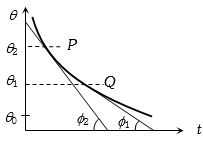
$A$ body cools in a surrounding which is at a constant temperature of $\theta_0$. Assume that it obeys Newton's law of cooling. Its temperature $\theta$ is plotted against time $t$. Tangents are drawn to the curve at the points $P(\theta = \theta_2)$ and $Q(\theta = \theta_1)$. These tangents meet the time axis at angles of $\varphi_2$ and $\varphi_1$,as shown in the figure.
A
$\frac{\tan \varphi_2}{\tan \varphi_1} = \frac{\theta_1 - \theta_0}{\theta_2 - \theta_0}$
B
$\frac{\tan \varphi_2}{\tan \varphi_1} = \frac{\theta_2 - \theta_0}{\theta_1 - \theta_0}$
C
$\frac{\tan \varphi_1}{\tan \varphi_2} = \frac{\theta_1}{\theta_2}$
D
$\frac{\tan \varphi_1}{\tan \varphi_2} = \frac{\theta_2}{\theta_1}$
Solution
(B) According to Newton's law of cooling,the rate of cooling is given by $\frac{d\theta}{dt} = -k(\theta - \theta_0)$,where $k$ is a positive constant.
In the $\theta-t$ graph,the slope of the tangent at any point is $\frac{d\theta}{dt}$. Since the curve is decreasing,the slope is negative. The angle $\varphi$ is the angle made by the tangent with the positive $t$-axis,so the slope is $-\tan \varphi$ (as the tangent makes an obtuse angle with the positive $t$-axis,or we consider the magnitude of the slope as $\tan \varphi$ where $\varphi$ is the angle with the negative $t$-axis direction).
At point $P$ where $\theta = \theta_2$,the magnitude of the slope is $\tan \varphi_2 = k(\theta_2 - \theta_0)$.
At point $Q$ where $\theta = \theta_1$,the magnitude of the slope is $\tan \varphi_1 = k(\theta_1 - \theta_0)$.
Dividing the two equations,we get: $\frac{\tan \varphi_2}{\tan \varphi_1} = \frac{k(\theta_2 - \theta_0)}{k(\theta_1 - \theta_0)} = \frac{\theta_2 - \theta_0}{\theta_1 - \theta_0}$.
In the $\theta-t$ graph,the slope of the tangent at any point is $\frac{d\theta}{dt}$. Since the curve is decreasing,the slope is negative. The angle $\varphi$ is the angle made by the tangent with the positive $t$-axis,so the slope is $-\tan \varphi$ (as the tangent makes an obtuse angle with the positive $t$-axis,or we consider the magnitude of the slope as $\tan \varphi$ where $\varphi$ is the angle with the negative $t$-axis direction).
At point $P$ where $\theta = \theta_2$,the magnitude of the slope is $\tan \varphi_2 = k(\theta_2 - \theta_0)$.
At point $Q$ where $\theta = \theta_1$,the magnitude of the slope is $\tan \varphi_1 = k(\theta_1 - \theta_0)$.
Dividing the two equations,we get: $\frac{\tan \varphi_2}{\tan \varphi_1} = \frac{k(\theta_2 - \theta_0)}{k(\theta_1 - \theta_0)} = \frac{\theta_2 - \theta_0}{\theta_1 - \theta_0}$.
0 likes
View Solution42
MediumMCQ
For a small temperature difference between the body and the surroundings,the relation between the rate of loss of heat $R$ and the temperature of the body $\theta$ is depicted by:
A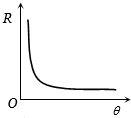
B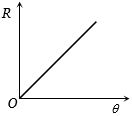
C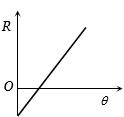
D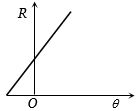
Solution
(C) According to Newton's law of cooling,for a small temperature difference between a body and its surroundings,the rate of loss of heat $R$ is directly proportional to the temperature difference $(\theta - \theta_0)$.
$R \propto (\theta - \theta_0)$
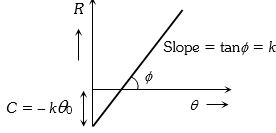
$R = k(\theta - \theta_0) = k\theta - k\theta_0$,where $k$ is a positive constant.
Comparing this with the equation of a straight line $y = mx + c$,where $y = R$,$x = \theta$,$m = k$ (slope),and $c = -k\theta_0$ (y-intercept).
Since $k$ and $\theta_0$ are positive,the intercept $c = -k\theta_0$ is negative.
Therefore,the graph is a straight line with a positive slope and a negative y-intercept,which corresponds to the graph shown in option $C$.
$R \propto (\theta - \theta_0)$
$R = k(\theta - \theta_0) = k\theta - k\theta_0$,where $k$ is a positive constant.
Comparing this with the equation of a straight line $y = mx + c$,where $y = R$,$x = \theta$,$m = k$ (slope),and $c = -k\theta_0$ (y-intercept).
Since $k$ and $\theta_0$ are positive,the intercept $c = -k\theta_0$ is negative.
Therefore,the graph is a straight line with a positive slope and a negative y-intercept,which corresponds to the graph shown in option $C$.
0 likes
View Solution43
DifficultMCQ
$A$ hollow copper sphere $S$ and a hollow copper cube $C$,both with negligible thin walls of the same surface area,are filled with water at $90^{\circ}C$ and allowed to cool in the same environment. The graph that correctly represents their cooling is:
A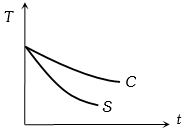
B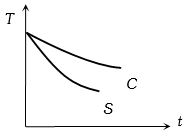
C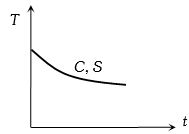
D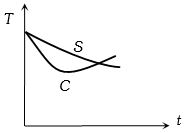
Solution
(A) According to Newton's law of cooling,the rate of loss of heat is given by $\frac{dQ}{dt} = \varepsilon A \sigma (T^4 - T_0^4) \approx \varepsilon A \sigma (4T_0^3) \Delta T$.
Since the rate of loss of heat is also $\frac{dQ}{dt} = mc \frac{dT}{dt}$,we have $mc \frac{dT}{dt} = \varepsilon A \sigma (4T_0^3) \Delta T$.
Thus,the rate of fall of temperature is $\frac{dT}{dt} = \frac{\varepsilon A \sigma 4T_0^3}{mc} \Delta T$.
For both the sphere and the cube,the surface area $A$ is the same. However,the volume $V$ of a sphere is less than the volume of a cube for the same surface area. Since the mass $m = \rho V$,the mass of water in the sphere is less than the mass of water in the cube $(m_S < m_C)$.
Since $\frac{dT}{dt} \propto \frac{1}{m}$,the rate of cooling is faster for the sphere $(S)$ than for the cube $(C)$.
Therefore,the temperature of the sphere drops faster than the temperature of the cube,which is represented by the graph where the curve for $S$ is steeper than the curve for $C$.
Since the rate of loss of heat is also $\frac{dQ}{dt} = mc \frac{dT}{dt}$,we have $mc \frac{dT}{dt} = \varepsilon A \sigma (4T_0^3) \Delta T$.
Thus,the rate of fall of temperature is $\frac{dT}{dt} = \frac{\varepsilon A \sigma 4T_0^3}{mc} \Delta T$.
For both the sphere and the cube,the surface area $A$ is the same. However,the volume $V$ of a sphere is less than the volume of a cube for the same surface area. Since the mass $m = \rho V$,the mass of water in the sphere is less than the mass of water in the cube $(m_S < m_C)$.
Since $\frac{dT}{dt} \propto \frac{1}{m}$,the rate of cooling is faster for the sphere $(S)$ than for the cube $(C)$.
Therefore,the temperature of the sphere drops faster than the temperature of the cube,which is represented by the graph where the curve for $S$ is steeper than the curve for $C$.
0 likes
View Solution44
MediumMCQ
The temperature of a liquid in a beaker at time $t$ is $\theta(t)$ and the temperature of the surroundings is $\theta_0$. According to Newton's law of cooling,which of the following is the correct graph between $\log_e(\theta - \theta_0)$ and $t$?
A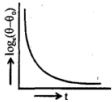
B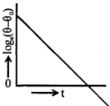
C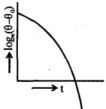
D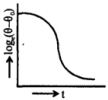
Solution
(B) According to Newton's law of cooling,the rate of change of temperature is proportional to the temperature difference between the body and its surroundings:
$\frac{d\theta}{dt} = -k(\theta - \theta_0)$
Rearranging the terms,we get:
$\frac{d\theta}{\theta - \theta_0} = -k dt$
Integrating both sides:
$\int \frac{d\theta}{\theta - \theta_0} = \int -k dt$
$\ln(\theta - \theta_0) = -kt + C$
This equation is of the form $y = mx + c$,where $y = \ln(\theta - \theta_0)$,$x = t$,$m = -k$ (a negative slope),and $c$ is the integration constant.
Therefore,the graph of $\log_e(\theta - \theta_0)$ versus $t$ is a straight line with a negative slope.
$\frac{d\theta}{dt} = -k(\theta - \theta_0)$
Rearranging the terms,we get:
$\frac{d\theta}{\theta - \theta_0} = -k dt$
Integrating both sides:
$\int \frac{d\theta}{\theta - \theta_0} = \int -k dt$
$\ln(\theta - \theta_0) = -kt + C$
This equation is of the form $y = mx + c$,where $y = \ln(\theta - \theta_0)$,$x = t$,$m = -k$ (a negative slope),and $c$ is the integration constant.
Therefore,the graph of $\log_e(\theta - \theta_0)$ versus $t$ is a straight line with a negative slope.
0 likes
View Solution45
MediumMCQ
According to Newton's law of cooling,the rate of cooling of a body is directly proportional to the ........
A
Temperature of the body
B
Temperature of the surroundings
C
Fourth power of the temperature of the body
D
Difference in temperature between the body and the surroundings
Solution
(D) Newton's law of cooling states that the rate of loss of heat $(dQ/dt)$ of a body is directly proportional to the difference in temperature between the body $(T)$ and its surroundings $(T_s)$,provided the difference is small.
Mathematically,$dQ/dt \propto (T - T_s)$.
Since the rate of cooling is defined as the rate of change of temperature $(dT/dt)$,it follows that $dT/dt \propto (T - T_s)$.
Therefore,the rate of cooling is directly proportional to the temperature difference between the body and the surroundings.
Mathematically,$dQ/dt \propto (T - T_s)$.
Since the rate of cooling is defined as the rate of change of temperature $(dT/dt)$,it follows that $dT/dt \propto (T - T_s)$.
Therefore,the rate of cooling is directly proportional to the temperature difference between the body and the surroundings.
0 likes
View Solution46
MediumMCQ
$A$ bucket full of hot water cools from $75^{\circ}C$ to $70^{\circ}C$ in time $T_1$,from $70^{\circ}C$ to $65^{\circ}C$ in time $T_2$,and from $65^{\circ}C$ to $60^{\circ}C$ in time $T_3$. Which of the following relations is correct?
A
$T_1 = T_2 = T_3$
B
$T_1 > T_2 > T_3$
C
$T_1 < T_2 < T_3$
D
$T_1 < T_3 < T_2$
Solution
(C) According to Newton's law of cooling,the rate of cooling is directly proportional to the temperature difference between the body and its surroundings: $-\frac{dT}{dt} = k(T - T_s)$.
As the temperature of the water decreases,the temperature difference between the water and the surroundings decreases.
Consequently,the rate of cooling decreases,meaning the time taken to cool by a specific temperature interval increases.
Since the initial temperature is highest for the first interval ($75^{\circ}C$ to $70^{\circ}C$),the rate of cooling is fastest,resulting in the shortest time $T_1$.
As the water cools further,the temperature difference becomes smaller,leading to slower cooling and longer time intervals.
Therefore,the relationship between the times is $T_1 < T_2 < T_3$.
As the temperature of the water decreases,the temperature difference between the water and the surroundings decreases.
Consequently,the rate of cooling decreases,meaning the time taken to cool by a specific temperature interval increases.
Since the initial temperature is highest for the first interval ($75^{\circ}C$ to $70^{\circ}C$),the rate of cooling is fastest,resulting in the shortest time $T_1$.
As the water cools further,the temperature difference becomes smaller,leading to slower cooling and longer time intervals.
Therefore,the relationship between the times is $T_1 < T_2 < T_3$.
0 likes
View Solution47
MediumMCQ
What is Newton's law of cooling used to determine in a laboratory?
A
Specific heat of a gas
B
Latent heat of a gas
C
Specific heat of a liquid
D
Latent heat of a liquid
Solution
(C) Newton's law of cooling states that the rate of loss of heat $dQ/dt$ of a body is directly proportional to the temperature difference between the body and its surroundings,i.e.,$dQ/dt = -k(\theta - \theta_0)$.
Since the rate of loss of heat is also given by $dQ/dt = -ms(d\theta/dt)$,where $m$ is the mass,$s$ is the specific heat,and $d\theta/dt$ is the rate of cooling.
By equating these,we get $-ms(d\theta/dt) = -k(\theta - \theta_0)$.
This relationship allows us to determine the specific heat capacity '$s$' of a liquid if the other parameters are known.
Since the rate of loss of heat is also given by $dQ/dt = -ms(d\theta/dt)$,where $m$ is the mass,$s$ is the specific heat,and $d\theta/dt$ is the rate of cooling.
By equating these,we get $-ms(d\theta/dt) = -k(\theta - \theta_0)$.
This relationship allows us to determine the specific heat capacity '$s$' of a liquid if the other parameters are known.
0 likes
View Solution48
MediumMCQ
Two metal spheres,one solid and one hollow,are heated to $300^{\circ}C$ and allowed to cool in the same environment. The rate of heat loss will be:
A
Greater for the hollow sphere
B
Greater for the solid sphere
C
Equal for both
D
None of these
Solution
(C) According to Newton's Law of Cooling,the rate of heat loss $(dQ/dt)$ is given by $dQ/dt = e \sigma A (T^4 - T_0^4)$,where $e$ is emissivity,$\sigma$ is the Stefan-Boltzmann constant,$A$ is the surface area,$T$ is the temperature of the body,and $T_0$ is the temperature of the surroundings.
Since both spheres are made of the same metal and are heated to the same temperature $T$ and placed in the same environment $T_0$,the rate of heat loss depends on the surface area $A$ and emissivity $e$.
If the spheres have the same radius,they have the same surface area $A = 4\pi r^2$.
Assuming the spheres have the same radius,the rate of heat loss will be the same for both,provided the emissivity is also the same.
Since both spheres are made of the same metal and are heated to the same temperature $T$ and placed in the same environment $T_0$,the rate of heat loss depends on the surface area $A$ and emissivity $e$.
If the spheres have the same radius,they have the same surface area $A = 4\pi r^2$.
Assuming the spheres have the same radius,the rate of heat loss will be the same for both,provided the emissivity is also the same.
0 likes
View Solution49
EasyMCQ
Newton's law of cooling is based upon which of the following principles?
A
Planck's law
B
Prevost's theory of heat exchange
C
Kirchhoff's law
D
Stefan-Boltzmann law
Solution
(D) Newton's law of cooling states that the rate of loss of heat of a body is directly proportional to the difference in temperature between the body and its surroundings,provided the difference is small.
This law is an empirical approximation derived from the Stefan-Boltzmann law,which describes the power radiated from a black body in terms of its temperature.
Specifically,when the temperature difference $\Delta T$ between the body and the surroundings is small,the Stefan-Boltzmann law can be linearized to show that the rate of cooling is proportional to $\Delta T$,which is the essence of Newton's law of cooling.
This law is an empirical approximation derived from the Stefan-Boltzmann law,which describes the power radiated from a black body in terms of its temperature.
Specifically,when the temperature difference $\Delta T$ between the body and the surroundings is small,the Stefan-Boltzmann law can be linearized to show that the rate of cooling is proportional to $\Delta T$,which is the essence of Newton's law of cooling.
0 likes
View Solution50
DifficultMCQ
$A$ suspended sphere has density $d$ and specific heat $s$. The radius of the sphere is $r$. The temperature difference between the sphere and the surroundings $(\Delta \theta)$ is very small. If the temperature of the surroundings is $\theta_0$,then the rate of cooling of the sphere will be .......
A
$\frac{4 \sigma \theta_0^3 \Delta \theta}{rds}$
B
$\frac{12 \sigma \theta_0^3 \Delta \theta}{rds}$
C
$\frac{4 \sigma \theta_0^4 \Delta \theta}{rds}$
D
$\frac{12 \sigma \theta \Delta \theta}{rds \theta_0^3}$
Solution
(B) According to Newton's law of cooling,the rate of heat loss is $\frac{dQ}{dt} = 4 \sigma A \theta_0^3 (\Delta \theta)$.
Since $\frac{dQ}{dt} = ms \left( -\frac{d\theta}{dt} \right)$,the rate of cooling is $-\frac{d\theta}{dt} = \frac{4 \sigma A \theta_0^3 (\Delta \theta)}{ms}$.
Here,mass $m = \text{Volume} \times \text{density} = (\frac{4}{3} \pi r^3) d$ and surface area $A = 4 \pi r^2$.
Substituting these values: $-\frac{d\theta}{dt} = \frac{4 \sigma (4 \pi r^2) \theta_0^3 (\Delta \theta)}{(\frac{4}{3} \pi r^3) d s}$.
Simplifying the expression: $-\frac{d\theta}{dt} = \frac{16 \pi r^2 \sigma \theta_0^3 (\Delta \theta)}{\frac{4}{3} \pi r^3 d s} = \frac{12 \sigma \theta_0^3 \Delta \theta}{rds}$.
Since $\frac{dQ}{dt} = ms \left( -\frac{d\theta}{dt} \right)$,the rate of cooling is $-\frac{d\theta}{dt} = \frac{4 \sigma A \theta_0^3 (\Delta \theta)}{ms}$.
Here,mass $m = \text{Volume} \times \text{density} = (\frac{4}{3} \pi r^3) d$ and surface area $A = 4 \pi r^2$.
Substituting these values: $-\frac{d\theta}{dt} = \frac{4 \sigma (4 \pi r^2) \theta_0^3 (\Delta \theta)}{(\frac{4}{3} \pi r^3) d s}$.
Simplifying the expression: $-\frac{d\theta}{dt} = \frac{16 \pi r^2 \sigma \theta_0^3 (\Delta \theta)}{\frac{4}{3} \pi r^3 d s} = \frac{12 \sigma \theta_0^3 \Delta \theta}{rds}$.
0 likes
View Solution10-2.Heat Transfer — Newton's Law of Cooling · Frequently Asked Questions
1Are these 10-2.Heat Transfer questions useful for JEE and NEET?
Yes. All questions in this section are mapped to JEE Main and NEET exam patterns. Previous year questions from JEE Main, NEET, GUJCET and state-level exams are included with full solutions.
2Can I switch to Hindi or Gujarati for these questions?
Yes. Use the language tabs in the hero section or the sidebar to view the same questions and solutions in English, Hindi or Gujarati.
3How do I generate a question paper from this subtopic?
Use the Vedclass Exam Paper Generator — select the chapter and subtopic, set difficulty, and generate Sets A, B, C, D automatically. First 3 chapters of every subject are free.
Vedclass Products
For Students
Vedclass Test Series
Mock tests in real JEE/NEET style with performance analysis. 5-day free trial.
Start Free TrialFor Teachers
Exam Paper Generator
Generate Set A/B/C/D papers from this chapter in 2 minutes. 3 chapters free.
Try FreeFor Institutes
Online Exam Module
Live online exams with unlimited students, 360° analytics & white-label branding.
See DemoFor Teachers & Institutes
Generate a 10-2.Heat Transfer Exam Paper in 2 Minutes
Select subtopic & difficulty — Sets A, B, C, D auto-generated with No Repeat logic.
First 3 chapters of every subject are free — no payment required.