
A English
Basic of Heat Transfer and Conduction Questions in English
Class 11 Physics · 10-2.Heat Transfer · Basic of Heat Transfer and Conduction
44+
Questions
English
Language
100%
With Solutions
Showing 44 of 44 questions in English
1
EasyMCQ
Under steady state,the temperature of a body
A
Increases with time
B
Decreases with time
C
Does not change with time and is same at all the points of the body
D
Does not change with time but is different at different points of the body
Solution
(D) In a steady state,the temperature at any given point within a body does not change with time.
This occurs because the rate of heat entering a specific region of the body is exactly equal to the rate of heat leaving that region.
However,the temperature can vary from one point to another within the body,depending on the thermal gradient and the distance from the heat source.
Therefore,the correct statement is that the temperature does not change with time but is different at different points of the body.
This occurs because the rate of heat entering a specific region of the body is exactly equal to the rate of heat leaving that region.
However,the temperature can vary from one point to another within the body,depending on the thermal gradient and the distance from the heat source.
Therefore,the correct statement is that the temperature does not change with time but is different at different points of the body.
0 likes
View Solution2
EasyMCQ
When two ends of a rod wrapped with cotton are maintained at different temperatures and after some time every point of the rod attains a constant temperature,then
A
Conduction of heat at different points of the rod stops because the temperature is not increasing
B
Rod is bad conductor of heat
C
Heat is being radiated from each point of the rod
D
Each point of the rod is giving heat to its neighbour at the same rate at which it is receiving heat
Solution
(D) When a rod reaches a steady state,the temperature at every point along the rod remains constant over time,meaning $\frac{dT}{dt} = 0$ for all points.
This does not mean heat flow has stopped; rather,it means that for any small cross-section of the rod,the rate of heat entering the section is exactly equal to the rate of heat leaving the section.
Therefore,each point of the rod is transferring heat to its neighbor at the same rate at which it is receiving heat from the previous point.
Thus,option $D$ is correct.
This does not mean heat flow has stopped; rather,it means that for any small cross-section of the rod,the rate of heat entering the section is exactly equal to the rate of heat leaving the section.
Therefore,each point of the rod is transferring heat to its neighbor at the same rate at which it is receiving heat from the previous point.
Thus,option $D$ is correct.
0 likes
View Solution3
EasyMCQ
$A$ piece of glass is heated to a high temperature and then allowed to cool. If it cracks,a probable reason for this is the following property of glass:
A
Low thermal conductivity
B
High thermal conductivity
C
High specific heat
D
High melting point
Solution
(A) When a piece of glass is heated or cooled rapidly,the surface temperature changes much faster than the interior temperature due to its low thermal conductivity.
This creates a temperature gradient within the material,leading to unequal expansion or contraction of its layers.
Since glass is a brittle material,these internal stresses exceed its structural limit,causing the glass to crack.
This creates a temperature gradient within the material,leading to unequal expansion or contraction of its layers.
Since glass is a brittle material,these internal stresses exceed its structural limit,causing the glass to crack.
0 likes
View Solution4
EasyMCQ
The temperature gradient in a rod of $0.5 \ m$ long is $80 \ ^oC/m$. If the temperature of the hotter end of the rod is $30 \ ^oC$,then the temperature of the cooler end is ...... $^oC$.
A
$40$
B
$-10$
C
$10$
D
$0$
Solution
(B) The temperature gradient is defined as the change in temperature per unit length,given by the formula: $\text{Temperature Gradient} = \frac{\theta_1 - \theta_2}{l}$.
Here,$\theta_1 = 30 \ ^oC$ is the temperature of the hotter end,$l = 0.5 \ m$ is the length of the rod,and the temperature gradient is $80 \ ^oC/m$.
Substituting the values into the formula:
$80 = \frac{30 - \theta_2}{0.5}$.
Multiplying both sides by $0.5$:
$80 \times 0.5 = 30 - \theta_2$.
$40 = 30 - \theta_2$.
Rearranging to solve for $\theta_2$:
$\theta_2 = 30 - 40 = -10 \ ^oC$.
Therefore,the temperature of the cooler end is $-10 \ ^oC$.
Here,$\theta_1 = 30 \ ^oC$ is the temperature of the hotter end,$l = 0.5 \ m$ is the length of the rod,and the temperature gradient is $80 \ ^oC/m$.
Substituting the values into the formula:
$80 = \frac{30 - \theta_2}{0.5}$.
Multiplying both sides by $0.5$:
$80 \times 0.5 = 30 - \theta_2$.
$40 = 30 - \theta_2$.
Rearranging to solve for $\theta_2$:
$\theta_2 = 30 - 40 = -10 \ ^oC$.
Therefore,the temperature of the cooler end is $-10 \ ^oC$.
0 likes
View Solution5
EasyMCQ
Snow is more heat insulating than ice,because
A
Air is trapped in the pores of snow.
B
Ice is a worse conductor than snow.
C
Air is trapped in the pores of ice.
D
The density of ice is higher.
Solution
(A) Snow consists of fine ice crystals with a large amount of air trapped between them. Since air is a very poor conductor of heat (an insulator),the presence of trapped air makes snow a much better heat insulator than solid ice,which lacks these air pockets. Therefore,the correct reason is that air is trapped in the pores of snow.
0 likes
View Solution6
EasyMCQ
Two thin blankets keep more warmth than one blanket of thickness equal to these two. The reason is
A
Their surface area increases
B
$A$ layer of air is formed between these two blankets,which is a bad conductor
C
These have more wool
D
They absorb more heat from outside
Solution
(B) Two thin blankets are usually warmer than one thick blanket because air is trapped between them.
Air is a bad conductor of heat.
This trapped layer of air prevents the transfer of heat from our body to the surroundings,thereby keeping us warmer.
Air is a bad conductor of heat.
This trapped layer of air prevents the transfer of heat from our body to the surroundings,thereby keeping us warmer.
0 likes
View Solution7
EasyMCQ
The quantity of heat which crosses unit area of a metal plate during conduction depends upon
A
The density of the metal
B
The temperature gradient perpendicular to the area
C
The temperature to which the metal is heated
D
The area of the metal plate
Solution
(B) According to Fourier's law of heat conduction,the rate of heat flow $\frac{dQ}{dt}$ through a material is given by the formula: $\frac{dQ}{dt} = -KA \frac{d\theta}{dx}$.
Here,$K$ is the thermal conductivity,$A$ is the area,and $\frac{d\theta}{dx}$ is the temperature gradient.
For a unit area $(A = 1)$,the quantity of heat crossing the area per unit time is proportional to the temperature gradient $\frac{d\theta}{dx}$ perpendicular to the surface.
Therefore,the correct option is $B$.
Here,$K$ is the thermal conductivity,$A$ is the area,and $\frac{d\theta}{dx}$ is the temperature gradient.
For a unit area $(A = 1)$,the quantity of heat crossing the area per unit time is proportional to the temperature gradient $\frac{d\theta}{dx}$ perpendicular to the surface.
Therefore,the correct option is $B$.
0 likes
View Solution8
MediumMCQ
The temperature of the hot and cold ends of a $20 \ cm$ long rod in a thermal steady state are at $100^\circ C$ and $20^\circ C$ respectively. The temperature at the centre of the rod is ...... $^\circ C$.
A
$50$
B
$60$
C
$40$
D
$30$
Solution
(B) In a thermal steady state,the temperature gradient along a uniform rod is constant.
The temperature gradient is given by: $\frac{dT}{dx} = \frac{T_{hot} - T_{cold}}{L} = \frac{100^\circ C - 20^\circ C}{20 \ cm} = \frac{80}{20} = 4^\circ C/cm$.
The temperature at any distance $x$ from the hot end is given by $T(x) = T_{hot} - (\text{gradient} \times x)$.
At the centre of the rod,$x = 10 \ cm$.
Therefore,$T(10) = 100^\circ C - (4^\circ C/cm \times 10 \ cm) = 100^\circ C - 40^\circ C = 60^\circ C$.
The temperature gradient is given by: $\frac{dT}{dx} = \frac{T_{hot} - T_{cold}}{L} = \frac{100^\circ C - 20^\circ C}{20 \ cm} = \frac{80}{20} = 4^\circ C/cm$.
The temperature at any distance $x$ from the hot end is given by $T(x) = T_{hot} - (\text{gradient} \times x)$.
At the centre of the rod,$x = 10 \ cm$.
Therefore,$T(10) = 100^\circ C - (4^\circ C/cm \times 10 \ cm) = 100^\circ C - 40^\circ C = 60^\circ C$.
0 likes
View Solution9
MediumMCQ
For heat to flow from one end to the other in a solid,it is necessary to have:
A
Uniform density
B
Density gradient
C
Temperature gradient
D
Uniform temperature
Solution
(C) Heat always flows from a region of higher temperature to a region of lower temperature.
Therefore,for heat to flow from one end of a solid to the other,there must be a difference in temperature along its length,which is known as a temperature gradient.
Therefore,for heat to flow from one end of a solid to the other,there must be a difference in temperature along its length,which is known as a temperature gradient.
0 likes
View Solution10
EasyMCQ
The heat is flowing through a rod of length $50 \ cm$ and area of cross-section $5 \ cm^2$. Its ends are respectively at $25^\circ C$ and $125^\circ C$. The coefficient of thermal conductivity of the material of the rod is $0.092 \ kcal/m \cdot s \cdot ^\circ C$. The temperature gradient in the rod is
A
$2^\circ C/cm$
B
$2^\circ C/m$
C
$20^\circ C/cm$
D
$20^\circ C/m$
Solution
(A) The temperature gradient is defined as the rate of change of temperature with respect to distance along the rod.
It is given by the formula: $\text{Temperature gradient} = \frac{\Delta T}{\Delta x}$.
Here,the temperature difference $\Delta T = 125^\circ C - 25^\circ C = 100^\circ C$.
The length of the rod $\Delta x = 50 \ cm$.
Therefore,the temperature gradient $= \frac{100^\circ C}{50 \ cm} = 2^\circ C/cm$.
It is given by the formula: $\text{Temperature gradient} = \frac{\Delta T}{\Delta x}$.
Here,the temperature difference $\Delta T = 125^\circ C - 25^\circ C = 100^\circ C$.
The length of the rod $\Delta x = 50 \ cm$.
Therefore,the temperature gradient $= \frac{100^\circ C}{50 \ cm} = 2^\circ C/cm$.
0 likes
View Solution11
EasyMCQ
Woollen clothes are used in winter season because woolen clothes
A
Are good sources for producing heat
B
Absorb heat from surroundings
C
Are bad conductors of heat
D
Provide heat to body continuously
Solution
(C) The correct option is $C$.
In winter,the ambient temperature is significantly lower than the human body temperature (approximately $37.4 ^\circ C$).
Woolen clothes contain a large amount of trapped air between their fibers.
Since air is a very poor conductor of heat and wool itself is a bad conductor,these clothes act as an insulator.
This prevents the heat generated by the human body from escaping into the colder surroundings,thereby keeping the body warm.
In winter,the ambient temperature is significantly lower than the human body temperature (approximately $37.4 ^\circ C$).
Woolen clothes contain a large amount of trapped air between their fibers.
Since air is a very poor conductor of heat and wool itself is a bad conductor,these clothes act as an insulator.
This prevents the heat generated by the human body from escaping into the colder surroundings,thereby keeping the body warm.
0 likes
View Solution12
EasyMCQ
If a liquid is heated in weightlessness,the heat is transmitted through
A
Conduction
B
Convection
C
Radiation
D
Neither,because the liquid cannot be heated in weightlessness
Solution
(A) Convection occurs due to the difference in density caused by gravity,where warmer,less dense fluid rises and cooler,denser fluid sinks.
In a state of weightlessness,there is no effective gravity to create these buoyancy-driven currents.
Therefore,convection is not possible.
Heat transfer in the liquid will occur primarily through conduction.
In a state of weightlessness,there is no effective gravity to create these buoyancy-driven currents.
Therefore,convection is not possible.
Heat transfer in the liquid will occur primarily through conduction.
0 likes
View Solution13
MediumMCQ
Ice starts forming in a lake with water at $0^{\circ}C$ when the atmospheric temperature is $-10^{\circ}C$. If the time taken for $1 \; cm$ of ice to form is $7$ hours,then the time taken for the thickness of ice to change from $1 \; cm$ to $2 \; cm$ is:
A
$7$ hours
B
$14$ hours
C
Less than $7$ hours
D
More than $7$ hours
Solution
(D) The rate of formation of ice of thickness $x$ is given by $\frac{dx}{dt} = \frac{K \theta}{\rho L x}$,where $K$ is thermal conductivity,$\rho$ is density,$L$ is latent heat,and $\theta$ is the temperature difference.
Integrating this,the time $t$ taken to grow from thickness $x_1$ to $x_2$ is $t = \frac{\rho L}{2K\theta} (x_2^2 - x_1^2)$.
This implies $t \propto (x_2^2 - x_1^2)$.
For the first $1 \; cm$ ($0$ to $1 \; cm$): $7 \propto (1^2 - 0^2) = 1$.
For the next $1 \; cm$ ($1 \; cm$ to $2 \; cm$): $t' \propto (2^2 - 1^2) = 4 - 1 = 3$.
Comparing the two,$\frac{t'}{7} = \frac{3}{1}$,which gives $t' = 21$ hours.
Since $21 > 7$,the time taken is more than $7$ hours.
Integrating this,the time $t$ taken to grow from thickness $x_1$ to $x_2$ is $t = \frac{\rho L}{2K\theta} (x_2^2 - x_1^2)$.
This implies $t \propto (x_2^2 - x_1^2)$.
For the first $1 \; cm$ ($0$ to $1 \; cm$): $7 \propto (1^2 - 0^2) = 1$.
For the next $1 \; cm$ ($1 \; cm$ to $2 \; cm$): $t' \propto (2^2 - 1^2) = 4 - 1 = 3$.
Comparing the two,$\frac{t'}{7} = \frac{3}{1}$,which gives $t' = 21$ hours.
Since $21 > 7$,the time taken is more than $7$ hours.
0 likes
View Solution14
MediumMCQ
Heat is flowing through a conductor of length $l$ from $x = 0$ to $x = l$. If its thermal resistance per unit length is uniform,which of the following graphs correctly represents the variation of temperature $T$ with distance $x$?
A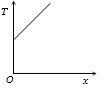
B
C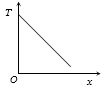
D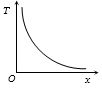
Solution
(C) The rate of heat flow through a conductor is given by Fourier's law of heat conduction:
$\frac{dQ}{dt} = -KA \frac{dT}{dx}$
Since the heat flow rate $\frac{dQ}{dt}$,thermal conductivity $K$,and cross-sectional area $A$ are constants for a uniform conductor,we have:
$\frac{dT}{dx} = -\frac{1}{KA} \frac{dQ}{dt} = \text{constant}$
This implies that the temperature gradient $\frac{dT}{dx}$ is constant.
Integrating this expression,we get $T(x) = -mx + c$,where $m$ is a positive constant.
This represents a linear decrease in temperature with respect to distance $x$. Therefore,the graph of $T$ versus $x$ is a straight line with a negative slope,which corresponds to Graph $C$.
$\frac{dQ}{dt} = -KA \frac{dT}{dx}$
Since the heat flow rate $\frac{dQ}{dt}$,thermal conductivity $K$,and cross-sectional area $A$ are constants for a uniform conductor,we have:
$\frac{dT}{dx} = -\frac{1}{KA} \frac{dQ}{dt} = \text{constant}$
This implies that the temperature gradient $\frac{dT}{dx}$ is constant.
Integrating this expression,we get $T(x) = -mx + c$,where $m$ is a positive constant.
This represents a linear decrease in temperature with respect to distance $x$. Therefore,the graph of $T$ versus $x$ is a straight line with a negative slope,which corresponds to Graph $C$.
0 likes
View Solution15
EasyMCQ
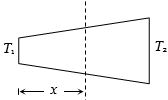
The radius of a conductor increases uniformly from the left end to the right end as shown in the figure. The material of the conductor is isotropic,and its curved surface is thermally isolated from the surroundings. Its ends are maintained at temperatures $T_1$ and $T_2$ $(T_1 > T_2)$. If,in a steady state,the heat flow rate is equal to $H$,then which of the following graphs is correct?
A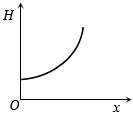
B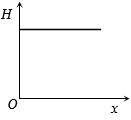
C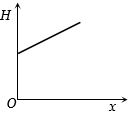
D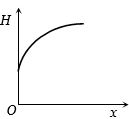
Solution
(B) In a steady state,the rate of heat flow $(H)$ through any cross-section of a conductor is constant,provided there is no heat loss from the curved surface. Since the problem states that the curved surface is thermally isolated from the surroundings,no heat escapes through the sides. Therefore,the heat flow rate $H$ remains the same at every cross-section along the length of the conductor. Consequently,the graph of $H$ versus $x$ will be a straight line parallel to the $x$-axis.
0 likes
View Solution16
EasyMCQ
When the two ends of a metal rod are maintained at different temperatures and after some time every point of the rod attains a constant temperature,then:
A
Heat is conducted through different points of the rod because the temperature does not increase.
B
The rod is a poor conductor of heat.
C
Heat is radiated from every point of the rod.
D
Every point conducts the same amount of heat to its neighboring point at a constant rate.
Solution
(D) When a rod reaches a steady state,the temperature at every point along the rod remains constant over time,meaning $\frac{dT}{dt} = 0$. In this state,the amount of heat entering any cross-section of the rod per unit time must equal the amount of heat leaving it. Therefore,every point conducts the same amount of heat to its neighboring point at a constant rate.
0 likes
View Solution17
EasyMCQ
In the steady state,the temperature of a body ...
A
increases with time.
B
decreases with time.
C
does not change with time and remains the same at all points of the body.
D
does not change with time but is different at different points of the body.
Solution
(D) In the steady state,the temperature at any given point within a body does not change with time because the rate of heat flow into that point is equal to the rate of heat flow out of that point.
However,the temperature can vary from one point to another within the body depending on the thermal gradient and the boundary conditions.
Therefore,the temperature is independent of time but dependent on the position within the body.
However,the temperature can vary from one point to another within the body depending on the thermal gradient and the boundary conditions.
Therefore,the temperature is independent of time but dependent on the position within the body.
0 likes
View Solution18
MediumMCQ
Heat flows through a long metallic rod from one end to the other under steady-state conditions. The variation of temperature $\theta$ with distance $x$ from the hot end is shown in which of the following graphs?
A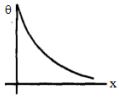
B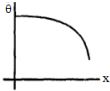
C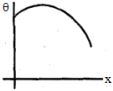
D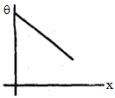
Solution
(D) Under steady-state conditions,the rate of heat flow $H$ through a rod is constant and is given by the formula:
$H = \frac{KA(T_1 - T_2)}{L} = \frac{KA(T_1 - T_x)}{x}$
where $T_1$ is the temperature at the hot end $(x=0)$,$T_2$ is the temperature at the cold end $(x=L)$,and $T_x$ is the temperature at distance $x$.
Rearranging the equation for $T_x$:
$T_x = T_1 - \left( \frac{T_1 - T_2}{L} \right) x$
This is a linear equation of the form $y = mx + c$,where the slope $m = -\frac{T_1 - T_2}{L}$ is negative and constant.
Therefore,the temperature $\theta$ decreases linearly with distance $x$,which corresponds to a straight line with a negative slope.
$H = \frac{KA(T_1 - T_2)}{L} = \frac{KA(T_1 - T_x)}{x}$
where $T_1$ is the temperature at the hot end $(x=0)$,$T_2$ is the temperature at the cold end $(x=L)$,and $T_x$ is the temperature at distance $x$.
Rearranging the equation for $T_x$:
$T_x = T_1 - \left( \frac{T_1 - T_2}{L} \right) x$
This is a linear equation of the form $y = mx + c$,where the slope $m = -\frac{T_1 - T_2}{L}$ is negative and constant.
Therefore,the temperature $\theta$ decreases linearly with distance $x$,which corresponds to a straight line with a negative slope.
0 likes
View Solution19
EasyMCQ
Heat flows through a rod of length $50 \ cm$ and cross-sectional area $5 \ cm^{2}$. Its ends are maintained at $25 \ ^\circ C$ and $125 \ ^\circ C$ respectively. The thermal conductivity of the material of the rod is $0.092 \ kcal/m \cdot s \cdot ^\circ C$. The temperature gradient of the rod is ....... $^\circ C/cm$.
A
$2$
B
$0.2$
C
$2.5$
D
$20$
Solution
(A) The temperature gradient is defined as the change in temperature per unit length of the rod.
It is given by the formula: $\text{Temperature Gradient} = \frac{\Delta \theta}{\Delta x}$
Where $\Delta \theta = \theta_2 - \theta_1 = 125 \ ^\circ C - 25 \ ^\circ C = 100 \ ^\circ C$.
And the length of the rod $\Delta x = 50 \ cm$.
Therefore,$\text{Temperature Gradient} = \frac{100 \ ^\circ C}{50 \ cm} = 2 \ ^\circ C/cm$.
It is given by the formula: $\text{Temperature Gradient} = \frac{\Delta \theta}{\Delta x}$
Where $\Delta \theta = \theta_2 - \theta_1 = 125 \ ^\circ C - 25 \ ^\circ C = 100 \ ^\circ C$.
And the length of the rod $\Delta x = 50 \ cm$.
Therefore,$\text{Temperature Gradient} = \frac{100 \ ^\circ C}{50 \ cm} = 2 \ ^\circ C/cm$.
0 likes
View Solution20
MediumMCQ
$A$ rod of length $50 \, cm$ has one end at $25^oC$ and the other end at $125^oC$. The temperature gradient is ....... $^oC/cm$.
A
$2$
B
$3$
C
$20$
D
$10$
Solution
(A) The temperature gradient is defined as the rate of change of temperature with respect to distance.
Temperature gradient $= \frac{\Delta \theta}{\Delta x} = \frac{\theta_2 - \theta_1}{\Delta x}$
Given: $\Delta \theta = 125^oC - 25^oC = 100^oC$ and $\Delta x = 50 \, cm$.
Temperature gradient $= \frac{100}{50} = 2 \, ^oC/cm$.
Temperature gradient $= \frac{\Delta \theta}{\Delta x} = \frac{\theta_2 - \theta_1}{\Delta x}$
Given: $\Delta \theta = 125^oC - 25^oC = 100^oC$ and $\Delta x = 50 \, cm$.
Temperature gradient $= \frac{100}{50} = 2 \, ^oC/cm$.
0 likes
View Solution21
DifficultMCQ
If it takes $7 \, h$ to form a $1 \, cm$ thick layer of ice on a pond at $0^o C$,how many hours will it take for the thickness of the ice layer to increase from $1 \, cm$ to $2 \, cm$?
A
$7$
B
$14$
C
$3.5$
D
$21$
Solution
(D) The time $t$ required for the thickness of an ice layer to increase from $y_1$ to $y_2$ is given by the formula: $t = \frac{\rho L}{2K\theta} (y_2^2 - y_1^2)$.
For the first layer ($0 \, cm$ to $1 \, cm$):
$t_1 = C(1^2 - 0^2) = C(1) = 7 \, h$,where $C = \frac{\rho L}{2K\theta}$.
For the second layer ($1 \, cm$ to $2 \, cm$):
$t_2 = C(2^2 - 1^2) = C(4 - 1) = 3C$.
Since $C = 7 \, h$,we have:
$t_2 = 3 \times 7 = 21 \, h$.
For the first layer ($0 \, cm$ to $1 \, cm$):
$t_1 = C(1^2 - 0^2) = C(1) = 7 \, h$,where $C = \frac{\rho L}{2K\theta}$.
For the second layer ($1 \, cm$ to $2 \, cm$):
$t_2 = C(2^2 - 1^2) = C(4 - 1) = 3C$.
Since $C = 7 \, h$,we have:
$t_2 = 3 \times 7 = 21 \, h$.
0 likes
View Solution22
MediumMCQ
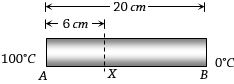
In a steady state of thermal conduction,the temperatures of the ends $A$ and $B$ of a $20 \, cm$ long rod are $100^\circ C$ and $0^\circ C$ respectively. What will be the temperature of the rod at a point at a distance of $6 \, cm$ from the end $A$ of the rod (in $^\circ C$)?
A
$70$
B
$30$
C
$50$
D
$40$
Solution
(A) In a steady state of thermal conduction,the temperature gradient along the rod is constant.
Let $\theta_A = 100^\circ C$ be the temperature at end $A$ and $\theta_B = 0^\circ C$ be the temperature at end $B$.
The total length of the rod is $L = 20 \, cm$.
Let $\theta_x$ be the temperature at a point $x = 6 \, cm$ from end $A$.
The temperature gradient is given by $\frac{\theta_A - \theta_x}{x} = \frac{\theta_A - \theta_B}{L}$.
Substituting the given values:
$\frac{100 - \theta_x}{6} = \frac{100 - 0}{20}$
$\frac{100 - \theta_x}{6} = \frac{100}{20}$
$100 - \theta_x = 5 \times 6$
$100 - \theta_x = 30$
$\theta_x = 100 - 30 = 70^\circ C$.
Thus,the temperature at the point is $70^\circ C$.
Let $\theta_A = 100^\circ C$ be the temperature at end $A$ and $\theta_B = 0^\circ C$ be the temperature at end $B$.
The total length of the rod is $L = 20 \, cm$.
Let $\theta_x$ be the temperature at a point $x = 6 \, cm$ from end $A$.
The temperature gradient is given by $\frac{\theta_A - \theta_x}{x} = \frac{\theta_A - \theta_B}{L}$.
Substituting the given values:
$\frac{100 - \theta_x}{6} = \frac{100 - 0}{20}$
$\frac{100 - \theta_x}{6} = \frac{100}{20}$
$100 - \theta_x = 5 \times 6$
$100 - \theta_x = 30$
$\theta_x = 100 - 30 = 70^\circ C$.
Thus,the temperature at the point is $70^\circ C$.
0 likes
View Solution23
EasyMCQ
Four rods of silver,copper,brass,and wood are of the same shape. They are heated together after wrapping a paper on each. The paper will burn first on:
A
Silver
B
Copper
C
Brass
D
Wood
Solution
(D) The rate of heat transfer through a rod depends on its thermal conductivity $(K)$.
Silver,copper,and brass are metals with high thermal conductivity,meaning they conduct heat away from the paper rapidly,preventing the paper from reaching its ignition temperature quickly.
Wood is an insulator with very low thermal conductivity.
Because wood does not conduct heat away from the surface,the heat supplied to the paper remains localized at the point of contact.
Therefore,the paper wrapped around the wooden rod will reach its ignition temperature first and burn.
Silver,copper,and brass are metals with high thermal conductivity,meaning they conduct heat away from the paper rapidly,preventing the paper from reaching its ignition temperature quickly.
Wood is an insulator with very low thermal conductivity.
Because wood does not conduct heat away from the surface,the heat supplied to the paper remains localized at the point of contact.
Therefore,the paper wrapped around the wooden rod will reach its ignition temperature first and burn.
0 likes
View Solution24
EasyMCQ
$A$ thermocouple is an arrangement of two different metals to :-
A
convert heat energy into electrical energy
B
produce more heat
C
convert heat energy into chemical energy
D
convert electrical energy into heat energy
Solution
(A) thermocouple is a device consisting of two dissimilar electrical conductors forming an electrical junction. $A$ thermocouple produces a temperature-dependent voltage as a result of the Seebeck effect,which is a form of converting heat energy into electrical energy. This voltage can be interpreted to measure temperature.
0 likes
View Solution25
MediumMCQ
End $A$ of a copper rod is maintained in a steam chamber at $100\,^{\circ}C$ and the other end $B$ is maintained at $0\,^{\circ}C$. Assuming $x = 0$ at $A$,the $T-x$ graph in steady state will be:
A
B
C
D
Solution
(A) In the steady state,the rate of heat flow $Q$ through a rod of cross-sectional area $A$ and thermal conductivity $K$ is given by Fourier's law of heat conduction:
$Q = -KA \frac{dT}{dx}$
Since the rod is uniform and in a steady state,$Q$,$K$,and $A$ are constants.
Therefore,$\frac{dT}{dx} = -\frac{Q}{KA} = \text{constant}$.
This implies that the temperature gradient is constant throughout the rod.
$A$ constant negative slope indicates a straight line starting from $T = 100\,^{\circ}C$ at $x = 0$ and decreasing linearly to $T = 0\,^{\circ}C$ at the other end $B$.
$Q = -KA \frac{dT}{dx}$
Since the rod is uniform and in a steady state,$Q$,$K$,and $A$ are constants.
Therefore,$\frac{dT}{dx} = -\frac{Q}{KA} = \text{constant}$.
This implies that the temperature gradient is constant throughout the rod.
$A$ constant negative slope indicates a straight line starting from $T = 100\,^{\circ}C$ at $x = 0$ and decreasing linearly to $T = 0\,^{\circ}C$ at the other end $B$.
0 likes
View Solution26
EasyMCQ
$Assertion :$ Woolen clothes keep the body warm in winter.
$Reason :$ Air is a bad conductor of heat.
$Reason :$ Air is a bad conductor of heat.
A
If both Assertion and Reason are correct and the Reason is a correct explanation of the Assertion.
B
If both Assertion and Reason are correct but Reason is not a correct explanation of the Assertion.
C
If the Assertion is correct but Reason is incorrect.
D
If both the Assertion and Reason are incorrect.
Solution
(A) Woolen clothes have a porous structure that traps air between the fibers.
Since air is a bad conductor of heat,it prevents the heat from the human body from escaping into the cold surroundings.
Therefore,the trapped air acts as an insulator,keeping the body warm in winter.
Both the Assertion and the Reason are correct,and the Reason is the correct explanation for the Assertion.
Since air is a bad conductor of heat,it prevents the heat from the human body from escaping into the cold surroundings.
Therefore,the trapped air acts as an insulator,keeping the body warm in winter.
Both the Assertion and the Reason are correct,and the Reason is the correct explanation for the Assertion.
0 likes
View Solution27
EasyMCQ
$Assertion:$ Two thin blankets put together are warmer than a single blanket of double the thickness.
$Reason:$ Thickness increases because of the air layer enclosed between the two blankets.
$Reason:$ Thickness increases because of the air layer enclosed between the two blankets.
A
If both $Assertion$ and $Reason$ are correct and the $Reason$ is a correct explanation of the $Assertion$.
B
If both $Assertion$ and $Reason$ are correct but $Reason$ is not a correct explanation of the $Assertion$.
C
If the $Assertion$ is correct but $Reason$ is incorrect.
D
If both the $Assertion$ and $Reason$ are incorrect.
Solution
(A) When two thin blankets are placed together,a layer of air is trapped between them.
Since air is a very poor conductor of heat (a good insulator),this trapped air layer prevents the heat from the body from escaping to the surroundings.
Therefore,the combination of two thin blankets provides better insulation and warmth compared to a single thick blanket of the same total thickness,as the air layer acts as an additional thermal barrier.
Since air is a very poor conductor of heat (a good insulator),this trapped air layer prevents the heat from the body from escaping to the surroundings.
Therefore,the combination of two thin blankets provides better insulation and warmth compared to a single thick blanket of the same total thickness,as the air layer acts as an additional thermal barrier.
0 likes
View Solution28
Medium
What is heat transfer? Give its types.
Solution
(N/A) Heat is a form of energy.
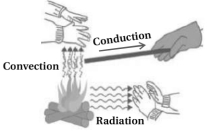
Heat transfer is the process of energy transfer from one system to another,or from one part of a system to another,arising due to a temperature difference.
Thus,the movement of heat within a substance or between substances is called heat transfer.
There are $3$ distinct modes of heat transfer:
$(1)$ Conduction: Heat transfer in solids,where energy is transferred through molecular collisions without the actual movement of matter.
$(2)$ Convection: Heat transfer in fluids (liquids and gases),which involves the actual movement of the heated particles of the fluid.
$(3)$ Radiation: Heat transfer that does not require any material medium; it occurs through electromagnetic waves.
Heat transfer is the process of energy transfer from one system to another,or from one part of a system to another,arising due to a temperature difference.
Thus,the movement of heat within a substance or between substances is called heat transfer.
There are $3$ distinct modes of heat transfer:
$(1)$ Conduction: Heat transfer in solids,where energy is transferred through molecular collisions without the actual movement of matter.
$(2)$ Convection: Heat transfer in fluids (liquids and gases),which involves the actual movement of the heated particles of the fluid.
$(3)$ Radiation: Heat transfer that does not require any material medium; it occurs through electromagnetic waves.
0 likes
View Solution29
Easy
Write the definition of thermal conduction and explain thermal conduction in solid bodies.
Solution
(N/A) Thermal Conduction: Conduction is the mechanism of heat transfer between two adjacent parts of a body due to a temperature difference between them.
In solid bodies,thermal conduction occurs primarily through two mechanisms: the vibration of atoms or molecules about their mean positions and the movement of free electrons.
When one end of a metallic rod is placed in a flame,the atoms at that end gain kinetic energy and vibrate more vigorously. These vibrations are passed on to neighboring atoms through intermolecular forces,effectively transferring energy along the rod.
In metals,the presence of a large number of free electrons significantly enhances this process. These electrons gain energy at the hot end and move rapidly toward the cooler end,colliding with atoms and transferring energy,which makes metals excellent thermal conductors.
Gases are generally poor thermal conductors,while liquids have thermal conductivities intermediate between solids and gases.
In solid bodies,thermal conduction occurs primarily through two mechanisms: the vibration of atoms or molecules about their mean positions and the movement of free electrons.
When one end of a metallic rod is placed in a flame,the atoms at that end gain kinetic energy and vibrate more vigorously. These vibrations are passed on to neighboring atoms through intermolecular forces,effectively transferring energy along the rod.
In metals,the presence of a large number of free electrons significantly enhances this process. These electrons gain energy at the hot end and move rapidly toward the cooler end,colliding with atoms and transferring energy,which makes metals excellent thermal conductors.
Gases are generally poor thermal conductors,while liquids have thermal conductivities intermediate between solids and gases.
0 likes
View Solution30
Medium
Write a note on a double-walled flask or a thermos.
Solution
(N/A) double-walled flask or thermos bottle is an arrangement designed to minimize heat exchange between the surroundings and the system inside it. It consists of a cylindrical glass vessel with two walls.
$1$. $A$ silver coating is applied to both the inner and outer surfaces of these walls.
$2$. The inner silvered wall reflects thermal radiation back into the system,preventing heat loss.
$3$. The outer silvered wall reflects incoming thermal radiation from the surroundings,preventing heat gain.
$4$. The space between the two walls is evacuated (vacuum),which effectively eliminates heat transfer via conduction and convection.
$5$. The flask is sealed with an airtight insulating cork to prevent heat loss through evaporation or air circulation.
$6$. Consequently,the substance inside remains at its initial temperature (hot or cold) for an extended period.
$1$. $A$ silver coating is applied to both the inner and outer surfaces of these walls.
$2$. The inner silvered wall reflects thermal radiation back into the system,preventing heat loss.
$3$. The outer silvered wall reflects incoming thermal radiation from the surroundings,preventing heat gain.
$4$. The space between the two walls is evacuated (vacuum),which effectively eliminates heat transfer via conduction and convection.
$5$. The flask is sealed with an airtight insulating cork to prevent heat loss through evaporation or air circulation.
$6$. Consequently,the substance inside remains at its initial temperature (hot or cold) for an extended period.
0 likes
View Solution31
Medium
What is heat transfer? Write its modes. In which mode,medium is not required?
Solution
(N/A) Heat transfer is the process of movement of thermal energy from a body at a higher temperature to a body at a lower temperature due to the temperature difference between them.
There are three modes of heat transfer:
$1$. Conduction: Heat transfer through a solid medium without the actual movement of particles.
$2$. Convection: Heat transfer through fluids (liquids and gases) involving the actual movement of particles.
$3$. Radiation: Heat transfer through electromagnetic waves.
Radiation is the mode of heat transfer that does not require any material medium for propagation.
There are three modes of heat transfer:
$1$. Conduction: Heat transfer through a solid medium without the actual movement of particles.
$2$. Convection: Heat transfer through fluids (liquids and gases) involving the actual movement of particles.
$3$. Radiation: Heat transfer through electromagnetic waves.
Radiation is the mode of heat transfer that does not require any material medium for propagation.
0 likes
View Solution32
Easy
Define heat transfer in solids.
Solution
(N/A) Heat transfer in solids occurs primarily through the process of $Conduction$.
In this process,heat energy is transferred from one part of a solid to another,or from one solid to another in physical contact,without the actual movement of the constituent particles (atoms or molecules) from their equilibrium positions.
Instead,the energy is transferred through molecular vibrations and the movement of free electrons (in metals),where higher-energy particles collide with their neighbors,transferring kinetic energy to them.
In this process,heat energy is transferred from one part of a solid to another,or from one solid to another in physical contact,without the actual movement of the constituent particles (atoms or molecules) from their equilibrium positions.
Instead,the energy is transferred through molecular vibrations and the movement of free electrons (in metals),where higher-energy particles collide with their neighbors,transferring kinetic energy to them.
0 likes
View Solution33
Medium
What is thermal steady state?
Solution
(N/A) Thermal steady state is a condition in heat transfer where the temperature at every point within a body remains constant over time.
In this state,although heat continues to flow through the material,the temperature at any given point does not change because the rate of heat entering the point is exactly equal to the rate of heat leaving it.
Mathematically,this implies that $\frac{dT}{dt} = 0$ for every point in the system,where $T$ is the temperature and $t$ is time.
In this state,although heat continues to flow through the material,the temperature at any given point does not change because the rate of heat entering the point is exactly equal to the rate of heat leaving it.
Mathematically,this implies that $\frac{dT}{dt} = 0$ for every point in the system,where $T$ is the temperature and $t$ is time.
0 likes
View Solution34
MediumMCQ
Why are snow particles poorer conductors of heat than ice?
A
Snow contains trapped air which is a poor conductor of heat.
B
Ice is denser than snow.
C
Snow has a higher melting point.
D
Ice has a higher thermal conductivity due to its crystalline structure.
Solution
(A) Snow consists of fine ice crystals with a large amount of air trapped between them. Since air is a very poor conductor of heat,the presence of these air pockets makes snow a much poorer conductor of heat compared to solid ice. Therefore,snow acts as an insulator.
0 likes
View Solution35
MediumMCQ
The value of the temperature gradient is $80\,^{\circ}C/m$ on a rod of $0.5\,m$ length. If the temperature of the hot end is $30\,^{\circ}C$, what is the temperature of the cold end?
A
$-10\,^{\circ}C$
B
$10\,^{\circ}C$
C
$40\,^{\circ}C$
D
$70\,^{\circ}C$
Solution
(A) The temperature gradient is defined as the rate of change of temperature with respect to distance, given by the formula: $\frac{T_{H} - T_{C}}{L} = 80\,^{\circ}C/m$.
Here, $T_{H} = 30\,^{\circ}C$ (temperature of the hot end), $L = 0.5\,m$ (length of the rod), and $T_{C}$ is the temperature of the cold end.
Substituting the values into the equation:
$\frac{30 - T_{C}}{0.5} = 80$
$30 - T_{C} = 80 \times 0.5$
$30 - T_{C} = 40$
$T_{C} = 30 - 40$
$T_{C} = -10\,^{\circ}C$.
Therefore, the temperature of the cold end is $-10\,^{\circ}C$.
Here, $T_{H} = 30\,^{\circ}C$ (temperature of the hot end), $L = 0.5\,m$ (length of the rod), and $T_{C}$ is the temperature of the cold end.
Substituting the values into the equation:
$\frac{30 - T_{C}}{0.5} = 80$
$30 - T_{C} = 80 \times 0.5$
$30 - T_{C} = 40$
$T_{C} = 30 - 40$
$T_{C} = -10\,^{\circ}C$.
Therefore, the temperature of the cold end is $-10\,^{\circ}C$.
0 likes
View Solution36
Difficult
What is temperature gradient? When is the temperature gradient considered positive and when is it considered negative?
Solution
(N/A) The temperature gradient is defined as the rate of change of temperature with respect to distance in the direction of heat flow. Mathematically,it is expressed as $\frac{dT}{dx}$.
$1$. If the temperature difference is measured from the hot end towards the cold end (i.e.,in the direction of heat flow),the temperature decreases as distance increases. Thus,$\frac{dT}{dx}$ is negative.
$2$. If the temperature difference is measured from the cold end towards the hot end (i.e.,opposite to the direction of heat flow),the temperature increases as distance increases. Thus,$\frac{dT}{dx}$ is positive.
$1$. If the temperature difference is measured from the hot end towards the cold end (i.e.,in the direction of heat flow),the temperature decreases as distance increases. Thus,$\frac{dT}{dx}$ is negative.
$2$. If the temperature difference is measured from the cold end towards the hot end (i.e.,opposite to the direction of heat flow),the temperature increases as distance increases. Thus,$\frac{dT}{dx}$ is positive.
0 likes
View Solution37
MediumMCQ
$A$ thin paper cup filled with water does not catch fire when placed over a flame. This is because
A
the water cuts off oxygen supply to the paper cup
B
water is an excellent conductor of heat
C
the paper cup does not become appreciably hotter than the water it contains
D
paper is a poor conductor of heat
Solution
(C) The correct option is $C$.
The thermal resistance of a thin layer of paper is very low. When the cup is placed over a flame,the heat is transferred through the paper to the water inside.
Since water has a high specific heat capacity,it absorbs the heat effectively. As long as there is water in the cup,the temperature of the paper does not rise significantly above the temperature of the water (which is $100^{\circ} C$ at boiling point).
Because the temperature of the paper remains below its ignition (burning) temperature,the paper cup does not catch fire.
The thermal resistance of a thin layer of paper is very low. When the cup is placed over a flame,the heat is transferred through the paper to the water inside.
Since water has a high specific heat capacity,it absorbs the heat effectively. As long as there is water in the cup,the temperature of the paper does not rise significantly above the temperature of the water (which is $100^{\circ} C$ at boiling point).
Because the temperature of the paper remains below its ignition (burning) temperature,the paper cup does not catch fire.
0 likes
View Solution38
MediumMCQ
Ice is used in a cooler in order to cool its contents. Which of the following will speed up the cooling process?
A
Wrap the ice in a metal foil
B
Drain the water from the cooler periodically
C
Put the ice as a single block
D
Crush the ice
Solution
(D) The correct option is $D$.
When ice is crushed,the total surface area of the ice that comes into contact with the surrounding air or the contents of the cooler increases significantly.
According to the principles of heat transfer,the rate of heat exchange is directly proportional to the surface area in contact.
Therefore,increasing the surface area by crushing the ice accelerates the rate of heat absorption from the surroundings,thereby speeding up the cooling process.
When ice is crushed,the total surface area of the ice that comes into contact with the surrounding air or the contents of the cooler increases significantly.
According to the principles of heat transfer,the rate of heat exchange is directly proportional to the surface area in contact.
Therefore,increasing the surface area by crushing the ice accelerates the rate of heat absorption from the surroundings,thereby speeding up the cooling process.
0 likes
View Solution39
MediumMCQ
The bottom of a lake is at $0^{\circ} C$ and the atmospheric temperature is $-20^{\circ} C$. If $1 \, cm$ of ice is formed on the surface in $24 \, h$,then the time taken to form the next $1 \, cm$ of ice is ......... $h$.
A
$24$
B
$72$
C
$48$
D
$96$
Solution
(B) The rate of formation of ice of thickness $x$ is given by $\frac{dx}{dt} = \frac{K \Delta T}{L \rho x}$,where $K$ is thermal conductivity,$L$ is latent heat,$\rho$ is density,and $\Delta T$ is the temperature difference.
This implies $x \, dx = \frac{K \Delta T}{L \rho} dt$.
Integrating both sides,we get $t \propto x^2$.
Let $t_1$ be the time to form the first $1 \, cm$ $(x_1 = 1 \, cm)$ and $t_2$ be the time to form the next $1 \, cm$ (total thickness $x_2 = 2 \, cm$).
The time taken to reach thickness $x$ is $t = C x^2$.
For $x = 1 \, cm$,$t_1 = C(1)^2 = 24 \, h$.
For $x = 2 \, cm$,total time $t_{total} = C(2)^2 = 4C = 4 \times 24 = 96 \, h$.
The time taken to form the next $1 \, cm$ is $t_2 = t_{total} - t_1 = 96 - 24 = 72 \, h$.
This implies $x \, dx = \frac{K \Delta T}{L \rho} dt$.
Integrating both sides,we get $t \propto x^2$.
Let $t_1$ be the time to form the first $1 \, cm$ $(x_1 = 1 \, cm)$ and $t_2$ be the time to form the next $1 \, cm$ (total thickness $x_2 = 2 \, cm$).
The time taken to reach thickness $x$ is $t = C x^2$.
For $x = 1 \, cm$,$t_1 = C(1)^2 = 24 \, h$.
For $x = 2 \, cm$,total time $t_{total} = C(2)^2 = 4C = 4 \times 24 = 96 \, h$.
The time taken to form the next $1 \, cm$ is $t_2 = t_{total} - t_1 = 96 - 24 = 72 \, h$.
0 likes
View Solution40
MediumMCQ
The difference of temperature in a material can convert heat energy into electrical energy. To harvest the heat energy,the material should have
A
low thermal conductivity and low electrical conductivity
B
high thermal conductivity and high electrical conductivity
C
low thermal conductivity and high electrical conductivity
D
high thermal conductivity and low electrical conductivity
Solution
(C) The phenomenon where a temperature difference is converted into electrical energy is known as the $Seebeck$ effect.
To maximize the efficiency of thermoelectric materials,we require a high $Seebeck$ coefficient,high electrical conductivity (to minimize Joule heating losses),and low thermal conductivity (to maintain the temperature gradient across the material).
Therefore,the material should have low thermal conductivity and high electrical conductivity.
To maximize the efficiency of thermoelectric materials,we require a high $Seebeck$ coefficient,high electrical conductivity (to minimize Joule heating losses),and low thermal conductivity (to maintain the temperature gradient across the material).
Therefore,the material should have low thermal conductivity and high electrical conductivity.
0 likes
View Solution41
MediumMCQ
For water at $0^{\circ} C$,it takes one hour for the first $3 \ mm$ of ice layer formation. How many hours will it take for the next $6 \ mm$ of ice formation?
A
$2$
B
$4$
C
$6$
D
$8$
Solution
(D) The rate of ice formation is given by the relation $t \propto (x_2^2 - x_1^2)$,where $x$ is the thickness of the ice layer.
For the first $3 \ mm$ $(x_1 = 3 \ mm)$,the time taken is $t_1 = 1 \ hour$.
For the next $6 \ mm$,the total thickness becomes $x_2 = 3 \ mm + 6 \ mm = 9 \ mm$.
The time taken for the total thickness of $9 \ mm$ is $T$.
The time taken for the next $6 \ mm$ is $t_2 = T - t_1$.
Using the proportionality: $\frac{t_1}{T} = \frac{x_1^2}{x_2^2} = \frac{3^2}{9^2} = \frac{9}{81} = \frac{1}{9}$.
So,$T = 9 \times t_1 = 9 \times 1 = 9 \ hours$.
The time taken for the next $6 \ mm$ is $t_2 = 9 - 1 = 8 \ hours$.
For the first $3 \ mm$ $(x_1 = 3 \ mm)$,the time taken is $t_1 = 1 \ hour$.
For the next $6 \ mm$,the total thickness becomes $x_2 = 3 \ mm + 6 \ mm = 9 \ mm$.
The time taken for the total thickness of $9 \ mm$ is $T$.
The time taken for the next $6 \ mm$ is $t_2 = T - t_1$.
Using the proportionality: $\frac{t_1}{T} = \frac{x_1^2}{x_2^2} = \frac{3^2}{9^2} = \frac{9}{81} = \frac{1}{9}$.
So,$T = 9 \times t_1 = 9 \times 1 = 9 \ hours$.
The time taken for the next $6 \ mm$ is $t_2 = 9 - 1 = 8 \ hours$.
0 likes
View Solution42
MediumMCQ
The temperature gradient in a rod of length $75 \ cm$ is $40^{\circ} C/m$. If the temperature of the cooler end of the rod is $10^{\circ} C$,then the temperature of the hotter end is: (in $^{\circ} C$)
A
$50$
B
$40$
C
$35$
D
$25$
Solution
(B) The temperature gradient is defined as the rate of change of temperature with respect to distance,given by $T_g = \frac{T_h - T_c}{L}$,where $T_h$ is the temperature of the hotter end,$T_c$ is the temperature of the cooler end,and $L$ is the length of the rod.
Given:
Length $L = 75 \ cm = 0.75 \ m$
Temperature gradient $T_g = 40^{\circ} C/m$
Cooler end temperature $T_c = 10^{\circ} C$
Substituting the values into the formula:
$40 = \frac{T_h - 10}{0.75}$
$T_h - 10 = 40 \times 0.75$
$T_h - 10 = 30$
$T_h = 30 + 10 = 40^{\circ} C$
Therefore,the temperature of the hotter end is $40^{\circ} C$.
Given:
Length $L = 75 \ cm = 0.75 \ m$
Temperature gradient $T_g = 40^{\circ} C/m$
Cooler end temperature $T_c = 10^{\circ} C$
Substituting the values into the formula:
$40 = \frac{T_h - 10}{0.75}$
$T_h - 10 = 40 \times 0.75$
$T_h - 10 = 30$
$T_h = 30 + 10 = 40^{\circ} C$
Therefore,the temperature of the hotter end is $40^{\circ} C$.
0 likes
View Solution43
MediumMCQ
In a steady state,the temperature at the end $A$ and end $B$ of a $20 \ cm$ long rod $AB$ are $100^{\circ} C$ and $0^{\circ} C$. The temperature of a point,$9 \ cm$ from $A$ is (in $^{\circ} C$)
A
$55$
B
$45$
C
$65$
D
$50$
Solution
(A) At steady state,the temperature at different parts of the rod remains constant and is independent of time. The temperature gradient,which is the ratio of the temperature difference to the distance between two points,is constant throughout the rod.
Let $T_C$ be the temperature at a point $C$ located $9 \ cm$ from end $A$.
The temperature gradient is given by:
$\frac{T_A - T_C}{x_C - x_A} = \frac{T_A - T_B}{L}$
Substituting the given values:
$\frac{100 - T_C}{9} = \frac{100 - 0}{20}$
$\frac{100 - T_C}{9} = \frac{100}{20}$
$100 - T_C = 5 \times 9$
$100 - T_C = 45$
$T_C = 100 - 45 = 55^{\circ} C$
Therefore,the temperature at the point is $55^{\circ} C$.
Let $T_C$ be the temperature at a point $C$ located $9 \ cm$ from end $A$.
The temperature gradient is given by:
$\frac{T_A - T_C}{x_C - x_A} = \frac{T_A - T_B}{L}$
Substituting the given values:
$\frac{100 - T_C}{9} = \frac{100 - 0}{20}$
$\frac{100 - T_C}{9} = \frac{100}{20}$
$100 - T_C = 5 \times 9$
$100 - T_C = 45$
$T_C = 100 - 45 = 55^{\circ} C$
Therefore,the temperature at the point is $55^{\circ} C$.
0 likes
View Solution44
EasyMCQ
Assertion: $A$ thermos bottle consists of a double-walled glass vessel with the space between the two walls evacuated,so that the heat transfer between the contents of the bottle and the outside is minimized.
Reason: The vacuum between the two walls inhibits the heat transfer by the radiation mechanism.
Which of the following is correct?
Reason: The vacuum between the two walls inhibits the heat transfer by the radiation mechanism.
Which of the following is correct?
A
Assertion is true,Reason is true and Reason is the correct explanation for Assertion.
B
Assertion is true,Reason is true but Reason is not the correct explanation for Assertion.
C
Assertion is true but Reason is false.
D
Assertion is false but Reason is true.
Solution
(C) The space between the two walls of a thermos bottle is evacuated to prevent heat transfer due to conduction and convection.
However,heat transfer by radiation does not require a material medium and can occur through a vacuum.
Therefore,the vacuum between the walls does not inhibit heat transfer by radiation.
Thus,the Assertion is true,but the Reason is false.
However,heat transfer by radiation does not require a material medium and can occur through a vacuum.
Therefore,the vacuum between the walls does not inhibit heat transfer by radiation.
Thus,the Assertion is true,but the Reason is false.
0 likes
View Solution10-2.Heat Transfer — Basic of Heat Transfer and Conduction · Frequently Asked Questions
1Are these 10-2.Heat Transfer questions useful for JEE and NEET?
Yes. All questions in this section are mapped to JEE Main and NEET exam patterns. Previous year questions from JEE Main, NEET, GUJCET and state-level exams are included with full solutions.
2Can I switch to Hindi or Gujarati for these questions?
Yes. Use the language tabs in the hero section or the sidebar to view the same questions and solutions in English, Hindi or Gujarati.
3How do I generate a question paper from this subtopic?
Use the Vedclass Exam Paper Generator — select the chapter and subtopic, set difficulty, and generate Sets A, B, C, D automatically. First 3 chapters of every subject are free.
Vedclass Products
For Students
Vedclass Test Series
Mock tests in real JEE/NEET style with performance analysis. 5-day free trial.
Start Free TrialFor Teachers
Exam Paper Generator
Generate Set A/B/C/D papers from this chapter in 2 minutes. 3 chapters free.
Try FreeFor Institutes
Online Exam Module
Live online exams with unlimited students, 360° analytics & white-label branding.
See DemoFor Teachers & Institutes
Generate a 10-2.Heat Transfer Exam Paper in 2 Minutes
Select subtopic & difficulty — Sets A, B, C, D auto-generated with No Repeat logic.
First 3 chapters of every subject are free — no payment required.