
A English
Thermal Resistance and it's Combination Questions in English
Class 11 Physics · 10-2.Heat Transfer · Thermal Resistance and it's Combination
135+
Questions
English
Language
100%
With Solutions
Showing 32 of 135 questions in English
101
MediumMCQ
Four rods of the same material and having the same cross-section and length have been joined as shown in the figure. The temperature of the junction of the four rods will be ............... $^{\circ}C$.

A
$20$
B
$30$
C
$45$
D
$60$
Solution
(C) Let the temperature of the junction be $\theta$. Since the rods have the same material,cross-section,and length,they have the same thermal resistance $R$.
The rate of heat flow through a rod is given by $H = \frac{\Delta T}{R}$.
At the junction,the sum of the heat flow rates must be zero (steady state):
$\frac{90 - \theta}{R} + \frac{60 - \theta}{R} + \frac{30 - \theta}{R} + \frac{0 - \theta}{R} = 0$
Multiplying by $R$:
$(90 - \theta) + (60 - \theta) + (30 - \theta) + (0 - \theta) = 0$
$180 - 4\theta = 0$
$4\theta = 180$
$\theta = 45^{\circ}C$.
The rate of heat flow through a rod is given by $H = \frac{\Delta T}{R}$.
At the junction,the sum of the heat flow rates must be zero (steady state):
$\frac{90 - \theta}{R} + \frac{60 - \theta}{R} + \frac{30 - \theta}{R} + \frac{0 - \theta}{R} = 0$
Multiplying by $R$:
$(90 - \theta) + (60 - \theta) + (30 - \theta) + (0 - \theta) = 0$
$180 - 4\theta = 0$
$4\theta = 180$
$\theta = 45^{\circ}C$.
0 likes
View Solution102
MediumMCQ
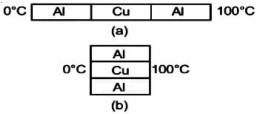
The three rods shown in the figure have identical dimensions. Heat flows from the hot end at a rate of $40 \, W$ in the arrangement $(a)$. Find the rate of heat flow when the rods are joined as in arrangement $(b)$ (Assume $K_{Al} = 200 \, W/m^{\circ}C$ and $K_{Cu} = 400 \, W/m^{\circ}C$). (in $, W$)
A
$75$
B
$200$
C
$400$
D
$4$
Solution
(C) For arrangement $(a)$,the rods are in series. Let the length of each rod be $L$ and the cross-sectional area be $A$. The thermal resistance of each rod is $R = \frac{L}{KA}$.
The effective resistance in series is $R_{\text{eff}, a} = R_{Al} + R_{Cu} + R_{Al} = \frac{L}{A} \left( \frac{1}{K_{Al}} + \frac{1}{K_{Cu}} + \frac{1}{K_{Al}} \right) = \frac{L}{A} \left( \frac{2}{200} + \frac{1}{400} \right) = \frac{L}{A} \left( \frac{4+1}{400} \right) = \frac{5L}{400A} = \frac{L}{80A}$.
The rate of heat flow is $H_1 = \frac{\Delta T}{R_{\text{eff}, a}} = \frac{100 \Delta T}{L/A} = 40 \, W$.
For arrangement $(b)$,the rods are in parallel. The effective resistance is given by $\frac{1}{R_{\text{eff}, b}} = \frac{1}{R_{Al}} + \frac{1}{R_{Cu}} + \frac{1}{R_{Al}} = \frac{A}{L} (K_{Al} + K_{Cu} + K_{Al}) = \frac{A}{L} (200 + 400 + 200) = \frac{800A}{L}$.
Thus,$R_{\text{eff}, b} = \frac{L}{800A}$.
The rate of heat flow is $H_2 = \frac{\Delta T}{R_{\text{eff}, b}} = \frac{\Delta T}{L/(800A)} = \frac{800A \Delta T}{L}$.
From the first case,$\frac{A \Delta T}{L} = \frac{40}{100/80} = \frac{40 \times 80}{100} = 32$.
Substituting this into $H_2$: $H_2 = 800 \times 32 = 25600$ (Wait,re-evaluating: $H_1 = \frac{\Delta T}{L/(80A)} = 80 \frac{A \Delta T}{L} = 40 \implies \frac{A \Delta T}{L} = 0.5$).
Then $H_2 = 800 \times 0.5 = 400 \, W$.
The effective resistance in series is $R_{\text{eff}, a} = R_{Al} + R_{Cu} + R_{Al} = \frac{L}{A} \left( \frac{1}{K_{Al}} + \frac{1}{K_{Cu}} + \frac{1}{K_{Al}} \right) = \frac{L}{A} \left( \frac{2}{200} + \frac{1}{400} \right) = \frac{L}{A} \left( \frac{4+1}{400} \right) = \frac{5L}{400A} = \frac{L}{80A}$.
The rate of heat flow is $H_1 = \frac{\Delta T}{R_{\text{eff}, a}} = \frac{100 \Delta T}{L/A} = 40 \, W$.
For arrangement $(b)$,the rods are in parallel. The effective resistance is given by $\frac{1}{R_{\text{eff}, b}} = \frac{1}{R_{Al}} + \frac{1}{R_{Cu}} + \frac{1}{R_{Al}} = \frac{A}{L} (K_{Al} + K_{Cu} + K_{Al}) = \frac{A}{L} (200 + 400 + 200) = \frac{800A}{L}$.
Thus,$R_{\text{eff}, b} = \frac{L}{800A}$.
The rate of heat flow is $H_2 = \frac{\Delta T}{R_{\text{eff}, b}} = \frac{\Delta T}{L/(800A)} = \frac{800A \Delta T}{L}$.
From the first case,$\frac{A \Delta T}{L} = \frac{40}{100/80} = \frac{40 \times 80}{100} = 32$.
Substituting this into $H_2$: $H_2 = 800 \times 32 = 25600$ (Wait,re-evaluating: $H_1 = \frac{\Delta T}{L/(80A)} = 80 \frac{A \Delta T}{L} = 40 \implies \frac{A \Delta T}{L} = 0.5$).
Then $H_2 = 800 \times 0.5 = 400 \, W$.

0 likes
View Solution103
MediumMCQ
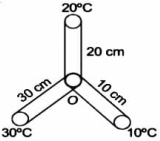
Three rods of the same material and same cross-sectional area,but different lengths $10 \, cm$,$20 \, cm$,and $30 \, cm$,are connected at a junction $O$ as shown in the figure. What is the temperature of the junction $O$ in $^{\circ} C$?
A
$19.2$
B
$16.4$
C
$11.5$
D
$22$
Solution
(B) Let the temperature of the junction $O$ be $\theta$.
According to the principle of steady-state heat flow,the sum of heat currents flowing into the junction must equal the sum of heat currents flowing out of the junction.
Heat current $H = \frac{KA(\Delta T)}{L}$.
Assuming heat flows from the $30^{\circ} C$ end towards the junction and then out to the $20^{\circ} C$ and $10^{\circ} C$ ends:
$\frac{KA}{30}(30 - \theta) = \frac{KA}{20}(\theta - 20) + \frac{KA}{10}(\theta - 10)$
Dividing both sides by $KA$:
$\frac{30 - \theta}{30} = \frac{\theta - 20}{20} + \frac{\theta - 10}{10}$
Multiply by $60$ to simplify:
$2(30 - \theta) = 3(\theta - 20) + 6(\theta - 10)$
$60 - 2\theta = 3\theta - 60 + 6\theta - 60$
$60 - 2\theta = 9\theta - 120$
$180 = 11\theta$
$\theta = \frac{180}{11} \approx 16.36^{\circ} C$.
Rounding to one decimal place,we get $16.4^{\circ} C$.
According to the principle of steady-state heat flow,the sum of heat currents flowing into the junction must equal the sum of heat currents flowing out of the junction.
Heat current $H = \frac{KA(\Delta T)}{L}$.
Assuming heat flows from the $30^{\circ} C$ end towards the junction and then out to the $20^{\circ} C$ and $10^{\circ} C$ ends:
$\frac{KA}{30}(30 - \theta) = \frac{KA}{20}(\theta - 20) + \frac{KA}{10}(\theta - 10)$
Dividing both sides by $KA$:
$\frac{30 - \theta}{30} = \frac{\theta - 20}{20} + \frac{\theta - 10}{10}$
Multiply by $60$ to simplify:
$2(30 - \theta) = 3(\theta - 20) + 6(\theta - 10)$
$60 - 2\theta = 3\theta - 60 + 6\theta - 60$
$60 - 2\theta = 9\theta - 120$
$180 = 11\theta$
$\theta = \frac{180}{11} \approx 16.36^{\circ} C$.
Rounding to one decimal place,we get $16.4^{\circ} C$.
0 likes
View Solution104
MediumMCQ
Two diagonally opposite corners of a square made of four thin rods of the same material and same dimensions are at temperatures $40^{\circ} C$ and $10^{\circ} C$. If only heat conduction takes place,then the temperature difference between the other two corners will be .......... $^{\circ} C$.
A
$0$
B
$10$
C
$25$
D
$15$
Solution
(A) Let the four corners of the square be $A, B, C,$ and $D$ in cyclic order. Let the temperatures at $A$ and $C$ be $T_A = 40^{\circ} C$ and $T_C = 10^{\circ} C$.
Since the four rods are identical,each rod acts as a thermal resistance $R = \frac{L}{kA}$.
The arrangement of the four rods forms a Wheatstone bridge circuit where the heat flows from $A$ to $C$ through two parallel paths: $A \rightarrow B \rightarrow C$ and $A \rightarrow D \rightarrow C$.
Due to the symmetry of the circuit and the identical nature of the rods,the potential (temperature) at $B$ and $D$ must be equal.
Since $T_B = T_D$,the temperature difference between the other two corners $B$ and $D$ is $T_B - T_D = 0^{\circ} C$.
Since the four rods are identical,each rod acts as a thermal resistance $R = \frac{L}{kA}$.
The arrangement of the four rods forms a Wheatstone bridge circuit where the heat flows from $A$ to $C$ through two parallel paths: $A \rightarrow B \rightarrow C$ and $A \rightarrow D \rightarrow C$.
Due to the symmetry of the circuit and the identical nature of the rods,the potential (temperature) at $B$ and $D$ must be equal.
Since $T_B = T_D$,the temperature difference between the other two corners $B$ and $D$ is $T_B - T_D = 0^{\circ} C$.
0 likes
View Solution105
AdvancedMCQ
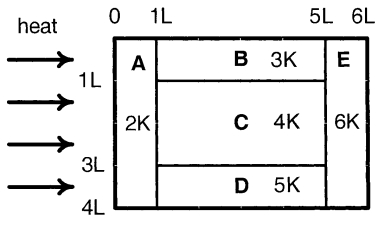
$A$ composite block is made of slabs $A, B, C, D$ and $E$ of different thermal conductivities (given in terms of a constant $K$) and sizes (given in terms of length,$L$) as shown in the figure. All slabs are of same width. Heat $Q$ flows only from left to right through the blocks. Then in steady state:
$(A)$ Heat flow through $A$ and $E$ slabs are same.
$(B)$ Heat flow through slab $E$ is maximum.
$(C)$ Temperature difference across slab $E$ is smallest.
$(D)$ Heat flow through $C =$ Heat flow through $B +$ Heat flow through $D$.
$(A)$ Heat flow through $A$ and $E$ slabs are same.
$(B)$ Heat flow through slab $E$ is maximum.
$(C)$ Temperature difference across slab $E$ is smallest.
$(D)$ Heat flow through $C =$ Heat flow through $B +$ Heat flow through $D$.
A
$(A, B, C)$
B
$(A, B, D)$
C
$(A, C, D)$
D
$(B, C, D)$
Solution
(C) The thermal resistance of a slab is given by $R = \frac{L}{kA}$,where $L$ is the length,$k$ is thermal conductivity,and $A$ is the cross-sectional area. Let $b$ be the width of the slabs.
$R_A = \frac{L}{2K(4Lb)} = \frac{1}{8} \frac{L}{K b} = \frac{R_0}{8}$
$R_B = \frac{4L}{3K(Lb)} = \frac{4}{3} \frac{L}{K b} = \frac{4R_0}{3}$
$R_C = \frac{4L}{4K(2Lb)} = \frac{1}{2} \frac{L}{K b} = \frac{R_0}{2}$
$R_D = \frac{4L}{5K(Lb)} = \frac{4}{5} \frac{L}{K b} = \frac{4R_0}{5}$
$R_E = \frac{L}{6K(4Lb)} = \frac{1}{24} \frac{L}{K b} = \frac{R_0}{24}$
$(i)$ Since slabs $A$ and $E$ are in series with the parallel combination of $B, C, D$,the total heat current $Q$ passes through both $A$ and $E$. Thus,heat flow through $A$ and $E$ is the same. Statement $(A)$ is correct.
$(ii)$ The temperature difference across a slab is $\Delta T = Q \cdot R$. Since $R_E$ is the smallest resistance,the temperature difference across $E$ is the smallest. Statement $(C)$ is correct.
$(iii)$ For the parallel section,the heat current $Q$ splits into $i_B, i_C, i_D$. Since they are in parallel,the potential difference $\Delta T_{BCD}$ is the same for all. Thus $i = \frac{\Delta T}{R}$.
$i_C = \frac{\Delta T}{R_C} = \frac{2\Delta T}{R_0}$,$i_B = \frac{\Delta T}{R_B} = \frac{3\Delta T}{4R_0}$,$i_D = \frac{\Delta T}{R_D} = \frac{5\Delta T}{4R_0}$.
Summing $i_B + i_D = \frac{3\Delta T}{4R_0} + \frac{5\Delta T}{4R_0} = \frac{8\Delta T}{4R_0} = \frac{2\Delta T}{R_0} = i_C$. Statement $(D)$ is correct.
Therefore,$(A, C, D)$ are correct.
$R_A = \frac{L}{2K(4Lb)} = \frac{1}{8} \frac{L}{K b} = \frac{R_0}{8}$
$R_B = \frac{4L}{3K(Lb)} = \frac{4}{3} \frac{L}{K b} = \frac{4R_0}{3}$
$R_C = \frac{4L}{4K(2Lb)} = \frac{1}{2} \frac{L}{K b} = \frac{R_0}{2}$
$R_D = \frac{4L}{5K(Lb)} = \frac{4}{5} \frac{L}{K b} = \frac{4R_0}{5}$
$R_E = \frac{L}{6K(4Lb)} = \frac{1}{24} \frac{L}{K b} = \frac{R_0}{24}$
$(i)$ Since slabs $A$ and $E$ are in series with the parallel combination of $B, C, D$,the total heat current $Q$ passes through both $A$ and $E$. Thus,heat flow through $A$ and $E$ is the same. Statement $(A)$ is correct.
$(ii)$ The temperature difference across a slab is $\Delta T = Q \cdot R$. Since $R_E$ is the smallest resistance,the temperature difference across $E$ is the smallest. Statement $(C)$ is correct.
$(iii)$ For the parallel section,the heat current $Q$ splits into $i_B, i_C, i_D$. Since they are in parallel,the potential difference $\Delta T_{BCD}$ is the same for all. Thus $i = \frac{\Delta T}{R}$.
$i_C = \frac{\Delta T}{R_C} = \frac{2\Delta T}{R_0}$,$i_B = \frac{\Delta T}{R_B} = \frac{3\Delta T}{4R_0}$,$i_D = \frac{\Delta T}{R_D} = \frac{5\Delta T}{4R_0}$.
Summing $i_B + i_D = \frac{3\Delta T}{4R_0} + \frac{5\Delta T}{4R_0} = \frac{8\Delta T}{4R_0} = \frac{2\Delta T}{R_0} = i_C$. Statement $(D)$ is correct.
Therefore,$(A, C, D)$ are correct.
0 likes
View Solution106
DifficultMCQ
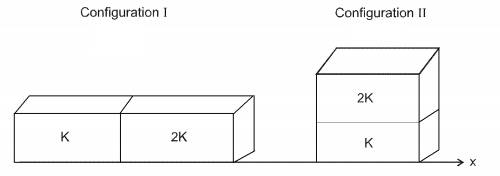
Two rectangular blocks,having identical dimensions,can be arranged either in configuration $I$ or in configuration $II$ as shown in the figure. One of the blocks has thermal conductivity $k$ and the other $2k$. The temperature difference between the ends along the $x$-axis is the same in both the configurations. It takes $9 \ s$ to transport a certain amount of heat from the hot end to the cold end in the configuration $I$. The time to transport the same amount of heat in the configuration $II$ is: (in $s$)
A
$2.0$
B
$3.0$
C
$4.5$
D
$6.0$
Solution
(A) Let the length of each block be $L$,cross-sectional area be $A$,and thermal resistance of the block with conductivity $k$ be $R = \frac{L}{kA}$. Then the resistance of the block with conductivity $2k$ is $R' = \frac{L}{2kA} = \frac{R}{2}$.
In configuration $I$ (series): The blocks are in series. The equivalent thermal resistance is $R_{eq,I} = R + \frac{R}{2} = \frac{3R}{2}$.
The heat current $H_I = \frac{\Delta T}{R_{eq,I}} = \frac{2\Delta T}{3R}$.
In configuration $II$ (parallel): The blocks are in parallel. The equivalent thermal resistance is given by $\frac{1}{R_{eq,II}} = \frac{1}{R} + \frac{1}{R/2} = \frac{1}{R} + \frac{2}{R} = \frac{3}{R}$. So,$R_{eq,II} = \frac{R}{3}$.
The heat current $H_{II} = \frac{\Delta T}{R_{eq,II}} = \frac{3\Delta T}{R}$.
Since the amount of heat $Q$ transported is the same,$Q = H_I t_I = H_{II} t_II$.
$t_{II} = t_I \times \frac{H_I}{H_{II}} = 9 \times \frac{2\Delta T / 3R}{3\Delta T / R} = 9 \times \frac{2}{9} = 2.0 \ s$.
In configuration $I$ (series): The blocks are in series. The equivalent thermal resistance is $R_{eq,I} = R + \frac{R}{2} = \frac{3R}{2}$.
The heat current $H_I = \frac{\Delta T}{R_{eq,I}} = \frac{2\Delta T}{3R}$.
In configuration $II$ (parallel): The blocks are in parallel. The equivalent thermal resistance is given by $\frac{1}{R_{eq,II}} = \frac{1}{R} + \frac{1}{R/2} = \frac{1}{R} + \frac{2}{R} = \frac{3}{R}$. So,$R_{eq,II} = \frac{R}{3}$.
The heat current $H_{II} = \frac{\Delta T}{R_{eq,II}} = \frac{3\Delta T}{R}$.
Since the amount of heat $Q$ transported is the same,$Q = H_I t_I = H_{II} t_II$.
$t_{II} = t_I \times \frac{H_I}{H_{II}} = 9 \times \frac{2\Delta T / 3R}{3\Delta T / R} = 9 \times \frac{2}{9} = 2.0 \ s$.
0 likes
View Solution107
MediumMCQ
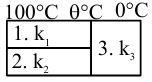
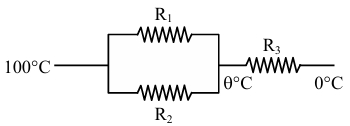
Three conductors of the same length having thermal conductivities $k_1, k_2$ and $k_3$ are connected as shown in the figure. The areas of cross-section of the $1^{\text{st}}$ and $2^{\text{nd}}$ conductors are the same,and for the $3^{\text{rd}}$ conductor,it is double that of the $1^{\text{st}}$ conductor. The temperatures are given in the figure. In the steady-state condition,the value of $\theta$ is . . . . . . $^{\circ}C$. (Given: $k_1 = 60 \ J s^{-1} m^{-1} K^{-1}, k_2 = 120 \ J s^{-1} m^{-1} K^{-1}, k_3 = 135 \ J s^{-1} m^{-1} K^{-1}$)
A
$10$
B
$30$
C
$40$
D
$50$
Solution
(C) Let the length of each conductor be $L$ and the area of cross-section of the $1^{\text{st}}$ and $2^{\text{nd}}$ conductors be $A$. Then the area of the $3^{\text{rd}}$ conductor is $2A$.
Thermal resistance is given by $R = \frac{L}{kA}$.
$R_1 = \frac{L}{k_1 A} = \frac{L}{60A}$,$R_2 = \frac{L}{k_2 A} = \frac{L}{120A}$,$R_3 = \frac{L}{k_3 (2A)} = \frac{L}{135 \times 2A} = \frac{L}{270A}$.
Conductors $1$ and $2$ are in parallel,so their equivalent resistance $R_{12}$ is:
$\frac{1}{R_{12}} = \frac{1}{R_1} + \frac{1}{R_2} = \frac{60A}{L} + \frac{120A}{L} = \frac{180A}{L} \implies R_{12} = \frac{L}{180A}$.
In steady state,the heat current $H$ flowing through the combination is constant:
$H = \frac{100 - \theta}{R_{12}} = \frac{\theta - 0}{R_3}$
$\frac{100 - \theta}{L / 180A} = \frac{\theta}{L / 270A}$
$180(100 - \theta) = 270\theta$
$2(100 - \theta) = 3\theta$
$200 - 2\theta = 3\theta$
$5\theta = 200 \implies \theta = 40^{\circ}C$.
Thermal resistance is given by $R = \frac{L}{kA}$.
$R_1 = \frac{L}{k_1 A} = \frac{L}{60A}$,$R_2 = \frac{L}{k_2 A} = \frac{L}{120A}$,$R_3 = \frac{L}{k_3 (2A)} = \frac{L}{135 \times 2A} = \frac{L}{270A}$.
Conductors $1$ and $2$ are in parallel,so their equivalent resistance $R_{12}$ is:
$\frac{1}{R_{12}} = \frac{1}{R_1} + \frac{1}{R_2} = \frac{60A}{L} + \frac{120A}{L} = \frac{180A}{L} \implies R_{12} = \frac{L}{180A}$.
In steady state,the heat current $H$ flowing through the combination is constant:
$H = \frac{100 - \theta}{R_{12}} = \frac{\theta - 0}{R_3}$
$\frac{100 - \theta}{L / 180A} = \frac{\theta}{L / 270A}$
$180(100 - \theta) = 270\theta$
$2(100 - \theta) = 3\theta$
$200 - 2\theta = 3\theta$
$5\theta = 200 \implies \theta = 40^{\circ}C$.
0 likes
View Solution108
MediumMCQ
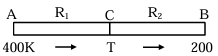
Two cylindrical rods $A$ and $B$ made of different materials are joined in a straight line. The ratios of lengths,radii,and thermal conductivities of these rods are $\frac{L_A}{L_B} = \frac{1}{2}$,$\frac{r_A}{r_B} = 2$,and $\frac{K_A}{K_B} = \frac{1}{2}$. The free ends of rods $A$ and $B$ are maintained at $400 \ K$ and $200 \ K$,respectively. The temperature of the rods' interface is . . . . . . $K$,when equilibrium is established.
A
$370$
B
$320$
C
$360$
D
$330$
Solution
(C) The thermal resistance $R$ of a rod is given by $R = \frac{L}{KA}$,where $L$ is the length,$K$ is the thermal conductivity,and $A = \pi r^2$ is the cross-sectional area.
For the two rods in series,the rate of heat flow $\frac{dQ}{dt}$ is the same in steady state:
$\frac{dQ}{dt} = \frac{\Delta T}{R} = \frac{400 - T}{R_A} = \frac{T - 200}{R_B}$
$\frac{400 - T}{T - 200} = \frac{R_A}{R_B} = \left( \frac{L_A}{L_B} \right) \left( \frac{K_B}{K_A} \right) \left( \frac{r_B}{r_A} \right)^2$
Given $\frac{L_A}{L_B} = \frac{1}{2}$,$\frac{K_A}{K_B} = \frac{1}{2} \implies \frac{K_B}{K_A} = 2$,and $\frac{r_A}{r_B} = 2 \implies \frac{r_B}{r_A} = \frac{1}{2}$.
Substituting these values:
$\frac{R_A}{R_B} = \left( \frac{1}{2} \right) \times (2) \times \left( \frac{1}{2} \right)^2 = 1 \times \frac{1}{4} = \frac{1}{4}$
Now,$\frac{400 - T}{T - 200} = \frac{1}{4}$
$4(400 - T) = T - 200$
$1600 - 4T = T - 200$
$5T = 1800$
$T = 360 \ K$
For the two rods in series,the rate of heat flow $\frac{dQ}{dt}$ is the same in steady state:
$\frac{dQ}{dt} = \frac{\Delta T}{R} = \frac{400 - T}{R_A} = \frac{T - 200}{R_B}$
$\frac{400 - T}{T - 200} = \frac{R_A}{R_B} = \left( \frac{L_A}{L_B} \right) \left( \frac{K_B}{K_A} \right) \left( \frac{r_B}{r_A} \right)^2$
Given $\frac{L_A}{L_B} = \frac{1}{2}$,$\frac{K_A}{K_B} = \frac{1}{2} \implies \frac{K_B}{K_A} = 2$,and $\frac{r_A}{r_B} = 2 \implies \frac{r_B}{r_A} = \frac{1}{2}$.
Substituting these values:
$\frac{R_A}{R_B} = \left( \frac{1}{2} \right) \times (2) \times \left( \frac{1}{2} \right)^2 = 1 \times \frac{1}{4} = \frac{1}{4}$
Now,$\frac{400 - T}{T - 200} = \frac{1}{4}$
$4(400 - T) = T - 200$
$1600 - 4T = T - 200$
$5T = 1800$
$T = 360 \ K$
0 likes
View Solution109
MediumMCQ
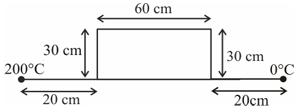
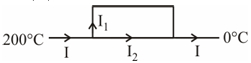
Consider the situation as shown in the figure. Find the amount of heat flowing per second through a cross-section of the bent part,if the total heat taken out per second from the end at $200^{\circ} C$ is $150 \ J/s$.
A
$130$
B
$50$
C
$70$
D
$80$
Solution
(B) The total heat current $I = 150 \ J/s$ enters the junction. The path splits into two parallel branches: the straight path and the bent path.
Let the length of the straight path be $L_2 = 60 \ cm$ and the length of the bent path be $L_1 = 30 + 60 + 30 = 120 \ cm$.
Since thermal resistance $R = \frac{L}{kA}$,and assuming the cross-sectional area $A$ and thermal conductivity $k$ are uniform,$R \propto L$.
Thus,$R_2 \propto 60$ and $R_1 \propto 120$.
The heat current $I_1$ through the bent path is given by the current divider rule for thermal circuits:
$I_1 = I \times \frac{R_2}{R_1 + R_2} = 150 \times \frac{60}{120 + 60} = 150 \times \frac{60}{180} = 150 \times \frac{1}{3} = 50 \ J/s$.
Let the length of the straight path be $L_2 = 60 \ cm$ and the length of the bent path be $L_1 = 30 + 60 + 30 = 120 \ cm$.
Since thermal resistance $R = \frac{L}{kA}$,and assuming the cross-sectional area $A$ and thermal conductivity $k$ are uniform,$R \propto L$.
Thus,$R_2 \propto 60$ and $R_1 \propto 120$.
The heat current $I_1$ through the bent path is given by the current divider rule for thermal circuits:
$I_1 = I \times \frac{R_2}{R_1 + R_2} = 150 \times \frac{60}{120 + 60} = 150 \times \frac{60}{180} = 150 \times \frac{1}{3} = 50 \ J/s$.
0 likes
View Solution110
MediumMCQ
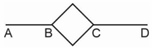
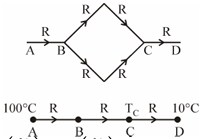
Six identical conducting rods are joined as shown in the figure. Points $A$ and $D$ are maintained at $100^{\circ} C$ and $10^{\circ} C$ respectively. The temperature of junction $C$ will be $.... ^{\circ} C$.
A
$120$
B
$100$
C
$140$
D
$40$
Solution
(D) The system can be modeled as an equivalent thermal circuit. Each rod has a thermal resistance $R$.
Between points $B$ and $C$,there are two parallel paths,each consisting of two rods in series. The resistance of each path is $R + R = 2R$.
The equivalent resistance $R_{BC}$ of these two parallel paths is given by $\frac{1}{R_{BC}} = \frac{1}{2R} + \frac{1}{2R} = \frac{2}{2R} = \frac{1}{R}$,so $R_{BC} = R$.
The total thermal resistance of the circuit from $A$ to $D$ is $R_{AD} = R_{AB} + R_{BC} + R_{CD} = R + R + R = 3R$.
The steady-state heat current $H$ flowing through the circuit is $H = \frac{\Delta T}{R_{total}} = \frac{100 - 10}{3R} = \frac{90}{3R} = \frac{30}{R}$.
The temperature at junction $C$ can be found using the heat current through the rod $CD$:
$H = \frac{T_C - 10}{R}$
$\frac{30}{R} = \frac{T_C - 10}{R}$
$30 = T_C - 10$
$T_C = 40^{\circ} C$.
Between points $B$ and $C$,there are two parallel paths,each consisting of two rods in series. The resistance of each path is $R + R = 2R$.
The equivalent resistance $R_{BC}$ of these two parallel paths is given by $\frac{1}{R_{BC}} = \frac{1}{2R} + \frac{1}{2R} = \frac{2}{2R} = \frac{1}{R}$,so $R_{BC} = R$.
The total thermal resistance of the circuit from $A$ to $D$ is $R_{AD} = R_{AB} + R_{BC} + R_{CD} = R + R + R = 3R$.
The steady-state heat current $H$ flowing through the circuit is $H = \frac{\Delta T}{R_{total}} = \frac{100 - 10}{3R} = \frac{90}{3R} = \frac{30}{R}$.
The temperature at junction $C$ can be found using the heat current through the rod $CD$:
$H = \frac{T_C - 10}{R}$
$\frac{30}{R} = \frac{T_C - 10}{R}$
$30 = T_C - 10$
$T_C = 40^{\circ} C$.
0 likes
View Solution111
MediumMCQ
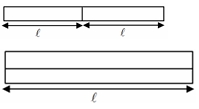
Two rods of same length and material transfer a given amount of heat in $12 \ s$,when they are joined end to end. But when they are joined along their lengths (parallel combination),then they will transfer the same amount of heat under the same conditions in time $t = \dots \ s$.
A
$24$
B
$3$
C
$1$
D
$48$
Solution
(B) Let the length of each rod be $\ell$,area of cross-section be $A$,and thermal conductivity be $K$. The heat transferred is given by $Q = \frac{KA \Delta T}{L_{eq}} \times t$.
Case $1$: Series combination (end to end).
The equivalent length is $L_{eq} = \ell + \ell = 2\ell$. The equivalent area is $A$.
$Q = \frac{KA \Delta T}{2\ell} \times 12 \quad \dots (1)$
Case $2$: Parallel combination (along their lengths).
The equivalent length is $L_{eq} = \ell$. The equivalent area is $A_{eq} = A + A = 2A$.
$Q = \frac{K(2A) \Delta T}{\ell} \times t \quad \dots (2)$
Since the heat $Q$ and temperature difference $\Delta T$ are the same in both cases,we equate $(1)$ and $(2)$:
$\frac{KA \Delta T}{2\ell} \times 12 = \frac{2KA \Delta T}{\ell} \times t$
$\frac{12}{2} = 2t$
$6 = 2t$
$t = 3 \ s$.
Case $1$: Series combination (end to end).
The equivalent length is $L_{eq} = \ell + \ell = 2\ell$. The equivalent area is $A$.
$Q = \frac{KA \Delta T}{2\ell} \times 12 \quad \dots (1)$
Case $2$: Parallel combination (along their lengths).
The equivalent length is $L_{eq} = \ell$. The equivalent area is $A_{eq} = A + A = 2A$.
$Q = \frac{K(2A) \Delta T}{\ell} \times t \quad \dots (2)$
Since the heat $Q$ and temperature difference $\Delta T$ are the same in both cases,we equate $(1)$ and $(2)$:
$\frac{KA \Delta T}{2\ell} \times 12 = \frac{2KA \Delta T}{\ell} \times t$
$\frac{12}{2} = 2t$
$6 = 2t$
$t = 3 \ s$.
0 likes
View Solution112
MediumMCQ
Two rods of the same length and material transfer a given amount of heat in $12 \ s$ when they are joined end to end. But when they are joined lengthwise parallel to each other,they will transfer the same amount of heat under the same conditions in a time of: (in $s$)
A
$24$
B
$3$
C
$1.5$
D
$48$
Solution
(B) Let the heat transferred be $Q$.
When rods are joined end to end,the equivalent thermal resistance is $R_{eq} = R + R = 2R$,where $R = \frac{l}{KA}$.
The rate of heat transfer is $\frac{Q}{t_1} = \frac{\Delta \theta}{R_{eq}} = \frac{\Delta \theta}{2 \frac{l}{KA}} = \frac{KA \Delta \theta}{2l}$.
Given $t_1 = 12 \ s$,so $Q = \frac{KA \Delta \theta}{2l} \times 12 \dots (i)$.
When rods are joined lengthwise (parallel),the equivalent thermal resistance is $R'_{eq} = \frac{R \times R}{R + R} = \frac{R}{2}$,where $R = \frac{l}{KA}$.
The rate of heat transfer is $\frac{Q}{t_2} = \frac{\Delta \theta}{R'_{eq}} = \frac{\Delta \theta}{R/2} = \frac{2KA \Delta \theta}{l}$.
So,$Q = \frac{2KA \Delta \theta}{l} \times t_2 \dots (ii)$.
Equating $(i)$ and $(ii)$:
$\frac{2KA \Delta \theta}{l} \times t_2 = \frac{KA \Delta \theta}{2l} \times 12$
$2 t_2 = \frac{12}{2}$
$4 t_2 = 12$
$t_2 = 3 \ s$.
When rods are joined end to end,the equivalent thermal resistance is $R_{eq} = R + R = 2R$,where $R = \frac{l}{KA}$.
The rate of heat transfer is $\frac{Q}{t_1} = \frac{\Delta \theta}{R_{eq}} = \frac{\Delta \theta}{2 \frac{l}{KA}} = \frac{KA \Delta \theta}{2l}$.
Given $t_1 = 12 \ s$,so $Q = \frac{KA \Delta \theta}{2l} \times 12 \dots (i)$.
When rods are joined lengthwise (parallel),the equivalent thermal resistance is $R'_{eq} = \frac{R \times R}{R + R} = \frac{R}{2}$,where $R = \frac{l}{KA}$.
The rate of heat transfer is $\frac{Q}{t_2} = \frac{\Delta \theta}{R'_{eq}} = \frac{\Delta \theta}{R/2} = \frac{2KA \Delta \theta}{l}$.
So,$Q = \frac{2KA \Delta \theta}{l} \times t_2 \dots (ii)$.
Equating $(i)$ and $(ii)$:
$\frac{2KA \Delta \theta}{l} \times t_2 = \frac{KA \Delta \theta}{2l} \times 12$
$2 t_2 = \frac{12}{2}$
$4 t_2 = 12$
$t_2 = 3 \ s$.

0 likes
View Solution113
MediumMCQ
$A$ composite slab consists of two materials having coefficients of thermal conductivity $K$ and $2K$,thickness $x$ and $4x$ respectively. The temperatures of two outer surfaces of the composite slab are $T_2$ and $T_1$ respectively $(T_2 > T_1)$. The rate of heat transfer through the slab in a steady state is $\left[\frac{A(T_2 - T_1)K}{x}\right] f$,where $f$ is equal to:
A
$1$
B
$2/3$
C
$1/2$
D
$1/3$
Solution
(D) In a steady state,the rate of heat flow $(H)$ through materials in series is the same.
For the first material: $H = \frac{KA(T_2 - T)}{x}$,where $T$ is the interface temperature.
For the second material: $H = \frac{(2K)A(T - T_1)}{4x} = \frac{KA(T - T_1)}{2x}$.
Equating the two expressions: $\frac{KA(T_2 - T)}{x} = \frac{KA(T - T_1)}{2x}$.
$2(T_2 - T) = T - T_1 \implies 2T_2 - 2T = T - T_1 \implies 3T = 2T_2 + T_1 \implies T = \frac{2T_2 + T_1}{3}$.
Substituting $T$ back into the first expression: $H = \frac{KA}{x} (T_2 - \frac{2T_2 + T_1}{3}) = \frac{KA}{x} (\frac{3T_2 - 2T_2 - T_1}{3}) = \frac{KA(T_2 - T_1)}{3x}$.
Comparing this with the given expression $\left[\frac{A(T_2 - T_1)K}{x}\right] f$,we find $f = 1/3$.
For the first material: $H = \frac{KA(T_2 - T)}{x}$,where $T$ is the interface temperature.
For the second material: $H = \frac{(2K)A(T - T_1)}{4x} = \frac{KA(T - T_1)}{2x}$.
Equating the two expressions: $\frac{KA(T_2 - T)}{x} = \frac{KA(T - T_1)}{2x}$.
$2(T_2 - T) = T - T_1 \implies 2T_2 - 2T = T - T_1 \implies 3T = 2T_2 + T_1 \implies T = \frac{2T_2 + T_1}{3}$.
Substituting $T$ back into the first expression: $H = \frac{KA}{x} (T_2 - \frac{2T_2 + T_1}{3}) = \frac{KA}{x} (\frac{3T_2 - 2T_2 - T_1}{3}) = \frac{KA(T_2 - T_1)}{3x}$.
Comparing this with the given expression $\left[\frac{A(T_2 - T_1)K}{x}\right] f$,we find $f = 1/3$.
0 likes
View Solution114
MediumMCQ
The ratio of thermal conductivity of two rods $A$ and $B$ with the same area of cross-section is $3: 2$. If the thermal resistance of two rods is the same,then the ratio of length of rod $A$ to length of rod $B$ is
A
$3: 2$
B
$2: 3$
C
$5: 1$
D
$1: 5$
Solution
(A) The thermal resistance $R$ of a rod is given by the formula $R = \frac{l}{KA}$,where $l$ is the length,$K$ is the thermal conductivity,and $A$ is the area of cross-section.
Given that the area of cross-section is the same for both rods,$A_A = A_B = A$.
Given the ratio of thermal conductivities is $\frac{K_A}{K_B} = \frac{3}{2}$.
Since the thermal resistances are equal,$R_A = R_B$.
Substituting the formula,we get $\frac{l_A}{K_A A} = \frac{l_B}{K_B A}$.
Simplifying this,we get $\frac{l_A}{l_B} = \frac{K_A}{K_B}$.
Substituting the given ratio,$\frac{l_A}{l_B} = \frac{3}{2}$.
Given that the area of cross-section is the same for both rods,$A_A = A_B = A$.
Given the ratio of thermal conductivities is $\frac{K_A}{K_B} = \frac{3}{2}$.
Since the thermal resistances are equal,$R_A = R_B$.
Substituting the formula,we get $\frac{l_A}{K_A A} = \frac{l_B}{K_B A}$.
Simplifying this,we get $\frac{l_A}{l_B} = \frac{K_A}{K_B}$.
Substituting the given ratio,$\frac{l_A}{l_B} = \frac{3}{2}$.
0 likes
View Solution115
DifficultMCQ
Two metal slabs of same cross-sectional area have thicknesses $d_1$ and $d_2$,and thermal conductivities $K_1$ and $K_2$ respectively,are connected in series. The free ends of the two slabs are kept at temperatures $T_1$ and $T_2$ $(T_1 > T_2)$. The temperature $T$ of their common junction is
A
$\frac{K_1 T_1 d_2 + K_2 T_2 d_1}{K_1 d_2 + K_2 d_1}$
B
$\frac{K_1 T_1 + K_2 T_2}{K_1 + K_2}$
C
$\frac{K_1 T_1 + K_2 T_2}{T_1 + T_2}$
D
$\frac{K_1 T_1 d_1 + K_2 T_2 d_2}{K_1 d_2 + K_2 d_1}$
Solution
(A) The heat current through the first slab is given by $\dot{Q}_1 = \frac{K_1 A (T_1 - T)}{d_1}$.
For the second slab,the heat current is $\dot{Q}_2 = \frac{K_2 A (T - T_2)}{d_2}$.
Since the slabs are connected in series,the same heat current flows through both,so $\dot{Q}_1 = \dot{Q}_2$.
Equating the two expressions: $\frac{K_1 A (T_1 - T)}{d_1} = \frac{K_2 A (T - T_2)}{d_2}$.
Canceling $A$ from both sides: $\frac{K_1 (T_1 - T)}{d_1} = \frac{K_2 (T - T_2)}{d_2}$.
Cross-multiplying gives: $K_1 d_2 (T_1 - T) = K_2 d_1 (T - T_2)$.
Expanding: $K_1 d_2 T_1 - K_1 d_2 T = K_2 d_1 T - K_2 d_1 T_2$.
Rearranging to solve for $T$: $K_1 d_2 T_1 + K_2 d_1 T_2 = T (K_1 d_2 + K_2 d_1)$.
Thus,$T = \frac{K_1 T_1 d_2 + K_2 T_2 d_1}{K_1 d_2 + K_2 d_1}$.
For the second slab,the heat current is $\dot{Q}_2 = \frac{K_2 A (T - T_2)}{d_2}$.
Since the slabs are connected in series,the same heat current flows through both,so $\dot{Q}_1 = \dot{Q}_2$.
Equating the two expressions: $\frac{K_1 A (T_1 - T)}{d_1} = \frac{K_2 A (T - T_2)}{d_2}$.
Canceling $A$ from both sides: $\frac{K_1 (T_1 - T)}{d_1} = \frac{K_2 (T - T_2)}{d_2}$.
Cross-multiplying gives: $K_1 d_2 (T_1 - T) = K_2 d_1 (T - T_2)$.
Expanding: $K_1 d_2 T_1 - K_1 d_2 T = K_2 d_1 T - K_2 d_1 T_2$.
Rearranging to solve for $T$: $K_1 d_2 T_1 + K_2 d_1 T_2 = T (K_1 d_2 + K_2 d_1)$.
Thus,$T = \frac{K_1 T_1 d_2 + K_2 T_2 d_1}{K_1 d_2 + K_2 d_1}$.
0 likes
View Solution116
MediumMCQ
Two rods of the same length and material are joined end-to-end. They transfer a certain amount of heat in $8 \ s$. When they are joined in parallel,they transfer the same amount of heat under the same conditions in a time of: (in $s$)
A
$3$
B
$2$
C
$1$
D
$4$
Solution
(B) Let $R$ be the thermal resistance of each rod. When connected in series,the total thermal resistance is $R_{s} = R + R = 2R$.
The heat transferred in series is $Q = \frac{\Delta T}{R_{s}} \times t_{s} = \frac{\Delta T}{2R} \times 8 = \frac{4 \Delta T}{R}$.
When connected in parallel,the equivalent thermal resistance is $R_{p} = \frac{R \times R}{R + R} = \frac{R}{2}$.
The heat transferred in parallel is $Q = \frac{\Delta T}{R_{p}} \times t_{p} = \frac{\Delta T}{R/2} \times t_{p} = \frac{2 \Delta T}{R} \times t_{p}$.
Since the heat transferred $Q$ is the same in both cases,we equate the expressions:
$\frac{4 \Delta T}{R} = \frac{2 \Delta T}{R} \times t_{p}$.
Solving for $t_{p}$,we get $t_{p} = \frac{4}{2} = 2 \ s$.
The heat transferred in series is $Q = \frac{\Delta T}{R_{s}} \times t_{s} = \frac{\Delta T}{2R} \times 8 = \frac{4 \Delta T}{R}$.
When connected in parallel,the equivalent thermal resistance is $R_{p} = \frac{R \times R}{R + R} = \frac{R}{2}$.
The heat transferred in parallel is $Q = \frac{\Delta T}{R_{p}} \times t_{p} = \frac{\Delta T}{R/2} \times t_{p} = \frac{2 \Delta T}{R} \times t_{p}$.
Since the heat transferred $Q$ is the same in both cases,we equate the expressions:
$\frac{4 \Delta T}{R} = \frac{2 \Delta T}{R} \times t_{p}$.
Solving for $t_{p}$,we get $t_{p} = \frac{4}{2} = 2 \ s$.
0 likes
View Solution117
EasyMCQ
The rate of flow of heat through a copper rod with a temperature difference of $28^{\circ} C$ is $1400 \ cal s^{-1}$. The thermal resistance of the copper rod will be:
A
$0.05 \ ^{\circ} C s cal^{-1}$
B
$0.02 \ ^{\circ} C s cal^{-1}$
C
$5 \ ^{\circ} C s cal^{-1}$
D
$2 \ ^{\circ} C s cal^{-1}$
Solution
(B) The thermal resistance $(R_{th})$ is defined as the ratio of the temperature difference $(\Delta T)$ to the rate of heat flow ($H$ or thermal current).
Formula: $R_{th} = \frac{\Delta T}{H}$
Given:
Temperature difference $\Delta T = 28^{\circ} C$
Rate of heat flow $H = 1400 \ cal s^{-1}$
Calculation:
$R_{th} = \frac{28}{1400} \ ^{\circ} C s cal^{-1}$
$R_{th} = 0.02 \ ^{\circ} C s cal^{-1}$
Therefore, the thermal resistance is $0.02 \ ^{\circ} C s cal^{-1}$.
Formula: $R_{th} = \frac{\Delta T}{H}$
Given:
Temperature difference $\Delta T = 28^{\circ} C$
Rate of heat flow $H = 1400 \ cal s^{-1}$
Calculation:
$R_{th} = \frac{28}{1400} \ ^{\circ} C s cal^{-1}$
$R_{th} = 0.02 \ ^{\circ} C s cal^{-1}$
Therefore, the thermal resistance is $0.02 \ ^{\circ} C s cal^{-1}$.
0 likes
View Solution118
MediumMCQ
The rate of flow of heat through a metal rod with a temperature difference of $40^{\circ} C$ is $1600 cal/s$. The thermal resistance of the metal rod in $^{\circ} C s/cal$ is
A
$0.025$
B
$0.25$
C
$2.5$
D
$40$
Solution
(A) Given:
Rate of flow of heat (conduction rate) $P_{\text{cond}} = 1600 \text{ cal/s}$.
Temperature difference $\Delta T = 40^{\circ} C$.
The formula for thermal resistance $R_T$ is given by the ratio of temperature difference to the rate of heat flow:
$R_T = \frac{\Delta T}{P_{\text{cond}}}$
Substituting the given values:
$R_T = \frac{40}{1600}$
$R_T = \frac{1}{40} = 0.025^{\circ} C s/cal$.
Thus,the thermal resistance is $0.025^{\circ} C s/cal$.
Rate of flow of heat (conduction rate) $P_{\text{cond}} = 1600 \text{ cal/s}$.
Temperature difference $\Delta T = 40^{\circ} C$.
The formula for thermal resistance $R_T$ is given by the ratio of temperature difference to the rate of heat flow:
$R_T = \frac{\Delta T}{P_{\text{cond}}}$
Substituting the given values:
$R_T = \frac{40}{1600}$
$R_T = \frac{1}{40} = 0.025^{\circ} C s/cal$.
Thus,the thermal resistance is $0.025^{\circ} C s/cal$.
0 likes
View Solution119
DifficultMCQ
$A$ composite slab consists of two materials having coefficients of thermal conductivity $K$ and $2K$,and thicknesses $x$ and $4x$ respectively. The temperatures of the two outer surfaces of the composite slab are $T_2$ and $T_1$ $(T_2 > T_1)$. The rate of heat transfer through the slab in a steady state is $\left[\frac{A(T_2 - T_1)K}{x}\right] \cdot f$,where '$f$' is equal to:
A
$1$
B
$\frac{2}{3}$
C
$\frac{1}{2}$
D
$\frac{1}{3}$
Solution
(D) The thermal resistance $R$ of a slab is given by $R = \frac{L}{KA}$,where $L$ is the thickness,$K$ is the thermal conductivity,and $A$ is the area.
For the first material: $R_1 = \frac{x}{KA}$.
For the second material: $R_2 = \frac{4x}{(2K)A} = \frac{2x}{KA}$.
Since the slabs are in series,the equivalent thermal resistance $R_{eq}$ is:
$R_{eq} = R_1 + R_2 = \frac{x}{KA} + \frac{2x}{KA} = \frac{3x}{KA}$.
The rate of heat transfer $\frac{dQ}{dt}$ is given by:
$\frac{dQ}{dt} = \frac{T_2 - T_1}{R_{eq}} = \frac{T_2 - T_1}{\frac{3x}{KA}} = \frac{KA(T_2 - T_1)}{3x}$.
Comparing this with the given expression $\left[\frac{A(T_2 - T_1)K}{x}\right] \cdot f$,we get:
$f = \frac{1}{3}$.
For the first material: $R_1 = \frac{x}{KA}$.
For the second material: $R_2 = \frac{4x}{(2K)A} = \frac{2x}{KA}$.
Since the slabs are in series,the equivalent thermal resistance $R_{eq}$ is:
$R_{eq} = R_1 + R_2 = \frac{x}{KA} + \frac{2x}{KA} = \frac{3x}{KA}$.
The rate of heat transfer $\frac{dQ}{dt}$ is given by:
$\frac{dQ}{dt} = \frac{T_2 - T_1}{R_{eq}} = \frac{T_2 - T_1}{\frac{3x}{KA}} = \frac{KA(T_2 - T_1)}{3x}$.
Comparing this with the given expression $\left[\frac{A(T_2 - T_1)K}{x}\right] \cdot f$,we get:
$f = \frac{1}{3}$.
0 likes
View Solution120
MediumMCQ
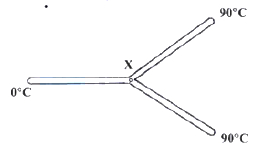
Three metal rods of the same material and identical in all respects are joined as shown in the figure. The temperatures at the ends of these rods are maintained as indicated. Assuming no heat energy loss occurs through the curved surfaces of the rods,the temperature at the junction $X$ is (in $^{\circ} C$)
A
$60$
B
$30$
C
$20$
D
$45$
Solution
(A) Let the thermal resistance of each rod be $R$ and the temperature of the junction be $T_X$.
According to the principle of conservation of energy,the total heat flowing into the junction must equal the total heat flowing out of the junction.
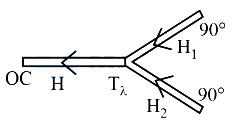
Here,heat flows from the two rods at $90^{\circ} C$ towards the junction $X$,and then from the junction $X$ towards the rod at $0^{\circ} C$.
Let $H_1$ and $H_2$ be the heat currents from the two rods at $90^{\circ} C$,and $H$ be the heat current flowing towards the $0^{\circ} C$ end.
$H = H_1 + H_2$
Using the formula for heat current $H = \frac{\Delta T}{R}$,we have:
$\frac{T_X - 0}{R} = \frac{90 - T_X}{R} + \frac{90 - T_X}{R}$
Since the rods are identical,the thermal resistance $R$ is the same for all.
$T_X = (90 - T_X) + (90 - T_X)$
$T_X = 180 - 2T_X$
$3T_X = 180$
$T_X = 60^{\circ} C$
Thus,the temperature at the junction $X$ is $60^{\circ} C$.
According to the principle of conservation of energy,the total heat flowing into the junction must equal the total heat flowing out of the junction.
Here,heat flows from the two rods at $90^{\circ} C$ towards the junction $X$,and then from the junction $X$ towards the rod at $0^{\circ} C$.
Let $H_1$ and $H_2$ be the heat currents from the two rods at $90^{\circ} C$,and $H$ be the heat current flowing towards the $0^{\circ} C$ end.
$H = H_1 + H_2$
Using the formula for heat current $H = \frac{\Delta T}{R}$,we have:
$\frac{T_X - 0}{R} = \frac{90 - T_X}{R} + \frac{90 - T_X}{R}$
Since the rods are identical,the thermal resistance $R$ is the same for all.
$T_X = (90 - T_X) + (90 - T_X)$
$T_X = 180 - 2T_X$
$3T_X = 180$
$T_X = 60^{\circ} C$
Thus,the temperature at the junction $X$ is $60^{\circ} C$.
0 likes
View Solution121
DifficultMCQ
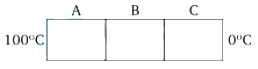
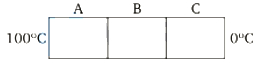
$A$,$B$ and $C$ are three identical conductors but made from different materials. They are kept in contact as shown. Their thermal conductivities are $K$,$2K$ and $K/2$. The free end of $A$ is at $100^{\circ} C$ and the free end of $C$ is at $0^{\circ} C$. During steady state,the temperature of the junction of $A$ and $B$ is nearly (in $^{\circ} C$)
A
$37$
B
$71$
C
$29$
D
$63$
Solution
(B) The thermal resistance of a conductor is given by $R_{th} = \frac{L}{KA}$,where $L$ is length,$K$ is thermal conductivity,and $A$ is the cross-sectional area. Since the conductors are identical,$L$ and $A$ are the same for all.
Let $R_0 = \frac{L}{KA}$. Then the thermal resistances are:
$R_A = \frac{L}{KA} = R_0$
$R_B = \frac{L}{(2K)A} = \frac{R_0}{2}$
$R_C = \frac{L}{(K/2)A} = 2R_0$
In steady state,the heat current $H$ through the series combination is constant:
$H = \frac{\Delta T}{R_{total}} = \frac{100 - 0}{R_A + R_B + R_C} = \frac{100}{R_0 + \frac{R_0}{2} + 2R_0} = \frac{100}{3.5 R_0} = \frac{200}{7 R_0}$
Let $T'$ be the temperature of the junction of $A$ and $B$. The heat current through $A$ is:
$H = \frac{100 - T'}{R_A} = \frac{100 - T'}{R_0}$
Equating the two expressions for $H$:
$\frac{100 - T'}{R_0} = \frac{200}{7 R_0}$
$100 - T' = \frac{200}{7}$
$T' = 100 - 28.57 = 71.43^{\circ} C$
Thus,the temperature is nearly $71^{\circ} C$.
Let $R_0 = \frac{L}{KA}$. Then the thermal resistances are:
$R_A = \frac{L}{KA} = R_0$
$R_B = \frac{L}{(2K)A} = \frac{R_0}{2}$
$R_C = \frac{L}{(K/2)A} = 2R_0$
In steady state,the heat current $H$ through the series combination is constant:
$H = \frac{\Delta T}{R_{total}} = \frac{100 - 0}{R_A + R_B + R_C} = \frac{100}{R_0 + \frac{R_0}{2} + 2R_0} = \frac{100}{3.5 R_0} = \frac{200}{7 R_0}$
Let $T'$ be the temperature of the junction of $A$ and $B$. The heat current through $A$ is:
$H = \frac{100 - T'}{R_A} = \frac{100 - T'}{R_0}$
Equating the two expressions for $H$:
$\frac{100 - T'}{R_0} = \frac{200}{7 R_0}$
$100 - T' = \frac{200}{7}$
$T' = 100 - 28.57 = 71.43^{\circ} C$
Thus,the temperature is nearly $71^{\circ} C$.
0 likes
View Solution122
DifficultMCQ
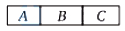
Three identical rods $A, B$ and $C$ are placed end to end. $A$ temperature difference is maintained between the free ends of $A$ and $C$. The thermal conductivity of $B$ is thrice that of $C$ and half of that of $A$. The effective thermal conductivity of the system will be ($K_{A}$ is the thermal conductivity of rod $A$).
A
$\frac{1}{3} K_{A}$
B
$3 K_{A}$
C
$2 K_{A}$
D
$\frac{2}{3} K_{A}$
Solution
(A) Given that the rods are identical,let the length of each rod be $l$ and the cross-sectional area be $A_{area}$.
Let $K_{A}, K_{B}, K_{C}$ be the thermal conductivities of rods $A, B, C$ respectively.
According to the problem:
$K_{B} = \frac{1}{2} K_{A}$
$K_{B} = 3 K_{C} \implies K_{C} = \frac{K_{B}}{3} = \frac{K_{A}}{6}$
Since the rods are connected in series,the equivalent thermal resistance $R_{eq}$ is the sum of individual resistances:
$R_{eq} = R_{A} + R_{B} + R_{C}$
$\frac{3l}{K_{eq} A_{area}} = \frac{l}{K_{A} A_{area}} + \frac{l}{K_{B} A_{area}} + \frac{l}{K_{C} A_{area}}$
$\frac{3}{K_{eq}} = \frac{1}{K_{A}} + \frac{1}{K_{A}/2} + \frac{1}{K_{A}/6}$
$\frac{3}{K_{eq}} = \frac{1}{K_{A}} + \frac{2}{K_{A}} + \frac{6}{K_{A}}$
$\frac{3}{K_{eq}} = \frac{9}{K_{A}}$
$K_{eq} = \frac{3 K_{A}}{9} = \frac{1}{3} K_{A}$
Let $K_{A}, K_{B}, K_{C}$ be the thermal conductivities of rods $A, B, C$ respectively.
According to the problem:
$K_{B} = \frac{1}{2} K_{A}$
$K_{B} = 3 K_{C} \implies K_{C} = \frac{K_{B}}{3} = \frac{K_{A}}{6}$
Since the rods are connected in series,the equivalent thermal resistance $R_{eq}$ is the sum of individual resistances:
$R_{eq} = R_{A} + R_{B} + R_{C}$
$\frac{3l}{K_{eq} A_{area}} = \frac{l}{K_{A} A_{area}} + \frac{l}{K_{B} A_{area}} + \frac{l}{K_{C} A_{area}}$
$\frac{3}{K_{eq}} = \frac{1}{K_{A}} + \frac{1}{K_{A}/2} + \frac{1}{K_{A}/6}$
$\frac{3}{K_{eq}} = \frac{1}{K_{A}} + \frac{2}{K_{A}} + \frac{6}{K_{A}}$
$\frac{3}{K_{eq}} = \frac{9}{K_{A}}$
$K_{eq} = \frac{3 K_{A}}{9} = \frac{1}{3} K_{A}$
0 likes
View Solution123
MediumMCQ
$A$ wall has two layers $A$ and $B$,each made of different materials. Both layers are of the same thickness. The thermal conductivity of material $A$ is twice that of $B$. If in the steady state,the temperature difference across the wall is $24^{\circ} C$,then the temperature difference across the layer $B$ is (in $^{\circ} C$)
A
$8$
B
$12$
C
$16$
D
$20$
Solution
(C) In the steady state,the rate of heat flow $(H)$ through both layers connected in series is the same.
Let $l$ be the thickness of each layer and $A$ be the cross-sectional area.
Let $K_A$ and $K_B$ be the thermal conductivities of layers $A$ and $B$ respectively.
Given: $K_A = 2K_B$.
The rate of heat flow is given by $H = \frac{K A \Delta T}{l}$.
Since $H$ is constant for both layers:
$H = \frac{K_A A \Delta T_A}{l} = \frac{K_B A \Delta T_B}{l}$
where $\Delta T_A$ and $\Delta T_B$ are the temperature differences across layers $A$ and $B$ respectively.
Canceling $A$ and $l$ from both sides:
$K_A \Delta T_A = K_B \Delta T_B$
Substituting $K_A = 2K_B$:
$2K_B \Delta T_A = K_B \Delta T_B \Rightarrow \Delta T_B = 2 \Delta T_A$
The total temperature difference across the wall is $\Delta T_A + \Delta T_B = 24^{\circ} C$.
Substituting $\Delta T_B = 2 \Delta T_A$ into the equation:
$\Delta T_A + 2 \Delta T_A = 24^{\circ} C$
$3 \Delta T_A = 24^{\circ} C \Rightarrow \Delta T_A = 8^{\circ} C$.
Therefore,the temperature difference across layer $B$ is:
$\Delta T_B = 2 \times 8^{\circ} C = 16^{\circ} C$.
Let $l$ be the thickness of each layer and $A$ be the cross-sectional area.
Let $K_A$ and $K_B$ be the thermal conductivities of layers $A$ and $B$ respectively.
Given: $K_A = 2K_B$.
The rate of heat flow is given by $H = \frac{K A \Delta T}{l}$.
Since $H$ is constant for both layers:
$H = \frac{K_A A \Delta T_A}{l} = \frac{K_B A \Delta T_B}{l}$
where $\Delta T_A$ and $\Delta T_B$ are the temperature differences across layers $A$ and $B$ respectively.
Canceling $A$ and $l$ from both sides:
$K_A \Delta T_A = K_B \Delta T_B$
Substituting $K_A = 2K_B$:
$2K_B \Delta T_A = K_B \Delta T_B \Rightarrow \Delta T_B = 2 \Delta T_A$
The total temperature difference across the wall is $\Delta T_A + \Delta T_B = 24^{\circ} C$.
Substituting $\Delta T_B = 2 \Delta T_A$ into the equation:
$\Delta T_A + 2 \Delta T_A = 24^{\circ} C$
$3 \Delta T_A = 24^{\circ} C \Rightarrow \Delta T_A = 8^{\circ} C$.
Therefore,the temperature difference across layer $B$ is:
$\Delta T_B = 2 \times 8^{\circ} C = 16^{\circ} C$.
0 likes
View Solution124
DifficultMCQ
$A$ window used to thermally insulate a room from outside consists of two parallel glass sheets each of area $2.6 \,m^2$ and thickness $1 \,cm$ separated by $5 \,cm$ thick stagnant air. In the steady state, the room-glass interface is at $18^{\circ} C$ and the glass-outdoor interface is at $-2^{\circ} C$. If the thermal conductivities of glass and air are respectively $0.8 \,Wm^{-1} K^{-1}$ and $0.08 \,Wm^{-1} K^{-1}$, the rate of flow of heat through the window is (in $\,W$)
A
$15$
B
$40$
C
$60$
D
$80$
Solution
(D) The system consists of three layers in series: glass, air, and glass. The equivalent thermal resistance $R_{eq}$ is given by $R_{eq} = R_1 + R_2 + R_3$, where $R = \frac{l}{kA}$.
Given: $l_1 = l_3 = 1 \,cm = 0.01 \,m$, $l_2 = 5 \,cm = 0.05 \,m$, $A = 2.6 \,m^2$, $k_{glass} = 0.8 \,Wm^{-1} K^{-1}$, $k_{air} = 0.08 \,Wm^{-1} K^{-1}$.
$R_1 = R_3 = \frac{0.01}{0.8 \times 2.6} = \frac{0.01}{2.08} \approx 0.0048 \,K/W$.
$R_2 = \frac{0.05}{0.08 \times 2.6} = \frac{0.05}{0.208} \approx 0.2404 \,K/W$.
$R_{eq} = 2 \times \left(\frac{0.01}{2.08}\right) + \frac{0.05}{0.208} = \frac{0.02}{2.08} + \frac{0.5}{2.08} = \frac{0.52}{2.08} = 0.25 \,K/W$.
The rate of heat flow $H = \frac{\Delta T}{R_{eq}} = \frac{18 - (-2)}{0.25} = \frac{20}{0.25} = 80 \,W$.
Given: $l_1 = l_3 = 1 \,cm = 0.01 \,m$, $l_2 = 5 \,cm = 0.05 \,m$, $A = 2.6 \,m^2$, $k_{glass} = 0.8 \,Wm^{-1} K^{-1}$, $k_{air} = 0.08 \,Wm^{-1} K^{-1}$.
$R_1 = R_3 = \frac{0.01}{0.8 \times 2.6} = \frac{0.01}{2.08} \approx 0.0048 \,K/W$.
$R_2 = \frac{0.05}{0.08 \times 2.6} = \frac{0.05}{0.208} \approx 0.2404 \,K/W$.
$R_{eq} = 2 \times \left(\frac{0.01}{2.08}\right) + \frac{0.05}{0.208} = \frac{0.02}{2.08} + \frac{0.5}{2.08} = \frac{0.52}{2.08} = 0.25 \,K/W$.
The rate of heat flow $H = \frac{\Delta T}{R_{eq}} = \frac{18 - (-2)}{0.25} = \frac{20}{0.25} = 80 \,W$.
0 likes
View Solution125
MediumMCQ
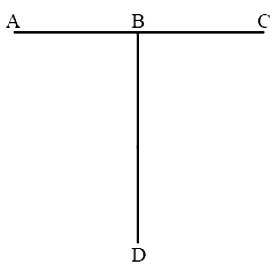
Three conducting rods $AB, BC$ and $BD$ made of the same material and same cross-section are arranged as shown in the figure. Temperatures at the points $A, D$ and $C$ are maintained at $20^{\circ} C, 90^{\circ} C$ and $0^{\circ} C$ respectively. The ratio of lengths of $BD$ to $BC$ when there is no heat flow in $AB$ is:
A
$\frac{2}{9}$
B
$\frac{7}{2}$
C
$\frac{2}{7}$
D
$\frac{9}{2}$
Solution
(B) Let the temperature at junction $B$ be $T_B$. The thermal resistance of a rod is given by $R = \frac{L}{kA}$. Since all rods have the same material $(k)$ and same cross-section $(A)$,the thermal resistance is proportional to the length $(R \propto L)$.
Let $R_{AB}, R_{BC}, R_{BD}$ be the resistances of rods $AB, BC, BD$ respectively.
Given that there is no heat flow in $AB$,the temperature at $B$ must be equal to the temperature at $A$. Therefore,$T_B = T_A = 20^{\circ} C$.
Since there is no heat flow in $AB$,all the heat flowing from $D$ to $B$ must flow from $B$ to $C$. Thus,the heat current $H_{DB} = H_{BC}$.
Using the formula $H = \frac{\Delta T}{R}$,we have $\frac{T_D - T_B}{R_{BD}} = \frac{T_B - T_C}{R_{BC}}$.
Substituting the values: $\frac{90 - 20}{R_{BD}} = \frac{20 - 0}{R_{BC}}$.
$\frac{70}{R_{BD}} = \frac{20}{R_{BC}}$.
$\frac{R_{BD}}{R_{BC}} = \frac{70}{20} = \frac{7}{2}$.
Since $R \propto L$,we have $\frac{L_{BD}}{L_{BC}} = \frac{7}{2}$.
Let $R_{AB}, R_{BC}, R_{BD}$ be the resistances of rods $AB, BC, BD$ respectively.
Given that there is no heat flow in $AB$,the temperature at $B$ must be equal to the temperature at $A$. Therefore,$T_B = T_A = 20^{\circ} C$.
Since there is no heat flow in $AB$,all the heat flowing from $D$ to $B$ must flow from $B$ to $C$. Thus,the heat current $H_{DB} = H_{BC}$.
Using the formula $H = \frac{\Delta T}{R}$,we have $\frac{T_D - T_B}{R_{BD}} = \frac{T_B - T_C}{R_{BC}}$.
Substituting the values: $\frac{90 - 20}{R_{BD}} = \frac{20 - 0}{R_{BC}}$.
$\frac{70}{R_{BD}} = \frac{20}{R_{BC}}$.
$\frac{R_{BD}}{R_{BC}} = \frac{70}{20} = \frac{7}{2}$.
Since $R \propto L$,we have $\frac{L_{BD}}{L_{BC}} = \frac{7}{2}$.
0 likes
View Solution126
EasyMCQ
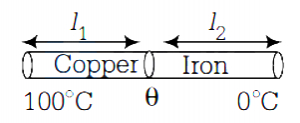
$A$ copper rod of length $75 \ cm$ and an iron rod of length $125 \ cm$ are joined together end to end. Both are of circular cross-section with diameter $2 \ cm$. The free ends of the copper and iron are maintained at $100^{\circ} C$ and $0^{\circ} C$ respectively. The surfaces of the bars are insulated thermally. The temperature of the copper-iron junction is (Thermal conductivity of copper is $386.4 \ W/m-K$ and thermal conductivity of iron is $48.46 \ W/m-K$) (in $^{\circ} C$)
A
$100$
B
$0$
C
$93$
D
$50$
Solution
(C) Let the temperature of the copper-iron junction be $\theta$.
Since the rods are joined in series and the surfaces are thermally insulated,the rate of heat flow through both rods must be the same in the steady state.
Let $K_1 = 386.4 \ W/m-K$ (copper),$l_1 = 0.75 \ m$,$T_1 = 100^{\circ} C$.
Let $K_2 = 48.46 \ W/m-K$ (iron),$l_2 = 1.25 \ m$,$T_2 = 0^{\circ} C$.
The cross-sectional area $A$ is the same for both.
The rate of heat flow is given by $H = \frac{KA(T_{high} - T_{low})}{l}$.
Equating the heat flow rates: $\frac{K_1 A (T_1 - \theta)}{l_1} = \frac{K_2 A (\theta - T_2)}{l_2}$.
$\frac{386.4 (100 - \theta)}{0.75} = \frac{48.46 (\theta - 0)}{1.25}$.
$515.2 (100 - \theta) = 38.768 \theta$.
$51520 - 515.2 \theta = 38.768 \theta$.
$553.968 \theta = 51520$.
$\theta = \frac{51520}{553.968} \approx 93^{\circ} C$.
Since the rods are joined in series and the surfaces are thermally insulated,the rate of heat flow through both rods must be the same in the steady state.
Let $K_1 = 386.4 \ W/m-K$ (copper),$l_1 = 0.75 \ m$,$T_1 = 100^{\circ} C$.
Let $K_2 = 48.46 \ W/m-K$ (iron),$l_2 = 1.25 \ m$,$T_2 = 0^{\circ} C$.
The cross-sectional area $A$ is the same for both.
The rate of heat flow is given by $H = \frac{KA(T_{high} - T_{low})}{l}$.
Equating the heat flow rates: $\frac{K_1 A (T_1 - \theta)}{l_1} = \frac{K_2 A (\theta - T_2)}{l_2}$.
$\frac{386.4 (100 - \theta)}{0.75} = \frac{48.46 (\theta - 0)}{1.25}$.
$515.2 (100 - \theta) = 38.768 \theta$.
$51520 - 515.2 \theta = 38.768 \theta$.
$553.968 \theta = 51520$.
$\theta = \frac{51520}{553.968} \approx 93^{\circ} C$.
0 likes
View Solution127
EasyMCQ
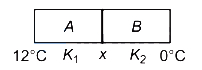
Two slabs $A$ and $B$ of different materials but of the same thickness are joined end to end to form a composite slab. The thermal conductivities of $A$ and $B$ are $k_1$ and $k_2$ respectively. $A$ steady temperature difference of $12^{\circ} C$ is maintained across the composite slab. If $k_1=\frac{k_2}{2}$,the temperature difference across slab $A$ is (in $^{\circ} C$)
A
$4$
B
$6$
C
$8$
D
$10$
Solution
(C) In a steady state,the rate of heat flow $(H)$ through both slabs connected in series is the same.
$H = \frac{k_1 A (\Delta T_A)}{L} = \frac{k_2 A (\Delta T_B)}{L}$
Since the thickness $(L)$ and cross-sectional area $(A)$ are the same for both slabs,we have:
$k_1 (\Delta T_A) = k_2 (\Delta T_B)$
Given $k_1 = \frac{k_2}{2}$,we can write $k_2 = 2k_1$.
Substituting this into the equation:
$k_1 (\Delta T_A) = 2k_1 (\Delta T_B)$
$\Delta T_A = 2 \Delta T_B$
We know the total temperature difference is $\Delta T_A + \Delta T_B = 12^{\circ} C$.
Substituting $\Delta T_A = 2 \Delta T_B$ into the total temperature equation:
$2 \Delta T_B + \Delta T_B = 12^{\circ} C$
$3 \Delta T_B = 12^{\circ} C \implies \Delta T_B = 4^{\circ} C$
Therefore,the temperature difference across slab $A$ is:
$\Delta T_A = 12^{\circ} C - 4^{\circ} C = 8^{\circ} C$.
$H = \frac{k_1 A (\Delta T_A)}{L} = \frac{k_2 A (\Delta T_B)}{L}$
Since the thickness $(L)$ and cross-sectional area $(A)$ are the same for both slabs,we have:
$k_1 (\Delta T_A) = k_2 (\Delta T_B)$
Given $k_1 = \frac{k_2}{2}$,we can write $k_2 = 2k_1$.
Substituting this into the equation:
$k_1 (\Delta T_A) = 2k_1 (\Delta T_B)$
$\Delta T_A = 2 \Delta T_B$
We know the total temperature difference is $\Delta T_A + \Delta T_B = 12^{\circ} C$.
Substituting $\Delta T_A = 2 \Delta T_B$ into the total temperature equation:
$2 \Delta T_B + \Delta T_B = 12^{\circ} C$
$3 \Delta T_B = 12^{\circ} C \implies \Delta T_B = 4^{\circ} C$
Therefore,the temperature difference across slab $A$ is:
$\Delta T_A = 12^{\circ} C - 4^{\circ} C = 8^{\circ} C$.
0 likes
View Solution128
DifficultMCQ
Two slabs $A$ and $B$ of equal surface area are placed one over the other such that their surfaces are completely in contact. The thickness of slab $A$ is twice that of $B$. The coefficient of thermal conductivity of slab $A$ is twice that of $B$. The first surface of slab $A$ is maintained at $100^{\circ} C$,while the second surface of slab $B$ is maintained at $25^{\circ} C$. The temperature at the contact of their surfaces is (in $^{\circ} C$)
A
$62.5$
B
$45$
C
$55$
D
$85$
Solution
(A) Let the thickness of slab $B$ be $d$ and its thermal conductivity be $K$. Then,for slab $A$,the thickness is $2d$ and thermal conductivity is $2K$.
Let the temperature at the contact surface be $T$.
Since the slabs are in series,the rate of heat flow $H$ through both slabs must be the same:
$H = \frac{K_A A (T_1 - T)}{d_A} = \frac{K_B A (T - T_2)}{d_B}$
Substituting the given values:
$\frac{2K \cdot A (100 - T)}{2d} = \frac{K \cdot A (T - 25)}{d}$
$(100 - T) = (T - 25)$
$2T = 125$
$T = 62.5^{\circ} C$
Let the temperature at the contact surface be $T$.
Since the slabs are in series,the rate of heat flow $H$ through both slabs must be the same:
$H = \frac{K_A A (T_1 - T)}{d_A} = \frac{K_B A (T - T_2)}{d_B}$
Substituting the given values:
$\frac{2K \cdot A (100 - T)}{2d} = \frac{K \cdot A (T - 25)}{d}$
$(100 - T) = (T - 25)$
$2T = 125$
$T = 62.5^{\circ} C$
0 likes
View Solution129
EasyMCQ
Three rods $AB$,$BC$,and $BD$ made of the same material and having the same cross-section have been joined as shown in the figure. The ends $A$,$C$,and $D$ are held at temperatures of $20^{\circ} C$,$80^{\circ} C$,and $80^{\circ} C$ respectively. If each rod is of the same length,then the temperature at the junction $B$ of the three rods is: (in $^{\circ} C$)
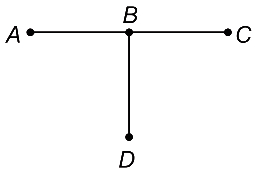
A
$90$
B
$60$
C
$40$
D
$30$
Solution
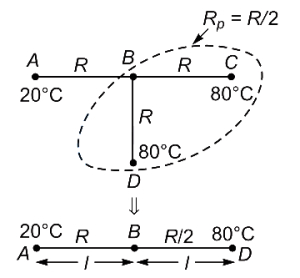
(B) Let the temperature at junction $B$ be $\theta$.
Since the rods $BC$ and $BD$ are connected to the same temperature source $(80^{\circ} C)$ at their outer ends,they act as parallel thermal resistances.
Let $R$ be the thermal resistance of each rod.
The equivalent resistance of the parallel combination of rods $BC$ and $BD$ is $R_p = \frac{R \times R}{R + R} = \frac{R}{2}$.
At steady state,the heat current flowing through rod $AB$ must be equal to the sum of heat currents flowing through rods $BC$ and $BD$.
Using the formula for heat current $\frac{Q}{t} = \frac{\Delta T}{R}$,we have:
$\frac{\theta - 20}{R} = \frac{80 - \theta}{R/2}$
$\theta - 20 = 2(80 - \theta)$
$\theta - 20 = 160 - 2\theta$
$3\theta = 180$
$\theta = 60^{\circ} C$
Thus,the temperature at junction $B$ is $60^{\circ} C$.
Since the rods $BC$ and $BD$ are connected to the same temperature source $(80^{\circ} C)$ at their outer ends,they act as parallel thermal resistances.
Let $R$ be the thermal resistance of each rod.
The equivalent resistance of the parallel combination of rods $BC$ and $BD$ is $R_p = \frac{R \times R}{R + R} = \frac{R}{2}$.
At steady state,the heat current flowing through rod $AB$ must be equal to the sum of heat currents flowing through rods $BC$ and $BD$.
Using the formula for heat current $\frac{Q}{t} = \frac{\Delta T}{R}$,we have:
$\frac{\theta - 20}{R} = \frac{80 - \theta}{R/2}$
$\theta - 20 = 2(80 - \theta)$
$\theta - 20 = 160 - 2\theta$
$3\theta = 180$
$\theta = 60^{\circ} C$
Thus,the temperature at junction $B$ is $60^{\circ} C$.
0 likes
View Solution130
EasyMCQ
Two rods whose lengths are $l_1$ and $l_2$ with thermal conductivity coefficients $k_1$ and $k_2$ are placed end to end. The thermal conductivity coefficient of a uniform rod of length $l_1+l_2$ whose thermal resistance is the same as that of the system of these two rods is
A
$\frac{(l_1+l_2) k_1 k_2}{k_2 l_1+k_1 l_2}$
B
$\frac{(l_1+l_2) k_1 k_2}{k_1 l_1+k_2 l_2}$
C
$\frac{k_1 l_1+k_2 l_2}{(l_1+l_2) k_1 k_2}$
D
$\frac{k_1 l_2+k_2 l_1}{(l_1+l_2) k_1 k_2}$
Solution
(A) When two rods are connected in series,the total thermal resistance $R_{eq}$ is the sum of individual thermal resistances $R_1$ and $R_2$.
The thermal resistance of a rod is given by $R = \frac{l}{kA}$.
For the two rods in series: $R_{eq} = R_1 + R_2$.
$\frac{l_1+l_2}{k A} = \frac{l_1}{k_1 A} + \frac{l_2}{k_2 A}$.
Canceling the area $A$ from both sides:
$\frac{l_1+l_2}{k} = \frac{l_1}{k_1} + \frac{l_2}{k_2}$.
$\frac{l_1+l_2}{k} = \frac{k_2 l_1 + k_1 l_2}{k_1 k_2}$.
Therefore,$k = \frac{(l_1+l_2) k_1 k_2}{k_2 l_1 + k_1 l_2}$.
The thermal resistance of a rod is given by $R = \frac{l}{kA}$.
For the two rods in series: $R_{eq} = R_1 + R_2$.
$\frac{l_1+l_2}{k A} = \frac{l_1}{k_1 A} + \frac{l_2}{k_2 A}$.
Canceling the area $A$ from both sides:
$\frac{l_1+l_2}{k} = \frac{l_1}{k_1} + \frac{l_2}{k_2}$.
$\frac{l_1+l_2}{k} = \frac{k_2 l_1 + k_1 l_2}{k_1 k_2}$.
Therefore,$k = \frac{(l_1+l_2) k_1 k_2}{k_2 l_1 + k_1 l_2}$.
0 likes
View Solution131
MediumMCQ
Two rods of equal length and diameter have thermal conductivities $3$ and $4$ units respectively. If they are joined in series,the thermal conductivity of the combination would be
A
$3.43$
B
$3.5$
C
$3.4$
D
$3.34$
Solution
(A) For two rods of equal length $\ell$ and cross-sectional area $A$ joined in series,the equivalent thermal resistance $R_{eq}$ is the sum of individual thermal resistances $R_1$ and $R_2$.
$R_{eq} = R_1 + R_2$
Since $R = \frac{\ell}{KA}$,we have:
$\frac{2\ell}{K_{eff} A} = \frac{\ell}{K_1 A} + \frac{\ell}{K_2 A}$
Canceling $\frac{\ell}{A}$ from both sides:
$\frac{2}{K_{eff}} = \frac{1}{K_1} + \frac{1}{K_2}$
Given $K_1 = 3$ and $K_2 = 4$:
$\frac{2}{K_{eff}} = \frac{1}{3} + \frac{1}{4} = \frac{4+3}{12} = \frac{7}{12}$
$K_{eff} = \frac{24}{7} \approx 3.43$ units.
$R_{eq} = R_1 + R_2$
Since $R = \frac{\ell}{KA}$,we have:
$\frac{2\ell}{K_{eff} A} = \frac{\ell}{K_1 A} + \frac{\ell}{K_2 A}$
Canceling $\frac{\ell}{A}$ from both sides:
$\frac{2}{K_{eff}} = \frac{1}{K_1} + \frac{1}{K_2}$
Given $K_1 = 3$ and $K_2 = 4$:
$\frac{2}{K_{eff}} = \frac{1}{3} + \frac{1}{4} = \frac{4+3}{12} = \frac{7}{12}$
$K_{eff} = \frac{24}{7} \approx 3.43$ units.
0 likes
View Solution132
DifficultMCQ
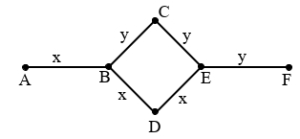
Rods $x$ and $y$ of equal dimensions but of different materials are joined as shown in the figure. Temperatures of end points $A$ and $F$ are maintained at $100^{\circ}C$ and $40^{\circ}C$ respectively. Given the thermal conductivity of rod $x$ is three times that of rod $y$,the temperatures at junction points $B$ and $E$ are (close to):
A
$89^{\circ}C$ and $73^{\circ}C$ respectively
B
$80^{\circ}C$ and $60^{\circ}C$ respectively
C
$80^{\circ}C$ and $70^{\circ}C$ respectively
D
$60^{\circ}C$ and $45^{\circ}C$ respectively
Solution
(A) Let the thermal resistance of rod $x$ be $R = \frac{\ell}{k_x A}$. Since the thermal conductivity of $x$ is $3$ times that of $y$ $(k_x = 3k_y)$,the thermal resistance of rod $y$ is $3R$.
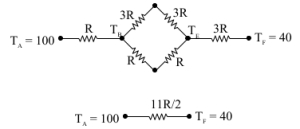
From the figure,the network between $B$ and $E$ consists of two parallel branches: one with rods $y$ and $y$ (total resistance $3R + 3R = 6R$) and one with rods $x$ and $x$ (total resistance $R + R = 2R$).
The equivalent resistance $R_{BE}$ between $B$ and $E$ is $\frac{1}{R_{BE}} = \frac{1}{6R} + \frac{1}{2R} = \frac{1+3}{6R} = \frac{4}{6R} = \frac{2}{3R}$,so $R_{BE} = 1.5R$.
The total resistance of the circuit is $R_{total} = R_{AB} + R_{BE} + R_{EF} = R + 1.5R + 3R = 5.5R = \frac{11R}{2}$.
The total heat current $H = \frac{100 - 40}{5.5R} = \frac{60}{5.5R} = \frac{120}{11R}$.
Now,$T_B = 100 - H \cdot R = 100 - \frac{120}{11R} \cdot R = 100 - 10.91 \approx 89.09^{\circ}C$.
And $T_E = 40 + H \cdot (3R) = 40 + \frac{120}{11R} \cdot 3R = 40 + 32.73 \approx 72.73^{\circ}C$.
Thus,$T_B \approx 89^{\circ}C$ and $T_E \approx 73^{\circ}C$.
From the figure,the network between $B$ and $E$ consists of two parallel branches: one with rods $y$ and $y$ (total resistance $3R + 3R = 6R$) and one with rods $x$ and $x$ (total resistance $R + R = 2R$).
The equivalent resistance $R_{BE}$ between $B$ and $E$ is $\frac{1}{R_{BE}} = \frac{1}{6R} + \frac{1}{2R} = \frac{1+3}{6R} = \frac{4}{6R} = \frac{2}{3R}$,so $R_{BE} = 1.5R$.
The total resistance of the circuit is $R_{total} = R_{AB} + R_{BE} + R_{EF} = R + 1.5R + 3R = 5.5R = \frac{11R}{2}$.
The total heat current $H = \frac{100 - 40}{5.5R} = \frac{60}{5.5R} = \frac{120}{11R}$.
Now,$T_B = 100 - H \cdot R = 100 - \frac{120}{11R} \cdot R = 100 - 10.91 \approx 89.09^{\circ}C$.
And $T_E = 40 + H \cdot (3R) = 40 + \frac{120}{11R} \cdot 3R = 40 + 32.73 \approx 72.73^{\circ}C$.
Thus,$T_B \approx 89^{\circ}C$ and $T_E \approx 73^{\circ}C$.
0 likes
View Solution10-2.Heat Transfer — Thermal Resistance and it's Combination · Frequently Asked Questions
1Are these 10-2.Heat Transfer questions useful for JEE and NEET?
Yes. All questions in this section are mapped to JEE Main and NEET exam patterns. Previous year questions from JEE Main, NEET, GUJCET and state-level exams are included with full solutions.
2Can I switch to Hindi or Gujarati for these questions?
Yes. Use the language tabs in the hero section or the sidebar to view the same questions and solutions in English, Hindi or Gujarati.
3How do I generate a question paper from this subtopic?
Use the Vedclass Exam Paper Generator — select the chapter and subtopic, set difficulty, and generate Sets A, B, C, D automatically. First 3 chapters of every subject are free.
Vedclass Products
For Students
Vedclass Test Series
Mock tests in real JEE/NEET style with performance analysis. 5-day free trial.
Start Free TrialFor Teachers
Exam Paper Generator
Generate Set A/B/C/D papers from this chapter in 2 minutes. 3 chapters free.
Try FreeFor Institutes
Online Exam Module
Live online exams with unlimited students, 360° analytics & white-label branding.
See DemoFor Teachers & Institutes
Generate a 10-2.Heat Transfer Exam Paper in 2 Minutes
Select subtopic & difficulty — Sets A, B, C, D auto-generated with No Repeat logic.
First 3 chapters of every subject are free — no payment required.