
A English
Mix Examples-Heat Transfer Questions in English
Class 11 Physics · 10-2.Heat Transfer · Mix Examples-Heat Transfer
42+
Questions
English
Language
100%
With Solutions
Showing 41 of 42 questions in English
1
EasyMCQ
In the variable state,the rate of flow of heat is controlled by
A
Density of material
B
Specific heat
C
Thermal conductivity
D
All the above factors
Solution
(D) In the variable state of heat conduction,the rate of heat flow is governed by the thermal diffusivity of the material. The thermal diffusivity $\alpha$ is defined as $\alpha = \frac{K}{\rho c}$,where $K$ is the thermal conductivity,$\rho$ is the density,and $c$ is the specific heat capacity.
Since the rate of change of temperature in the variable state depends on the thermal diffusivity,the rate of heat flow is influenced by all three factors: thermal conductivity $(K)$,density $(\rho)$,and specific heat $(c)$.
Therefore,the correct option is $D$.
Since the rate of change of temperature in the variable state depends on the thermal diffusivity,the rate of heat flow is influenced by all three factors: thermal conductivity $(K)$,density $(\rho)$,and specific heat $(c)$.
Therefore,the correct option is $D$.
0 likes
View Solution2
EasyMCQ
In a closed room,heat transfer takes place by
A
Conduction
B
Convection
C
Radiation
D
All of these
Solution
(D) In a closed room,the air inside acts as a fluid. When a heat source is present,the air near the source gets heated,becomes less dense,and rises,while cooler,denser air moves in to take its place. This continuous circulation of air,known as convection,is the primary mechanism for heat transfer throughout the room. While conduction occurs through walls and radiation occurs from surfaces,the overall distribution of heat in the room is dominated by convection. Therefore,the correct answer is $D$.
0 likes
View Solution3
MediumMCQ
On a clear sunny day,an object at temperature $T$ is placed on the top of a high mountain. An identical object at the same temperature is placed at the foot of the mountain. If both the objects are exposed to sun-rays for two hours in an identical manner,the object at the top of the mountain will register a temperature
A
Higher than the object at the foot
B
Lower than the object at the foot
C
Equal to the object at the foot
D
None of the above
Solution
(B) The correct answer is $B$.
$1$. At high altitudes,the atmosphere is thinner,which reduces the greenhouse effect and heat retention compared to the foot of the mountain.
$2$. The intensity of solar radiation reaching the surface depends on the angle of incidence. At the top of a mountain,the air temperature is significantly lower due to the adiabatic lapse rate.
$3$. Furthermore,the object at the top is exposed to higher wind speeds and lower ambient temperatures,leading to greater convective heat loss compared to the object at the foot.
$4$. Therefore,the object at the top of the mountain will register a lower temperature than the identical object placed at the foot.
$1$. At high altitudes,the atmosphere is thinner,which reduces the greenhouse effect and heat retention compared to the foot of the mountain.
$2$. The intensity of solar radiation reaching the surface depends on the angle of incidence. At the top of a mountain,the air temperature is significantly lower due to the adiabatic lapse rate.
$3$. Furthermore,the object at the top is exposed to higher wind speeds and lower ambient temperatures,leading to greater convective heat loss compared to the object at the foot.
$4$. Therefore,the object at the top of the mountain will register a lower temperature than the identical object placed at the foot.
0 likes
View Solution4
MediumMCQ
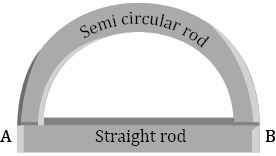
Two rods (one semi-circular and other straight) of the same material and of the same cross-sectional area are joined as shown in the figure. The points $A$ and $B$ are maintained at different temperatures. The ratio of the heat transferred through a cross-section of the semi-circular rod to the heat transferred through a cross-section of the straight rod in a given time is
A
$2 : \pi$
B
$1 : 2$
C
$\pi : 2$
D
$3 : 2$
Solution
(A) The rate of heat flow through a rod is given by the formula: $\frac{dQ}{dt} = \frac{KA \Delta \theta}{l}$.
Here,$K$ is the thermal conductivity,$A$ is the cross-sectional area,$\Delta \theta$ is the temperature difference,and $l$ is the length of the rod.
Since both rods are made of the same material,$K$ is the same for both.
They have the same cross-sectional area $A$,and the points $A$ and $B$ are maintained at the same temperature difference $\Delta \theta$ for both paths.
Therefore,the rate of heat flow is inversely proportional to the length of the rod: $\frac{dQ}{dt} \propto \frac{1}{l}$.
The length of the straight rod is $l_{straight} = 2r$,where $r$ is the radius.
The length of the semi-circular rod is $l_{semi} = \pi r$.
Thus,the ratio of heat transferred is:
$\frac{(dQ/dt)_{semi}}{(dQ/dt)_{straight}} = \frac{l_{straight}}{l_{semi}} = \frac{2r}{\pi r} = \frac{2}{\pi}$.
Here,$K$ is the thermal conductivity,$A$ is the cross-sectional area,$\Delta \theta$ is the temperature difference,and $l$ is the length of the rod.
Since both rods are made of the same material,$K$ is the same for both.
They have the same cross-sectional area $A$,and the points $A$ and $B$ are maintained at the same temperature difference $\Delta \theta$ for both paths.
Therefore,the rate of heat flow is inversely proportional to the length of the rod: $\frac{dQ}{dt} \propto \frac{1}{l}$.
The length of the straight rod is $l_{straight} = 2r$,where $r$ is the radius.
The length of the semi-circular rod is $l_{semi} = \pi r$.
Thus,the ratio of heat transferred is:
$\frac{(dQ/dt)_{semi}}{(dQ/dt)_{straight}} = \frac{l_{straight}}{l_{semi}} = \frac{2r}{\pi r} = \frac{2}{\pi}$.
0 likes
View Solution5
MediumMCQ
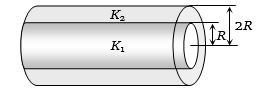
$A$ cylinder of radius $R$ made of a material of thermal conductivity $K_1$ is surrounded by a cylindrical shell of inner radius $R$ and outer radius $2R$ made of material of thermal conductivity $K_2$. The two ends of the combined system are maintained at two different temperatures. There is no loss of heat across the cylindrical surface and the system is in steady state. The effective thermal conductivity of the system is
A
$K_1 + K_2$
B
$\frac{K_1 K_2}{K_1 + K_2}$
C
$\frac{K_1 + 3K_2}{4}$
D
$\frac{3K_1 + K_2}{4}$
Solution
(C) Since the heat flows along the length of the cylinders,the two cylinders are in parallel configuration.
The equivalent thermal conductivity $K_{eq}$ for parallel combination is given by $K_{eq} = \frac{K_1 A_1 + K_2 A_2}{A_1 + A_2}$.
Here,$A_1$ is the cross-sectional area of the inner cylinder: $A_1 = \pi R^2$.
$A_2$ is the cross-sectional area of the outer cylindrical shell: $A_2 = \pi (2R)^2 - \pi R^2 = 4\pi R^2 - \pi R^2 = 3\pi R^2$.
The total area $A = A_1 + A_2 = \pi R^2 + 3\pi R^2 = 4\pi R^2$.
Substituting these values into the formula:
$K_{eq} = \frac{K_1(\pi R^2) + K_2(3\pi R^2)}{4\pi R^2} = \frac{K_1 + 3K_2}{4}$.
The equivalent thermal conductivity $K_{eq}$ for parallel combination is given by $K_{eq} = \frac{K_1 A_1 + K_2 A_2}{A_1 + A_2}$.
Here,$A_1$ is the cross-sectional area of the inner cylinder: $A_1 = \pi R^2$.
$A_2$ is the cross-sectional area of the outer cylindrical shell: $A_2 = \pi (2R)^2 - \pi R^2 = 4\pi R^2 - \pi R^2 = 3\pi R^2$.
The total area $A = A_1 + A_2 = \pi R^2 + 3\pi R^2 = 4\pi R^2$.
Substituting these values into the formula:
$K_{eq} = \frac{K_1(\pi R^2) + K_2(3\pi R^2)}{4\pi R^2} = \frac{K_1 + 3K_2}{4}$.
0 likes
View Solution6
DifficultMCQ
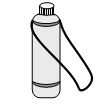
The only possibility of heat flow in a thermos flask is through its cork,which is $75 \ cm^2$ in area and $5 \ cm$ thick. Its thermal conductivity is $0.0075 \ cal/(cm \cdot s \cdot ^\circ C)$. The outside temperature is $40^\circ C$ and the latent heat of fusion of ice is $80 \ cal/g$. The time taken by $500 \ g$ of ice at $0^\circ C$ in the flask to melt into water at $0^\circ C$ is ....... $hr$.
A
$2.47$
B
$4.27$
C
$7.42$
D
$4.72$
Solution
(A) The heat required to melt $500 \ g$ of ice at $0^\circ C$ is given by $Q = mL$,where $m = 500 \ g$ and $L = 80 \ cal/g$.
$Q = 500 \times 80 = 40,000 \ cal$.
The rate of heat flow through the cork is given by $\frac{Q}{t} = \frac{KA\Delta\theta}{\Delta x}$,where $K = 0.0075 \ cal/(cm \cdot s \cdot ^\circ C)$,$A = 75 \ cm^2$,$\Delta\theta = (40 - 0) = 40^\circ C$,and $\Delta x = 5 \ cm$.
Substituting the values,we get:
$\frac{40,000}{t} = \frac{0.0075 \times 75 \times 40}{5}$
$\frac{40,000}{t} = 0.0075 \times 15 \times 40$
$\frac{40,000}{t} = 4.5$
$t = \frac{40,000}{4.5} \approx 8888.89 \ s$.
To convert the time into hours,divide by $3600$:
$t = \frac{8888.89}{3600} \approx 2.47 \ hr$.
$Q = 500 \times 80 = 40,000 \ cal$.
The rate of heat flow through the cork is given by $\frac{Q}{t} = \frac{KA\Delta\theta}{\Delta x}$,where $K = 0.0075 \ cal/(cm \cdot s \cdot ^\circ C)$,$A = 75 \ cm^2$,$\Delta\theta = (40 - 0) = 40^\circ C$,and $\Delta x = 5 \ cm$.
Substituting the values,we get:
$\frac{40,000}{t} = \frac{0.0075 \times 75 \times 40}{5}$
$\frac{40,000}{t} = 0.0075 \times 15 \times 40$
$\frac{40,000}{t} = 4.5$
$t = \frac{40,000}{4.5} \approx 8888.89 \ s$.
To convert the time into hours,divide by $3600$:
$t = \frac{8888.89}{3600} \approx 2.47 \ hr$.
0 likes
View Solution7
MediumMCQ
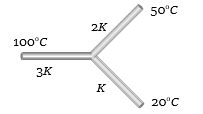
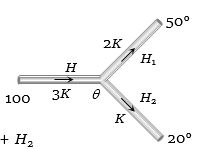
Three rods of the same dimension have thermal conductivities $3K$,$2K$,and $K$. They are arranged as shown in the figure,with their ends at $100^oC$,$50^oC$,and $20^oC$. The temperature of their junction is ......... $^oC$.
A
$60$
B
$70$
C
$50$
D
$35$
Solution
(B) Let the temperature of the junction be $\theta$. According to the principle of conservation of energy,the heat flowing into the junction must equal the heat flowing out of the junction.
$H = H_1 + H_2$
Using the formula for heat current $H = \frac{KA(\Delta T)}{l}$,where $K$ is thermal conductivity,$A$ is area,and $l$ is length:
$\frac{3K \cdot A \cdot (100 - \theta)}{l} = \frac{2K \cdot A \cdot (\theta - 50)}{l} + \frac{K \cdot A \cdot (\theta - 20)}{l}$
Since $A$ and $l$ are the same for all rods,they cancel out:
$3(100 - \theta) = 2(\theta - 50) + 1(\theta - 20)$
$300 - 3\theta = 2\theta - 100 + \theta - 20$
$300 - 3\theta = 3\theta - 120$
$420 = 6\theta$
$\theta = 70^oC$
Thus,the temperature of the junction is $70^oC$.
$H = H_1 + H_2$
Using the formula for heat current $H = \frac{KA(\Delta T)}{l}$,where $K$ is thermal conductivity,$A$ is area,and $l$ is length:
$\frac{3K \cdot A \cdot (100 - \theta)}{l} = \frac{2K \cdot A \cdot (\theta - 50)}{l} + \frac{K \cdot A \cdot (\theta - 20)}{l}$
Since $A$ and $l$ are the same for all rods,they cancel out:
$3(100 - \theta) = 2(\theta - 50) + 1(\theta - 20)$
$300 - 3\theta = 2\theta - 100 + \theta - 20$
$300 - 3\theta = 3\theta - 120$
$420 = 6\theta$
$\theta = 70^oC$
Thus,the temperature of the junction is $70^oC$.
0 likes
View Solution8
DifficultMCQ
Two bodies $A$ and $B$ have thermal emissivities of $0.01$ and $0.81$ respectively. The outer surface areas of the two bodies are the same. The two bodies emit total radiant power at the same rate. The wavelength ${\lambda _B}$ corresponding to maximum spectral radiancy in the radiation from $B$ is shifted from the wavelength corresponding to maximum spectral radiancy in the radiation from $A$ by $1.00\;\mu m$. If the temperature of $A$ is $5802\;K$,then:
A
The temperature of $B$ is $1934\;K$
B
${\lambda _B} = 1.5\;\mu m$
C
The temperature of $B$ is $11604\;K$
D
Both $(a)$ and $(b)$
Solution
(D) According to Stefan-Boltzmann law,the total radiant power $P = e A \sigma T^4$. Since $P_A = P_B$ and $A_A = A_B$,we have $e_A T_A^4 = e_B T_B^4$.
Given $e_A = 0.01$,$e_B = 0.81$,and $T_A = 5802\;K$.
$T_B = T_A \left( \frac{e_A}{e_B} \right)^{1/4} = 5802 \times \left( \frac{0.01}{0.81} \right)^{1/4} = 5802 \times \left( \frac{1}{81} \right)^{1/4} = 5802 \times \frac{1}{3} = 1934\;K$.
From Wien's displacement law,$\lambda_A T_A = \lambda_B T_B = b$ (constant).
$\lambda_A = \frac{b}{T_A}$ and $\lambda_B = \frac{b}{T_B}$.
Given $\lambda_B - \lambda_A = 1.00\;\mu m$.
$\frac{b}{T_B} - \frac{b}{T_A} = 1.00\;\mu m$.
$b \left( \frac{1}{1934} - \frac{1}{5802} \right) = 1.00\;\mu m$.
$b \left( \frac{3 - 1}{5802} \right) = 1.00\;\mu m \Rightarrow b = \frac{5802}{2} = 2901\;\mu m \cdot K$.
Now,$\lambda_B = \frac{b}{T_B} = \frac{2901}{1934} = 1.5\;\mu m$.
Thus,both $(a)$ and $(b)$ are correct.
Given $e_A = 0.01$,$e_B = 0.81$,and $T_A = 5802\;K$.
$T_B = T_A \left( \frac{e_A}{e_B} \right)^{1/4} = 5802 \times \left( \frac{0.01}{0.81} \right)^{1/4} = 5802 \times \left( \frac{1}{81} \right)^{1/4} = 5802 \times \frac{1}{3} = 1934\;K$.
From Wien's displacement law,$\lambda_A T_A = \lambda_B T_B = b$ (constant).
$\lambda_A = \frac{b}{T_A}$ and $\lambda_B = \frac{b}{T_B}$.
Given $\lambda_B - \lambda_A = 1.00\;\mu m$.
$\frac{b}{T_B} - \frac{b}{T_A} = 1.00\;\mu m$.
$b \left( \frac{1}{1934} - \frac{1}{5802} \right) = 1.00\;\mu m$.
$b \left( \frac{3 - 1}{5802} \right) = 1.00\;\mu m \Rightarrow b = \frac{5802}{2} = 2901\;\mu m \cdot K$.
Now,$\lambda_B = \frac{b}{T_B} = \frac{2901}{1934} = 1.5\;\mu m$.
Thus,both $(a)$ and $(b)$ are correct.
0 likes
View Solution9
DifficultMCQ
Three discs $A, B$ and $C$ having radii $2\; m, 4\; m,$ and $6\; m$ respectively are coated with carbon black on their outer surfaces. The wavelengths corresponding to maximum intensity are $300\; nm, 400\; nm$ and $500\; nm$ respectively. The power radiated by them are $Q_A, Q_B$ and $Q_C$ respectively. Which of the following is true?
A
$Q_A$ is maximum
B
$Q_B$ is maximum
C
$Q_C$ is maximum
D
$Q_A = Q_B = Q_C$
Solution
(B) The power radiated by a black body is given by the Stefan-Boltzmann law: $P = A \sigma T^4$,where $A$ is the surface area,$\sigma$ is the Stefan-Boltzmann constant,and $T$ is the absolute temperature.
Since the discs are coated with carbon black,they act as black bodies $(\varepsilon = 1)$.
The area of a disc is $A = \pi r^2$,so $P \propto r^2 T^4$.
According to Wien's displacement law,$\lambda_m T = b$ (constant),which implies $T \propto \frac{1}{\lambda_m}$.
Substituting this into the power equation: $P \propto r^2 \left(\frac{1}{\lambda_m}\right)^4 = \frac{r^2}{\lambda_m^4}$.
Now,calculating the relative values for $Q_A, Q_B,$ and $Q_C$:
$Q_A \propto \frac{2^2}{300^4} = \frac{4}{81 \times 10^8} \approx 0.049 \times 10^{-8}$
$Q_B \propto \frac{4^2}{400^4} = \frac{16}{256 \times 10^8} = 0.0625 \times 10^{-8}$
$Q_C \propto \frac{6^2}{500^4} = \frac{36}{625 \times 10^8} \approx 0.0576 \times 10^{-8}$
Comparing these values,$Q_B$ is the maximum.
Since the discs are coated with carbon black,they act as black bodies $(\varepsilon = 1)$.
The area of a disc is $A = \pi r^2$,so $P \propto r^2 T^4$.
According to Wien's displacement law,$\lambda_m T = b$ (constant),which implies $T \propto \frac{1}{\lambda_m}$.
Substituting this into the power equation: $P \propto r^2 \left(\frac{1}{\lambda_m}\right)^4 = \frac{r^2}{\lambda_m^4}$.
Now,calculating the relative values for $Q_A, Q_B,$ and $Q_C$:
$Q_A \propto \frac{2^2}{300^4} = \frac{4}{81 \times 10^8} \approx 0.049 \times 10^{-8}$
$Q_B \propto \frac{4^2}{400^4} = \frac{16}{256 \times 10^8} = 0.0625 \times 10^{-8}$
$Q_C \propto \frac{6^2}{500^4} = \frac{36}{625 \times 10^8} \approx 0.0576 \times 10^{-8}$
Comparing these values,$Q_B$ is the maximum.
0 likes
View Solution10
MediumMCQ
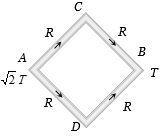
Four rods of identical cross-sectional area and made from the same metal form the sides of a square. The temperatures of two diagonally opposite points $A$ and $B$ are $\sqrt{2}T$ and $T$ respectively in the steady state. Assuming that only heat conduction takes place,what will be the temperature difference between the other two points $C$ and $D$?
A
$\frac{\sqrt{2} + 1}{2}T$
B
$\frac{2}{\sqrt{2} + 1}T$
C
$0$
D
None of these
Solution
(C) Let the thermal resistance of each rod be $R$. The square consists of four rods $AC, CB, BD, DA$. The points $A$ and $B$ are maintained at temperatures $T_A = \sqrt{2}T$ and $T_B = T$.
Due to the symmetry of the circuit,the heat current $H$ flowing from $A$ splits equally into two paths: $AC-CB$ and $AD-DB$.
Let $T_C$ and $T_D$ be the temperatures at points $C$ and $D$ respectively.
For path $AC-CB$: The heat current is $H_1 = \frac{T_A - T_C}{R} = \frac{T_C - T_B}{R}$. This implies $T_A - T_C = T_C - T_B$,so $T_C = \frac{T_A + T_B}{2}$.
For path $AD-DB$: The heat current is $H_2 = \frac{T_A - T_D}{R} = \frac{T_D - T_B}{R}$. This implies $T_A - T_D = T_D - T_B$,so $T_D = \frac{T_A + T_B}{2}$.
Since $T_C = T_D$,the temperature difference between $C$ and $D$ is $T_C - T_D = 0$.
Due to the symmetry of the circuit,the heat current $H$ flowing from $A$ splits equally into two paths: $AC-CB$ and $AD-DB$.
Let $T_C$ and $T_D$ be the temperatures at points $C$ and $D$ respectively.
For path $AC-CB$: The heat current is $H_1 = \frac{T_A - T_C}{R} = \frac{T_C - T_B}{R}$. This implies $T_A - T_C = T_C - T_B$,so $T_C = \frac{T_A + T_B}{2}$.
For path $AD-DB$: The heat current is $H_2 = \frac{T_A - T_D}{R} = \frac{T_D - T_B}{R}$. This implies $T_A - T_D = T_D - T_B$,so $T_D = \frac{T_A + T_B}{2}$.
Since $T_C = T_D$,the temperature difference between $C$ and $D$ is $T_C - T_D = 0$.
0 likes
View Solution11
DifficultMCQ
The sun,acting as a black body,emits maximum radiation at a wavelength of $0.48 \ \mu m$. The average radius of the sun is $6.96 \times 10^{8} \ m$. The Stefan-Boltzmann constant is $5.67 \times 10^{-8} \ W/m^2K^4$ and Wien's constant is $0.293 \ cm \cdot K$. The decrease in the mass of the sun per second due to radiation is ..... $kg/s$.
A
$5.3 \times 10^{9}$
B
$2.7 \times 10^{9}$
C
$2.7 \times 10^{8}$
D
$5.4 \times 10^{8}$
Solution
(A) Given: $\lambda_m = 0.48 \ \mu m = 0.48 \times 10^{-6} \ m$,$r = 6.96 \times 10^8 \ m$,$\sigma = 5.67 \times 10^{-8} \ W/m^2K^4$,$b = 0.293 \times 10^{-2} \ m \cdot K$.
$1$. Calculate the temperature of the sun using Wien's displacement law: $T = \frac{b}{\lambda_m} = \frac{0.293 \times 10^{-2}}{0.48 \times 10^{-6}} \approx 6104 \ K$.
$2$. Calculate the surface area of the sun: $A = 4\pi r^2 = 4 \times 3.1416 \times (6.96 \times 10^8)^2 \approx 6.084 \times 10^{18} \ m^2$.
$3$. Calculate the power (energy per second) radiated by the sun using Stefan-Boltzmann law: $P = A \sigma T^4 = (6.084 \times 10^{18}) \times (5.67 \times 10^{-8}) \times (6104)^4 \approx 4.789 \times 10^{26} \ J/s$.
$4$. Calculate the mass loss per second using Einstein's mass-energy equivalence: $\Delta m = \frac{P}{c^2} = \frac{4.789 \times 10^{26}}{(3 \times 10^8)^2} \approx 5.32 \times 10^9 \ kg/s$.
$1$. Calculate the temperature of the sun using Wien's displacement law: $T = \frac{b}{\lambda_m} = \frac{0.293 \times 10^{-2}}{0.48 \times 10^{-6}} \approx 6104 \ K$.
$2$. Calculate the surface area of the sun: $A = 4\pi r^2 = 4 \times 3.1416 \times (6.96 \times 10^8)^2 \approx 6.084 \times 10^{18} \ m^2$.
$3$. Calculate the power (energy per second) radiated by the sun using Stefan-Boltzmann law: $P = A \sigma T^4 = (6.084 \times 10^{18}) \times (5.67 \times 10^{-8}) \times (6104)^4 \approx 4.789 \times 10^{26} \ J/s$.
$4$. Calculate the mass loss per second using Einstein's mass-energy equivalence: $\Delta m = \frac{P}{c^2} = \frac{4.789 \times 10^{26}}{(3 \times 10^8)^2} \approx 5.32 \times 10^9 \ kg/s$.
0 likes
View Solution12
MediumMCQ
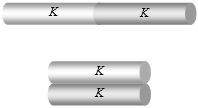
If heat conduction in Figure $1$ takes $12 \, sec$,how much time (in $sec$) will it take for the same amount of heat to be conducted in Figure $2$?
A
$24$
B
$3$
C
$1.5$
D
$48$
Solution
(B) The formula for heat conduction is $Q = K A \frac{\Delta \theta}{l} t$.
From this,we can see that for a constant amount of heat $Q$ and temperature difference $\Delta \theta$,the time $t$ is proportional to $\frac{l}{A}$,i.e.,$t \propto \frac{l}{A}$.
In Figure $1$,two rods of length $l$ and area $A$ are connected in series. The total length is $2l$ and the area is $A$. So,$t_1 \propto \frac{2l}{A}$.
In Figure $2$,the two rods are connected in parallel. The length is $l$ and the total area is $2A$. So,$t_2 \propto \frac{l}{2A}$.
Taking the ratio:
$\frac{t_1}{t_2} = \frac{2l/A}{l/2A} = \frac{2l}{A} \times \frac{2A}{l} = 4$.
Given $t_1 = 12 \, sec$,we have $t_2 = \frac{t_1}{4} = \frac{12}{4} = 3 \, sec$.
From this,we can see that for a constant amount of heat $Q$ and temperature difference $\Delta \theta$,the time $t$ is proportional to $\frac{l}{A}$,i.e.,$t \propto \frac{l}{A}$.
In Figure $1$,two rods of length $l$ and area $A$ are connected in series. The total length is $2l$ and the area is $A$. So,$t_1 \propto \frac{2l}{A}$.
In Figure $2$,the two rods are connected in parallel. The length is $l$ and the total area is $2A$. So,$t_2 \propto \frac{l}{2A}$.
Taking the ratio:
$\frac{t_1}{t_2} = \frac{2l/A}{l/2A} = \frac{2l}{A} \times \frac{2A}{l} = 4$.
Given $t_1 = 12 \, sec$,we have $t_2 = \frac{t_1}{4} = \frac{12}{4} = 3 \, sec$.
0 likes
View Solution13
AdvancedMCQ
$A$ rod of length $L$ and uniform cross-sectional area has varying thermal conductivity which changes linearly from $2K$ at end $A$ to $K$ at the other end $B$. The ends $A$ and $B$ of the rod are maintained at constant temperatures $100^oC$ and $0^oC$, respectively. At steady state, the graph of temperature $T = T(x)$, where $x$ is the distance from end $A$, will be:
A
B
C
D
Solution
(C) In steady state, the rate of heat flow $H = -kA(dT/dx)$ is constant throughout the rod.
Given $k(x) = 2K - (K/L)x = K(2 - x/L)$.
Thus, $H = -K(2 - x/L)A(dT/dx) = \text{constant} = C$.
Rearranging, $dT = -[C / (KA(2 - x/L))] dx$.
Integrating both sides, $T(x) = -[C / (KA)] \int [1 / (2 - x/L)] dx$.
$T(x) = [CL / (KA)] \ln(2 - x/L) + C_0$.
Since $T(x)$ involves a logarithmic function, the slope $dT/dx = -C / [KA(2 - x/L)]$ is not constant.
As $x$ increases from $0$ to $L$, the term $(2 - x/L)$ decreases from $2$ to $1$.
Therefore, the magnitude of the slope $|dT/dx| = C / [KA(2 - x/L)]$ increases as $x$ increases.
$A$ curve where the magnitude of the slope increases as $x$ increases is concave up. Thus, the graph is concave up.
Given $k(x) = 2K - (K/L)x = K(2 - x/L)$.
Thus, $H = -K(2 - x/L)A(dT/dx) = \text{constant} = C$.
Rearranging, $dT = -[C / (KA(2 - x/L))] dx$.
Integrating both sides, $T(x) = -[C / (KA)] \int [1 / (2 - x/L)] dx$.
$T(x) = [CL / (KA)] \ln(2 - x/L) + C_0$.
Since $T(x)$ involves a logarithmic function, the slope $dT/dx = -C / [KA(2 - x/L)]$ is not constant.
As $x$ increases from $0$ to $L$, the term $(2 - x/L)$ decreases from $2$ to $1$.
Therefore, the magnitude of the slope $|dT/dx| = C / [KA(2 - x/L)]$ increases as $x$ increases.
$A$ curve where the magnitude of the slope increases as $x$ increases is concave up. Thus, the graph is concave up.
0 likes
View Solution14
AdvancedMCQ
$A$ wall with a cavity consists of two layers of brick separated by a layer of air. All three layers have the same thickness,and the thermal conductivity of the brick is much greater than that of air. The left layer is at a higher temperature than the right layer,and a steady-state condition exists. Which of the following graphs correctly predicts the variation of temperature $T$ with distance $d$ inside the cavity?
A
B
C
D
Solution
(D) In a steady-state condition,the rate of heat flow $H = \frac{kA \Delta T}{L}$ is constant through all layers. Since the area $A$ and thickness $L$ are the same for all three layers,the temperature drop $\Delta T$ across each layer is inversely proportional to its thermal conductivity $k$ $(\Delta T = \frac{HL}{kA} \propto \frac{1}{k})$.
Since the thermal conductivity of brick $(k_b)$ is much greater than that of air $(k_a)$,the temperature drop across the air layer will be much larger than the temperature drop across each brick layer.
Therefore,the graph must show a steep linear decrease in temperature across the air layer and a gradual linear decrease across the brick layers. Option $(D)$ correctly represents this behavior.
Since the thermal conductivity of brick $(k_b)$ is much greater than that of air $(k_a)$,the temperature drop across the air layer will be much larger than the temperature drop across each brick layer.
Therefore,the graph must show a steep linear decrease in temperature across the air layer and a gradual linear decrease across the brick layers. Option $(D)$ correctly represents this behavior.
0 likes
View Solution15
AdvancedMCQ
The ends of a metal bar of constant cross-sectional area are maintained at temperatures $T_1$ and $T_2$ which are both higher than the temperature of the surroundings. If the bar is unlagged,which one of the following sketches best represents the variation of temperature with distance along the bar?
A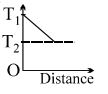
B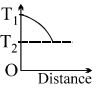
C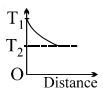
D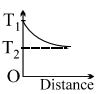
Solution
(C) For an unlagged metal bar,heat is lost to the surroundings from the surface of the bar due to convection and radiation.
Let $T$ be the temperature at a distance $x$ from the end maintained at $T_1$. The steady-state heat conduction equation for an unlagged rod is given by $\frac{d^2T}{dx^2} = k(T - T_s)$,where $T_s$ is the surrounding temperature and $k$ is a constant related to the material and surface properties.
The solution to this differential equation is of the form $T(x) = T_s + A e^{mx} + B e^{-mx}$.
This results in a temperature profile that is concave upwards (exponential decay towards the ambient temperature).
Since the bar is losing heat to the surroundings along its length,the temperature gradient decreases as we move away from the hot end,resulting in a concave curve.
Therefore,the correct representation is a concave curve.
Let $T$ be the temperature at a distance $x$ from the end maintained at $T_1$. The steady-state heat conduction equation for an unlagged rod is given by $\frac{d^2T}{dx^2} = k(T - T_s)$,where $T_s$ is the surrounding temperature and $k$ is a constant related to the material and surface properties.
The solution to this differential equation is of the form $T(x) = T_s + A e^{mx} + B e^{-mx}$.
This results in a temperature profile that is concave upwards (exponential decay towards the ambient temperature).
Since the bar is losing heat to the surroundings along its length,the temperature gradient decreases as we move away from the hot end,resulting in a concave curve.
Therefore,the correct representation is a concave curve.
0 likes
View Solution16
AdvancedMCQ
Three identical rods $AB$,$CD$ and $PQ$ are joined as shown. $P$ and $Q$ are midpoints of $AB$ and $CD$ respectively. Ends $A, B, C$ and $D$ are maintained at $0^{\circ} C, 100^{\circ} C, 30^{\circ} C$ and $60^{\circ} C$ respectively. The direction of heat flow in $PQ$ is
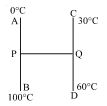
A
from $P$ to $Q$
B
from $Q$ to $P$
C
heat does not flow in $PQ$
D
data not sufficient
Solution
(A) Both the rods $AB$ and $CD$ are in a steady state.
This means the temperature gradient is constant and the temperature drops linearly with distance.
Temperature at the midpoint of $AB$ is $T_{P} = \frac{T_{A} + T_{B}}{2} = \frac{0^{\circ} C + 100^{\circ} C}{2} = 50^{\circ} C$.
Temperature at the midpoint of $CD$ is $T_{Q} = \frac{T_{C} + T_{D}}{2} = \frac{30^{\circ} C + 60^{\circ} C}{2} = 45^{\circ} C$.
Since the temperature at $P$ $(50^{\circ} C)$ is higher than the temperature at $Q$ $(45^{\circ} C)$,heat flows from $P$ to $Q$.
This means the temperature gradient is constant and the temperature drops linearly with distance.
Temperature at the midpoint of $AB$ is $T_{P} = \frac{T_{A} + T_{B}}{2} = \frac{0^{\circ} C + 100^{\circ} C}{2} = 50^{\circ} C$.
Temperature at the midpoint of $CD$ is $T_{Q} = \frac{T_{C} + T_{D}}{2} = \frac{30^{\circ} C + 60^{\circ} C}{2} = 45^{\circ} C$.
Since the temperature at $P$ $(50^{\circ} C)$ is higher than the temperature at $Q$ $(45^{\circ} C)$,heat flows from $P$ to $Q$.
0 likes
View Solution17
DifficultMCQ
The power radiated by a black body is $P$ and it radiates maximum energy around the wavelength $\lambda_0$. If the temperature of the black body is now changed so that it radiates maximum energy around wavelength $\frac{3}{4}\lambda_0$,the power radiated by it will increase by a factor of
A
$4/3$
B
$16/9$
C
$64/27$
D
$256/81$
Solution
(D) According to Wien's displacement law,$\lambda_{\max} T = \text{constant}$.
Let the initial temperature be $T$ and the final temperature be $T'$.
Given $\lambda_{\max, 1} = \lambda_0$ and $\lambda_{\max, 2} = \frac{3}{4}\lambda_0$.
Using $\lambda_{\max, 1} T_1 = \lambda_{\max, 2} T_2$,we get $\lambda_0 T = \frac{3}{4}\lambda_0 T'$,which implies $T' = \frac{4}{3}T$.
According to the Stefan-Boltzmann law,the power radiated $P \propto T^4$.
Therefore,the ratio of the new power $P'$ to the initial power $P$ is:
$\frac{P'}{P} = \left(\frac{T'}{T}\right)^4 = \left(\frac{4}{3}\right)^4 = \frac{256}{81}$.
Let the initial temperature be $T$ and the final temperature be $T'$.
Given $\lambda_{\max, 1} = \lambda_0$ and $\lambda_{\max, 2} = \frac{3}{4}\lambda_0$.
Using $\lambda_{\max, 1} T_1 = \lambda_{\max, 2} T_2$,we get $\lambda_0 T = \frac{3}{4}\lambda_0 T'$,which implies $T' = \frac{4}{3}T$.
According to the Stefan-Boltzmann law,the power radiated $P \propto T^4$.
Therefore,the ratio of the new power $P'$ to the initial power $P$ is:
$\frac{P'}{P} = \left(\frac{T'}{T}\right)^4 = \left(\frac{4}{3}\right)^4 = \frac{256}{81}$.
0 likes
View Solution18
MediumMCQ
$A$ long metallic bar is carrying heat from one of its ends to the other end under steady-state. The variation of temperature $\theta$ along the length $x$ of the bar from its hot end is best described by which of the following figures?
A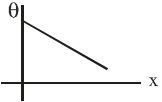
B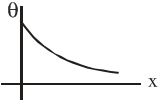
C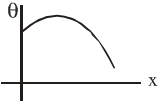
D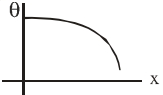
Solution
(A) In steady-state heat conduction through a uniform metallic bar,the rate of heat flow $\frac{dQ}{dt}$ is constant throughout the bar.
According to Fourier's law of heat conduction:
$\frac{dQ}{dt} = -kA \frac{d\theta}{dx}$
Where $k$ is the thermal conductivity,$A$ is the cross-sectional area,and $\frac{d\theta}{dx}$ is the temperature gradient.
Since $\frac{dQ}{dt}$,$k$,and $A$ are constants,the temperature gradient $\frac{d\theta}{dx} = -\frac{1}{kA} \frac{dQ}{dt}$ must also be a constant.
This implies that the temperature $\theta$ decreases linearly with distance $x$ from the hot end.
Therefore,the graph of $\theta$ versus $x$ is a straight line with a negative slope,which corresponds to figure $A$.
According to Fourier's law of heat conduction:
$\frac{dQ}{dt} = -kA \frac{d\theta}{dx}$
Where $k$ is the thermal conductivity,$A$ is the cross-sectional area,and $\frac{d\theta}{dx}$ is the temperature gradient.
Since $\frac{dQ}{dt}$,$k$,and $A$ are constants,the temperature gradient $\frac{d\theta}{dx} = -\frac{1}{kA} \frac{dQ}{dt}$ must also be a constant.
This implies that the temperature $\theta$ decreases linearly with distance $x$ from the hot end.
Therefore,the graph of $\theta$ versus $x$ is a straight line with a negative slope,which corresponds to figure $A$.
0 likes
View Solution19
DifficultMCQ
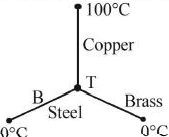
Three rods of Copper,Brass,and Steel are welded together to form a $Y$ shaped structure. The area of cross-section of each rod is $4 \ cm^2$. The end of the copper rod is maintained at $100^\circ C$,whereas the ends of the brass and steel rods are kept at $0^\circ C$. The lengths of the copper,brass,and steel rods are $46 \ cm$,$13 \ cm$,and $12 \ cm$ respectively. The rods are thermally insulated from the surroundings except at the ends. The thermal conductivities of copper,brass,and steel are $0.92$,$0.26$,and $0.12 \ CGS$ units respectively. The rate of heat flow through the copper rod is ....... $cal \ s^{-1}$.
A
$2.4$
B
$4.8$
C
$6.0$
D
$1.2$
Solution
(B) The rate of heat flow $Q$ is given by the formula:
$Q = \frac{KA(\theta_1 - \theta_2)}{l}$
where $K$ is the coefficient of thermal conductivity,$l$ is the length of the rod,and $A$ is the area of cross-section.
Let $T$ be the temperature at the junction where the three rods meet.
According to the principle of conservation of energy,the heat flowing into the junction through the copper rod must equal the heat flowing out through the brass and steel rods:
$Q_{\text{copper}} = Q_{\text{brass}} + Q_{\text{steel}}$
Substituting the given values:
$\frac{0.92 \times 4 \times (100 - T)}{46} = \frac{0.26 \times 4 \times (T - 0)}{13} + \frac{0.12 \times 4 \times (T - 0)}{12}$
Simplifying the equation:
$0.08 \times (100 - T) = 0.08 \times T + 0.04 \times T$
$8 - 0.08T = 0.12T$
$8 = 0.2T$
$T = \frac{8}{0.2} = 40^\circ C$
Now,calculate the rate of heat flow through the copper rod:
$Q_{\text{copper}} = \frac{0.92 \times 4 \times (100 - 40)}{46} = \frac{0.92 \times 4 \times 60}{46} = 0.02 \times 4 \times 60 = 4.8 \ cal \ s^{-1}$.
$Q = \frac{KA(\theta_1 - \theta_2)}{l}$
where $K$ is the coefficient of thermal conductivity,$l$ is the length of the rod,and $A$ is the area of cross-section.
Let $T$ be the temperature at the junction where the three rods meet.
According to the principle of conservation of energy,the heat flowing into the junction through the copper rod must equal the heat flowing out through the brass and steel rods:
$Q_{\text{copper}} = Q_{\text{brass}} + Q_{\text{steel}}$
Substituting the given values:
$\frac{0.92 \times 4 \times (100 - T)}{46} = \frac{0.26 \times 4 \times (T - 0)}{13} + \frac{0.12 \times 4 \times (T - 0)}{12}$
Simplifying the equation:
$0.08 \times (100 - T) = 0.08 \times T + 0.04 \times T$
$8 - 0.08T = 0.12T$
$8 = 0.2T$
$T = \frac{8}{0.2} = 40^\circ C$
Now,calculate the rate of heat flow through the copper rod:
$Q_{\text{copper}} = \frac{0.92 \times 4 \times (100 - 40)}{46} = \frac{0.92 \times 4 \times 60}{46} = 0.02 \times 4 \times 60 = 4.8 \ cal \ s^{-1}$.
0 likes
View Solution20
MediumMCQ
$A$ hot black body emits energy at the rate of $16 \ J \ m^{-2} \ s^{-1}$ and its most intense radiation corresponds to $20,000 \ \mathring{A}$. When the temperature of this body is further increased and its most intense radiation corresponds to $10,000 \ \mathring{A}$,then the energy radiated in $J \ m^{-2} \ s^{-1}$ will be
A
$4$
B
$1$
C
$64$
D
$256$
Solution
(D) According to Wien's displacement law: $\lambda_{m} \cdot T = b$,which implies $T \propto \frac{1}{\lambda_{m}}$.
Given $\lambda_{m1} = 20,000 \ \mathring{A}$ and $\lambda_{m2} = 10,000 \ \mathring{A}$.
Since $\lambda_{m}$ is halved,the temperature $T$ must double,i.e.,$T_{2} = 2T_{1}$.
According to the Stefan-Boltzmann law,the energy radiated per unit area per unit time is $e = \sigma T^{4}$.
Therefore,$\frac{e_{2}}{e_{1}} = \left(\frac{T_{2}}{T_{1}}\right)^{4} = (2)^{4} = 16$.
Given $e_{1} = 16 \ J \ m^{-2} \ s^{-1}$.
Thus,$e_{2} = 16 \times 16 = 256 \ J \ m^{-2} \ s^{-1}$.
Given $\lambda_{m1} = 20,000 \ \mathring{A}$ and $\lambda_{m2} = 10,000 \ \mathring{A}$.
Since $\lambda_{m}$ is halved,the temperature $T$ must double,i.e.,$T_{2} = 2T_{1}$.
According to the Stefan-Boltzmann law,the energy radiated per unit area per unit time is $e = \sigma T^{4}$.
Therefore,$\frac{e_{2}}{e_{1}} = \left(\frac{T_{2}}{T_{1}}\right)^{4} = (2)^{4} = 16$.
Given $e_{1} = 16 \ J \ m^{-2} \ s^{-1}$.
Thus,$e_{2} = 16 \times 16 = 256 \ J \ m^{-2} \ s^{-1}$.
0 likes
View Solution21
MediumMCQ
$A$ heated body maintained at $T \ K$ emits thermal radiation of total energy $E$ with a maximum intensity at frequency $v$. The emissivity of the material is $0.5$. If the temperature of the body is increased and maintained at temperature $3T \ K$,then:
$(i)$ The maximum intensity of the emitted radiation will occur at frequency $v/3$.
$(ii)$ The maximum intensity of the emitted radiation will occur at frequency $3v$.
$(iii)$ The total energy of emitted radiation will become $81E$.
$(iv)$ The total energy of emitted radiation will become $27E$.
$(i)$ The maximum intensity of the emitted radiation will occur at frequency $v/3$.
$(ii)$ The maximum intensity of the emitted radiation will occur at frequency $3v$.
$(iii)$ The total energy of emitted radiation will become $81E$.
$(iv)$ The total energy of emitted radiation will become $27E$.
A
$(i)$ and $(iii)$
B
$(ii)$ and $(iii)$
C
$(i)$ and $(iv)$
D
$(ii)$ and $(iv)$
Solution
(B) According to Wien's displacement law,the frequency $v_{max}$ at which the maximum intensity occurs is directly proportional to the absolute temperature $T$,i.e.,$v_{max} \propto T$.
Since the temperature increases from $T$ to $3T$,the new frequency $v'$ will be $v' = 3v$. Thus,statement $(ii)$ is correct.
According to the Stefan-Boltzmann law,the total energy $E$ radiated per unit time by a body is proportional to the fourth power of its absolute temperature,i.e.,$E \propto T^4$.
Given the initial energy is $E$ at temperature $T$,the new energy $E'$ at temperature $3T$ is $E' = E \times (3T/T)^4 = E \times 3^4 = 81E$. Thus,statement $(iii)$ is correct.
Therefore,statements $(ii)$ and $(iii)$ are correct.
Since the temperature increases from $T$ to $3T$,the new frequency $v'$ will be $v' = 3v$. Thus,statement $(ii)$ is correct.
According to the Stefan-Boltzmann law,the total energy $E$ radiated per unit time by a body is proportional to the fourth power of its absolute temperature,i.e.,$E \propto T^4$.
Given the initial energy is $E$ at temperature $T$,the new energy $E'$ at temperature $3T$ is $E' = E \times (3T/T)^4 = E \times 3^4 = 81E$. Thus,statement $(iii)$ is correct.
Therefore,statements $(ii)$ and $(iii)$ are correct.
0 likes
View Solution22
MediumMCQ
Which of the following statements is/are $CORRECT$?
$(i)$ $A$ body with large reflectivity is a poor emitter.
$(ii)$ $A$ brass tumbler feels much colder than a wooden tray on a chilly day.
$(iii)$ The Earth without its atmosphere would be inhospitably cold.
$(iv)$ Heating systems based on the circulation of steam are more efficient in warming a building than those based on the circulation of hot water.
$(i)$ $A$ body with large reflectivity is a poor emitter.
$(ii)$ $A$ brass tumbler feels much colder than a wooden tray on a chilly day.
$(iii)$ The Earth without its atmosphere would be inhospitably cold.
$(iv)$ Heating systems based on the circulation of steam are more efficient in warming a building than those based on the circulation of hot water.
A
$i$ and $ii$ only
B
$i, ii$ and $iv$
C
$i$ and $iv$ only
D
$i, ii, iii$ and $iv$
Solution
(D) $(i)$ According to Kirchhoff's law of radiation,good absorbers are good emitters. Since a body with high reflectivity is a poor absorber,it is also a poor emitter. This statement is $CORRECT$.
$(ii)$ Brass is a good conductor of heat,while wood is a poor conductor. On a chilly day,the brass tumbler conducts heat away from the hand much faster than the wooden tray,making it feel colder. This statement is $CORRECT$.
$(iii)$ The atmosphere traps heat via the greenhouse effect. Without it,the Earth would lose most of its heat through radiation,becoming inhospitably cold. This statement is $CORRECT$.
$(iv)$ Steam carries latent heat of vaporization,which is released upon condensation. This provides significantly more heat per unit mass compared to hot water,which only releases sensible heat. Thus,steam-based systems are more efficient. This statement is $CORRECT$.
Therefore,all statements are correct.
$(ii)$ Brass is a good conductor of heat,while wood is a poor conductor. On a chilly day,the brass tumbler conducts heat away from the hand much faster than the wooden tray,making it feel colder. This statement is $CORRECT$.
$(iii)$ The atmosphere traps heat via the greenhouse effect. Without it,the Earth would lose most of its heat through radiation,becoming inhospitably cold. This statement is $CORRECT$.
$(iv)$ Steam carries latent heat of vaporization,which is released upon condensation. This provides significantly more heat per unit mass compared to hot water,which only releases sensible heat. Thus,steam-based systems are more efficient. This statement is $CORRECT$.
Therefore,all statements are correct.
0 likes
View Solution23
DifficultMCQ
$A$ heated body emits radiation which has maximum intensity at frequency $f_m$. If the temperature of the body is doubled,then:
A
The maximum intensity radiation will be at frequency $2f_m$.
B
The maximum intensity radiation will be at frequency $\frac{1}{2}f_m$.
C
The total emitted energy will increase to $2$ times.
D
The total emitted energy will increase to $16$ times.
Solution
(A) According to Wien's displacement law,$\lambda_{\max} T = b$,where $b$ is Wien's constant.
Since $\lambda_{\max} = \frac{c}{f_{\max}}$,we have $\frac{c}{f_{\max}} T = b$,which implies $f_{\max} = \frac{c}{b} T$.
Therefore,$f_{\max} \propto T$.
If the temperature $T$ is doubled $(T' = 2T)$,the new frequency of maximum intensity becomes $f'_m = 2f_m$.
According to the Stefan-Boltzmann law,the total energy emitted per unit time is $Q = e \sigma A T^4$.
Thus,$Q \propto T^4$.
If the temperature is doubled,the new energy $Q'$ is $Q' \propto (2T)^4 = 16T^4 = 16Q$.
Therefore,the frequency of maximum intensity doubles,and the total emitted energy increases to $16$ times.
Since $\lambda_{\max} = \frac{c}{f_{\max}}$,we have $\frac{c}{f_{\max}} T = b$,which implies $f_{\max} = \frac{c}{b} T$.
Therefore,$f_{\max} \propto T$.
If the temperature $T$ is doubled $(T' = 2T)$,the new frequency of maximum intensity becomes $f'_m = 2f_m$.
According to the Stefan-Boltzmann law,the total energy emitted per unit time is $Q = e \sigma A T^4$.
Thus,$Q \propto T^4$.
If the temperature is doubled,the new energy $Q'$ is $Q' \propto (2T)^4 = 16T^4 = 16Q$.
Therefore,the frequency of maximum intensity doubles,and the total emitted energy increases to $16$ times.
0 likes
View Solution24
Medium
Explain why:
$(a)$ a body with large reflectivity is a poor emitter.
$(b)$ a brass tumbler feels much colder than a wooden tray on a chilly day.
$(c)$ an optical pyrometer (for measuring high temperatures) calibrated for an ideal black body radiation gives too low a value for the temperature of a red hot iron piece in the open,but gives a correct value for the temperature when the same piece is in the furnace.
$(d)$ the earth without its atmosphere would be inhospitably cold.
$(e)$ heating systems based on circulation of steam are more efficient in warming a building than those based on circulation of hot water.
$(a)$ a body with large reflectivity is a poor emitter.
$(b)$ a brass tumbler feels much colder than a wooden tray on a chilly day.
$(c)$ an optical pyrometer (for measuring high temperatures) calibrated for an ideal black body radiation gives too low a value for the temperature of a red hot iron piece in the open,but gives a correct value for the temperature when the same piece is in the furnace.
$(d)$ the earth without its atmosphere would be inhospitably cold.
$(e)$ heating systems based on circulation of steam are more efficient in warming a building than those based on circulation of hot water.
Solution
(N/A) According to Kirchhoff's law of radiation,good absorbers of radiation are also good emitters. Since a body with high reflectivity reflects most of the incident radiation,it is a poor absorber. Therefore,it is also a poor emitter.
$(b)$ Brass is a good conductor of heat,while wood is a poor conductor. When you touch a brass tumbler,heat flows rapidly from your hand to the metal,causing a sensation of cold. With a wooden tray,heat transfer is very slow,so your hand loses less heat,making it feel warmer.
$(c)$ An optical pyrometer measures temperature based on the intensity of radiation. $A$ red-hot iron piece in the open has an emissivity less than $1$. Since it is not a perfect black body,it emits less radiation than a black body at the same temperature,leading to a lower temperature reading. In a furnace,the environment acts like a cavity (black body),so the iron piece effectively behaves as a black body,yielding an accurate reading.
$(d)$ The atmosphere acts as a blanket for the Earth,trapping infrared radiation emitted by the surface through the greenhouse effect. Without the atmosphere,this heat would escape into space,making the Earth's surface temperature drop drastically.
$(e)$ Steam at $100 \, ^{\circ}C$ contains significantly more energy than water at $100 \, ^{\circ}C$ due to the latent heat of vaporization $(540 \, cal/g)$. As steam condenses in the radiators,it releases this large amount of latent heat,making it more efficient for heating.
$(b)$ Brass is a good conductor of heat,while wood is a poor conductor. When you touch a brass tumbler,heat flows rapidly from your hand to the metal,causing a sensation of cold. With a wooden tray,heat transfer is very slow,so your hand loses less heat,making it feel warmer.
$(c)$ An optical pyrometer measures temperature based on the intensity of radiation. $A$ red-hot iron piece in the open has an emissivity less than $1$. Since it is not a perfect black body,it emits less radiation than a black body at the same temperature,leading to a lower temperature reading. In a furnace,the environment acts like a cavity (black body),so the iron piece effectively behaves as a black body,yielding an accurate reading.
$(d)$ The atmosphere acts as a blanket for the Earth,trapping infrared radiation emitted by the surface through the greenhouse effect. Without the atmosphere,this heat would escape into space,making the Earth's surface temperature drop drastically.
$(e)$ Steam at $100 \, ^{\circ}C$ contains significantly more energy than water at $100 \, ^{\circ}C$ due to the latent heat of vaporization $(540 \, cal/g)$. As steam condenses in the radiators,it releases this large amount of latent heat,making it more efficient for heating.
0 likes
View Solution25
Medium
Differentiate clearly between thermal conduction,thermal convection,and thermal radiation.
Solution
(N/A) Thermal energy can be transferred through three distinct mechanisms:
$1$. Thermal Conduction: Heat transfer in solids where particles vibrate about their mean positions without net displacement. It does not require gravity and does not involve the formation of currents.
$2$. Thermal Convection: Heat transfer in fluids (liquids and gases) where particles physically move from one region to another,carrying thermal energy. This process requires gravity and leads to the formation of convection currents.
$3$. Thermal Radiation: Heat transfer in the form of electromagnetic waves (specifically infrared radiation). It does not require any material medium for propagation and can occur in a vacuum.
$1$. Thermal Conduction: Heat transfer in solids where particles vibrate about their mean positions without net displacement. It does not require gravity and does not involve the formation of currents.
$2$. Thermal Convection: Heat transfer in fluids (liquids and gases) where particles physically move from one region to another,carrying thermal energy. This process requires gravity and leads to the formation of convection currents.
$3$. Thermal Radiation: Heat transfer in the form of electromagnetic waves (specifically infrared radiation). It does not require any material medium for propagation and can occur in a vacuum.
0 likes
View Solution26
EasyMCQ
What are the modes of heat transfer due to a temperature difference?
A
Conduction
B
Convection
C
Radiation
D
All of the above
Solution
(D) Heat transfer occurs whenever there is a temperature difference between two objects or regions. The three primary modes of heat transfer are:
$1$. Conduction: The transfer of heat through direct contact between particles of a solid or stationary fluid.
$2$. Convection: The transfer of heat by the actual movement of the heated fluid (liquid or gas) particles.
$3$. Radiation: The transfer of heat through electromagnetic waves,which does not require a material medium.
Since all three processes are driven by temperature differences,the correct answer is $D$.
$1$. Conduction: The transfer of heat through direct contact between particles of a solid or stationary fluid.
$2$. Convection: The transfer of heat by the actual movement of the heated fluid (liquid or gas) particles.
$3$. Radiation: The transfer of heat through electromagnetic waves,which does not require a material medium.
Since all three processes are driven by temperature differences,the correct answer is $D$.
0 likes
View Solution27
Medium
Determine whether the following statements are True or False:
$(a)$ "Conduction stops once a rod achieves thermal steady state."
$(b)$ $A$ surface that is a good emitter is also a good absorber.
$(c)$ $A$ perfect black body must be black in color.
$(d)$ The value of heat capacity is the same under different conditions for a given matter.
$(a)$ "Conduction stops once a rod achieves thermal steady state."
$(b)$ $A$ surface that is a good emitter is also a good absorber.
$(c)$ $A$ perfect black body must be black in color.
$(d)$ The value of heat capacity is the same under different conditions for a given matter.
Solution
$(a)$ False. Conduction does not stop; rather, the temperature gradient becomes constant, and the rate of heat transfer remains steady.
$(b)$ True. According to Kirchhoff's law of radiation, for an arbitrary body emitting and absorbing thermal radiation in thermodynamic equilibrium, the emissivity is equal to the absorptivity.
$(c)$ False. $A$ perfect black body is defined by its ability to absorb all incident radiation, regardless of its appearance or color in the visible spectrum.
$(d)$ False. Heat capacity depends on the state of the matter (e.g., phase) and the conditions under which heat is added (e.g., constant pressure vs. constant volume).
$(b)$ True. According to Kirchhoff's law of radiation, for an arbitrary body emitting and absorbing thermal radiation in thermodynamic equilibrium, the emissivity is equal to the absorptivity.
$(c)$ False. $A$ perfect black body is defined by its ability to absorb all incident radiation, regardless of its appearance or color in the visible spectrum.
$(d)$ False. Heat capacity depends on the state of the matter (e.g., phase) and the conditions under which heat is added (e.g., constant pressure vs. constant volume).
0 likes
View Solution28
Medium
Fill in the blanks:
$(a)$ $0.49 \frac{\text{cal}}{\text{cm} \cdot \text{K} \cdot \text{s}} = \dots \frac{\text{J}}{\text{m} \cdot \text{K} \cdot \text{s}}$
$(b)$ If the rate of emission of heat of a substance is less than its rate of absorption,then its temperature $\dots$.
$(c)$ The rate of emission of heat of a substance is directly proportional to $\dots$ of temperature of it and surroundings.
$(a)$ $0.49 \frac{\text{cal}}{\text{cm} \cdot \text{K} \cdot \text{s}} = \dots \frac{\text{J}}{\text{m} \cdot \text{K} \cdot \text{s}}$
$(b)$ If the rate of emission of heat of a substance is less than its rate of absorption,then its temperature $\dots$.
$(c)$ The rate of emission of heat of a substance is directly proportional to $\dots$ of temperature of it and surroundings.
Solution
(N/A) Given $1 \text{ cal} = 4.184 \text{ J}$ and $1 \text{ cm} = 10^{-2} \text{ m}$.
$0.49 \frac{\text{cal}}{\text{cm} \cdot \text{K} \cdot \text{s}} = 0.49 \times \frac{4.184 \text{ J}}{10^{-2} \text{ m} \cdot \text{K} \cdot \text{s}} = 0.49 \times 418.4 \approx 205 \frac{\text{J}}{\text{m} \cdot \text{K} \cdot \text{s}}$.
Note: If using $1 \text{ cal} = 4.2 \text{ J}$,then $0.49 \times 420 = 205.8 \approx 206$.
$(b)$ If the rate of absorption is greater than the rate of emission,the substance gains net energy,so its temperature will increase.
$(c)$ According to Newton's Law of Cooling,the rate of loss of heat is directly proportional to the difference in temperature between the body and its surroundings,provided the difference is small.
$0.49 \frac{\text{cal}}{\text{cm} \cdot \text{K} \cdot \text{s}} = 0.49 \times \frac{4.184 \text{ J}}{10^{-2} \text{ m} \cdot \text{K} \cdot \text{s}} = 0.49 \times 418.4 \approx 205 \frac{\text{J}}{\text{m} \cdot \text{K} \cdot \text{s}}$.
Note: If using $1 \text{ cal} = 4.2 \text{ J}$,then $0.49 \times 420 = 205.8 \approx 206$.
$(b)$ If the rate of absorption is greater than the rate of emission,the substance gains net energy,so its temperature will increase.
$(c)$ According to Newton's Law of Cooling,the rate of loss of heat is directly proportional to the difference in temperature between the body and its surroundings,provided the difference is small.
0 likes
View Solution29
Medium
In Column-$I$,system surroundings and in Column-$II$ modes of heat transfer are given below. Match the following:
| Column-$I$ | Column-$II$ |
|---|---|
| $(a)$ Cup of hot tea in room | $(i)$ Forced convection |
| $(b)$ Substance kept near fire | $(ii)$ Natural convection |
| $(iii)$ Conduction | |
| $(iv)$ Radiation |
Solution
(A) $(a) - (iii, iv)$ and $(b) - (ii, iv)$.
$(a)$ $A$ cup of hot tea loses heat to the surroundings primarily through conduction (through the cup material to the air) and radiation (from the surface of the tea and cup).
$(b)$ $A$ substance kept near a fire receives heat primarily through natural convection (as the air near the fire heats up and rises) and radiation (direct thermal radiation from the fire).
$(a)$ $A$ cup of hot tea loses heat to the surroundings primarily through conduction (through the cup material to the air) and radiation (from the surface of the tea and cup).
$(b)$ $A$ substance kept near a fire receives heat primarily through natural convection (as the air near the fire heats up and rises) and radiation (direct thermal radiation from the fire).
0 likes
View Solution30
AdvancedMCQ
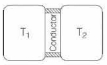
$A$ thin piece of thermal conductor of constant thermal conductivity,insulated on the lateral sides,connects two reservoirs which are maintained at temperatures $T_{1}$ and $T_{2}$ as shown in the figure. Assuming that the system is in a steady state,which of the following plots best represents the dependence of the rate of change of entropy on the ratio $T_{1} / T_{2}$?
A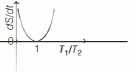
B
C
D
Solution
(B) The entropy change for a system or body is given by $\Delta S = \frac{Q}{T}$.
For the system to be in a steady state,the heat lost by the reservoir at temperature $T_{1}$ must equal the heat gained by the reservoir at temperature $T_{2}$ (let this be $Q$).
The total rate of change of entropy for the conduction process is the sum of the entropy changes of the two reservoirs:
$\frac{dS}{dt} = \frac{d}{dt} \left( \frac{-Q}{T_{1}} + \frac{Q}{T_{2}} \right) = \left( \frac{dQ}{dt} \right) \left( \frac{1}{T_{2}} - \frac{1}{T_{1}} \right)$
From Fourier's law of heat conduction,the rate of heat flow is $\frac{dQ}{dt} = kA \frac{(T_{1} - T_{2})}{L}$,where $k$ is thermal conductivity,$A$ is the cross-sectional area,and $L$ is the length.
Substituting this into the entropy rate equation:
$\frac{dS}{dt} = \left( kA \frac{(T_{1} - T_{2})}{L} \right) \left( \frac{T_{1} - T_{2}}{T_{1} T_{2}} \right) = \frac{kA}{L} \frac{(T_{1} - T_{2})^2}{T_{1} T_{2}}$
We can rewrite this in terms of the ratio $x = T_{1} / T_{2}$:
$\frac{dS}{dt} = \frac{kA}{L} \frac{T_{2}^2 (x - 1)^2}{T_{2}^2 x} = \frac{kA}{L} \frac{(x - 1)^2}{x} = \frac{kA}{L} \left( x - 2 + \frac{1}{x} \right)$
When $x = 1$ $(T_{1} = T_{2})$,$\frac{dS}{dt} = 0$. For $x > 1$ or $x < 1$,$\frac{dS}{dt} > 0$. The function $f(x) = \frac{(x-1)^2}{x}$ is non-negative and symmetric in its behavior relative to the minimum at $x=1$. Plot $(b)$ correctly represents this relationship.
For the system to be in a steady state,the heat lost by the reservoir at temperature $T_{1}$ must equal the heat gained by the reservoir at temperature $T_{2}$ (let this be $Q$).
The total rate of change of entropy for the conduction process is the sum of the entropy changes of the two reservoirs:
$\frac{dS}{dt} = \frac{d}{dt} \left( \frac{-Q}{T_{1}} + \frac{Q}{T_{2}} \right) = \left( \frac{dQ}{dt} \right) \left( \frac{1}{T_{2}} - \frac{1}{T_{1}} \right)$
From Fourier's law of heat conduction,the rate of heat flow is $\frac{dQ}{dt} = kA \frac{(T_{1} - T_{2})}{L}$,where $k$ is thermal conductivity,$A$ is the cross-sectional area,and $L$ is the length.
Substituting this into the entropy rate equation:
$\frac{dS}{dt} = \left( kA \frac{(T_{1} - T_{2})}{L} \right) \left( \frac{T_{1} - T_{2}}{T_{1} T_{2}} \right) = \frac{kA}{L} \frac{(T_{1} - T_{2})^2}{T_{1} T_{2}}$
We can rewrite this in terms of the ratio $x = T_{1} / T_{2}$:
$\frac{dS}{dt} = \frac{kA}{L} \frac{T_{2}^2 (x - 1)^2}{T_{2}^2 x} = \frac{kA}{L} \frac{(x - 1)^2}{x} = \frac{kA}{L} \left( x - 2 + \frac{1}{x} \right)$
When $x = 1$ $(T_{1} = T_{2})$,$\frac{dS}{dt} = 0$. For $x > 1$ or $x < 1$,$\frac{dS}{dt} > 0$. The function $f(x) = \frac{(x-1)^2}{x}$ is non-negative and symmetric in its behavior relative to the minimum at $x=1$. Plot $(b)$ correctly represents this relationship.
0 likes
View Solution31
EasyMCQ
If $120 \ J$ of thermal energy is incident on an area of $3 \ m^2$,the amount of heat transmitted is $12 \ J$,and the coefficient of absorption is $0.6$,then the amount of heat reflected is: (in $J$)
A
$24$
B
$30$
C
$36$
D
$40$
Solution
(C) Let $Q$ be the total incident thermal energy,$Q_a$ be the absorbed energy,$Q_t$ be the transmitted energy,and $Q_r$ be the reflected energy.
Given: $Q = 120 \ J$,$Q_t = 12 \ J$,and coefficient of absorption $a = 0.6$.
We know that the coefficient of absorption $a = \frac{Q_a}{Q}$.
Therefore,$Q_a = a \times Q = 0.6 \times 120 \ J = 72 \ J$.
According to the law of conservation of energy,the total incident energy is the sum of absorbed,transmitted,and reflected energy:
$Q = Q_a + Q_t + Q_r$
$120 \ J = 72 \ J + 12 \ J + Q_r$
$120 \ J = 84 \ J + Q_r$
$Q_r = 120 \ J - 84 \ J = 36 \ J$.
Thus,the amount of heat reflected is $36 \ J$.
Given: $Q = 120 \ J$,$Q_t = 12 \ J$,and coefficient of absorption $a = 0.6$.
We know that the coefficient of absorption $a = \frac{Q_a}{Q}$.
Therefore,$Q_a = a \times Q = 0.6 \times 120 \ J = 72 \ J$.
According to the law of conservation of energy,the total incident energy is the sum of absorbed,transmitted,and reflected energy:
$Q = Q_a + Q_t + Q_r$
$120 \ J = 72 \ J + 12 \ J + Q_r$
$120 \ J = 84 \ J + Q_r$
$Q_r = 120 \ J - 84 \ J = 36 \ J$.
Thus,the amount of heat reflected is $36 \ J$.
0 likes
View Solution32
MediumMCQ
The power radiated by a black body is $P$ and it radiates maximum energy around the wavelength $\lambda_0$. Now the temperature of the black body is changed so that it radiates maximum energy around wavelength $\left(\frac{\lambda_0}{2}\right)$. The power radiated by it will now increase by a factor of
A
$2$
B
$8$
C
$16$
D
$32$
Solution
(C) According to Wien's displacement law,$\lambda_m T = \text{constant}$.
Given $\lambda_{m1} = \lambda_0$ and $\lambda_{m2} = \frac{\lambda_0}{2}$.
Therefore,$\lambda_{m1} T_1 = \lambda_{m2} T_2 \implies \lambda_0 T_1 = \frac{\lambda_0}{2} T_2 \implies T_2 = 2T_1$.
According to the Stefan-Boltzmann law,the power radiated by a black body is $P = \sigma A T^4$,which implies $P \propto T^4$.
Thus,the ratio of the new power $P_2$ to the initial power $P_1$ is $\frac{P_2}{P_1} = \left(\frac{T_2}{T_1}\right)^4$.
Substituting $T_2 = 2T_1$,we get $\frac{P_2}{P_1} = (2)^4 = 16$.
Hence,the power radiated increases by a factor of $16$.
Given $\lambda_{m1} = \lambda_0$ and $\lambda_{m2} = \frac{\lambda_0}{2}$.
Therefore,$\lambda_{m1} T_1 = \lambda_{m2} T_2 \implies \lambda_0 T_1 = \frac{\lambda_0}{2} T_2 \implies T_2 = 2T_1$.
According to the Stefan-Boltzmann law,the power radiated by a black body is $P = \sigma A T^4$,which implies $P \propto T^4$.
Thus,the ratio of the new power $P_2$ to the initial power $P_1$ is $\frac{P_2}{P_1} = \left(\frac{T_2}{T_1}\right)^4$.
Substituting $T_2 = 2T_1$,we get $\frac{P_2}{P_1} = (2)^4 = 16$.
Hence,the power radiated increases by a factor of $16$.
0 likes
View Solution33
DifficultMCQ
Three discs $x, y$ and $z$ having radii $2 \ m, 2 \ m$ and $6 \ m$ respectively are coated on their outer surfaces. If the wavelengths corresponding to the maximum power radiated by them are $3 \ \mu m, 4 \ \mu m$ and $5 \ \mu m$ respectively,then which of the following is true regarding the power radiated $(P)$?
A
$P_y$ is maximum
B
$P_z$ is maximum
C
$P_x = P_y = P_z$
D
$P_x$ is maximum
Solution
(B) According to Wien's displacement law,the temperature $T$ is inversely proportional to the wavelength of maximum emission: $T \propto \frac{1}{\lambda_{\max }}$.
From Stefan-Boltzmann law,the power radiated $P$ by a blackbody is given by $P = \sigma A T^4$,where $A$ is the surface area and $\sigma$ is the Stefan-Boltzmann constant.
Since $A = \pi r^2$ for a disc (assuming radiation from both sides,$A = 2\pi r^2$),we have $P \propto r^2 T^4$.
Substituting $T \propto \frac{1}{\lambda_{\max }}$,we get $P \propto \frac{r^2}{\lambda_{\max }^4}$.
Given radii $r_x = 2 \ m, r_y = 2 \ m, r_z = 6 \ m$ and wavelengths $\lambda_x = 3 \ \mu m, \lambda_y = 4 \ \mu m, \lambda_z = 5 \ \mu m$:
$P_x \propto \frac{2^2}{3^4} = \frac{4}{81} \approx 0.049$
$P_y \propto \frac{2^2}{4^4} = \frac{4}{256} = 0.0156$
$P_z \propto \frac{6^2}{5^4} = \frac{36}{625} = 0.0576$
Comparing the values,$P_z > P_x > P_y$. Since the question asks for the maximum power,$P_z$ is the maximum.
From Stefan-Boltzmann law,the power radiated $P$ by a blackbody is given by $P = \sigma A T^4$,where $A$ is the surface area and $\sigma$ is the Stefan-Boltzmann constant.
Since $A = \pi r^2$ for a disc (assuming radiation from both sides,$A = 2\pi r^2$),we have $P \propto r^2 T^4$.
Substituting $T \propto \frac{1}{\lambda_{\max }}$,we get $P \propto \frac{r^2}{\lambda_{\max }^4}$.
Given radii $r_x = 2 \ m, r_y = 2 \ m, r_z = 6 \ m$ and wavelengths $\lambda_x = 3 \ \mu m, \lambda_y = 4 \ \mu m, \lambda_z = 5 \ \mu m$:
$P_x \propto \frac{2^2}{3^4} = \frac{4}{81} \approx 0.049$
$P_y \propto \frac{2^2}{4^4} = \frac{4}{256} = 0.0156$
$P_z \propto \frac{6^2}{5^4} = \frac{36}{625} = 0.0576$
Comparing the values,$P_z > P_x > P_y$. Since the question asks for the maximum power,$P_z$ is the maximum.
0 likes
View Solution34
MediumMCQ
Two black spheres '$P$' and '$Q$' have radii in the ratio $3:2$. The wavelengths of maximum intensity radiation are in the ratio $3:4$ respectively. The ratio of radiated power by '$P$' to '$Q$' is (in $/9$)
A
$74$
B
$64$
C
$16$
D
$25$
Solution
(B) According to Wien's displacement law,$\lambda_m T = b$ (constant),so $T \propto 1/\lambda_m$.
Given the ratio of wavelengths $\lambda_P : \lambda_Q = 3:4$,the ratio of temperatures is $T_P : T_Q = 4:3$.
According to Stefan-Boltzmann law,the power radiated by a black body is $P = \sigma A T^4 = \sigma (4\pi r^2) T^4$.
Thus,the ratio of power radiated is $\frac{P_P}{P_Q} = \left( \frac{r_P}{r_Q} \right)^2 \left( \frac{T_P}{T_Q} \right)^4$.
Substituting the given values: $\frac{P_P}{P_Q} = \left( \frac{3}{2} \right)^2 \times \left( \frac{4}{3} \right)^4$.
$\frac{P_P}{P_Q} = \frac{9}{4} \times \frac{256}{81} = \frac{1}{1} \times \frac{64}{9} = \frac{64}{9}$.
Given the ratio of wavelengths $\lambda_P : \lambda_Q = 3:4$,the ratio of temperatures is $T_P : T_Q = 4:3$.
According to Stefan-Boltzmann law,the power radiated by a black body is $P = \sigma A T^4 = \sigma (4\pi r^2) T^4$.
Thus,the ratio of power radiated is $\frac{P_P}{P_Q} = \left( \frac{r_P}{r_Q} \right)^2 \left( \frac{T_P}{T_Q} \right)^4$.
Substituting the given values: $\frac{P_P}{P_Q} = \left( \frac{3}{2} \right)^2 \times \left( \frac{4}{3} \right)^4$.
$\frac{P_P}{P_Q} = \frac{9}{4} \times \frac{256}{81} = \frac{1}{1} \times \frac{64}{9} = \frac{64}{9}$.
0 likes
View Solution35
EasyMCQ
$A$ black body radiates maximum energy at wavelength $\lambda$ and its emissive power is $E$. Now, due to a change in the temperature of that body, it radiates maximum energy at wavelength $\frac{2 \lambda}{3}$. At that temperature, the emissive power is:
A
$\frac{27 E}{16}$
B
$\frac{81 E}{16}$
C
$\frac{91 E}{16}$
D
$\frac{54 E}{16}$
Solution
(B) According to Wien's displacement law, $\lambda_{\max} T = \text{constant}$, so $\lambda_{1} T_{1} = \lambda_{2} T_{2}$.
Given $\lambda_{1} = \lambda$ and $\lambda_{2} = \frac{2 \lambda}{3}$.
Thus, $T_{2} = \frac{\lambda_{1} T_{1}}{\lambda_{2}} = \frac{\lambda T_{1}}{2 \lambda / 3} = \frac{3}{2} T_{1}$.
According to Stefan-Boltzmann law, the emissive power $E$ is proportional to $T^{4}$, i.e., $E = \sigma A T^{4}$.
Therefore, $\frac{E_{2}}{E_{1}} = \left( \frac{T_{2}}{T_{1}} \right)^{4}$.
Substituting the value of $T_{2}$, we get $\frac{E_{2}}{E} = \left( \frac{3/2 T_{1}}{T_{1}} \right)^{4} = \left( \frac{3}{2} \right)^{4} = \frac{81}{16}$.
Hence, $E_{2} = \frac{81 E}{16}$.
Given $\lambda_{1} = \lambda$ and $\lambda_{2} = \frac{2 \lambda}{3}$.
Thus, $T_{2} = \frac{\lambda_{1} T_{1}}{\lambda_{2}} = \frac{\lambda T_{1}}{2 \lambda / 3} = \frac{3}{2} T_{1}$.
According to Stefan-Boltzmann law, the emissive power $E$ is proportional to $T^{4}$, i.e., $E = \sigma A T^{4}$.
Therefore, $\frac{E_{2}}{E_{1}} = \left( \frac{T_{2}}{T_{1}} \right)^{4}$.
Substituting the value of $T_{2}$, we get $\frac{E_{2}}{E} = \left( \frac{3/2 T_{1}}{T_{1}} \right)^{4} = \left( \frac{3}{2} \right)^{4} = \frac{81}{16}$.
Hence, $E_{2} = \frac{81 E}{16}$.
0 likes
View Solution36
MediumMCQ
Let '$\sigma$' and '$b$' be Stefan's constant and Wien's constant respectively,then dimensions of '$\sigma b$' are
A
$[L^{1} M^{1} T^{-3} K^{-4}]$
B
$[L^{-1} M^{1} T^{-3} K^{-3}]$
C
$[L^{1} M^{1} T^{3} K^{-3}]$
D
$[L^{1} M^{1} T^{-3} K^{-3}]$
Solution
(D) The dimension of Stefan's constant $\sigma$ is given by the formula $P = \sigma A T^4$,where $P$ is power,$A$ is area,and $T$ is temperature.
$[\sigma] = \frac{[P]}{[A][T]^4} = \frac{[ML^2 T^{-3}]}{[L^2][K^4]} = [MT^{-3} K^{-4}]$.
The dimension of Wien's constant $b$ is given by $\lambda_{max} T = b$,where $\lambda$ is wavelength and $T$ is temperature.
$[b] = [L][K]$.
Therefore,the dimensions of $\sigma b$ are:
$[\sigma b] = [MT^{-3} K^{-4}] \times [LK] = [L^1 M^1 T^{-3} K^{-3}]$.
$[\sigma] = \frac{[P]}{[A][T]^4} = \frac{[ML^2 T^{-3}]}{[L^2][K^4]} = [MT^{-3} K^{-4}]$.
The dimension of Wien's constant $b$ is given by $\lambda_{max} T = b$,where $\lambda$ is wavelength and $T$ is temperature.
$[b] = [L][K]$.
Therefore,the dimensions of $\sigma b$ are:
$[\sigma b] = [MT^{-3} K^{-4}] \times [LK] = [L^1 M^1 T^{-3} K^{-3}]$.
0 likes
View Solution37
DifficultMCQ
One end of a uniform metal rod of length $100 \, cm$ is placed in ice and the other end is placed in boiling water. A point of the rod which is at a distance of $60 \, cm$ from the ice end is maintained at a constant temperature of $325^{\circ} C$. If $2 \, g$ of water is converted into steam per second, the mass of ice melted per second in steady state is (Latent heat of steam $= 6.75$ times latent heat of fusion of ice). (in $g$)
A
$13$
B
$4$
C
$6.75$
D
$8$
Solution
(A) Let the thermal conductivity of the rod be $K$ and the cross-sectional area be $A$. The rate of heat flow is given by $H = \frac{KA \Delta T}{L}$.
For the section in ice (length $x_1 = 60 \, cm$): The temperature difference is $\Delta T_1 = 325^{\circ} C - 0^{\circ} C = 325^{\circ} C$. The rate of heat flow is $H_1 = \frac{KA(325)}{60}$.
This heat melts the ice: $H_1 = m_{ice} L_f$, where $L_f$ is the latent heat of fusion.
For the section in boiling water (length $x_2 = 100 - 60 = 40 \, cm$): The temperature difference is $\Delta T_2 = 325^{\circ} C - 100^{\circ} C = 225^{\circ} C$. However, heat flows from $325^{\circ} C$ to $100^{\circ} C$, so $H_2 = \frac{KA(325 - 100)}{40} = \frac{KA(225)}{40}$.
This heat converts water to steam: $H_2 = m_{steam} L_v$, where $L_v = 6.75 L_f$.
Given $m_{steam} = 2 \, g/s$, then $H_2 = 2 \times 6.75 L_f = 13.5 L_f$.
Equating $H_2$: $\frac{KA(225)}{40} = 13.5 L_f$ implies $KA = \frac{13.5 \times 40}{225} L_f = 2.4 L_f$.
Now substitute $KA$ into $H_1$: $H_1 = \frac{2.4 L_f \times 325}{60} = 0.04 \times 325 L_f = 13 L_f$.
Since $H_1 = m_{ice} L_f$, we get $m_{ice} = 13 \, g/s$.
For the section in ice (length $x_1 = 60 \, cm$): The temperature difference is $\Delta T_1 = 325^{\circ} C - 0^{\circ} C = 325^{\circ} C$. The rate of heat flow is $H_1 = \frac{KA(325)}{60}$.
This heat melts the ice: $H_1 = m_{ice} L_f$, where $L_f$ is the latent heat of fusion.
For the section in boiling water (length $x_2 = 100 - 60 = 40 \, cm$): The temperature difference is $\Delta T_2 = 325^{\circ} C - 100^{\circ} C = 225^{\circ} C$. However, heat flows from $325^{\circ} C$ to $100^{\circ} C$, so $H_2 = \frac{KA(325 - 100)}{40} = \frac{KA(225)}{40}$.
This heat converts water to steam: $H_2 = m_{steam} L_v$, where $L_v = 6.75 L_f$.
Given $m_{steam} = 2 \, g/s$, then $H_2 = 2 \times 6.75 L_f = 13.5 L_f$.
Equating $H_2$: $\frac{KA(225)}{40} = 13.5 L_f$ implies $KA = \frac{13.5 \times 40}{225} L_f = 2.4 L_f$.
Now substitute $KA$ into $H_1$: $H_1 = \frac{2.4 L_f \times 325}{60} = 0.04 \times 325 L_f = 13 L_f$.
Since $H_1 = m_{ice} L_f$, we get $m_{ice} = 13 \, g/s$.
0 likes
View Solution38
EasyMCQ
Statement $A$: Convection involves flow of matter within a fluid due to unequal temperatures of its parts.
Statement $B$: $A$ hot bar placed under a running tap water loses heat due to the effect of convection within water.
Statement $C$: Heat transfer always involves a temperature difference between two systems.
Statement $B$: $A$ hot bar placed under a running tap water loses heat due to the effect of convection within water.
Statement $C$: Heat transfer always involves a temperature difference between two systems.
A
$A, B, C$ are true
B
Only $A$ and $C$ are true
C
Only $A$ and $B$ are true
D
Only $B$ and $C$ are true
Solution
(A) Statement $A$ is true: Convection is the process of heat transfer by the actual movement of fluid particles due to density differences caused by unequal temperatures.
Statement $B$ is true: When a hot bar is placed under running tap water,the water in contact with the bar heats up,becomes less dense,and rises,while cooler water replaces it. This circulation is convection.
Statement $C$ is true: Heat is defined as energy in transit due to a temperature difference. Without a temperature gradient,there is no net heat transfer.
Therefore,all three statements are correct.
Statement $B$ is true: When a hot bar is placed under running tap water,the water in contact with the bar heats up,becomes less dense,and rises,while cooler water replaces it. This circulation is convection.
Statement $C$ is true: Heat is defined as energy in transit due to a temperature difference. Without a temperature gradient,there is no net heat transfer.
Therefore,all three statements are correct.
0 likes
View Solution39
MediumMCQ
Heat loss takes place from a body maintained at a temperature of $400^{\circ} C$ to the surrounding air at $30^{\circ} C$ by convection and to the surrounding surfaces at $30^{\circ} C$ by radiation. The Newton's cooling coefficient is $20 \ W / m^2 \ K$ and the Stefan-Boltzmann constant is $5.67 \times 10^{-8} \ W / m^2 \ K^4$. If the rate of heat loss by convection is equal to the rate of heat loss by radiation,the emissivity of the body surface is
A
$0.35$
B
$0.46$
C
$0.55$
D
$0.66$
Solution
(D) Given that the rate of heat loss by convection is equal to the rate of heat loss by radiation.
Let $h$ be the convection coefficient,$A$ be the surface area,$e$ be the emissivity,$\sigma$ be the Stefan-Boltzmann constant,$T$ be the body temperature,and $T_0$ be the surrounding temperature.
$T = 400 + 273 = 673 \ K$
$T_0 = 30 + 273 = 303 \ K$
The rate of heat loss by convection is $P_{conv} = hA(T - T_0)$.
The rate of heat loss by radiation is $P_{rad} = eA\sigma(T^4 - T_0^4)$.
Equating the two: $hA(T - T_0) = eA\sigma(T^4 - T_0^4)$.
$20(673 - 303) = e(5.67 \times 10^{-8})(673^4 - 303^4)$.
$20(370) = e(5.67 \times 10^{-8})(2.049 \times 10^{11} - 0.0084 \times 10^{11})$.
$7400 = e(5.67 \times 10^{-8})(2.0406 \times 10^{11})$.
$7400 = e(11570.2)$.
$e = 7400 / 11570.2 \approx 0.6397$.
Rounding to the nearest option,$e \approx 0.66$.
Let $h$ be the convection coefficient,$A$ be the surface area,$e$ be the emissivity,$\sigma$ be the Stefan-Boltzmann constant,$T$ be the body temperature,and $T_0$ be the surrounding temperature.
$T = 400 + 273 = 673 \ K$
$T_0 = 30 + 273 = 303 \ K$
The rate of heat loss by convection is $P_{conv} = hA(T - T_0)$.
The rate of heat loss by radiation is $P_{rad} = eA\sigma(T^4 - T_0^4)$.
Equating the two: $hA(T - T_0) = eA\sigma(T^4 - T_0^4)$.
$20(673 - 303) = e(5.67 \times 10^{-8})(673^4 - 303^4)$.
$20(370) = e(5.67 \times 10^{-8})(2.049 \times 10^{11} - 0.0084 \times 10^{11})$.
$7400 = e(5.67 \times 10^{-8})(2.0406 \times 10^{11})$.
$7400 = e(11570.2)$.
$e = 7400 / 11570.2 \approx 0.6397$.
Rounding to the nearest option,$e \approx 0.66$.
0 likes
View Solution40
DifficultMCQ
Power radiated by a black body at temperature $T_1$ is $P$ and it radiates maximum energy at a wavelength $\lambda_1$. If the temperature of the black body is changed from $T_1$ to $T_2$,it radiates maximum energy at a wavelength $\frac{\lambda_1}{2}$. The power radiated at $T_2$ is (in $P$)
A
$2$
B
$4$
C
$8$
D
$16$
Solution
(D) According to Stefan-Boltzmann law,the power radiated by a black body is $P \propto T^4$.
According to Wien's displacement law,the wavelength corresponding to maximum energy is $\lambda \propto \frac{1}{T}$,which implies $T \propto \frac{1}{\lambda}$.
Substituting this into the power relation,we get $P \propto \left(\frac{1}{\lambda}\right)^4 = \frac{1}{\lambda^4}$.
Therefore,the ratio of power radiated is $\frac{P_1}{P_2} = \left(\frac{\lambda_2}{\lambda_1}\right)^4$.
Given $\lambda_2 = \frac{\lambda_1}{2}$,we have $\frac{\lambda_2}{\lambda_1} = \frac{1}{2}$.
Substituting this value,$\frac{P_1}{P_2} = \left(\frac{1}{2}\right)^4 = \frac{1}{16}$.
Thus,$P_2 = 16 P_1 = 16 P$.
According to Wien's displacement law,the wavelength corresponding to maximum energy is $\lambda \propto \frac{1}{T}$,which implies $T \propto \frac{1}{\lambda}$.
Substituting this into the power relation,we get $P \propto \left(\frac{1}{\lambda}\right)^4 = \frac{1}{\lambda^4}$.
Therefore,the ratio of power radiated is $\frac{P_1}{P_2} = \left(\frac{\lambda_2}{\lambda_1}\right)^4$.
Given $\lambda_2 = \frac{\lambda_1}{2}$,we have $\frac{\lambda_2}{\lambda_1} = \frac{1}{2}$.
Substituting this value,$\frac{P_1}{P_2} = \left(\frac{1}{2}\right)^4 = \frac{1}{16}$.
Thus,$P_2 = 16 P_1 = 16 P$.
0 likes
View Solution41
MediumMCQ
The dimensions of $\sigma b^4$,where $\sigma$ is Stefan's constant and $b$ is Wien's constant,are:
A
$[M^0 L^0 T^0]$
B
$[M L^4 T^{-3}]$
C
$[M L^{-2} T]$
D
$[M L^6 T^{-3}]$
Solution
(B) According to Stefan's law,the energy $(E)$ emitted per unit area per unit time is given by $E = \sigma T^4$,where $\sigma$ is Stefan's constant and $T$ is temperature.
Dimensional analysis for $\sigma$:
$\frac{[M L^2 T^{-2}]}{[L^2 T]} = [\sigma] [K^4]$
$[M T^{-3}] = [\sigma] [K^4]$
$[\sigma] = [M T^{-3} K^{-4}]$
Wien's displacement law is given by $b = \lambda T$,where $\lambda$ is wavelength and $T$ is temperature.
Dimension of $b = [L K]$.
Now,calculating the dimensions of $\sigma b^4$:
$[\sigma b^4] = [M T^{-3} K^{-4}] \times [L K]^4$
$[\sigma b^4] = [M T^{-3} K^{-4}] \times [L^4 K^4]$
$[\sigma b^4] = [M L^4 T^{-3}]$.
Dimensional analysis for $\sigma$:
$\frac{[M L^2 T^{-2}]}{[L^2 T]} = [\sigma] [K^4]$
$[M T^{-3}] = [\sigma] [K^4]$
$[\sigma] = [M T^{-3} K^{-4}]$
Wien's displacement law is given by $b = \lambda T$,where $\lambda$ is wavelength and $T$ is temperature.
Dimension of $b = [L K]$.
Now,calculating the dimensions of $\sigma b^4$:
$[\sigma b^4] = [M T^{-3} K^{-4}] \times [L K]^4$
$[\sigma b^4] = [M T^{-3} K^{-4}] \times [L^4 K^4]$
$[\sigma b^4] = [M L^4 T^{-3}]$.
0 likes
View Solution10-2.Heat Transfer — Mix Examples-Heat Transfer · Frequently Asked Questions
1Are these 10-2.Heat Transfer questions useful for JEE and NEET?
Yes. All questions in this section are mapped to JEE Main and NEET exam patterns. Previous year questions from JEE Main, NEET, GUJCET and state-level exams are included with full solutions.
2Can I switch to Hindi or Gujarati for these questions?
Yes. Use the language tabs in the hero section or the sidebar to view the same questions and solutions in English, Hindi or Gujarati.
3How do I generate a question paper from this subtopic?
Use the Vedclass Exam Paper Generator — select the chapter and subtopic, set difficulty, and generate Sets A, B, C, D automatically. First 3 chapters of every subject are free.
Vedclass Products
For Students
Vedclass Test Series
Mock tests in real JEE/NEET style with performance analysis. 5-day free trial.
Start Free TrialFor Teachers
Exam Paper Generator
Generate Set A/B/C/D papers from this chapter in 2 minutes. 3 chapters free.
Try FreeFor Institutes
Online Exam Module
Live online exams with unlimited students, 360° analytics & white-label branding.
See DemoFor Teachers & Institutes
Generate a 10-2.Heat Transfer Exam Paper in 2 Minutes
Select subtopic & difficulty — Sets A, B, C, D auto-generated with No Repeat logic.
First 3 chapters of every subject are free — no payment required.