
A English
Radiation (General, Kirchoff's law, Black body, Prevost's Theory) Questions in English
Class 11 Physics · 10-2.Heat Transfer · Radiation (General, Kirchoff's law, Black body, Prevost's Theory)
128+
Questions
English
Language
100%
With Solutions
Showing 50 of 128 questions in English
1
EasyMCQ
The temperature of the sun is measured with:
A
Platinum thermometer
B
Gas thermometer
C
Pyrometer
D
Vapour pressure thermometer
Solution
(C) pyrometer is a type of remote-sensing thermometer used to measure the temperature of surfaces.
Specifically,a total radiation pyrometer is used to measure very high temperatures,such as those of the sun,because it does not require physical contact with the source.
It works on the principle of Stefan-Boltzmann law,which states that the total energy radiated by a black body is proportional to the fourth power of its absolute temperature $(E \propto T^4)$.
Pyrometers can typically measure temperatures ranging from $800^{\circ}C$ to $6000^{\circ}C$.
Therefore,the temperature of the sun is measured with a pyrometer.
Specifically,a total radiation pyrometer is used to measure very high temperatures,such as those of the sun,because it does not require physical contact with the source.
It works on the principle of Stefan-Boltzmann law,which states that the total energy radiated by a black body is proportional to the fourth power of its absolute temperature $(E \propto T^4)$.
Pyrometers can typically measure temperatures ranging from $800^{\circ}C$ to $6000^{\circ}C$.
Therefore,the temperature of the sun is measured with a pyrometer.
0 likes
View Solution2
EasyMCQ
One likes to sit under sunshine in the winter season,because
A
The air surrounding the body is heated,which transfers heat to the body.
B
We get energy from the sun.
C
We get heat by conduction from the sun.
D
None of the above.
Solution
(A) The correct answer is $A$. In the winter,the air surrounding the body is cold. When sitting in the sunshine,the solar radiation heats the air molecules near the body and the body directly absorbs radiant energy. This heat transfer from the warmer surroundings and radiation to the body makes the person feel comfortable.
0 likes
View Solution3
EasyMCQ
The velocity of heat radiation in vacuum is
A
Equal to that of light
B
Less than that of light
C
Greater than that of light
D
Equal to that of sound
Solution
(A) Heat radiation consists of electromagnetic waves,specifically infrared radiation.
In a vacuum,all electromagnetic waves travel at the speed of light,which is approximately $c = 3 \times 10^8 \ m/s$.
Therefore,the velocity of heat radiation in a vacuum is equal to the velocity of light.
In a vacuum,all electromagnetic waves travel at the speed of light,which is approximately $c = 3 \times 10^8 \ m/s$.
Therefore,the velocity of heat radiation in a vacuum is equal to the velocity of light.
0 likes
View Solution4
EasyMCQ
In which process is the rate of transfer of heat maximum?
A
Conduction
B
Convection
C
Radiation
D
In all these,heat is transferred with the same velocity
Solution
(C) The rate of heat transfer depends on the mechanism of energy propagation. Conduction and convection require a material medium and involve the movement of particles or kinetic energy transfer between adjacent molecules,which is relatively slow. Radiation,however,involves the emission of electromagnetic waves,which travel at the speed of light $(c \approx 3 \times 10^8 \ m/s)$. Therefore,radiation is the fastest mode of heat transfer.
0 likes
View Solution5
EasyMCQ
Which of the following is the correct device for the detection of thermal radiation?
A
Constant volume thermometer
B
Liquid-in-glass thermometer
C
Six's maximum and minimum thermometer
D
Thermopile
Solution
(D) The correct answer is $D$.
$A$ thermopile is a sensitive electronic device that converts thermal energy into electrical energy.
It is specifically designed for the detection of thermal radiation and the measurement of its intensity by utilizing the Seebeck effect.
$A$ thermopile is a sensitive electronic device that converts thermal energy into electrical energy.
It is specifically designed for the detection of thermal radiation and the measurement of its intensity by utilizing the Seebeck effect.
0 likes
View Solution6
EasyMCQ
$A$ thermos flask is polished well.
A
To make it attractive
B
For shining
C
To absorb all radiations from outside
D
To reflect all radiations from outside
Solution
(D) The inner and outer surfaces of a thermos flask are polished to minimize heat transfer by radiation. $A$ polished surface is a poor absorber and a good reflector of thermal radiation. Therefore,by polishing the surfaces,the flask reflects all incoming radiation from the outside and prevents the internal heat from radiating out,thereby maintaining the temperature of the contents.
0 likes
View Solution7
EasyMCQ
Heat travels through vacuum by
A
Conduction
B
Convection
C
Radiation
D
Both $(A)$ and $(B)$
Solution
(C) Heat transfer occurs through three main processes: conduction,convection,and radiation.
Conduction requires a material medium and involves the transfer of energy through molecular collisions.
Convection also requires a material medium (liquid or gas) and involves the actual movement of matter.
Radiation is the process of heat transfer in the form of electromagnetic waves,which do not require any material medium to propagate.
Therefore,heat can travel through a vacuum only by radiation.
Conduction requires a material medium and involves the transfer of energy through molecular collisions.
Convection also requires a material medium (liquid or gas) and involves the actual movement of matter.
Radiation is the process of heat transfer in the form of electromagnetic waves,which do not require any material medium to propagate.
Therefore,heat can travel through a vacuum only by radiation.
0 likes
View Solution8
EasyMCQ
We consider the radiation emitted by the human body. Which of the following statements is true?
A
The radiation is emitted only during the day.
B
The radiation is emitted during the summers and absorbed during the winters.
C
The radiation emitted lies in the ultraviolet region and hence is not visible.
D
The radiation emitted is in the infra-red region.
Solution
(D) According to Prevost's theory of heat exchange,every body at all temperatures (above $T = 0 \ K$) continuously emits and absorbs thermal radiation.
Since the human body temperature is approximately $37^{\circ}C$ $(310 \ K)$,it emits electromagnetic radiation corresponding to its temperature.
According to Wien's displacement law,the wavelength of maximum emission for a body at $310 \ K$ falls in the infra-red region of the electromagnetic spectrum.
Therefore,the radiation emitted by the human body is in the infra-red region.
Since the human body temperature is approximately $37^{\circ}C$ $(310 \ K)$,it emits electromagnetic radiation corresponding to its temperature.
According to Wien's displacement law,the wavelength of maximum emission for a body at $310 \ K$ falls in the infra-red region of the electromagnetic spectrum.
Therefore,the radiation emitted by the human body is in the infra-red region.
0 likes
View Solution9
EasyMCQ
Infrared radiation is detected by
A
Spectrometer
B
Pyrometer
C
Nanometer
D
Photometer
Solution
(B) Infrared radiation is electromagnetic radiation with wavelengths longer than those of visible light.
Because these radiations are associated with heat,they are commonly detected using a pyrometer,which measures the intensity of thermal radiation emitted by an object.
Because these radiations are associated with heat,they are commonly detected using a pyrometer,which measures the intensity of thermal radiation emitted by an object.
0 likes
View Solution10
EasyMCQ
$A$ hot and a cold body are kept in a vacuum,separated from each other. Which of the following causes a decrease in the temperature of the hot body?
A
Radiation
B
Convection
C
Conduction
D
Temperature remains unchanged
Solution
(A) In a vacuum,heat transfer cannot occur via conduction or convection because these processes require a material medium.
Heat transfer in a vacuum occurs exclusively through the process of radiation,which involves the emission of electromagnetic waves.
Therefore,the hot body loses thermal energy to its surroundings or the cold body through radiation,leading to a decrease in its temperature.
Heat transfer in a vacuum occurs exclusively through the process of radiation,which involves the emission of electromagnetic waves.
Therefore,the hot body loses thermal energy to its surroundings or the cold body through radiation,leading to a decrease in its temperature.
0 likes
View Solution11
EasyMCQ
Good absorbers of heat are
A
Poor emitters
B
Non-emitters
C
Good emitters
D
Highly polished
Solution
(C) According to Kirchhoff's law of radiation,for an arbitrary body emitting and absorbing thermal radiation in thermodynamic equilibrium,the emissivity is equal to the absorptivity.
Therefore,good absorbers of heat are also good emitters of heat.
Therefore,good absorbers of heat are also good emitters of heat.
0 likes
View Solution12
EasyMCQ
For a perfectly black body,its absorptive power is
A
$1$
B
$0.5$
C
$0$
D
Infinity
Solution
(A) perfectly black body is defined as an object that absorbs all the electromagnetic radiation incident upon it,regardless of frequency or angle of incidence.
By definition,the absorptive power $(a)$ of a body is the ratio of the energy absorbed to the total energy incident on it.
Since a perfectly black body absorbs all incident radiation,the energy absorbed equals the total energy incident.
Therefore,its absorptive power is $a = 1$.
By definition,the absorptive power $(a)$ of a body is the ratio of the energy absorbed to the total energy incident on it.
Since a perfectly black body absorbs all incident radiation,the energy absorbed equals the total energy incident.
Therefore,its absorptive power is $a = 1$.
0 likes
View Solution13
EasyMCQ
$A$ certain substance emits only the wavelengths ${\lambda _1}, {\lambda _2}, {\lambda _3}$ and ${\lambda _4}$ when it is at a high temperature. When this substance is at a colder temperature,it will absorb only the following wavelengths:
A
${\lambda _1}$
B
${\lambda _2}$
C
${\lambda _1}$ and ${\lambda _2}$
D
${\lambda _1}, {\lambda _2}, {\lambda _3}$ and ${\lambda _4}$
Solution
(D) According to Kirchhoff's law of radiation,a body that is a good emitter of radiation at a given temperature is also a good absorber of radiation at the same temperature.
Specifically,if a substance emits certain discrete wavelengths at a high temperature,it will absorb those same specific wavelengths when it is at a lower temperature.
Therefore,if the substance emits ${\lambda _1}, {\lambda _2}, {\lambda _3}$ and ${\lambda _4}$ at high temperatures,it will absorb the same set of wavelengths,${\lambda _1}, {\lambda _2}, {\lambda _3}$ and ${\lambda _4}$,when cold.
The correct option is $D$.
Specifically,if a substance emits certain discrete wavelengths at a high temperature,it will absorb those same specific wavelengths when it is at a lower temperature.
Therefore,if the substance emits ${\lambda _1}, {\lambda _2}, {\lambda _3}$ and ${\lambda _4}$ at high temperatures,it will absorb the same set of wavelengths,${\lambda _1}, {\lambda _2}, {\lambda _3}$ and ${\lambda _4}$,when cold.
The correct option is $D$.
0 likes
View Solution14
EasyMCQ
As compared to a person with white skin,a person with black skin will experience:
A
Less heat and more cold
B
More heat and more cold
C
More heat and less cold
D
Less heat and less cold
Solution
(B) According to the principles of radiation,a black surface is a better absorber and a better emitter of heat radiation compared to a white surface.
$1$. Absorption: $A$ person with black skin absorbs more incident heat radiation from the surroundings,causing them to feel more heat.
$2$. Emission: $A$ person with black skin also emits more heat radiation to the surroundings,causing them to lose heat faster and feel more cold.
Therefore,a person with black skin experiences both more heat and more cold.
$1$. Absorption: $A$ person with black skin absorbs more incident heat radiation from the surroundings,causing them to feel more heat.
$2$. Emission: $A$ person with black skin also emits more heat radiation to the surroundings,causing them to lose heat faster and feel more cold.
Therefore,a person with black skin experiences both more heat and more cold.
0 likes
View Solution15
EasyMCQ
The relation between emissivity $e$ and absorptive power $a$ for a black body is:
A
$e = a$
B
$e = \frac{1}{a}$
C
$e = a^2$
D
$a = e^2$
Solution
(A) According to Kirchhoff's law of thermal radiation,for any body in thermal equilibrium,the emissivity $e$ is equal to its absorptive power $a$ at a given wavelength and temperature.
For a perfectly black body,the absorptive power $a = 1$ and the emissivity $e = 1$.
Therefore,the relation is $e = a$.
For a perfectly black body,the absorptive power $a = 1$ and the emissivity $e = 1$.
Therefore,the relation is $e = a$.
0 likes
View Solution16
EasyMCQ
Which of the following statements is wrong?
A
Rough surfaces are better radiators than smooth surfaces.
B
Highly polished mirror-like surfaces are very good radiators.
C
Black surfaces are better absorbers than white ones.
D
Black surfaces are better radiators than white ones.
Solution
(B) According to Kirchhoff's law of radiation,good absorbers of radiation are also good emitters (radiators) of radiation.
Rough and black surfaces are good absorbers,and therefore,they are also good radiators.
Highly polished,mirror-like surfaces are excellent reflectors of radiation,which means they are poor absorbers and consequently poor radiators.
Therefore,the statement that highly polished mirror-like surfaces are very good radiators is incorrect.
Rough and black surfaces are good absorbers,and therefore,they are also good radiators.
Highly polished,mirror-like surfaces are excellent reflectors of radiation,which means they are poor absorbers and consequently poor radiators.
Therefore,the statement that highly polished mirror-like surfaces are very good radiators is incorrect.
0 likes
View Solution17
EasyMCQ
Half part of an ice block is covered with a black cloth and the rest half is covered with a white cloth,and then it is kept in sunlight. After some time,the clothes are removed to observe the melted ice. Which of the following statements is correct?
A
Ice covered with white cloth will melt more.
B
Ice covered with black cloth will melt more.
C
Equal ice will melt under both clothes.
D
It will depend on the temperature of the surroundings of the ice.
Solution
(B) The correct answer is $B$. Black surfaces are good absorbers of radiant heat from the sun. Since the black cloth absorbs more solar radiation compared to the white cloth,the thermal energy transferred to the ice underneath the black cloth is higher. Consequently,the ice covered by the black cloth will melt more than the ice covered by the white cloth.
0 likes
View Solution18
MediumMCQ
If between wavelength $\lambda$ and $\lambda + d\lambda$,$e_\lambda$ and $a_\lambda$ are the emissive and absorptive powers of a body,respectively,and $E_\lambda$ is the emissive power of a perfectly black body,then according to Kirchhoff's law,which of the following is true?
A
$e_\lambda = a_\lambda = E_\lambda$
B
$e_\lambda E_\lambda = a_\lambda$
C
$e_\lambda = a_\lambda E_\lambda$
D
$e_\lambda a_\lambda E_\lambda = \text{constant}$
Solution
(C) According to Kirchhoff's law of thermal radiation,for any body in thermal equilibrium,the ratio of its emissive power $(e_\lambda)$ to its absorptive power $(a_\lambda)$ at a given wavelength $\lambda$ and temperature $T$ is equal to the emissive power $(E_\lambda)$ of a perfectly black body at the same wavelength and temperature.
Mathematically,this is expressed as:
$\frac{e_\lambda}{a_\lambda} = E_\lambda$
Rearranging this equation,we get:
$e_\lambda = a_\lambda E_\lambda$
Therefore,option $C$ is the correct statement.
Mathematically,this is expressed as:
$\frac{e_\lambda}{a_\lambda} = E_\lambda$
Rearranging this equation,we get:
$e_\lambda = a_\lambda E_\lambda$
Therefore,option $C$ is the correct statement.
0 likes
View Solution19
EasyMCQ
When $p$ calories of heat is given to a body,it absorbs $q$ calories; then the absorption power of the body will be
A
$p/q$
B
$q/p$
C
$p^2/q^2$
D
$q^2/p^2$
Solution
(B) The absorption power (or absorptivity) of a body is defined as the ratio of the amount of heat absorbed by the body to the total amount of heat incident on it.
Given:
Total heat incident on the body = $p$ calories.
Heat absorbed by the body = $q$ calories.
Therefore,Absorption power = $\frac{\text{Heat absorbed}}{\text{Total heat incident}} = \frac{q}{p}$.
Thus,the correct option is $B$.
Given:
Total heat incident on the body = $p$ calories.
Heat absorbed by the body = $q$ calories.
Therefore,Absorption power = $\frac{\text{Heat absorbed}}{\text{Total heat incident}} = \frac{q}{p}$.
Thus,the correct option is $B$.
0 likes
View Solution20
EasyMCQ
Distribution of energy in the spectrum of a black body can be correctly represented by
A
Wien's law
B
Stefan's law
C
Planck's law
D
Kirchhoff's law
Solution
(C) Planck's law correctly describes the spectral energy distribution of black body radiation across all wavelengths and temperatures.
While Wien's law only works for short wavelengths and Rayleigh-Jeans law works for long wavelengths,Planck's law provides a unified explanation that matches experimental observations at both low and high temperatures.
While Wien's law only works for short wavelengths and Rayleigh-Jeans law works for long wavelengths,Planck's law provides a unified explanation that matches experimental observations at both low and high temperatures.
0 likes
View Solution21
EasyMCQ
In the rainy season,on a clear night,the black seat of a bicycle becomes wet because:
A
It absorbs water vapour
B
Black seat is a good absorber of heat
C
Black seat is a good radiator of heat energy
D
None of the above
Solution
(C) On a clear night,the black seat of a bicycle loses heat rapidly by radiation because black surfaces are good radiators of heat energy.
As the seat loses heat,its temperature drops below the dew point of the surrounding air.
Consequently,the water vapour present in the air condenses on the cold surface of the seat,making it wet.
As the seat loses heat,its temperature drops below the dew point of the surrounding air.
Consequently,the water vapour present in the air condenses on the cold surface of the seat,making it wet.
0 likes
View Solution22
EasyMCQ
There is a rough black spot on a polished metallic plate. It is heated up to $1400 K$ approximately and then at once taken into a dark room. Which of the following statements is true?
A
In comparison with the plate,the spot will shine more.
B
In comparison with the plate,the spot will appear more black.
C
The spot and the plate will be equally bright.
D
The plate and the black spot cannot be seen in the dark room.
Solution
(A) According to Kirchhoff's law of radiation,good absorbers of radiation are also good emitters of radiation at a given temperature.
$1$. The rough black spot is a good absorber of radiation,and therefore,it is also a good emitter of radiation.
$2$. The polished metallic plate is a poor absorber of radiation,and therefore,it is a poor emitter of radiation.
$3$. When the plate is heated to $1400 K$ and taken into a dark room,the black spot emits a significant amount of thermal radiation,making it appear bright.
$4$. The polished surface emits very little radiation,making it appear dark in comparison to the spot.
Therefore,the spot will shine more than the plate.
$1$. The rough black spot is a good absorber of radiation,and therefore,it is also a good emitter of radiation.
$2$. The polished metallic plate is a poor absorber of radiation,and therefore,it is a poor emitter of radiation.
$3$. When the plate is heated to $1400 K$ and taken into a dark room,the black spot emits a significant amount of thermal radiation,making it appear bright.
$4$. The polished surface emits very little radiation,making it appear dark in comparison to the spot.
Therefore,the spot will shine more than the plate.
0 likes
View Solution23
EasyMCQ
At a certain temperature for a given wavelength,the ratio of the emissive power of a body to the emissive power of a black body in the same circumstances is known as:
A
Relative emissivity
B
Emissivity
C
Absorption coefficient
D
Coefficient of reflection
Solution
(B) According to Kirchhoff's law of radiation,at a certain temperature and for a given wavelength,the ratio of the emissive power $(E_{\lambda})$ of a body to the emissive power $(E_{b\lambda})$ of a black body at the same temperature is defined as the emissivity (or spectral emissivity) of the body.
Mathematically,$\epsilon_{\lambda} = \frac{E_{\lambda}}{E_{b\lambda}}$.
Therefore,the correct option is $B$.
Mathematically,$\epsilon_{\lambda} = \frac{E_{\lambda}}{E_{b\lambda}}$.
Therefore,the correct option is $B$.
0 likes
View Solution24
EasyMCQ
Two thermometers $A$ and $B$ are exposed to sunlight. The bulb of $A$ is painted black,but that of $B$ is not painted. Which of the following statements is correct regarding this case?
A
Temperature of $A$ will rise faster than $B$,but the final temperature will be the same in both.
B
Both $A$ and $B$ show equal rise in the beginning.
C
Temperature of $A$ will remain higher than $B$.
D
Temperature of $B$ will rise faster.
Solution
(A) black body is a better absorber of heat radiation compared to a non-black body.
Since the bulb of thermometer $A$ is painted black,it absorbs heat radiation from the sunlight at a faster rate than thermometer $B$.
Therefore,the temperature of $A$ rises faster than $B$.
However,once both thermometers reach thermal equilibrium with the surrounding environment,they will both eventually attain the same final atmospheric temperature.
Since the bulb of thermometer $A$ is painted black,it absorbs heat radiation from the sunlight at a faster rate than thermometer $B$.
Therefore,the temperature of $A$ rises faster than $B$.
However,once both thermometers reach thermal equilibrium with the surrounding environment,they will both eventually attain the same final atmospheric temperature.
0 likes
View Solution25
EasyMCQ
There is a black spot on a body. If the body is heated and carried into a dark room,then it glows more than the rest of the body. This can be explained on the basis of:
A
Newton's law of cooling
B
Wien's law
C
Kirchhoff's law
D
Stefan's law
Solution
(C) According to Kirchhoff's law,good absorbers of radiation are also good emitters of radiation at a given temperature. Since a black spot is a good absorber of light and heat,it will also be a good emitter. Therefore,when the body is heated and placed in a dark room,the black spot will emit more radiation than the surrounding surface,making it appear to glow more brightly.
0 likes
View Solution26
MediumMCQ
When red glass is heated in a dark room,it will appear:
A
Green
B
Purple
C
Black
D
Yellow
Solution
(A) According to Kirchhoff's law of radiation,good absorbers of a particular wavelength are also good emitters of that same wavelength.
Red glass appears red because it transmits red light and absorbs green light (as red and green are complementary colors).
When the red glass is heated to a high temperature and placed in a dark room,it emits the radiation it is capable of absorbing most strongly.
Since red glass is a strong absorber of green light,it will emit green light strongly when heated. Therefore,it will appear green in a dark room.
Red glass appears red because it transmits red light and absorbs green light (as red and green are complementary colors).
When the red glass is heated to a high temperature and placed in a dark room,it emits the radiation it is capable of absorbing most strongly.
Since red glass is a strong absorber of green light,it will emit green light strongly when heated. Therefore,it will appear green in a dark room.
0 likes
View Solution27
EasyMCQ
$A$ hot body will radiate heat most rapidly if its surface is
A
White & polished
B
White & rough
C
Black & polished
D
Black & rough
Solution
(D) According to $Kirchoff's$ law of radiation,the emissivity of a body is equal to its absorptivity at a given temperature.
Black and rough surfaces are excellent absorbers of heat radiation.
Consequently,they are also the most efficient emitters of heat radiation.
Therefore,a hot body will radiate heat most rapidly if its surface is black and rough.
Black and rough surfaces are excellent absorbers of heat radiation.
Consequently,they are also the most efficient emitters of heat radiation.
Therefore,a hot body will radiate heat most rapidly if its surface is black and rough.
0 likes
View Solution28
EasyMCQ
$A$ body,which emits radiations of all possible wavelengths,is known as
A
Good conductor
B
Partial radiator
C
Absorber of photons
D
Perfectly black-body
Solution
(D) perfectly black-body is defined as an ideal body that absorbs all incident radiation of any wavelength falling on it. According to Kirchhoff's law of thermal radiation,a good absorber is also a good emitter. Therefore,a perfectly black-body is also a perfect emitter,meaning it emits radiation of all possible wavelengths at a given temperature.
0 likes
View Solution29
EasyMCQ
Which of the following is an example of an ideal black body?
A
Kajal
B
Black board
C
$A$ pin hole in a box
D
None of these
Solution
(C) An ideal black body is defined as a body that absorbs all incident radiation of any wavelength.
When light is incident on a pin hole,it enters the box and undergoes successive reflections at the inner walls.
At each reflection,a portion of the energy is absorbed by the walls.
Consequently,once the ray enters the box,it is almost impossible for it to escape,causing the pin hole to act as a perfect black body.
When light is incident on a pin hole,it enters the box and undergoes successive reflections at the inner walls.
At each reflection,a portion of the energy is absorbed by the walls.
Consequently,once the ray enters the box,it is almost impossible for it to escape,causing the pin hole to act as a perfect black body.
0 likes
View Solution30
MediumMCQ
An ideal black body at room temperature is thrown into a furnace. It is observed that:
A
Initially it is the darkest body and at later times the brightest.
B
It is the darkest body at all times.
C
It cannot be distinguished at all times.
D
Initially it is the darkest body and at later times it cannot be distinguished.
Solution
(A) Initially,an ideal black body absorbs all the radiant energy incident on it,making it appear as the darkest object in the furnace.
According to Kirchhoff's law of radiation,a good absorber is also a good emitter. Therefore,as the black body heats up to the temperature of the furnace,it radiates the maximum amount of energy compared to other bodies at the same temperature.
Once the black body reaches thermal equilibrium with the furnace,it emits the most intense radiation,making it appear the brightest.
According to Kirchhoff's law of radiation,a good absorber is also a good emitter. Therefore,as the black body heats up to the temperature of the furnace,it radiates the maximum amount of energy compared to other bodies at the same temperature.
Once the black body reaches thermal equilibrium with the furnace,it emits the most intense radiation,making it appear the brightest.
0 likes
View Solution31
MediumMCQ
Which of the following statements is correct?
A
$A$ good absorber is a bad emitter.
B
Every body absorbs and emits radiations at every temperature.
C
The energy of radiations emitted from a black body is the same for all wavelengths.
D
The law showing the relation of temperatures with the wavelength of maximum emission from an ideal black body is Planck's law.
Solution
(D) According to Kirchhoff's law,a good absorber is a good emitter,so option $(A)$ is incorrect.
Every body absorbs and emits radiation at all temperatures above $0 \, K$ (absolute zero). At $0 \, K$,thermal motion ceases,so option $(B)$ is incorrect.
The energy of radiation emitted from a black body varies with wavelength,as described by the black body radiation spectrum,so option $(C)$ is incorrect.
Planck's law describes the spectral density of electromagnetic radiation emitted by a black body in thermal equilibrium at a given temperature $T$. The relation is given by $E_{\lambda} d_{\lambda} = \frac{8\pi hc}{\lambda^5} \frac{1}{[e^{hc/\lambda kT} - 1]} d_{\lambda}$. Therefore,option $(D)$ is correct.
Every body absorbs and emits radiation at all temperatures above $0 \, K$ (absolute zero). At $0 \, K$,thermal motion ceases,so option $(B)$ is incorrect.
The energy of radiation emitted from a black body varies with wavelength,as described by the black body radiation spectrum,so option $(C)$ is incorrect.
Planck's law describes the spectral density of electromagnetic radiation emitted by a black body in thermal equilibrium at a given temperature $T$. The relation is given by $E_{\lambda} d_{\lambda} = \frac{8\pi hc}{\lambda^5} \frac{1}{[e^{hc/\lambda kT} - 1]} d_{\lambda}$. Therefore,option $(D)$ is correct.
0 likes
View Solution32
EasyMCQ
$A$ piece of blue glass heated to a high temperature and a piece of red glass at room temperature are taken inside a dimly lit room. Then:
A
The blue piece will look blue and the red piece will look as usual.
B
The red piece will look brighter red and the blue piece will look ordinary blue.
C
The blue piece shines like a brighter red compared to the red piece.
D
Both the pieces will look equally red.
Solution
(C) According to Kirchhoff's law of radiation,good absorbers are good emitters at a given temperature.
Blue glass absorbs all wavelengths except blue at room temperature. When heated to a high temperature,it becomes a good emitter of the wavelengths it previously absorbed (which are the longer wavelengths,i.e.,red end of the spectrum).
When taken into a dimly lit room,the heated blue glass emits these longer wavelengths,making it appear to glow with a bright red color.
The red glass at room temperature does not emit significant visible radiation.
Therefore,the blue piece shines like a brighter red compared to the red piece.
Blue glass absorbs all wavelengths except blue at room temperature. When heated to a high temperature,it becomes a good emitter of the wavelengths it previously absorbed (which are the longer wavelengths,i.e.,red end of the spectrum).
When taken into a dimly lit room,the heated blue glass emits these longer wavelengths,making it appear to glow with a bright red color.
The red glass at room temperature does not emit significant visible radiation.
Therefore,the blue piece shines like a brighter red compared to the red piece.
0 likes
View Solution33
EasyMCQ
Which of the following laws states that "good absorbers of heat are good emitters"?
A
Stefan's law
B
Kirchhoff's law
C
Planck's law
D
Wien's law
Solution
(B) Kirchhoff's law states that the ratio of emissive power to the absorptive power corresponding to a particular wavelength and at a given temperature is constant for all bodies:
$e_{\lambda} / a_{\lambda} = \text{constant} = E_{\lambda}$
where $E_{\lambda}$ is the emissive power of a perfect black body corresponding to the same wavelength and temperature. It is clear from the above relation that if $a_{\lambda}$ (absorptive power) is large for a body, $e_{\lambda}$ (emissive power) will also be large to keep the ratio constant, i.e., good absorbers are good emitters.
$e_{\lambda} / a_{\lambda} = \text{constant} = E_{\lambda}$
where $E_{\lambda}$ is the emissive power of a perfect black body corresponding to the same wavelength and temperature. It is clear from the above relation that if $a_{\lambda}$ (absorptive power) is large for a body, $e_{\lambda}$ (emissive power) will also be large to keep the ratio constant, i.e., good absorbers are good emitters.
0 likes
View Solution34
MediumMCQ
Two identical objects $A$ and $B$ are at temperatures $T_A$ and $T_B$ respectively. Both objects are placed in a room with perfectly absorbing walls maintained at temperature $T$ $(T_A > T > T_B)$. The objects $A$ and $B$ attain temperature $T$ eventually. Which one of the following is the correct statement?
A
$A$ only emits radiations while $B$ only absorbs them until both attain temperature $T$.
B
$A$ loses more radiations than it absorbs while $B$ absorbs more radiations than it emits until temperature $T$ is attained.
C
Both $A$ and $B$ only absorb radiations until they attain temperature $T$.
D
Both $A$ and $B$ only emit radiations until they attain temperature $T$.
Solution
(B) According to Prevost's theory,every body radiates heat at all temperatures (except $0 \ K$) and also absorbs heat from its surroundings.
Since $T_A > T$,the rate of emission of radiation by object $A$ is greater than the rate of absorption of radiation from the surroundings. Thus,$A$ loses more radiation than it absorbs.
Since $T_B < T$,the rate of absorption of radiation by object $B$ from the surroundings is greater than the rate of emission of radiation by it. Thus,$B$ absorbs more radiation than it emits.
Eventually,both objects reach thermal equilibrium with the surroundings at temperature $T$.
Since $T_A > T$,the rate of emission of radiation by object $A$ is greater than the rate of absorption of radiation from the surroundings. Thus,$A$ loses more radiation than it absorbs.
Since $T_B < T$,the rate of absorption of radiation by object $B$ from the surroundings is greater than the rate of emission of radiation by it. Thus,$B$ absorbs more radiation than it emits.
Eventually,both objects reach thermal equilibrium with the surroundings at temperature $T$.
0 likes
View Solution35
MediumMCQ
When a body has the same temperature as that of its surroundings,which of the following statements is true?
A
It does not radiate heat.
B
It radiates the same quantity of heat as it absorbs.
C
It radiates less quantity of heat than it receives from the surroundings.
D
It radiates more quantity of heat than it receives from the surroundings.
Solution
(B) According to Prevost's theory of heat exchange,every body at a temperature above $0 \ K$ radiates thermal energy to its surroundings and simultaneously absorbs thermal energy from its surroundings.
When the temperature of the body $(T_b)$ is equal to the temperature of the surroundings $(T_s)$,the rate of emission of heat energy is exactly equal to the rate of absorption of heat energy.
Therefore,the net exchange of heat is zero,and the body remains in thermal equilibrium with its surroundings.
Thus,the correct statement is that it radiates the same quantity of heat as it absorbs.
When the temperature of the body $(T_b)$ is equal to the temperature of the surroundings $(T_s)$,the rate of emission of heat energy is exactly equal to the rate of absorption of heat energy.
Therefore,the net exchange of heat is zero,and the body remains in thermal equilibrium with its surroundings.
Thus,the correct statement is that it radiates the same quantity of heat as it absorbs.
0 likes
View Solution36
MediumMCQ
$A$ sphere,a cube,and a thin circular plate,all made of the same material and having the same mass,are initially heated to a temperature of $1000^{\circ}C$. Which one of these will cool first?
A
Plate
B
Sphere
C
Cube
D
None of these
Solution
(A) The rate of cooling is given by the formula $\frac{d\theta}{dt} = \frac{A \varepsilon \sigma (T^4 - T_0^4)}{mc}$.
Since all objects have the same mass $m$,material (same specific heat $c$),and are at the same initial temperature $T$,the rate of cooling is directly proportional to the surface area $A$ of the object $(\frac{d\theta}{dt} \propto A)$.
For a given mass and density,the surface area is largest for a thin circular plate and smallest for a sphere.
Therefore,the plate has the largest surface area,which leads to the fastest rate of cooling.
Thus,the plate will cool first.
Since all objects have the same mass $m$,material (same specific heat $c$),and are at the same initial temperature $T$,the rate of cooling is directly proportional to the surface area $A$ of the object $(\frac{d\theta}{dt} \propto A)$.
For a given mass and density,the surface area is largest for a thin circular plate and smallest for a sphere.
Therefore,the plate has the largest surface area,which leads to the fastest rate of cooling.
Thus,the plate will cool first.
0 likes
View Solution37
MediumMCQ
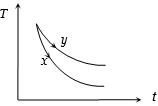
The graph shown in the adjacent diagram represents the variation of temperature $(T)$ of two bodies,$x$ and $y$,having the same surface area,with time $(t)$ due to the emission of radiation. Find the correct relation between their emissivities $(e)$ and absorptive powers $(a)$.
A
$e_x > e_y$ and $a_x > a_y$
B
$e_x < e_y$ and $a_x < a_y$
C
$e_x > e_y$ and $a_x < a_y$
D
$e_x < e_y$ and $a_x > a_y$
Solution
(A) According to Stefan-Boltzmann law,the rate of heat loss is given by $\frac{dQ}{dt} = e \sigma A (T^4 - T_0^4)$.
Since $\frac{dQ}{dt} = -ms \frac{dT}{dt}$,we have $-ms \frac{dT}{dt} = e \sigma A (T^4 - T_0^4)$.
Thus,the rate of cooling $\left( -\frac{dT}{dt} \right) = \frac{e \sigma A}{ms} (T^4 - T_0^4)$.
For bodies of the same surface area and mass,the rate of cooling is directly proportional to the emissivity $(e)$,i.e.,$\left( -\frac{dT}{dt} \right) \propto e$.
From the graph,the slope of the curve for body $x$ is steeper than that for body $y$ at any given temperature,which means $\left( -\frac{dT}{dt} \right)_x > \left( -\frac{dT}{dt} \right)_y$.
Therefore,$e_x > e_y$.
According to Kirchhoff's law of radiation,for any body,the emissivity $(e)$ is equal to its absorptive power $(a)$ at a given wavelength and temperature,i.e.,$e = a$.
Thus,$e_x > e_y$ implies $a_x > a_y$.
Since $\frac{dQ}{dt} = -ms \frac{dT}{dt}$,we have $-ms \frac{dT}{dt} = e \sigma A (T^4 - T_0^4)$.
Thus,the rate of cooling $\left( -\frac{dT}{dt} \right) = \frac{e \sigma A}{ms} (T^4 - T_0^4)$.
For bodies of the same surface area and mass,the rate of cooling is directly proportional to the emissivity $(e)$,i.e.,$\left( -\frac{dT}{dt} \right) \propto e$.
From the graph,the slope of the curve for body $x$ is steeper than that for body $y$ at any given temperature,which means $\left( -\frac{dT}{dt} \right)_x > \left( -\frac{dT}{dt} \right)_y$.
Therefore,$e_x > e_y$.
According to Kirchhoff's law of radiation,for any body,the emissivity $(e)$ is equal to its absorptive power $(a)$ at a given wavelength and temperature,i.e.,$e = a$.
Thus,$e_x > e_y$ implies $a_x > a_y$.
0 likes
View Solution38
MediumMCQ
The following graph shows the correct variation in the intensity of heat radiations emitted by a black body with respect to frequency at different fixed temperatures. Identify the correct graph.
A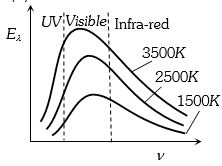
B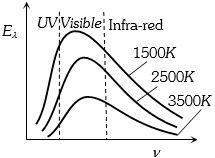
C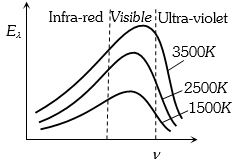
D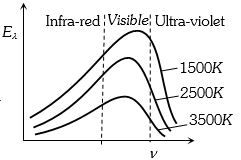
Solution
(C) According to Wien's displacement law,the wavelength corresponding to maximum energy emission is inversely proportional to the absolute temperature: $\lambda_m \propto \frac{1}{T}$.
Since frequency $\nu$ is related to wavelength $\lambda$ by $\nu = \frac{c}{\lambda}$,we have $\nu_m \propto T$.
This implies that as the temperature $T$ of the black body increases,the frequency $\nu_m$ corresponding to the maximum energy emission also increases.
Looking at the provided graphs,as the temperature increases from $1500 \ K$ to $2500 \ K$ to $3500 \ K$,the peak of the curve should shift towards higher frequencies (to the right).
Graph $(c)$ correctly depicts this behavior,where the peak frequency increases with increasing temperature.
Since frequency $\nu$ is related to wavelength $\lambda$ by $\nu = \frac{c}{\lambda}$,we have $\nu_m \propto T$.
This implies that as the temperature $T$ of the black body increases,the frequency $\nu_m$ corresponding to the maximum energy emission also increases.
Looking at the provided graphs,as the temperature increases from $1500 \ K$ to $2500 \ K$ to $3500 \ K$,the peak of the curve should shift towards higher frequencies (to the right).
Graph $(c)$ correctly depicts this behavior,where the peak frequency increases with increasing temperature.
0 likes
View Solution39
MediumMCQ
Shown below are the black body radiation curves at temperatures $T_1$ and $T_2$ $(T_2 > T_1)$. Which of the following plots is correct?
A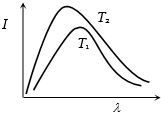
B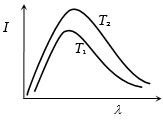
C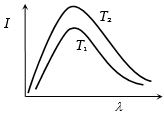
D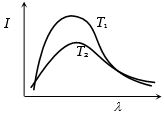
Solution
(A) According to Wien's displacement law,the wavelength corresponding to maximum intensity $\lambda_m$ is inversely proportional to the absolute temperature $T$,i.e.,$\lambda_m \propto \frac{1}{T}$.
Given $T_2 > T_1$,it follows that $\lambda_{m_2} < \lambda_{m_1}$.
This means the peak of the intensity-wavelength curve for the higher temperature $T_2$ shifts towards a shorter wavelength (left side) compared to the curve for $T_1$.
Additionally,according to the Stefan-Boltzmann law,the total energy emitted per unit area per unit time is proportional to $T^4$,so the intensity $I$ for $T_2$ will be higher than for $T_1$ at all wavelengths.
Therefore,the correct plot is the one where the curve for $T_2$ is higher and its peak is shifted to the left relative to the curve for $T_1$.
Given $T_2 > T_1$,it follows that $\lambda_{m_2} < \lambda_{m_1}$.
This means the peak of the intensity-wavelength curve for the higher temperature $T_2$ shifts towards a shorter wavelength (left side) compared to the curve for $T_1$.
Additionally,according to the Stefan-Boltzmann law,the total energy emitted per unit area per unit time is proportional to $T^4$,so the intensity $I$ for $T_2$ will be higher than for $T_1$ at all wavelengths.
Therefore,the correct plot is the one where the curve for $T_2$ is higher and its peak is shifted to the left relative to the curve for $T_1$.
0 likes
View Solution40
EasyMCQ
$A$ thermopile is used for:
A
Collecting heat energy
B
The measurement of radiant heat energy
C
The measurement of current
D
The change of atomic energy into heat energy
Solution
(B) thermopile is a device that converts thermal energy into electrical energy. It consists of several thermocouples connected in series. It is primarily used for the detection and measurement of radiant heat energy (infrared radiation) by producing a voltage proportional to the temperature difference.
0 likes
View Solution41
EasyMCQ
The black lines in the solar spectrum during a solar eclipse can be explained by
A
Planck's law
B
Kirchhoff's law
C
Boltzmann's law
D
Solar disturbances
Solution
(B) Kirchhoff's Law states that good emitters are good absorbers at a given temperature.
In the solar spectrum,the dark lines known as Fraunhofer lines are formed because the cooler gases in the Sun's outer atmosphere (chromosphere) absorb specific wavelengths of light emitted by the hotter inner layers (photosphere).
During a solar eclipse,when the bright photosphere is obscured by the Moon,the chromosphere becomes visible. At this moment,the emission spectrum of the chromosphere is observed,showing bright lines at the exact same wavelengths as the dark Fraunhofer lines.
This phenomenon is a direct consequence of Kirchhoff's law,which explains why the same material that absorbs light at a specific wavelength will also emit light at that same wavelength.
In the solar spectrum,the dark lines known as Fraunhofer lines are formed because the cooler gases in the Sun's outer atmosphere (chromosphere) absorb specific wavelengths of light emitted by the hotter inner layers (photosphere).
During a solar eclipse,when the bright photosphere is obscured by the Moon,the chromosphere becomes visible. At this moment,the emission spectrum of the chromosphere is observed,showing bright lines at the exact same wavelengths as the dark Fraunhofer lines.
This phenomenon is a direct consequence of Kirchhoff's law,which explains why the same material that absorbs light at a specific wavelength will also emit light at that same wavelength.
0 likes
View Solution42
EasyMCQ
The intensity of direct sunlight on a surface normal to the rays is $I_0$. What is the intensity of direct sunlight on a surface,whose normal makes an angle of $60^{\circ}$ with the rays of the sun?
A
$I_0$
B
$I_0 \left( \frac{\sqrt{3}}{2} \right)$
C
$\frac{I_0}{2}$
D
$2I_0$
Solution
(C) The intensity of radiation on a surface is given by the formula $I_{\theta} = I_0 \cos \theta$,where $I_0$ is the intensity when the surface is normal to the rays and $\theta$ is the angle between the normal to the surface and the direction of the rays.
Given $\theta = 60^{\circ}$,we have:
$I_{\theta} = I_0 \cos 60^{\circ}$
Since $\cos 60^{\circ} = \frac{1}{2}$,we get:
$I_{\theta} = I_0 \times \frac{1}{2} = \frac{I_0}{2}$.
Given $\theta = 60^{\circ}$,we have:
$I_{\theta} = I_0 \cos 60^{\circ}$
Since $\cos 60^{\circ} = \frac{1}{2}$,we get:
$I_{\theta} = I_0 \times \frac{1}{2} = \frac{I_0}{2}$.
0 likes
View Solution43
EasyMCQ
Heat radiations propagate with the speed of
A
$\alpha$-rays
B
$\beta$-rays
C
Light waves
D
Sound waves
Solution
(C) The correct option is $C$.
Heat radiations,also known as infrared radiations,are a form of electromagnetic waves.
According to the properties of electromagnetic waves,they travel through a vacuum at the speed of light,which is approximately $3 \times 10^8 \ m/s$.
Since heat radiations are electromagnetic in nature,they propagate with the same speed as light waves.
Heat radiations,also known as infrared radiations,are a form of electromagnetic waves.
According to the properties of electromagnetic waves,they travel through a vacuum at the speed of light,which is approximately $3 \times 10^8 \ m/s$.
Since heat radiations are electromagnetic in nature,they propagate with the same speed as light waves.
0 likes
View Solution44
EasyMCQ
Surface temperature of the sun is of the order of $K$.
A
$5000$
B
$7000$
C
$6000$
D
$12000$
Solution
(C) The surface temperature of the Sun is approximately $6000 \, K$.
This value is widely accepted in astrophysics as the effective temperature of the solar photosphere.
This value is widely accepted in astrophysics as the effective temperature of the solar photosphere.
0 likes
View Solution45
EasyMCQ
If the absorptance and reflectance of a surface are $0.4$ and $0.6$ respectively,then:
A
The emissive power will be $0.2$.
B
The transmittance will be $0.2$.
C
The body will be perfectly transparent.
D
The body will be perfectly opaque.
Solution
(D) For any surface,the sum of absorptance $(a)$,reflectance $(r)$,and transmittance $(t)$ is equal to $1$,i.e.,$a + r + t = 1$.
Given,$a = 0.4$ and $r = 0.6$.
Substituting these values into the equation: $0.4 + 0.6 + t = 1$.
$1.0 + t = 1$.
Therefore,$t = 0$.
Since the transmittance $(t)$ is $0$,no radiation can pass through the body.
Thus,the body is perfectly opaque.
Given,$a = 0.4$ and $r = 0.6$.
Substituting these values into the equation: $0.4 + 0.6 + t = 1$.
$1.0 + t = 1$.
Therefore,$t = 0$.
Since the transmittance $(t)$ is $0$,no radiation can pass through the body.
Thus,the body is perfectly opaque.
0 likes
View Solution46
EasyMCQ
$A$ body is in thermal equilibrium with its surroundings. This is because .....
A
it stops emitting heat.
B
the radiation absorbed and emitted by it are equal.
C
it emits heat radiation rapidly.
D
it emits heat radiation slowly.
Solution
(B) According to $Prevost's$ theory of heat exchange,every body at a temperature above $0 \ K$ emits and absorbs thermal radiation simultaneously.
When a body is in thermal equilibrium with its surroundings,its temperature remains constant.
This implies that the rate of heat energy absorbed by the body must be exactly equal to the rate of heat energy emitted by the body.
Therefore,the net heat exchange is zero,and the body maintains a constant temperature equal to that of the surroundings.
When a body is in thermal equilibrium with its surroundings,its temperature remains constant.
This implies that the rate of heat energy absorbed by the body must be exactly equal to the rate of heat energy emitted by the body.
Therefore,the net heat exchange is zero,and the body maintains a constant temperature equal to that of the surroundings.
0 likes
View Solution47
EasyMCQ
If $E$ is the total energy emitted by a body at temperature $T \ K$ and $E_{max}$ is the maximum energy emitted by it at the same temperature,then:
A
$E \propto T^{4}; E_{max} \propto T^{5}$
B
$E \propto T^{5}; E_{max} \propto T^{5}$
C
$E \propto T^{4}; E_{max} \propto T^{4}$
D
$E \propto T^{5}; E_{max} \propto T^{4}$
Solution
(A) According to the Stefan-Boltzmann law,the total energy $E$ radiated per unit area per unit time by a black body is proportional to the fourth power of its absolute temperature: $E \propto T^{4}$.
According to Wien's displacement law,the wavelength $\lambda_{max}$ corresponding to maximum energy emission is inversely proportional to temperature: $\lambda_{max} \propto 1/T$.
The spectral energy density $E_{\lambda}$ is given by Planck's law. The maximum spectral energy density $E_{max}$ at a given temperature $T$ is proportional to the fifth power of the absolute temperature: $E_{max} \propto T^{5}$.
Therefore,the correct relationship is $E \propto T^{4}$ and $E_{max} \propto T^{5}$.
According to Wien's displacement law,the wavelength $\lambda_{max}$ corresponding to maximum energy emission is inversely proportional to temperature: $\lambda_{max} \propto 1/T$.
The spectral energy density $E_{\lambda}$ is given by Planck's law. The maximum spectral energy density $E_{max}$ at a given temperature $T$ is proportional to the fifth power of the absolute temperature: $E_{max} \propto T^{5}$.
Therefore,the correct relationship is $E \propto T^{4}$ and $E_{max} \propto T^{5}$.
0 likes
View Solution48
MediumMCQ
$A$ body has a black spot on it. When the body is heated and taken into a dark room,the black spot glows more brightly. This can be explained by which of the following?
A
Newton's law of cooling
B
Wien's displacement law
C
Kirchhoff's law
D
Stefan's law
Solution
(C) According to Kirchhoff's law of radiation,the ratio of emissive power $(e)$ to the absorptive power $(a)$ for a body at a given temperature and wavelength is constant and equal to the emissive power of a perfectly black body at that temperature.
Mathematically,$\frac{e}{a} = E_{\lambda}$,where $E_{\lambda}$ is the emissive power of a black body.
This implies that $e \propto a$.
$A$ black spot on a body has a higher absorptive power $(a \approx 1)$ compared to the rest of the surface.
Since it is a better absorber,it is also a better emitter of radiation at high temperatures.
Therefore,when the body is heated and placed in a dark room,the black spot emits more radiation and appears to glow more brightly.
Thus,the correct option is $C$.
Mathematically,$\frac{e}{a} = E_{\lambda}$,where $E_{\lambda}$ is the emissive power of a black body.
This implies that $e \propto a$.
$A$ black spot on a body has a higher absorptive power $(a \approx 1)$ compared to the rest of the surface.
Since it is a better absorber,it is also a better emitter of radiation at high temperatures.
Therefore,when the body is heated and placed in a dark room,the black spot emits more radiation and appears to glow more brightly.
Thus,the correct option is $C$.
0 likes
View Solution49
EasyMCQ
When we enter an air-conditioned room,we feel cold. This can be explained by:
A
Newton's law of cooling
B
Stefan's law
C
Kirchhoff's law
D
Prevost's theory of heat exchange
Solution
(D) Prevost's theory of heat exchange states that all bodies at all temperatures (above $0 \ K$) emit and absorb thermal radiation simultaneously.
When we enter an air-conditioned room,our body temperature is higher than the room temperature.
According to Prevost's theory,the rate of emission of heat from our body is greater than the rate of absorption of heat from the surroundings.
This net loss of heat from our body results in the sensation of feeling cold.
When we enter an air-conditioned room,our body temperature is higher than the room temperature.
According to Prevost's theory,the rate of emission of heat from our body is greater than the rate of absorption of heat from the surroundings.
This net loss of heat from our body results in the sensation of feeling cold.
0 likes
View Solution50
EasyMCQ
The spectrum of black body radiation is a ...... .
A
Line spectrum
B
Band spectrum
C
Continuous spectrum
D
Both line and band spectrum
Solution
(C) line spectrum is produced by excited atoms and consists of discrete wavelengths.
$A$ band spectrum consists of groups of closely spaced lines that appear as bands,typically produced by molecules.
$A$ continuous spectrum is one that contains all wavelengths within a certain range without any gaps or interruptions.
Black body radiation is the thermal electromagnetic radiation within or surrounding a body in thermodynamic equilibrium with its environment. According to Planck's law,a black body emits radiation across a continuous range of wavelengths,which depends solely on its temperature. Therefore,the spectrum of black body radiation is a continuous spectrum.
$A$ band spectrum consists of groups of closely spaced lines that appear as bands,typically produced by molecules.
$A$ continuous spectrum is one that contains all wavelengths within a certain range without any gaps or interruptions.
Black body radiation is the thermal electromagnetic radiation within or surrounding a body in thermodynamic equilibrium with its environment. According to Planck's law,a black body emits radiation across a continuous range of wavelengths,which depends solely on its temperature. Therefore,the spectrum of black body radiation is a continuous spectrum.
0 likes
View Solution10-2.Heat Transfer — Radiation (General, Kirchoff's law, Black body, Prevost's Theory) · Frequently Asked Questions
1Are these 10-2.Heat Transfer questions useful for JEE and NEET?
Yes. All questions in this section are mapped to JEE Main and NEET exam patterns. Previous year questions from JEE Main, NEET, GUJCET and state-level exams are included with full solutions.
2Can I switch to Hindi or Gujarati for these questions?
Yes. Use the language tabs in the hero section or the sidebar to view the same questions and solutions in English, Hindi or Gujarati.
3How do I generate a question paper from this subtopic?
Use the Vedclass Exam Paper Generator — select the chapter and subtopic, set difficulty, and generate Sets A, B, C, D automatically. First 3 chapters of every subject are free.
Vedclass Products
For Students
Vedclass Test Series
Mock tests in real JEE/NEET style with performance analysis. 5-day free trial.
Start Free TrialFor Teachers
Exam Paper Generator
Generate Set A/B/C/D papers from this chapter in 2 minutes. 3 chapters free.
Try FreeFor Institutes
Online Exam Module
Live online exams with unlimited students, 360° analytics & white-label branding.
See DemoFor Teachers & Institutes
Generate a 10-2.Heat Transfer Exam Paper in 2 Minutes
Select subtopic & difficulty — Sets A, B, C, D auto-generated with No Repeat logic.
First 3 chapters of every subject are free — no payment required.