
A English
Convection Questions in English
Class 11 Physics · 10-2.Heat Transfer · Convection
23+
Questions
English
Language
100%
With Solutions
Showing 23 of 23 questions in English
1
EasyMCQ
It is hotter for the same distance over the top of a fire than it is in the side of it,mainly because
A
Air conducts heat upwards
B
Heat is radiated upwards
C
Convection takes more heat upwards
D
Convection,conduction and radiation all contribute significantly transferring heat upwards
Solution
(C) The primary mode of heat transfer in fluids (like air) is convection. When air near a fire is heated,it becomes less dense and rises due to buoyancy. This rising current of hot air carries a significant amount of heat upwards. Therefore,the temperature is much higher directly above the fire compared to the sides,where the air is not being actively replaced by the rising hot currents. Thus,option $C$ is correct.
0 likes
View Solution2
EasyMCQ
Air is a bad conductor of heat or partly conducts heat,yet a vacuum is placed between the walls of a thermos flask because:
A
It is difficult to fill the air between the walls of a thermos flask.
B
Due to high air pressure,the thermos can crack.
C
Heat can flow through air by convection.
D
Filling the air provides no advantage.
Solution
(C) The primary purpose of a thermos flask is to minimize heat transfer between the contents and the surroundings. Heat transfer occurs via conduction,convection,and radiation. While air is a poor conductor of heat,it allows heat transfer through convection currents. By creating a vacuum between the walls,convection is completely eliminated,as convection requires a material medium to transport heat. Therefore,the correct answer is $C$.
0 likes
View Solution3
EasyMCQ
While measuring the thermal conductivity of a liquid,we keep the upper part hot and the lower part cool,so that:
A
Convection may be stopped
B
Radiation may be stopped
C
Heat conduction is easier downwards
D
It is easier and more convenient to do so
Solution
(A) Heat flows from a hotter part to a colder part. In liquids,if the lower part is heated,the liquid becomes less dense and rises,creating convection currents. By keeping the upper part hot and the lower part cool,the density of the liquid at the top remains lower than at the bottom,which prevents the formation of convection currents. This allows for the measurement of thermal conductivity without the interference of convection.
0 likes
View Solution4
EasyMCQ
For proper ventilation of a building,windows must be open near the bottom and top of the walls so as to let pass:
A
In more air
B
In cool air near the bottom and hot air out near the roof
C
In hot air near the roof and cool air out near the bottom
D
Out hot air near the roof
Solution
(B) The density of hot air is less than the density of cold air,which causes hot air to rise.
By placing windows near the bottom,cool air from outside enters the building.
By placing windows near the top (roof),the warm air inside the building,being less dense,rises and escapes through these openings.
This process creates a natural convection current that ensures proper ventilation.
By placing windows near the bottom,cool air from outside enters the building.
By placing windows near the top (roof),the warm air inside the building,being less dense,rises and escapes through these openings.
This process creates a natural convection current that ensures proper ventilation.
0 likes
View Solution5
EasyMCQ
The layers of the atmosphere are heated through:
A
Convection
B
Conduction
C
Radiation
D
$B$ and $C$ both
Solution
(A) The Earth's surface absorbs solar radiation and gets heated.
This heat is then transferred to the lower layers of the atmosphere primarily through conduction (direct contact) and convection (movement of air currents).
Therefore,the atmosphere is heated through both conduction and convection.
However,in the context of atmospheric circulation and the heating of air masses,convection is the dominant process for distributing heat vertically.
Given the standard options,the most accurate description for the heating of atmospheric layers is through convection.
This heat is then transferred to the lower layers of the atmosphere primarily through conduction (direct contact) and convection (movement of air currents).
Therefore,the atmosphere is heated through both conduction and convection.
However,in the context of atmospheric circulation and the heating of air masses,convection is the dominant process for distributing heat vertically.
Given the standard options,the most accurate description for the heating of atmospheric layers is through convection.
0 likes
View Solution6
EasyMCQ
The mode of transmission of heat in which heat is carried by the actual movement of particles is:
A
Radiation
B
Conduction
C
Convection
D
Wave motion
Solution
(C) The correct answer is $C$.
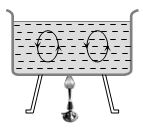
In convection,heat is transferred through fluids (liquids and gases) by the actual physical movement of the particles themselves.
When a fluid is heated,the particles near the heat source gain energy,become less dense,and rise upward.
Simultaneously,the cooler,denser particles from above move downward to take their place,creating convection currents that distribute heat throughout the medium.
In convection,heat is transferred through fluids (liquids and gases) by the actual physical movement of the particles themselves.
When a fluid is heated,the particles near the heat source gain energy,become less dense,and rise upward.
Simultaneously,the cooler,denser particles from above move downward to take their place,creating convection currents that distribute heat throughout the medium.
0 likes
View Solution7
EasyMCQ
Gravitational force is required for
A
Convection
B
Conduction
C
Radiation
D
Stirring of liquids
Solution
(A) Natural convection occurs due to the difference in density between two regions of a fluid. When a fluid is heated,it expands and its density decreases,causing it to rise,while cooler,denser fluid sinks to take its place. This movement is driven by the gravitational force acting on the density gradient. Therefore,gravitational force is essential for natural convection.
0 likes
View Solution8
EasyMCQ
When fluids are heated from the bottom,convection currents are produced because
A
Molecular motion of fluid becomes aligned
B
Molecular collisions take place within the fluid
C
Heated fluid becomes more dense than the cold fluid above it
D
Heated fluid becomes less dense than the cold fluid above it
Solution
(D) When a fluid is heated from the bottom,the molecules at the bottom gain kinetic energy and move further apart,which causes the fluid to expand.
As the fluid expands,its volume increases while its mass remains constant,leading to a decrease in density.
Because the heated fluid is less dense than the cooler,denser fluid above it,the buoyant force causes the warmer fluid to rise.
This continuous cycle of rising warm fluid and sinking cool fluid creates convection currents.
As the fluid expands,its volume increases while its mass remains constant,leading to a decrease in density.
Because the heated fluid is less dense than the cooler,denser fluid above it,the buoyant force causes the warmer fluid to rise.
This continuous cycle of rising warm fluid and sinking cool fluid creates convection currents.
0 likes
View Solution9
EasyMCQ
In which of the following processes does convection $NOT$ take place primarily?
A
Sea and land breeze
B
Boiling of water
C
Warming of glass of bulb due to filament
D
Heating air around a furnace
Solution
(C) The correct answer is $C$.
Convection is a mode of heat transfer that requires a fluid medium (liquid or gas) to transport heat through the actual movement of particles.
$A$. Sea and land breezes occur due to the convection currents in the atmosphere.
$B$. Boiling of water is a classic example of convection,where hot water rises and cold water sinks.
$C$. The warming of the glass bulb due to the filament occurs primarily through radiation. Since the interior of a light bulb is evacuated (a vacuum),there is no medium for convection to occur.
$D$. Heating air around a furnace involves the movement of air currents,which is a convection process.
Convection is a mode of heat transfer that requires a fluid medium (liquid or gas) to transport heat through the actual movement of particles.
$A$. Sea and land breezes occur due to the convection currents in the atmosphere.
$B$. Boiling of water is a classic example of convection,where hot water rises and cold water sinks.
$C$. The warming of the glass bulb due to the filament occurs primarily through radiation. Since the interior of a light bulb is evacuated (a vacuum),there is no medium for convection to occur.
$D$. Heating air around a furnace involves the movement of air currents,which is a convection process.
0 likes
View Solution10
MediumMCQ
At the same distance from a fire,the heat is greater at the top than at the sides because...
A
Air conducts heat in the upward direction.
B
Heat radiates in the upward direction.
C
Convection carries heat in the upward direction.
D
Convection,conduction,and radiation all contribute to the transfer of heat.
Solution
(C) When a fire burns,the air surrounding the flame gets heated.
As the air gets heated,it becomes less dense and rises upwards due to buoyancy.
This process of heat transfer through the actual movement of fluid particles is known as convection.
Since the hot air rises,the heat intensity is significantly higher directly above the fire compared to the sides,where the air is not being actively displaced by the rising convection currents.
As the air gets heated,it becomes less dense and rises upwards due to buoyancy.
This process of heat transfer through the actual movement of fluid particles is known as convection.
Since the hot air rises,the heat intensity is significantly higher directly above the fire compared to the sides,where the air is not being actively displaced by the rising convection currents.
0 likes
View Solution11
EasyMCQ
When measuring the thermal conductivity of a liquid,we should keep the top part hot and the bottom part cold so that...
A
Convection is prevented.
B
Radiation is prevented.
C
Heat flows rapidly downwards.
D
It is easier and more convenient to do so.
Solution
(A) In liquids,heat transfer occurs primarily through convection if the bottom is heated,as the warmer,less dense liquid rises. By heating the liquid from the top,the warmer liquid stays at the top and the cooler,denser liquid remains at the bottom. This stable density gradient prevents the formation of convection currents,allowing for the measurement of thermal conductivity through conduction alone.
0 likes
View Solution12
EasyMCQ
Can we boil water inside the earth satellite by convection?
A
Yes
B
No
C
Nothing can be said
D
Incomplete information is given
Solution
(B) The correct answer is $B$.
Convection is a mode of heat transfer that relies on the density difference of a fluid under the influence of gravity.
When water is heated,the warmer,less dense fluid rises while the cooler,denser fluid sinks,creating convection currents.
Inside an earth satellite,objects are in a state of weightlessness (free fall).
In this state,there is no effective gravity to create a density-driven buoyancy force.
Since the buoyancy force is zero,convection currents cannot be established.
Therefore,water cannot be boiled by convection inside an earth satellite.
Convection is a mode of heat transfer that relies on the density difference of a fluid under the influence of gravity.
When water is heated,the warmer,less dense fluid rises while the cooler,denser fluid sinks,creating convection currents.
Inside an earth satellite,objects are in a state of weightlessness (free fall).
In this state,there is no effective gravity to create a density-driven buoyancy force.
Since the buoyancy force is zero,convection currents cannot be established.
Therefore,water cannot be boiled by convection inside an earth satellite.
0 likes
View Solution13
MediumMCQ
Gravitation force is required for
A
Stirring of liquid
B
Convection
C
Conduction
D
Radiation
Solution
(B) Convection is the process of heat transfer in fluids (liquids and gases) where the actual movement of the fluid particles occurs.
This movement is driven by density differences caused by temperature variations.
When a fluid is heated,it expands and becomes less dense,causing it to rise,while the cooler,denser fluid sinks to take its place.
This buoyancy-driven circulation is entirely dependent on the presence of a gravitational field.
In contrast,conduction and radiation do not require the bulk movement of matter and are independent of gravity.
This movement is driven by density differences caused by temperature variations.
When a fluid is heated,it expands and becomes less dense,causing it to rise,while the cooler,denser fluid sinks to take its place.
This buoyancy-driven circulation is entirely dependent on the presence of a gravitational field.
In contrast,conduction and radiation do not require the bulk movement of matter and are independent of gravity.
0 likes
View Solution14
EasyMCQ
$Assertion :$ It is hotter over the top of a fire than at the same distance of the sides.
$Reason :$ Air surrounding the fire conducts more heat upwards.
$Reason :$ Air surrounding the fire conducts more heat upwards.
A
If both $Assertion$ and $Reason$ are correct and the $Reason$ is a correct explanation of the $Assertion$.
B
If both $Assertion$ and $Reason$ are correct but $Reason$ is not a correct explanation of the $Assertion$.
C
If the $Assertion$ is correct but $Reason$ is incorrect.
D
If both the $Assertion$ and $Reason$ are incorrect.
Solution
(C) The $Assertion$ is correct because the air directly above the fire becomes heated,expands,and rises due to convection currents.
This process carries heat energy upwards,making the region above the fire significantly hotter than the sides.
The $Reason$ is incorrect because air is a poor conductor of heat. The heat transfer in this scenario is primarily due to convection,not conduction.
This process carries heat energy upwards,making the region above the fire significantly hotter than the sides.
The $Reason$ is incorrect because air is a poor conductor of heat. The heat transfer in this scenario is primarily due to convection,not conduction.
0 likes
View Solution15
Easy
Explain the following terms:
$(a)$ Heat convection
$(b)$ Sea breeze
$(a)$ Heat convection
$(b)$ Sea breeze
Solution
(N/A) $(1)$ Propagation of heat in fluids is due to heat convection.
When a fluid is heated from the bottom, the volume of the fluid in that part increases and consequently, the density decreases.
Due to the force of buoyancy, the lighter fluid rises upward and the cooler fluid moves down to take its place.
The whole fluid gets heated as a result of such a continuous process. This process of heating is called "heat convection".
Heat convection can be natural or forced.
Natural convection: If the motion of the fluid takes place due to a difference in density, it is called natural convection.
In the atmosphere, hot and cold air currents are formed by natural convection due to unbalanced heat flow.
Forced convection: If the motion of the fluid takes place with the help of some device like a pump, fan, stirrer, etc., it is called forced convection.
In the human body, the heart acts as a pump and by circulating blood in all parts of the body, it maintains the temperature of the body by forced convection.
$(2)$ Sea breeze:
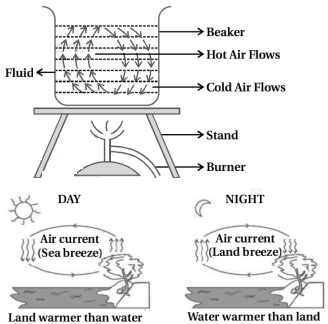
During the day, the ground heats up more quickly than large bodies of water. This occurs because water has a greater specific heat and mixing currents disperse the absorbed heat throughout the large volume of water.
The air in contact with the warm ground is heated by conduction. It expands, becoming less dense than the surrounding cooler air.
As a result, the warm air rises (air currents) and other air moves (winds) to fill the space, creating a sea breeze near a large body of water.
Cooler air descends, and a thermal convection cycle is set up, which transfers heat away from the land.
At night, the ground loses its heat more quickly, and the water surface is warmer than the land, leading to land breeze.
When a fluid is heated from the bottom, the volume of the fluid in that part increases and consequently, the density decreases.
Due to the force of buoyancy, the lighter fluid rises upward and the cooler fluid moves down to take its place.
The whole fluid gets heated as a result of such a continuous process. This process of heating is called "heat convection".
Heat convection can be natural or forced.
Natural convection: If the motion of the fluid takes place due to a difference in density, it is called natural convection.
In the atmosphere, hot and cold air currents are formed by natural convection due to unbalanced heat flow.
Forced convection: If the motion of the fluid takes place with the help of some device like a pump, fan, stirrer, etc., it is called forced convection.
In the human body, the heart acts as a pump and by circulating blood in all parts of the body, it maintains the temperature of the body by forced convection.
$(2)$ Sea breeze:
During the day, the ground heats up more quickly than large bodies of water. This occurs because water has a greater specific heat and mixing currents disperse the absorbed heat throughout the large volume of water.
The air in contact with the warm ground is heated by conduction. It expands, becoming less dense than the surrounding cooler air.
As a result, the warm air rises (air currents) and other air moves (winds) to fill the space, creating a sea breeze near a large body of water.
Cooler air descends, and a thermal convection cycle is set up, which transfers heat away from the land.
At night, the ground loses its heat more quickly, and the water surface is warmer than the land, leading to land breeze.
0 likes
View Solution16
MediumMCQ
Which mode of heat transfer occurs due to the difference in density?
A
Conduction
B
Convection
C
Radiation
D
Advection
Solution
(B) The mode of heat transfer that occurs due to the actual movement of fluid particles caused by density differences is known as $Convection$.
In this process,when a fluid is heated,the particles near the heat source gain energy,expand,and become less dense.
These less dense particles rise,while cooler,denser particles move down to take their place,creating convection currents that transfer heat.
In this process,when a fluid is heated,the particles near the heat source gain energy,expand,and become less dense.
These less dense particles rise,while cooler,denser particles move down to take their place,creating convection currents that transfer heat.
0 likes
View Solution17
MediumMCQ
In which mode of heat transfer is gravitation required?
A
Conduction
B
Convection
C
Radiation
D
None of these
Solution
(B) The mode of heat transfer that requires gravitation is $Convection$.
In $Convection$,heat is transferred by the actual movement of fluid particles (liquids or gases).
This movement occurs because of the difference in density caused by temperature variations.
Warmer fluid becomes less dense and rises,while cooler,denser fluid sinks due to the force of gravity.
Without gravity,there would be no buoyancy force to drive this circulation,and thus $Convection$ would not occur.
In $Convection$,heat is transferred by the actual movement of fluid particles (liquids or gases).
This movement occurs because of the difference in density caused by temperature variations.
Warmer fluid becomes less dense and rises,while cooler,denser fluid sinks due to the force of gravity.
Without gravity,there would be no buoyancy force to drive this circulation,and thus $Convection$ would not occur.
0 likes
View Solution18
MediumMCQ
Which type of convection does the human blood circulation system represent?
A
Natural convection
B
Forced convection
C
Both natural and forced convection
D
None of the above
Solution
(B) In the human blood circulation system,the heart acts as a pump that forces the blood to circulate throughout the body to transport nutrients,oxygen,and heat. Since the movement of the fluid (blood) is driven by an external mechanical agent (the heart) rather than by buoyancy forces arising from density differences,this process is classified as forced convection.
0 likes
View Solution19
Medium
What is meant by forced convection and natural convection?
Solution
(N/A) Forced convection: When the movement of the fluid is caused by external artificial means such as a fan,pump,or blower,the process is known as forced convection.
Natural convection: When the movement of the fluid is caused by density differences arising from temperature variations (buoyancy forces),the process is known as natural convection.
Natural convection: When the movement of the fluid is caused by density differences arising from temperature variations (buoyancy forces),the process is known as natural convection.
0 likes
View Solution20
EasyMCQ
Why is it hotter at the same distance above a candle flame than it is at the side of the flame?
A
Conduction of heat in air is upward.
B
Heat is maximum radiated in the upward direction.
C
Radiation and conduction both contribute to transferring heat upwards.
D
Convection carries more heat in the upward direction.
Solution
(D) The correct answer is $D$.
When a candle burns,heat is transferred to the surrounding air.
At the sides of the flame,heat is transferred primarily through radiation.
However,above the flame,the air gets heated,becomes less dense,and rises due to convection currents.
This upward flow of hot air carries a significant amount of thermal energy,making the region above the flame much hotter than the sides at an equivalent distance.
When a candle burns,heat is transferred to the surrounding air.
At the sides of the flame,heat is transferred primarily through radiation.
However,above the flame,the air gets heated,becomes less dense,and rises due to convection currents.
This upward flow of hot air carries a significant amount of thermal energy,making the region above the flame much hotter than the sides at an equivalent distance.
0 likes
View Solution21
EasyMCQ
Which factor does not affect convection?
A
Temperature difference
B
The rate of movement of carrying medium
C
The volumetric specific heat of carrying medium
D
The thermal conductivity of carrying medium
Solution
(D) The correct answer is $D$.
Convection is the process of heat transfer by the actual movement of the molecules of a fluid (liquid or gas).
The rate of heat transfer by convection depends on the temperature difference,the velocity of the fluid flow,and the heat capacity of the fluid.
Thermal conductivity is a property associated with conduction,which is the transfer of heat through stationary matter by molecular collisions.
Therefore,the thermal conductivity of the carrying medium does not affect the convection process.
Convection is the process of heat transfer by the actual movement of the molecules of a fluid (liquid or gas).
The rate of heat transfer by convection depends on the temperature difference,the velocity of the fluid flow,and the heat capacity of the fluid.
Thermal conductivity is a property associated with conduction,which is the transfer of heat through stationary matter by molecular collisions.
Therefore,the thermal conductivity of the carrying medium does not affect the convection process.
0 likes
View Solution22
EasyMCQ
Which one of the following processes depends on gravity?
A
Conduction
B
Convection
C
Radiation
D
None of these
Solution
(B) . Conduction is the process of heat transfer in a solid from a hotter region to a colder region without the actual movement of particles.
$B$. Convection involves the movement of fluid particles. Heated,less dense particles rise,while cooler,denser particles sink due to the gravitational force acting on them. Thus,convection depends on gravity.
$C$. Radiation is the transfer of heat via electromagnetic waves,which can occur even in a vacuum and does not depend on gravity.
Therefore,the correct option is $B$.
$B$. Convection involves the movement of fluid particles. Heated,less dense particles rise,while cooler,denser particles sink due to the gravitational force acting on them. Thus,convection depends on gravity.
$C$. Radiation is the transfer of heat via electromagnetic waves,which can occur even in a vacuum and does not depend on gravity.
Therefore,the correct option is $B$.
0 likes
View Solution23
EasyMCQ
Which one of the following is based on convection?
A
Heating of a copper utensil
B
Heating a room by a heater
C
Heating of an iron rod
D
Heat transferred from the sun to the earth
Solution
(B) Convection is a mode of heat transfer that occurs in fluids (liquids and gases) due to the actual movement of the molecules of the medium.
In the case of heating a room by a heater,the air near the heater gets warm,becomes less dense,and rises,while the cooler,denser air moves in to take its place. This continuous circulation of air,known as convection currents,heats the entire room.
Heating of a copper utensil and an iron rod are examples of conduction,while heat transfer from the sun to the earth occurs via radiation.
Therefore,the correct option is $B$.
In the case of heating a room by a heater,the air near the heater gets warm,becomes less dense,and rises,while the cooler,denser air moves in to take its place. This continuous circulation of air,known as convection currents,heats the entire room.
Heating of a copper utensil and an iron rod are examples of conduction,while heat transfer from the sun to the earth occurs via radiation.
Therefore,the correct option is $B$.
0 likes
View Solution10-2.Heat Transfer — Convection · Frequently Asked Questions
1Are these 10-2.Heat Transfer questions useful for JEE and NEET?
Yes. All questions in this section are mapped to JEE Main and NEET exam patterns. Previous year questions from JEE Main, NEET, GUJCET and state-level exams are included with full solutions.
2Can I switch to Hindi or Gujarati for these questions?
Yes. Use the language tabs in the hero section or the sidebar to view the same questions and solutions in English, Hindi or Gujarati.
3How do I generate a question paper from this subtopic?
Use the Vedclass Exam Paper Generator — select the chapter and subtopic, set difficulty, and generate Sets A, B, C, D automatically. First 3 chapters of every subject are free.
Vedclass Products
For Students
Vedclass Test Series
Mock tests in real JEE/NEET style with performance analysis. 5-day free trial.
Start Free TrialFor Teachers
Exam Paper Generator
Generate Set A/B/C/D papers from this chapter in 2 minutes. 3 chapters free.
Try FreeFor Institutes
Online Exam Module
Live online exams with unlimited students, 360° analytics & white-label branding.
See DemoFor Teachers & Institutes
Generate a 10-2.Heat Transfer Exam Paper in 2 Minutes
Select subtopic & difficulty — Sets A, B, C, D auto-generated with No Repeat logic.
First 3 chapters of every subject are free — no payment required.