
A English
Molecular orbital theory Questions in English
Class 11 Chemistry · Chemical Bonding and Molecular Structure · Molecular orbital theory
501+
Questions
English
Language
100%
With Solutions
Showing 49 of 501 questions in English
101
MediumMCQ
Which of the following species has a bond order of $1.5$?
A
$O_{2}^{+}$
B
$O_{2}^{-}$
C
$O_{2}^{2-}$
D
$O_{2}$
Solution
(B) The bond order is calculated using the formula: $\text{Bond Order} = \frac{N_b - N_a}{2}$,where $N_b$ is the number of bonding electrons and $N_a$ is the number of antibonding electrons.
For $O_{2}^{+}$ (total $15$ electrons): Configuration is $\sigma 1s^2, \sigma^* 1s^2, \sigma 2s^2, \sigma^* 2s^2, \sigma 2p_z^2, \pi 2p_x^2 = \pi 2p_y^2, \pi^* 2p_x^1$. Bond order $= \frac{10 - 5}{2} = 2.5$.
For $O_{2}^{-}$ (total $17$ electrons): Configuration is $\sigma 1s^2, \sigma^* 1s^2, \sigma 2s^2, \sigma^* 2s^2, \sigma 2p_z^2, \pi 2p_x^2 = \pi 2p_y^2, \pi^* 2p_x^2 = \pi^* 2p_y^1$. Bond order $= \frac{10 - 7}{2} = 1.5$.
For $O_{2}^{2-}$ (total $18$ electrons): Bond order $= \frac{10 - 8}{2} = 1.0$.
For $O_{2}$ (total $16$ electrons): Bond order $= \frac{10 - 6}{2} = 2.0$.
Thus,$O_{2}^{-}$ has a bond order of $1.5$.
For $O_{2}^{+}$ (total $15$ electrons): Configuration is $\sigma 1s^2, \sigma^* 1s^2, \sigma 2s^2, \sigma^* 2s^2, \sigma 2p_z^2, \pi 2p_x^2 = \pi 2p_y^2, \pi^* 2p_x^1$. Bond order $= \frac{10 - 5}{2} = 2.5$.
For $O_{2}^{-}$ (total $17$ electrons): Configuration is $\sigma 1s^2, \sigma^* 1s^2, \sigma 2s^2, \sigma^* 2s^2, \sigma 2p_z^2, \pi 2p_x^2 = \pi 2p_y^2, \pi^* 2p_x^2 = \pi^* 2p_y^1$. Bond order $= \frac{10 - 7}{2} = 1.5$.
For $O_{2}^{2-}$ (total $18$ electrons): Bond order $= \frac{10 - 8}{2} = 1.0$.
For $O_{2}$ (total $16$ electrons): Bond order $= \frac{10 - 6}{2} = 2.0$.
Thus,$O_{2}^{-}$ has a bond order of $1.5$.
0 likes
View Solution102
MediumMCQ
The pair of species with the same bond order is
A
$O_2^{2-}, B_2$
B
$O_2^+, NO^+$
C
$NO, CO$
D
$N_2, O_2$
Solution
(A) To find the bond order,we use the formula: $\text{Bond Order} = \frac{1}{2} (N_b - N_a)$,where $N_b$ is the number of bonding electrons and $N_a$ is the number of antibonding electrons.
$1$. For $O_2^+$: Total electrons = $15$. Configuration: $\sigma 1s^2, \sigma^* 1s^2, \sigma 2s^2, \sigma^* 2s^2, \sigma 2p_z^2, \pi 2p_x^2 = \pi 2p_y^2, \pi^* 2p_x^1$. Bond order = $\frac{1}{2}(10 - 5) = 2.5$.
$2$. For $NO^+$: Total electrons = $14$. Configuration: $\sigma 1s^2, \sigma^* 1s^2, \sigma 2s^2, \sigma^* 2s^2, \sigma 2p_z^2, \pi 2p_x^2 = \pi 2p_y^2$. Bond order = $\frac{1}{2}(10 - 4) = 3.0$.
$3$. For $O_2^{2-}$: Total electrons = $18$. Bond order = $1.0$.
$4$. For $B_2$: Total electrons = $10$. Bond order = $1.0$.
Since both $O_2^{2-}$ and $B_2$ have a bond order of $1.0$,they form the correct pair.
$1$. For $O_2^+$: Total electrons = $15$. Configuration: $\sigma 1s^2, \sigma^* 1s^2, \sigma 2s^2, \sigma^* 2s^2, \sigma 2p_z^2, \pi 2p_x^2 = \pi 2p_y^2, \pi^* 2p_x^1$. Bond order = $\frac{1}{2}(10 - 5) = 2.5$.
$2$. For $NO^+$: Total electrons = $14$. Configuration: $\sigma 1s^2, \sigma^* 1s^2, \sigma 2s^2, \sigma^* 2s^2, \sigma 2p_z^2, \pi 2p_x^2 = \pi 2p_y^2$. Bond order = $\frac{1}{2}(10 - 4) = 3.0$.
$3$. For $O_2^{2-}$: Total electrons = $18$. Bond order = $1.0$.
$4$. For $B_2$: Total electrons = $10$. Bond order = $1.0$.
Since both $O_2^{2-}$ and $B_2$ have a bond order of $1.0$,they form the correct pair.
0 likes
View Solution103
MediumMCQ
During the change of $O_2$ to $O_2^-$ ion,the electron adds to which one of the following orbitals?
A
$\pi ^*$ orbital
B
$\pi$ orbital
C
$\sigma ^*$ orbital
D
$\sigma$ orbital
Solution
(A) The electronic configuration of $O_2$ is $KK \sigma(2s)^2 \sigma^*(2s)^2 \sigma(2p_z)^2 \pi(2p_x)^2 \pi(2p_y)^2 \pi^*(2p_x)^1 \pi^*(2p_y)^1$.
When $O_2$ gains an electron to form $O_2^-$,the incoming electron enters the next available orbital,which is the antibonding $\pi^*$ orbital.
Thus,the configuration of $O_2^-$ becomes $KK \sigma(2s)^2 \sigma^*(2s)^2 \sigma(2p_z)^2 \pi(2p_x)^2 \pi(2p_y)^2 \pi^*(2p_x)^2 \pi^*(2p_y)^1$.
When $O_2$ gains an electron to form $O_2^-$,the incoming electron enters the next available orbital,which is the antibonding $\pi^*$ orbital.
Thus,the configuration of $O_2^-$ becomes $KK \sigma(2s)^2 \sigma^*(2s)^2 \sigma(2p_z)^2 \pi(2p_x)^2 \pi(2p_y)^2 \pi^*(2p_x)^2 \pi^*(2p_y)^1$.
0 likes
View Solution104
MediumMCQ
Four diatomic species are listed below. Identify the correct order in which the bond order is increasing in them.
A
$NO < O_2^- < C_2^{2-} < He_2^+$
B
$O_2^- < NO < C_2^{2-} < He_2^+$
C
$C_2^{2-} < He_2^+ < O_2^- < NO$
D
$He_2^+ < O_2^- < NO < C_2^{2-}$
Solution
(D) The bond order is calculated using the formula: $Bond \ Order = \frac{1}{2} (N_b - N_a)$.
For $He_2^+$ ($3$ electrons): $\sigma 1s^2, \sigma^* 1s^1$,$BO = \frac{2-1}{2} = 0.5$.
For $O_2^-$ ($17$ electrons): $BO = \frac{10-7}{2} = 1.5$.
For $NO$ ($15$ electrons): $BO = \frac{10-5}{2} = 2.5$.
For $C_2^{2-}$ ($14$ electrons): $BO = \frac{10-4}{2} = 3.0$.
Thus,the increasing order of bond order is: $He_2^+ < O_2^- < NO < C_2^{2-}$.
For $He_2^+$ ($3$ electrons): $\sigma 1s^2, \sigma^* 1s^1$,$BO = \frac{2-1}{2} = 0.5$.
For $O_2^-$ ($17$ electrons): $BO = \frac{10-7}{2} = 1.5$.
For $NO$ ($15$ electrons): $BO = \frac{10-5}{2} = 2.5$.
For $C_2^{2-}$ ($14$ electrons): $BO = \frac{10-4}{2} = 3.0$.
Thus,the increasing order of bond order is: $He_2^+ < O_2^- < NO < C_2^{2-}$.
0 likes
View Solution105
MediumMCQ
Which of the following has the minimum bond length?
A
$O_2^+$
B
$O_2^-$
C
$O_2^{2-}$
D
$O_2$
Solution
(A) The bond order is inversely proportional to the bond length.
Bond order of $O_2^+ = \frac{10-5}{2} = 2.5$
Bond order of $O_2 = \frac{10-6}{2} = 2.0$
Bond order of $O_2^- = \frac{10-7}{2} = 1.5$
Bond order of $O_2^{2-} = \frac{10-8}{2} = 1.0$
Since $O_2^+$ has the highest bond order $(2.5)$,it has the minimum bond length.
Bond order of $O_2^+ = \frac{10-5}{2} = 2.5$
Bond order of $O_2 = \frac{10-6}{2} = 2.0$
Bond order of $O_2^- = \frac{10-7}{2} = 1.5$
Bond order of $O_2^{2-} = \frac{10-8}{2} = 1.0$
Since $O_2^+$ has the highest bond order $(2.5)$,it has the minimum bond length.
0 likes
View Solution106
MediumMCQ
The pairs of species of oxygen and their magnetic behaviour are noted below. Which of the following presents the correct description?
A
$O_2^-, O_2^{2-}$ - Both diamagnetic
B
$O^{+}, O_2^{2-}$ - Both paramagnetic
C
$O_2^+, O_2$ - Both paramagnetic
D
$O, O_2^{2-}$ - Both paramagnetic
Solution
(C) The electronic configuration of $O_2^+$ ($13$ electrons) is: $KK \sigma 2s^2 \sigma^* 2s^2 \sigma 2pz^2 (\pi 2px^2 = \pi 2py^2) (\pi^* 2px^1)$. It has one unpaired electron,so it is paramagnetic.
The electronic configuration of $O_2$ ($16$ electrons) is: $KK \sigma 2s^2 \sigma^* 2s^2 \sigma 2pz^2 (\pi 2px^2 = \pi 2py^2) (\pi^* 2px^1 = \pi^* 2py^1)$. It has two unpaired electrons,so it is paramagnetic.
Since both $O_2^+$ and $O_2$ contain unpaired electrons in their $\pi^*$ antibonding molecular orbitals,both are paramagnetic.
The electronic configuration of $O_2$ ($16$ electrons) is: $KK \sigma 2s^2 \sigma^* 2s^2 \sigma 2pz^2 (\pi 2px^2 = \pi 2py^2) (\pi^* 2px^1 = \pi^* 2py^1)$. It has two unpaired electrons,so it is paramagnetic.
Since both $O_2^+$ and $O_2$ contain unpaired electrons in their $\pi^*$ antibonding molecular orbitals,both are paramagnetic.
1 likes
View Solution107
MediumMCQ
Which one of the following species does not exist under normal conditions?
A
$Be_2^+$
B
$Be_2$
C
$B_2$
D
$Li_2$
Solution
(B) The species $Be_2$ does not exist under normal conditions.
The electronic configuration of $Be_2$ ($Z=4$,total $8$ electrons) is: $\sigma 1s^2 \sigma^* 1s^2 \sigma 2s^2 \sigma^* 2s^2$.
The bond order is calculated as: $\text{Bond order} = \frac{N_b - N_a}{2} = \frac{4 - 4}{2} = 0$.
Since the bond order is $0$,the molecule is unstable and does not exist.
The electronic configuration of $Be_2$ ($Z=4$,total $8$ electrons) is: $\sigma 1s^2 \sigma^* 1s^2 \sigma 2s^2 \sigma^* 2s^2$.
The bond order is calculated as: $\text{Bond order} = \frac{N_b - N_a}{2} = \frac{4 - 4}{2} = 0$.
Since the bond order is $0$,the molecule is unstable and does not exist.
0 likes
View Solution108
MediumMCQ
According to $MO$ theory,which of the following lists ranks the nitrogen species in terms of increasing bond order?
A
$N_2^{2-} < N_2^- < N_2$
B
$N_2 < N_2^{2-} < N_2^-$
C
$N_2^- < N_2^{2-} < N_2$
D
$N_2^- < N_2 < N_2^{2-}$
Solution
(A) The molecular orbital configuration for $N_2$ ($14$ electrons) is: $(\sigma 1s)^2(\sigma^* 1s)^2(\sigma 2s)^2(\sigma^* 2s)^2(\pi 2p_x)^2(\pi 2p_y)^2(\sigma 2p_z)^2$.
Bond order $(B.O.)$ $= \frac{10-4}{2} = 3$.
For $N_2^-$ ($15$ electrons): $(\sigma 1s)^2(\sigma^* 1s)^2(\sigma 2s)^2(\sigma^* 2s)^2(\pi 2p_x)^2(\pi 2p_y)^2(\sigma 2p_z)^2(\pi^* 2p_x)^1$.
$B.O. = \frac{10-5}{2} = 2.5$.
For $N_2^{2-}$ ($16$ electrons): $(\sigma 1s)^2(\sigma^* 1s)^2(\sigma 2s)^2(\sigma^* 2s)^2(\pi 2p_x)^2(\pi 2p_y)^2(\sigma 2p_z)^2(\pi^* 2p_x)^1(\pi^* 2p_y)^1$.
$B.O. = \frac{10-6}{2} = 2$.
Comparing the bond orders: $2 < 2.5 < 3$.
Therefore,the increasing order is $N_2^{2-} < N_2^- < N_2$.
Bond order $(B.O.)$ $= \frac{10-4}{2} = 3$.
For $N_2^-$ ($15$ electrons): $(\sigma 1s)^2(\sigma^* 1s)^2(\sigma 2s)^2(\sigma^* 2s)^2(\pi 2p_x)^2(\pi 2p_y)^2(\sigma 2p_z)^2(\pi^* 2p_x)^1$.
$B.O. = \frac{10-5}{2} = 2.5$.
For $N_2^{2-}$ ($16$ electrons): $(\sigma 1s)^2(\sigma^* 1s)^2(\sigma 2s)^2(\sigma^* 2s)^2(\pi 2p_x)^2(\pi 2p_y)^2(\sigma 2p_z)^2(\pi^* 2p_x)^1(\pi^* 2p_y)^1$.
$B.O. = \frac{10-6}{2} = 2$.
Comparing the bond orders: $2 < 2.5 < 3$.
Therefore,the increasing order is $N_2^{2-} < N_2^- < N_2$.
0 likes
View Solution109
MediumMCQ
Which one of the following constitutes a group of the isoelectronic species?
A
$C_2^{2-}, O_2^-, CO, NO$
B
$NO^{+}, C_2^{2-}, CN^{-}, N_2$
C
$CN^{-}, N_2, O_2^{2-}, C_2^{2-}$
D
$N_2, O_2^-, NO^{+}, CO$
Solution
(B) Isoelectronic species are those that possess the same number of electrons.
For $NO^{+}$: $7 + 8 - 1 = 14$ electrons.
For $C_2^{2-}$: $6 \times 2 + 2 = 14$ electrons.
For $CN^{-}$: $6 + 7 + 1 = 14$ electrons.
For $N_2$: $7 \times 2 = 14$ electrons.
Since $NO^{+}, C_2^{2-}, CN^{-}$,and $N_2$ each have $14$ electrons,they are isoelectronic.
For $NO^{+}$: $7 + 8 - 1 = 14$ electrons.
For $C_2^{2-}$: $6 \times 2 + 2 = 14$ electrons.
For $CN^{-}$: $6 + 7 + 1 = 14$ electrons.
For $N_2$: $7 \times 2 = 14$ electrons.
Since $NO^{+}, C_2^{2-}, CN^{-}$,and $N_2$ each have $14$ electrons,they are isoelectronic.
0 likes
View Solution110
MediumMCQ
Which of the following molecules/ions does not contain unpaired electrons?
A
$N_2^+$
B
$O_2$
C
$O_2^{2-}$
D
$B_2$
Solution
(C) According to Molecular Orbital Theory $(MOT)$,we determine the presence of unpaired electrons by filling the molecular orbitals:
$1$. For $N_2^+$ ($13$ electrons): $\sigma_{1s}^2 \sigma_{1s}^{*2} \sigma_{2s}^2 \sigma_{2s}^{*2} \pi_{2p_x}^2 \pi_{2p_y}^2 \sigma_{2p_z}^1$. It has $1$ unpaired electron.
$2$. For $O_2$ ($16$ electrons): $\sigma_{1s}^2 \sigma_{1s}^{*2} \sigma_{2s}^2 \sigma_{2s}^{*2} \sigma_{2p_z}^2 \pi_{2p_x}^2 \pi_{2p_y}^2 \pi_{2p_x}^{*1} \pi_{2p_y}^{*1}$. It has $2$ unpaired electrons.
$3$. For $O_2^{2-}$ ($18$ electrons): $\sigma_{1s}^2 \sigma_{1s}^{*2} \sigma_{2s}^2 \sigma_{2s}^{*2} \sigma_{2p_z}^2 \pi_{2p_x}^2 \pi_{2p_y}^2 \pi_{2p_x}^{*2} \pi_{2p_y}^{*2}$. All electrons are paired.
$4$. For $B_2$ ($10$ electrons): $\sigma_{1s}^2 \sigma_{1s}^{*2} \sigma_{2s}^2 \sigma_{2s}^{*2} \pi_{2p_x}^1 \pi_{2p_y}^1$. It has $2$ unpaired electrons.
Therefore,$O_2^{2-}$ is the only species without unpaired electrons.
$1$. For $N_2^+$ ($13$ electrons): $\sigma_{1s}^2 \sigma_{1s}^{*2} \sigma_{2s}^2 \sigma_{2s}^{*2} \pi_{2p_x}^2 \pi_{2p_y}^2 \sigma_{2p_z}^1$. It has $1$ unpaired electron.
$2$. For $O_2$ ($16$ electrons): $\sigma_{1s}^2 \sigma_{1s}^{*2} \sigma_{2s}^2 \sigma_{2s}^{*2} \sigma_{2p_z}^2 \pi_{2p_x}^2 \pi_{2p_y}^2 \pi_{2p_x}^{*1} \pi_{2p_y}^{*1}$. It has $2$ unpaired electrons.
$3$. For $O_2^{2-}$ ($18$ electrons): $\sigma_{1s}^2 \sigma_{1s}^{*2} \sigma_{2s}^2 \sigma_{2s}^{*2} \sigma_{2p_z}^2 \pi_{2p_x}^2 \pi_{2p_y}^2 \pi_{2p_x}^{*2} \pi_{2p_y}^{*2}$. All electrons are paired.
$4$. For $B_2$ ($10$ electrons): $\sigma_{1s}^2 \sigma_{1s}^{*2} \sigma_{2s}^2 \sigma_{2s}^{*2} \pi_{2p_x}^1 \pi_{2p_y}^1$. It has $2$ unpaired electrons.
Therefore,$O_2^{2-}$ is the only species without unpaired electrons.
0 likes
View Solution111
MediumMCQ
Which of the following species exhibits the diamagnetic behaviour?
A
$NO$
B
$O_2^{2-}$
C
$O_2^{+}$
D
$O_2$
Solution
(B) To determine the magnetic behavior,we analyze the molecular orbital configuration of each species.
$1$. $NO$ has $15$ electrons: $\sigma_{1s}^2, \sigma_{1s}^{*2}, \sigma_{2s}^2, \sigma_{2s}^{*2}, \sigma_{2p_z}^2, \pi_{2p_x}^2 = \pi_{2p_y}^2, \pi_{2p_x}^{*1}$. It is paramagnetic due to the unpaired electron.
$2$. $O_2^{2-}$ has $18$ electrons. Its configuration is: $\sigma_{1s}^2, \sigma_{1s}^{*2}, \sigma_{2s}^2, \sigma_{2s}^{*2}, \sigma_{2p_z}^2, \pi_{2p_x}^2 = \pi_{2p_y}^2, \pi_{2p_x}^{*2} = \pi_{2p_y}^{*2}$. Since all electrons are paired,it is diamagnetic.
$3$. $O_2^{+}$ has $15$ electrons and is paramagnetic.
$4$. $O_2$ has $16$ electrons and is paramagnetic due to two unpaired electrons in the $\pi^*$ orbitals.
$1$. $NO$ has $15$ electrons: $\sigma_{1s}^2, \sigma_{1s}^{*2}, \sigma_{2s}^2, \sigma_{2s}^{*2}, \sigma_{2p_z}^2, \pi_{2p_x}^2 = \pi_{2p_y}^2, \pi_{2p_x}^{*1}$. It is paramagnetic due to the unpaired electron.
$2$. $O_2^{2-}$ has $18$ electrons. Its configuration is: $\sigma_{1s}^2, \sigma_{1s}^{*2}, \sigma_{2s}^2, \sigma_{2s}^{*2}, \sigma_{2p_z}^2, \pi_{2p_x}^2 = \pi_{2p_y}^2, \pi_{2p_x}^{*2} = \pi_{2p_y}^{*2}$. Since all electrons are paired,it is diamagnetic.
$3$. $O_2^{+}$ has $15$ electrons and is paramagnetic.
$4$. $O_2$ has $16$ electrons and is paramagnetic due to two unpaired electrons in the $\pi^*$ orbitals.
0 likes
View Solution112
DifficultMCQ
In which of the following ionization processes,the bond order has increased and the magnetic behaviour has changed?
A
$N_2 \rightarrow N_2^+$
B
$C_2 \rightarrow C_2^+$
C
$NO \rightarrow NO^+$
D
$O_2 \rightarrow O_2^+$
Solution
(C) The bond order $(BO)$ is calculated as $\frac{1}{2}(N_b - N_a)$,where $N_b$ is the number of bonding electrons and $N_a$ is the number of antibonding electrons.
For $NO$ ($15$ electrons): Configuration is $\sigma 1s^2, \sigma^* 1s^2, \sigma 2s^2, \sigma^* 2s^2, \sigma 2p_z^2, \pi 2p_x^2 = \pi 2p_y^2, \pi^* 2p_x^1$. $BO = \frac{1}{2}(10 - 5) = 2.5$. It is paramagnetic.
For $NO^+$ ($14$ electrons): Configuration is $\sigma 1s^2, \sigma^* 1s^2, \sigma 2s^2, \sigma^* 2s^2, \sigma 2p_z^2, \pi 2p_x^2 = \pi 2p_y^2$. $BO = \frac{1}{2}(10 - 4) = 3.0$. It is diamagnetic.
In the process $NO \rightarrow NO^+$,the electron is removed from the antibonding $\pi^*$ orbital,which increases the bond order from $2.5$ to $3.0$ and changes the magnetic behavior from paramagnetic to diamagnetic.
For $NO$ ($15$ electrons): Configuration is $\sigma 1s^2, \sigma^* 1s^2, \sigma 2s^2, \sigma^* 2s^2, \sigma 2p_z^2, \pi 2p_x^2 = \pi 2p_y^2, \pi^* 2p_x^1$. $BO = \frac{1}{2}(10 - 5) = 2.5$. It is paramagnetic.
For $NO^+$ ($14$ electrons): Configuration is $\sigma 1s^2, \sigma^* 1s^2, \sigma 2s^2, \sigma^* 2s^2, \sigma 2p_z^2, \pi 2p_x^2 = \pi 2p_y^2$. $BO = \frac{1}{2}(10 - 4) = 3.0$. It is diamagnetic.
In the process $NO \rightarrow NO^+$,the electron is removed from the antibonding $\pi^*$ orbital,which increases the bond order from $2.5$ to $3.0$ and changes the magnetic behavior from paramagnetic to diamagnetic.
0 likes
View Solution113
MediumMCQ
Which one of the following pairs of species have the same bond order?
A
$CN^{-}$ and $NO^{+}$
B
$CN^{-}$ and $CN^{+}$
C
$O_2^{-}$ and $CN^{-}$
D
$NO^{+}$ and $CN^{+}$
Solution
(A) The bond order of a diatomic species depends on the total number of electrons in the molecule or ion.
Species with the same number of electrons are isoelectronic and generally possess the same bond order.
Calculating the total number of electrons for each species:
$CN^{-}$: $6 + 7 + 1 = 14$ electrons.
$NO^{+}$: $7 + 8 - 1 = 14$ electrons.
$CN^{+}$: $6 + 7 - 1 = 12$ electrons.
$O_2^{-}$: $8 + 8 + 1 = 17$ electrons.
Since $CN^{-}$ and $NO^{+}$ both have $14$ electrons,they have the same bond order (which is $3$).
Species with the same number of electrons are isoelectronic and generally possess the same bond order.
Calculating the total number of electrons for each species:
$CN^{-}$: $6 + 7 + 1 = 14$ electrons.
$NO^{+}$: $7 + 8 - 1 = 14$ electrons.
$CN^{+}$: $6 + 7 - 1 = 12$ electrons.
$O_2^{-}$: $8 + 8 + 1 = 17$ electrons.
Since $CN^{-}$ and $NO^{+}$ both have $14$ electrons,they have the same bond order (which is $3$).
0 likes
View Solution114
MediumMCQ
Using $MO$ theory,predict which of the following species has the shortest bond length?
A
$O_2^+$
B
$O_2^-$
C
$O_2^{2-}$
D
$O_2^{2+}$
Solution
(D) According to $MO$ theory,bond order is inversely proportional to bond length.
$O_2^{2+}$ has a bond order of $3.0$.
$O_2^+$ has a bond order of $2.5$.
$O_2^-$ has a bond order of $1.5$.
$O_2^{2-}$ has a bond order of $1.0$.
Since $O_2^{2+}$ has the highest bond order,it has the shortest bond length.
$O_2^{2+}$ has a bond order of $3.0$.
$O_2^+$ has a bond order of $2.5$.
$O_2^-$ has a bond order of $1.5$.
$O_2^{2-}$ has a bond order of $1.0$.
Since $O_2^{2+}$ has the highest bond order,it has the shortest bond length.
0 likes
View Solution115
MediumMCQ
Which one of the following molecules is expected to exhibit diamagnetic behaviour?
A
$C_2$
B
$F_2$
C
$O_2$
D
$S_2$
Solution
(A) According to Molecular Orbital Theory $(MOT)$,a molecule is diamagnetic if all its electrons are paired.
For $C_2$ ($12$ electrons): $\sigma 1s^2, \sigma^* 1s^2, \sigma 2s^2, \sigma^* 2s^2, \pi 2p_x^2 = \pi 2p_y^2$. All electrons are paired,so it is diamagnetic.
For $F_2$ ($18$ electrons): $\sigma 1s^2, \sigma^* 1s^2, \sigma 2s^2, \sigma^* 2s^2, \sigma 2p_z^2, \pi 2p_x^2 = \pi 2p_y^2, \pi^* 2p_x^2 = \pi^* 2p_y^2$. All electrons are paired,so it is diamagnetic.
For $O_2$ ($16$ electrons): The configuration ends with $\pi^* 2p_x^1 = \pi^* 2p_y^1$,having $2$ unpaired electrons,making it paramagnetic.
For $S_2$ ($32$ electrons): Similar to $O_2$,it has $2$ unpaired electrons in the $\pi^*$ orbitals,making it paramagnetic.
Note: Both $C_2$ and $F_2$ are diamagnetic. However,in standard textbook contexts for this specific question,$C_2$ is frequently cited as the primary example of a molecule with a unique bonding structure exhibiting diamagnetism due to the $\pi$ bonding.
For $C_2$ ($12$ electrons): $\sigma 1s^2, \sigma^* 1s^2, \sigma 2s^2, \sigma^* 2s^2, \pi 2p_x^2 = \pi 2p_y^2$. All electrons are paired,so it is diamagnetic.
For $F_2$ ($18$ electrons): $\sigma 1s^2, \sigma^* 1s^2, \sigma 2s^2, \sigma^* 2s^2, \sigma 2p_z^2, \pi 2p_x^2 = \pi 2p_y^2, \pi^* 2p_x^2 = \pi^* 2p_y^2$. All electrons are paired,so it is diamagnetic.
For $O_2$ ($16$ electrons): The configuration ends with $\pi^* 2p_x^1 = \pi^* 2p_y^1$,having $2$ unpaired electrons,making it paramagnetic.
For $S_2$ ($32$ electrons): Similar to $O_2$,it has $2$ unpaired electrons in the $\pi^*$ orbitals,making it paramagnetic.
Note: Both $C_2$ and $F_2$ are diamagnetic. However,in standard textbook contexts for this specific question,$C_2$ is frequently cited as the primary example of a molecule with a unique bonding structure exhibiting diamagnetism due to the $\pi$ bonding.
0 likes
View Solution116
MediumMCQ
In which of the following pairs of molecules/ions,both the species are not likely to exist?
A
$H_{2}^{+}, He_{2}^{2-}$
B
$H_{2}^{-}, He_{2}^{2-}$
C
$H_{2}^{2+}, He_{2}$
D
$H_{2}^{-}, He_{2}^{2+}$
Solution
(C) According to Molecular Orbital Theory,species with a bond order of $0$ or less do not exist.
For $H_{2}^{2+}$: Total electrons $= 1 + 1 - 2 = 0$. Electronic configuration $= \sigma 1s^{0}$. Bond order $= 0$.
For $He_{2}$: Total electrons $= 2 + 2 = 4$. Electronic configuration $= \sigma 1s^{2}, \sigma^* 1s^{2}$. Bond order $= \frac{2 - 2}{2} = 0$.
Since both $H_{2}^{2+}$ and $He_{2}$ have a bond order of $0$,they are not likely to exist.
For $H_{2}^{2+}$: Total electrons $= 1 + 1 - 2 = 0$. Electronic configuration $= \sigma 1s^{0}$. Bond order $= 0$.
For $He_{2}$: Total electrons $= 2 + 2 = 4$. Electronic configuration $= \sigma 1s^{2}, \sigma^* 1s^{2}$. Bond order $= \frac{2 - 2}{2} = 0$.
Since both $H_{2}^{2+}$ and $He_{2}$ have a bond order of $0$,they are not likely to exist.
0 likes
View Solution117
MediumMCQ
Stability of the species $Li_2$, $Li_2^-$, and $Li_2^+$ increases in the order of:
A
$Li_2 < Li_2^+ < Li_2^-$
B
$Li_2^- < Li_2^+ < Li_2$
C
$Li_2 < Li_2^- < Li_2^+$
D
$Li_2^- < Li_2 < Li_2^+$
Solution
(B) The stability of a molecule is directly proportional to its bond order. If bond orders are equal, the species with more electrons in antibonding orbitals is less stable.
$Li_2$ ($6$ electrons): $\sigma 1s^2, \sigma^* 1s^2, \sigma 2s^2$. Bond order $= \frac{4 - 2}{2} = 1.0$.
$Li_2^+$ ($5$ electrons): $\sigma 1s^2, \sigma^* 1s^2, \sigma 2s^1$. Bond order $= \frac{3 - 2}{2} = 0.5$.
$Li_2^-$ ($7$ electrons): $\sigma 1s^2, \sigma^* 1s^2, \sigma 2s^2, \sigma^* 2s^1$. Bond order $= \frac{4 - 3}{2} = 0.5$.
Comparing $Li_2^+$ and $Li_2^-$, both have a bond order of $0.5$, but $Li_2^-$ has more electrons in the antibonding orbital $(\sigma^* 2s^1)$, making it less stable than $Li_2^+$.
Therefore, the stability order is $Li_2^- < Li_2^+ < Li_2$.
$Li_2$ ($6$ electrons): $\sigma 1s^2, \sigma^* 1s^2, \sigma 2s^2$. Bond order $= \frac{4 - 2}{2} = 1.0$.
$Li_2^+$ ($5$ electrons): $\sigma 1s^2, \sigma^* 1s^2, \sigma 2s^1$. Bond order $= \frac{3 - 2}{2} = 0.5$.
$Li_2^-$ ($7$ electrons): $\sigma 1s^2, \sigma^* 1s^2, \sigma 2s^2, \sigma^* 2s^1$. Bond order $= \frac{4 - 3}{2} = 0.5$.
Comparing $Li_2^+$ and $Li_2^-$, both have a bond order of $0.5$, but $Li_2^-$ has more electrons in the antibonding orbital $(\sigma^* 2s^1)$, making it less stable than $Li_2^+$.
Therefore, the stability order is $Li_2^- < Li_2^+ < Li_2$.
0 likes
View Solution118
DifficultMCQ
Which of the following species is not paramagnetic?
A
$NO$
B
$CO$
C
$O_2$
D
$B_2$
Solution
(B) Paramagnetism is due to the presence of unpaired electrons.
$1.$ $NO$: Total electrons = $15$. It has an odd number of electrons,so it must have at least one unpaired electron,making it paramagnetic.
$2.$ $CO$: Total electrons = $14$. All electrons are paired in its molecular orbitals,so it is diamagnetic (not paramagnetic).
$3.$ $O_2$: Total electrons = $16$. According to Molecular Orbital $(MO)$ theory,it has two unpaired electrons in its antibonding $\pi^* 2p_x$ and $\pi^* 2p_y$ orbitals,so it is paramagnetic.
$4.$ $B_2$: Total electrons = $10$. It has two unpaired electrons in its $\pi 2p_x$ and $\pi 2p_y$ orbitals,so it is paramagnetic.
$1.$ $NO$: Total electrons = $15$. It has an odd number of electrons,so it must have at least one unpaired electron,making it paramagnetic.
$2.$ $CO$: Total electrons = $14$. All electrons are paired in its molecular orbitals,so it is diamagnetic (not paramagnetic).
$3.$ $O_2$: Total electrons = $16$. According to Molecular Orbital $(MO)$ theory,it has two unpaired electrons in its antibonding $\pi^* 2p_x$ and $\pi^* 2p_y$ orbitals,so it is paramagnetic.
$4.$ $B_2$: Total electrons = $10$. It has two unpaired electrons in its $\pi 2p_x$ and $\pi 2p_y$ orbitals,so it is paramagnetic.
0 likes
View Solution119
MediumMCQ
Two homo-diatomic molecules $X_2$ and $Y_2$ have the same bond order. Then,select the $CORRECT$ statement.
A
Both must have the same number of total antibonding electrons.
B
Both must have the same number of total bonding electrons.
C
The difference between the total number of antibonding electrons and bonding electrons must be the same for both molecules.
D
Both $(A)$ and $(B)$ are correct.
Solution
(C) The bond order of a molecule is defined by the formula: $\text{Bond Order} = \frac{N_b - N_a}{2}$,where $N_b$ is the number of bonding electrons and $N_a$ is the number of antibonding electrons.
If two molecules have the same bond order,then $\frac{N_{b1} - N_{a1}}{2} = \frac{N_{b2} - N_{a2}}{2}$.
This implies that $N_{b1} - N_{a1} = N_{b2} - N_{a2}$.
Therefore,the difference between the number of bonding and antibonding electrons must be the same for both molecules.
Option $(C)$ correctly states this relationship.
If two molecules have the same bond order,then $\frac{N_{b1} - N_{a1}}{2} = \frac{N_{b2} - N_{a2}}{2}$.
This implies that $N_{b1} - N_{a1} = N_{b2} - N_{a2}$.
Therefore,the difference between the number of bonding and antibonding electrons must be the same for both molecules.
Option $(C)$ correctly states this relationship.
0 likes
View Solution120
MediumMCQ
In which pair,or pairs,is the stronger bond found in the first species?
$(a) \ O_2^-, O_2$
$(b) \ N_2, N_2^+$
$(c) \ NO^+, NO^-$
$(a) \ O_2^-, O_2$
$(b) \ N_2, N_2^+$
$(c) \ NO^+, NO^-$
A
$a$ only
B
$b$ only
C
$(a)$ and $(c)$ only
D
$(b)$ and $(c)$ only
Solution
(D) The bond strength is directly proportional to the Bond Order $(B.O.)$.
$(a) \ O_2^- (B.O. = 1.5), O_2 (B.O. = 2.0)$. Here,the second species is stronger.
$(b) \ N_2 (B.O. = 3.0), N_2^+ (B.O. = 2.5)$. Here,the first species is stronger.
$(c) \ NO^+ (B.O. = 3.0), NO^- (B.O. = 2.0)$. Here,the first species is stronger.
Therefore,the pairs where the first species has a stronger bond are $(b)$ and $(c)$.
$(a) \ O_2^- (B.O. = 1.5), O_2 (B.O. = 2.0)$. Here,the second species is stronger.
$(b) \ N_2 (B.O. = 3.0), N_2^+ (B.O. = 2.5)$. Here,the first species is stronger.
$(c) \ NO^+ (B.O. = 3.0), NO^- (B.O. = 2.0)$. Here,the first species is stronger.
Therefore,the pairs where the first species has a stronger bond are $(b)$ and $(c)$.
0 likes
View Solution121
DifficultMCQ
Which of the following electronic configurations is correct for the given species?
A
$CO : \sigma 1s^2, \sigma^* 1s^2, \sigma 2s^2, \sigma^* 2s^2, \pi 2px^2, \pi 2py^2, \sigma 2pz^2$
B
$CN^- : \sigma 1s^2, \sigma^* 1s^2, \sigma 2s^2, \sigma^* 2s^2, \pi 2px^2, \pi 2py^2, \sigma 2pz^2$
C
$NO : \sigma 1s^2, \sigma^* 1s^2, \sigma 2s^2, \sigma^* 2s^2, \sigma 2pz^2, \pi 2px^2, \pi 2py^2, \pi^* 2px^1$
D
$N_2^+ : \sigma 1s^2, \sigma^* 1s^2, \sigma 2s^2, \sigma^* 2s^2, \pi 2px^2, \pi 2py^2, \sigma 2pz^1$
Solution
(A) According to Molecular Orbital Theory $(MOT)$,for homonuclear and heteronuclear diatomic molecules with $14$ or fewer electrons,the order of energy is $\sigma 1s < \sigma^* 1s < \sigma 2s < \sigma^* 2s < \pi 2px = \pi 2py < \sigma 2pz < \pi^* 2px = \pi^* 2py < \sigma^* 2pz$.
For molecules with more than $14$ electrons,the order is $\sigma 1s < \sigma^* 1s < \sigma 2s < \sigma^* 2s < \sigma 2pz < \pi 2px = \pi 2py < \pi^* 2px = \pi^* 2py < \sigma^* 2pz$.
$CO$ ($14$ electrons): $\sigma 1s^2, \sigma^* 1s^2, \sigma 2s^2, \sigma^* 2s^2, \pi 2px^2, \pi 2py^2, \sigma 2pz^2$.
$CN^-$ ($14$ electrons): $\sigma 1s^2, \sigma^* 1s^2, \sigma 2s^2, \sigma^* 2s^2, \pi 2px^2, \pi 2py^2, \sigma 2pz^2$.
$NO$ ($15$ electrons): $\sigma 1s^2, \sigma^* 1s^2, \sigma 2s^2, \sigma^* 2s^2, \sigma 2pz^2, \pi 2px^2, \pi 2py^2, \pi^* 2px^1$.
$N_2^+$ ($13$ electrons): $\sigma 1s^2, \sigma^* 1s^2, \sigma 2s^2, \sigma^* 2s^2, \pi 2px^2, \pi 2py^2, \sigma 2pz^1$.
All given options represent correct configurations based on the $MOT$ energy order.
For molecules with more than $14$ electrons,the order is $\sigma 1s < \sigma^* 1s < \sigma 2s < \sigma^* 2s < \sigma 2pz < \pi 2px = \pi 2py < \pi^* 2px = \pi^* 2py < \sigma^* 2pz$.
$CO$ ($14$ electrons): $\sigma 1s^2, \sigma^* 1s^2, \sigma 2s^2, \sigma^* 2s^2, \pi 2px^2, \pi 2py^2, \sigma 2pz^2$.
$CN^-$ ($14$ electrons): $\sigma 1s^2, \sigma^* 1s^2, \sigma 2s^2, \sigma^* 2s^2, \pi 2px^2, \pi 2py^2, \sigma 2pz^2$.
$NO$ ($15$ electrons): $\sigma 1s^2, \sigma^* 1s^2, \sigma 2s^2, \sigma^* 2s^2, \sigma 2pz^2, \pi 2px^2, \pi 2py^2, \pi^* 2px^1$.
$N_2^+$ ($13$ electrons): $\sigma 1s^2, \sigma^* 1s^2, \sigma 2s^2, \sigma^* 2s^2, \pi 2px^2, \pi 2py^2, \sigma 2pz^1$.
All given options represent correct configurations based on the $MOT$ energy order.
0 likes
View Solution122
MediumMCQ
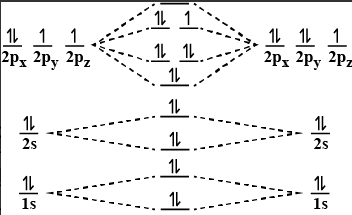
$A$ simplified application of $MO$ theory to the hypothetical molecule $OF$ would give its bond order as:
A
$2$
B
$1.5$
C
$1.0$
D
$0.5$
Solution
(B) Total number of electrons in $OF = 8$ (from $O$) $+ 9$ (from $F$) $= 17$ electrons.
The molecular orbital configuration for $17$ electrons is: $\sigma_{1s}^2, \sigma_{1s}^{*2}, \sigma_{2s}^2, \sigma_{2s}^{*2}, \sigma_{2p_z}^2, \pi_{2p_x}^2 = \pi_{2p_y}^2, \pi_{2p_x}^{*2} = \pi_{2p_y}^{*1}$.
Number of bonding electrons $(N_b)$ $= 10$.
Number of anti-bonding electrons $(N_a)$ $= 7$.
Bond order $= \frac{1}{2}(N_b - N_a) = \frac{1}{2}(10 - 7) = \frac{3}{2} = 1.5$.
The molecular orbital configuration for $17$ electrons is: $\sigma_{1s}^2, \sigma_{1s}^{*2}, \sigma_{2s}^2, \sigma_{2s}^{*2}, \sigma_{2p_z}^2, \pi_{2p_x}^2 = \pi_{2p_y}^2, \pi_{2p_x}^{*2} = \pi_{2p_y}^{*1}$.
Number of bonding electrons $(N_b)$ $= 10$.
Number of anti-bonding electrons $(N_a)$ $= 7$.
Bond order $= \frac{1}{2}(N_b - N_a) = \frac{1}{2}(10 - 7) = \frac{3}{2} = 1.5$.
0 likes
View Solution123
MediumMCQ
The correct stability order for $N_2$ and its given ions is :-
A
$N_2 > N_2^+ > N_2^- > N_2^{2-}$
B
$N_2^- > N_2^+ > N_2 > N_2^{2-}$
C
$N_2^+ > N_2^- > N_2 > N_2^{2-}$
D
$N_2 > N_2^+ = N_2^- > N_2^{2-}$
Solution
(A) Stability is directly proportional to bond order.
Bond order $= \frac{1}{2} \times (N_B - N_{AB})$.
$1$. $N_2$ (valence electrons $= 10$): $(\sigma 2s)^2(\sigma^* 2s)^2(\pi 2p)^4(\sigma 2p)^2$. Bond order $= \frac{1}{2} \times (8 - 2) = 3$.
$2$. $N_2^+$ (valence electrons $= 9$): $(\sigma 2s)^2(\sigma^* 2s)^2(\pi 2p)^4(\sigma 2p)^1$. Bond order $= \frac{1}{2} \times (7 - 2) = 2.5$.
$3$. $N_2^-$ (valence electrons $= 11$): $(\sigma 2s)^2(\sigma^* 2s)^2(\pi 2p)^4(\sigma 2p)^2(\pi^* 2p)^1$. Bond order $= \frac{1}{2} \times (8 - 3) = 2.5$.
$4$. $N_2^{2-}$ (valence electrons $= 12$): $(\sigma 2s)^2(\sigma^* 2s)^2(\pi 2p)^4(\sigma 2p)^2(\pi^* 2p)^2$. Bond order $= \frac{1}{2} \times (8 - 4) = 2$.
Although $N_2^+$ and $N_2^-$ have the same bond order,$N_2^-$ has an electron in an antibonding orbital,which decreases its stability compared to $N_2^+$.
Thus,the stability order is $N_2 > N_2^+ > N_2^- > N_2^{2-}$.
Therefore,the correct option is $A$.
Bond order $= \frac{1}{2} \times (N_B - N_{AB})$.
$1$. $N_2$ (valence electrons $= 10$): $(\sigma 2s)^2(\sigma^* 2s)^2(\pi 2p)^4(\sigma 2p)^2$. Bond order $= \frac{1}{2} \times (8 - 2) = 3$.
$2$. $N_2^+$ (valence electrons $= 9$): $(\sigma 2s)^2(\sigma^* 2s)^2(\pi 2p)^4(\sigma 2p)^1$. Bond order $= \frac{1}{2} \times (7 - 2) = 2.5$.
$3$. $N_2^-$ (valence electrons $= 11$): $(\sigma 2s)^2(\sigma^* 2s)^2(\pi 2p)^4(\sigma 2p)^2(\pi^* 2p)^1$. Bond order $= \frac{1}{2} \times (8 - 3) = 2.5$.
$4$. $N_2^{2-}$ (valence electrons $= 12$): $(\sigma 2s)^2(\sigma^* 2s)^2(\pi 2p)^4(\sigma 2p)^2(\pi^* 2p)^2$. Bond order $= \frac{1}{2} \times (8 - 4) = 2$.
Although $N_2^+$ and $N_2^-$ have the same bond order,$N_2^-$ has an electron in an antibonding orbital,which decreases its stability compared to $N_2^+$.
Thus,the stability order is $N_2 > N_2^+ > N_2^- > N_2^{2-}$.
Therefore,the correct option is $A$.
0 likes
View Solution124
MediumMCQ
In which of the following processes does the value of bond order and magnetic nature not change?
A
$O_2 \to O_2^+$
B
$N_2^+ \to N_2^-$
C
$NO \to NO^+$
D
$CO \to CO^+$
Solution
(B) To determine the change in bond order and magnetic nature,we analyze the molecular orbital configurations:
$1$. For $O_2 (16e^-)$: Bond order = $2.0$,Paramagnetic. For $O_2^+ (15e^-)$: Bond order = $2.5$,Paramagnetic. (Both change).
$2$. For $N_2^+ (13e^-)$: Bond order = $2.5$,Paramagnetic. For $N_2^- (15e^-)$: Bond order = $2.5$,Paramagnetic. (Bond order and magnetic nature remain unchanged).
$3$. For $NO (15e^-)$: Bond order = $2.5$,Paramagnetic. For $NO^+ (14e^-)$: Bond order = $3.0$,Diamagnetic. (Both change).
$4$. For $CO (14e^-)$: Bond order = $3.0$,Diamagnetic. For $CO^+ (13e^-)$: Bond order = $2.5$,Paramagnetic. (Both change).
Thus,the process $N_2^+ \to N_2^-$ maintains both properties.
$1$. For $O_2 (16e^-)$: Bond order = $2.0$,Paramagnetic. For $O_2^+ (15e^-)$: Bond order = $2.5$,Paramagnetic. (Both change).
$2$. For $N_2^+ (13e^-)$: Bond order = $2.5$,Paramagnetic. For $N_2^- (15e^-)$: Bond order = $2.5$,Paramagnetic. (Bond order and magnetic nature remain unchanged).
$3$. For $NO (15e^-)$: Bond order = $2.5$,Paramagnetic. For $NO^+ (14e^-)$: Bond order = $3.0$,Diamagnetic. (Both change).
$4$. For $CO (14e^-)$: Bond order = $3.0$,Diamagnetic. For $CO^+ (13e^-)$: Bond order = $2.5$,Paramagnetic. (Both change).
Thus,the process $N_2^+ \to N_2^-$ maintains both properties.
0 likes
View Solution125
MediumMCQ
Which of the following pairs of species are paramagnetic?
A
$O_2$ and $Na_2O_2$
B
$BaO_2$ and $KO_3$
C
$O_2$ and $KO_3$
D
$N_2$ and $KN_3$
Solution
(C) To determine paramagnetism,we look for the presence of unpaired electrons.
$1$. $O_2$: According to Molecular Orbital Theory,the electronic configuration is $\sigma 1s^2, \sigma^* 1s^2, \sigma 2s^2, \sigma^* 2s^2, \sigma 2p_z^2, \pi 2p_x^2 = \pi 2p_y^2, \pi^* 2p_x^1 = \pi^* 2p_y^1$. It has $2$ unpaired electrons,so it is paramagnetic.
$2$. $Na_2O_2$: Contains the peroxide ion $O_2^{2-}$. The configuration is $\sigma^* 2p_x^2 = \sigma^* 2p_y^2$. All electrons are paired,so it is diamagnetic.
$3$. $BaO_2$: Contains the peroxide ion $O_2^{2-}$,which is diamagnetic.
$4$. $KO_3$: Contains the ozonide ion $O_3^-$. The $O_3^-$ ion has $19$ valence electrons. Molecular orbital calculations show it has an unpaired electron in the antibonding $\pi^*$ orbital,making it paramagnetic.
Therefore,$O_2$ and $KO_3$ are both paramagnetic.
$1$. $O_2$: According to Molecular Orbital Theory,the electronic configuration is $\sigma 1s^2, \sigma^* 1s^2, \sigma 2s^2, \sigma^* 2s^2, \sigma 2p_z^2, \pi 2p_x^2 = \pi 2p_y^2, \pi^* 2p_x^1 = \pi^* 2p_y^1$. It has $2$ unpaired electrons,so it is paramagnetic.
$2$. $Na_2O_2$: Contains the peroxide ion $O_2^{2-}$. The configuration is $\sigma^* 2p_x^2 = \sigma^* 2p_y^2$. All electrons are paired,so it is diamagnetic.
$3$. $BaO_2$: Contains the peroxide ion $O_2^{2-}$,which is diamagnetic.
$4$. $KO_3$: Contains the ozonide ion $O_3^-$. The $O_3^-$ ion has $19$ valence electrons. Molecular orbital calculations show it has an unpaired electron in the antibonding $\pi^*$ orbital,making it paramagnetic.
Therefore,$O_2$ and $KO_3$ are both paramagnetic.
0 likes
View Solution126
MediumMCQ
Correct order of $C-O$ bond length is:
A
$CO^{+} > CO > C_2O_{4}^{2-}$
B
$C_2O_{4}^{2-} > CO^{+} > CO$
C
$C_2O_{4}^{2-} > CO > CO^{+}$
D
$CO > CO^{+} > C_2O_{4}^{2-}$
Solution
(B) To determine the bond length,we first calculate the bond order for each species.
$1$. For $CO$: The bond order is $3.0$.
$2$. For $CO^{+}$: The bond order is $2.5$ (as one electron is removed from the antibonding orbital of $CO$).
$3$. For $C_2O_{4}^{2-}$ (oxalate ion): The $C-O$ bond has partial double bond character due to resonance,with an average bond order of $1.5$.
Since bond length is inversely proportional to bond order $(Bond \ Length \propto \frac{1}{Bond \ Order})$,the order of bond length is: $C_2O_{4}^{2-} (1.5) > CO^{+} (2.5) > CO (3.0)$.
Therefore,the correct order is $C_2O_{4}^{2-} > CO^{+} > CO$.
$1$. For $CO$: The bond order is $3.0$.
$2$. For $CO^{+}$: The bond order is $2.5$ (as one electron is removed from the antibonding orbital of $CO$).
$3$. For $C_2O_{4}^{2-}$ (oxalate ion): The $C-O$ bond has partial double bond character due to resonance,with an average bond order of $1.5$.
Since bond length is inversely proportional to bond order $(Bond \ Length \propto \frac{1}{Bond \ Order})$,the order of bond length is: $C_2O_{4}^{2-} (1.5) > CO^{+} (2.5) > CO (3.0)$.
Therefore,the correct order is $C_2O_{4}^{2-} > CO^{+} > CO$.
0 likes
View Solution127
MediumMCQ
The compound $(SiH_3)_3N$ is expected to be
A
pyramidal and more basic than $(CH_3)_3N$
B
planar and less basic than $(CH_3)_3N$
C
pyramidal and less basic than $(CH_3)_3N$
D
planar and more basic than $(CH_3)_3N$
Solution
(B) The compound $(SiH_3)_3N$ is planar and less basic than $(CH_3)_3N$.
In $(SiH_3)_3N$,the lone pair of electrons on the $N$ atom is donated into the vacant $d$-orbitals of the $Si$ atoms,resulting in $p\pi - d\pi$ back bonding.
This delocalization of the lone pair makes the molecule planar and significantly reduces its availability for protonation,making it less basic than $(CH_3)_3N$.
In $(CH_3)_3N$,carbon lacks vacant $d$-orbitals,so no such back bonding occurs,and the lone pair remains localized on the $N$ atom.
In $(SiH_3)_3N$,the lone pair of electrons on the $N$ atom is donated into the vacant $d$-orbitals of the $Si$ atoms,resulting in $p\pi - d\pi$ back bonding.
This delocalization of the lone pair makes the molecule planar and significantly reduces its availability for protonation,making it less basic than $(CH_3)_3N$.
In $(CH_3)_3N$,carbon lacks vacant $d$-orbitals,so no such back bonding occurs,and the lone pair remains localized on the $N$ atom.
0 likes
View Solution128
MediumMCQ
Correct decreasing order of bond order of oxygen species in $I$ to $IV$:
$(I)$ $Na_2O_2$
$(II)$ $O_2[AsF_6]$
$(III)$ $CsO_2$
$(IV)$ $O_2$
$(I)$ $Na_2O_2$
$(II)$ $O_2[AsF_6]$
$(III)$ $CsO_2$
$(IV)$ $O_2$
A
$(II) > (IV) > (III) > (I)$
B
$(II) > (III) > (I) > (IV)$
C
$(IV) > (III) > (II) > (I)$
D
$(II) > (IV) > (I) > (III)$
Solution
(A) The bond order of oxygen species is determined by the number of electrons in the molecular orbitals:
$(I)$ $Na_2O_2$ contains the peroxide ion $O_2^{2-}$. The number of electrons is $18$. Bond order $= \frac{1}{2}(10 - 8) = 1.0$.
$(II)$ $O_2[AsF_6]$ contains the dioxygenyl cation $O_2^+$. The number of electrons is $15$. Bond order $= \frac{1}{2}(10 - 5) = 2.5$.
$(III)$ $CsO_2$ contains the superoxide ion $O_2^-$. The number of electrons is $17$. Bond order $= \frac{1}{2}(10 - 7) = 1.5$.
$(IV)$ $O_2$ is the neutral dioxygen molecule. The number of electrons is $16$. Bond order $= \frac{1}{2}(10 - 6) = 2.0$.
Comparing the bond orders: $2.5 (II) > 2.0 (IV) > 1.5 (III) > 1.0 (I)$.
Thus,the correct decreasing order is $(II) > (IV) > (III) > (I)$.
$(I)$ $Na_2O_2$ contains the peroxide ion $O_2^{2-}$. The number of electrons is $18$. Bond order $= \frac{1}{2}(10 - 8) = 1.0$.
$(II)$ $O_2[AsF_6]$ contains the dioxygenyl cation $O_2^+$. The number of electrons is $15$. Bond order $= \frac{1}{2}(10 - 5) = 2.5$.
$(III)$ $CsO_2$ contains the superoxide ion $O_2^-$. The number of electrons is $17$. Bond order $= \frac{1}{2}(10 - 7) = 1.5$.
$(IV)$ $O_2$ is the neutral dioxygen molecule. The number of electrons is $16$. Bond order $= \frac{1}{2}(10 - 6) = 2.0$.
Comparing the bond orders: $2.5 (II) > 2.0 (IV) > 1.5 (III) > 1.0 (I)$.
Thus,the correct decreasing order is $(II) > (IV) > (III) > (I)$.
0 likes
View Solution129
MediumMCQ
Which of the following molecules would have the same magnetic nature regardless of whether $sp$ mixing is operative or not?
A
$C_2$
B
$B_2$
C
$O_2$
D
$N_2$
Solution
(C) In $O_2$ ($16$ electrons),the molecular orbital configuration is $(\sigma 1s)^2 (\sigma^* 1s)^2 (\sigma 2s)^2 (\sigma^* 2s)^2 (\sigma 2p_z)^2 (\pi 2p_x)^2 (\pi 2p_y)^2 (\pi^* 2p_x)^1 (\pi^* 2p_y)^1$.
$sp$ mixing is generally significant for molecules with $14$ or fewer electrons (like $B_2, C_2, N_2$).
For $O_2$,the energy of $2s$ and $2p$ orbitals is sufficiently different that $sp$ mixing is negligible.
Even if $sp$ mixing were considered,the magnetic nature of $O_2$ (paramagnetic due to two unpaired electrons in $\pi^*$ orbitals) remains unchanged because the filling order of the higher energy orbitals is not affected by $sp$ mixing in this case.
$sp$ mixing is generally significant for molecules with $14$ or fewer electrons (like $B_2, C_2, N_2$).
For $O_2$,the energy of $2s$ and $2p$ orbitals is sufficiently different that $sp$ mixing is negligible.
Even if $sp$ mixing were considered,the magnetic nature of $O_2$ (paramagnetic due to two unpaired electrons in $\pi^*$ orbitals) remains unchanged because the filling order of the higher energy orbitals is not affected by $sp$ mixing in this case.
0 likes
View Solution130
MediumMCQ
Which of the following combinations leads to the $HOMO$ of the $N_2$ molecule?
A
B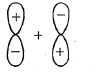
C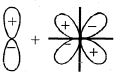
D
Solution
(A) $HOMO$ stands for Highest Occupied Molecular Orbital.
For the $N_2$ molecule,the electronic configuration is $\sigma 1s^2, \sigma^* 1s^2, \sigma 2s^2, \sigma^* 2s^2, \pi 2p_x^2 = \pi 2p_y^2, \sigma 2p_z^2$.
The $HOMO$ is the $\sigma 2p_z$ orbital.
This orbital is formed by the head-on overlap of two $2p_z$ orbitals with constructive interference (same signs overlapping),which is represented by the combination of two $p$ orbitals where the lobes of the same sign face each other.
For the $N_2$ molecule,the electronic configuration is $\sigma 1s^2, \sigma^* 1s^2, \sigma 2s^2, \sigma^* 2s^2, \pi 2p_x^2 = \pi 2p_y^2, \sigma 2p_z^2$.
The $HOMO$ is the $\sigma 2p_z$ orbital.
This orbital is formed by the head-on overlap of two $2p_z$ orbitals with constructive interference (same signs overlapping),which is represented by the combination of two $p$ orbitals where the lobes of the same sign face each other.
0 likes
View Solution131
MediumMCQ
Which of the following is paramagnetic?
A
$O_2[AsF_6]$
B
$Al_2O_3$
C
$C_2$
D
$Be_2$
Solution
(A) Paramagnetism is due to the presence of unpaired electrons.
In $O_2[AsF_6]$,the $O_2^+$ ion has a bond order of $2.5$ and contains one unpaired electron in its molecular orbitals,making it paramagnetic.
$Al_2O_3$ is an ionic solid where $Al^{3+}$ ($[Ne]$ configuration) and $O^{2-}$ ($[Ne]$ configuration) have no unpaired electrons,making it diamagnetic.
For $C_2$,the molecular orbital configuration is $\sigma 1s^2, \sigma^* 1s^2, \sigma 2s^2, \sigma^* 2s^2, \pi 2p_x^2, \pi 2p_y^2$. All electrons are paired,so it is diamagnetic.
For $Be_2$,the configuration is $\sigma 1s^2, \sigma^* 1s^2, \sigma 2s^2, \sigma^* 2s^2$. All electrons are paired,so it is diamagnetic.
In $O_2[AsF_6]$,the $O_2^+$ ion has a bond order of $2.5$ and contains one unpaired electron in its molecular orbitals,making it paramagnetic.
$Al_2O_3$ is an ionic solid where $Al^{3+}$ ($[Ne]$ configuration) and $O^{2-}$ ($[Ne]$ configuration) have no unpaired electrons,making it diamagnetic.
For $C_2$,the molecular orbital configuration is $\sigma 1s^2, \sigma^* 1s^2, \sigma 2s^2, \sigma^* 2s^2, \pi 2p_x^2, \pi 2p_y^2$. All electrons are paired,so it is diamagnetic.
For $Be_2$,the configuration is $\sigma 1s^2, \sigma^* 1s^2, \sigma 2s^2, \sigma^* 2s^2$. All electrons are paired,so it is diamagnetic.
0 likes
View Solution132
EasyMCQ
The $\sigma _{2s}^*$ molecular orbital has a nodal plane similar to which of the following orbitals?
A
$s$
B
$p$
C
$d$
D
$f$
Solution
(B) The $\sigma _{2s}^*$ molecular orbital is an antibonding molecular orbital formed by the out-of-phase combination of two $2s$ atomic orbitals.
It possesses a nodal plane perpendicular to the internuclear axis,which is a characteristic feature of $p$ orbitals (specifically $p_x$ or $p_y$ orbitals depending on the internuclear axis).
Therefore,the nodal structure of the $\sigma _{2s}^*$ orbital is similar to that of a $p$ orbital.
It possesses a nodal plane perpendicular to the internuclear axis,which is a characteristic feature of $p$ orbitals (specifically $p_x$ or $p_y$ orbitals depending on the internuclear axis).
Therefore,the nodal structure of the $\sigma _{2s}^*$ orbital is similar to that of a $p$ orbital.
0 likes
View Solution133
AdvancedMCQ
Which one of the following sketches is not correctly matched?
A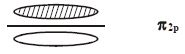
B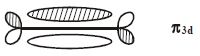
C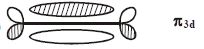
D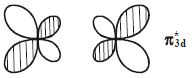
Solution
(D) In molecular orbital theory,the $\pi$ bond is formed by the lateral (sideways) overlap of atomic orbitals.
Option $A$ correctly shows the lateral overlap of two $p$-orbitals forming a $\pi_{2p}$ bond.
Options $B$ and $C$ represent the same lateral overlap of $d$-orbitals to form a $\pi_{3d}$ bond.
Option $D$ shows an incorrect representation for the antibonding $\pi^*_{3d}$ orbital,as the phase relationship and nodal planes do not correspond to the standard antibonding $\pi$ orbital structure for $d$-orbitals.
Option $A$ correctly shows the lateral overlap of two $p$-orbitals forming a $\pi_{2p}$ bond.
Options $B$ and $C$ represent the same lateral overlap of $d$-orbitals to form a $\pi_{3d}$ bond.
Option $D$ shows an incorrect representation for the antibonding $\pi^*_{3d}$ orbital,as the phase relationship and nodal planes do not correspond to the standard antibonding $\pi$ orbital structure for $d$-orbitals.
0 likes
View Solution134
DifficultMCQ
Which one of the following potential energy $(P.E.)$ graphs is not correctly matched?
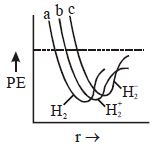
A
$a$
B
$b$
C
$c$
D
All are correctly matched
Solution
(D) The potential energy $(P.E.)$ curve for a molecule depends on its bond order and bond dissociation energy.
For $H_2$,the bond order is $1$ and it is a stable molecule with a deep potential energy well.
For $H_2^+$,the bond order is $0.5$,making it less stable than $H_2$,so it has a shallower potential energy well compared to $H_2$.
Looking at the provided graph,the curve labeled $a$ corresponds to $H_2$,$b$ corresponds to $H_2^+$,and $c$ corresponds to $H_2^-$.
However,the graph shows $H_2$ at $a$,$H_2^+$ at $b$,and $H_2^-$ at $c$. The stability order is $H_2 > H_2^+ \approx H_2^-$. The graph correctly depicts the relative depths of the potential energy wells for these species. Therefore,all are correctly matched.
For $H_2$,the bond order is $1$ and it is a stable molecule with a deep potential energy well.
For $H_2^+$,the bond order is $0.5$,making it less stable than $H_2$,so it has a shallower potential energy well compared to $H_2$.
Looking at the provided graph,the curve labeled $a$ corresponds to $H_2$,$b$ corresponds to $H_2^+$,and $c$ corresponds to $H_2^-$.
However,the graph shows $H_2$ at $a$,$H_2^+$ at $b$,and $H_2^-$ at $c$. The stability order is $H_2 > H_2^+ \approx H_2^-$. The graph correctly depicts the relative depths of the potential energy wells for these species. Therefore,all are correctly matched.
0 likes
View Solution135
MediumMCQ
Bond order of $C_2$ vapour is :
A
$1$
B
$2$
C
$3$
D
$0$
Solution
(B) The total number of electrons in a $C_2$ molecule is $12$ $(6 + 6)$.
According to Molecular Orbital Theory,the electronic configuration of $C_2$ is: $\sigma 1s^2, \sigma^* 1s^2, \sigma 2s^2, \sigma^* 2s^2, \pi 2p_x^2 = \pi 2p_y^2$.
Bond order is calculated as: $\text{Bond Order} = \frac{N_b - N_a}{2}$,where $N_b$ is the number of bonding electrons and $N_a$ is the number of antibonding electrons.
Here,$N_b = 8$ and $N_a = 4$.
$\text{Bond Order} = \frac{8 - 4}{2} = \frac{4}{2} = 2$.
According to Molecular Orbital Theory,the electronic configuration of $C_2$ is: $\sigma 1s^2, \sigma^* 1s^2, \sigma 2s^2, \sigma^* 2s^2, \pi 2p_x^2 = \pi 2p_y^2$.
Bond order is calculated as: $\text{Bond Order} = \frac{N_b - N_a}{2}$,where $N_b$ is the number of bonding electrons and $N_a$ is the number of antibonding electrons.
Here,$N_b = 8$ and $N_a = 4$.
$\text{Bond Order} = \frac{8 - 4}{2} = \frac{4}{2} = 2$.
0 likes
View Solution136
DifficultMCQ
If $x-axis$ is the molecular axis and $p_z$ orbitals participate in bonding,then which one of the following will be the nodal plane present within the $\pi-$ bond of the $O_2$ molecule?
A
$xy-plane$
B
$yz-plane$
C
$xz-plane$
D
Nodal plane is absent
Solution
(A) In the $O_2$ molecule,if the $x-axis$ is considered the internuclear (molecular) axis,then the $p_x$ orbitals undergo head-on overlap to form a $\sigma-$ bond.
The $p_y$ and $p_z$ orbitals undergo side-on overlap to form $\pi-$ bonds.
For a $\pi-$ bond formed by $p_z$ orbitals,the electron density is concentrated above and below the molecular axis $(x-axis)$.
The nodal plane is the plane where the probability of finding an electron is zero.
For a $\pi_{p_z}$ bond,the nodal plane contains the molecular axis $(x-axis)$ and is perpendicular to the plane of the orbital lobes.
Since the $p_z$ orbitals lie in the $xz-plane$,the nodal plane for the $\pi_{p_z}$ bond is the $xy-plane$.
The $p_y$ and $p_z$ orbitals undergo side-on overlap to form $\pi-$ bonds.
For a $\pi-$ bond formed by $p_z$ orbitals,the electron density is concentrated above and below the molecular axis $(x-axis)$.
The nodal plane is the plane where the probability of finding an electron is zero.
For a $\pi_{p_z}$ bond,the nodal plane contains the molecular axis $(x-axis)$ and is perpendicular to the plane of the orbital lobes.
Since the $p_z$ orbitals lie in the $xz-plane$,the nodal plane for the $\pi_{p_z}$ bond is the $xy-plane$.
0 likes
View Solution137
MediumMCQ
In the conversion of $N_2$ into $N_2^+$,the electron will be lost from which of the following molecular orbitals?
A
$\sigma^* 2p_z$
B
$\sigma 2p_z$
C
$\pi 2p_x$
D
$\pi^* 2p_x$
Solution
(B) The electronic configuration of $N_2$ ($14$ electrons) is: $KK \sigma 2s^2 \sigma^* 2s^2 \pi 2p_x^2 = \pi 2p_y^2 \sigma 2p_z^2$.
When $N_2$ is converted to $N_2^+$,one electron is removed from the highest occupied molecular orbital $(HOMO)$.
In $N_2$,the $HOMO$ is the $\sigma 2p_z$ orbital.
Therefore,the electron is lost from the $\sigma 2p_z$ molecular orbital.
When $N_2$ is converted to $N_2^+$,one electron is removed from the highest occupied molecular orbital $(HOMO)$.
In $N_2$,the $HOMO$ is the $\sigma 2p_z$ orbital.
Therefore,the electron is lost from the $\sigma 2p_z$ molecular orbital.
0 likes
View Solution138
MediumMCQ
Which set consists of paramagnetic molecules or ions?
A
$NO, NO_2, O_2^{2+}, O_2^{2-}$
B
$O_2^+, O_2^-, NO, NO_2$
C
$C_2, B_2, O_2, S_2$
D
$B_2, N_2, O_2, O_2^-$
Solution
(B) molecule or ion is paramagnetic if it contains at least one unpaired electron.
$NO$ $(15 \ e^-)$ and $NO_2$ $(23 \ e^-)$ are odd-electron species and are paramagnetic.
$O_2^+$ $(15 \ e^-)$ has one unpaired electron in the $\pi^* 2p$ orbital,making it paramagnetic.
$O_2^-$ $(17 \ e^-)$ has one unpaired electron in the $\pi^* 2p$ orbital,making it paramagnetic.
Therefore,the set $O_2^+, O_2^-, NO, NO_2$ contains only paramagnetic species.
$NO$ $(15 \ e^-)$ and $NO_2$ $(23 \ e^-)$ are odd-electron species and are paramagnetic.
$O_2^+$ $(15 \ e^-)$ has one unpaired electron in the $\pi^* 2p$ orbital,making it paramagnetic.
$O_2^-$ $(17 \ e^-)$ has one unpaired electron in the $\pi^* 2p$ orbital,making it paramagnetic.
Therefore,the set $O_2^+, O_2^-, NO, NO_2$ contains only paramagnetic species.
0 likes
View Solution139
MediumMCQ
In $Cl_2O_7$,the $\pi$-bond between $Cl$ and $O$ is formed by the overlapping of :-
A
$sp^3-2p$
B
$3p-2p$
C
$sp^3-sp^3$
D
$3d-2p$
Solution
(D) In $Cl_2O_7$,the $Cl$ atom is $sp^3$ hybridized.
The $\pi$-bonds are formed by the back-bonding mechanism involving the overlap of the empty $3d$ orbitals of $Cl$ and the filled $2p$ orbitals of $O$.
Therefore,the $\pi$-bond is formed by $3d-2p$ overlapping.
The $\pi$-bonds are formed by the back-bonding mechanism involving the overlap of the empty $3d$ orbitals of $Cl$ and the filled $2p$ orbitals of $O$.
Therefore,the $\pi$-bond is formed by $3d-2p$ overlapping.
0 likes
View Solution140
MediumMCQ
Which of the following molecular orbitals has a nodal plane and is relatively higher in energy compared to bonding orbitals?
A
${\sigma 2p_z}$
B
${\pi 2p_x}$
C
${\sigma ^* 2p_z}$
D
${\sigma ^* 2p_y}$
Solution
(C) The molecular orbital ${\pi 2p_x}$ is a Bonding Molecular Orbital $(B.M.O.)$ which has $1$ nodal plane.
Antibonding molecular orbitals like ${\sigma ^* 2p_z}$ have higher energy than bonding orbitals and possess nodal planes perpendicular to the internuclear axis.
Among the given options,${\sigma ^* 2p_z}$ is an antibonding orbital with a nodal plane,making it higher in energy than the bonding orbitals.
Antibonding molecular orbitals like ${\sigma ^* 2p_z}$ have higher energy than bonding orbitals and possess nodal planes perpendicular to the internuclear axis.
Among the given options,${\sigma ^* 2p_z}$ is an antibonding orbital with a nodal plane,making it higher in energy than the bonding orbitals.
0 likes
View Solution141
MediumMCQ
The correct order of bond length is :-
A
$F_2 < F_2^+ < F_2^-$
B
$F_2^+ < F_2 < F_2^-$
C
$F_2^+ < F_2^- < F_2$
D
$F_2^- < F_2^+ < F_2$
Solution
(B) According to Molecular Orbital Theory $(M.O.T.)$,the bond order is inversely proportional to the bond length.
For $F_2^+$: Total electrons = $17$,Bond Order = $(10-7)/2 = 1.5$.
For $F_2$: Total electrons = $18$,Bond Order = $(10-8)/2 = 1.0$.
For $F_2^-$: Total electrons = $19$,Bond Order = $(10-9)/2 = 0.5$.
Since the bond order follows the order $F_2^+ > F_2 > F_2^-$,the bond length follows the order $F_2^+ < F_2 < F_2^-$.
For $F_2^+$: Total electrons = $17$,Bond Order = $(10-7)/2 = 1.5$.
For $F_2$: Total electrons = $18$,Bond Order = $(10-8)/2 = 1.0$.
For $F_2^-$: Total electrons = $19$,Bond Order = $(10-9)/2 = 0.5$.
Since the bond order follows the order $F_2^+ > F_2 > F_2^-$,the bond length follows the order $F_2^+ < F_2 < F_2^-$.
0 likes
View Solution142
DifficultMCQ
Which of the following molecular orbitals has two nodal planes?
A
$ \sigma_{1s} $
B
$ \sigma_{2s}^* $
C
$ \sigma_{2pz} $
D
$ \pi_{2px}^* $
Solution
(D) nodal plane is a plane where the probability of finding an electron is zero.
For the antibonding molecular orbital $ \pi_{2px}^* $,there are two nodal planes: one is the nodal plane of the atomic $ p_x $ orbitals (the $ yz $-plane),and the other is the nodal plane perpendicular to the internuclear axis passing through the center of the bond (due to the antibonding nature).
Thus,$ \pi_{2px}^* $ has two nodal planes.
For the antibonding molecular orbital $ \pi_{2px}^* $,there are two nodal planes: one is the nodal plane of the atomic $ p_x $ orbitals (the $ yz $-plane),and the other is the nodal plane perpendicular to the internuclear axis passing through the center of the bond (due to the antibonding nature).
Thus,$ \pi_{2px}^* $ has two nodal planes.
0 likes
View Solution143
MediumMCQ
During the formation of a molecular orbital from atomic orbitals,the probability of electron density is
A
less in the nodal plane
B
maximum in the nodal plane
C
zero in the nodal plane
D
zero on the surface of the lobe
Solution
(C) nodal plane is defined as a region in space where the probability of finding an electron is zero.
0 likes
View Solution144
MediumMCQ
Which of the following is paramagnetic as well as it has a fractional bond order?
A
$O_2^+$
B
$B_2$
C
$O_2$
D
$N_2$
Solution
(A) To determine the bond order and magnetic property,we use Molecular Orbital Theory $(MOT)$:
$1$. For $O_2^+$ ($15$ electrons): Configuration is $(\sigma 1s)^2 (\sigma^* 1s)^2 (\sigma 2s)^2 (\sigma^* 2s)^2 (\sigma 2p_z)^2 (\pi 2p_x)^2 (\pi 2p_y)^2 (\pi^* 2p_x)^1$. Bond order = $\frac{10-5}{2} = 2.5$. It has one unpaired electron,so it is paramagnetic.
$2$. For $B_2$ ($10$ electrons): Configuration is $(\sigma 1s)^2 (\sigma^* 1s)^2 (\sigma 2s)^2 (\sigma^* 2s)^2 (\pi 2p_x)^1 (\pi 2p_y)^1$. Bond order = $\frac{6-4}{2} = 1.0$. It is paramagnetic but has an integer bond order.
$3$. For $O_2$ ($16$ electrons): Bond order = $\frac{10-6}{2} = 2.0$. It is paramagnetic but has an integer bond order.
$4$. For $N_2$ ($14$ electrons): Bond order = $\frac{10-4}{2} = 3.0$. It is diamagnetic.
Thus,$O_2^+$ is both paramagnetic and has a fractional bond order.
$1$. For $O_2^+$ ($15$ electrons): Configuration is $(\sigma 1s)^2 (\sigma^* 1s)^2 (\sigma 2s)^2 (\sigma^* 2s)^2 (\sigma 2p_z)^2 (\pi 2p_x)^2 (\pi 2p_y)^2 (\pi^* 2p_x)^1$. Bond order = $\frac{10-5}{2} = 2.5$. It has one unpaired electron,so it is paramagnetic.
$2$. For $B_2$ ($10$ electrons): Configuration is $(\sigma 1s)^2 (\sigma^* 1s)^2 (\sigma 2s)^2 (\sigma^* 2s)^2 (\pi 2p_x)^1 (\pi 2p_y)^1$. Bond order = $\frac{6-4}{2} = 1.0$. It is paramagnetic but has an integer bond order.
$3$. For $O_2$ ($16$ electrons): Bond order = $\frac{10-6}{2} = 2.0$. It is paramagnetic but has an integer bond order.
$4$. For $N_2$ ($14$ electrons): Bond order = $\frac{10-4}{2} = 3.0$. It is diamagnetic.
Thus,$O_2^+$ is both paramagnetic and has a fractional bond order.
0 likes
View Solution145
MediumMCQ
In which of the following transformations,the bond order has increased and the magnetic behaviour has changed?
A
$C_2^+ \to C_2$
B
$NO^+ \to NO$
C
$O_2 \to O_2^+$
D
$O_2 \to N_2^+$
Solution
(A) For $C_2^+ \to C_2$:
$C_2^+$ has $9$ electrons,configuration: $\sigma 1s^2, \sigma^* 1s^2, \sigma 2s^2, \sigma^* 2s^2, \pi 2p^1$. Bond order = $(6-4)/2 = 1.0$. It is paramagnetic.
$C_2$ has $12$ electrons,configuration: $\sigma 1s^2, \sigma^* 1s^2, \sigma 2s^2, \sigma^* 2s^2, \pi 2p^4$. Bond order = $(8-4)/2 = 2.0$. It is diamagnetic.
Since the bond order increased $(1.0 \to 2.0)$ and magnetic behavior changed (paramagnetic to diamagnetic),this is the correct transformation.
$C_2^+$ has $9$ electrons,configuration: $\sigma 1s^2, \sigma^* 1s^2, \sigma 2s^2, \sigma^* 2s^2, \pi 2p^1$. Bond order = $(6-4)/2 = 1.0$. It is paramagnetic.
$C_2$ has $12$ electrons,configuration: $\sigma 1s^2, \sigma^* 1s^2, \sigma 2s^2, \sigma^* 2s^2, \pi 2p^4$. Bond order = $(8-4)/2 = 2.0$. It is diamagnetic.
Since the bond order increased $(1.0 \to 2.0)$ and magnetic behavior changed (paramagnetic to diamagnetic),this is the correct transformation.
0 likes
View Solution146
MediumMCQ
Which of the following species is paramagnetic?
A
$NO^{-}$
B
$O_2^{2-}$
C
$CN^{-}$
D
$CO$
Solution
(A) To determine the magnetic nature,we calculate the total number of electrons and use Molecular Orbital Theory $(MOT)$.
$NO^{-}$ has $16$ electrons. The electronic configuration is $\sigma 1s^2, \sigma^* 1s^2, \sigma 2s^2, \sigma^* 2s^2, \sigma 2p_z^2, \pi 2p_x^2 = \pi 2p_y^2, \pi^* 2p_x^1 = \pi^* 2p_y^1$.
Since it contains two unpaired electrons in the $\pi^*$ orbitals,it is paramagnetic.
$O_2^{2-}$ has $18$ electrons and is diamagnetic.
$CN^{-}$ has $14$ electrons and is diamagnetic.
$CO$ has $14$ electrons and is diamagnetic.
$NO^{-}$ has $16$ electrons. The electronic configuration is $\sigma 1s^2, \sigma^* 1s^2, \sigma 2s^2, \sigma^* 2s^2, \sigma 2p_z^2, \pi 2p_x^2 = \pi 2p_y^2, \pi^* 2p_x^1 = \pi^* 2p_y^1$.
Since it contains two unpaired electrons in the $\pi^*$ orbitals,it is paramagnetic.
$O_2^{2-}$ has $18$ electrons and is diamagnetic.
$CN^{-}$ has $14$ electrons and is diamagnetic.
$CO$ has $14$ electrons and is diamagnetic.
0 likes
View Solution147
MediumMCQ
Which of the following statements is correct for the peroxide ion $(O_2^{2-})$?
$A.$ It has completely filled $\pi^*$ antibonding molecular orbitals.
$B.$ It is diamagnetic.
$C.$ It has a bond order of one.
$D.$ It is isoelectronic with Neon.
$A.$ It has completely filled $\pi^*$ antibonding molecular orbitals.
$B.$ It is diamagnetic.
$C.$ It has a bond order of one.
$D.$ It is isoelectronic with Neon.
A
$B, C$
B
$A, B, D$
C
$A, B, C$
D
$A, D$
Solution
(C) The electronic configuration of the peroxide ion $(O_2^{2-})$ is: $\sigma 1s^2, \sigma^* 1s^2, \sigma 2s^2, \sigma^* 2s^2, \sigma 2p_z^2, \pi 2p_x^2 = \pi 2p_y^2, \pi^* 2p_x^2 = \pi^* 2p_y^2$.
$1.$ The $\pi^*$ antibonding molecular orbitals are completely filled with $4$ electrons,so statement $A$ is correct.
$2.$ Since all electrons are paired,the ion is diamagnetic,so statement $B$ is correct.
$3.$ Bond order = $\frac{1}{2} (N_b - N_a) = \frac{1}{2} (10 - 8) = 1$. Thus,statement $C$ is correct.
$4.$ The total number of electrons in $O_2^{2-}$ is $8 + 8 + 2 = 18$,while Neon has $10$ electrons. Thus,statement $D$ is incorrect.
Therefore,statements $A, B,$ and $C$ are correct.
$1.$ The $\pi^*$ antibonding molecular orbitals are completely filled with $4$ electrons,so statement $A$ is correct.
$2.$ Since all electrons are paired,the ion is diamagnetic,so statement $B$ is correct.
$3.$ Bond order = $\frac{1}{2} (N_b - N_a) = \frac{1}{2} (10 - 8) = 1$. Thus,statement $C$ is correct.
$4.$ The total number of electrons in $O_2^{2-}$ is $8 + 8 + 2 = 18$,while Neon has $10$ electrons. Thus,statement $D$ is incorrect.
Therefore,statements $A, B,$ and $C$ are correct.
0 likes
View Solution148
MediumMCQ
Which of the following species contains only $\pi$-bonds but exhibits paramagnetic nature?
A
$C_2$
B
$B_2$
C
${O_2}^-$
D
$N_2$
Solution
(B) According to Molecular Orbital Theory $(M.O.T.)$,the electronic configuration of $B_2$ is $\sigma 1s^2, \sigma^* 1s^2, \sigma 2s^2, \sigma^* 2s^2, \pi 2p_x^1, \pi 2p_y^1$.
In $B_2$,the bond order is $1$,and the bond is formed by the overlap of $2p$ orbitals,which is a $\pi$-bond.
Since $B_2$ has two unpaired electrons in the $\pi 2p$ orbitals,it is paramagnetic.
$C_2$ has a bond order of $2$ (both $\pi$-bonds) but is diamagnetic.
${O_2}^-$ has both $\sigma$ and $\pi$ bonds and is paramagnetic.
$N_2$ has one $\sigma$ and two $\pi$ bonds and is diamagnetic.
Therefore,$B_2$ is the correct species.
In $B_2$,the bond order is $1$,and the bond is formed by the overlap of $2p$ orbitals,which is a $\pi$-bond.
Since $B_2$ has two unpaired electrons in the $\pi 2p$ orbitals,it is paramagnetic.
$C_2$ has a bond order of $2$ (both $\pi$-bonds) but is diamagnetic.
${O_2}^-$ has both $\sigma$ and $\pi$ bonds and is paramagnetic.
$N_2$ has one $\sigma$ and two $\pi$ bonds and is diamagnetic.
Therefore,$B_2$ is the correct species.
0 likes
View Solution149
MediumMCQ
Which of the following species shows the maximum bond length?
A
$O_2$
B
$Na_2O_2$
C
$KO_2$
D
All are equal
Solution
(B) The bond length is inversely proportional to the bond order $(B.O.)$.
$1$. For $O_2$ (dioxygen molecule): The bond order is $2.0$.
$2$. For $Na_2O_2$ (contains peroxide ion,$O_2^{2-}$): The bond order is $1.0$.
$3$. For $KO_2$ (contains superoxide ion,$O_2^-$): The bond order is $1.5$.
Comparing the bond orders: $2.0 (O_2) > 1.5 (O_2^-) > 1.0 (O_2^{2-})$.
Since bond length is inversely proportional to bond order,the species with the lowest bond order will have the maximum bond length.
Therefore,$O_2^{2-}$ (in $Na_2O_2$) has the maximum bond length.
$1$. For $O_2$ (dioxygen molecule): The bond order is $2.0$.
$2$. For $Na_2O_2$ (contains peroxide ion,$O_2^{2-}$): The bond order is $1.0$.
$3$. For $KO_2$ (contains superoxide ion,$O_2^-$): The bond order is $1.5$.
Comparing the bond orders: $2.0 (O_2) > 1.5 (O_2^-) > 1.0 (O_2^{2-})$.
Since bond length is inversely proportional to bond order,the species with the lowest bond order will have the maximum bond length.
Therefore,$O_2^{2-}$ (in $Na_2O_2$) has the maximum bond length.
0 likes
View SolutionChemical Bonding and Molecular Structure — Molecular orbital theory · Frequently Asked Questions
1Are these Chemical Bonding and Molecular Structure questions useful for JEE and NEET?
Yes. All questions in this section are mapped to JEE Main and NEET exam patterns. Previous year questions from JEE Main, NEET, GUJCET and state-level exams are included with full solutions.
2Can I switch to Hindi or Gujarati for these questions?
Yes. Use the language tabs in the hero section or the sidebar to view the same questions and solutions in English, Hindi or Gujarati.
3How do I generate a question paper from this subtopic?
Use the Vedclass Exam Paper Generator — select the chapter and subtopic, set difficulty, and generate Sets A, B, C, D automatically. First 3 chapters of every subject are free.
Vedclass Products
For Students
Vedclass Test Series
Mock tests in real JEE/NEET style with performance analysis. 5-day free trial.
Start Free TrialFor Teachers
Exam Paper Generator
Generate Set A/B/C/D papers from this chapter in 2 minutes. 3 chapters free.
Try FreeFor Institutes
Online Exam Module
Live online exams with unlimited students, 360° analytics & white-label branding.
See DemoFor Teachers & Institutes
Generate a Chemical Bonding and Molecular Structure Exam Paper in 2 Minutes
Select subtopic & difficulty — Sets A, B, C, D auto-generated with No Repeat logic.
First 3 chapters of every subject are free — no payment required.