
A English
Molecular orbital theory Questions in English
Class 11 Chemistry · Chemical Bonding and Molecular Structure · Molecular orbital theory
501+
Questions
English
Language
100%
With Solutions
Showing 49 of 501 questions in English
151
MediumMCQ
Which of the following molecules has two unpaired $e^-$ with a bond order equal to $2$?
A
$B_2$
B
$N_2$
C
$O_2^{2-}$
D
$O_2$
Solution
(D) According to Molecular Orbital Theory $(MOT)$:
$1$. For $O_2$ ($16$ electrons),the electronic configuration is: $\sigma 1s^2, \sigma^* 1s^2, \sigma 2s^2, \sigma^* 2s^2, \sigma 2p_z^2, \pi 2p_x^2 = \pi 2p_y^2, \pi^* 2p_x^1 = \pi^* 2p_y^1$.
$2$. It contains $2$ unpaired electrons in the $\pi^*$ antibonding orbitals.
$3$. Bond order = $\frac{N_b - N_a}{2} = \frac{10 - 6}{2} = 2$.
$4$. Thus,$O_2$ satisfies both conditions.
$1$. For $O_2$ ($16$ electrons),the electronic configuration is: $\sigma 1s^2, \sigma^* 1s^2, \sigma 2s^2, \sigma^* 2s^2, \sigma 2p_z^2, \pi 2p_x^2 = \pi 2p_y^2, \pi^* 2p_x^1 = \pi^* 2p_y^1$.
$2$. It contains $2$ unpaired electrons in the $\pi^*$ antibonding orbitals.
$3$. Bond order = $\frac{N_b - N_a}{2} = \frac{10 - 6}{2} = 2$.
$4$. Thus,$O_2$ satisfies both conditions.
0 likes
View Solution152
DifficultMCQ
Select the incorrect statement.
A
$O_3$ and $O_2^{2-}$ both are diamagnetic.
B
Out of $O_2, O_2^+, O_3$,the least $O-O$ bond length is in $O_2^+$.
C
Out of $O_2, O_2^+, O_2^-$,only $O_2$ is paramagnetic.
D
Out of $O_2, O_2^+, O_2^-$,the maximum spin magnetic moment is of $O_2$.
Solution
(C) $1$. $O_2$ has a bond order of $2$ and $2$ unpaired electrons in its antibonding $\pi^*$ orbitals,making it paramagnetic.
$2$. $O_2^+$ has a bond order of $2.5$ and $1$ unpaired electron,making it paramagnetic.
$3$. $O_2^-$ has a bond order of $1.5$ and $1$ unpaired electron,making it paramagnetic.
$4$. Since $O_2, O_2^+$,and $O_2^-$ all contain unpaired electrons,they are all paramagnetic. Therefore,the statement that 'only $O_2$ is paramagnetic' is incorrect.
$2$. $O_2^+$ has a bond order of $2.5$ and $1$ unpaired electron,making it paramagnetic.
$3$. $O_2^-$ has a bond order of $1.5$ and $1$ unpaired electron,making it paramagnetic.
$4$. Since $O_2, O_2^+$,and $O_2^-$ all contain unpaired electrons,they are all paramagnetic. Therefore,the statement that 'only $O_2$ is paramagnetic' is incorrect.
0 likes
View Solution153
EasyMCQ
The paramagnetic nature of oxygen can be explained by
A
Lewis-Langmuir concept
B
Electron-octet concept
C
Electron affinity concept
D
Molecular orbital concept
Solution
(D) The paramagnetic nature of the oxygen molecule $(O_2)$ is due to the presence of two unpaired electrons in the antibonding $\pi^* 2p_x$ and $\pi^* 2p_y$ molecular orbitals. This behavior cannot be explained by the Lewis structure or the octet rule,which suggest all electrons are paired. The Molecular Orbital Theory $(MOT)$ successfully accounts for this by considering the distribution of electrons in molecular orbitals.
0 likes
View Solution154
DifficultMCQ
If $Hund's$ Rule does not hold good,then which of the following pairs is diamagnetic?
A
$B_2, O_2^+$
B
$C_2, O_2$
C
$O_2^-, N_2$
D
$N_2, NO$
Solution
(B) If $Hund's$ Rule is not followed,electrons will pair up in the lowest energy orbitals first.
$B_2$ ($10$ electrons): $\sigma 1s^2, \sigma^* 1s^2, \sigma 2s^2, \sigma^* 2s^2, \pi 2p_x^2, \pi 2p_y^0$. All electrons are paired,so it is diamagnetic.
$C_2$ ($12$ electrons): $\sigma 1s^2, \sigma^* 1s^2, \sigma 2s^2, \sigma^* 2s^2, \pi 2p_x^2, \pi 2p_y^2$. All electrons are paired,so it is diamagnetic.
$O_2$ ($16$ electrons): $\sigma 1s^2, \sigma^* 1s^2, \sigma 2s^2, \sigma^* 2s^2, \sigma 2p_z^2, \pi 2p_x^2, \pi 2p_y^2, \pi^* 2p_x^2, \pi^* 2p_y^0$. All electrons are paired,so it is diamagnetic.
$N_2$ ($14$ electrons): $\sigma 1s^2, \sigma^* 1s^2, \sigma 2s^2, \sigma^* 2s^2, \pi 2p_x^2, \pi 2p_y^2, \sigma 2p_z^2$. All electrons are paired,so it is diamagnetic.
Since $C_2$ and $O_2$ are both diamagnetic under this assumption,option $B$ is the correct pair.
$B_2$ ($10$ electrons): $\sigma 1s^2, \sigma^* 1s^2, \sigma 2s^2, \sigma^* 2s^2, \pi 2p_x^2, \pi 2p_y^0$. All electrons are paired,so it is diamagnetic.
$C_2$ ($12$ electrons): $\sigma 1s^2, \sigma^* 1s^2, \sigma 2s^2, \sigma^* 2s^2, \pi 2p_x^2, \pi 2p_y^2$. All electrons are paired,so it is diamagnetic.
$O_2$ ($16$ electrons): $\sigma 1s^2, \sigma^* 1s^2, \sigma 2s^2, \sigma^* 2s^2, \sigma 2p_z^2, \pi 2p_x^2, \pi 2p_y^2, \pi^* 2p_x^2, \pi^* 2p_y^0$. All electrons are paired,so it is diamagnetic.
$N_2$ ($14$ electrons): $\sigma 1s^2, \sigma^* 1s^2, \sigma 2s^2, \sigma^* 2s^2, \pi 2p_x^2, \pi 2p_y^2, \sigma 2p_z^2$. All electrons are paired,so it is diamagnetic.
Since $C_2$ and $O_2$ are both diamagnetic under this assumption,option $B$ is the correct pair.
0 likes
View Solution155
DifficultMCQ
Select the correct set of statements regarding the molecular orbital theory of $O_2$:
$A$. Addition of an electron to $O_2$ decreases bond order.
$B$. Addition of an electron to $O_2$ increases bond order.
$C$. Removal of an electron from $O_2$ increases bond length.
$D$. Removal of an electron from $O_2$ decreases bond length.
$A$. Addition of an electron to $O_2$ decreases bond order.
$B$. Addition of an electron to $O_2$ increases bond order.
$C$. Removal of an electron from $O_2$ increases bond length.
$D$. Removal of an electron from $O_2$ decreases bond length.
A
$A, B$
B
$A, D$
C
$B, C$
D
$B, D$
Solution
(B) The molecular orbital configuration of $O_2$ is: $\sigma 1s^2, \sigma^* 1s^2, \sigma 2s^2, \sigma^* 2s^2, \sigma 2p_z^2, \pi 2p_x^2 = \pi 2p_y^2, \pi^* 2p_x^1 = \pi^* 2p_y^1$.
Bond order of $O_2 = \frac{10 - 6}{2} = 2$.
When an electron is added to $O_2$ to form $O_2^-$,it enters the antibonding $\pi^*$ orbital. The new configuration has $10$ bonding and $7$ antibonding electrons. Bond order = $\frac{10 - 7}{2} = 1.5$. Thus,bond order decreases (Statement $A$ is correct).
When an electron is removed from $O_2$ to form $O_2^+$,it is removed from the antibonding $\pi^*$ orbital. The new configuration has $10$ bonding and $5$ antibonding electrons. Bond order = $\frac{10 - 5}{2} = 2.5$. Since bond order increases,bond length decreases (Statement $D$ is correct).
Therefore,the correct set of statements is $A$ and $D$.
Bond order of $O_2 = \frac{10 - 6}{2} = 2$.
When an electron is added to $O_2$ to form $O_2^-$,it enters the antibonding $\pi^*$ orbital. The new configuration has $10$ bonding and $7$ antibonding electrons. Bond order = $\frac{10 - 7}{2} = 1.5$. Thus,bond order decreases (Statement $A$ is correct).
When an electron is removed from $O_2$ to form $O_2^+$,it is removed from the antibonding $\pi^*$ orbital. The new configuration has $10$ bonding and $5$ antibonding electrons. Bond order = $\frac{10 - 5}{2} = 2.5$. Since bond order increases,bond length decreases (Statement $D$ is correct).
Therefore,the correct set of statements is $A$ and $D$.
0 likes
View Solution156
MediumMCQ
Which of the following molecular orbitals has the maximum number of nodal planes?
A
$ \sigma 1s $
B
$ \sigma 2p_x $
C
$ \pi 2p_x $
D
$ \pi^* 2p_y $
Solution
(D) The number of nodal planes for the given molecular orbitals are:
$ \sigma 1s $: $0$ nodal planes.
$ \sigma 2p_x $: $1$ nodal plane (the nodal plane is perpendicular to the internuclear axis).
$ \pi 2p_x $: $1$ nodal plane (the internuclear axis itself acts as a nodal plane).
$ \pi^* 2p_y $: $2$ nodal planes (one nodal plane is the internuclear axis,and the other is perpendicular to the internuclear axis).
Therefore,$ \pi^* 2p_y $ has the maximum number of nodal planes.
$ \sigma 1s $: $0$ nodal planes.
$ \sigma 2p_x $: $1$ nodal plane (the nodal plane is perpendicular to the internuclear axis).
$ \pi 2p_x $: $1$ nodal plane (the internuclear axis itself acts as a nodal plane).
$ \pi^* 2p_y $: $2$ nodal planes (one nodal plane is the internuclear axis,and the other is perpendicular to the internuclear axis).
Therefore,$ \pi^* 2p_y $ has the maximum number of nodal planes.
0 likes
View Solution157
DifficultMCQ
Which of the following order of bond strength is correct?
A
$O_2^- > O_2 > O_2^+$
B
$O_2^- < O_2 < O_2^+$
C
$O_2^- > O_2 < O_2^+$
D
$O_2^- < O_2 > O_2^+$
Solution
(B) The bond order for $O_2^-$,$O_2$,and $O_2^+$ are $1.5$,$2.0$,and $2.5$ respectively.
Bond strength is directly proportional to bond order.
Therefore,the order of bond strength is $O_2^+ > O_2 > O_2^-$,which is equivalent to $O_2^- < O_2 < O_2^+$.
Thus,the correct option is $B$.
Bond strength is directly proportional to bond order.
Therefore,the order of bond strength is $O_2^+ > O_2 > O_2^-$,which is equivalent to $O_2^- < O_2 < O_2^+$.
Thus,the correct option is $B$.
0 likes
View Solution158
MediumMCQ
Which of the following contains a $(2C - 1e^-)$ bond?
A
$H_2^+$
B
$O_2$
C
$H_2$
D
$O_2^{2-}$
Solution
(A) $(2C - 1e^-)$ bond refers to a three-electron bond or a one-electron bond where two nuclei share a single electron.
In the case of the hydrogen molecular ion,$H_2^+$,the electronic configuration is $\sigma 1s^1$.
This means there is only one electron shared between two hydrogen nuclei,which constitutes a $(2C - 1e^-)$ bond.
In the case of the hydrogen molecular ion,$H_2^+$,the electronic configuration is $\sigma 1s^1$.
This means there is only one electron shared between two hydrogen nuclei,which constitutes a $(2C - 1e^-)$ bond.
0 likes
View Solution159
MediumMCQ
How many molecular orbitals filled with one or more electrons are present in $N_2^+$?
A
$5$
B
$6$
C
$7$
D
$8$
Solution
(C) The total number of electrons in $N_2^+$ is $(7 + 7 - 1) = 13$ electrons.
According to the molecular orbital theory,the electronic configuration for $N_2^+$ is: $\sigma 1s^2, \sigma^* 1s^2, \sigma 2s^2, \sigma^* 2s^2, \pi 2p_x^2 = \pi 2p_y^2, \sigma 2p_z^1$.
The molecular orbitals filled with one or more electrons are: $\sigma 1s, \sigma^* 1s, \sigma 2s, \sigma^* 2s, \pi 2p_x, \pi 2p_y, \sigma 2p_z$.
Counting these orbitals,we get a total of $7$ molecular orbitals.
According to the molecular orbital theory,the electronic configuration for $N_2^+$ is: $\sigma 1s^2, \sigma^* 1s^2, \sigma 2s^2, \sigma^* 2s^2, \pi 2p_x^2 = \pi 2p_y^2, \sigma 2p_z^1$.
The molecular orbitals filled with one or more electrons are: $\sigma 1s, \sigma^* 1s, \sigma 2s, \sigma^* 2s, \pi 2p_x, \pi 2p_y, \sigma 2p_z$.
Counting these orbitals,we get a total of $7$ molecular orbitals.
0 likes
View Solution160
MediumMCQ
In the molecular orbital diagram for the molecular ion,$N_2^+$,the number of electrons in the $\sigma_{2p_z}$ molecular orbital is
A
$0$
B
$2$
C
$3$
D
$1$
Solution
(D) The total number of electrons in $N_2^+$ is $(7 \times 2) - 1 = 13$.
The molecular orbital configuration for $N_2^+$ is $\sigma_{1s}^2, \sigma_{1s}^{*2}, \sigma_{2s}^2, \sigma_{2s}^{*2}, \pi_{2p_x}^2, \pi_{2p_y}^2, \sigma_{2p_z}^1$.
Thus,the number of electrons in the $\sigma_{2p_z}$ molecular orbital is $1$.
The molecular orbital configuration for $N_2^+$ is $\sigma_{1s}^2, \sigma_{1s}^{*2}, \sigma_{2s}^2, \sigma_{2s}^{*2}, \pi_{2p_x}^2, \pi_{2p_y}^2, \sigma_{2p_z}^1$.
Thus,the number of electrons in the $\sigma_{2p_z}$ molecular orbital is $1$.
0 likes
View Solution161
MediumMCQ
Which of the following best describes the given molecular orbital diagram?

A
$A$ bonding $\pi$ orbital
B
$A$ non-bonding orbital
C
An antibonding $\sigma$ orbital
D
An antibonding $\pi$ orbital
Solution
(D) The given diagram shows the out-of-phase overlap of two $p-$orbitals.
In this interaction,the lobes with opposite signs ($+$ and $-$) are adjacent to each other,which leads to destructive interference.
This type of lateral overlap results in the formation of an antibonding $\pi$ molecular orbital,denoted as $\pi^* \ MO$.
In this interaction,the lobes with opposite signs ($+$ and $-$) are adjacent to each other,which leads to destructive interference.
This type of lateral overlap results in the formation of an antibonding $\pi$ molecular orbital,denoted as $\pi^* \ MO$.
0 likes
View Solution162
DifficultMCQ
Which of the following is paramagnetic?
A
$NO^{+}$
B
$CO$
C
$O_2^{2-}$
D
$B_2$
Solution
(D) To determine the magnetic nature,we calculate the total number of electrons and fill the molecular orbitals:
$NO^{+} : 14 \text{ electrons} \Rightarrow KK, \sigma(2s)^2, \sigma^*(2s)^2, (\pi 2p_x)^2 = (\pi 2p_y)^2, (\sigma 2p_z)^2$ (All paired,diamagnetic)
$CO : 14 \text{ electrons} \Rightarrow KK, \sigma(2s)^2, \sigma^*(2s)^2, (\pi 2p_x)^2 = (\pi 2p_y)^2, (\sigma 2p_z)^2$ (All paired,diamagnetic)
$O_2^{2-} : 18 \text{ electrons}$ $\Rightarrow KK, \sigma(2s)^2, \sigma^*(2s)^2, \sigma(2p_z)^2, (\pi 2p_x)^2 = (\pi 2p_y)^2, \pi^*(2p_x)^2 = \pi^*(2p_y)^2$ (All paired,diamagnetic)
$B_2 : 10 \text{ electrons} \Rightarrow KK, \sigma(2s)^2, \sigma^*(2s)^2, \pi(2p_x)^1 = \pi(2p_y)^1$ (Contains unpaired electrons,paramagnetic)
Therefore,$B_2$ is paramagnetic.
$NO^{+} : 14 \text{ electrons} \Rightarrow KK, \sigma(2s)^2, \sigma^*(2s)^2, (\pi 2p_x)^2 = (\pi 2p_y)^2, (\sigma 2p_z)^2$ (All paired,diamagnetic)
$CO : 14 \text{ electrons} \Rightarrow KK, \sigma(2s)^2, \sigma^*(2s)^2, (\pi 2p_x)^2 = (\pi 2p_y)^2, (\sigma 2p_z)^2$ (All paired,diamagnetic)
$O_2^{2-} : 18 \text{ electrons}$ $\Rightarrow KK, \sigma(2s)^2, \sigma^*(2s)^2, \sigma(2p_z)^2, (\pi 2p_x)^2 = (\pi 2p_y)^2, \pi^*(2p_x)^2 = \pi^*(2p_y)^2$ (All paired,diamagnetic)
$B_2 : 10 \text{ electrons} \Rightarrow KK, \sigma(2s)^2, \sigma^*(2s)^2, \pi(2p_x)^1 = \pi(2p_y)^1$ (Contains unpaired electrons,paramagnetic)
Therefore,$B_2$ is paramagnetic.
0 likes
View Solution163
DifficultMCQ
After understanding the assertion and reason, choose the correct option.
Assertion : In the bonding molecular orbital $(MO)$ of $H_2,$ electron density is increased between the nuclei.
Reason : The bonding $MO$ is $\psi_A + \psi_B,$ which shows destructive interference of the combining electron waves.
Assertion : In the bonding molecular orbital $(MO)$ of $H_2,$ electron density is increased between the nuclei.
Reason : The bonding $MO$ is $\psi_A + \psi_B,$ which shows destructive interference of the combining electron waves.
A
Assertion is incorrect, reason is correct.
B
Assertion is correct, reason is incorrect.
C
Assertion and reason are correct and reason is the correct explanation for the assertion.
D
Assertion and reason are correct, but reason is not the correct explanation for the assertion.
Solution
(B) The assertion is correct because in a bonding molecular orbital $(MO)$, the electron density is concentrated in the region between the two nuclei, which leads to attraction and stability.
The reason is incorrect because the bonding $MO$ is formed by the constructive interference of the atomic orbitals $(\psi_A + \psi_B)$, not destructive interference. Destructive interference results in an antibonding molecular orbital $(\psi_A - \psi_B)$.
The reason is incorrect because the bonding $MO$ is formed by the constructive interference of the atomic orbitals $(\psi_A + \psi_B)$, not destructive interference. Destructive interference results in an antibonding molecular orbital $(\psi_A - \psi_B)$.
0 likes
View Solution164
DifficultMCQ
Which of the following has unpaired electron$(s)$?
A
$N_2$
B
$O_2^-$
C
$N_2^{2+}$
D
$O_2^{2-}$
Solution
(B) The molecular orbital configuration for $O_2^-$ (total $17$ electrons) is: $KK(\sigma 2s)^2(\sigma^* 2s)^2(\sigma 2p_x)^2(\pi 2p_y)^2(\pi 2p_z)^2(\pi^* 2p_y)^2(\pi^* 2p_z)^1$.
Since there is one unpaired electron in the $\pi^* 2p_z$ orbital,$O_2^-$ is paramagnetic.
For $N_2$ ($14$ electrons): $(\sigma 1s)^2(\sigma^* 1s)^2(\sigma 2s)^2(\sigma^* 2s)^2(\pi 2p_y)^2(\pi 2p_z)^2(\sigma 2p_x)^2$ (all paired).
For $N_2^{2+}$ ($12$ electrons): $(\sigma 1s)^2(\sigma^* 1s)^2(\sigma 2s)^2(\sigma^* 2s)^2(\pi 2p_y)^2(\pi 2p_z)^2$ (all paired).
For $O_2^{2-}$ ($18$ electrons): $(\sigma 1s)^2(\sigma^* 1s)^2(\sigma 2s)^2(\sigma^* 2s)^2(\sigma 2p_x)^2(\pi 2p_y)^2(\pi 2p_z)^2(\pi^* 2p_y)^2(\pi^* 2p_z)^2$ (all paired).
Since there is one unpaired electron in the $\pi^* 2p_z$ orbital,$O_2^-$ is paramagnetic.
For $N_2$ ($14$ electrons): $(\sigma 1s)^2(\sigma^* 1s)^2(\sigma 2s)^2(\sigma^* 2s)^2(\pi 2p_y)^2(\pi 2p_z)^2(\sigma 2p_x)^2$ (all paired).
For $N_2^{2+}$ ($12$ electrons): $(\sigma 1s)^2(\sigma^* 1s)^2(\sigma 2s)^2(\sigma^* 2s)^2(\pi 2p_y)^2(\pi 2p_z)^2$ (all paired).
For $O_2^{2-}$ ($18$ electrons): $(\sigma 1s)^2(\sigma^* 1s)^2(\sigma 2s)^2(\sigma^* 2s)^2(\sigma 2p_x)^2(\pi 2p_y)^2(\pi 2p_z)^2(\pi^* 2p_y)^2(\pi^* 2p_z)^2$ (all paired).
0 likes
View Solution165
MediumMCQ
The correct order of bond dissociation energy among $N_2, O_2, O_2^-$ is shown in which of the following arrangements?
A
$N_2 > O_2^- > O_2$
B
$O_2^- > O_2 > N_2$
C
$N_2 > O_2 > O_2^-$
D
$O_2 > O_2^- > N_2$
Solution
(C) The bond order is directly proportional to the bond dissociation energy.
Calculating the bond order using Molecular Orbital Theory:
For $N_2$ ($14$ electrons): Bond order = $(10-4)/2 = 3$.
For $O_2$ ($16$ electrons): Bond order = $(10-6)/2 = 2$.
For $O_2^-$ ($17$ electrons): Bond order = $(10-7)/2 = 1.5$.
Since the bond order follows the order $N_2 (3) > O_2 (2) > O_2^- (1.5)$,the bond dissociation energy follows the same order: $N_2 > O_2 > O_2^-$.
Calculating the bond order using Molecular Orbital Theory:
For $N_2$ ($14$ electrons): Bond order = $(10-4)/2 = 3$.
For $O_2$ ($16$ electrons): Bond order = $(10-6)/2 = 2$.
For $O_2^-$ ($17$ electrons): Bond order = $(10-7)/2 = 1.5$.
Since the bond order follows the order $N_2 (3) > O_2 (2) > O_2^- (1.5)$,the bond dissociation energy follows the same order: $N_2 > O_2 > O_2^-$.
0 likes
View Solution166
DifficultMCQ
Which one of the following molecules is paramagnetic?
A
$N_2$
B
$NO$
C
$CO$
D
$O_3$
Solution
(B) The molecular orbital configuration of the molecules is determined by the total number of electrons.
For $NO$:
Total number of electrons $= 7(N) + 8(O) = 15$.
The molecular orbital configuration is $KK(\sigma 2s)^2 (\sigma^* 2s)^2 (\sigma 2p_z)^2 (\pi 2p_x)^2 (\pi 2p_y)^2 (\pi^* 2p_x)^1$.
Due to the presence of one unpaired electron in the $\pi^* 2p_x$ orbital,$NO$ is paramagnetic.
In contrast,$N_2$ ($14$ electrons),$CO$ ($14$ electrons),and $O_3$ ($24$ electrons) have all electrons paired,making them diamagnetic.
For $NO$:
Total number of electrons $= 7(N) + 8(O) = 15$.
The molecular orbital configuration is $KK(\sigma 2s)^2 (\sigma^* 2s)^2 (\sigma 2p_z)^2 (\pi 2p_x)^2 (\pi 2p_y)^2 (\pi^* 2p_x)^1$.
Due to the presence of one unpaired electron in the $\pi^* 2p_x$ orbital,$NO$ is paramagnetic.
In contrast,$N_2$ ($14$ electrons),$CO$ ($14$ electrons),and $O_3$ ($24$ electrons) have all electrons paired,making them diamagnetic.
0 likes
View Solution167
MediumMCQ
In which of the following ionization processes has the bond energy increased and the magnetic behaviour changed from paramagnetic to diamagnetic?
A
$NO \to NO^{+}$
B
$N_2 \to N_2^{+}$
C
$C_2 \to C_2^{+}$
D
$O_2 \to O_2^{+}$
Solution
(A) For $NO$ (total $15$ electrons): Bond order $(B.O)$ $= 2.5$,magnetic behaviour is paramagnetic.
For $NO^{+}$ (total $14$ electrons): Bond order $(B.O)$ $= 3.0$,magnetic behaviour is diamagnetic.
Since the bond order increases,the bond energy also increases.
Thus,the process $NO \to NO^{+}$ satisfies both conditions.
For $NO^{+}$ (total $14$ electrons): Bond order $(B.O)$ $= 3.0$,magnetic behaviour is diamagnetic.
Since the bond order increases,the bond energy also increases.
Thus,the process $NO \to NO^{+}$ satisfies both conditions.
0 likes
View Solution168
DifficultMCQ
Bond order normally gives an idea of the stability of a molecular species. All the molecules,namely $H_2$,$Li_2$,and $B_2$,have the same bond order,yet they are not equally stable. Their stability order is:
A
$H_2 > B_2 > Li_2$
B
$Li_2 > H_2 > B_2$
C
$Li_2 > B_2 > H_2$
D
$H_2 > Li_2 > B_2$
Solution
(D) The bond order for all three molecules is $1$.
The molecular orbital configurations are:
$H_2: (\sigma 1s)^2$ ($0$ anti-bonding electrons)
$Li_2: (\sigma 1s)^2 (\sigma^* 1s)^2 (\sigma 2s)^2$ ($2$ anti-bonding electrons)
$B_2: (\sigma 1s)^2 (\sigma^* 1s)^2 (\sigma 2s)^2 (\sigma^* 2s)^2 (\pi 2p_y)^1 (\pi 2p_z)^1$ ($4$ anti-bonding electrons)
Stability is inversely proportional to the number of anti-bonding electrons.
Therefore,the correct order of stability is $H_2 > Li_2 > B_2$.
The molecular orbital configurations are:
$H_2: (\sigma 1s)^2$ ($0$ anti-bonding electrons)
$Li_2: (\sigma 1s)^2 (\sigma^* 1s)^2 (\sigma 2s)^2$ ($2$ anti-bonding electrons)
$B_2: (\sigma 1s)^2 (\sigma^* 1s)^2 (\sigma 2s)^2 (\sigma^* 2s)^2 (\pi 2p_y)^1 (\pi 2p_z)^1$ ($4$ anti-bonding electrons)
Stability is inversely proportional to the number of anti-bonding electrons.
Therefore,the correct order of stability is $H_2 > Li_2 > B_2$.
0 likes
View Solution169
MediumMCQ
The internuclear distances in $O-O$ bonds for $O_2^+$,$O_2$,$O_2^-$ and $O_2^{2-}$ respectively are
A
$1.30 \ \mathring{A}, 1.49 \ \mathring{A}, 1.12 \ \mathring{A}, 1.21 \ \mathring{A}$
B
$1.49 \ \mathring{A}, 1.21 \ \mathring{A}, 1.12 \ \mathring{A}, 1.30 \ \mathring{A}$
C
$1.21 \ \mathring{A}, 1.12 \ \mathring{A}, 1.49 \ \mathring{A}, 1.30 \ \mathring{A}$
D
$1.12 \ \mathring{A}, 1.21 \ \mathring{A}, 1.30 \ \mathring{A}, 1.49 \ \mathring{A}$
Solution
(D) According to Molecular Orbital Theory,the bond order decreases as we add electrons to antibonding orbitals.
The bond orders are:
$O_2^+ (2.5), O_2 (2.0), O_2^- (1.5), O_2^{2-} (1.0)$.
Since bond length is inversely proportional to bond order,the bond length increases as bond order decreases.
The order of bond lengths is: $O_2^+ < O_2 < O_2^- < O_2^{2-}$.
The corresponding bond lengths are approximately $1.12 \ \mathring{A}, 1.21 \ \mathring{A}, 1.30 \ \mathring{A}, 1.49 \ \mathring{A}$ respectively.
The bond orders are:
$O_2^+ (2.5), O_2 (2.0), O_2^- (1.5), O_2^{2-} (1.0)$.
Since bond length is inversely proportional to bond order,the bond length increases as bond order decreases.
The order of bond lengths is: $O_2^+ < O_2 < O_2^- < O_2^{2-}$.
The corresponding bond lengths are approximately $1.12 \ \mathring{A}, 1.21 \ \mathring{A}, 1.30 \ \mathring{A}, 1.49 \ \mathring{A}$ respectively.
0 likes
View Solution170
DifficultMCQ
Among the following,the species having the smallest bond length is:
A
$NO^{-}$
B
$NO^{+}$
C
$O_2$
D
$NO$
Solution
(B) The bond length is inversely proportional to the bond order $(B.O.)$. Calculating the bond order for each species using Molecular Orbital Theory:
$NO^{-}$ (Total electrons = $16$): $B.O. = \frac{10-6}{2} = 2$
$O_2$ (Total electrons = $16$): $B.O. = \frac{10-6}{2} = 2$
$NO^{+}$ (Total electrons = $14$): $B.O. = \frac{10-4}{2} = 3$
$NO$ (Total electrons = $15$): $B.O. = \frac{10-5}{2} = 2.5$
Since $NO^{+}$ has the highest bond order $(3)$,it has the smallest bond length.
$NO^{-}$ (Total electrons = $16$): $B.O. = \frac{10-6}{2} = 2$
$O_2$ (Total electrons = $16$): $B.O. = \frac{10-6}{2} = 2$
$NO^{+}$ (Total electrons = $14$): $B.O. = \frac{10-4}{2} = 3$
$NO$ (Total electrons = $15$): $B.O. = \frac{10-5}{2} = 2.5$
Since $NO^{+}$ has the highest bond order $(3)$,it has the smallest bond length.
0 likes
View Solution171
DifficultMCQ
Although $CN^{-}$ ion and $N_2$ molecule are isoelectronic,yet $N_2$ molecule is chemically inert because of
A
presence of more number of electrons in bonding orbitals
B
high bond energy
C
absence of bond polarity
D
uneven electron distribution
Solution
(C) The $N_2$ molecule consists of two nitrogen atoms with identical electronegativity,resulting in a non-polar covalent bond.
Additionally,the $N \equiv N$ triple bond has a very high bond dissociation energy $(941 \ kJ/mol)$,making it chemically inert compared to the $CN^{-}$ ion.
Additionally,the $N \equiv N$ triple bond has a very high bond dissociation energy $(941 \ kJ/mol)$,making it chemically inert compared to the $CN^{-}$ ion.
0 likes
View Solution172
MediumMCQ
According to molecular orbital theory,which of the following is true with respect to $Li_2^+$ and $Li_2^-$?
A
$Li_2^+$ is unstable and $Li_2^-$ is stable
B
$Li_2^+$ is stable and $Li_2^-$ is unstable
C
Both are stable
D
Both are unstable
Solution
(C) The electronic configuration of $Li$ is $1s^2 2s^1$. Total electrons in $Li_2^+$ is $3+3-1 = 5$. The configuration is $\sigma 1s^2, \sigma^* 1s^2, \sigma 2s^1$. Bond order = $\frac{1}{2}(N_b - N_a) = \frac{1}{2}(3 - 2) = 0.5$.
Total electrons in $Li_2^-$ is $3+3+1 = 7$. The configuration is $\sigma 1s^2, \sigma^* 1s^2, \sigma 2s^2, \sigma^* 2s^1$. Bond order = $\frac{1}{2}(4 - 3) = 0.5$.
Since both have a positive bond order,both are stable.
Total electrons in $Li_2^-$ is $3+3+1 = 7$. The configuration is $\sigma 1s^2, \sigma^* 1s^2, \sigma 2s^2, \sigma^* 2s^1$. Bond order = $\frac{1}{2}(4 - 3) = 0.5$.
Since both have a positive bond order,both are stable.
0 likes
View Solution173
MediumMCQ
Two $\pi$ and half $\sigma$ bonds are present in
A
$O_2^+$
B
$N_2$
C
$O_2$
D
$N_2^+$
Solution
(D) The bond order $(B.O.)$ is calculated using the formula: $B.O. = \frac{1}{2} (N_b - N_a)$.
For $N_2^+$,the total electrons are $13$. The molecular orbital configuration is: $\sigma 1s^2, \sigma^* 1s^2, \sigma 2s^2, \sigma^* 2s^2, \sigma 2p_z^2, \pi 2p_x^2 = \pi 2p_y^1$.
Here,$N_b = 9$ and $N_a = 4$. So,$B.O. = \frac{1}{2} (9 - 4) = 2.5$.
In $N_2^+$,the triple bond structure of $N_2$ is modified by removing one electron from the bonding $\sigma 2p_z$ orbital,resulting in $2 \ \pi$ bonds and $0.5 \ \sigma$ bond.
For $N_2^+$,the total electrons are $13$. The molecular orbital configuration is: $\sigma 1s^2, \sigma^* 1s^2, \sigma 2s^2, \sigma^* 2s^2, \sigma 2p_z^2, \pi 2p_x^2 = \pi 2p_y^1$.
Here,$N_b = 9$ and $N_a = 4$. So,$B.O. = \frac{1}{2} (9 - 4) = 2.5$.
In $N_2^+$,the triple bond structure of $N_2$ is modified by removing one electron from the bonding $\sigma 2p_z$ orbital,resulting in $2 \ \pi$ bonds and $0.5 \ \sigma$ bond.
0 likes
View Solution174
DifficultMCQ
Among the following molecules / ions $C_2^{2-}, N_2^{2-}, O_2^{2-}, O_2$,which one is diamagnetic and has the shortest bond length?
A
$O_2^{2-}$
B
$C_2^{2-}$
C
$O_2$
D
$N_2^{2-}$
Solution
$\textbf{(B) } C_2^{2-}: \sigma_{1s}^2, \sigma^*_{1s}{^2}, \sigma_{2s}^2, \sigma^*_{2s}{^2}, [\pi_{2p_x}^2 = \pi_{2p_y}^2], \sigma_{2p_z}^2. \text{ Bond Order (B.O.)} = \frac{10 - 4}{2} = 3 \text{ (diamagnetic)}.$
$N_2^{2-}: \sigma_{1s}^2, \sigma^*_{1s}{^2}, \sigma_{2s}^2, \sigma^*_{2s}{^2}, \sigma_{2p_z}^2, [\pi_{2p_x}^2 = \pi_{2p_y}^2], [\pi^*_{2p_x}{^1} = \pi^*_{2p_y}{^1}]. \text{ B.O.} = \frac{10 - 6}{2} = 2 \text{ (paramagnetic)}.$
$O_2^{2-}: \sigma_{1s}^2, \sigma^*_{1s}{^2}, \sigma_{2s}^2, \sigma^*_{2s}{^2}, \sigma_{2p_z}^2, [\pi_{2p_x}^2 = \pi_{2p_y}^2], [\pi^*_{2p_x}{^2} = \pi^*_{2p_y}{^2}]. \text{ B.O.} = \frac{10 - 8}{2} = 1 \text{ (diamagnetic)}.$
$O_2: \sigma_{1s}^2, \sigma^*_{1s}{^2}, \sigma_{2s}^2, \sigma^*_{2s}{^2}, \sigma_{2p_z}^2, [\pi_{2p_x}^2 = \pi_{2p_y}^2], [\pi^*_{2p_x}{^1} = \pi^*_{2p_y}{^1}]. \text{ B.O.} = \frac{10 - 6}{2} = 2 \text{ (paramagnetic)}.$
$\text{Since bond length is inversely proportional to bond order, } C_2^{2-} \text{ with B.O. } = 3 \text{ has the shortest bond length and is diamagnetic.}$
$N_2^{2-}: \sigma_{1s}^2, \sigma^*_{1s}{^2}, \sigma_{2s}^2, \sigma^*_{2s}{^2}, \sigma_{2p_z}^2, [\pi_{2p_x}^2 = \pi_{2p_y}^2], [\pi^*_{2p_x}{^1} = \pi^*_{2p_y}{^1}]. \text{ B.O.} = \frac{10 - 6}{2} = 2 \text{ (paramagnetic)}.$
$O_2^{2-}: \sigma_{1s}^2, \sigma^*_{1s}{^2}, \sigma_{2s}^2, \sigma^*_{2s}{^2}, \sigma_{2p_z}^2, [\pi_{2p_x}^2 = \pi_{2p_y}^2], [\pi^*_{2p_x}{^2} = \pi^*_{2p_y}{^2}]. \text{ B.O.} = \frac{10 - 8}{2} = 1 \text{ (diamagnetic)}.$
$O_2: \sigma_{1s}^2, \sigma^*_{1s}{^2}, \sigma_{2s}^2, \sigma^*_{2s}{^2}, \sigma_{2p_z}^2, [\pi_{2p_x}^2 = \pi_{2p_y}^2], [\pi^*_{2p_x}{^1} = \pi^*_{2p_y}{^1}]. \text{ B.O.} = \frac{10 - 6}{2} = 2 \text{ (paramagnetic)}.$
$\text{Since bond length is inversely proportional to bond order, } C_2^{2-} \text{ with B.O. } = 3 \text{ has the shortest bond length and is diamagnetic.}$
0 likes
View Solution175
AdvancedMCQ
Among the following,the molecule expected to be stabilized by anion formation is
A
$F_2$
B
$C_2$
C
$O_2$
D
$NO$
Solution
(B) The stability of a molecule upon anion formation depends on the change in bond order. If the electron enters a bonding molecular orbital,the bond order increases,leading to stabilization. If it enters an antibonding orbital,the bond order decreases,leading to destabilization.
For $C_2$: The electronic configuration is $\sigma 1s^2 \sigma^* 1s^2 \sigma 2s^2 \sigma^* 2s^2 \pi 2p_y^2 \pi 2p_z^2$. Bond order = $(8-4)/2 = 2$.
For $C_2^-$: The configuration is $\sigma 1s^2 \sigma^* 1s^2 \sigma 2s^2 \sigma^* 2s^2 \pi 2p_y^2 \pi 2p_z^2 \sigma 2p_x^1$. Bond order = $(9-4)/2 = 2.5$.
Since the bond order increases from $2$ to $2.5$,$C_2$ is stabilized by anion formation.
For $C_2$: The electronic configuration is $\sigma 1s^2 \sigma^* 1s^2 \sigma 2s^2 \sigma^* 2s^2 \pi 2p_y^2 \pi 2p_z^2$. Bond order = $(8-4)/2 = 2$.
For $C_2^-$: The configuration is $\sigma 1s^2 \sigma^* 1s^2 \sigma 2s^2 \sigma^* 2s^2 \pi 2p_y^2 \pi 2p_z^2 \sigma 2p_x^1$. Bond order = $(9-4)/2 = 2.5$.
Since the bond order increases from $2$ to $2.5$,$C_2$ is stabilized by anion formation.
0 likes
View Solution176
DifficultMCQ
Among the following species,the diamagnetic molecule is
A
$O_2$
B
$NO$
C
$B_2$
D
$CO$
Solution
(D) According to Molecular Orbital Theory $(MOT)$,the electronic configuration of $CO$ ($14$ electrons) is: $\sigma 1s^2, \sigma^* 1s^2, \sigma 2s^2, \sigma^* 2s^2, \pi 2p_x^2 = \pi 2p_y^2, \sigma 2p_z^2$.
Since all electrons are paired,$CO$ is diamagnetic.
In contrast,$O_2$ ($16$ electrons) has two unpaired electrons in $\pi^* 2p$ orbitals,$NO$ ($15$ electrons) has one unpaired electron,and $B_2$ ($10$ electrons) has two unpaired electrons in $\pi 2p$ orbitals.
Since all electrons are paired,$CO$ is diamagnetic.
In contrast,$O_2$ ($16$ electrons) has two unpaired electrons in $\pi^* 2p$ orbitals,$NO$ ($15$ electrons) has one unpaired electron,and $B_2$ ($10$ electrons) has two unpaired electrons in $\pi 2p$ orbitals.
0 likes
View Solution177
DifficultMCQ
In which of the following ionization processes,the bond order has increased and the magnetic behaviour has changed?
A
$N_2 \to N_2^{\oplus}$
B
$C_2 \to C_2^{\oplus}$
C
$NO \to NO^{\oplus}$
D
$O_2 \to O_2^{\oplus}$
Solution
(C) Let us analyze the bond order and magnetic behavior for each process:
$1$. $N_2$ ($14 \ e^-$,diamagnetic,$B.O. = 3.0$) $\to N_2^{\oplus}$ ($13 \ e^-$,paramagnetic,$B.O. = 2.5$). Bond order decreases.
$2$. $C_2$ ($12 \ e^-$,diamagnetic,$B.O. = 2.0$) $\to C_2^{\oplus}$ ($11 \ e^-$,paramagnetic,$B.O. = 1.5$). Bond order decreases.
$3$. $NO$ ($15 \ e^-$,paramagnetic,$B.O. = 2.5$) $\to NO^{\oplus}$ ($14 \ e^-$,diamagnetic,$B.O. = 3.0$). Bond order increases and magnetic behavior changes from paramagnetic to diamagnetic.
$4$. $O_2$ ($16 \ e^-$,paramagnetic,$B.O. = 2.0$) $\to O_2^{\oplus}$ ($15 \ e^-$,paramagnetic,$B.O. = 2.5$). Bond order increases but magnetic behavior remains paramagnetic.
Therefore,the correct process is $NO \to NO^{\oplus}$.
$1$. $N_2$ ($14 \ e^-$,diamagnetic,$B.O. = 3.0$) $\to N_2^{\oplus}$ ($13 \ e^-$,paramagnetic,$B.O. = 2.5$). Bond order decreases.
$2$. $C_2$ ($12 \ e^-$,diamagnetic,$B.O. = 2.0$) $\to C_2^{\oplus}$ ($11 \ e^-$,paramagnetic,$B.O. = 1.5$). Bond order decreases.
$3$. $NO$ ($15 \ e^-$,paramagnetic,$B.O. = 2.5$) $\to NO^{\oplus}$ ($14 \ e^-$,diamagnetic,$B.O. = 3.0$). Bond order increases and magnetic behavior changes from paramagnetic to diamagnetic.
$4$. $O_2$ ($16 \ e^-$,paramagnetic,$B.O. = 2.0$) $\to O_2^{\oplus}$ ($15 \ e^-$,paramagnetic,$B.O. = 2.5$). Bond order increases but magnetic behavior remains paramagnetic.
Therefore,the correct process is $NO \to NO^{\oplus}$.
0 likes
View Solution178
DifficultMCQ
Which of the following statements is correct?
A
$(CH_3)_3COH$ is more acidic than $(CH_3)_3SiOH$
B
In trisilyl phosphine,$p\pi -d\pi$ backbonding takes place
C
There are two $d\pi -p\pi$ bonds in a $SO_2$ molecule
D
Fraction of $s$-character in hybrid orbital around the central atom in $H_2SO_4$ molecule is $0.25$
Solution
(B) Let us analyze each option:
$A$: $(CH_3)_3SiOH$ is more acidic than $(CH_3)_3COH$ because the $Si-O$ bond is more polar and the $Si$ atom can stabilize the conjugate base through $p\pi -d\pi$ backbonding. Thus,$A$ is incorrect.
$B$: In trisilyl phosphine,$N(SiH_3)_3$ (or $P(SiH_3)_3$),the lone pair on the central atom is donated into the empty $d$-orbitals of $Si$,which is $p\pi -d\pi$ backbonding. This is correct.
$C$: In $SO_2$,there are two $S=O$ bonds. Each $S=O$ bond consists of one $\sigma$ bond and one $d\pi -p\pi$ bond. Thus,there are two $d\pi -p\pi$ bonds. This is also correct.
$D$: In $H_2SO_4$,the central $S$ atom is $sp^3$ hybridized. The fraction of $s$-character is $1/4 = 0.25$. This is also correct.
Note: In many competitive chemistry contexts,multiple statements may be technically correct depending on the specific curriculum focus. However,$B$ is a classic textbook example of $p\pi -d\pi$ bonding.
$A$: $(CH_3)_3SiOH$ is more acidic than $(CH_3)_3COH$ because the $Si-O$ bond is more polar and the $Si$ atom can stabilize the conjugate base through $p\pi -d\pi$ backbonding. Thus,$A$ is incorrect.
$B$: In trisilyl phosphine,$N(SiH_3)_3$ (or $P(SiH_3)_3$),the lone pair on the central atom is donated into the empty $d$-orbitals of $Si$,which is $p\pi -d\pi$ backbonding. This is correct.
$C$: In $SO_2$,there are two $S=O$ bonds. Each $S=O$ bond consists of one $\sigma$ bond and one $d\pi -p\pi$ bond. Thus,there are two $d\pi -p\pi$ bonds. This is also correct.
$D$: In $H_2SO_4$,the central $S$ atom is $sp^3$ hybridized. The fraction of $s$-character is $1/4 = 0.25$. This is also correct.
Note: In many competitive chemistry contexts,multiple statements may be technically correct depending on the specific curriculum focus. However,$B$ is a classic textbook example of $p\pi -d\pi$ bonding.
0 likes
View Solution179
DifficultMCQ
For $F_2$ and $OF$ molecules,consider the following statements:
$(a)$ Bond order for both is one
$(b)$ $OF$ is paramagnetic but $F_2$ is diamagnetic
$(c)$ $F_2$ is more likely to dissociate into atoms than $OF$
$(d)$ Both have greater number of electrons in $BMO$ than that in $ABMO$
Which of the following statements are true $(T)$ or false $(F)$ respectively?
$(a)$ Bond order for both is one
$(b)$ $OF$ is paramagnetic but $F_2$ is diamagnetic
$(c)$ $F_2$ is more likely to dissociate into atoms than $OF$
$(d)$ Both have greater number of electrons in $BMO$ than that in $ABMO$
Which of the following statements are true $(T)$ or false $(F)$ respectively?
A
$FTTT$
B
$TFTF$
C
$TTTF$
D
$TTFF$
Solution
(A) $1$. For $F_2$ ($18$ electrons): Electronic configuration is $\sigma 1s^2, \sigma^* 1s^2, \sigma 2s^2, \sigma^* 2s^2, \sigma 2p_z^2, \pi 2p_x^2 = \pi 2p_y^2, \pi^* 2p_x^2 = \pi^* 2p_y^2$. Bond order = $(10-8)/2 = 1$. It is diamagnetic.
$2$. For $OF$ ($17$ electrons): Electronic configuration is $\sigma 1s^2, \sigma^* 1s^2, \sigma 2s^2, \sigma^* 2s^2, \sigma 2p_z^2, \pi 2p_x^2 = \pi 2p_y^2, \pi^* 2p_x^2 = \pi^* 2p_y^1$. Bond order = $(10-7)/2 = 1.5$. It is paramagnetic.
$3$. Statement $(a)$: False,as bond order of $F_2$ is $1$ and $OF$ is $1.5$.
$4$. Statement $(b)$: True,$OF$ is paramagnetic and $F_2$ is diamagnetic.
$5$. Statement $(c)$: True,$F_2$ has a lower bond order $(1)$ compared to $OF$ $(1.5)$,making it easier to dissociate.
$6$. Statement $(d)$: True,for both,$BMO$ electrons $(10)$ > $ABMO$ electrons ($8$ for $F_2$,$7$ for $OF$).
$2$. For $OF$ ($17$ electrons): Electronic configuration is $\sigma 1s^2, \sigma^* 1s^2, \sigma 2s^2, \sigma^* 2s^2, \sigma 2p_z^2, \pi 2p_x^2 = \pi 2p_y^2, \pi^* 2p_x^2 = \pi^* 2p_y^1$. Bond order = $(10-7)/2 = 1.5$. It is paramagnetic.
$3$. Statement $(a)$: False,as bond order of $F_2$ is $1$ and $OF$ is $1.5$.
$4$. Statement $(b)$: True,$OF$ is paramagnetic and $F_2$ is diamagnetic.
$5$. Statement $(c)$: True,$F_2$ has a lower bond order $(1)$ compared to $OF$ $(1.5)$,making it easier to dissociate.
$6$. Statement $(d)$: True,for both,$BMO$ electrons $(10)$ > $ABMO$ electrons ($8$ for $F_2$,$7$ for $OF$).
0 likes
View Solution180
DifficultMCQ
Select the incorrect statement.
A
$O_3$ and $O_2^{2-}$ both are diamagnetic.
B
Out of $O_2$,$O_2^+$,and $O_3$,the least $O-O$ bond length is in $O_2^+$.
C
Out of $O_2$,$O_2^+$,and $O_2^-$,only $O_2$ is paramagnetic.
D
Out of $O_2$,$O_2^+$,and $O_2^-$,the maximum spin magnetic moment is of $O_2$.
Solution
(C) $1$. $O_3$ is diamagnetic (all electrons paired). $O_2^{2-}$ (peroxide ion) has $18$ electrons,all paired,so it is diamagnetic. Statement $A$ is correct.
$2$. Bond orders: $O_2$ $(2.0)$,$O_2^+$ $(2.5)$,$O_3$ (approx $1.5$). Higher bond order means shorter bond length. $O_2^+$ has the highest bond order,so it has the least $O-O$ bond length. Statement $B$ is correct.
$3$. Molecular orbital configurations: $O_2$ has $2$ unpaired electrons (paramagnetic). $O_2^+$ has $1$ unpaired electron (paramagnetic). $O_2^-$ has $1$ unpaired electron (paramagnetic). Statement $C$ is incorrect because $O_2^+$,$O_2$,and $O_2^-$ are all paramagnetic.
$4$. Spin magnetic moment $(\mu = \sqrt{n(n+2)} \ BM)$: $O_2$ has $n=2$ $(\mu = 2.83 \ BM)$,$O_2^+$ has $n=1$ $(\mu = 1.73 \ BM)$,$O_2^-$ has $n=1$ $(\mu = 1.73 \ BM)$. $O_2$ has the maximum spin magnetic moment. Statement $D$ is correct.
$2$. Bond orders: $O_2$ $(2.0)$,$O_2^+$ $(2.5)$,$O_3$ (approx $1.5$). Higher bond order means shorter bond length. $O_2^+$ has the highest bond order,so it has the least $O-O$ bond length. Statement $B$ is correct.
$3$. Molecular orbital configurations: $O_2$ has $2$ unpaired electrons (paramagnetic). $O_2^+$ has $1$ unpaired electron (paramagnetic). $O_2^-$ has $1$ unpaired electron (paramagnetic). Statement $C$ is incorrect because $O_2^+$,$O_2$,and $O_2^-$ are all paramagnetic.
$4$. Spin magnetic moment $(\mu = \sqrt{n(n+2)} \ BM)$: $O_2$ has $n=2$ $(\mu = 2.83 \ BM)$,$O_2^+$ has $n=1$ $(\mu = 1.73 \ BM)$,$O_2^-$ has $n=1$ $(\mu = 1.73 \ BM)$. $O_2$ has the maximum spin magnetic moment. Statement $D$ is correct.
0 likes
View Solution181
MediumMCQ
The lowest $O-O$ bond length in the following molecules is:
A
$O_2F_2$
B
$O_2$
C
$H_2O_2$
D
$O_3$
Solution
(B) To determine the $O-O$ bond length, we look at the bond order of each species:
$1$. For $O_2$, the bond order is $2.0$ (bond length $\approx 121 \text{ pm}$).
$2$. For $O_3$, the bond order is $1.5$ (resonance hybrid, bond length $\approx 128 \text{ pm}$).
$3$. For $H_2O_2$, the bond order is $1.0$ (bond length $\approx 148 \text{ pm}$).
$4$. For $O_2F_2$, the bond order is $1.0$, but due to the high electronegativity of fluorine and repulsion between lone pairs, the $O-O$ bond is significantly elongated (bond length $\approx 149 \text{ pm}$).
Comparing these, $O_2$ has the highest bond order and therefore the shortest $O-O$ bond length.
$1$. For $O_2$, the bond order is $2.0$ (bond length $\approx 121 \text{ pm}$).
$2$. For $O_3$, the bond order is $1.5$ (resonance hybrid, bond length $\approx 128 \text{ pm}$).
$3$. For $H_2O_2$, the bond order is $1.0$ (bond length $\approx 148 \text{ pm}$).
$4$. For $O_2F_2$, the bond order is $1.0$, but due to the high electronegativity of fluorine and repulsion between lone pairs, the $O-O$ bond is significantly elongated (bond length $\approx 149 \text{ pm}$).
Comparing these, $O_2$ has the highest bond order and therefore the shortest $O-O$ bond length.
0 likes
View Solution182
MediumMCQ
The correct statement regarding $SO_2$ molecule is
A
two $p\pi - d\pi$ bonds
B
molecule has $2$ lone pairs,$2 \sigma$ bonds and $2 \pi$ bonds
C
two $p\pi - p\pi$ bonds
D
one $p\pi - p\pi$ and one $p\pi - d\pi$ bond
Solution
(D) The $SO_2$ molecule has a bent geometry with the central sulfur atom bonded to two oxygen atoms.
Sulfur has an electronic configuration of $[Ne] 3s^2 3p^4$.
In the excited state,sulfur forms two $\sigma$ bonds and two $\pi$ bonds.
One $\pi$ bond is formed by the overlap of $p$-orbitals of sulfur and oxygen ($p\pi - p\pi$ bond),and the other $\pi$ bond is formed by the overlap of the $d$-orbital of sulfur and the $p$-orbital of oxygen ($p\pi - d\pi$ bond).
Therefore,the molecule contains one $p\pi - p\pi$ bond and one $p\pi - d\pi$ bond.
Sulfur has an electronic configuration of $[Ne] 3s^2 3p^4$.
In the excited state,sulfur forms two $\sigma$ bonds and two $\pi$ bonds.
One $\pi$ bond is formed by the overlap of $p$-orbitals of sulfur and oxygen ($p\pi - p\pi$ bond),and the other $\pi$ bond is formed by the overlap of the $d$-orbital of sulfur and the $p$-orbital of oxygen ($p\pi - d\pi$ bond).
Therefore,the molecule contains one $p\pi - p\pi$ bond and one $p\pi - d\pi$ bond.
0 likes
View Solution183
MediumMCQ
Which of the following orbitals cannot form a $\pi$-bond as well as a $\delta$-bond?
A
$d_{xy}$
B
$d_{z^2}$
C
$d_{x^2-y^2}$
D
$d_{yz}$
Solution
(B) The $d_{z^2}$ orbital has a unique shape with a major lobe along the $z$-axis and a ring of electron density in the $xy$-plane.
Due to this geometry,it can participate in the formation of $\sigma$-bonds through head-on overlap along the $z$-axis.
However,it cannot form $\pi$-bonds because its lobes do not have the required orientation for lateral overlap,and it cannot form $\delta$-bonds because it lacks the four-lobed structure required for face-to-face overlap.
Due to this geometry,it can participate in the formation of $\sigma$-bonds through head-on overlap along the $z$-axis.
However,it cannot form $\pi$-bonds because its lobes do not have the required orientation for lateral overlap,and it cannot form $\delta$-bonds because it lacks the four-lobed structure required for face-to-face overlap.
0 likes
View Solution184
MediumMCQ
Among $KO_2$,$KAlO_2$,$CaO_2$ and $NO_2^+$,unpaired electron is present in
A
$NO_2^+$ and $CaO_2$
B
$KO_2$ and $KAlO_2$
C
$KO_2$ only
D
$CaO_2$ only
Solution
(C) To determine the presence of an unpaired electron,we analyze the electronic structure of each species:
$1$. $KO_2$ (Potassium superoxide): It consists of $K^+$ and $O_2^-$ ions. The superoxide ion $(O_2^-)$ has $17$ valence electrons. According to Molecular Orbital Theory,the configuration is $(\sigma 1s)^2 (\sigma^* 1s)^2 (\sigma 2s)^2 (\sigma^* 2s)^2 (\sigma 2p_z)^2 (\pi 2p_x)^2 (\pi 2p_y)^2 (\pi^* 2p_x)^2 (\pi^* 2p_y)^1$. It contains one unpaired electron and is paramagnetic.
$2$. $KAlO_2$: This is an ionic compound containing $K^+$ and $AlO_2^-$ ions. The $AlO_2^-$ ion has an even number of electrons and all electrons are paired.
$3$. $CaO_2$ (Calcium peroxide): It consists of $Ca^{2+}$ and $O_2^{2-}$ (peroxide ion). The peroxide ion has $18$ electrons,all of which are paired.
$4$. $NO_2^+$ (Nitronium ion): It has $16$ valence electrons $(5 + 6 \times 2 - 1 = 16)$. All electrons are paired.
Therefore,only $KO_2$ contains an unpaired electron.
Hence,option $C$ is correct.
$1$. $KO_2$ (Potassium superoxide): It consists of $K^+$ and $O_2^-$ ions. The superoxide ion $(O_2^-)$ has $17$ valence electrons. According to Molecular Orbital Theory,the configuration is $(\sigma 1s)^2 (\sigma^* 1s)^2 (\sigma 2s)^2 (\sigma^* 2s)^2 (\sigma 2p_z)^2 (\pi 2p_x)^2 (\pi 2p_y)^2 (\pi^* 2p_x)^2 (\pi^* 2p_y)^1$. It contains one unpaired electron and is paramagnetic.
$2$. $KAlO_2$: This is an ionic compound containing $K^+$ and $AlO_2^-$ ions. The $AlO_2^-$ ion has an even number of electrons and all electrons are paired.
$3$. $CaO_2$ (Calcium peroxide): It consists of $Ca^{2+}$ and $O_2^{2-}$ (peroxide ion). The peroxide ion has $18$ electrons,all of which are paired.
$4$. $NO_2^+$ (Nitronium ion): It has $16$ valence electrons $(5 + 6 \times 2 - 1 = 16)$. All electrons are paired.
Therefore,only $KO_2$ contains an unpaired electron.
Hence,option $C$ is correct.
0 likes
View Solution185
AdvancedMCQ
Consider the given figure showing the formation of $H^{+}_2$ ion depending on internuclear distance versus potential energy of the system.
Which is the correct statement?
Which is the correct statement?
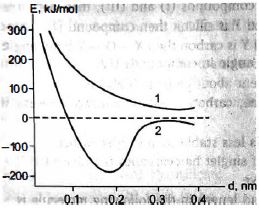
A
$Curve-1$ represents the most stable state of the system for $H^{+}_2$ ion
B
$Curve-2$ represents the most stable state of the system for $H^{+}_2$ ion
C
$Curve-1$ indicates that the molecular hydrogen ion is formed
D
$Curve-2$ represents the energy level of the antibonding region
Solution
(B) The potential energy diagram for the formation of $H^{+}_2$ ion shows two curves.
$Curve-2$ shows a minimum in potential energy at a specific internuclear distance,which corresponds to the formation of a stable bonding molecular orbital.
$Curve-1$ shows a continuous increase in potential energy as the internuclear distance decreases,which corresponds to an antibonding molecular orbital where no stable bond is formed.
Therefore,$Curve-2$ represents the most stable state of the system for $H^{+}_2$ ion,as it shows the energy minimum required for bond formation.
$Curve-2$ shows a minimum in potential energy at a specific internuclear distance,which corresponds to the formation of a stable bonding molecular orbital.
$Curve-1$ shows a continuous increase in potential energy as the internuclear distance decreases,which corresponds to an antibonding molecular orbital where no stable bond is formed.
Therefore,$Curve-2$ represents the most stable state of the system for $H^{+}_2$ ion,as it shows the energy minimum required for bond formation.
0 likes
View Solution186
DifficultMCQ
The incorrect statement regarding molecular orbital $(s)$ is
A
If there is a nodal plane perpendicular to the internuclear axis and lying between the nuclei of bonded atoms then corresponding orbital is antibonding $M.O.$
B
If a nodal plane lies in the internuclear axis,then corresponding orbital is $\pi$ bonding $M.O.$
C
The $\sigma$-bonding molecular orbital does not contain nodal planes containing the internuclear axis.
D
The $\delta$-bonding molecular orbital possesses three nodal planes containing the internuclear axis.
Solution
(D) The $\sigma$ bonding $M.O.$ has no nodal plane containing the internuclear axis.
The $\pi$ bonding $M.O.$ has one nodal plane containing the internuclear axis.
The $\delta$ bonding $M.O.$ has two nodal planes containing the internuclear axis.
Therefore,the statement in option $D$ is incorrect because the $\delta$ orbital possesses $2$ nodal planes,not $3$.
The $\pi$ bonding $M.O.$ has one nodal plane containing the internuclear axis.
The $\delta$ bonding $M.O.$ has two nodal planes containing the internuclear axis.
Therefore,the statement in option $D$ is incorrect because the $\delta$ orbital possesses $2$ nodal planes,not $3$.
0 likes
View Solution187
DifficultMCQ
Which of the following species absorbs maximum energy in its $HOMO-LUMO$ electronic transition?
A
$O_2$
B
$N_2^-$
C
$C_2$
D
$N_2$
Solution
(D) The energy gap between $HOMO$ and $LUMO$ is related to the bond order and the stability of the molecular orbitals.
For $N_2$ (bond order $3$),the $HOMO$ is $\sigma 2p_z$ and the $LUMO$ is $\sigma^* 2p_z$. The energy gap is very large.
For $C_2$ (bond order $2$),the $HOMO$ is $\pi 2p$ and the $LUMO$ is $\sigma 2p_z$.
For $O_2$ (bond order $2$),the $HOMO$ is $\pi^* 2p$ and the $LUMO$ is $\sigma^* 2p$.
For $N_2^-$ (bond order $2.5$),the $HOMO$ is $\pi^* 2p$ and the $LUMO$ is $\sigma^* 2p$.
Comparing the energy gaps,$N_2$ has the highest energy gap between its $HOMO$ and $LUMO$ due to the large splitting between the bonding $\sigma 2p_z$ and antibonding $\sigma^* 2p_z$ orbitals.
Therefore,$N_2$ requires the maximum energy for its $HOMO-LUMO$ electronic transition.
For $N_2$ (bond order $3$),the $HOMO$ is $\sigma 2p_z$ and the $LUMO$ is $\sigma^* 2p_z$. The energy gap is very large.
For $C_2$ (bond order $2$),the $HOMO$ is $\pi 2p$ and the $LUMO$ is $\sigma 2p_z$.
For $O_2$ (bond order $2$),the $HOMO$ is $\pi^* 2p$ and the $LUMO$ is $\sigma^* 2p$.
For $N_2^-$ (bond order $2.5$),the $HOMO$ is $\pi^* 2p$ and the $LUMO$ is $\sigma^* 2p$.
Comparing the energy gaps,$N_2$ has the highest energy gap between its $HOMO$ and $LUMO$ due to the large splitting between the bonding $\sigma 2p_z$ and antibonding $\sigma^* 2p_z$ orbitals.
Therefore,$N_2$ requires the maximum energy for its $HOMO-LUMO$ electronic transition.
0 likes
View Solution188
AdvancedMCQ
If $P$ to $T$ are second period $p-$block elements,then which of the following graphs shows the correct relation between the number of valence electrons in $P_2$ to $T_2$ (corresponding molecules) and their bond order?
A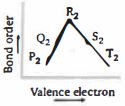
B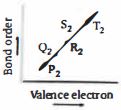
C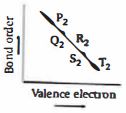
D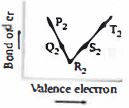
Solution
(A) The second period $p-$block elements are $B, C, N, O, F$. Let $P=B, Q=C, R=N, S=O, T=F$. The corresponding diatomic molecules are $B_2, C_2, N_2, O_2, F_2$.
As the number of valence electrons increases from $6$ to $10$,the bond order increases from $1.0$ to $3.0$. As the number of valence electrons increases further from $10$ to $14$,the bond order decreases from $3.0$ to $1.0$. This trend is represented by the graph in option $A$.
| Species | Valence Electrons | Bond Order |
| $B_2$ $(P_2)$ | $6$ | $1.0$ |
| $C_2$ $(Q_2)$ | $8$ | $2.0$ |
| $N_2$ $(R_2)$ | $10$ | $3.0$ |
| $O_2$ $(S_2)$ | $12$ | $2.0$ |
| $F_2$ $(T_2)$ | $14$ | $1.0$ |
As the number of valence electrons increases from $6$ to $10$,the bond order increases from $1.0$ to $3.0$. As the number of valence electrons increases further from $10$ to $14$,the bond order decreases from $3.0$ to $1.0$. This trend is represented by the graph in option $A$.
0 likes
View Solution189
DifficultMCQ
Which of the following statements is not correct?
$I$) Bond length order: $H_2^- = H_2^+ > H_2$
$II$) $O_2^+, NO, N_2^-$ have the same bond order of $2.5$
$III$) Bond order can assume any value including zero up to four
$IV$) $NO_3^-$ and $BO_3^{3-}$ have the same bond order for the $X-O$ bond (where $X$ is the central atom)
$I$) Bond length order: $H_2^- = H_2^+ > H_2$
$II$) $O_2^+, NO, N_2^-$ have the same bond order of $2.5$
$III$) Bond order can assume any value including zero up to four
$IV$) $NO_3^-$ and $BO_3^{3-}$ have the same bond order for the $X-O$ bond (where $X$ is the central atom)
A
$I, II$ and $III$
B
$I$ and $IV$
C
$II$ and $IV$
D
$I$ and $II$
Solution
(B) Bond order $= \frac{1}{2} [\text{Number of bonding electrons} - \text{Number of antibonding electrons}]$.
$I$) Bond order of $H_2^- = \frac{1}{2}[2-1] = 0.5$. Bond order of $H_2^+ = \frac{1}{2}[1-0] = 0.5$. Bond order of $H_2 = \frac{1}{2}[2-0] = 1$. Since bond length is inversely proportional to bond order,the order is $H_2^- = H_2^+ > H_2$. This statement is correct.
$II$) Bond order of $O_2^+ = \frac{1}{2}[10-5] = 2.5$. Bond order of $NO = \frac{1}{2}[10-5] = 2.5$. Bond order of $N_2^- = \frac{1}{2}[10-5] = 2.5$. This statement is correct.
$III$) Bond order can be zero,but it cannot be four for stable molecules in standard conditions. This statement is incorrect.
$IV$) $NO_3^-$ has a bond order of $1.33$ for $N-O$ bonds,while $BO_3^{3-}$ has a bond order of $1$ for $B-O$ bonds. This statement is incorrect.
$I$) Bond order of $H_2^- = \frac{1}{2}[2-1] = 0.5$. Bond order of $H_2^+ = \frac{1}{2}[1-0] = 0.5$. Bond order of $H_2 = \frac{1}{2}[2-0] = 1$. Since bond length is inversely proportional to bond order,the order is $H_2^- = H_2^+ > H_2$. This statement is correct.
$II$) Bond order of $O_2^+ = \frac{1}{2}[10-5] = 2.5$. Bond order of $NO = \frac{1}{2}[10-5] = 2.5$. Bond order of $N_2^- = \frac{1}{2}[10-5] = 2.5$. This statement is correct.
$III$) Bond order can be zero,but it cannot be four for stable molecules in standard conditions. This statement is incorrect.
$IV$) $NO_3^-$ has a bond order of $1.33$ for $N-O$ bonds,while $BO_3^{3-}$ has a bond order of $1$ for $B-O$ bonds. This statement is incorrect.
0 likes
View Solution190
DifficultMCQ
$N_2$ and $O_2$ are converted to monocations $N_2^+$ and $O_2^+$ respectively. Which statement is wrong?
A
In $N_2^+$,the $N-N$ bond weakens.
B
In $O_2^+$,the $O-O$ bond order increases.
C
In $O_2^+$,the paramagnetism decreases.
D
$N_2^+$ becomes diamagnetic.
Solution
(D) Bond order $= 1/2 \times (N_B - N_{AB})$.
For $N_2$ ($10$ valence electrons): $(\sigma 2s)^2 (\sigma^* 2s)^2 (\pi 2p_x)^2 (\pi 2p_y)^2 (\sigma 2p_z)^2$. Bond order $= 1/2 \times (8 - 2) = 3$.
For $N_2^+$ ($9$ valence electrons): $(\sigma 2s)^2 (\sigma^* 2s)^2 (\pi 2p_x)^2 (\pi 2p_y)^2 (\sigma 2p_z)^1$. Bond order $= 1/2 \times (7 - 2) = 2.5$. Since bond order decreases,the $N-N$ bond weakens. $N_2^+$ has one unpaired electron,so it is paramagnetic.
For $O_2$ ($12$ valence electrons): $(\sigma 2s)^2 (\sigma^* 2s)^2 (\sigma 2p_z)^2 (\pi 2p_x)^2 (\pi 2p_y)^2 (\pi^* 2p_x)^1 (\pi^* 2p_y)^1$. Bond order $= 1/2 \times (8 - 4) = 2$.
For $O_2^+$ ($11$ valence electrons): $(\sigma 2s)^2 (\sigma^* 2s)^2 (\sigma 2p_z)^2 (\pi 2p_x)^2 (\pi 2p_y)^2 (\pi^* 2p_x)^1$. Bond order $= 1/2 \times (8 - 3) = 2.5$. Since bond order increases,the $O-O$ bond strengthens. The number of unpaired electrons decreases from $2$ to $1$,so paramagnetism decreases.
Statement $D$ is wrong because $N_2^+$ is paramagnetic,not diamagnetic.
For $N_2$ ($10$ valence electrons): $(\sigma 2s)^2 (\sigma^* 2s)^2 (\pi 2p_x)^2 (\pi 2p_y)^2 (\sigma 2p_z)^2$. Bond order $= 1/2 \times (8 - 2) = 3$.
For $N_2^+$ ($9$ valence electrons): $(\sigma 2s)^2 (\sigma^* 2s)^2 (\pi 2p_x)^2 (\pi 2p_y)^2 (\sigma 2p_z)^1$. Bond order $= 1/2 \times (7 - 2) = 2.5$. Since bond order decreases,the $N-N$ bond weakens. $N_2^+$ has one unpaired electron,so it is paramagnetic.
For $O_2$ ($12$ valence electrons): $(\sigma 2s)^2 (\sigma^* 2s)^2 (\sigma 2p_z)^2 (\pi 2p_x)^2 (\pi 2p_y)^2 (\pi^* 2p_x)^1 (\pi^* 2p_y)^1$. Bond order $= 1/2 \times (8 - 4) = 2$.
For $O_2^+$ ($11$ valence electrons): $(\sigma 2s)^2 (\sigma^* 2s)^2 (\sigma 2p_z)^2 (\pi 2p_x)^2 (\pi 2p_y)^2 (\pi^* 2p_x)^1$. Bond order $= 1/2 \times (8 - 3) = 2.5$. Since bond order increases,the $O-O$ bond strengthens. The number of unpaired electrons decreases from $2$ to $1$,so paramagnetism decreases.
Statement $D$ is wrong because $N_2^+$ is paramagnetic,not diamagnetic.
0 likes
View Solution191
DifficultMCQ
In which of the following transformations,the bond order has increased and the magnetic behaviour has changed?
A
$C^{+}_2 \to C_2$
B
$NO^{+} \to NO$
C
$O_2 \to O^{+}_2$
D
$N_2 \to N^{+}_2$
Solution
(A) For each transformation,we calculate the bond order $(BO)$ and magnetic behavior:
$(a)$ $C^{+}_2$ ($7$ electrons,$\sigma 1s^2, \sigma^* 1s^2, \sigma 2s^2, \pi 2p^1$,$BO = (5-2)/2 = 1.5$,paramagnetic) $\to C_2$ ($8$ electrons,$\sigma 1s^2, \sigma^* 1s^2, \sigma 2s^2, \pi 2p^2$,$BO = (6-2)/2 = 2.0$,diamagnetic). Here,$BO$ increases and magnetic behavior changes.
$(b)$ $NO^{+}$ ($14$ electrons,$BO = 3.0$,diamagnetic) $\to NO$ ($15$ electrons,$BO = 2.5$,paramagnetic). Here,$BO$ decreases.
$(c)$ $O_2$ ($16$ electrons,$BO = 2.0$,paramagnetic) $\to O^{+}_2$ ($15$ electrons,$BO = 2.5$,paramagnetic). Here,$BO$ increases but magnetic behavior remains paramagnetic.
$(d)$ $N_2$ ($14$ electrons,$BO = 3.0$,diamagnetic) $\to N^{+}_2$ ($13$ electrons,$BO = 2.5$,paramagnetic). Here,$BO$ decreases.
$(a)$ $C^{+}_2$ ($7$ electrons,$\sigma 1s^2, \sigma^* 1s^2, \sigma 2s^2, \pi 2p^1$,$BO = (5-2)/2 = 1.5$,paramagnetic) $\to C_2$ ($8$ electrons,$\sigma 1s^2, \sigma^* 1s^2, \sigma 2s^2, \pi 2p^2$,$BO = (6-2)/2 = 2.0$,diamagnetic). Here,$BO$ increases and magnetic behavior changes.
$(b)$ $NO^{+}$ ($14$ electrons,$BO = 3.0$,diamagnetic) $\to NO$ ($15$ electrons,$BO = 2.5$,paramagnetic). Here,$BO$ decreases.
$(c)$ $O_2$ ($16$ electrons,$BO = 2.0$,paramagnetic) $\to O^{+}_2$ ($15$ electrons,$BO = 2.5$,paramagnetic). Here,$BO$ increases but magnetic behavior remains paramagnetic.
$(d)$ $N_2$ ($14$ electrons,$BO = 3.0$,diamagnetic) $\to N^{+}_2$ ($13$ electrons,$BO = 2.5$,paramagnetic). Here,$BO$ decreases.
0 likes
View Solution192
MediumMCQ
The $H.O.M.O.$ (Highest Occupied Molecular Orbital) of the $CO$ molecule is:
A
Non-bonding $M.O.$ with slight antibonding character
B
Non-bonding $M.O.$ with slight bonding character
C
Pure non-bonding $M.O.$
D
None of the above
Solution
(A) According to the molecular orbital theory and the Coulson model,the $H.O.M.O.$ of the $CO$ molecule is a non-bonding molecular orbital $(M.O.)$ that possesses a slight antibonding character.
Therefore,the correct option is $A$.
Therefore,the correct option is $A$.
0 likes
View Solution193
MediumMCQ
Which of the following is correctly matched?
A
$d_{x^2-y^2}$ atomic orbital - One nodal plane
B
$P_y$ atomic orbital - Two nodal planes
C
$\sigma_{Px}$ - $\Psi$ (gerade)
D
$P_{py}$ - $\Psi$ (ungerade)
Solution
(C) The $\sigma_{Px}$ bonding molecular orbital is formed by the head-on overlap of $p_x$ orbitals.
It possesses a center of symmetry,which makes it gerade $(g)$.
Therefore,the correct match is $\sigma_{Px} - \Psi$ (gerade).
It possesses a center of symmetry,which makes it gerade $(g)$.
Therefore,the correct match is $\sigma_{Px} - \Psi$ (gerade).
0 likes
View Solution194
MediumMCQ
The common features among the species $CN^{-}$,$CO$ and $NO^{+}$ are
A
Bond order three and diamagnetic
B
Bond order three and weak field ligands
C
Paramagnetic and strong field ligands
D
Paramagnetic and $\pi-$acceptor ligands
Solution
(A) The species $CN^{-}$,$CO$,and $NO^{+}$ are isoelectronic,each containing $14$ electrons.
According to Molecular Orbital Theory,the bond order $(B.O.)$ for these species is calculated as:
$B.O. = \frac{1}{2} (N_b - N_a) = \frac{1}{2} (10 - 4) = 3$.
Since all electrons are paired in their molecular orbitals,they are diamagnetic.
Additionally,they all act as strong field ligands and $\pi-$acceptor ligands.
Comparing the options,the most accurate description of their common features is that they have a bond order of $3$ and are diamagnetic.
According to Molecular Orbital Theory,the bond order $(B.O.)$ for these species is calculated as:
$B.O. = \frac{1}{2} (N_b - N_a) = \frac{1}{2} (10 - 4) = 3$.
Since all electrons are paired in their molecular orbitals,they are diamagnetic.
Additionally,they all act as strong field ligands and $\pi-$acceptor ligands.
Comparing the options,the most accurate description of their common features is that they have a bond order of $3$ and are diamagnetic.
| Species | $B.O.$ | Total Electrons |
|---|---|---|
| $CN^{-}$ | $3$ | $14$ |
| $CO$ | $3$ | $14$ |
| $NO^{+}$ | $3$ | $14$ |
0 likes
View Solution195
EasyMCQ
In dinitrogen tetroxide,$N_2O_4$:
A
Has two unpaired electrons and is paramagnetic.
B
Has two unpaired electrons and is diamagnetic.
C
Has one unpaired electron and is paramagnetic.
D
Has no unpaired electrons and is diamagnetic.
Solution
(D) The structure of $N_2O_4$ consists of two $NO_2$ units linked by an $N-N$ bond.
In $N_2O_4$,all electrons are paired,meaning there are no unpaired electrons.
Therefore,$N_2O_4$ is diamagnetic.
In $N_2O_4$,all electrons are paired,meaning there are no unpaired electrons.
Therefore,$N_2O_4$ is diamagnetic.
0 likes
View Solution196
EasyMCQ
Which of the following is paramagnetic and contains a three-electron bond in its structure?
A
$N_2O$
B
$NO$
C
$N_2O_3$
D
$N_2O_5$
Solution
(B) The molecule $NO$ (Nitric oxide) has a total of $11$ valence electrons.
In its molecular orbital structure,it contains a three-electron bond (a bond order of $2.5$).
Due to the presence of an unpaired electron in the antibonding $\pi^*$ orbital,$NO$ is paramagnetic.
In its molecular orbital structure,it contains a three-electron bond (a bond order of $2.5$).
Due to the presence of an unpaired electron in the antibonding $\pi^*$ orbital,$NO$ is paramagnetic.
0 likes
View Solution197
EasyMCQ
Which of the following is paramagnetic?
A
$NO$
B
$N_2O_4$
C
$P_4O_6$
D
$N_2O_5$
Solution
(A) In $NO$,the total number of valence electrons is $5 + 6 = 11$. Since it has an odd number of electrons,it contains an unpaired electron in the antibonding molecular orbital,making it paramagnetic.
0 likes
View Solution198
EasyMCQ
$CN^-$ and $N_2$ are isoelectronic,but $N_2$ is chemically inert compared to $CN^-$. The reason is:
A
Higher bond energy.
B
Bond polarity.
C
Unequal electron distribution.
D
Presence of more electrons in bonding orbitals.
Solution
(A) $N_2$ and $CN^-$ are isoelectronic species,both having $14$ electrons.
$N_2$ has a very high bond dissociation energy $(941 \ kJ \ mol^{-1})$ due to the presence of a strong triple bond $(N \equiv N)$.
This high bond energy makes $N_2$ chemically inert under normal conditions.
In contrast,$CN^-$ is an ion and is more reactive due to the presence of a negative charge and different electronic environment compared to the neutral $N_2$ molecule.
$N_2$ has a very high bond dissociation energy $(941 \ kJ \ mol^{-1})$ due to the presence of a strong triple bond $(N \equiv N)$.
This high bond energy makes $N_2$ chemically inert under normal conditions.
In contrast,$CN^-$ is an ion and is more reactive due to the presence of a negative charge and different electronic environment compared to the neutral $N_2$ molecule.
0 likes
View Solution199
MediumMCQ
In which of the following transformations,the bond order has increased and the magnetic behaviour has changed?
A
$C_2^+ \to C_2$
B
$NO^+ \to NO$
C
$O_2 \to O_2^+$
D
$N_2 \to N_2^+$
Solution
(A) The bond order $(BO)$ and magnetic behavior for the given transformations are as follows:
$1$. $C_2^+ (BO = 1.5, \text{Paramagnetic}) \to C_2 (BO = 2, \text{Diamagnetic})$. Here,$BO$ increases and magnetic behavior changes.
$2$. $NO^+ (BO = 3, \text{Diamagnetic}) \to NO (BO = 2.5, \text{Paramagnetic})$. Here,$BO$ decreases.
$3$. $O_2 (BO = 2, \text{Paramagnetic}) \to O_2^+ (BO = 2.5, \text{Paramagnetic})$. Here,$BO$ increases but magnetic behavior remains the same.
$4$. $N_2 (BO = 3, \text{Diamagnetic}) \to N_2^+ (BO = 2.5, \text{Paramagnetic})$. Here,$BO$ decreases.
Therefore,the correct transformation is $C_2^+ \to C_2$.
$1$. $C_2^+ (BO = 1.5, \text{Paramagnetic}) \to C_2 (BO = 2, \text{Diamagnetic})$. Here,$BO$ increases and magnetic behavior changes.
$2$. $NO^+ (BO = 3, \text{Diamagnetic}) \to NO (BO = 2.5, \text{Paramagnetic})$. Here,$BO$ decreases.
$3$. $O_2 (BO = 2, \text{Paramagnetic}) \to O_2^+ (BO = 2.5, \text{Paramagnetic})$. Here,$BO$ increases but magnetic behavior remains the same.
$4$. $N_2 (BO = 3, \text{Diamagnetic}) \to N_2^+ (BO = 2.5, \text{Paramagnetic})$. Here,$BO$ decreases.
Therefore,the correct transformation is $C_2^+ \to C_2$.
0 likes
View SolutionChemical Bonding and Molecular Structure — Molecular orbital theory · Frequently Asked Questions
1Are these Chemical Bonding and Molecular Structure questions useful for JEE and NEET?
Yes. All questions in this section are mapped to JEE Main and NEET exam patterns. Previous year questions from JEE Main, NEET, GUJCET and state-level exams are included with full solutions.
2Can I switch to Hindi or Gujarati for these questions?
Yes. Use the language tabs in the hero section or the sidebar to view the same questions and solutions in English, Hindi or Gujarati.
3How do I generate a question paper from this subtopic?
Use the Vedclass Exam Paper Generator — select the chapter and subtopic, set difficulty, and generate Sets A, B, C, D automatically. First 3 chapters of every subject are free.
Vedclass Products
For Students
Vedclass Test Series
Mock tests in real JEE/NEET style with performance analysis. 5-day free trial.
Start Free TrialFor Teachers
Exam Paper Generator
Generate Set A/B/C/D papers from this chapter in 2 minutes. 3 chapters free.
Try FreeFor Institutes
Online Exam Module
Live online exams with unlimited students, 360° analytics & white-label branding.
See DemoFor Teachers & Institutes
Generate a Chemical Bonding and Molecular Structure Exam Paper in 2 Minutes
Select subtopic & difficulty — Sets A, B, C, D auto-generated with No Repeat logic.
First 3 chapters of every subject are free — no payment required.