
A English
Co-ordinate or Dative bonding Questions in English
Class 11 Chemistry · Chemical Bonding and Molecular Structure · Co-ordinate or Dative bonding
68+
Questions
English
Language
100%
With Solutions
Showing 50 of 68 questions in English
1
EasyMCQ
The covalency of nitrogen in $HNO_3$ is
A
$0$
B
$3$
C
$4$
D
$5$
Solution
(C) The structure of nitric acid $(HNO_3)$ involves one $N=O$ bond,one $N-OH$ bond,and one coordinate covalent bond (dative bond) from $N$ to $O$.
Nitrogen forms a total of $4$ covalent bonds (one double bond,one single bond,and one coordinate bond).
Therefore,the covalency of nitrogen in $HNO_3$ is $4$.
Nitrogen forms a total of $4$ covalent bonds (one double bond,one single bond,and one coordinate bond).
Therefore,the covalency of nitrogen in $HNO_3$ is $4$.
0 likes
View Solution2
MediumMCQ
$A$ simple example of a coordinate covalent bond is exhibited by
A
$C_2H_2$
B
$H_2SO_4$
C
$NH_3$
D
$HCl$
Solution
(B) coordinate covalent bond (or dative bond) is formed when one atom provides both electrons for the shared pair.
In $H_2SO_4$,the sulfur atom is bonded to two hydroxyl groups by covalent bonds and to two oxygen atoms by coordinate covalent bonds (where $S$ donates a lone pair to each $O$ atom).
Thus,$H_2SO_4$ contains coordinate covalent bonds.
In $H_2SO_4$,the sulfur atom is bonded to two hydroxyl groups by covalent bonds and to two oxygen atoms by coordinate covalent bonds (where $S$ donates a lone pair to each $O$ atom).
Thus,$H_2SO_4$ contains coordinate covalent bonds.
0 likes
View Solution3
MediumMCQ
The bond that exists between $NH_3$ and $BF_3$ is called
A
Electrovalent
B
Covalent
C
Coordinate
D
Hydrogen
Solution
(C) $NH_3$ has a lone pair of electrons,while $BF_3$ is an electron-deficient compound.
Therefore,they form a coordinate (dative) bond by sharing the lone pair from nitrogen to boron.
The reaction is represented as: $NH_3 \to BF_3$.
Therefore,they form a coordinate (dative) bond by sharing the lone pair from nitrogen to boron.
The reaction is represented as: $NH_3 \to BF_3$.
0 likes
View Solution4
MediumMCQ
Which of the following molecules does not contain a coordinate bond?
A
$SO_2$
B
$HNO_3$
C
$H_2SO_3$
D
$HNO_2$
Solution
(D) $HNO_2$ (nitrous acid) does not contain a coordinate bond.
The structure of $HNO_2$ is $H-O-N=O$,where all bonds are covalent.
In contrast,$SO_2$ $(O=S \leftarrow O)$,$HNO_3$ $(H-O-N(=O) \leftarrow O)$,and $H_2SO_3$ ($H-O-S(=O)-O-H$ with a coordinate bond from $S$ to $O$) all contain coordinate bonds.
The structure of $HNO_2$ is $H-O-N=O$,where all bonds are covalent.
In contrast,$SO_2$ $(O=S \leftarrow O)$,$HNO_3$ $(H-O-N(=O) \leftarrow O)$,and $H_2SO_3$ ($H-O-S(=O)-O-H$ with a coordinate bond from $S$ to $O$) all contain coordinate bonds.
0 likes
View Solution5
EasyMCQ
Coordinate covalent compounds are formed by
A
Transfer of electrons
B
Sharing of electrons
C
Donation of electrons
D
None of these processes
Solution
(B) coordinate covalent bond (also known as a dative bond) is a type of covalent bond in which both electrons of the shared pair come from the same atom.
Unlike a normal covalent bond where each atom contributes one electron to the shared pair,in a coordinate bond,one atom acts as a donor (providing the electron pair) and the other acts as an acceptor.
Therefore,it is formed by the sharing of an electron pair donated by a single atom.
Unlike a normal covalent bond where each atom contributes one electron to the shared pair,in a coordinate bond,one atom acts as a donor (providing the electron pair) and the other acts as an acceptor.
Therefore,it is formed by the sharing of an electron pair donated by a single atom.
0 likes
View Solution6
EasyMCQ
In the coordinate valency:
A
Electrons are equally shared by the atoms
B
Electrons of one atom are shared with two atoms
C
Hydrogen bond is formed
D
None of the above
Solution
(B) In a coordinate bond (also known as a dative bond),the $2$ electrons forming the bond are provided by only one of the two participating atoms.
This shared pair of electrons is donated by one atom to another,resulting in the formation of a coordinate covalent bond.
This shared pair of electrons is donated by one atom to another,resulting in the formation of a coordinate covalent bond.
0 likes
View Solution7
MediumMCQ
Which of the following contains a coordinate covalent bond?
A
$N_2O_5$
B
$BaCl_2$
C
$HCl$
D
$H_2O$
Solution
(A) The correct answer is $A$.
In $N_2O_5$,the structure involves two nitrogen atoms connected by an oxygen atom $(N-O-N)$.
Each nitrogen atom is also bonded to one terminal oxygen atom via a double bond and to another terminal oxygen atom via a coordinate covalent bond (dative bond).
Thus,$N_2O_5$ contains coordinate covalent bonds.
In $N_2O_5$,the structure involves two nitrogen atoms connected by an oxygen atom $(N-O-N)$.
Each nitrogen atom is also bonded to one terminal oxygen atom via a double bond and to another terminal oxygen atom via a coordinate covalent bond (dative bond).
Thus,$N_2O_5$ contains coordinate covalent bonds.
0 likes
View Solution8
MediumMCQ
$A$ coordinate bond is formed when an atom in a molecule has
A
Electric charge on it
B
All its valency electrons shared
C
$A$ single unshared electron
D
One or more unshared electron pair
Solution
(D) coordinate or dative bond is a type of covalent bond in which both electrons of the shared pair are contributed by only one of the two participating atoms.
For the formation of a coordinate bond,the donor atom must possess at least one lone pair of electrons (an unshared electron pair) to donate to the acceptor atom.
For the formation of a coordinate bond,the donor atom must possess at least one lone pair of electrons (an unshared electron pair) to donate to the acceptor atom.
0 likes
View Solution9
MediumMCQ
Which of the following has a coordinate bond?
A
$SO_3^{2-}$
B
$CH_4$
C
$CO_2$
D
$NH_3$
Solution
(A) In the sulfite ion $(SO_3^{2-})$,the sulfur atom is bonded to three oxygen atoms.
To satisfy the octet rule for all atoms,one of the $S-O$ bonds is represented as a coordinate covalent bond (dative bond) where the sulfur atom donates a lone pair of electrons to an oxygen atom.
In contrast,$CH_4$,$CO_2$,and $NH_3$ primarily involve covalent bonds formed by electron sharing without coordinate bonds in their standard Lewis structures.
To satisfy the octet rule for all atoms,one of the $S-O$ bonds is represented as a coordinate covalent bond (dative bond) where the sulfur atom donates a lone pair of electrons to an oxygen atom.
In contrast,$CH_4$,$CO_2$,and $NH_3$ primarily involve covalent bonds formed by electron sharing without coordinate bonds in their standard Lewis structures.
0 likes
View Solution10
MediumMCQ
The compound containing a coordinate bond is
A
$O_3$
B
$SO_3$
C
$H_2SO_4$
D
All of these
Solution
(D) coordinate bond (or dative bond) is a type of covalent bond where both electrons of the shared pair are contributed by only one of the two participating atoms.
In $O_3$ (ozone),the central oxygen atom forms a coordinate bond with the terminal oxygen atom.
In $SO_3$ (sulfur trioxide),the sulfur atom forms coordinate bonds with two oxygen atoms.
In $H_2SO_4$ (sulfuric acid),the sulfur atom forms coordinate bonds with two oxygen atoms.
Since all these molecules contain at least one coordinate bond,the correct option is $D$.
In $O_3$ (ozone),the central oxygen atom forms a coordinate bond with the terminal oxygen atom.
In $SO_3$ (sulfur trioxide),the sulfur atom forms coordinate bonds with two oxygen atoms.
In $H_2SO_4$ (sulfuric acid),the sulfur atom forms coordinate bonds with two oxygen atoms.
Since all these molecules contain at least one coordinate bond,the correct option is $D$.
0 likes
View Solution11
MediumMCQ
The number of dative bonds in sulphuric acid $(H_2SO_4)$ molecules is:
A
$2$
B
$1$
C
$0$
D
$4$
Solution
(C) The structure of sulphuric acid $(H_2SO_4)$ consists of a central sulphur atom bonded to two hydroxyl groups $(-OH)$ via single covalent bonds and two oxygen atoms via double covalent bonds.
In the Lewis structure,all bonds are covalent. While older representations sometimes depicted two $S \rightarrow O$ coordinate (dative) bonds,modern valence bond theory and formal charge calculations show that these are best represented as $S=O$ double bonds.
Therefore,the number of dative bonds in a sulphuric acid molecule is $0$.
In the Lewis structure,all bonds are covalent. While older representations sometimes depicted two $S \rightarrow O$ coordinate (dative) bonds,modern valence bond theory and formal charge calculations show that these are best represented as $S=O$ double bonds.
Therefore,the number of dative bonds in a sulphuric acid molecule is $0$.
0 likes
View Solution12
MediumMCQ
Which of the following compounds has a coordinate (dative) bond?
A
$CH_3NC$
B
$CH_3OH$
C
$CH_3Cl$
D
$NH_3$
Solution
(A) In $CH_3NC$ (methyl isocyanide),the nitrogen atom donates a lone pair of electrons to the carbon atom to form a coordinate (dative) bond. The structure is $CH_3-N \rightarrow C$. Therefore,the correct option is $A$.
0 likes
View Solution13
MediumMCQ
What is the nature of the bond between $B$ and $O$ in $(C_2H_5)_2OBH_3$?
A
Covalent
B
Co-ordinate covalent
C
Ionic bond
D
Banana shaped bond
Solution
(B) Since $BH_3$ is a Lewis acid,it acts as an electron pair acceptor.
$(C_2H_5)_2O$ (diethyl ether) acts as a Lewis base because the oxygen atom has lone pairs of electrons.
The oxygen atom donates a lone pair of electrons to the boron atom in $BH_3$.
Therefore,the bond formed between $B$ and $O$ is a co-ordinate covalent bond (also known as a dative bond).
$(C_2H_5)_2O$ (diethyl ether) acts as a Lewis base because the oxygen atom has lone pairs of electrons.
The oxygen atom donates a lone pair of electrons to the boron atom in $BH_3$.
Therefore,the bond formed between $B$ and $O$ is a co-ordinate covalent bond (also known as a dative bond).
0 likes
View Solution14
MediumMCQ
Which combination is best explained by the coordinate covalent bond?
A
$H^{+} + H_2O$
B
$Cl + Cl$
C
$Mg + \frac{1}{2}O_2$
D
$H_2 + I_2$
Solution
(A) coordinate covalent bond (or dative bond) is formed when one atom donates a lone pair of electrons to another atom that needs them to complete its octet.
In the reaction $H_2O + H^{+} \to H_3O^{+}$,the oxygen atom in water has two lone pairs of electrons.
It donates one of these lone pairs to the $H^{+}$ ion,which has an empty $1s$ orbital.
This results in the formation of a hydronium ion $(H_3O^{+})$,where the bond between $O$ and $H^{+}$ is a coordinate covalent bond.
Therefore,the correct option is $A$.
In the reaction $H_2O + H^{+} \to H_3O^{+}$,the oxygen atom in water has two lone pairs of electrons.
It donates one of these lone pairs to the $H^{+}$ ion,which has an empty $1s$ orbital.
This results in the formation of a hydronium ion $(H_3O^{+})$,where the bond between $O$ and $H^{+}$ is a coordinate covalent bond.
Therefore,the correct option is $A$.
0 likes
View Solution15
EasyMCQ
In the reaction $I_2 + I^{-} \to I_3^-$,the Lewis base is
A
$I_2$
B
$I^{-}$
C
$I_3^-$
D
None of these
Solution
(B) Lewis base is defined as a species that can donate a lone pair of electrons to form a coordinate covalent bond.
In the reaction $I_2 + I^{-} \to I_3^-$,the iodide ion $(I^{-})$ acts as the electron pair donor.
Therefore,$I^{-}$ is the Lewis base.
In the reaction $I_2 + I^{-} \to I_3^-$,the iodide ion $(I^{-})$ acts as the electron pair donor.
Therefore,$I^{-}$ is the Lewis base.
0 likes
View Solution16
EasyMCQ
In Lewis acid-base theory,neutralization reaction may be considered as
A
Formation of salt and water
B
Competition for protons by acid and base
C
Oxidation reduction
D
Coordinate covalent bond formation
Solution
(D) According to the Lewis theory,an acid is an electron pair acceptor and a base is an electron pair donor.
Neutralization in this theory is defined as the formation of a coordinate covalent bond (also known as a dative bond) between the Lewis acid and the Lewis base,resulting in the formation of an adduct.
Neutralization in this theory is defined as the formation of a coordinate covalent bond (also known as a dative bond) between the Lewis acid and the Lewis base,resulting in the formation of an adduct.
0 likes
View Solution17
EasyMCQ
In the reaction $BCl_3 + PH_3 \rightarrow Cl_3B^{-}PH_3$,the Lewis base is:
A
$BCl_3$
B
$PH_3$
C
$Cl_3B^{-}PH_3$
D
None of these
Solution
(B) Lewis base is defined as a substance that can donate an electron pair.
In the reaction $BCl_3 + PH_3 \rightarrow Cl_3B^{-}PH_3$,the phosphorus atom in $PH_3$ has a lone pair of electrons.
$PH_3$ donates this lone pair to the electron-deficient boron atom in $BCl_3$ to form a coordinate covalent bond.
Therefore,$PH_3$ acts as the Lewis base.
In the reaction $BCl_3 + PH_3 \rightarrow Cl_3B^{-}PH_3$,the phosphorus atom in $PH_3$ has a lone pair of electrons.
$PH_3$ donates this lone pair to the electron-deficient boron atom in $BCl_3$ to form a coordinate covalent bond.
Therefore,$PH_3$ acts as the Lewis base.
0 likes
View Solution18
EasyMCQ
In the reaction $NH_3 + BF_3 \rightleftharpoons NH_3 \to BF_3$,$BF_3$ is
A
Lewis acid
B
Lewis base
C
Neither Lewis acid nor Lewis base
D
Lewis acid and Lewis base both
Solution
(A) In the reaction $NH_3 + BF_3 \rightleftharpoons NH_3 \to BF_3$,the $NH_3$ molecule has a lone pair of electrons on the nitrogen atom,which it donates to the $BF_3$ molecule.
$BF_3$ acts as an electron pair acceptor because the boron atom has an incomplete octet.
According to the Lewis concept,a substance that accepts an electron pair is a Lewis acid.
Therefore,$BF_3$ is a Lewis acid.
$BF_3$ acts as an electron pair acceptor because the boron atom has an incomplete octet.
According to the Lewis concept,a substance that accepts an electron pair is a Lewis acid.
Therefore,$BF_3$ is a Lewis acid.
0 likes
View Solution19
EasyMCQ
Which of the following is a Lewis base?
A
$B_2H_6$
B
$LiAlH_4$
C
$AlH_3$
D
$NH_3$
Solution
(D) Lewis base is defined as a substance that can donate a lone pair of electrons.
In $NH_3$,the nitrogen atom has one lone pair of electrons,which it can donate to an electron-deficient species.
Therefore,$NH_3$ acts as a Lewis base.
In $NH_3$,the nitrogen atom has one lone pair of electrons,which it can donate to an electron-deficient species.
Therefore,$NH_3$ acts as a Lewis base.
0 likes
View Solution20
EasyMCQ
Hydrogen molecule differs from chlorine molecule in the following respect:
A
Hydrogen molecule is non-polar but chlorine molecule is polar
B
Hydrogen molecule is polar while chlorine molecule is non-polar
C
Hydrogen molecule can form intermolecular hydrogen bonds but chlorine molecule does not
D
Hydrogen molecule cannot participate in coordination bond formation but chlorine molecule can
Solution
(D) Both $H_2$ and $Cl_2$ are non-polar covalent molecules.
$Cl_2$ contains lone pairs of electrons on the chlorine atoms,which can be donated to form a coordinate bond (e.g.,in complexes).
$H_2$ does not have any lone pairs of electrons to donate.
Therefore,the correct difference is that the hydrogen molecule cannot participate in coordination bond formation,while the chlorine molecule can.
$Cl_2$ contains lone pairs of electrons on the chlorine atoms,which can be donated to form a coordinate bond (e.g.,in complexes).
$H_2$ does not have any lone pairs of electrons to donate.
Therefore,the correct difference is that the hydrogen molecule cannot participate in coordination bond formation,while the chlorine molecule can.
0 likes
View Solution21
EasyMCQ
Which of the following compounds forms a dative bond with ammonia?
A
$CCl_4$
B
$BCl_3$
C
$MgCl_2$
D
$NaCl$
Solution
(B) dative bond (coordinate covalent bond) is formed when a species with a lone pair of electrons donates them to an electron-deficient species.
Ammonia $(NH_3)$ acts as a Lewis base because it has a lone pair of electrons on the nitrogen atom.
$BCl_3$ is a Lewis acid because the boron atom has an incomplete octet (only $6$ electrons in its valence shell).
Therefore,$NH_3$ donates its lone pair to the boron atom in $BCl_3$ to form an adduct,$H_3N \rightarrow BCl_3$,which contains a dative bond.
Ammonia $(NH_3)$ acts as a Lewis base because it has a lone pair of electrons on the nitrogen atom.
$BCl_3$ is a Lewis acid because the boron atom has an incomplete octet (only $6$ electrons in its valence shell).
Therefore,$NH_3$ donates its lone pair to the boron atom in $BCl_3$ to form an adduct,$H_3N \rightarrow BCl_3$,which contains a dative bond.
0 likes
View Solution22
MediumMCQ
Which of the following adducts has the minimum heat of dissociation?
A
$(CH_3)_3N \to BF_3$
B
$(CH_3)_3N \to B(CH_3)F_2$
C
$(CH_3)_3N \to B(CH_3)_2F$
D
$(CH_3)_3N \to B(CH_3)_3$
Solution
(D) The heat of dissociation of an adduct $(CH_3)_3N \to BX_3$ depends on the strength of the Lewis acid $BX_3$.
As the number of electron-donating methyl groups $(-CH_3)$ on the boron atom increases,the Lewis acidity of the boron compound decreases due to the $+I$ effect.
The order of Lewis acidity is $BF_3 > B(CH_3)F_2 > B(CH_3)_2F > B(CH_3)_3$.
Since $B(CH_3)_3$ is the weakest Lewis acid among the given options,the adduct $(CH_3)_3N \to B(CH_3)_3$ has the weakest $N-B$ bond and therefore the minimum heat of dissociation.
As the number of electron-donating methyl groups $(-CH_3)$ on the boron atom increases,the Lewis acidity of the boron compound decreases due to the $+I$ effect.
The order of Lewis acidity is $BF_3 > B(CH_3)F_2 > B(CH_3)_2F > B(CH_3)_3$.
Since $B(CH_3)_3$ is the weakest Lewis acid among the given options,the adduct $(CH_3)_3N \to B(CH_3)_3$ has the weakest $N-B$ bond and therefore the minimum heat of dissociation.
0 likes
View Solution23
MediumMCQ
The unshared pair of electrons on a cyanide ion can act as
A
Isocyanide centre
B
Amido centre
C
Cationic centre
D
Nucleophilic centre
Solution
(D) The cyanide ion $(CN^-)$ contains a lone pair of electrons on the carbon atom.
Because it has an electron-rich site capable of donating an electron pair to an electrophile,it acts as a nucleophilic centre.
Therefore,the correct option is $D$.
Because it has an electron-rich site capable of donating an electron pair to an electrophile,it acts as a nucleophilic centre.
Therefore,the correct option is $D$.
0 likes
View Solution24
EasyMCQ
$AlCl_3$ exists as a dimer because....
A
High ionization potential of $Al$.
B
Large radius of $Al$.
C
High charge on the nucleus.
D
Incomplete $p$-subshell (electron deficient).
Solution
(D) In $AlCl_3$,the $Al$ atom is electron-deficient,having only $6$ electrons in its valence shell.
To complete its octet,$AlCl_3$ forms a dimer $Al_2Cl_6$ by sharing lone pairs of electrons from the chlorine atoms of another $AlCl_3$ molecule,resulting in coordinate bonds.
This is due to the incomplete octet or electron-deficient nature of the $Al$ atom.
To complete its octet,$AlCl_3$ forms a dimer $Al_2Cl_6$ by sharing lone pairs of electrons from the chlorine atoms of another $AlCl_3$ molecule,resulting in coordinate bonds.
This is due to the incomplete octet or electron-deficient nature of the $Al$ atom.
0 likes
View Solution25
EasyMCQ
In the reaction $SnCl_2 + 2Cl^{-} \rightarrow [SnCl_4]^{2-}$,which species acts as a Lewis acid?
A
$Cl^{-}$
B
$SnCl_2$
C
$SnCl_4$
D
None of these
Solution
(B) Lewis acid is defined as an electron pair acceptor.
In the reaction $SnCl_2 + 2Cl^{-} \rightarrow [SnCl_4]^{2-}$,the $SnCl_2$ molecule accepts electron pairs from the chloride ions $(Cl^{-})$.
Since $SnCl_2$ accepts electron pairs to form the complex ion $[SnCl_4]^{2-}$,it acts as a Lewis acid.
Therefore,the correct option is $B$.
In the reaction $SnCl_2 + 2Cl^{-} \rightarrow [SnCl_4]^{2-}$,the $SnCl_2$ molecule accepts electron pairs from the chloride ions $(Cl^{-})$.
Since $SnCl_2$ accepts electron pairs to form the complex ion $[SnCl_4]^{2-}$,it acts as a Lewis acid.
Therefore,the correct option is $B$.
0 likes
View Solution26
EasyMCQ
In the reaction $I_2 + I^{-} \rightarrow I_3^-$,the Lewis base is .........
A
$I^{-}$
B
$I_2$
C
$I_3^-$
D
None of these
Solution
(A) Lewis base is defined as a species that can donate a lone pair of electrons.
In the reaction $I_2 + I^{-} \rightarrow I_3^-$,the iodide ion $(I^{-})$ has a lone pair of electrons which it donates to the iodine molecule $(I_2)$ to form the triiodide ion $(I_3^-)$.
Therefore,$I^{-}$ acts as the Lewis base and $I_2$ acts as the Lewis acid.
In the reaction $I_2 + I^{-} \rightarrow I_3^-$,the iodide ion $(I^{-})$ has a lone pair of electrons which it donates to the iodine molecule $(I_2)$ to form the triiodide ion $(I_3^-)$.
Therefore,$I^{-}$ acts as the Lewis base and $I_2$ acts as the Lewis acid.
0 likes
View Solution27
EasyMCQ
In the reaction $BCl_3 + :PH_3 \rightarrow Cl_3B \leftarrow PH_3$,which species acts as a Lewis base?
A
$PH_3$
B
$BCl_3$
C
Both $1$ and $2$
D
None of these
Solution
(A) Lewis base is defined as a species that can donate a lone pair of electrons.
In the given reaction,$PH_3$ has a lone pair of electrons on the phosphorus atom,which it donates to the electron-deficient boron atom in $BCl_3$.
Therefore,$PH_3$ acts as a Lewis base,and $BCl_3$ acts as a Lewis acid.
In the given reaction,$PH_3$ has a lone pair of electrons on the phosphorus atom,which it donates to the electron-deficient boron atom in $BCl_3$.
Therefore,$PH_3$ acts as a Lewis base,and $BCl_3$ acts as a Lewis acid.
0 likes
View Solution28
MediumMCQ
The $H_2SO_4$ molecule contains .......
A
Only covalent bonds
B
Covalent and ionic bonds
C
Covalent and coordinate covalent bonds
D
Covalent,ionic,and coordinate covalent bonds
Solution
(C) The structure of $H_2SO_4$ is $H-O-S(=O)_2-O-H$.
In this structure,the $S-O$ bonds formed by sharing electrons are covalent,and the two $S=O$ bonds are coordinate covalent bonds (dative bonds) where sulfur donates a lone pair to oxygen.
Thus,the molecule contains both covalent and coordinate covalent bonds.
In this structure,the $S-O$ bonds formed by sharing electrons are covalent,and the two $S=O$ bonds are coordinate covalent bonds (dative bonds) where sulfur donates a lone pair to oxygen.
Thus,the molecule contains both covalent and coordinate covalent bonds.
0 likes
View Solution29
DifficultMCQ
Which of the following contains a coordinate covalent bond?
A
$BaCl_2$
B
$N_2H_5^+$
C
$CaCl_2$
D
$H_2O$
Solution
(B) coordinate covalent bond is formed between the lone pair of nitrogen in hydrazine $(N_2H_4)$ and a proton $(H^+)$ to form the hydrazinium ion $(N_2H_5^+)$.
In $N_2H_5^+$,one nitrogen atom donates its lone pair to the $H^+$ ion,establishing a coordinate bond.
In $N_2H_5^+$,one nitrogen atom donates its lone pair to the $H^+$ ion,establishing a coordinate bond.
0 likes
View Solution30
EasyMCQ
Which of the following species does not contain a coordinate covalent bond?
A
$BH_4^-$
B
$NH_4^+$
C
$CO_3^{2-}$
D
$H_3O^+$
Solution
(C) In $BH_4^-$,the $BH_3$ molecule accepts a hydride ion $(H^-)$ to form a coordinate bond between $B$ and $H$.
In $NH_4^+$,the $NH_3$ molecule accepts an $H^+$ ion,forming a coordinate bond between $N$ and $H$.
In $H_3O^+$,the $H_2O$ molecule accepts an $H^+$ ion,forming a coordinate bond between $O$ and $H$.
In $CO_3^{2-}$,the structure consists of one $C=O$ double bond and two $C-O$ single bonds with negative charges on the oxygen atoms. It does not contain a coordinate covalent bond.
In $NH_4^+$,the $NH_3$ molecule accepts an $H^+$ ion,forming a coordinate bond between $N$ and $H$.
In $H_3O^+$,the $H_2O$ molecule accepts an $H^+$ ion,forming a coordinate bond between $O$ and $H$.
In $CO_3^{2-}$,the structure consists of one $C=O$ double bond and two $C-O$ single bonds with negative charges on the oxygen atoms. It does not contain a coordinate covalent bond.
0 likes
View Solution31
MediumMCQ
Ferric chloride exists as:
A
$FeCl_3$
B
$Fe_2Cl_6$
C
$(FeCl_3)_3$
D
$Fe_2Cl_6$ and $(FeCl_3)_3$
Solution
(B) Ferric chloride $(FeCl_3)$ exists as a dimer,$Fe_2Cl_6$,in the vapor phase or in non-polar solvents to satisfy the octet of the iron atom through coordinate bonding.
0 likes
View Solution32
EasyMCQ
Which one of the following molecules has a coordinate bond?
A
$NH_4Cl$
B
$AlCl_3$
C
$NaCl$
D
$Cl_2$
Solution
(A) $NH_4Cl$ contains a coordinate covalent bond.
In the ammonium ion $(NH_4^+)$,the nitrogen atom donates its lone pair of electrons to the $H^+$ ion to form a coordinate bond.
The structure is represented as $[H_3N \to H]^+ Cl^-$,where the arrow indicates the coordinate bond.
In the ammonium ion $(NH_4^+)$,the nitrogen atom donates its lone pair of electrons to the $H^+$ ion to form a coordinate bond.
The structure is represented as $[H_3N \to H]^+ Cl^-$,where the arrow indicates the coordinate bond.
0 likes
View Solution33
MediumMCQ
Co-ordinate bond is absent in
A
$BH_4^-$
B
$CO_3^{2-}$
C
$H_3O^{+}$
D
$NH_4^{+}$
Solution
(B) The co-ordinate bond (dative bond) is a type of covalent bond where both electrons come from one atom.
In $BH_4^-$,the $B-H$ bond formed by the reaction of $BH_3$ and $H^-$ is a co-ordinate bond.
In $H_3O^{+}$,the $O-H$ bond formed by the reaction of $H_2O$ and $H^{+}$ is a co-ordinate bond.
In $NH_4^{+}$,the $N-H$ bond formed by the reaction of $NH_3$ and $H^{+}$ is a co-ordinate bond.
In $CO_3^{2-}$,the structure consists of one $C=O$ double bond and two $C-O$ single bonds with formal charges on oxygen atoms. There is no dative bond involved in its resonance structures.
Therefore,the correct option is $B$.
In $BH_4^-$,the $B-H$ bond formed by the reaction of $BH_3$ and $H^-$ is a co-ordinate bond.
In $H_3O^{+}$,the $O-H$ bond formed by the reaction of $H_2O$ and $H^{+}$ is a co-ordinate bond.
In $NH_4^{+}$,the $N-H$ bond formed by the reaction of $NH_3$ and $H^{+}$ is a co-ordinate bond.
In $CO_3^{2-}$,the structure consists of one $C=O$ double bond and two $C-O$ single bonds with formal charges on oxygen atoms. There is no dative bond involved in its resonance structures.
Therefore,the correct option is $B$.
0 likes
View Solution34
EasyMCQ
Which of the following fluoro-compounds is most likely to behave as a Lewis base?
A
$BF_3$
B
$PF_3$
C
$CF_4$
D
$SiF_4$
Solution
(B) Lewis base is a substance that can donate a lone pair of electrons.
$1$. $BF_3$: Boron has an incomplete octet ($6$ electrons),making it a Lewis acid.
$2$. $PF_3$: Phosphorus has $5$ valence electrons,$3$ are used in bonding with $F$ atoms,leaving one lone pair on the $P$ atom. This lone pair can be donated,making $PF_3$ a Lewis base.
$3$. $CF_4$: Carbon has a complete octet and no lone pairs,making it chemically inert in this context.
$4$. $SiF_4$: Silicon has empty $d$-orbitals,allowing it to accept electron pairs,making it a Lewis acid.
Therefore,$PF_3$ is the correct answer.
$1$. $BF_3$: Boron has an incomplete octet ($6$ electrons),making it a Lewis acid.
$2$. $PF_3$: Phosphorus has $5$ valence electrons,$3$ are used in bonding with $F$ atoms,leaving one lone pair on the $P$ atom. This lone pair can be donated,making $PF_3$ a Lewis base.
$3$. $CF_4$: Carbon has a complete octet and no lone pairs,making it chemically inert in this context.
$4$. $SiF_4$: Silicon has empty $d$-orbitals,allowing it to accept electron pairs,making it a Lewis acid.
Therefore,$PF_3$ is the correct answer.
0 likes
View Solution35
DifficultMCQ
Solid $CuSO_4 \cdot 5H_2O$ has covalent,ionic,as well as coordinate bonds. The copper atom/ion forms $.........$ coordinate bonds with water molecules.
A
$1$
B
$2$
C
$3$
D
$4$
Solution
(D) In the crystal structure of $CuSO_4 \cdot 5H_2O$,the $Cu^{2+}$ ion is coordinated to four water molecules through coordinate bonds,forming a square planar geometry $[Cu(H_2O)_4]^{2+}$.
The fifth water molecule is held by hydrogen bonding between the $SO_4^{2-}$ ion and the coordinated water molecules.
Therefore,the copper ion forms $4$ coordinate bonds with water.
The fifth water molecule is held by hydrogen bonding between the $SO_4^{2-}$ ion and the coordinated water molecules.
Therefore,the copper ion forms $4$ coordinate bonds with water.
0 likes
View Solution36
EasyMCQ
Total number of coordinate bonds present in $1$ molecule of $(NH_4)_3PO_4$ are:
A
$2$
B
$3$
C
$4$
D
$5$
Solution
(B) The chemical formula $(NH_4)_3PO_4$ consists of $3$ ammonium ions $(NH_4^+)$ and $1$ phosphate ion $(PO_4^{3-})$.
In each $NH_4^+$ ion,there is $1$ coordinate bond formed between the lone pair of nitrogen and the $H^+$ ion.
Since there are $3$ ammonium ions in one molecule of $(NH_4)_3PO_4$,the total number of coordinate bonds is $3 \times 1 = 3$.
In each $NH_4^+$ ion,there is $1$ coordinate bond formed between the lone pair of nitrogen and the $H^+$ ion.
Since there are $3$ ammonium ions in one molecule of $(NH_4)_3PO_4$,the total number of coordinate bonds is $3 \times 1 = 3$.
0 likes
View Solution37
MediumMCQ
Dative bond is present in
A
$O_3$
B
$NH_3$
C
$BaCl_2$
D
$BI_3$
Solution
(A) dative bond (also known as a coordinate covalent bond) is a covalent bond in which both electrons come from the same atom.
In $O_3$ (ozone),the central oxygen atom forms a double bond with one oxygen atom and a coordinate covalent bond (dative bond) with the other oxygen atom to complete its octet.
$NH_3$ contains only polar covalent bonds.
$BaCl_2$ is an ionic compound.
$BI_3$ contains covalent bonds where boron is electron-deficient.
In $O_3$ (ozone),the central oxygen atom forms a double bond with one oxygen atom and a coordinate covalent bond (dative bond) with the other oxygen atom to complete its octet.
$NH_3$ contains only polar covalent bonds.
$BaCl_2$ is an ionic compound.
$BI_3$ contains covalent bonds where boron is electron-deficient.
0 likes
View Solution38
DifficultMCQ
In the reaction $BF_3 + NH_3 \to F_3B.NH_3$:
A
Bond angle $F-B-F$ increases
B
$H-N-H$ bond angle decreases
C
Regular geometry of $BF_3$ changes
D
Regular geometry of $NH_3$ changes
Solution
(C) In the reaction $BF_3 + NH_3 \to F_3B.NH_3$,$BF_3$ is a Lewis acid with $sp^2$ hybridization and trigonal planar geometry.
$NH_3$ is a Lewis base with $sp^3$ hybridization and pyramidal geometry.
When they react,$B$ atom in $BF_3$ changes its hybridization from $sp^2$ to $sp^3$ to form a coordinate bond with $N$ atom.
Consequently,the geometry of $BF_3$ changes from trigonal planar to tetrahedral.
Therefore,the regular geometry of $BF_3$ is changed.
$NH_3$ is a Lewis base with $sp^3$ hybridization and pyramidal geometry.
When they react,$B$ atom in $BF_3$ changes its hybridization from $sp^2$ to $sp^3$ to form a coordinate bond with $N$ atom.
Consequently,the geometry of $BF_3$ changes from trigonal planar to tetrahedral.
Therefore,the regular geometry of $BF_3$ is changed.
0 likes
View Solution39
DifficultMCQ
Which of the following is the product of the reaction between $AlCl_3$ and $CH_3OCH_3$?
A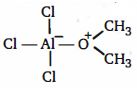
B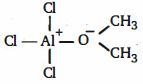
C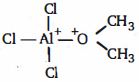
D
$Cl_3Al^{-} - O^{+}(CH_3)_2$
Solution
(A) $AlCl_3$ is a Lewis acid because it has an incomplete octet and can accept a lone pair of electrons. $CH_3OCH_3$ (dimethyl ether) is a Lewis base because the oxygen atom has two lone pairs of electrons. The reaction involves the donation of a lone pair from the oxygen atom of the ether to the aluminum atom of $AlCl_3$,forming a coordinate covalent bond (Lewis acid-base adduct). The oxygen atom acquires a positive charge,and the aluminum atom acquires a negative charge. The product is $(CH_3)_2O^{+} - Al^{-}Cl_3$.
0 likes
View Solution40
DifficultMCQ
In which of the following is a dative bond $NOT$ present?
A
Protonation of ether
B
$HCl$ dissolved in water
C
Dimerisation of $BeCl_2$
D
Dimerisation of benzoic acid
Solution
(D) dative bond (coordinate covalent bond) is not involved in the dimerisation of benzoic acid.
In the dimerisation of benzoic acid,two molecules are held together by intermolecular $H$-bonding.
In the protonation of ether $(R-O-R + H^+ \rightarrow R-O^+(H)-R)$,a dative bond exists between the oxygen atom of the ether and the $H^+$ ion.
When $HCl$ dissolves in water,it forms $H_3O^+$,which contains a dative bond between the oxygen of water and the $H^+$ ion.
In the dimerisation of $BeCl_2$,dative bonds are formed by the donation of lone pairs from chlorine atoms of one $BeCl_2$ molecule to the electron-deficient $Be$ atom of another $BeCl_2$ molecule.
In the dimerisation of benzoic acid,two molecules are held together by intermolecular $H$-bonding.
In the protonation of ether $(R-O-R + H^+ \rightarrow R-O^+(H)-R)$,a dative bond exists between the oxygen atom of the ether and the $H^+$ ion.
When $HCl$ dissolves in water,it forms $H_3O^+$,which contains a dative bond between the oxygen of water and the $H^+$ ion.
In the dimerisation of $BeCl_2$,dative bonds are formed by the donation of lone pairs from chlorine atoms of one $BeCl_2$ molecule to the electron-deficient $Be$ atom of another $BeCl_2$ molecule.
0 likes
View Solution41
MediumMCQ
Dative bond (coordinate bond) is present in:
A
$O_3$
B
$NH_3$
C
$BaCl_2$
D
$BI_3$
Solution
(A) dative bond,also known as a coordinate covalent bond,is formed when one atom provides both electrons for the shared pair.
In the ozone molecule $(O_3)$,the central oxygen atom forms a double bond with one oxygen atom and a coordinate (dative) bond with the other oxygen atom to complete its octet.
$NH_3$ contains only covalent bonds.
$BaCl_2$ is an ionic compound.
$BI_3$ contains covalent bonds where boron is electron-deficient.
In the ozone molecule $(O_3)$,the central oxygen atom forms a double bond with one oxygen atom and a coordinate (dative) bond with the other oxygen atom to complete its octet.
$NH_3$ contains only covalent bonds.
$BaCl_2$ is an ionic compound.
$BI_3$ contains covalent bonds where boron is electron-deficient.
0 likes
View Solution42
MediumMCQ
Bonds present in $N_2O_5$ (nitrogen pentaoxide) are
A
only ionic
B
only covalent
C
covalent and co-ordinate
D
covalent and ionic
Solution
(C) The structure of $N_2O_5$ consists of two nitrogen atoms bonded to a central oxygen atom $(N-O-N)$.
Each nitrogen atom is also double-bonded to an oxygen atom and forms a coordinate covalent bond with another oxygen atom.
Since nitrogen and oxygen are both non-metals,the bonds formed are covalent and coordinate covalent in nature.
There are no ionic bonds present in $N_2O_5$.
Each nitrogen atom is also double-bonded to an oxygen atom and forms a coordinate covalent bond with another oxygen atom.
Since nitrogen and oxygen are both non-metals,the bonds formed are covalent and coordinate covalent in nature.
There are no ionic bonds present in $N_2O_5$.
0 likes
View Solution43
MediumMCQ
Which of the following molecules does not have coordinate bonds?
A
$PH_4^+$
B
$NO_2$
C
$O_3$
D
$CO_3^{2-}$
Solution
(D) coordinate bond (or dative bond) is a type of covalent bond where both electrons come from the same atom.
$1$. In $PH_4^+$,the $P$ atom donates a lone pair to an $H^+$ ion,forming a coordinate bond.
$2$. In $NO_2$,the nitrogen atom forms a coordinate bond with one of the oxygen atoms to complete its octet.
$3$. In $O_3$ (ozone),one oxygen atom forms a coordinate bond with another oxygen atom.
$4$. In $CO_3^{2-}$,the structure consists of one $C=O$ double bond and two $C-O$ single bonds with resonance,involving only standard covalent bonds. There is no coordinate bond present.
Therefore,the correct option is $D$.
$1$. In $PH_4^+$,the $P$ atom donates a lone pair to an $H^+$ ion,forming a coordinate bond.
$2$. In $NO_2$,the nitrogen atom forms a coordinate bond with one of the oxygen atoms to complete its octet.
$3$. In $O_3$ (ozone),one oxygen atom forms a coordinate bond with another oxygen atom.
$4$. In $CO_3^{2-}$,the structure consists of one $C=O$ double bond and two $C-O$ single bonds with resonance,involving only standard covalent bonds. There is no coordinate bond present.
Therefore,the correct option is $D$.
0 likes
View Solution44
MediumMCQ
Which of the following species contains a coordinate covalent bond?
A
$N_2H_5^+$
B
$BaCl_2$
C
$HCl$
D
$H_2O$
Solution
(A) coordinate covalent bond (also known as a dative bond) is formed when one atom donates a pair of electrons to another atom that needs them to complete its octet.
In the case of $N_2H_5^+$,it is formed by the protonation of hydrazine $(N_2H_4)$.
The nitrogen atom in $N_2H_4$ has a lone pair of electrons.
When $H^+$ approaches,the nitrogen atom donates its lone pair to the $H^+$ ion,forming a coordinate covalent bond $(N \rightarrow H^+)$.
Therefore,$N_2H_5^+$ contains a coordinate covalent bond.
In the case of $N_2H_5^+$,it is formed by the protonation of hydrazine $(N_2H_4)$.
The nitrogen atom in $N_2H_4$ has a lone pair of electrons.
When $H^+$ approaches,the nitrogen atom donates its lone pair to the $H^+$ ion,forming a coordinate covalent bond $(N \rightarrow H^+)$.
Therefore,$N_2H_5^+$ contains a coordinate covalent bond.
0 likes
View Solution45
EasyMCQ
What is common between $NH_3$ and $PH_3$?
A
Odor
B
Combustibility
C
Basic character
D
None of these
Solution
(C) Both $NH_3$ and $PH_3$ act as Lewis bases due to the presence of a lone pair of electrons on the central atom ($N$ and $P$ respectively).
Therefore,they both exhibit basic character.
Therefore,they both exhibit basic character.
0 likes
View Solution46
EasyMCQ
The bonds present in $N_2O_5$ are ........
A
Only ionic.
B
Covalent and coordinate.
C
Only covalent.
D
Covalent and ionic.
Solution
(B) The structure of $N_2O_5$ is $O_2N-O-NO_2$.
In this molecule,the $N-O$ bonds are covalent,and the $N \rightarrow O$ bonds are coordinate covalent bonds.
Therefore,$N_2O_5$ contains both covalent and coordinate bonds.
In this molecule,the $N-O$ bonds are covalent,and the $N \rightarrow O$ bonds are coordinate covalent bonds.
Therefore,$N_2O_5$ contains both covalent and coordinate bonds.
0 likes
View Solution47
MediumMCQ
Which of the following compounds contains a coordinate covalent bond?
A
$O_3$
B
$SO_3$
C
$H_2SO_4$
D
All of the above
Solution
(D) coordinate covalent bond (also known as a dative bond) is a type of covalent bond where both electrons come from the same atom.
$1$. In ozone $(O_3)$,the central oxygen atom forms a double bond with one oxygen atom and a coordinate bond with the other.
$2$. In sulfur trioxide $(SO_3)$,the sulfur atom forms one double bond and two coordinate bonds with oxygen atoms.
$3$. In sulfuric acid $(H_2SO_4)$,the sulfur atom forms two double bonds with oxygen atoms and two single bonds with hydroxyl groups (or,in some representations,two coordinate bonds and two single bonds to oxygen atoms).
Since all these molecules contain coordinate covalent bonds,the correct answer is $D$.
$1$. In ozone $(O_3)$,the central oxygen atom forms a double bond with one oxygen atom and a coordinate bond with the other.
$2$. In sulfur trioxide $(SO_3)$,the sulfur atom forms one double bond and two coordinate bonds with oxygen atoms.
$3$. In sulfuric acid $(H_2SO_4)$,the sulfur atom forms two double bonds with oxygen atoms and two single bonds with hydroxyl groups (or,in some representations,two coordinate bonds and two single bonds to oxygen atoms).
Since all these molecules contain coordinate covalent bonds,the correct answer is $D$.
0 likes
View Solution48
MediumMCQ
What is the number of dative bonds in a sulfuric acid molecule?
A
$0$
B
$1$
C
$2$
D
$4$
Solution
(C) The chemical formula of sulfuric acid is $H_2SO_4$.
In the structure of $H_2SO_4$,the central sulfur atom is bonded to two hydroxyl $(-OH)$ groups via single covalent bonds and to two oxygen atoms via double bonds.
However,in terms of coordinate (dative) bonding,the two oxygen atoms are linked to the sulfur atom by dative bonds (often represented as $S \rightarrow O$).
Therefore,there are $2$ dative bonds in a sulfuric acid molecule.
In the structure of $H_2SO_4$,the central sulfur atom is bonded to two hydroxyl $(-OH)$ groups via single covalent bonds and to two oxygen atoms via double bonds.
However,in terms of coordinate (dative) bonding,the two oxygen atoms are linked to the sulfur atom by dative bonds (often represented as $S \rightarrow O$).
Therefore,there are $2$ dative bonds in a sulfuric acid molecule.
0 likes
View Solution49
MediumMCQ
Select the species which is planar at nitrogen.
A
$(CH_3)_3N$
B
$(SiH_3)_3N$
C
$NF_3$
D
$NH_3$
Solution
(B) In $(SiH_3)_3N$,the nitrogen atom has a lone pair of electrons.
Silicon has vacant $3d$ orbitals.
The lone pair on nitrogen is donated into the vacant $d$ orbital of silicon,forming a $p\pi-d\pi$ back bond.
Due to this back bonding,the nitrogen atom undergoes $sp^2$ hybridization and adopts a planar geometry.
Silicon has vacant $3d$ orbitals.
The lone pair on nitrogen is donated into the vacant $d$ orbital of silicon,forming a $p\pi-d\pi$ back bond.
Due to this back bonding,the nitrogen atom undergoes $sp^2$ hybridization and adopts a planar geometry.
0 likes
View Solution50
MediumMCQ
Which of the following does not contain a coordinate covalent bond?
A
$BH_4^-$
B
$NH_4^+$
C
$CO_3^{2-}$
D
$H_3O^+$
Solution
(C) coordinate covalent bond (dative bond) is formed when one atom donates a lone pair of electrons to another atom.
In $BH_4^-$,the $BH_3$ molecule accepts a hydride ion $(H^-)$ to form the bond,which is a coordinate bond.
In $NH_4^+$,the lone pair on nitrogen in $NH_3$ is donated to an $H^+$ ion,forming a coordinate bond.
In $H_3O^+$,the lone pair on oxygen in $H_2O$ is donated to an $H^+$ ion,forming a coordinate bond.
In $CO_3^{2-}$,the structure consists of one $C=O$ double bond and two $C-O$ single bonds with formal charges on oxygen atoms. All bonds are covalent,and there is no dative (coordinate) bond involved in the standard Lewis structure representation.
In $BH_4^-$,the $BH_3$ molecule accepts a hydride ion $(H^-)$ to form the bond,which is a coordinate bond.
In $NH_4^+$,the lone pair on nitrogen in $NH_3$ is donated to an $H^+$ ion,forming a coordinate bond.
In $H_3O^+$,the lone pair on oxygen in $H_2O$ is donated to an $H^+$ ion,forming a coordinate bond.
In $CO_3^{2-}$,the structure consists of one $C=O$ double bond and two $C-O$ single bonds with formal charges on oxygen atoms. All bonds are covalent,and there is no dative (coordinate) bond involved in the standard Lewis structure representation.
0 likes
View SolutionChemical Bonding and Molecular Structure — Co-ordinate or Dative bonding · Frequently Asked Questions
1Are these Chemical Bonding and Molecular Structure questions useful for JEE and NEET?
Yes. All questions in this section are mapped to JEE Main and NEET exam patterns. Previous year questions from JEE Main, NEET, GUJCET and state-level exams are included with full solutions.
2Can I switch to Hindi or Gujarati for these questions?
Yes. Use the language tabs in the hero section or the sidebar to view the same questions and solutions in English, Hindi or Gujarati.
3How do I generate a question paper from this subtopic?
Use the Vedclass Exam Paper Generator — select the chapter and subtopic, set difficulty, and generate Sets A, B, C, D automatically. First 3 chapters of every subject are free.
Vedclass Products
For Students
Vedclass Test Series
Mock tests in real JEE/NEET style with performance analysis. 5-day free trial.
Start Free TrialFor Teachers
Exam Paper Generator
Generate Set A/B/C/D papers from this chapter in 2 minutes. 3 chapters free.
Try FreeFor Institutes
Online Exam Module
Live online exams with unlimited students, 360° analytics & white-label branding.
See DemoFor Teachers & Institutes
Generate a Chemical Bonding and Molecular Structure Exam Paper in 2 Minutes
Select subtopic & difficulty — Sets A, B, C, D auto-generated with No Repeat logic.
First 3 chapters of every subject are free — no payment required.