
ChemistryQ1–70 of 199 questions
Page 1 of 4 · English
1
ChemistryMCQTS EAMCET · 2008
Identify $A$ and $B$ in the following reaction:
$CH_3-CH_3 \xleftarrow{B} CH_3COOH \xrightarrow{A} CH_3CH_2OH$
$CH_3-CH_3 \xleftarrow{B} CH_3COOH \xrightarrow{A} CH_3CH_2OH$
| $A$ | $B$ |
A
$HI +$ red $P$ $\quad$ $LiAlH_4$
B
$Ni / \Delta$ $\quad$ $LiAlH_4$
C
$LiAlH_4$ $\quad$ $HI +$ red $P$
D
$Pd-BaSO_4$ $\quad$ $Zn + HCl$
Solution
(C) Acetic acid $(CH_3COOH)$ on reduction with lithium aluminium hydride $(LiAlH_4)$ yields ethyl alcohol $(CH_3CH_2OH)$.
$CH_3COOH \xrightarrow{LiAlH_4} CH_3CH_2OH$
Acetic acid on reduction with $HI$ and red $P$ yields ethane $(CH_3-CH_3)$.
$CH_3COOH \xrightarrow{\text{Red } P + HI} CH_3-CH_3$
Therefore,reagent $A$ is $LiAlH_4$ and reagent $B$ is $HI +$ red $P$.
$CH_3COOH \xrightarrow{LiAlH_4} CH_3CH_2OH$
Acetic acid on reduction with $HI$ and red $P$ yields ethane $(CH_3-CH_3)$.
$CH_3COOH \xrightarrow{\text{Red } P + HI} CH_3-CH_3$
Therefore,reagent $A$ is $LiAlH_4$ and reagent $B$ is $HI +$ red $P$.
0 likesView Solution
2
ChemistryMCQTS EAMCET · 2008
The correct order of reactivity of hydrogen halides with ethyl alcohol is
A
$HF > HCl > HBr > HI$
B
$HCl > HBr > HF > HI$
C
$HBr > HCl > HI > HF$
D
$HI > HBr > HCl > HF$
Solution
(D) The reaction of hydrogen halides $(HX)$ with ethyl alcohol $(C_2H_5OH)$ involves the cleavage of the $C-O$ bond,which is facilitated by the nucleophilic attack of the halide ion $(X^-)$.
As the size of the halide ion increases from $F^-$ to $I^-$,the bond dissociation energy of the $H-X$ bond decreases,and the nucleophilicity of the halide ion increases.
Therefore,the reactivity of hydrogen halides towards ethyl alcohol follows the order: $HI > HBr > HCl > HF$.
As the size of the halide ion increases from $F^-$ to $I^-$,the bond dissociation energy of the $H-X$ bond decreases,and the nucleophilicity of the halide ion increases.
Therefore,the reactivity of hydrogen halides towards ethyl alcohol follows the order: $HI > HBr > HCl > HF$.
0 likesView Solution
3
ChemistryMCQTS EAMCET · 2008
Acetone on addition to methyl magnesium bromide forms a complex,which on decomposition with acid gives $X$ and $Mg(OH)Br$. Which one of the following is $X$?
A
$CH_3OH$
B
$(CH_3)_3COH$
C
$(CH_3)_2CHOH$
D
$CH_3CH_2OH$
Solution
(B) The reaction of acetone $(CH_3COCH_3)$ with methyl magnesium bromide $(CH_3MgBr)$ is a nucleophilic addition reaction.
Acetone reacts with $CH_3MgBr$ to form an addition complex,$(CH_3)_3COMgBr$.
This complex,upon acid hydrolysis (decomposition with acid),yields a tertiary alcohol,$X$,which is $2$-methylpropan-$2$-ol or tert-butyl alcohol,$(CH_3)_3COH$,along with $Mg(OH)Br$.
The reaction is: $(CH_3)_2C=O + CH_3MgBr$ $\rightarrow (CH_3)_3COMgBr$ $\xrightarrow{H_3O^+} (CH_3)_3COH + Mg(OH)Br$.
Acetone reacts with $CH_3MgBr$ to form an addition complex,$(CH_3)_3COMgBr$.
This complex,upon acid hydrolysis (decomposition with acid),yields a tertiary alcohol,$X$,which is $2$-methylpropan-$2$-ol or tert-butyl alcohol,$(CH_3)_3COH$,along with $Mg(OH)Br$.
The reaction is: $(CH_3)_2C=O + CH_3MgBr$ $\rightarrow (CH_3)_3COMgBr$ $\xrightarrow{H_3O^+} (CH_3)_3COH + Mg(OH)Br$.
0 likesView Solution
4
ChemistryMCQTS EAMCET · 2008
The number of turns in the primary and secondary coils of a transformer are $50$ and $200$ respectively. If the current in the primary coil is $4 ~A$,then the current in the secondary coil is: (in $~A$)
A
$1$
B
$2$
C
$4$
D
$5$
Solution
(A) For an ideal transformer,the relationship between the number of turns $(N)$ and current $(I)$ is given by the inverse ratio:
$\frac{N_P}{N_S} = \frac{I_S}{I_P}$
Given:
$N_P = 50$
$N_S = 200$
$I_P = 4 ~A$
Substituting the values into the formula:
$\frac{50}{200} = \frac{I_S}{4}$
$\frac{1}{4} = \frac{I_S}{4}$
$I_S = 1 ~A$
Therefore,the current in the secondary coil is $1 ~A$.
$\frac{N_P}{N_S} = \frac{I_S}{I_P}$
Given:
$N_P = 50$
$N_S = 200$
$I_P = 4 ~A$
Substituting the values into the formula:
$\frac{50}{200} = \frac{I_S}{4}$
$\frac{1}{4} = \frac{I_S}{4}$
$I_S = 1 ~A$
Therefore,the current in the secondary coil is $1 ~A$.
0 likesView Solution
5
ChemistryMCQTS EAMCET · 2008
The structure of the compound formed when nitrobenzene is reduced by lithium aluminium hydride $(LiAlH_4)$ is
A
Hydrazobenzene
B
Phenylhydroxylamine
C
Azobenzene
D
Aniline
Solution
(C) The reduction of nitrobenzene with lithium aluminium hydride $(LiAlH_4)$ in an ether solvent typically leads to the formation of azobenzene as the major product. The reaction involves the coupling of two nitrobenzene molecules.
$2C_6H_5NO_2 \xrightarrow{LiAlH_4} C_6H_5-N=N-C_6H_5$ (Azobenzene)
$2C_6H_5NO_2 \xrightarrow{LiAlH_4} C_6H_5-N=N-C_6H_5$ (Azobenzene)
0 likesView Solution
6
ChemistryMCQTS EAMCET · 2008
Hydrolysis of sucrose with dilute aqueous sulphuric acid yields
A
$1: 1$ $D-(+)$-glucose; $D-(-)$-fructose
B
$1: 2$ $D-(+)$-glucose; $D-(-)$-fructose
C
$1: 1$ $D-(-)$-glucose; $D-(+)$-fructose
D
$1: 2$ $D-(-)$-glucose; $D-(+)$-fructose
Solution
(A) Sucrose undergoes hydrolysis in the presence of dilute aqueous sulphuric acid to produce an equimolar mixture of $D-(+)$-glucose and $D-(-)$-fructose.
$C_{12}H_{22}O_{11} + H_2O$ $\xrightarrow{H_2SO_4} C_6H_{12}O_6 (D-(+)\text{-glucose}) + C_6H_{12}O_6 (D-(-)\text{-fructose})$
This process results in a $1: 1$ molar ratio of the two monosaccharides.
Since the specific rotation of $D-(-)$-fructose $(-92.4^{\circ})$ is greater in magnitude than that of $D-(+)$-glucose $(+52.7^{\circ})$,the resulting mixture is laevorotatory,which is why the process is often called the inversion of cane sugar.
$C_{12}H_{22}O_{11} + H_2O$ $\xrightarrow{H_2SO_4} C_6H_{12}O_6 (D-(+)\text{-glucose}) + C_6H_{12}O_6 (D-(-)\text{-fructose})$
This process results in a $1: 1$ molar ratio of the two monosaccharides.
Since the specific rotation of $D-(-)$-fructose $(-92.4^{\circ})$ is greater in magnitude than that of $D-(+)$-glucose $(+52.7^{\circ})$,the resulting mixture is laevorotatory,which is why the process is often called the inversion of cane sugar.
0 likesView Solution
7
ChemistryMCQTS EAMCET · 2008
The compound in which the number of $d\pi - p\pi$ bonds are equal to those present in $ClO_4^{-}$ is:
A
$XeF_4$
B
$XeO_3$
C
$XeO_4$
D
$XeF_6$
Solution
(B) The structure of $ClO_4^{-}$ involves one $Cl-O$ single bond and three $Cl=O$ double bonds. Each $Cl=O$ double bond consists of one $\sigma$ bond and one $d\pi - p\pi$ back bond. Thus,$ClO_4^{-}$ contains $3 \ d\pi - p\pi$ bonds.
In $XeO_3$,the xenon atom is $sp^3$ hybridized with one lone pair. It has three $Xe=O$ double bonds. Each $Xe=O$ double bond involves one $d\pi - p\pi$ bond. Therefore,$XeO_3$ contains $3 \ d\pi - p\pi$ bonds,which is equal to the number present in $ClO_4^{-}$.
In $XeO_3$,the xenon atom is $sp^3$ hybridized with one lone pair. It has three $Xe=O$ double bonds. Each $Xe=O$ double bond involves one $d\pi - p\pi$ bond. Therefore,$XeO_3$ contains $3 \ d\pi - p\pi$ bonds,which is equal to the number present in $ClO_4^{-}$.
0 likesView Solution
8
ChemistryMCQTS EAMCET · 2008
The bond length of $HCl$ molecule is $1.275 \ \mathring{A}$ and its dipole moment is $1.03 \ D$. The ionic character of the molecule (in percent) (charge of the electron $= 4.8 \times 10^{-10} \ esu$) is
A
$100$
B
$67.3$
C
$33.6$
D
$16.83$
Solution
(D) Given:
Observed dipole moment $= 1.03 \ D$
Bond length of $HCl$ molecule,$d = 1.275 \ \mathring{A} = 1.275 \times 10^{-8} \ cm$
Charge of electron,$e = 4.8 \times 10^{-10} \ esu$
Theoretical dipole moment $= e \times d = (4.8 \times 10^{-10} \ esu) \times (1.275 \times 10^{-8} \ cm) = 6.12 \times 10^{-18} \ esu \cdot cm = 6.12 \ D$
Percentage ionic character $= \frac{\text{Observed dipole moment}}{\text{Theoretical dipole moment}} \times 100$
Percentage ionic character $= \frac{1.03}{6.12} \times 100 = 16.83 \%$
Observed dipole moment $= 1.03 \ D$
Bond length of $HCl$ molecule,$d = 1.275 \ \mathring{A} = 1.275 \times 10^{-8} \ cm$
Charge of electron,$e = 4.8 \times 10^{-10} \ esu$
Theoretical dipole moment $= e \times d = (4.8 \times 10^{-10} \ esu) \times (1.275 \times 10^{-8} \ cm) = 6.12 \times 10^{-18} \ esu \cdot cm = 6.12 \ D$
Percentage ionic character $= \frac{\text{Observed dipole moment}}{\text{Theoretical dipole moment}} \times 100$
Percentage ionic character $= \frac{1.03}{6.12} \times 100 = 16.83 \%$
0 likesView Solution
9
ChemistryMCQTS EAMCET · 2008
In a $500 \ mL$ flask,the degree of dissociation of $PCl_5$ at equilibrium is $40 \%$ and the initial amount is $5 \ moles$. The value of equilibrium constant in $mol \ L^{-1}$ for the decomposition of $PCl_5$ is
A
$2.33$
B
$2.66$
C
$5.32$
D
$4.66$
Solution
(B) The decomposition reaction is: $PCl_5 \rightleftharpoons PCl_3 + Cl_2$
Initial moles: $5, 0, 0$
Moles at equilibrium: $5(1-\alpha), 5\alpha, 5\alpha$
Given $\alpha = 40 \% = 0.4$,so moles at equilibrium are: $5(1-0.4) = 3$,$5(0.4) = 2$,$5(0.4) = 2$
Volume of flask $V = 500 \ mL = 0.5 \ L$
Concentrations at equilibrium: $[PCl_5] = \frac{3}{0.5} = 6 \ M$,$[PCl_3] = \frac{2}{0.5} = 4 \ M$,$[Cl_2] = \frac{2}{0.5} = 4 \ M$
$K_c = \frac{[PCl_3][Cl_2]}{[PCl_5]} = \frac{4 \times 4}{6} = \frac{16}{6} = 2.66 \ mol \ L^{-1}$
Initial moles: $5, 0, 0$
Moles at equilibrium: $5(1-\alpha), 5\alpha, 5\alpha$
Given $\alpha = 40 \% = 0.4$,so moles at equilibrium are: $5(1-0.4) = 3$,$5(0.4) = 2$,$5(0.4) = 2$
Volume of flask $V = 500 \ mL = 0.5 \ L$
Concentrations at equilibrium: $[PCl_5] = \frac{3}{0.5} = 6 \ M$,$[PCl_3] = \frac{2}{0.5} = 4 \ M$,$[Cl_2] = \frac{2}{0.5} = 4 \ M$
$K_c = \frac{[PCl_3][Cl_2]}{[PCl_5]} = \frac{4 \times 4}{6} = \frac{16}{6} = 2.66 \ mol \ L^{-1}$
0 likesView Solution
10
ChemistryMCQTS EAMCET · 2008
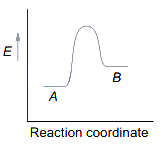
For a reversible reaction $A \rightleftharpoons B$,which one of the following statements is wrong from the given energy profile diagram?
A
Activation energy of forward reaction is greater than backward reaction
B
The forward reaction is endothermic
C
The threshold energy is less than that of activation energy
D
The energy of activation of forward reaction is equal to the sum of heat of reaction and the energy of activation of backward reaction
Solution
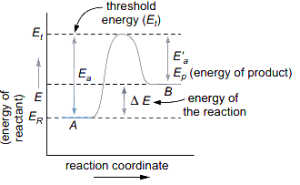
(C) From the energy profile diagram,we have:
$E_a = \text{activation energy of forward reaction}$
$E_a^{\prime} = \text{activation energy of backward reaction}$
$E_t = \text{threshold energy}$
$1$. The diagram shows that the peak energy $(E_t)$ is higher than the energy of the reactants $(E_R)$ and products $(E_P)$.
$2$. The activation energy for the forward reaction is $E_a = E_t - E_R$.
$3$. The activation energy for the backward reaction is $E_a^{\prime} = E_t - E_P$.
$4$. Since $E_P > E_R$,it follows that $E_a > E_a^{\prime}$. Thus,option $A$ is correct.
$5$. Since the potential energy of the product is greater than that of the reactant $(E_P > E_R)$,the reaction is endothermic. Thus,option $B$ is correct.
$6$. The threshold energy $(E_t)$ is the minimum energy required for the reaction to occur,which is always greater than or equal to the activation energy of the forward reaction $(E_t = E_a + E_R)$. Therefore,the statement that threshold energy is less than the activation energy is incorrect. Thus,option $C$ is wrong.
$7$. The energy of the forward reaction is $E_a = \Delta H + E_a^{\prime}$,where $\Delta H$ is the heat of reaction. Thus,option $D$ is correct.
$E_a = \text{activation energy of forward reaction}$
$E_a^{\prime} = \text{activation energy of backward reaction}$
$E_t = \text{threshold energy}$
$1$. The diagram shows that the peak energy $(E_t)$ is higher than the energy of the reactants $(E_R)$ and products $(E_P)$.
$2$. The activation energy for the forward reaction is $E_a = E_t - E_R$.
$3$. The activation energy for the backward reaction is $E_a^{\prime} = E_t - E_P$.
$4$. Since $E_P > E_R$,it follows that $E_a > E_a^{\prime}$. Thus,option $A$ is correct.
$5$. Since the potential energy of the product is greater than that of the reactant $(E_P > E_R)$,the reaction is endothermic. Thus,option $B$ is correct.
$6$. The threshold energy $(E_t)$ is the minimum energy required for the reaction to occur,which is always greater than or equal to the activation energy of the forward reaction $(E_t = E_a + E_R)$. Therefore,the statement that threshold energy is less than the activation energy is incorrect. Thus,option $C$ is wrong.
$7$. The energy of the forward reaction is $E_a = \Delta H + E_a^{\prime}$,where $\Delta H$ is the heat of reaction. Thus,option $D$ is correct.
0 likesView Solution
11
ChemistryMCQTS EAMCET · 2008
The atomic numbers of elements $A$,$B$,$C$ and $D$ are $Z-1$,$Z$,$Z+1$ and $Z+2$,respectively. If $B$ is a noble gas,choose the correct statements from the following:
$(1)$ $A$ has high electron affinity
$(2)$ $C$ exists in $+2$ oxidation state
$(3)$ $D$ is an alkaline earth metal
$(1)$ $A$ has high electron affinity
$(2)$ $C$ exists in $+2$ oxidation state
$(3)$ $D$ is an alkaline earth metal
A
$(1)$ and $(2)$
B
$(2)$ and $(3)$
C
$(1)$ and $(3)$
D
$(1)$,$(2)$ and $(3)$
Solution
(C) Given,atomic number of $B = Z$. Since $B$ is a noble gas,it belongs to group $18$.
The atomic number of $A = Z-1$,which corresponds to a halogen (group $17$).
The atomic number of $C = Z+1$,which corresponds to an alkali metal (group $1$).
The atomic number of $D = Z+2$,which corresponds to an alkaline earth metal (group $2$).
Statement $(1)$: Halogens $(A)$ have high electron affinity. This is correct.
Statement $(2)$: $C$ is an alkali metal,so it exists in $+1$ oxidation state,not $+2$. This is incorrect.
Statement $(3)$: $D$ is an alkaline earth metal (group $2$). This is correct.
Therefore,statements $(1)$ and $(3)$ are correct.
The atomic number of $A = Z-1$,which corresponds to a halogen (group $17$).
The atomic number of $C = Z+1$,which corresponds to an alkali metal (group $1$).
The atomic number of $D = Z+2$,which corresponds to an alkaline earth metal (group $2$).
Statement $(1)$: Halogens $(A)$ have high electron affinity. This is correct.
Statement $(2)$: $C$ is an alkali metal,so it exists in $+1$ oxidation state,not $+2$. This is incorrect.
Statement $(3)$: $D$ is an alkaline earth metal (group $2$). This is correct.
Therefore,statements $(1)$ and $(3)$ are correct.
0 likesView Solution
12
ChemistryMCQTS EAMCET · 2008
When a battery is connected across a resistor of $16 \Omega$,the voltage across the resistor is $12 \ V$. When the same battery is connected across a resistor of $10 \Omega$,the voltage across it is $11 \ V$. The internal resistance of the battery in ohm is
A
$\frac{10}{7}$
B
$\frac{20}{7}$
C
$\frac{25}{7}$
D
$\frac{30}{7}$
Solution
(B) Let $E$ be the $EMF$ of the battery and $r$ be its internal resistance.
The terminal voltage $V$ is given by $V = E - Ir$,where $I = \frac{V}{R}$.
Thus,$E = V + \frac{V}{R}r = V(1 + \frac{r}{R})$.
For the first case: $R_1 = 16 \ \Omega$,$V_1 = 12 \ V$.
$E = 12(1 + \frac{r}{16}) = 12 + \frac{12r}{16} = 12 + \frac{3r}{4} \quad \dots (i)$
For the second case: $R_2 = 10 \ \Omega$,$V_2 = 11 \ V$.
$E = 11(1 + \frac{r}{10}) = 11 + \frac{11r}{10} \quad \dots (ii)$
Equating $(i)$ and $(ii)$:
$12 + \frac{3r}{4} = 11 + \frac{11r}{10}$
$1 = \frac{11r}{10} - \frac{3r}{4}$
$1 = \frac{22r - 15r}{20} = \frac{7r}{20}$
$r = \frac{20}{7} \ \Omega$.
The terminal voltage $V$ is given by $V = E - Ir$,where $I = \frac{V}{R}$.
Thus,$E = V + \frac{V}{R}r = V(1 + \frac{r}{R})$.
For the first case: $R_1 = 16 \ \Omega$,$V_1 = 12 \ V$.
$E = 12(1 + \frac{r}{16}) = 12 + \frac{12r}{16} = 12 + \frac{3r}{4} \quad \dots (i)$
For the second case: $R_2 = 10 \ \Omega$,$V_2 = 11 \ V$.
$E = 11(1 + \frac{r}{10}) = 11 + \frac{11r}{10} \quad \dots (ii)$
Equating $(i)$ and $(ii)$:
$12 + \frac{3r}{4} = 11 + \frac{11r}{10}$
$1 = \frac{11r}{10} - \frac{3r}{4}$
$1 = \frac{22r - 15r}{20} = \frac{7r}{20}$
$r = \frac{20}{7} \ \Omega$.
0 likesView Solution
13
ChemistryMCQTS EAMCET · 2008
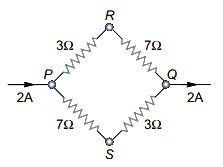
$A$ current of $2 \, A$ flows in an electric circuit as shown in the figure. The potential difference $(V_R - V_S)$, in volts ($V_R$ and $V_S$ are potentials at $R$ and $S$ respectively) is:
A
$-4$
B
$+2$
C
$+4$
D
$-2$
Solution
(C) The circuit consists of two parallel branches $PRQ$ and $PSQ$ connected between points $P$ and $Q$.
Branch $PRQ$ has a total resistance of $3 \, \Omega + 7 \, \Omega = 10 \, \Omega$.
Branch $PSQ$ has a total resistance of $7 \, \Omega + 3 \, \Omega = 10 \, \Omega$.
Since the resistances of both branches are equal, the total current of $2 \, A$ splits equally into $1 \, A$ through each branch.
For branch $PRQ$, the current $I_1 = 1 \, A$. The potential drop across the $3 \, \Omega$ resistor is $V_P - V_R = I_1 \times 3 \, \Omega = 1 \, A \times 3 \, \Omega = 3 \, V$.
For branch $PSQ$, the current $I_2 = 1 \, A$. The potential drop across the $7 \, \Omega$ resistor is $V_P - V_S = I_2 \times 7 \, \Omega = 1 \, A \times 7 \, \Omega = 7 \, V$.
We want to find $V_R - V_S$. From the above equations:
$V_R = V_P - 3$
$V_S = V_P - 7$
Subtracting these gives: $V_R - V_S = (V_P - 3) - (V_P - 7) = -3 + 7 = +4 \, V$.
Branch $PRQ$ has a total resistance of $3 \, \Omega + 7 \, \Omega = 10 \, \Omega$.
Branch $PSQ$ has a total resistance of $7 \, \Omega + 3 \, \Omega = 10 \, \Omega$.
Since the resistances of both branches are equal, the total current of $2 \, A$ splits equally into $1 \, A$ through each branch.
For branch $PRQ$, the current $I_1 = 1 \, A$. The potential drop across the $3 \, \Omega$ resistor is $V_P - V_R = I_1 \times 3 \, \Omega = 1 \, A \times 3 \, \Omega = 3 \, V$.
For branch $PSQ$, the current $I_2 = 1 \, A$. The potential drop across the $7 \, \Omega$ resistor is $V_P - V_S = I_2 \times 7 \, \Omega = 1 \, A \times 7 \, \Omega = 7 \, V$.
We want to find $V_R - V_S$. From the above equations:
$V_R = V_P - 3$
$V_S = V_P - 7$
Subtracting these gives: $V_R - V_S = (V_P - 3) - (V_P - 7) = -3 + 7 = +4 \, V$.
0 likesView Solution
14
ChemistryMCQTS EAMCET · 2008
In a galvanometer,$5 \%$ of the total current in the circuit passes through it. If the resistance of the galvanometer is $G$,the shunt resistance $S$ connected to the galvanometer is
A
$19 G$
B
$\frac{G}{19}$
C
$20 G$
D
$\frac{G}{20}$
Solution
(B) Let the total current in the circuit be $I$ and the current through the galvanometer be $I_g$.
Given that $I_g = 5 \% \text{ of } I = 0.05 I$.
The shunt resistance $S$ is connected in parallel to the galvanometer $G$.
Using the current division rule,the current through the galvanometer is given by $I_g = I \times \frac{S}{S+G}$.
Substituting the values: $0.05 I = I \times \frac{S}{S+G}$.
$0.05 = \frac{S}{S+G} \implies 0.05(S+G) = S$.
$0.05 S + 0.05 G = S$.
$0.05 G = 0.95 S$.
$S = \frac{0.05 G}{0.95} = \frac{G}{19}$.
Given that $I_g = 5 \% \text{ of } I = 0.05 I$.
The shunt resistance $S$ is connected in parallel to the galvanometer $G$.
Using the current division rule,the current through the galvanometer is given by $I_g = I \times \frac{S}{S+G}$.
Substituting the values: $0.05 I = I \times \frac{S}{S+G}$.
$0.05 = \frac{S}{S+G} \implies 0.05(S+G) = S$.
$0.05 S + 0.05 G = S$.
$0.05 G = 0.95 S$.
$S = \frac{0.05 G}{0.95} = \frac{G}{19}$.
0 likesView Solution
15
ChemistryMCQTS EAMCET · 2008
An $X$-ray tube produces a continuous spectrum of radiation with its shortest wavelength of $45 \times 10^{-2} \text{ \AA}$. The maximum energy of a photon in the radiation in $eV$ is $(h = 6.62 \times 10^{-34} \text{ J-s}, c = 3 \times 10^8 \text{ m/s})$. (in $27,500$)
A
$27$
B
$22$
C
$17$
D
$12$
Solution
(A) The energy of a photon is given by $E = \frac{hc}{\lambda}$.
Given, $\lambda = 45 \times 10^{-2} \text{ \AA} = 45 \times 10^{-12} \text{ m}$.
$E = \frac{6.62 \times 10^{-34} \times 3 \times 10^8}{45 \times 10^{-12}} \text{ J}$.
To convert energy into $eV$, divide by $1.6 \times 10^{-19} \text{ C}$.
$E = \frac{19.86 \times 10^{-26}}{45 \times 10^{-12} \times 1.6 \times 10^{-19}} \text{ eV}$.
$E = \frac{19.86 \times 10^{-26}}{72 \times 10^{-31}} \text{ eV}$.
$E \approx 0.2758 \times 10^5 \text{ eV} = 27,580 \text{ eV}$.
Rounding to the nearest option, the maximum energy is $27,500 \text{ eV}$.
Given, $\lambda = 45 \times 10^{-2} \text{ \AA} = 45 \times 10^{-12} \text{ m}$.
$E = \frac{6.62 \times 10^{-34} \times 3 \times 10^8}{45 \times 10^{-12}} \text{ J}$.
To convert energy into $eV$, divide by $1.6 \times 10^{-19} \text{ C}$.
$E = \frac{19.86 \times 10^{-26}}{45 \times 10^{-12} \times 1.6 \times 10^{-19}} \text{ eV}$.
$E = \frac{19.86 \times 10^{-26}}{72 \times 10^{-31}} \text{ eV}$.
$E \approx 0.2758 \times 10^5 \text{ eV} = 27,580 \text{ eV}$.
Rounding to the nearest option, the maximum energy is $27,500 \text{ eV}$.
0 likesView Solution
16
ChemistryMCQTS EAMCET · 2008
When electric current is passed through acidified water for $1930 \ s$,$1120 \ mL$ of $H_2$ gas is collected (at $STP$) at the cathode. What is the current passed in amperes?
A
$0.05$
B
$0.50$
C
$5.0$
D
$50$
Solution
(C) The reduction reaction at the cathode is: $2H^{+} + 2e^{-} \rightarrow H_2$.
Given volume of $H_2$ gas $= 1120 \ mL = 1.12 \ L$.
Number of moles of $H_2$ gas $= \frac{1.12 \ L}{22.4 \ L/mol} = 0.05 \ mol$.
According to the reaction,$1 \ mol$ of $H_2$ requires $2 \ mol$ of electrons.
Therefore,$0.05 \ mol$ of $H_2$ requires $0.05 \times 2 = 0.1 \ mol$ of electrons.
Total charge $Q = n \times F = 0.1 \times 96500 \ C = 9650 \ C$.
Using the formula $Q = I \times t$,where $t = 1930 \ s$:
$I = \frac{Q}{t} = \frac{9650 \ C}{1930 \ s} = 5.0 \ A$.
Given volume of $H_2$ gas $= 1120 \ mL = 1.12 \ L$.
Number of moles of $H_2$ gas $= \frac{1.12 \ L}{22.4 \ L/mol} = 0.05 \ mol$.
According to the reaction,$1 \ mol$ of $H_2$ requires $2 \ mol$ of electrons.
Therefore,$0.05 \ mol$ of $H_2$ requires $0.05 \times 2 = 0.1 \ mol$ of electrons.
Total charge $Q = n \times F = 0.1 \times 96500 \ C = 9650 \ C$.
Using the formula $Q = I \times t$,where $t = 1930 \ s$:
$I = \frac{Q}{t} = \frac{9650 \ C}{1930 \ s} = 5.0 \ A$.
0 likesView Solution
17
ChemistryMCQTS EAMCET · 2008
When the same quantity of electricity is passed through aqueous $AgNO_3$ and $H_2SO_4$ solutions connected in series,$5.04 \times 10^{-2} \ g$ of $H_2$ is liberated. What is the mass of silver (in grams) deposited? (Eq. wts. of hydrogen $= 1.008$,silver $= 108$)
A
$54$
B
$0.54$
C
$5.4$
D
$10.8$
Solution
(C) According to Faraday's second law of electrolysis,when the same quantity of electricity is passed through different electrolytes connected in series,the masses of substances deposited are proportional to their equivalent weights.
$\frac{\text{Mass of silver}}{\text{Mass of hydrogen}} = \frac{\text{Eq. wt. of silver}}{\text{Eq. wt. of hydrogen}}$
Given:
Mass of $H_2 = 5.04 \times 10^{-2} \ g$
Eq. wt. of $H_2 = 1.008$
Eq. wt. of $Ag = 108$
Let the mass of silver deposited be $w$.
$\frac{w}{5.04 \times 10^{-2}} = \frac{108}{1.008}$
$w = \frac{108 \times 5.04 \times 10^{-2}}{1.008}$
$w = 100 \times 5.04 \times 10^{-2} = 5.4 \ g$
Thus,the mass of silver deposited is $5.4 \ g$.
$\frac{\text{Mass of silver}}{\text{Mass of hydrogen}} = \frac{\text{Eq. wt. of silver}}{\text{Eq. wt. of hydrogen}}$
Given:
Mass of $H_2 = 5.04 \times 10^{-2} \ g$
Eq. wt. of $H_2 = 1.008$
Eq. wt. of $Ag = 108$
Let the mass of silver deposited be $w$.
$\frac{w}{5.04 \times 10^{-2}} = \frac{108}{1.008}$
$w = \frac{108 \times 5.04 \times 10^{-2}}{1.008}$
$w = 100 \times 5.04 \times 10^{-2} = 5.4 \ g$
Thus,the mass of silver deposited is $5.4 \ g$.
0 likesView Solution
18
ChemistryMCQTS EAMCET · 2008
$X$-rays of wavelength $0.140 \ nm$ are scattered from a block of carbon. What will be the wavelength of $X$-rays scattered at $90^{\circ}$ (in $nm$)?
A
$0.140$
B
$0.142$
C
$0.144$
D
$0.146$
Solution
(B) The Compton shift formula is given by $\Delta \lambda = \lambda' - \lambda = \frac{h}{m_e c} (1 - \cos \phi)$.
Given $\lambda = 0.140 \ nm = 0.140 \times 10^{-9} \ m$ and $\phi = 90^{\circ}$.
Since $\cos 90^{\circ} = 0$,the shift is $\Delta \lambda = \frac{h}{m_e c}$.
The Compton wavelength $\frac{h}{m_e c} \approx 2.426 \times 10^{-12} \ m = 0.002426 \ nm$.
Therefore,$\lambda' = \lambda + \Delta \lambda = 0.140 \ nm + 0.002426 \ nm = 0.142426 \ nm$.
Rounding to three decimal places,we get $\lambda' \approx 0.142 \ nm$.
Given $\lambda = 0.140 \ nm = 0.140 \times 10^{-9} \ m$ and $\phi = 90^{\circ}$.
Since $\cos 90^{\circ} = 0$,the shift is $\Delta \lambda = \frac{h}{m_e c}$.
The Compton wavelength $\frac{h}{m_e c} \approx 2.426 \times 10^{-12} \ m = 0.002426 \ nm$.
Therefore,$\lambda' = \lambda + \Delta \lambda = 0.140 \ nm + 0.002426 \ nm = 0.142426 \ nm$.
Rounding to three decimal places,we get $\lambda' \approx 0.142 \ nm$.
0 likesView Solution
19
ChemistryMCQTS EAMCET · 2008
$A$ charge of $1 \mu C$ is divided into two parts such that their charges are in the ratio of $2: 3$. These two charges are kept at a distance $1 \ m$ apart in vacuum. Then,the electric force between them (in $N$) is
A
$0.216$
B
$0.00216$
C
$0.0216$
D
$2.16$
Solution
(B) Given total charge $Q = 1 \mu C = 10^{-6} \ C$.
The charges are divided in the ratio $2:3$.
Therefore,$q_1 = \frac{2}{2+3} \times 10^{-6} \ C = 0.4 \times 10^{-6} \ C$ and $q_2 = \frac{3}{2+3} \times 10^{-6} \ C = 0.6 \times 10^{-6} \ C$.
The distance between them is $r = 1 \ m$.
The electrostatic force $F$ is given by Coulomb's Law: $F = \frac{1}{4 \pi \varepsilon_0} \frac{q_1 q_2}{r^2}$.
Substituting the values: $F = (9 \times 10^9) \times \frac{(0.4 \times 10^{-6}) \times (0.6 \times 10^{-6})}{1^2}$.
$F = 9 \times 10^9 \times 0.24 \times 10^{-12} = 2.16 \times 10^{-3} \ N = 0.00216 \ N$.
The charges are divided in the ratio $2:3$.
Therefore,$q_1 = \frac{2}{2+3} \times 10^{-6} \ C = 0.4 \times 10^{-6} \ C$ and $q_2 = \frac{3}{2+3} \times 10^{-6} \ C = 0.6 \times 10^{-6} \ C$.
The distance between them is $r = 1 \ m$.
The electrostatic force $F$ is given by Coulomb's Law: $F = \frac{1}{4 \pi \varepsilon_0} \frac{q_1 q_2}{r^2}$.
Substituting the values: $F = (9 \times 10^9) \times \frac{(0.4 \times 10^{-6}) \times (0.6 \times 10^{-6})}{1^2}$.
$F = 9 \times 10^9 \times 0.24 \times 10^{-12} = 2.16 \times 10^{-3} \ N = 0.00216 \ N$.
0 likesView Solution
20
ChemistryMCQTS EAMCET · 2008
Among the following compounds,which one is not responsible for the depletion of the ozone layer?
A
$CH_4$
B
$CFCl_3$
C
$NO$
D
$Cl_2$
Solution
(A) In the stratosphere,the following reactions occur which are responsible for the depletion of the ozone layer:
$NO + O_3 \longrightarrow NO_2 + O_2$
$CF_2Cl_2 \stackrel{h\nu}{\longrightarrow} \dot{C}F_2Cl + \dot{Cl}$
$CFCl_3 \stackrel{h\nu}{\longrightarrow} \dot{C}FCl_2 + \dot{Cl}$
$\dot{Cl} + O_3 \longrightarrow Cl\dot{O} + O_2$
$Cl\dot{O} + O \longrightarrow \dot{Cl} + O_2$
Hence,methane $(CH_4)$ is not responsible for ozone layer depletion.
$NO + O_3 \longrightarrow NO_2 + O_2$
$CF_2Cl_2 \stackrel{h\nu}{\longrightarrow} \dot{C}F_2Cl + \dot{Cl}$
$CFCl_3 \stackrel{h\nu}{\longrightarrow} \dot{C}FCl_2 + \dot{Cl}$
$\dot{Cl} + O_3 \longrightarrow Cl\dot{O} + O_2$
$Cl\dot{O} + O \longrightarrow \dot{Cl} + O_2$
Hence,methane $(CH_4)$ is not responsible for ozone layer depletion.
0 likesView Solution
21
ChemistryEasyMCQTS EAMCET · 2008
The $IUPAC$ name of the compound $C_2H_5-O-CH(CH_3)_2$ is:
A
ethoxy propane
B
$1,1-$dimethyl ether
C
$2-$ethoxy isopropane
D
$2-$ethoxy propane
Solution
(D) The given compound is an ether with the structure $C_2H_5-O-CH(CH_3)_2$.
According to $IUPAC$ nomenclature rules for ethers,they are named as alkoxyalkanes.
The larger alkyl group is taken as the parent alkane,and the smaller alkyl group along with the oxygen atom is named as the alkoxy group.
Here,the ethoxy group $(-OC_2H_5)$ is attached to the second carbon of the propane chain.
Therefore,the correct $IUPAC$ name is $2-$ethoxypropane.
According to $IUPAC$ nomenclature rules for ethers,they are named as alkoxyalkanes.
The larger alkyl group is taken as the parent alkane,and the smaller alkyl group along with the oxygen atom is named as the alkoxy group.
Here,the ethoxy group $(-OC_2H_5)$ is attached to the second carbon of the propane chain.
Therefore,the correct $IUPAC$ name is $2-$ethoxypropane.
0 likesView Solution
22
ChemistryEasyMCQTS EAMCET · 2008
According to $Cahn-Ingold-Prelog$ sequence rules,the correct order of priority for the given groups is
A
$-OH > -COOH > -CHO > -CH_2OH$
B
$-OH > -CHO > -COOH > -CH_2OH$
C
$-COOH > -CHO > -CH_2OH > -OH$
D
$-COOH > -CH_2OH > -OH > -CHO$
Solution
(A) According to $Cahn-Ingold-Prelog$ sequence rules,the priority of groups is decided by the atomic number of the atoms directly attached to the chiral center.
$1$. The atom with the highest atomic number gets the highest priority. Here,$O$ (atomic number $8$) has higher priority than $C$ (atomic number $6$). Thus,$-OH$ is first.
$2$. For the remaining carbon-containing groups,we look at the atoms attached to the first carbon: $-COOH$ ($C$ bonded to $O, O, O$),$-CHO$ ($C$ bonded to $O, O, H$),and $-CH_2OH$ ($C$ bonded to $O, H, H$).
$3$. Comparing these,the priority order is $-COOH > -CHO > -CH_2OH$.
$4$. Therefore,the overall order is $-OH > -COOH > -CHO > -CH_2OH$.
$1$. The atom with the highest atomic number gets the highest priority. Here,$O$ (atomic number $8$) has higher priority than $C$ (atomic number $6$). Thus,$-OH$ is first.
$2$. For the remaining carbon-containing groups,we look at the atoms attached to the first carbon: $-COOH$ ($C$ bonded to $O, O, O$),$-CHO$ ($C$ bonded to $O, O, H$),and $-CH_2OH$ ($C$ bonded to $O, H, H$).
$3$. Comparing these,the priority order is $-COOH > -CHO > -CH_2OH$.
$4$. Therefore,the overall order is $-OH > -COOH > -CHO > -CH_2OH$.
0 likesView Solution
23
ChemistryMCQTS EAMCET · 2008
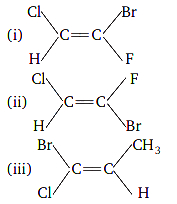
Which of the following compound$(s)$ has '$Z$' configuration?
A
$(i)$ only
B
$(ii)$ only
C
$(iii)$ only
D
$(i)$ and $(iii)$
Solution
(D) According to the Cahn-Ingold-Prelog $(CIP)$ priority rules,if the groups with higher priority are on the same side of the double bond,the configuration is '$Z$' (zusammen). If they are on opposite sides,it is '$E$' (entgegen).
For $(i)$: Priority at left carbon: $Cl > H$; Priority at right carbon: $Br > F$. Since $Cl$ and $Br$ are on the same side,it is $(Z)$.
For $(ii)$: Priority at left carbon: $Cl > H$; Priority at right carbon: $Br > F$. Since $Cl$ and $Br$ are on opposite sides,it is $(E)$.
For $(iii)$: Priority at left carbon: $Br > Cl$; Priority at right carbon: $CH_3 > H$. Since $Br$ and $CH_3$ are on the same side,it is $(Z)$.
Therefore,compounds $(i)$ and $(iii)$ have $(Z)$ configuration.
For $(i)$: Priority at left carbon: $Cl > H$; Priority at right carbon: $Br > F$. Since $Cl$ and $Br$ are on the same side,it is $(Z)$.
For $(ii)$: Priority at left carbon: $Cl > H$; Priority at right carbon: $Br > F$. Since $Cl$ and $Br$ are on opposite sides,it is $(E)$.
For $(iii)$: Priority at left carbon: $Br > Cl$; Priority at right carbon: $CH_3 > H$. Since $Br$ and $CH_3$ are on the same side,it is $(Z)$.
Therefore,compounds $(i)$ and $(iii)$ have $(Z)$ configuration.
0 likesView Solution
24
ChemistryMCQTS EAMCET · 2008
What are $X$ and $Y$ respectively in the following reaction?
$Z$-product $\stackrel{Y}{\longleftarrow} 2$-butyne $\stackrel{X}{\longrightarrow} E$-product
$Z$-product $\stackrel{Y}{\longleftarrow} 2$-butyne $\stackrel{X}{\longrightarrow} E$-product
A
$Na / NH_3$ (liq.) and $Pd / BaSO_4 + H_2$
B
$Ni / 140^{\circ} C$ and $Pd / BaSO_4 + H_2$
C
$Ni / 140^{\circ} C$ and $Na / NH_3$ (liq.)
D
$Pd / BaSO_4 + H_2$ and $Na / NH_3$ (liq.)
Solution
(A) The reduction of $2$-butyne with $Na / NH_3$ (liq.) (Birch reduction) proceeds via anti-addition to yield the $E$-product (trans$-2-$butene).
The reduction of $2$-butyne with $Pd / BaSO_4 + H_2$ (Lindlar's catalyst) proceeds via syn-addition to yield the $Z$-product (cis$-2-$butene).
According to the reaction scheme:
$2$-butyne $\xrightarrow{X} E$-product implies $X = Na / NH_3$ (liq.).
$2$-butyne $\xrightarrow{Y} Z$-product implies $Y = Pd / BaSO_4 + H_2$.
Therefore,$X$ and $Y$ are $Na / NH_3$ (liq.) and $Pd / BaSO_4 + H_2$ respectively.
The reduction of $2$-butyne with $Pd / BaSO_4 + H_2$ (Lindlar's catalyst) proceeds via syn-addition to yield the $Z$-product (cis$-2-$butene).
According to the reaction scheme:
$2$-butyne $\xrightarrow{X} E$-product implies $X = Na / NH_3$ (liq.).
$2$-butyne $\xrightarrow{Y} Z$-product implies $Y = Pd / BaSO_4 + H_2$.
Therefore,$X$ and $Y$ are $Na / NH_3$ (liq.) and $Pd / BaSO_4 + H_2$ respectively.
0 likesView Solution
25
ChemistryMCQTS EAMCET · 2008
Which one of the following reactions represents the oxidising property of $H_2O_2$?
A
$2KMnO_4 + 3H_2SO_4 + 5H_2O_2 \longrightarrow K_2SO_4 + 2MnSO_4 + 8H_2O + 5O_2$
B
$2K_3[Fe(CN)_6] + 2KOH + H_2O_2 \longrightarrow 2K_4[Fe(CN)_6] + 2H_2O + O_2$
C
$PbO_2 + H_2O_2 \longrightarrow PbO + H_2O + O_2$
D
$2KI + H_2SO_4 + H_2O_2 \longrightarrow K_2SO_4 + I_2 + 2H_2O$
Solution
(D) The oxidising property of $H_2O_2$ is demonstrated when it acts as an oxidising agent,meaning it gets reduced itself while oxidising another substance.
In option $A$,$B$,and $C$,$H_2O_2$ acts as a reducing agent,as it is oxidised to $O_2$.
In option $D$,$2KI + H_2SO_4 + H_2O_2 \longrightarrow K_2SO_4 + I_2 + 2H_2O$,the oxidation state of iodine increases from $-1$ in $KI$ to $0$ in $I_2$,while the oxygen in $H_2O_2$ is reduced from $-1$ to $-2$. Thus,$H_2O_2$ acts as an oxidising agent.
In option $A$,$B$,and $C$,$H_2O_2$ acts as a reducing agent,as it is oxidised to $O_2$.
In option $D$,$2KI + H_2SO_4 + H_2O_2 \longrightarrow K_2SO_4 + I_2 + 2H_2O$,the oxidation state of iodine increases from $-1$ in $KI$ to $0$ in $I_2$,while the oxygen in $H_2O_2$ is reduced from $-1$ to $-2$. Thus,$H_2O_2$ acts as an oxidising agent.
0 likesView Solution
26
ChemistryMCQTS EAMCET · 2008
$50 \ mL$ of $H_2O$ is added to $50 \ mL$ of $1 \times 10^{-3} \ M$ barium hydroxide solution. What is the $pH$ of the resulting solution?
A
$3.0$
B
$3.3$
C
$11.0$
D
$11.7$
Solution
(C) Barium hydroxide is a strong base and dissociates as follows: $Ba(OH)_2 \rightarrow Ba^{2+} + 2OH^-$.
Initially,the volume is $50 \ mL$ and the concentration is $1 \times 10^{-3} \ M$.
Upon adding $50 \ mL$ of $H_2O$,the total volume becomes $100 \ mL$.
Since the volume is doubled,the concentration of $Ba(OH)_2$ is halved: $M_2 = \frac{M_1 V_1}{V_2} = \frac{1 \times 10^{-3} \ M \times 50 \ mL}{100 \ mL} = 0.5 \times 10^{-3} \ M$.
Since each mole of $Ba(OH)_2$ produces $2$ moles of $OH^-$,the concentration of $OH^-$ is: $[OH^-] = 2 \times 0.5 \times 10^{-3} \ M = 1 \times 10^{-3} \ M$.
$pOH = -\log[OH^-] = -\log(1 \times 10^{-3}) = 3$.
$pH = 14 - pOH = 14 - 3 = 11.0$.
Initially,the volume is $50 \ mL$ and the concentration is $1 \times 10^{-3} \ M$.
Upon adding $50 \ mL$ of $H_2O$,the total volume becomes $100 \ mL$.
Since the volume is doubled,the concentration of $Ba(OH)_2$ is halved: $M_2 = \frac{M_1 V_1}{V_2} = \frac{1 \times 10^{-3} \ M \times 50 \ mL}{100 \ mL} = 0.5 \times 10^{-3} \ M$.
Since each mole of $Ba(OH)_2$ produces $2$ moles of $OH^-$,the concentration of $OH^-$ is: $[OH^-] = 2 \times 0.5 \times 10^{-3} \ M = 1 \times 10^{-3} \ M$.
$pOH = -\log[OH^-] = -\log(1 \times 10^{-3}) = 3$.
$pH = 14 - pOH = 14 - 3 = 11.0$.
0 likesView Solution
27
ChemistryMCQTS EAMCET · 2008
Assertion $(A)$: The aqueous solution of $CH_3COONa$ is alkaline in nature. Reason $(R)$: Acetate ion undergoes anionic hydrolysis. The correct answer is
A
Both $(A)$ and $(R)$ are true and $(R)$ is the correct explanation of $(A)$.
B
Both $(A)$ and $(R)$ are true but $(R)$ is not the correct explanation of $(A)$.
C
$(A)$ is true but $(R)$ is not true.
D
$(A)$ is not true but $(R)$ is true.
Solution
(A) $CH_3COONa$ is a salt of a weak acid $(CH_3COOH)$ and a strong base $(NaOH)$.
In aqueous solution,it ionizes as: $CH_3COONa \rightleftharpoons CH_3COO^{-} + Na^{+}$.
The acetate ion $(CH_3COO^{-})$ undergoes anionic hydrolysis: $CH_3COO^{-} + H_2O \rightleftharpoons CH_3COOH + OH^{-}$.
Due to the production of $OH^{-}$ ions,the solution becomes alkaline (basic).
Therefore,both $(A)$ and $(R)$ are true and $(R)$ is the correct explanation of $(A)$.
In aqueous solution,it ionizes as: $CH_3COONa \rightleftharpoons CH_3COO^{-} + Na^{+}$.
The acetate ion $(CH_3COO^{-})$ undergoes anionic hydrolysis: $CH_3COO^{-} + H_2O \rightleftharpoons CH_3COOH + OH^{-}$.
Due to the production of $OH^{-}$ ions,the solution becomes alkaline (basic).
Therefore,both $(A)$ and $(R)$ are true and $(R)$ is the correct explanation of $(A)$.
0 likesView Solution
28
ChemistryMCQTS EAMCET · 2008
Two concentric coils of $10$ turns each are placed in the same plane. Their radii are $20 \ cm$ and $40 \ cm$ and carry $0.2 \ A$ and $0.3 \ A$ current respectively in opposite directions. The magnetic induction (in $T$) at the centre is
A
$\frac{3}{4} \mu_0$
B
$\frac{5}{4} \mu_0$
C
$\frac{7}{4} \mu_0$
D
$\frac{9}{4} \mu_0$
Solution
(B) The magnetic field at the center of a circular coil is given by $B = \frac{\mu_0 N i}{2r}$.
Since the two coils carry currents in opposite directions,the net magnetic field at the center is the difference between the two fields.
Given: $N_1 = N_2 = 10$,$r_1 = 0.2 \ m$,$r_2 = 0.4 \ m$,$i_1 = 0.2 \ A$,$i_2 = 0.3 \ A$.
$B_{\text{net}} = |B_1 - B_2| = \left| \frac{\mu_0 N_1 i_1}{2r_1} - \frac{\mu_0 N_2 i_2}{2r_2} \right|$
$B_{\text{net}} = \frac{\mu_0 \times 10}{2} \left| \frac{0.2}{0.2} - \frac{0.3}{0.4} \right|$
$B_{\text{net}} = 5 \mu_0 \left| 1 - 0.75 \right|$
$B_{\text{net}} = 5 \mu_0 \times 0.25 = 5 \mu_0 \times \frac{1}{4} = \frac{5}{4} \mu_0$.
Since the two coils carry currents in opposite directions,the net magnetic field at the center is the difference between the two fields.
Given: $N_1 = N_2 = 10$,$r_1 = 0.2 \ m$,$r_2 = 0.4 \ m$,$i_1 = 0.2 \ A$,$i_2 = 0.3 \ A$.
$B_{\text{net}} = |B_1 - B_2| = \left| \frac{\mu_0 N_1 i_1}{2r_1} - \frac{\mu_0 N_2 i_2}{2r_2} \right|$
$B_{\text{net}} = \frac{\mu_0 \times 10}{2} \left| \frac{0.2}{0.2} - \frac{0.3}{0.4} \right|$
$B_{\text{net}} = 5 \mu_0 \left| 1 - 0.75 \right|$
$B_{\text{net}} = 5 \mu_0 \times 0.25 = 5 \mu_0 \times \frac{1}{4} = \frac{5}{4} \mu_0$.
0 likesView Solution
29
ChemistryMCQTS EAMCET · 2008
$A$ magnetized wire of magnetic moment $M$ and length $l$ is bent into the form of a semicircle of radius $r$. Then its new magnetic moment is:
A
$\frac{2 M}{\pi}$
B
$2 M$
C
$\frac{M}{\pi}$
D
zero
Solution
(A) The initial magnetic moment is $M = m \cdot l$,where $m$ is the pole strength.
When the wire of length $l$ is bent into a semicircle,the length $l$ becomes the arc length of the semicircle.
So,$l = \pi r$,which gives $r = \frac{l}{\pi}$.
The new distance between the poles (the diameter of the semicircle) is $l' = 2r = \frac{2l}{\pi}$.
The new magnetic moment $M'$ is given by the product of the pole strength and the new distance between the poles:
$M' = m \cdot l' = m \cdot \left(\frac{2l}{\pi}\right) = \frac{2}{\pi} (m \cdot l)$.
Since $M = m \cdot l$,we have $M' = \frac{2M}{\pi}$.
When the wire of length $l$ is bent into a semicircle,the length $l$ becomes the arc length of the semicircle.
So,$l = \pi r$,which gives $r = \frac{l}{\pi}$.
The new distance between the poles (the diameter of the semicircle) is $l' = 2r = \frac{2l}{\pi}$.
The new magnetic moment $M'$ is given by the product of the pole strength and the new distance between the poles:
$M' = m \cdot l' = m \cdot \left(\frac{2l}{\pi}\right) = \frac{2}{\pi} (m \cdot l)$.
Since $M = m \cdot l$,we have $M' = \frac{2M}{\pi}$.
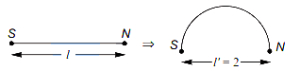
0 likesView Solution
30
ChemistryMCQTS EAMCET · 2008
With a standard rectangular bar magnet,the time period of a vibration magnetometer is $4 ~s$. The bar magnet is cut parallel to its length into four equal pieces. The time period of the vibration magnetometer when one piece is used (in seconds) (bar magnet breadth is small) is
A
$16$
B
$8$
C
$4$
D
$2$
Solution
(C) The time period of a vibration magnetometer is given by $T = 2 \pi \sqrt{\frac{I}{MB}}$.
When a bar magnet is cut parallel to its length into $4$ equal pieces,the mass of each piece becomes $m' = \frac{m}{4}$.
The magnetic moment of each piece becomes $M' = \frac{M}{4}$.
The moment of inertia of each piece about the axis of rotation becomes $I' = \frac{I}{4}$.
Substituting these into the formula for the new time period $T'$:
$T' = 2 \pi \sqrt{\frac{I'}{M'B}} = 2 \pi \sqrt{\frac{I/4}{(M/4)B}} = 2 \pi \sqrt{\frac{I}{MB}}$.
Thus,$T' = T = 4 ~s$.
When a bar magnet is cut parallel to its length into $4$ equal pieces,the mass of each piece becomes $m' = \frac{m}{4}$.
The magnetic moment of each piece becomes $M' = \frac{M}{4}$.
The moment of inertia of each piece about the axis of rotation becomes $I' = \frac{I}{4}$.
Substituting these into the formula for the new time period $T'$:
$T' = 2 \pi \sqrt{\frac{I'}{M'B}} = 2 \pi \sqrt{\frac{I/4}{(M/4)B}} = 2 \pi \sqrt{\frac{I}{MB}}$.
Thus,$T' = T = 4 ~s$.
0 likesView Solution
31
ChemistryMCQTS EAMCET · 2008
If $\frac{x^2+x+1}{x^2+2x+1} = A + \frac{B}{x+1} + \frac{C}{(x+1)^2}$,then $A-B$ is equal to
A
$4C$
B
$4C+1$
C
$3C$
D
$2C$
Solution
(D) We have $\frac{x^2+x+1}{x^2+2x+1} = \frac{(x^2+2x+1) - x}{x^2+2x+1} = 1 - \frac{x}{(x+1)^2}$.
Now,express $\frac{x}{(x+1)^2}$ in partial fractions:
$\frac{x}{(x+1)^2} = \frac{A'}{x+1} + \frac{B'}{(x+1)^2} = \frac{A'(x+1) + B'}{(x+1)^2}$.
Comparing numerators,$x = A'x + (A'+B')$.
Thus,$A' = 1$ and $A'+B' = 0$,which gives $B' = -1$.
So,$\frac{x^2+x+1}{x^2+2x+1} = 1 - (\frac{1}{x+1} - \frac{1}{(x+1)^2}) = 1 - \frac{1}{x+1} + \frac{1}{(x+1)^2}$.
Comparing this with $A + \frac{B}{x+1} + \frac{C}{(x+1)^2}$,we get $A=1$,$B=-1$,and $C=1$.
Therefore,$A-B = 1 - (-1) = 2$.
Since $C=1$,$2 = 2C$.
Hence,$A-B = 2C$.
Now,express $\frac{x}{(x+1)^2}$ in partial fractions:
$\frac{x}{(x+1)^2} = \frac{A'}{x+1} + \frac{B'}{(x+1)^2} = \frac{A'(x+1) + B'}{(x+1)^2}$.
Comparing numerators,$x = A'x + (A'+B')$.
Thus,$A' = 1$ and $A'+B' = 0$,which gives $B' = -1$.
So,$\frac{x^2+x+1}{x^2+2x+1} = 1 - (\frac{1}{x+1} - \frac{1}{(x+1)^2}) = 1 - \frac{1}{x+1} + \frac{1}{(x+1)^2}$.
Comparing this with $A + \frac{B}{x+1} + \frac{C}{(x+1)^2}$,we get $A=1$,$B=-1$,and $C=1$.
Therefore,$A-B = 1 - (-1) = 2$.
Since $C=1$,$2 = 2C$.
Hence,$A-B = 2C$.
0 likesView Solution
32
ChemistryMCQTS EAMCET · 2008
If $\alpha+\beta=-2$ and $\alpha^3+\beta^3=-56$,then the quadratic equation whose roots are $\alpha$ and $\beta$ is
A
$x^2+2x-16=0$
B
$x^2+2x+15=0$
C
$x^2+2x-12=0$
D
$x^2+2x-8=0$
Solution
(D) Given that,$\alpha+\beta=-2$ and $\alpha^3+\beta^3=-56$.
We know that $\alpha^3+\beta^3 = (\alpha+\beta)(\alpha^2+\beta^2-\alpha\beta)$.
Substituting the values,we get $(-2)(\alpha^2+\beta^2-\alpha\beta) = -56$,which implies $\alpha^2+\beta^2-\alpha\beta = 28$.
Also,$(\alpha+\beta)^2 = \alpha^2+\beta^2+2\alpha\beta = (-2)^2 = 4$.
Subtracting the two equations: $(\alpha^2+\beta^2+2\alpha\beta) - (\alpha^2+\beta^2-\alpha\beta) = 4 - 28$.
$3\alpha\beta = -24$,so $\alpha\beta = -8$.
The quadratic equation with roots $\alpha$ and $\beta$ is given by $x^2 - (\alpha+\beta)x + (\alpha\beta) = 0$.
Substituting the values,$x^2 - (-2)x + (-8) = 0$,which simplifies to $x^2+2x-8=0$.
We know that $\alpha^3+\beta^3 = (\alpha+\beta)(\alpha^2+\beta^2-\alpha\beta)$.
Substituting the values,we get $(-2)(\alpha^2+\beta^2-\alpha\beta) = -56$,which implies $\alpha^2+\beta^2-\alpha\beta = 28$.
Also,$(\alpha+\beta)^2 = \alpha^2+\beta^2+2\alpha\beta = (-2)^2 = 4$.
Subtracting the two equations: $(\alpha^2+\beta^2+2\alpha\beta) - (\alpha^2+\beta^2-\alpha\beta) = 4 - 28$.
$3\alpha\beta = -24$,so $\alpha\beta = -8$.
The quadratic equation with roots $\alpha$ and $\beta$ is given by $x^2 - (\alpha+\beta)x + (\alpha\beta) = 0$.
Substituting the values,$x^2 - (-2)x + (-8) = 0$,which simplifies to $x^2+2x-8=0$.
0 likesView Solution
33
ChemistryMCQTS EAMCET · 2008
If $\omega$ is a complex cube root of unity,then $\sin \left\{\left(\omega^{10}+\omega^{23}\right) \pi-\frac{\pi}{4}\right\}$ is equal to
A
$\frac{1}{\sqrt{2}}$
B
$\frac{1}{2}$
C
$1$
D
$\frac{\sqrt{3}}{2}$
Solution
(A) Given that $\omega$ is a complex cube root of unity,we have $\omega^3 = 1$ and $1 + \omega + \omega^2 = 0$.
First,simplify the powers of $\omega$:
$\omega^{10} = (\omega^3)^3 \cdot \omega = 1^3 \cdot \omega = \omega$
$\omega^{23} = (\omega^3)^7 \cdot \omega^2 = 1^7 \cdot \omega^2 = \omega^2$
Now,substitute these into the expression:
$\sin \left\{\left(\omega^{10} + \omega^{23}\right) \pi - \frac{\pi}{4}\right\} = \sin \left\{\left(\omega + \omega^2\right) \pi - \frac{\pi}{4}\right\}$
Since $1 + \omega + \omega^2 = 0$,we have $\omega + \omega^2 = -1$.
Substituting this value:
$= \sin \left\{-\pi - \frac{\pi}{4}\right\} = \sin \left\{-\left(\pi + \frac{\pi}{4}\right)\right\}$
Using the property $\sin(-\theta) = -\sin(\theta)$:
$= -\sin \left(\pi + \frac{\pi}{4}\right)$
Using the property $\sin(\pi + \theta) = -\sin(\theta)$:
$= -(-\sin \frac{\pi}{4}) = \sin \frac{\pi}{4} = \frac{1}{\sqrt{2}}$
First,simplify the powers of $\omega$:
$\omega^{10} = (\omega^3)^3 \cdot \omega = 1^3 \cdot \omega = \omega$
$\omega^{23} = (\omega^3)^7 \cdot \omega^2 = 1^7 \cdot \omega^2 = \omega^2$
Now,substitute these into the expression:
$\sin \left\{\left(\omega^{10} + \omega^{23}\right) \pi - \frac{\pi}{4}\right\} = \sin \left\{\left(\omega + \omega^2\right) \pi - \frac{\pi}{4}\right\}$
Since $1 + \omega + \omega^2 = 0$,we have $\omega + \omega^2 = -1$.
Substituting this value:
$= \sin \left\{-\pi - \frac{\pi}{4}\right\} = \sin \left\{-\left(\pi + \frac{\pi}{4}\right)\right\}$
Using the property $\sin(-\theta) = -\sin(\theta)$:
$= -\sin \left(\pi + \frac{\pi}{4}\right)$
Using the property $\sin(\pi + \theta) = -\sin(\theta)$:
$= -(-\sin \frac{\pi}{4}) = \sin \frac{\pi}{4} = \frac{1}{\sqrt{2}}$
0 likesView Solution
34
ChemistryMCQTS EAMCET · 2008
If ${}^n P_r = 30240$ and ${}^n C_r = 252$,then the ordered pair $(n, r)$ is equal to
A
$(12, 6)$
B
$(10, 5)$
C
$(9, 4)$
D
$(16, 7)$
Solution
(B) Given that,${}^n P_r = 30240$ and ${}^n C_r = 252$.
We know that ${}^n P_r = {}^n C_r \times r!$.
Substituting the values,we get $30240 = 252 \times r!$.
$r! = \frac{30240}{252} = 120$.
Since $120 = 5!$,we have $r = 5$.
Now,${}^n P_5 = 30240$.
$n(n-1)(n-2)(n-3)(n-4) = 30240$.
Testing values,for $n = 10$: $10 \times 9 \times 8 \times 7 \times 6 = 30240$.
Thus,$n = 10$.
Hence,the required ordered pair is $(10, 5)$.
We know that ${}^n P_r = {}^n C_r \times r!$.
Substituting the values,we get $30240 = 252 \times r!$.
$r! = \frac{30240}{252} = 120$.
Since $120 = 5!$,we have $r = 5$.
Now,${}^n P_5 = 30240$.
$n(n-1)(n-2)(n-3)(n-4) = 30240$.
Testing values,for $n = 10$: $10 \times 9 \times 8 \times 7 \times 6 = 30240$.
Thus,$n = 10$.
Hence,the required ordered pair is $(10, 5)$.
0 likesView Solution
35
ChemistryMCQTS EAMCET · 2008
There are $9$ balls to be placed in $9$ boxes. If $5$ of the balls cannot fit into $3$ specific small boxes,find the number of ways of arranging one ball in each of the boxes.
A
$18720$
B
$18270$
C
$17280$
D
$12780$
Solution
(C) Let the $3$ small boxes be $S_1, S_2, S_3$ and the other $6$ boxes be $B_1, B_2, B_3, B_4, B_5, B_6$.
There are $5$ balls that cannot fit into the $3$ small boxes.
These $5$ balls must be placed in the $6$ larger boxes.
The number of ways to arrange these $5$ balls in $6$ boxes is given by $^6P_5 = \frac{6!}{(6-5)!} = 6 \times 5 \times 4 \times 3 \times 2 = 720$.
After placing these $5$ balls,there are $4$ balls remaining and $4$ boxes remaining (the $3$ small boxes and $1$ unused large box).
The number of ways to arrange these $4$ balls in the remaining $4$ boxes is $4! = 24$.
Total number of arrangements = $^6P_5 \times 4! = 720 \times 24 = 17280$.
There are $5$ balls that cannot fit into the $3$ small boxes.
These $5$ balls must be placed in the $6$ larger boxes.
The number of ways to arrange these $5$ balls in $6$ boxes is given by $^6P_5 = \frac{6!}{(6-5)!} = 6 \times 5 \times 4 \times 3 \times 2 = 720$.
After placing these $5$ balls,there are $4$ balls remaining and $4$ boxes remaining (the $3$ small boxes and $1$ unused large box).
The number of ways to arrange these $4$ balls in the remaining $4$ boxes is $4! = 24$.
Total number of arrangements = $^6P_5 \times 4! = 720 \times 24 = 17280$.
0 likesView Solution
36
ChemistryMCQTS EAMCET · 2008
There is some change in length when a $33000 ~N$ tensile force is applied on a steel rod of area of cross-section $10^{-3} ~m^2$. The change of temperature required to produce the same elongation,if the steel rod is heated,is (The modulus of elasticity is $3 \times 10^{11} ~N/m^2$ and the coefficient of linear expansion of steel is $1.1 \times 10^{-5} /{ }^{\circ} C$). (in $^{\circ} C$)
A
$20$
B
$15$
C
$10$
D
$0$
Solution
(C) The Young's modulus $Y$ is given by $Y = \frac{F/A}{\Delta l/l}$,where $F$ is the force,$A$ is the area,and $\Delta l/l$ is the strain.
Given $F = 33000 ~N$,$A = 10^{-3} ~m^2$,and $Y = 3 \times 10^{11} ~N/m^2$.
Substituting the values: $3 \times 10^{11} = \frac{33000 / 10^{-3}}{\Delta l/l}$.
Thus,the strain $\frac{\Delta l}{l} = \frac{33000}{10^{-3} \times 3 \times 10^{11}} = \frac{33 \times 10^3}{3 \times 10^8} = 11 \times 10^{-5}$.
Thermal expansion is given by $\frac{\Delta l}{l} = \alpha \Delta T$,where $\alpha = 1.1 \times 10^{-5} /{ }^{\circ} C$.
Equating the two expressions for strain: $11 \times 10^{-5} = 1.1 \times 10^{-5} \times \Delta T$.
Solving for $\Delta T$: $\Delta T = \frac{11 \times 10^{-5}}{1.1 \times 10^{-5}} = 10^{\circ} C$.
Given $F = 33000 ~N$,$A = 10^{-3} ~m^2$,and $Y = 3 \times 10^{11} ~N/m^2$.
Substituting the values: $3 \times 10^{11} = \frac{33000 / 10^{-3}}{\Delta l/l}$.
Thus,the strain $\frac{\Delta l}{l} = \frac{33000}{10^{-3} \times 3 \times 10^{11}} = \frac{33 \times 10^3}{3 \times 10^8} = 11 \times 10^{-5}$.
Thermal expansion is given by $\frac{\Delta l}{l} = \alpha \Delta T$,where $\alpha = 1.1 \times 10^{-5} /{ }^{\circ} C$.
Equating the two expressions for strain: $11 \times 10^{-5} = 1.1 \times 10^{-5} \times \Delta T$.
Solving for $\Delta T$: $\Delta T = \frac{11 \times 10^{-5}}{1.1 \times 10^{-5}} = 10^{\circ} C$.
0 likesView Solution
37
ChemistryMCQTS EAMCET · 2008
$A$ load of $1 ~kg$ weight is attached to one end of a steel wire of area of cross-section $3 ~mm^2$ and Young's modulus $10^{11} ~N/m^2$. The other end is suspended vertically from a hook on a wall,then the load is pulled horizontally and released. When the load passes through its lowest position,the fractional change in length is $(g = 10 ~m/s^2)$.
A
$0.3 \times 10^{-4}$
B
$0.3 \times 10^{-3}$
C
$0.3 \times 10^{3}$
D
$0.3 \times 10^{4}$
Solution
(A) The Young's modulus $Y$ is defined as the ratio of stress to strain: $Y = \frac{\text{Stress}}{\text{Strain}} = \frac{F/A}{\Delta l/l}$.
Rearranging for the fractional change in length $\frac{\Delta l}{l}$,we get: $\frac{\Delta l}{l} = \frac{F}{AY}$.
At the lowest position,the tension $T$ in the wire is equal to the weight of the load,$T = mg$ (assuming the velocity is negligible or the question implies static equilibrium at the lowest point for the fractional change calculation).
Given: $m = 1 ~kg$,$g = 10 ~m/s^2$,$A = 3 ~mm^2 = 3 \times 10^{-6} ~m^2$,and $Y = 10^{11} ~N/m^2$.
Substituting the values: $\frac{\Delta l}{l} = \frac{1 \times 10}{3 \times 10^{-6} \times 10^{11}} = \frac{10}{3 \times 10^5} = \frac{1}{3} \times 10^{-4} \approx 0.33 \times 10^{-4}$.
Rounding to the provided options,the correct value is $0.3 \times 10^{-4}$.
Rearranging for the fractional change in length $\frac{\Delta l}{l}$,we get: $\frac{\Delta l}{l} = \frac{F}{AY}$.
At the lowest position,the tension $T$ in the wire is equal to the weight of the load,$T = mg$ (assuming the velocity is negligible or the question implies static equilibrium at the lowest point for the fractional change calculation).
Given: $m = 1 ~kg$,$g = 10 ~m/s^2$,$A = 3 ~mm^2 = 3 \times 10^{-6} ~m^2$,and $Y = 10^{11} ~N/m^2$.
Substituting the values: $\frac{\Delta l}{l} = \frac{1 \times 10}{3 \times 10^{-6} \times 10^{11}} = \frac{10}{3 \times 10^5} = \frac{1}{3} \times 10^{-4} \approx 0.33 \times 10^{-4}$.
Rounding to the provided options,the correct value is $0.3 \times 10^{-4}$.
0 likesView Solution
38
ChemistryMCQTS EAMCET · 2008
$A$ body is thrown vertically upwards and reaches its maximum height in $t$ seconds. The total time from the time of projection to reach a point at half of its maximum height while returning (in seconds) is:
A
$\sqrt{2} t$
B
$\left(1+\frac{1}{\sqrt{2}}\right) t$
C
$\frac{3 t}{2}$
D
$\frac{t}{\sqrt{2}}$
Solution
(B) Let the initial velocity be $u$. At maximum height $h$,the final velocity is $0$.
Using $v = u - gt$,we get $0 = u - gt$,so $u = gt$.
The maximum height is $h = \frac{u^2}{2g} = \frac{(gt)^2}{2g} = \frac{gt^2}{2}$.
The body reaches the maximum height in time $t$.
While returning,the body starts from rest at height $h$ and falls to height $h/2$. The distance covered is $s = h - h/2 = h/2$.
Using $s = \frac{1}{2}gt'^2$,where $t'$ is the time taken to fall from maximum height to $h/2$:
$\frac{h}{2} = \frac{1}{2}gt'^2 \implies t'^2 = \frac{h}{g} = \frac{gt^2/2}{g} = \frac{t^2}{2}$.
Thus,$t' = \frac{t}{\sqrt{2}}$.
The total time from projection is $T = t + t' = t + \frac{t}{\sqrt{2}} = \left(1 + \frac{1}{\sqrt{2}}\right) t$.
Using $v = u - gt$,we get $0 = u - gt$,so $u = gt$.
The maximum height is $h = \frac{u^2}{2g} = \frac{(gt)^2}{2g} = \frac{gt^2}{2}$.
The body reaches the maximum height in time $t$.
While returning,the body starts from rest at height $h$ and falls to height $h/2$. The distance covered is $s = h - h/2 = h/2$.
Using $s = \frac{1}{2}gt'^2$,where $t'$ is the time taken to fall from maximum height to $h/2$:
$\frac{h}{2} = \frac{1}{2}gt'^2 \implies t'^2 = \frac{h}{g} = \frac{gt^2/2}{g} = \frac{t^2}{2}$.
Thus,$t' = \frac{t}{\sqrt{2}}$.
The total time from projection is $T = t + t' = t + \frac{t}{\sqrt{2}} = \left(1 + \frac{1}{\sqrt{2}}\right) t$.
0 likesView Solution
39
ChemistryMCQTS EAMCET · 2008
If a body is projected with an angle $\theta$ to the horizontal,then
A
its velocity is always perpendicular to its acceleration
B
its velocity becomes zero at its maximum height
C
its velocity makes zero angle with the horizontal at its maximum height
D
the body just before hitting the ground,the direction of velocity coincides with the acceleration
Solution
(C) In projectile motion,the velocity vector is always tangent to the trajectory path.
At the maximum height,the vertical component of velocity $(v_y)$ becomes zero,while the horizontal component $(v_x = u \cos \theta)$ remains constant.
Since the velocity vector only has a horizontal component at the maximum height,it makes an angle of $0^\circ$ with the horizontal.
Therefore,option $C$ is correct.
At the maximum height,the vertical component of velocity $(v_y)$ becomes zero,while the horizontal component $(v_x = u \cos \theta)$ remains constant.
Since the velocity vector only has a horizontal component at the maximum height,it makes an angle of $0^\circ$ with the horizontal.
Therefore,option $C$ is correct.
0 likesView Solution
40
ChemistryMCQTS EAMCET · 2008
$F_{pp}$,$F_{nn}$,and $F_{np}$ are the nuclear forces between proton-proton,neutron-neutron,and neutron-proton respectively. Then the relation between them is:
A
$F_{pp} = F_{nn} \neq F_{np}$
B
$F_{pp} \neq F_{nn} = F_{np}$
C
$F_{pp} = F_{nn} = F_{np}$
D
$F_{pp} \neq F_{nn} \neq F_{np}$
Solution
(C) The nuclear force is the strong force that binds nucleons (protons and neutrons) together in the nucleus.
Experimental evidence shows that the nuclear force is charge-independent.
This means that the force between two protons,two neutrons,or a proton and a neutron is essentially the same,provided the distance between them and their spin states are identical.
Therefore,the relation is $F_{pp} = F_{nn} = F_{np}$.
Experimental evidence shows that the nuclear force is charge-independent.
This means that the force between two protons,two neutrons,or a proton and a neutron is essentially the same,provided the distance between them and their spin states are identical.
Therefore,the relation is $F_{pp} = F_{nn} = F_{np}$.
0 likesView Solution
41
ChemistryMCQTS EAMCET · 2008
$A$ particle is executing simple harmonic motion with an amplitude $A$ and time period $T$. The displacement of the particle after $2T$ time from its initial position is
A
$A$
B
$4A$
C
$8A$
D
zero
Solution
(D) Simple harmonic motion is a periodic motion where the particle repeats its position and velocity after every time interval equal to the time period $T$.
Given that the particle starts from an initial position,after one time period $T$,the particle returns to its initial position,meaning the displacement is $0$.
After $2T$ (which is an integer multiple of $T$),the particle will have completed two full cycles.
Therefore,the particle will return to its initial position again,and the net displacement from the initial position will be $0$.
Given that the particle starts from an initial position,after one time period $T$,the particle returns to its initial position,meaning the displacement is $0$.
After $2T$ (which is an integer multiple of $T$),the particle will have completed two full cycles.
Therefore,the particle will return to its initial position again,and the net displacement from the initial position will be $0$.
0 likesView Solution
42
ChemistryMCQTS EAMCET · 2008
Boron halides behave as Lewis acids because of their nature.
A
proton donor
B
covalent
C
electron deficient
D
ionising
Solution
(C) According to the Lewis concept,a substance that can accept a lone pair of electrons is called a Lewis acid.
Boron halides (e.g.,$BX_3$) have only $6$ electrons in the valence shell of the boron atom.
Due to this electron deficiency,they can accept a lone pair of electrons from a donor to complete their octet,thus acting as Lewis acids.
Boron halides (e.g.,$BX_3$) have only $6$ electrons in the valence shell of the boron atom.
Due to this electron deficiency,they can accept a lone pair of electrons from a donor to complete their octet,thus acting as Lewis acids.
0 likesView Solution
43
ChemistryMCQTS EAMCET · 2008
Identify $B$ in the following reaction:
$H_4SiO_4$ $\xrightarrow[1000^{\circ}C]{-2H_2O} A$ $\xrightarrow[\Delta]{\text{Carbon}} B + CO$
$H_4SiO_4$ $\xrightarrow[1000^{\circ}C]{-2H_2O} A$ $\xrightarrow[\Delta]{\text{Carbon}} B + CO$
A
corundum
B
quartz
C
silica
D
carborundum
Solution
(D) Orthosilicic acid $(H_4SiO_4)$,on heating at high temperature,loses two water molecules to form silica $(SiO_2)$ as $A$.
$H_4SiO_4 \xrightarrow[1000^{\circ}C]{-2H_2O} SiO_2 (A)$
Silica $(SiO_2)$ on reduction with carbon at high temperature gives carborundum $(SiC)$ as $B$ and releases carbon monoxide $(CO)$.
$SiO_2 + 3C \xrightarrow{\Delta} SiC (B) + 2CO$
Therefore,$B$ is carborundum.
$H_4SiO_4 \xrightarrow[1000^{\circ}C]{-2H_2O} SiO_2 (A)$
Silica $(SiO_2)$ on reduction with carbon at high temperature gives carborundum $(SiC)$ as $B$ and releases carbon monoxide $(CO)$.
$SiO_2 + 3C \xrightarrow{\Delta} SiC (B) + 2CO$
Therefore,$B$ is carborundum.
0 likesView Solution
44
ChemistryDifficultMCQTS EAMCET · 2008
The number of $\sigma$ and $\pi$ bonds in peroxodisulphuric acid are,respectively
A
$9$ and $4$
B
$11$ and $4$
C
$4$ and $8$
D
$4$ and $9$
Solution
(B) The structure of peroxodisulphuric acid $(H_2S_2O_8)$ is $HO-SO_2-O-O-SO_2-OH$.
In this structure,there are $4$ $S=O$ bonds (each containing $1$ $\sigma$ and $1$ $\pi$ bond),$2$ $S-OH$ bonds,$2$ $S-O$ bonds,and $1$ $O-O$ bond.
Total $\sigma$ bonds = $4$ (from $S=O$) + $2$ (from $S-OH$) + $2$ (from $S-O$) + $1$ (from $O-O$) + $2$ (from $O-H$) = $11$ $\sigma$ bonds.
Total $\pi$ bonds = $4$ (from $S=O$) = $4$ $\pi$ bonds.
Hence,it contains $11$ $\sigma$ and $4$ $\pi$ bonds.
In this structure,there are $4$ $S=O$ bonds (each containing $1$ $\sigma$ and $1$ $\pi$ bond),$2$ $S-OH$ bonds,$2$ $S-O$ bonds,and $1$ $O-O$ bond.
Total $\sigma$ bonds = $4$ (from $S=O$) + $2$ (from $S-OH$) + $2$ (from $S-O$) + $1$ (from $O-O$) + $2$ (from $O-H$) = $11$ $\sigma$ bonds.
Total $\pi$ bonds = $4$ (from $S=O$) = $4$ $\pi$ bonds.
Hence,it contains $11$ $\sigma$ and $4$ $\pi$ bonds.
0 likesView Solution
45
ChemistryMCQTS EAMCET · 2008
In which of the following reactions,chlorine acts as an oxidising agent?
$(i)$ $CH_3CH_2OH + Cl_2 \longrightarrow CH_3CHO + HCl$
$(ii)$ $CH_3CHO + Cl_2 \longrightarrow CCl_3CHO + HCl$
$(iii)$ $CH_4 + Cl_2 \xrightarrow{hv} CH_3Cl + HCl$
The correct answer is
$(i)$ $CH_3CH_2OH + Cl_2 \longrightarrow CH_3CHO + HCl$
$(ii)$ $CH_3CHO + Cl_2 \longrightarrow CCl_3CHO + HCl$
$(iii)$ $CH_4 + Cl_2 \xrightarrow{hv} CH_3Cl + HCl$
The correct answer is
A
$(i)$ only
B
$(ii)$ only
C
$(i)$ and $(iii)$
D
$(i)$,$(ii)$ and $(iii)$
Solution
(D) An oxidising agent is a substance that undergoes reduction (gain of electrons or decrease in oxidation state) and causes the oxidation of another substance (loss of electrons,addition of oxygen,or removal of hydrogen).
In all the given reactions,the oxidation state of chlorine decreases from $0$ (in $Cl_2$) to $-1$ (in $HCl$),which means chlorine is reduced.
$(i)$ $CH_3CH_2OH$ loses hydrogen to form $CH_3CHO$,so $Cl_2$ acts as an oxidising agent.
$(ii)$ $CH_3CHO$ loses hydrogen to form $CCl_3CHO$,so $Cl_2$ acts as an oxidising agent.
$(iii)$ $CH_4$ loses hydrogen to form $CH_3Cl$,so $Cl_2$ acts as an oxidising agent.
Therefore,in all these reactions,chlorine acts as an oxidising agent.
In all the given reactions,the oxidation state of chlorine decreases from $0$ (in $Cl_2$) to $-1$ (in $HCl$),which means chlorine is reduced.
$(i)$ $CH_3CH_2OH$ loses hydrogen to form $CH_3CHO$,so $Cl_2$ acts as an oxidising agent.
$(ii)$ $CH_3CHO$ loses hydrogen to form $CCl_3CHO$,so $Cl_2$ acts as an oxidising agent.
$(iii)$ $CH_4$ loses hydrogen to form $CH_3Cl$,so $Cl_2$ acts as an oxidising agent.
Therefore,in all these reactions,chlorine acts as an oxidising agent.
0 likesView Solution
46
ChemistryMCQTS EAMCET · 2008
Which one of the following reactions does not occur?
A
$F_2 + 2Cl^{-} \longrightarrow 2F^{-} + Cl_2$
B
$Cl_2 + 2F^{-} \longrightarrow 2Cl^{-} + F_2$
C
$Br_2 + 2I^{-} \longrightarrow 2Br^{-} + I_2$
D
$Cl_2 + 2Br^{-} \longrightarrow 2Cl^{-} + Br_2$
Solution
(B) The oxidizing power of halogens decreases down the group as their reduction potential decreases. $F_2$ is the strongest oxidizing agent,followed by $Cl_2$,$Br_2$,and $I_2$.
$A$ halogen with a higher reduction potential can displace a halogen with a lower reduction potential from its salt solution.
Since $F_2$ has the highest reduction potential,it can oxidize $Cl^-$,$Br^-$,and $I^-$.
However,$Cl_2$ cannot oxidize $F^-$ because $F_2$ is a stronger oxidizing agent than $Cl_2$.
Therefore,the reaction $Cl_2 + 2F^{-} \longrightarrow 2Cl^{-} + F_2$ does not occur.
$A$ halogen with a higher reduction potential can displace a halogen with a lower reduction potential from its salt solution.
Since $F_2$ has the highest reduction potential,it can oxidize $Cl^-$,$Br^-$,and $I^-$.
However,$Cl_2$ cannot oxidize $F^-$ because $F_2$ is a stronger oxidizing agent than $Cl_2$.
Therefore,the reaction $Cl_2 + 2F^{-} \longrightarrow 2Cl^{-} + F_2$ does not occur.
0 likesView Solution
47
ChemistryMCQTS EAMCET · 2008
$\sqrt{3} \operatorname{cosec} 20^{\circ} - \sec 20^{\circ}$ is equal to
A
$2$
B
$2 \sin 20^{\circ} \cdot \operatorname{cosec} 40^{\circ}$
C
$4$
D
$4 \sin 20^{\circ} \cdot \operatorname{cosec} 40^{\circ}$
Solution
(C) Let $E = \sqrt{3} \operatorname{cosec} 20^{\circ} - \sec 20^{\circ}$.
$E = \frac{\sqrt{3}}{\sin 20^{\circ}} - \frac{1}{\cos 20^{\circ}}$
$E = \frac{\sqrt{3} \cos 20^{\circ} - \sin 20^{\circ}}{\sin 20^{\circ} \cos 20^{\circ}}$
Multiply and divide by $2$:
$E = 2 \left( \frac{\frac{\sqrt{3}}{2} \cos 20^{\circ} - \frac{1}{2} \sin 20^{\circ}}{\sin 20^{\circ} \cos 20^{\circ}} \right)$
$E = 2 \left( \frac{\sin 60^{\circ} \cos 20^{\circ} - \cos 60^{\circ} \sin 20^{\circ}}{\sin 20^{\circ} \cos 20^{\circ}} \right)$
Using $\sin(A - B) = \sin A \cos B - \cos A \sin B$:
$E = 2 \left( \frac{\sin(60^{\circ} - 20^{\circ})}{\sin 20^{\circ} \cos 20^{\circ}} \right) = 2 \left( \frac{\sin 40^{\circ}}{\sin 20^{\circ} \cos 20^{\circ}} \right)$
Multiply numerator and denominator by $2$:
$E = 4 \left( \frac{\sin 40^{\circ}}{2 \sin 20^{\circ} \cos 20^{\circ}} \right) = 4 \left( \frac{\sin 40^{\circ}}{\sin 40^{\circ}} \right) = 4$.
$E = \frac{\sqrt{3}}{\sin 20^{\circ}} - \frac{1}{\cos 20^{\circ}}$
$E = \frac{\sqrt{3} \cos 20^{\circ} - \sin 20^{\circ}}{\sin 20^{\circ} \cos 20^{\circ}}$
Multiply and divide by $2$:
$E = 2 \left( \frac{\frac{\sqrt{3}}{2} \cos 20^{\circ} - \frac{1}{2} \sin 20^{\circ}}{\sin 20^{\circ} \cos 20^{\circ}} \right)$
$E = 2 \left( \frac{\sin 60^{\circ} \cos 20^{\circ} - \cos 60^{\circ} \sin 20^{\circ}}{\sin 20^{\circ} \cos 20^{\circ}} \right)$
Using $\sin(A - B) = \sin A \cos B - \cos A \sin B$:
$E = 2 \left( \frac{\sin(60^{\circ} - 20^{\circ})}{\sin 20^{\circ} \cos 20^{\circ}} \right) = 2 \left( \frac{\sin 40^{\circ}}{\sin 20^{\circ} \cos 20^{\circ}} \right)$
Multiply numerator and denominator by $2$:
$E = 4 \left( \frac{\sin 40^{\circ}}{2 \sin 20^{\circ} \cos 20^{\circ}} \right) = 4 \left( \frac{\sin 40^{\circ}}{\sin 40^{\circ}} \right) = 4$.
0 likesView Solution
48
ChemistryMCQTS EAMCET · 2008
If $\alpha+\beta+\gamma=2 \theta$,then $\cos \theta+\cos (\theta-\alpha)+\cos (\theta-\beta)+\cos (\theta-\gamma)$ is equal to
A
$4 \sin \frac{\alpha}{2} \cdot \cos \frac{\beta}{2} \cdot \sin \frac{\gamma}{2}$
B
$4 \cos \frac{\alpha}{2} \cdot \cos \frac{\beta}{2} \cdot \cos \frac{\gamma}{2}$
C
$4 \sin \frac{\alpha}{2} \cdot \sin \frac{\beta}{2} \cdot \sin \frac{\gamma}{2}$
D
$4 \sin \alpha \cdot \sin \beta \cdot \sin \gamma$
Solution
(B) Given that $\alpha+\beta+\gamma=2 \theta$,so $\theta = \frac{\alpha+\beta+\gamma}{2}$.
Let $S = \cos \theta + \cos (\theta-\alpha) + \cos (\theta-\beta) + \cos (\theta-\gamma)$.
Using the sum-to-product formula $\cos A + \cos B = 2 \cos \frac{A+B}{2} \cos \frac{A-B}{2}$:
$S = [\cos \theta + \cos (\theta-\gamma)] + [\cos (\theta-\alpha) + \cos (\theta-\beta)]$
$S = 2 \cos \frac{2\theta-\gamma}{2} \cos \frac{\gamma}{2} + 2 \cos \frac{2\theta-\alpha-\beta}{2} \cos \frac{\beta-\alpha}{2}$
Since $2\theta = \alpha+\beta+\gamma$,we have $2\theta-\gamma = \alpha+\beta$ and $2\theta-\alpha-\beta = \gamma$.
$S = 2 \cos \frac{\alpha+\beta}{2} \cos \frac{\gamma}{2} + 2 \cos \frac{\gamma}{2} \cos \frac{\beta-\alpha}{2}$
$S = 2 \cos \frac{\gamma}{2} [\cos \frac{\alpha+\beta}{2} + \cos \frac{\beta-\alpha}{2}]$
Using $\cos A + \cos B = 2 \cos \frac{A+B}{2} \cos \frac{A-B}{2}$ again:
$S = 2 \cos \frac{\gamma}{2} [2 \cos \frac{\beta}{2} \cos \frac{\alpha}{2}]$
$S = 4 \cos \frac{\alpha}{2} \cos \frac{\beta}{2} \cos \frac{\gamma}{2}$.
Let $S = \cos \theta + \cos (\theta-\alpha) + \cos (\theta-\beta) + \cos (\theta-\gamma)$.
Using the sum-to-product formula $\cos A + \cos B = 2 \cos \frac{A+B}{2} \cos \frac{A-B}{2}$:
$S = [\cos \theta + \cos (\theta-\gamma)] + [\cos (\theta-\alpha) + \cos (\theta-\beta)]$
$S = 2 \cos \frac{2\theta-\gamma}{2} \cos \frac{\gamma}{2} + 2 \cos \frac{2\theta-\alpha-\beta}{2} \cos \frac{\beta-\alpha}{2}$
Since $2\theta = \alpha+\beta+\gamma$,we have $2\theta-\gamma = \alpha+\beta$ and $2\theta-\alpha-\beta = \gamma$.
$S = 2 \cos \frac{\alpha+\beta}{2} \cos \frac{\gamma}{2} + 2 \cos \frac{\gamma}{2} \cos \frac{\beta-\alpha}{2}$
$S = 2 \cos \frac{\gamma}{2} [\cos \frac{\alpha+\beta}{2} + \cos \frac{\beta-\alpha}{2}]$
Using $\cos A + \cos B = 2 \cos \frac{A+B}{2} \cos \frac{A-B}{2}$ again:
$S = 2 \cos \frac{\gamma}{2} [2 \cos \frac{\beta}{2} \cos \frac{\alpha}{2}]$
$S = 4 \cos \frac{\alpha}{2} \cos \frac{\beta}{2} \cos \frac{\gamma}{2}$.
0 likesView Solution
49
ChemistryMCQTS EAMCET · 2008
If $A=35^{\circ}, B=15^{\circ}$ and $C=40^{\circ}$,then $\tan A \cdot \tan B+\tan B \cdot \tan C+\tan C \cdot \tan A$ is equal to
A
$0$
B
$1$
C
$2$
D
$3$
Solution
(B) Given that,$A=35^{\circ}, B=15^{\circ}$ and $C=40^{\circ}$.
Since $A+B+C = 35^{\circ}+15^{\circ}+40^{\circ} = 90^{\circ}$,we use the identity for $\tan(A+B+C)$:
$\tan(A+B+C) = \frac{\tan A + \tan B + \tan C - \tan A \tan B \tan C}{1 - (\tan A \tan B + \tan B \tan C + \tan C \tan A)}$.
As $A+B+C = 90^{\circ}$,$\tan(90^{\circ})$ is undefined,which implies the denominator must be zero:
$1 - (\tan A \tan B + \tan B \tan C + \tan C \tan A) = 0$.
Therefore,$\tan A \tan B + \tan B \tan C + \tan C \tan A = 1$.
Since $A+B+C = 35^{\circ}+15^{\circ}+40^{\circ} = 90^{\circ}$,we use the identity for $\tan(A+B+C)$:
$\tan(A+B+C) = \frac{\tan A + \tan B + \tan C - \tan A \tan B \tan C}{1 - (\tan A \tan B + \tan B \tan C + \tan C \tan A)}$.
As $A+B+C = 90^{\circ}$,$\tan(90^{\circ})$ is undefined,which implies the denominator must be zero:
$1 - (\tan A \tan B + \tan B \tan C + \tan C \tan A) = 0$.
Therefore,$\tan A \tan B + \tan B \tan C + \tan C \tan A = 1$.
0 likesView Solution
50
ChemistryMCQTS EAMCET · 2008
The set $\{x \in R: \cos 2x + 2 \cos^2 x = 2\}$ is equal to
A
$\{2n\pi + \frac{\pi}{3}: n \in Z\}$
B
$\{n\pi \pm \frac{\pi}{6}: n \in Z\}$
C
$\{n\pi + \frac{\pi}{3}: n \in Z\}$
D
$\{2n\pi - \frac{\pi}{3}: n \in Z\}$
Solution
(B) Given equation is $\cos 2x + 2 \cos^2 x = 2$.
Using the identity $\cos 2x = 2 \cos^2 x - 1$,we get:
$(2 \cos^2 x - 1) + 2 \cos^2 x = 2$
$4 \cos^2 x - 1 = 2$
$4 \cos^2 x = 3$
$\cos^2 x = \frac{3}{4}$
$\cos x = \pm \frac{\sqrt{3}}{2}$
For $\cos x = \frac{\sqrt{3}}{2}$,$x = 2n\pi \pm \frac{\pi}{6}$.
For $\cos x = -\frac{\sqrt{3}}{2}$,$x = 2n\pi \pm \frac{5\pi}{6}$.
Combining these,the general solution is $x = n\pi \pm \frac{\pi}{6}$ for $n \in Z$.
Using the identity $\cos 2x = 2 \cos^2 x - 1$,we get:
$(2 \cos^2 x - 1) + 2 \cos^2 x = 2$
$4 \cos^2 x - 1 = 2$
$4 \cos^2 x = 3$
$\cos^2 x = \frac{3}{4}$
$\cos x = \pm \frac{\sqrt{3}}{2}$
For $\cos x = \frac{\sqrt{3}}{2}$,$x = 2n\pi \pm \frac{\pi}{6}$.
For $\cos x = -\frac{\sqrt{3}}{2}$,$x = 2n\pi \pm \frac{5\pi}{6}$.
Combining these,the general solution is $x = n\pi \pm \frac{\pi}{6}$ for $n \in Z$.
0 likesView Solution
51
ChemistryEasyMCQTS EAMCET · 2008
Match the polymers in List-$I$ with their monomers in List-$II$ and select the correct match:
The correct match is:
| List-$I$ | List-$II$ |
|---|---|
| $A$. $Nylon$ $6,6$ | $i$. $Ethylene$ $glycol$ and $Terephthalic$ $acid$ |
| $B$. $Terylene$ | $ii$. $1,3-Butadiene$ and $Styrene$ |
| $C$. $Buna-S$ | $iii$. $Chloroprene$ |
| $D$. $Neoprene$ | $iv$. $Acrylonitrile$ |
| $v$. $Adipic$ $acid$ and $Hexamethylenediamine$ |
The correct match is:
A
$v, i, ii, iii$
B
$iv, ii, i, iii$
C
$iii, i, ii, iv$
D
$v, ii, iii, i$
Solution
(A) The correct matching is:
$A$. $Nylon$ $6,6$ is a polyamide formed from $Adipic$ $acid$ and $Hexamethylenediamine$ $(v)$.
$B$. $Terylene$ (also known as $Dacron$) is a polyester formed from $Ethylene$ $glycol$ and $Terephthalic$ $acid$ $(i)$.
$C$. $Buna-S$ is a copolymer of $1,3-Butadiene$ and $Styrene$ $(ii)$.
$D$. $Neoprene$ is a polymer of $Chloroprene$ $(iii)$.
Therefore,the correct sequence for $A, B, C, D$ is $(v, i, ii, iii)$.
$A$. $Nylon$ $6,6$ is a polyamide formed from $Adipic$ $acid$ and $Hexamethylenediamine$ $(v)$.
$B$. $Terylene$ (also known as $Dacron$) is a polyester formed from $Ethylene$ $glycol$ and $Terephthalic$ $acid$ $(i)$.
$C$. $Buna-S$ is a copolymer of $1,3-Butadiene$ and $Styrene$ $(ii)$.
$D$. $Neoprene$ is a polymer of $Chloroprene$ $(iii)$.
Therefore,the correct sequence for $A, B, C, D$ is $(v, i, ii, iii)$.
0 likesView Solution
52
ChemistryEasyMCQTS EAMCET · 2008
$[Co(NH_3)_5SO_4]Br$ and $[Co(NH_3)_5Br]SO_4$ are a pair of which isomers?
A
Ionisation
B
Ligand
C
Coordination
D
Hydrate
Solution
(A) The given compounds are:
$1. [Co(NH_3)_5SO_4]Br \rightleftharpoons [Co(NH_3)_5SO_4]^+ + Br^-$
$2. [Co(NH_3)_5Br]SO_4 \rightleftharpoons [Co(NH_3)_5Br]^{2+} + SO_4^{2-}$
Since both compounds have the same molecular formula but produce different ions in an aqueous solution,they exhibit ionisation isomerism.
$1. [Co(NH_3)_5SO_4]Br \rightleftharpoons [Co(NH_3)_5SO_4]^+ + Br^-$
$2. [Co(NH_3)_5Br]SO_4 \rightleftharpoons [Co(NH_3)_5Br]^{2+} + SO_4^{2-}$
Since both compounds have the same molecular formula but produce different ions in an aqueous solution,they exhibit ionisation isomerism.
0 likesView Solution
53
ChemistryEasyMCQTS EAMCET · 2008
The correct order of reducing abilities of hydrides of $V$ group elements is
A
$NH_3 < PH_3 < AsH_3 < SbH_3 < BiH_3$
B
$NH_3 > PH_3 > AsH_3 > SbH_3 > BiH_3$
C
$NH_3 < PH_3 > AsH_3 > SbH_3 > BiH_3$
D
$SbH_3 > BiH_3 > AsH_3 > NH_3 > PH_3$
Solution
(A) The reducing character of the hydrides of group $V$ elements depends upon the stability of the $E-H$ bond.
As we move down the group,the atomic size of the central element increases,which leads to a decrease in the bond dissociation enthalpy and stability of the hydrides.
Consequently,the ability to release hydrogen atoms increases,making the reducing character increase down the group.
Thus,the correct order of reducing abilities is $NH_3 < PH_3 < AsH_3 < SbH_3 < BiH_3$.
As we move down the group,the atomic size of the central element increases,which leads to a decrease in the bond dissociation enthalpy and stability of the hydrides.
Consequently,the ability to release hydrogen atoms increases,making the reducing character increase down the group.
Thus,the correct order of reducing abilities is $NH_3 < PH_3 < AsH_3 < SbH_3 < BiH_3$.
0 likesView Solution
54
ChemistryEasyMCQTS EAMCET · 2008
If the mass defect of ${ }_{5}B^{11}$ is $0.081 \ u$,its average binding energy (in $MeV$) is
A
$8.60$
B
$6.85$
C
$5.60$
D
$5.86$
Solution
(B) Given,mass defect $\Delta m = 0.081 \ u$.
Total number of nucleons $A = 11$.
Binding energy $BE = \Delta m \times 931 \ MeV/u = 0.081 \times 931 = 75.411 \ MeV$.
Average binding energy per nucleon $= \frac{BE}{A} = \frac{75.411}{11} = 6.855 \ MeV \approx 6.85 \ MeV$.
Total number of nucleons $A = 11$.
Binding energy $BE = \Delta m \times 931 \ MeV/u = 0.081 \times 931 = 75.411 \ MeV$.
Average binding energy per nucleon $= \frac{BE}{A} = \frac{75.411}{11} = 6.855 \ MeV \approx 6.85 \ MeV$.
0 likesView Solution
55
ChemistryMediumMCQTS EAMCET · 2008
Identify $A$ and $B$ in the following reaction:
$CH_3-CH_3 \stackrel{B}{\longleftarrow} CH_3COOH \stackrel{A}{\longrightarrow} CH_3CH_2OH$
$A \quad B$
$CH_3-CH_3 \stackrel{B}{\longleftarrow} CH_3COOH \stackrel{A}{\longrightarrow} CH_3CH_2OH$
$A \quad B$
A
$HI + \text{red } P \quad LiAlH_4$
B
$Ni / \Delta \quad LiAlH_4$
C
$LiAlH_4 \quad HI + \text{red } P$
D
$Pd-BaSO_4 \quad Zn + HCl$
Solution
(C) Acetic acid on reduction with lithium aluminium hydride $(LiAlH_4)$ gives ethyl alcohol.
$CH_3COOH \xrightarrow{LiAlH_4} CH_3CH_2OH$
Acetic acid on reduction with $HI$ and red $P$ gives ethane.
$CH_3COOH \xrightarrow{\text{Red } P + HI} CH_3-CH_3$
Therefore,reagent $A$ is $LiAlH_4$ and reagent $B$ is $HI + \text{red } P$.
$CH_3COOH \xrightarrow{LiAlH_4} CH_3CH_2OH$
Acetic acid on reduction with $HI$ and red $P$ gives ethane.
$CH_3COOH \xrightarrow{\text{Red } P + HI} CH_3-CH_3$
Therefore,reagent $A$ is $LiAlH_4$ and reagent $B$ is $HI + \text{red } P$.
0 likesView Solution
56
ChemistryMediumMCQTS EAMCET · 2008
The correct order of reactivity of hydrogen halides with ethyl alcohol is
A
$HF > HCl > HBr > HI$
B
$HCl > HBr > HF > HI$
C
$HBr > HCl > HI > HF$
D
$HI > HBr > HCl > HF$
Solution
(D) The reaction of hydrogen halides $(HX)$ with ethyl alcohol $(C_2H_5OH)$ involves the cleavage of the $C-O$ bond.
The reactivity depends on the strength of the $H-X$ bond.
As the size of the halogen atom increases from $F$ to $I$,the bond dissociation energy of the $H-X$ bond decreases,making the bond easier to break.
Therefore,the reactivity order is $HI > HBr > HCl > HF$.
The reactivity depends on the strength of the $H-X$ bond.
As the size of the halogen atom increases from $F$ to $I$,the bond dissociation energy of the $H-X$ bond decreases,making the bond easier to break.
Therefore,the reactivity order is $HI > HBr > HCl > HF$.
0 likesView Solution
57
ChemistryMediumMCQTS EAMCET · 2008
Acetone on addition to methyl magnesium bromide forms a complex,which on decomposition with acid gives $X$ and $Mg(OH)Br$. Which one of the following is $X$?
A
$CH_3OH$
B
$(CH_3)_3COH$
C
$(CH_3)_2CHOH$
D
$CH_3CH_2OH$
Solution
(B) Acetone $(CH_3COCH_3)$ reacts with methyl magnesium bromide $(CH_3MgBr)$ to form an addition complex.
This complex is $(CH_3)_3COMgBr$.
Upon acid hydrolysis (decomposition with acid),the complex undergoes protonation to yield a tertiary alcohol,$2$-methylpropan-$2$-ol,which is $(CH_3)_3COH$,and $Mg(OH)Br$.
Thus,$X$ is $(CH_3)_3COH$.
This complex is $(CH_3)_3COMgBr$.
Upon acid hydrolysis (decomposition with acid),the complex undergoes protonation to yield a tertiary alcohol,$2$-methylpropan-$2$-ol,which is $(CH_3)_3COH$,and $Mg(OH)Br$.
Thus,$X$ is $(CH_3)_3COH$.
0 likesView Solution
58
ChemistryMediumMCQTS EAMCET · 2008
The structure of the compound formed when nitrobenzene is reduced by lithium aluminium hydride $(LiAlH_4)$ is
A
Hydrazobenzene
B
Phenylhydroxylamine
C
Azobenzene
D
Aniline
Solution
(C) The reduction of nitrobenzene with lithium aluminium hydride $(LiAlH_4)$ in an alkaline medium or specific conditions leads to the formation of azobenzene as the major product.
The reaction is represented as:
$2 C_6H_5NO_2 \xrightarrow{LiAlH_4} C_6H_5-N=N-C_6H_5$ (Azobenzene).
The reaction is represented as:
$2 C_6H_5NO_2 \xrightarrow{LiAlH_4} C_6H_5-N=N-C_6H_5$ (Azobenzene).
0 likesView Solution
59
ChemistryMediumMCQTS EAMCET · 2008
Hydrolysis of sucrose with dilute aqueous sulphuric acid yields
A
$1:1$ $D-(+)$-glucose; $D-(-)$-fructose
B
$1:2$ $D-(+)$-glucose; $D-(-)$-fructose
C
$1:1$ $D-(-)$-glucose; $D-(+)$-fructose
D
$1:2$ $D-(-)$-glucose; $D-(+)$-fructose
Solution
(A) Sucrose undergoes hydrolysis in the presence of dilute aqueous sulphuric acid to produce an equimolar mixture of $D-(+)$-glucose and $D-(-)$-fructose.
The chemical reaction is:
$C_{12}H_{22}O_{11} + H_2O \xrightarrow{H_2SO_4} C_6H_{12}O_6 + C_6H_{12}O_6$
($D-(+)$-glucose) ($D-(-)$-fructose)
The molar ratio of the products is $1:1$.
Sucrose is dextrorotatory,but the resulting mixture is laevorotatory because the specific rotation of $D-(-)$-fructose $(-92.4^{\circ})$ is greater in magnitude than that of $D-(+)$-glucose $(+52.7^{\circ})$.
The chemical reaction is:
$C_{12}H_{22}O_{11} + H_2O \xrightarrow{H_2SO_4} C_6H_{12}O_6 + C_6H_{12}O_6$
($D-(+)$-glucose) ($D-(-)$-fructose)
The molar ratio of the products is $1:1$.
Sucrose is dextrorotatory,but the resulting mixture is laevorotatory because the specific rotation of $D-(-)$-fructose $(-92.4^{\circ})$ is greater in magnitude than that of $D-(+)$-glucose $(+52.7^{\circ})$.
0 likesView Solution
60
ChemistryMediumMCQTS EAMCET · 2008
For a reversible reaction $A \rightleftharpoons B$,which one of the following statements is wrong from the given energy profile diagram?
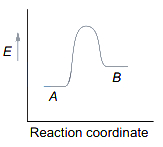
A
Activation energy of forward reaction is greater than backward reaction
B
The forward reaction is endothermic
C
The threshold energy is less than that of activation energy
D
The energy of activation of forward reaction is equal to the sum of heat of reaction and the energy of activation of backward reaction
Solution
(C) From the given energy profile diagram:
$E_a$ = activation energy of forward reaction
$E_a^{\prime}$ = activation energy of backward reaction
$E_t$ = threshold energy
$1$. Since the energy level of product $B$ is higher than reactant $A$,the reaction is endothermic.
$2$. The activation energy of the forward reaction $(E_a)$ is the difference between threshold energy $(E_t)$ and energy of reactant $(E_R)$.
$3$. The activation energy of the backward reaction $(E_a^{\prime})$ is the difference between threshold energy $(E_t)$ and energy of product $(E_p)$.
$4$. From the diagram,$E_a > E_a^{\prime}$.
$5$. The relationship is $E_a = E_a^{\prime} + \Delta E$,where $\Delta E$ is the heat of reaction.
$6$. The threshold energy $(E_t)$ is always greater than or equal to the activation energy ($E_a$ or $E_a^{\prime}$),as it represents the minimum energy required for the reaction to occur. Therefore,the statement that 'threshold energy is less than that of activation energy' is incorrect.
$E_a$ = activation energy of forward reaction
$E_a^{\prime}$ = activation energy of backward reaction
$E_t$ = threshold energy
$1$. Since the energy level of product $B$ is higher than reactant $A$,the reaction is endothermic.
$2$. The activation energy of the forward reaction $(E_a)$ is the difference between threshold energy $(E_t)$ and energy of reactant $(E_R)$.
$3$. The activation energy of the backward reaction $(E_a^{\prime})$ is the difference between threshold energy $(E_t)$ and energy of product $(E_p)$.
$4$. From the diagram,$E_a > E_a^{\prime}$.
$5$. The relationship is $E_a = E_a^{\prime} + \Delta E$,where $\Delta E$ is the heat of reaction.
$6$. The threshold energy $(E_t)$ is always greater than or equal to the activation energy ($E_a$ or $E_a^{\prime}$),as it represents the minimum energy required for the reaction to occur. Therefore,the statement that 'threshold energy is less than that of activation energy' is incorrect.
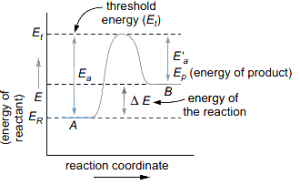
0 likesView Solution
61
ChemistryMediumMCQTS EAMCET · 2008
Match the following:
The correct match is:
| Column $I$ | Column $II$ |
|---|---|
| $(A)$ $CH_3CH_2CH_2CH_2NH_2$ | $(i)$ Secondary amine |
| $(B)$ $(CH_3CH_2)_2NH$ | $(ii)$ Tertiary amine |
| $(C)$ $(CH_3)_3N$ | $(iii)$ Aromatic amine |
| $(D)$ $C_6H_5NH_2$ | $(iv)$ Quaternary ammonium salt |
| $(v)$ Primary amine |
The correct match is:
A
$A-(v), B-(i), C-(ii), D-(iii)$
B
$A-(iv), B-(ii), C-(i), D-(iii)$
C
$A-(iii), B-(i), C-(ii), D-(iv)$
D
$A-(v), B-(ii), C-(iii), D-(i)$
Solution
(A) Based on the classification of amines:
$(A)$ $CH_3CH_2CH_2CH_2NH_2$ contains the $-NH_2$ group attached to one alkyl group,making it a primary amine $(1^\circ)$. Thus,$(A) \rightarrow (v)$.
$(B)$ $(CH_3CH_2)_2NH$ contains the $-NH-$ group attached to two alkyl groups,making it a secondary amine $(2^\circ)$. Thus,$(B) \rightarrow (i)$.
$(C)$ $(CH_3)_3N$ has the nitrogen atom attached to three alkyl groups,making it a tertiary amine $(3^\circ)$. Thus,$(C) \rightarrow (ii)$.
$(D)$ $C_6H_5NH_2$ (Aniline) is an amine where the nitrogen is directly attached to a benzene ring,making it an aromatic amine. Thus,$(D) \rightarrow (iii)$.
Therefore,the correct sequence is $A-(v), B-(i), C-(ii), D-(iii)$.
$(A)$ $CH_3CH_2CH_2CH_2NH_2$ contains the $-NH_2$ group attached to one alkyl group,making it a primary amine $(1^\circ)$. Thus,$(A) \rightarrow (v)$.
$(B)$ $(CH_3CH_2)_2NH$ contains the $-NH-$ group attached to two alkyl groups,making it a secondary amine $(2^\circ)$. Thus,$(B) \rightarrow (i)$.
$(C)$ $(CH_3)_3N$ has the nitrogen atom attached to three alkyl groups,making it a tertiary amine $(3^\circ)$. Thus,$(C) \rightarrow (ii)$.
$(D)$ $C_6H_5NH_2$ (Aniline) is an amine where the nitrogen is directly attached to a benzene ring,making it an aromatic amine. Thus,$(D) \rightarrow (iii)$.
Therefore,the correct sequence is $A-(v), B-(i), C-(ii), D-(iii)$.
0 likesView Solution
62
ChemistryMediumMCQTS EAMCET · 2008
$[Co(NH_3)_5SO_4]Br$ and $[Co(NH_3)_5Br]SO_4$ are a pair of isomers.
A
ionisation
B
ligand
C
coordination
D
hydrate
Solution
(A) The given compounds are:
$1. [Co(NH_3)_5SO_4]Br \rightleftharpoons [Co(NH_3)_5SO_4]^+ + Br^-$
$2. [Co(NH_3)_5Br]SO_4 \rightleftharpoons [Co(NH_3)_5Br]^{2+} + SO_4^{2-}$
Since both compounds have the same molecular formula but produce different ions in an aqueous solution,they exhibit ionisation isomerism.
$1. [Co(NH_3)_5SO_4]Br \rightleftharpoons [Co(NH_3)_5SO_4]^+ + Br^-$
$2. [Co(NH_3)_5Br]SO_4 \rightleftharpoons [Co(NH_3)_5Br]^{2+} + SO_4^{2-}$
Since both compounds have the same molecular formula but produce different ions in an aqueous solution,they exhibit ionisation isomerism.
0 likesView Solution
63
ChemistryDifficultMCQTS EAMCET · 2008
When electric current is passed through acidified water for $1930 \,s$, $1120 \,mL$ of $H_2$ gas is collected (at $STP$) at the cathode. What is the current passed in amperes?
A
$0.05$
B
$0.50$
C
$5.0$
D
$50$
Solution
(C) The reduction reaction at the cathode is: $2H^+ + 2e^- \rightarrow H_2$.
Number of moles of $H_2$ gas collected = $\frac{1120 \,mL}{22400 \,mL/mol} = 0.05 \,mol$.
From the stoichiometry of the reaction, $1 \,mol$ of $H_2$ requires $2 \,mol$ of electrons.
Therefore, $0.05 \,mol$ of $H_2$ requires $0.05 \times 2 = 0.1 \,mol$ of electrons.
Total charge $Q = n \times F = 0.1 \,mol \times 96500 \,C/mol = 9650 \,C$.
Using the relation $Q = I \times t$, where $t = 1930 \,s$:
$I = \frac{Q}{t} = \frac{9650 \,C}{1930 \,s} = 5.0 \,A$.
Number of moles of $H_2$ gas collected = $\frac{1120 \,mL}{22400 \,mL/mol} = 0.05 \,mol$.
From the stoichiometry of the reaction, $1 \,mol$ of $H_2$ requires $2 \,mol$ of electrons.
Therefore, $0.05 \,mol$ of $H_2$ requires $0.05 \times 2 = 0.1 \,mol$ of electrons.
Total charge $Q = n \times F = 0.1 \,mol \times 96500 \,C/mol = 9650 \,C$.
Using the relation $Q = I \times t$, where $t = 1930 \,s$:
$I = \frac{Q}{t} = \frac{9650 \,C}{1930 \,s} = 5.0 \,A$.
0 likesView Solution
64
ChemistryDifficultMCQTS EAMCET · 2008
When the same quantity of electricity is passed through aqueous $AgNO_3$ and $H_2SO_4$ solutions connected in series,$5.04 \times 10^{-2} \ g$ of $H_2$ is liberated. What is the mass of silver (in grams) deposited? (Eq. wts. of hydrogen $= 1.008$,silver $= 108$)
A
$54$
B
$0.54$
C
$5.4$
D
$10.8$
Solution
(C) According to Faraday's second law of electrolysis,when the same quantity of electricity is passed through different electrolytes in series,the masses of substances deposited are proportional to their equivalent weights.
$\frac{\text{Mass of Ag}}{\text{Mass of } H_2} = \frac{\text{Eq. wt. of Ag}}{\text{Eq. wt. of } H_2}$
Given:
Mass of $H_2 = 5.04 \times 10^{-2} \ g$
Eq. wt. of $H_2 = 1.008$
Eq. wt. of $Ag = 108$
Let the mass of silver deposited be $w$.
$\frac{w}{5.04 \times 10^{-2}} = \frac{108}{1.008}$
$w = \frac{108 \times 5.04 \times 10^{-2}}{1.008}$
$w = 107.14 \times 5.04 \times 10^{-2} \approx 5.4 \ g$
Therefore,the mass of silver deposited is $5.4 \ g$.
$\frac{\text{Mass of Ag}}{\text{Mass of } H_2} = \frac{\text{Eq. wt. of Ag}}{\text{Eq. wt. of } H_2}$
Given:
Mass of $H_2 = 5.04 \times 10^{-2} \ g$
Eq. wt. of $H_2 = 1.008$
Eq. wt. of $Ag = 108$
Let the mass of silver deposited be $w$.
$\frac{w}{5.04 \times 10^{-2}} = \frac{108}{1.008}$
$w = \frac{108 \times 5.04 \times 10^{-2}}{1.008}$
$w = 107.14 \times 5.04 \times 10^{-2} \approx 5.4 \ g$
Therefore,the mass of silver deposited is $5.4 \ g$.
0 likesView Solution
65
ChemistryMediumMCQTS EAMCET · 2008
The correct order of reducing abilities of hydrides of group $15$ elements is:
A
$NH_3 < PH_3 < AsH_3 < SbH_3 < BiH_3$
B
$NH_3 > PH_3 > AsH_3 > SbH_3 > BiH_3$
C
$NH_3 < PH_3 > AsH_3 > SbH_3 > BiH_3$
D
$SbH_3 > BiH_3 > AsH_3 > NH_3 > PH_3$
Solution
(A) The reducing character of the hydrides of group $15$ elements depends upon the thermal stability of the $E-H$ bond.
As we move down the group,the bond dissociation enthalpy decreases due to an increase in the size of the central atom.
Consequently,the stability of the hydrides decreases,and the ease of releasing hydrogen atoms increases.
Therefore,the reducing character increases down the group.
The correct order is: $NH_3 < PH_3 < AsH_3 < SbH_3 < BiH_3$.
As we move down the group,the bond dissociation enthalpy decreases due to an increase in the size of the central atom.
Consequently,the stability of the hydrides decreases,and the ease of releasing hydrogen atoms increases.
Therefore,the reducing character increases down the group.
The correct order is: $NH_3 < PH_3 < AsH_3 < SbH_3 < BiH_3$.
0 likesView Solution
66
ChemistryDifficultMCQTS EAMCET · 2008
For a crystal,the angle of diffraction $(2 \theta)$ is $90^{\circ}$ and the second order line has a $d$ value of $2.28 \ \text{Å}$. The wavelength (in $\text{Å}$) of $X$-rays used for Bragg's diffraction is
A
$1.612$
B
$2.00$
C
$2.28$
D
$4.00$
Solution
(A) Given: Angle of diffraction $(2 \theta) = 90^{\circ}$.
Therefore,$\theta = 45^{\circ}$.
Distance between two planes,$d = 2.28 \ \text{Å}$.
Order of diffraction,$n = 2$.
Bragg's equation is given by $n \lambda = 2 d \sin \theta$.
Substituting the values: $2 \times \lambda = 2 \times 2.28 \times \sin 45^{\circ}$.
Since $\sin 45^{\circ} = \frac{1}{\sqrt{2}} \approx 0.7071$,we have $2 \lambda = 2 \times 2.28 \times 0.7071$.
$\lambda = 2.28 \times 0.7071 = 1.612 \ \text{Å}$.
Therefore,$\theta = 45^{\circ}$.
Distance between two planes,$d = 2.28 \ \text{Å}$.
Order of diffraction,$n = 2$.
Bragg's equation is given by $n \lambda = 2 d \sin \theta$.
Substituting the values: $2 \times \lambda = 2 \times 2.28 \times \sin 45^{\circ}$.
Since $\sin 45^{\circ} = \frac{1}{\sqrt{2}} \approx 0.7071$,we have $2 \lambda = 2 \times 2.28 \times 0.7071$.
$\lambda = 2.28 \times 0.7071 = 1.612 \ \text{Å}$.
0 likesView Solution
67
ChemistryDifficultMCQTS EAMCET · 2008
When $25 \ g$ of a non-volatile solute is dissolved in $100 \ g$ of water,the vapour pressure is lowered by $2.25 \times 10^{-1} \ mm$. If the vapour pressure of water at $20^{\circ}C$ is $17.5 \ mm$,what is the molecular weight of the solute?
A
$206$
B
$302$
C
$350$
D
$276$
Solution
(C) Given:
Weight of non-volatile solute,$w = 25 \ g$
Weight of solvent,$W = 100 \ g$
Lowering of vapour pressure,$p^{\circ} - p_s = 0.225 \ mm$
Vapour pressure of pure solvent,$p^{\circ} = 17.5 \ mm$
Molecular weight of solvent $(H_2O)$,$M = 18 \ g/mol$
Molecular weight of solute,$m = ?$
According to Raoult's law for non-volatile solutes:
$\frac{p^{\circ} - p_s}{p^{\circ}} = \frac{w \times M}{m \times W}$
Substituting the values:
$\frac{0.225}{17.5} = \frac{25 \times 18}{m \times 100}$
$m = \frac{25 \times 18 \times 17.5}{0.225 \times 100}$
$m = \frac{25 \times 18 \times 17.5}{22.5}$
$m = 350 \ g/mol$
Weight of non-volatile solute,$w = 25 \ g$
Weight of solvent,$W = 100 \ g$
Lowering of vapour pressure,$p^{\circ} - p_s = 0.225 \ mm$
Vapour pressure of pure solvent,$p^{\circ} = 17.5 \ mm$
Molecular weight of solvent $(H_2O)$,$M = 18 \ g/mol$
Molecular weight of solute,$m = ?$
According to Raoult's law for non-volatile solutes:
$\frac{p^{\circ} - p_s}{p^{\circ}} = \frac{w \times M}{m \times W}$
Substituting the values:
$\frac{0.225}{17.5} = \frac{25 \times 18}{m \times 100}$
$m = \frac{25 \times 18 \times 17.5}{0.225 \times 100}$
$m = \frac{25 \times 18 \times 17.5}{22.5}$
$m = 350 \ g/mol$
0 likesView Solution
68
ChemistryEasyMCQTS EAMCET · 2008
If $\bar{M}_w$ is the weight average molecular weight and $\bar{M}_n$ is the number average molecular weight of a polymer,the poly dispersity index $(PDI)$ of the polymer is given by
A
$\frac{\bar{M}_n}{\bar{M}_w}$
B
$\frac{\bar{M}_w}{\bar{M}_n}$
C
$\bar{M}_w \times \bar{M}_n$
D
$\frac{1}{\bar{M}_w \times \bar{M}_n}$
Solution
(B) The ratio of weight average molecular weight to the number average molecular weight is defined as the poly dispersity index $(PDI)$.
$PDI = \frac{\bar{M}_w}{\bar{M}_n}$
where,
$\bar{M}_w = \text{weight average molecular weight}$
$\bar{M}_n = \text{number average molecular weight}$
For natural monodispersed polymers,$PDI = 1$,whereas for synthetic polymers,$PDI > 1$.
$PDI = \frac{\bar{M}_w}{\bar{M}_n}$
where,
$\bar{M}_w = \text{weight average molecular weight}$
$\bar{M}_n = \text{number average molecular weight}$
For natural monodispersed polymers,$PDI = 1$,whereas for synthetic polymers,$PDI > 1$.
0 likesView Solution
69
ChemistryDifficultMCQTS EAMCET · 2008
If the mass defect of ${ }_{5}^{11}B$ is $0.081 \ u$,its average binding energy (in $MeV$) is
A
$8.60$
B
$6.85$
C
$5.60$
D
$5.86$
Solution
(B) Given,mass defect $\Delta m = 0.081 \ u$.
Number of nucleons $A = 11$.
Binding energy $= 931 \times \Delta m \ MeV = 931 \times 0.081 \ MeV = 75.411 \ MeV$.
Average binding energy $= \frac{\text{Binding energy}}{A} = \frac{75.411}{11} \ MeV = 6.85 \ MeV$.
Number of nucleons $A = 11$.
Binding energy $= 931 \times \Delta m \ MeV = 931 \times 0.081 \ MeV = 75.411 \ MeV$.
Average binding energy $= \frac{\text{Binding energy}}{A} = \frac{75.411}{11} \ MeV = 6.85 \ MeV$.
0 likesView Solution
70
ChemistryMediumMCQTS EAMCET · 2008
Which one of the following graphs represents the Freundlich adsorption isotherm?
A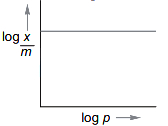
B
C
D
Solution
(C) The Freundlich adsorption isotherm is given by the equation: $\frac{x}{m} = k p^{1/n}$.
Taking the logarithm on both sides,we get: $\log \left( \frac{x}{m} \right) = \log k + \frac{1}{n} \log p$.
This equation is of the form $y = mx + c$,where $y = \log (x / m)$,$x = \log p$,slope $m = 1/n$,and intercept $c = \log k$.
Therefore,plotting $\log (x / m)$ on the $y$-axis and $\log p$ on the $x$-axis yields a straight line with a positive slope of $1/n$ and an intercept of $\log k$ on the $y$-axis.
Taking the logarithm on both sides,we get: $\log \left( \frac{x}{m} \right) = \log k + \frac{1}{n} \log p$.
This equation is of the form $y = mx + c$,where $y = \log (x / m)$,$x = \log p$,slope $m = 1/n$,and intercept $c = \log k$.
Therefore,plotting $\log (x / m)$ on the $y$-axis and $\log p$ on the $x$-axis yields a straight line with a positive slope of $1/n$ and an intercept of $\log k$ on the $y$-axis.
0 likesView Solution
Vedclass Products
For Students
Vedclass Test Series
Mock tests in real TS EAMCET style covering Chemistry with performance analysis. 5-day free trial.
Start Free TrialFor Teachers
Exam Paper Generator
Generate Set A/B/C/D Chemistry papers from 7.5L+ questions in 2 minutes. 3 chapters free.
Try FreeFor Institutes
Online Exam Module
Run live TS EAMCET mock exams with unlimited students, 360° analytics & white-label branding.
See DemoFrequently Asked Questions
How many Chemistry questions are in TS EAMCET 2008?
There are 199 Chemistry questions from the TS EAMCET 2008 paper on Vedclass, each with a detailed step-by-step solution in English.
Are TS EAMCET 2008 Chemistry solutions available in English?
Yes. All solutions on this page are in English. You can also switch to English or Hindi using the language buttons above the questions.
Can I practice TS EAMCET 2008 Chemistry as a timed test?
Yes. Use the Vedclass Test Series to attempt a full TS EAMCET mock test covering Chemistry with time limits and instant score analysis.
Can teachers create Chemistry papers from TS EAMCET previous year questions?
Yes. The Vedclass Exam Paper Generator lets teachers mix TS EAMCET Chemistry questions and generate Set A/B/C/D papers in minutes.
For Teachers & Institutes
Build a Custom Chemistry Paper
Pick TS EAMCET 2008 Chemistry questions, set difficulty, and generate Set A/B/C/D in 2 minutes.