
ChemistryQ151–179 of 199 questions
Page 4 of 4 · English
151
ChemistryMCQTS EAMCET · 2008
The angle between the curves $y^2=4x+4$ and $y^2=36(9-x)$ is (in $^{\circ}$)
A
$30$
B
$45$
C
$60$
D
$90$
Solution
(D) Given curves are $y^2=4x+4$ $(i)$ and $y^2=36(9-x)$ (ii).
To find the intersection points,equate the two expressions for $y^2$:
$4x+4 = 324-36x$
$40x = 320 \Rightarrow x = 8$.
Substituting $x=8$ into $(i)$,$y^2 = 4(8)+4 = 36 \Rightarrow y = \pm 6$.
So,the intersection points are $(8,6)$ and $(8,-6)$.
Differentiating $(i)$ with respect to $x$: $2y \frac{dy}{dx} = 4 \Rightarrow \frac{dy}{dx} = \frac{2}{y}$.
Differentiating (ii) with respect to $x$: $2y \frac{dy}{dx} = -36 \Rightarrow \frac{dy}{dx} = \frac{-18}{y}$.
At point $(8,6)$:
$m_1 = \frac{2}{6} = \frac{1}{3}$ and $m_2 = \frac{-18}{6} = -3$.
Since $m_1 \times m_2 = \frac{1}{3} \times (-3) = -1$,the tangents are perpendicular.
Therefore,the angle between the curves is $90^{\circ}$ or $\frac{\pi}{2}$.
To find the intersection points,equate the two expressions for $y^2$:
$4x+4 = 324-36x$
$40x = 320 \Rightarrow x = 8$.
Substituting $x=8$ into $(i)$,$y^2 = 4(8)+4 = 36 \Rightarrow y = \pm 6$.
So,the intersection points are $(8,6)$ and $(8,-6)$.
Differentiating $(i)$ with respect to $x$: $2y \frac{dy}{dx} = 4 \Rightarrow \frac{dy}{dx} = \frac{2}{y}$.
Differentiating (ii) with respect to $x$: $2y \frac{dy}{dx} = -36 \Rightarrow \frac{dy}{dx} = \frac{-18}{y}$.
At point $(8,6)$:
$m_1 = \frac{2}{6} = \frac{1}{3}$ and $m_2 = \frac{-18}{6} = -3$.
Since $m_1 \times m_2 = \frac{1}{3} \times (-3) = -1$,the tangents are perpendicular.
Therefore,the angle between the curves is $90^{\circ}$ or $\frac{\pi}{2}$.
0 likesView Solution
152
ChemistryMCQTS EAMCET · 2008
The equation of the normal to the curve $y^4=ax^3$ at $(a, a)$ is
A
$x+2y=3a$
B
$3x-4y+a=0$
C
$4x+3y=7a$
D
$4x-3y=0$
Solution
(C) Given curve is $y^4=ax^3$.
On differentiating with respect to $x$,we get:
$4y^3 \frac{dy}{dx} = 3ax^2$.
At the point $(a, a)$,the slope of the tangent is:
$\frac{dy}{dx} = \frac{3a(a)^2}{4(a)^3} = \frac{3a^3}{4a^3} = \frac{3}{4}$.
The slope of the normal is the negative reciprocal of the slope of the tangent:
$m_{\text{normal}} = -\frac{1}{3/4} = -\frac{4}{3}$.
The equation of the normal at $(a, a)$ is given by:
$y - a = -\frac{4}{3}(x - a)$.
Multiplying by $3$:
$3y - 3a = -4x + 4a$.
Rearranging the terms:
$4x + 3y = 7a$.
On differentiating with respect to $x$,we get:
$4y^3 \frac{dy}{dx} = 3ax^2$.
At the point $(a, a)$,the slope of the tangent is:
$\frac{dy}{dx} = \frac{3a(a)^2}{4(a)^3} = \frac{3a^3}{4a^3} = \frac{3}{4}$.
The slope of the normal is the negative reciprocal of the slope of the tangent:
$m_{\text{normal}} = -\frac{1}{3/4} = -\frac{4}{3}$.
The equation of the normal at $(a, a)$ is given by:
$y - a = -\frac{4}{3}(x - a)$.
Multiplying by $3$:
$3y - 3a = -4x + 4a$.
Rearranging the terms:
$4x + 3y = 7a$.
0 likesView Solution
153
ChemistryMCQTS EAMCET · 2008
If $\int e^x(1+x) \cdot \sec ^2(x e^x) \, dx = f(x) + \text{constant}$,then $f(x)$ is equal to
A
$\cos(x e^x)$
B
$\sin(x e^x)$
C
$2 \tan^{-1}(x)$
D
$\tan(x e^x)$
Solution
(D) Given the integral: $\int e^x(1+x) \cdot \sec^2(x e^x) \, dx = f(x) + C$.
Let $t = x e^x$.
Then,differentiating with respect to $x$ using the product rule: $\frac{dt}{dx} = e^x + x e^x = e^x(1+x)$.
Thus,$dt = e^x(1+x) \, dx$.
Substituting these into the integral,we get: $\int \sec^2(t) \, dt$.
The integral of $\sec^2(t)$ is $\tan(t) + C$.
Substituting back $t = x e^x$,we get $\tan(x e^x) + C$.
Comparing this with $f(x) + C$,we find $f(x) = \tan(x e^x)$.
Let $t = x e^x$.
Then,differentiating with respect to $x$ using the product rule: $\frac{dt}{dx} = e^x + x e^x = e^x(1+x)$.
Thus,$dt = e^x(1+x) \, dx$.
Substituting these into the integral,we get: $\int \sec^2(t) \, dt$.
The integral of $\sec^2(t)$ is $\tan(t) + C$.
Substituting back $t = x e^x$,we get $\tan(x e^x) + C$.
Comparing this with $f(x) + C$,we find $f(x) = \tan(x e^x)$.
0 likesView Solution
154
ChemistryMCQTS EAMCET · 2008
$\int_{-\pi / 2}^{\pi / 2} \sin |x| \, dx$ is equal to
A
$0$
B
$1$
C
$2$
D
$\pi$
Solution
(C) Let $I = \int_{-\pi / 2}^{\pi / 2} \sin |x| \, dx$.
Since $f(x) = \sin |x|$ is an even function because $f(-x) = \sin |-x| = \sin |x| = f(x)$,we can use the property $\int_{-a}^{a} f(x) \, dx = 2 \int_{0}^{a} f(x) \, dx$.
Thus,$I = 2 \int_{0}^{\pi / 2} \sin |x| \, dx$.
For $x \in [0, \pi / 2]$,$|x| = x$,so $I = 2 \int_{0}^{\pi / 2} \sin x \, dx$.
Evaluating the integral: $I = 2 [-\cos x]_{0}^{\pi / 2}$.
$I = 2 [-\cos(\pi / 2) - (-\cos 0)]$.
$I = 2 [0 - (-1)] = 2(1) = 2$.
Since $f(x) = \sin |x|$ is an even function because $f(-x) = \sin |-x| = \sin |x| = f(x)$,we can use the property $\int_{-a}^{a} f(x) \, dx = 2 \int_{0}^{a} f(x) \, dx$.
Thus,$I = 2 \int_{0}^{\pi / 2} \sin |x| \, dx$.
For $x \in [0, \pi / 2]$,$|x| = x$,so $I = 2 \int_{0}^{\pi / 2} \sin x \, dx$.
Evaluating the integral: $I = 2 [-\cos x]_{0}^{\pi / 2}$.
$I = 2 [-\cos(\pi / 2) - (-\cos 0)]$.
$I = 2 [0 - (-1)] = 2(1) = 2$.
0 likesView Solution
155
ChemistryMCQTS EAMCET · 2008
$\int_0^1 x^{3/2} \sqrt{1-x} \, dx$ is equal to
A
$\frac{\pi}{6}$
B
$\frac{\pi}{9}$
C
$\frac{\pi}{12}$
D
$\frac{\pi}{16}$
Solution
(D) Let $I = \int_0^1 x^{3/2} \sqrt{1-x} \, dx$.
Substitute $x = \sin^2 \theta$,then $dx = 2 \sin \theta \cos \theta \, d\theta$.
When $x=0, \theta=0$ and when $x=1, \theta=\frac{\pi}{2}$.
$I = \int_0^{\pi/2} (\sin^2 \theta)^{3/2} \sqrt{1-\sin^2 \theta} \cdot (2 \sin \theta \cos \theta) \, d\theta$
$I = \int_0^{\pi/2} \sin^3 \theta \cdot \cos \theta \cdot 2 \sin \theta \cos \theta \, d\theta$
$I = 2 \int_0^{\pi/2} \sin^4 \theta \cos^2 \theta \, d\theta$.
Using Wallis' formula $\int_0^{\pi/2} \sin^m \theta \cos^n \theta \, d\theta = \frac{(m-1)(m-3)\dots(1) \cdot (n-1)(n-3)\dots(1)}{(m+n)(m+n-2)\dots(2)} \cdot \frac{\pi}{2}$ (if both $m, n$ are even):
$I = 2 \left[ \frac{(4-1)(4-3) \cdot (2-1)}{(4+2)(4+2-2)(4+2-4)} \cdot \frac{\pi}{2} \right]$
$I = 2 \left[ \frac{3 \cdot 1 \cdot 1}{6 \cdot 4 \cdot 2} \cdot \frac{\pi}{2} \right] = 2 \left[ \frac{3}{48} \cdot \frac{\pi}{2} \right] = 2 \left[ \frac{1}{16} \cdot \frac{\pi}{2} \right] = \frac{\pi}{16}$.
Substitute $x = \sin^2 \theta$,then $dx = 2 \sin \theta \cos \theta \, d\theta$.
When $x=0, \theta=0$ and when $x=1, \theta=\frac{\pi}{2}$.
$I = \int_0^{\pi/2} (\sin^2 \theta)^{3/2} \sqrt{1-\sin^2 \theta} \cdot (2 \sin \theta \cos \theta) \, d\theta$
$I = \int_0^{\pi/2} \sin^3 \theta \cdot \cos \theta \cdot 2 \sin \theta \cos \theta \, d\theta$
$I = 2 \int_0^{\pi/2} \sin^4 \theta \cos^2 \theta \, d\theta$.
Using Wallis' formula $\int_0^{\pi/2} \sin^m \theta \cos^n \theta \, d\theta = \frac{(m-1)(m-3)\dots(1) \cdot (n-1)(n-3)\dots(1)}{(m+n)(m+n-2)\dots(2)} \cdot \frac{\pi}{2}$ (if both $m, n$ are even):
$I = 2 \left[ \frac{(4-1)(4-3) \cdot (2-1)}{(4+2)(4+2-2)(4+2-4)} \cdot \frac{\pi}{2} \right]$
$I = 2 \left[ \frac{3 \cdot 1 \cdot 1}{6 \cdot 4 \cdot 2} \cdot \frac{\pi}{2} \right] = 2 \left[ \frac{3}{48} \cdot \frac{\pi}{2} \right] = 2 \left[ \frac{1}{16} \cdot \frac{\pi}{2} \right] = \frac{\pi}{16}$.
0 likesView Solution
156
ChemistryMCQTS EAMCET · 2008
The solution of the differential equation $x y^2 d y - (x^3 + y^3) d x = 0$ is
A
$y^3 = 3 x^3 + c$
B
$y^3 = 3 x^3 \log (c x)$
C
$y^3 = 3 x^3 + \log (c x)$
D
$y^3 + 3 x^3 = \log (c x)$
Solution
(B) The given differential equation is $x y^2 d y = (x^3 + y^3) d x$.
This can be rewritten as $\frac{d y}{d x} = \frac{x^3 + y^3}{x y^2}$.
This is a homogeneous differential equation. Let $y = v x$,then $\frac{d y}{d x} = v + x \frac{d v}{d x}$.
Substituting these into the equation:
$v + x \frac{d v}{d x} = \frac{x^3 + v^3 x^3}{x(v x)^2} = \frac{x^3(1 + v^3)}{x^3 v^2} = \frac{1 + v^3}{v^2}$.
$x \frac{d v}{d x} = \frac{1 + v^3}{v^2} - v = \frac{1 + v^3 - v^3}{v^2} = \frac{1}{v^2}$.
Separating the variables,we get $v^2 d v = \frac{1}{x} d x$.
Integrating both sides: $\int v^2 d v = \int \frac{1}{x} d x$.
$\frac{v^3}{3} = \log |x| + C$,where $C = \log c$.
$\frac{v^3}{3} = \log |x| + \log c = \log |c x|$.
Substituting $v = \frac{y}{x}$,we get $\frac{1}{3} (\frac{y}{x})^3 = \log |c x|$.
$\frac{y^3}{3 x^3} = \log |c x| \Rightarrow y^3 = 3 x^3 \log |c x|$.
This can be rewritten as $\frac{d y}{d x} = \frac{x^3 + y^3}{x y^2}$.
This is a homogeneous differential equation. Let $y = v x$,then $\frac{d y}{d x} = v + x \frac{d v}{d x}$.
Substituting these into the equation:
$v + x \frac{d v}{d x} = \frac{x^3 + v^3 x^3}{x(v x)^2} = \frac{x^3(1 + v^3)}{x^3 v^2} = \frac{1 + v^3}{v^2}$.
$x \frac{d v}{d x} = \frac{1 + v^3}{v^2} - v = \frac{1 + v^3 - v^3}{v^2} = \frac{1}{v^2}$.
Separating the variables,we get $v^2 d v = \frac{1}{x} d x$.
Integrating both sides: $\int v^2 d v = \int \frac{1}{x} d x$.
$\frac{v^3}{3} = \log |x| + C$,where $C = \log c$.
$\frac{v^3}{3} = \log |x| + \log c = \log |c x|$.
Substituting $v = \frac{y}{x}$,we get $\frac{1}{3} (\frac{y}{x})^3 = \log |c x|$.
$\frac{y^3}{3 x^3} = \log |c x| \Rightarrow y^3 = 3 x^3 \log |c x|$.
0 likesView Solution
157
ChemistryMCQTS EAMCET · 2008
The solution of the differential equation $\frac{dy}{dx} - y \tan x = e^x \sec x$ is
A
$y = e^x \cos x + c$
B
$y \cos x = e^x + c$
C
$y = e^x \sin x + c$
D
$y \sin x = e^x + c$
Solution
(B) The given linear differential equation is of the form $\frac{dy}{dx} + Py = Q$,where $P = -\tan x$ and $Q = e^x \sec x$.
First,we find the integrating factor $(IF)$:
$IF = e^{\int P dx} = e^{\int -\tan x dx} = e^{\ln(\cos x)} = \cos x$.
The general solution is given by $y \cdot (IF) = \int Q \cdot (IF) dx + c$.
Substituting the values:
$y \cos x = \int (e^x \sec x) \cdot \cos x dx + c$.
Since $\sec x \cdot \cos x = 1$,the equation simplifies to:
$y \cos x = \int e^x dx + c$.
Integrating $e^x$,we get:
$y \cos x = e^x + c$.
First,we find the integrating factor $(IF)$:
$IF = e^{\int P dx} = e^{\int -\tan x dx} = e^{\ln(\cos x)} = \cos x$.
The general solution is given by $y \cdot (IF) = \int Q \cdot (IF) dx + c$.
Substituting the values:
$y \cos x = \int (e^x \sec x) \cdot \cos x dx + c$.
Since $\sec x \cdot \cos x = 1$,the equation simplifies to:
$y \cos x = \int e^x dx + c$.
Integrating $e^x$,we get:
$y \cos x = e^x + c$.
0 likesView Solution
158
ChemistryMCQTS EAMCET · 2008
The component of vector $\overrightarrow{A} = a_x \hat{i} + a_y \hat{j} + a_z \hat{k}$ along the direction of $\hat{i} - \hat{j}$ is
A
$a_x - a_y + a_z$
B
$a_x - a_y$
C
$(a_x - a_y) / \sqrt{2}$
D
$a_x + a_y + a_z$
Solution
(C) Let $\overrightarrow{B} = \hat{i} - \hat{j}$.
To find the component of vector $\overrightarrow{A}$ along the direction of $\overrightarrow{B}$,we calculate the scalar projection of $\overrightarrow{A}$ onto the unit vector of $\overrightarrow{B}$.
The unit vector along $\overrightarrow{B}$ is $\hat{u}_B = \frac{\overrightarrow{B}}{|\overrightarrow{B}|} = \frac{\hat{i} - \hat{j}}{\sqrt{1^2 + (-1)^2}} = \frac{\hat{i} - \hat{j}}{\sqrt{2}}$.
The component of $\overrightarrow{A}$ along $\overrightarrow{B}$ is given by the dot product $\overrightarrow{A} \cdot \hat{u}_B$.
$\overrightarrow{A} \cdot \hat{u}_B = (a_x \hat{i} + a_y \hat{j} + a_z \hat{k}) \cdot \left( \frac{\hat{i} - \hat{j}}{\sqrt{2}} \right)$.
$= \frac{1}{\sqrt{2}} (a_x(1) + a_y(-1) + a_z(0)) = \frac{a_x - a_y}{\sqrt{2}}$.
To find the component of vector $\overrightarrow{A}$ along the direction of $\overrightarrow{B}$,we calculate the scalar projection of $\overrightarrow{A}$ onto the unit vector of $\overrightarrow{B}$.
The unit vector along $\overrightarrow{B}$ is $\hat{u}_B = \frac{\overrightarrow{B}}{|\overrightarrow{B}|} = \frac{\hat{i} - \hat{j}}{\sqrt{1^2 + (-1)^2}} = \frac{\hat{i} - \hat{j}}{\sqrt{2}}$.
The component of $\overrightarrow{A}$ along $\overrightarrow{B}$ is given by the dot product $\overrightarrow{A} \cdot \hat{u}_B$.
$\overrightarrow{A} \cdot \hat{u}_B = (a_x \hat{i} + a_y \hat{j} + a_z \hat{k}) \cdot \left( \frac{\hat{i} - \hat{j}}{\sqrt{2}} \right)$.
$= \frac{1}{\sqrt{2}} (a_x(1) + a_y(-1) + a_z(0)) = \frac{a_x - a_y}{\sqrt{2}}$.
0 likesView Solution
159
ChemistryMCQTS EAMCET · 2008
If the position vectors of $A, B$ and $C$ are respectively $2 \hat{i}-\hat{j}+\hat{k}, \hat{i}-3 \hat{j}-5 \hat{k}$ and $3 \hat{i}-4 \hat{j}-4 \hat{k}$,then $\cos ^2 A$ is equal to
A
$0$
B
$\frac{6}{41}$
C
$\frac{35}{41}$
D
$1$
Solution
(C) Let the position vectors be $\vec{a} = \overrightarrow{OA} = 2\hat{i}-\hat{j}+\hat{k}$,$\vec{b} = \overrightarrow{OB} = \hat{i}-3\hat{j}-5\hat{k}$,and $\vec{c} = \overrightarrow{OC} = 3\hat{i}-4\hat{j}-4\hat{k}$.
To find $\cos A$,we consider the triangle $ABC$. The vectors forming the sides are $\vec{AB} = \vec{b} - \vec{a} = (1-2)\hat{i} + (-3+1)\hat{j} + (-5-1)\hat{k} = -\hat{i} - 2\hat{j} - 6\hat{k}$ and $\vec{AC} = \vec{c} - \vec{a} = (3-2)\hat{i} + (-4+1)\hat{j} + (-4-1)\hat{k} = \hat{i} - 3\hat{j} - 5\hat{k}$.
The angle $A$ is the angle between vectors $\vec{AB}$ and $\vec{AC}$.
$\cos A = \frac{\vec{AB} \cdot \vec{AC}}{|\vec{AB}| |\vec{AC}|}$.
$\vec{AB} \cdot \vec{AC} = (-1)(1) + (-2)(-3) + (-6)(-5) = -1 + 6 + 30 = 35$.
$|\vec{AB}| = \sqrt{(-1)^2 + (-2)^2 + (-6)^2} = \sqrt{1 + 4 + 36} = \sqrt{41}$.
$|\vec{AC}| = \sqrt{1^2 + (-3)^2 + (-5)^2} = \sqrt{1 + 9 + 25} = \sqrt{35}$.
$\cos A = \frac{35}{\sqrt{41} \sqrt{35}} = \sqrt{\frac{35}{41}}$.
Therefore,$\cos^2 A = \frac{35}{41}$.
To find $\cos A$,we consider the triangle $ABC$. The vectors forming the sides are $\vec{AB} = \vec{b} - \vec{a} = (1-2)\hat{i} + (-3+1)\hat{j} + (-5-1)\hat{k} = -\hat{i} - 2\hat{j} - 6\hat{k}$ and $\vec{AC} = \vec{c} - \vec{a} = (3-2)\hat{i} + (-4+1)\hat{j} + (-4-1)\hat{k} = \hat{i} - 3\hat{j} - 5\hat{k}$.
The angle $A$ is the angle between vectors $\vec{AB}$ and $\vec{AC}$.
$\cos A = \frac{\vec{AB} \cdot \vec{AC}}{|\vec{AB}| |\vec{AC}|}$.
$\vec{AB} \cdot \vec{AC} = (-1)(1) + (-2)(-3) + (-6)(-5) = -1 + 6 + 30 = 35$.
$|\vec{AB}| = \sqrt{(-1)^2 + (-2)^2 + (-6)^2} = \sqrt{1 + 4 + 36} = \sqrt{41}$.
$|\vec{AC}| = \sqrt{1^2 + (-3)^2 + (-5)^2} = \sqrt{1 + 9 + 25} = \sqrt{35}$.
$\cos A = \frac{35}{\sqrt{41} \sqrt{35}} = \sqrt{\frac{35}{41}}$.
Therefore,$\cos^2 A = \frac{35}{41}$.
0 likesView Solution
160
ChemistryMCQTS EAMCET · 2008
If the points with position vectors $60 \hat{i}+3 \hat{j}$,$40 \hat{i}-8 \hat{j}$,and $a \hat{i}-52 \hat{j}$ are collinear,then $a$ is equal to
A
$-40$
B
$-20$
C
$20$
D
$40$
Solution
(A) Let the points be $A(60, 3)$,$B(40, -8)$,and $C(a, -52)$.
Since the points are collinear,the area of the triangle formed by them is zero,or the slope of $AB$ must be equal to the slope of $BC$.
Slope of $AB = \frac{-8-3}{40-60} = \frac{-11}{-20} = \frac{11}{20}$.
Slope of $BC = \frac{-52-(-8)}{a-40} = \frac{-44}{a-40}$.
Equating the slopes: $\frac{11}{20} = \frac{-44}{a-40}$.
$11(a-40) = 20(-44)$.
$11a - 440 = -880$.
$11a = -440$.
$a = -40$.
Since the points are collinear,the area of the triangle formed by them is zero,or the slope of $AB$ must be equal to the slope of $BC$.
Slope of $AB = \frac{-8-3}{40-60} = \frac{-11}{-20} = \frac{11}{20}$.
Slope of $BC = \frac{-52-(-8)}{a-40} = \frac{-44}{a-40}$.
Equating the slopes: $\frac{11}{20} = \frac{-44}{a-40}$.
$11(a-40) = 20(-44)$.
$11a - 440 = -880$.
$11a = -440$.
$a = -40$.
0 likesView Solution
161
ChemistryMCQTS EAMCET · 2008
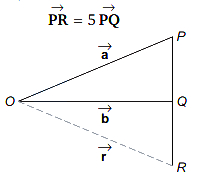
The position vectors of $P$ and $Q$ are respectively $\overrightarrow{a}$ and $\overrightarrow{b}$. If $R$ is a point such that $\overrightarrow{PR}=5 \overrightarrow{PQ}$,then the position vector of $R$ is
A
$5 \overrightarrow{b}-4 \overrightarrow{a}$
B
$5 \overrightarrow{b}+4 \overrightarrow{a}$
C
$4 \overrightarrow{b}-5 \overrightarrow{a}$
D
$4 \overrightarrow{b}+5 \overrightarrow{a}$
Solution
(A) Let $\overrightarrow{p} = \overrightarrow{a}$ and $\overrightarrow{q} = \overrightarrow{b}$ be the position vectors of points $P$ and $Q$ respectively.
Given that $\overrightarrow{PR} = 5 \overrightarrow{PQ}$.
We know that $\overrightarrow{PR} = \overrightarrow{r} - \overrightarrow{p}$ and $\overrightarrow{PQ} = \overrightarrow{q} - \overrightarrow{p}$.
Substituting these into the given equation:
$\overrightarrow{r} - \overrightarrow{p} = 5(\overrightarrow{q} - \overrightarrow{p})$
$\overrightarrow{r} - \overrightarrow{a} = 5(\overrightarrow{b} - \overrightarrow{a})$
$\overrightarrow{r} = \overrightarrow{a} + 5\overrightarrow{b} - 5\overrightarrow{a}$
$\overrightarrow{r} = 5\overrightarrow{b} - 4\overrightarrow{a}$
Thus,the position vector of $R$ is $5\overrightarrow{b} - 4\overrightarrow{a}$.
Given that $\overrightarrow{PR} = 5 \overrightarrow{PQ}$.
We know that $\overrightarrow{PR} = \overrightarrow{r} - \overrightarrow{p}$ and $\overrightarrow{PQ} = \overrightarrow{q} - \overrightarrow{p}$.
Substituting these into the given equation:
$\overrightarrow{r} - \overrightarrow{p} = 5(\overrightarrow{q} - \overrightarrow{p})$
$\overrightarrow{r} - \overrightarrow{a} = 5(\overrightarrow{b} - \overrightarrow{a})$
$\overrightarrow{r} = \overrightarrow{a} + 5\overrightarrow{b} - 5\overrightarrow{a}$
$\overrightarrow{r} = 5\overrightarrow{b} - 4\overrightarrow{a}$
Thus,the position vector of $R$ is $5\overrightarrow{b} - 4\overrightarrow{a}$.
0 likesView Solution
162
ChemistryMCQTS EAMCET · 2008
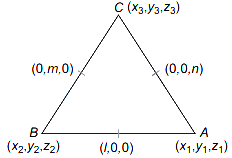
In $\triangle ABC$,the midpoints of the sides $AB, BC$,and $CA$ are respectively $(l, 0, 0), (0, m, 0)$,and $(0, 0, n)$. Then,$\frac{AB^2+BC^2+CA^2}{l^2+m^2+n^2}$ is equal to
A
$2$
B
$4$
C
$8$
D
$16$
Solution
(C) Let the vertices of the triangle be $A(x_1, y_1, z_1)$,$B(x_2, y_2, z_2)$,and $C(x_3, y_3, z_3)$.
Given the midpoints of $AB, BC$,and $CA$ are $(l, 0, 0), (0, m, 0)$,and $(0, 0, n)$ respectively.
Using the midpoint formula:
$\frac{x_1+x_2}{2} = l, \frac{y_1+y_2}{2} = 0, \frac{z_1+z_2}{2} = 0 \implies x_1+x_2=2l, y_1+y_2=0, z_1+z_2=0$
$\frac{x_2+x_3}{2} = 0, \frac{y_2+y_3}{2} = m, \frac{z_2+z_3}{2} = 0 \implies x_2+x_3=0, y_2+y_3=2m, z_2+z_3=0$
$\frac{x_3+x_1}{2} = 0, \frac{y_3+y_1}{2} = 0, \frac{z_3+z_1}{2} = n \implies x_3+x_1=0, y_3+y_1=0, z_3+z_1=2n$
Solving these systems of equations:
For $x$: $x_1+x_2=2l, x_2+x_3=0, x_3+x_1=0 \implies x_1=l, x_2=l, x_3=-l$
For $y$: $y_1+y_2=0, y_2+y_3=2m, y_3+y_1=0 \implies y_1=-m, y_2=m, y_3=m$
For $z$: $z_1+z_2=0, z_2+z_3=0, z_3+z_1=2n \implies z_1=n, z_2=-n, z_3=n$
Thus,$A(l, -m, n), B(l, m, -n), C(-l, m, n)$.
Now,calculate the squared side lengths:
$AB^2 = (l-l)^2 + (m-(-m))^2 + (-n-n)^2 = 0 + (2m)^2 + (-2n)^2 = 4m^2 + 4n^2$
$BC^2 = (-l-l)^2 + (m-m)^2 + (n-(-n))^2 = (-2l)^2 + 0 + (2n)^2 = 4l^2 + 4n^2$
$CA^2 = (l-(-l))^2 + (-m-m)^2 + (n-n)^2 = (2l)^2 + (-2m)^2 + 0 = 4l^2 + 4m^2$
Summing these: $AB^2+BC^2+CA^2 = (4m^2+4n^2) + (4l^2+4n^2) + (4l^2+4m^2) = 8(l^2+m^2+n^2)$.
Therefore,$\frac{AB^2+BC^2+CA^2}{l^2+m^2+n^2} = \frac{8(l^2+m^2+n^2)}{l^2+m^2+n^2} = 8$.
Given the midpoints of $AB, BC$,and $CA$ are $(l, 0, 0), (0, m, 0)$,and $(0, 0, n)$ respectively.
Using the midpoint formula:
$\frac{x_1+x_2}{2} = l, \frac{y_1+y_2}{2} = 0, \frac{z_1+z_2}{2} = 0 \implies x_1+x_2=2l, y_1+y_2=0, z_1+z_2=0$
$\frac{x_2+x_3}{2} = 0, \frac{y_2+y_3}{2} = m, \frac{z_2+z_3}{2} = 0 \implies x_2+x_3=0, y_2+y_3=2m, z_2+z_3=0$
$\frac{x_3+x_1}{2} = 0, \frac{y_3+y_1}{2} = 0, \frac{z_3+z_1}{2} = n \implies x_3+x_1=0, y_3+y_1=0, z_3+z_1=2n$
Solving these systems of equations:
For $x$: $x_1+x_2=2l, x_2+x_3=0, x_3+x_1=0 \implies x_1=l, x_2=l, x_3=-l$
For $y$: $y_1+y_2=0, y_2+y_3=2m, y_3+y_1=0 \implies y_1=-m, y_2=m, y_3=m$
For $z$: $z_1+z_2=0, z_2+z_3=0, z_3+z_1=2n \implies z_1=n, z_2=-n, z_3=n$
Thus,$A(l, -m, n), B(l, m, -n), C(-l, m, n)$.
Now,calculate the squared side lengths:
$AB^2 = (l-l)^2 + (m-(-m))^2 + (-n-n)^2 = 0 + (2m)^2 + (-2n)^2 = 4m^2 + 4n^2$
$BC^2 = (-l-l)^2 + (m-m)^2 + (n-(-n))^2 = (-2l)^2 + 0 + (2n)^2 = 4l^2 + 4n^2$
$CA^2 = (l-(-l))^2 + (-m-m)^2 + (n-n)^2 = (2l)^2 + (-2m)^2 + 0 = 4l^2 + 4m^2$
Summing these: $AB^2+BC^2+CA^2 = (4m^2+4n^2) + (4l^2+4n^2) + (4l^2+4m^2) = 8(l^2+m^2+n^2)$.
Therefore,$\frac{AB^2+BC^2+CA^2}{l^2+m^2+n^2} = \frac{8(l^2+m^2+n^2)}{l^2+m^2+n^2} = 8$.
0 likesView Solution
163
ChemistryMCQTS EAMCET · 2008
The angle between the lines whose direction cosines are $\left(\frac{\sqrt{3}}{4}, \frac{1}{4}, \frac{\sqrt{3}}{2}\right)$ and $\left(\frac{\sqrt{3}}{4}, \frac{1}{4}, \frac{-\sqrt{3}}{2}\right)$ is:
A
$\pi$
B
$\frac{\pi}{2}$
C
$\frac{\pi}{3}$
D
$\frac{\pi}{4}$
Solution
(C) Given the direction cosines of the two lines as $(l_1, m_1, n_1) = \left(\frac{\sqrt{3}}{4}, \frac{1}{4}, \frac{\sqrt{3}}{2}\right)$ and $(l_2, m_2, n_2) = \left(\frac{\sqrt{3}}{4}, \frac{1}{4}, \frac{-\sqrt{3}}{2}\right)$.
The cosine of the angle $\theta$ between two lines with direction cosines $(l_1, m_1, n_1)$ and $(l_2, m_2, n_2)$ is given by $\cos \theta = |l_1 l_2 + m_1 m_2 + n_1 n_2|$.
Substituting the values:
$\cos \theta = \left| \left(\frac{\sqrt{3}}{4} \times \frac{\sqrt{3}}{4}\right) + \left(\frac{1}{4} \times \frac{1}{4}\right) + \left(\frac{\sqrt{3}}{2} \times \frac{-\sqrt{3}}{2}\right) \right|$
$\cos \theta = \left| \frac{3}{16} + \frac{1}{16} - \frac{3}{4} \right|$
$\cos \theta = \left| \frac{4}{16} - \frac{12}{16} \right| = \left| -\frac{8}{16} \right| = \left| -\frac{1}{2} \right| = \frac{1}{2}$.
Since $\cos \theta = \frac{1}{2}$,we have $\theta = \frac{\pi}{3}$.
The cosine of the angle $\theta$ between two lines with direction cosines $(l_1, m_1, n_1)$ and $(l_2, m_2, n_2)$ is given by $\cos \theta = |l_1 l_2 + m_1 m_2 + n_1 n_2|$.
Substituting the values:
$\cos \theta = \left| \left(\frac{\sqrt{3}}{4} \times \frac{\sqrt{3}}{4}\right) + \left(\frac{1}{4} \times \frac{1}{4}\right) + \left(\frac{\sqrt{3}}{2} \times \frac{-\sqrt{3}}{2}\right) \right|$
$\cos \theta = \left| \frac{3}{16} + \frac{1}{16} - \frac{3}{4} \right|$
$\cos \theta = \left| \frac{4}{16} - \frac{12}{16} \right| = \left| -\frac{8}{16} \right| = \left| -\frac{1}{2} \right| = \frac{1}{2}$.
Since $\cos \theta = \frac{1}{2}$,we have $\theta = \frac{\pi}{3}$.
0 likesView Solution
164
ChemistryMCQTS EAMCET · 2008
Let $S$ be the sample space of the random experiment of throwing simultaneously two unbiased dice with six faces (numbered $1$ to $6$) and let $E_k = \{(a, b) \in S : ab = k\}$ for $k \geq 1$. If $p_k = P(E_k)$ for $k \geq 1$,then which of the following is correct?
A
$p_1 < p_{30} < p_4 < p_6$
B
$p_{36} < p_6 < p_2 < p_4$
C
$p_1 < p_{11} < p_4 < p_6$
D
$p_{36} < p_{11} < p_6 < p_4$
Solution
(A) The sample space $S$ for throwing two dice has $6 \times 6 = 36$ outcomes.
$p_k = P(E_k) = \frac{|E_k|}{36}$.
For $k=1$: $E_1 = \{(1, 1)\}$,so $p_1 = \frac{1}{36}$.
For $k=2$: $E_2 = \{(1, 2), (2, 1)\}$,so $p_2 = \frac{2}{36}$.
For $k=4$: $E_4 = \{(1, 4), (4, 1), (2, 2)\}$,so $p_4 = \frac{3}{36}$.
For $k=6$: $E_6 = \{(1, 6), (6, 1), (2, 3), (3, 2)\}$,so $p_6 = \frac{4}{36}$.
For $k=30$: $E_{30} = \{(5, 6), (6, 5)\}$,so $p_{30} = \frac{2}{36}$.
For $k=11$: $E_{11} = \emptyset$,so $p_{11} = 0$.
For $k=36$: $E_{36} = \{(6, 6)\}$,so $p_{36} = \frac{1}{36}$.
Comparing the values: $p_1 = \frac{1}{36}$,$p_{30} = \frac{2}{36}$,$p_4 = \frac{3}{36}$,$p_6 = \frac{4}{36}$.
Thus,$p_1 < p_{30} < p_4 < p_6$ is correct.
$p_k = P(E_k) = \frac{|E_k|}{36}$.
For $k=1$: $E_1 = \{(1, 1)\}$,so $p_1 = \frac{1}{36}$.
For $k=2$: $E_2 = \{(1, 2), (2, 1)\}$,so $p_2 = \frac{2}{36}$.
For $k=4$: $E_4 = \{(1, 4), (4, 1), (2, 2)\}$,so $p_4 = \frac{3}{36}$.
For $k=6$: $E_6 = \{(1, 6), (6, 1), (2, 3), (3, 2)\}$,so $p_6 = \frac{4}{36}$.
For $k=30$: $E_{30} = \{(5, 6), (6, 5)\}$,so $p_{30} = \frac{2}{36}$.
For $k=11$: $E_{11} = \emptyset$,so $p_{11} = 0$.
For $k=36$: $E_{36} = \{(6, 6)\}$,so $p_{36} = \frac{1}{36}$.
Comparing the values: $p_1 = \frac{1}{36}$,$p_{30} = \frac{2}{36}$,$p_4 = \frac{3}{36}$,$p_6 = \frac{4}{36}$.
Thus,$p_1 < p_{30} < p_4 < p_6$ is correct.
0 likesView Solution
165
ChemistryMCQTS EAMCET · 2008
For $k=1, 2, 3$,the box $B_k$ contains $k$ red balls and $(k+1)$ white balls. Let $P(B_1)=\frac{1}{2}$,$P(B_2)=\frac{1}{3}$,and $P(B_3)=\frac{1}{6}$. $A$ box is selected at random and a ball is drawn from it. If a red ball is drawn,then the probability that it has come from box $B_2$ is:
A
$\frac{35}{78}$
B
$\frac{14}{39}$
C
$\frac{10}{13}$
D
$\frac{12}{13}$
Solution
(B) Let $R$ be the event of drawing a red ball. The contents of the boxes are:
$B_1: 1R, 2W \implies P(R|B_1) = \frac{1}{3}$
$B_2: 2R, 3W \implies P(R|B_2) = \frac{2}{5}$
$B_3: 3R, 4W \implies P(R|B_3) = \frac{3}{7}$
Using Bayes' Theorem,the probability that the ball came from box $B_2$ given that it is red is:
$P(B_2|R) = \frac{P(B_2)P(R|B_2)}{P(B_1)P(R|B_1) + P(B_2)P(R|B_2) + P(B_3)P(R|B_3)}$
Substituting the values:
$P(B_2|R) = \frac{\frac{1}{3} \times \frac{2}{5}}{\frac{1}{2} \times \frac{1}{3} + \frac{1}{3} \times \frac{2}{5} + \frac{1}{6} \times \frac{3}{7}}$
$P(B_2|R) = \frac{\frac{2}{15}}{\frac{1}{6} + \frac{2}{15} + \frac{1}{14}}$
Finding a common denominator for the denominator $(210)$:
$P(B_2|R) = \frac{\frac{2}{15}}{\frac{35 + 28 + 15}{210}} = \frac{2}{15} \times \frac{210}{78} = \frac{280}{1170} = \frac{14}{39}$
$B_1: 1R, 2W \implies P(R|B_1) = \frac{1}{3}$
$B_2: 2R, 3W \implies P(R|B_2) = \frac{2}{5}$
$B_3: 3R, 4W \implies P(R|B_3) = \frac{3}{7}$
Using Bayes' Theorem,the probability that the ball came from box $B_2$ given that it is red is:
$P(B_2|R) = \frac{P(B_2)P(R|B_2)}{P(B_1)P(R|B_1) + P(B_2)P(R|B_2) + P(B_3)P(R|B_3)}$
Substituting the values:
$P(B_2|R) = \frac{\frac{1}{3} \times \frac{2}{5}}{\frac{1}{2} \times \frac{1}{3} + \frac{1}{3} \times \frac{2}{5} + \frac{1}{6} \times \frac{3}{7}}$
$P(B_2|R) = \frac{\frac{2}{15}}{\frac{1}{6} + \frac{2}{15} + \frac{1}{14}}$
Finding a common denominator for the denominator $(210)$:
$P(B_2|R) = \frac{\frac{2}{15}}{\frac{35 + 28 + 15}{210}} = \frac{2}{15} \times \frac{210}{78} = \frac{280}{1170} = \frac{14}{39}$
0 likesView Solution
166
ChemistryMCQTS EAMCET · 2008
If $X$ is a Poisson variate such that $P(X=1)=P(X=2)$,then $P(X=4)$ is equal to
A
$\frac{1}{2 e^2}$
B
$\frac{1}{3 e^2}$
C
$\frac{2}{3 e^2}$
D
$\frac{1}{e^2}$
Solution
(C) For a Poisson distribution,the probability mass function is given by $P(X=k) = \frac{e^{-\lambda} \lambda^k}{k!}$.
Given that $P(X=1) = P(X=2)$,we have:
$\frac{e^{-\lambda} \lambda^1}{1!} = \frac{e^{-\lambda} \lambda^2}{2!}$
Dividing both sides by $e^{-\lambda} \lambda$ (assuming $\lambda \neq 0$):
$1 = \frac{\lambda}{2}$
$\lambda = 2$
Now,we need to find $P(X=4)$:
$P(X=4) = \frac{e^{-\lambda} \lambda^4}{4!} = \frac{e^{-2} (2)^4}{4!}$
$P(X=4) = \frac{e^{-2} \times 16}{24} = \frac{2}{3 e^2}$.
Given that $P(X=1) = P(X=2)$,we have:
$\frac{e^{-\lambda} \lambda^1}{1!} = \frac{e^{-\lambda} \lambda^2}{2!}$
Dividing both sides by $e^{-\lambda} \lambda$ (assuming $\lambda \neq 0$):
$1 = \frac{\lambda}{2}$
$\lambda = 2$
Now,we need to find $P(X=4)$:
$P(X=4) = \frac{e^{-\lambda} \lambda^4}{4!} = \frac{e^{-2} (2)^4}{4!}$
$P(X=4) = \frac{e^{-2} \times 16}{24} = \frac{2}{3 e^2}$.
0 likesView Solution
167
ChemistryMCQTS EAMCET · 2008
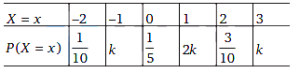
The distribution of a random variable $X$ is given below:
The value of $k$ is:
| $X = x$ | $-2$ | $-1$ | $0$ | $1$ | $2$ | $3$ |
| $P(X = x)$ | $\frac{1}{10}$ | $k$ | $\frac{1}{5}$ | $2k$ | $\frac{3}{10}$ | $k$ |
The value of $k$ is:
A
$\frac{1}{10}$
B
$\frac{2}{10}$
C
$\frac{3}{10}$
D
$\frac{7}{10}$
Solution
(A) For a probability distribution,the sum of all probabilities must be equal to $1$.
Therefore,$\sum P(X = x) = 1$.
$\frac{1}{10} + k + \frac{1}{5} + 2k + \frac{3}{10} + k = 1$
Combining the constant terms:
$(\frac{1}{10} + \frac{2}{10} + \frac{3}{10}) + (k + 2k + k) = 1$
$\frac{6}{10} + 4k = 1$
$4k = 1 - \frac{6}{10}$
$4k = \frac{10 - 6}{10}$
$4k = \frac{4}{10}$
$k = \frac{4}{10 \times 4}$
$k = \frac{1}{10}$
Therefore,$\sum P(X = x) = 1$.
$\frac{1}{10} + k + \frac{1}{5} + 2k + \frac{3}{10} + k = 1$
Combining the constant terms:
$(\frac{1}{10} + \frac{2}{10} + \frac{3}{10}) + (k + 2k + k) = 1$
$\frac{6}{10} + 4k = 1$
$4k = 1 - \frac{6}{10}$
$4k = \frac{10 - 6}{10}$
$4k = \frac{4}{10}$
$k = \frac{4}{10 \times 4}$
$k = \frac{1}{10}$
0 likesView Solution
168
ChemistryMCQTS EAMCET · 2008
Two rain drops reach the earth with different terminal velocities having ratio $9:4$. Then the ratio of their volumes is
A
$3:2$
B
$4:9$
C
$9:4$
D
$27:8$
Solution
(D) The terminal velocity $v_T$ of a spherical drop is given by $v_T = \frac{2}{9} \frac{r^2 g (\rho - \sigma)}{\eta}$,where $r$ is the radius of the drop.
Thus,$v_T \propto r^2$.
Given the ratio of terminal velocities is $\frac{v_{T_1}}{v_{T_2}} = \frac{9}{4}$.
Since $\frac{v_{T_1}}{v_{T_2}} = \left(\frac{r_1}{r_2}\right)^2$,we have $\frac{r_1}{r_2} = \sqrt{\frac{9}{4}} = \frac{3}{2}$.
The volume $V$ of a spherical drop is given by $V = \frac{4}{3} \pi r^3$,so $V \propto r^3$.
The ratio of their volumes is $\frac{V_1}{V_2} = \left(\frac{r_1}{r_2}\right)^3 = \left(\frac{3}{2}\right)^3 = \frac{27}{8}$.
Thus,$v_T \propto r^2$.
Given the ratio of terminal velocities is $\frac{v_{T_1}}{v_{T_2}} = \frac{9}{4}$.
Since $\frac{v_{T_1}}{v_{T_2}} = \left(\frac{r_1}{r_2}\right)^2$,we have $\frac{r_1}{r_2} = \sqrt{\frac{9}{4}} = \frac{3}{2}$.
The volume $V$ of a spherical drop is given by $V = \frac{4}{3} \pi r^3$,so $V \propto r^3$.
The ratio of their volumes is $\frac{V_1}{V_2} = \left(\frac{r_1}{r_2}\right)^3 = \left(\frac{3}{2}\right)^3 = \frac{27}{8}$.
0 likesView Solution
169
ChemistryMediumMCQTS EAMCET · 2008
Boron halides behave as Lewis acids because of their nature.
A
proton donor
B
covalent
C
electron deficient
D
ionising
Solution
(C) According to Lewis,compounds that can accept a lone pair of electrons are called Lewis acids.
Boron halides,such as $BX_3$,have only $6$ electrons in the valence shell of the boron atom.
Due to this electron deficiency,they can accept a lone pair of electrons from a donor to complete their octet,thus behaving as Lewis acids.
Boron halides,such as $BX_3$,have only $6$ electrons in the valence shell of the boron atom.
Due to this electron deficiency,they can accept a lone pair of electrons from a donor to complete their octet,thus behaving as Lewis acids.
0 likesView Solution
170
ChemistryMediumMCQTS EAMCET · 2008
Identify $B$ in the following reaction:
$H_4SiO_4$ $\xrightarrow[{-H_2O}]{1000^{\circ}C} A$ $\xrightarrow[\Delta]{Carbon} B + CO$
$H_4SiO_4$ $\xrightarrow[{-H_2O}]{1000^{\circ}C} A$ $\xrightarrow[\Delta]{Carbon} B + CO$
A
corundum
B
quartz
C
silica
D
carborundum
Solution
(D) Orthosilicic acid $(H_4SiO_4)$,on heating at $1000^{\circ}C$,loses two water molecules to form silica $(SiO_2)$ as product $A$.
$H_4SiO_4 \xrightarrow[{-2H_2O}]{1000^{\circ}C} SiO_2 (A)$
Silica $(SiO_2)$ on reduction with carbon at high temperature gives carborundum $(SiC)$ as product $B$ and carbon monoxide $(CO)$.
$SiO_2 + 3C \xrightarrow{\Delta} SiC (B) + 2CO$
Therefore,$B$ is carborundum.
$H_4SiO_4 \xrightarrow[{-2H_2O}]{1000^{\circ}C} SiO_2 (A)$
Silica $(SiO_2)$ on reduction with carbon at high temperature gives carborundum $(SiC)$ as product $B$ and carbon monoxide $(CO)$.
$SiO_2 + 3C \xrightarrow{\Delta} SiC (B) + 2CO$
Therefore,$B$ is carborundum.
0 likesView Solution
171
ChemistryMediumMCQTS EAMCET · 2008
The number of sigma $(\sigma)$ and pi $(\pi)$ bonds in peroxodisulphuric acid are,respectively:
A
$9$ and $4$
B
$11$ and $4$
C
$4$ and $8$
D
$4$ and $9$
Solution
(B) The chemical formula of peroxodisulphuric acid (Marshall's acid) is $H_2S_2O_8$.
Its structure consists of two $SO_3$ groups linked by a peroxide linkage $(-O-O-)$.
In the structure:
- There are $2$ $S=O$ double bonds per sulfur atom,contributing $2$ $\pi$ bonds each,totaling $4$ $\pi$ bonds.
- Counting the $\sigma$ bonds: $4$ $S=O$ bonds,$2$ $S-OH$ bonds,$2$ $O-H$ bonds,$2$ $S-O$ bonds (to peroxide oxygen),and $1$ $O-O$ bond.
- Total $\sigma$ bonds = $4 + 2 + 2 + 2 + 1 = 11$.
- Total $\pi$ bonds = $4$.
Thus,the number of $\sigma$ and $\pi$ bonds are $11$ and $4$ respectively.
Its structure consists of two $SO_3$ groups linked by a peroxide linkage $(-O-O-)$.
In the structure:
- There are $2$ $S=O$ double bonds per sulfur atom,contributing $2$ $\pi$ bonds each,totaling $4$ $\pi$ bonds.
- Counting the $\sigma$ bonds: $4$ $S=O$ bonds,$2$ $S-OH$ bonds,$2$ $O-H$ bonds,$2$ $S-O$ bonds (to peroxide oxygen),and $1$ $O-O$ bond.
- Total $\sigma$ bonds = $4 + 2 + 2 + 2 + 1 = 11$.
- Total $\pi$ bonds = $4$.
Thus,the number of $\sigma$ and $\pi$ bonds are $11$ and $4$ respectively.
0 likesView Solution
172
ChemistryMediumMCQTS EAMCET · 2008
In which of the following reactions,chlorine acts as an oxidising agent?
$(i)$ $CH_3CH_2OH + Cl_2 \longrightarrow CH_3CHO + HCl$
(ii) $CH_3CHO + Cl_2 \longrightarrow CCl_3CHO + HCl$
(iii) $CH_4 + Cl_2 \stackrel{hv}{\longrightarrow} CH_3Cl + HCl$
The correct answer is
$(i)$ $CH_3CH_2OH + Cl_2 \longrightarrow CH_3CHO + HCl$
(ii) $CH_3CHO + Cl_2 \longrightarrow CCl_3CHO + HCl$
(iii) $CH_4 + Cl_2 \stackrel{hv}{\longrightarrow} CH_3Cl + HCl$
The correct answer is
A
$(i)$ only
B
(ii) only
C
$(i)$ and (iii)
D
$(i)$,(ii) and (iii)
Solution
(D) An oxidising agent is a substance that undergoes reduction or facilitates the oxidation of another reactant (e.g.,by removing hydrogen).
In all three given reactions,the oxidation state of chlorine decreases from $0$ in $Cl_2$ to $-1$ in $HCl$,meaning chlorine is reduced.
$(i)$ $CH_3CH_2OH + Cl_2 \longrightarrow CH_3CHO + HCl$: Chlorine removes hydrogen from ethanol,oxidizing it to acetaldehyde.
(ii) $CH_3CHO + Cl_2 \longrightarrow CCl_3CHO + HCl$: Chlorine replaces hydrogen atoms in acetaldehyde,acting as an oxidant.
(iii) $CH_4 + Cl_2 \stackrel{hv}{\longrightarrow} CH_3Cl + HCl$: Chlorine removes hydrogen from methane,oxidizing it to chloromethane.
Since chlorine is reduced in all these reactions,it acts as an oxidising agent in all of them.
In all three given reactions,the oxidation state of chlorine decreases from $0$ in $Cl_2$ to $-1$ in $HCl$,meaning chlorine is reduced.
$(i)$ $CH_3CH_2OH + Cl_2 \longrightarrow CH_3CHO + HCl$: Chlorine removes hydrogen from ethanol,oxidizing it to acetaldehyde.
(ii) $CH_3CHO + Cl_2 \longrightarrow CCl_3CHO + HCl$: Chlorine replaces hydrogen atoms in acetaldehyde,acting as an oxidant.
(iii) $CH_4 + Cl_2 \stackrel{hv}{\longrightarrow} CH_3Cl + HCl$: Chlorine removes hydrogen from methane,oxidizing it to chloromethane.
Since chlorine is reduced in all these reactions,it acts as an oxidising agent in all of them.
0 likesView Solution
173
ChemistryMediumMCQTS EAMCET · 2008
Which one of the following reactions does not occur?
A
$F_2 + 2Cl^- \longrightarrow 2F^- + Cl_2$
B
$Cl_2 + 2F^- \longrightarrow 2Cl^- + F_2$
C
$Br_2 + 2I^- \longrightarrow 2Br^- + I_2$
D
$Cl_2 + 2Br^- \longrightarrow 2Cl^- + Br_2$
Solution
(B) The oxidizing power of halogens decreases down the group as the reduction potential decreases.
Fluorine $(F_2)$ is the strongest oxidizing agent,while Iodine $(I_2)$ is the weakest.
$A$ halogen with a higher reduction potential can displace a halide ion with a lower reduction potential from its salt solution.
Since the reduction potential of $Cl_2$ is lower than that of $F_2$,$Cl_2$ cannot oxidize $F^-$ to $F_2$.
Therefore,the reaction $Cl_2 + 2F^- \longrightarrow 2Cl^- + F_2$ is not spontaneous and does not occur.
Fluorine $(F_2)$ is the strongest oxidizing agent,while Iodine $(I_2)$ is the weakest.
$A$ halogen with a higher reduction potential can displace a halide ion with a lower reduction potential from its salt solution.
Since the reduction potential of $Cl_2$ is lower than that of $F_2$,$Cl_2$ cannot oxidize $F^-$ to $F_2$.
Therefore,the reaction $Cl_2 + 2F^- \longrightarrow 2Cl^- + F_2$ is not spontaneous and does not occur.
0 likesView Solution
174
ChemistryMediumMCQTS EAMCET · 2008
Which of the following statements are correct for alkali metal compounds?
$(i)$ Superoxides are paramagnetic in nature.
(ii) The basic strengths of hydroxides increase down the group.
(iii) The conductivity of chlorides in their aqueous solutions decreases down the group.
(iv) The basic nature of carbonates in aqueous solutions is due to cationic hydrolysis.
$(i)$ Superoxides are paramagnetic in nature.
(ii) The basic strengths of hydroxides increase down the group.
(iii) The conductivity of chlorides in their aqueous solutions decreases down the group.
(iv) The basic nature of carbonates in aqueous solutions is due to cationic hydrolysis.
A
$(i)$,(ii) and (iii) only
B
$(i)$ and (ii) only
C
(ii),(iii) and (iv) only
D
(iii) and (iv) only
Solution
(B) $(i)$ Superoxides contain the $O_2^-$ ion,which has one unpaired electron,making them paramagnetic. This statement is correct.
(ii) As we move down the group,the size of the metal ion increases,which decreases the lattice energy and increases the solubility/dissociation of hydroxides,thus increasing basic strength. This statement is correct.
(iii) Conductivity in aqueous solutions depends on ionic mobility. As we move down the group,the size of the hydrated ion decreases (due to less hydration),leading to higher ionic mobility and higher conductivity. Thus,conductivity increases down the group. This statement is incorrect.
(iv) The basic nature of carbonates is due to anionic hydrolysis (hydrolysis of the $CO_3^{2-}$ ion),not cationic hydrolysis. This statement is incorrect.
Therefore,only statements $(i)$ and $(ii)$ are correct.
(ii) As we move down the group,the size of the metal ion increases,which decreases the lattice energy and increases the solubility/dissociation of hydroxides,thus increasing basic strength. This statement is correct.
(iii) Conductivity in aqueous solutions depends on ionic mobility. As we move down the group,the size of the hydrated ion decreases (due to less hydration),leading to higher ionic mobility and higher conductivity. Thus,conductivity increases down the group. This statement is incorrect.
(iv) The basic nature of carbonates is due to anionic hydrolysis (hydrolysis of the $CO_3^{2-}$ ion),not cationic hydrolysis. This statement is incorrect.
Therefore,only statements $(i)$ and $(ii)$ are correct.
0 likesView Solution
175
ChemistryDifficultMCQTS EAMCET · 2008
Match the following items in List-$I$ with the corresponding results in List-$II$ (at $STP$):
| List-$I$ | List-$II$ (At $STP$) |
| $(A)$ $10 \ g \ CaCO_3 \xrightarrow{\Delta} \text{decomposition}$ | $(i)$ $0.224 \ L \ CO_2$ |
| $(B)$ $1.06 \ g \ Na_2CO_3 \xrightarrow{\text{Excess } HCl} \text{reaction}$ | $(ii)$ $4.48 \ L \ CO_2$ |
| $(C)$ $2.4 \ g \ C \xrightarrow{\text{Excess } O_2} \text{combustion}$ | $(iii)$ $0.448 \ L \ CO_2$ |
| $(D)$ $0.56 \ g \ CO \xrightarrow{\text{Excess } O_2} \text{combustion}$ | $(iv)$ $2.24 \ L \ CO_2$ |
| $(v)$ $22.4 \ L \ CO_2$ |
A
$A-(iv), B-(i), C-(ii), D-(iii)$
B
$A-(v), B-(i), C-(ii), D-(iii)$
C
$A-(iv), B-(i), C-(iii), D-(ii)$
D
$A-(i), B-(iv), C-(ii), D-(iii)$
Solution
(A) $CaCO_3 \xrightarrow{\Delta} CaO + CO_2$. $100 \ g \ CaCO_3$ gives $22.4 \ L \ CO_2$ at $STP$. So,$10 \ g \ CaCO_3$ gives $2.24 \ L \ CO_2$. Thus,$A-(iv)$.
$(B)$ $Na_2CO_3 + 2HCl \rightarrow 2NaCl + H_2O + CO_2$. $106 \ g \ Na_2CO_3$ gives $22.4 \ L \ CO_2$. So,$1.06 \ g \ Na_2CO_3$ gives $0.224 \ L \ CO_2$. Thus,$B-(i)$.
$(C)$ $C + O_2 \rightarrow CO_2$. $12 \ g \ C$ gives $22.4 \ L \ CO_2$. So,$2.4 \ g \ C$ gives $(22.4 \times 2.4) / 12 = 4.48 \ L \ CO_2$. Thus,$C-(ii)$.
$(D)$ $2CO + O_2 \rightarrow 2CO_2$. $56 \ g \ CO$ gives $2 \times 22.4 \ L \ CO_2 = 44.8 \ L \ CO_2$. So,$0.56 \ g \ CO$ gives $(44.8 \times 0.56) / 56 = 0.448 \ L \ CO_2$. Thus,$D-(iii)$.
Therefore,the correct match is $A-(iv), B-(i), C-(ii), D-(iii)$.
$(B)$ $Na_2CO_3 + 2HCl \rightarrow 2NaCl + H_2O + CO_2$. $106 \ g \ Na_2CO_3$ gives $22.4 \ L \ CO_2$. So,$1.06 \ g \ Na_2CO_3$ gives $0.224 \ L \ CO_2$. Thus,$B-(i)$.
$(C)$ $C + O_2 \rightarrow CO_2$. $12 \ g \ C$ gives $22.4 \ L \ CO_2$. So,$2.4 \ g \ C$ gives $(22.4 \times 2.4) / 12 = 4.48 \ L \ CO_2$. Thus,$C-(ii)$.
$(D)$ $2CO + O_2 \rightarrow 2CO_2$. $56 \ g \ CO$ gives $2 \times 22.4 \ L \ CO_2 = 44.8 \ L \ CO_2$. So,$0.56 \ g \ CO$ gives $(44.8 \times 0.56) / 56 = 0.448 \ L \ CO_2$. Thus,$D-(iii)$.
Therefore,the correct match is $A-(iv), B-(i), C-(ii), D-(iii)$.
0 likesView Solution
176
ChemistryDifficultMCQTS EAMCET · 2008
What is the temperature at which the kinetic energy of $0.3 \text{ moles}$ of helium is equal to the kinetic energy of $0.4 \text{ moles}$ of argon at $400 \text{ K}$ (in $\text{ K}$)?
A
$400$
B
$873$
C
$533$
D
$300$
Solution
(C) The kinetic energy $(KE)$ of an ideal gas is given by the formula $KE = nRT$, where $n$ is the number of moles, $R$ is the gas constant, and $T$ is the temperature in Kelvin.
Given:
For helium: $n_{He} = 0.3 \text{ mol}$
For argon: $n_{Ar} = 0.4 \text{ mol}$, $T_{Ar} = 400 \text{ K}$
According to the problem, $KE_{He} = KE_{Ar}$.
Substituting the values:
$0.3 \times R \times T = 0.4 \times R \times 400$
Dividing both sides by $R$:
$0.3 \times T = 160$
$T = \frac{160}{0.3} = 533.33 \text{ K} \approx 533 \text{ K}$.
Given:
For helium: $n_{He} = 0.3 \text{ mol}$
For argon: $n_{Ar} = 0.4 \text{ mol}$, $T_{Ar} = 400 \text{ K}$
According to the problem, $KE_{He} = KE_{Ar}$.
Substituting the values:
$0.3 \times R \times T = 0.4 \times R \times 400$
Dividing both sides by $R$:
$0.3 \times T = 160$
$T = \frac{160}{0.3} = 533.33 \text{ K} \approx 533 \text{ K}$.
0 likesView Solution
177
ChemistryMediumMCQTS EAMCET · 2008
An electronic transition in a hydrogen atom results in the formation of the $H_\alpha$ line of the hydrogen spectrum in the Lyman series. The energies associated with the electron in each of the orbits involved in the transition (in $kcal \ mol^{-1}$) are:
A
$-313.6, -34.84$
B
$-313.6, -78.4$
C
$-78.4, -34.84$
D
$-78.4, -19.6$
Solution
(B) The energy of an electron in the $n^{th}$ orbit is given by $E_n = -\frac{313.52 Z^2}{n^2} \ kcal \ mol^{-1}$.
For a hydrogen atom,$Z = 1$.
The Lyman series corresponds to transitions ending at $n_1 = 1$.
The $H_\alpha$ line in the Lyman series corresponds to the transition from $n_2 = 2$ to $n_1 = 1$.
Energy in the $n_1 = 1$ orbit: $E_1 = -\frac{313.52 \times (1)^2}{(1)^2} = -313.52 \ kcal \ mol^{-1} \approx -313.6 \ kcal \ mol^{-1}$.
Energy in the $n_2 = 2$ orbit: $E_2 = -\frac{313.52 \times (1)^2}{(2)^2} = -\frac{313.52}{4} = -78.38 \ kcal \ mol^{-1} \approx -78.4 \ kcal \ mol^{-1}$.
Thus,the energies are $-313.6 \ kcal \ mol^{-1}$ and $-78.4 \ kcal \ mol^{-1}$.
For a hydrogen atom,$Z = 1$.
The Lyman series corresponds to transitions ending at $n_1 = 1$.
The $H_\alpha$ line in the Lyman series corresponds to the transition from $n_2 = 2$ to $n_1 = 1$.
Energy in the $n_1 = 1$ orbit: $E_1 = -\frac{313.52 \times (1)^2}{(1)^2} = -313.52 \ kcal \ mol^{-1} \approx -313.6 \ kcal \ mol^{-1}$.
Energy in the $n_2 = 2$ orbit: $E_2 = -\frac{313.52 \times (1)^2}{(2)^2} = -\frac{313.52}{4} = -78.38 \ kcal \ mol^{-1} \approx -78.4 \ kcal \ mol^{-1}$.
Thus,the energies are $-313.6 \ kcal \ mol^{-1}$ and $-78.4 \ kcal \ mol^{-1}$.
0 likesView Solution
178
ChemistryDifficultMCQTS EAMCET · 2008
The velocities of two particles $A$ and $B$ are $0.05 \ ms^{-1}$ and $0.02 \ ms^{-1}$ respectively. The mass of $B$ is five times the mass of $A$. The ratio of their de-Broglie's wavelength is
A
$2: 1$
B
$1: 4$
C
$1: 1$
D
$4: 1$
Solution
(A) Given,velocity of particle $A$ $(v_A)$ = $0.05 \ ms^{-1}$.
Velocity of particle $B$ $(v_B)$ = $0.02 \ ms^{-1}$.
Let the mass of particle $A$ $(m_A)$ = $m$.
Then,the mass of particle $B$ $(m_B)$ = $5m$.
The de-Broglie wavelength is given by $\lambda = \frac{h}{mv}$.
For particle $A$,$\lambda_A = \frac{h}{m_A v_A} = \frac{h}{m \times 0.05}$.
For particle $B$,$\lambda_B = \frac{h}{m_B v_B} = \frac{h}{5m \times 0.02} = \frac{h}{0.1m}$.
Taking the ratio $\frac{\lambda_A}{\lambda_B} = \frac{h}{m \times 0.05} \times \frac{0.1m}{h} = \frac{0.1}{0.05} = \frac{2}{1}$.
Thus,the ratio is $2: 1$.
Velocity of particle $B$ $(v_B)$ = $0.02 \ ms^{-1}$.
Let the mass of particle $A$ $(m_A)$ = $m$.
Then,the mass of particle $B$ $(m_B)$ = $5m$.
The de-Broglie wavelength is given by $\lambda = \frac{h}{mv}$.
For particle $A$,$\lambda_A = \frac{h}{m_A v_A} = \frac{h}{m \times 0.05}$.
For particle $B$,$\lambda_B = \frac{h}{m_B v_B} = \frac{h}{5m \times 0.02} = \frac{h}{0.1m}$.
Taking the ratio $\frac{\lambda_A}{\lambda_B} = \frac{h}{m \times 0.05} \times \frac{0.1m}{h} = \frac{0.1}{0.05} = \frac{2}{1}$.
Thus,the ratio is $2: 1$.
0 likesView Solution
179
ChemistryDifficultMCQTS EAMCET · 2008
Calculate $\Delta H$ in $kJ$ for the following reaction:
$C_{(s)} + O_{2(g)} \longrightarrow CO_{2(g)}$
Given that:
$H_2O_{(g)} + C_{(s)} \longrightarrow CO_{(g)} + H_{2(g)} ; \Delta H = +131 \ kJ$
$CO_{(g)} + \frac{1}{2} O_{2(g)} \longrightarrow CO_{2(g)} ; \Delta H = -282 \ kJ$
$H_{2(g)} + \frac{1}{2} O_{2(g)} \longrightarrow H_2O_{(g)} ; \Delta H = -242 \ kJ$
$C_{(s)} + O_{2(g)} \longrightarrow CO_{2(g)}$
Given that:
$H_2O_{(g)} + C_{(s)} \longrightarrow CO_{(g)} + H_{2(g)} ; \Delta H = +131 \ kJ$
$CO_{(g)} + \frac{1}{2} O_{2(g)} \longrightarrow CO_{2(g)} ; \Delta H = -282 \ kJ$
$H_{2(g)} + \frac{1}{2} O_{2(g)} \longrightarrow H_2O_{(g)} ; \Delta H = -242 \ kJ$
A
$-393$
B
$+393$
C
$+655$
D
$-655$
Solution
(A) To find the enthalpy change for the reaction $C_{(s)} + O_{2(g)} \longrightarrow CO_{2(g)}$,we use Hess's Law by adding the given equations:
$(i) \ H_2O_{(g)} + C_{(s)} \longrightarrow CO_{(g)} + H_{2(g)} ; \Delta H_1 = +131 \ kJ$
$(ii) \ CO_{(g)} + \frac{1}{2} O_{2(g)} \longrightarrow CO_{2(g)} ; \Delta H_2 = -282 \ kJ$
$(iii) \ H_{2(g)} + \frac{1}{2} O_{2(g)} \longrightarrow H_2O_{(g)} ; \Delta H_3 = -242 \ kJ$
Adding equations $(i)$,$(ii)$,and $(iii)$:
$(H_2O_{(g)} + C_{(s)} + CO_{(g)} + \frac{1}{2} O_{2(g)} + H_{2(g)} + \frac{1}{2} O_{2(g)})$ $\longrightarrow (CO_{(g)} + H_{2(g)} + CO_{2(g)} + H_2O_{(g)})$
Canceling common species on both sides,we get:
$C_{(s)} + O_{2(g)} \longrightarrow CO_{2(g)}$
The total enthalpy change is $\Delta H = \Delta H_1 + \Delta H_2 + \Delta H_3 = 131 + (-282) + (-242) = -393 \ kJ$.
$(i) \ H_2O_{(g)} + C_{(s)} \longrightarrow CO_{(g)} + H_{2(g)} ; \Delta H_1 = +131 \ kJ$
$(ii) \ CO_{(g)} + \frac{1}{2} O_{2(g)} \longrightarrow CO_{2(g)} ; \Delta H_2 = -282 \ kJ$
$(iii) \ H_{2(g)} + \frac{1}{2} O_{2(g)} \longrightarrow H_2O_{(g)} ; \Delta H_3 = -242 \ kJ$
Adding equations $(i)$,$(ii)$,and $(iii)$:
$(H_2O_{(g)} + C_{(s)} + CO_{(g)} + \frac{1}{2} O_{2(g)} + H_{2(g)} + \frac{1}{2} O_{2(g)})$ $\longrightarrow (CO_{(g)} + H_{2(g)} + CO_{2(g)} + H_2O_{(g)})$
Canceling common species on both sides,we get:
$C_{(s)} + O_{2(g)} \longrightarrow CO_{2(g)}$
The total enthalpy change is $\Delta H = \Delta H_1 + \Delta H_2 + \Delta H_3 = 131 + (-282) + (-242) = -393 \ kJ$.
0 likesView Solution
Vedclass Products
For Students
Vedclass Test Series
Mock tests in real TS EAMCET style covering Chemistry with performance analysis. 5-day free trial.
Start Free TrialFor Teachers
Exam Paper Generator
Generate Set A/B/C/D Chemistry papers from 7.5L+ questions in 2 minutes. 3 chapters free.
Try FreeFor Institutes
Online Exam Module
Run live TS EAMCET mock exams with unlimited students, 360° analytics & white-label branding.
See DemoFrequently Asked Questions
How many Chemistry questions are in TS EAMCET 2008?
There are 199 Chemistry questions from the TS EAMCET 2008 paper on Vedclass, each with a detailed step-by-step solution in English.
Are TS EAMCET 2008 Chemistry solutions available in English?
Yes. All solutions on this page are in English. You can also switch to English or Hindi using the language buttons above the questions.
Can I practice TS EAMCET 2008 Chemistry as a timed test?
Yes. Use the Vedclass Test Series to attempt a full TS EAMCET mock test covering Chemistry with time limits and instant score analysis.
Can teachers create Chemistry papers from TS EAMCET previous year questions?
Yes. The Vedclass Exam Paper Generator lets teachers mix TS EAMCET Chemistry questions and generate Set A/B/C/D papers in minutes.
For Teachers & Institutes
Build a Custom Chemistry Paper
Pick TS EAMCET 2008 Chemistry questions, set difficulty, and generate Set A/B/C/D in 2 minutes.