
BiologyQ51–140 of 190 questions
Page 2 of 2 · English
51
BiologyEasyMCQNEET · 2020
Which of the following statements is incorrect?
A
$RuBisCO$ action requires $ATP$ and $NADPH$
B
$RuBisCO$ is a bifunctional enzyme
C
In $C_{4}$ plants,the site of $RuBisCO$ activity is mesophyll cell
D
The substrate molecule for $RuBisCO$ activity is a $5$-carbon compound
Solution
(C) In $C_{4}$ plants,the primary carboxylation occurs in mesophyll cells via $PEP$ carboxylase,but the Calvin cycle,where $RuBisCO$ functions,occurs exclusively in the bundle sheath cells. Therefore,the statement that $RuBisCO$ activity occurs in mesophyll cells of $C_{4}$ plants is incorrect.
0 likesView Solution
52
BiologyEasyMCQNEET · 2020
Inclusion bodies of blue-green,purple,and green photosynthetic bacteria are:
A
Microtubules
B
Contractile vacuoles
C
Gas vacuoles
D
Centrioles
Solution
(C) In prokaryotic cells,inclusion bodies serve as reserve material storage. In blue-green,purple,and green photosynthetic bacteria,these inclusion bodies are specifically known as gas vacuoles (or gas vesicles),which provide buoyancy to the cells.
0 likesView Solution
53
BiologyEasyMCQNEET · 2020
Which of the following is the correct floral formula of Liliaceae?
A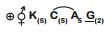
B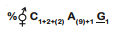
C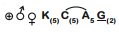
D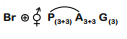
Solution
The floral formula of the family Liliaceae is represented as:
$Br \; \oplus \; \odot \; P_{(3+3)} \; A_{3+3} \; \underline{G}_{(3)}$
Here, $Br$ stands for bracteate, $\oplus$ for actinomorphic, $\odot$ for bisexual, $P_{(3+3)}$ for perianth (tepals) arranged in two whorls of three each (often fused), $A_{3+3}$ for androecium (stamens) in two whorls of three each, and $\underline{G}_{(3)}$ for gynoecium which is tricarpellary, syncarpous, and superior.
$Br \; \oplus \; \odot \; P_{(3+3)} \; A_{3+3} \; \underline{G}_{(3)}$
Here, $Br$ stands for bracteate, $\oplus$ for actinomorphic, $\odot$ for bisexual, $P_{(3+3)}$ for perianth (tepals) arranged in two whorls of three each (often fused), $A_{3+3}$ for androecium (stamens) in two whorls of three each, and $\underline{G}_{(3)}$ for gynoecium which is tricarpellary, syncarpous, and superior.
0 likesView Solution
54
BiologyMediumMCQNEET · 2020
Inhibitory substances in dormant seeds cannot be removed by subjecting seeds to
A
Chilling conditions
B
Gibberellic acid
C
Nitrate
D
Ascorbic acid
Solution
(D) Seed dormancy is a state in which seeds are prevented from germinating even under favorable environmental conditions.
Inhibitory substances such as abscisic acid $(ABA)$ are responsible for maintaining this dormancy.
Methods to break dormancy include exposure to chilling temperatures (stratification),application of gibberellins $(GA)$,and treatment with nitrates.
Conversely,ascorbic acid acts as an inhibitor that promotes or maintains seed dormancy rather than removing it.
Inhibitory substances such as abscisic acid $(ABA)$ are responsible for maintaining this dormancy.
Methods to break dormancy include exposure to chilling temperatures (stratification),application of gibberellins $(GA)$,and treatment with nitrates.
Conversely,ascorbic acid acts as an inhibitor that promotes or maintains seed dormancy rather than removing it.
0 likesView Solution
55
BiologyEasyMCQNEET · 2020
The biosynthesis of ribosomal $RNA$ occurs in
A
Nucleolus
B
Ribosomes
C
Golgi apparatus
D
Microbodies
Solution
(A) The biosynthesis of ribosomal $RNA$ $(rRNA)$ occurs in the nucleolus. The nucleolus is a non-membrane-bound structure present within the nucleus,which serves as the primary site for $rRNA$ transcription and the assembly of ribosomal subunits.
0 likesView Solution
56
BiologyEasyMCQNEET · 2020
Large,empty,colourless cells of the adaxial epidermis along the veins of grass leaves are:
A
Bulliform cells
B
Lenticels
C
Guard cells
D
Bundle sheath cells
Solution
(A) In grasses (monocots),certain adaxial epidermal cells along the veins modify themselves into large,empty,colourless cells. These are known as $Bulliform$ cells. When these cells absorb water and become turgid,they make the leaf surface exposed. When they become flaccid due to water stress,they make the leaves curl inwards to minimize water loss.
0 likesView Solution
57
BiologyEasyMCQNEET · 2020
In a mitotic cycle,the correct sequence of phases is
A
$G_{1}, G_{2}, S, M$
B
$S, G_{1}, G_{2}, M$
C
$G_{1}, S, G_{2}, M$
D
$M, G_{1}, G_{2}, S$
Solution
(C) The cell cycle is divided into two main phases: Interphase and $M$-phase (Mitosis).
Interphase is further subdivided into three stages: $G_{1}$ phase (Gap $1$),$S$ phase (Synthesis),and $G_{2}$ phase (Gap $2$).
Following Interphase,the cell enters the $M$-phase.
Therefore,the correct sequence is $G_{1} \rightarrow S \rightarrow G_{2} \rightarrow M$.
Interphase is further subdivided into three stages: $G_{1}$ phase (Gap $1$),$S$ phase (Synthesis),and $G_{2}$ phase (Gap $2$).
Following Interphase,the cell enters the $M$-phase.
Therefore,the correct sequence is $G_{1} \rightarrow S \rightarrow G_{2} \rightarrow M$.
0 likesView Solution
58
BiologyEasyMCQNEET · 2020
Phycoerythrin is the major pigment in
A
Brown algae
B
Red algae
C
Blue green algae
D
Green algae
Solution
(B) Phycoerythrin is a red-colored accessory pigment found in Rhodophyceae,commonly known as red algae. It masks the green color of chlorophyll $a$ and gives these algae their characteristic red appearance.
0 likesView Solution
59
BiologyEasyMCQNEET · 2020
During non-cyclic photophosphorylation,when electrons are lost from the reaction centre at $PS$ $II$,what is the source which replaces these electrons?
A
Light
B
Oxygen
C
Water
D
Carbon dioxide
Solution
(C) During non-cyclic photophosphorylation,the reaction centre of $PS$ $II$ $(P680)$ loses electrons upon excitation by light.
These electrons are replaced by the photolysis of water $(H_2O)$,which splits into protons $(H^+)$,electrons $(e^-)$,and oxygen $(O_2)$.
This process ensures a continuous supply of electrons for the electron transport chain.
These electrons are replaced by the photolysis of water $(H_2O)$,which splits into protons $(H^+)$,electrons $(e^-)$,and oxygen $(O_2)$.
This process ensures a continuous supply of electrons for the electron transport chain.
0 likesView Solution
60
BiologyEasyMCQNEET · 2020
Attachment of spindle fibers to kinetochores of chromosomes becomes evident in
A
Metaphase
B
Anaphase
C
Telophase
D
Prophase
Solution
(A) During the $M$ phase of the cell cycle,the condensation of chromosomes is completed by the end of prophase.
In metaphase,the chromosomes align at the equatorial plate.
It is during this stage that the spindle fibers from both poles of the cell attach to the kinetochores of the chromosomes.
Therefore,the attachment of spindle fibers to kinetochores becomes clearly evident in metaphase.
In metaphase,the chromosomes align at the equatorial plate.
It is during this stage that the spindle fibers from both poles of the cell attach to the kinetochores of the chromosomes.
Therefore,the attachment of spindle fibers to kinetochores becomes clearly evident in metaphase.
0 likesView Solution
61
BiologyMediumMCQNEET · 2020
Correct position of floral parts over thalamus in mustard plant is
A
Gynoecium is situated in the centre,and other parts of the flower are located at the rim of the thalamus,at the same level.
B
Gynoecium occupies the highest position,while the other parts are situated below it.
C
Margin of the thalamus grows upward,enclosing the ovary completely,and other parts arise below the ovary.
D
Gynoecium is present in the centre and other parts cover it partially.
Solution
(B) Mustard plants exhibit hypogynous flowers. In a hypogynous flower,the gynoecium occupies the highest position on the thalamus,while all other floral parts (sepals,petals,and stamens) are situated below the ovary. This type of ovary is referred to as superior.
0 likesView Solution
62
BiologyMediumMCQNEET · 2020
Select the incorrect statement.
A
Elements most easily mobilized in plants from one region to another are: phosphorus,sulphur,nitrogen and potassium.
B
Transport of molecules in phloem can be bidirectional.
C
Movement of minerals in xylem is unidirectional.
D
Unloading of sucrose at sink does not involve the utilization of $ATP$.
Solution
(D) The unloading of sucrose at the sink is an active process that requires energy. Therefore,it involves the utilization of $ATP$ to move sucrose from the phloem into the sink cells against the concentration gradient. Thus,the statement that it does not involve the utilization of $ATP$ is incorrect.
0 likesView Solution
63
BiologyEasyMCQNEET · 2020
Identify the statement which is incorrect.
A
Tyrosine possesses aromatic ring in its structure
B
Sulphur is an integral part of cysteine
C
Glycine is an example of lipids
D
Lecithin contains phosphorus atom in its structure
Solution
(C) Option $C$ is the correct answer because glycine is the simplest amino acid,not a lipid. The $R$ group in glycine is a hydrogen atom $(H)$. Tyrosine is an aromatic amino acid,cysteine contains a sulphur atom,and lecithin is a phospholipid containing a phosphorus group.
0 likesView Solution
64
BiologyMediumMCQNEET · 2020
Pyruvate dehydrogenase activity during aerobic respiration requires
A
Magnesium
B
Calcium
C
Iron
D
Cobalt
Solution
(A) During the link reaction,pyruvic acid is converted into Acetyl CoA with the help of the pyruvate dehydrogenase complex.
For this conversion,the pyruvate dehydrogenase complex requires cofactors including magnesium $(Mg^{2+})$,Coenzyme $A$ $(CoA)$,$NAD^+$,Thiamine pyrophosphate $(TPP)$,and lipoic acid.
For this conversion,the pyruvate dehydrogenase complex requires cofactors including magnesium $(Mg^{2+})$,Coenzyme $A$ $(CoA)$,$NAD^+$,Thiamine pyrophosphate $(TPP)$,and lipoic acid.
0 likesView Solution
65
BiologyEasyMCQNEET · 2020
Identify the correct features of Mango and Coconut fruits.
$(i)$ In both,the fruit is a drupe.
$(ii)$ Endocarp is edible in both.
$(iii)$ Mesocarp in Coconut is fibrous,and in Mango it is fleshy.
$(iv)$ In both,the fruit develops from a monocarpellary ovary.
Select the correct option from below:
$(i)$ In both,the fruit is a drupe.
$(ii)$ Endocarp is edible in both.
$(iii)$ Mesocarp in Coconut is fibrous,and in Mango it is fleshy.
$(iv)$ In both,the fruit develops from a monocarpellary ovary.
Select the correct option from below:
A
$(i)$ and $(ii)$ only
B
$(i)$,$(iii)$ and $(iv)$ only
C
$(i)$,$(ii)$ and $(iii)$ only
D
$(i)$ and $(iv)$ only
Solution
(B) Both Mango and Coconut fruits are classified as drupes. They develop from a monocarpellary superior ovary.
$(i)$ Correct: Both are drupes.
$(ii)$ Incorrect: In Mango,the mesocarp is edible,while in Coconut,the endosperm is edible. The endocarp is hard and stony in both.
$(iii)$ Correct: In Coconut,the mesocarp is fibrous,whereas in Mango,it is fleshy and edible.
$(iv)$ Correct: Both develop from a monocarpellary ovary.
Therefore,statements $(i)$,$(iii)$,and $(iv)$ are correct.
$(i)$ Correct: Both are drupes.
$(ii)$ Incorrect: In Mango,the mesocarp is edible,while in Coconut,the endosperm is edible. The endocarp is hard and stony in both.
$(iii)$ Correct: In Coconut,the mesocarp is fibrous,whereas in Mango,it is fleshy and edible.
$(iv)$ Correct: Both develop from a monocarpellary ovary.
Therefore,statements $(i)$,$(iii)$,and $(iv)$ are correct.
0 likesView Solution
66
BiologyEasyMCQNEET · 2020
In $Glycine \ max$,the product of biological nitrogen fixation is transported from the root nodules to other parts as
A
Ureides
B
Ammonia
C
Glutamate
D
Nitrates
Solution
(A) In $Glycine \ max$ (Soybean),the product of biological nitrogen fixation is transported from the root nodules to other parts of the plant in the form of ureides. These compounds have a particularly high nitrogen to carbon ratio.
0 likesView Solution
67
BiologyEasyMCQNEET · 2020
Which of the following statements about cork cambium is incorrect?
A
It is a couple of layers thick
B
It forms secondary cortex on its outerside
C
It forms a part of periderm
D
It is responsible for the formation of lenticels
Solution
(B) Cork cambium $(Phellogen)$ is a dedifferentiated tissue,making it a secondary meristem.
It is a couple of layers thick and cuts off cork $(Phellem)$ towards the outer side and secondary cortex $(Phelloderm)$ towards the inner side.
Therefore,the statement that it forms secondary cortex on its outer side is incorrect,as it forms secondary cortex on the inner side.
$Phellem + Phellogen + Phelloderm$ together constitute the periderm.
It is a couple of layers thick and cuts off cork $(Phellem)$ towards the outer side and secondary cortex $(Phelloderm)$ towards the inner side.
Therefore,the statement that it forms secondary cortex on its outer side is incorrect,as it forms secondary cortex on the inner side.
$Phellem + Phellogen + Phelloderm$ together constitute the periderm.
0 likesView Solution
68
BiologyEasyMCQNEET · 2020
Match the following:
Select the correct option:
| Column $I$ | Column $II$ |
|---|---|
| $(a)$ Aquaporin | $(i)$ Amide |
| $(b)$ Asparagine | $(ii)$ Polysaccharide |
| $(c)$ Abscisic acid | $(iii)$ Polypeptide |
| $(d)$ Chitin | $(iv)$ Carotenoids |
Select the correct option:
A
$(a)-(iii), (b)-(i), (c)-(ii), (d)-(iv)$
B
$(a)-(iii), (b)-(i), (c)-(iv), (d)-(ii)$
C
$(a)-(ii), (b)-(iii), (c)-(iv), (d)-(i)$
D
$(a)-(ii), (b)-(i), (c)-(iv), (d)-(iii)$
Solution
(B) The correct matches are as follows:
$1$. $(a)$ Aquaporin: It is a membrane protein that facilitates water transport,thus it is a polypeptide $(iii)$.
$2$. $(b)$ Asparagine: It is an amino acid derivative,specifically an amide of aspartic acid $(i)$.
$3$. $(c)$ Abscisic acid: It is a plant hormone derived from carotenoids $(iv)$.
$4$. $(d)$ Chitin: It is a structural homopolysaccharide found in the cell walls of fungi and the exoskeleton of arthropods $(ii)$.
Therefore,the correct sequence is $(a)-(iii), (b)-(i), (c)-(iv), (d)-(ii)$.
$1$. $(a)$ Aquaporin: It is a membrane protein that facilitates water transport,thus it is a polypeptide $(iii)$.
$2$. $(b)$ Asparagine: It is an amino acid derivative,specifically an amide of aspartic acid $(i)$.
$3$. $(c)$ Abscisic acid: It is a plant hormone derived from carotenoids $(iv)$.
$4$. $(d)$ Chitin: It is a structural homopolysaccharide found in the cell walls of fungi and the exoskeleton of arthropods $(ii)$.
Therefore,the correct sequence is $(a)-(iii), (b)-(i), (c)-(iv), (d)-(ii)$.
0 likesView Solution
69
BiologyEasyMCQNEET · 2020
Which of the following statements is incorrect about gymnosperms?
A
Their seeds are not covered
B
They are heterosporous
C
Male and female gametophytes are free living
D
Most of them have narrow leaves with thick cuticle
Solution
(C) Gymnosperms are characterized by naked seeds,meaning they are not enclosed within an ovary wall.
They are heterosporous,producing two types of spores: microspores and megaspores.
Unlike bryophytes and pteridophytes,the male and female gametophytes in gymnosperms do not have an independent,free-living existence; they remain within the sporangia retained on the sporophytes.
Therefore,the statement that male and female gametophytes are free-living is incorrect.
They are heterosporous,producing two types of spores: microspores and megaspores.
Unlike bryophytes and pteridophytes,the male and female gametophytes in gymnosperms do not have an independent,free-living existence; they remain within the sporangia retained on the sporophytes.
Therefore,the statement that male and female gametophytes are free-living is incorrect.
0 likesView Solution
70
BiologyEasyMCQNEET · 2020
Which of the following elements helps in maintaining the structure of ribosomes?
A
Molybdenum
B
Magnesium
C
Zinc
D
Copper
Solution
(B) Magnesium $(Mg^{2+})$ ions play a crucial role in maintaining the structural integrity of ribosomes.
They help in the association of the two ribosomal subunits ($60S$ and $40S$ in eukaryotes,or $50S$ and $30S$ in prokaryotes) to form a functional $80S$ or $70S$ ribosome,respectively.
They help in the association of the two ribosomal subunits ($60S$ and $40S$ in eukaryotes,or $50S$ and $30S$ in prokaryotes) to form a functional $80S$ or $70S$ ribosome,respectively.
0 likesView Solution
71
BiologyEasyMCQNEET · 2020
Match the following concerning the activity function and the phytohormone involved.
Select the correct option from the following:
| Column $I$ | Column $II$ |
| $(a)$ Fruit ripener | $(i)$ Abscisic acid |
| $(b)$ Herbicide | $(ii)$ $2,4-D$ |
| $(c)$ Bolting agent | $(iii)$ $GA_{3}$ |
| $(d)$ Stress hormone | $(iv)$ Ethephon |
Select the correct option from the following:
A
$(a)-(iv), (b)-(ii), (c)-(iii), (d)-(i)$
B
$(a)-(ii), (b)-(iii), (c)-(iv), (d)-(i)$
C
$(a)-(iii), (b)-(iv), (c)-(ii), (d)-(i)$
D
$(a)-(iv), (b)-(iii), (c)-(ii), (d)-(i)$
Solution
(A) The correct matches are as follows:
$(a)$ Fruit ripener: Ethephon $(iv)$. Ethylene is a gaseous hormone that promotes fruit ripening.
$(b)$ Herbicide: $2,4-D$ $(ii)$. $2,4-D$ is a synthetic auxin used as a weedicide.
$(c)$ Bolting agent: $GA_{3}$ $(iii)$. Gibberellins promote internode elongation just prior to flowering, a process known as bolting.
$(d)$ Stress hormone: Abscisic acid $(i)$. $ABA$ is known as the stress hormone as it helps plants withstand various environmental stresses.
Therefore, the correct sequence is $(a)-(iv), (b)-(ii), (c)-(iii), (d)-(i)$.
$(a)$ Fruit ripener: Ethephon $(iv)$. Ethylene is a gaseous hormone that promotes fruit ripening.
$(b)$ Herbicide: $2,4-D$ $(ii)$. $2,4-D$ is a synthetic auxin used as a weedicide.
$(c)$ Bolting agent: $GA_{3}$ $(iii)$. Gibberellins promote internode elongation just prior to flowering, a process known as bolting.
$(d)$ Stress hormone: Abscisic acid $(i)$. $ABA$ is known as the stress hormone as it helps plants withstand various environmental stresses.
Therefore, the correct sequence is $(a)-(iv), (b)-(ii), (c)-(iii), (d)-(i)$.
0 likesView Solution
72
BiologyEasyMCQNEET · 2020
Who coined the term 'Kinetin'?
A
Kurosawa
B
Skoog and Miller
C
Darwin
D
Went
Solution
(B) The term 'Kinetin' was discovered and coined by $Skoog$ and $Miller$ during their research on plant tissue culture. It is a type of cytokinin that promotes cell division.
0 likesView Solution
73
BiologyMediumMCQNEET · 2020
Which of the following is associated with a decrease in cardiac output?
A
Adrenal medullary hormones
B
Sympathetic nerves
C
Parasympathetic neural signals
D
Pneumotaxic centre
Solution
(C) Option $(C)$ is the correct answer.
Parasympathetic neural signals decrease the rate of heartbeat,the speed of conduction of action potentials,and the stroke volume,thereby decreasing the cardiac output.
Adrenal medullary hormones increase cardiac output.
Sympathetic neural signals increase the rate of heartbeat,the strength of ventricular contraction,and thereby the cardiac output.
The pneumotaxic centre is involved in the regulation of respiration,not cardiac activity.
Parasympathetic neural signals decrease the rate of heartbeat,the speed of conduction of action potentials,and the stroke volume,thereby decreasing the cardiac output.
Adrenal medullary hormones increase cardiac output.
Sympathetic neural signals increase the rate of heartbeat,the strength of ventricular contraction,and thereby the cardiac output.
The pneumotaxic centre is involved in the regulation of respiration,not cardiac activity.
0 likesView Solution
74
BiologyMediumMCQNEET · 2020
Match the following group of organisms with their respective distinctive characteristics and select the correct option:
| Organisms | Characteristics |
|---|---|
| $(a)$ Platyhelminthes | $(i)$ Cylindrical body with no segmentation |
| $(b)$ Echinoderms | $(ii)$ Warm-blooded animals with direct development |
| $(c)$ Hemichordates | $(iii)$ Bilateral symmetry with incomplete digestive system |
| $(d)$ Aves | $(iv)$ Radial symmetry with indirect development |
A
$(a)-(i), (b)-(ii), (c)-(iii), (d)-(iv)$
B
$(a)-(iii), (b)-(iv), (c)-(i), (d)-(ii)$
C
$(a)-(ii), (b)-(iii), (c)-(iv), (d)-(i)$
D
$(a)-(iv), (b)-(i), (c)-(ii), (d)-(iii)$
Solution
(B) The correct matching is as follows:
$(a)$ Platyhelminthes: $(iii)$ Bilateral symmetry with an incomplete digestive system (single opening).
$(b)$ Echinoderms: $(iv)$ Radial symmetry (in adults) with indirect development (larval stage present).
$(c)$ Hemichordates: $(i)$ Cylindrical body with no segmentation (proboscis,collar,and trunk).
$(d)$ Aves: $(ii)$ Warm-blooded animals (homeotherms) with direct development.
Therefore,the correct sequence is $(a)-(iii), (b)-(iv), (c)-(i), (d)-(ii)$.
$(a)$ Platyhelminthes: $(iii)$ Bilateral symmetry with an incomplete digestive system (single opening).
$(b)$ Echinoderms: $(iv)$ Radial symmetry (in adults) with indirect development (larval stage present).
$(c)$ Hemichordates: $(i)$ Cylindrical body with no segmentation (proboscis,collar,and trunk).
$(d)$ Aves: $(ii)$ Warm-blooded animals (homeotherms) with direct development.
Therefore,the correct sequence is $(a)-(iii), (b)-(iv), (c)-(i), (d)-(ii)$.
0 likesView Solution
75
BiologyEasyMCQNEET · 2020
The total lung capacity $(TLC)$ is the total volume of air accommodated in the lungs at the end of a forced inspiration. This includes:
A
$RV$ (Residual Volume); $ERV$ (Expiratory Reserve Volume); $TV$ (Tidal Volume); and $IRV$ (Inspiratory Reserve Volume)
B
$RV$; $IC$ (Inspiratory Capacity); $EC$ (Expiratory Capacity); and $ERV$
C
$RV$; $ERV$; $IC$ and $EC$
D
$RV$; $ERV$; $VC$ (Vital Capacity) and $FRC$ (Functional Residual Capacity)
Solution
(A) The correct answer is option $A$.
Total Lung Capacity $(TLC)$ is defined as the total volume of air accommodated in the lungs at the end of a forced inspiration.
This includes the sum of all respiratory volumes: $TLC = RV + ERV + TV + IRV$.
Therefore,it comprises the Residual Volume $(RV)$,Expiratory Reserve Volume $(ERV)$,Tidal Volume $(TV)$,and Inspiratory Reserve Volume $(IRV)$.
Total Lung Capacity $(TLC)$ is defined as the total volume of air accommodated in the lungs at the end of a forced inspiration.
This includes the sum of all respiratory volumes: $TLC = RV + ERV + TV + IRV$.
Therefore,it comprises the Residual Volume $(RV)$,Expiratory Reserve Volume $(ERV)$,Tidal Volume $(TV)$,and Inspiratory Reserve Volume $(IRV)$.
0 likesView Solution
76
BiologyEasyMCQNEET · 2020
Hormones stored and released from neurohypophysis are
A
Prolactin and Vasopressin
B
Thyroid stimulating hormone and Oxytocin
C
Oxytocin and Vasopressin
D
Follicle stimulating hormone and Leutinizing hormone
Solution
(C) Option $C$ is the correct answer.
The neurohypophysis (posterior pituitary) does not synthesize hormones itself; rather,it stores and releases two hormones: oxytocin and vasopressin (also known as antidiuretic hormone or $ADH$).
These hormones are synthesized by the hypothalamus and transported to the neurohypophysis via axonal transport.
Prolactin,thyroid-stimulating hormone $(TSH)$,follicle-stimulating hormone $(FSH)$,and luteinizing hormone $(LH)$ are synthesized and secreted by the adenohypophysis (anterior pituitary).
The neurohypophysis (posterior pituitary) does not synthesize hormones itself; rather,it stores and releases two hormones: oxytocin and vasopressin (also known as antidiuretic hormone or $ADH$).
These hormones are synthesized by the hypothalamus and transported to the neurohypophysis via axonal transport.
Prolactin,thyroid-stimulating hormone $(TSH)$,follicle-stimulating hormone $(FSH)$,and luteinizing hormone $(LH)$ are synthesized and secreted by the adenohypophysis (anterior pituitary).
0 likesView Solution
77
BiologyMediumMCQNEET · 2020
All vertebrates are chordates but all chordates are not vertebrates,why?
A
All chordates possess notochord throughout their life.
B
Notochord is replaced by vertebral column in adult of some chordates.
C
Ventral hollow nerve cord remains throughout life in some chordates.
D
All chordates possess vertebral column.
Solution
(B) The correct answer is option $B$ because the members of subphylum $Vertebrata$ possess a notochord during the embryonic period.
Since all vertebrates possess a notochord at some stage of their life,they are classified as chordates.
However,in adult vertebrates,the notochord is replaced by a cartilaginous or bony vertebral column.
In protochordates (urochordates and cephalochordates),a vertebral column is never formed. In urochordates,the notochord is present only in the larval tail,while in cephalochordates,it extends from head to tail region and persists throughout their life.
Therefore,because not all chordates develop a vertebral column,all chordates are not vertebrates.
Since all vertebrates possess a notochord at some stage of their life,they are classified as chordates.
However,in adult vertebrates,the notochord is replaced by a cartilaginous or bony vertebral column.
In protochordates (urochordates and cephalochordates),a vertebral column is never formed. In urochordates,the notochord is present only in the larval tail,while in cephalochordates,it extends from head to tail region and persists throughout their life.
Therefore,because not all chordates develop a vertebral column,all chordates are not vertebrates.
0 likesView Solution
78
BiologyEasyMCQNEET · 2020
The size of Pleuropneumonia-like organism $(PPLO)$ is
A
$0.1 \; \mu m$
B
$0.02 \; \mu m$
C
$1-2 \; \mu m$
D
$10-20 \; \ "\mu m$
Solution
(A) The size of $PPLO$ (Pleuropneumonia-like organism),also known as Mycoplasma,is approximately $0.1 \; \mu m$.
It is recognized as the smallest known living cell capable of independent existence.
It is recognized as the smallest known living cell capable of independent existence.
0 likesView Solution
79
BiologyEasyMCQNEET · 2020
Intrinsic factor that helps in the absorption of vitamin $B_{12}$ is secreted by
A
Chief cells
B
Goblet cells
C
Hepatic cells
D
Oxyntic cells
Solution
(D) The correct answer is option $D$ because parietal or oxyntic cells secrete $HCl$ and intrinsic factor,which is essential for the absorption of vitamin $B_{12}$.
Peptic or chief cells secrete the proenzyme pepsinogen.
Goblet cells secrete mucus.
Hepatic cells secrete bile.
Peptic or chief cells secrete the proenzyme pepsinogen.
Goblet cells secrete mucus.
Hepatic cells secrete bile.
0 likesView Solution
80
BiologyMediumMCQNEET · 2020
Match the following columns with reference to cockroach and select the correct option:
| Column $I$ | Column $II$ |
| $(a)$ Grinding of the food particles | $(i)$ Hepatic caecae |
| $(b)$ Secrete gastric juice | $(ii)$ $10^{\text{th}}$ segment |
| $(c)$ $10$ pairs | $(iii)$ Proventriculus |
| $(d)$ Anal cerci | $(iv)$ Spiracles |
A
$(a)-(ii), (b)-(iii), (c)-(i), (d)-(iv)$
B
$(a)-(iii), (b)-(i), (c)-(iv), (d)-(ii)$
C
$(a)-(iv), (b)-(iii), (c)-(v), (d)-(ii)$
D
$(a)-(i), (b)-(iv), (c)-(iii), (d)-(ii)$
Solution
(B) The correct matching is as follows:
$(a)$ Grinding of food particles is performed by the gizzard or $Proventriculus$ $(iii)$.
$(b)$ Hepatic caecae secrete digestive enzymes (gastric juice) $(i)$.
$(c)$ Cockroaches have $10$ pairs of spiracles for respiration $(iv)$.
$(d)$ Anal cerci are present on the $10^{\text{th}}$ abdominal segment in both sexes $(ii)$.
Thus, the correct sequence is $(a)-(iii), (b)-(i), (c)-(iv), (d)-(ii)$.
$(a)$ Grinding of food particles is performed by the gizzard or $Proventriculus$ $(iii)$.
$(b)$ Hepatic caecae secrete digestive enzymes (gastric juice) $(i)$.
$(c)$ Cockroaches have $10$ pairs of spiracles for respiration $(iv)$.
$(d)$ Anal cerci are present on the $10^{\text{th}}$ abdominal segment in both sexes $(ii)$.
Thus, the correct sequence is $(a)-(iii), (b)-(i), (c)-(iv), (d)-(ii)$.
0 likesView Solution
81
BiologyEasyMCQNEET · 2020
The increase in osmolarity from outer to inner medullary interstitium is maintained due to:
$(i)$ Close proximity between Henle's loop and vasa recta
$(ii)$ Counter current mechanism
$(iii)$ Selective secretion of $HCO_{3}^{-}$ and hydrogen ions in $PCT$
$(iv)$ Higher blood pressure in glomerular capillaries
$(i)$ Close proximity between Henle's loop and vasa recta
$(ii)$ Counter current mechanism
$(iii)$ Selective secretion of $HCO_{3}^{-}$ and hydrogen ions in $PCT$
$(iv)$ Higher blood pressure in glomerular capillaries
A
$(i)$ and $(ii)$
B
Only $(ii)$
C
$(iii)$ and $(iv)$
D
$(i), (ii)$ and $(iii)$
Solution
(A) The correct answer is option $(A)$ because both statements $(i)$ and $(ii)$ are correct.
The counter current mechanism is based on the close proximity and the parallel arrangement of the Henle's loop and the vasa recta.
This mechanism helps in maintaining a concentration gradient in the medullary interstitium,which is essential for the concentration of urine.
Statement $(iii)$ is incorrect because the $PCT$ (Proximal Convoluted Tubule) is involved in the selective secretion of $H^{+}$,ammonia,and $K^{+}$ ions,and the reabsorption of $HCO_{3}^{-}$,but it does not contribute to the medullary osmotic gradient.
Statement $(iv)$ is incorrect because the high blood pressure in the glomerular capillaries is responsible for the process of glomerular filtration,not for the counter current mechanism.
The counter current mechanism is based on the close proximity and the parallel arrangement of the Henle's loop and the vasa recta.
This mechanism helps in maintaining a concentration gradient in the medullary interstitium,which is essential for the concentration of urine.
Statement $(iii)$ is incorrect because the $PCT$ (Proximal Convoluted Tubule) is involved in the selective secretion of $H^{+}$,ammonia,and $K^{+}$ ions,and the reabsorption of $HCO_{3}^{-}$,but it does not contribute to the medullary osmotic gradient.
Statement $(iv)$ is incorrect because the high blood pressure in the glomerular capillaries is responsible for the process of glomerular filtration,not for the counter current mechanism.
0 likesView Solution
82
BiologyMediumMCQNEET · 2020
Select the correct statement.
A
Reduction in Glomerular Filtration Rate activates $JG$ cells to release renin.
B
Atrial Natriuretic Factor increases the blood pressure.
C
Angiotensin $II$ is a powerful vasodilator.
D
Counter current pattern of blood flow is not observed in vasa recta.
Solution
(A) The correct answer is option $A$ because a fall in $GFR$ or blood flow activates the $JG$ cells to release renin,which initiates the Renin-Angiotensin-Aldosterone System $(RAAS)$.
Option $B$ is incorrect because Atrial Natriuretic Factor $(ANF)$ causes vasodilation,which decreases blood pressure.
Option $C$ is incorrect because Angiotensin $II$ is a powerful vasoconstrictor,not a vasodilator,and it increases blood pressure.
Option $D$ is incorrect because a counter-current pattern of blood flow is indeed observed between the loop of Henle and the vasa recta,which is essential for the concentration of urine.
Option $B$ is incorrect because Atrial Natriuretic Factor $(ANF)$ causes vasodilation,which decreases blood pressure.
Option $C$ is incorrect because Angiotensin $II$ is a powerful vasoconstrictor,not a vasodilator,and it increases blood pressure.
Option $D$ is incorrect because a counter-current pattern of blood flow is indeed observed between the loop of Henle and the vasa recta,which is essential for the concentration of urine.
0 likesView Solution
83
BiologyEasyMCQNEET · 2020
Match the following columns and select the correct option.
| Column $I$ | Column $II$ |
|---|---|
| $(a)$ Smooth endoplasmic reticulum | $(i)$ Protein synthesis |
| $(b)$ Rough endoplasmic reticulum | $(ii)$ Lipid synthesis |
| $(c)$ Golgi complex | $(iii)$ Glycosylation |
| $(d)$ Centriole | $(iv)$ Spindle formation |
A
$(a)-(i), (b)-(ii), (c)-(iii), (d)-(iv)$
B
$(a)-(ii), (b)-(i), (c)-(iii), (d)-(iv)$
C
$(a)-(iii), (b)-(i), (c)-(ii), (d)-(iv)$
D
$(a)-(iv), (b)-(ii), (c)-(i), (d)-(iii)$
Solution
(B) The correct matches are as follows:
$(a)$ Smooth Endoplasmic Reticulum $(SER)$ is primarily responsible for lipid synthesis.
$(b)$ Rough Endoplasmic Reticulum $(RER)$ contains ribosomes on its surface and is responsible for protein synthesis.
$(c)$ Golgi complex is involved in the modification of proteins and lipids,specifically through the process of glycosylation.
$(d)$ Centriole plays a crucial role in the organization of the mitotic spindle during cell division.
Therefore,the correct matching is: $(a)-(ii), (b)-(i), (c)-(iii), (d)-(iv)$.
$(a)$ Smooth Endoplasmic Reticulum $(SER)$ is primarily responsible for lipid synthesis.
$(b)$ Rough Endoplasmic Reticulum $(RER)$ contains ribosomes on its surface and is responsible for protein synthesis.
$(c)$ Golgi complex is involved in the modification of proteins and lipids,specifically through the process of glycosylation.
$(d)$ Centriole plays a crucial role in the organization of the mitotic spindle during cell division.
Therefore,the correct matching is: $(a)-(ii), (b)-(i), (c)-(iii), (d)-(iv)$.
0 likesView Solution
84
BiologyEasyMCQNEET · 2020
The proteolytic enzyme rennin is found in
A
Pancreatic juice
B
Intestinal juice
C
Bile juice
D
Gastric juice
Solution
(D) The correct answer is option $D$ because $Rennin$ is a proteolytic enzyme found in the gastric juice of infants,which helps in the digestion of milk proteins.
Option $A$ is incorrect as the proteolytic enzymes found in pancreatic juice are $Trypsin$,$Chymotrypsin$,$Carboxypeptidase$,etc.
Option $B$ is incorrect as the proteolytic enzymes found in intestinal juice are $Dipeptidases$.
Option $C$ is incorrect as no enzymes are present in bile juice.
Option $A$ is incorrect as the proteolytic enzymes found in pancreatic juice are $Trypsin$,$Chymotrypsin$,$Carboxypeptidase$,etc.
Option $B$ is incorrect as the proteolytic enzymes found in intestinal juice are $Dipeptidases$.
Option $C$ is incorrect as no enzymes are present in bile juice.
0 likesView Solution
85
BiologyEasyMCQNEET · 2020
Select the incorrectly matched pair from the following:
A
Osteocytes - Bone cells
B
Chondrocytes - Smooth muscle cells
C
Neurons - Nerve cells
D
Fibroblast - Areolar tissue
Solution
(B) The correct answer is option $B$ because chondrocytes are not smooth muscle cells; they are the specialized cells found in cartilage.
$A$. Osteocytes are mature bone cells found in lacunae.
$B$. Chondrocytes are cartilage cells,whereas smooth muscle cells are found in the walls of internal organs.
$C$. Neurons are the structural and functional units of the nervous system.
$D$. Fibroblasts are cells present in areolar tissue that produce and secrete fibers.
$A$. Osteocytes are mature bone cells found in lacunae.
$B$. Chondrocytes are cartilage cells,whereas smooth muscle cells are found in the walls of internal organs.
$C$. Neurons are the structural and functional units of the nervous system.
$D$. Fibroblasts are cells present in areolar tissue that produce and secrete fibers.
0 likesView Solution
86
BiologyEasyMCQNEET · 2020
During $Meiosis-I$,in which stage does synapsis take place?
A
Leptotene
B
Pachytene
C
Zygotene
D
Diplotene
Solution
(C) Synapsis is the process by which homologous chromosomes pair up side by side.
This process occurs specifically during the $Zygotene$ stage of $Prophase-I$ in $Meiosis-I$.
This process occurs specifically during the $Zygotene$ stage of $Prophase-I$ in $Meiosis-I$.
0 likesView Solution
87
BiologyEasyMCQNEET · 2020
Match the following columns and select the correct option.
| Column $I$ | Column $II$ |
| $(a)$ Pituitary hormone | $(i)$ Steroid |
| $(b)$ Epinephrine | $(ii)$ Neuropeptides |
| $(c)$ Endorphins | $(iii)$ Peptides,proteins |
| $(d)$ Cortisol | $(iv)$ Biogenic amines |
A
$(a)-(iii), (b)-(iv), (c)-(i), (d)-(ii)$
B
$(a)-(iv), (b)-(i), (c)-(ii), (d)-(iii)$
C
$(a)-(iii), (b)-(iv), (c)-(ii), (d)-(i)$
D
$(a)-(iv), (b)-(iii), (c)-(i), (d)-(ii)$
Solution
(C) The correct matching is as follows:
$(a)$ Pituitary hormones are primarily peptide or protein-based hormones,so $(a)$ matches with $(iii)$.
$(b)$ Epinephrine is a catecholamine derived from tyrosine,classified as a biogenic amine,so $(b)$ matches with $(iv)$.
$(c)$ Endorphins are endogenous opioid neuropeptides,so $(c)$ matches with $(ii)$.
$(d)$ Cortisol is a glucocorticoid hormone synthesized from cholesterol,which is a steroid,so $(d)$ matches with $(i)$.
Therefore,the correct sequence is $(a)-(iii), (b)-(iv), (c)-(ii), (d)-(i)$.
$(a)$ Pituitary hormones are primarily peptide or protein-based hormones,so $(a)$ matches with $(iii)$.
$(b)$ Epinephrine is a catecholamine derived from tyrosine,classified as a biogenic amine,so $(b)$ matches with $(iv)$.
$(c)$ Endorphins are endogenous opioid neuropeptides,so $(c)$ matches with $(ii)$.
$(d)$ Cortisol is a glucocorticoid hormone synthesized from cholesterol,which is a steroid,so $(d)$ matches with $(i)$.
Therefore,the correct sequence is $(a)-(iii), (b)-(iv), (c)-(ii), (d)-(i)$.
0 likesView Solution
88
BiologyEasyMCQNEET · 2020
Which of the following conditions cause erythroblastosis foetalis?
A
Both mother and foetus $Rh^{+ve}$
B
Mother $Rh^{+ve}$ and foetus $Rh^{-ve}$
C
Mother $Rh^{-ve}$ and foetus $Rh^{+ve}$
D
Both mother and foetus $Rh^{-ve}$
Solution
(C) Option $C$ is the correct answer because Erythroblastosis foetalis occurs only when the foetus is $Rh^{+ve}$ and the mother is $Rh^{-ve}$.
During the first delivery,if $Rh^{+ve}$ foetal blood mixes with the mother's blood,antibodies are produced in the mother's body against the $Rh$ antigen.
These antibodies in successive pregnancies cross the placental barrier and reach the foetus,causing the clumping (agglutination) of $RBCs$ in the foetus.
During the first delivery,if $Rh^{+ve}$ foetal blood mixes with the mother's blood,antibodies are produced in the mother's body against the $Rh$ antigen.
These antibodies in successive pregnancies cross the placental barrier and reach the foetus,causing the clumping (agglutination) of $RBCs$ in the foetus.
0 likesView Solution
89
BiologyEasyMCQNEET · 2020
Which of the following options correctly represents the characteristic features of phylum $Annelida$?
A
Diploblastic,mostly marine and radially symmetrical.
B
Triploblastic,unsegmented body and bilaterally symmetrical.
C
Triploblastic,segmented body and bilaterally symmetrical.
D
Triploblastic,flattened body and acoelomate condition.
Solution
(C) Option $C$ is the correct answer.
$1$. Members of phylum $Annelida$ are triploblastic,meaning they possess three germ layers (ectoderm,mesoderm,and endoderm).
$2$. They exhibit bilateral symmetry,where the body can be divided into two identical left and right halves.
$3$. $A$ key characteristic of $Annelida$ is metameric segmentation,where the body is divided into segments or metameres.
$4$. They are also coelomates,possessing a true body cavity.
Option $A$ describes features of phylum $Cnidaria$. Option $B$ describes features of some other invertebrates but lacks segmentation. Option $D$ describes the characteristics of phylum $Platyhelminthes$.
$1$. Members of phylum $Annelida$ are triploblastic,meaning they possess three germ layers (ectoderm,mesoderm,and endoderm).
$2$. They exhibit bilateral symmetry,where the body can be divided into two identical left and right halves.
$3$. $A$ key characteristic of $Annelida$ is metameric segmentation,where the body is divided into segments or metameres.
$4$. They are also coelomates,possessing a true body cavity.
Option $A$ describes features of phylum $Cnidaria$. Option $B$ describes features of some other invertebrates but lacks segmentation. Option $D$ describes the characteristics of phylum $Platyhelminthes$.
0 likesView Solution
90
BiologyEasyMCQNEET · 2020
Match the following columns and select the correct option.
| Column $I$ | Column $II$ |
|---|---|
| $(a)$ Rods and Cones | $(i)$ Absence of photoreceptor cells |
| $(b)$ Blind Spot | $(ii)$ Cones are densely packed |
| $(c)$ Fovea | $(iii)$ Photoreceptor cells |
| $(d)$ Iris | $(iv)$ Visible coloured portion of the eye |
A
$(a)-(ii), (b)-(iv), (c)-(iii), (d)-(i)$
B
$(a)-(iii), (b)-(i), (c)-(ii), (d)-(iv)$
C
$(a)-(ii), (b)-(iii), (c)-(i), (d)-(iv)$
D
$(a)-(iii), (b)-(iv), (c)-(ii), (d)-(i)$
Solution
(B) The correct matching is as follows:
$(a)$ Rods and Cones are photoreceptor cells $(iii)$.
$(b)$ Blind Spot is the region where photoreceptor cells are absent $(i)$.
$(c)$ Fovea is the thinned-out portion of the retina where cones are densely packed $(ii)$.
$(d)$ Iris is the visible coloured portion of the eye $(iv)$.
Therefore,the correct sequence is $(a)-(iii), (b)-(i), (c)-(ii), (d)-(iv)$.
$(a)$ Rods and Cones are photoreceptor cells $(iii)$.
$(b)$ Blind Spot is the region where photoreceptor cells are absent $(i)$.
$(c)$ Fovea is the thinned-out portion of the retina where cones are densely packed $(ii)$.
$(d)$ Iris is the visible coloured portion of the eye $(iv)$.
Therefore,the correct sequence is $(a)-(iii), (b)-(i), (c)-(ii), (d)-(iv)$.
0 likesView Solution
91
BiologyEasyMCQNEET · 2020
Match the following columns and select the correct option:
| Column $I$ | Column $II$ |
|---|---|
| $(a)$ Pneumotaxic Centre | $(i)$ Alveoli |
| $(b)$ $O_{2}$ Dissociation curve | $(ii)$ Pons region of brain |
| $(c)$ Carbonic Anhydrase | $(iii)$ Haemoglobin |
| $(d)$ Primary site of exchange of gases | $(iv)$ $R.B.C.$ |
A
$(a)-(iv), (b)-(i), (c)-(iii), (d)-(ii)$
B
$(a)-(i), (b)-(iii), (c)-(ii), (d)-(iv)$
C
$(a)-(ii), (b)-(iii), (c)-(iv), (d)-(i)$
D
$(a)-(iii), (b)-(ii), (c)-(iv), (d)-(i)$
Solution
(C) The correct matching is as follows:
$(a)$ Pneumotaxic Centre is located in the pons region of the brain $(ii)$.
$(b)$ $O_{2}$ Dissociation curve represents the relationship between the percentage saturation of haemoglobin with $O_{2}$ and the partial pressure of $O_{2}$ $(pO_{2})$ $(iii)$.
$(c)$ Carbonic Anhydrase is an enzyme found in high concentrations within $R.B.C.s$ $(iv)$.
$(d)$ Alveoli are the primary sites of exchange of gases in the lungs $(i)$.
Therefore,the correct sequence is $(a)-(ii), (b)-(iii), (c)-(iv), (d)-(i)$.
$(a)$ Pneumotaxic Centre is located in the pons region of the brain $(ii)$.
$(b)$ $O_{2}$ Dissociation curve represents the relationship between the percentage saturation of haemoglobin with $O_{2}$ and the partial pressure of $O_{2}$ $(pO_{2})$ $(iii)$.
$(c)$ Carbonic Anhydrase is an enzyme found in high concentrations within $R.B.C.s$ $(iv)$.
$(d)$ Alveoli are the primary sites of exchange of gases in the lungs $(i)$.
Therefore,the correct sequence is $(a)-(ii), (b)-(iii), (c)-(iv), (d)-(i)$.
0 likesView Solution
92
BiologyMediumMCQNEET · 2020
Match the following columns and select the correct option:
| Column $I$ | Column $II$ |
|---|---|
| $(a)$ Gout | $(i)$ Decreased levels of estrogen |
| $(b)$ Osteoporosis | $(ii)$ Low $Ca^{2+}$ ions in the blood |
| $(c)$ Tetany | $(iii)$ Accumulation of uric acid crystals |
| $(d)$ Muscular dystrophy | $(iv)$ Autoimmune disorder |
| $(v)$ Genetic disorder |
A
$(a)-(i), (b)-(ii), (c)-(iii), (d)-(iv)$
B
$(a)-(ii), (b)-(ii), (c)-(iii), (d)-(iv)$
C
$(a)-(iii), (b)-(i), (c)-(ii), (d)-(v)$
D
$(a)-(iv), (b)-(v), (c)-(i), (d)-(ii)$
Solution
(C) The correct answer is option $(C)$.
$(a)$ Gout: It is caused by the accumulation of uric acid crystals in the joints,leading to inflammation. Thus,$(a)$ matches with $(iii)$.
$(b)$ Osteoporosis: It is an age-related disorder characterized by decreased bone mass and increased chances of fractures. $A$ common cause is decreased levels of estrogen in post-menopausal women. Thus,$(b)$ matches with $(i)$.
$(c)$ Tetany: It is characterized by rapid spasms (wild contractions) in muscles due to low $Ca^{2+}$ levels in body fluids. Thus,$(c)$ matches with $(ii)$.
$(d)$ Muscular dystrophy: It is a genetic disorder that results in the progressive degeneration of skeletal muscles. Thus,$(d)$ matches with $(v)$.
Note: Myasthenia gravis is an autoimmune disorder,which corresponds to $(iv)$.
$(a)$ Gout: It is caused by the accumulation of uric acid crystals in the joints,leading to inflammation. Thus,$(a)$ matches with $(iii)$.
$(b)$ Osteoporosis: It is an age-related disorder characterized by decreased bone mass and increased chances of fractures. $A$ common cause is decreased levels of estrogen in post-menopausal women. Thus,$(b)$ matches with $(i)$.
$(c)$ Tetany: It is characterized by rapid spasms (wild contractions) in muscles due to low $Ca^{2+}$ levels in body fluids. Thus,$(c)$ matches with $(ii)$.
$(d)$ Muscular dystrophy: It is a genetic disorder that results in the progressive degeneration of skeletal muscles. Thus,$(d)$ matches with $(v)$.
Note: Myasthenia gravis is an autoimmune disorder,which corresponds to $(iv)$.
0 likesView Solution
93
BiologyEasyMCQNEET · 2020
Match the following columns and select the correct option:
| Column $I$ | Column $II$ |
|---|---|
| $(a)$ Aptenodytes | $(i)$ Flying fox |
| $(b)$ Pteropus | $(ii)$ Angel fish |
| $(c)$ Pterophyllum | $(iii)$ Lamprey |
| $(d)$ Petromyzon | $(iv)$ Penguin |
A
$(a)-(ii), (b)-(i), (c)-(iv), (d)-(iii)$
B
$(a)-(iii), (b)-(iv), (c)-(ii), (d)-(i)$
C
$(a)-(iii), (b)-(iv), (c)-(i), (d)-(ii)$
D
$(a)-(iv), (b)-(i), (c)-(ii), (d)-(iii)$
Solution
(D) The correct matching is as follows:
$(a)$ $Aptenodytes$ is commonly known as the Penguin,which belongs to the class $Aves$.
$(b)$ $Pteropus$ is commonly known as the Flying fox,which belongs to the class $Mammalia$.
$(c)$ $Pterophyllum$ is commonly known as the Angel fish,which belongs to the class $Osteichthyes$.
$(d)$ $Petromyzon$ is commonly known as the Lamprey,which belongs to the class $Cyclostomata$.
Therefore,the correct sequence is $(a)-(iv), (b)-(i), (c)-(ii), (d)-(iii)$. Thus,option $(D)$ is correct.
$(a)$ $Aptenodytes$ is commonly known as the Penguin,which belongs to the class $Aves$.
$(b)$ $Pteropus$ is commonly known as the Flying fox,which belongs to the class $Mammalia$.
$(c)$ $Pterophyllum$ is commonly known as the Angel fish,which belongs to the class $Osteichthyes$.
$(d)$ $Petromyzon$ is commonly known as the Lamprey,which belongs to the class $Cyclostomata$.
Therefore,the correct sequence is $(a)-(iv), (b)-(i), (c)-(ii), (d)-(iii)$. Thus,option $(D)$ is correct.
0 likesView Solution
94
BiologyEasyMCQNEET · 2020
In cockroach,identify the parts of the foregut in correct sequence.
A
Mouth $\rightarrow$ Pharynx $\rightarrow$ Oesophagus $\rightarrow$ Crop $\rightarrow$ Gizzard
B
Mouth $\rightarrow$ Oesophagus $\rightarrow$ Pharynx $\rightarrow$ Crop $\rightarrow$ Gizzard
C
Mouth $\rightarrow$ Crop $\rightarrow$ Pharynx $\rightarrow$ Oesophagus $\rightarrow$ Gizzard
D
Mouth $\rightarrow$ Gizzard $\rightarrow$ Crop $\rightarrow$ Pharynx $\rightarrow$ Oesophagus
Solution
(A) The alimentary canal of the cockroach is divided into three regions: foregut,midgut,and hindgut.
The foregut includes the mouth,pharynx,oesophagus,crop,and gizzard.
The food enters through the mouth,passes through the pharynx into the oesophagus,which leads to the crop (used for storing food),and finally reaches the gizzard (used for grinding food).
Therefore,the correct sequence is: Mouth $\rightarrow$ Pharynx $\rightarrow$ Oesophagus $\rightarrow$ Crop $\rightarrow$ Gizzard.
The foregut includes the mouth,pharynx,oesophagus,crop,and gizzard.
The food enters through the mouth,passes through the pharynx into the oesophagus,which leads to the crop (used for storing food),and finally reaches the gizzard (used for grinding food).
Therefore,the correct sequence is: Mouth $\rightarrow$ Pharynx $\rightarrow$ Oesophagus $\rightarrow$ Crop $\rightarrow$ Gizzard.
0 likesView Solution
95
BiologyEasyMCQNEET · 2020
Match the following events that occur in their respective phases of cell cycle and select the correct option:
| Column $I$ | Column $II$ |
| $(a)$ $G_{1}$ phase | $(i)$ Cell grows and organelle duplication |
| $(b)$ $S$ phase | $(ii)$ $DNA$ replication and chromosome duplication |
| $(c)$ $G_{2}$ phase | $(iii)$ Cytoplasmic growth |
| $(d)$ Metaphase in $M$-phase | $(iv)$ Alignment of chromosomes |
A
$(a)-(i), (b)-(ii), (c)-(iii), (d)-(iv)$
B
$(a)-(ii), (b)-(iii), (c)-(iv), (d)-(i)$
C
$(a)-(iii), (b)-(iv), (c)-(i), (d)-(ii)$
D
$(a)-(iv), (b)-(i), (c)-(ii), (d)-(iii)$
Solution
(A) The phases of the cell cycle and their respective events are as follows:
$(a)$ $G_{1}$ phase: During this phase, the cell grows and organelles are duplicated.
$(b)$ $S$ phase: This is the synthesis phase where $DNA$ replication and chromosome duplication occur.
$(c)$ $G_{2}$ phase: During this phase, there is further cytoplasmic growth and preparation for mitosis.
$(d)$ Metaphase in $M$-phase: During metaphase, chromosomes align at the equatorial plate.
Therefore, the correct matching is $(a)-(i), (b)-(ii), (c)-(iii), (d)-(iv)$.
$(a)$ $G_{1}$ phase: During this phase, the cell grows and organelles are duplicated.
$(b)$ $S$ phase: This is the synthesis phase where $DNA$ replication and chromosome duplication occur.
$(c)$ $G_{2}$ phase: During this phase, there is further cytoplasmic growth and preparation for mitosis.
$(d)$ Metaphase in $M$-phase: During metaphase, chromosomes align at the equatorial plate.
Therefore, the correct matching is $(a)-(i), (b)-(ii), (c)-(iii), (d)-(iv)$.
0 likesView Solution
96
BiologyEasyMCQNEET · 2020
Chromosomal theory of inheritance was proposed by
A
Watson and Crick
B
Sutton and Boveri
C
Bateson and Punnet
D
$T$.$H$. Morgan
Solution
(B) The Chromosomal theory of inheritance was proposed by Walter Sutton and Theodor Boveri in $1902$. They observed that the behavior of chromosomes during meiosis is parallel to the behavior of genes (Mendelian factors) and proposed that chromosomes are the vehicles of heredity.
0 likesView Solution
97
BiologyEasyMCQNEET · 2020
The impact of immigration on population density is
A
Positive
B
Negative
C
Both positive and negative
D
Neutralized by natality
Solution
(A) Immigration refers to the number of individuals of the same species that have come into the habitat from elsewhere during the time period under consideration.
Since these individuals add to the existing population,immigration increases the population density.
Therefore,the impact of immigration on population density is positive.
Since these individuals add to the existing population,immigration increases the population density.
Therefore,the impact of immigration on population density is positive.
0 likesView Solution
98
BiologyEasyMCQNEET · 2020
Male and female gametophytes do not have an independent free-living existence in
A
Bryophytes
B
Pteridophytes
C
Algae
D
Angiosperms
Solution
(D) In $Angiosperms$,the male and female gametophytes are highly reduced and are dependent on the sporophyte for their nutrition and development. They do not have an independent free-living existence. In contrast,in $Bryophytes$,$Pteridophytes$,and $Algae$,the gametophytic phase is often free-living and independent.
0 likesView Solution
99
BiologyEasyMCQNEET · 2020
In the following,each set provides a conservation approach and an example of a method of conservation:
$(a)$ In situ conservation - Biosphere Reserve
$(b)$ Ex situ conservation - Sacred groves
$(c)$ In situ conservation - Seed bank
$(d)$ Ex situ conservation - Cryopreservation
Select the option with the correct match of approach and method.
$(a)$ In situ conservation - Biosphere Reserve
$(b)$ Ex situ conservation - Sacred groves
$(c)$ In situ conservation - Seed bank
$(d)$ Ex situ conservation - Cryopreservation
Select the option with the correct match of approach and method.
A
$(a)$ and $(b)$
B
$(a)$ and $(c)$
C
$(a)$ and $(d)$
D
$(b)$ and $(d)$
Solution
(C) In situ conservation involves protecting species in their natural habitat. Examples include National Parks,Wildlife Sanctuaries,and Biosphere Reserves.
Ex situ conservation involves protecting species outside their natural habitat. Examples include Botanical Gardens,Zoological Parks,Seed Banks,and Cryopreservation.
Analyzing the given sets:
$(a)$ In situ conservation - Biosphere Reserve: Correct.
$(b)$ Ex situ conservation - Sacred groves: Incorrect (Sacred groves are a form of In situ conservation).
$(c)$ In situ conservation - Seed bank: Incorrect (Seed banks are a form of Ex situ conservation).
$(d)$ Ex situ conservation - Cryopreservation: Correct.
Therefore,the correct matches are $(a)$ and $(d)$.
Ex situ conservation involves protecting species outside their natural habitat. Examples include Botanical Gardens,Zoological Parks,Seed Banks,and Cryopreservation.
Analyzing the given sets:
$(a)$ In situ conservation - Biosphere Reserve: Correct.
$(b)$ Ex situ conservation - Sacred groves: Incorrect (Sacred groves are a form of In situ conservation).
$(c)$ In situ conservation - Seed bank: Incorrect (Seed banks are a form of Ex situ conservation).
$(d)$ Ex situ conservation - Cryopreservation: Correct.
Therefore,the correct matches are $(a)$ and $(d)$.
0 likesView Solution
100
BiologyEasyMCQNEET · 2020
In some plants,the thalamus contributes to fruit formation. Such fruits are termed as:
A
Parthenocarpic fruit
B
False fruits
C
Aggregate fruits
D
True fruits
Solution
(B) In some plants,such as apple,strawberry,and cashew,the thalamus also contributes to fruit formation along with the ovary. These fruits are known as false fruits or pseudocarps.
0 likesView Solution
101
BiologyMediumMCQNEET · 2020
Match the following techniques or instruments with their usage:
Select the correct option from the following:
| Column-$I$ | Column-$II$ |
| $(a)$ Bioreactor | $(i)$ Separation of $DNA$ fragments |
| $(b)$ Electrophoresis | $(ii)$ Production of large quantities of products |
| $(c)$ $PCR$ | $(iii)$ Detection of pathogen, based on antigen-antibody reaction |
| $(d)$ $ELISA$ | $(iv)$ Amplification of nucleic acids |
Select the correct option from the following:
A
$(a)-(ii), (b)-(i), (c)-(iii), (d)-(iv)$
B
$(a)-(iii), (b)-(ii), (c)-(iv), (d)-(i)$
C
$(a)-(ii), (b)-(i), (c)-(iv), (d)-(iii)$
D
$(a)-(iv), (b)-(iii), (c)-(ii), (d)-(i)$
Solution
(C) The correct matching is as follows:
$(a)$ Bioreactor: Used for the production of large quantities of biological products. Thus, $(a)-(ii)$.
$(b)$ Electrophoresis: $A$ technique used for the separation of $DNA$ fragments based on their size. Thus, $(b)-(i)$.
$(c)$ $PCR$ (Polymerase Chain Reaction): $A$ technique used for the amplification of specific nucleic acid sequences. Thus, $(c)-(iv)$.
$(d)$ $ELISA$ (Enzyme-Linked Immunosorbent Assay): $A$ diagnostic technique used for the detection of pathogens based on antigen-antibody interactions. Thus, $(d)-(iii)$.
Therefore, the correct sequence is $(a)-(ii), (b)-(i), (c)-(iv), (d)-(iii)$.
$(a)$ Bioreactor: Used for the production of large quantities of biological products. Thus, $(a)-(ii)$.
$(b)$ Electrophoresis: $A$ technique used for the separation of $DNA$ fragments based on their size. Thus, $(b)-(i)$.
$(c)$ $PCR$ (Polymerase Chain Reaction): $A$ technique used for the amplification of specific nucleic acid sequences. Thus, $(c)-(iv)$.
$(d)$ $ELISA$ (Enzyme-Linked Immunosorbent Assay): $A$ diagnostic technique used for the detection of pathogens based on antigen-antibody interactions. Thus, $(d)-(iii)$.
Therefore, the correct sequence is $(a)-(ii), (b)-(i), (c)-(iv), (d)-(iii)$.
0 likesView Solution
102
BiologyEasyMCQNEET · 2020
In a mixture,$DNA$ fragments are separated by
A
Polymerase chain reaction
B
Bioprocess engineering
C
Restriction digestion
D
Electrophoresis
Solution
(D) The correct answer is option $D$ as $DNA$ fragments are separated based on their size through a technique known as gel electrophoresis.
Polymerase chain reaction $(PCR)$ is used to amplify specific $DNA$ sequences.
Bioprocess engineering involves the maintenance of sterile conditions in large-scale chemical engineering processes to enable the growth of desired microbes or eukaryotic cells for the production of biotechnological products like antibiotics and vaccines.
Restriction digestion is the process of cutting $DNA$ molecules at specific sites using restriction enzymes.
Polymerase chain reaction $(PCR)$ is used to amplify specific $DNA$ sequences.
Bioprocess engineering involves the maintenance of sterile conditions in large-scale chemical engineering processes to enable the growth of desired microbes or eukaryotic cells for the production of biotechnological products like antibiotics and vaccines.
Restriction digestion is the process of cutting $DNA$ molecules at specific sites using restriction enzymes.
0 likesView Solution
103
BiologyEasyMCQNEET · 2020
Which of the following is incorrect for wind-pollinated plants?
A
Pollen grains are light and non-sticky
B
Well-exposed stamens and stigma
C
Many ovules in each ovary
D
Flowers are small and not brightly coloured
Solution
(C) Wind-pollinated plants typically exhibit specific adaptations to ensure efficient pollination. These include light and non-sticky pollen grains to be easily carried by wind currents,well-exposed stamens and stigmas to facilitate pollen release and capture,and small,inconspicuous,non-brightly coloured flowers. However,wind-pollinated flowers usually possess a single ovule in each ovary,making the statement 'Many ovules in each ovary' incorrect.
0 likesView Solution
104
BiologyEasyMCQNEET · 2020
Embryological support for evolution was proposed by
A
Alfred Wallace
B
Ernst Haeckel
C
Karl Ernst von Baer
D
Charles Darwin
Solution
(B) The correct answer is $B$. Embryological support for evolution was proposed by Ernst Haeckel,based on the observation of certain features during the embryonic stage that are common to all vertebrates but are absent in the adult forms.
Alfred Wallace was a naturalist who worked in the Malay Archipelago and concluded that natural selection acts as the mechanism of evolution.
Karl Ernst von Baer disapproved of the proposal given by Ernst Haeckel and proposed that embryos never pass through the adult stages of other animals.
Charles Darwin proposed natural selection as the mechanism of evolution.
Alfred Wallace was a naturalist who worked in the Malay Archipelago and concluded that natural selection acts as the mechanism of evolution.
Karl Ernst von Baer disapproved of the proposal given by Ernst Haeckel and proposed that embryos never pass through the adult stages of other animals.
Charles Darwin proposed natural selection as the mechanism of evolution.
0 likesView Solution
105
BiologyEasyMCQNEET · 2020
According to Alexander von Humboldt,what is the relationship between species richness and the area of exploration?
A
Species richness goes on increasing with increasing area of exploration.
B
Species richness decreases with increasing area of exploration.
C
Species richness increases with increasing area,but only up to a limit.
D
There is no relationship between species richness and area explored.
Solution
(C) Alexander von Humboldt observed that within a region,species richness increases with increasing explored area,but only up to a certain limit. This relationship is described by the equation $S = CA^z$,where $S$ is species richness,$A$ is area,$Z$ is the slope of the line (regression coefficient),and $C$ is the $Y$-intercept.
0 likesView Solution
106
BiologyEasyMCQNEET · 2020
In the polynucleotide chain of $DNA$,a nitrogenous base is linked to the $-OH$ of
A
$1^{\prime} C$ pentose sugar
B
$2^{\prime} C$ pentose sugar
C
$3^{\prime} C$ pentose sugar
D
$5^{\prime} C$ pentose sugar
Solution
(A) The correct answer is option $A$ because,in the polynucleotide chain of $DNA$,a nitrogenous base is linked to the $1^{\prime} C$ of the pentose sugar via an $N$-glycosidic linkage.
Option $B$ is incorrect as the $2^{\prime} C$ of the pentose sugar in $DNA$ contains a hydrogen atom $(-H)$,whereas in $RNA$,it contains a hydroxyl group $(-OH)$.
Options $C$ and $D$ are incorrect because the $3^{\prime} C$ and $5^{\prime} C$ of the pentose sugar are involved in the formation of the phosphodiester bond that links adjacent nucleotides in the polynucleotide chain.
Option $B$ is incorrect as the $2^{\prime} C$ of the pentose sugar in $DNA$ contains a hydrogen atom $(-H)$,whereas in $RNA$,it contains a hydroxyl group $(-OH)$.
Options $C$ and $D$ are incorrect because the $3^{\prime} C$ and $5^{\prime} C$ of the pentose sugar are involved in the formation of the phosphodiester bond that links adjacent nucleotides in the polynucleotide chain.
0 likesView Solution
107
BiologyEasyMCQNEET · 2020
In Recombinant $DNA$ technology,antibiotics are used:
A
As selectable markers
B
To keep the medium bacteria-free
C
To detect alien $DNA$
D
To impart disease-resistance to the host plant
Solution
(A) In Recombinant $DNA$ $(RDT)$ technology,antibiotics serve two primary purposes:
$1$. They act as selectable markers to identify and eliminate non-transformants,allowing only the growth of transformants.
$2$. They are added to the culture medium to keep it free from unwanted bacterial contamination.
While the primary role in cloning vectors is as a selectable marker,the context of the question often refers to their use in maintaining sterile culture conditions. However,based on standard $NCERT$ curriculum,antibiotics are primarily defined as selectable markers. Given the provided options,option $A$ is the most scientifically accurate role in the context of vector design.
$1$. They act as selectable markers to identify and eliminate non-transformants,allowing only the growth of transformants.
$2$. They are added to the culture medium to keep it free from unwanted bacterial contamination.
While the primary role in cloning vectors is as a selectable marker,the context of the question often refers to their use in maintaining sterile culture conditions. However,based on standard $NCERT$ curriculum,antibiotics are primarily defined as selectable markers. Given the provided options,option $A$ is the most scientifically accurate role in the context of vector design.
0 likesView Solution
108
BiologyEasyMCQNEET · 2020
Which of the following statements is incorrect?
A
Energy content gradually decreases from first to fourth trophic level
B
Biomass decreases from first to fourth trophic level
C
Energy content gradually increases from first to fourth trophic level
D
Number of individuals decreases from first trophic level to fourth trophic level
Solution
(C) Energy content does not remain trapped permanently in any organism. It is passed on to various trophic levels in the food chain.
According to the $10\%$ law proposed by Lindemann, only about $10\%$ of the energy is transferred to the next trophic level.
Therefore, the energy content gradually decreases from the first $(T_1)$ to the fourth $(T_4)$ trophic level.
Thus, the statement that energy content increases is incorrect.
According to the $10\%$ law proposed by Lindemann, only about $10\%$ of the energy is transferred to the next trophic level.
Therefore, the energy content gradually decreases from the first $(T_1)$ to the fourth $(T_4)$ trophic level.
Thus, the statement that energy content increases is incorrect.
0 likesView Solution
109
BiologyEasyMCQNEET · 2020
After about how many years of the formation of Earth,did life appear on this planet?
A
$50$ billion years
B
$500$ billion years
C
$50$ million years
D
$500$ million years
Solution
(D) The Earth was formed approximately $4.5$ billion years ago.
Life appeared on Earth about $500$ million years after the formation of the Earth.
This corresponds to approximately $4$ billion years ago.
Therefore,the correct option is $D$.
Life appeared on Earth about $500$ million years after the formation of the Earth.
This corresponds to approximately $4$ billion years ago.
Therefore,the correct option is $D$.
0 likesView Solution
110
BiologyEasyMCQNEET · 2020
The term 'Nuclein' for the genetic material was used by:
A
Mendel
B
Franklin
C
Meischer
D
Chargaff
Solution
(C) The term 'Nuclein' was coined by the Swiss biochemist Friedrich Miescher in $1869$. He isolated this substance from the nuclei of pus cells (leukocytes) and identified it as an acidic substance, which he named 'Nuclein'. Later, this substance was identified as $DNA$.
0 likesView Solution
111
BiologyEasyMCQNEET · 2020
The number of contrasting characters studied by Mendel for his experiments was
A
$7$
B
$14$
C
$4$
D
$2$
Solution
(A) Gregor Mendel selected $7$ pairs of contrasting characters in the garden pea plant ($Pisum$ $sativum$) for his hybridization experiments.
These characters include stem height,flower color,flower position,pod shape,pod color,seed shape,and seed color.
These characters include stem height,flower color,flower position,pod shape,pod color,seed shape,and seed color.
0 likesView Solution
112
BiologyEasyMCQNEET · 2020
Vegetative propagule in $Agave$ is termed as
A
Eye
B
Rhizome
C
Bulbil
D
Offset
Solution
(C) In $Agave$,the floral buds are modified into fleshy,bulb-like structures known as bulbils. These bulbils detach from the parent plant,fall onto the ground,and develop into new independent plants,serving as a method of vegetative propagation.
0 likesView Solution
113
BiologyEasyMCQNEET · 2020
$A$ species which was introduced for ornamentation but has become a troublesome weed in India is:
A
Trapa spinosa
B
Parthenium hysterophorus
C
Eichhornia crassipes
D
Prosopis juliflora
Solution
(C) $Eichhornia$ $crassipes$ (Water Hyacinth) was introduced in India for its beautiful flowers and leaves for ornamentation. However, it grew uncontrollably in water bodies, causing an imbalance in the ecosystem and becoming a troublesome weed, often referred to as the 'Terror of Bengal'.
0 likesView Solution
114
BiologyEasyMCQNEET · 2020
Match the items in Column-$I$ with those in Column-$II$:
Select the correct option from the following:
| Column-$I$ | Column-$II$ |
| $(a)$ Herbivores-Plants | $(i)$ Commensalism |
| $(b)$ Mycorrhiza-Plants | $(ii)$ Mutualism |
| $(c)$ Sheep-Cattle | $(iii)$ Predation |
| $(d)$ Orchid-Tree | $(iv)$ Competition |
Select the correct option from the following:
A
$(a)-(i), (b)-(iii), (c)-(iv), (d)-(ii)$
B
$(a)-(iv), (b)-(ii), (c)-(i), (d)-(iii)$
C
$(a)-(iii), (b)-(ii), (c)-(iv), (d)-(i)$
D
$(a)-(ii), (b)-(i), (c)-(iii), (d)-(iv)$
Solution
(C) Herbivores-Plants: Predation $(+,-)$. Here, the herbivore feeds on the plant, benefiting itself while harming the plant.
$(b)$ Mycorrhiza-Plants: Mutualism $(+,+)$. This is a symbiotic association between fungi and plant roots where both partners benefit.
$(c)$ Sheep-Cattle: Competition $(-,-)$. Both species compete for the same limited resources like grass, which negatively affects both.
$(d)$ Orchid-Tree: Commensalism $(+,0)$. The orchid (epiphyte) grows on the tree to get sunlight and nutrients without harming or benefiting the tree.
$(b)$ Mycorrhiza-Plants: Mutualism $(+,+)$. This is a symbiotic association between fungi and plant roots where both partners benefit.
$(c)$ Sheep-Cattle: Competition $(-,-)$. Both species compete for the same limited resources like grass, which negatively affects both.
$(d)$ Orchid-Tree: Commensalism $(+,0)$. The orchid (epiphyte) grows on the tree to get sunlight and nutrients without harming or benefiting the tree.
0 likesView Solution
115
BiologyEasyMCQNEET · 2020
The Air (Prevention and Control of Pollution) Act was amended in $1987$ to include which of the following among pollutants?
A
Particulates of size $2.5 \ \mu m$ or below
B
Vehicular exhaust
C
Allergy-causing pollen
D
Noise
Solution
(D) The Air (Prevention and Control of Pollution) Act was enacted in $1981$ and was amended in $1987$ to include noise as an air pollutant.
Noise is defined as an undesired high level of sound,which can cause psychological and physiological damage to humans.
Noise is defined as an undesired high level of sound,which can cause psychological and physiological damage to humans.
0 likesView Solution
116
BiologyMediumMCQNEET · 2020
Which of the following statements is incorrect regarding the phosphorus cycle?
A
It is a sedimentary cycle.
B
Phosphates are the major form of phosphorus reservoir.
C
Phosphorus solubilising bacteria facilitate the release of phosphorus from organic remains.
D
There is appreciable respiratory release of phosphorus into the atmosphere.
Solution
(D) The phosphorus cycle is a sedimentary cycle.
Rocks are the major reservoir of phosphorus.
Unlike the carbon cycle,there is no respiratory release of phosphorus into the atmosphere because phosphorus does not have a significant gaseous phase in its cycle.
Therefore,the statement regarding the respiratory release of phosphorus is incorrect.
Rocks are the major reservoir of phosphorus.
Unlike the carbon cycle,there is no respiratory release of phosphorus into the atmosphere because phosphorus does not have a significant gaseous phase in its cycle.
Therefore,the statement regarding the respiratory release of phosphorus is incorrect.
0 likesView Solution
117
BiologyEasyMCQNEET · 2020
The first discovered restriction endonuclease that always cuts $DNA$ molecules at a particular point by recognizing a specific sequence of six base pairs is:
A
Hind $II$
B
EcoR $I$
C
Adenosine deaminase
D
Thermostable $DNA$ polymerase
Solution
(A) The first restriction endonuclease discovered was Hind $II$.
It was isolated from the bacterium Haemophilus influenzae and was found to cut $DNA$ molecules at a specific point by recognizing a specific sequence of six base pairs.
EcoR $I$ is a restriction enzyme obtained from Escherichia coli Ry$13$.
Thermostable $DNA$ polymerase,such as Taq polymerase,is used in the Polymerase Chain Reaction $(PCR)$.
Adenosine deaminase $(ADA)$ is an enzyme crucial for the immune system to function; its deficiency leads to Severe Combined Immunodeficiency $(SCID)$.
It was isolated from the bacterium Haemophilus influenzae and was found to cut $DNA$ molecules at a specific point by recognizing a specific sequence of six base pairs.
EcoR $I$ is a restriction enzyme obtained from Escherichia coli Ry$13$.
Thermostable $DNA$ polymerase,such as Taq polymerase,is used in the Polymerase Chain Reaction $(PCR)$.
Adenosine deaminase $(ADA)$ is an enzyme crucial for the immune system to function; its deficiency leads to Severe Combined Immunodeficiency $(SCID)$.
0 likesView Solution
118
BiologyEasyMCQNEET · 2020
Which is the basis of genetic mapping of human genome as well as $DNA$ fingerprinting?
A
Polymorphism in $RNA$ sequence
B
Polymorphism in $DNA$ sequence
C
Single nucleotide polymorphism
D
Polymorphism in $hnRNA$ sequence
Solution
(B) Polymorphism in $DNA$ sequence is the fundamental basis for both genetic mapping of the human genome and $DNA$ fingerprinting.
Genetic polymorphism refers to the occurrence of genetic variations at a specific locus in a population,which allows researchers to identify individuals and map genes.
Genetic polymorphism refers to the occurrence of genetic variations at a specific locus in a population,which allows researchers to identify individuals and map genes.
0 likesView Solution
119
BiologyEasyMCQNEET · 2020
The best example for pleiotropy is
A
$ABO$ Blood group
B
Skin colour
C
Phenylketonuria
D
Colour Blindness
Solution
(C) Pleiotropy occurs when a single gene influences two or more seemingly unrelated phenotypic traits.
Phenylketonuria $(PKU)$ is a classic example of pleiotropy,where a mutation in the gene encoding the enzyme phenylalanine hydroxylase leads to multiple effects,including mental retardation,reduced hair pigmentation,and skin problems.
$ABO$ blood group is an example of multiple allelism.
Skin colour is an example of polygenic inheritance.
Colour blindness is a sex-linked Mendelian disorder.
Phenylketonuria $(PKU)$ is a classic example of pleiotropy,where a mutation in the gene encoding the enzyme phenylalanine hydroxylase leads to multiple effects,including mental retardation,reduced hair pigmentation,and skin problems.
$ABO$ blood group is an example of multiple allelism.
Skin colour is an example of polygenic inheritance.
Colour blindness is a sex-linked Mendelian disorder.
0 likesView Solution
120
BiologyEasyMCQNEET · 2020
According to the Central Pollution Control Board $(CPCB)$,what size (in diameter) of particulate matter is responsible for causing the greatest harm to human health?
A
$3.0$ micrometers
B
$3.5$ micrometers
C
$2.5$ micrometers
D
$4.0$ micrometers
Solution
(C) According to the Central Pollution Control Board $(CPCB)$,particulate matter with a diameter of $2.5$ micrometers or less (known as $PM_{2.5}$) is responsible for causing the greatest harm to human health.
These fine particles can be inhaled deep into the lungs and can cause respiratory problems,inflammation,and damage to the lungs,and they can even enter the bloodstream.
These fine particles can be inhaled deep into the lungs and can cause respiratory problems,inflammation,and damage to the lungs,and they can even enter the bloodstream.
0 likesView Solution
121
BiologyEasyMCQNEET · 2020
Cyclosporin $A$, used as an immunosuppressive agent, is produced from:
A
Trichoderma polysporum
B
Monascus purpureus
C
Saccharomyces cerevisiae
D
Penicillium notatum
Solution
(A) Cyclosporin $A$ is a bioactive molecule used as an immunosuppressive agent in organ-transplant patients. It is produced by the fungus $Trichoderma$ $polysporum$.
0 likesView Solution
122
BiologyEasyMCQNEET · 2020
For the commercial and industrial production of Citric Acid, which of the following microbes is used?
A
Clostridium butylicum
B
Aspergillus niger
C
Lactobacillus sp
D
Saccharomyces cerevisiae
Solution
(B) $Aspergillus niger$ (a fungus) is used for the commercial and industrial production of citric acid.
It is a filamentous fungus that is highly efficient in converting sugars into citric acid through fermentation processes.
It is a filamentous fungus that is highly efficient in converting sugars into citric acid through fermentation processes.
0 likesView Solution
123
BiologyEasyMCQNEET · 2020
The phenomenon of evolution of different species in a given geographical area starting from a point and spreading to other habitats is called
A
Adaptive radiation
B
Saltation
C
Co-evolution
D
Natural selection
Solution
(A) The correct answer is option $A$ because the process of evolution of different species in a given geographical area starting from a point and literally radiating to other areas of geography is called adaptive radiation.
$Saltation$ is a single-step large mutation.
When one organism evolves with respect to evolution in another organism,it is called co-evolution. For example,the host-parasite relationship.
Natural selection is the process through which a population of living organisms that adapt are selected by nature based on reproductive fitness.
$Saltation$ is a single-step large mutation.
When one organism evolves with respect to evolution in another organism,it is called co-evolution. For example,the host-parasite relationship.
Natural selection is the process through which a population of living organisms that adapt are selected by nature based on reproductive fitness.
0 likesView Solution
124
BiologyEasyMCQNEET · 2020
$E. coli$ has only $4.6 \times 10^{6}$ base pairs and completes the process of replication within $18$ minutes; then the average rate of polymerisation is approximately
A
$1000$ base pairs/second
B
$2000$ base pairs/second
C
$3000$ base pairs/second
D
$4000$ base pairs/second
Solution
(B) The total number of base pairs in $E. coli$ is $4.6 \times 10^{6}$ bp.
The time taken for replication is $18$ minutes.
Convert the time into seconds: $18 \text{ minutes} = 18 \times 60 \text{ seconds} = 1080 \text{ seconds}$.
The average rate of polymerisation is calculated as: $\text{Total base pairs} / \text{Total time in seconds}$.
Rate $= (4.6 \times 10^{6}) / 1080 \approx 4259 \text{ base pairs/second}$.
Rounding to the nearest standard value provided in the context of biological replication rates,the average rate is approximately $2000$ base pairs/second (as per $NCERT$ textbook data for $E. coli$ replication).
The time taken for replication is $18$ minutes.
Convert the time into seconds: $18 \text{ minutes} = 18 \times 60 \text{ seconds} = 1080 \text{ seconds}$.
The average rate of polymerisation is calculated as: $\text{Total base pairs} / \text{Total time in seconds}$.
Rate $= (4.6 \times 10^{6}) / 1080 \approx 4259 \text{ base pairs/second}$.
Rounding to the nearest standard value provided in the context of biological replication rates,the average rate is approximately $2000$ base pairs/second (as per $NCERT$ textbook data for $E. coli$ replication).
0 likesView Solution
125
BiologyEasyMCQNEET · 2020
Which of the following $STDs$ are not curable?
A
Gonorrhoea,Trichomoniasis,Hepatitis $B$
B
Genital herpes,Hepatitis $B$,$HIV$ infection
C
Chlamydiasis,Syphilis,Genital warts
D
$HIV$,Gonorrhoea,Trichomoniasis
Solution
(B) The correct answer is option $B$ because Hepatitis-$B$,Genital herpes,and $HIV$ infections are not completely curable.
Other diseases mentioned in options $A$,$C$,and $D$ such as Gonorrhoea,Chlamydiasis,Syphilis,and Trichomoniasis are bacterial or parasitic infections that can be completely cured if detected early and treated properly with appropriate medication.
Other diseases mentioned in options $A$,$C$,and $D$ such as Gonorrhoea,Chlamydiasis,Syphilis,and Trichomoniasis are bacterial or parasitic infections that can be completely cured if detected early and treated properly with appropriate medication.
0 likesView Solution
126
BiologyEasyMCQNEET · 2020
$A$ Hominid fossil discovered in Java in $1891$, now extinct, having a cranial capacity of about $900 \, cc$ was:
A
Australopithecus
B
Homo erectus
C
Neanderthal man
D
Homo sapiens
Solution
(B) The correct answer is option $B$ because the fossils recovered in Java in $1891$, dating back to about $1.5 \, \text{mya}$, were identified as $Homo \, erectus$ and had a cranial capacity of approximately $900 \, cc$.
Option $A$ is incorrect because $Australopithecus$ lived in East African grasslands about $2 \, \text{mya}$.
Option $C$ is incorrect because the cranial capacity of Neanderthal man was about $1400 \, cc$.
Option $D$ is incorrect because $Homo \, sapiens$ arose during the ice age between $75,000$ to $10,000$ years ago.
Option $A$ is incorrect because $Australopithecus$ lived in East African grasslands about $2 \, \text{mya}$.
Option $C$ is incorrect because the cranial capacity of Neanderthal man was about $1400 \, cc$.
Option $D$ is incorrect because $Homo \, sapiens$ arose during the ice age between $75,000$ to $10,000$ years ago.
0 likesView Solution
127
BiologyEasyMCQNEET · 2020
Match the following columns and select the correct option:
| Column $I$ | Column $II$ |
| $(a)$ Dragonflies | $(i)$ Biocontrol agents of several plant pathogens |
| $(b)$ Bacillus thuringiensis | $(ii)$ Get rid of aphids and mosquitoes |
| $(c)$ Glomus | $(iii)$ Narrow spectrum insecticidal applications |
| $(d)$ Baculoviruses | $(iv)$ Biocontrol agents of lepidopteran plant pests |
| $(v)$ Absorb phosphorus from soil |
A
$(a)-(ii), (b)-(iv), (c)-(v), (d)-(iii)$
B
$(a)-(iii), (b)-(v), (c)-(iv), (d)-(i)$
C
$(a)-(ii), (b)-(i), (c)-(iii), (d)-(iv)$
D
$(a)-(ii), (b)-(iii), (c)-(iv), (d)-(v)$
Solution
(A) The correct matches are as follows:
$(a)$ Dragonflies are used to get rid of aphids and mosquitoes $(ii)$.
$(b)$ Bacillus thuringiensis is used as a biocontrol agent for lepidopteran plant pests $(iv)$.
$(c)$ Glomus is a fungal genus that forms mycorrhizae and absorbs phosphorus from the soil $(v)$.
$(d)$ Baculoviruses are used for narrow-spectrum insecticidal applications $(iii)$.
Therefore, the correct sequence is $(a)-(ii), (b)-(iv), (c)-(v), (d)-(iii)$.
$(a)$ Dragonflies are used to get rid of aphids and mosquitoes $(ii)$.
$(b)$ Bacillus thuringiensis is used as a biocontrol agent for lepidopteran plant pests $(iv)$.
$(c)$ Glomus is a fungal genus that forms mycorrhizae and absorbs phosphorus from the soil $(v)$.
$(d)$ Baculoviruses are used for narrow-spectrum insecticidal applications $(iii)$.
Therefore, the correct sequence is $(a)-(ii), (b)-(iv), (c)-(v), (d)-(iii)$.
0 likesView Solution
128
BiologyEasyMCQNEET · 2020
The yellowish fluid "colostrum" secreted by mammary glands of the mother during the initial days of lactation has abundant antibodies $(IgA)$ to protect the infant. This type of immunity is called:
A
Autoimmunity
B
Passive immunity
C
Active immunity
D
Acquired immunity
Solution
(B) Option $(B)$ is the correct answer.
Colostrum is the yellowish fluid secreted by the mammary glands of the mother during the initial days of lactation.
It contains abundant $IgA$ antibodies which are essential to protect the infant from infections.
Since the infant receives pre-formed antibodies directly from the mother rather than producing them, this type of immunity is known as natural passive immunity.
Colostrum is the yellowish fluid secreted by the mammary glands of the mother during the initial days of lactation.
It contains abundant $IgA$ antibodies which are essential to protect the infant from infections.
Since the infant receives pre-formed antibodies directly from the mother rather than producing them, this type of immunity is known as natural passive immunity.
0 likesView Solution
129
BiologyEasyMCQNEET · 2020
Select the correct option of haploid cells from the following groups.
A
Primary spermatocyte,Secondary spermatocyte,Second polar body
B
Primary oocyte,Secondary oocyte,Spermatid
C
Secondary spermatocyte,First polar body,Ovum
D
Spermatogonia,Primary spermatocyte,Spermatid
Solution
(C) The correct answer is $C$.
$1$. Primary spermatocytes and primary oocytes are diploid $(2n)$ cells.
$2$. Spermatogonia are also diploid $(2n)$ cells.
$3$. Secondary spermatocytes,secondary oocytes,spermatids,ova,and polar bodies are haploid $(n)$ cells.
$4$. In option $C$,secondary spermatocyte $(n)$,first polar body $(n)$,and ovum $(n)$ are all haploid structures.
$1$. Primary spermatocytes and primary oocytes are diploid $(2n)$ cells.
$2$. Spermatogonia are also diploid $(2n)$ cells.
$3$. Secondary spermatocytes,secondary oocytes,spermatids,ova,and polar bodies are haploid $(n)$ cells.
$4$. In option $C$,secondary spermatocyte $(n)$,first polar body $(n)$,and ovum $(n)$ are all haploid structures.
0 likesView Solution
130
BiologyEasyMCQNEET · 2020
Select the correct statement from the following.
A
$PCR$ is used for isolation and separation of gene of interest.
B
Gel electrophoresis is used for amplification of a $DNA$ segment.
C
The polymerase enzyme joins the gene of interest and the vector $DNA$.
D
Restriction enzyme digestions are performed by incubating purified $DNA$ molecules with the restriction enzymes under optimum conditions.
Solution
(D) $PCR$ (Polymerase Chain Reaction) is used for the amplification of a $DNA$ segment.
Gel electrophoresis is used for the separation of $DNA$ fragments based on their size.
$DNA$ ligase enzyme is responsible for joining the gene of interest with the vector $DNA$.
Restriction enzyme digestion involves incubating purified $DNA$ with specific restriction enzymes under optimal conditions (temperature,$pH$,etc.) to cut the $DNA$ at specific recognition sites. Therefore,option $D$ is the correct statement.
Gel electrophoresis is used for the separation of $DNA$ fragments based on their size.
$DNA$ ligase enzyme is responsible for joining the gene of interest with the vector $DNA$.
Restriction enzyme digestion involves incubating purified $DNA$ with specific restriction enzymes under optimal conditions (temperature,$pH$,etc.) to cut the $DNA$ at specific recognition sites. Therefore,option $D$ is the correct statement.
0 likesView Solution
131
BiologyEasyMCQNEET · 2020
Spooling is:
A
Collection of isolated $DNA$
B
Amplification of $DNA$
C
Cutting of separated $DNA$ bands from the agarose gel
D
Transfer of separated $DNA$ fragments to synthetic membranes
Solution
(A) Spooling is the process of collecting purified $DNA$ that precipitates out of a solution upon the addition of chilled ethanol. This $DNA$ appears as fine threads and is typically collected by winding it around a glass rod.
$A$. Collection of isolated $DNA$ is the correct definition of spooling.
$B$. Amplification of $DNA$ is performed using the $PCR$ ($Polymerase$ $Chain$ $Reaction$) technique.
$C$. Cutting of separated $DNA$ bands from the agarose gel is known as elution.
$D$. Transfer of separated $DNA$ fragments to synthetic membranes is known as blotting.
$A$. Collection of isolated $DNA$ is the correct definition of spooling.
$B$. Amplification of $DNA$ is performed using the $PCR$ ($Polymerase$ $Chain$ $Reaction$) technique.
$C$. Cutting of separated $DNA$ bands from the agarose gel is known as elution.
$D$. Transfer of separated $DNA$ fragments to synthetic membranes is known as blotting.
0 likesView Solution
132
BiologyEasyMCQNEET · 2020
Match the following columns and select the correct option.
| Column $I$ | Column $II$ |
|---|---|
| $(a)$ Ovary | $(i)$ Human chorionic Gonadotropin |
| $(b)$ Placenta | $(ii)$ Estrogen and Progesterone |
| $(c)$ Corpus luteum | $(iii)$ Androgens |
| $(d)$ Leydig cells | $(iv)$ Progesterone only |
A
$(a)-(ii), (b)-(i), (c)-(iv), (d)-(iii)$
B
$(a)-(iv), (b)-(iii), (c)-(ii), (d)-(i)$
C
$(a)-(i), (b)-(ii), (c)-(iii), (d)-(iv)$
D
$(a)-(i), (b)-(iii), (c)-(ii), (d)-(iv)$
Solution
(A) The correct matching is as follows:
$(a)$ Ovary: Secretes Estrogen and Progesterone $(ii)$.
$(b)$ Placenta: Secretes Human chorionic Gonadotropin $(HCG)$ $(i)$.
$(c)$ Corpus luteum: Secretes Progesterone only $(iv)$.
$(d)$ Leydig cells: Secrete Androgens $(iii)$.
Therefore,the correct sequence is $(a)-(ii), (b)-(i), (c)-(iv), (d)-(iii)$. Hence,the correct option is $A$.
$(a)$ Ovary: Secretes Estrogen and Progesterone $(ii)$.
$(b)$ Placenta: Secretes Human chorionic Gonadotropin $(HCG)$ $(i)$.
$(c)$ Corpus luteum: Secretes Progesterone only $(iv)$.
$(d)$ Leydig cells: Secrete Androgens $(iii)$.
Therefore,the correct sequence is $(a)-(ii), (b)-(i), (c)-(iv), (d)-(iii)$. Hence,the correct option is $A$.
0 likesView Solution
133
BiologyEasyMCQNEET · 2020
The laws and rules to prevent unauthorised exploitation of bio-resources are termed as
A
Biopiracy
B
Biopatenting
C
Bioethics
D
Bioengineering
Solution
(C) The correct answer is $C$ (Bioethics).
$1$. Bioethics refers to the set of standards and rules that regulate the moral conduct of humans in their interactions with biological resources.
$2$. These ethical standards are designed to prevent the unauthorised exploitation of bio-resources and traditional knowledge by multinational companies and other organisations,a practice known as Biopiracy.
$3$. Biopiracy involves the use of bio-resources without proper authorisation from the concerned countries and people,and without providing compensatory payment.
$1$. Bioethics refers to the set of standards and rules that regulate the moral conduct of humans in their interactions with biological resources.
$2$. These ethical standards are designed to prevent the unauthorised exploitation of bio-resources and traditional knowledge by multinational companies and other organisations,a practice known as Biopiracy.
$3$. Biopiracy involves the use of bio-resources without proper authorisation from the concerned countries and people,and without providing compensatory payment.
0 likesView Solution
134
BiologyEasyMCQNEET · 2020
Match the following columns and select the correct option:
| Column-$I$ | Column-$II$ |
| $(i)$ Typhoid | $(a)$ Haemophilus influenzae |
| $(ii)$ Malaria | $(b)$ Wuchereria bancrofti |
| $(iii)$ Pneumonia | $(c)$ Plasmodium vivax |
| $(iv)$ Filariasis | $(d)$ Salmonella typhi |
A
$(i)-(a), (ii)-(b), (iii)-(d), (iv)-(c)$
B
$(i)-(c), (ii)-(d), (iii)-(a), (iv)-(b)$
C
$(i)-(d), (ii)-(c), (iii)-(a), (iv)-(b)$
D
$(i)-(a), (ii)-(c), (iii)-(b), (iv)-(d)$
Solution
(C) The correct matching is as follows:
$(i)$ Typhoid is caused by the bacterium $Salmonella \ typhi$.
$(ii)$ Malaria is caused by the protozoan parasite $Plasmodium \ vivax$.
$(iii)$ Pneumonia is caused by bacteria such as $Haemophilus \ influenzae$ and $Streptococcus \ pneumoniae$.
$(iv)$ Filariasis (also known as elephantiasis) is caused by the filarial worm $Wuchereria \ bancrofti$.
Therefore, the correct sequence is $(i)-(d), (ii)-(c), (iii)-(a), (iv)-(b)$, which corresponds to option $C$.
$(i)$ Typhoid is caused by the bacterium $Salmonella \ typhi$.
$(ii)$ Malaria is caused by the protozoan parasite $Plasmodium \ vivax$.
$(iii)$ Pneumonia is caused by bacteria such as $Haemophilus \ influenzae$ and $Streptococcus \ pneumoniae$.
$(iv)$ Filariasis (also known as elephantiasis) is caused by the filarial worm $Wuchereria \ bancrofti$.
Therefore, the correct sequence is $(i)-(d), (ii)-(c), (iii)-(a), (iv)-(b)$, which corresponds to option $C$.
0 likesView Solution
135
BiologyEasyMCQNEET · 2020
$RNA$ interference is used for which of the following purposes in the field of biotechnology?
A
To reduce post-harvest losses
B
To develop a plant tolerant to abiotic stresses
C
To develop a pest-resistant plant against infestation by nematode
D
To enhance the mineral usage by the plant
Solution
(C) Option $(C)$ is the correct answer.
$RNA$ interference $(RNAi)$ is a method of cellular defense used in many eukaryotic organisms.
In biotechnology,this method has been successfully used to develop transgenic tobacco plants that are resistant to the nematode $Meloidogyne$ $incognita$,which infects the roots of tobacco plants.
The process involves silencing specific $mRNA$ of the nematode using a complementary $dsRNA$ molecule,thereby preventing the nematode from surviving in the host plant.
While other methods exist for reducing post-harvest losses or developing abiotic stress tolerance,$RNAi$ is specifically utilized for pest resistance in this context.
$RNA$ interference $(RNAi)$ is a method of cellular defense used in many eukaryotic organisms.
In biotechnology,this method has been successfully used to develop transgenic tobacco plants that are resistant to the nematode $Meloidogyne$ $incognita$,which infects the roots of tobacco plants.
The process involves silencing specific $mRNA$ of the nematode using a complementary $dsRNA$ molecule,thereby preventing the nematode from surviving in the host plant.
While other methods exist for reducing post-harvest losses or developing abiotic stress tolerance,$RNAi$ is specifically utilized for pest resistance in this context.
0 likesView Solution
136
BiologyEasyMCQNEET · 2020
The rate of decomposition is faster in the ecosystem due to the following factors $EXCEPT$:
A
Detritus richer in lignin and chitin
B
Detritus rich in sugars
C
Warm and moist environment
D
Presence of aerobic soil microbes
Solution
(A) Decomposition is the process of breakdown of complex organic matter into inorganic substances.
Factors that promote faster decomposition include a warm and moist environment,the presence of oxygen (aerobic conditions),and detritus rich in nitrogen and water-soluble substances like sugars.
Conversely,the rate of decomposition is significantly slower if the detritus contains high amounts of lignin,chitin,tannins,and cellulose,as these are complex polymers that are difficult for microbes to break down.
Factors that promote faster decomposition include a warm and moist environment,the presence of oxygen (aerobic conditions),and detritus rich in nitrogen and water-soluble substances like sugars.
Conversely,the rate of decomposition is significantly slower if the detritus contains high amounts of lignin,chitin,tannins,and cellulose,as these are complex polymers that are difficult for microbes to break down.
0 likesView Solution
137
BiologyEasyMCQNEET · 2020
In human beings,at the end of $12$ weeks (first trimester) of pregnancy,which of the following is observed?
A
Movement of the foetus
B
Eyelids and eyelashes are formed
C
Most of the major organ systems are formed
D
The head is covered with fine hair
Solution
(C) In human pregnancy,by the end of the first trimester ($12$ weeks),most of the major organ systems are formed,for example,the limbs and external genital organs are well-developed.
- Movement of the foetus and the appearance of hair on the head are usually observed during the fifth month ($20$ weeks).
- Eyelids separate and eyelashes are formed by the end of $24$ weeks (second trimester).
- Movement of the foetus and the appearance of hair on the head are usually observed during the fifth month ($20$ weeks).
- Eyelids separate and eyelashes are formed by the end of $24$ weeks (second trimester).
0 likesView Solution
138
BiologyEasyMCQNEET · 2020
Progestogens alone or in combination with estrogens can be used as a contraceptive in the form of
A
Pills only
B
Implants only
C
Injections only
D
Pills,injections and implants
Solution
(D) Option $D$ is the correct answer as progestogens alone or in combination with estrogens can be used as a contraceptive in the form of pills,injections,and implants.
These hormonal preparations act by inhibiting ovulation and implantation,as well as by altering the quality of cervical mucus to prevent the entry of sperm.
These hormonal preparations act by inhibiting ovulation and implantation,as well as by altering the quality of cervical mucus to prevent the entry of sperm.
0 likesView Solution
139
BiologyEasyMCQNEET · 2020
Inbreeding depression is
A
Reduced fertility and productivity due to continued close inbreeding
B
Reduced motility and immunity due to close inbreeding
C
Decreased productivity due to mating of superior male and inferior female
D
Decrease in body mass of progeny due to continued close inbreeding
Solution
(A) Inbreeding depression refers to the reduction in biological fitness in a given population as a result of inbreeding,or breeding of related individuals.
Continued close inbreeding,especially in cattle,usually reduces fertility and productivity.
It exposes harmful recessive genes that are expressed by homozygous conditions.
Therefore,option $A$ is the correct answer.
Outcrossing is a common practice used to overcome inbreeding depression.
Continued close inbreeding,especially in cattle,usually reduces fertility and productivity.
It exposes harmful recessive genes that are expressed by homozygous conditions.
Therefore,option $A$ is the correct answer.
Outcrossing is a common practice used to overcome inbreeding depression.
0 likesView Solution
140
BiologyMediumMCQNEET · 2020
The flippers of the Penguins and Dolphins are an example of:
A
Natural selection
B
Convergent evolution
C
Divergent evolution
D
Adaptive radiation
Solution
(B) The correct answer is option $(B)$,because the flippers of the Penguins and Dolphins perform similar functions (swimming) but they are not anatomically similar structures. This is an example of analogous structures.
- Option $(A)$ is incorrect as natural selection is a mechanism of evolution,not a pattern of structural similarity.
- Option $(C)$ is incorrect as divergent evolution results in the formation of homologous structures,where organs share a common origin but perform different functions.
- Option $(D)$ is incorrect as adaptive radiation is the process of evolution of different species in a given geographical area starting from a single point and radiating to other areas.
- Option $(A)$ is incorrect as natural selection is a mechanism of evolution,not a pattern of structural similarity.
- Option $(C)$ is incorrect as divergent evolution results in the formation of homologous structures,where organs share a common origin but perform different functions.
- Option $(D)$ is incorrect as adaptive radiation is the process of evolution of different species in a given geographical area starting from a single point and radiating to other areas.
0 likesView Solution
Vedclass Products
For Students
Vedclass Test Series
Mock tests in real NEET style covering Biology with performance analysis. 5-day free trial.
Start Free TrialFor Teachers
Exam Paper Generator
Generate Set A/B/C/D Biology papers from 7.5L+ questions in 2 minutes. 3 chapters free.
Try FreeFor Institutes
Online Exam Module
Run live NEET mock exams with unlimited students, 360° analytics & white-label branding.
See DemoFrequently Asked Questions
How many Biology questions are in NEET 2020?
There are 190 Biology questions from the NEET 2020 paper on Vedclass, each with a detailed step-by-step solution in English.
Are NEET 2020 Biology solutions available in English?
Yes. All solutions on this page are in English. You can also switch to English or Hindi using the language buttons above the questions.
Can I practice NEET 2020 Biology as a timed test?
Yes. Use the Vedclass Test Series to attempt a full NEET mock test covering Biology with time limits and instant score analysis.
Can teachers create Biology papers from NEET previous year questions?
Yes. The Vedclass Exam Paper Generator lets teachers mix NEET Biology questions and generate Set A/B/C/D papers in minutes.
For Teachers & Institutes
Build a Custom Biology Paper
Pick NEET 2020 Biology questions, set difficulty, and generate Set A/B/C/D in 2 minutes.