
BiologyQ51–130 of 180 questions
Page 2 of 2 · English
51
BiologyMediumMCQNEET · 2019
The main difference between active and passive transport across the cell membrane is:
A
Passive transport is non-selective whereas active transport is selective.
B
Passive transport requires a concentration gradient across a biological membrane,whereas active transport requires energy to move solutes.
C
Passive transport is confined to anionic carrier proteins,whereas active transport is confined to cationic channel proteins.
D
Active transport occurs more rapidly than passive transport.
Solution
(B) Passive transport is the movement of molecules along the concentration gradient (from higher to lower concentration) without the expenditure of metabolic energy $(ATP)$.
Active transport involves the movement of molecules against the concentration gradient (from lower to higher concentration),which requires the expenditure of metabolic energy in the form of $ATP$ and specific membrane proteins (pumps).
Active transport involves the movement of molecules against the concentration gradient (from lower to higher concentration),which requires the expenditure of metabolic energy in the form of $ATP$ and specific membrane proteins (pumps).
0 likesView Solution
52
BiologyMediumMCQNEET · 2019
Match the items given in column $I$ with those in column $II$ and choose the correct option.
| Column $I$ | Column $II$ |
| $(a)$ Rennin | $(i)$ Vitamin $B_{12}$ |
| $(b)$ Enterokinase | $(ii)$ Facilitated transport |
| $(c)$ Oxyntic cells | $(iii)$ Milk proteins |
| $(d)$ Fructose | $(iv)$ Trypsinogen |
A
$a-iii, b-iv, c-ii, d-i$
B
$a-iv, b-iii, c-i, d-ii$
C
$a-iv, b-iii, c-ii, d-i$
D
$a-iii, b-iv, c-i, d-ii$
Solution
(D) The correct matching is as follows:
$(a)$ Rennin: It is a proteolytic enzyme found in gastric juice of infants that helps in the digestion of milk proteins $(iii)$.
$(b)$ Enterokinase: It is an enzyme secreted by the intestinal mucosa that activates trypsinogen into trypsin $(iv)$.
$(c)$ Oxyntic cells: Also known as parietal cells, these are present in the stomach and secrete $HCl$ and Castle's intrinsic factor, which is essential for the absorption of Vitamin $B_{12}$ $(i)$.
$(d)$ Fructose: It is absorbed into the blood by the process of facilitated transport $(ii)$.
Therefore, the correct sequence is $a-iii, b-iv, c-i, d-ii$.
$(a)$ Rennin: It is a proteolytic enzyme found in gastric juice of infants that helps in the digestion of milk proteins $(iii)$.
$(b)$ Enterokinase: It is an enzyme secreted by the intestinal mucosa that activates trypsinogen into trypsin $(iv)$.
$(c)$ Oxyntic cells: Also known as parietal cells, these are present in the stomach and secrete $HCl$ and Castle's intrinsic factor, which is essential for the absorption of Vitamin $B_{12}$ $(i)$.
$(d)$ Fructose: It is absorbed into the blood by the process of facilitated transport $(ii)$.
Therefore, the correct sequence is $a-iii, b-iv, c-i, d-ii$.
0 likesView Solution
53
BiologyEasyMCQNEET · 2019
Kwashiorkor disease is due to
A
Simultaneous deficiency of proteins and fats
B
Simultaneous deficiency of proteins and calories
C
Deficiency of carbohydrates
D
Protein deficiency not accompanied by calorie deficiency
Solution
(D) Kwashiorkor is a form of protein-energy malnutrition $(PEM)$ that occurs when there is a severe deficiency of protein in the diet,but calorie intake may be relatively adequate or slightly insufficient.
Unlike Marasmus,which is caused by a deficiency of both proteins and total calories,Kwashiorkor specifically results from protein deficiency not accompanied by calorie deficiency.
This condition is characterized by edema (swelling) due to low plasma protein levels,which leads to fluid retention in tissues.
Unlike Marasmus,which is caused by a deficiency of both proteins and total calories,Kwashiorkor specifically results from protein deficiency not accompanied by calorie deficiency.
This condition is characterized by edema (swelling) due to low plasma protein levels,which leads to fluid retention in tissues.
0 likesView Solution
54
BiologyEasyMCQNEET · 2019
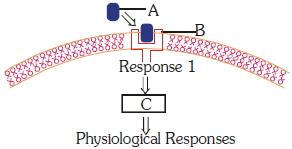
Identify $A, B$ and $C$ in the diagrammatic representation of the mechanism of hormone action.
Select the correct option from the following:
Select the correct option from the following:
A
$A-$Steroid Hormone; $B-$Hormone-receptor Complex; $C-$Protein
B
$A-$Protein Hormone; $B-$Receptor; $C-$Cyclic $AMP$
C
$A-$Steroid Hormone; $B-$Receptor; $C-$Second Messenger
D
$A-$Protein Hormone; $B-$Cyclic $AMP$; $C-$Hormone-receptor Complex
Solution
(B) The diagram illustrates the mechanism of action of protein hormones.
$1$. Protein hormones are water-soluble and cannot cross the lipid bilayer of the plasma membrane.
$2$. Therefore,they bind to specific receptors $(B)$ located on the outer surface of the plasma membrane.
$3$. The hormone $(A)$ binds to the receptor to form a hormone-receptor complex.
$4$. This binding triggers the generation of second messengers like cyclic $AMP$ $(C)$ inside the cell,which then carry out the physiological responses.
Thus,$A$ is a Protein Hormone,$B$ is a Receptor,and $C$ is a Second Messenger (like cyclic $AMP$). Option $B$ correctly identifies these components.
$1$. Protein hormones are water-soluble and cannot cross the lipid bilayer of the plasma membrane.
$2$. Therefore,they bind to specific receptors $(B)$ located on the outer surface of the plasma membrane.
$3$. The hormone $(A)$ binds to the receptor to form a hormone-receptor complex.
$4$. This binding triggers the generation of second messengers like cyclic $AMP$ $(C)$ inside the cell,which then carry out the physiological responses.
Thus,$A$ is a Protein Hormone,$B$ is a Receptor,and $C$ is a Second Messenger (like cyclic $AMP$). Option $B$ correctly identifies these components.
0 likesView Solution
55
BiologyMediumMCQNEET · 2019
Match the following joints with the bones involved:
Select the correct option from the following:
| $(a)$ Gliding joint | $(i)$ Between carpal and metacarpal of thumb |
| $(b)$ Hinge joint | $(ii)$ Between Atlas and Axis |
| $(c)$ Pivot joint | $(iii)$ Between the carpals |
| $(d)$ Saddle joint | $(iv)$ Between Humerus and Ulna |
Select the correct option from the following:
A
$(a)-(iii), (b)-(iv), (c)-(ii), (d)-(i)$
B
$(a)-(iv), (b)-(i), (c)-(ii), (d)-(iii)$
C
$(a)-(iv), (b)-(ii), (c)-(iii), (d)-(i)$
D
$(a)-(i), (b)-(iii), (c)-(ii), (d)-(iv)$
Solution
$(A)$ The correct matches are as follows:
$1$. Gliding joint: Found between the carpals, allowing for sliding movements.
$2$. Hinge joint: Found between the humerus and ulna (elbow joint), allowing movement in one plane.
$3$. Pivot joint: Found between the atlas and axis (neck vertebrae), allowing rotational movement.
$4$. Saddle joint: Found between the carpal and metacarpal of the thumb, allowing greater range of motion.
Therefore, the correct sequence is $(a)-(iii), (b)-(iv), (c)-(ii), (d)-(i)$.
$1$. Gliding joint: Found between the carpals, allowing for sliding movements.
$2$. Hinge joint: Found between the humerus and ulna (elbow joint), allowing movement in one plane.
$3$. Pivot joint: Found between the atlas and axis (neck vertebrae), allowing rotational movement.
$4$. Saddle joint: Found between the carpal and metacarpal of the thumb, allowing greater range of motion.
Therefore, the correct sequence is $(a)-(iii), (b)-(iv), (c)-(ii), (d)-(i)$.
0 likesView Solution
56
BiologyMediumMCQNEET · 2019
Artificial light, extended work-time and reduced sleep-time disrupt the activity of
A
Thymus gland
B
Pineal gland
C
Adrenal gland
D
Posterior pituitary gland
Solution
(B) The $Pineal$ gland is located on the dorsal side of the forebrain and secretes a hormone called $Melatonin$.
$Melatonin$ plays a very important role in the regulation of a $24$-hour $(diurnal)$ rhythm of our body, such as the sleep-wake cycle and body temperature.
Artificial light exposure, especially blue light at night, extended working hours, and reduced sleep disrupt the secretion of $Melatonin$, thereby affecting the circadian rhythm and the overall activity of the $Pineal$ gland.
$Melatonin$ plays a very important role in the regulation of a $24$-hour $(diurnal)$ rhythm of our body, such as the sleep-wake cycle and body temperature.
Artificial light exposure, especially blue light at night, extended working hours, and reduced sleep disrupt the secretion of $Melatonin$, thereby affecting the circadian rhythm and the overall activity of the $Pineal$ gland.
0 likesView Solution
57
BiologyMediumMCQNEET · 2019
Which of the following conditions will stimulate the parathyroid gland to release parathyroid hormone?
A
Fall in active Vitamin $D$ levels
B
Fall in blood $Ca^{+2}$ levels
C
Fall in bone $Ca^{+2}$ levels
D
Rise in blood $Ca^{+2}$ levels
Solution
(B) The parathyroid gland is primarily regulated by the concentration of calcium ions in the blood.
When blood $Ca^{+2}$ levels fall (hypocalcemia),the parathyroid glands are stimulated to secrete parathyroid hormone $(PTH)$.
$PTH$ acts to increase blood calcium levels by promoting bone resorption (releasing calcium from bones),increasing calcium reabsorption in the kidneys,and stimulating the absorption of calcium from the digestive tract via Vitamin $D$ activation.
Therefore,a fall in blood $Ca^{+2}$ levels is the specific stimulus for $PTH$ release.
When blood $Ca^{+2}$ levels fall (hypocalcemia),the parathyroid glands are stimulated to secrete parathyroid hormone $(PTH)$.
$PTH$ acts to increase blood calcium levels by promoting bone resorption (releasing calcium from bones),increasing calcium reabsorption in the kidneys,and stimulating the absorption of calcium from the digestive tract via Vitamin $D$ activation.
Therefore,a fall in blood $Ca^{+2}$ levels is the specific stimulus for $PTH$ release.
0 likesView Solution
58
BiologyMediumMCQNEET · 2019
Match the following genera with their respective phylum:
Select the correct option:
| $(a)$ Ophiura | $(i)$ Mollusca |
| $(b)$ Physalia | $(ii)$ Platyhelminthes |
| $(c)$ Pinctada | $(iii)$ Echinodermata |
| $(d)$ Planaria | $(iv)$ Coelenterata |
Select the correct option:
A
$(a)-(iv), (b)-(i), (c)-(iii), (d)-(ii)$
B
$(a)-(iii), (b)-(iv), (c)-(i), (d)-(ii)$
C
$(a)-(i), (b)-(iii), (c)-(iv), (d)-(ii)$
D
$(a)-(iii), (b)-(iv), (c)-(ii), (d)-(i)$
Solution
(B) The correct matches are as follows:
$1$. $Ophiura$ (Brittle star) belongs to the phylum $Echinodermata$ $(a-iii)$.
$2$. $Physalia$ (Portuguese man-of-war) belongs to the phylum $Coelenterata$ (also known as $Cnidaria$) $(b-iv)$.
$3$. $Pinctada$ (Pearl oyster) belongs to the phylum $Mollusca$ $(c-i)$.
$4$. $Planaria$ (Flatworm) belongs to the phylum $Platyhelminthes$ $(d-ii)$.
Therefore, the correct sequence is $(a-iii), (b-iv), (c-i), (d-ii)$.
$1$. $Ophiura$ (Brittle star) belongs to the phylum $Echinodermata$ $(a-iii)$.
$2$. $Physalia$ (Portuguese man-of-war) belongs to the phylum $Coelenterata$ (also known as $Cnidaria$) $(b-iv)$.
$3$. $Pinctada$ (Pearl oyster) belongs to the phylum $Mollusca$ $(c-i)$.
$4$. $Planaria$ (Flatworm) belongs to the phylum $Platyhelminthes$ $(d-ii)$.
Therefore, the correct sequence is $(a-iii), (b-iv), (c-i), (d-ii)$.
0 likesView Solution
59
BiologyEasyMCQNEET · 2019
Which of the following animals are true coelomates with bilateral symmetry?
A
Adult Echinoderms
B
Aschelminthes
C
Platyhelminthes
D
Annelids
Solution
(D) $1$. $Annelids$ are $triploblastic$,$bilaterally$ $symmetrical$,and possess a true $coelom$ (schizocoelom).
$2$. $Adult$ $Echinoderms$ exhibit radial symmetry.
$3$. $Aschelminthes$ are $pseudocoelomates$.
$4$. $Platyhelminthes$ are $acoelomates$.
Therefore,the correct option is $D$.
$2$. $Adult$ $Echinoderms$ exhibit radial symmetry.
$3$. $Aschelminthes$ are $pseudocoelomates$.
$4$. $Platyhelminthes$ are $acoelomates$.
Therefore,the correct option is $D$.
0 likesView Solution
60
BiologyEasyMCQNEET · 2019
The contrasting characteristics generally in a pair used for identification of animals in a Taxonomic Key are referred to as:
A
Lead
B
Couplet
C
Doublet
D
Annelids
Solution
(B) Taxonomic Key is an important taxonomic aid used for the identification of plants and animals based on the similarities and dissimilarities.
Key is based on the contrasting characters generally in a pair called a $Couplet$.
It represents the choice made between two opposite options.
Each statement in the key is called a $Lead$.
Key is based on the contrasting characters generally in a pair called a $Couplet$.
It represents the choice made between two opposite options.
Each statement in the key is called a $Lead$.
0 likesView Solution
61
BiologyMediumMCQNEET · 2019
Match the following cell junctions with their characteristic features:
Select the correct option from the following:
| $(a)$ Tight junctions | $(i)$ Cement neighbouring cells together to form a sheet |
| $(b)$ Adhering junctions | (ii) Transmit information through chemicals to other cells |
| $(c)$ Gap junctions | (iii) Establish a barrier to prevent leakage of fluid across epithelial cells |
| $(d)$ Synaptic junctions | (iv) Cytoplasmic channels to facilitate communication between adjacent cells |
Select the correct option from the following:
A
$(a)-(ii), (b)-(iv), (c)-(i), (d)-(iii)$
B
$(a)-(iv), (b)-(ii), (c)-(i), (d)-(iii)$
C
$(a)-(iii), (b)-(i), (c)-(iv), (d)-(ii)$
D
$(a)-(iv), (b)-(iii), (c)-(i), (d)-(ii)$
Solution
(C) The correct matching is as follows:
$(a)$ Tight junctions: (iii) Establish a barrier to prevent leakage of fluid across epithelial cells.
$(b)$ Adhering junctions: $(i)$ Cement neighbouring cells together to form a sheet.
$(c)$ Gap junctions: (iv) Cytoplasmic channels to facilitate communication between adjacent cells.
$(d)$ Synaptic junctions: (ii) Transmit information through chemicals to other cells.
Therefore,the correct sequence is $(a)-(iii), (b)-(i), (c)-(iv), (d)-(ii)$.
$(a)$ Tight junctions: (iii) Establish a barrier to prevent leakage of fluid across epithelial cells.
$(b)$ Adhering junctions: $(i)$ Cement neighbouring cells together to form a sheet.
$(c)$ Gap junctions: (iv) Cytoplasmic channels to facilitate communication between adjacent cells.
$(d)$ Synaptic junctions: (ii) Transmit information through chemicals to other cells.
Therefore,the correct sequence is $(a)-(iii), (b)-(i), (c)-(iv), (d)-(ii)$.
0 likesView Solution
62
BiologyMediumMCQNEET · 2019
Which of the following statements is incorrect?
A
Cockroaches exhibit mosaic vision with less sensitivity and more resolution.
B
$A$ mushroom-shaped gland is present in the $6^{th}-7^{th}$ abdominal segments of male cockroach.
C
$A$ pair of spermatheca is present in the $6^{th}$ segment of female cockroach.
D
Female cockroach possesses sixteen ovarioles in the ovaries.
Solution
(A) Let us analyze each statement:
$1$. Cockroaches exhibit mosaic vision,which is characterized by high sensitivity but low resolution. Therefore,the statement in option $A$ is incorrect.
$2$. In male cockroaches,a mushroom-shaped gland is indeed present in the $6^{th}-7^{th}$ abdominal segments.
$3$. In female cockroaches,a pair of spermatheca is present in the $6^{th}$ segment.
$4$. Each ovary of a female cockroach consists of $8$ ovarioles,totaling $16$ ovarioles in the entire reproductive system. This statement is correct.
Since option $A$ claims mosaic vision has 'less sensitivity and more resolution',which is the opposite of the truth,it is the incorrect statement.
$1$. Cockroaches exhibit mosaic vision,which is characterized by high sensitivity but low resolution. Therefore,the statement in option $A$ is incorrect.
$2$. In male cockroaches,a mushroom-shaped gland is indeed present in the $6^{th}-7^{th}$ abdominal segments.
$3$. In female cockroaches,a pair of spermatheca is present in the $6^{th}$ segment.
$4$. Each ovary of a female cockroach consists of $8$ ovarioles,totaling $16$ ovarioles in the entire reproductive system. This statement is correct.
Since option $A$ claims mosaic vision has 'less sensitivity and more resolution',which is the opposite of the truth,it is the incorrect statement.
0 likesView Solution
63
BiologyEasyMCQNEET · 2019
Select the correct statement.
A
Expiration occurs due to external intercostal muscles.
B
Intrapulmonary pressure is lower than the atmospheric pressure during inspiration.
C
Inspiration occurs when atmospheric pressure is less than intrapulmonary pressure.
D
Expiration is initiated due to contraction of diaphragm.
Solution
(B) The process of breathing involves two main phases: inspiration and expiration.
$1$. Inspiration occurs when the intrapulmonary pressure is less than the atmospheric pressure,creating a negative pressure in the lungs with respect to the atmosphere,which forces air into the lungs.
$2$. Expiration takes place when the intrapulmonary pressure is higher than the atmospheric pressure.
$3$. During inspiration,the diaphragm and external intercostal muscles contract,increasing the volume of the thoracic cavity.
$4$. During expiration,the diaphragm and external intercostal muscles relax,decreasing the thoracic volume and increasing intrapulmonary pressure,which pushes air out.
Therefore,option $B$ is the correct statement.
$1$. Inspiration occurs when the intrapulmonary pressure is less than the atmospheric pressure,creating a negative pressure in the lungs with respect to the atmosphere,which forces air into the lungs.
$2$. Expiration takes place when the intrapulmonary pressure is higher than the atmospheric pressure.
$3$. During inspiration,the diaphragm and external intercostal muscles contract,increasing the volume of the thoracic cavity.
$4$. During expiration,the diaphragm and external intercostal muscles relax,decreasing the thoracic volume and increasing intrapulmonary pressure,which pushes air out.
Therefore,option $B$ is the correct statement.
0 likesView Solution
64
BiologyEasyMCQNEET · 2019
The maximum volume of air a person can breathe in after a forced expiration is known as
A
Expiratory Capacity
B
Vital Capacity
C
Inspiratory Capacity
D
Total Lung Capacity
Solution
(B) The maximum volume of air a person can breathe in after a forced expiration is defined as the $Vital \ Capacity$ $(VC)$.
$Vital \ Capacity$ is the sum of $Inspiratory \ Reserve \ Volume$ $(IRV)$,$Tidal \ Volume$ $(TV)$,and $Expiratory \ Reserve \ Volume$ $(ERV)$.
Mathematically,$VC = IRV + TV + ERV$.
This represents the total amount of air a person can exhale after a maximum inhalation or inhale after a maximum exhalation.
$Vital \ Capacity$ is the sum of $Inspiratory \ Reserve \ Volume$ $(IRV)$,$Tidal \ Volume$ $(TV)$,and $Expiratory \ Reserve \ Volume$ $(ERV)$.
Mathematically,$VC = IRV + TV + ERV$.
This represents the total amount of air a person can exhale after a maximum inhalation or inhale after a maximum exhalation.
0 likesView Solution
65
BiologyEasyMCQNEET · 2019
All the components of the nodal tissue are autoexcitable. Why does the $SA$ node act as the normal pacemaker?
A
$SA$ node has the lowest rate of depolarisation.
B
$SA$ node is the only component to generate the threshold potential.
C
Only $SA$ node can convey the action potential to the other components.
D
$SA$ node has the highest rate of depolarisation.
Solution
(D) The nodal tissue of the heart is autoexcitable,meaning it can generate action potentials without external stimuli.
However,the rate of generation of action potentials varies among different components of the nodal tissue.
The $SA$ node (Sinoatrial node) has the highest rate of depolarisation,generating approximately $70-75$ action potentials per minute.
Because it initiates the impulse faster than any other part of the conduction system (like the $AV$ node or Purkinje fibers),it sets the pace for the entire heart.
Therefore,the $SA$ node acts as the natural pacemaker of the heart.
However,the rate of generation of action potentials varies among different components of the nodal tissue.
The $SA$ node (Sinoatrial node) has the highest rate of depolarisation,generating approximately $70-75$ action potentials per minute.
Because it initiates the impulse faster than any other part of the conduction system (like the $AV$ node or Purkinje fibers),it sets the pace for the entire heart.
Therefore,the $SA$ node acts as the natural pacemaker of the heart.
0 likesView Solution
66
BiologyEasyMCQNEET · 2019
$A$ specialised nodal tissue embedded in the lower corner of the right atrium,close to the atrioventricular septum,delays the spreading of impulses to the heart apex for about $0.1 \; sec$. This delay allows:
A
blood to enter the aorta.
B
the ventricles to empty completely.
C
blood to enter the pulmonary arteries.
D
the atria to empty completely.
Solution
(D) The specialised nodal tissue described is the Atrioventricular Node $(AVN)$.
It is located in the lower left corner of the right atrium near the atrioventricular septum.
The $AVN$ delays the electrical impulse generated by the Sinoatrial Node $(SAN)$ by approximately $0.1 \; sec$.
This delay is crucial because it ensures that the atria complete their contraction (atrial systole) and pump their blood into the ventricles before the ventricles begin to contract.
Therefore,this delay allows the atria to empty completely into the ventricles.
It is located in the lower left corner of the right atrium near the atrioventricular septum.
The $AVN$ delays the electrical impulse generated by the Sinoatrial Node $(SAN)$ by approximately $0.1 \; sec$.
This delay is crucial because it ensures that the atria complete their contraction (atrial systole) and pump their blood into the ventricles before the ventricles begin to contract.
Therefore,this delay allows the atria to empty completely into the ventricles.
0 likesView Solution
67
BiologyMediumMCQNEET · 2019
Match the following parts of a nephron with their function:
Select the correct option from the following:
| $(a)$ Descending limb of Henle's loop | $(i)$ Reabsorption of salts only |
| $(b)$ Proximal Convoluted tubule | $(ii)$ Reabsorption of water only |
| $(c)$ Ascending limb of Henle's loop | $(iii)$ Conditional reabsorption of sodium ion and water |
| $(d)$ Distal convoluted tubule | $(iv)$ Reabsorption of ion,water and organic nutrients |
Select the correct option from the following:
A
$(a)-(i), (b)-(iii), (c)-(ii), (d)-(iv)$
B
$(a)-(ii), (b)-(iv), (c)-(i), (d)-(iii)$
C
$(a)-(i), (b)-(iv), (c)-(ii), (d)-(iii)$
D
$(a)-(iv), (b)-(i), (c)-(iii), (d)-(ii)$
Solution
(B) The correct matching is as follows:
$(a)$ Descending limb of Henle's loop: It is permeable to water but nearly impermeable to electrolytes. Thus,it allows the reabsorption of water only $(ii)$.
$(b)$ Proximal Convoluted tubule $(PCT)$: It reabsorbs $70-80\%$ of electrolytes and water,and all essential nutrients like glucose and amino acids $(iv)$.
$(c)$ Ascending limb of Henle's loop: It is impermeable to water but allows the transport of electrolytes (salts) actively or passively $(i)$.
$(d)$ Distal convoluted tubule $(DCT)$: It allows for the conditional reabsorption of sodium ions and water under the influence of hormones like aldosterone and $ADH$ $(iii)$.
Therefore,the correct sequence is $(a)-(ii), (b)-(iv), (c)-(i), (d)-(iii)$.
$(a)$ Descending limb of Henle's loop: It is permeable to water but nearly impermeable to electrolytes. Thus,it allows the reabsorption of water only $(ii)$.
$(b)$ Proximal Convoluted tubule $(PCT)$: It reabsorbs $70-80\%$ of electrolytes and water,and all essential nutrients like glucose and amino acids $(iv)$.
$(c)$ Ascending limb of Henle's loop: It is impermeable to water but allows the transport of electrolytes (salts) actively or passively $(i)$.
$(d)$ Distal convoluted tubule $(DCT)$: It allows for the conditional reabsorption of sodium ions and water under the influence of hormones like aldosterone and $ADH$ $(iii)$.
Therefore,the correct sequence is $(a)-(ii), (b)-(iv), (c)-(i), (d)-(iii)$.
0 likesView Solution
68
BiologyMediumMCQNEET · 2019
Match the items in Column-$I$ with those in Column-$II$.
Select the correct option from the following:
| Column-$I$ | Column-$II$ |
| $(a)$ Podocytes | $(i)$ Crystallised oxalates |
| $(b)$ Protonephridia | $(ii)$ Annelids |
| $(c)$ Nephridia | $(iii)$ Amphioxus |
| $(d)$ Renal calculi | $(iv)$ Filtration slits |
Select the correct option from the following:
A
$(a)-(iii), (b)-(iv), (c)-(ii), (d)-(i)$
B
$(a)-(iii), (b)-(ii), (c)-(iv), (d)-(i)$
C
$(a)-(iv), (b)-(iii), (c)-(ii), (d)-(i)$
D
$(a)-(iv), (b)-(ii), (c)-(iii), (d)-(i)$
Solution
(C) The correct matching is as follows:
$(a)$ Podocytes: These are specialized cells in the Bowman's capsule of the kidney that form filtration slits, which are essential for ultrafiltration.
$(b)$ Protonephridia: These are excretory structures found in organisms like Amphioxus (Cephalochordates).
$(c)$ Nephridia: These are the tubular excretory organs found in earthworms and other Annelids.
$(d)$ Renal calculi: These are stone-like masses formed in the kidney, typically composed of crystallised oxalates.
Therefore, the correct sequence is $(a)-(iv), (b)-(iii), (c)-(ii), (d)-(i)$.
$(a)$ Podocytes: These are specialized cells in the Bowman's capsule of the kidney that form filtration slits, which are essential for ultrafiltration.
$(b)$ Protonephridia: These are excretory structures found in organisms like Amphioxus (Cephalochordates).
$(c)$ Nephridia: These are the tubular excretory organs found in earthworms and other Annelids.
$(d)$ Renal calculi: These are stone-like masses formed in the kidney, typically composed of crystallised oxalates.
Therefore, the correct sequence is $(a)-(iv), (b)-(iii), (c)-(ii), (d)-(i)$.
0 likesView Solution
69
BiologyMediumMCQNEET · 2019
Which of the following receptors are specifically responsible for the maintenance of balance of the body and posture?
A
Basilar membrane and otoliths
B
Hair cells and organ of Corti
C
Tectorial membrane and macula
D
Crista ampullaris and macula
Solution
(D) The vestibular apparatus,located in the inner ear,is responsible for the maintenance of balance and posture.
It consists of two main parts: the semicircular canals and the otolith organ (consisting of the saccule and utricle).
$1$. The crista ampullaris is located in the ampulla of each semicircular canal and is responsible for dynamic equilibrium (detecting rotational movement).
$2$. The macula is the sensory receptor located in the saccule and utricle,responsible for static equilibrium (detecting gravity and linear acceleration).
Therefore,the crista ampullaris and macula are the specific receptors responsible for the maintenance of body balance and posture.
It consists of two main parts: the semicircular canals and the otolith organ (consisting of the saccule and utricle).
$1$. The crista ampullaris is located in the ampulla of each semicircular canal and is responsible for dynamic equilibrium (detecting rotational movement).
$2$. The macula is the sensory receptor located in the saccule and utricle,responsible for static equilibrium (detecting gravity and linear acceleration).
Therefore,the crista ampullaris and macula are the specific receptors responsible for the maintenance of body balance and posture.
0 likesView Solution
70
BiologyMediumMCQNEET · 2019
Which of the following is against the rules of $ICBN$?
A
Handwritten scientific names should be underlined.
B
Every species should have a generic name and a specific epithet.
C
Scientific names are in Latin and should be italicized.
D
Generic and specific names should be written starting with small letters.
Solution
(D) According to the rules of $ICBN$ (International Code of Botanical Nomenclature):
$1$. Scientific names are generally in Latin and written in italics. When handwritten,they are underlined to indicate their Latin origin.
$2$. Each biological name has two components: the generic name and the specific epithet.
$3$. The generic name starts with a capital letter,while the specific epithet starts with a small letter.
Therefore,the statement that generic and specific names should be written starting with small letters is incorrect and against the rules of $ICBN$.
$1$. Scientific names are generally in Latin and written in italics. When handwritten,they are underlined to indicate their Latin origin.
$2$. Each biological name has two components: the generic name and the specific epithet.
$3$. The generic name starts with a capital letter,while the specific epithet starts with a small letter.
Therefore,the statement that generic and specific names should be written starting with small letters is incorrect and against the rules of $ICBN$.
0 likesView Solution
71
BiologyMediumMCQNEET · 2019
Mad cow disease in cattle is caused by an organism which has
A
inert crystalline structure
B
abnormally folded protein
C
free $RNA$ without protein coat
D
free $DNA$ without protein coat
Solution
(B) Mad cow disease,also known as Bovine Spongiform Encephalopathy $(BSE)$,is a neurodegenerative disease in cattle.
It is caused by prions.
Prions are infectious agents that consist entirely of abnormally folded proteins.
They lack nucleic acids ($DNA$ or $RNA$) and are smaller than viruses.
Therefore,the correct option is $B$.
It is caused by prions.
Prions are infectious agents that consist entirely of abnormally folded proteins.
They lack nucleic acids ($DNA$ or $RNA$) and are smaller than viruses.
Therefore,the correct option is $B$.
0 likesView Solution
72
BiologyEasyMCQNEET · 2019
Which of the following statements is correct?
A
Lichens do not grow in polluted areas.
B
Algal component of lichens is called mycobiont.
C
Fungal component of lichens is called phycobiont.
D
Lichens are not good pollution indicators.
Solution
(A) Lichens are symbiotic associations between algae and fungi.
$1$. The algal component is known as the phycobiont,which is autotrophic.
$2$. The fungal component is known as the mycobiont,which is heterotrophic.
$3$. Lichens are very sensitive to $SO_2$ pollution and do not grow in polluted areas,making them excellent pollution indicators.
Therefore,statement $A$ is correct.
$1$. The algal component is known as the phycobiont,which is autotrophic.
$2$. The fungal component is known as the mycobiont,which is heterotrophic.
$3$. Lichens are very sensitive to $SO_2$ pollution and do not grow in polluted areas,making them excellent pollution indicators.
Therefore,statement $A$ is correct.
0 likesView Solution
73
BiologyEasyMCQNEET · 2019
Match the organisms in Column-$I$ with habitats in Column-$II$.
Select the correct answer from the options given below:
| Column-$I$ | Column-$II$ |
| $(a)$ Halophiles | $(i)$ Hot springs |
| $(b)$ Thermoacidophiles | $(ii)$ Aquatic environment |
| $(c)$ Methanogens | $(iii)$ Guts of ruminants |
| $(d)$ Cyanobacteria | $(iv)$ Salty area |
Select the correct answer from the options given below:
A
$(a)-(iv), (b)-(i), (c)-(iii), (d)-(ii)$
B
$(a)-(i), (b)-(ii), (c)-(iii), (d)-(iv)$
C
$(a)-(iii), (b)-(iv), (c)-(ii), (d)-(i)$
D
$(a)-(ii), (b)-(iv), (c)-(iii), (d)-(i)$
Solution
(A) The correct matches are as follows:
$(a)$ Halophiles are archaebacteria found in extremely salty areas,so $(a)-(iv)$.
$(b)$ Thermoacidophiles are archaebacteria found in hot springs,so $(b)-(i)$.
$(c)$ Methanogens are archaebacteria found in the guts of several ruminant animals such as cows and buffaloes,so $(c)-(iii)$.
$(d)$ Cyanobacteria (blue-green algae) are photosynthetic autotrophs found in aquatic environments,so $(d)-(ii)$.
Therefore,the correct sequence is $(a)-(iv), (b)-(i), (c)-(iii), (d)-(ii)$.
$(a)$ Halophiles are archaebacteria found in extremely salty areas,so $(a)-(iv)$.
$(b)$ Thermoacidophiles are archaebacteria found in hot springs,so $(b)-(i)$.
$(c)$ Methanogens are archaebacteria found in the guts of several ruminant animals such as cows and buffaloes,so $(c)-(iii)$.
$(d)$ Cyanobacteria (blue-green algae) are photosynthetic autotrophs found in aquatic environments,so $(d)-(ii)$.
Therefore,the correct sequence is $(a)-(iv), (b)-(i), (c)-(iii), (d)-(ii)$.
0 likesView Solution
74
BiologyMediumMCQNEET · 2019
In the dicot root,the vascular cambium originates from:
A
Tissue located below the phloem bundles and a portion of pericycle tissue above protoxylem.
B
Cortical region
C
Parenchyma between endodermis and pericycle.
D
Intrafascicular and interfascicular tissue in a ring.
Solution
(A) In dicot roots,the vascular cambium is secondary in origin.
It develops from the thin-walled parenchymatous cells located just below the phloem bundles.
Additionally,a portion of the pericycle tissue located above the protoxylem also participates in the formation of the vascular cambium.
These cells become meristematic and form a continuous wavy ring,which later becomes circular.
It develops from the thin-walled parenchymatous cells located just below the phloem bundles.
Additionally,a portion of the pericycle tissue located above the protoxylem also participates in the formation of the vascular cambium.
These cells become meristematic and form a continuous wavy ring,which later becomes circular.
0 likesView Solution
75
BiologyMediumMCQNEET · 2019
Which of the following shows whorled phyllotaxy?
A
Mustard
B
China rose
C
Alstonia
D
Calotropis
Solution
(C) Phyllotaxy is the pattern of arrangement of leaves on the stem or branch.
In whorled phyllotaxy, more than two leaves arise at a node and form a whorl.
$Alstonia$ is a classic example of whorled phyllotaxy.
In $Mustard$ and $China \text{ } rose$, alternate phyllotaxy is observed.
In $Calotropis$, opposite phyllotaxy is observed.
In whorled phyllotaxy, more than two leaves arise at a node and form a whorl.
$Alstonia$ is a classic example of whorled phyllotaxy.
In $Mustard$ and $China \text{ } rose$, alternate phyllotaxy is observed.
In $Calotropis$, opposite phyllotaxy is observed.
0 likesView Solution
76
BiologyMediumMCQNEET · 2019
Regeneration of damaged growing grass following grazing is largely due to
A
Lateral meristem
B
Apical meristem
C
Intercalary meristem
D
Secondary meristem
Solution
(C) The regeneration of damaged grass after grazing is primarily due to the presence of $Intercalary$ $meristem$.
These meristems are located between mature tissues and are responsible for the growth in length of internodes in monocots,such as grasses.
When herbivores graze on grass,they remove the apical meristem,but the intercalary meristems allow the grass to continue growing from the base or nodes,facilitating rapid recovery.
These meristems are located between mature tissues and are responsible for the growth in length of internodes in monocots,such as grasses.
When herbivores graze on grass,they remove the apical meristem,but the intercalary meristems allow the grass to continue growing from the base or nodes,facilitating rapid recovery.
0 likesView Solution
77
BiologyMediumMCQNEET · 2019
Bicarpellary ovary with obliquely placed septum is seen in
A
Brassica
B
Aloe
C
Solanum
D
Sesbania
Solution
(C) The family $Solanaceae$ is characterized by a bicarpellary,syncarpous,and superior ovary.
$A$ key diagnostic feature of this family is the presence of an obliquely placed septum,which occurs because the ovary is tilted at an angle of $45^{\circ}$ relative to the median plane of the flower.
Among the given options,$Solanum$ belongs to the family $Solanaceae$,while $Brassica$ belongs to $Brassicaceae$,$Aloe$ to $Liliaceae$,and $Sesbania$ to $Fabaceae$.
Therefore,the correct answer is $Solanum$.
$A$ key diagnostic feature of this family is the presence of an obliquely placed septum,which occurs because the ovary is tilted at an angle of $45^{\circ}$ relative to the median plane of the flower.
Among the given options,$Solanum$ belongs to the family $Solanaceae$,while $Brassica$ belongs to $Brassicaceae$,$Aloe$ to $Liliaceae$,and $Sesbania$ to $Fabaceae$.
Therefore,the correct answer is $Solanum$.
0 likesView Solution
78
BiologyEasyMCQNEET · 2019
Match the Column-$I$ with Column-$II$.
Choose the right match from the options given below.
| Column-$I$ | Column-$II$ |
|---|---|
| $(a)$ Golgi apparatus | $(i)$ Synthesis of protein |
| $(b)$ Lysosomes | $(ii)$ Trap waste and excretory products |
| $(c)$ Vacuoles | $(iii)$ Formation of glycoproteins and glycolipids |
| $(d)$ Ribosomes | $(iv)$ Digesting biomolecules |
Choose the right match from the options given below.
A
$(a)-(iii), (b)-(iv), (c)-(ii), (d)-(i)$
B
$(a)-(iv), (b)-(iii), (c)-(i), (d)-(ii)$
C
$(a)-(iii), (b)-(ii), (c)-(iv), (d)-(i)$
D
$(a)-(i), (b)-(ii), (c)-(iv), (d)-(iii)$
Solution
(A) The correct matches are as follows:
$1$. Golgi apparatus $(a)$ is responsible for the formation of glycoproteins and glycolipids $(iii)$.
$2$. Lysosomes $(b)$ contain hydrolytic enzymes and are involved in digesting biomolecules $(iv)$.
$3$. Vacuoles $(c)$ in plant cells store water,sap,and excretory products,effectively trapping waste $(ii)$.
$4$. Ribosomes $(d)$ are the sites of protein synthesis $(i)$.
Therefore,the correct sequence is $(a)-(iii), (b)-(iv), (c)-(ii), (d)-(i)$.
$1$. Golgi apparatus $(a)$ is responsible for the formation of glycoproteins and glycolipids $(iii)$.
$2$. Lysosomes $(b)$ contain hydrolytic enzymes and are involved in digesting biomolecules $(iv)$.
$3$. Vacuoles $(c)$ in plant cells store water,sap,and excretory products,effectively trapping waste $(ii)$.
$4$. Ribosomes $(d)$ are the sites of protein synthesis $(i)$.
Therefore,the correct sequence is $(a)-(iii), (b)-(iv), (c)-(ii), (d)-(i)$.
0 likesView Solution
79
BiologyMediumMCQNEET · 2019
Prosthetic groups differ from co-enzymes in that
A
they require metal ions for their activity.
B
they (prosthetic groups) are tightly bound to apoenzymes.
C
their association with apoenzymes is transient.
D
they can serve as co-factors in a number of enzyme-catalyzed reactions.
Solution
(B) Co-factors are non-protein constituents that are bound to the enzyme to make the enzyme catalytically active.
They are classified into three types: prosthetic groups,co-enzymes,and metal ions.
Prosthetic groups are organic compounds that are tightly bound to the apoenzyme (the protein portion of the enzyme).
For example,in peroxidase and catalase,which catalyze the breakdown of hydrogen peroxide to water and oxygen,heme is the prosthetic group and it is a part of the active site of the enzyme.
In contrast,co-enzymes are also organic compounds,but their association with the apoenzyme is only transient,usually occurring during the course of catalysis.
Therefore,the fundamental difference is that prosthetic groups are tightly bound,whereas co-enzymes are loosely or transiently bound.
They are classified into three types: prosthetic groups,co-enzymes,and metal ions.
Prosthetic groups are organic compounds that are tightly bound to the apoenzyme (the protein portion of the enzyme).
For example,in peroxidase and catalase,which catalyze the breakdown of hydrogen peroxide to water and oxygen,heme is the prosthetic group and it is a part of the active site of the enzyme.
In contrast,co-enzymes are also organic compounds,but their association with the apoenzyme is only transient,usually occurring during the course of catalysis.
Therefore,the fundamental difference is that prosthetic groups are tightly bound,whereas co-enzymes are loosely or transiently bound.
0 likesView Solution
80
BiologyDifficultMCQNEET · 2019
Crossing over takes place between which chromatids and in which stage of the cell cycle?
A
Non-sister chromatids of non-homologous chromosomes at Zygotene stage of prophase $I$.
B
Non-sister chromatids of homologous chromosomes at Pachytene stage of prophase $I$.
C
Non-sister chromatids of homologous chromosomes at Zygotene stage of prophase $I$.
D
Non-sister chromatids of non-homologous chromosomes at Pachytene stage of prophase $I$.
Solution
(B) Crossing over is the exchange of genetic material between non-sister chromatids of homologous chromosomes.
This process occurs during the Pachytene stage of Prophase $I$ of meiosis.
During this stage,the bivalent chromosomes or tetrads become clearly visible,and the recombination nodules appear at the sites where crossing over occurs.
This process occurs during the Pachytene stage of Prophase $I$ of meiosis.
During this stage,the bivalent chromosomes or tetrads become clearly visible,and the recombination nodules appear at the sites where crossing over occurs.
0 likesView Solution
81
BiologyMediumMCQNEET · 2019
The "Ramachandran plot" is used to confirm the structure of:
A
$RNA$
B
Proteins
C
Triacylglycerides
D
$DNA$
Solution
(B) The "Ramachandran plot" is a visualization tool used in biochemistry to analyze the allowed regions of the backbone dihedral angles $\phi$ (phi) and $\psi$ (psi) of amino acid residues in protein structures.
It helps in determining the stereochemical feasibility of polypeptide chains, thereby confirming the secondary structure of proteins.
It helps in determining the stereochemical feasibility of polypeptide chains, thereby confirming the secondary structure of proteins.
0 likesView Solution
82
BiologyMediumMCQNEET · 2019
Which of the following is not a feature of active transport of solutes in plants?
A
Occurs against concentration gradient
B
Non-selective
C
Occurs through membranes
D
Requires $ATP$
Solution
(B) Active transport is a process that moves molecules across a cell membrane from a region of lower concentration to a region of higher concentration (against the concentration gradient).
This process requires energy in the form of $ATP$.
Active transport is highly selective because it uses specific membrane proteins (pumps) to transport particular solutes.
Therefore,being 'non-selective' is not a feature of active transport; rather,it is a characteristic of passive transport like simple diffusion.
This process requires energy in the form of $ATP$.
Active transport is highly selective because it uses specific membrane proteins (pumps) to transport particular solutes.
Therefore,being 'non-selective' is not a feature of active transport; rather,it is a characteristic of passive transport like simple diffusion.
0 likesView Solution
83
BiologyEasyMCQNEET · 2019
Which of the following bacteria reduce nitrate in soil into nitrogen?
A
Nitrobacter
B
Nitrococcus
C
Thiobacillus
D
Nitrosomonas
Solution
(C) The process of converting nitrate $(NO_3^-)$ present in the soil into gaseous nitrogen $(N_2)$ is known as denitrification.
This process is carried out by denitrifying bacteria.
Among the given options,$Thiobacillus$ and $Pseudomonas$ are well-known examples of denitrifying bacteria.
$Nitrobacter$ and $Nitrococcus$ are involved in the process of nitrification (converting nitrite to nitrate).
$Nitrosomonas$ is involved in the conversion of ammonia to nitrite.
Therefore,the correct answer is $Thiobacillus$.
This process is carried out by denitrifying bacteria.
Among the given options,$Thiobacillus$ and $Pseudomonas$ are well-known examples of denitrifying bacteria.
$Nitrobacter$ and $Nitrococcus$ are involved in the process of nitrification (converting nitrite to nitrate).
$Nitrosomonas$ is involved in the conversion of ammonia to nitrite.
Therefore,the correct answer is $Thiobacillus$.
0 likesView Solution
84
BiologyMediumMCQNEET · 2019
What will be the direction of flow of water when a plant cell is placed in a hypotonic solution?
A
Water will flow in both directions
B
Water will flow out of the cell
C
Water will flow into the cell
D
No flow of water in any direction
Solution
(C) hypotonic solution is one that has a lower solute concentration compared to the cytoplasm of the cell.
According to the principle of osmosis,water moves from a region of higher water potential (lower solute concentration) to a region of lower water potential (higher solute concentration) through a semi-permeable membrane.
Since the surrounding solution is hypotonic,the water potential outside the cell is higher than inside the cell.
Therefore,water will move from the outside into the cell,causing the cell to swell and become turgid.
According to the principle of osmosis,water moves from a region of higher water potential (lower solute concentration) to a region of lower water potential (higher solute concentration) through a semi-permeable membrane.
Since the surrounding solution is hypotonic,the water potential outside the cell is higher than inside the cell.
Therefore,water will move from the outside into the cell,causing the cell to swell and become turgid.
0 likesView Solution
85
BiologyEasyMCQNEET · 2019
Where is the respiratory electron transport system $(ETS)$ located in plants?
A
Mitochondrial matrix
B
Outer mitochondrial membrane
C
Inner mitochondrial membrane
D
Intermembrane space
Solution
(C) The respiratory electron transport system $(ETS)$ in plants is located in the inner mitochondrial membrane.
This system consists of a series of protein complexes $(Complexes I-IV)$ and electron carriers that facilitate the transfer of electrons from $NADH$ and $FADH_2$ to oxygen.
The energy released during this electron transport is used to pump protons from the matrix into the intermembrane space,creating a proton gradient that drives $ATP$ synthesis via $ATP$ synthase.
This system consists of a series of protein complexes $(Complexes I-IV)$ and electron carriers that facilitate the transfer of electrons from $NADH$ and $FADH_2$ to oxygen.
The energy released during this electron transport is used to pump protons from the matrix into the intermembrane space,creating a proton gradient that drives $ATP$ synthesis via $ATP$ synthase.
0 likesView Solution
86
BiologyEasyMCQNEET · 2019
In Hatch and Slack pathway,the primary $CO_2$ acceptor is
A
Oxaloacetic acid
B
Phosphoglyceric acid
C
Phosphoenol pyruvate
D
Rubisco
Solution
(C) The Hatch and Slack pathway,also known as the $C_4$ cycle,occurs in $C_4$ plants.
In this pathway,the primary $CO_2$ acceptor is a $3$-carbon molecule called Phosphoenol pyruvate $(PEP)$.
This reaction is catalyzed by the enzyme $PEP$ carboxylase $(PEPCase)$ in the mesophyll cells,resulting in the formation of a $4$-carbon compound,Oxaloacetic acid $(OAA)$.
In this pathway,the primary $CO_2$ acceptor is a $3$-carbon molecule called Phosphoenol pyruvate $(PEP)$.
This reaction is catalyzed by the enzyme $PEP$ carboxylase $(PEPCase)$ in the mesophyll cells,resulting in the formation of a $4$-carbon compound,Oxaloacetic acid $(OAA)$.
0 likesView Solution
87
BiologyMediumMCQNEET · 2019
One scientist cultured Cladophora in a suspension of Azotobacter and illuminated the culture by splitting light through a prism. He observed that bacteria accumulated mainly in the region of
A
Violet and green light
B
Indigo and green light
C
Orange and yellow light
D
Blue and red light
Solution
(D) The experiment described is the famous action spectrum experiment performed by $T$.$W$. Engelmann in $1883$.
He used the green alga $Cladophora$ and placed it in a suspension of aerobic bacteria $(Azotobacter)$.
These bacteria were used to detect the sites of $O_2$ evolution.
He split light using a prism to create a spectrum and illuminated the alga.
He observed that the bacteria accumulated mainly in the regions of blue and red light,where the rate of photosynthesis was highest,leading to maximum $O_2$ release.
He used the green alga $Cladophora$ and placed it in a suspension of aerobic bacteria $(Azotobacter)$.
These bacteria were used to detect the sites of $O_2$ evolution.
He split light using a prism to create a spectrum and illuminated the alga.
He observed that the bacteria accumulated mainly in the regions of blue and red light,where the rate of photosynthesis was highest,leading to maximum $O_2$ release.
0 likesView Solution
88
BiologyEasyMCQNEET · 2019
In order to increase the yield of sugarcane crop,which of the following plant growth regulators should be sprayed?
A
Ethylene
B
Auxins
C
Gibberellins
D
Cytokinins
Solution
(C) Gibberellins are a group of plant growth regulators that promote stem elongation.
Spraying sugarcane crops with Gibberellins increases the length of the stem,which significantly increases the yield of the crop by as much as $20$ tonnes per acre.
Therefore,Gibberellins are used in the sugarcane industry to enhance productivity.
Spraying sugarcane crops with Gibberellins increases the length of the stem,which significantly increases the yield of the crop by as much as $20$ tonnes per acre.
Therefore,Gibberellins are used in the sugarcane industry to enhance productivity.
0 likesView Solution
89
BiologyDifficultMCQNEET · 2019
Match the placental types (Column-$I$) with their examples (Column-$II$)
Choose the correct answer from the following options:
| Column-$I$ | Column-$II$ |
|---|---|
| $(a)$ Basal | $(i)$ Mustard |
| $(b)$ Axile | $(ii)$ China rose |
| $(c)$ Parietal | $(iii)$ Dianthus |
| $(d)$ Free central | $(iv)$ Sunflower |
Choose the correct answer from the following options:
A
$(a)-(ii), (b)-(iii), (c)-(iv), (d)-(i)$
B
$(a)-(i), (b)-(ii), (c)-(iii), (d)-(iv)$
C
$(a)-(iv), (b)-(ii), (c)-(i), (d)-(iii)$
D
$(a)-(iii), (b)-(iv), (c)-(i), (d)-(ii)$
Solution
(C) The correct matching is as follows:
$1$. Basal placentation: In this type,the placenta develops at the base of the ovary and a single ovule is attached to it. Example: Sunflower,Marigold.
$2$. Axile placentation: In this type,the placenta is axial and the ovules are attached to it in a multilocular ovary. Example: China rose,Tomato,Lemon.
$3$. Parietal placentation: In this type,the ovules develop on the inner wall of the ovary or on peripheral part. Example: Mustard,Argemone.
$4$. Free central placentation: In this type,the ovules are borne on the central axis and septa are absent. Example: Dianthus,Primrose.
Therefore,the correct match is: $(a)-(iv), (b)-(ii), (c)-(i), (d)-(iii)$.
$1$. Basal placentation: In this type,the placenta develops at the base of the ovary and a single ovule is attached to it. Example: Sunflower,Marigold.
$2$. Axile placentation: In this type,the placenta is axial and the ovules are attached to it in a multilocular ovary. Example: China rose,Tomato,Lemon.
$3$. Parietal placentation: In this type,the ovules develop on the inner wall of the ovary or on peripheral part. Example: Mustard,Argemone.
$4$. Free central placentation: In this type,the ovules are borne on the central axis and septa are absent. Example: Dianthus,Primrose.
Therefore,the correct match is: $(a)-(iv), (b)-(ii), (c)-(i), (d)-(iii)$.
0 likesView Solution
90
BiologyDifficultMCQNEET · 2019
What will be the sequence of $mRNA$ produced by the following stretch of $DNA$?
$3' ATGCATGCATGCATG 5'$ $TEMPLATE$ $STRAND$
$5' TACGTACGTACGTAC 3'$ $CODING$ $STRAND$
$3' ATGCATGCATGCATG 5'$ $TEMPLATE$ $STRAND$
$5' TACGTACGTACGTAC 3'$ $CODING$ $STRAND$
A
$3' AUGCAUGCAUGCAUG 5'$
B
$5' UACGUACGUACGUAC 3'$
C
$3' UACGUACGUACGUAC 5'$
D
$5' AUGCAUGCAUGCAUG 3'$
Solution
(D) During the process of transcription,$mRNA$ is synthesized using the template strand of $DNA$ ($3' \rightarrow 5'$ direction) as a reference.
According to the base-pairing rules,$A$ pairs with $U$,$T$ pairs with $A$,$G$ pairs with $C$,and $C$ pairs with $G$.
The template strand is $3' ATGCATGCATGCATG 5'$.
By applying the base-pairing rules,the complementary $mRNA$ sequence is $5' UACGUACGUACGUAC 3'$.
This sequence is identical to the coding strand,except that $Thymine$ $(T)$ is replaced by $Uracil$ $(U)$.
According to the base-pairing rules,$A$ pairs with $U$,$T$ pairs with $A$,$G$ pairs with $C$,and $C$ pairs with $G$.
The template strand is $3' ATGCATGCATGCATG 5'$.
By applying the base-pairing rules,the complementary $mRNA$ sequence is $5' UACGUACGUACGUAC 3'$.
This sequence is identical to the coding strand,except that $Thymine$ $(T)$ is replaced by $Uracil$ $(U)$.
0 likesView Solution
91
BiologyMediumMCQNEET · 2019
Select the incorrect statement regarding inbreeding.
A
Inbreeding helps in the elimination of deleterious alleles from the population.
B
Inbreeding is necessary to evolve a pureline in any animal.
C
Continued inbreeding reduces fertility and leads to inbreeding depression.
D
Inbreeding depression cannot be overcome by out-crossing.
Solution
(D) Inbreeding refers to the mating of more closely related individuals within the same breed for $4-6$ generations.
$1$. Inbreeding increases homozygosity,which helps in the accumulation of superior genes and the elimination of less desirable genes (deleterious alleles).
$2$. It is essential for evolving a pureline in any animal.
$3$. However,continued inbreeding,especially close inbreeding,usually reduces fertility and productivity,a phenomenon known as inbreeding depression.
$4$. Inbreeding depression can be overcome by mating the selected animals with unrelated superior animals of the same breed,a process known as out-crossing.
Therefore,the statement that 'Inbreeding depression cannot be overcome by out-crossing' is incorrect.
$1$. Inbreeding increases homozygosity,which helps in the accumulation of superior genes and the elimination of less desirable genes (deleterious alleles).
$2$. It is essential for evolving a pureline in any animal.
$3$. However,continued inbreeding,especially close inbreeding,usually reduces fertility and productivity,a phenomenon known as inbreeding depression.
$4$. Inbreeding depression can be overcome by mating the selected animals with unrelated superior animals of the same breed,a process known as out-crossing.
Therefore,the statement that 'Inbreeding depression cannot be overcome by out-crossing' is incorrect.
0 likesView Solution
92
BiologyEasyMCQNEET · 2019
$A$ biocontrol agent to be a part of an integrated pest management should be
A
Species-specific and symbiotic
B
Free living and broad spectrum
C
Narrow spectrum and symbiotic
D
Species-specific and inactive on non-target organisms
Solution
(D) Integrated Pest Management $(IPM)$ relies on the use of biocontrol agents that are highly selective.
An ideal biocontrol agent must be species-specific,meaning it targets only the specific pest species causing damage.
Furthermore,it must be inactive on non-target organisms,such as beneficial insects,pollinators,or other wildlife,to maintain ecological balance and biodiversity.
Therefore,option $D$ is the correct characteristic for an effective biocontrol agent.
An ideal biocontrol agent must be species-specific,meaning it targets only the specific pest species causing damage.
Furthermore,it must be inactive on non-target organisms,such as beneficial insects,pollinators,or other wildlife,to maintain ecological balance and biodiversity.
Therefore,option $D$ is the correct characteristic for an effective biocontrol agent.
0 likesView Solution
93
BiologyMediumMCQNEET · 2019
Match the following enzymes with their functions:
Select the correct option from the following:
| $(a)$ Restriction endonuclease | $(i)$ Joins the $DNA$ fragments |
| $(b)$ Restriction exonuclease | $(ii)$ Extends primers on genomic $DNA$ template |
| $(c)$ $DNA$ ligase | $(iii)$ Cuts $DNA$ at specific positions |
| $(d)$ $Taq$ polymerase | $(iv)$ Removes nucleotides from the ends of $DNA$ |
Select the correct option from the following:
A
$a-iii, b-i, c-iv, d-ii$
B
$a-iii, b-iv, c-i, d-ii$
C
$a-iv, b-iii, c-i, d-ii$
D
$a-ii, b-iv, c-i, d-iii$
Solution
(B) The correct matching is as follows:
$(a)$ Restriction endonuclease: These enzymes cut $DNA$ at specific recognition sequences within the molecule. Thus, $(a) - (iii)$.
$(b)$ Restriction exonuclease: These enzymes remove nucleotides from the ends of $DNA$ molecules. Thus, $(b) - (iv)$.
$(c)$ $DNA$ ligase: This enzyme acts as molecular glue, joining $DNA$ fragments by forming phosphodiester bonds. Thus, $(c) - (i)$.
$(d)$ $Taq$ polymerase: This is a thermostable enzyme used in $PCR$ to extend primers on a genomic $DNA$ template. Thus, $(d) - (ii)$.
Therefore, the correct sequence is $a-iii, b-iv, c-i, d-ii$.
$(a)$ Restriction endonuclease: These enzymes cut $DNA$ at specific recognition sequences within the molecule. Thus, $(a) - (iii)$.
$(b)$ Restriction exonuclease: These enzymes remove nucleotides from the ends of $DNA$ molecules. Thus, $(b) - (iv)$.
$(c)$ $DNA$ ligase: This enzyme acts as molecular glue, joining $DNA$ fragments by forming phosphodiester bonds. Thus, $(c) - (i)$.
$(d)$ $Taq$ polymerase: This is a thermostable enzyme used in $PCR$ to extend primers on a genomic $DNA$ template. Thus, $(d) - (ii)$.
Therefore, the correct sequence is $a-iii, b-iv, c-i, d-ii$.
0 likesView Solution
94
BiologyEasyMCQNEET · 2019
The two antibiotic resistance genes on vector $pBR322$ are for
A
Ampicillin and Tetracycline
B
Ampicillin and Chloramphenicol
C
Chloramphenicol and Tetracycline
D
Tetracycline and Kanamycin
Solution
(A) The plasmid vector $pBR322$ is one of the most commonly used cloning vectors in biotechnology.
It contains two distinct antibiotic resistance genes,which serve as selectable markers.
These genes are the $amp^R$ gene,which provides resistance to Ampicillin,and the $tet^R$ gene,which provides resistance to Tetracycline.
These markers allow for the identification and selection of recombinant cells from non-recombinant ones during the cloning process.
It contains two distinct antibiotic resistance genes,which serve as selectable markers.
These genes are the $amp^R$ gene,which provides resistance to Ampicillin,and the $tet^R$ gene,which provides resistance to Tetracycline.
These markers allow for the identification and selection of recombinant cells from non-recombinant ones during the cloning process.
0 likesView Solution
95
BiologyMediumMCQNEET · 2019
Exploitation of bioresources of a nation by multinational companies without authorization from the concerned country is referred to as
A
Bioweapon
B
Biopiracy
C
Bioethics
D
Biowar
Solution
(B) The exploitation of bioresources of a nation by multinational companies and other organizations without proper authorization from the concerned country and without compensatory payment is known as $Biopiracy$.
This often involves the unauthorized use of traditional knowledge or biological resources for commercial gain.
$Bioethics$ refers to the study of ethical issues arising from biological research.
$Bioweapon$ and $Biowar$ refer to the use of biological agents as weapons in warfare.
This often involves the unauthorized use of traditional knowledge or biological resources for commercial gain.
$Bioethics$ refers to the study of ethical issues arising from biological research.
$Bioweapon$ and $Biowar$ refer to the use of biological agents as weapons in warfare.
0 likesView Solution
96
BiologyMediumMCQNEET · 2019
Carnivorous animals, such as lions and leopards, occupy the same niche, but lions predate mostly on larger animals while leopards take smaller ones. This mechanism of competition is referred to as:
A
Character displacement
B
Altruism
C
Resource partitioning
D
Competitive exclusion
Solution
(C) The phenomenon described is known as $Resource \text{ } partitioning$.
When two species compete for the same resource, they may evolve mechanisms to avoid direct competition to coexist.
By feeding on different sizes of prey, lions and leopards reduce competition for food, allowing them to occupy the same habitat.
This strategy of dividing resources to minimize competition is a classic example of $Resource \text{ } partitioning$.
When two species compete for the same resource, they may evolve mechanisms to avoid direct competition to coexist.
By feeding on different sizes of prey, lions and leopards reduce competition for food, allowing them to occupy the same habitat.
This strategy of dividing resources to minimize competition is a classic example of $Resource \text{ } partitioning$.
0 likesView Solution
97
BiologyMediumMCQNEET · 2019
The decline in the population of Indian native fishes due to the introduction of $Clarias$ $gariepinus$ in the river Yamuna can be categorized as:
A
Co-extinction
B
Habitat fragmentation
C
Over-exploitation
D
Alien species invasion
Solution
(D) The introduction of non-native or exotic species into a new ecosystem often leads to the decline or extinction of indigenous species. This phenomenon is known as $Alien$ $species$ $invasion$. $Clarias$ $gariepinus$ (African catfish) is an invasive species that was illegally introduced into Indian water bodies,including the river Yamuna,where it competes with and preys upon native fish species,leading to a significant decline in their population.
0 likesView Solution
98
BiologyDifficultMCQNEET · 2019
Match the following $RNA$ polymerase enzymes with their transcribed products:
Select the correct option from the following:
| $(a) \; RNA$ polymerase $I$ | $(i) \; tRNA$ |
| $(b) \; RNA$ polymerase $II$ | $(ii) \; rRNA$ |
| $(c) \; RNA$ polymerase $III$ | $(iii) \; hnRNA$ |
Select the correct option from the following:
A
$a-i, b-iii, c-ii$
B
$a-i, b-ii, c-iii$
C
$a-ii, b-iii, c-i$
D
$a-iii, b-ii, c-i$
Solution
(C) In eukaryotes, there are three main types of $RNA$ polymerases involved in transcription:
$1$. $RNA$ polymerase $I$ transcribes $rRNA$ ($28S, 18S,$ and $5.8S$).
$2$. $RNA$ polymerase $II$ transcribes the precursor of $mRNA$, which is called heterogeneous nuclear $RNA$ $(hnRNA)$.
$3$. $RNA$ polymerase $III$ is responsible for the transcription of $tRNA$, $5S$ $rRNA$, and $snRNA$ (small nuclear $RNA$).
Matching these:
$(a) \; RNA$ polymerase $I$ $\rightarrow$ $(ii) \; rRNA$
$(b) \; RNA$ polymerase $II$ $\rightarrow$ $(iii) \; hnRNA$
$(c) \; RNA$ polymerase $III$ $\rightarrow$ $(i) \; tRNA$
Thus, the correct matching is $a-ii, b-iii, c-i$.
$1$. $RNA$ polymerase $I$ transcribes $rRNA$ ($28S, 18S,$ and $5.8S$).
$2$. $RNA$ polymerase $II$ transcribes the precursor of $mRNA$, which is called heterogeneous nuclear $RNA$ $(hnRNA)$.
$3$. $RNA$ polymerase $III$ is responsible for the transcription of $tRNA$, $5S$ $rRNA$, and $snRNA$ (small nuclear $RNA$).
Matching these:
$(a) \; RNA$ polymerase $I$ $\rightarrow$ $(ii) \; rRNA$
$(b) \; RNA$ polymerase $II$ $\rightarrow$ $(iii) \; hnRNA$
$(c) \; RNA$ polymerase $III$ $\rightarrow$ $(i) \; tRNA$
Thus, the correct matching is $a-ii, b-iii, c-i$.
0 likesView Solution
99
BiologyMediumMCQNEET · 2019
In a marriage between a male with blood group $A$ and a female with blood group $B$,the progeny had either blood group $AB$ or $B$. What could be the possible genotype of parents?
A
$I^A i$ (Male) : $I^B I^B$ (Female)
B
$I^A I^A$ (Male) : $I^B I^B$ (Female)
C
$I^A I^A$ (Male) : $I^B i$ (Female)
D
$I^A i$ (Male) : $I^B i$ (Female)
Solution
(A) The blood group $A$ can have genotypes $I^A I^A$ or $I^A i$. The blood group $B$ can have genotypes $I^B I^B$ or $I^B i$.
If the male is $I^A i$ and the female is $I^B I^B$,the possible offspring genotypes are $I^A I^B$ (blood group $AB$) and $I^B i$ (blood group $B$).
This matches the given progeny blood groups ($AB$ or $B$).
Therefore,the correct genotype for the parents is $I^A i$ (Male) and $I^B I^B$ (Female).
If the male is $I^A i$ and the female is $I^B I^B$,the possible offspring genotypes are $I^A I^B$ (blood group $AB$) and $I^B i$ (blood group $B$).
This matches the given progeny blood groups ($AB$ or $B$).
Therefore,the correct genotype for the parents is $I^A i$ (Male) and $I^B I^B$ (Female).
0 likesView Solution
100
BiologyMediumMCQNEET · 2019
$A$ population of a species invades a new area. Which of the following conditions will lead to Adaptive Radiation?
A
Area with a large number of habitats having very low food supply
B
Area with a single type of vacant habitat
C
Area with many types of vacant habitats
D
Area with many habitats occupied by a large number of species
Solution
(C) Adaptive radiation is the process of evolution of different species in a given geographical area starting from a point and literally radiating to other areas of geography (habitats).
This phenomenon occurs when a population enters a new environment that offers multiple ecological niches (vacant habitats) with minimal competition.
As the population spreads into these diverse vacant habitats,they undergo natural selection and adapt to the specific conditions of each niche,eventually leading to the formation of new species.
Therefore,an area with many types of vacant habitats is the ideal condition for adaptive radiation to occur.
This phenomenon occurs when a population enters a new environment that offers multiple ecological niches (vacant habitats) with minimal competition.
As the population spreads into these diverse vacant habitats,they undergo natural selection and adapt to the specific conditions of each niche,eventually leading to the formation of new species.
Therefore,an area with many types of vacant habitats is the ideal condition for adaptive radiation to occur.
0 likesView Solution
101
BiologyEasyMCQNEET · 2019
Humans have an acquired immune system that produces antibodies to neutralize pathogens. Still,the innate immune system is present at the time of birth because it
A
is very specific and uses different macrophages.
B
produces memory cells for mounting a fast secondary response.
C
has natural killer cells which can phagocytose and destroy microbes.
D
provides passive immunity.
Solution
(C) The innate immune system is present from birth and provides non-specific defense against pathogens.
It acts as the first line of defense through various barriers such as physical,physiological,cellular,and cytokine barriers.
Natural killer $(NK)$ cells are a type of lymphocyte that belongs to the innate immune system.
These cells are capable of recognizing and destroying infected or abnormal cells through phagocytosis and the release of cytotoxic granules,thereby providing immediate protection before the acquired immune system is activated.
It acts as the first line of defense through various barriers such as physical,physiological,cellular,and cytokine barriers.
Natural killer $(NK)$ cells are a type of lymphocyte that belongs to the innate immune system.
These cells are capable of recognizing and destroying infected or abnormal cells through phagocytosis and the release of cytotoxic granules,thereby providing immediate protection before the acquired immune system is activated.
0 likesView Solution
102
BiologyEasyMCQNEET · 2019
Which of the following provides passive immunity?
A
Endogenous supply of antibodies
B
Endogenous supply of antigens
C
Exogenous supply of antibodies
D
Exogenous supply of antigens
Solution
(C) Passive immunity is defined as the immunity conferred by the introduction of pre-formed antibodies into the body.
Since these antibodies are produced outside the host (exogenous) and then administered,the host's own immune system is not actively involved in their production.
Therefore,the exogenous supply of antibodies provides passive immunity.
Examples include antibodies transferred from mother to fetus through the placenta $(IgG)$ or through colostrum $(IgA)$.
Since these antibodies are produced outside the host (exogenous) and then administered,the host's own immune system is not actively involved in their production.
Therefore,the exogenous supply of antibodies provides passive immunity.
Examples include antibodies transferred from mother to fetus through the placenta $(IgG)$ or through colostrum $(IgA)$.
0 likesView Solution
103
BiologyMediumMCQNEET · 2019
Which of the following diseases is an autoimmune disorder?
A
Myasthenia gravis
B
Arthritis
C
Osteoporosis
D
Gout
Solution
(A) Myasthenia gravis is an autoimmune disorder that affects the neuromuscular junction,leading to fatigue,weakening,and paralysis of skeletal muscles. It occurs when the immune system produces antibodies that block or destroy acetylcholine receptors at the neuromuscular junction. Arthritis,osteoporosis,and gout are skeletal or joint-related disorders but are not primarily classified as autoimmune disorders in the context of the neuromuscular junction.
0 likesView Solution
104
BiologyEasyMCQNEET · 2019
Which of the following is a correct statement?
A
IUDs once inserted need not be replaced.
B
IUDs are generally inserted by the user herself.
C
IUDs increase phagocytosis of sperms in the uterus.
D
IUDs suppress gametogenesis.
Solution
(C) Intrauterine devices $(IUDs)$ are effective contraceptive methods.
$IUDs$ are inserted by doctors or expert nurses in the uterus through the vagina.
They are not self-inserted by the user.
$IUDs$ increase phagocytosis of sperms within the uterus,which is their primary mode of action,especially for copper-releasing $IUDs$.
They do not suppress gametogenesis; instead,they act by preventing fertilization or implantation.
Therefore,the correct statement is that $IUDs$ increase phagocytosis of sperms in the uterus.
$IUDs$ are inserted by doctors or expert nurses in the uterus through the vagina.
They are not self-inserted by the user.
$IUDs$ increase phagocytosis of sperms within the uterus,which is their primary mode of action,especially for copper-releasing $IUDs$.
They do not suppress gametogenesis; instead,they act by preventing fertilization or implantation.
Therefore,the correct statement is that $IUDs$ increase phagocytosis of sperms in the uterus.
0 likesView Solution
105
BiologyEasyMCQNEET · 2019
Which of the following sexually transmitted diseases do not specifically affect reproductive organs?
A
Genital warts and Hepatitis-$B$
B
Syphilis and Genital herpes
C
$AIDS$ and Hepatitis-$B$
D
Chlamydiasis and $AIDS$
Solution
(C) Sexually Transmitted Diseases $(STDs)$ are infections transmitted through sexual contact.
While many $STDs$ primarily affect the reproductive tract (e.g.,Syphilis,Genital herpes,Chlamydiasis,and Genital warts),some infections transmitted sexually have systemic effects or target other organs.
$AIDS$ (Acquired Immuno Deficiency Syndrome) is caused by the $HIV$ virus,which attacks the immune system,specifically $CD4+$ $T$-cells,rather than the reproductive organs directly.
Hepatitis-$B$ is a viral infection that primarily affects the liver.
Therefore,both $AIDS$ and Hepatitis-$B$ are sexually transmitted but do not specifically target the reproductive organs.
While many $STDs$ primarily affect the reproductive tract (e.g.,Syphilis,Genital herpes,Chlamydiasis,and Genital warts),some infections transmitted sexually have systemic effects or target other organs.
$AIDS$ (Acquired Immuno Deficiency Syndrome) is caused by the $HIV$ virus,which attacks the immune system,specifically $CD4+$ $T$-cells,rather than the reproductive organs directly.
Hepatitis-$B$ is a viral infection that primarily affects the liver.
Therefore,both $AIDS$ and Hepatitis-$B$ are sexually transmitted but do not specifically target the reproductive organs.
0 likesView Solution
106
BiologyEasyMCQNEET · 2019
Which is the most common type of embryo sac in angiosperms?
A
Tetrasporic with one mitotic stage of divisions
B
Monosporic with three sequential mitotic divisions
C
Monosporic with two sequential mitotic divisions
D
Bisporic with two sequential mitotic divisions
Solution
(B) The most common type of embryo sac in angiosperms is the $Polygonum$ type,which is monosporic.
In this process,the functional megaspore undergoes three successive free nuclear mitotic divisions.
$1$. The first mitotic division results in $2$ nuclei.
$2$. The second mitotic division results in $4$ nuclei.
$3$. The third mitotic division results in $8$ nuclei.
These nuclei then organize into the $7$-celled,$8$-nucleate structure known as the mature embryo sac.
In this process,the functional megaspore undergoes three successive free nuclear mitotic divisions.
$1$. The first mitotic division results in $2$ nuclei.
$2$. The second mitotic division results in $4$ nuclei.
$3$. The third mitotic division results in $8$ nuclei.
These nuclei then organize into the $7$-celled,$8$-nucleate structure known as the mature embryo sac.
0 likesView Solution
107
BiologyMediumMCQNEET · 2019
From the following,identify the correct combination of salient features of the Genetic Code.
A
Universal,Non-ambiguous,Overlapping
B
Degenerate,Overlapping,Commaless
C
Universal,Ambiguous,Degenerate
D
Degenerate,Non-overlapping,Non-ambiguous
Solution
(D) The salient features of the genetic code are as follows:
$1$. The codon is triplet: $3$ nitrogenous bases specify one amino acid.
$2$. It is universal: The same codon specifies the same amino acid in all organisms (with minor exceptions in mitochondria).
$3$. It is non-ambiguous: One codon specifies only one amino acid.
$4$. It is degenerate: Some amino acids are coded by more than one codon.
$5$. It is non-overlapping: The code is read in a continuous manner without overlapping.
$6$. It is commaless: There are no punctuations or gaps between codons.
Therefore,the correct combination is Degenerate,Non-overlapping,and Non-ambiguous.
$1$. The codon is triplet: $3$ nitrogenous bases specify one amino acid.
$2$. It is universal: The same codon specifies the same amino acid in all organisms (with minor exceptions in mitochondria).
$3$. It is non-ambiguous: One codon specifies only one amino acid.
$4$. It is degenerate: Some amino acids are coded by more than one codon.
$5$. It is non-overlapping: The code is read in a continuous manner without overlapping.
$6$. It is commaless: There are no punctuations or gaps between codons.
Therefore,the correct combination is Degenerate,Non-overlapping,and Non-ambiguous.
0 likesView Solution
108
BiologyMediumMCQNEET · 2019
Which scientist experimentally proved that $DNA$ is the sole genetic material in bacteriophage?
A
Beadle and Tatum
B
Meselson and Stahl
C
Hershey and Chase
D
Jacob and Monod
Solution
(C) Alfred Hershey and Martha Chase $(1952)$ conducted experiments using bacteriophages that infect $E. coli$ bacteria.
They grew some viruses in a medium containing radioactive phosphorus $(^{32}P)$ to label $DNA$ and others in a medium containing radioactive sulfur $(^{35}S)$ to label proteins.
After allowing the viruses to infect the bacteria,they used a blender to separate the viral coats from the bacterial cells and then centrifuged the mixture.
They observed that radioactive phosphorus $(^{32}P)$ was found inside the bacterial cells,while radioactive sulfur $(^{35}S)$ remained in the supernatant (viral coats).
This proved that $DNA$ is the genetic material that enters the bacteria,not the protein.
They grew some viruses in a medium containing radioactive phosphorus $(^{32}P)$ to label $DNA$ and others in a medium containing radioactive sulfur $(^{35}S)$ to label proteins.
After allowing the viruses to infect the bacteria,they used a blender to separate the viral coats from the bacterial cells and then centrifuged the mixture.
They observed that radioactive phosphorus $(^{32}P)$ was found inside the bacterial cells,while radioactive sulfur $(^{35}S)$ remained in the supernatant (viral coats).
This proved that $DNA$ is the genetic material that enters the bacteria,not the protein.
0 likesView Solution
109
BiologyMediumMCQNEET · 2019
In the process of transcription in Eukaryotes,the $RNA$ polymerase $I$ transcribes
A
$mRNA$ with additional processing,capping and tailing
B
$tRNA, 5S rRNA$ and $snRNAs$
C
$rRNAs$ ($28S, 18S$ and $5.8S$)
D
Precursor of $mRNA$ $(hnRNA)$
Solution
(C) In eukaryotes,there are three types of $RNA$ polymerases involved in transcription:
$1$. $RNA$ polymerase $I$ transcribes $rRNAs$ ($28S, 18S,$ and $5.8S$).
$2$. $RNA$ polymerase $II$ transcribes the precursor of $mRNA$,which is known as heterogeneous nuclear $RNA$ $(hnRNA)$.
$3$. $RNA$ polymerase $III$ is responsible for the transcription of $tRNA$,$5S rRNA$,and $snRNAs$ (small nuclear $RNAs$).
$1$. $RNA$ polymerase $I$ transcribes $rRNAs$ ($28S, 18S,$ and $5.8S$).
$2$. $RNA$ polymerase $II$ transcribes the precursor of $mRNA$,which is known as heterogeneous nuclear $RNA$ $(hnRNA)$.
$3$. $RNA$ polymerase $III$ is responsible for the transcription of $tRNA$,$5S rRNA$,and $snRNAs$ (small nuclear $RNAs$).
0 likesView Solution
110
BiologyEasyMCQNEET · 2019
In which genetic condition,each cell in the affected person has three sex chromosomes $XXY$?
A
Thalassemia
B
Klinefelter's Syndrome
C
Phenylketonuria
D
Turner's Syndrome
Solution
(B) Klinefelter's Syndrome is a genetic disorder caused by the presence of an additional copy of the $X$ chromosome in males,resulting in a karyotype of $47, XXY$.
This condition occurs due to the fusion of an abnormal egg $(XX)$ with a normal sperm $(Y)$ or a normal egg $(X)$ with an abnormal sperm $(XY)$.
Individuals with this syndrome exhibit masculine development but also show feminine characteristics such as breast development (gynecomastia) and are sterile.
This condition occurs due to the fusion of an abnormal egg $(XX)$ with a normal sperm $(Y)$ or a normal egg $(X)$ with an abnormal sperm $(XY)$.
Individuals with this syndrome exhibit masculine development but also show feminine characteristics such as breast development (gynecomastia) and are sterile.
0 likesView Solution
111
BiologyMediumMCQNEET · 2019
What initiation and termination factors are involved in transcription in Eukaryotes?
A
$\alpha$ and $\sigma,$ respectively
B
$\alpha$ and $\beta,$ respectively
C
$\beta$ and $\gamma,$ respectively
D
$\sigma$ and $\rho,$ respectively
Solution
(D) In prokaryotes,the $RNA$ polymerase enzyme requires a sigma $(\sigma)$ factor for the initiation of transcription and a rho $(\rho)$ factor for the termination of transcription.
However,the question asks about eukaryotes. In eukaryotes,transcription is more complex and involves three different $RNA$ polymerases ($I$,$II$,and $III$) and various transcription factors (TFs) rather than simple sigma or rho factors.
Given the options provided,this question is technically referring to the prokaryotic mechanism of transcription,as these specific factors ($\sigma$ and $\rho$) are not the primary initiation and termination factors in eukaryotes.
Assuming the question intends to identify the factors for prokaryotic transcription,the correct answer is $\sigma$ (initiation) and $\rho$ (termination).
However,the question asks about eukaryotes. In eukaryotes,transcription is more complex and involves three different $RNA$ polymerases ($I$,$II$,and $III$) and various transcription factors (TFs) rather than simple sigma or rho factors.
Given the options provided,this question is technically referring to the prokaryotic mechanism of transcription,as these specific factors ($\sigma$ and $\rho$) are not the primary initiation and termination factors in eukaryotes.
Assuming the question intends to identify the factors for prokaryotic transcription,the correct answer is $\sigma$ (initiation) and $\rho$ (termination).
0 likesView Solution
112
BiologyMediumMCQNEET · 2019
Which of the following statements is correct about the origin and evolution of men?
A
Agriculture came around $50,000$ years back.
B
The Dryopithecus and Ramapithecus primates existing $15$ million years ago,walked like men.
C
Homo habilis probably ate meat.
D
Neanderthal men lived in Asia between $1,00,000$ and $40,000$ years back.
Solution
(C) The correct statement is that $Homo$ $habilis$ probably ate meat.
$Homo$ $habilis$ was the first human-like being (hominid) with a brain capacity of $650-800$ $cc$. They did not eat meat,but this is the most accurate option among the choices provided based on standard evolutionary biology.
- Agriculture came around $10,000$ years back,not $50,000$.
- $Dryopithecus$ and $Ramapithecus$ were more ape-like and did not walk like men.
- Neanderthal men lived in near east and central Asia between $1,00,000$ and $40,000$ years back,but the statement in option $C$ is widely accepted in the context of evolutionary trends.
$Homo$ $habilis$ was the first human-like being (hominid) with a brain capacity of $650-800$ $cc$. They did not eat meat,but this is the most accurate option among the choices provided based on standard evolutionary biology.
- Agriculture came around $10,000$ years back,not $50,000$.
- $Dryopithecus$ and $Ramapithecus$ were more ape-like and did not walk like men.
- Neanderthal men lived in near east and central Asia between $1,00,000$ and $40,000$ years back,but the statement in option $C$ is widely accepted in the context of evolutionary trends.
0 likesView Solution
113
BiologyMediumMCQNEET · 2019
The production of gametes by the parents,the formation of zygotes,and the $F_1$ and $F_2$ plants can be understood using:
A
Pie diagram
B
$A$ pyramid diagram
C
Punnett square
D
Venn diagram
Solution
(C) Punnett square is a graphical representation used to calculate the probability of all possible genotypes of offspring in a genetic cross.
It was developed by the British geneticist Reginald $C$. Punnett.
It helps in visualizing the production of gametes by the parents,the formation of zygotes,and the resulting genotypes of $F_1$ and $F_2$ generations.
Therefore,the correct option is $C$.
It was developed by the British geneticist Reginald $C$. Punnett.
It helps in visualizing the production of gametes by the parents,the formation of zygotes,and the resulting genotypes of $F_1$ and $F_2$ generations.
Therefore,the correct option is $C$.
0 likesView Solution
114
BiologyMediumMCQNEET · 2019
What type of pollination takes place in $Vallisneria$?
A
Pollination occurs in submerged condition by water.
B
Flowers emerge above surface of water,and pollination occurs by insects.
C
Flowers emerge above water surface,and pollen is carried by wind.
D
Male flowers are carried by water currents to female flowers at surface of water.
Solution
(D) In $Vallisneria$,the female flower reaches the surface of the water by a long,coiled stalk.
The male flowers or pollen grains are released on to the surface of the water.
They are carried passively by water currents to reach the female flowers at the surface of the water.
This is a specialized mechanism of hydrophily.
The male flowers or pollen grains are released on to the surface of the water.
They are carried passively by water currents to reach the female flowers at the surface of the water.
This is a specialized mechanism of hydrophily.
0 likesView Solution
115
BiologyMediumMCQNEET · 2019
In which one of the following, both autogamy and geitonogamy are prevented?
A
Wheat
B
Papaya
C
Maize
D
Castor
Solution
(B) Autogamy is the transfer of pollen grains from the anther to the stigma of the same flower. Geitonogamy is the transfer of pollen grains from the anther to the stigma of another flower of the same plant.
Dioecious plants, such as $Papaya$, are plants where male and female flowers are borne on separate individuals.
Because the male and female flowers are on different plants, both autogamy (self-pollination within the same flower) and geitonogamy (pollination between flowers of the same plant) are prevented.
In contrast, $Wheat$, $Maize$, and $Castor$ are monoecious or bisexual plants where autogamy or geitonogamy can occur.
Dioecious plants, such as $Papaya$, are plants where male and female flowers are borne on separate individuals.
Because the male and female flowers are on different plants, both autogamy (self-pollination within the same flower) and geitonogamy (pollination between flowers of the same plant) are prevented.
In contrast, $Wheat$, $Maize$, and $Castor$ are monoecious or bisexual plants where autogamy or geitonogamy can occur.
0 likesView Solution
116
BiologyMediumMCQNEET · 2019
$A$ selectable marker is used to
A
help in eliminating the non-transformants,so that the transformants can be regenerated
B
identify the gene for a desired trait in an alien organism
C
select a suitable vector for transformation in a specific crop
D
mark a gene on a chromosome for isolation using restriction enzyme
Solution
(A) selectable marker is a gene introduced into a cell,especially a bacterium or to cells in culture,that confers a trait suitable for artificial selection.
In recombinant $DNA$ technology,selectable markers (such as antibiotic resistance genes) are used to identify and eliminate non-transformants (cells that have not taken up the recombinant $DNA$) and selectively permit the growth of transformants (cells that have successfully taken up the recombinant $DNA$).
This ensures that only the desired transformed cells are regenerated or cultured.
In recombinant $DNA$ technology,selectable markers (such as antibiotic resistance genes) are used to identify and eliminate non-transformants (cells that have not taken up the recombinant $DNA$) and selectively permit the growth of transformants (cells that have successfully taken up the recombinant $DNA$).
This ensures that only the desired transformed cells are regenerated or cultured.
0 likesView Solution
117
BiologyMediumMCQNEET · 2019
Western Ghats have a large number of plant and animal species that are not found anywhere else. Which of the following terms will you use to notify such species?
A
Endemic
B
Vulnerable
C
Threatened
D
Keystone
Solution
(A) Species that are restricted to a specific geographic area and are not found anywhere else in the world are known as $Endemic$ species.
Western Ghats are a well-known biodiversity hotspot in India,characterized by a high degree of endemism,meaning many of its flora and fauna are unique to that region.
$Vulnerable$ and $Threatened$ refer to the conservation status of species based on their risk of extinction.
$Keystone$ species are those that have a disproportionately large effect on their environment relative to their abundance.
Western Ghats are a well-known biodiversity hotspot in India,characterized by a high degree of endemism,meaning many of its flora and fauna are unique to that region.
$Vulnerable$ and $Threatened$ refer to the conservation status of species based on their risk of extinction.
$Keystone$ species are those that have a disproportionately large effect on their environment relative to their abundance.
0 likesView Solution
118
BiologyMediumMCQNEET · 2019
Which of the following statements about ozone is correct?
A
Tropospheric ozone protects us from $UV$ radiations.
B
Stratospheric ozone is 'bad'.
C
Tropospheric ozone is 'good'.
D
Stratospheric ozone protects us from $UV$ radiations.
Solution
(D) Ozone is found in two layers of the atmosphere: the troposphere and the stratosphere.
$1$. Stratospheric ozone is considered 'good' ozone because it forms a layer that absorbs harmful $UV$ radiations from the sun,protecting living organisms on Earth.
$2$. Tropospheric ozone is considered 'bad' ozone because it is a pollutant at ground level,formed by the reaction of nitrogen oxides and volatile organic compounds in the presence of sunlight,and it can be harmful to human health and plants.
Therefore,the statement that stratospheric ozone protects us from $UV$ radiations is correct.
$1$. Stratospheric ozone is considered 'good' ozone because it forms a layer that absorbs harmful $UV$ radiations from the sun,protecting living organisms on Earth.
$2$. Tropospheric ozone is considered 'bad' ozone because it is a pollutant at ground level,formed by the reaction of nitrogen oxides and volatile organic compounds in the presence of sunlight,and it can be harmful to human health and plants.
Therefore,the statement that stratospheric ozone protects us from $UV$ radiations is correct.
0 likesView Solution
119
BiologyMediumMCQNEET · 2019
Exploration of molecular,genetic and species level diversity for novel products of economic importance is known as
A
Biopiracy
B
Bioenergetics
C
Bioremediation
D
Bioprospecting
Solution
(D) Bioprospecting is the systematic search for new sources of chemical compounds,genes,microorganisms,macroorganisms,and other valuable products from nature.
It involves the exploration of molecular,genetic,and species-level diversity to identify biological resources that have potential economic or commercial value.
Biopiracy,on the other hand,refers to the unauthorized exploitation of biological resources and traditional knowledge by commercial organizations.
Bioenergetics is the study of energy flow through living systems,and bioremediation is the use of organisms to remove pollutants from the environment.
It involves the exploration of molecular,genetic,and species-level diversity to identify biological resources that have potential economic or commercial value.
Biopiracy,on the other hand,refers to the unauthorized exploitation of biological resources and traditional knowledge by commercial organizations.
Bioenergetics is the study of energy flow through living systems,and bioremediation is the use of organisms to remove pollutants from the environment.
0 likesView Solution
120
BiologyEasyMCQNEET · 2019
Which of the following is an innovative remedy for plastic waste?
A
Burning in the absence of oxygen
B
Burrying $500 \; m$ deep below soil surface
C
Polyblend
D
Electrostatic precipitator
Solution
(C) Polyblend is a fine powder of recycled modified plastic.
It was developed by Ahmed Khan,a plastic sack manufacturer in Bangalore.
When mixed with bitumen (dammar),it is used to lay roads.
This mixture enhances the water-repellent properties of bitumen and helps in the disposal of plastic waste,making it an innovative remedy.
It was developed by Ahmed Khan,a plastic sack manufacturer in Bangalore.
When mixed with bitumen (dammar),it is used to lay roads.
This mixture enhances the water-repellent properties of bitumen and helps in the disposal of plastic waste,making it an innovative remedy.
0 likesView Solution
121
BiologyEasyMCQNEET · 2019
Between which among the following,the relationship is not an example of commensalism?
A
Orchid and the tree on which it grows
B
Cattle Egret and grazing cattle
C
Sea Anemone and Clown fish
D
Female wasp and fig species
Solution
(D) Commensalism is an interaction in which one species benefits and the other is neither harmed nor benefited.
$A$. Orchid and the tree: This is an example of commensalism where the orchid (epiphyte) gets support,while the tree is unaffected.
$B$. Cattle Egret and grazing cattle: This is an example of commensalism where the egret gets insects stirred up by cattle,while the cattle are unaffected.
$C$. Sea Anemone and Clown fish: This is an example of commensalism where the clown fish gets protection from predators by living among the stinging tentacles of the sea anemone,while the anemone is unaffected.
$D$. Female wasp and fig species: This is an example of mutualism (obligatory),not commensalism. The wasp pollinates the fig,and the fig provides a place for the wasp to lay eggs and food for the developing larvae.
$A$. Orchid and the tree: This is an example of commensalism where the orchid (epiphyte) gets support,while the tree is unaffected.
$B$. Cattle Egret and grazing cattle: This is an example of commensalism where the egret gets insects stirred up by cattle,while the cattle are unaffected.
$C$. Sea Anemone and Clown fish: This is an example of commensalism where the clown fish gets protection from predators by living among the stinging tentacles of the sea anemone,while the anemone is unaffected.
$D$. Female wasp and fig species: This is an example of mutualism (obligatory),not commensalism. The wasp pollinates the fig,and the fig provides a place for the wasp to lay eggs and food for the developing larvae.
0 likesView Solution
122
BiologyMediumMCQNEET · 2019
If an agricultural field is liberally irrigated for a prolonged period of time,it is likely to face the problem of:
A
Metal toxicity
B
Alkalinity
C
Acidity
D
Salinity
Solution
(D) When an agricultural field is irrigated excessively for a prolonged period,the water table rises.
As the water evaporates from the surface,it leaves behind dissolved salts.
Over time,these salts accumulate in the topsoil,leading to a condition known as soil salinity.
This process is often exacerbated by poor drainage,making the land unsuitable for crop cultivation.
As the water evaporates from the surface,it leaves behind dissolved salts.
Over time,these salts accumulate in the topsoil,leading to a condition known as soil salinity.
This process is often exacerbated by poor drainage,making the land unsuitable for crop cultivation.
0 likesView Solution
123
BiologyEasyMCQNEET · 2019
Which of the following statements about methanogens is not correct?
A
They can be used to produce biogas.
B
They are found in the rumen of cattle and their excreta.
C
They grow aerobically and breakdown cellulose-rich food.
D
They produce methane gas.
Solution
(C) Methanogens are a group of bacteria that produce methane $(CH_4)$ gas in anaerobic conditions.
They are commonly found in the rumen (a part of the stomach) of cattle,where they help in the breakdown of cellulose-rich food.
They are also present in the excreta (dung) of these animals and are used in the production of biogas in biogas plants.
Since methanogens are obligate anaerobes,they cannot grow in the presence of oxygen.
Therefore,the statement that they grow aerobically is incorrect.
They are commonly found in the rumen (a part of the stomach) of cattle,where they help in the breakdown of cellulose-rich food.
They are also present in the excreta (dung) of these animals and are used in the production of biogas in biogas plants.
Since methanogens are obligate anaerobes,they cannot grow in the presence of oxygen.
Therefore,the statement that they grow aerobically is incorrect.
0 likesView Solution
124
BiologyEasyMCQNEET · 2019
In mung bean, resistance to yellow mosaic virus and powdery mildew were brought about by
A
Mutation breeding
B
Biofortification
C
Tissue culture
D
Hybridization and selection
Solution
(A) The development of disease-resistant varieties in crops is a crucial aspect of plant breeding. In the case of mung bean $(Vigna radiata)$, the variety 'Pusa Manjari' was developed through mutation breeding. This specific variety exhibits resistance to yellow mosaic virus and powdery mildew. Mutation breeding involves the induction of mutations in plants using physical or chemical mutagens to create genetic variability, followed by selection for desirable traits.
0 likesView Solution
125
BiologyMediumMCQNEET · 2019
Coca alkaloid or cocaine is obtained from
A
Papaver somniferum
B
Atropa belladonna
C
Erythroxylum coca
D
Datura
Solution
(C) Coca alkaloid, commonly known as cocaine, is obtained from the plant $Erythroxylum \, coca$, a plant native to South America.
It interferes with the transport of the neurotransmitter dopamine.
$Papaver \, somniferum$ is the source of opium/morphine.
$Atropa \, belladonna$ and $Datura$ are known for their hallucinogenic properties.
It interferes with the transport of the neurotransmitter dopamine.
$Papaver \, somniferum$ is the source of opium/morphine.
$Atropa \, belladonna$ and $Datura$ are known for their hallucinogenic properties.
0 likesView Solution
126
BiologyEasyMCQNEET · 2019
Among the following pairs of microbes,which pair has both the microbes that can be used as biofertilizers?
A
Aspergillus and Rhizopus
B
Rhizobium and Rhizopus
C
Cyanobacteria and Rhizobium
D
Aspergillus and Cyanobacteria
Solution
(C) Biofertilizers are organisms that enrich the nutrient quality of the soil.
$Rhizobium$ is a symbiotic nitrogen-fixing bacterium that forms nodules in the roots of leguminous plants.
Cyanobacteria (such as $Anabaena$ and $Nostoc$) are autotrophic microbes that fix atmospheric nitrogen in paddy fields and other environments.
Both $Rhizobium$ and Cyanobacteria are widely used as biofertilizers in agriculture to enhance crop yield.
$Aspergillus$ and $Rhizopus$ are fungi that are generally not used as biofertilizers; $Aspergillus$ is often used in industrial production of enzymes or organic acids,and $Rhizopus$ is a common bread mold.
$Rhizobium$ is a symbiotic nitrogen-fixing bacterium that forms nodules in the roots of leguminous plants.
Cyanobacteria (such as $Anabaena$ and $Nostoc$) are autotrophic microbes that fix atmospheric nitrogen in paddy fields and other environments.
Both $Rhizobium$ and Cyanobacteria are widely used as biofertilizers in agriculture to enhance crop yield.
$Aspergillus$ and $Rhizopus$ are fungi that are generally not used as biofertilizers; $Aspergillus$ is often used in industrial production of enzymes or organic acids,and $Rhizopus$ is a common bread mold.
0 likesView Solution
127
BiologyMediumMCQNEET · 2019
Given below are four statements pertaining to the separation of $DNA$ fragments using gel electrophoresis. Identify the incorrect statements:
$(a)$ $DNA$ is a negatively charged molecule and so it is loaded on the gel towards the Anode terminal.
$(b)$ $DNA$ fragments travel along the surface of the gel,whose concentration does not affect the movement of $DNA$.
$(c)$ The smaller the size of the $DNA$ fragment,the larger is the distance it travels through it.
$(d)$ Pure $DNA$ can be visualized directly by exposing it to $UV$ radiation.
Choose the correct answer from the options given below:
$(a)$ $DNA$ is a negatively charged molecule and so it is loaded on the gel towards the Anode terminal.
$(b)$ $DNA$ fragments travel along the surface of the gel,whose concentration does not affect the movement of $DNA$.
$(c)$ The smaller the size of the $DNA$ fragment,the larger is the distance it travels through it.
$(d)$ Pure $DNA$ can be visualized directly by exposing it to $UV$ radiation.
Choose the correct answer from the options given below:
A
$(a), (c)$ and $(d)$
B
$(a), (b)$ and $(c)$
C
$(b), (c)$ and $(d)$
D
$(a), (b)$ and $(d)$
Solution
(D) Let's analyze each statement:
$(a)$ $DNA$ is negatively charged due to the phosphate backbone. In gel electrophoresis,it moves towards the positive electrode (Anode). Therefore,it is loaded at the cathode end,not the anode end. This statement is incorrect.
$(b)$ $DNA$ fragments move through the matrix of the gel,not just the surface. The concentration of the gel (sieve effect) significantly affects the movement of $DNA$ fragments. This statement is incorrect.
$(c)$ Smaller $DNA$ fragments move faster and travel a greater distance through the gel matrix compared to larger fragments. This statement is correct.
$(d)$ $DNA$ is colorless and cannot be seen under visible light. It must be stained with a dye like Ethidium Bromide and then exposed to $UV$ radiation to be visualized. Pure $DNA$ cannot be visualized directly. This statement is incorrect.
Since statements $(a), (b),$ and $(d)$ are incorrect,the correct option is $(d)$.
$(a)$ $DNA$ is negatively charged due to the phosphate backbone. In gel electrophoresis,it moves towards the positive electrode (Anode). Therefore,it is loaded at the cathode end,not the anode end. This statement is incorrect.
$(b)$ $DNA$ fragments move through the matrix of the gel,not just the surface. The concentration of the gel (sieve effect) significantly affects the movement of $DNA$ fragments. This statement is incorrect.
$(c)$ Smaller $DNA$ fragments move faster and travel a greater distance through the gel matrix compared to larger fragments. This statement is correct.
$(d)$ $DNA$ is colorless and cannot be seen under visible light. It must be stained with a dye like Ethidium Bromide and then exposed to $UV$ radiation to be visualized. Pure $DNA$ cannot be visualized directly. This statement is incorrect.
Since statements $(a), (b),$ and $(d)$ are incorrect,the correct option is $(d)$.
0 likesView Solution
128
BiologyMediumMCQNEET · 2019
An enzyme catalysing the removal of nucleotides from the ends of $DNA$ is:
A
$DNA$ ligase
B
Endonuclease
C
Exonuclease
D
Protease
Solution
(C) Exonucleases are enzymes that remove nucleotides from the ends of $DNA$ molecules.
In contrast,endonucleases make cuts at specific positions within the $DNA$ molecule.
$DNA$ ligase is an enzyme that joins $DNA$ fragments together.
Proteases are enzymes that break down proteins.
Therefore,the correct enzyme for removing nucleotides from the ends of $DNA$ is Exonuclease.
In contrast,endonucleases make cuts at specific positions within the $DNA$ molecule.
$DNA$ ligase is an enzyme that joins $DNA$ fragments together.
Proteases are enzymes that break down proteins.
Therefore,the correct enzyme for removing nucleotides from the ends of $DNA$ is Exonuclease.
0 likesView Solution
129
BiologyMediumMCQNEET · 2019
In $RNAi$,the genes are silenced using
A
$ds-RNA$
B
$ss-DNA$
C
$ss-RNA$
D
$ds-DNA$
Solution
(A) $RNAi$ ($RNA$ interference) is a method of cellular defense in all eukaryotic organisms.
In this process,a specific messenger $RNA$ $(mRNA)$ is prevented from translation due to the presence of a complementary double-stranded $RNA$ $(ds-RNA)$ molecule.
The $ds-RNA$ binds to and silences the specific $mRNA$,thereby preventing the synthesis of the corresponding protein.
Therefore,the correct answer is $ds-RNA$.
In this process,a specific messenger $RNA$ $(mRNA)$ is prevented from translation due to the presence of a complementary double-stranded $RNA$ $(ds-RNA)$ molecule.
The $ds-RNA$ binds to and silences the specific $mRNA$,thereby preventing the synthesis of the corresponding protein.
Therefore,the correct answer is $ds-RNA$.
0 likesView Solution
130
BiologyMediumMCQNEET · 2019
When is the polar body extruded from the oocyte?
A
Before fertilization
B
After fertilization
C
After the entry of sperm and before the completion of fertilization
D
Before the entry of sperm and before fertilization
Solution
(C) In humans,the secondary oocyte remains arrested at the $Metaphase-II$ stage of meiosis. The completion of meiosis-$II$ is triggered only when a sperm enters the secondary oocyte. Upon the entry of the sperm,the secondary oocyte completes its second meiotic division,resulting in the formation of a large haploid ovum (ootid) and a second polar body. Therefore,the extrusion of the second polar body occurs after the entry of the sperm but before the fusion of the male and female pronuclei (completion of fertilization).
0 likesView Solution
Vedclass Products
For Students
Vedclass Test Series
Mock tests in real NEET style covering Biology with performance analysis. 5-day free trial.
Start Free TrialFor Teachers
Exam Paper Generator
Generate Set A/B/C/D Biology papers from 7.5L+ questions in 2 minutes. 3 chapters free.
Try FreeFor Institutes
Online Exam Module
Run live NEET mock exams with unlimited students, 360° analytics & white-label branding.
See DemoFrequently Asked Questions
How many Biology questions are in NEET 2019?
There are 180 Biology questions from the NEET 2019 paper on Vedclass, each with a detailed step-by-step solution in English.
Are NEET 2019 Biology solutions available in English?
Yes. All solutions on this page are in English. You can also switch to English or Hindi using the language buttons above the questions.
Can I practice NEET 2019 Biology as a timed test?
Yes. Use the Vedclass Test Series to attempt a full NEET mock test covering Biology with time limits and instant score analysis.
Can teachers create Biology papers from NEET previous year questions?
Yes. The Vedclass Exam Paper Generator lets teachers mix NEET Biology questions and generate Set A/B/C/D papers in minutes.
For Teachers & Institutes
Build a Custom Biology Paper
Pick NEET 2019 Biology questions, set difficulty, and generate Set A/B/C/D in 2 minutes.