
BiologyQ51–137 of 193 questions
Page 2 of 3 · English
51
BiologyMediumMCQNEET · 2015
$A$ column of water within xylem vessels of tall trees does not break under its weight because of
A
lignification of xylem vessels
B
positive root pressure
C
dissolved sugars in water
D
tensile strength of water.
Solution
(D) : Cohesion,adhesion,and surface tension are the forces responsible for the movement of water up the tracheary elements.
Water molecules remain attached to one another by a strong mutual force of attraction called cohesion force.
Due to the cohesion force,the water column can bear a tension or pull of up to $100 \ atm$.
Therefore,the cohesion force is also referred to as tensile strength.
Its theoretical value is about $15,000 \ atm$,but the measured value inside the tracheary elements ranges between $45 \ atm$ to $207 \ atm$.
The water column does not break its connection from the tracheary elements because of another force called adhesion force,which acts between the vessel walls and water molecules.
Additionally,surface tension accounts for high capillarity through tracheids and vessels.
Water molecules remain attached to one another by a strong mutual force of attraction called cohesion force.
Due to the cohesion force,the water column can bear a tension or pull of up to $100 \ atm$.
Therefore,the cohesion force is also referred to as tensile strength.
Its theoretical value is about $15,000 \ atm$,but the measured value inside the tracheary elements ranges between $45 \ atm$ to $207 \ atm$.
The water column does not break its connection from the tracheary elements because of another force called adhesion force,which acts between the vessel walls and water molecules.
Additionally,surface tension accounts for high capillarity through tracheids and vessels.
0 likesView Solution
52
BiologyMediumMCQNEET · 2015
In a ring girdled plant,
A
the shoot and root die together
B
neither root nor shoot will die
C
the shoot dies first
D
the root dies first.
Solution
(D) : In girdling or ringing experiments,a ring of bark is cut from the stem. This process removes the phloem. Nutrients accumulate above the ring,causing the bark to swell and potentially produce adventitious roots. Growth is vigorous above the ring. The tissues below the ring show a cessation of growth and begin to shrivel. The roots are starved of nutrients and die if the ring is not healed. The death of the roots eventually leads to the death of the entire plant,which demonstrates that the bark or phloem is responsible for the transport of organic solutes toward the roots.
0 likesView Solution
53
BiologyMediumMCQNEET · 2015
Transpiration and root pressure cause water to rise in plants by
A
pushing it upward
B
pushing and pulling it,respectively
C
pulling it upward
D
pulling and pushing it,respectively.
Solution
(D) : The transpiration process pulls water upwards with the help of cohesion and adhesion properties of water molecules. According to the transpiration pull theory,due to transpiration,the water column inside the plant comes under tension. This is called 'transpiration pull'. On account of this tension,the water column is pulled up passively from below to the top of the plant (almost like a rope).
Root pressure is the pressure that forces water,absorbed from the soil,to move through the roots and up ($i.e.$,pushes it up) the stem of a plant. It may be due to both the osmosis of water from the soil into the root cells,and the active pumping of salts into xylem tissue which maintains a concentration gradient along which the water moves.
Root pressure is the pressure that forces water,absorbed from the soil,to move through the roots and up ($i.e.$,pushes it up) the stem of a plant. It may be due to both the osmosis of water from the soil into the root cells,and the active pumping of salts into xylem tissue which maintains a concentration gradient along which the water moves.
0 likesView Solution
54
BiologyMediumMCQNEET · 2015
Which one gives the most valid and recent explanation for stomatal movement?
A
Starch hydrolysis
B
Guard cell photosynthesis
C
Transpiration
D
Potassium influx and efflux
Solution
(D) The most widely accepted and recent explanation for stomatal movement is the $K^+$ ion transport theory (Potassium pump theory).
According to this theory,during the daytime,$K^+$ ions enter the guard cells from the surrounding subsidiary cells,which decreases the water potential of the guard cells.
This leads to the endosmosis of water into the guard cells,making them turgid and causing the stomata to open.
Conversely,during the night,$K^+$ ions move out of the guard cells,leading to the exosmosis of water,which makes the guard cells flaccid and causes the stomata to close.
According to this theory,during the daytime,$K^+$ ions enter the guard cells from the surrounding subsidiary cells,which decreases the water potential of the guard cells.
This leads to the endosmosis of water into the guard cells,making them turgid and causing the stomata to open.
Conversely,during the night,$K^+$ ions move out of the guard cells,leading to the exosmosis of water,which makes the guard cells flaccid and causes the stomata to close.
0 likesView Solution
55
BiologyMediumMCQNEET · 2015
The oxygen evolved during photosynthesis comes from water molecules. Which one of the following pairs of elements is involved in this reaction?
A
Magnesium and Molybdenum
B
Magnesium and Chlorine
C
Manganese and Chlorine
D
Manganese and Potassium
Solution
(C) The correct answer is $C$. Oxygen is evolved during photosynthesis through the process of photolysis of water,which occurs in the membranes of grana thylakoids.
The phenomenon of breaking down water into hydrogen and oxygen in illuminated chloroplasts is called photolysis or photocatalytic splitting of water.
Light energy,an Oxygen Evolving Complex $(OEC)$,and electron carriers are required for this process. The Oxygen Evolving Complex is attached to the inner surface of the thylakoid membrane and contains four $Mn$ ions.
Light-energized changes in $Mn$ $(Mn^{2+}, Mn^{3+}, Mn^{4+})$ remove electrons from the $OH^-$ component of water,resulting in the formation of oxygen.
The liberation of $O_2$ also requires two other essential ions: $Ca^{2+}$ and $Cl^-$.
The reaction is as follows:
$4H_2O \rightleftharpoons 4H^+ + 4OH^-$
$4OH^- \xrightarrow[Mn^{2+}, Ca^{2+}, Cl^-]{\text{Oxygen evolving complex}} 2H_2O + O_2 \uparrow + 4e^-$
The phenomenon of breaking down water into hydrogen and oxygen in illuminated chloroplasts is called photolysis or photocatalytic splitting of water.
Light energy,an Oxygen Evolving Complex $(OEC)$,and electron carriers are required for this process. The Oxygen Evolving Complex is attached to the inner surface of the thylakoid membrane and contains four $Mn$ ions.
Light-energized changes in $Mn$ $(Mn^{2+}, Mn^{3+}, Mn^{4+})$ remove electrons from the $OH^-$ component of water,resulting in the formation of oxygen.
The liberation of $O_2$ also requires two other essential ions: $Ca^{2+}$ and $Cl^-$.
The reaction is as follows:
$4H_2O \rightleftharpoons 4H^+ + 4OH^-$
$4OH^- \xrightarrow[Mn^{2+}, Ca^{2+}, Cl^-]{\text{Oxygen evolving complex}} 2H_2O + O_2 \uparrow + 4e^-$
0 likesView Solution
56
BiologyMediumMCQNEET · 2015
During biological nitrogen fixation,inactivation of nitrogenase by oxygen poisoning is prevented by
A
carotene
B
cytochrome
C
leghaemoglobin
D
xanthophyll
Solution
(C) : Leghaemoglobin is a pinkish pigment present in the root nodules of leguminous plants. It acts as an oxygen scavenger and protects the nitrogenase enzyme from oxygen poisoning,as nitrogenase is highly sensitive to molecular oxygen.
0 likesView Solution
57
BiologyEasyMCQNEET · 2015
Minerals known to be required in large amounts for plant growth include
A
potassium,phosphorus,selenium,boron
B
magnesium,sulphur,iron,zinc
C
phosphorus,potassium,sulphur,calcium
D
calcium,magnesium,manganese,copper
Solution
(C) The correct answer is $C$. Macroelements (macronutrients) are essential elements present in plant tissues in large amounts,typically $1-10 \text{ mg}$ per gram of dry matter.
These elements are primarily involved in the synthesis of organic molecules and the maintenance of osmotic potential.
The nine macronutrients are $C, H, O, N, P, K, S, Mg,$ and $Ca$.
These elements are primarily involved in the synthesis of organic molecules and the maintenance of osmotic potential.
The nine macronutrients are $C, H, O, N, P, K, S, Mg,$ and $Ca$.
0 likesView Solution
58
BiologyMediumMCQNEET · 2015
In photosynthesis,the light-independent reactions take place at
A
photosystem $II$
B
stromal matrix
C
thylakoid lumen
D
photosystem $I$
Solution
(B) The light-independent reactions (also known as dark reactions or Blackman's reactions) of photosynthesis occur in the stroma or matrix of the chloroplasts.
These reactions are enzymatic processes that catalyze the assimilation of $CO_2$ into carbohydrates.
These reactions are enzymatic processes that catalyze the assimilation of $CO_2$ into carbohydrates.
0 likesView Solution
59
BiologyMediumMCQNEET · 2015
Chromatophores take part in
A
movement
B
respiration
C
photosynthesis
D
growth
Solution
(C) : Chromatophores are the internal membrane systems of photosynthetic forms which possess photosynthetic pigments. They occur in photoautotrophic bacteria,$e.g.$,purple bacteria and green bacteria.
0 likesView Solution
60
BiologyMediumMCQNEET · 2015
Cytochromes are found in
A
cristae of mitochondria
B
lysosomes
C
matrix of mitochondria
D
outer wall of mitochondria
Solution
(A) Cytochromes are iron-containing hemoproteins that act as electron carriers in the electron transport chain $(ETC)$.
In mitochondria,the $ETC$ is located in the inner mitochondrial membrane,which is folded into structures called cristae.
Therefore,cytochromes are found in the cristae of mitochondria.
In mitochondria,the $ETC$ is located in the inner mitochondrial membrane,which is folded into structures called cristae.
Therefore,cytochromes are found in the cristae of mitochondria.
0 likesView Solution
61
BiologyMediumMCQNEET · 2015
Auxin can be bioassayed by
A
potometer
B
lettuce hypocotyl elongation
C
Avena coleoptile curvature
D
hydroponics
Solution
(C) : Auxin bioassay is a quantitative test as it measures the concentration of auxin required to produce a specific effect and the magnitude of that effect. The $Avena$ Curvature test is based on the experiments of Went $(1928)$. $A$ $10^{\circ}$ curvature is produced by an auxin concentration of $150 \ mg/L$ at $25^{\circ}C$ and $90\%$ relative humidity. This test can measure auxin concentrations up to $300 \ mg/L$. Auxin from a shoot tip or any other plant organ is allowed to diffuse into a standard-sized agar block (generally $2 \times 2 \times 1 \ mm$). Alternatively,auxin can be dissolved directly into the agar. $A$ $15-30 \ mm$ long oat coleoptile grown in the dark is held vertically over water. $A$ $1 \ mm$ tip of the coleoptile is removed without injuring the primary leaf. After $3$ hours,a second decapitation is performed at a distance of $4 \ mm$. The primary leaf is then pulled loose,and the agar block is placed against the tip of the decapitated coleoptile. After $90-110$ minutes,the coleoptile is observed to have bent. The curvature is then measured,or it can be photographed and determined via a shadow graph.
0 likesView Solution
62
BiologyMediumMCQNEET · 2015
What causes a green plant exposed to the light,on only one side,to bend towards the source of light as it grows?
A
Light stimulates plant cells on the lighted side to grow faster.
B
Auxin accumulates on the shaded side,stimulating greater cell elongation there.
C
Green plants need light to perform photosynthesis.
D
Green plants seek light because they are phototropic.
Solution
(B) : Auxins induce cell elongation. In a differentially illuminated plant,they accumulate in the shaded part,causing elongation of the cells in the shaded part. This unequal elongation on two sides causes the plant to curve or bend towards the light source,$i.e.$,phototropic curvature.
0 likesView Solution
63
BiologyMediumMCQNEET · 2015
The typical growth curve in plants is
A
stair-steps shaped
B
parabolic
C
sigmoid
D
linear
Solution
(C) The correct answer is $C$.
Geometric growth cannot be sustained for long in natural conditions due to limited nutrient availability,which eventually slows down the growth rate.
This leads to a stationary phase or even a decline in growth.
When plotting the growth against time,it results in a typical $S$-shaped or sigmoid curve.
$A$ sigmoid growth curve is characteristic of most organisms in their natural environment,including plants.
Geometric growth cannot be sustained for long in natural conditions due to limited nutrient availability,which eventually slows down the growth rate.
This leads to a stationary phase or even a decline in growth.
When plotting the growth against time,it results in a typical $S$-shaped or sigmoid curve.
$A$ sigmoid growth curve is characteristic of most organisms in their natural environment,including plants.
0 likesView Solution
64
BiologyEasyMCQNEET · 2015
The enzyme that is not present in succus entericus is
A
nucleosidase
B
lipase
C
maltase
D
nuclease
Solution
(D) : Succus entericus or intestinal juice $(pH = 7.8)$ refers to the secretions of the glands of the small intestine.
It contains many enzymes such as maltase,isomaltase,lipase,lactase,$\alpha$-dextrinase,enterokinase,aminopeptidase,nucleotidase,and nucleosidase for the digestion of carbohydrates,proteins,fats,and nucleic acids.
Nuclease is not a digestive enzyme found in intestinal juice; it is primarily associated with pancreatic secretions or intracellular processes.
It contains many enzymes such as maltase,isomaltase,lipase,lactase,$\alpha$-dextrinase,enterokinase,aminopeptidase,nucleotidase,and nucleosidase for the digestion of carbohydrates,proteins,fats,and nucleic acids.
Nuclease is not a digestive enzyme found in intestinal juice; it is primarily associated with pancreatic secretions or intracellular processes.
0 likesView Solution
65
BiologyEasyMCQNEET · 2015
The primary dentition in human differs from permanent dentition in not having one of the following type of teeth.
A
Molars
B
Incisors
C
Canines
D
Premolars
Solution
(D) The correct answer is $D$.
In humans,the primary dentition (milk teeth) consists of $20$ teeth in total,which include $8$ incisors,$4$ canines,and $8$ molars.
Premolars are completely absent in the primary dentition.
In contrast,the permanent dentition consists of $32$ teeth,which include $8$ incisors,$4$ canines,$8$ premolars,and $12$ molars.
Therefore,premolars are the type of teeth that are not present in the primary dentition.
In humans,the primary dentition (milk teeth) consists of $20$ teeth in total,which include $8$ incisors,$4$ canines,and $8$ molars.
Premolars are completely absent in the primary dentition.
In contrast,the permanent dentition consists of $32$ teeth,which include $8$ incisors,$4$ canines,$8$ premolars,and $12$ molars.
Therefore,premolars are the type of teeth that are not present in the primary dentition.
0 likesView Solution
66
BiologyEasyMCQNEET · 2015
Gastric juice of infants contains
A
pepsinogen,lipase,rennin
B
amylase,rennin,pepsinogen
C
maltase,pepsinogen,rennin
D
nuclease,pepsinogen,lipase
Solution
(A) The secretion of the cells of the gastric glands forms gastric juice with a $pH$ of $2$ to $3.7$.
It contains two proenzymes,pepsinogen and prorennin (rennin),along with gastric lipase,mucus,and hydrochloric acid.
Rennin (chymosin) is responsible for clotting milk by acting on the soluble milk protein caseinogen and converting it into insoluble calcium paracaseinate (curd).
This ensures that milk remains in the stomach long enough to be acted upon by protein-digesting enzymes.
The concentration of rennin is highest in young mammals (as their primary diet is milk),which reduces gradually with age.
It contains two proenzymes,pepsinogen and prorennin (rennin),along with gastric lipase,mucus,and hydrochloric acid.
Rennin (chymosin) is responsible for clotting milk by acting on the soluble milk protein caseinogen and converting it into insoluble calcium paracaseinate (curd).
This ensures that milk remains in the stomach long enough to be acted upon by protein-digesting enzymes.
The concentration of rennin is highest in young mammals (as their primary diet is milk),which reduces gradually with age.
0 likesView Solution
67
BiologyMediumMCQNEET · 2015
Which of the following statements is not correct?
A
Oxyntic cells are present in the mucosa of stomach and secrete $HCl$.
B
Acini are present in the pancreas and secrete carboxypeptidase.
C
Brunner's glands are present in the submucosa of stomach and secrete pepsinogen.
D
Goblet cells are present in the mucosa of intestine and secrete mucus.
Solution
(C) is the incorrect statement.
Brunner's glands are located in the submucosa of the duodenum,not the stomach.
These glands secrete an alkaline,watery fluid containing mucus and some enzymes,which helps neutralize the acidic chyme entering from the stomach.
Pepsinogen is secreted by the chief cells (or peptic cells) located in the gastric glands of the stomach mucosa,not by Brunner's glands.
Brunner's glands are located in the submucosa of the duodenum,not the stomach.
These glands secrete an alkaline,watery fluid containing mucus and some enzymes,which helps neutralize the acidic chyme entering from the stomach.
Pepsinogen is secreted by the chief cells (or peptic cells) located in the gastric glands of the stomach mucosa,not by Brunner's glands.
0 likesView Solution
68
BiologyMediumMCQNEET · 2015
Name the pulmonary disease in which alveolar surface area involved in gas exchange is drastically reduced due to damage in the alveolar walls.
A
Pneumonia
B
Asthma
C
Pleurisy
D
Emphysema
Solution
(D) : Emphysema is a chronic disorder in which alveolar walls are damaged due to which respiratory surface is decreased. Cigarette smoking is a major cause of this disease. In this condition,the septa between the alveoli are destroyed,reducing the surface area available for gas exchange. The lungs lose their elasticity,and the alveolar sacs remain filled with air even after expiration,making exhalation difficult.
0 likesView Solution
69
BiologyMediumMCQNEET · 2015
When you hold your breath,which of the following gas changes in blood would first lead to the urge to breathe?
A
Falling $CO_2$ concentration
B
Rising $CO_2$ and falling $O_2$ concentration
C
Falling $O_2$ concentration
D
Rising $CO_2$ concentration
Solution
(D) The correct answer is $(d)$.
When you hold your breath,the concentration of $CO_2$ in the blood increases because it is not being exhaled.
This rise in $CO_2$ concentration (hypercapnia) is the primary stimulus that acts on the central chemoreceptors in the medulla oblongata of the brain.
These receptors detect the increase in $H^+$ ions resulting from the reaction of $CO_2$ with water,which triggers the respiratory centre to increase the rate and depth of breathing.
While a decrease in $O_2$ (hypoxia) can also stimulate breathing via peripheral chemoreceptors,the rise in $CO_2$ is the most sensitive and immediate trigger for the urge to breathe under normal physiological conditions.
When you hold your breath,the concentration of $CO_2$ in the blood increases because it is not being exhaled.
This rise in $CO_2$ concentration (hypercapnia) is the primary stimulus that acts on the central chemoreceptors in the medulla oblongata of the brain.
These receptors detect the increase in $H^+$ ions resulting from the reaction of $CO_2$ with water,which triggers the respiratory centre to increase the rate and depth of breathing.
While a decrease in $O_2$ (hypoxia) can also stimulate breathing via peripheral chemoreceptors,the rise in $CO_2$ is the most sensitive and immediate trigger for the urge to breathe under normal physiological conditions.
0 likesView Solution
70
BiologyMediumMCQNEET · 2015
Which one of the following animals has two separate circulatory pathways?
A
Whale
B
Shark
C
Frog
D
Lizard
Solution
(A) Whale is a mammal,and in mammals,two separate circulatory pathways are found: systemic circulation and pulmonary circulation.
Oxygenated and deoxygenated blood received by the left and right atria respectively pass on to the left and right ventricles.
Thus,oxygenated and deoxygenated bloods are not mixed.
This is referred to as double circulation,which is a characteristic feature of mammals,birds,and crocodiles.
Oxygenated and deoxygenated blood received by the left and right atria respectively pass on to the left and right ventricles.
Thus,oxygenated and deoxygenated bloods are not mixed.
This is referred to as double circulation,which is a characteristic feature of mammals,birds,and crocodiles.
0 likesView Solution
71
BiologyMediumMCQNEET · 2015
Doctors use a stethoscope to hear the sounds produced during each cardiac cycle. The second heart sound is heard when:
A
$AV$ node receives a signal from the $SA$ node
B
$AV$ valves open up
C
Ventricular walls vibrate due to the gushing in of blood from the atria
D
Semilunar valves close down after the blood flows into vessels from the ventricles
Solution
(D) The cardiac cycle produces two main sounds,often described as 'lub' and 'dup'.
$1$. The first heart sound,'lub',is associated with the closure of the atrioventricular $(AV)$ valves.
$2$. The second heart sound,'dup',is associated with the closure of the semilunar valves.
$3$. This closure occurs at the end of ventricular systole,preventing the backflow of blood from the pulmonary artery and aorta into the ventricles.
Therefore,the correct option is $(d)$.
$1$. The first heart sound,'lub',is associated with the closure of the atrioventricular $(AV)$ valves.
$2$. The second heart sound,'dup',is associated with the closure of the semilunar valves.
$3$. This closure occurs at the end of ventricular systole,preventing the backflow of blood from the pulmonary artery and aorta into the ventricles.
Therefore,the correct option is $(d)$.
0 likesView Solution
72
BiologyEasyMCQNEET · 2015
Erythropoiesis starts in
A
spleen
B
red bone marrow
C
kidney
D
liver
Solution
(B) $Erythropoiesis$ is the process of formation of red blood cells $(erythrocytes)$ which occurs in the red bone marrow in adults.
$Proerythroblast$ is the earliest precursor cell which gives rise successively to the early $erythroblast$,intermediate $erythroblast$,and late $erythroblast$.
Then,the nucleus is extruded and a biconcave,enucleated cell called $reticulocyte$ is formed,which is released into the blood.
In the blood,it matures into functional $erythrocytes$.
$Proerythroblast$ is the earliest precursor cell which gives rise successively to the early $erythroblast$,intermediate $erythroblast$,and late $erythroblast$.
Then,the nucleus is extruded and a biconcave,enucleated cell called $reticulocyte$ is formed,which is released into the blood.
In the blood,it matures into functional $erythrocytes$.
0 likesView Solution
73
BiologyMediumMCQNEET · 2015
Which one of the following is correct?
A
Lymph = Plasma + $RBC$ + $WBC$
B
Blood = Plasma + $RBC$ + $WBC$ + Platelets
C
Plasma = Blood - Lymphocytes
D
Serum = Blood + Fibrinogen
Solution
(B) The correct option is $B$.
$1$. Blood is a connective tissue consisting of a fluid matrix,plasma,and formed elements ($RBCs$,$WBCs$,and platelets).
$2$. Lymph is a fluid that lacks $RBCs$ and platelets; it is essentially plasma with $WBCs$ (lymphocytes).
$3$. Plasma is the straw-colored fluid matrix of blood,obtained after removing all cellular components ($RBCs$,$WBCs$,and platelets).
$4$. Serum is the fluid remaining after blood has clotted,which means it is plasma minus the clotting factors (like fibrinogen).
$1$. Blood is a connective tissue consisting of a fluid matrix,plasma,and formed elements ($RBCs$,$WBCs$,and platelets).
$2$. Lymph is a fluid that lacks $RBCs$ and platelets; it is essentially plasma with $WBCs$ (lymphocytes).
$3$. Plasma is the straw-colored fluid matrix of blood,obtained after removing all cellular components ($RBCs$,$WBCs$,and platelets).
$4$. Serum is the fluid remaining after blood has clotted,which means it is plasma minus the clotting factors (like fibrinogen).
0 likesView Solution
74
BiologyMediumMCQNEET · 2015
Blood pressure in the mammalian aorta is maximum during
A
systole of the left ventricle
B
diastole of the right atrium
C
systole of the left atrium
D
diastole of the right ventricle
Solution
(A) : The temporary rise in blood pressure during the contraction of the heart is called systolic pressure,and the temporary fall in blood pressure during the relaxation of the heart is called diastolic pressure.
Blood pressure is expressed as the ratio of the systolic pressure over the diastolic pressure.
For a healthy resting adult person,the average systolic/diastolic pressures are $120/80 \ mmHg$.
The aorta is directly supplied by the left ventricle; thus,the blood pressure in the aorta is highest during the systole of the left ventricle.
During this phase,the left ventricle contracts and pushes blood into the aorta.
Blood pressure is expressed as the ratio of the systolic pressure over the diastolic pressure.
For a healthy resting adult person,the average systolic/diastolic pressures are $120/80 \ mmHg$.
The aorta is directly supplied by the left ventricle; thus,the blood pressure in the aorta is highest during the systole of the left ventricle.
During this phase,the left ventricle contracts and pushes blood into the aorta.
0 likesView Solution
75
BiologyMediumMCQNEET · 2015
Human urine is usually acidic because
A
potassium and sodium exchange generates acidity
B
hydrogen ions are actively secreted into the filtrate
C
the sodium transporter exchanges one hydrogen ion for each sodium ion,in peritubular capillaries.
D
excreted plasma proteins are acidic.
Solution
(B) The human urine is usually acidic because the renal tubules,specifically the proximal convoluted tubule $(PCT)$ and the distal convoluted tubule $(DCT)$,actively secrete hydrogen ions $(H^+)$ into the filtrate.
This process helps in maintaining the acid-base balance of the body fluids.
Additionally,the reabsorption of bicarbonate ions $(HCO_3^-)$ from the filtrate back into the blood further contributes to the acidic nature of the urine.
This process helps in maintaining the acid-base balance of the body fluids.
Additionally,the reabsorption of bicarbonate ions $(HCO_3^-)$ from the filtrate back into the blood further contributes to the acidic nature of the urine.
0 likesView Solution
76
BiologyMediumMCQNEET · 2015
Which of the following does not favour the formation of large quantities of dilute urine?
A
Renin
B
Atrial natriuretic factor
C
Alcohol
D
Caffeine
Solution
(A) The correct answer is $A$.
$Renin$ is a key component of the $Renin-Angiotensin-Aldosterone$ System $(RAAS)$.
When blood pressure or blood volume decreases,$Renin$ is released,which leads to the production of $Angiotensin-II$.
$Angiotensin-II$ stimulates the adrenal cortex to release aldosterone.
Aldosterone increases the reabsorption of $Na^+$ and water from the distal convoluted tubule and collecting duct,thereby reducing urine volume and making it more concentrated.
In contrast,$Atrial$ $natriuretic$ $factor$ $(ANF)$ is a vasodilator that inhibits $Renin$ secretion and promotes $Na^+$ excretion,leading to increased urine volume.
$Alcohol$ and $Caffeine$ are known to inhibit the release of $Antidiuretic$ $Hormone$ $(ADH)$,which leads to the production of large quantities of dilute urine.
$Renin$ is a key component of the $Renin-Angiotensin-Aldosterone$ System $(RAAS)$.
When blood pressure or blood volume decreases,$Renin$ is released,which leads to the production of $Angiotensin-II$.
$Angiotensin-II$ stimulates the adrenal cortex to release aldosterone.
Aldosterone increases the reabsorption of $Na^+$ and water from the distal convoluted tubule and collecting duct,thereby reducing urine volume and making it more concentrated.
In contrast,$Atrial$ $natriuretic$ $factor$ $(ANF)$ is a vasodilator that inhibits $Renin$ secretion and promotes $Na^+$ excretion,leading to increased urine volume.
$Alcohol$ and $Caffeine$ are known to inhibit the release of $Antidiuretic$ $Hormone$ $(ADH)$,which leads to the production of large quantities of dilute urine.
0 likesView Solution
77
BiologyMediumMCQNEET · 2015
Removal of the proximal convoluted tubule from the nephron will result in:
A
no change in quality and quantity of urine
B
no urine formation
C
more diluted urine
D
more concentrated urine
Solution
(D) The correct answer is $D$.
Approximately $65\%$ of the glomerular filtrate is normally reabsorbed in the proximal convoluted tubule $(PCT)$ before reaching the loop of Henle.
The $PCT$ is responsible for the reabsorption of essential nutrients such as glucose,amino acids,vitamins,hormones,$Na^+$,$K^+$,$Cl^-$,phosphates,bicarbonates,water,and urea.
If the $PCT$ is removed,the reabsorption of these solutes and water is significantly impaired.
Consequently,a larger volume of fluid reaches the distal parts of the nephron,but because the primary reabsorptive site for water and solutes is absent,the final urine produced will be more concentrated due to the inability to regulate the osmotic balance effectively.
Approximately $65\%$ of the glomerular filtrate is normally reabsorbed in the proximal convoluted tubule $(PCT)$ before reaching the loop of Henle.
The $PCT$ is responsible for the reabsorption of essential nutrients such as glucose,amino acids,vitamins,hormones,$Na^+$,$K^+$,$Cl^-$,phosphates,bicarbonates,water,and urea.
If the $PCT$ is removed,the reabsorption of these solutes and water is significantly impaired.
Consequently,a larger volume of fluid reaches the distal parts of the nephron,but because the primary reabsorptive site for water and solutes is absent,the final urine produced will be more concentrated due to the inability to regulate the osmotic balance effectively.
0 likesView Solution
78
BiologyMediumMCQNEET · 2015
Which of the following is not a function of the skeletal system?
A
Production of body heat
B
Locomotion
C
Production of erythrocytes
D
Storage of minerals
Solution
(A) The skeletal system performs several vital functions,including providing structural support,protecting internal organs,facilitating movement (locomotion) through its attachment to muscles,storing minerals like $Ca^{2+}$ and $PO_4^{3-}$,and producing blood cells (hematopoiesis) in the red bone marrow.
Production of body heat is primarily a function of the muscular system through metabolic processes and muscle contraction,not the skeletal system.
Therefore,the correct option is $A$.
Production of body heat is primarily a function of the muscular system through metabolic processes and muscle contraction,not the skeletal system.
Therefore,the correct option is $A$.
0 likesView Solution
79
BiologyMediumMCQNEET · 2015
Which of the following joints would allow no movements?
A
Synovial joint
B
Ball and Socket joint
C
Fibrous joint
D
Cartilaginous joint
Solution
(C) : Fibrous or immovable joints are the joints in which no movement occurs between the bones concerned. White fibrous tissue is present between the ends of the bones. Fibrous joints occur between the bones of the skull,known as sutures,and the joints between the teeth and the maxilla or mandible.
0 likesView Solution
80
BiologyMediumMCQNEET · 2015
Sliding filament theory can be best explained as
A
actin and myosin filaments do not shorten but rather slide pass each other
B
when myofilaments slide pass each other,myosin filaments shorten while actin filaments do not shorten
C
when myofilaments slide pass each other actin filaments shorten while myosin filaments do not shorten
D
actin and myosin filaments shorten and slide pass each other.
Solution
(A) : During muscle contraction,the laterally projecting heads (cross bridges) of the thick myosin myofilaments come in contact with the thin actin myofilaments and rotate on them.
This pulls the thin myofilaments toward the middle of the sarcomere,past the thick myofilaments.
The $Z$ lines come closer together and the sarcomere becomes shorter.
Length of the $A$ band remains constant.
Myofilaments (both actin and myosin) stay the same length.
Free ends of actin myofilaments move closer to the centre of the sarcomere,bringing $Z$ lines closer together.
$I$ bands shorten and $H$ zone narrows.
$A$ similar action in all the sarcomeres results in shortening of the entire myofibril and thereby of the whole fibre and the whole muscle.
This pulls the thin myofilaments toward the middle of the sarcomere,past the thick myofilaments.
The $Z$ lines come closer together and the sarcomere becomes shorter.
Length of the $A$ band remains constant.
Myofilaments (both actin and myosin) stay the same length.
Free ends of actin myofilaments move closer to the centre of the sarcomere,bringing $Z$ lines closer together.
$I$ bands shorten and $H$ zone narrows.
$A$ similar action in all the sarcomeres results in shortening of the entire myofibril and thereby of the whole fibre and the whole muscle.
0 likesView Solution
81
BiologyMediumMCQNEET · 2015
The glenoid cavity articulates:
A
clavicle with scapula
B
humerus with scapula
C
clavicle with acromion
D
scapula with acromion
Solution
(B) The correct answer is $B$. The glenoid cavity is a shallow,pyriform articular surface located on the lateral angle of the scapula. It articulates with the head of the humerus to form the shoulder joint (glenohumeral joint). This ball-and-socket joint allows for a wide range of movement in the upper limb.
0 likesView Solution
82
BiologyMediumMCQNEET · 2015
Destruction of the anterior horn cells of the spinal cord would result in loss of
A
commissural impulses
B
integrating impulses
C
sensory impulses
D
voluntary motor impulses.
Solution
(D) The anterior horns of the spinal cord contain the cell bodies of lower motor neurons.
These neurons send their axons through the anterior (ventral) roots to innervate skeletal muscles.
These cells are essential for both voluntary movements and reflex activities of the muscles they supply.
If the anterior horn motor cells are destroyed,the motor signals cannot reach the muscles,leading to a loss of voluntary motor control and muscle paralysis.
These neurons send their axons through the anterior (ventral) roots to innervate skeletal muscles.
These cells are essential for both voluntary movements and reflex activities of the muscles they supply.
If the anterior horn motor cells are destroyed,the motor signals cannot reach the muscles,leading to a loss of voluntary motor control and muscle paralysis.
0 likesView Solution
83
BiologyEasyMCQNEET · 2015
In the mammalian eye, the 'fovea' is the center of the visual field, where
A
only rods are present
B
more rods than cones are found
C
high density of cones occur, but has no rods
D
the optic nerve leaves the eye.
Solution
(C) : $A$ small oval, yellowish area of the retina lying exactly opposite the center of the cornea is named the $macula \, lutea$ or yellow spot, which has at its middle a shallow depression, the $fovea \, centralis$. The $fovea \, centralis$ has cone cells only. It is devoid of rods and blood vessels. The $fovea \, centralis$ is the place of most distinct vision.
0 likesView Solution
84
BiologyMediumMCQNEET · 2015
$A$ gymnast is able to balance his body upside down even in total darkness because of:
A
tectorial membrane
B
organ of Corti
C
cochlea
D
vestibular apparatus
Solution
(D) : The vestibular apparatus is a part of the inner ear located above the cochlea.
It consists of three semicircular canals,which detect head movements,and the utriculus and sacculus,which detect the position of the head.
It does not play any role in hearing but is responsible for maintaining the balance of the body and posture.
It consists of three semicircular canals,which detect head movements,and the utriculus and sacculus,which detect the position of the head.
It does not play any role in hearing but is responsible for maintaining the balance of the body and posture.
0 likesView Solution
85
BiologyMediumMCQNEET · 2015
Which of the following regions of the brain is incorrectly paired with its function?
A
Corpus callosum $\Rightarrow$ communication between the left and right cerebral cortices
B
Cerebrum $\Rightarrow$ calculation and contemplation
C
Medulla oblongata $\Rightarrow$ homeostatic control
D
Cerebellum $\Rightarrow$ language comprehension
Solution
(D) : Language comprehension is a function of the cerebrum.
Cerebellum coordinates and controls rapid muscular activities such as running,typing,etc.
Although it does not initiate such voluntary movements,it is an important center for coordinating movements and for controlling posture and balance.
Cerebellum's function is almost exclusively motor; however,it is also implicated in some forms of learning.
Cerebellum coordinates and controls rapid muscular activities such as running,typing,etc.
Although it does not initiate such voluntary movements,it is an important center for coordinating movements and for controlling posture and balance.
Cerebellum's function is almost exclusively motor; however,it is also implicated in some forms of learning.
0 likesView Solution
86
BiologyMediumMCQNEET · 2015
Which one of the following hormones is not involved in sugar metabolism?
A
Insulin
B
Glucagon
C
Cortisone
D
Aldosterone
Solution
(D) $Insulin$,$Glucagon$,and $Cortisone$ play significant roles in the regulation of blood sugar levels (glucose metabolism).
$Insulin$ lowers blood glucose,while $Glucagon$ and $Cortisone$ (a glucocorticoid) increase blood glucose levels.
$Aldosterone$ is a mineralocorticoid secreted by the adrenal cortex that primarily regulates the balance of sodium and potassium ions in the body,as well as water retention.
Therefore,$Aldosterone$ is not involved in sugar metabolism.
$Insulin$ lowers blood glucose,while $Glucagon$ and $Cortisone$ (a glucocorticoid) increase blood glucose levels.
$Aldosterone$ is a mineralocorticoid secreted by the adrenal cortex that primarily regulates the balance of sodium and potassium ions in the body,as well as water retention.
Therefore,$Aldosterone$ is not involved in sugar metabolism.
0 likesView Solution
87
BiologyMediumMCQNEET · 2015
Which one of the following hormones,though synthesised elsewhere,is stored and released by the master gland?
A
Prolactin
B
Melanocyte stimulating hormone
C
Antidiuretic hormone
D
Luteinising hormone
Solution
(C) The correct answer is $(C)$.
Two hormones,namely oxytocin $(OT)$ and antidiuretic hormone $(ADH)$ (also known as vasopressin),are synthesised in the hypothalamus.
These hormones are transported axonally to the posterior pituitary (neurohypophysis).
The posterior pituitary gland stores and releases these hormones into the blood circulation upon stimulation.
Two hormones,namely oxytocin $(OT)$ and antidiuretic hormone $(ADH)$ (also known as vasopressin),are synthesised in the hypothalamus.
These hormones are transported axonally to the posterior pituitary (neurohypophysis).
The posterior pituitary gland stores and releases these hormones into the blood circulation upon stimulation.
0 likesView Solution
88
BiologyMediumMCQNEET · 2015
$A$ chemical signal that has both endocrine and neural roles is
A
epinephrine
B
cortisol
C
melatonin
D
calcitonin
Solution
(A) The correct answer is $A$.
Epinephrine and norepinephrine are hormones secreted by the adrenal medulla.
These are known as emergency hormones or hormones of fight or flight,as they are released during stress or emergency conditions.
Additionally,epinephrine and norepinephrine are released by the adrenergic nerve fibers of the sympathetic nervous system,where they function as neurotransmitters,thus serving both endocrine and neural roles.
Epinephrine and norepinephrine are hormones secreted by the adrenal medulla.
These are known as emergency hormones or hormones of fight or flight,as they are released during stress or emergency conditions.
Additionally,epinephrine and norepinephrine are released by the adrenergic nerve fibers of the sympathetic nervous system,where they function as neurotransmitters,thus serving both endocrine and neural roles.
0 likesView Solution
89
BiologyEasyMCQNEET · 2015
In ginger,vegetative propagation occurs through
A
bulbils
B
runners
C
rhizome
D
offsets
Solution
(C) : The rhizome is a thickened,underground,dorsiventral stem that grows horizontally at a particular depth within the soil.
It is brown in colour and shows cymose branching.
It can be distinguished from the modified root by the presence of nodes,internodes,terminal buds,axillary buds,and scale leaves.
The rhizomes are perennial and propagate vegetatively.
They store food materials and appear tuberous.
$E.g.$,$Zingiber$ $officinale$ (ginger),$Curcuma$ $longa$ (turmeric),$Canna$ $indica$.
It is brown in colour and shows cymose branching.
It can be distinguished from the modified root by the presence of nodes,internodes,terminal buds,axillary buds,and scale leaves.
The rhizomes are perennial and propagate vegetatively.
They store food materials and appear tuberous.
$E.g.$,$Zingiber$ $officinale$ (ginger),$Curcuma$ $longa$ (turmeric),$Canna$ $indica$.
0 likesView Solution
90
BiologyMediumMCQNEET · 2015
Flowers are unisexual in
A
China rose
B
onion
C
pea
D
cucumber
Solution
(D) The correct answer is $(d)$. In cucumber,flowers are unisexual,meaning individual flowers are either male (staminate) or female (pistillate). Both types of flowers are present on the same plant,making it a monoecious plant. In contrast,China rose,onion,and pea possess bisexual (hermaphrodite) flowers.
0 likesView Solution
91
BiologyMediumMCQNEET · 2015
Balbiani rings are sites of
A
polysaccharide synthesis
B
$RNA$ and protein synthesis
C
lipid synthesis
D
nucleotide synthesis
Solution
(B) : In certain developmental stages,polytene chromosomes exhibit conspicuous swellings known as chromosome puffs. The larger swellings are referred to as Balbiani rings.
In the region of a puff or Balbiani ring,the $DNA$ strands uncoil,become transcriptionally active,and produce numerous copies of $mRNA$.
The $mRNA$ molecules may be temporarily stored in the puff,where they undergo translation to synthesize proteins.
Thus,Balbiani rings are the primary sites of $RNA$ and protein synthesis.
In the region of a puff or Balbiani ring,the $DNA$ strands uncoil,become transcriptionally active,and produce numerous copies of $mRNA$.
The $mRNA$ molecules may be temporarily stored in the puff,where they undergo translation to synthesize proteins.
Thus,Balbiani rings are the primary sites of $RNA$ and protein synthesis.
0 likesView Solution
92
BiologyEasyMCQNEET · 2015
$A$ protoplast is a cell
A
undergoing division
B
without cell wall
C
without plasma membrane
D
without nucleus
Solution
(B) : $A$ protoplast is a plant,bacterial,or fungal cell that has had its cell wall completely removed by mechanical or enzymatic means,leaving only the plasma membrane and its contents.
0 likesView Solution
93
BiologyEasyMCQNEET · 2015
Which of the following are most suitable indicators of $SO_2$ pollution in the environment?
A
Algae
B
Fungi
C
Lichens
D
Conifers
Solution
(C) : Lichens are highly sensitive to $SO_2$ pollution. They are unable to survive in areas with high concentrations of sulfur dioxide in the atmosphere. Because of this sensitivity,they serve as excellent biological indicators for monitoring $SO_2$ pollution levels in the environment.
0 likesView Solution
94
BiologyEasyMCQNEET · 2015
Chromatophores are involved in which of the following processes?
A
Photosynthesis
B
Growth
C
Movement
D
Respiration
Solution
(A) Chromatophores are specialized membranous extensions into the cytoplasm in some prokaryotes,such as cyanobacteria. These structures contain pigments that are essential for the process of photosynthesis. Therefore,they are involved in photosynthesis.
0 likesView Solution
95
BiologyEasyMCQNEET · 2015
The imperfect fungi which are decomposers of litter and help in mineral cycling belong to:
A
Deuteromycetes
B
Basidiomycetes
C
Phycomycetes
D
Ascomycetes
Solution
(A) The fungi belonging to the class $Deuteromycetes$ are commonly known as 'imperfect fungi' because only their asexual or vegetative phases are known.
Many members of this group are saprophytes or parasites,while a large number of them are decomposers of litter and help in mineral cycling.
Therefore,the correct option is $A$.
Many members of this group are saprophytes or parasites,while a large number of them are decomposers of litter and help in mineral cycling.
Therefore,the correct option is $A$.
0 likesView Solution
96
BiologyMediumMCQNEET · 2015
Which of the following statements is incorrect?
A
Archegonia are found in bryophytes,pteridophytes,and gymnosperms.
B
Mucor has two flagellated zoospores.
C
Haploid endosperm is a characteristic feature of gymnosperms.
D
Brown algae contain chlorophyll $a$ and $c$ as well as fucoxanthin.
Solution
(B) Statement $B$ is incorrect because $Mucor$ (a member of Zygomycetes) produces non-motile spores called aplanospores,not flagellated zoospores.
Archegonia are indeed present in bryophytes,pteridophytes,and gymnosperms.
Haploid endosperm is a unique characteristic of gymnosperms,formed before fertilization.
Brown algae (Phaeophyceae) contain chlorophyll $a$,$c$,and the pigment fucoxanthin,which gives them their characteristic brown color.
Archegonia are indeed present in bryophytes,pteridophytes,and gymnosperms.
Haploid endosperm is a unique characteristic of gymnosperms,formed before fertilization.
Brown algae (Phaeophyceae) contain chlorophyll $a$,$c$,and the pigment fucoxanthin,which gives them their characteristic brown color.
0 likesView Solution
97
BiologyMediumMCQNEET · 2015
Metagenesis is observed in the context of ............... .
A
Presence of different morphological forms
B
Alternation of generation between asexual and sexual phases of an organism
C
Sudden change during post-embryonic development
D
Segmented body and reproduction by apomixis
Solution
(B) Metagenesis is a phenomenon observed in certain members of the phylum $Cnidaria$ (e.g.,$Obelia$).
It refers to the alternation of generation between the asexual polyp form and the sexual medusa form.
In this process,polyps produce medusae asexually,and medusae produce polyps sexually.
Therefore,it represents the alternation of generation between asexual and sexual phases.
It refers to the alternation of generation between the asexual polyp form and the sexual medusa form.
In this process,polyps produce medusae asexually,and medusae produce polyps sexually.
Therefore,it represents the alternation of generation between asexual and sexual phases.
0 likesView Solution
98
BiologyMediumMCQNEET · 2015
How many of the following plants have a superior ovary: Hibiscus,Mustard,Brinjal,Potato,Guava,Cucumber,Onion,and Tulip?
A
Four
B
Five
C
Six
D
Three
Solution
(C) To determine the number of plants with a superior ovary,we classify each plant based on its floral symmetry and ovary position:
$1$. $Hibiscus$ (China rose): Superior ovary (Hypogynous).
$2$. $Mustard$: Superior ovary (Hypogynous).
$3$. $Brinjal$: Superior ovary (Hypogynous).
$4$. $Potato$: Superior ovary (Hypogynous).
$5$. $Guava$: Inferior ovary (Epigynous).
$6$. $Cucumber$: Inferior ovary (Epigynous).
$7$. $Onion$: Superior ovary (Hypogynous).
$8$. $Tulip$: Superior ovary (Hypogynous).
Counting the plants with a superior ovary: $Hibiscus$,$Mustard$,$Brinjal$,$Potato$,$Onion$,and $Tulip$.
Total count = $6$.
Therefore,the correct option is $C$.
$1$. $Hibiscus$ (China rose): Superior ovary (Hypogynous).
$2$. $Mustard$: Superior ovary (Hypogynous).
$3$. $Brinjal$: Superior ovary (Hypogynous).
$4$. $Potato$: Superior ovary (Hypogynous).
$5$. $Guava$: Inferior ovary (Epigynous).
$6$. $Cucumber$: Inferior ovary (Epigynous).
$7$. $Onion$: Superior ovary (Hypogynous).
$8$. $Tulip$: Superior ovary (Hypogynous).
Counting the plants with a superior ovary: $Hibiscus$,$Mustard$,$Brinjal$,$Potato$,$Onion$,and $Tulip$.
Total count = $6$.
Therefore,the correct option is $C$.
0 likesView Solution
99
BiologyMediumMCQNEET · 2015
In which of the following is axile placentation found?
A
Argemone
B
Dianthus
C
Lemon
D
Pea
Solution
(C) In axile placentation,the placenta is axial and the ovules are attached to it in a multilocular ovary.
Examples of plants with axile placentation include China rose,tomato,and lemon.
- $Argemone$ (poppy) shows parietal placentation.
- $Dianthus$ shows free central placentation.
- $Pea$ shows marginal placentation.
Therefore,the correct option is $C$ (Lemon).
Examples of plants with axile placentation include China rose,tomato,and lemon.
- $Argemone$ (poppy) shows parietal placentation.
- $Dianthus$ shows free central placentation.
- $Pea$ shows marginal placentation.
Therefore,the correct option is $C$ (Lemon).
0 likesView Solution
100
BiologyDifficultMCQNEET · 2015
The root does not play a major role in water absorption in .......
A
Sunflower
B
Pistia
C
Pea
D
Wheat
Solution
(B) In aquatic plants like $Pistia$,the roots are often reduced or poorly developed because the plant can absorb water and nutrients directly through its surface from the surrounding aquatic environment. In contrast,terrestrial plants like $Sunflower$,$Pea$,and $Wheat$ rely heavily on their root systems for water and mineral absorption from the soil.
0 likesView Solution
101
BiologyMediumMCQNEET · 2015
$HIV$,which causes $AIDS$,first starts destroying:
A
helper $T$-lymphocytes
B
thrombocytes
C
$B$-lymphocytes
D
leucocytes
Solution
(A) $AIDS$ (Acquired Immuno Deficiency Syndrome) is caused by the Human Immunodeficiency Virus $(HIV)$.
$HIV$ is a retrovirus that specifically targets and destroys $CD4^+$ $T$-helper lymphocytes.
These cells are crucial for the immune system as they coordinate the immune response by activating $B$-lymphocytes to produce antibodies and stimulating cytotoxic $T$-cells.
By infecting and destroying $T$-helper cells,$HIV$ severely compromises the body's immune system,making the individual susceptible to opportunistic infections.
$HIV$ is a retrovirus that specifically targets and destroys $CD4^+$ $T$-helper lymphocytes.
These cells are crucial for the immune system as they coordinate the immune response by activating $B$-lymphocytes to produce antibodies and stimulating cytotoxic $T$-cells.
By infecting and destroying $T$-helper cells,$HIV$ severely compromises the body's immune system,making the individual susceptible to opportunistic infections.
0 likesView Solution
102
BiologyMediumMCQNEET · 2015
Outbreeding is an important strategy of animal husbandry because it
A
is useful in overcoming inbreeding depression
B
exposes harmful recessive genes that are eliminated by selection
C
helps in accumulation of superior genes
D
is useful in producing purelines of animals
Solution
(A) $Outbreeding$ is the breeding of unrelated animals, which may be between individuals of the same breed (but having no common ancestors), or between different breeds (cross-breeding) or different species (interspecific hybridization).
$Outbreeding$ is an important strategy of animal husbandry as it helps to overcome inbreeding depression, which occurs due to continuous inbreeding.
$Outbreeding$ is an important strategy of animal husbandry as it helps to overcome inbreeding depression, which occurs due to continuous inbreeding.
0 likesView Solution
103
BiologyMediumMCQNEET · 2015
$A$ technique of micropropagation is
A
protoplast fusion
B
embryo rescue
C
somatic hybridisation
D
somatic embryogenesis
Solution
(D) $Micropropagation$ is a modern technique used to obtain a large number of plantlets through plant tissue culture.
It is termed $micropropagation$ due to the very small size of the propagules used.
This process involves the repeated subculturing of an explant by modifying the culture medium to induce the formation of numerous plantlets from a single explant.
$Somatic$ $embryogenesis$,which refers to the development of embryos from somatic cells,is a key technique utilized within $micropropagation$.
It is termed $micropropagation$ due to the very small size of the propagules used.
This process involves the repeated subculturing of an explant by modifying the culture medium to induce the formation of numerous plantlets from a single explant.
$Somatic$ $embryogenesis$,which refers to the development of embryos from somatic cells,is a key technique utilized within $micropropagation$.
0 likesView Solution
104
BiologyMediumMCQNEET · 2015
Which of the following enhances or induces fusion of protoplasts?
A
$IAA$ and kinetin
B
$IAA$ and gibberellins
C
Sodium chloride and potassium chloride
D
Polyethylene glycol and sodium nitrate
Solution
(D) The correct answer is $D$.
Somatic hybridization is a technique used to produce somatic hybrids by fusing protoplasts from two different plant varieties or species.
To achieve this,the cell walls of the plant cells are first removed using enzymes.
The resulting protoplasts are then brought into contact and induced to fuse using specific agents known as fusogens.
Commonly used chemical fusogens include Polyethylene glycol $(PEG)$ and sodium nitrate $(NaNO_3)$.
Electrofusion is another physical method used for this purpose.
Once fused,the protoplasts regenerate their cell walls and develop into somatic hybrid cells.
Somatic hybridization is a technique used to produce somatic hybrids by fusing protoplasts from two different plant varieties or species.
To achieve this,the cell walls of the plant cells are first removed using enzymes.
The resulting protoplasts are then brought into contact and induced to fuse using specific agents known as fusogens.
Commonly used chemical fusogens include Polyethylene glycol $(PEG)$ and sodium nitrate $(NaNO_3)$.
Electrofusion is another physical method used for this purpose.
Once fused,the protoplasts regenerate their cell walls and develop into somatic hybrid cells.
0 likesView Solution
105
BiologyMediumMCQNEET · 2015
Match the following list of microbes and their importance.
| Column-$I$ | Column-$II$ |
| $(A)$ Saccharomyces cerevisiae | $(i)$ Production of immuno-suppressive agent |
| $(B)$ Monascus purpureus | $(ii)$ Ripening of Swiss cheese |
| $(C)$ Trichoderma polysporum | $(iii)$ Commercial production of ethanol |
| $(D)$ Propionibacterium | $(iv)$ Production of blood-cholesterol lowering agents |
A
$A-(iv), B-(ii), C-(i), D-(iii)$
B
$A-(iii), B-(i), C-(iv), D-(ii)$
C
$A-(iii), B-(iv), C-(i), D-(ii)$
D
$A-(iv), B-(iii), C-(ii), D-(i)$
Solution
(C) The correct matches are as follows:
$1$. $(A)$ Saccharomyces cerevisiae is used for the commercial production of ethanol $(iii)$.
$2$. $(B)$ Monascus purpureus produces statins, which are blood-cholesterol lowering agents $(iv)$.
$3$. $(C)$ Trichoderma polysporum is the source of cyclosporin $A$, an immuno-suppressive agent $(i)$.
$4$. $(D)$ Propionibacterium shermanii is responsible for the ripening of Swiss cheese $(ii)$.
Therefore, the correct sequence is $A-(iii), B-(iv), C-(i), D-(ii)$.
$1$. $(A)$ Saccharomyces cerevisiae is used for the commercial production of ethanol $(iii)$.
$2$. $(B)$ Monascus purpureus produces statins, which are blood-cholesterol lowering agents $(iv)$.
$3$. $(C)$ Trichoderma polysporum is the source of cyclosporin $A$, an immuno-suppressive agent $(i)$.
$4$. $(D)$ Propionibacterium shermanii is responsible for the ripening of Swiss cheese $(ii)$.
Therefore, the correct sequence is $A-(iii), B-(iv), C-(i), D-(ii)$.
0 likesView Solution
106
BiologyMediumMCQNEET · 2015
The guts of cow and buffalo possess
A
Methanogens
B
Cyanobacteria
C
Fucus sp.
D
Chlorella sp.
Solution
(A) : Methanogens like $Methanobacterium$ are found in the rumen (a part of the stomach) of cattle.
$A$ lot of cellulosic material is also available in the rumen.
In the rumen,these bacteria help in the breakdown of cellulose and play an important role in the nutrition of cattle.
$A$ lot of cellulosic material is also available in the rumen.
In the rumen,these bacteria help in the breakdown of cellulose and play an important role in the nutrition of cattle.
0 likesView Solution
107
BiologyMediumMCQNEET · 2015
Golden rice is a genetically modified crop plant where the incorporated gene is meant for biosynthesis of
A
omega $3$
B
vitamin $A$
C
vitamin $B$
D
vitamin $C$
Solution
(B) : Golden rice is a transgenic variety of rice ($Oryza$ $sativa$) which contains significant quantities of $\beta$-carotene,which is a provitamin $A$ (an inactive state of vitamin $A$).
$\beta$-carotene serves as a primary precursor for the synthesis of vitamin $A$ in the human body.
The grains of this rice appear yellow due to the presence of $\beta$-carotene,which is why it is commonly referred to as golden rice.
$\beta$-carotene serves as a primary precursor for the synthesis of vitamin $A$ in the human body.
The grains of this rice appear yellow due to the presence of $\beta$-carotene,which is why it is commonly referred to as golden rice.
0 likesView Solution
108
BiologyMediumMCQNEET · 2015
The introduction of $T-DNA$ into plants involves
A
exposing the plants to cold for a brief period
B
allowing the plant roots to stand in water
C
infection of the plant by Agrobacterium tumefaciens
D
altering the $pH$ of the soil, then heat-shocking the plants.
Solution
(C) : $Ti$ plasmid (tumor-inducing) from the soil bacterium $Agrobacterium \text{ } tumefaciens$ is effectively used as a vector for gene transfer to plant cells.
The part of the $Ti$ plasmid transferred into the plant cell $DNA$ is called the $T-DNA$.
This $T-DNA$, with the desired $DNA$ spliced into it, is inserted into the chromosomes of the host plant.
It integrates into the host genome, allowing the foreign gene to be expressed throughout the new plant.
Such transformed plant cells are then cultured and induced to differentiate to form plantlets, which grow into mature transgenic plants.
The part of the $Ti$ plasmid transferred into the plant cell $DNA$ is called the $T-DNA$.
This $T-DNA$, with the desired $DNA$ spliced into it, is inserted into the chromosomes of the host plant.
It integrates into the host genome, allowing the foreign gene to be expressed throughout the new plant.
Such transformed plant cells are then cultured and induced to differentiate to form plantlets, which grow into mature transgenic plants.
0 likesView Solution
109
BiologyMediumMCQNEET · 2015
In $Bt$ cotton,the $Bt$ toxin present in plant tissue as protoxin is converted into active toxin due to
A
action of gut microorganisms
B
presence of conversion factors in insect gut
C
alkaline $pH$ of the insect gut
D
acidic $pH$ of the insect gut
Solution
(C) The correct answer is $C$.
Soil bacterium $Bacillus$ $thuringiensis$ produces proteins that kill certain insects like lepidopterans (tobacco budworm,armyworm),coleopterans (beetles),and dipterans (flies,mosquitoes).
$B. thuringiensis$ forms protein crystals containing a toxic insecticidal protein.
This toxin does not kill the bacterium because it exists as an inactive protoxin.
Once an insect ingests the plant tissue,the protoxin is converted into an active form of toxin due to the alkaline $pH$ of the insect's alimentary canal.
The activated toxin binds to the surface of midgut epithelial cells and creates pores,which cause swelling and lysis,eventually leading to the death of the insect.
Soil bacterium $Bacillus$ $thuringiensis$ produces proteins that kill certain insects like lepidopterans (tobacco budworm,armyworm),coleopterans (beetles),and dipterans (flies,mosquitoes).
$B. thuringiensis$ forms protein crystals containing a toxic insecticidal protein.
This toxin does not kill the bacterium because it exists as an inactive protoxin.
Once an insect ingests the plant tissue,the protoxin is converted into an active form of toxin due to the alkaline $pH$ of the insect's alimentary canal.
The activated toxin binds to the surface of midgut epithelial cells and creates pores,which cause swelling and lysis,eventually leading to the death of the insect.
0 likesView Solution
110
BiologyMediumMCQNEET · 2015
Which body of the Government of India regulates $GM$ research and safety of introducing $GM$ organisms for public services?
A
Genetic Engineering Approval Committee
B
Research Committee on Genetic Manipulation
C
Bio-safety committee
D
Indian Council of Agricultural Research
Solution
(A) The correct answer is $A$.
Genetic modification of organisms can have unpredictable results when such organisms are introduced into the ecosystem.
Therefore,the Government of India has set up organizations such as $GEAC$ (Genetic Engineering Approval Committee).
This committee makes decisions regarding the validity of $GM$ research and the safety of introducing $GM$ organisms for public services.
Genetic modification of organisms can have unpredictable results when such organisms are introduced into the ecosystem.
Therefore,the Government of India has set up organizations such as $GEAC$ (Genetic Engineering Approval Committee).
This committee makes decisions regarding the validity of $GM$ research and the safety of introducing $GM$ organisms for public services.
0 likesView Solution
111
BiologyMediumMCQNEET · 2015
The crops engineered for glyphosate are resistant/tolerant to
A
insects
B
herbicides
C
fungi
D
bacteria
Solution
(B) : Glyphosate is a broad-spectrum herbicide that specifically kills broad-leaved weeds. Since crop plants can also be affected by this herbicide,they are genetically engineered to be resistant to glyphosate. Consequently,when glyphosate is applied to the field,only the weeds are eliminated,while the crop plants remain unharmed.
0 likesView Solution
112
BiologyMediumMCQNEET · 2015
In which of the following interactions are both partners adversely affected?
A
Parasitism
B
Mutualism
C
Competition
D
Predation
Solution
(C) : Competition is the rivalry between two or more organisms for obtaining the same resources such as food,light,water,space,shelter,mate,etc. In this interaction,both species involved are adversely affected as they compete for limited resources.
0 likesView Solution
113
BiologyMediumMCQNEET · 2015
An association of individuals of different species living in the same habitat and having functional interactions is
A
ecosystem
B
population
C
ecological niche
D
biotic community
Solution
(D) The correct answer is $D$.
Biological or biotic community is an assemblage of populations of different species of plants,animals,bacteria,and fungi which live in a particular area and interact with one another through competition,predation,mutualism,etc.
Each biotic community has a specific composition and structure,$e.g.$,a pond community.
Biological or biotic community is an assemblage of populations of different species of plants,animals,bacteria,and fungi which live in a particular area and interact with one another through competition,predation,mutualism,etc.
Each biotic community has a specific composition and structure,$e.g.$,a pond community.
0 likesView Solution
114
BiologyMediumMCQNEET · 2015
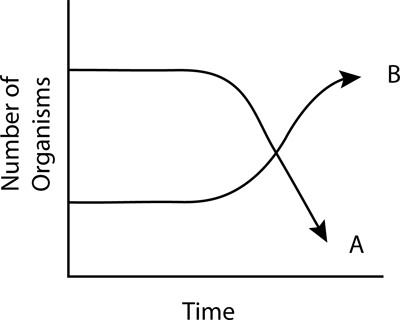
The following graph depicts changes in two populations ($A$ and $B$) of herbivores in a grassy field. $A$ possible reason for these changes is that
A
population $A$ produced more offspring than population $B$
B
population $A$ consumed the members of population $B$
C
both plant populations in this habitat decreased
D
population $B$ competed more successfully for food than population $A$
Solution
(D) The correct answer is $(d)$.
Both populations are herbivorous,thus they do not consume each other.
If the food sources for these populations $A$ and $B$ had decreased,both populations would have declined.
If population $A$ had produced more offspring,the graph for population $A$ would have shown an increase.
Based on the graph,population $B$ is more successful in competing for limited resources than population $A$. This interspecific competition leads to an increase in the number of organisms in population $B$ while the number of organisms in population $A$ decreases.
Both populations are herbivorous,thus they do not consume each other.
If the food sources for these populations $A$ and $B$ had decreased,both populations would have declined.
If population $A$ had produced more offspring,the graph for population $A$ would have shown an increase.
Based on the graph,population $B$ is more successful in competing for limited resources than population $A$. This interspecific competition leads to an increase in the number of organisms in population $B$ while the number of organisms in population $A$ decreases.
0 likesView Solution
115
BiologyMediumMCQNEET · 2015
Most animals that live in deep oceanic waters are
A
tertiary consumers
B
detritivores
C
primary consumers
D
secondary consumers.
Solution
(B) : Benthos is the community of organisms that live on,in,or near the sea bed,also known as the benthic zone.
Since no light is available in this zone of the sea,the energy source for deep benthic ecosystems is often organic matter from higher up in the water column which drifts down to the depths.
This dead and decaying matter sustains the benthic organisms.
Therefore,most organisms in the benthic zone,$i.e.$,in deep oceanic waters,are scavengers or detritivores.
Since no light is available in this zone of the sea,the energy source for deep benthic ecosystems is often organic matter from higher up in the water column which drifts down to the depths.
This dead and decaying matter sustains the benthic organisms.
Therefore,most organisms in the benthic zone,$i.e.$,in deep oceanic waters,are scavengers or detritivores.
0 likesView Solution
116
BiologyMediumMCQNEET · 2015
During ecological succession,
A
the numbers and types of animals remain constant.
B
the changes lead to a community that is in near equilibrium with the environment and is called pioneer community.
C
the gradual and predictable change in species composition occurs in a given area.
D
the establishment of a new biotic community is very fast in its primary phase.
Solution
(C) : Ecological succession is the gradual and predictable change in the species composition of a given area.
It is a natural process where a series of biotic communities develop at the same site,one after another,until a climax community is established.
The climax community is in near equilibrium with the environment and does not change further.
During succession,the number and types of animals and plants increase over time.
The establishment of a new biotic community is very slow in its primary phase because it starts on a bare area,whereas it is faster in the secondary phase.
It is a natural process where a series of biotic communities develop at the same site,one after another,until a climax community is established.
The climax community is in near equilibrium with the environment and does not change further.
During succession,the number and types of animals and plants increase over time.
The establishment of a new biotic community is very slow in its primary phase because it starts on a bare area,whereas it is faster in the secondary phase.
0 likesView Solution
117
BiologyMediumMCQNEET · 2015
In which of the following,both pairs have the correct combination?
A
Gaseous nutrient cycle: Nitrogen and Sulphur; Sedimentary nutrient cycle: Carbon and Phosphorus
B
Gaseous nutrient cycle: Sulphur and Phosphorus; Sedimentary nutrient cycle: Carbon and Nitrogen
C
Gaseous nutrient cycle: Carbon and Nitrogen; Sedimentary nutrient cycle: Sulphur and Phosphorus
D
Gaseous nutrient cycle: Carbon and Sulphur; Sedimentary nutrient cycle: Nitrogen and Phosphorus
Solution
(C) The correct answer is $C$.
Biogeochemical cycles are classified into two types: gaseous and sedimentary.
In gaseous nutrient cycles,the materials involved in circulation between the biotic and abiotic components of the biosphere are gases or vapours,and the reservoir pool is the atmosphere or hydrosphere. Examples include carbon,nitrogen,oxygen,and water.
In sedimentary nutrient cycles,the materials involved in circulation are non-gaseous,and the reservoir pool is the lithosphere (Earth's crust). Examples include phosphorus,calcium,and magnesium.
Sulphur is unique as it exhibits both sedimentary and gaseous nutrient cycles,but in standard classifications,it is often grouped with sedimentary cycles due to its primary reservoir in the lithosphere.
Biogeochemical cycles are classified into two types: gaseous and sedimentary.
In gaseous nutrient cycles,the materials involved in circulation between the biotic and abiotic components of the biosphere are gases or vapours,and the reservoir pool is the atmosphere or hydrosphere. Examples include carbon,nitrogen,oxygen,and water.
In sedimentary nutrient cycles,the materials involved in circulation are non-gaseous,and the reservoir pool is the lithosphere (Earth's crust). Examples include phosphorus,calcium,and magnesium.
Sulphur is unique as it exhibits both sedimentary and gaseous nutrient cycles,but in standard classifications,it is often grouped with sedimentary cycles due to its primary reservoir in the lithosphere.
0 likesView Solution
118
BiologyMediumMCQNEET · 2015
The mass of living material at a trophic level at a particular time is called
A
net primary productivity
B
standing crop
C
gross primary productivity
D
standing state
Solution
(B) The correct answer is $B$.
Standing crop is defined as the total mass of living material (biomass) present at a specific trophic level in an ecosystem at a particular time.
It is usually measured as the biomass per unit area or its equivalent in terms of energy.
Standing crop varies seasonally; for example,the biomass of deciduous trees changes significantly between summer and winter.
Standing crop is defined as the total mass of living material (biomass) present at a specific trophic level in an ecosystem at a particular time.
It is usually measured as the biomass per unit area or its equivalent in terms of energy.
Standing crop varies seasonally; for example,the biomass of deciduous trees changes significantly between summer and winter.
0 likesView Solution
119
BiologyEasyMCQNEET · 2015
Vertical distribution of different species occupying different levels in a biotic community is known as
A
zonation
B
pyramid
C
divergence
D
stratification
Solution
(D) The vertical distribution of different species occupying different levels in a biotic community is called $stratification$.
In a forest ecosystem,for example,trees occupy the top vertical strata,followed by shrubs,and then herbs and grasses at the bottom. This arrangement allows different species to utilize resources like sunlight and space efficiently.
In a forest ecosystem,for example,trees occupy the top vertical strata,followed by shrubs,and then herbs and grasses at the bottom. This arrangement allows different species to utilize resources like sunlight and space efficiently.
0 likesView Solution
120
BiologyMediumMCQNEET · 2015
Secondary succession takes place on/in
A
newly created pond
B
newly cooled lava
C
bare rock
D
degraded forest
Solution
(D) : Secondary succession (subsere) is the biotic succession that occurs in an area which has become secondarily bare due to the destruction of the community previously present there.
Secondary succession starts from previously built-up substrata with already existing living matter or soil.
The action of any external force,such as a sudden change in climatic factors,biotic intervention,fire,or deforestation,results in the destruction of the previous community.
Thus,the area becomes devoid of living matter,but its substratum remains intact.
It contains organic matter,making it biologically fertile,and thus,the successions are comparatively more rapid than primary succession.
Secondary succession starts from previously built-up substrata with already existing living matter or soil.
The action of any external force,such as a sudden change in climatic factors,biotic intervention,fire,or deforestation,results in the destruction of the previous community.
Thus,the area becomes devoid of living matter,but its substratum remains intact.
It contains organic matter,making it biologically fertile,and thus,the successions are comparatively more rapid than primary succession.
0 likesView Solution
121
BiologyEasyMCQNEET · 2015
Most animals are tree dwellers in a
A
temperate deciduous forest
B
tropical rainforest
C
coniferous forest
D
thorn woodland
Solution
(B) : Tropical rainforests have a very dense plant cover. They also experience a large amount of precipitation,thus the forest floor is always damp. These conditions have led animals to adapt to arboreal (tree-dwelling) habitats. Most animals found there are tree dwellers because almost every space on the forest floor is occupied by dense vegetation.
0 likesView Solution
122
BiologyEasyMCQNEET · 2015
In an ecosystem,the rate of production of organic matter during photosynthesis is termed as:
A
secondary productivity
B
net productivity
C
net primary productivity
D
gross primary productivity
Solution
(D) The rate of production of organic matter during photosynthesis is known as $Gross \ Primary \ Productivity$ $(GPP)$.
$GPP$ represents the total amount of energy or biomass produced by producers (green plants) through the process of photosynthesis per unit area over a specific time period.
$Net \ Primary \ Productivity$ $(NPP)$ is the amount of biomass remaining after accounting for the energy used by plants for respiration $(R)$,expressed as $NPP = GPP - R$.
$GPP$ represents the total amount of energy or biomass produced by producers (green plants) through the process of photosynthesis per unit area over a specific time period.
$Net \ Primary \ Productivity$ $(NPP)$ is the amount of biomass remaining after accounting for the energy used by plants for respiration $(R)$,expressed as $NPP = GPP - R$.
0 likesView Solution
123
BiologyMediumMCQNEET · 2015
The species confined to a particular region and not found elsewhere is termed as
A
endemic
B
rare
C
keystone
D
alien
Solution
(A) Species that are restricted to a specific geographical area and are not naturally found anywhere else in the world are known as $endemic$ species.
For example,many species found in the Western Ghats or on islands are endemic to those regions.
For example,many species found in the Western Ghats or on islands are endemic to those regions.
0 likesView Solution
124
BiologyMediumMCQNEET · 2015
In which of the following, both pairs have correct combinations?
A
$In \text{ situ conservation} : \text{Seed Bank}; Ex \text{ situ conservation} : \text{National Park}$
B
$In \text{ situ conservation} : \text{Tissue culture}; Ex \text{ situ conservation} : \text{Sacred groves}$
C
$In \text{ situ conservation} : \text{National Park}; Ex \text{ situ conservation} : \text{Botanical Garden}$
D
$In \text{ situ conservation} : \text{Cryopreservation}; Ex \text{ situ conservation} : \text{Wildlife Sanctuary}$
Solution
(C) $In \text{ situ}$ (on-site) conservation involves the protection and conservation of the entire ecosystem and its biodiversity at all levels to protect threatened species. Examples include national parks, wildlife sanctuaries, biosphere reserves, and sacred groves.
$Ex \text{ situ}$ (off-site) conservation involves the conservation of selected rare plants or animals outside their natural habitats. Examples include botanical gardens, zoological parks, seed banks, gene banks, tissue culture, and cryopreservation.
Option $C$ correctly identifies $In \text{ situ}$ conservation with a National Park and $Ex \text{ situ}$ conservation with a Botanical Garden.
$Ex \text{ situ}$ (off-site) conservation involves the conservation of selected rare plants or animals outside their natural habitats. Examples include botanical gardens, zoological parks, seed banks, gene banks, tissue culture, and cryopreservation.
Option $C$ correctly identifies $In \text{ situ}$ conservation with a National Park and $Ex \text{ situ}$ conservation with a Botanical Garden.
0 likesView Solution
125
BiologyMediumMCQNEET · 2015
Cryopreservation of gametes of threatened species in viable and fertile condition can be referred to as
A
in situ conservation by sacred groves
B
in situ cryo-conservation of biodiversity
C
in situ conservation of biodiversity
D
advanced ex situ conservation of biodiversity
Solution
(D) : Cryopreservation is an advanced method of $ex$ $situ$ conservation.
It involves preservation at $-196^{\circ}C$ in liquid nitrogen.
It can maintain tissue culture, embryos, animal cells/tissues, and spermatozoa indefinitely.
The cryopreserved material is revived through a special technique when required.
It involves preservation at $-196^{\circ}C$ in liquid nitrogen.
It can maintain tissue culture, embryos, animal cells/tissues, and spermatozoa indefinitely.
The cryopreserved material is revived through a special technique when required.
0 likesView Solution
126
BiologyEasyMCQNEET · 2015
Acid rain is caused by an increase in the atmospheric concentration of
A
$CO$ and $CO_2$
B
$O_3$ and dust
C
$SO_2$ and $NO_2$
D
$SO_3$ and $CO$
Solution
(C) The correct answer is $C$. Acid rain refers to rainfall or other forms of precipitation that have a $pH$ of less than $5.6$.
It is primarily caused by the large-scale emission of acidic gases into the atmosphere from thermal power plants,industries,and automobiles.
The most significant contributors are sulphur dioxide $(SO_2)$ and nitrogen oxides ($NO_x$,such as $NO_2$).
In the atmosphere,these gases react with oxygen and water vapor to form sulphuric acid $(H_2SO_4)$ and nitric acid $(HNO_3)$.
These acids then fall to the Earth's surface in the form of acid rain,which can cause significant damage to ecosystems,buildings,and soil health.
It is primarily caused by the large-scale emission of acidic gases into the atmosphere from thermal power plants,industries,and automobiles.
The most significant contributors are sulphur dioxide $(SO_2)$ and nitrogen oxides ($NO_x$,such as $NO_2$).
In the atmosphere,these gases react with oxygen and water vapor to form sulphuric acid $(H_2SO_4)$ and nitric acid $(HNO_3)$.
These acids then fall to the Earth's surface in the form of acid rain,which can cause significant damage to ecosystems,buildings,and soil health.
0 likesView Solution
127
BiologyMediumMCQNEET · 2015
Eutrophication of water bodies leading to the killing of fishes is mainly due to the non-availability of
A
essential minerals
B
oxygen
C
food
D
light
Solution
(B) : Eutrophication is the excessive growth of algae,plants,and animals in water bodies due to nutrient enrichment,particularly with nitrogen and phosphate. Nutrients present in sewage,agricultural wastes,and fertilizers cause dense growth of plants and planktonic algae. The excessive growth of planktonic algae that causes coloration of water is called algal bloom,which is toxic to animals and humans. Eutrophic water bodies also support excessive growth of floating plants. Algal blooms and floating plants cut off light from submerged plants,resulting in their death. There is a drastic decrease in oxygen replenishment inside the water. Non-availability of oxygen results in the death of aquatic animals such as fish,which further adds to the organic loading of water. Decomposition is replaced by putrefaction,which is anaerobic,leading to the absence of oxygen in water and the death of aquatic animals.
0 likesView Solution
128
BiologyEasyMCQNEET · 2015
The $UN$ Conference of Parties on climate change in the year $2012$ was held at
A
Lima
B
Warsaw
C
Durban
D
Doha
Solution
(D) The $UN$ Climate Change Conference in $2012$ was the $18$th session of the Conference of the Parties ($COP$ $18$) to the $UN$ Framework Convention on Climate Change $(UNFCCC)$.
It was held in Doha,Qatar,from November $26$ to December $8$,$2012$.
Therefore,the correct option is $D$.
It was held in Doha,Qatar,from November $26$ to December $8$,$2012$.
Therefore,the correct option is $D$.
0 likesView Solution
129
BiologyEasyMCQNEET · 2015
Increase in concentration of the toxicant at successive trophic levels is known as
A
biotransformation
B
biogeochemical cycling
C
biomagnification
D
biodeterioration
Solution
(C) The increase in the concentration of toxic substances at successive trophic levels is known as biomagnification.
This occurs because a toxic substance accumulated by an organism cannot be metabolized or excreted,and thus is passed on to the next higher trophic level.
For example,$DDT$ is a persistent pesticide that accumulates in the fatty tissues of organisms.
As it moves up the food chain,its concentration increases significantly per unit weight of the organism.
For instance,the concentration of $DDT$ in water is $0.003 \ ppb$,which increases to $0.003 \ ppm$ in phytoplankton,$0.04 \ ppm$ in zooplankton,$0.5 \ ppm$ in small fish,$2.0 \ ppm$ in large fish,and reaches $25 \ ppm$ in fish-eating birds.
This occurs because a toxic substance accumulated by an organism cannot be metabolized or excreted,and thus is passed on to the next higher trophic level.
For example,$DDT$ is a persistent pesticide that accumulates in the fatty tissues of organisms.
As it moves up the food chain,its concentration increases significantly per unit weight of the organism.
For instance,the concentration of $DDT$ in water is $0.003 \ ppb$,which increases to $0.003 \ ppm$ in phytoplankton,$0.04 \ ppm$ in zooplankton,$0.5 \ ppm$ in small fish,$2.0 \ ppm$ in large fish,and reaches $25 \ ppm$ in fish-eating birds.
0 likesView Solution
130
BiologyEasyMCQNEET · 2015
The $UN$ Conference of Parties on climate change in the year $2011$ was held in
A
Peru
B
Qatar
C
Poland
D
South Africa
Solution
(D) The $UN$ Conference of Parties $(COP17)$ on climate change in the year $2011$ was held in Durban,South Africa. This conference is officially known as the $17$th session of the Conference of the Parties $(COP17)$ to the $UN$ Framework Convention on Climate Change $(UNFCCC)$.
0 likesView Solution
131
BiologyMediumMCQNEET · 2015
Which of the following is not one of the prime health risks associated with greater $UV$ radiations through the atmosphere due to depletion of stratospheric ozone?
A
Damage to eyes
B
Increased liver cancer
C
Increased skin cancer
D
Reduced Immune System
Solution
(B) $UV$ radiations are of three types: $UV-C$ $(100-280 \ nm)$,$UV-B$ $(280-320 \ nm)$,and $UV-A$ $(320-390 \ nm)$.
Shorter $UV$ radiations $(UV-C)$ are absorbed by the atmosphere.
The longer ones $(UV-A)$ are not very harmful.
The intermediate $UV-B$ radiations are harmful and capable of deep penetration.
Thinning of the ozone layer increases the amount of $UV-B$ radiations reaching the Earth.
$UV-B$ radiations damage skin cells,cause skin ageing,skin cancer,and eye damage (such as snow blindness or cataracts),and can also suppress the immune system.
Liver cancer is not directly associated with $UV$ radiation exposure.
Shorter $UV$ radiations $(UV-C)$ are absorbed by the atmosphere.
The longer ones $(UV-A)$ are not very harmful.
The intermediate $UV-B$ radiations are harmful and capable of deep penetration.
Thinning of the ozone layer increases the amount of $UV-B$ radiations reaching the Earth.
$UV-B$ radiations damage skin cells,cause skin ageing,skin cancer,and eye damage (such as snow blindness or cataracts),and can also suppress the immune system.
Liver cancer is not directly associated with $UV$ radiation exposure.
0 likesView Solution
132
BiologyMediumMCQNEET · 2015
High value of $BOD$ (Biochemical Oxygen Demand) indicates that
A
water is less polluted
B
consumption of organic matter in the water is higher by the microbes
C
water is highly polluted
D
Both $(b)$ and $(c)$
Solution
(D) $BOD$ (Biochemical Oxygen Demand) refers to the amount of dissolved oxygen that would be consumed if all the organic matter in one liter of water were oxidized by bacteria.
Greater $BOD$ indicates that there is a higher concentration of organic matter in the water,which requires more oxygen for microbial decomposition.
Therefore,a high $BOD$ value signifies that the water is highly polluted due to the presence of significant organic waste.
Greater $BOD$ indicates that there is a higher concentration of organic matter in the water,which requires more oxygen for microbial decomposition.
Therefore,a high $BOD$ value signifies that the water is highly polluted due to the presence of significant organic waste.
0 likesView Solution
133
BiologyEasyMCQNEET · 2015
Rachel Carson's famous book "Silent Spring" is related to
A
population explosion
B
ecosystem management
C
pesticide pollution
D
noise pollution
Solution
(C) Rachel Carson's book "Silent Spring", published in $1962$, is a landmark work in the environmental movement.
It documented the detrimental environmental effects caused by the indiscriminate use of pesticides, particularly $DDT$.
This book played a crucial role in raising public awareness about the hazards of chemical pesticides to wildlife and human health, eventually leading to changes in pesticide regulations.
It documented the detrimental environmental effects caused by the indiscriminate use of pesticides, particularly $DDT$.
This book played a crucial role in raising public awareness about the hazards of chemical pesticides to wildlife and human health, eventually leading to changes in pesticide regulations.
0 likesView Solution
134
BiologyEasyMCQNEET · 2015
Filiform apparatus is a characteristic feature of ...
A
Generative cell
B
Nucellus
C
Antipodal cells
D
Synergids
Solution
(D) The filiform apparatus consists of finger-like projections of the cell wall that extend into the cytoplasm of the synergids.
These structures are located at the micropylar end of the synergids.
Their primary function is to guide the entry of the pollen tube into the synergids during the process of fertilization.
Therefore,the filiform apparatus is a characteristic feature of the synergids.
These structures are located at the micropylar end of the synergids.
Their primary function is to guide the entry of the pollen tube into the synergids during the process of fertilization.
Therefore,the filiform apparatus is a characteristic feature of the synergids.
0 likesView Solution
135
BiologyMediumMCQNEET · 2015
What is the term for a molecule that carries a desired gene into a host cell for cloning?
A
Carrier
B
Transformer
C
Vector
D
Template
Solution
(C) In recombinant $DNA$ technology,a $Vector$ is a $DNA$ molecule used as a vehicle to artificially carry foreign genetic material into another cell,where it can be replicated and/or expressed. Common examples of vectors include plasmids and bacteriophages.
0 likesView Solution
136
BiologyEasyMCQNEET · 2015
The discovery of which of the following has made it possible to cut $DNA$ at specific locations?
A
Ligase
B
Restriction enzymes
C
Probes ($DNA$ fragments)
D
Selectable markers
Solution
(B) Restriction enzymes,also known as 'molecular scissors',are enzymes that cut $DNA$ molecules at specific nucleotide sequences called recognition sites. This discovery was a fundamental breakthrough in recombinant $DNA$ technology,allowing scientists to isolate specific genes and insert them into vectors.
0 likesView Solution
137
BiologyDifficultMCQNEET · 2015
Which of these is not an important component of the initiation of parturition in humans?
A
Increase in estrogen and progesterone ratio
B
Synthesis of prostaglandins
C
Release of Oxytocin
D
Release of Prolactin
Solution
(D) Parturition is induced by a complex neuroendocrine mechanism.
$1$. The signals for parturition originate from the fully developed fetus and the placenta,which induce mild uterine contractions called the Fetal Ejection Reflex.
$2$. This triggers the release of Oxytocin from the maternal pituitary,which acts on the uterine muscle and causes stronger uterine contractions.
$3$. The ratio of estrogen to progesterone increases,which enhances the sensitivity of the uterus to oxytocin.
$4$. Prostaglandins are also synthesized,which help in further stimulating uterine contractions.
$5$. Prolactin is primarily responsible for milk production (lactogenesis) after childbirth and is not involved in the initiation of parturition.
$1$. The signals for parturition originate from the fully developed fetus and the placenta,which induce mild uterine contractions called the Fetal Ejection Reflex.
$2$. This triggers the release of Oxytocin from the maternal pituitary,which acts on the uterine muscle and causes stronger uterine contractions.
$3$. The ratio of estrogen to progesterone increases,which enhances the sensitivity of the uterus to oxytocin.
$4$. Prostaglandins are also synthesized,which help in further stimulating uterine contractions.
$5$. Prolactin is primarily responsible for milk production (lactogenesis) after childbirth and is not involved in the initiation of parturition.
0 likesView Solution
Vedclass Products
For Students
Vedclass Test Series
Mock tests in real NEET style covering Biology with performance analysis. 5-day free trial.
Start Free TrialFor Teachers
Exam Paper Generator
Generate Set A/B/C/D Biology papers from 7.5L+ questions in 2 minutes. 3 chapters free.
Try FreeFor Institutes
Online Exam Module
Run live NEET mock exams with unlimited students, 360° analytics & white-label branding.
See DemoFrequently Asked Questions
How many Biology questions are in NEET 2015?
There are 193 Biology questions from the NEET 2015 paper on Vedclass, each with a detailed step-by-step solution in English.
Are NEET 2015 Biology solutions available in English?
Yes. All solutions on this page are in English. You can also switch to English or Hindi using the language buttons above the questions.
Can I practice NEET 2015 Biology as a timed test?
Yes. Use the Vedclass Test Series to attempt a full NEET mock test covering Biology with time limits and instant score analysis.
Can teachers create Biology papers from NEET previous year questions?
Yes. The Vedclass Exam Paper Generator lets teachers mix NEET Biology questions and generate Set A/B/C/D papers in minutes.
For Teachers & Institutes
Build a Custom Biology Paper
Pick NEET 2015 Biology questions, set difficulty, and generate Set A/B/C/D in 2 minutes.