
PhysicsQ251–292 of 540 questions
Page 6 of 6 · English
251
PhysicsEasyMCQMHT CET · 2022
The Boolean expression for a two-input Ex-$OR$ gate is (where $A$ and $B$ are inputs,and $Y$ is the output):
A
$Y=(\bar{A}+B) \cdot(A+\bar{B})$
B
$Y=(A \cdot B)+(\bar{A}+\bar{B})$
C
$Y=(\bar{A} \cdot B)+(A \cdot \bar{B})$
D
$Y=(A \cdot B)+(\bar{A}+B)$
Solution
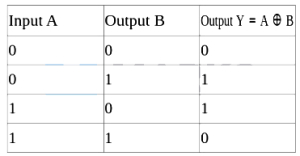
(C) The truth table for an Ex-$OR$ gate is as follows:
| Input $A$ | Input $B$ | Output $Y = A \oplus B$ |
| :--- | :--- | :--- |
| $0$ | $0$ | $0$ |
| $0$ | $1$ | $1$ |
| $1$ | $0$ | $1$ |
| $1$ | $1$ | $0$ |
The output equation for an Ex-$OR$ gate is $Y = A \oplus B = (\bar{A} \cdot B) + (A \cdot \bar{B})$.
Key points to remember:
$(1)$ The output is low $(0)$ when both inputs are the same.
$(2)$ The output is high $(1)$ when both inputs are different.
| Input $A$ | Input $B$ | Output $Y = A \oplus B$ |
| :--- | :--- | :--- |
| $0$ | $0$ | $0$ |
| $0$ | $1$ | $1$ |
| $1$ | $0$ | $1$ |
| $1$ | $1$ | $0$ |
The output equation for an Ex-$OR$ gate is $Y = A \oplus B = (\bar{A} \cdot B) + (A \cdot \bar{B})$.
Key points to remember:
$(1)$ The output is low $(0)$ when both inputs are the same.
$(2)$ The output is high $(1)$ when both inputs are different.
0 likesView Solution
252
PhysicsEasyMCQMHT CET · 2022
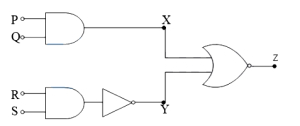
$A$ combination of logic gates is as shown in the figure. $P$,$Q$,$R$,and $S$ are the inputs and $X$,$Y$,and $Z$ are outputs. When inputs $P$ and $R$ are 'low' $(0)$ and $Q$ and $S$ are 'high' $(1)$,the outputs $X$,$Y$,and $Z$ are respectively:
A
$0, 1, 0$
B
$0, 1, 1$
C
$1, 0, 0$
D
$1, 1, 1$
Solution
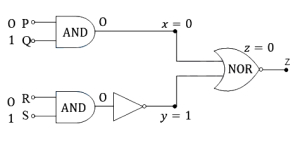
(A) Given inputs are $P = 0$,$Q = 1$,$R = 0$,and $S = 1$.
$1$. The output $X$ is obtained from an $AND$ gate with inputs $P$ and $Q$. Thus,$X = P \cdot Q = 0 \cdot 1 = 0$.
$2$. The input to the $NOT$ gate is the output of an $AND$ gate with inputs $R$ and $S$. Let this be $W$. So,$W = R \cdot S = 0 \cdot 1 = 0$. The output $Y$ is the $NOT$ of $W$,so $Y = \overline{W} = \overline{0} = 1$.
$3$. The output $Z$ is obtained from a $NOR$ gate with inputs $X$ and $Y$. Thus,$Z = \overline{X + Y} = \overline{0 + 1} = \overline{1} = 0$.
Therefore,the outputs are $X = 0$,$Y = 1$,and $Z = 0$.
$1$. The output $X$ is obtained from an $AND$ gate with inputs $P$ and $Q$. Thus,$X = P \cdot Q = 0 \cdot 1 = 0$.
$2$. The input to the $NOT$ gate is the output of an $AND$ gate with inputs $R$ and $S$. Let this be $W$. So,$W = R \cdot S = 0 \cdot 1 = 0$. The output $Y$ is the $NOT$ of $W$,so $Y = \overline{W} = \overline{0} = 1$.
$3$. The output $Z$ is obtained from a $NOR$ gate with inputs $X$ and $Y$. Thus,$Z = \overline{X + Y} = \overline{0 + 1} = \overline{1} = 0$.
Therefore,the outputs are $X = 0$,$Y = 1$,and $Z = 0$.
0 likesView Solution
253
PhysicsEasyMCQMHT CET · 2022
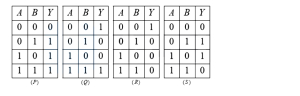
The truth table for the two-input Ex-$OR$ gate is (where $A$ and $B$ are the inputs and $Y$ is the output).
| $A$ | $B$ | $Y$ |
|---|---|---|
| $0$ | $0$ | $0$ |
| $0$ | $1$ | $1$ |
| $1$ | $0$ | $1$ |
| $1$ | $1$ | $0$ |
A
Table $(P)$
B
Table $(Q)$
C
Table $(R)$
D
Table $(S)$
Solution
(D) The Boolean expression for an Exclusive-$OR$ (Ex-$OR$) gate is given by:
$Y = A \oplus B = \bar{A} \cdot B + A \cdot \bar{B}$
The output of an Ex-$OR$ gate is $HIGH$ $(1)$ only when the inputs are at different logic levels. If both inputs are the same ($0,0$ or $1,1$),the output is $LOW$ $(0)$.
Evaluating the truth table:
$1$. For $A=0, B=0$: $Y = 0 \oplus 0 = 0$
$2$. For $A=0, B=1$: $Y = 0 \oplus 1 = 1$
$3$. For $A=1, B=0$: $Y = 1 \oplus 0 = 1$
$4$. For $A=1, B=1$: $Y = 1 \oplus 1 = 0$
Comparing this with the given tables,Table $(S)$ matches this truth table.
$Y = A \oplus B = \bar{A} \cdot B + A \cdot \bar{B}$
The output of an Ex-$OR$ gate is $HIGH$ $(1)$ only when the inputs are at different logic levels. If both inputs are the same ($0,0$ or $1,1$),the output is $LOW$ $(0)$.
Evaluating the truth table:
$1$. For $A=0, B=0$: $Y = 0 \oplus 0 = 0$
$2$. For $A=0, B=1$: $Y = 0 \oplus 1 = 1$
$3$. For $A=1, B=0$: $Y = 1 \oplus 0 = 1$
$4$. For $A=1, B=1$: $Y = 1 \oplus 1 = 0$
Comparing this with the given tables,Table $(S)$ matches this truth table.
0 likesView Solution
254
PhysicsEasyMCQMHT CET · 2022
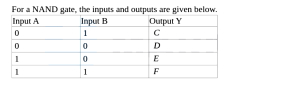
For a $NAND$ gate, the inputs and outputs are given in the table below. The values taken by $C, D, E, F$ are respectively:
| Input $A$ | Input $B$ | Output $Y$ |
|---|---|---|
| $0$ | $1$ | $C$ |
| $0$ | $0$ | $D$ |
| $1$ | $0$ | $E$ |
| $1$ | $1$ | $F$ |
A
$0, 1, 0, 0$
B
$1, 1, 1, 0$
C
$0, 1, 0, 1$
D
$1, 0, 1, 1$
Solution
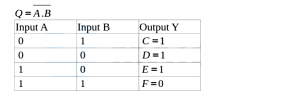
(B) The Boolean expression for a $NAND$ gate is $Y = \overline{A \cdot B}$.
$1$. For $A = 0, B = 1$: $Y = \overline{0 \cdot 1} = \overline{0} = 1$. Thus, $C = 1$.
$2$. For $A = 0, B = 0$: $Y = \overline{0 \cdot 0} = \overline{0} = 1$. Thus, $D = 1$.
$3$. For $A = 1, B = 0$: $Y = \overline{1 \cdot 0} = \overline{0} = 1$. Thus, $E = 1$.
$4$. For $A = 1, B = 1$: $Y = \overline{1 \cdot 1} = \overline{1} = 0$. Thus, $F = 0$.
Therefore, the values are $C = 1, D = 1, E = 1, F = 0$.
$1$. For $A = 0, B = 1$: $Y = \overline{0 \cdot 1} = \overline{0} = 1$. Thus, $C = 1$.
$2$. For $A = 0, B = 0$: $Y = \overline{0 \cdot 0} = \overline{0} = 1$. Thus, $D = 1$.
$3$. For $A = 1, B = 0$: $Y = \overline{1 \cdot 0} = \overline{0} = 1$. Thus, $E = 1$.
$4$. For $A = 1, B = 1$: $Y = \overline{1 \cdot 1} = \overline{1} = 0$. Thus, $F = 0$.
Therefore, the values are $C = 1, D = 1, E = 1, F = 0$.
0 likesView Solution
255
PhysicsEasyMCQMHT CET · 2022
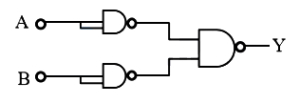
The combination of logic gates shown below becomes:
A
$X-OR$ gate
B
$NAND$ gate
C
$NOR$ gate
D
$OR$ gate
Solution
(D) The given circuit consists of two $NAND$ gates used as $NOT$ gates (since their inputs are shorted) followed by a $NAND$ gate.
Let the inputs be $A$ and $B$.
The output of the first $NAND$ gate (acting as $NOT$) is $\bar{A}$.
The output of the second $NAND$ gate (acting as $NOT$) is $\bar{B}$.
These two outputs are fed into a third $NAND$ gate.
The final output $Y$ is given by $Y = \overline{(\bar{A} \cdot \bar{B})}$.
Using De Morgan's theorem,$\overline{(\bar{A} \cdot \bar{B})} = \overline{\bar{A}} + \overline{\bar{B}} = A + B$.
This is the Boolean expression for an $OR$ gate.
Therefore,the combination acts as an $OR$ gate.
Let the inputs be $A$ and $B$.
The output of the first $NAND$ gate (acting as $NOT$) is $\bar{A}$.
The output of the second $NAND$ gate (acting as $NOT$) is $\bar{B}$.
These two outputs are fed into a third $NAND$ gate.
The final output $Y$ is given by $Y = \overline{(\bar{A} \cdot \bar{B})}$.
Using De Morgan's theorem,$\overline{(\bar{A} \cdot \bar{B})} = \overline{\bar{A}} + \overline{\bar{B}} = A + B$.
This is the Boolean expression for an $OR$ gate.
Therefore,the combination acts as an $OR$ gate.
0 likesView Solution
256
PhysicsEasyMCQMHT CET · 2022
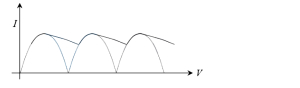
In a full-wave rectifier circuit without a filter,the output current is
A
unidirectional but not steady current.
B
an eddy current.
C
a sinusoidal current.
D
a constant direct current.
Solution
(A) full-wave rectifier converts both halves of the input $AC$ cycle into a single polarity. Without a filter,the output consists of a series of pulsating pulses that are always in the same direction (unidirectional). However,because the magnitude of the current varies with time,it is not a steady or constant $DC$. Therefore,the output is a unidirectional but not steady current.
0 likesView Solution
257
PhysicsMediumMCQMHT CET · 2022
In a $p$-type semiconductor,
A
holes are majority carriers and trivalent atoms are dopants.
B
electrons are minority carriers and pentavalent atoms are dopants.
C
electrons are majority carriers and pentavalent atoms are dopants.
D
holes are minority carriers and trivalent atoms are dopants.
Solution
(A) The correct option is $A$.
In a $p$-type semiconductor,the material is formed by doping a tetravalent semiconductor (like $Si$ or $Ge$) with trivalent impurity atoms (like $B$,$Al$,$Ga$,or $In$).
Since trivalent atoms have three valence electrons,they create a vacancy or 'hole' in the crystal lattice when they bond with the tetravalent atoms.
Therefore,holes become the majority charge carriers,and electrons become the minority charge carriers.
Thus,option $A$ is correct.
In a $p$-type semiconductor,the material is formed by doping a tetravalent semiconductor (like $Si$ or $Ge$) with trivalent impurity atoms (like $B$,$Al$,$Ga$,or $In$).
Since trivalent atoms have three valence electrons,they create a vacancy or 'hole' in the crystal lattice when they bond with the tetravalent atoms.
Therefore,holes become the majority charge carriers,and electrons become the minority charge carriers.
Thus,option $A$ is correct.
0 likesView Solution
258
PhysicsEasyMCQMHT CET · 2022
An $n$-type and a $p$-type silicon semiconductor can be obtained by doping pure silicon with
A
Boron and arsenic respectively.
B
arsenic and boron respectively.
C
sodium and magnesium respectively.
D
indium and sodium respectively.
Solution
(B) To obtain an $n$-type semiconductor,pure silicon (group $IV$ element) must be doped with pentavalent (donor) atoms from group $V$ of the periodic table,such as arsenic $(As)$ or phosphorus $(P)$.
To obtain a $p$-type semiconductor,pure silicon must be doped with trivalent (acceptor) atoms from group $III$ of the periodic table,such as boron $(B)$ or gallium $(Ga)$.
Therefore,for $n$-type and $p$-type respectively,we need to dope silicon with arsenic and boron.
To obtain a $p$-type semiconductor,pure silicon must be doped with trivalent (acceptor) atoms from group $III$ of the periodic table,such as boron $(B)$ or gallium $(Ga)$.
Therefore,for $n$-type and $p$-type respectively,we need to dope silicon with arsenic and boron.
0 likesView Solution
259
PhysicsEasyMCQMHT CET · 2022
The majority charge carriers in $p$-type and $n$-type semiconductors are respectively:
A
holes and electrons
B
electrons and holes
C
electrons and electrons
D
holes and holes
Solution
(A) The charge carriers that are present in large quantity are called majority charge carriers.
In a $p$-type semiconductor,the majority charge carriers are the holes because the trivalent impurity atoms create vacancies in the valence band.
In an $n$-type semiconductor,the majority charge carriers are the free electrons because the pentavalent impurity atoms provide extra electrons to the conduction band.
In a $p$-type semiconductor,the majority charge carriers are the holes because the trivalent impurity atoms create vacancies in the valence band.
In an $n$-type semiconductor,the majority charge carriers are the free electrons because the pentavalent impurity atoms provide extra electrons to the conduction band.
0 likesView Solution
260
PhysicsEasyMCQMHT CET · 2022
Identify the $WRONG$ statement from the following. In an intrinsic semiconductor:
A
The number of free electrons is less than that in a conductor.
B
The number of free electrons increases with temperature.
C
There are no free electrons at any temperature except absolute zero.
D
There are no free electrons at absolute zero temperature.
Solution
(C) In an intrinsic semiconductor,the number of free electrons is very small compared to a conductor at room temperature.
As the temperature increases,more covalent bonds break,leading to an increase in the number of free electrons.
At absolute zero temperature $(T = 0 \ K)$,an intrinsic semiconductor behaves as a perfect insulator because there is insufficient thermal energy to break covalent bonds.
Therefore,there are no free electrons at absolute zero temperature.
Statement $C$ is incorrect because free electrons exist at temperatures above absolute zero.
As the temperature increases,more covalent bonds break,leading to an increase in the number of free electrons.
At absolute zero temperature $(T = 0 \ K)$,an intrinsic semiconductor behaves as a perfect insulator because there is insufficient thermal energy to break covalent bonds.
Therefore,there are no free electrons at absolute zero temperature.
Statement $C$ is incorrect because free electrons exist at temperatures above absolute zero.
0 likesView Solution
261
PhysicsEasyMCQMHT CET · 2022
Pure Silicon crystal at $300 \ K$ has equal electron and hole concentration of $1.5 \times 10^{16} \ m^{-3}$. Doping by indium increases $n_h = 4.5 \times 10^{22} \ m^{-3}$. The $n_e$ in the doped silicon is:
A
$5 \times 10^9 \ m^{-3}$
B
$2.25 \times 10^{10} \ m^{-3}$
C
$3 \times 10^{12} \ m^{-3}$
D
$9 \times 10^6 \ m^{-3}$
Solution
(A) For an intrinsic semiconductor,the law of mass action states that the product of electron and hole concentration is equal to the square of the intrinsic carrier concentration: $n_e n_h = n_i^2$.
Given:
Intrinsic carrier concentration $n_i = 1.5 \times 10^{16} \ m^{-3}$.
New hole concentration $n_h = 4.5 \times 10^{22} \ m^{-3}$.
Using the formula:
$n_e = \frac{n_i^2}{n_h}$
$n_e = \frac{(1.5 \times 10^{16})^2}{4.5 \times 10^{22}}$
$n_e = \frac{2.25 \times 10^{32}}{4.5 \times 10^{22}}$
$n_e = 0.5 \times 10^{10} \ m^{-3} = 5 \times 10^9 \ m^{-3}$.
Given:
Intrinsic carrier concentration $n_i = 1.5 \times 10^{16} \ m^{-3}$.
New hole concentration $n_h = 4.5 \times 10^{22} \ m^{-3}$.
Using the formula:
$n_e = \frac{n_i^2}{n_h}$
$n_e = \frac{(1.5 \times 10^{16})^2}{4.5 \times 10^{22}}$
$n_e = \frac{2.25 \times 10^{32}}{4.5 \times 10^{22}}$
$n_e = 0.5 \times 10^{10} \ m^{-3} = 5 \times 10^9 \ m^{-3}$.
0 likesView Solution
262
PhysicsEasyMCQMHT CET · 2022
At room temperature,a $p$-type semiconductor has
A
equal number of free electrons and holes.
B
large number of free electrons and few holes.
C
large number of holes and few electrons.
D
no electrons or holes.
Solution
(C) Concept: $A$ $p$-type semiconductor is formed by doping an intrinsic semiconductor with trivalent impurities.
These impurities create acceptor energy levels just above the valence band.
At room temperature,these acceptor levels accept electrons from the valence band,creating a large number of holes in the valence band.
Therefore,in a $p$-type semiconductor,the majority charge carriers are holes and the minority charge carriers are free electrons.
These impurities create acceptor energy levels just above the valence band.
At room temperature,these acceptor levels accept electrons from the valence band,creating a large number of holes in the valence band.
Therefore,in a $p$-type semiconductor,the majority charge carriers are holes and the minority charge carriers are free electrons.
0 likesView Solution
263
PhysicsEasyMCQMHT CET · 2022
Identify the devices which work on solar energy.
$(a)$ Photodiode
$(b)$ Photovoltaic cell
$(c)$ $LED$
$(d)$ Photo-thermal devices
$(a)$ Photodiode
$(b)$ Photovoltaic cell
$(c)$ $LED$
$(d)$ Photo-thermal devices
A
$(a)$,$(d)$
B
$(b)$,$(d)$
C
$(a)$,$(b)$
D
$(b)$,$(c)$
Solution
(B) The working principle of these devices is as follows:
$(1)$ Photovoltaic cells convert solar energy directly into electrical energy.
$(2)$ Photo-thermal devices absorb solar radiation to produce heat energy.
$(3)$ $A$ Photodiode is a light-sensitive device that generates current when exposed to light,but it is typically used as a detector rather than a primary solar energy harvester.
$(4)$ An $LED$ (Light Emitting Diode) converts electrical energy into light energy,which is the reverse of a solar cell.
Therefore,devices that primarily work on solar energy are the Photovoltaic cell and Photo-thermal devices.
$(1)$ Photovoltaic cells convert solar energy directly into electrical energy.
$(2)$ Photo-thermal devices absorb solar radiation to produce heat energy.
$(3)$ $A$ Photodiode is a light-sensitive device that generates current when exposed to light,but it is typically used as a detector rather than a primary solar energy harvester.
$(4)$ An $LED$ (Light Emitting Diode) converts electrical energy into light energy,which is the reverse of a solar cell.
Therefore,devices that primarily work on solar energy are the Photovoltaic cell and Photo-thermal devices.
0 likesView Solution
264
PhysicsEasyMCQMHT CET · 2022
$A$ diffraction pattern is obtained by making blue light incident on a narrow slit. If blue light is replaced by red light,then:
A
there is no change in the diffraction pattern.
B
diffraction bands become narrower.
C
diffraction bands become broader.
D
the diffraction pattern disappears.
Solution
(C) The width of the central maximum in a single-slit diffraction pattern is given by the formula $\beta = \frac{2\lambda D}{a}$,where $\lambda$ is the wavelength of light,$D$ is the distance of the screen from the slit,and $a$ is the width of the slit.
Since the wavelength of red light $(\lambda_{red})$ is greater than the wavelength of blue light $(\lambda_{blue})$,the width of the diffraction bands $\beta$ is directly proportional to the wavelength $\lambda$.
Therefore,when blue light is replaced by red light,the diffraction bands become broader.
Since the wavelength of red light $(\lambda_{red})$ is greater than the wavelength of blue light $(\lambda_{blue})$,the width of the diffraction bands $\beta$ is directly proportional to the wavelength $\lambda$.
Therefore,when blue light is replaced by red light,the diffraction bands become broader.
0 likesView Solution
265
PhysicsMediumMCQMHT CET · 2022
In a diffraction pattern, light of wavelength $580 \,nm$ is incident normally on a slit of width '$a$'. The distance between the slit and the screen is $2.5 \,m$ and the distance of the second-order maximum from the center of the screen is $14.5 \,mm$. The value of '$a$' is:
A
$0.26 \times 10^{-3} \,m$
B
$0.36 \times 10^{-3} \,m$
C
$0.50 \times 10^{-3} \,m$
D
$0.12 \times 10^{-3} \,m$
Solution
(A) For a single slit diffraction, the condition for the $n^{\text{th}}$ order maximum is given by $a \sin \theta = (n + 1/2) \lambda$.
For small angles, $\sin \theta \approx \tan \theta = x/D$, where $x$ is the distance from the center and $D$ is the distance to the screen.
Thus, $a(x/D) = (n + 1/2) \lambda$.
For the $2^{\text{nd}}$ order maximum, $n = 2$, so $a = \frac{(2 + 1/2) \lambda D}{x} = \frac{2.5 \lambda D}{x}$.
Given: $\lambda = 580 \times 10^{-9} \,m$, $D = 2.5 \,m$, $x = 14.5 \times 10^{-3} \,m$.
Substituting the values: $a = \frac{2.5 \times 580 \times 10^{-9} \times 2.5}{14.5 \times 10^{-3}} \,m$.
$a = \frac{3625 \times 10^{-9}}{14.5 \times 10^{-3}} \,m = 250 \times 10^{-6} \,m = 0.25 \times 10^{-3} \,m \approx 0.26 \times 10^{-3} \,m$.
For small angles, $\sin \theta \approx \tan \theta = x/D$, where $x$ is the distance from the center and $D$ is the distance to the screen.
Thus, $a(x/D) = (n + 1/2) \lambda$.
For the $2^{\text{nd}}$ order maximum, $n = 2$, so $a = \frac{(2 + 1/2) \lambda D}{x} = \frac{2.5 \lambda D}{x}$.
Given: $\lambda = 580 \times 10^{-9} \,m$, $D = 2.5 \,m$, $x = 14.5 \times 10^{-3} \,m$.
Substituting the values: $a = \frac{2.5 \times 580 \times 10^{-9} \times 2.5}{14.5 \times 10^{-3}} \,m$.
$a = \frac{3625 \times 10^{-9}}{14.5 \times 10^{-3}} \,m = 250 \times 10^{-6} \,m = 0.25 \times 10^{-3} \,m \approx 0.26 \times 10^{-3} \,m$.
0 likesView Solution
266
PhysicsEasyMCQMHT CET · 2022
$A$ parallel beam of light of wavelength $\lambda$ is incident normally on a narrow slit. $A$ diffraction pattern is formed on a screen placed perpendicular to the direction of the incident beam. At the second minimum of the diffraction pattern,the phase difference between the rays coming from the two edges of the slit is:
A
$3 \pi$
B
$4 \pi$
C
$\pi \lambda$
D
$2 \pi$
Solution
(B) The condition for the $n^{\text{th}}$ diffraction minimum is given by the path difference $\Delta x = n\lambda$,where $n = 1, 2, 3, \dots$ is the order of the minimum.
For the second minimum,we set $n = 2$,which gives the path difference $\Delta x = 2\lambda$.
The relationship between phase difference $\phi$ and path difference $\Delta x$ is given by $\phi = \frac{2\pi}{\lambda} \Delta x$.
Substituting the value of $\Delta x$ for the second minimum:
$\phi = \frac{2\pi}{\lambda} (2\lambda) = 4\pi$.
Therefore,the phase difference between the rays coming from the two edges of the slit at the second minimum is $4\pi$.
For the second minimum,we set $n = 2$,which gives the path difference $\Delta x = 2\lambda$.
The relationship between phase difference $\phi$ and path difference $\Delta x$ is given by $\phi = \frac{2\pi}{\lambda} \Delta x$.
Substituting the value of $\Delta x$ for the second minimum:
$\phi = \frac{2\pi}{\lambda} (2\lambda) = 4\pi$.
Therefore,the phase difference between the rays coming from the two edges of the slit at the second minimum is $4\pi$.
0 likesView Solution
267
PhysicsEasyMCQMHT CET · 2022
$A$ parallel beam of monochromatic light falls normally on a single narrow slit. The angular width of the central maximum in the resulting diffraction pattern
A
decreases with a decrease in slit width
B
decreases with an increase in slit width
C
increases with an increase in slit width
D
may increase or decrease
Solution
(B) The angular width of the central maximum in a single-slit diffraction pattern is given by the formula $\theta = \frac{2\lambda}{d}$,where $\lambda$ is the wavelength of the light and $d$ is the width of the slit.
From this relation,it is clear that the angular width $\theta$ is inversely proportional to the slit width $d$ (i.e.,$\theta \propto \frac{1}{d}$).
Therefore,as the slit width $d$ increases,the angular width of the central maximum decreases.
From this relation,it is clear that the angular width $\theta$ is inversely proportional to the slit width $d$ (i.e.,$\theta \propto \frac{1}{d}$).
Therefore,as the slit width $d$ increases,the angular width of the central maximum decreases.
0 likesView Solution
268
PhysicsDifficultMCQMHT CET · 2022
In a Fraunhofer diffraction at a single slit of width $d$ and incident light of wavelength $5500 \text{ Å}$,the first minimum is observed at an angle $30^{\circ}$. The first secondary maxima are observed at an angle $\theta=$
A
$\sin ^{-1}\left(\frac{\sqrt{3}}{2}\right)$
B
$\sin ^{-1}\left(\frac{1}{4}\right)$
C
$\sin ^{-1}\left(\frac{1}{\sqrt{2}}\right)$
D
$\sin ^{-1}\left(\frac{3}{4}\right)$
Solution
(D) For a single slit diffraction,the condition for minima is $d \sin \theta = n\lambda$ where $n = 1, 2, 3, ...$
For the first minimum $(n=1)$,$d \sin 30^{\circ} = \lambda$.
Since $\sin 30^{\circ} = 0.5$,we have $d(0.5) = \lambda$,which implies $d = 2\lambda$.
The condition for secondary maxima is $d \sin \theta = (n + \frac{1}{2})\lambda$ where $n = 1, 2, 3, ...$
For the first secondary maximum $(n=1)$,$d \sin \theta = (1 + \frac{1}{2})\lambda = \frac{3}{2}\lambda$.
Substituting $d = 2\lambda$ into the equation:
$2\lambda \sin \theta = \frac{3}{2}\lambda$
$\sin \theta = \frac{3}{4}$
$\theta = \sin ^{-1}\left(\frac{3}{4}\right)$.
For the first minimum $(n=1)$,$d \sin 30^{\circ} = \lambda$.
Since $\sin 30^{\circ} = 0.5$,we have $d(0.5) = \lambda$,which implies $d = 2\lambda$.
The condition for secondary maxima is $d \sin \theta = (n + \frac{1}{2})\lambda$ where $n = 1, 2, 3, ...$
For the first secondary maximum $(n=1)$,$d \sin \theta = (1 + \frac{1}{2})\lambda = \frac{3}{2}\lambda$.
Substituting $d = 2\lambda$ into the equation:
$2\lambda \sin \theta = \frac{3}{2}\lambda$
$\sin \theta = \frac{3}{4}$
$\theta = \sin ^{-1}\left(\frac{3}{4}\right)$.
0 likesView Solution
269
PhysicsMediumMCQMHT CET · 2022
$A$ light wave of wavelength $\lambda$ is incident on a slit of width $d$. The resulting diffraction pattern is observed on a screen at a distance $D$. If the linear width of the principal maxima is equal to the width of the slit,then the distance $D$ is:
A
$\frac{d}{\lambda}$
B
$\frac{2 \lambda}{d}$
C
$\frac{d^{2}}{2 \lambda}$
D
$\frac{2 \lambda^{2}}{d}$
Solution
(C) The linear width of the principal maxima in a single-slit diffraction pattern is given by the formula $\beta = \frac{2 \lambda D}{d}$.
According to the problem,the linear width of the principal maxima is equal to the width of the slit,so $\beta = d$.
Substituting this into the formula,we get $d = \frac{2 \lambda D}{d}$.
Rearranging the equation to solve for $D$,we get $D = \frac{d^{2}}{2 \lambda}$.
According to the problem,the linear width of the principal maxima is equal to the width of the slit,so $\beta = d$.
Substituting this into the formula,we get $d = \frac{2 \lambda D}{d}$.
Rearranging the equation to solve for $D$,we get $D = \frac{d^{2}}{2 \lambda}$.
0 likesView Solution
270
PhysicsMediumMCQMHT CET · 2022
Consider the following statements about interference of light.
$A$-When crest of one wave coincides with crest of another wave at a point,this point is a point of destructive interference.
$B$-Two coherent sources emit waves of the same frequency with a constant phase difference.
Choose the correct option from the following.
$A$-When crest of one wave coincides with crest of another wave at a point,this point is a point of destructive interference.
$B$-Two coherent sources emit waves of the same frequency with a constant phase difference.
Choose the correct option from the following.
A
Both statements $A$ and $B$ are wrong.
B
Statement $A$ is correct while statement $B$ is wrong.
C
Statement $B$ is correct while statement $A$ is wrong.
D
Both statements $A$ and $B$ are correct.
Solution
(C) The correct option is $C$.
Statement $A$ is false because when the crest of one wave coincides with the crest of another wave,the amplitudes add up,resulting in constructive interference,not destructive interference.
Statement $B$ is true because,by definition,coherent sources are sources that emit light waves of the same frequency and maintain a constant phase difference over time.
Statement $A$ is false because when the crest of one wave coincides with the crest of another wave,the amplitudes add up,resulting in constructive interference,not destructive interference.
Statement $B$ is true because,by definition,coherent sources are sources that emit light waves of the same frequency and maintain a constant phase difference over time.
0 likesView Solution
271
PhysicsMediumMCQMHT CET · 2022
Consider the following statements about interference of light:
$A$. The interference fringes are equally bright and equally spaced.
$B$. At the centre of a bright fringe,the intensity is four times the intensity of the incident wave.
$C$. For constructive interference of two waves,the crest of one wave coincides with the trough of another wave.
Which of the above statements are correct?
$A$. The interference fringes are equally bright and equally spaced.
$B$. At the centre of a bright fringe,the intensity is four times the intensity of the incident wave.
$C$. For constructive interference of two waves,the crest of one wave coincides with the trough of another wave.
Which of the above statements are correct?
A
$A$ and $B$ only
B
$A$ and $C$ only
C
All $A, B$ and $C$
D
$B$ and $C$ only
Solution
(A) In interference,the fringes are equally bright and equally spaced,and the intensity of the bright fringe is four times the intensity of each incident wave.
Resultant intensity at a point is given by $I = I_1 + I_2 + 2\sqrt{I_1}\sqrt{I_2}\cos\delta$,where $I_1$ and $I_2$ are the intensities of the waves from the two sources.
For constructive interference,the crest of one wave coincides with the crest of another wave,or the trough coincides with the trough. Statement $C$ is incorrect because the condition described (crest coinciding with trough) leads to destructive interference.
For constructive interference at the central maxima,the phase difference $\delta = 0$.
If $I_1 = I_2 = I$,then $I_{\max} = I + I + 2\sqrt{I}\sqrt{I}\cos(0) = 4I$.
Thus,statements $A$ and $B$ are correct.
Resultant intensity at a point is given by $I = I_1 + I_2 + 2\sqrt{I_1}\sqrt{I_2}\cos\delta$,where $I_1$ and $I_2$ are the intensities of the waves from the two sources.
For constructive interference,the crest of one wave coincides with the crest of another wave,or the trough coincides with the trough. Statement $C$ is incorrect because the condition described (crest coinciding with trough) leads to destructive interference.
For constructive interference at the central maxima,the phase difference $\delta = 0$.
If $I_1 = I_2 = I$,then $I_{\max} = I + I + 2\sqrt{I}\sqrt{I}\cos(0) = 4I$.
Thus,statements $A$ and $B$ are correct.
0 likesView Solution
272
PhysicsEasyMCQMHT CET · 2022
In Young's double slit experiment,for the $n$th dark fringe $(n=1, 2, 3, \ldots)$ the phase difference of the interfering waves in radian will be
A
$n \frac{\pi}{2}$
B
$(2n+1) \pi$
C
$(2n-1) \pi$
D
$(2n-1) \frac{\pi}{2}$
Solution
(C) In Young's double slit experiment,the condition for destructive interference (dark fringe) is that the path difference $\Delta x$ must be an odd multiple of half the wavelength: $\Delta x = (2n-1) \frac{\lambda}{2}$,where $n = 1, 2, 3, \ldots$.
The relationship between phase difference $\Delta \phi$ and path difference $\Delta x$ is given by $\Delta \phi = \frac{2\pi}{\lambda} \Delta x$.
Substituting the expression for path difference into the phase difference formula:
$\Delta \phi = \frac{2\pi}{\lambda} \times (2n-1) \frac{\lambda}{2}$.
Simplifying the expression:
$\Delta \phi = (2n-1) \pi$ radians.
Thus,for the $n$th dark fringe,the phase difference is $(2n-1) \pi$.
The relationship between phase difference $\Delta \phi$ and path difference $\Delta x$ is given by $\Delta \phi = \frac{2\pi}{\lambda} \Delta x$.
Substituting the expression for path difference into the phase difference formula:
$\Delta \phi = \frac{2\pi}{\lambda} \times (2n-1) \frac{\lambda}{2}$.
Simplifying the expression:
$\Delta \phi = (2n-1) \pi$ radians.
Thus,for the $n$th dark fringe,the phase difference is $(2n-1) \pi$.
0 likesView Solution
273
PhysicsMediumMCQMHT CET · 2022
In Young's double-slit experiment,the intensity at a point where the path difference is $\frac{\lambda}{4}$ is $I$. If the maximum intensity is $I_0$,then the ratio $\frac{I_0}{I}$ is:
A
$2: 1$
B
$1: 4$
C
$1: 2$
D
$4: 1$
Solution
(A) The intensity at any point in an interference pattern is given by $I = I_0 \cos^2 \left( \frac{\phi}{2} \right)$,where $I_0$ is the maximum intensity and $\phi$ is the phase difference.
Given the path difference $\Delta x = \frac{\lambda}{4}$,the phase difference $\phi$ is calculated as $\phi = \frac{2\pi}{\lambda} \times \Delta x = \frac{2\pi}{\lambda} \times \frac{\lambda}{4} = \frac{\pi}{2}$.
Substituting this into the intensity formula: $I = I_0 \cos^2 \left( \frac{\pi/2}{2} \right) = I_0 \cos^2 \left( \frac{\pi}{4} \right)$.
Since $\cos \left( \frac{\pi}{4} \right) = \frac{1}{\sqrt{2}}$,we have $I = I_0 \left( \frac{1}{\sqrt{2}} \right)^2 = \frac{I_0}{2}$.
Therefore,the ratio $\frac{I_0}{I} = \frac{I_0}{I_0/2} = 2$,which is $2: 1$.
Given the path difference $\Delta x = \frac{\lambda}{4}$,the phase difference $\phi$ is calculated as $\phi = \frac{2\pi}{\lambda} \times \Delta x = \frac{2\pi}{\lambda} \times \frac{\lambda}{4} = \frac{\pi}{2}$.
Substituting this into the intensity formula: $I = I_0 \cos^2 \left( \frac{\pi/2}{2} \right) = I_0 \cos^2 \left( \frac{\pi}{4} \right)$.
Since $\cos \left( \frac{\pi}{4} \right) = \frac{1}{\sqrt{2}}$,we have $I = I_0 \left( \frac{1}{\sqrt{2}} \right)^2 = \frac{I_0}{2}$.
Therefore,the ratio $\frac{I_0}{I} = \frac{I_0}{I_0/2} = 2$,which is $2: 1$.
0 likesView Solution
274
PhysicsEasyMCQMHT CET · 2022
The path difference between two interfering light waves meeting at a point on the screen is $\left(\frac{87}{2}\right) \lambda$. The band obtained at that point is
A
$87^{\text{th}}$ bright band
B
$44^{\text{th}}$ dark band
C
$87^{\text{th}}$ dark band
D
$44^{\text{th}}$ bright band
Solution
(B) The condition for constructive interference (bright band) is path difference $\Delta x = n\lambda$,where $n = 0, 1, 2, \dots$
The condition for destructive interference (dark band) is path difference $\Delta x = (2n - 1) \frac{\lambda}{2}$,where $n = 1, 2, 3, \dots$
Given path difference $\Delta x = \frac{87}{2} \lambda = 87 \left( \frac{\lambda}{2} \right)$.
Comparing this with the condition for the dark band: $(2n - 1) \frac{\lambda}{2} = 87 \frac{\lambda}{2}$.
$2n - 1 = 87$
$2n = 88$
$n = 44$.
Therefore,the point corresponds to the $44^{\text{th}}$ dark band.
The condition for destructive interference (dark band) is path difference $\Delta x = (2n - 1) \frac{\lambda}{2}$,where $n = 1, 2, 3, \dots$
Given path difference $\Delta x = \frac{87}{2} \lambda = 87 \left( \frac{\lambda}{2} \right)$.
Comparing this with the condition for the dark band: $(2n - 1) \frac{\lambda}{2} = 87 \frac{\lambda}{2}$.
$2n - 1 = 87$
$2n = 88$
$n = 44$.
Therefore,the point corresponds to the $44^{\text{th}}$ dark band.
0 likesView Solution
275
PhysicsMediumMCQMHT CET · 2022
$A$ parallel monochromatic beam of light is incident normally on a narrow slit. $A$ diffraction pattern is formed on a screen placed perpendicular to the direction of the incident beam. At the first secondary maximum of the diffraction pattern,the phase difference between the rays coming from the edges of the slit is
A
$\frac{\pi}{4}$
B
$\pi$
C
$\frac{\pi}{2}$
D
$3 \pi$
Solution
(D) For the $n^{th}$ secondary maxima in a single-slit diffraction pattern,the path difference $x$ between the rays from the edges of the slit is given by the condition $x = (2n + 1) \frac{\lambda}{2}$,where $n = 1, 2, 3, \dots$ represents the order of the secondary maxima.
For the first secondary maximum $(n = 1)$,the path difference is $x_1 = (2(1) + 1) \frac{\lambda}{2} = \frac{3\lambda}{2}$.
The phase difference $\phi$ is related to the path difference $x$ by the formula $\phi = \frac{2\pi}{\lambda} x$.
Substituting the value of $x_1$,we get $\phi_1 = \frac{2\pi}{\lambda} \left( \frac{3\lambda}{2} \right) = 3\pi$.
For the first secondary maximum $(n = 1)$,the path difference is $x_1 = (2(1) + 1) \frac{\lambda}{2} = \frac{3\lambda}{2}$.
The phase difference $\phi$ is related to the path difference $x$ by the formula $\phi = \frac{2\pi}{\lambda} x$.
Substituting the value of $x_1$,we get $\phi_1 = \frac{2\pi}{\lambda} \left( \frac{3\lambda}{2} \right) = 3\pi$.
0 likesView Solution
276
PhysicsEasyMCQMHT CET · 2022
Two waves having amplitudes in the ratio $5:1$ produce interference. The ratio of the maximum to minimum intensity is
A
$6: 4$
B
$25: 1$
C
$3: 2$
D
$9: 4$
Solution
(D) Let the amplitudes of the two waves be $A_1 = 5x$ and $A_2 = x$.
The maximum intensity $I_{max}$ is proportional to the square of the sum of amplitudes: $I_{max} \propto (A_1 + A_2)^2 = (5x + x)^2 = (6x)^2 = 36x^2$.
The minimum intensity $I_{min}$ is proportional to the square of the difference of amplitudes: $I_{min} \propto (A_1 - A_2)^2 = (5x - x)^2 = (4x)^2 = 16x^2$.
The ratio of maximum to minimum intensity is $\frac{I_{max}}{I_{min}} = \frac{36x^2}{16x^2} = \frac{36}{16} = \frac{9}{4}$.
The maximum intensity $I_{max}$ is proportional to the square of the sum of amplitudes: $I_{max} \propto (A_1 + A_2)^2 = (5x + x)^2 = (6x)^2 = 36x^2$.
The minimum intensity $I_{min}$ is proportional to the square of the difference of amplitudes: $I_{min} \propto (A_1 - A_2)^2 = (5x - x)^2 = (4x)^2 = 16x^2$.
The ratio of maximum to minimum intensity is $\frac{I_{max}}{I_{min}} = \frac{36x^2}{16x^2} = \frac{36}{16} = \frac{9}{4}$.
0 likesView Solution
277
PhysicsMediumMCQMHT CET · 2022
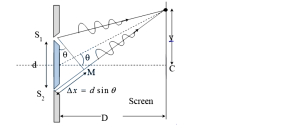
In Young's double slit experiment,the two slits are $d$ distance apart. The interference pattern is observed on the screen at a distance $D$ from the slits. The first dark fringe is observed on the screen directly opposite to one of the slits. The wavelength of the light is:
A
$\frac{D^2}{2 d}$
B
$\frac{d^2}{D}$
C
$\frac{d^2}{2 D}$
D
$\frac{D^2}{d}$
Solution
(B) The path difference $\Delta x$ at a point $P$ on the screen at a distance $y$ from the center is given by $\Delta x = d \sin \theta \approx d \tan \theta = d \left( \frac{y}{D} \right)$.
For a dark fringe,the path difference must be an odd multiple of half the wavelength: $\Delta x = (2n - 1) \frac{\lambda}{2}$,where $n = 1, 2, 3, \dots$.
The first dark fringe corresponds to $n = 1$,so $\Delta x = \frac{\lambda}{2}$.
The problem states that the first dark fringe is observed directly opposite to one of the slits. The distance of the slits from the center is $d/2$. Thus,$y = d/2$.
Substituting these values into the path difference formula:
$\frac{d}{2} \cdot \frac{d}{D} = \frac{\lambda}{2}$
$\frac{d^2}{D} = \lambda$
Therefore,the wavelength of the light is $\lambda = \frac{d^2}{D}$.
For a dark fringe,the path difference must be an odd multiple of half the wavelength: $\Delta x = (2n - 1) \frac{\lambda}{2}$,where $n = 1, 2, 3, \dots$.
The first dark fringe corresponds to $n = 1$,so $\Delta x = \frac{\lambda}{2}$.
The problem states that the first dark fringe is observed directly opposite to one of the slits. The distance of the slits from the center is $d/2$. Thus,$y = d/2$.
Substituting these values into the path difference formula:
$\frac{d}{2} \cdot \frac{d}{D} = \frac{\lambda}{2}$
$\frac{d^2}{D} = \lambda$
Therefore,the wavelength of the light is $\lambda = \frac{d^2}{D}$.
0 likesView Solution
278
PhysicsDifficultMCQMHT CET · 2022
On placing a thin film of mica of thickness $12 \times 10^{-5} \text{ cm}$ in the path of one of the interfering waves in Young's double slit experiment using monochromatic light,the fringe pattern shifts through a distance equal to the width of a bright fringe. If the wavelength used is $\lambda = 6 \times 10^{-5} \text{ cm}$,the refractive index of mica is:
A
$1.4$
B
$1.1$
C
$1.3$
D
$1.5$
Solution
(D) The path difference introduced by the mica film is given by $\Delta x = (\mu - 1)t$.
In Young's double slit experiment,the shift in the fringe pattern $\Delta y$ is related to the path difference by $\Delta y = \frac{D}{d} \Delta x = \frac{D}{d} (\mu - 1)t$.
Since the fringe width is $\beta = \frac{\lambda D}{d}$,we can write the shift as $\Delta y = \frac{\beta}{\lambda} (\mu - 1)t$.
Given that the shift is equal to the fringe width,$\Delta y = \beta$,we have $\beta = \frac{\beta}{\lambda} (\mu - 1)t$.
This simplifies to $(\mu - 1)t = \lambda$.
Substituting the given values,$\mu - 1 = \frac{\lambda}{t} = \frac{6 \times 10^{-5} \text{ cm}}{12 \times 10^{-5} \text{ cm}} = 0.5$.
Therefore,$\mu = 0.5 + 1 = 1.5$.
In Young's double slit experiment,the shift in the fringe pattern $\Delta y$ is related to the path difference by $\Delta y = \frac{D}{d} \Delta x = \frac{D}{d} (\mu - 1)t$.
Since the fringe width is $\beta = \frac{\lambda D}{d}$,we can write the shift as $\Delta y = \frac{\beta}{\lambda} (\mu - 1)t$.
Given that the shift is equal to the fringe width,$\Delta y = \beta$,we have $\beta = \frac{\beta}{\lambda} (\mu - 1)t$.
This simplifies to $(\mu - 1)t = \lambda$.
Substituting the given values,$\mu - 1 = \frac{\lambda}{t} = \frac{6 \times 10^{-5} \text{ cm}}{12 \times 10^{-5} \text{ cm}} = 0.5$.
Therefore,$\mu = 0.5 + 1 = 1.5$.
0 likesView Solution
279
PhysicsEasyMCQMHT CET · 2022
When the distance between the slit and the screen is doubled,what happens to the angular separation between the fringes in a slit diffraction experiment?
A
First increases and then decreases
B
Remains same
C
Increases
D
Decreases
Solution
(B) The angular separation $\theta$ between the fringes is given by the formula $\theta = \frac{\beta}{D}$,where $\beta$ is the fringe width and $D$ is the distance between the slit and the screen.
Since the fringe width $\beta = \frac{D \lambda}{d}$,substituting this into the expression for $\theta$ gives $\theta = \frac{(\frac{D \lambda}{d})}{D} = \frac{\lambda}{d}$.
Here,$\lambda$ is the wavelength of light and $d$ is the slit separation.
As the expression for $\theta$ does not contain the term $D$,the angular separation is independent of the distance between the slit and the screen.
Therefore,when the distance is doubled,the angular separation remains the same.
Since the fringe width $\beta = \frac{D \lambda}{d}$,substituting this into the expression for $\theta$ gives $\theta = \frac{(\frac{D \lambda}{d})}{D} = \frac{\lambda}{d}$.
Here,$\lambda$ is the wavelength of light and $d$ is the slit separation.
As the expression for $\theta$ does not contain the term $D$,the angular separation is independent of the distance between the slit and the screen.
Therefore,when the distance is doubled,the angular separation remains the same.
0 likesView Solution
280
PhysicsEasyMCQMHT CET · 2022
In Young's double-slit experiment,we get $15$ fringes per $cm$ on the screen using light of wavelength $5600$ Å. For the same setting,how many fringes per $cm$ will be obtained with light of wavelength $7000$ Å?
A
$18$
B
$10$
C
$12$
D
$15$
Solution
(C) The fringe width $\beta$ is given by $\beta = \frac{\lambda D}{d}$.
Since the number of fringes per unit length $n$ is inversely proportional to the fringe width $\beta$,we have $n \propto \frac{1}{\beta}$.
Therefore,$n \propto \frac{1}{\lambda}$,which implies $n_1 \lambda_1 = n_2 \lambda_2$.
Given $n_1 = 15$ fringes/$cm$,$\lambda_1 = 5600$ Å,and $\lambda_2 = 7000$ Å.
Substituting the values: $15 \times 5600 = n_2 \times 7000$.
$n_2 = \frac{15 \times 5600}{7000} = \frac{15 \times 56}{70} = \frac{15 \times 8}{10} = \frac{120}{10} = 12$.
Thus,$12$ fringes per $cm$ will be obtained.
Since the number of fringes per unit length $n$ is inversely proportional to the fringe width $\beta$,we have $n \propto \frac{1}{\beta}$.
Therefore,$n \propto \frac{1}{\lambda}$,which implies $n_1 \lambda_1 = n_2 \lambda_2$.
Given $n_1 = 15$ fringes/$cm$,$\lambda_1 = 5600$ Å,and $\lambda_2 = 7000$ Å.
Substituting the values: $15 \times 5600 = n_2 \times 7000$.
$n_2 = \frac{15 \times 5600}{7000} = \frac{15 \times 56}{70} = \frac{15 \times 8}{10} = \frac{120}{10} = 12$.
Thus,$12$ fringes per $cm$ will be obtained.
0 likesView Solution
281
PhysicsMediumMCQMHT CET · 2022
In a biprism experiment,a wavelength $\lambda$ is used to obtain an interference pattern. The fringe width is $W_1$ at a distance $D_1$ from the screen. When the screen is moved towards the biprism,the fringe width becomes $W_2$ at a distance $D_2$. The distance between the two virtual images of the slit is:
A
$\frac{\lambda(D_2-D_1)}{(W_1-W_2)}$
B
$\frac{\lambda(W_1-W_2)}{(D_1-D_2)}$
C
$\frac{\lambda(W_2-W_1)}{(D_1-D_2)}$
D
$\frac{\lambda(D_1-D_2)}{(W_1-W_2)}$
Solution
(D) The formula for fringe width is given by $\beta = \frac{\lambda D}{d}$,where $d$ is the distance between the two virtual sources.
For the first position: $W_1 = \frac{\lambda D_1}{d}$
For the second position: $W_2 = \frac{\lambda D_2}{d}$
Subtracting the two equations: $W_1 - W_2 = \frac{\lambda}{d}(D_1 - D_2)$
Rearranging for $d$: $d = \frac{\lambda(D_1 - D_2)}{(W_1 - W_2)}$
For the first position: $W_1 = \frac{\lambda D_1}{d}$
For the second position: $W_2 = \frac{\lambda D_2}{d}$
Subtracting the two equations: $W_1 - W_2 = \frac{\lambda}{d}(D_1 - D_2)$
Rearranging for $d$: $d = \frac{\lambda(D_1 - D_2)}{(W_1 - W_2)}$
0 likesView Solution
282
PhysicsDifficultMCQMHT CET · 2022
In Young's double slit experiment,the intensity at a point on the screen is $K$,where the path difference is $\lambda$. What will be the intensity at the point where the path difference is $\frac{\lambda}{4}$?
A
$\frac{K}{4}$
B
$\frac{K}{2}$
C
$K$
D
$0$
Solution
(B) The intensity in Young's double slit experiment is given by $I = 4I_0 \cos^2(\frac{\phi}{2})$,where $\phi$ is the phase difference.
Phase difference $\phi$ is related to path difference $\Delta x$ by $\phi = \frac{2\pi}{\lambda} \Delta x$.
For path difference $\Delta x = \lambda$,the phase difference is $\phi = \frac{2\pi}{\lambda} \times \lambda = 2\pi$.
Given intensity $K = 4I_0 \cos^2(\frac{2\pi}{2}) = 4I_0 \cos^2(\pi) = 4I_0(1)^2 = 4I_0$.
Now,for path difference $\Delta x = \frac{\lambda}{4}$,the phase difference is $\phi' = \frac{2\pi}{\lambda} \times \frac{\lambda}{4} = \frac{\pi}{2}$.
The new intensity $K'$ is $K' = 4I_0 \cos^2(\frac{\pi/2}{2}) = 4I_0 \cos^2(\frac{\pi}{4})$.
Since $\cos(\frac{\pi}{4}) = \frac{1}{\sqrt{2}}$,we have $K' = 4I_0 \times (\frac{1}{\sqrt{2}})^2 = 4I_0 \times \frac{1}{2} = 2I_0$.
Since $K = 4I_0$,then $2I_0 = \frac{K}{2}$.
Therefore,the intensity is $\frac{K}{2}$.
Phase difference $\phi$ is related to path difference $\Delta x$ by $\phi = \frac{2\pi}{\lambda} \Delta x$.
For path difference $\Delta x = \lambda$,the phase difference is $\phi = \frac{2\pi}{\lambda} \times \lambda = 2\pi$.
Given intensity $K = 4I_0 \cos^2(\frac{2\pi}{2}) = 4I_0 \cos^2(\pi) = 4I_0(1)^2 = 4I_0$.
Now,for path difference $\Delta x = \frac{\lambda}{4}$,the phase difference is $\phi' = \frac{2\pi}{\lambda} \times \frac{\lambda}{4} = \frac{\pi}{2}$.
The new intensity $K'$ is $K' = 4I_0 \cos^2(\frac{\pi/2}{2}) = 4I_0 \cos^2(\frac{\pi}{4})$.
Since $\cos(\frac{\pi}{4}) = \frac{1}{\sqrt{2}}$,we have $K' = 4I_0 \times (\frac{1}{\sqrt{2}})^2 = 4I_0 \times \frac{1}{2} = 2I_0$.
Since $K = 4I_0$,then $2I_0 = \frac{K}{2}$.
Therefore,the intensity is $\frac{K}{2}$.
0 likesView Solution
283
PhysicsEasyMCQMHT CET · 2022
In Young's double slit experiment with monochromatic light, fringes are obtained on a screen placed at some distance from the slits. If the screen is moved by $5 \times 10^{-2} \, m$ towards the slits, the change in fringe width is $3 \times 10^{-5} \, m$. If the separation between the slits is $10^{-3} \, m$, the wavelength of light used is (in $\text{\AA}$)
A
$6000$
B
$5000$
C
$4500$
D
$3000$
Solution
(A) The fringe width $\omega$ in Young's double slit experiment is given by $\omega = \frac{\lambda D}{d}$, where $\lambda$ is the wavelength, $D$ is the distance of the screen from the slits, and $d$ is the slit separation.
Given the change in screen distance $\Delta D = 5 \times 10^{-2} \, m$ and the change in fringe width $\Delta \omega = 3 \times 10^{-5} \, m$, the relationship is $\Delta \omega = \frac{\lambda (\Delta D)}{d}$.
Rearranging for $\lambda$: $\lambda = \frac{d \cdot \Delta \omega}{\Delta D}$.
Substituting the values: $\lambda = \frac{(10^{-3} \, m)(3 \times 10^{-5} \, m)}{5 \times 10^{-2} \, m} = \frac{3 \times 10^{-8}}{5 \times 10^{-2}} = 0.6 \times 10^{-6} \, m$.
Converting to $\text{\AA}$: $\lambda = 0.6 \times 10^{-6} \times 10^{10} \, \text{\AA} = 6000 \, \text{\AA}$.
Given the change in screen distance $\Delta D = 5 \times 10^{-2} \, m$ and the change in fringe width $\Delta \omega = 3 \times 10^{-5} \, m$, the relationship is $\Delta \omega = \frac{\lambda (\Delta D)}{d}$.
Rearranging for $\lambda$: $\lambda = \frac{d \cdot \Delta \omega}{\Delta D}$.
Substituting the values: $\lambda = \frac{(10^{-3} \, m)(3 \times 10^{-5} \, m)}{5 \times 10^{-2} \, m} = \frac{3 \times 10^{-8}}{5 \times 10^{-2}} = 0.6 \times 10^{-6} \, m$.
Converting to $\text{\AA}$: $\lambda = 0.6 \times 10^{-6} \times 10^{10} \, \text{\AA} = 6000 \, \text{\AA}$.
0 likesView Solution
284
PhysicsDifficultMCQMHT CET · 2022
In Young's double slit experiment,the angular width of fringes is $0.20$ radians for sodium light of wavelength $5890 \text{ Å}$. If the complete system is dipped in water,then the angular width of fringes will be [Refractive index of water $\mu = \frac{4}{3}$]
A
$0.30$ radians
B
$0.15$ radians
C
$0.11$ radians
D
$0.22$ radians
Solution
(B) The angular fringe width $\theta$ is given by the formula:
$\theta = \frac{\lambda}{d}$
Given,in air,$\theta = 0.20$ radians.
When the entire system is immersed in water,the wavelength of light changes to $\lambda' = \frac{\lambda}{\mu}$,where $\mu$ is the refractive index of water.
The new angular fringe width $\theta'$ is:
$\theta' = \frac{\lambda'}{d} = \frac{\lambda}{\mu d} = \frac{\theta}{\mu}$
Given $\mu = \frac{4}{3}$,we have:
$\theta' = \frac{0.20}{4/3} = 0.20 \times \frac{3}{4} = 0.15$ radians.
Thus,the angular width of the fringes in water is $0.15$ radians.
$\theta = \frac{\lambda}{d}$
Given,in air,$\theta = 0.20$ radians.
When the entire system is immersed in water,the wavelength of light changes to $\lambda' = \frac{\lambda}{\mu}$,where $\mu$ is the refractive index of water.
The new angular fringe width $\theta'$ is:
$\theta' = \frac{\lambda'}{d} = \frac{\lambda}{\mu d} = \frac{\theta}{\mu}$
Given $\mu = \frac{4}{3}$,we have:
$\theta' = \frac{0.20}{4/3} = 0.20 \times \frac{3}{4} = 0.15$ radians.
Thus,the angular width of the fringes in water is $0.15$ radians.

0 likesView Solution
285
PhysicsEasyMCQMHT CET · 2022
In a biprism experiment,the $4^{\text{th}}$ dark band is formed opposite to one of the slits. The wavelength of light used is ($D=$ distance between source and screen,$d=$ distance between the slits).
A
$\frac{d^2}{9 D}$
B
$\frac{d^2}{11 D}$
C
$\frac{d^2}{14 D}$
D
$\frac{d^2}{7 D}$
Solution
(D) Concept: In a biprism experiment,the position of the $n^{\text{th}}$ dark fringe from the central axis is given by the formula: $y_n = (2n - 1) \frac{\lambda D}{2d}$.
Given that the $4^{\text{th}}$ dark band is formed opposite to one of the slits,the distance of the slit from the central axis is $y = \frac{d}{2}$.
For $n = 4$,the position is $y_4 = (2(4) - 1) \frac{\lambda D}{2d} = \frac{7 \lambda D}{2d}$.
Equating the two expressions for $y_4$: $\frac{7 \lambda D}{2d} = \frac{d}{2}$.
Solving for $\lambda$: $7 \lambda D = d^2 \implies \lambda = \frac{d^2}{7D}$.
Thus,option $(D)$ is correct.
Given that the $4^{\text{th}}$ dark band is formed opposite to one of the slits,the distance of the slit from the central axis is $y = \frac{d}{2}$.
For $n = 4$,the position is $y_4 = (2(4) - 1) \frac{\lambda D}{2d} = \frac{7 \lambda D}{2d}$.
Equating the two expressions for $y_4$: $\frac{7 \lambda D}{2d} = \frac{d}{2}$.
Solving for $\lambda$: $7 \lambda D = d^2 \implies \lambda = \frac{d^2}{7D}$.
Thus,option $(D)$ is correct.
0 likesView Solution
286
PhysicsMediumMCQMHT CET · 2022
In a biprism experiment,the distance between the two sources is doubled and the distance between the slit and the eyepiece is also doubled. Then the width of the fringe is
A
halved.
B
unchanged.
C
reduced to $\left(\frac{1}{3}\right)^{rd}$
D
doubled.
Solution
(B) The fringe width $\beta$ is given by the formula $\beta = \frac{\lambda D}{d}$,where $\lambda$ is the wavelength of light,$D$ is the distance between the slit and the eyepiece,and $d$ is the distance between the two coherent sources.
Initially,$\beta = \frac{\lambda D}{d}$.
In the new situation,the distance between the sources becomes $d' = 2d$ and the distance between the slit and the eyepiece becomes $D' = 2D$.
The new fringe width $\beta'$ is given by $\beta' = \frac{\lambda D'}{d'} = \frac{\lambda (2D)}{(2d)} = \frac{\lambda D}{d}$.
Therefore,$\beta' = \beta$,which means the fringe width remains unchanged.
Initially,$\beta = \frac{\lambda D}{d}$.
In the new situation,the distance between the sources becomes $d' = 2d$ and the distance between the slit and the eyepiece becomes $D' = 2D$.
The new fringe width $\beta'$ is given by $\beta' = \frac{\lambda D'}{d'} = \frac{\lambda (2D)}{(2d)} = \frac{\lambda D}{d}$.
Therefore,$\beta' = \beta$,which means the fringe width remains unchanged.
0 likesView Solution
287
PhysicsEasyMCQMHT CET · 2022
In Young's double slit experiment,the slit separation is made threefold by keeping the remaining setup the same. The fringe width becomes
A
$\frac{1}{9}$ times
B
$\frac{1}{3}$ times
C
$9$ times
D
$3$ times
Solution
(B) The fringe width $\beta$ in Young's double slit experiment is given by the formula: $\beta = \frac{\lambda D}{d}$,where $\lambda$ is the wavelength of light,$D$ is the distance between the slits and the screen,and $d$ is the separation between the two slits.
Given that the slit separation $d$ is made threefold,i.e.,$d' = 3d$,while $\lambda$ and $D$ remain constant.
The new fringe width $\beta'$ will be: $\beta' = \frac{\lambda D}{d'} = \frac{\lambda D}{3d} = \frac{1}{3} \beta$.
Therefore,the fringe width becomes $\frac{1}{3}$ times the original fringe width.
Given that the slit separation $d$ is made threefold,i.e.,$d' = 3d$,while $\lambda$ and $D$ remain constant.
The new fringe width $\beta'$ will be: $\beta' = \frac{\lambda D}{d'} = \frac{\lambda D}{3d} = \frac{1}{3} \beta$.
Therefore,the fringe width becomes $\frac{1}{3}$ times the original fringe width.
0 likesView Solution
288
PhysicsMediumMCQMHT CET · 2022
$A$ thin transparent plate of thickness $t$ and refractive index $\mu$ is introduced in the path of one of the two interfering waves. The path difference between these waves is changed by half the wavelength of light $\lambda$. The thickness of the plate is
A
$\frac{\lambda}{4(\mu-1)}$
B
$\frac{3 \lambda}{4(\mu-1)}$
C
$\frac{\lambda}{(\mu-1)}$
D
$\frac{\lambda}{2(\mu-1)}$
Solution
(D) When a thin transparent plate of thickness $t$ and refractive index $\mu$ is introduced in the path of one of the interfering waves,the additional optical path introduced is given by $\Delta x = (\mu - 1)t$.
According to the problem,this path difference is equal to half the wavelength of light,i.e.,$\Delta x = \frac{\lambda}{2}$.
Equating the two expressions,we get $(\mu - 1)t = \frac{\lambda}{2}$.
Solving for $t$,we find $t = \frac{\lambda}{2(\mu - 1)}$.
According to the problem,this path difference is equal to half the wavelength of light,i.e.,$\Delta x = \frac{\lambda}{2}$.
Equating the two expressions,we get $(\mu - 1)t = \frac{\lambda}{2}$.
Solving for $t$,we find $t = \frac{\lambda}{2(\mu - 1)}$.
0 likesView Solution
289
PhysicsDifficultMCQMHT CET · 2022
Two light rays having the same wavelength $\lambda$ in vacuum are in phase initially. Then the first ray travels a path $L_1$ through a medium of refractive index $\mu_1$,while the second ray travels a path of length $L_2$ through a medium of refractive index $\mu_2$. The two waves are then combined to observe interference. The phase difference between the two waves is
A
$\frac{2 \pi}{\lambda}[\mu_2 L_1-\mu_1 L_2]$
B
$\frac{2 \pi}{\lambda}[\frac{L_1}{\mu_1}-\frac{L_2}{\mu_2}]$
C
$\frac{2 \pi}{\lambda}[\mu_1 L_1-\mu_2 L_2]$
D
$\frac{2 \pi}{\lambda}[L_2-L_1]$
Solution
(C) The optical path length in a medium of refractive index $\mu$ for a physical path length $L$ is defined as $\Delta = \mu L$.
For the first ray,the optical path is $\Delta_1 = \mu_1 L_1$.
For the second ray,the optical path is $\Delta_2 = \mu_2 L_2$.
The path difference between the two rays is $\Delta x = |\Delta_1 - \Delta_2| = |\mu_1 L_1 - \mu_2 L_2|$.
The phase difference $\phi$ is related to the path difference $\Delta x$ by the formula $\phi = \frac{2 \pi}{\lambda} \Delta x$.
Therefore,the phase difference is $\frac{2 \pi}{\lambda} |\mu_1 L_1 - \mu_2 L_2|$.
Comparing this with the given options,the correct expression is $\frac{2 \pi}{\lambda} [\mu_1 L_1 - \mu_2 L_2]$.
For the first ray,the optical path is $\Delta_1 = \mu_1 L_1$.
For the second ray,the optical path is $\Delta_2 = \mu_2 L_2$.
The path difference between the two rays is $\Delta x = |\Delta_1 - \Delta_2| = |\mu_1 L_1 - \mu_2 L_2|$.
The phase difference $\phi$ is related to the path difference $\Delta x$ by the formula $\phi = \frac{2 \pi}{\lambda} \Delta x$.
Therefore,the phase difference is $\frac{2 \pi}{\lambda} |\mu_1 L_1 - \mu_2 L_2|$.
Comparing this with the given options,the correct expression is $\frac{2 \pi}{\lambda} [\mu_1 L_1 - \mu_2 L_2]$.

0 likesView Solution
290
PhysicsMediumMCQMHT CET · 2022
If the ratio of the intensities of two waves producing interference is $49: 16$,then the ratio of the resultant maximum intensity to minimum intensity will be
A
$11:3$
B
$121:9$
C
$7:4$
D
$49:16$
Solution
(B) Let the intensities of the two waves be $I_1$ and $I_2$.
Given: $I_1/I_2 = 49/16$.
Since intensity $I \propto A^2$,the ratio of amplitudes is $\sqrt{I_1}/\sqrt{I_2} = A_1/A_2 = \sqrt{49}/\sqrt{16} = 7/4$.
The ratio of maximum intensity to minimum intensity is given by the formula:
$\frac{I_{\max}}{I_{\min}} = \left(\frac{A_1 + A_2}{A_1 - A_2}\right)^2$.
Substituting the values:
$\frac{I_{\max}}{I_{\min}} = \left(\frac{7 + 4}{7 - 4}\right)^2 = \left(\frac{11}{3}\right)^2 = \frac{121}{9}$.
Thus,the ratio is $121:9$.
Given: $I_1/I_2 = 49/16$.
Since intensity $I \propto A^2$,the ratio of amplitudes is $\sqrt{I_1}/\sqrt{I_2} = A_1/A_2 = \sqrt{49}/\sqrt{16} = 7/4$.
The ratio of maximum intensity to minimum intensity is given by the formula:
$\frac{I_{\max}}{I_{\min}} = \left(\frac{A_1 + A_2}{A_1 - A_2}\right)^2$.
Substituting the values:
$\frac{I_{\max}}{I_{\min}} = \left(\frac{7 + 4}{7 - 4}\right)^2 = \left(\frac{11}{3}\right)^2 = \frac{121}{9}$.
Thus,the ratio is $121:9$.
0 likesView Solution
291
PhysicsEasyMCQMHT CET · 2022
The optical path difference between two identical light waves arriving at a point is $31.5 \lambda$,where $\lambda$ is the wavelength of light used. The point is [Given: Two light sources are coherent]
A
alternative bright and dark.
B
dark.
C
bright.
D
neither bright nor dark.
Solution
(B) The condition for destructive interference is that the path difference $\Delta x$ must be an odd multiple of $\frac{\lambda}{2}$.
Given path difference $\Delta x = 31.5 \lambda = \frac{63}{2} \lambda = 63 \left( \frac{\lambda}{2} \right)$.
Since $63$ is an odd integer,the path difference is an odd multiple of $\frac{\lambda}{2}$.
Therefore,the point corresponds to destructive interference,which results in a dark point.
Given path difference $\Delta x = 31.5 \lambda = \frac{63}{2} \lambda = 63 \left( \frac{\lambda}{2} \right)$.
Since $63$ is an odd integer,the path difference is an odd multiple of $\frac{\lambda}{2}$.
Therefore,the point corresponds to destructive interference,which results in a dark point.
0 likesView Solution
292
PhysicsEasyMCQMHT CET · 2022
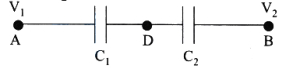
Two capacitors $C_1$ and $C_2$ in a circuit are joined as shown in the figure. The potential of point $A$ is $V_1$ and that of point $B$ is $V_2$. The potential at point $D$ will be
A
$\frac{1}{2}(V_1+V_2)$
B
$\frac{C_2 V_1+C_1 V_2}{C_1+C_2}$
C
$\frac{C_1 V_1+C_2 V_2}{C_1+C_2}$
D
$\frac{C_2 V_2-C_1 V_2}{C_1+C_2}$
Solution
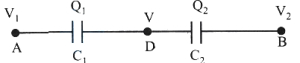
(C) In a series combination,the charge on each capacitor is the same,so $Q_1 = Q_2$.
Let the potential at point $D$ be $V$.
The charge on capacitor $C_1$ is $Q_1 = C_1(V_1 - V)$.
The charge on capacitor $C_2$ is $Q_2 = C_2(V - V_2)$.
Equating the charges: $C_1(V_1 - V) = C_2(V - V_2)$.
Expanding the terms: $C_1 V_1 - C_1 V = C_2 V - C_2 V_2$.
Rearranging to solve for $V$: $C_1 V_1 + C_2 V_2 = V(C_1 + C_2)$.
Therefore,the potential at point $D$ is $V = \frac{C_1 V_1 + C_2 V_2}{C_1 + C_2}$.
Let the potential at point $D$ be $V$.
The charge on capacitor $C_1$ is $Q_1 = C_1(V_1 - V)$.
The charge on capacitor $C_2$ is $Q_2 = C_2(V - V_2)$.
Equating the charges: $C_1(V_1 - V) = C_2(V - V_2)$.
Expanding the terms: $C_1 V_1 - C_1 V = C_2 V - C_2 V_2$.
Rearranging to solve for $V$: $C_1 V_1 + C_2 V_2 = V(C_1 + C_2)$.
Therefore,the potential at point $D$ is $V = \frac{C_1 V_1 + C_2 V_2}{C_1 + C_2}$.
0 likesView Solution
Vedclass Products
For Students
Vedclass Test Series
Mock tests in real MHT CET style covering Physics with performance analysis. 5-day free trial.
Start Free TrialFor Teachers
Exam Paper Generator
Generate Set A/B/C/D Physics papers from 7.5L+ questions in 2 minutes. 3 chapters free.
Try FreeFor Institutes
Online Exam Module
Run live MHT CET mock exams with unlimited students, 360° analytics & white-label branding.
See DemoFrequently Asked Questions
How many Physics questions are in MHT CET 2022?
There are 540 Physics questions from the MHT CET 2022 paper on Vedclass, each with a detailed step-by-step solution in English.
Are MHT CET 2022 Physics solutions available in English?
Yes. All solutions on this page are in English. You can also switch to English or Hindi using the language buttons above the questions.
Can I practice MHT CET 2022 Physics as a timed test?
Yes. Use the Vedclass Test Series to attempt a full MHT CET mock test covering Physics with time limits and instant score analysis.
Can teachers create Physics papers from MHT CET previous year questions?
Yes. The Vedclass Exam Paper Generator lets teachers mix MHT CET Physics questions and generate Set A/B/C/D papers in minutes.
For Teachers & Institutes
Build a Custom Physics Paper
Pick MHT CET 2022 Physics questions, set difficulty, and generate Set A/B/C/D in 2 minutes.