
PhysicsQ151–250 of 540 questions
Page 4 of 6 · English
151
PhysicsMediumMCQMHT CET · 2022
The ratio of thermal conductivity of two rods $A$ and $B$ with the same area of cross-section is $3: 2$. If the thermal resistance of two rods is the same,then the ratio of length of rod $A$ to length of rod $B$ is
A
$3: 2$
B
$2: 3$
C
$5: 1$
D
$1: 5$
Solution
(A) The thermal resistance $R$ of a rod is given by the formula $R = \frac{l}{KA}$,where $l$ is the length,$K$ is the thermal conductivity,and $A$ is the area of cross-section.
Given that the area of cross-section is the same for both rods,$A_A = A_B = A$.
Given the ratio of thermal conductivities is $\frac{K_A}{K_B} = \frac{3}{2}$.
Since the thermal resistances are equal,$R_A = R_B$.
Substituting the formula,we get $\frac{l_A}{K_A A} = \frac{l_B}{K_B A}$.
Simplifying this,we get $\frac{l_A}{l_B} = \frac{K_A}{K_B}$.
Substituting the given ratio,$\frac{l_A}{l_B} = \frac{3}{2}$.
Given that the area of cross-section is the same for both rods,$A_A = A_B = A$.
Given the ratio of thermal conductivities is $\frac{K_A}{K_B} = \frac{3}{2}$.
Since the thermal resistances are equal,$R_A = R_B$.
Substituting the formula,we get $\frac{l_A}{K_A A} = \frac{l_B}{K_B A}$.
Simplifying this,we get $\frac{l_A}{l_B} = \frac{K_A}{K_B}$.
Substituting the given ratio,$\frac{l_A}{l_B} = \frac{3}{2}$.
0 likesView Solution
152
PhysicsMediumMCQMHT CET · 2022
$A$ cylindrical metallic rod in thermal contact with two heat reservoirs at its two ends conducts an amount of heat '$Q_1$' in time '$t$'. The metallic rod is melted and the material is formed into a rod of length four times the length of the original rod. The amount of heat conducted by the new rod when placed in thermal contact with the same two reservoirs in time '$t$' is '$Q_2$'. Then $\frac{Q_1}{Q_2}$ is:
A
$16$
B
$\frac{1}{16}$
C
$\frac{1}{4}$
D
$4$
Solution
(A) The rate of heat conduction is given by the formula: $\frac{Q}{t} = \frac{k A (T_1 - T_2)}{l}$.
Since the volume of the material remains constant during melting and reshaping,we have $A_1 l_1 = A_2 l_2$.
Given that the new length $l_2 = 4 l_1$,we substitute this into the volume equation: $A_1 l_1 = A_2 (4 l_1)$,which gives $A_2 = \frac{A_1}{4}$.
For the new rod,the heat conducted in time $t$ is $Q_2 = \frac{k A_2 (T_1 - T_2) t}{l_2}$.
Substituting $A_2 = \frac{A_1}{4}$ and $l_2 = 4 l_1$ into the equation for $Q_2$:
$Q_2 = \frac{k (A_1 / 4) (T_1 - T_2) t}{4 l_1} = \frac{1}{16} \frac{k A_1 (T_1 - T_2) t}{l_1}$.
Since $Q_1 = \frac{k A_1 (T_1 - T_2) t}{l_1}$,we get $Q_2 = \frac{1}{16} Q_1$.
Therefore,$\frac{Q_1}{Q_2} = 16$.
Since the volume of the material remains constant during melting and reshaping,we have $A_1 l_1 = A_2 l_2$.
Given that the new length $l_2 = 4 l_1$,we substitute this into the volume equation: $A_1 l_1 = A_2 (4 l_1)$,which gives $A_2 = \frac{A_1}{4}$.
For the new rod,the heat conducted in time $t$ is $Q_2 = \frac{k A_2 (T_1 - T_2) t}{l_2}$.
Substituting $A_2 = \frac{A_1}{4}$ and $l_2 = 4 l_1$ into the equation for $Q_2$:
$Q_2 = \frac{k (A_1 / 4) (T_1 - T_2) t}{4 l_1} = \frac{1}{16} \frac{k A_1 (T_1 - T_2) t}{l_1}$.
Since $Q_1 = \frac{k A_1 (T_1 - T_2) t}{l_1}$,we get $Q_2 = \frac{1}{16} Q_1$.
Therefore,$\frac{Q_1}{Q_2} = 16$.
0 likesView Solution
153
PhysicsEasyMCQMHT CET · 2022
The coefficient of thermal conductivity of a rod depends on its
A
area of cross-section.
B
material of the rod.
C
length.
D
mass.
Solution
(B) The coefficient of thermal conductivity $(K)$ is an intrinsic property of the material of the rod.
It represents the ability of a material to conduct heat.
It does not depend on the physical dimensions such as the area of cross-section,length,or the mass of the rod.
Therefore,it only depends on the material of the rod.
It represents the ability of a material to conduct heat.
It does not depend on the physical dimensions such as the area of cross-section,length,or the mass of the rod.
Therefore,it only depends on the material of the rod.
0 likesView Solution
154
PhysicsMediumMCQMHT CET · 2022
Two metal rods $P$ and $Q$ have the same length and the same temperature difference between their ends. Their thermal conductivities are $K_1$ and $K_2$,and their cross-sectional areas are $A_1$ and $A_2$ respectively. If the rate of flow of heat through rod $Q$ is three times that in rod $P$,then:
A
$K_1 A_1 = 3 K_2 A_2$
B
$3 K_1 A_1 = K_2 A_2$
C
$3 K_1 A_1 = 2 K_2 A_2$
D
$2 K_1 A_1 = 3 K_2 A_2$
Solution
(B) The rate of heat flow $\dot{Q}$ through a rod is given by the formula: $\dot{Q} = \frac{KA \Delta T}{l}$.
Here,$K$ is the thermal conductivity,$A$ is the cross-sectional area,$\Delta T$ is the temperature difference,and $l$ is the length of the rod.
Given that the length $l$ and temperature difference $\Delta T$ are the same for both rods $P$ and $Q$,the rate of heat flow is directly proportional to the product $KA$.
According to the problem,the rate of heat flow through rod $Q$ is three times that of rod $P$:
$(\dot{Q})_Q = 3 (\dot{Q})_P$
Substituting the formula:
$\frac{K_2 A_2 \Delta T}{l} = 3 \left( \frac{K_1 A_1 \Delta T}{l} \right)$
Since $l$ and $\Delta T$ are equal,they cancel out from both sides:
$K_2 A_2 = 3 K_1 A_1$ or $3 K_1 A_1 = K_2 A_2$.
Here,$K$ is the thermal conductivity,$A$ is the cross-sectional area,$\Delta T$ is the temperature difference,and $l$ is the length of the rod.
Given that the length $l$ and temperature difference $\Delta T$ are the same for both rods $P$ and $Q$,the rate of heat flow is directly proportional to the product $KA$.
According to the problem,the rate of heat flow through rod $Q$ is three times that of rod $P$:
$(\dot{Q})_Q = 3 (\dot{Q})_P$
Substituting the formula:
$\frac{K_2 A_2 \Delta T}{l} = 3 \left( \frac{K_1 A_1 \Delta T}{l} \right)$
Since $l$ and $\Delta T$ are equal,they cancel out from both sides:
$K_2 A_2 = 3 K_1 A_1$ or $3 K_1 A_1 = K_2 A_2$.
0 likesView Solution
155
PhysicsDifficultMCQMHT CET · 2022
Two metal slabs of same cross-sectional area have thicknesses $d_1$ and $d_2$,and thermal conductivities $K_1$ and $K_2$ respectively,are connected in series. The free ends of the two slabs are kept at temperatures $T_1$ and $T_2$ $(T_1 > T_2)$. The temperature $T$ of their common junction is
A
$\frac{K_1 T_1 d_2 + K_2 T_2 d_1}{K_1 d_2 + K_2 d_1}$
B
$\frac{K_1 T_1 + K_2 T_2}{K_1 + K_2}$
C
$\frac{K_1 T_1 + K_2 T_2}{T_1 + T_2}$
D
$\frac{K_1 T_1 d_1 + K_2 T_2 d_2}{K_1 d_2 + K_2 d_1}$
Solution
(A) The heat current through the first slab is given by $\dot{Q}_1 = \frac{K_1 A (T_1 - T)}{d_1}$.
For the second slab,the heat current is $\dot{Q}_2 = \frac{K_2 A (T - T_2)}{d_2}$.
Since the slabs are connected in series,the same heat current flows through both,so $\dot{Q}_1 = \dot{Q}_2$.
Equating the two expressions: $\frac{K_1 A (T_1 - T)}{d_1} = \frac{K_2 A (T - T_2)}{d_2}$.
Canceling $A$ from both sides: $\frac{K_1 (T_1 - T)}{d_1} = \frac{K_2 (T - T_2)}{d_2}$.
Cross-multiplying gives: $K_1 d_2 (T_1 - T) = K_2 d_1 (T - T_2)$.
Expanding: $K_1 d_2 T_1 - K_1 d_2 T = K_2 d_1 T - K_2 d_1 T_2$.
Rearranging to solve for $T$: $K_1 d_2 T_1 + K_2 d_1 T_2 = T (K_1 d_2 + K_2 d_1)$.
Thus,$T = \frac{K_1 T_1 d_2 + K_2 T_2 d_1}{K_1 d_2 + K_2 d_1}$.
For the second slab,the heat current is $\dot{Q}_2 = \frac{K_2 A (T - T_2)}{d_2}$.
Since the slabs are connected in series,the same heat current flows through both,so $\dot{Q}_1 = \dot{Q}_2$.
Equating the two expressions: $\frac{K_1 A (T_1 - T)}{d_1} = \frac{K_2 A (T - T_2)}{d_2}$.
Canceling $A$ from both sides: $\frac{K_1 (T_1 - T)}{d_1} = \frac{K_2 (T - T_2)}{d_2}$.
Cross-multiplying gives: $K_1 d_2 (T_1 - T) = K_2 d_1 (T - T_2)$.
Expanding: $K_1 d_2 T_1 - K_1 d_2 T = K_2 d_1 T - K_2 d_1 T_2$.
Rearranging to solve for $T$: $K_1 d_2 T_1 + K_2 d_1 T_2 = T (K_1 d_2 + K_2 d_1)$.
Thus,$T = \frac{K_1 T_1 d_2 + K_2 T_2 d_1}{K_1 d_2 + K_2 d_1}$.
0 likesView Solution
156
PhysicsEasyMCQMHT CET · 2022
Two spheres '$S_1$' and '$S_2$' have the same radii but temperatures '$T_1$' and '$T_2$' respectively. Their emissive power is the same and their emissivity is in the ratio $1:4$. Then the ratio '$T_1$' to '$T_2$' is
A
$1: \sqrt{2}$
B
$1: 2$
C
$2: 1$
D
$\sqrt{2}: 1$
Solution
(D) The correct option is $D$.
Concept:
According to the Stefan-Boltzmann law,the emissive power $(E)$ of a body is given by $E = e \sigma T^4$,where $e$ is the emissivity,$\sigma$ is the Stefan-Boltzmann constant,and $T$ is the absolute temperature.
Given that the emissive power of both spheres is the same,we have $E_1 = E_2$.
Therefore,$e_1 \sigma T_1^4 = e_2 \sigma T_2^4$.
This implies $\frac{T_1^4}{T_2^4} = \frac{e_2}{e_1}$.
Given the ratio of emissivity $e_1 : e_2 = 1 : 4$,we have $\frac{e_2}{e_1} = \frac{4}{1} = 4$.
Thus,$\left(\frac{T_1}{T_2}\right)^4 = 4$.
Taking the fourth root on both sides,$\frac{T_1}{T_2} = (4)^{1/4} = (2^2)^{1/4} = 2^{1/2} = \sqrt{2}$.
So,the ratio $T_1 : T_2 = \sqrt{2} : 1$.
Concept:
According to the Stefan-Boltzmann law,the emissive power $(E)$ of a body is given by $E = e \sigma T^4$,where $e$ is the emissivity,$\sigma$ is the Stefan-Boltzmann constant,and $T$ is the absolute temperature.
Given that the emissive power of both spheres is the same,we have $E_1 = E_2$.
Therefore,$e_1 \sigma T_1^4 = e_2 \sigma T_2^4$.
This implies $\frac{T_1^4}{T_2^4} = \frac{e_2}{e_1}$.
Given the ratio of emissivity $e_1 : e_2 = 1 : 4$,we have $\frac{e_2}{e_1} = \frac{4}{1} = 4$.
Thus,$\left(\frac{T_1}{T_2}\right)^4 = 4$.
Taking the fourth root on both sides,$\frac{T_1}{T_2} = (4)^{1/4} = (2^2)^{1/4} = 2^{1/2} = \sqrt{2}$.
So,the ratio $T_1 : T_2 = \sqrt{2} : 1$.
0 likesView Solution
157
PhysicsEasyMCQMHT CET · 2022
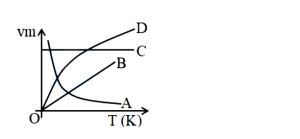
For a perfectly black body,a graph is plotted between the frequency of radiation with maximum intensity $(v_m)$ and the absolute temperature $T$. Which of the following graphs is correct?
A
$C$
B
$A$
C
$D$
D
$B$
Solution
(D) According to Wien's displacement law,$\lambda_m T = b$,where $b$ is Wien's constant.
If $v_m$ is the frequency corresponding to the wavelength $\lambda_m$,then $\lambda_m = \frac{c}{v_m}$.
Substituting this into the displacement law,we get $\left(\frac{c}{v_m}\right) T = b$.
Rearranging the terms,we find $v_m = \left(\frac{c}{b}\right) T$.
Since $c$ (speed of light) and $b$ (Wien's constant) are constants,$v_m \propto T$.
This represents a linear relationship passing through the origin,which corresponds to the straight line labeled $B$ in the graph.
Therefore,option $D$ is the correct answer.
If $v_m$ is the frequency corresponding to the wavelength $\lambda_m$,then $\lambda_m = \frac{c}{v_m}$.
Substituting this into the displacement law,we get $\left(\frac{c}{v_m}\right) T = b$.
Rearranging the terms,we find $v_m = \left(\frac{c}{b}\right) T$.
Since $c$ (speed of light) and $b$ (Wien's constant) are constants,$v_m \propto T$.
This represents a linear relationship passing through the origin,which corresponds to the straight line labeled $B$ in the graph.
Therefore,option $D$ is the correct answer.
0 likesView Solution
158
PhysicsEasyMCQMHT CET · 2022
The radiation energy density per unit wavelength at temperature $T$ is maximum at a wavelength $\lambda_0$. At temperature $2T$,it will have a maximum at a wavelength
A
$\frac{\lambda_0}{4}$
B
$2 \lambda_0$
C
$4 \lambda_0$
D
$\frac{\lambda_0}{2}$
Solution
(D) According to Wien's displacement law,the product of the wavelength at which the radiation energy density is maximum $(\lambda_m)$ and the absolute temperature $(T)$ is a constant.
$\lambda_m T = \text{constant}$
Given that at temperature $T$,the maximum is at $\lambda_0$,we have:
$\lambda_0 T = \lambda' T'$
Here,$T' = 2T$. Substituting this into the equation:
$\lambda_0 T = \lambda' (2T)$
$\lambda' = \frac{\lambda_0 T}{2T} = \frac{\lambda_0}{2}$
Therefore,at temperature $2T$,the maximum energy density occurs at $\frac{\lambda_0}{2}$.
$\lambda_m T = \text{constant}$
Given that at temperature $T$,the maximum is at $\lambda_0$,we have:
$\lambda_0 T = \lambda' T'$
Here,$T' = 2T$. Substituting this into the equation:
$\lambda_0 T = \lambda' (2T)$
$\lambda' = \frac{\lambda_0 T}{2T} = \frac{\lambda_0}{2}$
Therefore,at temperature $2T$,the maximum energy density occurs at $\frac{\lambda_0}{2}$.
0 likesView Solution
159
PhysicsEasyMCQMHT CET · 2022
An object is cooled from $75^{\circ} C$ to $65^{\circ} C$ in $2 \text{ min}$. The time it takes to cool from $55^{\circ} C$ to $45^{\circ} C$ is [The temperature of the surrounding is $30^{\circ} C$] (in $\text{ min}$)
A
$9$
B
$10$
C
$4$
D
$8$
Solution
(C) According to Newton's law of cooling,the rate of cooling is given by: $\frac{dT}{dt} = -k(T_{avg} - T_0)$,where $T_{avg} = \frac{T_1 + T_2}{2}$ and $T_0$ is the surrounding temperature.
Case $(1)$: Cooling from $75^{\circ} C$ to $65^{\circ} C$ in $2 \text{ min}$.
$T_{avg} = \frac{75 + 65}{2} = 70^{\circ} C$.
Rate of cooling = $\frac{75 - 65}{2} = \frac{10}{2} = 5^{\circ} C/\text{min}$.
So,$5 = k(70 - 30) = k(40) \Rightarrow k = \frac{5}{40} = \frac{1}{8} \text{ min}^{-1}$.
Case $(2)$: Cooling from $55^{\circ} C$ to $45^{\circ} C$ in $t \text{ min}$.
$T_{avg} = \frac{55 + 45}{2} = 50^{\circ} C$.
Rate of cooling = $\frac{55 - 45}{t} = \frac{10}{t} ^{\circ} C/\text{min}$.
Using the law: $\frac{10}{t} = k(50 - 30) = k(20)$.
Substituting $k = \frac{1}{8}$:
$\frac{10}{t} = \frac{1}{8} \times 20 = 2.5$.
$t = \frac{10}{2.5} = 4 \text{ min}$.
Case $(1)$: Cooling from $75^{\circ} C$ to $65^{\circ} C$ in $2 \text{ min}$.
$T_{avg} = \frac{75 + 65}{2} = 70^{\circ} C$.
Rate of cooling = $\frac{75 - 65}{2} = \frac{10}{2} = 5^{\circ} C/\text{min}$.
So,$5 = k(70 - 30) = k(40) \Rightarrow k = \frac{5}{40} = \frac{1}{8} \text{ min}^{-1}$.
Case $(2)$: Cooling from $55^{\circ} C$ to $45^{\circ} C$ in $t \text{ min}$.
$T_{avg} = \frac{55 + 45}{2} = 50^{\circ} C$.
Rate of cooling = $\frac{55 - 45}{t} = \frac{10}{t} ^{\circ} C/\text{min}$.
Using the law: $\frac{10}{t} = k(50 - 30) = k(20)$.
Substituting $k = \frac{1}{8}$:
$\frac{10}{t} = \frac{1}{8} \times 20 = 2.5$.
$t = \frac{10}{2.5} = 4 \text{ min}$.
0 likesView Solution
160
PhysicsMediumMCQMHT CET · 2022
If the temperature of a black body is doubled,the frequency at which the spectral intensity becomes maximum will be
A
unchanged
B
four times
C
doubled
D
halved
Solution
(C) According to Wien's displacement law,the wavelength corresponding to maximum spectral intensity $\lambda_m$ is inversely proportional to the absolute temperature $T$:
$\lambda_m \propto \frac{1}{T}$
Since the frequency $f$ is related to wavelength $\lambda$ by $f = \frac{c}{\lambda}$,where $c$ is the speed of light,we have $\lambda \propto \frac{1}{f}$.
Substituting this into Wien's law:
$\frac{1}{f} \propto \frac{1}{T} \Rightarrow f \propto T$
Therefore,if the temperature $T$ is doubled,the frequency $f$ at which the spectral intensity becomes maximum will also be doubled.
$\lambda_m \propto \frac{1}{T}$
Since the frequency $f$ is related to wavelength $\lambda$ by $f = \frac{c}{\lambda}$,where $c$ is the speed of light,we have $\lambda \propto \frac{1}{f}$.
Substituting this into Wien's law:
$\frac{1}{f} \propto \frac{1}{T} \Rightarrow f \propto T$
Therefore,if the temperature $T$ is doubled,the frequency $f$ at which the spectral intensity becomes maximum will also be doubled.
0 likesView Solution
161
PhysicsEasyMCQMHT CET · 2022
$A$ black sphere has radius $R$ whose rate of radiation is $E$ at temperature $T$. If the radius is made $\frac{R}{3}$ and the temperature is made $3T$,the rate of radiation will be:
A
$3E$
B
$16E$
C
$E$
D
$9E$
Solution
(D) According to the Stefan-Boltzmann law,the rate of radiation $E$ from a black sphere of radius $R$ at temperature $T$ is given by $E = \sigma A T^4$,where $A = 4\pi R^2$ is the surface area of the sphere.
Thus,$E \propto R^2 T^4$.
Let the initial rate be $E_1 = E$ with radius $R_1 = R$ and temperature $T_1 = T$.
The new rate $E_2$ has radius $R_2 = \frac{R}{3}$ and temperature $T_2 = 3T$.
Taking the ratio: $\frac{E_2}{E_1} = \left(\frac{R_2}{R_1}\right)^2 \left(\frac{T_2}{T_1}\right)^4$.
Substituting the values: $\frac{E_2}{E} = \left(\frac{R/3}{R}\right)^2 \left(\frac{3T}{T}\right)^4 = \left(\frac{1}{3}\right)^2 (3)^4 = \frac{1}{9} \times 81 = 9$.
Therefore,$E_2 = 9E$.
Thus,$E \propto R^2 T^4$.
Let the initial rate be $E_1 = E$ with radius $R_1 = R$ and temperature $T_1 = T$.
The new rate $E_2$ has radius $R_2 = \frac{R}{3}$ and temperature $T_2 = 3T$.
Taking the ratio: $\frac{E_2}{E_1} = \left(\frac{R_2}{R_1}\right)^2 \left(\frac{T_2}{T_1}\right)^4$.
Substituting the values: $\frac{E_2}{E} = \left(\frac{R/3}{R}\right)^2 \left(\frac{3T}{T}\right)^4 = \left(\frac{1}{3}\right)^2 (3)^4 = \frac{1}{9} \times 81 = 9$.
Therefore,$E_2 = 9E$.
0 likesView Solution
162
PhysicsEasyMCQMHT CET · 2022
Two solid spheres of radii $R_1$ and $R_2$ are made of the same material and have similar surfaces. The spheres are raised to the same temperature and then allowed to cool under identical conditions. Assuming the spheres to be perfect conductors of heat,the ratio of their initial rates of cooling is:
A
$R_1^2 / R_2^2$
B
$R_1^4 / R_2^4$
C
$R_2^3 / R_1^3$
D
$R_2 / R_1$
Solution
(D) The rate of heat loss by radiation is given by Stefan-Boltzmann Law: $dQ/dt = e \sigma A (T^4 - T_0^4)$.
Since the spheres are at the same temperature $T$ and in the same environment $T_0$,the rate of heat loss is proportional to the surface area $A = 4 \pi R^2$.
Thus,$dQ/dt \propto R^2$.
The rate of cooling is defined as $dT/dt = (dQ/dt) / (mc)$,where $m$ is the mass and $c$ is the specific heat capacity.
Mass $m = \rho V = \rho (4/3 \pi R^3)$,where $\rho$ is the density.
Therefore,the rate of cooling $dT/dt \propto R^2 / R^3 = 1/R$.
The ratio of the initial rates of cooling is $(dT/dt)_1 / (dT/dt)_2 = R_2 / R_1$.
Since the spheres are at the same temperature $T$ and in the same environment $T_0$,the rate of heat loss is proportional to the surface area $A = 4 \pi R^2$.
Thus,$dQ/dt \propto R^2$.
The rate of cooling is defined as $dT/dt = (dQ/dt) / (mc)$,where $m$ is the mass and $c$ is the specific heat capacity.
Mass $m = \rho V = \rho (4/3 \pi R^3)$,where $\rho$ is the density.
Therefore,the rate of cooling $dT/dt \propto R^2 / R^3 = 1/R$.
The ratio of the initial rates of cooling is $(dT/dt)_1 / (dT/dt)_2 = R_2 / R_1$.
0 likesView Solution
163
PhysicsDifficultMCQMHT CET · 2022
Three black discs $x, y, z$ have radii $1 \ m, 2 \ m$ and $3 \ m$ respectively. The wavelengths corresponding to maximum intensity are $200 \ nm, 300 \ nm$ and $400 \ nm$ respectively. The relation between emissive power $E_x, E_y$ and $E_z$ is:
A
$E_x$ is maximum
B
$E_y$ is maximum
C
$E_z$ is maximum
D
$E_x = E_y = E_z$
Solution
(A) According to Stefan-Boltzmann Law,the total emissive power $E$ of a black body is given by $E = \sigma T^4$,where $\sigma$ is the Stefan-Boltzmann constant and $T$ is the absolute temperature.
According to Wien's Displacement Law,the wavelength $\lambda_m$ corresponding to maximum intensity is inversely proportional to the absolute temperature $T$,i.e.,$T = \frac{b}{\lambda_m}$,where $b$ is Wien's constant.
Substituting $T$ in the expression for $E$,we get $E \propto (\frac{1}{\lambda_m})^4 = \frac{1}{\lambda_m^4}$.
Note that the emissive power $E$ of a black body depends only on its temperature,not on its surface area or radius.
Given $\lambda_x = 200 \ nm$,$\lambda_y = 300 \ nm$,and $\lambda_z = 400 \ nm$.
Since $E \propto \frac{1}{\lambda_m^4}$,we have:
$E_x \propto \frac{1}{200^4}$
$E_y \propto \frac{1}{300^4}$
$E_z \propto \frac{1}{400^4}$
Comparing the values,since $200 < 300 < 400$,it follows that $\frac{1}{200^4} > \frac{1}{300^4} > \frac{1}{400^4}$.
Therefore,$E_x > E_y > E_z$,which means $E_x$ is the maximum.
According to Wien's Displacement Law,the wavelength $\lambda_m$ corresponding to maximum intensity is inversely proportional to the absolute temperature $T$,i.e.,$T = \frac{b}{\lambda_m}$,where $b$ is Wien's constant.
Substituting $T$ in the expression for $E$,we get $E \propto (\frac{1}{\lambda_m})^4 = \frac{1}{\lambda_m^4}$.
Note that the emissive power $E$ of a black body depends only on its temperature,not on its surface area or radius.
Given $\lambda_x = 200 \ nm$,$\lambda_y = 300 \ nm$,and $\lambda_z = 400 \ nm$.
Since $E \propto \frac{1}{\lambda_m^4}$,we have:
$E_x \propto \frac{1}{200^4}$
$E_y \propto \frac{1}{300^4}$
$E_z \propto \frac{1}{400^4}$
Comparing the values,since $200 < 300 < 400$,it follows that $\frac{1}{200^4} > \frac{1}{300^4} > \frac{1}{400^4}$.
Therefore,$E_x > E_y > E_z$,which means $E_x$ is the maximum.
0 likesView Solution
164
PhysicsEasyMCQMHT CET · 2022
At $273^{\circ} C$,the emissive power of a perfectly black body is $R$. Its emissive power at $0^{\circ} C$ is:
A
$\frac{R}{4}$
B
$\frac{R}{8}$
C
$\frac{R}{16}$
D
$\frac{R}{2}$
Solution
(C) According to Stefan-Boltzmann law,the emissive power $E$ of a black body is directly proportional to the fourth power of its absolute temperature $T$ (in Kelvin).
$E = \sigma T^4$
Given:
Initial temperature $T_1 = 273^{\circ} C = 273 + 273 = 546 \ K$.
Final temperature $T_2 = 0^{\circ} C = 0 + 273 = 273 \ K$.
Initial emissive power $E_1 = R$.
Using the ratio formula:
$\frac{E_2}{E_1} = \left( \frac{T_2}{T_1} \right)^4$
$\frac{E_2}{R} = \left( \frac{273}{546} \right)^4$
$\frac{E_2}{R} = \left( \frac{1}{2} \right)^4 = \frac{1}{16}$
$E_2 = \frac{R}{16}$.
$E = \sigma T^4$
Given:
Initial temperature $T_1 = 273^{\circ} C = 273 + 273 = 546 \ K$.
Final temperature $T_2 = 0^{\circ} C = 0 + 273 = 273 \ K$.
Initial emissive power $E_1 = R$.
Using the ratio formula:
$\frac{E_2}{E_1} = \left( \frac{T_2}{T_1} \right)^4$
$\frac{E_2}{R} = \left( \frac{273}{546} \right)^4$
$\frac{E_2}{R} = \left( \frac{1}{2} \right)^4 = \frac{1}{16}$
$E_2 = \frac{R}{16}$.
0 likesView Solution
165
PhysicsMediumMCQMHT CET · 2022
Two bodies $A$ and $B$ radiate maximum energy with a wavelength difference of $4 \mu m$. The absolute temperature of body $A$ is $3$ times that of body $B$. The wavelength at which body $B$ radiates maximum energy is: (in $\mu m$)
A
$2$
B
$4$
C
$6$
D
$12$
Solution
(C) According to Wien's displacement law,the wavelength $\lambda_m$ corresponding to maximum energy emission is inversely proportional to the absolute temperature $T$:
$\lambda_m T = b$ (where $b$ is Wien's constant).
Therefore,$\lambda_{mA} T_A = \lambda_{mB} T_B$.
Given that $T_A = 3 T_B$,we substitute this into the equation:
$\lambda_{mA} (3 T_B) = \lambda_{mB} T_B \implies \lambda_{mB} = 3 \lambda_{mA}$.
We are also given the difference in wavelengths:
$\lambda_{mB} - \lambda_{mA} = 4 \mu m$.
Substituting $\lambda_{mB} = 3 \lambda_{mA}$ into the difference equation:
$3 \lambda_{mA} - \lambda_{mA} = 4 \mu m \implies 2 \lambda_{mA} = 4 \mu m \implies \lambda_{mA} = 2 \mu m$.
Now,calculate $\lambda_{mB}$:
$\lambda_{mB} = 3 \lambda_{mA} = 3(2 \mu m) = 6 \mu m$.
$\lambda_m T = b$ (where $b$ is Wien's constant).
Therefore,$\lambda_{mA} T_A = \lambda_{mB} T_B$.
Given that $T_A = 3 T_B$,we substitute this into the equation:
$\lambda_{mA} (3 T_B) = \lambda_{mB} T_B \implies \lambda_{mB} = 3 \lambda_{mA}$.
We are also given the difference in wavelengths:
$\lambda_{mB} - \lambda_{mA} = 4 \mu m$.
Substituting $\lambda_{mB} = 3 \lambda_{mA}$ into the difference equation:
$3 \lambda_{mA} - \lambda_{mA} = 4 \mu m \implies 2 \lambda_{mA} = 4 \mu m \implies \lambda_{mA} = 2 \mu m$.
Now,calculate $\lambda_{mB}$:
$\lambda_{mB} = 3 \lambda_{mA} = 3(2 \mu m) = 6 \mu m$.
0 likesView Solution
166
PhysicsMediumMCQMHT CET · 2022
$A$ star $(P)$ behaves like a perfectly black body emitting radiant energy at temperature $T$. Another star $(Q)$ also behaves like a perfectly black body emitting radiant energy at temperature $T/4$ and has a radius eight times the radius of star $(P)$. The ratio of radiant energy emitted by $(P)$ to that by $(Q)$ is
A
$1$:$8$
B
$1$:$1$
C
$4$:$1$
D
$1$:$4$
Solution
(C) Concept: According to the Stefan-Boltzmann law,the total radiant energy $E$ emitted by a black body of surface area $A$ at temperature $T$ is given by $E = \sigma A T^4$,where $\sigma$ is the Stefan-Boltzmann constant.
For a spherical star of radius $R$,the surface area is $A = 4 \pi R^2$.
Thus,$E = \sigma (4 \pi R^2) T^4$.
Given for star $(P)$: Radius $= R$,Temperature $= T$.
So,$E_P = \sigma (4 \pi R^2) T^4$.
Given for star $(Q)$: Radius $= 8R$,Temperature $= T/4$.
So,$E_Q = \sigma (4 \pi (8R)^2) (T/4)^4$.
Calculating the ratio:
$\frac{E_P}{E_Q} = \frac{\sigma (4 \pi R^2) T^4}{\sigma (4 \pi (64 R^2)) (T^4 / 256)} = \frac{T^4}{64 R^2 \cdot (T^4 / 256)} = \frac{256}{64} = 4$.
Wait,re-evaluating: $\frac{E_P}{E_Q} = \frac{R^2 T^4}{(8R)^2 (T/4)^4} = \frac{R^2 T^4}{64 R^2 (T^4 / 256)} = \frac{256}{64} = 4$.
The ratio of radiant energy emitted by $(P)$ to that by $(Q)$ is $4:1$.
For a spherical star of radius $R$,the surface area is $A = 4 \pi R^2$.
Thus,$E = \sigma (4 \pi R^2) T^4$.
Given for star $(P)$: Radius $= R$,Temperature $= T$.
So,$E_P = \sigma (4 \pi R^2) T^4$.
Given for star $(Q)$: Radius $= 8R$,Temperature $= T/4$.
So,$E_Q = \sigma (4 \pi (8R)^2) (T/4)^4$.
Calculating the ratio:
$\frac{E_P}{E_Q} = \frac{\sigma (4 \pi R^2) T^4}{\sigma (4 \pi (64 R^2)) (T^4 / 256)} = \frac{T^4}{64 R^2 \cdot (T^4 / 256)} = \frac{256}{64} = 4$.
Wait,re-evaluating: $\frac{E_P}{E_Q} = \frac{R^2 T^4}{(8R)^2 (T/4)^4} = \frac{R^2 T^4}{64 R^2 (T^4 / 256)} = \frac{256}{64} = 4$.
The ratio of radiant energy emitted by $(P)$ to that by $(Q)$ is $4:1$.
0 likesView Solution
167
PhysicsEasyMCQMHT CET · 2022
Regarding black body radiation,which one of the following is the $WRONG$ statement?
A
All wavelengths are emitted by a black body.
B
For longer wavelengths,intensity is less.
C
For shorter wavelengths,intensity is more.
D
For all wavelengths,intensity is the same.
Solution
(D) black body is an idealized physical body that absorbs all incident electromagnetic radiation.
According to Planck's law of black body radiation,the intensity of radiation emitted by a black body varies with wavelength.
The emission spectrum is continuous,meaning it emits radiation across all wavelengths.
However,the intensity is not constant for all wavelengths; it follows a specific distribution curve (Planck's distribution) that depends on the temperature of the body.
Therefore,the statement that intensity is the same for all wavelengths is incorrect.
According to Planck's law of black body radiation,the intensity of radiation emitted by a black body varies with wavelength.
The emission spectrum is continuous,meaning it emits radiation across all wavelengths.
However,the intensity is not constant for all wavelengths; it follows a specific distribution curve (Planck's distribution) that depends on the temperature of the body.
Therefore,the statement that intensity is the same for all wavelengths is incorrect.
0 likesView Solution
168
PhysicsDifficultMCQMHT CET · 2022
Three discs $x, y$ and $z$ having radii $2 \ m, 2 \ m$ and $6 \ m$ respectively are coated on their outer surfaces. If the wavelengths corresponding to the maximum power radiated by them are $3 \ \mu m, 4 \ \mu m$ and $5 \ \mu m$ respectively,then which of the following is true regarding the power radiated $(P)$?
A
$P_y$ is maximum
B
$P_z$ is maximum
C
$P_x = P_y = P_z$
D
$P_x$ is maximum
Solution
(B) According to Wien's displacement law,the temperature $T$ is inversely proportional to the wavelength of maximum emission: $T \propto \frac{1}{\lambda_{\max }}$.
From Stefan-Boltzmann law,the power radiated $P$ by a blackbody is given by $P = \sigma A T^4$,where $A$ is the surface area and $\sigma$ is the Stefan-Boltzmann constant.
Since $A = \pi r^2$ for a disc (assuming radiation from both sides,$A = 2\pi r^2$),we have $P \propto r^2 T^4$.
Substituting $T \propto \frac{1}{\lambda_{\max }}$,we get $P \propto \frac{r^2}{\lambda_{\max }^4}$.
Given radii $r_x = 2 \ m, r_y = 2 \ m, r_z = 6 \ m$ and wavelengths $\lambda_x = 3 \ \mu m, \lambda_y = 4 \ \mu m, \lambda_z = 5 \ \mu m$:
$P_x \propto \frac{2^2}{3^4} = \frac{4}{81} \approx 0.049$
$P_y \propto \frac{2^2}{4^4} = \frac{4}{256} = 0.0156$
$P_z \propto \frac{6^2}{5^4} = \frac{36}{625} = 0.0576$
Comparing the values,$P_z > P_x > P_y$. Since the question asks for the maximum power,$P_z$ is the maximum.
From Stefan-Boltzmann law,the power radiated $P$ by a blackbody is given by $P = \sigma A T^4$,where $A$ is the surface area and $\sigma$ is the Stefan-Boltzmann constant.
Since $A = \pi r^2$ for a disc (assuming radiation from both sides,$A = 2\pi r^2$),we have $P \propto r^2 T^4$.
Substituting $T \propto \frac{1}{\lambda_{\max }}$,we get $P \propto \frac{r^2}{\lambda_{\max }^4}$.
Given radii $r_x = 2 \ m, r_y = 2 \ m, r_z = 6 \ m$ and wavelengths $\lambda_x = 3 \ \mu m, \lambda_y = 4 \ \mu m, \lambda_z = 5 \ \mu m$:
$P_x \propto \frac{2^2}{3^4} = \frac{4}{81} \approx 0.049$
$P_y \propto \frac{2^2}{4^4} = \frac{4}{256} = 0.0156$
$P_z \propto \frac{6^2}{5^4} = \frac{36}{625} = 0.0576$
Comparing the values,$P_z > P_x > P_y$. Since the question asks for the maximum power,$P_z$ is the maximum.
0 likesView Solution
169
PhysicsMediumMCQMHT CET · 2022
The coefficients of linear expansion of brass and steel rods are $\alpha_1$ and $\alpha_2$ respectively. The lengths of the brass and steel rods are $l_1$ and $l_2$ respectively. If $(l_2 - l_1)$ is maintained the same at all temperatures,which one of the following relations is correct?
A
$\alpha_1 l_2 = \alpha_2 l_1$
B
$\alpha_1^2 l_2 = \alpha_2^2 l_1$
C
$\alpha_1 l_2^2 = \alpha_2 l_1^2$
D
$l_1 \alpha_1 = l_2 \alpha_2$
Solution
(D) The correct option is $D$.
Concept: The length of a metallic rod at a temperature $T$ is given by $l = l_0(1 + \alpha \Delta T)$,where $l_0$ is the initial length,$\alpha$ is the coefficient of linear expansion,and $\Delta T$ is the change in temperature.
Let the lengths of the brass and steel rods at temperature $T$ be $l_b$ and $l_s$ respectively.
$l_b = l_1(1 + \alpha_1 \Delta T)$
$l_s = l_2(1 + \alpha_2 \Delta T)$
The difference in lengths is given by $l_s - l_b = l_2(1 + \alpha_2 \Delta T) - l_1(1 + \alpha_1 \Delta T)$.
$l_s - l_b = (l_2 - l_1) + (l_2 \alpha_2 - l_1 \alpha_1) \Delta T$.
Since the difference $(l_2 - l_1)$ is maintained constant at all temperatures,the term involving $\Delta T$ must be zero.
Therefore,$l_2 \alpha_2 - l_1 \alpha_1 = 0$,which implies $l_1 \alpha_1 = l_2 \alpha_2$.
Concept: The length of a metallic rod at a temperature $T$ is given by $l = l_0(1 + \alpha \Delta T)$,where $l_0$ is the initial length,$\alpha$ is the coefficient of linear expansion,and $\Delta T$ is the change in temperature.
Let the lengths of the brass and steel rods at temperature $T$ be $l_b$ and $l_s$ respectively.
$l_b = l_1(1 + \alpha_1 \Delta T)$
$l_s = l_2(1 + \alpha_2 \Delta T)$
The difference in lengths is given by $l_s - l_b = l_2(1 + \alpha_2 \Delta T) - l_1(1 + \alpha_1 \Delta T)$.
$l_s - l_b = (l_2 - l_1) + (l_2 \alpha_2 - l_1 \alpha_1) \Delta T$.
Since the difference $(l_2 - l_1)$ is maintained constant at all temperatures,the term involving $\Delta T$ must be zero.
Therefore,$l_2 \alpha_2 - l_1 \alpha_1 = 0$,which implies $l_1 \alpha_1 = l_2 \alpha_2$.
0 likesView Solution
170
PhysicsMediumMCQMHT CET · 2022
$A$ clock with an iron pendulum keeps correct time at $15^{\circ} C$. If the room temperature is $20^{\circ} C$,the error in seconds per day will be nearly (coefficient of linear expansion of iron is $\alpha = 1.2 \times 10^{-5} /{ }^{\circ} C$) (in $s$)
A
$3.1$
B
$1.3$
C
$6.2$
D
$2.6$
Solution
(D) The time period of a simple pendulum is given by $T = 2 \pi \sqrt{\frac{l}{g}}$.
Taking the derivative,the fractional change in time period is $\frac{\Delta T}{T} = \frac{1}{2} \frac{\Delta l}{l}$.
Since $\frac{\Delta l}{l} = \alpha \Delta \theta$,we have $\frac{\Delta T}{T} = \frac{1}{2} \alpha \Delta \theta$.
The change in temperature is $\Delta \theta = 20^{\circ} C - 15^{\circ} C = 5^{\circ} C$.
The total time in a day is $T = 24 \times 60 \times 60 = 86,400 \ s$.
The error in time per day is $\Delta T = \frac{1}{2} \alpha \Delta \theta \times T$.
Substituting the values: $\Delta T = \frac{1}{2} \times (1.2 \times 10^{-5}) \times 5 \times 86,400$.
$\Delta T = 0.6 \times 10^{-5} \times 5 \times 86,400 = 3 \times 10^{-5} \times 86,400 = 2.592 \ s \approx 2.6 \ s$.
Taking the derivative,the fractional change in time period is $\frac{\Delta T}{T} = \frac{1}{2} \frac{\Delta l}{l}$.
Since $\frac{\Delta l}{l} = \alpha \Delta \theta$,we have $\frac{\Delta T}{T} = \frac{1}{2} \alpha \Delta \theta$.
The change in temperature is $\Delta \theta = 20^{\circ} C - 15^{\circ} C = 5^{\circ} C$.
The total time in a day is $T = 24 \times 60 \times 60 = 86,400 \ s$.
The error in time per day is $\Delta T = \frac{1}{2} \alpha \Delta \theta \times T$.
Substituting the values: $\Delta T = \frac{1}{2} \times (1.2 \times 10^{-5}) \times 5 \times 86,400$.
$\Delta T = 0.6 \times 10^{-5} \times 5 \times 86,400 = 3 \times 10^{-5} \times 86,400 = 2.592 \ s \approx 2.6 \ s$.
0 likesView Solution
171
PhysicsMediumMCQMHT CET · 2022
What is the change in volume of an iron sphere of volume $500 \,cm^3$, when it is heated from $0^{\circ} C$ to $100^{\circ} C$ (in $\,cm^3$)? (Given: $\alpha_{\text{Iron}} = 12 \times 10^{-6} /^{\circ} C$)
A
$1.8$
B
$2$
C
$1.4$
D
$3$
Solution
(A) The change in volume $\Delta V$ is given by the formula: $\Delta V = V \times \gamma \times \Delta T$, where $\gamma$ is the coefficient of volume expansion.
Since $\gamma = 3\alpha$, the formula becomes: $\Delta V = V \times (3\alpha) \times \Delta T$.
Given: $V = 500 \,cm^3$, $\alpha = 12 \times 10^{-6} /^{\circ} C$, and $\Delta T = 100^{\circ} C - 0^{\circ} C = 100^{\circ} C$.
Substituting the values:
$\Delta V = 500 \times (3 \times 12 \times 10^{-6}) \times 100$
$\Delta V = 500 \times (36 \times 10^{-6}) \times 100$
$\Delta V = 500 \times 0.0036 = 1.8 \,cm^3$.
Since $\gamma = 3\alpha$, the formula becomes: $\Delta V = V \times (3\alpha) \times \Delta T$.
Given: $V = 500 \,cm^3$, $\alpha = 12 \times 10^{-6} /^{\circ} C$, and $\Delta T = 100^{\circ} C - 0^{\circ} C = 100^{\circ} C$.
Substituting the values:
$\Delta V = 500 \times (3 \times 12 \times 10^{-6}) \times 100$
$\Delta V = 500 \times (36 \times 10^{-6}) \times 100$
$\Delta V = 500 \times 0.0036 = 1.8 \,cm^3$.
0 likesView Solution
172
PhysicsMediumMCQMHT CET · 2022
The volume of a metal sphere increases by $0.30 \%$,when its temperature is raised by $50^{\circ} C$. The coefficient of linear expansion of the metal is
A
$6 \times 10^{-5} /^{\circ} C$
B
$3 \times 10^{-5} /^{\circ} C$
C
$2 \times 10^{-5} /^{\circ} C$
D
$12 \times 10^{-5} /^{\circ} C$
Solution
(C) The fractional change in volume is given by $\frac{\Delta V}{V} = \gamma \Delta T$,where $\gamma$ is the coefficient of volume expansion.
Given $\frac{\Delta V}{V} = 0.30 \% = 0.003$ and $\Delta T = 50^{\circ} C$.
Substituting these values: $0.003 = \gamma (50^{\circ} C) \Rightarrow \gamma = \frac{0.003}{50} = 6 \times 10^{-5} /^{\circ} C$.
We know that the coefficient of volume expansion $\gamma$ is related to the coefficient of linear expansion $\alpha$ by $\gamma = 3\alpha$.
Therefore,$\alpha = \frac{\gamma}{3} = \frac{6 \times 10^{-5}}{3} = 2 \times 10^{-5} /^{\circ} C$.
Given $\frac{\Delta V}{V} = 0.30 \% = 0.003$ and $\Delta T = 50^{\circ} C$.
Substituting these values: $0.003 = \gamma (50^{\circ} C) \Rightarrow \gamma = \frac{0.003}{50} = 6 \times 10^{-5} /^{\circ} C$.
We know that the coefficient of volume expansion $\gamma$ is related to the coefficient of linear expansion $\alpha$ by $\gamma = 3\alpha$.
Therefore,$\alpha = \frac{\gamma}{3} = \frac{6 \times 10^{-5}}{3} = 2 \times 10^{-5} /^{\circ} C$.
0 likesView Solution
173
PhysicsEasyMCQMHT CET · 2022
If $R$ is the universal gas constant,the amount of heat needed to raise the temperature of $2$ moles of an ideal monoatomic gas from $273 \ K$ to $373 \ K$ when no work is done is: (in $R$)
A
$150$
B
$100$
C
$500$
D
$300$
Solution
(D) For an ideal gas,the internal energy is a function of temperature only. When no work is done,the process is isochoric (constant volume),so $\Delta W = 0$.
According to the first law of thermodynamics,$\Delta Q = \Delta U + \Delta W$.
Since $\Delta W = 0$,the heat supplied is equal to the change in internal energy: $\Delta Q = \Delta U = n C_V \Delta T$.
For a monoatomic gas,the molar heat capacity at constant volume is $C_V = \frac{3}{2} R$.
Given $n = 2$ moles,$\Delta T = 373 \ K - 273 \ K = 100 \ K$.
Substituting the values: $\Delta Q = 2 \times \frac{3}{2} R \times 100 = 300 R$.
According to the first law of thermodynamics,$\Delta Q = \Delta U + \Delta W$.
Since $\Delta W = 0$,the heat supplied is equal to the change in internal energy: $\Delta Q = \Delta U = n C_V \Delta T$.
For a monoatomic gas,the molar heat capacity at constant volume is $C_V = \frac{3}{2} R$.
Given $n = 2$ moles,$\Delta T = 373 \ K - 273 \ K = 100 \ K$.
Substituting the values: $\Delta Q = 2 \times \frac{3}{2} R \times 100 = 300 R$.
0 likesView Solution
174
PhysicsEasyMCQMHT CET · 2022
$A$ sample of a gas expands from volume $V_1$ to $V_2$. The amount of work done by the gas is maximum when the expansion is:
A
Adiabatic
B
Equal in isothermal and isobaric
C
Isothermal
D
Isobaric
Solution
(D) The work done by a gas during expansion is given by the area under the $P-V$ curve.
For a given change in volume from $V_1$ to $V_2$,the pressure $P$ remains higher in an isobaric process compared to an isothermal or adiabatic process.
Since $W = \int_{V_1}^{V_2} P \, dV$,the area under the curve is largest for the isobaric process.
Therefore,the work done by the gas is maximum when the expansion is isobaric.
For a given change in volume from $V_1$ to $V_2$,the pressure $P$ remains higher in an isobaric process compared to an isothermal or adiabatic process.
Since $W = \int_{V_1}^{V_2} P \, dV$,the area under the curve is largest for the isobaric process.
Therefore,the work done by the gas is maximum when the expansion is isobaric.
0 likesView Solution
175
PhysicsDifficultMCQMHT CET · 2022
For a monoatomic gas,the work done at constant pressure is $W$. For the same rise in temperature of the gas,the heat supplied at constant volume is:
A
$\frac{W}{2}$
B
$2 W$
C
$\frac{3}{2} W$
D
$\frac{5}{2} W$
Solution
(C) For a monoatomic gas at constant pressure,the work done is given by $W = p \Delta V$.
Using the ideal gas equation $pV = nRT$,we have $W = nR \Delta T$.
At constant volume,the heat supplied is equal to the change in internal energy,given by $Q = n C_v \Delta T$.
For a monoatomic gas,the molar heat capacity at constant volume is $C_v = \frac{3}{2} R$.
Substituting this into the heat equation,we get $Q = n \left( \frac{3}{2} R \right) \Delta T$.
Since $W = nR \Delta T$,we can substitute $nR \Delta T$ with $W$.
Therefore,$Q = \frac{3}{2} W$.
Using the ideal gas equation $pV = nRT$,we have $W = nR \Delta T$.
At constant volume,the heat supplied is equal to the change in internal energy,given by $Q = n C_v \Delta T$.
For a monoatomic gas,the molar heat capacity at constant volume is $C_v = \frac{3}{2} R$.
Substituting this into the heat equation,we get $Q = n \left( \frac{3}{2} R \right) \Delta T$.
Since $W = nR \Delta T$,we can substitute $nR \Delta T$ with $W$.
Therefore,$Q = \frac{3}{2} W$.
0 likesView Solution
176
PhysicsEasyMCQMHT CET · 2022
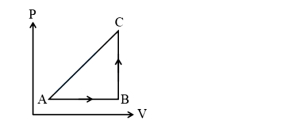
The $p-V$ diagram of a system undergoing thermodynamic changes is as shown in the figure. The work done by the system in going from $A \rightarrow B \rightarrow C$ is $30 \,J$. If $68 \,J$ of heat is given to the system,then the change in the internal energy of the system between $A$ and $C$ is (in $\,J$)
A
$38$
B
$55$
C
$98$
D
$30$
Solution
(A) According to the first law of thermodynamics,the change in internal energy $\Delta U$ is given by the equation:
$\Delta U = \Delta Q - \Delta W$
Given:
Heat absorbed by the system,$\Delta Q = 68 \,J$
Work done by the system,$\Delta W = 30 \,J$
Substituting these values into the equation:
$\Delta U = 68 \,J - 30 \,J = 38 \,J$
Therefore,the change in internal energy of the system between $A$ and $C$ is $38 \,J$.
$\Delta U = \Delta Q - \Delta W$
Given:
Heat absorbed by the system,$\Delta Q = 68 \,J$
Work done by the system,$\Delta W = 30 \,J$
Substituting these values into the equation:
$\Delta U = 68 \,J - 30 \,J = 38 \,J$
Therefore,the change in internal energy of the system between $A$ and $C$ is $38 \,J$.
0 likesView Solution
177
PhysicsDifficultMCQMHT CET · 2022
$A$ monoatomic ideal gas,initially at temperature $T_1$,is enclosed in a cylinder fitted with a frictionless piston. The gas is allowed to expand adiabatically to a temperature $T_2$ by releasing the piston suddenly. $L_1$ and $L_2$ are the lengths of the gas columns before and after the expansion,respectively. The ratio $T_2 / T_1$ is
A
$\left[\frac{L_1}{L_2}\right]^{2/3}$
B
$\left[\frac{L_2}{L_1}\right]^{2/3}$
C
$\left[\frac{L_2}{L_1}\right]^{1/2}$
D
$\left[\frac{L_1}{L_2}\right]^{1/2}$
Solution
(A) For an adiabatic process,the relation between temperature and volume is given by $T_1 V_1^{\gamma-1} = T_2 V_2^{\gamma-1}$.
Therefore,the ratio of temperatures is $\frac{T_2}{T_1} = \left(\frac{V_1}{V_2}\right)^{\gamma-1}$.
For a monoatomic ideal gas,the adiabatic exponent is $\gamma = \frac{5}{3}$.
Thus,$\gamma - 1 = \frac{5}{3} - 1 = \frac{2}{3}$.
Since the gas is in a cylinder of constant cross-sectional area $A$,the volume is $V = A \times L$. Therefore,$V_1 = A L_1$ and $V_2 = A L_2$.
Substituting these into the temperature ratio equation:
$\frac{T_2}{T_1} = \left(\frac{A L_1}{A L_2}\right)^{2/3} = \left(\frac{L_1}{L_2}\right)^{2/3}$.
Therefore,the ratio of temperatures is $\frac{T_2}{T_1} = \left(\frac{V_1}{V_2}\right)^{\gamma-1}$.
For a monoatomic ideal gas,the adiabatic exponent is $\gamma = \frac{5}{3}$.
Thus,$\gamma - 1 = \frac{5}{3} - 1 = \frac{2}{3}$.
Since the gas is in a cylinder of constant cross-sectional area $A$,the volume is $V = A \times L$. Therefore,$V_1 = A L_1$ and $V_2 = A L_2$.
Substituting these into the temperature ratio equation:
$\frac{T_2}{T_1} = \left(\frac{A L_1}{A L_2}\right)^{2/3} = \left(\frac{L_1}{L_2}\right)^{2/3}$.
0 likesView Solution
178
PhysicsEasyMCQMHT CET · 2022
In which thermodynamic process is there no exchange of heat between the system and the surroundings?
A
Isochoric
B
Adiabatic
C
Isothermal
D
Isobaric
Solution
(B) The correct option is $B$.
Concept: In an adiabatic process,the system is thermally insulated from its surroundings,meaning no heat is transferred into or out of the system $(dQ = 0)$.
Reason: This process typically occurs rapidly,preventing sufficient time for heat exchange to take place between the system and the surroundings.
Concept: In an adiabatic process,the system is thermally insulated from its surroundings,meaning no heat is transferred into or out of the system $(dQ = 0)$.
Reason: This process typically occurs rapidly,preventing sufficient time for heat exchange to take place between the system and the surroundings.
0 likesView Solution
179
PhysicsEasyMCQMHT CET · 2022
In an adiabatic expansion of a gas, the initial and final temperatures are $T_1$ and $T_2$ respectively. Then, the change in internal energy of the gas is:
$[R = \text{gas constant}, \gamma = \text{adiabatic ratio}]$
$[R = \text{gas constant}, \gamma = \text{adiabatic ratio}]$
A
zero
B
$\frac{nR}{\gamma-1}(T_1-T_2)$
C
$\frac{nR}{\gamma-1}(T_2-T_1)$
D
$nR(T_1-T_2)$
Solution
(C) The change in internal energy $(\Delta U)$ of an ideal gas depends only on the change in temperature and is given by the formula: $\Delta U = nC_v\Delta T$.
For an ideal gas, the molar heat capacity at constant volume is $C_v = \frac{R}{\gamma-1}$.
Substituting this into the internal energy formula, we get: $\Delta U = n \left(\frac{R}{\gamma-1}\right) (T_2 - T_1)$.
Therefore, the change in internal energy is $\frac{nR}{\gamma-1}(T_2 - T_1)$.
For an ideal gas, the molar heat capacity at constant volume is $C_v = \frac{R}{\gamma-1}$.
Substituting this into the internal energy formula, we get: $\Delta U = n \left(\frac{R}{\gamma-1}\right) (T_2 - T_1)$.
Therefore, the change in internal energy is $\frac{nR}{\gamma-1}(T_2 - T_1)$.
0 likesView Solution
180
PhysicsEasyMCQMHT CET · 2022
$V$ cc volume of a gas having $\gamma = \frac{5}{2}$ is suddenly compressed to $\frac{V}{4}$ cc. The initial pressure of the gas is $P$. The final pressure of the gas will be
A
$\frac{P}{32}$
B
$16 P$
C
$\frac{P}{16}$
D
$32 P$
Solution
(D) For a sudden compression,the process is adiabatic.
For an adiabatic process,the relation between pressure and volume is $P_1 V_1^{\gamma} = P_2 V_2^{\gamma}$.
Given: $V_1 = V$,$V_2 = \frac{V}{4}$,$P_1 = P$,and $\gamma = \frac{5}{2}$.
Substituting these values into the adiabatic equation:
$P \cdot V^{\gamma} = P_2 \cdot \left(\frac{V}{4}\right)^{\gamma}$
$P_2 = P \cdot \left(\frac{V}{V/4}\right)^{\gamma}$
$P_2 = P \cdot (4)^{\gamma}$
$P_2 = P \cdot (4)^{5/2}$
$P_2 = P \cdot (2^2)^{5/2}$
$P_2 = P \cdot 2^5$
$P_2 = 32 P$.
For an adiabatic process,the relation between pressure and volume is $P_1 V_1^{\gamma} = P_2 V_2^{\gamma}$.
Given: $V_1 = V$,$V_2 = \frac{V}{4}$,$P_1 = P$,and $\gamma = \frac{5}{2}$.
Substituting these values into the adiabatic equation:
$P \cdot V^{\gamma} = P_2 \cdot \left(\frac{V}{4}\right)^{\gamma}$
$P_2 = P \cdot \left(\frac{V}{V/4}\right)^{\gamma}$
$P_2 = P \cdot (4)^{\gamma}$
$P_2 = P \cdot (4)^{5/2}$
$P_2 = P \cdot (2^2)^{5/2}$
$P_2 = P \cdot 2^5$
$P_2 = 32 P$.
0 likesView Solution
181
PhysicsEasyMCQMHT CET · 2022
In a thermodynamic system,$W$ represents the work done by the system and $\Delta U$ is the increase in internal energy. Which of the following statements is $TRUE$?
A
In an adiabatic process,$\Delta U = -W$
B
In an isothermal process,$\Delta U = W$
C
In an adiabatic process,$\Delta U = W$
D
In an isothermal process,$\Delta U = -nW$
Solution
(A) According to the first law of thermodynamics,the change in internal energy $\Delta U$ is given by $\Delta Q = \Delta U + W$,where $\Delta Q$ is the heat supplied to the system and $W$ is the work done by the system.
In an adiabatic process,there is no exchange of heat between the system and the surroundings,so $\Delta Q = 0$.
Substituting this into the first law equation: $0 = \Delta U + W$.
Therefore,$\Delta U = -W$.
In an adiabatic process,there is no exchange of heat between the system and the surroundings,so $\Delta Q = 0$.
Substituting this into the first law equation: $0 = \Delta U + W$.
Therefore,$\Delta U = -W$.
0 likesView Solution
182
PhysicsEasyMCQMHT CET · 2022
In an isochoric process,if $t_1 = 27^{\circ}C$ and $t_2 = 127^{\circ}C$,then $\frac{P_1}{P_2}$ will be equal to [$P_1$ and $P_2$ are the pressures at $t_1^{\circ}C$ and $t_2^{\circ}C$ respectively].
A
$\frac{9}{59}$
B
$\frac{4}{3}$
C
$\frac{3}{4}$
D
$\frac{2}{3}$
Solution
(C) In an isochoric process,the volume of the gas remains constant.
According to Gay-Lussac's law,for a fixed mass of gas at constant volume,the pressure is directly proportional to its absolute temperature $(P \propto T)$.
Therefore,$\frac{P_1}{P_2} = \frac{T_1}{T_2}$.
First,convert the temperatures from Celsius to Kelvin:
$T_1 = 27 + 273 = 300 \ K$
$T_2 = 127 + 273 = 400 \ K$
Substituting these values into the ratio:
$\frac{P_1}{P_2} = \frac{300}{400} = \frac{3}{4}$.
According to Gay-Lussac's law,for a fixed mass of gas at constant volume,the pressure is directly proportional to its absolute temperature $(P \propto T)$.
Therefore,$\frac{P_1}{P_2} = \frac{T_1}{T_2}$.
First,convert the temperatures from Celsius to Kelvin:
$T_1 = 27 + 273 = 300 \ K$
$T_2 = 127 + 273 = 400 \ K$
Substituting these values into the ratio:
$\frac{P_1}{P_2} = \frac{300}{400} = \frac{3}{4}$.
0 likesView Solution
183
PhysicsEasyMCQMHT CET · 2022
Out of the following statements,which one is '$NOT$' correct in the case of a thermodynamic process?
A
In an isothermal process,$\Delta T = 0$
B
In an isobaric process,$\Delta P = 0$
C
In an isochoric process,$W = 0$
D
In an isothermal process,$Q = 0$
Solution
(D) In an isothermal process,the temperature remains constant,so $\Delta T = 0$. However,heat exchange $Q$ is not necessarily zero; it is equal to the work done $(Q = W)$.
In an adiabatic process,the heat exchange $Q$ is zero.
Therefore,the statement 'In an isothermal process,$Q = 0$' is incorrect.
In an adiabatic process,the heat exchange $Q$ is zero.
Therefore,the statement 'In an isothermal process,$Q = 0$' is incorrect.
0 likesView Solution
184
PhysicsEasyMCQMHT CET · 2022
In a thermodynamic process of uncontrolled change satisfying the equation $Q=W=0$,where $Q$ is heat supplied and $W$ is work done,the process is:
A
Free expansion
B
Cyclic
C
Isochoric
D
Isothermal
Solution
(A) i. Free expansions are adiabatic processes where there is no exchange of heat between the system and its environment,so $Q=0$.
ii. In a free expansion,the gas expands into a vacuum,meaning there is no external pressure to push against,so no work is done by the system,$W=0$.
iii. According to the first law of thermodynamics,$\Delta U = Q - W$. Since $Q=0$ and $W=0$,the change in internal energy $\Delta U = 0$.
iv. An example is the sudden rupture of a balloon or a tire,where gas rushes out into the surroundings without performing work on a piston or boundary.
v. $A$ free expansion is an uncontrolled,irreversible,and instantaneous change where the system is not in thermodynamic equilibrium during the process,and it cannot be represented as a continuous path on a $p-V$ diagram.
ii. In a free expansion,the gas expands into a vacuum,meaning there is no external pressure to push against,so no work is done by the system,$W=0$.
iii. According to the first law of thermodynamics,$\Delta U = Q - W$. Since $Q=0$ and $W=0$,the change in internal energy $\Delta U = 0$.
iv. An example is the sudden rupture of a balloon or a tire,where gas rushes out into the surroundings without performing work on a piston or boundary.
v. $A$ free expansion is an uncontrolled,irreversible,and instantaneous change where the system is not in thermodynamic equilibrium during the process,and it cannot be represented as a continuous path on a $p-V$ diagram.
0 likesView Solution
185
PhysicsEasyMCQMHT CET · 2022
$A$ container $A$ contains an ideal gas at pressure $P$,volume $V$,and temperature $T$. $A$ second container $B$ contains the same gas at pressure $2P$,volume $2V$,and temperature $\frac{T}{2}$. The ratio of the mass of gas in $A$ to that in $B$ is:
A
$1: 4$
B
$1: 8$
C
$1: 1$
D
$1: 2$
Solution
(B) The ideal gas equation is given by $PV = nRT$,where $n = \frac{m}{M}$.
Thus,$PV = \frac{m}{M}RT$,which implies $m = \frac{PVM}{RT}$.
For container $A$:
$m_A = \frac{PVM}{RT} \quad (1)$
For container $B$:
$m_B = \frac{(2P)(2V)M}{R(T/2)} = \frac{4PVM}{RT/2} = \frac{8PVM}{RT} \quad (2)$
Taking the ratio of $m_A$ to $m_B$:
$\frac{m_A}{m_B} = \frac{PVM/RT}{8PVM/RT} = \frac{1}{8}$.
Therefore,the ratio is $1: 8$.
Thus,$PV = \frac{m}{M}RT$,which implies $m = \frac{PVM}{RT}$.
For container $A$:
$m_A = \frac{PVM}{RT} \quad (1)$
For container $B$:
$m_B = \frac{(2P)(2V)M}{R(T/2)} = \frac{4PVM}{RT/2} = \frac{8PVM}{RT} \quad (2)$
Taking the ratio of $m_A$ to $m_B$:
$\frac{m_A}{m_B} = \frac{PVM/RT}{8PVM/RT} = \frac{1}{8}$.
Therefore,the ratio is $1: 8$.
0 likesView Solution
186
PhysicsEasyMCQMHT CET · 2022
Which one of the following equations specifies an isochoric process?
$[Q = \text{heat supplied, } \Delta p = \text{change in pressure, } \Delta V = \text{change in volume, } \Delta T = \text{change in temperature}]$
$[Q = \text{heat supplied, } \Delta p = \text{change in pressure, } \Delta V = \text{change in volume, } \Delta T = \text{change in temperature}]$
A
$\Delta V = 0$
B
$Q = 0$
C
$\Delta P = 0$
D
$\Delta T = 0$
Solution
(A) An isochoric process is a thermodynamic process that occurs at a constant volume.
Since the volume remains constant throughout the process,the change in volume is zero.
Therefore,the equation for an isochoric process is $\Delta V = 0$.
Since the volume remains constant throughout the process,the change in volume is zero.
Therefore,the equation for an isochoric process is $\Delta V = 0$.
0 likesView Solution
187
PhysicsEasyMCQMHT CET · 2022
$A$ polyatomic gas $\left(\gamma = \frac{4}{3}\right)$ is compressed to $\left(\frac{1}{8}\right)^{\text{th}}$ of its volume adiabatically. If its initial pressure is $p$,its new pressure will be (in $p$)
A
$8$
B
$16$
C
$2$
D
$6$
Solution
(B) For an adiabatic process,the relationship between pressure $p$ and volume $V$ is given by $p V^{\gamma} = \text{constant}$.
Let the initial pressure be $p$ and the initial volume be $V$.
The final volume is $V' = \frac{V}{8}$.
Using the adiabatic equation: $p V^{\gamma} = P' (V')^{\gamma}$.
Substituting the given values: $p V^{4/3} = P' \left(\frac{V}{8}\right)^{4/3}$.
$P' = p \left(\frac{V}{V/8}\right)^{4/3} = p (8)^{4/3}$.
Since $8 = 2^3$,we have $P' = p (2^3)^{4/3} = p (2^4) = 16p$.
Therefore,the new pressure is $16p$.
Let the initial pressure be $p$ and the initial volume be $V$.
The final volume is $V' = \frac{V}{8}$.
Using the adiabatic equation: $p V^{\gamma} = P' (V')^{\gamma}$.
Substituting the given values: $p V^{4/3} = P' \left(\frac{V}{8}\right)^{4/3}$.
$P' = p \left(\frac{V}{V/8}\right)^{4/3} = p (8)^{4/3}$.
Since $8 = 2^3$,we have $P' = p (2^3)^{4/3} = p (2^4) = 16p$.
Therefore,the new pressure is $16p$.
0 likesView Solution
188
PhysicsDifficultMCQMHT CET · 2022
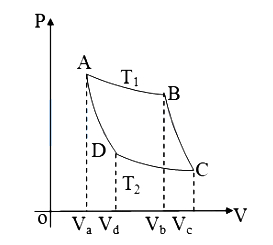
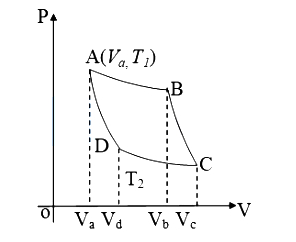
In the $P-V$ diagram shown,there are two adiabatic parts of the same gas intersecting two isothermals at $T_1$ and $T_2$. The ratio $\left(\frac{V_b}{V_a}\right)$ is equal to
A
$\left(\frac{V_c}{V_d}\right)^2$
B
$\left(\frac{V_c}{V_d}\right)$
C
$\frac{1}{2}\left(\frac{V_c}{V_d}\right)$
D
$2\left(\frac{V_c}{V_d}\right)$
Solution
(B) For an adiabatic process,the relation between temperature and volume is $T V^{\gamma-1} = \text{constant}$.
For the adiabatic path $BC$,the points $B$ and $C$ lie on the adiabatic curve connecting the isothermals $T_1$ and $T_2$. Thus:
$T_1 V_b^{\gamma-1} = T_2 V_c^{\gamma-1}$
$\Rightarrow \left(\frac{V_b}{V_c}\right)^{\gamma-1} = \frac{T_2}{T_1} \quad ---(1)$
For the adiabatic path $AD$,the points $A$ and $D$ lie on the adiabatic curve connecting the isothermals $T_1$ and $T_2$. Thus:
$T_1 V_a^{\gamma-1} = T_2 V_d^{\gamma-1}$
$\Rightarrow \left(\frac{V_a}{V_d}\right)^{\gamma-1} = \frac{T_2}{T_1} \quad ---(2)$
Equating $(1)$ and $(2)$:
$\left(\frac{V_b}{V_c}\right)^{\gamma-1} = \left(\frac{V_a}{V_d}\right)^{\gamma-1}$
$\Rightarrow \frac{V_b}{V_c} = \frac{V_a}{V_d}$
Rearranging the terms,we get:
$\frac{V_b}{V_a} = \frac{V_c}{V_d}$
Therefore,option $(B)$ is correct.
For the adiabatic path $BC$,the points $B$ and $C$ lie on the adiabatic curve connecting the isothermals $T_1$ and $T_2$. Thus:
$T_1 V_b^{\gamma-1} = T_2 V_c^{\gamma-1}$
$\Rightarrow \left(\frac{V_b}{V_c}\right)^{\gamma-1} = \frac{T_2}{T_1} \quad ---(1)$
For the adiabatic path $AD$,the points $A$ and $D$ lie on the adiabatic curve connecting the isothermals $T_1$ and $T_2$. Thus:
$T_1 V_a^{\gamma-1} = T_2 V_d^{\gamma-1}$
$\Rightarrow \left(\frac{V_a}{V_d}\right)^{\gamma-1} = \frac{T_2}{T_1} \quad ---(2)$
Equating $(1)$ and $(2)$:
$\left(\frac{V_b}{V_c}\right)^{\gamma-1} = \left(\frac{V_a}{V_d}\right)^{\gamma-1}$
$\Rightarrow \frac{V_b}{V_c} = \frac{V_a}{V_d}$
Rearranging the terms,we get:
$\frac{V_b}{V_a} = \frac{V_c}{V_d}$
Therefore,option $(B)$ is correct.
0 likesView Solution
189
PhysicsEasyMCQMHT CET · 2022
In which thermodynamic process are the change in internal energy ' $\Delta U$ ',heat supplied ' $Q$ ',and the work done in expansion ' $W$ ' all non-zero?
A
Adiabatic
B
Isobaric
C
Isothermal
D
Isochoric
Solution
(B) According to the first law of thermodynamics,$\Delta U = Q - W$.
$1$. In an adiabatic process,$Q = 0$ by definition,so it does not satisfy the condition.
$2$. In an isothermal process,the temperature remains constant,which implies $\Delta U = 0$ for an ideal gas,so it does not satisfy the condition.
$3$. In an isochoric process,the volume remains constant,which implies $W = P \Delta V = 0$,so it does not satisfy the condition.
$4$. In an isobaric process,the pressure remains constant. During expansion,the volume changes $(W \neq 0)$,the temperature changes $(\Delta U \neq 0)$,and heat is exchanged with the surroundings $(Q \neq 0)$. Therefore,all three quantities are non-zero.
$1$. In an adiabatic process,$Q = 0$ by definition,so it does not satisfy the condition.
$2$. In an isothermal process,the temperature remains constant,which implies $\Delta U = 0$ for an ideal gas,so it does not satisfy the condition.
$3$. In an isochoric process,the volume remains constant,which implies $W = P \Delta V = 0$,so it does not satisfy the condition.
$4$. In an isobaric process,the pressure remains constant. During expansion,the volume changes $(W \neq 0)$,the temperature changes $(\Delta U \neq 0)$,and heat is exchanged with the surroundings $(Q \neq 0)$. Therefore,all three quantities are non-zero.
0 likesView Solution
190
PhysicsEasyMCQMHT CET · 2022
At constant temperature, the pressure of a gas is decreased by $20 \%$. What is the percentage change in volume?
A
increase by $29 \%$
B
decreases by $25 \%$
C
increases by $25 \%$
D
decreases by $20 \%$
Solution
(C) According to Boyle's Law, at constant temperature, $PV = \text{constant}$.
Let the initial pressure be $P_1 = P$ and the initial volume be $V_1 = V$.
If the pressure is decreased by $20 \%$, the new pressure $P_2$ is $P - 0.20P = 0.8P$.
Using the relation $P_1 V_1 = P_2 V_2$:
$P \cdot V = (0.8P) \cdot V_2$
$V_2 = \frac{PV}{0.8P} = \frac{V}{0.8} = 1.25V$.
The change in volume is $\Delta V = V_2 - V_1 = 1.25V - V = 0.25V$.
The percentage change in volume is $\frac{\Delta V}{V_1} \times 100 = \frac{0.25V}{V} \times 100 = 25 \%$.
Since the value is positive, the volume increases by $25 \%$.
Let the initial pressure be $P_1 = P$ and the initial volume be $V_1 = V$.
If the pressure is decreased by $20 \%$, the new pressure $P_2$ is $P - 0.20P = 0.8P$.
Using the relation $P_1 V_1 = P_2 V_2$:
$P \cdot V = (0.8P) \cdot V_2$
$V_2 = \frac{PV}{0.8P} = \frac{V}{0.8} = 1.25V$.
The change in volume is $\Delta V = V_2 - V_1 = 1.25V - V = 0.25V$.
The percentage change in volume is $\frac{\Delta V}{V_1} \times 100 = \frac{0.25V}{V} \times 100 = 25 \%$.
Since the value is positive, the volume increases by $25 \%$.
0 likesView Solution
191
PhysicsEasyMCQMHT CET · 2022
The thermodynamic process in which the work done on or by the gas is zero is:
A
adiabatic process
B
isochoric process
C
isothermal process
D
isobaric process
Solution
(B) The work done by or on a gas is given by the formula $\Delta W = P \Delta V$,where $P$ is the pressure and $\Delta V$ is the change in volume.
For the work done to be zero,the change in volume $\Delta V$ must be zero.
This implies that the volume $V$ remains constant throughout the process.
$A$ thermodynamic process in which the volume remains constant is known as an isochoric process.
Therefore,in an isochoric process,the work done is zero.
For the work done to be zero,the change in volume $\Delta V$ must be zero.
This implies that the volume $V$ remains constant throughout the process.
$A$ thermodynamic process in which the volume remains constant is known as an isochoric process.
Therefore,in an isochoric process,the work done is zero.
0 likesView Solution
192
PhysicsEasyMCQMHT CET · 2022
$A$ monoatomic gas $(\gamma = 5/3)$ initially at $27^{\circ} C$ having volume $V$ is suddenly compressed to one-eighth of its original volume $(V/8)$. What is the final temperature after the compression (in $K$)?
A
$1160$
B
$580$
C
$1200$
D
$927$
Solution
(C) Since the compression is sudden,it is an adiabatic process.
For an adiabatic process,the relationship between temperature and volume is given by $T_1 V_1^{\gamma-1} = T_2 V_2^{\gamma-1}$.
Given: $T_1 = 27^{\circ} C = 27 + 273 = 300 \ K$,$V_1 = V$,$V_2 = V/8$,and $\gamma = 5/3$.
Substituting the values:
$T_2 = T_1 \left( \frac{V_1}{V_2} \right)^{\gamma-1}$
$T_2 = 300 \times \left( \frac{V}{V/8} \right)^{(5/3) - 1}$
$T_2 = 300 \times (8)^{2/3}$
$T_2 = 300 \times (2^3)^{2/3} = 300 \times 2^2 = 300 \times 4 = 1200 \ K$.
For an adiabatic process,the relationship between temperature and volume is given by $T_1 V_1^{\gamma-1} = T_2 V_2^{\gamma-1}$.
Given: $T_1 = 27^{\circ} C = 27 + 273 = 300 \ K$,$V_1 = V$,$V_2 = V/8$,and $\gamma = 5/3$.
Substituting the values:
$T_2 = T_1 \left( \frac{V_1}{V_2} \right)^{\gamma-1}$
$T_2 = 300 \times \left( \frac{V}{V/8} \right)^{(5/3) - 1}$
$T_2 = 300 \times (8)^{2/3}$
$T_2 = 300 \times (2^3)^{2/3} = 300 \times 2^2 = 300 \times 4 = 1200 \ K$.
0 likesView Solution
193
PhysicsEasyMCQMHT CET · 2022
In an adiabatic process,the state of a gas is changed from $P_1, V_1, T_1$ to $P_2, V_2, T_2$. Out of the following relations,the correct one is
A
$T_1 V_1^{\gamma-1} = T_2 V_2^{\gamma-1}$
B
$P_1 T_1^{\gamma-1} = P_2 T_2^{\gamma-1}$
C
$T_1 V_1^{\gamma} = T_2 V_2^{\gamma}$
D
$P_1 V_1^{\gamma-1} = P_2 V_2^{\gamma-1}$
Solution
(A) For an adiabatic process,the relationship between temperature $T$ and volume $V$ is given by the equation $T V^{\gamma-1} = \text{constant}$.
Therefore,for two different states $(P_1, V_1, T_1)$ and $(P_2, V_2, T_2)$,the relation holds as $T_1 V_1^{\gamma-1} = T_2 V_2^{\gamma-1}$.
Thus,the correct option is $A$.
Therefore,for two different states $(P_1, V_1, T_1)$ and $(P_2, V_2, T_2)$,the relation holds as $T_1 V_1^{\gamma-1} = T_2 V_2^{\gamma-1}$.
Thus,the correct option is $A$.
0 likesView Solution
194
PhysicsEasyMCQMHT CET · 2022
In a thermodynamic system,the working substance is an ideal gas. Its internal energy is in the form of
A
neither kinetic nor potential energy
B
both kinetic and potential energy
C
only potential energy
D
only kinetic energy
Solution
(D) For an ideal gas,the molecules are assumed to be point masses with no intermolecular forces of attraction or repulsion.
Since there are no intermolecular forces,there is no potential energy associated with the configuration of the molecules.
Therefore,the total internal energy of an ideal gas consists solely of the kinetic energy of its molecules due to their random motion.
Thus,the internal energy is only kinetic energy.
Since there are no intermolecular forces,there is no potential energy associated with the configuration of the molecules.
Therefore,the total internal energy of an ideal gas consists solely of the kinetic energy of its molecules due to their random motion.
Thus,the internal energy is only kinetic energy.
0 likesView Solution
195
PhysicsEasyMCQMHT CET · 2022
According to Boyle's law,the product $PV$ remains constant. The dimension of $PV$ is the same as:
A
Energy
B
Force
C
Impulse
D
Momentum
Solution
(A) The dimension of pressure $P$ is $[M^1 L^{-1} T^{-2}]$.
The dimension of volume $V$ is $[L^3]$.
Therefore,the dimension of the product $PV$ is $[M^1 L^{-1} T^{-2}] \times [L^3] = [M^1 L^2 T^{-2}]$.
Since the dimension of energy (work) is $[M^1 L^2 T^{-2}]$,the dimension of $PV$ is the same as energy.
The dimension of volume $V$ is $[L^3]$.
Therefore,the dimension of the product $PV$ is $[M^1 L^{-1} T^{-2}] \times [L^3] = [M^1 L^2 T^{-2}]$.
Since the dimension of energy (work) is $[M^1 L^2 T^{-2}]$,the dimension of $PV$ is the same as energy.
0 likesView Solution
196
PhysicsEasyMCQMHT CET · 2022
$A$ simple harmonic progressive wave is given by $Y = Y_0 \sin 2 \pi (nt - \frac{x}{\lambda})$. If the wave velocity is $(1/8)^{\text{th}}$ of the maximum particle velocity,then the wavelength is
A
$\frac{\pi Y_0}{2}$
B
$\frac{\pi Y_0}{4}$
C
$\frac{\pi Y_0}{8}$
D
$\frac{\pi Y_0}{16}$
Solution
(B) The given wave equation is $Y = Y_0 \sin(2 \pi n t - \frac{2 \pi x}{\lambda})$.
Comparing this with the standard form $Y = Y_0 \sin(\omega t - kx)$,we get angular frequency $\omega = 2 \pi n$.
The maximum particle velocity $v_{p, \text{max}} = Y_0 \omega = Y_0 (2 \pi n) = 2 \pi n Y_0$.
The wave velocity $v = n \lambda$.
According to the problem,the wave velocity is $(1/8)^{\text{th}}$ of the maximum particle velocity:
$v = \frac{1}{8} v_{p, \text{max}}$
$n \lambda = \frac{1}{8} (2 \pi n Y_0)$
$n \lambda = \frac{\pi n Y_0}{4}$
$\lambda = \frac{\pi Y_0}{4}$.
Comparing this with the standard form $Y = Y_0 \sin(\omega t - kx)$,we get angular frequency $\omega = 2 \pi n$.
The maximum particle velocity $v_{p, \text{max}} = Y_0 \omega = Y_0 (2 \pi n) = 2 \pi n Y_0$.
The wave velocity $v = n \lambda$.
According to the problem,the wave velocity is $(1/8)^{\text{th}}$ of the maximum particle velocity:
$v = \frac{1}{8} v_{p, \text{max}}$
$n \lambda = \frac{1}{8} (2 \pi n Y_0)$
$n \lambda = \frac{\pi n Y_0}{4}$
$\lambda = \frac{\pi Y_0}{4}$.
0 likesView Solution
197
PhysicsEasyMCQMHT CET · 2022
$A$ string is vibrating in its fifth overtone between two rigid supports $2.4 \ m$ apart. The distance between successive node and antinode is (in $m$)
A
$0.1$
B
$0.2$
C
$0.6$
D
$0.8$
Solution
(B) For a string fixed at both ends,the $n^{th}$ overtone corresponds to the $(n+1)^{th}$ harmonic.
Here,the fifth overtone is the sixth harmonic $(n=6)$.
The length of the string $L = 2.4 \ m$.
The condition for the $n^{th}$ harmonic is $L = n \frac{\lambda}{2}$.
Substituting the values: $2.4 = 6 \times \frac{\lambda}{2}$.
This gives $\frac{\lambda}{2} = \frac{2.4}{6} = 0.4 \ m$.
Thus,$\lambda = 0.8 \ m$.
The distance between a node and the successive antinode is always $\frac{\lambda}{4}$.
Therefore,distance $= \frac{0.8 \ m}{4} = 0.2 \ m$.
Here,the fifth overtone is the sixth harmonic $(n=6)$.
The length of the string $L = 2.4 \ m$.
The condition for the $n^{th}$ harmonic is $L = n \frac{\lambda}{2}$.
Substituting the values: $2.4 = 6 \times \frac{\lambda}{2}$.
This gives $\frac{\lambda}{2} = \frac{2.4}{6} = 0.4 \ m$.
Thus,$\lambda = 0.8 \ m$.
The distance between a node and the successive antinode is always $\frac{\lambda}{4}$.
Therefore,distance $= \frac{0.8 \ m}{4} = 0.2 \ m$.
0 likesView Solution
198
PhysicsEasyMCQMHT CET · 2022
Two waves $y_1 = 0.35 \sin(316 t)$ and $y_2 = 0.35 \sin(310 t)$ are propagating along the same direction. The number of beats produced per second is:
A
$\frac{3}{\pi}$
B
$\frac{2}{\pi}$
C
$\frac{\pi}{2}$
D
$\frac{\pi}{3}$
Solution
(A) The general equation for a wave is $y = A \sin(\omega t)$,where $\omega = 2 \pi f$.
Given $y_1 = 0.35 \sin(316 t)$,the angular frequency is $\omega_1 = 316 \text{ rad/s}$. Thus,the frequency $f_1 = \frac{\omega_1}{2 \pi} = \frac{316}{2 \pi} \text{ Hz}$.
Given $y_2 = 0.35 \sin(310 t)$,the angular frequency is $\omega_2 = 310 \text{ rad/s}$. Thus,the frequency $f_2 = \frac{\omega_2}{2 \pi} = \frac{310}{2 \pi} \text{ Hz}$.
The number of beats produced per second is the beat frequency $f_b = |f_1 - f_2|$.
$f_b = \frac{316}{2 \pi} - \frac{310}{2 \pi} = \frac{6}{2 \pi} = \frac{3}{\pi} \text{ beats per second}$.
Given $y_1 = 0.35 \sin(316 t)$,the angular frequency is $\omega_1 = 316 \text{ rad/s}$. Thus,the frequency $f_1 = \frac{\omega_1}{2 \pi} = \frac{316}{2 \pi} \text{ Hz}$.
Given $y_2 = 0.35 \sin(310 t)$,the angular frequency is $\omega_2 = 310 \text{ rad/s}$. Thus,the frequency $f_2 = \frac{\omega_2}{2 \pi} = \frac{310}{2 \pi} \text{ Hz}$.
The number of beats produced per second is the beat frequency $f_b = |f_1 - f_2|$.
$f_b = \frac{316}{2 \pi} - \frac{310}{2 \pi} = \frac{6}{2 \pi} = \frac{3}{\pi} \text{ beats per second}$.
0 likesView Solution
199
PhysicsMediumMCQMHT CET · 2022
The pitch of the whistle of an engine appears to drop by $20 \%$ of its original value when it passes a stationary observer. If the speed of sound in air is $350 \ m/s$,then the speed of the engine in $m/s$ is:
A
$1050$
B
$175$
C
$520.5$
D
$87.5$
Solution
(D) Let the original frequency be $f$. The apparent frequency $f^{\prime}$ drops by $20 \%$,so $f^{\prime} = f - 0.2f = 0.8f = \frac{4}{5}f$.
Since the frequency decreases,the source is moving away from the stationary observer.
Using the Doppler effect formula for a source moving away from a stationary observer:
$f^{\prime} = f \left[ \frac{V}{V + V_s} \right]$
where $V = 350 \ m/s$ is the speed of sound and $V_s$ is the speed of the engine.
Substituting the values:
$\frac{4}{5}f = f \left[ \frac{350}{350 + V_s} \right]$
$\frac{4}{5} = \frac{350}{350 + V_s}$
$4(350 + V_s) = 5(350)$
$1400 + 4V_s = 1750$
$4V_s = 350$
$V_s = 87.5 \ m/s$.
Since the frequency decreases,the source is moving away from the stationary observer.
Using the Doppler effect formula for a source moving away from a stationary observer:
$f^{\prime} = f \left[ \frac{V}{V + V_s} \right]$
where $V = 350 \ m/s$ is the speed of sound and $V_s$ is the speed of the engine.
Substituting the values:
$\frac{4}{5}f = f \left[ \frac{350}{350 + V_s} \right]$
$\frac{4}{5} = \frac{350}{350 + V_s}$
$4(350 + V_s) = 5(350)$
$1400 + 4V_s = 1750$
$4V_s = 350$
$V_s = 87.5 \ m/s$.
0 likesView Solution
200
PhysicsEasyMCQMHT CET · 2022
$A$ car sounding a horn of frequency $1000 \text{ Hz}$ passes an observer. The ratio of frequencies noted by the observer before and after the car passes is $11:9$. If the speed of sound is $V$,what is the speed of the car?
A
$V$
B
$\frac{V}{10}$
C
$\frac{V}{100}$
D
$\frac{V}{5}$
Solution
(B) According to the Doppler effect,the frequency heard by an observer when the source is approaching is $n_{\text{before}} = \left(\frac{V}{V - v_c}\right) n$.
When the source is receding,the frequency heard is $n_{\text{after}} = \left(\frac{V}{V + v_c}\right) n$.
Given the ratio $\frac{n_{\text{before}}}{n_{\text{after}}} = \frac{11}{9}$.
Substituting the expressions: $\frac{\frac{V}{V - v_c} n}{\frac{V}{V + v_c} n} = \frac{V + v_c}{V - v_c} = \frac{11}{9}$.
Cross-multiplying: $9(V + v_c) = 11(V - v_c)$.
$9V + 9v_c = 11V - 11v_c$.
$20v_c = 2V$.
$v_c = \frac{2V}{20} = \frac{V}{10}$.
When the source is receding,the frequency heard is $n_{\text{after}} = \left(\frac{V}{V + v_c}\right) n$.
Given the ratio $\frac{n_{\text{before}}}{n_{\text{after}}} = \frac{11}{9}$.
Substituting the expressions: $\frac{\frac{V}{V - v_c} n}{\frac{V}{V + v_c} n} = \frac{V + v_c}{V - v_c} = \frac{11}{9}$.
Cross-multiplying: $9(V + v_c) = 11(V - v_c)$.
$9V + 9v_c = 11V - 11v_c$.
$20v_c = 2V$.
$v_c = \frac{2V}{20} = \frac{V}{10}$.
0 likesView Solution
201
PhysicsEasyMCQMHT CET · 2022
Which one of the following statements is not the property of light?
A
Light involves transportation of energy.
B
Light can travel through vacuum.
C
Light requires material medium.
D
Light has finite speed.
Solution
(C) Light is an electromagnetic wave in nature.
Electromagnetic waves do not require any material medium for their propagation.
Therefore,the statement that 'Light requires a material medium' is incorrect and is not a property of light.
Electromagnetic waves do not require any material medium for their propagation.
Therefore,the statement that 'Light requires a material medium' is incorrect and is not a property of light.
0 likesView Solution
202
PhysicsEasyMCQMHT CET · 2022
If $\varepsilon_0$ and $\varepsilon$ represent the permittivity of free space and absolute permittivity of a medium,then the relative permittivity of the medium is:
A
$\frac{\varepsilon^2}{\varepsilon_0}$
B
$\frac{\varepsilon_0}{\varepsilon}$
C
$\varepsilon \varepsilon_0$
D
$\frac{\varepsilon}{\varepsilon_0}$
Solution
(D) The absolute permittivity of a medium $(\varepsilon)$ is related to the permittivity of free space $(\varepsilon_0)$ and the relative permittivity $(\varepsilon_r)$ by the formula: $\varepsilon = \varepsilon_r \varepsilon_0$.
From this relation,the relative permittivity $(\varepsilon_r)$ is given by: $\varepsilon_r = \frac{\varepsilon}{\varepsilon_0}$.
Therefore,the correct option is $D$.
From this relation,the relative permittivity $(\varepsilon_r)$ is given by: $\varepsilon_r = \frac{\varepsilon}{\varepsilon_0}$.
Therefore,the correct option is $D$.
0 likesView Solution
203
PhysicsEasyMCQMHT CET · 2022
Two point charges $q_1$ and $q_2$ are $l$ distance apart. If one of the charges is doubled and the distance between them is halved,the magnitude of force becomes $n$ times,where $n$ is
A
$8$
B
$1$
C
$2$
D
$16$
Solution
(A) The initial force between the two charges is given by Coulomb's Law: $F = k \frac{q_1 q_2}{l^2}$.
When one charge is doubled $(q_1' = 2q_1)$ and the distance is halved $(l' = l/2)$,the new force $F'$ is:
$F' = k \frac{(2q_1) q_2}{(l/2)^2}$
$F' = k \frac{2q_1 q_2}{l^2 / 4}$
$F' = 8 \left( k \frac{q_1 q_2}{l^2} \right)$
$F' = 8F$.
Thus,the magnitude of the force becomes $8$ times the original force,so $n = 8$.
When one charge is doubled $(q_1' = 2q_1)$ and the distance is halved $(l' = l/2)$,the new force $F'$ is:
$F' = k \frac{(2q_1) q_2}{(l/2)^2}$
$F' = k \frac{2q_1 q_2}{l^2 / 4}$
$F' = 8 \left( k \frac{q_1 q_2}{l^2} \right)$
$F' = 8F$.
Thus,the magnitude of the force becomes $8$ times the original force,so $n = 8$.
0 likesView Solution
204
PhysicsMediumMCQMHT CET · 2022
Two small identical metal balls are equally charged and placed at a fixed distance away from each other. They experience an electrostatic force '$F$'. $A$ similar uncharged ball,after touching one of them,is placed at the midpoint between the two balls. The force experienced by this ball is:
A
$F/2$
B
$F$
C
$4F$
D
$2F$
Solution
(B) The initial electrostatic force between two identical balls with charge $Q$ at distance $r$ is given by Coulomb's Law: $F = \frac{kQ^2}{r^2}$.
When an identical uncharged ball touches one of the charged balls,the charge $Q$ is shared equally between them. Thus,the touched ball now has charge $Q/2$ and the third ball also acquires a charge $Q/2$.
The third ball is placed at the midpoint ($r/2$ from each). Let the charges be $q_1 = Q/2$ (touched ball),$q_2 = Q$ (untouched ball),and $q_3 = Q/2$ (third ball).
The force on the third ball due to the first ball is $F_1 = \frac{k(Q/2)(Q/2)}{(r/2)^2} = \frac{kQ^2/4}{r^2/4} = \frac{kQ^2}{r^2} = F$ (directed away from the first ball).
The force on the third ball due to the second ball is $F_2 = \frac{k(Q)(Q/2)}{(r/2)^2} = \frac{kQ^2/2}{r^2/4} = \frac{2kQ^2}{r^2} = 2F$ (directed away from the second ball).
Since the forces are in opposite directions,the net force is $F_{\text{net}} = |F_2 - F_1| = |2F - F| = F$.
When an identical uncharged ball touches one of the charged balls,the charge $Q$ is shared equally between them. Thus,the touched ball now has charge $Q/2$ and the third ball also acquires a charge $Q/2$.
The third ball is placed at the midpoint ($r/2$ from each). Let the charges be $q_1 = Q/2$ (touched ball),$q_2 = Q$ (untouched ball),and $q_3 = Q/2$ (third ball).
The force on the third ball due to the first ball is $F_1 = \frac{k(Q/2)(Q/2)}{(r/2)^2} = \frac{kQ^2/4}{r^2/4} = \frac{kQ^2}{r^2} = F$ (directed away from the first ball).
The force on the third ball due to the second ball is $F_2 = \frac{k(Q)(Q/2)}{(r/2)^2} = \frac{kQ^2/2}{r^2/4} = \frac{2kQ^2}{r^2} = 2F$ (directed away from the second ball).
Since the forces are in opposite directions,the net force is $F_{\text{net}} = |F_2 - F_1| = |2F - F| = F$.
0 likesView Solution
205
PhysicsEasyMCQMHT CET · 2022
$A$ spherical conductor of diameter $6 \ mm$ is kept in a uniform electric field of intensity $2 \times 10^7 \ N/C$. The maximum charge on the conductor is $\left[\frac{1}{4 \pi \varepsilon_0} = 9 \times 10^9 \text{ SI units}\right]$. (in $\mu C$)
A
$0.2$
B
$2$
C
$20$
D
$0.02$
Solution
(D) The maximum charge $Q_{\text{max}}$ that a spherical conductor of radius $R$ can hold in an external electric field $E$ before the air around it breaks down is given by the condition where the electric field at the surface due to the charge equals the breakdown field strength. However,in this context,the formula for the induced charge capacity is $Q_{\text{max}} = 4 \pi \varepsilon_0 R^2 E$.
Given:
Diameter $d = 6 \ mm$,so radius $R = 3 \ mm = 3 \times 10^{-3} \ m$.
Electric field $E = 2 \times 10^7 \ N/C$.
Constant $\frac{1}{4 \pi \varepsilon_0} = 9 \times 10^9 \ N \cdot m^2/C^2$.
Substituting the values:
$Q_{\text{max}} = \frac{1}{9 \times 10^9} \times (3 \times 10^{-3})^2 \times (2 \times 10^7)$
$Q_{\text{max}} = \frac{1}{9 \times 10^9} \times (9 \times 10^{-6}) \times (2 \times 10^7)$
$Q_{\text{max}} = 10^{-15} \times 2 \times 10^7 = 2 \times 10^{-8} \ C$
$Q_{\text{max}} = 0.02 \times 10^{-6} \ C = 0.02 \ \mu C$.
Given:
Diameter $d = 6 \ mm$,so radius $R = 3 \ mm = 3 \times 10^{-3} \ m$.
Electric field $E = 2 \times 10^7 \ N/C$.
Constant $\frac{1}{4 \pi \varepsilon_0} = 9 \times 10^9 \ N \cdot m^2/C^2$.
Substituting the values:
$Q_{\text{max}} = \frac{1}{9 \times 10^9} \times (3 \times 10^{-3})^2 \times (2 \times 10^7)$
$Q_{\text{max}} = \frac{1}{9 \times 10^9} \times (9 \times 10^{-6}) \times (2 \times 10^7)$
$Q_{\text{max}} = 10^{-15} \times 2 \times 10^7 = 2 \times 10^{-8} \ C$
$Q_{\text{max}} = 0.02 \times 10^{-6} \ C = 0.02 \ \mu C$.
0 likesView Solution
206
PhysicsEasyMCQMHT CET · 2022
There are two metallic spheres of same radii,but one is solid and the other is hollow. Then:
A
they can be charged equally (maximum).
B
solid sphere can be given more charge.
C
hollow sphere can be given more charge.
D
solid sphere can be charged double to hollow sphere.
Solution
(A) Concept: When a conductor is charged,the charge resides entirely on its outer surface due to the mutual repulsion between like charges.
Since both spheres have the same radius,their outer surface areas are identical.
Therefore,the maximum amount of charge that can be stored on the surface before dielectric breakdown of the surrounding medium occurs is the same for both.
Thus,both metallic spheres (solid or hollow) can be charged equally.
Since both spheres have the same radius,their outer surface areas are identical.
Therefore,the maximum amount of charge that can be stored on the surface before dielectric breakdown of the surrounding medium occurs is the same for both.
Thus,both metallic spheres (solid or hollow) can be charged equally.
0 likesView Solution
207
PhysicsEasyMCQMHT CET · 2022
Two point charges $+Q$ and $+q$ repel each other with a force of $100 \,N$. Keeping the distance between them unchanged, if $Q$ is increased by $10 \%$ and $q$ is decreased by $10 \%$, the force of repulsion between them will:
A
decrease by $10 \,N$
B
decrease by $1 \,N$
C
increase by $10 \,N$
D
remain same
Solution
(B) According to Coulomb's law, the force between two point charges is given by $F = \frac{k Q q}{r^2}$.
Initially, $F_1 = \frac{k Q q}{r^2} = 100 \,N$.
When $Q$ is increased by $10 \%$, the new charge is $Q' = Q + 0.1 Q = 1.1 Q$.
When $q$ is decreased by $10 \%$, the new charge is $q' = q - 0.1 q = 0.9 q$.
The new force $F_2$ is given by $F_2 = \frac{k (1.1 Q) (0.9 q)}{r^2} = (1.1 \times 0.9) \frac{k Q q}{r^2}$.
$F_2 = 0.99 \times F_1 = 0.99 \times 100 \,N = 99 \,N$.
The change in force is $\Delta F = F_1 - F_2 = 100 \,N - 99 \,N = 1 \,N$.
Therefore, the force decreases by $1 \,N$.
Initially, $F_1 = \frac{k Q q}{r^2} = 100 \,N$.
When $Q$ is increased by $10 \%$, the new charge is $Q' = Q + 0.1 Q = 1.1 Q$.
When $q$ is decreased by $10 \%$, the new charge is $q' = q - 0.1 q = 0.9 q$.
The new force $F_2$ is given by $F_2 = \frac{k (1.1 Q) (0.9 q)}{r^2} = (1.1 \times 0.9) \frac{k Q q}{r^2}$.
$F_2 = 0.99 \times F_1 = 0.99 \times 100 \,N = 99 \,N$.
The change in force is $\Delta F = F_1 - F_2 = 100 \,N - 99 \,N = 1 \,N$.
Therefore, the force decreases by $1 \,N$.
0 likesView Solution
208
PhysicsMediumMCQMHT CET · 2022
Three equal charges $q_1, q_2$ and $q_3$ are placed on the three corners of a square of side $a$. If the force between $q_1$ and $q_2$ is $F_{12}$ and that between $q_1$ and $q_3$ is $F_{13}$,then the ratio of magnitudes $\left(\frac{F_{12}}{F_{13}}\right)$ is
A
$\frac{1}{\sqrt{2}}$
B
$\frac{1}{2}$
C
$2$
D
$\sqrt{2}$
Solution
(C) Let the side of the square be $a$. The distance between adjacent corners is $a$,and the distance between opposite corners (diagonal) is $\sqrt{2}a$.
According to Coulomb's Law,the force between two charges is $F = \frac{1}{4 \pi \varepsilon_0} \frac{q_i q_j}{r^2}$.
For charges $q_1$ and $q_2$ at adjacent corners,the distance is $r = a$. Thus,$F_{12} = \frac{1}{4 \pi \varepsilon_0} \frac{q_1 q_2}{a^2}$.
For charges $q_1$ and $q_3$ at opposite corners,the distance is $r = \sqrt{2}a$. Thus,$F_{13} = \frac{1}{4 \pi \varepsilon_0} \frac{q_1 q_3}{(\sqrt{2}a)^2} = \frac{1}{4 \pi \varepsilon_0} \frac{q_1 q_3}{2a^2}$.
Given $q_1 = q_2 = q_3 = q$,we have:
$\frac{F_{12}}{F_{13}} = \frac{\frac{1}{4 \pi \varepsilon_0} \frac{q^2}{a^2}}{\frac{1}{4 \pi \varepsilon_0} \frac{q^2}{2a^2}} = \frac{1}{1/2} = 2$.
According to Coulomb's Law,the force between two charges is $F = \frac{1}{4 \pi \varepsilon_0} \frac{q_i q_j}{r^2}$.
For charges $q_1$ and $q_2$ at adjacent corners,the distance is $r = a$. Thus,$F_{12} = \frac{1}{4 \pi \varepsilon_0} \frac{q_1 q_2}{a^2}$.
For charges $q_1$ and $q_3$ at opposite corners,the distance is $r = \sqrt{2}a$. Thus,$F_{13} = \frac{1}{4 \pi \varepsilon_0} \frac{q_1 q_3}{(\sqrt{2}a)^2} = \frac{1}{4 \pi \varepsilon_0} \frac{q_1 q_3}{2a^2}$.
Given $q_1 = q_2 = q_3 = q$,we have:
$\frac{F_{12}}{F_{13}} = \frac{\frac{1}{4 \pi \varepsilon_0} \frac{q^2}{a^2}}{\frac{1}{4 \pi \varepsilon_0} \frac{q^2}{2a^2}} = \frac{1}{1/2} = 2$.
0 likesView Solution
209
PhysicsMediumMCQMHT CET · 2022
Three charges $q, Q$ and $+4q$ are placed in a straight line of length $d$ at points at distances $0, \frac{d}{2}$ and $d$ respectively. In order to make the net force on $q$ to be zero,the value of $Q$ should be
A
$-2q$
B
$\frac{-q}{2}$
C
$-q$
D
$\frac{-3}{2}q$
Solution
(C) Let the charges be placed at positions $x=0$,$x=\frac{d}{2}$,and $x=d$ respectively.
To make the net force on the charge $q$ at $x=0$ equal to zero,the force exerted by $Q$ and the force exerted by $+4q$ must be equal in magnitude and opposite in direction.
Using Coulomb's law,the force exerted by $Q$ on $q$ is $F_Q = \frac{k q Q}{(d/2)^2}$ and the force exerted by $+4q$ on $q$ is $F_{+4q} = \frac{k q (4q)}{d^2}$.
For the net force to be zero,the sum of these forces must be zero:
$\frac{k q Q}{(d/2)^2} + \frac{k q (4q)}{d^2} = 0$
$\frac{k q Q}{d^2/4} + \frac{4 k q^2}{d^2} = 0$
$\frac{4 k q Q}{d^2} + \frac{4 k q^2}{d^2} = 0$
Dividing by $\frac{4 k q}{d^2}$ (assuming $q \neq 0$):
$Q + q = 0$
$Q = -q$
To make the net force on the charge $q$ at $x=0$ equal to zero,the force exerted by $Q$ and the force exerted by $+4q$ must be equal in magnitude and opposite in direction.
Using Coulomb's law,the force exerted by $Q$ on $q$ is $F_Q = \frac{k q Q}{(d/2)^2}$ and the force exerted by $+4q$ on $q$ is $F_{+4q} = \frac{k q (4q)}{d^2}$.
For the net force to be zero,the sum of these forces must be zero:
$\frac{k q Q}{(d/2)^2} + \frac{k q (4q)}{d^2} = 0$
$\frac{k q Q}{d^2/4} + \frac{4 k q^2}{d^2} = 0$
$\frac{4 k q Q}{d^2} + \frac{4 k q^2}{d^2} = 0$
Dividing by $\frac{4 k q}{d^2}$ (assuming $q \neq 0$):
$Q + q = 0$
$Q = -q$
0 likesView Solution
210
PhysicsEasyMCQMHT CET · 2022
An electric dipole of moment $\overrightarrow{p}$ is lying along a uniform electric field $\overrightarrow{E}$. The work done in rotating the dipole through $90^{\circ}$ is $\left[\sin 0^{\circ}=\cos 90^{\circ}=0, \cos 0^{\circ}=\sin 90^{\circ}=1\right]$
A
$pE$
B
$\sqrt{2} pE$
C
$pE / 2$
D
$2 pE$
Solution
(A) The potential energy $U$ of an electric dipole in an external electric field is given by $U = -\overrightarrow{p} \cdot \overrightarrow{E} = -pE \cos \theta$.
Initially,the dipole is lying along the electric field,so $\theta_1 = 0^{\circ}$.
Initial potential energy $U_1 = -pE \cos 0^{\circ} = -pE(1) = -pE$.
Finally,the dipole is rotated by $90^{\circ}$,so $\theta_2 = 90^{\circ}$.
Final potential energy $U_2 = -pE \cos 90^{\circ} = -pE(0) = 0$.
The work done $W$ is equal to the change in potential energy: $W = U_2 - U_1$.
$W = 0 - (-pE) = pE$.
Initially,the dipole is lying along the electric field,so $\theta_1 = 0^{\circ}$.
Initial potential energy $U_1 = -pE \cos 0^{\circ} = -pE(1) = -pE$.
Finally,the dipole is rotated by $90^{\circ}$,so $\theta_2 = 90^{\circ}$.
Final potential energy $U_2 = -pE \cos 90^{\circ} = -pE(0) = 0$.
The work done $W$ is equal to the change in potential energy: $W = U_2 - U_1$.
$W = 0 - (-pE) = pE$.
0 likesView Solution
211
PhysicsMediumMCQMHT CET · 2022
An electric dipole is as shown in the figure. The electric potential at point $P$ due to the dipole is $[\epsilon_0 = \text{permittivity of free space}]$.
A
$\frac{aq}{2 \pi \epsilon_0(x^2+a^2)}$
B
$\frac{2aq}{2 \pi \epsilon_0(x^2-a^2)}$
C
$\frac{2aq}{2 \pi \epsilon_0(x^2+a^2)}$
D
$\frac{aq}{2 \pi \epsilon_0(x^2-a^2)}$
Solution
(D) The electric potential due to a point charge $q$ at a distance $r$ is given by $V = \frac{1}{4 \pi \epsilon_0} \frac{q}{r}$.
For the given dipole,the distance of point $P$ from charge $-q$ is $(x+a)$ and from charge $+q$ is $(x-a)$.
The potential due to $-q$ is $V_{-q} = \frac{1}{4 \pi \epsilon_0} \frac{(-q)}{(x+a)}$.
The potential due to $+q$ is $V_{+q} = \frac{1}{4 \pi \epsilon_0} \frac{(+q)}{(x-a)}$.
The total potential $V_P$ at point $P$ is the algebraic sum of potentials due to individual charges:
$V_P = V_{-q} + V_{+q} = \frac{q}{4 \pi \epsilon_0} \left[ \frac{1}{x-a} - \frac{1}{x+a} \right]$.
$V_P = \frac{q}{4 \pi \epsilon_0} \left[ \frac{(x+a) - (x-a)}{(x-a)(x+a)} \right] = \frac{q}{4 \pi \epsilon_0} \left[ \frac{2a}{x^2-a^2} \right]$.
$V_P = \frac{2aq}{4 \pi \epsilon_0(x^2-a^2)} = \frac{aq}{2 \pi \epsilon_0(x^2-a^2)}$.
For the given dipole,the distance of point $P$ from charge $-q$ is $(x+a)$ and from charge $+q$ is $(x-a)$.
The potential due to $-q$ is $V_{-q} = \frac{1}{4 \pi \epsilon_0} \frac{(-q)}{(x+a)}$.
The potential due to $+q$ is $V_{+q} = \frac{1}{4 \pi \epsilon_0} \frac{(+q)}{(x-a)}$.
The total potential $V_P$ at point $P$ is the algebraic sum of potentials due to individual charges:
$V_P = V_{-q} + V_{+q} = \frac{q}{4 \pi \epsilon_0} \left[ \frac{1}{x-a} - \frac{1}{x+a} \right]$.
$V_P = \frac{q}{4 \pi \epsilon_0} \left[ \frac{(x+a) - (x-a)}{(x-a)(x+a)} \right] = \frac{q}{4 \pi \epsilon_0} \left[ \frac{2a}{x^2-a^2} \right]$.
$V_P = \frac{2aq}{4 \pi \epsilon_0(x^2-a^2)} = \frac{aq}{2 \pi \epsilon_0(x^2-a^2)}$.
0 likesView Solution
212
PhysicsEasyMCQMHT CET · 2022
An electron of mass $m_e$ and a proton of mass $m_p$ are kept in a uniform electric field. The ratio of the acceleration of electron $(a_e)$ to the acceleration of proton $(a_p)$ is
A
$\frac{m_e}{m_p}$
B
$\frac{m_p}{m_e}$
C
one
D
infinity
Solution
(B) The electrostatic force acting on a charged particle in a uniform electric field $E$ is given by $F = qE$.
For an electron,the magnitude of charge is $e$,so the force is $F_e = eE$. The acceleration is $a_e = \frac{F_e}{m_e} = \frac{eE}{m_e}$.
For a proton,the magnitude of charge is also $e$,so the force is $F_p = eE$. The acceleration is $a_p = \frac{F_p}{m_p} = \frac{eE}{m_p}$.
Taking the ratio of the acceleration of the electron to the acceleration of the proton:
$\frac{a_e}{a_p} = \frac{eE / m_e}{eE / m_p} = \frac{m_p}{m_e}$.
For an electron,the magnitude of charge is $e$,so the force is $F_e = eE$. The acceleration is $a_e = \frac{F_e}{m_e} = \frac{eE}{m_e}$.
For a proton,the magnitude of charge is also $e$,so the force is $F_p = eE$. The acceleration is $a_p = \frac{F_p}{m_p} = \frac{eE}{m_p}$.
Taking the ratio of the acceleration of the electron to the acceleration of the proton:
$\frac{a_e}{a_p} = \frac{eE / m_e}{eE / m_p} = \frac{m_p}{m_e}$.
0 likesView Solution
213
PhysicsEasyMCQMHT CET · 2022
Identify the $WRONG$ statement in the case of electric field lines.
A
They do not intersect each other.
B
They do not pass through a conductor.
C
They start from a positive charge and end on a negative charge.
D
They do not pass through an insulator.
Solution
(D) Electric field lines are imaginary lines representing the electric field.
$1$. They never intersect each other because at the point of intersection,there would be two directions for the electric field,which is impossible.
$2$. They do not pass through the interior of a conductor in electrostatic equilibrium because the electric field inside a conductor is zero.
$3$. They originate from positive charges and terminate on negative charges.
$4$. Electric field lines $CAN$ pass through insulators (dielectrics),as insulators do not have free charges to cancel the field.
Therefore,the statement that they do not pass through an insulator is incorrect.
$1$. They never intersect each other because at the point of intersection,there would be two directions for the electric field,which is impossible.
$2$. They do not pass through the interior of a conductor in electrostatic equilibrium because the electric field inside a conductor is zero.
$3$. They originate from positive charges and terminate on negative charges.
$4$. Electric field lines $CAN$ pass through insulators (dielectrics),as insulators do not have free charges to cancel the field.
Therefore,the statement that they do not pass through an insulator is incorrect.
0 likesView Solution
214
PhysicsMediumMCQMHT CET · 2022
Two parallel plates separated by $d \ mm$ are kept at a potential difference of $V \ V$. $A$ particle of mass $m$ and charge $q$ enters the region between them with some velocity. The acceleration of the particle will be
A
$\frac{q}{dmV}$
B
$\frac{qm}{Vd}$
C
$\frac{qd}{Vm}$
D
$\frac{qV}{dm}$
Solution
(D) The electric field $E$ between two parallel plates separated by a distance $d$ with a potential difference $V$ is given by $E = \frac{V}{d}$.
The force $F$ acting on a particle of charge $q$ in this electric field is $F = qE = \frac{qV}{d}$.
According to Newton's second law of motion,the acceleration $a$ is given by $a = \frac{F}{m}$.
Substituting the value of $F$,we get $a = \frac{qV}{md}$.
The force $F$ acting on a particle of charge $q$ in this electric field is $F = qE = \frac{qV}{d}$.
According to Newton's second law of motion,the acceleration $a$ is given by $a = \frac{F}{m}$.
Substituting the value of $F$,we get $a = \frac{qV}{md}$.
0 likesView Solution
215
PhysicsEasyMCQMHT CET · 2022
$A$ spherical rubber balloon carries a charge,uniformly distributed over its surface. As the balloon is blown up and increases in size,the total electric flux coming out of the surface
A
becomes zero
B
decreases
C
increases
D
remains unchanged
Solution
(D) According to Gauss's law,the total electric flux $\phi$ through a closed surface is given by $\phi = \frac{q_{enclosed}}{\varepsilon_0}$.
Here,$q_{enclosed}$ is the total charge enclosed by the surface.
When the balloon is blown up,its size increases,but the total charge $q$ on the surface of the balloon remains constant.
Since the charge enclosed by the surface does not change,the total electric flux $\phi$ passing through the surface remains unchanged.
Here,$q_{enclosed}$ is the total charge enclosed by the surface.
When the balloon is blown up,its size increases,but the total charge $q$ on the surface of the balloon remains constant.
Since the charge enclosed by the surface does not change,the total electric flux $\phi$ passing through the surface remains unchanged.
0 likesView Solution
216
PhysicsMediumMCQMHT CET · 2022
$A$ hollow cylinder has a charge $q$ inside it. If $\phi$ is the electric flux associated with the curved surface $B$,the flux linked with the plane surface $A$ will be
A
$\frac{\phi}{2}$
B
$\frac{\phi}{\epsilon_0}-\phi$
C
$\frac{1}{2}\left(\frac{q}{\epsilon_0}-\phi\right)$
D
$\frac{q}{2 \epsilon_0}$
Solution
(C) According to Gauss's Law,the total electric flux $\phi_{T}$ through a closed surface is given by $\phi_{T} = \frac{q}{\epsilon_0}$,where $q$ is the net charge enclosed by the surface.
For the given hollow cylinder,the total flux is the sum of the flux through the two plane surfaces ($A$ and $C$) and the curved surface $(B)$.
Let $\phi_A$,$\phi_B$,and $\phi_C$ be the fluxes through surfaces $A$,$B$,and $C$ respectively.
Given $\phi_B = \phi$. Due to the symmetry of the cylinder,the flux through the two plane ends must be equal,i.e.,$\phi_A = \phi_C$.
Therefore,$\phi_A + \phi_B + \phi_C = \frac{q}{\epsilon_0}$.
Substituting the values,we get $2\phi_A + \phi = \frac{q}{\epsilon_0}$.
Solving for $\phi_A$,we get $2\phi_A = \frac{q}{\epsilon_0} - \phi$,which implies $\phi_A = \frac{1}{2}\left(\frac{q}{\epsilon_0} - \phi\right)$.
For the given hollow cylinder,the total flux is the sum of the flux through the two plane surfaces ($A$ and $C$) and the curved surface $(B)$.
Let $\phi_A$,$\phi_B$,and $\phi_C$ be the fluxes through surfaces $A$,$B$,and $C$ respectively.
Given $\phi_B = \phi$. Due to the symmetry of the cylinder,the flux through the two plane ends must be equal,i.e.,$\phi_A = \phi_C$.
Therefore,$\phi_A + \phi_B + \phi_C = \frac{q}{\epsilon_0}$.
Substituting the values,we get $2\phi_A + \phi = \frac{q}{\epsilon_0}$.
Solving for $\phi_A$,we get $2\phi_A = \frac{q}{\epsilon_0} - \phi$,which implies $\phi_A = \frac{1}{2}\left(\frac{q}{\epsilon_0} - \phi\right)$.
0 likesView Solution
217
PhysicsMediumMCQMHT CET · 2022
The electric flux linked with the closed surface in $N m^2 C^{-1}$ is given by:
$\left(\varepsilon_0 = 8.85 \times 10^{-12} C^2 N^{-1} m^{-2}\right)$
$\left(\varepsilon_0 = 8.85 \times 10^{-12} C^2 N^{-1} m^{-2}\right)$
A
$10^{12}$
B
$8.85 \times 10^{-13}$
C
$10^{10}$
D
$10^{11}$
Solution
(A) According to Gauss's Law,the electric flux $\phi$ linked with a closed surface is given by $\phi = \frac{q_{enclosed}}{\varepsilon_0}$.
From the figure,the charges enclosed by the closed surface are $2.35 \ C$,$5 \ C$,$2 \ C$,and $-0.5 \ C$.
The total charge $q_{enclosed} = (2.35 + 5 + 2 - 0.5) \ C = 8.85 \ C$.
Given $\varepsilon_0 = 8.85 \times 10^{-12} \ C^2 N^{-1} m^{-2}$.
Substituting the values,we get $\phi = \frac{8.85 \ C}{8.85 \times 10^{-12} \ C^2 N^{-1} m^{-2}} = 10^{12} \ N m^2 C^{-1}$.
From the figure,the charges enclosed by the closed surface are $2.35 \ C$,$5 \ C$,$2 \ C$,and $-0.5 \ C$.
The total charge $q_{enclosed} = (2.35 + 5 + 2 - 0.5) \ C = 8.85 \ C$.
Given $\varepsilon_0 = 8.85 \times 10^{-12} \ C^2 N^{-1} m^{-2}$.
Substituting the values,we get $\phi = \frac{8.85 \ C}{8.85 \times 10^{-12} \ C^2 N^{-1} m^{-2}} = 10^{12} \ N m^2 C^{-1}$.
0 likesView Solution
218
PhysicsEasyMCQMHT CET · 2022
$A$ charge $Q \ C$ is placed at the center of a cube. If $\varepsilon_0$ is the permittivity of vacuum,then the flux through one face and two opposite faces of the cube is respectively:
A
$\frac{Q}{6 \varepsilon_0}, \frac{Q}{3 \varepsilon_0}$
B
$\frac{Q}{3 \varepsilon_0}, \frac{Q}{2 \varepsilon_0}$
C
$\frac{Q}{12 \varepsilon_0}, \frac{Q}{6 \varepsilon_0}$
D
$\frac{Q}{\varepsilon_0}, \frac{Q}{2 \varepsilon_0}$
Solution
(A) According to Gauss's Law,the total electric flux $\phi_{total}$ through a closed surface enclosing a charge $Q$ is given by $\phi_{total} = \frac{Q}{\varepsilon_0}$.
Since the charge is placed at the center of the cube,the flux is distributed equally among all $6$ faces due to symmetry.
Therefore,the flux through one face is $\phi_{one} = \frac{\phi_{total}}{6} = \frac{Q}{6 \varepsilon_0}$.
The flux through two opposite faces is the sum of the flux through each of these two faces,which is $\phi_{two} = 2 \times \phi_{one} = 2 \times \frac{Q}{6 \varepsilon_0} = \frac{Q}{3 \varepsilon_0}$.
Since the charge is placed at the center of the cube,the flux is distributed equally among all $6$ faces due to symmetry.
Therefore,the flux through one face is $\phi_{one} = \frac{\phi_{total}}{6} = \frac{Q}{6 \varepsilon_0}$.
The flux through two opposite faces is the sum of the flux through each of these two faces,which is $\phi_{two} = 2 \times \phi_{one} = 2 \times \frac{Q}{6 \varepsilon_0} = \frac{Q}{3 \varepsilon_0}$.
0 likesView Solution
219
PhysicsEasyMCQMHT CET · 2022
$A$ charge $Q$ is enclosed by a Gaussian surface of radius $R$. If the radius is doubled,then the outward electric flux will
A
be reduced to half
B
be doubled
C
remain the same
D
increase four times
Solution
(C) According to Gauss's law,the electric flux $\phi$ through any closed surface is given by the formula:
$\phi = \frac{Q_{\text{enclosed}}}{\varepsilon_0}$
Here,$Q_{\text{enclosed}}$ is the total charge enclosed by the Gaussian surface and $\varepsilon_0$ is the permittivity of free space.
From this expression,it is clear that the electric flux depends only on the magnitude of the charge enclosed within the surface.
It does not depend on the shape or the size (radius $R$) of the Gaussian surface.
Therefore,if the radius of the Gaussian surface is doubled,the enclosed charge $Q$ remains the same,and consequently,the outward electric flux will remain the same.
$\phi = \frac{Q_{\text{enclosed}}}{\varepsilon_0}$
Here,$Q_{\text{enclosed}}$ is the total charge enclosed by the Gaussian surface and $\varepsilon_0$ is the permittivity of free space.
From this expression,it is clear that the electric flux depends only on the magnitude of the charge enclosed within the surface.
It does not depend on the shape or the size (radius $R$) of the Gaussian surface.
Therefore,if the radius of the Gaussian surface is doubled,the enclosed charge $Q$ remains the same,and consequently,the outward electric flux will remain the same.
0 likesView Solution
220
PhysicsEasyMCQMHT CET · 2022
If the radius of the spherical Gaussian surface is increased,then the electric flux due to a point charge enclosed by the surface:
A
remains unchanged
B
zero
C
increases
D
decreases
Solution
(A) According to Gauss's Law,the electric flux $\Phi_E$ through a closed surface is given by $\Phi_E = \frac{q_{enclosed}}{\epsilon_0}$.
Here,$q_{enclosed}$ is the total charge enclosed by the Gaussian surface and $\epsilon_0$ is the permittivity of free space.
Since the point charge $q$ remains the same regardless of the radius of the spherical Gaussian surface,the enclosed charge $q_{enclosed} = q$ remains constant.
Therefore,the electric flux $\Phi_E = \frac{q}{\epsilon_0}$ remains unchanged when the radius of the surface is increased.
Here,$q_{enclosed}$ is the total charge enclosed by the Gaussian surface and $\epsilon_0$ is the permittivity of free space.
Since the point charge $q$ remains the same regardless of the radius of the spherical Gaussian surface,the enclosed charge $q_{enclosed} = q$ remains constant.
Therefore,the electric flux $\Phi_E = \frac{q}{\epsilon_0}$ remains unchanged when the radius of the surface is increased.
0 likesView Solution
221
PhysicsEasyMCQMHT CET · 2022
Three isolated metal spheres $A$,$B$,and $C$ have radii $R$,$2R$,and $3R$ respectively,and the same charge $Q$. If $U_A$,$U_B$,and $U_C$ are the energy densities just outside the surfaces of the spheres,then the relation between $U_A$,$U_B$,and $U_C$ is:
A
$U_A > U_B < U_C$
B
$U_A > U_B > U_C$
C
$U_A < U_B < U_C$
D
$U_A < U_B > U_C$
Solution
(B) The energy density $U$ in an electric field is given by the formula $U = \frac{1}{2} \varepsilon_0 E^2$,where $E$ is the electric field intensity.
For an isolated conducting sphere of radius $r$ carrying charge $Q$,the electric field just outside its surface is $E = \frac{1}{4 \pi \varepsilon_0} \frac{Q}{r^2}$.
Substituting this into the energy density formula: $U = \frac{1}{2} \varepsilon_0 \left( \frac{Q}{4 \pi \varepsilon_0 r^2} \right)^2 = \frac{Q^2}{32 \pi^2 \varepsilon_0 r^4}$.
Since $Q$ is constant,we have $U \propto \frac{1}{r^4}$.
Given the radii $R_A = R$,$R_B = 2R$,and $R_C = 3R$,we find:
$U_A \propto \frac{1}{R^4}$,$U_B \propto \frac{1}{(2R)^4} = \frac{1}{16R^4}$,and $U_C \propto \frac{1}{(3R)^4} = \frac{1}{81R^4}$.
Comparing these values,it is clear that $U_A > U_B > U_C$.
For an isolated conducting sphere of radius $r$ carrying charge $Q$,the electric field just outside its surface is $E = \frac{1}{4 \pi \varepsilon_0} \frac{Q}{r^2}$.
Substituting this into the energy density formula: $U = \frac{1}{2} \varepsilon_0 \left( \frac{Q}{4 \pi \varepsilon_0 r^2} \right)^2 = \frac{Q^2}{32 \pi^2 \varepsilon_0 r^4}$.
Since $Q$ is constant,we have $U \propto \frac{1}{r^4}$.
Given the radii $R_A = R$,$R_B = 2R$,and $R_C = 3R$,we find:
$U_A \propto \frac{1}{R^4}$,$U_B \propto \frac{1}{(2R)^4} = \frac{1}{16R^4}$,and $U_C \propto \frac{1}{(3R)^4} = \frac{1}{81R^4}$.
Comparing these values,it is clear that $U_A > U_B > U_C$.
0 likesView Solution
222
PhysicsEasyMCQMHT CET · 2022
Consider the following statements about electric field intensity and electric potential.
$A$. The electric field intensity due to a charged spherical shell is inversely proportional to the square of its distance from the center for points outside the shell.
$B$. The electric potential due to a point charge is inversely proportional to the distance between the charge and the point.
$A$. The electric field intensity due to a charged spherical shell is inversely proportional to the square of its distance from the center for points outside the shell.
$B$. The electric potential due to a point charge is inversely proportional to the distance between the charge and the point.
A
Both $A$ and $B$ are incorrect
B
Only $B$ is correct
C
Only $A$ is correct
D
Both $A$ and $B$ are correct
Solution
(B) Statement $A$ is incomplete as stated in the original prompt,but generally,for a point outside a charged spherical shell $(r > R)$,the electric field $E = \frac{1}{4\pi\epsilon_0} \frac{q}{r^2}$,which is inversely proportional to the square of the distance from the center. However,inside the shell $(r < R)$,the electric field is zero. Since the statement does not specify the region,it is technically ambiguous or incorrect in a general context.
Statement $B$ is correct. The electric potential $V$ due to a point charge $q$ at a distance $r$ is given by $V = \frac{1}{4\pi\epsilon_0} \frac{q}{r}$,which shows $V \propto \frac{1}{r}$.
Therefore,only statement $B$ is universally correct as stated.
Statement $B$ is correct. The electric potential $V$ due to a point charge $q$ at a distance $r$ is given by $V = \frac{1}{4\pi\epsilon_0} \frac{q}{r}$,which shows $V \propto \frac{1}{r}$.
Therefore,only statement $B$ is universally correct as stated.
0 likesView Solution
223
PhysicsDifficultMCQMHT CET · 2022
Four electric charges $+q, +q, -q$ and $-q$ are placed in order at the corners of a square of side $2r$. The electric potential at a point $P$ midway between the two negative charges is:
A
$\frac{1}{4 \pi \varepsilon_0} \frac{2q}{r}[1-\sqrt{5}]$
B
$\frac{1}{4 \pi \varepsilon_0} \frac{2q}{r}\left[\frac{1}{\sqrt{5}}+1\right]$
C
$\frac{1}{4 \pi \varepsilon_0} \frac{2q}{r}\left[\frac{1}{\sqrt{5}}-1\right]$
D
Zero
Solution
(C) Let the corners of the square be $A, B, C, D$ in order,with charges $+q$ at $A$ and $B$,and $-q$ at $C$ and $D$. The side length is $2r$. Point $P$ is the midpoint of side $CD$.
Thus,the distances are: $DP = PC = r$.
The distances from $A$ and $B$ to $P$ are: $AP = BP = \sqrt{AD^2 + DP^2} = \sqrt{(2r)^2 + r^2} = \sqrt{5r^2} = r\sqrt{5}$.
The electric potential $V_P$ at point $P$ is the sum of potentials due to all four charges:
$V_P = \frac{1}{4 \pi \varepsilon_0} \left[ \frac{q}{AP} + \frac{q}{BP} + \frac{-q}{CP} + \frac{-q}{DP} \right]$
$V_P = \frac{1}{4 \pi \varepsilon_0} \left[ \frac{q}{r\sqrt{5}} + \frac{q}{r\sqrt{5}} - \frac{q}{r} - \frac{q}{r} \right]$
$V_P = \frac{1}{4 \pi \varepsilon_0} \left[ \frac{2q}{r\sqrt{5}} - \frac{2q}{r} \right]$
$V_P = \frac{1}{4 \pi \varepsilon_0} \frac{2q}{r} \left[ \frac{1}{\sqrt{5}} - 1 \right]$
Thus,the distances are: $DP = PC = r$.
The distances from $A$ and $B$ to $P$ are: $AP = BP = \sqrt{AD^2 + DP^2} = \sqrt{(2r)^2 + r^2} = \sqrt{5r^2} = r\sqrt{5}$.
The electric potential $V_P$ at point $P$ is the sum of potentials due to all four charges:
$V_P = \frac{1}{4 \pi \varepsilon_0} \left[ \frac{q}{AP} + \frac{q}{BP} + \frac{-q}{CP} + \frac{-q}{DP} \right]$
$V_P = \frac{1}{4 \pi \varepsilon_0} \left[ \frac{q}{r\sqrt{5}} + \frac{q}{r\sqrt{5}} - \frac{q}{r} - \frac{q}{r} \right]$
$V_P = \frac{1}{4 \pi \varepsilon_0} \left[ \frac{2q}{r\sqrt{5}} - \frac{2q}{r} \right]$
$V_P = \frac{1}{4 \pi \varepsilon_0} \frac{2q}{r} \left[ \frac{1}{\sqrt{5}} - 1 \right]$
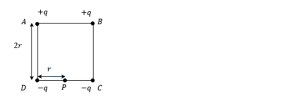
0 likesView Solution
224
PhysicsDifficultMCQMHT CET · 2022
Assume that an electric field $E=20 x^2 \hat{i}$ exists in space. If $V_0$ is the potential at the origin and $V_A$ is the potential at $x=3 \ m$,then the potential difference $V_A-V_0$ in volts is
A
-$80$
B
-$220$
C
-$180$
D
-$120$
Solution
(C) The relationship between electric field $\vec{E}$ and electric potential $V$ is given by the equation: $dV = -\vec{E} \cdot d\vec{l}$.
Given $\vec{E} = 20x^2 \hat{i}$ and $d\vec{l} = dx \hat{i}$.
Substituting these into the equation,we get: $dV = -(20x^2 \hat{i}) \cdot (dx \hat{i}) = -20x^2 dx$.
To find the potential difference $V_A - V_0$,we integrate from $x=0$ to $x=3 \ m$:
$V_A - V_0 = \int_{V_0}^{V_A} dV = \int_{0}^{3} -20x^2 dx$.
$V_A - V_0 = -20 \left[ \frac{x^3}{3} \right]_{0}^{3}$.
$V_A - V_0 = -20 \left( \frac{3^3}{3} - 0 \right) = -20 \left( \frac{27}{3} \right) = -20 \times 9 = -180 \ V$.
Given $\vec{E} = 20x^2 \hat{i}$ and $d\vec{l} = dx \hat{i}$.
Substituting these into the equation,we get: $dV = -(20x^2 \hat{i}) \cdot (dx \hat{i}) = -20x^2 dx$.
To find the potential difference $V_A - V_0$,we integrate from $x=0$ to $x=3 \ m$:
$V_A - V_0 = \int_{V_0}^{V_A} dV = \int_{0}^{3} -20x^2 dx$.
$V_A - V_0 = -20 \left[ \frac{x^3}{3} \right]_{0}^{3}$.
$V_A - V_0 = -20 \left( \frac{3^3}{3} - 0 \right) = -20 \left( \frac{27}{3} \right) = -20 \times 9 = -180 \ V$.
0 likesView Solution
225
PhysicsEasyMCQMHT CET · 2022
Three charges $Q$,$+q$,and $+q$ are placed at the vertices of a right-angled triangle as shown. The net electrostatic potential energy of the configuration is zero. The value of $Q$ is
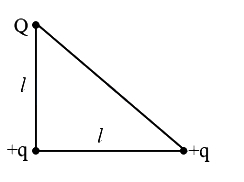
A
$-2q$
B
$-\frac{q}{1+\sqrt{2}}$
C
$+q$
D
$\frac{-\sqrt{2}q}{\sqrt{2}+1}$
Solution
(D) The total electrostatic potential energy $U$ of a system of point charges is the sum of the potential energies of all distinct pairs of charges.
For the given configuration,the pairs are $(Q, +q)$,$(+q, +q)$,and $(Q, +q)$ with distances $l$,$l$,and $\sqrt{2}l$ respectively.
The total potential energy is given by:
$U = \frac{kQq}{l} + \frac{kq^2}{l} + \frac{kQq}{\sqrt{2}l} = 0$
Dividing by $k/l$ (assuming $k \neq 0$ and $l \neq 0$):
$Qq + q^2 + \frac{Qq}{\sqrt{2}} = 0$
$Qq(1 + \frac{1}{\sqrt{2}}) = -q^2$
$Qq(\frac{\sqrt{2}+1}{\sqrt{2}}) = -q^2$
$Q = -q^2 \cdot \frac{\sqrt{2}}{q(\sqrt{2}+1)}$
$Q = -\frac{\sqrt{2}q}{\sqrt{2}+1}$
For the given configuration,the pairs are $(Q, +q)$,$(+q, +q)$,and $(Q, +q)$ with distances $l$,$l$,and $\sqrt{2}l$ respectively.
The total potential energy is given by:
$U = \frac{kQq}{l} + \frac{kq^2}{l} + \frac{kQq}{\sqrt{2}l} = 0$
Dividing by $k/l$ (assuming $k \neq 0$ and $l \neq 0$):
$Qq + q^2 + \frac{Qq}{\sqrt{2}} = 0$
$Qq(1 + \frac{1}{\sqrt{2}}) = -q^2$
$Qq(\frac{\sqrt{2}+1}{\sqrt{2}}) = -q^2$
$Q = -q^2 \cdot \frac{\sqrt{2}}{q(\sqrt{2}+1)}$
$Q = -\frac{\sqrt{2}q}{\sqrt{2}+1}$
0 likesView Solution
226
PhysicsDifficultMCQMHT CET · 2022
Two long parallel wires separated by distance '$d$' carry currents $I_1$ and $I_2$ in the same direction. They exert a force $F$ on each other. Now,the current in one of the wires is increased to three times its initial value and its direction is reversed. The distance between the wires is doubled. The magnitude of the force between them is:
A
$\frac{2 F}{3}$
B
$\frac{3 F}{2}$
C
$3 F$
D
$\frac{F}{2}$
Solution
(B) The force per unit length between two long parallel wires carrying currents $I_1$ and $I_2$ separated by a distance $d$ is given by the formula: $f = \frac{F}{l} = \frac{\mu_0 I_1 I_2}{2 \pi d}$.
Initially,the force is $F = \frac{\mu_0 I_1 I_2 l}{2 \pi d}$.
According to the problem,the new current $I_1' = 3 I_1$,the new distance $d' = 2 d$,and the current $I_2$ remains the same (the direction change only affects the nature of the force,not its magnitude).
The new force $F'$ is given by: $F' = \frac{\mu_0 (3 I_1) I_2 l}{2 \pi (2 d)}$.
Simplifying this expression,we get: $F' = \frac{3}{2} \left( \frac{\mu_0 I_1 I_2 l}{2 \pi d} \right)$.
Substituting the initial force $F$ into the equation,we get: $F' = \frac{3}{2} F$.
Initially,the force is $F = \frac{\mu_0 I_1 I_2 l}{2 \pi d}$.
According to the problem,the new current $I_1' = 3 I_1$,the new distance $d' = 2 d$,and the current $I_2$ remains the same (the direction change only affects the nature of the force,not its magnitude).
The new force $F'$ is given by: $F' = \frac{\mu_0 (3 I_1) I_2 l}{2 \pi (2 d)}$.
Simplifying this expression,we get: $F' = \frac{3}{2} \left( \frac{\mu_0 I_1 I_2 l}{2 \pi d} \right)$.
Substituting the initial force $F$ into the equation,we get: $F' = \frac{3}{2} F$.
0 likesView Solution
227
PhysicsMediumMCQMHT CET · 2022
$A$ wire of length $L$ carries a current $i$. If the wire is turned into a circular coil and kept in a uniform magnetic field $B$,the maximum magnitude of torque in the given magnetic field will be
A
$\frac{B i L^2}{4 \pi}$
B
$\frac{B i L^2}{2 \pi}$
C
$\frac{B^2 L^2}{2}$
D
$\frac{B i L^2}{2}$
Solution
(A) The torque $\tau$ on a current-carrying loop in a magnetic field is given by $\tau = N i A B \sin \theta$,where $N$ is the number of turns,$i$ is the current,$A$ is the area,$B$ is the magnetic field,and $\theta$ is the angle between the normal to the loop and the magnetic field.
For a wire of length $L$ formed into a circular coil of $N$ turns with radius $r$,the circumference is $L = N(2 \pi r)$,so $r = \frac{L}{2 \pi N}$.
The area of the coil is $A = \pi r^2 = \pi \left( \frac{L}{2 \pi N} \right)^2 = \frac{L^2}{4 \pi N^2}$.
Substituting $A$ into the torque equation: $\tau = N i \left( \frac{L^2}{4 \pi N^2} \right) B \sin \theta = \frac{i L^2 B \sin \theta}{4 \pi N}$.
To maximize the torque,we set $\sin \theta = 1$ and choose the minimum number of turns,$N = 1$.
Therefore,the maximum torque is $\tau_{\max} = \frac{i L^2 B}{4 \pi}$.
For a wire of length $L$ formed into a circular coil of $N$ turns with radius $r$,the circumference is $L = N(2 \pi r)$,so $r = \frac{L}{2 \pi N}$.
The area of the coil is $A = \pi r^2 = \pi \left( \frac{L}{2 \pi N} \right)^2 = \frac{L^2}{4 \pi N^2}$.
Substituting $A$ into the torque equation: $\tau = N i \left( \frac{L^2}{4 \pi N^2} \right) B \sin \theta = \frac{i L^2 B \sin \theta}{4 \pi N}$.
To maximize the torque,we set $\sin \theta = 1$ and choose the minimum number of turns,$N = 1$.
Therefore,the maximum torque is $\tau_{\max} = \frac{i L^2 B}{4 \pi}$.
0 likesView Solution
228
PhysicsEasyMCQMHT CET · 2022
$A$ rectangular coil of effective area $0.05 \ m^2$ is suspended freely in a radial magnetic field of $0.01 \ Wb/m^2$. The torsional constant of the suspension fiber is $5 \times 10^{-9} \ Nm/\text{degree}$. If a current of $300 \ \mu A$ is passed through it,then the angle through which the coil rotates is (in $^{\circ}$)
A
$60$
B
$30$
C
$45$
D
$90$
Solution
(B) The torque on a current-carrying coil in a magnetic field is given by $\tau = NIAB \sin \theta$. For a radial magnetic field,the plane of the coil is always parallel to the magnetic field,so $\theta = 90^{\circ}$ and $\sin 90^{\circ} = 1$.
Thus,the magnetic torque is $\tau_m = NIAB$.
The restoring torque provided by the suspension fiber is $\tau_r = K \phi$,where $K$ is the torsional constant and $\phi$ is the angle of rotation.
Equating the two torques for equilibrium: $NIAB = K \phi$.
Given: $A = 0.05 \ m^2$,$B = 0.01 \ Wb/m^2$,$K = 5 \times 10^{-9} \ Nm/\text{degree}$,$I = 300 \ \mu A = 300 \times 10^{-6} \ A$,and assuming $N = 1$.
Substituting the values: $\phi = \frac{NIAB}{K} = \frac{1 \times 300 \times 10^{-6} \times 0.01 \times 0.05}{5 \times 10^{-9}}$.
$\phi = \frac{300 \times 10^{-6} \times 5 \times 10^{-4}}{5 \times 10^{-9}} = \frac{300 \times 10^{-10}}{5 \times 10^{-9}} = 60 \times 10^{-1} = 6^{\circ}$.
Wait,re-calculating: $\phi = \frac{300 \times 10^{-6} \times 0.0005}{5 \times 10^{-9}} = \frac{150000 \times 10^{-12}}{5 \times 10^{-9}} = 30000 \times 10^{-3} = 30^{\circ}$.
Therefore,the angle of rotation is $30^{\circ}$.
Thus,the magnetic torque is $\tau_m = NIAB$.
The restoring torque provided by the suspension fiber is $\tau_r = K \phi$,where $K$ is the torsional constant and $\phi$ is the angle of rotation.
Equating the two torques for equilibrium: $NIAB = K \phi$.
Given: $A = 0.05 \ m^2$,$B = 0.01 \ Wb/m^2$,$K = 5 \times 10^{-9} \ Nm/\text{degree}$,$I = 300 \ \mu A = 300 \times 10^{-6} \ A$,and assuming $N = 1$.
Substituting the values: $\phi = \frac{NIAB}{K} = \frac{1 \times 300 \times 10^{-6} \times 0.01 \times 0.05}{5 \times 10^{-9}}$.
$\phi = \frac{300 \times 10^{-6} \times 5 \times 10^{-4}}{5 \times 10^{-9}} = \frac{300 \times 10^{-10}}{5 \times 10^{-9}} = 60 \times 10^{-1} = 6^{\circ}$.
Wait,re-calculating: $\phi = \frac{300 \times 10^{-6} \times 0.0005}{5 \times 10^{-9}} = \frac{150000 \times 10^{-12}}{5 \times 10^{-9}} = 30000 \times 10^{-3} = 30^{\circ}$.
Therefore,the angle of rotation is $30^{\circ}$.
0 likesView Solution
229
PhysicsEasyMCQMHT CET · 2022
Two thin long parallel wires of the same material are separated by a distance '$r$'. Both carry the same current '$I$' in the same direction. Hence,they will ($\mu_0 =$ permeability of free space.)
A
Attract each other with a force $\frac{\mu_0 I^2}{2r}$ per unit length
B
Repel each other with a force $\frac{\mu_0 I^2}{2\pi r}$ per unit length
C
Attract each other with a force $\frac{\mu_0 I^2}{2\pi r}$ per unit length
D
Repel each other with a force $\frac{\mu_0 I^2}{2r}$ per unit length
Solution
(C) The force per unit length between two long parallel current-carrying conductors is given by the formula $F = \frac{\mu_0 I_1 I_2}{2\pi r}$.
Here,$r$ is the separation distance,and $I_1$ and $I_2$ are the currents in the conductors.
According to the right-hand rule,when two parallel wires carry current in the same direction,they exert an attractive force on each other.
Given that $I_1 = I_2 = I$,the magnitude of the force per unit length is $F = \frac{\mu_0 I^2}{2\pi r}$.
Therefore,the wires attract each other with a force of $\frac{\mu_0 I^2}{2\pi r}$ per unit length.
Here,$r$ is the separation distance,and $I_1$ and $I_2$ are the currents in the conductors.
According to the right-hand rule,when two parallel wires carry current in the same direction,they exert an attractive force on each other.
Given that $I_1 = I_2 = I$,the magnitude of the force per unit length is $F = \frac{\mu_0 I^2}{2\pi r}$.
Therefore,the wires attract each other with a force of $\frac{\mu_0 I^2}{2\pi r}$ per unit length.
0 likesView Solution
230
PhysicsEasyMCQMHT CET · 2022
If the distance between two current-carrying parallel wires is made $\left(\frac{1}{3}\right)^{rd}$ of its original value,then the magnitude of the force between them (the same current is passing through both wires) is:
A
tripled.
B
$6$ times.
C
$9$ times.
D
remains the same.
Solution
(A) The force per unit length between two parallel wires carrying currents $I_1$ and $I_2$ separated by a distance $d$ is given by the formula: $F = \frac{\mu_0 I_1 I_2}{2 \pi d}$.
Since the current in both wires remains the same,the force is inversely proportional to the distance between them: $F \propto \frac{1}{d}$.
If the new distance $d' = \frac{d}{3}$,the new force $F'$ will be: $F' = \frac{\mu_0 I_1 I_2}{2 \pi (d/3)} = 3 \times \left( \frac{\mu_0 I_1 I_2}{2 \pi d} \right) = 3F$.
Therefore,the magnitude of the force becomes $3$ times the original value.
Since the current in both wires remains the same,the force is inversely proportional to the distance between them: $F \propto \frac{1}{d}$.
If the new distance $d' = \frac{d}{3}$,the new force $F'$ will be: $F' = \frac{\mu_0 I_1 I_2}{2 \pi (d/3)} = 3 \times \left( \frac{\mu_0 I_1 I_2}{2 \pi d} \right) = 3F$.
Therefore,the magnitude of the force becomes $3$ times the original value.
0 likesView Solution
231
PhysicsDifficultMCQMHT CET · 2022
Three long straight and parallel wires carrying currents are arranged as shown. The wire $C$ which carries a current of $50 \,A$ is so placed that it experiences no force. The distance of wire $C$ from wire $A$ is (in $\,cm$)
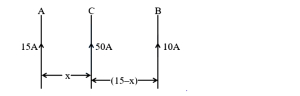
A
$3$
B
$5$
C
$9$
D
$7$
Solution
(C) The correct option is $C$.
Concept: For a wire to experience no force, the net magnetic field at its position due to the other two wires must be zero.
The magnetic field $B$ due to a long straight wire carrying current $I$ at a distance $r$ is given by $B = \frac{\mu_0 I}{2 \pi r}$.
Let $x$ be the distance of wire $C$ from wire $A$. The distance of wire $C$ from wire $B$ is $(15 - x) \,cm$.
For the net magnetic field at $C$ to be zero, the magnetic fields produced by wire $A$ and wire $B$ must be equal in magnitude and opposite in direction.
$\frac{\mu_0 I_A}{2 \pi x} = \frac{\mu_0 I_B}{2 \pi (15 - x)}$
$\frac{I_A}{x} = \frac{I_B}{15 - x}$
Given $I_A = 15 \,A$ and $I_B = 10 \,A$:
$\frac{15}{x} = \frac{10}{15 - x}$
$15(15 - x) = 10x$
$225 - 15x = 10x$
$25x = 225$
$x = 9 \,cm$.
Concept: For a wire to experience no force, the net magnetic field at its position due to the other two wires must be zero.
The magnetic field $B$ due to a long straight wire carrying current $I$ at a distance $r$ is given by $B = \frac{\mu_0 I}{2 \pi r}$.
Let $x$ be the distance of wire $C$ from wire $A$. The distance of wire $C$ from wire $B$ is $(15 - x) \,cm$.
For the net magnetic field at $C$ to be zero, the magnetic fields produced by wire $A$ and wire $B$ must be equal in magnitude and opposite in direction.
$\frac{\mu_0 I_A}{2 \pi x} = \frac{\mu_0 I_B}{2 \pi (15 - x)}$
$\frac{I_A}{x} = \frac{I_B}{15 - x}$
Given $I_A = 15 \,A$ and $I_B = 10 \,A$:
$\frac{15}{x} = \frac{10}{15 - x}$
$15(15 - x) = 10x$
$225 - 15x = 10x$
$25x = 225$
$x = 9 \,cm$.
0 likesView Solution
232
PhysicsEasyMCQMHT CET · 2022
In the current-carrying conductor $(AOCDEFG)$ as shown,the magnetic induction at the point $O$ is ($R_1$ and $R_2$ are radii of arcs $CD$ and $EF$ respectively,$I$ = current in the loop,$\mu_0$ = permeability of free space).
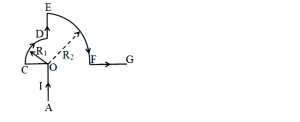
A
$\frac{\mu_0 I}{8}\left(\frac{R_1+R_2}{R_1-R_2}\right)$
B
$\frac{\mu_0 I}{8}\left(\frac{R_1+R_2}{R_1 R_2}\right)$
C
$\frac{\mu_0 I}{8}\left(\frac{R_1 R_2}{R_1-R_2}\right)$
D
$\frac{\mu_0 I}{8}\left(\frac{R_1 R_2}{R_1+R_2}\right)$
Solution
(B) Using the Biot-Savart law,the magnetic field at a point on the axis of a straight current-carrying conductor is zero. Therefore,the magnetic fields due to the straight segments $AO$,$OC$,$DE$,and $FG$ are zero at point $O$.
The magnetic field at the center of a full circular loop is $B = \frac{\mu_0 I}{2R}$.
For a circular arc subtending an angle $\theta$ at the center,the magnetic field is $B = \frac{\mu_0 I \theta}{4\pi R}$.
Here,both arcs $CD$ and $EF$ subtend an angle of $90^\circ$ or $\frac{\pi}{2}$ radians at point $O$.
For arc $CD$ with radius $R_1$:
$B_{CD} = \frac{\mu_0 I (\pi/2)}{4\pi R_1} = \frac{\mu_0 I}{8 R_1}$ (directed into the plane of the paper).
For arc $EF$ with radius $R_2$:
$B_{EF} = \frac{\mu_0 I (\pi/2)}{4\pi R_2} = \frac{\mu_0 I}{8 R_2}$ (directed into the plane of the paper).
Since both fields are in the same direction,the total magnetic field at $O$ is:
$B = B_{CD} + B_{EF} = \frac{\mu_0 I}{8 R_1} + \frac{\mu_0 I}{8 R_2} = \frac{\mu_0 I}{8} \left( \frac{1}{R_1} + \frac{1}{R_2} \right) = \frac{\mu_0 I}{8} \left( \frac{R_1 + R_2}{R_1 R_2} \right)$.
The magnetic field at the center of a full circular loop is $B = \frac{\mu_0 I}{2R}$.
For a circular arc subtending an angle $\theta$ at the center,the magnetic field is $B = \frac{\mu_0 I \theta}{4\pi R}$.
Here,both arcs $CD$ and $EF$ subtend an angle of $90^\circ$ or $\frac{\pi}{2}$ radians at point $O$.
For arc $CD$ with radius $R_1$:
$B_{CD} = \frac{\mu_0 I (\pi/2)}{4\pi R_1} = \frac{\mu_0 I}{8 R_1}$ (directed into the plane of the paper).
For arc $EF$ with radius $R_2$:
$B_{EF} = \frac{\mu_0 I (\pi/2)}{4\pi R_2} = \frac{\mu_0 I}{8 R_2}$ (directed into the plane of the paper).
Since both fields are in the same direction,the total magnetic field at $O$ is:
$B = B_{CD} + B_{EF} = \frac{\mu_0 I}{8 R_1} + \frac{\mu_0 I}{8 R_2} = \frac{\mu_0 I}{8} \left( \frac{1}{R_1} + \frac{1}{R_2} \right) = \frac{\mu_0 I}{8} \left( \frac{R_1 + R_2}{R_1 R_2} \right)$.
0 likesView Solution
233
PhysicsDifficultMCQMHT CET · 2022
Two identical long parallel wires carry currents $I_1$ and $I_2$ such that $I_1 > I_2$. When the currents are in the same direction,the magnetic field at a point midway between the wires is $6 \times 10^{-6} \ T$. If the direction of $I_2$ is reversed,the field becomes $3 \times 10^{-5} \ T$. The ratio $\left(\frac{I_1}{I_2}\right)$ is-
A
$\frac{3}{4}$
B
$\frac{1}{2}$
C
$\frac{2}{3}$
D
$\frac{3}{2}$
Solution
(D) Let the distance between the wires be $2r$. The distance from each wire to the midpoint is $r$. The magnetic field due to a long wire at distance $r$ is $B = \frac{\mu_0 I}{2 \pi r}$.
When currents are in the same direction,the fields at the midpoint are in opposite directions. The net field is $B_1 = \frac{\mu_0}{2 \pi r} (I_1 - I_2) = 6 \times 10^{-6} \ T$.
When the direction of $I_2$ is reversed,the fields at the midpoint are in the same direction. The net field is $B_2 = \frac{\mu_0}{2 \pi r} (I_1 + I_2) = 3 \times 10^{-5} \ T$.
Dividing the two equations: $\frac{I_1 - I_2}{I_1 + I_2} = \frac{6 \times 10^{-6}}{3 \times 10^{-5}} = \frac{6}{30} = \frac{1}{5}$.
$5(I_1 - I_2) = I_1 + I_2 \implies 5I_1 - 5I_2 = I_1 + I_2 \implies 4I_1 = 6I_2$.
Therefore,$\frac{I_1}{I_2} = \frac{6}{4} = \frac{3}{2}$.
When currents are in the same direction,the fields at the midpoint are in opposite directions. The net field is $B_1 = \frac{\mu_0}{2 \pi r} (I_1 - I_2) = 6 \times 10^{-6} \ T$.
When the direction of $I_2$ is reversed,the fields at the midpoint are in the same direction. The net field is $B_2 = \frac{\mu_0}{2 \pi r} (I_1 + I_2) = 3 \times 10^{-5} \ T$.
Dividing the two equations: $\frac{I_1 - I_2}{I_1 + I_2} = \frac{6 \times 10^{-6}}{3 \times 10^{-5}} = \frac{6}{30} = \frac{1}{5}$.
$5(I_1 - I_2) = I_1 + I_2 \implies 5I_1 - 5I_2 = I_1 + I_2 \implies 4I_1 = 6I_2$.
Therefore,$\frac{I_1}{I_2} = \frac{6}{4} = \frac{3}{2}$.
0 likesView Solution
234
PhysicsDifficultMCQMHT CET · 2022
Two circular coils $1$ and $2$ are made from the same wire,but the radius of the first coil is twice that of the second coil. What is the ratio of the potential difference applied across them so that the magnetic field at their centres is the same?
A
$2: 1$
B
$4: 1$
C
$1: 2$
D
$1: 4$
Solution
(B) The magnetic field at the center of a circular coil is given by $B = \frac{\mu_0 i}{2r}$.
Given that $B_1 = B_2$,we have $\frac{i_1}{r_1} = \frac{i_2}{r_2}$.
Since $r_1 = 2r_2$,we get $\frac{i_1}{2r_2} = \frac{i_2}{r_2}$,which implies $i_1 = 2i_2$.
The resistance of a wire is $R = \rho \frac{L}{A}$. Since both coils are made of the same wire,$\rho$ and $A$ are constant. The length $L = 2\pi r$.
Thus,$R_1 = 2\pi r_1$ and $R_2 = 2\pi r_2$. Since $r_1 = 2r_2$,$R_1 = 2R_2$.
The potential difference is $V = iR$. Therefore,$\frac{V_1}{V_2} = \frac{i_1 R_1}{i_2 R_2}$.
Substituting the values: $\frac{V_1}{V_2} = \frac{(2i_2)(2R_2)}{i_2 R_2} = 4$.
Thus,the ratio is $4: 1$.
Given that $B_1 = B_2$,we have $\frac{i_1}{r_1} = \frac{i_2}{r_2}$.
Since $r_1 = 2r_2$,we get $\frac{i_1}{2r_2} = \frac{i_2}{r_2}$,which implies $i_1 = 2i_2$.
The resistance of a wire is $R = \rho \frac{L}{A}$. Since both coils are made of the same wire,$\rho$ and $A$ are constant. The length $L = 2\pi r$.
Thus,$R_1 = 2\pi r_1$ and $R_2 = 2\pi r_2$. Since $r_1 = 2r_2$,$R_1 = 2R_2$.
The potential difference is $V = iR$. Therefore,$\frac{V_1}{V_2} = \frac{i_1 R_1}{i_2 R_2}$.
Substituting the values: $\frac{V_1}{V_2} = \frac{(2i_2)(2R_2)}{i_2 R_2} = 4$.
Thus,the ratio is $4: 1$.
0 likesView Solution
235
PhysicsMediumMCQMHT CET · 2022
$A$ toroid has a core of inner radius $r_1$ and outer radius $r_2$,around which $N$ turns of wire are wound. If the current in the wire is $I$,then the magnetic field inside the toroid is $(\mu_0 = \text{permeability of free space})$
A
$\frac{\mu_0 N I}{2 \pi(r_1+r_2)}$
B
$\frac{\mu_0 N I}{\pi(r_1+r_2)}$
C
$\frac{\mu_0 N I}{2 \pi(r_2-r_1)}$
D
$\frac{\mu_0 N I}{\pi(r_2-r_1)}$
Solution
(B) To find the magnetic field inside the toroid,we use Ampere's Circuital Law.
Consider an Amperian loop of radius $r$ inside the toroid,where $r = \frac{r_1 + r_2}{2}$.
According to Ampere's Law: $\oint \vec{B} \cdot d\vec{l} = \mu_0 I_{\text{enclosed}}$.
Since the magnetic field $B$ is uniform along the circular path and parallel to the length element $d\vec{l}$,the angle between them is $0^\circ$.
Thus,$B \oint dl = \mu_0 N I$.
The circumference of the loop is $2 \pi r = 2 \pi \left( \frac{r_1 + r_2}{2} \right) = \pi(r_1 + r_2)$.
Substituting this into the equation: $B \cdot \pi(r_1 + r_2) = \mu_0 N I$.
Therefore,the magnetic field is $B = \frac{\mu_0 N I}{\pi(r_1 + r_2)}$.
Consider an Amperian loop of radius $r$ inside the toroid,where $r = \frac{r_1 + r_2}{2}$.
According to Ampere's Law: $\oint \vec{B} \cdot d\vec{l} = \mu_0 I_{\text{enclosed}}$.
Since the magnetic field $B$ is uniform along the circular path and parallel to the length element $d\vec{l}$,the angle between them is $0^\circ$.
Thus,$B \oint dl = \mu_0 N I$.
The circumference of the loop is $2 \pi r = 2 \pi \left( \frac{r_1 + r_2}{2} \right) = \pi(r_1 + r_2)$.
Substituting this into the equation: $B \cdot \pi(r_1 + r_2) = \mu_0 N I$.
Therefore,the magnetic field is $B = \frac{\mu_0 N I}{\pi(r_1 + r_2)}$.
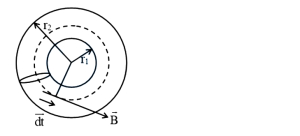
0 likesView Solution
236
PhysicsMediumMCQMHT CET · 2022
$A$ wire of certain length carries a steady current. It is first bent to form a circular coil of one turn. The same wire is then bent to form a circular coil of three turns. The ratio of magnetic inductions at the centre of the coil in the two cases is
A
$1$:$9$
B
$1$:$3$
C
$3$:$1$
D
$9$:$1$
Solution
(A) The magnetic field $B$ at the centre of a circular coil with $N$ turns,radius $r$,and current $I$ is given by $B = \frac{\mu_0 N I}{2r}$.
Let the total length of the wire be $L$.
For a single turn $(N_1 = 1)$,the circumference is $2 \pi r_1 = L$,so $r_1 = \frac{L}{2 \pi}$.
The magnetic field is $B_1 = \frac{\mu_0 (1) I}{2 (L / 2 \pi)} = \frac{\mu_0 I \pi}{L}$.
For three turns $(N_2 = 3)$,the total length is $3(2 \pi r_2) = L$,so $r_2 = \frac{L}{6 \pi}$.
The magnetic field is $B_2 = \frac{\mu_0 (3) I}{2 (L / 6 \pi)} = \frac{9 \mu_0 I \pi}{L}$.
The ratio of the magnetic inductions is $\frac{B_1}{B_2} = \frac{\mu_0 I \pi / L}{9 \mu_0 I \pi / L} = \frac{1}{9}$.
Let the total length of the wire be $L$.
For a single turn $(N_1 = 1)$,the circumference is $2 \pi r_1 = L$,so $r_1 = \frac{L}{2 \pi}$.
The magnetic field is $B_1 = \frac{\mu_0 (1) I}{2 (L / 2 \pi)} = \frac{\mu_0 I \pi}{L}$.
For three turns $(N_2 = 3)$,the total length is $3(2 \pi r_2) = L$,so $r_2 = \frac{L}{6 \pi}$.
The magnetic field is $B_2 = \frac{\mu_0 (3) I}{2 (L / 6 \pi)} = \frac{9 \mu_0 I \pi}{L}$.
The ratio of the magnetic inductions is $\frac{B_1}{B_2} = \frac{\mu_0 I \pi / L}{9 \mu_0 I \pi / L} = \frac{1}{9}$.
0 likesView Solution
237
PhysicsMediumMCQMHT CET · 2022
Two parallel conducting wires of equal length are placed distance $d$ apart and carry currents $I_1$ and $I_2$ respectively in opposite directions. The resultant magnetic field at the midpoint of the distance between both the wires is
A
$\frac{\mu_0(I_1-I_2)}{2\pi d}$
B
$\frac{\mu_0(I_1+I_2)}{2\pi d}$
C
$\frac{\mu_0(I_1+I_2)}{\pi d}$
D
$\frac{\mu_0(I_1-I_2)}{\pi d}$
Solution
(C) The magnetic field $B$ produced by a long straight current-carrying wire at a distance $r$ is given by $B = \frac{\mu_0 I}{2\pi r}$.
Since the currents $I_1$ and $I_2$ are in opposite directions,by the Right-Hand Thumb Rule,the magnetic fields produced by both wires at the midpoint will point in the same direction.
Therefore,the resultant magnetic field is the sum of the individual fields: $B_{net} = B_1 + B_2$.
The distance of the midpoint from each wire is $r = \frac{d}{2}$.
Substituting the values: $B_{net} = \frac{\mu_0 I_1}{2\pi(d/2)} + \frac{\mu_0 I_2}{2\pi(d/2)}$.
Simplifying the expression: $B_{net} = \frac{\mu_0 I_1}{\pi d} + \frac{\mu_0 I_2}{\pi d} = \frac{\mu_0(I_1+I_2)}{\pi d}$.
Since the currents $I_1$ and $I_2$ are in opposite directions,by the Right-Hand Thumb Rule,the magnetic fields produced by both wires at the midpoint will point in the same direction.
Therefore,the resultant magnetic field is the sum of the individual fields: $B_{net} = B_1 + B_2$.
The distance of the midpoint from each wire is $r = \frac{d}{2}$.
Substituting the values: $B_{net} = \frac{\mu_0 I_1}{2\pi(d/2)} + \frac{\mu_0 I_2}{2\pi(d/2)}$.
Simplifying the expression: $B_{net} = \frac{\mu_0 I_1}{\pi d} + \frac{\mu_0 I_2}{\pi d} = \frac{\mu_0(I_1+I_2)}{\pi d}$.
0 likesView Solution
238
PhysicsMediumMCQMHT CET · 2022
$A$ long wire carries a steady current. It is bent into a coil of one turn such that the magnetic induction at the centre is $B$. If the same wire is bent to form a coil of smaller radius with $n$ turns,then the new magnetic induction $B^{\prime}$ at the centre is:
A
$B^{\prime} = B / n^2$
B
$B^{\prime} = n B$
C
$B^{\prime} = B$
D
$B^{\prime} = n^2 B$
Solution
(D) The magnetic field at the center of a circular coil of $N$ turns,radius $r$,and current $I$ is given by $B = \frac{N \mu_0 I}{2r}$.
Initially,for one turn $(N=1)$ and radius $r$,the magnetic field is $B = \frac{\mu_0 I}{2r}$.
When the same wire of length $L = 2 \pi r$ is bent into $n$ turns,the new radius $r^{\prime}$ is given by $L = n(2 \pi r^{\prime})$,which implies $r^{\prime} = \frac{r}{n}$.
The new magnetic field $B^{\prime}$ is $B^{\prime} = \frac{n \mu_0 I}{2r^{\prime}}$.
Substituting $r^{\prime} = \frac{r}{n}$ into the expression for $B^{\prime}$:
$B^{\prime} = \frac{n \mu_0 I}{2(r/n)} = n^2 \left( \frac{\mu_0 I}{2r} \right) = n^2 B$.
Initially,for one turn $(N=1)$ and radius $r$,the magnetic field is $B = \frac{\mu_0 I}{2r}$.
When the same wire of length $L = 2 \pi r$ is bent into $n$ turns,the new radius $r^{\prime}$ is given by $L = n(2 \pi r^{\prime})$,which implies $r^{\prime} = \frac{r}{n}$.
The new magnetic field $B^{\prime}$ is $B^{\prime} = \frac{n \mu_0 I}{2r^{\prime}}$.
Substituting $r^{\prime} = \frac{r}{n}$ into the expression for $B^{\prime}$:
$B^{\prime} = \frac{n \mu_0 I}{2(r/n)} = n^2 \left( \frac{\mu_0 I}{2r} \right) = n^2 B$.
0 likesView Solution
239
PhysicsDifficultMCQMHT CET · 2022
$A$ current carrying circular coil of radius $R$ has a point $P$ situated on its axis at a distance $x$ from its centre $O$ of the coil. The magnetic induction at point $P$ is $\left(\frac{1}{8}\right)^{\text{th}}$ of the magnetic field at its centre $O$. The value of $x$ is
A
$\frac{R}{2 \sqrt{3}}$
B
$\sqrt{3} R$
C
$\frac{R}{\sqrt{3}}$
D
$\frac{2}{\sqrt{3}} R$
Solution
(B) The magnetic field $B$ on the axis of a circular coil of radius $R$ carrying current $I$ at a distance $x$ from its center is given by: $B = \frac{\mu_0 I R^2}{2(R^2 + x^2)^{3/2}}$.
At the center of the coil $(x = 0)$,the magnetic field $B_0$ is: $B_0 = \frac{\mu_0 I}{2R}$.
According to the problem,the magnetic field at point $P$ is $\frac{1}{8}$ of the field at the center: $B_P = \frac{1}{8} B_0$.
Substituting the expressions: $\frac{\mu_0 I R^2}{2(R^2 + x^2)^{3/2}} = \frac{1}{8} \left( \frac{\mu_0 I}{2R} \right)$.
Simplifying the equation: $\frac{R^2}{(R^2 + x^2)^{3/2}} = \frac{1}{8R} \Rightarrow \frac{R^3}{(R^2 + x^2)^{3/2}} = \frac{1}{8}$.
Taking the cube root of both sides: $\frac{R}{(R^2 + x^2)^{1/2}} = \frac{1}{2}$.
Squaring both sides: $\frac{R^2}{R^2 + x^2} = \frac{1}{4}$.
Cross-multiplying: $4R^2 = R^2 + x^2 \Rightarrow x^2 = 3R^2 \Rightarrow x = \sqrt{3}R$.
At the center of the coil $(x = 0)$,the magnetic field $B_0$ is: $B_0 = \frac{\mu_0 I}{2R}$.
According to the problem,the magnetic field at point $P$ is $\frac{1}{8}$ of the field at the center: $B_P = \frac{1}{8} B_0$.
Substituting the expressions: $\frac{\mu_0 I R^2}{2(R^2 + x^2)^{3/2}} = \frac{1}{8} \left( \frac{\mu_0 I}{2R} \right)$.
Simplifying the equation: $\frac{R^2}{(R^2 + x^2)^{3/2}} = \frac{1}{8R} \Rightarrow \frac{R^3}{(R^2 + x^2)^{3/2}} = \frac{1}{8}$.
Taking the cube root of both sides: $\frac{R}{(R^2 + x^2)^{1/2}} = \frac{1}{2}$.
Squaring both sides: $\frac{R^2}{R^2 + x^2} = \frac{1}{4}$.
Cross-multiplying: $4R^2 = R^2 + x^2 \Rightarrow x^2 = 3R^2 \Rightarrow x = \sqrt{3}R$.
0 likesView Solution
240
PhysicsDifficultMCQMHT CET · 2022
The magnetic field at the centre of a current carrying circular coil of an area $A$ is $B$. The magnetic moment of the coil is (where $\mu_0$ is the permeability of free space).
A
$\frac{2 B A^{3 / 2}}{\mu_0 \pi^{1 / 2}}$
B
$\frac{B A^2}{\mu_0 \pi}$
C
$\frac{\mu_0 \pi^{1 / 2}}{B A^{3 / 2}}$
D
$\frac{B A^{3 / 2}}{\mu_0 \pi}$
Solution
(A) Let $r$ be the radius of the circular loop.
Since the area $A = \pi r^2$,we have $r = \sqrt{\frac{A}{\pi}}$.
The magnetic field at the centre of a circular loop is given by $B = \frac{\mu_0 I}{2r}$.
Substituting the value of $r$,we get $B = \frac{\mu_0 I}{2 \sqrt{A/\pi}}$.
Solving for current $I$,we get $I = \frac{2B}{\mu_0} \sqrt{\frac{A}{\pi}}$.
The magnetic moment $M$ of the loop is defined as $M = I A$.
Substituting the expression for $I$,we get $M = \left( \frac{2B}{\mu_0} \sqrt{\frac{A}{\pi}} \right) A = \frac{2 B A^{3/2}}{\mu_0 \sqrt{\pi}}$.
Thus,the correct option is $A$.
Since the area $A = \pi r^2$,we have $r = \sqrt{\frac{A}{\pi}}$.
The magnetic field at the centre of a circular loop is given by $B = \frac{\mu_0 I}{2r}$.
Substituting the value of $r$,we get $B = \frac{\mu_0 I}{2 \sqrt{A/\pi}}$.
Solving for current $I$,we get $I = \frac{2B}{\mu_0} \sqrt{\frac{A}{\pi}}$.
The magnetic moment $M$ of the loop is defined as $M = I A$.
Substituting the expression for $I$,we get $M = \left( \frac{2B}{\mu_0} \sqrt{\frac{A}{\pi}} \right) A = \frac{2 B A^{3/2}}{\mu_0 \sqrt{\pi}}$.
Thus,the correct option is $A$.
0 likesView Solution
241
PhysicsEasyMCQMHT CET · 2022
If $M_0$ and $L_0$ denote the magnetic moment and angular momentum of the electron due to its orbital motion respectively,then the gyromagnetic ratio is given by
A
$\frac{M_0}{L_0}$
B
$L_0 M_0$
C
$\sqrt{\frac{M_0}{L_0}}$
D
$\frac{L_0}{M_0}$
Solution
(A) The gyromagnetic ratio is defined as the ratio of the magnetic moment $(M_0)$ to the angular momentum $(L_0)$ of a particle.
Mathematically,it is expressed as:
$\text{Gyromagnetic ratio} = \frac{M_0}{L_0}$
For an electron revolving in an orbit,the magnetic moment $M_0 = \frac{e}{2m} L_0$,where $e$ is the charge and $m$ is the mass of the electron.
Thus,the ratio $\frac{M_0}{L_0} = \frac{e}{2m}$,which is a constant.
Mathematically,it is expressed as:
$\text{Gyromagnetic ratio} = \frac{M_0}{L_0}$
For an electron revolving in an orbit,the magnetic moment $M_0 = \frac{e}{2m} L_0$,where $e$ is the charge and $m$ is the mass of the electron.
Thus,the ratio $\frac{M_0}{L_0} = \frac{e}{2m}$,which is a constant.
0 likesView Solution
242
PhysicsEasyMCQMHT CET · 2022
$A$ metal wire of length $l$ has a magnetic moment $M$. What is the new magnetic moment if it is bent into an $L$-shape?
A
$\frac{M}{2}$
B
$2 M$
C
$M$
D
$\frac{M}{\sqrt{2}}$
Solution
(D) magnetic wire of length $l$ has a magnetic moment $M = m l$,where $m$ is the pole strength of each end.
When the wire is bent into an $L$-shape,the two segments of length $l/2$ are perpendicular to each other.
The effective length (displacement between the poles) becomes the hypotenuse of a right-angled triangle with sides $l/2$ and $l/2$.
Effective length $l' = \sqrt{(l/2)^2 + (l/2)^2} = \sqrt{l^2/4 + l^2/4} = \sqrt{l^2/2} = \frac{l}{\sqrt{2}}$.
The new magnetic moment $M'$ is given by $M' = m l' = m \left( \frac{l}{\sqrt{2}} \right)$.
Since $M = m l$,we get $M' = \frac{M}{\sqrt{2}}$.
When the wire is bent into an $L$-shape,the two segments of length $l/2$ are perpendicular to each other.
The effective length (displacement between the poles) becomes the hypotenuse of a right-angled triangle with sides $l/2$ and $l/2$.
Effective length $l' = \sqrt{(l/2)^2 + (l/2)^2} = \sqrt{l^2/4 + l^2/4} = \sqrt{l^2/2} = \frac{l}{\sqrt{2}}$.
The new magnetic moment $M'$ is given by $M' = m l' = m \left( \frac{l}{\sqrt{2}} \right)$.
Since $M = m l$,we get $M' = \frac{M}{\sqrt{2}}$.
0 likesView Solution
243
PhysicsMediumMCQMHT CET · 2022
Two wires of the same length are used to form a circle and a square. They carry the same current. The ratio of the magnetic moment of the circle to that of the square is:
A
$4: \pi$
B
$2: \pi$
C
$\pi: 4$
D
$\pi: 2$
Solution
(A) Let the length of the wire be $l$. For a square loop,the side of the square is $a = l/4$.
Hence,its magnetic moment is $M_{sq} = i A = i (l/4)^2 = i l^2 / 16$.
For a circular loop,the circumference is $2 \pi r = l$,so the radius is $r = l / (2 \pi)$.
Hence,its magnetic moment is $M_{cir} = i A = i \pi r^2 = i \pi (l / (2 \pi))^2 = i \pi (l^2 / 4 \pi^2) = i l^2 / (4 \pi)$.
The ratio of the magnetic moment of the circle to that of the square is:
$\frac{M_{cir}}{M_{sq}} = \frac{i l^2 / (4 \pi)}{i l^2 / 16} = \frac{16}{4 \pi} = \frac{4}{\pi}$.
Hence,its magnetic moment is $M_{sq} = i A = i (l/4)^2 = i l^2 / 16$.
For a circular loop,the circumference is $2 \pi r = l$,so the radius is $r = l / (2 \pi)$.
Hence,its magnetic moment is $M_{cir} = i A = i \pi r^2 = i \pi (l / (2 \pi))^2 = i \pi (l^2 / 4 \pi^2) = i l^2 / (4 \pi)$.
The ratio of the magnetic moment of the circle to that of the square is:
$\frac{M_{cir}}{M_{sq}} = \frac{i l^2 / (4 \pi)}{i l^2 / 16} = \frac{16}{4 \pi} = \frac{4}{\pi}$.
0 likesView Solution
244
PhysicsMediumMCQMHT CET · 2022
$A$ proton moving in a perpendicular magnetic field possesses energy $E$. The strength of the magnetic field is increased four times, but the proton is constrained to move in a path of the same radius. The kinetic energy of the proton will increase by: (in $times$)
A
$4$
B
$12$
C
$8$
D
$16$
Solution
(D) When a charged particle moves in a perpendicular magnetic field, it undergoes uniform circular motion.
The magnetic force provides the necessary centripetal force: $\frac{mv^2}{R} = qvB$.
This simplifies to $v = \frac{qBR}{m}$.
The kinetic energy $E$ is given by $E = \frac{1}{2}mv^2 = \frac{1}{2}m \left(\frac{qBR}{m}\right)^2 = \frac{q^2B^2R^2}{2m}$.
Since $q$, $m$, and $R$ are constant, $E \propto B^2$.
If the magnetic field $B$ is increased by $4$ times $(B' = 4B)$, the new kinetic energy $E'$ will be:
$E' \propto (4B)^2 = 16B^2$.
Therefore, $E' = 16E$. The kinetic energy increases by $16$ times.
The magnetic force provides the necessary centripetal force: $\frac{mv^2}{R} = qvB$.
This simplifies to $v = \frac{qBR}{m}$.
The kinetic energy $E$ is given by $E = \frac{1}{2}mv^2 = \frac{1}{2}m \left(\frac{qBR}{m}\right)^2 = \frac{q^2B^2R^2}{2m}$.
Since $q$, $m$, and $R$ are constant, $E \propto B^2$.
If the magnetic field $B$ is increased by $4$ times $(B' = 4B)$, the new kinetic energy $E'$ will be:
$E' \propto (4B)^2 = 16B^2$.
Therefore, $E' = 16E$. The kinetic energy increases by $16$ times.
0 likesView Solution
245
PhysicsMediumMCQMHT CET · 2022
$A$ beam of electrons,initially at rest,is accelerated by a potential $V$. This beam experiences a force $F$ in a uniform magnetic field. The accelerating potential is increased to $V^{\prime}$ and the force experienced by the electrons in the same magnetic field becomes $2F$. The ratio $\frac{V}{V^{\prime}}$ is:
A
$2: 1$
B
$1: 2$
C
$1: 4$
D
$1: 1$
Solution
(C) The kinetic energy of the electrons is given by $\frac{1}{2}mv^2 = eV$,which implies the velocity $v = \sqrt{\frac{2eV}{m}}$.
The magnetic force experienced by the electrons is $F = evB = eB\sqrt{\frac{2eV}{m}}$.
This shows that $F \propto \sqrt{V}$.
Given that the new force $F^{\prime} = 2F$ when the potential is $V^{\prime}$,we have $\frac{F^{\prime}}{F} = \sqrt{\frac{V^{\prime}}{V}}$.
Substituting the values,$2 = \sqrt{\frac{V^{\prime}}{V}}$.
Squaring both sides,$4 = \frac{V^{\prime}}{V}$,which means $V^{\prime} = 4V$.
Therefore,the ratio $\frac{V}{V^{\prime}} = \frac{V}{4V} = \frac{1}{4}$.
The magnetic force experienced by the electrons is $F = evB = eB\sqrt{\frac{2eV}{m}}$.
This shows that $F \propto \sqrt{V}$.
Given that the new force $F^{\prime} = 2F$ when the potential is $V^{\prime}$,we have $\frac{F^{\prime}}{F} = \sqrt{\frac{V^{\prime}}{V}}$.
Substituting the values,$2 = \sqrt{\frac{V^{\prime}}{V}}$.
Squaring both sides,$4 = \frac{V^{\prime}}{V}$,which means $V^{\prime} = 4V$.
Therefore,the ratio $\frac{V}{V^{\prime}} = \frac{V}{4V} = \frac{1}{4}$.
0 likesView Solution
246
PhysicsEasyMCQMHT CET · 2022
An electric charge moving with uniform velocity has
A
only magnetic field around it.
B
neither electric field nor magnetic field around it.
C
only electric field around it.
D
both electric and magnetic field around it.
Solution
(D) stationary electric charge produces an electric field in the space around it.
When an electric charge moves with a uniform velocity,it constitutes an electric current.
According to the Oersted experiment,an electric current produces a magnetic field in the surrounding space.
Since the charge is moving,it continues to possess its inherent electric field while simultaneously generating a magnetic field due to its motion.
Therefore,a charge moving with uniform velocity produces both electric and magnetic fields.
When an electric charge moves with a uniform velocity,it constitutes an electric current.
According to the Oersted experiment,an electric current produces a magnetic field in the surrounding space.
Since the charge is moving,it continues to possess its inherent electric field while simultaneously generating a magnetic field due to its motion.
Therefore,a charge moving with uniform velocity produces both electric and magnetic fields.
0 likesView Solution
247
PhysicsEasyMCQMHT CET · 2022
$A$ charged particle moves through a magnetic field perpendicular to its direction. Then
A
both momentum and kinetic energy of the particle are changed
B
its momentum changes but its kinetic energy remains constant
C
its kinetic energy changes but momentum remains constant
D
both momentum and kinetic energy of the particle remains constant
Solution
(B) The magnetic force acting on a charged particle is given by $\vec{F} = q(\vec{v} \times \vec{B})$.
Since the force is always perpendicular to the velocity vector $\vec{v}$,the work done by the magnetic force is $W = \int \vec{F} \cdot d\vec{r} = \int \vec{F} \cdot \vec{v} dt = 0$.
According to the work-energy theorem,the change in kinetic energy is equal to the work done,so the kinetic energy remains constant.
However,because the direction of the velocity vector changes continuously during the motion,the momentum $\vec{p} = m\vec{v}$ changes.
Therefore,the momentum changes while the kinetic energy remains constant.
Since the force is always perpendicular to the velocity vector $\vec{v}$,the work done by the magnetic force is $W = \int \vec{F} \cdot d\vec{r} = \int \vec{F} \cdot \vec{v} dt = 0$.
According to the work-energy theorem,the change in kinetic energy is equal to the work done,so the kinetic energy remains constant.
However,because the direction of the velocity vector changes continuously during the motion,the momentum $\vec{p} = m\vec{v}$ changes.
Therefore,the momentum changes while the kinetic energy remains constant.
0 likesView Solution
248
PhysicsEasyMCQMHT CET · 2022
$A$ charge moves in a circular path perpendicular to a magnetic field. The time period of the revolution is independent of
A
strength of charge.
B
magnetic field.
C
mass of the charge.
D
velocity of the charge.
Solution
(D) When a charged particle of mass $m$ and charge $q$ moves in a circular path perpendicular to a uniform magnetic field $B$,the magnetic Lorentz force provides the necessary centripetal force.
$qvB = \frac{mv^2}{r}$
From this,the radius of the path is $r = \frac{mv}{qB}$.
The time period $T$ is the time taken to complete one full circle,which is the circumference divided by the velocity:
$T = \frac{2 \pi r}{v} = \frac{2 \pi (mv/qB)}{v} = \frac{2 \pi m}{qB}$.
As seen from the formula $T = \frac{2 \pi m}{qB}$,the time period $T$ depends only on the mass $m$,charge $q$,and magnetic field $B$.
It is independent of the velocity $v$ of the charge.
$qvB = \frac{mv^2}{r}$
From this,the radius of the path is $r = \frac{mv}{qB}$.
The time period $T$ is the time taken to complete one full circle,which is the circumference divided by the velocity:
$T = \frac{2 \pi r}{v} = \frac{2 \pi (mv/qB)}{v} = \frac{2 \pi m}{qB}$.
As seen from the formula $T = \frac{2 \pi m}{qB}$,the time period $T$ depends only on the mass $m$,charge $q$,and magnetic field $B$.
It is independent of the velocity $v$ of the charge.
0 likesView Solution
249
PhysicsMediumMCQMHT CET · 2022
An electron accelerated through a potential difference $V$ passes through a uniform transverse magnetic field and experiences a force $F$. If the accelerating potential is increased to $2V$,the electron in the same magnetic field will experience a force:
A
$\frac{F}{2}$
B
$3F$
C
$F$
D
$\sqrt{2}F$
Solution
(D) The magnetic force $F$ on a charged particle of mass $m$ and charge $q$ moving with velocity $v$ in a uniform magnetic field $B$ is given by $F = Bqv$.
When an electron is accelerated through a potential difference $V$,its kinetic energy is given by $\frac{1}{2}mv^2 = eV$.
From this,the velocity $v$ is $v = \sqrt{\frac{2eV}{m}}$.
Substituting this into the force equation,we get $F = B e \sqrt{\frac{2eV}{m}} = B e \sqrt{\frac{2e}{m}} \sqrt{V}$.
This shows that $F \propto \sqrt{V}$.
If the potential difference is increased to $2V$,the new force $F'$ will be $F' \propto \sqrt{2V}$.
Therefore,$\frac{F'}{F} = \frac{\sqrt{2V}}{\sqrt{V}} = \sqrt{2}$.
Thus,$F' = \sqrt{2}F$.
When an electron is accelerated through a potential difference $V$,its kinetic energy is given by $\frac{1}{2}mv^2 = eV$.
From this,the velocity $v$ is $v = \sqrt{\frac{2eV}{m}}$.
Substituting this into the force equation,we get $F = B e \sqrt{\frac{2eV}{m}} = B e \sqrt{\frac{2e}{m}} \sqrt{V}$.
This shows that $F \propto \sqrt{V}$.
If the potential difference is increased to $2V$,the new force $F'$ will be $F' \propto \sqrt{2V}$.
Therefore,$\frac{F'}{F} = \frac{\sqrt{2V}}{\sqrt{V}} = \sqrt{2}$.
Thus,$F' = \sqrt{2}F$.
0 likesView Solution
250
PhysicsEasyMCQMHT CET · 2022
An electron and a proton having same momenta enter perpendicular into a magnetic field then
A
they will move undeflected
B
curved path of electron and proton will be same. (Neglect sense of revolution)
C
curved path of electron is more curved than proton
D
path of the proton is more curved
Solution
(B) The radius of curvature $r$ of a charged particle of mass $m$ and charge $q$ moving in a region with a uniform perpendicular magnetic field $B$ is given by the formula: $r = \frac{mv}{Bq} = \frac{p}{Bq}$.
Here,$p$ is the momentum of the charged particle.
Since the momenta $p$ are the same for both the electron and the proton,and the magnetic field $B$ is also the same,the radius of the circular path depends only on the charge $q$ of the particle.
However,the magnitude of the charge for both an electron and a proton is equal $(|q_e| = |q_p| = e)$.
Therefore,$r_e = \frac{p}{Be}$ and $r_p = \frac{p}{Be}$,which implies $r_e = r_p$.
Thus,both particles will follow a curved path of the same radius,neglecting the sense of revolution (direction of curvature).
Here,$p$ is the momentum of the charged particle.
Since the momenta $p$ are the same for both the electron and the proton,and the magnetic field $B$ is also the same,the radius of the circular path depends only on the charge $q$ of the particle.
However,the magnitude of the charge for both an electron and a proton is equal $(|q_e| = |q_p| = e)$.
Therefore,$r_e = \frac{p}{Be}$ and $r_p = \frac{p}{Be}$,which implies $r_e = r_p$.
Thus,both particles will follow a curved path of the same radius,neglecting the sense of revolution (direction of curvature).
0 likesView Solution
Vedclass Products
For Students
Vedclass Test Series
Mock tests in real MHT CET style covering Physics with performance analysis. 5-day free trial.
Start Free TrialFor Teachers
Exam Paper Generator
Generate Set A/B/C/D Physics papers from 7.5L+ questions in 2 minutes. 3 chapters free.
Try FreeFor Institutes
Online Exam Module
Run live MHT CET mock exams with unlimited students, 360° analytics & white-label branding.
See DemoFrequently Asked Questions
How many Physics questions are in MHT CET 2022?
There are 540 Physics questions from the MHT CET 2022 paper on Vedclass, each with a detailed step-by-step solution in English.
Are MHT CET 2022 Physics solutions available in English?
Yes. All solutions on this page are in English. You can also switch to English or Hindi using the language buttons above the questions.
Can I practice MHT CET 2022 Physics as a timed test?
Yes. Use the Vedclass Test Series to attempt a full MHT CET mock test covering Physics with time limits and instant score analysis.
Can teachers create Physics papers from MHT CET previous year questions?
Yes. The Vedclass Exam Paper Generator lets teachers mix MHT CET Physics questions and generate Set A/B/C/D papers in minutes.
For Teachers & Institutes
Build a Custom Physics Paper
Pick MHT CET 2022 Physics questions, set difficulty, and generate Set A/B/C/D in 2 minutes.