
ChemistryQ51–150 of 627 questions
Page 2 of 8 · English
51
ChemistryEasyMCQMHT CET · 2022
What is the bond order of the $O_2$ molecule?
A
$1$
B
$1.5$
C
$2$
D
$3$
Solution
(C) According to Molecular Orbital Theory $(MOT)$,the electronic configuration of the $O_2$ molecule ($16$ electrons) is:
$\sigma 1s^2, \sigma^* 1s^2, \sigma 2s^2, \sigma^* 2s^2, \sigma 2p_z^2, \pi 2p_x^2 = \pi 2p_y^2, \pi^* 2p_x^1 = \pi^* 2p_y^1$.
Bond order is calculated as:
$\text{Bond Order} = \frac{N_b - N_a}{2}$
Where $N_b$ is the number of bonding electrons and $N_a$ is the number of antibonding electrons.
$N_b = 10$
$N_a = 6$
$\text{Bond Order} = \frac{10 - 6}{2} = \frac{4}{2} = 2$.
Thus,the bond order of $O_2$ is $2$.
$\sigma 1s^2, \sigma^* 1s^2, \sigma 2s^2, \sigma^* 2s^2, \sigma 2p_z^2, \pi 2p_x^2 = \pi 2p_y^2, \pi^* 2p_x^1 = \pi^* 2p_y^1$.
Bond order is calculated as:
$\text{Bond Order} = \frac{N_b - N_a}{2}$
Where $N_b$ is the number of bonding electrons and $N_a$ is the number of antibonding electrons.
$N_b = 10$
$N_a = 6$
$\text{Bond Order} = \frac{10 - 6}{2} = \frac{4}{2} = 2$.
Thus,the bond order of $O_2$ is $2$.
0 likesView Solution
52
ChemistryEasyMCQMHT CET · 2022
What is the bond order of the $CO$ molecule?
A
$0$
B
$2$
C
$1$
D
$3$
Solution
(D) The $CO$ molecule has a triple bond between the carbon and oxygen atoms,represented as $:C \equiv O:$.
Using the Molecular Orbital Theory,the bond order is calculated as:
$B.O. = \frac{1}{2} (N_b - N_a) = \frac{1}{2} (10 - 4) = 3$.
Therefore,the bond order of $CO$ is $3$.
Using the Molecular Orbital Theory,the bond order is calculated as:
$B.O. = \frac{1}{2} (N_b - N_a) = \frac{1}{2} (10 - 4) = 3$.
Therefore,the bond order of $CO$ is $3$.
0 likesView Solution
53
ChemistryMediumMCQMHT CET · 2022
Identify the element having the highest ionization enthalpy.
A
$Li$
B
$K$
C
$Rb$
D
$Cs$
Solution
(A) The ionization enthalpy $(I.E.)$ is the energy required to remove an electron from an isolated gaseous atom.
In the periodic table,as we move down a group,the atomic size increases and the valence electrons are further from the nucleus,which leads to a decrease in $I.E.$
All the given elements $(Li, K, Rb, Cs)$ belong to Group $1$ (Alkali metals).
Since $Li$ is at the top of the group,it has the smallest atomic size and therefore the highest $I.E.$ among the given options.
In the periodic table,as we move down a group,the atomic size increases and the valence electrons are further from the nucleus,which leads to a decrease in $I.E.$
All the given elements $(Li, K, Rb, Cs)$ belong to Group $1$ (Alkali metals).
Since $Li$ is at the top of the group,it has the smallest atomic size and therefore the highest $I.E.$ among the given options.
0 likesView Solution
54
ChemistryEasyMCQMHT CET · 2022
Which among the following is the correct decreasing order of covalent character of ionic bonds?
A
$AlCl_3 > MgCl_2 > NaCl$
B
$AlCl_3 > NaCl > MgCl_2$
C
$MgCl_2 > NaCl > AlCl_3$
D
$NaCl > MgCl_2 > AlCl_3$
Solution
(A) According to $Fajan's$ rule,the covalent character of an ionic bond increases with an increase in the polarising power of the cation.
Polarising power is directly proportional to the charge density of the cation.
The charge on the cations is $Al^{+3} > Mg^{+2} > Na^{+}$.
Therefore,the polarising power follows the order $Al^{+3} > Mg^{+2} > Na^{+}$.
Consequently,the decreasing order of covalent character is $AlCl_3 > MgCl_2 > NaCl$.
Polarising power is directly proportional to the charge density of the cation.
The charge on the cations is $Al^{+3} > Mg^{+2} > Na^{+}$.
Therefore,the polarising power follows the order $Al^{+3} > Mg^{+2} > Na^{+}$.
Consequently,the decreasing order of covalent character is $AlCl_3 > MgCl_2 > NaCl$.
0 likesView Solution
55
ChemistryMediumMCQMHT CET · 2022
Identify the non-benzenoid aromatic compound from the following:
A
Benzene
B
Phenol
C
Tropone
D
Naphthalene
Solution
(C) non-benzenoid aromatic compound is a cyclic,planar,conjugated system that follows $H$ückel's rule ($4n+2$ $\pi$ electrons) but does not contain a benzene ring.
$1$. Benzene,Phenol,and Naphthalene are all benzenoid aromatic compounds as they contain at least one benzene ring.
$2$. Tropone $(C_7H_6O)$ contains a seven-membered ring. Its resonance structure involves a dipolar form where the seven-membered ring becomes a tropylium cation $(C_7H_7^+)$,which is aromatic ($6$ $\pi$ electrons) and non-benzenoid.
Therefore,the correct option is $C$.
$1$. Benzene,Phenol,and Naphthalene are all benzenoid aromatic compounds as they contain at least one benzene ring.
$2$. Tropone $(C_7H_6O)$ contains a seven-membered ring. Its resonance structure involves a dipolar form where the seven-membered ring becomes a tropylium cation $(C_7H_7^+)$,which is aromatic ($6$ $\pi$ electrons) and non-benzenoid.
Therefore,the correct option is $C$.
0 likesView Solution
56
ChemistryEasyMCQMHT CET · 2022
Which among the following molecules is non-polar?
A
$HCl$
B
$NH_3$
C
$C_6H_6$
D
$ICl$
Solution
(C) molecule is non-polar if its net dipole moment is zero.
$HCl$ is a polar molecule due to the electronegativity difference between $H$ and $Cl$.
$NH_3$ has a pyramidal geometry with a lone pair on nitrogen,resulting in a net dipole moment.
$ICl$ is a polar molecule due to the electronegativity difference between $I$ and $Cl$.
$C_6H_6$ (Benzene) is a planar,symmetric molecule where the individual bond dipoles cancel each other out,making it non-polar.
$HCl$ is a polar molecule due to the electronegativity difference between $H$ and $Cl$.
$NH_3$ has a pyramidal geometry with a lone pair on nitrogen,resulting in a net dipole moment.
$ICl$ is a polar molecule due to the electronegativity difference between $I$ and $Cl$.
$C_6H_6$ (Benzene) is a planar,symmetric molecule where the individual bond dipoles cancel each other out,making it non-polar.
0 likesView Solution
57
ChemistryMediumMCQMHT CET · 2022
Which of the following molecules has the maximum value of dipole moment?
A
$CH_3Cl$
B
$CH_3OCH_3$
C
$CH_3CH_2CH_3$
D
$CH_3CN$
Solution
(D) The dipole moment $(\mu)$ depends on the electronegativity difference between atoms and the geometry of the molecule.
$1$. $CH_3CH_2CH_3$ is a non-polar hydrocarbon with a very low dipole moment.
$2$. $CH_3OCH_3$ (dimethyl ether) has a dipole moment of approximately $1.30 \ D$.
$3$. $CH_3Cl$ (chloromethane) has a dipole moment of approximately $1.86 \ D$.
$4$. $CH_3CN$ (acetonitrile) has a very high dipole moment of approximately $3.92 \ D$ due to the strong electron-withdrawing effect of the cyano group $(-CN)$ and the linear geometry of the $C-C \equiv N$ bond,which creates a large charge separation.
Therefore,$CH_3CN$ has the maximum dipole moment.
$1$. $CH_3CH_2CH_3$ is a non-polar hydrocarbon with a very low dipole moment.
$2$. $CH_3OCH_3$ (dimethyl ether) has a dipole moment of approximately $1.30 \ D$.
$3$. $CH_3Cl$ (chloromethane) has a dipole moment of approximately $1.86 \ D$.
$4$. $CH_3CN$ (acetonitrile) has a very high dipole moment of approximately $3.92 \ D$ due to the strong electron-withdrawing effect of the cyano group $(-CN)$ and the linear geometry of the $C-C \equiv N$ bond,which creates a large charge separation.
Therefore,$CH_3CN$ has the maximum dipole moment.
0 likesView Solution
58
ChemistryMediumMCQMHT CET · 2022
Which among the following statements is $NOT$ correct about the dipole moment of $NH_3$ and $NF_3$?
A
Fluorine is less electronegative than nitrogen.
B
The dipole moment of $NH_3$ is more than that of $NF_3$.
C
In $NH_3$,the orbital dipole is in the same direction as that of the resultant dipole moment of $N-H$ bonds.
D
In $NF_3$,the orbital dipole is in the opposite direction of the resultant dipole moment of three $N-F$ bonds.
Solution
(A) The electronegativity of $F$ $(4.0)$ is greater than that of $N$ $(3.0)$,while the electronegativity of $N$ $(3.0)$ is greater than that of $H$ $(2.1)$.
In $NH_3$,the orbital dipole (due to the lone pair) and the resultant dipole moment of the three $N-H$ bonds are in the same direction,leading to a higher net dipole moment $(1.46 \ D)$.
In $NF_3$,the orbital dipole and the resultant dipole moment of the three $N-F$ bonds are in opposite directions,which partially cancels out,leading to a lower net dipole moment $(0.24 \ D)$.
Therefore,the statement that 'Fluorine is less electronegative than nitrogen' is incorrect.
In $NH_3$,the orbital dipole (due to the lone pair) and the resultant dipole moment of the three $N-H$ bonds are in the same direction,leading to a higher net dipole moment $(1.46 \ D)$.
In $NF_3$,the orbital dipole and the resultant dipole moment of the three $N-F$ bonds are in opposite directions,which partially cancels out,leading to a lower net dipole moment $(0.24 \ D)$.
Therefore,the statement that 'Fluorine is less electronegative than nitrogen' is incorrect.
0 likesView Solution
59
ChemistryEasyMCQMHT CET · 2022
Which of the following molecules has intramolecular hydrogen bonding?
A
Ammonia
B
Hydrogen fluoride
C
Water
D
Ethylene glycol
Solution
(D) Intramolecular hydrogen bonding occurs within the same molecule.
In $Ethylene \ glycol$ $(HO-CH_2-CH_2-OH)$,the hydrogen atom of one hydroxyl group forms a hydrogen bond with the oxygen atom of the other hydroxyl group within the same molecule,as shown in the structure:
$CH_2(OH)-CH_2(OH)$ forming a cyclic structure via hydrogen bonding.
Ammonia $(NH_3)$,Hydrogen fluoride $(HF)$,and Water $(H_2O)$ exhibit intermolecular hydrogen bonding (between different molecules).
In $Ethylene \ glycol$ $(HO-CH_2-CH_2-OH)$,the hydrogen atom of one hydroxyl group forms a hydrogen bond with the oxygen atom of the other hydroxyl group within the same molecule,as shown in the structure:
$CH_2(OH)-CH_2(OH)$ forming a cyclic structure via hydrogen bonding.
Ammonia $(NH_3)$,Hydrogen fluoride $(HF)$,and Water $(H_2O)$ exhibit intermolecular hydrogen bonding (between different molecules).
0 likesView Solution
60
ChemistryEasyMCQMHT CET · 2022
Which of the following molecules possesses the highest dipole-dipole interaction?
A
$HF$
B
$HBr$
C
$HI$
D
$HCl$
Solution
(A) The dipole-dipole interaction strength depends on the polarity of the molecule,which is determined by the electronegativity difference between the bonded atoms.
$F$ is the most electronegative element among the halogens,making the $H-F$ bond the most polar.
Therefore,$HF$ exhibits the highest dipole-dipole interaction among the given molecules.
$F$ is the most electronegative element among the halogens,making the $H-F$ bond the most polar.
Therefore,$HF$ exhibits the highest dipole-dipole interaction among the given molecules.
0 likesView Solution
61
ChemistryMediumMCQMHT CET · 2022
An organic weak monobasic acid is $0.001$ percent dissociated in its $0.05 \ M$ solution. What is its dissociation constant?
A
$6 \times 10^{-12}$
B
$5 \times 10^{-12}$
C
$4 \times 10^{-12}$
D
$1 \times 10^{-12}$
Solution
(B) For a weak monobasic acid,the dissociation constant $K_a$ is given by the formula $K_a = C \alpha^2$,where $C$ is the concentration and $\alpha$ is the degree of dissociation.
Given,$C = 0.05 \ M$ and percentage dissociation $= 0.001 \%$.
Therefore,$\alpha = \frac{0.001}{100} = 10^{-5}$.
Substituting the values into the formula:
$K_a = 0.05 \times (10^{-5})^2$
$K_a = 0.05 \times 10^{-10}$
$K_a = 5 \times 10^{-12}$.
Given,$C = 0.05 \ M$ and percentage dissociation $= 0.001 \%$.
Therefore,$\alpha = \frac{0.001}{100} = 10^{-5}$.
Substituting the values into the formula:
$K_a = 0.05 \times (10^{-5})^2$
$K_a = 0.05 \times 10^{-10}$
$K_a = 5 \times 10^{-12}$.
0 likesView Solution
62
ChemistryMediumMCQMHT CET · 2022
An acid dissociated to $1.5 \%$ in its $0.1 \ M$ solution. Calculate its dissociation constant.
A
$1.2 \times 10^{-5}$
B
$2.25 \times 10^{-5}$
C
$1.1 \times 10^{-5}$
D
$1.5 \times 10^{-5}$
Solution
(B) For a weak acid,the dissociation constant $K_a$ is given by the formula $K_a = C \alpha^2$,where $C$ is the concentration and $\alpha$ is the degree of dissociation.
Given: $C = 0.1 \ M$ and $\alpha = 1.5 \% = \frac{1.5}{100} = 0.015$.
Substituting the values:
$K_a = 0.1 \times (0.015)^2$
$K_a = 0.1 \times 0.000225$
$K_a = 2.25 \times 10^{-5}$
Given: $C = 0.1 \ M$ and $\alpha = 1.5 \% = \frac{1.5}{100} = 0.015$.
Substituting the values:
$K_a = 0.1 \times (0.015)^2$
$K_a = 0.1 \times 0.000225$
$K_a = 2.25 \times 10^{-5}$
0 likesView Solution
63
ChemistryMediumMCQMHT CET · 2022
$A$ weak monobasic acid is $2 \%$ dissociated in its $0.1 \ M$ solution. What is its dissociation constant?
A
$4.0 \times 10^{-5}$
B
$1.0 \times 10^{-5}$
C
$2.0 \times 10^{-5}$
D
$2.5 \times 10^{-5}$
Solution
(A) For a weak monobasic acid,the dissociation constant $K_a$ is given by the formula $K_a = C \alpha^2$,where $C$ is the molar concentration and $\alpha$ is the degree of dissociation.
Given: $C = 0.1 \ M$ and $\alpha = 2 \% = 0.02$.
Substituting the values: $K_a = 0.1 \times (0.02)^2$.
$K_a = 0.1 \times 0.0004 = 4.0 \times 10^{-5}$.
Given: $C = 0.1 \ M$ and $\alpha = 2 \% = 0.02$.
Substituting the values: $K_a = 0.1 \times (0.02)^2$.
$K_a = 0.1 \times 0.0004 = 4.0 \times 10^{-5}$.
0 likesView Solution
64
ChemistryMediumMCQMHT CET · 2022
$A$ weak monoacidic base is $1.2 \%$ dissociated in its $0.2 \ M$ solution. What is the value of dissociation constant?
A
$1.21 \times 10^{-5}$
B
$1.44 \times 10^{-5}$
C
$2.54 \times 10^{-5}$
D
$2.88 \times 10^{-5}$
Solution
(D) For a weak base,the dissociation constant $K_b$ is given by the formula $K_b = \alpha^2 C$,where $\alpha$ is the degree of dissociation and $C$ is the molar concentration.
Given $\alpha = 1.2 \% = 0.012$ and $C = 0.2 \ M$.
Substituting the values: $K_b = (0.012)^2 \times 0.2$.
$K_b = 0.000144 \times 0.2 = 2.88 \times 10^{-5}$.
Given $\alpha = 1.2 \% = 0.012$ and $C = 0.2 \ M$.
Substituting the values: $K_b = (0.012)^2 \times 0.2$.
$K_b = 0.000144 \times 0.2 = 2.88 \times 10^{-5}$.
0 likesView Solution
65
ChemistryMediumMCQMHT CET · 2022
The percent dissociation of a weak monobasic acid is $3 \%$ in its $0.02 \ M$ solution. What is the dissociation constant of the acid?
A
$9 \times 10^{-4}$
B
$3 \times 10^{-2}$
C
$2 \times 10^{-2}$
D
$1.8 \times 10^{-5}$
Solution
(D) For a weak monobasic acid,the dissociation constant $K_a$ is given by the formula $K_a = C \alpha^2$,where $C$ is the concentration and $\alpha$ is the degree of dissociation.
Given: $C = 0.02 \ M$ and percent dissociation = $3 \%$.
Therefore,$\alpha = 3 / 100 = 0.03$.
Substituting the values into the formula:
$K_a = 0.02 \times (0.03)^2$
$K_a = 0.02 \times 0.0009$
$K_a = 1.8 \times 10^{-5}$
Given: $C = 0.02 \ M$ and percent dissociation = $3 \%$.
Therefore,$\alpha = 3 / 100 = 0.03$.
Substituting the values into the formula:
$K_a = 0.02 \times (0.03)^2$
$K_a = 0.02 \times 0.0009$
$K_a = 1.8 \times 10^{-5}$
0 likesView Solution
66
ChemistryEasyMCQMHT CET · 2022
$A$ weak monobasic acid dissociates to $0.001 \%$ in its $0.01 \ M$ solution. What is its dissociation constant?
A
$1 \times 10^{-6}$
B
$1 \times 10^{-8}$
C
$1 \times 10^{-3}$
D
$1 \times 10^{-12}$
Solution
(D) For a weak acid,the dissociation constant $K_a$ is given by the formula $K_a = C \alpha^2$,where $C$ is the concentration and $\alpha$ is the degree of dissociation.
Given,$C = 0.01 \ M = 10^{-2} \ M$.
The degree of dissociation $\alpha = \frac{0.001}{100} = 10^{-5}$.
Substituting the values into the formula:
$K_a = (10^{-2}) \times (10^{-5})^2$
$K_a = 10^{-2} \times 10^{-10}$
$K_a = 10^{-12}$.
Given,$C = 0.01 \ M = 10^{-2} \ M$.
The degree of dissociation $\alpha = \frac{0.001}{100} = 10^{-5}$.
Substituting the values into the formula:
$K_a = (10^{-2}) \times (10^{-5})^2$
$K_a = 10^{-2} \times 10^{-10}$
$K_a = 10^{-12}$.
0 likesView Solution
67
ChemistryEasyMCQMHT CET · 2022
What is the position of copper in the modern periodic table?
A
Period-$5$,Group-$9$
B
Period-$4$,Group-$11$
C
Period-$4$,Group-$10$
D
Period-$3$,Group-$9$
Solution
(B) The atomic number of copper $(Cu)$ is $29$.
Its electronic configuration is $[Ar] 3d^{10} 4s^1$.
Since the valence electrons enter the $4s$ orbital,it belongs to Period $4$.
It is a transition metal located in Group $11$ of the $d$-block.
Its electronic configuration is $[Ar] 3d^{10} 4s^1$.
Since the valence electrons enter the $4s$ orbital,it belongs to Period $4$.
It is a transition metal located in Group $11$ of the $d$-block.
0 likesView Solution
68
ChemistryEasyMCQMHT CET · 2022
Which among the following elements has only one electron in the valence shell?
A
$Ca$
B
$Ra$
C
$Rb$
D
$Ba$
Solution
(C) The elements of group $1$ (alkali metals) have $1$ electron in their valence shell.
Among the given options,$Rb$ (Rubidium) belongs to group $1$,while $Ca$,$Ra$,and $Ba$ belong to group $2$ (alkaline earth metals).
Among the given options,$Rb$ (Rubidium) belongs to group $1$,while $Ca$,$Ra$,and $Ba$ belong to group $2$ (alkaline earth metals).
0 likesView Solution
69
ChemistryEasyMCQMHT CET · 2022
Identify the element having the smallest atomic radius from the following:
A
$Ar$
B
$P$
C
$Si$
D
$Cl$
Solution
(D) In a period,as we move from left to right,the atomic radius generally decreases due to an increase in effective nuclear charge.
For the elements $Si$,$P$,$Cl$,and $Ar$ belonging to the $3^{rd}$ period,the atomic radius decreases from $Si$ to $Cl$.
However,$Ar$ is a noble gas and its atomic radius is measured as the van der Waals radius,which is significantly larger than the covalent radii of the other elements in the same period.
Therefore,among the given options,$Cl$ has the smallest atomic radius.
For the elements $Si$,$P$,$Cl$,and $Ar$ belonging to the $3^{rd}$ period,the atomic radius decreases from $Si$ to $Cl$.
However,$Ar$ is a noble gas and its atomic radius is measured as the van der Waals radius,which is significantly larger than the covalent radii of the other elements in the same period.
Therefore,among the given options,$Cl$ has the smallest atomic radius.
0 likesView Solution
70
ChemistryEasyMCQMHT CET · 2022
Identify the amphoteric oxide from the following.
A
$MgO$
B
$BeO$
C
$BaO$
D
$Li_2O$
Solution
(B) Amphoteric oxides are those that react with both acids and bases to form salt and water.
Among the given options,$BeO$ (Beryllium oxide) is amphoteric in nature.
$MgO$,$BaO$,and $Li_2O$ are basic oxides.
Among the given options,$BeO$ (Beryllium oxide) is amphoteric in nature.
$MgO$,$BaO$,and $Li_2O$ are basic oxides.
0 likesView Solution
71
ChemistryEasyMCQMHT CET · 2022
What is the number of unpaired electrons present in $d$ orbitals of $Cr (Z=24)$ to have extra stability?
A
$0$
B
$1$
C
$4$
D
$5$
Solution
(D) The electronic configuration of $Cr (Z=24)$ is $[Ar] 3d^5 4s^1$.
This configuration is adopted because half-filled $d$-orbitals $(d^5)$ provide extra stability.
In the $3d$ subshell,there are $5$ electrons,each occupying one of the $5$ $d$-orbitals singly.
Therefore,the number of unpaired electrons in the $d$-orbitals is $5$.
This configuration is adopted because half-filled $d$-orbitals $(d^5)$ provide extra stability.
In the $3d$ subshell,there are $5$ electrons,each occupying one of the $5$ $d$-orbitals singly.
Therefore,the number of unpaired electrons in the $d$-orbitals is $5$.
0 likesView Solution
72
ChemistryEasyMCQMHT CET · 2022
Which of the following is a good reducing agent?
A
$Sn$
B
$Au$
C
$Li$
D
$Cu$
Solution
(C) good reducing agent is a substance that readily loses electrons and has a low standard reduction potential. Among the given options,$Li$ (Lithium) has the most negative standard reduction potential $(E^\circ = -3.04 \ V)$,making it the strongest reducing agent in aqueous solution.
0 likesView Solution
73
ChemistryEasyMCQMHT CET · 2022
What is the total number of unpaired electrons present in the observed electronic configuration of $Cr$ $(Z=24)$?
A
$4$
B
$5$
C
$6$
D
$3$
Solution
(C) The atomic number of Chromium $(Cr)$ is $24$.
Its expected electronic configuration is $[Ar] 3d^4 4s^2$.
However,due to the extra stability of half-filled $d$-orbitals,the actual electronic configuration is $[Ar] 3d^5 4s^1$.
In this configuration,there are $5$ unpaired electrons in the $3d$ subshell and $1$ unpaired electron in the $4s$ subshell.
Therefore,the total number of unpaired electrons is $5 + 1 = 6$.
Its expected electronic configuration is $[Ar] 3d^4 4s^2$.
However,due to the extra stability of half-filled $d$-orbitals,the actual electronic configuration is $[Ar] 3d^5 4s^1$.
In this configuration,there are $5$ unpaired electrons in the $3d$ subshell and $1$ unpaired electron in the $4s$ subshell.
Therefore,the total number of unpaired electrons is $5 + 1 = 6$.
0 likesView Solution
74
ChemistryEasyMCQMHT CET · 2022
Which element from the following has the highest negative standard reduction potential?
A
$K$
B
$Li$
C
$Na$
D
$Rb$
Solution
(B) The standard reduction potential $(E^\circ)$ is a measure of the tendency of a species to gain electrons.
Lithium $(Li)$ has the most negative standard reduction potential of approximately $-3.04 \ V$ among the alkali metals.
This is due to the very high hydration energy of the small $Li^+$ ion,which compensates for its high sublimation and ionization energy,making it the strongest reducing agent in aqueous solution.
Lithium $(Li)$ has the most negative standard reduction potential of approximately $-3.04 \ V$ among the alkali metals.
This is due to the very high hydration energy of the small $Li^+$ ion,which compensates for its high sublimation and ionization energy,making it the strongest reducing agent in aqueous solution.
0 likesView Solution
75
ChemistryEasyMCQMHT CET · 2022
Which among the following statements is against the principles of green chemistry?
A
Protecting and deprotecting functional groups in organic reactions reduces the number of steps.
B
Unnecessary derivatization should be minimized.
C
Use of biodegradable polymers helps to clean the environment.
D
Use of renewable resources ensures the sharing of resources by future generations.
Solution
(A) The principle of green chemistry states that unnecessary derivatization (such as the use of blocking groups,protection/deprotection,or temporary modification of physical/chemical processes) should be avoided whenever possible because these steps require additional reagents and generate waste. Therefore,the statement that protecting and deprotecting functional groups reduces the number of steps is incorrect and against the principles of green chemistry.
0 likesView Solution
76
ChemistryMediumMCQMHT CET · 2022
Which among the following statements is $NOT$ a principle of green chemistry?
A
Effluents of one industry can be used as coolant for thermal power stations.
B
To develop technology for zero waste.
C
To give priority for prevention of waste.
D
It aims to dump waste product formed in one system instead of using it as raw material for another system.
Solution
(D) Green chemistry is a strategy to design products and processes that minimize the use and generation of hazardous substances.
Key principles include:
$1$. Prevention of waste generation.
$2$. Atom economy.
$3$. Designing safer chemicals.
$4$. Use of renewable feedstocks.
$5$. Catalysis.
Option $D$ states that it aims to dump waste products,which is the opposite of the green chemistry principle of waste valorization and circular economy,where waste from one process is used as a raw material for another.
Key principles include:
$1$. Prevention of waste generation.
$2$. Atom economy.
$3$. Designing safer chemicals.
$4$. Use of renewable feedstocks.
$5$. Catalysis.
Option $D$ states that it aims to dump waste products,which is the opposite of the green chemistry principle of waste valorization and circular economy,where waste from one process is used as a raw material for another.
0 likesView Solution
77
ChemistryEasyMCQMHT CET · 2022
Which among the following statements is $NOT$ true according to principles of green chemistry?
A
Use of catalyst minimizes waste.
B
Benzene being a volatile compound pollutes air.
C
Carrying out reactions at high temperature and high pressure minimizes the use of energy.
D
Use renewable chemicals rather than crude oil.
Solution
(C) According to the principles of green chemistry,reactions should be designed to maximize energy efficiency. Carrying out reactions at high temperature and high pressure consumes a significant amount of energy,which contradicts the principle of energy efficiency. Therefore,statement $C$ is $NOT$ true.
0 likesView Solution
78
ChemistryEasyMCQMHT CET · 2022
What is the $IUPAC$ name of $(CH_3)_3N$?
A
$2, 2-$Dimethylmethanamine
B
$N-$Methyldimethanamine
C
$N, N-$Dimethylmethanamine
D
Trimethylamine
Solution
(C) The given structure is $(CH_3)_3N$,which consists of a nitrogen atom bonded to three methyl groups.
According to $IUPAC$ nomenclature for tertiary amines,the longest carbon chain attached to the nitrogen is selected as the parent alkane,and the other alkyl groups are named as $N-$substituents.
Here,the parent chain is methane $(CH_4)$,and there are two methyl groups attached to the nitrogen atom.
Therefore,the $IUPAC$ name is $N, N-$dimethylmethanamine.
According to $IUPAC$ nomenclature for tertiary amines,the longest carbon chain attached to the nitrogen is selected as the parent alkane,and the other alkyl groups are named as $N-$substituents.
Here,the parent chain is methane $(CH_4)$,and there are two methyl groups attached to the nitrogen atom.
Therefore,the $IUPAC$ name is $N, N-$dimethylmethanamine.
0 likesView Solution
79
ChemistryEasyMCQMHT CET · 2022
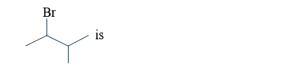
What is the $IUPAC$ name of the given compound?
A
$2-$Bromopentane
B
$3-$Bromo$-2-$methylbutane
C
$2-$Bromo$-3-$methylbutane
D
$1-$Bromo$-3-$methylbutane
Solution
(C) $1$. Identify the longest carbon chain: The longest chain contains $4$ carbon atoms,so the parent alkane is butane.
$2$. Number the chain: Numbering should be done such that the substituents get the lowest possible locants. Numbering from left to right gives the bromine at position $2$ and the methyl group at position $3$.
$3$. Assign names to substituents: There is a bromo group at position $2$ and a methyl group at position $3$.
$4$. Combine: The $IUPAC$ name is $2-$bromo$-3-$methylbutane.
$2$. Number the chain: Numbering should be done such that the substituents get the lowest possible locants. Numbering from left to right gives the bromine at position $2$ and the methyl group at position $3$.
$3$. Assign names to substituents: There is a bromo group at position $2$ and a methyl group at position $3$.
$4$. Combine: The $IUPAC$ name is $2-$bromo$-3-$methylbutane.
0 likesView Solution
80
ChemistryEasyMCQMHT CET · 2022
The correct structure of prop$-2-$en$-1-$amine is
A
$CH_3-CH=CH-NH_2$
B
$CH_3-CH(NH_2)-CH_3$
C
$CH_3-C(NH_2)=CH_2$
D
$CH_2=CH-CH_2-NH_2$
Solution
(D) The $IUPAC$ name prop$-2-$en$-1-$amine indicates a three-carbon chain (prop) with a double bond at the second position ($-2-$en) and an amine group at the first position ($-1-$amine).
The structure is $CH_2=CH-CH_2-NH_2$.
The structure is $CH_2=CH-CH_2-NH_2$.
0 likesView Solution
81
ChemistryEasyMCQMHT CET · 2022
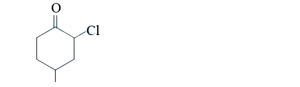
What is the $IUPAC$ name of the compound?
A
$2-$chloro$-4-$methylcyclohexanone
B
$4-$methyl$-2-$chlorocyclohexanone
C
$6-$chloro$-4-$methylcyclohexanone
D
$2-$chloro$-5-$methylcyclohexanone
Solution
(A) $1$. The principal functional group is the ketone,which gets the lowest possible locant. Thus,the carbonyl carbon is assigned position $1$.
$2$. Numbering the ring to give the substituents the lowest possible locants,we move towards the chlorine atom to give it position $2$.
$3$. The methyl group is then at position $4$.
$4$. Combining these,the $IUPAC$ name is $2-$chloro$-4-$methylcyclohexanone.
$2$. Numbering the ring to give the substituents the lowest possible locants,we move towards the chlorine atom to give it position $2$.
$3$. The methyl group is then at position $4$.
$4$. Combining these,the $IUPAC$ name is $2-$chloro$-4-$methylcyclohexanone.
0 likesView Solution
82
ChemistryMediumMCQMHT CET · 2022
Identify the compound that does not correctly match with its common name.
| $A$. $HCHO$ | Formaldehyde |
| $B$. $C_6H_5NH_2$ | Aniline |
| $C$. $CH_3CH(CH_3)CH_3$ | $n-$Butane |
| $D$. $CH_3CH(OH)COOH$ | Lactic acid |
A
$A$
B
$B$
C
$C$
D
$D$
Solution
(C) The structure $CH_3CH(CH_3)CH_3$ is $iso-$butane (or $2-$methylpropane),not $n-$butane.
The structure of $n-$butane is $CH_3CH_2CH_2CH_3$.
Therefore,option $(C)$ is the incorrect match.
The structure of $n-$butane is $CH_3CH_2CH_2CH_3$.
Therefore,option $(C)$ is the incorrect match.
0 likesView Solution
83
ChemistryEasyMCQMHT CET · 2022
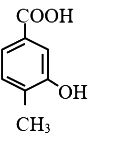
What is the $IUPAC$ name of the following compound?
A
$3-$Hydroxy$-4-$methylbenzoic acid
B
$5-$methyl$-3-$hydroxybenzoic acid
C
$5-$Hydroxy$-4-$methylbenzoic acid
D
$4-$methyl$-3-$hydroxybenzoic acid
Solution
(A) $1$. Identify the principal functional group: The $-COOH$ group has the highest priority,so the parent compound is benzoic acid.
$2$. Number the ring: Start numbering from the carbon attached to the $-COOH$ group as $C-1$. Number the ring to give the lowest possible locants to the substituents.
$3$. Assign positions: The $-OH$ group is at position $3$ and the $-CH_3$ group is at position $4$.
$4$. Name the compound: Combining these,the $IUPAC$ name is $3-$hydroxy$-4-$methylbenzoic acid.
$2$. Number the ring: Start numbering from the carbon attached to the $-COOH$ group as $C-1$. Number the ring to give the lowest possible locants to the substituents.
$3$. Assign positions: The $-OH$ group is at position $3$ and the $-CH_3$ group is at position $4$.
$4$. Name the compound: Combining these,the $IUPAC$ name is $3-$hydroxy$-4-$methylbenzoic acid.
0 likesView Solution
84
ChemistryEasyMCQMHT CET · 2022
Which among the following statements is $NOT$ true about aliphatic compounds?
A
These are easily attacked by oxidizing agents.
B
These burn with a sooty flame.
C
Saturated aliphatic compounds undergo substitution reactions.
D
Unsaturated aliphatic compounds undergo addition reactions easily.
Solution
(B) Aliphatic compounds generally burn with a non-sooty (clean) flame because they have a lower carbon-to-hydrogen ratio compared to aromatic compounds. Aromatic compounds,due to their high carbon content,typically burn with a sooty flame. Therefore,the statement that aliphatic compounds burn with a sooty flame is incorrect.
0 likesView Solution
85
ChemistryEasyMCQMHT CET · 2022
Which of the following statements is $NOT$ correct?
A
Homolytic cleavage of $C-C$ bond gives free radicals.
B
Resonance structures are represented by drawing $\leftrightarrow$ arrows between them.
C
Carbocation,carbanions and free radicals are reaction intermediates.
D
Chlorine is said to exert $+I$ effect in the carbon chain.
Solution
(D) Chlorine is an electronegative atom and exerts an $-I$ (inductive) effect,not a $+I$ effect,due to its ability to withdraw electron density from the carbon chain.
Therefore,the statement in option $D$ is incorrect.
Therefore,the statement in option $D$ is incorrect.
0 likesView Solution
86
ChemistryEasyMCQMHT CET · 2022
Identify the group that exerts electron withdrawing resonance effect.
A
$-COOH$
B
$-OH$
C
$-OR$
D
$-NHR$
Solution
(A) The $-COOH$ group contains a carbonyl group $(C=O)$ attached to the carbon chain,which acts as an electron-withdrawing group via resonance ($-R$ effect).
In contrast,$-OH$,$-OR$,and $-NHR$ groups contain atoms with lone pairs of electrons that donate electron density into the ring or system via resonance ($+R$ effect).
In contrast,$-OH$,$-OR$,and $-NHR$ groups contain atoms with lone pairs of electrons that donate electron density into the ring or system via resonance ($+R$ effect).
0 likesView Solution
87
ChemistryMediumMCQMHT CET · 2022
Which free radical from the following is least stable?
A
$\dot{C}H_3$
B
$CH_3-\dot{C}H_2$
C
$(CH_3)_3\dot{C}$
D
$(CH_3)_2\dot{C}H$
Solution
(A) The stability of a carbon free radical $(CFR)$ is directly proportional to the number of $\alpha$-hydrogen atoms present due to hyperconjugation.
$1. \dot{C}H_3$ (methyl radical): $0 \ \alpha-H$
$2. CH_3-\dot{C}H_2$ (ethyl radical): $3 \ \alpha-H$
$3. (CH_3)_2\dot{C}H$ (isopropyl radical): $6 \ \alpha-H$
$4. (CH_3)_3\dot{C}$ (tert-butyl radical): $9 \ \alpha-H$
Since the stability order is $(CH_3)_3\dot{C} > (CH_3)_2\dot{C}H > CH_3-\dot{C}H_2 > \dot{C}H_3$,the methyl radical $\dot{C}H_3$ is the least stable.
$1. \dot{C}H_3$ (methyl radical): $0 \ \alpha-H$
$2. CH_3-\dot{C}H_2$ (ethyl radical): $3 \ \alpha-H$
$3. (CH_3)_2\dot{C}H$ (isopropyl radical): $6 \ \alpha-H$
$4. (CH_3)_3\dot{C}$ (tert-butyl radical): $9 \ \alpha-H$
Since the stability order is $(CH_3)_3\dot{C} > (CH_3)_2\dot{C}H > CH_3-\dot{C}H_2 > \dot{C}H_3$,the methyl radical $\dot{C}H_3$ is the least stable.
0 likesView Solution
88
ChemistryMediumMCQMHT CET · 2022
How many $\pi$ electrons are present in naphthalene to decide its aromaticity?
A
$6$
B
$8$
C
$7$
D
$10$
Solution
(D) Naphthalene consists of two fused benzene rings.
It contains $5$ double bonds in its structure.
Each double bond contributes $2$ $\pi$ electrons.
Therefore,the total number of $\pi$ electrons = $5 \times 2 = 10$ $\pi$ electrons.
This satisfies $H$ückel's rule ($4n + 2 = 10$,where $n = 2$),confirming its aromatic nature.
It contains $5$ double bonds in its structure.
Each double bond contributes $2$ $\pi$ electrons.
Therefore,the total number of $\pi$ electrons = $5 \times 2 = 10$ $\pi$ electrons.
This satisfies $H$ückel's rule ($4n + 2 = 10$,where $n = 2$),confirming its aromatic nature.
0 likesView Solution
89
ChemistryEasyMCQMHT CET · 2022
What is the number of $\pi$ electrons present in pyridine?
A
$4$
B
$8$
C
$2$
D
$6$
Solution
(D) Pyridine is a heterocyclic aromatic compound with the formula $C_5H_5N$.
It contains three double bonds in the ring,each contributing $2$ $\pi$ electrons.
The lone pair on the nitrogen atom is in an $sp^2$ hybridized orbital and is not part of the aromatic $\pi$ system.
Therefore,the total number of $\pi$ electrons is $3 \times 2 = 6$.
It contains three double bonds in the ring,each contributing $2$ $\pi$ electrons.
The lone pair on the nitrogen atom is in an $sp^2$ hybridized orbital and is not part of the aromatic $\pi$ system.
Therefore,the total number of $\pi$ electrons is $3 \times 2 = 6$.
0 likesView Solution
90
ChemistryMediumMCQMHT CET · 2022
Hyperconjugation is not observed in
A
$CH_3-CH=CH_2$
B
$CH_3-C(CH_3)=C(CH_3)-CH_3$
C
$(CH_3)_3C^+$
D
$CH_2=CH_2$
Solution
(D) Hyperconjugation requires the presence of at least one $\alpha-H$ atom on a carbon atom adjacent to a double bond or a carbocation.
$A) \ CH_3-CH=CH_2$: Has $3 \ \alpha-H$ atoms.
$B) \ CH_3-C(CH_3)=C(CH_3)-CH_3$: Has $12 \ \alpha-H$ atoms.
$C) \ (CH_3)_3C^+$: Has $9 \ \alpha-H$ atoms.
$D) \ CH_2=CH_2$: Has $0 \ \alpha-H$ atoms.
Since $CH_2=CH_2$ has no $\alpha-H$ atoms,hyperconjugation is not observed.
$A) \ CH_3-CH=CH_2$: Has $3 \ \alpha-H$ atoms.
$B) \ CH_3-C(CH_3)=C(CH_3)-CH_3$: Has $12 \ \alpha-H$ atoms.
$C) \ (CH_3)_3C^+$: Has $9 \ \alpha-H$ atoms.
$D) \ CH_2=CH_2$: Has $0 \ \alpha-H$ atoms.
Since $CH_2=CH_2$ has no $\alpha-H$ atoms,hyperconjugation is not observed.
0 likesView Solution
91
ChemistryMediumMCQMHT CET · 2022
Which of the following pairs of compounds is an example of position isomerism?
A
$2-$methylprop$-1-$ene and but$-1-$ene
B
but$-2-$ene and cis-but$-2-$ene
C
but$-2-$ene and $2-$methylprop$-1-$ene
D
but$-1-$ene and but$-2-$ene
Solution
(D) Position isomerism occurs when the position of a functional group or a double bond changes while the carbon skeleton remains the same.
In $CH_3-CH_2-CH=CH_2$ (but$-1-$ene),the double bond is at the $C-1$ position.
In $CH_3-CH=CH-CH_3$ (but$-2-$ene),the double bond is at the $C-2$ position.
Since the parent carbon chain is the same and only the position of the double bond differs,they are position isomers.
In $CH_3-CH_2-CH=CH_2$ (but$-1-$ene),the double bond is at the $C-1$ position.
In $CH_3-CH=CH-CH_3$ (but$-2-$ene),the double bond is at the $C-2$ position.
Since the parent carbon chain is the same and only the position of the double bond differs,they are position isomers.
0 likesView Solution
92
ChemistryMediumMCQMHT CET · 2022
Identify the optically active substance from the following.
A
$CH_3-CH(Br)-CH_2-CH_3$
B
$(CH_3)_2-C(Br)-CH_3$
C
$CH_3-(CH_2)_3-CH_2-Br$
D
$(CH_3)_2-CH-CH(Br)-CH(CH_3)_2$
Solution
(A) substance is optically active if it contains at least one chiral center (an asymmetric carbon atom bonded to four different groups).
$A$. $CH_3-CH(Br)-CH_2-CH_3$: The central carbon is bonded to $-H$,$-CH_3$,$-Br$,and $-CH_2CH_3$. Since all four groups are different,it is a chiral center. Thus,it is optically active.
$B$. $(CH_3)_2-C(Br)-CH_3$: The central carbon is bonded to two identical $-CH_3$ groups. It is achiral.
$C$. $CH_3-(CH_2)_3-CH_2-Br$: The carbon attached to $-Br$ is bonded to two identical $-H$ atoms. It is achiral.
$D$. $(CH_3)_2-CH-CH(Br)-CH(CH_3)_2$: While this molecule has chiral centers,option $A$ is the simplest and most direct example of a chiral molecule often used in textbooks to demonstrate optical activity. However,based on the provided solution image,option $A$ is the intended answer.
$A$. $CH_3-CH(Br)-CH_2-CH_3$: The central carbon is bonded to $-H$,$-CH_3$,$-Br$,and $-CH_2CH_3$. Since all four groups are different,it is a chiral center. Thus,it is optically active.
$B$. $(CH_3)_2-C(Br)-CH_3$: The central carbon is bonded to two identical $-CH_3$ groups. It is achiral.
$C$. $CH_3-(CH_2)_3-CH_2-Br$: The carbon attached to $-Br$ is bonded to two identical $-H$ atoms. It is achiral.
$D$. $(CH_3)_2-CH-CH(Br)-CH(CH_3)_2$: While this molecule has chiral centers,option $A$ is the simplest and most direct example of a chiral molecule often used in textbooks to demonstrate optical activity. However,based on the provided solution image,option $A$ is the intended answer.
0 likesView Solution
93
ChemistryMediumMCQMHT CET · 2022
Identify the chiral molecule from the following:
A
$CH_3-CH(CH_3)-CH(Cl)-CH(CH_3)-CH_3$
B
$CH_3-CH(Cl)-CH_2-CH_3$
C
$CH_3-CH(Cl)-CH_3$
D
$(CH_3)_3-C-Cl$
Solution
(B) molecule is chiral if it contains at least one chiral center (a carbon atom bonded to four different groups).
In $CH_3-CH(Cl)-CH_2-CH_3$ ($2$-chlorobutane),the second carbon atom is bonded to four different groups: $-H$,$-Cl$,$-CH_3$,and $-CH_2CH_3$.
Since it has one chiral center,it is a chiral molecule.
Other options do not have a chiral center.
In $CH_3-CH(Cl)-CH_2-CH_3$ ($2$-chlorobutane),the second carbon atom is bonded to four different groups: $-H$,$-Cl$,$-CH_3$,and $-CH_2CH_3$.
Since it has one chiral center,it is a chiral molecule.
Other options do not have a chiral center.
0 likesView Solution
94
ChemistryDifficultMCQMHT CET · 2022
Which among the following compounds has a chiral carbon atom?
A
$CH_3-CH(Cl)-CH_2-CH_3$
B
$(CH_3-CH_2)_2-CHCl$
C
$(CH_3)_2-CH-CH_2Cl$
D
$(CH_3)_2-CHCl$
Solution
(A) chiral carbon atom is a carbon atom bonded to four different groups.
In $CH_3-CH(Cl)-CH_2-CH_3$,the second carbon atom is bonded to $-H$,$-Cl$,$-CH_3$,and $-CH_2CH_3$.
Since all four groups are different,this carbon is chiral.
In $CH_3-CH(Cl)-CH_2-CH_3$,the second carbon atom is bonded to $-H$,$-Cl$,$-CH_3$,and $-CH_2CH_3$.
Since all four groups are different,this carbon is chiral.
0 likesView Solution
95
ChemistryEasyMCQMHT CET · 2022
Which of the following pairs of compounds is an example of metamerism?
A
$n-$Butane and $2-$Methylpropane
B
Dimethyl ether and ethyl alcohol
C
but$-2-$ene and but$-1-$ene
D
Ethoxyethane and $1-$methoxypropane
Solution
(D) Metamerism arises due to the presence of different alkyl groups attached to the same polyvalent functional group (like $-O-$,$-S-$,$-NH-$,etc.).
In $Ethoxyethane$ $(CH_3CH_2-O-CH_2CH_3)$,the oxygen atom is attached to two ethyl groups.
In $1-Methoxypropane$ $(CH_3-O-CH_2CH_2CH_3)$,the oxygen atom is attached to a methyl group and a propyl group.
Since the alkyl groups attached to the oxygen atom are different,these compounds are metamers.
In $Ethoxyethane$ $(CH_3CH_2-O-CH_2CH_3)$,the oxygen atom is attached to two ethyl groups.
In $1-Methoxypropane$ $(CH_3-O-CH_2CH_2CH_3)$,the oxygen atom is attached to a methyl group and a propyl group.
Since the alkyl groups attached to the oxygen atom are different,these compounds are metamers.
0 likesView Solution
96
ChemistryMediumMCQMHT CET · 2022
Which among the following compounds does not exhibit cis-trans isomerism?
A
$H_2C=C(R)_2$
B
$R_1R_2C=CR_1R_2$
C
$RCH=CHR$
D
$R_1CH=CR_1R_2$
Solution
(A) For a compound to exhibit cis-trans isomerism,each carbon atom involved in the double bond must be attached to two different groups.
In the compound $H_2C=C(R)_2$,the first carbon atom is attached to two identical hydrogen atoms.
Since at least one carbon atom of the double bond does not have two different groups attached to it,this compound cannot exhibit cis-trans isomerism.
In the compound $H_2C=C(R)_2$,the first carbon atom is attached to two identical hydrogen atoms.
Since at least one carbon atom of the double bond does not have two different groups attached to it,this compound cannot exhibit cis-trans isomerism.
0 likesView Solution
97
ChemistryMediumMCQMHT CET · 2022
What are the different elements present in the mineral barite?
A
$Ca, O, H$
B
$Ba, S, O$
C
$Zn, C, O$
D
$K, N, O$
Solution
(B) The mineral barite is chemically known as barium sulfate,which has the chemical formula $BaSO_4$.
Therefore,the elements present in barite are Barium $(Ba)$,Sulfur $(S)$,and Oxygen $(O)$.
Therefore,the elements present in barite are Barium $(Ba)$,Sulfur $(S)$,and Oxygen $(O)$.
0 likesView Solution
98
ChemistryMCQMHT CET · 2022
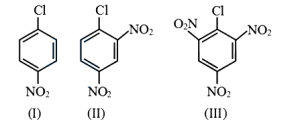
The correct order of reactivity for reactions involving the cleavage of the $C-X$ bond in the following compounds is:
A
$I > III > II$
B
$III > II > I$
C
$I > II > III$
D
$II > III > I$
Solution
(B) The cleavage of the $C-X$ bond in these haloarenes occurs via Nucleophilic Aromatic Substitution $(Ar-S_N)$ reactions.
These reactions are facilitated by the presence of electron-withdrawing groups $(-NO_2)$ on the benzene ring,which stabilize the carbanion intermediate formed during the reaction.
The rate of $Ar-S_N$ reaction is directly proportional to the number of electron-withdrawing groups ($-M$ and $-I$ effect) present on the ring.
Compound $(I)$ has one $-NO_2$ group.
Compound $(II)$ has two $-NO_2$ groups.
Compound $(III)$ has three $-NO_2$ groups.
Therefore,the reactivity order is $III > II > I$.
These reactions are facilitated by the presence of electron-withdrawing groups $(-NO_2)$ on the benzene ring,which stabilize the carbanion intermediate formed during the reaction.
The rate of $Ar-S_N$ reaction is directly proportional to the number of electron-withdrawing groups ($-M$ and $-I$ effect) present on the ring.
Compound $(I)$ has one $-NO_2$ group.
Compound $(II)$ has two $-NO_2$ groups.
Compound $(III)$ has three $-NO_2$ groups.
Therefore,the reactivity order is $III > II > I$.
0 likesView Solution
99
ChemistryEasyMCQMHT CET · 2022
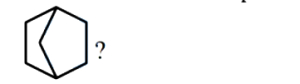
What is the number of primary carbon atoms in the compound?
A
$2$
B
Zero
C
$1$
D
$3$
Solution
(B) The given compound is bicyclo[$2.2$.$1$]heptane.
$A$ primary $(1^{\circ})$ carbon atom is a carbon atom bonded to only one other carbon atom.
In this cyclic structure,every carbon atom is bonded to at least two other carbon atoms.
Specifically,the bridgehead carbons are tertiary $(3^{\circ})$ and the other carbons are secondary $(2^{\circ})$.
Therefore,there are zero primary carbon atoms present in the compound.
$A$ primary $(1^{\circ})$ carbon atom is a carbon atom bonded to only one other carbon atom.
In this cyclic structure,every carbon atom is bonded to at least two other carbon atoms.
Specifically,the bridgehead carbons are tertiary $(3^{\circ})$ and the other carbons are secondary $(2^{\circ})$.
Therefore,there are zero primary carbon atoms present in the compound.
0 likesView Solution
100
ChemistryDifficultMCQMHT CET · 2022
Which of the following alkanes is used for road surfacing?
A
$C_{20}H_{42}$ to $C_{24}H_{50}$
B
$C_{36}H_{74}$ and above
C
$C_{10}H_{22}$ to $C_{12}H_{26}$
D
$C_{15}H_{32}$ to $C_{19}H_{40}$
Solution
(B) Alkanes with high molecular weight,specifically $C_{36}H_{74}$ and above,are known as paraffin wax or asphaltic residues,which are commonly used for road surfacing and waterproofing.
0 likesView Solution
101
ChemistryDifficultMCQMHT CET · 2022
Identify the product $A$ in the following reaction:
$[(CH_3CH_2CH_2)(CH_3CH_2)_3N]^+ OH^- \xrightarrow{\Delta, -H_2O} A + (CH_3CH_2CH_2)(CH_3CH_2)_2N$
$[(CH_3CH_2CH_2)(CH_3CH_2)_3N]^+ OH^- \xrightarrow{\Delta, -H_2O} A + (CH_3CH_2CH_2)(CH_3CH_2)_2N$
A
$H_2C=CH_2$
B
$CH_3-CH_2-CH_3$
C
$CH_3-C\equiv CH$
D
$CH_3-CH=CH_2$
Solution
(A) The given reaction is a Hofmann elimination reaction.
In this reaction,a quaternary ammonium hydroxide is heated,leading to the formation of an alkene and a tertiary amine.
The hydroxide ion $(OH^-)$ acts as a base and abstracts a proton from the $\beta$-carbon atom of the alkyl group attached to the nitrogen.
According to the Hofmann rule,the less substituted alkene is formed as the major product.
In the given reactant,the alkyl groups attached to the nitrogen are one propyl group $(CH_3CH_2CH_2-)$ and three ethyl groups $(-CH_2CH_3)$.
When the base abstracts a proton from the $\beta$-carbon of an ethyl group,ethene $(H_2C=CH_2)$ is formed as the alkene product $A$.
In this reaction,a quaternary ammonium hydroxide is heated,leading to the formation of an alkene and a tertiary amine.
The hydroxide ion $(OH^-)$ acts as a base and abstracts a proton from the $\beta$-carbon atom of the alkyl group attached to the nitrogen.
According to the Hofmann rule,the less substituted alkene is formed as the major product.
In the given reactant,the alkyl groups attached to the nitrogen are one propyl group $(CH_3CH_2CH_2-)$ and three ethyl groups $(-CH_2CH_3)$.
When the base abstracts a proton from the $\beta$-carbon of an ethyl group,ethene $(H_2C=CH_2)$ is formed as the alkene product $A$.
0 likesView Solution
102
ChemistryMediumMCQMHT CET · 2022
Which among the following reactions does not occur?
A
$C_2H_5Br + AgNO_2 \rightarrow C_2H_5NO_2 + AgBr$
B
$C_2H_5Br + AgCN \rightarrow C_2H_5NC + AgBr$
C
$C_2H_5Br + KCN \rightarrow C_2H_5NC + KBr$
D
$C_2H_5Br + KNO_2 \rightarrow C_2H_5-O-N=O + KBr$
Solution
(C) $KCN$ is an ionic compound,so it provides $CN^-$ ions which act as an ambident nucleophile. The carbon atom is more nucleophilic,leading to the formation of alkyl cyanide $(C_2H_5CN)$.
Therefore,the reaction $C_2H_5Br + KCN \rightarrow C_2H_5NC + KBr$ does not occur as written; it should produce $C_2H_5CN$ (ethyl cyanide).
$AgCN$ is covalent,so the nitrogen atom is the nucleophilic site,leading to the formation of alkyl isocyanide $(C_2H_5NC)$.
$AgNO_2$ is covalent,leading to nitroalkane $(C_2H_5NO_2)$.
$KNO_2$ is ionic,leading to alkyl nitrite $(C_2H_5ONO)$.
Therefore,the reaction $C_2H_5Br + KCN \rightarrow C_2H_5NC + KBr$ does not occur as written; it should produce $C_2H_5CN$ (ethyl cyanide).
$AgCN$ is covalent,so the nitrogen atom is the nucleophilic site,leading to the formation of alkyl isocyanide $(C_2H_5NC)$.
$AgNO_2$ is covalent,leading to nitroalkane $(C_2H_5NO_2)$.
$KNO_2$ is ionic,leading to alkyl nitrite $(C_2H_5ONO)$.
0 likesView Solution
103
ChemistryEasyMCQMHT CET · 2022
Which among the following reactions represents the Carbylamine reaction?
A
$R-NH_2 + CHCl_3 + 3KOH \xrightarrow{\Delta, \text{alc.}} R-NC + 3KCl + 3H_2O$
B
$R-NH_2 + HNO_2 \xrightarrow{NaNO_2 + HCl} R-OH + N_2 \uparrow + H_2O$
C
$R-NH_2 + CH_3COCl \xrightarrow{\text{pyridine}} R-NH-COCH_3 + HCl$
D
$R-NH_2 + R-X \rightarrow R_4N^+ X^- + 2HX$
Solution
(A) The Carbylamine reaction is a chemical test for the detection of primary amines. In this reaction,a primary amine is heated with chloroform $(CHCl_3)$ and alcoholic potassium hydroxide $(KOH)$ to form an isocyanide (carbylamine),which has a foul smell.
The reaction is: $R-NH_2 + CHCl_3 + 3KOH \xrightarrow{\Delta, \text{alc.}} R-NC + 3KCl + 3H_2O$.
The reaction is: $R-NH_2 + CHCl_3 + 3KOH \xrightarrow{\Delta, \text{alc.}} R-NC + 3KCl + 3H_2O$.
0 likesView Solution
104
ChemistryMediumMCQMHT CET · 2022
Which carbon atoms of fructose are bonded together through oxygen forming fructofuranose?
A
$2$ and $5$
B
$1$ and $6$
C
$1$ and $5$
D
$2$ and $6$
Solution
(A) Fructose is a ketohexose with the molecular formula $C_6H_{12}O_6$.
In its cyclic form,known as fructofuranose,the ring is formed by the reaction between the ketone group at $C-2$ and the hydroxyl group at $C-5$.
This creates a five-membered ring containing four carbon atoms and one oxygen atom.
Therefore,the $C-2$ and $C-5$ atoms are linked through an oxygen atom to form the furanose ring structure.
In its cyclic form,known as fructofuranose,the ring is formed by the reaction between the ketone group at $C-2$ and the hydroxyl group at $C-5$.
This creates a five-membered ring containing four carbon atoms and one oxygen atom.
Therefore,the $C-2$ and $C-5$ atoms are linked through an oxygen atom to form the furanose ring structure.
0 likesView Solution
105
ChemistryMediumMCQMHT CET · 2022
Which among the following carbohydrate molecules is not further hydrolysed into smaller units?
A
Lactose
B
Stachyose
C
Raffinose
D
Ribose
Solution
(D) Ribose is a monosaccharide,therefore it cannot be further hydrolysed into smaller carbohydrate units.
0 likesView Solution
106
ChemistryEasyMCQMHT CET · 2022
Which among the following sugars is called as laevulose?
A
Maltose
B
Galactose
C
Glucose
D
Fructose
Solution
(D) Fructose is a ketohexose that is levorotatory in nature,which is why it is commonly known as laevulose.
0 likesView Solution
107
ChemistryEasyMCQMHT CET · 2022
What is the number of primary and secondary alcoholic groups respectively present in glucose?
A
$2,3$
B
$3,2$
C
$4,2$
D
$1,4$
Solution
(D) The structure of glucose is $CHO-(CHOH)_4-CH_2OH$.
In this structure,the $-CH_2OH$ group is a primary alcoholic group because the carbon atom is attached to only one other carbon atom.
There is $1$ such primary alcoholic group.
The four $-CHOH$ groups are secondary alcoholic groups because each carbon atom is attached to two other carbon atoms.
Thus,there are $4$ secondary alcoholic groups.
Therefore,the number of primary and secondary alcoholic groups is $1$ and $4$ respectively.
In this structure,the $-CH_2OH$ group is a primary alcoholic group because the carbon atom is attached to only one other carbon atom.
There is $1$ such primary alcoholic group.
The four $-CHOH$ groups are secondary alcoholic groups because each carbon atom is attached to two other carbon atoms.
Thus,there are $4$ secondary alcoholic groups.
Therefore,the number of primary and secondary alcoholic groups is $1$ and $4$ respectively.
0 likesView Solution
108
ChemistryEasyMCQMHT CET · 2022
How many secondary hydroxyl groups are present in glucose?
A
$3$
B
$5$
C
$2$
D
$4$
Solution
(D) The open-chain structure of glucose is $CHO-(CHOH)_4-CH_2OH$.
In this structure,the four $-CHOH-$ groups are attached to two other carbon atoms,making the hydroxyl groups attached to these carbons secondary $(2^{\circ})$ hydroxyl groups.
The $-CH_2OH$ group at the end is a primary $(1^{\circ})$ hydroxyl group.
Therefore,there are $4$ secondary hydroxyl groups in glucose.
In this structure,the four $-CHOH-$ groups are attached to two other carbon atoms,making the hydroxyl groups attached to these carbons secondary $(2^{\circ})$ hydroxyl groups.
The $-CH_2OH$ group at the end is a primary $(1^{\circ})$ hydroxyl group.
Therefore,there are $4$ secondary hydroxyl groups in glucose.
0 likesView Solution
109
ChemistryEasyMCQMHT CET · 2022
Which carbon atom of glucose,numbered from $C-1$ to $C-6$,converts its functional group to a $-COOH$ group when heated with $Br_2$ water?
A
$C-1$
B
$C-2$
C
$C-3$
D
$C-6$
Solution
(A) Glucose contains an aldehyde group $(-CHO)$ at the $C-1$ position and a primary alcohol group $(-CH_2OH)$ at the $C-6$ position.
Bromine water $(Br_2-H_2O)$ is a mild oxidizing agent.
It selectively oxidizes the aldehyde group $(-CHO)$ of glucose to a carboxylic acid group $(-COOH)$,forming gluconic acid.
Therefore,the carbon atom at the $C-1$ position is converted to a $-COOH$ group.
Bromine water $(Br_2-H_2O)$ is a mild oxidizing agent.
It selectively oxidizes the aldehyde group $(-CHO)$ of glucose to a carboxylic acid group $(-COOH)$,forming gluconic acid.
Therefore,the carbon atom at the $C-1$ position is converted to a $-COOH$ group.
0 likesView Solution
110
ChemistryDifficultMCQMHT CET · 2022
Which of the following reagents converts the $-CHO$ and $-CH_2OH$ groups of glucose to $-COOH$ groups?
A
Hydrogen cyanide
B
dil. nitric acid
C
Acetic anhydride
D
Hydroxyl amine
Solution
(B) Glucose contains an aldehyde group $(-CHO)$ at $C-1$ and a primary alcoholic group $(-CH_2OH)$ at $C-6$.
When glucose is treated with dilute nitric acid $(dil. HNO_3)$,it undergoes oxidation to form a dicarboxylic acid known as saccharic acid (or glucaric acid).
In this reaction,both the terminal aldehyde group and the primary alcoholic group are oxidized to carboxylic acid $(-COOH)$ groups.
The reaction is represented as:
$CHO-(CHOH)_4-CH_2OH + [O] \xrightarrow{dil. HNO_3} COOH-(CHOH)_4-COOH$
Thus,the correct reagent is dilute nitric acid.
When glucose is treated with dilute nitric acid $(dil. HNO_3)$,it undergoes oxidation to form a dicarboxylic acid known as saccharic acid (or glucaric acid).
In this reaction,both the terminal aldehyde group and the primary alcoholic group are oxidized to carboxylic acid $(-COOH)$ groups.
The reaction is represented as:
$CHO-(CHOH)_4-CH_2OH + [O] \xrightarrow{dil. HNO_3} COOH-(CHOH)_4-COOH$
Thus,the correct reagent is dilute nitric acid.
0 likesView Solution
111
ChemistryMediumMCQMHT CET · 2022
Which among the following enzymes converts glucose to fructose?
A
Proteases
B
Lipase
C
Amylase
D
Glucose isomerase
Solution
(D) The enzyme $Glucose \ isomerase$ is responsible for the conversion of $glucose$ into $fructose$.
0 likesView Solution
112
ChemistryMediumMCQMHT CET · 2022
Identify the product obtained when sucrose is treated with conc. $H_2 SO_4$.
A
Saccharic acid
B
Gluconic acid and fructose
C
Glucose and fructose
D
Sugar charcoal and water
Solution
(D) Sucrose is a disaccharide with the formula $C_{12}H_{22}O_{11}$.
When treated with concentrated $H_2SO_4$,it undergoes dehydration.
The concentrated $H_2SO_4$ acts as a strong dehydrating agent and removes water molecules from the sucrose.
The reaction is: $C_{12}H_{22}O_{11} \xrightarrow{\text{conc. } H_2SO_4} 12C + 11H_2O$.
Thus,the products obtained are sugar charcoal $(12C)$ and water $(11H_2O)$.
When treated with concentrated $H_2SO_4$,it undergoes dehydration.
The concentrated $H_2SO_4$ acts as a strong dehydrating agent and removes water molecules from the sucrose.
The reaction is: $C_{12}H_{22}O_{11} \xrightarrow{\text{conc. } H_2SO_4} 12C + 11H_2O$.
Thus,the products obtained are sugar charcoal $(12C)$ and water $(11H_2O)$.
0 likesView Solution
113
ChemistryMediumMCQMHT CET · 2022
Which among the following enzymes hydrolyzes $ \text{starch}$?
A
$ \text{Amylase}$
B
$ \text{Proteases}$
C
$ \text{Glucose isomerase}$
D
$ \text{Insulin}$
Solution
(A) $ \text{Amylase}$ is the enzyme responsible for the hydrolysis of $ \text{starch}$ into simpler sugars like $ \text{maltose}$ and $ \text{glucose}$.
$ \text{Proteases}$ hydrolyze proteins.
$ \text{Glucose isomerase}$ converts $ \text{glucose}$ to $ \text{fructose}$.
$ \text{Insulin}$ is a hormone.
$ \text{Proteases}$ hydrolyze proteins.
$ \text{Glucose isomerase}$ converts $ \text{glucose}$ to $ \text{fructose}$.
$ \text{Insulin}$ is a hormone.
0 likesView Solution
114
ChemistryMediumMCQMHT CET · 2022
What is the quantity of water required to obtain one mole of glucose from one mole of sucrose by acid hydrolysis (in $g$)?
A
$9.5$
B
$18.0$
C
$15.0$
D
$16.0$
Solution
(B) The chemical equation for the acid hydrolysis of sucrose is:
$C_{12}H_{22}O_{11} + H_2O \xrightarrow{H^{+}} C_6H_{12}O_6 (\text{glucose}) + C_6H_{12}O_6 (\text{fructose})$
From the stoichiometry of the reaction,$1 \ mol$ of sucrose reacts with $1 \ mol$ of $H_2O$ to produce $1 \ mol$ of glucose and $1 \ mol$ of fructose.
Therefore,to obtain $1 \ mol$ of glucose,we require $1 \ mol$ of $H_2O$.
The molar mass of water $(H_2O)$ is $18 \ g/mol$.
Mass of water = $\text{moles} \times \text{molar mass} = 1 \ mol \times 18 \ g/mol = 18 \ g$.
$C_{12}H_{22}O_{11} + H_2O \xrightarrow{H^{+}} C_6H_{12}O_6 (\text{glucose}) + C_6H_{12}O_6 (\text{fructose})$
From the stoichiometry of the reaction,$1 \ mol$ of sucrose reacts with $1 \ mol$ of $H_2O$ to produce $1 \ mol$ of glucose and $1 \ mol$ of fructose.
Therefore,to obtain $1 \ mol$ of glucose,we require $1 \ mol$ of $H_2O$.
The molar mass of water $(H_2O)$ is $18 \ g/mol$.
Mass of water = $\text{moles} \times \text{molar mass} = 1 \ mol \times 18 \ g/mol = 18 \ g$.
0 likesView Solution
115
ChemistryEasyMCQMHT CET · 2022
Which among the following carbohydrate molecules yields the highest number of galactose molecules when one mole of each is hydrolyzed?
A
Sucrose
B
Stachyose
C
Raffinose
D
Lactose
Solution
(B) The hydrolysis products of the given carbohydrates are as follows:
$1$. Sucrose: $1$ mole of glucose + $1$ mole of fructose.
$2$. Stachyose: $2$ moles of galactose + $1$ mole of glucose + $1$ mole of fructose.
$3$. Raffinose: $1$ mole of galactose + $1$ mole of glucose + $1$ mole of fructose.
$4$. Lactose: $1$ mole of galactose + $1$ mole of glucose.
Therefore,$Stachyose$ yields the highest number ($2$ moles) of galactose molecules upon hydrolysis.
$1$. Sucrose: $1$ mole of glucose + $1$ mole of fructose.
$2$. Stachyose: $2$ moles of galactose + $1$ mole of glucose + $1$ mole of fructose.
$3$. Raffinose: $1$ mole of galactose + $1$ mole of glucose + $1$ mole of fructose.
$4$. Lactose: $1$ mole of galactose + $1$ mole of glucose.
Therefore,$Stachyose$ yields the highest number ($2$ moles) of galactose molecules upon hydrolysis.
0 likesView Solution
116
ChemistryEasyMCQMHT CET · 2022
Which among the following amino acids is $NOT$ synthesized in our body?
A
Valine
B
Tyrosine
C
Proline
D
Alanine
Solution
(A) Essential amino acids are those that cannot be synthesized by the human body and must be obtained through the diet.
Among the given options,$Valine$ is an essential amino acid.
The list of essential amino acids includes: $1$. $Leucine$,$2$. $Isoleucine$,$3$. $Lysine$,$4$. $Methionine$,$5$. $Phenylalanine$,$6$. $Threonine$,$7$. $Tryptophan$,$8$. $Valine$,and $9$. $Histidine$.
$Tyrosine$,$Proline$,and $Alanine$ are non-essential amino acids,meaning they can be synthesized by the body.
Among the given options,$Valine$ is an essential amino acid.
The list of essential amino acids includes: $1$. $Leucine$,$2$. $Isoleucine$,$3$. $Lysine$,$4$. $Methionine$,$5$. $Phenylalanine$,$6$. $Threonine$,$7$. $Tryptophan$,$8$. $Valine$,and $9$. $Histidine$.
$Tyrosine$,$Proline$,and $Alanine$ are non-essential amino acids,meaning they can be synthesized by the body.
0 likesView Solution
117
ChemistryEasyMCQMHT CET · 2022
Which of the following amino acids contains sulfur?
A
Tryptophan
B
Histidine
C
Serine
D
Cysteine
Solution
(D) Among the given options,$Cysteine$ is a sulfur-containing amino acid. Its chemical structure is $HS-CH_2-CH(NH_2)-COOH$.
0 likesView Solution
118
ChemistryMediumMCQMHT CET · 2022
Which among the following compounds contains both,amino and carboxyl groups in it?
A
Lactic acid
B
Acetamide
C
Glycerol
D
Glycine
Solution
(D) The amino acids are organic compounds containing an amino group $(-NH_2)$ and a carboxyl group $(-COOH)$ attached to the same carbon atom.
Glycine is the simplest amino acid with the structure $NH_2-CH_2-COOH$.
Therefore,it contains both amino and carboxyl groups.
Glycine is the simplest amino acid with the structure $NH_2-CH_2-COOH$.
Therefore,it contains both amino and carboxyl groups.
0 likesView Solution
119
ChemistryEasyMCQMHT CET · 2022
What is the total number of essential amino acids?
A
$8$
B
$5$
C
$12$
D
$10$
Solution
(D) Essential amino acids are those that cannot be synthesized by the human body and must be obtained through the diet.
There are $10$ essential amino acids in total.
There are $10$ essential amino acids in total.
0 likesView Solution
120
ChemistryDifficultMCQMHT CET · 2022
Which of the following amino acids is $NOT$ synthesized in our body?
A
Cysteine
B
Asparagine
C
Phenylalanine
D
Serine
Solution
(C) Amino acids that are not synthesized in the human body are called essential amino acids and must be obtained through the diet. $Phenylalanine$ is an essential amino acid,whereas $Cysteine$,$Asparagine$,and $Serine$ are non-essential amino acids that can be synthesized by the body.
0 likesView Solution
121
ChemistryDifficultMCQMHT CET · 2022
Which among the following nitrogen bases of polynucleotides is $NOT$ derived from pyrimidine?
A
Guanine
B
Uracil
C
Cytosine
D
Thymine
Solution
(A) Nitrogenous bases in nucleic acids are classified into two types: purines and pyrimidines.
$1$. Pyrimidines are heterocyclic compounds containing two nitrogen atoms in a six-membered ring. Examples include $Cytosine$,$Uracil$,and $Thymine$.
$2$. Purines are heterocyclic compounds consisting of a six-membered ring fused to a five-membered ring,containing four nitrogen atoms. Examples include $Adenine$ and $Guanine$.
Therefore,$Guanine$ is a purine derivative,not a pyrimidine derivative.
$1$. Pyrimidines are heterocyclic compounds containing two nitrogen atoms in a six-membered ring. Examples include $Cytosine$,$Uracil$,and $Thymine$.
$2$. Purines are heterocyclic compounds consisting of a six-membered ring fused to a five-membered ring,containing four nitrogen atoms. Examples include $Adenine$ and $Guanine$.
Therefore,$Guanine$ is a purine derivative,not a pyrimidine derivative.
0 likesView Solution
122
ChemistryDifficultMCQMHT CET · 2022
Which of the following sugars is present in the nucleotide of $RNA$?
A
$L$-Glucose
B
$D$-Ribose
C
$L$-Threose
D
$D$-Fructose
Solution
(B) Nucleotides are composed of a nitrogenous base, a phosphate group, and a pentose sugar.
In $RNA$ (Ribonucleic Acid), the pentose sugar present is $\beta-D$-ribose.
In $DNA$ (Deoxyribonucleic Acid), the pentose sugar present is $\beta-D-2$-deoxyribose.
Therefore, the sugar present in the nucleotide of $RNA$ is $D$-Ribose.
In $RNA$ (Ribonucleic Acid), the pentose sugar present is $\beta-D$-ribose.
In $DNA$ (Deoxyribonucleic Acid), the pentose sugar present is $\beta-D-2$-deoxyribose.
Therefore, the sugar present in the nucleotide of $RNA$ is $D$-Ribose.
0 likesView Solution
123
ChemistryMediumMCQMHT CET · 2022
Identify the sugar molecule involved in polynucleotide formation.
A
Tetrose
B
Triose
C
Hexose
D
Pentose
Solution
(D) Polynucleotides,such as $DNA$ and $RNA$,are formed by the polymerization of nucleotides.
Each nucleotide consists of a nitrogenous base,a phosphate group,and a sugar molecule.
The sugar present in these nucleotides is a $5$-carbon sugar,known as a pentose sugar.
Specifically,$RNA$ contains $\beta-D-ribose$ and $DNA$ contains $\beta-D-2-deoxyribose$,both of which are pentose sugars.
Each nucleotide consists of a nitrogenous base,a phosphate group,and a sugar molecule.
The sugar present in these nucleotides is a $5$-carbon sugar,known as a pentose sugar.
Specifically,$RNA$ contains $\beta-D-ribose$ and $DNA$ contains $\beta-D-2-deoxyribose$,both of which are pentose sugars.
0 likesView Solution
124
ChemistryDifficultMCQMHT CET · 2022
Identify the nitrogenous base of nucleic acid from the following that has a double-ring structure.
A
Thymine
B
Uracil
C
Cytosine
D
Guanine
Solution
(D) Nitrogenous bases in nucleic acids are classified into two types: purines and pyrimidines.
Purines have a double-ring structure (a six-membered ring fused to a five-membered ring),while pyrimidines have a single-ring structure.
Among the given options,$Thymine$,$Uracil$,and $Cytosine$ are pyrimidines (single-ring).
$Guanine$ is a purine and possesses a double-ring structure.
Therefore,the correct option is $D$.
Purines have a double-ring structure (a six-membered ring fused to a five-membered ring),while pyrimidines have a single-ring structure.
Among the given options,$Thymine$,$Uracil$,and $Cytosine$ are pyrimidines (single-ring).
$Guanine$ is a purine and possesses a double-ring structure.
Therefore,the correct option is $D$.
0 likesView Solution
125
ChemistryDifficultMCQMHT CET · 2022
Which nitrogen atom of the pyrimidine base,numbered from $1$ to $6$,is bonded with the furanose sugar?
A
$4$
B
$2$
C
$1$
D
$5$
Solution
(C) In nucleosides,the nitrogen atom at position $1$ $(N-1)$ of the pyrimidine base is covalently bonded to the $C-1'$ carbon atom of the furanose sugar.
0 likesView Solution
126
ChemistryEasyMCQMHT CET · 2022
Which among the following compounds possesses the highest number of $N$ atoms in it?
A
Guanine
B
Thymine
C
Cytosine
D
Uracil
Solution
(A) To determine the number of $N$ atoms in each compound,we examine their chemical structures:
$1$. Guanine $(C_5H_5N_5O)$: It contains $5$ nitrogen atoms.
$2$. Thymine $(C_5H_6N_2O_2)$: It contains $2$ nitrogen atoms.
$3$. Cytosine $(C_4H_5N_3O)$: It contains $3$ nitrogen atoms.
$4$. Uracil $(C_4H_4N_2O_2)$: It contains $2$ nitrogen atoms.
Comparing these,Guanine has the highest number of nitrogen atoms $(5)$.
Therefore,the correct option is $A$.
$1$. Guanine $(C_5H_5N_5O)$: It contains $5$ nitrogen atoms.
$2$. Thymine $(C_5H_6N_2O_2)$: It contains $2$ nitrogen atoms.
$3$. Cytosine $(C_4H_5N_3O)$: It contains $3$ nitrogen atoms.
$4$. Uracil $(C_4H_4N_2O_2)$: It contains $2$ nitrogen atoms.
Comparing these,Guanine has the highest number of nitrogen atoms $(5)$.
Therefore,the correct option is $A$.
0 likesView Solution
127
ChemistryMediumMCQMHT CET · 2022
Which nitrogen atom of a purine base is bonded with the furanose sugar to form a nucleoside?
A
$2$
B
$7$
C
$9$
D
$1$
Solution
(C) In a nucleoside,the nitrogenous base is linked to the $C1'$ position of the sugar (ribose or deoxyribose) via a $\beta$-glycosidic linkage.
For purine bases (like adenine or guanine),this linkage occurs at the $N9$ nitrogen atom.
For pyrimidine bases (like cytosine,thymine,or uracil),this linkage occurs at the $N1$ nitrogen atom.
As shown in the provided structure,the furanose ring is attached to the $N9$ position of the purine base.
For purine bases (like adenine or guanine),this linkage occurs at the $N9$ nitrogen atom.
For pyrimidine bases (like cytosine,thymine,or uracil),this linkage occurs at the $N1$ nitrogen atom.
As shown in the provided structure,the furanose ring is attached to the $N9$ position of the purine base.
0 likesView Solution
128
ChemistryEasyMCQMHT CET · 2022
Identify the product $B$ in the following reaction.
$C_6H_5COCl + H_2O \rightarrow B + HCl$
$C_6H_5COCl + H_2O \rightarrow B + HCl$
A
Acetophenone
B
Benzaldehyde
C
Benzoic acid
D
Benzene
Solution
(C) The reaction of benzoyl chloride $(C_6H_5COCl)$ with water $(H_2O)$ is a hydrolysis reaction.
In this reaction,the chlorine atom $(-Cl)$ of the acid chloride is replaced by a hydroxyl group $(-OH)$ from water.
The chemical equation is: $C_6H_5COCl + H_2O \rightarrow C_6H_5COOH + HCl$.
Here,$C_6H_5COOH$ is benzoic acid,which is the product $B$.
In this reaction,the chlorine atom $(-Cl)$ of the acid chloride is replaced by a hydroxyl group $(-OH)$ from water.
The chemical equation is: $C_6H_5COCl + H_2O \rightarrow C_6H_5COOH + HCl$.
Here,$C_6H_5COOH$ is benzoic acid,which is the product $B$.
0 likesView Solution
129
ChemistryDifficultMCQMHT CET · 2022
Which among the following carboxylic acids is found in Lemon?
A
Citric acid
B
Acetic acid
C
Formic acid
D
$L^{-}$-Lactic acid
Solution
(A) Citric acid is a tricarboxylic acid found in citrus fruits like lemon and orange.
0 likesView Solution
130
ChemistryMediumMCQMHT CET · 2022
Which among the following compounds is $NOT$ used for the preparation of aromatic carboxylic acids from alkyl benzene?
A
Diborane
B
Dilute nitric acid
C
Alkaline potassium permanganate
D
Chromic acid
Solution
(A) Aromatic carboxylic acids can be prepared from alkyl benzenes by vigorous oxidation of the alkyl side chain using strong oxidizing agents.
Alkaline potassium permanganate $(KMnO_4/OH^-)$ and chromic acid $(H_2CrO_4)$ are well-known strong oxidizing agents used for this purpose.
Dilute nitric acid $(HNO_3)$ is also capable of oxidizing the alkyl side chain of alkyl benzenes to a carboxylic acid group.
Diborane $(B_2H_6)$ is a reducing agent,typically used for hydroboration-oxidation reactions to convert alkenes into alcohols,and it is not used for the oxidation of alkyl benzenes to carboxylic acids.
Therefore,the correct answer is $A$.
Alkaline potassium permanganate $(KMnO_4/OH^-)$ and chromic acid $(H_2CrO_4)$ are well-known strong oxidizing agents used for this purpose.
Dilute nitric acid $(HNO_3)$ is also capable of oxidizing the alkyl side chain of alkyl benzenes to a carboxylic acid group.
Diborane $(B_2H_6)$ is a reducing agent,typically used for hydroboration-oxidation reactions to convert alkenes into alcohols,and it is not used for the oxidation of alkyl benzenes to carboxylic acids.
Therefore,the correct answer is $A$.
0 likesView Solution
131
ChemistryMediumMCQMHT CET · 2022
The number of alcoholic $-OH$ and $-COOH$ groups in citric acid respectively are
A
$1$ and $3$
B
$3$ and $1$
C
$2$ and $1$
D
$1$ and $2$
Solution
(A) The chemical structure of citric acid is $HOOC-CH_2-C(OH)(COOH)-CH_2-COOH$.
By observing the structure,we can identify the functional groups present:
$1$. There is one alcoholic $-OH$ group attached to the central carbon atom.
$2$. There are three carboxylic acid $-COOH$ groups present in the molecule.
Therefore,the number of alcoholic $-OH$ and $-COOH$ groups in citric acid are $1$ and $3$ respectively.
By observing the structure,we can identify the functional groups present:
$1$. There is one alcoholic $-OH$ group attached to the central carbon atom.
$2$. There are three carboxylic acid $-COOH$ groups present in the molecule.
Therefore,the number of alcoholic $-OH$ and $-COOH$ groups in citric acid are $1$ and $3$ respectively.
0 likesView Solution
132
ChemistryEasyMCQMHT CET · 2022
What is the source of $L$-Lactic acid from the following?
A
Curd
B
Tamarind
C
Vinegar
D
Lemon
Solution
(A) $L$-Lactic acid is primarily found in curd,produced by the fermentation of lactose by lactic acid bacteria.
0 likesView Solution
133
ChemistryDifficultMCQMHT CET · 2022
Identify compound $A$ in the following reaction.
$R-Mg-X + A$ $\xrightarrow{\text{dry ether}} R-COOMgX$ $\xrightarrow[\text{dil } HCl]{H_2O} R-COOH + Mg(X)OH$
$R-Mg-X + A$ $\xrightarrow{\text{dry ether}} R-COOMgX$ $\xrightarrow[\text{dil } HCl]{H_2O} R-COOH + Mg(X)OH$
A
$K_2Cr_2O_7$
B
$NaOH$
C
$CO_2$ (Solid)
D
$NH_3$
Solution
(C) The reaction of a Grignard reagent $(R-Mg-X)$ with solid carbon dioxide ($CO_2$,dry ice) followed by acidic hydrolysis is a standard method for the preparation of carboxylic acids.
Step $1$: $R-Mg-X + CO_2 \xrightarrow{\text{dry ether}} R-COOMgX$ (Carboxylato magnesium halide).
Step $2$: $R-COOMgX + H_2O \xrightarrow{\text{dil } HCl} R-COOH + Mg(X)OH$ (Carboxylic acid).
Therefore,compound $A$ is $CO_2$ (Solid).
Step $1$: $R-Mg-X + CO_2 \xrightarrow{\text{dry ether}} R-COOMgX$ (Carboxylato magnesium halide).
Step $2$: $R-COOMgX + H_2O \xrightarrow{\text{dil } HCl} R-COOH + Mg(X)OH$ (Carboxylic acid).
Therefore,compound $A$ is $CO_2$ (Solid).
0 likesView Solution
134
ChemistryEasyMCQMHT CET · 2022
What is the number of $-COOH$ groups present in phthalic acid?
A
$4$
B
$1$
C
$2$
D
$3$
Solution
(C) Phthalic acid is benzene-$1,2$-dicarboxylic acid.
Its chemical structure consists of a benzene ring with two carboxylic acid $(-COOH)$ groups attached at the ortho positions.
Therefore,the number of $-COOH$ groups present in phthalic acid is $2$.
Its chemical structure consists of a benzene ring with two carboxylic acid $(-COOH)$ groups attached at the ortho positions.
Therefore,the number of $-COOH$ groups present in phthalic acid is $2$.
0 likesView Solution
135
ChemistryMediumMCQMHT CET · 2022
Identify product $A$ in the following reaction.
$2 CH_3COOH \xrightarrow{\Delta, P_2O_5} A + H_2O$
$2 CH_3COOH \xrightarrow{\Delta, P_2O_5} A + H_2O$
A
Methyl acetate
B
Acetyl chloride
C
Acetic anhydride
D
Ethane
Solution
(C) The reaction of two molecules of acetic acid $(CH_3COOH)$ in the presence of a dehydrating agent like phosphorus pentoxide $(P_2O_5)$ and heat $(\Delta)$ results in the removal of one water molecule $(H_2O)$.
This process is known as dehydration.
The reaction is as follows:
$2 CH_3COOH \xrightarrow{\Delta, P_2O_5} (CH_3CO)_2O H_2O$
Here,$(CH_3CO)_2O$ is acetic anhydride.
Therefore,product $A$ is acetic anhydride.
This process is known as dehydration.
The reaction is as follows:
$2 CH_3COOH \xrightarrow{\Delta, P_2O_5} (CH_3CO)_2O H_2O$
Here,$(CH_3CO)_2O$ is acetic anhydride.
Therefore,product $A$ is acetic anhydride.
0 likesView Solution
136
ChemistryMediumMCQMHT CET · 2022
Which among the following reactions forms acid anhydride?
A
$R-COOH$ treated with $NaHCO_{3(aq)}$
B
$R-COOH$ treated with $PCl_5$
C
$R-COOH$ (excess) heated in presence of $P_2O_5$
D
$R-COOH$ treated with $R'-OH$ and heated
Solution
(C) When two molecules of carboxylic acid $(R-COOH)$ are heated in the presence of a dehydrating agent like phosphorus pentoxide $(P_2O_5)$,they undergo a condensation reaction to form an acid anhydride by the elimination of a water molecule $(H_2O)$.
The reaction is represented as:
$2R-COOH \xrightarrow{P_2O_5, \Delta} (RCO)_2O + H_2O$
Thus,option $C$ is the correct reaction for the formation of acid anhydride.
The reaction is represented as:
$2R-COOH \xrightarrow{P_2O_5, \Delta} (RCO)_2O + H_2O$
Thus,option $C$ is the correct reaction for the formation of acid anhydride.
0 likesView Solution
137
ChemistryEasyMCQMHT CET · 2022
Identify the correct decreasing order of bond dissociation enthalpy from the following.
A
$F-F > Cl-Cl > Br-Br > I-I$
B
$Cl-Cl > F-F > Br-Br > I-I$
C
$I-I > Br-Br > Cl-Cl > F-F$
D
$Cl-Cl > Br-Br > F-F > I-I$
Solution
(D) The bond dissociation enthalpy depends on the bond length and the repulsion between lone pairs of electrons on the bonded atoms.
In $F-F$,the atoms are very small,which leads to significant inter-electronic repulsion between the lone pairs of the two fluorine atoms.
This repulsion weakens the $F-F$ bond,making its bond dissociation enthalpy lower than that of $Cl-Cl$.
Therefore,the correct decreasing order of bond dissociation enthalpy is $Cl-Cl > Br-Br > F-F > I-I$.
In $F-F$,the atoms are very small,which leads to significant inter-electronic repulsion between the lone pairs of the two fluorine atoms.
This repulsion weakens the $F-F$ bond,making its bond dissociation enthalpy lower than that of $Cl-Cl$.
Therefore,the correct decreasing order of bond dissociation enthalpy is $Cl-Cl > Br-Br > F-F > I-I$.
0 likesView Solution
138
ChemistryMediumMCQMHT CET · 2022
Which among the following molecules has the lowest bond dissociation enthalpy?
A
$F_2$
B
$Br_2$
C
$Cl_2$
D
$I_2$
Solution
(D) The bond dissociation enthalpy of halogens generally decreases down the group due to an increase in atomic size.
However,$F_2$ is an exception because of the small size of the fluorine atom.
In $F_2$,the lone pairs on the fluorine atoms experience significant inter-electronic repulsion,which weakens the $F-F$ bond.
Therefore,$F_2$ has a lower bond dissociation enthalpy than $Cl_2$ and $Br_2$,but $I_2$ has the lowest bond dissociation enthalpy due to the largest atomic size and longest bond length.
However,$F_2$ is an exception because of the small size of the fluorine atom.
In $F_2$,the lone pairs on the fluorine atoms experience significant inter-electronic repulsion,which weakens the $F-F$ bond.
Therefore,$F_2$ has a lower bond dissociation enthalpy than $Cl_2$ and $Br_2$,but $I_2$ has the lowest bond dissociation enthalpy due to the largest atomic size and longest bond length.
0 likesView Solution
139
ChemistryEasyMCQMHT CET · 2022
Which of the following molecules has the highest bond dissociation enthalpy?
A
$Cl_2$
B
$I_2$
C
$F_2$
D
$Br_2$
Solution
(A) The bond dissociation enthalpy of halogens generally decreases down the group due to an increase in atomic size.
However,$F_2$ has an exceptionally low bond dissociation enthalpy due to the high inter-electronic repulsion between the lone pairs of the small $F$ atoms.
The correct order of bond dissociation enthalpy is: $I_2 < F_2 < Br_2 < Cl_2$.
Therefore,$Cl_2$ has the highest bond dissociation enthalpy.
However,$F_2$ has an exceptionally low bond dissociation enthalpy due to the high inter-electronic repulsion between the lone pairs of the small $F$ atoms.
The correct order of bond dissociation enthalpy is: $I_2 < F_2 < Br_2 < Cl_2$.
Therefore,$Cl_2$ has the highest bond dissociation enthalpy.
0 likesView Solution
140
ChemistryEasyMCQMHT CET · 2022
What is the bond length between carbon and bromine in $CH_3Br$ molecule (in $pm$)?
A
$193$
B
$214$
C
$139$
D
$178$
Solution
(A) The $C-Br$ bond length in methyl bromide $(CH_3Br)$ is experimentally determined to be approximately $193 \ pm$. This value is consistent with the covalent radii of carbon $(77 \ pm)$ and bromine $(114 \ pm)$.
0 likesView Solution
141
ChemistryMediumMCQMHT CET · 2022
Ammonia and oxygen react at high temperature as in the reaction,$4 NH_{3(g)} + 5 O_{2(g)} \rightarrow 4 NO_{(g)} + 6 H_2O_{(g)}$. If the rate of formation of $NO$ is $3.6 \times 10^{-3} \ mol \ L^{-1} \ sec^{-1}$,calculate the rate of formation of water.
A
$5.4 \times 10^{-3} \ mol \ L^{-1} \ sec^{-1}$
B
$6.0 \times 10^{-3} \ mol \ L^{-1} \ sec^{-1}$
C
$1.8 \times 10^{-3} \ mol \ L^{-1} \ sec^{-1}$
D
$3.6 \times 10^{-3} \ mol \ L^{-1} \ sec^{-1}$
Solution
(A) For the reaction $4 NH_{3(g)} + 5 O_{2(g)} \rightarrow 4 NO_{(g)} + 6 H_2O_{(g)}$,the rate expression is given by:
$-\frac{1}{4} \frac{d[NH_3]}{dt} = -\frac{1}{5} \frac{d[O_2]}{dt} = +\frac{1}{4} \frac{d[NO]}{dt} = +\frac{1}{6} \frac{d[H_2O]}{dt}$
Given that the rate of formation of $NO$ is $\frac{d[NO]}{dt} = 3.6 \times 10^{-3} \ mol \ L^{-1} \ sec^{-1}$.
Equating the terms for $NO$ and $H_2O$:
$\frac{1}{4} \frac{d[NO]}{dt} = \frac{1}{6} \frac{d[H_2O]}{dt}$
$\frac{d[H_2O]}{dt} = \frac{6}{4} \times \frac{d[NO]}{dt} = 1.5 \times 3.6 \times 10^{-3} \ mol \ L^{-1} \ sec^{-1}$
$= 5.4 \times 10^{-3} \ mol \ L^{-1} \ sec^{-1}$
$-\frac{1}{4} \frac{d[NH_3]}{dt} = -\frac{1}{5} \frac{d[O_2]}{dt} = +\frac{1}{4} \frac{d[NO]}{dt} = +\frac{1}{6} \frac{d[H_2O]}{dt}$
Given that the rate of formation of $NO$ is $\frac{d[NO]}{dt} = 3.6 \times 10^{-3} \ mol \ L^{-1} \ sec^{-1}$.
Equating the terms for $NO$ and $H_2O$:
$\frac{1}{4} \frac{d[NO]}{dt} = \frac{1}{6} \frac{d[H_2O]}{dt}$
$\frac{d[H_2O]}{dt} = \frac{6}{4} \times \frac{d[NO]}{dt} = 1.5 \times 3.6 \times 10^{-3} \ mol \ L^{-1} \ sec^{-1}$
$= 5.4 \times 10^{-3} \ mol \ L^{-1} \ sec^{-1}$
0 likesView Solution
142
ChemistryEasyMCQMHT CET · 2022
Which of the following units is used to express the rate of a reaction?
A
$mol^{-1} \ dm^3 \ t^{-1}$
B
$mol \ dm^3 \ t$
C
$mol \ dm^{-3} \ t^{-1}$
D
$mol^{-1} \ dm^3 \ t$
Solution
(C) The rate of a reaction is defined as the change in concentration of a reactant or product per unit time.
Concentration is typically expressed in $mol \ dm^{-3}$ (or $M$) and time $(t)$ is expressed in seconds $(s)$,minutes $(min)$,or hours $(h)$.
Therefore,the unit for the rate of reaction is $\frac{\text{concentration}}{\text{time}} = \frac{mol \ dm^{-3}}{t} = mol \ dm^{-3} \ t^{-1}$.
Concentration is typically expressed in $mol \ dm^{-3}$ (or $M$) and time $(t)$ is expressed in seconds $(s)$,minutes $(min)$,or hours $(h)$.
Therefore,the unit for the rate of reaction is $\frac{\text{concentration}}{\text{time}} = \frac{mol \ dm^{-3}}{t} = mol \ dm^{-3} \ t^{-1}$.
0 likesView Solution
143
ChemistryEasyMCQMHT CET · 2022
For the reaction,$2 \ NO_{(g)} + O_{2_{(g)}} \rightarrow 2 \ NO_{2_{(g)}}$. If $\frac{d[NO_2]}{dt} = 0.052 \ mol \ dm^{-3} \ s^{-1}$,calculate the rate of consumption of $NO_{(g)}$.
A
$0.114 \ mol \ dm^{-3} \ s^{-1}$
B
$0.078 \ mol \ dm^{-3} \ s^{-1}$
C
$0.026 \ mol \ dm^{-3} \ s^{-1}$
D
$0.052 \ mol \ dm^{-3} \ s^{-1}$
Solution
(D) The rate expression for the given reaction $2 \ NO_{(g)} + O_{2_{(g)}} \rightarrow 2 \ NO_{2_{(g)}}$ is given by:
$-\frac{1}{2} \frac{d[NO]}{dt} = \frac{1}{2} \frac{d[NO_2]}{dt}$.
The rate of consumption of $NO_{(g)}$ is defined as $-\frac{d[NO]}{dt}$.
From the expression,$-\frac{d[NO]}{dt} = \frac{d[NO_2]}{dt}$.
Given that $\frac{d[NO_2]}{dt} = 0.052 \ mol \ dm^{-3} \ s^{-1}$,
Therefore,$-\frac{d[NO]}{dt} = 0.052 \ mol \ dm^{-3} \ s^{-1}$.
$-\frac{1}{2} \frac{d[NO]}{dt} = \frac{1}{2} \frac{d[NO_2]}{dt}$.
The rate of consumption of $NO_{(g)}$ is defined as $-\frac{d[NO]}{dt}$.
From the expression,$-\frac{d[NO]}{dt} = \frac{d[NO_2]}{dt}$.
Given that $\frac{d[NO_2]}{dt} = 0.052 \ mol \ dm^{-3} \ s^{-1}$,
Therefore,$-\frac{d[NO]}{dt} = 0.052 \ mol \ dm^{-3} \ s^{-1}$.
0 likesView Solution
144
ChemistryMediumMCQMHT CET · 2022
Identify the correct expression for the rate of the following reaction: $2 N_2 O_{5(g)} \rightarrow 4 NO_{2(g)} + O_{2(g)}$
A
$-\frac{1}{2} \frac{d[N_2 O_5]}{dt}$
B
$-\frac{d[NO_2]}{dt}$
C
$-\frac{1}{4} \frac{d[N_2 O_5]}{dt}$
D
$\frac{1}{4} \frac{d[O_2]}{dt}$
Solution
(A) For a general reaction $aA + bB \rightarrow cC + dD$,the rate of reaction is given by:
$r = -\frac{1}{a} \frac{d[A]}{dt} = -\frac{1}{b} \frac{d[B]}{dt} = \frac{1}{c} \frac{d[C]}{dt} = \frac{1}{d} \frac{d[D]}{dt}$
For the reaction $2 N_2 O_{5(g)} \rightarrow 4 NO_{2(g)} + O_{2(g)}$,the rate expression is:
$r = -\frac{1}{2} \frac{d[N_2 O_5]}{dt} = \frac{1}{4} \frac{d[NO_2]}{dt} = \frac{d[O_2]}{dt}$
Comparing this with the given options,option $A$ is the correct expression for the rate of reaction.
$r = -\frac{1}{a} \frac{d[A]}{dt} = -\frac{1}{b} \frac{d[B]}{dt} = \frac{1}{c} \frac{d[C]}{dt} = \frac{1}{d} \frac{d[D]}{dt}$
For the reaction $2 N_2 O_{5(g)} \rightarrow 4 NO_{2(g)} + O_{2(g)}$,the rate expression is:
$r = -\frac{1}{2} \frac{d[N_2 O_5]}{dt} = \frac{1}{4} \frac{d[NO_2]}{dt} = \frac{d[O_2]}{dt}$
Comparing this with the given options,option $A$ is the correct expression for the rate of reaction.
0 likesView Solution
145
ChemistryMediumMCQMHT CET · 2022
For a reaction,$2A + B \rightarrow 2C$,the rate of disappearance of $A$ is $0.076 \ mol \ dm^{-3} \ s^{-1}$. What is the rate of disappearance of $B$?
A
$0.152 \ mol \ dm^{-3} \ s^{-1}$
B
$0.114 \ mol \ dm^{-3} \ s^{-1}$
C
$0.038 \ mol \ dm^{-3} \ s^{-1}$
D
$0.076 \ mol \ dm^{-3} \ s^{-1}$
Solution
(C) The rate of reaction is given by the expression: $Rate = -\frac{1}{2} \frac{d[A]}{dt} = -\frac{d[B]}{dt} = \frac{1}{2} \frac{d[C]}{dt}$.
Given that the rate of disappearance of $A$ is $-\frac{d[A]}{dt} = 0.076 \ mol \ dm^{-3} \ s^{-1}$.
Substituting this into the relation $-\frac{d[B]}{dt} = \frac{1}{2} \frac{d[A]}{dt}$:
$-\frac{d[B]}{dt} = \frac{1}{2} \times 0.076 \ mol \ dm^{-3} \ s^{-1} = 0.038 \ mol \ dm^{-3} \ s^{-1}$.
Given that the rate of disappearance of $A$ is $-\frac{d[A]}{dt} = 0.076 \ mol \ dm^{-3} \ s^{-1}$.
Substituting this into the relation $-\frac{d[B]}{dt} = \frac{1}{2} \frac{d[A]}{dt}$:
$-\frac{d[B]}{dt} = \frac{1}{2} \times 0.076 \ mol \ dm^{-3} \ s^{-1} = 0.038 \ mol \ dm^{-3} \ s^{-1}$.
0 likesView Solution
146
ChemistryDifficultMCQMHT CET · 2022
For the reaction $2 NO_{(g)} + O_{2(g)} \rightarrow 2 NO_{2(g)}$,the rate of formation of $NO_2$ is $\frac{d[NO_2]}{dt} = 0.052 \ mol \ dm^{-3} \ s^{-1}$. Calculate the rate of disappearance of $O_2$,i.e.,$-\frac{d[O_2]}{dt}$.
A
$0.026$
B
$0.052$
C
$0.078$
D
$0.114$
Solution
(A) The rate expression for the reaction $2 NO_{(g)} + O_{2(g)} \rightarrow 2 NO_{2(g)}$ is given by:
$-\frac{1}{2} \frac{d[NO]}{dt} = -\frac{d[O_2]}{dt} = \frac{1}{2} \frac{d[NO_2]}{dt}$
Given that the rate of formation of $NO_2$ is $\frac{d[NO_2]}{dt} = 0.052 \ mol \ dm^{-3} \ s^{-1}$.
Equating the rate of disappearance of $O_2$ to the rate of formation of $NO_2$:
$-\frac{d[O_2]}{dt} = \frac{1}{2} \times \frac{d[NO_2]}{dt}$
$-\frac{d[O_2]}{dt} = \frac{1}{2} \times 0.052 \ mol \ dm^{-3} \ s^{-1} = 0.026 \ mol \ dm^{-3} \ s^{-1}$.
$-\frac{1}{2} \frac{d[NO]}{dt} = -\frac{d[O_2]}{dt} = \frac{1}{2} \frac{d[NO_2]}{dt}$
Given that the rate of formation of $NO_2$ is $\frac{d[NO_2]}{dt} = 0.052 \ mol \ dm^{-3} \ s^{-1}$.
Equating the rate of disappearance of $O_2$ to the rate of formation of $NO_2$:
$-\frac{d[O_2]}{dt} = \frac{1}{2} \times \frac{d[NO_2]}{dt}$
$-\frac{d[O_2]}{dt} = \frac{1}{2} \times 0.052 \ mol \ dm^{-3} \ s^{-1} = 0.026 \ mol \ dm^{-3} \ s^{-1}$.
0 likesView Solution
147
ChemistryEasyMCQMHT CET · 2022
The rate of a chemical reaction can be expressed in terms of:
A
rate of consumption of reactant only.
B
rate of consumption of reactant and formation of product.
C
rate of formation of products only.
D
rate of consumption of catalyst.
Solution
(B) The rate of a chemical reaction is defined as the change in concentration of any of the reactants or products per unit time.
Mathematically,for a reaction $A \rightarrow B$,the rate can be expressed as:
Rate $= -\frac{d[A]}{dt} = \frac{d[B]}{dt}$.
Thus,it is expressed in terms of both the rate of consumption of reactants and the rate of formation of products.
Mathematically,for a reaction $A \rightarrow B$,the rate can be expressed as:
Rate $= -\frac{d[A]}{dt} = \frac{d[B]}{dt}$.
Thus,it is expressed in terms of both the rate of consumption of reactants and the rate of formation of products.
0 likesView Solution
148
ChemistryMediumMCQMHT CET · 2022
If the rate of reaction is given as $\frac{1}{3} \frac{d[X]}{dt} = -\frac{1}{2} \frac{d[Y]}{dt} = -\frac{d[Z]}{dt}$,the reaction can be represented as
A
$3X + 2Y \rightarrow Z$
B
$2Y \rightarrow 3X + Z$
C
$3X \rightarrow 2Y + Z$
D
$2Y + Z \rightarrow 3X$
Solution
(D) For a general reaction $aA + bB \rightarrow cC + dD$,the rate of reaction is expressed as $-\frac{1}{a} \frac{d[A]}{dt} = -\frac{1}{b} \frac{d[B]}{dt} = \frac{1}{c} \frac{d[C]}{dt} = \frac{1}{d} \frac{d[D]}{dt}$.
Given: $\frac{1}{3} \frac{d[X]}{dt} = -\frac{1}{2} \frac{d[Y]}{dt} = -\frac{d[Z]}{dt}$.
This implies that $X$ is a product (positive sign) with a stoichiometric coefficient of $3$,and $Y$ and $Z$ are reactants (negative sign) with stoichiometric coefficients of $2$ and $1$ respectively.
Thus,the reaction is $2Y + Z \rightarrow 3X$.
Given: $\frac{1}{3} \frac{d[X]}{dt} = -\frac{1}{2} \frac{d[Y]}{dt} = -\frac{d[Z]}{dt}$.
This implies that $X$ is a product (positive sign) with a stoichiometric coefficient of $3$,and $Y$ and $Z$ are reactants (negative sign) with stoichiometric coefficients of $2$ and $1$ respectively.
Thus,the reaction is $2Y + Z \rightarrow 3X$.
0 likesView Solution
149
ChemistryEasyMCQMHT CET · 2022
For the reaction $N_{2(g)} + 3H_{2(g)} \rightarrow 2NH_{3(g)}$,the rate of disappearance of $N_{2(g)}$ is $2.22 \times 10^{-3} \ mol \ dm^{-3} \ s^{-1}$. What is the rate of appearance of $NH_{3(g)}$?
A
$4.44 \times 10^{-3} \ mol \ dm^{-3} \ s^{-1}$
B
$1.11 \times 10^{-3} \ mol \ dm^{-3} \ s^{-1}$
C
$2.22 \times 10^{-3} \ mol \ dm^{-3} \ s^{-1}$
D
$3.33 \times 10^{-3} \ mol \ dm^{-3} \ s^{-1}$
Solution
(A) The rate of reaction is given by the expression: $-\frac{d[N_2]}{dt} = -\frac{1}{3} \frac{d[H_2]}{dt} = \frac{1}{2} \frac{d[NH_3]}{dt}$.
Given that the rate of disappearance of $N_2$ is $-\frac{d[N_2]}{dt} = 2.22 \times 10^{-3} \ mol \ dm^{-3} \ s^{-1}$.
From the stoichiometric relationship,we have: $\frac{d[NH_3]}{dt} = 2 \times (-\frac{d[N_2]}{dt})$.
Substituting the given value: $\frac{d[NH_3]}{dt} = 2 \times (2.22 \times 10^{-3} \ mol \ dm^{-3} \ s^{-1}) = 4.44 \times 10^{-3} \ mol \ dm^{-3} \ s^{-1}$.
Given that the rate of disappearance of $N_2$ is $-\frac{d[N_2]}{dt} = 2.22 \times 10^{-3} \ mol \ dm^{-3} \ s^{-1}$.
From the stoichiometric relationship,we have: $\frac{d[NH_3]}{dt} = 2 \times (-\frac{d[N_2]}{dt})$.
Substituting the given value: $\frac{d[NH_3]}{dt} = 2 \times (2.22 \times 10^{-3} \ mol \ dm^{-3} \ s^{-1}) = 4.44 \times 10^{-3} \ mol \ dm^{-3} \ s^{-1}$.
0 likesView Solution
150
ChemistryEasyMCQMHT CET · 2022
The instantaneous rate for the reaction $2 A + B \rightarrow C + 3 D$ is given by:
A
$\frac{1}{3} \frac{d[D]}{dt}$
B
$-\frac{1}{2} \frac{d[A]}{dt}$
C
$-\frac{d[A]}{dt}$
D
$-\frac{d[B]}{dt}$
Solution
(A) For a general reaction $aA + bB \rightarrow cC + dD$,the rate of reaction is given by $r = -\frac{1}{a} \frac{d[A]}{dt} = -\frac{1}{b} \frac{d[B]}{dt} = \frac{1}{c} \frac{d[C]}{dt} = \frac{1}{d} \frac{d[D]}{dt}$.
Applying this to the reaction $2 A + B \rightarrow C + 3 D$,we get:
$r = -\frac{1}{2} \frac{d[A]}{dt} = -\frac{d[B]}{dt} = \frac{d[C]}{dt} = \frac{1}{3} \frac{d[D]}{dt}$.
Comparing this with the given options,both $A$ and $B$ are mathematically equivalent expressions for the rate of reaction.
Applying this to the reaction $2 A + B \rightarrow C + 3 D$,we get:
$r = -\frac{1}{2} \frac{d[A]}{dt} = -\frac{d[B]}{dt} = \frac{d[C]}{dt} = \frac{1}{3} \frac{d[D]}{dt}$.
Comparing this with the given options,both $A$ and $B$ are mathematically equivalent expressions for the rate of reaction.
0 likesView Solution
Vedclass Products
For Students
Vedclass Test Series
Mock tests in real MHT CET style covering Chemistry with performance analysis. 5-day free trial.
Start Free TrialFor Teachers
Exam Paper Generator
Generate Set A/B/C/D Chemistry papers from 7.5L+ questions in 2 minutes. 3 chapters free.
Try FreeFor Institutes
Online Exam Module
Run live MHT CET mock exams with unlimited students, 360° analytics & white-label branding.
See DemoFrequently Asked Questions
How many Chemistry questions are in MHT CET 2022?
There are 627 Chemistry questions from the MHT CET 2022 paper on Vedclass, each with a detailed step-by-step solution in English.
Are MHT CET 2022 Chemistry solutions available in English?
Yes. All solutions on this page are in English. You can also switch to English or Hindi using the language buttons above the questions.
Can I practice MHT CET 2022 Chemistry as a timed test?
Yes. Use the Vedclass Test Series to attempt a full MHT CET mock test covering Chemistry with time limits and instant score analysis.
Can teachers create Chemistry papers from MHT CET previous year questions?
Yes. The Vedclass Exam Paper Generator lets teachers mix MHT CET Chemistry questions and generate Set A/B/C/D papers in minutes.
For Teachers & Institutes
Build a Custom Chemistry Paper
Pick MHT CET 2022 Chemistry questions, set difficulty, and generate Set A/B/C/D in 2 minutes.