
ChemistryQ1–51 of 51 questions
Page 1 of 1 · English
1
ChemistryMCQMHT CET · 2012
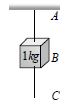
$A$ mass of $1\, kg$ is suspended by a string $A$. Another string $C$ is connected to its lower end (see figure). If a sudden jerk is given to $C$,then
A
The portion $AB$ of the string will break
B
The portion $BC$ of the string will break
C
None of the strings will break
D
The mass will start rotating
Solution
(B) When a sudden jerk is given to string $C$,an impulsive force is applied to it.
Due to the inertia of the $1\, kg$ mass,it does not immediately move downward.
This impulsive force creates a very high tension in the lower string $C$ (the portion $BC$).
Since the tension in $C$ exceeds its breaking strength before the impulse can be transmitted through the mass to the upper string $A$,the string $BC$ will break first.
Due to the inertia of the $1\, kg$ mass,it does not immediately move downward.
This impulsive force creates a very high tension in the lower string $C$ (the portion $BC$).
Since the tension in $C$ exceeds its breaking strength before the impulse can be transmitted through the mass to the upper string $A$,the string $BC$ will break first.
0 likesView Solution
2
ChemistryMediumMCQMHT CET · 2012
The reaction of sodium acetate and sodalime gives
A
$butane$
B
$ethane$
C
$methane$
D
$propane$
Solution
(C) The reaction of sodium acetate with sodalime $(NaOH + CaO)$ is a decarboxylation reaction.
$CH_{3}COONa + NaOH \xrightarrow{\Delta} CH_{4} + Na_{2}CO_{3}$
Here,sodium acetate reacts with sodalime to produce methane gas and sodium carbonate.
$CH_{3}COONa + NaOH \xrightarrow{\Delta} CH_{4} + Na_{2}CO_{3}$
Here,sodium acetate reacts with sodalime to produce methane gas and sodium carbonate.
0 likesView Solution
3
ChemistryEasyMCQMHT CET · 2012
The geometry of $I_{3}^{-}$ is
A
triangular
B
linear
C
tetrahedral
D
$T$-shape
Solution
(B) The central iodine atom in $I_{3}^{-}$ undergoes $sp^{3}d$ hybridization.
It has $3$ lone pairs of electrons in the equatorial positions and $2$ bonding pairs in the axial positions.
According to $VSEPR$ theory,the presence of $3$ lone pairs results in a linear geometry with a bond angle of $180^{\circ}$.
It has $3$ lone pairs of electrons in the equatorial positions and $2$ bonding pairs in the axial positions.
According to $VSEPR$ theory,the presence of $3$ lone pairs results in a linear geometry with a bond angle of $180^{\circ}$.
0 likesView Solution
4
ChemistryEasyMCQMHT CET · 2012
The hybridization state of $C$ atoms in but$-2-$enedioic acid is
A
$sp^{2}$
B
$sp^{3}$
C
Both $(a)$ and $(b)$
D
$sp$
Solution
(A) The structure of but$-2-$enedioic acid is $HOOC-CH=CH-COOH$.
In this molecule,each carbon atom is bonded to three other atoms (or groups) and has one double bond.
Specifically,the two carbonyl carbons are bonded to one oxygen (double bond),one hydroxyl group,and one carbon atom,making them $sp^{2}$ hybridized.
The two alkene carbons are each bonded to one hydrogen atom,one carbon atom,and one other carbon atom (double bond),also making them $sp^{2}$ hybridized.
Therefore,all $C$ atoms in but$-2-$enedioic acid are $sp^{2}$ hybridized.
In this molecule,each carbon atom is bonded to three other atoms (or groups) and has one double bond.
Specifically,the two carbonyl carbons are bonded to one oxygen (double bond),one hydroxyl group,and one carbon atom,making them $sp^{2}$ hybridized.
The two alkene carbons are each bonded to one hydrogen atom,one carbon atom,and one other carbon atom (double bond),also making them $sp^{2}$ hybridized.
Therefore,all $C$ atoms in but$-2-$enedioic acid are $sp^{2}$ hybridized.
0 likesView Solution
5
ChemistryEasyMCQMHT CET · 2012
$C-H$ bond length is least in
A
acetylene
B
methane
C
ethylene
D
ethane
Solution
(A) The $C-H$ bond length depends on the hybridization of the carbon atom.
As the $s$-character in the hybrid orbital increases,the bond length decreases.
In acetylene $(HC \equiv CH)$,the carbon is $sp$ hybridized ($50\% \ s$-character).
In ethylene $(CH_2=CH_2)$,the carbon is $sp^2$ hybridized ($33.3\% \ s$-character).
In methane $(CH_4)$ and ethane $(CH_3-CH_3)$,the carbon is $sp^3$ hybridized ($25\% \ s$-character).
Since $sp$ hybridization has the highest $s$-character,the $C-H$ bond length is the shortest in acetylene.
As the $s$-character in the hybrid orbital increases,the bond length decreases.
In acetylene $(HC \equiv CH)$,the carbon is $sp$ hybridized ($50\% \ s$-character).
In ethylene $(CH_2=CH_2)$,the carbon is $sp^2$ hybridized ($33.3\% \ s$-character).
In methane $(CH_4)$ and ethane $(CH_3-CH_3)$,the carbon is $sp^3$ hybridized ($25\% \ s$-character).
Since $sp$ hybridization has the highest $s$-character,the $C-H$ bond length is the shortest in acetylene.
0 likesView Solution
6
ChemistryMediumMCQMHT CET · 2012
Which of the following species has the highest bond energy?
A
$O_{2}^{2-}$
B
$O_{2}^{+}$
C
$O_{2}^{-}$
D
$O_{2}$
Solution
(B) The bond energy is directly proportional to the bond order. The bond order can be calculated using the formula: $\text{Bond Order} = \frac{N_b - N_a}{2}$,where $N_b$ is the number of bonding electrons and $N_a$ is the number of antibonding electrons.
$(A)$ $O_{2}^{2-}$: Total electrons = $18$. Configuration: $KK(\sigma 2s)^2, (\sigma^* 2s)^2, (\sigma 2p_z)^2, (\pi 2p_x)^2, (\pi 2p_y)^2, (\pi^* 2p_x)^2, (\pi^* 2p_y)^2$. Bond order = $\frac{10-8}{2} = 1$.
$(B)$ $O_{2}^{+}$: Total electrons = $15$. Configuration: $KK(\sigma 2s)^2, (\sigma^* 2s)^2, (\sigma 2p_z)^2, (\pi 2p_x)^2, (\pi 2p_y)^2, (\pi^* 2p_x)^1$. Bond order = $\frac{10-5}{2} = 2.5$.
$(C)$ $O_{2}^{-}$: Total electrons = $17$. Configuration: $KK(\sigma 2s)^2, (\sigma^* 2s)^2, (\sigma 2p_z)^2, (\pi 2p_x)^2, (\pi 2p_y)^2, (\pi^* 2p_x)^2, (\pi^* 2p_y)^1$. Bond order = $\frac{10-7}{2} = 1.5$.
$(D)$ $O_{2}$: Total electrons = $16$. Configuration: $KK(\sigma 2s)^2, (\sigma^* 2s)^2, (\sigma 2p_z)^2, (\pi 2p_x)^2, (\pi 2p_y)^2, (\pi^* 2p_x)^1, (\pi^* 2p_y)^1$. Bond order = $\frac{10-6}{2} = 2$.
Comparing the bond orders: $O_{2}^{+} (2.5) > O_{2} (2) > O_{2}^{-} (1.5) > O_{2}^{2-} (1)$.
Since $O_{2}^{+}$ has the highest bond order,it has the highest bond energy.
$(A)$ $O_{2}^{2-}$: Total electrons = $18$. Configuration: $KK(\sigma 2s)^2, (\sigma^* 2s)^2, (\sigma 2p_z)^2, (\pi 2p_x)^2, (\pi 2p_y)^2, (\pi^* 2p_x)^2, (\pi^* 2p_y)^2$. Bond order = $\frac{10-8}{2} = 1$.
$(B)$ $O_{2}^{+}$: Total electrons = $15$. Configuration: $KK(\sigma 2s)^2, (\sigma^* 2s)^2, (\sigma 2p_z)^2, (\pi 2p_x)^2, (\pi 2p_y)^2, (\pi^* 2p_x)^1$. Bond order = $\frac{10-5}{2} = 2.5$.
$(C)$ $O_{2}^{-}$: Total electrons = $17$. Configuration: $KK(\sigma 2s)^2, (\sigma^* 2s)^2, (\sigma 2p_z)^2, (\pi 2p_x)^2, (\pi 2p_y)^2, (\pi^* 2p_x)^2, (\pi^* 2p_y)^1$. Bond order = $\frac{10-7}{2} = 1.5$.
$(D)$ $O_{2}$: Total electrons = $16$. Configuration: $KK(\sigma 2s)^2, (\sigma^* 2s)^2, (\sigma 2p_z)^2, (\pi 2p_x)^2, (\pi 2p_y)^2, (\pi^* 2p_x)^1, (\pi^* 2p_y)^1$. Bond order = $\frac{10-6}{2} = 2$.
Comparing the bond orders: $O_{2}^{+} (2.5) > O_{2} (2) > O_{2}^{-} (1.5) > O_{2}^{2-} (1)$.
Since $O_{2}^{+}$ has the highest bond order,it has the highest bond energy.
0 likesView Solution
7
ChemistryMediumMCQMHT CET · 2012
Which of the following has the least bond energy?
A
$N_{2}^{2-}$
B
$N_{2}^{-}$
C
$N_{2}^{+}$
D
$N_{2}$
Solution
(A) The bond energy is directly proportional to the bond order. Let us calculate the bond order for each species using Molecular Orbital Theory:
$(A)$ $N_{2}^{2-}$: Total electrons = $14 + 2 = 16$. Configuration: $KK(\sigma 2s)^2 (\sigma^* 2s)^2 (\sigma 2p_z)^2 (\pi 2p_x)^2 (\pi 2p_y)^2 (\pi^* 2p_x)^1 (\pi^* 2p_y)^1$. Bond order = $(8 - 6) / 2 = 1$.
$(B)$ $N_{2}^{-}$: Total electrons = $14 + 1 = 15$. Configuration: $KK(\sigma 2s)^2 (\sigma^* 2s)^2 (\sigma 2p_z)^2 (\pi 2p_x)^2 (\pi 2p_y)^2 (\pi^* 2p_x)^1$. Bond order = $(8 - 5) / 2 = 1.5$.
$(C)$ $N_{2}^{+}$: Total electrons = $14 - 1 = 13$. Configuration: $KK(\sigma 2s)^2 (\sigma^* 2s)^2 (\sigma 2p_z)^1 (\pi 2p_x)^2 (\pi 2p_y)^2$. Bond order = $(7 - 2) / 2 = 2.5$.
$(D)$ $N_{2}$: Total electrons = $14$. Configuration: $KK(\sigma 2s)^2 (\sigma^* 2s)^2 (\pi 2p_x)^2 (\pi 2p_y)^2 (\sigma 2p_z)^2$. Bond order = $(8 - 2) / 2 = 3$.
Since $N_{2}^{2-}$ has the lowest bond order $(1)$,it has the least bond energy.
$(A)$ $N_{2}^{2-}$: Total electrons = $14 + 2 = 16$. Configuration: $KK(\sigma 2s)^2 (\sigma^* 2s)^2 (\sigma 2p_z)^2 (\pi 2p_x)^2 (\pi 2p_y)^2 (\pi^* 2p_x)^1 (\pi^* 2p_y)^1$. Bond order = $(8 - 6) / 2 = 1$.
$(B)$ $N_{2}^{-}$: Total electrons = $14 + 1 = 15$. Configuration: $KK(\sigma 2s)^2 (\sigma^* 2s)^2 (\sigma 2p_z)^2 (\pi 2p_x)^2 (\pi 2p_y)^2 (\pi^* 2p_x)^1$. Bond order = $(8 - 5) / 2 = 1.5$.
$(C)$ $N_{2}^{+}$: Total electrons = $14 - 1 = 13$. Configuration: $KK(\sigma 2s)^2 (\sigma^* 2s)^2 (\sigma 2p_z)^1 (\pi 2p_x)^2 (\pi 2p_y)^2$. Bond order = $(7 - 2) / 2 = 2.5$.
$(D)$ $N_{2}$: Total electrons = $14$. Configuration: $KK(\sigma 2s)^2 (\sigma^* 2s)^2 (\pi 2p_x)^2 (\pi 2p_y)^2 (\sigma 2p_z)^2$. Bond order = $(8 - 2) / 2 = 3$.
Since $N_{2}^{2-}$ has the lowest bond order $(1)$,it has the least bond energy.
0 likesView Solution
8
ChemistryEasyMCQMHT CET · 2012
The oxidation state of $Cr$ in $K_{2}Cr_{2}O_{7}$ is
A
$+4$
B
$+3$
C
$+6$
D
$+5$
Solution
(C) For $K_{2}Cr_{2}O_{7}$,let the oxidation state of $Cr$ be $x$.
The sum of oxidation states of all atoms in a neutral molecule is $0$.
$2(+1) + 2x + 7(-2) = 0$
$2 + 2x - 14 = 0$
$2x - 12 = 0$
$2x = 12$
$x = +6$
Therefore,the oxidation state of $Cr$ in $K_{2}Cr_{2}O_{7}$ is $+6$.
The sum of oxidation states of all atoms in a neutral molecule is $0$.
$2(+1) + 2x + 7(-2) = 0$
$2 + 2x - 14 = 0$
$2x - 12 = 0$
$2x = 12$
$x = +6$
Therefore,the oxidation state of $Cr$ in $K_{2}Cr_{2}O_{7}$ is $+6$.
0 likesView Solution
9
ChemistryMediumMCQMHT CET · 2012
The tetraethyl lead mixed in petrol works as
A
cooling agent
B
anti-knocking agent
C
bleaching agent
D
None of the above
Solution
(B) Tetraethyl lead $(TEL)$ is added to petrol as an anti-knocking agent.
It functions by increasing the octane number of the fuel,which prevents premature ignition or 'knocking' in internal combustion engines.
It functions by increasing the octane number of the fuel,which prevents premature ignition or 'knocking' in internal combustion engines.
0 likesView Solution
10
ChemistryEasyMCQMHT CET · 2012
$LPG$ mainly consists of the following:
A
$methane$
B
$hydrogen$
C
$acetylene$
D
$butane$
Solution
(D) $LPG$ (Liquefied Petroleum Gas) is a mixture of hydrocarbon gases used as a fuel.
It mainly consists of $butane$ $(C_4H_{10})$ and $propane$ $(C_3H_8)$.
Among the given options,$butane$ is the primary component.
It mainly consists of $butane$ $(C_4H_{10})$ and $propane$ $(C_3H_8)$.
Among the given options,$butane$ is the primary component.
0 likesView Solution
11
ChemistryEasyMCQMHT CET · 2012
Which of the following dissolves in ionic solvents?
A
$C_6H_6$
B
$CH_3OH$
C
$CCl_4$
D
$C_5H_{12}$
Solution
(B) Ionic solvents (like water) are polar in nature. According to the principle of 'like dissolves like',polar solutes dissolve in polar solvents.
$CH_3OH$ (methanol) is a polar molecule capable of forming hydrogen bonds with water,making it soluble in ionic/polar solvents.
$C_6H_6$ (benzene),$CCl_4$ (carbon tetrachloride),and $C_5H_{12}$ (pentane) are non-polar organic compounds and are insoluble in ionic solvents.
$CH_3OH$ (methanol) is a polar molecule capable of forming hydrogen bonds with water,making it soluble in ionic/polar solvents.
$C_6H_6$ (benzene),$CCl_4$ (carbon tetrachloride),and $C_5H_{12}$ (pentane) are non-polar organic compounds and are insoluble in ionic solvents.
0 likesView Solution
12
ChemistryEasyMCQMHT CET · 2012
Which of the following is a weak acid?
A
$C_6H_6$
B
$CH_3COOH$
C
$CH_2=CH_2$
D
$CH_3COCH_3$
Solution
(B) Among the given options,$CH_3COOH$ (acetic acid) is a weak acid because it partially dissociates in water to release $H^+$ ions.
$C_6H_6$ (benzene),$CH_2=CH_2$ (ethene),and $CH_3COCH_3$ (acetone) are not considered acids in the context of aqueous solutions as they do not readily donate $H^+$ ions.
$C_6H_6$ (benzene),$CH_2=CH_2$ (ethene),and $CH_3COCH_3$ (acetone) are not considered acids in the context of aqueous solutions as they do not readily donate $H^+$ ions.
0 likesView Solution
13
ChemistryMediumMCQMHT CET · 2012
Which of the following compounds is not aromatic?
A
Cyclobutadiene
B
Pyridine
C
Furan
D
Thiophene
Solution
(A) Aromatic compounds satisfy the $(4n+2) \pi$ $H$ückel rule.
$(A)$ Cyclobutadiene: Number of $\pi$ electrons $= 4$. Since it is not equal to $4n+2$,it is anti-aromatic,not aromatic.
$(B)$ Pyridine: Number of $\pi$ electrons $= 6$ ($4n+2$,where $n=1$). The lone pair on $N$ is not involved in delocalization.
$(C)$ Furan: Number of $\pi$ electrons $= 4 + 2 = 6$ ($4n+2$,where $n=1$).
$(D)$ Thiophene: Number of $\pi$ electrons $= 4 + 2 = 6$ ($4n+2$,where $n=1$).
Thus,except cyclobutadiene,all other species are aromatic.
$(A)$ Cyclobutadiene: Number of $\pi$ electrons $= 4$. Since it is not equal to $4n+2$,it is anti-aromatic,not aromatic.
$(B)$ Pyridine: Number of $\pi$ electrons $= 6$ ($4n+2$,where $n=1$). The lone pair on $N$ is not involved in delocalization.
$(C)$ Furan: Number of $\pi$ electrons $= 4 + 2 = 6$ ($4n+2$,where $n=1$).
$(D)$ Thiophene: Number of $\pi$ electrons $= 4 + 2 = 6$ ($4n+2$,where $n=1$).
Thus,except cyclobutadiene,all other species are aromatic.
0 likesView Solution
14
ChemistryMediumMCQMHT CET · 2012
The number of alkenyl groups possible from $C_{4}H_{7}$ are
A
$7$
B
$5$
C
$3$
D
$8$
Solution
(B) The alkenyl groups are derived by removing one hydrogen atom from an alkene. For $C_{4}H_{8}$ (butenes),the possible isomers are $1$-butene,$2$-butene,and $2$-methylpropene.
Removing a hydrogen atom from these structures gives the following $C_{4}H_{7}$ groups:
$(i)$ $CH_{3}CH_{2}CH=CH-$ ($1$-butenyl)
$(ii)$ $CH_{3}CH=CHCH_{2}-$ ($2$-butenyl)
$(iii)$ $CH_{2}=CHCH_{2}CH_{2}-$ ($3$-butenyl)
$(iv)$ $CH_{3}C(CH_{3})=CH-$ ($2$-methyl$-1-$propenyl)
$(v)$ $CH_{2}=C(CH_{3})CH_{2}-$ ($2$-methyl$-2-$propenyl)
Thus,there are $5$ possible alkenyl groups.
Removing a hydrogen atom from these structures gives the following $C_{4}H_{7}$ groups:
$(i)$ $CH_{3}CH_{2}CH=CH-$ ($1$-butenyl)
$(ii)$ $CH_{3}CH=CHCH_{2}-$ ($2$-butenyl)
$(iii)$ $CH_{2}=CHCH_{2}CH_{2}-$ ($3$-butenyl)
$(iv)$ $CH_{3}C(CH_{3})=CH-$ ($2$-methyl$-1-$propenyl)
$(v)$ $CH_{2}=C(CH_{3})CH_{2}-$ ($2$-methyl$-2-$propenyl)
Thus,there are $5$ possible alkenyl groups.
0 likesView Solution
15
ChemistryMediumMCQMHT CET · 2012
The number of structural isomers for the molecular formula $C_{4}H_{10}O$ is:
A
$7$
B
$8$
C
$6$
D
$5$
Solution
(A) The molecular formula $C_{4}H_{10}O$ corresponds to saturated acyclic compounds (alcohols and ethers). The structural isomers are as follows:
Alcohols:
$1$. $CH_{3}CH_{2}CH_{2}CH_{2}OH$ ($n$-butanol)
$2$. $CH_{3}CH_{2}CH(OH)CH_{3}$ (butan-$2$-ol)
$3$. $(CH_{3})_{2}CHCH_{2}OH$ (isobutanol)
$4$. $(CH_{3})_{3}COH$ (tert-butanol)
Ethers:
$5$. $CH_{3}OCH_{2}CH_{2}CH_{3}$ (methyl propyl ether)
$6$. $CH_{3}OCH(CH_{3})_{2}$ (methyl isopropyl ether)
$7$. $CH_{3}CH_{2}OCH_{2}CH_{3}$ (diethyl ether)
There are a total of $7$ structural isomers.
Alcohols:
$1$. $CH_{3}CH_{2}CH_{2}CH_{2}OH$ ($n$-butanol)
$2$. $CH_{3}CH_{2}CH(OH)CH_{3}$ (butan-$2$-ol)
$3$. $(CH_{3})_{2}CHCH_{2}OH$ (isobutanol)
$4$. $(CH_{3})_{3}COH$ (tert-butanol)
Ethers:
$5$. $CH_{3}OCH_{2}CH_{2}CH_{3}$ (methyl propyl ether)
$6$. $CH_{3}OCH(CH_{3})_{2}$ (methyl isopropyl ether)
$7$. $CH_{3}CH_{2}OCH_{2}CH_{3}$ (diethyl ether)
There are a total of $7$ structural isomers.
0 likesView Solution
16
ChemistryMediumMCQMHT CET · 2012
Which of the following is not an isomer of pentane?
A
$n$-pentane
B
$2,2$-dimethylpropane
C
$2,3$-dimethylbutane
D
$2$-methylbutane
Solution
(C) Pentane has the molecular formula $C_5H_{12}$. Isomers must have the same molecular formula but different structural arrangements.
$1.$ $n$-pentane: $CH_3-CH_2-CH_2-CH_2-CH_3$ $(C_5H_{12})$
$2.$ $2,2$-dimethylpropane: $CH_3-C(CH_3)_2-CH_3$ $(C_5H_{12})$
$3.$ $2$-methylbutane: $CH_3-CH(CH_3)-CH_2-CH_3$ $(C_5H_{12})$
$4.$ $2,3$-dimethylbutane: $CH_3-CH(CH_3)-CH(CH_3)-CH_3$ $(C_6H_{14})$
Since $2,3$-dimethylbutane has $6$ carbon atoms and the formula $C_6H_{14}$,it is an isomer of hexane,not pentane. Thus,option $C$ is correct.
$1.$ $n$-pentane: $CH_3-CH_2-CH_2-CH_2-CH_3$ $(C_5H_{12})$
$2.$ $2,2$-dimethylpropane: $CH_3-C(CH_3)_2-CH_3$ $(C_5H_{12})$
$3.$ $2$-methylbutane: $CH_3-CH(CH_3)-CH_2-CH_3$ $(C_5H_{12})$
$4.$ $2,3$-dimethylbutane: $CH_3-CH(CH_3)-CH(CH_3)-CH_3$ $(C_6H_{14})$
Since $2,3$-dimethylbutane has $6$ carbon atoms and the formula $C_6H_{14}$,it is an isomer of hexane,not pentane. Thus,option $C$ is correct.
0 likesView Solution
17
ChemistryMediumMCQMHT CET · 2012
By which of the following processes are hydrocarbons obtained from petroleum?
A
Combustion
B
Fractional distillation
C
Addition
D
All of the above
Solution
(B) Hydrocarbons are separated from petroleum based on their different boiling points using the $Fractional \ distillation$ method.
0 likesView Solution
18
ChemistryMediumMCQMHT CET · 2012
The false statement regarding alkanes is
A
they do not undergo polymerization reactions
B
they do not undergo elimination reactions
C
they do not decolourise dilute $KMnO_{4}$ solution
D
they do not decolourise bromine water
Solution
(B) Alkanes are saturated hydrocarbons and generally do not undergo addition reactions,which is why they do not decolourise bromine water or dilute $KMnO_{4}$ solution. They also do not typically undergo polymerization. However,alkanes do undergo elimination reactions,specifically dehydrogenation or cracking,when heated to high temperatures $(500-700^{\circ} C)$ in the absence of air. For example,propane undergoes cracking to form propene,ethene,methane,and hydrogen. Therefore,the statement that alkanes do not undergo elimination reactions is false.
0 likesView Solution
19
ChemistryEasyMCQMHT CET · 2012
Which of the following aromatic compounds undergoes sulphonation reaction most easily?
A
Chlorobenzene
B
Nitrobenzene
C
Toluene
D
Benzene
Solution
(C) The rate of electrophilic aromatic substitution,such as sulphonation,depends on the electron density of the benzene ring.
$CH_3$ group in Toluene is an electron-donating group ($+I$ effect and hyperconjugation),which increases the electron density of the benzene ring,making it more reactive towards electrophiles compared to Benzene,Chlorobenzene (deactivating),and Nitrobenzene (strongly deactivating).
Therefore,Toluene undergoes sulphonation most easily.
$CH_3$ group in Toluene is an electron-donating group ($+I$ effect and hyperconjugation),which increases the electron density of the benzene ring,making it more reactive towards electrophiles compared to Benzene,Chlorobenzene (deactivating),and Nitrobenzene (strongly deactivating).
Therefore,Toluene undergoes sulphonation most easily.
0 likesView Solution
20
ChemistryEasyMCQMHT CET · 2012
The conjugate acid of $HS^{-}$ is
A
$S^{2-}$
B
$H_2S$
C
Both $(A)$ and $(B)$
D
None of these
Solution
(B) conjugate acid is formed by adding a proton $(H^{+})$ to a base.
For the species $HS^{-}$,adding a proton $(H^{+})$ results in $H_2S$.
The reaction is: $HS^{-} + H^{+} \rightleftharpoons H_2S$.
Therefore,the conjugate acid of $HS^{-}$ is $H_2S$.
For the species $HS^{-}$,adding a proton $(H^{+})$ results in $H_2S$.
The reaction is: $HS^{-} + H^{+} \rightleftharpoons H_2S$.
Therefore,the conjugate acid of $HS^{-}$ is $H_2S$.
0 likesView Solution
21
ChemistryDifficultMCQMHT CET · 2012
The degree of ionization of $0.4 \ M$ acetic acid will be $(K_{a} = 1.8 \times 10^{-5})$.
A
$6.71 \times 10^{-3}$
B
$1.6 \times 10^{-3}$
C
$0.4 \times 1.8 \times 10^{-5}$
D
$1.8 \times 10^{-5}$
Solution
(A) For a weak acid like acetic acid,the dissociation constant $K_{a}$ is related to the degree of ionization $\alpha$ and concentration $C$ by the formula: $K_{a} = C \alpha^{2}$.
Given $K_{a} = 1.8 \times 10^{-5}$ and $C = 0.4 \ M$.
Substituting the values: $1.8 \times 10^{-5} = 0.4 \times \alpha^{2}$.
$\alpha^{2} = \frac{1.8 \times 10^{-5}}{0.4} = 4.5 \times 10^{-5} = 45 \times 10^{-6}$.
$\alpha = \sqrt{45 \times 10^{-6}} \approx 6.71 \times 10^{-3}$.
Given $K_{a} = 1.8 \times 10^{-5}$ and $C = 0.4 \ M$.
Substituting the values: $1.8 \times 10^{-5} = 0.4 \times \alpha^{2}$.
$\alpha^{2} = \frac{1.8 \times 10^{-5}}{0.4} = 4.5 \times 10^{-5} = 45 \times 10^{-6}$.
$\alpha = \sqrt{45 \times 10^{-6}} \approx 6.71 \times 10^{-3}$.
0 likesView Solution
22
ChemistryMediumMCQMHT CET · 2012
The hydrogen ion concentration of a solution is $3.98 \times 10^{-6} \text{ mole per liter}$. The $pH$ value of this solution will be
A
$6.0$
B
$5.8$
C
$5.4$
D
$5.9$
Solution
(C) $pH = -\log [H^{+}]$
$pH = -\log (3.98 \times 10^{-6})$
$pH = -(\log 3.98 + \log 10^{-6})$
$pH = -(0.60 - 6)$
$pH = 5.40$
$pH = -\log (3.98 \times 10^{-6})$
$pH = -(\log 3.98 + \log 10^{-6})$
$pH = -(0.60 - 6)$
$pH = 5.40$
0 likesView Solution
23
ChemistryDifficultMCQMHT CET · 2012
Which of the following organic compounds could not be dried by anhydrous $CaCl_{2}$?
A
Ethanol
B
Benzene
C
Chloroform
D
Ethyl acetate
Solution
(A) Ethanol cannot be dried using anhydrous $CaCl_{2}$ because it reacts with $CaCl_{2}$ to form an addition compound (solvate). The reaction is as follows:
$CaCl_{2} + 4C_{2}H_{5}OH \rightarrow CaCl_{2} \cdot 4C_{2}H_{5}OH$ (solid)
$CaCl_{2} + 4C_{2}H_{5}OH \rightarrow CaCl_{2} \cdot 4C_{2}H_{5}OH$ (solid)
0 likesView Solution
24
ChemistryEasyMCQMHT CET · 2012
The oxidation number of $C$ atom in $CH_{2}Cl_{2}$ and $CCl_{4}$ are respectively:
A
$0$ and $-4$
B
$0$ and $-4$
C
$0$ and $4$
D
$2$ and $4$
Solution
(C) Let the oxidation number of $C$ be $x$.
For $CH_{2}Cl_{2}$:
$x + 2(+1) + 2(-1) = 0$
$x + 2 - 2 = 0$
$x = 0$
For $CCl_{4}$:
$x + 4(-1) = 0$
$x - 4 = 0$
$x = 4$
Thus,the oxidation numbers are $0$ and $4$ respectively.
For $CH_{2}Cl_{2}$:
$x + 2(+1) + 2(-1) = 0$
$x + 2 - 2 = 0$
$x = 0$
For $CCl_{4}$:
$x + 4(-1) = 0$
$x - 4 = 0$
$x = 4$
Thus,the oxidation numbers are $0$ and $4$ respectively.
0 likesView Solution
25
ChemistryMediumMCQMHT CET · 2012
Which of the following is least hydrolysed?
A
$BeCl_{2}$
B
$MgCl_{2}$
C
$CaCl_{2}$
D
$BaCl_{2}$
Solution
(D) Hydrolysis of metal chlorides depends on the ionic character of the $M-Cl$ bond.
As we move down the group from $Be$ to $Ba$,the ionic character of the metal chloride increases due to the decrease in polarizing power of the cation.
$BeCl_{2}$ is covalent and undergoes hydrolysis,whereas $BaCl_{2}$ is highly ionic and is the least susceptible to hydrolysis among the given options.
Therefore,$BaCl_{2}$ is the least hydrolysed.
As we move down the group from $Be$ to $Ba$,the ionic character of the metal chloride increases due to the decrease in polarizing power of the cation.
$BeCl_{2}$ is covalent and undergoes hydrolysis,whereas $BaCl_{2}$ is highly ionic and is the least susceptible to hydrolysis among the given options.
Therefore,$BaCl_{2}$ is the least hydrolysed.
0 likesView Solution
26
ChemistryMediumMCQMHT CET · 2012
Gypsum is
A
$CaSO_{4} \cdot H_{2}O$
B
$CaSO_{4} \cdot 2H_{2}O$
C
$2CaSO_{4} \cdot 2H_{2}O$
D
$CaSO_{4}$
Solution
(B) Gypsum is a naturally occurring mineral with the chemical formula $CaSO_{4} \cdot 2H_{2}O$.
0 likesView Solution
27
ChemistryDifficultMCQMHT CET · 2012
The volume concentration of hydrogen peroxide having $6.8 \%$ concentration will be
A
$5$
B
$11.2$
C
$22.4$
D
$20$
Solution
(C) The relation between volume strength and percentage strength of $H_2O_2$ is given by:
$\text{Volume strength} = 5.6 \times \text{Molarity}$
$\text{Molarity} = \frac{\% \text{ strength} \times 10}{\text{Molar mass of } H_2O_2} = \frac{6.8 \times 10}{34} = 2 \ M$
$\text{Volume strength} = 5.6 \times 2 = 11.2 \ V$
Alternatively,using the direct formula:
$\text{Volume strength} = \frac{112}{34} \times \% \text{ concentration} = \frac{112}{34} \times 6.8 = 22.4 \ V$
$\text{Volume strength} = 5.6 \times \text{Molarity}$
$\text{Molarity} = \frac{\% \text{ strength} \times 10}{\text{Molar mass of } H_2O_2} = \frac{6.8 \times 10}{34} = 2 \ M$
$\text{Volume strength} = 5.6 \times 2 = 11.2 \ V$
Alternatively,using the direct formula:
$\text{Volume strength} = \frac{112}{34} \times \% \text{ concentration} = \frac{112}{34} \times 6.8 = 22.4 \ V$
0 likesView Solution
28
ChemistryDifficultMCQMHT CET · 2012
Which of the following on combustion gives maximum energy?
A
Ethane
B
Propane
C
Methane
D
Butane
Solution
(D) The general equation for the combustion of alkanes is $C_n H_{2n+2} + (\frac{3n+1}{2}) O_2 \rightarrow n CO_2 + (n+1) H_2O + \text{Heat}$.
Greater the value of $n$ (number of carbon atoms),greater will be the amount of heat produced upon combustion.
Comparing the given alkanes: Methane $(n=1)$,Ethane $(n=2)$,Propane $(n=3)$,and Butane $(n=4)$.
Since Butane has the highest number of carbon atoms $(n=4)$,it releases the maximum energy upon combustion.
Greater the value of $n$ (number of carbon atoms),greater will be the amount of heat produced upon combustion.
Comparing the given alkanes: Methane $(n=1)$,Ethane $(n=2)$,Propane $(n=3)$,and Butane $(n=4)$.
Since Butane has the highest number of carbon atoms $(n=4)$,it releases the maximum energy upon combustion.
0 likesView Solution
29
ChemistryEasyMCQMHT CET · 2012
Which of the following compounds forms a white precipitate with bromine water?
A
Nitrobenzene
B
Phenol
C
Benzene
D
All of the above
Solution
(B) Phenol reacts with bromine water $(Br_2/H_2O)$ to undergo electrophilic aromatic substitution,yielding a white precipitate of $2,4,6-$tribromophenol.
The reaction is:
$C_6H_5OH + 3Br_2(aq) \rightarrow C_6H_2Br_3OH(s) + 3HBr(aq)$
The reaction is:
$C_6H_5OH + 3Br_2(aq) \rightarrow C_6H_2Br_3OH(s) + 3HBr(aq)$
0 likesView Solution
30
ChemistryEasyMCQMHT CET · 2012
The nature of $2,4,6-$trinitrophenol is
A
neutral
B
basic
C
acidic
D
weak basic
Solution
(C) $2,4,6-$trinitrophenol is commonly known as picric acid. The presence of three electron-withdrawing $-NO_2$ groups at the ortho and para positions significantly increases the acidity of the phenolic $-OH$ group by stabilizing the phenoxide ion through resonance and inductive effects. Therefore,it is strongly acidic in nature.
0 likesView Solution
31
ChemistryMediumMCQMHT CET · 2012
Which of the following is the strongest base?
A
$C_6H_5NH_2$
B
$CH_3NH_2$
C
$NH_3$
D
$CH_3CONH_2$
Solution
(B) The basic nature of an amine is due to the presence of a lone pair of electrons on the nitrogen atom,which is available for bond formation with a Lewis acid.
In $CH_3NH_2$,the $+I$ effect of the $-CH_3$ group increases the electron density on the nitrogen atom,making it more available for donation compared to $NH_3$.
In $C_6H_5NH_2$,the lone pair is involved in resonance with the benzene ring,reducing its availability.
In $CH_3CONH_2$,the lone pair is involved in resonance with the carbonyl group $(C=O)$,significantly reducing its basicity.
Therefore,$CH_3NH_2$ is the strongest base among the given options.
In $CH_3NH_2$,the $+I$ effect of the $-CH_3$ group increases the electron density on the nitrogen atom,making it more available for donation compared to $NH_3$.
In $C_6H_5NH_2$,the lone pair is involved in resonance with the benzene ring,reducing its availability.
In $CH_3CONH_2$,the lone pair is involved in resonance with the carbonyl group $(C=O)$,significantly reducing its basicity.
Therefore,$CH_3NH_2$ is the strongest base among the given options.
0 likesView Solution
32
ChemistryDifficultMCQMHT CET · 2012
Which of the following acids does not contain the $-COOH$ group?
A
Carbamic acid
B
Barbituric acid
C
Lactic acid
D
Succinic acid
Solution
(B) The structures of the given acids are:
$(A)$ Carbamic acid: $NH_2COOH$ (contains $-COOH$ group)
$(B)$ Barbituric acid: $C_4H_4N_2O_3$ (a cyclic amide,does not contain $-COOH$ group)
$(C)$ Lactic acid: $CH_3CH(OH)COOH$ (contains $-COOH$ group)
$(D)$ Succinic acid: $HOOCCH_2CH_2COOH$ (contains $-COOH$ group)
Therefore,barbituric acid is the correct answer as it is a pyrimidine derivative and not a carboxylic acid.
$(A)$ Carbamic acid: $NH_2COOH$ (contains $-COOH$ group)
$(B)$ Barbituric acid: $C_4H_4N_2O_3$ (a cyclic amide,does not contain $-COOH$ group)
$(C)$ Lactic acid: $CH_3CH(OH)COOH$ (contains $-COOH$ group)
$(D)$ Succinic acid: $HOOCCH_2CH_2COOH$ (contains $-COOH$ group)
Therefore,barbituric acid is the correct answer as it is a pyrimidine derivative and not a carboxylic acid.
0 likesView Solution
33
ChemistryDifficultMCQMHT CET · 2012
Which of the following statements is false?
A
$40 \%$ solution of $HCHO$ is known as formalin
B
$HCHO$ is least reactive in its homologous series
C
The boiling point of iso-valeraldehyde is less than $n$-valeraldehyde
D
The boiling point of ketones is higher than that of aldehydes
Solution
(B) $HCHO$ (formaldehyde) is the most reactive aldehyde in its homologous series due to the absence of electron-donating alkyl groups and minimal steric hindrance. Therefore,the statement that $HCHO$ is the least reactive is false.
$40 \%$ solution of $HCHO$ is indeed called formalin.
Branching in iso-valeraldehyde decreases the surface area compared to $n$-valeraldehyde,leading to a lower boiling point.
Ketones generally have higher boiling points than isomeric aldehydes due to the higher dipole moment of the carbonyl group.
$40 \%$ solution of $HCHO$ is indeed called formalin.
Branching in iso-valeraldehyde decreases the surface area compared to $n$-valeraldehyde,leading to a lower boiling point.
Ketones generally have higher boiling points than isomeric aldehydes due to the higher dipole moment of the carbonyl group.
0 likesView Solution
34
ChemistryEasyMCQMHT CET · 2012
The alkaline hydrolysis of ester is known as
A
dehydrogenation
B
dehydration
C
esterification
D
saponification
Solution
(D) The alkaline hydrolysis of an ester is known as saponification.
When an ester is heated with aqueous $NaOH$,a sodium salt of the carboxylic acid and an alcohol are formed.
The reaction is represented as:
$R-COOR' + NaOH \rightarrow R-COO^-Na^+ + R'OH$
When an ester is heated with aqueous $NaOH$,a sodium salt of the carboxylic acid and an alcohol are formed.
The reaction is represented as:
$R-COOR' + NaOH \rightarrow R-COO^-Na^+ + R'OH$
0 likesView Solution
35
ChemistryMediumMCQMHT CET · 2012
$[Cu(NH_3)_4]^{2+}$ shows the following hybridization:
A
$dsp^2$
B
$sp^3d$
C
$dsp^3$
D
$sp^3$
Solution
(A) The atomic number of $Cu$ is $29$. The electronic configuration is $[Ar] 3d^{10} 4s^1$.
In $[Cu(NH_3)_4]^{2+}$,the oxidation state of $Cu$ is $+2$. The electronic configuration of $Cu^{2+}$ is $[Ar] 3d^9$.
In the presence of $4$ $NH_3$ ligands,one electron from the $3d$ orbital is promoted to the $4p$ orbital to facilitate $dsp^2$ hybridization.
Thus,the hybridization is $dsp^2$.
In $[Cu(NH_3)_4]^{2+}$,the oxidation state of $Cu$ is $+2$. The electronic configuration of $Cu^{2+}$ is $[Ar] 3d^9$.
In the presence of $4$ $NH_3$ ligands,one electron from the $3d$ orbital is promoted to the $4p$ orbital to facilitate $dsp^2$ hybridization.
Thus,the hybridization is $dsp^2$.
0 likesView Solution
36
ChemistryEasyMCQMHT CET · 2012
Which of the following compounds is used as a refrigerant?
A
$CCl_4$
B
$CCl_2F_2$
C
$CF_4$
D
Acetone
Solution
(B) Chlorofluorocarbons,specifically dichlorodifluoromethane $(CCl_2F_2)$,are commonly used as refrigerants in refrigerators and air conditioners.
0 likesView Solution
37
ChemistryMediumMCQMHT CET · 2012
The strongest acid is
A
acetic acid
B
trichloroacetic acid
C
dichloroacetic acid
D
monochloroacetic acid
Solution
(B) The acidity of carboxylic acids is influenced by the presence of electron-withdrawing groups (EWGs) such as the chloro group $(-Cl)$.
These groups exert a $-I$ (negative inductive) effect,which stabilizes the carboxylate anion by dispersing the negative charge.
As the number of electron-withdrawing chlorine atoms increases,the $-I$ effect becomes stronger,leading to greater stabilization of the conjugate base and thus higher acidity.
The order of acidity is: $CCl_3COOH > CHCl_2COOH > CH_2ClCOOH > CH_3COOH$.
Therefore,trichloroacetic acid is the strongest acid among the given options.
These groups exert a $-I$ (negative inductive) effect,which stabilizes the carboxylate anion by dispersing the negative charge.
As the number of electron-withdrawing chlorine atoms increases,the $-I$ effect becomes stronger,leading to greater stabilization of the conjugate base and thus higher acidity.
The order of acidity is: $CCl_3COOH > CHCl_2COOH > CH_2ClCOOH > CH_3COOH$.
Therefore,trichloroacetic acid is the strongest acid among the given options.
0 likesView Solution
38
ChemistryMediumMCQMHT CET · 2012
Which of the following groups is strongly ortho and para directing?
A
$-C_6H_5$
B
$-OH$
C
$-CH_3$
D
$-Cl$
Solution
(B) All the given groups are $o-$ and $p-$ directing.
However,in the $-OH$ group,the lone pair of electrons on the $O$-atom participates in resonance,which significantly increases the electron density at the $o-$ and $p-$ positions of the benzene ring.
This makes the $-OH$ group a strongly activating and strongly $o-$ and $p-$ directing group compared to the others.
However,in the $-OH$ group,the lone pair of electrons on the $O$-atom participates in resonance,which significantly increases the electron density at the $o-$ and $p-$ positions of the benzene ring.
This makes the $-OH$ group a strongly activating and strongly $o-$ and $p-$ directing group compared to the others.
0 likesView Solution
39
ChemistryMediumMCQMHT CET · 2012
The minimum number of carbon atoms in ketones which will show chain isomerism is:
A
$7$
B
$4$
C
$6$
D
$5$
Solution
(D) Chain isomerism in ketones requires a minimum of $5$ carbon atoms in the main chain to allow for branching.
For example,pentan-$2$-one $(CH_3COCH_2CH_2CH_3)$ can form a chain isomer,$3$-methylbutan-$2$-one $(CH_3COCH(CH_3)_2)$,by branching the carbon chain.
Thus,the minimum number of carbon atoms required is $5$.
For example,pentan-$2$-one $(CH_3COCH_2CH_2CH_3)$ can form a chain isomer,$3$-methylbutan-$2$-one $(CH_3COCH(CH_3)_2)$,by branching the carbon chain.
Thus,the minimum number of carbon atoms required is $5$.
0 likesView Solution
40
ChemistryEasyMCQMHT CET · 2012
Fool's gold is
A
$Cu_{2}S$
B
$FeS_{2}$
C
$Al_{2}O_{5}$
D
$CuFeS_{2}$
Solution
(B) Iron pyrite,$FeS_{2}$,is commonly known as fool's gold due to its metallic luster and pale brass-yellow hue,which resembles gold.
0 likesView Solution
41
ChemistryEasyMCQMHT CET · 2012
Which of the following is not an iron ore?
A
Malachite
B
Haematite
C
Siderite
D
Limonite
Solution
(A) The ores of iron are:
$1$. Haematite: $Fe_2O_3$
$2$. Siderite: $FeCO_3$
$3$. Limonite: $Fe_2O_3 \cdot 3H_2O$
Malachite is an ore of copper with the formula $CuCO_3 \cdot Cu(OH)_2$.
Therefore,malachite is not an iron ore.
$1$. Haematite: $Fe_2O_3$
$2$. Siderite: $FeCO_3$
$3$. Limonite: $Fe_2O_3 \cdot 3H_2O$
Malachite is an ore of copper with the formula $CuCO_3 \cdot Cu(OH)_2$.
Therefore,malachite is not an iron ore.
0 likesView Solution
42
ChemistryMediumMCQMHT CET · 2012
$C_{6}H_{6} + CH_{3}Cl \xrightarrow{\text{Anhy. } AlCl_{3}} C_{6}H_{5}CH_{3} + HCl$
The name of the above reaction is:
The name of the above reaction is:
A
Gattermann
B
Reimer-Tiemann
C
Friedel-Craft
D
Cannizzaro
Solution
(C) The given reaction is $C_{6}H_{6} + CH_{3}Cl \xrightarrow{\text{Anhy. } AlCl_{3}} C_{6}H_{5}CH_{3} + HCl$.
This is an electrophilic aromatic substitution reaction where a methyl group is introduced into the benzene ring using an alkyl halide in the presence of a Lewis acid catalyst $(AlCl_{3})$.
This reaction is known as the Friedel-Crafts alkylation reaction.
This is an electrophilic aromatic substitution reaction where a methyl group is introduced into the benzene ring using an alkyl halide in the presence of a Lewis acid catalyst $(AlCl_{3})$.
This reaction is known as the Friedel-Crafts alkylation reaction.
0 likesView Solution
43
ChemistryEasyMCQMHT CET · 2012
$A$ solution contains $Cl^{-}$,$I^{-}$,and $SO_{4}^{2-}$ ions. Which of the following ions is capable of precipitating all of the above when added to this solution?
A
$Pb^{2+}$
B
$Ba^{2+}$
C
$Hg^{2+}$
D
$Cu^{2+}$
Solution
(A) $Pb^{2+}$ ion is capable of precipitating $Cl^{-}$,$I^{-}$,and $SO_{4}^{2-}$ ions as insoluble salts.
$Pb^{2+} + 2Cl^{-} \longrightarrow PbCl_{2} \downarrow$ (White precipitate)
$Pb^{2+} + 2I^{-} \longrightarrow PbI_{2} \downarrow$ (Yellow precipitate)
$Pb^{2+} + SO_{4}^{2-} \longrightarrow PbSO_{4} \downarrow$ (White precipitate)
While $Ba^{2+}$ precipitates $SO_{4}^{2-}$,it does not form insoluble precipitates with $Cl^{-}$ and $I^{-}$ in aqueous solutions.
$Pb^{2+} + 2Cl^{-} \longrightarrow PbCl_{2} \downarrow$ (White precipitate)
$Pb^{2+} + 2I^{-} \longrightarrow PbI_{2} \downarrow$ (Yellow precipitate)
$Pb^{2+} + SO_{4}^{2-} \longrightarrow PbSO_{4} \downarrow$ (White precipitate)
While $Ba^{2+}$ precipitates $SO_{4}^{2-}$,it does not form insoluble precipitates with $Cl^{-}$ and $I^{-}$ in aqueous solutions.
0 likesView Solution
44
ChemistryMediumMCQMHT CET · 2012
Haber process is used for the production of which of the following?
A
$NH_3$
B
$HNO_3$
C
$H_2SO_4$
D
$O_3$
Solution
(A) The Haber process is an industrial method used for the large-scale production of ammonia $(NH_3)$.
In this process,nitrogen gas reacts with hydrogen gas in the presence of an iron catalyst at high temperature and pressure.
The chemical equation is: $N_{2(g)} + 3H_{2(g)} \rightleftharpoons 2NH_{3(g)}$
In this process,nitrogen gas reacts with hydrogen gas in the presence of an iron catalyst at high temperature and pressure.
The chemical equation is: $N_{2(g)} + 3H_{2(g)} \rightleftharpoons 2NH_{3(g)}$
0 likesView Solution
45
ChemistryEasyMCQMHT CET · 2012
The laughing gas is
A
$N_{2}O_{4}$
B
$NO$
C
$N_{2}O$
D
$N_{2}O_{5}$
Solution
(C) Nitrous oxide,$N_{2}O$,is commonly known as laughing gas.
0 likesView Solution
46
ChemistryDifficultMCQMHT CET · 2012
The solution of $BiCl_{3}$ in dil. $HCl$ when diluted with water,forms a white precipitate which is:
A
Bismuth oxychloride
B
Bismuth oxide
C
Bismuth hydroxide
D
None of the above
Solution
(A) When $BiCl_{3}$ is diluted with water,it undergoes hydrolysis to form a white precipitate of bismuth oxychloride $(BiOCl)$.
The chemical reaction is: $BiCl_{3} + H_{2}O \rightleftharpoons BiOCl \downarrow + 2HCl$
Here,$BiOCl$ is the white precipitate.
The chemical reaction is: $BiCl_{3} + H_{2}O \rightleftharpoons BiOCl \downarrow + 2HCl$
Here,$BiOCl$ is the white precipitate.
0 likesView Solution
47
ChemistryMediumMCQMHT CET · 2012
Which of the following compounds of xenon does not exist?
A
$XeF_{6}$
B
$XeF_{4}$
C
$XeF_{5}$
D
$XeF_{2}$
Solution
(C) Xenon forms the following stable fluorides: $XeF_{2}$,$XeF_{4}$,and $XeF_{6}$.
$XeF_{5}$ is not a known stable compound of xenon.
$XeF_{5}$ is not a known stable compound of xenon.
0 likesView Solution
48
ChemistryEasyMCQMHT CET · 2012
$Nylon-6,6$ is a
A
polyester
B
polyamide
C
polyacrylate
D
None of the above
Solution
(B) $Nylon-6,6$ is a condensation polymer formed by the reaction between hexamethylene diamine $(nH_2N-(CH_2)_6-NH_2)$ and adipic acid $(nHOOC-(CH_2)_4-COOH)$.
Since the repeating units are linked by amide bonds $(-CONH-)$,it is classified as a polyamide.
Since the repeating units are linked by amide bonds $(-CONH-)$,it is classified as a polyamide.
0 likesView Solution
49
ChemistryEasyMCQMHT CET · 2012
The natural rubber is the polymer of
A
$1,3-$butadiene
B
polyamide
C
isoprene
D
None of these
Solution
(C) Natural rubber is a linear polymer of isoprene ($2-$methyl-$1,3-$butadiene).
It is formed by the polymerization of isoprene units.
The reaction is as follows:
$nCH_2=C(CH_3)-CH=CH_2 \xrightarrow{\text{Polymerization}} [CH_2-C(CH_3)=CH-CH_2]_n$
It is formed by the polymerization of isoprene units.
The reaction is as follows:
$nCH_2=C(CH_3)-CH=CH_2 \xrightarrow{\text{Polymerization}} [CH_2-C(CH_3)=CH-CH_2]_n$
0 likesView Solution
50
ChemistryMediumMCQMHT CET · 2012
The molar concentration of chloride ions in the resulting solution of $300 \ mL$ of $3.0 \ M$ $NaCl$ and $200 \ mL$ of $4.0 \ M$ $BaCl_{2}$ will be (in $M$)
A
$1.7$
B
$1.8$
C
$5.0$
D
$3.4$
Solution
(C) For $NaCl$: $n(Cl^-) = M \times V = 3.0 \ M \times 0.300 \ L = 0.9 \ mol$.
For $BaCl_{2}$: $BaCl_{2} \rightarrow Ba^{2+} + 2Cl^-$.
$n(Cl^-) = 2 \times M \times V = 2 \times 4.0 \ M \times 0.200 \ L = 1.6 \ mol$.
Total moles of $Cl^- = 0.9 \ mol + 1.6 \ mol = 2.5 \ mol$.
Total volume of solution = $300 \ mL + 200 \ mL = 500 \ mL = 0.5 \ L$.
Molar concentration of $Cl^- = \frac{\text{Total moles}}{\text{Total volume}} = \frac{2.5 \ mol}{0.5 \ L} = 5.0 \ M$.
For $BaCl_{2}$: $BaCl_{2} \rightarrow Ba^{2+} + 2Cl^-$.
$n(Cl^-) = 2 \times M \times V = 2 \times 4.0 \ M \times 0.200 \ L = 1.6 \ mol$.
Total moles of $Cl^- = 0.9 \ mol + 1.6 \ mol = 2.5 \ mol$.
Total volume of solution = $300 \ mL + 200 \ mL = 500 \ mL = 0.5 \ L$.
Molar concentration of $Cl^- = \frac{\text{Total moles}}{\text{Total volume}} = \frac{2.5 \ mol}{0.5 \ L} = 5.0 \ M$.
0 likesView Solution
51
ChemistryEasyMCQMHT CET · 2012
Which of the following species shows the maximum magnetic moment?
A
$Mn^{6+}$
B
$Ni^{2+}$
C
$Fe^{3+}$
D
$Ag^{+}$
Solution
(C) The magnetic moment $(\mu)$ is calculated using the formula $\mu = \sqrt{n(n+2)} \text{ BM}$,where $n$ is the number of unpaired electrons.
$1$. For $Mn^{6+}$ $([Ar]3d^1)$: $n = 1$,$\mu = \sqrt{1(1+2)} = 1.73 \text{ BM}$.
$2$. For $Ni^{2+}$ $([Ar]3d^8)$: $n = 2$,$\mu = \sqrt{2(2+2)} = 2.83 \text{ BM}$.
$3$. For $Fe^{3+}$ $([Ar]3d^5)$: $n = 5$,$\mu = \sqrt{5(5+2)} = 5.91 \text{ BM}$.
$4$. For $Ag^{+}$ $([Kr]4d^{10})$: $n = 0$,$\mu = 0 \text{ BM}$.
Thus,$Fe^{3+}$ has the maximum number of unpaired electrons $(n=5)$ and consequently shows the maximum magnetic moment.
$1$. For $Mn^{6+}$ $([Ar]3d^1)$: $n = 1$,$\mu = \sqrt{1(1+2)} = 1.73 \text{ BM}$.
$2$. For $Ni^{2+}$ $([Ar]3d^8)$: $n = 2$,$\mu = \sqrt{2(2+2)} = 2.83 \text{ BM}$.
$3$. For $Fe^{3+}$ $([Ar]3d^5)$: $n = 5$,$\mu = \sqrt{5(5+2)} = 5.91 \text{ BM}$.
$4$. For $Ag^{+}$ $([Kr]4d^{10})$: $n = 0$,$\mu = 0 \text{ BM}$.
Thus,$Fe^{3+}$ has the maximum number of unpaired electrons $(n=5)$ and consequently shows the maximum magnetic moment.
0 likesView Solution
Vedclass Products
For Students
Vedclass Test Series
Mock tests in real MHT CET style covering Chemistry with performance analysis. 5-day free trial.
Start Free TrialFor Teachers
Exam Paper Generator
Generate Set A/B/C/D Chemistry papers from 7.5L+ questions in 2 minutes. 3 chapters free.
Try FreeFor Institutes
Online Exam Module
Run live MHT CET mock exams with unlimited students, 360° analytics & white-label branding.
See DemoFrequently Asked Questions
How many Chemistry questions are in MHT CET 2012?
There are 51 Chemistry questions from the MHT CET 2012 paper on Vedclass, each with a detailed step-by-step solution in English.
Are MHT CET 2012 Chemistry solutions available in English?
Yes. All solutions on this page are in English. You can also switch to English or Hindi using the language buttons above the questions.
Can I practice MHT CET 2012 Chemistry as a timed test?
Yes. Use the Vedclass Test Series to attempt a full MHT CET mock test covering Chemistry with time limits and instant score analysis.
Can teachers create Chemistry papers from MHT CET previous year questions?
Yes. The Vedclass Exam Paper Generator lets teachers mix MHT CET Chemistry questions and generate Set A/B/C/D papers in minutes.
For Teachers & Institutes
Build a Custom Chemistry Paper
Pick MHT CET 2012 Chemistry questions, set difficulty, and generate Set A/B/C/D in 2 minutes.