
PhysicsQ1–50 of 50 questions
Page 1 of 1 · English
1
PhysicsMediumMCQMHT CET · 2012
$A$ ball of mass $0.1 \,kg$ strikes a wall normally with a speed of $30 \,ms^{-1}$ and rebounds with a speed of $20 \,ms^{-1}$. The impulse of the force exerted by the wall on the ball is (in $\,N-s$)
A
$1$
B
$5$
C
$2$
D
$3$
Solution
(B) Impulse is defined as the change in momentum of the object.
Let the initial velocity be $u = 30 \,ms^{-1}$ and the final velocity be $v = -20 \,ms^{-1}$ (since it rebounds in the opposite direction).
The mass of the ball is $m = 0.1 \,kg$.
Impulse $J = \Delta p = m(v - u)$.
Taking the direction of the initial velocity as positive:
$J = m(v_{final} - v_{initial}) = 0.1 \times (-20 - 30) = 0.1 \times (-50) = -5 \,N-s$.
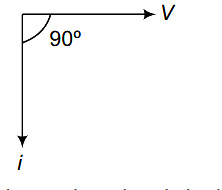
The magnitude of the impulse exerted by the wall on the ball is $|J| = 5 \,N-s$.
Let the initial velocity be $u = 30 \,ms^{-1}$ and the final velocity be $v = -20 \,ms^{-1}$ (since it rebounds in the opposite direction).
The mass of the ball is $m = 0.1 \,kg$.
Impulse $J = \Delta p = m(v - u)$.
Taking the direction of the initial velocity as positive:
$J = m(v_{final} - v_{initial}) = 0.1 \times (-20 - 30) = 0.1 \times (-50) = -5 \,N-s$.
The magnitude of the impulse exerted by the wall on the ball is $|J| = 5 \,N-s$.
0 likesView Solution
2
PhysicsEasyMCQMHT CET · 2012
An elevator is moving vertically up with an acceleration $a$. The force exerted on the floor by a passenger of mass $m$ is:
A
$m g$
B
$m a$
C
$m g - m a$
D
$m g + m a$
Solution
(D) When an elevator moves vertically upward with an acceleration $a$,the effective weight of the passenger increases.
According to Newton's second law of motion,the forces acting on the passenger are the normal force $R$ (exerted by the floor) acting upwards and the gravitational force $m g$ acting downwards.
The equation of motion is $R - m g = m a$.
Therefore,the normal force exerted by the floor on the passenger is $R = m g + m a$.
According to Newton's second law of motion,the forces acting on the passenger are the normal force $R$ (exerted by the floor) acting upwards and the gravitational force $m g$ acting downwards.
The equation of motion is $R - m g = m a$.
Therefore,the normal force exerted by the floor on the passenger is $R = m g + m a$.
0 likesView Solution
3
PhysicsMediumMCQMHT CET · 2012
The minimum acceleration with which a fireman can slide down a rope of breaking strength two-third of his weight is
A
zero
B
$\frac{g}{3}$
C
$3g$
D
$g$
Solution
(B) Let the mass of the fireman be $m$ and his acceleration be $a$. The weight of the fireman is $mg$.
The breaking strength of the rope is given as $\frac{2}{3}mg$.
When the fireman slides down with acceleration $a$,the tension $T$ in the rope is given by $T = m(g - a)$.
For the rope not to break,the tension $T$ must be less than or equal to the breaking strength.
To find the minimum acceleration $a$,we set the tension equal to the breaking strength:
$m(g - a) = \frac{2}{3}mg$
Dividing both sides by $m$:
$g - a = \frac{2}{3}g$
$a = g - \frac{2}{3}g = \frac{g}{3}$
Therefore,the minimum acceleration is $\frac{g}{3}$.
The breaking strength of the rope is given as $\frac{2}{3}mg$.
When the fireman slides down with acceleration $a$,the tension $T$ in the rope is given by $T = m(g - a)$.
For the rope not to break,the tension $T$ must be less than or equal to the breaking strength.
To find the minimum acceleration $a$,we set the tension equal to the breaking strength:
$m(g - a) = \frac{2}{3}mg$
Dividing both sides by $m$:
$g - a = \frac{2}{3}g$
$a = g - \frac{2}{3}g = \frac{g}{3}$
Therefore,the minimum acceleration is $\frac{g}{3}$.
0 likesView Solution
4
PhysicsMediumMCQMHT CET · 2012
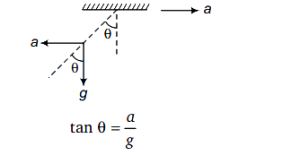
$A$ plumb bob is hanging from the ceiling of a car. If the car moves with an acceleration $a$,the angle made by the string with the vertical is
A
$\tan ^{-1}\left(\frac{a}{g}\right)$
B
$\tan ^{-1}\left(\frac{g}{a}\right)$
C
$\cos ^{-1}\left(\frac{g}{a}\right)$
D
$\cos ^{-1}\left(\frac{a}{g}\right)$
Solution
(A) When the car moves with an acceleration $a$ in the forward direction,a pseudo force $F_p = ma$ acts on the plumb bob in the backward direction in the non-inertial frame of the car.
Let $m$ be the mass of the bob. The forces acting on the bob are:
$1$. Weight $mg$ acting vertically downwards.
$2$. Pseudo force $ma$ acting horizontally backwards.
$3$. Tension $T$ in the string.
In the equilibrium position relative to the car,the net force on the bob is zero. Resolving the forces,we have:
$T \sin \theta = ma$
$T \cos \theta = mg$
Dividing the two equations,we get:
$\frac{T \sin \theta}{T \cos \theta} = \frac{ma}{mg}$
$\tan \theta = \frac{a}{g}$
Therefore,the angle made by the string with the vertical is $\theta = \tan ^{-1}\left(\frac{a}{g}\right)$.
Let $m$ be the mass of the bob. The forces acting on the bob are:
$1$. Weight $mg$ acting vertically downwards.
$2$. Pseudo force $ma$ acting horizontally backwards.
$3$. Tension $T$ in the string.
In the equilibrium position relative to the car,the net force on the bob is zero. Resolving the forces,we have:
$T \sin \theta = ma$
$T \cos \theta = mg$
Dividing the two equations,we get:
$\frac{T \sin \theta}{T \cos \theta} = \frac{ma}{mg}$
$\tan \theta = \frac{a}{g}$
Therefore,the angle made by the string with the vertical is $\theta = \tan ^{-1}\left(\frac{a}{g}\right)$.
0 likesView Solution
5
PhysicsMediumMCQMHT CET · 2012
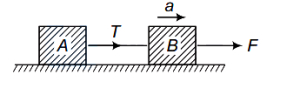
Two blocks $A$ and $B$, each of mass $20 \,kg$, lying on a frictionless table, are connected by a light string. The system is pulled horizontally with an acceleration of $2 \,ms^{-2}$ by a force $F$ applied on block $B$. The tension in the string will be: (in $\,N$)
A
$10$
B
$40$
C
$100$
D
$120$
Solution
(B) The system consists of two blocks $A$ and $B$ connected by a string. Since the table is frictionless and the system is pulled with an acceleration $a = 2 \,ms^{-2}$, we can analyze the motion of block $A$ separately.
Block $A$ is being pulled by the tension $T$ in the string. According to Newton's second law of motion, the force acting on block $A$ is given by:
$T = M_A \times a$
Given:
$M_A = 20 \,kg$
$a = 2 \,ms^{-2}$
Substituting the values:
$T = 20 \,kg \times 2 \,ms^{-2} = 40 \,N$
Therefore, the tension in the string is $40 \,N$.
Block $A$ is being pulled by the tension $T$ in the string. According to Newton's second law of motion, the force acting on block $A$ is given by:
$T = M_A \times a$
Given:
$M_A = 20 \,kg$
$a = 2 \,ms^{-2}$
Substituting the values:
$T = 20 \,kg \times 2 \,ms^{-2} = 40 \,N$
Therefore, the tension in the string is $40 \,N$.
0 likesView Solution
6
PhysicsDifficultMCQMHT CET · 2012
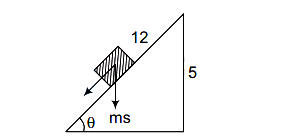
$A$ body weighing $20 \ kg$ just slides down a rough inclined plane that rises $5$ in $12$. The coefficient of friction is
A
$0.46$
B
$4.6$
C
$0.52$
D
$0.12$
Solution
(A) The plane rises $5$ in $12$,which means the height is $5$ and the length of the incline is $12$.
Therefore,$\sin \theta = \frac{5}{12}$.
Since the body just slides down,the angle of inclination $\theta$ is equal to the angle of repose.
The coefficient of friction $\mu$ is given by $\mu = \tan \theta$.
We know that $\cos \theta = \sqrt{1 - \sin^2 \theta} = \sqrt{1 - (\frac{5}{12})^2} = \sqrt{1 - \frac{25}{144}} = \sqrt{\frac{119}{144}} = \frac{\sqrt{119}}{12}$.
Thus,$\mu = \tan \theta = \frac{\sin \theta}{\cos \theta} = \frac{5/12}{\sqrt{119}/12} = \frac{5}{\sqrt{119}}$.
Calculating the value,$\sqrt{119} \approx 10.9087$.
$\mu = \frac{5}{10.9087} \approx 0.4583 \approx 0.46$.
Therefore,$\sin \theta = \frac{5}{12}$.
Since the body just slides down,the angle of inclination $\theta$ is equal to the angle of repose.
The coefficient of friction $\mu$ is given by $\mu = \tan \theta$.
We know that $\cos \theta = \sqrt{1 - \sin^2 \theta} = \sqrt{1 - (\frac{5}{12})^2} = \sqrt{1 - \frac{25}{144}} = \sqrt{\frac{119}{144}} = \frac{\sqrt{119}}{12}$.
Thus,$\mu = \tan \theta = \frac{\sin \theta}{\cos \theta} = \frac{5/12}{\sqrt{119}/12} = \frac{5}{\sqrt{119}}$.
Calculating the value,$\sqrt{119} \approx 10.9087$.
$\mu = \frac{5}{10.9087} \approx 0.4583 \approx 0.46$.
0 likesView Solution
7
PhysicsMediumMCQMHT CET · 2012
$A$ body takes $n$ times as much time to slide down a $45^{\circ}$ rough incline as it takes to slide down a smooth $45^{\circ}$ incline. The coefficient of friction between the body and the incline will be
A
$\frac{1}{1-n^{2}}$
B
$1-\frac{1}{n^{2}}$
C
$\sqrt{\frac{1}{1-n^{2}}}$
D
$\sqrt{1-\frac{1}{n^{2}}}$
Solution
(B) Let the length of the incline be $L$ and the angle of inclination be $\theta = 45^{\circ}$.
For a smooth incline,the acceleration is $a_1 = g \sin \theta$. The time taken is $t_1 = \sqrt{\frac{2L}{g \sin \theta}}$.
For a rough incline,the acceleration is $a_2 = g(\sin \theta - \mu \cos \theta)$. The time taken is $t_2 = \sqrt{\frac{2L}{g(\sin \theta - \mu \cos \theta)}}$.
Given that $t_2 = n t_1$,we have $\frac{t_2}{t_1} = n$.
Squaring both sides,$\frac{t_2^2}{t_1^2} = n^2$,which implies $\frac{\sin \theta}{\sin \theta - \mu \cos \theta} = n^2$.
Rearranging the terms: $\sin \theta = n^2 \sin \theta - n^2 \mu \cos \theta$.
$n^2 \mu \cos \theta = (n^2 - 1) \sin \theta$.
$\mu = \frac{n^2 - 1}{n^2} \tan \theta$.
Since $\theta = 45^{\circ}$,$\tan 45^{\circ} = 1$.
Therefore,$\mu = 1 - \frac{1}{n^2}$.
For a smooth incline,the acceleration is $a_1 = g \sin \theta$. The time taken is $t_1 = \sqrt{\frac{2L}{g \sin \theta}}$.
For a rough incline,the acceleration is $a_2 = g(\sin \theta - \mu \cos \theta)$. The time taken is $t_2 = \sqrt{\frac{2L}{g(\sin \theta - \mu \cos \theta)}}$.
Given that $t_2 = n t_1$,we have $\frac{t_2}{t_1} = n$.
Squaring both sides,$\frac{t_2^2}{t_1^2} = n^2$,which implies $\frac{\sin \theta}{\sin \theta - \mu \cos \theta} = n^2$.
Rearranging the terms: $\sin \theta = n^2 \sin \theta - n^2 \mu \cos \theta$.
$n^2 \mu \cos \theta = (n^2 - 1) \sin \theta$.
$\mu = \frac{n^2 - 1}{n^2} \tan \theta$.
Since $\theta = 45^{\circ}$,$\tan 45^{\circ} = 1$.
Therefore,$\mu = 1 - \frac{1}{n^2}$.
0 likesView Solution
8
PhysicsMediumMCQMHT CET · 2012
$A$ body is projected up along a rough inclined plane of inclination $45^{\circ}$. The coefficient of friction is $0.5$. Then the retardation of the block is
A
$\frac{g}{2 \sqrt{2}}$
B
$\frac{g}{2}$
C
$\frac{3 g}{2 \sqrt{2}}$
D
$\frac{g}{\sqrt{2}}$
Solution
(C) When a body is projected up an inclined plane,both the component of gravity acting down the plane and the frictional force act in the direction opposite to the motion.
Retardation $a = g \sin \theta + \mu g \cos \theta = g(\sin \theta + \mu \cos \theta)$.
Given $\theta = 45^{\circ}$ and $\mu = 0.5$.
Substituting the values:
$a = g(\sin 45^{\circ} + 0.5 \cos 45^{\circ})$
$a = g\left(\frac{1}{\sqrt{2}} + 0.5 \times \frac{1}{\sqrt{2}}\right)$
$a = \frac{g}{\sqrt{2}}(1 + 0.5)$
$a = \frac{1.5 g}{\sqrt{2}} = \frac{3 g}{2 \sqrt{2}}$.
Retardation $a = g \sin \theta + \mu g \cos \theta = g(\sin \theta + \mu \cos \theta)$.
Given $\theta = 45^{\circ}$ and $\mu = 0.5$.
Substituting the values:
$a = g(\sin 45^{\circ} + 0.5 \cos 45^{\circ})$
$a = g\left(\frac{1}{\sqrt{2}} + 0.5 \times \frac{1}{\sqrt{2}}\right)$
$a = \frac{g}{\sqrt{2}}(1 + 0.5)$
$a = \frac{1.5 g}{\sqrt{2}} = \frac{3 g}{2 \sqrt{2}}$.
0 likesView Solution
9
PhysicsMediumMCQMHT CET · 2012
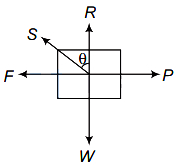
$A$ weight $W$ can be just supported on a rough inclined plane by a force $F$ either acting along the plane or horizontally. If $\theta$ is the angle of friction,then $F / W$ is
A
$\tan \theta$
B
$\sec \theta$
C
$\sin \theta$
D
$\cos \theta$
Solution
(A) Let $\alpha$ be the angle of inclination of the plane.
Case $1$: Force $F$ acting along the plane.
For the weight to be just supported,$F = W \sin \alpha - f_s$,where $f_s$ is the static friction. At the point of impending motion,$f_s = \mu R = \mu W \cos \alpha = W \tan \theta \cos \alpha$.
Thus,$F = W \sin \alpha - W \tan \theta \cos \alpha = W \frac{\sin(\alpha - \theta)}{\cos \theta}$.
Case $2$: Force $F$ acting horizontally.
For the weight to be just supported,$F \cos \alpha = W \sin \alpha + f_s$. At the point of impending motion,$f_s = \mu R = \mu (W \cos \alpha + F \sin \alpha) = \tan \theta (W \cos \alpha + F \sin \alpha)$.
Solving for $F$,we get $F = W \tan(\alpha + \theta)$.
Since the problem states that the weight can be supported by the same force $F$ in both cases,we equate the two expressions for $F$:
$W \frac{\sin(\alpha - \theta)}{\cos \theta} = W \tan(\alpha + \theta)$.
This implies $\sin(\alpha - \theta) = \sin(\alpha + \theta) \cdot \frac{\cos \theta}{\cos(\alpha + \theta)}$.
Solving this trigonometric equation leads to the condition where $F/W = \tan \theta$.
Case $1$: Force $F$ acting along the plane.
For the weight to be just supported,$F = W \sin \alpha - f_s$,where $f_s$ is the static friction. At the point of impending motion,$f_s = \mu R = \mu W \cos \alpha = W \tan \theta \cos \alpha$.
Thus,$F = W \sin \alpha - W \tan \theta \cos \alpha = W \frac{\sin(\alpha - \theta)}{\cos \theta}$.
Case $2$: Force $F$ acting horizontally.
For the weight to be just supported,$F \cos \alpha = W \sin \alpha + f_s$. At the point of impending motion,$f_s = \mu R = \mu (W \cos \alpha + F \sin \alpha) = \tan \theta (W \cos \alpha + F \sin \alpha)$.
Solving for $F$,we get $F = W \tan(\alpha + \theta)$.
Since the problem states that the weight can be supported by the same force $F$ in both cases,we equate the two expressions for $F$:
$W \frac{\sin(\alpha - \theta)}{\cos \theta} = W \tan(\alpha + \theta)$.
This implies $\sin(\alpha - \theta) = \sin(\alpha + \theta) \cdot \frac{\cos \theta}{\cos(\alpha + \theta)}$.
Solving this trigonometric equation leads to the condition where $F/W = \tan \theta$.
0 likesView Solution
10
PhysicsMediumMCQMHT CET · 2012
If a ship of mass $4 \times 10^{7} \,kg$ initially at rest is pulled by a force of $5 \times 10^{4} \,N$ through a distance of $4 \,m$, then the speed of the ship will be (resistance due to water is negligible). (in $\,ms^{-1}$)
A
$5$
B
$1.5$
C
$60$
D
$0.1$
Solution
(D) Given: Mass $m = 4 \times 10^{7} \,kg$, Force $F = 5 \times 10^{4} \,N$, Initial velocity $u = 0$, Distance $s = 4 \,m$.
Using Newton's second law, $F = ma$:
$5 \times 10^{4} = 4 \times 10^{7} \times a$
$a = \frac{5 \times 10^{4}}{4 \times 10^{7}} = 1.25 \times 10^{-3} \,ms^{-2}$.
Using the kinematic equation $v^{2} = u^{2} + 2as$:
$v^{2} = 0^{2} + 2 \times (1.25 \times 10^{-3}) \times 4$
$v^{2} = 2 \times 1.25 \times 4 \times 10^{-3} = 10 \times 10^{-3} = 10^{-2} \,m^{2}s^{-2}$.
$v = \sqrt{10^{-2}} = 0.1 \,ms^{-1}$.
Using Newton's second law, $F = ma$:
$5 \times 10^{4} = 4 \times 10^{7} \times a$
$a = \frac{5 \times 10^{4}}{4 \times 10^{7}} = 1.25 \times 10^{-3} \,ms^{-2}$.
Using the kinematic equation $v^{2} = u^{2} + 2as$:
$v^{2} = 0^{2} + 2 \times (1.25 \times 10^{-3}) \times 4$
$v^{2} = 2 \times 1.25 \times 4 \times 10^{-3} = 10 \times 10^{-3} = 10^{-2} \,m^{2}s^{-2}$.
$v = \sqrt{10^{-2}} = 0.1 \,ms^{-1}$.
0 likesView Solution
11
PhysicsEasyMCQMHT CET · 2012
$A$ mass of $1 \ kg$ is suspended by a string $A$. Another string $C$ is connected to its lower end as shown in figure. If a sudden jerk is given to $C$,then
A
the mass will start rotating
B
the portion $A B$ of the string will break
C
the portion $B C$ of the string will break
D
None of the string will break
Solution
(C) When a sudden jerk is given to string $C$,an impulsive force is applied to it.
Because the mass has inertia,it resists the sudden change in motion.
This impulsive tension develops in string $C$ first,exceeding its breaking strength.
Since the impulse takes finite time to propagate through the mass to string $A$,string $C$ breaks before the tension in string $A$ can increase significantly.
Because the mass has inertia,it resists the sudden change in motion.
This impulsive tension develops in string $C$ first,exceeding its breaking strength.
Since the impulse takes finite time to propagate through the mass to string $A$,string $C$ breaks before the tension in string $A$ can increase significantly.
0 likesView Solution
12
PhysicsEasyMCQMHT CET · 2012
$A$ body of mass $2 \,kg$ collides with a wall with a speed of $100 \,ms^{-1}$ and rebounds with the same speed. If the time of contact is $1/50 \,s$,the force exerted on the wall is
A
$8 \,N$
B
$2 \times 10^{4} \,N$
C
$4 \,N$
D
$10^{4} \,N$
Solution
(B) The change in momentum $\Delta p$ is given by the final momentum minus the initial momentum.
Initial momentum $p_i = m \times v = 2 \,kg \times 100 \,ms^{-1} = 200 \,kg \cdot ms^{-1}$.
Since the body rebounds with the same speed in the opposite direction,the final momentum $p_f = m \times (-v) = 2 \,kg \times (-100 \,ms^{-1}) = -200 \,kg \cdot ms^{-1}$.
The change in momentum $\Delta p = p_f - p_i = -200 - 200 = -400 \,kg \cdot ms^{-1}$.
The magnitude of the change in momentum is $|\Delta p| = 400 \,kg \cdot ms^{-1}$.
The force exerted on the wall is given by Newton's Second Law: $F = \frac{|\Delta p|}{\Delta t}$.
Given $\Delta t = 1/50 \,s$,we have $F = \frac{400}{1/50} = 400 \times 50 = 20,000 \,N = 2 \times 10^{4} \,N$.
Initial momentum $p_i = m \times v = 2 \,kg \times 100 \,ms^{-1} = 200 \,kg \cdot ms^{-1}$.
Since the body rebounds with the same speed in the opposite direction,the final momentum $p_f = m \times (-v) = 2 \,kg \times (-100 \,ms^{-1}) = -200 \,kg \cdot ms^{-1}$.
The change in momentum $\Delta p = p_f - p_i = -200 - 200 = -400 \,kg \cdot ms^{-1}$.
The magnitude of the change in momentum is $|\Delta p| = 400 \,kg \cdot ms^{-1}$.
The force exerted on the wall is given by Newton's Second Law: $F = \frac{|\Delta p|}{\Delta t}$.
Given $\Delta t = 1/50 \,s$,we have $F = \frac{400}{1/50} = 400 \times 50 = 20,000 \,N = 2 \times 10^{4} \,N$.
0 likesView Solution
13
PhysicsEasyMCQMHT CET · 2012
$A$ solid ball of volume $V$ is dropped in a viscous liquid. It experiences a viscous force $F$. If a solid ball of volume $2V$ of the same material is dropped in the same fluid,then the viscous force acting on it will be
A
$F / 2$
B
$F$
C
$2F$
D
$4F$
Solution
(C) According to Stokes' Law,the viscous force $F$ acting on a spherical body of radius $r$ moving with terminal velocity $v$ is given by $F = 6 \pi \eta r v$.
For a body falling in a viscous fluid,the terminal velocity $v$ is proportional to the square of the radius,i.e.,$v \propto r^2$.
Substituting this into the force equation: $F \propto r \cdot r^2 = r^3$.
Since the volume $V$ of a sphere is proportional to the cube of its radius $(V \propto r^3)$,we have $F \propto V$.
Therefore,if the volume of the ball is doubled $(V' = 2V)$,the viscous force acting on it will also be doubled $(F' = 2F)$.
For a body falling in a viscous fluid,the terminal velocity $v$ is proportional to the square of the radius,i.e.,$v \propto r^2$.
Substituting this into the force equation: $F \propto r \cdot r^2 = r^3$.
Since the volume $V$ of a sphere is proportional to the cube of its radius $(V \propto r^3)$,we have $F \propto V$.
Therefore,if the volume of the ball is doubled $(V' = 2V)$,the viscous force acting on it will also be doubled $(F' = 2F)$.
0 likesView Solution
14
PhysicsEasyMCQMHT CET · 2012
The distance $x$ covered in time $t$ by a body having initial velocity $u$ and having constant acceleration $a$ is given by $x=ut+\frac{1}{2}at^2$. This result follows from
A
Newton's first law
B
Newton's second law
C
Newton's third law
D
None of the above
Solution
(D) The kinematic equation $x=ut+\frac{1}{2}at^2$ describes the motion of an object under constant acceleration.
This equation is derived from the definitions of velocity and acceleration using calculus or graphical methods.
It is a kinematic relationship and does not directly follow from Newton's laws of motion,which relate force,mass,and acceleration $(F=ma)$.
Therefore,the correct option is $D$.
This equation is derived from the definitions of velocity and acceleration using calculus or graphical methods.
It is a kinematic relationship and does not directly follow from Newton's laws of motion,which relate force,mass,and acceleration $(F=ma)$.
Therefore,the correct option is $D$.
0 likesView Solution
15
PhysicsEasyMCQMHT CET · 2012
Inductive reactance of a coil is expressed in
A
ampere
B
ohm
C
volt
D
weber
Solution
(B) Inductive reactance $(X_L)$ is defined as the opposition offered by an inductor to the flow of alternating current.
It is given by the formula $X_L = \omega L = 2\pi f L$.
Since it represents the opposition to current flow in an $AC$ circuit, it is analogous to resistance.
Therefore, the $SI$ unit of inductive reactance is the same as that of resistance, which is the ohm $(\Omega)$.
It is given by the formula $X_L = \omega L = 2\pi f L$.
Since it represents the opposition to current flow in an $AC$ circuit, it is analogous to resistance.
Therefore, the $SI$ unit of inductive reactance is the same as that of resistance, which is the ohm $(\Omega)$.
0 likesView Solution
16
PhysicsEasyMCQMHT CET · 2012
The power factor in an $L-C-R$ circuit at resonance is
A
zero
B
$1$
C
$0.8$
D
$\frac{1}{2}$
Solution
(B) At resonance, the inductive reactance $(X_L)$ is equal to the capacitive reactance $(X_C)$, i.e., $X_L = X_C$.
Therefore, the net impedance $(Z)$ of the $L-C-R$ circuit is equal to the resistance $(R)$, i.e., $Z = R$.
The power factor $(\cos \phi)$ is defined as the ratio of resistance to impedance: $\cos \phi = \frac{R}{Z}$.
Substituting $Z = R$, we get $\cos \phi = \frac{R}{R} = 1$.
Thus, at resonance, the $L-C-R$ circuit behaves as a purely resistive circuit, and the power factor is $1$.
Therefore, the net impedance $(Z)$ of the $L-C-R$ circuit is equal to the resistance $(R)$, i.e., $Z = R$.
The power factor $(\cos \phi)$ is defined as the ratio of resistance to impedance: $\cos \phi = \frac{R}{Z}$.
Substituting $Z = R$, we get $\cos \phi = \frac{R}{R} = 1$.
Thus, at resonance, the $L-C-R$ circuit behaves as a purely resistive circuit, and the power factor is $1$.
0 likesView Solution
17
PhysicsMediumMCQMHT CET · 2012
If the inductance and capacitance are both doubled in an $L-C-R$ circuit,the resonant frequency of the circuit will
A
decrease to one-half the original value
B
decrease to one-fourth the original value
C
increase to twice the original value
D
decrease to twice the original value
Solution
(A) The resonant frequency of an $L-C-R$ circuit is given by the formula:
$v_{0} = \frac{1}{2 \pi \sqrt{L C}}$
This implies that $v_{0} \propto \frac{1}{\sqrt{L C}}$.
If the inductance $L$ is doubled $(L' = 2L)$ and the capacitance $C$ is doubled $(C' = 2C)$,the new resonant frequency $v_{0}'$ will be:
$v_{0}' = \frac{1}{2 \pi \sqrt{(2L)(2C)}} = \frac{1}{2 \pi \sqrt{4LC}} = \frac{1}{2 \pi \cdot 2 \sqrt{LC}}$
$v_{0}' = \frac{1}{2} \left( \frac{1}{2 \pi \sqrt{LC}} \right) = \frac{1}{2} v_{0}$
Therefore,the resonant frequency will decrease to one-half of the original value.
$v_{0} = \frac{1}{2 \pi \sqrt{L C}}$
This implies that $v_{0} \propto \frac{1}{\sqrt{L C}}$.
If the inductance $L$ is doubled $(L' = 2L)$ and the capacitance $C$ is doubled $(C' = 2C)$,the new resonant frequency $v_{0}'$ will be:
$v_{0}' = \frac{1}{2 \pi \sqrt{(2L)(2C)}} = \frac{1}{2 \pi \sqrt{4LC}} = \frac{1}{2 \pi \cdot 2 \sqrt{LC}}$
$v_{0}' = \frac{1}{2} \left( \frac{1}{2 \pi \sqrt{LC}} \right) = \frac{1}{2} v_{0}$
Therefore,the resonant frequency will decrease to one-half of the original value.
0 likesView Solution
18
PhysicsMediumMCQMHT CET · 2012
The resonant frequency of an $L-C$ circuit is
A
$\frac{1}{2 \pi \sqrt{L C}}$
B
$\frac{1}{2 \pi} \sqrt{\frac{L}{C}}$
C
$\frac{1}{2 \pi} \sqrt{\frac{C}{L}}$
D
$\frac{1}{\sqrt{L C}}$
Solution
(A) In an $L-C$ circuit,resonance occurs when the inductive reactance $(X_L)$ equals the capacitive reactance $(X_C)$.
$X_L = X_C$
$\omega L = \frac{1}{\omega C}$
$\omega^2 = \frac{1}{LC}$
$\omega = \frac{1}{\sqrt{LC}}$
Since $\omega = 2 \pi f$,the resonant frequency $f$ is given by:
$f = \frac{1}{2 \pi \sqrt{LC}}$
$X_L = X_C$
$\omega L = \frac{1}{\omega C}$
$\omega^2 = \frac{1}{LC}$
$\omega = \frac{1}{\sqrt{LC}}$
Since $\omega = 2 \pi f$,the resonant frequency $f$ is given by:
$f = \frac{1}{2 \pi \sqrt{LC}}$
0 likesView Solution
19
PhysicsMediumMCQMHT CET · 2012
$A$ lamp is connected in series with a capacitor and an $AC$ source. What happens if the capacitance of the capacitor is reduced?
A
The lamp shines more brightly
B
The lamp shines less brightly
C
There is no change in the brightness of the lamp
D
Brightness may increase or decrease depending on the frequency of the $AC$
Solution
(B) The brightness of the lamp depends on the current flowing through the circuit.
In an $RC$ series circuit,the capacitive reactance is given by $X_{C} = \frac{1}{\omega C}$.
When the capacitance $C$ is reduced,the capacitive reactance $X_{C}$ increases.
The total impedance of the circuit is $Z = \sqrt{R^2 + X_{C}^2}$.
As $X_{C}$ increases,the total impedance $Z$ of the circuit increases.
According to Ohm's law for $AC$ circuits,the current $I = \frac{V}{Z}$.
Since $Z$ increases,the current $I$ flowing through the lamp decreases.
Therefore,the lamp shines less brightly.
In an $RC$ series circuit,the capacitive reactance is given by $X_{C} = \frac{1}{\omega C}$.
When the capacitance $C$ is reduced,the capacitive reactance $X_{C}$ increases.
The total impedance of the circuit is $Z = \sqrt{R^2 + X_{C}^2}$.
As $X_{C}$ increases,the total impedance $Z$ of the circuit increases.
According to Ohm's law for $AC$ circuits,the current $I = \frac{V}{Z}$.
Since $Z$ increases,the current $I$ flowing through the lamp decreases.
Therefore,the lamp shines less brightly.
0 likesView Solution
20
PhysicsEasyMCQMHT CET · 2012
In a purely inductive circuit,the current is
A
in phase with the voltage
B
out of phase with the voltage
C
leads the voltage by $\pi / 2$
D
lags behind the voltage by $\pi / 2$
Solution
(D) In a purely inductive circuit,the voltage $V$ leads the current $i$ by a phase angle of $\pi / 2$ radians $(90^{\circ})$.
Conversely,this means the current $i$ lags behind the voltage $V$ by $\pi / 2$ radians.
This is represented by the phasor diagram where $V$ is along the positive x-axis and $i$ is along the negative y-axis.
Conversely,this means the current $i$ lags behind the voltage $V$ by $\pi / 2$ radians.
This is represented by the phasor diagram where $V$ is along the positive x-axis and $i$ is along the negative y-axis.
0 likesView Solution
21
PhysicsEasyMCQMHT CET · 2012
The average value of alternating current over a complete cycle is
A
zero
B
$I_{rms}$
C
$\frac{I_0}{\sqrt{2}}$
D
$2 I_0$
Solution
(A) The alternating current is represented by the equation $I = I_0 \sin(\omega t)$.
To find the average value over a complete cycle of period $T$,we integrate the current over the interval $[0, T]$ and divide by the total time $T$.
$I_{avg} = \frac{1}{T} \int_{0}^{T} I_0 \sin(\omega t) dt$.
Since $\omega = \frac{2\pi}{T}$,the integral of $\sin(\omega t)$ over a full period is zero because the positive area of the sine wave cancels out the negative area.
Therefore,the average value of alternating current over a complete cycle is $0$.
To find the average value over a complete cycle of period $T$,we integrate the current over the interval $[0, T]$ and divide by the total time $T$.
$I_{avg} = \frac{1}{T} \int_{0}^{T} I_0 \sin(\omega t) dt$.
Since $\omega = \frac{2\pi}{T}$,the integral of $\sin(\omega t)$ over a full period is zero because the positive area of the sine wave cancels out the negative area.
Therefore,the average value of alternating current over a complete cycle is $0$.
0 likesView Solution
22
PhysicsEasyMCQMHT CET · 2012
The instantaneous value of an $AC$ is given by $I = 5 \sin (\omega t + \phi) \text{ A}$. The rms value of current is
A
$5 \text{ A}$
B
$\frac{5}{\sqrt{2}} \text{ A}$
C
$5 \sqrt{2} \text{ A}$
D
$2.5 \text{ A}$
Solution
(B) The instantaneous current is given by the equation $I = I_{0} \sin (\omega t + \phi)$,where $I_{0}$ is the peak current.
Comparing this with the given equation $I = 5 \sin (\omega t + \phi)$,we find the peak current $I_{0} = 5 \text{ A}$.
The root mean square $(rms)$ value of an alternating current is related to the peak current by the formula $I_{rms} = \frac{I_{0}}{\sqrt{2}}$.
Substituting the value of $I_{0}$,we get $I_{rms} = \frac{5}{\sqrt{2}} \text{ A}$.
Comparing this with the given equation $I = 5 \sin (\omega t + \phi)$,we find the peak current $I_{0} = 5 \text{ A}$.
The root mean square $(rms)$ value of an alternating current is related to the peak current by the formula $I_{rms} = \frac{I_{0}}{\sqrt{2}}$.
Substituting the value of $I_{0}$,we get $I_{rms} = \frac{5}{\sqrt{2}} \text{ A}$.
0 likesView Solution
23
PhysicsMediumMCQMHT CET · 2012
One complete set of negative and positive values of alternating quantities is called
A
time period
B
amplitude
C
frequency
D
cycle
Solution
(D) An alternating quantity varies periodically with time. One complete set of positive and negative values of an alternating quantity is defined as a $cycle$. It represents the complete variation of the quantity before it starts repeating itself.
0 likesView Solution
24
PhysicsEasyMCQMHT CET · 2012
The rms value of current $I_{\text{rms}}$ is
A
$\frac{I_{0}}{2 \pi}$
B
$\frac{I_{0}}{\sqrt{2}}$
C
$\frac{2 I_{0}}{\pi}$
D
$\sqrt{2} I_{0}$
Solution
(B) The root mean square $(I_{\text{rms}})$ value of an alternating current is defined as the square root of the mean of the squares of the instantaneous current over one complete cycle.
For a sinusoidal alternating current given by $I = I_{0} \sin(\omega t)$,the $I_{\text{rms}}$ value is calculated as:
$I_{\text{rms}} = \sqrt{\frac{1}{T} \int_{0}^{T} I^{2} dt} = \frac{I_{0}}{\sqrt{2}}$
where $I_{0}$ is the peak value (amplitude) of the current.
For a sinusoidal alternating current given by $I = I_{0} \sin(\omega t)$,the $I_{\text{rms}}$ value is calculated as:
$I_{\text{rms}} = \sqrt{\frac{1}{T} \int_{0}^{T} I^{2} dt} = \frac{I_{0}}{\sqrt{2}}$
where $I_{0}$ is the peak value (amplitude) of the current.
0 likesView Solution
25
PhysicsMediumMCQMHT CET · 2012
Power consumed in an $AC$ circuit becomes zero if
A
inductance and resistance are both high
B
inductance and resistance are both low
C
inductance very high and resistance negligible
D
inductance low and resistance high
Solution
(C) The average power consumed in an $AC$ circuit is given by the formula $P = V_{rms} I_{rms} \cos \phi$, where $\cos \phi$ is the power factor.
In a purely inductive circuit, the phase difference $\phi$ between voltage and current is $90^{\circ}$.
Since $\cos 90^{\circ} = 0$, the power consumed becomes $P = V_{rms} I_{rms} \times 0 = 0$.
Therefore, if the inductance is very high (acting as a pure inductor) and the resistance is negligible, the power consumed in the $AC$ circuit is zero.
In a purely inductive circuit, the phase difference $\phi$ between voltage and current is $90^{\circ}$.
Since $\cos 90^{\circ} = 0$, the power consumed becomes $P = V_{rms} I_{rms} \times 0 = 0$.
Therefore, if the inductance is very high (acting as a pure inductor) and the resistance is negligible, the power consumed in the $AC$ circuit is zero.
0 likesView Solution
26
PhysicsEasyMCQMHT CET · 2012
Alternating voltage:
A
is independent of time
B
varies directly with time
C
varies inversely with time
D
varies sinusoidally with time
Solution
(D) An alternating voltage is defined as a voltage that changes its magnitude and direction periodically with time. The standard mathematical expression for an alternating voltage is $V(t) = V_m \sin(\omega t)$,where $V_m$ is the peak voltage and $\omega$ is the angular frequency. Since this expression follows a sine function,the alternating voltage varies sinusoidally with time.
0 likesView Solution
27
PhysicsMediumMCQMHT CET · 2012
The frequency of $AC$ mains in India is (in $\text{ Hz}$)
A
$110$
B
$50$
C
$60$
D
$120$
Solution
(B) The standard frequency of alternating current $(AC)$ mains supplied in India is $50 \text{ Hz}$.
Frequency is defined as the number of cycles per second,which is equivalent to $50 \text{ cycles/second}$ or $50 \text{ s}^{-1}$.
Frequency is defined as the number of cycles per second,which is equivalent to $50 \text{ cycles/second}$ or $50 \text{ s}^{-1}$.
0 likesView Solution
28
PhysicsMediumMCQMHT CET · 2012
$A$ choke coil is used as resistance in
A
$AC$ circuits
B
$DC$ circuits
C
half wave rectifier circuits
D
Both in $AC$ and $DC$ circuits
Solution
(A) choke coil is an inductor with high inductance and low resistance. It is used to control the current in $AC$ circuits without dissipating significant power as heat. In $DC$ circuits,an inductor acts as a simple wire with negligible resistance,so it cannot be used to control current effectively. Therefore,a choke coil is used as a resistance (impedance) in $AC$ circuits.
0 likesView Solution
29
PhysicsEasyMCQMHT CET · 2012
In $AC$ circuits,a choke coil is preferred over resistors because:
A
choke coil is cheap
B
voltage increases
C
energy is not wasted
D
current increases
Solution
(C) In $AC$ circuits,a resistor dissipates energy in the form of heat due to the $I^2R$ loss,regardless of the phase difference.
However,an ideal choke coil is an inductor with negligible resistance.
In an ideal inductor,the phase difference between voltage and current is $90^{\circ}$,which makes the power factor $\cos(90^{\circ}) = 0$.
Therefore,the average power consumed by an ideal choke coil is $P = V_{rms} I_{rms} \cos(90^{\circ}) = 0$.
Thus,a choke coil controls the current in an $AC$ circuit without wasting electrical energy as heat.
However,an ideal choke coil is an inductor with negligible resistance.
In an ideal inductor,the phase difference between voltage and current is $90^{\circ}$,which makes the power factor $\cos(90^{\circ}) = 0$.
Therefore,the average power consumed by an ideal choke coil is $P = V_{rms} I_{rms} \cos(90^{\circ}) = 0$.
Thus,a choke coil controls the current in an $AC$ circuit without wasting electrical energy as heat.
0 likesView Solution
30
PhysicsEasyMCQMHT CET · 2012
$AC$ measuring instruments measure
A
peak value
B
rms value
C
any value
D
average value
Solution
(B) $AC$ measuring instruments,such as $AC$ ammeters and voltmeters,are designed to measure the root mean square $(rms)$ value of the alternating current or voltage. This is because the heating effect of current,which is the principle behind most analog measuring instruments,is proportional to the square of the current,making the $rms$ value the most physically significant quantity for power calculations.
0 likesView Solution
31
PhysicsEasyMCQMHT CET · 2012
If the power factor in a circuit is unity,then the impedance of the circuit is
A
inductive
B
capacitive
C
partially inductive and partially capacitive
D
resistive
Solution
(D) The power factor of an $AC$ circuit is given by $\cos \phi = \frac{R}{Z}$,where $R$ is the resistance and $Z$ is the impedance.
When the power factor is unity,$\cos \phi = 1$,which implies $\phi = 0^\circ$.
Since $\cos \phi = \frac{R}{Z} = 1$,we get $R = Z$.
This condition occurs at resonance in an $LCR$ circuit,where the inductive reactance $X_L$ and capacitive reactance $X_C$ cancel each other out $(X_L = X_C)$.
Consequently,the circuit behaves as a purely resistive circuit.
When the power factor is unity,$\cos \phi = 1$,which implies $\phi = 0^\circ$.
Since $\cos \phi = \frac{R}{Z} = 1$,we get $R = Z$.
This condition occurs at resonance in an $LCR$ circuit,where the inductive reactance $X_L$ and capacitive reactance $X_C$ cancel each other out $(X_L = X_C)$.
Consequently,the circuit behaves as a purely resistive circuit.
0 likesView Solution
32
PhysicsMediumMCQMHT CET · 2012
The $Q$-factor of a resonant circuit is equal to
A
$\frac{1}{L} \sqrt{\frac{R}{C}}$
B
$\frac{1}{R} \sqrt{\frac{L}{C}}$
C
$\frac{1}{R L} \sqrt{C}$
D
$\frac{1}{C} \sqrt{\frac{R}{L}}$
Solution
(B) The quality factor ($Q$-factor) of a resonant circuit is defined as the ratio of resonant frequency to the bandwidth of the circuit.
Mathematically,$Q = \frac{\omega_{0} L}{R}$.
At resonance,the angular frequency is given by $\omega_{0} = \frac{1}{\sqrt{LC}}$.
Substituting the value of $\omega_{0}$ into the $Q$-factor formula:
$Q = \frac{1}{\sqrt{LC}} \cdot \frac{L}{R} = \frac{1}{R} \cdot \frac{\sqrt{L}}{\sqrt{C}} = \frac{1}{R} \sqrt{\frac{L}{C}}$.
Mathematically,$Q = \frac{\omega_{0} L}{R}$.
At resonance,the angular frequency is given by $\omega_{0} = \frac{1}{\sqrt{LC}}$.
Substituting the value of $\omega_{0}$ into the $Q$-factor formula:
$Q = \frac{1}{\sqrt{LC}} \cdot \frac{L}{R} = \frac{1}{R} \cdot \frac{\sqrt{L}}{\sqrt{C}} = \frac{1}{R} \sqrt{\frac{L}{C}}$.
0 likesView Solution
33
PhysicsEasyMCQMHT CET · 2012
The instrument which works on the principle of mutual inductance is
A
galvanometer
B
ammeter
C
potentiometer
D
transformer
Solution
(D) Mutual inductance is the phenomenon where a change in current in one coil induces an electromotive force $(EMF)$ in a neighboring coil. $A$ transformer consists of two coils,the primary and the secondary,wound on a common core. When an alternating current flows through the primary coil,it creates a changing magnetic flux that links with the secondary coil,inducing an $EMF$ in it. Therefore,the transformer operates on the principle of mutual inductance.
0 likesView Solution
34
PhysicsEasyMCQMHT CET · 2012
$A$ transformer is a device which converts
A
low voltage at low current into high voltage at high current
B
high voltage at low current into low voltage at high current
C
high voltage at high current into low voltage at low current
D
electrical power into mechanical power
Solution
(B) transformer is an electrical device that operates on the principle of mutual induction. It is used to change the magnitude of alternating voltage and current. Specifically,it converts high alternating voltage at low current into low alternating voltage at high current (step-down) or vice-versa (step-up),while keeping the frequency constant.
0 likesView Solution
35
PhysicsEasyMCQMHT CET · 2012
$A$ transformer works on
A
$DC$ only
B
$AC$ only
C
Both $AC$ and $DC$
D
high voltage only
Solution
(B) transformer operates on the principle of mutual induction.
Mutual induction requires a changing magnetic flux,which is produced by a time-varying current.
Since $AC$ (Alternating Current) changes its magnitude and direction periodically,it produces a changing magnetic flux in the primary coil,which induces an $EMF$ in the secondary coil.
$DC$ (Direct Current) is constant and does not produce a changing magnetic flux; therefore,a transformer cannot work on $DC$.
Mutual induction requires a changing magnetic flux,which is produced by a time-varying current.
Since $AC$ (Alternating Current) changes its magnitude and direction periodically,it produces a changing magnetic flux in the primary coil,which induces an $EMF$ in the secondary coil.
$DC$ (Direct Current) is constant and does not produce a changing magnetic flux; therefore,a transformer cannot work on $DC$.
0 likesView Solution
36
PhysicsEasyMCQMHT CET · 2012
In a step-down transformer,the number of turns in:
A
primary are less
B
primary are more
C
primary and secondary are equal
D
secondary are infinite
Solution
(B) step-down transformer is a device used to decrease the voltage of an alternating current. According to the transformer equation,$\frac{V_s}{V_p} = \frac{N_s}{N_p}$,where $V_s$ and $V_p$ are the voltages of the secondary and primary coils,and $N_s$ and $N_p$ are the number of turns in the secondary and primary coils,respectively. For a step-down transformer,the output voltage $V_s$ is less than the input voltage $V_p$. Therefore,the number of turns in the primary coil $(N_p)$ must be greater than the number of turns in the secondary coil $(N_s)$.
0 likesView Solution
37
PhysicsMediumMCQMHT CET · 2012
$A$ coil of resistance $5 \Omega$ and inductance $4 H$ is connected to a $10 \ V$ battery. The energy stored in the coil is: (in $J$)
A
$0.8$
B
$8$
C
$16$
D
$4$
Solution
(B) The energy stored in an inductor is given by the formula $U = \frac{1}{2} L i^2$.
When a coil is connected to a battery of $EMF$ $E$ and resistance $R$,the steady-state current $i$ is given by $i = \frac{E}{R}$.
Substituting the values: $E = 10 \ V$,$L = 4 \ H$,and $R = 5 \ \Omega$.
First,calculate the steady-state current: $i = \frac{10 \ V}{5 \ \Omega} = 2 \ A$.
Now,calculate the stored energy: $U = \frac{1}{2} \times 4 \ H \times (2 \ A)^2$.
$U = 2 \times 4 \ J = 8 \ J$.
When a coil is connected to a battery of $EMF$ $E$ and resistance $R$,the steady-state current $i$ is given by $i = \frac{E}{R}$.
Substituting the values: $E = 10 \ V$,$L = 4 \ H$,and $R = 5 \ \Omega$.
First,calculate the steady-state current: $i = \frac{10 \ V}{5 \ \Omega} = 2 \ A$.
Now,calculate the stored energy: $U = \frac{1}{2} \times 4 \ H \times (2 \ A)^2$.
$U = 2 \times 4 \ J = 8 \ J$.
0 likesView Solution
38
PhysicsEasyMCQMHT CET · 2012
An inductor may store energy in
A
its electric field
B
its coil
C
its magnetic field
D
Both electric and magnetic fields
Solution
(C) An inductor stores energy in the form of a magnetic field created by the current flowing through it.
The energy $U$ stored in an inductor is given by the formula $U = \frac{1}{2} L I^{2}$,where $L$ is the self-inductance of the inductor and $I$ is the current flowing through it.
Therefore,the correct option is $C$.
The energy $U$ stored in an inductor is given by the formula $U = \frac{1}{2} L I^{2}$,where $L$ is the self-inductance of the inductor and $I$ is the current flowing through it.
Therefore,the correct option is $C$.
0 likesView Solution
39
PhysicsEasyMCQMHT CET · 2012
Lenz's law is a consequence of the law of conservation of:
A
energy only
B
charge only
C
momentum only
D
energy and momentum
Solution
(A) Lenz's law states that the direction of the induced current is such that it opposes the change in magnetic flux that produced it. If the induced current were to assist the change,it would violate the law of conservation of energy,as it would create energy out of nothing. Therefore,Lenz's law is a direct consequence of the law of conservation of energy.
0 likesView Solution
40
PhysicsEasyMCQMHT CET · 2012
The law of electromagnetic induction has been used in the construction of
A
generator
B
electric motor
C
galvanometer
D
None of these
Solution
(A) The principle of electromagnetic induction,specifically Faraday's law,states that a change in magnetic flux linked with a coil induces an electromotive force $(emf)$ in it.
This principle is the fundamental working mechanism of an electric generator,which converts mechanical energy into electrical energy by rotating a coil within a magnetic field.
While motors and galvanometers also involve magnetic fields,their primary operating principle is the magnetic effect of current (Lorentz force),not electromagnetic induction.
This principle is the fundamental working mechanism of an electric generator,which converts mechanical energy into electrical energy by rotating a coil within a magnetic field.
While motors and galvanometers also involve magnetic fields,their primary operating principle is the magnetic effect of current (Lorentz force),not electromagnetic induction.
0 likesView Solution
41
PhysicsMediumMCQMHT CET · 2012
The back emf in a $DC$ motor is maximum when,
A
the motor has picked up maximum speed
B
the motor has just started moving
C
the speed of motor is still on increase
D
the motor has just been switched off
Solution
(A) The back emf $e$ in a $DC$ motor is given by the relation $e \propto \omega$,where $\omega$ is the angular velocity of the motor armature.
Since the back emf is directly proportional to the angular velocity,it reaches its maximum value when the motor attains its maximum speed.
Since the back emf is directly proportional to the angular velocity,it reaches its maximum value when the motor attains its maximum speed.
0 likesView Solution
42
PhysicsMediumMCQMHT CET · 2012
What is the self-inductance of a coil in which an induced emf of $2 \,V$ is set up, when the current is changing at the rate of $4 \,A s^{-1}$?
A
$0.5 \,mH$
B
$0.05 \,H$
C
$2 \,H$
D
$0.5 \,H$
Solution
(D) The induced emf $(e)$ in a coil due to self-induction is given by the formula: $e = L \frac{di}{dt}$.
Here, the induced emf $e = 2 \,V$ and the rate of change of current $\frac{di}{dt} = 4 \,A s^{-1}$.
Substituting these values into the formula:
$2 = L \times 4$
$L = \frac{2}{4} \,H$
$L = 0.5 \,H$.
Therefore, the self-inductance of the coil is $0.5 \,H$.
Here, the induced emf $e = 2 \,V$ and the rate of change of current $\frac{di}{dt} = 4 \,A s^{-1}$.
Substituting these values into the formula:
$2 = L \times 4$
$L = \frac{2}{4} \,H$
$L = 0.5 \,H$.
Therefore, the self-inductance of the coil is $0.5 \,H$.
0 likesView Solution
43
PhysicsDifficultMCQMHT CET · 2012
Two different coils of self-inductance $L_{1}$ and $L_{2}$ are placed close to each other so that the effective flux in one coil is completely linked with the other. If $M$ is the mutual inductance between them,then:
A
$M=L_{1} / L_{2}$
B
$M=L_{1} L_{2}$
C
$M=\sqrt{L_{1} L_{2}}$
D
$M=\left(L_{1} L_{2}\right)^{2}$
Solution
(C) The mutual inductance $M$ between two coils is related to their self-inductances $L_{1}$ and $L_{2}$ by the formula $M = k\sqrt{L_{1} L_{2}}$,where $k$ is the coefficient of coupling.
Given that the flux in one coil is completely linked with the other,the coupling is perfect,meaning $k = 1$.
Therefore,the expression simplifies to $M = \sqrt{L_{1} L_{2}}$.
Given that the flux in one coil is completely linked with the other,the coupling is perfect,meaning $k = 1$.
Therefore,the expression simplifies to $M = \sqrt{L_{1} L_{2}}$.
0 likesView Solution
44
PhysicsDifficultMCQMHT CET · 2012
Two different coils have self-inductance $8 \ mH$ and $2 \ mH$. The current in both coils is increased at the same constant rate. The ratio of the induced $emf$s in the coils is
A
$4: 1$
B
$1: 4$
C
$1: 2$
D
$2: 1$
Solution
(A) The induced $emf$ $(e)$ in a coil is given by the formula: $e = L \frac{di}{dt}$.
Here,$L_1 = 8 \ mH$ and $L_2 = 2 \ mH$.
The rate of change of current,$\frac{di}{dt}$,is the same for both coils.
Therefore,the ratio of the induced $emf$s is:
$\frac{e_1}{e_2} = \frac{L_1 (di/dt)}{L_2 (di/dt)} = \frac{L_1}{L_2}$.
Substituting the given values:
$\frac{e_1}{e_2} = \frac{8 \ mH}{2 \ mH} = \frac{4}{1}$.
Thus,the ratio is $4: 1$.
Here,$L_1 = 8 \ mH$ and $L_2 = 2 \ mH$.
The rate of change of current,$\frac{di}{dt}$,is the same for both coils.
Therefore,the ratio of the induced $emf$s is:
$\frac{e_1}{e_2} = \frac{L_1 (di/dt)}{L_2 (di/dt)} = \frac{L_1}{L_2}$.
Substituting the given values:
$\frac{e_1}{e_2} = \frac{8 \ mH}{2 \ mH} = \frac{4}{1}$.
Thus,the ratio is $4: 1$.
0 likesView Solution
45
PhysicsEasyMCQMHT CET · 2012
Electromagnetic waves of wavelength ranging from $100 \text{ Å}$ to $400 \text{ Å}$ come under which region?
A
$X$-rays
B
$UV$ region
C
visible region
D
infrared region
Solution
(B) The electromagnetic spectrum is categorized based on wavelength ranges.
- The wavelength range of $100 \text{ Å}$ to $400 \text{ Å}$ falls within the ultraviolet $(UV)$ region.
- $X$-rays typically range from $0.01 \text{ Å}$ to $100 \text{ Å}$.
- The visible region ranges from approximately $4000 \text{ Å}$ to $7000 \text{ Å}$.
- The infrared region starts above $7000 \text{ Å}$.
Therefore,the correct classification for the range $100 \text{ Å}$ to $400 \text{ Å}$ is the $UV$ region.
- The wavelength range of $100 \text{ Å}$ to $400 \text{ Å}$ falls within the ultraviolet $(UV)$ region.
- $X$-rays typically range from $0.01 \text{ Å}$ to $100 \text{ Å}$.
- The visible region ranges from approximately $4000 \text{ Å}$ to $7000 \text{ Å}$.
- The infrared region starts above $7000 \text{ Å}$.
Therefore,the correct classification for the range $100 \text{ Å}$ to $400 \text{ Å}$ is the $UV$ region.
0 likesView Solution
46
PhysicsEasyMCQMHT CET · 2012
Which of the following is not an electromagnetic wave?
A
Light rays
B
$X$-rays
C
Alpha rays
D
Gamma rays
Solution
(C) Electromagnetic waves are waves that are created as a result of vibrations between an electric field and a magnetic field. They do not require a medium to travel.
Light rays,$X$-rays,and $Gamma$ rays are all parts of the electromagnetic spectrum.
Alpha rays consist of high-energy helium nuclei ($He^{2+}$ particles),which are charged particles with mass. Therefore,alpha rays are particle radiation,not electromagnetic waves.
Light rays,$X$-rays,and $Gamma$ rays are all parts of the electromagnetic spectrum.
Alpha rays consist of high-energy helium nuclei ($He^{2+}$ particles),which are charged particles with mass. Therefore,alpha rays are particle radiation,not electromagnetic waves.
0 likesView Solution
47
PhysicsEasyMCQMHT CET · 2012
The existence of electromagnetic waves was experimentally confirmed by
A
Maxwell
B
Faraday
C
Hertz
D
Tesla
Solution
(C) The existence of electromagnetic waves was first experimentally confirmed by the German physicist Heinrich Hertz in $1887$. He used a spark-gap transmitter to produce and detect electromagnetic waves,thereby validating Maxwell's theoretical predictions.
0 likesView Solution
48
PhysicsEasyMCQMHT CET · 2012
The electromagnetic waves travel in free space with the velocity of
A
sound
B
light
C
greater than that of light
D
greater than that of sound
Solution
(B) Electromagnetic waves travel in free space or vacuum with the velocity of light,which is approximately $3 \times 10^{8} \ m/s$.
0 likesView Solution
49
PhysicsMediumMCQMHT CET · 2012
The frequency of radio waves corresponding to a wavelength of $10 \, m$ is
A
$3 \times 10^{7} \, Hz$
B
$3.3 \times 10^{8} \, Hz$
C
$3 \times 10^{9} \, Hz$
D
$3 \times 10^{-7} \, Hz$
Solution
(A) The relationship between the speed of light $(c)$, frequency $(\nu)$, and wavelength $(\lambda)$ is given by the formula: $c = \nu \lambda$.
Given:
Wavelength $\lambda = 10 \, m$.
Speed of light $c = 3 \times 10^{8} \, m/s$.
Rearranging the formula to solve for frequency: $\nu = \frac{c}{\lambda}$.
Substituting the values: $\nu = \frac{3 \times 10^{8} \, m/s}{10 \, m} = 3 \times 10^{7} \, Hz$.
Given:
Wavelength $\lambda = 10 \, m$.
Speed of light $c = 3 \times 10^{8} \, m/s$.
Rearranging the formula to solve for frequency: $\nu = \frac{c}{\lambda}$.
Substituting the values: $\nu = \frac{3 \times 10^{8} \, m/s}{10 \, m} = 3 \times 10^{7} \, Hz$.
0 likesView Solution
50
PhysicsEasyMCQMHT CET · 2012
Electromagnetic theory suggests that light consists of
A
magnetic vector only
B
electric vector only
C
electric and magnetic vectors perpendicular to each other
D
parallel electric and magnetic vectors
Solution
(C) According to electromagnetic theory,light is an electromagnetic wave. It consists of time-varying electric and magnetic fields that oscillate in space and time. These electric and magnetic field vectors are mutually perpendicular to each other and also perpendicular to the direction of propagation of the wave.
0 likesView Solution
Vedclass Products
For Students
Vedclass Test Series
Mock tests in real MHT CET style covering Physics with performance analysis. 5-day free trial.
Start Free TrialFor Teachers
Exam Paper Generator
Generate Set A/B/C/D Physics papers from 7.5L+ questions in 2 minutes. 3 chapters free.
Try FreeFor Institutes
Online Exam Module
Run live MHT CET mock exams with unlimited students, 360° analytics & white-label branding.
See DemoFrequently Asked Questions
How many Physics questions are in MHT CET 2012?
There are 50 Physics questions from the MHT CET 2012 paper on Vedclass, each with a detailed step-by-step solution in English.
Are MHT CET 2012 Physics solutions available in English?
Yes. All solutions on this page are in English. You can also switch to English or Hindi using the language buttons above the questions.
Can I practice MHT CET 2012 Physics as a timed test?
Yes. Use the Vedclass Test Series to attempt a full MHT CET mock test covering Physics with time limits and instant score analysis.
Can teachers create Physics papers from MHT CET previous year questions?
Yes. The Vedclass Exam Paper Generator lets teachers mix MHT CET Physics questions and generate Set A/B/C/D papers in minutes.
For Teachers & Institutes
Build a Custom Physics Paper
Pick MHT CET 2012 Physics questions, set difficulty, and generate Set A/B/C/D in 2 minutes.