
The graph which depicts the results of the Rutherford gold foil experiment with $\alpha$-particles is:
$\theta$: Scattering angle
$Y$: Number of scattered $\alpha$-particles detected
(Plots are schematic and not to scale)
$\theta$: Scattering angle
$Y$: Number of scattered $\alpha$-particles detected
(Plots are schematic and not to scale)
- A
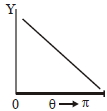
- B
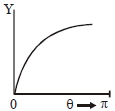
- C
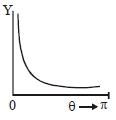
- D
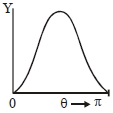
Explore More
Similar Questions
In an alpha particle scattering experiment,the distance of closest approach for the $\alpha$-particle is $4.5 \times 10^{-14} \ m$. If the target nucleus has an atomic number $Z = 80$,then the maximum velocity of the $\alpha$-particle is approximately $... \times 10^5 \ m/s$.
$\left(\frac{1}{4 \pi \epsilon_0} = 9 \times 10^9 \ SI \ unit, \text{mass of } \alpha \text{-particle } m = 6.72 \times 10^{-27} \ kg, e = 1.6 \times 10^{-19} \ C\right)$
$\left(\frac{1}{4 \pi \epsilon_0} = 9 \times 10^9 \ SI \ unit, \text{mass of } \alpha \text{-particle } m = 6.72 \times 10^{-27} \ kg, e = 1.6 \times 10^{-19} \ C\right)$
DifficultJEE MAIN 2024
View SolutionWhat does it mean if the $\alpha$-particle passes through the gold foil without any deviation?
Medium
View SolutionAn alpha particle colliding with one of the electrons in a gold atom loses
Easy
View SolutionAn $\alpha$-particle of energy $5 \text{ MeV}$ is scattered through $180^{\circ}$ by a gold nucleus. The distance of closest approach is of the order of:
An $\alpha$-particle of $5 \; MeV$ energy strikes a stationary uranium nucleus at a scattering angle of $180^o$. The distance of closest approach of the $\alpha$-particle to the nucleus will be of the order of:
MediumIIT 1981
View SolutionVedclass Products
For Students
Vedclass Test Series
Mock tests in real JEE/NEET style with performance analysis. 5-day free trial.
Start Free TrialFor Teachers
Exam Paper Generator
Generate Set A/B/C/D exam papers from 7.5L+ questions in 2 minutes. 3 chapters free.
Try FreeFor Institutes
Online Exam Module
Live online exams with unlimited students, 360° analytics & white-label branding.
See Demo