
PhysicsQ151–242 of 399 questions
Page 4 of 5 · English
151
PhysicsMediumMCQJEE Main · 2020
Nitrogen gas is at $300^{\circ} C$ temperature. The temperature (in $K$) at which the $rms$ speed of a $H_{2}$ molecule would be equal to the $rms$ speed of a nitrogen molecule is........ (Molar mass of $N_{2}$ gas = $28 \ g/mol$,Molar mass of $H_{2}$ gas = $2 \ g/mol$)
A
$41$
B
$45$
C
$38$
D
$49$
Solution
(A) The root mean square $(rms)$ speed of a gas molecule is given by the formula: $V_{rms} = \sqrt{\frac{3RT}{M}}$.
Given that the $rms$ speed of $H_{2}$ is equal to the $rms$ speed of $N_{2}$:
$V_{rms(H_{2})} = V_{rms(N_{2})}$
$\sqrt{\frac{3RT_{H_{2}}}{M_{H_{2}}}} = \sqrt{\frac{3RT_{N_{2}}}{M_{N_{2}}}}$
Squaring both sides and canceling common terms $(3R)$:
$\frac{T_{H_{2}}}{M_{H_{2}}} = \frac{T_{N_{2}}}{M_{N_{2}}}$
Given $T_{N_{2}} = 300^{\circ}C = 300 + 273 = 573 \ K$,$M_{N_{2}} = 28 \ g/mol$,and $M_{H_{2}} = 2 \ g/mol$:
$\frac{T_{H_{2}}}{2} = \frac{573}{28}$
$T_{H_{2}} = \frac{573 \times 2}{28} = \frac{573}{14} \approx 40.928 \ K$.
Rounding to the nearest integer,we get $41 \ K$.
Given that the $rms$ speed of $H_{2}$ is equal to the $rms$ speed of $N_{2}$:
$V_{rms(H_{2})} = V_{rms(N_{2})}$
$\sqrt{\frac{3RT_{H_{2}}}{M_{H_{2}}}} = \sqrt{\frac{3RT_{N_{2}}}{M_{N_{2}}}}$
Squaring both sides and canceling common terms $(3R)$:
$\frac{T_{H_{2}}}{M_{H_{2}}} = \frac{T_{N_{2}}}{M_{N_{2}}}$
Given $T_{N_{2}} = 300^{\circ}C = 300 + 273 = 573 \ K$,$M_{N_{2}} = 28 \ g/mol$,and $M_{H_{2}} = 2 \ g/mol$:
$\frac{T_{H_{2}}}{2} = \frac{573}{28}$
$T_{H_{2}} = \frac{573 \times 2}{28} = \frac{573}{14} \approx 40.928 \ K$.
Rounding to the nearest integer,we get $41 \ K$.
0 likesView Solution
152
PhysicsDifficultMCQJEE Main · 2020
$A$ thin rod of mass $0.9\, kg$ and length $1\, m$ is suspended,at rest,from one end so that it can freely oscillate in the vertical plane. $A$ particle of mass $0.1\, kg$ moving in a straight line with velocity $80\, m/s$ hits the rod at its bottom-most point and sticks to it. The angular speed (in $rad/s$) of the rod immediately after the collision will be

A
$30$
B
$28$
C
$20$
D
$25$
Solution
(C) Since the impulsive force acts at the pivot,the angular momentum about the pivot is conserved during the collision.
Initial angular momentum $L_i = m v L$.
Final angular momentum $L_f = I_{total} \omega$,where $I_{total} = I_{rod} + I_{particle} = \frac{M L^2}{3} + m L^2$.
Equating $L_i = L_f$:
$m v L = \left( \frac{M L^2}{3} + m L^2 \right) \omega$
Substituting the given values $(M = 0.9\, kg, m = 0.1\, kg, L = 1\, m, v = 80\, m/s)$:
$0.1 \times 80 \times 1 = \left( \frac{0.9 \times 1^2}{3} + 0.1 \times 1^2 \right) \omega$
$8 = (0.3 + 0.1) \omega$
$8 = 0.4 \omega$
$\omega = \frac{8}{0.4} = 20\, rad/s$.
Initial angular momentum $L_i = m v L$.
Final angular momentum $L_f = I_{total} \omega$,where $I_{total} = I_{rod} + I_{particle} = \frac{M L^2}{3} + m L^2$.
Equating $L_i = L_f$:
$m v L = \left( \frac{M L^2}{3} + m L^2 \right) \omega$
Substituting the given values $(M = 0.9\, kg, m = 0.1\, kg, L = 1\, m, v = 80\, m/s)$:
$0.1 \times 80 \times 1 = \left( \frac{0.9 \times 1^2}{3} + 0.1 \times 1^2 \right) \omega$
$8 = (0.3 + 0.1) \omega$
$8 = 0.4 \omega$
$\omega = \frac{8}{0.4} = 20\, rad/s$.
0 likesView Solution
153
PhysicsDifficultMCQJEE Main · 2020
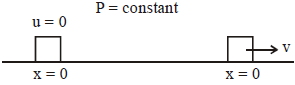
$A$ body of mass $2\, kg$ is driven by an engine delivering a constant power $1\, J/s$. The body starts from rest and moves in a straight line. After $9$ seconds,the body has moved a distance (in $m$):
A
$28$
B
$25$
C
$20$
D
$18$
Solution
(D) Given: Mass $m = 2\, kg$,Power $P = 1\, J/s$,Time $t = 9\, s$,Initial velocity $u = 0$.
Power is defined as $P = F \cdot v = (m \cdot a) \cdot v = m \cdot \frac{dv}{dt} \cdot v$.
Rearranging the terms: $m \cdot v \cdot dv = P \cdot dt$.
Integrating both sides from rest ($v=0$ at $t=0$): $\int_{0}^{v} m \cdot v \cdot dv = \int_{0}^{t} P \cdot dt$.
$m \cdot \frac{v^2}{2} = P \cdot t \Rightarrow v^2 = \frac{2Pt}{m} \Rightarrow v = \sqrt{\frac{2Pt}{m}}$.
Since $v = \frac{dx}{dt}$,we have $\frac{dx}{dt} = \sqrt{\frac{2P}{m}} \cdot t^{1/2}$.
Integrating to find distance $x$: $\int_{0}^{x} dx = \sqrt{\frac{2P}{m}} \int_{0}^{t} t^{1/2} dt$.
$x = \sqrt{\frac{2P}{m}} \cdot \frac{t^{3/2}}{3/2} = \sqrt{\frac{2P}{m}} \cdot \frac{2}{3} \cdot t^{3/2}$.
Substituting the values $m = 2$,$P = 1$,$t = 9$: $x = \sqrt{\frac{2 \cdot 1}{2}} \cdot \frac{2}{3} \cdot 9^{3/2} = 1 \cdot \frac{2}{3} \cdot (3^2)^{3/2} = \frac{2}{3} \cdot 27 = 18\, m$.
Power is defined as $P = F \cdot v = (m \cdot a) \cdot v = m \cdot \frac{dv}{dt} \cdot v$.
Rearranging the terms: $m \cdot v \cdot dv = P \cdot dt$.
Integrating both sides from rest ($v=0$ at $t=0$): $\int_{0}^{v} m \cdot v \cdot dv = \int_{0}^{t} P \cdot dt$.
$m \cdot \frac{v^2}{2} = P \cdot t \Rightarrow v^2 = \frac{2Pt}{m} \Rightarrow v = \sqrt{\frac{2Pt}{m}}$.
Since $v = \frac{dx}{dt}$,we have $\frac{dx}{dt} = \sqrt{\frac{2P}{m}} \cdot t^{1/2}$.
Integrating to find distance $x$: $\int_{0}^{x} dx = \sqrt{\frac{2P}{m}} \int_{0}^{t} t^{1/2} dt$.
$x = \sqrt{\frac{2P}{m}} \cdot \frac{t^{3/2}}{3/2} = \sqrt{\frac{2P}{m}} \cdot \frac{2}{3} \cdot t^{3/2}$.
Substituting the values $m = 2$,$P = 1$,$t = 9$: $x = \sqrt{\frac{2 \cdot 1}{2}} \cdot \frac{2}{3} \cdot 9^{3/2} = 1 \cdot \frac{2}{3} \cdot (3^2)^{3/2} = \frac{2}{3} \cdot 27 = 18\, m$.
0 likesView Solution
154
PhysicsDifficultMCQJEE Main · 2020
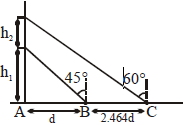
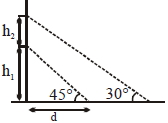
$A$ balloon is moving up in air vertically above a point $A$ on the ground. When it is at a height $h_{1}$,a girl standing at a distance $d$ (point $B$) from $A$ sees it at an angle $45^{\circ}$ with respect to the vertical. When the balloon climbs up a further height $h_{2}$,it is seen at an angle $60^{\circ}$ with respect to the vertical if the girl moves further by a distance $2.464d$ (point $C$). Then the height $h_{2}$ is (given $\tan 30^{\circ} = 0.5774$):
A
$d$
B
$0.732d$
C
$1.464d$
D
$0.464d$
Solution
(A) From the first position at point $B$,the angle with the vertical is $45^{\circ}$. Thus,the angle with the ground is $90^{\circ} - 45^{\circ} = 45^{\circ}$.
$\tan 45^{\circ} = \frac{h_{1}}{d} \Rightarrow 1 = \frac{h_{1}}{d} \Rightarrow h_{1} = d$.
When the balloon is at height $h_{1} + h_{2}$,the girl is at point $C$. The distance from $A$ to $C$ is $d + 2.464d = 3.464d$. The angle with the vertical is $60^{\circ}$,so the angle with the ground is $90^{\circ} - 60^{\circ} = 30^{\circ}$.
$\tan 30^{\circ} = \frac{h_{1} + h_{2}}{3.464d}$.
Given $\tan 30^{\circ} = 0.5774$,we have $0.5774 = \frac{d + h_{2}}{3.464d}$.
$d + h_{2} = 0.5774 \times 3.464d \approx 2d$.
$h_{2} = 2d - d = d$.
$\tan 45^{\circ} = \frac{h_{1}}{d} \Rightarrow 1 = \frac{h_{1}}{d} \Rightarrow h_{1} = d$.
When the balloon is at height $h_{1} + h_{2}$,the girl is at point $C$. The distance from $A$ to $C$ is $d + 2.464d = 3.464d$. The angle with the vertical is $60^{\circ}$,so the angle with the ground is $90^{\circ} - 60^{\circ} = 30^{\circ}$.
$\tan 30^{\circ} = \frac{h_{1} + h_{2}}{3.464d}$.
Given $\tan 30^{\circ} = 0.5774$,we have $0.5774 = \frac{d + h_{2}}{3.464d}$.
$d + h_{2} = 0.5774 \times 3.464d \approx 2d$.
$h_{2} = 2d - d = d$.
0 likesView Solution
155
PhysicsMediumMCQJEE Main · 2020
In a resonance tube experiment,when the tube is filled with water up to a height of $17.0 \, cm$ from the bottom,it resonates with a given tuning fork. When the water level is raised,the next resonance with the same tuning fork occurs at a height of $24.5 \, cm$. If the velocity of sound in air is $330 \, m/s$,the tuning fork frequency is $...... \, Hz$.
A
$1100$
B
$3300$
C
$2200$
D
$550$
Solution
(C) In a resonance tube,the distance between two consecutive resonance positions is equal to half the wavelength of the sound wave,i.e.,$\frac{\lambda}{2} = l_2 - l_1$.
Given $l_1 = 17.0 \, cm$ and $l_2 = 24.5 \, cm$.
$\frac{\lambda}{2} = 24.5 \, cm - 17.0 \, cm = 7.5 \, cm$.
Therefore,$\lambda = 2 \times 7.5 \, cm = 15.0 \, cm = 0.15 \, m$.
The relationship between velocity $(v)$,frequency $(f)$,and wavelength $(\lambda)$ is $v = f \lambda$.
Given $v = 330 \, m/s$,we have $330 = f \times 0.15$.
$f = \frac{330}{0.15} = \frac{33000}{15} = 2200 \, Hz$.
Given $l_1 = 17.0 \, cm$ and $l_2 = 24.5 \, cm$.
$\frac{\lambda}{2} = 24.5 \, cm - 17.0 \, cm = 7.5 \, cm$.
Therefore,$\lambda = 2 \times 7.5 \, cm = 15.0 \, cm = 0.15 \, m$.
The relationship between velocity $(v)$,frequency $(f)$,and wavelength $(\lambda)$ is $v = f \lambda$.
Given $v = 330 \, m/s$,we have $330 = f \times 0.15$.
$f = \frac{330}{0.15} = \frac{33000}{15} = 2200 \, Hz$.
0 likesView Solution
156
PhysicsDifficultMCQJEE Main · 2020
$A$ helicopter rises from rest on the ground vertically upwards with a constant acceleration $g$. $A$ food packet is dropped from the helicopter when it is at a height $h$. The time taken by the packet to reach the ground is close to [$g$ is the acceleration due to gravity].
A
$t = \sqrt{\frac{2h}{3g}}$
B
$t = 1.8 \sqrt{\frac{h}{g}}$
C
$t = 3.4 \sqrt{\frac{h}{g}}$
D
$t = \frac{2}{3} \sqrt{\frac{h}{g}}$
Solution
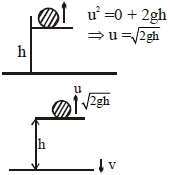
(C) $1$. First,find the velocity of the helicopter at height $h$. Since it starts from rest with acceleration $g$,$v^2 = u^2 + 2as \Rightarrow v^2 = 0 + 2gh \Rightarrow v = \sqrt{2gh}$.
$2$. When the packet is dropped,it has an initial upward velocity $u = \sqrt{2gh}$.
$3$. The packet moves upward,reaches a maximum height,and then falls to the ground. The maximum height reached by the packet from the point of release is $H_{max} = \frac{u^2}{2g} = \frac{2gh}{2g} = h$.
$4$. The total height of the packet from the ground is $H_{total} = h + h = 2h$.
$5$. Using the equation of motion $s = ut + \frac{1}{2}at^2$ for the downward journey (taking upward as positive,$s = -h$,$u = \sqrt{2gh}$,$a = -g$):
$-h = \sqrt{2gh} \cdot t - \frac{1}{2}gt^2$
$\frac{1}{2}gt^2 - \sqrt{2gh} \cdot t - h = 0$
Multiplying by $2/g$: $t^2 - 2\sqrt{\frac{2h}{g}} \cdot t - \frac{2h}{g} = 0$.
$6$. Solving for $t$ using the quadratic formula $t = \frac{-b \pm \sqrt{b^2 - 4ac}}{2a}$:
$t = \frac{2\sqrt{2h/g} + \sqrt{8h/g + 8h/g}}{2} = \sqrt{\frac{2h}{g}} + \sqrt{\frac{4h}{g}} = (\sqrt{2} + 2) \sqrt{\frac{h}{g}} \approx (1.414 + 2) \sqrt{\frac{h}{g}} = 3.414 \sqrt{\frac{h}{g}}$.
$2$. When the packet is dropped,it has an initial upward velocity $u = \sqrt{2gh}$.
$3$. The packet moves upward,reaches a maximum height,and then falls to the ground. The maximum height reached by the packet from the point of release is $H_{max} = \frac{u^2}{2g} = \frac{2gh}{2g} = h$.
$4$. The total height of the packet from the ground is $H_{total} = h + h = 2h$.
$5$. Using the equation of motion $s = ut + \frac{1}{2}at^2$ for the downward journey (taking upward as positive,$s = -h$,$u = \sqrt{2gh}$,$a = -g$):
$-h = \sqrt{2gh} \cdot t - \frac{1}{2}gt^2$
$\frac{1}{2}gt^2 - \sqrt{2gh} \cdot t - h = 0$
Multiplying by $2/g$: $t^2 - 2\sqrt{\frac{2h}{g}} \cdot t - \frac{2h}{g} = 0$.
$6$. Solving for $t$ using the quadratic formula $t = \frac{-b \pm \sqrt{b^2 - 4ac}}{2a}$:
$t = \frac{2\sqrt{2h/g} + \sqrt{8h/g + 8h/g}}{2} = \sqrt{\frac{2h}{g}} + \sqrt{\frac{4h}{g}} = (\sqrt{2} + 2) \sqrt{\frac{h}{g}} \approx (1.414 + 2) \sqrt{\frac{h}{g}} = 3.414 \sqrt{\frac{h}{g}}$.
0 likesView Solution
157
PhysicsDifficultMCQJEE Main · 2020
$A$ hollow spherical shell of outer radius $R$ floats just submerged under the water surface. The inner radius of the shell is $r$. If the specific gravity of the shell material is $\frac{27}{8}$ with respect to water,the value of $r$ is $......R$.
A
$0.44$
B
$0.88$
C
$0.33$
D
$0.66$
Solution
(B) For the shell to float just submerged,the weight of the shell must be equal to the weight of the water displaced.
Weight of shell = $V_{material} \times \rho_{material} \times g = \frac{4}{3} \pi (R^3 - r^3) \rho_{material} g$.
Weight of displaced water = $V_{total} \times \rho_{water} \times g = \frac{4}{3} \pi R^3 \rho_{water} g$.
Equating the two: $\frac{4}{3} \pi (R^3 - r^3) \rho_{material} g = \frac{4}{3} \pi R^3 \rho_{water} g$.
$(R^3 - r^3) \rho_{material} = R^3 \rho_{water}$.
Given specific gravity $\frac{\rho_{material}}{\rho_{water}} = \frac{27}{8}$.
So,$(R^3 - r^3) \frac{27}{8} = R^3$.
$R^3 - r^3 = \frac{8}{27} R^3$.
$r^3 = R^3 - \frac{8}{27} R^3 = \frac{19}{27} R^3$.
$r = R \left( \frac{19}{27} \right)^{1/3} = \frac{R}{3} (19)^{1/3}$.
Since $(19)^{1/3} \approx 2.668$,$r \approx \frac{2.668}{3} R \approx 0.889 R$.
Weight of shell = $V_{material} \times \rho_{material} \times g = \frac{4}{3} \pi (R^3 - r^3) \rho_{material} g$.
Weight of displaced water = $V_{total} \times \rho_{water} \times g = \frac{4}{3} \pi R^3 \rho_{water} g$.
Equating the two: $\frac{4}{3} \pi (R^3 - r^3) \rho_{material} g = \frac{4}{3} \pi R^3 \rho_{water} g$.
$(R^3 - r^3) \rho_{material} = R^3 \rho_{water}$.
Given specific gravity $\frac{\rho_{material}}{\rho_{water}} = \frac{27}{8}$.
So,$(R^3 - r^3) \frac{27}{8} = R^3$.
$R^3 - r^3 = \frac{8}{27} R^3$.
$r^3 = R^3 - \frac{8}{27} R^3 = \frac{19}{27} R^3$.
$r = R \left( \frac{19}{27} \right)^{1/3} = \frac{R}{3} (19)^{1/3}$.
Since $(19)^{1/3} \approx 2.668$,$r \approx \frac{2.668}{3} R \approx 0.889 R$.
0 likesView Solution
158
PhysicsDifficultMCQJEE Main · 2020
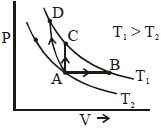
Three different processes that can occur in an ideal monoatomic gas are shown in the $P$ vs $V$ diagram. The paths are labelled as $A \rightarrow B, A \rightarrow C$ and $A \rightarrow D$. The change in internal energies during these processes are taken as $E_{AB}, E_{AC}$ and $E_{AD}$ and the work done as $W_{AB}, W_{AC}$ and $W_{AD}$. The correct relation between these parameters is:
A
$E_{AB} = E_{AC} = E_{AD}, W_{AB} > 0, W_{AC} = 0, W_{AD} > 0$
B
$E_{AB} < E_{AC} < E_{AD}, W_{AB} > 0, W_{AC} > W_{AD}$
C
$E_{AB} = E_{AC} < E_{AD}, W_{AB} > 0, W_{AC} = 0, W_{AD} < 0$
D
$E_{AB} > E_{AC} > E_{AD}, W_{AB} < W_{AC} < W_{AD}$
Solution
(C) $1$. Internal energy of an ideal gas depends only on temperature: $\Delta U = nC_v \Delta T$. Since all processes start at point $A$ (temperature $T_2$) and end at different points $B, C, D$ which lie on different isotherms,we must check the final temperatures. Point $B$ lies on isotherm $T_1$. Points $C$ and $D$ lie on an isotherm higher than $T_1$. Therefore,the final temperatures are $T_B = T_1$ and $T_C = T_D > T_1$. Thus,$\Delta U_{AB} < \Delta U_{AC} = \Delta U_{AD}$.
$2$. Work done $W$ is the area under the $P-V$ curve. For $A \rightarrow B$,volume increases,so $W_{AB} > 0$. For $A \rightarrow C$,it is an isochoric process (vertical line),so $W_{AC} = 0$. For $A \rightarrow D$,volume decreases,so $W_{AD} < 0$.
$3$. Comparing these,we get $E_{AB} < E_{AC} = E_{AD}$ and $W_{AB} > 0, W_{AC} = 0, W_{AD} < 0$. Note: The provided options seem to have a typo in the question's intended logic. Based on the graph,$E_{AB} < E_{AC} = E_{AD}$ and $W_{AB} > 0, W_{AC} = 0, W_{AD} < 0$. Option $C$ is the closest match if we interpret the internal energy comparison correctly.
$2$. Work done $W$ is the area under the $P-V$ curve. For $A \rightarrow B$,volume increases,so $W_{AB} > 0$. For $A \rightarrow C$,it is an isochoric process (vertical line),so $W_{AC} = 0$. For $A \rightarrow D$,volume decreases,so $W_{AD} < 0$.
$3$. Comparing these,we get $E_{AB} < E_{AC} = E_{AD}$ and $W_{AB} > 0, W_{AC} = 0, W_{AD} < 0$. Note: The provided options seem to have a typo in the question's intended logic. Based on the graph,$E_{AB} < E_{AC} = E_{AD}$ and $W_{AB} > 0, W_{AC} = 0, W_{AD} < 0$. Option $C$ is the closest match if we interpret the internal energy comparison correctly.
0 likesView Solution
159
PhysicsDifficultMCQJEE Main · 2020
Assume that the displacement $(s)$ of air is proportional to the pressure difference $(\Delta p)$ created by a sound wave. Displacement $(s)$ further depends on the speed of sound $(v)$,density of air $(\rho)$,and the frequency $(f)$. If $\Delta p \approx 10 \, Pa$,$v \approx 300 \, m/s$,$\rho \approx 1 \, kg/m^3$,and $f \approx 1000 \, Hz$,then $s$ will be of the order of (take multiplicative constant to be $1$).
A
$10 \, mm$
B
$\frac{3}{100} \, mm$
C
$1 \, mm$
D
$\frac{1}{10} \, mm$
Solution
(B) The pressure amplitude $\Delta p$ in a sound wave is related to the displacement amplitude $s$ by the formula $\Delta p = B k s$,where $B$ is the bulk modulus and $k$ is the wave number.
Since $B = \rho v^2$ and $k = \frac{\omega}{v} = \frac{2 \pi f}{v}$,we have $\Delta p = (\rho v^2) \times (\frac{2 \pi f}{v}) \times s$.
Taking the multiplicative constant to be $1$ (ignoring $2 \pi$),the relation simplifies to $\Delta p = \rho v \omega s$.
Rearranging for $s$,we get $s = \frac{\Delta p}{\rho v \omega} = \frac{\Delta p}{\rho v (2 \pi f)}$.
Substituting the given values: $s \approx \frac{10}{1 \times 300 \times 2 \pi \times 1000} \, m$.
Ignoring the factor of $2 \pi$ as per the instruction to take the multiplicative constant as $1$: $s \approx \frac{10}{300 \times 1000} \, m = \frac{1}{30000} \, m$.
Converting to millimeters: $s \approx \frac{1}{30000} \times 1000 \, mm = \frac{1}{30} \, mm \approx 0.033 \, mm = \frac{3}{100} \, mm$.
Since $B = \rho v^2$ and $k = \frac{\omega}{v} = \frac{2 \pi f}{v}$,we have $\Delta p = (\rho v^2) \times (\frac{2 \pi f}{v}) \times s$.
Taking the multiplicative constant to be $1$ (ignoring $2 \pi$),the relation simplifies to $\Delta p = \rho v \omega s$.
Rearranging for $s$,we get $s = \frac{\Delta p}{\rho v \omega} = \frac{\Delta p}{\rho v (2 \pi f)}$.
Substituting the given values: $s \approx \frac{10}{1 \times 300 \times 2 \pi \times 1000} \, m$.
Ignoring the factor of $2 \pi$ as per the instruction to take the multiplicative constant as $1$: $s \approx \frac{10}{300 \times 1000} \, m = \frac{1}{30000} \, m$.
Converting to millimeters: $s \approx \frac{1}{30000} \times 1000 \, mm = \frac{1}{30} \, mm \approx 0.033 \, mm = \frac{3}{100} \, mm$.
0 likesView Solution
160
PhysicsMediumMCQJEE Main · 2020
$A$ bullet of mass $5\, g$,travelling with a speed of $210\, m/s$,strikes a fixed wooden target. One half of its kinetic energy is converted into heat in the bullet while the other half is converted into heat in the wood. The rise of temperature of the bullet if the specific heat of its material is $0.030\, cal/(g \cdot ^{\circ}C)$ $(1\, cal = 4.2 \times 10^{7}\, ergs)$ is close to $.......^{\circ}C$.
A
$83.3$
B
$87.5$
C
$119.2$
D
$38.4$
Solution
(B) The initial kinetic energy of the bullet is $K = \frac{1}{2} m v^2$.
Given $m = 5\, g$ and $v = 210\, m/s = 21000\, cm/s$.
$K = \frac{1}{2} \times 5 \times (21000)^2 = 1.1025 \times 10^9\, ergs$.
One half of this energy is converted into heat in the bullet:
$Q = \frac{1}{2} K = \frac{1}{2} \times 1.1025 \times 10^9 = 5.5125 \times 10^8\, ergs$.
We know $Q = m s \Delta T$,where $s = 0.030\, cal/(g \cdot ^{\circ}C) = 0.030 \times 4.2 \times 10^7\, ergs/(g \cdot ^{\circ}C) = 1.26 \times 10^6\, ergs/(g \cdot ^{\circ}C)$.
Substituting the values:
$5.5125 \times 10^8 = 5 \times (1.26 \times 10^6) \times \Delta T$.
$\Delta T = \frac{5.5125 \times 10^8}{6.3 \times 10^6} = \frac{551.25}{6.3} = 87.5^{\circ}C$.
Given $m = 5\, g$ and $v = 210\, m/s = 21000\, cm/s$.
$K = \frac{1}{2} \times 5 \times (21000)^2 = 1.1025 \times 10^9\, ergs$.
One half of this energy is converted into heat in the bullet:
$Q = \frac{1}{2} K = \frac{1}{2} \times 1.1025 \times 10^9 = 5.5125 \times 10^8\, ergs$.
We know $Q = m s \Delta T$,where $s = 0.030\, cal/(g \cdot ^{\circ}C) = 0.030 \times 4.2 \times 10^7\, ergs/(g \cdot ^{\circ}C) = 1.26 \times 10^6\, ergs/(g \cdot ^{\circ}C)$.
Substituting the values:
$5.5125 \times 10^8 = 5 \times (1.26 \times 10^6) \times \Delta T$.
$\Delta T = \frac{5.5125 \times 10^8}{6.3 \times 10^6} = \frac{551.25}{6.3} = 87.5^{\circ}C$.
0 likesView Solution
161
PhysicsMediumMCQJEE Main · 2020
Number of molecules in a volume of $4\, cm^{3}$ of a perfect monoatomic gas at some temperature $T$ and at a pressure of $2\, cm$ of mercury is close to $?$
(Given,mean kinetic energy of a molecule (at $T$) is $4 \times 10^{-14}\, erg$,$g=980\, cm/s^{2}$,density of mercury $=13.6\, g/cm^{3}$)
(Given,mean kinetic energy of a molecule (at $T$) is $4 \times 10^{-14}\, erg$,$g=980\, cm/s^{2}$,density of mercury $=13.6\, g/cm^{3}$)
A
$5.8 \times 10^{18}$
B
$5.8 \times 10^{16}$
C
$4.0 \times 10^{18}$
D
$4.0 \times 10^{16}$
Solution
(C) The pressure $P$ is given by $P = h \rho g$,where $h = 2\, cm$,$\rho = 13.6\, g/cm^{3}$,and $g = 980\, cm/s^{2}$.
$P = 2 \times 13.6 \times 980 = 26656\, dyne/cm^{2}$.
The volume $V = 4\, cm^{3}$.
The mean kinetic energy of a monoatomic gas molecule is given by $E = \frac{3}{2} kT = 4 \times 10^{-14}\, erg$.
From the ideal gas law,$PV = NkT$,where $N$ is the number of molecules.
We can write $N = \frac{PV}{kT}$.
Since $kT = \frac{2}{3} E = \frac{2}{3} \times 4 \times 10^{-14} = \frac{8}{3} \times 10^{-14}\, erg$.
Substituting the values: $N = \frac{26656 \times 4}{\frac{8}{3} \times 10^{-14}} = \frac{106624 \times 3}{8 \times 10^{-14}} = 13328 \times 3 \times 10^{14} = 39984 \times 10^{14} \approx 4.0 \times 10^{18}$.
$P = 2 \times 13.6 \times 980 = 26656\, dyne/cm^{2}$.
The volume $V = 4\, cm^{3}$.
The mean kinetic energy of a monoatomic gas molecule is given by $E = \frac{3}{2} kT = 4 \times 10^{-14}\, erg$.
From the ideal gas law,$PV = NkT$,where $N$ is the number of molecules.
We can write $N = \frac{PV}{kT}$.
Since $kT = \frac{2}{3} E = \frac{2}{3} \times 4 \times 10^{-14} = \frac{8}{3} \times 10^{-14}\, erg$.
Substituting the values: $N = \frac{26656 \times 4}{\frac{8}{3} \times 10^{-14}} = \frac{106624 \times 3}{8 \times 10^{-14}} = 13328 \times 3 \times 10^{14} = 39984 \times 10^{14} \approx 4.0 \times 10^{18}$.
0 likesView Solution
162
PhysicsMediumMCQJEE Main · 2020
$A$ physical quantity $z$ depends on four observables $a, b, c$ and $d$ as $z = \frac{a^2 b^{2/3}}{\sqrt{c} d^3}$. The percentage errors in the measurement of $a, b, c$ and $d$ are $2\%, 1.5\%, 4\%$ and $2.5\%$ respectively. The percentage error in $z$ is $......\%$. (in $.5$)
A
$12$
B
$14$
C
$16$
D
$13$
Solution
(B) The given relation is $z = \frac{a^2 b^{2/3}}{c^{1/2} d^3}$.
The relative error in $z$ is given by the formula: $\frac{\Delta z}{z} = 2 \frac{\Delta a}{a} + \frac{2}{3} \frac{\Delta b}{b} + \frac{1}{2} \frac{\Delta c}{c} + 3 \frac{\Delta d}{d}$.
Given percentage errors are: $\frac{\Delta a}{a} \times 100 = 2\%$,$\frac{\Delta b}{b} \times 100 = 1.5\%$,$\frac{\Delta c}{c} \times 100 = 4\%$,and $\frac{\Delta d}{d} \times 100 = 2.5\%$.
Substituting these values into the error formula:
$\frac{\Delta z}{z} \times 100 = 2(2\%) + \frac{2}{3}(1.5\%) + \frac{1}{2}(4\%) + 3(2.5\%)$.
$\frac{\Delta z}{z} \times 100 = 4\% + 1\% + 2\% + 7.5\% = 14.5\%$.
Thus,the percentage error in $z$ is $14.5\%$.
The relative error in $z$ is given by the formula: $\frac{\Delta z}{z} = 2 \frac{\Delta a}{a} + \frac{2}{3} \frac{\Delta b}{b} + \frac{1}{2} \frac{\Delta c}{c} + 3 \frac{\Delta d}{d}$.
Given percentage errors are: $\frac{\Delta a}{a} \times 100 = 2\%$,$\frac{\Delta b}{b} \times 100 = 1.5\%$,$\frac{\Delta c}{c} \times 100 = 4\%$,and $\frac{\Delta d}{d} \times 100 = 2.5\%$.
Substituting these values into the error formula:
$\frac{\Delta z}{z} \times 100 = 2(2\%) + \frac{2}{3}(1.5\%) + \frac{1}{2}(4\%) + 3(2.5\%)$.
$\frac{\Delta z}{z} \times 100 = 4\% + 1\% + 2\% + 7.5\% = 14.5\%$.
Thus,the percentage error in $z$ is $14.5\%$.
0 likesView Solution
163
PhysicsDifficultMCQJEE Main · 2020
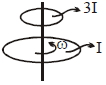
$A$ wheel is rotating freely with an angular speed $\omega$ on a shaft. The moment of inertia of the wheel is $I$ and the moment of inertia of the shaft is negligible. Another wheel of moment of inertia $3I$ initially at rest is suddenly coupled to the same shaft. The resultant fractional loss in the kinetic energy of the system is:
A
$0$
B
$\frac{1}{4}$
C
$\frac{3}{4}$
D
$\frac{5}{6}$
Solution
(C) According to the law of conservation of angular momentum:
$I\omega + 3I \times 0 = (I + 3I)\omega'$
$I\omega = 4I\omega'$
$\omega' = \frac{\omega}{4}$
Initial kinetic energy $(KE)_i = \frac{1}{2}I\omega^2$
Final kinetic energy $(KE)_f = \frac{1}{2}(I + 3I)(\omega')^2 = \frac{1}{2}(4I)\left(\frac{\omega}{4}\right)^2 = 2I \times \frac{\omega^2}{16} = \frac{I\omega^2}{8}$
Loss in kinetic energy $\Delta KE = (KE)_i - (KE)_f = \frac{1}{2}I\omega^2 - \frac{1}{8}I\omega^2 = \frac{3}{8}I\omega^2$
Fractional loss in kinetic energy = $\frac{\Delta KE}{(KE)_i} = \frac{\frac{3}{8}I\omega^2}{\frac{1}{2}I\omega^2} = \frac{3}{8} \times 2 = \frac{3}{4}$
$I\omega + 3I \times 0 = (I + 3I)\omega'$
$I\omega = 4I\omega'$
$\omega' = \frac{\omega}{4}$
Initial kinetic energy $(KE)_i = \frac{1}{2}I\omega^2$
Final kinetic energy $(KE)_f = \frac{1}{2}(I + 3I)(\omega')^2 = \frac{1}{2}(4I)\left(\frac{\omega}{4}\right)^2 = 2I \times \frac{\omega^2}{16} = \frac{I\omega^2}{8}$
Loss in kinetic energy $\Delta KE = (KE)_i - (KE)_f = \frac{1}{2}I\omega^2 - \frac{1}{8}I\omega^2 = \frac{3}{8}I\omega^2$
Fractional loss in kinetic energy = $\frac{\Delta KE}{(KE)_i} = \frac{\frac{3}{8}I\omega^2}{\frac{1}{2}I\omega^2} = \frac{3}{8} \times 2 = \frac{3}{4}$
0 likesView Solution
164
PhysicsDifficultMCQJEE Main · 2020
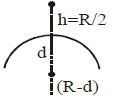
The value of the acceleration due to gravity is $g_{1}$ at a height $h = \frac{R}{2}$ ($R$ = radius of the earth) from the surface of the earth. It is again equal to $g_{1}$ at a depth $d$ below the surface of the earth. The ratio $\left(\frac{d}{R}\right)$ equals
A
$\frac{7}{9}$
B
$\frac{4}{9}$
C
$\frac{1}{3}$
D
$\frac{5}{9}$
Solution
(D) The acceleration due to gravity at a height $h$ is given by $g_{h} = \frac{GM}{(R+h)^{2}}$.
Given $h = \frac{R}{2}$,we have $g_{1} = \frac{GM}{(R + R/2)^{2}} = \frac{GM}{(3R/2)^{2}} = \frac{4GM}{9R^{2}} \ldots(1)$
The acceleration due to gravity at a depth $d$ is given by $g_{d} = g(1 - \frac{d}{R}) = \frac{GM}{R^{2}}(1 - \frac{d}{R}) = \frac{GM(R-d)}{R^{3}} \ldots(2)$
Since $g_{1} = g_{d}$,we equate equations $(1)$ and $(2)$:
$\frac{4GM}{9R^{2}} = \frac{GM(R-d)}{R^{3}}$
$\frac{4}{9} = \frac{R-d}{R}$
$\frac{4}{9} = 1 - \frac{d}{R}$
$\frac{d}{R} = 1 - \frac{4}{9} = \frac{5}{9}$
Given $h = \frac{R}{2}$,we have $g_{1} = \frac{GM}{(R + R/2)^{2}} = \frac{GM}{(3R/2)^{2}} = \frac{4GM}{9R^{2}} \ldots(1)$
The acceleration due to gravity at a depth $d$ is given by $g_{d} = g(1 - \frac{d}{R}) = \frac{GM}{R^{2}}(1 - \frac{d}{R}) = \frac{GM(R-d)}{R^{3}} \ldots(2)$
Since $g_{1} = g_{d}$,we equate equations $(1)$ and $(2)$:
$\frac{4GM}{9R^{2}} = \frac{GM(R-d)}{R^{3}}$
$\frac{4}{9} = \frac{R-d}{R}$
$\frac{4}{9} = 1 - \frac{d}{R}$
$\frac{d}{R} = 1 - \frac{4}{9} = \frac{5}{9}$
0 likesView Solution
165
PhysicsMediumMCQJEE Main · 2020
$A$ force $\overrightarrow{F} = (\hat{i} + 2\hat{j} + 3\hat{k}) \text{ N}$ acts at a point $\vec{r}_1 = (4\hat{i} + 3\hat{j} - \hat{k}) \text{ m}$. The magnitude of torque about the point $\vec{r}_2 = (\hat{i} + 2\hat{j} + \hat{k}) \text{ m}$ is $\sqrt{x} \text{ N-m}$. The value of $x$ is $........$
A
$200$
B
$195$
C
$150$
D
$175$
Solution
(B) The torque $\vec{\tau}$ about a point $\vec{r}_2$ is given by $\vec{\tau} = (\vec{r}_1 - \vec{r}_2) \times \vec{F}$.
First,calculate the position vector relative to the point of rotation:
$\vec{r} = \vec{r}_1 - \vec{r}_2 = (4\hat{i} + 3\hat{j} - \hat{k}) - (\hat{i} + 2\hat{j} + \hat{k}) = 3\hat{i} + \hat{j} - 2\hat{k}$.
Now,calculate the cross product $\vec{\tau} = \vec{r} \times \vec{F}$:
$\vec{\tau} = \begin{vmatrix} \hat{i} & \hat{j} & \hat{k} \\ 3 & 1 & -2 \\ 1 & 2 & 3 \end{vmatrix}$
$= \hat{i}(1(3) - (-2)(2)) - \hat{j}(3(3) - (-2)(1)) + \hat{k}(3(2) - 1(1))$
$= \hat{i}(3 + 4) - \hat{j}(9 + 2) + \hat{k}(6 - 1) = 7\hat{i} - 11\hat{j} + 5\hat{k}$.
The magnitude of the torque is $|\vec{\tau}| = \sqrt{7^2 + (-11)^2 + 5^2} = \sqrt{49 + 121 + 25} = \sqrt{195}$.
Comparing this with $\sqrt{x}$,we get $x = 195$.
First,calculate the position vector relative to the point of rotation:
$\vec{r} = \vec{r}_1 - \vec{r}_2 = (4\hat{i} + 3\hat{j} - \hat{k}) - (\hat{i} + 2\hat{j} + \hat{k}) = 3\hat{i} + \hat{j} - 2\hat{k}$.
Now,calculate the cross product $\vec{\tau} = \vec{r} \times \vec{F}$:
$\vec{\tau} = \begin{vmatrix} \hat{i} & \hat{j} & \hat{k} \\ 3 & 1 & -2 \\ 1 & 2 & 3 \end{vmatrix}$
$= \hat{i}(1(3) - (-2)(2)) - \hat{j}(3(3) - (-2)(1)) + \hat{k}(3(2) - 1(1))$
$= \hat{i}(3 + 4) - \hat{j}(9 + 2) + \hat{k}(6 - 1) = 7\hat{i} - 11\hat{j} + 5\hat{k}$.
The magnitude of the torque is $|\vec{\tau}| = \sqrt{7^2 + (-11)^2 + 5^2} = \sqrt{49 + 121 + 25} = \sqrt{195}$.
Comparing this with $\sqrt{x}$,we get $x = 195$.
0 likesView Solution
166
PhysicsDifficultMCQJEE Main · 2020
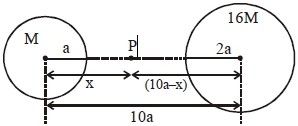
Two planets have masses $M$ and $16\, M$ and their radii are $a$ and $2\, a$ respectively. The separation between the centres of the planets is $10\, a.$ $A$ body of mass $m$ is fired from the surface of the larger planet towards the smaller planet along the line joining their centres. For the body to be able to reach the surface of the smaller planet,the minimum firing speed needed is
A
$\sqrt{\frac{GM}{a}}$
B
$\frac{3}{2} \sqrt{\frac{5GM}{a}}$
C
$4 \sqrt{\frac{GM}{a}}$
D
$2 \sqrt{\frac{GM}{a}}$
Solution
(B) To reach the smaller planet,the body must cross the point of zero gravitational field (neutral point) between the two planets.
Let the distance of the neutral point from the center of the smaller planet be $x$.
Equating the gravitational fields from both planets at this point:
$\frac{GM}{x^2} = \frac{G(16M)}{(10a - x)^2}$
Taking the square root on both sides:
$\frac{1}{x} = \frac{4}{10a - x} \implies 10a - x = 4x \implies x = 2a$.
Now,apply the Law of Conservation of Mechanical Energy between the surface of the larger planet and the neutral point.
The potential at the surface of the larger planet (radius $2a$,mass $16M$) is $V_L = -\frac{G(16M)}{2a} - \frac{GM}{8a} = -\frac{8GM}{a} - \frac{GM}{8a} = -\frac{65GM}{8a}$.
The potential at the neutral point (distance $8a$ from larger,$2a$ from smaller) is $V_P = -\frac{G(16M)}{8a} - \frac{GM}{2a} = -\frac{2GM}{a} - \frac{GM}{2a} = -\frac{5GM}{2a}$.
Using $KE_i + PE_i = KE_f + PE_f$,where $KE_f = 0$ at the neutral point:
$\frac{1}{2}mv^2 + m V_L = 0 + m V_P$
$\frac{1}{2}v^2 = V_P - V_L = -\frac{5GM}{2a} - (-\frac{65GM}{8a}) = \frac{-20GM + 65GM}{8a} = \frac{45GM}{8a}$.
$v^2 = \frac{45GM}{4a} \implies v = \sqrt{\frac{45GM}{4a}} = \frac{3}{2} \sqrt{\frac{5GM}{a}}$.
Let the distance of the neutral point from the center of the smaller planet be $x$.
Equating the gravitational fields from both planets at this point:
$\frac{GM}{x^2} = \frac{G(16M)}{(10a - x)^2}$
Taking the square root on both sides:
$\frac{1}{x} = \frac{4}{10a - x} \implies 10a - x = 4x \implies x = 2a$.
Now,apply the Law of Conservation of Mechanical Energy between the surface of the larger planet and the neutral point.
The potential at the surface of the larger planet (radius $2a$,mass $16M$) is $V_L = -\frac{G(16M)}{2a} - \frac{GM}{8a} = -\frac{8GM}{a} - \frac{GM}{8a} = -\frac{65GM}{8a}$.
The potential at the neutral point (distance $8a$ from larger,$2a$ from smaller) is $V_P = -\frac{G(16M)}{8a} - \frac{GM}{2a} = -\frac{2GM}{a} - \frac{GM}{2a} = -\frac{5GM}{2a}$.
Using $KE_i + PE_i = KE_f + PE_f$,where $KE_f = 0$ at the neutral point:
$\frac{1}{2}mv^2 + m V_L = 0 + m V_P$
$\frac{1}{2}v^2 = V_P - V_L = -\frac{5GM}{2a} - (-\frac{65GM}{8a}) = \frac{-20GM + 65GM}{8a} = \frac{45GM}{8a}$.
$v^2 = \frac{45GM}{4a} \implies v = \sqrt{\frac{45GM}{4a}} = \frac{3}{2} \sqrt{\frac{5GM}{a}}$.
0 likesView Solution
167
PhysicsDifficultMCQJEE Main · 2020
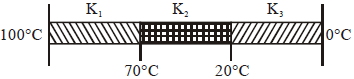
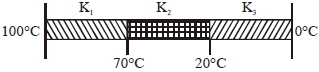
Three rods of identical cross-section and lengths are made of three different materials of thermal conductivity $K_{1}, K_{2},$ and $K_{3}$,respectively. They are joined together at their ends to make a long rod. One end of the long rod is maintained at $100^{\circ} C$ and the other at $0^{\circ} C$. If the joints of the rod are at $70^{\circ} C$ and $20^{\circ} C$ in steady state and there is no loss of energy from the surface of the rod,the correct relationship between $K_{1}, K_{2}$ and $K_{3}$ is:
A
$K_{1}: K_{3}=2: 3 ; K_{2}: K_{3}=2: 5$
B
$K_{1}< K_{2}< K_{3}$
C
$K_{1}: K_{2}=5: 2 ; K_{1}: K_{3}=3: 5$
D
$K_{1}> K_{2}> K_{3}$
Solution
(A) The rods are identical,meaning they have the same length $(\ell)$ and area of cross-section $(A)$.
Since the rods are joined in series,the rate of heat flow (heat current) is the same for all rods in a steady state.
Let the heat current be $H = \frac{\Delta Q}{\Delta t}$.
$H = \frac{K_{1} A (100 - 70)}{\ell} = \frac{K_{2} A (70 - 20)}{\ell} = \frac{K_{3} A (20 - 0)}{\ell}$
Simplifying the equation:
$30 K_{1} = 50 K_{2} = 20 K_{3}$
Dividing by $10$:
$3 K_{1} = 5 K_{2} = 2 K_{3}$
From $3 K_{1} = 2 K_{3}$,we get $\frac{K_{1}}{K_{3}} = \frac{2}{3}$ or $K_{1}: K_{3} = 2: 3$.
From $5 K_{2} = 2 K_{3}$,we get $\frac{K_{2}}{K_{3}} = \frac{2}{5}$ or $K_{2}: K_{3} = 2: 5$.
Thus,the correct relationship is $K_{1}: K_{3} = 2: 3$ and $K_{2}: K_{3} = 2: 5$.
Since the rods are joined in series,the rate of heat flow (heat current) is the same for all rods in a steady state.
Let the heat current be $H = \frac{\Delta Q}{\Delta t}$.
$H = \frac{K_{1} A (100 - 70)}{\ell} = \frac{K_{2} A (70 - 20)}{\ell} = \frac{K_{3} A (20 - 0)}{\ell}$
Simplifying the equation:
$30 K_{1} = 50 K_{2} = 20 K_{3}$
Dividing by $10$:
$3 K_{1} = 5 K_{2} = 2 K_{3}$
From $3 K_{1} = 2 K_{3}$,we get $\frac{K_{1}}{K_{3}} = \frac{2}{3}$ or $K_{1}: K_{3} = 2: 3$.
From $5 K_{2} = 2 K_{3}$,we get $\frac{K_{2}}{K_{3}} = \frac{2}{5}$ or $K_{2}: K_{3} = 2: 5$.
Thus,the correct relationship is $K_{1}: K_{3} = 2: 3$ and $K_{2}: K_{3} = 2: 5$.
0 likesView Solution
168
PhysicsDifficultMCQJEE Main · 2020
$A$ particle moving in the $xy$ plane experiences a velocity-dependent force $\overrightarrow{F} = k(v_y \hat{i} + v_x \hat{j})$,where $v_x$ and $v_y$ are the $x$ and $y$ components of its velocity $\overrightarrow{v}$. If $\overrightarrow{a}$ is the acceleration of the particle,then which of the following statements is true for the particle?
A
The quantity $\overrightarrow{v} \cdot \overrightarrow{a}$ is constant in time.
B
The kinetic energy of the particle is constant in time.
C
The quantity $\overrightarrow{v} \times \overrightarrow{a}$ is constant in time.
D
The force $\overrightarrow{F}$ arises due to a magnetic field.
Solution
(C) Given force $\overrightarrow{F} = m\overrightarrow{a} = k(v_y \hat{i} + v_x \hat{j})$.
Thus,$a_x = \frac{dv_x}{dt} = \frac{k}{m} v_y$ and $a_y = \frac{dv_y}{dt} = \frac{k}{m} v_x$.
Dividing the two equations: $\frac{dv_y}{dv_x} = \frac{v_x}{v_y} \implies v_y dv_y = v_x dv_x$.
Integrating both sides: $\int v_y dv_y = \int v_x dv_x \implies v_y^2 = v_x^2 + C \implies v_y^2 - v_x^2 = \text{constant}$.
Now,calculate $\overrightarrow{v} \times \overrightarrow{a}$:
$\overrightarrow{v} \times \overrightarrow{a} = (v_x \hat{i} + v_y \hat{j}) \times \frac{k}{m}(v_y \hat{i} + v_x \hat{j})$
$= \frac{k}{m} [v_x^2 (\hat{i} \times \hat{j}) + v_y^2 (\hat{j} \times \hat{i})]$
$= \frac{k}{m} [v_x^2 \hat{k} - v_y^2 \hat{k}] = \frac{k}{m} (v_x^2 - v_y^2) \hat{k}$.
Since $v_y^2 - v_x^2$ is constant,$\overrightarrow{v} \times \overrightarrow{a}$ is constant in time.
Thus,$a_x = \frac{dv_x}{dt} = \frac{k}{m} v_y$ and $a_y = \frac{dv_y}{dt} = \frac{k}{m} v_x$.
Dividing the two equations: $\frac{dv_y}{dv_x} = \frac{v_x}{v_y} \implies v_y dv_y = v_x dv_x$.
Integrating both sides: $\int v_y dv_y = \int v_x dv_x \implies v_y^2 = v_x^2 + C \implies v_y^2 - v_x^2 = \text{constant}$.
Now,calculate $\overrightarrow{v} \times \overrightarrow{a}$:
$\overrightarrow{v} \times \overrightarrow{a} = (v_x \hat{i} + v_y \hat{j}) \times \frac{k}{m}(v_y \hat{i} + v_x \hat{j})$
$= \frac{k}{m} [v_x^2 (\hat{i} \times \hat{j}) + v_y^2 (\hat{j} \times \hat{i})]$
$= \frac{k}{m} [v_x^2 \hat{k} - v_y^2 \hat{k}] = \frac{k}{m} (v_x^2 - v_y^2) \hat{k}$.
Since $v_y^2 - v_x^2$ is constant,$\overrightarrow{v} \times \overrightarrow{a}$ is constant in time.
0 likesView Solution
169
PhysicsDifficultMCQJEE Main · 2020
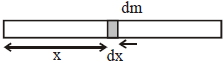
The linear mass density of a thin rod $AB$ of length $L$ varies from $A$ to $B$ as $\lambda(x) = \lambda_{0}(1 + \frac{x}{L})$,where $x$ is the distance from $A$. If $M$ is the mass of the rod,then its moment of inertia about an axis passing through $A$ and perpendicular to the rod is $......ML^{2}$.
A
$0.416$
B
$0.428$
C
$0.4$
D
$0.388$
Solution
(D) The moment of inertia $I$ is given by $I = \int r^{2} dm = \int_{0}^{L} x^{2} \lambda(x) dx$.
Substituting $\lambda(x) = \lambda_{0}(1 + \frac{x}{L})$:
$I = \int_{0}^{L} x^{2} \lambda_{0}(1 + \frac{x}{L}) dx = \lambda_{0} \int_{0}^{L} (x^{2} + \frac{x^{3}}{L}) dx$
$I = \lambda_{0} [\frac{x^{3}}{3} + \frac{x^{4}}{4L}]_{0}^{L} = \lambda_{0} (\frac{L^{3}}{3} + \frac{L^{3}}{4}) = \frac{7}{12} \lambda_{0} L^{3} \quad ...(i)$
Now,calculate the total mass $M$:
$M = \int_{0}^{L} \lambda(x) dx = \int_{0}^{L} \lambda_{0}(1 + \frac{x}{L}) dx = \lambda_{0} [x + \frac{x^{2}}{2L}]_{0}^{L} = \lambda_{0} (L + \frac{L}{2}) = \frac{3}{2} \lambda_{0} L$
Thus,$\lambda_{0} L = \frac{2}{3} M \quad ...(ii)$
Substituting $(ii)$ into $(i)$:
$I = \frac{7}{12} (\lambda_{0} L) L^{2} = \frac{7}{12} (\frac{2}{3} M) L^{2} = \frac{14}{36} M L^{2} = \frac{7}{18} M L^{2}$
$I \approx 0.388 M L^{2}$.
Substituting $\lambda(x) = \lambda_{0}(1 + \frac{x}{L})$:
$I = \int_{0}^{L} x^{2} \lambda_{0}(1 + \frac{x}{L}) dx = \lambda_{0} \int_{0}^{L} (x^{2} + \frac{x^{3}}{L}) dx$
$I = \lambda_{0} [\frac{x^{3}}{3} + \frac{x^{4}}{4L}]_{0}^{L} = \lambda_{0} (\frac{L^{3}}{3} + \frac{L^{3}}{4}) = \frac{7}{12} \lambda_{0} L^{3} \quad ...(i)$
Now,calculate the total mass $M$:
$M = \int_{0}^{L} \lambda(x) dx = \int_{0}^{L} \lambda_{0}(1 + \frac{x}{L}) dx = \lambda_{0} [x + \frac{x^{2}}{2L}]_{0}^{L} = \lambda_{0} (L + \frac{L}{2}) = \frac{3}{2} \lambda_{0} L$
Thus,$\lambda_{0} L = \frac{2}{3} M \quad ...(ii)$
Substituting $(ii)$ into $(i)$:
$I = \frac{7}{12} (\lambda_{0} L) L^{2} = \frac{7}{12} (\frac{2}{3} M) L^{2} = \frac{14}{36} M L^{2} = \frac{7}{18} M L^{2}$
$I \approx 0.388 M L^{2}$.
0 likesView Solution
170
PhysicsMediumMCQJEE Main · 2020
$A$ student measuring the diameter of a pencil of circular cross-section with the help of a vernier scale records the following four readings: $5.50\, mm, 5.55\, mm, 5.45\, mm, 5.65\, mm$. The average of these four readings is $5.5375\, mm$ and the standard deviation of the data is $0.07395\, mm$. The average diameter of the pencil should therefore be recorded as:
A
$(5.5375 \pm 0.0739)\, mm$
B
$(5.538 \pm 0.074)\, mm$
C
$(5.54 \pm 0.07)\, mm$
D
$(5.5375 \pm 0.0740)\, mm$
Solution
(C) $1$. The given readings are $5.50\, mm, 5.55\, mm, 5.45\, mm,$ and $5.65\, mm$. All these readings have $3$ significant figures.
$2$. The average value is $5.5375\, mm$. According to the rules of significant figures,the result should be rounded off to the same number of significant figures as the measured values,which is $3$. Thus,$5.5375$ is rounded to $5.54\, mm$.
$3$. The standard deviation is $0.07395\, mm$. The uncertainty (error) should generally be expressed to one or two significant figures. Rounding $0.07395$ to one significant figure gives $0.07\, mm$.
$4$. Therefore,the diameter should be recorded as $(5.54 \pm 0.07)\, mm$.
$2$. The average value is $5.5375\, mm$. According to the rules of significant figures,the result should be rounded off to the same number of significant figures as the measured values,which is $3$. Thus,$5.5375$ is rounded to $5.54\, mm$.
$3$. The standard deviation is $0.07395\, mm$. The uncertainty (error) should generally be expressed to one or two significant figures. Rounding $0.07395$ to one significant figure gives $0.07\, mm$.
$4$. Therefore,the diameter should be recorded as $(5.54 \pm 0.07)\, mm$.
0 likesView Solution
171
PhysicsDifficultMCQJEE Main · 2020
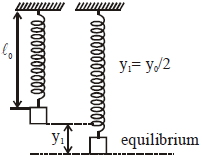
When a particle of mass $m$ is attached to a vertical spring of spring constant $k$ and released,its motion is described by $y(t) = y_{0} \sin^{2} \omega t$,where $y$ is measured from the lower end of the unstretched spring. Then $\omega$ is
A
$\sqrt{\frac{g}{y_{0}}}$
B
$\sqrt{\frac{g}{2y_{0}}}$
C
$\frac{1}{2} \sqrt{\frac{g}{y_{0}}}$
D
$\sqrt{\frac{2g}{y_{0}}}$
Solution
(B) The given equation of motion is $y = y_{0} \sin^{2} \omega t$.
Using the trigonometric identity $\sin^{2} \theta = \frac{1 - \cos 2\theta}{2}$,we can rewrite the equation as:
$y = \frac{y_{0}}{2} (1 - \cos 2\omega t)$
$y - \frac{y_{0}}{2} = -\frac{y_{0}}{2} \cos 2\omega t$
This represents simple harmonic motion about the equilibrium position $y_{eq} = \frac{y_{0}}{2}$ with an amplitude $A = \frac{y_{0}}{2}$.
For a vertical spring-mass system,the equilibrium position is at a distance $y_{eq} = \frac{mg}{k}$ from the unstretched position.
Therefore,$\frac{y_{0}}{2} = \frac{mg}{k}$,which implies $\frac{k}{m} = \frac{2g}{y_{0}}$.
The angular frequency of the oscillation is given by $\Omega = \sqrt{\frac{k}{m}}$.
From the equation $y = \frac{y_{0}}{2} - \frac{y_{0}}{2} \cos 2\omega t$,the angular frequency of the motion is $2\omega$.
Thus,$2\omega = \sqrt{\frac{k}{m}} = \sqrt{\frac{2g}{y_{0}}}$.
Solving for $\omega$,we get $\omega = \frac{1}{2} \sqrt{\frac{2g}{y_{0}}} = \sqrt{\frac{2g}{4y_{0}}} = \sqrt{\frac{g}{2y_{0}}}$.
Using the trigonometric identity $\sin^{2} \theta = \frac{1 - \cos 2\theta}{2}$,we can rewrite the equation as:
$y = \frac{y_{0}}{2} (1 - \cos 2\omega t)$
$y - \frac{y_{0}}{2} = -\frac{y_{0}}{2} \cos 2\omega t$
This represents simple harmonic motion about the equilibrium position $y_{eq} = \frac{y_{0}}{2}$ with an amplitude $A = \frac{y_{0}}{2}$.
For a vertical spring-mass system,the equilibrium position is at a distance $y_{eq} = \frac{mg}{k}$ from the unstretched position.
Therefore,$\frac{y_{0}}{2} = \frac{mg}{k}$,which implies $\frac{k}{m} = \frac{2g}{y_{0}}$.
The angular frequency of the oscillation is given by $\Omega = \sqrt{\frac{k}{m}}$.
From the equation $y = \frac{y_{0}}{2} - \frac{y_{0}}{2} \cos 2\omega t$,the angular frequency of the motion is $2\omega$.
Thus,$2\omega = \sqrt{\frac{k}{m}} = \sqrt{\frac{2g}{y_{0}}}$.
Solving for $\omega$,we get $\omega = \frac{1}{2} \sqrt{\frac{2g}{y_{0}}} = \sqrt{\frac{2g}{4y_{0}}} = \sqrt{\frac{g}{2y_{0}}}$.
0 likesView Solution
172
PhysicsMediumMCQJEE Main · 2020
In a dilute gas at pressure $P$ and temperature $T$,the mean time between successive collisions of a molecule varies with $T$ as
A
$\sqrt{T}$
B
$1/T$
C
$1/\sqrt{T}$
D
$T$
Solution
(A) The mean free path $\lambda$ is given by $\lambda = \frac{k_B T}{\sqrt{2} \pi d^2 P}$,where $k_B$ is the Boltzmann constant and $d$ is the molecular diameter.
For a constant pressure $P$,$\lambda \propto T$.
The average speed of a molecule $v_{avg}$ is given by $v_{avg} = \sqrt{\frac{8 k_B T}{\pi m}}$,so $v_{avg} \propto \sqrt{T}$.
The mean time between successive collisions $t_0$ is defined as $t_0 = \frac{\lambda}{v_{avg}}$.
Substituting the proportionalities: $t_0 \propto \frac{T}{\sqrt{T}} = \sqrt{T}$.
Therefore,the mean time between successive collisions varies with $T$ as $\sqrt{T}$.
For a constant pressure $P$,$\lambda \propto T$.
The average speed of a molecule $v_{avg}$ is given by $v_{avg} = \sqrt{\frac{8 k_B T}{\pi m}}$,so $v_{avg} \propto \sqrt{T}$.
The mean time between successive collisions $t_0$ is defined as $t_0 = \frac{\lambda}{v_{avg}}$.
Substituting the proportionalities: $t_0 \propto \frac{T}{\sqrt{T}} = \sqrt{T}$.
Therefore,the mean time between successive collisions varies with $T$ as $\sqrt{T}$.
0 likesView Solution
173
PhysicsMediumMCQJEE Main · 2020
$A$ fluid is flowing through a horizontal pipe of varying cross-section,with speed $v \ m/s$ at a point where the pressure is $P \ Pa$. At another point where pressure is $\frac{P}{2} \ Pa$,its speed is $V \ m/s$. If the density of the fluid is $\rho \ kg/m^3$ and the flow is streamline,then $V$ is equal to
A
$\sqrt{\frac{P}{2\rho} + v^2}$
B
$\sqrt{\frac{P}{\rho} + v^2}$
C
$\sqrt{\frac{2P}{\rho} + v^2}$
D
$\sqrt{\frac{P}{\rho} + v}$
Solution
(B) For a horizontal pipe,the height $h$ is constant,so $h_1 = h_2$. According to Bernoulli's equation:
$P_1 + \frac{1}{2}\rho v_1^2 = P_2 + \frac{1}{2}\rho v_2^2$
Given $P_1 = P$,$v_1 = v$,$P_2 = \frac{P}{2}$,and $v_2 = V$.
Substituting these values:
$P + \frac{1}{2}\rho v^2 = \frac{P}{2} + \frac{1}{2}\rho V^2$
Subtract $\frac{P}{2}$ from both sides:
$\frac{P}{2} + \frac{1}{2}\rho v^2 = \frac{1}{2}\rho V^2$
Multiply the entire equation by $\frac{2}{\rho}$:
$\frac{P}{\rho} + v^2 = V^2$
Taking the square root on both sides:
$V = \sqrt{\frac{P}{\rho} + v^2}$
$P_1 + \frac{1}{2}\rho v_1^2 = P_2 + \frac{1}{2}\rho v_2^2$
Given $P_1 = P$,$v_1 = v$,$P_2 = \frac{P}{2}$,and $v_2 = V$.
Substituting these values:
$P + \frac{1}{2}\rho v^2 = \frac{P}{2} + \frac{1}{2}\rho V^2$
Subtract $\frac{P}{2}$ from both sides:
$\frac{P}{2} + \frac{1}{2}\rho v^2 = \frac{1}{2}\rho V^2$
Multiply the entire equation by $\frac{2}{\rho}$:
$\frac{P}{\rho} + v^2 = V^2$
Taking the square root on both sides:
$V = \sqrt{\frac{P}{\rho} + v^2}$
0 likesView Solution
174
PhysicsDifficultMCQJEE Main · 2020
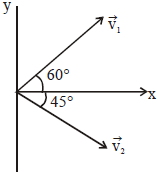
Particle $A$ of mass $m_{1}$ moving with velocity $(\sqrt{3} \hat{i} + \hat{j}) \, m/s$ collides with another particle $B$ of mass $m_{2}$ which is at rest initially. Let $\vec{V}_{1}$ and $\vec{V}_{2}$ be the velocities of particles $A$ and $B$ after collision,respectively. If $m_{1} = 2m_{2}$ and after collision $\vec{V}_{1} = (\hat{i} + \sqrt{3} \hat{j}) \, m/s$,the angle between $\vec{V}_{1}$ and $\vec{V}_{2}$ is $......^{\circ}$.
A
$60$
B
$15$
C
$45$
D
$105$
Solution
(D) Initial velocity of particle $A$: $\vec{u}_{1} = (\sqrt{3} \hat{i} + \hat{j}) \, m/s$.
Initial velocity of particle $B$: $\vec{u}_{2} = 0$.
Given $m_{1} = 2m_{2}$.
Final velocity of particle $A$: $\vec{V}_{1} = (\hat{i} + \sqrt{3} \hat{j}) \, m/s$.
By the law of conservation of linear momentum:
$m_{1} \vec{u}_{1} + m_{2} \vec{u}_{2} = m_{1} \vec{V}_{1} + m_{2} \vec{V}_{2}$
$2m_{2}(\sqrt{3} \hat{i} + \hat{j}) + 0 = 2m_{2}(\hat{i} + \sqrt{3} \hat{j}) + m_{2} \vec{V}_{2}$
Dividing by $m_{2}$:
$2(\sqrt{3} \hat{i} + \hat{j}) = 2(\hat{i} + \sqrt{3} \hat{j}) + \vec{V}_{2}$
$\vec{V}_{2} = 2(\sqrt{3} \hat{i} + \hat{j} - \hat{i} - \sqrt{3} \hat{j}) = 2[(\sqrt{3}-1) \hat{i} + (1-\sqrt{3}) \hat{j}] = 2(\sqrt{3}-1) (\hat{i} - \hat{j})$.
Now,the angle $\theta$ between $\vec{V}_{1}$ and $\vec{V}_{2}$ is given by $\cos \theta = \frac{\vec{V}_{1} \cdot \vec{V}_{2}}{|\vec{V}_{1}| |\vec{V}_{2}|}$.
$\vec{V}_{1} \cdot \vec{V}_{2} = (\hat{i} + \sqrt{3} \hat{j}) \cdot [2(\sqrt{3}-1) (\hat{i} - \hat{j})] = 2(\sqrt{3}-1) (1 - \sqrt{3}) = -2(\sqrt{3}-1)^{2}$.
$|\vec{V}_{1}| = \sqrt{1^{2} + (\sqrt{3})^{2}} = 2$.
$|\vec{V}_{2}| = 2(\sqrt{3}-1) \sqrt{1^{2} + (-1)^{2}} = 2\sqrt{2}(\sqrt{3}-1)$.
$\cos \theta = \frac{-2(\sqrt{3}-1)^{2}}{2 \cdot 2\sqrt{2}(\sqrt{3}-1)} = \frac{-(\sqrt{3}-1)}{2\sqrt{2}} = \frac{1-\sqrt{3}}{2\sqrt{2}}$.
Since $\cos 105^{\circ} = \cos(60^{\circ} + 45^{\circ}) = \cos 60^{\circ} \cos 45^{\circ} - \sin 60^{\circ} \sin 45^{\circ} = \frac{1}{2} \cdot \frac{1}{\sqrt{2}} - \frac{\sqrt{3}}{2} \cdot \frac{1}{\sqrt{2}} = \frac{1-\sqrt{3}}{2\sqrt{2}}$,therefore $\theta = 105^{\circ}$.
Initial velocity of particle $B$: $\vec{u}_{2} = 0$.
Given $m_{1} = 2m_{2}$.
Final velocity of particle $A$: $\vec{V}_{1} = (\hat{i} + \sqrt{3} \hat{j}) \, m/s$.
By the law of conservation of linear momentum:
$m_{1} \vec{u}_{1} + m_{2} \vec{u}_{2} = m_{1} \vec{V}_{1} + m_{2} \vec{V}_{2}$
$2m_{2}(\sqrt{3} \hat{i} + \hat{j}) + 0 = 2m_{2}(\hat{i} + \sqrt{3} \hat{j}) + m_{2} \vec{V}_{2}$
Dividing by $m_{2}$:
$2(\sqrt{3} \hat{i} + \hat{j}) = 2(\hat{i} + \sqrt{3} \hat{j}) + \vec{V}_{2}$
$\vec{V}_{2} = 2(\sqrt{3} \hat{i} + \hat{j} - \hat{i} - \sqrt{3} \hat{j}) = 2[(\sqrt{3}-1) \hat{i} + (1-\sqrt{3}) \hat{j}] = 2(\sqrt{3}-1) (\hat{i} - \hat{j})$.
Now,the angle $\theta$ between $\vec{V}_{1}$ and $\vec{V}_{2}$ is given by $\cos \theta = \frac{\vec{V}_{1} \cdot \vec{V}_{2}}{|\vec{V}_{1}| |\vec{V}_{2}|}$.
$\vec{V}_{1} \cdot \vec{V}_{2} = (\hat{i} + \sqrt{3} \hat{j}) \cdot [2(\sqrt{3}-1) (\hat{i} - \hat{j})] = 2(\sqrt{3}-1) (1 - \sqrt{3}) = -2(\sqrt{3}-1)^{2}$.
$|\vec{V}_{1}| = \sqrt{1^{2} + (\sqrt{3})^{2}} = 2$.
$|\vec{V}_{2}| = 2(\sqrt{3}-1) \sqrt{1^{2} + (-1)^{2}} = 2\sqrt{2}(\sqrt{3}-1)$.
$\cos \theta = \frac{-2(\sqrt{3}-1)^{2}}{2 \cdot 2\sqrt{2}(\sqrt{3}-1)} = \frac{-(\sqrt{3}-1)}{2\sqrt{2}} = \frac{1-\sqrt{3}}{2\sqrt{2}}$.
Since $\cos 105^{\circ} = \cos(60^{\circ} + 45^{\circ}) = \cos 60^{\circ} \cos 45^{\circ} - \sin 60^{\circ} \sin 45^{\circ} = \frac{1}{2} \cdot \frac{1}{\sqrt{2}} - \frac{\sqrt{3}}{2} \cdot \frac{1}{\sqrt{2}} = \frac{1-\sqrt{3}}{2\sqrt{2}}$,therefore $\theta = 105^{\circ}$.
0 likesView Solution
175
PhysicsDifficultMCQJEE Main · 2020
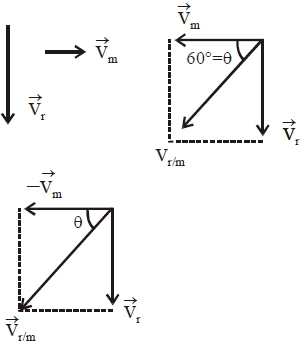
When a car is at rest,its driver sees rain drops falling on it vertically. When driving the car with speed $v$,he sees that rain drops are coming at an angle $60^{\circ}$ from the horizontal. On further increasing the speed of the car to $(1+\beta)v$,this angle changes to $45^{\circ}$. The value of $\beta$ is close to...
A
$0.41$
B
$0.50$
C
$0.37$
D
$0.73$
Solution
(D) Let the velocity of rain be $\vec{v}_r = -v_r \hat{j}$ and the velocity of the car be $\vec{v}_m = v_m \hat{i}$.
When the car moves with speed $v$,the relative velocity of rain with respect to the car is $\vec{v}_{r/m} = \vec{v}_r - \vec{v}_m = -v_r \hat{j} - v \hat{i}$.
The angle $\theta$ with the horizontal is given by $\tan \theta = \frac{|v_r|}{|v_m|}$.
Given $\theta = 60^{\circ}$ and $v_m = v$,we have $\tan 60^{\circ} = \frac{v_r}{v} = \sqrt{3}$,so $v_r = v\sqrt{3}$.
When the car speed increases to $(1+\beta)v$,the new angle is $45^{\circ}$.
Thus,$\tan 45^{\circ} = \frac{v_r}{(1+\beta)v} = 1$.
Substituting $v_r = v\sqrt{3}$,we get $\frac{v\sqrt{3}}{(1+\beta)v} = 1$.
$\sqrt{3} = 1 + \beta$.
$\beta = \sqrt{3} - 1 \approx 1.732 - 1 = 0.732$.
Therefore,the value of $\beta$ is close to $0.73$.
When the car moves with speed $v$,the relative velocity of rain with respect to the car is $\vec{v}_{r/m} = \vec{v}_r - \vec{v}_m = -v_r \hat{j} - v \hat{i}$.
The angle $\theta$ with the horizontal is given by $\tan \theta = \frac{|v_r|}{|v_m|}$.
Given $\theta = 60^{\circ}$ and $v_m = v$,we have $\tan 60^{\circ} = \frac{v_r}{v} = \sqrt{3}$,so $v_r = v\sqrt{3}$.
When the car speed increases to $(1+\beta)v$,the new angle is $45^{\circ}$.
Thus,$\tan 45^{\circ} = \frac{v_r}{(1+\beta)v} = 1$.
Substituting $v_r = v\sqrt{3}$,we get $\frac{v\sqrt{3}}{(1+\beta)v} = 1$.
$\sqrt{3} = 1 + \beta$.
$\beta = \sqrt{3} - 1 \approx 1.732 - 1 = 0.732$.
Therefore,the value of $\beta$ is close to $0.73$.
2 likesView Solution
176
PhysicsDifficultMCQJEE Main · 2020
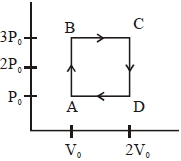
An engine operates by taking a monatomic ideal gas through the cycle shown in the figure. The percentage efficiency of the engine is close to $.......\%$
A
$19$
B
$25$
C
$27$
D
$30$
Solution
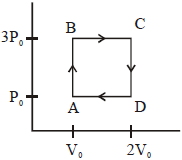
(A) The work done per cycle is the area enclosed by the $P-V$ diagram:
$W = \text{Area} = (2V_0 - V_0) \times (3P_0 - P_0) = V_0 \times 2P_0 = 2P_0V_0$.
Heat is absorbed during processes $AB$ and $BC$:
For process $AB$ (isochoric): $Q_{AB} = nC_V \Delta T = n \left( \frac{3R}{2} \right) \left( \frac{P_B V_A}{nR} - \frac{P_A V_A}{nR} \right) = \frac{3}{2} V_A (P_B - P_A) = \frac{3}{2} V_0 (3P_0 - P_0) = 3P_0V_0$.
For process $BC$ (isobaric): $Q_{BC} = nC_P \Delta T = n \left( \frac{5R}{2} \right) \left( \frac{P_B V_C}{nR} - \frac{P_B V_B}{nR} \right) = \frac{5}{2} P_B (V_C - V_B) = \frac{5}{2} (3P_0) (2V_0 - V_0) = \frac{15}{2} P_0V_0$.
Total heat absorbed $Q_{\text{in}} = Q_{AB} + Q_{BC} = 3P_0V_0 + 7.5P_0V_0 = 10.5P_0V_0 = \frac{21}{2} P_0V_0$.
Efficiency $\eta = \frac{W}{Q_{\text{in}}} \times 100 = \frac{2P_0V_0}{(21/2)P_0V_0} \times 100 = \frac{4}{21} \times 100 \approx 19.04\%$.
Thus,the efficiency is close to $19\%$.
$W = \text{Area} = (2V_0 - V_0) \times (3P_0 - P_0) = V_0 \times 2P_0 = 2P_0V_0$.
Heat is absorbed during processes $AB$ and $BC$:
For process $AB$ (isochoric): $Q_{AB} = nC_V \Delta T = n \left( \frac{3R}{2} \right) \left( \frac{P_B V_A}{nR} - \frac{P_A V_A}{nR} \right) = \frac{3}{2} V_A (P_B - P_A) = \frac{3}{2} V_0 (3P_0 - P_0) = 3P_0V_0$.
For process $BC$ (isobaric): $Q_{BC} = nC_P \Delta T = n \left( \frac{5R}{2} \right) \left( \frac{P_B V_C}{nR} - \frac{P_B V_B}{nR} \right) = \frac{5}{2} P_B (V_C - V_B) = \frac{5}{2} (3P_0) (2V_0 - V_0) = \frac{15}{2} P_0V_0$.
Total heat absorbed $Q_{\text{in}} = Q_{AB} + Q_{BC} = 3P_0V_0 + 7.5P_0V_0 = 10.5P_0V_0 = \frac{21}{2} P_0V_0$.
Efficiency $\eta = \frac{W}{Q_{\text{in}}} \times 100 = \frac{2P_0V_0}{(21/2)P_0V_0} \times 100 = \frac{4}{21} \times 100 \approx 19.04\%$.
Thus,the efficiency is close to $19\%$.
1 likesView Solution
177
PhysicsMediumMCQJEE Main · 2020
The centre of mass of a solid hemisphere of radius $8 \, cm$ is $X \, cm$ from the centre of the flat surface. Then the value of $X$ is $......$
A
$5$
B
$3$
C
$9$
D
$10$
Solution
(B) The formula for the distance of the centre of mass of a solid hemisphere from the centre of its flat base is given by $X = \frac{3R}{8}$,where $R$ is the radius of the hemisphere.
Given,$R = 8 \, cm$.
Substituting the value of $R$ in the formula:
$X = \frac{3 \times 8}{8} \, cm$
$X = 3 \, cm$.
Therefore,the value of $X$ is $3$.
Given,$R = 8 \, cm$.
Substituting the value of $R$ in the formula:
$X = \frac{3 \times 8}{8} \, cm$
$X = 3 \, cm$.
Therefore,the value of $X$ is $3$.

0 likesView Solution
178
PhysicsMediumMCQJEE Main · 2020
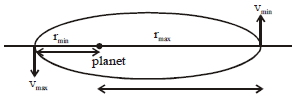
$A$ satellite is in an elliptical orbit around a planet $P.$ It is observed that the velocity of the satellite when it is farthest from the planet is $6$ times less than that when it is closest to the planet. The ratio of distances between the satellite and the planet at closest and farthest points is $......$
A
$1:6$
B
$3:4$
C
$1:3$
D
$1:2$
Solution
(A) According to the law of conservation of angular momentum,the angular momentum of the satellite remains constant throughout its orbit.
At the closest point (periapsis) and farthest point (apoapsis),the velocity vector is perpendicular to the position vector.
Therefore,$L = m r_{\min} V_{\max} = m r_{\max} V_{\min}$.
This simplifies to $r_{\min} V_{\max} = r_{\max} V_{\min} \quad \dots(i)$.
Given that the velocity at the farthest point is $6$ times less than the velocity at the closest point,we have $V_{\min} = \frac{V_{\max}}{6}$,or $\frac{V_{\min}}{V_{\max}} = \frac{1}{6}$.
Substituting this into equation $(i)$,we get $\frac{r_{\min}}{r_{\max}} = \frac{V_{\min}}{V_{\max}} = \frac{1}{6}$.
Thus,the ratio of the distances is $1:6$.
At the closest point (periapsis) and farthest point (apoapsis),the velocity vector is perpendicular to the position vector.
Therefore,$L = m r_{\min} V_{\max} = m r_{\max} V_{\min}$.
This simplifies to $r_{\min} V_{\max} = r_{\max} V_{\min} \quad \dots(i)$.
Given that the velocity at the farthest point is $6$ times less than the velocity at the closest point,we have $V_{\min} = \frac{V_{\max}}{6}$,or $\frac{V_{\min}}{V_{\max}} = \frac{1}{6}$.
Substituting this into equation $(i)$,we get $\frac{r_{\min}}{r_{\max}} = \frac{V_{\min}}{V_{\max}} = \frac{1}{6}$.
Thus,the ratio of the distances is $1:6$.
0 likesView Solution
179
PhysicsMediumMCQJEE Main · 2020
$A$ screw gauge has $50$ divisions on its circular scale. The circular scale is $4$ units ahead of the pitch scale marking,prior to use. Upon one complete rotation of the circular scale,a displacement of $0.5\, mm$ is noticed on the pitch scale. The nature of zero error involved,and the least count of the screw gauge,are respectively
A
Negative,$2\, \mu m$
B
Positive,$10\, \mu m$
C
Positive,$0.1\, \mu m$
D
Positive,$0.1\, mm$
Solution
(B) The least count $(LC)$ of a screw gauge is calculated as:
$LC = \frac{\text{Pitch}}{\text{Number of divisions on circular scale}}$
Given,$\text{Pitch} = 0.5\, mm$ and $\text{Number of divisions} = 50$.
$LC = \frac{0.5\, mm}{50} = 0.01\, mm = 10\, \mu m$.
Since the circular scale is $4$ units ahead of the pitch scale marking (the zero of the circular scale is above the reference line),the zero error is positive.
Therefore,the nature of zero error is positive and the least count is $10\, \mu m$.
$LC = \frac{\text{Pitch}}{\text{Number of divisions on circular scale}}$
Given,$\text{Pitch} = 0.5\, mm$ and $\text{Number of divisions} = 50$.
$LC = \frac{0.5\, mm}{50} = 0.01\, mm = 10\, \mu m$.
Since the circular scale is $4$ units ahead of the pitch scale marking (the zero of the circular scale is above the reference line),the zero error is positive.
Therefore,the nature of zero error is positive and the least count is $10\, \mu m$.
0 likesView Solution
180
PhysicsMediumMCQJEE Main · 2020
An object of mass $m$ is suspended at the end of a massless wire of length $L$ and area of cross-section $A$. The Young's modulus of the material of the wire is $Y$. If the mass is pulled down slightly,its frequency of oscillation along the vertical direction is:
A
$f = \frac{1}{2 \pi} \sqrt{\frac{YA}{mL}}$
B
$f = \frac{1}{2 \pi} \sqrt{\frac{YL}{mA}}$
C
$f = \frac{1}{2 \pi} \sqrt{\frac{mA}{YL}}$
D
$f = \frac{1}{2 \pi} \sqrt{\frac{mL}{YA}}$
Solution
(A) An elastic wire acts like a spring with a force constant $k$ given by the formula $k = \frac{YA}{L}$.
The frequency of oscillation $f$ for a mass-spring system is given by $f = \frac{1}{2 \pi} \sqrt{\frac{k}{m}}$.
Substituting the value of $k$ into the frequency formula:
$f = \frac{1}{2 \pi} \sqrt{\frac{YA/L}{m}}$
Therefore,the frequency is $f = \frac{1}{2 \pi} \sqrt{\frac{YA}{mL}}$.
The frequency of oscillation $f$ for a mass-spring system is given by $f = \frac{1}{2 \pi} \sqrt{\frac{k}{m}}$.
Substituting the value of $k$ into the frequency formula:
$f = \frac{1}{2 \pi} \sqrt{\frac{YA/L}{m}}$
Therefore,the frequency is $f = \frac{1}{2 \pi} \sqrt{\frac{YA}{mL}}$.
0 likesView Solution
181
PhysicsDifficultMCQJEE Main · 2020
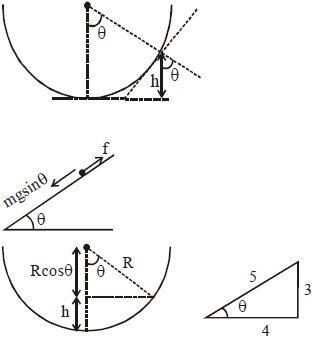
An insect is at the bottom of a hemispherical ditch of radius $R = 1\, m$. It crawls up the ditch but starts slipping after it is at height $h$ from the bottom. If the coefficient of friction between the ground and the insect is $\mu = 0.75$,then $h$ is $.......\, m$. $(g = 10\, m s^{-2})$
A
$0.80$
B
$0.60$
C
$0.45$
D
$0.20$
Solution
(D) Let $\theta$ be the angle the radius makes with the vertical at the point where the insect starts slipping. At this point,the component of gravity along the tangent balances the maximum static friction.
$mg \sin \theta = f_{max} = \mu N$
Since the normal force $N = mg \cos \theta$,we have:
$mg \sin \theta = \mu mg \cos \theta$
$\tan \theta = \mu = 0.75 = \frac{3}{4}$
From the geometry of the hemisphere,the height $h$ from the bottom is given by:
$h = R - R \cos \theta = R(1 - \cos \theta)$
Given $\tan \theta = \frac{3}{4}$,we have $\sin \theta = \frac{3}{5}$ and $\cos \theta = \frac{4}{5}$.
Substituting the values:
$h = 1 \times (1 - \frac{4}{5}) = 1 \times \frac{1}{5} = 0.2\, m$.
$mg \sin \theta = f_{max} = \mu N$
Since the normal force $N = mg \cos \theta$,we have:
$mg \sin \theta = \mu mg \cos \theta$
$\tan \theta = \mu = 0.75 = \frac{3}{4}$
From the geometry of the hemisphere,the height $h$ from the bottom is given by:
$h = R - R \cos \theta = R(1 - \cos \theta)$
Given $\tan \theta = \frac{3}{4}$,we have $\sin \theta = \frac{3}{5}$ and $\cos \theta = \frac{4}{5}$.
Substituting the values:
$h = 1 \times (1 - \frac{4}{5}) = 1 \times \frac{1}{5} = 0.2\, m$.
0 likesView Solution
182
PhysicsMediumMCQJEE Main · 2020
$A$ clock has a continuously moving second's hand of $0.1\, m$ length. The average acceleration of the tip of the hand (in units of $m\, s^{-2}$) is of the order of
A
$10^{-3}$
B
$10^{-2}$
C
$10^{-4}$
D
$10^{-1}$
Solution
(A) The length of the second's hand is the radius of the circular path,$R = 0.1\, m$.
The time period for the second's hand is $T = 60\, s$.
The angular velocity $\omega$ is given by $\omega = \frac{2\pi}{T} = \frac{2\pi}{60} \approx 0.105\, rad/s$.
The centripetal acceleration $a$ of the tip of the hand is given by $a = \omega^2 R$.
Substituting the values: $a = (0.105)^2 \times 0.1$.
$a \approx 0.011025 \times 0.1 = 0.0011025\, m/s^2$.
This can be written as $1.1 \times 10^{-3}\, m/s^2$.
Therefore,the average acceleration is of the order of $10^{-3}$.
The time period for the second's hand is $T = 60\, s$.
The angular velocity $\omega$ is given by $\omega = \frac{2\pi}{T} = \frac{2\pi}{60} \approx 0.105\, rad/s$.
The centripetal acceleration $a$ of the tip of the hand is given by $a = \omega^2 R$.
Substituting the values: $a = (0.105)^2 \times 0.1$.
$a \approx 0.011025 \times 0.1 = 0.0011025\, m/s^2$.
This can be written as $1.1 \times 10^{-3}\, m/s^2$.
Therefore,the average acceleration is of the order of $10^{-3}$.
0 likesView Solution
183
PhysicsDifficultMCQJEE Main · 2020
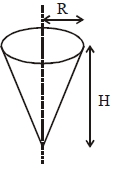
Shown in the figure is a hollow ice cream cone (it is open at the top). If its mass is $M$,radius of its top is $R$,and height is $H$,then its moment of inertia about its axis is
A
$\frac{MR^2}{2}$
B
$\frac{MH^2}{3}$
C
$\frac{MR^2}{3}$
D
$\frac{M(R^2 + H^2)}{4}$
Solution
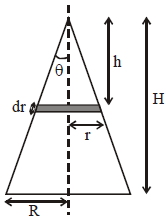
(A) Consider a hollow cone of mass $M$,height $H$,and base radius $R$. The slant height is $L = \sqrt{R^2 + H^2}$.
Let $\theta$ be the semi-vertical angle,so $\tan \theta = R/H$.
Consider a thin circular ring element at a distance $y$ from the apex along the axis,with thickness $dy$ along the slant height.
The radius of this ring is $r = y \tan \theta$.
The slant length of the element is $dl = dy / \cos \theta$.
The surface area of the cone is $A = \pi R L = \pi R \sqrt{R^2 + H^2}$.
The mass per unit area is $\sigma = M / A = M / (\pi R \sqrt{R^2 + H^2})$.
The area of the ring element is $dA = 2 \pi r dl = 2 \pi (y \tan \theta) (dy / \cos \theta)$.
The mass of the element is $dm = \sigma dA = \frac{M}{\pi R \sqrt{R^2 + H^2}} \cdot 2 \pi (y \tan \theta) \frac{dy}{\cos \theta} = \frac{2M}{R \sqrt{R^2 + H^2}} \cdot \frac{\tan \theta}{\cos \theta} y dy$.
Since $\tan \theta = R/H$ and $\cos \theta = H/L = H/\sqrt{R^2 + H^2}$,we have $\frac{\tan \theta}{\cos \theta} = \frac{R/H}{H/L} = \frac{RL}{H^2} = \frac{R\sqrt{R^2+H^2}}{H^2}$.
Thus,$dm = \frac{2M}{R\sqrt{R^2+H^2}} \cdot \frac{R\sqrt{R^2+H^2}}{H^2} y dy = \frac{2M}{H^2} y dy$.
The moment of inertia of this ring about the axis is $dI = dm \cdot r^2 = (\frac{2M}{H^2} y dy) (y \tan \theta)^2 = \frac{2M}{H^2} \tan^2 \theta \cdot y^3 dy$.
Integrating from $y=0$ to $y=H$:
$I = \int_0^H \frac{2M}{H^2} (R/H)^2 y^3 dy = \frac{2MR^2}{H^4} \int_0^H y^3 dy = \frac{2MR^2}{H^4} [\frac{y^4}{4}]_0^H = \frac{2MR^2}{H^4} \cdot \frac{H^4}{4} = \frac{MR^2}{2}$.
Let $\theta$ be the semi-vertical angle,so $\tan \theta = R/H$.
Consider a thin circular ring element at a distance $y$ from the apex along the axis,with thickness $dy$ along the slant height.
The radius of this ring is $r = y \tan \theta$.
The slant length of the element is $dl = dy / \cos \theta$.
The surface area of the cone is $A = \pi R L = \pi R \sqrt{R^2 + H^2}$.
The mass per unit area is $\sigma = M / A = M / (\pi R \sqrt{R^2 + H^2})$.
The area of the ring element is $dA = 2 \pi r dl = 2 \pi (y \tan \theta) (dy / \cos \theta)$.
The mass of the element is $dm = \sigma dA = \frac{M}{\pi R \sqrt{R^2 + H^2}} \cdot 2 \pi (y \tan \theta) \frac{dy}{\cos \theta} = \frac{2M}{R \sqrt{R^2 + H^2}} \cdot \frac{\tan \theta}{\cos \theta} y dy$.
Since $\tan \theta = R/H$ and $\cos \theta = H/L = H/\sqrt{R^2 + H^2}$,we have $\frac{\tan \theta}{\cos \theta} = \frac{R/H}{H/L} = \frac{RL}{H^2} = \frac{R\sqrt{R^2+H^2}}{H^2}$.
Thus,$dm = \frac{2M}{R\sqrt{R^2+H^2}} \cdot \frac{R\sqrt{R^2+H^2}}{H^2} y dy = \frac{2M}{H^2} y dy$.
The moment of inertia of this ring about the axis is $dI = dm \cdot r^2 = (\frac{2M}{H^2} y dy) (y \tan \theta)^2 = \frac{2M}{H^2} \tan^2 \theta \cdot y^3 dy$.
Integrating from $y=0$ to $y=H$:
$I = \int_0^H \frac{2M}{H^2} (R/H)^2 y^3 dy = \frac{2MR^2}{H^4} \int_0^H y^3 dy = \frac{2MR^2}{H^4} [\frac{y^4}{4}]_0^H = \frac{2MR^2}{H^4} \cdot \frac{H^4}{4} = \frac{MR^2}{2}$.
0 likesView Solution
184
PhysicsDifficultMCQJEE Main · 2020
If the potential energy between two molecules is given by $U = -\frac{A}{r^6} + \frac{B}{r^{12}}$,then at equilibrium,the separation between the molecules and the potential energy are:
A
$\left(\frac{B}{A}\right)^{1/6}, 0$
B
$\left(\frac{B}{2A}\right)^{1/6}, -\frac{A^2}{2B}$
C
$\left(\frac{2B}{A}\right)^{1/6}, -\frac{A^2}{4B}$
D
$\left(\frac{2B}{A}\right)^{1/6}, -\frac{A^2}{2B}$
Solution
(C) The potential energy is given by $U(r) = -\frac{A}{r^6} + \frac{B}{r^{12}}$.
At equilibrium,the force $F = -\frac{dU}{dr} = 0$.
Calculating the derivative: $\frac{dU}{dr} = -A(-6r^{-7}) + B(-12r^{-13}) = \frac{6A}{r^7} - \frac{12B}{r^{13}}$.
Setting $\frac{dU}{dr} = 0$: $\frac{6A}{r^7} = \frac{12B}{r^{13}} \Rightarrow r^6 = \frac{12B}{6A} = \frac{2B}{A}$.
Thus,the equilibrium separation is $r = \left(\frac{2B}{A}\right)^{1/6}$.
Substituting this value into the potential energy expression:
$U = -\frac{A}{(2B/A)} + \frac{B}{(2B/A)^2} = -\frac{A^2}{2B} + \frac{B \cdot A^2}{4B^2} = -\frac{A^2}{2B} + \frac{A^2}{4B} = -\frac{A^2}{4B}$.
At equilibrium,the force $F = -\frac{dU}{dr} = 0$.
Calculating the derivative: $\frac{dU}{dr} = -A(-6r^{-7}) + B(-12r^{-13}) = \frac{6A}{r^7} - \frac{12B}{r^{13}}$.
Setting $\frac{dU}{dr} = 0$: $\frac{6A}{r^7} = \frac{12B}{r^{13}} \Rightarrow r^6 = \frac{12B}{6A} = \frac{2B}{A}$.
Thus,the equilibrium separation is $r = \left(\frac{2B}{A}\right)^{1/6}$.
Substituting this value into the potential energy expression:
$U = -\frac{A}{(2B/A)} + \frac{B}{(2B/A)^2} = -\frac{A^2}{2B} + \frac{B \cdot A^2}{4B^2} = -\frac{A^2}{2B} + \frac{A^2}{4B} = -\frac{A^2}{4B}$.
0 likesView Solution
185
PhysicsMediumMCQJEE Main · 2020
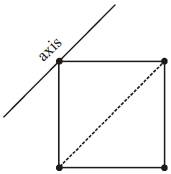
Four point masses,each of mass $m$,are fixed at the corners of a square of side $\ell$. The square is rotating with angular frequency $\omega$,about an axis passing through one of the corners of the square and parallel to its diagonal,as shown in the figure. The angular momentum of the square about this axis is $.......m\ell^2 \omega$.
A
$2$
B
$3$
C
$1$
D
$4$
Solution
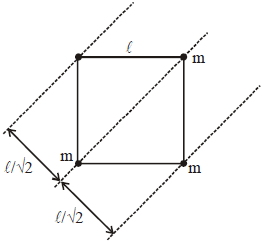
(C) Let the corners of the square be at $(0,0)$,$(\ell, 0)$,$(\ell, \ell)$,and $(0, \ell)$. The axis passes through $(0,0)$ and is parallel to the diagonal connecting $(0, \ell)$ and $(\ell, 0)$. The equation of this diagonal is $x + y = \ell$. The perpendicular distance $r$ of a point $(x, y)$ from the line $x + y - \ell = 0$ is given by $r = \frac{|x + y - \ell|}{\sqrt{1^2 + 1^2}} = \frac{|x + y - \ell|}{\sqrt{2}}$.
For the four masses:
$1$. At $(0,0)$: $r_1 = \frac{|0 + 0 - \ell|}{\sqrt{2}} = \frac{\ell}{\sqrt{2}}$.
$2$. At $(\ell, 0)$: $r_2 = \frac{|\ell + 0 - \ell|}{\sqrt{2}} = 0$.
$3$. At $(0, \ell)$: $r_3 = \frac{|0 + \ell - \ell|}{\sqrt{2}} = 0$.
$4$. At $(\ell, \ell)$: $r_4 = \frac{|\ell + \ell - \ell|}{\sqrt{2}} = \frac{\ell}{\sqrt{2}}$.
The moment of inertia $I$ about the axis is $I = \sum mr_i^2 = m \left( \left(\frac{\ell}{\sqrt{2}}\right)^2 + 0^2 + 0^2 + \left(\frac{\ell}{\sqrt{2}}\right)^2 \right) = m \left( \frac{\ell^2}{2} + \frac{\ell^2}{2} \right) = m\ell^2$.
Angular momentum $L = I\omega = m\ell^2\omega$. Therefore,the missing value is $1$.
For the four masses:
$1$. At $(0,0)$: $r_1 = \frac{|0 + 0 - \ell|}{\sqrt{2}} = \frac{\ell}{\sqrt{2}}$.
$2$. At $(\ell, 0)$: $r_2 = \frac{|\ell + 0 - \ell|}{\sqrt{2}} = 0$.
$3$. At $(0, \ell)$: $r_3 = \frac{|0 + \ell - \ell|}{\sqrt{2}} = 0$.
$4$. At $(\ell, \ell)$: $r_4 = \frac{|\ell + \ell - \ell|}{\sqrt{2}} = \frac{\ell}{\sqrt{2}}$.
The moment of inertia $I$ about the axis is $I = \sum mr_i^2 = m \left( \left(\frac{\ell}{\sqrt{2}}\right)^2 + 0^2 + 0^2 + \left(\frac{\ell}{\sqrt{2}}\right)^2 \right) = m \left( \frac{\ell^2}{2} + \frac{\ell^2}{2} \right) = m\ell^2$.
Angular momentum $L = I\omega = m\ell^2\omega$. Therefore,the missing value is $1$.
0 likesView Solution
186
PhysicsMediumMCQJEE Main · 2020
Molecules of an ideal gas are known to have three translational degrees of freedom and two rotational degrees of freedom. The gas is maintained at a temperature of $T$. The total internal energy,$U$ of a mole of this gas,and the value of $\gamma \left( = \frac{C_P}{C_V} \right)$ are given,respectively,by:
A
$U = \frac{5}{2} RT$ and $\gamma = \frac{6}{5}$
B
$U = 5 RT$ and $\gamma = \frac{7}{5}$
C
$U = 5 RT$ and $\gamma = \frac{6}{5}$
D
$U = \frac{5}{2} RT$ and $\gamma = \frac{7}{5}$
Solution
(D) The total number of degrees of freedom $(f)$ is the sum of translational and rotational degrees of freedom: $f = 3 + 2 = 5$.
The total internal energy $(U)$ for one mole of an ideal gas is given by the formula $U = \frac{f}{2} RT$. Substituting $f = 5$,we get $U = \frac{5}{2} RT$.
The adiabatic index $\gamma$ is defined as the ratio of molar heat capacities,$\gamma = \frac{C_P}{C_V} = 1 + \frac{2}{f}$.
Substituting $f = 5$ into the formula for $\gamma$,we get $\gamma = 1 + \frac{2}{5} = \frac{7}{5}$.
The total internal energy $(U)$ for one mole of an ideal gas is given by the formula $U = \frac{f}{2} RT$. Substituting $f = 5$,we get $U = \frac{5}{2} RT$.
The adiabatic index $\gamma$ is defined as the ratio of molar heat capacities,$\gamma = \frac{C_P}{C_V} = 1 + \frac{2}{f}$.
Substituting $f = 5$ into the formula for $\gamma$,we get $\gamma = 1 + \frac{2}{5} = \frac{7}{5}$.
0 likesView Solution
187
PhysicsDifficultMCQJEE Main · 2020
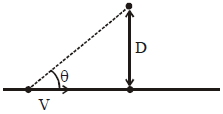
$A$ sound source $S$ is moving along a straight track with speed $v,$ and is emitting sound of frequency $v_{0}.$ An observer is standing at a finite distance,at the point $O,$ from the track. The time variation of frequency heard by the observer is best represented by (where $t_{0}$ represents the instant when the distance between the source and observer is minimum).
A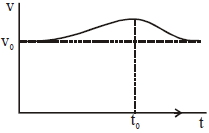
B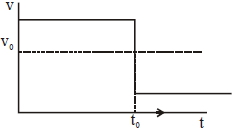
C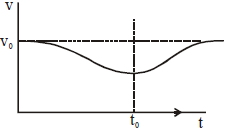
D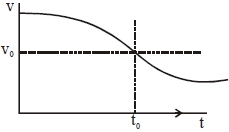
Solution
(D) The frequency $f$ heard by the observer is given by the Doppler effect formula: $f = f_{0} \left( \frac{v_{s}}{v_{s} - v \cos \theta} \right)$,where $v_{s}$ is the speed of sound,$v$ is the speed of the source,and $\theta$ is the angle between the velocity vector of the source and the line joining the source to the observer.
Before the source reaches the point of closest approach $(t < t_{0})$,the source is approaching the observer,so $\theta$ is acute,$\cos \theta > 0$,and the observed frequency $f > f_{0}$. As the source approaches the point of closest approach,$\theta$ increases towards $90^{\circ}$,so $\cos \theta$ decreases,and $f$ decreases towards $f_{0}$.
At the point of closest approach $(t = t_{0})$,$\theta = 90^{\circ}$,$\cos \theta = 0$,and $f = f_{0}$.
After the source passes the point of closest approach $(t > t_{0})$,the source is moving away from the observer,so $\theta$ is obtuse,$\cos \theta < 0$,and the observed frequency $f < f_{0}$. As the source moves further away,$\theta$ increases,$\cos \theta$ becomes more negative,and $f$ decreases further below $f_{0}$.
Thus,the frequency $f$ starts above $f_{0}$,decreases to $f_{0}$ at $t = t_{0}$,and continues to decrease below $f_{0}$ for $t > t_{0}$. This behavior is best represented by Graph $D$.
Before the source reaches the point of closest approach $(t < t_{0})$,the source is approaching the observer,so $\theta$ is acute,$\cos \theta > 0$,and the observed frequency $f > f_{0}$. As the source approaches the point of closest approach,$\theta$ increases towards $90^{\circ}$,so $\cos \theta$ decreases,and $f$ decreases towards $f_{0}$.
At the point of closest approach $(t = t_{0})$,$\theta = 90^{\circ}$,$\cos \theta = 0$,and $f = f_{0}$.
After the source passes the point of closest approach $(t > t_{0})$,the source is moving away from the observer,so $\theta$ is obtuse,$\cos \theta < 0$,and the observed frequency $f < f_{0}$. As the source moves further away,$\theta$ increases,$\cos \theta$ becomes more negative,and $f$ decreases further below $f_{0}$.
Thus,the frequency $f$ starts above $f_{0}$,decreases to $f_{0}$ at $t = t_{0}$,and continues to decrease below $f_{0}$ for $t > t_{0}$. This behavior is best represented by Graph $D$.
0 likesView Solution
188
PhysicsMediumMCQJEE Main · 2020
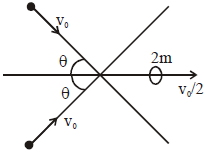
Two bodies of the same mass $m$ are moving with the same speed $v_0$,but in different directions in a plane. They undergo a completely inelastic collision and move together thereafter with a final speed which is half of their initial speed. The angle between the initial velocities of the two bodies (in degrees) is:
A
$100$
B
$120$
C
$125$
D
$130$
Solution
(B) Let the two bodies have mass $m$ and initial speed $v_0$. Let the angle between their initial velocity vectors be $2\theta$.
By symmetry,the combined mass $2m$ will move along the angle bisector of the initial velocity vectors with a final speed $v_f = v_0/2$.
Applying the law of conservation of linear momentum along the direction of the final velocity:
$m v_0 \cos \theta + m v_0 \cos \theta = (2m) v_f$
$2 m v_0 \cos \theta = 2 m (v_0/2)$
$2 m v_0 \cos \theta = m v_0$
$\cos \theta = 1/2$
$\theta = 60^\circ$
The angle between the initial velocities is $2\theta = 2 \times 60^\circ = 120^\circ$.
By symmetry,the combined mass $2m$ will move along the angle bisector of the initial velocity vectors with a final speed $v_f = v_0/2$.
Applying the law of conservation of linear momentum along the direction of the final velocity:
$m v_0 \cos \theta + m v_0 \cos \theta = (2m) v_f$
$2 m v_0 \cos \theta = 2 m (v_0/2)$
$2 m v_0 \cos \theta = m v_0$
$\cos \theta = 1/2$
$\theta = 60^\circ$
The angle between the initial velocities is $2\theta = 2 \times 60^\circ = 120^\circ$.
0 likesView Solution
189
PhysicsDifficultMCQJEE Main · 2020
The density of a solid metal sphere is determined by measuring its mass and its diameter. The maximum error in the density of the sphere is $\left(\frac{x}{100}\right) \%$. If the relative errors in measuring the mass and the diameter are $6.0 \%$ and $1.5 \%$ respectively,the value of $x$ is
A
$1000$
B
$1075$
C
$1060$
D
$1050$
Solution
(D) The density $\rho$ of a sphere is given by $\rho = \frac{M}{V} = \frac{M}{\frac{4}{3} \pi (D/2)^3} = \frac{6M}{\pi D^3}$.
Taking the natural logarithm on both sides: $\ln \rho = \ln(6/\pi) + \ln M - 3 \ln D$.
Differentiating both sides to find the relative error: $\frac{d\rho}{\rho} = \frac{dM}{M} - 3 \frac{dD}{D}$.
For the maximum percentage error,we add the absolute values of the relative errors: $\left( \frac{d\rho}{\rho} \times 100 \right)_{\text{max}} = \left( \frac{dM}{M} \times 100 \right) + 3 \left( \frac{dD}{D} \times 100 \right)$.
Given $\frac{dM}{M} \times 100 = 6.0 \%$ and $\frac{dD}{D} \times 100 = 1.5 \%$.
Substituting these values: $\text{Max error} = 6.0 + 3(1.5) = 6.0 + 4.5 = 10.5 \%$.
We are given the error as $\left(\frac{x}{100}\right) \% = 10.5 \%$.
Therefore,$\frac{x}{100} = 10.5 \implies x = 1050$.
Taking the natural logarithm on both sides: $\ln \rho = \ln(6/\pi) + \ln M - 3 \ln D$.
Differentiating both sides to find the relative error: $\frac{d\rho}{\rho} = \frac{dM}{M} - 3 \frac{dD}{D}$.
For the maximum percentage error,we add the absolute values of the relative errors: $\left( \frac{d\rho}{\rho} \times 100 \right)_{\text{max}} = \left( \frac{dM}{M} \times 100 \right) + 3 \left( \frac{dD}{D} \times 100 \right)$.
Given $\frac{dM}{M} \times 100 = 6.0 \%$ and $\frac{dD}{D} \times 100 = 1.5 \%$.
Substituting these values: $\text{Max error} = 6.0 + 3(1.5) = 6.0 + 4.5 = 10.5 \%$.
We are given the error as $\left(\frac{x}{100}\right) \% = 10.5 \%$.
Therefore,$\frac{x}{100} = 10.5 \implies x = 1050$.
0 likesView Solution
190
PhysicsMediumMCQJEE Main · 2020
Initially,a gas of diatomic molecules is contained in a cylinder of volume $V_{1}$ at a pressure $P_{1}$ and temperature $250\, K$. Assuming that $25\%$ of the molecules get dissociated,causing a change in the number of moles. The pressure of the resulting gas at temperature $2000\, K$,when contained in a volume $2V_{1}$,is given by $P_{2}$. The ratio $\frac{P_{2}}{P_{1}}$ is:
A
$5$
B
$10$
C
$13$
D
$9$
Solution
(A) Let the initial number of moles be $n$. The initial state is given by $P_{1}V_{1} = nRT_{1}$,where $T_{1} = 250\, K$.
When $25\%$ of the diatomic molecules $(X_{2})$ dissociate,the reaction is $X_{2} \rightarrow 2X$. If $25\%$ of $n$ moles dissociate,the number of moles of $X_{2}$ remaining is $0.75n$,and the number of moles of $X$ produced is $2 \times 0.25n = 0.5n$.
The total number of moles in the final state is $n' = 0.75n + 0.5n = 1.25n = \frac{5n}{4}$.
The final state is given by $P_{2}V_{2} = n'RT_{2}$,where $V_{2} = 2V_{1}$ and $T_{2} = 2000\, K$.
Substituting the values: $P_{2}(2V_{1}) = \left(\frac{5n}{4}\right)R(2000)$.
Dividing the two equations: $\frac{P_{2}(2V_{1})}{P_{1}V_{1}} = \frac{(5n/4)R(2000)}{n R(250)}$.
$2 \frac{P_{2}}{P_{1}} = \frac{5}{4} \times \frac{2000}{250} = \frac{5}{4} \times 8 = 10$.
Therefore,$\frac{P_{2}}{P_{1}} = \frac{10}{2} = 5$.
When $25\%$ of the diatomic molecules $(X_{2})$ dissociate,the reaction is $X_{2} \rightarrow 2X$. If $25\%$ of $n$ moles dissociate,the number of moles of $X_{2}$ remaining is $0.75n$,and the number of moles of $X$ produced is $2 \times 0.25n = 0.5n$.
The total number of moles in the final state is $n' = 0.75n + 0.5n = 1.25n = \frac{5n}{4}$.
The final state is given by $P_{2}V_{2} = n'RT_{2}$,where $V_{2} = 2V_{1}$ and $T_{2} = 2000\, K$.
Substituting the values: $P_{2}(2V_{1}) = \left(\frac{5n}{4}\right)R(2000)$.
Dividing the two equations: $\frac{P_{2}(2V_{1})}{P_{1}V_{1}} = \frac{(5n/4)R(2000)}{n R(250)}$.
$2 \frac{P_{2}}{P_{1}} = \frac{5}{4} \times \frac{2000}{250} = \frac{5}{4} \times 8 = 10$.
Therefore,$\frac{P_{2}}{P_{1}} = \frac{10}{2} = 5$.
0 likesView Solution
191
PhysicsMediumMCQJEE Main · 2020
One end of a massless spring of spring constant $k$ and natural length $l_{0}$ is fixed,while the other end is connected to a small object of mass $m$ lying on a frictionless table. The spring remains horizontal on the table. If the object is made to rotate at an angular velocity $\omega$ about an axis passing through the fixed end,then the elongation of the spring will be
A
$\frac{k - m \omega^{2} l_{0}}{m \omega^{2}}$
B
$\frac{m \omega^{2} l_{0}}{k + m \omega^{2}}$
C
$\frac{m \omega^{2} l_{0}}{k - m \omega^{2}}$
D
$\frac{k + m \omega^{2} l_{0}}{m \omega^{2}}$
Solution
(C) Let the elongation of the spring be $\Delta x$. The total length of the spring becomes $l = l_{0} + \Delta x$.
The centripetal force required for the circular motion of the mass $m$ is provided by the spring force $F_{s} = k \Delta x$.
Equating the spring force to the centripetal force: $k \Delta x = m \omega^{2} (l_{0} + \Delta x)$.
Expanding the equation: $k \Delta x = m \omega^{2} l_{0} + m \omega^{2} \Delta x$.
Rearranging the terms to solve for $\Delta x$: $k \Delta x - m \omega^{2} \Delta x = m \omega^{2} l_{0}$.
$\Delta x (k - m \omega^{2}) = m \omega^{2} l_{0}$.
Therefore,the elongation is $\Delta x = \frac{m \omega^{2} l_{0}}{k - m \omega^{2}}$.
The centripetal force required for the circular motion of the mass $m$ is provided by the spring force $F_{s} = k \Delta x$.
Equating the spring force to the centripetal force: $k \Delta x = m \omega^{2} (l_{0} + \Delta x)$.
Expanding the equation: $k \Delta x = m \omega^{2} l_{0} + m \omega^{2} \Delta x$.
Rearranging the terms to solve for $\Delta x$: $k \Delta x - m \omega^{2} \Delta x = m \omega^{2} l_{0}$.
$\Delta x (k - m \omega^{2}) = m \omega^{2} l_{0}$.
Therefore,the elongation is $\Delta x = \frac{m \omega^{2} l_{0}}{k - m \omega^{2}}$.
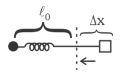
0 likesView Solution
192
PhysicsDifficultMCQJEE Main · 2020
At what distance above and below the surface of the earth will a body have the same weight? (Take the radius of the earth as $R$.)
A
$\sqrt{5} R - R$
B
$\frac{\sqrt{3} R - R}{2}$
C
$\frac{R}{2}$
D
$\frac{\sqrt{5} R - R}{2}$
Solution
(D) Let $h$ be the distance above and below the surface of the earth where the weight of the body is the same. This implies the acceleration due to gravity at height $h$ $(g_h)$ must be equal to the acceleration due to gravity at depth $h$ $(g_d)$.
The formula for acceleration due to gravity at height $h$ is $g_h = g \left( 1 + \frac{h}{R} \right)^{-2} \approx g \left( 1 - \frac{2h}{R} \right)$ (for $h \ll R$). However,for a general solution,we use $g_h = \frac{g R^2}{(R+h)^2}$.
The formula for acceleration due to gravity at depth $h$ is $g_d = g \left( 1 - \frac{h}{R} \right)$.
Equating the two: $\frac{g R^2}{(R+h)^2} = g \left( 1 - \frac{h}{R} \right)$.
$\frac{1}{(1 + h/R)^2} = 1 - \frac{h}{R}$.
Let $x = \frac{h}{R}$. Then $\frac{1}{(1+x)^2} = 1 - x$.
$1 = (1-x)(1+x)^2 = (1-x)(1 + 2x + x^2) = 1 + 2x + x^2 - x - 2x^2 - x^3$.
$1 = 1 + x - x^2 - x^3$.
$x^3 + x^2 - x = 0$.
Since $x \neq 0$,we have $x^2 + x - 1 = 0$.
Using the quadratic formula $x = \frac{-b \pm \sqrt{b^2 - 4ac}}{2a}$,we get $x = \frac{-1 \pm \sqrt{1^2 - 4(1)(-1)}}{2(1)} = \frac{-1 \pm \sqrt{5}}{2}$.
Since $x$ must be positive,$x = \frac{\sqrt{5} - 1}{2}$.
Therefore,$h = \frac{\sqrt{5} - 1}{2} R = \frac{\sqrt{5} R - R}{2}$.
The formula for acceleration due to gravity at height $h$ is $g_h = g \left( 1 + \frac{h}{R} \right)^{-2} \approx g \left( 1 - \frac{2h}{R} \right)$ (for $h \ll R$). However,for a general solution,we use $g_h = \frac{g R^2}{(R+h)^2}$.
The formula for acceleration due to gravity at depth $h$ is $g_d = g \left( 1 - \frac{h}{R} \right)$.
Equating the two: $\frac{g R^2}{(R+h)^2} = g \left( 1 - \frac{h}{R} \right)$.
$\frac{1}{(1 + h/R)^2} = 1 - \frac{h}{R}$.
Let $x = \frac{h}{R}$. Then $\frac{1}{(1+x)^2} = 1 - x$.
$1 = (1-x)(1+x)^2 = (1-x)(1 + 2x + x^2) = 1 + 2x + x^2 - x - 2x^2 - x^3$.
$1 = 1 + x - x^2 - x^3$.
$x^3 + x^2 - x = 0$.
Since $x \neq 0$,we have $x^2 + x - 1 = 0$.
Using the quadratic formula $x = \frac{-b \pm \sqrt{b^2 - 4ac}}{2a}$,we get $x = \frac{-1 \pm \sqrt{1^2 - 4(1)(-1)}}{2(1)} = \frac{-1 \pm \sqrt{5}}{2}$.
Since $x$ must be positive,$x = \frac{\sqrt{5} - 1}{2}$.
Therefore,$h = \frac{\sqrt{5} - 1}{2} R = \frac{\sqrt{5} R - R}{2}$.
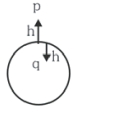
0 likesView Solution
193
PhysicsMediumMCQJEE Main · 2020
$A$ small bar magnet is moved through a coil at a constant speed from one end to the other. Which of the following series of observations will be seen on the galvanometer $G$ attached across the coil? Three positions shown describe: $(a)$ the magnet's entry,$(b)$ the magnet is completely inside,and $(c)$ the magnet's exit.
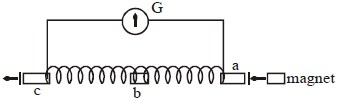
A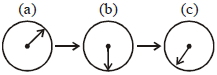
B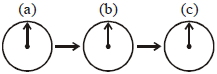
C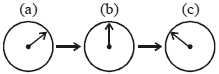
D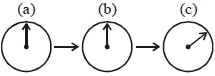
Solution
(A) When the bar magnet enters the coil with a constant speed,the magnetic flux linked with the coil changes,and an $e.m.f.$ is induced,causing the galvanometer to deflect in one direction (e.g.,positive).
When the magnet is completely inside the coil,the magnetic flux linked with the coil remains constant,so the rate of change of flux is zero,and the reading of the galvanometer is zero.
When the bar magnet exits the coil,the magnetic flux linked with the coil changes again,and an $e.m.f.$ is induced in the opposite direction to that of the entry phase,causing the galvanometer to deflect in the opposite direction (e.g.,negative).
When the magnet is completely inside the coil,the magnetic flux linked with the coil remains constant,so the rate of change of flux is zero,and the reading of the galvanometer is zero.
When the bar magnet exits the coil,the magnetic flux linked with the coil changes again,and an $e.m.f.$ is induced in the opposite direction to that of the entry phase,causing the galvanometer to deflect in the opposite direction (e.g.,negative).
0 likesView Solution
194
PhysicsDifficultMCQJEE Main · 2020
$A$ battery of $3.0 \ V$ is connected to a resistor dissipating $0.5 \ W$ of power. If the terminal voltage of the battery is $2.5 \ V$,the power dissipated within the internal resistance is $....... \ W$.
A
$0.50$
B
$0.125$
C
$0.072$
D
$0.10$
Solution
(D) Given:
Electromotive force $E = 3.0 \ V$
Terminal voltage $V = 2.5 \ V$
Power dissipated by external resistor $P_R = 0.5 \ W$
We know that the terminal voltage $V$ is given by $V = E - ir$,where $i$ is the current and $r$ is the internal resistance.
$2.5 = 3.0 - ir$
$ir = 0.5 \ V$
The power dissipated in the internal resistance is $P_r = i^2r = (ir) \cdot i$.
Since $V = iR = 2.5 \ V$,we have $i = \frac{2.5}{R}$.
Also,$P_R = i^2R = 0.5 \ W$.
Substituting $i = \frac{2.5}{R}$ into $P_R = i^2R$:
$0.5 = (\frac{2.5}{R})^2 \cdot R = \frac{6.25}{R}$
$R = \frac{6.25}{0.5} = 12.5 \ \Omega$.
Now,find the current $i$:
$i = \frac{V}{R} = \frac{2.5}{12.5} = 0.2 \ A$.
Finally,calculate the power dissipated in the internal resistance $P_r$:
$P_r = i^2r = i(ir) = 0.2 \ A \times 0.5 \ V = 0.10 \ W$.
Electromotive force $E = 3.0 \ V$
Terminal voltage $V = 2.5 \ V$
Power dissipated by external resistor $P_R = 0.5 \ W$
We know that the terminal voltage $V$ is given by $V = E - ir$,where $i$ is the current and $r$ is the internal resistance.
$2.5 = 3.0 - ir$
$ir = 0.5 \ V$
The power dissipated in the internal resistance is $P_r = i^2r = (ir) \cdot i$.
Since $V = iR = 2.5 \ V$,we have $i = \frac{2.5}{R}$.
Also,$P_R = i^2R = 0.5 \ W$.
Substituting $i = \frac{2.5}{R}$ into $P_R = i^2R$:
$0.5 = (\frac{2.5}{R})^2 \cdot R = \frac{6.25}{R}$
$R = \frac{6.25}{0.5} = 12.5 \ \Omega$.
Now,find the current $i$:
$i = \frac{V}{R} = \frac{2.5}{12.5} = 0.2 \ A$.
Finally,calculate the power dissipated in the internal resistance $P_r$:
$P_r = i^2r = i(ir) = 0.2 \ A \times 0.5 \ V = 0.10 \ W$.
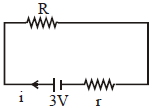
0 likesView Solution
195
PhysicsDifficultMCQJEE Main · 2020
Two point charges $4q$ and $-q$ are fixed on the $x$-axis at $x = -d/2$ and $x = d/2$,respectively. If a third point charge $q$ is moved from the origin to $x = d$ along the semicircle as shown in the figure,the potential energy of the charge will:
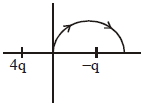
A
increase by $\frac{2q^2}{3\pi\varepsilon_0 d}$
B
increase by $\frac{3q^2}{4\pi\varepsilon_0 d}$
C
decrease by $\frac{4q^2}{3\pi\varepsilon_0 d}$
D
decrease by $\frac{q^2}{4\pi\varepsilon_0 d}$
Solution
(C) The potential energy of a charge $q$ at a point is given by $U = qV$,where $V$ is the electric potential due to the fixed charges.
Initial position: $x_i = 0$. The distances from $4q$ and $-q$ are $r_1 = d/2$ and $r_2 = d/2$.
Initial potential $V_i = \frac{1}{4\pi\varepsilon_0} \left( \frac{4q}{d/2} + \frac{-q}{d/2} \right) = \frac{1}{4\pi\varepsilon_0} \left( \frac{3q}{d/2} \right) = \frac{6q}{4\pi\varepsilon_0 d}$.
Final position: $x_f = d$. The distances from $4q$ and $-q$ are $r_1' = d + d/2 = 3d/2$ and $r_2' = d - d/2 = d/2$.
Final potential $V_f = \frac{1}{4\pi\varepsilon_0} \left( \frac{4q}{3d/2} + \frac{-q}{d/2} \right) = \frac{1}{4\pi\varepsilon_0} \left( \frac{8q}{3d} - \frac{2q}{d} \right) = \frac{1}{4\pi\varepsilon_0} \left( \frac{8q - 6q}{3d} \right) = \frac{2q}{12\pi\varepsilon_0 d} = \frac{q}{6\pi\varepsilon_0 d}$.
Change in potential energy $\Delta U = q(V_f - V_i) = q \left( \frac{q}{6\pi\varepsilon_0 d} - \frac{6q}{4\pi\varepsilon_0 d} \right) = \frac{q^2}{4\pi\varepsilon_0 d} \left( \frac{2}{3} - 6 \right) = \frac{q^2}{4\pi\varepsilon_0 d} \left( -\frac{16}{3} \right) = -\frac{4q^2}{3\pi\varepsilon_0 d}$.
The negative sign indicates a decrease in potential energy by $\frac{4q^2}{3\pi\varepsilon_0 d}$.
Initial position: $x_i = 0$. The distances from $4q$ and $-q$ are $r_1 = d/2$ and $r_2 = d/2$.
Initial potential $V_i = \frac{1}{4\pi\varepsilon_0} \left( \frac{4q}{d/2} + \frac{-q}{d/2} \right) = \frac{1}{4\pi\varepsilon_0} \left( \frac{3q}{d/2} \right) = \frac{6q}{4\pi\varepsilon_0 d}$.
Final position: $x_f = d$. The distances from $4q$ and $-q$ are $r_1' = d + d/2 = 3d/2$ and $r_2' = d - d/2 = d/2$.
Final potential $V_f = \frac{1}{4\pi\varepsilon_0} \left( \frac{4q}{3d/2} + \frac{-q}{d/2} \right) = \frac{1}{4\pi\varepsilon_0} \left( \frac{8q}{3d} - \frac{2q}{d} \right) = \frac{1}{4\pi\varepsilon_0} \left( \frac{8q - 6q}{3d} \right) = \frac{2q}{12\pi\varepsilon_0 d} = \frac{q}{6\pi\varepsilon_0 d}$.
Change in potential energy $\Delta U = q(V_f - V_i) = q \left( \frac{q}{6\pi\varepsilon_0 d} - \frac{6q}{4\pi\varepsilon_0 d} \right) = \frac{q^2}{4\pi\varepsilon_0 d} \left( \frac{2}{3} - 6 \right) = \frac{q^2}{4\pi\varepsilon_0 d} \left( -\frac{16}{3} \right) = -\frac{4q^2}{3\pi\varepsilon_0 d}$.
The negative sign indicates a decrease in potential energy by $\frac{4q^2}{3\pi\varepsilon_0 d}$.
0 likesView Solution
196
PhysicsDifficultMCQJEE Main · 2020
Two charged thin infinite plane sheets of uniform surface charge density $\sigma_{+}$ and $\sigma_{-}$ where $\left|\sigma_{+}\right|>\left|\sigma_{-}\right|$ intersect at a right angle. Which of the following best represents the electric field lines for this system?
A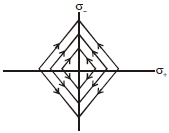
B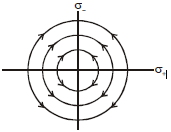
C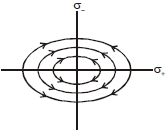
D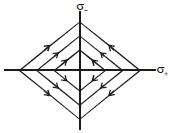
Solution
(A) Thin infinite uniformly charged planes produce a uniform electric field. Therefore,the electric field lines must be parallel straight lines,which rules out options $B$ and $C$ as they show curved field lines.
The electric field due to a positively charged sheet is directed away from it,and the field due to a negatively charged sheet is directed towards it. The magnitude of the electric field is given by $E = \frac{\sigma}{2\epsilon_0}$.
Since $\left|\sigma_{+}\right| > \left|\sigma_{-}\right|$,the magnitude of the electric field produced by the positively charged sheet is greater than that produced by the negatively charged sheet. This implies that the density of field lines originating from the positive sheet is higher than the density of field lines terminating on the negative sheet. Option $A$ correctly depicts the field lines originating from the positive sheet and terminating on the negative sheet with the appropriate relative densities,making it the correct representation.
The electric field due to a positively charged sheet is directed away from it,and the field due to a negatively charged sheet is directed towards it. The magnitude of the electric field is given by $E = \frac{\sigma}{2\epsilon_0}$.
Since $\left|\sigma_{+}\right| > \left|\sigma_{-}\right|$,the magnitude of the electric field produced by the positively charged sheet is greater than that produced by the negatively charged sheet. This implies that the density of field lines originating from the positive sheet is higher than the density of field lines terminating on the negative sheet. Option $A$ correctly depicts the field lines originating from the positive sheet and terminating on the negative sheet with the appropriate relative densities,making it the correct representation.
0 likesView Solution
197
PhysicsDifficultMCQJEE Main · 2020
Take the breakdown voltage of the zener diode used in the given circuit as $6\, V$. For the input voltage shown in the figure below, the time variation of the output voltage is: (Graphs drawn are schematic and not to scale)
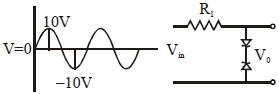
A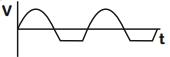
B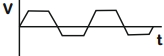
C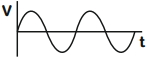
D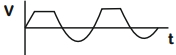
Solution
(A) The circuit consists of two Zener diodes connected in series in reverse polarity.
When the input voltage $V_{in}$ is positive, the first Zener diode is in reverse bias and the second is in forward bias.
When $V_{in}$ exceeds the breakdown voltage of $6\, V$, the first Zener diode operates in the breakdown region, maintaining a constant output voltage of $6\, V$.
When $V_{in}$ is between $0\, V$ and $6\, V$, the output voltage follows the input voltage.
Similarly, when the input voltage $V_{in}$ is negative, the second Zener diode is in reverse bias and the first is in forward bias.
When $V_{in}$ becomes more negative than $-6\, V$, the second Zener diode operates in the breakdown region, maintaining a constant output voltage of $-6\, V$.
Thus, the output voltage is clipped at $+6\, V$ and $-6\, V$, resulting in a waveform that follows the input sine wave between $-6\, V$ and $+6\, V$ and remains constant at $\pm 6\, V$ outside this range.
Comparing this with the given options, the correct graph is represented by option $A$.
When the input voltage $V_{in}$ is positive, the first Zener diode is in reverse bias and the second is in forward bias.
When $V_{in}$ exceeds the breakdown voltage of $6\, V$, the first Zener diode operates in the breakdown region, maintaining a constant output voltage of $6\, V$.
When $V_{in}$ is between $0\, V$ and $6\, V$, the output voltage follows the input voltage.
Similarly, when the input voltage $V_{in}$ is negative, the second Zener diode is in reverse bias and the first is in forward bias.
When $V_{in}$ becomes more negative than $-6\, V$, the second Zener diode operates in the breakdown region, maintaining a constant output voltage of $-6\, V$.
Thus, the output voltage is clipped at $+6\, V$ and $-6\, V$, resulting in a waveform that follows the input sine wave between $-6\, V$ and $+6\, V$ and remains constant at $\pm 6\, V$ outside this range.
Comparing this with the given options, the correct graph is represented by option $A$.
1 likesView Solution
198
PhysicsDifficultMCQJEE Main · 2020
In a compound microscope,the magnified virtual image is formed at a distance of $25 \, cm$ from the eye-piece. The focal length of its objective lens is $1 \, cm$. If the magnification is $100$ and the tube length of the microscope is $20 \, cm$,then the focal length of the eye-piece lens (in $cm$) is
A
$4.5$
B
$4$
C
$3.5$
D
$4.8$
Solution
(A) Let $u_1$ be the object distance from the objective lens. Given $f_o = 1 \, cm$. The image distance $v_1$ from the objective lens is given by the lens formula: $\frac{1}{v_1} - \frac{1}{-u_1} = \frac{1}{f_o} \Rightarrow \frac{1}{v_1} = 1 - \frac{1}{u_1} = \frac{u_1 - 1}{u_1} \Rightarrow v_1 = \frac{u_1}{u_1 - 1}$.
The magnification of the objective lens is $m_o = \frac{v_1}{u_1} = \frac{1}{u_1 - 1}$.
The tube length $L = v_1 + |u_e| = 20 \, cm$,where $u_e$ is the object distance for the eye-piece. Thus,$|u_e| = 20 - v_1 = 20 - \frac{u_1}{u_1 - 1} = \frac{20u_1 - 20 - u_1}{u_1 - 1} = \frac{19u_1 - 20}{u_1 - 1}$.
The magnification of the eye-piece is $m_e = \frac{D}{|u_e|} = \frac{25}{|u_e|} = \frac{25(u_1 - 1)}{19u_1 - 20}$.
Total magnification $M = m_o \times m_e = 100 \Rightarrow \left(\frac{1}{u_1 - 1}\right) \times \left(\frac{25(u_1 - 1)}{19u_1 - 20}\right) = 100$.
$\frac{25}{19u_1 - 20} = 100 \Rightarrow 19u_1 - 20 = 0.25 \Rightarrow 19u_1 = 20.25 \Rightarrow u_1 = \frac{20.25}{19} \approx 1.0658 \, cm$.
Now,$|u_e| = 20 - v_1 = 20 - \frac{1.0658}{1.0658 - 1} = 20 - \frac{1.0658}{0.0658} \approx 20 - 16.2 = 3.8 \, cm$.
Using the lens formula for the eye-piece: $\frac{1}{v_e} - \frac{1}{u_e} = \frac{1}{f_e} \Rightarrow \frac{1}{-25} - \frac{1}{-3.8} = \frac{1}{f_e} \Rightarrow \frac{1}{f_e} = \frac{1}{3.8} - \frac{1}{25} \approx 0.263 - 0.04 = 0.223$.
$f_e \approx \frac{1}{0.223} \approx 4.48 \, cm$. The closest option is $4.5 \, cm$.
The magnification of the objective lens is $m_o = \frac{v_1}{u_1} = \frac{1}{u_1 - 1}$.
The tube length $L = v_1 + |u_e| = 20 \, cm$,where $u_e$ is the object distance for the eye-piece. Thus,$|u_e| = 20 - v_1 = 20 - \frac{u_1}{u_1 - 1} = \frac{20u_1 - 20 - u_1}{u_1 - 1} = \frac{19u_1 - 20}{u_1 - 1}$.
The magnification of the eye-piece is $m_e = \frac{D}{|u_e|} = \frac{25}{|u_e|} = \frac{25(u_1 - 1)}{19u_1 - 20}$.
Total magnification $M = m_o \times m_e = 100 \Rightarrow \left(\frac{1}{u_1 - 1}\right) \times \left(\frac{25(u_1 - 1)}{19u_1 - 20}\right) = 100$.
$\frac{25}{19u_1 - 20} = 100 \Rightarrow 19u_1 - 20 = 0.25 \Rightarrow 19u_1 = 20.25 \Rightarrow u_1 = \frac{20.25}{19} \approx 1.0658 \, cm$.
Now,$|u_e| = 20 - v_1 = 20 - \frac{1.0658}{1.0658 - 1} = 20 - \frac{1.0658}{0.0658} \approx 20 - 16.2 = 3.8 \, cm$.
Using the lens formula for the eye-piece: $\frac{1}{v_e} - \frac{1}{u_e} = \frac{1}{f_e} \Rightarrow \frac{1}{-25} - \frac{1}{-3.8} = \frac{1}{f_e} \Rightarrow \frac{1}{f_e} = \frac{1}{3.8} - \frac{1}{25} \approx 0.263 - 0.04 = 0.223$.
$f_e \approx \frac{1}{0.223} \approx 4.48 \, cm$. The closest option is $4.5 \, cm$.
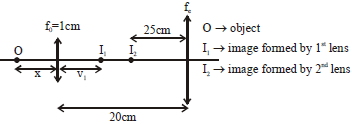
0 likesView Solution
199
PhysicsDifficultMCQJEE Main · 2020
In the line spectra of the hydrogen atom,the difference between the largest and the shortest wavelengths of the Lyman series is $304\,\mathring{A}$. The corresponding difference for the Paschen series in $\mathring{A}$ is:
A
$10553$
B
$10560$
C
$10555$
D
$10165$
Solution
(A) The wavelength $\lambda$ is given by $\frac{1}{\lambda} = R \left( \frac{1}{n_1^2} - \frac{1}{n_2^2} \right)$,where $R$ is the Rydberg constant. Let $C = \frac{1}{R}$. Then $\lambda = C \left( \frac{1}{n_1^2} - \frac{1}{n_2^2} \right)^{-1}$.
For the Lyman series $(n_1 = 1)$:
Shortest wavelength $\lambda_{L,s} = C \left( \frac{1}{1^2} - \frac{1}{\infty^2} \right)^{-1} = C$.
Longest wavelength $\lambda_{L,l} = C \left( \frac{1}{1^2} - \frac{1}{2^2} \right)^{-1} = \frac{4C}{3}$.
Difference $\Delta \lambda_L = \frac{4C}{3} - C = \frac{C}{3} = 304\,\mathring{A} \implies C = 912\,\mathring{A}$.
For the Paschen series $(n_1 = 3)$:
Shortest wavelength $\lambda_{P,s} = C \left( \frac{1}{3^2} - \frac{1}{\infty^2} \right)^{-1} = 9C$.
Longest wavelength $\lambda_{P,l} = C \left( \frac{1}{3^2} - \frac{1}{4^2} \right)^{-1} = C \left( \frac{1}{9} - \frac{1}{16} \right)^{-1} = C \left( \frac{7}{144} \right)^{-1} = \frac{144C}{7}$.
Difference $\Delta \lambda_P = \frac{144C}{7} - 9C = \frac{144C - 63C}{7} = \frac{81C}{7}$.
Substituting $C = 912\,\mathring{A}$:
$\Delta \lambda_P = \frac{81 \times 912}{7} \approx 10553.14\,\mathring{A}$.
For the Lyman series $(n_1 = 1)$:
Shortest wavelength $\lambda_{L,s} = C \left( \frac{1}{1^2} - \frac{1}{\infty^2} \right)^{-1} = C$.
Longest wavelength $\lambda_{L,l} = C \left( \frac{1}{1^2} - \frac{1}{2^2} \right)^{-1} = \frac{4C}{3}$.
Difference $\Delta \lambda_L = \frac{4C}{3} - C = \frac{C}{3} = 304\,\mathring{A} \implies C = 912\,\mathring{A}$.
For the Paschen series $(n_1 = 3)$:
Shortest wavelength $\lambda_{P,s} = C \left( \frac{1}{3^2} - \frac{1}{\infty^2} \right)^{-1} = 9C$.
Longest wavelength $\lambda_{P,l} = C \left( \frac{1}{3^2} - \frac{1}{4^2} \right)^{-1} = C \left( \frac{1}{9} - \frac{1}{16} \right)^{-1} = C \left( \frac{7}{144} \right)^{-1} = \frac{144C}{7}$.
Difference $\Delta \lambda_P = \frac{144C}{7} - 9C = \frac{144C - 63C}{7} = \frac{81C}{7}$.
Substituting $C = 912\,\mathring{A}$:
$\Delta \lambda_P = \frac{81 \times 912}{7} \approx 10553.14\,\mathring{A}$.
0 likesView Solution
200
PhysicsDifficultMCQJEE Main · 2020
In the circuit shown in the figure,the currents in different branches and the value of one resistor are given. Then,the potential at point $B$ with respect to point $A$ is $.......V$.
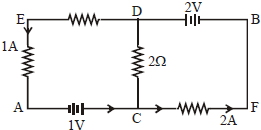
A
$+1$
B
$-1$
C
$-2$
D
$+2$
Solution
(A) Let the potential at point $A$ be $V_A = 0 \ V$.
Applying Kirchhoff's Current Law $(KCL)$ at junction $C$:
The current entering from the battery branch is $i_1 = 1 \ A$.
The current flowing through the $2 \ \Omega$ resistor is $i_3$ (downwards from $D$ to $C$).
The current leaving towards $F$ is $i_2 = 2 \ A$.
According to $KCL$ at junction $C$: $i_1 + i_3 = i_2$.
Substituting the values: $1 \ A + i_3 = 2 \ A$,which gives $i_3 = 1 \ A$.
Now,we find the potential at $D$ by traversing from $A$ to $D$ via $C$:
$V_D = V_A + 1 \ V - i_3 \times (2 \ \Omega) = 0 + 1 - (1 \times 2) = -1 \ V$.
Now,we find the potential at $B$ by traversing from $D$ to $B$:
$V_B = V_D + 2 \ V = -1 + 2 = 1 \ V$.
Thus,the potential at point $B$ with respect to point $A$ is $V_B - V_A = 1 - 0 = 1 \ V$.
Applying Kirchhoff's Current Law $(KCL)$ at junction $C$:
The current entering from the battery branch is $i_1 = 1 \ A$.
The current flowing through the $2 \ \Omega$ resistor is $i_3$ (downwards from $D$ to $C$).
The current leaving towards $F$ is $i_2 = 2 \ A$.
According to $KCL$ at junction $C$: $i_1 + i_3 = i_2$.
Substituting the values: $1 \ A + i_3 = 2 \ A$,which gives $i_3 = 1 \ A$.
Now,we find the potential at $D$ by traversing from $A$ to $D$ via $C$:
$V_D = V_A + 1 \ V - i_3 \times (2 \ \Omega) = 0 + 1 - (1 \times 2) = -1 \ V$.
Now,we find the potential at $B$ by traversing from $D$ to $B$:
$V_B = V_D + 2 \ V = -1 + 2 = 1 \ V$.
Thus,the potential at point $B$ with respect to point $A$ is $V_B - V_A = 1 - 0 = 1 \ V$.
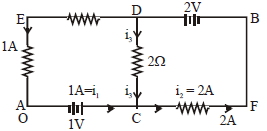
0 likesView Solution
201
PhysicsDifficultMCQJEE Main · 2020
$A$ parallel plate capacitor has plates of length $l$,width $w$,and separation $d$. It is connected to a battery of emf $V$. $A$ dielectric slab of the same thickness $d$ and dielectric constant $k = 4$ is being inserted between the plates. At what length $x$ of the slab inside the plates will the energy stored in the capacitor be two times the initial energy stored?
A
$\frac{l}{4}$
B
$\frac{l}{2}$
C
$\frac{l}{3}$
D
$\frac{2l}{3}$
Solution
(C) Initial capacitance $C_i = \frac{\varepsilon_0 A}{d} = \frac{\varepsilon_0 (lw)}{d}$.
Initial energy $U_i = \frac{1}{2} C_i V^2$.
After inserting the slab of length $x$,the capacitor acts as two capacitors in parallel: one with dielectric (length $x$) and one with air (length $l-x$).
$C_f = C_1 + C_2 = \frac{k \varepsilon_0 (xw)}{d} + \frac{\varepsilon_0 ((l-x)w)}{d}$.
Given $U_f = 2 U_i$,and since $V$ is constant,$C_f = 2 C_i$.
$\frac{\varepsilon_0 w}{d} [kx + l - x] = 2 \frac{\varepsilon_0 lw}{d}$.
$kx + l - x = 2l$.
Substitute $k = 4$: $4x + l - x = 2l$.
$3x = l \Rightarrow x = \frac{l}{3}$.
Initial energy $U_i = \frac{1}{2} C_i V^2$.
After inserting the slab of length $x$,the capacitor acts as two capacitors in parallel: one with dielectric (length $x$) and one with air (length $l-x$).
$C_f = C_1 + C_2 = \frac{k \varepsilon_0 (xw)}{d} + \frac{\varepsilon_0 ((l-x)w)}{d}$.
Given $U_f = 2 U_i$,and since $V$ is constant,$C_f = 2 C_i$.
$\frac{\varepsilon_0 w}{d} [kx + l - x] = 2 \frac{\varepsilon_0 lw}{d}$.
$kx + l - x = 2l$.
Substitute $k = 4$: $4x + l - x = 2l$.
$3x = l \Rightarrow x = \frac{l}{3}$.
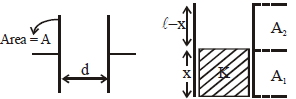
0 likesView Solution
202
PhysicsDifficultMCQJEE Main · 2020
Ten charges are placed on the circumference of a circle of radius $R$ with constant angular separation between successive charges. Alternate charges $1, 3, 5, 7, 9$ have charge $(+q)$ each, while $2, 4, 6, 8, 10$ have charge $(-q)$ each. The potential $V$ and the electric field $E$ at the centre of the circle are respectively (Take $V = 0$ at infinity).
A
$V = \frac{10q}{4\pi\epsilon_0 R}; E = \frac{10q}{4\pi\epsilon_0 R^2}$
B
$V = 0, E = \frac{10q}{4\pi\epsilon_0 R^2}$
C
$V = 0, E = 0$
D
$V = \frac{10q}{4\pi\epsilon_0 R}; E = 0$
Solution
(C) The electric potential $V$ at the centre is the algebraic sum of potentials due to individual charges: $V = \sum \frac{kq_i}{R} = \frac{k}{R} \sum q_i$. Since there are five charges of $(+q)$ and five charges of $(-q)$, the net charge $\sum q_i = 5(+q) + 5(-q) = 0$. Thus, $V = 0$.
For the electric field $E$ at the centre, each charge $(+q)$ produces a field $\vec{E}_0$ directed away from it, and each charge $(-q)$ produces a field $\vec{E}_0$ directed towards it. Due to the symmetry of the ten charges arranged at equal angular intervals of $36^\circ$, every charge has an diametrically opposite charge of equal magnitude but opposite sign. For example, charge $1$ $(+q)$ and charge $6$ $(-q)$ are diametrically opposite. The field due to charge $1$ is $\vec{E}_1$ (away from $1$) and the field due to charge $6$ is $\vec{E}_6$ (towards $6$). Since $1$ and $6$ are opposite, $\vec{E}_1$ and $\vec{E}_6$ point in the same direction and add up to $2\vec{E}_0$. This results in five such vectors of magnitude $2E_0$ separated by $72^\circ$ each. The vector sum of these five equal vectors separated by equal angles is zero. Therefore, $E = 0$.
For the electric field $E$ at the centre, each charge $(+q)$ produces a field $\vec{E}_0$ directed away from it, and each charge $(-q)$ produces a field $\vec{E}_0$ directed towards it. Due to the symmetry of the ten charges arranged at equal angular intervals of $36^\circ$, every charge has an diametrically opposite charge of equal magnitude but opposite sign. For example, charge $1$ $(+q)$ and charge $6$ $(-q)$ are diametrically opposite. The field due to charge $1$ is $\vec{E}_1$ (away from $1$) and the field due to charge $6$ is $\vec{E}_6$ (towards $6$). Since $1$ and $6$ are opposite, $\vec{E}_1$ and $\vec{E}_6$ point in the same direction and add up to $2\vec{E}_0$. This results in five such vectors of magnitude $2E_0$ separated by $72^\circ$ each. The vector sum of these five equal vectors separated by equal angles is zero. Therefore, $E = 0$.
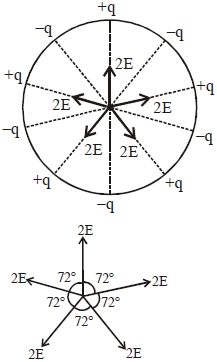
0 likesView Solution
203
PhysicsMediumMCQJEE Main · 2020
An iron rod of volume $10^{-3} \ m^3$ and relative permeability $1000$ is placed as a core in a solenoid with $10 \ turns/cm$. If a current of $0.5 \ A$ is passed through the solenoid,then the magnetic moment of the rod will be $........... \ Am^2$.
A
$0.5 \times 10^2$
B
$50 \times 10^2$
C
$500 \times 10^2$
D
$5 \times 10^2$
Solution
(D) The magnetic field inside the solenoid is $B_0 = \mu_0 n i$.
When an iron rod is placed inside,the magnetic field becomes $B = \mu_r B_0 = \mu_r \mu_0 n i$.
The magnetization $M_z$ is given by $M_z = \frac{B - \mu_0 H}{\mu_0} = (\mu_r - 1) H$.
Since $\mu_r = 1000 \gg 1$,we can approximate $M_z \approx \mu_r H = \mu_r n i$.
The magnetic moment $m$ is given by $m = M_z \times V$,where $V$ is the volume of the rod.
Given: $V = 10^{-3} \ m^3$,$\mu_r = 1000$,$n = 10 \ turns/cm = 1000 \ turns/m$,$i = 0.5 \ A$.
$m = (\mu_r n i) V = 1000 \times 1000 \times 0.5 \times 10^{-3}$.
$m = 10^6 \times 0.5 \times 10^{-3} = 0.5 \times 10^3 = 500 \ Am^2$.
$m = 5 \times 10^2 \ Am^2$.
When an iron rod is placed inside,the magnetic field becomes $B = \mu_r B_0 = \mu_r \mu_0 n i$.
The magnetization $M_z$ is given by $M_z = \frac{B - \mu_0 H}{\mu_0} = (\mu_r - 1) H$.
Since $\mu_r = 1000 \gg 1$,we can approximate $M_z \approx \mu_r H = \mu_r n i$.
The magnetic moment $m$ is given by $m = M_z \times V$,where $V$ is the volume of the rod.
Given: $V = 10^{-3} \ m^3$,$\mu_r = 1000$,$n = 10 \ turns/cm = 1000 \ turns/m$,$i = 0.5 \ A$.
$m = (\mu_r n i) V = 1000 \times 1000 \times 0.5 \times 10^{-3}$.
$m = 10^6 \times 0.5 \times 10^{-3} = 0.5 \times 10^3 = 500 \ Am^2$.
$m = 5 \times 10^2 \ Am^2$.
0 likesView Solution
204
PhysicsDifficultMCQJEE Main · 2020
An infinitely long straight wire carrying current $I$,an open rectangular loop,and a conductor $C$ with a sliding connector are located in the same plane,as shown in the figure. The connector has length $l$ and resistance $R$. It slides to the right with a velocity $v$. The resistance of the conductor and the self-inductance of the loop are negligible. The induced current in the loop,as a function of separation $r$ between the connector and the straight wire,is:
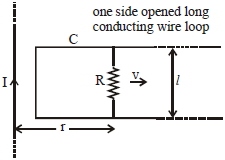
A
$\frac{\mu_{0}}{\pi} \frac{ Ivl }{ Rr }$
B
$\frac{\mu_{0}}{2 \pi} \frac{ Ivl }{ Rr }$
C
$\frac{2 \mu_{0}}{\pi} \frac{ Ivl }{ Rr }$
D
$\frac{\mu_{0}}{4 \pi} \frac{ Ivl }{ Rr }$
Solution
(B) The magnetic field $B$ at a distance $r$ from an infinitely long straight wire carrying current $I$ is given by:
$B = \frac{\mu_{0} I}{2 \pi r}$
The motional electromotive force $(EMF)$ induced in a conductor of length $l$ moving with velocity $v$ perpendicular to a magnetic field $B$ is given by:
$e = Bvl$
Substituting the expression for $B$ into the formula for $e$:
$e = \left( \frac{\mu_{0} I}{2 \pi r} \right) vl = \frac{\mu_{0} Ivl}{2 \pi r}$
The induced current $i$ in the loop is given by Ohm's law,$i = \frac{e}{R}$:
$i = \frac{1}{R} \left( \frac{\mu_{0} Ivl}{2 \pi r} \right) = \frac{\mu_{0} Ivl}{2 \pi Rr}$
$B = \frac{\mu_{0} I}{2 \pi r}$
The motional electromotive force $(EMF)$ induced in a conductor of length $l$ moving with velocity $v$ perpendicular to a magnetic field $B$ is given by:
$e = Bvl$
Substituting the expression for $B$ into the formula for $e$:
$e = \left( \frac{\mu_{0} I}{2 \pi r} \right) vl = \frac{\mu_{0} Ivl}{2 \pi r}$
The induced current $i$ in the loop is given by Ohm's law,$i = \frac{e}{R}$:
$i = \frac{1}{R} \left( \frac{\mu_{0} Ivl}{2 \pi r} \right) = \frac{\mu_{0} Ivl}{2 \pi Rr}$
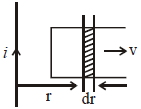
0 likesView Solution
205
PhysicsMediumMCQJEE Main · 2020
$A$ radioactive nucleus decays by two different processes. The half-life for the first process is $10 \ s$ and that for the second is $100 \ s$. The effective half-life of the nucleus is close to $..... \ s$.
A
$9$
B
$55$
C
$6$
D
$12$
Solution
(A) When a radioactive nucleus decays by two different processes with decay constants $\lambda_1$ and $\lambda_2$,the total decay constant is $\lambda_{\text{eff}} = \lambda_1 + \lambda_2$.
Since the decay constant $\lambda = \frac{\ln 2}{T}$,we can write the relation for half-lives as:
$\frac{\ln 2}{T_{\text{eff}}} = \frac{\ln 2}{T_1} + \frac{\ln 2}{T_2}$
$\frac{1}{T_{\text{eff}}} = \frac{1}{T_1} + \frac{1}{T_2}$
Given $T_1 = 10 \ s$ and $T_2 = 100 \ s$,we have:
$\frac{1}{T_{\text{eff}}} = \frac{1}{10} + \frac{1}{100} = \frac{10 + 1}{100} = \frac{11}{100}$
$T_{\text{eff}} = \frac{100}{11} \approx 9.09 \ s$
Thus,the effective half-life is close to $9 \ s$.
Since the decay constant $\lambda = \frac{\ln 2}{T}$,we can write the relation for half-lives as:
$\frac{\ln 2}{T_{\text{eff}}} = \frac{\ln 2}{T_1} + \frac{\ln 2}{T_2}$
$\frac{1}{T_{\text{eff}}} = \frac{1}{T_1} + \frac{1}{T_2}$
Given $T_1 = 10 \ s$ and $T_2 = 100 \ s$,we have:
$\frac{1}{T_{\text{eff}}} = \frac{1}{10} + \frac{1}{100} = \frac{10 + 1}{100} = \frac{11}{100}$
$T_{\text{eff}} = \frac{100}{11} \approx 9.09 \ s$
Thus,the effective half-life is close to $9 \ s$.

0 likesView Solution
206
PhysicsDifficultMCQJEE Main · 2020
In the circuit shown,the charge on the $5\, \mu F$ capacitor is $........\mu C$.
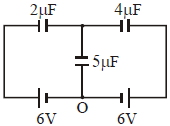
A
$5.45$
B
$16.36$
C
$10.90$
D
$18.00$
Solution
(B) Let the potential of point $O$ be $V_{O} = 0 \, V$.
Let the potential of the upper junction be $x$.
The capacitors are connected to the batteries as shown. The potential at the left plate of the $2\, \mu F$ capacitor is $6\, V$ and the potential at the right plate of the $4\, \mu F$ capacitor is $6\, V$.
Using nodal analysis at the upper junction $x$:
Sum of charges on the plates connected to junction $x$ is zero: $q_{1} + q_{2} + q_{3} = 0$.
$2(x - 6) + 4(x - 6) + 5(x - 0) = 0$.
$2x - 12 + 4x - 24 + 5x = 0$.
$11x = 36$.
$x = \frac{36}{11} \, V$.
The charge on the $5\, \mu F$ capacitor is $q_{3} = C_{3} \cdot V_{3} = 5 \cdot (x - 0) = 5 \cdot \frac{36}{11} = \frac{180}{11} \, \mu C$.
$q_{3} \approx 16.36 \, \mu C$.
Let the potential of the upper junction be $x$.
The capacitors are connected to the batteries as shown. The potential at the left plate of the $2\, \mu F$ capacitor is $6\, V$ and the potential at the right plate of the $4\, \mu F$ capacitor is $6\, V$.
Using nodal analysis at the upper junction $x$:
Sum of charges on the plates connected to junction $x$ is zero: $q_{1} + q_{2} + q_{3} = 0$.
$2(x - 6) + 4(x - 6) + 5(x - 0) = 0$.
$2x - 12 + 4x - 24 + 5x = 0$.
$11x = 36$.
$x = \frac{36}{11} \, V$.
The charge on the $5\, \mu F$ capacitor is $q_{3} = C_{3} \cdot V_{3} = 5 \cdot (x - 0) = 5 \cdot \frac{36}{11} = \frac{180}{11} \, \mu C$.
$q_{3} \approx 16.36 \, \mu C$.
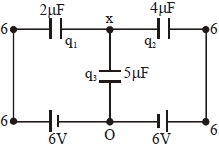
0 likesView Solution
207
PhysicsDifficultMCQJEE Main · 2020
The quantities $x = \frac{1}{\sqrt{\mu_{0} \varepsilon_{0}}}$,$y = \frac{E}{B}$,and $z = \frac{l}{CR}$ are defined,where $C$ is capacitance,$R$ is resistance,$l$ is length,$E$ is electric field,$B$ is magnetic field,and $\varepsilon_{0}, \mu_{0}$ are free space permittivity and permeability respectively. Then:
A
Only $x$ and $y$ have the same dimension
B
$x, y$ and $z$ have the same dimension
C
Only $x$ and $z$ have the same dimension
D
Only $y$ and $z$ have the same dimension
Solution
(B) $x = \frac{1}{\sqrt{\mu_{0} \varepsilon_{0}}}$ represents the speed of light in vacuum,so its dimension is $[x] = [L^{1}T^{-1}]$.
$y = \frac{E}{B}$ represents the speed of an electromagnetic wave,so its dimension is $[y] = [L^{1}T^{-1}]$.
$z = \frac{l}{CR}$ where $RC$ is the time constant $(\tau)$,so $z = \frac{l}{\tau}$. The dimension is $[z] = \frac{[L]}{[T]} = [L^{1}T^{-1}]$.
Since all three quantities have the same dimension $[L^{1}T^{-1}]$,the correct option is $B$.
$y = \frac{E}{B}$ represents the speed of an electromagnetic wave,so its dimension is $[y] = [L^{1}T^{-1}]$.
$z = \frac{l}{CR}$ where $RC$ is the time constant $(\tau)$,so $z = \frac{l}{\tau}$. The dimension is $[z] = \frac{[L]}{[T]} = [L^{1}T^{-1}]$.
Since all three quantities have the same dimension $[L^{1}T^{-1}]$,the correct option is $B$.
0 likesView Solution
208
PhysicsMediumMCQJEE Main · 2020
$A$ galvanometer is used in the laboratory for the null point in electrical experiments. If,on passing a current of $6 \, mA$,it produces a deflection of $2^{\circ}$,its figure of merit is close to:
A
$3 \times 10^{-3} \, A/\text{div}$
B
$333 \, \text{div}/A$
C
$6 \times 10^{-3} \, A/\text{div}$
D
$666 \, \text{div}/A$
Solution
(A) The figure of merit $(k)$ of a galvanometer is defined as the current required to produce a unit deflection in the galvanometer.
It is given by the formula: $k = \frac{I}{\theta}$
Given:
Current $I = 6 \, mA = 6 \times 10^{-3} \, A$
Deflection $\theta = 2^{\circ}$
Substituting the values:
$k = \frac{6 \times 10^{-3} \, A}{2^{\circ}} = 3 \times 10^{-3} \, A/\text{div}$
Therefore,the figure of merit is $3 \times 10^{-3} \, A/\text{div}$.
It is given by the formula: $k = \frac{I}{\theta}$
Given:
Current $I = 6 \, mA = 6 \times 10^{-3} \, A$
Deflection $\theta = 2^{\circ}$
Substituting the values:
$k = \frac{6 \times 10^{-3} \, A}{2^{\circ}} = 3 \times 10^{-3} \, A/\text{div}$
Therefore,the figure of merit is $3 \times 10^{-3} \, A/\text{div}$.
0 likesView Solution
209
PhysicsDifficultMCQJEE Main · 2020
Two Zener diodes ($A$ and $B$) having breakdown voltages of $6\, V$ and $4\, V$ respectively,are connected as shown in the circuit below. The output voltage $V_{0}$ variation with input voltage linearly increasing with time,is given by: $(V_{\text{input}} = 0\, V$ at $t = 0)$ (figures are qualitative).
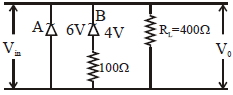
A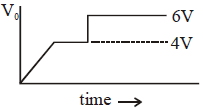
B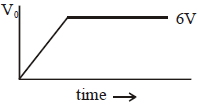
C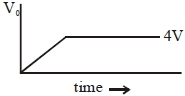
D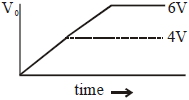
Solution
(A) $1$. For $V_{\text{in}} < 4\, V$: Neither Zener diode $A$ $(6\, V)$ nor $B$ $(4\, V)$ is in the breakdown region. Thus,the output voltage $V_{0}$ follows the input voltage $V_{\text{in}}$,i.e.,$V_{0} = V_{\text{in}}$.
$2$. For $4\, V < V_{\text{in}} < 6\, V$: Zener diode $B$ reaches its breakdown voltage of $4\, V$. Since it is in parallel with the load,the output voltage $V_{0}$ is clamped at $4\, V$. The excess voltage $(V_{\text{in}} - 4\, V)$ drops across the series resistance associated with diode $B$.
$3$. For $V_{\text{in}} > 6\, V$: Zener diode $A$ also reaches its breakdown voltage of $6\, V$. Since $A$ is in parallel with the load,the output voltage $V_{0}$ is now clamped at $6\, V$. The excess voltage drops across the series resistance of the source or the circuit.
$4$. Therefore,the graph of $V_{0}$ versus time will show a linear increase up to $4\, V$,a constant plateau at $4\, V$,and then a step increase to a constant plateau at $6\, V$.
$2$. For $4\, V < V_{\text{in}} < 6\, V$: Zener diode $B$ reaches its breakdown voltage of $4\, V$. Since it is in parallel with the load,the output voltage $V_{0}$ is clamped at $4\, V$. The excess voltage $(V_{\text{in}} - 4\, V)$ drops across the series resistance associated with diode $B$.
$3$. For $V_{\text{in}} > 6\, V$: Zener diode $A$ also reaches its breakdown voltage of $6\, V$. Since $A$ is in parallel with the load,the output voltage $V_{0}$ is now clamped at $6\, V$. The excess voltage drops across the series resistance of the source or the circuit.
$4$. Therefore,the graph of $V_{0}$ versus time will show a linear increase up to $4\, V$,a constant plateau at $4\, V$,and then a step increase to a constant plateau at $6\, V$.
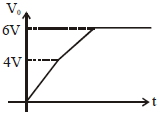
0 likesView Solution
210
PhysicsMediumMCQJEE Main · 2020
The correct match between the entries in column $I$ and column $II$ is:
$I$ (Radiation) | $II$ (Wavelength)
$(a)$ Microwave | $(i)$ $100 \, m$
$(b)$ Gamma rays | $(ii)$ $10^{-15} \, m$
$(c)$ $A.M.$ radio waves | $(iii)$ $10^{-10} \, m$
$(d)$ $X$-rays | $(iv)$ $10^{-3} \, m$
$I$ (Radiation) | $II$ (Wavelength)
$(a)$ Microwave | $(i)$ $100 \, m$
$(b)$ Gamma rays | $(ii)$ $10^{-15} \, m$
$(c)$ $A.M.$ radio waves | $(iii)$ $10^{-10} \, m$
$(d)$ $X$-rays | $(iv)$ $10^{-3} \, m$
A
$(a)-(ii), (b)-(i), (c)-(iv), (d)-(iii)$
B
$(a)-(i), (b)-(iii), (c)-(iv), (d)-(ii)$
C
$(a)-(iii), (b)-(ii), (c)-(i), (d)-(iv)$
D
$(a)-(iv), (b)-(ii), (c)-(i), (d)-(iii)$
Solution
(D) The wavelength ranges for the given electromagnetic radiations are as follows:
$(a)$ Microwave: The wavelength is approximately $10^{-3} \, m$ to $0.3 \, m$. Thus, $(a) \rightarrow (iv)$.
$(b)$ Gamma rays: These have the shortest wavelengths, typically less than $10^{-13} \, m$ (often cited as $10^{-15} \, m$ in this context). Thus, $(b) \rightarrow (ii)$.
$(c)$ $A.M.$ radio waves: These have very long wavelengths, typically in the range of $100 \, m$ to $1000 \, m$. Thus, $(c) \rightarrow (i)$.
$(d)$ $X$-rays: These have wavelengths in the range of $10^{-8} \, m$ to $10^{-12} \, m$ (often cited as $10^{-10} \, m$). Thus, $(d) \rightarrow (iii)$.
Therefore, the correct matching is $(a)-(iv), (b)-(ii), (c)-(i), (d)-(iii)$.
$(a)$ Microwave: The wavelength is approximately $10^{-3} \, m$ to $0.3 \, m$. Thus, $(a) \rightarrow (iv)$.
$(b)$ Gamma rays: These have the shortest wavelengths, typically less than $10^{-13} \, m$ (often cited as $10^{-15} \, m$ in this context). Thus, $(b) \rightarrow (ii)$.
$(c)$ $A.M.$ radio waves: These have very long wavelengths, typically in the range of $100 \, m$ to $1000 \, m$. Thus, $(c) \rightarrow (i)$.
$(d)$ $X$-rays: These have wavelengths in the range of $10^{-8} \, m$ to $10^{-12} \, m$ (often cited as $10^{-10} \, m$). Thus, $(d) \rightarrow (iii)$.
Therefore, the correct matching is $(a)-(iv), (b)-(ii), (c)-(i), (d)-(iii)$.
0 likesView Solution
211
PhysicsMediumMCQJEE Main · 2020
The surface of a metal is illuminated alternately with photons of energies $E_{1} = 4 \ eV$ and $E_{2} = 2.5 \ eV$ respectively. The ratio of maximum speeds of the photoelectrons emitted in the two cases is $2$. The work function of the metal in $eV$ is:
A
$2$
B
$4$
C
$8$
D
$10$
Solution
(A) According to Einstein's photoelectric equation,the maximum kinetic energy $K$ is given by $K = E - \phi$,where $E$ is the photon energy and $\phi$ is the work function.
For the first case: $K_{1} = E_{1} - \phi = 4 - \phi$.
For the second case: $K_{2} = E_{2} - \phi = 2.5 - \phi$.
Since $K = \frac{1}{2}mv_{max}^{2}$,the ratio of kinetic energies is $\frac{K_{1}}{K_{2}} = \left(\frac{v_{1}}{v_{2}}\right)^{2}$.
Given $\frac{v_{1}}{v_{2}} = 2$,we have $\frac{K_{1}}{K_{2}} = 2^{2} = 4$,so $K_{1} = 4K_{2}$.
Substituting the expressions for $K_{1}$ and $K_{2}$: $4 - \phi = 4(2.5 - \phi)$.
$4 - \phi = 10 - 4\phi$.
$3\phi = 6$.
$\phi = 2 \ eV$.
For the first case: $K_{1} = E_{1} - \phi = 4 - \phi$.
For the second case: $K_{2} = E_{2} - \phi = 2.5 - \phi$.
Since $K = \frac{1}{2}mv_{max}^{2}$,the ratio of kinetic energies is $\frac{K_{1}}{K_{2}} = \left(\frac{v_{1}}{v_{2}}\right)^{2}$.
Given $\frac{v_{1}}{v_{2}} = 2$,we have $\frac{K_{1}}{K_{2}} = 2^{2} = 4$,so $K_{1} = 4K_{2}$.
Substituting the expressions for $K_{1}$ and $K_{2}$: $4 - \phi = 4(2.5 - \phi)$.
$4 - \phi = 10 - 4\phi$.
$3\phi = 6$.
$\phi = 2 \ eV$.
0 likesView Solution
212
PhysicsMediumMCQJEE Main · 2020
$A$ prism of angle $A=1^{\circ}$ has a refractive index $\mu=1.5$. $A$ good estimate for the minimum angle of deviation (in degrees) is close to $N/10$. The value of $N$ is......
A
$5$
B
$8$
C
$10$
D
$15$
Solution
(A) For a thin prism,the angle of minimum deviation $\delta_{\min}$ is given by the formula:
$\delta_{\min} = (\mu - 1)A$
Given:
Prism angle $A = 1^{\circ}$
Refractive index $\mu = 1.5$
Substituting the values:
$\delta_{\min} = (1.5 - 1) \times 1^{\circ}$
$\delta_{\min} = 0.5^{\circ}$
We are given that $\delta_{\min} = N/10$.
So,$0.5 = N/10$
$N = 0.5 \times 10 = 5$
Thus,the value of $N$ is $5$.
$\delta_{\min} = (\mu - 1)A$
Given:
Prism angle $A = 1^{\circ}$
Refractive index $\mu = 1.5$
Substituting the values:
$\delta_{\min} = (1.5 - 1) \times 1^{\circ}$
$\delta_{\min} = 0.5^{\circ}$
We are given that $\delta_{\min} = N/10$.
So,$0.5 = N/10$
$N = 0.5 \times 10 = 5$
Thus,the value of $N$ is $5$.
0 likesView Solution
213
PhysicsDifficultMCQJEE Main · 2020
The activities of three radioactive substances $A, B$ and $C$ are represented by the curves $A, B$ and $C$ in the figure. Then their half-lives $T_{\frac{1}{2}}(A) : T_{\frac{1}{2}}(B) : T_{\frac{1}{2}}(C)$ are in the ratio:
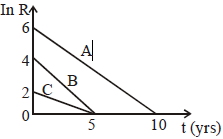
A
$3: 2: 1$
B
$4: 3: 1$
C
$2: 1: 3$
D
$2: 1: 1$
Solution
(B) The activity of a radioactive substance is given by $R = R_{0} e^{-\lambda t}$.
Taking the natural logarithm on both sides,we get $\ln R = \ln R_{0} - \lambda t$.
This is the equation of a straight line $y = mx + c$,where the slope $m = -\lambda$.
From the graph,the slope $\lambda$ for each substance is:
For $A$: $\lambda_{A} = \frac{6 - 0}{10 - 0} = 0.6 = \frac{3}{5}$.
For $B$: $\lambda_{B} = \frac{4 - 0}{5 - 0} = 0.8 = \frac{4}{5}$.
For $C$: $\lambda_{C} = \frac{2 - 0}{5 - 0} = 0.4 = \frac{2}{5}$.
The half-life is given by $T_{\frac{1}{2}} = \frac{\ln 2}{\lambda}$.
Thus,$T_{\frac{1}{2}}(A) : T_{\frac{1}{2}}(B) : T_{\frac{1}{2}}(C) = \frac{1}{\lambda_{A}} : \frac{1}{\lambda_{B}} : \frac{1}{\lambda_{C}} = \frac{5}{3} : \frac{5}{4} : \frac{5}{2}$.
Multiplying by the $LCM$ of the denominators $(12)$,we get $20 : 15 : 30$,which simplifies to $4 : 3 : 6$.
Taking the natural logarithm on both sides,we get $\ln R = \ln R_{0} - \lambda t$.
This is the equation of a straight line $y = mx + c$,where the slope $m = -\lambda$.
From the graph,the slope $\lambda$ for each substance is:
For $A$: $\lambda_{A} = \frac{6 - 0}{10 - 0} = 0.6 = \frac{3}{5}$.
For $B$: $\lambda_{B} = \frac{4 - 0}{5 - 0} = 0.8 = \frac{4}{5}$.
For $C$: $\lambda_{C} = \frac{2 - 0}{5 - 0} = 0.4 = \frac{2}{5}$.
The half-life is given by $T_{\frac{1}{2}} = \frac{\ln 2}{\lambda}$.
Thus,$T_{\frac{1}{2}}(A) : T_{\frac{1}{2}}(B) : T_{\frac{1}{2}}(C) = \frac{1}{\lambda_{A}} : \frac{1}{\lambda_{B}} : \frac{1}{\lambda_{C}} = \frac{5}{3} : \frac{5}{4} : \frac{5}{2}$.
Multiplying by the $LCM$ of the denominators $(12)$,we get $20 : 15 : 30$,which simplifies to $4 : 3 : 6$.
0 likesView Solution
214
PhysicsDifficultMCQJEE Main · 2020
$A$ solid sphere of radius $R$ carries a charge $(Q+q)$ distributed uniformly over its volume. $A$ very small point-like piece of it of mass $m$ gets detached from the bottom of the sphere and falls down vertically under gravity. This piece carries charge $q$. If it acquires a speed $v$ when it has fallen through a vertical height $y$ (see figure),then: (assume the remaining portion to be spherical).
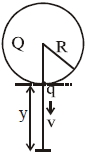
A
$v^{2}=2 y\left[\frac{q Q}{4 \pi \epsilon_{0} R(R+y) m}+g\right]$
B
$v^{2}=y\left[\frac{q Q}{4 \pi \epsilon_{0} R^{2} y m}+g\right]$
C
$v^{2}=2 y\left[\frac{q Q R}{4 \pi \epsilon_{0}(R+y)^{3} m}+g\right]$
D
$v^{2}=y\left[\frac{q Q}{4 \pi \epsilon_{0} R(R+y) m}+g\right]$
Solution
(A) The total energy of the system is conserved. The initial potential energy of the small piece of charge $q$ at the surface of the sphere (distance $R$ from the center) is $U_i = \frac{kQq}{R} + mgy_0$ (taking the reference level at the bottom of the sphere).
When the piece has fallen by a height $y$,its distance from the center of the sphere is $(R+y)$.
The final energy is $U_f + K_f = \frac{kQq}{R+y} + mg(y_0 - y) + \frac{1}{2}mv^2$.
Equating initial and final energy:
$\frac{kQq}{R} + mgy_0 = \frac{kQq}{R+y} + mg(y_0 - y) + \frac{1}{2}mv^2$
$\frac{1}{2}mv^2 = \frac{kQq}{R} - \frac{kQq}{R+y} + mgy$
$\frac{1}{2}mv^2 = kQq \left[ \frac{R+y-R}{R(R+y)} \right] + mgy$
$\frac{1}{2}mv^2 = \frac{kQqy}{R(R+y)} + mgy$
$v^2 = 2 \left[ \frac{kQqy}{mR(R+y)} + gy \right] = 2y \left[ \frac{kQq}{mR(R+y)} + g \right]$
Substituting $k = \frac{1}{4\pi\epsilon_0}$:
$v^2 = 2y \left[ \frac{qQ}{4\pi\epsilon_0 mR(R+y)} + g \right]$.
When the piece has fallen by a height $y$,its distance from the center of the sphere is $(R+y)$.
The final energy is $U_f + K_f = \frac{kQq}{R+y} + mg(y_0 - y) + \frac{1}{2}mv^2$.
Equating initial and final energy:
$\frac{kQq}{R} + mgy_0 = \frac{kQq}{R+y} + mg(y_0 - y) + \frac{1}{2}mv^2$
$\frac{1}{2}mv^2 = \frac{kQq}{R} - \frac{kQq}{R+y} + mgy$
$\frac{1}{2}mv^2 = kQq \left[ \frac{R+y-R}{R(R+y)} \right] + mgy$
$\frac{1}{2}mv^2 = \frac{kQqy}{R(R+y)} + mgy$
$v^2 = 2 \left[ \frac{kQqy}{mR(R+y)} + gy \right] = 2y \left[ \frac{kQq}{mR(R+y)} + g \right]$
Substituting $k = \frac{1}{4\pi\epsilon_0}$:
$v^2 = 2y \left[ \frac{qQ}{4\pi\epsilon_0 mR(R+y)} + g \right]$.
0 likesView Solution
215
PhysicsMediumMCQJEE Main · 2020
With increasing biasing voltage of a photodiode,the photocurrent magnitude
A
increases initially and saturates finally
B
increases initially and after attaining certain value,it decreases
C
increases linearly
D
remains constant
Solution
(A) photodiode is operated in reverse bias mode. When light of energy greater than the bandgap energy falls on the photodiode,electron-hole pairs are generated in the depletion region.
As the reverse biasing voltage is increased,the electric field in the depletion region increases,which helps in sweeping the generated charge carriers across the junction more effectively,thereby increasing the photocurrent.
However,once all the generated charge carriers are collected,further increase in the reverse bias voltage does not increase the photocurrent significantly,and it reaches a saturation value. This is shown in the $I-V$ characteristic curve of a photodiode.
As the reverse biasing voltage is increased,the electric field in the depletion region increases,which helps in sweeping the generated charge carriers across the junction more effectively,thereby increasing the photocurrent.
However,once all the generated charge carriers are collected,further increase in the reverse bias voltage does not increase the photocurrent significantly,and it reaches a saturation value. This is shown in the $I-V$ characteristic curve of a photodiode.
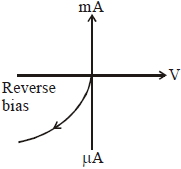
0 likesView Solution
216
PhysicsDifficultMCQJEE Main · 2020
For a concave lens of focal length $f$,the relation between object distance $u$ and image distance $v$ from its pole can best be represented by ($u = v$ is the reference line):
A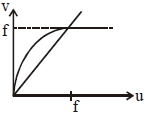
B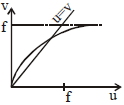
C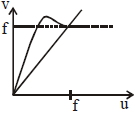
D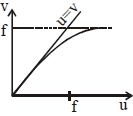
Solution
(D) The lens formula is given by $\frac{1}{v} - \frac{1}{u} = \frac{1}{f}$.
For a concave lens,the focal length $f$ is negative,so let $f = -|f|$.
Thus,$\frac{1}{v} - \frac{1}{u} = -\frac{1}{|f|}$,which simplifies to $\frac{1}{v} = \frac{1}{u} - \frac{1}{|f|} = \frac{|f|-u}{u|f|}$.
Therefore,$v = \frac{u|f|}{|f|-u}$.
As $u \to 0$,$v \to 0$.
As $u \to |f|$,$v \to \infty$.
As $u \to \infty$,$v \to -|f|$.
Since the question uses magnitudes for $u$ and $v$ in the graphs,we consider the virtual image formed by a concave lens,where $v$ is always between $0$ and $f$. The correct graphical representation for the magnitude of image distance $v$ versus object distance $u$ is shown in option $D$.
For a concave lens,the focal length $f$ is negative,so let $f = -|f|$.
Thus,$\frac{1}{v} - \frac{1}{u} = -\frac{1}{|f|}$,which simplifies to $\frac{1}{v} = \frac{1}{u} - \frac{1}{|f|} = \frac{|f|-u}{u|f|}$.
Therefore,$v = \frac{u|f|}{|f|-u}$.
As $u \to 0$,$v \to 0$.
As $u \to |f|$,$v \to \infty$.
As $u \to \infty$,$v \to -|f|$.
Since the question uses magnitudes for $u$ and $v$ in the graphs,we consider the virtual image formed by a concave lens,where $v$ is always between $0$ and $f$. The correct graphical representation for the magnitude of image distance $v$ versus object distance $u$ is shown in option $D$.
0 likesView Solution
217
PhysicsMediumMCQJEE Main · 2020
An electrical power line, having a total resistance of $2 \, \Omega$, delivers $1 \, kW$ at $220 \, V$. The efficiency of the transmission line is approximately $....... \%$.
A
$72$
B
$96$
C
$91$
D
$85$
Solution
(B) The power delivered is $P_{out} = 1 \, kW = 1000 \, W$ at a voltage $V = 220 \, V$.
The current $I$ flowing through the line is given by $I = \frac{P_{out}}{V} = \frac{1000}{220} = \frac{50}{11} \, A$.
The power loss in the transmission line due to its resistance $R = 2 \, \Omega$ is $P_{loss} = I^2 R$.
$P_{loss} = \left( \frac{50}{11} \right)^2 \times 2 = \frac{2500}{121} \times 2 = \frac{5000}{121} \approx 41.32 \, W$.
The total power generated at the source is $P_{in} = P_{out} + P_{loss} = 1000 + 41.32 = 1041.32 \, W$.
The efficiency $\eta$ is given by $\eta = \left( \frac{P_{out}}{P_{in}} \right) \times 100$.
$\eta = \left( \frac{1000}{1041.32} \right) \times 100 \approx 96.03 \%$.
Therefore, the efficiency is approximately $96 \%$.
The current $I$ flowing through the line is given by $I = \frac{P_{out}}{V} = \frac{1000}{220} = \frac{50}{11} \, A$.
The power loss in the transmission line due to its resistance $R = 2 \, \Omega$ is $P_{loss} = I^2 R$.
$P_{loss} = \left( \frac{50}{11} \right)^2 \times 2 = \frac{2500}{121} \times 2 = \frac{5000}{121} \approx 41.32 \, W$.
The total power generated at the source is $P_{in} = P_{out} + P_{loss} = 1000 + 41.32 = 1041.32 \, W$.
The efficiency $\eta$ is given by $\eta = \left( \frac{P_{out}}{P_{in}} \right) \times 100$.
$\eta = \left( \frac{1000}{1041.32} \right) \times 100 \approx 96.03 \%$.
Therefore, the efficiency is approximately $96 \%$.
0 likesView Solution
218
PhysicsDifficultMCQJEE Main · 2020
$A$ square loop of side $2a$ carrying current $I$ is kept in the $XZ$ plane with its centre at the origin. $A$ long wire carrying the same current $I$ is placed parallel to the $z$-axis and passes through the point $(0, b, 0)$,where $b >> a$. The magnitude of the torque on the loop about the $z$-axis is given by:
A
$\frac{2 \mu_{0} I^{2} a^{2}}{\pi b}$
B
$\frac{\mu_{0} I^{2} a^{3}}{2 \pi b^{2}}$
C
$\frac{\mu_{0} I^{2} a^{2}}{2 \pi b}$
D
$\frac{2 \mu_{0} I^{2} a^{3}}{\pi b^{2}}$
Solution
(A) The magnetic field produced by the long wire at the center of the loop is $B = \frac{\mu_{0} I}{2 \pi b}$.
The magnetic moment of the square loop is $M = I \times \text{Area} = I \times (2a)^2 = 4a^2 I$.
The torque on the loop is given by $\tau = M \times B \times \sin(\theta)$.
Since the magnetic moment vector is along the $y$-axis and the magnetic field is along the $x$-axis,the angle between them is $90^{\circ}$.
Thus,$\tau = (4a^2 I) \times (\frac{\mu_{0} I}{2 \pi b}) \times \sin(90^{\circ}) = \frac{2 \mu_{0} I^{2} a^{2}}{\pi b}$.
The magnetic moment of the square loop is $M = I \times \text{Area} = I \times (2a)^2 = 4a^2 I$.
The torque on the loop is given by $\tau = M \times B \times \sin(\theta)$.
Since the magnetic moment vector is along the $y$-axis and the magnetic field is along the $x$-axis,the angle between them is $90^{\circ}$.
Thus,$\tau = (4a^2 I) \times (\frac{\mu_{0} I}{2 \pi b}) \times \sin(90^{\circ}) = \frac{2 \mu_{0} I^{2} a^{2}}{\pi b}$.
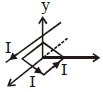
0 likesView Solution
219
PhysicsDifficultMCQJEE Main · 2020
$A$ galvanometer of resistance $G$ is converted into a voltmeter of range $0-1\, V$ by connecting a resistance $R_{1}$ in series with it. The additional resistance that should be connected in series with $R_{1}$ to increase the range of the voltmeter to $0-2\, V$ will be
A
$R_{1}$
B
$R_{1}+G$
C
$R_{1}-G$
D
$G$
Solution
(B) Let $i_{g}$ be the full-scale deflection current of the galvanometer.
For the first case,the range is $0-1\, V$ with resistance $R_{1}$ in series:
$1 = i_{g}(G + R_{1}) \quad \dots(1)$
For the second case,the range is $0-2\, V$ with an additional resistance $R_{2}$ in series:
$2 = i_{g}(G + R_{1} + R_{2}) \quad \dots(2)$
Dividing equation $(2)$ by equation $(1)$:
$\frac{2}{1} = \frac{i_{g}(G + R_{1} + R_{2})}{i_{g}(G + R_{1})}$
$2 = \frac{G + R_{1} + R_{2}}{G + R_{1}}$
$2(G + R_{1}) = G + R_{1} + R_{2}$
$2G + 2R_{1} = G + R_{1} + R_{2}$
$R_{2} = G + R_{1}$
Thus,the additional resistance required is $G + R_{1}$.
For the first case,the range is $0-1\, V$ with resistance $R_{1}$ in series:
$1 = i_{g}(G + R_{1}) \quad \dots(1)$
For the second case,the range is $0-2\, V$ with an additional resistance $R_{2}$ in series:
$2 = i_{g}(G + R_{1} + R_{2}) \quad \dots(2)$
Dividing equation $(2)$ by equation $(1)$:
$\frac{2}{1} = \frac{i_{g}(G + R_{1} + R_{2})}{i_{g}(G + R_{1})}$
$2 = \frac{G + R_{1} + R_{2}}{G + R_{1}}$
$2(G + R_{1}) = G + R_{1} + R_{2}$
$2G + 2R_{1} = G + R_{1} + R_{2}$
$R_{2} = G + R_{1}$
Thus,the additional resistance required is $G + R_{1}$.
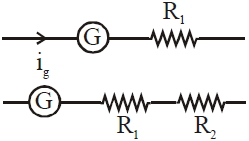
0 likesView Solution
220
PhysicsMediumMCQJEE Main · 2020
An electron is constrained to move along the $y$-axis with a speed of $0.1 c$ ($c$ is the speed of light) in the presence of an electromagnetic wave,whose electric field is $\overrightarrow{E} = 30 \hat{j} \sin(1.5 \times 10^7 t - 5 \times 10^{-2} x) \, V/m$. The maximum magnetic force experienced by the electron will be: (given $c = 3 \times 10^8 \, m/s$ and electron charge $q = 1.6 \times 10^{-19} \, C$)
A
$1.6 \times 10^{-19} \, N$
B
$4.8 \times 10^{-19} \, N$
C
$3.2 \times 10^{-18} \, N$
D
$2.4 \times 10^{-18} \, N$
Solution
(B) The electric field is given by $\overrightarrow{E} = E_0 \sin(kx - \omega t) \hat{j}$,where $E_0 = 30 \, V/m$,$\omega = 1.5 \times 10^7 \, rad/s$,and $k = 5 \times 10^{-2} \, rad/m$.
The amplitude of the magnetic field $B_0$ is related to the electric field amplitude $E_0$ by $B_0 = \frac{E_0}{c}$.
$B_0 = \frac{30}{3 \times 10^8} = 10^{-7} \, T$.
The electron moves along the $y$-axis with velocity $\overrightarrow{v} = 0.1 c \hat{j} = 0.1 \times 3 \times 10^8 \hat{j} = 3 \times 10^7 \hat{j} \, m/s$.
The magnetic force is given by $\overrightarrow{F}_{mag} = q(\overrightarrow{v} \times \overrightarrow{B})$. Since $\overrightarrow{v}$ is along the $y$-axis and $\overrightarrow{E}$ is along the $y$-axis,the wave propagates along the $x$-axis. The magnetic field $\overrightarrow{B}$ must be perpendicular to both the direction of propagation ($x$-axis) and the electric field ($y$-axis),so $\overrightarrow{B}$ is along the $z$-axis.
$F_{max} = q v B_0 = (1.6 \times 10^{-19} \, C) \times (3 \times 10^7 \, m/s) \times (10^{-7} \, T)$.
$F_{max} = 1.6 \times 3 \times 10^{-19} = 4.8 \times 10^{-19} \, N$.
The amplitude of the magnetic field $B_0$ is related to the electric field amplitude $E_0$ by $B_0 = \frac{E_0}{c}$.
$B_0 = \frac{30}{3 \times 10^8} = 10^{-7} \, T$.
The electron moves along the $y$-axis with velocity $\overrightarrow{v} = 0.1 c \hat{j} = 0.1 \times 3 \times 10^8 \hat{j} = 3 \times 10^7 \hat{j} \, m/s$.
The magnetic force is given by $\overrightarrow{F}_{mag} = q(\overrightarrow{v} \times \overrightarrow{B})$. Since $\overrightarrow{v}$ is along the $y$-axis and $\overrightarrow{E}$ is along the $y$-axis,the wave propagates along the $x$-axis. The magnetic field $\overrightarrow{B}$ must be perpendicular to both the direction of propagation ($x$-axis) and the electric field ($y$-axis),so $\overrightarrow{B}$ is along the $z$-axis.
$F_{max} = q v B_0 = (1.6 \times 10^{-19} \, C) \times (3 \times 10^7 \, m/s) \times (10^{-7} \, T)$.
$F_{max} = 1.6 \times 3 \times 10^{-19} = 4.8 \times 10^{-19} \, N$.
0 likesView Solution
221
PhysicsDifficultMCQJEE Main · 2020
Two capacitors of capacitances $C$ and $2C$ are charged to potential differences $V$ and $2V$,respectively. These are then connected in parallel in such a manner that the positive terminal of one is connected to the negative terminal of the other. The final energy of this configuration is $.....CV^2$.
A
$4.5$
B
$4.16$
C
$0$
D
$1.5$
Solution
(D) Initial charges on the capacitors are:
$Q_1 = C \times V = CV$
$Q_2 = 2C \times 2V = 4CV$
Since they are connected with opposite polarities (positive to negative),the net charge available is:
$Q_{net} = Q_2 - Q_1 = 4CV - CV = 3CV$
When connected in parallel,the equivalent capacitance is:
$C_{eq} = C + 2C = 3C$
The common potential $V_c$ is given by:
$V_c = \frac{Q_{net}}{C_{eq}} = \frac{3CV}{3C} = V$
The final energy $U_f$ stored in the configuration is:
$U_f = \frac{1}{2} C_{eq} V_c^2 = \frac{1}{2} \times (3C) \times V^2 = 1.5 CV^2$
$Q_1 = C \times V = CV$
$Q_2 = 2C \times 2V = 4CV$
Since they are connected with opposite polarities (positive to negative),the net charge available is:
$Q_{net} = Q_2 - Q_1 = 4CV - CV = 3CV$
When connected in parallel,the equivalent capacitance is:
$C_{eq} = C + 2C = 3C$
The common potential $V_c$ is given by:
$V_c = \frac{Q_{net}}{C_{eq}} = \frac{3CV}{3C} = V$
The final energy $U_f$ stored in the configuration is:
$U_f = \frac{1}{2} C_{eq} V_c^2 = \frac{1}{2} \times (3C) \times V^2 = 1.5 CV^2$
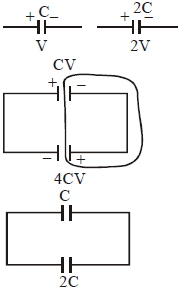
0 likesView Solution
222
PhysicsMediumMCQJEE Main · 2020
Two concentric circular coils,$C_{1}$ and $C_{2}$,are placed in the $XY$ plane. $C_{1}$ has $500$ turns and a radius of $1\; cm$. $C_{2}$ has $200$ turns and a radius of $20\; cm$. $C_{2}$ carries a time-dependent current $I(t) = (5t^{2} - 2t + 3)\; A$,where $t$ is in $s$. The $emf$ induced in $C_{1}$ (in $mV$) at the instant $t = 1\; s$ is $\frac{4}{x}$. The value of $x$ is:
A
$5$
B
$8$
C
$10$
D
$12$
Solution
(B) The magnetic field $B$ at the center of coil $C_{2}$ due to current $I$ is given by $B = \frac{\mu_{0} N_{2} I}{2 R_{2}}$.
The magnetic flux $\phi$ linked with coil $C_{1}$ is $\phi = B \cdot A_{1} \cdot N_{1} = \left( \frac{\mu_{0} N_{2} I}{2 R_{2}} \right) (\pi r_{1}^{2}) N_{1}$.
Substituting the values: $N_{1} = 500$,$r_{1} = 0.01\; m$,$N_{2} = 200$,$R_{2} = 0.2\; m$,$\mu_{0} = 4\pi \times 10^{-7}\; T\cdot m/A$.
$\phi = \frac{(4\pi \times 10^{-7}) \times 200 \times (5t^{2} - 2t + 3)}{2 \times 0.2} \times \pi \times (0.01)^{2} \times 500$.
$\phi = \frac{4\pi^{2} \times 10^{-7} \times 200 \times 500 \times 10^{-4}}{0.4} \times (5t^{2} - 2t + 3) = (10\pi^{2} \times 10^{-6}) \times (5t^{2} - 2t + 3)$.
The induced $emf$ is $\varepsilon = -\frac{d\phi}{dt} = -10\pi^{2} \times 10^{-6} \times (10t - 2)$.
At $t = 1\; s$,$\varepsilon = -10\pi^{2} \times 10^{-6} \times (10(1) - 2) = -80\pi^{2} \times 10^{-6}\; V$.
Taking magnitude,$|\varepsilon| = 80\pi^{2} \times 10^{-6}\; V = 80\pi^{2} \times 10^{-3}\; mV \approx 80 \times 9.87 \times 10^{-3} \approx 0.789\; mV$.
Given $|\varepsilon| = \frac{4}{x} = 0.5\; mV$ (assuming $\pi^{2} \approx 10$),then $x = 8$.
The magnetic flux $\phi$ linked with coil $C_{1}$ is $\phi = B \cdot A_{1} \cdot N_{1} = \left( \frac{\mu_{0} N_{2} I}{2 R_{2}} \right) (\pi r_{1}^{2}) N_{1}$.
Substituting the values: $N_{1} = 500$,$r_{1} = 0.01\; m$,$N_{2} = 200$,$R_{2} = 0.2\; m$,$\mu_{0} = 4\pi \times 10^{-7}\; T\cdot m/A$.
$\phi = \frac{(4\pi \times 10^{-7}) \times 200 \times (5t^{2} - 2t + 3)}{2 \times 0.2} \times \pi \times (0.01)^{2} \times 500$.
$\phi = \frac{4\pi^{2} \times 10^{-7} \times 200 \times 500 \times 10^{-4}}{0.4} \times (5t^{2} - 2t + 3) = (10\pi^{2} \times 10^{-6}) \times (5t^{2} - 2t + 3)$.
The induced $emf$ is $\varepsilon = -\frac{d\phi}{dt} = -10\pi^{2} \times 10^{-6} \times (10t - 2)$.
At $t = 1\; s$,$\varepsilon = -10\pi^{2} \times 10^{-6} \times (10(1) - 2) = -80\pi^{2} \times 10^{-6}\; V$.
Taking magnitude,$|\varepsilon| = 80\pi^{2} \times 10^{-6}\; V = 80\pi^{2} \times 10^{-3}\; mV \approx 80 \times 9.87 \times 10^{-3} \approx 0.789\; mV$.
Given $|\varepsilon| = \frac{4}{x} = 0.5\; mV$ (assuming $\pi^{2} \approx 10$),then $x = 8$.

0 likesView Solution
223
PhysicsMediumMCQJEE Main · 2020
$A$ beam of electrons of energy $E$ scatters from a target having atomic spacing of $1 \, Å$. The first maximum intensity occurs at $\theta = 60^{\circ}$. Then $E$ (in $eV$) is: (Planck constant $h = 6.64 \times 10^{-34} \, Js$, $1 \, eV = 1.6 \times 10^{-19} \, J$, electron mass $m = 9.1 \times 10^{-31} \, kg$)
A
$57$
B
$65$
C
$50$
D
$51$
Solution
(C) According to Bragg's law for diffraction, $2d \sin \theta = n\lambda$. For the first maximum, $n = 1$, so $2d \sin \theta = \lambda$.
Given $d = 1 \, Å = 10^{-10} \, m$ and $\theta = 60^{\circ}$.
Thus, $\lambda = 2 \times 10^{-10} \times \sin(60^{\circ}) = 2 \times 10^{-10} \times \frac{\sqrt{3}}{2} = \sqrt{3} \times 10^{-10} \, m$.
Using the de Broglie wavelength formula, $\lambda = \frac{h}{\sqrt{2mE}}$, we have $\sqrt{2mE} = \frac{h}{\lambda}$.
Squaring both sides, $2mE = \frac{h^2}{\lambda^2}$, so $E = \frac{h^2}{2m\lambda^2}$.
Substituting the values: $E = \frac{(6.64 \times 10^{-34})^2}{2 \times 9.1 \times 10^{-31} \times (\sqrt{3} \times 10^{-10})^2} = \frac{44.0896 \times 10^{-68}}{2 \times 9.1 \times 10^{-31} \times 3 \times 10^{-20}} = \frac{44.0896 \times 10^{-68}}{54.6 \times 10^{-51}} \approx 0.8075 \times 10^{-17} \, J$.
To convert to $eV$, divide by $1.6 \times 10^{-19} \, J/eV$:
$E = \frac{0.8075 \times 10^{-17}}{1.6 \times 10^{-19}} \approx 50.47 \, eV$.
Rounding to the nearest integer, $E \approx 50 \, eV$.
Given $d = 1 \, Å = 10^{-10} \, m$ and $\theta = 60^{\circ}$.
Thus, $\lambda = 2 \times 10^{-10} \times \sin(60^{\circ}) = 2 \times 10^{-10} \times \frac{\sqrt{3}}{2} = \sqrt{3} \times 10^{-10} \, m$.
Using the de Broglie wavelength formula, $\lambda = \frac{h}{\sqrt{2mE}}$, we have $\sqrt{2mE} = \frac{h}{\lambda}$.
Squaring both sides, $2mE = \frac{h^2}{\lambda^2}$, so $E = \frac{h^2}{2m\lambda^2}$.
Substituting the values: $E = \frac{(6.64 \times 10^{-34})^2}{2 \times 9.1 \times 10^{-31} \times (\sqrt{3} \times 10^{-10})^2} = \frac{44.0896 \times 10^{-68}}{2 \times 9.1 \times 10^{-31} \times 3 \times 10^{-20}} = \frac{44.0896 \times 10^{-68}}{54.6 \times 10^{-51}} \approx 0.8075 \times 10^{-17} \, J$.
To convert to $eV$, divide by $1.6 \times 10^{-19} \, J/eV$:
$E = \frac{0.8075 \times 10^{-17}}{1.6 \times 10^{-19}} \approx 50.47 \, eV$.
Rounding to the nearest integer, $E \approx 50 \, eV$.
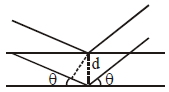
0 likesView Solution
224
PhysicsMediumMCQJEE Main · 2020
$A$ particle of mass $200 \, MeV/c^2$ collides with a hydrogen atom at rest. Soon after the collision,the particle comes to rest,and the atom recoils and goes to its first excited state. The initial kinetic energy of the particle (in $eV$) is $\frac{N}{4}$. The value of $N$ is: (Given the mass of the hydrogen atom to be $1 \, GeV/c^2$)
A
$55$
B
$65$
C
$60$
D
$51$
Solution
(D) Let $m = 200 \, MeV/c^2$ be the mass of the particle and $M = 1000 \, MeV/c^2$ be the mass of the hydrogen atom.
Let $v$ be the initial velocity of the particle and $V$ be the recoil velocity of the atom.
By conservation of linear momentum: $mv = MV = p$,where $p$ is the momentum.
The energy required to excite the hydrogen atom to its first excited state is $\Delta E = 13.6 \, eV \times (1 - 1/4) = 10.2 \, eV$.
By conservation of energy: $K_{initial} = K_{final} + \Delta E$.
$K_{initial} = \frac{p^2}{2m}$ and $K_{final} = \frac{p^2}{2M}$.
Thus,$\frac{p^2}{2m} - \frac{p^2}{2M} = 10.2 \, eV$.
$\frac{p^2}{2m} (1 - \frac{m}{M}) = 10.2 \, eV$.
Given $m/M = 200/1000 = 0.2$,we have $K_{initial} (1 - 0.2) = 10.2 \, eV$.
$K_{initial} (0.8) = 10.2 \, eV$.
$K_{initial} = \frac{10.2}{0.8} = 12.75 \, eV$.
We are given $K_{initial} = \frac{N}{4}$,so $\frac{N}{4} = 12.75$.
$N = 12.75 \times 4 = 51$.
Let $v$ be the initial velocity of the particle and $V$ be the recoil velocity of the atom.
By conservation of linear momentum: $mv = MV = p$,where $p$ is the momentum.
The energy required to excite the hydrogen atom to its first excited state is $\Delta E = 13.6 \, eV \times (1 - 1/4) = 10.2 \, eV$.
By conservation of energy: $K_{initial} = K_{final} + \Delta E$.
$K_{initial} = \frac{p^2}{2m}$ and $K_{final} = \frac{p^2}{2M}$.
Thus,$\frac{p^2}{2m} - \frac{p^2}{2M} = 10.2 \, eV$.
$\frac{p^2}{2m} (1 - \frac{m}{M}) = 10.2 \, eV$.
Given $m/M = 200/1000 = 0.2$,we have $K_{initial} (1 - 0.2) = 10.2 \, eV$.
$K_{initial} (0.8) = 10.2 \, eV$.
$K_{initial} = \frac{10.2}{0.8} = 12.75 \, eV$.
We are given $K_{initial} = \frac{N}{4}$,so $\frac{N}{4} = 12.75$.
$N = 12.75 \times 4 = 51$.
0 likesView Solution
225
PhysicsMediumMCQJEE Main · 2020
$A$ compound microscope consists of an objective lens of focal length $1 \, cm$ and an eyepiece of focal length $5 \, cm$ with a separation of $10 \, cm$. The distance between an object and the objective lens,at which the strain on the eye is minimum,is $\frac{n}{40} \, cm$. The value of $n$ is $....$
A
$50$
B
$55$
C
$60$
D
$62$
Solution
(A) For minimum strain on the eye,the final image is formed at infinity.
For the eyepiece,the object must be placed at its focal length,so $u_e = -f_e = -5 \, cm$.
The separation between the lenses is $L = 10 \, cm$. The image formed by the objective lens $(v_o)$ acts as the object for the eyepiece.
Thus,$v_o = L - |u_e| = 10 \, cm - 5 \, cm = 5 \, cm$.
Using the lens formula for the objective lens: $\frac{1}{v_o} - \frac{1}{u_o} = \frac{1}{f_o}$.
Substituting the values: $\frac{1}{5} - \frac{1}{u_o} = \frac{1}{1} \Rightarrow -\frac{1}{u_o} = 1 - \frac{1}{5} = \frac{4}{5}$.
Therefore,$u_o = -\frac{5}{4} \, cm$. The distance is $|u_o| = \frac{5}{4} \, cm = \frac{50}{40} \, cm$.
Comparing this with $\frac{n}{40} \, cm$,we get $n = 50$.
For the eyepiece,the object must be placed at its focal length,so $u_e = -f_e = -5 \, cm$.
The separation between the lenses is $L = 10 \, cm$. The image formed by the objective lens $(v_o)$ acts as the object for the eyepiece.
Thus,$v_o = L - |u_e| = 10 \, cm - 5 \, cm = 5 \, cm$.
Using the lens formula for the objective lens: $\frac{1}{v_o} - \frac{1}{u_o} = \frac{1}{f_o}$.
Substituting the values: $\frac{1}{5} - \frac{1}{u_o} = \frac{1}{1} \Rightarrow -\frac{1}{u_o} = 1 - \frac{1}{5} = \frac{4}{5}$.
Therefore,$u_o = -\frac{5}{4} \, cm$. The distance is $|u_o| = \frac{5}{4} \, cm = \frac{50}{40} \, cm$.
Comparing this with $\frac{n}{40} \, cm$,we get $n = 50$.
0 likesView Solution
226
PhysicsMediumMCQJEE Main · 2020
For a plane electromagnetic wave,the magnetic field at a point $x$ and time $t$ is $\overrightarrow{ B }( x , t ) = [1.2 \times 10^{-7} \sin (0.5 \times 10^{3} x + 1.5 \times 10^{11} t) \hat{ k }] \text{ T}$. The instantaneous electric field $\overrightarrow{ E }$ corresponding to $\overrightarrow{ B }$ is: (speed of light $c = 3 \times 10^{8} \text{ m/s}$)
A
$\overrightarrow{ E }( x , t ) = [36 \sin (0.5 \times 10^{3} x + 1.5 \times 10^{11} t) \hat{ k }] \text{ V/m}$
B
$\overrightarrow{ E }( x , t ) = [-36 \sin (0.5 \times 10^{3} x + 1.5 \times 10^{11} t) \hat{ j }] \text{ V/m}$
C
$\overrightarrow{ E }( x , t ) = [-36 \sin (1 \times 10^{3} x + 1.5 \times 10^{11} t) \hat{ j }] \text{ V/m}$
D
$\overrightarrow{ E }( x , t ) = [36 \sin (1 \times 10^{3} x + 1.5 \times 10^{11} t) \hat{ j }] \text{ V/m}$
Solution
(B) For an electromagnetic wave,the magnitude of the electric field $E_0$ is related to the magnetic field $B_0$ by $E_0 = c B_0$.
Given $c = 3 \times 10^{8} \text{ m/s}$ and $B_0 = 1.2 \times 10^{-7} \text{ T}$,we have $E_0 = 3 \times 10^{8} \times 1.2 \times 10^{-7} = 36 \text{ V/m}$.
The wave propagates in the direction of $-x$ because the argument of the sine function is $(kx + \omega t)$.
The magnetic field is along the $\hat{k}$ direction ($z$-axis).
Since the direction of propagation is $\vec{E} \times \vec{B}$,and the propagation is along $-\hat{i}$,we have $\hat{j} \times \hat{k} = \hat{i}$. To get $-\hat{i}$,we need $(-\hat{j}) \times \hat{k} = -\hat{i}$.
Thus,the electric field is $\overrightarrow{ E }( x , t ) = [-36 \sin (0.5 \times 10^{3} x + 1.5 \times 10^{11} t) \hat{ j }] \text{ V/m}$.
Given $c = 3 \times 10^{8} \text{ m/s}$ and $B_0 = 1.2 \times 10^{-7} \text{ T}$,we have $E_0 = 3 \times 10^{8} \times 1.2 \times 10^{-7} = 36 \text{ V/m}$.
The wave propagates in the direction of $-x$ because the argument of the sine function is $(kx + \omega t)$.
The magnetic field is along the $\hat{k}$ direction ($z$-axis).
Since the direction of propagation is $\vec{E} \times \vec{B}$,and the propagation is along $-\hat{i}$,we have $\hat{j} \times \hat{k} = \hat{i}$. To get $-\hat{i}$,we need $(-\hat{j}) \times \hat{k} = -\hat{i}$.
Thus,the electric field is $\overrightarrow{ E }( x , t ) = [-36 \sin (0.5 \times 10^{3} x + 1.5 \times 10^{11} t) \hat{ j }] \text{ V/m}$.
0 likesView Solution
227
PhysicsMediumMCQJEE Main · 2020
$A$ double convex lens has power $P$ and same radii of curvature $R$ of both the surfaces. The radius of curvature of a surface of a plano-convex lens made of the same material with power $1.5P$ is ......$R$.
A
$0.5$
B
$2$
C
$1.5$
D
$0.33$
Solution
(D) For a double convex lens, the radii of curvature are $R_1 = R$ and $R_2 = -R$. Using the lens maker's formula, the power $P$ is given by:
$P = (\mu - 1) \left( \frac{1}{R_1} - \frac{1}{R_2} \right) = (\mu - 1) \left( \frac{1}{R} - \frac{1}{-R} \right) = (\mu - 1) \left( \frac{2}{R} \right) \quad ...(i)$
For a plano-convex lens, the radii of curvature are $R_1' = R'$ and $R_2' = \infty$. The power $P'$ is given by:
$P' = (\mu - 1) \left( \frac{1}{R'} - \frac{1}{\infty} \right) = (\mu - 1) \left( \frac{1}{R'} \right) \quad ...(ii)$
Given that $P' = 1.5P = \frac{3}{2}P$, we substitute the expressions from $(i)$ and $(ii)$:
$(\mu - 1) \left( \frac{1}{R'} \right) = \frac{3}{2} \left[ (\mu - 1) \left( \frac{2}{R} \right) \right]$
$\frac{1}{R'} = \frac{3}{R}$
Therefore, $R' = \frac{R}{3} \approx 0.33R$.
$P = (\mu - 1) \left( \frac{1}{R_1} - \frac{1}{R_2} \right) = (\mu - 1) \left( \frac{1}{R} - \frac{1}{-R} \right) = (\mu - 1) \left( \frac{2}{R} \right) \quad ...(i)$
For a plano-convex lens, the radii of curvature are $R_1' = R'$ and $R_2' = \infty$. The power $P'$ is given by:
$P' = (\mu - 1) \left( \frac{1}{R'} - \frac{1}{\infty} \right) = (\mu - 1) \left( \frac{1}{R'} \right) \quad ...(ii)$
Given that $P' = 1.5P = \frac{3}{2}P$, we substitute the expressions from $(i)$ and $(ii)$:
$(\mu - 1) \left( \frac{1}{R'} \right) = \frac{3}{2} \left[ (\mu - 1) \left( \frac{2}{R} \right) \right]$
$\frac{1}{R'} = \frac{3}{R}$
Therefore, $R' = \frac{R}{3} \approx 0.33R$.

0 likesView Solution
228
PhysicsMediumMCQJEE Main · 2020
$A$ circuit to verify $Ohm's$ law uses an ammeter and a voltmeter. How should they be connected to the resistor?
A
Ammeter is always connected in series and voltmeter in parallel.
B
Both ammeter and voltmeter must be connected in series.
C
Both ammeter and voltmeter must be connected in parallel.
D
Ammeter is always used in parallel and voltmeter in series.
Solution
(A) To verify $Ohm's$ law,we need to measure the current flowing through the resistor and the potential difference across it.
$1$. Ammeter: An ammeter is designed to measure the current flowing through a circuit. To ensure the same current passes through the ammeter as the circuit component,it must be connected in series with the resistor.
$2$. Voltmeter: $A$ voltmeter is designed to measure the potential difference (voltage) between two points. To measure the voltage across a specific resistor,it must be connected in parallel with that resistor.
Therefore,the correct configuration is that the ammeter is connected in series and the voltmeter is connected in parallel.
$1$. Ammeter: An ammeter is designed to measure the current flowing through a circuit. To ensure the same current passes through the ammeter as the circuit component,it must be connected in series with the resistor.
$2$. Voltmeter: $A$ voltmeter is designed to measure the potential difference (voltage) between two points. To measure the voltage across a specific resistor,it must be connected in parallel with that resistor.
Therefore,the correct configuration is that the ammeter is connected in series and the voltmeter is connected in parallel.
0 likesView Solution
229
PhysicsDifficultMCQJEE Main · 2020
Consider the force $F$ on a charge $q$ due to a uniformly charged spherical shell of radius $R$ carrying charge $Q$ distributed uniformly over it. Which one of the following statements is true for $F$,if $q$ is placed at distance $r$ from the centre of the shell?
A
$F = \frac{1}{4 \pi \varepsilon_{0}} \frac{Qq}{r^{2}}$ for $r > R$
B
$\frac{1}{4 \pi \varepsilon_{0}} \frac{qQ}{R^{2}} > F > 0$ for $r < R$
C
$F = \frac{1}{4 \pi \varepsilon_{0}} \frac{Qq}{r^{2}}$ for all $r$
D
$F = \frac{1}{4 \pi \varepsilon_{0}} \frac{Qq}{R^{2}}$ for $r < R$
Solution
(A) According to Gauss's Law,for a uniformly charged spherical shell of radius $R$ and total charge $Q$:
$1$. For points outside the shell $(r > R)$,the shell behaves as if all its charge is concentrated at the centre. Thus,the electric field is $E = \frac{1}{4 \pi \varepsilon_{0}} \frac{Q}{r^{2}}$. The force on a charge $q$ is $F = qE = \frac{1}{4 \pi \varepsilon_{0}} \frac{Qq}{r^{2}}$.
$2$. For points inside the shell $(r < R)$,the electric field due to the shell is zero $(E = 0)$. Therefore,the force on a charge $q$ placed inside is $F = qE = 0$.
Comparing these results with the given options,statement $A$ is correct.
$1$. For points outside the shell $(r > R)$,the shell behaves as if all its charge is concentrated at the centre. Thus,the electric field is $E = \frac{1}{4 \pi \varepsilon_{0}} \frac{Q}{r^{2}}$. The force on a charge $q$ is $F = qE = \frac{1}{4 \pi \varepsilon_{0}} \frac{Qq}{r^{2}}$.
$2$. For points inside the shell $(r < R)$,the electric field due to the shell is zero $(E = 0)$. Therefore,the force on a charge $q$ placed inside is $F = qE = 0$.
Comparing these results with the given options,statement $A$ is correct.
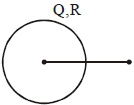
0 likesView Solution
230
PhysicsMediumMCQJEE Main · 2020
Given the masses of various atomic particles $m_{p} = 1.0072 \ u$,$m_{n} = 1.0087 \ u$,$m_{e} = 0.000548 \ u$,$m_{\bar{v}} = 0$,and $m_{d} = 2.0141 \ u$,where $p \equiv$ proton,$n \equiv$ neutron,$e \equiv$ electron,$\bar{v} \equiv$ antineutrino,and $d \equiv$ deuteron. Which of the following processes is allowed by momentum and energy conservation?
A
$n + p \rightarrow d + \gamma$
B
$e^{+} + e^{-} \rightarrow \gamma$
C
$n + n \rightarrow$ deuterium atom (electron bound to the nucleus)
D
$p \rightarrow n + e^{+} + \bar{v}$
Solution
(A) For a process to be allowed by energy conservation,the mass of the reactants must be greater than or equal to the mass of the products (considering the energy equivalent of mass).
Let us evaluate $A$: $n + p \rightarrow d + \gamma$.
Mass of reactants: $m_{n} + m_{p} = 1.0087 + 1.0072 = 2.0159 \ u$.
Mass of product: $m_{d} = 2.0141 \ u$.
Since $2.0159 \ u > 2.0141 \ u$,the mass difference is released as energy (photon $\gamma$),satisfying conservation laws.
Evaluating $B$: $e^{+} + e^{-} \rightarrow \gamma$ violates momentum conservation (a single photon cannot conserve both energy and momentum in the center-of-mass frame).
Evaluating $D$: $p \rightarrow n + e^{+} + \bar{v}$ is not possible for a free proton because $m_{p} < m_{n} + m_{e}$.
Thus,the correct process is $A$.
Let us evaluate $A$: $n + p \rightarrow d + \gamma$.
Mass of reactants: $m_{n} + m_{p} = 1.0087 + 1.0072 = 2.0159 \ u$.
Mass of product: $m_{d} = 2.0141 \ u$.
Since $2.0159 \ u > 2.0141 \ u$,the mass difference is released as energy (photon $\gamma$),satisfying conservation laws.
Evaluating $B$: $e^{+} + e^{-} \rightarrow \gamma$ violates momentum conservation (a single photon cannot conserve both energy and momentum in the center-of-mass frame).
Evaluating $D$: $p \rightarrow n + e^{+} + \bar{v}$ is not possible for a free proton because $m_{p} < m_{n} + m_{e}$.
Thus,the correct process is $A$.
0 likesView Solution
231
PhysicsMediumMCQJEE Main · 2020
Two identical electric point dipoles have dipole moments $\overrightarrow{p}_{1} = p\hat{i}$ and $\overrightarrow{p}_{2} = -p\hat{i}$ and are held on the $x$-axis at a distance $'a'$ from each other. When released,they move along the $x$-axis with the direction of their dipole moments remaining unchanged. If the mass of each dipole is $'m'$,their speed when they are infinitely far apart is
A
$\frac{p}{a} \sqrt{\frac{1}{\pi \varepsilon_{0} ma}}$
B
$\frac{p}{a} \sqrt{\frac{3}{2 \pi \varepsilon_{0} ma}}$
C
$\frac{p}{a} \sqrt{\frac{1}{2 \pi \varepsilon_{0} ma}}$
D
$\frac{p}{a} \sqrt{\frac{2}{\pi \varepsilon_{0} ma}}$
Solution
(C) The potential energy of two dipoles $\overrightarrow{p}_{1}$ and $\overrightarrow{p}_{2}$ separated by distance $r$ along the $x$-axis is given by $U = \frac{1}{4\pi\varepsilon_{0}} \left[ \frac{\overrightarrow{p}_{1} \cdot \overrightarrow{p}_{2} - 3(\overrightarrow{p}_{1} \cdot \hat{r})(\overrightarrow{p}_{2} \cdot \hat{r})}{r^{3}} \right]$.
Here,$\overrightarrow{p}_{1} = p\hat{i}$,$\overrightarrow{p}_{2} = -p\hat{i}$,and $\hat{r} = \hat{i}$.
So,$U = \frac{1}{4\pi\varepsilon_{0}} \left[ \frac{(p\hat{i}) \cdot (-p\hat{i}) - 3(p\hat{i} \cdot \hat{i})(-p\hat{i} \cdot \hat{i})}{a^{3}} \right] = \frac{1}{4\pi\varepsilon_{0}} \left[ \frac{-p^{2} - 3(p)(-p)}{a^{3}} \right] = \frac{1}{4\pi\varepsilon_{0}} \left[ \frac{2p^{2}}{a^{3}} \right] = \frac{p^{2}}{2\pi\varepsilon_{0}a^{3}}$.
By conservation of energy,$KE_{i} + PE_{i} = KE_{f} + PE_{f}$.
Initially,$KE_{i} = 0$ and $PE_{i} = \frac{p^{2}}{2\pi\varepsilon_{0}a^{3}}$.
Finally,at infinite separation,$PE_{f} = 0$ and $KE_{f} = 2 \times (\frac{1}{2}mv^{2}) = mv^{2}$.
Thus,$0 + \frac{p^{2}}{2\pi\varepsilon_{0}a^{3}} = mv^{2} + 0$.
$v^{2} = \frac{p^{2}}{2\pi\varepsilon_{0}ma^{3}}$.
$v = \frac{p}{a} \sqrt{\frac{1}{2\pi\varepsilon_{0}ma}}$.
Here,$\overrightarrow{p}_{1} = p\hat{i}$,$\overrightarrow{p}_{2} = -p\hat{i}$,and $\hat{r} = \hat{i}$.
So,$U = \frac{1}{4\pi\varepsilon_{0}} \left[ \frac{(p\hat{i}) \cdot (-p\hat{i}) - 3(p\hat{i} \cdot \hat{i})(-p\hat{i} \cdot \hat{i})}{a^{3}} \right] = \frac{1}{4\pi\varepsilon_{0}} \left[ \frac{-p^{2} - 3(p)(-p)}{a^{3}} \right] = \frac{1}{4\pi\varepsilon_{0}} \left[ \frac{2p^{2}}{a^{3}} \right] = \frac{p^{2}}{2\pi\varepsilon_{0}a^{3}}$.
By conservation of energy,$KE_{i} + PE_{i} = KE_{f} + PE_{f}$.
Initially,$KE_{i} = 0$ and $PE_{i} = \frac{p^{2}}{2\pi\varepsilon_{0}a^{3}}$.
Finally,at infinite separation,$PE_{f} = 0$ and $KE_{f} = 2 \times (\frac{1}{2}mv^{2}) = mv^{2}$.
Thus,$0 + \frac{p^{2}}{2\pi\varepsilon_{0}a^{3}} = mv^{2} + 0$.
$v^{2} = \frac{p^{2}}{2\pi\varepsilon_{0}ma^{3}}$.
$v = \frac{p}{a} \sqrt{\frac{1}{2\pi\varepsilon_{0}ma}}$.
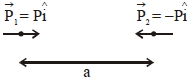
0 likesView Solution
232
PhysicsMediumMCQJEE Main · 2020
In the figure shown,the current in the $10 \, V$ battery is close to
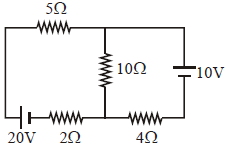
A
$0.36 \, A$ from negative to positive terminal.
B
$0.71 \, A$ from positive to negative terminal.
C
$0.21 \, A$ from positive to negative terminal.
D
$0.42 \, A$ from positive to negative terminal.
Solution
(C) To find the current in the $10 \, V$ battery,we can simplify the circuit using Thevenin's theorem or nodal analysis. Let the node between the $5 \, \Omega$ and $10 \, \Omega$ resistors be $A$ and the bottom node be $B$.
Applying Kirchhoff's Current Law at the node above the $10 \, \Omega$ resistor,let the potential be $V$.
$\frac{V - 20}{5 + 2} + \frac{V}{10} + \frac{V - 10}{4} = 0$
$\frac{V - 20}{7} + \frac{V}{10} + \frac{V - 10}{4} = 0$
Multiplying by $140$ ($LCM$ of $7, 10, 4$):
$20(V - 20) + 14V + 35(V - 10) = 0$
$20V - 400 + 14V + 35V - 350 = 0$
$69V = 750$
$V = \frac{750}{69} \approx 10.87 \, V$
The current $I$ through the $10 \, V$ battery is $I = \frac{V - 10}{4} = \frac{10.87 - 10}{4} = \frac{0.87}{4} = 0.2175 \, A$.
Since the potential $V$ is greater than $10 \, V$,the current flows from the positive terminal to the negative terminal.
Applying Kirchhoff's Current Law at the node above the $10 \, \Omega$ resistor,let the potential be $V$.
$\frac{V - 20}{5 + 2} + \frac{V}{10} + \frac{V - 10}{4} = 0$
$\frac{V - 20}{7} + \frac{V}{10} + \frac{V - 10}{4} = 0$
Multiplying by $140$ ($LCM$ of $7, 10, 4$):
$20(V - 20) + 14V + 35(V - 10) = 0$
$20V - 400 + 14V + 35V - 350 = 0$
$69V = 750$
$V = \frac{750}{69} \approx 10.87 \, V$
The current $I$ through the $10 \, V$ battery is $I = \frac{V - 10}{4} = \frac{10.87 - 10}{4} = \frac{0.87}{4} = 0.2175 \, A$.
Since the potential $V$ is greater than $10 \, V$,the current flows from the positive terminal to the negative terminal.
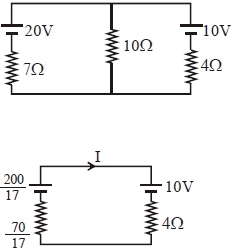
0 likesView Solution
233
PhysicsDifficultMCQJEE Main · 2020
Assuming the nitrogen molecule is moving with $r.m.s.$ velocity at $400 \ K$, the de$-$Broglie wavelength of the nitrogen molecule is close to $...... \ \mathring{A}$. (Given: nitrogen molecule mass: $4.64 \times 10^{-26} \ kg$, Boltzmann constant: $1.38 \times 10^{-23} \ J/K$, Planck constant: $6.63 \times 10^{-34} \ J \cdot s$)
A
$0.34$
B
$0.24$
C
$0.20$
D
$0.44$
Solution
(B) The $r.m.s.$ velocity of a gas molecule is given by $v_{rms} = \sqrt{\frac{3kT}{m}}$.
The de$-$Broglie wavelength is given by $\lambda = \frac{h}{mv}$.
Substituting $v_{rms}$ for $v$, we get $\lambda = \frac{h}{m \sqrt{\frac{3kT}{m}}} = \frac{h}{\sqrt{3kTm}}$.
Given values: $h = 6.63 \times 10^{-34} \ J \cdot s$, $k = 1.38 \times 10^{-23} \ J/K$, $T = 400 \ K$, and $m = 4.64 \times 10^{-26} \ kg$.
Calculating the denominator: $\sqrt{3 \times 1.38 \times 10^{-23} \times 400 \times 4.64 \times 10^{-26}} = \sqrt{7.68768 \times 10^{-45}} \approx 2.77 \times 10^{-22} \ kg \cdot m/s$.
Now, $\lambda = \frac{6.63 \times 10^{-34}}{2.77 \times 10^{-22}} \approx 2.39 \times 10^{-11} \ m$.
Converting to $\mathring{A}$s: $2.39 \times 10^{-11} \ m = 0.239 \ \mathring{A} \approx 0.24 \ \mathring{A}$.
The de$-$Broglie wavelength is given by $\lambda = \frac{h}{mv}$.
Substituting $v_{rms}$ for $v$, we get $\lambda = \frac{h}{m \sqrt{\frac{3kT}{m}}} = \frac{h}{\sqrt{3kTm}}$.
Given values: $h = 6.63 \times 10^{-34} \ J \cdot s$, $k = 1.38 \times 10^{-23} \ J/K$, $T = 400 \ K$, and $m = 4.64 \times 10^{-26} \ kg$.
Calculating the denominator: $\sqrt{3 \times 1.38 \times 10^{-23} \times 400 \times 4.64 \times 10^{-26}} = \sqrt{7.68768 \times 10^{-45}} \approx 2.77 \times 10^{-22} \ kg \cdot m/s$.
Now, $\lambda = \frac{6.63 \times 10^{-34}}{2.77 \times 10^{-22}} \approx 2.39 \times 10^{-11} \ m$.
Converting to $\mathring{A}$s: $2.39 \times 10^{-11} \ m = 0.239 \ \mathring{A} \approx 0.24 \ \mathring{A}$.
0 likesView Solution
234
PhysicsDifficultMCQJEE Main · 2020
$A$ charged particle going around in a circle can be considered to be a current loop. $A$ particle of mass $m$ carrying charge $q$ is moving in a plane with speed $v$ under the influence of magnetic field $\overrightarrow{ B }$. The magnetic moment of this moving particle is:
A
$-\frac{ mv ^{2} \overrightarrow{ B }}{ B ^{2}}$
B
$-\frac{m v^{2} \vec{B}}{2 \pi B^{2}}$
C
$\frac{m v^{2} \vec{B}}{2 B^{2}}$
D
$-\frac{m v^{2} \vec{B}}{2 B^{2}}$
Solution
(D) The magnetic moment $M$ of a current loop is given by $M = iA$,where $i$ is the current and $A$ is the area of the loop.
For a particle of charge $q$ moving in a circle of radius $r$ with speed $v$,the time period $T$ is $T = \frac{2 \pi r}{v}$.
The equivalent current is $i = \frac{q}{T} = \frac{qv}{2 \pi r}$.
The area of the loop is $A = \pi r^2$.
Thus,the magnitude of the magnetic moment is $M = iA = \left( \frac{qv}{2 \pi r} \right) \times (\pi r^2) = \frac{qvr}{2}$.
For a charged particle moving in a magnetic field,the radius of the circular path is $r = \frac{mv}{qB}$.
Substituting $r$ into the expression for $M$,we get $M = \frac{qv}{2} \times \left( \frac{mv}{qB} \right) = \frac{mv^2}{2B}$.
From the right-hand rule,the direction of the magnetic moment is opposite to the direction of the magnetic field for a positively charged particle moving in a circle. Therefore,in vector form,$\overrightarrow{M} = -\frac{mv^2}{2B} \hat{B}$.
Since $\hat{B} = \frac{\vec{B}}{B}$,we have $\overrightarrow{M} = -\frac{mv^2}{2B} \left( \frac{\vec{B}}{B} \right) = -\frac{mv^2 \vec{B}}{2B^2}$.
For a particle of charge $q$ moving in a circle of radius $r$ with speed $v$,the time period $T$ is $T = \frac{2 \pi r}{v}$.
The equivalent current is $i = \frac{q}{T} = \frac{qv}{2 \pi r}$.
The area of the loop is $A = \pi r^2$.
Thus,the magnitude of the magnetic moment is $M = iA = \left( \frac{qv}{2 \pi r} \right) \times (\pi r^2) = \frac{qvr}{2}$.
For a charged particle moving in a magnetic field,the radius of the circular path is $r = \frac{mv}{qB}$.
Substituting $r$ into the expression for $M$,we get $M = \frac{qv}{2} \times \left( \frac{mv}{qB} \right) = \frac{mv^2}{2B}$.
From the right-hand rule,the direction of the magnetic moment is opposite to the direction of the magnetic field for a positively charged particle moving in a circle. Therefore,in vector form,$\overrightarrow{M} = -\frac{mv^2}{2B} \hat{B}$.
Since $\hat{B} = \frac{\vec{B}}{B}$,we have $\overrightarrow{M} = -\frac{mv^2}{2B} \left( \frac{\vec{B}}{B} \right) = -\frac{mv^2 \vec{B}}{2B^2}$.
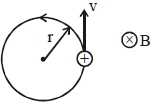
0 likesView Solution
235
PhysicsDifficultMCQJEE Main · 2020
$A$ square loop of side $2a$ carrying current $I$ is kept in the $xz$-plane with its centre at the origin. $A$ long wire carrying the same current $I$ is placed parallel to the $z$-axis and passes through the point $(0, b, 0)$,where $b \gg a$. The magnitude of the torque on the loop about the $z$-axis is:
A
$\frac{2 \mu_{0} I^{2} a^{2} b}{\pi(a^{2}+b^{2})}$
B
$\frac{\mu_{0} I^{2} a^{2} b}{2 \pi(a^{2}+b^{2})}$
C
$\frac{\mu_{0} I^{2} a^{2}}{2 \pi b}$
D
$\frac{2 \mu_{0} I^{2} a^{2}}{\pi b}$
Solution
(A) The magnetic field $B$ produced by the long wire at a distance $r$ is given by $B = \frac{\mu_{0} I}{2 \pi r}$.
For the two sides of the loop parallel to the $z$-axis,the distance from the wire is $r = \sqrt{b^2 + a^2}$.
The force on each of these sides is $F = B I (2a) = \frac{\mu_{0} I}{2 \pi \sqrt{b^2 + a^2}} \cdot I \cdot 2a = \frac{\mu_{0} I^2 a}{\pi \sqrt{b^2 + a^2}}$.
The torque $\tau$ about the $z$-axis is produced by the vertical components of these forces. The component of force perpendicular to the lever arm is $F \cos \theta$,where $\cos \theta = \frac{b}{\sqrt{b^2 + a^2}}$.
The total torque is $\tau = 2 \cdot (F \cos \theta) \cdot a = 2 \cdot \left( \frac{\mu_{0} I^2 a}{\pi \sqrt{b^2 + a^2}} \right) \cdot \left( \frac{b}{\sqrt{b^2 + a^2}} \right) \cdot a$.
Simplifying this,we get $\tau = \frac{2 \mu_{0} I^2 a^2 b}{\pi (a^2 + b^2)}$.
For the two sides of the loop parallel to the $z$-axis,the distance from the wire is $r = \sqrt{b^2 + a^2}$.
The force on each of these sides is $F = B I (2a) = \frac{\mu_{0} I}{2 \pi \sqrt{b^2 + a^2}} \cdot I \cdot 2a = \frac{\mu_{0} I^2 a}{\pi \sqrt{b^2 + a^2}}$.
The torque $\tau$ about the $z$-axis is produced by the vertical components of these forces. The component of force perpendicular to the lever arm is $F \cos \theta$,where $\cos \theta = \frac{b}{\sqrt{b^2 + a^2}}$.
The total torque is $\tau = 2 \cdot (F \cos \theta) \cdot a = 2 \cdot \left( \frac{\mu_{0} I^2 a}{\pi \sqrt{b^2 + a^2}} \right) \cdot \left( \frac{b}{\sqrt{b^2 + a^2}} \right) \cdot a$.
Simplifying this,we get $\tau = \frac{2 \mu_{0} I^2 a^2 b}{\pi (a^2 + b^2)}$.
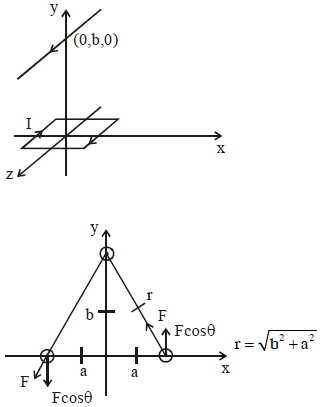
0 likesView Solution
236
PhysicsMediumMCQJEE Main · 2020
The output characteristics of a transistor are shown in the figure. When $V_{CE} = 10\, V$ and $I_{C} = 4.0\, mA$,then the value of $\beta_{ac}$ is:
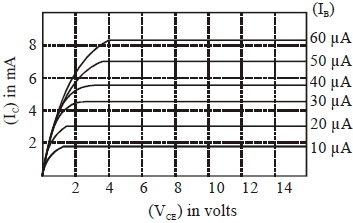
A
$130$
B
$125$
C
$150$
D
$100$
Solution
(C) The $AC$ current gain $\beta_{ac}$ is defined as the ratio of the change in collector current $\Delta I_{C}$ to the change in base current $\Delta I_{B}$ at a constant collector-emitter voltage $V_{CE}$.
From the graph,at $V_{CE} = 10\, V$,the collector current $I_{C} = 4.0\, mA$ corresponds to a base current $I_{B} = 30\, \mu A$.
To find $\beta_{ac}$ around this operating point,we consider the adjacent curves for $I_{B} = 20\, \mu A$ and $I_{B} = 40\, \mu A$.
At $V_{CE} = 10\, V$:
For $I_{B} = 20\, \mu A$,$I_{C} = 3.0\, mA$.
For $I_{B} = 40\, \mu A$,$I_{C} = 6.0\, mA$.
Therefore,the change in base current is $\Delta I_{B} = 40\, \mu A - 20\, \mu A = 20\, \mu A = 20 \times 10^{-6}\, A$.
The change in collector current is $\Delta I_{C} = 6.0\, mA - 3.0\, mA = 3.0\, mA = 3.0 \times 10^{-3}\, A$.
The $AC$ current gain is $\beta_{ac} = \frac{\Delta I_{C}}{\Delta I_{B}} = \frac{3.0 \times 10^{-3}}{20 \times 10^{-6}} = \frac{3000}{20} = 150$.
From the graph,at $V_{CE} = 10\, V$,the collector current $I_{C} = 4.0\, mA$ corresponds to a base current $I_{B} = 30\, \mu A$.
To find $\beta_{ac}$ around this operating point,we consider the adjacent curves for $I_{B} = 20\, \mu A$ and $I_{B} = 40\, \mu A$.
At $V_{CE} = 10\, V$:
For $I_{B} = 20\, \mu A$,$I_{C} = 3.0\, mA$.
For $I_{B} = 40\, \mu A$,$I_{C} = 6.0\, mA$.
Therefore,the change in base current is $\Delta I_{B} = 40\, \mu A - 20\, \mu A = 20\, \mu A = 20 \times 10^{-6}\, A$.
The change in collector current is $\Delta I_{C} = 6.0\, mA - 3.0\, mA = 3.0\, mA = 3.0 \times 10^{-3}\, A$.
The $AC$ current gain is $\beta_{ac} = \frac{\Delta I_{C}}{\Delta I_{B}} = \frac{3.0 \times 10^{-3}}{20 \times 10^{-6}} = \frac{3000}{20} = 150$.
0 likesView Solution
237
PhysicsMediumMCQJEE Main · 2020
In a series $LR$ circuit,power of $400 \ W$ is dissipated from a source of $250 \ V, 50 \ Hz$. The power factor of the circuit is $0.8$. In order to bring the power factor to unity,a capacitor of value $C$ is added in series to the $L$ and $R$. Taking the value of $C$ as $(\frac{n}{3 \pi}) \mu F$,then the value of $n$ is $......$
A
$200$
B
$250$
C
$350$
D
$400$
Solution
(D) Given: $P = 400 \ W$,$V_{rms} = 250 \ V$,$f = 50 \ Hz$,$\cos \phi = 0.8$.
$1$. Calculate impedance $Z$:
$P = V_{rms} I_{rms} \cos \phi = \frac{V_{rms}^2}{Z} \cos \phi$
$400 = \frac{250^2}{Z} \times 0.8$
$Z = \frac{62500 \times 0.8}{400} = \frac{50000}{400} = 125 \ \Omega$.
$2$. Calculate resistance $R$ and inductive reactance $X_L$:
$R = Z \cos \phi = 125 \times 0.8 = 100 \ \Omega$.
$X_L = Z \sin \phi = 125 \times \sqrt{1 - 0.8^2} = 125 \times 0.6 = 75 \ \Omega$.
$3$. For unity power factor,the circuit must be in resonance,so $X_C = X_L = 75 \ \Omega$.
$X_C = \frac{1}{2 \pi f C} = 75$
$C = \frac{1}{2 \pi \times 50 \times 75} = \frac{1}{7500 \pi} \ F = \frac{10^6}{7500 \pi} \ \mu F = \frac{10000}{75 \pi} \ \mu F = \frac{400}{3 \pi} \ \mu F$.
Comparing with $C = (\frac{n}{3 \pi}) \ \mu F$,we get $n = 400$.
$1$. Calculate impedance $Z$:
$P = V_{rms} I_{rms} \cos \phi = \frac{V_{rms}^2}{Z} \cos \phi$
$400 = \frac{250^2}{Z} \times 0.8$
$Z = \frac{62500 \times 0.8}{400} = \frac{50000}{400} = 125 \ \Omega$.
$2$. Calculate resistance $R$ and inductive reactance $X_L$:
$R = Z \cos \phi = 125 \times 0.8 = 100 \ \Omega$.
$X_L = Z \sin \phi = 125 \times \sqrt{1 - 0.8^2} = 125 \times 0.6 = 75 \ \Omega$.
$3$. For unity power factor,the circuit must be in resonance,so $X_C = X_L = 75 \ \Omega$.
$X_C = \frac{1}{2 \pi f C} = 75$
$C = \frac{1}{2 \pi \times 50 \times 75} = \frac{1}{7500 \pi} \ F = \frac{10^6}{7500 \pi} \ \mu F = \frac{10000}{75 \pi} \ \mu F = \frac{400}{3 \pi} \ \mu F$.
Comparing with $C = (\frac{n}{3 \pi}) \ \mu F$,we get $n = 400$.
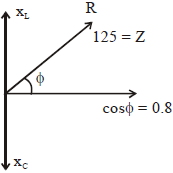
0 likesView Solution
238
PhysicsMediumMCQJEE Main · 2020
$A$ Young's double-slit experiment is performed using monochromatic light of wavelength $\lambda$. The intensity of light at a point on the screen,where the path difference is $\lambda$,is $K$ units. The intensity of light at a point where the path difference is $\frac{\lambda}{6}$ is given by $\frac{nK}{12}$,where $n$ is an integer. The value of $n$ is $......$
A
$9$
B
$12$
C
$15$
D
$5$
Solution
(A) The intensity at any point in a Young's double-slit experiment is given by $I = I_1 + I_2 + 2\sqrt{I_1 I_2} \cos \phi$,where $\phi$ is the phase difference.
Given that the intensity at a path difference of $\lambda$ is $K$,and since the path difference $\lambda$ corresponds to a phase difference of $2\pi$,the intensity is $I_{max} = 4I_0 = K$,where $I_0$ is the intensity of each slit.
Thus,$I_0 = K/4$.
For a path difference $\Delta x = \frac{\lambda}{6}$,the phase difference $\phi$ is $\frac{2\pi}{\lambda} \times \Delta x = \frac{2\pi}{\lambda} \times \frac{\lambda}{6} = \frac{\pi}{3}$.
The intensity at this point is $I = I_0 + I_0 + 2\sqrt{I_0 I_0} \cos(\frac{\pi}{3}) = 2I_0 + 2I_0 \cos(\frac{\pi}{3})$.
Substituting $I_0 = K/4$ and $\cos(\frac{\pi}{3}) = 1/2$,we get $I = 2(K/4) + 2(K/4)(1/2) = K/2 + K/4 = 3K/4$.
We are given $I = \frac{nK}{12}$,so $\frac{3K}{4} = \frac{nK}{12}$.
Solving for $n$,we get $n = \frac{3 \times 12}{4} = 9$.
Given that the intensity at a path difference of $\lambda$ is $K$,and since the path difference $\lambda$ corresponds to a phase difference of $2\pi$,the intensity is $I_{max} = 4I_0 = K$,where $I_0$ is the intensity of each slit.
Thus,$I_0 = K/4$.
For a path difference $\Delta x = \frac{\lambda}{6}$,the phase difference $\phi$ is $\frac{2\pi}{\lambda} \times \Delta x = \frac{2\pi}{\lambda} \times \frac{\lambda}{6} = \frac{\pi}{3}$.
The intensity at this point is $I = I_0 + I_0 + 2\sqrt{I_0 I_0} \cos(\frac{\pi}{3}) = 2I_0 + 2I_0 \cos(\frac{\pi}{3})$.
Substituting $I_0 = K/4$ and $\cos(\frac{\pi}{3}) = 1/2$,we get $I = 2(K/4) + 2(K/4)(1/2) = K/2 + K/4 = 3K/4$.
We are given $I = \frac{nK}{12}$,so $\frac{3K}{4} = \frac{nK}{12}$.
Solving for $n$,we get $n = \frac{3 \times 12}{4} = 9$.
0 likesView Solution
239
PhysicsDifficultMCQJEE Main · 2020
For the given input voltage waveform $V_{\text{in}}(t)$,the output voltage waveform $V_0(t)$ across the capacitor is correctly depicted by:
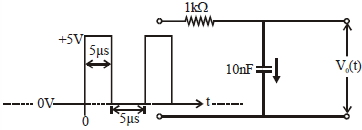
A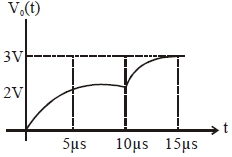
B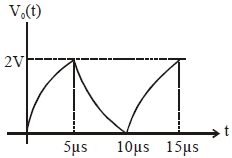
C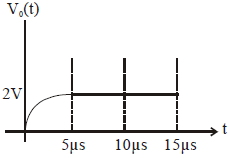
D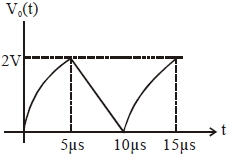
Solution
(A) The time constant of the $RC$ circuit is $\tau = RC = (1 \times 10^3 \ \Omega) \times (10 \times 10^{-9} \ \text{F}) = 10 \times 10^{-6} \ \text{s} = 10 \ \mu\text{s}$.
During the first $5 \ \mu\text{s}$ $(0 \le t \le 5 \ \mu\text{s})$,the capacitor charges from $0 \ \text{V}$ towards $5 \ \text{V}$ according to $V_0(t) = 5(1 - e^{-t/\tau})$.
At $t = 5 \ \mu\text{s}$,$V_0(5 \ \mu\text{s}) = 5(1 - e^{-5/10}) = 5(1 - e^{-0.5}) \approx 5(1 - 0.6065) = 5(0.3935) \approx 1.9675 \ \text{V} \approx 2 \ \text{V}$.
During the next $5 \ \mu\text{s}$ $(5 \ \mu\text{s} \le t \le 10 \ \mu\text{s})$,the input is $0 \ \text{V}$,so the capacitor discharges from $2 \ \text{V}$ towards $0 \ \text{V}$ according to $V_0(t) = 2e^{-(t-5)/\tau}$.
At $t = 10 \ \mu\text{s}$,$V_0(10 \ \mu\text{s}) = 2e^{-(10-5)/10} = 2e^{-0.5} \approx 2(0.6065) \approx 1.213 \ \text{V}$.
During the next $5 \ \mu\text{s}$ $(10 \ \mu\text{s} \le t \le 15 \ \mu\text{s})$,the capacitor charges from $1.213 \ \text{V}$ towards $5 \ \text{V}$ according to $V_0(t) = 5 - (5 - 1.213)e^{-(t-10)/\tau} = 5 - 3.787e^{-(t-10)/\tau}$.
At $t = 15 \ \mu\text{s}$,$V_0(15 \ \mu\text{s}) = 5 - 3.787e^{-0.5} \approx 5 - 3.787(0.6065) \approx 5 - 2.297 = 2.703 \ \text{V} \approx 2.7 \ \text{V}$.
Comparing this behavior with the given options,Option $A$ correctly shows the charging and discharging cycles with the calculated values.
During the first $5 \ \mu\text{s}$ $(0 \le t \le 5 \ \mu\text{s})$,the capacitor charges from $0 \ \text{V}$ towards $5 \ \text{V}$ according to $V_0(t) = 5(1 - e^{-t/\tau})$.
At $t = 5 \ \mu\text{s}$,$V_0(5 \ \mu\text{s}) = 5(1 - e^{-5/10}) = 5(1 - e^{-0.5}) \approx 5(1 - 0.6065) = 5(0.3935) \approx 1.9675 \ \text{V} \approx 2 \ \text{V}$.
During the next $5 \ \mu\text{s}$ $(5 \ \mu\text{s} \le t \le 10 \ \mu\text{s})$,the input is $0 \ \text{V}$,so the capacitor discharges from $2 \ \text{V}$ towards $0 \ \text{V}$ according to $V_0(t) = 2e^{-(t-5)/\tau}$.
At $t = 10 \ \mu\text{s}$,$V_0(10 \ \mu\text{s}) = 2e^{-(10-5)/10} = 2e^{-0.5} \approx 2(0.6065) \approx 1.213 \ \text{V}$.
During the next $5 \ \mu\text{s}$ $(10 \ \mu\text{s} \le t \le 15 \ \mu\text{s})$,the capacitor charges from $1.213 \ \text{V}$ towards $5 \ \text{V}$ according to $V_0(t) = 5 - (5 - 1.213)e^{-(t-10)/\tau} = 5 - 3.787e^{-(t-10)/\tau}$.
At $t = 15 \ \mu\text{s}$,$V_0(15 \ \mu\text{s}) = 5 - 3.787e^{-0.5} \approx 5 - 3.787(0.6065) \approx 5 - 2.297 = 2.703 \ \text{V} \approx 2.7 \ \text{V}$.
Comparing this behavior with the given options,Option $A$ correctly shows the charging and discharging cycles with the calculated values.
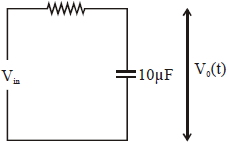
0 likesView Solution
240
PhysicsDifficultMCQJEE Main · 2020
Charges $Q_{1}$ and $Q_{2}$ are at points $A$ and $B$ of a right-angled triangle $OAB$ (see figure). If the resultant electric field at point $O$ is perpendicular to the hypotenuse $AB$,then $Q_{1} / Q_{2}$ is proportional to:
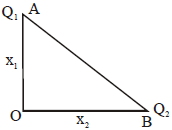
A
$\frac{x_{2}^{2}}{x_{1}^{2}}$
B
$\frac{x_{1}^{3}}{x_{2}^{3}}$
C
$\frac{x_{1}}{x_{2}}$
D
$\frac{x_{2}}{x_{1}}$
Solution
(B) Let $E_{1}$ be the electric field at $O$ due to charge $Q_{1}$ at $A$,and $E_{2}$ be the electric field at $O$ due to charge $Q_{2}$ at $B$.
$E_{1} = \frac{k|Q_{1}|}{x_{1}^{2}}$ along $OA$ (assuming $Q_{1}$ is positive).
$E_{2} = \frac{k|Q_{2}|}{x_{2}^{2}}$ along $OB$ (assuming $Q_{2}$ is positive).
Let $\angle OAB = \alpha$. Then $\angle OBA = 90^{\circ} - \alpha$.
The resultant electric field $E_{net}$ is perpendicular to the hypotenuse $AB$.
From the geometry of the triangle,the angle that the resultant field $E_{net}$ makes with $E_{1}$ is $\alpha$,and with $E_{2}$ is $90^{\circ} - \alpha$.
Using the vector addition property,$\tan(\alpha) = \frac{E_{2}}{E_{1}}$.
From the triangle $OAB$,$\tan(\alpha) = \frac{OB}{OA} = \frac{x_{2}}{x_{1}}$.
Equating the two expressions for $\tan(\alpha)$:
$\frac{E_{2}}{E_{1}} = \frac{x_{2}}{x_{1}}$
$\frac{k|Q_{2}| / x_{2}^{2}}{k|Q_{1}| / x_{1}^{2}} = \frac{x_{2}}{x_{1}}$
$\frac{|Q_{2}| x_{1}^{2}}{|Q_{1}| x_{2}^{2}} = \frac{x_{2}}{x_{1}}$
$\frac{|Q_{1}|}{|Q_{2}|} = \frac{x_{1}^{2}}{x_{2}^{2}} \cdot \frac{x_{1}}{x_{2}} = \frac{x_{1}^{3}}{x_{2}^{3}}$
Thus,$Q_{1} / Q_{2}$ is proportional to $\frac{x_{1}^{3}}{x_{2}^{3}}$.
$E_{1} = \frac{k|Q_{1}|}{x_{1}^{2}}$ along $OA$ (assuming $Q_{1}$ is positive).
$E_{2} = \frac{k|Q_{2}|}{x_{2}^{2}}$ along $OB$ (assuming $Q_{2}$ is positive).
Let $\angle OAB = \alpha$. Then $\angle OBA = 90^{\circ} - \alpha$.
The resultant electric field $E_{net}$ is perpendicular to the hypotenuse $AB$.
From the geometry of the triangle,the angle that the resultant field $E_{net}$ makes with $E_{1}$ is $\alpha$,and with $E_{2}$ is $90^{\circ} - \alpha$.
Using the vector addition property,$\tan(\alpha) = \frac{E_{2}}{E_{1}}$.
From the triangle $OAB$,$\tan(\alpha) = \frac{OB}{OA} = \frac{x_{2}}{x_{1}}$.
Equating the two expressions for $\tan(\alpha)$:
$\frac{E_{2}}{E_{1}} = \frac{x_{2}}{x_{1}}$
$\frac{k|Q_{2}| / x_{2}^{2}}{k|Q_{1}| / x_{1}^{2}} = \frac{x_{2}}{x_{1}}$
$\frac{|Q_{2}| x_{1}^{2}}{|Q_{1}| x_{2}^{2}} = \frac{x_{2}}{x_{1}}$
$\frac{|Q_{1}|}{|Q_{2}|} = \frac{x_{1}^{2}}{x_{2}^{2}} \cdot \frac{x_{1}}{x_{2}} = \frac{x_{1}^{3}}{x_{2}^{3}}$
Thus,$Q_{1} / Q_{2}$ is proportional to $\frac{x_{1}^{3}}{x_{2}^{3}}$.
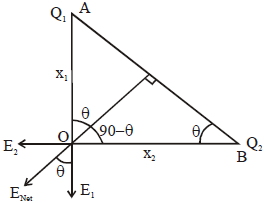
0 likesView Solution
241
PhysicsMediumMCQJEE Main · 2020
$A$ particle of charge $q$ and mass $m$ is moving with a velocity $-v \hat{i} (v \neq 0)$ towards a large screen placed in the $Y-Z$ plane at a distance $d$. If there is a magnetic field $\vec{B} = B_{0} \hat{k}$,the minimum value of $v$ for which the particle will not hit the screen is
A
$\frac{q d B_{0}}{2 m}$
B
$\frac{q d B_{0}}{m}$
C
$\frac{2 q d B_{0}}{m}$
D
$\frac{q d B_{0}}{3 m}$
Solution
(B) When a charged particle enters a uniform magnetic field perpendicular to its velocity,it follows a circular path.
The radius $R$ of this circular path is given by $R = \frac{mv}{qB_{0}}$.
For the particle not to hit the screen placed at a distance $d$ from its initial position,the radius of the circular path must be less than or equal to $d$.
Therefore,$R \leq d$.
Substituting the expression for $R$,we get $\frac{mv}{qB_{0}} \leq d$.
Solving for $v$,we get $v \leq \frac{q B_{0} d}{m}$.
However,the question asks for the minimum value of $v$ such that the particle does not hit the screen. If the particle's path is tangent to the screen,it will just graze it without hitting it. This occurs when $R = d$.
Thus,$v = \frac{q B_{0} d}{m}$ is the required value.
The radius $R$ of this circular path is given by $R = \frac{mv}{qB_{0}}$.
For the particle not to hit the screen placed at a distance $d$ from its initial position,the radius of the circular path must be less than or equal to $d$.
Therefore,$R \leq d$.
Substituting the expression for $R$,we get $\frac{mv}{qB_{0}} \leq d$.
Solving for $v$,we get $v \leq \frac{q B_{0} d}{m}$.
However,the question asks for the minimum value of $v$ such that the particle does not hit the screen. If the particle's path is tangent to the screen,it will just graze it without hitting it. This occurs when $R = d$.
Thus,$v = \frac{q B_{0} d}{m}$ is the required value.
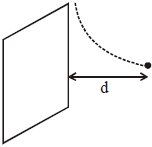
0 likesView Solution
242
PhysicsMediumMCQJEE Main · 2020
An electron,a doubly ionized helium ion $(He^{++})$ and a proton have the same kinetic energy. The relation between their respective de-Broglie wavelengths $\lambda_{e}, \lambda_{He^{++}}$ and $\lambda_{P}$ is:
A
$\lambda_{e} < \lambda_{P} < \lambda_{He^{++}}$
B
$\lambda_{e} < \lambda_{He^{++}} = \lambda_{P}$
C
$\lambda_{e} > \lambda_{He^{++}} > \lambda_{P}$
D
$\lambda_{e} > \lambda_{P} > \lambda_{He^{++}}$
Solution
(D) The de-Broglie wavelength $\lambda$ is given by the formula: $\lambda = \frac{h}{p} = \frac{h}{\sqrt{2m(KE)}}$.
Since the kinetic energy $(KE)$ and Planck's constant $(h)$ are the same for all particles,we have $\lambda \propto \frac{1}{\sqrt{m}}$.
Comparing the masses of the particles: $m_{He^{++}} > m_{P} > m_{e}$.
Since $\lambda$ is inversely proportional to the square root of mass,the particle with the smallest mass will have the largest wavelength.
Therefore,the relation is: $\lambda_{e} > \lambda_{P} > \lambda_{He^{++}}$.
Since the kinetic energy $(KE)$ and Planck's constant $(h)$ are the same for all particles,we have $\lambda \propto \frac{1}{\sqrt{m}}$.
Comparing the masses of the particles: $m_{He^{++}} > m_{P} > m_{e}$.
Since $\lambda$ is inversely proportional to the square root of mass,the particle with the smallest mass will have the largest wavelength.
Therefore,the relation is: $\lambda_{e} > \lambda_{P} > \lambda_{He^{++}}$.
0 likesView Solution
Vedclass Products
For Students
Vedclass Test Series
Mock tests in real JEE Main style covering Physics with performance analysis. 5-day free trial.
Start Free TrialFor Teachers
Exam Paper Generator
Generate Set A/B/C/D Physics papers from 7.5L+ questions in 2 minutes. 3 chapters free.
Try FreeFor Institutes
Online Exam Module
Run live JEE Main mock exams with unlimited students, 360° analytics & white-label branding.
See DemoFrequently Asked Questions
How many Physics questions are in JEE Main 2020?
There are 399 Physics questions from the JEE Main 2020 paper on Vedclass, each with a detailed step-by-step solution in English.
Are JEE Main 2020 Physics solutions available in English?
Yes. All solutions on this page are in English. You can also switch to English or Hindi using the language buttons above the questions.
Can I practice JEE Main 2020 Physics as a timed test?
Yes. Use the Vedclass Test Series to attempt a full JEE Main mock test covering Physics with time limits and instant score analysis.
Can teachers create Physics papers from JEE Main previous year questions?
Yes. The Vedclass Exam Paper Generator lets teachers mix JEE Main Physics questions and generate Set A/B/C/D papers in minutes.
For Teachers & Institutes
Build a Custom Physics Paper
Pick JEE Main 2020 Physics questions, set difficulty, and generate Set A/B/C/D in 2 minutes.