
ChemistryQ1–42 of 42 questions
Page 1 of 1 · English
1
ChemistryEasyMCQIIT JEE · 1997
The first use of quantum theory to explain the structure of the atom was made by
A
Heisenberg
B
Bohr
C
Planck
D
Einstein
Solution
(B) It was in $1913$ that Neils Bohr put forth the stability of the atom and with the help of Planck's quantum theory explained the reason for spectral lines.
Bohr first made use of quantum theory to explain the structure of atoms and proposed that the energy of electrons in an atom is quantized.
Bohr first made use of quantum theory to explain the structure of atoms and proposed that the energy of electrons in an atom is quantized.
0 likesView Solution
2
ChemistryMediumMCQIIT JEE · 1997
Among the following compounds,the one that is polar and has a central atom with $sp^2$ hybridization is:
A
$H_2CO_3$
B
$BF_3$
C
$SiF_4$
D
$HClO_2$
Solution
(A) $1$. $BF_3$ has a trigonal planar geometry with $sp^2$ hybridization,but it is non-polar due to the cancellation of dipole moments.
$2$. $SiF_4$ has a tetrahedral geometry with $sp^3$ hybridization and is non-polar.
$3$. $HClO_2$ has a central $Cl$ atom with $sp^3$ hybridization.
$4$. $H_2CO_3$ (carbonic acid) has a central carbon atom with $sp^2$ hybridization. Due to the asymmetric arrangement of atoms and the difference in electronegativity between $C$,$O$,and $H$,the molecule is polar.
$2$. $SiF_4$ has a tetrahedral geometry with $sp^3$ hybridization and is non-polar.
$3$. $HClO_2$ has a central $Cl$ atom with $sp^3$ hybridization.
$4$. $H_2CO_3$ (carbonic acid) has a central carbon atom with $sp^2$ hybridization. Due to the asymmetric arrangement of atoms and the difference in electronegativity between $C$,$O$,and $H$,the molecule is polar.
0 likesView Solution
3
ChemistryEasyMCQIIT JEE · 1997
The compressibility factor for an ideal gas is
A
$1.5$
B
$1$
C
$2$
D
$\alpha$
Solution
(B) The compressibility factor $Z$ is defined as $Z = \frac{PV}{nRT}$.
For an ideal gas,the equation of state is $PV = nRT$.
Substituting this into the expression for $Z$,we get $Z = \frac{nRT}{nRT} = 1$.
Therefore,the compressibility factor for an ideal gas is $1$.
For an ideal gas,the equation of state is $PV = nRT$.
Substituting this into the expression for $Z$,we get $Z = \frac{nRT}{nRT} = 1$.
Therefore,the compressibility factor for an ideal gas is $1$.
0 likesView Solution
4
ChemistryMCQIIT JEE · 1997
The compressibility factor for an ideal gas is
A
$1.5$
B
$1$
C
$2$
D
$\infty$
Solution
(B) For an ideal gas,the equation of state is $PV = nRT$.
By definition,the compressibility factor $Z$ is given by the ratio $Z = \frac{PV}{nRT}$.
Substituting $PV = nRT$ into the expression for $Z$,we get $Z = \frac{nRT}{nRT} = 1$.
Therefore,the compressibility factor for an ideal gas is $1$.
By definition,the compressibility factor $Z$ is given by the ratio $Z = \frac{PV}{nRT}$.
Substituting $PV = nRT$ into the expression for $Z$,we get $Z = \frac{nRT}{nRT} = 1$.
Therefore,the compressibility factor for an ideal gas is $1$.
0 likesView Solution
5
ChemistryDifficultMCQIIT JEE · 1997
Solubility of a salt $M_2X_3$ is $y \ mol \ dm^{-3}$. The solubility product of the salt will be
A
$6y^4$
B
$64y^4$
C
$36y^5$
D
$108y^5$
Solution
(D) The dissociation of the salt $M_2X_3$ is given by:
$M_2X_3(s) \rightleftharpoons 2M^{3+}(aq) + 3X^{2-}(aq)$
If the solubility is $y \ mol \ dm^{-3}$,then the concentration of $M^{3+}$ is $2y \ mol \ dm^{-3}$ and the concentration of $X^{2-}$ is $3y \ mol \ dm^{-3}$.
The solubility product $K_{sp}$ is defined as:
$K_{sp} = [M^{3+}]^2 [X^{2-}]^3$
Substituting the values:
$K_{sp} = (2y)^2 \times (3y)^3$
$K_{sp} = (4y^2) \times (27y^3)$
$K_{sp} = 108y^5 \ mol^5 \ dm^{-15}$
Therefore,the correct option is $(D)$.
$M_2X_3(s) \rightleftharpoons 2M^{3+}(aq) + 3X^{2-}(aq)$
If the solubility is $y \ mol \ dm^{-3}$,then the concentration of $M^{3+}$ is $2y \ mol \ dm^{-3}$ and the concentration of $X^{2-}$ is $3y \ mol \ dm^{-3}$.
The solubility product $K_{sp}$ is defined as:
$K_{sp} = [M^{3+}]^2 [X^{2-}]^3$
Substituting the values:
$K_{sp} = (2y)^2 \times (3y)^3$
$K_{sp} = (4y^2) \times (27y^3)$
$K_{sp} = 108y^5 \ mol^5 \ dm^{-15}$
Therefore,the correct option is $(D)$.
0 likesView Solution
6
ChemistryMediumMCQIIT JEE · 1997
Standard molar enthalpy of formation of $CO_2$ is equal to
A
Zero
B
The standard molar enthalpy of combustion of gaseous carbon
C
The sum of standard molar enthalpies of formation of $CO$ and $O_2$
D
The standard molar enthalpy of combustion of carbon (graphite)
Solution
(D) The standard molar enthalpy of formation of a compound is defined as the enthalpy change when $1 \ mol$ of the compound is formed from its constituent elements in their most stable states at $298 \ K$ and $1 \ bar$ pressure.
For $CO_2$,the reaction is: $C(\text{graphite}) + O_2(g) \rightarrow CO_2(g)$.
This reaction also represents the combustion of carbon (graphite) in oxygen to form $CO_2$.
Therefore,the standard molar enthalpy of formation of $CO_2$ is equal to the standard molar enthalpy of combustion of carbon (graphite).
For $CO_2$,the reaction is: $C(\text{graphite}) + O_2(g) \rightarrow CO_2(g)$.
This reaction also represents the combustion of carbon (graphite) in oxygen to form $CO_2$.
Therefore,the standard molar enthalpy of formation of $CO_2$ is equal to the standard molar enthalpy of combustion of carbon (graphite).
0 likesView Solution
7
ChemistryEasyMCQIIT JEE · 1997
The incorrect statement among the following is:
A
The first ionisation potential of $Al$ is less than the first ionisation potential of $Mg$
B
The second ionisation potential of $Mg$ is greater than the second ionisation potential of $Na$
C
The first ionisation potential of $Na$ is less than the first ionisation potential of $Mg$
D
The third ionisation potential of $Mg$ is greater than the third ionisation potential of $Al$
Solution
(B) The correct answer is $(B)$.
$1$. The first ionisation potential $(IE_1)$ of $Al$ $([Ne] 3s^2 3p^1)$ is less than $Mg$ $([Ne] 3s^2)$ because $Mg$ has a stable fully-filled $s$-orbital.
$2$. The second ionisation potential $(IE_2)$ of $Na$ $([Ne] 3s^1 \rightarrow [Ne])$ is much higher than that of $Mg$ $([Ne] 3s^2 \rightarrow [Ne] 3s^1)$ because the second electron in $Na$ is removed from a stable noble gas core $([Ne])$.
$3$. $IE_1$ of $Na$ is less than $Mg$ due to higher effective nuclear charge and stable configuration of $Mg$.
$4$. The third ionisation potential $(IE_3)$ of $Mg$ is higher than $Al$ because the third electron in $Mg$ is removed from a stable noble gas core $([Ne])$,whereas in $Al$ it is removed from the $3s^2$ subshell.
$1$. The first ionisation potential $(IE_1)$ of $Al$ $([Ne] 3s^2 3p^1)$ is less than $Mg$ $([Ne] 3s^2)$ because $Mg$ has a stable fully-filled $s$-orbital.
$2$. The second ionisation potential $(IE_2)$ of $Na$ $([Ne] 3s^1 \rightarrow [Ne])$ is much higher than that of $Mg$ $([Ne] 3s^2 \rightarrow [Ne] 3s^1)$ because the second electron in $Na$ is removed from a stable noble gas core $([Ne])$.
$3$. $IE_1$ of $Na$ is less than $Mg$ due to higher effective nuclear charge and stable configuration of $Mg$.
$4$. The third ionisation potential $(IE_3)$ of $Mg$ is higher than $Al$ because the third electron in $Mg$ is removed from a stable noble gas core $([Ne])$,whereas in $Al$ it is removed from the $3s^2$ subshell.
0 likesView Solution
8
ChemistryMediumMCQIIT JEE · 1997
The critical temperature of water is higher than that of $O_2$ because $H_2O$ molecule has
A
Fewer electrons than oxygen
B
Two covalent bonds
C
$V$-shape
D
Dipole moment
Solution
(D) The critical temperature of a substance depends on the strength of intermolecular forces.
$H_2O$ is a polar molecule with a permanent dipole moment $(1.84 \ D)$,which leads to strong dipole-dipole interactions and hydrogen bonding.
In contrast,$O_2$ is a non-polar molecule with a dipole moment of $0 \ D$,exhibiting only weak London dispersion forces.
Therefore,$H_2O$ has a higher critical temperature than $O_2$.
$H_2O$ is a polar molecule with a permanent dipole moment $(1.84 \ D)$,which leads to strong dipole-dipole interactions and hydrogen bonding.
In contrast,$O_2$ is a non-polar molecule with a dipole moment of $0 \ D$,exhibiting only weak London dispersion forces.
Therefore,$H_2O$ has a higher critical temperature than $O_2$.
0 likesView Solution
9
ChemistryMediumMCQIIT JEE · 1997
Property of the alkaline earth metals that increases with their atomic number is
A
Ionisation energy
B
Solubility of their hydroxides
C
Solubility of their sulphates
D
Electronegativity
Solution
(B) In alkaline earth metals,as the atomic number increases,the atomic size increases.
For hydroxides,the lattice energy decreases more rapidly than the hydration energy as we move down the group from $Be$ to $Ba$.
This leads to an increase in the solubility of their hydroxides.
Conversely,properties like ionisation energy $(IE)$,electronegativity,and the solubility of their sulphates decrease as the atomic number increases.
For hydroxides,the lattice energy decreases more rapidly than the hydration energy as we move down the group from $Be$ to $Ba$.
This leads to an increase in the solubility of their hydroxides.
Conversely,properties like ionisation energy $(IE)$,electronegativity,and the solubility of their sulphates decrease as the atomic number increases.
0 likesView Solution
10
ChemistryMediumMCQIIT JEE · 1997
Among $KO_2$,$NO_2^-$,$BaO_2$ and $NO_2^+$,an unpaired electron is present in:
A
$NO_2^+$ and $BaO_2$
B
$KO_2$ and $BaO_2$
C
$KO_2$ only
D
$BaO_2$ only
Solution
(C) The electronic configurations are as follows:
$1$. $KO_2$ contains the superoxide ion $O_2^-$. The molecular orbital configuration of $O_2^-$ is $\sigma 1s^2, \sigma^* 1s^2, \sigma 2s^2, \sigma^* 2s^2, \sigma 2p_z^2, \pi 2p_x^2 = \pi 2p_y^2, \pi^* 2p_x^2 = \pi^* 2p_y^1$. It has one unpaired electron.
$2$. $NO_2^-$ has $5 + 6(2) + 1 = 18$ valence electrons. All electrons are paired.
$3$. $BaO_2$ contains the peroxide ion $O_2^{2-}$. The configuration is $\sigma 1s^2, \sigma^* 1s^2, \sigma 2s^2, \sigma^* 2s^2, \sigma 2p_z^2, \pi 2p_x^2 = \pi 2p_y^2, \pi^* 2p_x^2 = \pi^* 2p_y^2$. All electrons are paired.
$4$. $NO_2^+$ has $5 + 6(2) - 1 = 16$ valence electrons. All electrons are paired.
Therefore,only $KO_2$ contains an unpaired electron.
$1$. $KO_2$ contains the superoxide ion $O_2^-$. The molecular orbital configuration of $O_2^-$ is $\sigma 1s^2, \sigma^* 1s^2, \sigma 2s^2, \sigma^* 2s^2, \sigma 2p_z^2, \pi 2p_x^2 = \pi 2p_y^2, \pi^* 2p_x^2 = \pi^* 2p_y^1$. It has one unpaired electron.
$2$. $NO_2^-$ has $5 + 6(2) + 1 = 18$ valence electrons. All electrons are paired.
$3$. $BaO_2$ contains the peroxide ion $O_2^{2-}$. The configuration is $\sigma 1s^2, \sigma^* 1s^2, \sigma 2s^2, \sigma^* 2s^2, \sigma 2p_z^2, \pi 2p_x^2 = \pi 2p_y^2, \pi^* 2p_x^2 = \pi^* 2p_y^2$. All electrons are paired.
$4$. $NO_2^+$ has $5 + 6(2) - 1 = 16$ valence electrons. All electrons are paired.
Therefore,only $KO_2$ contains an unpaired electron.
0 likesView Solution
11
ChemistryDifficultMCQIIT JEE · 1997
The correct statement about the compounds $A$ and $B$ is:
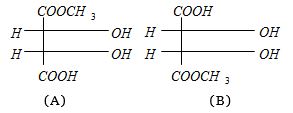
A
$A$ and $B$ are identical
B
$A$ and $B$ are diastereomers
C
$A$ and $B$ are enantiomers
D
None of these
Solution
(A) Compound $A$ is methyl hydrogen tartrate (where the top group is $COOCH_3$ and the bottom is $COOH$).
Compound $B$ is also methyl hydrogen tartrate (where the top group is $COOH$ and the bottom is $COOCH_3$).
By rotating compound $B$ by $180^{\circ}$ in the plane of the paper,the $COOH$ group moves to the top and the $COOCH_3$ group moves to the bottom,while the $H$ and $OH$ groups on the chiral carbons remain in their relative positions.
After rotation,the structure of $B$ becomes identical to the structure of $A$.
Therefore,$A$ and $B$ are identical.
Compound $B$ is also methyl hydrogen tartrate (where the top group is $COOH$ and the bottom is $COOCH_3$).
By rotating compound $B$ by $180^{\circ}$ in the plane of the paper,the $COOH$ group moves to the top and the $COOCH_3$ group moves to the bottom,while the $H$ and $OH$ groups on the chiral carbons remain in their relative positions.
After rotation,the structure of $B$ becomes identical to the structure of $A$.
Therefore,$A$ and $B$ are identical.
0 likesView Solution
12
ChemistryMCQIIT JEE · 1997
The number of possible enantiomeric pairs that can be produced during mono-chlorination of $2$-methylbutane is
A
$3$
B
$4$
C
$1$
D
$2$
Solution
(D) $2$-methylbutane is $CH_3-CH(CH_3)-CH_2-CH_3$.
Mono-chlorination gives the following products:
$1.$ $ClCH_2-CH(CH_3)-CH_2-CH_3$ (Chiral center at $C2$,$1$ pair of enantiomers)
$2.$ $CH_3-CCl(CH_3)-CH_2-CH_3$ (Achiral)
$3.$ $CH_3-CH(CH_3)-CHCl-CH_3$ (Chiral center at $C3$,$1$ pair of enantiomers)
$4.$ $CH_3-CH(CH_3)-CH_2-CH_2Cl$ (Achiral)
Total enantiomeric pairs = $1 + 1 = 2$.
Mono-chlorination gives the following products:
$1.$ $ClCH_2-CH(CH_3)-CH_2-CH_3$ (Chiral center at $C2$,$1$ pair of enantiomers)
$2.$ $CH_3-CCl(CH_3)-CH_2-CH_3$ (Achiral)
$3.$ $CH_3-CH(CH_3)-CHCl-CH_3$ (Chiral center at $C3$,$1$ pair of enantiomers)
$4.$ $CH_3-CH(CH_3)-CH_2-CH_2Cl$ (Achiral)
Total enantiomeric pairs = $1 + 1 = 2$.
0 likesView Solution
13
ChemistryMediumMCQIIT JEE · 1997
The number of possible enantiomeric pairs that can be produced during monochlorination of $2$-methylbutane is
A
$1$
B
$3$
C
$4$
D
$2$
Solution
(D) The structure of $2$-methylbutane is $CH_3-CH(CH_3)-CH_2-CH_3$.
Monochlorination can occur at four different types of hydrogen atoms:
$1$. At $C-1$ (terminal methyl group): $Cl-CH_2-CH(CH_3)-CH_2-CH_3$. This molecule has a chiral center at $C-2$,so it exists as a pair of enantiomers.
$2$. At $C-2$: $CH_3-CCl(CH_3)-CH_2-CH_3$. This molecule is achiral.
$3$. At $C-3$: $CH_3-CH(CH_3)-CHCl-CH_3$. This molecule has a chiral center at $C-3$,so it exists as a pair of enantiomers.
$4$. At $C-4$: $CH_3-CH(CH_3)-CH_2-CH_2Cl$. This molecule is achiral.
Thus,there are $2$ chiral products,each forming an enantiomeric pair. Therefore,the total number of enantiomeric pairs is $2$.
Monochlorination can occur at four different types of hydrogen atoms:
$1$. At $C-1$ (terminal methyl group): $Cl-CH_2-CH(CH_3)-CH_2-CH_3$. This molecule has a chiral center at $C-2$,so it exists as a pair of enantiomers.
$2$. At $C-2$: $CH_3-CCl(CH_3)-CH_2-CH_3$. This molecule is achiral.
$3$. At $C-3$: $CH_3-CH(CH_3)-CHCl-CH_3$. This molecule has a chiral center at $C-3$,so it exists as a pair of enantiomers.
$4$. At $C-4$: $CH_3-CH(CH_3)-CH_2-CH_2Cl$. This molecule is achiral.
Thus,there are $2$ chiral products,each forming an enantiomeric pair. Therefore,the total number of enantiomeric pairs is $2$.
0 likesView Solution
14
ChemistryDifficultMCQIIT JEE · 1997
The intermediate during the addition of $HCl$ to propene in the presence of peroxide is
A
$CH_3-CH(Cl)-CH_2^\bullet$
B
$CH_3-CH^{+}-CH_3$
C
$CH_3-CH_2-CH_2^\bullet$
D
$CH_3-CH_2-CH_2^+$
Solution
(B) The addition of $HCl$ to propene follows Markovnikov's rule,even in the presence of peroxide.
Peroxide effect (Kharasch effect) is only applicable to $HBr$ and not to $HCl$ or $HI$.
In the reaction,the electrophile $H^+$ attacks the double bond to form the more stable secondary carbocation,$CH_3-CH^{+}-CH_3$,as the reaction intermediate.
Therefore,the correct intermediate is $CH_3-CH^{+}-CH_3$.
Peroxide effect (Kharasch effect) is only applicable to $HBr$ and not to $HCl$ or $HI$.
In the reaction,the electrophile $H^+$ attacks the double bond to form the more stable secondary carbocation,$CH_3-CH^{+}-CH_3$,as the reaction intermediate.
Therefore,the correct intermediate is $CH_3-CH^{+}-CH_3$.
0 likesView Solution
15
ChemistryDifficultMCQIIT JEE · 1997
During the debromination of $meso-2,3-dibromobutane$,the major compound formed is:
A
$n-butane$
B
$1-butene$
C
$cis-2-butene$
D
$trans-2-butene$
Solution
(D) The debromination of $meso-2,3-dibromobutane$ proceeds via an $E2$ mechanism,which is stereospecific.
In the $meso$ form,the two bromine atoms are anti to each other in the staggered conformation.
Elimination of $Br_2$ from this conformation leads to the formation of $trans-2-butene$.
$trans-2-butene$ is more stable than $cis-2-butene$ due to reduced steric hindrance between the methyl groups.
In the $meso$ form,the two bromine atoms are anti to each other in the staggered conformation.
Elimination of $Br_2$ from this conformation leads to the formation of $trans-2-butene$.
$trans-2-butene$ is more stable than $cis-2-butene$ due to reduced steric hindrance between the methyl groups.
0 likesView Solution
16
ChemistryMediumMCQIIT JEE · 1997
Among the following statements on the nitration of aromatic compounds,the false one is:
A
The rate of nitration of benzene is almost the same as that of hexadeuterobenzene
B
The rate of nitration of toluene is greater than that of benzene
C
The rate of nitration of benzene is greater than that of hexadeuterobenzene
D
Nitration is an electrophilic substitution reaction
Solution
(C) Nitration of aromatic compounds is an electrophilic aromatic substitution reaction where the rate-determining step is the formation of the sigma complex (arenium ion).
Since the $C-H$ or $C-D$ bond cleavage occurs after the rate-determining step,there is no primary kinetic isotope effect observed.
Therefore,the rate of nitration of benzene $(C_6H_6)$ and hexadeuterobenzene $(C_6D_6)$ is essentially the same.
Statement $C$ is false because the rates are equal,not greater.
Since the $C-H$ or $C-D$ bond cleavage occurs after the rate-determining step,there is no primary kinetic isotope effect observed.
Therefore,the rate of nitration of benzene $(C_6H_6)$ and hexadeuterobenzene $(C_6D_6)$ is essentially the same.
Statement $C$ is false because the rates are equal,not greater.
0 likesView Solution
17
ChemistryMediumMCQIIT JEE · 1997
Nitrobenzene can be prepared from benzene by using a mixture of conc. $HNO_3$ and conc. $H_2SO_4$. In the nitrating mixture,$HNO_3$ acts as a
A
Base
B
Acid
C
Reducing agent
D
Catalyst
Solution
(A) In the nitration of benzene,the mixture of concentrated $HNO_3$ and concentrated $H_2SO_4$ is used.
Here,$H_2SO_4$ acts as a stronger acid and protonates $HNO_3$ to generate the electrophile $NO_2^+$.
The reaction is as follows:
$HNO_3 + H_2SO_4 \rightleftharpoons H_2NO_3^+ + HSO_4^-$
$H_2NO_3^+ \rightleftharpoons H_2O + NO_2^+$
Since $HNO_3$ accepts a proton from $H_2SO_4$,it acts as a base in this reaction.
Here,$H_2SO_4$ acts as a stronger acid and protonates $HNO_3$ to generate the electrophile $NO_2^+$.
The reaction is as follows:
$HNO_3 + H_2SO_4 \rightleftharpoons H_2NO_3^+ + HSO_4^-$
$H_2NO_3^+ \rightleftharpoons H_2O + NO_2^+$
Since $HNO_3$ accepts a proton from $H_2SO_4$,it acts as a base in this reaction.
0 likesView Solution
18
ChemistryMCQIIT JEE · 1997
Among the following,the compound that is both paramagnetic and coloured is
A
$K_2Cr_2O_7$
B
$(NH_4)_2(TiCl_6)$
C
$VOSO_4$
D
$K_3[Cu(CN)_4]$
Solution
(C) In $VOSO_4$,the oxidation state of Vanadium is $V^{+4}$.
The electronic configuration of $V^{+4}$ is $[Ar] 3d^1 4s^0$.
Since it has $1$ unpaired electron,it is paramagnetic.
Due to the presence of an unpaired electron and $d-d$ transition,it is a coloured compound.
The electronic configuration of $V^{+4}$ is $[Ar] 3d^1 4s^0$.
Since it has $1$ unpaired electron,it is paramagnetic.
Due to the presence of an unpaired electron and $d-d$ transition,it is a coloured compound.
0 likesView Solution
19
ChemistryAdvancedMCQIIT JEE · 1997
The number of moles of $KMnO_4$ that will be needed to react completely with one mole of ferrous oxalate $FeC_2O_4$ in acidic solution is
A
$3/5$
B
$2/5$
C
$4/5$
D
$1$
Solution
(A) The balanced redox reaction in an acidic medium is:
$3MnO_4^- + 5FeC_2O_4 + 24H^+ \to 3Mn^{2+} + 5Fe^{3+} + 10CO_2 + 12H_2O$
From the stoichiometry of the balanced equation,$5 \ mol$ of $FeC_2O_4$ reacts with $3 \ mol$ of $KMnO_4$.
Therefore,$1 \ mol$ of $FeC_2O_4$ will react with $3/5 \ mol$ of $KMnO_4$.
$3MnO_4^- + 5FeC_2O_4 + 24H^+ \to 3Mn^{2+} + 5Fe^{3+} + 10CO_2 + 12H_2O$
From the stoichiometry of the balanced equation,$5 \ mol$ of $FeC_2O_4$ reacts with $3 \ mol$ of $KMnO_4$.
Therefore,$1 \ mol$ of $FeC_2O_4$ will react with $3/5 \ mol$ of $KMnO_4$.
0 likesView Solution
20
ChemistryMCQIIT JEE · 1997
If $g(x) = \int_0^x \cos^4 t \, dt$,then $g(x + \pi)$ equals
A
$g(x) + g(\pi)$
B
$g(x) - g(\pi)$
C
$g(x)g(\pi)$
D
$g(x)/g(\pi)$
Solution
(A) Given $g(x) = \int_0^x \cos^4 t \, dt$.
We need to evaluate $g(x + \pi) = \int_0^{x + \pi} \cos^4 t \, dt$.
Using the property of definite integrals,we can split the interval:
$g(x + \pi) = \int_0^{\pi} \cos^4 t \, dt + \int_{\pi}^{x + \pi} \cos^4 t \, dt$.
By definition,the first integral is $g(\pi)$.
For the second integral,let $t = u + \pi$,then $dt = du$. When $t = \pi$,$u = 0$,and when $t = x + \pi$,$u = x$.
Since $\cos^4(u + \pi) = (-\cos u)^4 = \cos^4 u$,the second integral becomes $\int_0^x \cos^4 u \, du = g(x)$.
Therefore,$g(x + \pi) = g(\pi) + g(x)$.
We need to evaluate $g(x + \pi) = \int_0^{x + \pi} \cos^4 t \, dt$.
Using the property of definite integrals,we can split the interval:
$g(x + \pi) = \int_0^{\pi} \cos^4 t \, dt + \int_{\pi}^{x + \pi} \cos^4 t \, dt$.
By definition,the first integral is $g(\pi)$.
For the second integral,let $t = u + \pi$,then $dt = du$. When $t = \pi$,$u = 0$,and when $t = x + \pi$,$u = x$.
Since $\cos^4(u + \pi) = (-\cos u)^4 = \cos^4 u$,the second integral becomes $\int_0^x \cos^4 u \, du = g(x)$.
Therefore,$g(x + \pi) = g(\pi) + g(x)$.
0 likesView Solution
21
ChemistryMediumMCQIIT JEE · 1997
If $pK_b$ for fluoride ion $(F^-)$ at $25\,^{\circ}C$ is $10.83$,the ionisation constant $(K_a)$ of hydrofluoric acid $(HF)$ in water at this temperature is:
A
$1.74 \times 10^{-3}$
B
$3.52 \times 10^{-3}$
C
$6.75 \times 10^{-4}$
D
$5.38 \times 10^{-2}$
Solution
(C) Given $pK_b = 10.83$ for $F^-$.
The base dissociation constant $K_b = 10^{-pK_b} = 10^{-10.83} = 1.479 \times 10^{-11} \approx 1.48 \times 10^{-11}$.
At $25\,^{\circ}C$,the ionic product of water $K_w = 10^{-14}$.
The relationship between $K_a$ and $K_b$ for a conjugate acid-base pair is $K_a \times K_b = K_w$.
Therefore,$K_a = \frac{K_w}{K_b} = \frac{10^{-14}}{1.48 \times 10^{-11}} = 6.756 \times 10^{-4} \approx 6.75 \times 10^{-4}$.
The base dissociation constant $K_b = 10^{-pK_b} = 10^{-10.83} = 1.479 \times 10^{-11} \approx 1.48 \times 10^{-11}$.
At $25\,^{\circ}C$,the ionic product of water $K_w = 10^{-14}$.
The relationship between $K_a$ and $K_b$ for a conjugate acid-base pair is $K_a \times K_b = K_w$.
Therefore,$K_a = \frac{K_w}{K_b} = \frac{10^{-14}}{1.48 \times 10^{-11}} = 6.756 \times 10^{-4} \approx 6.75 \times 10^{-4}$.
0 likesView Solution
22
ChemistryEasyMCQIIT JEE · 1997
Molar heat capacity of water in equilibrium with ice at constant pressure is
A
Zero
B
Infinity $(\infty)$
C
$40.45 \ kJ \ K^{-1} \ mol^{-1}$
D
$75.48 \ J \ K^{-1} \ mol^{-1}$
Solution
(B) The molar heat capacity at constant pressure is defined as $C_P = (\frac{\delta H}{\delta T})_P$.
At phase equilibrium between ice and water,the temperature remains constant even when heat is added,meaning $\delta T = 0$.
Therefore,$C_P = \frac{\delta H}{0} = \infty$.
At phase equilibrium between ice and water,the temperature remains constant even when heat is added,meaning $\delta T = 0$.
Therefore,$C_P = \frac{\delta H}{0} = \infty$.
0 likesView Solution
23
ChemistryMCQIIT JEE · 1997
The intensity of radiation emitted by the Sun has its maximum value at a wavelength of $510 \ nm$ and that emitted by the North Star has the maximum value at $350 \ nm$. If these stars behave like black bodies,then the ratio of the surface temperature of the Sun and the North Star is
A
$1.46$
B
$0.69$
C
$1.21$
D
$0.83$
Solution
(B) According to Wien's displacement law,the product of the absolute temperature $T$ and the wavelength $\lambda_m$ corresponding to maximum intensity is a constant:
$T \lambda_m = b$
This implies $T \propto \frac{1}{\lambda_m}$.
Given:
$\lambda_S = 510 \ nm$ (wavelength for the Sun)
$\lambda_N = 350 \ nm$ (wavelength for the North Star)
Therefore,the ratio of the surface temperature of the Sun $(T_S)$ to the North Star $(T_N)$ is:
$\frac{T_S}{T_N} = \frac{\lambda_N}{\lambda_S}$
Substituting the values:
$\frac{T_S}{T_N} = \frac{350}{510} \approx 0.686 \approx 0.69$.
$T \lambda_m = b$
This implies $T \propto \frac{1}{\lambda_m}$.
Given:
$\lambda_S = 510 \ nm$ (wavelength for the Sun)
$\lambda_N = 350 \ nm$ (wavelength for the North Star)
Therefore,the ratio of the surface temperature of the Sun $(T_S)$ to the North Star $(T_N)$ is:
$\frac{T_S}{T_N} = \frac{\lambda_N}{\lambda_S}$
Substituting the values:
$\frac{T_S}{T_N} = \frac{350}{510} \approx 0.686 \approx 0.69$.
0 likesView Solution
24
ChemistryMCQIIT JEE · 1997
$A$ vessel contains $1$ mole of $O_2$ gas (molar mass $32$) at a temperature $T$. The pressure of the gas is $P$. An identical vessel containing $1$ mole of $He$ gas (molar mass $4$) at a temperature $2T$ has a pressure of:
A
$P/8$
B
$P$
C
$2P$
D
$8P$
Solution
(C) The ideal gas equation is given by $PV = nRT$,where $P$ is pressure,$V$ is volume,$n$ is the number of moles,$R$ is the universal gas constant,and $T$ is the absolute temperature.
For the $O_2$ gas vessel:
$P_1 = P, V_1 = V, n_1 = 1, T_1 = T$
So,$PV = (1)RT = RT$ --- (Equation $1$)
For the $He$ gas vessel:
$P_2 = ?, V_2 = V, n_2 = 1, T_2 = 2T$
Using the ideal gas equation: $P_2 V = n_2 R T_2$
$P_2 V = (1)R(2T) = 2RT$ --- (Equation $2$)
Dividing Equation $2$ by Equation $1$:
$P_2 V / PV = 2RT / RT$
$P_2 / P = 2$
$P_2 = 2P$
Therefore,the pressure of the $He$ gas is $2P$.
For the $O_2$ gas vessel:
$P_1 = P, V_1 = V, n_1 = 1, T_1 = T$
So,$PV = (1)RT = RT$ --- (Equation $1$)
For the $He$ gas vessel:
$P_2 = ?, V_2 = V, n_2 = 1, T_2 = 2T$
Using the ideal gas equation: $P_2 V = n_2 R T_2$
$P_2 V = (1)R(2T) = 2RT$ --- (Equation $2$)
Dividing Equation $2$ by Equation $1$:
$P_2 V / PV = 2RT / RT$
$P_2 / P = 2$
$P_2 = 2P$
Therefore,the pressure of the $He$ gas is $2P$.
0 likesView Solution
25
ChemistryMCQIIT JEE · 1997
The $K_{\alpha}$ $X$-ray emission line of tungsten occurs at $\lambda = 0.021 \, nm$. The energy difference between $K$ and $L$ levels in this atom is about:
A
$0.51 \, MeV$
B
$1.2 \, MeV$
C
$59 \, keV$
D
$13.6 \, eV$
Solution
(C) The energy of an $X$-ray photon is given by the relation $E = \frac{hc}{\lambda}$.
Given $\lambda = 0.021 \, nm = 0.21 \, \mathring{A}$.
Using the approximation $E \approx \frac{12400 \, eV \cdot \mathring{A}}{\lambda (\text{in } \mathring{A})}$,we get:
$E = \frac{12400}{0.21} \, eV \approx 59047 \, eV$.
Since the $K_{\alpha}$ line corresponds to the transition from the $L$-shell to the $K$-shell,the energy difference is $\Delta E = E_L - E_K = E_{photon} \approx 59 \, keV$.
Given $\lambda = 0.021 \, nm = 0.21 \, \mathring{A}$.
Using the approximation $E \approx \frac{12400 \, eV \cdot \mathring{A}}{\lambda (\text{in } \mathring{A})}$,we get:
$E = \frac{12400}{0.21} \, eV \approx 59047 \, eV$.
Since the $K_{\alpha}$ line corresponds to the transition from the $L$-shell to the $K$-shell,the energy difference is $\Delta E = E_L - E_K = E_{photon} \approx 59 \, keV$.
0 likesView Solution
26
ChemistryMCQIIT JEE · 1997
Let $f$ be a positive function. Let $I_1 = \int_{1-k}^{k} x f\{x(1-x)\} dx$ and $I_2 = \int_{1-k}^{k} f\{x(1-x)\} dx$,where $2k-1 > 0$. Then $I_1/I_2$ is
A
$2$
B
$k$
C
$1/2$
D
$1$
Solution
(C) We are given $I_1 = \int_{1-k}^{k} x f\{x(1-x)\} dx$ and $I_2 = \int_{1-k}^{k} f\{x(1-x)\} dx$.
Using the property $\int_{a}^{b} g(x) dx = \int_{a}^{b} g(a+b-x) dx$,we apply it to $I_1$ with $a = 1-k$ and $b = k$,so $a+b = 1$.
$I_1 = \int_{1-k}^{k} (1-x) f\{(1-x)(1-(1-x))\} dx$
$I_1 = \int_{1-k}^{k} (1-x) f\{(1-x)x\} dx$
$I_1 = \int_{1-k}^{k} f\{x(1-x)\} dx - \int_{1-k}^{k} x f\{x(1-x)\} dx$
$I_1 = I_2 - I_1$
$2I_1 = I_2$
Therefore,$\frac{I_1}{I_2} = \frac{1}{2}$.
Using the property $\int_{a}^{b} g(x) dx = \int_{a}^{b} g(a+b-x) dx$,we apply it to $I_1$ with $a = 1-k$ and $b = k$,so $a+b = 1$.
$I_1 = \int_{1-k}^{k} (1-x) f\{(1-x)(1-(1-x))\} dx$
$I_1 = \int_{1-k}^{k} (1-x) f\{(1-x)x\} dx$
$I_1 = \int_{1-k}^{k} f\{x(1-x)\} dx - \int_{1-k}^{k} x f\{x(1-x)\} dx$
$I_1 = I_2 - I_1$
$2I_1 = I_2$
Therefore,$\frac{I_1}{I_2} = \frac{1}{2}$.
0 likesView Solution
27
ChemistryMCQIIT JEE · 1997
Among the following statements,the incorrect one is:
A
Calamine and siderite are carbonates.
B
Argentite and cuprite are oxides.
C
Zinc blende and pyrites are sulphides.
D
Malachite and azurite are ores of copper.
Solution
(B) Let us analyze the chemical composition of the given ores:
$1$. Calamine is $ZnCO_3$ and siderite is $FeCO_3$. Both are carbonates. This statement is correct.
$2$. Argentite is $Ag_2S$ (a sulphide) and cuprite is $Cu_2O$ (an oxide). Since both are not oxides,this statement is incorrect.
$3$. Zinc blende is $ZnS$ and pyrites (iron pyrites) is $FeS_2$. Both are sulphides. This statement is correct.
$4$. Malachite is $CuCO_3 \cdot Cu(OH)_2$ and azurite is $2CuCO_3 \cdot Cu(OH)_2$. Both are ores of copper. This statement is correct.
Therefore,the incorrect statement is $B$.
$1$. Calamine is $ZnCO_3$ and siderite is $FeCO_3$. Both are carbonates. This statement is correct.
$2$. Argentite is $Ag_2S$ (a sulphide) and cuprite is $Cu_2O$ (an oxide). Since both are not oxides,this statement is incorrect.
$3$. Zinc blende is $ZnS$ and pyrites (iron pyrites) is $FeS_2$. Both are sulphides. This statement is correct.
$4$. Malachite is $CuCO_3 \cdot Cu(OH)_2$ and azurite is $2CuCO_3 \cdot Cu(OH)_2$. Both are ores of copper. This statement is correct.
Therefore,the incorrect statement is $B$.
0 likesView Solution
28
ChemistryMCQIIT JEE · 1997
Among the following statements,the incorrect one is:
A
Calamine and siderite are carbonates
B
Argentite and cuprite are oxides
C
Zinc blende and iron pyrites are sulphides
D
Malachite and azurite are ores of copper
Solution
(B) The chemical formulas for the ores are as follows:
$1$. Calamine is $ZnCO_{3}$ and siderite is $FeCO_{3}$ (both are carbonates).
$2$. Argentite is $Ag_{2}S$ (sulphide) and cuprite is $Cu_{2}O$ (oxide). Thus,the statement that both are oxides is incorrect.
$3$. Zinc blende is $ZnS$ and iron pyrites is $FeS_{2}$ (both are sulphides).
$4$. Malachite is $CuCO_{3} \cdot Cu(OH)_{2}$ and azurite is $Cu_{3}(CO_{3})_{2}(OH)_{2}$ (both are copper ores).
Therefore,the incorrect statement is $B$.
$1$. Calamine is $ZnCO_{3}$ and siderite is $FeCO_{3}$ (both are carbonates).
$2$. Argentite is $Ag_{2}S$ (sulphide) and cuprite is $Cu_{2}O$ (oxide). Thus,the statement that both are oxides is incorrect.
$3$. Zinc blende is $ZnS$ and iron pyrites is $FeS_{2}$ (both are sulphides).
$4$. Malachite is $CuCO_{3} \cdot Cu(OH)_{2}$ and azurite is $Cu_{3}(CO_{3})_{2}(OH)_{2}$ (both are copper ores).
Therefore,the incorrect statement is $B$.
0 likesView Solution
29
ChemistryMCQIIT JEE · 1997
Among the following,the compound that is both paramagnetic and coloured is
A
$K_2Cr_2O_7$
B
$(NH_4)_2[TiCl_6]$
C
$VOSO_4$
D
$K_3[Cu(CN)_4]$
Solution
(C) In $K_2Cr_2O_7$,the oxidation state of $Cr$ is $+6$. $Cr^{+6} = [Ar] 3d^0$.
In $(NH_4)_2[TiCl_6]$,the oxidation state of $Ti$ is $+4$. $Ti^{+4} = [Ar] 3d^0$.
In $VOSO_4$,the oxidation state of $V$ is $+4$. $V^{+4} = [Ar] 3d^1$.
In $K_3[Cu(CN)_4]$,the oxidation state of $Cu$ is $+1$. $Cu^{+1} = [Ar] 3d^{10}$.
In $VOSO_4$,the $V^{+4}$ configuration is $d^1$,which contains one unpaired $d$-electron,making it paramagnetic and coloured.
All other compounds listed have no unpaired $d$-electrons,making them diamagnetic in nature.
In $(NH_4)_2[TiCl_6]$,the oxidation state of $Ti$ is $+4$. $Ti^{+4} = [Ar] 3d^0$.
In $VOSO_4$,the oxidation state of $V$ is $+4$. $V^{+4} = [Ar] 3d^1$.
In $K_3[Cu(CN)_4]$,the oxidation state of $Cu$ is $+1$. $Cu^{+1} = [Ar] 3d^{10}$.
In $VOSO_4$,the $V^{+4}$ configuration is $d^1$,which contains one unpaired $d$-electron,making it paramagnetic and coloured.
All other compounds listed have no unpaired $d$-electrons,making them diamagnetic in nature.
0 likesView Solution
30
ChemistryMCQIIT JEE · 1997
$A$ vessel contains $1 \, mole$ of $O_2$ gas (molar mass $32$) at a temperature $T$. The pressure of the gas is $P$. An identical vessel containing one mole of $He$ gas (molar mass $4$) at a temperature $2T$ has a pressure of:
A
$P/8$
B
$P$
C
$2P$
D
$8P$
Solution
(C) The ideal gas equation is given by $PV = nRT$.
Since the vessels are identical,the volume $V$ is the same for both gases.
For the first vessel containing $O_2$ gas: $P_1 V = n_1 R T_1$,where $n_1 = 1 \, mole$,$T_1 = T$,and $P_1 = P$.
So,$PV = (1)RT \Rightarrow PV = RT$.
For the second vessel containing $He$ gas: $P_2 V = n_2 R T_2$,where $n_2 = 1 \, mole$,$T_2 = 2T$,and $P_2$ is the unknown pressure.
So,$P_2 V = (1)R(2T) \Rightarrow P_2 V = 2RT$.
Dividing the two equations: $\frac{P_2 V}{PV} = \frac{2RT}{RT}$.
This simplifies to $\frac{P_2}{P} = 2$,which gives $P_2 = 2P$.
Since the vessels are identical,the volume $V$ is the same for both gases.
For the first vessel containing $O_2$ gas: $P_1 V = n_1 R T_1$,where $n_1 = 1 \, mole$,$T_1 = T$,and $P_1 = P$.
So,$PV = (1)RT \Rightarrow PV = RT$.
For the second vessel containing $He$ gas: $P_2 V = n_2 R T_2$,where $n_2 = 1 \, mole$,$T_2 = 2T$,and $P_2$ is the unknown pressure.
So,$P_2 V = (1)R(2T) \Rightarrow P_2 V = 2RT$.
Dividing the two equations: $\frac{P_2 V}{PV} = \frac{2RT}{RT}$.
This simplifies to $\frac{P_2}{P} = 2$,which gives $P_2 = 2P$.
0 likesView Solution
31
ChemistryMCQIIT JEE · 1997
The circuit shown in the following figure contains two diodes $D_1$ and $D_2$, each with a forward resistance of $50 \, \Omega$ and infinite backward resistance. If the battery voltage is $6 \, V$, find the current through the $100 \, \Omega$ resistor (in amperes).
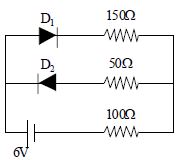
A
$0$
B
$0.02$
C
$0.03$
D
$0.036$
Solution
(B) $1$. Analyze the circuit: The battery is connected to a $100 \, \Omega$ resistor in series with a parallel combination of two branches.
$2$. Branch $1$ contains diode $D_1$ (forward biased) and a $150 \, \Omega$ resistor. Total resistance of this branch = $R_{D1} + R_1 = 50 \, \Omega + 150 \, \Omega = 200 \, \Omega$.
$3$. Branch $2$ contains diode $D_2$ (reverse biased). Since it has infinite backward resistance, no current flows through this branch.
$4$. The total resistance of the circuit is the sum of the $100 \, \Omega$ resistor and the equivalent resistance of the parallel branches. Since only Branch $1$ is active, the total resistance $R_{eq} = 100 \, \Omega + 200 \, \Omega = 300 \, \Omega$.
$5$. The current $I$ through the $100 \, \Omega$ resistor is given by Ohm's Law: $I = \frac{V}{R_{eq}} = \frac{6 \, V}{300 \, \Omega} = 0.02 \, A$.
$2$. Branch $1$ contains diode $D_1$ (forward biased) and a $150 \, \Omega$ resistor. Total resistance of this branch = $R_{D1} + R_1 = 50 \, \Omega + 150 \, \Omega = 200 \, \Omega$.
$3$. Branch $2$ contains diode $D_2$ (reverse biased). Since it has infinite backward resistance, no current flows through this branch.
$4$. The total resistance of the circuit is the sum of the $100 \, \Omega$ resistor and the equivalent resistance of the parallel branches. Since only Branch $1$ is active, the total resistance $R_{eq} = 100 \, \Omega + 200 \, \Omega = 300 \, \Omega$.
$5$. The current $I$ through the $100 \, \Omega$ resistor is given by Ohm's Law: $I = \frac{V}{R_{eq}} = \frac{6 \, V}{300 \, \Omega} = 0.02 \, A$.
0 likesView Solution
32
ChemistryMCQIIT JEE · 1997
The number of possible enantiomeric pairs that can be produced on monochlorination of $2$-methylbutane is
A
$2$
B
$3$
C
$4$
D
$1$
Solution
(B) The structure of $2$-methylbutane is $CH_3-CH(CH_3)-CH_2-CH_3$.
Monochlorination can occur at four different types of hydrogen atoms:
$1$. At $C_1$ (terminal methyl group): $CH_2Cl-CH(CH_3)-CH_2-CH_3$. This product has a chiral center at $C_2$,so it exists as a pair of enantiomers ($R$ and $S$).
$2$. At $C_2$: $CH_3-CCl(CH_3)-CH_2-CH_3$. This product has a chiral center at $C_2$,so it exists as a pair of enantiomers ($R$ and $S$).
$3$. At $C_3$: $CH_3-CH(CH_3)-CHCl-CH_3$. This product has a chiral center at $C_3$,so it exists as a pair of enantiomers ($R$ and $S$).
$4$. At $C_4$ (terminal methyl group): $CH_3-CH(CH_3)-CH_2-CH_2Cl$. This product is achiral.
Thus,there are $3$ products that exist as enantiomeric pairs. Therefore,the number of enantiomeric pairs is $3$.
Monochlorination can occur at four different types of hydrogen atoms:
$1$. At $C_1$ (terminal methyl group): $CH_2Cl-CH(CH_3)-CH_2-CH_3$. This product has a chiral center at $C_2$,so it exists as a pair of enantiomers ($R$ and $S$).
$2$. At $C_2$: $CH_3-CCl(CH_3)-CH_2-CH_3$. This product has a chiral center at $C_2$,so it exists as a pair of enantiomers ($R$ and $S$).
$3$. At $C_3$: $CH_3-CH(CH_3)-CHCl-CH_3$. This product has a chiral center at $C_3$,so it exists as a pair of enantiomers ($R$ and $S$).
$4$. At $C_4$ (terminal methyl group): $CH_3-CH(CH_3)-CH_2-CH_2Cl$. This product is achiral.
Thus,there are $3$ products that exist as enantiomeric pairs. Therefore,the number of enantiomeric pairs is $3$.
0 likesView Solution
33
ChemistryMCQIIT JEE · 1997
$A$ light pointer fixed to one prong of a tuning fork touches a vertical plate. The fork is set vibrating and the plate is allowed to fall freely. If eight oscillations are counted when the plate falls through $10 \, cm$,the frequency of the tuning fork is .... $Hz$
A
$360$
B
$280$
C
$560$
D
$56$
Solution
(D) The time taken for the plate to fall through a distance $h$ under gravity is given by $h = \frac{1}{2} g t^2$.
Given $h = 10 \, cm = 0.1 \, m$ and $g = 9.8 \, m/s^2$ (or $10 \, m/s^2$ for simplicity).
Using $g = 10 \, m/s^2$,we have $0.1 = \frac{1}{2} \times 10 \times t^2$.
$0.1 = 5 t^2 \implies t^2 = 0.02 \implies t = \sqrt{0.02} = \sqrt{\frac{2}{100}} = \frac{\sqrt{2}}{10} \, s$.
In this time $t$,the tuning fork completes $n = 8$ oscillations.
The frequency $f$ is given by $f = \frac{n}{t}$.
$f = \frac{8}{\frac{\sqrt{2}}{10}} = \frac{80}{\sqrt{2}} = 40 \sqrt{2} \approx 40 \times 1.414 = 56.56 \, Hz$.
Rounding to the nearest provided option,the frequency is $56 \, Hz$.
Given $h = 10 \, cm = 0.1 \, m$ and $g = 9.8 \, m/s^2$ (or $10 \, m/s^2$ for simplicity).
Using $g = 10 \, m/s^2$,we have $0.1 = \frac{1}{2} \times 10 \times t^2$.
$0.1 = 5 t^2 \implies t^2 = 0.02 \implies t = \sqrt{0.02} = \sqrt{\frac{2}{100}} = \frac{\sqrt{2}}{10} \, s$.
In this time $t$,the tuning fork completes $n = 8$ oscillations.
The frequency $f$ is given by $f = \frac{n}{t}$.
$f = \frac{8}{\frac{\sqrt{2}}{10}} = \frac{80}{\sqrt{2}} = 40 \sqrt{2} \approx 40 \times 1.414 = 56.56 \, Hz$.
Rounding to the nearest provided option,the frequency is $56 \, Hz$.
0 likesView Solution
34
ChemistryMCQIIT JEE · 1997
The intensity of radiation emitted by the sun has its maximum value at a wavelength of $510 \ nm$ and that emitted by the north star has the maximum value at $350 \ nm$. If these stars behave like black bodies,then the ratio of the surface temperature of the sun and north star is
A
$1.46$
B
$0.69$
C
$1.21$
D
$0.83$
Solution
(B) According to Wien's displacement law,the product of the wavelength corresponding to maximum intensity $(\lambda_{\max})$ and the absolute temperature $(T)$ of a black body is constant.
$\lambda_{\max} T = b$ (constant)
Therefore,$T \propto \frac{1}{\lambda_{\max}}$.
Let $T_S$ and $\lambda_S$ be the temperature and wavelength of the sun,and $T_N$ and $\lambda_N$ be the temperature and wavelength of the north star.
$\frac{T_S}{T_N} = \frac{(\lambda_N)_{\max}}{(\lambda_S)_{\max}}$
Given $(\lambda_S)_{\max} = 510 \ nm$ and $(\lambda_N)_{\max} = 350 \ nm$.
$\frac{T_S}{T_N} = \frac{350}{510} = \frac{35}{51} \approx 0.686 \approx 0.69$.
$\lambda_{\max} T = b$ (constant)
Therefore,$T \propto \frac{1}{\lambda_{\max}}$.
Let $T_S$ and $\lambda_S$ be the temperature and wavelength of the sun,and $T_N$ and $\lambda_N$ be the temperature and wavelength of the north star.
$\frac{T_S}{T_N} = \frac{(\lambda_N)_{\max}}{(\lambda_S)_{\max}}$
Given $(\lambda_S)_{\max} = 510 \ nm$ and $(\lambda_N)_{\max} = 350 \ nm$.
$\frac{T_S}{T_N} = \frac{350}{510} = \frac{35}{51} \approx 0.686 \approx 0.69$.
0 likesView Solution
35
ChemistryMCQIIT JEE · 1997
Molar heat capacity of water in equilibrium with ice at constant pressure is
A
Zero
B
Infinity
C
$40.45 \ kJ \ K^{-1} \ mol^{-1}$
D
$75.48 \ kJ \ K^{-1} \ mol^{-1}$
Solution
(B) The molar heat capacity $(C)$ is defined as $C = \frac{dQ}{dT}$.
When water is in equilibrium with ice at a constant pressure,the phase transition occurs at a constant temperature (the melting point).
Since the temperature remains constant during the phase change,the change in temperature $\Delta T = 0$.
However,there is heat exchange $(\Delta Q \neq 0)$ as the substance absorbs or releases latent heat.
Therefore,$C = \frac{\Delta Q}{\Delta T} = \frac{\Delta Q}{0} \rightarrow \infty$.
Thus,the molar heat capacity is infinite. Option $B$ is correct.
When water is in equilibrium with ice at a constant pressure,the phase transition occurs at a constant temperature (the melting point).
Since the temperature remains constant during the phase change,the change in temperature $\Delta T = 0$.
However,there is heat exchange $(\Delta Q \neq 0)$ as the substance absorbs or releases latent heat.
Therefore,$C = \frac{\Delta Q}{\Delta T} = \frac{\Delta Q}{0} \rightarrow \infty$.
Thus,the molar heat capacity is infinite. Option $B$ is correct.
0 likesView Solution
36
ChemistryMediumMCQIIT JEE · 1997
$A$ standard hydrogen electrode has zero electrode potential because
A
Hydrogen is easiest to oxidise
B
The electrode potential is assumed to be zero
C
Hydrogen atom has only one electron
D
Hydrogen is the lightest element
Solution
(B) Electrode potential is a relative term,meaning it is always measured with respect to a reference electrode.
In electrochemistry,the standard hydrogen electrode is arbitrarily chosen as the reference electrode.
To establish a basis for comparison with all other electrode reactions,its standard electrode potential is defined as $0.00 \ V$ at all temperatures.
In electrochemistry,the standard hydrogen electrode is arbitrarily chosen as the reference electrode.
To establish a basis for comparison with all other electrode reactions,its standard electrode potential is defined as $0.00 \ V$ at all temperatures.
0 likesView Solution
37
ChemistryMediumMCQIIT JEE · 1997
Among the following statements,the incorrect one is:
A
Calamine and siderite are carbonates
B
Argentite and cuprite are oxides
C
Zinc blende and pyrites are sulphides
D
Malachite and azurite are ores of copper
Solution
(B) The incorrect statement is $B$.
Calamine is $ZnCO_3$ and siderite is $FeCO_3$,which are both carbonates.
Argentite is $Ag_2S$ (sulphide) and cuprite is $Cu_2O$ (oxide),so the statement that both are oxides is incorrect.
Zinc blende is $ZnS$ and pyrites (iron pyrites) is $FeS_2$,which are both sulphides.
Malachite is $Cu(OH)_2 \cdot CuCO_3$ and azurite is $2CuCO_3 \cdot Cu(OH)_2$,which are both ores of copper.
Calamine is $ZnCO_3$ and siderite is $FeCO_3$,which are both carbonates.
Argentite is $Ag_2S$ (sulphide) and cuprite is $Cu_2O$ (oxide),so the statement that both are oxides is incorrect.
Zinc blende is $ZnS$ and pyrites (iron pyrites) is $FeS_2$,which are both sulphides.
Malachite is $Cu(OH)_2 \cdot CuCO_3$ and azurite is $2CuCO_3 \cdot Cu(OH)_2$,which are both ores of copper.
0 likesView Solution
38
ChemistryDifficultMCQIIT JEE · 1997
The only cations present in a slightly acidic solution are $Fe^{3+}$,$Zn^{2+}$,and $Cu^{2+}$. The reagent that when added in excess to this solution would identify and separate $Fe^{3+}$ in one step is
A
$2 \ M \ HCl$
B
$6 \ M \ NH_3$
C
$6 \ M \ NaOH$
D
$H_2S \ \text{gas}$
Solution
(C) When $6 \ M \ NaOH$ is added in excess to a solution containing $Fe^{3+}$,$Zn^{2+}$,and $Cu^{2+}$:
$1$. $Fe^{3+}$ reacts with $OH^-$ to form a reddish-brown precipitate of $Fe(OH)_3$,which is insoluble in excess $NaOH$.
$2$. $Zn^{2+}$ reacts with $OH^-$ to form $Zn(OH)_2$,which dissolves in excess $NaOH$ to form the soluble complex $[Zn(OH)_4]^{2-}$.
$3$. $Cu^{2+}$ reacts with $OH^-$ to form a blue precipitate of $Cu(OH)_2$,which is insoluble in excess $NaOH$.
However,in the context of standard qualitative analysis,$Fe^{3+}$ is separated as $Fe(OH)_3$ from the others. Given the options,$6 \ M \ NaOH$ is the correct reagent to distinguish $Fe^{3+}$ (as a precipitate) from the amphoteric $Zn^{2+}$ (as a soluble complex).
$1$. $Fe^{3+}$ reacts with $OH^-$ to form a reddish-brown precipitate of $Fe(OH)_3$,which is insoluble in excess $NaOH$.
$2$. $Zn^{2+}$ reacts with $OH^-$ to form $Zn(OH)_2$,which dissolves in excess $NaOH$ to form the soluble complex $[Zn(OH)_4]^{2-}$.
$3$. $Cu^{2+}$ reacts with $OH^-$ to form a blue precipitate of $Cu(OH)_2$,which is insoluble in excess $NaOH$.
However,in the context of standard qualitative analysis,$Fe^{3+}$ is separated as $Fe(OH)_3$ from the others. Given the options,$6 \ M \ NaOH$ is the correct reagent to distinguish $Fe^{3+}$ (as a precipitate) from the amphoteric $Zn^{2+}$ (as a soluble complex).
0 likesView Solution
39
ChemistryDifficultMCQIIT JEE · 1997
In the following groups: $I. -OAc$,$II. -OMe$,$III. -OSO_2Me$,$IV. -OSO_2CF_3$. The order of leaving group ability is:
A
$I > II > III > IV$
B
$IV > III > I > II$
C
$III > II > I > IV$
D
$II > III > IV > I$
Solution
(B) The leaving group ability is inversely proportional to the basicity of the leaving group. Weaker bases are better leaving groups.
The acidity of the corresponding conjugate acids follows the order: $CF_3SO_3H > CH_3SO_3H > CH_3COOH > CH_3OH$.
Therefore,the basicity order of their conjugate bases is: $CH_3O^- > CH_3COO^- > CH_3SO_3^- > CF_3SO_3^-$.
Thus,the leaving group ability order is $IV > III > I > II$.
The acidity of the corresponding conjugate acids follows the order: $CF_3SO_3H > CH_3SO_3H > CH_3COOH > CH_3OH$.
Therefore,the basicity order of their conjugate bases is: $CH_3O^- > CH_3COO^- > CH_3SO_3^- > CF_3SO_3^-$.
Thus,the leaving group ability order is $IV > III > I > II$.
0 likesView Solution
40
ChemistryMediumMCQIIT JEE · 1997
Among the given compounds,the most susceptible to nucleophilic attack at the carbonyl group is
A
$MeCOCl$
B
$MeCHO$
C
$MeCOOMe$
D
$MeCOOCOMe$
Solution
(A) Among the given compounds,the reactivity towards nucleophilic attack depends on the electrophilicity of the carbonyl carbon.
$MeCOCl$ (acid chloride) is the most reactive because the $Cl$ atom exerts a strong $-I$ effect and a weak $+R$ effect,making the carbonyl carbon highly electron-deficient.
The general order of reactivity towards nucleophilic acyl substitution is: $MeCOCl > MeCOOCOMe > MeCOOMe > MeCHO$.
Therefore,$MeCOCl$ is the most susceptible to nucleophilic attack.
$MeCOCl$ (acid chloride) is the most reactive because the $Cl$ atom exerts a strong $-I$ effect and a weak $+R$ effect,making the carbonyl carbon highly electron-deficient.
The general order of reactivity towards nucleophilic acyl substitution is: $MeCOCl > MeCOOCOMe > MeCOOMe > MeCHO$.
Therefore,$MeCOCl$ is the most susceptible to nucleophilic attack.
0 likesView Solution
41
ChemistryDifficultMCQIIT JEE · 1997
Which of the following will give a yellow precipitate with $I_2/NaOH$?
A
$ICH_2COCH_2CH_3$
B
$CH_3COOCOCH_3$
C
$CH_3CH(OH)CH_2CH_3$
D
Both $(a)$ and $(c)$
Solution
(D) The iodoform test is given by compounds containing the $CH_3CO-$ group or the $CH_3CH(OH)-$ group.
$1$. $ICH_2COCH_2CH_3$ contains the $CH_3CO-$ group (after considering the reaction conditions,it acts as a methyl ketone derivative),which reacts with $I_2/NaOH$ to form $CHI_3$ (yellow precipitate).
$2$. $CH_3CH(OH)CH_2CH_3$ is a secondary alcohol with a $CH_3CH(OH)-$ group,which is oxidized to a methyl ketone and then undergoes the iodoform reaction to give $CHI_3$ (yellow precipitate).
Therefore,both $(a)$ and $(c)$ give a yellow precipitate.
$1$. $ICH_2COCH_2CH_3$ contains the $CH_3CO-$ group (after considering the reaction conditions,it acts as a methyl ketone derivative),which reacts with $I_2/NaOH$ to form $CHI_3$ (yellow precipitate).
$2$. $CH_3CH(OH)CH_2CH_3$ is a secondary alcohol with a $CH_3CH(OH)-$ group,which is oxidized to a methyl ketone and then undergoes the iodoform reaction to give $CHI_3$ (yellow precipitate).
Therefore,both $(a)$ and $(c)$ give a yellow precipitate.
0 likesView Solution
42
ChemistryDifficultMCQIIT JEE · 1997
Among the following,the compound that is both paramagnetic and coloured is
A
$K_2Cr_2O_7$
B
$(NH_4)_2[TiCl_6]$
C
$VOSO_4$
D
$K_3[Cu(CN)_4]$
Solution
(C) $K_3[Cu(CN)_4]$: $Cu$ is in $+1$ oxidation state $(3d^{10})$,so it has no unpaired electrons,making it diamagnetic and colourless.
$(NH_4)_2[TiCl_6]$: $Ti$ is in $+4$ oxidation state $(3d^0)$,so it has no unpaired electrons,making it diamagnetic and colourless.
$VOSO_4$: $V$ is in $+4$ oxidation state $(3d^1)$,so it has one unpaired electron,making it paramagnetic and coloured.
$K_2Cr_2O_7$: $Cr$ is in $+6$ oxidation state $(3d^0)$,so it has no unpaired electrons. It is diamagnetic,but appears coloured due to ligand-to-metal charge transfer $(LMCT)$.
$(NH_4)_2[TiCl_6]$: $Ti$ is in $+4$ oxidation state $(3d^0)$,so it has no unpaired electrons,making it diamagnetic and colourless.
$VOSO_4$: $V$ is in $+4$ oxidation state $(3d^1)$,so it has one unpaired electron,making it paramagnetic and coloured.
$K_2Cr_2O_7$: $Cr$ is in $+6$ oxidation state $(3d^0)$,so it has no unpaired electrons. It is diamagnetic,but appears coloured due to ligand-to-metal charge transfer $(LMCT)$.
0 likesView Solution
Vedclass Products
For Students
Vedclass Test Series
Mock tests in real IIT JEE style covering Chemistry with performance analysis. 5-day free trial.
Start Free TrialFor Teachers
Exam Paper Generator
Generate Set A/B/C/D Chemistry papers from 7.5L+ questions in 2 minutes. 3 chapters free.
Try FreeFor Institutes
Online Exam Module
Run live IIT JEE mock exams with unlimited students, 360° analytics & white-label branding.
See DemoFrequently Asked Questions
How many Chemistry questions are in IIT JEE 1997?
There are 42 Chemistry questions from the IIT JEE 1997 paper on Vedclass, each with a detailed step-by-step solution in English.
Are IIT JEE 1997 Chemistry solutions available in English?
Yes. All solutions on this page are in English. You can also switch to English or Hindi using the language buttons above the questions.
Can I practice IIT JEE 1997 Chemistry as a timed test?
Yes. Use the Vedclass Test Series to attempt a full IIT JEE mock test covering Chemistry with time limits and instant score analysis.
Can teachers create Chemistry papers from IIT JEE previous year questions?
Yes. The Vedclass Exam Paper Generator lets teachers mix IIT JEE Chemistry questions and generate Set A/B/C/D papers in minutes.
For Teachers & Institutes
Build a Custom Chemistry Paper
Pick IIT JEE 1997 Chemistry questions, set difficulty, and generate Set A/B/C/D in 2 minutes.