
PhysicsQ1–22 of 22 questions
Page 1 of 1 · English
1
PhysicsMediumMCQIIT JEE · 1997
An artificial satellite moving in a circular orbit around the earth has a total (kinetic + potential) energy $E_0$. Its potential energy is
A
$ - E_0$
B
$1.5 E_0$
C
$2 E_0$
D
$E_0$
Solution
(C) For a satellite in a circular orbit,the potential energy $U$ is given by $U = -\frac{GMm}{r}$.
The total energy $E_0$ is the sum of kinetic energy $K$ and potential energy $U$,which is $E_0 = K + U = \frac{GMm}{2r} - \frac{GMm}{r} = -\frac{GMm}{2r}$.
Comparing the expressions for $U$ and $E_0$,we can see that $U = 2 \times (-\frac{GMm}{2r}) = 2 E_0$.
Therefore,the potential energy of the satellite is $2 E_0$.
The total energy $E_0$ is the sum of kinetic energy $K$ and potential energy $U$,which is $E_0 = K + U = \frac{GMm}{2r} - \frac{GMm}{r} = -\frac{GMm}{2r}$.
Comparing the expressions for $U$ and $E_0$,we can see that $U = 2 \times (-\frac{GMm}{2r}) = 2 E_0$.
Therefore,the potential energy of the satellite is $2 E_0$.
0 likesView Solution
2
PhysicsMediumMCQIIT JEE · 1997
$A$ vessel contains $1$ mole of $O_2$ gas (molar mass $32$) at a temperature $T$. The pressure of the gas is $P$. An identical vessel containing $1$ mole of $He$ gas (molar mass $4$) at temperature $2T$ has a pressure of:
A
$P/8$
B
$P$
C
$2P$
D
$8P$
Solution
(C) The ideal gas equation is given by $PV = \mu RT$,where $P$ is pressure,$V$ is volume,$\mu$ is the number of moles,$R$ is the universal gas constant,and $T$ is the temperature.
Since the vessels are identical,the volume $V$ is constant. $R$ is also a constant.
Therefore,$P \propto \mu T$.
For the first vessel (containing $O_2$): $P_1 = P$,$\mu_1 = 1$,$T_1 = T$.
For the second vessel (containing $He$): $P_2 = ?$,$\mu_2 = 1$,$T_2 = 2T$.
Taking the ratio: $\frac{P_2}{P_1} = \frac{\mu_2 T_2}{\mu_1 T_1}$.
Substituting the values: $\frac{P_2}{P} = \frac{1 \times 2T}{1 \times T} = 2$.
Thus,$P_2 = 2P$.
Since the vessels are identical,the volume $V$ is constant. $R$ is also a constant.
Therefore,$P \propto \mu T$.
For the first vessel (containing $O_2$): $P_1 = P$,$\mu_1 = 1$,$T_1 = T$.
For the second vessel (containing $He$): $P_2 = ?$,$\mu_2 = 1$,$T_2 = 2T$.
Taking the ratio: $\frac{P_2}{P_1} = \frac{\mu_2 T_2}{\mu_1 T_1}$.
Substituting the values: $\frac{P_2}{P} = \frac{1 \times 2T}{1 \times T} = 2$.
Thus,$P_2 = 2P$.
0 likesView Solution
3
PhysicsEasyMCQIIT JEE · 1997
The average translational kinetic energy of ${O_2}$ (molar mass $32$) molecules at a particular temperature is $0.048 \; eV$. The translational kinetic energy of ${N_2}$ (molar mass $28$) molecules in $eV$ at the same temperature is:
A
$0.0015$
B
$0.003$
C
$0.048$
D
$0.768$
Solution
(C) The average translational kinetic energy of an ideal gas molecule is given by the formula:
$E = \frac{3}{2} k_B T$
where $k_B$ is the Boltzmann constant and $T$ is the absolute temperature.
From this formula,it is clear that the translational kinetic energy depends only on the temperature $T$ of the gas.
It is independent of the nature of the gas (i.e.,independent of molar mass).
Since the temperature $T$ is the same for both ${O_2}$ and ${N_2}$ molecules,their average translational kinetic energies will be equal.
Therefore,$E_{N_2} = E_{O_2} = 0.048 \; eV$.
$E = \frac{3}{2} k_B T$
where $k_B$ is the Boltzmann constant and $T$ is the absolute temperature.
From this formula,it is clear that the translational kinetic energy depends only on the temperature $T$ of the gas.
It is independent of the nature of the gas (i.e.,independent of molar mass).
Since the temperature $T$ is the same for both ${O_2}$ and ${N_2}$ molecules,their average translational kinetic energies will be equal.
Therefore,$E_{N_2} = E_{O_2} = 0.048 \; eV$.
0 likesView Solution
4
PhysicsMediumMCQIIT JEE · 1997
The average translational kinetic energy and the $r.m.s.$ speed of molecules in a sample of oxygen gas at $300 \, K$ are $6.21 \times 10^{-21} \, J$ and $484 \, m/s$ respectively. The corresponding values at $600 \, K$ are nearly (assuming ideal gas behaviour):
A
$12.42 \times 10^{-21} \, J, \, 684 \, m/s$
B
$8.78 \times 10^{-21} \, J, \, 684 \, m/s$
C
$6.21 \times 10^{-21} \, J, \, 968 \, m/s$
D
$12.42 \times 10^{-21} \, J, \, 968 \, m/s$
Solution
(A) The average translational kinetic energy $E$ of a gas molecule is given by $E = \frac{3}{2} k_B T$. Thus,$E \propto T$.
Given $T_1 = 300 \, K$ and $T_2 = 600 \, K$,the ratio is $\frac{E_2}{E_1} = \frac{T_2}{T_1} = \frac{600}{300} = 2$.
Therefore,$E_2 = 2 \times E_1 = 2 \times 6.21 \times 10^{-21} \, J = 12.42 \times 10^{-21} \, J$.
The $r.m.s.$ speed is given by $v_{rms} = \sqrt{\frac{3RT}{M}}$. Thus,$v_{rms} \propto \sqrt{T}$.
Therefore,$\frac{(v_{rms})_2}{(v_{rms})_1} = \sqrt{\frac{T_2}{T_1}} = \sqrt{\frac{600}{300}} = \sqrt{2} \approx 1.414$.
$(v_{rms})_2 = 1.414 \times 484 \, m/s \approx 684 \, m/s$.
Thus,the values are $12.42 \times 10^{-21} \, J$ and $684 \, m/s$.
Given $T_1 = 300 \, K$ and $T_2 = 600 \, K$,the ratio is $\frac{E_2}{E_1} = \frac{T_2}{T_1} = \frac{600}{300} = 2$.
Therefore,$E_2 = 2 \times E_1 = 2 \times 6.21 \times 10^{-21} \, J = 12.42 \times 10^{-21} \, J$.
The $r.m.s.$ speed is given by $v_{rms} = \sqrt{\frac{3RT}{M}}$. Thus,$v_{rms} \propto \sqrt{T}$.
Therefore,$\frac{(v_{rms})_2}{(v_{rms})_1} = \sqrt{\frac{T_2}{T_1}} = \sqrt{\frac{600}{300}} = \sqrt{2} \approx 1.414$.
$(v_{rms})_2 = 1.414 \times 484 \, m/s \approx 684 \, m/s$.
Thus,the values are $12.42 \times 10^{-21} \, J$ and $684 \, m/s$.
0 likesView Solution
5
PhysicsEasyMCQIIT JEE · 1997
The intensity of radiation emitted by the sun has its maximum value at a wavelength of $510\;nm$ and that emitted by the north star has the maximum value at $350\;nm$. If these stars behave like black bodies,then the ratio of the surface temperature of the sun and north star is
A
$1.46$
B
$0.69$
C
$1.21$
D
$0.83$
Solution
(B) According to Wien's displacement law,the product of the wavelength corresponding to maximum intensity $(\lambda_{\max})$ and the absolute temperature $(T)$ of a black body is constant.
$\lambda_{\max} T = b$ (constant)
Therefore,$T \propto \frac{1}{\lambda_{\max}}$.
Let $T_S$ and $\lambda_S$ be the temperature and wavelength of maximum intensity for the sun,and $T_N$ and $\lambda_N$ be those for the north star.
Given: $\lambda_S = 510\;nm$ and $\lambda_N = 350\;nm$.
The ratio of the surface temperatures is given by:
$\frac{T_S}{T_N} = \frac{\lambda_N}{\lambda_S} = \frac{350}{510} \approx 0.686$.
Rounding to two decimal places,we get $0.69$.
$\lambda_{\max} T = b$ (constant)
Therefore,$T \propto \frac{1}{\lambda_{\max}}$.
Let $T_S$ and $\lambda_S$ be the temperature and wavelength of maximum intensity for the sun,and $T_N$ and $\lambda_N$ be those for the north star.
Given: $\lambda_S = 510\;nm$ and $\lambda_N = 350\;nm$.
The ratio of the surface temperatures is given by:
$\frac{T_S}{T_N} = \frac{\lambda_N}{\lambda_S} = \frac{350}{510} \approx 0.686$.
Rounding to two decimal places,we get $0.69$.
0 likesView Solution
6
PhysicsMediumMCQIIT JEE · 1997
$A$ spherical black body with a radius of $24\;cm$ radiates $440\;W$ power at $500\;K$. If the radius were halved and the temperature doubled,the power radiated in watt would be
A
$220$
B
$440$
C
$880$
D
$1760$
Solution
(D) The power radiated by a black body is given by the Stefan-Boltzmann law: $P = A\sigma T^4$,where $A = 4\pi r^2$ is the surface area.
Therefore,$P \propto r^2 T^4$.
Given the initial state: $P_1 = 440\;W$,$r_1 = 24\;cm$,$T_1 = 500\;K$.
For the final state: $r_2 = r_1 / 2 = 12\;cm$ and $T_2 = 2T_1 = 1000\;K$.
Using the proportionality ratio:
$\frac{P_2}{P_1} = \left( \frac{r_2}{r_1} \right)^2 \left( \frac{T_2}{T_1} \right)^4$
$\frac{P_2}{440} = \left( \frac{1}{2} \right)^2 \left( \frac{2}{1} \right)^4$
$\frac{P_2}{440} = \frac{1}{4} \times 16 = 4$
$P_2 = 440 \times 4 = 1760\;W$.
Therefore,$P \propto r^2 T^4$.
Given the initial state: $P_1 = 440\;W$,$r_1 = 24\;cm$,$T_1 = 500\;K$.
For the final state: $r_2 = r_1 / 2 = 12\;cm$ and $T_2 = 2T_1 = 1000\;K$.
Using the proportionality ratio:
$\frac{P_2}{P_1} = \left( \frac{r_2}{r_1} \right)^2 \left( \frac{T_2}{T_1} \right)^4$
$\frac{P_2}{440} = \left( \frac{1}{2} \right)^2 \left( \frac{2}{1} \right)^4$
$\frac{P_2}{440} = \frac{1}{4} \times 16 = 4$
$P_2 = 440 \times 4 = 1760\;W$.
0 likesView Solution
7
PhysicsEasyMCQIIT JEE · 1997
$A$ travelling wave in a stretched string is described by the equation $y = A\sin (kx - \omega t)$. The maximum particle velocity is
A
$A\omega$
B
$A\omega/k$
C
$d\omega/dk$
D
$x/t$
Solution
(A) The displacement of the particle in the string is given by $y = A\sin (kx - \omega t)$.
To find the particle velocity,we differentiate the displacement $y$ with respect to time $t$:
$v = \frac{dy}{dt} = \frac{d}{dt} [A\sin (kx - \omega t)]$
$v = A \cos (kx - \omega t) \cdot (-\omega)$
$v = -A\omega \cos (kx - \omega t)$
The maximum value of the particle velocity occurs when the magnitude of the cosine function is $1$.
Therefore,$v_{\max} = | -A\omega | = A\omega$.
To find the particle velocity,we differentiate the displacement $y$ with respect to time $t$:
$v = \frac{dy}{dt} = \frac{d}{dt} [A\sin (kx - \omega t)]$
$v = A \cos (kx - \omega t) \cdot (-\omega)$
$v = -A\omega \cos (kx - \omega t)$
The maximum value of the particle velocity occurs when the magnitude of the cosine function is $1$.
Therefore,$v_{\max} = | -A\omega | = A\omega$.
0 likesView Solution
8
PhysicsMediumMCQIIT JEE · 1997
$A$ whistle giving out $450 Hz$ approaches a stationary observer at a speed of $33 m/s$. The frequency heard by the observer in $Hz$ is (Take speed of sound $v = 330 m/s$)
A
$409$
B
$429$
C
$517$
D
$500$
Solution
(D) The apparent frequency $n'$ heard by the observer is given by the Doppler effect formula for a source moving towards a stationary observer:
$n' = n \left( \frac{v}{v - v_s} \right)$
Given:
Source frequency $n = 450 Hz$
Speed of sound $v = 330 m/s$
Speed of source $v_s = 33 m/s$
Substituting the values:
$n' = 450 \times \left( \frac{330}{330 - 33} \right)$
$n' = 450 \times \left( \frac{330}{297} \right)$
$n' = 450 \times \frac{10}{9}$
$n' = 50 \times 10 = 500 Hz$
Therefore,the frequency heard by the observer is $500 Hz$.
$n' = n \left( \frac{v}{v - v_s} \right)$
Given:
Source frequency $n = 450 Hz$
Speed of sound $v = 330 m/s$
Speed of source $v_s = 33 m/s$
Substituting the values:
$n' = 450 \times \left( \frac{330}{330 - 33} \right)$
$n' = 450 \times \left( \frac{330}{297} \right)$
$n' = 450 \times \frac{10}{9}$
$n' = 50 \times 10 = 500 Hz$
Therefore,the frequency heard by the observer is $500 Hz$.
0 likesView Solution
9
PhysicsMediumMCQIIT JEE · 1997
$A$ light pointer fixed to one prong of a tuning fork touches a vertical plate. The fork is set vibrating and the plate is allowed to fall freely. If eight oscillations are counted when the plate falls through $10 \, cm$,the frequency of the tuning fork is .... $Hz$
A
$360$
B
$280$
C
$560$
D
$56$
Solution
(D) The time $t$ taken by the plate to fall through a height $h$ is given by the equation of motion $h = \frac{1}{2}gt^2$.
Given $h = 10 \, cm = 0.1 \, m$ and $g = 9.8 \, m/s^2$ (or $10 \, m/s^2$ for simplicity).
Using $g = 10 \, m/s^2$,we have $0.1 = \frac{1}{2} \times 10 \times t^2$,which gives $t^2 = 0.02$,so $t = \sqrt{0.02} \, s = \sqrt{\frac{2}{100}} \, s = \frac{\sqrt{2}}{10} \, s \approx 0.1414 \, s$.
In this time,the tuning fork completes $n = 8$ oscillations.
The time period of one oscillation is $T = \frac{t}{n} = \frac{\sqrt{0.02}}{8} \, s$.
The frequency $f$ is the reciprocal of the time period: $f = \frac{1}{T} = \frac{8}{\sqrt{0.02}} = \frac{8}{0.1414} \approx 56.56 \, Hz$.
Rounding to the nearest integer provided in the options,the frequency is $56 \, Hz$.
Given $h = 10 \, cm = 0.1 \, m$ and $g = 9.8 \, m/s^2$ (or $10 \, m/s^2$ for simplicity).
Using $g = 10 \, m/s^2$,we have $0.1 = \frac{1}{2} \times 10 \times t^2$,which gives $t^2 = 0.02$,so $t = \sqrt{0.02} \, s = \sqrt{\frac{2}{100}} \, s = \frac{\sqrt{2}}{10} \, s \approx 0.1414 \, s$.
In this time,the tuning fork completes $n = 8$ oscillations.
The time period of one oscillation is $T = \frac{t}{n} = \frac{\sqrt{0.02}}{8} \, s$.
The frequency $f$ is the reciprocal of the time period: $f = \frac{1}{T} = \frac{8}{\sqrt{0.02}} = \frac{8}{0.1414} \approx 56.56 \, Hz$.
Rounding to the nearest integer provided in the options,the frequency is $56 \, Hz$.
0 likesView Solution
10
PhysicsMediumMCQIIT JEE · 1997
An isolated particle of mass $m$ is moving in a horizontal plane $(x-y)$ along the $x$-axis,at a certain height above the ground. It suddenly explodes into two fragments of masses $m/4$ and $3m/4$. An instant later,the smaller fragment is at $y = +15 \ cm$. The larger fragment at this instant is at
A
$-5 \ cm$
B
$+20 \ cm$
C
$+5 \ cm$
D
$-20 \ cm$
Solution
(A) Before the explosion,the particle was moving along the $x$-axis,which means it had no $y$-component of velocity. Consequently,the center of mass of the system does not move in the $y$-direction,so $y_{CM} = 0$.
Using the formula for the center of mass: $y_{CM} = \frac{m_1 y_1 + m_2 y_2}{m_1 + m_2}$.
Substituting the given values: $0 = \frac{(m/4)(+15) + (3m/4)(y)}{m}$.
This simplifies to: $0 = \frac{15}{4} + \frac{3y}{4}$.
Solving for $y$: $\frac{3y}{4} = -\frac{15}{4}$,which gives $y = -5 \ cm$.
Using the formula for the center of mass: $y_{CM} = \frac{m_1 y_1 + m_2 y_2}{m_1 + m_2}$.
Substituting the given values: $0 = \frac{(m/4)(+15) + (3m/4)(y)}{m}$.
This simplifies to: $0 = \frac{15}{4} + \frac{3y}{4}$.
Solving for $y$: $\frac{3y}{4} = -\frac{15}{4}$,which gives $y = -5 \ cm$.
0 likesView Solution
11
PhysicsMediumMCQIIT JEE · 1997
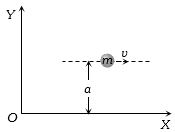
$A$ mass $m$ is moving with a constant velocity $v$ along a line parallel to the $X$-axis. Its angular momentum with respect to the origin or the $Z$-axis is:
A
will be zero
B
will remain constant
C
will increase
D
will decrease
Solution
(B) The angular momentum $L$ of a particle about the origin is given by $L = r \times p$,where $r$ is the position vector and $p$ is the linear momentum.
Alternatively,the magnitude of angular momentum is $L = p \times d$,where $d$ is the perpendicular distance from the origin to the line of motion.
Here,the mass $m$ moves with constant velocity $v$,so the linear momentum $p = mv$ is constant.
The perpendicular distance $d$ from the origin to the line of motion is constant and equal to $a$.
Therefore,the angular momentum $L = mv \times a = mva$,which is a constant value.
Alternatively,the magnitude of angular momentum is $L = p \times d$,where $d$ is the perpendicular distance from the origin to the line of motion.
Here,the mass $m$ moves with constant velocity $v$,so the linear momentum $p = mv$ is constant.
The perpendicular distance $d$ from the origin to the line of motion is constant and equal to $a$.
Therefore,the angular momentum $L = mv \times a = mva$,which is a constant value.
0 likesView Solution
12
PhysicsMediumMCQIIT JEE · 1997
An electron of mass $m_e$ initially at rest moves through a certain distance in a uniform electric field in time $t_1$. $A$ proton of mass $m_p$ also initially at rest takes time $t_2$ to move through an equal distance in this uniform electric field. Neglecting the effect of gravity,the ratio of $t_2/t_1$ is nearly equal to
A
$1$
B
$(m_p/m_e)^{1/2}$
C
$(m_e/m_p)^{1/2}$
D
$1836$
Solution
(B) The force on a charged particle in a uniform electric field $E$ is given by $F = qE$. According to Newton's second law,$F = ma$,so the acceleration is $a = qE/m$.
Using the equation of motion $s = ut + (1/2)at^2$,and since the particles start from rest $(u = 0)$,the distance $s$ covered in time $t$ is $s = (1/2)(qE/m)t^2$.
For the electron: $s = (1/2)(eE/m_e)t_1^2$.
For the proton: $s = (1/2)(eE/m_p)t_2^2$.
Since the distance $s$ is the same for both,we equate the two expressions:
$(1/2)(eE/m_e)t_1^2 = (1/2)(eE/m_p)t_2^2$.
Simplifying this,we get $t_1^2/m_e = t_2^2/m_p$.
Therefore,$t_2^2/t_1^2 = m_p/m_e$.
Taking the square root of both sides,we find the ratio $t_2/t_1 = (m_p/m_e)^{1/2}$.
Using the equation of motion $s = ut + (1/2)at^2$,and since the particles start from rest $(u = 0)$,the distance $s$ covered in time $t$ is $s = (1/2)(qE/m)t^2$.
For the electron: $s = (1/2)(eE/m_e)t_1^2$.
For the proton: $s = (1/2)(eE/m_p)t_2^2$.
Since the distance $s$ is the same for both,we equate the two expressions:
$(1/2)(eE/m_e)t_1^2 = (1/2)(eE/m_p)t_2^2$.
Simplifying this,we get $t_1^2/m_e = t_2^2/m_p$.
Therefore,$t_2^2/t_1^2 = m_p/m_e$.
Taking the square root of both sides,we find the ratio $t_2/t_1 = (m_p/m_e)^{1/2}$.
0 likesView Solution
13
PhysicsMediumMCQIIT JEE · 1997
$A$ non-conducting ring of radius $0.5\,m$ carries a total charge of $1.11 \times 10^{-10}\,C$ distributed non-uniformly on its circumference,producing an electric field $\vec{E}$ everywhere in space. The value of the line integral $\int_{l = \infty }^{l = 0} { - \vec{E} \cdot d\vec{l} }$ (where $l = 0$ is the centre of the ring) in volts is:
A
$2$
B
$-1$
C
$-2$
D
$0$
Solution
(A) The line integral of the electric field from infinity to a point $P$ is defined as the electric potential $V$ at that point.
$\int_{\infty}^{P} -\vec{E} \cdot d\vec{l} = V_P - V_{\infty}$.
Since the potential at infinity $V_{\infty} = 0$,the integral represents the potential at the centre of the ring.
For a ring of radius $R$ with total charge $q$,the potential at the centre is given by $V = \frac{1}{4\pi\epsilon_0} \frac{q}{R}$.
Given $q = 1.11 \times 10^{-10}\,C$,$R = 0.5\,m$,and $\frac{1}{4\pi\epsilon_0} = 9 \times 10^9\,N\cdot m^2/C^2$.
$V = (9 \times 10^9) \times \frac{1.11 \times 10^{-10}}{0.5} = \frac{9.99 \times 10^{-1}}{0.5} = \frac{0.999}{0.5} \approx 2\,V$.
$\int_{\infty}^{P} -\vec{E} \cdot d\vec{l} = V_P - V_{\infty}$.
Since the potential at infinity $V_{\infty} = 0$,the integral represents the potential at the centre of the ring.
For a ring of radius $R$ with total charge $q$,the potential at the centre is given by $V = \frac{1}{4\pi\epsilon_0} \frac{q}{R}$.
Given $q = 1.11 \times 10^{-10}\,C$,$R = 0.5\,m$,and $\frac{1}{4\pi\epsilon_0} = 9 \times 10^9\,N\cdot m^2/C^2$.
$V = (9 \times 10^9) \times \frac{1.11 \times 10^{-10}}{0.5} = \frac{9.99 \times 10^{-1}}{0.5} = \frac{0.999}{0.5} \approx 2\,V$.
0 likesView Solution
14
PhysicsEasyMCQIIT JEE · 1997
$A$ steady current flows in a metallic conductor of non-uniform cross-section. The quantity/quantities constant along the length of the conductor is/are:
A
Current,electric field and drift speed
B
Drift speed only
C
Current and drift speed
D
Current only
Solution
(D) For a steady current $i$ flowing through a conductor,the charge conservation principle implies that the current $i$ must be constant at every cross-section of the conductor.
The current density is given by $j = \frac{i}{A}$,where $A$ is the cross-sectional area. Since $A$ varies along the length,$j$ is not constant.
From Ohm's law in microscopic form,$j = \sigma E$. Since $j$ varies,the electric field $E$ must also vary along the length.
Furthermore,the drift velocity is given by ${v_d} = \frac{j}{ne} = \frac{i}{Ane}$. Since $A$ varies,the drift velocity ${v_d}$ is also not constant.
Therefore,only the current $i$ remains constant along the length of the conductor.
The current density is given by $j = \frac{i}{A}$,where $A$ is the cross-sectional area. Since $A$ varies along the length,$j$ is not constant.
From Ohm's law in microscopic form,$j = \sigma E$. Since $j$ varies,the electric field $E$ must also vary along the length.
Furthermore,the drift velocity is given by ${v_d} = \frac{j}{ne} = \frac{i}{Ane}$. Since $A$ varies,the drift velocity ${v_d}$ is also not constant.
Therefore,only the current $i$ remains constant along the length of the conductor.
0 likesView Solution
15
PhysicsMediumMCQIIT JEE · 1997
The maximum kinetic energy of photoelectrons emitted from a surface when photons of energy $6 eV$ fall on it is $4 eV$. The stopping potential in volts is
A
$2$
B
$4$
C
$6$
D
$10$
Solution
(B) The relationship between the maximum kinetic energy $(K_{\max})$ of photoelectrons and the stopping potential $(V_s)$ is given by the equation: $K_{\max} = e V_s$.
Given that the maximum kinetic energy $K_{\max} = 4 eV$.
Substituting the value into the equation: $4 eV = e V_s$.
Therefore,the stopping potential $V_s = 4 V$.
Given that the maximum kinetic energy $K_{\max} = 4 eV$.
Substituting the value into the equation: $4 eV = e V_s$.
Therefore,the stopping potential $V_s = 4 V$.
0 likesView Solution
16
PhysicsMediumMCQIIT JEE · 1997
The $K_{\alpha}$ $X$-ray emission line of tungsten occurs at $\lambda = 0.021 \ nm$. The energy difference between $K$ and $L$ levels in this atom is about:
A
$0.51 \ MeV$
B
$1.2 \ MeV$
C
$59 \ keV$
D
$13.6 \ eV$
Solution
(C) The energy of the emitted $X$-ray photon corresponds to the energy difference between the two levels involved in the transition.
For the $K_{\alpha}$ line,the transition occurs from the $L$ level to the $K$ level.
The energy difference is given by $\Delta E = E_K - E_L = \frac{hc}{\lambda}$.
Substituting the values: $h = 6.6 \times 10^{-34} \ J \cdot s$,$c = 3 \times 10^8 \ m/s$,and $\lambda = 0.021 \times 10^{-9} \ m$.
$\Delta E = \frac{(6.6 \times 10^{-34}) \times (3 \times 10^8)}{0.021 \times 10^{-9}} \ J$.
To convert this energy into electron-volts $(eV)$,divide by $1.6 \times 10^{-19} \ J/eV$:
$\Delta E = \frac{19.8 \times 10^{-26}}{0.021 \times 10^{-9} \times 1.6 \times 10^{-19}} \ eV \approx 58928 \ eV \approx 59 \ keV$.
For the $K_{\alpha}$ line,the transition occurs from the $L$ level to the $K$ level.
The energy difference is given by $\Delta E = E_K - E_L = \frac{hc}{\lambda}$.
Substituting the values: $h = 6.6 \times 10^{-34} \ J \cdot s$,$c = 3 \times 10^8 \ m/s$,and $\lambda = 0.021 \times 10^{-9} \ m$.
$\Delta E = \frac{(6.6 \times 10^{-34}) \times (3 \times 10^8)}{0.021 \times 10^{-9}} \ J$.
To convert this energy into electron-volts $(eV)$,divide by $1.6 \times 10^{-19} \ J/eV$:
$\Delta E = \frac{19.8 \times 10^{-26}}{0.021 \times 10^{-9} \times 1.6 \times 10^{-19}} \ eV \approx 58928 \ eV \approx 59 \ keV$.
0 likesView Solution
17
PhysicsEasyMCQIIT JEE · 1997
As per the Bohr model,the minimum energy (in $eV$) required to remove an electron from the ground state of a doubly ionized $Li$ atom $(Z = 3)$ is:
A
$1.51$
B
$13.6$
C
$40.8$
D
$122.4$
Solution
(D) According to the Bohr model,the energy of an electron in the $n^{th}$ orbit of a hydrogen-like atom is given by $E_n = -13.6 \times \frac{Z^2}{n^2} \; eV$.
For a doubly ionized lithium atom $(Li^{2+})$,the atomic number $Z = 3$.
For the ground state,the principal quantum number $n = 1$.
Substituting these values,the energy of the ground state is $E_1 = -13.6 \times \frac{3^2}{1^2} \; eV = -13.6 \times 9 \; eV = -122.4 \; eV$.
The energy required to remove the electron (ionization energy) is the energy needed to bring the electron from the ground state to infinity $(E_{\infty} = 0)$.
Therefore,Ionization Energy $= E_{\infty} - E_1 = 0 - (-122.4 \; eV) = 122.4 \; eV$.
For a doubly ionized lithium atom $(Li^{2+})$,the atomic number $Z = 3$.
For the ground state,the principal quantum number $n = 1$.
Substituting these values,the energy of the ground state is $E_1 = -13.6 \times \frac{3^2}{1^2} \; eV = -13.6 \times 9 \; eV = -122.4 \; eV$.
The energy required to remove the electron (ionization energy) is the energy needed to bring the electron from the ground state to infinity $(E_{\infty} = 0)$.
Therefore,Ionization Energy $= E_{\infty} - E_1 = 0 - (-122.4 \; eV) = 122.4 \; eV$.
0 likesView Solution
18
PhysicsEasyMCQIIT JEE · 1997
Which of the following statements is not true?
A
The resistance of intrinsic semiconductors decreases with an increase in temperature.
B
Doping pure $Si$ with trivalent impurities gives $P-$type semiconductors.
C
The majority carriers in $N-$type semiconductors are holes.
D
$A$ $PN-$junction can act as a semiconductor diode.
Solution
(C) In an $N-$type semiconductor,the majority charge carriers are electrons,not holes. Therefore,the statement that the majority carriers in $N-$type semiconductors are holes is incorrect. Thus,option $C$ is the correct answer.
0 likesView Solution
19
PhysicsEasyMCQIIT JEE · 1997
The dominant mechanisms for motion of charge carriers in forward and reverse biased silicon $P-N$ junctions are
A
Drift in forward bias,diffusion in reverse bias
B
Diffusion in forward bias,drift in reverse bias
C
Diffusion in both forward and reverse bias
D
Drift in both forward and reverse bias
Solution
(B) In a forward-biased $P-N$ junction,the potential barrier is reduced,which allows majority charge carriers to cross the junction easily. This process is known as diffusion,which becomes the dominant mechanism for current flow.
In a reverse-biased $P-N$ junction,the potential barrier increases,which prevents majority charge carriers from crossing the junction. However,minority charge carriers can still cross the junction due to the electric field present in the depletion region. This process is known as drift,which becomes the dominant mechanism for the small reverse saturation current.
In a reverse-biased $P-N$ junction,the potential barrier increases,which prevents majority charge carriers from crossing the junction. However,minority charge carriers can still cross the junction due to the electric field present in the depletion region. This process is known as drift,which becomes the dominant mechanism for the small reverse saturation current.
0 likesView Solution
20
PhysicsMediumMCQIIT JEE · 1997
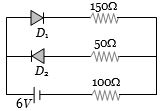
The circuit shown in the following figure contains two diodes $D_1$ and $D_2$,each with a forward resistance of $50 \, \Omega$ and infinite backward resistance. If the battery voltage is $6 \, V$,the current through the $100 \, \Omega$ resistance (in amperes) is:
A
$0$
B
$0.02$
C
$0.03$
D
$0.036$
Solution
(B) $1$. Analyze the biasing of the diodes: Based on the provided circuit diagram,the positive terminal of the $6 \, V$ battery is connected to the anode of diode $D_1$ and the cathode of diode $D_2$.
$2$. Determine the state of each diode: Diode $D_1$ is forward-biased,allowing current to flow through it. Diode $D_2$ is reverse-biased,acting as an open circuit (infinite resistance),so no current flows through the branch containing $D_2$.
$3$. Calculate the total resistance of the circuit: The circuit effectively consists of the battery,the $100 \, \Omega$ resistor,the forward-biased diode $D_1$ (with $50 \, \Omega$ resistance),and the $150 \, \Omega$ resistor in series.
Total resistance $R_{eq} = R_{battery} + R_{D1} + R_{150\Omega} + R_{100\Omega} = 0 + 50 \, \Omega + 150 \, \Omega + 100 \, \Omega = 300 \, \Omega$.
$4$. Calculate the current: Using Ohm's law,$I = \frac{V}{R_{eq}} = \frac{6 \, V}{300 \, \Omega} = 0.02 \, A$.
$2$. Determine the state of each diode: Diode $D_1$ is forward-biased,allowing current to flow through it. Diode $D_2$ is reverse-biased,acting as an open circuit (infinite resistance),so no current flows through the branch containing $D_2$.
$3$. Calculate the total resistance of the circuit: The circuit effectively consists of the battery,the $100 \, \Omega$ resistor,the forward-biased diode $D_1$ (with $50 \, \Omega$ resistance),and the $150 \, \Omega$ resistor in series.
Total resistance $R_{eq} = R_{battery} + R_{D1} + R_{150\Omega} + R_{100\Omega} = 0 + 50 \, \Omega + 150 \, \Omega + 100 \, \Omega = 300 \, \Omega$.
$4$. Calculate the current: Using Ohm's law,$I = \frac{V}{R_{eq}} = \frac{6 \, V}{300 \, \Omega} = 0.02 \, A$.
0 likesView Solution
21
PhysicsMediumMCQIIT JEE · 1997
An eye specialist prescribes spectacles having a combination of a convex lens of focal length $40\, cm$ in contact with a concave lens of focal length $25\, cm$. The power of this lens combination in diopters is
A
$+ 1.5$
B
$- 1.5$
C
$+ 6.67$
D
$- 6.67$
Solution
(B) The power $P$ of a lens is given by $P = \frac{100}{f(cm)}\, D$.
For the convex lens,the focal length $f_1 = +40\, cm$.
Therefore,the power $P_1 = \frac{100}{40} = +2.5\, D$.
For the concave lens,the focal length $f_2 = -25\, cm$.
Therefore,the power $P_2 = \frac{100}{-25} = -4.0\, D$.
The power of the combination of lenses in contact is given by $P = P_1 + P_2$.
$P = 2.5\, D + (-4.0\, D) = -1.5\, D$.
For the convex lens,the focal length $f_1 = +40\, cm$.
Therefore,the power $P_1 = \frac{100}{40} = +2.5\, D$.
For the concave lens,the focal length $f_2 = -25\, cm$.
Therefore,the power $P_2 = \frac{100}{-25} = -4.0\, D$.
The power of the combination of lenses in contact is given by $P = P_1 + P_2$.
$P = 2.5\, D + (-4.0\, D) = -1.5\, D$.
0 likesView Solution
22
PhysicsMediumMCQIIT JEE · 1997
Proton,deuteron,and alpha particle of same kinetic energy are moving in circular trajectories in a constant magnetic field. The radii of proton,deuteron,and alpha particle are respectively $r_p, r_d$,and $r_{\alpha}$. Which one of the following relations is correct?
A
$r_{\alpha} = r_d > r_p$
B
$r_{\alpha} = r_p = r_d$
C
$r_{\alpha} = r_p < r_d$
D
$r_{\alpha} > r_d > r_p$
Solution
(C) The radius of a charged particle moving in a magnetic field is given by $r = \frac{mv}{qB}$.
Since kinetic energy $K = \frac{1}{2}mv^2$,we have $mv = \sqrt{2mK}$.
Substituting this into the radius formula: $r = \frac{\sqrt{2mK}}{qB}$.
Since $K$ and $B$ are constant,$r \propto \frac{\sqrt{m}}{q}$.
For a proton $(p)$: $m_p = m, q_p = e \Rightarrow r_p \propto \frac{\sqrt{m}}{e}$.
For a deuteron $(d)$: $m_d = 2m, q_d = e \Rightarrow r_d \propto \frac{\sqrt{2m}}{e} = \sqrt{2} r_p$.
For an alpha particle $(\alpha)$: $m_{\alpha} = 4m, q_{\alpha} = 2e \Rightarrow r_{\alpha} \propto \frac{\sqrt{4m}}{2e} = \frac{2\sqrt{m}}{2e} = r_p$.
Comparing the values: $r_{\alpha} = r_p$ and $r_d = \sqrt{2} r_p \approx 1.414 r_p$.
Thus,$r_d > r_{\alpha} = r_p$ is not explicitly listed,but checking the options,the relation $r_{\alpha} = r_p < r_d$ is correct.
Since kinetic energy $K = \frac{1}{2}mv^2$,we have $mv = \sqrt{2mK}$.
Substituting this into the radius formula: $r = \frac{\sqrt{2mK}}{qB}$.
Since $K$ and $B$ are constant,$r \propto \frac{\sqrt{m}}{q}$.
For a proton $(p)$: $m_p = m, q_p = e \Rightarrow r_p \propto \frac{\sqrt{m}}{e}$.
For a deuteron $(d)$: $m_d = 2m, q_d = e \Rightarrow r_d \propto \frac{\sqrt{2m}}{e} = \sqrt{2} r_p$.
For an alpha particle $(\alpha)$: $m_{\alpha} = 4m, q_{\alpha} = 2e \Rightarrow r_{\alpha} \propto \frac{\sqrt{4m}}{2e} = \frac{2\sqrt{m}}{2e} = r_p$.
Comparing the values: $r_{\alpha} = r_p$ and $r_d = \sqrt{2} r_p \approx 1.414 r_p$.
Thus,$r_d > r_{\alpha} = r_p$ is not explicitly listed,but checking the options,the relation $r_{\alpha} = r_p < r_d$ is correct.
0 likesView Solution
Vedclass Products
For Students
Vedclass Test Series
Mock tests in real IIT JEE style covering Physics with performance analysis. 5-day free trial.
Start Free TrialFor Teachers
Exam Paper Generator
Generate Set A/B/C/D Physics papers from 7.5L+ questions in 2 minutes. 3 chapters free.
Try FreeFor Institutes
Online Exam Module
Run live IIT JEE mock exams with unlimited students, 360° analytics & white-label branding.
See DemoFrequently Asked Questions
How many Physics questions are in IIT JEE 1997?
There are 22 Physics questions from the IIT JEE 1997 paper on Vedclass, each with a detailed step-by-step solution in English.
Are IIT JEE 1997 Physics solutions available in English?
Yes. All solutions on this page are in English. You can also switch to English or Hindi using the language buttons above the questions.
Can I practice IIT JEE 1997 Physics as a timed test?
Yes. Use the Vedclass Test Series to attempt a full IIT JEE mock test covering Physics with time limits and instant score analysis.
Can teachers create Physics papers from IIT JEE previous year questions?
Yes. The Vedclass Exam Paper Generator lets teachers mix IIT JEE Physics questions and generate Set A/B/C/D papers in minutes.
For Teachers & Institutes
Build a Custom Physics Paper
Pick IIT JEE 1997 Physics questions, set difficulty, and generate Set A/B/C/D in 2 minutes.