
MathematicsQ1–11 of 11 questions
Page 1 of 1 · English
1
MathematicsEasyMCQIIT JEE · 1997
The equation $\sqrt{x + 1} - \sqrt{x - 1} = \sqrt{4x - 1}$ has
A
No solution
B
One solution
C
Two solutions
D
More than two solutions
Solution
(A) Given equation: $\sqrt{x + 1} - \sqrt{x - 1} = \sqrt{4x - 1}$.
Squaring both sides: $(x + 1) + (x - 1) - 2\sqrt{(x + 1)(x - 1)} = 4x - 1$.
$2x - 2\sqrt{x^2 - 1} = 4x - 1$.
$-2\sqrt{x^2 - 1} = 2x - 1$.
Squaring both sides again: $4(x^2 - 1) = (2x - 1)^2$.
$4x^2 - 4 = 4x^2 - 4x + 1$.
$-4 = -4x + 1$.
$4x = 5 \implies x = 5/4$.
Checking $x = 5/4$ in the original equation: $\sqrt{5/4 + 1} - \sqrt{5/4 - 1} = \sqrt{9/4} - \sqrt{1/4} = 3/2 - 1/2 = 1$.
However,the $RHS$ is $\sqrt{4(5/4) - 1} = \sqrt{5 - 1} = \sqrt{4} = 2$.
Since $1 \neq 2$,the value $x = 5/4$ is an extraneous solution.
Therefore,the equation has no solution.
Squaring both sides: $(x + 1) + (x - 1) - 2\sqrt{(x + 1)(x - 1)} = 4x - 1$.
$2x - 2\sqrt{x^2 - 1} = 4x - 1$.
$-2\sqrt{x^2 - 1} = 2x - 1$.
Squaring both sides again: $4(x^2 - 1) = (2x - 1)^2$.
$4x^2 - 4 = 4x^2 - 4x + 1$.
$-4 = -4x + 1$.
$4x = 5 \implies x = 5/4$.
Checking $x = 5/4$ in the original equation: $\sqrt{5/4 + 1} - \sqrt{5/4 - 1} = \sqrt{9/4} - \sqrt{1/4} = 3/2 - 1/2 = 1$.
However,the $RHS$ is $\sqrt{4(5/4) - 1} = \sqrt{5 - 1} = \sqrt{4} = 2$.
Since $1 \neq 2$,the value $x = 5/4$ is an extraneous solution.
Therefore,the equation has no solution.
1 likesView Solution
2
MathematicsDifficultMCQIIT JEE · 1997
If $\cos (\theta - \alpha ), \cos \theta$ and $\cos (\theta + \alpha )$ are in $H.P.$,then $\cos \theta \sec \frac{\alpha }{2}$ is equal to
A
$\pm \sqrt{2}$
B
$\pm \sqrt{3}$
C
$\pm \frac{1}{\sqrt{2}}$
D
None of these
Solution
(A) Given that $\cos (\theta - \alpha ), \cos \theta, \cos (\theta + \alpha )$ are in $H.P.$
Therefore,their reciprocals $\frac{1}{\cos (\theta - \alpha )}, \frac{1}{\cos \theta}, \frac{1}{\cos (\theta + \alpha )}$ are in $A.P.$
This implies $\frac{2}{\cos \theta} = \frac{1}{\cos (\theta - \alpha )} + \frac{1}{\cos (\theta + \alpha )}$.
Using the formula $\cos (A+B) + \cos (A-B) = 2 \cos A \cos B$,we get $\frac{2}{\cos \theta} = \frac{\cos (\theta + \alpha ) + \cos (\theta - \alpha )}{\cos (\theta - \alpha ) \cos (\theta + \alpha )} = \frac{2 \cos \theta \cos \alpha}{\cos^2 \theta - \sin^2 \alpha}$.
Simplifying,$\frac{1}{\cos \theta} = \frac{\cos \theta \cos \alpha}{\cos^2 \theta - \sin^2 \alpha}$.
$\cos^2 \theta - \sin^2 \alpha = \cos^2 \theta \cos \alpha$.
$\cos^2 \theta (1 - \cos \alpha) = \sin^2 \alpha$.
Using $1 - \cos \alpha = 2 \sin^2 \frac{\alpha}{2}$ and $\sin^2 \alpha = 4 \sin^2 \frac{\alpha}{2} \cos^2 \frac{\alpha}{2}$,we have $\cos^2 \theta (2 \sin^2 \frac{\alpha}{2}) = 4 \sin^2 \frac{\alpha}{2} \cos^2 \frac{\alpha}{2}$.
$\cos^2 \theta = 2 \cos^2 \frac{\alpha}{2}$.
$\cos^2 \theta \sec^2 \frac{\alpha}{2} = 2$.
Taking the square root,$\cos \theta \sec \frac{\alpha}{2} = \pm \sqrt{2}$.
Therefore,their reciprocals $\frac{1}{\cos (\theta - \alpha )}, \frac{1}{\cos \theta}, \frac{1}{\cos (\theta + \alpha )}$ are in $A.P.$
This implies $\frac{2}{\cos \theta} = \frac{1}{\cos (\theta - \alpha )} + \frac{1}{\cos (\theta + \alpha )}$.
Using the formula $\cos (A+B) + \cos (A-B) = 2 \cos A \cos B$,we get $\frac{2}{\cos \theta} = \frac{\cos (\theta + \alpha ) + \cos (\theta - \alpha )}{\cos (\theta - \alpha ) \cos (\theta + \alpha )} = \frac{2 \cos \theta \cos \alpha}{\cos^2 \theta - \sin^2 \alpha}$.
Simplifying,$\frac{1}{\cos \theta} = \frac{\cos \theta \cos \alpha}{\cos^2 \theta - \sin^2 \alpha}$.
$\cos^2 \theta - \sin^2 \alpha = \cos^2 \theta \cos \alpha$.
$\cos^2 \theta (1 - \cos \alpha) = \sin^2 \alpha$.
Using $1 - \cos \alpha = 2 \sin^2 \frac{\alpha}{2}$ and $\sin^2 \alpha = 4 \sin^2 \frac{\alpha}{2} \cos^2 \frac{\alpha}{2}$,we have $\cos^2 \theta (2 \sin^2 \frac{\alpha}{2}) = 4 \sin^2 \frac{\alpha}{2} \cos^2 \frac{\alpha}{2}$.
$\cos^2 \theta = 2 \cos^2 \frac{\alpha}{2}$.
$\cos^2 \theta \sec^2 \frac{\alpha}{2} = 2$.
Taking the square root,$\cos \theta \sec \frac{\alpha}{2} = \pm \sqrt{2}$.
0 likesView Solution
3
MathematicsDifficultMCQIIT JEE · 1997
The graph of the function $f(x) = \cos x \cos(x + 2) - \cos^2(x + 1)$ is
A
$A$ straight line passing through $(0, -\sin^2 1)$ with slope $2$
B
$A$ straight line passing through $(0, 0)$
C
$A$ parabola with vertex at $75^\circ$
D
$A$ straight line passing through the point $(\frac{\pi}{2}, -\sin^2 1)$ and parallel to the $x$-axis
Solution
(D) Let $y = \cos x \cos(x + 2) - \cos^2(x + 1)$.
Using the identity $\cos A \cos B = \frac{1}{2}[\cos(A - B) + \cos(A + B)]$,we have:
$y = \frac{1}{2}[\cos(x - (x + 2)) + \cos(x + x + 2)] - \cos^2(x + 1)$
$y = \frac{1}{2}[\cos(-2) + \cos(2x + 2)] - \cos^2(x + 1)$
Since $\cos(-2) = \cos 2$,we get:
$y = \frac{1}{2}\cos 2 + \frac{1}{2}\cos(2(x + 1)) - \cos^2(x + 1)$
Using $\cos(2\theta) = 2\cos^2 \theta - 1$:
$y = \frac{1}{2}\cos 2 + \frac{1}{2}(2\cos^2(x + 1) - 1) - \cos^2(x + 1)$
$y = \frac{1}{2}\cos 2 + \cos^2(x + 1) - \frac{1}{2} - \cos^2(x + 1)$
$y = \frac{1}{2}(\cos 2 - 1)$
Using $1 - \cos 2 = 2\sin^2 1$,we get $y = -\sin^2 1$.
This represents a straight line parallel to the $x$-axis,passing through $(\frac{\pi}{2}, -\sin^2 1)$.
Using the identity $\cos A \cos B = \frac{1}{2}[\cos(A - B) + \cos(A + B)]$,we have:
$y = \frac{1}{2}[\cos(x - (x + 2)) + \cos(x + x + 2)] - \cos^2(x + 1)$
$y = \frac{1}{2}[\cos(-2) + \cos(2x + 2)] - \cos^2(x + 1)$
Since $\cos(-2) = \cos 2$,we get:
$y = \frac{1}{2}\cos 2 + \frac{1}{2}\cos(2(x + 1)) - \cos^2(x + 1)$
Using $\cos(2\theta) = 2\cos^2 \theta - 1$:
$y = \frac{1}{2}\cos 2 + \frac{1}{2}(2\cos^2(x + 1) - 1) - \cos^2(x + 1)$
$y = \frac{1}{2}\cos 2 + \cos^2(x + 1) - \frac{1}{2} - \cos^2(x + 1)$
$y = \frac{1}{2}(\cos 2 - 1)$
Using $1 - \cos 2 = 2\sin^2 1$,we get $y = -\sin^2 1$.
This represents a straight line parallel to the $x$-axis,passing through $(\frac{\pi}{2}, -\sin^2 1)$.
0 likesView Solution
4
MathematicsDifficultMCQIIT JEE · 1997
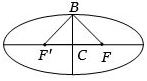
If the angle between the lines joining the end points of the minor axis of an ellipse with its foci is $\frac{\pi}{2}$,then the eccentricity of the ellipse is
A
$1/2$
B
$1/\sqrt{2}$
C
$\sqrt{3}/2$
D
$1/(2\sqrt{2})$
Solution
(B) Let the ellipse be $\frac{x^2}{a^2} + \frac{y^2}{b^2} = 1$ where $a > b$.
Let the foci be $F(ae, 0)$ and $F'(-ae, 0)$ and the end point of the minor axis be $B(0, b)$.
The center of the ellipse is $C(0, 0)$.
Given that $\angle FBF' = \frac{\pi}{2}$.
Since $\triangle FBF'$ is an isosceles triangle with $BF = BF'$,the altitude $BC$ bisects $\angle FBF'$.
Therefore,$\angle FBC = \frac{1}{2} \angle FBF' = \frac{\pi}{4}$.
In the right-angled triangle $\triangle BCF$,$\tan(\angle FBC) = \frac{CF}{BC}$.
$\tan(\frac{\pi}{4}) = \frac{ae}{b}$.
$1 = \frac{ae}{b} \Rightarrow b = ae$.
Squaring both sides,$b^2 = a^2 e^2$.
Using the relation $b^2 = a^2(1 - e^2)$,we get $a^2(1 - e^2) = a^2 e^2$.
$1 - e^2 = e^2$.
$2e^2 = 1$.
$e^2 = 1/2$.
$e = 1/\sqrt{2}$.
Let the foci be $F(ae, 0)$ and $F'(-ae, 0)$ and the end point of the minor axis be $B(0, b)$.
The center of the ellipse is $C(0, 0)$.
Given that $\angle FBF' = \frac{\pi}{2}$.
Since $\triangle FBF'$ is an isosceles triangle with $BF = BF'$,the altitude $BC$ bisects $\angle FBF'$.
Therefore,$\angle FBC = \frac{1}{2} \angle FBF' = \frac{\pi}{4}$.
In the right-angled triangle $\triangle BCF$,$\tan(\angle FBC) = \frac{CF}{BC}$.
$\tan(\frac{\pi}{4}) = \frac{ae}{b}$.
$1 = \frac{ae}{b} \Rightarrow b = ae$.
Squaring both sides,$b^2 = a^2 e^2$.
Using the relation $b^2 = a^2(1 - e^2)$,we get $a^2(1 - e^2) = a^2 e^2$.
$1 - e^2 = e^2$.
$2e^2 = 1$.
$e^2 = 1/2$.
$e = 1/\sqrt{2}$.
0 likesView Solution
5
MathematicsDifficultMCQIIT JEE · 1997
Let $p, q, r$ be three mutually perpendicular vectors of the same magnitude. If a vector $x$ satisfies the equation $p \times \{(x - q) \times p\} + q \times \{(x - r) \times q\} + r \times \{(x - p) \times r\} = 0$,then $x$ is given by
A
$\frac{1}{2}(p + q - 2r)$
B
$\frac{1}{2}(p + q + r)$
C
$\frac{1}{3}(p + q + r)$
D
$\frac{1}{3}(2p + q - r)$
Solution
(B) Given that $p, q, r$ are mutually perpendicular vectors of the same magnitude,let $|p| = |q| = |r| = c$.
Thus,$p \cdot q = q \cdot r = r \cdot p = 0$ and $p \cdot p = q \cdot q = r \cdot r = c^2$.
Using the vector triple product identity $a \times (b \times c) = (a \cdot c)b - (a \cdot b)c$,we expand each term:
$p \times \{(x - q) \times p\} = (p \cdot p)(x - q) - (p \cdot (x - q))p = c^2(x - q) - (p \cdot x)p$.
Similarly,$q \times \{(x - r) \times q\} = c^2(x - r) - (q \cdot x)q$ and $r \times \{(x - p) \times r\} = c^2(x - p) - (r \cdot x)r$.
Summing these,we get:
$c^2(x - q + x - r + x - p) - [(p \cdot x)p + (q \cdot x)q + (r \cdot x)r] = 0$.
$c^2(3x - (p + q + r)) - [(p \cdot x)p + (q \cdot x)q + (r \cdot x)r] = 0$.
If we substitute $x = \frac{1}{2}(p + q + r)$,then $p \cdot x = \frac{1}{2}c^2$,$q \cdot x = \frac{1}{2}c^2$,and $r \cdot x = \frac{1}{2}c^2$.
Substituting these into the equation:
$c^2(3(\frac{1}{2}(p + q + r)) - (p + q + r)) - [\frac{1}{2}c^2 p + \frac{1}{2}c^2 q + \frac{1}{2}c^2 r] = 0$.
$c^2(\frac{3}{2}(p + q + r) - (p + q + r)) - \frac{1}{2}c^2(p + q + r) = 0$.
$c^2(\frac{1}{2}(p + q + r)) - \frac{1}{2}c^2(p + q + r) = 0$.
This confirms $x = \frac{1}{2}(p + q + r)$ is the solution.
Thus,$p \cdot q = q \cdot r = r \cdot p = 0$ and $p \cdot p = q \cdot q = r \cdot r = c^2$.
Using the vector triple product identity $a \times (b \times c) = (a \cdot c)b - (a \cdot b)c$,we expand each term:
$p \times \{(x - q) \times p\} = (p \cdot p)(x - q) - (p \cdot (x - q))p = c^2(x - q) - (p \cdot x)p$.
Similarly,$q \times \{(x - r) \times q\} = c^2(x - r) - (q \cdot x)q$ and $r \times \{(x - p) \times r\} = c^2(x - p) - (r \cdot x)r$.
Summing these,we get:
$c^2(x - q + x - r + x - p) - [(p \cdot x)p + (q \cdot x)q + (r \cdot x)r] = 0$.
$c^2(3x - (p + q + r)) - [(p \cdot x)p + (q \cdot x)q + (r \cdot x)r] = 0$.
If we substitute $x = \frac{1}{2}(p + q + r)$,then $p \cdot x = \frac{1}{2}c^2$,$q \cdot x = \frac{1}{2}c^2$,and $r \cdot x = \frac{1}{2}c^2$.
Substituting these into the equation:
$c^2(3(\frac{1}{2}(p + q + r)) - (p + q + r)) - [\frac{1}{2}c^2 p + \frac{1}{2}c^2 q + \frac{1}{2}c^2 r] = 0$.
$c^2(\frac{3}{2}(p + q + r) - (p + q + r)) - \frac{1}{2}c^2(p + q + r) = 0$.
$c^2(\frac{1}{2}(p + q + r)) - \frac{1}{2}c^2(p + q + r) = 0$.
This confirms $x = \frac{1}{2}(p + q + r)$ is the solution.
0 likesView Solution
6
MathematicsDifficultMCQIIT JEE · 1997
Let $f(x) = \left| \begin{array}{ccc} x^3 & \sin x & \cos x \\ 6 & -1 & 0 \\ p & p^2 & p^3 \end{array} \right|$,where $p$ is a constant. Then $\frac{d^3}{dx^3} \{f(x)\}$ at $x = 0$ is
A
$p$
B
$p + p^2$
C
$p + p^3$
D
Independent of $p$
Solution
(D) Given $f(x) = \left| \begin{array}{ccc} x^3 & \sin x & \cos x \\ 6 & -1 & 0 \\ p & p^2 & p^3 \end{array} \right|$.
Since the derivative of a determinant is the sum of determinants obtained by differentiating one row at a time,and the second and third rows are constants,the third derivative $f'''(x)$ is given by differentiating the first row three times:
$f'''(x) = \left| \begin{array}{ccc} \frac{d^3}{dx^3}(x^3) & \frac{d^3}{dx^3}(\sin x) & \frac{d^3}{dx^3}(\cos x) \\ 6 & -1 & 0 \\ p & p^2 & p^3 \end{array} \right|$
Calculating the derivatives:
$\frac{d^3}{dx^3}(x^3) = 6$
$\frac{d^3}{dx^3}(\sin x) = -\cos x$
$\frac{d^3}{dx^3}(\cos x) = \sin x$
Thus,$f'''(x) = \left| \begin{array}{ccc} 6 & -\cos x & \sin x \\ 6 & -1 & 0 \\ p & p^2 & p^3 \end{array} \right|$.
At $x = 0$:
$f'''(0) = \left| \begin{array}{ccc} 6 & -\cos(0) & \sin(0) \\ 6 & -1 & 0 \\ p & p^2 & p^3 \end{array} \right| = \left| \begin{array}{ccc} 6 & -1 & 0 \\ 6 & -1 & 0 \\ p & p^2 & p^3 \end{array} \right|$.
Since the first two rows are identical,the value of the determinant is $0$.
Therefore,the result is $0$,which is independent of $p$.
Since the derivative of a determinant is the sum of determinants obtained by differentiating one row at a time,and the second and third rows are constants,the third derivative $f'''(x)$ is given by differentiating the first row three times:
$f'''(x) = \left| \begin{array}{ccc} \frac{d^3}{dx^3}(x^3) & \frac{d^3}{dx^3}(\sin x) & \frac{d^3}{dx^3}(\cos x) \\ 6 & -1 & 0 \\ p & p^2 & p^3 \end{array} \right|$
Calculating the derivatives:
$\frac{d^3}{dx^3}(x^3) = 6$
$\frac{d^3}{dx^3}(\sin x) = -\cos x$
$\frac{d^3}{dx^3}(\cos x) = \sin x$
Thus,$f'''(x) = \left| \begin{array}{ccc} 6 & -\cos x & \sin x \\ 6 & -1 & 0 \\ p & p^2 & p^3 \end{array} \right|$.
At $x = 0$:
$f'''(0) = \left| \begin{array}{ccc} 6 & -\cos(0) & \sin(0) \\ 6 & -1 & 0 \\ p & p^2 & p^3 \end{array} \right| = \left| \begin{array}{ccc} 6 & -1 & 0 \\ 6 & -1 & 0 \\ p & p^2 & p^3 \end{array} \right|$.
Since the first two rows are identical,the value of the determinant is $0$.
Therefore,the result is $0$,which is independent of $p$.
0 likesView Solution
7
MathematicsDifficultMCQIIT JEE · 1997
If $f(x) = \frac{x}{\sin x}$ and $g(x) = \frac{x}{\tan x}$,where $0 < x \le 1$,then in this interval:
A
Both $f(x)$ and $g(x)$ are increasing functions
B
Both $f(x)$ and $g(x)$ are decreasing functions
C
$f(x)$ is an increasing function
D
$g(x)$ is an increasing function
Solution
(C) For $f(x) = \frac{x}{\sin x}$,we have $f'(x) = \frac{\sin x - x \cos x}{\sin^2 x} = \frac{\cos x(\tan x - x)}{\sin^2 x}$.
Since $0 < x \le 1$ (in radians),we know that $\tan x > x$ and $\cos x > 0$. Thus,$f'(x) > 0$,which implies $f(x)$ is an increasing function.
For $g(x) = \frac{x}{\tan x} = x \cot x$,we have $g'(x) = \cot x - x \csc^2 x = \frac{\sin x \cos x - x}{\sin^2 x} = \frac{\sin 2x - 2x}{2 \sin^2 x}$.
Let $h(x) = \sin 2x - 2x$. Then $h'(x) = 2 \cos 2x - 2 = 2(\cos 2x - 1)$. Since $\cos 2x < 1$ for $x \in (0, 1]$,$h'(x) < 0$.
Since $h(0) = 0$ and $h(x)$ is decreasing,$h(x) < 0$ for $x > 0$. Therefore,$g'(x) < 0$,which implies $g(x)$ is a decreasing function.
Thus,$f(x)$ is an increasing function.
Since $0 < x \le 1$ (in radians),we know that $\tan x > x$ and $\cos x > 0$. Thus,$f'(x) > 0$,which implies $f(x)$ is an increasing function.
For $g(x) = \frac{x}{\tan x} = x \cot x$,we have $g'(x) = \cot x - x \csc^2 x = \frac{\sin x \cos x - x}{\sin^2 x} = \frac{\sin 2x - 2x}{2 \sin^2 x}$.
Let $h(x) = \sin 2x - 2x$. Then $h'(x) = 2 \cos 2x - 2 = 2(\cos 2x - 1)$. Since $\cos 2x < 1$ for $x \in (0, 1]$,$h'(x) < 0$.
Since $h(0) = 0$ and $h(x)$ is decreasing,$h(x) < 0$ for $x > 0$. Therefore,$g'(x) < 0$,which implies $g(x)$ is a decreasing function.
Thus,$f(x)$ is an increasing function.
0 likesView Solution
8
MathematicsDifficultMCQIIT JEE · 1997
$\mathop {\lim }\limits_{n \to \infty } \frac{1}{n}\sum\limits_{r = 1}^{2n} {\frac{r}{{\sqrt {{n^2} + {r^2}} }}} $ equals
A
$1 + \sqrt{5}$
B
$-1 + \sqrt{5}$
C
$-1 + \sqrt{2}$
D
$1 + \sqrt{2}$
Solution
(B) Let $L = \mathop {\lim }\limits_{n \to \infty } \frac{1}{n}\sum\limits_{r = 1}^{2n} {\frac{r}{{\sqrt {{n^2} + {r^2}} }}} $.
We can rewrite the expression as $L = \mathop {\lim }\limits_{n \to \infty } \sum\limits_{r = 1}^{2n} {\frac{1}{n} \cdot \frac{r/n}{{\sqrt {1 + {{(r/n)}^2}} }}} $.
Using the definition of a definite integral as the limit of a sum,$\mathop {\lim }\limits_{n \to \infty } \frac{1}{n}\sum\limits_{r = 1}^{kn} {f(r/n)} = \int_0^k {f(x)dx}$.
Here,$f(x) = \frac{x}{{\sqrt {1 + {x^2}} }}$ and the upper limit is $k = 2$.
So,$L = \int_0^2 {\frac{x}{{\sqrt {1 + {x^2}} }}} dx$.
Let $u = 1 + x^2$,then $du = 2x dx$,or $x dx = \frac{1}{2} du$.
When $x = 0$,$u = 1$. When $x = 2$,$u = 5$.
$L = \int_1^5 {\frac{1}{{2\sqrt u }}} du = \left[ {\sqrt u } \right]_1^5 = \sqrt{5} - 1$.
We can rewrite the expression as $L = \mathop {\lim }\limits_{n \to \infty } \sum\limits_{r = 1}^{2n} {\frac{1}{n} \cdot \frac{r/n}{{\sqrt {1 + {{(r/n)}^2}} }}} $.
Using the definition of a definite integral as the limit of a sum,$\mathop {\lim }\limits_{n \to \infty } \frac{1}{n}\sum\limits_{r = 1}^{kn} {f(r/n)} = \int_0^k {f(x)dx}$.
Here,$f(x) = \frac{x}{{\sqrt {1 + {x^2}} }}$ and the upper limit is $k = 2$.
So,$L = \int_0^2 {\frac{x}{{\sqrt {1 + {x^2}} }}} dx$.
Let $u = 1 + x^2$,then $du = 2x dx$,or $x dx = \frac{1}{2} du$.
When $x = 0$,$u = 1$. When $x = 2$,$u = 5$.
$L = \int_1^5 {\frac{1}{{2\sqrt u }}} du = \left[ {\sqrt u } \right]_1^5 = \sqrt{5} - 1$.
0 likesView Solution
9
MathematicsDifficultMCQIIT JEE · 1997
Let $f$ be a positive function. Let $I_1 = \int_{1 - k}^k x f\{x(1 - x)\} dx$ and $I_2 = \int_{1 - k}^k f\{x(1 - x)\} dx$,where $2k - 1 > 0$. Then $I_1/I_2$ is
A
$2$
B
$k$
C
$1/2$
D
$1$
Solution
(C) Given $I_1 = \int_{1 - k}^k x f\{x(1 - x)\} dx$ and $I_2 = \int_{1 - k}^k f\{x(1 - x)\} dx$.
Using the property $\int_{a}^{b} g(x) dx = \int_{a}^{b} g(a + b - x) dx$,we have $a + b = 1 - k + k = 1$.
Thus,$I_1 = \int_{1 - k}^k (1 - x) f\{(1 - x)(1 - (1 - x))\} dx$.
$I_1 = \int_{1 - k}^k (1 - x) f\{(1 - x)x\} dx$.
$I_1 = \int_{1 - k}^k f\{x(1 - x)\} dx - \int_{1 - k}^k x f\{x(1 - x)\} dx$.
$I_1 = I_2 - I_1$.
$2I_1 = I_2$.
Therefore,$I_1/I_2 = 1/2$.
Using the property $\int_{a}^{b} g(x) dx = \int_{a}^{b} g(a + b - x) dx$,we have $a + b = 1 - k + k = 1$.
Thus,$I_1 = \int_{1 - k}^k (1 - x) f\{(1 - x)(1 - (1 - x))\} dx$.
$I_1 = \int_{1 - k}^k (1 - x) f\{(1 - x)x\} dx$.
$I_1 = \int_{1 - k}^k f\{x(1 - x)\} dx - \int_{1 - k}^k x f\{x(1 - x)\} dx$.
$I_1 = I_2 - I_1$.
$2I_1 = I_2$.
Therefore,$I_1/I_2 = 1/2$.
0 likesView Solution
10
MathematicsMediumMCQIIT JEE · 1997
The parameter on which the value of the determinant $\left| \begin{array}{ccc} 1 & a & a^2 \\ \cos(p-d)x & \cos px & \cos(p+d)x \\ \sin(p-d)x & \sin px & \sin(p+d)x \end{array} \right|$ does not depend is:
A
$a$
B
$p$
C
$d$
D
$x$
Solution
(B) Let the determinant be $\Delta$. Apply the column transformation $C_1 \to C_1 + C_3$.
Using the formula $\cos(A-B) + \cos(A+B) = 2\cos A \cos B$ and $\sin(A-B) + \sin(A+B) = 2\sin A \cos B$,we get:
$C_1 = \begin{bmatrix} 1+a^2 \\ 2\cos px \cos dx \\ 2\sin px \cos dx \end{bmatrix}$.
Now,apply $C_1 \to C_1 - 2\cos dx \cdot C_2$:
$C_1 = \begin{bmatrix} 1+a^2 - 2a\cos dx \\ 2\cos px \cos dx - 2\cos px \cos dx \\ 2\sin px \cos dx - 2\sin px \cos dx \end{bmatrix} = \begin{bmatrix} 1+a^2 - 2a\cos dx \\ 0 \\ 0 \end{bmatrix}$.
Expanding along the first column:
$\Delta = (1+a^2 - 2a\cos dx) \cdot [\cos px \sin(p+d)x - \sin px \cos(p+d)x]$.
Using $\sin(A-B) = \sin A \cos B - \cos A \sin B$:
$\Delta = (1+a^2 - 2a\cos dx) \cdot \sin((p+d)x - px) = (1+a^2 - 2a\cos dx) \sin dx$.
Since the final expression $(1+a^2 - 2a\cos dx) \sin dx$ does not contain $p$,the determinant is independent of $p$.
Using the formula $\cos(A-B) + \cos(A+B) = 2\cos A \cos B$ and $\sin(A-B) + \sin(A+B) = 2\sin A \cos B$,we get:
$C_1 = \begin{bmatrix} 1+a^2 \\ 2\cos px \cos dx \\ 2\sin px \cos dx \end{bmatrix}$.
Now,apply $C_1 \to C_1 - 2\cos dx \cdot C_2$:
$C_1 = \begin{bmatrix} 1+a^2 - 2a\cos dx \\ 2\cos px \cos dx - 2\cos px \cos dx \\ 2\sin px \cos dx - 2\sin px \cos dx \end{bmatrix} = \begin{bmatrix} 1+a^2 - 2a\cos dx \\ 0 \\ 0 \end{bmatrix}$.
Expanding along the first column:
$\Delta = (1+a^2 - 2a\cos dx) \cdot [\cos px \sin(p+d)x - \sin px \cos(p+d)x]$.
Using $\sin(A-B) = \sin A \cos B - \cos A \sin B$:
$\Delta = (1+a^2 - 2a\cos dx) \cdot \sin((p+d)x - px) = (1+a^2 - 2a\cos dx) \sin dx$.
Since the final expression $(1+a^2 - 2a\cos dx) \sin dx$ does not contain $p$,the determinant is independent of $p$.
0 likesView Solution
11
MathematicsDifficultMCQIIT JEE · 1997
If $g(x) = \int_0^x \cos^4 t \,dt$, then $g(x+\pi)$ equals
A
$g(x) + g(\pi)$
B
$g(x) - g(\pi)$
C
$\frac{g(x)}{g(\pi)}$
D
$g(x) \cdot g(\pi)$
Solution
(A) Given $g(x) = \int_0^x \cos^4 t \,dt$.
We need to find $g(x+\pi) = \int_0^{x+\pi} \cos^4 t \,dt$.
Using the property of definite integrals, $\int_0^{x+\pi} f(t) \,dt = \int_0^x f(t) \,dt + \int_x^{x+\pi} f(t) \,dt$.
Thus, $g(x+\pi) = g(x) + \int_x^{x+\pi} \cos^4 t \,dt$.
Since $\cos^4 t$ is a periodic function with period $\pi$, the integral over any interval of length $\pi$ is equal to the integral over $[0, \pi]$.
Therefore, $\int_x^{x+\pi} \cos^4 t \,dt = \int_0^\pi \cos^4 t \,dt = g(\pi)$.
Hence, $g(x+\pi) = g(x) + g(\pi)$.
We need to find $g(x+\pi) = \int_0^{x+\pi} \cos^4 t \,dt$.
Using the property of definite integrals, $\int_0^{x+\pi} f(t) \,dt = \int_0^x f(t) \,dt + \int_x^{x+\pi} f(t) \,dt$.
Thus, $g(x+\pi) = g(x) + \int_x^{x+\pi} \cos^4 t \,dt$.
Since $\cos^4 t$ is a periodic function with period $\pi$, the integral over any interval of length $\pi$ is equal to the integral over $[0, \pi]$.
Therefore, $\int_x^{x+\pi} \cos^4 t \,dt = \int_0^\pi \cos^4 t \,dt = g(\pi)$.
Hence, $g(x+\pi) = g(x) + g(\pi)$.
0 likesView Solution
Vedclass Products
For Students
Vedclass Test Series
Mock tests in real IIT JEE style covering Mathematics with performance analysis. 5-day free trial.
Start Free TrialFor Teachers
Exam Paper Generator
Generate Set A/B/C/D Mathematics papers from 7.5L+ questions in 2 minutes. 3 chapters free.
Try FreeFor Institutes
Online Exam Module
Run live IIT JEE mock exams with unlimited students, 360° analytics & white-label branding.
See DemoFrequently Asked Questions
How many Mathematics questions are in IIT JEE 1997?
There are 11 Mathematics questions from the IIT JEE 1997 paper on Vedclass, each with a detailed step-by-step solution in English.
Are IIT JEE 1997 Mathematics solutions available in English?
Yes. All solutions on this page are in English. You can also switch to English or Hindi using the language buttons above the questions.
Can I practice IIT JEE 1997 Mathematics as a timed test?
Yes. Use the Vedclass Test Series to attempt a full IIT JEE mock test covering Mathematics with time limits and instant score analysis.
Can teachers create Mathematics papers from IIT JEE previous year questions?
Yes. The Vedclass Exam Paper Generator lets teachers mix IIT JEE Mathematics questions and generate Set A/B/C/D papers in minutes.
For Teachers & Institutes
Build a Custom Mathematics Paper
Pick IIT JEE 1997 Mathematics questions, set difficulty, and generate Set A/B/C/D in 2 minutes.