
ChemistryQ1–27 of 27 questions
Page 1 of 1 · English
1
ChemistryMCQIIT JEE · 1985
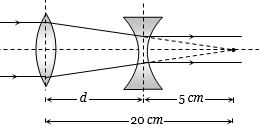
$A$ convex lens $A$ of focal length $20 \ cm$ and a concave lens $B$ of focal length $5 \ cm$ are kept along the same axis with a distance $d$ between them. If a parallel beam of light falling on $A$ leaves $B$ as a parallel beam,then the distance $d$ in $cm$ will be
A
$25$
B
$15$
C
$30$
D
$50$
Solution
(B) For a parallel beam of light to emerge as a parallel beam from a combination of a convex and a concave lens,the second focal point of the convex lens must coincide with the first focal point of the concave lens.
Let $f_1 = 20 \ cm$ be the focal length of the convex lens and $f_2 = 5 \ cm$ be the focal length of the concave lens.
The distance between the lenses is given by $d = f_1 - f_2$.
Substituting the values,we get $d = 20 \ cm - 5 \ cm = 15 \ cm$.
Let $f_1 = 20 \ cm$ be the focal length of the convex lens and $f_2 = 5 \ cm$ be the focal length of the concave lens.
The distance between the lenses is given by $d = f_1 - f_2$.
Substituting the values,we get $d = 20 \ cm - 5 \ cm = 15 \ cm$.
0 likesView Solution
2
ChemistryEasyMCQIIT JEE · 1985
The radius of an atom is of the order of
A
$10^{-8} \ cm$
B
$10^{-13} \ cm$
C
$10^{-15} \ cm$
D
$10^{-10} \ cm$
Solution
(A) The radius of an atom is typically in the range of $10^{-10} \ m$ or $1 \ \mathring{A}$.
Converting this to centimeters,$10^{-10} \ m = 10^{-8} \ cm$.
Therefore,the order of the radius of an atom is $10^{-8} \ cm$.
Converting this to centimeters,$10^{-10} \ m = 10^{-8} \ cm$.
Therefore,the order of the radius of an atom is $10^{-8} \ cm$.
0 likesView Solution
3
ChemistryEasyMCQIIT JEE · 1985
Bohr's model can explain:
A
The spectrum of hydrogen atom only
B
Spectrum of atom or ion containing one electron only
C
The spectrum of hydrogen molecule
D
The solar spectrum
Solution
(B) Bohr's model is applicable only to hydrogen-like species,which are atoms or ions containing only one electron,such as $H$,$He^+$,$Li^{2+}$,etc.
0 likesView Solution
4
ChemistryMCQIIT JEE · 1985
The molecule having one unpaired electron is
A
$NO$
B
$CO$
C
$CN^{-}$
D
$O_2$
Solution
(A) According to Molecular Orbital Theory $(MOT)$,the electronic configurations are as follows:
$A].$ For $NO$ ($15$ electrons): $\sigma 1s^2, \sigma^* 1s^2, \sigma 2s^2, \sigma^* 2s^2, \sigma 2p_z^2, \pi 2p_x^2, \pi 2p_y^2, \pi^* 2p_x^1$. It has $1$ unpaired electron.
$B].$ For $CO$ ($14$ electrons): $\sigma 1s^2, \sigma^* 1s^2, \sigma 2s^2, \sigma^* 2s^2, \sigma 2p_z^2, \pi 2p_x^2, \pi 2p_y^2$. All electrons are paired.
$C].$ For $CN^{-}$ ($14$ electrons): $\sigma 1s^2, \sigma^* 1s^2, \sigma 2s^2, \sigma^* 2s^2, \sigma 2p_z^2, \pi 2p_x^2, \pi 2p_y^2$. All electrons are paired.
$D].$ For $O_2$ ($16$ electrons): $\sigma 1s^2, \sigma^* 1s^2, \sigma 2s^2, \sigma^* 2s^2, \sigma 2p_z^2, \pi 2p_x^2, \pi 2p_y^2, \pi^* 2p_x^1, \pi^* 2p_y^1$. It has $2$ unpaired electrons.
Thus,$NO$ is the correct molecule.
$A].$ For $NO$ ($15$ electrons): $\sigma 1s^2, \sigma^* 1s^2, \sigma 2s^2, \sigma^* 2s^2, \sigma 2p_z^2, \pi 2p_x^2, \pi 2p_y^2, \pi^* 2p_x^1$. It has $1$ unpaired electron.
$B].$ For $CO$ ($14$ electrons): $\sigma 1s^2, \sigma^* 1s^2, \sigma 2s^2, \sigma^* 2s^2, \sigma 2p_z^2, \pi 2p_x^2, \pi 2p_y^2$. All electrons are paired.
$C].$ For $CN^{-}$ ($14$ electrons): $\sigma 1s^2, \sigma^* 1s^2, \sigma 2s^2, \sigma^* 2s^2, \sigma 2p_z^2, \pi 2p_x^2, \pi 2p_y^2$. All electrons are paired.
$D].$ For $O_2$ ($16$ electrons): $\sigma 1s^2, \sigma^* 1s^2, \sigma 2s^2, \sigma^* 2s^2, \sigma 2p_z^2, \pi 2p_x^2, \pi 2p_y^2, \pi^* 2p_x^1, \pi^* 2p_y^1$. It has $2$ unpaired electrons.
Thus,$NO$ is the correct molecule.
0 likesView Solution
5
ChemistryEasyMCQIIT JEE · 1985
The rate of diffusion of a gas is
A
Directly proportional to its density
B
Directly proportional to its molecular mass
C
Directly proportional to the square root of its molecular mass
D
Inversely proportional to the square root of its molecular mass
Solution
(D) According to Graham's law of diffusion,the rate of diffusion $(r)$ of a gas is inversely proportional to the square root of its density $(d)$ or its molar mass $(M)$.
Mathematically,$r \propto \frac{1}{\sqrt{d}}$ or $r \propto \frac{1}{\sqrt{M}}$.
Therefore,the rate of diffusion is inversely proportional to the square root of its molecular mass.
Mathematically,$r \propto \frac{1}{\sqrt{d}}$ or $r \propto \frac{1}{\sqrt{M}}$.
Therefore,the rate of diffusion is inversely proportional to the square root of its molecular mass.
0 likesView Solution
6
ChemistryEasyMCQIIT JEE · 1985
The compound that is not a Lewis acid is
A
$HSO_4^-$
B
$AlCl_3$
C
$BeCl_2$
D
$NH_3$
Solution
(D) Lewis acid is defined as an electron-pair acceptor.
$AlCl_3$ and $BeCl_2$ are electron-deficient compounds (incomplete octet),so they act as Lewis acids.
$HSO_4^-$ can accept a proton or an electron pair in certain conditions.
$NH_3$ has a lone pair of electrons on the nitrogen atom,which it can donate.
Therefore,$NH_3$ acts as a Lewis base,not a Lewis acid.
$AlCl_3$ and $BeCl_2$ are electron-deficient compounds (incomplete octet),so they act as Lewis acids.
$HSO_4^-$ can accept a proton or an electron pair in certain conditions.
$NH_3$ has a lone pair of electrons on the nitrogen atom,which it can donate.
Therefore,$NH_3$ acts as a Lewis base,not a Lewis acid.
0 likesView Solution
7
ChemistryMediumMCQIIT JEE · 1985
The conjugate acid of $NH_2^-$ is
A
$NH_3$
B
$NH_4^+$
C
$NH_2OH$
D
$N_2H_4$
Solution
(A) The conjugate acid of a base is formed by the addition of a proton $(H^+)$ to the base.
For the base $NH_2^-$,the conjugate acid is formed as follows:
$NH_2^- + H^+ \rightarrow NH_3$
Therefore,the correct option is $(A)$.
For the base $NH_2^-$,the conjugate acid is formed as follows:
$NH_2^- + H^+ \rightarrow NH_3$
Therefore,the correct option is $(A)$.
0 likesView Solution
8
ChemistryEasyMCQIIT JEE · 1985
Hydrogen will not reduce:
A
Heated cupric oxide
B
Heated ferric oxide
C
Heated stannic oxide
D
Heated aluminium oxide
Solution
(D) The reactivity series of metals indicates that hydrogen can reduce oxides of metals that are less reactive than hydrogen.
$Cu$,$Fe$,and $Sn$ are less reactive than hydrogen,so their oxides ($CuO$,$Fe_2O_3$,$SnO_2$) can be reduced by $H_2$.
However,$Al$ is more reactive than hydrogen,so $H_2$ cannot reduce $Al_2O_3$ to $Al$.
Therefore,the correct option is $(D)$.
$Cu$,$Fe$,and $Sn$ are less reactive than hydrogen,so their oxides ($CuO$,$Fe_2O_3$,$SnO_2$) can be reduced by $H_2$.
However,$Al$ is more reactive than hydrogen,so $H_2$ cannot reduce $Al_2O_3$ to $Al$.
Therefore,the correct option is $(D)$.
0 likesView Solution
9
ChemistryEasyMCQIIT JEE · 1985
Glauber's salt is
A
$MgSO_4 \cdot 7H_2O$
B
$CuSO_4 \cdot 5H_2O$
C
$FeSO_4 \cdot 7H_2O$
D
$Na_2SO_4 \cdot 10H_2O$
Solution
(D) Glauber's salt is the common name for sodium sulphate decahydrate,which has the chemical formula $Na_2SO_4 \cdot 10H_2O$.
It exists as white or colourless monoclinic crystals.
When exposed to dry air,it undergoes efflorescence,losing its water of crystallization to form powdery anhydrous sodium sulphate.
It exists as white or colourless monoclinic crystals.
When exposed to dry air,it undergoes efflorescence,losing its water of crystallization to form powdery anhydrous sodium sulphate.
0 likesView Solution
10
ChemistryMediumMCQIIT JEE · 1985
The indicator used in titrating a weak acid (e.g.,oxalic acid) with a strong base (e.g.,caustic soda) solution is
A
Methyl orange
B
Methyl red
C
Fluorescein
D
Phenolphthalein
Solution
(D) Phenolphthalein is the correct indicator for the titration of a weak acid with a strong base.
This is because the equivalence point of such a titration lies in the basic range ($pH$ range $8-10$).
Phenolphthalein changes its color from colourless to pink in this $pH$ range.
This is because the equivalence point of such a titration lies in the basic range ($pH$ range $8-10$).
Phenolphthalein changes its color from colourless to pink in this $pH$ range.
0 likesView Solution
11
ChemistryMediumMCQIIT JEE · 1985
In which of the following,addition of $HBr$ does not take place against Markownikoff's rule,or for which is the Anti-Markownikoff addition of $HBr$ not observed?
A
$Propene$
B
$But-1-ene$
C
$But-2-ene$
D
$Pent-2-ene$
Solution
(C) The Anti-Markownikoff addition of $HBr$ (also known as the peroxide effect or Kharasch effect) is only observed in unsymmetrical alkenes.
$But-2-ene$ $(CH_3-CH=CH-CH_3)$ is a symmetrical alkene.
In a symmetrical alkene,the addition of $HBr$ results in the same product regardless of whether it follows Markownikoff's rule or the Anti-Markownikoff mechanism.
Therefore,the Anti-Markownikoff addition is not observed for $But-2-ene$.
$But-2-ene$ $(CH_3-CH=CH-CH_3)$ is a symmetrical alkene.
In a symmetrical alkene,the addition of $HBr$ results in the same product regardless of whether it follows Markownikoff's rule or the Anti-Markownikoff mechanism.
Therefore,the Anti-Markownikoff addition is not observed for $But-2-ene$.
0 likesView Solution
12
ChemistryMediumMCQIIT JEE · 1985
Which of the following has acidic hydrogen?
A
Ethyne
B
Ethene
C
Ethane
D
Benzene
Solution
(A) The acidic nature of hydrogen in hydrocarbons depends on the hybridization of the carbon atom to which it is attached.
In $CH \equiv CH$ (Ethyne),the carbon is $sp$ hybridized,which has $50\%$ $s$-character,making it more electronegative and thus the $C-H$ bond is polar,allowing the hydrogen to be acidic.
Reaction with sodium metal confirms this: $2CH \equiv CH + 2Na \to 2CH \equiv C^{-}Na^{+} + H_2 \uparrow$.
Therefore,ethyne has acidic hydrogen.
In $CH \equiv CH$ (Ethyne),the carbon is $sp$ hybridized,which has $50\%$ $s$-character,making it more electronegative and thus the $C-H$ bond is polar,allowing the hydrogen to be acidic.
Reaction with sodium metal confirms this: $2CH \equiv CH + 2Na \to 2CH \equiv C^{-}Na^{+} + H_2 \uparrow$.
Therefore,ethyne has acidic hydrogen.
0 likesView Solution
13
ChemistryMediumMCQIIT JEE · 1985
The compound that is most reactive towards electrophilic nitration is
A
Toluene
B
Benzene
C
Benzoic acid
D
Nitrobenzene
Solution
(A) Electrophilic aromatic substitution is facilitated by electron-donating groups on the benzene ring,which increase the electron density of the ring.
$1$. The $-CH_3$ group in Toluene is an electron-donating group due to the $+I$ effect and hyperconjugation.
$2$. Benzene has no substituents.
$3$. The $-COOH$ group in Benzoic acid and the $-NO_2$ group in Nitrobenzene are electron-withdrawing groups,which decrease the electron density of the ring.
Therefore,Toluene is the most reactive towards electrophilic nitration among the given options.
$1$. The $-CH_3$ group in Toluene is an electron-donating group due to the $+I$ effect and hyperconjugation.
$2$. Benzene has no substituents.
$3$. The $-COOH$ group in Benzoic acid and the $-NO_2$ group in Nitrobenzene are electron-withdrawing groups,which decrease the electron density of the ring.
Therefore,Toluene is the most reactive towards electrophilic nitration among the given options.
0 likesView Solution
14
ChemistryMCQIIT JEE · 1985
The conjugate acid of $NH_2^-$ is ...... .
A
$NH_3$
B
$NH_4^+$
C
$NH_2OH$
D
$N_2H_4$
Solution
(A) The conjugate acid of a base is formed by adding a proton $(H^+)$ to the base.
For the base $NH_2^-$,the conjugate acid is formed as follows:
$NH_2^- + H^+ \rightarrow NH_3$
Therefore,the conjugate acid of $NH_2^-$ is $NH_3$.
For the base $NH_2^-$,the conjugate acid is formed as follows:
$NH_2^- + H^+ \rightarrow NH_3$
Therefore,the conjugate acid of $NH_2^-$ is $NH_3$.
0 likesView Solution
15
ChemistryMediumMCQIIT JEE · 1985
The molecule having one unpaired electron is
A
$NO$
B
$CO$
C
$CN^{-}$
D
$O_2$
Solution
(A) According to Molecular Orbital Theory $(MOT)$:
$NO$ has a total of $15$ electrons ($7$ from $N$ and $8$ from $O$).
The electronic configuration is: $\sigma 1s^2, \sigma^* 1s^2, \sigma 2s^2, \sigma^* 2s^2, \sigma 2p_z^2, \pi 2p_x^2 = \pi 2p_y^2, \pi^* 2p_x^1$.
Since there is one electron in the antibonding $\pi^* 2p_x$ orbital,$NO$ is paramagnetic and contains one unpaired electron.
$CO$ ($14$ electrons) and $CN^{-}$ ($14$ electrons) are diamagnetic (zero unpaired electrons).
$O_2$ ($16$ electrons) has two unpaired electrons in the $\pi^* 2p$ orbitals.
$NO$ has a total of $15$ electrons ($7$ from $N$ and $8$ from $O$).
The electronic configuration is: $\sigma 1s^2, \sigma^* 1s^2, \sigma 2s^2, \sigma^* 2s^2, \sigma 2p_z^2, \pi 2p_x^2 = \pi 2p_y^2, \pi^* 2p_x^1$.
Since there is one electron in the antibonding $\pi^* 2p_x$ orbital,$NO$ is paramagnetic and contains one unpaired electron.
$CO$ ($14$ electrons) and $CN^{-}$ ($14$ electrons) are diamagnetic (zero unpaired electrons).
$O_2$ ($16$ electrons) has two unpaired electrons in the $\pi^* 2p$ orbitals.
0 likesView Solution
16
ChemistryMCQIIT JEE · 1985
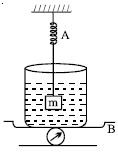
The spring balance $A$ reads $2 \ kg$ with a block $m$ suspended from it. $A$ balance $B$ reads $5 \ kg$ when a beaker with liquid is placed on the pan of the balance. The two balances are now arranged such that the hanging mass is inside the liquid in the beaker as shown in the figure. In this situation:
A
the balance $A$ will read more than $2 \ kg$
B
the balance $B$ will read more than $5 \ kg$
C
the balance $A$ will read less than $2 \ kg$ and $B$ will read more than $5 \ kg$
D
both $A$ and $B$ will read their original values
Solution
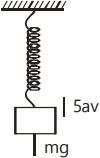
(C) When the block $m$ is suspended in air,the reading of spring balance $A$ is equal to the weight of the block,$T = mg = 2 \ kgf$.
When the block is immersed in the liquid,an upward buoyant force $F_B$ acts on the block. The new tension in the spring $A$ becomes $T' = mg - F_B$. Since $F_B > 0$,$T' < mg$,so the reading of balance $A$ will be less than $2 \ kg$.
According to Newton's third law,the block exerts an equal and opposite downward force $F_B$ on the liquid. This force is transmitted to the beaker and consequently to the pan of balance $B$. Thus,the new reading of balance $B$ becomes $W_{beaker+liquid} + F_B$. Since $F_B > 0$,the reading of balance $B$ will be more than $5 \ kg$.
When the block is immersed in the liquid,an upward buoyant force $F_B$ acts on the block. The new tension in the spring $A$ becomes $T' = mg - F_B$. Since $F_B > 0$,$T' < mg$,so the reading of balance $A$ will be less than $2 \ kg$.
According to Newton's third law,the block exerts an equal and opposite downward force $F_B$ on the liquid. This force is transmitted to the beaker and consequently to the pan of balance $B$. Thus,the new reading of balance $B$ becomes $W_{beaker+liquid} + F_B$. Since $F_B > 0$,the reading of balance $B$ will be more than $5 \ kg$.
0 likesView Solution
17
ChemistryMCQIIT JEE · 1985
From the origin,chords are drawn to the circle $(x - 1)^2 + y^2 = 1$. The equation of the locus of the midpoints of these chords is:
A
$x^2 + y^2 - 3x = 0$
B
$x^2 + y^2 - 3y = 0$
C
$x^2 + y^2 - x = 0$
D
$x^2 + y^2 - y = 0$
Solution
(C) The equation of the circle is $(x - 1)^2 + y^2 = 1$,which simplifies to $x^2 - 2x + 1 + y^2 = 1$,or $x^2 + y^2 - 2x = 0$.
Let $(h, k)$ be the midpoint of a chord passing through the origin $(0, 0)$.
The equation of a chord with midpoint $(h, k)$ is given by $T = S_1$,where $T = xh + yk - (x + h)$ and $S_1 = h^2 + k^2 - 2h$.
So,$xh + yk - x - h = h^2 + k^2 - 2h$.
Since this chord passes through the origin $(0, 0)$,we substitute $x = 0$ and $y = 0$ into the equation:
$0(h) + 0(k) - 0 - h = h^2 + k^2 - 2h$.
$-h = h^2 + k^2 - 2h$.
$h^2 + k^2 - h = 0$.
Replacing $(h, k)$ with $(x, y)$,the locus is $x^2 + y^2 - x = 0$.
Let $(h, k)$ be the midpoint of a chord passing through the origin $(0, 0)$.
The equation of a chord with midpoint $(h, k)$ is given by $T = S_1$,where $T = xh + yk - (x + h)$ and $S_1 = h^2 + k^2 - 2h$.
So,$xh + yk - x - h = h^2 + k^2 - 2h$.
Since this chord passes through the origin $(0, 0)$,we substitute $x = 0$ and $y = 0$ into the equation:
$0(h) + 0(k) - 0 - h = h^2 + k^2 - 2h$.
$-h = h^2 + k^2 - 2h$.
$h^2 + k^2 - h = 0$.
Replacing $(h, k)$ with $(x, y)$,the locus is $x^2 + y^2 - x = 0$.
0 likesView Solution
18
ChemistryMCQIIT JEE · 1985
If $z_1 = a + ib$ and $z_2 = c + id$ are complex numbers such that $|z_1| = |z_2| = 1$ and $R(z_1\overline{z_2}) = 0$,then the pair of complex numbers $w_1 = a + ic$ and $w_2 = b + id$ satisfies
A
$|w_1| = 1$
B
$|w_2| = 1$
C
$R(w_1\overline{w_2}) = 0$
D
All the above
Solution
(D) Given $|z_1| = |z_2| = 1$,we can write $z_1 = \cos \theta_1 + i \sin \theta_1$ and $z_2 = \cos \theta_2 + i \sin \theta_2$,where $\theta_1 = \arg(z_1)$ and $\theta_2 = \arg(z_2)$.
Since $z_1 = a + ib$ and $z_2 = c + id$,we have $a = \cos \theta_1, b = \sin \theta_1, c = \cos \theta_2, d = \sin \theta_2$.
Given $R(z_1\overline{z_2}) = 0$,we have $R[(\cos \theta_1 + i \sin \theta_1)(\cos \theta_2 - i \sin \theta_2)] = 0$.
This simplifies to $R[\cos(\theta_1 - \theta_2) + i \sin(\theta_1 - \theta_2)] = \cos(\theta_1 - \theta_2) = 0$.
Thus,$\theta_1 - \theta_2 = \pm \frac{\pi}{2}$,which implies $\theta_1 = \theta_2 \pm \frac{\pi}{2}$.
Now,$w_1 = a + ic = \cos \theta_1 + i \cos \theta_2$. Since $\cos \theta_2 = \sin \theta_1$ (or $-\sin \theta_1$),we have $|w_1| = \sqrt{\cos^2 \theta_1 + \sin^2 \theta_1} = 1$.
Similarly,$w_2 = b + id = \sin \theta_1 + i \sin \theta_2$. Since $\sin \theta_2 = \cos \theta_1$ (or $-\cos \theta_1$),we have $|w_2| = \sqrt{\sin^2 \theta_1 + \cos^2 \theta_1} = 1$.
Finally,$w_1\overline{w_2} = (a + ic)(b - id) = (ab + cd) + i(bc - ad)$.
$R(w_1\overline{w_2}) = ab + cd = \cos \theta_1 \sin \theta_1 + \cos \theta_2 \sin \theta_2 = \frac{1}{2}(\sin 2\theta_1 + \sin 2\theta_2)$.
Using $\theta_1 = \theta_2 + \frac{\pi}{2}$,we get $\sin 2\theta_1 = \sin(2\theta_2 + \pi) = -\sin 2\theta_2$,so $ab + cd = 0$.
Thus,all conditions are satisfied.
Since $z_1 = a + ib$ and $z_2 = c + id$,we have $a = \cos \theta_1, b = \sin \theta_1, c = \cos \theta_2, d = \sin \theta_2$.
Given $R(z_1\overline{z_2}) = 0$,we have $R[(\cos \theta_1 + i \sin \theta_1)(\cos \theta_2 - i \sin \theta_2)] = 0$.
This simplifies to $R[\cos(\theta_1 - \theta_2) + i \sin(\theta_1 - \theta_2)] = \cos(\theta_1 - \theta_2) = 0$.
Thus,$\theta_1 - \theta_2 = \pm \frac{\pi}{2}$,which implies $\theta_1 = \theta_2 \pm \frac{\pi}{2}$.
Now,$w_1 = a + ic = \cos \theta_1 + i \cos \theta_2$. Since $\cos \theta_2 = \sin \theta_1$ (or $-\sin \theta_1$),we have $|w_1| = \sqrt{\cos^2 \theta_1 + \sin^2 \theta_1} = 1$.
Similarly,$w_2 = b + id = \sin \theta_1 + i \sin \theta_2$. Since $\sin \theta_2 = \cos \theta_1$ (or $-\cos \theta_1$),we have $|w_2| = \sqrt{\sin^2 \theta_1 + \cos^2 \theta_1} = 1$.
Finally,$w_1\overline{w_2} = (a + ic)(b - id) = (ab + cd) + i(bc - ad)$.
$R(w_1\overline{w_2}) = ab + cd = \cos \theta_1 \sin \theta_1 + \cos \theta_2 \sin \theta_2 = \frac{1}{2}(\sin 2\theta_1 + \sin 2\theta_2)$.
Using $\theta_1 = \theta_2 + \frac{\pi}{2}$,we get $\sin 2\theta_1 = \sin(2\theta_2 + \pi) = -\sin 2\theta_2$,so $ab + cd = 0$.
Thus,all conditions are satisfied.
0 likesView Solution
19
ChemistryMCQIIT JEE · 1985
The radius of an atom is of the order of
A
$10^{-10} \, cm$
B
$10^{-12} \, cm$
C
$10^{-15} \, cm$
D
$10^{-8} \, cm$
Solution
(D) The radius of an atom is typically in the range of $10^{-10} \, m$ or $1 \, \mathring{A}$.
Converting this to centimeters,$1 \, \mathring{A} = 10^{-8} \, cm$.
Therefore,the order of the radius of an atom is $10^{-8} \, cm$.
Converting this to centimeters,$1 \, \mathring{A} = 10^{-8} \, cm$.
Therefore,the order of the radius of an atom is $10^{-8} \, cm$.
0 likesView Solution
20
ChemistryMCQIIT JEE · 1985
The conjugate acid of $NH_2^-$ is
A
$N_2H_4$
B
$NH_3$
C
$NH_2OH$
D
$NH_4^+$
Solution
(B) The conjugate acid of a base is formed by adding a proton $(H^+)$ to the base.
For the amide ion $(NH_2^-)$,the reaction is:
$NH_2^- + H^+ \rightarrow NH_3$
Therefore,the conjugate acid of $NH_2^-$ is $NH_3$.
For the amide ion $(NH_2^-)$,the reaction is:
$NH_2^- + H^+ \rightarrow NH_3$
Therefore,the conjugate acid of $NH_2^-$ is $NH_3$.
0 likesView Solution
21
ChemistryMCQIIT JEE · 1985
The conjugate acid of $NH_2^-$ is
A
$NH_4^+$
B
$NH_3$
C
$NH_2OH$
D
$N_2H_4$
Solution
(B) The conjugate acid of a base is formed by the addition of a proton $(H^+)$ to the base.
For the base $NH_2^-$,the conjugate acid is obtained by adding $H^+$:
$NH_2^- + H^+ \rightarrow NH_3$
Therefore,the conjugate acid of $NH_2^-$ is $NH_3$.
For the base $NH_2^-$,the conjugate acid is obtained by adding $H^+$:
$NH_2^- + H^+ \rightarrow NH_3$
Therefore,the conjugate acid of $NH_2^-$ is $NH_3$.
0 likesView Solution
22
ChemistryMediumMCQIIT JEE · 1985
Nitrogen dioxide cannot be obtained by heating:
A
$KNO_3$
B
$Pb(NO_3)_2$
C
$Cu(NO_3)_2$
D
$AgNO_3$
Solution
(A) Heating $KNO_3$ produces potassium nitrite and oxygen gas: $2KNO_{3(s)} \xrightarrow{\Delta} 2KNO_{2(s)} + O_{2(g)}$.
Heating heavy metal nitrates like $Pb(NO_3)_2$,$Cu(NO_3)_2$,and $AgNO_3$ produces nitrogen dioxide $(NO_2)$ along with oxygen and the metal oxide.
Heating heavy metal nitrates like $Pb(NO_3)_2$,$Cu(NO_3)_2$,and $AgNO_3$ produces nitrogen dioxide $(NO_2)$ along with oxygen and the metal oxide.
0 likesView Solution
23
ChemistryEasyMCQIIT JEE · 1985
The number of moles of solute per $kg$ of a solvent is called its
A
Molarity
B
Normality
C
Molar fraction
D
Molality
Solution
(D) Molality is defined as the number of moles of solute present in $1 \ kg$ of solvent.
The formula is: $\text{Molality} = \frac{\text{moles of solute}}{\text{mass of solvent in } kg}$.
The formula is: $\text{Molality} = \frac{\text{moles of solute}}{\text{mass of solvent in } kg}$.
0 likesView Solution
24
ChemistryEasyMCQIIT JEE · 1985
For a dilute solution,Raoult's law states that
A
The lowering of vapour pressure is equal to mole fraction of solute
B
The relative lowering of vapour pressure is equal to mole fraction of solute
C
The relative lowering of vapour pressure is proportional to the amount of solute in solution
D
The vapour pressure of the solution is equal to the mole fraction of solvent
Solution
(B) According to Raoult's law for a solution containing a non-volatile solute,the relative lowering of vapour pressure is equal to the mole fraction of the solute present in the solution.
Mathematically,it is expressed as: $\frac{P^o - P_s}{P^o} = x_2$,where $P^o$ is the vapour pressure of the pure solvent,$P_s$ is the vapour pressure of the solution,and $x_2$ is the mole fraction of the solute.
Mathematically,it is expressed as: $\frac{P^o - P_s}{P^o} = x_2$,where $P^o$ is the vapour pressure of the pure solvent,$P_s$ is the vapour pressure of the solution,and $x_2$ is the mole fraction of the solute.
0 likesView Solution
25
ChemistryMediumMCQIIT JEE · 1985
During a negative $\beta$-decay:
A
An atomic electron is ejected
B
An electron which is already present within the nucleus is ejected
C
$A$ neutron in the nucleus decays emitting an electron
D
$A$ part of the binding energy of the nucleus is converted into an electron
Solution
(C) In negative $\beta$-decay,a neutron $(n)$ inside the nucleus transforms into a proton $(p)$,an electron $(_{-1}e^0)$,and an antineutrino $(\bar{\nu})$.
The process is represented as: $n \to p + _{-1}e^0 + \bar{\nu}$.
Therefore,the correct statement is that a neutron in the nucleus decays,emitting an electron.
The process is represented as: $n \to p + _{-1}e^0 + \bar{\nu}$.
Therefore,the correct statement is that a neutron in the nucleus decays,emitting an electron.
0 likesView Solution
26
ChemistryMediumMCQIIT JEE · 1985
The reaction $1/2 H_{2(g)} + AgCl_{(s)} \to H^{+}_{(aq)} + Cl^{-}_{(aq)} + Ag_{(s)}$ occurs in the galvanic cell:
A
$Ag | AgCl_{(s)}, KCl_{(soln)} || AgNO_{3(soln)} | Ag$
B
$Pt | H_{2(g)}, HCl_{(soln)} || AgNO_{3(soln)} | Ag$
C
$Pt | H_{2(g)}, HCl_{(soln)} || AgCl_{(s)} | Ag$
D
$Pt | H_{2(g)}, KCl_{(soln)} || AgCl_{(s)} | Ag$
Solution
(C) The given cell reaction is: $1/2 H_{2(g)} + AgCl_{(s)} \to H^{+}_{(aq)} + Cl^{-}_{(aq)} + Ag_{(s)}$.
In this reaction,$H_2$ is oxidized to $H^+$ at the anode,and $AgCl$ is reduced to $Ag$ at the cathode.
The anode reaction is: $1/2 H_{2(g)} \to H^{+}_{(aq)} + e^{-}$,which corresponds to a standard hydrogen electrode $(Pt | H_{2(g)}, HCl_{(soln)})$.
The cathode reaction is: $AgCl_{(s)} + e^{-} \to Ag_{(s)} + Cl^{-}_{(aq)}$,which corresponds to a silver-silver chloride electrode $(AgCl_{(s)} | Ag)$.
Therefore,the cell representation is $Pt | H_{2(g)}, HCl_{(soln)} || AgCl_{(s)} | Ag$.
In this reaction,$H_2$ is oxidized to $H^+$ at the anode,and $AgCl$ is reduced to $Ag$ at the cathode.
The anode reaction is: $1/2 H_{2(g)} \to H^{+}_{(aq)} + e^{-}$,which corresponds to a standard hydrogen electrode $(Pt | H_{2(g)}, HCl_{(soln)})$.
The cathode reaction is: $AgCl_{(s)} + e^{-} \to Ag_{(s)} + Cl^{-}_{(aq)}$,which corresponds to a silver-silver chloride electrode $(AgCl_{(s)} | Ag)$.
Therefore,the cell representation is $Pt | H_{2(g)}, HCl_{(soln)} || AgCl_{(s)} | Ag$.
0 likesView Solution
27
ChemistryDifficultMCQIIT JEE · 1985
Which compound does not form iodoform with alkali and iodine?
A
Acetone
B
Ethanol
C
Diethyl ketone
D
Isopropyl alcohol
Solution
(C) The iodoform test is given by compounds containing the $CH_3CO-$ group or the $CH_3CH(OH)-$ group.
$Diethyl \ ketone$ $(CH_3CH_2-CO-CH_2CH_3)$ does not contain the $CH_3CO-$ group,therefore it does not form a yellow precipitate of iodoform $(CHI_3)$.
$Diethyl \ ketone$ $(CH_3CH_2-CO-CH_2CH_3)$ does not contain the $CH_3CO-$ group,therefore it does not form a yellow precipitate of iodoform $(CHI_3)$.
| $CH_3COCH_3 \xrightarrow{NaOH/I_2} CHI_3$ | $Yellow \ ppt$ |
| $C_2H_5OH \xrightarrow{NaOH/I_2} CHI_3$ | |
| $CH_3-CH(OH)-CH_3 \xrightarrow{NaOH/I_2} CHI_3$ |
0 likesView Solution
Vedclass Products
For Students
Vedclass Test Series
Mock tests in real IIT JEE style covering Chemistry with performance analysis. 5-day free trial.
Start Free TrialFor Teachers
Exam Paper Generator
Generate Set A/B/C/D Chemistry papers from 7.5L+ questions in 2 minutes. 3 chapters free.
Try FreeFor Institutes
Online Exam Module
Run live IIT JEE mock exams with unlimited students, 360° analytics & white-label branding.
See DemoFrequently Asked Questions
How many Chemistry questions are in IIT JEE 1985?
There are 27 Chemistry questions from the IIT JEE 1985 paper on Vedclass, each with a detailed step-by-step solution in English.
Are IIT JEE 1985 Chemistry solutions available in English?
Yes. All solutions on this page are in English. You can also switch to English or Hindi using the language buttons above the questions.
Can I practice IIT JEE 1985 Chemistry as a timed test?
Yes. Use the Vedclass Test Series to attempt a full IIT JEE mock test covering Chemistry with time limits and instant score analysis.
Can teachers create Chemistry papers from IIT JEE previous year questions?
Yes. The Vedclass Exam Paper Generator lets teachers mix IIT JEE Chemistry questions and generate Set A/B/C/D papers in minutes.
For Teachers & Institutes
Build a Custom Chemistry Paper
Pick IIT JEE 1985 Chemistry questions, set difficulty, and generate Set A/B/C/D in 2 minutes.