
MathematicsQ1–28 of 28 questions
Page 1 of 1 · English
1
MathematicsMediumMCQIIT JEE · 1985
If three complex numbers are in $A.P.$,then they lie on
A
$A$ circle in the complex plane
B
$A$ straight line in the complex plane
C
$A$ parabola in the complex plane
D
None of these
Solution
(B) Let $z_1, z_2, z_3$ be three complex numbers in $A.P.$
Then $2z_2 = z_1 + z_3$.
This implies $z_2 = \frac{z_1 + z_3}{2}$.
Thus,the complex number $z_2$ is the midpoint of the line segment joining the points $z_1$ and $z_3$.
Therefore,the three points $z_1, z_2,$ and $z_3$ are collinear and lie on a straight line in the complex plane.
Then $2z_2 = z_1 + z_3$.
This implies $z_2 = \frac{z_1 + z_3}{2}$.
Thus,the complex number $z_2$ is the midpoint of the line segment joining the points $z_1$ and $z_3$.
Therefore,the three points $z_1, z_2,$ and $z_3$ are collinear and lie on a straight line in the complex plane.
0 likesView Solution
2
MathematicsDifficultMCQIIT JEE · 1985
If ${z_1} = a + ib$ and ${z_2} = c + id$ are complex numbers such that $|{z_1}| = |{z_2}| = 1$ and $R({z_1}\overline {{z_2}} ) = 0,$ then the pair of complex numbers ${w_1} = a + ic$ and ${w_2} = b + id$ satisfies
A
$|{w_1}| = 1$
B
$|{w_2}| = 1$
C
$R({w_1}\overline {{w_2}} ) = 0$
D
All the above
Solution
(D) Given $|{z_1}| = |{z_2}| = 1$,we have ${z_1} = \cos {\theta _1} + i\sin {\theta _1}$ and ${z_2} = \cos {\theta _2} + i\sin {\theta _2}$,where ${\theta _1} = \arg({z_1})$ and ${\theta _2} = \arg({z_2})$.
Since ${z_1} = a + ib$ and ${z_2} = c + id$,we have $a = \cos {\theta _1}, b = \sin {\theta _1}, c = \cos {\theta _2}, d = \sin {\theta _2}$.
Given $R({z_1}\overline {{z_2}} ) = 0$,we have $R[(\cos {\theta _1} + i\sin {\theta _1})(\cos {\theta _2} - i\sin {\theta _2})] = \cos({\theta _1} - {\theta _2}) = 0$.
Thus,${\theta _1} - {\theta _2} = \pm \frac{\pi }{2}$,which implies ${\theta _1} = {\theta _2} \pm \frac{\pi }{2}$.
Now,${w_1} = a + ic = \cos {\theta _1} + i\cos {\theta _2}$. Since $\cos {\theta _2} = \sin {\theta _1}$ (or $-\sin {\theta _1}$),we have $|{w_1}|^2 = \cos^2 {\theta _1} + \cos^2 {\theta _2} = \cos^2 {\theta _1} + \sin^2 {\theta _1} = 1$,so $|{w_1}| = 1$.
Similarly,$|{w_2}|^2 = b^2 + d^2 = \sin^2 {\theta _1} + \sin^2 {\theta _2} = \sin^2 {\theta _1} + \cos^2 {\theta _1} = 1$,so $|{w_2}| = 1$.
Finally,$R({w_1}\overline {{w_2}} ) = R((a + ic)(b - id)) = R(ab - iad + ibc + cd) = ab + cd = \cos {\theta _1}\sin {\theta _1} + \cos {\theta _2}\sin {\theta _2} = \frac{1}{2}(\sin 2{\theta _1} + \sin 2{\theta _2})$.
Since ${\theta _1} = {\theta _2} + \frac{\pi }{2}$,$\sin 2{\theta _1} = \sin(2{\theta _2} + \pi) = -\sin 2{\theta _2}$,so $R({w_1}\overline {{w_2}} ) = 0$.
Thus,all the above are satisfied.
Since ${z_1} = a + ib$ and ${z_2} = c + id$,we have $a = \cos {\theta _1}, b = \sin {\theta _1}, c = \cos {\theta _2}, d = \sin {\theta _2}$.
Given $R({z_1}\overline {{z_2}} ) = 0$,we have $R[(\cos {\theta _1} + i\sin {\theta _1})(\cos {\theta _2} - i\sin {\theta _2})] = \cos({\theta _1} - {\theta _2}) = 0$.
Thus,${\theta _1} - {\theta _2} = \pm \frac{\pi }{2}$,which implies ${\theta _1} = {\theta _2} \pm \frac{\pi }{2}$.
Now,${w_1} = a + ic = \cos {\theta _1} + i\cos {\theta _2}$. Since $\cos {\theta _2} = \sin {\theta _1}$ (or $-\sin {\theta _1}$),we have $|{w_1}|^2 = \cos^2 {\theta _1} + \cos^2 {\theta _2} = \cos^2 {\theta _1} + \sin^2 {\theta _1} = 1$,so $|{w_1}| = 1$.
Similarly,$|{w_2}|^2 = b^2 + d^2 = \sin^2 {\theta _1} + \sin^2 {\theta _2} = \sin^2 {\theta _1} + \cos^2 {\theta _1} = 1$,so $|{w_2}| = 1$.
Finally,$R({w_1}\overline {{w_2}} ) = R((a + ic)(b - id)) = R(ab - iad + ibc + cd) = ab + cd = \cos {\theta _1}\sin {\theta _1} + \cos {\theta _2}\sin {\theta _2} = \frac{1}{2}(\sin 2{\theta _1} + \sin 2{\theta _2})$.
Since ${\theta _1} = {\theta _2} + \frac{\pi }{2}$,$\sin 2{\theta _1} = \sin(2{\theta _2} + \pi) = -\sin 2{\theta _2}$,so $R({w_1}\overline {{w_2}} ) = 0$.
Thus,all the above are satisfied.
0 likesView Solution
3
MathematicsDifficultMCQIIT JEE · 1985
If the first and $(2n - 1)^{th}$ terms of an $A.P.$,$G.P.$,and $H.P.$ are equal and their $n^{th}$ terms are respectively $a, b$ and $c$,then:
A
$a \ge b \ge c$
B
$a + c = b$
C
$ac - b^2 = 0$
D
$(a)$ and $(c)$ both
Solution
(D) Let $\alpha$ and $\beta$ be the first and $(2n - 1)^{th}$ terms of the $A.P.$,$G.P.$,and $H.P.$ respectively.
For $A.P.$: The $n^{th}$ term is $a = \frac{\alpha + \beta}{2}$ $(i)$
For $G.P.$: The $n^{th}$ term is $b = \sqrt{\alpha \beta}$ (ii)
For $H.P.$: The $n^{th}$ term is $c = \frac{2\alpha \beta}{\alpha + \beta}$ (iii)
From $(i)$,(ii),and (iii),we observe that $a, b, c$ are the Arithmetic Mean,Geometric Mean,and Harmonic Mean of $\alpha$ and $\beta$ respectively.
We know that for any two positive numbers $\alpha$ and $\beta$,$A.M. \ge G.M. \ge H.M.$
Thus,$a \ge b \ge c$,which matches option $(a)$.
Also,$ac = \left(\frac{\alpha + \beta}{2}\right) \left(\frac{2\alpha \beta}{\alpha + \beta}\right) = \alpha \beta = b^2$.
Therefore,$ac - b^2 = 0$,which matches option $(c)$.
Hence,both $(a)$ and $(c)$ are correct.
For $A.P.$: The $n^{th}$ term is $a = \frac{\alpha + \beta}{2}$ $(i)$
For $G.P.$: The $n^{th}$ term is $b = \sqrt{\alpha \beta}$ (ii)
For $H.P.$: The $n^{th}$ term is $c = \frac{2\alpha \beta}{\alpha + \beta}$ (iii)
From $(i)$,(ii),and (iii),we observe that $a, b, c$ are the Arithmetic Mean,Geometric Mean,and Harmonic Mean of $\alpha$ and $\beta$ respectively.
We know that for any two positive numbers $\alpha$ and $\beta$,$A.M. \ge G.M. \ge H.M.$
Thus,$a \ge b \ge c$,which matches option $(a)$.
Also,$ac = \left(\frac{\alpha + \beta}{2}\right) \left(\frac{2\alpha \beta}{\alpha + \beta}\right) = \alpha \beta = b^2$.
Therefore,$ac - b^2 = 0$,which matches option $(c)$.
Hence,both $(a)$ and $(c)$ are correct.
0 likesView Solution
4
MathematicsDifficultMCQIIT JEE · 1985
If $P(x) = ax^2 + bx + c$ and $Q(x) = -ax^2 + dx + c$ where $ac \neq 0$,then $P(x) \cdot Q(x) = 0$ has at least:
A
Four real roots
B
Two real roots
C
Four imaginary roots
D
None of these
Solution
(B) Let the discriminants of $P(x) = 0$ and $Q(x) = 0$ be $D_1$ and $D_2$ respectively.
$D_1 = b^2 - 4ac$ and $D_2 = d^2 - 4(-a)c = d^2 + 4ac$.
Consider the sum of the discriminants: $D_1 + D_2 = (b^2 - 4ac) + (d^2 + 4ac) = b^2 + d^2$.
Since $b^2 \ge 0$ and $d^2 \ge 0$,we have $D_1 + D_2 \ge 0$.
If both $D_1 < 0$ and $D_2 < 0$,then $D_1 + D_2 < 0$,which contradicts $D_1 + D_2 \ge 0$.
Thus,at least one of $D_1$ or $D_2$ must be greater than or equal to $0$.
If $D_1 \ge 0$,$P(x) = 0$ has at least two real roots.
If $D_2 \ge 0$,$Q(x) = 0$ has at least two real roots.
Therefore,the equation $P(x) \cdot Q(x) = 0$ must have at least two real roots.
$D_1 = b^2 - 4ac$ and $D_2 = d^2 - 4(-a)c = d^2 + 4ac$.
Consider the sum of the discriminants: $D_1 + D_2 = (b^2 - 4ac) + (d^2 + 4ac) = b^2 + d^2$.
Since $b^2 \ge 0$ and $d^2 \ge 0$,we have $D_1 + D_2 \ge 0$.
If both $D_1 < 0$ and $D_2 < 0$,then $D_1 + D_2 < 0$,which contradicts $D_1 + D_2 \ge 0$.
Thus,at least one of $D_1$ or $D_2$ must be greater than or equal to $0$.
If $D_1 \ge 0$,$P(x) = 0$ has at least two real roots.
If $D_2 \ge 0$,$Q(x) = 0$ has at least two real roots.
Therefore,the equation $P(x) \cdot Q(x) = 0$ must have at least two real roots.
0 likesView Solution
5
MathematicsDifficultMCQIIT JEE · 1985
If $a, b, c$ are in $G.P.$,then the equations $ax^2 + 2bx + c = 0$ and $dx^2 + 2ex + f = 0$ have a common root if $\frac{d}{a}, \frac{e}{b}, \frac{f}{c}$ are in
A
$A.P.$
B
$G.P.$
C
$H.P.$
D
None of these
Solution
(A) Since $a, b, c$ are in $G.P.$,we have $b^2 = ac$.
The equation $ax^2 + 2bx + c = 0$ becomes $ax^2 + 2\sqrt{ac}x + c = 0$.
This can be written as $(\sqrt{a}x + \sqrt{c})^2 = 0$,which gives the repeated root $x = -\sqrt{\frac{c}{a}}$.
Since this is a common root,it must satisfy $dx^2 + 2ex + f = 0$.
Substituting $x = -\sqrt{\frac{c}{a}}$,we get $d(\frac{c}{a}) - 2e\sqrt{\frac{c}{a}} + f = 0$.
Dividing by $c$,we get $\frac{d}{a} - 2e\frac{1}{\sqrt{ac}} + \frac{f}{c} = 0$.
Since $b = \sqrt{ac}$,this becomes $\frac{d}{a} + \frac{f}{c} = \frac{2e}{b}$.
This condition implies that $\frac{d}{a}, \frac{e}{b}, \frac{f}{c}$ are in $A.P.$
The equation $ax^2 + 2bx + c = 0$ becomes $ax^2 + 2\sqrt{ac}x + c = 0$.
This can be written as $(\sqrt{a}x + \sqrt{c})^2 = 0$,which gives the repeated root $x = -\sqrt{\frac{c}{a}}$.
Since this is a common root,it must satisfy $dx^2 + 2ex + f = 0$.
Substituting $x = -\sqrt{\frac{c}{a}}$,we get $d(\frac{c}{a}) - 2e\sqrt{\frac{c}{a}} + f = 0$.
Dividing by $c$,we get $\frac{d}{a} - 2e\frac{1}{\sqrt{ac}} + \frac{f}{c} = 0$.
Since $b = \sqrt{ac}$,this becomes $\frac{d}{a} + \frac{f}{c} = \frac{2e}{b}$.
This condition implies that $\frac{d}{a}, \frac{e}{b}, \frac{f}{c}$ are in $A.P.$
0 likesView Solution
6
MathematicsDifficultMCQIIT JEE · 1985
The product of any $r$ consecutive natural numbers is always divisible by
A
$r!$
B
$r^2$
C
$r^n$
D
None of these
Solution
(A) Let the $r$ consecutive natural numbers be $n, n+1, n+2, \dots, n+r-1$.
Their product is given by $P = n(n+1)(n+2)\dots(n+r-1)$.
We know that the number of ways to choose $r$ objects from $n+r-1$ objects is given by the binomial coefficient $\binom{n+r-1}{r} = \frac{(n+r-1)!}{r!(n-1)!}$.
This can be rewritten as $\frac{(n+r-1)(n+r-2)\dots(n)}{r!} = \binom{n+r-1}{r}$.
Since $\binom{n+r-1}{r}$ is always an integer,it follows that the product $n(n+1)\dots(n+r-1)$ must be divisible by $r!$.
Their product is given by $P = n(n+1)(n+2)\dots(n+r-1)$.
We know that the number of ways to choose $r$ objects from $n+r-1$ objects is given by the binomial coefficient $\binom{n+r-1}{r} = \frac{(n+r-1)!}{r!(n-1)!}$.
This can be rewritten as $\frac{(n+r-1)(n+r-2)\dots(n)}{r!} = \binom{n+r-1}{r}$.
Since $\binom{n+r-1}{r}$ is always an integer,it follows that the product $n(n+1)\dots(n+r-1)$ must be divisible by $r!$.
0 likesView Solution
7
MathematicsMediumMCQIIT JEE · 1985
$\cos \frac{2\pi}{15} \cos \frac{4\pi}{15} \cos \frac{8\pi}{15} \cos \frac{16\pi}{15} = $
A
$1/2$
B
$1/4$
C
$1/8$
D
$1/16$
Solution
(D) We use the formula $\prod_{k=0}^{n-1} \cos(2^k \theta) = \frac{\sin(2^n \theta)}{2^n \sin \theta}$.
Here,$\theta = \frac{2\pi}{15}$ and $n = 4$.
$\cos \frac{2\pi}{15} \cos \frac{4\pi}{15} \cos \frac{8\pi}{15} \cos \frac{16\pi}{15} = \frac{\sin(2^4 \cdot \frac{2\pi}{15})}{2^4 \sin \frac{2\pi}{15}}$
$= \frac{\sin \frac{32\pi}{15}}{16 \sin \frac{2\pi}{15}}$
Since $\frac{32\pi}{15} = 2\pi + \frac{2\pi}{15}$,we have $\sin \frac{32\pi}{15} = \sin \frac{2\pi}{15}$.
$= \frac{\sin \frac{2\pi}{15}}{16 \sin \frac{2\pi}{15}} = \frac{1}{16}$.
Here,$\theta = \frac{2\pi}{15}$ and $n = 4$.
$\cos \frac{2\pi}{15} \cos \frac{4\pi}{15} \cos \frac{8\pi}{15} \cos \frac{16\pi}{15} = \frac{\sin(2^4 \cdot \frac{2\pi}{15})}{2^4 \sin \frac{2\pi}{15}}$
$= \frac{\sin \frac{32\pi}{15}}{16 \sin \frac{2\pi}{15}}$
Since $\frac{32\pi}{15} = 2\pi + \frac{2\pi}{15}$,we have $\sin \frac{32\pi}{15} = \sin \frac{2\pi}{15}$.
$= \frac{\sin \frac{2\pi}{15}}{16 \sin \frac{2\pi}{15}} = \frac{1}{16}$.
0 likesView Solution
8
MathematicsDifficultMCQIIT JEE · 1985
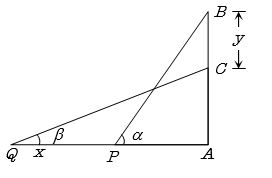
$A$ ladder rests against a wall making an angle $\alpha$ with the horizontal. The foot of the ladder is pulled away from the wall through a distance $x$,so that it slides a distance $y$ down the wall making an angle $\beta$ with the horizontal. The correct relation is
A
$x = y \tan \frac{\alpha + \beta}{2}$
B
$y = x \tan \frac{\alpha + \beta}{2}$
C
$x = y \tan (\alpha + \beta)$
D
$y = x \tan (\alpha + \beta)$
Solution
(A) Let $l$ be the length of the ladder.
In the initial position,the ladder makes an angle $\alpha$ with the horizontal. The horizontal distance from the wall is $PA = l \cos \alpha$ and the vertical height is $AB = l \sin \alpha$.
In the final position,the ladder makes an angle $\beta$ with the horizontal. The horizontal distance from the wall is $QA = l \cos \beta$ and the vertical height is $AC = l \sin \beta$.
The foot of the ladder is pulled away by distance $x = QA - PA = l(\cos \beta - \cos \alpha)$.
The ladder slides down by distance $y = AB - AC = l(\sin \alpha - \sin \beta)$.
Now,taking the ratio $\frac{y}{x}$:
$\frac{y}{x} = \frac{l(\sin \alpha - \sin \beta)}{l(\cos \beta - \cos \alpha)} = \frac{2 \sin \frac{\alpha - \beta}{2} \cos \frac{\alpha + \beta}{2}}{2 \sin \frac{\alpha + \beta}{2} \sin \frac{\alpha - \beta}{2}}$
$\frac{y}{x} = \cot \frac{\alpha + \beta}{2}$
Therefore,$x = y \tan \frac{\alpha + \beta}{2}$.
In the initial position,the ladder makes an angle $\alpha$ with the horizontal. The horizontal distance from the wall is $PA = l \cos \alpha$ and the vertical height is $AB = l \sin \alpha$.
In the final position,the ladder makes an angle $\beta$ with the horizontal. The horizontal distance from the wall is $QA = l \cos \beta$ and the vertical height is $AC = l \sin \beta$.
The foot of the ladder is pulled away by distance $x = QA - PA = l(\cos \beta - \cos \alpha)$.
The ladder slides down by distance $y = AB - AC = l(\sin \alpha - \sin \beta)$.
Now,taking the ratio $\frac{y}{x}$:
$\frac{y}{x} = \frac{l(\sin \alpha - \sin \beta)}{l(\cos \beta - \cos \alpha)} = \frac{2 \sin \frac{\alpha - \beta}{2} \cos \frac{\alpha + \beta}{2}}{2 \sin \frac{\alpha + \beta}{2} \sin \frac{\alpha - \beta}{2}}$
$\frac{y}{x} = \cot \frac{\alpha + \beta}{2}$
Therefore,$x = y \tan \frac{\alpha + \beta}{2}$.
0 likesView Solution
9
MathematicsMediumMCQIIT JEE · 1985
The orthocentre of the triangle formed by the lines $x + y = 1$,$2x + 3y = 6$,and $4x - y + 4 = 0$ lies in which quadrant?
A
First
B
Second
C
Third
D
Fourth
Solution
(A) Let the lines be $L_1: x + y - 1 = 0$,$L_2: 2x + 3y - 6 = 0$,and $L_3: 4x - y + 4 = 0$.
To find the vertices,we solve the equations in pairs:
$1$. $L_1$ and $L_2$: $x + y = 1$ and $2x + 3y = 6$. Solving gives $x = -3, y = 4$. Vertex $A = (-3, 4)$.
$2$. $L_2$ and $L_3$: $2x + 3y = 6$ and $4x - y = -4$. Solving gives $x = -\frac{3}{7}, y = \frac{16}{7}$. Vertex $B = (-\frac{3}{7}, \frac{16}{7})$.
$3$. $L_1$ and $L_3$: $x + y = 1$ and $4x - y = -4$. Solving gives $x = -\frac{3}{5}, y = \frac{8}{5}$. Vertex $C = (-\frac{3}{5}, \frac{8}{5})$.
To find the orthocentre,we find the equations of altitudes:
Altitude from $A$ to $BC$: Slope of $BC = \frac{8/5 - 16/7}{-3/5 - (-3/7)} = \frac{56-80}{35} / \frac{-21+15}{35} = \frac{-24}{-6} = 4$. The altitude is perpendicular to $BC$,so its slope is $-\frac{1}{4}$. Equation: $y - 4 = -\frac{1}{4}(x + 3) \implies x + 4y = 13$.
Altitude from $B$ to $AC$: Slope of $AC = \frac{8/5 - 4}{-3/5 - (-3)} = \frac{-12/5}{12/5} = -1$. The altitude is perpendicular to $AC$,so its slope is $1$. Equation: $y - \frac{16}{7} = 1(x + \frac{3}{7}) \implies x - y = -\frac{19}{7} \implies 7x - 7y = -19$.
Solving $x + 4y = 13$ and $7x - 7y = -19$: From the first,$x = 13 - 4y$. Substituting into the second: $7(13 - 4y) - 7y = -19 \implies 91 - 28y - 7y = -19 \implies -35y = -110 \implies y = \frac{22}{7}$. Then $x = 13 - 4(\frac{22}{7}) = \frac{91 - 88}{7} = \frac{3}{7}$.
The orthocentre is $(\frac{3}{7}, \frac{22}{7})$,which lies in the First quadrant.
To find the vertices,we solve the equations in pairs:
$1$. $L_1$ and $L_2$: $x + y = 1$ and $2x + 3y = 6$. Solving gives $x = -3, y = 4$. Vertex $A = (-3, 4)$.
$2$. $L_2$ and $L_3$: $2x + 3y = 6$ and $4x - y = -4$. Solving gives $x = -\frac{3}{7}, y = \frac{16}{7}$. Vertex $B = (-\frac{3}{7}, \frac{16}{7})$.
$3$. $L_1$ and $L_3$: $x + y = 1$ and $4x - y = -4$. Solving gives $x = -\frac{3}{5}, y = \frac{8}{5}$. Vertex $C = (-\frac{3}{5}, \frac{8}{5})$.
To find the orthocentre,we find the equations of altitudes:
Altitude from $A$ to $BC$: Slope of $BC = \frac{8/5 - 16/7}{-3/5 - (-3/7)} = \frac{56-80}{35} / \frac{-21+15}{35} = \frac{-24}{-6} = 4$. The altitude is perpendicular to $BC$,so its slope is $-\frac{1}{4}$. Equation: $y - 4 = -\frac{1}{4}(x + 3) \implies x + 4y = 13$.
Altitude from $B$ to $AC$: Slope of $AC = \frac{8/5 - 4}{-3/5 - (-3)} = \frac{-12/5}{12/5} = -1$. The altitude is perpendicular to $AC$,so its slope is $1$. Equation: $y - \frac{16}{7} = 1(x + \frac{3}{7}) \implies x - y = -\frac{19}{7} \implies 7x - 7y = -19$.
Solving $x + 4y = 13$ and $7x - 7y = -19$: From the first,$x = 13 - 4y$. Substituting into the second: $7(13 - 4y) - 7y = -19 \implies 91 - 28y - 7y = -19 \implies -35y = -110 \implies y = \frac{22}{7}$. Then $x = 13 - 4(\frac{22}{7}) = \frac{91 - 88}{7} = \frac{3}{7}$.
The orthocentre is $(\frac{3}{7}, \frac{22}{7})$,which lies in the First quadrant.
0 likesView Solution
10
MathematicsMediumMCQIIT JEE · 1985
If the lines $ax + by + c = 0$,$bx + cy + a = 0$,and $cx + ay + b = 0$ are concurrent,then:
A
$a^3 + b^3 + c^3 + 3abc = 0$
B
$a^3 + b^3 + c^3 - abc = 0$
C
$a^3 + b^3 + c^3 - 3abc = 0$
D
None of these
Solution
(C) The given lines are:
$ax + by + c = 0$ $(i)$
$bx + cy + a = 0$ $(ii)$
$cx + ay + b = 0$ $(iii)$
Three lines $a_1x + b_1y + c_1 = 0$,$a_2x + b_2y + c_2 = 0$,and $a_3x + b_3y + c_3 = 0$ are concurrent if the determinant of their coefficients is zero:
$\begin{vmatrix} a & b & c \\ b & c & a \\ c & a & b \end{vmatrix} = 0$
Expanding the determinant:
$a(cb - a^2) - b(b^2 - ac) + c(ab - c^2) = 0$
$abc - a^3 - b^3 + abc + abc - c^3 = 0$
$3abc - (a^3 + b^3 + c^3) = 0$
Therefore,$a^3 + b^3 + c^3 - 3abc = 0$.
$ax + by + c = 0$ $(i)$
$bx + cy + a = 0$ $(ii)$
$cx + ay + b = 0$ $(iii)$
Three lines $a_1x + b_1y + c_1 = 0$,$a_2x + b_2y + c_2 = 0$,and $a_3x + b_3y + c_3 = 0$ are concurrent if the determinant of their coefficients is zero:
$\begin{vmatrix} a & b & c \\ b & c & a \\ c & a & b \end{vmatrix} = 0$
Expanding the determinant:
$a(cb - a^2) - b(b^2 - ac) + c(ab - c^2) = 0$
$abc - a^3 - b^3 + abc + abc - c^3 = 0$
$3abc - (a^3 + b^3 + c^3) = 0$
Therefore,$a^3 + b^3 + c^3 - 3abc = 0$.
0 likesView Solution
11
MathematicsDifficultMCQIIT JEE · 1985
From the origin,chords are drawn to the circle $(x - 1)^2 + y^2 = 1$. The equation of the locus of the midpoints of these chords is
A
$x^2 + y^2 - 3x = 0$
B
$x^2 + y^2 - 3y = 0$
C
$x^2 + y^2 - x = 0$
D
$x^2 + y^2 - y = 0$
Solution
(C) The given circle is $(x - 1)^2 + y^2 = 1$,which expands to $x^2 + y^2 - 2x = 0$.
Let $(h, k)$ be the midpoint of a chord.
The equation of a chord with midpoint $(h, k)$ is given by $T = S_1$,where $T = xh + yk - (x + h)$ and $S_1 = h^2 + k^2 - 2h$.
So,the equation of the chord is $xh + yk - (x + h) = h^2 + k^2 - 2h$.
Since the chord passes through the origin $(0, 0)$,we substitute $x = 0$ and $y = 0$ into the equation:
$0(h) + 0(k) - (0 + h) = h^2 + k^2 - 2h$
$-h = h^2 + k^2 - 2h$
$h^2 + k^2 - h = 0$.
Replacing $(h, k)$ with $(x, y)$,the locus is $x^2 + y^2 - x = 0$.
Let $(h, k)$ be the midpoint of a chord.
The equation of a chord with midpoint $(h, k)$ is given by $T = S_1$,where $T = xh + yk - (x + h)$ and $S_1 = h^2 + k^2 - 2h$.
So,the equation of the chord is $xh + yk - (x + h) = h^2 + k^2 - 2h$.
Since the chord passes through the origin $(0, 0)$,we substitute $x = 0$ and $y = 0$ into the equation:
$0(h) + 0(k) - (0 + h) = h^2 + k^2 - 2h$
$-h = h^2 + k^2 - 2h$
$h^2 + k^2 - h = 0$.
Replacing $(h, k)$ with $(x, y)$,the locus is $x^2 + y^2 - x = 0$.
0 likesView Solution
12
MathematicsDifficultMCQIIT JEE · 1985
The tangents are drawn from the point $(4, 5)$ to the circle $x^2 + y^2 - 4x - 2y - 11 = 0$. The area of the quadrilateral formed by these tangents and the radii is .............. $sq. \text{ units}$.
A
$15$
B
$75$
C
$8$
D
$4$
Solution
(C) The equation of the circle is $x^2 + y^2 - 4x - 2y - 11 = 0$.
Comparing with $x^2 + y^2 + 2gx + 2fy + c = 0$,we get $g = -2$,$f = -1$,and $c = -11$.
The center of the circle is $(-g, -f) = (2, 1)$ and the radius $r = \sqrt{g^2 + f^2 - c} = \sqrt{4 + 1 + 11} = \sqrt{16} = 4$.
The length of the tangent $L$ from point $(x_1, y_1) = (4, 5)$ is given by $L = \sqrt{x_1^2 + y_1^2 - 4x_1 - 2y_1 - 11}$.
$L = \sqrt{4^2 + 5^2 - 4(4) - 2(5) - 11} = \sqrt{16 + 25 - 16 - 10 - 11} = \sqrt{4} = 2$.
The quadrilateral formed by the two tangents,the two radii,and the center is composed of two congruent right-angled triangles.
The area of the quadrilateral is $2 \times (\frac{1}{2} \times \text{base} \times \text{height}) = 2 \times (\frac{1}{2} \times L \times r) = L \times r$.
Area $= 2 \times 4 = 8 \text{ sq. units}$.
Comparing with $x^2 + y^2 + 2gx + 2fy + c = 0$,we get $g = -2$,$f = -1$,and $c = -11$.
The center of the circle is $(-g, -f) = (2, 1)$ and the radius $r = \sqrt{g^2 + f^2 - c} = \sqrt{4 + 1 + 11} = \sqrt{16} = 4$.
The length of the tangent $L$ from point $(x_1, y_1) = (4, 5)$ is given by $L = \sqrt{x_1^2 + y_1^2 - 4x_1 - 2y_1 - 11}$.
$L = \sqrt{4^2 + 5^2 - 4(4) - 2(5) - 11} = \sqrt{16 + 25 - 16 - 10 - 11} = \sqrt{4} = 2$.
The quadrilateral formed by the two tangents,the two radii,and the center is composed of two congruent right-angled triangles.
The area of the quadrilateral is $2 \times (\frac{1}{2} \times \text{base} \times \text{height}) = 2 \times (\frac{1}{2} \times L \times r) = L \times r$.
Area $= 2 \times 4 = 8 \text{ sq. units}$.
0 likesView Solution
13
MathematicsMediumMCQIIT JEE · 1985
From the origin,chords are drawn to the circle $(x - 1)^2 + y^2 = 1$. The locus of the midpoints of these chords is a
A
Circle
B
Straight line
C
Pair of straight lines
D
None of these
Solution
(A) Let $(x', y')$ be the midpoint of a chord.
The equation of the chord with midpoint $(x', y')$ for the circle $x^2 + y^2 - 2x = 0$ is given by $T = S_1$.
$x x' + y y' - (x + x') = x'^2 + y'^2 - 2x'$
Since the chord passes through the origin $(0, 0)$,we substitute $x = 0$ and $y = 0$ into the equation:
$0 + 0 - (0 + x') = x'^2 + y'^2 - 2x'$
$-x' = x'^2 + y'^2 - 2x'$
$x'^2 + y'^2 - x' = 0$
Replacing $(x', y')$ with $(x, y)$,the locus is $x^2 + y^2 - x = 0$,which represents a circle.
The equation of the chord with midpoint $(x', y')$ for the circle $x^2 + y^2 - 2x = 0$ is given by $T = S_1$.
$x x' + y y' - (x + x') = x'^2 + y'^2 - 2x'$
Since the chord passes through the origin $(0, 0)$,we substitute $x = 0$ and $y = 0$ into the equation:
$0 + 0 - (0 + x') = x'^2 + y'^2 - 2x'$
$-x' = x'^2 + y'^2 - 2x'$
$x'^2 + y'^2 - x' = 0$
Replacing $(x', y')$ with $(x, y)$,the locus is $x^2 + y^2 - x = 0$,which represents a circle.
0 likesView Solution
14
MathematicsEasyMCQIIT JEE · 1985
If $f(x) = \begin{cases} \frac{\sin([x])}{[x]}, & \text{when } [x] \neq 0 \\ 0, & \text{when } [x] = 0 \end{cases}$ where $[x]$ is the greatest integer function,then $\lim_{x \to 0} f(x) = $
A
$-1$
B
$1$
C
$0$
D
Does not exist
Solution
(D) To find $\lim_{x \to 0} f(x)$,we evaluate the left-hand limit $(LHL)$ and the right-hand limit $(RHL)$ at $x = 0$.
For the $LHL$: $\lim_{x \to 0^-} f(x)$. As $x \to 0^-$,$x$ is slightly less than $0$,so $[x] = -1$.
Thus,$f(x) = \frac{\sin(-1)}{-1} = \frac{-\sin(1)}{-1} = \sin(1)$.
So,$\lim_{x \to 0^-} f(x) = \sin(1)$.
For the $RHL$: $\lim_{x \to 0^+} f(x)$. As $x \to 0^+$,$x$ is in the interval $[0, 1)$,so $[x] = 0$.
According to the definition of $f(x)$,when $[x] = 0$,$f(x) = 0$.
So,$\lim_{x \to 0^+} f(x) = 0$.
Since $\lim_{x \to 0^-} f(x) = \sin(1)$ and $\lim_{x \to 0^+} f(x) = 0$,the left-hand limit is not equal to the right-hand limit.
Therefore,$\lim_{x \to 0} f(x)$ does not exist.
For the $LHL$: $\lim_{x \to 0^-} f(x)$. As $x \to 0^-$,$x$ is slightly less than $0$,so $[x] = -1$.
Thus,$f(x) = \frac{\sin(-1)}{-1} = \frac{-\sin(1)}{-1} = \sin(1)$.
So,$\lim_{x \to 0^-} f(x) = \sin(1)$.
For the $RHL$: $\lim_{x \to 0^+} f(x)$. As $x \to 0^+$,$x$ is in the interval $[0, 1)$,so $[x] = 0$.
According to the definition of $f(x)$,when $[x] = 0$,$f(x) = 0$.
So,$\lim_{x \to 0^+} f(x) = 0$.
Since $\lim_{x \to 0^-} f(x) = \sin(1)$ and $\lim_{x \to 0^+} f(x) = 0$,the left-hand limit is not equal to the right-hand limit.
Therefore,$\lim_{x \to 0} f(x)$ does not exist.
0 likesView Solution
15
MathematicsDifficultMCQIIT JEE · 1985
$P(A \cup B) = P(A \cap B)$ if and only if the relation between $P(A)$ and $P(B)$ is
A
$P(A) = P(\bar{A})$
B
$P(A \cap B) = P(A' \cap B')$
C
$P(A) = P(B)$
D
None of these
Solution
(C) We know that the addition theorem of probability states that $P(A \cup B) = P(A) + P(B) - P(A \cap B)$.
Given the condition $P(A \cup B) = P(A \cap B)$,we substitute this into the formula:
$P(A \cap B) = P(A) + P(B) - P(A \cap B)$.
Rearranging the terms,we get $2P(A \cap B) = P(A) + P(B)$.
However,for the specific case where $P(A \cup B) = P(A \cap B)$,it implies that $P(A \setminus B) = 0$ and $P(B \setminus A) = 0$,which means $P(A) = P(A \cap B) = P(B)$.
Therefore,the correct relation is $P(A) = P(B)$.
Given the condition $P(A \cup B) = P(A \cap B)$,we substitute this into the formula:
$P(A \cap B) = P(A) + P(B) - P(A \cap B)$.
Rearranging the terms,we get $2P(A \cap B) = P(A) + P(B)$.
However,for the specific case where $P(A \cup B) = P(A \cap B)$,it implies that $P(A \setminus B) = 0$ and $P(B \setminus A) = 0$,which means $P(A) = P(A \cap B) = P(B)$.
Therefore,the correct relation is $P(A) = P(B)$.
0 likesView Solution
16
MathematicsMediumMCQIIT JEE · 1985
If $a, b, c$ are unequal,what is the condition that the value of the following determinant is zero? $\Delta = \left| \begin{array}{ccc} a & a^2 & a^3 + 1 \\ b & b^2 & b^3 + 1 \\ c & c^2 & c^3 + 1 \end{array} \right|$
A
$1 + abc = 0$
B
$a + b + c + 1 = 0$
C
$(a - b)(b - c)(c - a) = 0$
D
None of these
Solution
(A) We are given the determinant $\Delta = \left| \begin{array}{ccc} a & a^2 & a^3 + 1 \\ b & b^2 & b^3 + 1 \\ c & c^2 & c^3 + 1 \end{array} \right|$.
By the property of determinants,we can split the third column into two parts:
$\Delta = \left| \begin{array}{ccc} a & a^2 & a^3 \\ b & b^2 & b^3 \\ c & c^2 & c^3 \end{array} \right| + \left| \begin{array}{ccc} a & a^2 & 1 \\ b & b^2 & 1 \\ c & c^2 & 1 \end{array} \right|$.
Taking $abc$ common from the first determinant,we get:
$\Delta = abc \left| \begin{array}{ccc} 1 & a & a^2 \\ 1 & b & b^2 \\ 1 & c & c^2 \end{array} \right| + \left| \begin{array}{ccc} a & a^2 & 1 \\ b & b^2 & 1 \\ c & c^2 & 1 \end{array} \right|$.
In the second determinant,perform column swaps to match the first: $C_3 \leftrightarrow C_2$ then $C_2 \leftrightarrow C_1$. This results in two sign changes,so the sign remains positive:
$\Delta = abc \left| \begin{array}{ccc} 1 & a & a^2 \\ 1 & b & b^2 \\ 1 & c & c^2 \end{array} \right| + \left| \begin{array}{ccc} 1 & a & a^2 \\ 1 & b & b^2 \\ 1 & c & c^2 \end{array} \right| = (1 + abc) \left| \begin{array}{ccc} 1 & a & a^2 \\ 1 & b & b^2 \\ 1 & c & c^2 \end{array} \right|$.
The value of the determinant $\left| \begin{array}{ccc} 1 & a & a^2 \\ 1 & b & b^2 \\ 1 & c & c^2 \end{array} \right|$ is $(a - b)(b - c)(c - a)$.
Thus,$\Delta = (1 + abc)(a - b)(b - c)(c - a) = 0$.
Since $a, b, c$ are unequal,$(a - b)(b - c)(c - a) \neq 0$.
Therefore,the condition is $1 + abc = 0$.
By the property of determinants,we can split the third column into two parts:
$\Delta = \left| \begin{array}{ccc} a & a^2 & a^3 \\ b & b^2 & b^3 \\ c & c^2 & c^3 \end{array} \right| + \left| \begin{array}{ccc} a & a^2 & 1 \\ b & b^2 & 1 \\ c & c^2 & 1 \end{array} \right|$.
Taking $abc$ common from the first determinant,we get:
$\Delta = abc \left| \begin{array}{ccc} 1 & a & a^2 \\ 1 & b & b^2 \\ 1 & c & c^2 \end{array} \right| + \left| \begin{array}{ccc} a & a^2 & 1 \\ b & b^2 & 1 \\ c & c^2 & 1 \end{array} \right|$.
In the second determinant,perform column swaps to match the first: $C_3 \leftrightarrow C_2$ then $C_2 \leftrightarrow C_1$. This results in two sign changes,so the sign remains positive:
$\Delta = abc \left| \begin{array}{ccc} 1 & a & a^2 \\ 1 & b & b^2 \\ 1 & c & c^2 \end{array} \right| + \left| \begin{array}{ccc} 1 & a & a^2 \\ 1 & b & b^2 \\ 1 & c & c^2 \end{array} \right| = (1 + abc) \left| \begin{array}{ccc} 1 & a & a^2 \\ 1 & b & b^2 \\ 1 & c & c^2 \end{array} \right|$.
The value of the determinant $\left| \begin{array}{ccc} 1 & a & a^2 \\ 1 & b & b^2 \\ 1 & c & c^2 \end{array} \right|$ is $(a - b)(b - c)(c - a)$.
Thus,$\Delta = (1 + abc)(a - b)(b - c)(c - a) = 0$.
Since $a, b, c$ are unequal,$(a - b)(b - c)(c - a) \neq 0$.
Therefore,the condition is $1 + abc = 0$.
0 likesView Solution
17
MathematicsEasyMCQIIT JEE · 1985
If $\left| {\begin{array}{*{20}{c}}{{x_1}}&{{y_1}}&1\\{{x_2}}&{{y_2}}&1\\{{x_3}}&{{y_3}}&1\end{array}} \right| = \left| {\begin{array}{*{20}{c}}{{a_1}}&{{b_1}}&1\\{{a_2}}&{{b_2}}&1\\{{a_3}}&{{b_3}}&1\end{array}} \right|$,then the two triangles with vertices $(x_1, y_1), (x_2, y_2), (x_3, y_3)$ and $(a_1, b_1), (a_2, b_2), (a_3, b_3)$ must be:
A
Similar
B
None of these
C
Never congruent
D
Congruent
Solution
(B) The area of a triangle with vertices $(x_1, y_1), (x_2, y_2), (x_3, y_3)$ is given by $\Delta = \frac{1}{2} \left| \begin{array}{ccc} x_1 & y_1 & 1 \\ x_2 & y_2 & 1 \\ x_3 & y_3 & 1 \end{array} \right|$.
Given that the determinants are equal,it implies that the areas of the two triangles are equal.
Equality of area does not imply that the triangles are congruent or similar.
Therefore,the correct option is $B$.
Given that the determinants are equal,it implies that the areas of the two triangles are equal.
Equality of area does not imply that the triangles are congruent or similar.
Therefore,the correct option is $B$.
0 likesView Solution
18
MathematicsMediumMCQIIT JEE · 1985
If $a, b, c$ are three non-coplanar vectors,then $\frac{a \cdot (b \times c)}{c \times a \cdot b} + \frac{b \cdot (a \times c)}{c \cdot (a \times b)} = $
A
$0$
B
$2$
C
$-2$
D
None of these
Solution
(A) The scalar triple product is defined as $[a, b, c] = a \cdot (b \times c)$.
Given that $a, b, c$ are non-coplanar,$[a, b, c] \neq 0$.
We know the properties of scalar triple products: $[c, a, b] = [a, b, c]$ and $[b, a, c] = -[a, b, c]$.
Substituting these into the expression:
$\frac{a \cdot (b \times c)}{c \times a \cdot b} + \frac{b \cdot (a \times c)}{c \cdot (a \times b)} = \frac{[a, b, c]}{[c, a, b]} + \frac{[b, a, c]}{[c, a, b]}$
$= \frac{[a, b, c]}{[a, b, c]} + \frac{-[a, b, c]}{[a, b, c]}$
$= 1 - 1 = 0$.
Given that $a, b, c$ are non-coplanar,$[a, b, c] \neq 0$.
We know the properties of scalar triple products: $[c, a, b] = [a, b, c]$ and $[b, a, c] = -[a, b, c]$.
Substituting these into the expression:
$\frac{a \cdot (b \times c)}{c \times a \cdot b} + \frac{b \cdot (a \times c)}{c \cdot (a \times b)} = \frac{[a, b, c]}{[c, a, b]} + \frac{[b, a, c]}{[c, a, b]}$
$= \frac{[a, b, c]}{[a, b, c]} + \frac{-[a, b, c]}{[a, b, c]}$
$= 1 - 1 = 0$.
0 likesView Solution
19
MathematicsEasyMCQIIT JEE · 1985
If $f(x) = x(\sqrt{x} - \sqrt{x + 1}),$ then
A
$f(x)$ is continuous but non-differentiable at $x = 0$
B
$f(x)$ is differentiable at $x = 0$
C
$f(x)$ is not differentiable at $x = 0$
D
None of these
Solution
(C) The function $f(x) = x(\sqrt{x} - \sqrt{x + 1})$ is defined for $x \ge 0$ because of the term $\sqrt{x}$.
For $x < 0$,the term $\sqrt{x}$ is not defined in the set of real numbers.
Since the function is not defined in the neighborhood $(-\delta, 0)$ for any $\delta > 0$,it cannot be continuous at $x = 0$.
By definition,a function must be continuous at a point to be differentiable at that point.
Therefore,$f(x)$ is not differentiable at $x = 0$.
For $x < 0$,the term $\sqrt{x}$ is not defined in the set of real numbers.
Since the function is not defined in the neighborhood $(-\delta, 0)$ for any $\delta > 0$,it cannot be continuous at $x = 0$.
By definition,a function must be continuous at a point to be differentiable at that point.
Therefore,$f(x)$ is not differentiable at $x = 0$.
0 likesView Solution
20
MathematicsEasyMCQIIT JEE · 1985
$\frac{d}{dx} \log(\log x) =$
A
$\frac{x}{\log x}$
B
$\frac{\log x}{x}$
C
$(x \log x)^{-1}$
D
None of these
Solution
(C) To find the derivative of $\log(\log x)$ with respect to $x$,we use the chain rule.
Let $y = \log(\log x)$.
Applying the chain rule,$\frac{dy}{dx} = \frac{d}{d(\log x)} \log(\log x) \cdot \frac{d}{dx} \log x$.
Since $\frac{d}{du} \log u = \frac{1}{u}$ and $\frac{d}{dx} \log x = \frac{1}{x}$,we get:
$\frac{dy}{dx} = \frac{1}{\log x} \cdot \frac{1}{x} = \frac{1}{x \log x}$.
This can be written as $(x \log x)^{-1}$.
Therefore,the correct option is $C$.
Let $y = \log(\log x)$.
Applying the chain rule,$\frac{dy}{dx} = \frac{d}{d(\log x)} \log(\log x) \cdot \frac{d}{dx} \log x$.
Since $\frac{d}{du} \log u = \frac{1}{u}$ and $\frac{d}{dx} \log x = \frac{1}{x}$,we get:
$\frac{dy}{dx} = \frac{1}{\log x} \cdot \frac{1}{x} = \frac{1}{x \log x}$.
This can be written as $(x \log x)^{-1}$.
Therefore,the correct option is $C$.
0 likesView Solution
21
MathematicsMediumMCQIIT JEE · 1985
If $f(x) = \log_{x}(\log x)$,then $f'(x)$ at $x = e$ is
A
$e$
B
$\frac{1}{e}$
C
$1$
D
None of these
Solution
(B) Given $f(x) = \log_{x}(\log x)$.
Using the base change formula,we can write $f(x) = \frac{\log(\log x)}{\log x}$.
Now,differentiate $f(x)$ with respect to $x$ using the quotient rule $\frac{d}{dx}\left(\frac{u}{v}\right) = \frac{u'v - uv'}{v^2}$:
$f'(x) = \frac{\left(\frac{d}{dx}(\log(\log x))\right)(\log x) - (\log(\log x))(\frac{d}{dx}(\log x))}{(\log x)^2}$
$f'(x) = \frac{\left(\frac{1}{\log x} \cdot \frac{1}{x}\right)(\log x) - (\log(\log x))(\frac{1}{x})}{(\log x)^2}$
$f'(x) = \frac{\frac{1}{x} - \frac{\log(\log x)}{x}}{(\log x)^2} = \frac{1 - \log(\log x)}{x(\log x)^2}$.
Now,evaluate $f'(x)$ at $x = e$:
$f'(e) = \frac{1 - \log(\log e)}{e(\log e)^2}$.
Since $\log e = 1$ and $\log(1) = 0$,we have:
$f'(e) = \frac{1 - 0}{e(1)^2} = \frac{1}{e}$.
Using the base change formula,we can write $f(x) = \frac{\log(\log x)}{\log x}$.
Now,differentiate $f(x)$ with respect to $x$ using the quotient rule $\frac{d}{dx}\left(\frac{u}{v}\right) = \frac{u'v - uv'}{v^2}$:
$f'(x) = \frac{\left(\frac{d}{dx}(\log(\log x))\right)(\log x) - (\log(\log x))(\frac{d}{dx}(\log x))}{(\log x)^2}$
$f'(x) = \frac{\left(\frac{1}{\log x} \cdot \frac{1}{x}\right)(\log x) - (\log(\log x))(\frac{1}{x})}{(\log x)^2}$
$f'(x) = \frac{\frac{1}{x} - \frac{\log(\log x)}{x}}{(\log x)^2} = \frac{1 - \log(\log x)}{x(\log x)^2}$.
Now,evaluate $f'(x)$ at $x = e$:
$f'(e) = \frac{1 - \log(\log e)}{e(\log e)^2}$.
Since $\log e = 1$ and $\log(1) = 0$,we have:
$f'(e) = \frac{1 - 0}{e(1)^2} = \frac{1}{e}$.
0 likesView Solution
22
MathematicsMediumMCQIIT JEE · 1985
$\int \frac{x^5}{\sqrt{1 + x^3}} dx = $
A
$\frac{2}{9}(1 + x^3)^{3/2} + c$
B
$\frac{2}{9}(1 + x^3)^{3/2} + \frac{2}{3}(1 + x^3)^{1/2} + c$
C
$\frac{2}{9}(1 + x^3)^{3/2} - \frac{2}{3}(1 + x^3)^{1/2} + c$
D
None of these
Solution
(C) Let $I = \int \frac{x^5}{\sqrt{1 + x^3}} dx$.
Put $1 + x^3 = t^2$,then $3x^2 dx = 2t dt$,which implies $x^2 dx = \frac{2}{3} t dt$.
Also,$x^3 = t^2 - 1$.
Substituting these into the integral:
$I = \int \frac{x^3 \cdot x^2 dx}{\sqrt{1 + x^3}} = \int \frac{(t^2 - 1) \cdot \frac{2}{3} t dt}{t}$
$I = \frac{2}{3} \int (t^2 - 1) dt$
$I = \frac{2}{3} \left( \frac{t^3}{3} - t \right) + c$
$I = \frac{2}{9} t^3 - \frac{2}{3} t + c$
Since $t = (1 + x^3)^{1/2}$,we have:
$I = \frac{2}{9} (1 + x^3)^{3/2} - \frac{2}{3} (1 + x^3)^{1/2} + c$.
Put $1 + x^3 = t^2$,then $3x^2 dx = 2t dt$,which implies $x^2 dx = \frac{2}{3} t dt$.
Also,$x^3 = t^2 - 1$.
Substituting these into the integral:
$I = \int \frac{x^3 \cdot x^2 dx}{\sqrt{1 + x^3}} = \int \frac{(t^2 - 1) \cdot \frac{2}{3} t dt}{t}$
$I = \frac{2}{3} \int (t^2 - 1) dt$
$I = \frac{2}{3} \left( \frac{t^3}{3} - t \right) + c$
$I = \frac{2}{9} t^3 - \frac{2}{3} t + c$
Since $t = (1 + x^3)^{1/2}$,we have:
$I = \frac{2}{9} (1 + x^3)^{3/2} - \frac{2}{3} (1 + x^3)^{1/2} + c$.
0 likesView Solution
23
MathematicsDifficultMCQIIT JEE · 1985
$\int_0^{\pi /2} \frac{x \sin x \cos x}{\cos^4 x + \sin^4 x} \, dx = $
A
$0$
B
$\frac{\pi}{8}$
C
$\frac{\pi^2}{8}$
D
$\frac{\pi^2}{16}$
Solution
(D) Let $I = \int_0^{\pi /2} \frac{x \sin x \cos x}{\cos^4 x + \sin^4 x} \, dx$ .....$(i)$
Using the property $\int_0^a f(x) \, dx = \int_0^a f(a-x) \, dx$,we get:
$I = \int_0^{\pi /2} \frac{(\frac{\pi}{2} - x) \cos x \sin x}{\sin^4 x + \cos^4 x} \, dx$ .....$(ii)$
Adding $(i)$ and $(ii)$:
$2I = \int_0^{\pi /2} \frac{\frac{\pi}{2} \sin x \cos x}{\sin^4 x + \cos^4 x} \, dx$
$I = \frac{\pi}{4} \int_0^{\pi /2} \frac{\sin x \cos x}{\cos^4 x + \sin^4 x} \, dx$
Divide numerator and denominator by $\cos^4 x$:
$I = \frac{\pi}{4} \int_0^{\pi /2} \frac{\tan x \sec^2 x}{1 + \tan^4 x} \, dx$
Let $\tan^2 x = t$,then $2 \tan x \sec^2 x \, dx = dt$,so $\tan x \sec^2 x \, dx = \frac{1}{2} dt$. When $x=0, t=0$; when $x=\frac{\pi}{2}, t \to \infty$.
$I = \frac{\pi}{4} \int_0^{\infty} \frac{1}{1 + t^2} \cdot \frac{1}{2} \, dt = \frac{\pi}{8} [\tan^{-1} t]_0^{\infty} = \frac{\pi}{8} \cdot \frac{\pi}{2} = \frac{\pi^2}{16}$.
Using the property $\int_0^a f(x) \, dx = \int_0^a f(a-x) \, dx$,we get:
$I = \int_0^{\pi /2} \frac{(\frac{\pi}{2} - x) \cos x \sin x}{\sin^4 x + \cos^4 x} \, dx$ .....$(ii)$
Adding $(i)$ and $(ii)$:
$2I = \int_0^{\pi /2} \frac{\frac{\pi}{2} \sin x \cos x}{\sin^4 x + \cos^4 x} \, dx$
$I = \frac{\pi}{4} \int_0^{\pi /2} \frac{\sin x \cos x}{\cos^4 x + \sin^4 x} \, dx$
Divide numerator and denominator by $\cos^4 x$:
$I = \frac{\pi}{4} \int_0^{\pi /2} \frac{\tan x \sec^2 x}{1 + \tan^4 x} \, dx$
Let $\tan^2 x = t$,then $2 \tan x \sec^2 x \, dx = dt$,so $\tan x \sec^2 x \, dx = \frac{1}{2} dt$. When $x=0, t=0$; when $x=\frac{\pi}{2}, t \to \infty$.
$I = \frac{\pi}{4} \int_0^{\infty} \frac{1}{1 + t^2} \cdot \frac{1}{2} \, dt = \frac{\pi}{8} [\tan^{-1} t]_0^{\infty} = \frac{\pi}{8} \cdot \frac{\pi}{2} = \frac{\pi^2}{16}$.
0 likesView Solution
24
MathematicsMediumMCQIIT JEE · 1985
If $n$ is any integer,then $\int_0^\pi {e^{\cos^2 x} \cos^3((2n + 1)x)} \, dx = $
A
$x$
B
$1$
C
$0$
D
None of these
Solution
(C) Let $I = \int_0^\pi {e^{\cos^2 x} \cos^3((2n + 1)x)} \, dx$.
Using the property $\int_0^a f(x) \, dx = \int_0^a f(a - x) \, dx$,we have:
$I = \int_0^\pi {e^{\cos^2(\pi - x)} \cos^3((2n + 1)(\pi - x))} \, dx$.
Since $\cos(\pi - x) = -\cos x$,we have $\cos^2(\pi - x) = \cos^2 x$.
Also,$\cos((2n + 1)(\pi - x)) = \cos((2n + 1)\pi - (2n + 1)x) = \cos((2n + 1)\pi) \cos((2n + 1)x) + \sin((2n + 1)\pi) \sin((2n + 1)x)$.
Since $(2n + 1)$ is an odd integer,$\cos((2n + 1)\pi) = -1$ and $\sin((2n + 1)\pi) = 0$.
Thus,$\cos((2n + 1)(\pi - x)) = -\cos((2n + 1)x)$.
Therefore,$\cos^3((2n + 1)(\pi - x)) = (-\cos((2n + 1)x))^3 = -\cos^3((2n + 1)x)$.
Substituting this back into the integral,we get $I = \int_0^\pi e^{\cos^2 x} (-\cos^3((2n + 1)x)) \, dx = -I$.
$2I = 0 \implies I = 0$.
Using the property $\int_0^a f(x) \, dx = \int_0^a f(a - x) \, dx$,we have:
$I = \int_0^\pi {e^{\cos^2(\pi - x)} \cos^3((2n + 1)(\pi - x))} \, dx$.
Since $\cos(\pi - x) = -\cos x$,we have $\cos^2(\pi - x) = \cos^2 x$.
Also,$\cos((2n + 1)(\pi - x)) = \cos((2n + 1)\pi - (2n + 1)x) = \cos((2n + 1)\pi) \cos((2n + 1)x) + \sin((2n + 1)\pi) \sin((2n + 1)x)$.
Since $(2n + 1)$ is an odd integer,$\cos((2n + 1)\pi) = -1$ and $\sin((2n + 1)\pi) = 0$.
Thus,$\cos((2n + 1)(\pi - x)) = -\cos((2n + 1)x)$.
Therefore,$\cos^3((2n + 1)(\pi - x)) = (-\cos((2n + 1)x))^3 = -\cos^3((2n + 1)x)$.
Substituting this back into the integral,we get $I = \int_0^\pi e^{\cos^2 x} (-\cos^3((2n + 1)x)) \, dx = -I$.
$2I = 0 \implies I = 0$.
0 likesView Solution
25
MathematicsMediumMCQIIT JEE · 1985
If $a = (1, 1, 1)$ and $c = (0, 1, -1)$ are two vectors and $b$ is a vector such that $a \times b = c$ and $a \cdot b = 3$,then $b$ is equal to
A
$\left( \frac{2}{3}, \frac{2}{3}, \frac{5}{3} \right)$
B
$\left( \frac{2}{3}, \frac{5}{3}, \frac{2}{3} \right)$
C
$(5, 2, 2)$
D
$\left( \frac{5}{3}, \frac{2}{3}, \frac{2}{3} \right)$
Solution
(D) Let $b = b_1 i + b_2 j + b_3 k$.
Given $a \cdot b = 3$,we have $b_1 + b_2 + b_3 = 3$ ......$(i)$.
Given $a \times b = c$,where $a = (1, 1, 1)$ and $c = (0, 1, -1)$,we calculate the cross product:
$a \times b = \begin{vmatrix} i & j & k \\ 1 & 1 & 1 \\ b_1 & b_2 & b_3 \end{vmatrix} = (b_3 - b_2)i + (b_1 - b_3)j + (b_2 - b_1)k$.
Comparing this with $c = (0, 1, -1)$,we get:
$b_3 - b_2 = 0$ ......$(ii)$
$b_1 - b_3 = 1$ ......$(iii)$
$b_2 - b_1 = -1$ ......$(iv)$
From $(ii)$,$b_2 = b_3$. Substituting into $(i)$,$b_1 + 2b_2 = 3$.
From $(iii)$,$b_1 = 1 + b_3 = 1 + b_2$.
Substituting $b_1$ into $b_1 + 2b_2 = 3$,we get $(1 + b_2) + 2b_2 = 3$,so $3b_2 = 2$,which means $b_2 = \frac{2}{3}$.
Then $b_3 = \frac{2}{3}$ and $b_1 = 1 + \frac{2}{3} = \frac{5}{3}$.
Thus,$b = \left( \frac{5}{3}, \frac{2}{3}, \frac{2}{3} \right)$.
Given $a \cdot b = 3$,we have $b_1 + b_2 + b_3 = 3$ ......$(i)$.
Given $a \times b = c$,where $a = (1, 1, 1)$ and $c = (0, 1, -1)$,we calculate the cross product:
$a \times b = \begin{vmatrix} i & j & k \\ 1 & 1 & 1 \\ b_1 & b_2 & b_3 \end{vmatrix} = (b_3 - b_2)i + (b_1 - b_3)j + (b_2 - b_1)k$.
Comparing this with $c = (0, 1, -1)$,we get:
$b_3 - b_2 = 0$ ......$(ii)$
$b_1 - b_3 = 1$ ......$(iii)$
$b_2 - b_1 = -1$ ......$(iv)$
From $(ii)$,$b_2 = b_3$. Substituting into $(i)$,$b_1 + 2b_2 = 3$.
From $(iii)$,$b_1 = 1 + b_3 = 1 + b_2$.
Substituting $b_1$ into $b_1 + 2b_2 = 3$,we get $(1 + b_2) + 2b_2 = 3$,so $3b_2 = 2$,which means $b_2 = \frac{2}{3}$.
Then $b_3 = \frac{2}{3}$ and $b_1 = 1 + \frac{2}{3} = \frac{5}{3}$.
Thus,$b = \left( \frac{5}{3}, \frac{2}{3}, \frac{2}{3} \right)$.
0 likesView Solution
26
MathematicsMediumMCQIIT JEE · 1985
If $\left| \begin{array}{ccc} a & a^2 & 1 + a^3 \\ b & b^2 & 1 + b^3 \\ c & c^2 & 1 + c^3 \end{array} \right| = 0$ and the vectors $\vec{a} = (1, a, a^2)$,$\vec{b} = (1, b, b^2)$,and $\vec{c} = (1, c, c^2)$ are non-coplanar,then $abc$ is equal to
A
$-1$
B
$0$
C
$1$
D
$4$
Solution
(A) Given that the vectors $(1, a, a^2)$,$(1, b, b^2)$,and $(1, c, c^2)$ are non-coplanar,the determinant of the matrix formed by these vectors is non-zero:
$\Delta = \left| \begin{array}{ccc} 1 & a & a^2 \\ 1 & b & b^2 \\ 1 & c & c^2 \end{array} \right| \neq 0$.
We are given the equation:
$\left| \begin{array}{ccc} a & a^2 & 1 + a^3 \\ b & b^2 & 1 + b^3 \\ c & c^2 & 1 + c^3 \end{array} \right| = 0$.
Using the property of determinants,we can split the third column:
$\left| \begin{array}{ccc} a & a^2 & 1 \\ b & b^2 & 1 \\ c & c^2 & 1 \end{array} \right| + \left| \begin{array}{ccc} a & a^2 & a^3 \\ b & b^2 & b^3 \\ c & c^2 & c^3 \end{array} \right| = 0$.
In the second determinant,factor out $a, b, c$ from the rows:
$\left| \begin{array}{ccc} a & a^2 & 1 \\ b & b^2 & 1 \\ c & c^2 & 1 \end{array} \right| + abc \left| \begin{array}{ccc} 1 & a & a^2 \\ 1 & b & b^2 \\ 1 & c & c^2 \end{array} \right| = 0$.
Note that $\left| \begin{array}{ccc} a & a^2 & 1 \\ b & b^2 & 1 \\ c & c^2 & 1 \end{array} \right| = \left| \begin{array}{ccc} 1 & a & a^2 \\ 1 & b & b^2 \\ 1 & c & c^2 \end{array} \right| = \Delta$ (after two column swaps).
Thus,$\Delta + abc \Delta = 0 \Rightarrow \Delta(1 + abc) = 0$.
Since $\Delta \neq 0$,we have $1 + abc = 0$,which implies $abc = -1$.
$\Delta = \left| \begin{array}{ccc} 1 & a & a^2 \\ 1 & b & b^2 \\ 1 & c & c^2 \end{array} \right| \neq 0$.
We are given the equation:
$\left| \begin{array}{ccc} a & a^2 & 1 + a^3 \\ b & b^2 & 1 + b^3 \\ c & c^2 & 1 + c^3 \end{array} \right| = 0$.
Using the property of determinants,we can split the third column:
$\left| \begin{array}{ccc} a & a^2 & 1 \\ b & b^2 & 1 \\ c & c^2 & 1 \end{array} \right| + \left| \begin{array}{ccc} a & a^2 & a^3 \\ b & b^2 & b^3 \\ c & c^2 & c^3 \end{array} \right| = 0$.
In the second determinant,factor out $a, b, c$ from the rows:
$\left| \begin{array}{ccc} a & a^2 & 1 \\ b & b^2 & 1 \\ c & c^2 & 1 \end{array} \right| + abc \left| \begin{array}{ccc} 1 & a & a^2 \\ 1 & b & b^2 \\ 1 & c & c^2 \end{array} \right| = 0$.
Note that $\left| \begin{array}{ccc} a & a^2 & 1 \\ b & b^2 & 1 \\ c & c^2 & 1 \end{array} \right| = \left| \begin{array}{ccc} 1 & a & a^2 \\ 1 & b & b^2 \\ 1 & c & c^2 \end{array} \right| = \Delta$ (after two column swaps).
Thus,$\Delta + abc \Delta = 0 \Rightarrow \Delta(1 + abc) = 0$.
Since $\Delta \neq 0$,we have $1 + abc = 0$,which implies $abc = -1$.
0 likesView Solution
27
MathematicsMediumMCQIIT JEE · 1985
$\int \sqrt{\frac{1 - \sqrt{x}}{1 + \sqrt{x}}} \, dx = $
A
$\cos^{-1}\sqrt{x} + \sqrt{1 - x} \cdot (\sqrt{x} - 2) + c$
B
$\cos^{-1}\sqrt{x} - \sqrt{1 - x} \cdot (\sqrt{x} - 2) + c$
C
$\cos^{-1}\sqrt{x} + \sqrt{1 - x} \cdot (\sqrt{x - 2}) + c$
D
None of these
Solution
(A) Let $x = \cos^2 \theta$. Then $dx = -2 \cos \theta \sin \theta \, d\theta$.
Substituting these into the integral:
$\int \sqrt{\frac{1 - \cos \theta}{1 + \cos \theta}} (-2 \cos \theta \sin \theta) \, d\theta = \int \sqrt{\frac{2 \sin^2(\theta/2)}{2 \cos^2(\theta/2)}} (-2 \cos \theta \sin \theta) \, d\theta$
$= \int \tan(\theta/2) (-2 \cos \theta \sin \theta) \, d\theta = \int \frac{\sin(\theta/2)}{\cos(\theta/2)} (-4 \sin(\theta/2) \cos(\theta/2) \cos \theta) \, d\theta$
$= -4 \int \sin^2(\theta/2) \cos \theta \, d\theta = -2 \int (1 - \cos \theta) \cos \theta \, d\theta$
$= -2 \int (\cos \theta - \cos^2 \theta) \, d\theta = -2 \int \cos \theta \, d\theta + \int (1 + \cos 2\theta) \, d\theta$
$= -2 \sin \theta + \theta + \frac{1}{2} \sin 2\theta + c = \theta + \sin \theta \cos \theta - 2 \sin \theta + c$
Since $x = \cos^2 \theta$,we have $\cos \theta = \sqrt{x}$ and $\sin \theta = \sqrt{1 - x}$.
Substituting back: $\cos^{-1}\sqrt{x} + \sqrt{1 - x} \cdot \sqrt{x} - 2 \sqrt{1 - x} + c = \cos^{-1}\sqrt{x} + \sqrt{1 - x}(\sqrt{x} - 2) + c$.
Substituting these into the integral:
$\int \sqrt{\frac{1 - \cos \theta}{1 + \cos \theta}} (-2 \cos \theta \sin \theta) \, d\theta = \int \sqrt{\frac{2 \sin^2(\theta/2)}{2 \cos^2(\theta/2)}} (-2 \cos \theta \sin \theta) \, d\theta$
$= \int \tan(\theta/2) (-2 \cos \theta \sin \theta) \, d\theta = \int \frac{\sin(\theta/2)}{\cos(\theta/2)} (-4 \sin(\theta/2) \cos(\theta/2) \cos \theta) \, d\theta$
$= -4 \int \sin^2(\theta/2) \cos \theta \, d\theta = -2 \int (1 - \cos \theta) \cos \theta \, d\theta$
$= -2 \int (\cos \theta - \cos^2 \theta) \, d\theta = -2 \int \cos \theta \, d\theta + \int (1 + \cos 2\theta) \, d\theta$
$= -2 \sin \theta + \theta + \frac{1}{2} \sin 2\theta + c = \theta + \sin \theta \cos \theta - 2 \sin \theta + c$
Since $x = \cos^2 \theta$,we have $\cos \theta = \sqrt{x}$ and $\sin \theta = \sqrt{1 - x}$.
Substituting back: $\cos^{-1}\sqrt{x} + \sqrt{1 - x} \cdot \sqrt{x} - 2 \sqrt{1 - x} + c = \cos^{-1}\sqrt{x} + \sqrt{1 - x}(\sqrt{x} - 2) + c$.
0 likesView Solution
28
MathematicsDifficultMCQIIT JEE · 1985
$A$ box contains $100$ tickets numbered $1, 2, \dots, 100$. Two tickets are chosen at random. It is given that the maximum number on the two chosen tickets is not more than $10$. What is the probability that the minimum number on them is $5$?
A
$\frac{1}{8}$
B
$\frac{13}{15}$
C
$\frac{1}{7}$
D
None of these
Solution
(D) Let $A$ be the event that the maximum number on the two chosen tickets is $\le 10$. Let $B$ be the event that the minimum number on the two chosen tickets is $5$. We need to find the conditional probability $P(B|A) = \frac{n(A \cap B)}{n(A)}$.
First,we determine $n(A)$,the number of ways to choose two distinct tickets such that both are $\le 10$. The number of ways to choose $2$ tickets from $10$ is $\binom{10}{2} = \frac{10 \times 9}{2} = 45$.
Next,we determine $n(A \cap B)$,the number of ways to choose two tickets such that the maximum is $\le 10$ and the minimum is $5$. This means one ticket must be $5$,and the other ticket must be in the set $\{6, 7, 8, 9, 10\}$.
There are $5$ such pairs: $(5, 6), (5, 7), (5, 8), (5, 9), (5, 10)$.
Thus,$n(A \cap B) = 5$.
Therefore,the required probability is $P(B|A) = \frac{5}{45} = \frac{1}{9}$.
Since $\frac{1}{9}$ is not among the options,the correct answer is $(D)$ None of these.
First,we determine $n(A)$,the number of ways to choose two distinct tickets such that both are $\le 10$. The number of ways to choose $2$ tickets from $10$ is $\binom{10}{2} = \frac{10 \times 9}{2} = 45$.
Next,we determine $n(A \cap B)$,the number of ways to choose two tickets such that the maximum is $\le 10$ and the minimum is $5$. This means one ticket must be $5$,and the other ticket must be in the set $\{6, 7, 8, 9, 10\}$.
There are $5$ such pairs: $(5, 6), (5, 7), (5, 8), (5, 9), (5, 10)$.
Thus,$n(A \cap B) = 5$.
Therefore,the required probability is $P(B|A) = \frac{5}{45} = \frac{1}{9}$.
Since $\frac{1}{9}$ is not among the options,the correct answer is $(D)$ None of these.
0 likesView Solution
Vedclass Products
For Students
Vedclass Test Series
Mock tests in real IIT JEE style covering Mathematics with performance analysis. 5-day free trial.
Start Free TrialFor Teachers
Exam Paper Generator
Generate Set A/B/C/D Mathematics papers from 7.5L+ questions in 2 minutes. 3 chapters free.
Try FreeFor Institutes
Online Exam Module
Run live IIT JEE mock exams with unlimited students, 360° analytics & white-label branding.
See DemoFrequently Asked Questions
How many Mathematics questions are in IIT JEE 1985?
There are 28 Mathematics questions from the IIT JEE 1985 paper on Vedclass, each with a detailed step-by-step solution in English.
Are IIT JEE 1985 Mathematics solutions available in English?
Yes. All solutions on this page are in English. You can also switch to English or Hindi using the language buttons above the questions.
Can I practice IIT JEE 1985 Mathematics as a timed test?
Yes. Use the Vedclass Test Series to attempt a full IIT JEE mock test covering Mathematics with time limits and instant score analysis.
Can teachers create Mathematics papers from IIT JEE previous year questions?
Yes. The Vedclass Exam Paper Generator lets teachers mix IIT JEE Mathematics questions and generate Set A/B/C/D papers in minutes.
For Teachers & Institutes
Build a Custom Mathematics Paper
Pick IIT JEE 1985 Mathematics questions, set difficulty, and generate Set A/B/C/D in 2 minutes.