
PhysicsQ1–13 of 13 questions
Page 1 of 1 · English
1
PhysicsMediumMCQIIT JEE · 1985
The dimensional formula for Planck's constant $(h)$ is
A
$M L^{-2} T^{-3}$
B
$M L^2 T^{-2}$
C
$M L^2 T^{-1}$
D
$M L^{-2} T^{-2}$
Solution
(C) The energy of a photon is given by the equation $E = h \nu$,where $E$ is energy,$h$ is Planck's constant,and $\nu$ is frequency.
Rearranging for $h$,we get $h = \frac{E}{\nu}$.
The dimensional formula for energy $E$ is $[M L^2 T^{-2}]$.
The dimensional formula for frequency $\nu$ is $[T^{-1}]$.
Substituting these into the equation: $[h] = \frac{[M L^2 T^{-2}]}{[T^{-1}]} = [M L^2 T^{-1}]$.
Therefore,the correct option is $C$.
Rearranging for $h$,we get $h = \frac{E}{\nu}$.
The dimensional formula for energy $E$ is $[M L^2 T^{-2}]$.
The dimensional formula for frequency $\nu$ is $[T^{-1}]$.
Substituting these into the equation: $[h] = \frac{[M L^2 T^{-2}]}{[T^{-1}]} = [M L^2 T^{-1}]$.
Therefore,the correct option is $C$.
0 likesView Solution
2
PhysicsMediumMCQIIT JEE · 1985
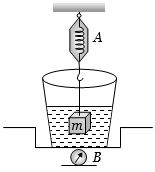
The spring balance $A$ reads $2 \, kg$ with a block $m$ suspended from it. $A$ balance $B$ reads $5 \, kg$ when a beaker filled with liquid is put on the pan of the balance. The two balances are now arranged such that the hanging mass is inside the liquid as shown in the figure. In this situation:
A
The balance $A$ will read more than $2 \, kg$.
B
The balance $B$ will read more than $5 \, kg$.
C
The balance $A$ will read less than $2 \, kg$ and $B$ will read more than $5 \, kg$.
D
Both $(b)$ and $(c)$.
Solution
(D) When the block $m$ is immersed in the liquid,it experiences an upward buoyant force (upthrust) $F_B$ according to Archimedes' principle.
For balance $A$,the reading is the tension $T$ in the string. Initially,$T = mg = 2 \, kg \cdot g$. When immersed,$T = mg - F_B$. Since $F_B > 0$,the reading of balance $A$ will be less than $2 \, kg$.
For balance $B$,it measures the normal force exerted by the beaker on the pan. Initially,it reads the weight of the beaker plus the liquid. When the block is immersed,the liquid exerts an upward force $F_B$ on the block. By Newton's third law,the block exerts an equal and opposite downward force $F_B$ on the liquid. Thus,the total downward force on the balance $B$ increases by $F_B$. Therefore,the reading of balance $B$ will be more than $5 \, kg$.
Since both statements $(b)$ and $(c)$ are correct,the correct option is $(d)$.
For balance $A$,the reading is the tension $T$ in the string. Initially,$T = mg = 2 \, kg \cdot g$. When immersed,$T = mg - F_B$. Since $F_B > 0$,the reading of balance $A$ will be less than $2 \, kg$.
For balance $B$,it measures the normal force exerted by the beaker on the pan. Initially,it reads the weight of the beaker plus the liquid. When the block is immersed,the liquid exerts an upward force $F_B$ on the block. By Newton's third law,the block exerts an equal and opposite downward force $F_B$ on the liquid. Thus,the total downward force on the balance $B$ increases by $F_B$. Therefore,the reading of balance $B$ will be more than $5 \, kg$.
Since both statements $(b)$ and $(c)$ are correct,the correct option is $(d)$.
0 likesView Solution
3
PhysicsDifficultMCQIIT JEE · 1985
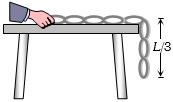
$A$ uniform chain of length $L$ and mass $M$ is lying on a smooth table and one-third of its length is hanging vertically down over the edge of the table. If $g$ is the acceleration due to gravity, the work required to pull the hanging part onto the table is
A
$MgL$
B
$MgL/3$
C
$MgL/9$
D
$MgL/18$
Solution
(D) The mass of the hanging part of the chain is $m = M/3$.
The length of the hanging part is $l = L/3$.
The center of mass of the hanging part is at a distance $h = l/2 = L/6$ below the edge of the table.
The potential energy of the hanging part relative to the table surface is $U = -mgh = -(M/3)g(L/6) = -MgL/18$.
To pull the hanging part onto the table, the work done by an external force must be equal to the change in potential energy, which is $W = \Delta U = U_{final} - U_{initial} = 0 - (-MgL/18) = MgL/18$.
The length of the hanging part is $l = L/3$.
The center of mass of the hanging part is at a distance $h = l/2 = L/6$ below the edge of the table.
The potential energy of the hanging part relative to the table surface is $U = -mgh = -(M/3)g(L/6) = -MgL/18$.
To pull the hanging part onto the table, the work done by an external force must be equal to the change in potential energy, which is $W = \Delta U = U_{final} - U_{initial} = 0 - (-MgL/18) = MgL/18$.
0 likesView Solution
4
PhysicsDifficultMCQIIT JEE · 1985
$70 \, cal$ of heat are required to raise the temperature of $2 \, moles$ of an ideal gas at constant pressure from $30^{\circ}C$ to $35^{\circ}C$. The amount of heat required to raise the temperature of the same gas through the same range ($30^{\circ}C$ to $35^{\circ}C$) at constant volume is ..... $cal$ $(R = 2 \, cal/mol \cdot K)$.
A
$30$
B
$50$
C
$70$
D
$90$
Solution
(B) Given: $\mu = 2 \, moles$,$(\Delta Q)_P = 70 \, cal$,$\Delta T = 35^{\circ}C - 30^{\circ}C = 5 \, K$,$R = 2 \, cal/mol \cdot K$.
At constant pressure,the heat supplied is given by $(\Delta Q)_P = \mu C_P \Delta T$.
Substituting the values: $70 = 2 \times C_P \times 5$.
$70 = 10 \times C_P$,which gives $C_P = 7 \, cal/mol \cdot K$.
Using the Mayer's relation: $C_P - C_V = R$.
$C_V = C_P - R = 7 - 2 = 5 \, cal/mol \cdot K$.
Now,at constant volume,the heat required is $(\Delta Q)_V = \mu C_V \Delta T$.
$(\Delta Q)_V = 2 \times 5 \times 5 = 50 \, cal$.
At constant pressure,the heat supplied is given by $(\Delta Q)_P = \mu C_P \Delta T$.
Substituting the values: $70 = 2 \times C_P \times 5$.
$70 = 10 \times C_P$,which gives $C_P = 7 \, cal/mol \cdot K$.
Using the Mayer's relation: $C_P - C_V = R$.
$C_V = C_P - R = 7 - 2 = 5 \, cal/mol \cdot K$.
Now,at constant volume,the heat required is $(\Delta Q)_V = \mu C_V \Delta T$.
$(\Delta Q)_V = 2 \times 5 \times 5 = 50 \, cal$.
0 likesView Solution
5
PhysicsMediumMCQIIT JEE · 1985
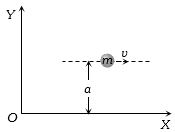
$A$ mass $m$ is moving with a constant velocity $v$ along a line parallel to the $X$-axis. Its angular momentum with respect to the origin or the $Z$-axis is:
A
will be zero
B
will remain constant
C
will increase
D
will decrease
Solution
(B) The angular momentum $L$ of a particle about the origin is given by $L = r \times p$,where $r$ is the position vector and $p$ is the linear momentum.
Alternatively,the magnitude of angular momentum is $L = p \times d$,where $d$ is the perpendicular distance from the origin to the line of motion.
Here,the mass $m$ moves with constant velocity $v$,so the linear momentum $p = mv$ is constant.
The perpendicular distance $d$ from the origin to the line of motion is constant and equal to $a$.
Therefore,the angular momentum $L = mv \times a = mva$,which is a constant value.
Alternatively,the magnitude of angular momentum is $L = p \times d$,where $d$ is the perpendicular distance from the origin to the line of motion.
Here,the mass $m$ moves with constant velocity $v$,so the linear momentum $p = mv$ is constant.
The perpendicular distance $d$ from the origin to the line of motion is constant and equal to $a$.
Therefore,the angular momentum $L = mv \times a = mva$,which is a constant value.
0 likesView Solution
6
PhysicsEasyMCQIIT JEE · 1985
Which one statement is correct? $A$ parallel plate air condenser is connected to a battery. Its charge,potential,electric field,and energy are ${Q_0}$,${V_0}$,${E_0}$,and ${U_0}$ respectively. $A$ dielectric slab is inserted to fill the complete space between the plates while the battery remains connected. Now,the corresponding values $Q$,$V$,$E$,and $U$ are related to the initial values as:
A
$Q > {Q_0}$
B
$U > {U_0}$
C
$E > {E_0}$
D
Both $(a)$ and $(b)$
Solution
(D) When a dielectric slab is inserted into a parallel plate capacitor while the battery remains connected,the potential difference $V$ across the plates remains constant,i.e.,$V = {V_0}$.
Since the capacitance $C$ increases by a factor of $K$ (dielectric constant),where $C = KC_0$,the charge $Q$ on the plates increases according to $Q = CV = K C_0 V_0 = K Q_0$. Thus,$Q > {Q_0}$.
The electric field $E$ between the plates is given by $E = V/d$. Since $V$ and $d$ remain constant,$E = {E_0}$.
The energy stored in the capacitor is $U = \frac{1}{2}CV^2$. Since $C$ increases and $V$ remains constant,$U$ increases,i.e.,$U > {U_0}$.
Therefore,both statements $(a)$ and $(b)$ are correct.
Since the capacitance $C$ increases by a factor of $K$ (dielectric constant),where $C = KC_0$,the charge $Q$ on the plates increases according to $Q = CV = K C_0 V_0 = K Q_0$. Thus,$Q > {Q_0}$.
The electric field $E$ between the plates is given by $E = V/d$. Since $V$ and $d$ remain constant,$E = {E_0}$.
The energy stored in the capacitor is $U = \frac{1}{2}CV^2$. Since $C$ increases and $V$ remains constant,$U$ increases,i.e.,$U > {U_0}$.
Therefore,both statements $(a)$ and $(b)$ are correct.
0 likesView Solution
7
PhysicsMediumMCQIIT JEE · 1985
$A$ proton moving with a constant velocity passes through a region of space without any change in its velocity. If $\overrightarrow{E}$ and $\overrightarrow{B}$ represent the electric and magnetic fields respectively,then this region of space may have
A
$E = 0, B = 0$
B
$E = 0, B \neq 0$
C
$E \neq 0, B \neq 0$
D
All of the above
Solution
(D) The force on a proton moving with velocity $\overrightarrow{v}$ in the presence of electric field $\overrightarrow{E}$ and magnetic field $\overrightarrow{B}$ is given by the Lorentz force law: $\overrightarrow{F} = q(\overrightarrow{E} + \overrightarrow{v} \times \overrightarrow{B})$.
Since the proton moves with a constant velocity,the net force $\overrightarrow{F}$ must be zero.
Case $1$: If $\overrightarrow{E} = 0$ and $\overrightarrow{B} = 0$,then $\overrightarrow{F} = 0$. The proton continues in a straight line.
Case $2$: If $\overrightarrow{E} = 0$ and $\overrightarrow{B} \neq 0$,the force $\overrightarrow{F} = q(\overrightarrow{v} \times \overrightarrow{B})$. If $\overrightarrow{B}$ is parallel or anti-parallel to $\overrightarrow{v}$,then $\overrightarrow{v} \times \overrightarrow{B} = 0$,so $\overrightarrow{F} = 0$.
Case $3$: If $\overrightarrow{E} \neq 0$ and $\overrightarrow{B} \neq 0$,the forces can cancel each other if $q\overrightarrow{E} = -q(\overrightarrow{v} \times \overrightarrow{B})$,i.e.,$\overrightarrow{E} = -(\overrightarrow{v} \times \overrightarrow{B})$. This is the principle of a velocity selector.
Thus,all the given conditions are possible.
Since the proton moves with a constant velocity,the net force $\overrightarrow{F}$ must be zero.
Case $1$: If $\overrightarrow{E} = 0$ and $\overrightarrow{B} = 0$,then $\overrightarrow{F} = 0$. The proton continues in a straight line.
Case $2$: If $\overrightarrow{E} = 0$ and $\overrightarrow{B} \neq 0$,the force $\overrightarrow{F} = q(\overrightarrow{v} \times \overrightarrow{B})$. If $\overrightarrow{B}$ is parallel or anti-parallel to $\overrightarrow{v}$,then $\overrightarrow{v} \times \overrightarrow{B} = 0$,so $\overrightarrow{F} = 0$.
Case $3$: If $\overrightarrow{E} \neq 0$ and $\overrightarrow{B} \neq 0$,the forces can cancel each other if $q\overrightarrow{E} = -q(\overrightarrow{v} \times \overrightarrow{B})$,i.e.,$\overrightarrow{E} = -(\overrightarrow{v} \times \overrightarrow{B})$. This is the principle of a velocity selector.
Thus,all the given conditions are possible.
0 likesView Solution
8
PhysicsMediumMCQIIT JEE · 1985
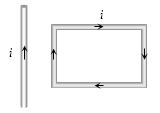
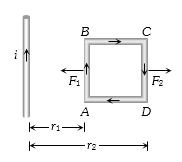
$A$ rectangular loop carrying a current $i$ is situated near a long straight wire such that the wire is parallel to one of the sides of the loop and is in the plane of the loop. If a steady current $i$ is established in the wire as shown in the figure,the loop will
A
Rotate about an axis parallel to the wire
B
Move away from the wire or towards the right
C
Move towards the wire
D
Remain stationary
Solution
(C) The magnetic field produced by the long straight wire at a distance $r$ is given by $B = \frac{\mu_0 i}{2\pi r}$.
For the side of the loop closer to the wire at distance $r_1$,the current flows in the same direction as the wire. According to Fleming's left-hand rule,the force $F_1$ on this side is attractive (towards the wire).
For the side of the loop farther from the wire at distance $r_2$,the current flows in the opposite direction to the wire. The force $F_2$ on this side is repulsive (away from the wire).
Since $r_1 < r_2$,the magnetic field $B_1$ at the closer side is stronger than the magnetic field $B_2$ at the farther side $(B_1 > B_2)$.
Consequently,the attractive force $F_1$ is greater than the repulsive force $F_2$ $(F_1 > F_2)$.
Therefore,the net force $F_{net} = F_1 - F_2$ acts towards the wire,and the loop will move towards the wire.
For the side of the loop closer to the wire at distance $r_1$,the current flows in the same direction as the wire. According to Fleming's left-hand rule,the force $F_1$ on this side is attractive (towards the wire).
For the side of the loop farther from the wire at distance $r_2$,the current flows in the opposite direction to the wire. The force $F_2$ on this side is repulsive (away from the wire).
Since $r_1 < r_2$,the magnetic field $B_1$ at the closer side is stronger than the magnetic field $B_2$ at the farther side $(B_1 > B_2)$.
Consequently,the attractive force $F_1$ is greater than the repulsive force $F_2$ $(F_1 > F_2)$.
Therefore,the net force $F_{net} = F_1 - F_2$ acts towards the wire,and the loop will move towards the wire.
0 likesView Solution
9
PhysicsEasyMCQIIT JEE · 1985
The $X-$ray beam coming from an $X-$ray tube will be:
A
Monochromatic
B
Having all wavelengths smaller than a certain maximum wavelength
C
Having all wavelengths larger than a certain minimum wavelength
D
Having all wavelengths lying between a minimum and a maximum wavelength
Solution
(C) In an $X-$ray tube,electrons are accelerated by a potential difference $V$ and strike a metal target.
This process produces a continuous spectrum of $X-$rays due to Bremsstrahlung (braking radiation).
As an electron decelerates,it emits a photon with energy $E = hf = hc/\lambda$.
The maximum energy of the emitted photon corresponds to the kinetic energy of the incident electron,$E_{max} = eV = hc/\lambda_{min}$.
Therefore,the emitted $X-$ray spectrum contains all wavelengths greater than or equal to this minimum wavelength $\lambda_{min} = hc/eV$.
Thus,the beam consists of all wavelengths larger than a certain minimum wavelength.
This process produces a continuous spectrum of $X-$rays due to Bremsstrahlung (braking radiation).
As an electron decelerates,it emits a photon with energy $E = hf = hc/\lambda$.
The maximum energy of the emitted photon corresponds to the kinetic energy of the incident electron,$E_{max} = eV = hc/\lambda_{min}$.
Therefore,the emitted $X-$ray spectrum contains all wavelengths greater than or equal to this minimum wavelength $\lambda_{min} = hc/eV$.
Thus,the beam consists of all wavelengths larger than a certain minimum wavelength.
0 likesView Solution
10
PhysicsEasyMCQIIT JEE · 1985
The binding energy of the innermost electron in tungsten is $40 \text{ keV}$. To produce characteristic $X$-rays using a tungsten target in an $X$-ray tube,the potential difference $V$ between the cathode and the anti-cathode should be:
A
$V < 40 \text{ kV}$
B
$V \le 40 \text{ kV}$
C
$V > 40 \text{ kV}$
D
$V >/< 40 \text{ kV}$
Solution
(C) To produce characteristic $X$-rays,the incident electron must have enough energy to knock out an electron from the inner shell of the target atom.
This requires the kinetic energy of the incident electron to be at least equal to the binding energy of the electron in that shell.
The kinetic energy of an electron accelerated through a potential difference $V$ is given by $K = eV$.
Therefore,to eject an electron from the innermost shell (binding energy $E_b = 40 \text{ keV}$),the condition is $eV > E_b$.
Substituting the values,$eV > 40 \text{ keV}$,which implies $V > 40 \text{ kV}$.
This requires the kinetic energy of the incident electron to be at least equal to the binding energy of the electron in that shell.
The kinetic energy of an electron accelerated through a potential difference $V$ is given by $K = eV$.
Therefore,to eject an electron from the innermost shell (binding energy $E_b = 40 \text{ keV}$),the condition is $eV > E_b$.
Substituting the values,$eV > 40 \text{ keV}$,which implies $V > 40 \text{ kV}$.
0 likesView Solution
11
PhysicsEasyMCQIIT JEE · 1985
The binding energy of the innermost electron in tungsten is $40 \, keV$. The energy of the characteristic $X$-rays emitted is:
A
Less than $40 \, keV$
B
More than $40 \, keV$
C
Equal to $40 \, keV$
D
Greater than or equal to $40 \, keV$
Solution
(A) The characteristic $X$-rays are produced when an electron from a higher energy shell (e.g.,$L, M, N, \dots$ shells) transitions to a vacancy in the innermost shell (the $K$-shell).
The energy of the emitted characteristic $X$-ray photon is given by the difference in energy between the two shells involved in the transition: $E_{X-ray} = E_{higher} - E_{lower}$.
Since the electron transitions from a higher energy level (closer to $0 \, eV$) to the innermost shell (which has a binding energy of $40 \, keV$,meaning its energy level is $-40 \, keV$),the energy released must be less than the binding energy of the innermost shell.
Therefore,the energy of the characteristic $X$-rays is always less than the binding energy of the innermost electron.
The energy of the emitted characteristic $X$-ray photon is given by the difference in energy between the two shells involved in the transition: $E_{X-ray} = E_{higher} - E_{lower}$.
Since the electron transitions from a higher energy level (closer to $0 \, eV$) to the innermost shell (which has a binding energy of $40 \, keV$,meaning its energy level is $-40 \, keV$),the energy released must be less than the binding energy of the innermost shell.
Therefore,the energy of the characteristic $X$-rays is always less than the binding energy of the innermost electron.
0 likesView Solution
12
PhysicsMediumMCQIIT JEE · 1985
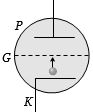
For a given plate-voltage,the plate current in a triode is maximum when the potential of
A
The grid is positive and plate is negative
B
The grid is positive and plate is positive
C
The grid is zero and plate is positive
D
The grid is negative and plate is positive
Solution
(B) In a triode,the plate current is determined by the number of electrons reaching the plate $P$ from the cathode $K$.
When the grid $G$ is given a positive potential,it exerts an attractive force on the electrons emitted from the cathode,helping them pass through the grid mesh towards the plate.
Since the plate $P$ must also be at a positive potential to attract these electrons,having both the grid and the plate at positive potentials results in the maximum flow of electrons to the plate,thereby maximizing the plate current.
Therefore,the correct option is $B$.
When the grid $G$ is given a positive potential,it exerts an attractive force on the electrons emitted from the cathode,helping them pass through the grid mesh towards the plate.
Since the plate $P$ must also be at a positive potential to attract these electrons,having both the grid and the plate at positive potentials results in the maximum flow of electrons to the plate,thereby maximizing the plate current.
Therefore,the correct option is $B$.
0 likesView Solution
13
PhysicsMediumMCQIIT JEE · 1985
$A$ convex lens $A$ of focal length $20 \, cm$ and a concave lens $B$ of focal length $5 \, cm$ are kept along the same axis with a distance $d$ between them. If a parallel beam of light falling on $A$ leaves $B$ as a parallel beam,then the distance $d$ in $cm$ will be:
A
$25$
B
$15$
C
$50$
D
$30$
Solution
(B) For a parallel beam of light to remain parallel after passing through a combination of two lenses,the second focal point of the first lens must coincide with the first focal point of the second lens.
Let $f_1 = 20 \, cm$ (convex lens) and $f_2 = -5 \, cm$ (concave lens).
The distance $d$ between the lenses is given by the formula $d = f_1 + f_2$.
Substituting the values,we get $d = 20 \, cm + (-5 \, cm) = 15 \, cm$.
Thus,the distance $d$ is $15 \, cm$.
Let $f_1 = 20 \, cm$ (convex lens) and $f_2 = -5 \, cm$ (concave lens).
The distance $d$ between the lenses is given by the formula $d = f_1 + f_2$.
Substituting the values,we get $d = 20 \, cm + (-5 \, cm) = 15 \, cm$.
Thus,the distance $d$ is $15 \, cm$.
0 likesView Solution
Vedclass Products
For Students
Vedclass Test Series
Mock tests in real IIT JEE style covering Physics with performance analysis. 5-day free trial.
Start Free TrialFor Teachers
Exam Paper Generator
Generate Set A/B/C/D Physics papers from 7.5L+ questions in 2 minutes. 3 chapters free.
Try FreeFor Institutes
Online Exam Module
Run live IIT JEE mock exams with unlimited students, 360° analytics & white-label branding.
See DemoFrequently Asked Questions
How many Physics questions are in IIT JEE 1985?
There are 13 Physics questions from the IIT JEE 1985 paper on Vedclass, each with a detailed step-by-step solution in English.
Are IIT JEE 1985 Physics solutions available in English?
Yes. All solutions on this page are in English. You can also switch to English or Hindi using the language buttons above the questions.
Can I practice IIT JEE 1985 Physics as a timed test?
Yes. Use the Vedclass Test Series to attempt a full IIT JEE mock test covering Physics with time limits and instant score analysis.
Can teachers create Physics papers from IIT JEE previous year questions?
Yes. The Vedclass Exam Paper Generator lets teachers mix IIT JEE Physics questions and generate Set A/B/C/D papers in minutes.
For Teachers & Institutes
Build a Custom Physics Paper
Pick IIT JEE 1985 Physics questions, set difficulty, and generate Set A/B/C/D in 2 minutes.