
ChemistryQ1–22 of 22 questions
Page 1 of 1 · English
1
ChemistryEasyMCQGUJCET · 2022
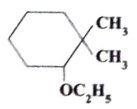
What is the $IUPAC$ name of the following compound?
A
$5-$ethoxy$-6, 6-$dimethylcyclohexane
B
$1-$ethoxy$-2, 2-$dimethylcyclohexane
C
$2-$ethoxy$-1, 1-$dimethylcyclohexane
D
$1-$ethoxy$-6, 6-$dimethylcyclohexane
Solution
(C) $1$. Identify the principal functional group: The ether group $(-OC_2H_5)$ is present.
$2$. Number the cyclohexane ring: To give the substituents the lowest possible locants,we start numbering at the carbon attached to the ethoxy group as $1$. Then,we proceed towards the dimethyl-substituted carbon to give it the lowest possible number,which is $1$. Thus,the carbon with two methyl groups is at position $1$.
$3$. The $IUPAC$ name is $2-$ethoxy$-1, 1-$dimethylcyclohexane. Therefore,the correct option is $C$.
$2$. Number the cyclohexane ring: To give the substituents the lowest possible locants,we start numbering at the carbon attached to the ethoxy group as $1$. Then,we proceed towards the dimethyl-substituted carbon to give it the lowest possible number,which is $1$. Thus,the carbon with two methyl groups is at position $1$.
$3$. The $IUPAC$ name is $2-$ethoxy$-1, 1-$dimethylcyclohexane. Therefore,the correct option is $C$.
0 likesView Solution
2
ChemistryEasyMCQGUJCET · 2022
Which reaction is used to make salicylic acid from phenol?
A
Stephen reaction
B
Kolbe reaction
C
Etard reaction
D
Reimer-Tiemann reaction
Solution
(B) The conversion of phenol to salicylic acid is achieved using the $Kolbe$ reaction.
In this reaction,phenol is treated with sodium hydroxide $(NaOH)$ to form sodium phenoxide,which then reacts with carbon dioxide $(CO_2)$ under pressure followed by acidification to yield $2$-hydroxybenzoic acid,commonly known as salicylic acid.
In this reaction,phenol is treated with sodium hydroxide $(NaOH)$ to form sodium phenoxide,which then reacts with carbon dioxide $(CO_2)$ under pressure followed by acidification to yield $2$-hydroxybenzoic acid,commonly known as salicylic acid.
0 likesView Solution
3
ChemistryEasyMCQGUJCET · 2022
Which of the following processes does not give benzene as a product?
A
$C_6H_5COONa + \text{Sodalime} \xrightarrow{\Delta}$
B
$C_6H_5N_2^{+}Cl^{-} + H_3PO_2 + H_2O \longrightarrow$
C
$C_6H_5OH + Zn \xrightarrow{\Delta}$
D
$C_6H_5OH + H_2CrO_4 \xrightarrow{[O]}$
Solution
(D) . $C_6H_5COONa + NaOH/CaO \xrightarrow{\Delta} C_6H_6 + Na_2CO_3$ (Benzene is formed).
$B$. $C_6H_5N_2^{+}Cl^{-} + H_3PO_2 + H_2O \longrightarrow C_6H_6 + H_3PO_3 + HCl + N_2$ (Benzene is formed).
$C$. $C_6H_5OH + Zn \xrightarrow{\Delta} C_6H_6 + ZnO$ (Benzene is formed).
$D$. $C_6H_5OH + H_2CrO_4 \xrightarrow{[O]} \text{Benzoquinone}$ (Benzene is $NOT$ formed).
Therefore,the correct option is $D$.
$B$. $C_6H_5N_2^{+}Cl^{-} + H_3PO_2 + H_2O \longrightarrow C_6H_6 + H_3PO_3 + HCl + N_2$ (Benzene is formed).
$C$. $C_6H_5OH + Zn \xrightarrow{\Delta} C_6H_6 + ZnO$ (Benzene is formed).
$D$. $C_6H_5OH + H_2CrO_4 \xrightarrow{[O]} \text{Benzoquinone}$ (Benzene is $NOT$ formed).
Therefore,the correct option is $D$.
0 likesView Solution
4
ChemistryEasyMCQGUJCET · 2022
What will be the main product in the following reaction?
$C_6H_5CHO + CH_3CHO \xrightarrow{OH^-, \Delta} ?$
$C_6H_5CHO + CH_3CHO \xrightarrow{OH^-, \Delta} ?$
A
$C_6H_5CH_2CH(OH)CHO$
B
$C_6H_5CH=CHCHO$
C
$C_6H_5CH_2CH_2CHO$
D
$C_6H_5CH=CHCOOH$
Solution
(B) The given reaction is a $Cross-Aldol$ condensation reaction between $benzaldehyde$ $(C_6H_5CHO)$ and $acetaldehyde$ $(CH_3CHO)$ in the presence of a dilute base $(OH^-)$ and heat $(\Delta)$.
$1.$ $Acetaldehyde$ contains $\alpha$-hydrogens,so it forms an enolate ion in the presence of a base.
$2.$ This enolate ion attacks the carbonyl carbon of $benzaldehyde$ (which has no $\alpha$-hydrogens) to form a $\beta$-hydroxy aldehyde intermediate $(C_6H_5CH(OH)CH_2CHO)$.
$3.$ Upon heating $(\Delta)$,this intermediate undergoes dehydration (loss of $H_2O$) to form the stable $\alpha,\beta$-unsaturated aldehyde,which is $cinnamaldehyde$ $(C_6H_5CH=CHCHO)$.
Therefore,the main product is $C_6H_5CH=CHCHO$.
$1.$ $Acetaldehyde$ contains $\alpha$-hydrogens,so it forms an enolate ion in the presence of a base.
$2.$ This enolate ion attacks the carbonyl carbon of $benzaldehyde$ (which has no $\alpha$-hydrogens) to form a $\beta$-hydroxy aldehyde intermediate $(C_6H_5CH(OH)CH_2CHO)$.
$3.$ Upon heating $(\Delta)$,this intermediate undergoes dehydration (loss of $H_2O$) to form the stable $\alpha,\beta$-unsaturated aldehyde,which is $cinnamaldehyde$ $(C_6H_5CH=CHCHO)$.
Therefore,the main product is $C_6H_5CH=CHCHO$.
0 likesView Solution
5
ChemistryEasyMCQGUJCET · 2022
Which of the following compounds will not give "Iodoform" by reaction with "Sodium hypoiodite"?
A
$CH_3CHO$
B
$CH_3CH(OH)CH_2CH_3$
C
$CH_3CH_2COCH_3$
D
$CH_3CH_2COCH_2CH_3$
Solution
(D) The "Iodoform" test is given by compounds containing the $CH_3CO-$ group or the $CH_3CH(OH)-$ group.
$A$. $CH_3CHO$ (Acetaldehyde) contains the $CH_3CO-$ group,so it gives a positive "Iodoform" test.
$B$. $CH_3CH(OH)CH_2CH_3$ (Butan-$2$-ol) contains the $CH_3CH(OH)-$ group,which is oxidized to a $CH_3CO-$ group by "Sodium hypoiodite",hence it gives a positive "Iodoform" test.
$C$. $CH_3CH_2COCH_3$ (Butan-$2$-one) contains the $CH_3CO-$ group,so it gives a positive "Iodoform" test.
$D$. $CH_3CH_2COCH_2CH_3$ (Pentan-$3$-one) does not contain the $CH_3CO-$ group or the $CH_3CH(OH)-$ group. Therefore,it will not give the "Iodoform" test.
Thus,the correct option is $D$.
$A$. $CH_3CHO$ (Acetaldehyde) contains the $CH_3CO-$ group,so it gives a positive "Iodoform" test.
$B$. $CH_3CH(OH)CH_2CH_3$ (Butan-$2$-ol) contains the $CH_3CH(OH)-$ group,which is oxidized to a $CH_3CO-$ group by "Sodium hypoiodite",hence it gives a positive "Iodoform" test.
$C$. $CH_3CH_2COCH_3$ (Butan-$2$-one) contains the $CH_3CO-$ group,so it gives a positive "Iodoform" test.
$D$. $CH_3CH_2COCH_2CH_3$ (Pentan-$3$-one) does not contain the $CH_3CO-$ group or the $CH_3CH(OH)-$ group. Therefore,it will not give the "Iodoform" test.
Thus,the correct option is $D$.
0 likesView Solution
6
ChemistryEasyMCQGUJCET · 2022
Which is the incorrect order of increasing acidic strength for the following?
A
$CH_2FCH_2CH_2COOH < CH_3CHFCH_2COOH$
B
$CH_2ClCOOH < CH_2FCOOH$
C
$CH_3COOH < CH_2ClCOOH$
D
$HCOOH < C_6H_5COOH$
Solution
(D) The acidic strength of carboxylic acids depends on the electron-withdrawing effect of substituents. Electron-withdrawing groups $(EWG)$ increase acidity by stabilizing the carboxylate anion,while electron-donating groups decrease it.
$A$. $CH_2FCH_2CH_2COOH < CH_3CHFCH_2COOH$: Correct. The $F$ atom is closer to the $COOH$ group in the second molecule,exerting a stronger $-I$ effect.
$B$. $CH_2ClCOOH < CH_2FCOOH$: Correct. $F$ is more electronegative than $Cl$,so $CH_2FCOOH$ is more acidic.
$C$. $CH_3COOH < CH_2ClCOOH$: Correct. $Cl$ is an $EWG$,making the chloroacetic acid more acidic than acetic acid.
$D$. $HCOOH < C_6H_5COOH$: Incorrect. Formic acid $(HCOOH)$ is more acidic than benzoic acid $(C_6H_5COOH)$ because the phenyl group in benzoic acid is electron-donating by resonance and has a weaker $-I$ effect compared to the hydrogen atom in formic acid. Thus,the correct order is $C_6H_5COOH < HCOOH$.
$A$. $CH_2FCH_2CH_2COOH < CH_3CHFCH_2COOH$: Correct. The $F$ atom is closer to the $COOH$ group in the second molecule,exerting a stronger $-I$ effect.
$B$. $CH_2ClCOOH < CH_2FCOOH$: Correct. $F$ is more electronegative than $Cl$,so $CH_2FCOOH$ is more acidic.
$C$. $CH_3COOH < CH_2ClCOOH$: Correct. $Cl$ is an $EWG$,making the chloroacetic acid more acidic than acetic acid.
$D$. $HCOOH < C_6H_5COOH$: Incorrect. Formic acid $(HCOOH)$ is more acidic than benzoic acid $(C_6H_5COOH)$ because the phenyl group in benzoic acid is electron-donating by resonance and has a weaker $-I$ effect compared to the hydrogen atom in formic acid. Thus,the correct order is $C_6H_5COOH < HCOOH$.
0 likesView Solution
7
ChemistryEasyMCQGUJCET · 2022
Which glycosidic linkage occurs in 'Amylopectin'?
A
$C_1-C_3$ and $C_1-C_4$
B
$C_1-C_4$ and $C_1-C_6$
C
$C_1-C_2$ and $C_1-C_6$
D
$C_2-C_4$ and $C_4-C_6$
Solution
(B) Amylopectin is a branched-chain polymer of $\alpha$-$D$-glucose units.
It consists of a linear chain formed by $C_1-C_4$ glycosidic linkages.
Additionally,it contains branching points formed by $C_1-C_6$ glycosidic linkages.
Therefore,the correct answer is $B$.
It consists of a linear chain formed by $C_1-C_4$ glycosidic linkages.
Additionally,it contains branching points formed by $C_1-C_6$ glycosidic linkages.
Therefore,the correct answer is $B$.
0 likesView Solution
8
ChemistryEasyMCQGUJCET · 2022
Select the correct sequence of True $(T)$ and False $(F)$ statements from the following:
$(i)$ $\text{Pentose sugar} + \text{base} \rightarrow \text{Nucleotide}$
$(ii)$ $\text{Nucleotide} + \text{phosphate} \rightarrow \text{Nucleoside}$
$(iii)$ $DNA$ contains four bases $A$,$G$,$C$ and $T$
$(iv)$ $RNA$ contains four bases $A$,$G$,$C$ and $U$.
$(i)$ $\text{Pentose sugar} + \text{base} \rightarrow \text{Nucleotide}$
$(ii)$ $\text{Nucleotide} + \text{phosphate} \rightarrow \text{Nucleoside}$
$(iii)$ $DNA$ contains four bases $A$,$G$,$C$ and $T$
$(iv)$ $RNA$ contains four bases $A$,$G$,$C$ and $U$.
A
$FTFT$
B
$FTTT$
C
$FFTT$
D
$TTTT$
Solution
(C) Statement $(i)$ is False because $\text{Pentose sugar} + \text{base} \rightarrow \text{Nucleoside}$.
Statement $(ii)$ is False because $\text{Nucleoside} + \text{phosphate} \rightarrow \text{Nucleotide}$.
Statement $(iii)$ is True as $DNA$ contains Adenine $(A)$,Guanine $(G)$,Cytosine $(C)$,and Thymine $(T)$.
Statement $(iv)$ is True as $RNA$ contains Adenine $(A)$,Guanine $(G)$,Cytosine $(C)$,and Uracil $(U)$.
Thus,the sequence is $FFTT$.
Statement $(ii)$ is False because $\text{Nucleoside} + \text{phosphate} \rightarrow \text{Nucleotide}$.
Statement $(iii)$ is True as $DNA$ contains Adenine $(A)$,Guanine $(G)$,Cytosine $(C)$,and Thymine $(T)$.
Statement $(iv)$ is True as $RNA$ contains Adenine $(A)$,Guanine $(G)$,Cytosine $(C)$,and Uracil $(U)$.
Thus,the sequence is $FFTT$.
0 likesView Solution
9
ChemistryEasyMCQGUJCET · 2022
$A$ reaction is first order with respect to a reactant $A$ and second order with respect to reactant $B$. What is the effect on the rate when the concentration of both $A$ and $B$ is doubled?
A
Eight times
B
Three times
C
Doubled
D
Sixteen times
Solution
(A) The rate law for the reaction is given by $r_1 = k[A]^1[B]^2$.
When the concentrations of both $A$ and $B$ are doubled,the new concentrations become $[A]' = 2[A]$ and $[B]' = 2[B]$.
The new rate $r_2$ is calculated as:
$r_2 = k[2A]^1[2B]^2$
$r_2 = k \times 2[A] \times 4[B]^2$
$r_2 = 8 \times k[A][B]^2$
$r_2 = 8r_1$.
Therefore,the rate increases by $8$ times.
When the concentrations of both $A$ and $B$ are doubled,the new concentrations become $[A]' = 2[A]$ and $[B]' = 2[B]$.
The new rate $r_2$ is calculated as:
$r_2 = k[2A]^1[2B]^2$
$r_2 = k \times 2[A] \times 4[B]^2$
$r_2 = 8 \times k[A][B]^2$
$r_2 = 8r_1$.
Therefore,the rate increases by $8$ times.
0 likesView Solution
10
ChemistryEasyMCQGUJCET · 2022
What is the value of the slope when a graph is plotted of $\log \frac{[R]_0}{[R]}$ versus $t$ (time) for a first-order reaction?
A
$-\frac{K}{2.303}$
B
$\frac{K}{2.303}$
C
$-K$
D
$\frac{2.303}{K}$
Solution
(B) For a first-order reaction,the integrated rate equation is given by:
$K = \frac{2.303}{t} \log \frac{[R]_0}{[R]}$
Rearranging this equation to the form $y = mx + c$:
$\log \frac{[R]_0}{[R]} = \frac{K}{2.303} \times t$
Comparing this with the equation of a straight line $y = mx$,where $y = \log \frac{[R]_0}{[R]}$,$x = t$,and the slope $m = \frac{K}{2.303}$.
Therefore,the slope of the graph is $\frac{K}{2.303}$.
$K = \frac{2.303}{t} \log \frac{[R]_0}{[R]}$
Rearranging this equation to the form $y = mx + c$:
$\log \frac{[R]_0}{[R]} = \frac{K}{2.303} \times t$
Comparing this with the equation of a straight line $y = mx$,where $y = \log \frac{[R]_0}{[R]}$,$x = t$,and the slope $m = \frac{K}{2.303}$.
Therefore,the slope of the graph is $\frac{K}{2.303}$.
0 likesView Solution
11
ChemistryEasyMCQGUJCET · 2022
Which of the following ligands is not ambidentate?
$(P) = NO_3^-$,$(Q) = NO_2^-$,$(R) = CN^-$,$(S) = SCN^-$
$(P) = NO_3^-$,$(Q) = NO_2^-$,$(R) = CN^-$,$(S) = SCN^-$
A
$(R)$
B
$(P)$
C
$(S)$
D
$(Q)$
Solution
(B) An ambidentate ligand is a ligand that can coordinate to a central metal atom through two different donor atoms.
$(Q) = NO_2^-$ can coordinate through $N$ (nitro) or $O$ (nitrito).
$(R) = CN^-$ can coordinate through $C$ (cyano) or $N$ (isocyano).
$(S) = SCN^-$ can coordinate through $S$ (thiocyanato) or $N$ (isothiocyanato).
$(P) = NO_3^-$ is a monodentate ligand that coordinates only through the oxygen atom and does not exhibit ambidentate behavior.
Therefore,$(P)$ is not an ambidentate ligand.
$(Q) = NO_2^-$ can coordinate through $N$ (nitro) or $O$ (nitrito).
$(R) = CN^-$ can coordinate through $C$ (cyano) or $N$ (isocyano).
$(S) = SCN^-$ can coordinate through $S$ (thiocyanato) or $N$ (isothiocyanato).
$(P) = NO_3^-$ is a monodentate ligand that coordinates only through the oxygen atom and does not exhibit ambidentate behavior.
Therefore,$(P)$ is not an ambidentate ligand.
0 likesView Solution
12
ChemistryEasyMCQGUJCET · 2022
Which of the following ligands are ambidentate?
$P: NO_3^-$,$Q: NO_2^-$,$R: CN^-$,$S: SCN^-$
$P: NO_3^-$,$Q: NO_2^-$,$R: CN^-$,$S: SCN^-$
A
$R$ and $S$
B
$P$ and $Q$
C
$Q$ and $S$
D
$Q$ and $R$
Solution
(D) An ambidentate ligand is a ligand that can coordinate to a central metal atom through two different donor atoms.
In the given list:
$P: NO_3^-$ is not ambidentate.
$Q: NO_2^-$ can coordinate through $N$ (nitro) or $O$ (nitrito),so it is ambidentate.
$R: CN^-$ can coordinate through $C$ (cyano) or $N$ (isocyano),so it is ambidentate.
$S: SCN^-$ can coordinate through $S$ (thiocyanato) or $N$ (isothiocyanato),so it is ambidentate.
Among the given options,$Q$,$R$,and $S$ are ambidentate. The combination $Q$ and $R$ is listed in option $D$.
In the given list:
$P: NO_3^-$ is not ambidentate.
$Q: NO_2^-$ can coordinate through $N$ (nitro) or $O$ (nitrito),so it is ambidentate.
$R: CN^-$ can coordinate through $C$ (cyano) or $N$ (isocyano),so it is ambidentate.
$S: SCN^-$ can coordinate through $S$ (thiocyanato) or $N$ (isothiocyanato),so it is ambidentate.
Among the given options,$Q$,$R$,and $S$ are ambidentate. The combination $Q$ and $R$ is listed in option $D$.
0 likesView Solution
13
ChemistryEasyMCQGUJCET · 2022
How many geometrical isomers does $[Pt(NH_3)(Br)(Cl)(Py)]$ have?
A
$3$
B
$2$
C
$1$
D
$4$
Solution
(A) The complex $[Pt(NH_3)(Br)(Cl)(Py)]$ is of the type $[Mabcd]$,where $M = Pt$,$a = NH_3$,$b = Br$,$c = Cl$,and $d = Py$.
For a square planar complex of the type $[Mabcd]$,the number of geometrical isomers is $3$.
These isomers are formed by fixing one ligand (e.g.,$NH_3$) and arranging the other three ligands ($Br$,$Cl$,$Py$) in the $trans$ positions relative to the fixed ligand.
For a square planar complex of the type $[Mabcd]$,the number of geometrical isomers is $3$.
These isomers are formed by fixing one ligand (e.g.,$NH_3$) and arranging the other three ligands ($Br$,$Cl$,$Py$) in the $trans$ positions relative to the fixed ligand.
0 likesView Solution
14
ChemistryEasyMCQGUJCET · 2022
Name the periodic element,which does not show variable oxidation states.
A
$Zinc$
B
$Copper$
C
$Scandium$
D
$Chromium$
Solution
(A) Transition elements are defined as elements that have incompletely filled $d$-orbitals in their ground state or in any of their oxidation states.
$Zinc$ ($Zn$,atomic number $30$) has the electronic configuration $[Ar] 3d^{10} 4s^2$.
In its common oxidation state of $+2$,it forms $Zn^{2+}$ with the configuration $[Ar] 3d^{10}$.
Since the $d$-orbital is completely filled in both the ground state and the $+2$ oxidation state,$Zinc$ is not considered a transition element and does not exhibit variable oxidation states.
$Zinc$ ($Zn$,atomic number $30$) has the electronic configuration $[Ar] 3d^{10} 4s^2$.
In its common oxidation state of $+2$,it forms $Zn^{2+}$ with the configuration $[Ar] 3d^{10}$.
Since the $d$-orbital is completely filled in both the ground state and the $+2$ oxidation state,$Zinc$ is not considered a transition element and does not exhibit variable oxidation states.
0 likesView Solution
15
ChemistryEasyMCQGUJCET · 2022
Which statement is incorrect from the following?
A
$CrO$ is basic,but $Cr_2O_3$ is amphoteric
B
$Cd$ is not considered as a transition element
C
Atomic sizes of elements of the $4d$ series are greater than corresponding elements of the $3d$ series
D
Atomic sizes of elements of the $5d$ series are greater than corresponding $4d$ series
Solution
(D) The correct answer is $D$.
Due to the lanthanoid contraction,the atomic radii of elements in the $5d$ series are nearly the same as those of the corresponding elements in the $4d$ series.
Therefore,the statement that the atomic sizes of the $5d$ series are greater than the $4d$ series is incorrect.
Due to the lanthanoid contraction,the atomic radii of elements in the $5d$ series are nearly the same as those of the corresponding elements in the $4d$ series.
Therefore,the statement that the atomic sizes of the $5d$ series are greater than the $4d$ series is incorrect.
0 likesView Solution
16
ChemistryEasyMCQGUJCET · 2022
Which substance is used as an oxidising agent in a nickel-cadmium cell?
A
$Ni(OH)_3$
B
$Cd$
C
$Ni$
D
$CdO$
Solution
(A) In a nickel-cadmium cell,the chemical reactions are as follows:
At the anode: $Cd(s) + 2OH^-(aq) \rightarrow Cd(OH)_2(s) + 2e^-$
At the cathode: $NiO_2(s) + 2H_2O(l) + 2e^- \rightarrow Ni(OH)_2(s) + 2OH^-(aq)$
In the cathode reaction,$NiO_2$ (often represented as $Ni(OH)_3$ in some contexts or hydrated nickel oxide) undergoes reduction,meaning it acts as the oxidising agent.
Therefore,the correct option is $A$.
At the anode: $Cd(s) + 2OH^-(aq) \rightarrow Cd(OH)_2(s) + 2e^-$
At the cathode: $NiO_2(s) + 2H_2O(l) + 2e^- \rightarrow Ni(OH)_2(s) + 2OH^-(aq)$
In the cathode reaction,$NiO_2$ (often represented as $Ni(OH)_3$ in some contexts or hydrated nickel oxide) undergoes reduction,meaning it acts as the oxidising agent.
Therefore,the correct option is $A$.
0 likesView Solution
17
ChemistryEasyMCQGUJCET · 2022
Which is the proper value of $x$ for the following to increase the cell potential of $Zn_{(s)} | Zn_{(x \ M)}^{2+} || Cu_{(0.02 \ M)}^{2+} | Cu_{(s)}$?
A
$x = 0.02 \ M$
B
$x < 0.02 \ M$
C
$x > 0.02 \ M$
D
$x \geq 0.02 \ M$
Solution
(B) The cell reaction is: $Zn_{(s)} + Cu_{(0.02 \ M)}^{2+} \rightarrow Zn_{(x \ M)}^{2+} + Cu_{(s)}$.
According to the Nernst equation: $E_{cell} = E_{cell}^0 - \frac{0.059}{2} \log \frac{[Zn^{2+}]}{[Cu^{2+}]}$.
Substituting the values: $E_{cell} = E_{cell}^0 - 0.0295 \log \frac{x}{0.02}$.
To increase $E_{cell}$,the term $\log \frac{x}{0.02}$ must be negative.
This occurs when $\frac{x}{0.02} < 1$,which implies $x < 0.02 \ M$.
According to the Nernst equation: $E_{cell} = E_{cell}^0 - \frac{0.059}{2} \log \frac{[Zn^{2+}]}{[Cu^{2+}]}$.
Substituting the values: $E_{cell} = E_{cell}^0 - 0.0295 \log \frac{x}{0.02}$.
To increase $E_{cell}$,the term $\log \frac{x}{0.02}$ must be negative.
This occurs when $\frac{x}{0.02} < 1$,which implies $x < 0.02 \ M$.
0 likesView Solution
18
ChemistryEasyMCQGUJCET · 2022
How much electricity in terms of Faraday is required for the reduction of $2 \ mol$ of $Cr_2O_7^{2-}$ into $Cr^{3+}$ in an acidic medium (in $F$)?
A
$12$
B
$3$
C
$6$
D
$9$
Solution
(A) The reduction half-reaction for $Cr_2O_7^{2-}$ in an acidic medium is given by:
$Cr_2O_7^{2-} + 14H^{+} + 6e^{-} \rightarrow 2Cr^{3+} + 7H_2O$
From the balanced equation,$1 \ mol$ of $Cr_2O_7^{2-}$ requires $6 \ mol$ of electrons,which is equivalent to $6 \ F$ of electricity.
Therefore,for the reduction of $2 \ mol$ of $Cr_2O_7^{2-}$,the total electricity required is $2 \times 6 \ F = 12 \ F$.
$Cr_2O_7^{2-} + 14H^{+} + 6e^{-} \rightarrow 2Cr^{3+} + 7H_2O$
From the balanced equation,$1 \ mol$ of $Cr_2O_7^{2-}$ requires $6 \ mol$ of electrons,which is equivalent to $6 \ F$ of electricity.
Therefore,for the reduction of $2 \ mol$ of $Cr_2O_7^{2-}$,the total electricity required is $2 \times 6 \ F = 12 \ F$.
0 likesView Solution
19
ChemistryEasyMCQGUJCET · 2022
Which of the following compounds has the fastest $S_N2$ reaction rate?
A
$C_6H_5CH(CH_3)Br$
B
$C_6H_5CH(C_6H_5)Br$
C
$C_6H_5C(CH_3)(C_6H_5)Br$
D
$C_6H_5CH_2Br$
Solution
(D) The rate of an $S_N2$ reaction depends primarily on the steric hindrance around the electrophilic carbon atom.
Less sterically hindered substrates react faster in $S_N2$ reactions.
The order of reactivity for $S_N2$ is: $\text{primary} > \text{secondary} > \text{tertiary}$.
In the given options:
$A$ is a secondary alkyl halide.
$B$ is a secondary alkyl halide (with two bulky phenyl groups).
$C$ is a tertiary alkyl halide.
$D$ $(C_6H_5CH_2Br)$ is a primary benzylic halide.
Since $D$ is a primary halide,it experiences the least steric hindrance,making it the most reactive towards $S_N2$ substitution.
Therefore,the correct option is $D$.
Less sterically hindered substrates react faster in $S_N2$ reactions.
The order of reactivity for $S_N2$ is: $\text{primary} > \text{secondary} > \text{tertiary}$.
In the given options:
$A$ is a secondary alkyl halide.
$B$ is a secondary alkyl halide (with two bulky phenyl groups).
$C$ is a tertiary alkyl halide.
$D$ $(C_6H_5CH_2Br)$ is a primary benzylic halide.
Since $D$ is a primary halide,it experiences the least steric hindrance,making it the most reactive towards $S_N2$ substitution.
Therefore,the correct option is $D$.
0 likesView Solution
20
ChemistryEasyMCQGUJCET · 2022
What is the value of the Van't Hoff factor $(i)$ when $80\%$ of $CaCl_2$ dissociates?
A
$2.6$
B
$2.4$
C
$3$
D
$2.3$
Solution
(A) The dissociation of $CaCl_2$ is represented as: $CaCl_2 \rightarrow Ca^{2+} + 2Cl^-$.
Initially,let the number of moles be $1$.
After $80\%$ dissociation,the moles are:
$CaCl_2 = 1 - 0.8 = 0.2$
$Ca^{2+} = 0.8$
$Cl^- = 2 \times 0.8 = 1.6$
Total moles after dissociation = $0.2 + 0.8 + 1.6 = 2.6$.
The Van't Hoff factor $(i)$ is defined as the ratio of total moles after dissociation to the initial moles.
$i = \frac{2.6}{1} = 2.6$.
Therefore,the correct option is $A$.
Initially,let the number of moles be $1$.
After $80\%$ dissociation,the moles are:
$CaCl_2 = 1 - 0.8 = 0.2$
$Ca^{2+} = 0.8$
$Cl^- = 2 \times 0.8 = 1.6$
Total moles after dissociation = $0.2 + 0.8 + 1.6 = 2.6$.
The Van't Hoff factor $(i)$ is defined as the ratio of total moles after dissociation to the initial moles.
$i = \frac{2.6}{1} = 2.6$.
Therefore,the correct option is $A$.
0 likesView Solution
21
ChemistryEasyMCQGUJCET · 2022
The value of Henry's constant $K_H$ . . . . . . .
A
is not affected by changing temperature
B
decreases with an increase in temperature
C
increases with an increase in temperature
D
first decreases and then increases with an increase in temperature
Solution
(C) Henry's law states that the solubility of a gas in a liquid is proportional to the partial pressure of the gas above the liquid,given by the equation $P = K_H \cdot x$,where $K_H$ is Henry's constant.
As the temperature increases,the kinetic energy of the gas molecules increases,making it easier for them to escape from the solution.
Consequently,the solubility of the gas decreases.
Since $K_H = P / x$,for a constant partial pressure $P$,an increase in temperature leads to a decrease in the mole fraction $x$ of the dissolved gas.
Therefore,the value of $K_H$ increases with an increase in temperature.
As the temperature increases,the kinetic energy of the gas molecules increases,making it easier for them to escape from the solution.
Consequently,the solubility of the gas decreases.
Since $K_H = P / x$,for a constant partial pressure $P$,an increase in temperature leads to a decrease in the mole fraction $x$ of the dissolved gas.
Therefore,the value of $K_H$ increases with an increase in temperature.
0 likesView Solution
22
ChemistryEasyMCQGUJCET · 2022
Calculate the mole fraction of urea in an aqueous solution of $1 \ m$ urea $(NH_2CONH_2)$.
A
$0.01878$
B
$0.01768$
C
$0.018$
D
$0.01698$
Solution
(B) $1 \ m$ solution means $1 \ \text{mole}$ of solute (urea) is dissolved in $1 \ \text{kg}$ $(1000 \ \text{g})$ of solvent (water).
Number of moles of urea $(n_{\text{urea}})$ = $1 \ \text{mol}$.
Number of moles of water $(n_{\text{water}})$ = $\frac{1000 \ \text{g}}{18 \ \text{g/mol}} \approx 55.56 \ \text{mol}$.
Mole fraction of urea $(x_{\text{urea}})$ = $\frac{n_{\text{urea}}}{n_{\text{urea}} + n_{\text{water}}}$.
$x_{\text{urea}} = \frac{1}{1 + 55.56} = \frac{1}{56.56} \approx 0.01768$.
Number of moles of urea $(n_{\text{urea}})$ = $1 \ \text{mol}$.
Number of moles of water $(n_{\text{water}})$ = $\frac{1000 \ \text{g}}{18 \ \text{g/mol}} \approx 55.56 \ \text{mol}$.
Mole fraction of urea $(x_{\text{urea}})$ = $\frac{n_{\text{urea}}}{n_{\text{urea}} + n_{\text{water}}}$.
$x_{\text{urea}} = \frac{1}{1 + 55.56} = \frac{1}{56.56} \approx 0.01768$.
0 likesView Solution
Vedclass Products
For Students
Vedclass Test Series
Mock tests in real GUJCET style covering Chemistry with performance analysis. 5-day free trial.
Start Free TrialFor Teachers
Exam Paper Generator
Generate Set A/B/C/D Chemistry papers from 7.5L+ questions in 2 minutes. 3 chapters free.
Try FreeFor Institutes
Online Exam Module
Run live GUJCET mock exams with unlimited students, 360° analytics & white-label branding.
See DemoFrequently Asked Questions
How many Chemistry questions are in GUJCET 2022?
There are 22 Chemistry questions from the GUJCET 2022 paper on Vedclass, each with a detailed step-by-step solution in English.
Are GUJCET 2022 Chemistry solutions available in English?
Yes. All solutions on this page are in English. You can also switch to English or Hindi using the language buttons above the questions.
Can I practice GUJCET 2022 Chemistry as a timed test?
Yes. Use the Vedclass Test Series to attempt a full GUJCET mock test covering Chemistry with time limits and instant score analysis.
Can teachers create Chemistry papers from GUJCET previous year questions?
Yes. The Vedclass Exam Paper Generator lets teachers mix GUJCET Chemistry questions and generate Set A/B/C/D papers in minutes.
For Teachers & Institutes
Build a Custom Chemistry Paper
Pick GUJCET 2022 Chemistry questions, set difficulty, and generate Set A/B/C/D in 2 minutes.