
ChemistryQ1–27 of 27 questions
Page 1 of 1 · English
1
ChemistryEasyMCQGSEB · 2023
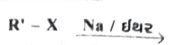
$R^{\prime}-X \xrightarrow{Na / \text{ether}} 2,3-\text{dimethylbutane}$. Identify $R^{\prime}$.
A
$(CH_3CH_2)_3C-$
B
$(C_2H_5)_2CH-$
C
$(CH_3)_3C-$
D
$(CH_3)_2CH-$
Solution
(D) The reaction given is the Wurtz reaction,where an alkyl halide reacts with sodium in the presence of dry ether to form a symmetric alkane.
$2R^{\prime}-X + 2Na \xrightarrow{\text{ether}} R^{\prime}-R^{\prime} + 2NaX$
Given the product is $2,3-\text{dimethylbutane}$,which has the structure $(CH_3)_2CH-CH(CH_3)_2$.
This indicates that the alkyl group $R^{\prime}$ must be an isopropyl group,$(CH_3)_2CH-$.
Therefore,$R^{\prime}-X$ is isopropyl halide,$(CH_3)_2CH-X$.
$2R^{\prime}-X + 2Na \xrightarrow{\text{ether}} R^{\prime}-R^{\prime} + 2NaX$
Given the product is $2,3-\text{dimethylbutane}$,which has the structure $(CH_3)_2CH-CH(CH_3)_2$.
This indicates that the alkyl group $R^{\prime}$ must be an isopropyl group,$(CH_3)_2CH-$.
Therefore,$R^{\prime}-X$ is isopropyl halide,$(CH_3)_2CH-X$.
0 likesView Solution
2
ChemistryEasyMCQGSEB · 2023
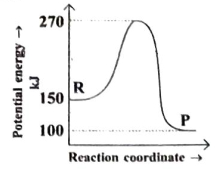
For the reaction $R \rightarrow P$,the following potential energy diagram is given. What will be the enthalpy change $(\Delta H)$ for the given reaction (in $kJ$)?
A
$170$
B
$120$
C
$-50$
D
$50$
Solution
(C) The enthalpy change $(\Delta H)$ of a reaction is defined as the difference between the potential energy of the products $(H_P)$ and the potential energy of the reactants $(H_R)$.
$\Delta H = H_P - H_R$
From the given graph:
Potential energy of reactants $(H_R)$ = $150 \ kJ$
Potential energy of products $(H_P)$ = $100 \ kJ$
Therefore,$\Delta H = 100 \ kJ - 150 \ kJ = -50 \ kJ$.
Thus,the correct option is $C$.
$\Delta H = H_P - H_R$
From the given graph:
Potential energy of reactants $(H_R)$ = $150 \ kJ$
Potential energy of products $(H_P)$ = $100 \ kJ$
Therefore,$\Delta H = 100 \ kJ - 150 \ kJ = -50 \ kJ$.
Thus,the correct option is $C$.
0 likesView Solution
3
ChemistryEasyMCQGSEB · 2023
How many monochloro structural isomers are expected to be formed on free radical monochlorination of isopentane?
A
$2$
B
$4$
C
$3$
D
$5$
Solution
(B) The structure of isopentane is $CH_3-CH(CH_3)-CH_2-CH_3$.
There are $4$ distinct types of hydrogen atoms in isopentane:
$1$. Primary hydrogens on the terminal $CH_3$ group attached to the $CH$ group.
$2$. Tertiary hydrogen on the $CH$ group.
$3$. Secondary hydrogens on the $CH_2$ group.
$4$. Primary hydrogens on the terminal $CH_3$ group attached to the $CH_2$ group.
Since there are $4$ different types of hydrogen atoms,replacing any one of them with a chlorine atom will result in $4$ different monochloro structural isomers.
Therefore,the correct answer is $4$.
There are $4$ distinct types of hydrogen atoms in isopentane:
$1$. Primary hydrogens on the terminal $CH_3$ group attached to the $CH$ group.
$2$. Tertiary hydrogen on the $CH$ group.
$3$. Secondary hydrogens on the $CH_2$ group.
$4$. Primary hydrogens on the terminal $CH_3$ group attached to the $CH_2$ group.
Since there are $4$ different types of hydrogen atoms,replacing any one of them with a chlorine atom will result in $4$ different monochloro structural isomers.
Therefore,the correct answer is $4$.
0 likesView Solution
4
ChemistryEasyMCQGSEB · 2023
If the solubility product of $CuS$ is $9 \times 10^{-16}$,then what will be the maximum molarity of $CuS$ in an aqueous solution?
A
$2 \times 10^{-10} \ M$
B
$5 \times 10^{-7} \ M$
C
$3 \times 10^{-8} \ M$
D
$6 \times 10^{-12} \ M$
Solution
(C) The dissolution of $CuS$ in water is represented as: $CuS(s) \rightleftharpoons Cu^{2+}(aq) + S^{2-}(aq)$.
Let the solubility of $CuS$ be $s \ mol/L$.
Then,$[Cu^{2+}] = s$ and $[S^{2-}] = s$.
The solubility product constant $(K_{sp})$ is given by: $K_{sp} = [Cu^{2+}][S^{2-}] = s \times s = s^2$.
Given $K_{sp} = 9 \times 10^{-16}$.
Therefore,$s^2 = 9 \times 10^{-16}$.
Taking the square root on both sides,$s = \sqrt{9 \times 10^{-16}} = 3 \times 10^{-8} \ M$.
Thus,the maximum molarity of $CuS$ in an aqueous solution is $3 \times 10^{-8} \ M$.
Let the solubility of $CuS$ be $s \ mol/L$.
Then,$[Cu^{2+}] = s$ and $[S^{2-}] = s$.
The solubility product constant $(K_{sp})$ is given by: $K_{sp} = [Cu^{2+}][S^{2-}] = s \times s = s^2$.
Given $K_{sp} = 9 \times 10^{-16}$.
Therefore,$s^2 = 9 \times 10^{-16}$.
Taking the square root on both sides,$s = \sqrt{9 \times 10^{-16}} = 3 \times 10^{-8} \ M$.
Thus,the maximum molarity of $CuS$ in an aqueous solution is $3 \times 10^{-8} \ M$.
0 likesView Solution
5
ChemistryEasyMCQGSEB · 2023
Which compound has the highest value of $pK_{a}$?
A
$p-$cresol
B
phenol
C
$o-$nitrophenol
D
$m-$nitrophenol
Solution
(A) The $pK_{a}$ value is inversely proportional to the acidity of the compound. Higher $pK_{a}$ means lower acidity.
$1$. $p-$cresol contains an electron-donating methyl group $(-CH_{3})$,which decreases the acidity of phenol.
$2$. Phenol has no substituent.
$3$. $o-$nitrophenol and $m-$nitrophenol contain electron-withdrawing nitro groups $(-NO_{2})$,which significantly increase the acidity of phenol.
Comparing these,$p-$cresol is the least acidic,therefore it has the highest $pK_{a}$ value.
$1$. $p-$cresol contains an electron-donating methyl group $(-CH_{3})$,which decreases the acidity of phenol.
$2$. Phenol has no substituent.
$3$. $o-$nitrophenol and $m-$nitrophenol contain electron-withdrawing nitro groups $(-NO_{2})$,which significantly increase the acidity of phenol.
Comparing these,$p-$cresol is the least acidic,therefore it has the highest $pK_{a}$ value.
0 likesView Solution
6
ChemistryEasyMCQGSEB · 2023
Which compound will give a yellow precipitate on reaction with sodium hypoiodite?
A
isobutyl alcohol
B
$tert-$butyl alcohol
C
$n-$butyl alcohol
D
$sec-$butyl alcohol
Solution
(D) The reaction with sodium hypoiodite $(NaOI)$ is the iodoform test.
Compounds containing the $CH_3CH(OH)-$ group or the $CH_3CO-$ group give a positive iodoform test,resulting in a yellow precipitate of iodoform $(CHI_3)$.
Among the given options,$sec-$butyl alcohol $(CH_3CH(OH)CH_2CH_3)$ contains the $CH_3CH(OH)-$ structural unit.
Therefore,$sec-$butyl alcohol reacts with $NaOI$ to form a yellow precipitate.
Compounds containing the $CH_3CH(OH)-$ group or the $CH_3CO-$ group give a positive iodoform test,resulting in a yellow precipitate of iodoform $(CHI_3)$.
Among the given options,$sec-$butyl alcohol $(CH_3CH(OH)CH_2CH_3)$ contains the $CH_3CH(OH)-$ structural unit.
Therefore,$sec-$butyl alcohol reacts with $NaOI$ to form a yellow precipitate.
0 likesView Solution
7
ChemistryEasyMCQGSEB · 2023
Which reagent is useful in the conversion of ethanenitrile to ethanal?
A
Anhydrous $Cr_2O_3$
B
$PCC$
C
$DIBAL-H$
D
$LiAlH_4$
Solution
(C) The conversion of nitriles $(R-CN)$ to aldehydes $(R-CHO)$ is typically achieved using $DIBAL-H$ (Diisobutylaluminium hydride) followed by hydrolysis.
$CH_3CN + DIBAL-H \xrightarrow{H_2O} CH_3CHO$.
$LiAlH_4$ would reduce the nitrile all the way to a primary amine $(CH_3CH_2NH_2)$.
$CH_3CN + DIBAL-H \xrightarrow{H_2O} CH_3CHO$.
$LiAlH_4$ would reduce the nitrile all the way to a primary amine $(CH_3CH_2NH_2)$.
0 likesView Solution
8
ChemistryEasyMCQGSEB · 2023
Salicylaldehyde on heating with zinc dust gives . . . . . . as the organic product.
A
Benzoic acid
B
Benzaldehyde
C
Benzyl alcohol
D
Benzene
Solution
(B) When salicylaldehyde $(2-hydroxybenzaldehyde)$ is heated with zinc dust,the phenolic $-OH$ group is reduced to a hydrogen atom,and the aldehyde group is also reduced to a methyl group,resulting in the formation of toluene $(C_6H_5CH_3)$. However,in the context of standard textbook reactions where zinc dust is used to reduce phenolic groups,the product is often identified as benzaldehyde if the reaction conditions specifically target the $-OH$ group. Given the options provided,the most chemically accurate transformation for salicylaldehyde with zinc dust is the reduction of the phenolic $-OH$ to $H$,yielding benzaldehyde $(C_6H_5CHO)$.
0 likesView Solution
9
ChemistryEasyMCQGSEB · 2023
Which of the following vitamins should be regularly supplied in the diet?
A
Vitamin $- D$
B
Vitamin $- K$
C
Vitamin $- E$
D
Vitamin $- C$
Solution
(D) Vitamins are classified as fat-soluble and water-soluble.
Fat-soluble vitamins $(A, D, E, K)$ can be stored in the body,whereas water-soluble vitamins ($B$ complex and $C$) cannot be stored and are excreted in urine.
Therefore,water-soluble vitamins must be supplied regularly in the diet.
Thus,the correct option is $D$.
Fat-soluble vitamins $(A, D, E, K)$ can be stored in the body,whereas water-soluble vitamins ($B$ complex and $C$) cannot be stored and are excreted in urine.
Therefore,water-soluble vitamins must be supplied regularly in the diet.
Thus,the correct option is $D$.
0 likesView Solution
10
ChemistryEasyMCQGSEB · 2023
Which polysaccharide is highly branched?
A
Amylose
B
Glycogen
C
Cellulose
D
Amylopectin
Solution
(B) Glycogen is a storage polysaccharide in animals and is highly branched,similar in structure to amylopectin but with more frequent branching points (every $8-12$ glucose units).
Amylose is a linear polymer of $\alpha$-$D$-glucose.
Cellulose is a linear polymer of $\beta$-$D$-glucose.
Amylopectin is a branched polymer of $\alpha$-$D$-glucose,but it is less branched than glycogen.
Amylose is a linear polymer of $\alpha$-$D$-glucose.
Cellulose is a linear polymer of $\beta$-$D$-glucose.
Amylopectin is a branched polymer of $\alpha$-$D$-glucose,but it is less branched than glycogen.
0 likesView Solution
11
ChemistryEasyMCQGSEB · 2023
Which one acts as a non-reducing sugar?
A
glucose
B
lactose
C
sucrose
D
maltose
Solution
(C) sugar is considered non-reducing if it does not have a free hemiacetal or hemiketal group,meaning it cannot reduce Tollens' reagent or Fehling's solution.
Sucrose is a disaccharide composed of $D-(+)$-glucose and $D-(-)$-fructose joined by a glycosidic linkage between $C1$ of glucose and $C2$ of fructose.
Since both the anomeric carbons are involved in the glycosidic bond,sucrose does not have a free functional group to act as a reducing agent,making it a non-reducing sugar.
Sucrose is a disaccharide composed of $D-(+)$-glucose and $D-(-)$-fructose joined by a glycosidic linkage between $C1$ of glucose and $C2$ of fructose.
Since both the anomeric carbons are involved in the glycosidic bond,sucrose does not have a free functional group to act as a reducing agent,making it a non-reducing sugar.
0 likesView Solution
12
ChemistryEasyMCQGSEB · 2023
Thyroxine produced in the thyroid is an iodinated derivative of . . . . . . amino acid.
A
Tyrosine
B
Cysteine
C
Glutamine
D
Histidine
Solution
(A) Thyroxine $(T_4)$ is a hormone produced by the thyroid gland.
It is synthesized from the amino acid $Tyrosine$ by the addition of iodine atoms.
Therefore,it is an iodinated derivative of $Tyrosine$.
It is synthesized from the amino acid $Tyrosine$ by the addition of iodine atoms.
Therefore,it is an iodinated derivative of $Tyrosine$.
0 likesView Solution
13
ChemistryEasyMCQGSEB · 2023
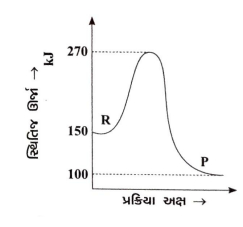
The graph for the process $R \rightarrow P$ is given below. Determine the activation energy $(E_a)$ for the forward reaction if the energy of the reactant is $50 \ kJ$ and the energy of the transition state is $170 \ kJ$. (in $kJ$)
A
$50$
B
$120$
C
$170$
D
$220$
Solution
(B) The activation energy $(E_a)$ for a reaction is defined as the difference between the energy of the transition state $(E_{TS})$ and the energy of the reactants $(E_R)$.
$E_a = E_{TS} - E_R$
Given:
$E_{TS} = 170 \ kJ$
$E_R = 50 \ kJ$
Therefore,$E_a = 170 \ kJ - 50 \ kJ = 120 \ kJ$.
Thus,the correct option is $B$.
$E_a = E_{TS} - E_R$
Given:
$E_{TS} = 170 \ kJ$
$E_R = 50 \ kJ$
Therefore,$E_a = 170 \ kJ - 50 \ kJ = 120 \ kJ$.
Thus,the correct option is $B$.
0 likesView Solution
14
ChemistryEasyMCQGSEB · 2023
Time taken to complete a zero order reaction is . . . . . . .
A
$\frac{[R]_0}{k}$
B
$\frac{2k}{[R]_0}$
C
$\frac{[R]_0}{2k}$
D
$\frac{k}{[R]_0}$
Solution
(A) For a zero order reaction,the integrated rate equation is $[R] = [R]_0 - kt$.
At the completion of the reaction,the concentration of the reactant $[R]$ becomes $0$.
Substituting this in the equation: $0 = [R]_0 - kt$.
Rearranging for time $t$: $t = \frac{[R]_0}{k}$.
Therefore,the time taken to complete a zero order reaction is $\frac{[R]_0}{k}$.
At the completion of the reaction,the concentration of the reactant $[R]$ becomes $0$.
Substituting this in the equation: $0 = [R]_0 - kt$.
Rearranging for time $t$: $t = \frac{[R]_0}{k}$.
Therefore,the time taken to complete a zero order reaction is $\frac{[R]_0}{k}$.
0 likesView Solution
15
ChemistryEasyMCQGSEB · 2023
What will be the unit of the rate constant for the following reaction?
$C_2H_{4(g)} + H_{2(g)} \rightarrow C_2H_{6(g)}$
$C_2H_{4(g)} + H_{2(g)} \rightarrow C_2H_{6(g)}$
A
$mol \cdot L^{-1} \cdot s^{-1}$
B
$s^{-1}$
C
$mol^{-1} \cdot L \cdot s^{-1}$
D
$mol^2 \cdot L^2 \cdot s^{-1}$
Solution
(C) The given reaction is $C_2H_{4(g)} + H_{2(g)} \rightarrow C_2H_{6(g)}$.
This is a hydrogenation reaction which typically follows second-order kinetics.
The general formula for the unit of the rate constant $k$ for an $n^{th}$ order reaction is $(mol \cdot L^{-1})^{1-n} \cdot s^{-1}$.
For a second-order reaction,$n = 2$.
Substituting $n = 2$ into the formula: $(mol \cdot L^{-1})^{1-2} \cdot s^{-1} = (mol \cdot L^{-1})^{-1} \cdot s^{-1} = mol^{-1} \cdot L \cdot s^{-1}$.
Therefore,the correct unit is $mol^{-1} \cdot L \cdot s^{-1}$,which corresponds to option $C$.
This is a hydrogenation reaction which typically follows second-order kinetics.
The general formula for the unit of the rate constant $k$ for an $n^{th}$ order reaction is $(mol \cdot L^{-1})^{1-n} \cdot s^{-1}$.
For a second-order reaction,$n = 2$.
Substituting $n = 2$ into the formula: $(mol \cdot L^{-1})^{1-2} \cdot s^{-1} = (mol \cdot L^{-1})^{-1} \cdot s^{-1} = mol^{-1} \cdot L \cdot s^{-1}$.
Therefore,the correct unit is $mol^{-1} \cdot L \cdot s^{-1}$,which corresponds to option $C$.
0 likesView Solution
16
ChemistryEasyMCQGSEB · 2023
Number of possible isomers for $[Cr(H_2O)_2(C_2O_4)_2]^{-}$ are . . . . . . .
A
$3$
B
$4$
C
$2$
D
$6$
Solution
(A) The complex $[Cr(H_2O)_2(C_2O_4)_2]^{-}$ is an octahedral complex of the type $[M(AA)_2(a)_2]$.
Here,$AA$ represents the bidentate oxalate ligand $(C_2O_4^{2-})$ and $a$ represents the monodentate aqua ligand $(H_2O)$.
This type of complex exhibits geometric isomerism:
$1$. $cis$-isomer: The two $H_2O$ ligands are adjacent to each other. The $cis$-isomer is optically active and exists as a pair of enantiomers ($d$ and $l$ forms).
$2$. $trans$-isomer: The two $H_2O$ ligands are opposite to each other. The $trans$-isomer is optically inactive due to the presence of a plane of symmetry.
Therefore,the total number of isomers is $3$ ($cis$-$d$,$cis$-$l$,and $trans$).
Here,$AA$ represents the bidentate oxalate ligand $(C_2O_4^{2-})$ and $a$ represents the monodentate aqua ligand $(H_2O)$.
This type of complex exhibits geometric isomerism:
$1$. $cis$-isomer: The two $H_2O$ ligands are adjacent to each other. The $cis$-isomer is optically active and exists as a pair of enantiomers ($d$ and $l$ forms).
$2$. $trans$-isomer: The two $H_2O$ ligands are opposite to each other. The $trans$-isomer is optically inactive due to the presence of a plane of symmetry.
Therefore,the total number of isomers is $3$ ($cis$-$d$,$cis$-$l$,and $trans$).
0 likesView Solution
17
ChemistryEasyMCQGSEB · 2023
Which is the correct formula of the Wilkinson catalyst?
A
$[RhCl(PPh_3)_3]$
B
$[RhCl(PMe_3)_3]$
C
$[RhCl(PPh_3)_3]$
D
$[RhCl(AsMe_3)_3]$
Solution
(A) The Wilkinson catalyst is a well-known organometallic complex used in the hydrogenation of alkenes.
Its chemical formula is $[RhCl(PPh_3)_3]$,where $Rh$ is Rhodium,$Cl$ is Chlorine,and $PPh_3$ is Triphenylphosphine.
Therefore,the correct option is $A$ or $C$ (as both are identical in the provided options).
Its chemical formula is $[RhCl(PPh_3)_3]$,where $Rh$ is Rhodium,$Cl$ is Chlorine,and $PPh_3$ is Triphenylphosphine.
Therefore,the correct option is $A$ or $C$ (as both are identical in the provided options).
0 likesView Solution
18
ChemistryEasyMCQGSEB · 2023
The shape of the manganate ion $(MnO_4^{2-})$ is . . . . . . .
A
Pyramidal
B
Tetrahedral
C
Square planar
D
Square pyramidal
Solution
(B) The manganate ion $(MnO_4^{2-})$ has a central manganese atom in the $+6$ oxidation state. The electronic configuration of $Mn^{6+}$ is $[Ar] 3d^1$. The ion involves $sp^3$ hybridization,which results in a tetrahedral geometry. Therefore,the correct shape is tetrahedral.
0 likesView Solution
19
ChemistryEasyMCQGSEB · 2023
Which oxidation state is common for lanthanoid elements?
A
$+2$
B
$+3$
C
$+4$
D
$+5$
Solution
(B) The most common and stable oxidation state for all lanthanoid elements is $+3$.
Although some lanthanoids exhibit $+2$ or $+4$ oxidation states in specific compounds,the $+3$ state is characteristic of the entire series due to the stability provided by the electronic configuration.
Although some lanthanoids exhibit $+2$ or $+4$ oxidation states in specific compounds,the $+3$ state is characteristic of the entire series due to the stability provided by the electronic configuration.
0 likesView Solution
20
ChemistryEasyMCQGSEB · 2023
Which compound has a magnetic moment equal to $4.90 \ B.M.$?
A
$MnSO_4$
B
$NiSO_4$
C
$FeSO_4$
D
$Cr_2(SO_4)_3$
Solution
(C) The magnetic moment is given by the formula $\mu = \sqrt{n(n+2)} \ B.M.$,where $n$ is the number of unpaired electrons.
For $\mu = 4.90 \ B.M.$,we solve $\sqrt{n(n+2)} = 4.90$,which gives $n = 4$.
In $FeSO_4$,the iron ion is $Fe^{2+}$.
The electronic configuration of $Fe^{2+}$ is $[Ar] 3d^6$.
In the $3d^6$ configuration,there are $4$ unpaired electrons.
Therefore,$FeSO_4$ has a magnetic moment of $4.90 \ B.M.$
For $\mu = 4.90 \ B.M.$,we solve $\sqrt{n(n+2)} = 4.90$,which gives $n = 4$.
In $FeSO_4$,the iron ion is $Fe^{2+}$.
The electronic configuration of $Fe^{2+}$ is $[Ar] 3d^6$.
In the $3d^6$ configuration,there are $4$ unpaired electrons.
Therefore,$FeSO_4$ has a magnetic moment of $4.90 \ B.M.$
0 likesView Solution
21
ChemistryEasyMCQGSEB · 2023
In which of the following conditions will the reduction potential of a hydrogen half-cell be negative?
A
$P_{H_2} = 2 \ atm$ and $[H^{+}] = 2 \ M$
B
$P_{H_2} = 2 \ atm$ and $[H^{+}] = 1 \ M$
C
$P_{H_2} = 1 \ atm$ and $[H^{+}] = 1 \ M$
D
$P_{H_2} = 1 \ atm$ and $[H^{+}] = 2 \ M$
Solution
(B) The reduction reaction for a hydrogen half-cell is: $2H^{+} (aq) + 2e^{-} \rightarrow H_2 (g)$.
Using the Nernst equation: $E_{red} = E^{\circ}_{red} - \frac{0.0591}{n} \log \frac{P_{H_2}}{[H^{+}]^2}$.
Since $E^{\circ}_{red} = 0 \ V$ and $n = 2$,the equation becomes: $E_{red} = -0.02955 \log \frac{P_{H_2}}{[H^{+}]^2}$.
For $E_{red}$ to be negative,$\log \frac{P_{H_2}}{[H^{+}]^2}$ must be positive,which means $\frac{P_{H_2}}{[H^{+}]^2} > 1$.
Checking the options:
$A$: $\frac{2}{2^2} = 0.5 < 1$ (Positive potential).
$B$: $\frac{2}{1^2} = 2 > 1$ (Negative potential).
$C$: $\frac{1}{1^2} = 1$ $(E_{red} = 0 \ V)$.
$D$: $\frac{1}{2^2} = 0.25 < 1$ (Positive potential).
Therefore,option $B$ is correct.
Using the Nernst equation: $E_{red} = E^{\circ}_{red} - \frac{0.0591}{n} \log \frac{P_{H_2}}{[H^{+}]^2}$.
Since $E^{\circ}_{red} = 0 \ V$ and $n = 2$,the equation becomes: $E_{red} = -0.02955 \log \frac{P_{H_2}}{[H^{+}]^2}$.
For $E_{red}$ to be negative,$\log \frac{P_{H_2}}{[H^{+}]^2}$ must be positive,which means $\frac{P_{H_2}}{[H^{+}]^2} > 1$.
Checking the options:
$A$: $\frac{2}{2^2} = 0.5 < 1$ (Positive potential).
$B$: $\frac{2}{1^2} = 2 > 1$ (Negative potential).
$C$: $\frac{1}{1^2} = 1$ $(E_{red} = 0 \ V)$.
$D$: $\frac{1}{2^2} = 0.25 < 1$ (Positive potential).
Therefore,option $B$ is correct.
0 likesView Solution
22
ChemistryEasyMCQGSEB · 2023
If $E^0_{Fe^{3+}/Fe} = x \ V$ and $E^0_{Fe^{2+}/Fe} = y \ V$,then what will be the value of $E^0_{Fe^{3+}/Fe^{2+}}$?
A
$x - y$
B
$3x + 2y$
C
$2x + y$
D
$3x - 2y$
Solution
(D) We use the relationship $\Delta G^0 = -nFE^0$.
For the reaction $Fe^{3+} + 3e^- \rightarrow Fe$,$\Delta G^0_1 = -3Fx$.
For the reaction $Fe^{2+} + 2e^- \rightarrow Fe$,$\Delta G^0_2 = -2Fy$.
We want the potential for $Fe^{3+} + e^- \rightarrow Fe^{2+}$.
This can be obtained by subtracting the second reaction from the first: $(Fe^{3+} + 3e^-$ $\rightarrow Fe) - (Fe^{2+} + 2e^-$ $\rightarrow Fe)$ $\Rightarrow Fe^{3+} + e^-$ $\rightarrow Fe^{2+}$.
Therefore,$\Delta G^0_3 = \Delta G^0_1 - \Delta G^0_2 = -3Fx - (-2Fy) = -3Fx + 2Fy$.
Since $\Delta G^0_3 = -nFE^0_{Fe^{3+}/Fe^{2+}}$ where $n=1$,we have $-1FE^0_{Fe^{3+}/Fe^{2+}} = -3Fx + 2Fy$.
Thus,$E^0_{Fe^{3+}/Fe^{2+}} = 3x - 2y$.
For the reaction $Fe^{3+} + 3e^- \rightarrow Fe$,$\Delta G^0_1 = -3Fx$.
For the reaction $Fe^{2+} + 2e^- \rightarrow Fe$,$\Delta G^0_2 = -2Fy$.
We want the potential for $Fe^{3+} + e^- \rightarrow Fe^{2+}$.
This can be obtained by subtracting the second reaction from the first: $(Fe^{3+} + 3e^-$ $\rightarrow Fe) - (Fe^{2+} + 2e^-$ $\rightarrow Fe)$ $\Rightarrow Fe^{3+} + e^-$ $\rightarrow Fe^{2+}$.
Therefore,$\Delta G^0_3 = \Delta G^0_1 - \Delta G^0_2 = -3Fx - (-2Fy) = -3Fx + 2Fy$.
Since $\Delta G^0_3 = -nFE^0_{Fe^{3+}/Fe^{2+}}$ where $n=1$,we have $-1FE^0_{Fe^{3+}/Fe^{2+}} = -3Fx + 2Fy$.
Thus,$E^0_{Fe^{3+}/Fe^{2+}} = 3x - 2y$.
0 likesView Solution
23
ChemistryEasyMCQGSEB · 2023
Which substance is used as cathode in a mercury cell?
A
$HgO + C$
B
$ZnO + Pt$
C
$HgO + KOH$
D
$ZnO + NaOH$
Solution
(A) In a mercury cell,the anode is made of zinc amalgam $(Zn(Hg))$ and the cathode is a paste of mercury$(II)$ oxide $(HgO)$ mixed with carbon $(C)$.
Therefore,the correct option is $A$.
Therefore,the correct option is $A$.
0 likesView Solution
24
ChemistryEasyMCQGSEB · 2023
Which species is obtained at the anode during the electrolysis of an aqueous solution containing a higher concentration of $H_2SO_4$?
A
$SO_2$
B
$SO_3^{2-}$
C
$S_2O_8^{2-}$
D
$S_2O_3^{2-}$
Solution
(C) During the electrolysis of a highly concentrated aqueous solution of $H_2SO_4$,the oxidation of the hydrogen sulfate ion $(HSO_4^-)$ occurs at the anode.
The reaction is: $2HSO_4^- (aq) \rightarrow S_2O_8^{2-} (aq) + 2H^+ (aq) + 2e^-$.
This results in the formation of the peroxodisulfate ion $(S_2O_8^{2-})$,also known as Marshall's acid anion.
The reaction is: $2HSO_4^- (aq) \rightarrow S_2O_8^{2-} (aq) + 2H^+ (aq) + 2e^-$.
This results in the formation of the peroxodisulfate ion $(S_2O_8^{2-})$,also known as Marshall's acid anion.
0 likesView Solution
25
ChemistryEasyMCQGSEB · 2023
Which compound has the highest reactivity towards $S_{N}2$ reaction?
A
$1-$Bromobutane
B
$1-$Bromo-$2$-methylbutane
C
$1-$Bromo-$2,2$-dimethylpropane
D
$1-$Bromo-$3$-methylbutane
Solution
(A) The reactivity of alkyl halides towards $S_{N}2$ reaction depends on the steric hindrance around the electrophilic carbon atom. The order of reactivity is: $Primary > Secondary > Tertiary$.
Among the given options:
$A$. $1-$Bromobutane is a primary alkyl halide with the least steric hindrance.
$B$. $1-$Bromo-$2$-methylbutane is a primary alkyl halide but has more steric hindrance due to the methyl group at the $C-2$ position.
$C$. $1-$Bromo-$2,2$-dimethylpropane is a primary alkyl halide but is highly hindered due to the two methyl groups at the $C-2$ position (neopentyl halide).
$D$. $1-$Bromo-$3$-methylbutane is a primary alkyl halide with steric hindrance further away from the reaction site compared to $B$ and $C$.
Since $1-$Bromobutane has the least steric hindrance,it is the most reactive towards $S_{N}2$ reaction.
Among the given options:
$A$. $1-$Bromobutane is a primary alkyl halide with the least steric hindrance.
$B$. $1-$Bromo-$2$-methylbutane is a primary alkyl halide but has more steric hindrance due to the methyl group at the $C-2$ position.
$C$. $1-$Bromo-$2,2$-dimethylpropane is a primary alkyl halide but is highly hindered due to the two methyl groups at the $C-2$ position (neopentyl halide).
$D$. $1-$Bromo-$3$-methylbutane is a primary alkyl halide with steric hindrance further away from the reaction site compared to $B$ and $C$.
Since $1-$Bromobutane has the least steric hindrance,it is the most reactive towards $S_{N}2$ reaction.
0 likesView Solution
26
ChemistryEasyMCQGSEB · 2023
Which mixture shows negative deviation from Raoult's law?
A
ethanol and acetone
B
carbon disulphide and acetone
C
hexane and heptane
D
phenol and aniline
Solution
(D) Negative deviation from Raoult's law occurs when the intermolecular forces of attraction between the solute and solvent molecules are stronger than those between the pure components ($A-A$ and $B-B$ interactions < $A-B$ interactions).
In the mixture of phenol $(C_6H_5OH)$ and aniline $(C_6H_5NH_2)$,strong intermolecular hydrogen bonding is formed between the phenolic hydrogen and the lone pair of nitrogen in aniline.
This leads to a decrease in total vapor pressure,which is characteristic of negative deviation.
Therefore,the correct option is $D$.
In the mixture of phenol $(C_6H_5OH)$ and aniline $(C_6H_5NH_2)$,strong intermolecular hydrogen bonding is formed between the phenolic hydrogen and the lone pair of nitrogen in aniline.
This leads to a decrease in total vapor pressure,which is characteristic of negative deviation.
Therefore,the correct option is $D$.
0 likesView Solution
27
ChemistryEasyMCQGSEB · 2023
Elevation in boiling point of the aqueous solution of $0.01 \ M \ BaCl_2$ compared to $0.01 \ M$ urea is . . . . . . .
A
approximately half
B
equal
C
approximately three times
D
approximately twice
Solution
(C) The elevation in boiling point is given by the formula $\Delta T_b = i \times K_b \times m$.
For $0.01 \ M$ urea (a non-electrolyte),the van't Hoff factor $i = 1$.
For $0.01 \ M \ BaCl_2$ (a strong electrolyte),it dissociates as $BaCl_2 \rightarrow Ba^{2+} + 2Cl^-$,so the van't Hoff factor $i = 3$.
Since the molality $m$ and the ebullioscopic constant $K_b$ are the same for both solutions,the ratio of elevation in boiling point is $\frac{\Delta T_b(BaCl_2)}{\Delta T_b(\text{urea})} = \frac{i(BaCl_2)}{i(\text{urea})} = \frac{3}{1} = 3$.
Therefore,the elevation in boiling point of $0.01 \ M \ BaCl_2$ is approximately three times that of $0.01 \ M$ urea.
For $0.01 \ M$ urea (a non-electrolyte),the van't Hoff factor $i = 1$.
For $0.01 \ M \ BaCl_2$ (a strong electrolyte),it dissociates as $BaCl_2 \rightarrow Ba^{2+} + 2Cl^-$,so the van't Hoff factor $i = 3$.
Since the molality $m$ and the ebullioscopic constant $K_b$ are the same for both solutions,the ratio of elevation in boiling point is $\frac{\Delta T_b(BaCl_2)}{\Delta T_b(\text{urea})} = \frac{i(BaCl_2)}{i(\text{urea})} = \frac{3}{1} = 3$.
Therefore,the elevation in boiling point of $0.01 \ M \ BaCl_2$ is approximately three times that of $0.01 \ M$ urea.
0 likesView Solution
Vedclass Products
For Students
Vedclass Test Series
Mock tests in real GSEB style covering Chemistry with performance analysis. 5-day free trial.
Start Free TrialFor Teachers
Exam Paper Generator
Generate Set A/B/C/D Chemistry papers from 7.5L+ questions in 2 minutes. 3 chapters free.
Try FreeFor Institutes
Online Exam Module
Run live GSEB mock exams with unlimited students, 360° analytics & white-label branding.
See DemoFrequently Asked Questions
How many Chemistry questions are in GSEB 2023?
There are 27 Chemistry questions from the GSEB 2023 paper on Vedclass, each with a detailed step-by-step solution in English.
Are GSEB 2023 Chemistry solutions available in English?
Yes. All solutions on this page are in English. You can also switch to English or Hindi using the language buttons above the questions.
Can I practice GSEB 2023 Chemistry as a timed test?
Yes. Use the Vedclass Test Series to attempt a full GSEB mock test covering Chemistry with time limits and instant score analysis.
Can teachers create Chemistry papers from GSEB previous year questions?
Yes. The Vedclass Exam Paper Generator lets teachers mix GSEB Chemistry questions and generate Set A/B/C/D papers in minutes.
For Teachers & Institutes
Build a Custom Chemistry Paper
Pick GSEB 2023 Chemistry questions, set difficulty, and generate Set A/B/C/D in 2 minutes.