
PhysicsQ1–38 of 38 questions
Page 1 of 1 · English
1
PhysicsEasyMCQGSEB · 2023
If the rms current in a $50 \text{ Hz}$ $AC$ circuit is $5 \text{ A}$,and at time $t=0$,the current $I$ is $0$. The value of current $I$ at $t=\frac{1}{300} \text{ s}$ is . . . . . . $A$.
A
$\frac{5}{6}$
B
$5 \sqrt{\frac{3}{2}}$
C
$5 \sqrt{2}$
D
$\frac{5}{\sqrt{2}}$
Solution
(B) Given: $I_{rms} = 5 \text{ A}$,frequency $f = 50 \text{ Hz}$.
At $t=0$,$I=0$,so the equation for current is $I = I_0 \sin(\omega t)$.
First,calculate the peak current $I_0 = \sqrt{2} \times I_{rms} = 5\sqrt{2} \text{ A}$.
Next,calculate the angular frequency $\omega = 2\pi f = 2\pi \times 50 = 100\pi \text{ rad/s}$.
Now,substitute $t = \frac{1}{300} \text{ s}$ into the equation:
$I = 5\sqrt{2} \sin(100\pi \times \frac{1}{300})$
$I = 5\sqrt{2} \sin(\frac{\pi}{3})$
Since $\sin(\frac{\pi}{3}) = \frac{\sqrt{3}}{2}$,we get:
$I = 5\sqrt{2} \times \frac{\sqrt{3}}{2} = 5 \sqrt{\frac{2 \times 3}{4}} = 5 \sqrt{\frac{3}{2}} \text{ A}$.
At $t=0$,$I=0$,so the equation for current is $I = I_0 \sin(\omega t)$.
First,calculate the peak current $I_0 = \sqrt{2} \times I_{rms} = 5\sqrt{2} \text{ A}$.
Next,calculate the angular frequency $\omega = 2\pi f = 2\pi \times 50 = 100\pi \text{ rad/s}$.
Now,substitute $t = \frac{1}{300} \text{ s}$ into the equation:
$I = 5\sqrt{2} \sin(100\pi \times \frac{1}{300})$
$I = 5\sqrt{2} \sin(\frac{\pi}{3})$
Since $\sin(\frac{\pi}{3}) = \frac{\sqrt{3}}{2}$,we get:
$I = 5\sqrt{2} \times \frac{\sqrt{3}}{2} = 5 \sqrt{\frac{2 \times 3}{4}} = 5 \sqrt{\frac{3}{2}} \text{ A}$.
0 likesView Solution
2
PhysicsEasyMCQGSEB · 2023
For circuits used for transporting electric power,a low power factor implies . . . . . . .
A
small power loss in transmission.
B
remains constant in transmission.
C
power increases in transmission.
D
large power loss in transmission.
Solution
(D) The power transmitted in an $AC$ circuit is given by $P = V_{rms} I_{rms} \cos \phi$,where $\cos \phi$ is the power factor.
From this,the current is $I_{rms} = \frac{P}{V_{rms} \cos \phi}$.
For a fixed power $P$ and voltage $V_{rms}$,if the power factor $\cos \phi$ is low,the current $I_{rms}$ must be large to transmit the same amount of power.
The power loss in the transmission lines is given by $P_{loss} = I_{rms}^2 R$.
Since $I_{rms}$ is large,the power loss $I_{rms}^2 R$ will be large.
Therefore,a low power factor implies a large power loss in transmission.
From this,the current is $I_{rms} = \frac{P}{V_{rms} \cos \phi}$.
For a fixed power $P$ and voltage $V_{rms}$,if the power factor $\cos \phi$ is low,the current $I_{rms}$ must be large to transmit the same amount of power.
The power loss in the transmission lines is given by $P_{loss} = I_{rms}^2 R$.
Since $I_{rms}$ is large,the power loss $I_{rms}^2 R$ will be large.
Therefore,a low power factor implies a large power loss in transmission.
0 likesView Solution
3
PhysicsEasyMCQGSEB · 2023
$A$ power transmission line feeds input power at $2300 \ V$ to a step-down transformer with its primary winding having $4000$ turns. What should be the number of turns in the secondary in order to get output power at $230 \ V$?
A
$4000$
B
$40$
C
$400$
D
$2300$
Solution
(C) The transformer equation is given by $\frac{V_s}{V_p} = \frac{N_s}{N_p}$.
Given:
Primary voltage $V_p = 2300 \ V$
Secondary voltage $V_s = 230 \ V$
Primary turns $N_p = 4000$
Substituting these values into the equation:
$\frac{230}{2300} = \frac{N_s}{4000}$
$N_s = \frac{230 \times 4000}{2300}$
$N_s = \frac{1}{10} \times 4000 = 400$.
Therefore,the number of turns in the secondary winding should be $400$.
Given:
Primary voltage $V_p = 2300 \ V$
Secondary voltage $V_s = 230 \ V$
Primary turns $N_p = 4000$
Substituting these values into the equation:
$\frac{230}{2300} = \frac{N_s}{4000}$
$N_s = \frac{230 \times 4000}{2300}$
$N_s = \frac{1}{10} \times 4000 = 400$.
Therefore,the number of turns in the secondary winding should be $400$.
0 likesView Solution
4
PhysicsEasyMCQGSEB · 2023
Inductive reactance . . . . . .
A
limits $A$.$C$. current
B
limits $DC$ voltage
C
limits $DC$ current
D
Stores the $AC$ current
Solution
(A) The correct answer is $A$. Inductive reactance $(X_L)$ is defined as the opposition offered by an inductor to the flow of alternating current.
$X_L = \omega L = 2 \pi f L$
where $f$ is the frequency of the $AC$ source and $L$ is the inductance.
Since $X_L$ is directly proportional to the frequency $(f)$,it effectively limits the flow of alternating current in a circuit.
For $DC$ circuits,the frequency $f = 0$,which means $X_L = 0$. Therefore,a pure inductor offers no resistance to $DC$ current.
$X_L = \omega L = 2 \pi f L$
where $f$ is the frequency of the $AC$ source and $L$ is the inductance.
Since $X_L$ is directly proportional to the frequency $(f)$,it effectively limits the flow of alternating current in a circuit.
For $DC$ circuits,the frequency $f = 0$,which means $X_L = 0$. Therefore,a pure inductor offers no resistance to $DC$ current.
0 likesView Solution
5
PhysicsEasyMCQGSEB · 2023
What is the ratio of the total energy of an electron in a hydrogen atom in the first excited state to that in the third excited state?
A
$3: 1$
B
$1: 1$
C
$4: 1$
D
$4: 4$
Solution
(C) The total energy of an electron in a hydrogen atom is given by the formula:
$E_{n} = \frac{-13.6}{n^{2}} \text{ eV}$
From this,we can see that the energy is inversely proportional to the square of the principal quantum number:
$E_{n} \propto \frac{1}{n^{2}}$
The first excited state corresponds to $n = 2$,and the third excited state corresponds to $n = 4$.
Therefore,the ratio of the energy in the first excited state $(E_{2})$ to the energy in the third excited state $(E_{4})$ is:
$\frac{E_{2}}{E_{4}} = \frac{n_{4}^{2}}{n_{2}^{2}} = \left(\frac{4}{2}\right)^{2}$
$\frac{E_{2}}{E_{4}} = (2)^{2} = \frac{4}{1}$
Thus,the ratio is $4: 1$.
$E_{n} = \frac{-13.6}{n^{2}} \text{ eV}$
From this,we can see that the energy is inversely proportional to the square of the principal quantum number:
$E_{n} \propto \frac{1}{n^{2}}$
The first excited state corresponds to $n = 2$,and the third excited state corresponds to $n = 4$.
Therefore,the ratio of the energy in the first excited state $(E_{2})$ to the energy in the third excited state $(E_{4})$ is:
$\frac{E_{2}}{E_{4}} = \frac{n_{4}^{2}}{n_{2}^{2}} = \left(\frac{4}{2}\right)^{2}$
$\frac{E_{2}}{E_{4}} = (2)^{2} = \frac{4}{1}$
Thus,the ratio is $4: 1$.
0 likesView Solution
6
PhysicsEasyMCQGSEB · 2023
What is the angular momentum of an electron in the $n=5$ orbit of a $Be^{+3}$ ion?
A
$6.6 \times 10^{-34} \text{ J s}$
B
$5.3 \times 10^{-34} \text{ J s}$
C
$3.3 \times 10^{-34} \text{ J s}$
D
$1.3 \times 10^{-34} \text{ J s}$
Solution
(B) According to Bohr's postulate,the angular momentum $L$ of an electron in an orbit $n$ is given by the formula:
$L = \frac{nh}{2\pi}$
Given that $n = 5$ and Planck's constant $h \approx 6.63 \times 10^{-34} \text{ J s}$:
$L = \frac{5 \times 6.63 \times 10^{-34}}{2 \times 3.14}$
$L = \frac{33.15 \times 10^{-34}}{6.28}$
$L \approx 5.278 \times 10^{-34} \text{ J s}$
Rounding to two significant figures,we get $L \approx 5.3 \times 10^{-34} \text{ J s}$.
$L = \frac{nh}{2\pi}$
Given that $n = 5$ and Planck's constant $h \approx 6.63 \times 10^{-34} \text{ J s}$:
$L = \frac{5 \times 6.63 \times 10^{-34}}{2 \times 3.14}$
$L = \frac{33.15 \times 10^{-34}}{6.28}$
$L \approx 5.278 \times 10^{-34} \text{ J s}$
Rounding to two significant figures,we get $L \approx 5.3 \times 10^{-34} \text{ J s}$.
0 likesView Solution
7
PhysicsEasyMCQGSEB · 2023
$A$ steady current flows in a metallic conductor of non-uniform cross-section. Which of the following quantities is constant along the conductor?
A
Electric field
B
Current density
C
Current
D
Drift speed
Solution
(C) The correct option is $C$.
When a steady current flows through a metallic conductor of non-uniform cross-section,the current $I$ remains constant throughout the conductor due to the principle of conservation of charge.
From the relation for drift velocity,$v_d = \frac{I}{neA}$,since $n$,$e$,and $I$ are constant,$v_d$ depends on the cross-sectional area $A$.
From the relation for current density,$J = \frac{I}{A}$,since $I$ is constant,$J$ depends on $A$.
From the relation for electric field,$E = \rho J = \frac{\rho I}{A}$,since $\rho$ and $I$ are constant,$E$ depends on $A$.
Therefore,only the current $I$ remains constant along the conductor.
When a steady current flows through a metallic conductor of non-uniform cross-section,the current $I$ remains constant throughout the conductor due to the principle of conservation of charge.
From the relation for drift velocity,$v_d = \frac{I}{neA}$,since $n$,$e$,and $I$ are constant,$v_d$ depends on the cross-sectional area $A$.
From the relation for current density,$J = \frac{I}{A}$,since $I$ is constant,$J$ depends on $A$.
From the relation for electric field,$E = \rho J = \frac{\rho I}{A}$,since $\rho$ and $I$ are constant,$E$ depends on $A$.
Therefore,only the current $I$ remains constant along the conductor.
0 likesView Solution
8
PhysicsEasyMCQGSEB · 2023
Kirchhoff's loop rule is a reflection of . . . . . . .
A
Law of conservation of momentum
B
Ohm's law
C
Law of conservation of charge
D
Law of conservation of energy
Solution
(D) Kirchhoff's loop rule (also known as Kirchhoff's second law or the voltage law) states that the algebraic sum of changes in potential around any closed loop in a circuit is zero.
This is based on the fact that electrostatic force is a conservative force,meaning the work done in moving a unit charge around a closed path is zero.
Therefore,the loop rule is a direct consequence of the law of conservation of energy.
Thus,the correct option is $D$.
This is based on the fact that electrostatic force is a conservative force,meaning the work done in moving a unit charge around a closed path is zero.
Therefore,the loop rule is a direct consequence of the law of conservation of energy.
Thus,the correct option is $D$.
0 likesView Solution
9
PhysicsEasyMCQGSEB · 2023
Two batteries of emf $\varepsilon_1$ and $\varepsilon_2$ (where $\varepsilon_2 > \varepsilon_1$) and internal resistances $r_1$ and $r_2$ respectively are connected in parallel as shown.
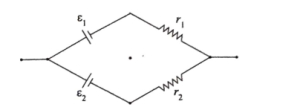
A
$\varepsilon_{eq}$ is independent of internal resistances $r_1$ and $r_2$.
B
The equivalent emf $\varepsilon_{eq}$ is smaller than $\varepsilon_1$.
C
The equivalent emf is given by $\varepsilon_{eq} = \varepsilon_1 + \varepsilon_2$.
D
The equivalent emf $\varepsilon_{eq}$ of the two cells is between $\varepsilon_1$ and $\varepsilon_2$,i.e.,$\varepsilon_1 < \varepsilon_{eq} < \varepsilon_2$.
Solution
(D) For two batteries connected in parallel,the equivalent emf $\varepsilon_{eq}$ and equivalent internal resistance $r_{eq}$ are given by the formulas:
$\frac{\varepsilon_{eq}}{r_{eq}} = \frac{\varepsilon_1}{r_1} + \frac{\varepsilon_2}{r_2} = \frac{\varepsilon_1 r_2 + \varepsilon_2 r_1}{r_1 r_2}$
and
$\frac{1}{r_{eq}} = \frac{1}{r_1} + \frac{1}{r_2} \implies r_{eq} = \frac{r_1 r_2}{r_1 + r_2}$
Substituting $r_{eq}$ into the first equation:
$\varepsilon_{eq} = \left( \frac{\varepsilon_1 r_2 + \varepsilon_2 r_1}{r_1 r_2} \right) \times \left( \frac{r_1 r_2}{r_1 + r_2} \right)$
$\varepsilon_{eq} = \frac{\varepsilon_1 r_2 + \varepsilon_2 r_1}{r_1 + r_2}$
Since $\varepsilon_2 > \varepsilon_1$,the equivalent emf $\varepsilon_{eq}$ is a weighted average of $\varepsilon_1$ and $\varepsilon_2$,which implies that $\varepsilon_1 < \varepsilon_{eq} < \varepsilon_2$.
$\frac{\varepsilon_{eq}}{r_{eq}} = \frac{\varepsilon_1}{r_1} + \frac{\varepsilon_2}{r_2} = \frac{\varepsilon_1 r_2 + \varepsilon_2 r_1}{r_1 r_2}$
and
$\frac{1}{r_{eq}} = \frac{1}{r_1} + \frac{1}{r_2} \implies r_{eq} = \frac{r_1 r_2}{r_1 + r_2}$
Substituting $r_{eq}$ into the first equation:
$\varepsilon_{eq} = \left( \frac{\varepsilon_1 r_2 + \varepsilon_2 r_1}{r_1 r_2} \right) \times \left( \frac{r_1 r_2}{r_1 + r_2} \right)$
$\varepsilon_{eq} = \frac{\varepsilon_1 r_2 + \varepsilon_2 r_1}{r_1 + r_2}$
Since $\varepsilon_2 > \varepsilon_1$,the equivalent emf $\varepsilon_{eq}$ is a weighted average of $\varepsilon_1$ and $\varepsilon_2$,which implies that $\varepsilon_1 < \varepsilon_{eq} < \varepsilon_2$.
0 likesView Solution
10
PhysicsEasyMCQGSEB · 2023
Monochromatic light of frequency $6 \times 10^{14} \,Hz$ is produced by a laser. The power emitted is $2 \times 10^{-3} \,W$. The energy of the photon in this light beam is . . . . . . eV.
A
$3.5$
B
$4$
C
$3$
D
$2.5$
Solution
(D) The energy of a photon is given by the formula $E = h \nu$,where $h$ is Planck's constant $(6.63 \times 10^{-34} \,J \cdot s)$ and $\nu$ is the frequency of the light.
Given: $\nu = 6 \times 10^{14} \,Hz$.
Substituting the values: $E = (6.63 \times 10^{-34} \,J \cdot s) \times (6 \times 10^{14} \,Hz) = 3.978 \times 10^{-19} \,J$.
To convert the energy from Joules to electron-volts $(eV)$,we divide by the charge of an electron $(1.6 \times 10^{-19} \,C)$:
$E = \frac{3.978 \times 10^{-19} \,J}{1.6 \times 10^{-19} \,J/eV} \approx 2.486 \,eV$.
Rounding to the nearest value,we get $E \approx 2.5 \,eV$.
Given: $\nu = 6 \times 10^{14} \,Hz$.
Substituting the values: $E = (6.63 \times 10^{-34} \,J \cdot s) \times (6 \times 10^{14} \,Hz) = 3.978 \times 10^{-19} \,J$.
To convert the energy from Joules to electron-volts $(eV)$,we divide by the charge of an electron $(1.6 \times 10^{-19} \,C)$:
$E = \frac{3.978 \times 10^{-19} \,J}{1.6 \times 10^{-19} \,J/eV} \approx 2.486 \,eV$.
Rounding to the nearest value,we get $E \approx 2.5 \,eV$.
0 likesView Solution
11
PhysicsEasyMCQGSEB · 2023
The variation of stopping potential $V_{0}$ with frequency $\nu$ of incident radiation for a given photosensitive material is a straight line [frequency $\nu$ of incident radiation is greater than threshold frequency $\nu_{0}$]. The slope of this line is . . . . . . .
A
$\frac{h}{\nu}$
B
$\frac{\phi_{0}}{h}$
C
$\frac{h}{e}$
D
$\frac{e}{V_{0}}$
Solution
(C) According to Einstein's photoelectric equation,the maximum kinetic energy $K_{max}$ of emitted photoelectrons is given by $K_{max} = h\nu - \phi_{0}$.
Since the stopping potential $V_{0}$ is related to the maximum kinetic energy by $K_{max} = eV_{0}$,we can write $eV_{0} = h\nu - \phi_{0}$.
Dividing by the elementary charge $e$,we get $V_{0} = \frac{h}{e}\nu - \frac{\phi_{0}}{e}$.
Comparing this with the equation of a straight line $y = mx + c$,where $y = V_{0}$,$x = \nu$,and $c = -\frac{\phi_{0}}{e}$,the slope $m$ is equal to $\frac{h}{e}$.
Since the stopping potential $V_{0}$ is related to the maximum kinetic energy by $K_{max} = eV_{0}$,we can write $eV_{0} = h\nu - \phi_{0}$.
Dividing by the elementary charge $e$,we get $V_{0} = \frac{h}{e}\nu - \frac{\phi_{0}}{e}$.
Comparing this with the equation of a straight line $y = mx + c$,where $y = V_{0}$,$x = \nu$,and $c = -\frac{\phi_{0}}{e}$,the slope $m$ is equal to $\frac{h}{e}$.
0 likesView Solution
12
PhysicsEasyMCQGSEB · 2023
The Coulombian repulsive force between two alpha particles kept at a distance of $3 \ cm$ in air is . . . . . . .
A
$1.024 \times 10^{-27} \ N$
B
$1.024 \times 10^{-25} \ N$
C
$1.024 \times 10^{-24} \ N$
D
$1.024 \times 10^{-23} \ N$
Solution
(C) The electric charge of an $\alpha$-particle is $q = 2e = 2 \times 1.6 \times 10^{-19} \ C = 3.2 \times 10^{-19} \ C$.
Given distance $r = 3 \ cm = 3 \times 10^{-2} \ m$.
The Coulombian repulsive force is given by $F = \frac{k q_1 q_2}{r^2}$.
Since $q_1 = q_2 = q$,we have $F = \frac{k q^2}{r^2}$.
Substituting the values:
$F = \frac{9 \times 10^9 \times (3.2 \times 10^{-19})^2}{(3 \times 10^{-2})^2}$
$F = \frac{9 \times 10^9 \times 10.24 \times 10^{-38}}{9 \times 10^{-4}}$
$F = 10.24 \times 10^{9 - 38 + 4}$
$F = 10.24 \times 10^{-25} \ N = 1.024 \times 10^{-24} \ N$.
Given distance $r = 3 \ cm = 3 \times 10^{-2} \ m$.
The Coulombian repulsive force is given by $F = \frac{k q_1 q_2}{r^2}$.
Since $q_1 = q_2 = q$,we have $F = \frac{k q^2}{r^2}$.
Substituting the values:
$F = \frac{9 \times 10^9 \times (3.2 \times 10^{-19})^2}{(3 \times 10^{-2})^2}$
$F = \frac{9 \times 10^9 \times 10.24 \times 10^{-38}}{9 \times 10^{-4}}$
$F = 10.24 \times 10^{9 - 38 + 4}$
$F = 10.24 \times 10^{-25} \ N = 1.024 \times 10^{-24} \ N$.
0 likesView Solution
13
PhysicsEasyMCQGSEB · 2023
How much charge should be placed on a spherical shell of radius $25 \ cm$ to have a surface charge density of $\frac{3}{\pi} \mu C/m^2$ (in $\mu C$)?
A
$0.57$
B
$0.75$
C
$0.25$
D
$0.5$
Solution
(B) The surface charge density $\sigma$ is defined as the charge $Q$ per unit area $A$ of the surface.
Given: Radius $r = 25 \ cm = 0.25 \ m = \frac{1}{4} \ m$.
Surface charge density $\sigma = \frac{3}{\pi} \ \mu C/m^2$.
The surface area of a spherical shell is $A = 4 \pi r^2$.
Using the formula $\sigma = \frac{Q}{A}$,we get $Q = \sigma \times A = \sigma \times 4 \pi r^2$.
Substituting the values:
$Q = \left( \frac{3}{\pi} \ \mu C/m^2 \right) \times 4 \pi \times (0.25 \ m)^2$
$Q = 3 \times 4 \times (0.0625) \ \mu C$
$Q = 12 \times 0.0625 \ \mu C = 0.75 \ \mu C$.
Therefore,the charge required is $0.75 \ \mu C$.
Given: Radius $r = 25 \ cm = 0.25 \ m = \frac{1}{4} \ m$.
Surface charge density $\sigma = \frac{3}{\pi} \ \mu C/m^2$.
The surface area of a spherical shell is $A = 4 \pi r^2$.
Using the formula $\sigma = \frac{Q}{A}$,we get $Q = \sigma \times A = \sigma \times 4 \pi r^2$.
Substituting the values:
$Q = \left( \frac{3}{\pi} \ \mu C/m^2 \right) \times 4 \pi \times (0.25 \ m)^2$
$Q = 3 \times 4 \times (0.0625) \ \mu C$
$Q = 12 \times 0.0625 \ \mu C = 0.75 \ \mu C$.
Therefore,the charge required is $0.75 \ \mu C$.
0 likesView Solution
14
PhysicsEasyMCQGSEB · 2023
Rubbing a plastic rod with wool gives the plastic rod a negative charge of $8 \times 10^{-7} \ C$. How many electrons have been transferred,and from where to whom?
A
$5 \times 10^{10}$,from wool to plastic rod
B
$5 \times 10^{11}$,from plastic rod to wool
C
$5 \times 10^{12}$,from plastic rod to wool
D
$5 \times 10^{12}$,from wool to plastic rod
Solution
(D) The charge on the plastic rod is $q = -8 \times 10^{-7} \ C$. Since the rod becomes negatively charged,it has gained electrons.
Using the quantization of charge formula,$q = ne$,where $e = 1.6 \times 10^{-19} \ C$ is the magnitude of the charge of an electron.
$n = \frac{|q|}{e} = \frac{8 \times 10^{-7}}{1.6 \times 10^{-19}}$
$n = 5 \times 10^{12}$
Since the plastic rod gained a negative charge,electrons must have been transferred from the wool to the plastic rod.
Using the quantization of charge formula,$q = ne$,where $e = 1.6 \times 10^{-19} \ C$ is the magnitude of the charge of an electron.
$n = \frac{|q|}{e} = \frac{8 \times 10^{-7}}{1.6 \times 10^{-19}}$
$n = 5 \times 10^{12}$
Since the plastic rod gained a negative charge,electrons must have been transferred from the wool to the plastic rod.
0 likesView Solution
15
PhysicsEasyMCQGSEB · 2023
The dimensional formula of electric flux is . . . . . . .
A
$M^1 L^{-3} T^{-3} A^{-1}$
B
$M^1 L^3 T^{-3} A^{-1}$
C
$M^{-1} L^3 T^{-3} A^{-1}$
D
$M^1 L^3 T^3 A^{-1}$
Solution
(B) Electric flux is defined by the formula $\Phi = E \cdot A$.
The dimensional formula of the Electric Field $(E)$ is $[M^1 L^1 T^{-3} A^{-1}]$.
The dimensional formula of Area $(A)$ is $[L^2]$.
Thus,the dimensional formula of electric flux is $[M^1 L^1 T^{-3} A^{-1}] \times [L^2] = [M^1 L^3 T^{-3} A^{-1}]$.
The dimensional formula of the Electric Field $(E)$ is $[M^1 L^1 T^{-3} A^{-1}]$.
The dimensional formula of Area $(A)$ is $[L^2]$.
Thus,the dimensional formula of electric flux is $[M^1 L^1 T^{-3} A^{-1}] \times [L^2] = [M^1 L^3 T^{-3} A^{-1}]$.
0 likesView Solution
16
PhysicsEasyMCQGSEB · 2023
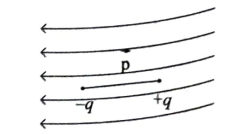
The figure shows an electric field in which an electric dipole $\overrightarrow{P}$ is placed. Which of the following statements is correct?
A
The dipole will experience a net force towards the left.
B
The dipole will experience a net force towards the right.
C
The dipole will not experience any force.
D
The dipole will experience a net force upward.
Solution
(B) The electric field lines are closer together on the left side,indicating a stronger electric field $(E_L > E_R)$.
For a dipole,the force on the negative charge $(-q)$ is in the direction opposite to the electric field,and the force on the positive charge $(+q)$ is in the direction of the electric field.
Let $E_L$ be the electric field at the position of $-q$ and $E_R$ be the electric field at the position of $+q$.
The force on $-q$ is $F_L = q E_L$ directed towards the right.
The force on $+q$ is $F_R = q E_R$ directed towards the left.
Since the field lines are denser on the left,$E_L > E_R$,therefore $F_L > F_R$.
The net force is $F_{net} = F_L - F_R$,which is directed towards the right.
For a dipole,the force on the negative charge $(-q)$ is in the direction opposite to the electric field,and the force on the positive charge $(+q)$ is in the direction of the electric field.
Let $E_L$ be the electric field at the position of $-q$ and $E_R$ be the electric field at the position of $+q$.
The force on $-q$ is $F_L = q E_L$ directed towards the right.
The force on $+q$ is $F_R = q E_R$ directed towards the left.
Since the field lines are denser on the left,$E_L > E_R$,therefore $F_L > F_R$.
The net force is $F_{net} = F_L - F_R$,which is directed towards the right.
0 likesView Solution
17
PhysicsEasyMCQGSEB · 2023
Magnetic flux linked with the coil is given by $\phi(t) = 2t^2 + 2t + 1$ and its resistance is $10 \ \Omega$. The current passing through the coil at $t = 2 \ s$ is . . . . . . $A$.
A
$1.5$
B
$1$
C
$0.5$
D
$2$
Solution
(B) According to Faraday's law of electromagnetic induction,the induced electromotive force (emf) $\varepsilon$ is given by the rate of change of magnetic flux: $\varepsilon = |\frac{d\phi}{dt}|$.
Given $\phi(t) = 2t^2 + 2t + 1$,we differentiate with respect to $t$:
$\varepsilon = |\frac{d}{dt}(2t^2 + 2t + 1)| = |4t + 2|$.
At $t = 2 \ s$,the induced emf is:
$\varepsilon = 4(2) + 2 = 10 \ V$.
Using Ohm's law,the current $i$ is given by $i = \frac{\varepsilon}{R}$.
Given resistance $R = 10 \ \Omega$,the current is:
$i = \frac{10 \ V}{10 \ \Omega} = 1 \ A$.
Given $\phi(t) = 2t^2 + 2t + 1$,we differentiate with respect to $t$:
$\varepsilon = |\frac{d}{dt}(2t^2 + 2t + 1)| = |4t + 2|$.
At $t = 2 \ s$,the induced emf is:
$\varepsilon = 4(2) + 2 = 10 \ V$.
Using Ohm's law,the current $i$ is given by $i = \frac{\varepsilon}{R}$.
Given resistance $R = 10 \ \Omega$,the current is:
$i = \frac{10 \ V}{10 \ \Omega} = 1 \ A$.
0 likesView Solution
18
PhysicsEasyMCQGSEB · 2023
When current $I$ passes through an inductor having self-inductance of $4 \ H$. If the current is made double,what will be the new self-inductance of the inductor?
A
$4 \ H$
B
$2 \ H$
C
zero
D
$8 \ H$
Solution
(A) The self-inductance $L$ of an inductor is given by the formula $L = \frac{\mu_0 N^2 A}{l}$,where $\mu_0$ is the permeability of free space,$N$ is the number of turns,$A$ is the cross-sectional area,and $l$ is the length of the inductor.
This formula shows that the self-inductance $L$ depends only on the geometric properties and the core material of the inductor.
It is independent of the current $I$ flowing through it.
Therefore,if the current is doubled,the self-inductance remains unchanged at $4 \ H$.
This formula shows that the self-inductance $L$ depends only on the geometric properties and the core material of the inductor.
It is independent of the current $I$ flowing through it.
Therefore,if the current is doubled,the self-inductance remains unchanged at $4 \ H$.
0 likesView Solution
19
PhysicsEasyMCQGSEB · 2023
$A$ square of side $L$ meter lies in the $x-y$ plane in a region where the magnetic field is given by $\overrightarrow{B} = B_0(2 \hat{i} + 4 \hat{j} + 3 \hat{k}) \text{ T}$,where $B_0$ is a constant. The magnitude of the magnetic flux passing through the square is . . . . . . .
A
$4 B_0 L^2 \text{ Wb}$
B
$3 B_0 L^2 \text{ Wb}$
C
$2 B_0 L^2 \text{ Wb}$
D
$\sqrt{29} B_0 L^2 \text{ Wb}$
Solution
(B) The magnetic flux $\phi$ through a surface is given by the dot product of the magnetic field vector $\overrightarrow{B}$ and the area vector $\overrightarrow{A}$.
Since the square of side $L$ lies in the $x-y$ plane,its area vector $\overrightarrow{A}$ is directed along the $z$-axis.
Therefore,$\overrightarrow{A} = L^2 \hat{k}$.
The magnetic field is $\overrightarrow{B} = B_0(2 \hat{i} + 4 \hat{j} + 3 \hat{k})$.
The magnetic flux is calculated as:
$\phi = \overrightarrow{B} \cdot \overrightarrow{A}$
$\phi = [B_0(2 \hat{i} + 4 \hat{j} + 3 \hat{k})] \cdot [L^2 \hat{k}]$
$\phi = B_0 L^2 (2 \hat{i} \cdot \hat{k} + 4 \hat{j} \cdot \hat{k} + 3 \hat{k} \cdot \hat{k})$
Since $\hat{i} \cdot \hat{k} = 0$,$\hat{j} \cdot \hat{k} = 0$,and $\hat{k} \cdot \hat{k} = 1$,we get:
$\phi = B_0 L^2 (0 + 0 + 3(1)) = 3 B_0 L^2 \text{ Wb}$.
Since the square of side $L$ lies in the $x-y$ plane,its area vector $\overrightarrow{A}$ is directed along the $z$-axis.
Therefore,$\overrightarrow{A} = L^2 \hat{k}$.
The magnetic field is $\overrightarrow{B} = B_0(2 \hat{i} + 4 \hat{j} + 3 \hat{k})$.
The magnetic flux is calculated as:
$\phi = \overrightarrow{B} \cdot \overrightarrow{A}$
$\phi = [B_0(2 \hat{i} + 4 \hat{j} + 3 \hat{k})] \cdot [L^2 \hat{k}]$
$\phi = B_0 L^2 (2 \hat{i} \cdot \hat{k} + 4 \hat{j} \cdot \hat{k} + 3 \hat{k} \cdot \hat{k})$
Since $\hat{i} \cdot \hat{k} = 0$,$\hat{j} \cdot \hat{k} = 0$,and $\hat{k} \cdot \hat{k} = 1$,we get:
$\phi = B_0 L^2 (0 + 0 + 3(1)) = 3 B_0 L^2 \text{ Wb}$.
0 likesView Solution
20
PhysicsEasyMCQGSEB · 2023
For a given electromagnetic wave,the magnitude of the electric field is $6.6 \,V \,m^{-1}$ at a point in space. The magnitude of the magnetic field at this point is . . . . . . $T$.
A
$2.1 \times 10^{-8}$
B
$6.6 \times 10^{-8}$
C
$19.8 \times 10^{-8}$
D
$2.2 \times 10^{-8}$
Solution
(D) The relationship between the magnitude of the electric field $(E)$ and the magnetic field $(B)$ in an electromagnetic wave is given by the equation: $E/B = c$,where $c$ is the speed of light in vacuum.
Given: $E = 6.6 \,V \,m^{-1}$ and $c = 3 \times 10^8 \,m \,s^{-1}$.
Rearranging the formula to solve for $B$: $B = E/c$.
Substituting the values: $B = 6.6 / (3 \times 10^8) \,T$.
Calculating the result: $B = 2.2 \times 10^{-8} \,T$.
Therefore,the correct option is $D$.
Given: $E = 6.6 \,V \,m^{-1}$ and $c = 3 \times 10^8 \,m \,s^{-1}$.
Rearranging the formula to solve for $B$: $B = E/c$.
Substituting the values: $B = 6.6 / (3 \times 10^8) \,T$.
Calculating the result: $B = 2.2 \times 10^{-8} \,T$.
Therefore,the correct option is $D$.
0 likesView Solution
21
PhysicsEasyMCQGSEB · 2023
$TV$ waves range from . . . . . .
A
$24.5 GHz - 229.5 GHz$
B
$88 GHz - 108 MHz$
C
$54 MHz - 890 MHz$
D
$400 GHz - 600 GHz$
Solution
(C) $TV$ waves,which are a part of the radio wave spectrum used for television broadcasting,typically operate in the frequency range of $54 MHz$ to $890 MHz$. This range covers both Very High Frequency $(VHF)$ and Ultra High Frequency $(UHF)$ bands used for television signals. Therefore,the correct option is $C$.
0 likesView Solution
22
PhysicsEasyMCQGSEB · 2023
Equipotential surfaces at a very large distance from a collection of charges whose total sum is not zero are approximately . . . . . . .
A
planes
B
spheres
C
paraboloids
D
ellipsoids
Solution
(B) The correct option is $(B)$.
For a collection of charges with a non-zero total sum $(Q \neq 0)$,the system behaves like a point charge when viewed from a very large distance $(r \to \infty)$.
The electric potential $V$ due to a point charge $q$ is given by the formula:
$V = \frac{1}{4\pi\epsilon_0} \frac{q}{r}$
This equation shows that the potential $V$ depends only on the distance $r$ from the charge. Therefore,all points at a constant distance $r$ from the charge have the same potential.
The locus of points at a constant distance $r$ from a point source in three-dimensional space forms the surface of a sphere.
Thus,at a very large distance,the equipotential surfaces of such a charge distribution are approximately spheres.
For a collection of charges with a non-zero total sum $(Q \neq 0)$,the system behaves like a point charge when viewed from a very large distance $(r \to \infty)$.
The electric potential $V$ due to a point charge $q$ is given by the formula:
$V = \frac{1}{4\pi\epsilon_0} \frac{q}{r}$
This equation shows that the potential $V$ depends only on the distance $r$ from the charge. Therefore,all points at a constant distance $r$ from the charge have the same potential.
The locus of points at a constant distance $r$ from a point source in three-dimensional space forms the surface of a sphere.
Thus,at a very large distance,the equipotential surfaces of such a charge distribution are approximately spheres.
0 likesView Solution
23
PhysicsEasyMCQGSEB · 2023
The electric potential energy of a $2 \mu C$ charge is $3 \times 10^{-5} \text{ J}$ at a point in a uniform electric field. The electric potential at the point is . . . . . . $V$.
A
$5$
B
$15$
C
$6$
D
zero
Solution
(B) The electric potential $V$ at a point is defined as the electric potential energy $U$ per unit charge $q$.
Formula: $V = \frac{U}{q}$
Given:
Charge $q = 2 \mu C = 2 \times 10^{-6} \text{ C}$
Potential Energy $U = 3 \times 10^{-5} \text{ J}$
Calculation:
$V = \frac{3 \times 10^{-5}}{2 \times 10^{-6}}$
$V = 1.5 \times 10^1$
$V = 15 \text{ V}$
Therefore,the electric potential at the point is $15 \text{ V}$.
Formula: $V = \frac{U}{q}$
Given:
Charge $q = 2 \mu C = 2 \times 10^{-6} \text{ C}$
Potential Energy $U = 3 \times 10^{-5} \text{ J}$
Calculation:
$V = \frac{3 \times 10^{-5}}{2 \times 10^{-6}}$
$V = 1.5 \times 10^1$
$V = 15 \text{ V}$
Therefore,the electric potential at the point is $15 \text{ V}$.
0 likesView Solution
24
PhysicsEasyMCQGSEB · 2023
Energy of a charged capacitor is $U$. Now it is removed from a battery and then connected to two other identical uncharged capacitors in parallel. What will be the energy of each capacitor?
A
$\frac{U}{4}$
B
$\frac{3U}{2}$
C
$U$
D
$\frac{U}{9}$
Solution
(D) The initial energy stored in the capacitor is $U = \frac{Q^2}{2C}$,where $Q$ is the initial charge and $C$ is the capacitance.
When the charged capacitor is disconnected from the battery and connected in parallel to two other identical uncharged capacitors,the total charge $Q$ is shared equally among the three capacitors because they are identical.
Therefore,the charge on each capacitor becomes $Q' = \frac{Q}{3}$.
The new energy $U'$ stored in each capacitor is given by $U' = \frac{(Q')^2}{2C}$.
Substituting $Q' = \frac{Q}{3}$ into the equation:
$U' = \frac{(\frac{Q}{3})^2}{2C} = \frac{Q^2}{9 \times 2C} = \frac{1}{9} \times \frac{Q^2}{2C}$.
Since $U = \frac{Q^2}{2C}$,we get $U' = \frac{U}{9}$.
When the charged capacitor is disconnected from the battery and connected in parallel to two other identical uncharged capacitors,the total charge $Q$ is shared equally among the three capacitors because they are identical.
Therefore,the charge on each capacitor becomes $Q' = \frac{Q}{3}$.
The new energy $U'$ stored in each capacitor is given by $U' = \frac{(Q')^2}{2C}$.
Substituting $Q' = \frac{Q}{3}$ into the equation:
$U' = \frac{(\frac{Q}{3})^2}{2C} = \frac{Q^2}{9 \times 2C} = \frac{1}{9} \times \frac{Q^2}{2C}$.
Since $U = \frac{Q^2}{2C}$,we get $U' = \frac{U}{9}$.
0 likesView Solution
25
PhysicsEasyMCQGSEB · 2023
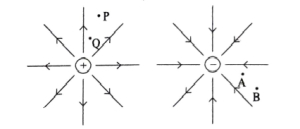
The figure shows the electric field lines of a positive and a negative charge,respectively. Determine the sign of the potential difference $V_Q - V_P$ and $V_B - V_A$.
A
$-Ve, +Ve$
B
$+Ve, -Ve$
C
$+Ve, +Ve$
D
$-Ve, -Ve$
Solution
(C) For a positive charge $+q$,the electric potential at a distance $r$ is given by $V = \frac{kq}{r}$. Since $V \propto \frac{1}{r}$,the potential is higher closer to the charge.
For the positive charge,point $Q$ is closer to the charge than point $P$,so $r_Q < r_P$. This implies $V_Q > V_P$,therefore $V_Q - V_P > 0$ (positive).
For a negative charge $-q$,the electric potential is given by $V = \frac{k(-q)}{r} = -\frac{kq}{r}$. Here,the potential is more negative (lower) closer to the charge.
For the negative charge,point $A$ is closer to the charge than point $B$,so $r_A < r_B$. This implies $V_A < V_B$ (since $V_A$ is more negative than $V_B$). Therefore,$V_B - V_A > 0$ (positive).
Thus,both potential differences are positive.
For the positive charge,point $Q$ is closer to the charge than point $P$,so $r_Q < r_P$. This implies $V_Q > V_P$,therefore $V_Q - V_P > 0$ (positive).
For a negative charge $-q$,the electric potential is given by $V = \frac{k(-q)}{r} = -\frac{kq}{r}$. Here,the potential is more negative (lower) closer to the charge.
For the negative charge,point $A$ is closer to the charge than point $B$,so $r_A < r_B$. This implies $V_A < V_B$ (since $V_A$ is more negative than $V_B$). Therefore,$V_B - V_A > 0$ (positive).
Thus,both potential differences are positive.
0 likesView Solution
26
PhysicsEasyMCQGSEB · 2023
Ferromagnetic materials have . . . . . . permeability and . . . . . . retentivity.
A
high,high
B
high,low
C
low,high
D
low,low
Solution
(A) Ferromagnetic materials are characterized by their ability to be strongly magnetized in an external magnetic field.
They possess a very high relative permeability $(\mu_r \gg 1)$, which allows them to concentrate magnetic field lines within themselves.
Additionally, they exhibit high retentivity, meaning they retain a significant amount of magnetization even after the external magnetic field is removed.
Therefore, the correct description is high permeability and high retentivity.
However, based on the provided options, the intended answer is $A$.
They possess a very high relative permeability $(\mu_r \gg 1)$, which allows them to concentrate magnetic field lines within themselves.
Additionally, they exhibit high retentivity, meaning they retain a significant amount of magnetization even after the external magnetic field is removed.
Therefore, the correct description is high permeability and high retentivity.
However, based on the provided options, the intended answer is $A$.
0 likesView Solution
27
PhysicsEasyMCQGSEB · 2023
Which of the following is not a unit of magnetic induction?
A
$\frac{\text{Weber}}{\text{m}^2}$
B
$\frac{\text{Newton-meter}}{\text{Ampere}}$
C
Tesla
D
$\frac{\text{Newton}}{\text{meter-Ampere}}$
Solution
(B) The magnetic induction $B$ is defined by the force $F$ on a current-carrying wire of length $l$ carrying current $I$ as $F = BIl \sin \theta$.
Thus,the $SI$ unit of magnetic induction is $\frac{\text{Newton}}{\text{Ampere-meter}}$.
Since $1 \text{ Tesla} = 1 \frac{\text{Weber}}{\text{m}^2} = 1 \frac{\text{Newton}}{\text{Ampere-meter}}$,options $A$,$C$,and $D$ are all valid units of magnetic induction.
Option $B$,$\frac{\text{Newton-meter}}{\text{Ampere}}$,is not a unit of magnetic induction.
Thus,the $SI$ unit of magnetic induction is $\frac{\text{Newton}}{\text{Ampere-meter}}$.
Since $1 \text{ Tesla} = 1 \frac{\text{Weber}}{\text{m}^2} = 1 \frac{\text{Newton}}{\text{Ampere-meter}}$,options $A$,$C$,and $D$ are all valid units of magnetic induction.
Option $B$,$\frac{\text{Newton-meter}}{\text{Ampere}}$,is not a unit of magnetic induction.
0 likesView Solution
28
PhysicsEasyMCQGSEB · 2023
$A$ galvanometer coil has a resistance of $10 \ \Omega$ and the meter shows full-scale deflection for $3 \ \text{mA}$. The value of the shunt required to convert this meter into an ammeter of range $0$ to $10 \ \text{A}$ is . . . . . . $\Omega$.
A
$4 \times 10^{-3}$
B
$2 \times 10^{-3}$
C
$3 \times 10^{-3}$
D
$1 \times 10^{-3}$
Solution
(C) Given:
Resistance of galvanometer $(G)$ = $10 \ \Omega$
Full-scale deflection current $(I_g)$ = $3 \ \text{mA} = 3 \times 10^{-3} \ \text{A}$
Range of ammeter $(I)$ = $10 \ \text{A}$
The formula for shunt resistance $(S)$ required to convert a galvanometer into an ammeter is given by:
$S = \frac{I_g \cdot G}{I - I_g}$
Substituting the values:
$S = \frac{3 \times 10^{-3} \times 10}{10 - 3 \times 10^{-3}}$
Since $3 \times 10^{-3} = 0.003 \ \text{A}$,the denominator is $10 - 0.003 = 9.997 \ \text{A}$.
$S = \frac{0.03}{9.997} \approx \frac{0.03}{10} = 0.003 \ \Omega$
Therefore,$S = 3 \times 10^{-3} \ \Omega$.
Resistance of galvanometer $(G)$ = $10 \ \Omega$
Full-scale deflection current $(I_g)$ = $3 \ \text{mA} = 3 \times 10^{-3} \ \text{A}$
Range of ammeter $(I)$ = $10 \ \text{A}$
The formula for shunt resistance $(S)$ required to convert a galvanometer into an ammeter is given by:
$S = \frac{I_g \cdot G}{I - I_g}$
Substituting the values:
$S = \frac{3 \times 10^{-3} \times 10}{10 - 3 \times 10^{-3}}$
Since $3 \times 10^{-3} = 0.003 \ \text{A}$,the denominator is $10 - 0.003 = 9.997 \ \text{A}$.
$S = \frac{0.03}{9.997} \approx \frac{0.03}{10} = 0.003 \ \Omega$
Therefore,$S = 3 \times 10^{-3} \ \Omega$.
0 likesView Solution
29
PhysicsEasyMCQGSEB · 2023
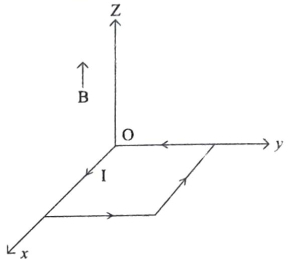
$A$ uniform magnetic field of $0.3 \text{ T}$ is established along the $+z$-direction. $A$ rectangular loop of sides $10 \text{ cm}$ and $5 \text{ cm}$ carries a current of $12 \text{ A}$ and is placed in the $xy$-plane as shown in the figure. The torque acting on the loop is $....... \text{ Nm}$.
A
$-1.8 \times 10^{-2} \hat{i}$
B
$-1.8 \times 10^{-2} \hat{j}$
C
$1.8 \times 10^{-2} \hat{i}$
D
zero
Solution
(D) The magnetic field is given by $\vec{B} = 0.3 \hat{k} \text{ T}$.
The area vector $\vec{A}$ of the loop placed in the $xy$-plane is perpendicular to the plane,so $\vec{A} = (10 \times 10^{-2} \text{ m} \times 5 \times 10^{-2} \text{ m}) \hat{k} = 50 \times 10^{-4} \hat{k} \text{ m}^2 = 5 \times 10^{-3} \hat{k} \text{ m}^2$.
The magnetic moment $\vec{m}$ is given by $\vec{m} = I \vec{A} = 12 \times 5 \times 10^{-3} \hat{k} = 60 \times 10^{-3} \hat{k} = 0.06 \hat{k} \text{ A m}^2$.
The torque $\vec{\tau}$ acting on the loop is given by $\vec{\tau} = \vec{m} \times \vec{B}$.
Substituting the values,$\vec{\tau} = (0.06 \hat{k}) \times (0.3 \hat{k})$.
Since the cross product of a vector with itself is zero $(\hat{k} \times \hat{k} = 0)$,the torque $\vec{\tau} = 0$.
The area vector $\vec{A}$ of the loop placed in the $xy$-plane is perpendicular to the plane,so $\vec{A} = (10 \times 10^{-2} \text{ m} \times 5 \times 10^{-2} \text{ m}) \hat{k} = 50 \times 10^{-4} \hat{k} \text{ m}^2 = 5 \times 10^{-3} \hat{k} \text{ m}^2$.
The magnetic moment $\vec{m}$ is given by $\vec{m} = I \vec{A} = 12 \times 5 \times 10^{-3} \hat{k} = 60 \times 10^{-3} \hat{k} = 0.06 \hat{k} \text{ A m}^2$.
The torque $\vec{\tau}$ acting on the loop is given by $\vec{\tau} = \vec{m} \times \vec{B}$.
Substituting the values,$\vec{\tau} = (0.06 \hat{k}) \times (0.3 \hat{k})$.
Since the cross product of a vector with itself is zero $(\hat{k} \times \hat{k} = 0)$,the torque $\vec{\tau} = 0$.
0 likesView Solution
30
PhysicsEasyMCQGSEB · 2023
One of the fusion reactions in the sun is given by ${ }_{1}^{2} H+{ }_{1}^{1} H \rightarrow{ }_{2}^{3} He+\gamma+Q$. Calculate the energy $Q$ released in the reaction. (in $MeV$)
A
$5.49$
B
$12.86$
C
$1.02$
D
$0.42$
Solution
(A) The mass of ${ }_{1}^{2} H$ is $2.014102 \ u$.
The mass of ${ }_{1}^{1} H$ is $1.007825 \ u$.
The mass of ${ }_{2}^{3} He$ is $3.016029 \ u$.
The mass defect $\Delta m = (m({ }_{1}^{2} H) + m({ }_{1}^{1} H)) - m({ }_{2}^{3} He)$.
$\Delta m = (2.014102 + 1.007825) - 3.016029 = 3.021927 - 3.016029 = 0.005898 \ u$.
The energy released $Q = \Delta m \times 931.5 \ MeV/u$.
$Q = 0.005898 \times 931.5 \approx 5.49 \ MeV$.
The mass of ${ }_{1}^{1} H$ is $1.007825 \ u$.
The mass of ${ }_{2}^{3} He$ is $3.016029 \ u$.
The mass defect $\Delta m = (m({ }_{1}^{2} H) + m({ }_{1}^{1} H)) - m({ }_{2}^{3} He)$.
$\Delta m = (2.014102 + 1.007825) - 3.016029 = 3.021927 - 3.016029 = 0.005898 \ u$.
The energy released $Q = \Delta m \times 931.5 \ MeV/u$.
$Q = 0.005898 \times 931.5 \approx 5.49 \ MeV$.
0 likesView Solution
31
PhysicsEasyMCQGSEB · 2023
According to the mass-energy equivalence relation,$9 \times 10^{13} \text{ J}$ of energy can be converted into $\qquad$ maximum mass. [Speed of light $c = 3 \times 10^{8} \text{ m/s}$] (in $\text{ g}$)
A
$9$
B
$3$
C
$81$
D
$1$
Solution
(D) According to the mass-energy equivalence relation:
$E = mc^{2}$
Therefore,$m = \frac{E}{c^{2}}$
Substituting the given values:
$m = \frac{9 \times 10^{13}}{(3 \times 10^{8})^{2}}$
$m = \frac{9 \times 10^{13}}{9 \times 10^{16}}$
$m = 10^{-3} \text{ kg}$
Since $1 \text{ kg} = 1000 \text{ g}$,we have:
$m = 10^{-3} \times 10^{3} \text{ g} = 1 \text{ g}$
Thus,the correct option is $D$.
$E = mc^{2}$
Therefore,$m = \frac{E}{c^{2}}$
Substituting the given values:
$m = \frac{9 \times 10^{13}}{(3 \times 10^{8})^{2}}$
$m = \frac{9 \times 10^{13}}{9 \times 10^{16}}$
$m = 10^{-3} \text{ kg}$
Since $1 \text{ kg} = 1000 \text{ g}$,we have:
$m = 10^{-3} \times 10^{3} \text{ g} = 1 \text{ g}$
Thus,the correct option is $D$.
0 likesView Solution
32
PhysicsEasyMCQGSEB · 2023
Optical phenomena taking place for a mirror and a lens respectively are . . . . . . and . . . . . . .
A
interference,diffraction
B
reflection,refraction
C
reflection,diffraction
D
refraction,interference
Solution
(B) mirror works on the principle of the reflection of light,where light rays bounce off the surface of the mirror. $A$ lens works on the principle of the refraction of light,where light rays pass through the medium and change their direction due to a change in speed. Therefore,the correct phenomena are reflection and refraction respectively.
0 likesView Solution
33
PhysicsEasyMCQGSEB · 2023
Power of a plane mirror is . . . . . .
A
$\infty$
B
$0$
C
$1$
D
$-1$
Solution
(B) The focal length of a plane mirror is $f = \infty$.
The power $P$ of a mirror is defined as the reciprocal of its focal length in meters,given by $P = \frac{1}{f}$.
Substituting the value of $f$:
$P = \frac{1}{\infty} = 0 \text{ dioptre}$.
Therefore,the power of a plane mirror is $0$.
The power $P$ of a mirror is defined as the reciprocal of its focal length in meters,given by $P = \frac{1}{f}$.
Substituting the value of $f$:
$P = \frac{1}{\infty} = 0 \text{ dioptre}$.
Therefore,the power of a plane mirror is $0$.
0 likesView Solution
34
PhysicsEasyMCQGSEB · 2023
$A$ small pin fixed on a table top is viewed from above from a distance of $100 \ cm$. By what distance would the pin appear to be raised if it is viewed from the same point through a $9 \ cm$ thick glass slab held parallel to the table (in $cm$)? The refractive index of glass is $1.5$.
A
$6$
B
$3$
C
$9$
D
$5$
Solution
(B) The apparent depth of an object viewed through a glass slab is given by the formula:
$\text{Apparent depth} = \frac{\text{Real depth}}{\mu}$
Given, real depth $(t)$ = $9 \ cm$ and refractive index $(\mu)$ = $1.5$.
$\text{Apparent depth} = \frac{9}{1.5} = 6 \ cm$
The shift or the distance by which the pin appears to be raised is given by:
$\text{Shift} = \text{Real depth} - \text{Apparent depth}$
$\text{Shift} = 9 \ cm - 6 \ cm = 3 \ cm$
Therefore, the pin appears to be raised by $3 \ cm$.
$\text{Apparent depth} = \frac{\text{Real depth}}{\mu}$
Given, real depth $(t)$ = $9 \ cm$ and refractive index $(\mu)$ = $1.5$.
$\text{Apparent depth} = \frac{9}{1.5} = 6 \ cm$
The shift or the distance by which the pin appears to be raised is given by:
$\text{Shift} = \text{Real depth} - \text{Apparent depth}$
$\text{Shift} = 9 \ cm - 6 \ cm = 3 \ cm$
Therefore, the pin appears to be raised by $3 \ cm$.
0 likesView Solution
35
PhysicsEasyMCQGSEB · 2023
The intensity of incident unpolarized light on a polaroid is $I_1$ and the intensity of emergent polarized light from this polaroid is $I_2$. The relation between $I_1$ and $I_2$ is $.......$
A
$I_1 > I_2$
B
$I_1 = I_2$
C
$I_1 < I_2$
D
$I_1 = 2I_2$
Solution
(D) When unpolarized light of intensity $I_1$ is incident on a polaroid,the intensity of the emergent polarized light $I_2$ is given by Malus's Law for unpolarized light.
According to the law,the intensity of light transmitted through a polarizer is half the intensity of the incident unpolarized light.
Therefore,$I_2 = \frac{I_1}{2}$.
Rearranging this equation,we get $I_1 = 2I_2$.
According to the law,the intensity of light transmitted through a polarizer is half the intensity of the incident unpolarized light.
Therefore,$I_2 = \frac{I_1}{2}$.
Rearranging this equation,we get $I_1 = 2I_2$.
0 likesView Solution
36
PhysicsEasyMCQGSEB · 2023
In Young's double-slit experiment,the distance between slits is $0.2 \ mm$ and the distance between slits and screen is $1.5 \ m$. The wavelength of light used is $600 \ nm$. The distance between any two consecutive bright fringes is . . . . . . $mm$. (in $mm$)
A
$4.5$
B
$0.5$
C
$0.8$
D
$2.0$
Solution
(A) The distance between any two consecutive bright fringes is known as fringe width,denoted by $\beta$.
The formula for fringe width is $\beta = \frac{\lambda D}{d}$.
Given values are:
Wavelength $\lambda = 600 \ nm = 600 \times 10^{-9} \ m$.
Distance between slits and screen $D = 1.5 \ m$.
Distance between slits $d = 0.2 \ mm = 0.2 \times 10^{-3} \ m$.
Substituting these values into the formula:
$\beta = \frac{600 \times 10^{-9} \times 1.5}{0.2 \times 10^{-3}}$
$\beta = \frac{900 \times 10^{-9}}{0.2 \times 10^{-3}}$
$\beta = 4500 \times 10^{-6} \ m$
$\beta = 4.5 \times 10^{-3} \ m = 4.5 \ mm$.
Thus,the distance between any two consecutive bright fringes is $4.5 \ mm$.
The formula for fringe width is $\beta = \frac{\lambda D}{d}$.
Given values are:
Wavelength $\lambda = 600 \ nm = 600 \times 10^{-9} \ m$.
Distance between slits and screen $D = 1.5 \ m$.
Distance between slits $d = 0.2 \ mm = 0.2 \times 10^{-3} \ m$.
Substituting these values into the formula:
$\beta = \frac{600 \times 10^{-9} \times 1.5}{0.2 \times 10^{-3}}$
$\beta = \frac{900 \times 10^{-9}}{0.2 \times 10^{-3}}$
$\beta = 4500 \times 10^{-6} \ m$
$\beta = 4.5 \times 10^{-3} \ m = 4.5 \ mm$.
Thus,the distance between any two consecutive bright fringes is $4.5 \ mm$.
0 likesView Solution
37
PhysicsEasyMCQGSEB · 2023
The refractive index of a medium is $\frac{3}{2}$. The speed of light in this medium is . . . . . . $ms^{-1}$. (Speed of light in vacuum is $c = 3 \times 10^{8} \,ms^{-1}$)
A
$2.5 \times 10^{8}$
B
$3 \times 10^{8}$
C
$2 \times 10^{8}$
D
$3.5 \times 10^{8}$
Solution
(C) The refractive index $n$ of a medium is defined as the ratio of the speed of light in a vacuum $c$ to the speed of light in the medium $v$,given by $n = \frac{c}{v}$.
Given $n = \frac{3}{2}$ and $c = 3 \times 10^{8} \,ms^{-1}$.
Rearranging the formula to solve for $v$,we get $v = \frac{c}{n}$.
Substituting the values,$v = \frac{3 \times 10^{8}}{3/2} = 3 \times 10^{8} \times \frac{2}{3} = 2 \times 10^{8} \,ms^{-1}$.
Therefore,the correct option is $C$.
Given $n = \frac{3}{2}$ and $c = 3 \times 10^{8} \,ms^{-1}$.
Rearranging the formula to solve for $v$,we get $v = \frac{c}{n}$.
Substituting the values,$v = \frac{3 \times 10^{8}}{3/2} = 3 \times 10^{8} \times \frac{2}{3} = 2 \times 10^{8} \,ms^{-1}$.
Therefore,the correct option is $C$.
0 likesView Solution
38
PhysicsEasyMCQGSEB · 2023
$A$ slit of size '$a$' is illuminated by a parallel beam of light of wavelength $\lambda$. The angle at which this light is diffracted is approximately . . . . . . .
A
$\frac{\lambda}{a^{2}}$
B
$\frac{\lambda}{a}$
C
$\frac{a^{2}}{\lambda}$
D
$\frac{a}{\lambda}$
Solution
(B) In single-slit diffraction,the condition for the first minimum (where the light is diffracted) is given by the formula $a \sin \theta = n \lambda$.
For the first minimum,we take $n = 1$,so $a \sin \theta = \lambda$.
Since the angle $\theta$ is very small,we can approximate $\sin \theta \approx \theta$.
Therefore,$a \theta \approx \lambda$,which gives $\theta \approx \frac{\lambda}{a}$.
Thus,the angle of diffraction is approximately $\frac{\lambda}{a}$.
For the first minimum,we take $n = 1$,so $a \sin \theta = \lambda$.
Since the angle $\theta$ is very small,we can approximate $\sin \theta \approx \theta$.
Therefore,$a \theta \approx \lambda$,which gives $\theta \approx \frac{\lambda}{a}$.
Thus,the angle of diffraction is approximately $\frac{\lambda}{a}$.
0 likesView Solution
Vedclass Products
For Students
Vedclass Test Series
Mock tests in real GSEB style covering Physics with performance analysis. 5-day free trial.
Start Free TrialFor Teachers
Exam Paper Generator
Generate Set A/B/C/D Physics papers from 7.5L+ questions in 2 minutes. 3 chapters free.
Try FreeFor Institutes
Online Exam Module
Run live GSEB mock exams with unlimited students, 360° analytics & white-label branding.
See DemoFrequently Asked Questions
How many Physics questions are in GSEB 2023?
There are 38 Physics questions from the GSEB 2023 paper on Vedclass, each with a detailed step-by-step solution in English.
Are GSEB 2023 Physics solutions available in English?
Yes. All solutions on this page are in English. You can also switch to English or Hindi using the language buttons above the questions.
Can I practice GSEB 2023 Physics as a timed test?
Yes. Use the Vedclass Test Series to attempt a full GSEB mock test covering Physics with time limits and instant score analysis.
Can teachers create Physics papers from GSEB previous year questions?
Yes. The Vedclass Exam Paper Generator lets teachers mix GSEB Physics questions and generate Set A/B/C/D papers in minutes.
For Teachers & Institutes
Build a Custom Physics Paper
Pick GSEB 2023 Physics questions, set difficulty, and generate Set A/B/C/D in 2 minutes.