
ChemistryQ51–72 of 95 questions
Page 2 of 2 · English
51
ChemistryMCQAIPMT · 2008
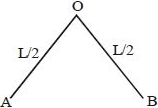
$A$ thin rod of length $L$ and mass $M$ is bent at its mid-point into two halves so that the angle between them is $90^o$. The moment of inertia of the bent rod about an axis passing through the bending point and perpendicular to the plane defined by the two halves of the rod is
A
$\frac{ML^2}{6}$
B
$\frac{\sqrt{2}ML^2}{24}$
C
$\frac{ML^2}{24}$
D
$\frac{ML^2}{12}$
Solution
(D) The rod is bent at the midpoint into two equal segments,each of length $l = \frac{L}{2}$ and mass $m = \frac{M}{2}$.
Each segment acts as a rod of length $l$ rotating about one of its ends.
The moment of inertia of a rod of mass $m$ and length $l$ about an axis passing through one end and perpendicular to its length is $I = \frac{1}{3}ml^2$.
Since there are two such segments,the total moment of inertia $I_{\text{total}}$ about the axis passing through the bending point $O$ and perpendicular to the plane is the sum of the moments of inertia of the two segments:
$I_{\text{total}} = I_1 + I_2 = \frac{1}{3} \left(\frac{M}{2}\right) \left(\frac{L}{2}\right)^2 + \frac{1}{3} \left(\frac{M}{2}\right) \left(\frac{L}{2}\right)^2$
$I_{\text{total}} = 2 \times \left[ \frac{1}{3} \times \frac{M}{2} \times \frac{L^2}{4} \right]$
$I_{\text{total}} = 2 \times \left[ \frac{ML^2}{24} \right] = \frac{ML^2}{12}$
Each segment acts as a rod of length $l$ rotating about one of its ends.
The moment of inertia of a rod of mass $m$ and length $l$ about an axis passing through one end and perpendicular to its length is $I = \frac{1}{3}ml^2$.
Since there are two such segments,the total moment of inertia $I_{\text{total}}$ about the axis passing through the bending point $O$ and perpendicular to the plane is the sum of the moments of inertia of the two segments:
$I_{\text{total}} = I_1 + I_2 = \frac{1}{3} \left(\frac{M}{2}\right) \left(\frac{L}{2}\right)^2 + \frac{1}{3} \left(\frac{M}{2}\right) \left(\frac{L}{2}\right)^2$
$I_{\text{total}} = 2 \times \left[ \frac{1}{3} \times \frac{M}{2} \times \frac{L^2}{4} \right]$
$I_{\text{total}} = 2 \times \left[ \frac{ML^2}{24} \right] = \frac{ML^2}{12}$
0 likesView Solution
52
ChemistryMCQAIPMT · 2008
$A$ galvanometer of resistance $50\,\Omega$ is connected to a battery of $3\,V$ along with a resistance of $2950\,\Omega$ in series. $A$ full-scale deflection of $30$ divisions is obtained in the galvanometer. In order to reduce this deflection to $20$ divisions,the resistance in series should be.......$\Omega$.
A
$6050$
B
$4450$
C
$5050$
D
$5550$
Solution
(B) The initial total resistance in the circuit is $R_{total,1} = R_G + R_1 = 50\,\Omega + 2950\,\Omega = 3000\,\Omega$.
Given the battery voltage $\varepsilon = 3\,V$,the initial current $I_1$ is $I_1 = \frac{\varepsilon}{R_{total,1}} = \frac{3\,V}{3000\,\Omega} = 1 \times 10^{-3}\,A = 1\,mA$.
Since $30$ divisions correspond to $1\,mA$,the current per division is $\frac{1\,mA}{30}$.
To get a deflection of $20$ divisions,the new current $I_2$ must be $I_2 = 20 \times \frac{1\,mA}{30} = \frac{2}{3}\,mA$.
Let the new total resistance be $R_{total,2}$. Using Ohm's law,$I_2 = \frac{\varepsilon}{R_{total,2}}$,so $R_{total,2} = \frac{\varepsilon}{I_2} = \frac{3\,V}{(2/3) \times 10^{-3}\,A} = 4500\,\Omega$.
The new total resistance is $R_{total,2} = R_G + R_{new}$,where $R_{new}$ is the new series resistance.
$4500\,\Omega = 50\,\Omega + R_{new} \Rightarrow R_{new} = 4450\,\Omega$.
Given the battery voltage $\varepsilon = 3\,V$,the initial current $I_1$ is $I_1 = \frac{\varepsilon}{R_{total,1}} = \frac{3\,V}{3000\,\Omega} = 1 \times 10^{-3}\,A = 1\,mA$.
Since $30$ divisions correspond to $1\,mA$,the current per division is $\frac{1\,mA}{30}$.
To get a deflection of $20$ divisions,the new current $I_2$ must be $I_2 = 20 \times \frac{1\,mA}{30} = \frac{2}{3}\,mA$.
Let the new total resistance be $R_{total,2}$. Using Ohm's law,$I_2 = \frac{\varepsilon}{R_{total,2}}$,so $R_{total,2} = \frac{\varepsilon}{I_2} = \frac{3\,V}{(2/3) \times 10^{-3}\,A} = 4500\,\Omega$.
The new total resistance is $R_{total,2} = R_G + R_{new}$,where $R_{new}$ is the new series resistance.
$4500\,\Omega = 50\,\Omega + R_{new} \Rightarrow R_{new} = 4450\,\Omega$.
0 likesView Solution
53
ChemistryMCQAIPMT · 2008
Earthworms have no skeleton,but during burrowing the anterior end becomes turgid and acts as a hydraulic skeleton. It is due to
A
Coelomic fluid
B
Blood
C
Gut peristalsis
D
Setae
Solution
(A) The body cavity $(coelom)$ of an earthworm is filled with an alkaline,colourless or milky coelomic fluid containing water,salts,some proteins,and four types of coelomic corpuscles.
During burrowing and locomotion,the contraction of septa (which partition the $coelom$ into a series of coelomic chambers) increases the pressure on the coelomic fluid.
This pressure makes the anterior body segment turgid and elongated,allowing it to function as a hydraulic skeleton.
During burrowing and locomotion,the contraction of septa (which partition the $coelom$ into a series of coelomic chambers) increases the pressure on the coelomic fluid.
This pressure makes the anterior body segment turgid and elongated,allowing it to function as a hydraulic skeleton.
0 likesView Solution
54
ChemistryMCQAIPMT · 2008
Endosperm is consumed by the developing embryo in the seed of
A
Coconut
B
Castor
C
Pea
D
Maize
Solution
(C) In albuminous seeds (like $Castor$,$Coconut$,and $Maize$),the endosperm is retained in the mature seed. In exalbuminous or non-albuminous seeds (like $Pea$,$Bean$,and $Groundnut$),the endosperm is completely consumed by the developing embryo during seed development. Therefore,the correct answer is $Pea$.
0 likesView Solution
55
ChemistryMCQAIPMT · 2008
The length of different internodes in a culm of sugarcane is variable because of
A
Shoot apical meristem
B
Position of axillary buds
C
Size of leaf lamina at the node below each internode
D
Intercalary meristem
Solution
(D) Intercalary meristem is a type of primary meristem that is found between mature tissues. In monocots like sugarcane,these meristems are responsible for the elongation of internodes. The variation in the length of different internodes is due to the differential activity of the intercalary meristem located at the base of each internode.
0 likesView Solution
56
ChemistryMCQAIPMT · 2008
Vascular tissues in flowering plants develop from
A
Phellogen
B
Plerome
C
Periblem
D
Dermatogen
Solution
(B) According to the Histogen theory proposed by Hanstein,the apical meristem consists of three distinct zones: Dermatogen,Periblem,and Plerome.
$1$. Dermatogen gives rise to the epidermis.
$2$. Periblem gives rise to the cortex.
$3$. Plerome gives rise to the central stele,which includes the vascular tissues (xylem and phloem).
Therefore,vascular tissues in flowering plants develop from the plerome.
$1$. Dermatogen gives rise to the epidermis.
$2$. Periblem gives rise to the cortex.
$3$. Plerome gives rise to the central stele,which includes the vascular tissues (xylem and phloem).
Therefore,vascular tissues in flowering plants develop from the plerome.
0 likesView Solution
57
ChemistryMCQAIPMT · 2008
The rupture and fractionation do not usually occur in the water column in $vessels/tracheids$ during the ascent of sap because of
A
Lignified thick walls
B
Cohesion and adhesion
C
Weak gravitational pull
D
Transpiration pull
Solution
(B) The vertical conduction of water from root to aerial parts of a plant is called ascent of sap.
The water molecules remain joined to each other due to a force of attraction called cohesion force.
Attraction between water molecules and the walls of $xylem$ is due to adhesion force.
These factors, along with surface tension, help to ensure the continuity of the water column in $xylem$ and prevent it from breaking or rupturing.
The water molecules remain joined to each other due to a force of attraction called cohesion force.
Attraction between water molecules and the walls of $xylem$ is due to adhesion force.
These factors, along with surface tension, help to ensure the continuity of the water column in $xylem$ and prevent it from breaking or rupturing.
0 likesView Solution
58
ChemistryMCQAIPMT · 2008
The energy-releasing metabolic process in which substrate is oxidized without an external electron acceptor is called:
A
Glycolysis
B
Fermentation
C
Aerobic respiration
D
Photorespiration
Solution
(B) Fermentation is an anaerobic metabolic process in which organic substrates,such as glucose,are incompletely oxidized without the involvement of an external electron acceptor.
In this process,pyruvic acid is converted into products like ethanol and carbon dioxide or lactic acid.
The enzymes $Pyruvic$ $acid$ $decarboxylase$ and $Alcohol$ $dehydrogenase$ catalyze these reactions in yeast.
In this process,pyruvic acid is converted into products like ethanol and carbon dioxide or lactic acid.
The enzymes $Pyruvic$ $acid$ $decarboxylase$ and $Alcohol$ $dehydrogenase$ catalyze these reactions in yeast.
0 likesView Solution
59
ChemistryMCQAIPMT · 2008
The chemiosmotic coupling hypothesis of oxidative phosphorylation proposes that adenosine triphosphate $(ATP)$ is formed because
A
High energy bonds are formed in mitochondrial proteins
B
$ADP$ is pumped out of the matrix into the intermembrane space
C
$A$ proton gradient forms across the inner membrane
D
There is a change in the permeability of the inner mitochondrial membrane towards adenosine diphosphate $(ADP)$
Solution
(C) The chemiosmotic hypothesis,proposed by Peter Mitchell,explains that the synthesis of $ATP$ in oxidative phosphorylation is driven by a proton gradient across the inner mitochondrial membrane.
As electrons pass through the electron transport chain,protons $(H^+)$ are pumped from the mitochondrial matrix into the intermembrane space.
This creates a high concentration of protons in the intermembrane space compared to the matrix,resulting in an electrochemical proton gradient.
The flow of protons back into the matrix through the $F_0-F_1$ $ATP$ synthase complex provides the energy required to phosphorylate $ADP$ into $ATP$.
As electrons pass through the electron transport chain,protons $(H^+)$ are pumped from the mitochondrial matrix into the intermembrane space.
This creates a high concentration of protons in the intermembrane space compared to the matrix,resulting in an electrochemical proton gradient.
The flow of protons back into the matrix through the $F_0-F_1$ $ATP$ synthase complex provides the energy required to phosphorylate $ADP$ into $ATP$.
0 likesView Solution
60
ChemistryMCQAIPMT · 2008
Senescence as an active developmental cellular process in the growth and functioning of a flowering plant,is indicated in
A
Vessels and tracheid differentiation
B
Leaf abscission
C
Annual plants
D
Floral parts
Solution
(B) Senescence is a programmed,active developmental process in plants. In the context of the growth and functioning of a flowering plant,leaf abscission is a clear example of senescence where specific cells undergo programmed death to allow the leaf to detach from the plant body.
0 likesView Solution
61
ChemistryMCQAIPMT · 2008
Importance of day length in flowering of plants was first shown in
A
Lemna
B
Tobacco
C
Cotton
D
Petunia
Solution
(B) The phenomenon of photoperiodism was first discovered by Garner and Allard $(1920-1922)$.
They observed that the Maryland Mammoth variety of tobacco could be made to flower only by reducing the light hours with artificial darkening.
They observed that the Maryland Mammoth variety of tobacco could be made to flower only by reducing the light hours with artificial darkening.
0 likesView Solution
62
ChemistryMCQAIPMT · 2008
Cornea transplant in humans is almost never rejected. This is because
A
Its cells are least penetrable by bacteria
B
It has no blood supply
C
It is composed of enucleated cells
D
It is a non-living layer
Solution
(B) The cornea is the transparent front part of the eye that covers the iris,pupil,and anterior chamber.
It is an avascular structure,meaning it lacks a direct blood supply.
Because the immune system's recognition of foreign tissue relies on the circulation of immune cells through the blood,the lack of blood vessels in the cornea prevents the immune system from easily detecting and attacking the transplanted tissue.
Therefore,cornea transplants are rarely rejected.
It is an avascular structure,meaning it lacks a direct blood supply.
Because the immune system's recognition of foreign tissue relies on the circulation of immune cells through the blood,the lack of blood vessels in the cornea prevents the immune system from easily detecting and attacking the transplanted tissue.
Therefore,cornea transplants are rarely rejected.
0 likesView Solution
63
ChemistryMCQAIPMT · 2008
Which one of the following is resistant to enzyme action?
A
Cork
B
Wood fibre
C
Pollen exine
D
Leaf cuticle
Solution
(C) The pollen wall consists of two layers: the outer $exine$ and the inner $intine$.
The $exine$ is primarily composed of $sporopollenin$, which is derived from the oxidative polymerization of carotenoids.
$Sporopollenin$ is recognized as one of the most chemically and biologically resistant organic materials known to science.
It is highly resistant to degradation by enzymes, strong acids, and alkalis, which allows pollen grains to be well-preserved in fossil deposits.
Therefore, $Pollen \text{ } exine$ is the correct answer.
The $exine$ is primarily composed of $sporopollenin$, which is derived from the oxidative polymerization of carotenoids.
$Sporopollenin$ is recognized as one of the most chemically and biologically resistant organic materials known to science.
It is highly resistant to degradation by enzymes, strong acids, and alkalis, which allows pollen grains to be well-preserved in fossil deposits.
Therefore, $Pollen \text{ } exine$ is the correct answer.
0 likesView Solution
64
ChemistryMCQAIPMT · 2008
Unisexuality of flowers prevents
A
Autogamy,but not geitonogamy
B
Geitonogamy and xenogamy
C
Geitonogamy,but not xenogamy
D
Autogamy and Geitonogamy
Solution
(A) Unisexuality of flowers means that a flower is either male (staminate) or female (pistillate).
Because a single flower cannot contain both reproductive organs,it prevents autogamy (self-pollination within the same flower).
However,it does not prevent geitonogamy,which is the transfer of pollen grains from the anther to the stigma of another flower on the same plant.
Because a single flower cannot contain both reproductive organs,it prevents autogamy (self-pollination within the same flower).
However,it does not prevent geitonogamy,which is the transfer of pollen grains from the anther to the stigma of another flower on the same plant.
0 likesView Solution
65
ChemistryMCQAIPMT · 2008
In humans,at the end of the first meiotic division,the male germ cells differentiate into the
A
Primary spermatocytes
B
Secondary spermatocytes
C
Spermatids
D
Spermatogonia
Solution
(B) During spermatogenesis,the process begins with spermatogonia $(2n)$.
These undergo mitotic divisions to form primary spermatocytes $(2n)$.
The primary spermatocytes then undergo the first meiotic division (meiosis-$I$),which is a reductional division,resulting in the formation of two haploid $(n)$ cells known as secondary spermatocytes.
Therefore,at the end of the first meiotic division,the cells formed are secondary spermatocytes.
These undergo mitotic divisions to form primary spermatocytes $(2n)$.
The primary spermatocytes then undergo the first meiotic division (meiosis-$I$),which is a reductional division,resulting in the formation of two haploid $(n)$ cells known as secondary spermatocytes.
Therefore,at the end of the first meiotic division,the cells formed are secondary spermatocytes.
0 likesView Solution
66
ChemistryMCQAIPMT · 2008
Consider the statements given below regarding contraception and answer as directed thereafter:
$(1)$ Medical Termination of Pregnancy $(MTP)$ during the first trimester is generally safe.
$(2)$ Generally,chances of conception are nil until the mother breast-feeds the infant up to two years.
$(3)$ Intrauterine devices like Copper-$T$ are effective contraceptives.
$(4)$ Contraception pills may be taken up to one week after coitus to prevent conception.
Which two of the above statements are correct?
$(1)$ Medical Termination of Pregnancy $(MTP)$ during the first trimester is generally safe.
$(2)$ Generally,chances of conception are nil until the mother breast-feeds the infant up to two years.
$(3)$ Intrauterine devices like Copper-$T$ are effective contraceptives.
$(4)$ Contraception pills may be taken up to one week after coitus to prevent conception.
Which two of the above statements are correct?
A
$1, 3$
B
$1, 2$
C
$2, 3$
D
$3, 4$
Solution
(A) Statement $(1)$ is correct: $MTP$ is considered relatively safe during the first trimester (up to $12$ weeks of pregnancy).
Statement $(2)$ is incorrect: Lactational amenorrhea is effective only up to $6$ months of exclusive breast-feeding,not two years.
Statement $(3)$ is correct: Intrauterine devices (IUDs) like Copper-$T$ are highly effective and widely used contraceptive methods.
Statement $(4)$ is incorrect: Emergency contraceptive pills are typically effective if taken within $72$ hours ($3$ days) after coitus,not one week.
Therefore,statements $(1)$ and $(3)$ are correct.
Statement $(2)$ is incorrect: Lactational amenorrhea is effective only up to $6$ months of exclusive breast-feeding,not two years.
Statement $(3)$ is correct: Intrauterine devices (IUDs) like Copper-$T$ are highly effective and widely used contraceptive methods.
Statement $(4)$ is incorrect: Emergency contraceptive pills are typically effective if taken within $72$ hours ($3$ days) after coitus,not one week.
Therefore,statements $(1)$ and $(3)$ are correct.
0 likesView Solution
67
ChemistryMCQAIPMT · 2008
Which one of the following statements is incorrect about menstruation?
A
At menopause in the female,there is especially abrupt increase in gonadotropic hormones
B
The beginning of the cycle of menstruation is called menarche
C
During normal menstruation about $40 \; ml$ blood is lost
D
The menstrual fluid can easily clot
Solution
(D) The correct answer is $D$. The menstrual fluid consists of blood,endometrial tissue,and secretions from the uterine glands. It does not clot easily because the enzyme plasmin (fibrinolysin) is present in the endometrium,which breaks down fibrin clots. Statement $A$ is correct as menopause leads to a sharp rise in gonadotropins ($FSH$ and $LH$) due to the loss of negative feedback from ovarian steroids. Statement $B$ is correct as the first menstruation at puberty is termed menarche. Statement $C$ is correct as the average blood loss during a normal menstrual cycle is approximately $30-50 \; ml$.
0 likesView Solution
68
ChemistryMCQAIPMT · 2008
Haploids are more suitable for mutation studies than diploids. This is because
A
Haploids are reproductively more stable than diploids
B
Mutagens penetrate in haploids more effectively than in diploids
C
Haploids are more abundant in nature than diploids
D
All mutations,whether dominant or recessive,are expressed in haploids
Solution
(D) Haploid plants can be produced in large numbers through anther and ovary cultures.
Haploids are highly useful for the isolation of mutants because they contain only a single set of chromosomes.
Consequently,even recessive mutant alleles are expressed in the phenotype in the very first generation after mutagen treatment,whereas in diploids,recessive mutations are masked by the dominant allele.
Haploids are highly useful for the isolation of mutants because they contain only a single set of chromosomes.
Consequently,even recessive mutant alleles are expressed in the phenotype in the very first generation after mutagen treatment,whereas in diploids,recessive mutations are masked by the dominant allele.
0 likesView Solution
69
ChemistryMCQAIPMT · 2008
The main objective of the production/use of herbicide-resistant $GM$ crops is to
A
Eliminate weeds from the field without the use of manual labour
B
Eliminate weeds from the field without the use of herbicides
C
Encourage eco-friendly herbicides
D
Reduce herbicide accumulation in food articles for health safety
Solution
(D) The primary objective of developing herbicide-resistant genetically modified $(GM)$ crops is to allow farmers to spray herbicides to kill weeds without harming the crop itself. This practice helps in managing weeds efficiently and,when managed correctly,aims to reduce the overall herbicide accumulation in food products,thereby ensuring better health safety.
0 likesView Solution
70
ChemistryMCQAIPMT · 2008
Which one of the following is not observed in biodiversity hotspots?
A
Endemism
B
Accelerated species loss
C
Lesser interspecific competition
D
Species richness
Solution
(C) Biodiversity hotspots are regions characterized by high levels of species richness and endemism. Due to the high density of various species living in close proximity and competing for limited resources,interspecific competition is typically very high in these areas. Therefore,'Lesser interspecific competition' is not observed in biodiversity hotspots.
0 likesView Solution
71
ChemistryMCQAIPMT · 2008
In leaves of $C_4$ plants,malic acid synthesis during $CO_2$ fixation occurs in :-
A
Bundle sheath
B
Guard cells
C
Epidermal cells
D
Mesophyll cells
Solution
(D) In $C_4$ plants,the initial fixation of $CO_2$ occurs in the mesophyll cells.
$1$. The enzyme $PEP$ carboxylase $(PEPCase)$ combines $CO_2$ with phosphoenolpyruvate $(PEP)$ to form oxaloacetic acid $(OAA)$.
$2$. $OAA$ is then converted into malic acid (or aspartic acid) in the mesophyll cells.
$3$. This malic acid is then transported to the bundle sheath cells for further processing in the Calvin cycle.
$1$. The enzyme $PEP$ carboxylase $(PEPCase)$ combines $CO_2$ with phosphoenolpyruvate $(PEP)$ to form oxaloacetic acid $(OAA)$.
$2$. $OAA$ is then converted into malic acid (or aspartic acid) in the mesophyll cells.
$3$. This malic acid is then transported to the bundle sheath cells for further processing in the Calvin cycle.
0 likesView Solution
72
ChemistryEasyMCQAIPMT · 2008
An organic compound contains carbon,hydrogen,and oxygen. Its elemental analysis gives $38.71 \%$ of $C$ and $9.67 \%$ of $H$. The empirical formula of the compound would be $:-$
A
$CHO$
B
$CH_4O$
C
$CH_3O$
D
$CH_2O$
Solution
(C) $1$. Calculate the percentage of oxygen: $\% O = 100 - (38.71 + 9.67) = 51.62 \%$.
$2$. Calculate the relative number of moles for each element:
$C = \frac{38.71}{12} = 3.226$
$H = \frac{9.67}{1} = 9.67$
$O = \frac{51.62}{16} = 3.226$
$3$. Determine the simplest molar ratio by dividing by the smallest value $(3.226)$:
$C = \frac{3.226}{3.226} = 1$
$H = \frac{9.67}{3.226} \approx 3$
$O = \frac{3.226}{3.226} = 1$
$4$. The empirical formula is $CH_3O$.
$2$. Calculate the relative number of moles for each element:
$C = \frac{38.71}{12} = 3.226$
$H = \frac{9.67}{1} = 9.67$
$O = \frac{51.62}{16} = 3.226$
$3$. Determine the simplest molar ratio by dividing by the smallest value $(3.226)$:
$C = \frac{3.226}{3.226} = 1$
$H = \frac{9.67}{3.226} \approx 3$
$O = \frac{3.226}{3.226} = 1$
$4$. The empirical formula is $CH_3O$.
0 likesView Solution
Vedclass Products
For Students
Vedclass Test Series
Mock tests in real AIPMT style covering Chemistry with performance analysis. 5-day free trial.
Start Free TrialFor Teachers
Exam Paper Generator
Generate Set A/B/C/D Chemistry papers from 7.5L+ questions in 2 minutes. 3 chapters free.
Try FreeFor Institutes
Online Exam Module
Run live AIPMT mock exams with unlimited students, 360° analytics & white-label branding.
See DemoFrequently Asked Questions
How many Chemistry questions are in AIPMT 2008?
There are 95 Chemistry questions from the AIPMT 2008 paper on Vedclass, each with a detailed step-by-step solution in English.
Are AIPMT 2008 Chemistry solutions available in English?
Yes. All solutions on this page are in English. You can also switch to English or Hindi using the language buttons above the questions.
Can I practice AIPMT 2008 Chemistry as a timed test?
Yes. Use the Vedclass Test Series to attempt a full AIPMT mock test covering Chemistry with time limits and instant score analysis.
Can teachers create Chemistry papers from AIPMT previous year questions?
Yes. The Vedclass Exam Paper Generator lets teachers mix AIPMT Chemistry questions and generate Set A/B/C/D papers in minutes.
For Teachers & Institutes
Build a Custom Chemistry Paper
Pick AIPMT 2008 Chemistry questions, set difficulty, and generate Set A/B/C/D in 2 minutes.