
PhysicsQ1–50 of 50 questions
Page 1 of 1 · English
1
PhysicsMediumMCQAIPMT · 1999
If a unit vector is represented by $0.5\hat i + 0.8\hat j + c\hat k$,then the value of $c$ is
A
$1$
B
$\sqrt{0.11}$
C
$\sqrt{0.01}$
D
$\sqrt{0.39}$
Solution
(B) unit vector has a magnitude of $1$.
Given vector $\vec{A} = 0.5\hat i + 0.8\hat j + c\hat k$.
The magnitude is given by $|\vec{A}| = \sqrt{(0.5)^2 + (0.8)^2 + c^2} = 1$.
Squaring both sides,we get $(0.5)^2 + (0.8)^2 + c^2 = 1^2$.
$0.25 + 0.64 + c^2 = 1$.
$0.89 + c^2 = 1$.
$c^2 = 1 - 0.89 = 0.11$.
Therefore,$c = \sqrt{0.11}$.
Given vector $\vec{A} = 0.5\hat i + 0.8\hat j + c\hat k$.
The magnitude is given by $|\vec{A}| = \sqrt{(0.5)^2 + (0.8)^2 + c^2} = 1$.
Squaring both sides,we get $(0.5)^2 + (0.8)^2 + c^2 = 1^2$.
$0.25 + 0.64 + c^2 = 1$.
$0.89 + c^2 = 1$.
$c^2 = 1 - 0.89 = 0.11$.
Therefore,$c = \sqrt{0.11}$.
0 likesView Solution
2
PhysicsMediumMCQAIPMT · 1999
What is the value of linear velocity,if $\vec \omega = 3\hat i - 4\hat j + \hat k$ and $\vec r = 5\hat i - 6\hat j + 6\hat k$?
A
$6\hat i - 2\hat j + 3\hat k$
B
$6\hat i - 2\hat j + 8\hat k$
C
$4\hat i - 13\hat j + 6\hat k$
D
$-18\hat i - 13\hat j + 2\hat k$
Solution
(D) The relationship between linear velocity $\vec v$,angular velocity $\vec \omega$,and position vector $\vec r$ is given by the cross product: $\vec v = \vec \omega \times \vec r$.
To calculate this,we use the determinant form:
$\vec v = \begin{vmatrix} \hat i & \hat j & \hat k \\ 3 & -4 & 1 \\ 5 & -6 & 6 \end{vmatrix}$
Expanding the determinant:
$\vec v = \hat i((-4)(6) - (1)(-6)) - \hat j((3)(6) - (1)(5)) + \hat k((3)(-6) - (-4)(5))$
$\vec v = \hat i(-24 + 6) - \hat j(18 - 5) + \hat k(-18 + 20)$
$\vec v = -18\hat i - 13\hat j + 2\hat k$.
To calculate this,we use the determinant form:
$\vec v = \begin{vmatrix} \hat i & \hat j & \hat k \\ 3 & -4 & 1 \\ 5 & -6 & 6 \end{vmatrix}$
Expanding the determinant:
$\vec v = \hat i((-4)(6) - (1)(-6)) - \hat j((3)(6) - (1)(5)) + \hat k((3)(-6) - (-4)(5))$
$\vec v = \hat i(-24 + 6) - \hat j(18 - 5) + \hat k(-18 + 20)$
$\vec v = -18\hat i - 13\hat j + 2\hat k$.
0 likesView Solution
3
PhysicsMediumMCQAIPMT · 1999
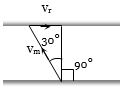
$A$ person aiming to reach the exactly opposite point on the bank of a stream is swimming with a speed of $0.5\, m/s$ at an angle of $120^\circ$ with the direction of flow of water. The speed of water in the stream is..........$m/s$.
A
$1$
B
$0.5$
C
$0.25$
D
$0.43$
Solution
(C) Let $v_m$ be the velocity of the man and $v_r$ be the velocity of the river flow.
The man swims at an angle of $120^\circ$ with the direction of the river flow to reach the exactly opposite point.
This means the component of the man's velocity along the river flow must cancel out the river's velocity.
The angle between the man's velocity vector and the line perpendicular to the bank is $120^\circ - 90^\circ = 30^\circ$.
Thus,the horizontal component of the man's velocity is $v_m \sin(30^\circ)$.
For the man to reach the opposite point,this horizontal component must be equal to the river's velocity:
$v_r = v_m \sin(30^\circ)$
Given $v_m = 0.5\, m/s$ and $\sin(30^\circ) = 0.5$,
$v_r = 0.5 \times 0.5 = 0.25\, m/s$.
The man swims at an angle of $120^\circ$ with the direction of the river flow to reach the exactly opposite point.
This means the component of the man's velocity along the river flow must cancel out the river's velocity.
The angle between the man's velocity vector and the line perpendicular to the bank is $120^\circ - 90^\circ = 30^\circ$.
Thus,the horizontal component of the man's velocity is $v_m \sin(30^\circ)$.
For the man to reach the opposite point,this horizontal component must be equal to the river's velocity:
$v_r = v_m \sin(30^\circ)$
Given $v_m = 0.5\, m/s$ and $\sin(30^\circ) = 0.5$,
$v_r = 0.5 \times 0.5 = 0.25\, m/s$.
2 likesView Solution
4
PhysicsEasyMCQAIPMT · 1999
Two racing cars of masses $m_1$ and $m_2$ are moving in circles of radii $r_1$ and $r_2$ respectively. Their speeds are such that each makes a complete circle in the same duration of time $T$. The ratio of the angular speed of the first to the second car is
A
$m_1:m_2$
B
$r_1:r_2$
C
$1:1$
D
$m_1r_1:m_2r_2$
Solution
(C) The angular speed $\omega$ of an object moving in a circular path is defined as the rate of change of angular displacement,given by the formula $\omega = \frac{2\pi}{T}$,where $T$ is the time period of one complete revolution.
Since both cars complete their respective circles in the same duration of time $T$,their time periods are equal.
Therefore,the ratio of their angular speeds is $\frac{\omega_1}{\omega_2} = \frac{2\pi / T}{2\pi / T} = 1:1$.
Thus,the correct option is $C$.
Since both cars complete their respective circles in the same duration of time $T$,their time periods are equal.
Therefore,the ratio of their angular speeds is $\frac{\omega_1}{\omega_2} = \frac{2\pi / T}{2\pi / T} = 1:1$.
Thus,the correct option is $C$.
0 likesView Solution
5
PhysicsEasyMCQAIPMT · 1999
$A$ $500 \, kg$ car takes a round turn of radius $50 \, m$ with a velocity of $36 \, km/hr$. The centripetal force is .......... $N$.
A
$250$
B
$750$
C
$1000$
D
$1200$
Solution
(C) Given:
Mass $m = 500 \, kg$
Radius $r = 50 \, m$
Velocity $v = 36 \, km/hr$
First,convert the velocity into $SI$ units $(m/s)$:
$v = 36 \times \frac{5}{18} = 10 \, m/s$
The formula for centripetal force is $F = \frac{mv^2}{r}$.
Substituting the values:
$F = \frac{500 \times (10)^2}{50}$
$F = \frac{500 \times 100}{50}$
$F = 10 \times 100 = 1000 \, N$.
Therefore,the centripetal force is $1000 \, N$.
Mass $m = 500 \, kg$
Radius $r = 50 \, m$
Velocity $v = 36 \, km/hr$
First,convert the velocity into $SI$ units $(m/s)$:
$v = 36 \times \frac{5}{18} = 10 \, m/s$
The formula for centripetal force is $F = \frac{mv^2}{r}$.
Substituting the values:
$F = \frac{500 \times (10)^2}{50}$
$F = \frac{500 \times 100}{50}$
$F = 10 \times 100 = 1000 \, N$.
Therefore,the centripetal force is $1000 \, N$.
0 likesView Solution
6
PhysicsEasyMCQAIPMT · 1999
If the force on a rocket having an exhaust velocity of $300 \, m/s$ is $210 \, N$,then the rate of combustion of the fuel is ........... $kg/s$.
A
$0.7$
B
$1.4$
C
$0.07$
D
$10.7$
Solution
(A) The thrust force $F$ acting on a rocket is given by the formula:
$F = u \left( \frac{dm}{dt} \right)$
where $u$ is the exhaust velocity and $\frac{dm}{dt}$ is the rate of combustion of fuel.
Given:
$F = 210 \, N$
$u = 300 \, m/s$
Rearranging the formula to solve for $\frac{dm}{dt}$:
$\frac{dm}{dt} = \frac{F}{u}$
Substituting the values:
$\frac{dm}{dt} = \frac{210}{300} = 0.7 \, kg/s$
Therefore,the rate of combustion of the fuel is $0.7 \, kg/s$.
$F = u \left( \frac{dm}{dt} \right)$
where $u$ is the exhaust velocity and $\frac{dm}{dt}$ is the rate of combustion of fuel.
Given:
$F = 210 \, N$
$u = 300 \, m/s$
Rearranging the formula to solve for $\frac{dm}{dt}$:
$\frac{dm}{dt} = \frac{F}{u}$
Substituting the values:
$\frac{dm}{dt} = \frac{210}{300} = 0.7 \, kg/s$
Therefore,the rate of combustion of the fuel is $0.7 \, kg/s$.
0 likesView Solution
7
PhysicsEasyMCQAIPMT · 1999
Two bodies with kinetic energies in the ratio of $4 : 1$ are moving with equal linear momentum. The ratio of their masses is
A
$1:2$
B
$1:1$
C
$4:1$
D
$1:4$
Solution
(D) The kinetic energy $E$ of a body with mass $m$ and linear momentum $p$ is given by the relation: $E = \frac{p^2}{2m}$.
Since the linear momentum $p$ is constant for both bodies,we have $E \propto \frac{1}{m}$,which implies $m \propto \frac{1}{E}$.
Given the ratio of kinetic energies is $\frac{E_1}{E_2} = \frac{4}{1}$.
Therefore,the ratio of their masses is $\frac{m_1}{m_2} = \frac{E_2}{E_1} = \frac{1}{4}$.
Thus,the ratio of their masses is $1:4$.
Since the linear momentum $p$ is constant for both bodies,we have $E \propto \frac{1}{m}$,which implies $m \propto \frac{1}{E}$.
Given the ratio of kinetic energies is $\frac{E_1}{E_2} = \frac{4}{1}$.
Therefore,the ratio of their masses is $\frac{m_1}{m_2} = \frac{E_2}{E_1} = \frac{1}{4}$.
Thus,the ratio of their masses is $1:4$.
0 likesView Solution
8
PhysicsEasyMCQAIPMT · 1999
The escape velocity of a sphere of mass $m$ is given by ($G =$ Universal gravitational constant; $M_e =$ Mass of the earth and $R_e =$ Radius of the earth).
A
$\sqrt{\frac{2GM_e}{R_e}}$
B
$\frac{GM_e}{R_e^2}$
C
$\sqrt{\frac{2Gm}{R_e}}$
D
$\sqrt{\frac{GM_e}{R_e}}$
Solution
(A) The escape velocity $v_e$ of an object from the surface of the Earth is the minimum velocity required for the object to escape the Earth's gravitational field.
It is derived by equating the kinetic energy of the object to the magnitude of its gravitational potential energy at the Earth's surface: $\frac{1}{2}mv_e^2 = \frac{GM_em}{R_e}$.
Solving for $v_e$,we get $v_e = \sqrt{\frac{2GM_e}{R_e}}$.
Note that the mass of the object $m$ cancels out,meaning the escape velocity is independent of the mass of the projectile.
It is derived by equating the kinetic energy of the object to the magnitude of its gravitational potential energy at the Earth's surface: $\frac{1}{2}mv_e^2 = \frac{GM_em}{R_e}$.
Solving for $v_e$,we get $v_e = \sqrt{\frac{2GM_e}{R_e}}$.
Note that the mass of the object $m$ cancels out,meaning the escape velocity is independent of the mass of the projectile.
0 likesView Solution
9
PhysicsEasyMCQAIPMT · 1999
The degrees of freedom of a triatomic gas is
A
$2$
B
$4$
C
$6$
D
$8$
Solution
(C) For a non-linear triatomic gas molecule,the degrees of freedom $(f)$ is calculated as follows:
$1$. Translational degrees of freedom: $3$ (along $x, y, z$ axes).
$2$. Rotational degrees of freedom: $3$ (about $x, y, z$ axes).
Therefore,the total degrees of freedom $f = 3 + 3 = 6$.
$1$. Translational degrees of freedom: $3$ (along $x, y, z$ axes).
$2$. Rotational degrees of freedom: $3$ (about $x, y, z$ axes).
Therefore,the total degrees of freedom $f = 3 + 3 = 6$.
0 likesView Solution
10
PhysicsMediumMCQAIPMT · 1999
An ideal gas at $27^{\circ}C$ is compressed adiabatically to $\frac{8}{27}$ of its original volume. If $\gamma = \frac{5}{3}$,then the rise in temperature is ........ $K$.
A
$450$
B
$375$
C
$225$
D
$405$
Solution
(B) For an adiabatic process,the relationship between temperature and volume is given by $T_1 V_1^{\gamma-1} = T_2 V_2^{\gamma-1}$.
Given: Initial temperature $T_1 = 27^{\circ}C = 27 + 273 = 300 \ K$.
Final volume $V_2 = \frac{8}{27} V_1$,so $\frac{V_1}{V_2} = \frac{27}{8}$.
Adiabatic index $\gamma = \frac{5}{3}$,so $\gamma - 1 = \frac{5}{3} - 1 = \frac{2}{3}$.
Using the formula $T_2 = T_1 \left( \frac{V_1}{V_2} \right)^{\gamma-1}$:
$T_2 = 300 \times \left( \frac{27}{8} \right)^{2/3}$.
$T_2 = 300 \times \left( \left( \frac{27}{8} \right)^{1/3} \right)^2 = 300 \times \left( \frac{3}{2} \right)^2$.
$T_2 = 300 \times \frac{9}{4} = 75 \times 9 = 675 \ K$.
The rise in temperature is $\Delta T = T_2 - T_1 = 675 - 300 = 375 \ K$.
Given: Initial temperature $T_1 = 27^{\circ}C = 27 + 273 = 300 \ K$.
Final volume $V_2 = \frac{8}{27} V_1$,so $\frac{V_1}{V_2} = \frac{27}{8}$.
Adiabatic index $\gamma = \frac{5}{3}$,so $\gamma - 1 = \frac{5}{3} - 1 = \frac{2}{3}$.
Using the formula $T_2 = T_1 \left( \frac{V_1}{V_2} \right)^{\gamma-1}$:
$T_2 = 300 \times \left( \frac{27}{8} \right)^{2/3}$.
$T_2 = 300 \times \left( \left( \frac{27}{8} \right)^{1/3} \right)^2 = 300 \times \left( \frac{3}{2} \right)^2$.
$T_2 = 300 \times \frac{9}{4} = 75 \times 9 = 675 \ K$.
The rise in temperature is $\Delta T = T_2 - T_1 = 675 - 300 = 375 \ K$.
0 likesView Solution
11
PhysicsEasyMCQAIPMT · 1999
The time period of a simple pendulum is $2 \, sec$. If its length is increased $4$ times,then its period becomes ..... $\sec$.
A
$16$
B
$12$
C
$8$
D
$4$
Solution
(D) The time period $T$ of a simple pendulum is given by the formula $T = 2\pi \sqrt{\frac{l}{g}}$,where $l$ is the length of the pendulum and $g$ is the acceleration due to gravity.
From this formula,we can see that $T \propto \sqrt{l}$.
Let the initial length be $l_1 = l$ and the initial time period be $T_1 = 2 \, sec$.
Let the new length be $l_2 = 4l$ and the new time period be $T_2$.
Using the ratio method: $\frac{T_1}{T_2} = \sqrt{\frac{l_1}{l_2}}$.
Substituting the values: $\frac{2}{T_2} = \sqrt{\frac{l}{4l}} = \sqrt{\frac{1}{4}} = \frac{1}{2}$.
Therefore,$T_2 = 2 \times 2 = 4 \, sec$.
From this formula,we can see that $T \propto \sqrt{l}$.
Let the initial length be $l_1 = l$ and the initial time period be $T_1 = 2 \, sec$.
Let the new length be $l_2 = 4l$ and the new time period be $T_2$.
Using the ratio method: $\frac{T_1}{T_2} = \sqrt{\frac{l_1}{l_2}}$.
Substituting the values: $\frac{2}{T_2} = \sqrt{\frac{l}{4l}} = \sqrt{\frac{1}{4}} = \frac{1}{2}$.
Therefore,$T_2 = 2 \times 2 = 4 \, sec$.
0 likesView Solution
12
PhysicsMediumMCQAIPMT · 1999
Two waves of lengths $50 \; cm$ and $51 \; cm$ produce $12$ beats per second. The velocity of sound is .... $m/s$.
A
$306$
B
$331$
C
$340$
D
$360$
Solution
(A) The frequency of a wave is given by $n = \frac{v}{\lambda}$,where $v$ is the velocity and $\lambda$ is the wavelength.
Given wavelengths are $\lambda_1 = 50 \; cm = 0.50 \; m$ and $\lambda_2 = 51 \; cm = 0.51 \; m$.
The frequencies are $n_1 = \frac{v}{0.50}$ and $n_2 = \frac{v}{0.51}$.
The beat frequency is the difference between the two frequencies: $\Delta n = n_1 - n_2 = 12 \; Hz$.
Substituting the values: $v \left( \frac{1}{0.50} - \frac{1}{0.51} \right) = 12$.
$v \left( \frac{0.51 - 0.50}{0.50 \times 0.51} \right) = 12$.
$v \left( \frac{0.01}{0.255} \right) = 12$.
$v = \frac{12 \times 0.255}{0.01} = 12 \times 25.5 = 306 \; m/s$.
Given wavelengths are $\lambda_1 = 50 \; cm = 0.50 \; m$ and $\lambda_2 = 51 \; cm = 0.51 \; m$.
The frequencies are $n_1 = \frac{v}{0.50}$ and $n_2 = \frac{v}{0.51}$.
The beat frequency is the difference between the two frequencies: $\Delta n = n_1 - n_2 = 12 \; Hz$.
Substituting the values: $v \left( \frac{1}{0.50} - \frac{1}{0.51} \right) = 12$.
$v \left( \frac{0.51 - 0.50}{0.50 \times 0.51} \right) = 12$.
$v \left( \frac{0.01}{0.255} \right) = 12$.
$v = \frac{12 \times 0.255}{0.01} = 12 \times 25.5 = 306 \; m/s$.
0 likesView Solution
13
PhysicsMediumMCQAIPMT · 1999
Coefficient of linear expansion of brass and steel rods are $\alpha_1$ and $\alpha_2$. Lengths of brass and steel rods are $l_1$ and $l_2$ respectively. If $(l_2 - l_1)$ is maintained same at all temperatures,which one of the following relations holds good?
A
$\alpha_1 l_2^2 = \alpha_2 l_1^2$
B
$\alpha_1^2 l_2 = \alpha_2^2 l_1$
C
$\alpha_1 l_1 = \alpha_2 l_2$
D
$\alpha_1 l_2 = \alpha_2 l_1$
Solution
(C) Let the lengths of the brass and steel rods at temperature $T$ be $L_1$ and $L_2$ respectively.
After a change in temperature $\Delta T$,the new lengths are:
$L_1' = l_1(1 + \alpha_1 \Delta T)$
$L_2' = l_2(1 + \alpha_2 \Delta T)$
Given that the difference $(L_2' - L_1')$ remains constant and equal to $(l_2 - l_1)$ at all temperatures:
$L_2' - L_1' = l_2 - l_1$
$l_2(1 + \alpha_2 \Delta T) - l_1(1 + \alpha_1 \Delta T) = l_2 - l_1$
$l_2 + l_2 \alpha_2 \Delta T - l_1 - l_1 \alpha_1 \Delta T = l_2 - l_1$
$(l_2 - l_1) + \Delta T(l_2 \alpha_2 - l_1 \alpha_1) = l_2 - l_1$
For this to hold for any $\Delta T$,the coefficient of $\Delta T$ must be zero:
$l_2 \alpha_2 - l_1 \alpha_1 = 0$
$\alpha_1 l_1 = \alpha_2 l_2$
After a change in temperature $\Delta T$,the new lengths are:
$L_1' = l_1(1 + \alpha_1 \Delta T)$
$L_2' = l_2(1 + \alpha_2 \Delta T)$
Given that the difference $(L_2' - L_1')$ remains constant and equal to $(l_2 - l_1)$ at all temperatures:
$L_2' - L_1' = l_2 - l_1$
$l_2(1 + \alpha_2 \Delta T) - l_1(1 + \alpha_1 \Delta T) = l_2 - l_1$
$l_2 + l_2 \alpha_2 \Delta T - l_1 - l_1 \alpha_1 \Delta T = l_2 - l_1$
$(l_2 - l_1) + \Delta T(l_2 \alpha_2 - l_1 \alpha_1) = l_2 - l_1$
For this to hold for any $\Delta T$,the coefficient of $\Delta T$ must be zero:
$l_2 \alpha_2 - l_1 \alpha_1 = 0$
$\alpha_1 l_1 = \alpha_2 l_2$
0 likesView Solution
14
PhysicsEasyMCQAIPMT · 1999
Three identical metal balls,each of radius $r$,are placed touching each other on a horizontal surface such that an equilateral triangle is formed when the centres of the three balls are joined. The centre of mass of the system is located at:
A
horizontal surface
B
centre of one of the balls
C
line joining centres of any two balls
D
point of intersection of the medians
Solution
(D) The centre of mass of each individual ball is located at its geometric centre.
Since the three balls are identical and their centres form an equilateral triangle,the system is symmetric.
The centre of mass of a system of particles is the weighted average of the positions of the individual centres of mass.
For three identical masses placed at the vertices of an equilateral triangle,the centre of mass coincides with the centroid of the triangle.
The centroid of an equilateral triangle is the point of intersection of its medians.
Since the three balls are identical and their centres form an equilateral triangle,the system is symmetric.
The centre of mass of a system of particles is the weighted average of the positions of the individual centres of mass.
For three identical masses placed at the vertices of an equilateral triangle,the centre of mass coincides with the centroid of the triangle.
The centroid of an equilateral triangle is the point of intersection of its medians.
0 likesView Solution
15
PhysicsMediumMCQAIPMT · 1999
The moment of inertia of a disc of mass $M$ and radius $R$ about a tangent to its rim in its plane is
A
$ \frac{5}{4}MR^2 $
B
$ \frac{2}{3}MR^2 $
C
$ \frac{3}{2}MR^2 $
D
$ \frac{4}{5}MR^2 $
Solution
(A) The moment of inertia of a disc about its diameter is $I_{diameter} = \frac{1}{4}MR^2$.
According to the parallel axis theorem,the moment of inertia about an axis parallel to the diameter and passing through the rim (tangent in the plane) is given by $I = I_{cm} + Md^2$.
Here,the distance $d$ between the diameter and the tangent is $R$.
Substituting the values,we get $I = \frac{1}{4}MR^2 + MR^2 = \frac{5}{4}MR^2$.
According to the parallel axis theorem,the moment of inertia about an axis parallel to the diameter and passing through the rim (tangent in the plane) is given by $I = I_{cm} + Md^2$.
Here,the distance $d$ between the diameter and the tangent is $R$.
Substituting the values,we get $I = \frac{1}{4}MR^2 + MR^2 = \frac{5}{4}MR^2$.
1 likesView Solution
16
PhysicsMediumMCQAIPMT · 1999
If $1\; g$ of steam at $100^{\circ}C$ is mixed with $1\; g$ of ice at $0^{\circ}C$,then the resultant temperature of the mixture is ........ $^{\circ}C$.
A
$100$
B
$50$
C
$230$
D
$270$
Solution
(A) Let us calculate the heat required to convert $1\; g$ of ice at $0^{\circ}C$ to water at $100^{\circ}C$:
Heat to melt ice: $Q_1 = m L_f = 1\; g \times 80\; cal/g = 80\; cal$.
Heat to raise water temperature from $0^{\circ}C$ to $100^{\circ}C$: $Q_2 = m c \Delta T = 1\; g \times 1\; cal/g^{\circ}C \times 100^{\circ}C = 100\; cal$.
Total heat required by ice: $Q_{total} = 80 + 100 = 180\; cal$.
Now,calculate the heat released by $1\; g$ of steam at $100^{\circ}C$ to condense into water at $100^{\circ}C$:
Heat released: $Q_{steam} = m L_v = 1\; g \times 540\; cal/g = 540\; cal$.
Since the heat released by steam $(540\; cal)$ is greater than the heat required by ice $(180\; cal)$,the final mixture will be at $100^{\circ}C$ with some steam remaining condensed as water.
Heat to melt ice: $Q_1 = m L_f = 1\; g \times 80\; cal/g = 80\; cal$.
Heat to raise water temperature from $0^{\circ}C$ to $100^{\circ}C$: $Q_2 = m c \Delta T = 1\; g \times 1\; cal/g^{\circ}C \times 100^{\circ}C = 100\; cal$.
Total heat required by ice: $Q_{total} = 80 + 100 = 180\; cal$.
Now,calculate the heat released by $1\; g$ of steam at $100^{\circ}C$ to condense into water at $100^{\circ}C$:
Heat released: $Q_{steam} = m L_v = 1\; g \times 540\; cal/g = 540\; cal$.
Since the heat released by steam $(540\; cal)$ is greater than the heat required by ice $(180\; cal)$,the final mixture will be at $100^{\circ}C$ with some steam remaining condensed as water.
0 likesView Solution
17
PhysicsMediumMCQAIPMT · 1999
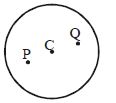
$A$ disc is rolling (without slipping) on a horizontal surface. $C$ is its centre and $Q$ and $P$ are two points on the same horizontal line passing through $C$,such that $Q$ is at a distance $r$ from $C$ and $P$ is at a distance $r$ from $C$ on the opposite side. Let $V_P, V_Q$ and $V_C$ be the magnitudes of velocities of points $P, Q$ and $C$ respectively,then:
A
$V_Q > V_C > V_P$
B
$V_Q < V_C < V_P$
C
$V_Q = V_P, V_C = \frac{1}{2} V_P$
D
$V_Q = V_C = V_P$
Solution
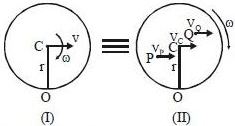
(A) rolling motion can be considered as a combination of pure translation of the centre of mass $C$ with velocity $V_C = R\omega$ and pure rotation about the centre $C$ with angular velocity $\omega$.
For any point at a distance $r$ from the centre $C$,the velocity due to rotation is $v_{rot} = r\omega$.
The velocity of any point is the vector sum of the translational velocity $\vec{V}_C$ and the rotational velocity $\vec{v}_{rot}$.
For points $P$ and $Q$ on the horizontal diameter:
$1$. At point $Q$,the rotational velocity is in the same direction as the translational velocity. Thus,$V_Q = V_C + r\omega = R\omega + r\omega = (R+r)\omega$.
$2$. At point $P$,the rotational velocity is in the opposite direction to the translational velocity. Thus,$V_P = |V_C - r\omega| = |R\omega - r\omega| = (R-r)\omega$.
Since $R > r$,we have $V_Q > V_C > V_P$.
For any point at a distance $r$ from the centre $C$,the velocity due to rotation is $v_{rot} = r\omega$.
The velocity of any point is the vector sum of the translational velocity $\vec{V}_C$ and the rotational velocity $\vec{v}_{rot}$.
For points $P$ and $Q$ on the horizontal diameter:
$1$. At point $Q$,the rotational velocity is in the same direction as the translational velocity. Thus,$V_Q = V_C + r\omega = R\omega + r\omega = (R+r)\omega$.
$2$. At point $P$,the rotational velocity is in the opposite direction to the translational velocity. Thus,$V_P = |V_C - r\omega| = |R\omega - r\omega| = (R-r)\omega$.
Since $R > r$,we have $V_Q > V_C > V_P$.
0 likesView Solution
18
PhysicsMediumMCQAIPMT · 1999
The dimensional formula of magnetic flux is:
A
$[M L^2 T^{-2} A^{-1}]$
B
$[M L^0 T^{-2} A^{-2}]$
C
$[M^0 L^{-2} T^{-2} A^{-3}]$
D
$[M L^2 T^{-2} A^3]$
Solution
(A) Magnetic flux $\phi$ is defined as the product of magnetic field $B$ and area $A$,i.e.,$\phi = B \cdot A$.
From the Lorentz force formula,$F = B I L$,we can write $B = \frac{F}{I L}$.
Substituting the dimensions of force $[F] = [M L T^{-2}]$,current $[I] = [A]$,and length $[L] = [L]$,we get the dimensions of $B$ as $[B] = \frac{[M L T^{-2}]}{[A] [L]} = [M T^{-2} A^{-1}]$.
Now,the dimensions of magnetic flux $\phi$ are $[B] \times [A] = [M T^{-2} A^{-1}] \times [L^2] = [M L^2 T^{-2} A^{-1}]$.
From the Lorentz force formula,$F = B I L$,we can write $B = \frac{F}{I L}$.
Substituting the dimensions of force $[F] = [M L T^{-2}]$,current $[I] = [A]$,and length $[L] = [L]$,we get the dimensions of $B$ as $[B] = \frac{[M L T^{-2}]}{[A] [L]} = [M T^{-2} A^{-1}]$.
Now,the dimensions of magnetic flux $\phi$ are $[B] \times [A] = [M T^{-2} A^{-1}] \times [L^2] = [M L^2 T^{-2} A^{-1}]$.
0 likesView Solution
19
PhysicsEasyMCQAIPMT · 1999
When air is replaced by a dielectric medium of constant $k$,the maximum force of attraction between two charges separated by a distance $r$:
A
becomes $k^{-1}$ times
B
remains unchanged
C
increases $k$ times
D
becomes $k$ times
Solution
(A) The force between two charges $q_1$ and $q_2$ separated by a distance $r$ in air is given by $F = \frac{1}{4\pi \varepsilon_0} \frac{q_1 q_2}{r^2}$.
When the medium is replaced by a dielectric of constant $k$,the permittivity of the medium becomes $\varepsilon = k \varepsilon_0$.
The new force $F'$ is given by $F' = \frac{1}{4\pi \varepsilon} \frac{q_1 q_2}{r^2} = \frac{1}{4\pi k \varepsilon_0} \frac{q_1 q_2}{r^2}$.
Therefore,$F' = \frac{F}{k} = k^{-1} F$.
Since $k > 1$ for any dielectric medium,the force decreases and becomes $k^{-1}$ times the original force.
When the medium is replaced by a dielectric of constant $k$,the permittivity of the medium becomes $\varepsilon = k \varepsilon_0$.
The new force $F'$ is given by $F' = \frac{1}{4\pi \varepsilon} \frac{q_1 q_2}{r^2} = \frac{1}{4\pi k \varepsilon_0} \frac{q_1 q_2}{r^2}$.
Therefore,$F' = \frac{F}{k} = k^{-1} F$.
Since $k > 1$ for any dielectric medium,the force decreases and becomes $k^{-1}$ times the original force.
1 likesView Solution
20
PhysicsEasyMCQAIPMT · 1999
When a proton is accelerated through $1\,V$,then its kinetic energy will be.....$eV$.
A
$1840$
B
$13.6$
C
$1$
D
$0.54$
Solution
(C) The kinetic energy gained by a charged particle accelerated through a potential difference $V$ is given by the formula $\Delta KE = qV$.
For a proton,the charge $q = e$.
Given the potential difference $V = 1\,V$.
Substituting these values,we get $\Delta KE = e \times 1\,V = 1\,eV$.
Therefore,the kinetic energy of the proton is $1\,eV$.
For a proton,the charge $q = e$.
Given the potential difference $V = 1\,V$.
Substituting these values,we get $\Delta KE = e \times 1\,V = 1\,eV$.
Therefore,the kinetic energy of the proton is $1\,eV$.
0 likesView Solution
21
PhysicsEasyMCQAIPMT · 1999
When one electron is moved towards another electron,the electric potential energy of the system:
A
Decreases
B
Increases
C
Remains unchanged
D
Becomes zero
Solution
(B) The electric potential energy $U$ of a system of two point charges $q_1$ and $q_2$ separated by a distance $r$ is given by $U = \frac{1}{4\pi\varepsilon_0} \frac{q_1 q_2}{r}$.
For two electrons,$q_1 = -e$ and $q_2 = -e$,so the potential energy is $U = \frac{e^2}{4\pi\varepsilon_0 r}$.
When one electron is moved towards the other,the separation distance $r$ decreases.
Since $U \propto \frac{1}{r}$,as the distance $r$ decreases,the potential energy $U$ increases.
For two electrons,$q_1 = -e$ and $q_2 = -e$,so the potential energy is $U = \frac{e^2}{4\pi\varepsilon_0 r}$.
When one electron is moved towards the other,the separation distance $r$ decreases.
Since $U \propto \frac{1}{r}$,as the distance $r$ decreases,the potential energy $U$ increases.
0 likesView Solution
22
PhysicsEasyMCQAIPMT · 1999
$A$ parallel plate capacitor with oil between the plates (dielectric constant of oil $K = 2$) has a capacitance $C$. If the oil is removed,then the capacitance of the capacitor becomes:
A
$\sqrt{2} C$
B
$2C$
C
$\frac{C}{\sqrt{2}}$
D
$\frac{C}{2}$
Solution
(D) The capacitance of a parallel plate capacitor filled with a dielectric medium is given by $C_{medium} = \frac{K \epsilon_0 A}{d} = KC_0$,where $C_0$ is the capacitance with air/vacuum between the plates.
Given that $C_{medium} = C$ and $K = 2$,we have $C = 2C_0$.
Therefore,the capacitance with air (when oil is removed) is $C_0 = \frac{C}{2}$.
Thus,the correct option is $D$.
Given that $C_{medium} = C$ and $K = 2$,we have $C = 2C_0$.
Therefore,the capacitance with air (when oil is removed) is $C_0 = \frac{C}{2}$.
Thus,the correct option is $D$.
0 likesView Solution
23
PhysicsMediumMCQAIPMT · 1999
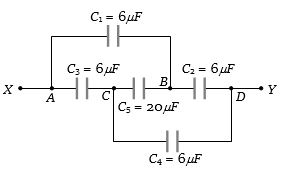
What is the effective capacitance between points $X$ and $Y$ in $\mu F$?
A
$24$
B
$18$
C
$12$
D
$6$
Solution
(D) The given circuit can be analyzed by identifying the nodes. The capacitors $C_1, C_2, C_3, C_4$ are all equal to $6\,\mu F$.
By observing the circuit,we can see that it forms a Wheatstone bridge structure between points $A, B, C,$ and $D$.
Specifically,the ratio of capacitances $\frac{C_1}{C_3} = \frac{6}{6} = 1$ and $\frac{C_2}{C_4} = \frac{6}{6} = 1$.
Since the ratios are equal,the bridge is balanced.
In a balanced Wheatstone bridge,the potential difference across the central capacitor $C_5$ is zero,so no charge flows through it.
Thus,$C_5$ can be removed from the circuit.
Now,the circuit consists of two parallel branches: one with $C_1$ and $C_2$ in series,and the other with $C_3$ and $C_4$ in series.
Equivalent capacitance of the upper branch $(C_{upper})$ = $\frac{C_1 \times C_2}{C_1 + C_2} = \frac{6 \times 6}{6 + 6} = \frac{36}{12} = 3\,\mu F$.
Equivalent capacitance of the lower branch $(C_{lower})$ = $\frac{C_3 \times C_4}{C_3 + C_4} = \frac{6 \times 6}{6 + 6} = \frac{36}{12} = 3\,\mu F$.
Since these two branches are in parallel,the total effective capacitance $C_{eq} = C_{upper} + C_{lower} = 3 + 3 = 6\,\mu F$.
By observing the circuit,we can see that it forms a Wheatstone bridge structure between points $A, B, C,$ and $D$.
Specifically,the ratio of capacitances $\frac{C_1}{C_3} = \frac{6}{6} = 1$ and $\frac{C_2}{C_4} = \frac{6}{6} = 1$.
Since the ratios are equal,the bridge is balanced.
In a balanced Wheatstone bridge,the potential difference across the central capacitor $C_5$ is zero,so no charge flows through it.
Thus,$C_5$ can be removed from the circuit.
Now,the circuit consists of two parallel branches: one with $C_1$ and $C_2$ in series,and the other with $C_3$ and $C_4$ in series.
Equivalent capacitance of the upper branch $(C_{upper})$ = $\frac{C_1 \times C_2}{C_1 + C_2} = \frac{6 \times 6}{6 + 6} = \frac{36}{12} = 3\,\mu F$.
Equivalent capacitance of the lower branch $(C_{lower})$ = $\frac{C_3 \times C_4}{C_3 + C_4} = \frac{6 \times 6}{6 + 6} = \frac{36}{12} = 3\,\mu F$.
Since these two branches are in parallel,the total effective capacitance $C_{eq} = C_{upper} + C_{lower} = 3 + 3 = 6\,\mu F$.
0 likesView Solution
24
PhysicsEasyMCQAIPMT · 1999
The resistance of a discharge tube is
A
Ohmic
B
Non-ohmic
C
infinity
D
Zero
Solution
(B) discharge tube does not follow Ohm's law,which states that the current is directly proportional to the potential difference for a constant resistance. In a discharge tube,the current-voltage $(I-V)$ relationship is non-linear due to the process of secondary ionization of the gas particles inside the tube. As the potential difference increases,the number of charge carriers increases significantly,causing the resistance to change. Therefore,it is classified as a non-ohmic device.
0 likesView Solution
25
PhysicsMediumMCQAIPMT · 1999
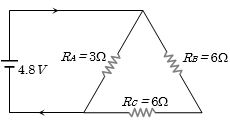
The current in the given circuit is ............ $A$.
A
$8.31$
B
$6.82$
C
$4.92$
D
$2$
Solution
(D) From the circuit diagram,the resistors $R_B = 6 \, \Omega$ and $R_C = 6 \, \Omega$ are connected in series.
Their equivalent resistance is $R_{BC} = 6 \, \Omega + 6 \, \Omega = 12 \, \Omega$.
This combination $R_{BC}$ is in parallel with resistor $R_A = 3 \, \Omega$.
The equivalent resistance $R_{eq}$ of the circuit is given by $\frac{1}{R_{eq}} = \frac{1}{R_A} + \frac{1}{R_{BC}} = \frac{1}{3} + \frac{1}{12} = \frac{4 + 1}{12} = \frac{5}{12} \, \Omega^{-1}$.
Thus,$R_{eq} = \frac{12}{5} = 2.4 \, \Omega$.
The total current $I$ in the circuit is $I = \frac{V}{R_{eq}} = \frac{4.8 \, V}{2.4 \, \Omega} = 2 \, A$.
Their equivalent resistance is $R_{BC} = 6 \, \Omega + 6 \, \Omega = 12 \, \Omega$.
This combination $R_{BC}$ is in parallel with resistor $R_A = 3 \, \Omega$.
The equivalent resistance $R_{eq}$ of the circuit is given by $\frac{1}{R_{eq}} = \frac{1}{R_A} + \frac{1}{R_{BC}} = \frac{1}{3} + \frac{1}{12} = \frac{4 + 1}{12} = \frac{5}{12} \, \Omega^{-1}$.
Thus,$R_{eq} = \frac{12}{5} = 2.4 \, \Omega$.
The total current $I$ in the circuit is $I = \frac{V}{R_{eq}} = \frac{4.8 \, V}{2.4 \, \Omega} = 2 \, A$.
1 likesView Solution
26
PhysicsMediumMCQAIPMT · 1999
$A$ cell whose e.m.f. is $2\, V$ and internal resistance is $0.1\,\Omega$ is connected with a resistance of $3.9\,\Omega$. The voltage across the cell terminal will be ................ $V$.
A
$0.50$
B
$1.90$
C
$1.95$
D
$2.00$
Solution
(C) The electromotive force $(E)$ of the cell is $2\, V$.
The internal resistance $(r)$ of the cell is $0.1\,\Omega$.
The external resistance $(R)$ connected is $3.9\,\Omega$.
The total resistance of the circuit is $R_{total} = R + r = 3.9\,\Omega + 0.1\,\Omega = 4.0\,\Omega$.
The current $(I)$ flowing through the circuit is given by Ohm's law: $I = \frac{E}{R + r} = \frac{2\, V}{4.0\,\Omega} = 0.5\, A$.
The terminal voltage $(V)$ across the cell is given by $V = I \times R$.
Substituting the values: $V = 0.5\, A \times 3.9\,\Omega = 1.95\, V$.
The internal resistance $(r)$ of the cell is $0.1\,\Omega$.
The external resistance $(R)$ connected is $3.9\,\Omega$.
The total resistance of the circuit is $R_{total} = R + r = 3.9\,\Omega + 0.1\,\Omega = 4.0\,\Omega$.
The current $(I)$ flowing through the circuit is given by Ohm's law: $I = \frac{E}{R + r} = \frac{2\, V}{4.0\,\Omega} = 0.5\, A$.
The terminal voltage $(V)$ across the cell is given by $V = I \times R$.
Substituting the values: $V = 0.5\, A \times 3.9\,\Omega = 1.95\, V$.
0 likesView Solution
27
PhysicsEasyMCQAIPMT · 1999
$A$ potentiometer consists of a wire of length $4\, m$ and resistance $10\,\Omega$. It is connected to a cell of $e.m.f.$ $2\, V$. The potential difference per unit length of the wire will be ............. $V/m$.
A
$0.5$
B
$2$
C
$5$
D
$10$
Solution
(A) The potential difference across the entire length of the potentiometer wire is equal to the $e.m.f.$ of the connected cell,which is $2\, V$.
The potential gradient (potential difference per unit length) is given by the formula:
Potential gradient $= \frac{V}{L}$
Where $V = 2\, V$ and $L = 4\, m$.
Therefore,the potential difference per unit length $= \frac{2\, V}{4\, m} = 0.5\, V/m$.
The potential gradient (potential difference per unit length) is given by the formula:
Potential gradient $= \frac{V}{L}$
Where $V = 2\, V$ and $L = 4\, m$.
Therefore,the potential difference per unit length $= \frac{2\, V}{4\, m} = 0.5\, V/m$.
0 likesView Solution
28
PhysicsEasyMCQAIPMT · 1999
In a meter bridge,the balancing length from the left end (standard resistance of $1 \, \Omega$ is in the right gap) is found to be $20 \, cm$. The value of the unknown resistance is ............... $\Omega$.
A
$0.8$
B
$0.5$
C
$0.4$
D
$0.25$
Solution
(D) In a meter bridge,the balancing condition is given by the formula $\frac{X}{R} = \frac{l}{100 - l}$,where $X$ is the unknown resistance,$R$ is the known resistance,and $l$ is the balancing length from the left end.
Given: $R = 1 \, \Omega$ and $l = 20 \, cm$.
The total length of the wire is $100 \, cm$,so the remaining length is $100 - 20 = 80 \, cm$.
Substituting the values into the formula: $\frac{X}{1} = \frac{20}{80}$.
Simplifying the fraction: $\frac{X}{1} = \frac{1}{4}$.
Therefore,$X = 0.25 \, \Omega$.
Given: $R = 1 \, \Omega$ and $l = 20 \, cm$.
The total length of the wire is $100 \, cm$,so the remaining length is $100 - 20 = 80 \, cm$.
Substituting the values into the formula: $\frac{X}{1} = \frac{20}{80}$.
Simplifying the fraction: $\frac{X}{1} = \frac{1}{4}$.
Therefore,$X = 0.25 \, \Omega$.
0 likesView Solution
29
PhysicsEasyMCQAIPMT · 1999
If a long hollow copper pipe carries a current,then the magnetic field is produced:
A
Only inside the pipe
B
Only outside the pipe
C
Neither inside nor outside the pipe
D
Both inside and outside the pipe
Solution
(B) According to Ampere's circuital law,$\oint B \cdot dl = \mu_0 I_{enclosed}$.
For a long hollow pipe,the current $I$ flows only through the surface of the pipe.
Inside the pipe,any Amperian loop will enclose zero current $(I_{enclosed} = 0)$,so the magnetic field $B = 0$.
Outside the pipe,at a distance $r$ from the axis,the Amperian loop encloses the total current $I$,resulting in a magnetic field $B = \frac{\mu_0 I}{2\pi r}$.
Therefore,the magnetic field is produced only outside the pipe.
For a long hollow pipe,the current $I$ flows only through the surface of the pipe.
Inside the pipe,any Amperian loop will enclose zero current $(I_{enclosed} = 0)$,so the magnetic field $B = 0$.
Outside the pipe,at a distance $r$ from the axis,the Amperian loop encloses the total current $I$,resulting in a magnetic field $B = \frac{\mu_0 I}{2\pi r}$.
Therefore,the magnetic field is produced only outside the pipe.
0 likesView Solution
30
PhysicsEasyMCQAIPMT · 1999
The magnetic field at the center of a circular coil of radius $0.1\, m$ having $1000$ turns and carrying a current of $0.1\, A$ is:
A
$2 \times 10^{-1}\,T$
B
$4.31 \times 10^{-2}\,T$
C
$6.28 \times 10^{-4}\,T$
D
$9.81 \times 10^{-4}\,T$
Solution
(C) The magnetic field $B$ at the center of a circular coil is given by the formula: $B = \frac{\mu_0 Ni}{2r}$.
Given values are:
Number of turns $N = 1000$
Current $i = 0.1\, A$
Radius $r = 0.1\, m$
Permeability of free space $\mu_0 = 4\pi \times 10^{-7}\, T\cdot m/A$.
Substituting these values into the formula:
$B = \frac{4\pi \times 10^{-7} \times 1000 \times 0.1}{2 \times 0.1}$
$B = \frac{4\pi \times 10^{-7} \times 100}{0.2}$
$B = 2\pi \times 10^{-4}\, T$
Using $\pi \approx 3.14$,we get:
$B = 2 \times 3.14 \times 10^{-4} = 6.28 \times 10^{-4}\, T$.
Given values are:
Number of turns $N = 1000$
Current $i = 0.1\, A$
Radius $r = 0.1\, m$
Permeability of free space $\mu_0 = 4\pi \times 10^{-7}\, T\cdot m/A$.
Substituting these values into the formula:
$B = \frac{4\pi \times 10^{-7} \times 1000 \times 0.1}{2 \times 0.1}$
$B = \frac{4\pi \times 10^{-7} \times 100}{0.2}$
$B = 2\pi \times 10^{-4}\, T$
Using $\pi \approx 3.14$,we get:
$B = 2 \times 3.14 \times 10^{-4} = 6.28 \times 10^{-4}\, T$.
0 likesView Solution
31
PhysicsEasyMCQAIPMT · 1999
$A$ straight wire of diameter $0.5\, mm$ carrying a current of $1\, A$ is replaced by another wire of $1\, mm$ diameter carrying the same current. The strength of the magnetic field at a point far away is
A
Twice the earlier value
B
Half of the earlier value
C
Quarter of its earlier value
D
Unchanged
Solution
(D) The magnetic field $B$ at a distance $r$ from a long straight current-carrying wire is given by the formula $B = \frac{\mu_0}{4\pi} \frac{2i}{r}$.
Here,$\mu_0$ is the permeability of free space,$i$ is the current flowing through the wire,and $r$ is the perpendicular distance from the wire.
As per the formula,the magnetic field $B$ depends only on the current $i$ and the distance $r$ from the wire.
It is independent of the radius or diameter of the wire.
Since the current $i$ remains the same and the distance $r$ is considered far away (implying the same observation point),the magnetic field strength remains unchanged.
Here,$\mu_0$ is the permeability of free space,$i$ is the current flowing through the wire,and $r$ is the perpendicular distance from the wire.
As per the formula,the magnetic field $B$ depends only on the current $i$ and the distance $r$ from the wire.
It is independent of the radius or diameter of the wire.
Since the current $i$ remains the same and the distance $r$ is considered far away (implying the same observation point),the magnetic field strength remains unchanged.
0 likesView Solution
32
PhysicsMediumMCQAIPMT · 1999
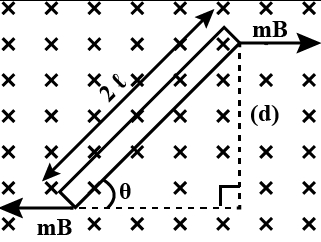
$A$ bar magnet of magnetic moment $\overrightarrow{M}$ is placed in a magnetic field of induction $\overrightarrow{B}$. The torque exerted on it is
A
$\overrightarrow{M} \cdot \overrightarrow{B}$
B
$-\overrightarrow{M} \cdot \overrightarrow{B}$
C
$\overrightarrow{M} \times \overrightarrow{B}$
D
$\overrightarrow{B} \times \overrightarrow{M}$
Solution
(C) Consider a bar magnet of length $2l$ placed in a uniform magnetic field $\overrightarrow{B}$ at an angle $\theta$ with the direction of the field.
The force acting on each pole of the magnet is $F = mB$, where $m$ is the pole strength.
These two equal and opposite forces form a couple that exerts a torque $\tau$ on the magnet.
The torque is given by: $\tau = \text{Force} \times \text{perpendicular distance } (d)$.
From the geometry, the perpendicular distance between the forces is $d = 2l \sin \theta$.
Therefore, $\tau = (mB) \times (2l \sin \theta) = (m \times 2l) B \sin \theta$.
Since the magnetic moment is defined as $M = m \times 2l$, we have $\tau = MB \sin \theta$.
In vector form, this is expressed as $\overrightarrow{\tau} = \overrightarrow{M} \times \overrightarrow{B}$.
The force acting on each pole of the magnet is $F = mB$, where $m$ is the pole strength.
These two equal and opposite forces form a couple that exerts a torque $\tau$ on the magnet.
The torque is given by: $\tau = \text{Force} \times \text{perpendicular distance } (d)$.
From the geometry, the perpendicular distance between the forces is $d = 2l \sin \theta$.
Therefore, $\tau = (mB) \times (2l \sin \theta) = (m \times 2l) B \sin \theta$.
Since the magnetic moment is defined as $M = m \times 2l$, we have $\tau = MB \sin \theta$.
In vector form, this is expressed as $\overrightarrow{\tau} = \overrightarrow{M} \times \overrightarrow{B}$.
0 likesView Solution
33
PhysicsEasyMCQAIPMT · 1999
If a diamagnetic substance is brought near the north or south pole of a bar magnet,it is:
A
Attracted by the poles
B
Repelled by the poles
C
Repelled by the north pole and attracted by the south pole
D
Attracted by the north pole and repelled by the south pole
Solution
(B) Diamagnetic substances are materials that develop a weak magnetization in the direction opposite to the applied magnetic field. When a diamagnetic substance is placed in a non-uniform magnetic field (such as near the poles of a bar magnet),it experiences a force that pushes it from the stronger part of the field to the weaker part. Since the magnetic field is strongest at the poles of a bar magnet,the diamagnetic substance is repelled by both the north and south poles.
0 likesView Solution
34
PhysicsEasyMCQAIPMT · 1999
The photoelectric work function for a metal surface is $4.125 \ eV$. The cut-off wavelength for this surface is .......... $\mathring{A}$.
A
$4125$
B
$2062.5$
C
$3000$
D
$6000$
Solution
(C) The work function $\Phi_0$ is related to the threshold wavelength $\lambda_0$ by the formula: $\Phi_0 = \frac{hc}{\lambda_0}$.
Using the approximation $hc \approx 12375 \ eV \cdot \mathring{A}$,we have:
$\lambda_0 = \frac{12375}{\Phi_0 \ (eV)} \ \mathring{A}$.
Given $\Phi_0 = 4.125 \ eV$,we calculate:
$\lambda_0 = \frac{12375}{4.125} \ \mathring{A} = 3000 \ \mathring{A}$.
Thus,the correct option is $C$.
Using the approximation $hc \approx 12375 \ eV \cdot \mathring{A}$,we have:
$\lambda_0 = \frac{12375}{\Phi_0 \ (eV)} \ \mathring{A}$.
Given $\Phi_0 = 4.125 \ eV$,we calculate:
$\lambda_0 = \frac{12375}{4.125} \ \mathring{A} = 3000 \ \mathring{A}$.
Thus,the correct option is $C$.
0 likesView Solution
35
PhysicsEasyMCQAIPMT · 1999
As the intensity of incident light increases,
A
Photoelectric current increases
B
Photoelectric current decreases
C
Kinetic energy of emitted photoelectrons increases
D
Kinetic energy of emitted photoelectrons decreases
Solution
(A) The intensity of incident light is directly proportional to the number of photons incident per unit area per unit time.
Since each photon ejects one photoelectron (provided the frequency is above the threshold frequency),an increase in intensity leads to a higher number of photoelectrons emitted per second.
Therefore,the photoelectric current increases.
The kinetic energy of the emitted photoelectrons depends only on the frequency of the incident light,not on its intensity.
Since each photon ejects one photoelectron (provided the frequency is above the threshold frequency),an increase in intensity leads to a higher number of photoelectrons emitted per second.
Therefore,the photoelectric current increases.
The kinetic energy of the emitted photoelectrons depends only on the frequency of the incident light,not on its intensity.
0 likesView Solution
36
PhysicsEasyMCQAIPMT · 1999
After one $\alpha$ and two $\beta$ emissions,what happens to the nucleus?
A
Mass number reduces by $3$
B
Mass number reduces by $4$
C
Mass number reduces by $6$
D
Atomic number remains unchanged
Solution
(B) An $\alpha$ decay involves the emission of a helium nucleus $(_{2}^{4}He)$,which decreases the mass number $(A)$ by $4$ and the atomic number $(Z)$ by $2$.
$A$ $\beta$ decay involves the emission of an electron $(_{-1}^{0}e)$,which leaves the mass number $(A)$ unchanged and increases the atomic number $(Z)$ by $1$.
Starting with a nucleus $_{Z}^{A}X$:
$1$. After one $\alpha$ emission: $_{Z-2}^{A-4}Y$.
$2$. After two $\beta$ emissions: $_{Z-2+2}^{A-4}X = _{Z}^{A-4}X$.
Thus,the mass number reduces by $4$ and the atomic number remains unchanged.
$A$ $\beta$ decay involves the emission of an electron $(_{-1}^{0}e)$,which leaves the mass number $(A)$ unchanged and increases the atomic number $(Z)$ by $1$.
Starting with a nucleus $_{Z}^{A}X$:
$1$. After one $\alpha$ emission: $_{Z-2}^{A-4}Y$.
$2$. After two $\beta$ emissions: $_{Z-2+2}^{A-4}X = _{Z}^{A-4}X$.
Thus,the mass number reduces by $4$ and the atomic number remains unchanged.
0 likesView Solution
37
PhysicsEasyMCQAIPMT · 1999
In $p-$type semiconductor,the majority charge carriers are
A
Electrons
B
Protons
C
Holes
D
Neutrons
Solution
(C) In a $p-$type semiconductor,the material is doped with trivalent impurity atoms (like Boron,Aluminum,etc.).
These trivalent atoms create vacancies in the valence band of the semiconductor crystal lattice.
These vacancies are known as holes.
Since the number of holes created by the doping process is significantly higher than the number of thermally generated electrons,holes act as the majority charge carriers in $p-$type semiconductors.
These trivalent atoms create vacancies in the valence band of the semiconductor crystal lattice.
These vacancies are known as holes.
Since the number of holes created by the doping process is significantly higher than the number of thermally generated electrons,holes act as the majority charge carriers in $p-$type semiconductors.
0 likesView Solution
38
PhysicsEasyMCQAIPMT · 1999
The $PN$ junction diode is used as:
A
An amplifier
B
$A$ rectifier
C
An oscillator
D
$A$ modulator
Solution
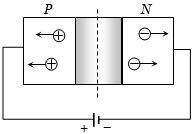
(B) $PN$ junction diode allows current to flow in only one direction (when forward-biased) and blocks it in the opposite direction (when reverse-biased). Due to this unidirectional property,it is primarily used as a rectifier to convert alternating current $(AC)$ into direct current $(DC)$.
0 likesView Solution
39
PhysicsEasyMCQAIPMT · 1999
The depletion layer consists of
A
electrons
B
protons
C
mobile ions
D
only fixed ions
Solution
(D) In the depletion region of an unbiased $P-N$ junction diode,the mobile charge carriers (electrons and holes) diffuse across the junction and recombine. This leaves behind immobile (fixed) ionized donor atoms in the $N$-region and immobile (fixed) ionized acceptor atoms in the $P$-region. Therefore,the depletion layer consists only of fixed ions.
0 likesView Solution
40
PhysicsEasyMCQAIPMT · 1999
In a junction diode,the holes are due to
A
Protons
B
Neutrons
C
Extra electrons
D
Missing of electrons
Solution
(D) In a semiconductor,a hole is defined as the absence of an electron in the valence band. When an electron is removed from a covalent bond,it leaves behind a vacancy that acts as a positive charge carrier. Therefore,holes are essentially the missing electrons in the crystal lattice structure of the semiconductor material. Option $D$ is the correct answer.
0 likesView Solution
41
PhysicsEasyMCQAIPMT · 1999
In forward bias,the width of the potential barrier in a $P-N$ junction diode:
A
Increases
B
Decreases
C
Remains constant
D
First increases then decreases
Solution
(B) In a $P-N$ junction diode,when forward bias is applied,the positive terminal of the battery is connected to the $P$-region and the negative terminal to the $N$-region.
This external electric field opposes the internal electric field of the depletion layer.
As a result,the majority charge carriers are pushed towards the junction,which reduces the width of the depletion layer.
Consequently,the width of the potential barrier decreases.
This external electric field opposes the internal electric field of the depletion layer.
As a result,the majority charge carriers are pushed towards the junction,which reduces the width of the depletion layer.
Consequently,the width of the potential barrier decreases.
0 likesView Solution
42
PhysicsEasyMCQAIPMT · 1999
$A$ plano-convex lens is made of a material with a refractive index of $1.6$. The radius of curvature of the curved surface is $60 \ cm$. The focal length of the lens is.....$cm$.
A
$50$
B
$100$
C
$200$
D
$400$
Solution
(B) The focal length $f$ of a lens is given by the Lens Maker's Formula: $\frac{1}{f} = (\mu - 1) \left( \frac{1}{R_1} - \frac{1}{R_2} \right)$.
For a plano-convex lens,one surface is plane $(R_1 = \infty)$ and the other is curved ($R_2 = -R = -60 \ cm$ using sign convention).
Substituting the values: $\frac{1}{f} = (1.6 - 1) \left( \frac{1}{\infty} - \frac{1}{-60} \right)$.
$\frac{1}{f} = (0.6) \left( 0 + \frac{1}{60} \right) = \frac{0.6}{60} = \frac{1}{100}$.
Therefore,$f = 100 \ cm$.
For a plano-convex lens,one surface is plane $(R_1 = \infty)$ and the other is curved ($R_2 = -R = -60 \ cm$ using sign convention).
Substituting the values: $\frac{1}{f} = (1.6 - 1) \left( \frac{1}{\infty} - \frac{1}{-60} \right)$.
$\frac{1}{f} = (0.6) \left( 0 + \frac{1}{60} \right) = \frac{0.6}{60} = \frac{1}{100}$.
Therefore,$f = 100 \ cm$.
0 likesView Solution
43
PhysicsDifficultMCQAIPMT · 1999
If the refractive index of a material of an equilateral prism is $\sqrt{3}$,then the angle of minimum deviation of the prism is......$^o$
A
$30$
B
$45$
C
$60$
D
$75$
Solution
(C) For an equilateral prism,the angle of the prism $A = 60^\circ$.
The formula for the refractive index $\mu$ in terms of the angle of minimum deviation $\delta_m$ is given by:
$\mu = \frac{\sin\left(\frac{A + \delta_m}{2}\right)}{\sin\left(\frac{A}{2}\right)}$
Given $\mu = \sqrt{3}$ and $A = 60^\circ$,we substitute these values:
$\sqrt{3} = \frac{\sin\left(\frac{60^\circ + \delta_m}{2}\right)}{\sin(30^\circ)}$
Since $\sin(30^\circ) = 0.5 = \frac{1}{2}$,we have:
$\sqrt{3} \times \frac{1}{2} = \sin\left(30^\circ + \frac{\delta_m}{2}\right)$
$\frac{\sqrt{3}}{2} = \sin\left(30^\circ + \frac{\delta_m}{2}\right)$
We know that $\sin(60^\circ) = \frac{\sqrt{3}}{2}$,so:
$60^\circ = 30^\circ + \frac{\delta_m}{2}$
$\frac{\delta_m}{2} = 30^\circ$
$\delta_m = 60^\circ$
The formula for the refractive index $\mu$ in terms of the angle of minimum deviation $\delta_m$ is given by:
$\mu = \frac{\sin\left(\frac{A + \delta_m}{2}\right)}{\sin\left(\frac{A}{2}\right)}$
Given $\mu = \sqrt{3}$ and $A = 60^\circ$,we substitute these values:
$\sqrt{3} = \frac{\sin\left(\frac{60^\circ + \delta_m}{2}\right)}{\sin(30^\circ)}$
Since $\sin(30^\circ) = 0.5 = \frac{1}{2}$,we have:
$\sqrt{3} \times \frac{1}{2} = \sin\left(30^\circ + \frac{\delta_m}{2}\right)$
$\frac{\sqrt{3}}{2} = \sin\left(30^\circ + \frac{\delta_m}{2}\right)$
We know that $\sin(60^\circ) = \frac{\sqrt{3}}{2}$,so:
$60^\circ = 30^\circ + \frac{\delta_m}{2}$
$\frac{\delta_m}{2} = 30^\circ$
$\delta_m = 60^\circ$
0 likesView Solution
44
PhysicsEasyMCQAIPMT · 1999
The colours observed in thin soap bubbles are due to
A
Interference
B
Diffraction
C
Dispersion
D
Reflection
Solution
(A) When light falls on a thin soap bubble,it reflects from both the outer and inner surfaces of the soap film.
These reflected light waves undergo the phenomenon of interference.
Depending on the thickness of the film and the angle of incidence,certain wavelengths of light undergo constructive interference while others undergo destructive interference.
This selective reinforcement and cancellation of different colours result in the appearance of vibrant colours on the soap bubble.
These reflected light waves undergo the phenomenon of interference.
Depending on the thickness of the film and the angle of incidence,certain wavelengths of light undergo constructive interference while others undergo destructive interference.
This selective reinforcement and cancellation of different colours result in the appearance of vibrant colours on the soap bubble.
0 likesView Solution
45
PhysicsEasyMCQAIPMT · 1999
What is the wavelength of light with a frequency of $100\;Hz$?
A
$2 \times 10^6\;m$
B
$3 \times 10^6\;m$
C
$4 \times 10^6\;m$
D
$5 \times 10^6\;m$
Solution
(B) The relationship between the speed of light $(c)$,frequency $(\nu)$,and wavelength $(\lambda)$ is given by the formula: $c = \nu \lambda$.
Rearranging for wavelength,we get: $\lambda = \frac{c}{\nu}$.
Given that the speed of light $c = 3 \times 10^8\;m/s$ and the frequency $\nu = 100\;Hz$,we substitute these values into the equation:
$\lambda = \frac{3 \times 10^8}{100} = 3 \times 10^6\;m$.
Therefore,the correct option is $B$.
Rearranging for wavelength,we get: $\lambda = \frac{c}{\nu}$.
Given that the speed of light $c = 3 \times 10^8\;m/s$ and the frequency $\nu = 100\;Hz$,we substitute these values into the equation:
$\lambda = \frac{3 \times 10^8}{100} = 3 \times 10^6\;m$.
Therefore,the correct option is $B$.
0 likesView Solution
46
PhysicsEasyMCQAIPMT · 1999
Alpha particles are
A
$2$ free protons
B
doubly ionised helium atoms
C
helium atoms
D
singly ionised helium atoms
Solution
(B) An alpha particle consists of $2$ protons and $2$ neutrons,which is identical to the nucleus of a helium atom $(^4_2He)$.
Since an alpha particle has no electrons,it is a helium atom that has lost both of its electrons.
Therefore,an alpha particle is a doubly ionised helium atom $(He^{2+})$.
Since an alpha particle has no electrons,it is a helium atom that has lost both of its electrons.
Therefore,an alpha particle is a doubly ionised helium atom $(He^{2+})$.
0 likesView Solution
47
PhysicsMediumMCQAIPMT · 1999
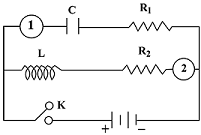
In the circuit shown,an inductor $L$ and a capacitor $C$ are connected as shown. $A_1$ and $A_2$ are ammeters. When the key $K$ is pressed to complete the circuit,what will be the readings of $A_1$ and $A_2$ just after closing the key $K$?
A
zero in both $A_1$ and $A_2$
B
maximum in both $A_1$ and $A_2$
C
maximum in $A_1$ and zero in $A_2$
D
zero in $A_1$ and maximum in $A_2$
Solution
(C) At the instant the key $K$ is closed $(t=0)$:
$(i)$ $A$ capacitor acts as a short circuit (offers zero resistance) because it is initially uncharged,allowing maximum current to flow through the branch containing $A_1$.
$(ii)$ An inductor opposes any change in current. Since the current was zero before closing the key,the inductor acts as an open circuit (offers infinite resistance) at $t=0$,resulting in zero current through the branch containing $A_2$.
Therefore,the reading of $A_1$ is maximum and the reading of $A_2$ is zero.
$(i)$ $A$ capacitor acts as a short circuit (offers zero resistance) because it is initially uncharged,allowing maximum current to flow through the branch containing $A_1$.
$(ii)$ An inductor opposes any change in current. Since the current was zero before closing the key,the inductor acts as an open circuit (offers infinite resistance) at $t=0$,resulting in zero current through the branch containing $A_2$.
Therefore,the reading of $A_1$ is maximum and the reading of $A_2$ is zero.
0 likesView Solution
48
PhysicsEasyMCQAIPMT · 1999
Which of the following when added as an impurity into silicon produces $n-$type semiconductor?
A
$B$
B
$P$
C
$Mg$
D
$Al$
Solution
(B) To produce an $n-$type semiconductor,we need to dope the intrinsic semiconductor (Silicon) with a pentavalent impurity atom.
Silicon $(Si)$ is a group $14$ element with $4$ valence electrons.
Pentavalent atoms have $5$ valence electrons.
Among the given options,Phosphorus $(P)$ is a group $15$ element (pentavalent).
When $P$ is added to $Si$,$4$ of its valence electrons form covalent bonds with $Si$ atoms,and the $5$th electron becomes a free charge carrier,resulting in an $n-$type semiconductor.
Boron $(B)$ and Aluminium $(Al)$ are group $13$ elements (trivalent) and produce $p-$type semiconductors.
Silicon $(Si)$ is a group $14$ element with $4$ valence electrons.
Pentavalent atoms have $5$ valence electrons.
Among the given options,Phosphorus $(P)$ is a group $15$ element (pentavalent).
When $P$ is added to $Si$,$4$ of its valence electrons form covalent bonds with $Si$ atoms,and the $5$th electron becomes a free charge carrier,resulting in an $n-$type semiconductor.
Boron $(B)$ and Aluminium $(Al)$ are group $13$ elements (trivalent) and produce $p-$type semiconductors.
0 likesView Solution
49
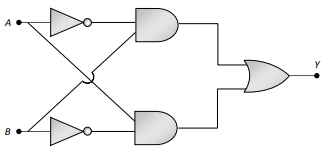
PhysicsMediumMCQAIPMT · 1999
The combination of the gates shown will produce:
A
$AND$ gate
B
$NAND$ gate
C
$OR$ gate
D
$XOR$ gate
Solution
(D) Let the inputs be $A$ and $B$. The circuit consists of two $NOT$ gates, two $AND$ gates, and one $OR$ gate.
$1$. The upper $AND$ gate receives inputs $A'$ (from $NOT$ gate) and $B$. Its output is $A' \cdot B = \bar{A}B$.
$2$. The lower $AND$ gate receives inputs $A$ and $B'$ (from $NOT$ gate). Its output is $A \cdot B' = A\bar{B}$.
$3$. The final $OR$ gate combines these outputs: $Y = \bar{A}B + A\bar{B}$.
$4$. The Boolean expression $Y = \bar{A}B + A\bar{B}$ is the standard definition of an $XOR$ gate (Exclusive $OR$ gate).
Therefore, the combination produces an $XOR$ gate.
$1$. The upper $AND$ gate receives inputs $A'$ (from $NOT$ gate) and $B$. Its output is $A' \cdot B = \bar{A}B$.
$2$. The lower $AND$ gate receives inputs $A$ and $B'$ (from $NOT$ gate). Its output is $A \cdot B' = A\bar{B}$.
$3$. The final $OR$ gate combines these outputs: $Y = \bar{A}B + A\bar{B}$.
$4$. The Boolean expression $Y = \bar{A}B + A\bar{B}$ is the standard definition of an $XOR$ gate (Exclusive $OR$ gate).
Therefore, the combination produces an $XOR$ gate.
0 likesView Solution
50
PhysicsEasyMCQAIPMT · 1999
The ozone layer blocks radiation of which wavelength?
A
Less than $3 \times 10^{-7} \,m$
B
Equal to $3 \times 10^{-7} \,m$
C
More than $3 \times 10^{-7} \,m$
D
All of the above
Solution
(A) The ozone layer in the Earth's atmosphere is primarily responsible for absorbing ultraviolet $(UV)$ radiation from the Sun.
Specifically,it effectively absorbs radiation with wavelengths shorter than approximately $3 \times 10^{-7} \,m$ (or $300 \,nm$),which corresponds to the $UV$-$C$ and parts of the $UV$-$B$ spectrum.
Therefore,radiation with wavelengths less than $3 \times 10^{-7} \,m$ is blocked by the ozone layer.
Specifically,it effectively absorbs radiation with wavelengths shorter than approximately $3 \times 10^{-7} \,m$ (or $300 \,nm$),which corresponds to the $UV$-$C$ and parts of the $UV$-$B$ spectrum.
Therefore,radiation with wavelengths less than $3 \times 10^{-7} \,m$ is blocked by the ozone layer.
0 likesView Solution
Vedclass Products
For Students
Vedclass Test Series
Mock tests in real AIPMT style covering Physics with performance analysis. 5-day free trial.
Start Free TrialFor Teachers
Exam Paper Generator
Generate Set A/B/C/D Physics papers from 7.5L+ questions in 2 minutes. 3 chapters free.
Try FreeFor Institutes
Online Exam Module
Run live AIPMT mock exams with unlimited students, 360° analytics & white-label branding.
See DemoFrequently Asked Questions
How many Physics questions are in AIPMT 1999?
There are 50 Physics questions from the AIPMT 1999 paper on Vedclass, each with a detailed step-by-step solution in English.
Are AIPMT 1999 Physics solutions available in English?
Yes. All solutions on this page are in English. You can also switch to English or Hindi using the language buttons above the questions.
Can I practice AIPMT 1999 Physics as a timed test?
Yes. Use the Vedclass Test Series to attempt a full AIPMT mock test covering Physics with time limits and instant score analysis.
Can teachers create Physics papers from AIPMT previous year questions?
Yes. The Vedclass Exam Paper Generator lets teachers mix AIPMT Physics questions and generate Set A/B/C/D papers in minutes.
For Teachers & Institutes
Build a Custom Physics Paper
Pick AIPMT 1999 Physics questions, set difficulty, and generate Set A/B/C/D in 2 minutes.