
BiologyQ1–100 of 213 questions
Page 1 of 3 · English
1
BiologyMediumMCQAIPMT · 1999
$A$ system of classification in which a large number of traits are considered is
A
Artificial system
B
Synthetic system
C
Natural system
D
Phylogenetic system
Solution
(C) The correct answer is $C$.
In the natural system of classification,organisms are arranged according to their natural affinities by considering a large number of traits,including structural,cytological,reproductive,and biochemical characteristics.
This approach helps in identifying homologies between different organisms,providing a more comprehensive understanding of their relationships compared to artificial systems,which rely on only a few superficial characters.
In the natural system of classification,organisms are arranged according to their natural affinities by considering a large number of traits,including structural,cytological,reproductive,and biochemical characteristics.
This approach helps in identifying homologies between different organisms,providing a more comprehensive understanding of their relationships compared to artificial systems,which rely on only a few superficial characters.
0 likesView Solution
2
BiologyEasyMCQAIPMT · 1999
The symbiotic nitrogen-fixing bacteria present in root nodules of legumes belong to the genus
A
Xanthomonas
B
Pseudomonas
C
Rhizobium
D
Acetobacter
Solution
(C) The symbiotic nitrogen-fixing bacteria that live in the root nodules of leguminous plants belong to the genus $Rhizobium$.
These bacteria form a mutualistic relationship with the plants,where the bacteria fix atmospheric nitrogen into ammonia,which the plant can use for growth,while the plant provides the bacteria with carbohydrates and a protected environment.
These bacteria form a mutualistic relationship with the plants,where the bacteria fix atmospheric nitrogen into ammonia,which the plant can use for growth,while the plant provides the bacteria with carbohydrates and a protected environment.
0 likesView Solution
3
BiologyMediumMCQAIPMT · 1999
In which of the following is there no sexual reproduction?
A
Ulothrix
B
Nostoc
C
Aspergillus
D
Volvox
Solution
(B) Sexual reproduction is a characteristic feature of Eukaryotic organisms.
$Nostoc$ is a Cyanobacterium (Prokaryote).
Prokaryotes do not undergo true sexual reproduction involving meiosis and gamete fusion.
$Ulothrix$ and $Volvox$ are green algae (Eukaryotes) that reproduce sexually.
$Aspergillus$ is a fungus (Eukaryote) that also exhibits sexual reproduction.
$Nostoc$ is a Cyanobacterium (Prokaryote).
Prokaryotes do not undergo true sexual reproduction involving meiosis and gamete fusion.
$Ulothrix$ and $Volvox$ are green algae (Eukaryotes) that reproduce sexually.
$Aspergillus$ is a fungus (Eukaryote) that also exhibits sexual reproduction.
0 likesView Solution
4
BiologyMediumMCQAIPMT · 1999
In prokaryotes,the genetic material is
A
Linear $DNA$ with histones
B
Circular $DNA$ with histones
C
Linear $DNA$ without histones
D
Circular $DNA$ without histones
Solution
(D) Prokaryotic cells,such as bacteria,lack a well-defined nucleus.
Their genetic material consists of a single,circular $DNA$ molecule that is not enclosed within a nuclear membrane.
Unlike eukaryotes,prokaryotic $DNA$ is not associated with histone proteins,although it is organized by other proteins into a structure known as the nucleoid.
Their genetic material consists of a single,circular $DNA$ molecule that is not enclosed within a nuclear membrane.
Unlike eukaryotes,prokaryotic $DNA$ is not associated with histone proteins,although it is organized by other proteins into a structure known as the nucleoid.
0 likesView Solution
5
BiologyEasyMCQAIPMT · 1999
Columella is a specialized structure found in the sporangium of
A
Ulothrix
B
Rhizopus
C
Spirogyra
D
Yeast and Albugo
Solution
(B) The sporangium of $Rhizopus$ is divided into two regions:
$1$. Outer fertile sporiferous zone.
$2$. $A$ central sterile columella.
The protoplast of the sporiferous zone undergoes mitotic cleavage to form dark-colored multinucleate spores.
$1$. Outer fertile sporiferous zone.
$2$. $A$ central sterile columella.
The protoplast of the sporiferous zone undergoes mitotic cleavage to form dark-colored multinucleate spores.
0 likesView Solution
6
BiologyMediumMCQAIPMT · 1999
Bryophytes can be separated from algae,because they
A
Are thalloid forms
B
Have no conducting tissue
C
Possess archegonia
D
Contain chloroplast
Solution
(C) . The female sex organ in bryophytes is the archegonium. It is a flask-shaped structure that is distinguishable into a long neck and a globular swollen venter. Algae lack such specialized multicellular sex organs,whereas bryophytes possess them,which is a key evolutionary advancement.
0 likesView Solution
7
BiologyMediumMCQAIPMT · 1999
Bryophytes comprise:
A
Sporophyte is of longer duration
B
Dominant phase of sporophyte which is parasitic
C
Dominant phase of gametophyte which produces spores
D
Small sporophyte phase and generally parasitic on gametophyte
Solution
(D) In $Bryophytes$,the main plant body is a gametophyte,which is independent and photosynthetic.
The sporophyte is not free-living; it is dependent on the gametophyte for its nutrition,either partially or wholly.
Therefore,the sporophyte phase is small and generally parasitic on the gametophyte.
The sporophyte is not free-living; it is dependent on the gametophyte for its nutrition,either partially or wholly.
Therefore,the sporophyte phase is small and generally parasitic on the gametophyte.
0 likesView Solution
8
BiologyMediumMCQAIPMT · 1999
Which of the following is true about bryophytes?
A
They possess archegonia
B
They contain chloroplast
C
They are thalloid
D
All of these
Solution
(D) Bryophytes are characterized by the following features:
$1$. They possess a flask-shaped female sex organ called an archegonium and a globular male sex organ called an antheridium.
$2$. They contain chloroplasts,which make them photosynthetic and green in color.
$3$. Their plant body is typically thalloid (not differentiated into true roots,stems,or leaves) and attached to the substratum by unicellular or multicellular rhizoids.
Therefore,all the given statements are correct.
$1$. They possess a flask-shaped female sex organ called an archegonium and a globular male sex organ called an antheridium.
$2$. They contain chloroplasts,which make them photosynthetic and green in color.
$3$. Their plant body is typically thalloid (not differentiated into true roots,stems,or leaves) and attached to the substratum by unicellular or multicellular rhizoids.
Therefore,all the given statements are correct.
0 likesView Solution
9
BiologyMediumMCQAIPMT · 1999
Dichotomous branching is found in
A
Fern
B
Funaria
C
Liverworts
D
Marchantia
Solution
(C) The thallus of liverworts (a group of bryophytes) is dorsiventrally flattened,lobed,liver-like,prostrate,and exhibits dichotomous branching.
$Marchantia$ is a specific genus of liverwort that clearly shows this characteristic dichotomous branching pattern.
$Marchantia$ is a specific genus of liverwort that clearly shows this characteristic dichotomous branching pattern.
0 likesView Solution
10
BiologyEasyMCQAIPMT · 1999
The antherozoids of $Funaria$ are
A
Aciliated
B
Biciliated
C
Multiciliated
D
Monociliated
Solution
(B) The antherozoids (male gametes) in $Funaria$ are biflagellated,meaning they possess two flagella.
These structures are coiled and motile,which allows them to swim through a film of water to reach the archegonia for fertilization.
These structures are coiled and motile,which allows them to swim through a film of water to reach the archegonia for fertilization.
0 likesView Solution
11
BiologyMediumMCQAIPMT · 1999
$A$ plant having vascular supply,producing spores but lacking seeds is a
A
Bryophyte
B
Pteridophyte
C
Gymnosperm
D
Angiosperm
Solution
(B) The plant group that possesses vascular tissues ($xylem$ and $phloem$) but does not produce seeds is known as $Pteridophytes$.
$1$. Bryophytes lack true vascular tissues.
$2$. Gymnosperms and Angiosperms are seed-bearing plants (Spermatophytes).
$3$. Pteridophytes reproduce via spores and are the first terrestrial plants to possess vascular tissues.
$1$. Bryophytes lack true vascular tissues.
$2$. Gymnosperms and Angiosperms are seed-bearing plants (Spermatophytes).
$3$. Pteridophytes reproduce via spores and are the first terrestrial plants to possess vascular tissues.
0 likesView Solution
12
BiologyEasyMCQAIPMT · 1999
The angiosperm to which the largest flower belongs is a:
A
Total stem parasite
B
Partial stem parasite
C
Total root parasite
D
Partial root parasite
Solution
(C) The largest flower in the world is $Rafflesia$ $arnoldii$.
It is an angiosperm that lacks chlorophyll,leaves,stems,and true roots.
It derives all its nutrients from the roots of its host plant,specifically the genus $Tetrastigma$.
Therefore,it is classified as a total root parasite.
It is an angiosperm that lacks chlorophyll,leaves,stems,and true roots.
It derives all its nutrients from the roots of its host plant,specifically the genus $Tetrastigma$.
Therefore,it is classified as a total root parasite.
0 likesView Solution
13
BiologyEasyMCQAIPMT · 1999
The plant which bears clinging roots is
A
Trapa
B
Orchid
C
Screw pine
D
Podostemon
Solution
(B) In $Orchid$,many short,branched,adventitious roots arise at each node of the weak stem to help the plant climb up its support; these are called clinging roots.
0 likesView Solution
14
BiologyMediumMCQAIPMT · 1999
The endosperm of gymnosperm is
A
Triploid
B
Haploid
C
Diploid
D
Polyploid
Solution
(B) In gymnosperms,the endosperm is formed before fertilization by the process of megasporogenesis followed by the development of the female gametophyte.
Since it represents the female gametophyte tissue,it is always haploid $(n)$.
Since it represents the female gametophyte tissue,it is always haploid $(n)$.
0 likesView Solution
15
BiologyMediumMCQAIPMT · 1999
Canal system is a characteristic of
A
Hydra
B
Sponge
C
Sea anemone
D
Sea urchin
Solution
(B) . Sponges (Phylum $Porifera$) possess a unique water transport or canal system. Water enters through minute pores called $ostia$ in the body wall into a central cavity,the $spongocoel$,and goes out through the $osculum$. This pathway of water transport is helpful in food gathering,respiratory exchange,and removal of waste products.
0 likesView Solution
16
BiologyMediumMCQAIPMT · 1999
The vertebrae of birds are characteristically
A
Heterocoelous
B
Acoelous
C
Opisthocoelous
D
Amphicoelous
Solution
(A) The vertebrae of birds are characteristically $Heterocoelous$.
In a $Heterocoelous$ vertebra,the centrum has a saddle-shaped articular surface,where one face is convex in one direction and concave in the other,allowing for significant flexibility of the neck while preventing rotation.
This structure is a unique adaptation in birds that provides stability and mobility to the cervical region.
In a $Heterocoelous$ vertebra,the centrum has a saddle-shaped articular surface,where one face is convex in one direction and concave in the other,allowing for significant flexibility of the neck while preventing rotation.
This structure is a unique adaptation in birds that provides stability and mobility to the cervical region.
0 likesView Solution
17
BiologyMediumMCQAIPMT · 1999
Clinging and epiphytic roots are found in
A
Orchid
B
Tinospora / Trapa
C
Rhizophora / Pandanus
D
Pothos / Podostemon
Solution
(A) Epiphytic roots are specialized aerial roots found in epiphytes,such as $Orchid$,which grow on other plants for support but do not derive nutrients from them. These roots are often green and photosynthetic,and they possess a specialized tissue called $velamen$ to absorb moisture from the atmosphere. Clinging roots are adventitious roots that help climbing plants attach to a support,commonly seen in $Pothos$ (money plant) and $Hedera$ (ivy).
0 likesView Solution
18
BiologyEasyMCQAIPMT · 1999
Climbing roots occur in
A
Vanilla
B
Vanda
C
Pongamia
D
Taeniophyllum
Solution
(A) Climbing roots are specialized adventitious roots that help a plant climb up a support.
In the genus $Vanilla$ (an orchid),the plant produces climbing roots from the nodes to attach itself to the bark of trees or other supports,allowing it to grow upwards towards sunlight.
$Vanda$ possesses epiphytic roots,$Pongamia$ is a tree with normal root systems,and $Taeniophyllum$ is a leafless orchid with photosynthetic roots.
In the genus $Vanilla$ (an orchid),the plant produces climbing roots from the nodes to attach itself to the bark of trees or other supports,allowing it to grow upwards towards sunlight.
$Vanda$ possesses epiphytic roots,$Pongamia$ is a tree with normal root systems,and $Taeniophyllum$ is a leafless orchid with photosynthetic roots.
0 likesView Solution
19
BiologyEasyMCQAIPMT · 1999
The edible part in litchi is
A
Pericarp
B
Mesocarp
C
Endosperm
D
Fleshy aril
Solution
(D) The correct answer is $D$.
In Litchi $(Nephelium)$,the pericarp is hard,brittle,and spiny.
The single seed is covered by a white,juicy,edible fleshy mass known as the aril,which is the part consumed.
In Litchi $(Nephelium)$,the pericarp is hard,brittle,and spiny.
The single seed is covered by a white,juicy,edible fleshy mass known as the aril,which is the part consumed.
0 likesView Solution
20
BiologyMediumMCQAIPMT · 1999
Which of the following cells is totipotent?
A
Meristem
B
Sieve tube
C
Collenchyma
D
Xylem vessel
Solution
(A) Totipotency is the ability of a single cell to divide and produce all the differentiated cells in an organism.
Meristematic cells are undifferentiated,actively dividing cells that retain the capacity to develop into any type of plant tissue.
Sieve tubes,collenchyma,and xylem vessels are differentiated cells that have lost their ability to divide and are specialized for specific functions like transport or structural support.
Meristematic cells are undifferentiated,actively dividing cells that retain the capacity to develop into any type of plant tissue.
Sieve tubes,collenchyma,and xylem vessels are differentiated cells that have lost their ability to divide and are specialized for specific functions like transport or structural support.
0 likesView Solution
21
BiologyEasyMCQAIPMT · 1999
Aerenchyma is found in
A
Lithophytes
B
Hydrophytes
C
Sciophytes
D
Xerophytes
Solution
(B) Aerenchyma is a type of parenchyma tissue characterized by large air-filled intercellular spaces.
It is primarily found in $Hydrophytes$ (aquatic plants).
The presence of these air cavities provides buoyancy,which helps the plants to float on the water surface and facilitates the exchange of gases in submerged conditions.
It is primarily found in $Hydrophytes$ (aquatic plants).
The presence of these air cavities provides buoyancy,which helps the plants to float on the water surface and facilitates the exchange of gases in submerged conditions.
0 likesView Solution
22
BiologyMediumMCQAIPMT · 1999
In dicot roots,cells of which region show Casparian strips?
A
Cambium
B
Endodermis
C
Pericycle
D
Hypodermis
Solution
(B) The $Casparian$ strips are characteristic features of the $Endodermis$ in roots.
These are water-impermeable,waxy bands made of $suberin$ that are deposited in the radial and tangential walls of the endodermal cells.
They prevent the apoplastic movement of water and solutes,forcing them to enter the vascular cylinder through the symplastic pathway.
Therefore,the correct option is $B$.
These are water-impermeable,waxy bands made of $suberin$ that are deposited in the radial and tangential walls of the endodermal cells.
They prevent the apoplastic movement of water and solutes,forcing them to enter the vascular cylinder through the symplastic pathway.
Therefore,the correct option is $B$.
0 likesView Solution
23
BiologyEasyMCQAIPMT · 1999
Ligament is a
A
Modified white fibrous tissue
B
Modified yellow elastic fibrous tissue
C
Inelastic white fibrous tissue
D
None of these
Solution
(B) . Ligament is a modified yellow elastic fibrous tissue.
It occurs in the form of cords and connects one bone to another bone.
It contains a significant amount of yellow elastic fibers along with some white collagen fibers,which provides the necessary elasticity and strength to the joints.
It occurs in the form of cords and connects one bone to another bone.
It contains a significant amount of yellow elastic fibers along with some white collagen fibers,which provides the necessary elasticity and strength to the joints.
0 likesView Solution
24
BiologyEasyMCQAIPMT · 1999
Tendons are formed of:
A
White fibrous connective tissue
B
Yellow fibrous connective tissue
C
Areolar tissue
D
Adipose tissue
Solution
(A) Tendons are dense regular connective tissues primarily composed of collagen fibers,which are white fibrous connective tissues. Their main function is to attach skeletal muscles to bones.
0 likesView Solution
25
BiologyMediumMCQAIPMT · 1999
Which of the following is regarded as a unit of nervous tissue?
A
Axons
B
Dendrites
C
Neurons
D
Myelin sheath
Solution
(C) . Neurons are the structural and functional units of nervous tissue.
They are specialized cells responsible for receiving,processing,and transmitting information through electrical and chemical signals.
Their number is quite high,exceeding $1 \times 10^{12}$ in the human brain alone.
They are specialized cells responsible for receiving,processing,and transmitting information through electrical and chemical signals.
Their number is quite high,exceeding $1 \times 10^{12}$ in the human brain alone.
0 likesView Solution
26
BiologyMediumMCQAIPMT · 1999
The junction between the axon of one neuron and the dendrite of the next is called
A
$A$ joint
B
$A$ synapse
C
Constant bridge
D
Junction point
Solution
(B) synapse is the specialized junction through which a neuron signals to another neuron or to a non-neuronal cell such as a muscle or gland.
It is formed by the membranes of a pre-synaptic neuron and a post-synaptic neuron,which may or may not be separated by a gap called the synaptic cleft.
It is formed by the membranes of a pre-synaptic neuron and a post-synaptic neuron,which may or may not be separated by a gap called the synaptic cleft.
0 likesView Solution
27
BiologyMediumMCQAIPMT · 1999
The functional unit in the synthesis of protein is
A
Peroxisome
B
Dictyosome
C
Lysosome
D
Polysome
Solution
(D) $Polysome$ (or $Polyribosome$) is a cluster of ribosomes held together by a strand of $mRNA$ that functions as the site of protein synthesis.
Multiple ribosomes translate a single $mRNA$ molecule simultaneously,which significantly increases the efficiency of protein production.
Therefore,the $Polysome$ is considered the functional unit of protein synthesis.
Multiple ribosomes translate a single $mRNA$ molecule simultaneously,which significantly increases the efficiency of protein production.
Therefore,the $Polysome$ is considered the functional unit of protein synthesis.
0 likesView Solution
28
BiologyMediumMCQAIPMT · 1999
The site of protein synthesis in plants is the
A
Chloroplast
B
Ribosomes
C
Pyrenoids
D
Mitochondria
Solution
(B) Ribosomes are the cellular organelles responsible for protein synthesis in all living organisms,including plants. They act as the site where amino acids are assembled into polypeptide chains based on the genetic instructions provided by $mRNA$.
0 likesView Solution
29
BiologyEasyMCQAIPMT · 1999
Which of the following organelles has a single membrane?
A
Nucleus
B
Cell wall
C
Mitochondria
D
Sphaerosomes
Solution
(D) The organelles are classified based on the number of membranes surrounding them:
$1$. $Nucleus$ and $Mitochondria$ are double-membrane bound organelles.
$2$. $Cell$ $wall$ is a non-membranous structure.
$3$. $Sphaerosomes$ are single-membrane bound organelles that store lipids in plant cells.
Therefore, $Sphaerosomes$ is the correct answer.
$1$. $Nucleus$ and $Mitochondria$ are double-membrane bound organelles.
$2$. $Cell$ $wall$ is a non-membranous structure.
$3$. $Sphaerosomes$ are single-membrane bound organelles that store lipids in plant cells.
Therefore, $Sphaerosomes$ is the correct answer.
0 likesView Solution
30
BiologyMediumMCQAIPMT · 1999
Some of the enzymes,which are associated in converting fats into carbohydrates,are present in
A
Liposomes
B
Golgi bodies
C
Microsome
D
Glyoxysomes
Solution
(D) Glyoxysomes are specialized peroxisomes found in plants,particularly in the germinating seeds of fat-storing tissues.
These organelles contain enzymes of the glyoxylate cycle,which is a metabolic pathway that converts stored fats into carbohydrates (sugars) to provide energy and carbon skeletons for the growing seedling.
Therefore,the correct option is $D$.
These organelles contain enzymes of the glyoxylate cycle,which is a metabolic pathway that converts stored fats into carbohydrates (sugars) to provide energy and carbon skeletons for the growing seedling.
Therefore,the correct option is $D$.
0 likesView Solution
31
BiologyMediumMCQAIPMT · 1999
$DNA$ is mainly found in
A
Nucleus only
B
Nucleus and cytoplasm
C
Cytoplasm only
D
All of these
Solution
(B) In eukaryotic cells,the majority of $DNA$ is located within the nucleus,where it is organized into chromosomes.
However,$DNA$ is also present in certain organelles within the cytoplasm,specifically in mitochondria and chloroplasts (in plants).
Therefore,$DNA$ is found in both the nucleus and the cytoplasm.
However,$DNA$ is also present in certain organelles within the cytoplasm,specifically in mitochondria and chloroplasts (in plants).
Therefore,$DNA$ is found in both the nucleus and the cytoplasm.
0 likesView Solution
32
BiologyEasyMCQAIPMT · 1999
In soil,water available for plants is
A
Capillary water
B
Hygroscopic water
C
Gravitational water
D
Chemically bound water
Solution
(A) The water present in the soil exists in various forms.
$1$. Gravitational water: This water moves deep into the soil due to gravity and is generally unavailable to plants.
$2$. Hygroscopic water: This water is held tightly by soil particles and is unavailable to plants.
$3$. Chemically bound water: This water is part of the chemical structure of soil minerals and is unavailable to plants.
$4$. Capillary water: This is the water held in the spaces between soil particles by capillary forces. It is the primary source of water that plants can absorb through their root hairs.
$1$. Gravitational water: This water moves deep into the soil due to gravity and is generally unavailable to plants.
$2$. Hygroscopic water: This water is held tightly by soil particles and is unavailable to plants.
$3$. Chemically bound water: This water is part of the chemical structure of soil minerals and is unavailable to plants.
$4$. Capillary water: This is the water held in the spaces between soil particles by capillary forces. It is the primary source of water that plants can absorb through their root hairs.
0 likesView Solution
33
BiologyMediumMCQAIPMT · 1999
Bidirectional translocation of minerals takes place in
A
Phloem
B
Xylem
C
Parenchyma
D
Cambium
Solution
(A) The translocation of minerals and organic nutrients in plants occurs through the $Phloem$.
Unlike $Xylem$,which primarily transports water and minerals in an upward (unidirectional) direction from roots to leaves,$Phloem$ is responsible for the bidirectional transport of food (sucrose) and minerals from the source (leaves) to the sink (roots,fruits,or growing regions).
Therefore,the correct answer is $Phloem$.
Unlike $Xylem$,which primarily transports water and minerals in an upward (unidirectional) direction from roots to leaves,$Phloem$ is responsible for the bidirectional transport of food (sucrose) and minerals from the source (leaves) to the sink (roots,fruits,or growing regions).
Therefore,the correct answer is $Phloem$.
0 likesView Solution
34
BiologyEasyMCQAIPMT · 1999
The Nobel Prize of $1991$ for discovering single ion channels in cells was awarded to:
A
Watson and Hargobind Khorana
B
Erwin Neher and Bert Sakmann
C
Nirenberg and Kornberg
D
Holley and Matthaei
Solution
(B) The Nobel Prize in Physiology or Medicine in $1991$ was awarded to Erwin Neher and Bert Sakmann for their discoveries concerning the function of single ion channels in cells.
They developed the patch-clamp technique,which allows for the measurement of the tiny electrical currents that flow through individual ion channels in the cell membrane.
They developed the patch-clamp technique,which allows for the measurement of the tiny electrical currents that flow through individual ion channels in the cell membrane.
0 likesView Solution
35
BiologyEasyMCQAIPMT · 1999
$A$ pair of insectivorous plants is:
A
Drosera and Rafflesia
B
Nepenthes and Bladderwort
C
Dionaea and Viscum
D
Venus fly trap and Rafflesia
Solution
(B) Insectivorous plants are plants that derive some or most of their nutrients from trapping and consuming animals or protozoans,typically insects and other arthropods.
$Nepenthes$ (Pitcher plant) and Bladderwort $(Utricularia)$ are well-known examples of insectivorous plants.
$Rafflesia$ is a parasitic plant,not insectivorous.
$Viscum$ (Mistletoe) is a hemiparasitic plant.
Therefore,the correct pair is $Nepenthes$ and Bladderwort.
$Nepenthes$ (Pitcher plant) and Bladderwort $(Utricularia)$ are well-known examples of insectivorous plants.
$Rafflesia$ is a parasitic plant,not insectivorous.
$Viscum$ (Mistletoe) is a hemiparasitic plant.
Therefore,the correct pair is $Nepenthes$ and Bladderwort.
0 likesView Solution
36
BiologyEasyMCQAIPMT · 1999
The core metal of chlorophyll is
A
$Fe$
B
$Mg$
C
$Ni$
D
$Cu$
Solution
(B) The core metal of chlorophyll is $Mg$ (Magnesium).
Chlorophyll is a porphyrin derivative with a central magnesium atom coordinated to four nitrogen atoms of the porphyrin ring.
This central $Mg^{2+}$ ion is essential for the light-harvesting function of chlorophyll molecules during photosynthesis.
If the central $Mg$ atom is replaced by $Fe$ (Iron),the molecule is converted into a different pigment,such as those found in cytochromes,which are involved in electron transport rather than light absorption.
Chlorophyll is a porphyrin derivative with a central magnesium atom coordinated to four nitrogen atoms of the porphyrin ring.
This central $Mg^{2+}$ ion is essential for the light-harvesting function of chlorophyll molecules during photosynthesis.
If the central $Mg$ atom is replaced by $Fe$ (Iron),the molecule is converted into a different pigment,such as those found in cytochromes,which are involved in electron transport rather than light absorption.
0 likesView Solution
37
BiologyEasyMCQAIPMT · 1999
Which one of the following concerns photophosphorylation?
A
$AMP + \text{Inorganic } PO_4 \xrightarrow{\text{Light energy}} ATP$
B
$ADP + AMP \xrightarrow{\text{Light energy}} ATP$
C
$ADP + \text{Inorganic } PO_4 \xrightarrow{\text{Light energy}} ATP$
D
$ADP + \text{Inorganic } PO_4 \rightarrow ATP$
Solution
(C) Photophosphorylation is the process of synthesizing $ATP$ from $ADP$ and inorganic phosphate $(Pi)$ in the presence of light energy.
This process occurs in the chloroplasts of plants during the light-dependent reactions of photosynthesis.
The chemical equation for this reaction is: $ADP + Pi \xrightarrow{\text{Light energy}} ATP$.
This process occurs in the chloroplasts of plants during the light-dependent reactions of photosynthesis.
The chemical equation for this reaction is: $ADP + Pi \xrightarrow{\text{Light energy}} ATP$.
0 likesView Solution
38
BiologyEasyMCQAIPMT · 1999
Which fractions of the visible spectrum of solar radiations are primarily absorbed by carotenoids of the higher plants?
A
Violet and blue
B
Blue and green
C
Green and red
D
Red and violet
Solution
(A) Carotenoids are accessory photosynthetic pigments that absorb light energy and transfer it to chlorophyll $a$.
They primarily absorb light in the violet and blue regions of the visible spectrum.
By absorbing these wavelengths,they protect the chlorophyll molecules from photo-oxidation and expand the range of light wavelengths that can be utilized for photosynthesis.
They primarily absorb light in the violet and blue regions of the visible spectrum.
By absorbing these wavelengths,they protect the chlorophyll molecules from photo-oxidation and expand the range of light wavelengths that can be utilized for photosynthesis.
0 likesView Solution
39
BiologyEasyMCQAIPMT · 1999
The $CO_2$ acceptor in $C_3$ plants is:
A
Xylulose-$5$-phosphate
B
$3$-phosphoglyceric acid
C
Ribulose $1,5$-bisphosphate
D
Phosphoenolpyruvic acid
Solution
(C) In $C_3$ plants,the primary $CO_2$ acceptor is a $5$-carbon ketose sugar called Ribulose $1,5$-bisphosphate $(RuBP)$.
This reaction is catalyzed by the enzyme RuBisCO,which leads to the formation of two molecules of $3$-phosphoglyceric acid ($3$-$PGA$),which is the first stable product of the Calvin cycle.
This reaction is catalyzed by the enzyme RuBisCO,which leads to the formation of two molecules of $3$-phosphoglyceric acid ($3$-$PGA$),which is the first stable product of the Calvin cycle.
0 likesView Solution
40
BiologyMediumMCQAIPMT · 1999
In sugarcane plant,$^{14}CO_2$ is fixed in malic acid. The enzyme that fixes $CO_2$ in this process is:
A
Fructose phosphatase
B
Ribulose bisphosphate carboxylase
C
Phosphoenolpyruvate carboxylase
D
Ribulose phosphate kinase
Solution
(C) Sugarcane is a $C_4$ plant. In $C_4$ plants,the primary fixation of $CO_2$ occurs in the mesophyll cells.
The enzyme Phosphoenolpyruvate carboxylase (PEPCase) catalyzes the fixation of $CO_2$ by combining it with Phosphoenolpyruvate $(PEP)$ to form Oxaloacetic acid $(OAA)$.
This $OAA$ is then converted into malic acid or aspartic acid,which is transported to the bundle sheath cells.
Therefore,the correct enzyme involved in the initial fixation of $CO_2$ is Phosphoenolpyruvate carboxylase.
The enzyme Phosphoenolpyruvate carboxylase (PEPCase) catalyzes the fixation of $CO_2$ by combining it with Phosphoenolpyruvate $(PEP)$ to form Oxaloacetic acid $(OAA)$.
This $OAA$ is then converted into malic acid or aspartic acid,which is transported to the bundle sheath cells.
Therefore,the correct enzyme involved in the initial fixation of $CO_2$ is Phosphoenolpyruvate carboxylase.
0 likesView Solution
41
BiologyEasyMCQAIPMT · 1999
Photosynthetic bacteria have pigments in
A
Leucoplasts
B
Chloroplasts
C
Chromoplasts
D
Chromatophore
Solution
(D) Photosynthetic bacteria are prokaryotic organisms and do not possess membrane-bound organelles like chloroplasts.
Instead,they contain photosynthetic pigments within specialized membranous structures called chromatophores.
These structures are extensions of the plasma membrane that house the pigments required for photosynthesis.
Instead,they contain photosynthetic pigments within specialized membranous structures called chromatophores.
These structures are extensions of the plasma membrane that house the pigments required for photosynthesis.
0 likesView Solution
42
BiologyMediumMCQAIPMT · 1999
The most effective wavelength of visible light in photosynthesis is in the region of
A
Violet
B
Green
C
Yellow
D
Red
Solution
(D) Photosynthesis is most efficient in the blue and red regions of the visible light spectrum. Chlorophyll $a$ and $b$ show maximum absorption in these regions. While blue light carries more energy,red light is highly effective for the photochemical reactions of photosynthesis. Among the given options,the red region is recognized as one of the primary peaks for photosynthetic activity.
0 likesView Solution
43
BiologyMediumMCQAIPMT · 1999
The net gain of energy from one gram molecule of glucose during aerobic respiration is (in $ATP$)
A
$2$
B
$36$
C
$38$
D
$15$
Solution
(C) During aerobic respiration,the complete oxidation of one molecule of glucose $(C_6H_{12}O_6)$ occurs through glycolysis,the link reaction,the Krebs cycle,and the electron transport system $(ETS)$.
In eukaryotic cells,the net gain is typically $36$ $ATP$ molecules because $2$ $ATP$ are consumed to transport $NADH$ produced during glycolysis into the mitochondria via the shuttle system.
However,in prokaryotic cells,there is no such transport cost,resulting in a net gain of $38$ $ATP$ molecules.
In standard biological contexts,$38$ $ATP$ is often cited as the theoretical maximum yield per glucose molecule.
In eukaryotic cells,the net gain is typically $36$ $ATP$ molecules because $2$ $ATP$ are consumed to transport $NADH$ produced during glycolysis into the mitochondria via the shuttle system.
However,in prokaryotic cells,there is no such transport cost,resulting in a net gain of $38$ $ATP$ molecules.
In standard biological contexts,$38$ $ATP$ is often cited as the theoretical maximum yield per glucose molecule.
0 likesView Solution
44
BiologyMediumMCQAIPMT · 1999
Net gain of $ATP$ molecules, during aerobic respiration, is
A
$36$ molecules
B
$38$ molecules
C
$40$ molecules
D
$48$ molecules
Solution
(A) During aerobic respiration, the complete oxidation of one molecule of glucose occurs through glycolysis, the link reaction, the Krebs cycle, and the electron transport system $(ETS)$.
In the eukaryotic cell, the net gain of $ATP$ is $36$ molecules because $2$ $ATP$ molecules are consumed during the transport of $NADH$ produced in glycolysis into the mitochondria via the glycerol-phosphate shuttle.
While the theoretical maximum yield is $38$ $ATP$, the net yield in most eukaryotic cells is $36$ $ATP$.
In the eukaryotic cell, the net gain of $ATP$ is $36$ molecules because $2$ $ATP$ molecules are consumed during the transport of $NADH$ produced in glycolysis into the mitochondria via the glycerol-phosphate shuttle.
While the theoretical maximum yield is $38$ $ATP$, the net yield in most eukaryotic cells is $36$ $ATP$.
0 likesView Solution
45
BiologyMediumMCQAIPMT · 1999
Differentiation of shoot is controlled by
A
High gibberellin : cytokinin ratio
B
High cytokinin : auxin ratio
C
High auxin : cytokinin ratio
D
High gibberellin : auxin ratio
Solution
(B) The differentiation of plant tissues in tissue culture is regulated by the balance between auxin and cytokinin.
High concentrations of cytokinin relative to auxin promote shoot development (caulogenesis).
Conversely,high concentrations of auxin relative to cytokinin promote root development (rhizogenesis).
Therefore,a high cytokinin to auxin ratio is responsible for shoot differentiation.
High concentrations of cytokinin relative to auxin promote shoot development (caulogenesis).
Conversely,high concentrations of auxin relative to cytokinin promote root development (rhizogenesis).
Therefore,a high cytokinin to auxin ratio is responsible for shoot differentiation.
0 likesView Solution
46
BiologyMediumMCQAIPMT · 1999
Abscisic acid controls
A
Shoot elongation
B
Cell elongation and cell wall formation
C
Cell division
D
Leaf fall and dormancy
Solution
(D) Abscisic acid $(ABA)$ is a plant growth inhibitor. It plays a crucial role in the abscission of leaves,flowers,and fruits. Spraying $ABA$ induces rapid leaf fall (abscission). Additionally,it promotes dormancy in buds and seeds,helping plants survive unfavorable environmental conditions.
0 likesView Solution
47
BiologyEasyMCQAIPMT · 1999
Presence of which of the following in seeds is associated with dormancy?
A
Starch
B
Abscisic acid
C
Ethylene
D
Gibberellic acid
Solution
(B) Abscisic acid $(ABA)$ is a plant growth inhibitor. It plays a crucial role in seed development,maturation,and the induction of seed dormancy. By inhibiting metabolic processes,$ABA$ prevents seeds from germinating under unfavorable conditions,thereby ensuring their survival. In contrast,Gibberellic acid promotes seed germination.
0 likesView Solution
48
BiologyMediumMCQAIPMT · 1999
$ABA$ is involved in:
A
Dormancy of seeds
B
Root elongation
C
Shoot elongation
D
Increased cell division
Solution
(A) $ABA$ (Abscisic acid) acts as a plant growth inhibitor. It plays a crucial role in inducing dormancy in seeds and buds,which helps plants survive unfavorable environmental conditions such as winter or drought. Therefore,it inhibits growth rather than promoting it.
0 likesView Solution
49
BiologyEasyMCQAIPMT · 1999
Brunner's glands are found in which of the following layers?
A
Submucosa of stomach
B
Mucosa of ileum
C
Submucosa of duodenum
D
Mucosa of oesophagus
Solution
(C) Brunner's glands are specialized tubular glands located in the $Submucosa$ of the $Duodenum$.
These glands secrete an alkaline fluid containing mucus,which helps to neutralize the acidic chyme coming from the stomach and protects the intestinal wall from damage.
These glands secrete an alkaline fluid containing mucus,which helps to neutralize the acidic chyme coming from the stomach and protects the intestinal wall from damage.
0 likesView Solution
50
BiologyMediumMCQAIPMT · 1999
Cholecystokinin and duocrinin are secreted by
A
Intestine
B
Pancreas
C
Adrenal cortex
D
Thyroid gland
Solution
(A) Cholecystokinin $(CCK)$ and duocrinin are gastrointestinal hormones.
These hormones are secreted by the mucosa of the small intestine.
Specifically,$CCK$ is secreted by the $I$-cells of the duodenum and jejunum,while duocrinin is secreted by the duodenal mucosa to stimulate the secretion of mucus by Brunner's glands.
Therefore,the correct answer is the intestine.
These hormones are secreted by the mucosa of the small intestine.
Specifically,$CCK$ is secreted by the $I$-cells of the duodenum and jejunum,while duocrinin is secreted by the duodenal mucosa to stimulate the secretion of mucus by Brunner's glands.
Therefore,the correct answer is the intestine.
0 likesView Solution
51
BiologyEasyMCQAIPMT · 1999
The correct sequence of stages of the growth curve for bacteria is:
A
Decline,lag,log phase
B
Lag,log,stationary phase
C
Stationary,lag,log,decline phase
D
Lag,log,stationary,decline phase
Solution
(D) The growth curve of bacteria in a closed system (batch culture) typically follows four distinct phases:
$1$. $Lag$ phase: Bacteria adapt to the new environment; there is no significant increase in cell number.
$2$. $Log$ (exponential) phase: Bacteria divide rapidly by binary fission,leading to exponential growth.
$3$. $Stationary$ phase: The growth rate equals the death rate due to nutrient depletion and accumulation of toxic waste products.
$4$. $Decline$ (death) phase: The number of dying cells exceeds the number of new cells formed,leading to a population decrease.
$1$. $Lag$ phase: Bacteria adapt to the new environment; there is no significant increase in cell number.
$2$. $Log$ (exponential) phase: Bacteria divide rapidly by binary fission,leading to exponential growth.
$3$. $Stationary$ phase: The growth rate equals the death rate due to nutrient depletion and accumulation of toxic waste products.
$4$. $Decline$ (death) phase: The number of dying cells exceeds the number of new cells formed,leading to a population decrease.
0 likesView Solution
52
BiologyMediumMCQAIPMT · 1999
Transformation experiments using Pneumococcus bacteria led to the hypothesis that
A
$DNA$ is the genetic material
B
Bacteria have sexual reproduction
C
Chromosomes are made up of $DNA$
D
$RNA$ is the transfer link
Solution
(A) Frederick Griffith's transformation experiments conducted in $1928$ using $Streptococcus$ $pneumoniae$ (also known as $Pneumococcus$) demonstrated that a 'transforming principle' from heat-killed virulent bacteria could transform non-virulent bacteria into virulent ones.
Later,Avery,MacLeod,and McCarty built upon this work to identify that this transforming principle was $DNA$,thereby leading to the hypothesis that $DNA$ is the genetic material.
Later,Avery,MacLeod,and McCarty built upon this work to identify that this transforming principle was $DNA$,thereby leading to the hypothesis that $DNA$ is the genetic material.
0 likesView Solution
53
BiologyMediumMCQAIPMT · 1999
Farmers have reported over $50\%$ higher yields of rice by using which of the following biofertilizer?
A
Mycorrhiza
B
Azolla pinnata
C
Cyanobacteria
D
Legume-Rhizobium symbiosis
Solution
(B) $Azolla pinnata$ is a small aquatic fern that has a symbiotic relationship with the nitrogen-fixing cyanobacterium $Anabaena azollae$.
When used as a biofertilizer in rice fields,it provides a significant amount of nitrogen to the soil.
Farmers have reported that the application of $Azolla$ can increase rice yields by over $50\%$ due to its nitrogen-fixing capabilities and its role as a green manure.
When used as a biofertilizer in rice fields,it provides a significant amount of nitrogen to the soil.
Farmers have reported that the application of $Azolla$ can increase rice yields by over $50\%$ due to its nitrogen-fixing capabilities and its role as a green manure.
0 likesView Solution
54
BiologyEasyMCQAIPMT · 1999
The aquatic fern which is an excellent biofertilizer is
A
Azolla
B
Salvinia
C
Marsilia
D
Pteridium
Solution
(A) $Azolla$ is an aquatic fern that lives in a symbiotic relationship with the nitrogen-fixing cyanobacterium $Anabaena$ $azollae$.
This association allows $Azolla$ to fix atmospheric nitrogen,making it an excellent biofertilizer,particularly in rice paddies.
This association allows $Azolla$ to fix atmospheric nitrogen,making it an excellent biofertilizer,particularly in rice paddies.
0 likesView Solution
55
BiologyMediumMCQAIPMT · 1999
Temperature changes in the environment affect the body temperature of animals which are:
A
Aquatic
B
Desert living
C
Poikilothermic
D
Homoiothermic
Solution
(C) The correct answer is $C$.
Poikilothermic animals,also known as $cold-blooded$ animals,cannot regulate their internal body temperature.
Their body temperature fluctuates in accordance with the ambient environmental temperature.
In contrast,homoiothermic (warm-blooded) animals maintain a constant internal body temperature regardless of environmental changes.
Poikilothermic animals,also known as $cold-blooded$ animals,cannot regulate their internal body temperature.
Their body temperature fluctuates in accordance with the ambient environmental temperature.
In contrast,homoiothermic (warm-blooded) animals maintain a constant internal body temperature regardless of environmental changes.
0 likesView Solution
56
BiologyEasyMCQAIPMT · 1999
The term 'humulin' is used for
A
Human insulin
B
Isoenzyme
C
Hydrolytic enzyme
D
Powerful antibiotic
Solution
(A) Humulin is the first genetically engineered human insulin.
It is a human protein produced by the fermentation of appropriate recombinant $E. coli$ clones.
It has been approved for clinical use in the treatment of diabetes mellitus.
It is a human protein produced by the fermentation of appropriate recombinant $E. coli$ clones.
It has been approved for clinical use in the treatment of diabetes mellitus.
0 likesView Solution
57
BiologyMediumMCQAIPMT · 1999
The hormone that acts during parturition (child birth) but which has more effect on lactation is
A
Progesterone
B
Prolactin
C
Oxytocin
D
Vasopressin
Solution
(C) Oxytocin acts during parturition by causing the contraction of the smooth muscles of the myometrium,which helps in forcing the foetus out of the uterus.
Oxytocin is also involved in the ejection of milk from the mammary glands,often referred to as the 'milk-ejection reflex'.
However,the actual production of milk is primarily stimulated by the hormone prolactin.
Therefore,while oxytocin plays a role in milk ejection,prolactin is the primary hormone responsible for lactation (milk production).
Oxytocin is also involved in the ejection of milk from the mammary glands,often referred to as the 'milk-ejection reflex'.
However,the actual production of milk is primarily stimulated by the hormone prolactin.
Therefore,while oxytocin plays a role in milk ejection,prolactin is the primary hormone responsible for lactation (milk production).
0 likesView Solution
58
BiologyMediumMCQAIPMT · 1999
Most of the contraceptive pills contain
A
Estrogen + $FSH$
B
Progesterone + $LH$
C
$FSH$ + $LH$
D
Estrogen + progesterone
Solution
(D) Most contraceptive pills for women contain synthetic forms of the female sex hormones,estrogen and progesterone.
These hormones work primarily by inhibiting the secretion of $FSH$ and $LH$ from the pituitary gland,which prevents the development of follicles and ovulation.
Additionally,these hormones alter the cervical mucus,making it thick and hostile to sperm,thereby preventing fertilization.
These hormones work primarily by inhibiting the secretion of $FSH$ and $LH$ from the pituitary gland,which prevents the development of follicles and ovulation.
Additionally,these hormones alter the cervical mucus,making it thick and hostile to sperm,thereby preventing fertilization.
0 likesView Solution
59
BiologyMediumMCQAIPMT · 1999
Secretion of progesterone by the corpus luteum is initiated by
A
$MSH$
B
$LH$
C
Testosterone
D
Thyroxine
Solution
(B) The corpus luteum is a temporary endocrine structure in the ovary that develops from the ovarian follicle after ovulation.
Its primary function is the secretion of progesterone,which is essential for maintaining the endometrium during pregnancy.
The secretion of progesterone by the corpus luteum is stimulated and maintained by Luteinizing Hormone $(LH)$,which is secreted by the anterior pituitary gland.
Its primary function is the secretion of progesterone,which is essential for maintaining the endometrium during pregnancy.
The secretion of progesterone by the corpus luteum is stimulated and maintained by Luteinizing Hormone $(LH)$,which is secreted by the anterior pituitary gland.
0 likesView Solution
60
BiologyMediumMCQAIPMT · 1999
The structure formed after the release of ova from Graafian follicles and which is secretory in nature,is:
A
Corpus callosum
B
Corpus luteum
C
Corpus albicans
D
Corpus stratum
Solution
(B) After the release of the ovum (ovulation),the ruptured Graafian follicle transforms into a temporary endocrine structure known as the $Corpus \ luteum$.
This process involves the proliferation of the cells of the $membrana \ granulosa$ and the deposition of a yellow pigment called $lutein$.
The $Corpus \ luteum$ is secretory in nature and primarily secretes the hormone $progesterone$,which is essential for maintaining the endometrium during pregnancy.
If fertilization does not occur,the $Corpus \ luteum$ degenerates into a white scar tissue known as $Corpus \ albicans$.
This process involves the proliferation of the cells of the $membrana \ granulosa$ and the deposition of a yellow pigment called $lutein$.
The $Corpus \ luteum$ is secretory in nature and primarily secretes the hormone $progesterone$,which is essential for maintaining the endometrium during pregnancy.
If fertilization does not occur,the $Corpus \ luteum$ degenerates into a white scar tissue known as $Corpus \ albicans$.
0 likesView Solution
61
BiologyMediumMCQAIPMT · 1999
Secretion of progesterone by the corpus luteum is initiated by
A
$LH$
B
$MSH$
C
Testosterone
D
Thyroxine
Solution
(A) The corpus luteum is formed from the ruptured Graafian follicle after ovulation under the influence of the Luteinizing Hormone $(LH)$.
Once formed,the corpus luteum secretes large amounts of progesterone,which is essential for maintaining the endometrium.
Therefore,the secretion of progesterone by the corpus luteum is initiated and maintained by $LH$.
Once formed,the corpus luteum secretes large amounts of progesterone,which is essential for maintaining the endometrium.
Therefore,the secretion of progesterone by the corpus luteum is initiated and maintained by $LH$.
0 likesView Solution
62
BiologyMediumMCQAIPMT · 1999
An allele is said to be dominant if
A
It is expressed only in heterozygous combination
B
It is expressed only in homozygous combination
C
It is expressed in both homozygous and heterozygous condition
D
It is expressed only in second generation
Solution
(C) dominant allele is defined as an allele that expresses its phenotype even in the presence of a recessive allele.
Therefore,it is expressed in both the homozygous condition (e.g.,$TT$) and the heterozygous condition (e.g.,$Tt$).
Conventionally,dominant alleles are represented by capital letters,such as $T$ for tallness in pea plants or $R$ for round seeds.
Therefore,it is expressed in both the homozygous condition (e.g.,$TT$) and the heterozygous condition (e.g.,$Tt$).
Conventionally,dominant alleles are represented by capital letters,such as $T$ for tallness in pea plants or $R$ for round seeds.
0 likesView Solution
63
BiologyMediumMCQAIPMT · 1999
Mendel's law of heredity can be explained with the help of
A
Mitosis
B
Meiosis
C
Both mitosis and meiosis
D
None of the above
Solution
(B) Mendel's laws of inheritance,specifically the Law of Segregation and the Law of Independent Assortment,are based on the behavior of chromosomes during cell division.
Meiosis is the specialized type of cell division that reduces the chromosome number by half,leading to the formation of gametes.
During meiosis,homologous chromosomes segregate into different gametes,which provides the physical basis for Mendel's Law of Segregation.
Furthermore,the independent alignment of different pairs of homologous chromosomes during metaphase $I$ explains the Law of Independent Assortment.
Therefore,meiosis is the process that explains the transmission of genetic material from parents to offspring according to Mendelian principles.
Meiosis is the specialized type of cell division that reduces the chromosome number by half,leading to the formation of gametes.
During meiosis,homologous chromosomes segregate into different gametes,which provides the physical basis for Mendel's Law of Segregation.
Furthermore,the independent alignment of different pairs of homologous chromosomes during metaphase $I$ explains the Law of Independent Assortment.
Therefore,meiosis is the process that explains the transmission of genetic material from parents to offspring according to Mendelian principles.
0 likesView Solution
64
BiologyMediumMCQAIPMT · 1999
In hybridization,$Tt \times tt$ gives rise to progeny in the ratio of:
A
$1:1$
B
$1:2$
C
$2:1$
D
$1:2:1$
Solution
(A) This is a test cross between a heterozygous tall plant $(Tt)$ and a homozygous recessive dwarf plant $(tt)$.
According to the Punnett square:
- The gametes produced by $Tt$ are $T$ and $t$.
- The gametes produced by $tt$ are $t$ and $t$.
- The resulting genotypes are $Tt$ (tall) and $tt$ (dwarf) in a $1:1$ ratio.
Therefore,the phenotypic and genotypic ratio of the progeny is $1:1$.
According to the Punnett square:
- The gametes produced by $Tt$ are $T$ and $t$.
- The gametes produced by $tt$ are $t$ and $t$.
- The resulting genotypes are $Tt$ (tall) and $tt$ (dwarf) in a $1:1$ ratio.
Therefore,the phenotypic and genotypic ratio of the progeny is $1:1$.
0 likesView Solution
65
BiologyEasyMCQAIPMT · 1999
Which of the following are the most abundant types of antibodies?
A
$IgA$
B
$IgE$
C
$IgG$
D
$IgM$
Solution
(C) $IgG$ is the most abundant antibody in the human body,accounting for approximately $80\%$ of the total serum antibodies.
It is the only class of antibody capable of crossing the placenta from the mother to the fetus,providing passive immunity to the newborn.
It is the only class of antibody capable of crossing the placenta from the mother to the fetus,providing passive immunity to the newborn.
0 likesView Solution
66
BiologyMediumMCQAIPMT · 1999
Which of the following is the main category of mutation?
A
All of these
B
Zygotic mutation
C
Somatic mutation
D
Genetic mutation
Solution
(D) Mutation is a sudden heritable change in the gene structure of an organism. The term $Genetic$ $mutation$ is the broad category that encompasses both $Somatic$ $mutation$ (occurring in body cells) and $Germinal$ (or $Zygotic$) $mutation$ (occurring in reproductive cells). Therefore,$Genetic$ $mutation$ is the primary classification.
0 likesView Solution
67
BiologyMediumMCQAIPMT · 1999
In human beings,multiple genes are involved in the inheritance of
A
Colourblindness
B
Phenylketonuria
C
Sickle-cell anaemia
D
Skin colour
Solution
(D) Polygenic inheritance is a type of inheritance in which a trait is controlled by two or more genes.
In humans,skin colour is a classic example of polygenic inheritance.
It is influenced by the cumulative effect of multiple genes,resulting in a wide range of phenotypes rather than distinct categories.
In contrast,colourblindness is an $X$-linked recessive trait,while phenylketonuria and sickle-cell anaemia are examples of monogenic (single-gene) disorders.
In humans,skin colour is a classic example of polygenic inheritance.
It is influenced by the cumulative effect of multiple genes,resulting in a wide range of phenotypes rather than distinct categories.
In contrast,colourblindness is an $X$-linked recessive trait,while phenylketonuria and sickle-cell anaemia are examples of monogenic (single-gene) disorders.
0 likesView Solution
68
BiologyMediumMCQAIPMT · 1999
If a mother is a carrier for colour blindness and the father is normal,then in the offspring,this disease may be seen in:
A
All the sons
B
All the daughters
C
$50\%$ of sons and $50\%$ of daughters (carrier)
D
All the sons and not in daughters
Solution
(C) Colour blindness is an $X$-linked recessive disorder. Let $X^C$ be the normal allele and $X^c$ be the colour-blind allele.
Mother is a carrier: $X^C X^c$.
Father is normal: $X^C Y$.
Crossing: $X^C X^c \times X^C Y \rightarrow X^C X^C$ (Normal daughter),$X^C Y$ (Normal son),$X^C X^c$ (Carrier daughter),$X^c Y$ (Colour-blind son).
Thus,$50\%$ of the sons will be colour-blind and $50\%$ of the daughters will be carriers.
Mother is a carrier: $X^C X^c$.
Father is normal: $X^C Y$.
Crossing: $X^C X^c \times X^C Y \rightarrow X^C X^C$ (Normal daughter),$X^C Y$ (Normal son),$X^C X^c$ (Carrier daughter),$X^c Y$ (Colour-blind son).
Thus,$50\%$ of the sons will be colour-blind and $50\%$ of the daughters will be carriers.
0 likesView Solution
69
BiologyMediumMCQAIPMT · 1999
If a colour blind lady marries a normal man,their children will be:
A
Normal daughters and normal sons
B
Normal sons and carrier daughters
C
Colour blind sons and carrier daughters
D
Colour blind sons and colour blind daughters
Solution
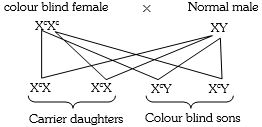
(C) Colour blindness is an $X$-linked recessive disorder. Let the allele for normal vision be $X$ and the allele for colour blindness be $X^c$.
$A$ colour blind female has the genotype $X^cX^c$.
$A$ normal male has the genotype $XY$.
When they cross $(X^cX^c \times XY)$:
- The female produces gametes $X^c$ and $X^c$.
- The male produces gametes $X$ and $Y$.
The resulting offspring genotypes are:
- $X^cX$ (Carrier daughter)
- $X^cY$ (Colour blind son)
Therefore,all daughters will be carriers and all sons will be colour blind.
$A$ colour blind female has the genotype $X^cX^c$.
$A$ normal male has the genotype $XY$.
When they cross $(X^cX^c \times XY)$:
- The female produces gametes $X^c$ and $X^c$.
- The male produces gametes $X$ and $Y$.
The resulting offspring genotypes are:
- $X^cX$ (Carrier daughter)
- $X^cY$ (Colour blind son)
Therefore,all daughters will be carriers and all sons will be colour blind.
0 likesView Solution
70
BiologyMediumMCQAIPMT · 1999
$A$ haemophilic man marries a normal woman. Their offspring will be:
A
All girls
B
All normal
C
All haemophilic
D
All boys haemophilic
Solution
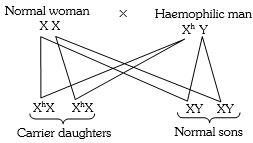
(B) Haemophilia is an $X$-linked recessive disorder. The genotype of a haemophilic man is $X^hY$ and that of a normal woman is $XX$.
When they cross,the possible genotypes of the offspring are:
$X^hY \times XX \rightarrow X^hX, X^hX, XY, XY$
Here,$X^hX$ represents carrier daughters and $XY$ represents normal sons.
Since none of the offspring express the disease (as daughters are only carriers and sons are normal),all offspring are phenotypically normal.
When they cross,the possible genotypes of the offspring are:
$X^hY \times XX \rightarrow X^hX, X^hX, XY, XY$
Here,$X^hX$ represents carrier daughters and $XY$ represents normal sons.
Since none of the offspring express the disease (as daughters are only carriers and sons are normal),all offspring are phenotypically normal.
0 likesView Solution
71
BiologyMediumMCQAIPMT · 1999
The initiating codon in eukaryotes is
A
$AUG$
B
$GUG$
C
$UGA$
D
$UAG$
Solution
(A) In eukaryotes,the chain initiation codon is generally $AUG$.
This codon codes for the amino acid methionine.
$UGA$ and $UAG$ are stop codons,while $GUG$ typically codes for valine.
This codon codes for the amino acid methionine.
$UGA$ and $UAG$ are stop codons,while $GUG$ typically codes for valine.
0 likesView Solution
72
BiologyMediumMCQAIPMT · 1999
The eukaryotic genome differs from the prokaryotic genome because
A
Repetitive sequences are present in eukaryotes
B
Genes in the former case are organized into operons
C
The $DNA$ is complexed with histones in prokaryotes
D
The $DNA$ is circular and single stranded in prokaryotes
Solution
(A) Eukaryotic genomes are characterized by the presence of large amounts of non-coding $DNA$ and repetitive sequences,which are largely absent or rare in prokaryotic genomes.
Prokaryotic genes are often organized into operons (a cluster of genes under the control of a single promoter),whereas eukaryotic genes are typically monocistronic.
In eukaryotes,$DNA$ is wrapped around histone proteins to form nucleosomes,whereas prokaryotes lack true histones.
Prokaryotic $DNA$ is typically circular and double-stranded,not single-stranded.
Prokaryotic genes are often organized into operons (a cluster of genes under the control of a single promoter),whereas eukaryotic genes are typically monocistronic.
In eukaryotes,$DNA$ is wrapped around histone proteins to form nucleosomes,whereas prokaryotes lack true histones.
Prokaryotic $DNA$ is typically circular and double-stranded,not single-stranded.
0 likesView Solution
73
BiologyMediumMCQAIPMT · 1999
In the Operon concept,the regulator gene functions as:
A
Repressor
B
Regulator
C
Inhibitor
D
All of these
Solution
(A) In the $Operon$ concept,the regulator gene (often denoted as $i$ gene) codes for a protein known as the repressor.
This repressor protein binds to the operator region of the operon.
By binding to the operator,it prevents the $RNA$ polymerase from transcribing the structural genes,thereby inhibiting the expression of the operon.
This repressor protein binds to the operator region of the operon.
By binding to the operator,it prevents the $RNA$ polymerase from transcribing the structural genes,thereby inhibiting the expression of the operon.
0 likesView Solution
74
BiologyMediumMCQAIPMT · 1999
The term 'active immunity' means
A
Resistance developed after disease
B
Resistance developed before disease
C
Resistance rate of heart beat
D
Increasing quantity of blood
Solution
(A) Active immunity is a type of immunity that develops when the immune system of an individual produces antibodies in response to the presence of an antigen.
This can occur naturally after an infection (disease) or artificially through vaccination.
Therefore,it is the resistance developed by the host's own immune system after exposure to a pathogen or antigen.
This can occur naturally after an infection (disease) or artificially through vaccination.
Therefore,it is the resistance developed by the host's own immune system after exposure to a pathogen or antigen.
0 likesView Solution
75
BiologyMediumMCQAIPMT · 1999
The antibodies are
A
Lipids
B
Germs
C
Proteins
D
Carbohydrates
Solution
(C) Antibodies are specialized proteins produced by $B$-lymphocytes in response to pathogens.
These are also known as immunoglobulins $(Ig)$.
They have a structure composed of four polypeptide chains: two light chains and two heavy chains,held together by disulfide bonds.
Therefore,antibodies are essentially proteinaceous in nature.
These are also known as immunoglobulins $(Ig)$.
They have a structure composed of four polypeptide chains: two light chains and two heavy chains,held together by disulfide bonds.
Therefore,antibodies are essentially proteinaceous in nature.
0 likesView Solution
76
BiologyMediumMCQAIPMT · 1999
Koch's postulates are not applicable to
A
$T.B.$
B
Leprosy
C
Diphtheria
D
Cholera
Solution
(B) Koch's postulates are a set of criteria designed to establish a causative relationship between a microbe and a disease.
$1$. The microorganism must be found in abundance in all organisms suffering from the disease, but should not be found in healthy organisms.
$2$. The microorganism must be isolated from a diseased organism and grown in pure culture.
$3$. The cultured microorganism should cause disease when introduced into a healthy organism.
$4$. The microorganism must be re-isolated from the inoculated, diseased experimental host and identified as being identical to the original specific causative agent.
Leprosy, caused by $Mycobacterium$ \text{ leprae}, is an exception because it cannot be grown in a cell-free culture medium (pure culture), which violates the second postulate of Koch.
$1$. The microorganism must be found in abundance in all organisms suffering from the disease, but should not be found in healthy organisms.
$2$. The microorganism must be isolated from a diseased organism and grown in pure culture.
$3$. The cultured microorganism should cause disease when introduced into a healthy organism.
$4$. The microorganism must be re-isolated from the inoculated, diseased experimental host and identified as being identical to the original specific causative agent.
Leprosy, caused by $Mycobacterium$ \text{ leprae}, is an exception because it cannot be grown in a cell-free culture medium (pure culture), which violates the second postulate of Koch.
0 likesView Solution
77
BiologyMediumMCQAIPMT · 1999
Which type of cancer is found in lymph nodes and spleen?
A
Carcinoma
B
Sarcoma
C
Lymphoma
D
Leukaemia
Solution
(C) Lymphoma is a type of cancer that originates in the lymphatic system,which includes the lymph nodes,spleen,thymus gland,and bone marrow.
It occurs when lymphocytes (a type of white blood cell) grow abnormally and uncontrollably.
Therefore,cancer found in lymph nodes and the spleen is classified as Lymphoma.
It occurs when lymphocytes (a type of white blood cell) grow abnormally and uncontrollably.
Therefore,cancer found in lymph nodes and the spleen is classified as Lymphoma.
0 likesView Solution
78
BiologyEasyMCQAIPMT · 1999
The new varieties of plants are produced by
A
Selection and hybridization
B
Mutation and selection
C
Introduction and mutation
D
Selection and introduction
Solution
(A) Plant breeding is the purposeful manipulation of plant species in order to create desired plant types that are better suited for cultivation,give better yields,and are disease resistant.
Classical plant breeding involves crossing or hybridization of pure lines,followed by artificial selection to produce plants with desirable traits of higher yield,nutrition,and resistance to diseases.
Therefore,selection and hybridization are the fundamental methods used for the production of new plant varieties.
Classical plant breeding involves crossing or hybridization of pure lines,followed by artificial selection to produce plants with desirable traits of higher yield,nutrition,and resistance to diseases.
Therefore,selection and hybridization are the fundamental methods used for the production of new plant varieties.
0 likesView Solution
79
BiologyEasyMCQAIPMT · 1999
The life span of a worker bee is
A
$10$ days
B
$15$ days
C
$6$ weeks
D
$10$ weeks
Solution
(C) The correct answer is $C$.
Worker bees are the smallest caste in a honey bee colony.
It takes approximately $21$ days for their development from egg to adult.
The total life span of an adult worker honey bee is typically $6$ weeks.
Worker bees are the smallest caste in a honey bee colony.
It takes approximately $21$ days for their development from egg to adult.
The total life span of an adult worker honey bee is typically $6$ weeks.
0 likesView Solution
80
BiologyEasyMCQAIPMT · 1999
The term 'aquaculture' means
A
Aspergillosis
B
Marine fisheries
C
Inland fisheries
D
$(b)$ and $(c)$ both
Solution
(D) Aquaculture is the farming of aquatic organisms,including fish,mollusks,crustaceans,and aquatic plants. It involves the cultivation of these organisms in controlled aquatic environments. It encompasses both marine fisheries (mariculture) and inland fisheries (freshwater aquaculture). Therefore,the term includes both $(b)$ and $(c)$.
0 likesView Solution
81
BiologyEasyMCQAIPMT · 1999
Which chemical compound caused the death of thousands of people in the Bhopal gas tragedy?
A
Carbon tetrachloride
B
Nitrous acid
C
Mustard gas
D
Methyl isocyanate
Solution
(D) The Bhopal gas tragedy occurred on the night of $2nd-3rd$ December $1984$ at the Union Carbide India Limited $(UCIL)$ pesticide plant in Bhopal,Madhya Pradesh.
This disaster was caused by the accidental release of $40$ tonnes of the toxic gas Methyl isocyanate $(CH_3NCO)$.
It is considered one of the world's worst industrial disasters,resulting in thousands of immediate deaths and long-term health complications for the survivors.
This disaster was caused by the accidental release of $40$ tonnes of the toxic gas Methyl isocyanate $(CH_3NCO)$.
It is considered one of the world's worst industrial disasters,resulting in thousands of immediate deaths and long-term health complications for the survivors.
0 likesView Solution
82
BiologyMediumMCQAIPMT · 1999
The yield of a paddy field can be increased by the application of:
A
Iron bacteria
B
Nostoc/Anabaena
C
Archaebacteria
D
Symbiotic bacteria
Solution
(B) $Nostoc$ and $Anabaena$ are free-living nitrogen-fixing cyanobacteria.
They increase the nitrogen content of moist soil and water bodies.
This enrichment of nitrogen acts as a natural fertilizer,which significantly increases the yield of paddy crops.
They increase the nitrogen content of moist soil and water bodies.
This enrichment of nitrogen acts as a natural fertilizer,which significantly increases the yield of paddy crops.
0 likesView Solution
83
BiologyMediumMCQAIPMT · 1999
Which aquatic fern is an excellent biofertilizer?
A
Salvinia
B
Azolla
C
Marsilea
D
Pteridium
Solution
(B) $Azolla$ $pinnata$ (an aquatic fern) contains symbiotic nitrogen-fixing cyanobacteria ($Anabaena$ $azollae$) in its leaf cavities.
It is widely used as a biofertilizer in rice fields,particularly in south-eastern Asia.
It helps in nitrogen fixation and has been found to increase crop yield by up to $50\%$.
It is widely used as a biofertilizer in rice fields,particularly in south-eastern Asia.
It helps in nitrogen fixation and has been found to increase crop yield by up to $50\%$.
0 likesView Solution
84
BiologyMediumMCQAIPMT · 1999
Which fish is used to eradicate mosquito larvae?
A
Anabas
B
Rohu
C
Gambusia
D
Cutter fish
Solution
(C) $Gambusia$ is a larvivorous fish that feeds on mosquito larvae. By introducing $Gambusia$ into water bodies like ponds and tanks,the population of mosquito larvae is significantly reduced,which helps in the biological control of mosquito-borne diseases like malaria and dengue.
0 likesView Solution
85
BiologyEasyMCQAIPMT · 1999
Humulin is
A
$A$ form of chitin
B
$A$ powerful antibiotic
C
$A$ new digestive enzyme
D
Human insulin
Solution
(D) $Humulin$ is the trade name for human insulin produced using recombinant $DNA$ technology.
It was the first genetically engineered pharmaceutical product to be approved for human use.
It is produced by inserting the human insulin gene into $E. coli$ bacteria,which then synthesize the insulin protein.
It was the first genetically engineered pharmaceutical product to be approved for human use.
It is produced by inserting the human insulin gene into $E. coli$ bacteria,which then synthesize the insulin protein.
0 likesView Solution
86
BiologyMediumMCQAIPMT · 1999
Due to which of the following organisms is the yield of rice increased?
A
Anabaena
B
Bacillus popilliae
C
Sesbania
D
Bacillus polymyxa
Solution
(A) Anabaena is a genus of filamentous cyanobacteria that exists as plankton. It is known for its nitrogen-fixing abilities. In paddy fields (rice fields),Anabaena azollae (a species of Anabaena) lives in symbiotic association with the water fern Azolla. This association helps in fixing atmospheric nitrogen,which acts as a biofertilizer,thereby significantly increasing the yield of rice crops.
0 likesView Solution
87
BiologyMediumMCQAIPMT · 1999
Hybridoma cells are
A
Nervous cells
B
Hybrid cells resulting from myeloma cells
C
Only cells having oncogenes
D
Product of spore formation in bacteria
Solution
(B) $Hybridoma$ cells are formed by the fusion of a normal antibody-producing $B$-cell (plasma cell) and a myeloma cell (a cancerous $B$-cell).
$1$. The $B$-cell provides the ability to produce specific antibodies.
$2$. The myeloma cell provides the property of immortality,allowing the hybrid cell to divide indefinitely in culture.
$3$. These fused cells are called $Hybridomas$,which are used for the production of monoclonal antibodies.
$1$. The $B$-cell provides the ability to produce specific antibodies.
$2$. The myeloma cell provides the property of immortality,allowing the hybrid cell to divide indefinitely in culture.
$3$. These fused cells are called $Hybridomas$,which are used for the production of monoclonal antibodies.
0 likesView Solution
88
BiologyMediumMCQAIPMT · 1999
What percentage of energy can be captured by the organisms of the next trophic level (in $\%$)?
A
$20$
B
$30$
C
$90$
D
$10$
Solution
(D) According to Lindemann's $10\%$ law of energy flow,only $10\%$ of the total energy available at one trophic level is transferred to the next trophic level. The remaining $90\%$ is lost as heat to the environment or used for metabolic activities.
0 likesView Solution
89
BiologyEasyMCQAIPMT · 1999
Energy transfer from one trophic level to another in a food chain is: (in $\%$)
A
$1$
B
$2$
C
$10$
D
$20$
Solution
(C) According to the $10\%$ law proposed by Lindeman,only $10\%$ of the energy available at one trophic level is transferred to the next trophic level.
Remaining $90\%$ of the energy is lost to the environment as heat during metabolic activities like respiration and movement.
Therefore,the correct answer is $10\%$.
Remaining $90\%$ of the energy is lost to the environment as heat during metabolic activities like respiration and movement.
Therefore,the correct answer is $10\%$.
0 likesView Solution
90
BiologyMediumMCQAIPMT · 1999
The maximum biomagnification would be in which of the following in case of an aquatic ecosystem?
A
Fishes
B
Birds
C
Zooplanktons
D
Phytoplanktons
Solution
(A) Biomagnification refers to the increase in concentration of non-degradable pollutants at successive trophic levels of a food chain.
In an aquatic ecosystem, the food chain typically follows the sequence: $\text{Phytoplankton} \to \text{Zooplankton} \to \text{Small Fishes} \to \text{Large Fishes} \to \text{Fish-eating Birds}$.
Since biomagnification increases as we move up the trophic levels, the concentration of toxic substances will be highest in the top consumers.
Among the given options, fishes occupy a higher trophic level compared to phytoplankton and zooplankton, leading to higher accumulation of toxins.
In an aquatic ecosystem, the food chain typically follows the sequence: $\text{Phytoplankton} \to \text{Zooplankton} \to \text{Small Fishes} \to \text{Large Fishes} \to \text{Fish-eating Birds}$.
Since biomagnification increases as we move up the trophic levels, the concentration of toxic substances will be highest in the top consumers.
Among the given options, fishes occupy a higher trophic level compared to phytoplankton and zooplankton, leading to higher accumulation of toxins.
0 likesView Solution
91
BiologyMediumMCQAIPMT · 1999
In an aquatic ecosystem,maximum biomagnification is seen among the
A
Fishes
B
Phytoplanktons
C
Zooplanktons
D
Macroscopic plants
Solution
(A) Biomagnification refers to the increase in concentration of toxic substances at successive trophic levels.
In an aquatic ecosystem,the food chain typically follows the sequence: $Phytoplanktons \rightarrow Zooplanktons \rightarrow Small \ Fishes \rightarrow Large \ Fishes$.
Since fishes occupy the higher trophic levels (tertiary or quaternary consumers),they accumulate the highest concentration of non-biodegradable pollutants compared to primary producers like phytoplanktons or primary consumers like zooplanktons.
Therefore,the correct answer is $A$ (Fishes).
In an aquatic ecosystem,the food chain typically follows the sequence: $Phytoplanktons \rightarrow Zooplanktons \rightarrow Small \ Fishes \rightarrow Large \ Fishes$.
Since fishes occupy the higher trophic levels (tertiary or quaternary consumers),they accumulate the highest concentration of non-biodegradable pollutants compared to primary producers like phytoplanktons or primary consumers like zooplanktons.
Therefore,the correct answer is $A$ (Fishes).
0 likesView Solution
92
BiologyEasyMCQAIPMT · 1999
Which part of the world has a high diversity of organisms?
A
Grasslands
B
Savannahs
C
Deciduous forests
D
Tropical rain forests
Solution
(D) Tropical rain forests exhibit the highest biodiversity on land. It is estimated that one-half to two-thirds of all species of terrestrial plants and insects reside within these biomes due to favorable climatic conditions,such as high rainfall and consistent temperatures throughout the year.
0 likesView Solution
93
BiologyEasyMCQAIPMT · 1999
The circulation or cycling of elements in an ecosystem is known as
A
Geological cycling
B
Geo-chemical cycling
C
Bio-geochemical cycling
D
Nutrient cycling
Solution
(C) The movement of nutrient elements through the various components of an ecosystem is called nutrient cycling. Another name for this process is biogeochemical cycling (bio: living organism,geo: rocks,air,water). This process ensures that essential elements like carbon,nitrogen,phosphorus,and calcium are continuously recycled between the biotic (living) and abiotic (non-living) components of the ecosystem.
0 likesView Solution
94
BiologyEasyMCQAIPMT · 1999
The study of Biogeochemical cycles is called Biogeochemistry. Its father is Vernadsky. It involves:
A
Cycling of energy
B
Cycling of gases
C
Cycling of nutrients
D
Cycling of water
Solution
(C) Biogeochemistry is the scientific study of the chemical,physical,geological,and biological processes and reactions that govern the composition of the natural environment. The term 'Biogeochemical cycle' specifically refers to the movement of chemical elements and compounds between living organisms (bio) and the physical environment (geo). Therefore,it primarily involves the cycling of nutrients through the ecosystem.
0 likesView Solution
95
BiologyEasyMCQAIPMT · 1999
According to the National Forest Policy $(1988)$ of India,what percentage of the total land area should be under forest cover (in $\%$)?
A
$11$
B
$22$
C
$33$
D
$60$
Solution
(C) The National Forest Policy $(1988)$ of India recommends that $33\%$ of the total geographical area of the country should be under forest cover to maintain ecological balance.
While the option provided in the original question was $30\%$,the scientifically and policy-accepted standard is $33\%$ (or one-third of the land area).
While the option provided in the original question was $30\%$,the scientifically and policy-accepted standard is $33\%$ (or one-third of the land area).
0 likesView Solution
96
BiologyMediumMCQAIPMT · 1999
Which of the following is considered an eco-friendly method?
A
Plantation of $C_3$ plants
B
Plantation of sugarcane
C
Energy plantation
D
None of the above
Solution
(C) Energy plantation refers to the practice of growing fast-growing trees or crops specifically for the purpose of producing energy (such as biomass or biofuels).
This method is considered eco-friendly because it promotes the use of renewable energy sources,helps in carbon sequestration,and reduces dependence on fossil fuels.
Therefore,energy plantation is a sustainable and environmentally friendly approach.
This method is considered eco-friendly because it promotes the use of renewable energy sources,helps in carbon sequestration,and reduces dependence on fossil fuels.
Therefore,energy plantation is a sustainable and environmentally friendly approach.
0 likesView Solution
97
BiologyEasyMCQAIPMT · 1999
The Red Data Book provides data on:
A
Red flowered plants
B
Red coloured fishes
C
Endangered plants and animals
D
Red eyed birds
Solution
(C) The Red Data Book is a public document created for recording endangered and rare species of animals,plants,and fungi,as well as some local subspecies that are present within a particular region. It serves as a comprehensive inventory of the conservation status of biological species.
0 likesView Solution
98
BiologyEasyMCQAIPMT · 1999
World Wildlife Week is observed during which period?
A
First week of September
B
First week of October
C
Third week of October
D
Last week of October
Solution
(B) World Wildlife Week is celebrated annually across India from $1^{st}$ to $7^{th}$ October. The primary objective of this week is to raise awareness about the conservation and protection of wildlife species.
0 likesView Solution
99
BiologyMediumMCQAIPMT · 1999
Which of the following is mainly responsible for the extinction of wildlife?
A
Hunting for flesh
B
Destruction of habitats
C
Pollution of air and water
D
All of these
Solution
(D) The extinction of wildlife is caused by multiple anthropogenic factors.
$1$. Hunting for flesh and trade leads to a direct decline in population numbers.
$2$. Destruction of habitats (deforestation,urbanization) is considered the primary cause as it removes the essential resources required for survival.
$3$. Pollution of air and water introduces toxic substances that disrupt physiological processes and reproductive success.
Since all these factors contribute significantly to the loss of biodiversity and extinction,the correct answer is $D$.
$1$. Hunting for flesh and trade leads to a direct decline in population numbers.
$2$. Destruction of habitats (deforestation,urbanization) is considered the primary cause as it removes the essential resources required for survival.
$3$. Pollution of air and water introduces toxic substances that disrupt physiological processes and reproductive success.
Since all these factors contribute significantly to the loss of biodiversity and extinction,the correct answer is $D$.
0 likesView Solution
100
BiologyMediumMCQAIPMT · 1999
If the number of a species increases in any national park, it can be due to:
A
Intraspecific competition
B
Interspecific competition
C
Emigration
D
Mutualism
Solution
(D) The increase in the number of a species in a national park is typically due to positive interactions like $Mutualism$ or $Commensalism$, which provide better resources or protection.
$Intraspecific$ and $Interspecific$ competition generally limit population growth by increasing resource scarcity.
$Emigration$ refers to individuals leaving an area, which would decrease the population size.
Therefore, $Mutualism$ is the only option listed that can facilitate population growth through beneficial interactions.
$Intraspecific$ and $Interspecific$ competition generally limit population growth by increasing resource scarcity.
$Emigration$ refers to individuals leaving an area, which would decrease the population size.
Therefore, $Mutualism$ is the only option listed that can facilitate population growth through beneficial interactions.
0 likesView Solution
Vedclass Products
For Students
Vedclass Test Series
Mock tests in real AIPMT style covering Biology with performance analysis. 5-day free trial.
Start Free TrialFor Teachers
Exam Paper Generator
Generate Set A/B/C/D Biology papers from 7.5L+ questions in 2 minutes. 3 chapters free.
Try FreeFor Institutes
Online Exam Module
Run live AIPMT mock exams with unlimited students, 360° analytics & white-label branding.
See DemoFrequently Asked Questions
How many Biology questions are in AIPMT 1999?
There are 213 Biology questions from the AIPMT 1999 paper on Vedclass, each with a detailed step-by-step solution in English.
Are AIPMT 1999 Biology solutions available in English?
Yes. All solutions on this page are in English. You can also switch to English or Hindi using the language buttons above the questions.
Can I practice AIPMT 1999 Biology as a timed test?
Yes. Use the Vedclass Test Series to attempt a full AIPMT mock test covering Biology with time limits and instant score analysis.
Can teachers create Biology papers from AIPMT previous year questions?
Yes. The Vedclass Exam Paper Generator lets teachers mix AIPMT Biology questions and generate Set A/B/C/D papers in minutes.
For Teachers & Institutes
Build a Custom Biology Paper
Pick AIPMT 1999 Biology questions, set difficulty, and generate Set A/B/C/D in 2 minutes.