
PhysicsQ1–38 of 38 questions
Page 1 of 1 · English
1
PhysicsMediumMCQAIPMT · 1991
The angle between the vectors $\overrightarrow{A}$ and $\overrightarrow{B}$ is $\theta$. The value of the triple product $\overrightarrow{A} \cdot (\overrightarrow{B} \times \overrightarrow{A})$ is
A
$A^2 B$
B
Zero
C
$A^2 B \sin \theta$
D
$A^2 B \cos \theta$
Solution
(B) The expression given is a scalar triple product of the form $\overrightarrow{A} \cdot (\overrightarrow{B} \times \overrightarrow{A})$.
By the properties of the cross product,the vector $\overrightarrow{C} = (\overrightarrow{B} \times \overrightarrow{A})$ is perpendicular to both $\overrightarrow{A}$ and $\overrightarrow{B}$.
Since $\overrightarrow{C}$ is perpendicular to $\overrightarrow{A}$,the dot product of $\overrightarrow{A}$ and $\overrightarrow{C}$ must be zero.
Mathematically,$\overrightarrow{A} \cdot (\overrightarrow{B} \times \overrightarrow{A}) = 0$ because the vector $(\overrightarrow{B} \times \overrightarrow{A})$ lies in a plane perpendicular to $\overrightarrow{A}$.
By the properties of the cross product,the vector $\overrightarrow{C} = (\overrightarrow{B} \times \overrightarrow{A})$ is perpendicular to both $\overrightarrow{A}$ and $\overrightarrow{B}$.
Since $\overrightarrow{C}$ is perpendicular to $\overrightarrow{A}$,the dot product of $\overrightarrow{A}$ and $\overrightarrow{C}$ must be zero.
Mathematically,$\overrightarrow{A} \cdot (\overrightarrow{B} \times \overrightarrow{A}) = 0$ because the vector $(\overrightarrow{B} \times \overrightarrow{A})$ lies in a plane perpendicular to $\overrightarrow{A}$.
0 likesView Solution
2
PhysicsMediumMCQAIPMT · 1991
The dimensional formula of permeability of free space $\mu_0$ is
A
$M^1 L^1 T^{-2} A^{-2}$
B
$M^1 L^1 T^{-2}$
C
$M^1 L^0 T^{-1}$
D
$M^1 L^1 T^2 A^{-1}$
Solution
(A) The force per unit length between two parallel current-carrying wires is given by the formula: $F/l = \frac{\mu_0 I_1 I_2}{2\pi r}$.
Rearranging for $\mu_0$,we get: $\mu_0 = \frac{2\pi r F}{l I_1 I_2}$.
The dimensional formula for force $F$ is $[M^1 L^1 T^{-2}]$.
The dimensional formula for length $l$ is $[L^1]$.
The dimensional formula for current $I$ is $[A^1]$.
The dimensional formula for distance $r$ is $[L^1]$.
Substituting these into the formula: $[\mu_0] = \frac{[L^1] [M^1 L^1 T^{-2}]}{[L^1] [A^1] [A^1]}$.
Simplifying the expression: $[\mu_0] = [M^1 L^1 T^{-2} A^{-2}]$.
Rearranging for $\mu_0$,we get: $\mu_0 = \frac{2\pi r F}{l I_1 I_2}$.
The dimensional formula for force $F$ is $[M^1 L^1 T^{-2}]$.
The dimensional formula for length $l$ is $[L^1]$.
The dimensional formula for current $I$ is $[A^1]$.
The dimensional formula for distance $r$ is $[L^1]$.
Substituting these into the formula: $[\mu_0] = \frac{[L^1] [M^1 L^1 T^{-2}]}{[L^1] [A^1] [A^1]}$.
Simplifying the expression: $[\mu_0] = [M^1 L^1 T^{-2} A^{-2}]$.
0 likesView Solution
3
PhysicsMediumMCQAIPMT · 1991
$A$ heavy uniform chain lies on a horizontal table-top. If the coefficient of friction between the chain and table surface is $0.25$,then the maximum fraction of length of the chain that can hang over one edge of the table is ...... $\%$
A
$20$
B
$25$
C
$35$
D
$15$
Solution
(A) Let the total length of the chain be $L$ and its total mass be $M$. The mass per unit length is $\lambda = M/L$.
Let $x$ be the length of the chain hanging over the edge. Then the length of the chain on the table is $(L - x)$.
The mass of the hanging part is $m_h = \lambda x$ and the mass of the part on the table is $m_t = \lambda (L - x)$.
The force pulling the chain down is the weight of the hanging part: $F_g = m_h g = \lambda x g$.
The maximum static frictional force acting on the part on the table is $f_{max} = \mu N = \mu m_t g = \mu \lambda (L - x) g$.
For the chain to be on the verge of sliding,the pulling force must equal the maximum frictional force: $\lambda x g = \mu \lambda (L - x) g$.
Dividing both sides by $\lambda g$,we get $x = \mu (L - x)$.
Substituting $\mu = 0.25$: $x = 0.25(L - x) \implies x = 0.25L - 0.25x \implies 1.25x = 0.25L$.
Thus,the fraction $x/L = 0.25 / 1.25 = 1/5 = 0.20$.
Converting to percentage,the fraction is $20\%$.
Let $x$ be the length of the chain hanging over the edge. Then the length of the chain on the table is $(L - x)$.
The mass of the hanging part is $m_h = \lambda x$ and the mass of the part on the table is $m_t = \lambda (L - x)$.
The force pulling the chain down is the weight of the hanging part: $F_g = m_h g = \lambda x g$.
The maximum static frictional force acting on the part on the table is $f_{max} = \mu N = \mu m_t g = \mu \lambda (L - x) g$.
For the chain to be on the verge of sliding,the pulling force must equal the maximum frictional force: $\lambda x g = \mu \lambda (L - x) g$.
Dividing both sides by $\lambda g$,we get $x = \mu (L - x)$.
Substituting $\mu = 0.25$: $x = 0.25(L - x) \implies x = 0.25L - 0.25x \implies 1.25x = 0.25L$.
Thus,the fraction $x/L = 0.25 / 1.25 = 1/5 = 0.20$.
Converting to percentage,the fraction is $20\%$.
0 likesView Solution
4
PhysicsEasyMCQAIPMT · 1991
$A$ satellite moves around the earth in a circular orbit of radius $r$ with speed $v$. If the mass of the satellite is $M$,its total energy is
A
$ - \frac{1}{2}Mv^2$
B
$\frac{1}{2}Mv^2$
C
$\frac{3}{4}Mv^2$
D
$Mv^2$
Solution
(A) For a satellite in a circular orbit,the gravitational force provides the necessary centripetal force: $\frac{GMm}{r^2} = \frac{Mv^2}{r}$.
This implies that the potential energy $U = -\frac{GMm}{r} = -Mv^2$.
The kinetic energy $K = \frac{1}{2}Mv^2$.
The total energy $E$ is the sum of kinetic and potential energy: $E = K + U = \frac{1}{2}Mv^2 - Mv^2 = -\frac{1}{2}Mv^2$.
This implies that the potential energy $U = -\frac{GMm}{r} = -Mv^2$.
The kinetic energy $K = \frac{1}{2}Mv^2$.
The total energy $E$ is the sum of kinetic and potential energy: $E = K + U = \frac{1}{2}Mv^2 - Mv^2 = -\frac{1}{2}Mv^2$.
0 likesView Solution
5
PhysicsMediumMCQAIPMT · 1991
Three containers of the same volume contain three different gases. The masses of the molecules are $m_1, m_2$ and $m_3$ and the number of molecules in their respective containers are $N_1, N_2$ and $N_3$. The gas pressures in the containers are $P_1, P_2$ and $P_3$ respectively. All the gases are now mixed and put in one of the containers. The pressure $P$ of the mixture will be
A
$P < (P_1 + P_2 + P_3)$
B
$P = \frac{P_1 + P_2 + P_3}{3}$
C
$P = P_1 + P_2 + P_3$
D
$P > (P_1 + P_2 + P_3)$
Solution
(C) According to Dalton's Law of Partial Pressures,the total pressure exerted by a mixture of non-reacting gases in a fixed volume is equal to the sum of the partial pressures of the individual gases.
Since all three gases are mixed and placed into a single container of the same volume $V$,the total pressure $P$ is the sum of the individual pressures.
Therefore,$P = P_1 + P_2 + P_3$.
Since all three gases are mixed and placed into a single container of the same volume $V$,the total pressure $P$ is the sum of the individual pressures.
Therefore,$P = P_1 + P_2 + P_3$.
0 likesView Solution
6
PhysicsDifficultMCQAIPMT · 1991
The relation between the gas pressure $P$ and average kinetic energy per unit volume $E$ is
A
$P = \frac{1}{2}E$
B
$P = E$
C
$P = \frac{3}{2}E$
D
$P = \frac{2}{3}E$
Solution
(D) The pressure $P$ exerted by an ideal gas is given by the kinetic theory of gases as $P = \frac{1}{3} \rho v_{rms}^2$,where $\rho$ is the density of the gas and $v_{rms}$ is the root mean square velocity.
We know that the average kinetic energy per unit volume $E$ is given by $E = \frac{1}{2} \rho v_{rms}^2$.
From this,we can write $\rho v_{rms}^2 = 2E$.
Substituting this into the pressure equation: $P = \frac{1}{3} (2E) = \frac{2}{3}E$.
Therefore,the correct relation is $P = \frac{2}{3}E$.
We know that the average kinetic energy per unit volume $E$ is given by $E = \frac{1}{2} \rho v_{rms}^2$.
From this,we can write $\rho v_{rms}^2 = 2E$.
Substituting this into the pressure equation: $P = \frac{1}{3} (2E) = \frac{2}{3}E$.
Therefore,the correct relation is $P = \frac{2}{3}E$.
0 likesView Solution
7
PhysicsMediumMCQAIPMT · 1991
$A$ body is executing $S.H.M.$ When its displacement from the mean position is $4 \, cm$ and $5 \, cm$,the corresponding velocity of the body is $10 \, cm/sec$ and $8 \, cm/sec$. Then the time period of the body is
A
$2\pi \, sec$
B
$\pi /2 \, sec$
C
$\pi \, sec$
D
$3\pi /2 \, sec$
Solution
(C) The velocity $v$ of a body executing $S.H.M.$ at a displacement $y$ is given by the formula: $v = \omega \sqrt{a^2 - y^2}$,where $a$ is the amplitude and $\omega$ is the angular frequency.
For $y_1 = 4 \, cm$,$v_1 = 10 \, cm/sec$: $10 = \omega \sqrt{a^2 - 4^2} \implies 100 = \omega^2(a^2 - 16)$ --- $(1)$
For $y_2 = 5 \, cm$,$v_2 = 8 \, cm/sec$: $8 = \omega \sqrt{a^2 - 5^2} \implies 64 = \omega^2(a^2 - 25)$ --- $(2)$
Subtracting equation $(2)$ from equation $(1)$:
$100 - 64 = \omega^2(a^2 - 16 - a^2 + 25)$
$36 = \omega^2(9)$
$\omega^2 = 4 \implies \omega = 2 \, rad/sec$.
The time period $T$ is given by $T = \frac{2\pi}{\omega}$.
$T = \frac{2\pi}{2} = \pi \, sec$.
For $y_1 = 4 \, cm$,$v_1 = 10 \, cm/sec$: $10 = \omega \sqrt{a^2 - 4^2} \implies 100 = \omega^2(a^2 - 16)$ --- $(1)$
For $y_2 = 5 \, cm$,$v_2 = 8 \, cm/sec$: $8 = \omega \sqrt{a^2 - 5^2} \implies 64 = \omega^2(a^2 - 25)$ --- $(2)$
Subtracting equation $(2)$ from equation $(1)$:
$100 - 64 = \omega^2(a^2 - 16 - a^2 + 25)$
$36 = \omega^2(9)$
$\omega^2 = 4 \implies \omega = 2 \, rad/sec$.
The time period $T$ is given by $T = \frac{2\pi}{\omega}$.
$T = \frac{2\pi}{2} = \pi \, sec$.
0 likesView Solution
8
PhysicsMediumMCQAIPMT · 1991
The angular velocity and the amplitude of a simple pendulum are $\omega$ and $a$ respectively. At a displacement $X$ from the mean position,if its kinetic energy is $T$ and potential energy is $V$,then the ratio of $T$ to $V$ is:
A
$X^2 \omega^2 / (a^2 - X^2 \omega^2)$
B
$X^2 / (a^2 - X^2)$
C
$(a^2 - X^2 \omega^2) / X^2 \omega^2$
D
$(a^2 - X^2) / X^2$
Solution
(D) For a simple harmonic oscillator,the kinetic energy $T$ at displacement $X$ is given by $T = \frac{1}{2} m \omega^2 (a^2 - X^2)$.
The potential energy $V$ at displacement $X$ is given by $V = \frac{1}{2} m \omega^2 X^2$.
To find the ratio of kinetic energy $T$ to potential energy $V$,we divide the two expressions:
$\frac{T}{V} = \frac{\frac{1}{2} m \omega^2 (a^2 - X^2)}{\frac{1}{2} m \omega^2 X^2}$.
Canceling the common terms $\frac{1}{2} m \omega^2$,we get:
$\frac{T}{V} = \frac{a^2 - X^2}{X^2}$.
The potential energy $V$ at displacement $X$ is given by $V = \frac{1}{2} m \omega^2 X^2$.
To find the ratio of kinetic energy $T$ to potential energy $V$,we divide the two expressions:
$\frac{T}{V} = \frac{\frac{1}{2} m \omega^2 (a^2 - X^2)}{\frac{1}{2} m \omega^2 X^2}$.
Canceling the common terms $\frac{1}{2} m \omega^2$,we get:
$\frac{T}{V} = \frac{a^2 - X^2}{X^2}$.
0 likesView Solution
9
PhysicsMediumMCQAIPMT · 1991
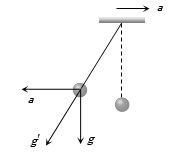
$A$ simple pendulum is suspended from the roof of a trolley which moves in a horizontal direction with an acceleration $a$. The time period is given by $T = 2\pi \sqrt{\frac{l}{g'}}$,where $g'$ is equal to:
A
$g$
B
$g - a$
C
$g + a$
D
$\sqrt{g^2 + a^2}$
Solution
(D) When a trolley moves with a horizontal acceleration $a$,a pseudo force $ma$ acts on the bob of the pendulum in the direction opposite to the acceleration of the trolley.
The effective acceleration due to gravity $g'$ is the vector sum of the acceleration due to gravity $g$ (acting downwards) and the pseudo acceleration $a$ (acting horizontally).
Since these two vectors are perpendicular to each other,the magnitude of the effective acceleration $g'$ is given by:
$g' = \sqrt{g^2 + a^2}$
Thus,the correct option is $D$.
The effective acceleration due to gravity $g'$ is the vector sum of the acceleration due to gravity $g$ (acting downwards) and the pseudo acceleration $a$ (acting horizontally).
Since these two vectors are perpendicular to each other,the magnitude of the effective acceleration $g'$ is given by:
$g' = \sqrt{g^2 + a^2}$
Thus,the correct option is $D$.
0 likesView Solution
10
PhysicsEasyMCQAIPMT · 1991
The ratio of intensities of two waves is given by $4:1$. The ratio of the amplitudes of the two waves is
A
$2:1$
B
$1:2$
C
$4:1$
D
$1:4$
Solution
(A) The intensity $I$ of a wave is directly proportional to the square of its amplitude $a$,i.e.,$I \propto a^2$.
Given the ratio of intensities is $\frac{I_1}{I_2} = \frac{4}{1}$.
Since $\frac{I_1}{I_2} = \left( \frac{a_1}{a_2} \right)^2$,we have $\left( \frac{a_1}{a_2} \right)^2 = \frac{4}{1}$.
Taking the square root on both sides,we get $\frac{a_1}{a_2} = \sqrt{\frac{4}{1}} = \frac{2}{1}$.
Therefore,the ratio of the amplitudes is $2:1$.
Given the ratio of intensities is $\frac{I_1}{I_2} = \frac{4}{1}$.
Since $\frac{I_1}{I_2} = \left( \frac{a_1}{a_2} \right)^2$,we have $\left( \frac{a_1}{a_2} \right)^2 = \frac{4}{1}$.
Taking the square root on both sides,we get $\frac{a_1}{a_2} = \sqrt{\frac{4}{1}} = \frac{2}{1}$.
Therefore,the ratio of the amplitudes is $2:1$.
0 likesView Solution
11
PhysicsMediumMCQAIPMT · 1991
$A$ certain body weighs $22.42 \; g$ and has a measured volume of $4.7 \; cc$. The possible errors in the measurement of mass and volume are $0.01 \; g$ and $0.1 \; cc$,respectively. Then the maximum percentage error in the density will be: (in $\%$)
A
$22$
B
$0.2$
C
$2$
D
$0.02$
Solution
(C) Density $\rho$ is given by the formula $\rho = \frac{m}{V}$.
For a product or quotient,the relative error is the sum of the relative errors of the individual measurements: $\frac{\Delta \rho}{\rho} = \frac{\Delta m}{m} + \frac{\Delta V}{V}$.
Given: $m = 22.42 \; g$,$\Delta m = 0.01 \; g$,$V = 4.7 \; cc$,$\Delta V = 0.1 \; cc$.
Substituting the values:
$\frac{\Delta \rho}{\rho} = \frac{0.01}{22.42} + \frac{0.1}{4.7}$.
$\frac{\Delta \rho}{\rho} \approx 0.000446 + 0.021276 \approx 0.021722$.
To find the percentage error,multiply by $100 \%$:
Percentage error $= 0.021722 \times 100 \% \approx 2.17 \%$.
Rounding to the nearest significant value provided in the options,the maximum percentage error is approximately $2 \%$.
For a product or quotient,the relative error is the sum of the relative errors of the individual measurements: $\frac{\Delta \rho}{\rho} = \frac{\Delta m}{m} + \frac{\Delta V}{V}$.
Given: $m = 22.42 \; g$,$\Delta m = 0.01 \; g$,$V = 4.7 \; cc$,$\Delta V = 0.1 \; cc$.
Substituting the values:
$\frac{\Delta \rho}{\rho} = \frac{0.01}{22.42} + \frac{0.1}{4.7}$.
$\frac{\Delta \rho}{\rho} \approx 0.000446 + 0.021276 \approx 0.021722$.
To find the percentage error,multiply by $100 \%$:
Percentage error $= 0.021722 \times 100 \% \approx 2.17 \%$.
Rounding to the nearest significant value provided in the options,the maximum percentage error is approximately $2 \%$.
0 likesView Solution
12
PhysicsMediumMCQAIPMT · 1991
$A$ car moves a distance of $200 \; m$. It covers the first half of the distance at a speed of $40 \; km/h$ and the second half of the distance at a speed of $v$. If the average speed is $48 \; km/h$,the value of $v$ is: (in $; km/h$)
A
$56$
B
$60$
C
$50$
D
$48$
Solution
(B) Let the total distance be $d = 200 \; m$. The first half distance is $d_1 = 100 \; m$ and the second half distance is $d_2 = 100 \; m$.
The time taken for the first half is $t_1 = \frac{d_1}{v_1} = \frac{100}{40} \; h$.
The time taken for the second half is $t_2 = \frac{d_2}{v} = \frac{100}{v} \; h$.
The average speed $v_{avg}$ is given by the formula: $v_{avg} = \frac{\text{Total Distance}}{\text{Total Time}} = \frac{d}{t_1 + t_2}$.
Substituting the given values: $48 = \frac{200}{\frac{100}{40} + \frac{100}{v}}$.
Dividing the numerator and denominator by $100$: $48 = \frac{2}{\frac{1}{40} + \frac{1}{v}}$.
Rearranging the terms: $\frac{1}{40} + \frac{1}{v} = \frac{2}{48} = \frac{1}{24}$.
Solving for $v$: $\frac{1}{v} = \frac{1}{24} - \frac{1}{40} = \frac{5 - 3}{120} = \frac{2}{120} = \frac{1}{60}$.
Therefore,$v = 60 \; km/h$.
The time taken for the first half is $t_1 = \frac{d_1}{v_1} = \frac{100}{40} \; h$.
The time taken for the second half is $t_2 = \frac{d_2}{v} = \frac{100}{v} \; h$.
The average speed $v_{avg}$ is given by the formula: $v_{avg} = \frac{\text{Total Distance}}{\text{Total Time}} = \frac{d}{t_1 + t_2}$.
Substituting the given values: $48 = \frac{200}{\frac{100}{40} + \frac{100}{v}}$.
Dividing the numerator and denominator by $100$: $48 = \frac{2}{\frac{1}{40} + \frac{1}{v}}$.
Rearranging the terms: $\frac{1}{40} + \frac{1}{v} = \frac{2}{48} = \frac{1}{24}$.
Solving for $v$: $\frac{1}{v} = \frac{1}{24} - \frac{1}{40} = \frac{5 - 3}{120} = \frac{2}{120} = \frac{1}{60}$.
Therefore,$v = 60 \; km/h$.
0 likesView Solution
13
PhysicsMediumMCQAIPMT · 1991
$A$ solid sphere is in rolling motion. In rolling motion,a body possesses translational kinetic energy $(K_t)$ as well as rotational kinetic energy $(K_r)$ simultaneously. The ratio $K_t : (K_t + K_r)$ for the sphere is
A
$7:10$
B
$5:7$
C
$2:5$
D
$10:7$
Solution
(B) Translational kinetic energy is given by $K_t = \frac{1}{2}mv^2$.
Rotational kinetic energy is given by $K_r = \frac{1}{2}I\omega^2$.
For a solid sphere,the moment of inertia is $I = \frac{2}{5}mr^2$ and the relation between linear and angular velocity is $v = r\omega$,so $\omega = \frac{v}{r}$.
Substituting these into the rotational kinetic energy formula:
$K_r = \frac{1}{2} \left( \frac{2}{5}mr^2 \right) \left( \frac{v}{r} \right)^2 = \frac{1}{5}mv^2$.
The total kinetic energy is $K_{total} = K_t + K_r = \frac{1}{2}mv^2 + \frac{1}{5}mv^2 = \left( \frac{5+2}{10} \right)mv^2 = \frac{7}{10}mv^2$.
The ratio $K_t : (K_t + K_r)$ is $\frac{\frac{1}{2}mv^2}{\frac{7}{10}mv^2} = \frac{1}{2} \times \frac{10}{7} = \frac{5}{7}$.
Rotational kinetic energy is given by $K_r = \frac{1}{2}I\omega^2$.
For a solid sphere,the moment of inertia is $I = \frac{2}{5}mr^2$ and the relation between linear and angular velocity is $v = r\omega$,so $\omega = \frac{v}{r}$.
Substituting these into the rotational kinetic energy formula:
$K_r = \frac{1}{2} \left( \frac{2}{5}mr^2 \right) \left( \frac{v}{r} \right)^2 = \frac{1}{5}mv^2$.
The total kinetic energy is $K_{total} = K_t + K_r = \frac{1}{2}mv^2 + \frac{1}{5}mv^2 = \left( \frac{5+2}{10} \right)mv^2 = \frac{7}{10}mv^2$.
The ratio $K_t : (K_t + K_r)$ is $\frac{\frac{1}{2}mv^2}{\frac{7}{10}mv^2} = \frac{1}{2} \times \frac{10}{7} = \frac{5}{7}$.
1 likesView Solution
14
PhysicsEasyMCQAIPMT · 1991
Two identical balls $A$ and $B$ having velocities of $0.5 \, m s^{-1}$ and $-0.3 \, m s^{-1}$ respectively collide elastically in one dimension. The velocities of $B$ and $A$ after the collision respectively will be
A
$-0.3 \, m s^{-1}, 0.5 \, m s^{-1}$
B
$0.3 \, m s^{-1}, 0.5 \, m s^{-1}$
C
$-0.5 \, m s^{-1}, 0.3 \, m s^{-1}$
D
$0.5 \, m s^{-1}, -0.3 \, m s^{-1}$
Solution
(D) In an elastic collision between two bodies of equal mass,the velocities of the bodies are interchanged after the collision.
Given: Initial velocity of ball $A$ $(u_A)$ = $0.5 \, m s^{-1}$ and initial velocity of ball $B$ $(u_B)$ = $-0.3 \, m s^{-1}$.
Since the masses are identical and the collision is elastic,the final velocity of ball $A$ $(v_A)$ will be equal to $u_B$,and the final velocity of ball $B$ $(v_B)$ will be equal to $u_A$.
Therefore,$v_A = -0.3 \, m s^{-1}$ and $v_B = 0.5 \, m s^{-1}$.
The question asks for the velocities of $B$ and $A$ respectively,which are $v_B$ and $v_A$.
Thus,the velocities are $0.5 \, m s^{-1}$ and $-0.3 \, m s^{-1}$.
Given: Initial velocity of ball $A$ $(u_A)$ = $0.5 \, m s^{-1}$ and initial velocity of ball $B$ $(u_B)$ = $-0.3 \, m s^{-1}$.
Since the masses are identical and the collision is elastic,the final velocity of ball $A$ $(v_A)$ will be equal to $u_B$,and the final velocity of ball $B$ $(v_B)$ will be equal to $u_A$.
Therefore,$v_A = -0.3 \, m s^{-1}$ and $v_B = 0.5 \, m s^{-1}$.
The question asks for the velocities of $B$ and $A$ respectively,which are $v_B$ and $v_A$.
Thus,the velocities are $0.5 \, m s^{-1}$ and $-0.3 \, m s^{-1}$.
1 likesView Solution
15
PhysicsMediumMCQAIPMT · 1991
$A$ closed organ pipe (closed at one end) is excited to support the third overtone. It is found that air in the pipe has
A
three nodes and three antinodes
B
three nodes and four antinodes
C
four nodes and three antinodes
D
four nodes and four antinodes
Solution
(D) For a closed organ pipe,the frequencies of the harmonics are given by $f_n = (2n - 1)f_1$,where $n = 1, 2, 3, ...$ is the harmonic number.
The fundamental frequency $(n=1)$ is the first harmonic.
The first overtone is the third harmonic $(n=2)$.
The second overtone is the fifth harmonic $(n=3)$.
The third overtone is the seventh harmonic $(n=4)$.
For the $n$-th harmonic in a closed pipe,the number of nodes is $n$ and the number of antinodes is $n$.
Since the third overtone corresponds to the $4$-th harmonic $(n=4)$,the air column in the pipe will have $4$ nodes and $4$ antinodes.
The fundamental frequency $(n=1)$ is the first harmonic.
The first overtone is the third harmonic $(n=2)$.
The second overtone is the fifth harmonic $(n=3)$.
The third overtone is the seventh harmonic $(n=4)$.
For the $n$-th harmonic in a closed pipe,the number of nodes is $n$ and the number of antinodes is $n$.
Since the third overtone corresponds to the $4$-th harmonic $(n=4)$,the air column in the pipe will have $4$ nodes and $4$ antinodes.
0 likesView Solution
16
PhysicsEasyMCQAIPMT · 1991
When milk is churned,cream gets separated due to
A
gravitational force
B
frictional force
C
centrifugal force
D
centripetal force
Solution
(C) When milk is churned,it undergoes circular motion. The cream particles,being lighter than the milk,experience a smaller centripetal force required to maintain circular motion. Consequently,they are pushed away from the outer edge towards the center of the container due to the centrifugal force,which is a pseudo-force acting in a rotating frame of reference.
0 likesView Solution
17
PhysicsMediumMCQAIPMT · 1991
Two trains move towards each other with the same speed. The speed of sound is $340 \; m/s$. If the pitch of the whistle of one train heard by an observer on the other train changes by a factor of $9/8$,then the speed of each train is ........... $m/s$.
A
$20$
B
$2$
C
$200$
D
$2000$
Solution
(A) Let the speed of each train be $u$ and the frequency of the whistle be $\nu$. The speed of sound is $v = 340 \; m/s$.
Since the trains are moving towards each other,the apparent frequency $\nu'$ is given by the Doppler effect formula:
$\nu' = \nu \left( \frac{v + u}{v - u} \right)$
Given that the pitch changes by a factor of $9/8$,we have $\nu' = \frac{9}{8} \nu$.
Substituting the values:
$\frac{9}{8} \nu = \nu \left( \frac{340 + u}{340 - u} \right)$
$\frac{9}{8} = \frac{340 + u}{340 - u}$
Cross-multiplying gives:
$9(340 - u) = 8(340 + u)$
$3060 - 9u = 2720 + 8u$
$3060 - 2720 = 8u + 9u$
$340 = 17u$
$u = \frac{340}{17} = 20 \; m/s$.
Thus,the speed of each train is $20 \; m/s$.
Since the trains are moving towards each other,the apparent frequency $\nu'$ is given by the Doppler effect formula:
$\nu' = \nu \left( \frac{v + u}{v - u} \right)$
Given that the pitch changes by a factor of $9/8$,we have $\nu' = \frac{9}{8} \nu$.
Substituting the values:
$\frac{9}{8} \nu = \nu \left( \frac{340 + u}{340 - u} \right)$
$\frac{9}{8} = \frac{340 + u}{340 - u}$
Cross-multiplying gives:
$9(340 - u) = 8(340 + u)$
$3060 - 9u = 2720 + 8u$
$3060 - 2720 = 8u + 9u$
$340 = 17u$
$u = \frac{340}{17} = 20 \; m/s$.
Thus,the speed of each train is $20 \; m/s$.
0 likesView Solution
18
PhysicsMediumMCQAIPMT · 1991
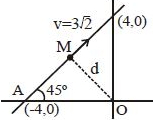
$A$ particle of mass $m = 5$ is moving with a uniform speed $v = 3\sqrt{2}$ in the $XOY$ plane along the line $Y = X + 4$. The magnitude of the angular momentum of the particle about the origin is .......
A
$0$
B
$60$
C
$7.5$
D
$40\sqrt{2}$
Solution
(B) The equation of the line is $Y = X + 4$,which can be written as $X - Y + 4 = 0$.
The perpendicular distance $d$ from the origin $(0, 0)$ to this line is given by the formula $d = \frac{|ax_0 + by_0 + c|}{\sqrt{a^2 + b^2}}$.
Substituting the values,$d = \frac{|1(0) - 1(0) + 4|}{\sqrt{1^2 + (-1)^2}} = \frac{4}{\sqrt{2}}$.
The angular momentum $L$ about the origin is given by $L = mvd$.
Substituting the given values $m = 5$,$v = 3\sqrt{2}$,and $d = \frac{4}{\sqrt{2}}$:
$L = 5 \times 3\sqrt{2} \times \frac{4}{\sqrt{2}} = 5 \times 3 \times 4 = 60$ units.
The perpendicular distance $d$ from the origin $(0, 0)$ to this line is given by the formula $d = \frac{|ax_0 + by_0 + c|}{\sqrt{a^2 + b^2}}$.
Substituting the values,$d = \frac{|1(0) - 1(0) + 4|}{\sqrt{1^2 + (-1)^2}} = \frac{4}{\sqrt{2}}$.
The angular momentum $L$ about the origin is given by $L = mvd$.
Substituting the given values $m = 5$,$v = 3\sqrt{2}$,and $d = \frac{4}{\sqrt{2}}$:
$L = 5 \times 3\sqrt{2} \times \frac{4}{\sqrt{2}} = 5 \times 3 \times 4 = 60$ units.
0 likesView Solution
19
PhysicsEasyMCQAIPMT · 1991
Physical independence of force is a consequence of
A
first law of motion
B
second law of motion
C
third law of motion
D
all of these laws
Solution
(A) Newton's first law of motion states that an object will remain at rest or in uniform motion in a straight line unless acted upon by an external force.
This law defines force as that which changes the state of rest or uniform motion of an object.
It implies that force is an external agent that can exist independently of the object's motion,establishing the concept of the physical independence of force.
Therefore,the first law of motion is the basis for the physical independence of force.
This law defines force as that which changes the state of rest or uniform motion of an object.
It implies that force is an external agent that can exist independently of the object's motion,establishing the concept of the physical independence of force.
Therefore,the first law of motion is the basis for the physical independence of force.
0 likesView Solution
20
PhysicsDifficultMCQAIPMT · 1991
The vectors $\vec{A}$ and $\vec{B}$ are such that $|\vec{A}+\vec{B}|=|\vec{A}-\vec{B}|$. The angle between the two vectors is: (in $^{\circ}$)
A
$60$
B
$75$
C
$45$
D
$90$
Solution
(D) The magnitude of the sum of two vectors is given by $|\vec{A}+\vec{B}|^2 = |\vec{A}|^2 + |\vec{B}|^2 + 2|\vec{A}||\vec{B}| \cos \theta$.
Similarly,the magnitude of the difference of two vectors is given by $|\vec{A}-\vec{B}|^2 = |\vec{A}|^2 + |\vec{B}|^2 - 2|\vec{A}||\vec{B}| \cos \theta$.
Given that $|\vec{A}+\vec{B}| = |\vec{A}-\vec{B}|$,we square both sides to get $|\vec{A}+\vec{B}|^2 = |\vec{A}-\vec{B}|^2$.
Substituting the expressions,we have $|\vec{A}|^2 + |\vec{B}|^2 + 2|\vec{A}||\vec{B}| \cos \theta = |\vec{A}|^2 + |\vec{B}|^2 - 2|\vec{A}||\vec{B}| \cos \theta$.
Canceling the common terms $|\vec{A}|^2$ and $|\vec{B}|^2$ from both sides,we get $2|\vec{A}||\vec{B}| \cos \theta = -2|\vec{A}||\vec{B}| \cos \theta$.
Rearranging the terms,we get $4|\vec{A}||\vec{B}| \cos \theta = 0$.
Since the vectors are non-zero,$|\vec{A}| \neq 0$ and $|\vec{B}| \neq 0$,therefore $\cos \theta = 0$.
This implies $\theta = 90^{\circ}$.
Similarly,the magnitude of the difference of two vectors is given by $|\vec{A}-\vec{B}|^2 = |\vec{A}|^2 + |\vec{B}|^2 - 2|\vec{A}||\vec{B}| \cos \theta$.
Given that $|\vec{A}+\vec{B}| = |\vec{A}-\vec{B}|$,we square both sides to get $|\vec{A}+\vec{B}|^2 = |\vec{A}-\vec{B}|^2$.
Substituting the expressions,we have $|\vec{A}|^2 + |\vec{B}|^2 + 2|\vec{A}||\vec{B}| \cos \theta = |\vec{A}|^2 + |\vec{B}|^2 - 2|\vec{A}||\vec{B}| \cos \theta$.
Canceling the common terms $|\vec{A}|^2$ and $|\vec{B}|^2$ from both sides,we get $2|\vec{A}||\vec{B}| \cos \theta = -2|\vec{A}||\vec{B}| \cos \theta$.
Rearranging the terms,we get $4|\vec{A}||\vec{B}| \cos \theta = 0$.
Since the vectors are non-zero,$|\vec{A}| \neq 0$ and $|\vec{B}| \neq 0$,therefore $\cos \theta = 0$.
This implies $\theta = 90^{\circ}$.
0 likesView Solution
21
PhysicsEasyMCQAIPMT · 1991
$A$ uniform magnetic field acts at right angles to the direction of motion of electrons. As a result,the electron moves in a circular path of radius $2\, cm$. If the speed of the electrons is doubled,then the radius of the circular path will be.....$cm$.
A
$2$
B
$0.5$
C
$4$
D
$1$
Solution
(C) The radius $r$ of a circular path of a charged particle moving in a uniform magnetic field is given by the formula $r = \frac{mv}{qB}$,where $m$ is the mass,$v$ is the speed,$q$ is the charge,and $B$ is the magnetic field strength.
Since $m$,$q$,and $B$ are constant,the radius is directly proportional to the speed,i.e.,$r \propto v$.
Given the initial radius $r_1 = 2\, cm$ and the initial speed $v_1 = v$.
If the speed is doubled,$v_2 = 2v$.
Therefore,the new radius $r_2$ is given by $\frac{r_2}{r_1} = \frac{v_2}{v_1} = \frac{2v}{v} = 2$.
Thus,$r_2 = 2 \times r_1 = 2 \times 2\, cm = 4\, cm$.
Since $m$,$q$,and $B$ are constant,the radius is directly proportional to the speed,i.e.,$r \propto v$.
Given the initial radius $r_1 = 2\, cm$ and the initial speed $v_1 = v$.
If the speed is doubled,$v_2 = 2v$.
Therefore,the new radius $r_2$ is given by $\frac{r_2}{r_1} = \frac{v_2}{v_1} = \frac{2v}{v} = 2$.
Thus,$r_2 = 2 \times r_1 = 2 \times 2\, cm = 4\, cm$.
0 likesView Solution
22
PhysicsMediumMCQAIPMT · 1991
$A$ deuteron of kinetic energy $50 \, keV$ is describing a circular orbit of radius $0.5 \, m$ in a plane perpendicular to a magnetic field $\vec{B}$. The kinetic energy of a proton that describes a circular orbit of radius $0.5 \, m$ in the same plane with the same $\vec{B}$ is ........ $keV$.
A
$25$
B
$50$
C
$200$
D
$100$
Solution
(D) The radius of a circular path of a charged particle in a magnetic field is given by $r = \frac{\sqrt{2mK}}{qB}$,where $m$ is the mass,$K$ is the kinetic energy,and $q$ is the charge.
From this,we can write $K = \frac{r^2 q^2 B^2}{2m}$.
Since $r$ and $B$ are the same for both particles,$K \propto \frac{q^2}{m}$.
For a deuteron $(d)$,$q_d = e$ and $m_d = 2m_p$. For a proton $(p)$,$q_p = e$ and $m_p = m_p$.
Taking the ratio: $\frac{K_p}{K_d} = \left( \frac{q_p}{q_d} \right)^2 \times \left( \frac{m_d}{m_p} \right) = \left( \frac{e}{e} \right)^2 \times \left( \frac{2m_p}{m_p} \right) = 1^2 \times 2 = 2$.
Therefore,$K_p = 2 \times K_d = 2 \times 50 \, keV = 100 \, keV$.
From this,we can write $K = \frac{r^2 q^2 B^2}{2m}$.
Since $r$ and $B$ are the same for both particles,$K \propto \frac{q^2}{m}$.
For a deuteron $(d)$,$q_d = e$ and $m_d = 2m_p$. For a proton $(p)$,$q_p = e$ and $m_p = m_p$.
Taking the ratio: $\frac{K_p}{K_d} = \left( \frac{q_p}{q_d} \right)^2 \times \left( \frac{m_d}{m_p} \right) = \left( \frac{e}{e} \right)^2 \times \left( \frac{2m_p}{m_p} \right) = 1^2 \times 2 = 2$.
Therefore,$K_p = 2 \times K_d = 2 \times 50 \, keV = 100 \, keV$.
0 likesView Solution
23
PhysicsEasyMCQAIPMT · 1991
Faraday's laws are a consequence of the conservation of
A
Energy
B
Energy and magnetic field
C
Charge
D
Magnetic field
Solution
(A) Faraday's laws of electromagnetic induction describe the process where a changing magnetic flux induces an electromotive force $(EMF)$.
This process involves the conversion of mechanical work done to move a conductor or change the magnetic field into electrical energy.
Since energy is neither created nor destroyed,this phenomenon is a direct consequence of the law of conservation of energy.
This process involves the conversion of mechanical work done to move a conductor or change the magnetic field into electrical energy.
Since energy is neither created nor destroyed,this phenomenon is a direct consequence of the law of conservation of energy.
0 likesView Solution
24
PhysicsMediumMCQAIPMT · 1991
$A$ magnetic field of $2 \times 10^{-2} \, T$ acts at right angles to a coil of area $100 \, cm^2$ with $50$ turns. The average emf induced in the coil is $0.1 \, V$,when it is removed from the field in time $t$. The value of $t$ is $... \, sec$.
A
$0.1$
B
$0.01$
C
$1$
D
$20$
Solution
(A) The induced emf is given by Faraday's law: $|e| = N \frac{|\Delta \Phi|}{\Delta t}$.
Here,$N = 50$,$A = 100 \, cm^2 = 100 \times 10^{-4} \, m^2 = 10^{-2} \, m^2$,$B_1 = 2 \times 10^{-2} \, T$,$B_2 = 0 \, T$,and $e = 0.1 \, V$.
The change in magnetic flux is $\Delta \Phi = A(B_2 - B_1) = 10^{-2} \times (0 - 2 \times 10^{-2}) = -2 \times 10^{-4} \, Wb$.
The magnitude of induced emf is $|e| = N \frac{|\Delta \Phi|}{t}$.
Substituting the values: $0.1 = 50 \times \frac{2 \times 10^{-4}}{t}$.
$t = \frac{50 \times 2 \times 10^{-4}}{0.1} = \frac{100 \times 10^{-4}}{0.1} = \frac{10^{-2}}{10^{-1}} = 0.1 \, s$.
Here,$N = 50$,$A = 100 \, cm^2 = 100 \times 10^{-4} \, m^2 = 10^{-2} \, m^2$,$B_1 = 2 \times 10^{-2} \, T$,$B_2 = 0 \, T$,and $e = 0.1 \, V$.
The change in magnetic flux is $\Delta \Phi = A(B_2 - B_1) = 10^{-2} \times (0 - 2 \times 10^{-2}) = -2 \times 10^{-4} \, Wb$.
The magnitude of induced emf is $|e| = N \frac{|\Delta \Phi|}{t}$.
Substituting the values: $0.1 = 50 \times \frac{2 \times 10^{-4}}{t}$.
$t = \frac{50 \times 2 \times 10^{-4}}{0.1} = \frac{100 \times 10^{-4}}{0.1} = \frac{10^{-2}}{10^{-1}} = 0.1 \, s$.
0 likesView Solution
25
PhysicsEasyMCQAIPMT · 1991
When the number of turns in a coil is doubled without any change in the length of the coil,its self-inductance becomes
A
Four times
B
Doubled
C
Halved
D
Unchanged
Solution
(A) The self-inductance $L$ of a solenoid is given by the formula $L = \frac{\mu_0 N^2 A}{l}$,where $N$ is the number of turns,$A$ is the cross-sectional area,and $l$ is the length of the coil.
Since $A$ and $l$ remain constant,we have $L \propto N^2$.
Given that the number of turns is doubled,$N_2 = 2N_1$.
Therefore,the new self-inductance $L_2$ is given by $L_2 = L_1 \left( \frac{N_2}{N_1} \right)^2 = L_1 \left( \frac{2N_1}{N_1} \right)^2 = 4L_1$.
Thus,the self-inductance becomes four times the original value.
Since $A$ and $l$ remain constant,we have $L \propto N^2$.
Given that the number of turns is doubled,$N_2 = 2N_1$.
Therefore,the new self-inductance $L_2$ is given by $L_2 = L_1 \left( \frac{N_2}{N_1} \right)^2 = L_1 \left( \frac{2N_1}{N_1} \right)^2 = 4L_1$.
Thus,the self-inductance becomes four times the original value.
0 likesView Solution
26
PhysicsEasyMCQAIPMT · 1991
$A$ $100\, mH$ coil carries a current of $1\, A$. The energy stored in its magnetic field is......$J$.
A
$0.5$
B
$1$
C
$0.05$
D
$0.1$
Solution
(C) The energy $U$ stored in an inductor is given by the formula $U = \frac{1}{2} L I^2$.
Given:
Inductance $L = 100\, mH = 100 \times 10^{-3}\, H = 0.1\, H$.
Current $I = 1\, A$.
Substituting the values into the formula:
$U = \frac{1}{2} \times 0.1 \times (1)^2$
$U = 0.05\, J$.
Therefore,the energy stored in the magnetic field is $0.05\, J$.
Given:
Inductance $L = 100\, mH = 100 \times 10^{-3}\, H = 0.1\, H$.
Current $I = 1\, A$.
Substituting the values into the formula:
$U = \frac{1}{2} \times 0.1 \times (1)^2$
$U = 0.05\, J$.
Therefore,the energy stored in the magnetic field is $0.05\, J$.
0 likesView Solution
27
PhysicsEasyMCQAIPMT · 1991
The wavelength of a $1 \;keV$ photon is $1.24 \times 10^{-9} \;m$. What is the frequency of a $1 \;MeV$ photon?
A
$1.24 \times 10^{15} \;Hz$
B
$2.4 \times 10^{20} \;Hz$
C
$1.24 \times 10^{18} \;Hz$
D
$2.4 \times 10^{23} \;Hz$
Solution
(B) The energy of a photon is given by the relation $E = h\nu$,where $h$ is Planck's constant and $\nu$ is the frequency.
Given energy $E = 1 \;MeV = 1 \times 10^6 \;eV = 10^6 \times 1.6 \times 10^{-19} \;J = 1.6 \times 10^{-13} \;J$.
Planck's constant $h \approx 6.63 \times 10^{-34} \;J \cdot s$.
Using the formula $\nu = \frac{E}{h}$:
$\nu = \frac{1.6 \times 10^{-13} \;J}{6.63 \times 10^{-34} \;J \cdot s} \approx 0.241 \times 10^{21} \;Hz = 2.41 \times 10^{20} \;Hz$.
Thus,the frequency is approximately $2.4 \times 10^{20} \;Hz$.
Given energy $E = 1 \;MeV = 1 \times 10^6 \;eV = 10^6 \times 1.6 \times 10^{-19} \;J = 1.6 \times 10^{-13} \;J$.
Planck's constant $h \approx 6.63 \times 10^{-34} \;J \cdot s$.
Using the formula $\nu = \frac{E}{h}$:
$\nu = \frac{1.6 \times 10^{-13} \;J}{6.63 \times 10^{-34} \;J \cdot s} \approx 0.241 \times 10^{21} \;Hz = 2.41 \times 10^{20} \;Hz$.
Thus,the frequency is approximately $2.4 \times 10^{20} \;Hz$.
0 likesView Solution
28
PhysicsMediumMCQAIPMT · 1991
The work function of a metal is $1 \; eV$. Light of wavelength $3000 \; \mathring{A}$ is incident on this metal surface. The velocity of the emitted photo-electrons will be:
A
$10 \; m/s$
B
$1 \times 10^3 \; m/s$
C
$1 \times 10^4 \; m/s$
D
$1 \times 10^6 \; m/s$
Solution
(D) According to Einstein's photoelectric equation: $E = W_0 + K_{\max}$.
First,calculate the energy of the incident photon: $E = \frac{hc}{\lambda} \approx \frac{12400 \; eV \cdot \mathring{A}}{3000 \; \mathring{A}} \approx 4.13 \; eV$.
Given the work function $W_0 = 1 \; eV$,the maximum kinetic energy is $K_{\max} = E - W_0 = 4.13 \; eV - 1 \; eV = 3.13 \; eV$.
Convert $K_{\max}$ to Joules: $K_{\max} = 3.13 \times 1.6 \times 10^{-19} \; J \approx 5 \times 10^{-19} \; J$.
Using $K_{\max} = \frac{1}{2} m v^2$,where $m = 9.1 \times 10^{-31} \; kg$:
$v = \sqrt{\frac{2 K_{\max}}{m}} = \sqrt{\frac{2 \times 5 \times 10^{-19}}{9.1 \times 10^{-31}}} \approx \sqrt{1.1 \times 10^{12}} \approx 1.05 \times 10^6 \; m/s$.
Thus,the velocity is approximately $1 \times 10^6 \; m/s$.
First,calculate the energy of the incident photon: $E = \frac{hc}{\lambda} \approx \frac{12400 \; eV \cdot \mathring{A}}{3000 \; \mathring{A}} \approx 4.13 \; eV$.
Given the work function $W_0 = 1 \; eV$,the maximum kinetic energy is $K_{\max} = E - W_0 = 4.13 \; eV - 1 \; eV = 3.13 \; eV$.
Convert $K_{\max}$ to Joules: $K_{\max} = 3.13 \times 1.6 \times 10^{-19} \; J \approx 5 \times 10^{-19} \; J$.
Using $K_{\max} = \frac{1}{2} m v^2$,where $m = 9.1 \times 10^{-31} \; kg$:
$v = \sqrt{\frac{2 K_{\max}}{m}} = \sqrt{\frac{2 \times 5 \times 10^{-19}}{9.1 \times 10^{-31}}} \approx \sqrt{1.1 \times 10^{12}} \approx 1.05 \times 10^6 \; m/s$.
Thus,the velocity is approximately $1 \times 10^6 \; m/s$.
0 likesView Solution
29
PhysicsMediumMCQAIPMT · 1991
The half-life period of radium is $1600$ years. The fraction of a sample of radium that would remain after $6400$ years is
A
$1/4$
B
$1/2$
C
$1/8$
D
$1/16$
Solution
(D) The formula for the remaining fraction of a radioactive sample is given by $\frac{N}{N_0} = (1/2)^n$,where $n$ is the number of half-lives.
Given,half-life $T_{1/2} = 1600$ years and total time $t = 6400$ years.
The number of half-lives $n = \frac{t}{T_{1/2}} = \frac{6400}{1600} = 4$.
Therefore,the fraction remaining is $\frac{N}{N_0} = (1/2)^4 = \frac{1}{16}$.
Given,half-life $T_{1/2} = 1600$ years and total time $t = 6400$ years.
The number of half-lives $n = \frac{t}{T_{1/2}} = \frac{6400}{1600} = 4$.
Therefore,the fraction remaining is $\frac{N}{N_0} = (1/2)^4 = \frac{1}{16}$.
0 likesView Solution
30
PhysicsEasyMCQAIPMT · 1991
The depletion layer in the $P-N$ junction region is caused by
A
Drift of holes
B
Diffusion of charge carriers
C
Migration of impurity ions
D
Drift of electrons
Solution
(B) When a $P-N$ junction is formed,there is a high concentration of electrons in the $N$-region and a high concentration of holes in the $P$-region.
Due to this concentration gradient,electrons diffuse from the $N$-side to the $P$-side,and holes diffuse from the $P$-side to the $N$-side.
As these charge carriers cross the junction,they recombine near the interface,leaving behind immobile ionized impurity atoms.
This region,depleted of mobile charge carriers,is known as the depletion layer.
Due to this concentration gradient,electrons diffuse from the $N$-side to the $P$-side,and holes diffuse from the $P$-side to the $N$-side.
As these charge carriers cross the junction,they recombine near the interface,leaving behind immobile ionized impurity atoms.
This region,depleted of mobile charge carriers,is known as the depletion layer.
0 likesView Solution
31
PhysicsDifficultMCQAIPMT · 1991
In a Young's experiment,two coherent sources are placed $0.90 \, mm$ apart and the fringes are observed one metre away. If it produces the second dark fringe at a distance of $1 \, mm$ from the central fringe,the wavelength of monochromatic light used would be
A
$60 \times 10^{-4} \, cm$
B
$10 \times 10^{-4} \, cm$
C
$10 \times 10^{-5} \, cm$
D
$6 \times 10^{-5} \, cm$
Solution
(D) The distance of the $n^{th}$ dark fringe from the central fringe is given by the formula:
$x_n = \frac{(2n - 1) \lambda D}{2d}$
For the second dark fringe $(n = 2)$:
$x_2 = \frac{(2 \times 2 - 1) \lambda D}{2d} = \frac{3 \lambda D}{2d}$
Given: $x_2 = 1 \, mm = 1 \times 10^{-3} \, m$,$D = 1 \, m$,and $d = 0.90 \, mm = 0.9 \times 10^{-3} \, m$.
Substituting the values:
$1 \times 10^{-3} = \frac{3 \times \lambda \times 1}{2 \times 0.9 \times 10^{-3}}$
$1 \times 10^{-3} = \frac{3 \lambda}{1.8 \times 10^{-3}}$
$3 \lambda = 1.8 \times 10^{-6}$
$\lambda = 0.6 \times 10^{-6} \, m = 6 \times 10^{-7} \, m = 6 \times 10^{-5} \, cm$.
$x_n = \frac{(2n - 1) \lambda D}{2d}$
For the second dark fringe $(n = 2)$:
$x_2 = \frac{(2 \times 2 - 1) \lambda D}{2d} = \frac{3 \lambda D}{2d}$
Given: $x_2 = 1 \, mm = 1 \times 10^{-3} \, m$,$D = 1 \, m$,and $d = 0.90 \, mm = 0.9 \times 10^{-3} \, m$.
Substituting the values:
$1 \times 10^{-3} = \frac{3 \times \lambda \times 1}{2 \times 0.9 \times 10^{-3}}$
$1 \times 10^{-3} = \frac{3 \lambda}{1.8 \times 10^{-3}}$
$3 \lambda = 1.8 \times 10^{-6}$
$\lambda = 0.6 \times 10^{-6} \, m = 6 \times 10^{-7} \, m = 6 \times 10^{-5} \, cm$.
0 likesView Solution
32
PhysicsEasyMCQAIPMT · 1991
If the nuclear force between two protons,two neutrons,and between a proton and a neutron is denoted by $F_{pp}$,$F_{nn}$,and $F_{pn}$ respectively,then:
A
$F_{pp} < F_{pn} = F_{nn}$
B
$F_{pp} > F_{pn} = F_{nn}$
C
$F_{pp} = F_{pn} = F_{nn}$
D
$F_{pp} < F_{pn} < F_{nn}$
Solution
(C) The nuclear force is charge-independent.
This means that the strong nuclear force acting between two nucleons is independent of whether they are protons or neutrons.
Therefore,the magnitude of the nuclear force between two protons $(F_{pp})$,two neutrons $(F_{nn})$,and a proton and a neutron $(F_{pn})$ is approximately the same.
Thus,$F_{pp} = F_{pn} = F_{nn}$.
This means that the strong nuclear force acting between two nucleons is independent of whether they are protons or neutrons.
Therefore,the magnitude of the nuclear force between two protons $(F_{pp})$,two neutrons $(F_{nn})$,and a proton and a neutron $(F_{pn})$ is approximately the same.
Thus,$F_{pp} = F_{pn} = F_{nn}$.
0 likesView Solution
33
PhysicsMediumMCQAIPMT · 1991
Energy of $H$-atom in the ground state is $-13.6 \; eV$. The energy needed to ionize a hydrogen atom which is in its second excited state is ....... $eV$.
A
$1.51$
B
$3.4$
C
$13.6$
D
None of the above
Solution
(A) The ground state of a hydrogen atom corresponds to the principal quantum number $n = 1$.
The second excited state corresponds to the principal quantum number $n = 3$.
The energy of an electron in the $n$-th orbit of a hydrogen atom is given by $E_n = -\frac{13.6}{n^2} \; eV$.
For the second excited state $(n = 3)$,the energy is $E_3 = -\frac{13.6}{3^2} = -\frac{13.6}{9} = -1.51 \; eV$.
The energy required to ionize the atom is the energy needed to bring the electron from the current state to the state where $E = 0$.
Therefore,the ionization energy $E_{ion} = 0 - E_3 = 0 - (-1.51) = 1.51 \; eV$.
The second excited state corresponds to the principal quantum number $n = 3$.
The energy of an electron in the $n$-th orbit of a hydrogen atom is given by $E_n = -\frac{13.6}{n^2} \; eV$.
For the second excited state $(n = 3)$,the energy is $E_3 = -\frac{13.6}{3^2} = -\frac{13.6}{9} = -1.51 \; eV$.
The energy required to ionize the atom is the energy needed to bring the electron from the current state to the state where $E = 0$.
Therefore,the ionization energy $E_{ion} = 0 - E_3 = 0 - (-1.51) = 1.51 \; eV$.
0 likesView Solution
34
PhysicsMediumMCQAIPMT · 1991
An electron with rest mass $m_{0}$ moves with a speed of $0.8 c$. Its mass when it moves with this speed is
A
$m_0$
B
$m_0/6$
C
$5m_0/3$
D
$3m_0/5$
Solution
(C) According to the theory of special relativity,the relativistic mass $m$ of an object moving with velocity $v$ is given by the formula:
$m = \frac{m_0}{\sqrt{1 - \frac{v^2}{c^2}}}$
Given that the speed $v = 0.8 c$,we substitute this value into the equation:
$m = \frac{m_0}{\sqrt{1 - \frac{(0.8c)^2}{c^2}}}$
$m = \frac{m_0}{\sqrt{1 - 0.64}}$
$m = \frac{m_0}{\sqrt{0.36}}$
$m = \frac{m_0}{0.6}$
$m = \frac{m_0}{6/10} = \frac{10}{6} m_0 = \frac{5}{3} m_0$
Therefore,the mass of the electron at this speed is $\frac{5}{3} m_0$.
$m = \frac{m_0}{\sqrt{1 - \frac{v^2}{c^2}}}$
Given that the speed $v = 0.8 c$,we substitute this value into the equation:
$m = \frac{m_0}{\sqrt{1 - \frac{(0.8c)^2}{c^2}}}$
$m = \frac{m_0}{\sqrt{1 - 0.64}}$
$m = \frac{m_0}{\sqrt{0.36}}$
$m = \frac{m_0}{0.6}$
$m = \frac{m_0}{6/10} = \frac{10}{6} m_0 = \frac{5}{3} m_0$
Therefore,the mass of the electron at this speed is $\frac{5}{3} m_0$.
0 likesView Solution
35
PhysicsMediumMCQAIPMT · 1991
To use a transistor as an amplifier,which of the following conditions must be satisfied?
A
no bias voltage is required
B
the emitter-base junction is forward-biased and the base-collector junction is reverse-biased
C
both junctions are forward-biased
D
both junctions are reverse-biased
Solution
(B) For a transistor to operate as an amplifier,it must be in the active region.
In the active region,the emitter-base junction is forward-biased,which allows charge carriers to flow from the emitter into the base.
The base-collector junction is reverse-biased,which allows the collector to collect the majority of the charge carriers injected from the emitter.
Therefore,the correct condition is that the emitter-base junction is forward-biased and the base-collector junction is reverse-biased.
In the active region,the emitter-base junction is forward-biased,which allows charge carriers to flow from the emitter into the base.
The base-collector junction is reverse-biased,which allows the collector to collect the majority of the charge carriers injected from the emitter.
Therefore,the correct condition is that the emitter-base junction is forward-biased and the base-collector junction is reverse-biased.
0 likesView Solution
36
PhysicsMediumMCQAIPMT · 1991
Green light of wavelength $5460 \mathring{A}$ is incident on an air-glass interface. If the refractive index of glass is $1.5$,the wavelength of light in glass would be ........ $\mathring{A}$.
A
$3640$
B
$5460$
C
$4861$
D
none of these
Solution
(A) The wavelength of light in a medium is given by the relation $\lambda_{m} = \frac{\lambda_{a}}{\mu}$,where $\lambda_{a}$ is the wavelength in air and $\mu$ is the refractive index of the medium.
Given: $\lambda_{a} = 5460 \mathring{A}$ and $\mu = 1.5$.
Substituting the values,we get $\lambda_{g} = \frac{5460}{1.5} = 3640 \mathring{A}$.
Thus,the wavelength of light in glass is $3640 \mathring{A}$.
Given: $\lambda_{a} = 5460 \mathring{A}$ and $\mu = 1.5$.
Substituting the values,we get $\lambda_{g} = \frac{5460}{1.5} = 3640 \mathring{A}$.
Thus,the wavelength of light in glass is $3640 \mathring{A}$.
0 likesView Solution
37
PhysicsEasyMCQAIPMT · 1991
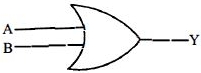
The truth table given below represents which logic gate?
| $A$ | $B$ | $Y$ |
|---|---|---|
| $0$ | $0$ | $0$ |
| $0$ | $1$ | $1$ |
| $1$ | $0$ | $1$ |
| $1$ | $1$ | $1$ |
A
$OR$ Gate
B
$NAND$ Gate
C
$AND$ Gate
D
$NOR$ Gate
Solution
(A) The truth table shows that the output $Y$ is $1$ if either input $A$ or input $B$ (or both) is $1$. If both inputs are $0$,the output is $0$.
This behavior corresponds to the Boolean expression $Y = A + B$,which is the characteristic operation of an $OR$ gate.
This behavior corresponds to the Boolean expression $Y = A + B$,which is the characteristic operation of an $OR$ gate.
| $A$ | $B$ | $Y = A + B$ |
|---|---|---|
| $0$ | $0$ | $0$ |
| $0$ | $1$ | $1$ |
| $1$ | $0$ | $1$ |
| $1$ | $1$ | $1$ |
0 likesView Solution
38
PhysicsMediumMCQAIPMT · 1991
In the nucleus of ${ }_{11} Na^{23}$,the number of protons,neutrons and electrons are
A
$11, 12, 0$
B
$12, 11, 0$
C
$23, 12, 11$
D
$23, 11, 12$
Solution
(A) The notation ${ }_{Z} X^{A}$ represents an atom where $Z$ is the atomic number and $A$ is the mass number.
For ${ }_{11} Na^{23}$,the atomic number $Z = 11$ and the mass number $A = 23$.
The number of protons in the nucleus is equal to the atomic number $Z$,so protons = $11$.
The number of neutrons is given by $N = A - Z = 23 - 11 = 12$.
The nucleus of an atom contains only protons and neutrons; it does not contain electrons.
Therefore,the number of electrons in the nucleus is $0$.
Thus,the number of protons,neutrons,and electrons in the nucleus are $11, 12, 0$ respectively.
For ${ }_{11} Na^{23}$,the atomic number $Z = 11$ and the mass number $A = 23$.
The number of protons in the nucleus is equal to the atomic number $Z$,so protons = $11$.
The number of neutrons is given by $N = A - Z = 23 - 11 = 12$.
The nucleus of an atom contains only protons and neutrons; it does not contain electrons.
Therefore,the number of electrons in the nucleus is $0$.
Thus,the number of protons,neutrons,and electrons in the nucleus are $11, 12, 0$ respectively.
0 likesView Solution
Vedclass Products
For Students
Vedclass Test Series
Mock tests in real AIPMT style covering Physics with performance analysis. 5-day free trial.
Start Free TrialFor Teachers
Exam Paper Generator
Generate Set A/B/C/D Physics papers from 7.5L+ questions in 2 minutes. 3 chapters free.
Try FreeFor Institutes
Online Exam Module
Run live AIPMT mock exams with unlimited students, 360° analytics & white-label branding.
See DemoFrequently Asked Questions
How many Physics questions are in AIPMT 1991?
There are 38 Physics questions from the AIPMT 1991 paper on Vedclass, each with a detailed step-by-step solution in English.
Are AIPMT 1991 Physics solutions available in English?
Yes. All solutions on this page are in English. You can also switch to English or Hindi using the language buttons above the questions.
Can I practice AIPMT 1991 Physics as a timed test?
Yes. Use the Vedclass Test Series to attempt a full AIPMT mock test covering Physics with time limits and instant score analysis.
Can teachers create Physics papers from AIPMT previous year questions?
Yes. The Vedclass Exam Paper Generator lets teachers mix AIPMT Physics questions and generate Set A/B/C/D papers in minutes.
For Teachers & Institutes
Build a Custom Physics Paper
Pick AIPMT 1991 Physics questions, set difficulty, and generate Set A/B/C/D in 2 minutes.