
ChemistryQ1–10 of 10 questions
Page 1 of 1 · English
1
ChemistryMCQAIIMS · 1995
When a large bubble rises from the bottom of a lake to the surface,its radius doubles. If atmospheric pressure is equal to that of a column of water of height $H$,then the depth of the lake is:
A
$H$
B
$2H$
C
$7H$
D
$8H$
Solution
(C) Let the depth of the lake be $h$. The pressure at the bottom of the lake is $P_1 = P_{atm} + h\rho g$. Given that atmospheric pressure $P_{atm} = H\rho g$,we have $P_1 = (H + h)\rho g$.
At the surface,the pressure is $P_2 = P_{atm} = H\rho g$.
Let the radius of the bubble at the bottom be $r$. Its volume is $V_1 = \frac{4}{3}\pi r^3$.
At the surface,the radius becomes $2r$,so the volume is $V_2 = \frac{4}{3}\pi (2r)^3 = 8 \times \frac{4}{3}\pi r^3 = 8V_1$.
Assuming the temperature remains constant,we apply Boyle's Law: $P_1V_1 = P_2V_2$.
Substituting the values: $(H + h)\rho g \times V_1 = H\rho g \times 8V_1$.
Dividing both sides by $\rho g V_1$,we get $H + h = 8H$.
Therefore,$h = 7H$.
At the surface,the pressure is $P_2 = P_{atm} = H\rho g$.
Let the radius of the bubble at the bottom be $r$. Its volume is $V_1 = \frac{4}{3}\pi r^3$.
At the surface,the radius becomes $2r$,so the volume is $V_2 = \frac{4}{3}\pi (2r)^3 = 8 \times \frac{4}{3}\pi r^3 = 8V_1$.
Assuming the temperature remains constant,we apply Boyle's Law: $P_1V_1 = P_2V_2$.
Substituting the values: $(H + h)\rho g \times V_1 = H\rho g \times 8V_1$.
Dividing both sides by $\rho g V_1$,we get $H + h = 8H$.
Therefore,$h = 7H$.
0 likesView Solution
2
ChemistryMCQAIIMS · 1995
$A$ large horizontal surface moves up and down in $SHM$ with an amplitude of $1 \, cm$. If a mass of $10 \, kg$ (which is placed on the surface) is to remain continually in contact with it,the maximum frequency of $SHM$ will be ... $Hz$.
A
$0.5$
B
$1.5$
C
$5$
D
$10$
Solution
(C) For the mass to remain in contact with the surface,the downward acceleration of the surface must not exceed the acceleration due to gravity $g$.
At the highest point of the $SHM$,the acceleration is directed downwards and its magnitude is $a_{max} = \omega^2 A$.
To maintain contact,we require $a_{max} \leq g$.
Thus,$\omega^2 A = g$.
Substituting $\omega = 2\pi n$,where $n$ is the frequency:
$(2\pi n)^2 A = g$
$4\pi^2 n^2 A = g$
$n^2 = \frac{g}{4\pi^2 A}$.
Given $g = 10 \, m/s^2$,$A = 1 \, cm = 0.01 \, m$,and $\pi^2 \approx 10$:
$n^2 = \frac{10}{4 \times 10 \times 0.01} = \frac{10}{0.4} = 25$.
$n = \sqrt{25} = 5 \, Hz$.
At the highest point of the $SHM$,the acceleration is directed downwards and its magnitude is $a_{max} = \omega^2 A$.
To maintain contact,we require $a_{max} \leq g$.
Thus,$\omega^2 A = g$.
Substituting $\omega = 2\pi n$,where $n$ is the frequency:
$(2\pi n)^2 A = g$
$4\pi^2 n^2 A = g$
$n^2 = \frac{g}{4\pi^2 A}$.
Given $g = 10 \, m/s^2$,$A = 1 \, cm = 0.01 \, m$,and $\pi^2 \approx 10$:
$n^2 = \frac{10}{4 \times 10 \times 0.01} = \frac{10}{0.4} = 25$.
$n = \sqrt{25} = 5 \, Hz$.
0 likesView Solution
3
ChemistryMCQAIIMS · 1995
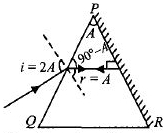
The angle of a prism is $A.$ One of its refracting surfaces is silvered. Light rays falling at an angle of incidence $2A$ on the first surface return back through the same path after suffering reflection at the silvered surface. The refractive index $\mu$ of the prism is
A
$2 \sin A$
B
$2 \cos A$
C
$\frac{1}{2} \cos A$
D
$\tan A$
Solution
(B) For the light ray to retrace its path after reflection from the silvered surface,it must strike the silvered surface normally (at an angle of incidence $0^{\circ}$).
From the geometry of the prism,the angle of refraction $r$ at the first surface is related to the prism angle $A$ by $r = A$.
Applying Snell's law at the first surface:
$1 \cdot \sin i = \mu \cdot \sin r$
Given that the angle of incidence $i = 2A$ and the angle of refraction $r = A$,we substitute these values:
$\sin(2A) = \mu \sin A$
Using the trigonometric identity $\sin(2A) = 2 \sin A \cos A$:
$2 \sin A \cos A = \mu \sin A$
Dividing both sides by $\sin A$ (assuming $A \neq 0$):
$\mu = 2 \cos A$
From the geometry of the prism,the angle of refraction $r$ at the first surface is related to the prism angle $A$ by $r = A$.
Applying Snell's law at the first surface:
$1 \cdot \sin i = \mu \cdot \sin r$
Given that the angle of incidence $i = 2A$ and the angle of refraction $r = A$,we substitute these values:
$\sin(2A) = \mu \sin A$
Using the trigonometric identity $\sin(2A) = 2 \sin A \cos A$:
$2 \sin A \cos A = \mu \sin A$
Dividing both sides by $\sin A$ (assuming $A \neq 0$):
$\mu = 2 \cos A$
0 likesView Solution
4
ChemistryMCQAIIMS · 1995
Three waves of equal frequency having amplitudes $10 \mu m,$ $4 \mu m,$ and $7 \mu m$ arrive at a given point with a successive phase difference of $\frac{\pi}{2}.$ The amplitude of the resulting wave in $\mu m$ is given by
A
$4$
B
$5$
C
$6$
D
$7$
Solution
(B) The amplitudes of the waves are $a_1 = 10 \mu m,$ $a_2 = 4 \mu m,$ and $a_3 = 7 \mu m.$ The phase difference between the $1^{st}$ and $2^{nd}$ wave is $\frac{\pi}{2},$ and between the $2^{nd}$ and $3^{rd}$ wave is $\frac{\pi}{2}.$ Therefore,the phase difference between the $1^{st}$ and $3^{rd}$ wave is $\pi.$
Combining the $1^{st}$ and $3^{rd}$ waves,their resultant amplitude $A_1$ is given by:
$A_1 = \sqrt{a_1^2 + a_3^2 + 2a_1a_3 \cos(\pi)} = \sqrt{10^2 + 7^2 + 2(10)(7)(-1)} = \sqrt{100 + 49 - 140} = \sqrt{9} = 3 \mu m.$
This resultant $A_1$ is in the direction of the $1^{st}$ wave.
Now,combining this resultant $A_1$ with the $2^{nd}$ wave (which has a phase difference of $\frac{\pi}{2}$ relative to the $1^{st}$ wave),the final resultant amplitude $A$ is:
$A = \sqrt{A_1^2 + a_2^2 + 2A_1a_2 \cos(\frac{\pi}{2})} = \sqrt{3^2 + 4^2 + 2(3)(4)(0)} = \sqrt{9 + 16} = \sqrt{25} = 5 \mu m.$
Combining the $1^{st}$ and $3^{rd}$ waves,their resultant amplitude $A_1$ is given by:
$A_1 = \sqrt{a_1^2 + a_3^2 + 2a_1a_3 \cos(\pi)} = \sqrt{10^2 + 7^2 + 2(10)(7)(-1)} = \sqrt{100 + 49 - 140} = \sqrt{9} = 3 \mu m.$
This resultant $A_1$ is in the direction of the $1^{st}$ wave.
Now,combining this resultant $A_1$ with the $2^{nd}$ wave (which has a phase difference of $\frac{\pi}{2}$ relative to the $1^{st}$ wave),the final resultant amplitude $A$ is:
$A = \sqrt{A_1^2 + a_2^2 + 2A_1a_2 \cos(\frac{\pi}{2})} = \sqrt{3^2 + 4^2 + 2(3)(4)(0)} = \sqrt{9 + 16} = \sqrt{25} = 5 \mu m.$
0 likesView Solution
5
ChemistryMCQAIIMS · 1995
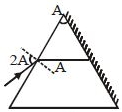
The angle of a prism is $A$. One of its refracting surfaces is silvered. Light rays falling at an angle of incidence $2A$ on the first surface return back through the same path after suffering reflection at the silvered surface. The refractive index $\mu$ of the prism is:
A
$2 \sin A$
B
$2 \cos A$
C
$\frac{1}{2} \cos A$
D
$\tan A$
Solution
(B) Let the angle of incidence be $i = 2A$ and the angle of refraction be $r_1$.
According to Snell's Law at the first surface: $\mu = \frac{\sin i}{\sin r_1} = \frac{\sin 2A}{\sin r_1}$.
Since the light ray returns back through the same path after reflection at the silvered surface,it must strike the silvered surface normally.
This implies the angle of refraction at the second surface is $r_2 = 0$.
For a prism,$A = r_1 + r_2$. Since $r_2 = 0$,we have $r_1 = A$.
Substituting $r_1 = A$ into the Snell's Law equation:
$\mu = \frac{\sin 2A}{\sin A}$
Using the trigonometric identity $\sin 2A = 2 \sin A \cos A$:
$\mu = \frac{2 \sin A \cos A}{\sin A} = 2 \cos A$.
According to Snell's Law at the first surface: $\mu = \frac{\sin i}{\sin r_1} = \frac{\sin 2A}{\sin r_1}$.
Since the light ray returns back through the same path after reflection at the silvered surface,it must strike the silvered surface normally.
This implies the angle of refraction at the second surface is $r_2 = 0$.
For a prism,$A = r_1 + r_2$. Since $r_2 = 0$,we have $r_1 = A$.
Substituting $r_1 = A$ into the Snell's Law equation:
$\mu = \frac{\sin 2A}{\sin A}$
Using the trigonometric identity $\sin 2A = 2 \sin A \cos A$:
$\mu = \frac{2 \sin A \cos A}{\sin A} = 2 \cos A$.
0 likesView Solution
6
ChemistryMCQAIIMS · 1995
Three waves of equal frequency having amplitudes $10\, \mu m, 4\, \mu m$ and $7\, \mu m$ arrive at a given point with successive phase difference of $\pi/2$. The amplitude of the resulting wave in $\mu m$ is given by
A
$7$
B
$6$
C
$5$
D
$4$
Solution
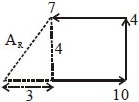
(C) Let the amplitudes be represented as vectors: $\vec{A}_1 = 10\hat{i}$,$\vec{A}_2 = 4\hat{j}$,and $\vec{A}_3 = -7\hat{i}$ (since the phase difference is $\pi/2$ between successive waves).
The resultant amplitude vector $\vec{A}_R = \vec{A}_1 + \vec{A}_2 + \vec{A}_3$.
$\vec{A}_R = (10 - 7)\hat{i} + 4\hat{j} = 3\hat{i} + 4\hat{j}$.
The magnitude of the resultant amplitude is $A_R = \sqrt{3^2 + 4^2} = \sqrt{9 + 16} = \sqrt{25} = 5\, \mu m$.
The resultant amplitude vector $\vec{A}_R = \vec{A}_1 + \vec{A}_2 + \vec{A}_3$.
$\vec{A}_R = (10 - 7)\hat{i} + 4\hat{j} = 3\hat{i} + 4\hat{j}$.
The magnitude of the resultant amplitude is $A_R = \sqrt{3^2 + 4^2} = \sqrt{9 + 16} = \sqrt{25} = 5\, \mu m$.
0 likesView Solution
7
ChemistryMCQAIIMS · 1995
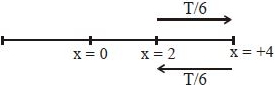
$A$ particle is performing simple harmonic motion along the $x$-axis with an amplitude of $4\, cm$ and a time period of $1.2\, s$. The minimum time taken by the particle to move from $x = 2\, cm$ to $x = +4\, cm$ and back again is given by .... $s$.
A
$0.6$
B
$0.4$
C
$0.3$
D
$0.2$
Solution
(B) The equation of motion for a particle in simple harmonic motion is given by $x = A \sin(\omega t)$.
Given amplitude $A = 4\, cm$ and time period $T = 1.2\, s$.
To find the time taken to move from $x = 2\, cm$ to $x = 4\, cm$:
At $x = 2\, cm$,$2 = 4 \sin(\omega t_1) \implies \sin(\omega t_1) = 1/2 \implies \omega t_1 = \pi/6$.
At $x = 4\, cm$,$4 = 4 \sin(\omega t_2) \implies \sin(\omega t_2) = 1 \implies \omega t_2 = \pi/2$.
The time taken to go from $x = 2\, cm$ to $x = 4\, cm$ is $\Delta t = t_2 - t_1 = (\pi/2 - \pi/6) / \omega = (\pi/3) / (2\pi/T) = T/6$.
Since the particle returns from $x = 4\, cm$ to $x = 2\, cm$,the time taken for the return journey is also $T/6$.
Total minimum time $= T/6 + T/6 = T/3$.
Given $T = 1.2\, s$,total time $= 1.2 / 3 = 0.4\, s$.
Given amplitude $A = 4\, cm$ and time period $T = 1.2\, s$.
To find the time taken to move from $x = 2\, cm$ to $x = 4\, cm$:
At $x = 2\, cm$,$2 = 4 \sin(\omega t_1) \implies \sin(\omega t_1) = 1/2 \implies \omega t_1 = \pi/6$.
At $x = 4\, cm$,$4 = 4 \sin(\omega t_2) \implies \sin(\omega t_2) = 1 \implies \omega t_2 = \pi/2$.
The time taken to go from $x = 2\, cm$ to $x = 4\, cm$ is $\Delta t = t_2 - t_1 = (\pi/2 - \pi/6) / \omega = (\pi/3) / (2\pi/T) = T/6$.
Since the particle returns from $x = 4\, cm$ to $x = 2\, cm$,the time taken for the return journey is also $T/6$.
Total minimum time $= T/6 + T/6 = T/3$.
Given $T = 1.2\, s$,total time $= 1.2 / 3 = 0.4\, s$.
0 likesView Solution
8
ChemistryMCQAIIMS · 1995
When a large bubble rises from the bottom of a lake to the surface, its radius doubles. If atmospheric pressure is equal to that of a column of water of height $H$, then the depth of the lake is:
A
$H$
B
$2H$
C
$7H$
D
$8H$
Solution
(C) Let the depth of the lake be $h$ and the radius of the bubble at the bottom be $R$.
At the bottom, the total pressure is $P_{1} = P_{atm} + \rho gh = \rho gH + \rho gh = \rho g(H + h)$.
The volume at the bottom is $V_{1} = \frac{4}{3} \pi R^{3}$.
At the surface, the pressure is $P_{2} = P_{atm} = \rho gH$.
The radius of the bubble becomes $2R$, so the volume at the surface is $V_{2} = \frac{4}{3} \pi (2R)^{3} = 8 \cdot \frac{4}{3} \pi R^{3} = 8V_{1}$.
Assuming the temperature remains constant, we apply Boyle's Law: $P_{1}V_{1} = P_{2}V_{2}$.
$\rho g(H + h) V_{1} = \rho gH (8V_{1})$.
$H + h = 8H$.
$h = 7H$.
Thus, the depth of the lake is $7H$.
At the bottom, the total pressure is $P_{1} = P_{atm} + \rho gh = \rho gH + \rho gh = \rho g(H + h)$.
The volume at the bottom is $V_{1} = \frac{4}{3} \pi R^{3}$.
At the surface, the pressure is $P_{2} = P_{atm} = \rho gH$.
The radius of the bubble becomes $2R$, so the volume at the surface is $V_{2} = \frac{4}{3} \pi (2R)^{3} = 8 \cdot \frac{4}{3} \pi R^{3} = 8V_{1}$.
Assuming the temperature remains constant, we apply Boyle's Law: $P_{1}V_{1} = P_{2}V_{2}$.
$\rho g(H + h) V_{1} = \rho gH (8V_{1})$.
$H + h = 8H$.
$h = 7H$.
Thus, the depth of the lake is $7H$.
0 likesView Solution
9
ChemistryMCQAIIMS · 1995
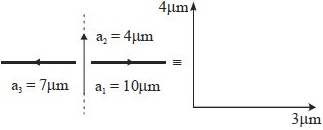
Three waves of equal frequency having amplitudes $10\,\mu m$,$4\,\mu m$,and $7\,\mu m$ arrive at a given point with a successive phase difference of $\pi / 2$. The amplitude of the resulting wave in $\mu m$ is:
A
$4$
B
$5$
C
$6$
D
$7$
Solution
(B) Let the three amplitudes be represented as vectors: $\vec{A_1} = 10\hat{i}$,$\vec{A_2} = 4\hat{j}$,and $\vec{A_3} = -7\hat{i}$ (since they have a successive phase difference of $\pi/2$).
The resultant vector $\vec{A} = \vec{A_1} + \vec{A_2} + \vec{A_3} = (10 - 7)\hat{i} + 4\hat{j} = 3\hat{i} + 4\hat{j}$.
The magnitude of the resultant amplitude is $A = \sqrt{3^2 + 4^2} = \sqrt{9 + 16} = \sqrt{25} = 5\,\mu m$.
The resultant vector $\vec{A} = \vec{A_1} + \vec{A_2} + \vec{A_3} = (10 - 7)\hat{i} + 4\hat{j} = 3\hat{i} + 4\hat{j}$.
The magnitude of the resultant amplitude is $A = \sqrt{3^2 + 4^2} = \sqrt{9 + 16} = \sqrt{25} = 5\,\mu m$.
0 likesView Solution
10
ChemistryMCQAIIMS · 1995
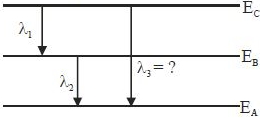
Energy levels $A, B, C$ of a certain atom correspond to increasing values of energy, i.e., $E_A < E_B < E_C$. If $\lambda_1, \lambda_2, \lambda_3$ are the wavelengths of radiation corresponding to the transitions $C \to B$, $B \to A$, and $C \to A$ respectively, which of the following relations is correct?
A
$\lambda_3 = \lambda_1 + \lambda_2$
B
$\lambda_3 = \frac{\lambda_1 \lambda_2}{\lambda_1 + \lambda_2}$
C
$\lambda_1 + \lambda_2 + \lambda_3 = 0$
D
$\lambda_3^2 = \lambda_1^2 + \lambda_2^2$
Solution
(B) The energy difference between levels $C$ and $A$ is the sum of the energy differences between $C$ and $B$, and $B$ and $A$.
$E_C - E_A = (E_C - E_B) + (E_B - E_A)$
Using the relation $E = \frac{hc}{\lambda}$, we can write:
$\frac{hc}{\lambda_3} = \frac{hc}{\lambda_1} + \frac{hc}{\lambda_2}$
Dividing both sides by $hc$, we get:
$\frac{1}{\lambda_3} = \frac{1}{\lambda_1} + \frac{1}{\lambda_2}$
$\frac{1}{\lambda_3} = \frac{\lambda_2 + \lambda_1}{\lambda_1 \lambda_2}$
Therefore, $\lambda_3 = \frac{\lambda_1 \lambda_2}{\lambda_1 + \lambda_2}$.
$E_C - E_A = (E_C - E_B) + (E_B - E_A)$
Using the relation $E = \frac{hc}{\lambda}$, we can write:
$\frac{hc}{\lambda_3} = \frac{hc}{\lambda_1} + \frac{hc}{\lambda_2}$
Dividing both sides by $hc$, we get:
$\frac{1}{\lambda_3} = \frac{1}{\lambda_1} + \frac{1}{\lambda_2}$
$\frac{1}{\lambda_3} = \frac{\lambda_2 + \lambda_1}{\lambda_1 \lambda_2}$
Therefore, $\lambda_3 = \frac{\lambda_1 \lambda_2}{\lambda_1 + \lambda_2}$.
0 likesView Solution
Vedclass Products
For Students
Vedclass Test Series
Mock tests in real AIIMS style covering Chemistry with performance analysis. 5-day free trial.
Start Free TrialFor Teachers
Exam Paper Generator
Generate Set A/B/C/D Chemistry papers from 7.5L+ questions in 2 minutes. 3 chapters free.
Try FreeFor Institutes
Online Exam Module
Run live AIIMS mock exams with unlimited students, 360° analytics & white-label branding.
See DemoFrequently Asked Questions
How many Chemistry questions are in AIIMS 1995?
There are 10 Chemistry questions from the AIIMS 1995 paper on Vedclass, each with a detailed step-by-step solution in English.
Are AIIMS 1995 Chemistry solutions available in English?
Yes. All solutions on this page are in English. You can also switch to English or Hindi using the language buttons above the questions.
Can I practice AIIMS 1995 Chemistry as a timed test?
Yes. Use the Vedclass Test Series to attempt a full AIIMS mock test covering Chemistry with time limits and instant score analysis.
Can teachers create Chemistry papers from AIIMS previous year questions?
Yes. The Vedclass Exam Paper Generator lets teachers mix AIIMS Chemistry questions and generate Set A/B/C/D papers in minutes.
For Teachers & Institutes
Build a Custom Chemistry Paper
Pick AIIMS 1995 Chemistry questions, set difficulty, and generate Set A/B/C/D in 2 minutes.