
PhysicsQ1–26 of 26 questions
Page 1 of 1 · English
1
PhysicsMediumMCQAIIMS · 1995
An aeroplane flies $400 \,m$ north and $300 \,m$ south and then flies $1200 \,m$ upwards. The net displacement is...........$m$.
A
$1204$
B
$1300$
C
$1400$
D
$1500$
Solution
(A) Let the initial position be the origin $(0, 0, 0)$.
First,the aeroplane moves $400 \,m$ North (along $y$-axis) and $300 \,m$ South (along negative $y$-axis).
The net displacement in the horizontal plane is $400 \,m - 300 \,m = 100 \,m$ towards the North.
Then,it flies $1200 \,m$ upwards (along $z$-axis).
The final position vector is $\vec{r} = 100 \hat{j} + 1200 \hat{k}$.
The magnitude of the net displacement is $r = \sqrt{(100)^2 + (1200)^2}$.
$r = \sqrt{10000 + 1440000} = \sqrt{1450000}$.
$r = 100 \sqrt{145} \approx 100 \times 12.04 = 1204 \,m$.
First,the aeroplane moves $400 \,m$ North (along $y$-axis) and $300 \,m$ South (along negative $y$-axis).
The net displacement in the horizontal plane is $400 \,m - 300 \,m = 100 \,m$ towards the North.
Then,it flies $1200 \,m$ upwards (along $z$-axis).
The final position vector is $\vec{r} = 100 \hat{j} + 1200 \hat{k}$.
The magnitude of the net displacement is $r = \sqrt{(100)^2 + (1200)^2}$.
$r = \sqrt{10000 + 1440000} = \sqrt{1450000}$.
$r = 100 \sqrt{145} \approx 100 \times 12.04 = 1204 \,m$.
0 likesView Solution
2
PhysicsMediumMCQAIIMS · 1995
$A$ particle reaches its highest point when it has covered exactly one half of its horizontal range. The corresponding point on the displacement-time graph is characterized by
A
Negative slope and zero curvature
B
Zero slope and positive curvature
C
Zero slope and negative curvature
D
Positive slope and zero curvature
Solution
(C) In projectile motion,the horizontal displacement $x$ is given by $x = u_x t$,which is a linear function of time. The vertical displacement $y$ is given by $y = u_y t - \frac{1}{2} g t^2$,which is a downward-opening parabola. At the highest point,the vertical velocity $v_y = \frac{dy}{dt} = 0$. On a displacement-time graph for vertical motion,the slope is $\frac{dy}{dt}$. At the highest point,the slope is $0$. Since the path is a downward-opening parabola ($y = at^2 + bt + c$ with $a < 0$),the second derivative $\frac{d^2y}{dt^2} = -g$ is negative. However,the question asks for the displacement-time graph of the particle's motion. The vertical displacement $y(t)$ reaches a maximum at the peak,where the slope is $0$ and the curvature (concavity) is negative. Thus,the correct description is zero slope and negative curvature.
0 likesView Solution
3
PhysicsEasyMCQAIIMS · 1995
$A$ body of mass $0.25 \, kg$ is projected with a muzzle velocity of $100 \, m/s$ from a tank of mass $100 \, kg$. What is the recoil velocity of the tank in $m/s$?
A
$5$
B
$25$
C
$0.5$
D
$0.25$
Solution
(D) According to the law of conservation of linear momentum,the total momentum before projection must equal the total momentum after projection.
Initially,both the tank and the body are at rest,so the initial momentum is $0$.
Let $M = 100 \, kg$ be the mass of the tank and $m = 0.25 \, kg$ be the mass of the body.
Let $V$ be the recoil velocity of the tank and $v = 100 \, m/s$ be the velocity of the body.
$M \times V + m \times v = 0$
$100 \times V + 0.25 \times 100 = 0$
$100 \times V = -25$
$V = -25 / 100 = -0.25 \, m/s$.
The magnitude of the recoil velocity is $0.25 \, m/s$.
Initially,both the tank and the body are at rest,so the initial momentum is $0$.
Let $M = 100 \, kg$ be the mass of the tank and $m = 0.25 \, kg$ be the mass of the body.
Let $V$ be the recoil velocity of the tank and $v = 100 \, m/s$ be the velocity of the body.
$M \times V + m \times v = 0$
$100 \times V + 0.25 \times 100 = 0$
$100 \times V = -25$
$V = -25 / 100 = -0.25 \, m/s$.
The magnitude of the recoil velocity is $0.25 \, m/s$.
0 likesView Solution
4
PhysicsDifficultMCQAIIMS · 1995
$A$ particle free to move along the $x$-axis has potential energy given by $U(x) = k[1 - \exp(-x^2)]$ for $-\infty \le x \le +\infty$,where $k$ is a positive constant of appropriate dimensions. Then:
A
At points away from the origin,the particle is in unstable equilibrium
B
For any finite non-zero value of $x$,there is a force directed away from the origin
C
If its total mechanical energy is $k/2$,it has its minimum kinetic energy at the origin
D
For small displacements from $x = 0$,the motion is simple harmonic
Solution
(D) The potential energy of the particle is given by $U(x) = k(1 - e^{-x^2})$.
The force acting on the particle is $F = -\frac{dU}{dx}$.
$F = -\frac{d}{dx} [k(1 - e^{-x^2})] = -k[0 - e^{-x^2} \cdot (-2x)] = -2kxe^{-x^2}$.
For small displacements from the origin $(x \approx 0)$,we can use the Taylor expansion $e^{-x^2} \approx 1 - x^2 + \dots \approx 1$.
Thus,$F \approx -2kx$.
Since $F \propto -x$,the restoring force is proportional to the displacement,which is the condition for simple harmonic motion $(SHM)$.
The force acting on the particle is $F = -\frac{dU}{dx}$.
$F = -\frac{d}{dx} [k(1 - e^{-x^2})] = -k[0 - e^{-x^2} \cdot (-2x)] = -2kxe^{-x^2}$.
For small displacements from the origin $(x \approx 0)$,we can use the Taylor expansion $e^{-x^2} \approx 1 - x^2 + \dots \approx 1$.
Thus,$F \approx -2kx$.
Since $F \propto -x$,the restoring force is proportional to the displacement,which is the condition for simple harmonic motion $(SHM)$.
0 likesView Solution
5
PhysicsMediumMCQAIIMS · 1995
Two satellites $A$ and $B$ go round a planet $P$ in circular orbits having radii $4R$ and $R$ respectively. If the speed of the satellite $A$ is $3V$,the speed of the satellite $B$ will be ........ $V$.
A
$12$
B
$6$
C
$\frac{4}{3}$
D
$\frac{3}{2}$
Solution
(B) The orbital speed of a satellite at a distance $r$ from the center of a planet is given by $v = \sqrt{\frac{GM}{r}}$.
Since $v \propto \frac{1}{\sqrt{r}}$,we can write the ratio of the speeds of satellites $A$ and $B$ as:
$\frac{v_A}{v_B} = \sqrt{\frac{r_B}{r_A}}$
Given $r_A = 4R$ and $r_B = R$,we have:
$\frac{v_A}{v_B} = \sqrt{\frac{R}{4R}} = \sqrt{\frac{1}{4}} = \frac{1}{2}$
Given the speed of satellite $A$ is $v_A = 3V$,we substitute this into the ratio:
$\frac{3V}{v_B} = \frac{1}{2}$
Therefore,$v_B = 3V \times 2 = 6V$.
Since $v \propto \frac{1}{\sqrt{r}}$,we can write the ratio of the speeds of satellites $A$ and $B$ as:
$\frac{v_A}{v_B} = \sqrt{\frac{r_B}{r_A}}$
Given $r_A = 4R$ and $r_B = R$,we have:
$\frac{v_A}{v_B} = \sqrt{\frac{R}{4R}} = \sqrt{\frac{1}{4}} = \frac{1}{2}$
Given the speed of satellite $A$ is $v_A = 3V$,we substitute this into the ratio:
$\frac{3V}{v_B} = \frac{1}{2}$
Therefore,$v_B = 3V \times 2 = 6V$.
1 likesView Solution
6
PhysicsMediumMCQAIIMS · 1995
The time period of a satellite of the Earth is $5$ hours. If the separation between the Earth and the satellite is increased to four times the previous value,the new time period will become ......... $hours$.
A
$20$
B
$10$
C
$80$
D
$40$
Solution
(D) According to Kepler's third law of planetary motion,the square of the time period $(T)$ is proportional to the cube of the orbital radius $(R)$: $T^2 \propto R^3$,which implies $T \propto R^{3/2}$.
Given the initial time period $T_1 = 5$ hours.
Let the initial separation be $R_1$ and the new separation be $R_2 = 4R_1$.
The new time period $T_2$ is given by the ratio: $\frac{T_2}{T_1} = \left( \frac{R_2}{R_1} \right)^{3/2}$.
Substituting the values: $\frac{T_2}{5} = \left( \frac{4R_1}{R_1} \right)^{3/2} = (4)^{3/2}$.
Calculating the exponent: $(4)^{3/2} = (2^2)^{3/2} = 2^3 = 8$.
Therefore,$T_2 = 5 \times 8 = 40$ hours.
Given the initial time period $T_1 = 5$ hours.
Let the initial separation be $R_1$ and the new separation be $R_2 = 4R_1$.
The new time period $T_2$ is given by the ratio: $\frac{T_2}{T_1} = \left( \frac{R_2}{R_1} \right)^{3/2}$.
Substituting the values: $\frac{T_2}{5} = \left( \frac{4R_1}{R_1} \right)^{3/2} = (4)^{3/2}$.
Calculating the exponent: $(4)^{3/2} = (2^2)^{3/2} = 2^3 = 8$.
Therefore,$T_2 = 5 \times 8 = 40$ hours.
0 likesView Solution
7
PhysicsDifficultMCQAIIMS · 1995
When a large bubble rises from the bottom of a lake to the surface,its radius doubles. If atmospheric pressure is equal to that of a column of water of height $H$,then the depth of the lake is:
A
$H$
B
$2H$
C
$7H$
D
$8H$
Solution
(C) Let the depth of the lake be $h$. The pressure at the bottom of the lake is $P_1 = P_0 + h\rho g$,where $P_0$ is the atmospheric pressure and $\rho$ is the density of water.
Given that atmospheric pressure $P_0 = H\rho g$.
So,$P_1 = H\rho g + h\rho g = (H + h)\rho g$.
The volume of the bubble at the bottom is $V_1 = \frac{4}{3}\pi r^3$.
At the surface,the pressure is $P_2 = P_0 = H\rho g$ and the radius becomes $2r$,so the volume is $V_2 = \frac{4}{3}\pi (2r)^3 = 8 \times \frac{4}{3}\pi r^3$.
Assuming the temperature remains constant,we use Boyle's Law: $P_1V_1 = P_2V_2$.
$(H + h)\rho g \times \frac{4}{3}\pi r^3 = H\rho g \times 8 \times \frac{4}{3}\pi r^3$.
$(H + h) = 8H$.
$h = 7H$.
Given that atmospheric pressure $P_0 = H\rho g$.
So,$P_1 = H\rho g + h\rho g = (H + h)\rho g$.
The volume of the bubble at the bottom is $V_1 = \frac{4}{3}\pi r^3$.
At the surface,the pressure is $P_2 = P_0 = H\rho g$ and the radius becomes $2r$,so the volume is $V_2 = \frac{4}{3}\pi (2r)^3 = 8 \times \frac{4}{3}\pi r^3$.
Assuming the temperature remains constant,we use Boyle's Law: $P_1V_1 = P_2V_2$.
$(H + h)\rho g \times \frac{4}{3}\pi r^3 = H\rho g \times 8 \times \frac{4}{3}\pi r^3$.
$(H + h) = 8H$.
$h = 7H$.
0 likesView Solution
8
PhysicsDifficultMCQAIIMS · 1995
$A$ concrete sphere of radius $R$ has a cavity of radius $r$ which is packed with sawdust. The specific gravities of concrete and sawdust are $2.4$ and $0.3$ respectively. For this sphere to float with its entire volume submerged under water,the ratio of the mass of concrete to the mass of sawdust will be:
A
$8$
B
$4$
C
$3$
D
$0$
Solution
(B) Let the specific gravities of concrete and sawdust be $\rho_1 = 2.4$ and $\rho_2 = 0.3$ respectively.
According to the principle of floatation,the weight of the whole sphere equals the upthrust (buoyant force) on the sphere.
Weight of sphere = Weight of water displaced
$\frac{4}{3}\pi (R^3 - r^3)\rho_1 g + \frac{4}{3}\pi r^3 \rho_2 g = \frac{4}{3}\pi R^3 \times 1 \times g$
Dividing by $\frac{4}{3}\pi g$,we get:
$(R^3 - r^3)\rho_1 + r^3 \rho_2 = R^3$
$R^3 \rho_1 - r^3 \rho_1 + r^3 \rho_2 = R^3$
$R^3(\rho_1 - 1) = r^3(\rho_1 - \rho_2)$
$\frac{R^3}{r^3} = \frac{\rho_1 - \rho_2}{\rho_1 - 1} = \frac{2.4 - 0.3}{2.4 - 1} = \frac{2.1}{1.4} = 1.5$
Now,the ratio of the mass of concrete $(M_c)$ to the mass of sawdust $(M_s)$ is:
$\frac{M_c}{M_s} = \frac{\frac{4}{3}\pi (R^3 - r^3)\rho_1}{\frac{4}{3}\pi r^3 \rho_2} = \left( \frac{R^3}{r^3} - 1 \right) \frac{\rho_1}{\rho_2}$
Substituting the values:
$\frac{M_c}{M_s} = (1.5 - 1) \times \frac{2.4}{0.3} = 0.5 \times 8 = 4$.
According to the principle of floatation,the weight of the whole sphere equals the upthrust (buoyant force) on the sphere.
Weight of sphere = Weight of water displaced
$\frac{4}{3}\pi (R^3 - r^3)\rho_1 g + \frac{4}{3}\pi r^3 \rho_2 g = \frac{4}{3}\pi R^3 \times 1 \times g$
Dividing by $\frac{4}{3}\pi g$,we get:
$(R^3 - r^3)\rho_1 + r^3 \rho_2 = R^3$
$R^3 \rho_1 - r^3 \rho_1 + r^3 \rho_2 = R^3$
$R^3(\rho_1 - 1) = r^3(\rho_1 - \rho_2)$
$\frac{R^3}{r^3} = \frac{\rho_1 - \rho_2}{\rho_1 - 1} = \frac{2.4 - 0.3}{2.4 - 1} = \frac{2.1}{1.4} = 1.5$
Now,the ratio of the mass of concrete $(M_c)$ to the mass of sawdust $(M_s)$ is:
$\frac{M_c}{M_s} = \frac{\frac{4}{3}\pi (R^3 - r^3)\rho_1}{\frac{4}{3}\pi r^3 \rho_2} = \left( \frac{R^3}{r^3} - 1 \right) \frac{\rho_1}{\rho_2}$
Substituting the values:
$\frac{M_c}{M_s} = (1.5 - 1) \times \frac{2.4}{0.3} = 0.5 \times 8 = 4$.
0 likesView Solution
9
PhysicsEasyMCQAIIMS · 1995
The entropy of a thermodynamic system does not change when this system is used for:
A
Conduction of heat from a hot reservoir to a cold reservoir
B
Conversion of heat into work isobarically
C
Conversion of heat into internal energy isochorically
D
Conversion of work into heat isochorically
Solution
(D) The change in entropy $(dS)$ for a reversible process is defined as $dS = \frac{dQ_{rev}}{T}$.
For an adiabatic reversible process,the heat exchange $dQ_{rev} = 0$,which implies $dS = 0$.
Among the given options,the conversion of work into heat isochorically (if done reversibly) or any process that is internally reversible and adiabatic results in no change in entropy.
However,in the context of standard thermodynamic problems,a reversible process is defined as an isentropic process $(dS = 0)$.
Option $(d)$ represents a process where work is converted to heat; if this is performed reversibly,the entropy of the system remains constant.
For an adiabatic reversible process,the heat exchange $dQ_{rev} = 0$,which implies $dS = 0$.
Among the given options,the conversion of work into heat isochorically (if done reversibly) or any process that is internally reversible and adiabatic results in no change in entropy.
However,in the context of standard thermodynamic problems,a reversible process is defined as an isentropic process $(dS = 0)$.
Option $(d)$ represents a process where work is converted to heat; if this is performed reversibly,the entropy of the system remains constant.
0 likesView Solution
10
PhysicsMediumMCQAIIMS · 1995
When an ideal monoatomic gas is heated at constant pressure,the fraction of heat energy supplied that increases the internal energy of the gas is:
A
$0.4$
B
$0.6$
C
$0.43$
D
$0.75$
Solution
(B) For an ideal monoatomic gas,the molar heat capacity at constant pressure is $C_P = \frac{5}{2}R$ and at constant volume is $C_V = \frac{3}{2}R$.
The heat supplied at constant pressure is given by $\Delta Q = n C_P \Delta T$.
The change in internal energy is given by $\Delta U = n C_V \Delta T$.
The fraction of heat energy that increases the internal energy is $\frac{\Delta U}{\Delta Q} = \frac{n C_V \Delta T}{n C_P \Delta T} = \frac{C_V}{C_P}$.
Substituting the values,we get $\frac{\Delta U}{\Delta Q} = \frac{3/2 R}{5/2 R} = \frac{3}{5} = 0.6$.
The heat supplied at constant pressure is given by $\Delta Q = n C_P \Delta T$.
The change in internal energy is given by $\Delta U = n C_V \Delta T$.
The fraction of heat energy that increases the internal energy is $\frac{\Delta U}{\Delta Q} = \frac{n C_V \Delta T}{n C_P \Delta T} = \frac{C_V}{C_P}$.
Substituting the values,we get $\frac{\Delta U}{\Delta Q} = \frac{3/2 R}{5/2 R} = \frac{3}{5} = 0.6$.
0 likesView Solution
11
PhysicsMediumMCQAIIMS · 1995
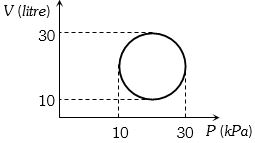
The heat energy absorbed by a system in going through the cyclic process shown in the figure is:
A
$10^{7} \pi \text{ J}$
B
$10^{4} \pi \text{ J}$
C
$10^{2} \pi \text{ J}$
D
$10^{-3} \pi \text{ J}$
Solution
(C) For a cyclic process,the change in internal energy is $\Delta U = 0$.
From the First Law of Thermodynamics $(FLOT)$,$\Delta Q = \Delta U + \Delta W = 0 + \Delta W = \Delta W$.
The work done $\Delta W$ is equal to the area enclosed by the cyclic process in the $P-V$ diagram.
The area of the circle is $\pi r_P r_V$,where $r_P$ is the radius along the pressure axis and $r_V$ is the radius along the volume axis.
$r_P = \frac{30 \text{ kPa} - 10 \text{ kPa}}{2} = 10 \text{ kPa} = 10 \times 10^{3} \text{ Pa}$.
$r_V = \frac{30 \text{ litre} - 10 \text{ litre}}{2} = 10 \text{ litre} = 10 \times 10^{-3} \text{ m}^{3}$.
Therefore,$\Delta Q = \pi \times (10 \times 10^{3} \text{ Pa}) \times (10 \times 10^{-3} \text{ m}^{3}) = \pi \times 100 \text{ J} = 100 \pi \text{ J} = 10^{2} \pi \text{ J}$.
From the First Law of Thermodynamics $(FLOT)$,$\Delta Q = \Delta U + \Delta W = 0 + \Delta W = \Delta W$.
The work done $\Delta W$ is equal to the area enclosed by the cyclic process in the $P-V$ diagram.
The area of the circle is $\pi r_P r_V$,where $r_P$ is the radius along the pressure axis and $r_V$ is the radius along the volume axis.
$r_P = \frac{30 \text{ kPa} - 10 \text{ kPa}}{2} = 10 \text{ kPa} = 10 \times 10^{3} \text{ Pa}$.
$r_V = \frac{30 \text{ litre} - 10 \text{ litre}}{2} = 10 \text{ litre} = 10 \times 10^{-3} \text{ m}^{3}$.
Therefore,$\Delta Q = \pi \times (10 \times 10^{3} \text{ Pa}) \times (10 \times 10^{-3} \text{ m}^{3}) = \pi \times 100 \text{ J} = 100 \pi \text{ J} = 10^{2} \pi \text{ J}$.
0 likesView Solution
12
PhysicsDifficultMCQAIIMS · 1995
$A$ particle is performing simple harmonic motion along the $x$-axis with an amplitude of $4 \, cm$ and a time period of $1.2 \, s$. The minimum time taken by the particle to move from $x = 2 \, cm$ to $x = +4 \, cm$ and back again is given by .... $s$.
A
$0.6$
B
$0.4$
C
$0.3$
D
$0.2$
Solution
(B) The time taken by the particle to move from the mean position $(x=0)$ to the extreme position $(x=4 \, cm)$ is $T/4 = 1.2/4 = 0.3 \, s$.
Let $t_1$ be the time taken to move from $x=0$ to $x=2 \, cm$. The equation of motion is $x = A \sin(\omega t)$.
Substituting the values: $2 = 4 \sin(\frac{2\pi}{T} t_1) \Rightarrow 1/2 = \sin(\frac{2\pi}{1.2} t_1)$.
This gives $\frac{\pi}{6} = \frac{2\pi}{1.2} t_1$,which simplifies to $t_1 = 0.1 \, s$.
The time taken to move from $x=2 \, cm$ to $x=4 \, cm$ is $t_2 = (T/4) - t_1 = 0.3 - 0.1 = 0.2 \, s$.
The total time to move from $x=2 \, cm$ to $x=4 \, cm$ and back again is $2 \times t_2 = 2 \times 0.2 = 0.4 \, s$.
Let $t_1$ be the time taken to move from $x=0$ to $x=2 \, cm$. The equation of motion is $x = A \sin(\omega t)$.
Substituting the values: $2 = 4 \sin(\frac{2\pi}{T} t_1) \Rightarrow 1/2 = \sin(\frac{2\pi}{1.2} t_1)$.
This gives $\frac{\pi}{6} = \frac{2\pi}{1.2} t_1$,which simplifies to $t_1 = 0.1 \, s$.
The time taken to move from $x=2 \, cm$ to $x=4 \, cm$ is $t_2 = (T/4) - t_1 = 0.3 - 0.1 = 0.2 \, s$.
The total time to move from $x=2 \, cm$ to $x=4 \, cm$ and back again is $2 \times t_2 = 2 \times 0.2 = 0.4 \, s$.
0 likesView Solution
13
PhysicsMediumMCQAIIMS · 1995
The superposing waves are represented by the following equations: ${y_1} = 5\sin 2\pi (10t - 0.1x)$ and ${y_2} = 10\sin 2\pi (20t - 0.2x)$. The ratio of intensities $\frac{I_{\max}}{I_{\min}}$ will be:
A
$1$
B
$9$
C
$4$
D
$16$
Solution
(B) The amplitudes of the two waves are given by ${a_1} = 5$ and ${a_2} = 10$.
The intensity of a wave is proportional to the square of its amplitude,$I \propto a^2$.
The ratio of maximum intensity to minimum intensity is given by the formula:
$\frac{I_{\max}}{I_{\min}} = \frac{(a_1 + a_2)^2}{(a_1 - a_2)^2}$.
Substituting the values of the amplitudes:
$\frac{I_{\max}}{I_{\min}} = \left( \frac{5 + 10}{5 - 10} \right)^2 = \left( \frac{15}{-5} \right)^2 = (-3)^2 = 9$.
Therefore,the ratio is $9:1$ or simply $9$.
The intensity of a wave is proportional to the square of its amplitude,$I \propto a^2$.
The ratio of maximum intensity to minimum intensity is given by the formula:
$\frac{I_{\max}}{I_{\min}} = \frac{(a_1 + a_2)^2}{(a_1 - a_2)^2}$.
Substituting the values of the amplitudes:
$\frac{I_{\max}}{I_{\min}} = \left( \frac{5 + 10}{5 - 10} \right)^2 = \left( \frac{15}{-5} \right)^2 = (-3)^2 = 9$.
Therefore,the ratio is $9:1$ or simply $9$.
0 likesView Solution
14
PhysicsMediumMCQAIIMS · 1995
At a certain instant,a stationary transverse wave is found to have maximum kinetic energy. The appearance of the string at that instant is:
A
Sinusoidal shape with amplitude $A/3$
B
Sinusoidal shape with amplitude $A/2$
C
Sinusoidal shape with amplitude $A$
D
Straight line
Solution
(D) In a stationary wave,the total energy oscillates between kinetic and potential energy.
When the kinetic energy of the string is maximum,the potential energy is zero.
Potential energy is associated with the deformation (displacement) of the string.
Since potential energy is zero,the displacement of every particle on the string must be zero at that instant.
Therefore,all particles are passing through their mean positions simultaneously.
This results in the string appearing as a straight line along the equilibrium axis.
When the kinetic energy of the string is maximum,the potential energy is zero.
Potential energy is associated with the deformation (displacement) of the string.
Since potential energy is zero,the displacement of every particle on the string must be zero at that instant.
Therefore,all particles are passing through their mean positions simultaneously.
This results in the string appearing as a straight line along the equilibrium axis.
0 likesView Solution
15
PhysicsMediumMCQAIIMS · 1995
Three waves of equal frequency having amplitudes $10 \,\mu m, 4 \,\mu m$ and $7 \,\mu m$ arrive at a given point with successive phase difference of $\frac{\pi}{2}$. The amplitude of the resulting wave in $\mu m$ is given by
A
$7$
B
$6$
C
$5$
D
$4$
Solution
(C) Let the amplitudes be $A_1 = 10 \,\mu m$,$A_2 = 4 \,\mu m$,and $A_3 = 7 \,\mu m$.
The waves arrive with successive phase differences of $\frac{\pi}{2}$.
Let the phase of the first wave be $0$,the second be $\frac{\pi}{2}$,and the third be $\pi$.
Using the phasor method,the resultant amplitude $A_R$ is given by the vector sum of the amplitudes:
$A_R = \sqrt{(\sum A_i \cos \phi_i)^2 + (\sum A_i \sin \phi_i)^2}$
$A_x = A_1 \cos(0) + A_2 \cos(\frac{\pi}{2}) + A_3 \cos(\pi) = 10(1) + 4(0) + 7(-1) = 10 - 7 = 3 \,\mu m$
$A_y = A_1 \sin(0) + A_2 \sin(\frac{\pi}{2}) + A_3 \sin(\pi) = 10(0) + 4(1) + 7(0) = 4 \,\mu m$
Resultant amplitude $A_R = \sqrt{A_x^2 + A_y^2} = \sqrt{3^2 + 4^2} = \sqrt{9 + 16} = \sqrt{25} = 5 \,\mu m$.
The waves arrive with successive phase differences of $\frac{\pi}{2}$.
Let the phase of the first wave be $0$,the second be $\frac{\pi}{2}$,and the third be $\pi$.
Using the phasor method,the resultant amplitude $A_R$ is given by the vector sum of the amplitudes:
$A_R = \sqrt{(\sum A_i \cos \phi_i)^2 + (\sum A_i \sin \phi_i)^2}$
$A_x = A_1 \cos(0) + A_2 \cos(\frac{\pi}{2}) + A_3 \cos(\pi) = 10(1) + 4(0) + 7(-1) = 10 - 7 = 3 \,\mu m$
$A_y = A_1 \sin(0) + A_2 \sin(\frac{\pi}{2}) + A_3 \sin(\pi) = 10(0) + 4(1) + 7(0) = 4 \,\mu m$
Resultant amplitude $A_R = \sqrt{A_x^2 + A_y^2} = \sqrt{3^2 + 4^2} = \sqrt{9 + 16} = \sqrt{25} = 5 \,\mu m$.
0 likesView Solution
16
PhysicsDifficultMCQAIIMS · 1995
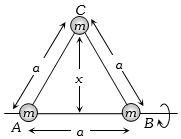
Three point masses,each of mass $m$,are placed at the corners of an equilateral triangle of side $a$. The moment of inertia of this system about an axis passing along one side of the triangle is:
A
$m a^2$
B
$3m a^2$
C
$\frac{3}{4}m a^2$
D
$\frac{2}{3}m a^2$
Solution
(C) Let the vertices of the equilateral triangle be $A, B,$ and $C$. The masses are placed at $A, B,$ and $C$. The axis of rotation passes through side $AB$.
$1$. The perpendicular distance of mass at $A$ from the axis $AB$ is $r_A = 0$.
$2$. The perpendicular distance of mass at $B$ from the axis $AB$ is $r_B = 0$.
$3$. The perpendicular distance of mass at $C$ from the axis $AB$ is the altitude $x$ of the equilateral triangle.
Using the Pythagorean theorem in the triangle formed by the altitude:
$x^2 + (a/2)^2 = a^2$
$x^2 = a^2 - a^2/4 = 3a^2/4$
$x = \frac{\sqrt{3}}{2}a$
The moment of inertia $I$ of the system about the axis $AB$ is given by:
$I = \sum m_i r_i^2 = m(r_A^2) + m(r_B^2) + m(r_C^2)$
$I = m(0)^2 + m(0)^2 + m(x)^2$
$I = m \left( \frac{\sqrt{3}}{2}a \right)^2 = m \left( \frac{3}{4}a^2 \right) = \frac{3}{4}m a^2$
$1$. The perpendicular distance of mass at $A$ from the axis $AB$ is $r_A = 0$.
$2$. The perpendicular distance of mass at $B$ from the axis $AB$ is $r_B = 0$.
$3$. The perpendicular distance of mass at $C$ from the axis $AB$ is the altitude $x$ of the equilateral triangle.
Using the Pythagorean theorem in the triangle formed by the altitude:
$x^2 + (a/2)^2 = a^2$
$x^2 = a^2 - a^2/4 = 3a^2/4$
$x = \frac{\sqrt{3}}{2}a$
The moment of inertia $I$ of the system about the axis $AB$ is given by:
$I = \sum m_i r_i^2 = m(r_A^2) + m(r_B^2) + m(r_C^2)$
$I = m(0)^2 + m(0)^2 + m(x)^2$
$I = m \left( \frac{\sqrt{3}}{2}a \right)^2 = m \left( \frac{3}{4}a^2 \right) = \frac{3}{4}m a^2$
0 likesView Solution
17
PhysicsMediumMCQAIIMS · 1995
An object of mass $m$ slides down an inclined plane and reaches the bottom with a velocity $v$. If the same object were in the form of a ring and rolled down the same inclined plane,its velocity at the bottom would be:
A
$v$
B
$\sqrt{2}v$
C
$\frac{1}{\sqrt{2}}v$
D
$\sqrt{\frac{2}{5}}v$
Solution
(C) When an object of mass $m$ slides down an inclined plane without friction,the potential energy is converted entirely into translational kinetic energy: $mgh = \frac{1}{2}mv^2$,which gives $v = \sqrt{2gh}$.
When the object is a ring rolling down the inclined plane,the potential energy is converted into both translational and rotational kinetic energy: $mgh = \frac{1}{2}mv_{ring}^2 + \frac{1}{2}I\omega^2$.
For a ring,the moment of inertia $I = mR^2$ and $\omega = \frac{v_{ring}}{R}$.
Substituting these,we get: $mgh = \frac{1}{2}mv_{ring}^2 + \frac{1}{2}(mR^2)(\frac{v_{ring}}{R})^2 = \frac{1}{2}mv_{ring}^2 + \frac{1}{2}mv_{ring}^2 = mv_{ring}^2$.
Thus,$v_{ring} = \sqrt{gh}$.
Since $v = \sqrt{2gh}$,we can write $\sqrt{gh} = \frac{v}{\sqrt{2}}$.
Therefore,the velocity of the ring is $\frac{v}{\sqrt{2}}$.
When the object is a ring rolling down the inclined plane,the potential energy is converted into both translational and rotational kinetic energy: $mgh = \frac{1}{2}mv_{ring}^2 + \frac{1}{2}I\omega^2$.
For a ring,the moment of inertia $I = mR^2$ and $\omega = \frac{v_{ring}}{R}$.
Substituting these,we get: $mgh = \frac{1}{2}mv_{ring}^2 + \frac{1}{2}(mR^2)(\frac{v_{ring}}{R})^2 = \frac{1}{2}mv_{ring}^2 + \frac{1}{2}mv_{ring}^2 = mv_{ring}^2$.
Thus,$v_{ring} = \sqrt{gh}$.
Since $v = \sqrt{2gh}$,we can write $\sqrt{gh} = \frac{v}{\sqrt{2}}$.
Therefore,the velocity of the ring is $\frac{v}{\sqrt{2}}$.
0 likesView Solution
18
PhysicsMediumMCQAIIMS · 1995
$A$ large horizontal surface moves up and down in $S.H.M.$ with an amplitude of $1 \, cm$. If a mass of $10 \, kg$ placed on the surface is to remain continuously in contact with it,the maximum frequency of $S.H.M.$ will be .... $Hz$.
A
$5$
B
$0.5$
C
$1.5$
D
$10$
Solution
(A) For the mass to remain in contact with the surface,the downward acceleration of the surface must not exceed the acceleration due to gravity $g$.
The maximum acceleration of a particle in $S.H.M.$ is given by $a_{max} = \omega^2 A$.
To maintain contact,we require $a_{max} \leq g$.
Substituting $\omega = 2 \pi f$,we get $(2 \pi f)^2 A \leq g$.
Given $A = 1 \, cm = 0.01 \, m$ and taking $g \approx 10 \, m/s^2$:
$4 \pi^2 f^2 (0.01) = 10$
$f^2 = \frac{10}{4 \pi^2 \times 0.01} = \frac{10}{0.04 \pi^2} = \frac{250}{\pi^2}$
$f = \sqrt{\frac{250}{\pi^2}} = \frac{\sqrt{250}}{\pi} \approx \frac{15.81}{3.14} \approx 5.03 \, Hz$.
Thus,the maximum frequency is approximately $5 \, Hz$.
The maximum acceleration of a particle in $S.H.M.$ is given by $a_{max} = \omega^2 A$.
To maintain contact,we require $a_{max} \leq g$.
Substituting $\omega = 2 \pi f$,we get $(2 \pi f)^2 A \leq g$.
Given $A = 1 \, cm = 0.01 \, m$ and taking $g \approx 10 \, m/s^2$:
$4 \pi^2 f^2 (0.01) = 10$
$f^2 = \frac{10}{4 \pi^2 \times 0.01} = \frac{10}{0.04 \pi^2} = \frac{250}{\pi^2}$
$f = \sqrt{\frac{250}{\pi^2}} = \frac{\sqrt{250}}{\pi} \approx \frac{15.81}{3.14} \approx 5.03 \, Hz$.
Thus,the maximum frequency is approximately $5 \, Hz$.
0 likesView Solution
19
PhysicsEasyMCQAIIMS · 1995
Force of attraction between two point charges $Q$ and $-Q$ separated by $d \, \text{m}$ is $F_e$. When these charges are placed on two identical spheres of radius $R = 0.3 \, d$ whose centres are $d \, \text{m}$ apart,the force of attraction between them is
A
Greater than $F_e$
B
Equal to $F_e$
C
Less than $F_e$
D
None of these
Solution
(A) For point charges,the force is given by Coulomb's law: $F_e = \frac{k Q^2}{d^2}$.
When the charges are placed on spheres of radius $R = 0.3 \, d$,the distance between the centers is $d$.
Since the spheres are close to each other ($R$ is a significant fraction of $d$),the electrostatic induction effect causes the charges to redistribute on the surfaces of the spheres.
Specifically,the positive charge on one sphere is attracted towards the negative charge on the other sphere,causing the charges to shift closer to each other on the inner faces of the spheres.
Because the effective distance between the centers of charge becomes less than $d$,the force of attraction increases.
Therefore,the new force is greater than $F_e$.
When the charges are placed on spheres of radius $R = 0.3 \, d$,the distance between the centers is $d$.
Since the spheres are close to each other ($R$ is a significant fraction of $d$),the electrostatic induction effect causes the charges to redistribute on the surfaces of the spheres.
Specifically,the positive charge on one sphere is attracted towards the negative charge on the other sphere,causing the charges to shift closer to each other on the inner faces of the spheres.
Because the effective distance between the centers of charge becomes less than $d$,the force of attraction increases.
Therefore,the new force is greater than $F_e$.
0 likesView Solution
20
PhysicsMediumMCQAIIMS · 1995
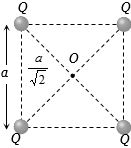
Four equal charges $Q$ are placed at the four corners of a square of side length $a$. The work done in removing a charge $-Q$ from its center to infinity is
A
$0$
B
$\frac{\sqrt{2} Q^2}{4\pi \varepsilon_0 a}$
C
$\frac{\sqrt{2} Q^2}{\pi \varepsilon_0 a}$
D
$\frac{Q^2}{2\pi \varepsilon_0 a}$
Solution
(C) The distance of each corner from the center $O$ of the square is $r = \frac{a}{\sqrt{2}}$.
The electric potential $V_O$ at the center $O$ due to the four charges $Q$ at the corners is:
$V_O = 4 \times \left( \frac{1}{4\pi \varepsilon_0} \cdot \frac{Q}{r} \right) = 4 \times \left( \frac{Q}{4\pi \varepsilon_0 (a/\sqrt{2})} \right) = \frac{4\sqrt{2} Q}{4\pi \varepsilon_0 a} = \frac{\sqrt{2} Q}{\pi \varepsilon_0 a}$.
The work done $W$ in moving a charge $q = -Q$ from the center to infinity is given by $W = q(V_{\infty} - V_O)$.
Since the potential at infinity $V_{\infty} = 0$,we have:
$W = (-Q)(0 - V_O) = Q V_O$.
Substituting the value of $V_O$:
$W = Q \times \left( \frac{\sqrt{2} Q}{\pi \varepsilon_0 a} \right) = \frac{\sqrt{2} Q^2}{\pi \varepsilon_0 a}$.
The electric potential $V_O$ at the center $O$ due to the four charges $Q$ at the corners is:
$V_O = 4 \times \left( \frac{1}{4\pi \varepsilon_0} \cdot \frac{Q}{r} \right) = 4 \times \left( \frac{Q}{4\pi \varepsilon_0 (a/\sqrt{2})} \right) = \frac{4\sqrt{2} Q}{4\pi \varepsilon_0 a} = \frac{\sqrt{2} Q}{\pi \varepsilon_0 a}$.
The work done $W$ in moving a charge $q = -Q$ from the center to infinity is given by $W = q(V_{\infty} - V_O)$.
Since the potential at infinity $V_{\infty} = 0$,we have:
$W = (-Q)(0 - V_O) = Q V_O$.
Substituting the value of $V_O$:
$W = Q \times \left( \frac{\sqrt{2} Q}{\pi \varepsilon_0 a} \right) = \frac{\sqrt{2} Q^2}{\pi \varepsilon_0 a}$.
0 likesView Solution
21
PhysicsMediumMCQAIIMS · 1995
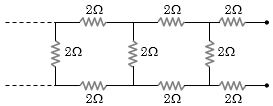
The equivalent resistance of the following infinite network of resistances is
A
Less than $4\,\Omega $
B
$4\,\Omega $
C
More than $4\,\Omega $ but less than $12\,\Omega $
D
$12\,\Omega $
Solution
(C) Let the equivalent resistance of the infinite network be $R$. Since the network is infinite,adding or removing one repeating unit does not change the equivalent resistance.
The circuit can be viewed as a $2\,\Omega$ resistor in series with the top branch,a $2\,\Omega$ resistor in series with the bottom branch,and the equivalent resistance $R$ in parallel with the vertical $2\,\Omega$ resistor.
Thus,the equivalent resistance $R$ is given by:
$R = 2 + 2 + \frac{2 \times R}{2 + R}$
$R = 4 + \frac{2R}{2 + R}$
Multiplying by $(2 + R)$:
$R(2 + R) = 4(2 + R) + 2R$
$2R + R^2 = 8 + 4R + 2R$
$R^2 - 4R - 8 = 0$
Using the quadratic formula $R = \frac{-b \pm \sqrt{b^2 - 4ac}}{2a}$:
$R = \frac{4 \pm \sqrt{(-4)^2 - 4(1)(-8)}}{2(1)}$
$R = \frac{4 \pm \sqrt{16 + 32}}{2} = \frac{4 \pm \sqrt{48}}{2} = \frac{4 \pm 4\sqrt{3}}{2} = 2 \pm 2\sqrt{3}$
Since resistance cannot be negative,we take the positive root:
$R = 2 + 2\sqrt{3} \approx 2 + 2(1.732) = 5.464\,\Omega$.
This value is greater than $4\,\Omega$ and less than $12\,\Omega$.
The circuit can be viewed as a $2\,\Omega$ resistor in series with the top branch,a $2\,\Omega$ resistor in series with the bottom branch,and the equivalent resistance $R$ in parallel with the vertical $2\,\Omega$ resistor.
Thus,the equivalent resistance $R$ is given by:
$R = 2 + 2 + \frac{2 \times R}{2 + R}$
$R = 4 + \frac{2R}{2 + R}$
Multiplying by $(2 + R)$:
$R(2 + R) = 4(2 + R) + 2R$
$2R + R^2 = 8 + 4R + 2R$
$R^2 - 4R - 8 = 0$
Using the quadratic formula $R = \frac{-b \pm \sqrt{b^2 - 4ac}}{2a}$:
$R = \frac{4 \pm \sqrt{(-4)^2 - 4(1)(-8)}}{2(1)}$
$R = \frac{4 \pm \sqrt{16 + 32}}{2} = \frac{4 \pm \sqrt{48}}{2} = \frac{4 \pm 4\sqrt{3}}{2} = 2 \pm 2\sqrt{3}$
Since resistance cannot be negative,we take the positive root:
$R = 2 + 2\sqrt{3} \approx 2 + 2(1.732) = 5.464\,\Omega$.
This value is greater than $4\,\Omega$ and less than $12\,\Omega$.
0 likesView Solution
22
PhysicsMediumMCQAIIMS · 1995
The force between two identical bar magnets whose centres are $r \ m$ apart is $4.8 \ N$,when their axes are in the same line. If the separation is increased to $2r$,the force between them is reduced to . . . . . . $N$.
A
$2.4$
B
$1.2$
C
$0.6$
D
$0.3$
Solution
(D) For two short bar magnets placed coaxially,the force of interaction $F$ is inversely proportional to the fourth power of the distance $r$ between their centers,i.e.,$F \propto \frac{1}{r^4}$.
Given the initial force $F_1 = 4.8 \ N$ at distance $r_1 = r$.
When the distance is increased to $r_2 = 2r$,the new force $F_2$ is given by:
$\frac{F_2}{F_1} = \left( \frac{r_1}{r_2} \right)^4$
$\frac{F_2}{4.8} = \left( \frac{r}{2r} \right)^4 = \left( \frac{1}{2} \right)^4 = \frac{1}{16}$
$F_2 = \frac{4.8}{16} = 0.3 \ N$.
Given the initial force $F_1 = 4.8 \ N$ at distance $r_1 = r$.
When the distance is increased to $r_2 = 2r$,the new force $F_2$ is given by:
$\frac{F_2}{F_1} = \left( \frac{r_1}{r_2} \right)^4$
$\frac{F_2}{4.8} = \left( \frac{r}{2r} \right)^4 = \left( \frac{1}{2} \right)^4 = \frac{1}{16}$
$F_2 = \frac{4.8}{16} = 0.3 \ N$.
0 likesView Solution
23
PhysicsMediumMCQAIIMS · 1995
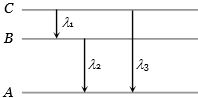
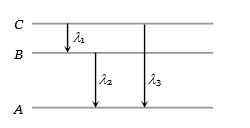
Energy levels $A, B, C$ of a certain atom correspond to increasing values of energy,i.e.,$E_A < E_B < E_C$. If $\lambda_1, \lambda_2, \lambda_3$ are the wavelengths of radiations corresponding to the transitions $C$ to $B$,$B$ to $A$,and $C$ to $A$ respectively,which of the following statements is correct?
A
$\lambda_3 = \lambda_1 + \lambda_2$
B
$\lambda_3 = \frac{\lambda_1 \lambda_2}{\lambda_1 + \lambda_2}$
C
$\lambda_1 + \lambda_2 + \lambda_3 = 0$
D
$\lambda_3^2 = \lambda_1^2 + \lambda_2^2$
Solution
(B) Let the energies of the states $A, B,$ and $C$ be $E_A, E_B,$ and $E_C$ respectively.
From the principle of conservation of energy,the energy of the transition from $C$ to $A$ is equal to the sum of the energies of the transitions from $C$ to $B$ and $B$ to $A$.
Thus,$(E_C - E_A) = (E_C - E_B) + (E_B - E_A)$.
Using the relation $E = \frac{hc}{\lambda}$,we can write:
$\frac{hc}{\lambda_3} = \frac{hc}{\lambda_1} + \frac{hc}{\lambda_2}$
Dividing both sides by $hc$,we get:
$\frac{1}{\lambda_3} = \frac{1}{\lambda_1} + \frac{1}{\lambda_2}$
$\frac{1}{\lambda_3} = \frac{\lambda_1 + \lambda_2}{\lambda_1 \lambda_2}$
Therefore,$\lambda_3 = \frac{\lambda_1 \lambda_2}{\lambda_1 + \lambda_2}$.
From the principle of conservation of energy,the energy of the transition from $C$ to $A$ is equal to the sum of the energies of the transitions from $C$ to $B$ and $B$ to $A$.
Thus,$(E_C - E_A) = (E_C - E_B) + (E_B - E_A)$.
Using the relation $E = \frac{hc}{\lambda}$,we can write:
$\frac{hc}{\lambda_3} = \frac{hc}{\lambda_1} + \frac{hc}{\lambda_2}$
Dividing both sides by $hc$,we get:
$\frac{1}{\lambda_3} = \frac{1}{\lambda_1} + \frac{1}{\lambda_2}$
$\frac{1}{\lambda_3} = \frac{\lambda_1 + \lambda_2}{\lambda_1 \lambda_2}$
Therefore,$\lambda_3 = \frac{\lambda_1 \lambda_2}{\lambda_1 + \lambda_2}$.
0 likesView Solution
24
PhysicsDifficultMCQAIIMS · 1995
$A$ combination of two thin lenses with focal lengths $f_1$ and $f_2$ respectively forms an image of a distant object at a distance of $60 \ cm$ when the lenses are in contact. The position of this image shifts by $30 \ cm$ towards the combination when the two lenses are separated by $10 \ cm$. The corresponding values of $f_1$ and $f_2$ are:
A
$30 \ cm, -60 \ cm$
B
$20 \ cm, -30 \ cm$
C
$15 \ cm, -20 \ cm$
D
$12 \ cm, -15 \ cm$
Solution
(B) When lenses are in contact,the effective focal length $F$ is given by $\frac{1}{F} = \frac{1}{f_1} + \frac{1}{f_2}$. Since the object is at infinity,the image is formed at the focus $F = 60 \ cm$. Thus,$\frac{1}{f_1} + \frac{1}{f_2} = \frac{1}{60}$ ... $(i)$.
When the lenses are separated by $d = 10 \ cm$,the equivalent focal length $F'$ is given by $\frac{1}{F'} = \frac{1}{f_1} + \frac{1}{f_2} - \frac{d}{f_1 f_2}$. The image shifts by $30 \ cm$ towards the combination,so the new image distance is $60 \ cm - 30 \ cm = 30 \ cm$. Thus,$\frac{1}{30} = \frac{1}{f_1} + \frac{1}{f_2} - \frac{10}{f_1 f_2}$ ... $(ii)$.
Substituting $(i)$ into $(ii)$: $\frac{1}{30} = \frac{1}{60} - \frac{10}{f_1 f_2} \implies \frac{10}{f_1 f_2} = \frac{1}{60} - \frac{1}{30} = -\frac{1}{60} \implies f_1 f_2 = -600$.
From $(i)$,$\frac{f_1 + f_2}{f_1 f_2} = \frac{1}{60} \implies f_1 + f_2 = \frac{-600}{60} = -10$.
Solving $x^2 - (f_1+f_2)x + f_1 f_2 = 0 \implies x^2 + 10x - 600 = 0 \implies (x+30)(x-20) = 0$. Thus,the focal lengths are $20 \ cm$ and $-30 \ cm$.
When the lenses are separated by $d = 10 \ cm$,the equivalent focal length $F'$ is given by $\frac{1}{F'} = \frac{1}{f_1} + \frac{1}{f_2} - \frac{d}{f_1 f_2}$. The image shifts by $30 \ cm$ towards the combination,so the new image distance is $60 \ cm - 30 \ cm = 30 \ cm$. Thus,$\frac{1}{30} = \frac{1}{f_1} + \frac{1}{f_2} - \frac{10}{f_1 f_2}$ ... $(ii)$.
Substituting $(i)$ into $(ii)$: $\frac{1}{30} = \frac{1}{60} - \frac{10}{f_1 f_2} \implies \frac{10}{f_1 f_2} = \frac{1}{60} - \frac{1}{30} = -\frac{1}{60} \implies f_1 f_2 = -600$.
From $(i)$,$\frac{f_1 + f_2}{f_1 f_2} = \frac{1}{60} \implies f_1 + f_2 = \frac{-600}{60} = -10$.
Solving $x^2 - (f_1+f_2)x + f_1 f_2 = 0 \implies x^2 + 10x - 600 = 0 \implies (x+30)(x-20) = 0$. Thus,the focal lengths are $20 \ cm$ and $-30 \ cm$.
1 likesView Solution
25
PhysicsDifficultMCQAIIMS · 1995
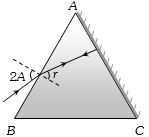
The angle of a prism is $A$. One of its refracting surfaces is silvered. Light rays falling at an angle of incidence $2A$ on the first surface return back through the same path after suffering reflection at the silvered surface. The refractive index $\mu$ of the prism is:
A
$2 \sin A$
B
$2 \cos A$
C
$\frac{1}{2} \cos A$
D
$\tan A$
Solution
(A) For the light ray to retrace its path,it must strike the silvered surface normally (at an angle of $90^{\circ}$).
In the triangle formed inside the prism,the angle at the silvered surface is $90^{\circ}$,and the angle at the apex is $A$. Thus,the angle of refraction $r$ at the first surface must be $r = 90^{\circ} - A$.
According to Snell's Law at the first surface: $\mu = \frac{\sin i}{\sin r}$.
Given $i = 2A$ and $r = 90^{\circ} - A$,we have:
$\mu = \frac{\sin(2A)}{\sin(90^{\circ} - A)}$
$\mu = \frac{2 \sin A \cos A}{\cos A}$
$\mu = 2 \sin A$.
In the triangle formed inside the prism,the angle at the silvered surface is $90^{\circ}$,and the angle at the apex is $A$. Thus,the angle of refraction $r$ at the first surface must be $r = 90^{\circ} - A$.
According to Snell's Law at the first surface: $\mu = \frac{\sin i}{\sin r}$.
Given $i = 2A$ and $r = 90^{\circ} - A$,we have:
$\mu = \frac{\sin(2A)}{\sin(90^{\circ} - A)}$
$\mu = \frac{2 \sin A \cos A}{\cos A}$
$\mu = 2 \sin A$.
0 likesView Solution
26
PhysicsDifficultMCQAIIMS · 1995
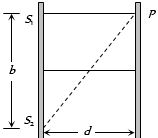
In Young's double slit experiment,white light is used. The separation between the slits is $b$. The screen is at a distance $d$ $(d >> b)$ from the slits. Some wavelengths are missing exactly in front of one slit. These wavelengths are
A
$\lambda = \frac{b^2}{d}$
B
$\lambda = \frac{2b^2}{d}$
C
$\lambda = \frac{b^2}{3d}$
D
Both $(a)$ and $(c)$
Solution
(D) Let $P$ be the point on the screen directly in front of slit $S_1$. The path difference between the light rays reaching $P$ from $S_1$ and $S_2$ is given by:
$\Delta x = S_2P - S_1P = \sqrt{b^2 + d^2} - d$
Using binomial expansion for $d >> b$:
$\Delta x = d(1 + \frac{b^2}{d^2})^{1/2} - d \approx d(1 + \frac{b^2}{2d^2}) - d = \frac{b^2}{2d}$
For destructive interference (missing wavelengths),the path difference must be an odd multiple of $\frac{\lambda}{2}$:
$\Delta x = (2n - 1)\frac{\lambda}{2}$,where $n = 1, 2, 3, ...$
Equating the two expressions for path difference:
$\frac{b^2}{2d} = (2n - 1)\frac{\lambda}{2}$
$\lambda = \frac{b^2}{(2n - 1)d}$
For $n = 1$,$\lambda = \frac{b^2}{d}$.
For $n = 2$,$\lambda = \frac{b^2}{3d}$.
Thus,both $(a)$ and $(c)$ are correct.
$\Delta x = S_2P - S_1P = \sqrt{b^2 + d^2} - d$
Using binomial expansion for $d >> b$:
$\Delta x = d(1 + \frac{b^2}{d^2})^{1/2} - d \approx d(1 + \frac{b^2}{2d^2}) - d = \frac{b^2}{2d}$
For destructive interference (missing wavelengths),the path difference must be an odd multiple of $\frac{\lambda}{2}$:
$\Delta x = (2n - 1)\frac{\lambda}{2}$,where $n = 1, 2, 3, ...$
Equating the two expressions for path difference:
$\frac{b^2}{2d} = (2n - 1)\frac{\lambda}{2}$
$\lambda = \frac{b^2}{(2n - 1)d}$
For $n = 1$,$\lambda = \frac{b^2}{d}$.
For $n = 2$,$\lambda = \frac{b^2}{3d}$.
Thus,both $(a)$ and $(c)$ are correct.
0 likesView Solution
Vedclass Products
For Students
Vedclass Test Series
Mock tests in real AIIMS style covering Physics with performance analysis. 5-day free trial.
Start Free TrialFor Teachers
Exam Paper Generator
Generate Set A/B/C/D Physics papers from 7.5L+ questions in 2 minutes. 3 chapters free.
Try FreeFor Institutes
Online Exam Module
Run live AIIMS mock exams with unlimited students, 360° analytics & white-label branding.
See DemoFrequently Asked Questions
How many Physics questions are in AIIMS 1995?
There are 26 Physics questions from the AIIMS 1995 paper on Vedclass, each with a detailed step-by-step solution in English.
Are AIIMS 1995 Physics solutions available in English?
Yes. All solutions on this page are in English. You can also switch to English or Hindi using the language buttons above the questions.
Can I practice AIIMS 1995 Physics as a timed test?
Yes. Use the Vedclass Test Series to attempt a full AIIMS mock test covering Physics with time limits and instant score analysis.
Can teachers create Physics papers from AIIMS previous year questions?
Yes. The Vedclass Exam Paper Generator lets teachers mix AIIMS Physics questions and generate Set A/B/C/D papers in minutes.
For Teachers & Institutes
Build a Custom Physics Paper
Pick AIIMS 1995 Physics questions, set difficulty, and generate Set A/B/C/D in 2 minutes.