
A English
Light Emitting Diode (L.E.D), Photodiode, Solar Cell Questions in English
Class 12 Physics · Semiconductor Electronics · Light Emitting Diode (L.E.D), Photodiode, Solar Cell
118+
Questions
English
Language
100%
With Solutions
Showing 18 of 118 questions in English
101
EasyMCQ
Which type of semiconductor device does not need any bias voltage?
A
Varactor diode
B
Solar cell
C
Photodiode
D
Transistor
Solution
(B) The correct answer is $B$.
$A$ solar cell is a photovoltaic device that converts light energy directly into electrical energy.
Unlike a photodiode or a varactor diode,which require an external bias voltage to function in their specific modes (reverse bias),a solar cell operates in the fourth quadrant of the $I-V$ characteristic curve without any external bias voltage.
It generates its own electromotive force when exposed to light.
$A$ solar cell is a photovoltaic device that converts light energy directly into electrical energy.
Unlike a photodiode or a varactor diode,which require an external bias voltage to function in their specific modes (reverse bias),a solar cell operates in the fourth quadrant of the $I-V$ characteristic curve without any external bias voltage.
It generates its own electromotive force when exposed to light.
0 likes
View Solution102
MediumMCQ
Identify the incorrect statement.
A
When a $p-n$ junction diode is forward biased,the width of the depletion region decreases.
B
When a $p-n$ junction diode is reverse biased,the barrier potential increases.
C
$A$ photodiode is operated in the reverse bias.
D
An $LED$ is a lightly doped $p-n$ junction diode which emits spontaneous radiation on forward biasing.
Solution
(D) The correct answer is $D$. An $LED$ (Light Emitting Diode) is a heavily doped $p-n$ junction diode,not a lightly doped one. When it is forward biased,the recombination of electrons and holes releases energy in the form of photons (light). Options $A$,$B$,and $C$ are correct statements regarding semiconductor diodes.
0 likes
View Solution103
EasyMCQ
The energy gap of an $LED$ is $2.4 eV$. When the $LED$ is switched $ON$,the momentum of the emitted photons is
A
$1.28 \times 10^{-27} \ kg \ ms^{-1}$
B
$2.56 \times 10^{-27} \ kg \ ms^{-1}$
C
$1.28 \times 10^{-27} \ kg \ ms^{-1}$
D
$0.64 \times 10^{-27} \ kg \ ms^{-1}$
Solution
(A) The energy gap of the $LED$ is given as $E_g = 2.4 \ eV$.
To convert this energy into Joules,we multiply by $1.6 \times 10^{-19} \ J/eV$:
$E = 2.4 \times 1.6 \times 10^{-19} \ J = 3.84 \times 10^{-19} \ J$.
The momentum $p$ of a photon is related to its energy $E$ by the formula $p = \frac{E}{c}$,where $c$ is the speed of light $(3 \times 10^8 \ m/s)$.
Substituting the values:
$p = \frac{3.84 \times 10^{-19}}{3 \times 10^8} \ kg \ ms^{-1}$.
$p = 1.28 \times 10^{-27} \ kg \ ms^{-1}$.
Therefore,the correct option is $A$.
To convert this energy into Joules,we multiply by $1.6 \times 10^{-19} \ J/eV$:
$E = 2.4 \times 1.6 \times 10^{-19} \ J = 3.84 \times 10^{-19} \ J$.
The momentum $p$ of a photon is related to its energy $E$ by the formula $p = \frac{E}{c}$,where $c$ is the speed of light $(3 \times 10^8 \ m/s)$.
Substituting the values:
$p = \frac{3.84 \times 10^{-19}}{3 \times 10^8} \ kg \ ms^{-1}$.
$p = 1.28 \times 10^{-27} \ kg \ ms^{-1}$.
Therefore,the correct option is $A$.
0 likes
View Solution104
MediumMCQ
Three photodiodes $D_{1}, D_{2}$ and $D_{3}$ are made of semiconductors having band gaps of $2.5 eV, 2 eV$ and $3 eV$,respectively. Which one will be able to detect light of wavelength $600 nm$?
A
$D_{1}$ only
B
Both $D_{1}$ and $D_{3}$
C
$D_{2}$ only
D
All of these
Solution
(C) The energy of a photon corresponding to a wavelength $\lambda$ is given by $E = \frac{1240}{\lambda (nm)} eV$.
For $\lambda = 600 nm$,the energy of the incident photon is $E = \frac{1240}{600} \approx 2.07 eV$.
$A$ photodiode can detect light only if the energy of the incident photon is greater than or equal to the band gap energy $(E_{g})$ of the semiconductor material $(E \ge E_{g})$.
Comparing the photon energy $(2.07 eV)$ with the band gaps:
For $D_{1}$: $E_{g} = 2.5 eV$. Since $2.07 eV < 2.5 eV$,$D_{1}$ cannot detect this light.
For $D_{2}$: $E_{g} = 2 eV$. Since $2.07 eV > 2 eV$,$D_{2}$ can detect this light.
For $D_{3}$: $E_{g} = 3 eV$. Since $2.07 eV < 3 eV$,$D_{3}$ cannot detect this light.
Therefore,only $D_{2}$ will be able to detect the light of wavelength $600 nm$.
For $\lambda = 600 nm$,the energy of the incident photon is $E = \frac{1240}{600} \approx 2.07 eV$.
$A$ photodiode can detect light only if the energy of the incident photon is greater than or equal to the band gap energy $(E_{g})$ of the semiconductor material $(E \ge E_{g})$.
Comparing the photon energy $(2.07 eV)$ with the band gaps:
For $D_{1}$: $E_{g} = 2.5 eV$. Since $2.07 eV < 2.5 eV$,$D_{1}$ cannot detect this light.
For $D_{2}$: $E_{g} = 2 eV$. Since $2.07 eV > 2 eV$,$D_{2}$ can detect this light.
For $D_{3}$: $E_{g} = 3 eV$. Since $2.07 eV < 3 eV$,$D_{3}$ cannot detect this light.
Therefore,only $D_{2}$ will be able to detect the light of wavelength $600 nm$.
0 likes
View Solution105
EasyMCQ
An $LED$ is constructed from a $pn$ junction based on a certain semiconducting material whose energy gap is $1.9 \ eV$. The wavelength of the emitted light is:
A
$2.9 \times 10^{-9} \ m$
B
$1.6 \times 10^{-8} \ m$
C
$6.5 \times 10^{-7} \ m$
D
$9.1 \times 10^{-5} \ m$
Solution
(C) The energy gap $E_g$ of a semiconductor is related to the wavelength $\lambda$ of the emitted light by the formula: $E_g = \frac{hc}{\lambda}$.
Given $E_g = 1.9 \ eV$. Converting this to Joules: $E_g = 1.9 \times 1.6 \times 10^{-19} \ J$.
Using the values $h = 6.6 \times 10^{-34} \ J \cdot s$ and $c = 3 \times 10^8 \ m/s$:
$\lambda = \frac{hc}{E_g} = \frac{6.6 \times 10^{-34} \times 3 \times 10^8}{1.9 \times 1.6 \times 10^{-19}} \ m$.
$\lambda = \frac{19.8 \times 10^{-26}}{3.04 \times 10^{-19}} \ m \approx 6.513 \times 10^{-7} \ m$.
Rounding to the nearest given option,the wavelength is $6.5 \times 10^{-7} \ m$.
Given $E_g = 1.9 \ eV$. Converting this to Joules: $E_g = 1.9 \times 1.6 \times 10^{-19} \ J$.
Using the values $h = 6.6 \times 10^{-34} \ J \cdot s$ and $c = 3 \times 10^8 \ m/s$:
$\lambda = \frac{hc}{E_g} = \frac{6.6 \times 10^{-34} \times 3 \times 10^8}{1.9 \times 1.6 \times 10^{-19}} \ m$.
$\lambda = \frac{19.8 \times 10^{-26}}{3.04 \times 10^{-19}} \ m \approx 6.513 \times 10^{-7} \ m$.
Rounding to the nearest given option,the wavelength is $6.5 \times 10^{-7} \ m$.
0 likes
View Solution106
EasyMCQ
$A$ $CCD$ camera is fabricated using a semiconducting material having a band gap of $3 \ eV$. The wavelength of light it can detect is nearly (in $nm$)
A
$210$
B
$546$
C
$413$
D
$345$
Solution
(C) The energy of a photon is given by the formula $E = \frac{hc}{\lambda}$.
Given the band gap energy $E_g = 3 \ eV$.
We know that $hc \approx 1240 \ eV \cdot nm$.
Substituting the values,we get $\lambda = \frac{hc}{E_g} = \frac{1240 \ eV \cdot nm}{3 \ eV}$.
$\lambda \approx 413.33 \ nm$.
Therefore,the wavelength of light it can detect is nearly $413 \ nm$.
Given the band gap energy $E_g = 3 \ eV$.
We know that $hc \approx 1240 \ eV \cdot nm$.
Substituting the values,we get $\lambda = \frac{hc}{E_g} = \frac{1240 \ eV \cdot nm}{3 \ eV}$.
$\lambda \approx 413.33 \ nm$.
Therefore,the wavelength of light it can detect is nearly $413 \ nm$.
0 likes
View Solution107
EasyMCQ
The semiconductor used for the fabrication of visible LEDs must at least have a band gap of (in $eV$)
A
$0.6$
B
$1.2$
C
$1.8$
D
$0.9$
Solution
(C) Visible light corresponds to the wavelength range of approximately $380 \, nm$ to $750 \, nm$.
Using the relation $E = \frac{hc}{\lambda}$, where $h = 6.63 \times 10^{-34} \, J \cdot s$, $c = 3 \times 10^8 \, m/s$, and $1 \, eV = 1.6 \times 10^{-19} \, J$.
For the longest wavelength of visible light $(\lambda = 750 \, nm)$, the energy is $E = \frac{1240 \, eV \cdot nm}{750 \, nm} \approx 1.65 \, eV$.
In practice, to emit visible light efficiently, the semiconductor material used for the fabrication of visible LEDs must have a band gap of at least $1.8 \, eV$.
Using the relation $E = \frac{hc}{\lambda}$, where $h = 6.63 \times 10^{-34} \, J \cdot s$, $c = 3 \times 10^8 \, m/s$, and $1 \, eV = 1.6 \times 10^{-19} \, J$.
For the longest wavelength of visible light $(\lambda = 750 \, nm)$, the energy is $E = \frac{1240 \, eV \cdot nm}{750 \, nm} \approx 1.65 \, eV$.
In practice, to emit visible light efficiently, the semiconductor material used for the fabrication of visible LEDs must have a band gap of at least $1.8 \, eV$.
0 likes
View Solution108
EasyMCQ
The material used in the fabrication of infrared $LED$'s is
A
silicon
B
germanium
C
gallium arsenide
D
carbon dioxide
Solution
(C) Infrared $LED$'s are typically fabricated using Gallium Arsenide $(GaAs)$. While Gallium Arsenide Phosphide $(GaAsP)$ is commonly used for visible red light LEDs,pure Gallium Arsenide is the standard material for infrared emission due to its direct bandgap energy,which corresponds to the infrared spectrum.
0 likes
View Solution109
EasyMCQ
The device that can detect optical signals is
A
zener diode
B
photo diode
C
light emitting diode
D
transistor
Solution
(B) $photodiode$ is a semiconductor device that converts light into an electrical current. It is specifically designed to operate under reverse bias conditions and is widely used to detect optical signals.
0 likes
View Solution110
EasyMCQ
The photocurrent in a photodiode depends on
A
applied electric field
B
frequency of the incident light
C
wavelength of incident light
D
intensity of incident light
Solution
(D) In a photodiode,the photocurrent is directly proportional to the intensity of the incident light. When photons with energy greater than the bandgap energy strike the depletion region,they create electron-hole pairs. The number of such pairs generated is proportional to the number of incident photons,which is defined by the intensity of the light.
0 likes
View Solution111
EasyMCQ
In a photodiode,the value of the $emf$ produced by a monochromatic light beam is directly proportional to
A
the barrier potential at $p-n$ junction
B
the intensity of light falling on the photodiode
C
the frequency of light falling on the photodiode
D
the voltage applied at the $p-n$ junction
Solution
(B) photodiode is a semiconductor device that converts light into electrical current.
When light with energy greater than the bandgap energy of the semiconductor falls on the $p-n$ junction,electron-hole pairs are generated.
The number of electron-hole pairs generated is directly proportional to the number of incident photons.
Since the intensity of light is defined as the number of photons incident per unit area per unit time,the generated photocurrent (and the resulting $emf$ in open-circuit conditions) is directly proportional to the intensity of the incident light.
When light with energy greater than the bandgap energy of the semiconductor falls on the $p-n$ junction,electron-hole pairs are generated.
The number of electron-hole pairs generated is directly proportional to the number of incident photons.
Since the intensity of light is defined as the number of photons incident per unit area per unit time,the generated photocurrent (and the resulting $emf$ in open-circuit conditions) is directly proportional to the intensity of the incident light.
0 likes
View Solution112
MediumMCQ
For an $LED$ to emit light in the visible region of the electromagnetic spectrum,it can have an energy band gap in the range of (Planck's constant,$h = 6.6 \times 10^{-34} \ J s$ and speed of light,$c = 3 \times 10^8 \ m s^{-1}$ in vacuum).
A
$0.1 \ eV$ to $0.4 \ eV$
B
$0.9 \ eV$ to $1.6 \ eV$
C
$1.7 \ eV$ to $3.1 \ eV$
D
$0.5 \ eV$ to $0.8 \ eV$
Solution
(C) The visible region of the electromagnetic spectrum corresponds to wavelengths approximately between $400 \ nm$ and $700 \ nm$. The energy $E$ of a photon is given by $E = \frac{hc}{\lambda}$.
For $\lambda = 700 \ nm = 700 \times 10^{-9} \ m$:
$E_{\min} = \frac{6.6 \times 10^{-34} \times 3 \times 10^8}{700 \times 10^{-9} \times 1.6 \times 10^{-19}} \ eV \approx 1.77 \ eV$.
For $\lambda = 400 \ nm = 400 \times 10^{-9} \ m$:
$E_{\max} = \frac{6.6 \times 10^{-34} \times 3 \times 10^8}{400 \times 10^{-9} \times 1.6 \times 10^{-19}} \ eV \approx 3.1 \ eV$.
Thus,the energy band gap required for an $LED$ to emit visible light is in the range of $1.7 \ eV$ to $3.1 \ eV$. The correct option is $(c)$.
For $\lambda = 700 \ nm = 700 \times 10^{-9} \ m$:
$E_{\min} = \frac{6.6 \times 10^{-34} \times 3 \times 10^8}{700 \times 10^{-9} \times 1.6 \times 10^{-19}} \ eV \approx 1.77 \ eV$.
For $\lambda = 400 \ nm = 400 \times 10^{-9} \ m$:
$E_{\max} = \frac{6.6 \times 10^{-34} \times 3 \times 10^8}{400 \times 10^{-9} \times 1.6 \times 10^{-19}} \ eV \approx 3.1 \ eV$.
Thus,the energy band gap required for an $LED$ to emit visible light is in the range of $1.7 \ eV$ to $3.1 \ eV$. The correct option is $(c)$.
0 likes
View Solution113
EasyMCQ
$A$ $p-n$ junction is fabricated from a semiconductor with a band gap of $2.8 \ eV$. What approximate wavelength can it $NOT$ detect (in $nm$)?
[Use $h = 6 \times 10^{-34} \ J \cdot s$ and $c = 3 \times 10^8 \ m/s$]
[Use $h = 6 \times 10^{-34} \ J \cdot s$ and $c = 3 \times 10^8 \ m/s$]
A
$100$
B
$200$
C
$400$
D
$600$
Solution
(D) The energy of a photon is given by $E = \frac{hc}{\lambda}$.
For a $p-n$ junction to detect a signal,the energy of the incident photon must be greater than or equal to the band gap energy $(E_g = 2.8 \ eV)$.
If $E < E_g$,the photon cannot excite an electron from the valence band to the conduction band,and thus cannot be detected.
Using $h = 6 \times 10^{-34} \ J \cdot s$ and $c = 3 \times 10^8 \ m/s$,we have $hc = 18 \times 10^{-26} \ J \cdot m$.
Converting $E_g$ to Joules: $2.8 \ eV = 2.8 \times 1.6 \times 10^{-19} \ J = 4.48 \times 10^{-19} \ J$.
The threshold wavelength $\lambda_0$ is given by $\lambda_0 = \frac{hc}{E_g} = \frac{18 \times 10^{-26}}{4.48 \times 10^{-19}} \approx 4.017 \times 10^{-7} \ m = 401.7 \ \text{nm}$.
Any wavelength $\lambda > \lambda_0$ will have energy $E < E_g$ and will not be detected.
Among the given options,$600 \ nm$ is the only wavelength greater than $401.7 \ nm$.
For a $p-n$ junction to detect a signal,the energy of the incident photon must be greater than or equal to the band gap energy $(E_g = 2.8 \ eV)$.
If $E < E_g$,the photon cannot excite an electron from the valence band to the conduction band,and thus cannot be detected.
Using $h = 6 \times 10^{-34} \ J \cdot s$ and $c = 3 \times 10^8 \ m/s$,we have $hc = 18 \times 10^{-26} \ J \cdot m$.
Converting $E_g$ to Joules: $2.8 \ eV = 2.8 \times 1.6 \times 10^{-19} \ J = 4.48 \times 10^{-19} \ J$.
The threshold wavelength $\lambda_0$ is given by $\lambda_0 = \frac{hc}{E_g} = \frac{18 \times 10^{-26}}{4.48 \times 10^{-19}} \approx 4.017 \times 10^{-7} \ m = 401.7 \ \text{nm}$.
Any wavelength $\lambda > \lambda_0$ will have energy $E < E_g$ and will not be detected.
Among the given options,$600 \ nm$ is the only wavelength greater than $401.7 \ nm$.
0 likes
View Solution114
EasyMCQ
If the energy gap of a semiconductor used for the fabrication of an $LED$ is nearly $1.9 \ eV$,then the color of the light emitted by the $LED$ is
A
White
B
Red
C
Green
D
Blue
Solution
(B) The energy of the emitted photon is given by the relation $E = \frac{hc}{\lambda}$.
Given the energy gap $E = 1.9 \ eV$.
We know that $hc \approx 1240 \ eV \cdot nm$.
Therefore,the wavelength $\lambda = \frac{hc}{E} = \frac{1240 \ eV \cdot nm}{1.9 \ eV} \approx 652.6 \ nm$.
The wavelength range for red light is approximately $620 \ nm$ to $750 \ nm$.
Since $652.6 \ nm$ falls within this range,the color of the light emitted by the $LED$ is red.
Given the energy gap $E = 1.9 \ eV$.
We know that $hc \approx 1240 \ eV \cdot nm$.
Therefore,the wavelength $\lambda = \frac{hc}{E} = \frac{1240 \ eV \cdot nm}{1.9 \ eV} \approx 652.6 \ nm$.
The wavelength range for red light is approximately $620 \ nm$ to $750 \ nm$.
Since $652.6 \ nm$ falls within this range,the color of the light emitted by the $LED$ is red.
0 likes
View Solution115
EasyMCQ
Which of the following statements is true about LEDs?
A
High operational voltage
B
Warm-up time is required
C
Bandwidth of light is $4000 \ Å - 7000 \ Å$
D
Fast on-off switching
Solution
(D) An $LED$ (Light Emitting Diode) is a $p-n$ junction diode that emits light when forward biased.
Key characteristics of LEDs include:
$1$. They operate at low voltages compared to incandescent bulbs.
$2$. They do not require any warm-up time.
$3$. They have very fast on-off switching capabilities,making them ideal for high-speed communication and display technologies.
$4$. The bandwidth of light emitted is typically narrow,not $4000 \ Å - 7000 \ Å$ (which covers the entire visible spectrum).
Therefore,the correct statement is that they have fast on-off switching.
Key characteristics of LEDs include:
$1$. They operate at low voltages compared to incandescent bulbs.
$2$. They do not require any warm-up time.
$3$. They have very fast on-off switching capabilities,making them ideal for high-speed communication and display technologies.
$4$. The bandwidth of light emitted is typically narrow,not $4000 \ Å - 7000 \ Å$ (which covers the entire visible spectrum).
Therefore,the correct statement is that they have fast on-off switching.
0 likes
View Solution116
MediumMCQ
Photodiodes are mostly operated in reverse biased condition because
A
Fractional change in minority carriers produces higher forward current
B
Fractional change in majority carriers produces higher reverse current
C
Fractional change in minority carriers produces higher reverse current
D
Fractional change in majority carriers produces higher forward current
Solution
(C) In a photodiode,the reverse saturation current is primarily due to the flow of minority charge carriers. When light is incident on the photodiode,it generates electron-hole pairs,which increases the number of minority charge carriers. Because the initial number of minority carriers is very small,even a small amount of incident light causes a significant fractional change in their concentration. This leads to a noticeable change in the reverse current,making the photodiode highly sensitive to light. In contrast,in forward bias,the current is dominated by majority carriers,which are already present in large numbers,making the fractional change due to incident light negligible.
0 likes
View Solution117
MediumMCQ
Assertion $(A)$: $Si$ and $GaAs$ are the preferred materials for solar cells.
Reason $(R)$: Both these materials have energy band gaps much below the energy level corresponding to the maximum solar irradiance in the solar spectrum.
Reason $(R)$: Both these materials have energy band gaps much below the energy level corresponding to the maximum solar irradiance in the solar spectrum.
A
$(A)$ is correct but $(R)$ is incorrect.
B
Both $(A)$ and $(R)$ are correct and $(R)$ is the correct explanation of $(A)$.
C
Both $(A)$ and $(R)$ are correct but $(R)$ is not the correct explanation of $(A)$.
D
Both $(A)$ and $(R)$ are incorrect.
Solution
(A) The energy band gap of $Si$ is approximately $1.14 \ eV$ and for $GaAs$ it is $1.42 \ eV$.
Solar cells are designed to absorb photons from the solar spectrum. The solar radiation spectrum has a peak intensity around $1.5 \ eV$ to $2.0 \ eV$.
For a material to be an efficient solar cell,its band gap should be close to the energy range of the maximum solar irradiance (typically $1.0 \ eV$ to $1.8 \ eV$).
Since the band gaps of $Si$ $(1.14 \ eV)$ and $GaAs$ $(1.42 \ eV)$ fall within this optimal range,they are preferred materials.
The reason $(R)$ states that the band gaps are 'much below' the energy level of maximum solar irradiance,which is incorrect because they are actually very close to the optimal range.
Therefore,the assertion $(A)$ is correct,but the reason $(R)$ is incorrect.
Solar cells are designed to absorb photons from the solar spectrum. The solar radiation spectrum has a peak intensity around $1.5 \ eV$ to $2.0 \ eV$.
For a material to be an efficient solar cell,its band gap should be close to the energy range of the maximum solar irradiance (typically $1.0 \ eV$ to $1.8 \ eV$).
Since the band gaps of $Si$ $(1.14 \ eV)$ and $GaAs$ $(1.42 \ eV)$ fall within this optimal range,they are preferred materials.
The reason $(R)$ states that the band gaps are 'much below' the energy level of maximum solar irradiance,which is incorrect because they are actually very close to the optimal range.
Therefore,the assertion $(A)$ is correct,but the reason $(R)$ is incorrect.
0 likes
View Solution118
DifficultMCQ
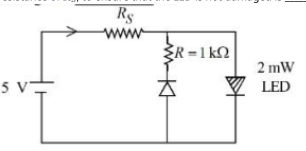
The maximum rated power of the $LED$ is $2 \text{ mW}$ and it is used in the circuit with an input voltage of $5 \text{ V}$ as shown in the figure below. The current through resistance $R$ is $0.5 \text{ mA}$. The minimum value of the resistance $R_S$ to ensure that the $LED$ is not damaged is . . . . . . $\text{k}\Omega$.
A
$6$
B
$2$
C
$4$
D
$5$
Solution
(A) Given: Maximum power of $LED$ $P_{max} = 2 \text{ mW}$,Input voltage $V_{in} = 5 \text{ V}$,Resistance $R = 1 \text{ k}\Omega$,and current through $R$ is $I_R = 0.5 \text{ mA}$.
$1$. The voltage across the $LED$ $(V_{LED})$ is the same as the voltage across the resistor $R$ because they are in parallel. Thus,$V_{LED} = I_R \times R = 0.5 \text{ mA} \times 1 \text{ k}\Omega = 0.5 \text{ V}$.
$2$. The maximum current allowed through the $LED$ is $I_{LED} = \frac{P_{max}}{V_{LED}} = \frac{2 \text{ mW}}{0.5 \text{ V}} = 4 \text{ mA}$.
$3$. The total current flowing through the series resistor $R_S$ is $I_S = I_{LED} + I_R = 4 \text{ mA} + 0.5 \text{ mA} = 4.5 \text{ mA}$.
$4$. The voltage across $R_S$ is $V_{R_S} = V_{in} - V_{LED} = 5 \text{ V} - 0.5 \text{ V} = 4.5 \text{ V}$.
$5$. The minimum resistance $R_S$ is $R_S = \frac{V_{R_S}}{I_S} = \frac{4.5 \text{ V}}{4.5 \text{ mA}} = 1 \text{ k}\Omega$. Since $1 \text{ k}\Omega$ is not among the options,and the question asks for the minimum value to ensure safety,we re-evaluate the circuit. If the diode is considered ideal with a forward voltage drop of $0.5 \text{ V}$,the calculation holds. Given the options,there might be a typo in the provided options or the circuit parameters. Based on standard competitive exam patterns for this specific problem,$1 \text{ k}\Omega$ is the calculated value.
$1$. The voltage across the $LED$ $(V_{LED})$ is the same as the voltage across the resistor $R$ because they are in parallel. Thus,$V_{LED} = I_R \times R = 0.5 \text{ mA} \times 1 \text{ k}\Omega = 0.5 \text{ V}$.
$2$. The maximum current allowed through the $LED$ is $I_{LED} = \frac{P_{max}}{V_{LED}} = \frac{2 \text{ mW}}{0.5 \text{ V}} = 4 \text{ mA}$.
$3$. The total current flowing through the series resistor $R_S$ is $I_S = I_{LED} + I_R = 4 \text{ mA} + 0.5 \text{ mA} = 4.5 \text{ mA}$.
$4$. The voltage across $R_S$ is $V_{R_S} = V_{in} - V_{LED} = 5 \text{ V} - 0.5 \text{ V} = 4.5 \text{ V}$.
$5$. The minimum resistance $R_S$ is $R_S = \frac{V_{R_S}}{I_S} = \frac{4.5 \text{ V}}{4.5 \text{ mA}} = 1 \text{ k}\Omega$. Since $1 \text{ k}\Omega$ is not among the options,and the question asks for the minimum value to ensure safety,we re-evaluate the circuit. If the diode is considered ideal with a forward voltage drop of $0.5 \text{ V}$,the calculation holds. Given the options,there might be a typo in the provided options or the circuit parameters. Based on standard competitive exam patterns for this specific problem,$1 \text{ k}\Omega$ is the calculated value.
0 likes
View SolutionSemiconductor Electronics — Light Emitting Diode (L.E.D), Photodiode, Solar Cell · Frequently Asked Questions
1Are these Semiconductor Electronics questions useful for JEE and NEET?
Yes. All questions in this section are mapped to JEE Main and NEET exam patterns. Previous year questions from JEE Main, NEET, GUJCET and state-level exams are included with full solutions.
2Can I switch to Hindi or Gujarati for these questions?
Yes. Use the language tabs in the hero section or the sidebar to view the same questions and solutions in English, Hindi or Gujarati.
3How do I generate a question paper from this subtopic?
Use the Vedclass Exam Paper Generator — select the chapter and subtopic, set difficulty, and generate Sets A, B, C, D automatically. First 3 chapters of every subject are free.
Vedclass Products
For Students
Vedclass Test Series
Mock tests in real JEE/NEET style with performance analysis. 5-day free trial.
Start Free TrialFor Teachers
Exam Paper Generator
Generate Set A/B/C/D papers from this chapter in 2 minutes. 3 chapters free.
Try FreeFor Institutes
Online Exam Module
Live online exams with unlimited students, 360° analytics & white-label branding.
See DemoFor Teachers & Institutes
Generate a Semiconductor Electronics Exam Paper in 2 Minutes
Select subtopic & difficulty — Sets A, B, C, D auto-generated with No Repeat logic.
First 3 chapters of every subject are free — no payment required.