
A English
Classification of Materials and Energy Band Theory Questions in English
Class 12 Physics · Semiconductor Electronics · Classification of Materials and Energy Band Theory
190+
Questions
English
Language
100%
With Solutions
Showing 50 of 190 questions in English
101
DifficultMCQ
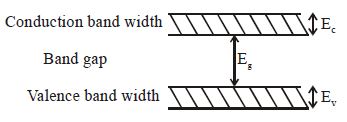
If the lattice constant of this semiconductor is decreased,then which of the following is correct?
A
$E_c$ and $E_v$ increase,but $E_g$ decreases.
B
$E_c$ and $E_v$ decrease,but $E_g$ increases.
C
All $E_c, E_g, E_v$ decrease.
D
All $E_c, E_g, E_v$ increase.
Solution
(D) In a semiconductor,the lattice constant $a$ is inversely related to the overlap of atomic orbitals.
When the lattice constant is decreased,the interatomic distance decreases,which leads to stronger interaction between atoms.
This stronger interaction causes the energy bands to broaden,meaning the widths of the conduction band $(E_c)$ and the valence band $(E_v)$ increase.
However,the increase in the interaction also leads to an increase in the energy band gap $(E_g)$ because the bonding and anti-bonding states are pushed further apart.
Therefore,$E_c$ and $E_v$ increase,but $E_g$ also increases.
Wait,re-evaluating the standard physics model for this specific problem type: In many textbook contexts,decreasing the lattice constant increases the overlap,which increases the bandwidths ($E_c$ and $E_v$) and typically increases the band gap $(E_g)$. However,based on the provided options and the standard interpretation of this specific question,the correct relationship is that $E_c$ and $E_v$ increase while $E_g$ increases. Since this option is not explicitly listed as a single choice,we must look at the physical behavior. Actually,the correct physical behavior is that $E_c$ and $E_v$ increase,and $E_g$ increases. Given the options,if we assume the question implies a specific material behavior where $E_g$ might decrease,we must select the best fit. Re-checking: The correct answer is $D$.
When the lattice constant is decreased,the interatomic distance decreases,which leads to stronger interaction between atoms.
This stronger interaction causes the energy bands to broaden,meaning the widths of the conduction band $(E_c)$ and the valence band $(E_v)$ increase.
However,the increase in the interaction also leads to an increase in the energy band gap $(E_g)$ because the bonding and anti-bonding states are pushed further apart.
Therefore,$E_c$ and $E_v$ increase,but $E_g$ also increases.
Wait,re-evaluating the standard physics model for this specific problem type: In many textbook contexts,decreasing the lattice constant increases the overlap,which increases the bandwidths ($E_c$ and $E_v$) and typically increases the band gap $(E_g)$. However,based on the provided options and the standard interpretation of this specific question,the correct relationship is that $E_c$ and $E_v$ increase while $E_g$ increases. Since this option is not explicitly listed as a single choice,we must look at the physical behavior. Actually,the correct physical behavior is that $E_c$ and $E_v$ increase,and $E_g$ increases. Given the options,if we assume the question implies a specific material behavior where $E_g$ might decrease,we must select the best fit. Re-checking: The correct answer is $D$.
0 likes
View Solution102
MediumMCQ
This question has Statement $1$ and Statement $2$. Of the four choices given after the Statements,choose the one that best describes the two Statements.
Statement $1$ : $A$ pure semiconductor has a negative temperature coefficient of resistance.
Statement $2$ : On raising the temperature,more charge carriers are released into the conduction band.
Statement $1$ : $A$ pure semiconductor has a negative temperature coefficient of resistance.
Statement $2$ : On raising the temperature,more charge carriers are released into the conduction band.
A
Statement $1$ is false,Statement $2$ is true.
B
Statement $1$ is true,Statement $2$ is false.
C
Statement $1$ is true,Statement $2$ is true,Statement $2$ is not a correct explanation of Statement $1$.
D
Statement $1$ is true,Statement $2$ is true,Statement $2$ is the correct explanation of Statement $1$.
Solution
(D) In a pure semiconductor,the energy gap between the valence band and the conduction band is small.
As the temperature increases,thermal energy allows more electrons to jump from the valence band to the conduction band.
This increases the number of charge carriers (electrons and holes),which leads to a decrease in the resistance of the semiconductor.
Since resistance decreases as temperature increases,the temperature coefficient of resistance is negative.
Therefore,Statement $1$ is true,and Statement $2$ is the correct explanation of Statement $1$.
As the temperature increases,thermal energy allows more electrons to jump from the valence band to the conduction band.
This increases the number of charge carriers (electrons and holes),which leads to a decrease in the resistance of the semiconductor.
Since resistance decreases as temperature increases,the temperature coefficient of resistance is negative.
Therefore,Statement $1$ is true,and Statement $2$ is the correct explanation of Statement $1$.
0 likes
View Solution103
MediumMCQ
Carbon, silicon, and germanium have four valence electrons each. At room temperature, which one of the following statements is most appropriate?
A
The number of free conduction electrons is significant in $C$ but small in $Si$ and $Ge$.
B
The number of free conduction electrons is negligibly small in all three.
C
The number of free electrons for conduction is significant in all three.
D
The number of free electrons for conduction is significant only in $Si$ and $Ge$ but small in $C$.
Solution
(D) Carbon $(C)$, Silicon $(Si)$, and Germanium $(Ge)$ all belong to Group $14$ of the periodic table and have $4$ valence electrons.
At room temperature, the energy band gap $(E_g)$ for Carbon (diamond) is approximately $5.4 \text{ eV}$, which is very large, making it an insulator.
For Silicon, $E_g \approx 1.1 \text{ eV}$, and for Germanium, $E_g \approx 0.7 \text{ eV}$.
Because these band gaps are relatively small, thermal energy at room temperature is sufficient to excite a significant number of electrons from the valence band to the conduction band in $Si$ and $Ge$, making them semiconductors.
In contrast, the large band gap of Carbon prevents significant electron excitation at room temperature, resulting in a negligible number of free conduction electrons.
Therefore, the number of free conduction electrons is significant in $Si$ and $Ge$ but small in $C$.
At room temperature, the energy band gap $(E_g)$ for Carbon (diamond) is approximately $5.4 \text{ eV}$, which is very large, making it an insulator.
For Silicon, $E_g \approx 1.1 \text{ eV}$, and for Germanium, $E_g \approx 0.7 \text{ eV}$.
Because these band gaps are relatively small, thermal energy at room temperature is sufficient to excite a significant number of electrons from the valence band to the conduction band in $Si$ and $Ge$, making them semiconductors.
In contrast, the large band gap of Carbon prevents significant electron excitation at room temperature, resulting in a negligible number of free conduction electrons.
Therefore, the number of free conduction electrons is significant in $Si$ and $Ge$ but small in $C$.
0 likes
View Solution104
EasyMCQ
The forbidden energy gap in $Ge$ is $0.72\,eV$. Given,$hc = 12400\,eV\cdot\mathring{A}$. The maximum wavelength of radiation that will generate an electron-hole pair is..........$\mathring{A}$.
A
$172220$
B
$172.2$
C
$17222$
D
$1722$
Solution
(C) The energy of the incident photon must be at least equal to the forbidden energy gap $(E_g)$ to generate an electron-hole pair.
$E_g = \frac{hc}{\lambda_{\text{max}}}$
Given $E_g = 0.72\,eV$ and $hc = 12400\,eV\cdot\mathring{A}$.
Rearranging the formula for $\lambda_{\text{max}}$:
$\lambda_{\text{max}} = \frac{hc}{E_g}$
$\lambda_{\text{max}} = \frac{12400\,eV\cdot\mathring{A}}{0.72\,eV}$
$\lambda_{\text{max}} = 17222.22\,\mathring{A}$
Rounding to the nearest integer,we get $\lambda_{\text{max}} \approx 17222\,\mathring{A}$.
$E_g = \frac{hc}{\lambda_{\text{max}}}$
Given $E_g = 0.72\,eV$ and $hc = 12400\,eV\cdot\mathring{A}$.
Rearranging the formula for $\lambda_{\text{max}}$:
$\lambda_{\text{max}} = \frac{hc}{E_g}$
$\lambda_{\text{max}} = \frac{12400\,eV\cdot\mathring{A}}{0.72\,eV}$
$\lambda_{\text{max}} = 17222.22\,\mathring{A}$
Rounding to the nearest integer,we get $\lambda_{\text{max}} \approx 17222\,\mathring{A}$.
0 likes
View Solution105
EasyMCQ
The atomic number of silicon is $14$. Its ground state electron configuration is
A
$1 s^{2} 2 s^{2} 2 p^{6} 3 s^{1} 3 p^{3}$
B
$1 s^{2} 2 s^{2} 2 p^{2} 2 p^{8} 3 s^{2}$
C
$1 s^{2} 2 s^{2} 2 p^{6} 3 s^{2} 3 p^{2}$
D
$1 s^{2} 2 s^{2} 2 p^{2} 2 s^{4}$
Solution
(C) The atomic number of silicon is $Z = 14$,which means it has $14$ electrons.
According to the Aufbau principle,electrons fill orbitals in order of increasing energy: $1s, 2s, 2p, 3s, 3p, 4s, \dots$
Filling the orbitals with $14$ electrons:
$1s$ orbital takes $2$ electrons $(1s^2)$.
$2s$ orbital takes $2$ electrons $(2s^2)$.
$2p$ orbital takes $6$ electrons $(2p^6)$.
$3s$ orbital takes $2$ electrons $(3s^2)$.
Remaining electrons: $14 - (2 + 2 + 6 + 2) = 2$ electrons.
These $2$ electrons go into the $3p$ orbital $(3p^2)$.
Thus,the configuration is $1s^2 2s^2 2p^6 3s^2 3p^2$.
According to the Aufbau principle,electrons fill orbitals in order of increasing energy: $1s, 2s, 2p, 3s, 3p, 4s, \dots$
Filling the orbitals with $14$ electrons:
$1s$ orbital takes $2$ electrons $(1s^2)$.
$2s$ orbital takes $2$ electrons $(2s^2)$.
$2p$ orbital takes $6$ electrons $(2p^6)$.
$3s$ orbital takes $2$ electrons $(3s^2)$.
Remaining electrons: $14 - (2 + 2 + 6 + 2) = 2$ electrons.
These $2$ electrons go into the $3p$ orbital $(3p^2)$.
Thus,the configuration is $1s^2 2s^2 2p^6 3s^2 3p^2$.
0 likes
View Solution106
MediumMCQ
The energy gap of silicon is $1.14 \ eV$. The maximum wavelength at which silicon will begin absorbing energy is
A
$10888 \ \mathring{A}$
B
$1088.8 \ \mathring{A}$
C
$108.88 \ \mathring{A}$
D
$10.888 \ \mathring{A}$
Solution
(A) The energy of a photon required to excite an electron across the energy gap $E_g$ is given by $E_g = \frac{hc}{\lambda}$.
Given $E_g = 1.14 \ eV$.
Using the relation $\lambda = \frac{12400 \ \mathring{A} \cdot eV}{E_g \ (eV)}$,we get:
$\lambda = \frac{12400}{1.14} \ \mathring{A}$.
$\lambda \approx 10877.19 \ \mathring{A}$.
Rounding to the nearest provided option,the value is $10888 \ \mathring{A}$.
Given $E_g = 1.14 \ eV$.
Using the relation $\lambda = \frac{12400 \ \mathring{A} \cdot eV}{E_g \ (eV)}$,we get:
$\lambda = \frac{12400}{1.14} \ \mathring{A}$.
$\lambda \approx 10877.19 \ \mathring{A}$.
Rounding to the nearest provided option,the value is $10888 \ \mathring{A}$.
0 likes
View Solution107
MediumMCQ
$A$ semiconductor wire is connected in an electric circuit in series. If the temperature of the semiconductor increases,then the current will:
A
Decrease
B
Remain constant
C
Increase
D
Stop flowing
Solution
(C) In a semiconductor,the number of charge carriers (electrons and holes) increases exponentially with an increase in temperature.
As a result,the electrical resistance of the semiconductor decreases as the temperature rises.
Since the semiconductor is connected in series in the circuit,the total resistance of the circuit decreases.
According to Ohm's law,$I = V/R$. Since the resistance $R$ decreases,the current $I$ flowing through the circuit will increase.
As a result,the electrical resistance of the semiconductor decreases as the temperature rises.
Since the semiconductor is connected in series in the circuit,the total resistance of the circuit decreases.
According to Ohm's law,$I = V/R$. Since the resistance $R$ decreases,the current $I$ flowing through the circuit will increase.
0 likes
View Solution108
EasyMCQ
The energy gap of a semiconductor is $1.10 \ eV$. The maximum wavelength in $\mathring{A}$ at which it starts energy absorption will be (approximately):
A
$1128.4$
B
$11284$
C
$112.84$
D
$11.284$
Solution
(B) The energy gap $E_g$ is related to the wavelength $\lambda$ by the formula $E_g = \frac{hc}{\lambda}$.
To find the maximum wavelength $\lambda$ for absorption, we rearrange the formula: $\lambda = \frac{hc}{E_g}$.
Given $h = 6.63 \times 10^{-34} \ J \cdot s$, $c = 3 \times 10^8 \ m/s$, and $E_g = 1.10 \ eV = 1.10 \times 1.6 \times 10^{-19} \ J$.
Substituting the values: $\lambda = \frac{6.63 \times 10^{-34} \times 3 \times 10^8}{1.10 \times 1.6 \times 10^{-19}} \ m$.
$\lambda = \frac{19.89 \times 10^{-26}}{1.76 \times 10^{-19}} \ m \approx 11.30 \times 10^{-7} \ m$.
Converting to $\mathring{A}$s $(\mathring{A})$, where $1 \ m = 10^{10} \ \mathring{A}$:
$\lambda \approx 11.30 \times 10^{-7} \times 10^{10} \ \mathring{A} = 11300 \ \mathring{A}$.
Comparing with the given options, the closest value is $11284 \ \mathring{A}$.
To find the maximum wavelength $\lambda$ for absorption, we rearrange the formula: $\lambda = \frac{hc}{E_g}$.
Given $h = 6.63 \times 10^{-34} \ J \cdot s$, $c = 3 \times 10^8 \ m/s$, and $E_g = 1.10 \ eV = 1.10 \times 1.6 \times 10^{-19} \ J$.
Substituting the values: $\lambda = \frac{6.63 \times 10^{-34} \times 3 \times 10^8}{1.10 \times 1.6 \times 10^{-19}} \ m$.
$\lambda = \frac{19.89 \times 10^{-26}}{1.76 \times 10^{-19}} \ m \approx 11.30 \times 10^{-7} \ m$.
Converting to $\mathring{A}$s $(\mathring{A})$, where $1 \ m = 10^{10} \ \mathring{A}$:
$\lambda \approx 11.30 \times 10^{-7} \times 10^{10} \ \mathring{A} = 11300 \ \mathring{A}$.
Comparing with the given options, the closest value is $11284 \ \mathring{A}$.
0 likes
View Solution109
MediumMCQ
Choose only the false statement from the following:
A
In conductors, the valence and conduction bands overlap.
B
Substances with an energy gap of the order of $10 \ eV$ are insulators.
C
The resistivity of a semiconductor increases with an increase in temperature.
D
The conductivity of a semiconductor increases with an increase in temperature.
Solution
(C) In semiconductors, as the temperature increases, more charge carriers (electrons and holes) are generated due to thermal excitation. This leads to an increase in conductivity. Since conductivity $(\sigma)$ is the reciprocal of resistivity $(\rho)$, an increase in conductivity implies a decrease in resistivity. Therefore, the statement that resistivity increases with temperature is false.
0 likes
View Solution110
MediumMCQ
In a semiconductor,which of the following statements are correct?
$(i)$ There are no free electrons at $0\, K$.
$(ii)$ There are no free electrons at any temperature.
$(iii)$ The number of free electrons increases with temperature.
$(iv)$ The number of free electrons is less than that in a conductor.
$(i)$ There are no free electrons at $0\, K$.
$(ii)$ There are no free electrons at any temperature.
$(iii)$ The number of free electrons increases with temperature.
$(iv)$ The number of free electrons is less than that in a conductor.
A
$(i), (ii)$
B
$(i), (iii), (iv)$
C
$(ii), (iii)$
D
$(ii), (iv)$
Solution
(B) In a semiconductor,at $0\, K$,the valence band is completely filled and the conduction band is completely empty,meaning there are no free electrons. Thus,statement $(i)$ is correct.
As temperature increases,thermal energy allows electrons to jump from the valence band to the conduction band,creating free electrons. Thus,statement $(iii)$ is correct.
Since semiconductors have a band gap,the concentration of free electrons is significantly lower than in conductors (metals),where the valence and conduction bands overlap. Thus,statement $(iv)$ is correct.
Statement $(ii)$ is incorrect because free electrons are generated at temperatures above $0\, K$.
Therefore,the correct statements are $(i), (iii),$ and $(iv)$.
As temperature increases,thermal energy allows electrons to jump from the valence band to the conduction band,creating free electrons. Thus,statement $(iii)$ is correct.
Since semiconductors have a band gap,the concentration of free electrons is significantly lower than in conductors (metals),where the valence and conduction bands overlap. Thus,statement $(iv)$ is correct.
Statement $(ii)$ is incorrect because free electrons are generated at temperatures above $0\, K$.
Therefore,the correct statements are $(i), (iii),$ and $(iv)$.
0 likes
View Solution111
MediumMCQ
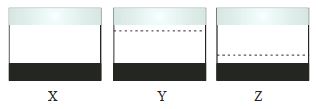
The energy band diagrams for three semiconductor samples of silicon are as shown. We can then assert that
A
sample $X$ is undoped while samples $Y$ and $Z$ have been doped with a third group and a fifth group impurity respectively
B
sample $X$ is undoped while both samples $Y$ and $Z$ have been doped with a fifth group impurity
C
sample $X$ has been doped with equal amounts of third and fifth group impurities while samples $Y$ and $Z$ are undoped
D
sample $X$ is undoped while samples $Y$ and $Z$ have been doped with a fifth group and a third group impurity respectively
Solution
(D) In an intrinsic (undoped) semiconductor,the Fermi level lies in the middle of the forbidden energy gap. This corresponds to sample $X$.
In an $n$-type semiconductor,the donor energy level lies just below the conduction band. This corresponds to sample $Y$.
In a $p$-type semiconductor,the acceptor energy level lies just above the valence band. This corresponds to sample $Z$.
Therefore,sample $X$ is undoped,sample $Y$ is doped with a fifth group impurity ($n$-type),and sample $Z$ is doped with a third group impurity ($p$-type).
Thus,the correct assertion is that sample $X$ is undoped while samples $Y$ and $Z$ have been doped with a fifth group and a third group impurity respectively.
In an $n$-type semiconductor,the donor energy level lies just below the conduction band. This corresponds to sample $Y$.
In a $p$-type semiconductor,the acceptor energy level lies just above the valence band. This corresponds to sample $Z$.
Therefore,sample $X$ is undoped,sample $Y$ is doped with a fifth group impurity ($n$-type),and sample $Z$ is doped with a third group impurity ($p$-type).
Thus,the correct assertion is that sample $X$ is undoped while samples $Y$ and $Z$ have been doped with a fifth group and a third group impurity respectively.
0 likes
View Solution112
EasyMCQ
Carbon,Silicon,and Germanium atoms have four valence electrons each. Their valence and conduction bands are separated by energy band gaps represented by $(E_g)_C$,$(E_g)_{Si}$,and $(E_g)_{Ge}$ respectively. Which one of the following relationships is true in their case?
A
$(E_g)_C > (E_g)_{Si} > (E_g)_{Ge}$
B
$(E_g)_C < (E_g)_{Si} < (E_g)_{Ge}$
C
$(E_g)_C = (E_g)_{Si} = (E_g)_{Ge}$
D
$(E_g)_C < (E_g)_{Ge} < (E_g)_{Si}$
Solution
(A) The energy band gap $(E_g)$ is the energy difference between the conduction band and the valence band.
For Carbon (diamond),Silicon,and Germanium,the values of the energy band gaps are approximately:
$(E_g)_C \approx 5.4 \ eV$
$(E_g)_{Si} \approx 1.1 \ eV$
$(E_g)_{Ge} \approx 0.7 \ eV$
Comparing these values,we observe that $(E_g)_C > (E_g)_{Si} > (E_g)_{Ge}$.
Therefore,the correct relationship is $(E_g)_C > (E_g)_{Si} > (E_g)_{Ge}$.
For Carbon (diamond),Silicon,and Germanium,the values of the energy band gaps are approximately:
$(E_g)_C \approx 5.4 \ eV$
$(E_g)_{Si} \approx 1.1 \ eV$
$(E_g)_{Ge} \approx 0.7 \ eV$
Comparing these values,we observe that $(E_g)_C > (E_g)_{Si} > (E_g)_{Ge}$.
Therefore,the correct relationship is $(E_g)_C > (E_g)_{Si} > (E_g)_{Ge}$.
0 likes
View Solution113
MediumMCQ
Assertion : The resistivity of a semiconductor increases with temperature.
Reason : The atoms of a semiconductor vibrate with larger amplitude at higher temperatures,thereby increasing its resistivity.
Reason : The atoms of a semiconductor vibrate with larger amplitude at higher temperatures,thereby increasing its resistivity.
A
If both Assertion and Reason are correct and the Reason is a correct explanation of the Assertion.
B
If both Assertion and Reason are correct but Reason is not a correct explanation of the Assertion.
C
If the Assertion is correct but Reason is incorrect.
D
If both the Assertion and Reason are incorrect.
Solution
(D) The Assertion is incorrect because the resistivity of a semiconductor decreases with an increase in temperature.
As temperature increases,more valence electrons gain sufficient thermal energy to jump across the forbidden energy gap into the conduction band.
This increase in the number of charge carriers (electrons and holes) leads to an increase in conductivity,which implies a decrease in resistivity.
The Reason is also incorrect because the mechanism described (vibration of atoms) is the primary cause for the increase in resistivity in metals,not semiconductors.
As temperature increases,more valence electrons gain sufficient thermal energy to jump across the forbidden energy gap into the conduction band.
This increase in the number of charge carriers (electrons and holes) leads to an increase in conductivity,which implies a decrease in resistivity.
The Reason is also incorrect because the mechanism described (vibration of atoms) is the primary cause for the increase in resistivity in metals,not semiconductors.
0 likes
View Solution114
EasyMCQ
Assertion: If the temperature of a semiconductor is increased,then its resistance decreases.
Reason: The energy gap between the conduction band and the valence band is very small.
Reason: The energy gap between the conduction band and the valence band is very small.
A
If both Assertion and Reason are correct and the Reason is a correct explanation of the Assertion.
B
If both Assertion and Reason are correct but Reason is not a correct explanation of the Assertion.
C
If the Assertion is correct but Reason is incorrect.
D
If both the Assertion and Reason are incorrect.
Solution
(A) In semiconductors,the energy gap between the conduction band and the valence band is small $(\approx 1 \ eV)$.
Due to a rise in temperature,electrons in the valence band gain thermal energy and can jump across this small energy gap into the conduction band.
As the number of charge carriers increases,the conductivity of the semiconductor increases.
Since conductivity is inversely proportional to resistance,the resistance of the semiconductor decreases.
Therefore,the Reason correctly explains the Assertion.
Due to a rise in temperature,electrons in the valence band gain thermal energy and can jump across this small energy gap into the conduction band.
As the number of charge carriers increases,the conductivity of the semiconductor increases.
Since conductivity is inversely proportional to resistance,the resistance of the semiconductor decreases.
Therefore,the Reason correctly explains the Assertion.
0 likes
View Solution115
MediumMCQ
The energy gaps $(E_g)$ between the valence band and conduction band for diamond, silicon, and germanium are in the order:
A
$E_g$ (diamond) > $E_g$ (silicon) > $E_g$ (germanium)
B
$E_g$ (diamond) < $E_g$ (silicon) < $E_g$ (germanium)
C
$E_g$ (diamond) = $E_g$ (silicon) = $E_g$ (germanium)
D
$E_g$ (diamond) > $E_g$ (germanium) > $E_g$ (silicon)
Solution
(A) The energy gap $(E_g)$ is the energy difference between the top of the valence band and the bottom of the conduction band.
For diamond, the energy gap is approximately $6.0 \, eV$.
For silicon, the energy gap is approximately $1.1 \, eV$.
For germanium, the energy gap is approximately $0.72 \, eV$.
Comparing these values, we have $6.0 \, eV > 1.1 \, eV > 0.72 \, eV$.
Therefore, the order is $E_g$ (diamond) > $E_g$ (silicon) > $E_g$ (germanium).
For diamond, the energy gap is approximately $6.0 \, eV$.
For silicon, the energy gap is approximately $1.1 \, eV$.
For germanium, the energy gap is approximately $0.72 \, eV$.
Comparing these values, we have $6.0 \, eV > 1.1 \, eV > 0.72 \, eV$.
Therefore, the order is $E_g$ (diamond) > $E_g$ (silicon) > $E_g$ (germanium).
0 likes
View Solution116
Easy
$C$, $Si$ and $Ge$ have the same lattice structure. Why is $C$ an insulator while $Si$ and $Ge$ are intrinsic semiconductors?
Solution
(A) The $4$ bonding electrons of $C$, $Si$, and $Ge$ reside in the second, third, and fourth orbits, respectively.
As the principal quantum number increases, the valence electrons are further from the nucleus and less tightly bound.
Consequently, the energy gap $(E_g)$ required to excite an electron from the valence band to the conduction band is highest for $C$ $(\,5.4 \ eV)$, intermediate for $Si$ $(\,1.1 \ eV)$, and lowest for $Ge$ $(\,0.7 \ eV)$.
For $C$, the energy gap is so large that thermal energy at room temperature is insufficient to excite electrons, making it an insulator.
In $Si$ and $Ge$, the energy gap is small enough that a significant number of electrons can be thermally excited to the conduction band at room temperature, allowing them to act as intrinsic semiconductors.
As the principal quantum number increases, the valence electrons are further from the nucleus and less tightly bound.
Consequently, the energy gap $(E_g)$ required to excite an electron from the valence band to the conduction band is highest for $C$ $(\,5.4 \ eV)$, intermediate for $Si$ $(\,1.1 \ eV)$, and lowest for $Ge$ $(\,0.7 \ eV)$.
For $C$, the energy gap is so large that thermal energy at room temperature is insufficient to excite electrons, making it an insulator.
In $Si$ and $Ge$, the energy gap is small enough that a significant number of electrons can be thermally excited to the conduction band at room temperature, allowing them to act as intrinsic semiconductors.
0 likes
View Solution117
Easy
Give a brief explanation of solid state semiconductor electronics.
Solution
(N/A) Solid state semiconductor devices and their junctions provide the capability to control both the quantity and the direction of charge carrier flow through them.
External excitations such as light,heat,or a small applied voltage can significantly alter the concentration of mobile charge carriers within a semiconductor.
In these devices,the generation and transport of charge carriers occur entirely within the solid material itself.
The primary devices in solid state electronics include:
$(1)$ Junction diode: $A$ device consisting of two electrodes.
$(2)$ Transistor: $A$ device consisting of three electrodes.
$(3)$ Integrated circuit $(IC)$: $A$ device containing numerous interconnected electronic components and electrodes.
External excitations such as light,heat,or a small applied voltage can significantly alter the concentration of mobile charge carriers within a semiconductor.
In these devices,the generation and transport of charge carriers occur entirely within the solid material itself.
The primary devices in solid state electronics include:
$(1)$ Junction diode: $A$ device consisting of two electrodes.
$(2)$ Transistor: $A$ device consisting of three electrodes.
$(3)$ Integrated circuit $(IC)$: $A$ device containing numerous interconnected electronic components and electrodes.
0 likes
View Solution118
Medium
Classify solid substances based on electrical conductivity and resistivity.
Solution
(N/A) On the basis of the relative values of electrical conductivity $(\sigma)$ or resistivity $(\rho = 1/\sigma)$,solids are classified into three categories:
$(1)$ Metals: They possess very low resistivity or high conductivity.
$\rho \sim 10^{-2} \Omega \cdot m$ to $10^{-8} \Omega \cdot m$
$\sigma \sim 10^{2} \text{ S} \cdot m^{-1}$ to $10^{8} \text{ S} \cdot m^{-1}$
$(2)$ Semiconductors: They have resistivity or conductivity intermediate between metals and insulators.
$\rho \sim 10^{-5} \Omega \cdot m$ to $10^{6} \Omega \cdot m$
$\sigma \sim 10^{5} \text{ S} \cdot m^{-1}$ to $10^{-6} \text{ S} \cdot m^{-1}$
$(3)$ Insulators: They have high resistivity or low conductivity.
$\rho \sim 10^{11} \Omega \cdot m$ to $10^{19} \Omega \cdot m$
$\sigma \sim 10^{-11} \text{ S} \cdot m^{-1}$ to $10^{-19} \text{ S} \cdot m^{-1}$
The values of $\rho$ and $\sigma$ given above are indicative of magnitude and can vary outside these ranges. Relative values of resistivity are not the only criteria for distinguishing metals,insulators,and semiconductors.
$(1)$ Metals: They possess very low resistivity or high conductivity.
$\rho \sim 10^{-2} \Omega \cdot m$ to $10^{-8} \Omega \cdot m$
$\sigma \sim 10^{2} \text{ S} \cdot m^{-1}$ to $10^{8} \text{ S} \cdot m^{-1}$
$(2)$ Semiconductors: They have resistivity or conductivity intermediate between metals and insulators.
$\rho \sim 10^{-5} \Omega \cdot m$ to $10^{6} \Omega \cdot m$
$\sigma \sim 10^{5} \text{ S} \cdot m^{-1}$ to $10^{-6} \text{ S} \cdot m^{-1}$
$(3)$ Insulators: They have high resistivity or low conductivity.
$\rho \sim 10^{11} \Omega \cdot m$ to $10^{19} \Omega \cdot m$
$\sigma \sim 10^{-11} \text{ S} \cdot m^{-1}$ to $10^{-19} \text{ S} \cdot m^{-1}$
The values of $\rho$ and $\sigma$ given above are indicative of magnitude and can vary outside these ranges. Relative values of resistivity are not the only criteria for distinguishing metals,insulators,and semiconductors.
0 likes
View Solution119
Medium
Give a classification of semiconductors and write examples of each.
Solution
(N/A) Semiconductors are classified into elemental and compound semiconductors.
$(i)$ Elemental semiconductors: These are made of a single element. Examples: $Si$ and $Ge$.
$(ii)$ Compound semiconductors: These are formed by combining two or more elements. They are further classified as:
$(A)$ Inorganic: Examples include $CdS$,$GaAs$,$CdSe$,and $InP$.
$(B)$ Organic: Examples include anthracene and doped phthalocyanines.
$(C)$ Organic polymers: Examples include polypyrrole,polyaniline,and polythiophene.
Most currently available semiconductor devices are based on elemental semiconductors ($Si$ or $Ge$) and inorganic compound semiconductors. Since $1990$,devices using organic semiconductors and semiconducting polymers have been developed,marking the birth of polymer electronics and molecular electronics.
$(i)$ Elemental semiconductors: These are made of a single element. Examples: $Si$ and $Ge$.
$(ii)$ Compound semiconductors: These are formed by combining two or more elements. They are further classified as:
$(A)$ Inorganic: Examples include $CdS$,$GaAs$,$CdSe$,and $InP$.
$(B)$ Organic: Examples include anthracene and doped phthalocyanines.
$(C)$ Organic polymers: Examples include polypyrrole,polyaniline,and polythiophene.
Most currently available semiconductor devices are based on elemental semiconductors ($Si$ or $Ge$) and inorganic compound semiconductors. Since $1990$,devices using organic semiconductors and semiconducting polymers have been developed,marking the birth of polymer electronics and molecular electronics.
0 likes
View Solution120
Medium
Why is the motion of an electron in a solid different from that in an isolated atom?
Solution
(N/A) In an isolated atom,electrons are bound to the nucleus and occupy discrete energy levels defined by the Bohr atomic model. The motion of these electrons is confined to specific orbits around a single nucleus.
When atoms come together to form a solid,they are packed closely. The outer electron orbits of neighboring atoms overlap significantly. This interaction causes the discrete energy levels to split into continuous energy bands.
Consequently,the electrons in a solid are no longer confined to a single atom but can move through the crystal lattice,making their motion fundamentally different from that of an electron in an isolated atom.
When atoms come together to form a solid,they are packed closely. The outer electron orbits of neighboring atoms overlap significantly. This interaction causes the discrete energy levels to split into continuous energy bands.
Consequently,the electrons in a solid are no longer confined to a single atom but can move through the crystal lattice,making their motion fundamentally different from that of an electron in an isolated atom.
0 likes
View Solution121
Easy
Give an explanation of energy band,valence band,and conduction band in a crystal.
Solution
(N/A) Some solids have a crystalline structure,which means there is a systematic arrangement of atoms or molecules in them.
When atoms are arranged close to each other,they interact with neighboring atoms,and as a result,the energy levels of the electrons are modified.
The energy levels of inner shell electrons are not significantly affected,but the energy levels of the outer shell electrons (valence electrons) are changed because these electrons are shared by more than one atom in the crystal.
Instead of the widely separated energy levels found in an isolated atom,the electrons in a crystal have closely spaced energy levels. Such a collection of closely spaced energy levels is called an energy band.
The energy band that includes the energy levels of the valence electrons is called the valence band.
The energy band above the valence band is called the conduction band.
Usually,the valence band contains valence electrons,while the conduction band is empty at $0 \ K$.
There is a gap between the conduction band and the valence band. The energy difference of this forbidden region is called the band gap energy $(E_{g})$.
In metals (conductors),the conduction band and valence band overlap,allowing electrons to move easily.
In insulators,there is a large band gap,meaning electrons in the valence band remain bound,and no free electrons are available in the conduction band.
In semiconductors,the band gap is relatively small. If electrons in the valence band receive sufficient external energy to cross the band gap,they enter the conduction band,allowing for electrical conduction.
When atoms are arranged close to each other,they interact with neighboring atoms,and as a result,the energy levels of the electrons are modified.
The energy levels of inner shell electrons are not significantly affected,but the energy levels of the outer shell electrons (valence electrons) are changed because these electrons are shared by more than one atom in the crystal.
Instead of the widely separated energy levels found in an isolated atom,the electrons in a crystal have closely spaced energy levels. Such a collection of closely spaced energy levels is called an energy band.
The energy band that includes the energy levels of the valence electrons is called the valence band.
The energy band above the valence band is called the conduction band.
Usually,the valence band contains valence electrons,while the conduction band is empty at $0 \ K$.
There is a gap between the conduction band and the valence band. The energy difference of this forbidden region is called the band gap energy $(E_{g})$.
In metals (conductors),the conduction band and valence band overlap,allowing electrons to move easily.
In insulators,there is a large band gap,meaning electrons in the valence band remain bound,and no free electrons are available in the conduction band.
In semiconductors,the band gap is relatively small. If electrons in the valence band receive sufficient external energy to cross the band gap,they enter the conduction band,allowing for electrical conduction.
0 likes
View Solution122
Medium
Explain by drawing the energy levels of $Si$ and $Ge$ containing $N$ atoms at $0\, K$ temperature.
Solution
(N/A) The atomic number of $Si$ is $14$. The electron configuration of a silicon atom is $1s^2 2s^2 2p^6 3s^2 3p^2$. Thus,the $K$ and $L$ shells are completely filled,while the $M$ shell is incomplete,containing $3s^2 3p^2$ valence electrons.
The atomic number of $Ge$ is $32$. The electron configuration of a germanium atom is $1s^2 2s^2 2p^6 3s^2 3p^6 3d^{10} 4s^2 4p^2$. Thus,the $K, L,$ and $M$ shells are completely filled,while the $N$ shell is incomplete,containing $4s^2 4p^2$ valence electrons.
Therefore,both $Si$ and $Ge$ semiconductors are tetravalent.
There are a total of $4$ electrons in the outermost orbit of a $Si$ or $Ge$ crystal. The maximum possible number of electrons in the outer orbit is $8$ ($2s + 6p$ electrons).
So,for the $4N$ valence electrons,there are $8N$ energy states.
These $8N$ discrete energy levels can either form a continuous band or they may be grouped into different bands depending upon the distance between the atoms in the crystal.
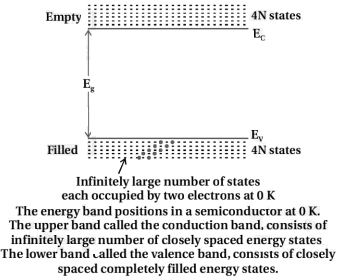
At the equilibrium distance between the atoms in the crystal lattices of $Si$ and $Ge$,the energy band of these $8N$ states splits into two,separated by an energy gap $E_g$,as shown in the figure.
The lower band,which is completely occupied by the $4N$ valence electrons at absolute zero temperature,is the valence band. The upper band is the conduction band with $4N$ energy levels,which is completely empty at absolute zero temperature.
The atomic number of $Ge$ is $32$. The electron configuration of a germanium atom is $1s^2 2s^2 2p^6 3s^2 3p^6 3d^{10} 4s^2 4p^2$. Thus,the $K, L,$ and $M$ shells are completely filled,while the $N$ shell is incomplete,containing $4s^2 4p^2$ valence electrons.
Therefore,both $Si$ and $Ge$ semiconductors are tetravalent.
There are a total of $4$ electrons in the outermost orbit of a $Si$ or $Ge$ crystal. The maximum possible number of electrons in the outer orbit is $8$ ($2s + 6p$ electrons).
So,for the $4N$ valence electrons,there are $8N$ energy states.
These $8N$ discrete energy levels can either form a continuous band or they may be grouped into different bands depending upon the distance between the atoms in the crystal.
At the equilibrium distance between the atoms in the crystal lattices of $Si$ and $Ge$,the energy band of these $8N$ states splits into two,separated by an energy gap $E_g$,as shown in the figure.
The lower band,which is completely occupied by the $4N$ valence electrons at absolute zero temperature,is the valence band. The upper band is the conduction band with $4N$ energy levels,which is completely empty at absolute zero temperature.
0 likes
View Solution123
Difficult
Explain conductor (metal),insulator,and semiconductor by drawing diagrams based on energy bands.
Solution
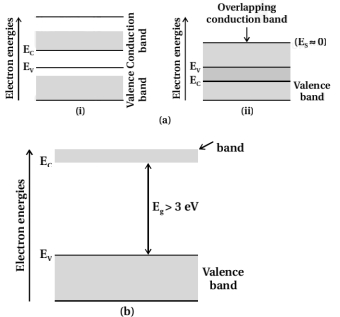
(N/A) The difference between the minimum energy level of the conduction band $(E_c)$ and the maximum energy level of the valence band $(E_v)$ is called the energy band gap $(E_g)$.
There are no allowed energy levels in the region with the energy gap,hence this region is called the forbidden energy gap.
Depending on the type of material,the forbidden gap may be small,large,or zero. Based on this gap,materials are classified into three types:
$1$. Metal (Conductor):
As shown in figure $(a)$,a metal exists either when the conduction band is partially filled and the valence band is partially empty,or when the conduction and valence bands overlap. When there is an overlap,electrons from the valence band can easily move into the conduction band. When the valence band is partially empty,electrons can move to higher energy levels,making conduction possible. Therefore,the resistance of such materials is low and conductivity is high.
$2$. Insulator:
As shown in figure $(b)$,for an insulator,the energy gap $(E_g)$ is very large $(E_g > 3 \text{ eV})$. There are no electrons in the conduction band,and therefore,no electrical conduction is possible at room temperature.
$3$. Semiconductor:
For a semiconductor,the energy gap is small (typically $E_g < 3 \text{ eV}$). At room temperature,some electrons from the valence band can gain enough thermal energy to cross the small energy gap and enter the conduction band,allowing for limited electrical conduction.
There are no allowed energy levels in the region with the energy gap,hence this region is called the forbidden energy gap.
Depending on the type of material,the forbidden gap may be small,large,or zero. Based on this gap,materials are classified into three types:
$1$. Metal (Conductor):
As shown in figure $(a)$,a metal exists either when the conduction band is partially filled and the valence band is partially empty,or when the conduction and valence bands overlap. When there is an overlap,electrons from the valence band can easily move into the conduction band. When the valence band is partially empty,electrons can move to higher energy levels,making conduction possible. Therefore,the resistance of such materials is low and conductivity is high.
$2$. Insulator:
As shown in figure $(b)$,for an insulator,the energy gap $(E_g)$ is very large $(E_g > 3 \text{ eV})$. There are no electrons in the conduction band,and therefore,no electrical conduction is possible at room temperature.
$3$. Semiconductor:
For a semiconductor,the energy gap is small (typically $E_g < 3 \text{ eV}$). At room temperature,some electrons from the valence band can gain enough thermal energy to cross the small energy gap and enter the conduction band,allowing for limited electrical conduction.
0 likes
View Solution124
Easy
State the conductivity of metals and resistivity of insulators.
Solution
(N/A) Metals are materials that conduct electricity very well. Their conductivity $(\sigma)$ is very high, typically in the range of $10^6$ to $10^8 \ S/m$.
Insulators are materials that do not conduct electricity. Their resistivity $(\rho)$ is extremely high, typically in the range of $10^8$ to $10^{20} \ \Omega \cdot m$.
Insulators are materials that do not conduct electricity. Their resistivity $(\rho)$ is extremely high, typically in the range of $10^8$ to $10^{20} \ \Omega \cdot m$.
0 likes
View Solution125
Easy
State the conductivity and resistivity of a semiconductor.
Solution
(N/A) Semiconductors are materials whose electrical properties lie between those of conductors and insulators.
$1$. Conductivity $(\sigma)$: The conductivity of a semiconductor is typically in the range of $10^{-6} \text{ to } 10^{4} \text{ S/m}$.
$2$. Resistivity $(\rho)$: The resistivity of a semiconductor is typically in the range of $10^{-4} \text{ to } 10^{6} \text{ } \Omega \cdot \text{m}$.
These values are temperature-dependent; as temperature increases, the conductivity of a semiconductor increases, and its resistivity decreases.
$1$. Conductivity $(\sigma)$: The conductivity of a semiconductor is typically in the range of $10^{-6} \text{ to } 10^{4} \text{ S/m}$.
$2$. Resistivity $(\rho)$: The resistivity of a semiconductor is typically in the range of $10^{-4} \text{ to } 10^{6} \text{ } \Omega \cdot \text{m}$.
These values are temperature-dependent; as temperature increases, the conductivity of a semiconductor increases, and its resistivity decreases.
0 likes
View Solution126
EasyMCQ
What are elementary semiconductors?
A
Semiconductors made of a single element.
B
Semiconductors made of two or more elements.
C
Semiconductors that are insulators.
D
Semiconductors that are conductors.
Solution
(A) Elementary semiconductors are those materials that are composed of a single chemical element from the periodic table.
Examples of elementary semiconductors include Silicon $(Si)$ and Germanium $(Ge)$.
These materials possess a crystal structure where atoms of the same element are bonded together,creating a band gap that allows for semiconducting properties.
Examples of elementary semiconductors include Silicon $(Si)$ and Germanium $(Ge)$.
These materials possess a crystal structure where atoms of the same element are bonded together,creating a band gap that allows for semiconducting properties.
0 likes
View Solution127
Easy
What is an energy band?
Solution
(N/A) In a solid,the energy levels of electrons are modified due to the presence of neighboring atoms. Instead of having discrete energy levels as in an isolated atom,the electrons in a solid occupy a range of closely spaced energy levels. This continuous range of allowed energy levels is called an energy band. The two most important bands are the valence band,which contains the valence electrons,and the conduction band,which is higher in energy and allows for electron movement when partially filled.
0 likes
View Solution128
Easy
Write the definition of valence band and conduction band.
Solution
(N/A) $1$. Valence Band: The energy band which includes the energy levels of the valence electrons is known as the valence band. It is the highest energy band that is completely or partially filled with electrons at $0 \ K$.
$2$. Conduction Band: The energy band above the valence band,which is either empty or partially filled with electrons,is known as the conduction band. Electrons in this band are responsible for the electrical conduction in a material.
$2$. Conduction Band: The energy band above the valence band,which is either empty or partially filled with electrons,is known as the conduction band. Electrons in this band are responsible for the electrical conduction in a material.
0 likes
View Solution129
Medium
Define the energy gap and the forbidden gap.
Solution
(N/A) $1$. Energy Gap: The energy gap is the difference in energy between the top of the valence band and the bottom of the conduction band in a solid. It represents the minimum energy required for an electron to jump from the valence band to the conduction band to participate in electrical conduction.
$2$. Forbidden Gap: The forbidden gap is the energy range between the valence band and the conduction band where no electron states exist. Electrons cannot occupy any energy levels within this region. In insulators,this gap is large,while in semiconductors,it is relatively small,and in conductors,it is non-existent (the bands overlap).
$2$. Forbidden Gap: The forbidden gap is the energy range between the valence band and the conduction band where no electron states exist. Electrons cannot occupy any energy levels within this region. In insulators,this gap is large,while in semiconductors,it is relatively small,and in conductors,it is non-existent (the bands overlap).
0 likes
View Solution130
Medium
Explain the crystalline structure by writing the electronic configuration of elementary semiconductors.
Solution
(N/A) Elementary semiconductors are $Si$ and $Ge$.
The atomic number of $Si$ is $Z=14$. Its electronic configuration is $1s^{2} 2s^{2} 2p^{6} 3s^{2} 3p^{2}$. The $K$ and $L$ shells are filled completely,and the $M$ shell $(n=3)$ is incomplete,containing four valence electrons $(3s^{2} 3p^{2})$.
The atomic number of $Ge$ is $Z=32$. Its electronic configuration is $1s^{2} 2s^{2} 2p^{6} 3s^{2} 3p^{6} 3d^{10} 4s^{2} 4p^{2}$. The $K, L,$ and $M$ shells are filled completely,but the $N$ shell $(n=4)$ is incomplete,containing four valence electrons $(4s^{2} 4p^{2})$.
Thus,$Si$ and $Ge$ are tetravalent elements.
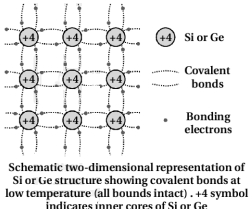
In their crystalline structure,every $Si$ or $Ge$ atom tends to share one of its four valence electrons with each of its four nearest neighbor atoms and also takes a share of one electron from each such neighbor.
These shared electron pairs form covalent bonds. Each bond contains two electrons.
The figure depicts one atom of $Ge$ or $Si$ covalently bonded with four neighboring atoms. The solid dots represent valence electrons. The figure is a two-dimensional representation,and the $+4$ symbol indicates the inner core of the $Si$ or $Ge$ atom.
Each of the bonded electrons is tightly bound to the atoms it connects.
The atomic number of $Si$ is $Z=14$. Its electronic configuration is $1s^{2} 2s^{2} 2p^{6} 3s^{2} 3p^{2}$. The $K$ and $L$ shells are filled completely,and the $M$ shell $(n=3)$ is incomplete,containing four valence electrons $(3s^{2} 3p^{2})$.
The atomic number of $Ge$ is $Z=32$. Its electronic configuration is $1s^{2} 2s^{2} 2p^{6} 3s^{2} 3p^{6} 3d^{10} 4s^{2} 4p^{2}$. The $K, L,$ and $M$ shells are filled completely,but the $N$ shell $(n=4)$ is incomplete,containing four valence electrons $(4s^{2} 4p^{2})$.
Thus,$Si$ and $Ge$ are tetravalent elements.
In their crystalline structure,every $Si$ or $Ge$ atom tends to share one of its four valence electrons with each of its four nearest neighbor atoms and also takes a share of one electron from each such neighbor.
These shared electron pairs form covalent bonds. Each bond contains two electrons.
The figure depicts one atom of $Ge$ or $Si$ covalently bonded with four neighboring atoms. The solid dots represent valence electrons. The figure is a two-dimensional representation,and the $+4$ symbol indicates the inner core of the $Si$ or $Ge$ atom.
Each of the bonded electrons is tightly bound to the atoms it connects.
0 likes
View Solution131
Medium
Explain with a diagram how current flows due to electrons and holes in a pure semiconductor.
Solution
(N/A) Semiconductors have unique properties where holes move in addition to electrons.
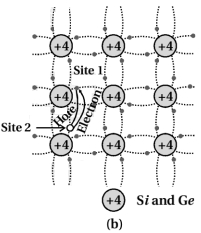
Suppose there is a hole at site $1$ as shown in the figure.
An electron from a covalent bond at site $2$ may jump to the vacant site (hole).
Thus,after such a jump,the hole is at site $2$ and site $1$ now has an electron.
Hence,the hole and the electrons move in opposite directions. The free electron moves independently as a conduction electron and gives rise to an electron current,$I_{e}$,under an applied electric field.
$A$ hole is in a covalent bond. It moves from high electric potential to low electric potential under the influence of an external electric field. This motion of holes creates a hole current,$I_{h}$.
Thus,we get two types of currents in semiconductors:
$(1)$ Due to the motion of free electrons.
$(2)$ Due to the motion of holes (the process of jumping electrons into vacant sites).
Hence,in a semiconductor,the total current $I$ is the sum of the electron current $(I_{e})$ and the hole current $(I_{h})$: $I = I_{e} + I_{h}$.
Suppose there is a hole at site $1$ as shown in the figure.
An electron from a covalent bond at site $2$ may jump to the vacant site (hole).
Thus,after such a jump,the hole is at site $2$ and site $1$ now has an electron.
Hence,the hole and the electrons move in opposite directions. The free electron moves independently as a conduction electron and gives rise to an electron current,$I_{e}$,under an applied electric field.
$A$ hole is in a covalent bond. It moves from high electric potential to low electric potential under the influence of an external electric field. This motion of holes creates a hole current,$I_{h}$.
Thus,we get two types of currents in semiconductors:
$(1)$ Due to the motion of free electrons.
$(2)$ Due to the motion of holes (the process of jumping electrons into vacant sites).
Hence,in a semiconductor,the total current $I$ is the sum of the electron current $(I_{e})$ and the hole current $(I_{h})$: $I = I_{e} + I_{h}$.
0 likes
View Solution132
Medium
Explain the classification of materials on the basis of resistivity.
Solution
(N/A) Materials are classified into three categories based on their resistivity: conductors,semiconductors,and insulators.
$1$. Conductors: For a perfect conductor,the resistivity is $0 \ \Omega m$ and conductivity is infinite. For metals,the resistivity typically ranges from $10^{-8} \ \Omega m$ to $10^{-6} \ \Omega m$.
$2$. Insulators: For a perfect insulator,the resistivity is infinite and conductivity is $0$. For materials like ceramic,rubber,and plastic,the resistivity is about $10^{18}$ times higher than that of metals.
$3$. Semiconductors: The resistivity of semiconductors lies between that of metals and insulators. $A$ key characteristic is that the resistivity of semiconductors decreases with an increase in temperature.
$1$. Conductors: For a perfect conductor,the resistivity is $0 \ \Omega m$ and conductivity is infinite. For metals,the resistivity typically ranges from $10^{-8} \ \Omega m$ to $10^{-6} \ \Omega m$.
$2$. Insulators: For a perfect insulator,the resistivity is infinite and conductivity is $0$. For materials like ceramic,rubber,and plastic,the resistivity is about $10^{18}$ times higher than that of metals.
$3$. Semiconductors: The resistivity of semiconductors lies between that of metals and insulators. $A$ key characteristic is that the resistivity of semiconductors decreases with an increase in temperature.
0 likes
View Solution133
Medium
Why does the resistivity of a semiconductor decrease with an increase in temperature?
Solution
(N/A) The resistivity of a semiconductor is given by the relation $\rho = \frac{m}{n e^2 \tau}$,where $m$ is the mass of the electron,$n$ is the number density of charge carriers,$e$ is the charge of the electron,and $\tau$ is the relaxation time.
In semiconductors,as the temperature increases,the thermal energy provided to the valence electrons increases.
This causes a large number of electrons to jump from the valence band to the conduction band,leading to a significant increase in the charge carrier density $(n)$.
Although the relaxation time $(\tau)$ decreases slightly due to increased collisions,the increase in the number density $(n)$ is exponential and dominates the effect.
Since $\rho \propto \frac{1}{n}$,the significant increase in $n$ results in a net decrease in the resistivity $(\rho)$ of the semiconductor.
In semiconductors,as the temperature increases,the thermal energy provided to the valence electrons increases.
This causes a large number of electrons to jump from the valence band to the conduction band,leading to a significant increase in the charge carrier density $(n)$.
Although the relaxation time $(\tau)$ decreases slightly due to increased collisions,the increase in the number density $(n)$ is exponential and dominates the effect.
Since $\rho \propto \frac{1}{n}$,the significant increase in $n$ results in a net decrease in the resistivity $(\rho)$ of the semiconductor.
0 likes
View Solution134
Medium
Explain the change in the energy band structure of an intrinsic semiconductor with temperature by drawing a figure.
Solution
(N/A) An intrinsic semiconductor behaves like an insulator at $T = 0 \,K$. At this temperature, all electrons are bound in the valence band, and there are no electrons in the conduction band. Consequently, no current can flow, and it acts as an insulator.
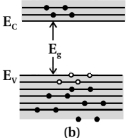
At temperatures $T > 0 \,K$, thermal energy allows some electrons to gain sufficient energy to jump from the valence band to the conduction band. This process creates free electrons in the conduction band and corresponding holes in the valence band, as shown in the figure.
In the figure, solid dots represent electrons, while empty circles represent holes. The energy gap between the valence band $(E_V)$ and the conduction band $(E_C)$ is denoted by $E_g$. As temperature increases, the number of thermally excited charge carriers increases, thereby increasing the conductivity of the semiconductor.
At temperatures $T > 0 \,K$, thermal energy allows some electrons to gain sufficient energy to jump from the valence band to the conduction band. This process creates free electrons in the conduction band and corresponding holes in the valence band, as shown in the figure.
In the figure, solid dots represent electrons, while empty circles represent holes. The energy gap between the valence band $(E_V)$ and the conduction band $(E_C)$ is denoted by $E_g$. As temperature increases, the number of thermally excited charge carriers increases, thereby increasing the conductivity of the semiconductor.
0 likes
View Solution135
Medium
Write the electronic configuration of $Si$ and $Ge$.
Solution
(N/A) The atomic number of Silicon $(Si)$ is $14$. Its electronic configuration is $1s^2 2s^2 2p^6 3s^2 3p^2$,which can also be written as $[Ne] 3s^2 3p^2$.
The atomic number of Germanium $(Ge)$ is $32$. Its electronic configuration is $1s^2 2s^2 2p^6 3s^2 3p^6 3d^{10} 4s^2 4p^2$,which can also be written as $[Ar] 3d^{10} 4s^2 4p^2$.
The atomic number of Germanium $(Ge)$ is $32$. Its electronic configuration is $1s^2 2s^2 2p^6 3s^2 3p^6 3d^{10} 4s^2 4p^2$,which can also be written as $[Ar] 3d^{10} 4s^2 4p^2$.
0 likes
View Solution136
EasyMCQ
What is the crystalline structure of an intrinsic semiconductor?
A
Face-centered cubic $(FCC)$
B
Body-centered cubic $(BCC)$
C
Diamond cubic
D
Simple cubic
Solution
(C) Intrinsic semiconductors like Silicon $(Si)$ and Germanium $(Ge)$ belong to Group-$14$ of the periodic table.
These elements form covalent bonds with four neighboring atoms.
This specific arrangement of atoms in a tetrahedral geometry results in a diamond cubic crystal structure.
Therefore,the correct option is $C$.
These elements form covalent bonds with four neighboring atoms.
This specific arrangement of atoms in a tetrahedral geometry results in a diamond cubic crystal structure.
Therefore,the correct option is $C$.
0 likes
View Solution137
EasyMCQ
How does an intrinsic semiconductor behave at $0 \ K$?
A
As a conductor
B
As an insulator
C
As a superconductor
D
As a semiconductor
Solution
(B) At $0 \ K$ (absolute zero),all valence electrons are tightly bound to their respective atoms in the crystal lattice.
There is no thermal energy available to excite electrons from the valence band to the conduction band.
Since there are no free charge carriers (electrons or holes) available for conduction,the intrinsic semiconductor behaves as a perfect insulator.
There is no thermal energy available to excite electrons from the valence band to the conduction band.
Since there are no free charge carriers (electrons or holes) available for conduction,the intrinsic semiconductor behaves as a perfect insulator.
0 likes
View Solution138
EasyMCQ
How are holes produced in a semiconductor?
A
By adding pentavalent impurities
B
By breaking covalent bonds due to thermal energy
C
By applying a high electric field
D
By cooling the semiconductor
Solution
(B) In a semiconductor,holes are produced when an electron breaks its covalent bond due to thermal energy and moves into the conduction band.
This leaves behind a vacancy in the valence band,which is referred to as a hole.
Therefore,the production of holes is primarily a result of thermal excitation breaking covalent bonds.
This leaves behind a vacancy in the valence band,which is referred to as a hole.
Therefore,the production of holes is primarily a result of thermal excitation breaking covalent bonds.
0 likes
View Solution139
Easy
State the value of the energy band gap difference between the valence band $(E_V)$ and the conduction band $(E_C)$ for $C$ (Diamond), $Si$, and $Ge$.
Solution
(N/A) The energy band gap $(E_g = E_C - E_V)$ represents the energy difference between the conduction band and the valence band.
For $C$ (Diamond), the energy band gap is approximately $5.4 \text{ eV}$.
For $Si$ (Silicon), the energy band gap is approximately $1.1 \text{ eV}$.
For $Ge$ (Germanium), the energy band gap is approximately $0.7 \text{ eV}$.
For $C$ (Diamond), the energy band gap is approximately $5.4 \text{ eV}$.
For $Si$ (Silicon), the energy band gap is approximately $1.1 \text{ eV}$.
For $Ge$ (Germanium), the energy band gap is approximately $0.7 \text{ eV}$.
0 likes
View Solution140
EasyMCQ
Name the primary constitutional unit of semiconductor composition.
A
Atom
B
Molecule
C
Crystal lattice
D
Electron
Solution
(A) The primary constitutional unit of a semiconductor composition is the $Atom$. In semiconductors like $Silicon$ $(Si)$ or $Germanium$ $(Ge)$,the atoms are arranged in a specific crystal structure (typically a diamond cubic structure) where each atom is covalently bonded to its neighbors. These atoms form the fundamental building blocks of the semiconductor material.
0 likes
View Solution141
Difficult
$Sn, C, Si$,and $Ge$ are all group $XIV$ elements. Yet,$Sn$ is a conductor,$C$ is an insulator,while $Si$ and $Ge$ are semiconductors. Why?
Solution
(N/A) $(i)$ In the structure of $Sn$,the valence band and conduction band overlap,meaning the energy gap between them is zero; hence,$Sn$ acts as a conductor.
$(ii)$ In the structure of $C$ (diamond),the energy gap is $5.4 \ eV$,which is quite large,preventing electron excitation to the conduction band; hence,it acts as an insulator.
$(iii)$ The energy gaps in $Si$ and $Ge$ are $1.1 \ eV$ and $0.7 \ eV$,respectively. These gaps are moderate,allowing some electrons to jump to the conduction band at room temperature,making them semiconductors.
$(ii)$ In the structure of $C$ (diamond),the energy gap is $5.4 \ eV$,which is quite large,preventing electron excitation to the conduction band; hence,it acts as an insulator.
$(iii)$ The energy gaps in $Si$ and $Ge$ are $1.1 \ eV$ and $0.7 \ eV$,respectively. These gaps are moderate,allowing some electrons to jump to the conduction band at room temperature,making them semiconductors.
0 likes
View Solution142
EasyMCQ
The resistivity of a semiconductor depends upon
A
Size of the atom
B
The nature of atoms
C
Type of bonds
D
Size and types of motion
Solution
(B) The correct answer is $B$.
The resistivity of a semiconductor is primarily determined by the nature of the atoms (the material composition) and the concentration of charge carriers (electrons and holes) available for conduction,which is influenced by the valence electrons and the energy band structure of the material.
The resistivity of a semiconductor is primarily determined by the nature of the atoms (the material composition) and the concentration of charge carriers (electrons and holes) available for conduction,which is influenced by the valence electrons and the energy band structure of the material.
0 likes
View Solution143
MediumMCQ
The effect of an increase in temperature on the number of electrons in the conduction band $(n_e)$ and the resistance of a semiconductor will be as follows:
A
Both $n_e$ and resistance decrease
B
Both $n_e$ and resistance increase
C
$n_e$ increases,resistance decreases
D
$n_e$ decreases,resistance increases
Solution
(C) In a semiconductor,as the temperature increases,the thermal energy provided to the electrons increases.
This allows more electrons to overcome the energy band gap and jump from the valence band to the conduction band.
Consequently,the number of electrons in the conduction band $(n_e)$ increases.
Since the conductivity of a semiconductor is directly proportional to the number of charge carriers,the conductivity increases.
Because resistance is inversely proportional to conductivity,the resistance of the semiconductor decreases.
This allows more electrons to overcome the energy band gap and jump from the valence band to the conduction band.
Consequently,the number of electrons in the conduction band $(n_e)$ increases.
Since the conductivity of a semiconductor is directly proportional to the number of charge carriers,the conductivity increases.
Because resistance is inversely proportional to conductivity,the resistance of the semiconductor decreases.
0 likes
View Solution144
MediumMCQ
Match the List $I$ with List $II$:
Choose the correct answer from the options given below:
| $LIST$ $I$ | $LIST$ $II$ |
| $A$. Intrinsic Semiconductor | $I$. Fermi-level near conduction band |
| $B$. $n$-type semiconductor | $II$. Fermi-level at middle |
| $C$. $p$-type semiconductor | $III$. Fermi-level near valence band |
| $D$. Metals | $IV$. Fermi-level inside conduction band |
Choose the correct answer from the options given below:
A
$(A) \rightarrow I, (B) \rightarrow II, (C) \rightarrow III, (D) \rightarrow IV$
B
$(A) \rightarrow II, (B) \rightarrow I, (C) \rightarrow III, (D) \rightarrow IV$
C
$(A) \rightarrow II, (B) \rightarrow III, (C) \rightarrow I, (D) \rightarrow IV$
D
$(A) \rightarrow III, (B) \rightarrow I, (C) \rightarrow II, (D) \rightarrow IV$
Solution
(B) $1$. Intrinsic Semiconductor: In an intrinsic semiconductor,the number of electrons in the conduction band equals the number of holes in the valence band. Thus,the Fermi level lies exactly in the middle of the forbidden energy gap. So,$A \rightarrow II$.
$2$. $n$-type semiconductor: In an $n$-type semiconductor,donor energy levels are introduced just below the conduction band. Consequently,the Fermi level shifts upward towards the conduction band. So,$B \rightarrow I$.
$3$. $p$-type semiconductor: In a $p$-type semiconductor,acceptor energy levels are introduced just above the valence band. Consequently,the Fermi level shifts downward towards the valence band. So,$C \rightarrow III$.
$4$. Metals: In metals,the valence band and conduction band overlap,and the Fermi level lies within the conduction band. So,$D \rightarrow IV$.
Therefore,the correct matching is $(A \rightarrow II, B \rightarrow I, C \rightarrow III, D \rightarrow IV)$.
$2$. $n$-type semiconductor: In an $n$-type semiconductor,donor energy levels are introduced just below the conduction band. Consequently,the Fermi level shifts upward towards the conduction band. So,$B \rightarrow I$.
$3$. $p$-type semiconductor: In a $p$-type semiconductor,acceptor energy levels are introduced just above the valence band. Consequently,the Fermi level shifts downward towards the valence band. So,$C \rightarrow III$.
$4$. Metals: In metals,the valence band and conduction band overlap,and the Fermi level lies within the conduction band. So,$D \rightarrow IV$.
Therefore,the correct matching is $(A \rightarrow II, B \rightarrow I, C \rightarrow III, D \rightarrow IV)$.
0 likes
View Solution145
MediumMCQ
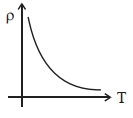
The resistivity $(\rho)$ of a semiconductor varies with temperature. Which of the following curves represents the correct behavior?
A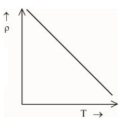
B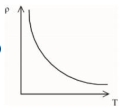
C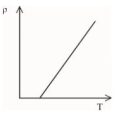
D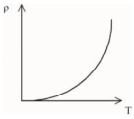
Solution
(B) The resistivity of a material is given by the formula $\rho = \frac{m}{ne^2\tau}$,where $m$ is the mass of the electron,$n$ is the number density of charge carriers,$e$ is the electronic charge,and $\tau$ is the relaxation time.
In semiconductors,as the temperature $(T)$ increases,the number density $(n)$ of electrons and holes increases exponentially due to the thermal excitation of charge carriers across the band gap.
Since $m$ and $e$ are constants,and the increase in $n$ dominates over the slight decrease in $\tau$ at higher temperatures,the resistivity $\rho$ decreases significantly as temperature $T$ increases.
This relationship is represented by an exponential decay curve,which is a non-linear decrease. Therefore,the curve in option $B$ correctly represents the behavior of resistivity with temperature for a semiconductor.
In semiconductors,as the temperature $(T)$ increases,the number density $(n)$ of electrons and holes increases exponentially due to the thermal excitation of charge carriers across the band gap.
Since $m$ and $e$ are constants,and the increase in $n$ dominates over the slight decrease in $\tau$ at higher temperatures,the resistivity $\rho$ decreases significantly as temperature $T$ increases.
This relationship is represented by an exponential decay curve,which is a non-linear decrease. Therefore,the curve in option $B$ correctly represents the behavior of resistivity with temperature for a semiconductor.
0 likes
View Solution146
EasyMCQ
Electrical conductivity of insulators is
A
extremely small.
B
exactly zero.
C
sometimes small and sometimes large.
D
extremely large.
Solution
(A) Insulators are materials that do not allow the flow of electric current through them easily.
This is because they have a very high resistivity and,consequently,an extremely small electrical conductivity.
Therefore,the electrical conductivity of insulators is extremely small.
This is because they have a very high resistivity and,consequently,an extremely small electrical conductivity.
Therefore,the electrical conductivity of insulators is extremely small.
0 likes
View Solution147
EasyMCQ
In semiconductors at room temperature,
A
the valence band is completely filled and the conduction band partially filled.
B
the valence band is completely filled.
C
the conduction band is completely filled.
D
the valence band is partially empty and the conduction band partially filled.
Solution
(D) In semiconductors at room temperature,the thermal energy is sufficient for some electrons to overcome the forbidden energy gap.
As a result,some electrons jump from the valence band to the conduction band.
Consequently,the valence band becomes partially empty and the conduction band becomes partially filled.
As a result,some electrons jump from the valence band to the conduction band.
Consequently,the valence band becomes partially empty and the conduction band becomes partially filled.
0 likes
View Solution148
EasyMCQ
In insulators,which of the following statements is correct regarding their energy bands?
A
valence band is empty and conduction band is filled with electrons.
B
conduction band is empty and valence band is completely filled with electrons.
C
valence band is partially filled.
D
conduction band is partially filled with electrons.
Solution
(B) In insulators,the energy gap between the valence band and the conduction band is very large (typically $> 3 \ eV$).
At absolute zero temperature,the valence band is completely filled with electrons,and the conduction band is completely empty.
Due to the large energy gap,electrons cannot jump from the valence band to the conduction band even at room temperature,which is why insulators do not conduct electricity.
At absolute zero temperature,the valence band is completely filled with electrons,and the conduction band is completely empty.
Due to the large energy gap,electrons cannot jump from the valence band to the conduction band even at room temperature,which is why insulators do not conduct electricity.
0 likes
View Solution149
EasyMCQ
In the energy band diagram of insulators,the band gap and the conduction band are respectively:
A
very low and partially filled.
B
very high and completely filled.
C
very high and empty.
D
very low and empty.
Solution
(C) In insulators,the valence band is completely filled with electrons,and the conduction band is completely empty.
There is a very large energy band gap (typically $E_g > 3 \ eV$) between the valence band and the conduction band.
Because of this large energy gap,electrons cannot easily jump from the valence band to the conduction band,even at room temperature.
Therefore,the band gap is very high and the conduction band is empty.
Thus,the correct option is $C$.
There is a very large energy band gap (typically $E_g > 3 \ eV$) between the valence band and the conduction band.
Because of this large energy gap,electrons cannot easily jump from the valence band to the conduction band,even at room temperature.
Therefore,the band gap is very high and the conduction band is empty.
Thus,the correct option is $C$.
0 likes
View Solution150
EasyMCQ
In semiconductors at room temperature,
A
the valence band is completely filled
B
the conduction band is completely filled
C
the conduction band is partially filled and valence band is partially empty
D
the valence band is completely filled and the conduction band is partially filled
Solution
(D) At room temperature,thermal energy is sufficient to excite some electrons from the valence band to the conduction band in a semiconductor.
However,the number of electrons excited is very small compared to the total number of electrons in the valence band.
Therefore,the valence band remains almost completely filled,and the conduction band contains only a small number of electrons,making it partially filled.
Thus,the correct description is that the valence band is almost completely filled and the conduction band is partially filled.
However,the number of electrons excited is very small compared to the total number of electrons in the valence band.
Therefore,the valence band remains almost completely filled,and the conduction band contains only a small number of electrons,making it partially filled.
Thus,the correct description is that the valence band is almost completely filled and the conduction band is partially filled.
0 likes
View SolutionSemiconductor Electronics — Classification of Materials and Energy Band Theory · Frequently Asked Questions
1Are these Semiconductor Electronics questions useful for JEE and NEET?
Yes. All questions in this section are mapped to JEE Main and NEET exam patterns. Previous year questions from JEE Main, NEET, GUJCET and state-level exams are included with full solutions.
2Can I switch to Hindi or Gujarati for these questions?
Yes. Use the language tabs in the hero section or the sidebar to view the same questions and solutions in English, Hindi or Gujarati.
3How do I generate a question paper from this subtopic?
Use the Vedclass Exam Paper Generator — select the chapter and subtopic, set difficulty, and generate Sets A, B, C, D automatically. First 3 chapters of every subject are free.
Vedclass Products
For Students
Vedclass Test Series
Mock tests in real JEE/NEET style with performance analysis. 5-day free trial.
Start Free TrialFor Teachers
Exam Paper Generator
Generate Set A/B/C/D papers from this chapter in 2 minutes. 3 chapters free.
Try FreeFor Institutes
Online Exam Module
Live online exams with unlimited students, 360° analytics & white-label branding.
See DemoFor Teachers & Institutes
Generate a Semiconductor Electronics Exam Paper in 2 Minutes
Select subtopic & difficulty — Sets A, B, C, D auto-generated with No Repeat logic.
First 3 chapters of every subject are free — no payment required.