
A English
Classification of Materials and Energy Band Theory Questions in English
Class 12 Physics · Semiconductor Electronics · Classification of Materials and Energy Band Theory
190+
Questions
English
Language
100%
With Solutions
Showing 49 of 190 questions in English
51
EasyMCQ
Carbon, silicon, and germanium atoms have four valence electrons each. Their valence and conduction bands are separated by energy band gaps represented by $(E_g)_C$, $(E_g)_{Si}$, and $(E_g)_{Ge}$ respectively. Which one of the following relationships is true in their case?
A
$(E_g)_C > (E_g)_{Si}$
B
$(E_g)_C = (E_g)_{Si}$
C
$(E_g)_C < (E_g)_{Ge}$
D
$(E_g)_C < (E_g)_{Si}$
Solution
(A) The energy band gap $(E_g)$ is the energy difference between the valence band and the conduction band.
For carbon (diamond), the energy band gap is approximately $5.4 \text{ eV}$.
For silicon, the energy band gap is approximately $1.1 \text{ eV}$.
For germanium, the energy band gap is approximately $0.7 \text{ eV}$.
Comparing these values, we find that $(E_g)_C > (E_g)_{Si} > (E_g)_{Ge}$.
Therefore, the correct relationship is $(E_g)_C > (E_g)_{Si}$.
For carbon (diamond), the energy band gap is approximately $5.4 \text{ eV}$.
For silicon, the energy band gap is approximately $1.1 \text{ eV}$.
For germanium, the energy band gap is approximately $0.7 \text{ eV}$.
Comparing these values, we find that $(E_g)_C > (E_g)_{Si} > (E_g)_{Ge}$.
Therefore, the correct relationship is $(E_g)_C > (E_g)_{Si}$.
0 likes
View Solution52
EasyMCQ
In a semiconducting material,the mobilities of electrons and holes are $\mu_e$ and $\mu_h$ respectively. Which of the following is true?
A
$\mu_e > \mu_h$
B
$\mu_e < \mu_h$
C
$\mu_e = \mu_h$
D
$\mu_e < 0; \mu_h > 0$
Solution
(A) In a semiconductor,the mobility of charge carriers is defined as the drift velocity per unit electric field.
Electrons are lighter and move through the conduction band,whereas holes are essentially vacancies in the valence band that move through a process of successive electron jumps.
Due to their lower effective mass and the nature of their movement in the conduction band,electrons encounter less scattering and have a higher mobility compared to holes.
Therefore,the mobility of electrons is always greater than the mobility of holes,i.e.,$\mu_e > \mu_h$.
Electrons are lighter and move through the conduction band,whereas holes are essentially vacancies in the valence band that move through a process of successive electron jumps.
Due to their lower effective mass and the nature of their movement in the conduction band,electrons encounter less scattering and have a higher mobility compared to holes.
Therefore,the mobility of electrons is always greater than the mobility of holes,i.e.,$\mu_e > \mu_h$.
0 likes
View Solution53
MediumMCQ
The probability of electrons to be found in the conduction band of an intrinsic semiconductor at a finite temperature:
A
Decreases exponentially with increasing band gap
B
Increases exponentially with increasing band gap
C
Decreases with increasing temperature
D
Is independent of the temperature and the band gap
Solution
(A) The probability $P(E)$ of finding an electron in an energy state $E$ is given by the Fermi-Dirac distribution function:
$P(E) = \frac{1}{1 + e^{(E - E_F) / kT}}$
where $E_F$ is the Fermi level,$k$ is the Boltzmann constant,and $T$ is the absolute temperature.
For an intrinsic semiconductor,the conduction band starts at energy $E_c$. The probability of finding an electron in the conduction band is proportional to $e^{-(E_c - E_F) / kT}$.
Since the band gap $E_g = E_c - E_v$ is related to the Fermi level (approximately $E_g \approx 2(E_c - E_F)$),the probability depends on the term $e^{-E_g / 2kT}$.
As the band gap $E_g$ increases,the term $e^{-E_g / 2kT}$ decreases exponentially.
Therefore,the probability of electrons being found in the conduction band decreases exponentially with an increasing band gap.
$P(E) = \frac{1}{1 + e^{(E - E_F) / kT}}$
where $E_F$ is the Fermi level,$k$ is the Boltzmann constant,and $T$ is the absolute temperature.
For an intrinsic semiconductor,the conduction band starts at energy $E_c$. The probability of finding an electron in the conduction band is proportional to $e^{-(E_c - E_F) / kT}$.
Since the band gap $E_g = E_c - E_v$ is related to the Fermi level (approximately $E_g \approx 2(E_c - E_F)$),the probability depends on the term $e^{-E_g / 2kT}$.
As the band gap $E_g$ increases,the term $e^{-E_g / 2kT}$ decreases exponentially.
Therefore,the probability of electrons being found in the conduction band decreases exponentially with an increasing band gap.
0 likes
View Solution54
MediumMCQ
The explanation of the band structure in solids is due to:
A
Heisenberg's uncertainty principle
B
Pauli's exclusion principle
C
Bohr's correspondence principle
D
Boltzmann's principle
Solution
(B) In a solid,when atoms are brought together to form a crystal,their individual energy levels split into bands due to the interaction between electrons of neighboring atoms. According to $Pauli's$ exclusion principle,no two electrons in an atom can have the same set of four quantum numbers. As atoms come closer,the energy levels of the electrons overlap and split into a large number of closely spaced energy levels,forming energy bands. Thus,the band structure is a direct consequence of $Pauli's$ exclusion principle.
0 likes
View Solution55
MediumMCQ
$A$ copper strip and a germanium strip are cooled to $80 \ K$ from room temperature. The resistance of:
A
each decreases.
B
the copper strip increases and that of the germanium decreases.
C
the copper strip decreases and that of the germanium increases.
D
each increases.
Solution
(C) Copper is a metal (conductor),and germanium is a semiconductor.
For conductors,the resistance decreases as the temperature decreases because the scattering of electrons by lattice vibrations reduces.
For semiconductors,the resistance increases as the temperature decreases because the number of free charge carriers (electrons and holes) decreases significantly due to the reduction in thermal excitation.
Therefore,when cooled to $80 \ K$,the resistance of the copper strip decreases,and the resistance of the germanium strip increases.
For conductors,the resistance decreases as the temperature decreases because the scattering of electrons by lattice vibrations reduces.
For semiconductors,the resistance increases as the temperature decreases because the number of free charge carriers (electrons and holes) decreases significantly due to the reduction in thermal excitation.
Therefore,when cooled to $80 \ K$,the resistance of the copper strip decreases,and the resistance of the germanium strip increases.
0 likes
View Solution56
MediumMCQ
The electrical conductivities of $Ge$ and $Na$ are $\sigma_1$ and $\sigma_2$ respectively. If these materials are heated,then:
A
$\sigma_1$ decreases and $\sigma_2$ increases
B
$\sigma_1$ and $\sigma_2$ both decrease
C
$\sigma_1$ and $\sigma_2$ both increase
D
$\sigma_1$ increases and $\sigma_2$ decreases
Solution
(D) $Ge$ (Germanium) is a semiconductor. When a semiconductor is heated,the number of charge carriers (electrons and holes) increases due to the breaking of covalent bonds,which leads to an increase in its electrical conductivity $\sigma_1$.
$Na$ (Sodium) is a metal (conductor). When a metal is heated,the amplitude of vibration of the lattice ions increases,which leads to more frequent collisions with electrons. This increases the resistance of the metal,thereby decreasing its electrical conductivity $\sigma_2$.
Therefore,$\sigma_1$ increases and $\sigma_2$ decreases.
$Na$ (Sodium) is a metal (conductor). When a metal is heated,the amplitude of vibration of the lattice ions increases,which leads to more frequent collisions with electrons. This increases the resistance of the metal,thereby decreasing its electrical conductivity $\sigma_2$.
Therefore,$\sigma_1$ increases and $\sigma_2$ decreases.
0 likes
View Solution57
EasyMCQ
$GaAs$ (Gallium Arsenide) is a ....... .
A
Intrinsic semiconductor
B
Compound semiconductor
C
Insulator
D
Conductor
Solution
(B) $GaAs$ (Gallium Arsenide) is a chemical compound of the elements gallium and arsenic. It is a well-known example of a compound semiconductor,which is formed by combining elements from groups $13$ and $15$ of the periodic table. Unlike elemental semiconductors like silicon $(Si)$ or germanium $(Ge)$,compound semiconductors are synthesized from two or more elements. Therefore,the correct classification for $GaAs$ is a compound semiconductor.
0 likes
View Solution58
MediumMCQ
If pieces of copper and germanium are cooled from room temperature to $77 \ K$,their resistance will:
A
Increase for both.
B
Decrease for both.
C
Decrease for copper and increase for germanium.
D
Increase for copper and decrease for germanium.
Solution
(C) Copper is a conductor (metal). For metals,resistance decreases as temperature decreases because the number of collisions between electrons and lattice ions decreases.
Germanium is a semiconductor. For semiconductors,resistance increases as temperature decreases because the number of charge carriers (electrons and holes) decreases exponentially with temperature.
Therefore,when cooled to $77 \ K$,the resistance of copper decreases and the resistance of germanium increases.
Germanium is a semiconductor. For semiconductors,resistance increases as temperature decreases because the number of charge carriers (electrons and holes) decreases exponentially with temperature.
Therefore,when cooled to $77 \ K$,the resistance of copper decreases and the resistance of germanium increases.
0 likes
View Solution59
EasyMCQ
$A$ solid which is transparent to visible light and whose electrical conductivity increases with temperature is formed by:
A
Metallic bonds
B
Ionic bonds
C
Covalent bonds
D
Van der Waals bonds
Solution
(C) $1$. The property of being transparent to visible light indicates that the material has a large band gap,which is characteristic of insulators or semiconductors.
$2$. The property that electrical conductivity increases with temperature is a defining characteristic of semiconductors.
$3$. Semiconductors like Silicon $(Si)$ and Germanium $(Ge)$ are formed by covalent bonds between atoms.
$4$. In these materials,as temperature increases,more electrons gain enough thermal energy to jump from the valence band to the conduction band,thereby increasing conductivity.
$5$. Therefore,the correct answer is covalent bonds.
$2$. The property that electrical conductivity increases with temperature is a defining characteristic of semiconductors.
$3$. Semiconductors like Silicon $(Si)$ and Germanium $(Ge)$ are formed by covalent bonds between atoms.
$4$. In these materials,as temperature increases,more electrons gain enough thermal energy to jump from the valence band to the conduction band,thereby increasing conductivity.
$5$. Therefore,the correct answer is covalent bonds.
0 likes
View Solution60
MediumMCQ
The forbidden energy gap for a germanium crystal is approximately ....... $J$.
A
$1.12 \times 10^{-19}$
B
$1.76 \times 10^{-19}$
C
$0.16 \times 10^{-19}$
D
Zero
Solution
(A) The forbidden energy gap $(E_g)$ for germanium $(Ge)$ at room temperature is approximately $0.7 \, eV$.
To convert this energy from electron-volts $(eV)$ to Joules $(J)$,we use the conversion factor $1 \, eV = 1.6 \times 10^{-19} \, J$.
Therefore,$E_g = 0.7 \times 1.6 \times 10^{-19} \, J = 1.12 \times 10^{-19} \, J$.
Thus,the correct option is $A$.
To convert this energy from electron-volts $(eV)$ to Joules $(J)$,we use the conversion factor $1 \, eV = 1.6 \times 10^{-19} \, J$.
Therefore,$E_g = 0.7 \times 1.6 \times 10^{-19} \, J = 1.12 \times 10^{-19} \, J$.
Thus,the correct option is $A$.
0 likes
View Solution61
EasyMCQ
The forbidden energy gap of $Ge$ is ....... $eV$.
A
$0.72$
B
$0.072$
C
$7.2$
D
$0.0072$
Solution
(A) The forbidden energy gap $(E_g)$ is the energy difference between the valence band and the conduction band.
For Germanium $(Ge)$,the forbidden energy gap at room temperature $(300 \ K)$ is approximately $0.72 \ eV$.
For Silicon $(Si)$,the forbidden energy gap is approximately $1.1 \ eV$.
Therefore,the correct option is $A$.
For Germanium $(Ge)$,the forbidden energy gap at room temperature $(300 \ K)$ is approximately $0.72 \ eV$.
For Silicon $(Si)$,the forbidden energy gap is approximately $1.1 \ eV$.
Therefore,the correct option is $A$.
0 likes
View Solution62
EasyMCQ
The electrons in the conduction band of a semiconductor are called .......
A
Valence electrons
B
Bond electrons
C
Free electrons
D
Bound electrons
Solution
(C) In a semiconductor,the conduction band is partially filled or empty at $0 \ K$. When electrons gain enough energy to jump from the valence band to the conduction band,they are no longer bound to any specific atom. Since the conduction band allows these electrons to move freely throughout the crystal lattice,they are referred to as free electrons.
0 likes
View Solution63
EasyMCQ
On the basis of which principle are the band diagrams of solids classified into different types?
A
Heisenberg's uncertainty principle
B
Pauli's exclusion principle
C
Bohr's theory
D
Boltzmann's law
Solution
(B) According to Pauli's exclusion principle,no two electrons in an atom can have the same set of all four quantum numbers.
When atoms come together to form a solid,the energy levels of the electrons split into bands due to the interaction between atoms.
The distribution of electrons into these energy bands is governed by Pauli's exclusion principle,which determines how many electrons can occupy a specific energy state.
Therefore,the formation and classification of energy bands in solids are based on Pauli's exclusion principle.
When atoms come together to form a solid,the energy levels of the electrons split into bands due to the interaction between atoms.
The distribution of electrons into these energy bands is governed by Pauli's exclusion principle,which determines how many electrons can occupy a specific energy state.
Therefore,the formation and classification of energy bands in solids are based on Pauli's exclusion principle.
0 likes
View Solution64
EasyMCQ
The resistivity of a semiconductor depends on $........$.
A
Size
B
Nature of atoms
C
Length
D
Size and nature of atoms
Solution
(B) The resistivity of a semiconductor is an intrinsic property of the material. It depends on the concentration of charge carriers (electrons and holes),which is determined by the atomic structure and the nature of the atoms present in the semiconductor material. Therefore,the resistivity depends on the nature of the atoms.
0 likes
View Solution65
EasyMCQ
At room temperature,in a semiconductor material:
A
The valence band is partially empty and the conduction band is partially filled.
B
The valence band is completely filled and the conduction band is partially filled.
C
The valence band is completely filled.
D
The conduction band is completely empty.
Solution
(A) At room temperature,some electrons in the valence band gain sufficient thermal energy to jump into the conduction band.
As a result,the valence band becomes partially empty and the conduction band becomes partially filled.
At $0 \ K$ temperature,the valence band is completely filled and the conduction band is completely empty in a semiconductor.
As a result,the valence band becomes partially empty and the conduction band becomes partially filled.
At $0 \ K$ temperature,the valence band is completely filled and the conduction band is completely empty in a semiconductor.
0 likes
View Solution66
EasyMCQ
At absolute zero,$Si$ acts as
A
non-metal
B
metal
C
semiconductor
D
insulator
Solution
(D) At absolute zero $(0 \ K)$,all valence electrons in pure silicon $(Si)$ are tightly bound in covalent bonds.
There is no thermal energy available to excite electrons from the valence band to the conduction band.
Consequently,the conduction band remains empty and there are no free charge carriers (electrons or holes) available for conduction.
Therefore,pure silicon behaves as an insulator at absolute zero.
There is no thermal energy available to excite electrons from the valence band to the conduction band.
Consequently,the conduction band remains empty and there are no free charge carriers (electrons or holes) available for conduction.
Therefore,pure silicon behaves as an insulator at absolute zero.
0 likes
View Solution67
MediumMCQ
Carbon,Silicon,and Germanium atoms each have four valence electrons. If their bandgaps are represented by $(E_g)_C$,$(E_g)_{Si}$,and $(E_g)_{Ge}$ respectively,which of the following relations is correct?
A
$(E_g)_C > (E_g)_{Si}$
B
$(E_g)_C < (E_g)_{Si}$
C
$(E_g)_C = (E_g)_{Si}$
D
$(E_g)_C < (E_g)_{Ge}$
Solution
(A) The bandgap energy $(E_g)$ for Carbon (diamond) is approximately $5.5 \ eV$.
The bandgap energy $(E_g)$ for Silicon is approximately $1.1 \ eV$.
The bandgap energy $(E_g)$ for Germanium is approximately $0.7 \ eV$.
Comparing these values,we find that $(E_g)_C > (E_g)_{Si} > (E_g)_{Ge}$.
Therefore,the correct relation is $(E_g)_C > (E_g)_{Si}$.
The bandgap energy $(E_g)$ for Silicon is approximately $1.1 \ eV$.
The bandgap energy $(E_g)$ for Germanium is approximately $0.7 \ eV$.
Comparing these values,we find that $(E_g)_C > (E_g)_{Si} > (E_g)_{Ge}$.
Therefore,the correct relation is $(E_g)_C > (E_g)_{Si}$.
0 likes
View Solution68
MediumMCQ
Which of the following statements is incorrect?
A
In conductors,the conduction band and valence band overlap.
B
$A$ material with an energy band gap of the order of $10 \ eV$ is an insulator.
C
The resistivity of a semiconductor increases with temperature.
D
The conductivity of a semiconductor increases with temperature.
Solution
(C) In semiconductors,as the temperature increases,more electrons are excited from the valence band to the conduction band. This leads to an increase in the number of charge carriers,which causes the conductivity to increase and the resistivity to decrease. Therefore,the statement that the resistivity of a semiconductor increases with temperature is incorrect.
0 likes
View Solution69
EasyMCQ
In which material is the energy band gap maximum?
A
Metallic material
B
Superconducting material
C
Insulating material
D
Semiconducting material
Solution
(C) The energy band gap $(E_g)$ is the energy difference between the valence band and the conduction band.
In metals,the valence and conduction bands overlap,so $E_g = 0$.
In semiconductors,the energy band gap is small,typically around $1 \ eV$.
In insulators,the energy band gap is very large,typically $E_g > 3 \ eV$,which prevents electrons from jumping from the valence band to the conduction band even at room temperature.
Therefore,insulators have the maximum energy band gap.
In metals,the valence and conduction bands overlap,so $E_g = 0$.
In semiconductors,the energy band gap is small,typically around $1 \ eV$.
In insulators,the energy band gap is very large,typically $E_g > 3 \ eV$,which prevents electrons from jumping from the valence band to the conduction band even at room temperature.
Therefore,insulators have the maximum energy band gap.
0 likes
View Solution70
EasyMCQ
If $Cu$ (Copper) and $Ge$ (Germanium) are cooled to $70 \ K$,then:
A
The resistance of $Cu$ decreases and the resistance of $Ge$ also decreases.
B
The resistance of $Cu$ decreases and the resistance of $Ge$ increases.
C
The resistance of both $Cu$ and $Ge$ increases.
D
The resistance of both $Cu$ and $Ge$ decreases.
Solution
(B) $Cu$ is a conductor (metal). For metals,the resistance decreases as the temperature decreases because the lattice vibrations decrease.
$Ge$ is a semiconductor. For semiconductors,the resistance increases as the temperature decreases because the number of free charge carriers (electrons and holes) decreases exponentially with temperature.
Therefore,when cooled to $70 \ K$,the resistance of $Cu$ decreases and the resistance of $Ge$ increases.
$Ge$ is a semiconductor. For semiconductors,the resistance increases as the temperature decreases because the number of free charge carriers (electrons and holes) decreases exponentially with temperature.
Therefore,when cooled to $70 \ K$,the resistance of $Cu$ decreases and the resistance of $Ge$ increases.
0 likes
View Solution71
MediumMCQ
Which of the following statements is incorrect?
A
The resistivity of a semiconductor increases with temperature.
B
Materials with an energy gap of $10 \text{ eV}$ are insulators.
C
In conductors, the valence and conduction bands overlap each other.
D
The conductivity of a semiconductor increases with temperature.
Solution
(A) $1$. In semiconductors, as temperature increases, more electrons gain enough thermal energy to jump from the valence band to the conduction band.
$2$. This increase in the number of charge carriers leads to an increase in conductivity, which implies a decrease in resistivity.
$3$. Therefore, the statement 'The resistivity of a semiconductor increases with temperature' is incorrect, as it actually decreases.
$4$. Materials with a large energy gap (typically $ > 3 \text{ eV}$), such as $10 \text{ eV}$, are classified as insulators.
$5$. In conductors, the valence and conduction bands overlap, allowing easy flow of electrons.
$6$. Thus, option $A$ is the incorrect statement.
$2$. This increase in the number of charge carriers leads to an increase in conductivity, which implies a decrease in resistivity.
$3$. Therefore, the statement 'The resistivity of a semiconductor increases with temperature' is incorrect, as it actually decreases.
$4$. Materials with a large energy gap (typically $ > 3 \text{ eV}$), such as $10 \text{ eV}$, are classified as insulators.
$5$. In conductors, the valence and conduction bands overlap, allowing easy flow of electrons.
$6$. Thus, option $A$ is the incorrect statement.
0 likes
View Solution72
EasyMCQ
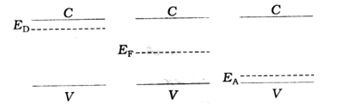
The band diagrams for three different semiconductors are shown in the figure below. Starting from the left to the right,identify the types of semiconductors they represent.
A
$n$-type semiconductor,intrinsic semiconductor,$p$-type semiconductor
B
$p$-type semiconductor,intrinsic semiconductor,$n$-type semiconductor
C
intrinsic semiconductor,$p$-type semiconductor,$n$-type semiconductor
D
$p$-type semiconductor,$n$-type semiconductor,intrinsic semiconductor
Solution
(A) In the first diagram (left),the donor energy level $E_D$ is located just below the conduction band $C$. This is characteristic of an $n$-type semiconductor.
In the second diagram (middle),the Fermi level $E_F$ is located exactly in the middle of the forbidden energy gap between the valence band $V$ and the conduction band $C$. This is characteristic of an intrinsic semiconductor.
In the third diagram (right),the acceptor energy level $E_A$ is located just above the valence band $V$. This is characteristic of a $p$-type semiconductor.
Therefore,the sequence from left to right is: $n$-type semiconductor,intrinsic semiconductor,$p$-type semiconductor.
In the second diagram (middle),the Fermi level $E_F$ is located exactly in the middle of the forbidden energy gap between the valence band $V$ and the conduction band $C$. This is characteristic of an intrinsic semiconductor.
In the third diagram (right),the acceptor energy level $E_A$ is located just above the valence band $V$. This is characteristic of a $p$-type semiconductor.
Therefore,the sequence from left to right is: $n$-type semiconductor,intrinsic semiconductor,$p$-type semiconductor.
0 likes
View Solution73
MediumMCQ
Carbon,Silicon,and Germanium have $4$ valence electrons each. Which of the following statements is true at room temperature?
A
$Si$ and $Ge$ have a significant number of free electrons for conduction,while $C$ has very few.
B
$C$ has a significant number of free electrons,while $Si$ and $Ge$ have very few.
C
All three substances have a very small number of free electrons.
D
All three substances have a sufficient number of free electrons for conduction.
Solution
(A) In $Si$ and $Ge$ at room temperature $(300 \ K)$,the energy band gap is relatively small. As a result,electrons in the covalent bonds gain enough thermal energy to break the bonds and move to the conduction band,creating a hole in the valence band.
Therefore,the number of free electrons available for conduction is significant in $Si$ and $Ge$.
In the case of carbon (diamond),the energy band gap is very high $(5.4 \ eV)$. Consequently,even at room temperature,there are not a significant number of electrons in the conduction band,making it an insulator.
Therefore,the number of free electrons available for conduction is significant in $Si$ and $Ge$.
In the case of carbon (diamond),the energy band gap is very high $(5.4 \ eV)$. Consequently,even at room temperature,there are not a significant number of electrons in the conduction band,making it an insulator.
0 likes
View Solution74
EasyMCQ
The energy gap in semiconductors is of the order of ........ $eV$.
A
$1$
B
$5$
C
$10$
D
$15$
Solution
(A) In semiconductors,the valence band and conduction band are separated by a small energy gap,known as the forbidden energy gap $(E_g)$.
For semiconductors like Silicon $(Si)$ and Germanium $(Ge)$,this energy gap is typically around $1 \ eV$.
Specifically,for $Si$,$E_g \approx 1.1 \ eV$ and for $Ge$,$E_g \approx 0.7 \ eV$.
Therefore,the order of the energy gap in semiconductors is $1 \ eV$.
For semiconductors like Silicon $(Si)$ and Germanium $(Ge)$,this energy gap is typically around $1 \ eV$.
Specifically,for $Si$,$E_g \approx 1.1 \ eV$ and for $Ge$,$E_g \approx 0.7 \ eV$.
Therefore,the order of the energy gap in semiconductors is $1 \ eV$.
0 likes
View Solution75
EasyMCQ
Statement-$1$: The temperature coefficient of resistance of an intrinsic semiconductor is negative.
Statement-$2$: As temperature increases,more charge carriers are released into the conduction band.
Statement-$2$: As temperature increases,more charge carriers are released into the conduction band.
A
Statement-$1$ is true,Statement-$2$ is true. Statement-$2$ is not the correct explanation of Statement-$1$.
B
Statement-$1$ is false,Statement-$2$ is true.
C
Statement-$1$ is true,Statement-$2$ is false.
D
Statement-$1$ is true,Statement-$2$ is true and Statement-$2$ is the correct explanation of Statement-$1$.
Solution
(D) In an intrinsic semiconductor,the energy gap between the valence band and the conduction band is small.
At $T = 0 \ K$,the valence band is completely filled and the conduction band is empty,making it an insulator.
As the temperature increases,thermal energy allows electrons to jump from the valence band to the conduction band.
This increases the number of charge carriers (electrons and holes),which leads to a decrease in electrical resistance.
Since resistance decreases with an increase in temperature,the temperature coefficient of resistance is negative.
Therefore,Statement-$1$ is true,Statement-$2$ is true,and Statement-$2$ is the correct explanation for Statement-$1$.
At $T = 0 \ K$,the valence band is completely filled and the conduction band is empty,making it an insulator.
As the temperature increases,thermal energy allows electrons to jump from the valence band to the conduction band.
This increases the number of charge carriers (electrons and holes),which leads to a decrease in electrical resistance.
Since resistance decreases with an increase in temperature,the temperature coefficient of resistance is negative.
Therefore,Statement-$1$ is true,Statement-$2$ is true,and Statement-$2$ is the correct explanation for Statement-$1$.
1 likes
View Solution76
EasyMCQ
At $0 \ K$ temperature,the valence band in semiconductors is .....
A
Completely filled
B
Completely empty
C
Partially filled
D
Cannot be determined
Solution
(A) In semiconductors,at $0 \ K$ temperature,there is no thermal energy available for electrons to jump from the valence band to the conduction band.
Since the valence band is the highest energy band that is occupied by electrons at absolute zero,it remains completely filled with electrons.
The conduction band,on the other hand,remains completely empty at $0 \ K$ because no electrons have gained enough energy to cross the forbidden energy gap.
Since the valence band is the highest energy band that is occupied by electrons at absolute zero,it remains completely filled with electrons.
The conduction band,on the other hand,remains completely empty at $0 \ K$ because no electrons have gained enough energy to cross the forbidden energy gap.
0 likes
View Solution77
MediumMCQ
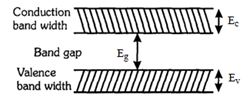
If the lattice constant of this semiconductor decreases,which of the following is true?
A
All $E_c$,$E_g$,$E_v$ will increase
B
$E_c$ and $E_v$ will increase,$E_g$ will decrease
C
$E_c$ and $E_v$ will decrease,$E_g$ will increase
D
All $E_c$,$E_g$,$E_v$ will decrease
Solution
(B) In a semiconductor,the lattice constant is the distance between atoms. When the lattice constant decreases,the atoms come closer together,which increases the overlap of atomic orbitals.
This increased overlap leads to a broadening of the energy bands,meaning the bandwidths $E_c$ (conduction band width) and $E_v$ (valence band width) increase.
However,the increase in overlap also causes the energy levels to shift such that the forbidden energy gap $E_g$ between the valence band and the conduction band decreases.
Therefore,$E_c$ and $E_v$ increase,while $E_g$ decreases.
This increased overlap leads to a broadening of the energy bands,meaning the bandwidths $E_c$ (conduction band width) and $E_v$ (valence band width) increase.
However,the increase in overlap also causes the energy levels to shift such that the forbidden energy gap $E_g$ between the valence band and the conduction band decreases.
Therefore,$E_c$ and $E_v$ increase,while $E_g$ decreases.
0 likes
View Solution78
DifficultMCQ
When radiation with a wavelength shorter than $2480 \, nm$ is incident on a semiconductor,its conductivity increases. The bandgap of this semiconductor is ....... $eV$.
A
$0.5$
B
$0.7$
C
$1.1$
D
$2.5$
Solution
(A) The bandgap energy $E_g$ corresponds to the energy of the incident photon with the maximum wavelength $\lambda = 2480 \, nm$ that can excite an electron across the bandgap.
Using the formula $E = \frac{hc}{\lambda}$,where $h = 6.63 \times 10^{-34} \, J \cdot s$,$c = 3 \times 10^8 \, m/s$,and $1 \, eV = 1.6 \times 10^{-19} \, J$:
$E = \frac{6.63 \times 10^{-34} \times 3 \times 10^8}{2480 \times 10^{-9} \times 1.6 \times 10^{-19}} \, eV$
$E = \frac{19.89 \times 10^{-26}}{3968 \times 10^{-28}} \, eV$
$E = \frac{1989}{3968} \approx 0.5 \, eV$.
Thus,the bandgap of the semiconductor is $0.5 \, eV$.
Using the formula $E = \frac{hc}{\lambda}$,where $h = 6.63 \times 10^{-34} \, J \cdot s$,$c = 3 \times 10^8 \, m/s$,and $1 \, eV = 1.6 \times 10^{-19} \, J$:
$E = \frac{6.63 \times 10^{-34} \times 3 \times 10^8}{2480 \times 10^{-9} \times 1.6 \times 10^{-19}} \, eV$
$E = \frac{19.89 \times 10^{-26}}{3968 \times 10^{-28}} \, eV$
$E = \frac{1989}{3968} \approx 0.5 \, eV$.
Thus,the bandgap of the semiconductor is $0.5 \, eV$.
0 likes
View Solution79
MediumMCQ
The energy of a photon of sodium light $(\lambda = 589 nm)$ is equal to the band gap of a semiconductor material. Find the value of $E/kT$ at $300 K$.
A
$58$
B
$124$
C
$81$
D
$42$
Solution
(C) The energy of a photon is given by $E = \frac{hc}{\lambda}$.
Using $hc = 12400 eV \cdot \mathring{A}$ and $\lambda = 589 nm = 5890 \mathring{A}$, we get:
$E = \frac{12400}{5890} \approx 2.105 eV$.
To find the ratio $E/kT$, we convert energy to Joules: $E = 2.105 \times 1.6 \times 10^{-19} J$.
The thermal energy $kT$ at $T = 300 K$ is $k = 1.38 \times 10^{-23} J/K$.
$kT = 1.38 \times 10^{-23} \times 300 = 4.14 \times 10^{-21} J$.
Now, $\frac{E}{kT} = \frac{2.105 \times 1.6 \times 10^{-19}}{4.14 \times 10^{-21}} = \frac{3.368 \times 10^{-19}}{4.14 \times 10^{-21}} \approx 81.35$.
Rounding to the nearest integer, we get $81$.
Using $hc = 12400 eV \cdot \mathring{A}$ and $\lambda = 589 nm = 5890 \mathring{A}$, we get:
$E = \frac{12400}{5890} \approx 2.105 eV$.
To find the ratio $E/kT$, we convert energy to Joules: $E = 2.105 \times 1.6 \times 10^{-19} J$.
The thermal energy $kT$ at $T = 300 K$ is $k = 1.38 \times 10^{-23} J/K$.
$kT = 1.38 \times 10^{-23} \times 300 = 4.14 \times 10^{-21} J$.
Now, $\frac{E}{kT} = \frac{2.105 \times 1.6 \times 10^{-19}}{4.14 \times 10^{-21}} = \frac{3.368 \times 10^{-19}}{4.14 \times 10^{-21}} \approx 81.35$.
Rounding to the nearest integer, we get $81$.
0 likes
View Solution80
EasyMCQ
What is the band gap energy for an insulator in $eV$?
A
$6$
B
$1.1$
C
$0.8$
D
$0.3$
Solution
(A) In solid-state physics,materials are classified based on their energy band gaps.
For conductors,the valence and conduction bands overlap.
For semiconductors,the band gap is relatively small (typically around $1 \ eV$ to $1.5 \ eV$).
For insulators,the energy band gap is very large,typically greater than $3 \ eV$ to $6 \ eV$.
Among the given options,$6 \ eV$ is the value that represents a typical band gap for an insulator.
For conductors,the valence and conduction bands overlap.
For semiconductors,the band gap is relatively small (typically around $1 \ eV$ to $1.5 \ eV$).
For insulators,the energy band gap is very large,typically greater than $3 \ eV$ to $6 \ eV$.
Among the given options,$6 \ eV$ is the value that represents a typical band gap for an insulator.
0 likes
View Solution81
EasyMCQ
What is the band gap energy for Germanium $(Ge)$?
A
$1.12 \times 10^{-19} \ J$
B
$1.76 \times 10^{-19} \ J$
C
$1.6 \times 10^{-19} \ J$
D
$0 \ J$
Solution
(A) The band gap energy $(E_g)$ for Germanium $(Ge)$ is approximately $0.7 \ eV$.
To convert this energy into Joules $(J)$,we use the conversion factor $1 \ eV = 1.6 \times 10^{-19} \ J$.
Therefore,$E_g = 0.7 \ eV = 0.7 \times 1.6 \times 10^{-19} \ J = 1.12 \times 10^{-19} \ J$.
Thus,the correct option is $A$.
To convert this energy into Joules $(J)$,we use the conversion factor $1 \ eV = 1.6 \times 10^{-19} \ J$.
Therefore,$E_g = 0.7 \ eV = 0.7 \times 1.6 \times 10^{-19} \ J = 1.12 \times 10^{-19} \ J$.
Thus,the correct option is $A$.
0 likes
View Solution82
EasyMCQ
What is the relationship between the number density of free electrons $(n)$ and temperature $(T)$ in a semiconductor?
A
$n \propto T^2$
B
$n \propto T$
C
$n \propto \sqrt{T}$
D
$n \propto T^{3/2}$
Solution
(D) In a semiconductor,the intrinsic carrier concentration $n_i$ is given by the relation:
$n_i = A T^{3/2} \exp\left(-\frac{E_g}{2kT}\right)$
where $A$ is a constant,$E_g$ is the band gap energy,and $k$ is the Boltzmann constant.
For a given semiconductor,the temperature dependence is dominated by the $T^{3/2}$ factor in the pre-exponential term.
Therefore,the number density of free electrons $n$ is proportional to $T^{3/2}$.
$n_i = A T^{3/2} \exp\left(-\frac{E_g}{2kT}\right)$
where $A$ is a constant,$E_g$ is the band gap energy,and $k$ is the Boltzmann constant.
For a given semiconductor,the temperature dependence is dominated by the $T^{3/2}$ factor in the pre-exponential term.
Therefore,the number density of free electrons $n$ is proportional to $T^{3/2}$.
0 likes
View Solution83
EasyMCQ
$C$ and $Si$ both have the same lattice structure,having $4$ bonding electrons in each. However,$C$ is an insulator whereas $Si$ is an intrinsic semiconductor. This is because:
A
In the case of $C$,the valence band is not completely filled at absolute zero temperature.
B
In the case of $C$,the conduction band is partly filled even at absolute zero temperature.
C
The four bonding electrons in the case of $C$ lie in the second orbit,whereas in the case of $Si$ they lie in the third.
D
The four bonding electrons in the case of $C$ lie in the third orbit,whereas for $Si$ they lie in the fourth orbit.
Solution
(C) The electronic configuration of carbon $(^{6}C)$ is $1s^{2} 2s^{2} 2p^{2}$.
The electronic configuration of silicon $(_{14}Si)$ is $1s^{2} 2s^{2} 2p^{6} 3s^{2} 3p^{2}$.
In $C$,the valence electrons are in the $n=2$ shell,which is closer to the nucleus,resulting in a large energy band gap $(E_{g} \approx 5.4 \ eV)$,making it an insulator.
In $Si$,the valence electrons are in the $n=3$ shell,which is further from the nucleus,resulting in a smaller energy band gap $(E_{g} \approx 1.1 \ eV)$,allowing it to act as an intrinsic semiconductor.
Therefore,the four bonding electrons of $C$ and $Si$ lie in the second and third orbits,respectively.
The electronic configuration of silicon $(_{14}Si)$ is $1s^{2} 2s^{2} 2p^{6} 3s^{2} 3p^{2}$.
In $C$,the valence electrons are in the $n=2$ shell,which is closer to the nucleus,resulting in a large energy band gap $(E_{g} \approx 5.4 \ eV)$,making it an insulator.
In $Si$,the valence electrons are in the $n=3$ shell,which is further from the nucleus,resulting in a smaller energy band gap $(E_{g} \approx 1.1 \ eV)$,allowing it to act as an intrinsic semiconductor.
Therefore,the four bonding electrons of $C$ and $Si$ lie in the second and third orbits,respectively.
0 likes
View Solution84
EasyMCQ
Pure sodium $(Na)$ is a good conductor of electricity because the $3s$ and $3p$ atomic bands overlap to form a partially filled conduction band. By contrast,the ionic sodium chloride $(NaCl)$ crystal is:
A
Insulator
B
Conductor
C
Semiconductor
D
None of these
Solution
(A) In sodium chloride $(NaCl)$,the $Na^+$ and $Cl^-$ ions both have a stable noble gas electron configuration,which corresponds to completely filled energy bands.
Since these filled bands do not overlap with the empty conduction bands,there exists a large energy gap (forbidden energy gap) between the valence band and the conduction band.
Due to this large energy gap,electrons cannot easily jump to the conduction band,making $NaCl$ an insulator.
Since these filled bands do not overlap with the empty conduction bands,there exists a large energy gap (forbidden energy gap) between the valence band and the conduction band.
Due to this large energy gap,electrons cannot easily jump to the conduction band,making $NaCl$ an insulator.
0 likes
View Solution85
EasyMCQ
Would there be any advantage to adding $n$-type or $p$-type impurities to copper?
A
Yes
B
No
C
May be
D
Information is insufficient
Solution
(B) The correct answer is $B$. Pure $Cu$ is already an excellent conductor because it has a partially filled conduction band.
Furthermore,$Cu$ forms a metallic crystal lattice,unlike the covalent crystal structures of semiconductors like silicon or germanium.
Therefore,the doping scheme used to donate or accept electrons in semiconductors does not work for copper.
In fact,adding impurities to copper decreases its electrical conductivity because impurity atoms act as scattering centers for electrons,which impedes the flow of current.
Furthermore,$Cu$ forms a metallic crystal lattice,unlike the covalent crystal structures of semiconductors like silicon or germanium.
Therefore,the doping scheme used to donate or accept electrons in semiconductors does not work for copper.
In fact,adding impurities to copper decreases its electrical conductivity because impurity atoms act as scattering centers for electrons,which impedes the flow of current.
0 likes
View Solution86
EasyMCQ
Is the ionisation energy of an isolated free atom different from the ionisation energy for the atoms in a crystalline lattice?
A
Yes
B
No
C
May be
D
None of these
Solution
(A) The ionisation energy of an isolated free atom is different from its value in a crystalline lattice.
In a crystalline lattice,each atom is surrounded by other atoms.
The potential energy of an electron in a crystal is influenced by the electric fields of all the neighboring atoms in the periodic lattice.
This interaction modifies the energy levels of the electrons,causing the ionisation energy to differ from that of an isolated atom.
In a crystalline lattice,each atom is surrounded by other atoms.
The potential energy of an electron in a crystal is influenced by the electric fields of all the neighboring atoms in the periodic lattice.
This interaction modifies the energy levels of the electrons,causing the ionisation energy to differ from that of an isolated atom.
0 likes
View Solution87
EasyMCQ
The energy gap of silicon is $1.1 \, eV$. At what wavelength will silicon stop absorbing photons? (in $\mathring A$)
A
$11272$
B
$8250$
C
$6875$
D
$5000$
Solution
(A) The energy gap of silicon is given as $E_g = 1.1 \, eV$.
To find the maximum wavelength $\lambda$ that can be absorbed,we use the relation $E_g = \frac{hc}{\lambda}$.
Substituting the values: $h = 6.63 \times 10^{-34} \, J \cdot s$,$c = 3 \times 10^8 \, m/s$,and $1 \, eV = 1.6 \times 10^{-19} \, J$.
$\lambda = \frac{hc}{E_g} = \frac{6.63 \times 10^{-34} \times 3 \times 10^8}{1.1 \times 1.6 \times 10^{-19}} \, m$.
$\lambda \approx 1.13 \times 10^{-6} \, m = 11272 \, \mathring A$.
Photons with wavelengths longer than this will not have enough energy to excite electrons across the band gap.
To find the maximum wavelength $\lambda$ that can be absorbed,we use the relation $E_g = \frac{hc}{\lambda}$.
Substituting the values: $h = 6.63 \times 10^{-34} \, J \cdot s$,$c = 3 \times 10^8 \, m/s$,and $1 \, eV = 1.6 \times 10^{-19} \, J$.
$\lambda = \frac{hc}{E_g} = \frac{6.63 \times 10^{-34} \times 3 \times 10^8}{1.1 \times 1.6 \times 10^{-19}} \, m$.
$\lambda \approx 1.13 \times 10^{-6} \, m = 11272 \, \mathring A$.
Photons with wavelengths longer than this will not have enough energy to excite electrons across the band gap.
0 likes
View Solution88
MediumMCQ
Read the following statements carefully:
$Y:$ The resistivity of a semiconductor decreases with an increase in temperature.
$Z:$ In a conducting solid,the rate of collision between free electrons and ions increases with an increase in temperature.
Select the correct statement from the following:
$Y:$ The resistivity of a semiconductor decreases with an increase in temperature.
$Z:$ In a conducting solid,the rate of collision between free electrons and ions increases with an increase in temperature.
Select the correct statement from the following:
A
$Y$ is true but $Z$ is false.
B
$Y$ is false but $Z$ is true.
C
Both $Y$ and $Z$ are true.
D
$Y$ is true and $Z$ is the correct reason for $Y$.
Solution
(C) Statement $Y$ is true: In semiconductors,as temperature increases,more charge carriers (electrons and holes) are thermally excited across the band gap,which increases conductivity and thus decreases resistivity.
Statement $Z$ is true: In a conducting solid (metal),as temperature increases,the lattice vibrations (phonons) increase,leading to a higher frequency of collisions between free electrons and ions,which increases the resistance.
Therefore,both statements $Y$ and $Z$ are true.
Statement $Z$ is true: In a conducting solid (metal),as temperature increases,the lattice vibrations (phonons) increase,leading to a higher frequency of collisions between free electrons and ions,which increases the resistance.
Therefore,both statements $Y$ and $Z$ are true.
0 likes
View Solution89
EasyMCQ
$A$ solid which is not transparent to visible light and whose conductivity increases with temperature is formed by
A
Metallic bonding
B
Ionic bonding
C
Covalent bonding
D
Van der Waals bonding
Solution
(C) The property of increasing conductivity with an increase in temperature is a characteristic feature of semiconductors.
Semiconductors are typically formed by covalent bonding (e.g.,Silicon,Germanium).
Metals (metallic bonding) show a decrease in conductivity with an increase in temperature.
Ionic solids are generally transparent to visible light and are insulators.
Therefore,the solid described is formed by covalent bonding.
Semiconductors are typically formed by covalent bonding (e.g.,Silicon,Germanium).
Metals (metallic bonding) show a decrease in conductivity with an increase in temperature.
Ionic solids are generally transparent to visible light and are insulators.
Therefore,the solid described is formed by covalent bonding.
0 likes
View Solution90
EasyMCQ
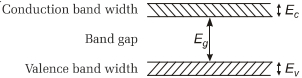
If the lattice constant of this semiconductor is decreased,then which of the following is correct?
A
All $E_c, E_g, E_v$ decrease
B
All $E_c, E_g$ and $E_v$ increase
C
$E_c$ and $E_v$ increase,but $E_g$ decreases
D
$E_c$ and $E_v$ decrease,but $E_g$ increases
Solution
(C) In a semiconductor crystal,the lattice constant represents the spacing between atoms.
When the lattice constant decreases,the atoms are brought closer together,which increases the overlap of atomic orbitals.
This increased overlap leads to a broadening of the energy bands,meaning the widths of the conduction band $(E_c)$ and the valence band $(E_v)$ increase.
Simultaneously,the increased interaction between atoms results in a decrease in the band gap $(E_g)$.
Therefore,$E_c$ and $E_v$ increase,while $E_g$ decreases.
When the lattice constant decreases,the atoms are brought closer together,which increases the overlap of atomic orbitals.
This increased overlap leads to a broadening of the energy bands,meaning the widths of the conduction band $(E_c)$ and the valence band $(E_v)$ increase.
Simultaneously,the increased interaction between atoms results in a decrease in the band gap $(E_g)$.
Therefore,$E_c$ and $E_v$ increase,while $E_g$ decreases.
0 likes
View Solution91
EasyMCQ
Carbon,silicon and germanium have four valence electrons each. At room temperature,which one of the following statements is most appropriate?
A
The number of free electrons for conduction is significant only in $Si$ and $Ge$ but small in $C$.
B
The number of free conduction electrons is significant in $C$ but small in $Si$ and $Ge$.
C
The number of free conduction electrons is negligibly small in all the three.
D
The number of free electrons for conduction is significant in all the three.
Solution
(A) Carbon $(C)$,Silicon $(Si)$,and Germanium $(Ge)$ all belong to group $14$ of the periodic table and have $4$ valence electrons.
At room temperature,the energy band gap $(E_g)$ for Carbon (diamond) is approximately $5.4 \ eV$,which is very large,making it an insulator.
The energy band gap for Silicon is approximately $1.1 \ eV$ and for Germanium is approximately $0.7 \ eV$.
Because these band gaps are relatively small,thermal energy at room temperature is sufficient to excite a significant number of electrons from the valence band to the conduction band in $Si$ and $Ge$.
Therefore,$Si$ and $Ge$ act as semiconductors,while $C$ acts as an insulator due to its large band gap.
At room temperature,the energy band gap $(E_g)$ for Carbon (diamond) is approximately $5.4 \ eV$,which is very large,making it an insulator.
The energy band gap for Silicon is approximately $1.1 \ eV$ and for Germanium is approximately $0.7 \ eV$.
Because these band gaps are relatively small,thermal energy at room temperature is sufficient to excite a significant number of electrons from the valence band to the conduction band in $Si$ and $Ge$.
Therefore,$Si$ and $Ge$ act as semiconductors,while $C$ acts as an insulator due to its large band gap.
0 likes
View Solution92
EasyMCQ
The temperature dependence of resistances of $Cu$ and undoped $Si$ in the temperature range $300-400 \ K$ is best described by:
A
Linear increase for $Cu$,exponential decrease for $Si$
B
Linear decrease for $Cu$,linear decrease for $Si$
C
Linear increase for $Cu$,linear increase for $Si$
D
Linear increase for $Cu$,exponential increase for $Si$
Solution
(A) $Cu$ (Copper) is a metal/conductor. For metals,the resistance increases linearly with temperature according to the relation $R_T = R_0(1 + \alpha \Delta T)$.
$Si$ (Silicon) is an intrinsic semiconductor. For semiconductors,the number of charge carriers increases exponentially with temperature,leading to an exponential decrease in resistance,described by $R = R_0 e^{E_g / 2kT}$.
$Si$ (Silicon) is an intrinsic semiconductor. For semiconductors,the number of charge carriers increases exponentially with temperature,leading to an exponential decrease in resistance,described by $R = R_0 e^{E_g / 2kT}$.
0 likes
View Solution93
EasyMCQ
The Fermi energy level of an intrinsic semiconductor lies:
A
In the middle of the forbidden gap
B
Below the middle of the forbidden gap
C
Above the middle of the forbidden gap
D
Outside the forbidden gap
Solution
(A) The Fermi energy level $(E_F)$ is defined as the energy state where the probability of occupancy by an electron is exactly $50 \%$ or $0.5$ at any temperature.
For an intrinsic semiconductor,the number of electrons in the conduction band $(n_e)$ is equal to the number of holes in the valence band $(n_h)$,i.e.,$n_e = n_h = n_i$.
Since the effective mass of electrons and holes is approximately equal,the Fermi level lies exactly in the middle of the forbidden energy gap.
Mathematically,$E_F = \frac{E_c + E_v}{2}$,where $E_c$ is the conduction band energy and $E_v$ is the valence band energy.
For an intrinsic semiconductor,the number of electrons in the conduction band $(n_e)$ is equal to the number of holes in the valence band $(n_h)$,i.e.,$n_e = n_h = n_i$.
Since the effective mass of electrons and holes is approximately equal,the Fermi level lies exactly in the middle of the forbidden energy gap.
Mathematically,$E_F = \frac{E_c + E_v}{2}$,where $E_c$ is the conduction band energy and $E_v$ is the valence band energy.
0 likes
View Solution94
MediumMCQ
Although carbon,silicon,and germanium have the same lattice structure and four valence electrons each,their band structure leads to the energy gaps as:
A
$E_g (Si) < E_g(Ge) < E_g(C)$
B
$E_g (Si) > E_g(Ge) < E_g(C)$
C
$E_g (Si) < E_g(Ge) > E_g(C)$
D
$E_g (Si) > E_g(Ge) > E_g(C)$
Solution
(D) Carbon,silicon,and germanium belong to group $14$ of the periodic table and have the same diamond-like crystal structure.
However,the energy gap $(E_g)$ depends on the atomic size and the strength of the interatomic bonds.
As we move down the group,the atomic size increases,which leads to a decrease in the strength of the covalent bonds.
Consequently,the energy gap decreases as we go from carbon to silicon to germanium.
The energy gap values are approximately:
$E_g(C) \approx 5.4 \ eV$
$E_g(Si) \approx 1.1 \ eV$
$E_g(Ge) \approx 0.7 \ eV$
Therefore,the correct relationship is $E_g(C) > E_g(Si) > E_g(Ge)$,which can be rewritten as $E_g(Si) > E_g(Ge)$ and $E_g(C) > E_g(Si)$,leading to the order $E_g(Si) > E_g(Ge)$ and $E_g(C)$ being the largest. Looking at the options,the correct order is $E_g(Si) > E_g(Ge)$ and $E_g(C)$ is greater than both,which matches option $D$ if interpreted as $E_g(C) > E_g(Si) > E_g(Ge)$.
However,the energy gap $(E_g)$ depends on the atomic size and the strength of the interatomic bonds.
As we move down the group,the atomic size increases,which leads to a decrease in the strength of the covalent bonds.
Consequently,the energy gap decreases as we go from carbon to silicon to germanium.
The energy gap values are approximately:
$E_g(C) \approx 5.4 \ eV$
$E_g(Si) \approx 1.1 \ eV$
$E_g(Ge) \approx 0.7 \ eV$
Therefore,the correct relationship is $E_g(C) > E_g(Si) > E_g(Ge)$,which can be rewritten as $E_g(Si) > E_g(Ge)$ and $E_g(C) > E_g(Si)$,leading to the order $E_g(Si) > E_g(Ge)$ and $E_g(C)$ being the largest. Looking at the options,the correct order is $E_g(Si) > E_g(Ge)$ and $E_g(C)$ is greater than both,which matches option $D$ if interpreted as $E_g(C) > E_g(Si) > E_g(Ge)$.
0 likes
View Solution95
MediumMCQ
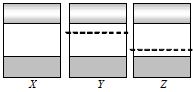
The energy band diagrams for three semiconductor samples of silicon are as shown. We can then assert that :-
A
Sample $X$ is undoped while samples $Y$ and $Z$ have been doped with a third group and a fifth group impurity respectively.
B
Sample $X$ is undoped while both samples $Y$ and $Z$ have been doped with a fifth group impurity.
C
Sample $X$ has been doped with equal amounts of third and fifth group impurities while samples $Y$ and $Z$ are undoped.
D
Sample $X$ is undoped while samples $Y$ and $Z$ have been doped with a fifth group and a third group impurity respectively.
Solution
(D) In sample $X$,there is no impurity energy level within the forbidden energy gap,so it is an intrinsic (undoped) semiconductor.
In sample $Y$,the impurity energy level lies just below the conduction band. This is characteristic of an $n$-type semiconductor,which is formed by doping with a fifth group (pentavalent) impurity.
In sample $Z$,the impurity energy level lies just above the valence band. This is characteristic of a $p$-type semiconductor,which is formed by doping with a third group (trivalent) impurity.
Therefore,sample $X$ is undoped,sample $Y$ is doped with a fifth group impurity,and sample $Z$ is doped with a third group impurity.
In sample $Y$,the impurity energy level lies just below the conduction band. This is characteristic of an $n$-type semiconductor,which is formed by doping with a fifth group (pentavalent) impurity.
In sample $Z$,the impurity energy level lies just above the valence band. This is characteristic of a $p$-type semiconductor,which is formed by doping with a third group (trivalent) impurity.
Therefore,sample $X$ is undoped,sample $Y$ is doped with a fifth group impurity,and sample $Z$ is doped with a third group impurity.
0 likes
View Solution96
EasyMCQ
On heating a semiconductor:
A
mobility decreases,resistivity decreases
B
mobility decreases,resistivity increases
C
mobility increases,resistivity increases
D
mobility increases,resistivity decreases
Solution
(A) When the temperature of a semiconductor increases,the thermal energy causes more covalent bonds to break,leading to an increase in the number of free charge carriers (electrons and holes).
This increase in charge carriers significantly increases the conductivity,which corresponds to a decrease in resistivity.
However,the increased thermal vibrations of the lattice atoms lead to more frequent collisions,which causes the mobility of the charge carriers to decrease.
This increase in charge carriers significantly increases the conductivity,which corresponds to a decrease in resistivity.
However,the increased thermal vibrations of the lattice atoms lead to more frequent collisions,which causes the mobility of the charge carriers to decrease.
0 likes
View Solution97
EasyMCQ
$A$ piece of copper and another of germanium are cooled from room temperature to $80\, K$. The resistance of :-
A
each of them increases
B
each of them decreases
C
copper increases and germanium decreases
D
copper decreases and germanium increases
Solution
(D) Copper is a metal and germanium is a semiconductor.
For metals,the resistance decreases as the temperature decreases because the collision frequency of electrons with the lattice ions decreases.
For semiconductors,the resistance increases as the temperature decreases because the number of charge carriers (electrons and holes) decreases exponentially with a decrease in temperature.
Therefore,when cooled from room temperature to $80\, K$,the resistance of copper decreases and the resistance of germanium increases.
For metals,the resistance decreases as the temperature decreases because the collision frequency of electrons with the lattice ions decreases.
For semiconductors,the resistance increases as the temperature decreases because the number of charge carriers (electrons and holes) decreases exponentially with a decrease in temperature.
Therefore,when cooled from room temperature to $80\, K$,the resistance of copper decreases and the resistance of germanium increases.
0 likes
View Solution98
MediumMCQ
Carbon, silicon, and germanium atoms have four valence electrons each. Their valence and conduction bands are separated by energy band gaps represented by $(E_g)_C$, $(E_g)_{Si}$, and $(E_g)_{Ge}$ respectively. Which one of the following relationships is true in their case?
A
$(E_g)_C > (E_g)_{Si} > (E_g)_{Ge}$
B
$(E_g)_C = (E_g)_{Si} = (E_g)_{Ge}$
C
$(E_g)_C < (E_g)_{Si} < (E_g)_{Ge}$
D
$(E_g)_C > (E_g)_{Si} < (E_g)_{Ge}$
Solution
(A) The energy band gap $(E_g)$ is the energy difference between the conduction band and the valence band.
For Carbon (diamond), the energy gap is approximately $5.4 \text{ eV}$.
For Silicon, the energy gap is approximately $1.1 \text{ eV}$.
For Germanium, the energy gap is approximately $0.7 \text{ eV}$.
Comparing these values, we find that $(E_g)_C > (E_g)_{Si} > (E_g)_{Ge}$.
Therefore, the correct relationship is $(E_g)_C > (E_g)_{Si} > (E_g)_{Ge}$.
For Carbon (diamond), the energy gap is approximately $5.4 \text{ eV}$.
For Silicon, the energy gap is approximately $1.1 \text{ eV}$.
For Germanium, the energy gap is approximately $0.7 \text{ eV}$.
Comparing these values, we find that $(E_g)_C > (E_g)_{Si} > (E_g)_{Ge}$.
Therefore, the correct relationship is $(E_g)_C > (E_g)_{Si} > (E_g)_{Ge}$.
0 likes
View Solution99
MediumMCQ
When a semiconductor is heated,its resistance
A
Decreases
B
Increases
C
Remains the same
D
May increase or decrease depending upon semiconductor
Solution
(A) In a semiconductor,the number of charge carriers (electrons and holes) increases exponentially with an increase in temperature due to the thermal excitation of electrons from the valence band to the conduction band.
Although the mobility of charge carriers decreases slightly due to increased scattering,the effect of the rapid increase in the number of charge carriers dominates.
As a result,the conductivity of the semiconductor increases,which implies that its resistance decreases with an increase in temperature.
Although the mobility of charge carriers decreases slightly due to increased scattering,the effect of the rapid increase in the number of charge carriers dominates.
As a result,the conductivity of the semiconductor increases,which implies that its resistance decreases with an increase in temperature.
0 likes
View SolutionSemiconductor Electronics — Classification of Materials and Energy Band Theory · Frequently Asked Questions
1Are these Semiconductor Electronics questions useful for JEE and NEET?
Yes. All questions in this section are mapped to JEE Main and NEET exam patterns. Previous year questions from JEE Main, NEET, GUJCET and state-level exams are included with full solutions.
2Can I switch to Hindi or Gujarati for these questions?
Yes. Use the language tabs in the hero section or the sidebar to view the same questions and solutions in English, Hindi or Gujarati.
3How do I generate a question paper from this subtopic?
Use the Vedclass Exam Paper Generator — select the chapter and subtopic, set difficulty, and generate Sets A, B, C, D automatically. First 3 chapters of every subject are free.
Vedclass Products
For Students
Vedclass Test Series
Mock tests in real JEE/NEET style with performance analysis. 5-day free trial.
Start Free TrialFor Teachers
Exam Paper Generator
Generate Set A/B/C/D papers from this chapter in 2 minutes. 3 chapters free.
Try FreeFor Institutes
Online Exam Module
Live online exams with unlimited students, 360° analytics & white-label branding.
See DemoFor Teachers & Institutes
Generate a Semiconductor Electronics Exam Paper in 2 Minutes
Select subtopic & difficulty — Sets A, B, C, D auto-generated with No Repeat logic.
First 3 chapters of every subject are free — no payment required.