
A English
Classification of Materials and Energy Band Theory Questions in English
Class 12 Physics · Semiconductor Electronics · Classification of Materials and Energy Band Theory
190+
Questions
English
Language
100%
With Solutions
Showing 40 of 190 questions in English
151
MediumMCQ
Choose the correct statement. In semiconductors,the valence band and conduction band
A
are separated by a large energy gap
B
are separated by a small energy gap
C
are almost empty
D
overlap each other
Solution
(B) In semiconductors,the valence band and conduction band are separated by a small energy gap,typically on the order of $1 \ eV$. This allows electrons to be thermally excited from the valence band to the conduction band at room temperature,which is why semiconductors exhibit intermediate electrical conductivity compared to conductors and insulators.
0 likes
View Solution152
EasyMCQ
Choose the correct statement. In conductors,
A
valence band and conduction band overlap each other.
B
valence band and conduction band are separated by a large energy gap.
C
valence band and conduction band are separated by a small energy gap.
D
a very small number of electrons are available for electrical conduction.
Solution
(A) In conductors,the valence band and the conduction band overlap each other. This overlap allows electrons to move freely from the valence band to the conduction band even at low temperatures,which is why conductors exhibit high electrical conductivity.
0 likes
View Solution153
EasyMCQ
Choose the correct statement. In conductors,
A
valence band and conduction band overlap each other.
B
valence band and conduction band are separated by a large energy gap.
C
very small number of electrons are available for electrical conduction.
D
valence band and conduction band are separated by a small energy gap.
Solution
(A) In conductors,the valence band and the conduction band overlap each other. This overlap allows electrons to move freely from the valence band to the conduction band even at low temperatures,which is why conductors have high electrical conductivity.
0 likes
View Solution154
EasyMCQ
In the energy band diagram of insulators,the band gap and the conduction band are respectively:
A
very high,empty.
B
very low,partially filled.
C
very high,completely filled.
D
very low,empty.
Solution
(A) In insulators,the valence band is completely filled with electrons,and the conduction band is completely empty. The energy gap (forbidden energy gap) between the valence band and the conduction band is very large (typically $> 3 \ eV$). Therefore,electrons cannot jump from the valence band to the conduction band even at room temperature,making them poor conductors of electricity. Thus,the band gap is very high and the conduction band is empty.
0 likes
View Solution155
EasyMCQ
The energy band gap (distance between the conduction band and valence band) in a conductor is
A
$0$
B
$4 \,eV$
C
$10 \,eV$
D
$100 \,eV$
Solution
(A) In conductors, the valence band and the conduction band overlap each other, or the energy gap between them is effectively zero.
This overlap allows electrons to move freely from the valence band to the conduction band, which is why conductors exhibit high electrical conductivity.
This overlap allows electrons to move freely from the valence band to the conduction band, which is why conductors exhibit high electrical conductivity.
0 likes
View Solution156
MediumMCQ
$A$ solid reflects incident light and its electrical conductivity decreases with temperature. The binding in this solid is
A
ionic
B
covalent
C
metallic
D
molecular
Solution
(C) Metals reflect incident light due to the oscillations of free electrons under the influence of the electric field of the incident light wave.
Electrical conductivity of metals decreases with an increase in temperature because the increased random thermal motion of ions increases the scattering of free electrons,thereby increasing resistance.
Therefore,the bonding in such a solid is metallic.
Electrical conductivity of metals decreases with an increase in temperature because the increased random thermal motion of ions increases the scattering of free electrons,thereby increasing resistance.
Therefore,the bonding in such a solid is metallic.
0 likes
View Solution157
EasyMCQ
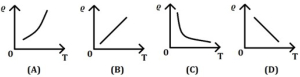
Which graph shows correctly the temperature $(T)$ dependence of resistivity $(\varrho)$ of a semiconductor?
A
$A$
B
$B$
C
$C$
D
$D$
Solution
(C) In a semiconductor,as the temperature $(T)$ increases,the number of charge carriers (electrons and holes) increases exponentially due to the breaking of covalent bonds.
This increase in the number of charge carriers dominates over the effect of increased lattice vibrations (which would otherwise increase resistivity).
Consequently,the resistivity $(\varrho)$ of a semiconductor decreases rapidly with an increase in temperature.
The relationship is given by $\varrho = \varrho_0 e^{E_g / 2k_BT}$,where $E_g$ is the band gap energy and $k_B$ is the Boltzmann constant.
Graph $(C)$ correctly represents this exponential decrease of resistivity with temperature.
This increase in the number of charge carriers dominates over the effect of increased lattice vibrations (which would otherwise increase resistivity).
Consequently,the resistivity $(\varrho)$ of a semiconductor decreases rapidly with an increase in temperature.
The relationship is given by $\varrho = \varrho_0 e^{E_g / 2k_BT}$,where $E_g$ is the band gap energy and $k_B$ is the Boltzmann constant.
Graph $(C)$ correctly represents this exponential decrease of resistivity with temperature.
0 likes
View Solution158
EasyMCQ
$A$ piece of semiconductor is connected in series in an electric circuit. On increasing the temperature,the current in the circuit will
A
decrease.
B
remain unchanged.
C
increase.
D
stop flowing.
Solution
(C) In a semiconductor,the number of charge carriers (electrons and holes) increases exponentially with an increase in temperature because more covalent bonds are broken,releasing more charge carriers.
As the number of charge carriers increases,the electrical conductivity of the semiconductor increases,which leads to a decrease in its electrical resistance.
According to Ohm's law,$I = V/R$. Since the voltage $V$ remains constant and the resistance $R$ decreases,the current $I$ in the circuit will increase.
As the number of charge carriers increases,the electrical conductivity of the semiconductor increases,which leads to a decrease in its electrical resistance.
According to Ohm's law,$I = V/R$. Since the voltage $V$ remains constant and the resistance $R$ decreases,the current $I$ in the circuit will increase.
0 likes
View Solution159
MediumMCQ
In semiconductors at room temperature,
A
the valence band is completely filled.
B
the conduction band is completely empty.
C
the conduction band is partially filled and the valence band is partially empty.
D
the valence band is completely filled and conduction band is partially empty.
Solution
(C) In semiconductors,the energy gap between the valence band and the conduction band is small.
At room temperature,thermal energy is sufficient for some electrons to jump from the valence band to the conduction band by overcoming the forbidden energy gap.
As a result,some electrons move to the conduction band,making it partially filled.
Simultaneously,this leaves behind vacancies (holes) in the valence band,making it partially empty.
Therefore,at room temperature,both the conduction band and the valence band are partially filled/empty.
At room temperature,thermal energy is sufficient for some electrons to jump from the valence band to the conduction band by overcoming the forbidden energy gap.
As a result,some electrons move to the conduction band,making it partially filled.
Simultaneously,this leaves behind vacancies (holes) in the valence band,making it partially empty.
Therefore,at room temperature,both the conduction band and the valence band are partially filled/empty.
0 likes
View Solution160
EasyMCQ
In an extrinsic $n$-type semiconductor,the free electrons donated by the impurity atoms occupy energy levels in
A
the conduction band.
B
the valence band.
C
the band gap and are close to the conduction band.
D
the band gap and are close to the valence band.
Solution
(C) In an $n$-type semiconductor,pentavalent impurity atoms (donor atoms) are added to the intrinsic semiconductor.
These donor atoms create discrete energy levels known as donor energy levels.
These donor energy levels are located within the band gap,just below the conduction band.
Because these levels are very close to the conduction band,the electrons in these levels can easily be thermally excited into the conduction band at room temperature.
Therefore,the correct option is $(C)$.
These donor atoms create discrete energy levels known as donor energy levels.
These donor energy levels are located within the band gap,just below the conduction band.
Because these levels are very close to the conduction band,the electrons in these levels can easily be thermally excited into the conduction band at room temperature.
Therefore,the correct option is $(C)$.
0 likes
View Solution161
EasyMCQ
Identify the $WRONG$ statement from the following. In an intrinsic semiconductor:
A
The number of free electrons is less than that in a conductor.
B
The number of free electrons increases with temperature.
C
There are no free electrons at any temperature except absolute zero.
D
There are no free electrons at absolute zero temperature.
Solution
(C) In an intrinsic semiconductor,the number of free electrons is very small compared to a conductor at room temperature.
As the temperature increases,more covalent bonds break,leading to an increase in the number of free electrons.
At absolute zero temperature $(T = 0 \ K)$,an intrinsic semiconductor behaves as a perfect insulator because there is insufficient thermal energy to break covalent bonds.
Therefore,there are no free electrons at absolute zero temperature.
Statement $C$ is incorrect because free electrons exist at temperatures above absolute zero.
As the temperature increases,more covalent bonds break,leading to an increase in the number of free electrons.
At absolute zero temperature $(T = 0 \ K)$,an intrinsic semiconductor behaves as a perfect insulator because there is insufficient thermal energy to break covalent bonds.
Therefore,there are no free electrons at absolute zero temperature.
Statement $C$ is incorrect because free electrons exist at temperatures above absolute zero.
0 likes
View Solution162
EasyMCQ
In the case of insulators,the band gap and the conduction band are respectively:
A
very high,empty
B
very low,partially filled
C
very high,completely filled
D
very low,empty
Solution
(A) In insulators,the energy band gap between the valence band and the conduction band is very large (typically $> 3 \ eV$).
Because of this large energy gap,electrons cannot gain enough thermal energy to jump from the valence band to the conduction band.
Consequently,the conduction band remains empty at all temperatures,preventing the flow of electric current.
Because of this large energy gap,electrons cannot gain enough thermal energy to jump from the valence band to the conduction band.
Consequently,the conduction band remains empty at all temperatures,preventing the flow of electric current.
0 likes
View Solution163
MediumMCQ
Choose the $FALSE$ statement from the following.
A
Generally,in conductors the valence and conducting bands overlap.
B
The resistivity of a semiconductor increases with increase in temperature.
C
The conductivity of a semiconductor increases with increase in temperature.
D
Substances with an energy gap of the order of $10 \ eV$ are insulators.
Solution
(B) In semiconductors,as the temperature increases,more charge carriers (electrons and holes) are generated due to thermal excitation. This leads to an increase in conductivity. Since conductivity is the reciprocal of resistivity,the resistivity of a semiconductor decreases with an increase in temperature. Therefore,the statement that resistivity increases with temperature is false.
0 likes
View Solution164
EasyMCQ
When the temperature of a semiconductor is increased,its resistance and electric conductivity respectively.
A
increase and decrease
B
decrease and decrease
C
increase and increase
D
decrease and increase
Solution
(D) In a semiconductor,as the temperature increases,more covalent bonds break,leading to an increase in the number of charge carriers (electrons and holes). This increase in charge carrier density results in a decrease in electrical resistance and an increase in electrical conductivity. Therefore,the resistance decreases and the conductivity increases.
0 likes
View Solution165
EasyMCQ
At absolute zero temperature,pure silicon behaves as
A
extrinsic semiconductor
B
non-metal
C
insulator
D
metal
Solution
(C)
At absolute zero temperature $(T = 0 \ K)$,there is no thermal energy available to excite electrons from the valence band to the conduction band in a pure semiconductor like silicon.
Consequently,the valence band is completely filled and the conduction band is completely empty.
Due to the absence of free charge carriers,the material cannot conduct electricity.
Therefore,pure silicon behaves as an insulator at absolute zero temperature.
At absolute zero temperature $(T = 0 \ K)$,there is no thermal energy available to excite electrons from the valence band to the conduction band in a pure semiconductor like silicon.
Consequently,the valence band is completely filled and the conduction band is completely empty.
Due to the absence of free charge carriers,the material cannot conduct electricity.
Therefore,pure silicon behaves as an insulator at absolute zero temperature.
0 likes
View Solution166
EasyMCQ
$A$ piece of copper and another of Germanium are cooled from room temperature to $40 \ K$. The resistance of . . . . . . .
A
copper decreases and germanium increases.
B
each of them decreases.
C
each of them increases.
D
copper increases and germanium decreases.
Solution
(A) The resistance of a conductor (like copper) is directly proportional to its temperature. As the temperature decreases,the resistance of copper decreases.
The resistance of a semiconductor (like germanium) is inversely proportional to its temperature because the number of charge carriers decreases significantly as the temperature drops. As the temperature decreases,the resistance of germanium increases.
Therefore,when both are cooled from room temperature to $40 \ K$,the resistance of copper decreases and the resistance of germanium increases.
The resistance of a semiconductor (like germanium) is inversely proportional to its temperature because the number of charge carriers decreases significantly as the temperature drops. As the temperature decreases,the resistance of germanium increases.
Therefore,when both are cooled from room temperature to $40 \ K$,the resistance of copper decreases and the resistance of germanium increases.
0 likes
View Solution167
EasyMCQ
The energy required for an electron to jump the forbidden band for germanium at room temperature is $........... eV$.
A
$0.72$
B
$1.1$
C
$5.4$
D
$0.05$
Solution
(A) The forbidden energy gap $(E_g)$ represents the minimum energy required for an electron to jump from the valence band to the conduction band.
For Germanium $(Ge)$ at room temperature $(300 \ K)$,the forbidden energy gap is approximately $0.72 \ eV$.
For Silicon $(Si)$ at room temperature $(300 \ K)$,the forbidden energy gap is approximately $1.1 \ eV$.
Therefore,the correct value for Germanium is $0.72 \ eV$.
For Germanium $(Ge)$ at room temperature $(300 \ K)$,the forbidden energy gap is approximately $0.72 \ eV$.
For Silicon $(Si)$ at room temperature $(300 \ K)$,the forbidden energy gap is approximately $1.1 \ eV$.
Therefore,the correct value for Germanium is $0.72 \ eV$.
0 likes
View Solution168
EasyMCQ
Carbon,Silicon,and Germanium have four valence electrons each. These are characterized by valence and conduction bands separated by energy band gaps respectively equal to $(E_g)_C, (E_g)_{Si},$ and $(E_g)_{Ge}$. Which of the following statements is true?
A
$(E_g)_{Si} < (E_g)_{Ge} < (E_g)_C$
B
$(E_g)_C < (E_g)_{Ge} > (E_g)_{Si}$
C
$(E_g)_C > (E_g)_{Si} > (E_g)_{Ge}$
D
$(E_g)_C = (E_g)_{Si} = (E_g)_{Ge}$
Solution
(C) The energy band gap $(E_g)$ is the energy difference between the conduction band and the valence band.
For Carbon (diamond),the band gap is approximately $5.4 \ eV$.
For Silicon,the band gap is approximately $1.1 \ eV$.
For Germanium,the band gap is approximately $0.7 \ eV$.
Comparing these values,we find that $(E_g)_C > (E_g)_{Si} > (E_g)_{Ge}$.
Therefore,option $(C)$ is correct.
For Carbon (diamond),the band gap is approximately $5.4 \ eV$.
For Silicon,the band gap is approximately $1.1 \ eV$.
For Germanium,the band gap is approximately $0.7 \ eV$.
Comparing these values,we find that $(E_g)_C > (E_g)_{Si} > (E_g)_{Ge}$.
Therefore,option $(C)$ is correct.
0 likes
View Solution169
EasyMCQ
Which of the following substances has an energy gap $(E_g)$ greater than $3 \ eV$?
A
Metals
B
Semiconductors
C
Alloys
D
Insulators (Non-metals)
Solution
(D) The energy gap $(E_g)$ is the energy difference between the valence band and the conduction band.
- For metals,the valence and conduction bands overlap,so $E_g = 0$.
- For semiconductors,the energy gap is small,typically $E_g < 3 \ eV$ (e.g.,Silicon is $1.1 \ eV$,Germanium is $0.7 \ eV$).
- For insulators (often referred to as non-metals in this context),the energy gap is very large,typically $E_g > 3 \ eV$.
Therefore,the correct answer is insulators or non-metals.
- For metals,the valence and conduction bands overlap,so $E_g = 0$.
- For semiconductors,the energy gap is small,typically $E_g < 3 \ eV$ (e.g.,Silicon is $1.1 \ eV$,Germanium is $0.7 \ eV$).
- For insulators (often referred to as non-metals in this context),the energy gap is very large,typically $E_g > 3 \ eV$.
Therefore,the correct answer is insulators or non-metals.
0 likes
View Solution170
EasyMCQ
What type of semiconductor is $CdS$?
A
Elemental
B
Inorganic
C
Organic
D
Organic Polymer
Solution
(B) $CdS$ (Cadmium Sulfide) is a compound semiconductor.
It is composed of elements from groups $12$ and $16$ of the periodic table.
Since it is a compound formed by inorganic elements,it is classified as an inorganic semiconductor.
Therefore,the correct option is $B$.
It is composed of elements from groups $12$ and $16$ of the periodic table.
Since it is a compound formed by inorganic elements,it is classified as an inorganic semiconductor.
Therefore,the correct option is $B$.
0 likes
View Solution171
DifficultMCQ
The energy gap in case of which of the following is less than $ 3 eV $?
A
Copper
B
Iron
C
Aluminium
D
Germanium
Solution
(D) The energy gap $(E_g)$ of a semiconductor is typically less than $3 eV$.
Copper,Iron,and Aluminium are metals (conductors) where the valence and conduction bands overlap,meaning they do not have an energy gap in the traditional sense.
Germanium is a semiconductor with an energy gap of approximately $0.7 eV$.
Since $0.7 eV < 3 eV$,Germanium is the correct answer.
Copper,Iron,and Aluminium are metals (conductors) where the valence and conduction bands overlap,meaning they do not have an energy gap in the traditional sense.
Germanium is a semiconductor with an energy gap of approximately $0.7 eV$.
Since $0.7 eV < 3 eV$,Germanium is the correct answer.
0 likes
View Solution172
EasyMCQ
Copper and Germanium are cooled from room temperature to $100 \ K$. Then,the resistance of
A
germanium increases,copper increases
B
germanium decreases,copper increases
C
germanium decreases,copper decreases
D
germanium increases,copper decreases
Solution
(D) Copper is a conductor (metal). For metals,the resistance decreases as the temperature decreases because the lattice vibrations (collisions) decrease.
Germanium is a semiconductor. For semiconductors,the resistance increases as the temperature decreases because the number of charge carriers (electrons and holes) decreases significantly due to the reduction in thermal energy.
Germanium is a semiconductor. For semiconductors,the resistance increases as the temperature decreases because the number of charge carriers (electrons and holes) decreases significantly due to the reduction in thermal energy.
0 likes
View Solution173
MediumMCQ
The upper level of the valence band and the lower level of the conduction band overlap in the case of
A
silicon
B
copper
C
carbon
D
germanium
Solution
(B) In conductors,there is no forbidden energy gap between the conduction band and the valence band.
For materials like copper,which is a metal (conductor),the valence band and the conduction band overlap.
This overlapping allows electrons to move freely,which is why copper is a good conductor of electricity.
Silicon,germanium,and carbon (in diamond form) are semiconductors or insulators,where a forbidden energy gap exists.
For materials like copper,which is a metal (conductor),the valence band and the conduction band overlap.
This overlapping allows electrons to move freely,which is why copper is a good conductor of electricity.
Silicon,germanium,and carbon (in diamond form) are semiconductors or insulators,where a forbidden energy gap exists.
0 likes
View Solution174
EasyMCQ
The forbidden energy gap for $Ge$ crystal at $0 \,K$ is (in $\,eV$)
A
$0.71$
B
$2.57$
C
$0.74$
D
$0.071$
Solution
(C) The forbidden energy gap $(E_g)$ of a semiconductor depends on temperature.
For Germanium $(Ge)$, the forbidden energy gap at $0 \,K$ is approximately $0.74 \,eV$.
As the temperature increases, the energy gap decreases slightly.
At room temperature $(300 \,K)$, the value is approximately $0.67 \,eV$ to $0.72 \,eV$.
Comparing the given options, $0.74 \,eV$ is the standard value for $Ge$ at $0 \,K$.
For Germanium $(Ge)$, the forbidden energy gap at $0 \,K$ is approximately $0.74 \,eV$.
As the temperature increases, the energy gap decreases slightly.
At room temperature $(300 \,K)$, the value is approximately $0.67 \,eV$ to $0.72 \,eV$.
Comparing the given options, $0.74 \,eV$ is the standard value for $Ge$ at $0 \,K$.
0 likes
View Solution175
EasyMCQ
The forbidden energy gap in $Ge$ is $0.72 eV$. Given $hc = 12400 eV-Å$. The maximum wavelength of radiation that will generate an electron-hole pair is: (in $Å$)
A
$172220$
B
$172.2$
C
$17222$
D
$1722$
Solution
(C) The energy required to generate an electron-hole pair is equal to the forbidden energy gap $E_{g}$.
For a photon to create an electron-hole pair,its energy must be at least equal to $E_{g}$.
The relationship between energy and wavelength is given by $E = \frac{hc}{\lambda}$.
To find the maximum wavelength $\lambda_{max}$,we use the minimum energy $E_{g}$:
$\lambda_{max} = \frac{hc}{E_{g}}$
Substituting the given values:
$\lambda_{max} = \frac{12400 eV-Å}{0.72 eV}$
$\lambda_{max} = 17222.22 Å$
Rounding to the nearest integer,we get $\lambda_{max} = 17222 Å$.
For a photon to create an electron-hole pair,its energy must be at least equal to $E_{g}$.
The relationship between energy and wavelength is given by $E = \frac{hc}{\lambda}$.
To find the maximum wavelength $\lambda_{max}$,we use the minimum energy $E_{g}$:
$\lambda_{max} = \frac{hc}{E_{g}}$
Substituting the given values:
$\lambda_{max} = \frac{12400 eV-Å}{0.72 eV}$
$\lambda_{max} = 17222.22 Å$
Rounding to the nearest integer,we get $\lambda_{max} = 17222 Å$.
0 likes
View Solution176
EasyMCQ
The resistivity of a semiconductor at room temperature is in between
A
$10^{-3}$ to $10^6 \Omega-cm$
B
$10^6$ to $10^8 \Omega-cm$
C
$10^{10}$ to $10^{12} \Omega-cm$
D
$10^{-2}$ to $10^{-5} \Omega-cm$
Solution
(A) The resistivity of a material determines its classification as a conductor,semiconductor,or insulator.
Metals (conductors) have low resistivity,typically in the range of $10^{-2}$ to $10^{-8} \Omega-m$.
Insulators have very high resistivity,typically in the range of $10^{11}$ to $10^{19} \Omega-m$.
Semiconductors have resistivity values that lie between those of conductors and insulators,typically in the range of $10^{-3}$ to $10^6 \Omega-m$ (or $10^{-1}$ to $10^8 \Omega-cm$).
Given the options provided,the range $10^{-3}$ to $10^6 \Omega-cm$ is the standard accepted range for semiconductors.
Metals (conductors) have low resistivity,typically in the range of $10^{-2}$ to $10^{-8} \Omega-m$.
Insulators have very high resistivity,typically in the range of $10^{11}$ to $10^{19} \Omega-m$.
Semiconductors have resistivity values that lie between those of conductors and insulators,typically in the range of $10^{-3}$ to $10^6 \Omega-m$ (or $10^{-1}$ to $10^8 \Omega-cm$).
Given the options provided,the range $10^{-3}$ to $10^6 \Omega-cm$ is the standard accepted range for semiconductors.
0 likes
View Solution177
EasyMCQ
The conductivity of a semiconductor increases with an increase in temperature because
A
both number density of charge carriers and relaxation time increase
B
number density of charge carriers increases
C
number density of charge carriers increases,relaxation time decreases,but the effect of the decrease in relaxation time is much less than the increase in number density
D
relaxation time increases
Solution
(C) The conductivity of a semiconductor is given by $\sigma = e(n_e \mu_e + n_h \mu_h)$.
As the temperature increases,the number density of charge carriers ($n_e$ and $n_h$) increases exponentially according to the relation $n = C T^{3/2} \exp(-E_g / 2kT)$.
Although the relaxation time $(\tau)$ decreases with an increase in temperature due to increased scattering,the exponential increase in the number density of charge carriers far outweighs the decrease in mobility caused by the reduction in relaxation time.
Therefore,the net effect is an increase in the conductivity of the semiconductor.
As the temperature increases,the number density of charge carriers ($n_e$ and $n_h$) increases exponentially according to the relation $n = C T^{3/2} \exp(-E_g / 2kT)$.
Although the relaxation time $(\tau)$ decreases with an increase in temperature due to increased scattering,the exponential increase in the number density of charge carriers far outweighs the decrease in mobility caused by the reduction in relaxation time.
Therefore,the net effect is an increase in the conductivity of the semiconductor.
0 likes
View Solution178
EasyMCQ
Assertion $(A)$: When a wire of aluminium and another wire of silicon are heated from room temperature to $80^{\circ} C$,the conductivity of aluminium decreases and that of silicon increases.
Reason $(R)$: Aluminium has a positive temperature coefficient of resistivity and silicon has a negative temperature coefficient of resistivity.
Reason $(R)$: Aluminium has a positive temperature coefficient of resistivity and silicon has a negative temperature coefficient of resistivity.
A
Both $(A)$ and $(R)$ are correct and $(R)$ is the correct explanation of $(A)$.
B
Both $(A)$ and $(R)$ are correct but $(R)$ is not the correct explanation of $(A)$.
C
$(A)$ is correct but $(R)$ is not correct.
D
$(A)$ is not correct but $(R)$ is correct.
Solution
(D) Key Idea: In nature,metals have a positive temperature coefficient of resistivity,while semiconductors have a negative temperature coefficient of resistivity.
Aluminium is a metal. As temperature increases,the collision frequency of electrons increases,which increases resistivity and decreases conductivity.
Silicon $(Si)$ is a semiconductor. As temperature increases,more charge carriers are generated,which decreases resistivity and increases conductivity.
The assertion $(A)$ states that the conductivity of aluminium increases and silicon decreases,which is the opposite of the physical reality. Therefore,$(A)$ is incorrect.
The reason $(R)$ correctly states that metals have a positive temperature coefficient of resistivity and semiconductors have a negative temperature coefficient of resistivity. Therefore,$(R)$ is correct.
Thus,$(A)$ is incorrect but $(R)$ is correct.
Aluminium is a metal. As temperature increases,the collision frequency of electrons increases,which increases resistivity and decreases conductivity.
Silicon $(Si)$ is a semiconductor. As temperature increases,more charge carriers are generated,which decreases resistivity and increases conductivity.
The assertion $(A)$ states that the conductivity of aluminium increases and silicon decreases,which is the opposite of the physical reality. Therefore,$(A)$ is incorrect.
The reason $(R)$ correctly states that metals have a positive temperature coefficient of resistivity and semiconductors have a negative temperature coefficient of resistivity. Therefore,$(R)$ is correct.
Thus,$(A)$ is incorrect but $(R)$ is correct.
0 likes
View Solution179
EasyMCQ
If the energy gap of a substance is $5.4 \ eV$,then the substance is
A
Insulator
B
Conductor
C
$p$-type semiconductor
D
$n$-type semiconductor
Solution
(A) The classification of materials based on the energy band gap $(E_g)$ is as follows:
$1$. For conductors,the energy gap is $E_g \approx 0 \ eV$.
$2$. For semiconductors,the energy gap is typically $E_g < 3 \ eV$.
$3$. For insulators,the energy gap is large,typically $E_g > 5 \ eV$.
Since the given energy gap is $5.4 \ eV$,which is greater than $5 \ eV$,the substance is an insulator.
$1$. For conductors,the energy gap is $E_g \approx 0 \ eV$.
$2$. For semiconductors,the energy gap is typically $E_g < 3 \ eV$.
$3$. For insulators,the energy gap is large,typically $E_g > 5 \ eV$.
Since the given energy gap is $5.4 \ eV$,which is greater than $5 \ eV$,the substance is an insulator.
0 likes
View Solution180
EasyMCQ
The class of materials having the largest band gap in the following is
A
Metals
B
Semi-metals
C
Semiconductors
D
Insulators
Solution
(D) In solid-state physics,materials are classified based on their energy band gaps.
Metals have overlapping valence and conduction bands,meaning the band gap is effectively $0 eV$.
Semiconductors have a small band gap,typically around $1 eV$ to $3 eV$.
Insulators have a very large energy band gap,which is generally greater than $3 eV$,preventing electron flow from the valence band to the conduction band under normal conditions.
Therefore,insulators have the largest band gap among the given options.
Metals have overlapping valence and conduction bands,meaning the band gap is effectively $0 eV$.
Semiconductors have a small band gap,typically around $1 eV$ to $3 eV$.
Insulators have a very large energy band gap,which is generally greater than $3 eV$,preventing electron flow from the valence band to the conduction band under normal conditions.
Therefore,insulators have the largest band gap among the given options.
0 likes
View Solution181
EasyMCQ
At absolute zero temperature,an intrinsic semiconductor behaves as
A
conductor
B
superconductor
C
insulator
D
intrinsic semiconductor
Solution
(C) At absolute zero temperature $(T = 0 \ K)$,all valence electrons are tightly bound to their respective atoms in the crystal lattice.
There is no thermal energy available to excite electrons from the valence band to the conduction band.
Since there are no free charge carriers (electrons or holes) available for conduction,the intrinsic semiconductor behaves as a perfect insulator.
There is no thermal energy available to excite electrons from the valence band to the conduction band.
Since there are no free charge carriers (electrons or holes) available for conduction,the intrinsic semiconductor behaves as a perfect insulator.
0 likes
View Solution182
MediumMCQ
Consider the following statements regarding a semiconductor:
$(A)$ There are no free electrons at $0 \ K$.
$(B)$ There are no free electrons at any temperature.
$(C)$ The number of free electrons increases with temperature.
$(D)$ The number of free electrons is less than that in a conductor.
$(A)$ There are no free electrons at $0 \ K$.
$(B)$ There are no free electrons at any temperature.
$(C)$ The number of free electrons increases with temperature.
$(D)$ The number of free electrons is less than that in a conductor.
A
$B, C, D$ are true but $A$ is false.
B
$A, B, C$ are true but $D$ is false.
C
$A, C, D$ are true but $B$ is false.
D
$A, B, C$ and $D$ are all true.
Solution
(C) In a semiconductor,at $0 \ K$,all electrons are in the valence band,and no electrons are present in the conduction band. Therefore,there are no free electrons at $0 \ K$. Thus,statement $(A)$ is true.
As the temperature increases,electrons gain thermal energy,which allows them to break covalent bonds and move into the conduction band. Consequently,the number of free electrons increases with temperature. Thus,statement $(C)$ is true.
Statement $(B)$ is false because free electrons are generated as temperature increases.
In a semiconductor,the number of free electrons is significantly lower than in a conductor because most electrons are bound in the lattice structure. Thus,statement $(D)$ is true.
Therefore,statements $(A), (C),$ and $(D)$ are true,while $(B)$ is false.
As the temperature increases,electrons gain thermal energy,which allows them to break covalent bonds and move into the conduction band. Consequently,the number of free electrons increases with temperature. Thus,statement $(C)$ is true.
Statement $(B)$ is false because free electrons are generated as temperature increases.
In a semiconductor,the number of free electrons is significantly lower than in a conductor because most electrons are bound in the lattice structure. Thus,statement $(D)$ is true.
Therefore,statements $(A), (C),$ and $(D)$ are true,while $(B)$ is false.
0 likes
View Solution183
MediumMCQ
If the temperature of a semiconductor is increased,which of the following statements is correct?
A
Its resistance increases
B
The number of electrons in the valence band increases
C
The number of electrons in the conduction band increases
D
The number of holes in the valence band decreases
Solution
(C) In semiconductors,the energy gap between the valence band and the conduction band is small.
As the temperature increases,more thermal energy is available to the electrons in the valence band.
This allows more electrons to overcome the energy gap and jump into the conduction band.
Consequently,the number of free electrons in the conduction band increases,which leads to an increase in conductivity and a decrease in resistance.
Therefore,the correct statement is that the number of electrons in the conduction band increases.
As the temperature increases,more thermal energy is available to the electrons in the valence band.
This allows more electrons to overcome the energy gap and jump into the conduction band.
Consequently,the number of free electrons in the conduction band increases,which leads to an increase in conductivity and a decrease in resistance.
Therefore,the correct statement is that the number of electrons in the conduction band increases.
0 likes
View Solution184
EasyMCQ
$A$ piece of copper and another of germanium are cooled from room temperature to $77 \ K$. The resistance of
A
copper increases and germanium decreases
B
both decreases
C
both increases
D
copper decreases and germanium increases
Solution
(D) The resistance of conductors depends on the temperature. For a conductor like copper,the resistance decreases as the temperature decreases.
For a semiconductor like germanium,the resistance increases as the temperature decreases because the number of charge carriers (electrons and holes) decreases significantly at lower temperatures.
Therefore,when cooled from room temperature to $77 \ K$,the resistance of copper decreases and the resistance of germanium increases.
For a semiconductor like germanium,the resistance increases as the temperature decreases because the number of charge carriers (electrons and holes) decreases significantly at lower temperatures.
Therefore,when cooled from room temperature to $77 \ K$,the resistance of copper decreases and the resistance of germanium increases.
0 likes
View Solution185
EasyMCQ
$A$ piece of copper and a piece of germanium are cooled from room temperature to $80 \text{ K}$. Then, which one of the following is correct?
A
Resistance of each will increase
B
Resistance of each will decrease
C
Resistance of copper will decrease while that of germanium will increase
D
Resistance of copper will increase while that of germanium will decrease
Solution
(C) Copper is a metallic conductor, and its resistance decreases as the temperature decreases because the frequency of collisions between electrons and lattice ions decreases.
Germanium is a semiconductor. In semiconductors, the number of charge carriers (electrons and holes) decreases exponentially as the temperature decreases, which leads to a significant increase in resistance.
Therefore, when both are cooled from room temperature to $80 \text{ K}$, the resistance of copper decreases, and the resistance of germanium increases.
Germanium is a semiconductor. In semiconductors, the number of charge carriers (electrons and holes) decreases exponentially as the temperature decreases, which leads to a significant increase in resistance.
Therefore, when both are cooled from room temperature to $80 \text{ K}$, the resistance of copper decreases, and the resistance of germanium increases.
0 likes
View Solution186
EasyMCQ
What is the maximum wavelength of electromagnetic radiation that can create an electron-hole pair in a material with a band gap of $0.7 \ eV$? (Planck's constant $h = 4.136 \times 10^{-15} \ eV \cdot s$,velocity of light $c = 3 \times 10^8 \ m/s$).
A
$1773 \times 10^{-8} \ m$
B
$1773 \times 10^{-9} \ m$
C
$1873 \times 10^{-9} \ m$
D
$1873 \times 10^{-8} \ m$
Solution
(B) The band gap energy is given as $E_g = 0.7 \ eV$.
To create an electron-hole pair,the energy of the incident photon must be at least equal to the band gap energy,i.e.,$E = h\nu = \frac{hc}{\lambda} \geq E_g$.
For the maximum wavelength $\lambda_{max}$,the energy of the photon must be exactly equal to the band gap energy:
$\frac{hc}{\lambda_{max}} = E_g$
$\lambda_{max} = \frac{hc}{E_g}$
Substituting the given values:
$\lambda_{max} = \frac{4.136 \times 10^{-15} \ eV \cdot s \times 3 \times 10^8 \ m/s}{0.7 \ eV}$
$\lambda_{max} = \frac{12.408 \times 10^{-7}}{0.7} \ m$
$\lambda_{max} \approx 17.7257 \times 10^{-7} \ m$
Converting this to the required format:
$\lambda_{max} \approx 1772.57 \times 10^{-9} \ m \approx 1773 \times 10^{-9} \ m$.
To create an electron-hole pair,the energy of the incident photon must be at least equal to the band gap energy,i.e.,$E = h\nu = \frac{hc}{\lambda} \geq E_g$.
For the maximum wavelength $\lambda_{max}$,the energy of the photon must be exactly equal to the band gap energy:
$\frac{hc}{\lambda_{max}} = E_g$
$\lambda_{max} = \frac{hc}{E_g}$
Substituting the given values:
$\lambda_{max} = \frac{4.136 \times 10^{-15} \ eV \cdot s \times 3 \times 10^8 \ m/s}{0.7 \ eV}$
$\lambda_{max} = \frac{12.408 \times 10^{-7}}{0.7} \ m$
$\lambda_{max} \approx 17.7257 \times 10^{-7} \ m$
Converting this to the required format:
$\lambda_{max} \approx 1772.57 \times 10^{-9} \ m \approx 1773 \times 10^{-9} \ m$.
0 likes
View Solution187
EasyMCQ
Which of the following statements is true?
A
$A$ solid is an insulator or semiconductor,if its conduction band is partially filled
B
$A$ solid is necessarily an insulator,if its conduction band is empty
C
$A$ solid is necessarily a semiconductor,if its conduction band is empty
D
$A$ solid is a conductor,if its conduction band is partially filled
Solution
(D) In the energy band theory of solids:
$1$. $A$ conductor has a conduction band that is partially filled with electrons,or the valence band and conduction band overlap.
$2$. An insulator has a large energy gap between the valence band and the conduction band,and the conduction band is completely empty at $0 \ K$.
$3$. $A$ semiconductor has a small energy gap between the valence band and the conduction band,and the conduction band is empty at $0 \ K$ but can be partially filled at higher temperatures.
Therefore,the statement that a solid is a conductor if its conduction band is partially filled is correct.
$1$. $A$ conductor has a conduction band that is partially filled with electrons,or the valence band and conduction band overlap.
$2$. An insulator has a large energy gap between the valence band and the conduction band,and the conduction band is completely empty at $0 \ K$.
$3$. $A$ semiconductor has a small energy gap between the valence band and the conduction band,and the conduction band is empty at $0 \ K$ but can be partially filled at higher temperatures.
Therefore,the statement that a solid is a conductor if its conduction band is partially filled is correct.
0 likes
View Solution188
EasyMCQ
At absolute zero temperature,a semiconductor behaves like
A
semiconductor
B
superconductor
C
conductor
D
insulator
Solution
(D) At absolute zero temperature $(T = 0 \ K)$,all the valence electrons are tightly bound to their respective atoms in the crystal lattice.
There is no thermal energy available to excite electrons from the valence band to the conduction band.
Consequently,the conduction band remains completely empty,and the valence band is completely filled.
Due to the absence of free charge carriers,the semiconductor acts as a perfect insulator.
There is no thermal energy available to excite electrons from the valence band to the conduction band.
Consequently,the conduction band remains completely empty,and the valence band is completely filled.
Due to the absence of free charge carriers,the semiconductor acts as a perfect insulator.
0 likes
View Solution189
EasyMCQ
If $V_0$ is the volume of a standard unit cell of germanium crystal containing $N_0$ atoms,then the expression for the mass $m$ of a volume $V$ in terms of $V_0, N_0, M$ and $N_A$ is [here,$M$ is the molar mass of germanium and $N_A$ is the Avogadro's constant].
A
$M \frac{V}{V_0} \frac{N_A}{N_0}$
B
$\frac{N_A}{N_0} \frac{V_0}{V} M$
C
$M \frac{V}{V_0} \frac{N_0}{N_A}$
D
$M \frac{V_0}{V} \frac{N_0}{N_A}$
Solution
(C) The number of unit cells in volume $V$ is given by $\frac{V}{V_0}$.
Since each unit cell contains $N_0$ atoms,the total number of atoms in volume $V$ is $\frac{V}{V_0} \times N_0$.
The number of moles of germanium in volume $V$ is the total number of atoms divided by Avogadro's constant $N_A$,which is $\frac{V}{V_0} \times \frac{N_0}{N_A}$.
The mass $m$ is the number of moles multiplied by the molar mass $M$.
Therefore,$m = \frac{V}{V_0} \times \frac{N_0}{N_A} \times M$.
Since each unit cell contains $N_0$ atoms,the total number of atoms in volume $V$ is $\frac{V}{V_0} \times N_0$.
The number of moles of germanium in volume $V$ is the total number of atoms divided by Avogadro's constant $N_A$,which is $\frac{V}{V_0} \times \frac{N_0}{N_A}$.
The mass $m$ is the number of moles multiplied by the molar mass $M$.
Therefore,$m = \frac{V}{V_0} \times \frac{N_0}{N_A} \times M$.
0 likes
View Solution190
EasyMCQ
If the bandgap between the valence band and conduction band in a material is $5.0 \ eV$,then the material is
A
semiconductor
B
good conductor
C
superconductor
D
insulator
Solution
(D) The classification of materials based on energy band theory is as follows:
$1$. Conductors: The valence band and conduction band overlap,or the energy gap is negligible.
$2$. Semiconductors: The energy band gap is small,typically around $1 \ eV$ (e.g.,$Si \approx 1.1 \ eV$,$Ge \approx 0.7 \ eV$).
$3$. Insulators: The energy band gap is very large,typically greater than $3 \ eV$.
Since the given bandgap is $5.0 \ eV$,which is significantly greater than $3 \ eV$,the material is classified as an insulator.
$1$. Conductors: The valence band and conduction band overlap,or the energy gap is negligible.
$2$. Semiconductors: The energy band gap is small,typically around $1 \ eV$ (e.g.,$Si \approx 1.1 \ eV$,$Ge \approx 0.7 \ eV$).
$3$. Insulators: The energy band gap is very large,typically greater than $3 \ eV$.
Since the given bandgap is $5.0 \ eV$,which is significantly greater than $3 \ eV$,the material is classified as an insulator.
0 likes
View SolutionSemiconductor Electronics — Classification of Materials and Energy Band Theory · Frequently Asked Questions
1Are these Semiconductor Electronics questions useful for JEE and NEET?
Yes. All questions in this section are mapped to JEE Main and NEET exam patterns. Previous year questions from JEE Main, NEET, GUJCET and state-level exams are included with full solutions.
2Can I switch to Hindi or Gujarati for these questions?
Yes. Use the language tabs in the hero section or the sidebar to view the same questions and solutions in English, Hindi or Gujarati.
3How do I generate a question paper from this subtopic?
Use the Vedclass Exam Paper Generator — select the chapter and subtopic, set difficulty, and generate Sets A, B, C, D automatically. First 3 chapters of every subject are free.
Vedclass Products
For Students
Vedclass Test Series
Mock tests in real JEE/NEET style with performance analysis. 5-day free trial.
Start Free TrialFor Teachers
Exam Paper Generator
Generate Set A/B/C/D papers from this chapter in 2 minutes. 3 chapters free.
Try FreeFor Institutes
Online Exam Module
Live online exams with unlimited students, 360° analytics & white-label branding.
See DemoFor Teachers & Institutes
Generate a Semiconductor Electronics Exam Paper in 2 Minutes
Select subtopic & difficulty — Sets A, B, C, D auto-generated with No Repeat logic.
First 3 chapters of every subject are free — no payment required.