
A English
Refraction of Light Questions in English
Class 12 Physics · Ray Optics and Optical Instruments · Refraction of Light
261+
Questions
English
Language
100%
With Solutions
Showing 49 of 261 questions in English
201
MediumMCQ
$A$ ray of light is incident on a medium of refractive index $\mu$ at an angle of incidence $i$. On refraction in the medium,$\delta$ is the angle of deviation. Then:
A
$\frac{1}{\mu} = \cos \delta - \frac{\sin \delta}{\tan i}$
B
$\frac{1}{\mu} = \sin \delta - \frac{\cos \delta}{\tan i}$
C
$\frac{1}{\mu} = \cos \delta - \sin \delta \cdot \tan i$
D
$\frac{1}{\mu} = \sin \delta - \cos \delta \cdot \tan i$
Solution
(A) The angle of deviation $\delta$ for refraction is given by $\delta = i - r$,where $i$ is the angle of incidence and $r$ is the angle of refraction.
From Snell's Law,$\mu = \frac{\sin i}{\sin r}$,which implies $\sin r = \frac{\sin i}{\mu}$.
Since $\delta = i - r$,we have $r = i - \delta$.
Substituting $r$ in the expression for $\mu$:
$\mu = \frac{\sin i}{\sin(i - \delta)}$
Taking the reciprocal:
$\frac{1}{\mu} = \frac{\sin(i - \delta)}{\sin i}$
Using the trigonometric identity $\sin(A - B) = \sin A \cos B - \cos A \sin B$:
$\frac{1}{\mu} = \frac{\sin i \cos \delta - \cos i \sin \delta}{\sin i}$
$\frac{1}{\mu} = \frac{\sin i \cos \delta}{\sin i} - \frac{\cos i \sin \delta}{\sin i}$
$\frac{1}{\mu} = \cos \delta - \frac{\sin \delta}{\tan i}$
From Snell's Law,$\mu = \frac{\sin i}{\sin r}$,which implies $\sin r = \frac{\sin i}{\mu}$.
Since $\delta = i - r$,we have $r = i - \delta$.
Substituting $r$ in the expression for $\mu$:
$\mu = \frac{\sin i}{\sin(i - \delta)}$
Taking the reciprocal:
$\frac{1}{\mu} = \frac{\sin(i - \delta)}{\sin i}$
Using the trigonometric identity $\sin(A - B) = \sin A \cos B - \cos A \sin B$:
$\frac{1}{\mu} = \frac{\sin i \cos \delta - \cos i \sin \delta}{\sin i}$
$\frac{1}{\mu} = \frac{\sin i \cos \delta}{\sin i} - \frac{\cos i \sin \delta}{\sin i}$
$\frac{1}{\mu} = \cos \delta - \frac{\sin \delta}{\tan i}$
0 likes
View Solution202
MediumMCQ
The velocity of light in diamond is $\left(\frac{5}{12}\right)$ times that in air. The velocity of light in water is $\left(\frac{3}{4}\right)$ times that in air. Find the angle of incidence for a ray of light travelling from water to diamond,given that the angle of refraction $r = 30^{\circ}$ and $\sin 30^{\circ} = \frac{1}{2}$.
A
$\sin^{-1}(9/10)$
B
$\sin^{-1}(3/4)$
C
$\sin^{-1}(5/12)$
D
$\sin^{-1}(9/5)$
Solution
(A) Given that the velocity of light in diamond is $v_d = \frac{5}{12}c$ and in water is $v_w = \frac{3}{4}c$,where $c$ is the speed of light in air.
Refractive index of diamond with respect to water is given by ${}_w n_d = \frac{n_d}{n_w} = \frac{c/v_d}{c/v_w} = \frac{v_w}{v_d}$.
Substituting the values: ${}_w n_d = \frac{3/4 c}{5/12 c} = \frac{3}{4} \times \frac{12}{5} = \frac{9}{5}$.
Using Snell's Law: ${}_w n_d = \frac{\sin i}{\sin r}$.
Therefore,$\sin i = {}_w n_d \times \sin r = \frac{9}{5} \times \sin 30^{\circ}$.
Since $\sin 30^{\circ} = \frac{1}{2}$,we get $\sin i = \frac{9}{5} \times \frac{1}{2} = \frac{9}{10}$.
Thus,$i = \sin^{-1}\left(\frac{9}{10}\right)$.
Refractive index of diamond with respect to water is given by ${}_w n_d = \frac{n_d}{n_w} = \frac{c/v_d}{c/v_w} = \frac{v_w}{v_d}$.
Substituting the values: ${}_w n_d = \frac{3/4 c}{5/12 c} = \frac{3}{4} \times \frac{12}{5} = \frac{9}{5}$.
Using Snell's Law: ${}_w n_d = \frac{\sin i}{\sin r}$.
Therefore,$\sin i = {}_w n_d \times \sin r = \frac{9}{5} \times \sin 30^{\circ}$.
Since $\sin 30^{\circ} = \frac{1}{2}$,we get $\sin i = \frac{9}{5} \times \frac{1}{2} = \frac{9}{10}$.
Thus,$i = \sin^{-1}\left(\frac{9}{10}\right)$.
0 likes
View Solution203
DifficultMCQ
The angle of incidence is found to be twice the angle of refraction when a ray of light passes from vacuum into a medium of refractive index $\mu$. The angle of incidence will be
A
$\cos^{-1}\left(\frac{\mu}{2}\right)$
B
$2 \cos^{-1}\left(\frac{\mu}{2}\right)$
C
$\sin^{-1}\left(\frac{\mu}{2}\right)$
D
$2 \sin^{-1}\left(\frac{\mu}{2}\right)$
Solution
(B) According to Snell's law,the refractive index $\mu$ is given by $\mu = \frac{\sin i}{\sin r}$.
Given that the angle of incidence $i$ is twice the angle of refraction $r$,so $i = 2r$ or $r = \frac{i}{2}$.
Substituting this into Snell's law:
$\mu = \frac{\sin i}{\sin(i/2)}$.
Using the trigonometric identity $\sin i = 2 \sin(i/2) \cos(i/2)$,we get:
$\mu = \frac{2 \sin(i/2) \cos(i/2)}{\sin(i/2)}$.
$\mu = 2 \cos(i/2)$.
Rearranging for $i$:
$\frac{\mu}{2} = \cos(i/2)$.
$i/2 = \cos^{-1}\left(\frac{\mu}{2}\right)$.
Therefore,$i = 2 \cos^{-1}\left(\frac{\mu}{2}\right)$.
Given that the angle of incidence $i$ is twice the angle of refraction $r$,so $i = 2r$ or $r = \frac{i}{2}$.
Substituting this into Snell's law:
$\mu = \frac{\sin i}{\sin(i/2)}$.
Using the trigonometric identity $\sin i = 2 \sin(i/2) \cos(i/2)$,we get:
$\mu = \frac{2 \sin(i/2) \cos(i/2)}{\sin(i/2)}$.
$\mu = 2 \cos(i/2)$.
Rearranging for $i$:
$\frac{\mu}{2} = \cos(i/2)$.
$i/2 = \cos^{-1}\left(\frac{\mu}{2}\right)$.
Therefore,$i = 2 \cos^{-1}\left(\frac{\mu}{2}\right)$.
0 likes
View Solution204
EasyMCQ
The optical path of a particular ray of light that has travelled a distance of $3 \ cm$ in flint glass is the same as that of a ray travelling a distance of '$x$' $cm$ through another medium. The value of '$x$' is [refractive index of flint glass $= 1.6$, refractive index of another medium $= 1.25$]. (in $cm$)
A
$3.84$
B
$2.84$
C
$1.84$
D
$4.84$
Solution
(A) The optical path length is defined as the product of the refractive index $(\mu)$ and the geometric distance $(d)$ travelled by the light in that medium.
Given that the optical paths are equal:
$\mu_{g} x_{g} = \mu_{m} x_{m}$
Where $\mu_{g} = 1.6$ is the refractive index of flint glass, $x_{g} = 3 \ cm$ is the distance in flint glass, $\mu_{m} = 1.25$ is the refractive index of the other medium, and $x_{m} = x$ is the distance in the other medium.
Substituting the values:
$1.6 \times 3 = 1.25 \times x$
$4.8 = 1.25 \times x$
$x = \frac{4.8}{1.25} = 3.84 \ cm$
Therefore, the value of '$x$' is $3.84 \ cm$.
Given that the optical paths are equal:
$\mu_{g} x_{g} = \mu_{m} x_{m}$
Where $\mu_{g} = 1.6$ is the refractive index of flint glass, $x_{g} = 3 \ cm$ is the distance in flint glass, $\mu_{m} = 1.25$ is the refractive index of the other medium, and $x_{m} = x$ is the distance in the other medium.
Substituting the values:
$1.6 \times 3 = 1.25 \times x$
$4.8 = 1.25 \times x$
$x = \frac{4.8}{1.25} = 3.84 \ cm$
Therefore, the value of '$x$' is $3.84 \ cm$.
0 likes
View Solution205
MediumMCQ
If ${ }_{i} \mu_{j}$ represents the refractive index when a ray goes from medium $i$ to medium $j$,then the product ${ }_2 \mu_1 \times { }_3 \mu_2 \times { }_4 \mu_3$ is equal to:
A
$\frac{1}{{ }_3 \mu_2}$
B
${ }_3 \mu_2$
C
$\frac{1}{{ }_4 \mu_1}$
D
${ }_4 \mu_1$
Solution
(D) The refractive index of medium $j$ with respect to medium $i$ is defined as ${ }_{i} \mu_{j} = \frac{\mu_j}{\mu_i}$,where $\mu$ represents the absolute refractive index of the medium.
Given the expression: ${ }_2 \mu_1 \times { }_3 \mu_2 \times { }_4 \mu_3$.
Substituting the definition of refractive index:
$= \frac{\mu_1}{\mu_2} \times \frac{\mu_2}{\mu_3} \times \frac{\mu_3}{\mu_4}$.
Canceling the common terms in the numerator and denominator:
$= \frac{\mu_1}{\mu_4}$.
By definition,$\frac{\mu_1}{\mu_4} = { }_4 \mu_1$.
However,looking at the options,we note that ${ }_4 \mu_1 = \frac{1}{{ }_1 \mu_4}$. Since the question asks for the equivalent product,and ${ }_4 \mu_1$ is the result,we check the provided options. Note that ${ }_4 \mu_1$ is equivalent to $\frac{1}{{ }_1 \mu_4}$. Given the structure of the options,there might be a typo in the question's options provided. Based on the derivation,the result is ${ }_4 \mu_1$.
Given the expression: ${ }_2 \mu_1 \times { }_3 \mu_2 \times { }_4 \mu_3$.
Substituting the definition of refractive index:
$= \frac{\mu_1}{\mu_2} \times \frac{\mu_2}{\mu_3} \times \frac{\mu_3}{\mu_4}$.
Canceling the common terms in the numerator and denominator:
$= \frac{\mu_1}{\mu_4}$.
By definition,$\frac{\mu_1}{\mu_4} = { }_4 \mu_1$.
However,looking at the options,we note that ${ }_4 \mu_1 = \frac{1}{{ }_1 \mu_4}$. Since the question asks for the equivalent product,and ${ }_4 \mu_1$ is the result,we check the provided options. Note that ${ }_4 \mu_1$ is equivalent to $\frac{1}{{ }_1 \mu_4}$. Given the structure of the options,there might be a typo in the question's options provided. Based on the derivation,the result is ${ }_4 \mu_1$.
0 likes
View Solution206
DifficultMCQ
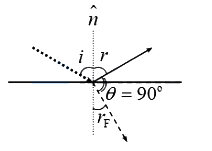
$A$ beam of white light is partially reflected and partially refracted from a surface. The angle between the reflected and refracted light is $90^{\circ}$. The angle of refraction is $30^{\circ}$. The angle of incidence must be (in $^{\circ}$)
A
$70$
B
$60$
C
$55$
D
$58$
Solution
(B) Let $i$ be the angle of incidence,$r$ be the angle of reflection,and $r_F$ be the angle of refraction.
According to the law of reflection,the angle of incidence is equal to the angle of reflection,so $i = r$.
The sum of the angles on a straight line (the interface) is $180^{\circ}$.
From the geometry of the problem,the sum of the angle of reflection,the angle between the reflected and refracted rays,and the angle of refraction is $180^{\circ}$.
Therefore,$r + 90^{\circ} + r_F = 180^{\circ}$.
Given $r_F = 30^{\circ}$,we have $r + 90^{\circ} + 30^{\circ} = 180^{\circ}$.
$r + 120^{\circ} = 180^{\circ}$.
$r = 180^{\circ} - 120^{\circ} = 60^{\circ}$.
Since $i = r$,the angle of incidence $i = 60^{\circ}$.
According to the law of reflection,the angle of incidence is equal to the angle of reflection,so $i = r$.
The sum of the angles on a straight line (the interface) is $180^{\circ}$.
From the geometry of the problem,the sum of the angle of reflection,the angle between the reflected and refracted rays,and the angle of refraction is $180^{\circ}$.
Therefore,$r + 90^{\circ} + r_F = 180^{\circ}$.
Given $r_F = 30^{\circ}$,we have $r + 90^{\circ} + 30^{\circ} = 180^{\circ}$.
$r + 120^{\circ} = 180^{\circ}$.
$r = 180^{\circ} - 120^{\circ} = 60^{\circ}$.
Since $i = r$,the angle of incidence $i = 60^{\circ}$.
0 likes
View Solution207
EasyMCQ
$A$ glass cube of length $24 \ cm$ has a small air bubble trapped inside. When viewed normally from one face,it is $10 \ cm$ below the surface. When viewed normally from the opposite face,its apparent distance is $6 \ cm$. The refractive index of glass is:
A
$1.5$
B
$1.4$
C
$1.45$
D
$1.55$
Solution
(A) Let $x$ be the real depth of the air bubble from the first face.
When viewed from the first face,the apparent depth is given by $d_1 = \frac{x}{\mu} = 10 \ cm$.
So,$x = 10\mu$.
When viewed from the opposite face,the real depth of the bubble is $(24 - x)$.
The apparent depth is given by $d_2 = \frac{24 - x}{\mu} = 6 \ cm$.
So,$24 - x = 6\mu$.
Substituting $x = 10\mu$ into the second equation:
$24 - 10\mu = 6\mu$
$24 = 16\mu$
$\mu = \frac{24}{16} = 1.5$.
Therefore,the refractive index of glass is $1.5$.
When viewed from the first face,the apparent depth is given by $d_1 = \frac{x}{\mu} = 10 \ cm$.
So,$x = 10\mu$.
When viewed from the opposite face,the real depth of the bubble is $(24 - x)$.
The apparent depth is given by $d_2 = \frac{24 - x}{\mu} = 6 \ cm$.
So,$24 - x = 6\mu$.
Substituting $x = 10\mu$ into the second equation:
$24 - 10\mu = 6\mu$
$24 = 16\mu$
$\mu = \frac{24}{16} = 1.5$.
Therefore,the refractive index of glass is $1.5$.
0 likes
View Solution208
EasyMCQ
$A$ ray of light travels from air to water to glass and again from glass to air. The refractive index of water with respect to air is '$X$', glass with respect to water is '$Y$', and air with respect to glass is '$Z$'. Which one of the following is correct?
A
$Y Z = X$
B
$X Y Z = 1$
C
$X Y = Z$
D
$X Z = Y$
Solution
(B) The refractive index of medium $2$ with respect to medium $1$ is given by the ratio of the speed of light in medium $1$ to the speed of light in medium $2$.
Let $v_a$, $v_w$, and $v_g$ be the speeds of light in air, water, and glass, respectively.
Given:
$X = {}^a\mu_w = \frac{v_a}{v_w}$
$Y = {}^w\mu_g = \frac{v_w}{v_g}$
$Z = {}^g\mu_a = \frac{v_g}{v_a}$
Multiplying these three values:
$X \times Y \times Z = \left(\frac{v_a}{v_w}\right) \times \left(\frac{v_w}{v_g}\right) \times \left(\frac{v_g}{v_a}\right) = 1$
Therefore, $X Y Z = 1$.
Let $v_a$, $v_w$, and $v_g$ be the speeds of light in air, water, and glass, respectively.
Given:
$X = {}^a\mu_w = \frac{v_a}{v_w}$
$Y = {}^w\mu_g = \frac{v_w}{v_g}$
$Z = {}^g\mu_a = \frac{v_g}{v_a}$
Multiplying these three values:
$X \times Y \times Z = \left(\frac{v_a}{v_w}\right) \times \left(\frac{v_w}{v_g}\right) \times \left(\frac{v_g}{v_a}\right) = 1$
Therefore, $X Y Z = 1$.
0 likes
View Solution209
EasyMCQ
White light consists of wavelengths ranging from $480 \,nm$ to $672 \,nm$. What will be the wavelength range when white light is passed through glass of refractive index $1.6$?
A
$420 \,nm - 672 \,nm$
B
$300 \,nm - 480 \,nm$
C
$300 \,nm - 420 \,nm$
D
$300 \,nm - 672 \,nm$
Solution
(C) The wavelength of light in a medium is given by the formula $\lambda_m = \frac{\lambda_a}{n}$, where $\lambda_a$ is the wavelength in air (or vacuum) and $n$ is the refractive index of the medium.
Given the refractive index $n = 1.6$.
For the lower limit: $\lambda_{m1} = \frac{480 \,nm}{1.6} = 300 \,nm$.
For the upper limit: $\lambda_{m2} = \frac{672 \,nm}{1.6} = 420 \,nm$.
Therefore, the wavelength range in the glass is $300 \,nm - 420 \,nm$.
Given the refractive index $n = 1.6$.
For the lower limit: $\lambda_{m1} = \frac{480 \,nm}{1.6} = 300 \,nm$.
For the upper limit: $\lambda_{m2} = \frac{672 \,nm}{1.6} = 420 \,nm$.
Therefore, the wavelength range in the glass is $300 \,nm - 420 \,nm$.
0 likes
View Solution210
EasyMCQ
$A$ light ray of frequency '$v$' and wavelength '$\lambda$' enters a liquid of refractive index $\frac{3}{2}$. The ray travels in the liquid with:
A
frequency $v$ and wavelength $\left(\frac{2}{3}\right) \lambda$
B
frequency $v$ and wavelength $\left(\frac{3}{2}\right) \lambda$
C
frequency $\left(\frac{3}{2}\right) v$ and wavelength $\lambda$
D
frequency $\left(\frac{2}{3}\right) v$ and wavelength $\left(\frac{2}{3}\right) \lambda$
Solution
(A) When a light ray travels from one medium to another,its frequency '$v$' remains unchanged because it depends only on the source of the light.
The speed of light in a medium is given by $v = \frac{c}{n}$,where '$c$' is the speed of light in vacuum and '$n$' is the refractive index.
The wavelength in the medium is given by $\lambda' = \frac{v}{f} = \frac{c/n}{f} = \frac{\lambda}{n}$.
Given the refractive index $n = \frac{3}{2}$,the new wavelength is $\lambda' = \frac{\lambda}{3/2} = \left(\frac{2}{3}\right) \lambda$.
Therefore,the frequency remains '$v$' and the wavelength becomes $\left(\frac{2}{3}\right) \lambda$.
The speed of light in a medium is given by $v = \frac{c}{n}$,where '$c$' is the speed of light in vacuum and '$n$' is the refractive index.
The wavelength in the medium is given by $\lambda' = \frac{v}{f} = \frac{c/n}{f} = \frac{\lambda}{n}$.
Given the refractive index $n = \frac{3}{2}$,the new wavelength is $\lambda' = \frac{\lambda}{3/2} = \left(\frac{2}{3}\right) \lambda$.
Therefore,the frequency remains '$v$' and the wavelength becomes $\left(\frac{2}{3}\right) \lambda$.
0 likes
View Solution211
EasyMCQ
When light enters glass from vacuum,then the wavelength of light:
A
remains constant.
B
becomes zero.
C
decreases.
D
increases.
Solution
(C) When light enters glass from vacuum,the wavelength of light decreases.
This occurs because the speed of light in glass is less than the speed of light in a vacuum.
The refractive index $\mu$ of a medium is defined as $\mu = \frac{c}{v}$,where $c$ is the speed of light in a vacuum and $v$ is the speed of light in the medium.
Since the refractive index of glass is greater than that of a vacuum,the speed of light $v$ decreases.
Given the relationship $v = f \lambda$,where $f$ is the frequency (which remains constant) and $\lambda$ is the wavelength,the speed $v$ is directly proportional to the wavelength $\lambda$.
Therefore,as the speed of light decreases,the wavelength of light also decreases.
This occurs because the speed of light in glass is less than the speed of light in a vacuum.
The refractive index $\mu$ of a medium is defined as $\mu = \frac{c}{v}$,where $c$ is the speed of light in a vacuum and $v$ is the speed of light in the medium.
Since the refractive index of glass is greater than that of a vacuum,the speed of light $v$ decreases.
Given the relationship $v = f \lambda$,where $f$ is the frequency (which remains constant) and $\lambda$ is the wavelength,the speed $v$ is directly proportional to the wavelength $\lambda$.
Therefore,as the speed of light decreases,the wavelength of light also decreases.
0 likes
View Solution212
EasyMCQ
$A$ ray of light travels from air to water to glass and again from glass to air. The refractive index of water with respect to air is $x$,glass with respect to water is $y$,and air with respect to glass is $z$. Which one of the following is correct?
A
$xz=y$
B
$z=x$
C
$xyz=1$
D
$xy=z$
Solution
(C) Let $n_{aw}$ be the refractive index of water with respect to air,$n_{gw}$ be the refractive index of glass with respect to water,and $n_{ag}$ be the refractive index of air with respect to glass. Given: $x = n_{aw}$,$y = n_{gw}$,and $z = n_{ag}$.
By the principle of reversibility and the definition of relative refractive indices,we have:
$x = \frac{n_w}{n_a}$
$y = \frac{n_g}{n_w}$
$z = \frac{n_a}{n_g}$
Multiplying these three expressions:
$x \cdot y \cdot z = \left(\frac{n_w}{n_a}\right) \cdot \left(\frac{n_g}{n_w}\right) \cdot \left(\frac{n_a}{n_g}\right) = 1$
Therefore,$xyz = 1$.
By the principle of reversibility and the definition of relative refractive indices,we have:
$x = \frac{n_w}{n_a}$
$y = \frac{n_g}{n_w}$
$z = \frac{n_a}{n_g}$
Multiplying these three expressions:
$x \cdot y \cdot z = \left(\frac{n_w}{n_a}\right) \cdot \left(\frac{n_g}{n_w}\right) \cdot \left(\frac{n_a}{n_g}\right) = 1$
Therefore,$xyz = 1$.
0 likes
View Solution213
EasyMCQ
Let $\mu_{1}$ and $\mu_{2}$ be the refractive indices of two media. $v_{1}$ and $v_{2}$ are the velocities of light in the media respectively. Which one of the following relations is $TRUE$?
A
$\mu_{1} v_{1}=\mu_{2} v_{2}$
B
$\mu_{2} v_{1}=\mu_{1} v_{2}$
C
$\mu_{1} v_{1}^{2}=\mu_{2} v_{2}^{2}$
D
$\mu_{2}^{2} v_{1}=\mu_{1}^{2} v_{2}$
Solution
(A) The refractive index $\mu$ of a medium is defined as the ratio of the speed of light in vacuum $(c)$ to the speed of light in that medium $(v)$.
Thus,for the two media,we have:
$\mu_{1} = \frac{c}{v_{1}}$ and $\mu_{2} = \frac{c}{v_{2}}$
From these equations,we can write:
$c = \mu_{1} v_{1}$ and $c = \mu_{2} v_{2}$
Since both expressions are equal to the speed of light in vacuum $(c)$,we have:
$\mu_{1} v_{1} = \mu_{2} v_{2}$
Thus,for the two media,we have:
$\mu_{1} = \frac{c}{v_{1}}$ and $\mu_{2} = \frac{c}{v_{2}}$
From these equations,we can write:
$c = \mu_{1} v_{1}$ and $c = \mu_{2} v_{2}$
Since both expressions are equal to the speed of light in vacuum $(c)$,we have:
$\mu_{1} v_{1} = \mu_{2} v_{2}$
0 likes
View Solution214
EasyMCQ
An object is immersed in a fluid of refractive index $\mu$. In order that the object becomes invisible when observed from outside,it should
A
have refractive index equal to one.
B
have refractive index same as surrounding fluid,that is $\mu$.
C
absorb all light falling on it.
D
behave as a perfect reflector.
Solution
(B) When an object is placed in a medium,it becomes visible due to the reflection and refraction of light at its boundaries.
If the refractive index of the object is exactly the same as the refractive index of the surrounding fluid $(\mu_{object} = \mu_{fluid} = \mu)$,there will be no change in the speed or direction of light as it passes from the fluid into the object.
Consequently,no refraction or reflection occurs at the interface between the object and the fluid.
As a result,the light rays pass through the object as if it were not there,making the object invisible to an observer outside the fluid.
If the refractive index of the object is exactly the same as the refractive index of the surrounding fluid $(\mu_{object} = \mu_{fluid} = \mu)$,there will be no change in the speed or direction of light as it passes from the fluid into the object.
Consequently,no refraction or reflection occurs at the interface between the object and the fluid.
As a result,the light rays pass through the object as if it were not there,making the object invisible to an observer outside the fluid.
0 likes
View Solution215
EasyMCQ
The refractive index of a medium is $\mu$ and the wavelength of light in that medium is $\lambda$. Which of the following proportionality relations is correct?
A
$\mu \propto \frac{1}{\lambda^2}$
B
$\mu \propto \lambda^2$
C
$\mu \propto \frac{1}{\lambda}$
D
$\mu \propto \lambda$
Solution
(C) The refractive index $\mu$ of a medium is defined as the ratio of the speed of light in a vacuum $(c)$ to the speed of light in the medium $(v)$: $\mu = \frac{c}{v}$.
Since the frequency $(f)$ of light remains constant when it travels from one medium to another,we can express the speeds as $c = f \lambda_0$ and $v = f \lambda$,where $\lambda_0$ is the wavelength in a vacuum and $\lambda$ is the wavelength in the medium.
Substituting these into the refractive index formula: $\mu = \frac{f \lambda_0}{f \lambda} = \frac{\lambda_0}{\lambda}$.
Since $\lambda_0$ (wavelength in vacuum) is a constant,it follows that $\mu \propto \frac{1}{\lambda}$.
Therefore,the correct option is $C$.
Since the frequency $(f)$ of light remains constant when it travels from one medium to another,we can express the speeds as $c = f \lambda_0$ and $v = f \lambda$,where $\lambda_0$ is the wavelength in a vacuum and $\lambda$ is the wavelength in the medium.
Substituting these into the refractive index formula: $\mu = \frac{f \lambda_0}{f \lambda} = \frac{\lambda_0}{\lambda}$.
Since $\lambda_0$ (wavelength in vacuum) is a constant,it follows that $\mu \propto \frac{1}{\lambda}$.
Therefore,the correct option is $C$.
0 likes
View Solution216
MediumMCQ
$A$ ray of light travelling through glass of refractive index $\sqrt{2}$ is incident on a glass-air boundary at an angle of incidence of $45^{\circ}$. If the refractive index of air is $1$,then the angle of refraction will be: $[\sin 45^{\circ} = \frac{1}{\sqrt{2}}, \sin 90^{\circ} = 1]$ (in $^{\circ}$)
A
$30$
B
$90$
C
$60$
D
$45$
Solution
(B) According to Snell's Law,$\mu_1 \sin i = \mu_2 \sin r$.
Here,$\mu_1 = \sqrt{2}$ (refractive index of glass),$i = 45^{\circ}$ (angle of incidence),and $\mu_2 = 1$ (refractive index of air).
Substituting the values: $\sqrt{2} \sin 45^{\circ} = 1 \cdot \sin r$.
Since $\sin 45^{\circ} = \frac{1}{\sqrt{2}}$,we get: $\sqrt{2} \cdot \frac{1}{\sqrt{2}} = \sin r$.
$1 = \sin r$.
Since $\sin 90^{\circ} = 1$,the angle of refraction $r = 90^{\circ}$.
Here,$\mu_1 = \sqrt{2}$ (refractive index of glass),$i = 45^{\circ}$ (angle of incidence),and $\mu_2 = 1$ (refractive index of air).
Substituting the values: $\sqrt{2} \sin 45^{\circ} = 1 \cdot \sin r$.
Since $\sin 45^{\circ} = \frac{1}{\sqrt{2}}$,we get: $\sqrt{2} \cdot \frac{1}{\sqrt{2}} = \sin r$.
$1 = \sin r$.
Since $\sin 90^{\circ} = 1$,the angle of refraction $r = 90^{\circ}$.
0 likes
View Solution217
EasyMCQ
$A$ light ray undergoes refraction from air to water,water to glass,and finally from glass back to air. If the emergent ray is parallel to the incident ray,which of the following relations is correct? ($n_{a}, n_{w}, n_{g}$ represent the refractive indices of air,water,and glass respectively.)
A
$_{g}n_{w} = \frac{_{a}n_{g}}{_{a}n_{w}}$
B
$_{g}n_{w} = _{a}n_{g} \times _{a}n_{w}$
C
$_{w}n_{g} = \frac{_{a}n_{w}}{_{a}n_{g}}$
D
$_{w}n_{g} = \frac{_{a}n_{g}}{_{a}n_{w}}$
Solution
(D) When a light ray passes through a series of parallel media and finally emerges into the original medium,the product of the relative refractive indices is equal to $1$.
For the given sequence (air $\rightarrow$ water $\rightarrow$ glass $\rightarrow$ air),the principle of reversibility and the property of parallel slabs imply:
$_{a}n_{w} \times _{w}n_{g} \times _{g}n_{a} = 1$.
We know that $_{g}n_{a} = \frac{1}{_{a}n_{g}}$.
Substituting this into the equation:
$_{a}n_{w} \times _{w}n_{g} \times \frac{1}{_{a}n_{g}} = 1$.
Rearranging the terms to solve for $_{w}n_{g}$:
$_{w}n_{g} = \frac{_{a}n_{g}}{_{a}n_{w}}$.
Thus,option $D$ is the correct relation.
For the given sequence (air $\rightarrow$ water $\rightarrow$ glass $\rightarrow$ air),the principle of reversibility and the property of parallel slabs imply:
$_{a}n_{w} \times _{w}n_{g} \times _{g}n_{a} = 1$.
We know that $_{g}n_{a} = \frac{1}{_{a}n_{g}}$.
Substituting this into the equation:
$_{a}n_{w} \times _{w}n_{g} \times \frac{1}{_{a}n_{g}} = 1$.
Rearranging the terms to solve for $_{w}n_{g}$:
$_{w}n_{g} = \frac{_{a}n_{g}}{_{a}n_{w}}$.
Thus,option $D$ is the correct relation.
0 likes
View Solution218
EasyMCQ
$A$ light of wavelength $\lambda_{1}$ and velocity $C_{1}$ travels from the first medium of refractive index $\mu_{1}$ into the second medium of refractive index $\mu_{2}$. The wavelength and velocity of light in the second medium are $\lambda_{2}$ and $C_{2}$ respectively. The refractive index of the second medium with respect to the first medium is given by:
A
$\frac{C_{2}}{C_{1}}$
B
$\frac{\mu_{2}}{\mu_{1}}$
C
$\frac{\mu_{1}}{\mu_{2}}$
D
$\frac{\lambda_{2}}{\lambda_{1}}$
Solution
(B) The refractive index of the second medium with respect to the first medium is defined as the ratio of the speed of light in the first medium to the speed of light in the second medium.
Mathematically,it is expressed as: $n_{21} = \frac{\mu_{2}}{\mu_{1}} = \frac{C_{1}}{C_{2}} = \frac{\lambda_{1}}{\lambda_{2}}$.
However,the question asks for the refractive index of the second medium with respect to the first medium,which is denoted by the ratio of the refractive indices themselves,i.e.,$\frac{\mu_{2}}{\mu_{1}}$.
Mathematically,it is expressed as: $n_{21} = \frac{\mu_{2}}{\mu_{1}} = \frac{C_{1}}{C_{2}} = \frac{\lambda_{1}}{\lambda_{2}}$.
However,the question asks for the refractive index of the second medium with respect to the first medium,which is denoted by the ratio of the refractive indices themselves,i.e.,$\frac{\mu_{2}}{\mu_{1}}$.
0 likes
View Solution219
EasyMCQ
Light travels through water in a beaker. The height of the water column is $h$. If the refractive index of water is $\mu_{w}$ and $C$ is the velocity of light in air,the time taken by light to travel through the water will be:
A
$\frac{\mu_{w} h}{C}$
B
$h \mu_{w} C$
C
$\frac{hC}{\mu_{w}}$
D
$\frac{h}{\mu_{w} C}$
Solution
(A) The velocity of light in a medium is given by $v = \frac{C}{\mu_{w}}$,where $C$ is the speed of light in air and $\mu_{w}$ is the refractive index of water.
Time taken $(t)$ to travel a distance $h$ is given by the formula: $t = \frac{\text{distance}}{\text{velocity}}$.
Substituting the values,we get $t = \frac{h}{v}$.
Since $v = \frac{C}{\mu_{w}}$,we substitute this into the time equation:
$t = \frac{h}{(C / \mu_{w})} = \frac{h \mu_{w}}{C}$.
Therefore,the correct option is $A$.
Time taken $(t)$ to travel a distance $h$ is given by the formula: $t = \frac{\text{distance}}{\text{velocity}}$.
Substituting the values,we get $t = \frac{h}{v}$.
Since $v = \frac{C}{\mu_{w}}$,we substitute this into the time equation:
$t = \frac{h}{(C / \mu_{w})} = \frac{h \mu_{w}}{C}$.
Therefore,the correct option is $A$.
0 likes
View Solution220
EasyMCQ
The refractive index of the material of a crystal is $1.68$ and that of castor oil is $1.2$. When a ray of light passes from oil to the crystal,its velocity will change by a factor of:
A
$\frac{2}{3}$
B
$\frac{3}{4}$
C
$\frac{5}{6}$
D
$\frac{5}{7}$
Solution
(D) The refractive index of a medium is inversely proportional to the speed of light in that medium,given by $\mu = \frac{c}{v}$.
When light travels from oil (medium $1$) to crystal (medium $2$),the ratio of the speeds is given by the inverse ratio of their refractive indices:
$\frac{v_{crystal}}{v_{oil}} = \frac{\mu_{oil}}{\mu_{crystal}}$
Given $\mu_{crystal} = 1.68$ and $\mu_{oil} = 1.2$.
Substituting the values:
$\frac{v_{crystal}}{v_{oil}} = \frac{1.2}{1.68} = \frac{120}{168} = \frac{10}{14} = \frac{5}{7}$.
Thus,the velocity changes by a factor of $\frac{5}{7}$.
When light travels from oil (medium $1$) to crystal (medium $2$),the ratio of the speeds is given by the inverse ratio of their refractive indices:
$\frac{v_{crystal}}{v_{oil}} = \frac{\mu_{oil}}{\mu_{crystal}}$
Given $\mu_{crystal} = 1.68$ and $\mu_{oil} = 1.2$.
Substituting the values:
$\frac{v_{crystal}}{v_{oil}} = \frac{1.2}{1.68} = \frac{120}{168} = \frac{10}{14} = \frac{5}{7}$.
Thus,the velocity changes by a factor of $\frac{5}{7}$.
0 likes
View Solution221
EasyMCQ
When light enters glass from vacuum,then the wavelength of light
A
Decreases
B
Becomes zero
C
Remains same
D
Increases
Solution
(A) When light enters glass from vacuum,its wavelength decreases. This is because the speed of light in glass is less than that in a vacuum. The frequency of light remains constant when it travels from one medium to another. From the relation $v = f \lambda$,where $v$ is the speed,$f$ is the frequency,and $\lambda$ is the wavelength,we have $\lambda = \frac{v}{f}$. Since the speed $v$ decreases in glass compared to vacuum and the frequency $f$ remains constant,the wavelength $\lambda$ must decrease.
0 likes
View Solution222
MediumMCQ
If the angle of incidence is twice the angle of refraction in a medium of refractive index $\mu$,then the angle of incidence is
A
$2 \cos^{-1} \left( \frac{\mu}{2} \right)$
B
$2 \sin^{-1} \left( \frac{\mu}{2} \right)$
C
$2 \cos^{-1} \mu$
D
$2 \sin^{-1} \mu$
Solution
(A) According to Snell's law,the refractive index $\mu$ is given by $\mu = \frac{\sin i}{\sin r}$.
Given that the angle of incidence $i$ is twice the angle of refraction $r$,so $i = 2r$.
Substituting this into Snell's law: $\mu = \frac{\sin(2r)}{\sin r}$.
Using the trigonometric identity $\sin(2r) = 2 \sin r \cos r$,we get $\mu = \frac{2 \sin r \cos r}{\sin r}$.
Simplifying,we have $\mu = 2 \cos r$,which implies $\cos r = \frac{\mu}{2}$.
Therefore,$r = \cos^{-1} \left( \frac{\mu}{2} \right)$.
Since $i = 2r$,we get $i = 2 \cos^{-1} \left( \frac{\mu}{2} \right)$.
Given that the angle of incidence $i$ is twice the angle of refraction $r$,so $i = 2r$.
Substituting this into Snell's law: $\mu = \frac{\sin(2r)}{\sin r}$.
Using the trigonometric identity $\sin(2r) = 2 \sin r \cos r$,we get $\mu = \frac{2 \sin r \cos r}{\sin r}$.
Simplifying,we have $\mu = 2 \cos r$,which implies $\cos r = \frac{\mu}{2}$.
Therefore,$r = \cos^{-1} \left( \frac{\mu}{2} \right)$.
Since $i = 2r$,we get $i = 2 \cos^{-1} \left( \frac{\mu}{2} \right)$.
0 likes
View Solution223
DifficultMCQ
$A$ beam of light is incident on a glass plate at an angle of $60^{\circ}$. The reflected ray is polarized. If the angle of incidence is $45^{\circ}$,then the angle of refraction is:
A
$\sin^{-1}\left(\frac{1}{\sqrt{6}}\right)$
B
$\sin^{-1}\left(\frac{1}{\sqrt{3}}\right)$
C
$\sin^{-1}\left(\sqrt{\frac{3}{2}}\right)$
D
$\cos^{-1}\left(\sqrt{\frac{3}{2}}\right)$
Solution
(A) According to Brewster's law,the refractive index $n$ is given by $\tan \theta_{B} = n$,where $\theta_{B}$ is the Brewster angle.
Given $\theta_{B} = 60^{\circ}$,we have $n = \tan 60^{\circ} = \sqrt{3}$.
Now,using Snell's law,$\frac{\sin i}{\sin r} = n$,where $i = 45^{\circ}$ is the angle of incidence and $r$ is the angle of refraction.
Substituting the values,$\sin r = \frac{\sin 45^{\circ}}{n} = \frac{1/\sqrt{2}}{\sqrt{3}} = \frac{1}{\sqrt{6}}$.
Therefore,the angle of refraction is $r = \sin^{-1}\left(\frac{1}{\sqrt{6}}\right)$.
Given $\theta_{B} = 60^{\circ}$,we have $n = \tan 60^{\circ} = \sqrt{3}$.
Now,using Snell's law,$\frac{\sin i}{\sin r} = n$,where $i = 45^{\circ}$ is the angle of incidence and $r$ is the angle of refraction.
Substituting the values,$\sin r = \frac{\sin 45^{\circ}}{n} = \frac{1/\sqrt{2}}{\sqrt{3}} = \frac{1}{\sqrt{6}}$.
Therefore,the angle of refraction is $r = \sin^{-1}\left(\frac{1}{\sqrt{6}}\right)$.
0 likes
View Solution224
EasyMCQ
The refractive index of glass is $1.6$ and the speed of light in glass will be . . . . . . . Speed of light in vacuum is $3 \times 10^{8} \,m \,s^{-1}$.
A
$1.66 \times 10^{8} \,m \,s^{-1}$
B
$1.88 \times 10^{8} \,m \,s^{-1}$
C
$1.22 \times 10^{6} \,m \,s^{-1}$
D
$1.48 \times 10^{8} \,m \,s^{-1}$
Solution
(B) The refractive index $n$ is defined as the ratio of the speed of light in vacuum $c$ to the speed of light in the medium $v$.
$n = \frac{c}{v}$
Given:
$n = 1.6$
$c = 3 \times 10^{8} \,m \,s^{-1}$
Rearranging the formula to solve for $v$:
$v = \frac{c}{n}$
$v = \frac{3 \times 10^{8}}{1.6}$
$v = 1.875 \times 10^{8} \,m \,s^{-1} \approx 1.88 \times 10^{8} \,m \,s^{-1}$
Thus,the correct option is $B$.
$n = \frac{c}{v}$
Given:
$n = 1.6$
$c = 3 \times 10^{8} \,m \,s^{-1}$
Rearranging the formula to solve for $v$:
$v = \frac{c}{n}$
$v = \frac{3 \times 10^{8}}{1.6}$
$v = 1.875 \times 10^{8} \,m \,s^{-1} \approx 1.88 \times 10^{8} \,m \,s^{-1}$
Thus,the correct option is $B$.
0 likes
View Solution225
EasyMCQ
The refractive index of air with respect to vacuum is . . . . . . .
A
$1.029$
B
$1.0029$
C
$1.00029$
D
$1$
Solution
(C) The refractive index of a medium is defined as the ratio of the speed of light in vacuum $(c)$ to the speed of light in that medium $(v)$.
Mathematically,$n = c/v$.
For air,the speed of light is slightly less than the speed of light in a vacuum.
The refractive index of air is approximately $1.00029$.
Therefore,the correct option is $C$.
Mathematically,$n = c/v$.
For air,the speed of light is slightly less than the speed of light in a vacuum.
The refractive index of air is approximately $1.00029$.
Therefore,the correct option is $C$.
0 likes
View Solution226
EasyMCQ
$A$ tank is filled with water to a height of $16 \text{ cm}$. Find the apparent depth of a needle lying at the bottom of the tank as measured by a microscope. The refractive index of water $(\mu_{w})$ is $\frac{4}{3}$. (in $\text{ cm}$)
A
$8.0$
B
$10.6$
C
$12.0$
D
$9.4$
Solution
(C) The formula for apparent depth is given by:
$\mu = \frac{\text{Real depth}}{\text{Apparent depth}}$
Given:
Real depth $(h_2) = 16 \text{ cm}$
Refractive index $(\mu) = \frac{4}{3}$
Let the apparent depth be $h_1$.
Substituting the values in the formula:
$\frac{4}{3} = \frac{16}{h_1}$
$h_1 = \frac{16 \times 3}{4}$
$h_1 = 4 \times 3 = 12 \text{ cm}$
Therefore, the apparent depth of the needle is $12.0 \text{ cm}$.
$\mu = \frac{\text{Real depth}}{\text{Apparent depth}}$
Given:
Real depth $(h_2) = 16 \text{ cm}$
Refractive index $(\mu) = \frac{4}{3}$
Let the apparent depth be $h_1$.
Substituting the values in the formula:
$\frac{4}{3} = \frac{16}{h_1}$
$h_1 = \frac{16 \times 3}{4}$
$h_1 = 4 \times 3 = 12 \text{ cm}$
Therefore, the apparent depth of the needle is $12.0 \text{ cm}$.
0 likes
View Solution227
EasyMCQ
Light waves travel from an optically rarer medium to an optically denser medium. Its velocity decreases because of a change in . . . . . . .
A
wavelength
B
frequency
C
amplitude
D
phase
Solution
(A) The correct answer is $A$.
The velocity of a wave is given by the relation $v = \nu \lambda$,where $\nu$ is the frequency and $\lambda$ is the wavelength.
When light travels from one medium to another,its frequency $\nu$ remains constant because it depends on the source of the light.
Since $v = \nu \lambda$ and $\nu$ is constant,the velocity $v$ is directly proportional to the wavelength $\lambda$ $(v \propto \lambda)$.
Therefore,when the velocity of light decreases upon entering a denser medium,the wavelength must also decrease.
The velocity of a wave is given by the relation $v = \nu \lambda$,where $\nu$ is the frequency and $\lambda$ is the wavelength.
When light travels from one medium to another,its frequency $\nu$ remains constant because it depends on the source of the light.
Since $v = \nu \lambda$ and $\nu$ is constant,the velocity $v$ is directly proportional to the wavelength $\lambda$ $(v \propto \lambda)$.
Therefore,when the velocity of light decreases upon entering a denser medium,the wavelength must also decrease.
0 likes
View Solution228
EasyMCQ
The speed of light in a medium of refractive index $1.25$ is . . . . . . .
(Speed of light in vacuum is $3 \times 10^{8} \,m \,s^{-1}$)
(Speed of light in vacuum is $3 \times 10^{8} \,m \,s^{-1}$)
A
$2.4 \times 10^{8} \,m \,s^{-1}$
B
$1.5 \times 10^{8} \,m \,s^{-1}$
C
$2.0 \times 10^{8} \,m \,s^{-1}$
D
$1.25 \times 10^{8} \,m \,s^{-1}$
Solution
(A) The refractive index $n$ of a medium is defined as the ratio of the speed of light in vacuum $c$ to the speed of light in the medium $v$.
The formula is given by $n = \frac{c}{v}$.
Rearranging the formula to solve for $v$,we get $v = \frac{c}{n}$.
Given $c = 3 \times 10^{8} \,m \,s^{-1}$ and $n = 1.25$.
Substituting the values: $v = \frac{3 \times 10^{8}}{1.25} = 2.4 \times 10^{8} \,m \,s^{-1}$.
Therefore,the correct option is $A$.
The formula is given by $n = \frac{c}{v}$.
Rearranging the formula to solve for $v$,we get $v = \frac{c}{n}$.
Given $c = 3 \times 10^{8} \,m \,s^{-1}$ and $n = 1.25$.
Substituting the values: $v = \frac{3 \times 10^{8}}{1.25} = 2.4 \times 10^{8} \,m \,s^{-1}$.
Therefore,the correct option is $A$.
0 likes
View Solution229
EasyMCQ
Optical phenomena taking place for a mirror and a lens respectively are . . . . . . and . . . . . . .
A
interference,diffraction
B
reflection,refraction
C
reflection,diffraction
D
refraction,interference
Solution
(B) mirror works on the principle of the reflection of light,where light rays bounce off the surface of the mirror. $A$ lens works on the principle of the refraction of light,where light rays pass through the medium and change their direction due to a change in speed. Therefore,the correct phenomena are reflection and refraction respectively.
0 likes
View Solution230
EasyMCQ
The refractive index of a medium is $\frac{3}{2}$. The speed of light in this medium is . . . . . . $ms^{-1}$. (Speed of light in vacuum is $c = 3 \times 10^{8} \,ms^{-1}$)
A
$2.5 \times 10^{8}$
B
$3 \times 10^{8}$
C
$2 \times 10^{8}$
D
$3.5 \times 10^{8}$
Solution
(C) The refractive index $n$ of a medium is defined as the ratio of the speed of light in a vacuum $c$ to the speed of light in the medium $v$,given by $n = \frac{c}{v}$.
Given $n = \frac{3}{2}$ and $c = 3 \times 10^{8} \,ms^{-1}$.
Rearranging the formula to solve for $v$,we get $v = \frac{c}{n}$.
Substituting the values,$v = \frac{3 \times 10^{8}}{3/2} = 3 \times 10^{8} \times \frac{2}{3} = 2 \times 10^{8} \,ms^{-1}$.
Therefore,the correct option is $C$.
Given $n = \frac{3}{2}$ and $c = 3 \times 10^{8} \,ms^{-1}$.
Rearranging the formula to solve for $v$,we get $v = \frac{c}{n}$.
Substituting the values,$v = \frac{3 \times 10^{8}}{3/2} = 3 \times 10^{8} \times \frac{2}{3} = 2 \times 10^{8} \,ms^{-1}$.
Therefore,the correct option is $C$.
0 likes
View Solution231
MediumMCQ
If $\varepsilon_{0}$ and $\mu_{0}$ are the permittivity and permeability of free space and $\varepsilon$ and $\mu$ are the corresponding quantities for a medium,then the refractive index of the medium is:
A
$\sqrt{\frac{\mu_{0} \varepsilon_{0}}{\mu \varepsilon}}$
B
$\sqrt{\frac{\mu \varepsilon}{\mu_{0} \varepsilon_{0}}}$
C
$1$
D
Insufficient information
Solution
(B) The speed of light in free space is given by $c = \frac{1}{\sqrt{\mu_{0} \varepsilon_{0}}}$.
The speed of light in a medium is given by $v = \frac{1}{\sqrt{\mu \varepsilon}}$.
The refractive index $n$ of a medium is defined as the ratio of the speed of light in vacuum to the speed of light in the medium:
$n = \frac{c}{v} = \frac{\frac{1}{\sqrt{\mu_{0} \varepsilon_{0}}}}{\frac{1}{\sqrt{\mu \varepsilon}}} = \frac{\sqrt{\mu \varepsilon}}{\sqrt{\mu_{0} \varepsilon_{0}}} = \sqrt{\frac{\mu \varepsilon}{\mu_{0} \varepsilon_{0}}}$.
Thus,the correct option is $B$.
The speed of light in a medium is given by $v = \frac{1}{\sqrt{\mu \varepsilon}}$.
The refractive index $n$ of a medium is defined as the ratio of the speed of light in vacuum to the speed of light in the medium:
$n = \frac{c}{v} = \frac{\frac{1}{\sqrt{\mu_{0} \varepsilon_{0}}}}{\frac{1}{\sqrt{\mu \varepsilon}}} = \frac{\sqrt{\mu \varepsilon}}{\sqrt{\mu_{0} \varepsilon_{0}}} = \sqrt{\frac{\mu \varepsilon}{\mu_{0} \varepsilon_{0}}}$.
Thus,the correct option is $B$.
0 likes
View Solution232
MediumMCQ
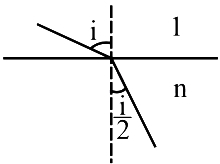
$A$ ray of light passes from vacuum into a medium of refractive index $n$. If the angle of incidence is twice the angle of refraction,then the angle of incidence in terms of refractive index is
A
$\operatorname{Sin}^{-1}\left(\frac{n}{2}\right)$
B
$2 \operatorname{Cos}^{-1}\left(\frac{n}{2}\right)$
C
$2 \operatorname{Sin}^{-1}\left(\frac{n}{2}\right)$
D
$\operatorname{Cos}^{-1}\left(\frac{n}{2}\right)$
Solution
(B) According to Snell's law,$n_1 \sin i = n_2 \sin r$.
Here,$n_1 = 1$ (vacuum),$n_2 = n$,$i$ is the angle of incidence,and $r$ is the angle of refraction.
Given that $i = 2r$,we have $r = \frac{i}{2}$.
Substituting these into Snell's law:
$1 \times \sin i = n \sin \left(\frac{i}{2}\right)$
Using the trigonometric identity $\sin i = 2 \sin \left(\frac{i}{2}\right) \cos \left(\frac{i}{2}\right)$:
$2 \sin \left(\frac{i}{2}\right) \cos \left(\frac{i}{2}\right) = n \sin \left(\frac{i}{2}\right)$
Dividing both sides by $\sin \left(\frac{i}{2}\right)$ (assuming $i \neq 0$):
$2 \cos \left(\frac{i}{2}\right) = n$
$\cos \left(\frac{i}{2}\right) = \frac{n}{2}$
$\frac{i}{2} = \cos^{-1} \left(\frac{n}{2}\right)$
$i = 2 \cos^{-1} \left(\frac{n}{2}\right)$
Here,$n_1 = 1$ (vacuum),$n_2 = n$,$i$ is the angle of incidence,and $r$ is the angle of refraction.
Given that $i = 2r$,we have $r = \frac{i}{2}$.
Substituting these into Snell's law:
$1 \times \sin i = n \sin \left(\frac{i}{2}\right)$
Using the trigonometric identity $\sin i = 2 \sin \left(\frac{i}{2}\right) \cos \left(\frac{i}{2}\right)$:
$2 \sin \left(\frac{i}{2}\right) \cos \left(\frac{i}{2}\right) = n \sin \left(\frac{i}{2}\right)$
Dividing both sides by $\sin \left(\frac{i}{2}\right)$ (assuming $i \neq 0$):
$2 \cos \left(\frac{i}{2}\right) = n$
$\cos \left(\frac{i}{2}\right) = \frac{n}{2}$
$\frac{i}{2} = \cos^{-1} \left(\frac{n}{2}\right)$
$i = 2 \cos^{-1} \left(\frac{n}{2}\right)$
0 likes
View Solution233
EasyMCQ
In refraction,light waves are bent on passing from one medium to a second medium because,in the second medium,
A
frequency is different
B
speed is different
C
coefficient of elasticity is different
D
amplitude is smaller
Solution
(B) The bending of light when passing from one medium to another is due to the change in the speed of light.
Refraction occurs because the refractive index of the second medium is different from that of the first medium.
The refractive index $( \mu )$ is defined as the ratio of the speed of light in a vacuum $( c )$ to the speed of light in the medium $( v )$,i.e.,$ \mu = c/v $.
When light travels from one medium to another,its frequency remains constant,but its speed changes,which causes the light ray to deviate from its original path (bending).
Therefore,the correct reason for the bending of light is that the speed of light is different in the second medium.
Refraction occurs because the refractive index of the second medium is different from that of the first medium.
The refractive index $( \mu )$ is defined as the ratio of the speed of light in a vacuum $( c )$ to the speed of light in the medium $( v )$,i.e.,$ \mu = c/v $.
When light travels from one medium to another,its frequency remains constant,but its speed changes,which causes the light ray to deviate from its original path (bending).
Therefore,the correct reason for the bending of light is that the speed of light is different in the second medium.
0 likes
View Solution234
DifficultMCQ
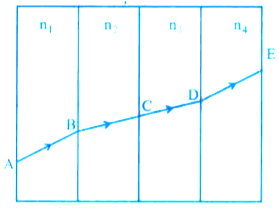
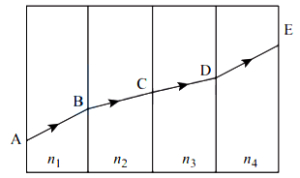
$A$ ray of light passes through four transparent media with refractive indices $n_{1}$,$n_{2}$,$n_{3}$,and $n_{4}$ as shown. The surfaces of all media are parallel. If the emergent ray $DE$ is parallel to the incident ray $AB$,then
A
$n_{1} = n_{4}$
B
$n_{2} = n_{4}$
C
$n_{3} = n_{4}$
D
$n_{1} = \frac{n_{2} + n_{3} + n_{4}}{3}$
Solution
(A) According to Snell's law for a series of parallel interfaces,the product of the refractive index and the sine of the angle of incidence at each interface remains constant.
Let $\theta_{1}$ be the angle of incidence in the first medium and $\theta_{4}$ be the angle of emergence in the fourth medium.
Applying Snell's law at each interface:
$n_{1} \sin \theta_{1} = n_{2} \sin \theta_{2} = n_{3} \sin \theta_{3} = n_{4} \sin \theta_{4}$
Given that the emergent ray $DE$ is parallel to the incident ray $AB$,the angle of incidence $\theta_{1}$ must be equal to the angle of emergence $\theta_{4}$ (i.e.,$\theta_{1} = \theta_{4}$).
Therefore,$n_{1} \sin \theta_{1} = n_{4} \sin \theta_{1}$.
Since $\sin \theta_{1} \neq 0$,we get $n_{1} = n_{4}$.
Let $\theta_{1}$ be the angle of incidence in the first medium and $\theta_{4}$ be the angle of emergence in the fourth medium.
Applying Snell's law at each interface:
$n_{1} \sin \theta_{1} = n_{2} \sin \theta_{2} = n_{3} \sin \theta_{3} = n_{4} \sin \theta_{4}$
Given that the emergent ray $DE$ is parallel to the incident ray $AB$,the angle of incidence $\theta_{1}$ must be equal to the angle of emergence $\theta_{4}$ (i.e.,$\theta_{1} = \theta_{4}$).
Therefore,$n_{1} \sin \theta_{1} = n_{4} \sin \theta_{1}$.
Since $\sin \theta_{1} \neq 0$,we get $n_{1} = n_{4}$.
0 likes
View Solution235
DifficultMCQ
$A$ monochromatic beam of light is travelling from medium $A$ of refractive index $n_{1}$ to a medium $B$ of refractive index $n_{2}$. In the medium $A$,there are $x$ number of waves in a certain distance. In the medium $B$,there are $y$ number of waves in the same distance. Then,the refractive index of medium $A$ with respect to medium $B$ is
A
$\frac{x}{y}$
B
$\frac{y}{x}$
C
$\sqrt{\frac{x}{y}}$
D
$\frac{x}{y-x}$
Solution
(A) Let the distance be $s$. In medium $A$,the wavelength is $\lambda_{1}$ and in medium $B$,the wavelength is $\lambda_{2}$.
Since $x$ waves are in distance $s$ in medium $A$,we have $s = x \lambda_{1}$.
Since $y$ waves are in distance $s$ in medium $B$,we have $s = y \lambda_{2}$.
Equating the two expressions for $s$,we get $x \lambda_{1} = y \lambda_{2}$,which implies $\frac{\lambda_{1}}{\lambda_{2}} = \frac{y}{x}$.
We know that the refractive index $n$ is inversely proportional to the wavelength $\lambda$ (i.e.,$n \propto \frac{1}{\lambda}$).
Therefore,the refractive index of medium $A$ with respect to medium $B$ is given by $n_{AB} = \frac{n_{A}}{n_{B}} = \frac{\lambda_{2}}{\lambda_{1}}$.
Substituting the ratio of wavelengths,we get $n_{AB} = \frac{x}{y}$.
Since $x$ waves are in distance $s$ in medium $A$,we have $s = x \lambda_{1}$.
Since $y$ waves are in distance $s$ in medium $B$,we have $s = y \lambda_{2}$.
Equating the two expressions for $s$,we get $x \lambda_{1} = y \lambda_{2}$,which implies $\frac{\lambda_{1}}{\lambda_{2}} = \frac{y}{x}$.
We know that the refractive index $n$ is inversely proportional to the wavelength $\lambda$ (i.e.,$n \propto \frac{1}{\lambda}$).
Therefore,the refractive index of medium $A$ with respect to medium $B$ is given by $n_{AB} = \frac{n_{A}}{n_{B}} = \frac{\lambda_{2}}{\lambda_{1}}$.
Substituting the ratio of wavelengths,we get $n_{AB} = \frac{x}{y}$.
0 likes
View Solution236
DifficultMCQ
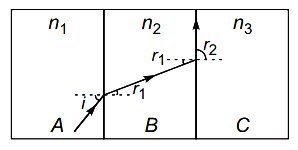
$A$,$B$ and $C$ are parallel-sided transparent media of refractive indices $n_{1}$,$n_{2}$ and $n_{3}$ respectively. They are arranged as shown in the figure. $A$ ray is incident at an angle $i$ on the surface of separation of $A$ and $B$. After refraction into medium $B$,the ray grazes the surface of separation of media $B$ and $C$. Then,$\sin i$ equals to
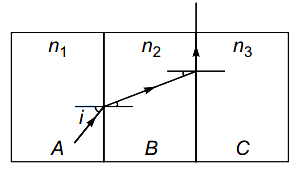
A
$\frac{n_{3}}{n_{1}}$
B
$\frac{n_{1}}{n_{3}}$
C
$\frac{n_{2}}{n_{3}}$
D
$\frac{n_{1}}{n_{2}}$
Solution
(A) Applying Snell's law at the interface of media $A$ and $B$:
$n_{1} \sin i = n_{2} \sin r_{1} \quad \text{...(i)}$
Applying Snell's law at the interface of media $B$ and $C$:
$n_{2} \sin r_{1} = n_{3} \sin r_{2} \quad \text{...(ii)}$
Since the ray grazes the surface of separation of media $B$ and $C$,the angle of refraction $r_{2} = 90^{\circ}$.
Substituting $r_{2} = 90^{\circ}$ in equation (ii):
$n_{2} \sin r_{1} = n_{3} \sin 90^{\circ} = n_{3}$
Now,substitute $n_{2} \sin r_{1} = n_{3}$ into equation $(i)$:
$n_{1} \sin i = n_{3}$
$\sin i = \frac{n_{3}}{n_{1}}$
$n_{1} \sin i = n_{2} \sin r_{1} \quad \text{...(i)}$
Applying Snell's law at the interface of media $B$ and $C$:
$n_{2} \sin r_{1} = n_{3} \sin r_{2} \quad \text{...(ii)}$
Since the ray grazes the surface of separation of media $B$ and $C$,the angle of refraction $r_{2} = 90^{\circ}$.
Substituting $r_{2} = 90^{\circ}$ in equation (ii):
$n_{2} \sin r_{1} = n_{3} \sin 90^{\circ} = n_{3}$
Now,substitute $n_{2} \sin r_{1} = n_{3}$ into equation $(i)$:
$n_{1} \sin i = n_{3}$
$\sin i = \frac{n_{3}}{n_{1}}$
0 likes
View Solution237
MediumMCQ
$A$ boat has a green light of wavelength $\lambda = 500 \ nm$ on the mast. What wavelength would be measured and what colour would be observed for this light as seen by a diver submerged in water by the side of the boat? Given,$n_{w} = 4/3$.
A
Green of wavelength $376 \ nm$
B
Red of wavelength $665 \ nm$
C
Green of wavelength $500 \ nm$
D
Blue of wavelength $376 \ nm$
Solution
(D) When light travels from a rarer medium (air) to a denser medium (water),its frequency remains constant,but its wavelength changes.
The wavelength in water is given by the formula $\lambda_{w} = \frac{\lambda_{a}}{n_{w}}$,where $\lambda_{a}$ is the wavelength in air and $n_{w}$ is the refractive index of water.
Substituting the given values: $\lambda_{w} = \frac{500 \ nm}{4/3} = 500 \times \frac{3}{4} \ nm = 375 \ nm$.
Rounding this value,we get $\lambda_{w} \approx 376 \ nm$.
Since the wavelength of light shifts towards the blue end of the spectrum ($376 \ nm$ falls in the blue region),the diver will observe the light as blue.
The wavelength in water is given by the formula $\lambda_{w} = \frac{\lambda_{a}}{n_{w}}$,where $\lambda_{a}$ is the wavelength in air and $n_{w}$ is the refractive index of water.
Substituting the given values: $\lambda_{w} = \frac{500 \ nm}{4/3} = 500 \times \frac{3}{4} \ nm = 375 \ nm$.
Rounding this value,we get $\lambda_{w} \approx 376 \ nm$.
Since the wavelength of light shifts towards the blue end of the spectrum ($376 \ nm$ falls in the blue region),the diver will observe the light as blue.
0 likes
View Solution238
DifficultMCQ
$A$ fish in water (refractive index $n$) looks at a bird vertically above in the air. If $y$ is the height of the bird and $x$ is the depth of the fish from the surface,then the distance of the bird as estimated by the fish is
A
$x+y(1-1/n)$
B
$x+ny$
C
$x+y(1+1/n)$
D
$y+x(1-1/n)$
Solution
(B) When an observer is in a denser medium (water,refractive index $n$) and the object (bird) is in a rarer medium (air,refractive index $1$),the apparent height of the object is increased.
For an observer in a medium of refractive index $n$,the apparent height $h'$ of an object at a real height $h$ is given by $h' = n \times h$.
Here,the bird is at a height $y$ above the water surface.
Therefore,the apparent height of the bird as seen by the fish from the water surface is $h' = n \times y$.
The fish is at a depth $x$ below the water surface.
Thus,the total distance of the bird as estimated by the fish is the sum of the depth of the fish and the apparent height of the bird: $D = x + ny$.
For an observer in a medium of refractive index $n$,the apparent height $h'$ of an object at a real height $h$ is given by $h' = n \times h$.
Here,the bird is at a height $y$ above the water surface.
Therefore,the apparent height of the bird as seen by the fish from the water surface is $h' = n \times y$.
The fish is at a depth $x$ below the water surface.
Thus,the total distance of the bird as estimated by the fish is the sum of the depth of the fish and the apparent height of the bird: $D = x + ny$.
0 likes
View Solution239
DifficultMCQ
$A$ vessel of height $2d$ is half-filled with a liquid of refractive index $\sqrt{2}$ and the other half with a liquid of refractive index $n$ (the given liquids are immiscible). Then the apparent depth of the inner surface of the bottom of the vessel (neglecting the thickness of the bottom of the vessel) will be
A
$\frac{n}{d(n+\sqrt{2})}$
B
$\frac{d(n+\sqrt{2})}{n \sqrt{2}}$
C
$\frac{\sqrt{2} n}{d(n+\sqrt{2})}$
D
$\frac{n d}{d+\sqrt{2 n}}$
Solution
(B) The apparent depth of an object in a medium is given by the formula: $\text{Apparent depth} = \frac{\text{Real depth}}{\text{Refractive index}}$.
The vessel has a total height of $2d$. It is half-filled with two immiscible liquids,so the real depth of each liquid is $d$.
For the first liquid with refractive index $\mu_1 = \sqrt{2}$,the apparent depth $x_1$ is:
$x_1 = \frac{d}{\sqrt{2}}$
For the second liquid with refractive index $\mu_2 = n$,the apparent depth $x_2$ is:
$x_2 = \frac{d}{n}$
The total apparent depth of the bottom of the vessel is the sum of the apparent depths of the two layers:
$\text{Total apparent depth} = x_1 + x_2 = \frac{d}{\sqrt{2}} + \frac{d}{n}$
Taking the common denominator:
$\text{Total apparent depth} = \frac{dn + d\sqrt{2}}{n\sqrt{2}} = \frac{d(n + \sqrt{2})}{n\sqrt{2}}$
The vessel has a total height of $2d$. It is half-filled with two immiscible liquids,so the real depth of each liquid is $d$.
For the first liquid with refractive index $\mu_1 = \sqrt{2}$,the apparent depth $x_1$ is:
$x_1 = \frac{d}{\sqrt{2}}$
For the second liquid with refractive index $\mu_2 = n$,the apparent depth $x_2$ is:
$x_2 = \frac{d}{n}$
The total apparent depth of the bottom of the vessel is the sum of the apparent depths of the two layers:
$\text{Total apparent depth} = x_1 + x_2 = \frac{d}{\sqrt{2}} + \frac{d}{n}$
Taking the common denominator:
$\text{Total apparent depth} = \frac{dn + d\sqrt{2}}{n\sqrt{2}} = \frac{d(n + \sqrt{2})}{n\sqrt{2}}$
0 likes
View Solution240
EasyMCQ
According to the Cartesian sign convention in ray optics,
A
all distances are taken positive.
B
all distances are taken negative.
C
all distances measured in the direction of the incident ray are taken positive.
D
all distances measured in the direction of the incident ray are taken negative.
Solution
(C) According to the Cartesian sign convention used in ray optics,the pole of the mirror or the optical center of the lens is taken as the origin $(0,0)$.
All distances measured in the direction of the incident light ray are considered positive.
Conversely,all distances measured in the direction opposite to the incident light ray are considered negative.
All distances measured in the direction of the incident light ray are considered positive.
Conversely,all distances measured in the direction opposite to the incident light ray are considered negative.
0 likes
View Solution241
MediumMCQ
Assertion $(A)$: The colour of radiation does not change on passing through different media.
Reason $(R)$: The media do not absorb or emit colours.
Reason $(R)$: The media do not absorb or emit colours.
A
Both $A$ and $R$ are true and $R$ is a correct explanation for $A$.
B
Both $A$ and $R$ are true but $R$ is not a correct explanation for $A$.
C
$A$ is true but $R$ is false.
D
$A$ is false but $R$ is true.
Solution
(C) The colour of light radiation is determined by its frequency. When light travels from one medium to another,its speed and wavelength change,but its frequency remains constant.
Since the frequency does not change,the colour of the radiation remains unchanged. Thus,Assertion $(A)$ is true.
However,the statement that media do not absorb or emit colours is incorrect. The absorption or emission of specific wavelengths (colours) of radiation depends on the atomic or molecular nature of the medium (e.g.,selective absorption in filters or emission spectra). Thus,Reason $(R)$ is false.
Since the frequency does not change,the colour of the radiation remains unchanged. Thus,Assertion $(A)$ is true.
However,the statement that media do not absorb or emit colours is incorrect. The absorption or emission of specific wavelengths (colours) of radiation depends on the atomic or molecular nature of the medium (e.g.,selective absorption in filters or emission spectra). Thus,Reason $(R)$ is false.
0 likes
View Solution242
EasyMCQ
The frequency of a light ray is $6 \times 10^{14} \,Hz$. Its frequency when it propagates in a medium of refractive index $1.5$, will be
A
$1.67 \times 10^{14} \,Hz$
B
$9.10 \times 10^{14} \,Hz$
C
$6 \times 10^{14} \,Hz$
D
$4 \times 10^{14} \,Hz$
Solution
(C) The frequency of a light wave is determined by the source of the light and remains constant regardless of the medium through which it travels.
When a light ray passes from one medium to another, its speed and wavelength change, but its frequency remains unchanged.
Therefore, the frequency of the light ray in a medium of refractive index $1.5$ will be the same as its frequency in a vacuum or air, which is $6 \times 10^{14} \,Hz$.
When a light ray passes from one medium to another, its speed and wavelength change, but its frequency remains unchanged.
Therefore, the frequency of the light ray in a medium of refractive index $1.5$ will be the same as its frequency in a vacuum or air, which is $6 \times 10^{14} \,Hz$.
0 likes
View Solution243
DifficultMCQ
$A$ needle is lying at the bottom of a water tank of height $12 \,cm$. The apparent depth of the needle measured by a microscope is $9 \,cm$. If the water is replaced by a liquid of refractive index of $1.5$ of same height, the distance through which the microscope has to be moved to focus the needle again is (in $\,cm$)
A
$1.2$
B
$1.1$
C
$1$
D
$1.33$
Solution
(C) For water, real depth $= 12 \,cm$.
Apparent depth $= 9 \,cm$.
Refractive index of water is $\mu_w = \frac{\text{Real depth}}{\text{Apparent depth}} = \frac{12}{9} = \frac{4}{3}$.
When water is replaced by a liquid of refractive index $\mu_l = 1.5$, the new apparent depth is given by:
$\text{New apparent depth} = \frac{\text{Real depth}}{\mu_l} = \frac{12}{1.5} = 8 \,cm$.
The microscope was initially focused at $9 \,cm$ and now needs to be focused at $8 \,cm$.
Therefore, the distance through which the microscope has to be moved is $9 \,cm - 8 \,cm = 1 \,cm$.
Apparent depth $= 9 \,cm$.
Refractive index of water is $\mu_w = \frac{\text{Real depth}}{\text{Apparent depth}} = \frac{12}{9} = \frac{4}{3}$.
When water is replaced by a liquid of refractive index $\mu_l = 1.5$, the new apparent depth is given by:
$\text{New apparent depth} = \frac{\text{Real depth}}{\mu_l} = \frac{12}{1.5} = 8 \,cm$.
The microscope was initially focused at $9 \,cm$ and now needs to be focused at $8 \,cm$.
Therefore, the distance through which the microscope has to be moved is $9 \,cm - 8 \,cm = 1 \,cm$.
0 likes
View Solution244
EasyMCQ
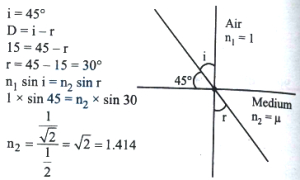
Light enters from air into a given medium at an angle of $45^{\circ}$ with the interface of the air-medium surface. After refraction,the light ray is deviated through an angle of $15^{\circ}$ from its original direction. The refractive index of the medium is
A
$1.732$
B
$1.333$
C
$1.414$
D
$2.732$
Solution
(C) The angle of incidence $i$ is the angle between the incident ray and the normal. The problem states the light enters at an angle of $45^{\circ}$ with the interface. Therefore,the angle of incidence is $i = 90^{\circ} - 45^{\circ} = 45^{\circ}$.
The angle of deviation $D$ is given as $15^{\circ}$. The relationship between the angle of incidence $i$,the angle of refraction $r$,and the angle of deviation $D$ is $D = i - r$.
Substituting the given values: $15^{\circ} = 45^{\circ} - r$,which gives $r = 45^{\circ} - 15^{\circ} = 30^{\circ}$.
Using Snell's law,$n_1 \sin i = n_2 \sin r$,where $n_1 = 1$ (for air) and $n_2 = \mu$ (refractive index of the medium):
$1 \times \sin 45^{\circ} = \mu \times \sin 30^{\circ}$
$\frac{1}{\sqrt{2}} = \mu \times \frac{1}{2}$
$\mu = \frac{2}{\sqrt{2}} = \sqrt{2} \approx 1.414$.
Thus,the refractive index of the medium is $1.414$.
The angle of deviation $D$ is given as $15^{\circ}$. The relationship between the angle of incidence $i$,the angle of refraction $r$,and the angle of deviation $D$ is $D = i - r$.
Substituting the given values: $15^{\circ} = 45^{\circ} - r$,which gives $r = 45^{\circ} - 15^{\circ} = 30^{\circ}$.
Using Snell's law,$n_1 \sin i = n_2 \sin r$,where $n_1 = 1$ (for air) and $n_2 = \mu$ (refractive index of the medium):
$1 \times \sin 45^{\circ} = \mu \times \sin 30^{\circ}$
$\frac{1}{\sqrt{2}} = \mu \times \frac{1}{2}$
$\mu = \frac{2}{\sqrt{2}} = \sqrt{2} \approx 1.414$.
Thus,the refractive index of the medium is $1.414$.
0 likes
View Solution245
MediumMCQ
$A$ ray of light is incident at $30^{\circ}$ from a medium of refractive index $2$ into a medium of refractive index $1$. The angle of refraction is: (in $^{\circ}$)
A
$30$
B
$60$
C
$45$
D
$90$
Solution
(D) According to Snell's law,$n_1 \sin i = n_2 \sin r$.
Given: $n_1 = 2$,$i = 30^{\circ}$,$n_2 = 1$.
Substituting the values into the equation:
$2 \times \sin 30^{\circ} = 1 \times \sin r$
Since $\sin 30^{\circ} = 0.5$,we have:
$2 \times 0.5 = \sin r$
$1 = \sin r$
Therefore,$r = \arcsin(1) = 90^{\circ}$.
Given: $n_1 = 2$,$i = 30^{\circ}$,$n_2 = 1$.
Substituting the values into the equation:
$2 \times \sin 30^{\circ} = 1 \times \sin r$
Since $\sin 30^{\circ} = 0.5$,we have:
$2 \times 0.5 = \sin r$
$1 = \sin r$
Therefore,$r = \arcsin(1) = 90^{\circ}$.
0 likes
View Solution246
MediumMCQ
Light of wavelength $300 \ nm$ in medium $A$ enters into medium $B$ through a plane surface. If the frequency of light is $5 \times 10^{14} \ Hz$ and the ratio of speed in medium $A$ to that in medium $B$ is $\frac{4}{5}$,the absolute refractive index of medium $B$ is:
A
$1.6$
B
$1.5$
C
$1.3$
D
$1.45$
Solution
(A) The speed of light in medium $A$ is given by $v_A = f \lambda_A = (5 \times 10^{14} \ Hz) \times (300 \times 10^{-9} \ m) = 1.5 \times 10^8 \ m/s$.
The absolute refractive index of medium $A$ is $\mu_A = \frac{c}{v_A} = \frac{3 \times 10^8 \ m/s}{1.5 \times 10^8 \ m/s} = 2$.
We are given the ratio of speeds $\frac{v_A}{v_B} = \frac{4}{5}$.
Since the refractive index $\mu$ is inversely proportional to the speed of light $v$ $(\mu = \frac{c}{v})$,we have $\frac{\mu_B}{\mu_A} = \frac{v_A}{v_B}$.
Substituting the values: $\frac{\mu_B}{2} = \frac{4}{5}$.
Therefore,$\mu_B = 2 \times \frac{4}{5} = \frac{8}{5} = 1.6$.
The absolute refractive index of medium $A$ is $\mu_A = \frac{c}{v_A} = \frac{3 \times 10^8 \ m/s}{1.5 \times 10^8 \ m/s} = 2$.
We are given the ratio of speeds $\frac{v_A}{v_B} = \frac{4}{5}$.
Since the refractive index $\mu$ is inversely proportional to the speed of light $v$ $(\mu = \frac{c}{v})$,we have $\frac{\mu_B}{\mu_A} = \frac{v_A}{v_B}$.
Substituting the values: $\frac{\mu_B}{2} = \frac{4}{5}$.
Therefore,$\mu_B = 2 \times \frac{4}{5} = \frac{8}{5} = 1.6$.
0 likes
View Solution247
EasyMCQ
$A$ light wave has a frequency of $4 \times 10^{14} \,Hz$ and a wavelength of $5 \times 10^{-7} \,m$ in a medium. The refractive index of the medium is
A
$1.5$
B
$1.33$
C
$1$
D
$0.66$
Solution
(A) The frequency of the light wave is $v = 4 \times 10^{14} \,Hz$ and the wavelength in the medium is $\lambda_m = 5 \times 10^{-7} \,m$.
The speed of light in the medium is given by $v_m = v \times \lambda_m = (4 \times 10^{14} \,Hz) \times (5 \times 10^{-7} \,m) = 2 \times 10^8 \,m/s$.
The refractive index $\mu$ of a medium is defined as the ratio of the speed of light in a vacuum $(c)$ to the speed of light in the medium $(v_m)$.
Given $c = 3 \times 10^8 \,m/s$.
$\mu = \frac{c}{v_m} = \frac{3 \times 10^8 \,m/s}{2 \times 10^8 \,m/s} = 1.5$.
Therefore,the refractive index of the medium is $1.5$.
The speed of light in the medium is given by $v_m = v \times \lambda_m = (4 \times 10^{14} \,Hz) \times (5 \times 10^{-7} \,m) = 2 \times 10^8 \,m/s$.
The refractive index $\mu$ of a medium is defined as the ratio of the speed of light in a vacuum $(c)$ to the speed of light in the medium $(v_m)$.
Given $c = 3 \times 10^8 \,m/s$.
$\mu = \frac{c}{v_m} = \frac{3 \times 10^8 \,m/s}{2 \times 10^8 \,m/s} = 1.5$.
Therefore,the refractive index of the medium is $1.5$.
0 likes
View Solution248
DifficultMCQ
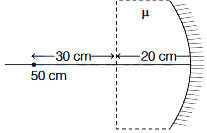
When an object is moved along the principal axis of a concave mirror placed in air,the image coincides with the object if the object is $50 \ cm$ from the mirror. If the mirror is placed at a depth of $20 \ cm$ in a transparent medium,the image coincides with the object when the object is $40 \ cm$ from the mirror. The refractive index of the liquid is
A
$\frac{5}{4}$
B
$\frac{4}{3}$
C
$\frac{3}{2}$
D
$\frac{5}{3}$
Solution
(C) When an object is placed at the center of curvature of a concave mirror,the image coincides with the object. Thus,the radius of curvature $R = 50 \ cm$.
When the mirror is placed in a liquid of refractive index $\mu$,the light rays from the object travel through air and then through the liquid to reach the mirror.
The distance of the mirror from the surface of the liquid is $20 \ cm$. The object is at a distance of $40 \ cm$ from the mirror,which means it is at a distance of $40 - 20 = 20 \ cm$ from the surface of the liquid in the air.
The light rays from the object travel $20 \ cm$ in air and then enter the liquid. The apparent depth of the object as seen from the liquid is $d' = \frac{d}{\mu} = \frac{20}{\mu}$.
The total distance of the object from the mirror as seen by the mirror is $d_{total} = 20 + \frac{20}{\mu}$.
Since the image coincides with the object,this total distance must be equal to the radius of curvature $R = 50 \ cm$.
$20 + \frac{20}{\mu} = 50$
$\frac{20}{\mu} = 30$
$\mu = \frac{20}{30} = \frac{2}{3}$ (Wait,let's re-evaluate: The object is at $40 \ cm$ from the mirror. The mirror is at $20 \ cm$ depth. The distance of the object from the liquid surface is $40 - 20 = 20 \ cm$. The apparent distance of this $20 \ cm$ air-gap as seen from inside the liquid is $20 \times \mu$. So the total distance is $20 + 20\mu = 50 \implies 20\mu = 30 \implies \mu = 1.5 = \frac{3}{2}$.)
Therefore,the correct option is $C$.
When the mirror is placed in a liquid of refractive index $\mu$,the light rays from the object travel through air and then through the liquid to reach the mirror.
The distance of the mirror from the surface of the liquid is $20 \ cm$. The object is at a distance of $40 \ cm$ from the mirror,which means it is at a distance of $40 - 20 = 20 \ cm$ from the surface of the liquid in the air.
The light rays from the object travel $20 \ cm$ in air and then enter the liquid. The apparent depth of the object as seen from the liquid is $d' = \frac{d}{\mu} = \frac{20}{\mu}$.
The total distance of the object from the mirror as seen by the mirror is $d_{total} = 20 + \frac{20}{\mu}$.
Since the image coincides with the object,this total distance must be equal to the radius of curvature $R = 50 \ cm$.
$20 + \frac{20}{\mu} = 50$
$\frac{20}{\mu} = 30$
$\mu = \frac{20}{30} = \frac{2}{3}$ (Wait,let's re-evaluate: The object is at $40 \ cm$ from the mirror. The mirror is at $20 \ cm$ depth. The distance of the object from the liquid surface is $40 - 20 = 20 \ cm$. The apparent distance of this $20 \ cm$ air-gap as seen from inside the liquid is $20 \times \mu$. So the total distance is $20 + 20\mu = 50 \implies 20\mu = 30 \implies \mu = 1.5 = \frac{3}{2}$.)
Therefore,the correct option is $C$.
0 likes
View Solution249
MediumMCQ
Blue light travelling in a vacuum has a wavelength of $450 \ nm$. It enters a medium whose refractive index is $1.5$. What is its frequency in the medium? $(Speed of light in vacuum = 3 \times 10^8 \ m \ s^{-1})$
A
$6.67 \times 10^{14} \ Hz$
B
$10^{15} \ Hz$
C
$4.45 \times 10^{14} \ Hz$
D
$10^{14} \ Hz$
Solution
(A) The frequency of light remains constant when it travels from one medium to another.
The frequency $f$ is given by the formula $f = \frac{c}{\lambda}$, where $c$ is the speed of light in a vacuum and $\lambda$ is the wavelength in a vacuum.
Given: $c = 3 \times 10^8 \ m \ s^{-1}$ and $\lambda = 450 \times 10^{-9} \ m$.
Substituting the values: $f = \frac{3 \times 10^8}{450 \times 10^{-9}} = \frac{3 \times 10^8}{4.5 \times 10^{-7}} = \frac{3}{4.5} \times 10^{15} = 0.666... \times 10^{15} \ Hz = 6.67 \times 10^{14} \ Hz$.
Since frequency is independent of the medium, the frequency in the medium is the same as in the vacuum.
The frequency $f$ is given by the formula $f = \frac{c}{\lambda}$, where $c$ is the speed of light in a vacuum and $\lambda$ is the wavelength in a vacuum.
Given: $c = 3 \times 10^8 \ m \ s^{-1}$ and $\lambda = 450 \times 10^{-9} \ m$.
Substituting the values: $f = \frac{3 \times 10^8}{450 \times 10^{-9}} = \frac{3 \times 10^8}{4.5 \times 10^{-7}} = \frac{3}{4.5} \times 10^{15} = 0.666... \times 10^{15} \ Hz = 6.67 \times 10^{14} \ Hz$.
Since frequency is independent of the medium, the frequency in the medium is the same as in the vacuum.
0 likes
View SolutionRay Optics and Optical Instruments — Refraction of Light · Frequently Asked Questions
1Are these Ray Optics and Optical Instruments questions useful for JEE and NEET?
Yes. All questions in this section are mapped to JEE Main and NEET exam patterns. Previous year questions from JEE Main, NEET, GUJCET and state-level exams are included with full solutions.
2Can I switch to Hindi or Gujarati for these questions?
Yes. Use the language tabs in the hero section or the sidebar to view the same questions and solutions in English, Hindi or Gujarati.
3How do I generate a question paper from this subtopic?
Use the Vedclass Exam Paper Generator — select the chapter and subtopic, set difficulty, and generate Sets A, B, C, D automatically. First 3 chapters of every subject are free.
Vedclass Products
For Students
Vedclass Test Series
Mock tests in real JEE/NEET style with performance analysis. 5-day free trial.
Start Free TrialFor Teachers
Exam Paper Generator
Generate Set A/B/C/D papers from this chapter in 2 minutes. 3 chapters free.
Try FreeFor Institutes
Online Exam Module
Live online exams with unlimited students, 360° analytics & white-label branding.
See DemoFor Teachers & Institutes
Generate a Ray Optics and Optical Instruments Exam Paper in 2 Minutes
Select subtopic & difficulty — Sets A, B, C, D auto-generated with No Repeat logic.
First 3 chapters of every subject are free — no payment required.