
A English
Refraction of Light Questions in English
Class 12 Physics · Ray Optics and Optical Instruments · Refraction of Light
261+
Questions
English
Language
100%
With Solutions
Showing 11 of 261 questions in English
251
MediumMCQ
Refractive index of a medium is $\mu$. If the angle of incidence is twice that of the angle of refraction,then the angle of incidence is
A
$2 \cos ^{-1}\left(\frac{\mu}{2}\right)$
B
$\cos ^{-1}\left(\frac{\mu}{2}\right)$
C
$2 \sin ^{-1}\left(\frac{\mu}{2}\right)$
D
$\sin ^{-1}(\mu)$
Solution
(A) Given,angle of incidence $i = 2r$,where $r$ is the angle of refraction.
According to Snell's law,$\mu_1 \sin i = \mu_2 \sin r$.
Assuming the light travels from air $(\mu_1 = 1)$ to a medium with refractive index $\mu_2 = \mu$,we have:
$1 \cdot \sin(2r) = \mu \sin r$
Using the trigonometric identity $\sin(2r) = 2 \sin r \cos r$,we get:
$2 \sin r \cos r = \mu \sin r$
Since $\sin r \neq 0$,we can divide both sides by $\sin r$:
$2 \cos r = \mu \implies \cos r = \frac{\mu}{2}$
Thus,$r = \cos^{-1}\left(\frac{\mu}{2}\right)$.
Since $i = 2r$,the angle of incidence is $i = 2 \cos^{-1}\left(\frac{\mu}{2}\right)$.
According to Snell's law,$\mu_1 \sin i = \mu_2 \sin r$.
Assuming the light travels from air $(\mu_1 = 1)$ to a medium with refractive index $\mu_2 = \mu$,we have:
$1 \cdot \sin(2r) = \mu \sin r$
Using the trigonometric identity $\sin(2r) = 2 \sin r \cos r$,we get:
$2 \sin r \cos r = \mu \sin r$
Since $\sin r \neq 0$,we can divide both sides by $\sin r$:
$2 \cos r = \mu \implies \cos r = \frac{\mu}{2}$
Thus,$r = \cos^{-1}\left(\frac{\mu}{2}\right)$.
Since $i = 2r$,the angle of incidence is $i = 2 \cos^{-1}\left(\frac{\mu}{2}\right)$.
0 likes
View Solution252
EasyMCQ
$A$ beam of light is propagating at an angle $\alpha_1$ from medium $1$ into medium $2$ at an angle $\alpha_2$. If the wavelength of light in medium $1$ is $\lambda_1$,then the wavelength of light in medium $2$,$\lambda_2$,is:
A
$\frac{\sin \alpha_2}{\sin \alpha_1} \lambda_1$
B
$\frac{\sin \alpha_1}{\sin \alpha_2} \lambda_2$
C
$\left(\frac{\alpha_1}{\alpha_2}\right) \lambda_1$
D
$\lambda_1$
Solution
(A) According to Snell's Law,the ratio of the sines of the angles of incidence and refraction is equal to the ratio of the refractive indices of the two media:
$\frac{\sin \alpha_1}{\sin \alpha_2} = \frac{\mu_2}{\mu_1}$
We also know that the refractive index $\mu$ is inversely proportional to the wavelength $\lambda$ in the medium,given by $\mu = \frac{c}{v} = \frac{\lambda_0}{\lambda}$,where $\lambda_0$ is the wavelength in vacuum.
Therefore,$\frac{\mu_2}{\mu_1} = \frac{\lambda_1}{\lambda_2}$.
Equating the two expressions,we get:
$\frac{\sin \alpha_1}{\sin \alpha_2} = \frac{\lambda_1}{\lambda_2}$
Rearranging for $\lambda_2$,we find:
$\lambda_2 = \lambda_1 \frac{\sin \alpha_2}{\sin \alpha_1}$
$\frac{\sin \alpha_1}{\sin \alpha_2} = \frac{\mu_2}{\mu_1}$
We also know that the refractive index $\mu$ is inversely proportional to the wavelength $\lambda$ in the medium,given by $\mu = \frac{c}{v} = \frac{\lambda_0}{\lambda}$,where $\lambda_0$ is the wavelength in vacuum.
Therefore,$\frac{\mu_2}{\mu_1} = \frac{\lambda_1}{\lambda_2}$.
Equating the two expressions,we get:
$\frac{\sin \alpha_1}{\sin \alpha_2} = \frac{\lambda_1}{\lambda_2}$
Rearranging for $\lambda_2$,we find:
$\lambda_2 = \lambda_1 \frac{\sin \alpha_2}{\sin \alpha_1}$
0 likes
View Solution253
EasyMCQ
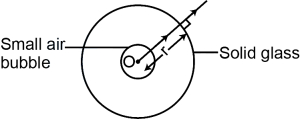
There is a small air bubble at the centre of a solid glass sphere of radius $r$ and refractive index $\mu$. What will be the apparent distance of the bubble from the centre of the sphere,when viewed from outside?
A
$r$
B
$\frac{r}{\mu}$
C
$r(1 - \frac{1}{\mu})$
D
Zero
Solution
(D) The air bubble is located at the centre $O$ of the solid glass sphere.
When light rays originating from the air bubble travel towards the surface of the sphere,they move along the radius of the sphere.
Since the radius is always perpendicular to the surface of the sphere,the light rays strike the surface at an angle of incidence $i = 0^\circ$.
According to Snell's law,when light is incident normally on a surface,it does not undergo any refraction or deviation.
Therefore,the light rays continue to travel in a straight line without bending.
As a result,the observer looking from outside sees the image of the bubble at the same position as the object.
Thus,the apparent distance of the bubble from the centre of the sphere is zero.
When light rays originating from the air bubble travel towards the surface of the sphere,they move along the radius of the sphere.
Since the radius is always perpendicular to the surface of the sphere,the light rays strike the surface at an angle of incidence $i = 0^\circ$.
According to Snell's law,when light is incident normally on a surface,it does not undergo any refraction or deviation.
Therefore,the light rays continue to travel in a straight line without bending.
As a result,the observer looking from outside sees the image of the bubble at the same position as the object.
Thus,the apparent distance of the bubble from the centre of the sphere is zero.
0 likes
View Solution254
DifficultMCQ
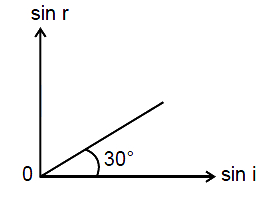
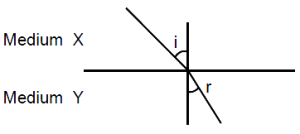
$A$ ray of monochromatic light is incident on the plane surface of separation between two media $X$ and $Y$ with angle of incidence $i$ in medium $X$ and angle of refraction $r$ in medium $Y$. The given graph shows the relation between $\sin i$ and $\sin r$. If $V_X$ and $V_Y$ are the velocities of the ray in media $X$ and $Y$ respectively,then which of the following is true?
A
$V_X = \frac{1}{\sqrt{3}} V_Y$
B
$V_X = \sqrt{3} V_Y$
C
Total internal reflection can happen when the light is incident in medium $X$.
D
$v_X = \sqrt{3} v_Y$,where $v_X$ and $v_Y$ are frequencies of the light in medium $X$ and $Y$ respectively.
Solution
(B) From Snell's law,we have $\mu_X \sin i = \mu_Y \sin r$.
Since $\mu = \frac{c}{V}$,we can write $\frac{c}{V_X} \sin i = \frac{c}{V_Y} \sin r$,which simplifies to $\frac{\sin i}{\sin r} = \frac{V_X}{V_Y}$.
From the given graph,the slope of the line is $\tan 30^{\circ} = \frac{\sin r}{\sin i} = \frac{1}{\sqrt{3}}$.
Therefore,$\frac{\sin i}{\sin r} = \sqrt{3}$.
Substituting this into the velocity ratio,we get $\frac{V_X}{V_Y} = \sqrt{3}$,which implies $V_X = \sqrt{3} V_Y$.
Since the light travels from a rarer medium $(X)$ to a denser medium $(Y)$ (as $r < i$),total internal reflection cannot occur when light is incident from medium $X$ to $Y$. Frequency remains constant during refraction.
Since $\mu = \frac{c}{V}$,we can write $\frac{c}{V_X} \sin i = \frac{c}{V_Y} \sin r$,which simplifies to $\frac{\sin i}{\sin r} = \frac{V_X}{V_Y}$.
From the given graph,the slope of the line is $\tan 30^{\circ} = \frac{\sin r}{\sin i} = \frac{1}{\sqrt{3}}$.
Therefore,$\frac{\sin i}{\sin r} = \sqrt{3}$.
Substituting this into the velocity ratio,we get $\frac{V_X}{V_Y} = \sqrt{3}$,which implies $V_X = \sqrt{3} V_Y$.
Since the light travels from a rarer medium $(X)$ to a denser medium $(Y)$ (as $r < i$),total internal reflection cannot occur when light is incident from medium $X$ to $Y$. Frequency remains constant during refraction.
0 likes
View Solution255
EasyMCQ
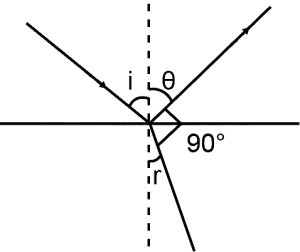
$A$ ray of light is incident at an angle $i$ on a glass slab of refractive index $\mu$. The angle between the reflected and refracted light is $90^{\circ}$. Then,the relationship between $i$ and $\mu$ is
A
$i=\tan ^{-1}\left(\frac{1}{\mu}\right)$
B
$\tan i=\mu$
C
$\sin i=\mu$
D
$\cos i=\mu$
Solution
(B) According to the law of reflection,the angle of incidence $i$ is equal to the angle of reflection $\theta$. So,$i = \theta$.
The sum of the angles on a straight line is $180^{\circ}$. Therefore,the angle of reflection $\theta$,the angle between the reflected and refracted rays $(90^{\circ})$,and the angle of refraction $r$ must satisfy:
$\theta + 90^{\circ} + r = 180^{\circ}$
Substituting $\theta = i$:
$i + 90^{\circ} + r = 180^{\circ}$
$r = 90^{\circ} - i$
According to Snell's law,$\mu = \frac{\sin i}{\sin r}$.
Substituting $r = 90^{\circ} - i$:
$\mu = \frac{\sin i}{\sin(90^{\circ} - i)}$
Since $\sin(90^{\circ} - i) = \cos i$,we get:
$\mu = \frac{\sin i}{\cos i} = \tan i$
Thus,$\tan i = \mu$.
The sum of the angles on a straight line is $180^{\circ}$. Therefore,the angle of reflection $\theta$,the angle between the reflected and refracted rays $(90^{\circ})$,and the angle of refraction $r$ must satisfy:
$\theta + 90^{\circ} + r = 180^{\circ}$
Substituting $\theta = i$:
$i + 90^{\circ} + r = 180^{\circ}$
$r = 90^{\circ} - i$
According to Snell's law,$\mu = \frac{\sin i}{\sin r}$.
Substituting $r = 90^{\circ} - i$:
$\mu = \frac{\sin i}{\sin(90^{\circ} - i)}$
Since $\sin(90^{\circ} - i) = \cos i$,we get:
$\mu = \frac{\sin i}{\cos i} = \tan i$
Thus,$\tan i = \mu$.
0 likes
View Solution256
EasyMCQ
When light is refracted from a surface,which of its following physical parameters does not change?
A
Velocity
B
Amplitude
C
Frequency
D
Wavelength
Solution
(C) When light travels from one medium to another,its speed and wavelength change because the optical density of the medium changes. However,the frequency of light is determined by the source of the light and remains constant during refraction. Therefore,the frequency does not change.
0 likes
View Solution257
MediumMCQ
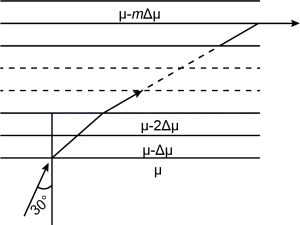
$A$ glass slab consists of thin uniform layers of progressively decreasing refractive indices $(RI)$ such that the $RI$ of any layer is $\mu - m \Delta \mu$. Here,$\mu$ and $\Delta \mu$ denote the $RI$ of the $0^{\text{th}}$ layer and the difference in $RI$ between any two consecutive layers,respectively. The integer $m = 0, 1, 2, 3, \ldots$ denotes the number of the successive layers. $A$ ray of light from the $0^{\text{th}}$ layer enters the $1^{\text{st}}$ layer at an angle of incidence of $30^{\circ}$. After undergoing the $m^{\text{th}}$ refraction,the ray emerges parallel to the interface. If $\mu = 1.5$ and $\Delta \mu = 0.015$,the value of $m$ is:
A
$20$
B
$30$
C
$40$
D
$50$
Solution
(D) According to Snell's law,for a series of parallel layers,the product of the refractive index and the sine of the angle of incidence remains constant at every interface.
Let $\mu_0$ be the refractive index of the $0^{\text{th}}$ layer and $i_0$ be the angle of incidence at the first interface.
$\mu_0 \sin i_0 = \mu_m \sin r_m$
Given:
$\mu_0 = \mu = 1.5$
$i_0 = 30^{\circ}$
$\mu_m = \mu - m \Delta \mu = 1.5 - m(0.015)$
Since the ray emerges parallel to the interface after the $m^{\text{th}}$ refraction,the angle of refraction $r_m = 90^{\circ}$.
Substituting the values:
$1.5 \sin 30^{\circ} = (1.5 - m \times 0.015) \sin 90^{\circ}$
$1.5 \times 0.5 = (1.5 - 0.015m) \times 1$
$0.75 = 1.5 - 0.015m$
$0.015m = 1.5 - 0.75$
$0.015m = 0.75$
$m = \frac{0.75}{0.015} = \frac{750}{15} = 50$
Thus,the value of $m$ is $50$.
Let $\mu_0$ be the refractive index of the $0^{\text{th}}$ layer and $i_0$ be the angle of incidence at the first interface.
$\mu_0 \sin i_0 = \mu_m \sin r_m$
Given:
$\mu_0 = \mu = 1.5$
$i_0 = 30^{\circ}$
$\mu_m = \mu - m \Delta \mu = 1.5 - m(0.015)$
Since the ray emerges parallel to the interface after the $m^{\text{th}}$ refraction,the angle of refraction $r_m = 90^{\circ}$.
Substituting the values:
$1.5 \sin 30^{\circ} = (1.5 - m \times 0.015) \sin 90^{\circ}$
$1.5 \times 0.5 = (1.5 - 0.015m) \times 1$
$0.75 = 1.5 - 0.015m$
$0.015m = 1.5 - 0.75$
$0.015m = 0.75$
$m = \frac{0.75}{0.015} = \frac{750}{15} = 50$
Thus,the value of $m$ is $50$.
0 likes
View Solution258
MediumMCQ
$A$ beam of monochromatic blue light of wavelength $4200 Å$ in air travels in water of refractive index $4/3$. Its wavelength in water will be: (in $Å$)
A
$4200$
B
$5800$
C
$4150$
D
$3150$
Solution
(D) The wavelength of light in a medium is given by the formula $\lambda_m = \frac{\lambda_0}{n}$,where $\lambda_0$ is the wavelength in vacuum (or air) and $n$ is the refractive index of the medium.
Given:
$\lambda_0 = 4200 Å$
$n = 4/3$
Substituting the values:
$\lambda_m = \frac{4200}{4/3} = 4200 \times \frac{3}{4} = 1050 \times 3 = 3150 Å$.
Therefore,the wavelength of the light in water is $3150 Å$.
Given:
$\lambda_0 = 4200 Å$
$n = 4/3$
Substituting the values:
$\lambda_m = \frac{4200}{4/3} = 4200 \times \frac{3}{4} = 1050 \times 3 = 3150 Å$.
Therefore,the wavelength of the light in water is $3150 Å$.
0 likes
View Solution259
MediumMCQ
The wavelength of light,while it is passing through water,is $540 \ nm$. The refractive index of water is $\frac{4}{3}$. The wavelength of the same light when it is passing through a transparent medium having a refractive index of $\frac{3}{2}$ is . . . . . . $nm$.
A
$380$
B
$840$
C
$480$
D
$540$
Solution
(C) The frequency $f$ of light remains constant when it travels from one medium to another.
Since $v = f \lambda$ and $v = \frac{c}{\mu}$,we have $\frac{c}{\mu} = f \lambda$,which implies $\mu \lambda = \frac{c}{f} = \text{constant}$.
Therefore,$\mu_1 \lambda_1 = \mu_2 \lambda_2$.
Given: $\mu_1 = \frac{4}{3}$,$\lambda_1 = 540 \ nm$,and $\mu_2 = \frac{3}{2}$.
Substituting the values: $\left(\frac{4}{3}\right) \times 540 = \left(\frac{3}{2}\right) \times \lambda_2$.
$\lambda_2 = 540 \times \frac{4}{3} \times \frac{2}{3}$.
$\lambda_2 = 540 \times \frac{8}{9} = 60 \times 8 = 480 \ nm$.
Since $v = f \lambda$ and $v = \frac{c}{\mu}$,we have $\frac{c}{\mu} = f \lambda$,which implies $\mu \lambda = \frac{c}{f} = \text{constant}$.
Therefore,$\mu_1 \lambda_1 = \mu_2 \lambda_2$.
Given: $\mu_1 = \frac{4}{3}$,$\lambda_1 = 540 \ nm$,and $\mu_2 = \frac{3}{2}$.
Substituting the values: $\left(\frac{4}{3}\right) \times 540 = \left(\frac{3}{2}\right) \times \lambda_2$.
$\lambda_2 = 540 \times \frac{4}{3} \times \frac{2}{3}$.
$\lambda_2 = 540 \times \frac{8}{9} = 60 \times 8 = 480 \ nm$.
0 likes
View Solution260
MediumMCQ
The speed of light in a medium is $200 \times 10^8 \text{ cm/s}$. The refractive index of the medium is . . . . . . $(c = 3 \times 10^8 \text{ m/s})$.
A
$2.42$
B
$1$
C
$1.5$
D
$1.33$
Solution
(C) The speed of light in a vacuum is $c = 3 \times 10^8 \text{ m/s}$.
The speed of light in the medium is $v = 200 \times 10^8 \text{ cm/s}$.
First,convert the speed in the medium to $\text{m/s}$:
$v = 200 \times 10^8 \times 10^{-2} \text{ m/s} = 2 \times 10^8 \text{ m/s}$.
The refractive index $n$ is given by the formula $n = \frac{c}{v}$.
Substituting the values: $n = \frac{3 \times 10^8 \text{ m/s}}{2 \times 10^8 \text{ m/s}} = 1.5$.
The speed of light in the medium is $v = 200 \times 10^8 \text{ cm/s}$.
First,convert the speed in the medium to $\text{m/s}$:
$v = 200 \times 10^8 \times 10^{-2} \text{ m/s} = 2 \times 10^8 \text{ m/s}$.
The refractive index $n$ is given by the formula $n = \frac{c}{v}$.
Substituting the values: $n = \frac{3 \times 10^8 \text{ m/s}}{2 \times 10^8 \text{ m/s}} = 1.5$.
0 likes
View Solution261
DifficultMCQ
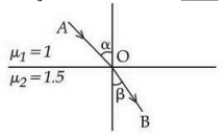
$A$ light ray incident along a vector $\vec{AO}$ $(\vec{AO} = 2\hat{i} - 3\hat{j})$ emerges along a vector $\vec{OB}$ $(\vec{OB} = C\hat{i} - 4\hat{j})$ as shown in the figure. The value of $C$ is . . . . . . .
A
$1.6$
B
$0.16$
C
$11.6$
D
$16$
Solution
(A) From Snell's law,$\mu_1 \sin \alpha = \mu_2 \sin \beta$.
Given $\mu_1 = 1$ and $\mu_2 = 1.5$.
The vector $\vec{AO} = 2\hat{i} - 3\hat{j}$ makes an angle $\alpha$ with the vertical axis (y-axis). Thus,$\tan \alpha = \frac{|x|}{|y|} = \frac{2}{3}$.
Therefore,$\sin \alpha = \frac{2}{\sqrt{2^2 + 3^2}} = \frac{2}{\sqrt{13}}$.
Using Snell's law: $\sin \beta = \frac{\mu_1}{\mu_2} \sin \alpha = \frac{1}{1.5} \times \frac{2}{\sqrt{13}} = \frac{2}{1.5 \sqrt{13}} = \frac{4}{3\sqrt{13}}$.
The refracted vector is $\vec{OB} = C\hat{i} - 4\hat{j}$. The angle $\beta$ is with the vertical axis,so $\sin \beta = \frac{|C|}{\sqrt{C^2 + (-4)^2}} = \frac{C}{\sqrt{C^2 + 16}}$.
Equating the two expressions for $\sin \beta$: $\frac{C}{\sqrt{C^2 + 16}} = \frac{4}{3\sqrt{13}}$.
Squaring both sides: $\frac{C^2}{C^2 + 16} = \frac{16}{9 \times 13} = \frac{16}{117}$.
$117C^2 = 16(C^2 + 16) \implies 117C^2 = 16C^2 + 256$.
$101C^2 = 256 \implies C^2 = \frac{256}{101} \approx 2.534$.
$C = \sqrt{2.534} \approx 1.59 \approx 1.6$.
Given $\mu_1 = 1$ and $\mu_2 = 1.5$.
The vector $\vec{AO} = 2\hat{i} - 3\hat{j}$ makes an angle $\alpha$ with the vertical axis (y-axis). Thus,$\tan \alpha = \frac{|x|}{|y|} = \frac{2}{3}$.
Therefore,$\sin \alpha = \frac{2}{\sqrt{2^2 + 3^2}} = \frac{2}{\sqrt{13}}$.
Using Snell's law: $\sin \beta = \frac{\mu_1}{\mu_2} \sin \alpha = \frac{1}{1.5} \times \frac{2}{\sqrt{13}} = \frac{2}{1.5 \sqrt{13}} = \frac{4}{3\sqrt{13}}$.
The refracted vector is $\vec{OB} = C\hat{i} - 4\hat{j}$. The angle $\beta$ is with the vertical axis,so $\sin \beta = \frac{|C|}{\sqrt{C^2 + (-4)^2}} = \frac{C}{\sqrt{C^2 + 16}}$.
Equating the two expressions for $\sin \beta$: $\frac{C}{\sqrt{C^2 + 16}} = \frac{4}{3\sqrt{13}}$.
Squaring both sides: $\frac{C^2}{C^2 + 16} = \frac{16}{9 \times 13} = \frac{16}{117}$.
$117C^2 = 16(C^2 + 16) \implies 117C^2 = 16C^2 + 256$.
$101C^2 = 256 \implies C^2 = \frac{256}{101} \approx 2.534$.
$C = \sqrt{2.534} \approx 1.59 \approx 1.6$.
0 likes
View SolutionRay Optics and Optical Instruments — Refraction of Light · Frequently Asked Questions
1Are these Ray Optics and Optical Instruments questions useful for JEE and NEET?
Yes. All questions in this section are mapped to JEE Main and NEET exam patterns. Previous year questions from JEE Main, NEET, GUJCET and state-level exams are included with full solutions.
2Can I switch to Hindi or Gujarati for these questions?
Yes. Use the language tabs in the hero section or the sidebar to view the same questions and solutions in English, Hindi or Gujarati.
3How do I generate a question paper from this subtopic?
Use the Vedclass Exam Paper Generator — select the chapter and subtopic, set difficulty, and generate Sets A, B, C, D automatically. First 3 chapters of every subject are free.
Vedclass Products
For Students
Vedclass Test Series
Mock tests in real JEE/NEET style with performance analysis. 5-day free trial.
Start Free TrialFor Teachers
Exam Paper Generator
Generate Set A/B/C/D papers from this chapter in 2 minutes. 3 chapters free.
Try FreeFor Institutes
Online Exam Module
Live online exams with unlimited students, 360° analytics & white-label branding.
See DemoFor Teachers & Institutes
Generate a Ray Optics and Optical Instruments Exam Paper in 2 Minutes
Select subtopic & difficulty — Sets A, B, C, D auto-generated with No Repeat logic.
First 3 chapters of every subject are free — no payment required.