
A English
Human Eye and Defects of Vision Questions in English
Class 12 Physics · Ray Optics and Optical Instruments · Human Eye and Defects of Vision
98+
Questions
English
Language
100%
With Solutions
Showing 48 of 98 questions in English
51
EasyMCQ
$A$ defective eye cannot see close objects clearly because their image is formed
A
On the eye lens
B
Between eye lens and retina
C
On the retina
D
Beyond retina
Solution
(D) The condition described is $Hypermetropia$ (farsightedness).
In a normal eye,the image of a close object is formed on the retina.
In a hypermetropic eye,the eyeball is too short or the lens is too flat,causing the light rays from a nearby object to converge at a point behind the retina.
Therefore,the image is formed beyond the retina,making close objects appear blurry.
In a normal eye,the image of a close object is formed on the retina.
In a hypermetropic eye,the eyeball is too short or the lens is too flat,causing the light rays from a nearby object to converge at a point behind the retina.
Therefore,the image is formed beyond the retina,making close objects appear blurry.
0 likes
View Solution52
EasyMCQ
The image formed on the retina of the eye is proportional to:
A
Size of the object
B
Area of the object
C
$\frac{\text{Size of object}}{\text{Size of image}}$
D
$\frac{\text{Size of image}}{\text{Size of object}}$
Solution
(A) The size of the image formed on the retina is directly proportional to the size of the object placed in front of the eye. As the object size increases,the angle subtended by the object at the eye increases,leading to a larger image on the retina. Therefore,the correct option is $A$.
0 likes
View Solution53
MediumMCQ
$A$ student can distinctly see objects up to a distance of $15 \, cm$. He wants to see the blackboard at a distance of $3 \, m$. The focal length and power of the lens used,respectively,will be:
A
$ - 4.8 \, cm, - 3.3 \, D$
B
$ - 5.8 \, cm, - 4.3 \, D$
C
$ - 7.5 \, cm, - 6.3 \, D$
D
$ - 15.8 \, cm, - 6.3 \, D$
Solution
(D) The student suffers from myopia (nearsightedness). To see objects at infinity (or a far distance),the lens must form a virtual image of the object at the student's far point.
Given: Far point $v = -15 \, cm$,Object distance $u = -300 \, cm$ $(3 \, m = 300 \, cm)$.
Using the lens formula: $\frac{1}{f} = \frac{1}{v} - \frac{1}{u}$.
Substituting the values: $\frac{1}{f} = \frac{1}{-15} - \frac{1}{-300} = \frac{-20 + 1}{300} = \frac{-19}{300}$.
Therefore,$f = -\frac{300}{19} \approx -15.8 \, cm$.
The power of the lens is given by $P = \frac{100}{f (cm)} = \frac{100}{-15.789} \approx -6.33 \, D$.
Thus,the focal length is $-15.8 \, cm$ and the power is $-6.3 \, D$.
Given: Far point $v = -15 \, cm$,Object distance $u = -300 \, cm$ $(3 \, m = 300 \, cm)$.
Using the lens formula: $\frac{1}{f} = \frac{1}{v} - \frac{1}{u}$.
Substituting the values: $\frac{1}{f} = \frac{1}{-15} - \frac{1}{-300} = \frac{-20 + 1}{300} = \frac{-19}{300}$.
Therefore,$f = -\frac{300}{19} \approx -15.8 \, cm$.
The power of the lens is given by $P = \frac{100}{f (cm)} = \frac{100}{-15.789} \approx -6.33 \, D$.
Thus,the focal length is $-15.8 \, cm$ and the power is $-6.3 \, D$.
0 likes
View Solution54
EasyMCQ
The ability of the eye to see objects at all distances is called
A
Binocular vision
B
Myopia
C
Hypermetropia
D
Accommodation
Solution
(D) The ability of the human eye to adjust its focal length by changing the curvature of the crystalline lens,allowing it to focus on objects at varying distances,is known as accommodation.
Therefore,the correct option is $D$.
Therefore,the correct option is $D$.
0 likes
View Solution55
EasyMCQ
Identify the wrong description of the above figures.
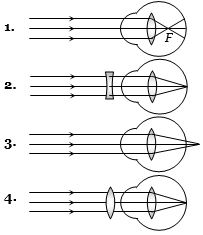
A
$1$ represents far-sightedness.
B
$2$ represents correction for short-sightedness.
C
$3$ represents far-sightedness.
D
$4$ represents correction for far-sightedness.
Solution
(A) In figure $1$,parallel rays from infinity focus before the retina,which is the condition for myopia (short-sightedness). Therefore,the statement '$1$ represents far-sightedness' is incorrect.
In figure $2$,a concave lens is used to correct myopia (short-sightedness).
In figure $3$,parallel rays focus behind the retina,which is the condition for hypermetropia (far-sightedness).
In figure $4$,a convex lens is used to correct hypermetropia (far-sightedness).
Thus,option $A$ is the wrong description.
In figure $2$,a concave lens is used to correct myopia (short-sightedness).
In figure $3$,parallel rays focus behind the retina,which is the condition for hypermetropia (far-sightedness).
In figure $4$,a convex lens is used to correct hypermetropia (far-sightedness).
Thus,option $A$ is the wrong description.
0 likes
View Solution56
MediumMCQ
$A$ lens of power $0.66 \ D$ is used to correct myopia. What is the far point of the eye in $cm$?
A
$100$
B
$151.5$
C
$50$
D
$25$
Solution
(B) For a myopic eye,the far point is at a finite distance $v$ instead of infinity. The corrective lens must form an image of an object at infinity at the person's far point.
Using the lens formula: $\frac{1}{f} = \frac{1}{v} - \frac{1}{u}$.
Given power $P = -0.66 \ D$ (since it is for myopia,the lens is concave).
Focal length $f = \frac{1}{P} = \frac{1}{-0.66} \ m = -\frac{100}{66} \ cm \approx -151.5 \ cm$.
For an object at infinity $(u = -\infty)$,the image is formed at the far point $v$:
$\frac{1}{f} = \frac{1}{v} - \frac{1}{-\infty} \implies \frac{1}{f} = \frac{1}{v} \implies v = f$.
Thus,the far point is $151.5 \ cm$.
Using the lens formula: $\frac{1}{f} = \frac{1}{v} - \frac{1}{u}$.
Given power $P = -0.66 \ D$ (since it is for myopia,the lens is concave).
Focal length $f = \frac{1}{P} = \frac{1}{-0.66} \ m = -\frac{100}{66} \ cm \approx -151.5 \ cm$.
For an object at infinity $(u = -\infty)$,the image is formed at the far point $v$:
$\frac{1}{f} = \frac{1}{v} - \frac{1}{-\infty} \implies \frac{1}{f} = \frac{1}{v} \implies v = f$.
Thus,the far point is $151.5 \ cm$.
0 likes
View Solution57
EasyMCQ
The near point and far point of a normal human eye are respectively:
A
$0$ and $25 \, cm$
B
$25 \, cm$ and $50 \, cm$
C
$50 \, cm$ and $100 \, cm$
D
$25 \, cm$ and infinity
Solution
(D) The near point of a normal human eye is the minimum distance at which an object can be seen clearly without strain,which is $25 \, cm$.
The far point of a normal human eye is the maximum distance at which an object can be seen clearly,which is at infinity for a healthy eye.
The far point of a normal human eye is the maximum distance at which an object can be seen clearly,which is at infinity for a healthy eye.
0 likes
View Solution58
EasyMCQ
Myopia can be corrected with the help of a/an ...
A
Concave lens
B
Convex lens
C
Cylindrical lens
D
Surgical diagnosis
Solution
(A) Myopia,also known as near-sightedness,is a defect of the human eye where distant objects cannot be seen clearly because the image is formed in front of the retina.
To correct this defect,a concave lens (diverging lens) is used to diverge the incoming light rays before they enter the eye,allowing the image to be focused correctly on the retina.
Therefore,the correct option is $A$.
To correct this defect,a concave lens (diverging lens) is used to diverge the incoming light rays before they enter the eye,allowing the image to be focused correctly on the retina.
Therefore,the correct option is $A$.
0 likes
View Solution59
EasyMCQ
When the human eye is focused on an object,at what position are the ciliary muscles least strained?
A
Far from the eye
B
Very close to the eye
C
$25 \ cm$ from the eye
D
$1 \ m$ from the eye
Solution
(A) The eye lens is composed of a fibrous,jelly-like material. Its curvature can be modified to some extent by the ciliary muscles. The change in the curvature of the eye lens changes its focal length.
When the ciliary muscles are relaxed,the lens becomes thin,which increases its focal length. This state enables the eye to see distant objects clearly with minimal strain.
When we look at objects closer to the eye,the ciliary muscles contract to increase the curvature of the eye lens,making it thicker and decreasing its focal length. This process requires more effort from the muscles.
Therefore,the muscles of a normal eye are least strained when the eye is focused on an object far away.
When the ciliary muscles are relaxed,the lens becomes thin,which increases its focal length. This state enables the eye to see distant objects clearly with minimal strain.
When we look at objects closer to the eye,the ciliary muscles contract to increase the curvature of the eye lens,making it thicker and decreasing its focal length. This process requires more effort from the muscles.
Therefore,the muscles of a normal eye are least strained when the eye is focused on an object far away.
0 likes
View Solution60
MediumMCQ
$A$ person has a near point of $50 \, cm$ and a far point of $3 \, m$. What power of lens is required to $(i)$ read and $(ii)$ see distant stars?
A
$-2 \, D$ and $0.33 \, D$
B
$2 \, D$ and $-0.33 \, D$
C
$-2 \, D$ and $3 \, D$
D
$2 \, D$ and $-3 \, D$
Solution
(B) For $(i)$ reading,the person needs to see an object at the standard near point $(u = -25 \, cm)$ as if it were at their actual near point $(v = -50 \, cm)$.
Using the lens formula $\frac{1}{f} = \frac{1}{v} - \frac{1}{u}$:
$\frac{1}{f} = \frac{1}{-50} - \frac{1}{-25} = \frac{-1 + 2}{50} = \frac{1}{50} \, cm^{-1}$.
Power $P = \frac{100}{f(cm)} = \frac{100}{50} = +2 \, D$.
For $(ii)$ seeing distant stars,the person needs to see an object at infinity $(u = \infty)$ as if it were at their far point $(v = -3 \, m)$.
Using the lens formula $\frac{1}{f} = \frac{1}{v} - \frac{1}{u}$:
$\frac{1}{f} = \frac{1}{-3} - \frac{1}{\infty} = -\frac{1}{3} \, m^{-1}$.
Power $P = \frac{1}{f(m)} = -\frac{1}{3} \approx -0.33 \, D$.
Using the lens formula $\frac{1}{f} = \frac{1}{v} - \frac{1}{u}$:
$\frac{1}{f} = \frac{1}{-50} - \frac{1}{-25} = \frac{-1 + 2}{50} = \frac{1}{50} \, cm^{-1}$.
Power $P = \frac{100}{f(cm)} = \frac{100}{50} = +2 \, D$.
For $(ii)$ seeing distant stars,the person needs to see an object at infinity $(u = \infty)$ as if it were at their far point $(v = -3 \, m)$.
Using the lens formula $\frac{1}{f} = \frac{1}{v} - \frac{1}{u}$:
$\frac{1}{f} = \frac{1}{-3} - \frac{1}{\infty} = -\frac{1}{3} \, m^{-1}$.
Power $P = \frac{1}{f(m)} = -\frac{1}{3} \approx -0.33 \, D$.
0 likes
View Solution61
EasyMCQ
Myopia is a defect of the eye due to which a person experiences difficulty in seeing .......
A
Distant objects
B
Nearby objects
C
Objects at all distances
D
Colors
Solution
(A) Myopia,also known as nearsightedness,is a vision condition in which people can see close objects clearly,but objects farther away appear blurred.
This occurs because the eyeball is too long or the cornea is too curved,causing light entering the eye to focus in front of the retina instead of directly on it.
Therefore,a person with myopia experiences difficulty in seeing distant objects clearly.
This occurs because the eyeball is too long or the cornea is too curved,causing light entering the eye to focus in front of the retina instead of directly on it.
Therefore,a person with myopia experiences difficulty in seeing distant objects clearly.
0 likes
View Solution62
MediumMCQ
$A$ person cannot see an object clearly if it is placed beyond $100 \, cm$. Find the power of the lens required to see an object clearly at infinity.
A
$+1.33 \, D$
B
$-1.0 \, D$
C
$+1.23 \, D$
D
$+2.33 \, D$
Solution
(B) The person is suffering from myopia (nearsightedness), as they cannot see distant objects clearly.
To correct this, the lens must form a virtual image of an object at infinity $(u = -\infty)$ at the person's far point $(v = -100 \, cm = -1 \, m)$.
Using the lens formula: $\frac{1}{f} = \frac{1}{v} - \frac{1}{u}$.
Substituting the values: $\frac{1}{f} = \frac{1}{-1} - \frac{1}{-\infty} = -1 - 0 = -1 \, m^{-1}$.
The power of the lens $P$ is given by $P = \frac{1}{f(\text{in meters})}$.
Therefore, $P = -1 \, D$.
To correct this, the lens must form a virtual image of an object at infinity $(u = -\infty)$ at the person's far point $(v = -100 \, cm = -1 \, m)$.
Using the lens formula: $\frac{1}{f} = \frac{1}{v} - \frac{1}{u}$.
Substituting the values: $\frac{1}{f} = \frac{1}{-1} - \frac{1}{-\infty} = -1 - 0 = -1 \, m^{-1}$.
The power of the lens $P$ is given by $P = \frac{1}{f(\text{in meters})}$.
Therefore, $P = -1 \, D$.
0 likes
View Solution63
EasyMCQ
$A$ person has a near point of $50\, cm$. What lens should they use to reduce it to $25\, cm$?
A
Concave lens of focal length $50\, cm$
B
Convex lens of focal length $25\, cm$
C
Convex lens of focal length $50\, cm$
D
Concave lens of focal length $25\, cm$
Solution
(C) The person wants to see an object placed at $u = -25\, cm$ as if it were at their near point $v = -50\, cm$.
Using the lens formula: $\frac{1}{f} = \frac{1}{v} - \frac{1}{u}$.
Substituting the values: $\frac{1}{f} = \frac{1}{-50} - \frac{1}{-25}$.
$\frac{1}{f} = -\frac{1}{50} + \frac{1}{25} = \frac{-1 + 2}{50} = \frac{1}{50}$.
Thus,$f = +50\, cm$.
$A$ positive focal length indicates a convex lens of focal length $50\, cm$.
Using the lens formula: $\frac{1}{f} = \frac{1}{v} - \frac{1}{u}$.
Substituting the values: $\frac{1}{f} = \frac{1}{-50} - \frac{1}{-25}$.
$\frac{1}{f} = -\frac{1}{50} + \frac{1}{25} = \frac{-1 + 2}{50} = \frac{1}{50}$.
Thus,$f = +50\, cm$.
$A$ positive focal length indicates a convex lens of focal length $50\, cm$.
0 likes
View Solution64
MediumMCQ
$A$ person cannot see objects clearly beyond a distance of $40 \, cm$. What power of lens should be prescribed for them?
A
$+2.5 \, D$
B
$-2.5 \, D$
C
$+0.4 \, D$
D
$-0.4 \, D$
Solution
(B) The person is suffering from myopia (nearsightedness),as they cannot see distant objects clearly. The far point of the person is $v = -40 \, cm$.
To correct this,we need to use a concave lens that forms a virtual image of an object at infinity at the person's far point $(u = -\infty)$.
Using the lens formula: $\frac{1}{f} = \frac{1}{v} - \frac{1}{u}$.
Substituting the values: $\frac{1}{f} = \frac{1}{-40} - \frac{1}{-\infty} = \frac{1}{-40} - 0 = -\frac{1}{40} \, cm^{-1}$.
The power of the lens $P$ is given by $P = \frac{100}{f}$ (where $f$ is in $cm$).
$P = \frac{100}{-40} = -2.5 \, D$.
To correct this,we need to use a concave lens that forms a virtual image of an object at infinity at the person's far point $(u = -\infty)$.
Using the lens formula: $\frac{1}{f} = \frac{1}{v} - \frac{1}{u}$.
Substituting the values: $\frac{1}{f} = \frac{1}{-40} - \frac{1}{-\infty} = \frac{1}{-40} - 0 = -\frac{1}{40} \, cm^{-1}$.
The power of the lens $P$ is given by $P = \frac{100}{f}$ (where $f$ is in $cm$).
$P = \frac{100}{-40} = -2.5 \, D$.
0 likes
View Solution65
MediumMCQ
$A$ person with hypermetropia has a near point of $60\, cm$. What power of lens should be used for the eye to read a book at $25\, cm$?
A
$+1.33\, D$
B
$-1.0\, D$
C
$+1.23\, D$
D
$+2.33\, D$
Solution
(D) The person has hypermetropia (farsightedness) with a near point of $60\, cm$.
To read a book at $25\, cm$, the lens must form a virtual image of the object placed at $u = -25\, cm$ at the person's near point $v = -60\, cm$.
Using the lens formula: $\frac{1}{f} = \frac{1}{v} - \frac{1}{u}$
Substituting the values: $\frac{1}{f} = \frac{1}{-60} - \frac{1}{-25} = \frac{1}{-60} + \frac{1}{25}$
$\frac{1}{f} = \frac{-5 + 12}{300} = \frac{7}{300}\, cm^{-1}$
$f = \frac{300}{7}\, cm = \frac{3}{7}\, m$
Power $P = \frac{1}{f(\text{in } m)} = \frac{1}{3/7} = \frac{7}{3} \approx +2.33\, D$.
To read a book at $25\, cm$, the lens must form a virtual image of the object placed at $u = -25\, cm$ at the person's near point $v = -60\, cm$.
Using the lens formula: $\frac{1}{f} = \frac{1}{v} - \frac{1}{u}$
Substituting the values: $\frac{1}{f} = \frac{1}{-60} - \frac{1}{-25} = \frac{1}{-60} + \frac{1}{25}$
$\frac{1}{f} = \frac{-5 + 12}{300} = \frac{7}{300}\, cm^{-1}$
$f = \frac{300}{7}\, cm = \frac{3}{7}\, m$
Power $P = \frac{1}{f(\text{in } m)} = \frac{1}{3/7} = \frac{7}{3} \approx +2.33\, D$.
0 likes
View Solution66
EasyMCQ
$A$ person suffering from hypermetropia cannot focus on objects closer than $120 \, cm$. To read at a distance of $40 \, cm$,what should be the focal length of the lens required?
A
$30$
B
$-30$
C
$60$
D
$-60$
Solution
(D) The person has a near point of $u = -120 \, cm$ due to hypermetropia.
To read at a distance of $v = -40 \, cm$,the lens must form a virtual image of an object placed at $40 \, cm$ at the person's actual near point of $120 \, cm$.
Using the lens formula: $\frac{1}{f} = \frac{1}{v} - \frac{1}{u}$.
Substituting the values: $\frac{1}{f} = \frac{1}{-40} - \frac{1}{-120}$.
$\frac{1}{f} = -\frac{1}{40} + \frac{1}{120} = \frac{-3 + 1}{120} = \frac{-2}{120} = -\frac{1}{60}$.
Therefore,$f = -60 \, cm$.
To read at a distance of $v = -40 \, cm$,the lens must form a virtual image of an object placed at $40 \, cm$ at the person's actual near point of $120 \, cm$.
Using the lens formula: $\frac{1}{f} = \frac{1}{v} - \frac{1}{u}$.
Substituting the values: $\frac{1}{f} = \frac{1}{-40} - \frac{1}{-120}$.
$\frac{1}{f} = -\frac{1}{40} + \frac{1}{120} = \frac{-3 + 1}{120} = \frac{-2}{120} = -\frac{1}{60}$.
Therefore,$f = -60 \, cm$.
0 likes
View Solution67
EasyMCQ
When the human eye is focused on an object,the ciliary muscles are least strained when the object is at:
A
Infinity
B
$A$ very short distance from the eye
C
$A$ distance of $25 \, cm$ from the eye
D
$A$ distance of $1 \, m$ from the eye
Solution
(A) The human eye is in a relaxed state when it is focused on objects at infinity.
In this state,the ciliary muscles are least strained,and the focal length of the eye lens is at its maximum.
As the object moves closer to the eye,the ciliary muscles must contract to increase the curvature of the lens,thereby decreasing the focal length to maintain focus on the retina.
Therefore,the strain on the ciliary muscles is minimum when the object is at infinity.
In this state,the ciliary muscles are least strained,and the focal length of the eye lens is at its maximum.
As the object moves closer to the eye,the ciliary muscles must contract to increase the curvature of the lens,thereby decreasing the focal length to maintain focus on the retina.
Therefore,the strain on the ciliary muscles is minimum when the object is at infinity.
0 likes
View Solution68
MediumMCQ
$A$ person cannot see objects beyond $3 \, m$. What should be the focal length of the lens required to see objects at $12 \, m$?
A
$-3/4 \, D$
B
$3 \, D$
C
$-1/4 \, D$
D
$-4 \, D$
Solution
(C) The person is suffering from myopia (nearsightedness). The far point of the person is $x = 3 \, m$. The person wants to see objects at $y = 12 \, m$.
To correct this,the lens must form a virtual image of an object placed at $y = 12 \, m$ at the person's far point $x = 3 \, m$.
Using the lens formula: $\frac{1}{f} = \frac{1}{v} - \frac{1}{u}$.
Here,$v = -3 \, m$ and $u = -12 \, m$.
$\frac{1}{f} = \frac{1}{-3} - \frac{1}{-12} = -\frac{1}{3} + \frac{1}{12} = \frac{-4 + 1}{12} = -\frac{3}{12} = -\frac{1}{4} \, m^{-1}$.
Therefore,the power of the lens is $P = \frac{1}{f} = -0.25 \, D$.
To correct this,the lens must form a virtual image of an object placed at $y = 12 \, m$ at the person's far point $x = 3 \, m$.
Using the lens formula: $\frac{1}{f} = \frac{1}{v} - \frac{1}{u}$.
Here,$v = -3 \, m$ and $u = -12 \, m$.
$\frac{1}{f} = \frac{1}{-3} - \frac{1}{-12} = -\frac{1}{3} + \frac{1}{12} = \frac{-4 + 1}{12} = -\frac{3}{12} = -\frac{1}{4} \, m^{-1}$.
Therefore,the power of the lens is $P = \frac{1}{f} = -0.25 \, D$.
0 likes
View Solution69
MediumMCQ
For a normal eye,the cornea of the eye provides a converging power of $40\, D$ and the least converging power of the eye lens behind the cornea is $20\, D$. Using this information,the distance between the retina and the cornea-eye lens can be estimated to be ......... $cm$.
A
$5$
B
$2.5$
C
$1.67$
D
$1.5$
Solution
(C) The total converging power of the eye is the sum of the power of the cornea and the eye lens.
Total power $P = P_{c} + P_{e} = 40\, D + 20\, D = 60\, D$.
For a normal eye,the image of an object at infinity is formed on the retina.
The focal length $f$ of the eye system is given by $f = \frac{1}{P}$.
$f = \frac{1}{60}\, m = \frac{100}{60}\, cm = \frac{5}{3}\, cm$.
$f \approx 1.67\, cm$.
Since the image is formed on the retina,the distance between the retina and the cornea-eye lens is equal to the focal length of the eye system,which is $1.67\, cm$.
Total power $P = P_{c} + P_{e} = 40\, D + 20\, D = 60\, D$.
For a normal eye,the image of an object at infinity is formed on the retina.
The focal length $f$ of the eye system is given by $f = \frac{1}{P}$.
$f = \frac{1}{60}\, m = \frac{100}{60}\, cm = \frac{5}{3}\, cm$.
$f \approx 1.67\, cm$.
Since the image is formed on the retina,the distance between the retina and the cornea-eye lens is equal to the focal length of the eye system,which is $1.67\, cm$.
0 likes
View Solution70
MediumMCQ
$A$ person can see objects clearly only when they lie between $50\, cm$ and $400\, cm$ from his eyes. In order to increase the maximum distance of distinct vision to infinity, the type and power of the correcting lens the person has to use will be
A
concave, $-0.25$ diopter
B
convex, $+0.15$ diopter
C
convex, $+2.25$ diopter
D
concave, $-0.2$ diopter
Solution
(A) The person suffers from myopia (nearsightedness) because they cannot see objects beyond $400\, cm$.
To correct this, we need to place a lens such that an object at infinity $(\infty)$ forms a virtual image at the person's far point $(400\, cm)$.
Given: Object distance $u = -\infty$, Image distance $v = -400\, cm = -4\, m$.
Using the lens formula: $\frac{1}{f} = \frac{1}{v} - \frac{1}{u}$.
Substituting the values: $\frac{1}{f} = \frac{1}{-4} - \frac{1}{-\infty} = -0.25\, m^{-1}$.
Since the focal length $f$ is negative, the lens must be concave.
The power of the lens $P = \frac{1}{f} = -0.25\, D$.
To correct this, we need to place a lens such that an object at infinity $(\infty)$ forms a virtual image at the person's far point $(400\, cm)$.
Given: Object distance $u = -\infty$, Image distance $v = -400\, cm = -4\, m$.
Using the lens formula: $\frac{1}{f} = \frac{1}{v} - \frac{1}{u}$.
Substituting the values: $\frac{1}{f} = \frac{1}{-4} - \frac{1}{-\infty} = -0.25\, m^{-1}$.
Since the focal length $f$ is negative, the lens must be concave.
The power of the lens $P = \frac{1}{f} = -0.25\, D$.
0 likes
View Solution71
MediumMCQ
$A$ person has a near point at $60\; cm$. The focal length of the spectacle lenses required to read at $22\; cm$,with the glasses separated by $2\; cm$ from the eyes,is: (in $; cm$)
A
$10$
B
$20$
C
$30$
D
$40$
Solution
(C) The person wants to read at a distance of $d = 22\; cm$ from the eyes.
Since the spectacles are placed $2\; cm$ from the eyes,the object distance $u$ for the lens is $u = -(22 - 2) = -20\; cm$.
The lens must form a virtual image at the person's near point,which is $60\; cm$ from the eyes.
Since the lens is $2\; cm$ from the eyes,the image distance $v$ is $v = -(60 - 2) = -58\; cm$.
Using the lens formula $\frac{1}{f} = \frac{1}{v} - \frac{1}{u}$:
$\frac{1}{f} = \frac{1}{-58} - \frac{1}{-20} = \frac{1}{20} - \frac{1}{58} = \frac{58 - 20}{20 \times 58} = \frac{38}{1160}$.
$f = \frac{1160}{38} \approx 30.5\; cm$.
Given the options provided,the closest integer value is $30\; cm$.
Since the spectacles are placed $2\; cm$ from the eyes,the object distance $u$ for the lens is $u = -(22 - 2) = -20\; cm$.
The lens must form a virtual image at the person's near point,which is $60\; cm$ from the eyes.
Since the lens is $2\; cm$ from the eyes,the image distance $v$ is $v = -(60 - 2) = -58\; cm$.
Using the lens formula $\frac{1}{f} = \frac{1}{v} - \frac{1}{u}$:
$\frac{1}{f} = \frac{1}{-58} - \frac{1}{-20} = \frac{1}{20} - \frac{1}{58} = \frac{58 - 20}{20 \times 58} = \frac{38}{1160}$.
$f = \frac{1160}{38} \approx 30.5\; cm$.
Given the options provided,the closest integer value is $30\; cm$.
0 likes
View Solution72
MediumMCQ
The diameter of the eye-ball of a normal eye is about $2.5\, cm$. The power of the eye lens varies from
A
$2\, D$ to $10\, D$
B
$40\, D$ to $32\, D$
C
$9\, D$ to $8\, D$
D
$44\, D$ to $40\, D$
Solution
(D) For a normal eye,the image distance $v$ is equal to the diameter of the eyeball,$v = 2.5\, cm = 0.025\, m$.
When viewing distant objects (at infinity),the eye is relaxed. Using the lens formula $\frac{1}{f} = \frac{1}{v} - \frac{1}{u}$:
$P = \frac{1}{f} = \frac{1}{0.025} - \frac{1}{-\infty} = 40\, D$.
When viewing objects at the near point $(u = -25\, cm = -0.25\, m)$,the eye is under maximum strain:
$P = \frac{1}{f} = \frac{1}{0.025} - \frac{1}{-0.25} = 40 + 4 = 44\, D$.
Thus,the power of the eye lens varies from $44\, D$ to $40\, D$.
When viewing distant objects (at infinity),the eye is relaxed. Using the lens formula $\frac{1}{f} = \frac{1}{v} - \frac{1}{u}$:
$P = \frac{1}{f} = \frac{1}{0.025} - \frac{1}{-\infty} = 40\, D$.
When viewing objects at the near point $(u = -25\, cm = -0.25\, m)$,the eye is under maximum strain:
$P = \frac{1}{f} = \frac{1}{0.025} - \frac{1}{-0.25} = 40 + 4 = 44\, D$.
Thus,the power of the eye lens varies from $44\, D$ to $40\, D$.
0 likes
View Solution73
MediumMCQ
The least distance of distinct vision for a farsighted person is $1 \ m$. The optical power of the lens of his spectacles,which effectively reduces his least distance of distinct vision $(LDDV)$ to $25 \ cm$,is:
A
$+3 \ D$
B
$+2 \ D$
C
$-3 \ D$
D
None
Solution
(A) The person is farsighted (hypermetropic),meaning they cannot see objects closer than $1 \ m$ clearly. We want to use a lens to form a virtual image of an object placed at $u = -25 \ cm = -0.25 \ m$ at the person's near point $v = -1 \ m$.
Using the lens formula: $\frac{1}{f} = \frac{1}{v} - \frac{1}{u}$.
Substituting the values: $\frac{1}{f} = \frac{1}{-1} - \frac{1}{-0.25}$.
$\frac{1}{f} = -1 + 4 = +3 \ m^{-1}$.
Since power $P = \frac{1}{f}$ (in meters),the optical power is $P = +3 \ D$.
Using the lens formula: $\frac{1}{f} = \frac{1}{v} - \frac{1}{u}$.
Substituting the values: $\frac{1}{f} = \frac{1}{-1} - \frac{1}{-0.25}$.
$\frac{1}{f} = -1 + 4 = +3 \ m^{-1}$.
Since power $P = \frac{1}{f}$ (in meters),the optical power is $P = +3 \ D$.
0 likes
View Solution74
MediumMCQ
$A$ presbyopic patient has a near point of $30 \ cm$ and a far point of $40 \ cm$. The dioptric power of the corrective lens required for seeing distant objects is: (in $D$)
A
$40$
B
$-4$
C
$-2.5$
D
$-0.25$
Solution
(C) For a person with myopia (nearsightedness),the far point is limited. To see distant objects (at infinity) clearly,the corrective lens must form a virtual image of the object at the patient's actual far point.
Here,the object distance $u = \infty$ and the image distance $v = -40 \ cm$ (since the image must be formed on the same side as the object).
Using the lens formula: $\frac{1}{f} = \frac{1}{v} - \frac{1}{u}$
$\frac{1}{f} = \frac{1}{-40} - \frac{1}{\infty} = \frac{1}{-40} - 0 = -\frac{1}{40} \ cm^{-1}$
Power $P$ in Diopters is given by $P = \frac{100}{f \text{ (in cm)}}$
$P = \frac{100}{-40} = -2.5 \ D$
Here,the object distance $u = \infty$ and the image distance $v = -40 \ cm$ (since the image must be formed on the same side as the object).
Using the lens formula: $\frac{1}{f} = \frac{1}{v} - \frac{1}{u}$
$\frac{1}{f} = \frac{1}{-40} - \frac{1}{\infty} = \frac{1}{-40} - 0 = -\frac{1}{40} \ cm^{-1}$
Power $P$ in Diopters is given by $P = \frac{100}{f \text{ (in cm)}}$
$P = \frac{100}{-40} = -2.5 \ D$
0 likes
View Solution75
EasyMCQ
When we see an object,the image formed on the retina is
A
real
B
virtual
C
erect
D
None of these
Solution
(A) The human eye acts like a convex lens system.
When light rays from an object enter the eye,they are refracted by the cornea and the crystalline lens.
These rays converge to form an image on the light-sensitive screen called the retina.
Since the light rays actually meet at the retina,the image formed is real.
Furthermore,due to the nature of the convex lens,the image formed on the retina is inverted.
Therefore,the image formed on the retina is real and inverted.
When light rays from an object enter the eye,they are refracted by the cornea and the crystalline lens.
These rays converge to form an image on the light-sensitive screen called the retina.
Since the light rays actually meet at the retina,the image formed is real.
Furthermore,due to the nature of the convex lens,the image formed on the retina is inverted.
Therefore,the image formed on the retina is real and inverted.
0 likes
View Solution76
EasyMCQ
$A$ man suffering from short-sightedness (myopia) is unable to see objects distinctly at a distance greater than $2\,m$. The power of the lens required to correct this defect should be.......$D$
A
$+0.5$
B
$-2$
C
$+2$
D
$-0.5$
Solution
(D) person suffering from short-sightedness (myopia) cannot see distant objects clearly. To correct this,a concave lens is used to bring the image of distant objects (at infinity) to the person's far point $(2\,m)$.
Using the lens formula: $\frac{1}{f} = \frac{1}{v} - \frac{1}{u}$.
Here,$v = -2\,m$ (the far point) and $u = -\infty$.
$\frac{1}{f} = \frac{1}{-2} - \frac{1}{-\infty} = -0.5\,m^{-1}$.
Power $P = \frac{1}{f(m)} = -0.5\,D$.
Using the lens formula: $\frac{1}{f} = \frac{1}{v} - \frac{1}{u}$.
Here,$v = -2\,m$ (the far point) and $u = -\infty$.
$\frac{1}{f} = \frac{1}{-2} - \frac{1}{-\infty} = -0.5\,m^{-1}$.
Power $P = \frac{1}{f(m)} = -0.5\,D$.
0 likes
View Solution77
MediumMCQ
The least distance of distinct vision for a long-sighted person is $x \ m$. He wants to read a newspaper placed at a distance $(x/2) \ m$. The power of the spectacle lens used by him is $x \ D$. What is the value of $x$?
A
$0.5$
B
$1$
C
$1.5$
D
$2$
Solution
(B) For a long-sighted person,the near point is shifted to $x \ m$. To read a newspaper at $u = -x/2 \ m$,the lens must form a virtual image at the person's near point,so $v = -x \ m$.
Using the lens formula: $\frac{1}{f} = \frac{1}{v} - \frac{1}{u}$.
Substituting the values: $P = \frac{1}{f} = \frac{1}{-x} - \frac{1}{-x/2} = -\frac{1}{x} + \frac{2}{x} = \frac{1}{x}$.
Given that the power $P = x \ D$,we have $x = \frac{1}{x}$.
This implies $x^2 = 1$,so $x = 1$ (since distance must be positive).
Using the lens formula: $\frac{1}{f} = \frac{1}{v} - \frac{1}{u}$.
Substituting the values: $P = \frac{1}{f} = \frac{1}{-x} - \frac{1}{-x/2} = -\frac{1}{x} + \frac{2}{x} = \frac{1}{x}$.
Given that the power $P = x \ D$,we have $x = \frac{1}{x}$.
This implies $x^2 = 1$,so $x = 1$ (since distance must be positive).
0 likes
View Solution78
EasyMCQ
$A$ myopia patient uses:
A
Convex lens
B
Concave lens
C
Cylindrical lens
D
Bifocal lens
Solution
(B) Near-sightedness,or myopia,is a common refractive error of the eye.
Myopia occurs when the eyeball is too long relative to the focusing power of the cornea and the lens of the eye.
This causes light rays to focus at a point in front of the retina,rather than directly on its surface.
To correct this,a diverging lens is required to shift the focal point back onto the retina.
$A$ concave lens is a diverging lens,which is why it is used to treat myopia.
Myopia occurs when the eyeball is too long relative to the focusing power of the cornea and the lens of the eye.
This causes light rays to focus at a point in front of the retina,rather than directly on its surface.
To correct this,a diverging lens is required to shift the focal point back onto the retina.
$A$ concave lens is a diverging lens,which is why it is used to treat myopia.
0 likes
View Solution79
DifficultMCQ
$A$ far-sighted person has a near point of $60\, cm$. What power lens should be used for eyeglasses such that the person can read a book at a distance of $25\, cm$?
A
$-6.66\, D$
B
$+6.66\, D$
C
$+2.33\, D$
D
$-2.33\, D$
Solution
(C) For a far-sighted person (hypermetropia), the near point is shifted further away. The lens must form a virtual image of an object placed at the normal near point $(u = -25\, cm)$ at the person's actual near point $(v = -60\, cm)$.
Using the lens formula: $\frac{1}{f} = \frac{1}{v} - \frac{1}{u}$
Substituting the values: $\frac{1}{f} = \frac{1}{-60} - \frac{1}{-25}$
$\frac{1}{f} = -\frac{1}{60} + \frac{1}{25} = \frac{-5 + 12}{300} = \frac{7}{300}$
Power $P = \frac{100}{f(cm)} = \frac{100 \times 7}{300} = +2.33\, D$.
Using the lens formula: $\frac{1}{f} = \frac{1}{v} - \frac{1}{u}$
Substituting the values: $\frac{1}{f} = \frac{1}{-60} - \frac{1}{-25}$
$\frac{1}{f} = -\frac{1}{60} + \frac{1}{25} = \frac{-5 + 12}{300} = \frac{7}{300}$
Power $P = \frac{100}{f(cm)} = \frac{100 \times 7}{300} = +2.33\, D$.
0 likes
View Solution80
MediumMCQ
The near point of a hypermetropic person is $75\, cm$ from the eye. What is the power of the lens required to enable the person to read clearly a book held at $25\, cm$ from the eye?
A
$+ 2.67\, D$
B
$-3.42\, D$
C
$4.62\, D$
D
$5.42\, D$
Solution
(A) For a hypermetropic person,the near point is $d' = 75\, cm$. The person wants to read a book at the normal near point $d = 25\, cm$.
Using the lens formula: $\frac{1}{f} = \frac{1}{v} - \frac{1}{u}$.
Here,$v = -75\, cm$ (the image must be formed at the person's actual near point) and $u = -25\, cm$ (the object distance).
$\frac{1}{f} = \frac{1}{-75} - \frac{1}{-25} = \frac{-1 + 3}{75} = \frac{2}{75}\, cm^{-1}$.
The power $P$ in Diopters is given by $P = \frac{100}{f(cm)}$.
$P = 100 \times \frac{2}{75} = \frac{200}{75} = +2.67\, D$.
Using the lens formula: $\frac{1}{f} = \frac{1}{v} - \frac{1}{u}$.
Here,$v = -75\, cm$ (the image must be formed at the person's actual near point) and $u = -25\, cm$ (the object distance).
$\frac{1}{f} = \frac{1}{-75} - \frac{1}{-25} = \frac{-1 + 3}{75} = \frac{2}{75}\, cm^{-1}$.
The power $P$ in Diopters is given by $P = \frac{100}{f(cm)}$.
$P = 100 \times \frac{2}{75} = \frac{200}{75} = +2.67\, D$.
0 likes
View Solution81
MediumMCQ
$A$ person wears glasses of power $-2.5 \, D$. What is the far point of the person without glasses in $cm$?
A
$10$
B
$20$
C
$40$
D
$Infinity$
Solution
(C) The power of the lens is given as $P = -2.5 \, D$.
Since the person wears glasses to correct their vision,the lens must form an image of an object at infinity at the person's far point.
The lens formula is given by $\frac{1}{f} = \frac{1}{v} - \frac{1}{u}$.
Since $P = \frac{1}{f}$ (in meters),we have $P = \frac{100}{f}$ (in cm).
Thus,$P = \frac{100}{v} - \frac{100}{u}$.
Here,$u = -\infty$ (for a normal far point) and $v$ is the far point of the person.
$-2.5 = \frac{100}{v} - \frac{100}{-\infty}$.
Since $\frac{100}{\infty} = 0$,we get $-2.5 = \frac{100}{v}$.
$v = \frac{100}{-2.5} = -40 \, cm$.
The negative sign indicates that the far point is in front of the eye.
Therefore,the far point of the person without glasses is $40 \, cm$.
Since the person wears glasses to correct their vision,the lens must form an image of an object at infinity at the person's far point.
The lens formula is given by $\frac{1}{f} = \frac{1}{v} - \frac{1}{u}$.
Since $P = \frac{1}{f}$ (in meters),we have $P = \frac{100}{f}$ (in cm).
Thus,$P = \frac{100}{v} - \frac{100}{u}$.
Here,$u = -\infty$ (for a normal far point) and $v$ is the far point of the person.
$-2.5 = \frac{100}{v} - \frac{100}{-\infty}$.
Since $\frac{100}{\infty} = 0$,we get $-2.5 = \frac{100}{v}$.
$v = \frac{100}{-2.5} = -40 \, cm$.
The negative sign indicates that the far point is in front of the eye.
Therefore,the far point of the person without glasses is $40 \, cm$.
0 likes
View Solution82
MediumMCQ
$A$ presbyopic patient has a near point of $30 \, cm$ and a far point of $40 \, cm$. The dioptric power of the corrective lens required for seeing distant objects is: (in $, D$)
A
$40$
B
$4$
C
$-2.5$
D
$0.25$
Solution
(C) For a person with myopia (far point limited),the corrective lens must form an image of an object at infinity at the patient's far point.
Using the lens formula: $\frac{1}{f} = \frac{1}{v} - \frac{1}{u}$.
Here,the object distance $u = \infty$ and the image distance $v = -40 \, cm = -0.4 \, m$.
Power $P = \frac{1}{f} = \frac{1}{v} - \frac{1}{u} = \frac{1}{-0.4} - \frac{1}{\infty}$.
$P = -2.5 \, D$.
Using the lens formula: $\frac{1}{f} = \frac{1}{v} - \frac{1}{u}$.
Here,the object distance $u = \infty$ and the image distance $v = -40 \, cm = -0.4 \, m$.
Power $P = \frac{1}{f} = \frac{1}{v} - \frac{1}{u} = \frac{1}{-0.4} - \frac{1}{\infty}$.
$P = -2.5 \, D$.
0 likes
View Solution83
EasyMCQ
The far point of a myopic person is $80\, cm$ in front of the eye. What is the power of the lens required to enable him to see very distant objects clearly?
A
$-1.25\, D$
B
$+1.25\, D$
C
$-1.50\, D$
D
$+1.50\, D$
Solution
(A) For a myopic person,the far point is at a finite distance $v = -80\, cm$.
To see objects at infinity $(u = \infty)$ clearly,the lens must form a virtual image at the person's far point.
Using the lens formula: $\frac{1}{f} = \frac{1}{v} - \frac{1}{u}$.
Substituting the values: $\frac{1}{f} = \frac{1}{-80} - \frac{1}{\infty} = \frac{1}{-80} - 0 = -\frac{1}{80}\, cm^{-1}$.
Thus,the focal length $f = -80\, cm = -0.8\, m$.
The power of the lens is given by $P = \frac{1}{f(m)}$.
$P = \frac{1}{-0.8} = -1.25\, D$.
To see objects at infinity $(u = \infty)$ clearly,the lens must form a virtual image at the person's far point.
Using the lens formula: $\frac{1}{f} = \frac{1}{v} - \frac{1}{u}$.
Substituting the values: $\frac{1}{f} = \frac{1}{-80} - \frac{1}{\infty} = \frac{1}{-80} - 0 = -\frac{1}{80}\, cm^{-1}$.
Thus,the focal length $f = -80\, cm = -0.8\, m$.
The power of the lens is given by $P = \frac{1}{f(m)}$.
$P = \frac{1}{-0.8} = -1.25\, D$.
0 likes
View Solution84
EasyMCQ
Assertion : In a movie, ordinarily $24$ frames are projected per second from one end to the other of the complete film.
Reason : The image formed on the retina of the eye is sustained up to $1/10 \, s$ after the removal of the stimulus.
Reason : The image formed on the retina of the eye is sustained up to $1/10 \, s$ after the removal of the stimulus.
A
If both Assertion and Reason are correct and the Reason is a correct explanation of the Assertion.
B
If both Assertion and Reason are correct but Reason is not a correct explanation of the Assertion.
C
If the Assertion is correct but Reason is incorrect.
D
If both the Assertion and Reason are incorrect.
Solution
(C) The phenomenon where an image persists on the retina after the stimulus is removed is known as persistence of vision.
This persistence of vision lasts for approximately $\frac{1}{16} \, s$.
To perceive motion in a movie, the frame rate must be higher than the reciprocal of the persistence time, which is $16 \, \text{frames per second}$.
Since $24 \, \text{frames per second}$ is greater than $16 \, \text{frames per second}$, the motion appears smooth.
The Reason provided states the persistence time is $1/10 \, s$, which is factually incorrect as it is approximately $1/16 \, s$.
Therefore, the Assertion is correct, but the Reason is incorrect.
This persistence of vision lasts for approximately $\frac{1}{16} \, s$.
To perceive motion in a movie, the frame rate must be higher than the reciprocal of the persistence time, which is $16 \, \text{frames per second}$.
Since $24 \, \text{frames per second}$ is greater than $16 \, \text{frames per second}$, the motion appears smooth.
The Reason provided states the persistence time is $1/10 \, s$, which is factually incorrect as it is approximately $1/16 \, s$.
Therefore, the Assertion is correct, but the Reason is incorrect.
0 likes
View Solution85
EasyMCQ
Give the name of a natural optical instrument.
A
Human eye
B
Telescope
C
Microscope
D
Camera
Solution
(A) The human eye is considered a natural optical instrument. It functions similarly to a camera,where light enters through the pupil,is refracted by the cornea and lens,and forms an image on the retina.
0 likes
View Solution86
Medium
$A$ myopic adult has a far point at $0.1\, m$. His power of accommodation is $4\, D$.
$(i)$ What power lenses are required to see distant objects?
$(ii)$ What is his near point without glasses?
$(iii)$ What is his near point with glasses? (Take the image distance from the lens of the eye to the retina to be $2\, cm$.)
$(i)$ What power lenses are required to see distant objects?
$(ii)$ What is his near point without glasses?
$(iii)$ What is his near point with glasses? (Take the image distance from the lens of the eye to the retina to be $2\, cm$.)
Solution
(A) $(i)$ For a normal relaxed eye,the power required to focus at the far point $(0.1\, m)$ is given by the lens formula $\frac{1}{f} = \frac{1}{v} - \frac{1}{u}$. With $v = 0.02\, m$ and $u = -0.1\, m$,the power $P_f = \frac{1}{0.02} - \frac{1}{0.1} = 50 - (-10) = 60\, D$.
To see distant objects $(u = \infty)$,the required power is $P_f' = \frac{1}{0.02} - \frac{1}{\infty} = 50\, D$.
The power of the corrective lens $P_g$ is $P_f' - P_f = 50 - 60 = -10\, D$.
$(ii)$ The power of accommodation is $4\, D$. The power at the near point $P_n = P_f + 4 = 60 + 4 = 64\, D$.
Using $\frac{1}{f} = P_n = \frac{1}{v} - \frac{1}{u_n}$,where $v = 0.02\, m$:
$64 = \frac{1}{0.02} - \frac{1}{u_n} \implies 64 = 50 - \frac{1}{u_n} \implies \frac{1}{u_n} = 50 - 64 = -14$.
$u_n = -\frac{1}{14} \approx -0.0714\, m$ or $7.14\, cm$.
$(iii)$ With glasses of $P_g = -10\, D$,the total power at the near point is $P_{total} = P_n + P_g = 64 - 10 = 54\, D$.
Using $\frac{1}{v} - \frac{1}{u_n'} = 54$,with $v = 0.02\, m$:
$50 - \frac{1}{u_n'} = 54 \implies \frac{1}{u_n'} = 50 - 54 = -4$.
$u_n' = -\frac{1}{4} = -0.25\, m$ or $25\, cm$.
To see distant objects $(u = \infty)$,the required power is $P_f' = \frac{1}{0.02} - \frac{1}{\infty} = 50\, D$.
The power of the corrective lens $P_g$ is $P_f' - P_f = 50 - 60 = -10\, D$.
$(ii)$ The power of accommodation is $4\, D$. The power at the near point $P_n = P_f + 4 = 60 + 4 = 64\, D$.
Using $\frac{1}{f} = P_n = \frac{1}{v} - \frac{1}{u_n}$,where $v = 0.02\, m$:
$64 = \frac{1}{0.02} - \frac{1}{u_n} \implies 64 = 50 - \frac{1}{u_n} \implies \frac{1}{u_n} = 50 - 64 = -14$.
$u_n = -\frac{1}{14} \approx -0.0714\, m$ or $7.14\, cm$.
$(iii)$ With glasses of $P_g = -10\, D$,the total power at the near point is $P_{total} = P_n + P_g = 64 - 10 = 54\, D$.
Using $\frac{1}{v} - \frac{1}{u_n'} = 54$,with $v = 0.02\, m$:
$50 - \frac{1}{u_n'} = 54 \implies \frac{1}{u_n'} = 50 - 54 = -4$.
$u_n' = -\frac{1}{4} = -0.25\, m$ or $25\, cm$.
0 likes
View Solution87
DifficultMCQ
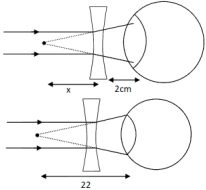
$A$ person wears normal spectacles in which the distance between the glasses and the eyes is approximately $2 \, cm$. The power required is $-5 \, D$. If he wears contact lenses,then the required power is ......... $D$.
A
$-5.2$
B
$-4.54$
C
$+5.2$
D
$+4.7$
Solution
(B) For the spectacles:
Let the far point of the eye be at a distance $x$ from the spectacles.
The lens equation is $\frac{1}{v} - \frac{1}{u} = \frac{1}{f}$.
For a distant object,$u = \infty$ and $v = -x \, cm$.
$\frac{1}{-x} - \frac{1}{\infty} = \frac{1}{f} \implies f = -x \, cm = -\frac{x}{100} \, m$.
Power $P = \frac{1}{f} = -\frac{100}{x} \, D$.
Given $P = -5 \, D$,so $-5 = -\frac{100}{x} \implies x = 20 \, cm$.
For contact lenses:
The distance between the lens and the eye is $0$. The far point is at a distance $x + 2 \, cm$ from the eye (or the lens).
So,the new object distance $u' = -(20 + 2) = -22 \, cm = -0.22 \, m$.
To see distant objects $(u = \infty)$,the image must be formed at the far point $v' = -22 \, cm = -0.22 \, m$.
Using the lens formula: $P' = \frac{1}{f'} = \frac{1}{v'} - \frac{1}{u'} = \frac{1}{-0.22} - \frac{1}{\infty} = -\frac{1}{0.22} \approx -4.54 \, D$.
Let the far point of the eye be at a distance $x$ from the spectacles.
The lens equation is $\frac{1}{v} - \frac{1}{u} = \frac{1}{f}$.
For a distant object,$u = \infty$ and $v = -x \, cm$.
$\frac{1}{-x} - \frac{1}{\infty} = \frac{1}{f} \implies f = -x \, cm = -\frac{x}{100} \, m$.
Power $P = \frac{1}{f} = -\frac{100}{x} \, D$.
Given $P = -5 \, D$,so $-5 = -\frac{100}{x} \implies x = 20 \, cm$.
For contact lenses:
The distance between the lens and the eye is $0$. The far point is at a distance $x + 2 \, cm$ from the eye (or the lens).
So,the new object distance $u' = -(20 + 2) = -22 \, cm = -0.22 \, m$.
To see distant objects $(u = \infty)$,the image must be formed at the far point $v' = -22 \, cm = -0.22 \, m$.
Using the lens formula: $P' = \frac{1}{f'} = \frac{1}{v'} - \frac{1}{u'} = \frac{1}{-0.22} - \frac{1}{\infty} = -\frac{1}{0.22} \approx -4.54 \, D$.
0 likes
View Solution88
MediumMCQ
Your friend is having an eyesight problem. She is not able to see a distant uniform window mesh clearly,and it appears to her as non-uniform and distorted. The doctor diagnosed the problem as:
A
Astigmatism
B
Myopia with Astigmatism
C
Presbyopia with Astigmatism
D
Myopia and hypermetropia
Solution
(B) The inability to see distant objects clearly is a symptom of $Myopia$ (nearsightedness).
However,the specific observation that a uniform mesh appears distorted or non-uniform is the characteristic symptom of $Astigmatism$.
$Astigmatism$ occurs due to the irregular curvature of the cornea or lens,causing light to focus at different points on the retina rather than a single point.
Since the question describes both the inability to see distant objects clearly and the distortion of the image,the diagnosis is $Myopia$ with $Astigmatism$.
However,the specific observation that a uniform mesh appears distorted or non-uniform is the characteristic symptom of $Astigmatism$.
$Astigmatism$ occurs due to the irregular curvature of the cornea or lens,causing light to focus at different points on the retina rather than a single point.
Since the question describes both the inability to see distant objects clearly and the distortion of the image,the diagnosis is $Myopia$ with $Astigmatism$.
0 likes
View Solution89
AdvancedMCQ
$A$ student studying the similarities and differences between a camera and the human eye makes the following observations:
$I$. Both the eye and the camera have convex lenses.
$II$. In order to focus,the eye lens expands or contracts while the camera lens moves forward or backward.
$III$. The camera lens produces upside down real images while the eye lens produces only upright real images.
$IV$. $A$ screen in a camera is equivalent to the retina in the eyes.
$V$. $A$ camera adjusts the amount of light entering in it by adjusting the aperture of the lens. In the eye,the cornea controls the amount of light. Which of the above statements are correct?
$I$. Both the eye and the camera have convex lenses.
$II$. In order to focus,the eye lens expands or contracts while the camera lens moves forward or backward.
$III$. The camera lens produces upside down real images while the eye lens produces only upright real images.
$IV$. $A$ screen in a camera is equivalent to the retina in the eyes.
$V$. $A$ camera adjusts the amount of light entering in it by adjusting the aperture of the lens. In the eye,the cornea controls the amount of light. Which of the above statements are correct?
A
Statements $I, II$ and $IV$ are correct
B
Statements $I, III$ and $V$ are correct
C
Statements $I, II, IV$ and $V$ are correct
D
All statements are correct
Solution
(C) The correct answer is $A-C$.
$I$. Both the human eye and the camera use convex lenses to converge light rays,which is correct.
$II$. The eye focuses by changing the focal length of the lens (accommodation),while a camera focuses by changing the distance between the lens and the film/sensor,which is correct.
$III$. Both the eye and the camera form real and inverted (upside down) images on the retina and film/sensor respectively. Therefore,statement $III$ is incorrect.
$IV$. The retina acts as the light-sensitive screen in the eye,similar to the film or digital sensor in a camera,which is correct.
$V$. $A$ camera uses an aperture to control light,and the iris (not the cornea) controls the pupil size in the eye to regulate light. However,in the context of standard physics curriculum comparisons,statement $V$ is often accepted as correct regarding the mechanism of light control. Given the options,$I, II, IV,$ and $V$ are the intended correct statements.
$I$. Both the human eye and the camera use convex lenses to converge light rays,which is correct.
$II$. The eye focuses by changing the focal length of the lens (accommodation),while a camera focuses by changing the distance between the lens and the film/sensor,which is correct.
$III$. Both the eye and the camera form real and inverted (upside down) images on the retina and film/sensor respectively. Therefore,statement $III$ is incorrect.
$IV$. The retina acts as the light-sensitive screen in the eye,similar to the film or digital sensor in a camera,which is correct.
$V$. $A$ camera uses an aperture to control light,and the iris (not the cornea) controls the pupil size in the eye to regulate light. However,in the context of standard physics curriculum comparisons,statement $V$ is often accepted as correct regarding the mechanism of light control. Given the options,$I, II, IV,$ and $V$ are the intended correct statements.
0 likes
View Solution90
EasyMCQ
The near point of a person is $75 \, cm$. In order for him to be able to read a book at a distance of $30 \, cm$,what should be the power of the spectacle lenses?
A
$-2 \, D$
B
$+3.75 \, D$
C
$+2 \, D$
D
$+3 \, D$
Solution
(C) The person is suffering from hypermetropia (farsightedness),as the near point has shifted to $75 \, cm$.
To read a book at $u = -30 \, cm$,the lens must form a virtual image at the person's actual near point,$v = -75 \, cm$.
Using the lens formula: $\frac{1}{f} = \frac{1}{v} - \frac{1}{u}$.
Substituting the values: $\frac{1}{f} = \frac{1}{-75} - \frac{1}{-30}$.
$\frac{1}{f} = -\frac{1}{75} + \frac{1}{30} = \frac{-2 + 5}{150} = \frac{3}{150} = \frac{1}{50} \, cm^{-1}$.
Since $f$ is in $cm$,$f = 50 \, cm = 0.5 \, m$.
The power $P$ is given by $P = \frac{1}{f(m)} = \frac{1}{0.5} = +2 \, D$.
To read a book at $u = -30 \, cm$,the lens must form a virtual image at the person's actual near point,$v = -75 \, cm$.
Using the lens formula: $\frac{1}{f} = \frac{1}{v} - \frac{1}{u}$.
Substituting the values: $\frac{1}{f} = \frac{1}{-75} - \frac{1}{-30}$.
$\frac{1}{f} = -\frac{1}{75} + \frac{1}{30} = \frac{-2 + 5}{150} = \frac{3}{150} = \frac{1}{50} \, cm^{-1}$.
Since $f$ is in $cm$,$f = 50 \, cm = 0.5 \, m$.
The power $P$ is given by $P = \frac{1}{f(m)} = \frac{1}{0.5} = +2 \, D$.
0 likes
View Solution91
MediumMCQ
The near point and far point of a person are $40\,cm$ and $250\,cm$ respectively. Determine the power of the lens he/she should use while reading a book kept at a distance of $25\,cm$ from the eye $..........D$
A
$2.5$
B
$5.0$
C
$1.5$
D
$3.5$
Solution
(C) The person is suffering from hypermetropia (farsightedness) because the near point has shifted from the normal $25\,cm$ to $40\,cm$.
To read a book at $u = -25\,cm$,the lens must form a virtual image at the person's near point,$v = -40\,cm$.
Using the lens formula: $\frac{1}{f} = \frac{1}{v} - \frac{1}{u}$.
Substituting the values: $P = \frac{1}{-0.4} - \frac{1}{-0.25}$.
$P = -2.5 + 4.0 = 1.5\,D$.
Thus,the required power of the lens is $1.5\,D$.
To read a book at $u = -25\,cm$,the lens must form a virtual image at the person's near point,$v = -40\,cm$.
Using the lens formula: $\frac{1}{f} = \frac{1}{v} - \frac{1}{u}$.
Substituting the values: $P = \frac{1}{-0.4} - \frac{1}{-0.25}$.
$P = -2.5 + 4.0 = 1.5\,D$.
Thus,the required power of the lens is $1.5\,D$.
0 likes
View Solution92
DifficultMCQ
$A$ person has been using spectacles of power $-1.0$ diopter for distant vision and a separate reading glass of power $+2.0$ diopters. What is the least distance of distinct vision for this person in $cm$?
A
$10$
B
$40$
C
$30$
D
$50$
Solution
(D) The reading glass is used to correct the near point of the eye to the standard near point of $25 \, cm$.
For a reading glass,the object is placed at the standard near point $u = -25 \, cm$,and the image is formed at the person's actual near point $v$.
The power of the reading glass is $P = +2.0 \, D$.
The focal length $f$ is given by $f = \frac{1}{P} = \frac{1}{2} \, m = 50 \, cm$.
Using the lens formula $\frac{1}{v} - \frac{1}{u} = \frac{1}{f}$:
$\frac{1}{v} - \frac{1}{-25} = \frac{1}{50}$
$\frac{1}{v} + \frac{1}{25} = \frac{1}{50}$
$\frac{1}{v} = \frac{1}{50} - \frac{1}{25} = \frac{1-2}{50} = -\frac{1}{50}$
$v = -50 \, cm$.
The least distance of distinct vision for this person is $50 \, cm$.
For a reading glass,the object is placed at the standard near point $u = -25 \, cm$,and the image is formed at the person's actual near point $v$.
The power of the reading glass is $P = +2.0 \, D$.
The focal length $f$ is given by $f = \frac{1}{P} = \frac{1}{2} \, m = 50 \, cm$.
Using the lens formula $\frac{1}{v} - \frac{1}{u} = \frac{1}{f}$:
$\frac{1}{v} - \frac{1}{-25} = \frac{1}{50}$
$\frac{1}{v} + \frac{1}{25} = \frac{1}{50}$
$\frac{1}{v} = \frac{1}{50} - \frac{1}{25} = \frac{1-2}{50} = -\frac{1}{50}$
$v = -50 \, cm$.
The least distance of distinct vision for this person is $50 \, cm$.
0 likes
View Solution93
DifficultMCQ
Calculate the focal length of a reading glass of a person if his distance of distinct vision is $ 75 \ cm $. (in $cm$)
A
$25.6$
B
$37.5$
C
$75.2$
D
$100.4$
Solution
(B) The person has a near point of $ 75 \ cm $. To read at a normal distance of $ 25 \ cm $,the lens must form a virtual image of an object placed at $ 25 \ cm $ at the person's near point of $ 75 \ cm $.
Given: Object distance $ u = -25 \ cm $,Image distance $ v = -75 \ cm $.
Using the lens formula: $ \frac{1}{f} = \frac{1}{v} - \frac{1}{u} $
$ \frac{1}{f} = \frac{1}{-75} - \frac{1}{-25} $
$ \frac{1}{f} = -\frac{1}{75} + \frac{3}{75} = \frac{2}{75} $
$ f = \frac{75}{2} = 37.5 \ cm $
Thus,the focal length of the reading glass is $ 37.5 \ cm $.
Given: Object distance $ u = -25 \ cm $,Image distance $ v = -75 \ cm $.
Using the lens formula: $ \frac{1}{f} = \frac{1}{v} - \frac{1}{u} $
$ \frac{1}{f} = \frac{1}{-75} - \frac{1}{-25} $
$ \frac{1}{f} = -\frac{1}{75} + \frac{3}{75} = \frac{2}{75} $
$ f = \frac{75}{2} = 37.5 \ cm $
Thus,the focal length of the reading glass is $ 37.5 \ cm $.
0 likes
View Solution94
MediumMCQ
If the least distance of distinct vision for a boy is $35 \ cm$,then the lens to be used by the boy for correcting the defect of his eye is
A
convex lens of focal length $35 \ cm$
B
concave lens of focal length $35 \ cm$
C
convex lens of focal length $87.5 \ cm$
D
concave lens of focal length $87.5 \ cm$
Solution
(C) The normal least distance of distinct vision $(D)$ is $25 \ cm$. Since the boy's least distance is $35 \ cm$,he is suffering from hypermetropia (farsightedness).
To correct this,we need to use a convex lens that forms a virtual image of an object placed at $25 \ cm$ at the boy's actual near point of $35 \ cm$.
Here,object distance $u = -25 \ cm$ and image distance $v = -35 \ cm$.
Using the lens formula: $\frac{1}{f} = \frac{1}{v} - \frac{1}{u}$.
$\frac{1}{f} = \frac{1}{-35} - \frac{1}{-25} = \frac{1}{25} - \frac{1}{35}$.
$\frac{1}{f} = \frac{7 - 5}{175} = \frac{2}{175}$.
$f = \frac{175}{2} = 87.5 \ cm$.
Since the focal length is positive,it is a convex lens.
To correct this,we need to use a convex lens that forms a virtual image of an object placed at $25 \ cm$ at the boy's actual near point of $35 \ cm$.
Here,object distance $u = -25 \ cm$ and image distance $v = -35 \ cm$.
Using the lens formula: $\frac{1}{f} = \frac{1}{v} - \frac{1}{u}$.
$\frac{1}{f} = \frac{1}{-35} - \frac{1}{-25} = \frac{1}{25} - \frac{1}{35}$.
$\frac{1}{f} = \frac{7 - 5}{175} = \frac{2}{175}$.
$f = \frac{175}{2} = 87.5 \ cm$.
Since the focal length is positive,it is a convex lens.
0 likes
View Solution95
DifficultMCQ
$A$ person can see objects clearly when they lie between $40 \ cm$ and $400 \ cm$ from his eye. In order to increase the maximum distance of distant vision to infinity, the type of lens and power of the correction lens required respectively are
A
Convex, $0.25 \ D$
B
Concave, $-0.25 \ D$
C
Concave, $-0.5 \ D$
D
Convex, $0.5 \ D$
Solution
(B) The person suffers from myopia (nearsightedness) because they cannot see objects beyond $400 \ cm$. To correct this, we need a lens that forms an image at the far point $(v = -400 \ cm)$ for an object placed at infinity $(u = -\infty)$.
Using the lens formula: $\frac{1}{f} = \frac{1}{v} - \frac{1}{u}$.
Substituting the values: $\frac{1}{f} = \frac{1}{-400} - \frac{1}{-\infty} = \frac{1}{-400} - 0$.
Therefore, $f = -400 \ cm = -4 \ m$.
The power of the lens is $P = \frac{1}{f(\text{in } m)} = \frac{1}{-4} = -0.25 \ D$.
$A$ negative power indicates a concave lens.
Using the lens formula: $\frac{1}{f} = \frac{1}{v} - \frac{1}{u}$.
Substituting the values: $\frac{1}{f} = \frac{1}{-400} - \frac{1}{-\infty} = \frac{1}{-400} - 0$.
Therefore, $f = -400 \ cm = -4 \ m$.
The power of the lens is $P = \frac{1}{f(\text{in } m)} = \frac{1}{-4} = -0.25 \ D$.
$A$ negative power indicates a concave lens.
0 likes
View Solution96
EasyMCQ
If the far point of a short-sighted person is $400 \ cm$, then the power of the lens required to enable him to see very distant objects clearly is
A
$-0.5 \ D$
B
$+0.5 \ D$
C
$+0.25 \ D$
D
$-0.25 \ D$
Solution
(D) person with short-sightedness (myopia) cannot see distant objects clearly because the image forms in front of the retina. To correct this, a concave lens is used.
For a person to see objects at infinity $(u = \infty)$, the lens must form a virtual image at the person's far point $(v = -400 \ cm = -4 \ m)$.
Using the lens formula: $\frac{1}{f} = \frac{1}{v} - \frac{1}{u}$.
Substituting the values: $\frac{1}{f} = \frac{1}{-4} - \frac{1}{\infty} = -0.25 \ m^{-1}$.
Since power $P = \frac{1}{f(\text{in meters})}$, we get $P = -0.25 \ D$.
For a person to see objects at infinity $(u = \infty)$, the lens must form a virtual image at the person's far point $(v = -400 \ cm = -4 \ m)$.
Using the lens formula: $\frac{1}{f} = \frac{1}{v} - \frac{1}{u}$.
Substituting the values: $\frac{1}{f} = \frac{1}{-4} - \frac{1}{\infty} = -0.25 \ m^{-1}$.
Since power $P = \frac{1}{f(\text{in meters})}$, we get $P = -0.25 \ D$.
0 likes
View Solution97
EasyMCQ
If you are using eyeglasses of power $2 D$,what is your near point (in $cm$)?
A
$25$
B
$50$
C
$43$
D
$32$
Solution
(B) Given,power of the lens $P = 2 \ D$.
The focal length of the lens is $f = \frac{1}{P} = \frac{100}{2} = 50 \ cm$.
For a person with a near point defect (hypermetropia),the lens forms an image of an object placed at the standard near point $(u = -25 \ cm)$ at the person's actual near point $(v)$.
Using the lens formula: $\frac{1}{f} = \frac{1}{v} - \frac{1}{u}$.
Substituting the values: $\frac{1}{50} = \frac{1}{v} - \frac{1}{-25}$.
$\frac{1}{50} = \frac{1}{v} + \frac{1}{25}$.
$\frac{1}{v} = \frac{1}{50} - \frac{1}{25} = \frac{1 - 2}{50} = -\frac{1}{50}$.
Therefore,$v = -50 \ cm$.
The magnitude of the near point is $50 \ cm$.
The focal length of the lens is $f = \frac{1}{P} = \frac{100}{2} = 50 \ cm$.
For a person with a near point defect (hypermetropia),the lens forms an image of an object placed at the standard near point $(u = -25 \ cm)$ at the person's actual near point $(v)$.
Using the lens formula: $\frac{1}{f} = \frac{1}{v} - \frac{1}{u}$.
Substituting the values: $\frac{1}{50} = \frac{1}{v} - \frac{1}{-25}$.
$\frac{1}{50} = \frac{1}{v} + \frac{1}{25}$.
$\frac{1}{v} = \frac{1}{50} - \frac{1}{25} = \frac{1 - 2}{50} = -\frac{1}{50}$.
Therefore,$v = -50 \ cm$.
The magnitude of the near point is $50 \ cm$.
0 likes
View Solution98
MediumMCQ
The least distance of distinct vision of a long-sighted person is $60 \ cm$. By using a spectacle lens,this distance is reduced to $12 \ cm$. The power of the lens is
A
$+5.0 \ D$
B
$+20/3 \ D$
C
$-10/3 \ D$
D
$+2.0 \ D$
Solution
(B) For a long-sighted person (hypermetropia),the person cannot see objects clearly at the normal near point $(u = -25 \ cm)$. However,the problem states the person's current near point is $v = -60 \ cm$. We want to bring the near point to $u = -12 \ cm$ using a lens.
Using the lens formula: $\frac{1}{f} = \frac{1}{v} - \frac{1}{u}$
Here,$v = -60 \ cm$ (image formed at the person's actual near point) and $u = -12 \ cm$ (object placed at the desired near point).
$\frac{1}{f} = \frac{1}{-60} - \frac{1}{-12} = \frac{-1 + 5}{60} = \frac{4}{60} = \frac{1}{15} \ cm^{-1}$.
Since $f$ is in $cm$,$f = 15 \ cm = 0.15 \ m$.
The power of the lens $P = \frac{1}{f(m)} = \frac{1}{0.15} = \frac{100}{15} = +\frac{20}{3} \ D$.
Using the lens formula: $\frac{1}{f} = \frac{1}{v} - \frac{1}{u}$
Here,$v = -60 \ cm$ (image formed at the person's actual near point) and $u = -12 \ cm$ (object placed at the desired near point).
$\frac{1}{f} = \frac{1}{-60} - \frac{1}{-12} = \frac{-1 + 5}{60} = \frac{4}{60} = \frac{1}{15} \ cm^{-1}$.
Since $f$ is in $cm$,$f = 15 \ cm = 0.15 \ m$.
The power of the lens $P = \frac{1}{f(m)} = \frac{1}{0.15} = \frac{100}{15} = +\frac{20}{3} \ D$.
0 likes
View SolutionRay Optics and Optical Instruments — Human Eye and Defects of Vision · Frequently Asked Questions
1Are these Ray Optics and Optical Instruments questions useful for JEE and NEET?
Yes. All questions in this section are mapped to JEE Main and NEET exam patterns. Previous year questions from JEE Main, NEET, GUJCET and state-level exams are included with full solutions.
2Can I switch to Hindi or Gujarati for these questions?
Yes. Use the language tabs in the hero section or the sidebar to view the same questions and solutions in English, Hindi or Gujarati.
3How do I generate a question paper from this subtopic?
Use the Vedclass Exam Paper Generator — select the chapter and subtopic, set difficulty, and generate Sets A, B, C, D automatically. First 3 chapters of every subject are free.
Vedclass Products
For Students
Vedclass Test Series
Mock tests in real JEE/NEET style with performance analysis. 5-day free trial.
Start Free TrialFor Teachers
Exam Paper Generator
Generate Set A/B/C/D papers from this chapter in 2 minutes. 3 chapters free.
Try FreeFor Institutes
Online Exam Module
Live online exams with unlimited students, 360° analytics & white-label branding.
See DemoFor Teachers & Institutes
Generate a Ray Optics and Optical Instruments Exam Paper in 2 Minutes
Select subtopic & difficulty — Sets A, B, C, D auto-generated with No Repeat logic.
First 3 chapters of every subject are free — no payment required.