
A English
Human Eye and Defects of Vision Questions in English
Class 12 Physics · Ray Optics and Optical Instruments · Human Eye and Defects of Vision
98+
Questions
English
Language
100%
With Solutions
Showing 50 of 98 questions in English
1
EasyMCQ
$A$ far-sighted man who has lost his spectacles reads a book by looking through a small hole $(3-4 \,mm)$ in a sheet of paper. The reason is:
A
Because the hole produces an image of the letters at a longer distance
B
Because in doing so,the focal length of the eye lens is effectively increased
C
Because in doing so,the focal length of the eye lens is effectively decreased
D
None of these
Solution
(C) far-sighted person suffers from hypermetropia,meaning they cannot see nearby objects clearly because the image forms behind the retina.
By looking through a small hole (a pinhole),the person effectively increases the depth of focus of their eye.
This reduction in the aperture of the eye allows the light rays to enter more parallel to the optical axis,which reduces the blur circle on the retina.
Effectively,this acts like a convex lens,allowing the eye to focus on closer objects by decreasing the required accommodation power,which is equivalent to an effective decrease in the focal length of the eye's optical system to bring the image onto the retina.
By looking through a small hole (a pinhole),the person effectively increases the depth of focus of their eye.
This reduction in the aperture of the eye allows the light rays to enter more parallel to the optical axis,which reduces the blur circle on the retina.
Effectively,this acts like a convex lens,allowing the eye to focus on closer objects by decreasing the required accommodation power,which is equivalent to an effective decrease in the focal length of the eye's optical system to bring the image onto the retina.
0 likes
View Solution2
EasyMCQ
For a normal eye,the least distance of distinct vision is......$m$.
A
$0.25$
B
$0.50$
C
$25$
D
Infinite
Solution
(A) In optometry,the least distance of distinct vision $(LDDV)$ is the closest distance at which an object can be placed so that it can be seen clearly by a normal human eye without any strain.
For a normal human eye,this distance is standardly defined as $25 \ cm$.
To convert this into meters,we divide by $100$:
$25 \ cm = 25 / 100 \ m = 0.25 \ m$.
Therefore,the correct option is $A$.
For a normal human eye,this distance is standardly defined as $25 \ cm$.
To convert this into meters,we divide by $100$:
$25 \ cm = 25 / 100 \ m = 0.25 \ m$.
Therefore,the correct option is $A$.
0 likes
View Solution3
EasyMCQ
For the myopic eye,the defect is cured by
A
Convex lens
B
Concave lens
C
Cylindrical lens
D
Toric lens
Solution
(B) In myopia,the far point of the eye is at a finite distance $d$ instead of infinity. To correct this,we need a lens that forms an image of an object at infinity at the far point $d$ of the myopic eye.
Using the lens formula: $\frac{1}{f} = \frac{1}{v} - \frac{1}{u}$
Here,$u = -\infty$ and $v = -d$ (since the image must be formed at the far point).
Substituting these values: $\frac{1}{f} = \frac{1}{-d} - \frac{1}{-\infty} = -\frac{1}{d} + 0$
Therefore,$f = -d$.
Since the focal length $f$ is negative,a concave lens is used to correct myopia.
Using the lens formula: $\frac{1}{f} = \frac{1}{v} - \frac{1}{u}$
Here,$u = -\infty$ and $v = -d$ (since the image must be formed at the far point).
Substituting these values: $\frac{1}{f} = \frac{1}{-d} - \frac{1}{-\infty} = -\frac{1}{d} + 0$
Therefore,$f = -d$.
Since the focal length $f$ is negative,a concave lens is used to correct myopia.
0 likes
View Solution4
EasyMCQ
The lens used to correct long-sightedness (hypermetropia) is:
A
Concave lens
B
Plano-concave lens
C
Convexo-concave lens
D
Convex lens
Solution
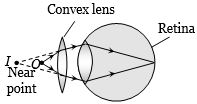
(D) Hypermetropia,also known as long-sightedness,is a vision defect where a person can see distant objects clearly but cannot see nearby objects distinctly. This happens because the light rays from a nearby object focus behind the retina. To correct this,a convex lens is used to converge the incoming light rays before they enter the eye,allowing the image to be formed exactly on the retina. Therefore,the correct option is $D$.
0 likes
View Solution5
EasyMCQ
The substance present in the choroid is:
A
Japan black
B
Nigrim pigment
C
Carbon black
D
Platinum black
Solution
(B) The choroid is the vascular layer of the eye,lying between the retina and the sclera. It contains specialized cells known as retinal pigmented epithelial cells. These cells contain a dark-colored pigment called Nigrim (or melanin),which helps in absorbing excess light and preventing internal reflection within the eye. This layer also provides oxygen and nourishment to the outer layers of the retina.
0 likes
View Solution6
EasyMCQ
Astigmatism (for a human eye) can be removed by using
A
Concave lens
B
Convex lens
C
Cylindrical lens
D
Prismatic lens
Solution
(C) Astigmatism is a defect of the human eye where the cornea or lens has an irregular curvature,causing blurred vision at all distances.
To correct this defect,a cylindrical lens is used.
The axis of the cylindrical lens is oriented to compensate for the irregular curvature of the eye's cornea,thereby focusing light correctly onto the retina.
To correct this defect,a cylindrical lens is used.
The axis of the cylindrical lens is oriented to compensate for the irregular curvature of the eye's cornea,thereby focusing light correctly onto the retina.
0 likes
View Solution7
EasyMCQ
The circular part in the centre of the retina is called:
A
Blind spot
B
Yellow spot
C
Red spot
D
None of the above
Solution
(B) The retina contains a small,yellowish,circular area located at the centre of the posterior part of the eye,directly opposite the lens. This area is known as the $Yellow$ $spot$ or $macula$ $lutea$. It is the region of highest visual acuity,containing a high density of cone cells. Therefore,the correct option is $B$.
0 likes
View Solution8
EasyMCQ
The image formed on the retina is:
A
Real and inverted
B
Virtual and erect
C
Real and erect
D
Virtual and inverted
Solution
(A) The human eye acts like a convex lens. Light rays from an object enter the eye and are refracted by the cornea and the crystalline lens. These rays converge to form an image on the retina. Since the light rays actually meet at the retina,the image formed is real. Furthermore,due to the nature of the convex lens,the image formed on the retina is inverted. Therefore,the image formed on the retina is real and inverted.
0 likes
View Solution9
EasyMCQ
If a human had only one eye,then:
A
The image of the object would have been inverted.
B
The visible region would have decreased.
C
The image would not have been seen in three dimensions.
D
$(b)$ and $(c)$ both.
Solution
(D) With two eyes,the field of view is wider (about $180^{\circ}$),which allows for a larger visible region. If a person has only one eye,the field of view is reduced. Furthermore,binocular vision (using two eyes) is essential for perceiving depth and three-dimensional images. With only one eye,the brain cannot compare two slightly different perspectives,so the ability to judge depth is lost. Therefore,both $(b)$ and $(c)$ are correct.
0 likes
View Solution10
EasyMCQ
$A$ person cannot see distinctly at a distance less than $1 \, m$. Calculate the power of the lens that he should use to read a book at a distance of $25 \, cm$.
A
$+ 3.0 \, D$
B
$+ 0.125 \, D$
C
$- 3.0 \, D$
D
$+ 4.0 \, D$
Solution
(A) The person suffers from hypermetropia (farsightedness) as they cannot see objects closer than $1 \, m$ $(100 \, cm)$.
To read a book at $u = -25 \, cm$, the lens must form a virtual image at the person's near point, $v = -100 \, cm$.
Using the lens formula: $\frac{1}{f} = \frac{1}{v} - \frac{1}{u}$.
Substituting the values: $\frac{1}{f} = \frac{1}{-100} - \frac{1}{-25} = -\frac{1}{100} + \frac{1}{25} = \frac{-1 + 4}{100} = \frac{3}{100} \, cm^{-1}$.
Since power $P = \frac{1}{f(\text{in } meters)} = \frac{100}{f(\text{in } cm)}$, we have $P = \frac{100}{100/3} = +3.0 \, D$.
To read a book at $u = -25 \, cm$, the lens must form a virtual image at the person's near point, $v = -100 \, cm$.
Using the lens formula: $\frac{1}{f} = \frac{1}{v} - \frac{1}{u}$.
Substituting the values: $\frac{1}{f} = \frac{1}{-100} - \frac{1}{-25} = -\frac{1}{100} + \frac{1}{25} = \frac{-1 + 4}{100} = \frac{3}{100} \, cm^{-1}$.
Since power $P = \frac{1}{f(\text{in } meters)} = \frac{100}{f(\text{in } cm)}$, we have $P = \frac{100}{100/3} = +3.0 \, D$.
0 likes
View Solution11
MediumMCQ
$A$ man who cannot see clearly beyond $5 \, m$ wants to see stars clearly. He should use a lens of focal length ....... $m$.
A
$-100$
B
$+5$
C
$-5$
D
Very large
Solution
(C) The man suffers from myopia (nearsightedness),where the far point is limited to $5 \, m$.
To see distant objects (stars) clearly,the lens must form a virtual image of an object at infinity at the man's far point.
Given: Object distance $u = \infty$,Image distance $v = -5 \, m$ (using sign convention).
Using the lens formula: $\frac{1}{f} = \frac{1}{v} - \frac{1}{u}$.
Substituting the values: $\frac{1}{f} = \frac{1}{-5} - \frac{1}{\infty}$.
Since $\frac{1}{\infty} = 0$,we get $\frac{1}{f} = -\frac{1}{5}$.
Therefore,$f = -5 \, m$.
To see distant objects (stars) clearly,the lens must form a virtual image of an object at infinity at the man's far point.
Given: Object distance $u = \infty$,Image distance $v = -5 \, m$ (using sign convention).
Using the lens formula: $\frac{1}{f} = \frac{1}{v} - \frac{1}{u}$.
Substituting the values: $\frac{1}{f} = \frac{1}{-5} - \frac{1}{\infty}$.
Since $\frac{1}{\infty} = 0$,we get $\frac{1}{f} = -\frac{1}{5}$.
Therefore,$f = -5 \, m$.
0 likes
View Solution12
MediumMCQ
$A$ man can see only between $75 \, cm$ and $100 \, cm$. The power of the lens required to correct the near point will be:
A
$+ \frac{8}{3} \, D$
B
$+ 3 \, D$
C
$- 3 \, D$
D
$-\frac{8}{3} \, D$
Solution
(A) To correct the near point, we need to place an object at the standard near point $(u = -25 \, cm)$ such that its virtual image is formed at the man's actual near point $(v = -75 \, cm)$.
Using the lens formula: $\frac{1}{f} = \frac{1}{v} - \frac{1}{u}$.
Substituting the values: $\frac{1}{f} = \frac{1}{-75} - \frac{1}{-25} = \frac{-1 + 3}{75} = \frac{2}{75} \, cm^{-1}$.
Thus, $f = \frac{75}{2} \, cm = 0.375 \, m$.
The power of the lens is given by $P = \frac{1}{f(\text{in meters})} = \frac{1}{0.375} = \frac{100}{37.5} = +\frac{8}{3} \, D$.
Using the lens formula: $\frac{1}{f} = \frac{1}{v} - \frac{1}{u}$.
Substituting the values: $\frac{1}{f} = \frac{1}{-75} - \frac{1}{-25} = \frac{-1 + 3}{75} = \frac{2}{75} \, cm^{-1}$.
Thus, $f = \frac{75}{2} \, cm = 0.375 \, m$.
The power of the lens is given by $P = \frac{1}{f(\text{in meters})} = \frac{1}{0.375} = \frac{100}{37.5} = +\frac{8}{3} \, D$.
0 likes
View Solution13
EasyMCQ
For a short-sighted person,the image is formed at
A
Retina
B
Before the retina
C
Behind the retina
D
Image is not formed at all
Solution
(B) In short-sightedness (myopia),the focal length of the eye lens decreases or the eyeball becomes too long. As a result,the light rays from a distant object converge at a point before reaching the retina. Therefore,the image is formed before the retina.
0 likes
View Solution14
EasyMCQ
$A$ man can see up to $100 \, cm$ of the distant object. The power of the lens required to see far objects will be
A
$+ 0.5 \, D$
B
$+ 1.0 \, D$
C
$+ 2.0 \, D$
D
$- 1.0 \, D$
Solution
(D) The man is suffering from myopia (nearsightedness), where the far point is limited to $100 \, cm$. To see objects at infinity, the lens must form a virtual image of an object at infinity at the person's far point of $100 \, cm$.
Using the lens formula: $\frac{1}{f} = \frac{1}{v} - \frac{1}{u}$
Here, $v = -100 \, cm = -1 \, m$ (image formed at the far point) and $u = -\infty$ (object at infinity).
$\frac{1}{f} = \frac{1}{-1} - \frac{1}{-\infty} = -1 \, m^{-1}$
Power $P = \frac{1}{f (\text{in meters})} = -1 \, D$.
Using the lens formula: $\frac{1}{f} = \frac{1}{v} - \frac{1}{u}$
Here, $v = -100 \, cm = -1 \, m$ (image formed at the far point) and $u = -\infty$ (object at infinity).
$\frac{1}{f} = \frac{1}{-1} - \frac{1}{-\infty} = -1 \, m^{-1}$
Power $P = \frac{1}{f (\text{in meters})} = -1 \, D$.
0 likes
View Solution15
MediumMCQ
$A$ man can see objects clearly between $15 \ cm$ and $30 \ cm$. He uses a lens to see far objects. Due to the lens used,the new near point will be at........$cm$.
A
$\frac{10}{3}$
B
$30$
C
$15$
D
$\frac{100}{3}$
Solution
(B) The man has a far point of $30 \ cm$ and a near point of $15 \ cm$. To see far objects (at infinity),he needs a concave lens such that an object at infinity forms an image at his far point $(v = -30 \ cm)$.
Using the lens formula: $\frac{1}{f} = \frac{1}{v} - \frac{1}{u} = \frac{1}{-30} - \frac{1}{\infty} = -\frac{1}{30}$.
Thus,the focal length $f = -30 \ cm$.
Now,to find the new near point,we use the same lens to see an object at distance $u$ such that the image is formed at his actual near point $(v = -15 \ cm)$.
$\frac{1}{f} = \frac{1}{v} - \frac{1}{u} \Rightarrow -\frac{1}{30} = \frac{1}{-15} - \frac{1}{u}$.
$\frac{1}{u} = \frac{1}{30} - \frac{1}{15} = \frac{1-2}{30} = -\frac{1}{30}$.
Therefore,$u = -30 \ cm$. The new near point is at $30 \ cm$.
Using the lens formula: $\frac{1}{f} = \frac{1}{v} - \frac{1}{u} = \frac{1}{-30} - \frac{1}{\infty} = -\frac{1}{30}$.
Thus,the focal length $f = -30 \ cm$.
Now,to find the new near point,we use the same lens to see an object at distance $u$ such that the image is formed at his actual near point $(v = -15 \ cm)$.
$\frac{1}{f} = \frac{1}{v} - \frac{1}{u} \Rightarrow -\frac{1}{30} = \frac{1}{-15} - \frac{1}{u}$.
$\frac{1}{u} = \frac{1}{30} - \frac{1}{15} = \frac{1-2}{30} = -\frac{1}{30}$.
Therefore,$u = -30 \ cm$. The new near point is at $30 \ cm$.
0 likes
View Solution16
EasyMCQ
The far point of a myopic eye is at $40 \, cm$. To correct this defect,the power of the lens required will be: (in $, D$)
A
$40$
B
$-4$
C
$-2.5$
D
$0.25$
Solution
(C) For a myopic eye,the far point is at a finite distance instead of infinity. To correct this,a concave lens is used to form an image of an object at infinity at the person's far point.
Given,the far point $d = 40 \, cm = 0.4 \, m$.
The focal length $f$ of the required concave lens is equal to the negative of the far point distance: $f = -40 \, cm = -0.4 \, m$.
The power of the lens $P$ is given by the formula $P = \frac{1}{f \text{ (in meters)}}$.
$P = \frac{1}{-0.4} = -2.5 \, D$.
Therefore,the power of the lens required is $-2.5 \, D$.
Given,the far point $d = 40 \, cm = 0.4 \, m$.
The focal length $f$ of the required concave lens is equal to the negative of the far point distance: $f = -40 \, cm = -0.4 \, m$.
The power of the lens $P$ is given by the formula $P = \frac{1}{f \text{ (in meters)}}$.
$P = \frac{1}{-0.4} = -2.5 \, D$.
Therefore,the power of the lens required is $-2.5 \, D$.
0 likes
View Solution17
MediumMCQ
$A$ man suffering from myopia can read a book placed at $10 \ cm$ distance. For reading the book at a distance of $60 \ cm$ with relaxed vision,the focal length of the lens required will be ...... $cm$.
A
$45$
B
$-20$
C
$-12$
D
$30$
Solution
(C) For a myopic eye,the lens must form a virtual image of an object placed at the desired distance $(u)$ at the person's far point $(v)$.
Given: Desired object distance $u = -60 \ cm$.
Given: Far point of the person $v = -10 \ cm$.
Using the lens formula: $\frac{1}{f} = \frac{1}{v} - \frac{1}{u}$.
Substituting the values: $\frac{1}{f} = \frac{1}{-10} - \frac{1}{-60}$.
$\frac{1}{f} = -\frac{1}{10} + \frac{1}{60} = \frac{-6 + 1}{60} = -\frac{5}{60}$.
$\frac{1}{f} = -\frac{1}{12}$.
Therefore,$f = -12 \ cm$.
Given: Desired object distance $u = -60 \ cm$.
Given: Far point of the person $v = -10 \ cm$.
Using the lens formula: $\frac{1}{f} = \frac{1}{v} - \frac{1}{u}$.
Substituting the values: $\frac{1}{f} = \frac{1}{-10} - \frac{1}{-60}$.
$\frac{1}{f} = -\frac{1}{10} + \frac{1}{60} = \frac{-6 + 1}{60} = -\frac{5}{60}$.
$\frac{1}{f} = -\frac{1}{12}$.
Therefore,$f = -12 \ cm$.
0 likes
View Solution18
EasyMCQ
If the distance of the far point for a myopia patient is doubled,the focal length of the lens required to cure it will become
A
Half
B
Double
C
The same but a convex lens
D
The same but a concave lens
Solution
(B) For a myopia patient,the far point is at a finite distance $x$. To correct this,a concave lens is used such that the image of an object at infinity is formed at the far point $x$.
Using the lens formula: $\frac{1}{f} = \frac{1}{v} - \frac{1}{u}$.
Here,$v = -x$ and $u = \infty$.
So,$\frac{1}{f} = \frac{1}{-x} - \frac{1}{\infty} = -\frac{1}{x}$,which gives $f = -x$.
If the far point distance is doubled,the new far point is $x' = 2x$.
The new focal length $f'$ will be $-x' = -2x$.
Since $f' = 2f$,the magnitude of the focal length becomes double.
Using the lens formula: $\frac{1}{f} = \frac{1}{v} - \frac{1}{u}$.
Here,$v = -x$ and $u = \infty$.
So,$\frac{1}{f} = \frac{1}{-x} - \frac{1}{\infty} = -\frac{1}{x}$,which gives $f = -x$.
If the far point distance is doubled,the new far point is $x' = 2x$.
The new focal length $f'$ will be $-x' = -2x$.
Since $f' = 2f$,the magnitude of the focal length becomes double.
0 likes
View Solution19
EasyMCQ
An imaginary line joining the optical centre of the eye lens and the yellow point is called as
A
Principal axis
B
Vision axis
C
Neutral axis
D
Optical axis
Solution
(B) An imaginary line joining the optical centre of the eye lens and the yellow point (fovea centralis) is known as the $Vision \text{ axis}$.
The $Vision \text{ axis}$ represents the path along which light rays travel to reach the fovea, which is the area of sharpest vision on the retina.
The $Vision \text{ axis}$ represents the path along which light rays travel to reach the fovea, which is the area of sharpest vision on the retina.
0 likes
View Solution20
EasyMCQ
The light when enters the human eye experiences most of the refraction while passing through
A
Cornea
B
Aqueous humour
C
Vitreous humour
D
Crystalline lens
Solution
(A) The Cornea is the outer membrane of the eyeball. It has a refractive index,$\mu = 1.38$,which is quite large compared to the refractive index of the surrounding air medium,$\mu_{air} \approx 1.00$.
As light falls on the Cornea first before hitting the retina,and due to the significant difference in refractive indices between air and the Cornea,light undergoes most of its refraction (moving from an optically rarer to a denser medium) while passing through the Cornea.
Therefore,when light enters the human eye,it experiences the majority of its refraction while passing through the Cornea.
As light falls on the Cornea first before hitting the retina,and due to the significant difference in refractive indices between air and the Cornea,light undergoes most of its refraction (moving from an optically rarer to a denser medium) while passing through the Cornea.
Therefore,when light enters the human eye,it experiences the majority of its refraction while passing through the Cornea.
0 likes
View Solution21
EasyMCQ
The impact of an image on the retina remains for......$sec$.
A
$0.1$
B
$0.5$
C
$10$
D
$15$
Solution
(A) The phenomenon where the image of an object persists on the retina for a short duration after the object is removed from the field of view is known as persistence of vision.
This duration is approximately $1/16$ of a second,which is equal to $0.0625$ seconds,commonly rounded to $0.1$ seconds in physics textbooks.
Therefore,the correct option is $A$.
This duration is approximately $1/16$ of a second,which is equal to $0.0625$ seconds,commonly rounded to $0.1$ seconds in physics textbooks.
Therefore,the correct option is $A$.
0 likes
View Solution22
MediumMCQ
$A$ person is suffering from a myopic defect. He is able to see clear objects placed at $15 \,cm$. What type and of what focal length of lens should he use to see clearly the objects placed $60 \,cm$ away?
A
Concave lens of $20 \,cm$ focal length
B
Convex lens of $20 \,cm$ focal length
C
Concave lens of $12 \,cm$ focal length
D
Convex lens of $12 \,cm$ focal length
Solution
(A) For a myopic eye,a concave lens is used to correct the vision.
Given:
Object distance $u = -60 \,cm$ (the distance at which the person wants to see).
Image distance $v = -15 \,cm$ (the far point of the myopic eye).
Using the lens formula: $\frac{1}{f} = \frac{1}{v} - \frac{1}{u}$.
Substituting the values: $\frac{1}{f} = \frac{1}{-15} - \frac{1}{-60}$.
$\frac{1}{f} = -\frac{1}{15} + \frac{1}{60} = \frac{-4 + 1}{60} = -\frac{3}{60} = -\frac{1}{20}$.
Therefore,$f = -20 \,cm$.
The negative sign indicates a concave lens of focal length $20 \,cm$.
Given:
Object distance $u = -60 \,cm$ (the distance at which the person wants to see).
Image distance $v = -15 \,cm$ (the far point of the myopic eye).
Using the lens formula: $\frac{1}{f} = \frac{1}{v} - \frac{1}{u}$.
Substituting the values: $\frac{1}{f} = \frac{1}{-15} - \frac{1}{-60}$.
$\frac{1}{f} = -\frac{1}{15} + \frac{1}{60} = \frac{-4 + 1}{60} = -\frac{3}{60} = -\frac{1}{20}$.
Therefore,$f = -20 \,cm$.
The negative sign indicates a concave lens of focal length $20 \,cm$.
0 likes
View Solution23
EasyMCQ
The sensation of vision in the retina is carried to the brain by
A
Ciliary muscles
B
Blind spot
C
Cylindrical lens
D
Optic nerve
Solution
(D) The sensation of vision in the retina is carried to the brain by the $Optic \text{ } nerve$.
Once light reflected from the surrounding object enters the retina through the eye lens, chemical and electrical impulses (sensory information) are generated.
The $Optic \text{ } nerve$ then transmits this visual information to the brain via electrical impulses for processing.
Once light reflected from the surrounding object enters the retina through the eye lens, chemical and electrical impulses (sensory information) are generated.
The $Optic \text{ } nerve$ then transmits this visual information to the brain via electrical impulses for processing.
0 likes
View Solution24
EasyMCQ
When the power of the eye lens increases,a defect of vision is produced. This defect is known as:
A
Short-sightedness (Myopia)
B
Long-sightedness (Hypermetropia)
C
Colour blindness
D
None of the above
Solution
(A) The power of a lens $(P)$ is inversely proportional to its focal length $(f)$,given by $P = 1/f$.
When the power of the eye lens increases,the focal length of the eye lens decreases.
This causes the image of distant objects to be formed in front of the retina instead of on the retina.
This condition is known as short-sightedness or myopia.
When the power of the eye lens increases,the focal length of the eye lens decreases.
This causes the image of distant objects to be formed in front of the retina instead of on the retina.
This condition is known as short-sightedness or myopia.
0 likes
View Solution25
EasyMCQ
$A$ man is suffering from colour blindness for green colour. To remove this defect,he should use goggles of
A
Green colour glasses
B
Red colour glasses
C
Smoky colour glasses
D
None of the above
Solution
(D) Colour blindness is a genetic disorder caused by the absence or malfunction of specific cone cells in the retina.
Since it is a hereditary condition related to the genetic makeup of the individual,it cannot be corrected or cured by wearing any type of corrective lenses or goggles.
Therefore,none of the options provided can remove this defect.
Since it is a hereditary condition related to the genetic makeup of the individual,it cannot be corrected or cured by wearing any type of corrective lenses or goggles.
Therefore,none of the options provided can remove this defect.
0 likes
View Solution26
EasyMCQ
In the human eye,the focusing is done by:
A
To and fro movement of the eye lens
B
To and fro movement of the retina
C
Change in the convexity of the lens surface
D
Change in the refractive index of the eye fluids
Solution
(C) The human eye focuses on objects at varying distances through a process called accommodation.
This is achieved by the ciliary muscles,which adjust the shape (convexity) of the crystalline lens.
When the ciliary muscles contract,the lens becomes more convex (thicker),increasing its power to focus on nearby objects.
When the ciliary muscles relax,the lens becomes less convex (thinner),decreasing its power to focus on distant objects.
Therefore,the correct mechanism is the change in the convexity of the lens surface.
This is achieved by the ciliary muscles,which adjust the shape (convexity) of the crystalline lens.
When the ciliary muscles contract,the lens becomes more convex (thicker),increasing its power to focus on nearby objects.
When the ciliary muscles relax,the lens becomes less convex (thinner),decreasing its power to focus on distant objects.
Therefore,the correct mechanism is the change in the convexity of the lens surface.
0 likes
View Solution27
MediumMCQ
$A$ short-sighted person can see distinctly only those objects which lie between $10\, cm$ and $100\, cm$ from him. The power of the spectacle lens required to see a distant object is
A
$+ 0.5\, D$
B
$- 1.0\, D$
C
$- 10\, D$
D
$+ 4.0\, D$
Solution
(B) short-sighted person (myopic) cannot see objects beyond their far point clearly.
Here,the far point of the person is $d = 100\, cm = 1\, m$.
To see a distant object (at infinity),the lens must form a virtual image of the object at the person's far point.
Using the lens formula: $\frac{1}{f} = \frac{1}{v} - \frac{1}{u}$.
Here,$u = \infty$ and $v = -100\, cm = -1\, m$ (since the image must be formed on the same side as the object).
$\frac{1}{f} = \frac{1}{-1} - \frac{1}{\infty} = -1 - 0 = -1\, m^{-1}$.
Power $P = \frac{1}{f} = -1\, D$.
Here,the far point of the person is $d = 100\, cm = 1\, m$.
To see a distant object (at infinity),the lens must form a virtual image of the object at the person's far point.
Using the lens formula: $\frac{1}{f} = \frac{1}{v} - \frac{1}{u}$.
Here,$u = \infty$ and $v = -100\, cm = -1\, m$ (since the image must be formed on the same side as the object).
$\frac{1}{f} = \frac{1}{-1} - \frac{1}{\infty} = -1 - 0 = -1\, m^{-1}$.
Power $P = \frac{1}{f} = -1\, D$.
0 likes
View Solution28
MediumMCQ
$A$ person can see clearly only up to a distance of $25 \, cm$. He wants to read a book placed at a distance of $50 \, cm$. What kind of lens does he require for his spectacles and what must be its power?
A
Concave,$-1.0 \, D$
B
Convex,$+1.5 \, D$
C
Concave,$-2.0 \, D$
D
Convex,$+2.0 \, D$
Solution
(C) The person is suffering from myopia (nearsightedness) as he cannot see objects beyond $25 \, cm$. To correct this,a concave lens is required.
Given:
Object distance $u = -50 \, cm$ (the position where he wants to read).
Image distance $v = -25 \, cm$ (his far point,where the virtual image must be formed).
Using the lens formula: $\frac{1}{f} = \frac{1}{v} - \frac{1}{u}$
$\frac{1}{f} = \frac{1}{-25} - \frac{1}{-50} = -\frac{2}{50} + \frac{1}{50} = -\frac{1}{50}$
So,$f = -50 \, cm = -0.5 \, m$.
The power of the lens is $P = \frac{1}{f(m)} = \frac{1}{-0.5} = -2.0 \, D$.
Thus,a concave lens of power $-2.0 \, D$ is required.
Given:
Object distance $u = -50 \, cm$ (the position where he wants to read).
Image distance $v = -25 \, cm$ (his far point,where the virtual image must be formed).
Using the lens formula: $\frac{1}{f} = \frac{1}{v} - \frac{1}{u}$
$\frac{1}{f} = \frac{1}{-25} - \frac{1}{-50} = -\frac{2}{50} + \frac{1}{50} = -\frac{1}{50}$
So,$f = -50 \, cm = -0.5 \, m$.
The power of the lens is $P = \frac{1}{f(m)} = \frac{1}{-0.5} = -2.0 \, D$.
Thus,a concave lens of power $-2.0 \, D$ is required.
0 likes
View Solution29
EasyMCQ
The human eye has a lens which has a
A
Soft portion at its centre
B
Hard surface
C
Varying refractive index
D
Constant refractive index
Solution
(C) The human eye lens is a crystalline,transparent,and biconvex structure. Unlike a glass lens which has a uniform material and constant refractive index,the human eye lens is composed of layers of protein fibers. These fibers are more densely packed towards the center of the lens compared to the periphery. Consequently,the refractive index of the human eye lens is not constant; it gradually increases from the outer surface towards the center. This gradient refractive index helps in reducing spherical aberration and focusing light effectively on the retina. Therefore,the correct option is $C$.
0 likes
View Solution30
MediumMCQ
$A$ man with defective eyes cannot see objects distinctly at a distance of more than $60 \, cm$ from his eyes. The power of the lens to be used will be:
A
$+ 60 \, D$
B
$- 60 \, D$
C
$- 1.66 \, D$
D
$\frac{1}{1.66} \, D$
Solution
(C) The man is suffering from myopia (nearsightedness) because he cannot see distant objects clearly.
To correct this defect, we use a concave lens that forms a virtual image of an object at infinity at the man's far point $(60 \, cm)$.
Here, the object distance $u = \infty$ and the image distance $v = -60 \, cm = -0.6 \, m$.
Using the lens formula: $\frac{1}{f} = \frac{1}{v} - \frac{1}{u}$.
$\frac{1}{f} = \frac{1}{-0.6} - \frac{1}{\infty} = -\frac{1}{0.6}$.
Power $P = \frac{1}{f(\text{in meters})} = -\frac{1}{0.6} = -1.66 \, D$.
To correct this defect, we use a concave lens that forms a virtual image of an object at infinity at the man's far point $(60 \, cm)$.
Here, the object distance $u = \infty$ and the image distance $v = -60 \, cm = -0.6 \, m$.
Using the lens formula: $\frac{1}{f} = \frac{1}{v} - \frac{1}{u}$.
$\frac{1}{f} = \frac{1}{-0.6} - \frac{1}{\infty} = -\frac{1}{0.6}$.
Power $P = \frac{1}{f(\text{in meters})} = -\frac{1}{0.6} = -1.66 \, D$.
0 likes
View Solution31
MediumMCQ
$A$ person's near point is $50 \, cm$ and his far point is $3 \, m$. The power of the lenses he requires for $(i)$ reading and $(ii)$ seeing distant stars are:
A
$-2 \, D$ and $0.33 \, D$
B
$2 \, D$ and $-0.33 \, D$
C
$-2 \, D$ and $3 \, D$
D
$2 \, D$ and $-3 \, D$
Solution
(B) For reading,the person needs to see an object at the standard near point $(u = -25 \, cm)$ as if it were at his own near point $(v = -50 \, cm)$.
Using the lens formula $\frac{1}{f} = \frac{1}{v} - \frac{1}{u}$:
$\frac{1}{f} = \frac{1}{-50} - \frac{1}{-25} = \frac{-1 + 2}{50} = \frac{1}{50} \, cm^{-1}$.
$f = 50 \, cm = 0.5 \, m$.
Power $P = \frac{1}{f(m)} = \frac{1}{0.5} = +2 \, D$.
For seeing distant stars,the person needs to see an object at infinity $(u = \infty)$ as if it were at his far point $(v = -3 \, m)$.
Using the lens formula $\frac{1}{f} = \frac{1}{v} - \frac{1}{u}$:
$\frac{1}{f} = \frac{1}{-3} - \frac{1}{\infty} = -\frac{1}{3} \, m^{-1}$.
Power $P = \frac{1}{f(m)} = -\frac{1}{3} \approx -0.33 \, D$.
Using the lens formula $\frac{1}{f} = \frac{1}{v} - \frac{1}{u}$:
$\frac{1}{f} = \frac{1}{-50} - \frac{1}{-25} = \frac{-1 + 2}{50} = \frac{1}{50} \, cm^{-1}$.
$f = 50 \, cm = 0.5 \, m$.
Power $P = \frac{1}{f(m)} = \frac{1}{0.5} = +2 \, D$.
For seeing distant stars,the person needs to see an object at infinity $(u = \infty)$ as if it were at his far point $(v = -3 \, m)$.
Using the lens formula $\frac{1}{f} = \frac{1}{v} - \frac{1}{u}$:
$\frac{1}{f} = \frac{1}{-3} - \frac{1}{\infty} = -\frac{1}{3} \, m^{-1}$.
Power $P = \frac{1}{f(m)} = -\frac{1}{3} \approx -0.33 \, D$.
0 likes
View Solution32
MediumMCQ
$A$ person wears glasses of power $-2.5 \, D$. The defect of the eye and the far point of the person without the glasses are respectively
A
Farsightedness,$40 \, cm$
B
Nearsightedness,$40 \, cm$
C
Astigmatism,$40 \, cm$
D
Nearsightedness,$250 \, cm$
Solution
(B) The power of the lens is given as $P = -2.5 \, D$.
Since the power is negative,the lens used is a concave lens,which indicates that the person is suffering from myopia or nearsightedness.
The focal length $f$ of the lens is given by $f = \frac{1}{P} = \frac{1}{-2.5} \, m = -0.4 \, m = -40 \, cm$.
For a person with nearsightedness,the far point is the focal length of the corrective lens used.
Therefore,the far point of the person without glasses is $40 \, cm$.
Since the power is negative,the lens used is a concave lens,which indicates that the person is suffering from myopia or nearsightedness.
The focal length $f$ of the lens is given by $f = \frac{1}{P} = \frac{1}{-2.5} \, m = -0.4 \, m = -40 \, cm$.
For a person with nearsightedness,the far point is the focal length of the corrective lens used.
Therefore,the far point of the person without glasses is $40 \, cm$.
0 likes
View Solution33
EasyMCQ
Myopia is due to
A
Elongation of the eye ball
B
Irregular change in focal length
C
Shortening of the eye ball
D
Older age
Solution
(A) Myopia,also known as nearsightedness,occurs when the eye ball becomes too long or the cornea is too curved.
As a result,light rays entering the eye are focused at a point in front of the retina rather than directly on it.
Therefore,the correct cause among the given options is the elongation of the eye ball.
As a result,light rays entering the eye are focused at a point in front of the retina rather than directly on it.
Therefore,the correct cause among the given options is the elongation of the eye ball.
0 likes
View Solution34
EasyMCQ
$A$ person is suffering from the defect astigmatism. Its main reason is
A
Distance of the eye lens from retina is increased
B
Distance of the eye lens from retina is decreased
C
The cornea is not spherical
D
Power of accommodation of the eye is decreased
Solution
(C) Astigmatism is a common vision defect caused by an irregular curvature of the cornea or the lens of the eye.
When the cornea is not perfectly spherical,it causes light rays to focus at different points on the retina rather than a single point.
This results in blurred or distorted vision at all distances.
Therefore,the correct reason is that the cornea is not spherical.
When the cornea is not perfectly spherical,it causes light rays to focus at different points on the retina rather than a single point.
This results in blurred or distorted vision at all distances.
Therefore,the correct reason is that the cornea is not spherical.
0 likes
View Solution35
EasyMCQ
$A$ person cannot see objects clearly beyond $2.0 \, m$. The power of the lens required to correct his vision will be:
A
$+ 2.0 \, D$
B
$- 1.0 \, D$
C
$+ 1.0 \, D$
D
$- 0.5 \, D$
Solution
(D) The person is suffering from myopia (nearsightedness) because they cannot see objects beyond a certain distance $(2.0 \, m)$.
To correct this defect, a concave lens is used.
The far point of the person is $v = - 2.0 \, m$.
We want the person to be able to see objects at infinity, so the object distance is $u = \infty$.
Using the lens formula: $\frac{1}{f} = \frac{1}{v} - \frac{1}{u}$.
$\frac{1}{f} = \frac{1}{- 2.0} - \frac{1}{\infty} = - 0.5 \, m^{-1}$.
Power $P = \frac{1}{f (in \, meters)} = - 0.5 \, D$.
To correct this defect, a concave lens is used.
The far point of the person is $v = - 2.0 \, m$.
We want the person to be able to see objects at infinity, so the object distance is $u = \infty$.
Using the lens formula: $\frac{1}{f} = \frac{1}{v} - \frac{1}{u}$.
$\frac{1}{f} = \frac{1}{- 2.0} - \frac{1}{\infty} = - 0.5 \, m^{-1}$.
Power $P = \frac{1}{f (in \, meters)} = - 0.5 \, D$.
0 likes
View Solution36
EasyMCQ
When objects at different distances are seen by the eye,which of the following remains constant?
A
The focal length of the eye lens
B
The object distance from the eye lens
C
The radii of curvature of the eye lens
D
The image distance from the eye lens
Solution
(D) The human eye adjusts its focal length to focus objects at varying distances onto the retina.
Since the distance between the eye lens and the retina is fixed in a healthy eye,the image distance remains constant.
Therefore,the image distance from the eye lens is the correct answer.
Since the distance between the eye lens and the retina is fixed in a healthy eye,the image distance remains constant.
Therefore,the image distance from the eye lens is the correct answer.
0 likes
View Solution37
EasyMCQ
$A$ person wears glasses of power $-2.0 \, D$. The defect of the eye and the far point of the person without the glasses will be
A
Nearsighted,$50 \, cm$
B
Farsighted,$50 \, cm$
C
Nearsighted,$250 \, cm$
D
Astigmatism,$50 \, cm$
Solution
(A) The power of the lens is $P = -2.0 \, D$. Since the power is negative,the lens used is a concave lens,which is used to correct myopia (nearsightedness).
For a myopic eye,the far point is at a finite distance $x$ instead of infinity.
The lens formula is $\frac{1}{f} = \frac{1}{v} - \frac{1}{u}$.
For a person to see an object at infinity $(u = \infty)$,the image must be formed at their far point $(v = -x)$.
Since $P = \frac{1}{f}$,we have $P = \frac{1}{v} - \frac{1}{u} = \frac{1}{-x} - \frac{1}{\infty} = -\frac{1}{x}$.
Thus,$x = -\frac{1}{P} = -\frac{1}{-2.0} = 0.5 \, m = 50 \, cm$.
Therefore,the person is nearsighted and their far point is $50 \, cm$.
For a myopic eye,the far point is at a finite distance $x$ instead of infinity.
The lens formula is $\frac{1}{f} = \frac{1}{v} - \frac{1}{u}$.
For a person to see an object at infinity $(u = \infty)$,the image must be formed at their far point $(v = -x)$.
Since $P = \frac{1}{f}$,we have $P = \frac{1}{v} - \frac{1}{u} = \frac{1}{-x} - \frac{1}{\infty} = -\frac{1}{x}$.
Thus,$x = -\frac{1}{P} = -\frac{1}{-2.0} = 0.5 \, m = 50 \, cm$.
Therefore,the person is nearsighted and their far point is $50 \, cm$.
0 likes
View Solution38
MediumMCQ
Match the List-$I$ with the List-$II$ from the combinations shown:
| $(I)$ Presbyopia | $(A)$ Sphero-cylindrical lens |
| $(II)$ Hypermetropia | $(B)$ Convex lens of proper power may be used close to the eye |
| $(III)$ Astigmatism | $(C)$ Concave lens of suitable focal length |
| $(IV)$ Myopia | $(D)$ Bifocal lens of suitable focal length |
A
$I-A; II-C; III-B; IV-D$
B
$I-B; II-D; III-C; IV-A$
C
$I-D; II-B; III-A; IV-C$
D
$I-D; II-A; III-C; IV-B$
Solution
(C) The correct matches are as follows:
$1$. Presbyopia: This is a defect where the eye loses its power of accommodation with age. It is corrected using a bifocal lens $(I-D)$.
$2$. Hypermetropia (Farsightedness): This is corrected by using a convex lens of appropriate power to converge light rays onto the retina $(II-B)$.
$3$. Astigmatism: This defect occurs due to the irregular curvature of the cornea. It is corrected using a sphero-cylindrical lens $(III-A)$.
$4$. Myopia (Nearsightedness): This is corrected by using a concave lens of suitable focal length to diverge light rays before they enter the eye $(IV-C)$.
Therefore, the correct combination is $I-D, II-B, III-A, IV-C$.
$1$. Presbyopia: This is a defect where the eye loses its power of accommodation with age. It is corrected using a bifocal lens $(I-D)$.
$2$. Hypermetropia (Farsightedness): This is corrected by using a convex lens of appropriate power to converge light rays onto the retina $(II-B)$.
$3$. Astigmatism: This defect occurs due to the irregular curvature of the cornea. It is corrected using a sphero-cylindrical lens $(III-A)$.
$4$. Myopia (Nearsightedness): This is corrected by using a concave lens of suitable focal length to diverge light rays before they enter the eye $(IV-C)$.
Therefore, the correct combination is $I-D, II-B, III-A, IV-C$.
0 likes
View Solution39
EasyMCQ
The near point and far point of a normal human eye are respectively:
A
$0$ and $25\, cm$
B
$0$ and $\infty$
C
$25\, cm$ and $100\, cm$
D
$25\, cm$ and $\infty$
Solution
(D) The near point of a normal human eye is the minimum distance at which an object can be seen clearly without strain,which is $25\, cm$.
The far point of a normal human eye is the maximum distance at which an object can be seen clearly,which is at infinity $(\infty)$.
Therefore,the near point and far point are $25\, cm$ and $\infty$ respectively.
The far point of a normal human eye is the maximum distance at which an object can be seen clearly,which is at infinity $(\infty)$.
Therefore,the near point and far point are $25\, cm$ and $\infty$ respectively.
0 likes
View Solution40
EasyMCQ
The retina of the eye acts like the ........ of a camera.
A
Shutter
B
Film
C
Lens
D
None of these
Solution
(B) The back of the eye is lined by a layer called the retina,which acts like the film inside a camera.
The retina is a thin layer of nerve tissue that contains photoreceptors.
Photoreceptors convert light rays into electrical impulses,which are then sent through the optic nerve to the brain,where an image is perceived.
As with a camera,if the film is bad in the eye (i.e.,the retina is damaged or diseased),no matter how well the rest of the eye is functioning,a good picture is not possible.
The retina is a thin layer of nerve tissue that contains photoreceptors.
Photoreceptors convert light rays into electrical impulses,which are then sent through the optic nerve to the brain,where an image is perceived.
As with a camera,if the film is bad in the eye (i.e.,the retina is damaged or diseased),no matter how well the rest of the eye is functioning,a good picture is not possible.
0 likes
View Solution41
EasyMCQ
Hypermetropia is a:
A
Short-sightedness defect
B
Long-sightedness defect
C
Bad vision due to old age
D
None of these
Solution
(B) Hypermetropia,also known as long-sightedness or farsightedness,is a vision defect where a person can see distant objects clearly but cannot see nearby objects distinctly.
This occurs because the light rays from a nearby object focus behind the retina instead of on it.
Therefore,the correct option is $B$.
This occurs because the light rays from a nearby object focus behind the retina instead of on it.
Therefore,the correct option is $B$.
0 likes
View Solution42
EasyMCQ
$A$ man cannot see clearly the objects beyond a distance of $20 \, cm$ from his eyes. To see distant objects clearly,he must use which kind of lenses and of what focal length?
A
$100 \, cm$ convex
B
$100 \, cm$ concave
C
$20 \, cm$ convex
D
$20 \, cm$ concave
Solution
(D) The man is suffering from myopia (nearsightedness),as he cannot see objects beyond $20 \, cm$.
To correct this defect,the lens must form a virtual image of an object placed at infinity $(u = \infty)$ at the man's far point $(v = -20 \, cm)$.
Using the lens formula: $\frac{1}{f} = \frac{1}{v} - \frac{1}{u}$.
Substituting the values: $\frac{1}{f} = \frac{1}{-20} - \frac{1}{\infty}$.
Since $\frac{1}{\infty} = 0$,we get $\frac{1}{f} = -\frac{1}{20}$.
Therefore,$f = -20 \, cm$.
$A$ negative focal length indicates a concave lens. Thus,a concave lens of focal length $20 \, cm$ is required.
To correct this defect,the lens must form a virtual image of an object placed at infinity $(u = \infty)$ at the man's far point $(v = -20 \, cm)$.
Using the lens formula: $\frac{1}{f} = \frac{1}{v} - \frac{1}{u}$.
Substituting the values: $\frac{1}{f} = \frac{1}{-20} - \frac{1}{\infty}$.
Since $\frac{1}{\infty} = 0$,we get $\frac{1}{f} = -\frac{1}{20}$.
Therefore,$f = -20 \, cm$.
$A$ negative focal length indicates a concave lens. Thus,a concave lens of focal length $20 \, cm$ is required.
0 likes
View Solution43
EasyMCQ
$A$ person uses spectacles of power $+2D$. He is suffering from
A
Short-sightedness or myopia
B
Long-sightedness or hypermetropia
C
Presbyopia
D
Astigmatism
Solution
(B) The power of the lens is given as $P = +2D$.
Since the power of the lens is positive,the lens used is a convex lens.
$A$ convex lens is used to correct hypermetropia (long-sightedness),where the person cannot see nearby objects clearly because the image forms behind the retina.
Therefore,the person is suffering from hypermetropia.
Since the power of the lens is positive,the lens used is a convex lens.
$A$ convex lens is used to correct hypermetropia (long-sightedness),where the person cannot see nearby objects clearly because the image forms behind the retina.
Therefore,the person is suffering from hypermetropia.
0 likes
View Solution44
EasyMCQ
To remove myopia (short-sightedness),a lens of power $0.66 \, D$ is required. The far point of the eye is approximately ....... $cm$.
A
$100$
B
$150$
C
$50$
D
$25$
Solution
(B) For a myopic eye,the corrective lens must form an image of an object at infinity at the person's far point $(x)$.
Using the lens formula: $\frac{1}{f} = \frac{1}{v} - \frac{1}{u}$.
Here,$u = -\infty$ and $v = -x$ (where $x$ is the distance of the far point).
Since $P = \frac{1}{f}$ (in meters),we have $P = \frac{1}{-x}$.
Thus,$x = -\frac{1}{P}$.
Given $P = -0.66 \, D$ (a concave lens is required for myopia).
$x = \frac{1}{0.66} \, m = 1.515 \, m$.
Converting to centimeters: $x \approx 151 \, cm \approx 150 \, cm$.
Using the lens formula: $\frac{1}{f} = \frac{1}{v} - \frac{1}{u}$.
Here,$u = -\infty$ and $v = -x$ (where $x$ is the distance of the far point).
Since $P = \frac{1}{f}$ (in meters),we have $P = \frac{1}{-x}$.
Thus,$x = -\frac{1}{P}$.
Given $P = -0.66 \, D$ (a concave lens is required for myopia).
$x = \frac{1}{0.66} \, m = 1.515 \, m$.
Converting to centimeters: $x \approx 151 \, cm \approx 150 \, cm$.
0 likes
View Solution45
EasyMCQ
$A$ person suffering from 'presbyopia' (having both myopia and hypermetropia) should use:
A
$A$ concave lens
B
$A$ convex lens
C
$A$ bifocal lens whose lower portion is convex
D
$A$ bifocal lens whose upper portion is convex
Solution
(C) Presbyopia is a vision defect where the eye loses its ability to focus on near objects due to the hardening of the lens with age. It often occurs alongside myopia (nearsightedness) and hypermetropia (farsightedness).
To correct this,a bifocal lens is used.
The upper portion of the bifocal lens is a concave lens,which is used to correct myopia (distance vision).
The lower portion of the bifocal lens is a convex lens,which is used to correct hypermetropia (near vision).
Therefore,the correct option is $C$.
To correct this,a bifocal lens is used.
The upper portion of the bifocal lens is a concave lens,which is used to correct myopia (distance vision).
The lower portion of the bifocal lens is a convex lens,which is used to correct hypermetropia (near vision).
Therefore,the correct option is $C$.
0 likes
View Solution46
MediumMCQ
$A$ person who can see things most clearly at a distance of $10 \, cm$ requires spectacles to enable him to see clearly things at a distance of $30 \, cm$. What should be the focal length of the spectacles?
A
$15 \, cm$ (Concave)
B
$15 \, cm$ (Convex)
C
$10 \, cm$
D
$0$
Solution
(A) The person suffers from myopia (nearsightedness) and needs to see an object placed at $u = -30 \, cm$ as if it were at their near point of $v = -10 \, cm$.
Using the lens formula: $\frac{1}{f} = \frac{1}{v} - \frac{1}{u}$.
Substituting the values: $\frac{1}{f} = \frac{1}{-10} - \frac{1}{-30}$.
$\frac{1}{f} = -\frac{1}{10} + \frac{1}{30} = \frac{-3 + 1}{30} = \frac{-2}{30} = -\frac{1}{15}$.
Therefore,$f = -15 \, cm$.
The negative sign indicates a concave lens with a focal length of $15 \, cm$.
Using the lens formula: $\frac{1}{f} = \frac{1}{v} - \frac{1}{u}$.
Substituting the values: $\frac{1}{f} = \frac{1}{-10} - \frac{1}{-30}$.
$\frac{1}{f} = -\frac{1}{10} + \frac{1}{30} = \frac{-3 + 1}{30} = \frac{-2}{30} = -\frac{1}{15}$.
Therefore,$f = -15 \, cm$.
The negative sign indicates a concave lens with a focal length of $15 \, cm$.
0 likes
View Solution47
EasyMCQ
The far point of a myopic eye is $250 \, cm$. What is the focal length of the lens required to correct this defect?
A
$-250 \, cm$
B
$- \frac{250}{9} \, cm$
C
$+ 250 \, cm$
D
$+ \frac{250}{9} \, cm$
Solution
(A) For a myopic eye,the far point is at a finite distance $d = 250 \, cm$. To correct this defect,the lens must form an image of an object at infinity at the far point of the eye.
Using the lens formula: $\frac{1}{f} = \frac{1}{v} - \frac{1}{u}$.
Here,$u = \infty$ (object at infinity) and $v = -250 \, cm$ (image formed at the far point).
Substituting these values: $\frac{1}{f} = \frac{1}{-250} - \frac{1}{\infty}$.
Since $\frac{1}{\infty} = 0$,we get $\frac{1}{f} = -\frac{1}{250}$.
Therefore,$f = -250 \, cm$.
Using the lens formula: $\frac{1}{f} = \frac{1}{v} - \frac{1}{u}$.
Here,$u = \infty$ (object at infinity) and $v = -250 \, cm$ (image formed at the far point).
Substituting these values: $\frac{1}{f} = \frac{1}{-250} - \frac{1}{\infty}$.
Since $\frac{1}{\infty} = 0$,we get $\frac{1}{f} = -\frac{1}{250}$.
Therefore,$f = -250 \, cm$.
0 likes
View Solution48
MediumMCQ
$A$ man can see clearly up to $3 \, m$. Prescribe a lens for his spectacles so that he can see clearly up to $12 \, m$.
A
$-3/4 \, D$
B
$3 \, D$
C
$-1/4 \, D$
D
$-4 \, D$
Solution
(C) The man suffers from myopia (nearsightedness). To see objects at infinity or a distant point $u = -12 \, m$,the lens must form a virtual image at his far point $v = -3 \, m$.
Using the lens formula: $\frac{1}{f} = \frac{1}{v} - \frac{1}{u}$.
Substituting the values: $P = \frac{1}{f} = \frac{1}{-3} - \frac{1}{-12}$.
$P = -\frac{1}{3} + \frac{1}{12} = \frac{-4 + 1}{12} = -\frac{3}{12} = -0.25 \, D$.
Thus,the required power is $-1/4 \, D$.
Using the lens formula: $\frac{1}{f} = \frac{1}{v} - \frac{1}{u}$.
Substituting the values: $P = \frac{1}{f} = \frac{1}{-3} - \frac{1}{-12}$.
$P = -\frac{1}{3} + \frac{1}{12} = \frac{-4 + 1}{12} = -\frac{3}{12} = -0.25 \, D$.
Thus,the required power is $-1/4 \, D$.
0 likes
View Solution49
EasyMCQ
$A$ person cannot see objects clearly placed at a distance of more than $40 \, cm$. He is advised to use a lens of power:
A
$-2.5 \, D$
B
$+2.5 \, D$
C
$-6.25 \, D$
D
$+1.5 \, D$
Solution
(A) The person is suffering from myopia (nearsightedness) because he cannot see distant objects clearly.
For a myopic eye, the far point is limited to $40 \, cm$.
To correct this defect, we need to use a concave lens that forms a virtual image of an object at infinity at the person's far point $(40 \, cm)$.
Here, the object distance $u = \infty$ and the image distance $v = -40 \, cm$.
Using the lens formula: $\frac{1}{f} = \frac{1}{v} - \frac{1}{u}$.
$\frac{1}{f} = \frac{1}{-40} - \frac{1}{\infty} = -\frac{1}{40} \, cm^{-1}$.
Thus, the focal length $f = -40 \, cm = -0.4 \, m$.
The power of the lens $P$ is given by $P = \frac{1}{f(\text{in } meters)}$.
$P = \frac{1}{-0.4} = -2.5 \, D$.
For a myopic eye, the far point is limited to $40 \, cm$.
To correct this defect, we need to use a concave lens that forms a virtual image of an object at infinity at the person's far point $(40 \, cm)$.
Here, the object distance $u = \infty$ and the image distance $v = -40 \, cm$.
Using the lens formula: $\frac{1}{f} = \frac{1}{v} - \frac{1}{u}$.
$\frac{1}{f} = \frac{1}{-40} - \frac{1}{\infty} = -\frac{1}{40} \, cm^{-1}$.
Thus, the focal length $f = -40 \, cm = -0.4 \, m$.
The power of the lens $P$ is given by $P = \frac{1}{f(\text{in } meters)}$.
$P = \frac{1}{-0.4} = -2.5 \, D$.
0 likes
View Solution50
MediumMCQ
$A$ person uses a lens of power $+3 \text{ D}$ to normalize vision. The near point of the hypermetropic eye is ....... $m$.
A
$1$
B
$1.66$
C
$2$
D
$0.66$
Solution
(A) The power of the lens is $P = +3 \text{ D}$.
Focal length $f = \frac{1}{P} = \frac{1}{3} \text{ m} = \frac{100}{3} \text{ cm}$.
For a hypermetropic eye,the near point is shifted beyond the normal near point $(u = -25 \text{ cm})$. The lens forms a virtual image of an object placed at the normal near point $(u = -25 \text{ cm})$ at the person's actual near point $(v = -x)$.
Using the lens formula $\frac{1}{f} = \frac{1}{v} - \frac{1}{u}$:
$\frac{1}{100/3} = \frac{1}{-x} - \frac{1}{-25}$
$\frac{3}{100} = -\frac{1}{x} + \frac{1}{25}$
$\frac{1}{x} = \frac{1}{25} - \frac{3}{100} = \frac{4-3}{100} = \frac{1}{100}$
$x = 100 \text{ cm} = 1 \text{ m}$.
Focal length $f = \frac{1}{P} = \frac{1}{3} \text{ m} = \frac{100}{3} \text{ cm}$.
For a hypermetropic eye,the near point is shifted beyond the normal near point $(u = -25 \text{ cm})$. The lens forms a virtual image of an object placed at the normal near point $(u = -25 \text{ cm})$ at the person's actual near point $(v = -x)$.
Using the lens formula $\frac{1}{f} = \frac{1}{v} - \frac{1}{u}$:
$\frac{1}{100/3} = \frac{1}{-x} - \frac{1}{-25}$
$\frac{3}{100} = -\frac{1}{x} + \frac{1}{25}$
$\frac{1}{x} = \frac{1}{25} - \frac{3}{100} = \frac{4-3}{100} = \frac{1}{100}$
$x = 100 \text{ cm} = 1 \text{ m}$.
0 likes
View SolutionRay Optics and Optical Instruments — Human Eye and Defects of Vision · Frequently Asked Questions
1Are these Ray Optics and Optical Instruments questions useful for JEE and NEET?
Yes. All questions in this section are mapped to JEE Main and NEET exam patterns. Previous year questions from JEE Main, NEET, GUJCET and state-level exams are included with full solutions.
2Can I switch to Hindi or Gujarati for these questions?
Yes. Use the language tabs in the hero section or the sidebar to view the same questions and solutions in English, Hindi or Gujarati.
3How do I generate a question paper from this subtopic?
Use the Vedclass Exam Paper Generator — select the chapter and subtopic, set difficulty, and generate Sets A, B, C, D automatically. First 3 chapters of every subject are free.
Vedclass Products
For Students
Vedclass Test Series
Mock tests in real JEE/NEET style with performance analysis. 5-day free trial.
Start Free TrialFor Teachers
Exam Paper Generator
Generate Set A/B/C/D papers from this chapter in 2 minutes. 3 chapters free.
Try FreeFor Institutes
Online Exam Module
Live online exams with unlimited students, 360° analytics & white-label branding.
See DemoFor Teachers & Institutes
Generate a Ray Optics and Optical Instruments Exam Paper in 2 Minutes
Select subtopic & difficulty — Sets A, B, C, D auto-generated with No Repeat logic.
First 3 chapters of every subject are free — no payment required.