
A English
Critical Angle and Total Internal Reflection Questions in English
Class 12 Physics · Ray Optics and Optical Instruments · Critical Angle and Total Internal Reflection
282+
Questions
English
Language
100%
With Solutions
Showing 27 of 282 questions in English
251
EasyMCQ
The wavelengths of given light waves in air and in a medium are $6000 \ Å$ and $4000 \ Å$ respectively. The critical angle is
A
$\tan ^{-1}\left(\frac{2}{3}\right)$
B
$\tan ^{-1}\left(\frac{3}{2}\right)$
C
$\sin ^{-1}\left(\frac{2}{3}\right)$
D
$\sin ^{-1}\left(\frac{3}{2}\right)$
Solution
(C) The refractive index $\mu$ of a medium is given by the ratio of the wavelength in vacuum (or air) $\lambda_a$ to the wavelength in the medium $\lambda_m$:
$\mu = \frac{\lambda_a}{\lambda_m} = \frac{6000 \ Å}{4000 \ Å} = \frac{6}{4} = \frac{3}{2}$.
The relationship between the critical angle $C$ and the refractive index $\mu$ is given by:
$\sin C = \frac{1}{\mu}$.
Substituting the value of $\mu$:
$\sin C = \frac{1}{3/2} = \frac{2}{3}$.
Therefore,the critical angle is:
$C = \sin ^{-1}\left(\frac{2}{3}\right)$.
$\mu = \frac{\lambda_a}{\lambda_m} = \frac{6000 \ Å}{4000 \ Å} = \frac{6}{4} = \frac{3}{2}$.
The relationship between the critical angle $C$ and the refractive index $\mu$ is given by:
$\sin C = \frac{1}{\mu}$.
Substituting the value of $\mu$:
$\sin C = \frac{1}{3/2} = \frac{2}{3}$.
Therefore,the critical angle is:
$C = \sin ^{-1}\left(\frac{2}{3}\right)$.
0 likes
View Solution252
MediumMCQ
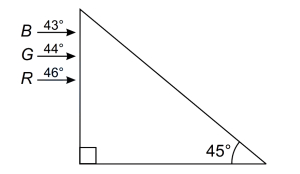
The figure shows a mixture of blue,green,and red colored rays incident normally on a right-angled prism. The critical angles of the material of the prism for red,green,and blue are $46^{\circ}$,$44^{\circ}$,and $43^{\circ}$ respectively. The arrangement will separate:
A
red color from blue and green
B
blue color from red and green
C
green color from red and blue
D
all the three colors
Solution
(A) The rays are incident normally on the first surface of the prism,so they pass undeviated and strike the hypotenuse at an angle of incidence $i = 45^{\circ}$.
For total internal reflection to occur at the second surface,the angle of incidence must be greater than the critical angle $(i > C)$.
Given critical angles are $C_{red} = 46^{\circ}$,$C_{green} = 44^{\circ}$,and $C_{blue} = 43^{\circ}$.
For red light: $i = 45^{\circ} < C_{red} = 46^{\circ}$. Thus,red light will emerge from the prism.
For green light: $i = 45^{\circ} > C_{green} = 44^{\circ}$. Thus,green light will undergo total internal reflection.
For blue light: $i = 45^{\circ} > C_{blue} = 43^{\circ}$. Thus,blue light will undergo total internal reflection.
Since green and blue light undergo total internal reflection while red light emerges,the arrangement separates red color from blue and green colors.
For total internal reflection to occur at the second surface,the angle of incidence must be greater than the critical angle $(i > C)$.
Given critical angles are $C_{red} = 46^{\circ}$,$C_{green} = 44^{\circ}$,and $C_{blue} = 43^{\circ}$.
For red light: $i = 45^{\circ} < C_{red} = 46^{\circ}$. Thus,red light will emerge from the prism.
For green light: $i = 45^{\circ} > C_{green} = 44^{\circ}$. Thus,green light will undergo total internal reflection.
For blue light: $i = 45^{\circ} > C_{blue} = 43^{\circ}$. Thus,blue light will undergo total internal reflection.
Since green and blue light undergo total internal reflection while red light emerges,the arrangement separates red color from blue and green colors.
0 likes
View Solution253
MediumMCQ
$A$ ray of light is incident normally on one face of a right-angled isosceles prism. It then grazes the hypotenuse. The refractive index of the material of the prism is
A
$1.33$
B
$1.414$
C
$1.5$
D
$1.732$
Solution
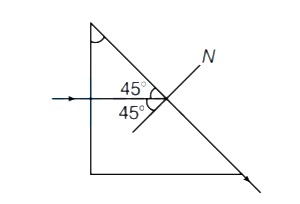
(B) ray of light incident normally on one face of a right-angled isosceles prism passes undeviated into the prism.
When it reaches the hypotenuse,the angle of incidence $i$ is $45^{\circ}$.
Since the ray grazes the hypotenuse,the angle of refraction is $90^{\circ}$.
Thus,the angle of incidence is equal to the critical angle $C$,so $C = 45^{\circ}$.
The refractive index $\mu$ is given by $\mu = \frac{1}{\sin C}$.
Substituting the value of $C$,we get $\mu = \frac{1}{\sin 45^{\circ}} = \frac{1}{1/\sqrt{2}} = \sqrt{2}$.
Therefore,$\mu \approx 1.414$.
When it reaches the hypotenuse,the angle of incidence $i$ is $45^{\circ}$.
Since the ray grazes the hypotenuse,the angle of refraction is $90^{\circ}$.
Thus,the angle of incidence is equal to the critical angle $C$,so $C = 45^{\circ}$.
The refractive index $\mu$ is given by $\mu = \frac{1}{\sin C}$.
Substituting the value of $C$,we get $\mu = \frac{1}{\sin 45^{\circ}} = \frac{1}{1/\sqrt{2}} = \sqrt{2}$.
Therefore,$\mu \approx 1.414$.
0 likes
View Solution254
MediumMCQ
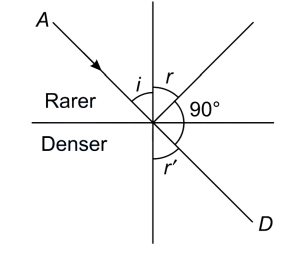
$A$ ray of light enters from a rarer to a denser medium. The angle of incidence is $i$. Then the reflected and refracted rays are mutually perpendicular to each other. The critical angle for the pair of media is
A
$\sin ^{-1}(\tan i)$
B
$\tan ^{-1}(\sin i)$
C
$\sin ^{-1}(\cot i)$
D
$\cos ^{-1}(\tan i)$
Solution
(C) According to the law of reflection,the angle of incidence $i$ is equal to the angle of reflection $r$,so $i = r$.
Given that the reflected and refracted rays are mutually perpendicular,the sum of the angle of reflection $r$,the angle between them $(90^{\circ})$,and the angle of refraction $r'$ is $180^{\circ}$.
Thus,$r + 90^{\circ} + r' = 180^{\circ}$.
Since $r = i$,we have $i + 90^{\circ} + r' = 180^{\circ}$,which implies $r' = 90^{\circ} - i$.
Applying Snell's Law at the interface: $\mu_r \sin i = \mu_d \sin r'$.
Substituting $r' = 90^{\circ} - i$,we get $\mu_r \sin i = \mu_d \sin(90^{\circ} - i) = \mu_d \cos i$.
Therefore,$\frac{\mu_d}{\mu_r} = \frac{\sin i}{\cos i} = \tan i$.
For the critical angle $C$,we know that $\sin C = \frac{\mu_r}{\mu_d}$.
Thus,$\sin C = \frac{1}{\tan i} = \cot i$.
Hence,the critical angle is $C = \sin^{-1}(\cot i)$.
Given that the reflected and refracted rays are mutually perpendicular,the sum of the angle of reflection $r$,the angle between them $(90^{\circ})$,and the angle of refraction $r'$ is $180^{\circ}$.
Thus,$r + 90^{\circ} + r' = 180^{\circ}$.
Since $r = i$,we have $i + 90^{\circ} + r' = 180^{\circ}$,which implies $r' = 90^{\circ} - i$.
Applying Snell's Law at the interface: $\mu_r \sin i = \mu_d \sin r'$.
Substituting $r' = 90^{\circ} - i$,we get $\mu_r \sin i = \mu_d \sin(90^{\circ} - i) = \mu_d \cos i$.
Therefore,$\frac{\mu_d}{\mu_r} = \frac{\sin i}{\cos i} = \tan i$.
For the critical angle $C$,we know that $\sin C = \frac{\mu_r}{\mu_d}$.
Thus,$\sin C = \frac{1}{\tan i} = \cot i$.
Hence,the critical angle is $C = \sin^{-1}(\cot i)$.
0 likes
View Solution255
MediumMCQ
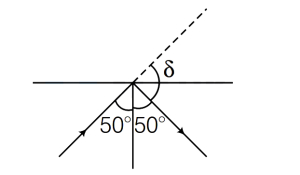
$A$ ray of light is travelling from glass to air. (refractive index of glass $= 1.5$). The angle of incidence is $50^{\circ}$. The deviation of the ray is
A
$0^{\circ}$
B
$80^{\circ}$
C
$50^{\circ} - \sin^{-1}\left[\frac{\sin 50^{\circ}}{1.5}\right]$
D
$\sin^{-1}\left[\frac{\sin 50^{\circ}}{1.5}\right] - 50^{\circ}$
Solution
(B) The refractive index of glass with respect to air is $\mu = 1.5$.
The critical angle $C$ is given by $\sin C = \frac{1}{\mu} = \frac{1}{1.5} = \frac{2}{3} \approx 0.667$.
$C = \sin^{-1}(0.667) \approx 41.8^{\circ} \approx 42^{\circ}$.
Since the angle of incidence $i = 50^{\circ}$ is greater than the critical angle $C = 42^{\circ}$,the light ray undergoes total internal reflection.
In total internal reflection,the angle of reflection $r$ is equal to the angle of incidence $i$,so $r = 50^{\circ}$.
The deviation $\delta$ is the angle between the original path of the incident ray and the reflected ray.
From the geometry of the reflection,the deviation is $\delta = 180^{\circ} - (i + r) = 180^{\circ} - (50^{\circ} + 50^{\circ}) = 180^{\circ} - 100^{\circ} = 80^{\circ}$.
The critical angle $C$ is given by $\sin C = \frac{1}{\mu} = \frac{1}{1.5} = \frac{2}{3} \approx 0.667$.
$C = \sin^{-1}(0.667) \approx 41.8^{\circ} \approx 42^{\circ}$.
Since the angle of incidence $i = 50^{\circ}$ is greater than the critical angle $C = 42^{\circ}$,the light ray undergoes total internal reflection.
In total internal reflection,the angle of reflection $r$ is equal to the angle of incidence $i$,so $r = 50^{\circ}$.
The deviation $\delta$ is the angle between the original path of the incident ray and the reflected ray.
From the geometry of the reflection,the deviation is $\delta = 180^{\circ} - (i + r) = 180^{\circ} - (50^{\circ} + 50^{\circ}) = 180^{\circ} - 100^{\circ} = 80^{\circ}$.
0 likes
View Solution256
MediumMCQ
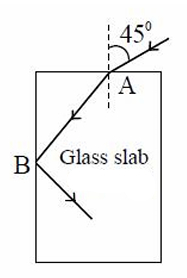
$A$ light ray falls on a rectangular glass slab as shown in the figure. If total internal reflection occurs at the vertical face of the slab at point $B$,the refractive index of glass is
A
$\sqrt{\frac{3}{2}}$
B
$\frac{\sqrt{3}+1}{2}$
C
$\frac{\sqrt{2}+1}{2}$
D
$\frac{\sqrt{5}}{2}$
Solution
(A) Let the refractive index of the glass slab be $\mu$. The angle of incidence at point $A$ is $i = 45^\circ$. Let the angle of refraction at $A$ be $r$. By Snell's Law,$1 \cdot \sin(45^\circ) = \mu \cdot \sin(r)$,so $\sin(r) = \frac{1}{\mu\sqrt{2}}$.
At point $B$,the angle of incidence is $r' = 90^\circ - r$. For total internal reflection to occur,the angle of incidence must be greater than or equal to the critical angle $C$,where $\sin(C) = \frac{1}{\mu}$.
Thus,$\sin(90^\circ - r) \ge \frac{1}{\mu}$,which implies $\cos(r) \ge \frac{1}{\mu}$.
Squaring both sides,$\cos^2(r) \ge \frac{1}{\mu^2}$,so $1 - \sin^2(r) \ge \frac{1}{\mu^2}$.
Substituting $\sin^2(r) = \frac{1}{2\mu^2}$,we get $1 - \frac{1}{2\mu^2} \ge \frac{1}{\mu^2}$,which simplifies to $1 \ge \frac{3}{2\mu^2}$.
Thus,$\mu^2 \ge \frac{3}{2}$,or $\mu \ge \sqrt{\frac{3}{2}}$. The minimum refractive index is $\sqrt{\frac{3}{2}}$.
At point $B$,the angle of incidence is $r' = 90^\circ - r$. For total internal reflection to occur,the angle of incidence must be greater than or equal to the critical angle $C$,where $\sin(C) = \frac{1}{\mu}$.
Thus,$\sin(90^\circ - r) \ge \frac{1}{\mu}$,which implies $\cos(r) \ge \frac{1}{\mu}$.
Squaring both sides,$\cos^2(r) \ge \frac{1}{\mu^2}$,so $1 - \sin^2(r) \ge \frac{1}{\mu^2}$.
Substituting $\sin^2(r) = \frac{1}{2\mu^2}$,we get $1 - \frac{1}{2\mu^2} \ge \frac{1}{\mu^2}$,which simplifies to $1 \ge \frac{3}{2\mu^2}$.
Thus,$\mu^2 \ge \frac{3}{2}$,or $\mu \ge \sqrt{\frac{3}{2}}$. The minimum refractive index is $\sqrt{\frac{3}{2}}$.
0 likes
View Solution257
EasyMCQ
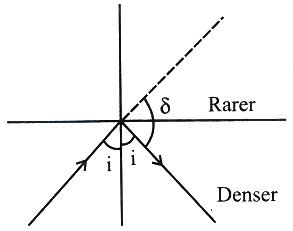
$A$ ray of light travels from an optically denser to a rarer medium. The critical angle for the two media is $C$. The maximum possible deviation of the ray will be
A
$\frac{\pi}{2}-C$
B
$2C$
C
$\pi-2C$
D
$\pi-C$
Solution
(C) When a light ray travels from a denser to a rarer medium,it undergoes refraction. The angle of deviation $\delta$ for refraction is given by $\delta = |r - i|$,where $i$ is the angle of incidence and $r$ is the angle of refraction.
Since $r > i$,$\delta = r - i$.
As $i$ increases,$r$ also increases. The maximum value of $i$ is the critical angle $C$,at which point $r = 90^\circ$ or $\frac{\pi}{2}$ radians.
Thus,the maximum deviation for refraction is $\delta_{\max} = \frac{\pi}{2} - C$.
However,if the angle of incidence $i$ exceeds $C$,the ray undergoes total internal reflection. In this case,the angle of reflection is equal to the angle of incidence $(r = i)$.
The deviation for reflection is $\delta = \pi - 2i$.
To find the maximum deviation for reflection,we consider the range $C < i < \frac{\pi}{2}$. As $i$ approaches $C$ from the denser side,$\delta$ approaches $\pi - 2C$. This is the maximum possible deviation for the ray in this scenario.
Since $r > i$,$\delta = r - i$.
As $i$ increases,$r$ also increases. The maximum value of $i$ is the critical angle $C$,at which point $r = 90^\circ$ or $\frac{\pi}{2}$ radians.
Thus,the maximum deviation for refraction is $\delta_{\max} = \frac{\pi}{2} - C$.
However,if the angle of incidence $i$ exceeds $C$,the ray undergoes total internal reflection. In this case,the angle of reflection is equal to the angle of incidence $(r = i)$.
The deviation for reflection is $\delta = \pi - 2i$.
To find the maximum deviation for reflection,we consider the range $C < i < \frac{\pi}{2}$. As $i$ approaches $C$ from the denser side,$\delta$ approaches $\pi - 2C$. This is the maximum possible deviation for the ray in this scenario.
0 likes
View Solution258
EasyMCQ
The critical angle for diamond with respect to air is nearly (in $^{\circ}$)
A
$48.8$
B
$41.1$
C
$37.3$
D
$24.4$
Solution
(D) The critical angle $i_c$ is given by the formula $\sin(i_c) = \frac{1}{n}$,where $n$ is the refractive index of the material with respect to air.
For diamond,the refractive index $n \approx 2.42$.
Therefore,$\sin(i_c) = \frac{1}{2.42} \approx 0.413$.
Taking the inverse sine,$i_c = \arcsin(0.413) \approx 24.4^{\circ}$.
For diamond,the refractive index $n \approx 2.42$.
Therefore,$\sin(i_c) = \frac{1}{2.42} \approx 0.413$.
Taking the inverse sine,$i_c = \arcsin(0.413) \approx 24.4^{\circ}$.
0 likes
View Solution259
MediumMCQ
With respect to air,the critical angle in a medium for red light of wavelength $\lambda_1$ is $\theta$. Other facts remaining same,the critical angle for yellow light of wavelength $\lambda_2$ will be
A
$\theta$
B
more than $\theta$
C
less than $\theta$
D
$\frac{\theta \lambda_1}{\lambda_2}$
Solution
(C) The critical angle $C$ is given by the formula $\sin C = \frac{1}{n}$,where $n$ is the refractive index of the medium.
Since the refractive index $n$ is inversely proportional to the wavelength $\lambda$ (Cauchy's relation: $n \approx A + \frac{B}{\lambda^2}$),as the wavelength decreases,the refractive index increases.
For red light,the wavelength is $\lambda_1$. For yellow light,the wavelength is $\lambda_2$. Since $\lambda_1 > \lambda_2$,the refractive index for red light $(n_r)$ is less than the refractive index for yellow light $(n_y)$.
Therefore,$n_r < n_y$.
Since $\sin C = \frac{1}{n}$,a higher refractive index results in a smaller critical angle.
Thus,the critical angle for yellow light will be less than the critical angle for red light $(\theta)$.
Since the refractive index $n$ is inversely proportional to the wavelength $\lambda$ (Cauchy's relation: $n \approx A + \frac{B}{\lambda^2}$),as the wavelength decreases,the refractive index increases.
For red light,the wavelength is $\lambda_1$. For yellow light,the wavelength is $\lambda_2$. Since $\lambda_1 > \lambda_2$,the refractive index for red light $(n_r)$ is less than the refractive index for yellow light $(n_y)$.
Therefore,$n_r < n_y$.
Since $\sin C = \frac{1}{n}$,a higher refractive index results in a smaller critical angle.
Thus,the critical angle for yellow light will be less than the critical angle for red light $(\theta)$.
0 likes
View Solution260
MediumMCQ
$A$ ray is incident from a medium of refractive index $2$ into a medium of refractive index $1$. The critical angle is (in $^{\circ}$)
A
$30$
B
$60$
C
$45$
D
$90$
Solution
(A) The critical angle $(i_c)$ is the angle of incidence in a denser medium for which the angle of refraction in the rarer medium is $90^{\circ}$.
Given,refractive index of the denser medium $\mu_1 = 2$ and refractive index of the rarer medium $\mu_2 = 1$.
The formula for the critical angle is given by $\sin(i_c) = \frac{\mu_2}{\mu_1}$.
Substituting the values,we get $\sin(i_c) = \frac{1}{2}$.
Therefore,$i_c = \sin^{-1}(0.5) = 30^{\circ}$.
Given,refractive index of the denser medium $\mu_1 = 2$ and refractive index of the rarer medium $\mu_2 = 1$.
The formula for the critical angle is given by $\sin(i_c) = \frac{\mu_2}{\mu_1}$.
Substituting the values,we get $\sin(i_c) = \frac{1}{2}$.
Therefore,$i_c = \sin^{-1}(0.5) = 30^{\circ}$.
0 likes
View Solution261
EasyMCQ
$A$ light ray is incident from a medium of refractive index $2$ into a medium of refractive index $\sqrt{3}$. The critical angle is (in $^{\circ}$)
A
$30$
B
$45$
C
$60$
D
$90$
Solution
(C) The critical angle $i_c$ is defined as the angle of incidence for which the angle of refraction is $90^{\circ}$ when light travels from a denser medium to a rarer medium.
Given,refractive index of the first medium $\mu_1 = 2$ and refractive index of the second medium $\mu_2 = \sqrt{3}$.
The formula for the critical angle is given by $\sin i_c = \frac{\mu_2}{\mu_1}$.
Substituting the values,we get $\sin i_c = \frac{\sqrt{3}}{2}$.
Since $\sin 60^{\circ} = \frac{\sqrt{3}}{2}$,we have $i_c = 60^{\circ}$.
Given,refractive index of the first medium $\mu_1 = 2$ and refractive index of the second medium $\mu_2 = \sqrt{3}$.
The formula for the critical angle is given by $\sin i_c = \frac{\mu_2}{\mu_1}$.
Substituting the values,we get $\sin i_c = \frac{\sqrt{3}}{2}$.
Since $\sin 60^{\circ} = \frac{\sqrt{3}}{2}$,we have $i_c = 60^{\circ}$.
0 likes
View Solution262
EasyMCQ
$A$ well-cut diamond appears bright because
A
it emits light
B
it is radioactive
C
of its total internal reflection
D
it has high density
Solution
(C) The refractive index $\mu$ of a diamond is very high (approximately $2.42$).
Since the critical angle $\theta_c$ is given by the relation $\sin \theta_c = \frac{1}{\mu}$,a high refractive index results in a very small critical angle.
When light enters a well-cut diamond,it strikes the internal surfaces at angles greater than the critical angle.
This leads to multiple total internal reflections within the diamond.
Consequently,the light is trapped and reflected multiple times,making the diamond appear bright.
Since the critical angle $\theta_c$ is given by the relation $\sin \theta_c = \frac{1}{\mu}$,a high refractive index results in a very small critical angle.
When light enters a well-cut diamond,it strikes the internal surfaces at angles greater than the critical angle.
This leads to multiple total internal reflections within the diamond.
Consequently,the light is trapped and reflected multiple times,making the diamond appear bright.
0 likes
View Solution263
MediumMCQ
If the refractive index of water is $\frac{4}{3}$ and that of a given glass slab immersed in it is $\frac{5}{3}$,the value of the critical angle for a ray of light tending to go from glass to water is:
A
$\sin ^{-1}\left(\frac{4}{5}\right)$
B
$\sin ^{-1}\left(\frac{3}{4}\right)$
C
$\sin ^{-1}\left(\frac{5}{3}\right)$
D
$\sin ^{-1}\left(\frac{4}{3}\right)$
Solution
(A) The refractive index of glass with respect to water is given by the ratio of their absolute refractive indices (or refractive indices with respect to air).
Given: Refractive index of water,$\mu_w = \frac{4}{3}$.
Refractive index of glass,$\mu_g = \frac{5}{3}$.
The relative refractive index of glass with respect to water is $\mu = \frac{\mu_g}{\mu_w} = \frac{5/3}{4/3} = \frac{5}{4}$.
The critical angle $C$ is defined by the relation $\sin C = \frac{1}{\mu}$.
Substituting the value of $\mu$,we get $\sin C = \frac{1}{5/4} = \frac{4}{5}$.
Therefore,the critical angle $C = \sin ^{-1}\left(\frac{4}{5}\right)$.
Given: Refractive index of water,$\mu_w = \frac{4}{3}$.
Refractive index of glass,$\mu_g = \frac{5}{3}$.
The relative refractive index of glass with respect to water is $\mu = \frac{\mu_g}{\mu_w} = \frac{5/3}{4/3} = \frac{5}{4}$.
The critical angle $C$ is defined by the relation $\sin C = \frac{1}{\mu}$.
Substituting the value of $\mu$,we get $\sin C = \frac{1}{5/4} = \frac{4}{5}$.
Therefore,the critical angle $C = \sin ^{-1}\left(\frac{4}{5}\right)$.
0 likes
View Solution264
EasyMCQ
$A$ ray of light travels from a medium of refractive index $2$ to another medium of refractive index $\sqrt{2}$. Total internal reflection takes place when the angle of incidence is
A
$> 45^{\circ}$
B
$< 45^{\circ}$
C
$= 45^{\circ}$
D
$= 30^{\circ}$
Solution
(A) The refractive index of the first medium is $\mu_1 = 2$ and the refractive index of the second medium is $\mu_2 = \sqrt{2}$.
Total internal reflection occurs when the light travels from a denser medium to a rarer medium and the angle of incidence $i$ is greater than the critical angle $i_C$.
The critical angle $i_C$ is given by the formula $\sin i_C = \frac{\mu_2}{\mu_1}$.
Substituting the values,we get $\sin i_C = \frac{\sqrt{2}}{2} = \frac{1}{\sqrt{2}}$.
Therefore,$i_C = 45^{\circ}$.
For total internal reflection to occur,the angle of incidence must be greater than the critical angle,i.e.,$i > 45^{\circ}$.
Total internal reflection occurs when the light travels from a denser medium to a rarer medium and the angle of incidence $i$ is greater than the critical angle $i_C$.
The critical angle $i_C$ is given by the formula $\sin i_C = \frac{\mu_2}{\mu_1}$.
Substituting the values,we get $\sin i_C = \frac{\sqrt{2}}{2} = \frac{1}{\sqrt{2}}$.
Therefore,$i_C = 45^{\circ}$.
For total internal reflection to occur,the angle of incidence must be greater than the critical angle,i.e.,$i > 45^{\circ}$.
0 likes
View Solution265
DifficultMCQ
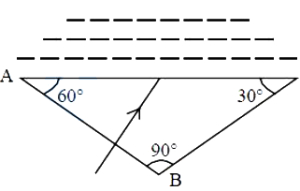
$A$ right-angled glass prism is shown in the figure. $A$ liquid film is in contact with the hypotenuse face. $A$ ray of light incident normally on the face $AB$ will undergo total internal reflection from the hypotenuse face,if the refractive index of the liquid is $\mu_l$ (given $\mu_{\text{glass}} = 3/2$).
A
$< \frac{3 \sqrt{3}}{4}$
B
$> \frac{3 \sqrt{3}}{4}$
C
$1.7$
D
$1.5$
Solution
(A) The prism is a right-angled triangle with angles $30^{\circ}, 60^{\circ}, 90^{\circ}$.
When a ray of light is incident normally on face $AB$,it passes undeviated into the prism.
It then strikes the hypotenuse face at an angle of incidence $i = 60^{\circ}$.
For total internal reflection $(TIR)$ to occur at the hypotenuse face,the angle of incidence must be greater than the critical angle $C$,i.e.,$i > C$.
Thus,$\sin(i) > \sin(C)$.
Given $i = 60^{\circ}$,we have $\sin(60^{\circ}) > \frac{\mu_l}{\mu_{\text{glass}}}$.
$\frac{\sqrt{3}}{2} > \frac{\mu_l}{3/2}$.
$\frac{\sqrt{3}}{2} > \frac{2 \mu_l}{3}$.
$\mu_l < \frac{3 \sqrt{3}}{4}$.
Therefore,the refractive index of the liquid must be less than $\frac{3 \sqrt{3}}{4}$.
When a ray of light is incident normally on face $AB$,it passes undeviated into the prism.
It then strikes the hypotenuse face at an angle of incidence $i = 60^{\circ}$.
For total internal reflection $(TIR)$ to occur at the hypotenuse face,the angle of incidence must be greater than the critical angle $C$,i.e.,$i > C$.
Thus,$\sin(i) > \sin(C)$.
Given $i = 60^{\circ}$,we have $\sin(60^{\circ}) > \frac{\mu_l}{\mu_{\text{glass}}}$.
$\frac{\sqrt{3}}{2} > \frac{\mu_l}{3/2}$.
$\frac{\sqrt{3}}{2} > \frac{2 \mu_l}{3}$.
$\mu_l < \frac{3 \sqrt{3}}{4}$.
Therefore,the refractive index of the liquid must be less than $\frac{3 \sqrt{3}}{4}$.
0 likes
View Solution266
EasyMCQ
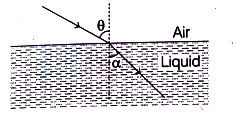
$A$ beam of light is incident from air on the surface of a liquid. The angle of incidence is $\theta$ and the angle of refraction is $\alpha$. If the critical angle for the liquid when surrounded by air is $\theta_c$,then $\sin \theta_c$ is:
A
$\frac{\sin \alpha}{\sin \theta}$
B
$\sin \alpha \times \sin \theta$
C
$\frac{\sin \theta}{\sin \alpha}$
D
$\frac{\sin \alpha}{\cos \theta}$
Solution
(A) According to Snell's Law,the refractive index of the liquid with respect to air $(n_{la})$ is given by:
$n_{la} = \frac{\sin \theta}{\sin \alpha}$
By definition,the critical angle $\theta_c$ is the angle of incidence in the denser medium (liquid) for which the angle of refraction in the rarer medium (air) is $90^{\circ}$.
The refractive index of air with respect to the liquid $(n_{al})$ is:
$n_{al} = \frac{1}{n_{la}} = \frac{\sin \theta_c}{\sin 90^{\circ}}$
Since $\sin 90^{\circ} = 1$,we have:
$\sin \theta_c = \frac{1}{n_{la}}$
Substituting the value of $n_{la}$:
$\sin \theta_c = \frac{1}{\frac{\sin \theta}{\sin \alpha}} = \frac{\sin \alpha}{\sin \theta}$
$n_{la} = \frac{\sin \theta}{\sin \alpha}$
By definition,the critical angle $\theta_c$ is the angle of incidence in the denser medium (liquid) for which the angle of refraction in the rarer medium (air) is $90^{\circ}$.
The refractive index of air with respect to the liquid $(n_{al})$ is:
$n_{al} = \frac{1}{n_{la}} = \frac{\sin \theta_c}{\sin 90^{\circ}}$
Since $\sin 90^{\circ} = 1$,we have:
$\sin \theta_c = \frac{1}{n_{la}}$
Substituting the value of $n_{la}$:
$\sin \theta_c = \frac{1}{\frac{\sin \theta}{\sin \alpha}} = \frac{\sin \alpha}{\sin \theta}$
0 likes
View Solution267
EasyMCQ
$A$ light ray travels from a medium with refractive index $n_1$ to another medium of refractive index $n_2$. If $n_1=2$ and $n_2=\sqrt{3}$,then find the critical angle. (in $^{\circ}$)
A
$15$
B
$30$
C
$45$
D
$60$
Solution
(D) The critical angle $\theta_{c}$ is the angle of incidence for which the angle of refraction is $90^{\circ}$.
It is given by the formula:
$\sin \theta_{c} = \frac{n_2}{n_1}$
Given $n_1 = 2$ and $n_2 = \sqrt{3}$,we substitute these values into the formula:
$\sin \theta_{c} = \frac{\sqrt{3}}{2}$
Since $\sin 60^{\circ} = \frac{\sqrt{3}}{2}$,we have:
$\theta_{c} = 60^{\circ}$
It is given by the formula:
$\sin \theta_{c} = \frac{n_2}{n_1}$
Given $n_1 = 2$ and $n_2 = \sqrt{3}$,we substitute these values into the formula:
$\sin \theta_{c} = \frac{\sqrt{3}}{2}$
Since $\sin 60^{\circ} = \frac{\sqrt{3}}{2}$,we have:
$\theta_{c} = 60^{\circ}$
0 likes
View Solution268
MediumMCQ
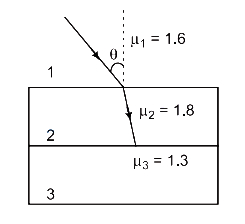
$A$ ray of light refracts from medium $1$ into a thin layer of medium $2$,crosses the layer,and is incident at the critical angle on the interface between medium $2$ and $3$ as shown in the figure. If the angle of incidence of the ray is $\theta$,the value of $\theta$ is
A
$\sin ^{-1}\left(\frac{8}{9}\right)$
B
$\sin ^{-1}\left(\frac{13}{18}\right)$
C
$\sin ^{-1}\left(\frac{13}{16}\right)$
D
$\sin ^{-1}\left(\frac{8}{13}\right)$
Solution
(C) Given: Refractive indices $\mu_1 = 1.6$,$\mu_2 = 1.8$,$\mu_3 = 1.3$.
At the interface between medium $2$ and $3$,the ray is incident at the critical angle $C$. Therefore,$\sin C = \frac{\mu_3}{\mu_2} = \frac{1.3}{1.8}$.
Let $r$ be the angle of refraction in medium $2$. Since the ray is incident at the critical angle at the interface of $2$ and $3$,the angle of refraction $r$ at the first interface is equal to the critical angle $C$ (i.e.,$r = C$).
Applying Snell's Law at the interface between medium $1$ and $2$:
$\mu_1 \sin \theta = \mu_2 \sin r$
Since $r = C$,we have $\sin r = \sin C = \frac{1.3}{1.8}$.
Substituting the values:
$1.6 \times \sin \theta = 1.8 \times \left(\frac{1.3}{1.8}\right)$
$1.6 \times \sin \theta = 1.3$
$\sin \theta = \frac{1.3}{1.6} = \frac{13}{16}$
$\theta = \sin ^{-1}\left(\frac{13}{16}\right)$
At the interface between medium $2$ and $3$,the ray is incident at the critical angle $C$. Therefore,$\sin C = \frac{\mu_3}{\mu_2} = \frac{1.3}{1.8}$.
Let $r$ be the angle of refraction in medium $2$. Since the ray is incident at the critical angle at the interface of $2$ and $3$,the angle of refraction $r$ at the first interface is equal to the critical angle $C$ (i.e.,$r = C$).
Applying Snell's Law at the interface between medium $1$ and $2$:
$\mu_1 \sin \theta = \mu_2 \sin r$
Since $r = C$,we have $\sin r = \sin C = \frac{1.3}{1.8}$.
Substituting the values:
$1.6 \times \sin \theta = 1.8 \times \left(\frac{1.3}{1.8}\right)$
$1.6 \times \sin \theta = 1.3$
$\sin \theta = \frac{1.3}{1.6} = \frac{13}{16}$
$\theta = \sin ^{-1}\left(\frac{13}{16}\right)$
0 likes
View Solution269
DifficultMCQ
In an optical fibre,the core and cladding are made with materials of refractive indices $1.5$ and $1.414$ respectively. To observe total internal reflection,what will be the range of the incident angle with the axis of the optical fibre?
A
$0^{\circ}-60^{\circ}$
B
$0^{\circ}-48^{\circ}$
C
$0^{\circ}-30^{\circ}$
D
$0^{\circ}-82^{\circ}$
Solution
(C) The acceptance angle $\theta_a$ is the maximum angle of incidence at the entrance of the optical fibre such that the light undergoes total internal reflection at the core-cladding interface.
For an optical fibre with core refractive index $\mu_1 = 1.5$ and cladding refractive index $\mu_2 = 1.414$,the acceptance angle $\theta_a$ is given by the formula:
$\sin \theta_a = \sqrt{\mu_1^2 - \mu_2^2}$
Substituting the given values:
$\sin \theta_a = \sqrt{(1.5)^2 - (1.414)^2}$
$\sin \theta_a = \sqrt{2.25 - 1.999396} \approx \sqrt{0.2506} \approx 0.5006$
$\theta_a = \sin^{-1}(0.5006) \approx 30^{\circ}$
Thus,the range of the incident angle with the axis of the optical fibre for total internal reflection is $0^{\circ}$ to $30^{\circ}$.
Therefore,option $C$ is correct.
For an optical fibre with core refractive index $\mu_1 = 1.5$ and cladding refractive index $\mu_2 = 1.414$,the acceptance angle $\theta_a$ is given by the formula:
$\sin \theta_a = \sqrt{\mu_1^2 - \mu_2^2}$
Substituting the given values:
$\sin \theta_a = \sqrt{(1.5)^2 - (1.414)^2}$
$\sin \theta_a = \sqrt{2.25 - 1.999396} \approx \sqrt{0.2506} \approx 0.5006$
$\theta_a = \sin^{-1}(0.5006) \approx 30^{\circ}$
Thus,the range of the incident angle with the axis of the optical fibre for total internal reflection is $0^{\circ}$ to $30^{\circ}$.
Therefore,option $C$ is correct.
0 likes
View Solution270
MediumMCQ
Assertion $(A)$: Propagation of light through an optical fibre is due to total internal reflection taking place at the core-clad interface.
Reason $(R)$: Refractive index of the material of the core of the optical fibre is greater than that of air.
Reason $(R)$: Refractive index of the material of the core of the optical fibre is greater than that of air.
A
both $(A)$ and $(R)$ are true and $(R)$ is the correct explanation of $(A)$
B
both $(A)$ and $(R)$ are true but $(R)$ is not the correct explanation of $(A)$
C
$(A)$ is true but $(R)$ is false
D
$(A)$ is false but $(R)$ is true
Solution
(B) The assertion $(A)$ is true because optical fibres work on the principle of total internal reflection $(TIR)$,which occurs when light travels from a denser medium (core) to a rarer medium (cladding) at an angle of incidence greater than the critical angle.
The reason $(R)$ states that the refractive index of the core is greater than that of air. While it is true that the core has a higher refractive index than air,the condition for $TIR$ in an optical fibre is that the refractive index of the core $(n_1)$ must be greater than the refractive index of the cladding $(n_2)$,not necessarily air.
Therefore,while both statements are factually correct,the reason $(R)$ does not explain why $TIR$ occurs at the core-clad interface. The correct explanation would involve the relationship between the core and the cladding refractive indices.
The reason $(R)$ states that the refractive index of the core is greater than that of air. While it is true that the core has a higher refractive index than air,the condition for $TIR$ in an optical fibre is that the refractive index of the core $(n_1)$ must be greater than the refractive index of the cladding $(n_2)$,not necessarily air.
Therefore,while both statements are factually correct,the reason $(R)$ does not explain why $TIR$ occurs at the core-clad interface. The correct explanation would involve the relationship between the core and the cladding refractive indices.
0 likes
View Solution271
EasyMCQ
Assertion $(A)$: Optical fibres are widely used in communication networks. Reason $(R)$: Optical fibres are small in size,light in weight,flexible,and there is no scope for interference in them.
A
Both $(A)$ and $(R)$ are true and $(R)$ is the correct explanation of $(A)$
B
Both $(A)$ and $(R)$ are true but $(R)$ is not the correct explanation of $(A)$
C
$(A)$ is true but $(R)$ is false
D
$(A)$ is false but $(R)$ is true
Solution
(A) Optical fibres are extensively used in modern communication systems because they offer high bandwidth and low signal loss.
They are physically small,lightweight,and flexible,making them easy to install.
Since light signals are confined within the fibre due to total internal reflection,they are immune to electromagnetic interference,which is a significant advantage over copper wires.
Therefore,both the assertion and the reason are true,and the reason correctly explains why optical fibres are widely used.
They are physically small,lightweight,and flexible,making them easy to install.
Since light signals are confined within the fibre due to total internal reflection,they are immune to electromagnetic interference,which is a significant advantage over copper wires.
Therefore,both the assertion and the reason are true,and the reason correctly explains why optical fibres are widely used.
0 likes
View Solution272
DifficultMCQ
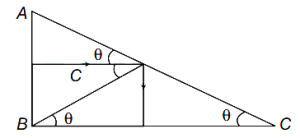
$A$ ray of light is incident on the hypotenuse of a right-angled prism after travelling parallel to the base inside the prism. If $\mu$ is the refractive index of the material of the prism,the maximum value of the base angle for which light is totally reflected from the hypotenuse is
A
$\sin ^{-1}\left(\frac{1}{\mu}\right)$
B
$\tan ^{-1}\left(\frac{1}{\mu}\right)$
C
$\sin ^{-1}\left(\frac{\mu-1}{\mu}\right)$
D
$\cos ^{-1}\left(\frac{1}{\mu}\right)$
Solution
(D) For total internal reflection to occur at the hypotenuse,the angle of incidence $i$ must be greater than or equal to the critical angle $C$.
From the geometry of the prism,the light ray travels parallel to the base $BC$. The angle between the incident ray and the normal to the hypotenuse is the angle of incidence $i$.
In the right-angled triangle,if the base angle is $\theta$,the angle of incidence $i$ at the hypotenuse is $90^{\circ} - \theta$.
For total internal reflection,$i \geq C$,where $\sin C = \frac{1}{\mu}$.
Thus,$90^{\circ} - \theta \geq C \Rightarrow \theta \leq 90^{\circ} - C$.
To find the maximum value of $\theta$,we set $\theta = 90^{\circ} - C$.
Taking the cosine on both sides: $\cos \theta = \cos(90^{\circ} - C) = \sin C$.
Since $\sin C = \frac{1}{\mu}$,we have $\cos \theta = \frac{1}{\mu}$.
Therefore,$\theta = \cos ^{-1}\left(\frac{1}{\mu}\right)$.
From the geometry of the prism,the light ray travels parallel to the base $BC$. The angle between the incident ray and the normal to the hypotenuse is the angle of incidence $i$.
In the right-angled triangle,if the base angle is $\theta$,the angle of incidence $i$ at the hypotenuse is $90^{\circ} - \theta$.
For total internal reflection,$i \geq C$,where $\sin C = \frac{1}{\mu}$.
Thus,$90^{\circ} - \theta \geq C \Rightarrow \theta \leq 90^{\circ} - C$.
To find the maximum value of $\theta$,we set $\theta = 90^{\circ} - C$.
Taking the cosine on both sides: $\cos \theta = \cos(90^{\circ} - C) = \sin C$.
Since $\sin C = \frac{1}{\mu}$,we have $\cos \theta = \frac{1}{\mu}$.
Therefore,$\theta = \cos ^{-1}\left(\frac{1}{\mu}\right)$.
0 likes
View Solution273
MediumMCQ
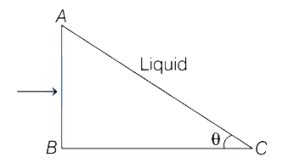
Consider a glass prism immersed in a liquid as shown below. The refractive index of glass and liquid is $1.5$ and $1.2$,respectively. $A$ ray of light enters the prism perpendicular to the face $AB$. If the ray is totally internally reflected at the face $AC$,then the largest value of angle $\theta$ is:
A
$\cos ^{-1}(0.8)$
B
$\sin ^{-1}(0.8)$
C
$\cos ^{-1}(0.6)$
D
$\sin ^{-1}(0.4)$
Solution
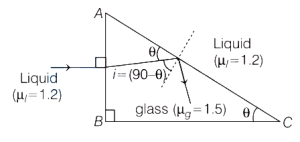
(A) The given situation is shown in the figure. The light ray enters the prism perpendicular to the face $AB$,so it passes undeviated into the prism and strikes the face $AC$.
In the triangle formed by the prism,the angle of incidence $i$ at the face $AC$ is $i = 90^{\circ} - \theta$.
For total internal reflection to occur at face $AC$,the angle of incidence $i$ must be greater than or equal to the critical angle $i_c$.
Thus,for the largest value of $\theta$,we set $i = i_c$.
Using Snell's law at the interface $AC$ for the critical angle condition:
$\sin(i_c) = \frac{\mu_{\text{liquid}}}{\mu_{\text{glass}}}$
Substituting $i = 90^{\circ} - \theta$ and the given refractive indices:
$\sin(90^{\circ} - \theta) = \frac{1.2}{1.5}$
$\cos(\theta) = \frac{12}{15} = \frac{4}{5} = 0.8$
Therefore,$\theta = \cos^{-1}(0.8)$.
In the triangle formed by the prism,the angle of incidence $i$ at the face $AC$ is $i = 90^{\circ} - \theta$.
For total internal reflection to occur at face $AC$,the angle of incidence $i$ must be greater than or equal to the critical angle $i_c$.
Thus,for the largest value of $\theta$,we set $i = i_c$.
Using Snell's law at the interface $AC$ for the critical angle condition:
$\sin(i_c) = \frac{\mu_{\text{liquid}}}{\mu_{\text{glass}}}$
Substituting $i = 90^{\circ} - \theta$ and the given refractive indices:
$\sin(90^{\circ} - \theta) = \frac{1.2}{1.5}$
$\cos(\theta) = \frac{12}{15} = \frac{4}{5} = 0.8$
Therefore,$\theta = \cos^{-1}(0.8)$.
0 likes
View Solution274
MediumMCQ
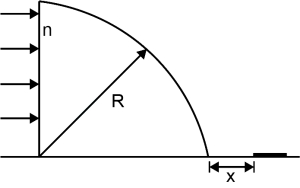
$A$ parallel beam of light is incident on a glass prism in the shape of a quarter cylinder of radius $R=0.05 \ m$ and refractive index $n=1.5$,placed on a horizontal table as shown in the figure. Beyond the cylinder,a patch of light is found whose nearest distance $x$ from the cylinder is
A
$(3 \sqrt{3}-4) \times 10^{-2} \ m$
B
$(2 \sqrt{3}-2) \times 10^{-2} \ m$
C
$(3 \sqrt{5}-5) \times 10^{-2} \ m$
D
$(3 \sqrt{2}-3) \times 10^{-2} \ m$
Solution
(C) Given,radius $R=0.05 \ m = 5 \times 10^{-2} \ m$.
Refractive index $n=1.5$.
The critical angle $c$ is given by $\sin c = \frac{1}{n} = \frac{1}{1.5} = \frac{2}{3}$.
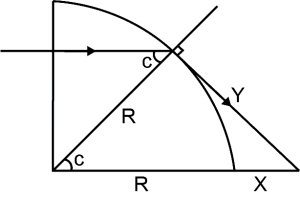
From the geometry of the problem,the ray that strikes the curved surface at the critical angle $c$ will emerge tangent to the surface and hit the table at a distance $x$ from the edge of the cylinder.
In the right-angled triangle formed by the radius $R$ and the distance $(R+x)$,the angle at the center is $c$.
Thus,$\cos c = \frac{R}{R+x}$.
Since $\sin c = \frac{2}{3}$,we have $\cos c = \sqrt{1 - \sin^2 c} = \sqrt{1 - \frac{4}{9}} = \sqrt{\frac{5}{9}} = \frac{\sqrt{5}}{3}$.
Equating the two expressions for $\cos c$:
$\frac{\sqrt{5}}{3} = \frac{R}{R+x}$.
$\sqrt{5}(R+x) = 3R$.
$\sqrt{5}x = 3R - \sqrt{5}R = R(3 - \sqrt{5})$.
$x = R \frac{3 - \sqrt{5}}{\sqrt{5}} = R \left( \frac{3}{\sqrt{5}} - 1 \right) = R \left( \frac{3\sqrt{5}}{5} - 1 \right)$.
Wait,re-evaluating the geometry: The distance from the center to the point where the ray hits the table is $d = \frac{R}{\cos c}$.
So,$R+x = \frac{R}{\cos c} = \frac{R}{\sqrt{5}/3} = \frac{3R}{\sqrt{5}} = \frac{3\sqrt{5}R}{5}$.
$x = \frac{3\sqrt{5}R}{5} - R = R \left( \frac{3\sqrt{5}-5}{5} \right)$.
Given $R = 5 \times 10^{-2} \ m$,we get $x = 5 \times 10^{-2} \left( \frac{3\sqrt{5}-5}{5} \right) = (3\sqrt{5}-5) \times 10^{-2} \ m$.
Refractive index $n=1.5$.
The critical angle $c$ is given by $\sin c = \frac{1}{n} = \frac{1}{1.5} = \frac{2}{3}$.
From the geometry of the problem,the ray that strikes the curved surface at the critical angle $c$ will emerge tangent to the surface and hit the table at a distance $x$ from the edge of the cylinder.
In the right-angled triangle formed by the radius $R$ and the distance $(R+x)$,the angle at the center is $c$.
Thus,$\cos c = \frac{R}{R+x}$.
Since $\sin c = \frac{2}{3}$,we have $\cos c = \sqrt{1 - \sin^2 c} = \sqrt{1 - \frac{4}{9}} = \sqrt{\frac{5}{9}} = \frac{\sqrt{5}}{3}$.
Equating the two expressions for $\cos c$:
$\frac{\sqrt{5}}{3} = \frac{R}{R+x}$.
$\sqrt{5}(R+x) = 3R$.
$\sqrt{5}x = 3R - \sqrt{5}R = R(3 - \sqrt{5})$.
$x = R \frac{3 - \sqrt{5}}{\sqrt{5}} = R \left( \frac{3}{\sqrt{5}} - 1 \right) = R \left( \frac{3\sqrt{5}}{5} - 1 \right)$.
Wait,re-evaluating the geometry: The distance from the center to the point where the ray hits the table is $d = \frac{R}{\cos c}$.
So,$R+x = \frac{R}{\cos c} = \frac{R}{\sqrt{5}/3} = \frac{3R}{\sqrt{5}} = \frac{3\sqrt{5}R}{5}$.
$x = \frac{3\sqrt{5}R}{5} - R = R \left( \frac{3\sqrt{5}-5}{5} \right)$.
Given $R = 5 \times 10^{-2} \ m$,we get $x = 5 \times 10^{-2} \left( \frac{3\sqrt{5}-5}{5} \right) = (3\sqrt{5}-5) \times 10^{-2} \ m$.
0 likes
View Solution275
EasyMCQ
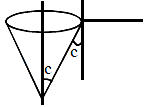
$A$ diver at a depth of $12 \ m$ in water $\left(\mu = \frac{4}{3}\right)$ sees the sky in a cone of semi-vertical angle:
A
$\sin ^{-1}\left(\frac{4}{3}\right)$
B
$\tan ^{-1}\left(\frac{4}{3}\right)$
C
$\sin ^{-1}\left(\frac{3}{4}\right)$
D
$90^{\circ}$
Solution
(C) When a diver is inside the water,they see the outside world through a cone of light due to the phenomenon of total internal reflection.
The semi-vertical angle of this cone is equal to the critical angle $c$ for the water-air interface.
The formula for the critical angle is given by $\sin c = \frac{1}{\mu}$.
Given the refractive index of water $\mu = \frac{4}{3}$,we have:
$\sin c = \frac{1}{4/3} = \frac{3}{4}$.
Therefore,the semi-vertical angle is $c = \sin ^{-1}\left(\frac{3}{4}\right)$.
The semi-vertical angle of this cone is equal to the critical angle $c$ for the water-air interface.
The formula for the critical angle is given by $\sin c = \frac{1}{\mu}$.
Given the refractive index of water $\mu = \frac{4}{3}$,we have:
$\sin c = \frac{1}{4/3} = \frac{3}{4}$.
Therefore,the semi-vertical angle is $c = \sin ^{-1}\left(\frac{3}{4}\right)$.
0 likes
View Solution276
MediumMCQ
The radius of the light circle observed by a fish at a depth of $12 \ m$ is (refractive index of water $\mu = 4/3$):
A
$36 \sqrt{7}$
B
$\frac{36}{\sqrt{7}}$
C
$36 \sqrt{5}$
D
$4 \sqrt{5}$
Solution
(B) When a fish is at a depth $h$ below the surface of water,it sees the outside world through a circular window due to total internal reflection.
The radius $r$ of this circle is given by the formula $r = \frac{h}{\sqrt{\mu^2 - 1}}$.
Given: depth $h = 12 \ m$ and refractive index $\mu = 4/3$.
Substituting the values into the formula:
$r = \frac{12}{\sqrt{(4/3)^2 - 1}}$
$r = \frac{12}{\sqrt{16/9 - 1}}$
$r = \frac{12}{\sqrt{7/9}}$
$r = \frac{12 \times 3}{\sqrt{7}}$
$r = \frac{36}{\sqrt{7}} \ m$.
The radius $r$ of this circle is given by the formula $r = \frac{h}{\sqrt{\mu^2 - 1}}$.
Given: depth $h = 12 \ m$ and refractive index $\mu = 4/3$.
Substituting the values into the formula:
$r = \frac{12}{\sqrt{(4/3)^2 - 1}}$
$r = \frac{12}{\sqrt{16/9 - 1}}$
$r = \frac{12}{\sqrt{7/9}}$
$r = \frac{12 \times 3}{\sqrt{7}}$
$r = \frac{36}{\sqrt{7}} \ m$.
0 likes
View Solution277
MediumMCQ
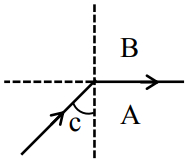
Consider light travelling from a medium $A$ to medium $B$ separated by a plane interface. If the light undergoes total internal reflection during its travel from medium $A$ to $B$ and the speed of light in media $A$ and $B$ are $2.4 \times 10^8 \ m/s$ and $2.7 \times 10^8 \ m/s$ respectively,then the value of critical angle is:
A
$\cot^{-1}(\frac{3}{\sqrt{13}})$
B
$\sin^{-1}(\frac{9}{8})$
C
$\tan^{-1}(\frac{8}{\sqrt{17}})$
D
$\cos^{-1}(\frac{8}{9})$
Solution
(C) For total internal reflection to occur,light must travel from a denser medium to a rarer medium. Here,the speed of light in medium $A$ $(v_A = 2.4 \times 10^8 \ m/s)$ is less than in medium $B$ $(v_B = 2.7 \times 10^8 \ m/s)$,so medium $A$ is denser.
At the critical angle $c$,the angle of refraction is $90^\circ$. According to Snell's Law:
$\mu_A \sin c = \mu_B \sin 90^\circ$
Since $\mu = \frac{c_{light}}{v}$,we have $\frac{c_{light}}{v_A} \sin c = \frac{c_{light}}{v_B} \times 1$
$\sin c = \frac{v_A}{v_B} = \frac{2.4 \times 10^8}{2.7 \times 10^8} = \frac{24}{27} = \frac{8}{9}$
Now,using the trigonometric identity $\tan c = \frac{\sin c}{\sqrt{1 - \sin^2 c}}$:
$\tan c = \frac{8/9}{\sqrt{1 - (8/9)^2}} = \frac{8/9}{\sqrt{1 - 64/81}} = \frac{8/9}{\sqrt{17/81}} = \frac{8}{\sqrt{17}}$
Therefore,$c = \tan^{-1}(\frac{8}{\sqrt{17}})$.
At the critical angle $c$,the angle of refraction is $90^\circ$. According to Snell's Law:
$\mu_A \sin c = \mu_B \sin 90^\circ$
Since $\mu = \frac{c_{light}}{v}$,we have $\frac{c_{light}}{v_A} \sin c = \frac{c_{light}}{v_B} \times 1$
$\sin c = \frac{v_A}{v_B} = \frac{2.4 \times 10^8}{2.7 \times 10^8} = \frac{24}{27} = \frac{8}{9}$
Now,using the trigonometric identity $\tan c = \frac{\sin c}{\sqrt{1 - \sin^2 c}}$:
$\tan c = \frac{8/9}{\sqrt{1 - (8/9)^2}} = \frac{8/9}{\sqrt{1 - 64/81}} = \frac{8/9}{\sqrt{17/81}} = \frac{8}{\sqrt{17}}$
Therefore,$c = \tan^{-1}(\frac{8}{\sqrt{17}})$.
0 likes
View SolutionRay Optics and Optical Instruments — Critical Angle and Total Internal Reflection · Frequently Asked Questions
1Are these Ray Optics and Optical Instruments questions useful for JEE and NEET?
Yes. All questions in this section are mapped to JEE Main and NEET exam patterns. Previous year questions from JEE Main, NEET, GUJCET and state-level exams are included with full solutions.
2Can I switch to Hindi or Gujarati for these questions?
Yes. Use the language tabs in the hero section or the sidebar to view the same questions and solutions in English, Hindi or Gujarati.
3How do I generate a question paper from this subtopic?
Use the Vedclass Exam Paper Generator — select the chapter and subtopic, set difficulty, and generate Sets A, B, C, D automatically. First 3 chapters of every subject are free.
Vedclass Products
For Students
Vedclass Test Series
Mock tests in real JEE/NEET style with performance analysis. 5-day free trial.
Start Free TrialFor Teachers
Exam Paper Generator
Generate Set A/B/C/D papers from this chapter in 2 minutes. 3 chapters free.
Try FreeFor Institutes
Online Exam Module
Live online exams with unlimited students, 360° analytics & white-label branding.
See DemoFor Teachers & Institutes
Generate a Ray Optics and Optical Instruments Exam Paper in 2 Minutes
Select subtopic & difficulty — Sets A, B, C, D auto-generated with No Repeat logic.
First 3 chapters of every subject are free — no payment required.