
To verify Ohm's law,a student is provided with a test resistor $R_T$,a high resistance $R_1$,a small resistance $R_2$,two identical galvanometers $G_1$ and $G_2$,and a variable voltage source $V$. The correct circuit to carry out the experiment is
- A
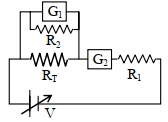
- B
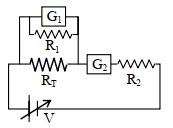
- C
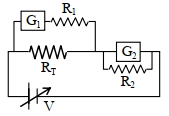
- D
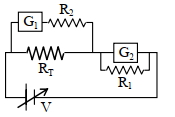
Explore More
Similar Questions
If an ammeter is to be used in place of a galvanometer,then we must connect:
$A$ galvanometer of resistance $G$ can be converted into a voltmeter of range $V$ by connecting a resistance $R$ in series with it. The series resistance required to change its range to $\frac{V}{3}$ is
DifficultMHT CET 2022
View SolutionHow are a voltmeter and an ammeter connected in a circuit? Explain.
Medium
View SolutionThe resistance of a galvanometer is $25\,\Omega$ and it requires $50\,\mu A$ for full-scale deflection. The value of the shunt resistance required to convert it into an ammeter of $5\,A$ range is:
Medium
View SolutionThe sensitivity of a galvanometer is $60 \text{ division/A}$. When a shunt is used,its sensitivity becomes $10 \text{ division/A}$. If the galvanometer is of resistance $20 \ \Omega$,the value of shunt used is (in $Omega$)
DifficultAP EAMCET 2011
View SolutionVedclass Products
For Students
Vedclass Test Series
Mock tests in real JEE/NEET style with performance analysis. 5-day free trial.
Start Free TrialFor Teachers
Exam Paper Generator
Generate Set A/B/C/D exam papers from 7.5L+ questions in 2 minutes. 3 chapters free.
Try FreeFor Institutes
Online Exam Module
Live online exams with unlimited students, 360° analytics & white-label branding.
See Demo