
A English
Relation between Electric Field and Potential and Potential Gradient Questions in English
Class 12 Physics · Electric Potential and Capacitance · Relation between Electric Field and Potential and Potential Gradient
126+
Questions
English
Language
100%
With Solutions
Showing 25 of 126 questions in English
101
EasyMCQ
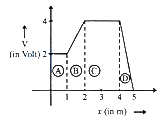
The figure shows the electric potential $V$ as a function of distance through four regions on the $x$-axis. Which of the following is true for the magnitude of the electric field $E$ in these regions?
A
$E_{B}=E_{D}$ and $E_{A} < E_{C}$
B
$E_{A}>E_{B}>E_{C}>E_{D}$
C
$E_{A} < E_{B} < E_{C} < E_{D}$
D
$E_{A}=E_{C}$ and $E_{B} < E_{D}$
Solution
(D) The electric field $E$ is related to the potential $V$ by the relation $E = -\frac{dV}{dx}$. The magnitude of the electric field is $|E| = |\frac{dV}{dx}|$,which represents the slope of the $V-x$ graph.
In region $A$ ($x=0$ to $1$ m),$V$ is constant ($2$ $V$),so the slope $\frac{dV}{dx} = 0$. Thus,$E_{A} = 0$.
In region $B$ ($x=1$ to $2$ m),the slope is $\frac{4-2}{2-1} = 2$ $V$/m. Thus,$|E_{B}| = 2$ $V$/m.
In region $C$ ($x=2$ to $4$ m),$V$ is constant ($4$ $V$),so the slope $\frac{dV}{dx} = 0$. Thus,$E_{C} = 0$.
In region $D$ ($x=4$ to $5$ m),the slope is $\frac{0-4}{5-4} = -4$ $V$/m. Thus,$|E_{D}| = |-4| = 4$ $V$/m.
Comparing the magnitudes: $E_{A} = E_{C} = 0$ and $E_{B} = 2$ $V$/m,$E_{D} = 4$ $V$/m. Therefore,$E_{A} = E_{C}$ and $E_{B} < E_{D}$.
In region $A$ ($x=0$ to $1$ m),$V$ is constant ($2$ $V$),so the slope $\frac{dV}{dx} = 0$. Thus,$E_{A} = 0$.
In region $B$ ($x=1$ to $2$ m),the slope is $\frac{4-2}{2-1} = 2$ $V$/m. Thus,$|E_{B}| = 2$ $V$/m.
In region $C$ ($x=2$ to $4$ m),$V$ is constant ($4$ $V$),so the slope $\frac{dV}{dx} = 0$. Thus,$E_{C} = 0$.
In region $D$ ($x=4$ to $5$ m),the slope is $\frac{0-4}{5-4} = -4$ $V$/m. Thus,$|E_{D}| = |-4| = 4$ $V$/m.
Comparing the magnitudes: $E_{A} = E_{C} = 0$ and $E_{B} = 2$ $V$/m,$E_{D} = 4$ $V$/m. Therefore,$E_{A} = E_{C}$ and $E_{B} < E_{D}$.
0 likes
View Solution102
EasyMCQ
The electric potential at any point $(x, y, z)$ in metres is given by $V = 3x^2$. The electric field at a point $(2, 0, 1)$ is (in $Vm^{-1}$)
A
$12$
B
$-6$
C
$6$
D
$-12$
Solution
(D) The electric potential is given by $V = 3x^2$.
The electric field $\vec{E}$ is related to the potential $V$ by the relation $\vec{E} = -\nabla V = -\left( \frac{\partial V}{\partial x} \hat{i} + \frac{\partial V}{\partial y} \hat{j} + \frac{\partial V}{\partial z} \hat{k} \right)$.
Calculating the partial derivatives:
$\frac{\partial V}{\partial x} = \frac{\partial}{\partial x}(3x^2) = 6x$.
$\frac{\partial V}{\partial y} = 0$.
$\frac{\partial V}{\partial z} = 0$.
Thus,$\vec{E} = -6x \hat{i}$.
At the point $(2, 0, 1)$,the $x$-coordinate is $2$.
Substituting $x = 2$ into the expression for $\vec{E}$:
$\vec{E} = -6(2) \hat{i} = -12 \hat{i} \ Vm^{-1}$.
The magnitude of the electric field is $-12 \ Vm^{-1}$ along the $x$-direction.
The electric field $\vec{E}$ is related to the potential $V$ by the relation $\vec{E} = -\nabla V = -\left( \frac{\partial V}{\partial x} \hat{i} + \frac{\partial V}{\partial y} \hat{j} + \frac{\partial V}{\partial z} \hat{k} \right)$.
Calculating the partial derivatives:
$\frac{\partial V}{\partial x} = \frac{\partial}{\partial x}(3x^2) = 6x$.
$\frac{\partial V}{\partial y} = 0$.
$\frac{\partial V}{\partial z} = 0$.
Thus,$\vec{E} = -6x \hat{i}$.
At the point $(2, 0, 1)$,the $x$-coordinate is $2$.
Substituting $x = 2$ into the expression for $\vec{E}$:
$\vec{E} = -6(2) \hat{i} = -12 \hat{i} \ Vm^{-1}$.
The magnitude of the electric field is $-12 \ Vm^{-1}$ along the $x$-direction.
0 likes
View Solution103
EasyMCQ
The potential of the electric field produced by a point charge at any point $(x, y, z)$ is given by $V = 3x^2 + 5$,where $x, y$ are in metres and $V$ is in volts. The intensity of the electric field at $(-2, 1, 0)$ is
A
$+12 \ Vm^{-1}$
B
$-12 \ Vm^{-1}$
C
$+17 \ Vm^{-1}$
D
$-17 \ Vm^{-1}$
Solution
(A) The electric field intensity $\vec{E}$ is related to the electric potential $V$ by the relation $\vec{E} = -\nabla V$.
Since the potential $V$ depends only on $x$,the electric field is given by $E_x = -\frac{dV}{dx}$.
Given $V = 3x^2 + 5$.
Calculating the derivative: $\frac{dV}{dx} = \frac{d}{dx}(3x^2 + 5) = 6x$.
Therefore,$E_x = -6x$.
At the point $(-2, 1, 0)$,the $x$-coordinate is $-2$.
Substituting $x = -2$ into the expression for $E_x$:
$E_x = -6(-2) = +12 \ Vm^{-1}$.
Thus,the intensity of the electric field at $(-2, 1, 0)$ is $+12 \ Vm^{-1}$.
Since the potential $V$ depends only on $x$,the electric field is given by $E_x = -\frac{dV}{dx}$.
Given $V = 3x^2 + 5$.
Calculating the derivative: $\frac{dV}{dx} = \frac{d}{dx}(3x^2 + 5) = 6x$.
Therefore,$E_x = -6x$.
At the point $(-2, 1, 0)$,the $x$-coordinate is $-2$.
Substituting $x = -2$ into the expression for $E_x$:
$E_x = -6(-2) = +12 \ Vm^{-1}$.
Thus,the intensity of the electric field at $(-2, 1, 0)$ is $+12 \ Vm^{-1}$.
0 likes
View Solution104
EasyMCQ
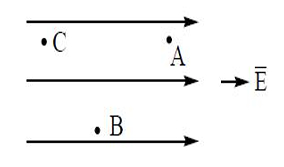
As shown in the figure, if the values of the electric potential at three points $A, B$ and $C$ in a uniform electric field $(\vec{E})$ are $V_A, V_B$, and $V_C$ respectively, then
A
$V_A > V_B > V_C$
B
$V_A > V_C > V_B$
C
$V_C > V_B > V_A$
D
$V_C > V_A > V_B$
Solution
(C) In a uniform electric field, the electric potential decreases in the direction of the electric field lines.
Let the electric field be directed along the positive $x$-axis.
The potential at any point $(x, y)$ is given by $V = -E \cdot x + \text{constant}$.
Comparing the $x$-coordinates of the points $A, B$, and $C$ from the figure:
Point $A$ is the furthest to the right, so it has the largest $x$-coordinate.
Points $B$ and $C$ have the same $x$-coordinate, so $V_B = V_C$.
Since $A$ is further along the direction of the electric field than $B$ and $C$, the potential at $A$ is the lowest.
Therefore, $V_B = V_C > V_A$.
Looking at the options provided, the relationship $V_C > V_A > V_B$ is not strictly correct as $V_B = V_C$. However, based on the relative positions, $C$ and $B$ are at the same potential, and $A$ is at a lower potential. If we assume the points are slightly offset in the $x$-direction such that $C$ is behind $B$, then $V_C > V_B > V_A$. Given the standard interpretation of such diagrams, $C$ and $B$ are at the same potential, and $A$ is at the lowest. Among the choices, $V_C > V_B > V_A$ is the most logical representation of the potential gradient.
Let the electric field be directed along the positive $x$-axis.
The potential at any point $(x, y)$ is given by $V = -E \cdot x + \text{constant}$.
Comparing the $x$-coordinates of the points $A, B$, and $C$ from the figure:
Point $A$ is the furthest to the right, so it has the largest $x$-coordinate.
Points $B$ and $C$ have the same $x$-coordinate, so $V_B = V_C$.
Since $A$ is further along the direction of the electric field than $B$ and $C$, the potential at $A$ is the lowest.
Therefore, $V_B = V_C > V_A$.
Looking at the options provided, the relationship $V_C > V_A > V_B$ is not strictly correct as $V_B = V_C$. However, based on the relative positions, $C$ and $B$ are at the same potential, and $A$ is at a lower potential. If we assume the points are slightly offset in the $x$-direction such that $C$ is behind $B$, then $V_C > V_B > V_A$. Given the standard interpretation of such diagrams, $C$ and $B$ are at the same potential, and $A$ is at the lowest. Among the choices, $V_C > V_B > V_A$ is the most logical representation of the potential gradient.
0 likes
View Solution105
MediumMCQ
In space,the electric potential varies as $V = 20|\vec{r}|$ volt,where $\vec{r} = x \hat{i} + y \hat{j} + z \hat{k}$ is the position vector. Then,the electric field in $N C^{-1}$ at the point $(4 \ m, 3 \ m, -5 \ m)$ is:
A
$-\sqrt{2}(4 \hat{i} + 3 \hat{j} - 10 \hat{k})$
B
$-\sqrt{2}(8 \hat{i} + 6 \hat{j} - 10 \hat{k})$
C
$-(8 \hat{i} + 6 \hat{j} - 10 \hat{k})$
D
$4 \hat{i} + 3 \hat{j} - 5 \hat{k}$
Solution
(B) The electric field $\vec{E}$ is related to the electric potential $V$ by the relation $\vec{E} = -\nabla V$.
Given $V = 20|\vec{r}| = 20\sqrt{x^2 + y^2 + z^2}$.
Calculating the gradient $\nabla V = \frac{\partial V}{\partial x} \hat{i} + \frac{\partial V}{\partial y} \hat{j} + \frac{\partial V}{\partial z} \hat{k}$.
$\frac{\partial V}{\partial x} = 20 \cdot \frac{1}{2\sqrt{x^2 + y^2 + z^2}} \cdot 2x = \frac{20x}{|\vec{r}|}$.
Similarly,$\frac{\partial V}{\partial y} = \frac{20y}{|\vec{r}|}$ and $\frac{\partial V}{\partial z} = \frac{20z}{|\vec{r}|}$.
Thus,$\vec{E} = -\frac{20}{|\vec{r}|} (x \hat{i} + y \hat{j} + z \hat{k}) = -\frac{20}{|\vec{r}|} \vec{r} = -20 \hat{r}$.
At the point $(4, 3, -5)$,the magnitude $|\vec{r}| = \sqrt{4^2 + 3^2 + (-5)^2} = \sqrt{16 + 9 + 25} = \sqrt{50} = 5\sqrt{2}$.
Substituting the values: $\vec{E} = -\frac{20}{5\sqrt{2}} (4 \hat{i} + 3 \hat{j} - 5 \hat{k}) = -\frac{4}{\sqrt{2}} (4 \hat{i} + 3 \hat{j} - 5 \hat{k}) = -2\sqrt{2} (4 \hat{i} + 3 \hat{j} - 5 \hat{k})$.
This simplifies to $-\sqrt{2} (8 \hat{i} + 6 \hat{j} - 10 \hat{k})$.
Therefore,the correct option is $B$.
Given $V = 20|\vec{r}| = 20\sqrt{x^2 + y^2 + z^2}$.
Calculating the gradient $\nabla V = \frac{\partial V}{\partial x} \hat{i} + \frac{\partial V}{\partial y} \hat{j} + \frac{\partial V}{\partial z} \hat{k}$.
$\frac{\partial V}{\partial x} = 20 \cdot \frac{1}{2\sqrt{x^2 + y^2 + z^2}} \cdot 2x = \frac{20x}{|\vec{r}|}$.
Similarly,$\frac{\partial V}{\partial y} = \frac{20y}{|\vec{r}|}$ and $\frac{\partial V}{\partial z} = \frac{20z}{|\vec{r}|}$.
Thus,$\vec{E} = -\frac{20}{|\vec{r}|} (x \hat{i} + y \hat{j} + z \hat{k}) = -\frac{20}{|\vec{r}|} \vec{r} = -20 \hat{r}$.
At the point $(4, 3, -5)$,the magnitude $|\vec{r}| = \sqrt{4^2 + 3^2 + (-5)^2} = \sqrt{16 + 9 + 25} = \sqrt{50} = 5\sqrt{2}$.
Substituting the values: $\vec{E} = -\frac{20}{5\sqrt{2}} (4 \hat{i} + 3 \hat{j} - 5 \hat{k}) = -\frac{4}{\sqrt{2}} (4 \hat{i} + 3 \hat{j} - 5 \hat{k}) = -2\sqrt{2} (4 \hat{i} + 3 \hat{j} - 5 \hat{k})$.
This simplifies to $-\sqrt{2} (8 \hat{i} + 6 \hat{j} - 10 \hat{k})$.
Therefore,the correct option is $B$.
0 likes
View Solution106
EasyMCQ
In a region,the electric field is $(30 \hat{i} + 40 \hat{j}) \text{ NC}^{-1}$. If the electric potential at the origin is zero,the electric potential at the point $(1 \text{ m}, 2 \text{ m})$ is
A
-$60$ $V$
B
-$75$ $V$
C
-$55$ $V$
D
-$110$ $V$
Solution
(D) Given: $\vec{E} = (30 \hat{i} + 40 \hat{j}) \text{ NC}^{-1}$ and $V(0,0) = 0 \text{ V}$.
We know that the relation between electric field and electric potential is given by $dV = -\vec{E} \cdot d\vec{r}$.
Here,$d\vec{r} = dx \hat{i} + dy \hat{j} + dz \hat{k}$.
Integrating from the origin $(0,0)$ to the point $(1,2)$:
$\int_{V(0,0)}^{V(1,2)} dV = -\int_{(0,0)}^{(1,2)} (30 \hat{i} + 40 \hat{j}) \cdot (dx \hat{i} + dy \hat{j})$
$V(1,2) - V(0,0) = -\left[ \int_{0}^{1} 30 dx + \int_{0}^{2} 40 dy \right]$
$V(1,2) - 0 = -[30(1) + 40(2)]$
$V(1,2) = -(30 + 80) = -110 \text{ V}$.
We know that the relation between electric field and electric potential is given by $dV = -\vec{E} \cdot d\vec{r}$.
Here,$d\vec{r} = dx \hat{i} + dy \hat{j} + dz \hat{k}$.
Integrating from the origin $(0,0)$ to the point $(1,2)$:
$\int_{V(0,0)}^{V(1,2)} dV = -\int_{(0,0)}^{(1,2)} (30 \hat{i} + 40 \hat{j}) \cdot (dx \hat{i} + dy \hat{j})$
$V(1,2) - V(0,0) = -\left[ \int_{0}^{1} 30 dx + \int_{0}^{2} 40 dy \right]$
$V(1,2) - 0 = -[30(1) + 40(2)]$
$V(1,2) = -(30 + 80) = -110 \text{ V}$.
0 likes
View Solution107
EasyMCQ
The potential is varying with distance $(x, y)$ as $V = \frac{1}{2} (y^2 - 4x) \text{ V}$. The electric field at $x = 1 \text{ m}$ and $y = 1 \text{ m}$ is:
A
$2 \hat{i} + \hat{j} \text{ Vm}^{-1}$
B
$-2 \hat{i} + \hat{j} \text{ Vm}^{-1}$
C
$2 \hat{i} - \hat{j} \text{ Vm}^{-1}$
D
$-2 \hat{i} + 2 \hat{j} \text{ Vm}^{-1}$
Solution
(C) The electric field $\vec{E}$ is given by the negative gradient of the potential $V$: $\vec{E} = -\vec{\nabla} V = -\left( \frac{\partial V}{\partial x} \hat{i} + \frac{\partial V}{\partial y} \hat{j} \right)$.
Given $V = \frac{1}{2} y^2 - 2x$.
Calculating partial derivatives:
$\frac{\partial V}{\partial x} = -2$
$\frac{\partial V}{\partial y} = y$
Substituting these into the electric field formula:
$\vec{E} = -(-2 \hat{i} + y \hat{j}) = 2 \hat{i} - y \hat{j}$.
At the point $(x = 1 \text{ m}, y = 1 \text{ m})$:
$\vec{E} = 2 \hat{i} - (1) \hat{j} = 2 \hat{i} - \hat{j} \text{ Vm}^{-1}$.
Given $V = \frac{1}{2} y^2 - 2x$.
Calculating partial derivatives:
$\frac{\partial V}{\partial x} = -2$
$\frac{\partial V}{\partial y} = y$
Substituting these into the electric field formula:
$\vec{E} = -(-2 \hat{i} + y \hat{j}) = 2 \hat{i} - y \hat{j}$.
At the point $(x = 1 \text{ m}, y = 1 \text{ m})$:
$\vec{E} = 2 \hat{i} - (1) \hat{j} = 2 \hat{i} - \hat{j} \text{ Vm}^{-1}$.
0 likes
View Solution108
MediumMCQ
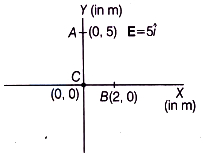
The electric field in a region of space is given as $E = (5x) \hat{i} \text{ N/C}$. Consider point $A$ on the $Y$-axis at $y = 5 \text{ m}$ and point $B$ on the $X$-axis at $x = 2 \text{ m}$. If the potentials at points $A$ and $B$ are $V_A$ and $V_B$ respectively, then $(V_B - V_A)$ is (in $\text{ V}$)
A
$-15$
B
$8$
C
$-10$
D
$-12.5$
Solution
(C) The electric field is given by $E = 5x \hat{i}$.
The potential difference between two points is given by $V_B - V_A = -\int_{A}^{B} \vec{E} \cdot d\vec{r}$.
Since the electric field is only in the $X$-direction, the $Y$-axis (where $x=0$) is an equipotential line. Thus, the potential at point $A(0, 5)$ is the same as the potential at the origin $C(0, 0)$.
$V_A = V_C$.
Now, we calculate the potential difference between $C(0, 0)$ and $B(2, 0)$:
$V_B - V_C = -\int_{0}^{2} E_x dx = -\int_{0}^{2} 5x dx$.
$V_B - V_C = -5 \left[ \frac{x^2}{2} \right]_{0}^{2} = -5 \left( \frac{4}{2} - 0 \right) = -5(2) = -10 \text{ V}$.
Since $V_A = V_C$, we have $V_B - V_A = -10 \text{ V}$.
The potential difference between two points is given by $V_B - V_A = -\int_{A}^{B} \vec{E} \cdot d\vec{r}$.
Since the electric field is only in the $X$-direction, the $Y$-axis (where $x=0$) is an equipotential line. Thus, the potential at point $A(0, 5)$ is the same as the potential at the origin $C(0, 0)$.
$V_A = V_C$.
Now, we calculate the potential difference between $C(0, 0)$ and $B(2, 0)$:
$V_B - V_C = -\int_{0}^{2} E_x dx = -\int_{0}^{2} 5x dx$.
$V_B - V_C = -5 \left[ \frac{x^2}{2} \right]_{0}^{2} = -5 \left( \frac{4}{2} - 0 \right) = -5(2) = -10 \text{ V}$.
Since $V_A = V_C$, we have $V_B - V_A = -10 \text{ V}$.
0 likes
View Solution109
EasyMCQ
Electric potential in a region is given by $\phi(x, y, z) = \phi_0 \frac{x_0}{x}$; where $x_0 = 5 \ m$ and $\phi_0 = 8 \ V$. Find the electric field at $(10 \ m, 5 \ m, 5 \ m)$.
A
$0.40 \ Vm^{-1} \hat{i}$
B
$-0.40 \ Vm^{-1} \hat{i}$
C
$4.0 \ Vm^{-1} \hat{i}$
D
$-4.0 \ Vm^{-1} \hat{i}$
Solution
(A) The electric field $\vec{E}$ is related to the electric potential $\phi$ by the relation $\vec{E} = -\nabla \phi$.
Since the potential $\phi$ depends only on $x$,the electric field is given by $\vec{E} = -\frac{\partial \phi}{\partial x} \hat{i}$.
Given $\phi(x) = \phi_0 \frac{x_0}{x} = (8 \ V)(5 \ m) \frac{1}{x} = \frac{40}{x} \ V \cdot m$.
Differentiating with respect to $x$: $\frac{\partial \phi}{\partial x} = 40 \frac{d}{dx}(x^{-1}) = 40 (-x^{-2}) = -\frac{40}{x^2}$.
Therefore,$\vec{E} = -(-\frac{40}{x^2}) \hat{i} = \frac{40}{x^2} \hat{i} \ V/m$.
At the point $(10 \ m, 5 \ m, 5 \ m)$,the $x$-coordinate is $10 \ m$.
Substituting $x = 10 \ m$ into the expression for $\vec{E}$: $\vec{E} = \frac{40}{10^2} \hat{i} = \frac{40}{100} \hat{i} = 0.40 \ Vm^{-1} \hat{i}$.
Since the potential $\phi$ depends only on $x$,the electric field is given by $\vec{E} = -\frac{\partial \phi}{\partial x} \hat{i}$.
Given $\phi(x) = \phi_0 \frac{x_0}{x} = (8 \ V)(5 \ m) \frac{1}{x} = \frac{40}{x} \ V \cdot m$.
Differentiating with respect to $x$: $\frac{\partial \phi}{\partial x} = 40 \frac{d}{dx}(x^{-1}) = 40 (-x^{-2}) = -\frac{40}{x^2}$.
Therefore,$\vec{E} = -(-\frac{40}{x^2}) \hat{i} = \frac{40}{x^2} \hat{i} \ V/m$.
At the point $(10 \ m, 5 \ m, 5 \ m)$,the $x$-coordinate is $10 \ m$.
Substituting $x = 10 \ m$ into the expression for $\vec{E}$: $\vec{E} = \frac{40}{10^2} \hat{i} = \frac{40}{100} \hat{i} = 0.40 \ Vm^{-1} \hat{i}$.
0 likes
View Solution110
DifficultMCQ
In a space having electric field $\vec{E}=A(x \hat{i}+y \hat{j})$,the potential at a point $(10 \ m, 20 \ m)$ is zero. Then the potential at the origin is $\left[A=10 \ Vm^{-2}\right]$. (in $V$)
A
$500$
B
$2000$
C
$2500$
D
$1500$
Solution
(C) The relation between electric field $\vec{E}$ and potential $V$ is given by $\vec{E} = -\nabla V$,which implies $dV = -\vec{E} \cdot d\vec{r}$.
Given $\vec{E} = A(x \hat{i} + y \hat{j})$,we have $dV = -A(x dx + y dy)$.
Integrating both sides,we get $V = -A \int x dx - A \int y dy = -A \frac{x^2}{2} - A \frac{y^2}{2} + C$,where $C$ is the integration constant.
Substituting $A = 10 \ Vm^{-2}$,we get $V = -5(x^2 + y^2) + C$.
Given that the potential at $(10 \ m, 20 \ m)$ is zero,we have $0 = -5(10^2 + 20^2) + C$.
$0 = -5(100 + 400) + C \Rightarrow 0 = -5(500) + C \Rightarrow C = 2500 \ V$.
Thus,the potential function is $V(x, y) = -5(x^2 + y^2) + 2500$.
At the origin $(0, 0)$,the potential is $V(0, 0) = -5(0^2 + 0^2) + 2500 = 2500 \ V$.
Given $\vec{E} = A(x \hat{i} + y \hat{j})$,we have $dV = -A(x dx + y dy)$.
Integrating both sides,we get $V = -A \int x dx - A \int y dy = -A \frac{x^2}{2} - A \frac{y^2}{2} + C$,where $C$ is the integration constant.
Substituting $A = 10 \ Vm^{-2}$,we get $V = -5(x^2 + y^2) + C$.
Given that the potential at $(10 \ m, 20 \ m)$ is zero,we have $0 = -5(10^2 + 20^2) + C$.
$0 = -5(100 + 400) + C \Rightarrow 0 = -5(500) + C \Rightarrow C = 2500 \ V$.
Thus,the potential function is $V(x, y) = -5(x^2 + y^2) + 2500$.
At the origin $(0, 0)$,the potential is $V(0, 0) = -5(0^2 + 0^2) + 2500 = 2500 \ V$.
0 likes
View Solution111
DifficultMCQ
An infinite non-conducting sheet has a surface charge density of $7 \times 10^{-7} \text{ C m}^{-2}$ on one side. The distance between equipotential surfaces whose potentials differ by $19.8 \text{ V}$ will be (Take $\frac{1}{4 \pi \varepsilon_{0}} = 9 \times 10^9 \text{ SI units}$) (in $\text{ mm}$)
A
$2.0$
B
$0.25$
C
$1.0$
D
$0.5$
Solution
(D) The electric field $E$ produced by an infinite non-conducting sheet is given by $E = \frac{\sigma}{2 \varepsilon_0}$.
Given $\sigma = 7 \times 10^{-7} \text{ C m}^{-2}$ and $\frac{1}{4 \pi \varepsilon_0} = 9 \times 10^9 \text{ SI units}$.
We know that $\varepsilon_0 = \frac{1}{4 \pi \times 9 \times 10^9} \approx 8.85 \times 10^{-12} \text{ F m}^{-1}$.
The relation between electric field and potential difference $\Delta V$ for a distance $\Delta r$ is $|E| = \frac{\Delta V}{\Delta r}$.
Substituting the values:
$\frac{\sigma}{2 \varepsilon_0} = \frac{\Delta V}{\Delta r}$
$\Delta r = \frac{\Delta V \times 2 \varepsilon_0}{\sigma} = \frac{19.8 \times 2 \times 8.85 \times 10^{-12}}{7 \times 10^{-7}}$
$\Delta r = \frac{19.8 \times 17.7 \times 10^{-12}}{7 \times 10^{-7}} \approx 5 \times 10^{-4} \text{ m} = 0.5 \text{ mm}$.
Given $\sigma = 7 \times 10^{-7} \text{ C m}^{-2}$ and $\frac{1}{4 \pi \varepsilon_0} = 9 \times 10^9 \text{ SI units}$.
We know that $\varepsilon_0 = \frac{1}{4 \pi \times 9 \times 10^9} \approx 8.85 \times 10^{-12} \text{ F m}^{-1}$.
The relation between electric field and potential difference $\Delta V$ for a distance $\Delta r$ is $|E| = \frac{\Delta V}{\Delta r}$.
Substituting the values:
$\frac{\sigma}{2 \varepsilon_0} = \frac{\Delta V}{\Delta r}$
$\Delta r = \frac{\Delta V \times 2 \varepsilon_0}{\sigma} = \frac{19.8 \times 2 \times 8.85 \times 10^{-12}}{7 \times 10^{-7}}$
$\Delta r = \frac{19.8 \times 17.7 \times 10^{-12}}{7 \times 10^{-7}} \approx 5 \times 10^{-4} \text{ m} = 0.5 \text{ mm}$.
0 likes
View Solution112
EasyMCQ
What is the angle between the maximum value of the potential gradient and the equipotential surface?
A
$0$
B
$\frac{\pi}{4}$
C
$\frac{\pi}{2}$
D
$\pi$
Solution
(C) The electric field $\vec{E}$ is related to the potential gradient by the relation $\vec{E} = -\nabla V$.
The magnitude of the potential gradient is maximum in the direction of the electric field.
By definition,an equipotential surface is a surface where the electric potential $V$ is constant at every point.
For any displacement $d\vec{r}$ along the equipotential surface,the change in potential $dV = -\vec{E} \cdot d\vec{r} = 0$.
This implies that the electric field vector $\vec{E}$ must be perpendicular to the surface at every point.
Since the maximum potential gradient points in the direction of the electric field,the angle between the maximum potential gradient and the equipotential surface is $90^{\circ}$ or $\frac{\pi}{2}$ radians.
The magnitude of the potential gradient is maximum in the direction of the electric field.
By definition,an equipotential surface is a surface where the electric potential $V$ is constant at every point.
For any displacement $d\vec{r}$ along the equipotential surface,the change in potential $dV = -\vec{E} \cdot d\vec{r} = 0$.
This implies that the electric field vector $\vec{E}$ must be perpendicular to the surface at every point.
Since the maximum potential gradient points in the direction of the electric field,the angle between the maximum potential gradient and the equipotential surface is $90^{\circ}$ or $\frac{\pi}{2}$ radians.
0 likes
View Solution113
MediumMCQ
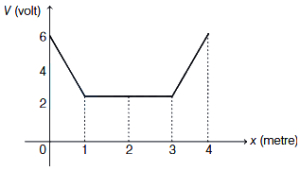
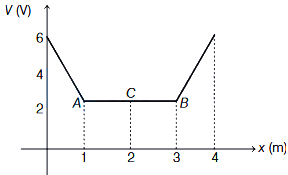
The variation of electric potential $V$ with distance $x$ from a fixed point is shown in the figure. What is the value of the electric field at $x = 2 \ m$?
A
$0$
B
$3$
C
$2$
D
$6$
Solution
(A) The relationship between electric field $E$ and electric potential $V$ is given by $E = -\frac{dV}{dx}$.
From the given graph,it is observed that in the region between $x = 1 \ m$ and $x = 3 \ m$,the electric potential $V$ is constant $(V = 2 \ V)$.
Since the potential is constant in this region,the rate of change of potential with respect to distance is zero,i.e.,$\frac{dV}{dx} = 0$.
Therefore,the electric field at $x = 2 \ m$ is $E = -\frac{dV}{dx} = 0 \ V/m$.
From the given graph,it is observed that in the region between $x = 1 \ m$ and $x = 3 \ m$,the electric potential $V$ is constant $(V = 2 \ V)$.
Since the potential is constant in this region,the rate of change of potential with respect to distance is zero,i.e.,$\frac{dV}{dx} = 0$.
Therefore,the electric field at $x = 2 \ m$ is $E = -\frac{dV}{dx} = 0 \ V/m$.
0 likes
View Solution114
EasyMCQ
The potential difference between two points $A(2, 1, 0) \ m$ and $B(0, 2, 4) \ m$ in an electric field $\vec{E} = (x \hat{i} - 2y \hat{j} + z \hat{k}) \ Vm^{-1}$ is: (in $V$)
A
$2$
B
$3$
C
$1$
D
$6$
Solution
(B) The potential difference $\Delta V = V_B - V_A$ is given by the line integral: $\Delta V = -\int_{A}^{B} \vec{E} \cdot d\vec{r}$.
Given $\vec{E} = x \hat{i} - 2y \hat{j} + z \hat{k}$ and $d\vec{r} = dx \hat{i} + dy \hat{j} + dz \hat{k}$.
$\Delta V = -\int_{(2,1,0)}^{(0,2,4)} (x \hat{i} - 2y \hat{j} + z \hat{k}) \cdot (dx \hat{i} + dy \hat{j} + dz \hat{k})$
$\Delta V = -[\int_{2}^{0} x \ dx - \int_{1}^{2} 2y \ dy + \int_{0}^{4} z \ dz]$
Evaluating the integrals:
$\int_{2}^{0} x \ dx = [\frac{x^2}{2}]_{2}^{0} = 0 - 2 = -2$
$\int_{1}^{2} 2y \ dy = [y^2]_{1}^{2} = 4 - 1 = 3$
$\int_{0}^{4} z \ dz = [\frac{z^2}{2}]_{0}^{4} = 8 - 0 = 8$
Substituting these values:
$\Delta V = -[-2 - 3 + 8] = -[3] = -3 \ V$.
The magnitude of the potential difference is $|\Delta V| = 3 \ V$.
Given $\vec{E} = x \hat{i} - 2y \hat{j} + z \hat{k}$ and $d\vec{r} = dx \hat{i} + dy \hat{j} + dz \hat{k}$.
$\Delta V = -\int_{(2,1,0)}^{(0,2,4)} (x \hat{i} - 2y \hat{j} + z \hat{k}) \cdot (dx \hat{i} + dy \hat{j} + dz \hat{k})$
$\Delta V = -[\int_{2}^{0} x \ dx - \int_{1}^{2} 2y \ dy + \int_{0}^{4} z \ dz]$
Evaluating the integrals:
$\int_{2}^{0} x \ dx = [\frac{x^2}{2}]_{2}^{0} = 0 - 2 = -2$
$\int_{1}^{2} 2y \ dy = [y^2]_{1}^{2} = 4 - 1 = 3$
$\int_{0}^{4} z \ dz = [\frac{z^2}{2}]_{0}^{4} = 8 - 0 = 8$
Substituting these values:
$\Delta V = -[-2 - 3 + 8] = -[3] = -3 \ V$.
The magnitude of the potential difference is $|\Delta V| = 3 \ V$.
0 likes
View Solution115
EasyMCQ
The electric field vector in a region is given by $E = (3 \hat{i} + 4y \hat{j}) \ V \ m^{-1}$. The potential at the origin is zero. Then,the potential at a point $(2, 1) \ m$ is: (in $V$)
A
$7$
B
$8$
C
$-8$
D
$-7$
Solution
(C) The relation between electric field $E$ and electric potential $V$ is given by $E = -\nabla V = -\left( \frac{\partial V}{\partial x} \hat{i} + \frac{\partial V}{\partial y} \hat{j} \right)$.
Given $E = 3 \hat{i} + 4y \hat{j}$,we have:
$-\frac{\partial V}{\partial x} = 3 \implies \frac{\partial V}{\partial x} = -3$
$-\frac{\partial V}{\partial y} = 4y \implies \frac{\partial V}{\partial y} = -4y$
Integrating these partial derivatives:
$V(x, y) = \int -3 \ dx = -3x + f(y)$
$V(x, y) = \int -4y \ dy = -2y^2 + g(x)$
Combining these,the general potential function is $V(x, y) = -(3x + 2y^2) + C$.
Given that the potential at the origin $(0, 0)$ is $0$,we have $V(0, 0) = -(3(0) + 2(0)^2) + C = 0$,which implies $C = 0$.
Thus,$V(x, y) = -(3x + 2y^2)$.
At point $(2, 1)$,the potential is $V(2, 1) = -(3(2) + 2(1)^2) = -(6 + 2) = -8 \ V$.
Given $E = 3 \hat{i} + 4y \hat{j}$,we have:
$-\frac{\partial V}{\partial x} = 3 \implies \frac{\partial V}{\partial x} = -3$
$-\frac{\partial V}{\partial y} = 4y \implies \frac{\partial V}{\partial y} = -4y$
Integrating these partial derivatives:
$V(x, y) = \int -3 \ dx = -3x + f(y)$
$V(x, y) = \int -4y \ dy = -2y^2 + g(x)$
Combining these,the general potential function is $V(x, y) = -(3x + 2y^2) + C$.
Given that the potential at the origin $(0, 0)$ is $0$,we have $V(0, 0) = -(3(0) + 2(0)^2) + C = 0$,which implies $C = 0$.
Thus,$V(x, y) = -(3x + 2y^2)$.
At point $(2, 1)$,the potential is $V(2, 1) = -(3(2) + 2(1)^2) = -(6 + 2) = -8 \ V$.
0 likes
View Solution116
DifficultMCQ
The potential difference between two parallel plates is $10^4 \,V$. If the plates are separated by $0.5 \,cm$, the force on an electron between the plates is
A
$32 \times 10^{-13} \,N$
B
$0.32 \times 10^{-13} \,N$
C
$0.032 \times 10^{-13} \,N$
D
$3.2 \times 10^{-13} \,N$
Solution
(D) The electric field $E$ between the parallel plates is given by $E = \frac{V}{d}$.
Given, $V = 10^4 \,V$ and $d = 0.5 \,cm = 0.5 \times 10^{-2} \,m$.
Therefore, $E = \frac{10^4}{0.5 \times 10^{-2}} = 2 \times 10^6 \,V/m$.
The force $F$ on an electron of charge $e = 1.6 \times 10^{-19} \,C$ is given by $F = eE$.
$F = (1.6 \times 10^{-19} \,C) \times (2 \times 10^6 \,V/m) = 3.2 \times 10^{-13} \,N$.
Given, $V = 10^4 \,V$ and $d = 0.5 \,cm = 0.5 \times 10^{-2} \,m$.
Therefore, $E = \frac{10^4}{0.5 \times 10^{-2}} = 2 \times 10^6 \,V/m$.
The force $F$ on an electron of charge $e = 1.6 \times 10^{-19} \,C$ is given by $F = eE$.
$F = (1.6 \times 10^{-19} \,C) \times (2 \times 10^6 \,V/m) = 3.2 \times 10^{-13} \,N$.
0 likes
View Solution117
MediumMCQ
The electric potential at a place is varying as $V = \frac{1}{2}(y^2 - 4x) \text{ V}$. Then the electric field at $x = 1 \text{ m}$ and $y = 1 \text{ m}$ is
A
$2 \hat{i} + \hat{j} \text{ V m}^{-1}$
B
$-2 \hat{i} + \hat{j} \text{ V m}^{-1}$
C
$2 \hat{i} - \hat{j} \text{ V m}^{-1}$
D
$-2 \hat{i} + 2 \hat{j} \text{ V m}^{-1}$
Solution
(C) The electric field $\vec{E}$ is related to the electric potential $V$ by the relation $\vec{E} = -\nabla V = -\left( \frac{\partial V}{\partial x} \hat{i} + \frac{\partial V}{\partial y} \hat{j} \right)$.
Given $V = \frac{1}{2}y^2 - 2x$.
Calculating the partial derivatives:
$\frac{\partial V}{\partial x} = \frac{\partial}{\partial x} (\frac{1}{2}y^2 - 2x) = -2$.
$\frac{\partial V}{\partial y} = \frac{\partial}{\partial y} (\frac{1}{2}y^2 - 2x) = y$.
Thus,$\vec{E} = -(-2 \hat{i} + y \hat{j}) = 2 \hat{i} - y \hat{j}$.
At the point $(x = 1 \text{ m}, y = 1 \text{ m})$:
$\vec{E} = 2 \hat{i} - (1) \hat{j} = 2 \hat{i} - \hat{j} \text{ V m}^{-1}$.
Given $V = \frac{1}{2}y^2 - 2x$.
Calculating the partial derivatives:
$\frac{\partial V}{\partial x} = \frac{\partial}{\partial x} (\frac{1}{2}y^2 - 2x) = -2$.
$\frac{\partial V}{\partial y} = \frac{\partial}{\partial y} (\frac{1}{2}y^2 - 2x) = y$.
Thus,$\vec{E} = -(-2 \hat{i} + y \hat{j}) = 2 \hat{i} - y \hat{j}$.
At the point $(x = 1 \text{ m}, y = 1 \text{ m})$:
$\vec{E} = 2 \hat{i} - (1) \hat{j} = 2 \hat{i} - \hat{j} \text{ V m}^{-1}$.
0 likes
View Solution118
EasyMCQ
The electric field and electric potential at a point due to a point charge are $500 \ NC^{-1}$ and $30 \ V$ respectively. The magnitude of the charge is:
A
$1.3 \times 10^{-9} \ C$
B
$3 \times 10^{-12} \ C$
C
$2 \times 10^{-10} \ C$
D
$1.6 \times 10^{-20} \ C$
Solution
(C) Given: Electric field $E = 500 \ NC^{-1}$,Electric potential $V = 30 \ V$.
The relationship between electric field and potential for a point charge is $E = \frac{V}{r}$.
Therefore,the distance $r$ is $r = \frac{V}{E} = \frac{30}{500} = 0.06 \ m$.
The formula for electric potential is $V = \frac{kq}{r}$,where $k = 9 \times 10^9 \ Nm^2C^{-2}$.
Rearranging for charge $q$: $q = \frac{V \cdot r}{k}$.
Substituting the values: $q = \frac{30 \times 0.06}{9 \times 10^9} = \frac{1.8}{9 \times 10^9} = 0.2 \times 10^{-9} \ C$.
Thus,$q = 2 \times 10^{-10} \ C$.
The relationship between electric field and potential for a point charge is $E = \frac{V}{r}$.
Therefore,the distance $r$ is $r = \frac{V}{E} = \frac{30}{500} = 0.06 \ m$.
The formula for electric potential is $V = \frac{kq}{r}$,where $k = 9 \times 10^9 \ Nm^2C^{-2}$.
Rearranging for charge $q$: $q = \frac{V \cdot r}{k}$.
Substituting the values: $q = \frac{30 \times 0.06}{9 \times 10^9} = \frac{1.8}{9 \times 10^9} = 0.2 \times 10^{-9} \ C$.
Thus,$q = 2 \times 10^{-10} \ C$.
0 likes
View Solution119
EasyMCQ
The potential $\phi(x, y)$ of an electrostatic field $\vec{E} = a(y \hat{i} + x \hat{j})$ is [where $a$ is a constant and $\hat{i}$ and $\hat{j}$ are unit vectors along $X$ and $Y$ axes].
A
$-2axy + C$
B
$-axy + C$
C
$a^2xy + C$
D
$a(xy)^2 + C$
Solution
(B) The relation between the electric field $\vec{E}$ and the electric potential $\phi$ is given by $\vec{E} = -\nabla \phi$.
Thus,$d\phi = -\vec{E} \cdot d\vec{r}$.
Given $\vec{E} = a(y \hat{i} + x \hat{j})$ and $d\vec{r} = dx \hat{i} + dy \hat{j}$.
Substituting these into the expression:
$d\phi = -a(y \hat{i} + x \hat{j}) \cdot (dx \hat{i} + dy \hat{j})$
$d\phi = -a(y dx + x dy)$
We know that $d(xy) = y dx + x dy$.
Therefore,$d\phi = -a d(xy)$.
Integrating both sides,we get:
$\phi = -a \int d(xy) = -axy + C$.
Comparing this with the given options,option $B$ is the correct answer.
Thus,$d\phi = -\vec{E} \cdot d\vec{r}$.
Given $\vec{E} = a(y \hat{i} + x \hat{j})$ and $d\vec{r} = dx \hat{i} + dy \hat{j}$.
Substituting these into the expression:
$d\phi = -a(y \hat{i} + x \hat{j}) \cdot (dx \hat{i} + dy \hat{j})$
$d\phi = -a(y dx + x dy)$
We know that $d(xy) = y dx + x dy$.
Therefore,$d\phi = -a d(xy)$.
Integrating both sides,we get:
$\phi = -a \int d(xy) = -axy + C$.
Comparing this with the given options,option $B$ is the correct answer.
0 likes
View Solution120
DifficultMCQ
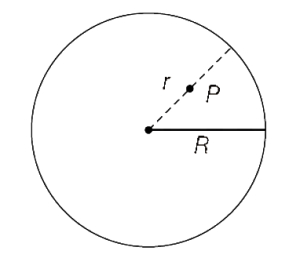
The electrostatic potential inside a charged sphere is given as $V = A r^2 + B$,where $r$ is the distance from the centre of the sphere,$A$ and $B$ are constants. Then,the charge density in the sphere is
A
$16 A \varepsilon_0$
B
$-6 A \varepsilon_0$
C
$20 A \varepsilon_0$
D
$-15 A \varepsilon_0$
Solution
(B) The electrostatic potential $V$ inside a charged sphere is given by $V = A r^2 + B$.
The electric field $E$ is related to the potential $V$ by the relation $E = -\frac{dV}{dr}$.
Substituting the given expression for $V$:
$E = -\frac{d}{dr}(A r^2 + B) = -2 A r$.
According to Gauss's Law in differential form,the volume charge density $\rho$ is related to the electric field $E$ by the equation $\nabla \cdot E = \frac{\rho}{\varepsilon_0}$.
For a spherically symmetric distribution,this becomes $\frac{1}{r^2} \frac{d}{dr}(r^2 E) = \frac{\rho}{\varepsilon_0}$.
Substituting $E = -2 A r$:
$\frac{\rho}{\varepsilon_0} = \frac{1}{r^2} \frac{d}{dr}(r^2 \cdot (-2 A r)) = \frac{1}{r^2} \frac{d}{dr}(-2 A r^3) = \frac{1}{r^2} (-6 A r^2) = -6 A$.
Therefore,the charge density is $\rho = -6 A \varepsilon_0$.
The electric field $E$ is related to the potential $V$ by the relation $E = -\frac{dV}{dr}$.
Substituting the given expression for $V$:
$E = -\frac{d}{dr}(A r^2 + B) = -2 A r$.
According to Gauss's Law in differential form,the volume charge density $\rho$ is related to the electric field $E$ by the equation $\nabla \cdot E = \frac{\rho}{\varepsilon_0}$.
For a spherically symmetric distribution,this becomes $\frac{1}{r^2} \frac{d}{dr}(r^2 E) = \frac{\rho}{\varepsilon_0}$.
Substituting $E = -2 A r$:
$\frac{\rho}{\varepsilon_0} = \frac{1}{r^2} \frac{d}{dr}(r^2 \cdot (-2 A r)) = \frac{1}{r^2} \frac{d}{dr}(-2 A r^3) = \frac{1}{r^2} (-6 A r^2) = -6 A$.
Therefore,the charge density is $\rho = -6 A \varepsilon_0$.
0 likes
View Solution121
EasyMCQ
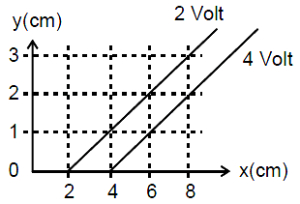
The figure represents two equipotential lines in the $x-y$ plane for an electric field. The $x$-component $E_{x}$ of the electric field in the space between these equipotential lines is, (in $V/m$)
A
$100$
B
$-100$
C
$200$
D
$-200$
Solution
(B) The electric field component $E_{x}$ is given by the negative gradient of the potential with respect to $x$,i.e.,$E_{x} = -\frac{dV}{dx}$.
From the graph,the potential difference $\Delta V = V_{2} - V_{1} = 4 \ V - 2 \ V = 2 \ V$.
The distance along the $x$-axis between these two equipotential lines is $\Delta x = 4 \ cm - 2 \ cm = 2 \ cm = 0.02 \ m$.
Therefore,the magnitude of the $x$-component of the electric field is $E_{x} = -\frac{\Delta V}{\Delta x} = -\frac{2 \ V}{0.02 \ m} = -100 \ V/m$.
Thus,the correct option is $B$.
From the graph,the potential difference $\Delta V = V_{2} - V_{1} = 4 \ V - 2 \ V = 2 \ V$.
The distance along the $x$-axis between these two equipotential lines is $\Delta x = 4 \ cm - 2 \ cm = 2 \ cm = 0.02 \ m$.
Therefore,the magnitude of the $x$-component of the electric field is $E_{x} = -\frac{\Delta V}{\Delta x} = -\frac{2 \ V}{0.02 \ m} = -100 \ V/m$.
Thus,the correct option is $B$.
0 likes
View Solution122
MediumMCQ
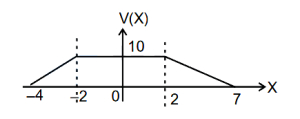
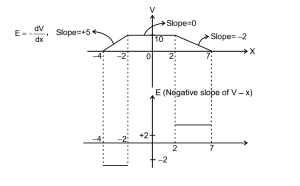
The electric potential for an electric field directed parallel to $X$-axis is shown in the figure. Choose the correct plot of electric field strength.
A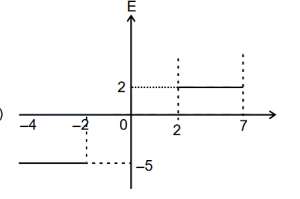
B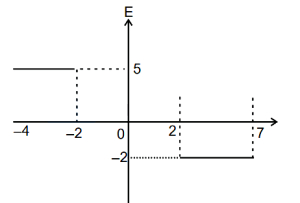
C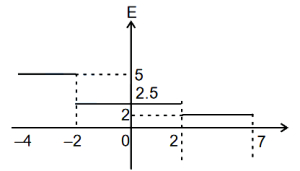
D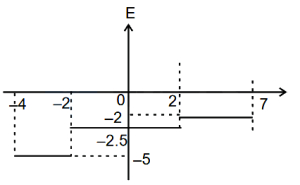
Solution
(A) The relation between electric field $E$ and electric potential $V$ is given by $E = -\frac{dV}{dx}$.
This means the electric field is the negative of the slope of the $V-X$ graph.
$1$. For the interval $X \in [-4, -2]$: The slope is $\frac{10 - 0}{-2 - (-4)} = \frac{10}{2} = 5$. Thus,$E = -5$.
$2$. For the interval $X \in [-2, 2]$: The potential is constant $(V = 10)$,so the slope is $0$. Thus,$E = 0$.
$3$. For the interval $X \in [2, 7]$: The slope is $\frac{0 - 10}{7 - 2} = \frac{-10}{5} = -2$. Thus,$E = -(-2) = 2$.
Comparing these values with the given options,option $A$ represents $E = -5$ for $X \in [-4, -2]$,$E = 0$ for $X \in [-2, 2]$,and $E = 2$ for $X \in [2, 7]$.
This means the electric field is the negative of the slope of the $V-X$ graph.
$1$. For the interval $X \in [-4, -2]$: The slope is $\frac{10 - 0}{-2 - (-4)} = \frac{10}{2} = 5$. Thus,$E = -5$.
$2$. For the interval $X \in [-2, 2]$: The potential is constant $(V = 10)$,so the slope is $0$. Thus,$E = 0$.
$3$. For the interval $X \in [2, 7]$: The slope is $\frac{0 - 10}{7 - 2} = \frac{-10}{5} = -2$. Thus,$E = -(-2) = 2$.
Comparing these values with the given options,option $A$ represents $E = -5$ for $X \in [-4, -2]$,$E = 0$ for $X \in [-2, 2]$,and $E = 2$ for $X \in [2, 7]$.
0 likes
View Solution123
MediumMCQ
The electrostatic potential in a charged spherical region of radius $r$ varies as $V = ar^3 + b$,where $a$ and $b$ are constants. The total charge in the sphere of unit radius is $\alpha \times \pi a \epsilon_0$. The value of $\alpha$ is . . . . . . .
A
$-12$
B
$-6$
C
$-9$
D
$-8$
Solution
(A) The electrostatic potential is given by $V = ar^3 + b$.
The electric field $E$ is related to the potential by $E = -\frac{dV}{dr}$.
Differentiating $V$ with respect to $r$,we get $E = -\frac{d}{dr}(ar^3 + b) = -3ar^2$.
According to Gauss's Law,the total charge $q_{enc}$ enclosed in a sphere of radius $r=1$ is given by $q_{enc} = \epsilon_0 \oint E \cdot dA$.
For a spherical surface of radius $r=1$,the area $A = 4\pi r^2 = 4\pi(1)^2 = 4\pi$.
Substituting the values at $r=1$,$E = -3a(1)^2 = -3a$.
Thus,$q_{enc} = \epsilon_0 \times (-3a) \times 4\pi = -12\pi a \epsilon_0$.
Comparing this with the given expression $\alpha \times \pi a \epsilon_0$,we find $\alpha = -12$.
The electric field $E$ is related to the potential by $E = -\frac{dV}{dr}$.
Differentiating $V$ with respect to $r$,we get $E = -\frac{d}{dr}(ar^3 + b) = -3ar^2$.
According to Gauss's Law,the total charge $q_{enc}$ enclosed in a sphere of radius $r=1$ is given by $q_{enc} = \epsilon_0 \oint E \cdot dA$.
For a spherical surface of radius $r=1$,the area $A = 4\pi r^2 = 4\pi(1)^2 = 4\pi$.
Substituting the values at $r=1$,$E = -3a(1)^2 = -3a$.
Thus,$q_{enc} = \epsilon_0 \times (-3a) \times 4\pi = -12\pi a \epsilon_0$.
Comparing this with the given expression $\alpha \times \pi a \epsilon_0$,we find $\alpha = -12$.
0 likes
View Solution124
DifficultMCQ
Electric field in a region is given by $\vec{E} = Ax\hat{i} + By\hat{j}$,where $A = 10 \ V/m^2$ and $B = 5 \ V/m^2$. If the electric potential at a point $(10, 20)$ is $500 \ V$,then the electric potential at the origin is . . . . . . $V$.
A
$1000$
B
$500$
C
$2000$
D
$0$
Solution
(C) The electric field is given by $\vec{E} = 10x\hat{i} + 5y\hat{j}$.
We know that the relation between electric field and potential is $\Delta V = -\int \vec{E} \cdot d\vec{r}$.
Let $V_0$ be the potential at the origin $(0, 0)$ and $V_P$ be the potential at $(10, 20)$.
$V_P - V_0 = -\int_{(0,0)}^{(10,20)} (10x\hat{i} + 5y\hat{j}) \cdot (dx\hat{i} + dy\hat{j})$.
$500 - V_0 = -\int_{0}^{10} 10x \ dx - \int_{0}^{20} 5y \ dy$.
$500 - V_0 = -[5x^2]_0^{10} - [\frac{5y^2}{2}]_0^{20}$.
$500 - V_0 = -[5(100) - 0] - [\frac{5(400)}{2} - 0]$.
$500 - V_0 = -500 - 1000$.
$500 - V_0 = -1500$.
$V_0 = 500 + 1500 = 2000 \ V$.
We know that the relation between electric field and potential is $\Delta V = -\int \vec{E} \cdot d\vec{r}$.
Let $V_0$ be the potential at the origin $(0, 0)$ and $V_P$ be the potential at $(10, 20)$.
$V_P - V_0 = -\int_{(0,0)}^{(10,20)} (10x\hat{i} + 5y\hat{j}) \cdot (dx\hat{i} + dy\hat{j})$.
$500 - V_0 = -\int_{0}^{10} 10x \ dx - \int_{0}^{20} 5y \ dy$.
$500 - V_0 = -[5x^2]_0^{10} - [\frac{5y^2}{2}]_0^{20}$.
$500 - V_0 = -[5(100) - 0] - [\frac{5(400)}{2} - 0]$.
$500 - V_0 = -500 - 1000$.
$500 - V_0 = -1500$.
$V_0 = 500 + 1500 = 2000 \ V$.
0 likes
View Solution125
DifficultMCQ
The electric potential as a function of $x, y$ is given by $V = 5(x^2 - y^2) \text{ V}$. The electric field at a point $(2, 3) \text{ m}$ is . . . . . . $\text{V/m}$.
A
$(-20\hat{i} + 30\hat{j})$
B
$(20\hat{i} - 30\hat{j})$
C
$(20\hat{i} + 45\hat{j})$
D
$(-4\hat{i} + 6\hat{j})$
Solution
(A) The electric field $\vec{E}$ is related to the electric potential $V$ by the relation $\vec{E} = -\nabla V = -(\frac{\partial V}{\partial x}\hat{i} + \frac{\partial V}{\partial y}\hat{j})$.
Given $V = 5x^2 - 5y^2$.
Calculating the partial derivatives:
$\frac{\partial V}{\partial x} = \frac{\partial}{\partial x}(5x^2 - 5y^2) = 10x$.
$\frac{\partial V}{\partial y} = \frac{\partial}{\partial y}(5x^2 - 5y^2) = -10y$.
Substituting these into the expression for $\vec{E}$:
$\vec{E} = -(10x\hat{i} - 10y\hat{j}) = -10x\hat{i} + 10y\hat{j}$.
At the point $(2, 3) \text{ m}$,substituting $x = 2$ and $y = 3$:
$\vec{E} = -10(2)\hat{i} + 10(3)\hat{j} = -20\hat{i} + 30\hat{j} \text{ V/m}$.
Given $V = 5x^2 - 5y^2$.
Calculating the partial derivatives:
$\frac{\partial V}{\partial x} = \frac{\partial}{\partial x}(5x^2 - 5y^2) = 10x$.
$\frac{\partial V}{\partial y} = \frac{\partial}{\partial y}(5x^2 - 5y^2) = -10y$.
Substituting these into the expression for $\vec{E}$:
$\vec{E} = -(10x\hat{i} - 10y\hat{j}) = -10x\hat{i} + 10y\hat{j}$.
At the point $(2, 3) \text{ m}$,substituting $x = 2$ and $y = 3$:
$\vec{E} = -10(2)\hat{i} + 10(3)\hat{j} = -20\hat{i} + 30\hat{j} \text{ V/m}$.
0 likes
View SolutionElectric Potential and Capacitance — Relation between Electric Field and Potential and Potential Gradient · Frequently Asked Questions
1Are these Electric Potential and Capacitance questions useful for JEE and NEET?
Yes. All questions in this section are mapped to JEE Main and NEET exam patterns. Previous year questions from JEE Main, NEET, GUJCET and state-level exams are included with full solutions.
2Can I switch to Hindi or Gujarati for these questions?
Yes. Use the language tabs in the hero section or the sidebar to view the same questions and solutions in English, Hindi or Gujarati.
3How do I generate a question paper from this subtopic?
Use the Vedclass Exam Paper Generator — select the chapter and subtopic, set difficulty, and generate Sets A, B, C, D automatically. First 3 chapters of every subject are free.
Vedclass Products
For Students
Vedclass Test Series
Mock tests in real JEE/NEET style with performance analysis. 5-day free trial.
Start Free TrialFor Teachers
Exam Paper Generator
Generate Set A/B/C/D papers from this chapter in 2 minutes. 3 chapters free.
Try FreeFor Institutes
Online Exam Module
Live online exams with unlimited students, 360° analytics & white-label branding.
See DemoFor Teachers & Institutes
Generate a Electric Potential and Capacitance Exam Paper in 2 Minutes
Select subtopic & difficulty — Sets A, B, C, D auto-generated with No Repeat logic.
First 3 chapters of every subject are free — no payment required.