
A English
Relation between Electric Field and Potential and Potential Gradient Questions in English
Class 12 Physics · Electric Potential and Capacitance · Relation between Electric Field and Potential and Potential Gradient
126+
Questions
English
Language
100%
With Solutions
Showing 50 of 126 questions in English
51
MediumMCQ
In a region,if the electric field is defined as $\vec{E} = (\hat{i} + 2\hat{j} + \hat{k}) \text{ V/m}$,then the potential difference between two points $A(0, 0, 0)$ and $B(2, 3, 4)$ in that region is ...... $V$.
A
$6$
B
$12$
C
$8$
D
$9$
Solution
(B) The potential difference $V_{AB} = V_B - V_A$ is given by the line integral of the electric field: $V_B - V_A = -\int_{A}^{B} \vec{E} \cdot d\vec{r}$.
Given $\vec{E} = \hat{i} + 2\hat{j} + \hat{k}$ and the displacement vector $d\vec{r} = dx\hat{i} + dy\hat{j} + dz\hat{k}$.
The points are $A(0, 0, 0)$ and $B(2, 3, 4)$.
$V_A - V_B = \int_{A}^{B} \vec{E} \cdot d\vec{r} = \int_{(0,0,0)}^{(2,3,4)} (\hat{i} + 2\hat{j} + \hat{k}) \cdot (dx\hat{i} + dy\hat{j} + dz\hat{k})$.
$V_A - V_B = \int_{0}^{2} dx + \int_{0}^{3} 2dy + \int_{0}^{4} dz$.
$V_A - V_B = [x]_0^2 + 2[y]_0^3 + [z]_0^4 = 2 + 2(3) + 4 = 2 + 6 + 4 = 12 \text{ V}$.
Since the question asks for the potential difference between $A$ and $B$,we consider the magnitude or the path integral $V_A - V_B = 12 \text{ V}$.
Given $\vec{E} = \hat{i} + 2\hat{j} + \hat{k}$ and the displacement vector $d\vec{r} = dx\hat{i} + dy\hat{j} + dz\hat{k}$.
The points are $A(0, 0, 0)$ and $B(2, 3, 4)$.
$V_A - V_B = \int_{A}^{B} \vec{E} \cdot d\vec{r} = \int_{(0,0,0)}^{(2,3,4)} (\hat{i} + 2\hat{j} + \hat{k}) \cdot (dx\hat{i} + dy\hat{j} + dz\hat{k})$.
$V_A - V_B = \int_{0}^{2} dx + \int_{0}^{3} 2dy + \int_{0}^{4} dz$.
$V_A - V_B = [x]_0^2 + 2[y]_0^3 + [z]_0^4 = 2 + 2(3) + 4 = 2 + 6 + 4 = 12 \text{ V}$.
Since the question asks for the potential difference between $A$ and $B$,we consider the magnitude or the path integral $V_A - V_B = 12 \text{ V}$.
0 likes
View Solution52
EasyMCQ
Assume that an electric field $\overrightarrow{E} = 30x^2 \hat{i}$ exists in space. Then the potential difference $V_A - V_O$,where $V_O$ is the potential at the origin and $V_A$ is the potential at $x = 2 \, m$,is: (in $, V$)
A
$-80$
B
$80$
C
$120$
D
$-120$
Solution
(A) The relationship between electric field $\overrightarrow{E}$ and electric potential $V$ is given by the formula: $dV = -\overrightarrow{E} \cdot d\overrightarrow{r}$.
For a one-dimensional field along the $x$-axis,this becomes: $dV = -E_x dx$.
To find the potential difference $V_A - V_O$,we integrate from the origin $(x = 0)$ to point $A$ $(x = 2 \, m)$:
$V_A - V_O = -\int_{0}^{2} E_x dx$.
Substituting the given electric field $E_x = 30x^2$:
$V_A - V_O = -\int_{0}^{2} 30x^2 dx$.
Evaluating the integral:
$V_A - V_O = -30 \left[ \frac{x^3}{3} \right]_{0}^{2}$.
$V_A - V_O = -30 \left( \frac{2^3}{3} - \frac{0^3}{3} \right)$.
$V_A - V_O = -30 \left( \frac{8}{3} \right) = -10 \times 8 = -80 \, V$.
For a one-dimensional field along the $x$-axis,this becomes: $dV = -E_x dx$.
To find the potential difference $V_A - V_O$,we integrate from the origin $(x = 0)$ to point $A$ $(x = 2 \, m)$:
$V_A - V_O = -\int_{0}^{2} E_x dx$.
Substituting the given electric field $E_x = 30x^2$:
$V_A - V_O = -\int_{0}^{2} 30x^2 dx$.
Evaluating the integral:
$V_A - V_O = -30 \left[ \frac{x^3}{3} \right]_{0}^{2}$.
$V_A - V_O = -30 \left( \frac{2^3}{3} - \frac{0^3}{3} \right)$.
$V_A - V_O = -30 \left( \frac{8}{3} \right) = -10 \times 8 = -80 \, V$.
0 likes
View Solution53
EasyMCQ
$A$ uniform electric field of $20\, N/C$ exists along the $x$-axis in a space. The potential difference $(V_B - V_A)$ for the points $A(4\,m, 2\,m)$ and $B(6\,m, 5\,m)$ is.....$V$.
A
$20 \sqrt{13}$
B
$-40$
C
$+40$
D
$-20 \sqrt{13}$
Solution
(B) The electric field is given as $\vec{E} = 20\hat{i}\, N/C$.
For a uniform electric field,the potential difference between two points $A$ and $B$ is given by the relation $\Delta V = V_B - V_A = -\int_{A}^{B} \vec{E} \cdot d\vec{r}$.
Here,the displacement vector $\vec{r}_{AB} = (x_B - x_A)\hat{i} + (y_B - y_A)\hat{j} = (6 - 4)\hat{i} + (5 - 2)\hat{j} = 2\hat{i} + 3\hat{j}$.
Substituting the values,we get $V_B - V_A = -(20\hat{i}) \cdot (2\hat{i} + 3\hat{j})$.
$V_B - V_A = -20 \times 2 = -40\, V$.
For a uniform electric field,the potential difference between two points $A$ and $B$ is given by the relation $\Delta V = V_B - V_A = -\int_{A}^{B} \vec{E} \cdot d\vec{r}$.
Here,the displacement vector $\vec{r}_{AB} = (x_B - x_A)\hat{i} + (y_B - y_A)\hat{j} = (6 - 4)\hat{i} + (5 - 2)\hat{j} = 2\hat{i} + 3\hat{j}$.
Substituting the values,we get $V_B - V_A = -(20\hat{i}) \cdot (2\hat{i} + 3\hat{j})$.
$V_B - V_A = -20 \times 2 = -40\, V$.
0 likes
View Solution54
MediumMCQ
The electric potential $V$ at any point $(x, y, z)$ (all in $m$) in space is given by $V = 4x^2 \ V$. The electric field at the point $(1 \ m, 0, 2 \ m)$ in $V/m$ is:
A
$8$ along negative $x$-axis
B
$8$ along positive $x$-axis
C
$16$ along negative $x$-axis
D
$16$ along positive $x$-axis
Solution
(A) The electric field $\overrightarrow{E}$ is related to the electric potential $V$ by the relation $\overrightarrow{E} = -\nabla V = -\left( \frac{\partial V}{\partial x} \hat{i} + \frac{\partial V}{\partial y} \hat{j} + \frac{\partial V}{\partial z} \hat{k} \right)$.
Given $V = 4x^2$,we calculate the partial derivatives:
$\frac{\partial V}{\partial x} = \frac{d}{dx}(4x^2) = 8x$
$\frac{\partial V}{\partial y} = 0$
$\frac{\partial V}{\partial z} = 0$
Thus,$\overrightarrow{E} = -(8x) \hat{i} = -8x \hat{i}$.
At the point $(1 \ m, 0, 2 \ m)$,the value of $x$ is $1 \ m$.
Substituting $x = 1$,we get $\overrightarrow{E} = -8(1) \hat{i} = -8 \hat{i} \ V/m$.
The negative sign indicates that the electric field is directed along the negative $x$-axis with a magnitude of $8 \ V/m$.
Given $V = 4x^2$,we calculate the partial derivatives:
$\frac{\partial V}{\partial x} = \frac{d}{dx}(4x^2) = 8x$
$\frac{\partial V}{\partial y} = 0$
$\frac{\partial V}{\partial z} = 0$
Thus,$\overrightarrow{E} = -(8x) \hat{i} = -8x \hat{i}$.
At the point $(1 \ m, 0, 2 \ m)$,the value of $x$ is $1 \ m$.
Substituting $x = 1$,we get $\overrightarrow{E} = -8(1) \hat{i} = -8 \hat{i} \ V/m$.
The negative sign indicates that the electric field is directed along the negative $x$-axis with a magnitude of $8 \ V/m$.
0 likes
View Solution55
MediumMCQ
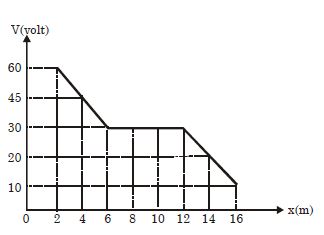
The variation of potential $V$ with distance $x$ from a fixed point is as shown in the figure. The electric field at $x = 13\,m$ is......$V/m$.
A
$7.5$
B
$-7.5$
C
$5$
D
$-5$
Solution
(C) The electric field $E$ is related to the potential $V$ by the relation $E = -\frac{dV}{dx}$,which is the negative of the slope of the $V-x$ graph.
At $x = 13\,m$,the point lies on the line segment between $x = 12\,m$ and $x = 16\,m$.
The coordinates of the endpoints of this segment are $(12, 30)$ and $(16, 10)$.
The slope of this line segment is $\text{slope} = \frac{V_2 - V_1}{x_2 - x_1} = \frac{10 - 30}{16 - 12} = \frac{-20}{4} = -5\,V/m$.
Therefore,the electric field $E = -(\text{slope}) = -(-5) = 5\,V/m$.
At $x = 13\,m$,the point lies on the line segment between $x = 12\,m$ and $x = 16\,m$.
The coordinates of the endpoints of this segment are $(12, 30)$ and $(16, 10)$.
The slope of this line segment is $\text{slope} = \frac{V_2 - V_1}{x_2 - x_1} = \frac{10 - 30}{16 - 12} = \frac{-20}{4} = -5\,V/m$.
Therefore,the electric field $E = -(\text{slope}) = -(-5) = 5\,V/m$.
0 likes
View Solution56
EasyMCQ
The electric potential at any point as a function of distance $(x)$ in meters is given by $V = 5x^2 + 10x - 9 \, (V)$. The value of the electric field at $x = 1 \, m$ is ...... $V m^{-1}$.
A
-$20$
B
$6$
C
$11$
D
-$23$
Solution
(A) The relationship between electric field $E$ and electric potential $V$ is given by the formula $E = -\frac{dV}{dx}$.
Given $V = 5x^2 + 10x - 9$.
Differentiating $V$ with respect to $x$,we get $\frac{dV}{dx} = \frac{d}{dx}(5x^2 + 10x - 9) = 10x + 10$.
Substituting this into the electric field formula: $E = -(10x + 10)$.
At $x = 1 \, m$,the electric field is $E = -(10(1) + 10) = -(10 + 10) = -20 \, V m^{-1}$.
Given $V = 5x^2 + 10x - 9$.
Differentiating $V$ with respect to $x$,we get $\frac{dV}{dx} = \frac{d}{dx}(5x^2 + 10x - 9) = 10x + 10$.
Substituting this into the electric field formula: $E = -(10x + 10)$.
At $x = 1 \, m$,the electric field is $E = -(10(1) + 10) = -(10 + 10) = -20 \, V m^{-1}$.
0 likes
View Solution57
DifficultMCQ
The potential (in volts) of a charge distribution is given by $V(z) = 30 - 5z^2$ for $|z| \le 1 \ m$ and $V(z) = 35 - 10|z|$ for $|z| \ge 1 \ m$. $V(z)$ does not depend on $x$ and $y$. If this potential is generated by a constant charge per unit volume $\rho_0$ (in units of $\varepsilon_0$) which is spread over a certain region,then choose the correct statement.
A
$\rho_0 = 20 \varepsilon_0$ in the entire region
B
$\rho_0 = 10 \varepsilon_0$ for $|z| \le 1 \ m$ and $\rho_0 = 0$ elsewhere
C
$\rho_0 = 20 \varepsilon_0$ for $|z| \le 1 \ m$ and $\rho_0 = 0$ elsewhere
D
$\rho_0 = 40 \varepsilon_0$ in the entire region
Solution
(B) Using Poisson's equation for a potential that depends only on $z$: $\frac{d^2V}{dz^2} = -\frac{\rho}{\varepsilon_0}$.
For $|z| < 1 \ m$,$V(z) = 30 - 5z^2$. Therefore,$\frac{dV}{dz} = -10z$ and $\frac{d^2V}{dz^2} = -10$.
Substituting this into the equation: $-10 = -\frac{\rho_0}{\varepsilon_0} \implies \rho_0 = 10 \varepsilon_0$.
For $|z| > 1 \ m$,$V(z) = 35 - 10|z|$. For $z > 1$,$V(z) = 35 - 10z$,so $\frac{dV}{dz} = -10$ and $\frac{d^2V}{dz^2} = 0$. Thus,$\rho = 0$.
For $z < -1$,$V(z) = 35 + 10z$,so $\frac{dV}{dz} = 10$ and $\frac{d^2V}{dz^2} = 0$. Thus,$\rho = 0$.
Therefore,$\rho_0 = 10 \varepsilon_0$ for $|z| \le 1 \ m$ and $\rho_0 = 0$ elsewhere.
For $|z| < 1 \ m$,$V(z) = 30 - 5z^2$. Therefore,$\frac{dV}{dz} = -10z$ and $\frac{d^2V}{dz^2} = -10$.
Substituting this into the equation: $-10 = -\frac{\rho_0}{\varepsilon_0} \implies \rho_0 = 10 \varepsilon_0$.
For $|z| > 1 \ m$,$V(z) = 35 - 10|z|$. For $z > 1$,$V(z) = 35 - 10z$,so $\frac{dV}{dz} = -10$ and $\frac{d^2V}{dz^2} = 0$. Thus,$\rho = 0$.
For $z < -1$,$V(z) = 35 + 10z$,so $\frac{dV}{dz} = 10$ and $\frac{d^2V}{dz^2} = 0$. Thus,$\rho = 0$.
Therefore,$\rho_0 = 10 \varepsilon_0$ for $|z| \le 1 \ m$ and $\rho_0 = 0$ elsewhere.
0 likes
View Solution58
MediumMCQ
An electric field $\vec{E} = (25 \hat{i} + 30 \hat{j}) \, NC^{-1}$ exists in a region of space. If the potential at the origin is taken to be zero,then the potential at $x = 2 \, m, y = 2 \, m$ is ...... $volt$.
A
$-110$
B
$-140$
C
$-120$
D
$-130$
Solution
(A) The relation between electric field $\vec{E}$ and electric potential $V$ is given by $\vec{E} = -\nabla V$.
Thus,$dV = -\vec{E} \cdot d\vec{r} = -(E_x dx + E_y dy)$.
Given $\vec{E} = (25 \hat{i} + 30 \hat{j}) \, NC^{-1}$,we have $E_x = 25$ and $E_y = 30$.
To find the potential at $(2, 2)$ relative to the origin $(0, 0)$,we integrate:
$V(2, 2) - V(0, 0) = -\int_{(0,0)}^{(2,2)} (25 dx + 30 dy)$.
Since $V(0, 0) = 0$,we have:
$V(2, 2) = -[25x + 30y]_{(0,0)}^{(2,2)}$.
$V(2, 2) = -[25(2) + 30(2)] - [25(0) + 30(0)]$.
$V(2, 2) = -(50 + 60) = -110 \, V$.
Thus,$dV = -\vec{E} \cdot d\vec{r} = -(E_x dx + E_y dy)$.
Given $\vec{E} = (25 \hat{i} + 30 \hat{j}) \, NC^{-1}$,we have $E_x = 25$ and $E_y = 30$.
To find the potential at $(2, 2)$ relative to the origin $(0, 0)$,we integrate:
$V(2, 2) - V(0, 0) = -\int_{(0,0)}^{(2,2)} (25 dx + 30 dy)$.
Since $V(0, 0) = 0$,we have:
$V(2, 2) = -[25x + 30y]_{(0,0)}^{(2,2)}$.
$V(2, 2) = -[25(2) + 30(2)] - [25(0) + 30(0)]$.
$V(2, 2) = -(50 + 60) = -110 \, V$.
0 likes
View Solution59
MediumMCQ
The electric field in a region is given by $\vec{E} = (Ax + B)\hat{i}$ where $E$ is in $N\,C^{-1}$ and $x$ is in meters. The values of constants are $A = 20\, SI\, \text{unit}$ and $B = 10\, SI\, \text{unit}$. If the potential at $x = 1$ is $V_1$ and that at $x = -5$ is $V_2$, then $V_1 - V_2$ is.....$V$.
A
$320$
B
$-48$
C
$-520$
D
$180$
Solution
(D) The relation between electric field $\vec{E}$ and electric potential $V$ is given by $\vec{E} = -\frac{dV}{dx} \hat{i}$.
Therefore, $dV = -E_x dx$.
Integrating both sides from $x = -5$ to $x = 1$:
$\int_{V_2}^{V_1} dV = -\int_{-5}^{1} (Ax + B) dx$
$V_1 - V_2 = -\int_{-5}^{1} (20x + 10) dx$
$V_1 - V_2 = -[10x^2 + 10x]_{-5}^{1}$
$V_1 - V_2 = -[(10(1)^2 + 10(1)) - (10(-5)^2 + 10(-5))]$
$V_1 - V_2 = -[(10 + 10) - (250 - 50)]$
$V_1 - V_2 = -[20 - 200]$
$V_1 - V_2 = -[-180] = 180\, V$.
Therefore, $dV = -E_x dx$.
Integrating both sides from $x = -5$ to $x = 1$:
$\int_{V_2}^{V_1} dV = -\int_{-5}^{1} (Ax + B) dx$
$V_1 - V_2 = -\int_{-5}^{1} (20x + 10) dx$
$V_1 - V_2 = -[10x^2 + 10x]_{-5}^{1}$
$V_1 - V_2 = -[(10(1)^2 + 10(1)) - (10(-5)^2 + 10(-5))]$
$V_1 - V_2 = -[(10 + 10) - (250 - 50)]$
$V_1 - V_2 = -[20 - 200]$
$V_1 - V_2 = -[-180] = 180\, V$.
0 likes
View Solution60
EasyMCQ
Electric potential at any point is $V = -5x + 3y + \sqrt{15} z$,then the magnitude of the electric field is
A
$3\sqrt{2}$
B
$4\sqrt{2}$
C
$5\sqrt{2}$
D
$7$
Solution
(D) The electric field $\vec{E}$ is related to the electric potential $V$ by the relation $\vec{E} = -\nabla V = -\left( \frac{\partial V}{\partial x} \hat{i} + \frac{\partial V}{\partial y} \hat{j} + \frac{\partial V}{\partial z} \hat{k} \right)$.
Given $V = -5x + 3y + \sqrt{15}z$.
Calculating the partial derivatives:
$E_x = -\frac{\partial V}{\partial x} = -(-5) = 5$
$E_y = -\frac{\partial V}{\partial y} = -(3) = -3$
$E_z = -\frac{\partial V}{\partial z} = -(\sqrt{15}) = -\sqrt{15}$
Thus,$\vec{E} = 5\hat{i} - 3\hat{j} - \sqrt{15}\hat{k}$.
The magnitude of the electric field is $|\vec{E}| = \sqrt{E_x^2 + E_y^2 + E_z^2}$.
$|\vec{E}| = \sqrt{(5)^2 + (-3)^2 + (-\sqrt{15})^2} = \sqrt{25 + 9 + 15} = \sqrt{49} = 7$.
Given $V = -5x + 3y + \sqrt{15}z$.
Calculating the partial derivatives:
$E_x = -\frac{\partial V}{\partial x} = -(-5) = 5$
$E_y = -\frac{\partial V}{\partial y} = -(3) = -3$
$E_z = -\frac{\partial V}{\partial z} = -(\sqrt{15}) = -\sqrt{15}$
Thus,$\vec{E} = 5\hat{i} - 3\hat{j} - \sqrt{15}\hat{k}$.
The magnitude of the electric field is $|\vec{E}| = \sqrt{E_x^2 + E_y^2 + E_z^2}$.
$|\vec{E}| = \sqrt{(5)^2 + (-3)^2 + (-\sqrt{15})^2} = \sqrt{25 + 9 + 15} = \sqrt{49} = 7$.
0 likes
View Solution61
EasyMCQ
Variation in electric potential is maximum if one goes
A
along the line of force
B
perpendicular to the line of force
C
in any direction
D
no variation in any direction
Solution
(A) The relationship between electric potential $V$ and electric field $\overrightarrow{E}$ is given by the formula $\Delta V = -\int \overrightarrow{E} \cdot d \overrightarrow{r}$.
This can be written as $\Delta V = -E \cdot dr \cdot \cos \theta$,where $\theta$ is the angle between the electric field vector $\overrightarrow{E}$ and the displacement vector $d \overrightarrow{r}$.
For the variation in electric potential to be maximum,the magnitude of $\cos \theta$ must be maximum.
The maximum value of $|\cos \theta|$ is $1$,which occurs when $\theta = 0^{\circ}$ or $\theta = 180^{\circ}$.
This corresponds to moving along the direction of the electric field lines (the lines of force).
This can be written as $\Delta V = -E \cdot dr \cdot \cos \theta$,where $\theta$ is the angle between the electric field vector $\overrightarrow{E}$ and the displacement vector $d \overrightarrow{r}$.
For the variation in electric potential to be maximum,the magnitude of $\cos \theta$ must be maximum.
The maximum value of $|\cos \theta|$ is $1$,which occurs when $\theta = 0^{\circ}$ or $\theta = 180^{\circ}$.
This corresponds to moving along the direction of the electric field lines (the lines of force).
0 likes
View Solution62
EasyMCQ
The potential function of an electrostatic field is given by $V = 2x^2$. Determine the electric field strength at the point $(2 \ m, 0, 3 \ m)$.
A
$\vec E = 4\hat i \ N C^{-1}$
B
$\vec E = -4\hat i \ N C^{-1}$
C
$\vec E = 8\hat i \ N C^{-1}$
D
$\vec E = -8\hat i \ N C^{-1}$
Solution
(D) The electric field $\vec E$ is related to the potential $V$ by the relation $\vec E = -\nabla V$.
Since $V = 2x^2$,the electric field is given by $\vec E = -\left( \frac{\partial V}{\partial x} \hat i + \frac{\partial V}{\partial y} \hat j + \frac{\partial V}{\partial z} \hat k \right)$.
Calculating the partial derivatives: $\frac{\partial V}{\partial x} = 4x$,$\frac{\partial V}{\partial y} = 0$,and $\frac{\partial V}{\partial z} = 0$.
Thus,$\vec E = -(4x) \hat i$.
At the point $(2 \ m, 0, 3 \ m)$,the $x$-coordinate is $2 \ m$.
Substituting $x = 2$,we get $\vec E = -(4 \times 2) \hat i = -8 \hat i \ N C^{-1}$.
Since $V = 2x^2$,the electric field is given by $\vec E = -\left( \frac{\partial V}{\partial x} \hat i + \frac{\partial V}{\partial y} \hat j + \frac{\partial V}{\partial z} \hat k \right)$.
Calculating the partial derivatives: $\frac{\partial V}{\partial x} = 4x$,$\frac{\partial V}{\partial y} = 0$,and $\frac{\partial V}{\partial z} = 0$.
Thus,$\vec E = -(4x) \hat i$.
At the point $(2 \ m, 0, 3 \ m)$,the $x$-coordinate is $2 \ m$.
Substituting $x = 2$,we get $\vec E = -(4 \times 2) \hat i = -8 \hat i \ N C^{-1}$.
0 likes
View Solution63
EasyMCQ
The potential $V$ is varying with $x$ and $y$ as $V = \frac{1}{2}(y^2 - 4x) \text{ V}$. The electric field at $(1 \text{ m}, 1 \text{ m})$ is:
A
$2\hat{i} + \hat{j} \text{ V/m}$
B
$-2\hat{i} + \hat{j} \text{ V/m}$
C
$2\hat{i} - \hat{j} \text{ V/m}$
D
$-2\hat{i} + 2\hat{j} \text{ V/m}$
Solution
(C) The electric field $\vec{E}$ is related to the potential $V$ by the relation $\vec{E} = -\nabla V = -\left( \frac{\partial V}{\partial x} \hat{i} + \frac{\partial V}{\partial y} \hat{j} \right)$.
Given $V = \frac{1}{2}(y^2 - 4x)$.
Calculating the partial derivatives:
$E_x = -\frac{\partial V}{\partial x} = -\frac{\partial}{\partial x} \left( \frac{1}{2}y^2 - 2x \right) = -(-2) = 2 \text{ V/m}$.
$E_y = -\frac{\partial V}{\partial y} = -\frac{\partial}{\partial y} \left( \frac{1}{2}y^2 - 2x \right) = -\left( \frac{1}{2} \cdot 2y \right) = -y \text{ V/m}$.
At the point $(1 \text{ m}, 1 \text{ m})$:
$E_x = 2 \text{ V/m}$.
$E_y = -1 \text{ V/m}$.
Therefore,the electric field is $\vec{E} = 2\hat{i} - \hat{j} \text{ V/m}$.
Given $V = \frac{1}{2}(y^2 - 4x)$.
Calculating the partial derivatives:
$E_x = -\frac{\partial V}{\partial x} = -\frac{\partial}{\partial x} \left( \frac{1}{2}y^2 - 2x \right) = -(-2) = 2 \text{ V/m}$.
$E_y = -\frac{\partial V}{\partial y} = -\frac{\partial}{\partial y} \left( \frac{1}{2}y^2 - 2x \right) = -\left( \frac{1}{2} \cdot 2y \right) = -y \text{ V/m}$.
At the point $(1 \text{ m}, 1 \text{ m})$:
$E_x = 2 \text{ V/m}$.
$E_y = -1 \text{ V/m}$.
Therefore,the electric field is $\vec{E} = 2\hat{i} - \hat{j} \text{ V/m}$.
0 likes
View Solution64
EasyMCQ
Find the potential $V$ of an electrostatic field $\vec{E} = a(y\hat{i} + x\hat{j})$,where $a$ is a constant.
A
$axy + C$
B
$-axy + C$
C
$axy$
D
$-axy$
Solution
(B) The relation between electric field $\vec{E}$ and potential $V$ is given by $\vec{E} = -\nabla V$.
Given $\vec{E} = a(y\hat{i} + x\hat{j})$,we have:
$-\left(\frac{\partial V}{\partial x}\hat{i} + \frac{\partial V}{\partial y}\hat{j}\right) = ay\hat{i} + ax\hat{j}$.
Comparing the components:
$\frac{\partial V}{\partial x} = -ay$ and $\frac{\partial V}{\partial y} = -ax$.
Integrating $\frac{\partial V}{\partial x} = -ay$ with respect to $x$:
$V = -axy + f(y)$,where $f(y)$ is a function of $y$.
Differentiating this with respect to $y$:
$\frac{\partial V}{\partial y} = -ax + f'(y)$.
Comparing this with $\frac{\partial V}{\partial y} = -ax$,we get $f'(y) = 0$,which implies $f(y) = C$ (a constant).
Therefore,$V = -axy + C$.
Given $\vec{E} = a(y\hat{i} + x\hat{j})$,we have:
$-\left(\frac{\partial V}{\partial x}\hat{i} + \frac{\partial V}{\partial y}\hat{j}\right) = ay\hat{i} + ax\hat{j}$.
Comparing the components:
$\frac{\partial V}{\partial x} = -ay$ and $\frac{\partial V}{\partial y} = -ax$.
Integrating $\frac{\partial V}{\partial x} = -ay$ with respect to $x$:
$V = -axy + f(y)$,where $f(y)$ is a function of $y$.
Differentiating this with respect to $y$:
$\frac{\partial V}{\partial y} = -ax + f'(y)$.
Comparing this with $\frac{\partial V}{\partial y} = -ax$,we get $f'(y) = 0$,which implies $f(y) = C$ (a constant).
Therefore,$V = -axy + C$.
0 likes
View Solution65
MediumMCQ
The electric potential in a region is represented as $V = 2x + 3y - z$. The expression for the electric field strength is:
A
$2\hat{i} + 3\hat{j} - \hat{k}$
B
$-2\hat{i} - 3\hat{j} + \hat{k}$
C
$-2\hat{i} - 3\hat{j}$
D
$2\hat{i} + 3\hat{j}$
Solution
(B) The electric field $\vec{E}$ is related to the electric potential $V$ by the relation $\vec{E} = -\nabla V = -\left( \frac{\partial V}{\partial x} \hat{i} + \frac{\partial V}{\partial y} \hat{j} + \frac{\partial V}{\partial z} \hat{k} \right)$.
Given $V = 2x + 3y - z$,we calculate the partial derivatives:
$\frac{\partial V}{\partial x} = \frac{\partial}{\partial x}(2x + 3y - z) = 2$
$\frac{\partial V}{\partial y} = \frac{\partial}{\partial y}(2x + 3y - z) = 3$
$\frac{\partial V}{\partial z} = \frac{\partial}{\partial z}(2x + 3y - z) = -1$
Substituting these values into the expression for $\vec{E}$:
$\vec{E} = -(2\hat{i} + 3\hat{j} - 1\hat{k})$
$\vec{E} = -2\hat{i} - 3\hat{j} + \hat{k}$
Given $V = 2x + 3y - z$,we calculate the partial derivatives:
$\frac{\partial V}{\partial x} = \frac{\partial}{\partial x}(2x + 3y - z) = 2$
$\frac{\partial V}{\partial y} = \frac{\partial}{\partial y}(2x + 3y - z) = 3$
$\frac{\partial V}{\partial z} = \frac{\partial}{\partial z}(2x + 3y - z) = -1$
Substituting these values into the expression for $\vec{E}$:
$\vec{E} = -(2\hat{i} + 3\hat{j} - 1\hat{k})$
$\vec{E} = -2\hat{i} - 3\hat{j} + \hat{k}$
0 likes
View Solution66
DifficultMCQ
The electric potential $(V)$ as a function of distance $(x)$ [in meters] is given by $V = (5x^2 + 10x - 9) \, V$. The value of the electric field at $x = 1 \, m$ would be ...... $V/m$.
A
$20$
B
$6$
C
$11$
D
$-20$
Solution
(D) The relationship between electric field $(E)$ and electric potential $(V)$ is given by the formula $E = -\frac{dV}{dx}$.
Given $V = 5x^2 + 10x - 9$.
Differentiating $V$ with respect to $x$:
$\frac{dV}{dx} = \frac{d}{dx}(5x^2 + 10x - 9) = 10x + 10$.
Therefore,$E = -(10x + 10)$.
At $x = 1 \, m$:
$E = -(10(1) + 10) = -(10 + 10) = -20 \, V/m$.
Given $V = 5x^2 + 10x - 9$.
Differentiating $V$ with respect to $x$:
$\frac{dV}{dx} = \frac{d}{dx}(5x^2 + 10x - 9) = 10x + 10$.
Therefore,$E = -(10x + 10)$.
At $x = 1 \, m$:
$E = -(10(1) + 10) = -(10 + 10) = -20 \, V/m$.
0 likes
View Solution67
MediumMCQ
Electric field at a point $(x, y, z)$ is represented by $\vec E = 2x\hat i + y^2\hat j$. If the potential at $(0, 0, 0)$ is $2 \, V$,find the potential at $(1, 1, 1)$. (in $/3$)
A
$4$
B
$2$
C
$10$
D
$1$
Solution
(B) The relationship between electric field $\vec E$ and electric potential $V$ is given by $\vec E = -\nabla V$,which implies $dV = -\vec E \cdot d\vec r$.
Integrating from the origin $(0, 0, 0)$ to the point $(1, 1, 1)$:
$V(1, 1, 1) - V(0, 0, 0) = -\int_{(0,0,0)}^{(1,1,1)} (2x\hat i + y^2\hat j) \cdot (dx\hat i + dy\hat j + dz\hat k)$.
$V(1, 1, 1) - 2 = -\left[ \int_{0}^{1} 2x \, dx + \int_{0}^{1} y^2 \, dy \right]$.
$V(1, 1, 1) - 2 = -\left[ x^2 \right]_{0}^{1} - \left[ \frac{y^3}{3} \right]_{0}^{1}$.
$V(1, 1, 1) - 2 = -(1 - 0) - (1/3 - 0) = -1 - 1/3 = -4/3$.
$V(1, 1, 1) = 2 - 4/3 = 2/3 \, V$.
Integrating from the origin $(0, 0, 0)$ to the point $(1, 1, 1)$:
$V(1, 1, 1) - V(0, 0, 0) = -\int_{(0,0,0)}^{(1,1,1)} (2x\hat i + y^2\hat j) \cdot (dx\hat i + dy\hat j + dz\hat k)$.
$V(1, 1, 1) - 2 = -\left[ \int_{0}^{1} 2x \, dx + \int_{0}^{1} y^2 \, dy \right]$.
$V(1, 1, 1) - 2 = -\left[ x^2 \right]_{0}^{1} - \left[ \frac{y^3}{3} \right]_{0}^{1}$.
$V(1, 1, 1) - 2 = -(1 - 0) - (1/3 - 0) = -1 - 1/3 = -4/3$.
$V(1, 1, 1) = 2 - 4/3 = 2/3 \, V$.
0 likes
View Solution68
EasyMCQ
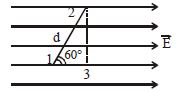
The electric field $\vec E$ between two points is constant in both magnitude and direction. Consider a path of length $d$ at an angle $\theta = 60^o$ with respect to the field lines as shown in the figure. The potential difference between points $1$ and $2$ is
A
$\frac {E}{d \cos 60^o}$
B
$Ed \cos 60^o$
C
$\frac {Ed}{\cos 60^o}$
D
$\frac {E}{d} \cos 60^o$
Solution
(B) The potential difference between two points in a uniform electric field $\vec E$ is given by $\Delta V = -\int \vec E \cdot d\vec l$.
For a uniform electric field,this simplifies to $\Delta V = E \Delta r$,where $\Delta r$ is the displacement along the direction of the electric field.
In the given figure,the path length is $d$ at an angle of $60^o$ with the electric field lines.
The component of the displacement $d$ along the direction of the electric field is $\Delta r = d \cos 60^o$.
Therefore,the potential difference between points $1$ and $2$ is $V = E d \cos 60^o$.
For a uniform electric field,this simplifies to $\Delta V = E \Delta r$,where $\Delta r$ is the displacement along the direction of the electric field.
In the given figure,the path length is $d$ at an angle of $60^o$ with the electric field lines.
The component of the displacement $d$ along the direction of the electric field is $\Delta r = d \cos 60^o$.
Therefore,the potential difference between points $1$ and $2$ is $V = E d \cos 60^o$.
0 likes
View Solution69
MediumMCQ
For a given electric field $\vec{E} = 2x\hat{i} + 3y\hat{j}$,find the potential at $(X, Y)$ if the potential at the origin is $5\, V$.
A
$-X^2 - \frac{3}{2}Y^2 + 5$
B
$-\frac{2}{3}X^2 - \frac{3}{2}Y^2 + 5$
C
$-2X^2 - \frac{3}{2}Y^2$
D
$\frac{3}{2}Y^2 + 5$
Solution
(A) The relationship between electric field $\vec{E}$ and electric potential $V$ is given by $\Delta V = -\int \vec{E} \cdot d\vec{r}$.
Given $\vec{E} = 2x\hat{i} + 3y\hat{j}$ and $V(0,0) = 5\, V$.
Integrating from origin $(0,0)$ to point $(X, Y)$:
$V(X, Y) - V(0,0) = -\int_{(0,0)}^{(X, Y)} (2x\hat{i} + 3y\hat{j}) \cdot (dx\hat{i} + dy\hat{j})$
$V(X, Y) - 5 = -\int_{0}^{X} 2x\, dx - \int_{0}^{Y} 3y\, dy$
$V(X, Y) - 5 = -[x^2]_{0}^{X} - [\frac{3}{2}y^2]_{0}^{Y}$
$V(X, Y) - 5 = -X^2 - \frac{3}{2}Y^2$
$V(X, Y) = -X^2 - \frac{3}{2}Y^2 + 5$.
Given $\vec{E} = 2x\hat{i} + 3y\hat{j}$ and $V(0,0) = 5\, V$.
Integrating from origin $(0,0)$ to point $(X, Y)$:
$V(X, Y) - V(0,0) = -\int_{(0,0)}^{(X, Y)} (2x\hat{i} + 3y\hat{j}) \cdot (dx\hat{i} + dy\hat{j})$
$V(X, Y) - 5 = -\int_{0}^{X} 2x\, dx - \int_{0}^{Y} 3y\, dy$
$V(X, Y) - 5 = -[x^2]_{0}^{X} - [\frac{3}{2}y^2]_{0}^{Y}$
$V(X, Y) - 5 = -X^2 - \frac{3}{2}Y^2$
$V(X, Y) = -X^2 - \frac{3}{2}Y^2 + 5$.
0 likes
View Solution70
EasyMCQ
Let $V$ and $E$ be the potential and electric field intensity at a point,respectively. Then:
A
If $V = 0$,then $E$ must be zero.
B
If $V \neq 0$,then $E$ cannot be zero.
C
If $E \neq 0$,then $V$ cannot be zero.
D
If $V = 0$,then $E$ may be zero.
Solution
(D) The electric field $E$ and electric potential $V$ are related by the expression $E = -\frac{dV}{dr}$.
If $V = 0$ at a point,it does not necessarily mean $E = 0$. For example,at the center of a uniformly charged spherical shell,$V$ is constant and non-zero,but $E = 0$. Conversely,between two equal and opposite charges,the potential $V$ is zero at the midpoint,but the electric field $E$ is non-zero.
Similarly,if $E = 0$ at a point,it does not imply $V = 0$. For example,inside a charged conducting sphere,$E = 0$ everywhere,but $V$ is constant and equal to the potential at the surface.
Therefore,if $V = 0$,$E$ may or may not be zero. Similarly,if $E = 0$,$V$ may or may not be zero.
If $V = 0$ at a point,it does not necessarily mean $E = 0$. For example,at the center of a uniformly charged spherical shell,$V$ is constant and non-zero,but $E = 0$. Conversely,between two equal and opposite charges,the potential $V$ is zero at the midpoint,but the electric field $E$ is non-zero.
Similarly,if $E = 0$ at a point,it does not imply $V = 0$. For example,inside a charged conducting sphere,$E = 0$ everywhere,but $V$ is constant and equal to the potential at the surface.
Therefore,if $V = 0$,$E$ may or may not be zero. Similarly,if $E = 0$,$V$ may or may not be zero.
0 likes
View Solution71
DifficultMCQ
The potential $V$ varies with $x$ and $y$ as $V = \frac{1}{2}(y^2 - 4x) \text{ volts}$. The electric field at $(1 \text{ m}, 1 \text{ m})$ is:
A
$2\hat{i} + \hat{j} \text{ V/m}$
B
$-2\hat{i} + \hat{j} \text{ V/m}$
C
$2\hat{i} - \hat{j} \text{ V/m}$
D
$-2\hat{i} + 2\hat{j} \text{ V/m}$
Solution
(C) The electric field $\vec{E}$ is related to the potential $V$ by the relation $\vec{E} = -\nabla V = -(\frac{\partial V}{\partial x}\hat{i} + \frac{\partial V}{\partial y}\hat{j})$.
Given $V = \frac{1}{2}(y^2 - 4x)$.
Calculating the partial derivative with respect to $x$:
$E_x = -\frac{\partial V}{\partial x} = -\frac{\partial}{\partial x} [\frac{1}{2}(y^2 - 4x)] = -\frac{1}{2}(-4) = 2 \text{ V/m}$.
Calculating the partial derivative with respect to $y$:
$E_y = -\frac{\partial V}{\partial y} = -\frac{\partial}{\partial y} [\frac{1}{2}(y^2 - 4x)] = -\frac{1}{2}(2y) = -y \text{ V/m}$.
At the point $(1 \text{ m}, 1 \text{ m})$,we have $x = 1$ and $y = 1$.
Substituting $y = 1$ into the expression for $E_y$:
$E_y = -1 \text{ V/m}$.
Thus,the electric field vector is $\vec{E} = E_x\hat{i} + E_y\hat{j} = 2\hat{i} - 1\hat{j} \text{ V/m}$.
Given $V = \frac{1}{2}(y^2 - 4x)$.
Calculating the partial derivative with respect to $x$:
$E_x = -\frac{\partial V}{\partial x} = -\frac{\partial}{\partial x} [\frac{1}{2}(y^2 - 4x)] = -\frac{1}{2}(-4) = 2 \text{ V/m}$.
Calculating the partial derivative with respect to $y$:
$E_y = -\frac{\partial V}{\partial y} = -\frac{\partial}{\partial y} [\frac{1}{2}(y^2 - 4x)] = -\frac{1}{2}(2y) = -y \text{ V/m}$.
At the point $(1 \text{ m}, 1 \text{ m})$,we have $x = 1$ and $y = 1$.
Substituting $y = 1$ into the expression for $E_y$:
$E_y = -1 \text{ V/m}$.
Thus,the electric field vector is $\vec{E} = E_x\hat{i} + E_y\hat{j} = 2\hat{i} - 1\hat{j} \text{ V/m}$.
0 likes
View Solution72
Medium
Distinguish between electric field and electrostatic potential.
Solution
(N/A) The electric field $E$ of a point charge $Q$ at a distance $r$ is given by $E = \frac{kQ}{r^2}$.
The electrostatic potential $V$ of a point charge $Q$ at a distance $r$ is given by $V = \frac{kQ}{r}$.
Comparing the two expressions,we can see that $V = E \times r$.
Key differences:
$1$. Electric field is a vector quantity,whereas electrostatic potential is a scalar quantity.
$2$. The electric field represents the force per unit charge,while the electrostatic potential represents the work done per unit charge in bringing a test charge from infinity to a point.
The electrostatic potential $V$ of a point charge $Q$ at a distance $r$ is given by $V = \frac{kQ}{r}$.
Comparing the two expressions,we can see that $V = E \times r$.
Key differences:
$1$. Electric field is a vector quantity,whereas electrostatic potential is a scalar quantity.
$2$. The electric field represents the force per unit charge,while the electrostatic potential represents the work done per unit charge in bringing a test charge from infinity to a point.
0 likes
View Solution73
Easy
Write the relation between the electric field of an electric charge and electrostatic potential at any point.
Solution
(N/A) The electric field $\vec{E}$ at any point is related to the electrostatic potential $V$ at that point by the negative gradient of the potential.
Mathematically,this is expressed as: $\vec{E} = -\nabla V$.
In Cartesian coordinates,this can be written as: $\vec{E} = -\left( \frac{\partial V}{\partial x} \hat{i} + \frac{\partial V}{\partial y} \hat{j} + \frac{\partial V}{\partial z} \hat{k} \right)$.
This relation signifies that the electric field points in the direction of the steepest decrease of the electrostatic potential.
Mathematically,this is expressed as: $\vec{E} = -\nabla V$.
In Cartesian coordinates,this can be written as: $\vec{E} = -\left( \frac{\partial V}{\partial x} \hat{i} + \frac{\partial V}{\partial y} \hat{j} + \frac{\partial V}{\partial z} \hat{k} \right)$.
This relation signifies that the electric field points in the direction of the steepest decrease of the electrostatic potential.
0 likes
View Solution74
Medium
Obtain the relation between electric field and electric potential.
Solution
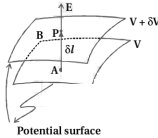
(N/A) As shown in the figure,consider two closely spaced equipotential surfaces $A$ and $B$ with potential values $V$ and $V+\delta V$,where $\delta V$ is the change in $V$ in the direction of the electric field $\vec{E}$.
Let $P$ be a point on the surface $B$. $\delta l$ is the perpendicular distance of the surface $A$ from $P$. Suppose that a unit positive charge is moved along the perpendicular from the surface $B$ to the surface $A$ against the electric field. The work done in this process is $|\vec{E}| \delta l$.
But work done,$W = V_{A} - V_{B}$.
Therefore,$|\vec{E}| \delta l = V - (V + \delta V)$.
$|\vec{E}| \delta l = -\delta V$.
$|\vec{E}| = -\frac{\delta V}{\delta l}$.
Hence,the negative value of the potential gradient is equal to the magnitude of the electric field. $\frac{\delta V}{\delta l}$ is known as the potential gradient. Its unit is $V \cdot m^{-1}$.
From this,there are two important conclusions:
$(1)$ The electric field is in the direction in which the potential decreases most steeply.
$(2)$ The magnitude of the electric field is given by the change in the magnitude of potential per unit displacement normal to the equipotential surface at the point.
Let $P$ be a point on the surface $B$. $\delta l$ is the perpendicular distance of the surface $A$ from $P$. Suppose that a unit positive charge is moved along the perpendicular from the surface $B$ to the surface $A$ against the electric field. The work done in this process is $|\vec{E}| \delta l$.
But work done,$W = V_{A} - V_{B}$.
Therefore,$|\vec{E}| \delta l = V - (V + \delta V)$.
$|\vec{E}| \delta l = -\delta V$.
$|\vec{E}| = -\frac{\delta V}{\delta l}$.
Hence,the negative value of the potential gradient is equal to the magnitude of the electric field. $\frac{\delta V}{\delta l}$ is known as the potential gradient. Its unit is $V \cdot m^{-1}$.
From this,there are two important conclusions:
$(1)$ The electric field is in the direction in which the potential decreases most steeply.
$(2)$ The magnitude of the electric field is given by the change in the magnitude of potential per unit displacement normal to the equipotential surface at the point.
0 likes
View Solution75
Medium
Write the relation between electric field and electrostatic potential.
Solution
(N/A) The electric field $E$ at a point is defined as the negative gradient of the electrostatic potential $V$ at that point.
Mathematically,this is expressed as:
$E = -\nabla V$
In one dimension,this relation is given by:
$E = -\frac{dV}{dr}$
where $E$ is the electric field,$V$ is the electrostatic potential,and $r$ is the position coordinate.
Mathematically,this is expressed as:
$E = -\nabla V$
In one dimension,this relation is given by:
$E = -\frac{dV}{dr}$
where $E$ is the electric field,$V$ is the electrostatic potential,and $r$ is the position coordinate.
0 likes
View Solution76
Easy
What is potential gradient?
Solution
(N/A) The potential gradient is defined as the rate of change of electric potential with respect to distance in the direction of the electric field.
Mathematically,it is expressed as $E = -\frac{dV}{dr}$,where $E$ is the electric field intensity,$V$ is the electric potential,and $r$ is the distance.
The negative sign indicates that the electric potential decreases in the direction of the electric field.
The $SI$ unit of potential gradient is $V/m$ (volt per meter).
Mathematically,it is expressed as $E = -\frac{dV}{dr}$,where $E$ is the electric field intensity,$V$ is the electric potential,and $r$ is the distance.
The negative sign indicates that the electric potential decreases in the direction of the electric field.
The $SI$ unit of potential gradient is $V/m$ (volt per meter).
0 likes
View Solution77
EasyMCQ
In a certain region of space with volume $0.2 \ m^3$,the electric potential is found to be $5 \ V$ throughout. The magnitude of the electric field in this region is . . . . . . $N/C$.
A
$5$
B
$0$
C
$0.5$
D
$1$
Solution
(B) The relationship between electric field $\vec{E}$ and electric potential $V$ is given by the gradient formula: $\vec{E} = -\nabla V$.
Since the electric potential $V$ is constant $(5 \ V)$ throughout the given region,its spatial derivative (gradient) is zero.
Therefore,$\vec{E} = -\frac{dV}{dr} = 0$.
Thus,the magnitude of the electric field in this region is $0 \ N/C$.
Since the electric potential $V$ is constant $(5 \ V)$ throughout the given region,its spatial derivative (gradient) is zero.
Therefore,$\vec{E} = -\frac{dV}{dr} = 0$.
Thus,the magnitude of the electric field in this region is $0 \ N/C$.
0 likes
View Solution78
EasyMCQ
If the electric potential at any point $(x, y, z) \, m$ in space is given by $V = 3x^2$ volt,the electric field at the point $(1, 0, 3) \, m$ will be ............
A
$3 \, Vm^{-1}$,directed along positive $x$-axis
B
$3 \, Vm^{-1}$,directed along negative $x$-axis
C
$6 \, Vm^{-1}$,directed along positive $x$-axis
D
$6 \, Vm^{-1}$,directed along negative $x$-axis
Solution
(D) The electric field $\vec{E}$ is related to the electric potential $V$ by the relation $\vec{E} = -\nabla V = -\left( \frac{\partial V}{\partial x} \hat{i} + \frac{\partial V}{\partial y} \hat{j} + \frac{\partial V}{\partial z} \hat{k} \right)$.
Given $V = 3x^2$,we calculate the partial derivatives:
$\frac{\partial V}{\partial x} = \frac{d}{dx}(3x^2) = 6x$
$\frac{\partial V}{\partial y} = 0$
$\frac{\partial V}{\partial z} = 0$
Thus,$\vec{E} = -(6x) \hat{i} = -6x \hat{i}$.
At the point $(1, 0, 3)$,the $x$-coordinate is $1$. Substituting this into the expression for $\vec{E}$:
$\vec{E} = -6(1) \hat{i} = -6 \hat{i} \, Vm^{-1}$.
The magnitude is $6 \, Vm^{-1}$ and the negative sign indicates it is directed along the negative $x$-axis.
Given $V = 3x^2$,we calculate the partial derivatives:
$\frac{\partial V}{\partial x} = \frac{d}{dx}(3x^2) = 6x$
$\frac{\partial V}{\partial y} = 0$
$\frac{\partial V}{\partial z} = 0$
Thus,$\vec{E} = -(6x) \hat{i} = -6x \hat{i}$.
At the point $(1, 0, 3)$,the $x$-coordinate is $1$. Substituting this into the expression for $\vec{E}$:
$\vec{E} = -6(1) \hat{i} = -6 \hat{i} \, Vm^{-1}$.
The magnitude is $6 \, Vm^{-1}$ and the negative sign indicates it is directed along the negative $x$-axis.
0 likes
View Solution79
EasyMCQ
The potential gradient is a
A
Vector quantity
B
Scalar quantity
C
Conversion factor
D
Constant
Solution
(A) The potential gradient is defined as the rate of change of electric potential with respect to distance.
Mathematically,it is expressed as $\frac{dV}{dr}$.
According to the relation between electric field $E$ and potential $V$,we have $E = -\frac{dV}{dr}$.
Since the electric field $E$ is a vector quantity,the potential gradient $\frac{dV}{dr}$ must also be a vector quantity.
Therefore,the correct option is $A$.
Mathematically,it is expressed as $\frac{dV}{dr}$.
According to the relation between electric field $E$ and potential $V$,we have $E = -\frac{dV}{dr}$.
Since the electric field $E$ is a vector quantity,the potential gradient $\frac{dV}{dr}$ must also be a vector quantity.
Therefore,the correct option is $A$.
0 likes
View Solution80
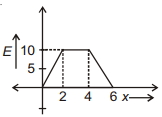
MediumMCQ
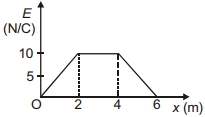
The figure shows the variation of electric field intensity $E$ versus distance $x$. What is the potential difference between the points at $x = 2 \, m$ and $x = 6 \, m$ from $O$ (in $V$)?
A
$30$
B
$60$
C
$40$
D
$20$
Solution
(A) The potential difference $V_A - V_B$ is given by the area under the $E-x$ graph between the points $x_A$ and $x_B$.
$V_2 - V_6 = \int_{2}^{6} E \, dx$
This integral represents the area under the $E-x$ graph from $x = 2 \, m$ to $x = 6 \, m$.
The area consists of a rectangle from $x = 2$ to $x = 4$ and a triangle from $x = 4$ to $x = 6$.
Area of rectangle = $base \times height = (4 - 2) \times 10 = 2 \times 10 = 20 \, V$.
Area of triangle = $\frac{1}{2} \times base \times height = \frac{1}{2} \times (6 - 4) \times 10 = \frac{1}{2} \times 2 \times 10 = 10 \, V$.
Total potential difference = $20 + 10 = 30 \, V$.
$V_2 - V_6 = \int_{2}^{6} E \, dx$
This integral represents the area under the $E-x$ graph from $x = 2 \, m$ to $x = 6 \, m$.
The area consists of a rectangle from $x = 2$ to $x = 4$ and a triangle from $x = 4$ to $x = 6$.
Area of rectangle = $base \times height = (4 - 2) \times 10 = 2 \times 10 = 20 \, V$.
Area of triangle = $\frac{1}{2} \times base \times height = \frac{1}{2} \times (6 - 4) \times 10 = \frac{1}{2} \times 2 \times 10 = 10 \, V$.
Total potential difference = $20 + 10 = 30 \, V$.
0 likes
View Solution81
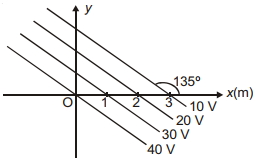
MediumMCQ
The figure shows a set of equipotential surfaces. The magnitude and direction of the electric field that exists in the region is .........
A
$10 \sqrt{2} \, V/m$ at $45^{\circ}$ with the $x$-axis
B
$10 \sqrt{2} \, V/m$ at $-45^{\circ}$ with the $x$-axis
C
$5 \sqrt{2} \, V/m$ at $45^{\circ}$ with the $x$-axis
D
$5 \sqrt{2} \, V/m$ at $-45^{\circ}$ with the $x$-axis
Solution
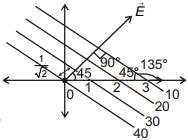
(A) The electric field $E$ is perpendicular to the equipotential surfaces and points from higher potential to lower potential.
From the figure,the equipotential lines make an angle of $135^{\circ}$ with the positive $x$-axis.
The normal to these lines makes an angle of $135^{\circ} - 90^{\circ} = 45^{\circ}$ with the positive $x$-axis.
The potential difference between two consecutive surfaces is $\Delta V = 10 \, V$.
The perpendicular distance $d$ between two consecutive surfaces can be calculated from the geometry: $d = 1 \cdot \sin(45^{\circ}) = \frac{1}{\sqrt{2}} \, m$.
The magnitude of the electric field is $E = \frac{|\Delta V|}{d} = \frac{10}{1/\sqrt{2}} = 10 \sqrt{2} \, V/m$.
Since the field points from higher potential to lower potential,it is directed at $45^{\circ}$ with the $x$-axis.
From the figure,the equipotential lines make an angle of $135^{\circ}$ with the positive $x$-axis.
The normal to these lines makes an angle of $135^{\circ} - 90^{\circ} = 45^{\circ}$ with the positive $x$-axis.
The potential difference between two consecutive surfaces is $\Delta V = 10 \, V$.
The perpendicular distance $d$ between two consecutive surfaces can be calculated from the geometry: $d = 1 \cdot \sin(45^{\circ}) = \frac{1}{\sqrt{2}} \, m$.
The magnitude of the electric field is $E = \frac{|\Delta V|}{d} = \frac{10}{1/\sqrt{2}} = 10 \sqrt{2} \, V/m$.
Since the field points from higher potential to lower potential,it is directed at $45^{\circ}$ with the $x$-axis.
0 likes
View Solution82
MediumMCQ
Determine the electric field strength vector if the potential of this field depends on $x, y$ coordinates as $V = 10axy$.
A
$10a(y \hat{i} + x \hat{j})$
B
$-10a(y \hat{i} + x \hat{j})$
C
$-a(y \hat{i} + x \hat{j})$
D
$-10a(x \hat{i} + y \hat{k})$
Solution
(B) The electric field $\vec{E}$ is related to the electric potential $V$ by the relation $\vec{E} = -\nabla V$.
Given $V = 10axy$.
The components of the electric field are given by:
$E_x = -\frac{\partial V}{\partial x} = -\frac{\partial}{\partial x}(10axy) = -10ay$
$E_y = -\frac{\partial V}{\partial y} = -\frac{\partial}{\partial y}(10axy) = -10ax$
$E_z = -\frac{\partial V}{\partial z} = 0$
Thus,the electric field vector is $\vec{E} = E_x \hat{i} + E_y \hat{j} + E_z \hat{k} = -10ay \hat{i} - 10ax \hat{j} = -10a(y \hat{i} + x \hat{j})$.
Given $V = 10axy$.
The components of the electric field are given by:
$E_x = -\frac{\partial V}{\partial x} = -\frac{\partial}{\partial x}(10axy) = -10ay$
$E_y = -\frac{\partial V}{\partial y} = -\frac{\partial}{\partial y}(10axy) = -10ax$
$E_z = -\frac{\partial V}{\partial z} = 0$
Thus,the electric field vector is $\vec{E} = E_x \hat{i} + E_y \hat{j} + E_z \hat{k} = -10ay \hat{i} - 10ax \hat{j} = -10a(y \hat{i} + x \hat{j})$.
0 likes
View Solution83
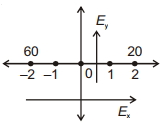
MediumMCQ
If on the $x$-axis electric potential decreases uniformly from $60 \,V$ to $20 \,V$ between $x=-2 \,m$ to $x=+2 \,m$,then the magnitude of electric field at the origin
A
Must be $10 \,V/m$
B
May be greater than $10 \,V/m$
C
Is zero
D
Is $5 \,V/m$
Solution
(B) The electric field component along the $x$-axis is given by $E_x = -\frac{dV}{dx}$.
Given that the potential decreases uniformly from $60 \,V$ to $20 \,V$ over a distance of $4 \,m$ (from $x = -2 \,m$ to $x = +2 \,m$),the magnitude of the $x$-component of the electric field is $|E_x| = \frac{\Delta V}{\Delta x} = \frac{60 \,V - 20 \,V}{2 \,m - (-2 \,m)} = \frac{40 \,V}{4 \,m} = 10 \,V/m$.
Since the potential is only given as a function of $x$,we cannot conclude that the electric field components in the $y$ or $z$ directions are zero. The total electric field is $E = \sqrt{E_x^2 + E_y^2 + E_z^2}$.
Even if $E_y$ and $E_z$ are non-zero,the magnitude of the electric field $E$ will be $\sqrt{(10)^2 + E_y^2 + E_z^2}$,which is greater than or equal to $10 \,V/m$.
Therefore,the magnitude of the electric field at the origin may be greater than $10 \,V/m$.
Given that the potential decreases uniformly from $60 \,V$ to $20 \,V$ over a distance of $4 \,m$ (from $x = -2 \,m$ to $x = +2 \,m$),the magnitude of the $x$-component of the electric field is $|E_x| = \frac{\Delta V}{\Delta x} = \frac{60 \,V - 20 \,V}{2 \,m - (-2 \,m)} = \frac{40 \,V}{4 \,m} = 10 \,V/m$.
Since the potential is only given as a function of $x$,we cannot conclude that the electric field components in the $y$ or $z$ directions are zero. The total electric field is $E = \sqrt{E_x^2 + E_y^2 + E_z^2}$.
Even if $E_y$ and $E_z$ are non-zero,the magnitude of the electric field $E$ will be $\sqrt{(10)^2 + E_y^2 + E_z^2}$,which is greater than or equal to $10 \,V/m$.
Therefore,the magnitude of the electric field at the origin may be greater than $10 \,V/m$.
0 likes
View Solution84
MediumMCQ
Electric potential in a region is varying according to the relation $V = \frac{3x^2}{2} - \frac{y^2}{4}$,where $x$ and $y$ are in $m$ and $V$ is in $V$. Electric field intensity (in $N/C$) at a point $(1 \, m, 2 \, m)$ is:
A
$3 \hat{i} - \hat{j}$
B
$-3 \hat{i} + \hat{j}$
C
$6 \hat{i} - 2 \hat{j}$
D
$-6 \hat{i} + 2 \hat{j}$
Solution
(B) The electric field $\vec{E}$ is related to the electric potential $V$ by the relation $\vec{E} = -\nabla V = -\left( \frac{\partial V}{\partial x} \hat{i} + \frac{\partial V}{\partial y} \hat{j} \right)$.
Given $V = \frac{3x^2}{2} - \frac{y^2}{4}$.
Calculating the partial derivatives:
$E_x = -\frac{\partial V}{\partial x} = -\frac{\partial}{\partial x} \left( \frac{3x^2}{2} - \frac{y^2}{4} \right) = -3x$.
$E_y = -\frac{\partial V}{\partial y} = -\frac{\partial}{\partial y} \left( \frac{3x^2}{2} - \frac{y^2}{4} \right) = -\left( -\frac{2y}{4} \right) = \frac{y}{2}$.
At the point $(1 \, m, 2 \, m)$,substitute $x = 1$ and $y = 2$:
$E_x = -3(1) = -3 \, N/C$.
$E_y = \frac{2}{2} = 1 \, N/C$.
Thus,the electric field vector is $\vec{E} = -3 \hat{i} + \hat{j} \, N/C$.
Given $V = \frac{3x^2}{2} - \frac{y^2}{4}$.
Calculating the partial derivatives:
$E_x = -\frac{\partial V}{\partial x} = -\frac{\partial}{\partial x} \left( \frac{3x^2}{2} - \frac{y^2}{4} \right) = -3x$.
$E_y = -\frac{\partial V}{\partial y} = -\frac{\partial}{\partial y} \left( \frac{3x^2}{2} - \frac{y^2}{4} \right) = -\left( -\frac{2y}{4} \right) = \frac{y}{2}$.
At the point $(1 \, m, 2 \, m)$,substitute $x = 1$ and $y = 2$:
$E_x = -3(1) = -3 \, N/C$.
$E_y = \frac{2}{2} = 1 \, N/C$.
Thus,the electric field vector is $\vec{E} = -3 \hat{i} + \hat{j} \, N/C$.
0 likes
View Solution85
EasyMCQ
In a certain region of space,the variation of potential with distance from the origin as we move along the $x$-axis is given by $V = 8x^2 + 2$,where $x$ is the $x$-coordinate of a point in space. The magnitude of the electric field at a point $(-4, 0)$ is .......... $V/m$.
A
$16$
B
$32$
C
$48$
D
$64$
Solution
(D) The relationship between electric field $E$ and potential $V$ is given by $E = -\frac{dV}{dx}$.
Given the potential function $V = 8x^2 + 2$.
Differentiating with respect to $x$,we get $\frac{dV}{dx} = \frac{d}{dx}(8x^2 + 2) = 16x$.
Thus,the electric field $E_x = -16x$.
At the point $(-4, 0)$,the $x$-coordinate is $x = -4$.
Substituting this value into the expression for $E_x$,we get $E_x = -16(-4) = 64 \, V/m$.
The magnitude of the electric field is $|E_x| = 64 \, V/m$.
Given the potential function $V = 8x^2 + 2$.
Differentiating with respect to $x$,we get $\frac{dV}{dx} = \frac{d}{dx}(8x^2 + 2) = 16x$.
Thus,the electric field $E_x = -16x$.
At the point $(-4, 0)$,the $x$-coordinate is $x = -4$.
Substituting this value into the expression for $E_x$,we get $E_x = -16(-4) = 64 \, V/m$.
The magnitude of the electric field is $|E_x| = 64 \, V/m$.
0 likes
View Solution86
MediumMCQ
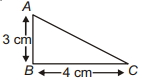
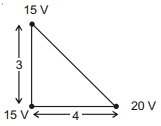
$ABC$ is a right-angled triangle situated in a uniform electric field $\vec{E}$ which is in the plane of the triangle. The points $A$ and $B$ are at the same potential of $15 \, V$,while the point $C$ is at a potential of $20 \, V$. Given $AB = 3 \, cm$ and $BC = 4 \, cm$. The magnitude of the electric field is (in $S.I.$ units):
A
$100$
B
$125$
C
$167$
D
$208$
Solution
(B) The potential difference between points $B$ and $C$ is $\Delta V = V_C - V_B = 20 \, V - 15 \, V = 5 \, V$.
Since the electric field $\vec{E}$ is uniform and in the plane of the triangle,the potential difference is given by $\Delta V = E \cdot d \cos \theta$,where $d$ is the distance between the points and $\theta$ is the angle between the electric field and the displacement vector.
Since $A$ and $B$ are at the same potential,the line $AB$ is an equipotential line. The electric field $\vec{E}$ must be perpendicular to the equipotential line $AB$. Thus,$\vec{E}$ is parallel to $BC$.
The distance between $B$ and $C$ is $d = BC = 4 \, cm = 0.04 \, m$.
Since $\vec{E}$ is parallel to $BC$,the potential difference is $\Delta V = E \cdot d$.
$5 \, V = E \times 0.04 \, m$.
$E = \frac{5}{0.04} \, V/m = 125 \, V/m$ (or $N/C$).
Since the electric field $\vec{E}$ is uniform and in the plane of the triangle,the potential difference is given by $\Delta V = E \cdot d \cos \theta$,where $d$ is the distance between the points and $\theta$ is the angle between the electric field and the displacement vector.
Since $A$ and $B$ are at the same potential,the line $AB$ is an equipotential line. The electric field $\vec{E}$ must be perpendicular to the equipotential line $AB$. Thus,$\vec{E}$ is parallel to $BC$.
The distance between $B$ and $C$ is $d = BC = 4 \, cm = 0.04 \, m$.
Since $\vec{E}$ is parallel to $BC$,the potential difference is $\Delta V = E \cdot d$.
$5 \, V = E \times 0.04 \, m$.
$E = \frac{5}{0.04} \, V/m = 125 \, V/m$ (or $N/C$).
0 likes
View Solution87
DifficultMCQ
For a charged spherical ball,electrostatic potential inside the ball varies with $r$ as $V = 2ar^2 + b$. Here,$a$ and $b$ are constants and $r$ is the distance from the center. The volume charge density inside the ball is $-\lambda a \varepsilon$. The value of $\lambda$ is $...........$. $\varepsilon =$ permittivity of medium.
A
$11$
B
$12$
C
$6$
D
$3$
Solution
(B) The electric field $E$ is related to the potential $V$ by the relation $E = -\frac{dV}{dr}$.
Given $V = 2ar^2 + b$,differentiating with respect to $r$ gives $E = -\frac{d}{dr}(2ar^2 + b) = -4ar$.
According to Gauss's Law for a uniformly charged sphere,the electric field inside is given by $E = \frac{\rho r}{3\varepsilon}$,where $\rho$ is the volume charge density.
Comparing the two expressions for $E$: $-4ar = \frac{\rho r}{3\varepsilon}$.
Solving for $\rho$: $\rho = -12a\varepsilon$.
Comparing this with the given form $\rho = -\lambda a\varepsilon$,we find $\lambda = 12$.
Given $V = 2ar^2 + b$,differentiating with respect to $r$ gives $E = -\frac{d}{dr}(2ar^2 + b) = -4ar$.
According to Gauss's Law for a uniformly charged sphere,the electric field inside is given by $E = \frac{\rho r}{3\varepsilon}$,where $\rho$ is the volume charge density.
Comparing the two expressions for $E$: $-4ar = \frac{\rho r}{3\varepsilon}$.
Solving for $\rho$: $\rho = -12a\varepsilon$.
Comparing this with the given form $\rho = -\lambda a\varepsilon$,we find $\lambda = 12$.
0 likes
View Solution88
MediumMCQ
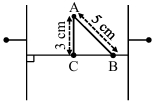
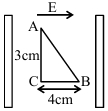
Two large plane parallel conducting plates are kept $10 \ cm$ apart as shown in the figure. The potential difference between them is $V$. The potential difference between the points $A$ and $B$ (shown in the figure) is
A
$\frac{1}{4} V$
B
$\frac{2}{5} V$
C
$\frac{3}{4} V$
D
$V$
Solution
(B) The electric field $E$ between two large parallel conducting plates is uniform and is given by $E = \frac{V}{d}$,where $V$ is the potential difference and $d$ is the separation between the plates.
Given $d = 10 \ cm$,so $E = \frac{V}{10 \ cm}$.
The potential difference between two points is given by $\Delta V = E \cdot \Delta x$,where $\Delta x$ is the projection of the displacement vector between the points along the direction of the electric field.
The electric field is directed from the positive plate to the negative plate (horizontally).
The horizontal distance (projection) between points $A$ and $B$ is the same as the horizontal distance between $C$ and $B$,which is $4 \ cm$.
Therefore,the potential difference between $A$ and $B$ is $V_{AB} = E \cdot (4 \ cm) = \left( \frac{V}{10 \ cm} \right) \times 4 \ cm = \frac{4}{10} V = \frac{2}{5} V$.
Given $d = 10 \ cm$,so $E = \frac{V}{10 \ cm}$.
The potential difference between two points is given by $\Delta V = E \cdot \Delta x$,where $\Delta x$ is the projection of the displacement vector between the points along the direction of the electric field.
The electric field is directed from the positive plate to the negative plate (horizontally).
The horizontal distance (projection) between points $A$ and $B$ is the same as the horizontal distance between $C$ and $B$,which is $4 \ cm$.
Therefore,the potential difference between $A$ and $B$ is $V_{AB} = E \cdot (4 \ cm) = \left( \frac{V}{10 \ cm} \right) \times 4 \ cm = \frac{4}{10} V = \frac{2}{5} V$.
0 likes
View Solution89
DifficultMCQ
The electric potential in some region is expressed by $V = 6x - 8xy^2 - 8y + 6yz - 4z^2 \text{ volt}$. The magnitude of the electric force acting on a charge of $2 \text{ C}$ situated at the origin will be $-$ (in $\text{ N}$)
A
$2$
B
$6$
C
$8$
D
$20$
Solution
(D) The electric field $\vec{E}$ is given by the negative gradient of the potential: $\vec{E} = -\nabla V = -\left( \frac{\partial V}{\partial x} \hat{i} + \frac{\partial V}{\partial y} \hat{j} + \frac{\partial V}{\partial z} \hat{k} \right)$.
Calculating the partial derivatives:
$\frac{\partial V}{\partial x} = 6 - 8y^2$
$\frac{\partial V}{\partial y} = -16xy - 8 + 6z$
$\frac{\partial V}{\partial z} = 6y - 8z$
At the origin $(0, 0, 0)$:
$\frac{\partial V}{\partial x} = 6 - 0 = 6$
$\frac{\partial V}{\partial y} = 0 - 8 + 0 = -8$
$\frac{\partial V}{\partial z} = 0 - 0 = 0$
Thus,$\vec{E} = -(6 \hat{i} - 8 \hat{j} + 0 \hat{k}) = -6 \hat{i} + 8 \hat{j} \text{ V/m}$.
The magnitude of the electric field is $|\vec{E}| = \sqrt{(-6)^2 + 8^2} = \sqrt{36 + 64} = \sqrt{100} = 10 \text{ N/C}$.
The electric force is $F = qE = 2 \text{ C} \times 10 \text{ N/C} = 20 \text{ N}$.
Calculating the partial derivatives:
$\frac{\partial V}{\partial x} = 6 - 8y^2$
$\frac{\partial V}{\partial y} = -16xy - 8 + 6z$
$\frac{\partial V}{\partial z} = 6y - 8z$
At the origin $(0, 0, 0)$:
$\frac{\partial V}{\partial x} = 6 - 0 = 6$
$\frac{\partial V}{\partial y} = 0 - 8 + 0 = -8$
$\frac{\partial V}{\partial z} = 0 - 0 = 0$
Thus,$\vec{E} = -(6 \hat{i} - 8 \hat{j} + 0 \hat{k}) = -6 \hat{i} + 8 \hat{j} \text{ V/m}$.
The magnitude of the electric field is $|\vec{E}| = \sqrt{(-6)^2 + 8^2} = \sqrt{36 + 64} = \sqrt{100} = 10 \text{ N/C}$.
The electric force is $F = qE = 2 \text{ C} \times 10 \text{ N/C} = 20 \text{ N}$.
0 likes
View Solution90
DifficultMCQ
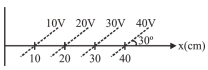
Some equipotential surfaces are shown in the figure below. The magnitude of the electric field will be $:-$ (in $V/m$)
A
$200$
B
$100$
C
$50$
D
$400$
Solution
(A) The electric field $E$ is related to the potential difference $\Delta V$ and the perpendicular distance $d$ between equipotential surfaces by the formula $E = \frac{\Delta V}{d}$.
From the figure,the potential difference between two adjacent equipotential surfaces is $\Delta V = 20 \ V - 10 \ V = 10 \ V$.
The distance along the $x$-axis between these two surfaces is $\Delta x = 20 \ cm - 10 \ cm = 10 \ cm = 0.1 \ m$.
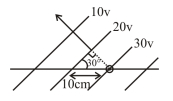
The perpendicular distance $d$ between the surfaces is given by $d = \Delta x \sin 30^{\circ} = 0.1 \times \sin 30^{\circ} = 0.1 \times 0.5 = 0.05 \ m$.
Therefore,the magnitude of the electric field is $E = \frac{10 \ V}{0.05 \ m} = 200 \ V/m$.
From the figure,the potential difference between two adjacent equipotential surfaces is $\Delta V = 20 \ V - 10 \ V = 10 \ V$.
The distance along the $x$-axis between these two surfaces is $\Delta x = 20 \ cm - 10 \ cm = 10 \ cm = 0.1 \ m$.
The perpendicular distance $d$ between the surfaces is given by $d = \Delta x \sin 30^{\circ} = 0.1 \times \sin 30^{\circ} = 0.1 \times 0.5 = 0.05 \ m$.
Therefore,the magnitude of the electric field is $E = \frac{10 \ V}{0.05 \ m} = 200 \ V/m$.
0 likes
View Solution91
MediumMCQ
The electric potential $V$ is given as a function of distance $x$ $(m)$ by $V = (2x^2 + 10x - 9) \text{ V}$. The value of the electric field at $x = 1 \text{ m}$ is: (in $\text{ V/m}$)
A
$-20$
B
$6$
C
$-11$
D
$-14$
Solution
(D) The relation between electric field $E$ and electric potential $V$ is given by $E = -\frac{dV}{dx}$.
Given $V = 2x^2 + 10x - 9$.
Differentiating $V$ with respect to $x$:
$\frac{dV}{dx} = \frac{d}{dx}(2x^2 + 10x - 9) = 4x + 10$.
Therefore,$E = -(4x + 10)$.
At $x = 1 \text{ m}$,the electric field is:
$E = -(4(1) + 10) = -(4 + 10) = -14 \text{ V/m}$.
Given $V = 2x^2 + 10x - 9$.
Differentiating $V$ with respect to $x$:
$\frac{dV}{dx} = \frac{d}{dx}(2x^2 + 10x - 9) = 4x + 10$.
Therefore,$E = -(4x + 10)$.
At $x = 1 \text{ m}$,the electric field is:
$E = -(4(1) + 10) = -(4 + 10) = -14 \text{ V/m}$.
0 likes
View Solution92
MediumMCQ
$A$ small particle carrying a negative charge of $1.6 \times 10^{-19} \text{ C}$ is suspended in equilibrium between two horizontal metal plates $8 \text{ cm}$ apart having a potential difference of $980 \text{ V}$ across them. Find the mass of the particle. $[g = 9.8 \text{ m/s}^2]$
A
$2 \times 10^{-16} \text{ kg}$
B
$2.2 \times 10^{-16} \text{ kg}$
C
$20 \times 10^{-16} \text{ kg}$
D
$4 \times 10^{-16} \text{ kg}$
Solution
(A) For the particle to be in equilibrium,the upward electric force must balance the downward gravitational force.
$F_e = mg$
Since $F_e = qE$ and $E = \frac{V}{d}$,we have $F_e = \frac{qV}{d}$.
Equating the forces: $mg = \frac{qV}{d}$.
Rearranging for mass $m$: $m = \frac{qV}{gd}$.
Given values: $q = 1.6 \times 10^{-19} \text{ C}$,$V = 980 \text{ V}$,$d = 8 \text{ cm} = 0.08 \text{ m}$,$g = 9.8 \text{ m/s}^2$.
Substituting the values:
$m = \frac{1.6 \times 10^{-19} \times 980}{9.8 \times 0.08}$
$m = \frac{1.6 \times 10^{-19} \times 100}{0.08}$
$m = \frac{1.6 \times 10^{-17}}{0.08} = 20 \times 10^{-17} \text{ kg} = 2 \times 10^{-16} \text{ kg}$.
$F_e = mg$
Since $F_e = qE$ and $E = \frac{V}{d}$,we have $F_e = \frac{qV}{d}$.
Equating the forces: $mg = \frac{qV}{d}$.
Rearranging for mass $m$: $m = \frac{qV}{gd}$.
Given values: $q = 1.6 \times 10^{-19} \text{ C}$,$V = 980 \text{ V}$,$d = 8 \text{ cm} = 0.08 \text{ m}$,$g = 9.8 \text{ m/s}^2$.
Substituting the values:
$m = \frac{1.6 \times 10^{-19} \times 980}{9.8 \times 0.08}$
$m = \frac{1.6 \times 10^{-19} \times 100}{0.08}$
$m = \frac{1.6 \times 10^{-17}}{0.08} = 20 \times 10^{-17} \text{ kg} = 2 \times 10^{-16} \text{ kg}$.
0 likes
View Solution93
DifficultMCQ
The electrostatic potential inside a charged spherical ball is given by $V = ar^2 + b$,where $r$ is the distance from its centre and $a$ and $b$ are constants. The volume charge density of the ball is [$\varepsilon_0$ = permittivity of free space].
A
$-24 \pi a \varepsilon_0 r$
B
$-6 a \varepsilon_0 r$
C
$-24 \pi a \varepsilon_0$
D
$-6 a \varepsilon_0$
Solution
(D) The electric field $E$ is related to the potential $V$ by the relation $E = -\frac{dV}{dr}$.
Given $V = ar^2 + b$,we have $E = -\frac{d}{dr}(ar^2 + b) = -2ar$.
According to Gauss's law in differential form,the volume charge density $\rho$ is related to the electric field by $\nabla \cdot \vec{E} = \frac{\rho}{\varepsilon_0}$.
In spherical coordinates,for a radial field $E(r)$,the divergence is given by $\frac{1}{r^2} \frac{d}{dr}(r^2 E) = \frac{\rho}{\varepsilon_0}$.
Substituting $E = -2ar$ into the equation:
$\frac{\rho}{\varepsilon_0} = \frac{1}{r^2} \frac{d}{dr}(r^2 \cdot (-2ar)) = \frac{1}{r^2} \frac{d}{dr}(-2ar^3) = \frac{1}{r^2} (-6ar^2) = -6a$.
Therefore,$\rho = -6a\varepsilon_0$.
Given $V = ar^2 + b$,we have $E = -\frac{d}{dr}(ar^2 + b) = -2ar$.
According to Gauss's law in differential form,the volume charge density $\rho$ is related to the electric field by $\nabla \cdot \vec{E} = \frac{\rho}{\varepsilon_0}$.
In spherical coordinates,for a radial field $E(r)$,the divergence is given by $\frac{1}{r^2} \frac{d}{dr}(r^2 E) = \frac{\rho}{\varepsilon_0}$.
Substituting $E = -2ar$ into the equation:
$\frac{\rho}{\varepsilon_0} = \frac{1}{r^2} \frac{d}{dr}(r^2 \cdot (-2ar)) = \frac{1}{r^2} \frac{d}{dr}(-2ar^3) = \frac{1}{r^2} (-6ar^2) = -6a$.
Therefore,$\rho = -6a\varepsilon_0$.
0 likes
View Solution94
EasyMCQ
The electric potential $V$ is given as a function of distance $x$ (metre) by $V = (4x^2 + 8x - 3) \ V$. The value of the electric field at $x = 0.5 \ m$,in $V/m$,is:
A
$-16$
B
$-12$
C
$0$
D
$+12$
Solution
(B) The relationship between electric field $E$ and electric potential $V$ is given by the formula $E = -\frac{dV}{dx}$.
Given $V = 4x^2 + 8x - 3$.
Differentiating $V$ with respect to $x$:
$\frac{dV}{dx} = \frac{d}{dx}(4x^2 + 8x - 3) = 8x + 8$.
Substituting this into the electric field formula:
$E = -(8x + 8) = -8x - 8$.
Now,evaluate the electric field at $x = 0.5 \ m$:
$E = -8(0.5) - 8 = -4 - 8 = -12 \ V/m$.
Therefore,the correct option is $B$.
Given $V = 4x^2 + 8x - 3$.
Differentiating $V$ with respect to $x$:
$\frac{dV}{dx} = \frac{d}{dx}(4x^2 + 8x - 3) = 8x + 8$.
Substituting this into the electric field formula:
$E = -(8x + 8) = -8x - 8$.
Now,evaluate the electric field at $x = 0.5 \ m$:
$E = -8(0.5) - 8 = -4 - 8 = -12 \ V/m$.
Therefore,the correct option is $B$.
0 likes
View Solution95
MediumMCQ
When a charge of $3 \, C$ is placed in a uniform electric field, it experiences a force of $3000 \, N$. Within this field, the potential difference between two points separated by a distance of $1 \, cm$ is: (in $V$)
A
$10$
B
$90$
C
$1000$
D
$3000$
Solution
(A) The electric force $F$ on a charge $q$ in an electric field $E$ is given by $F = qE$.
Thus, the electric field strength is $E = F/q = 3000 \, N / 3 \, C = 1000 \, N/C$.
The potential difference $V$ between two points separated by a distance $d$ in a uniform electric field is given by $V = Ed$.
Given $d = 1 \, cm = 10^{-2} \, m$.
Substituting the values, $V = 1000 \, N/C \times 10^{-2} \, m = 10 \, V$.
Thus, the electric field strength is $E = F/q = 3000 \, N / 3 \, C = 1000 \, N/C$.
The potential difference $V$ between two points separated by a distance $d$ in a uniform electric field is given by $V = Ed$.
Given $d = 1 \, cm = 10^{-2} \, m$.
Substituting the values, $V = 1000 \, N/C \times 10^{-2} \, m = 10 \, V$.
0 likes
View Solution96
MediumMCQ
Assume that an electric field $E = 30x^2 \hat{i}$ exists in space. If $V_0$ is the potential at the origin and $V_A$ is the potential at $x = 2 \ m$,then the potential difference $(V_A - V_0)$ is: (in $V$)
A
$-80$
B
$-120$
C
$80$
D
$120$
Solution
(A) The relationship between electric field $\vec{E}$ and electric potential $V$ is given by the relation: $dV = -\vec{E} \cdot d\vec{r}$.
Given $\vec{E} = 30x^2 \hat{i}$ and $d\vec{r} = dx \hat{i}$,we have $dV = -30x^2 dx$.
To find the potential difference $(V_A - V_0)$,we integrate from $x = 0$ to $x = 2$:
$\int_{V_0}^{V_A} dV = -\int_{0}^{2} 30x^2 dx$.
$V_A - V_0 = -[10x^3]_{0}^{2}$.
$V_A - V_0 = -(10(2)^3 - 10(0)^3) = -(10 \times 8) = -80 \ V$.
Given $\vec{E} = 30x^2 \hat{i}$ and $d\vec{r} = dx \hat{i}$,we have $dV = -30x^2 dx$.
To find the potential difference $(V_A - V_0)$,we integrate from $x = 0$ to $x = 2$:
$\int_{V_0}^{V_A} dV = -\int_{0}^{2} 30x^2 dx$.
$V_A - V_0 = -[10x^3]_{0}^{2}$.
$V_A - V_0 = -(10(2)^3 - 10(0)^3) = -(10 \times 8) = -80 \ V$.
0 likes
View Solution97
DifficultMCQ
Assume that an electric field $E=20 x^2 \hat{i}$ exists in space. If $V_0$ is the potential at the origin and $V_A$ is the potential at $x=3 \ m$,then the potential difference $V_A-V_0$ in volts is
A
-$80$
B
-$220$
C
-$180$
D
-$120$
Solution
(C) The relationship between electric field $\vec{E}$ and electric potential $V$ is given by the equation: $dV = -\vec{E} \cdot d\vec{l}$.
Given $\vec{E} = 20x^2 \hat{i}$ and $d\vec{l} = dx \hat{i}$.
Substituting these into the equation,we get: $dV = -(20x^2 \hat{i}) \cdot (dx \hat{i}) = -20x^2 dx$.
To find the potential difference $V_A - V_0$,we integrate from $x=0$ to $x=3 \ m$:
$V_A - V_0 = \int_{V_0}^{V_A} dV = \int_{0}^{3} -20x^2 dx$.
$V_A - V_0 = -20 \left[ \frac{x^3}{3} \right]_{0}^{3}$.
$V_A - V_0 = -20 \left( \frac{3^3}{3} - 0 \right) = -20 \left( \frac{27}{3} \right) = -20 \times 9 = -180 \ V$.
Given $\vec{E} = 20x^2 \hat{i}$ and $d\vec{l} = dx \hat{i}$.
Substituting these into the equation,we get: $dV = -(20x^2 \hat{i}) \cdot (dx \hat{i}) = -20x^2 dx$.
To find the potential difference $V_A - V_0$,we integrate from $x=0$ to $x=3 \ m$:
$V_A - V_0 = \int_{V_0}^{V_A} dV = \int_{0}^{3} -20x^2 dx$.
$V_A - V_0 = -20 \left[ \frac{x^3}{3} \right]_{0}^{3}$.
$V_A - V_0 = -20 \left( \frac{3^3}{3} - 0 \right) = -20 \left( \frac{27}{3} \right) = -20 \times 9 = -180 \ V$.
0 likes
View Solution98
EasyMCQ
The electric potential at any point $(x, y, z)$ (all in meters) in space is given by $V = 5x^2$ volt. The electric field at the point $(1, 2, 3) \text{ m}$ is $\overrightarrow{E} = $ . . . . . . $\text{N/C}$.
A
$1\hat{i} + 2\hat{j} + 3\hat{k}$
B
$-20\hat{j}$
C
$-30\hat{k}$
D
$-10\hat{i}$
Solution
(D) The relation between electric field $\overrightarrow{E}$ and electric potential $V$ is given by $\overrightarrow{E} = -\nabla V = -\left( \frac{\partial V}{\partial x}\hat{i} + \frac{\partial V}{\partial y}\hat{j} + \frac{\partial V}{\partial z}\hat{k} \right)$.
Given $V = 5x^2$.
Calculating the partial derivatives:
$\frac{\partial V}{\partial x} = \frac{d}{dx}(5x^2) = 10x$
$\frac{\partial V}{\partial y} = 0$
$\frac{\partial V}{\partial z} = 0$
Thus,$\overrightarrow{E} = -(10x)\hat{i} = -10x\hat{i} \text{ N/C}$.
At the point $(1, 2, 3) \text{ m}$,substituting $x = 1$:
$\overrightarrow{E} = -10(1)\hat{i} = -10\hat{i} \text{ N/C}$.
Therefore,the correct option is $D$.
Given $V = 5x^2$.
Calculating the partial derivatives:
$\frac{\partial V}{\partial x} = \frac{d}{dx}(5x^2) = 10x$
$\frac{\partial V}{\partial y} = 0$
$\frac{\partial V}{\partial z} = 0$
Thus,$\overrightarrow{E} = -(10x)\hat{i} = -10x\hat{i} \text{ N/C}$.
At the point $(1, 2, 3) \text{ m}$,substituting $x = 1$:
$\overrightarrow{E} = -10(1)\hat{i} = -10\hat{i} \text{ N/C}$.
Therefore,the correct option is $D$.
0 likes
View Solution99
EasyMCQ
Two plates are $20 \ cm$ apart and a potential difference of $10 \ V$ is applied between them. The electric field between the plates is . . . . . . . (in $Vm^{-1}$)
A
$0.5$
B
$20$
C
$50$
D
$500$
Solution
(C) The electric field $E$ between two parallel plates is given by the formula $E = \frac{V}{d}$,where $V$ is the potential difference and $d$ is the distance between the plates.
Given:
Potential difference $V = 10 \ V$
Distance $d = 20 \ cm = 20 \times 10^{-2} \ m = 0.2 \ m$
Substituting these values into the formula:
$E = \frac{10}{0.2} = 50 \ Vm^{-1}$
Therefore,the electric field between the plates is $50 \ Vm^{-1}$.
Given:
Potential difference $V = 10 \ V$
Distance $d = 20 \ cm = 20 \times 10^{-2} \ m = 0.2 \ m$
Substituting these values into the formula:
$E = \frac{10}{0.2} = 50 \ Vm^{-1}$
Therefore,the electric field between the plates is $50 \ Vm^{-1}$.
0 likes
View Solution100
MediumMCQ
Two metal plates are separated by $2 \,cm$. The potentials of the plates are $-10 \,V$ and $+30 \,V$. The electric field between the two plates is: (in $\,V/m$)
A
$1000$
B
$2000$
C
$3000$
D
$4000$
Solution
(B) The electric field $E$ between two parallel plates is given by the formula $E = \frac{|\Delta V|}{d}$,where $\Delta V$ is the potential difference and $d$ is the distance between the plates.
Given:
Potential difference $\Delta V = V_2 - V_1 = 30 \,V - (-10 \,V) = 40 \,V$.
Distance $d = 2 \,cm = 2 \times 10^{-2} \,m$.
Substituting the values:
$E = \frac{40 \,V}{2 \times 10^{-2} \,m} = 20 \times 10^2 \,V/m = 2000 \,V/m$.
Therefore,the correct option is $B$.
Given:
Potential difference $\Delta V = V_2 - V_1 = 30 \,V - (-10 \,V) = 40 \,V$.
Distance $d = 2 \,cm = 2 \times 10^{-2} \,m$.
Substituting the values:
$E = \frac{40 \,V}{2 \times 10^{-2} \,m} = 20 \times 10^2 \,V/m = 2000 \,V/m$.
Therefore,the correct option is $B$.
0 likes
View SolutionElectric Potential and Capacitance — Relation between Electric Field and Potential and Potential Gradient · Frequently Asked Questions
1Are these Electric Potential and Capacitance questions useful for JEE and NEET?
Yes. All questions in this section are mapped to JEE Main and NEET exam patterns. Previous year questions from JEE Main, NEET, GUJCET and state-level exams are included with full solutions.
2Can I switch to Hindi or Gujarati for these questions?
Yes. Use the language tabs in the hero section or the sidebar to view the same questions and solutions in English, Hindi or Gujarati.
3How do I generate a question paper from this subtopic?
Use the Vedclass Exam Paper Generator — select the chapter and subtopic, set difficulty, and generate Sets A, B, C, D automatically. First 3 chapters of every subject are free.
Vedclass Products
For Students
Vedclass Test Series
Mock tests in real JEE/NEET style with performance analysis. 5-day free trial.
Start Free TrialFor Teachers
Exam Paper Generator
Generate Set A/B/C/D papers from this chapter in 2 minutes. 3 chapters free.
Try FreeFor Institutes
Online Exam Module
Live online exams with unlimited students, 360° analytics & white-label branding.
See DemoFor Teachers & Institutes
Generate a Electric Potential and Capacitance Exam Paper in 2 Minutes
Select subtopic & difficulty — Sets A, B, C, D auto-generated with No Repeat logic.
First 3 chapters of every subject are free — no payment required.