
A English
Electric Charge, It's Properties and Method of Charging Questions in English
Class 12 Physics · Electric Charges and Fields · Electric Charge, It's Properties and Method of Charging
137+
Questions
English
Language
100%
With Solutions
Showing 50 of 137 questions in English
1
EasyMCQ
Faraday is the unit of
A
Charge
B
emf
C
Mass
D
Energy
Solution
(A) The Faraday is a unit of electric charge used in physics and chemistry.
$1$ Faraday is defined as the magnitude of the total electric charge per mole of electrons.
Its value is approximately $96485 \ C/mol$,often rounded to $96500 \ C/mol$.
Therefore,Faraday is the unit of charge.
$1$ Faraday is defined as the magnitude of the total electric charge per mole of electrons.
Its value is approximately $96485 \ C/mol$,often rounded to $96500 \ C/mol$.
Therefore,Faraday is the unit of charge.
0 likes
View Solution2
EasyMCQ
$A$ body can be negatively charged by
A
Giving excess of electrons to it
B
Removing some electrons from it
C
Giving some protons to it
D
Removing some neutrons from it
Solution
(A) The fundamental unit of charge is the electron,which carries a negative charge.
When a neutral body gains excess electrons,the total number of electrons becomes greater than the number of protons.
Since protons are positively charged and electrons are negatively charged,an excess of electrons results in a net negative charge on the body.
Therefore,giving excess electrons to a body makes it negatively charged.
When a neutral body gains excess electrons,the total number of electrons becomes greater than the number of protons.
Since protons are positively charged and electrons are negatively charged,an excess of electrons results in a net negative charge on the body.
Therefore,giving excess electrons to a body makes it negatively charged.
2 likes
View Solution3
EasyMCQ
The minimum charge on an object is
A
$1 \text{ coulomb}$
B
$1 \text{ stat coulomb}$
C
$1.6 \times 10^{-19} \text{ coulomb}$
D
$3.2 \times 10^{-19} \text{ coulomb}$
Solution
(C) According to the principle of quantization of electric charge,the electric charge of any object is always an integral multiple of the elementary charge $(e)$.
The elementary charge is the charge of an electron or a proton,which is $e = 1.6 \times 10^{-19} \text{ C}$.
Therefore,the minimum possible charge on any free object is $1.6 \times 10^{-19} \text{ C}$.
The elementary charge is the charge of an electron or a proton,which is $e = 1.6 \times 10^{-19} \text{ C}$.
Therefore,the minimum possible charge on any free object is $1.6 \times 10^{-19} \text{ C}$.
0 likes
View Solution4
EasyMCQ
An isolated solid metallic sphere is given $ + Q$ charge. The charge will be distributed on the sphere:
A
Uniformly but only on the surface
B
Only on the surface but non-uniformly
C
Uniformly inside the volume
D
Non-uniformly inside the volume
Solution
(A) When a charge $ + Q$ is given to an isolated solid metallic sphere,the charges experience mutual electrostatic repulsion.
Because the material is a conductor,the charges are free to move.
To minimize the potential energy of the system,the charges redistribute themselves such that they reside entirely on the outer surface of the sphere.
Due to the spherical symmetry of the conductor,the charge distribution on the surface is uniform.
Because the material is a conductor,the charges are free to move.
To minimize the potential energy of the system,the charges redistribute themselves such that they reside entirely on the outer surface of the sphere.
Due to the spherical symmetry of the conductor,the charge distribution on the surface is uniform.
0 likes
View Solution5
EasyMCQ
There are two metallic spheres of same radii but one is solid and the other is hollow, then
A
Solid sphere can be given more charge
B
Hollow sphere can be given more charge
C
They can be charged equally (maximum)
D
None of the above
Solution
(C) The correct answer is $C$.
For a metallic sphere, whether it is solid or hollow, the excess charge resides entirely on its outer surface due to the electrostatic repulsion between like charges.
Since both spheres have the same radius $R$, they have the same surface area $A = 4\pi R^2$.
Therefore, both spheres can hold the same maximum amount of charge before the electric field at the surface exceeds the dielectric strength of the surrounding medium (causing ionization/discharge).
For a metallic sphere, whether it is solid or hollow, the excess charge resides entirely on its outer surface due to the electrostatic repulsion between like charges.
Since both spheres have the same radius $R$, they have the same surface area $A = 4\pi R^2$.
Therefore, both spheres can hold the same maximum amount of charge before the electric field at the surface exceeds the dielectric strength of the surrounding medium (causing ionization/discharge).
0 likes
View Solution6
EasyMCQ
In general,metallic ropes are suspended from the carriers that transport inflammable materials. The reason is:
A
Their speed is controlled.
B
To keep the centre of gravity of the carrier nearer to the earth.
C
To keep the body of the carrier in contact with the earth.
D
Nothing should be placed under the carrier.
Solution
(C) The correct answer is $C$. When a carrier moves,friction with the air causes static electricity to build up on its surface. If this charge accumulates,it could produce a spark,which is dangerous for inflammable materials. Metallic ropes are used to provide a continuous conducting path to the earth,allowing the induced charge to discharge safely into the ground.
0 likes
View Solution7
EasyMCQ
When $10^{14}$ electrons are removed from a neutral metal sphere,the charge on the sphere becomes ...... $\mu C$.
A
$16$
B
$-16$
C
$32$
D
$-32$
Solution
(A) The charge $Q$ on a body is given by the quantization of charge formula: $Q = ne$.
Here,$n = 10^{14}$ is the number of electrons removed,and $e = 1.6 \times 10^{-19} \ C$ is the elementary charge.
Since electrons are removed from the neutral sphere,the sphere becomes positively charged.
$Q = 10^{14} \times 1.6 \times 10^{-19} \ C = 1.6 \times 10^{-5} \ C$.
To convert this into microcoulombs $(\mu C)$,we multiply by $10^6$:
$Q = 1.6 \times 10^{-5} \times 10^6 \ \mu C = 1.6 \times 10^1 \ \mu C = 16 \ \mu C$.
Here,$n = 10^{14}$ is the number of electrons removed,and $e = 1.6 \times 10^{-19} \ C$ is the elementary charge.
Since electrons are removed from the neutral sphere,the sphere becomes positively charged.
$Q = 10^{14} \times 1.6 \times 10^{-19} \ C = 1.6 \times 10^{-5} \ C$.
To convert this into microcoulombs $(\mu C)$,we multiply by $10^6$:
$Q = 1.6 \times 10^{-5} \times 10^6 \ \mu C = 1.6 \times 10^1 \ \mu C = 16 \ \mu C$.
0 likes
View Solution8
EasyMCQ
$A$ conductor has $14.4 \times 10^{-19} \ C$ of positive charge. The conductor has (Charge on an electron $= 1.6 \times 10^{-19} \ C$):
A
$9$ electrons in excess
B
$27$ electrons in short
C
$27$ electrons in excess
D
$9$ electrons in short
Solution
(D) The quantization of charge is given by the formula $Q = ne$,where $Q$ is the total charge,$n$ is the number of electrons,and $e$ is the elementary charge.
Given $Q = 14.4 \times 10^{-19} \ C$ and $e = 1.6 \times 10^{-19} \ C$.
We need to find $n = \frac{Q}{e}$.
$n = \frac{14.4 \times 10^{-19}}{1.6 \times 10^{-19}} = \frac{14.4}{1.6} = 9$.
Since the conductor has a positive charge,it indicates a deficiency of electrons.
Therefore,the conductor has $9$ electrons in short.
Given $Q = 14.4 \times 10^{-19} \ C$ and $e = 1.6 \times 10^{-19} \ C$.
We need to find $n = \frac{Q}{e}$.
$n = \frac{14.4 \times 10^{-19}}{1.6 \times 10^{-19}} = \frac{14.4}{1.6} = 9$.
Since the conductor has a positive charge,it indicates a deficiency of electrons.
Therefore,the conductor has $9$ electrons in short.
0 likes
View Solution9
EasyMCQ
Number of electrons in one coulomb of charge will be
A
$5.46 \times 10^{29}$
B
$6.25 \times 10^{18}$
C
$1.6 \times 10^{19}$
D
$9 \times 10^{11}$
Solution
(B) According to the quantization of charge,the total charge $q$ is given by $q = ne$,where $n$ is the number of electrons and $e$ is the elementary charge.
Given,$q = 1 \ C$ and $e = 1.6 \times 10^{-19} \ C$.
Therefore,$n = \frac{q}{e} = \frac{1}{1.6 \times 10^{-19}}$.
$n = \frac{1}{1.6} \times 10^{19} = 0.625 \times 10^{19} = 6.25 \times 10^{18}$.
Thus,the number of electrons in one coulomb of charge is $6.25 \times 10^{18}$.
Given,$q = 1 \ C$ and $e = 1.6 \times 10^{-19} \ C$.
Therefore,$n = \frac{q}{e} = \frac{1}{1.6 \times 10^{-19}}$.
$n = \frac{1}{1.6} \times 10^{19} = 0.625 \times 10^{19} = 6.25 \times 10^{18}$.
Thus,the number of electrons in one coulomb of charge is $6.25 \times 10^{18}$.
0 likes
View Solution10
EasyMCQ
One metallic sphere $A$ is given a positive charge,whereas another identical metallic sphere $B$ of exactly the same mass as $A$ is given an equal amount of negative charge. Then:
A
Mass of $A$ and mass of $B$ still remain equal.
B
Mass of $A$ increases.
C
Mass of $B$ decreases.
D
Mass of $B$ increases.
Solution
(D) When a body is given a positive charge,it loses electrons. Since electrons have a finite mass $(m_e \approx 9.1 \times 10^{-31} \ kg)$,the mass of sphere $A$ decreases.
When a body is given a negative charge,it gains electrons. Since electrons have a finite mass,the mass of sphere $B$ increases.
Therefore,the mass of sphere $B$ becomes greater than the mass of sphere $A$.
When a body is given a negative charge,it gains electrons. Since electrons have a finite mass,the mass of sphere $B$ increases.
Therefore,the mass of sphere $B$ becomes greater than the mass of sphere $A$.
0 likes
View Solution11
EasyMCQ
When ${10^{19}}$ electrons are removed from a neutral metal plate,the electric charge on it is
A
$-1.6 \, C$
B
$+1.6 \, C$
C
$10^{19} \, C$
D
$10^{-19} \, C$
Solution
(B) The quantization of electric charge is given by the formula $Q = ne$,where $n$ is the number of electrons removed or added and $e$ is the elementary charge $(e \approx 1.6 \times 10^{-19} \, C)$.
Since electrons are removed from the neutral metal plate,the plate becomes positively charged.
Given $n = 10^{19}$ and $e = 1.6 \times 10^{-19} \, C$,the charge $Q$ is:
$Q = (+10^{19}) \times (1.6 \times 10^{-19} \, C)$
$Q = 1.6 \times 10^{19-19} \, C$
$Q = 1.6 \times 10^0 \, C$
$Q = +1.6 \, C$.
Since electrons are removed from the neutral metal plate,the plate becomes positively charged.
Given $n = 10^{19}$ and $e = 1.6 \times 10^{-19} \, C$,the charge $Q$ is:
$Q = (+10^{19}) \times (1.6 \times 10^{-19} \, C)$
$Q = 1.6 \times 10^{19-19} \, C$
$Q = 1.6 \times 10^0 \, C$
$Q = +1.6 \, C$.
0 likes
View Solution12
EasyMCQ
The charge on an $\alpha$-particle is:
A
$4.8 \times 10^{-19} \, C$
B
$1.6 \times 10^{-19} \, C$
C
$3.2 \times 10^{-19} \, C$
D
$6.4 \times 10^{-19} \, C$
Solution
(C) An $\alpha$-particle is a helium nucleus,which consists of $2$ protons and $2$ neutrons.
Since neutrons are electrically neutral,the total charge on the $\alpha$-particle is equal to the charge of $2$ protons.
The charge of a single proton is $e = 1.6 \times 10^{-19} \, C$.
Therefore,the total charge $Q$ is given by $Q = 2e = 2 \times (1.6 \times 10^{-19} \, C) = 3.2 \times 10^{-19} \, C$.
Since neutrons are electrically neutral,the total charge on the $\alpha$-particle is equal to the charge of $2$ protons.
The charge of a single proton is $e = 1.6 \times 10^{-19} \, C$.
Therefore,the total charge $Q$ is given by $Q = 2e = 2 \times (1.6 \times 10^{-19} \, C) = 3.2 \times 10^{-19} \, C$.
0 likes
View Solution13
EasyMCQ
When a glass rod is rubbed with silk,it
A
Gains electrons from silk
B
Gives electrons to silk
C
Gains protons from silk
D
Gives protons to silk
Solution
(B) When a glass rod is rubbed with silk,electrons are transferred from the glass rod to the silk due to the difference in their work functions.
Since the glass rod loses electrons,it acquires a positive charge.
Since the silk gains electrons,it acquires a negative charge.
Therefore,the glass rod gives electrons to the silk.
Since the glass rod loses electrons,it acquires a positive charge.
Since the silk gains electrons,it acquires a negative charge.
Therefore,the glass rod gives electrons to the silk.
0 likes
View Solution14
EasyMCQ
$A$ body has $-80 \ \mu C$ of charge. The number of additional electrons in it will be:
A
$8 \times 10^{-5}$
B
$80 \times 10^{-17}$
C
$5 \times 10^{14}$
D
$1.28 \times 10^{-17}$
Solution
(C) The quantization of charge is given by the formula $Q = Ne$,where $Q$ is the total charge,$N$ is the number of electrons,and $e$ is the elementary charge $(e \approx 1.6 \times 10^{-19} \ C)$.
Given: $Q = 80 \ \mu C = 80 \times 10^{-6} \ C$.
Using the formula $N = \frac{Q}{e}$:
$N = \frac{80 \times 10^{-6}}{1.6 \times 10^{-19}}$
$N = \frac{80}{1.6} \times 10^{-6 - (-19)}$
$N = 50 \times 10^{13} = 5 \times 10^{14}$.
Therefore,the number of additional electrons is $5 \times 10^{14}$.
Given: $Q = 80 \ \mu C = 80 \times 10^{-6} \ C$.
Using the formula $N = \frac{Q}{e}$:
$N = \frac{80 \times 10^{-6}}{1.6 \times 10^{-19}}$
$N = \frac{80}{1.6} \times 10^{-6 - (-19)}$
$N = 50 \times 10^{13} = 5 \times 10^{14}$.
Therefore,the number of additional electrons is $5 \times 10^{14}$.
0 likes
View Solution15
MediumMCQ
Five balls numbered $1$ to $5$ are suspended using separate threads. Pairs $(1, 2)$,$(2, 4)$,and $(4, 1)$ show electrostatic attraction,while pairs $(2, 3)$ and $(4, 5)$ show repulsion. Therefore,ball $1$ must be:
A
Positively charged
B
Negatively charged
C
Neutral
D
Made of metal
Solution
(C) Given that $(2, 3)$ and $(4, 5)$ show repulsion,balls $2$ and $3$ have the same charge,and balls $4$ and $5$ have the same charge.
Since $(1, 2)$,$(2, 4)$,and $(4, 1)$ show attraction,if $1$ were charged,it would have to have a charge opposite to $2$ and $4$. However,if $2$ and $4$ have opposite charges,$1$ cannot simultaneously attract both unless $1$ is neutral.
When a neutral object is brought near a charged object,it experiences electrostatic induction,resulting in an attractive force regardless of the sign of the charge on the other object.
Thus,ball $1$ must be neutral.
Since $(1, 2)$,$(2, 4)$,and $(4, 1)$ show attraction,if $1$ were charged,it would have to have a charge opposite to $2$ and $4$. However,if $2$ and $4$ have opposite charges,$1$ cannot simultaneously attract both unless $1$ is neutral.
When a neutral object is brought near a charged object,it experiences electrostatic induction,resulting in an attractive force regardless of the sign of the charge on the other object.
Thus,ball $1$ must be neutral.
0 likes
View Solution16
EasyMCQ
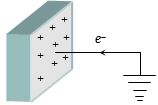
When a body is connected to the earth,electrons from the earth flow into the body. This means the body is initially:
A
Unchanged
B
Charged positively
C
Charged negatively
D
An insulator
Solution
(B) When a body is connected to the earth,the potential of the body becomes equal to the potential of the earth (which is $0 \ V$).
If electrons flow from the earth into the body,it implies that the body must have been at a higher potential than the earth,which is only possible if the body was positively charged.
The electrons flow to neutralize the positive charge on the body.
Therefore,the body was initially charged positively.
If electrons flow from the earth into the body,it implies that the body must have been at a higher potential than the earth,which is only possible if the body was positively charged.
The electrons flow to neutralize the positive charge on the body.
Therefore,the body was initially charged positively.
0 likes
View Solution17
EasyMCQ
The number of electrons in $1.6 \, C$ charge will be
A
$10^{19}$
B
$10^{20}$
C
$1.1 \times 10^{19}$
D
$1.1 \times 10^{2}$
Solution
(A) According to the quantization of charge,the total charge $q$ is given by $q = ne$,where $n$ is the number of electrons and $e$ is the elementary charge.
Given: $q = 1.6 \, C$ and $e = 1.6 \times 10^{-19} \, C$.
To find the number of electrons $n$,we use the formula $n = \frac{q}{e}$.
Substituting the values: $n = \frac{1.6}{1.6 \times 10^{-19}} = \frac{1}{10^{-19}} = 10^{19}$.
Therefore,the number of electrons is $10^{19}$.
Given: $q = 1.6 \, C$ and $e = 1.6 \times 10^{-19} \, C$.
To find the number of electrons $n$,we use the formula $n = \frac{q}{e}$.
Substituting the values: $n = \frac{1.6}{1.6 \times 10^{-19}} = \frac{1}{10^{-19}} = 10^{19}$.
Therefore,the number of electrons is $10^{19}$.
0 likes
View Solution18
EasyMCQ
Four metal conductors having different shapes:
$1.$ $A$ sphere
$2.$ Cylindrical
$3.$ Pear
$4.$ Lightning conductor
are mounted on insulating stands and charged. The one which is best suited to retain the charges for a longer time is:
$1.$ $A$ sphere
$2.$ Cylindrical
$3.$ Pear
$4.$ Lightning conductor
are mounted on insulating stands and charged. The one which is best suited to retain the charges for a longer time is:
A
$1$
B
$2$
C
$3$
D
$4$
Solution
(A) The ability of a conductor to retain charge depends on the uniformity of the surface charge distribution.
For a spherical conductor,the charge distributes itself uniformly over the entire surface due to symmetry.
In non-spherical conductors (like pear-shaped or lightning conductors),the charge density is higher at regions with smaller radii of curvature (sharp points).
This leads to a higher electric field intensity at sharp points,which causes the ionization of surrounding air,resulting in the leakage of charge (corona discharge).
Therefore,a spherical conductor is best suited to retain charges for a longer time as it minimizes charge leakage.
For a spherical conductor,the charge distributes itself uniformly over the entire surface due to symmetry.
In non-spherical conductors (like pear-shaped or lightning conductors),the charge density is higher at regions with smaller radii of curvature (sharp points).
This leads to a higher electric field intensity at sharp points,which causes the ionization of surrounding air,resulting in the leakage of charge (corona discharge).
Therefore,a spherical conductor is best suited to retain charges for a longer time as it minimizes charge leakage.
0 likes
View Solution19
EasyMCQ
The charge on $500\,cc$ of water due to protons will be
A
$6.0 \times 10^{27}\,C$
B
$2.67 \times 10^7\,C$
C
$6 \times 10^{23}\,C$
D
$1.67 \times 10^{23}\,C$
Solution
(B) The density of water is $1\,g/cc$,so the mass of $500\,cc$ of water is $500\,g$.
The molar mass of water $(H_2O)$ is $18\,g/mol$.
The number of moles of water is $n_{moles} = \frac{500}{18} \approx 27.78\,mol$.
Each molecule of water $(H_2O)$ contains $10$ protons ($1$ from each $H$ atom and $8$ from the $O$ atom).
The total number of protons $N_p$ is given by $N_p = n_{moles} \times N_A \times 10$,where $N_A = 6.022 \times 10^{23}\,mol^{-1}$.
$N_p = \frac{500}{18} \times 6.022 \times 10^{23} \times 10 \approx 1.673 \times 10^{26}$.
The total charge $Q$ is $N_p \times e$,where $e = 1.6 \times 10^{-19}\,C$.
$Q = 1.673 \times 10^{26} \times 1.6 \times 10^{-19} \approx 2.67 \times 10^7\,C$.
The molar mass of water $(H_2O)$ is $18\,g/mol$.
The number of moles of water is $n_{moles} = \frac{500}{18} \approx 27.78\,mol$.
Each molecule of water $(H_2O)$ contains $10$ protons ($1$ from each $H$ atom and $8$ from the $O$ atom).
The total number of protons $N_p$ is given by $N_p = n_{moles} \times N_A \times 10$,where $N_A = 6.022 \times 10^{23}\,mol^{-1}$.
$N_p = \frac{500}{18} \times 6.022 \times 10^{23} \times 10 \approx 1.673 \times 10^{26}$.
The total charge $Q$ is $N_p \times e$,where $e = 1.6 \times 10^{-19}\,C$.
$Q = 1.673 \times 10^{26} \times 1.6 \times 10^{-19} \approx 2.67 \times 10^7\,C$.
0 likes
View Solution20
EasyMCQ
In Millikan's oil drop experiment for the determination of the charge on the electron,the reason for using oil is:
A
It is a lubricant
B
Its density is higher
C
It vaporizes easily
D
It does not vaporize
Solution
(D) In Millikan's oil drop experiment,the oil used must be non-volatile. If the oil were volatile,the drops would evaporate during the experiment,causing their mass and radius to change continuously. This would make it impossible to accurately determine the charge on the electron. Therefore,a non-volatile oil is chosen so that the size and mass of the droplets remain constant throughout the observation.
0 likes
View Solution21
DifficultMCQ
While doing his experiment,Millikan one day observed the following charges on a single drop:
$(i)$ $6.563 \times 10^{-19} \ C$
$(ii)$ $8.204 \times 10^{-19} \ C$
$(iii)$ $11.50 \times 10^{-19} \ C$
$(iv)$ $13.13 \times 10^{-19} \ C$
$(v)$ $16.48 \times 10^{-19} \ C$
$(vi)$ $18.09 \times 10^{-19} \ C$
From this data,the value of the elementary charge $(e)$ was found to be:
$(i)$ $6.563 \times 10^{-19} \ C$
$(ii)$ $8.204 \times 10^{-19} \ C$
$(iii)$ $11.50 \times 10^{-19} \ C$
$(iv)$ $13.13 \times 10^{-19} \ C$
$(v)$ $16.48 \times 10^{-19} \ C$
$(vi)$ $18.09 \times 10^{-19} \ C$
From this data,the value of the elementary charge $(e)$ was found to be:
A
$1.641 \times 10^{-19} \ C$
B
$1.630 \times 10^{-19} \ C$
C
$1.648 \times 10^{-19} \ C$
D
$1.602 \times 10^{-19} \ C$
Solution
(A) The quantization of charge states that any charge $q$ is an integer multiple of the elementary charge $e$,given by $q = ne$,where $n$ is an integer.
To find $e$,we look for the greatest common divisor of the observed charges.
Dividing each charge by the smallest value $(6.563 \times 10^{-19} \ C)$:
$1 : 1.25 : 1.75 : 2.0 : 2.5 : 2.75$
Multiplying by $4$ to get integers:
$4 : 5 : 7 : 8 : 10 : 11$
These represent the values of $n$ for each charge.
We calculate $e$ by taking the average: $e = \frac{\sum q_i}{\sum n_i} = \frac{(6.563 + 8.204 + 11.50 + 13.13 + 16.48 + 18.09) \times 10^{-19}}{4 + 5 + 7 + 8 + 10 + 11}$
$e = \frac{73.967 \times 10^{-19}}{45} \approx 1.641 \times 10^{-19} \ C$.
To find $e$,we look for the greatest common divisor of the observed charges.
Dividing each charge by the smallest value $(6.563 \times 10^{-19} \ C)$:
$1 : 1.25 : 1.75 : 2.0 : 2.5 : 2.75$
Multiplying by $4$ to get integers:
$4 : 5 : 7 : 8 : 10 : 11$
These represent the values of $n$ for each charge.
We calculate $e$ by taking the average: $e = \frac{\sum q_i}{\sum n_i} = \frac{(6.563 + 8.204 + 11.50 + 13.13 + 16.48 + 18.09) \times 10^{-19}}{4 + 5 + 7 + 8 + 10 + 11}$
$e = \frac{73.967 \times 10^{-19}}{45} \approx 1.641 \times 10^{-19} \ C$.
0 likes
View Solution22
EasyMCQ
The fact that electric charges are integral multiples of the fundamental electronic charge was proved experimentally by
A
Planck
B
$J$.$J$. Thomson
C
Einstein
D
Millikan
Solution
(D) The quantization of electric charge,which states that any electric charge $q$ is an integral multiple of the fundamental electronic charge $e$ (i.e.,$q = ne$,where $n$ is an integer),was experimentally demonstrated by Robert $A$. Millikan in his famous Oil Drop Experiment. Therefore,the correct option is $D$.
0 likes
View Solution23
EasyMCQ
The charge on an electron was discovered by
A
$J$.$J$. Thomson
B
Neil Bohr
C
Millikan
D
Chadwick
Solution
(C) The charge on an electron was determined by Robert Millikan in $1906$ through his famous oil drop experiment.
He measured the charge of individual oil droplets and found that the charge was always an integer multiple of a fundamental value,which he identified as the charge of an electron.
He measured the charge of individual oil droplets and found that the charge was always an integer multiple of a fundamental value,which he identified as the charge of an electron.
0 likes
View Solution24
EasyMCQ
From the following,what charges can be present on oil drops in Millikan's experiment? (Here $e$ is the electronic charge)
A
Zero,equal to the magnitude of charge on $\alpha$-particle
B
$2e, 1.6 \times 10^{-18} \text{ C}$
C
$1.6 \times 10^{-19} \text{ C}, 2.5e$
D
$1.5e, e$
Solution
(B) In Millikan's oil drop experiment,the charge $q$ on any oil drop is always an integral multiple of the elementary charge $e$. This is expressed as $q = ne$,where $n$ is an integer $(n = 1, 2, 3, \dots)$.
Given $e = 1.6 \times 10^{-19} \text{ C}$.
Option $B$ contains $2e$ (which is $2 \times 1.6 \times 10^{-19} = 3.2 \times 10^{-19} \text{ C}$) and $10e$ (which is $10 \times 1.6 \times 10^{-19} = 1.6 \times 10^{-18} \text{ C}$).
Since both $2$ and $10$ are integers,these charges are possible on the oil drops.
Given $e = 1.6 \times 10^{-19} \text{ C}$.
Option $B$ contains $2e$ (which is $2 \times 1.6 \times 10^{-19} = 3.2 \times 10^{-19} \text{ C}$) and $10e$ (which is $10 \times 1.6 \times 10^{-19} = 1.6 \times 10^{-18} \text{ C}$).
Since both $2$ and $10$ are integers,these charges are possible on the oil drops.
0 likes
View Solution25
EasyMCQ
When a proton is accelerated with $1 \, V$ potential difference,then its kinetic energy is .......... $eV$.
A
$1/1840$
B
$1840$
C
$1$
D
$0.5$
Solution
(C) The kinetic energy $(K)$ gained by a charged particle accelerated through a potential difference $(V)$ is given by the formula: $K = qV$.
For a proton,the charge is $q = +e$.
Given the potential difference $V = 1 \, V$.
Substituting these values,we get: $K = (1e) \times (1 \, V) = 1 \, eV$.
Therefore,the kinetic energy of the proton is $1 \, eV$.
For a proton,the charge is $q = +e$.
Given the potential difference $V = 1 \, V$.
Substituting these values,we get: $K = (1e) \times (1 \, V) = 1 \, eV$.
Therefore,the kinetic energy of the proton is $1 \, eV$.
0 likes
View Solution26
EasyMCQ
In a Millikan's oil drop experiment,the charge on an oil drop is calculated to be $6.35 \times 10^{-19} \ C$. The number of excess electrons on the drop is:
A
$3.9$
B
$4$
C
$4.2$
D
$6$
Solution
(B) According to the quantization of electric charge,the total charge $Q$ on an object is given by $Q = ne$,where $n$ is an integer representing the number of excess electrons and $e$ is the elementary charge $(e \approx 1.6 \times 10^{-19} \ C)$.
Given $Q = 6.35 \times 10^{-19} \ C$.
We need to find $n = \frac{Q}{e}$.
Substituting the values: $n = \frac{6.35 \times 10^{-19}}{1.6 \times 10^{-19}} = \frac{6.35}{1.6} \approx 3.968$.
Since the number of electrons $n$ must be an integer,we round $3.968$ to the nearest integer,which is $4$.
Therefore,the number of excess electrons on the drop is $4$.
Given $Q = 6.35 \times 10^{-19} \ C$.
We need to find $n = \frac{Q}{e}$.
Substituting the values: $n = \frac{6.35 \times 10^{-19}}{1.6 \times 10^{-19}} = \frac{6.35}{1.6} \approx 3.968$.
Since the number of electrons $n$ must be an integer,we round $3.968$ to the nearest integer,which is $4$.
Therefore,the number of excess electrons on the drop is $4$.
0 likes
View Solution27
EasyMCQ
The nature of binding for a crystal with alternate and evenly spaced positive and negative ions is
A
Covalent
B
Metallic
C
Dipolar
D
Ionic
Solution
(D) Ionic bonds are formed when atoms with low ionization energies,which readily lose electrons,interact with atoms that tend to acquire excess electrons.
In such a crystal,the former atoms transfer electrons to the latter,resulting in the formation of positive and negative ions.
These ions are then held together by strong electrostatic forces of attraction,which is characteristic of ionic bonding.
Therefore,a crystal structure consisting of alternate and evenly spaced positive and negative ions is ionic in nature.
In such a crystal,the former atoms transfer electrons to the latter,resulting in the formation of positive and negative ions.
These ions are then held together by strong electrostatic forces of attraction,which is characteristic of ionic bonding.
Therefore,a crystal structure consisting of alternate and evenly spaced positive and negative ions is ionic in nature.
0 likes
View Solution28
EasyMCQ
How many electrons are there in $1 \ C$ of charge?
A
$5.46 \times 10^{29}$
B
$6.25 \times 10^{18}$
C
$1.6 \times 10^{19}$
D
$9 \times 10^{11}$
Solution
(B) According to the quantization of charge,the total charge $Q$ is given by $Q = ne$,where $n$ is the number of electrons and $e$ is the elementary charge.
Given $Q = 1 \ C$ and $e = 1.6 \times 10^{-19} \ C$.
We need to find $n = Q / e$.
$n = 1 / (1.6 \times 10^{-19})$
$n = 10^{19} / 1.6$
$n = 0.625 \times 10^{19}$
$n = 6.25 \times 10^{18}$ electrons.
Given $Q = 1 \ C$ and $e = 1.6 \times 10^{-19} \ C$.
We need to find $n = Q / e$.
$n = 1 / (1.6 \times 10^{-19})$
$n = 10^{19} / 1.6$
$n = 0.625 \times 10^{19}$
$n = 6.25 \times 10^{18}$ electrons.
0 likes
View Solution29
EasyMCQ
The electric charge on an $\alpha$-particle is ....... .
A
$4.8 \times 10^{-19} \, C$
B
$1.6 \times 10^{-19} \, C$
C
$3.2 \times 10^{-19} \, C$
D
$6.4 \times 10^{-19} \, C$
Solution
(C) An $\alpha$-particle is a helium nucleus,which consists of $2$ protons and $2$ neutrons.
Since neutrons are electrically neutral,the total charge on an $\alpha$-particle is equal to the charge of $2$ protons.
The charge of a single proton is $e = 1.6 \times 10^{-19} \, C$.
Therefore,the charge of an $\alpha$-particle is $q = 2e = 2 \times (1.6 \times 10^{-19} \, C) = 3.2 \times 10^{-19} \, C$.
Since neutrons are electrically neutral,the total charge on an $\alpha$-particle is equal to the charge of $2$ protons.
The charge of a single proton is $e = 1.6 \times 10^{-19} \, C$.
Therefore,the charge of an $\alpha$-particle is $q = 2e = 2 \times (1.6 \times 10^{-19} \, C) = 3.2 \times 10^{-19} \, C$.
0 likes
View Solution30
EasyMCQ
Which of the following properties is $NOT$ satisfied by a static electric charge?
A
Conservation of electric charge
B
Generation of a magnetic field
C
Quantization of electric charge
D
Generation of an electric field
Solution
(B) static electric charge is a charge at rest.
$1$. It satisfies the conservation of electric charge.
$2$. It produces an electric field in the space around it.
$3$. Electric charge is quantized $(q = ne)$.
$4$. $A$ magnetic field is produced only by a moving electric charge (current).
Therefore,a static electric charge does not generate a magnetic field.
$1$. It satisfies the conservation of electric charge.
$2$. It produces an electric field in the space around it.
$3$. Electric charge is quantized $(q = ne)$.
$4$. $A$ magnetic field is produced only by a moving electric charge (current).
Therefore,a static electric charge does not generate a magnetic field.
0 likes
View Solution31
EasyMCQ
$A$ body can be negatively charged by which of the following methods?
A
Giving it some electrons
B
Removing some electrons from it
C
Giving it some protons
D
Removing some neutrons from it
Solution
(A) body becomes negatively charged when it gains an excess of electrons. Since electrons carry a negative charge,adding them to a neutral body increases the total negative charge,making the body negatively charged. Removing electrons would make it positively charged,and protons or neutrons cannot be easily transferred in standard electrostatic charging processes.
0 likes
View Solution32
MediumMCQ
When $10^{14}$ electrons are removed from a neutral metal sphere,what will be the electric charge on the sphere in $\mu C$?
A
$16$
B
$-16$
C
$32$
D
$-32$
Solution
(A) The quantization of electric charge is given by the formula $q = ne$,where $n$ is the number of electrons and $e$ is the elementary charge.
Given: $n = 10^{14}$ electrons.
Since electrons are removed,the sphere becomes positively charged.
The elementary charge $e = 1.6 \times 10^{-19} \ C$.
Therefore,$q = 10^{14} \times 1.6 \times 10^{-19} \ C = 1.6 \times 10^{-5} \ C$.
To convert this into $\mu C$ (microcoulombs),we multiply by $10^6$.
$q = 1.6 \times 10^{-5} \times 10^6 \ \mu C = 1.6 \times 10^1 \ \mu C = 16 \ \mu C$.
Given: $n = 10^{14}$ electrons.
Since electrons are removed,the sphere becomes positively charged.
The elementary charge $e = 1.6 \times 10^{-19} \ C$.
Therefore,$q = 10^{14} \times 1.6 \times 10^{-19} \ C = 1.6 \times 10^{-5} \ C$.
To convert this into $\mu C$ (microcoulombs),we multiply by $10^6$.
$q = 1.6 \times 10^{-5} \times 10^6 \ \mu C = 1.6 \times 10^1 \ \mu C = 16 \ \mu C$.
0 likes
View Solution33
EasyMCQ
Which experiment was used to determine the quantization of electric charge?
A
Passage of electricity through gases
B
Millikan's oil drop experiment
C
Melde's experiment
D
None of the above
Solution
(B) The quantization of electric charge was experimentally demonstrated by Robert $A$. Millikan in his famous oil drop experiment.
In this experiment,tiny oil droplets were sprayed into a chamber.
By observing the motion of these droplets under the influence of gravity and a uniform electric field,Millikan found that the charge $q$ on any oil drop was always an integer multiple of a fundamental charge $e$,i.e.,$q = ne$,where $n = 1, 2, 3, ...$.
This proved that electric charge is quantized.
In this experiment,tiny oil droplets were sprayed into a chamber.
By observing the motion of these droplets under the influence of gravity and a uniform electric field,Millikan found that the charge $q$ on any oil drop was always an integer multiple of a fundamental charge $e$,i.e.,$q = ne$,where $n = 1, 2, 3, ...$.
This proved that electric charge is quantized.
0 likes
View Solution34
EasyMCQ
The net electric charge of a conductor does not change when:
A
Electrons are removed from it.
B
It is placed in contact with another neutral conductor.
C
It is brought very close to a charged conductor.
D
Electrons are applied to it.
Solution
(C) The net electric charge of a conductor remains constant when it is brought near a charged body due to the phenomenon of electrostatic induction.
In electrostatic induction,the charges within the conductor redistribute themselves (positive charges move to one side and negative charges to the other),but the total net charge of the conductor remains zero (if it was initially neutral) or unchanged (if it was initially charged).
Options $A$,$B$,and $D$ involve the transfer or addition/removal of charge,which changes the net charge of the conductor.
In electrostatic induction,the charges within the conductor redistribute themselves (positive charges move to one side and negative charges to the other),but the total net charge of the conductor remains zero (if it was initially neutral) or unchanged (if it was initially charged).
Options $A$,$B$,and $D$ involve the transfer or addition/removal of charge,which changes the net charge of the conductor.
0 likes
View Solution35
EasyMCQ
Which of the following charges is $NOT$ possible in Millikan's oil drop experiment?
A
$4.0 \times 10^{-19} \ C$
B
$6.0 \times 10^{-19} \ C$
C
$10.0 \times 10^{-19} \ C$
D
All of the above
Solution
(D) According to the quantization of electric charge,the total charge $q$ on any body is always an integral multiple of the elementary charge $e$,where $e = 1.6 \times 10^{-19} \ C$.
The formula is $q = n \times e$,where $n$ is an integer $(n = 1, 2, 3, \dots)$.
To check if a charge is possible,we calculate $n = q / e$:
For option $A$: $n = (4.0 \times 10^{-19}) / (1.6 \times 10^{-19}) = 2.5$ (Not an integer).
For option $B$: $n = (6.0 \times 10^{-19}) / (1.6 \times 10^{-19}) = 3.75$ (Not an integer).
For option $C$: $n = (10.0 \times 10^{-19}) / (1.6 \times 10^{-19}) = 6.25$ (Not an integer).
Since $n$ is not an integer for any of the given options,none of these charges are possible in Millikan's oil drop experiment. Therefore,the correct answer is $D$.
The formula is $q = n \times e$,where $n$ is an integer $(n = 1, 2, 3, \dots)$.
To check if a charge is possible,we calculate $n = q / e$:
For option $A$: $n = (4.0 \times 10^{-19}) / (1.6 \times 10^{-19}) = 2.5$ (Not an integer).
For option $B$: $n = (6.0 \times 10^{-19}) / (1.6 \times 10^{-19}) = 3.75$ (Not an integer).
For option $C$: $n = (10.0 \times 10^{-19}) / (1.6 \times 10^{-19}) = 6.25$ (Not an integer).
Since $n$ is not an integer for any of the given options,none of these charges are possible in Millikan's oil drop experiment. Therefore,the correct answer is $D$.
0 likes
View Solution36
EasyMCQ
The electric charge of an $\alpha$-particle is ..........
A
$4.8 \times 10^{-19} \, C$
B
$1.6 \times 10^{-19} \, C$
C
$3.2 \times 10^{-19} \, C$
D
$6.4 \times 10^{-19} \, C$
Solution
(C) An $\alpha$-particle is a helium nucleus,which consists of $2$ protons and $2$ neutrons.
Since the charge of a proton is $e = 1.6 \times 10^{-19} \, C$ and neutrons are neutral,the total charge $Q$ of an $\alpha$-particle is given by $Q = +2e$.
Substituting the value of $e$:
$Q = 2 \times (1.6 \times 10^{-19} \, C) = 3.2 \times 10^{-19} \, C$.
Since the charge of a proton is $e = 1.6 \times 10^{-19} \, C$ and neutrons are neutral,the total charge $Q$ of an $\alpha$-particle is given by $Q = +2e$.
Substituting the value of $e$:
$Q = 2 \times (1.6 \times 10^{-19} \, C) = 3.2 \times 10^{-19} \, C$.
0 likes
View Solution37
EasyMCQ
In Millikan's oil drop experiment, which of the following charges can be present on the oil drop?
A
$0, \text{charge equal to } \alpha \text{-particle}$
B
$2e, 1.6 \times 10^{-19} \, C$
C
$2e, 1.6 \times 10^{-19} \, C, 2.5e$
D
$1.5e, e$
Solution
(B) Millikan's oil drop experiment demonstrated that electric charge is quantized.
This means that the total charge $q$ on any object is always an integer multiple of the elementary charge $e$ (where $e \approx 1.6 \times 10^{-19} \, C$).
Mathematically, $q = n \cdot e$, where $n$ is an integer $(n = 1, 2, 3, \dots)$.
Looking at the options, $1.6 \times 10^{-19} \, C$ corresponds to $n=1$ $(1e)$ and $2e$ corresponds to $n=2$.
Since $2.5e$ and $1.5e$ are not integer multiples of $e$, they cannot exist on the oil drop.
Therefore, the set of charges $2e$ and $1.6 \times 10^{-19} \, C$ (which is $1e$) are valid values.
This means that the total charge $q$ on any object is always an integer multiple of the elementary charge $e$ (where $e \approx 1.6 \times 10^{-19} \, C$).
Mathematically, $q = n \cdot e$, where $n$ is an integer $(n = 1, 2, 3, \dots)$.
Looking at the options, $1.6 \times 10^{-19} \, C$ corresponds to $n=1$ $(1e)$ and $2e$ corresponds to $n=2$.
Since $2.5e$ and $1.5e$ are not integer multiples of $e$, they cannot exist on the oil drop.
Therefore, the set of charges $2e$ and $1.6 \times 10^{-19} \, C$ (which is $1e$) are valid values.
0 likes
View Solution38
EasyMCQ
An insulating solid metal sphere is charged with a charge $+Q$. The distribution of $+Q$ charge on the surface will be .......
A
Uniform only on the surface
B
Non-uniform only on the surface
C
Uniform inside the volume
D
Non-uniform inside the volume
Solution
(D) An insulating material does not allow charge to flow freely through it. When a charge $+Q$ is given to an insulating solid sphere,the charge remains where it is placed and does not redistribute itself to the surface as it would in a conductor. Therefore,the charge distribution will be non-uniform throughout the volume of the sphere.
0 likes
View Solution39
EasyMCQ
The statement that electric charge is an integral multiple of the electronic charge $e$ was experimentally proven by whom?
A
Planck
B
$J$. $J$. Thomson
C
Einstein
D
Millikan
Solution
(D) The quantization of electric charge states that the total charge $q$ of a body is given by $q = ne$,where $n$ is an integer and $e$ is the elementary charge.
This fundamental property,which confirms that electric charge is an integral multiple of the electronic charge,was experimentally demonstrated by Robert $A$. Millikan through his famous oil-drop experiment.
This fundamental property,which confirms that electric charge is an integral multiple of the electronic charge,was experimentally demonstrated by Robert $A$. Millikan through his famous oil-drop experiment.
0 likes
View Solution40
MediumMCQ
$A$ neutral sphere is bombarded with $10^{12} \, \alpha$-particles per second. How much time in seconds will it take to accumulate a charge of $2 \, \mu C$?
A
$6.25$
B
$5.50$
C
$7.00$
D
$2.60$
Solution
(A) The number of $\alpha$-particles falling on the sphere in $t$ seconds is $N = 10^{12}t$.
Each $\alpha$-particle carries a charge of $q_{\alpha} = +2e$,where $e = 1.6 \times 10^{-19} \, C$.
The total charge $Q$ accumulated in time $t$ is given by $Q = N \times q_{\alpha} = (10^{12}t) \times (2e)$.
Given $Q = 2 \, \mu C = 2 \times 10^{-6} \, C$.
Equating the values: $2 \times 10^{-6} = 10^{12} \times t \times 2 \times 1.6 \times 10^{-19}$.
$2 \times 10^{-6} = 3.2 \times 10^{-7} \times t$.
$t = \frac{2 \times 10^{-6}}{3.2 \times 10^{-7}} = \frac{20}{3.2} = 6.25 \, s$.
Each $\alpha$-particle carries a charge of $q_{\alpha} = +2e$,where $e = 1.6 \times 10^{-19} \, C$.
The total charge $Q$ accumulated in time $t$ is given by $Q = N \times q_{\alpha} = (10^{12}t) \times (2e)$.
Given $Q = 2 \, \mu C = 2 \times 10^{-6} \, C$.
Equating the values: $2 \times 10^{-6} = 10^{12} \times t \times 2 \times 1.6 \times 10^{-19}$.
$2 \times 10^{-6} = 3.2 \times 10^{-7} \times t$.
$t = \frac{2 \times 10^{-6}}{3.2 \times 10^{-7}} = \frac{20}{3.2} = 6.25 \, s$.
0 likes
View Solution41
DifficultMCQ
Two identical spherical conductors $B$ and $C$ have equal radii and carry equal charges. They repel each other with a force $F$ when placed at a certain distance apart. $A$ third identical spherical conductor $A$,which is uncharged,is brought in contact with $B$ and then removed. It is then brought in contact with $C$ and removed. What is the new force of repulsion between $B$ and $C$?
A
$F/4$
B
$3F/4$
C
$F/8$
D
$3F/8$
Solution
(D) Let the initial charge on each sphere $B$ and $C$ be $q$ and the distance between them be $r$. The initial force is $F = \frac{kq^2}{r^2}$.
When uncharged sphere $A$ is brought in contact with $B$,the charge on $B$ becomes $q/2$ and on $A$ becomes $q/2$.
Now,when sphere $A$ (having charge $q/2$) is brought in contact with $C$ (having charge $q$),the total charge is $q + q/2 = 3q/2$. Since the spheres are identical,the charge is shared equally,so each gets $(3q/2) / 2 = 3q/4$.
Now,the charge on $B$ is $q/2$ and the charge on $C$ is $3q/4$.
The new force $F' = \frac{k(q/2)(3q/4)}{r^2} = \frac{3kq^2}{8r^2}$.
Since $F = \frac{kq^2}{r^2}$,we get $F' = \frac{3}{8}F$.
When uncharged sphere $A$ is brought in contact with $B$,the charge on $B$ becomes $q/2$ and on $A$ becomes $q/2$.
Now,when sphere $A$ (having charge $q/2$) is brought in contact with $C$ (having charge $q$),the total charge is $q + q/2 = 3q/2$. Since the spheres are identical,the charge is shared equally,so each gets $(3q/2) / 2 = 3q/4$.
Now,the charge on $B$ is $q/2$ and the charge on $C$ is $3q/4$.
The new force $F' = \frac{k(q/2)(3q/4)}{r^2} = \frac{3kq^2}{8r^2}$.
Since $F = \frac{kq^2}{r^2}$,we get $F' = \frac{3}{8}F$.
0 likes
View Solution42
EasyMCQ
When a piece of polythene is rubbed with wool,a charge of $-2 \times 10^{-7} \ C$ is developed on the polythene. What is the amount of mass transferred to the polythene?
A
$11.38 \times 10^{-17} \ kg$
B
$12.38 \times 10^{-19} \ kg$
C
$11.38 \times 10^{-19} \ kg$
D
$10.38 \times 10^{-19} \ kg$
Solution
(C) The charge on the polythene is $Q = -2 \times 10^{-7} \ C$. Since the charge is negative,electrons are transferred from the wool to the polythene.
Using the quantization of charge,$Q = ne$,where $e = 1.6 \times 10^{-19} \ C$ is the charge of an electron.
The number of electrons transferred is $n = \frac{|Q|}{e} = \frac{2 \times 10^{-7}}{1.6 \times 10^{-19}} = 1.25 \times 10^{12}$.
The mass of one electron is $m_e = 9.1 \times 10^{-31} \ kg$.
The total mass transferred to the polythene is $M = n \times m_e$.
$M = (1.25 \times 10^{12}) \times (9.1 \times 10^{-31}) \ kg$.
$M = 11.375 \times 10^{-19} \ kg \approx 11.38 \times 10^{-19} \ kg$.
Using the quantization of charge,$Q = ne$,where $e = 1.6 \times 10^{-19} \ C$ is the charge of an electron.
The number of electrons transferred is $n = \frac{|Q|}{e} = \frac{2 \times 10^{-7}}{1.6 \times 10^{-19}} = 1.25 \times 10^{12}$.
The mass of one electron is $m_e = 9.1 \times 10^{-31} \ kg$.
The total mass transferred to the polythene is $M = n \times m_e$.
$M = (1.25 \times 10^{12}) \times (9.1 \times 10^{-31}) \ kg$.
$M = 11.375 \times 10^{-19} \ kg \approx 11.38 \times 10^{-19} \ kg$.
0 likes
View Solution43
EasyMCQ
Which of the following electric charges is not possible?
A
$1.6 \times 10^{-18} \ C$
B
$1.6 \times 10^{-19} \ C$
C
$1.6 \times 10^{-20} \ C$
D
None of these
Solution
(C) According to the quantization of electric charge,the total charge $q$ on a body is given by $q = ne$,where $n$ is an integer $(n = 1, 2, 3, \dots)$ and $e = 1.6 \times 10^{-19} \ C$ is the elementary charge.
For $q = 1.6 \times 10^{-18} \ C$,$n = q/e = (1.6 \times 10^{-18}) / (1.6 \times 10^{-19}) = 10$,which is an integer.
For $q = 1.6 \times 10^{-19} \ C$,$n = q/e = 1$,which is an integer.
For $q = 1.6 \times 10^{-20} \ C$,$n = q/e = (1.6 \times 10^{-20}) / (1.6 \times 10^{-19}) = 0.1$,which is not an integer.
Since $n$ must be an integer,a charge of $1.6 \times 10^{-20} \ C$ is not possible.
For $q = 1.6 \times 10^{-18} \ C$,$n = q/e = (1.6 \times 10^{-18}) / (1.6 \times 10^{-19}) = 10$,which is an integer.
For $q = 1.6 \times 10^{-19} \ C$,$n = q/e = 1$,which is an integer.
For $q = 1.6 \times 10^{-20} \ C$,$n = q/e = (1.6 \times 10^{-20}) / (1.6 \times 10^{-19}) = 0.1$,which is not an integer.
Since $n$ must be an integer,a charge of $1.6 \times 10^{-20} \ C$ is not possible.
0 likes
View Solution44
MediumMCQ
The number of electrons in $1 \ C$ of charge is:
A
$5.46 \times 10^{29}$
B
$6.25 \times 10^{18}$
C
$1.6 \times 10^{19}$
D
$9 \times 10^{11}$
Solution
(B) According to the quantization of charge,the total charge $Q$ is given by $Q = ne$,where $n$ is the number of electrons and $e$ is the elementary charge.
Given $Q = 1 \ C$ and $e = 1.6 \times 10^{-19} \ C$.
Rearranging the formula for $n$: $n = \frac{Q}{e}$.
Substituting the values: $n = \frac{1}{1.6 \times 10^{-19}} = \frac{10^{19}}{1.6} = 0.625 \times 10^{19} = 6.25 \times 10^{18}$.
Therefore,the number of electrons in $1 \ C$ of charge is $6.25 \times 10^{18}$.
Given $Q = 1 \ C$ and $e = 1.6 \times 10^{-19} \ C$.
Rearranging the formula for $n$: $n = \frac{Q}{e}$.
Substituting the values: $n = \frac{1}{1.6 \times 10^{-19}} = \frac{10^{19}}{1.6} = 0.625 \times 10^{19} = 6.25 \times 10^{18}$.
Therefore,the number of electrons in $1 \ C$ of charge is $6.25 \times 10^{18}$.
0 likes
View Solution45
MediumMCQ
$A$ solid sphere of mass $1 \ gm$ contains $5 \times 10^{21}$ atoms. If one electron is removed from every $0.01\%$ of the atoms,what is the charge acquired by the sphere in $C$?
A
$+ 0.08$
B
$+ 0.8$
C
$-0.08$
D
$-0.8$
Solution
(A) The total number of atoms is $N = 5 \times 10^{21}$.
The number of atoms from which one electron is removed is $n = 0.01\% \text{ of } N$.
$n = \frac{0.01}{100} \times 5 \times 10^{21} = 10^{-4} \times 5 \times 10^{21} = 5 \times 10^{17}$.
Since one electron is removed from each of these atoms,the total number of electrons removed is $n = 5 \times 10^{17}$.
The charge acquired by the sphere due to the removal of electrons is $Q = +ne$.
$Q = (5 \times 10^{17}) \times (1.6 \times 10^{-19} \ C)$.
$Q = 8 \times 10^{-2} \ C = 0.08 \ C$.
Since electrons are removed,the sphere becomes positively charged,so $Q = +0.08 \ C$.
The number of atoms from which one electron is removed is $n = 0.01\% \text{ of } N$.
$n = \frac{0.01}{100} \times 5 \times 10^{21} = 10^{-4} \times 5 \times 10^{21} = 5 \times 10^{17}$.
Since one electron is removed from each of these atoms,the total number of electrons removed is $n = 5 \times 10^{17}$.
The charge acquired by the sphere due to the removal of electrons is $Q = +ne$.
$Q = (5 \times 10^{17}) \times (1.6 \times 10^{-19} \ C)$.
$Q = 8 \times 10^{-2} \ C = 0.08 \ C$.
Since electrons are removed,the sphere becomes positively charged,so $Q = +0.08 \ C$.
0 likes
View Solution46
MediumMCQ
Select the correct alternative.
A
The charge gained by the uncharged body from a charged body due to conduction is equal to half of the total charge initially present.
B
The magnitude of charge increases with the increase in velocity of charge.
C
Charge can exist without matter,although matter cannot exist without charge.
D
Between two non-magnetic substances,repulsion is the true test of electrification (electrification means the body has a net charge).
Solution
(D) $(1)$ Charging by conduction depends on the geometry and size of the bodies,not just half of the initial charge.
$(2)$ Charge is invariant with velocity; it does not change as speed increases.
$(3)$ Charge cannot exist without matter (mass).
$(4)$ Repulsion is the true test of electrification because attraction can occur between a charged and an uncharged body due to induction,whereas repulsion only occurs between two like-charged bodies.
$(2)$ Charge is invariant with velocity; it does not change as speed increases.
$(3)$ Charge cannot exist without matter (mass).
$(4)$ Repulsion is the true test of electrification because attraction can occur between a charged and an uncharged body due to induction,whereas repulsion only occurs between two like-charged bodies.
0 likes
View Solution47
EasyMCQ
If a body is charged by rubbing it,its weight:
A
always decreases slightly
B
always increases slightly
C
may increase slightly or may decrease slightly
D
remains precisely the same
Solution
(C) When a body is charged by rubbing,electrons are transferred from one body to another.
If a body gains electrons,it becomes negatively charged and its mass increases slightly,leading to a slight increase in weight.
If a body loses electrons,it becomes positively charged and its mass decreases slightly,leading to a slight decrease in weight.
Therefore,the weight may increase or decrease depending on whether the body is charged negatively or positively.
If a body gains electrons,it becomes negatively charged and its mass increases slightly,leading to a slight increase in weight.
If a body loses electrons,it becomes positively charged and its mass decreases slightly,leading to a slight decrease in weight.
Therefore,the weight may increase or decrease depending on whether the body is charged negatively or positively.
0 likes
View Solution48
DifficultMCQ
We have three identical metallic spheres $A, B$ and $C$. $A$ is given a charge $Q$,and $B$ and $C$ are uncharged. The following processes of touching of two spheres are carried out in succession. Each process is carried out with sufficient time.
$(i)$ $A$ and $B$
$(ii)$ $B$ and $C$
$(iii)$ $C$ and $A$
$(iv)$ $A$ and $B$
$(v)$ $B$ and $C$
The final charges on the spheres are
$(i)$ $A$ and $B$
$(ii)$ $B$ and $C$
$(iii)$ $C$ and $A$
$(iv)$ $A$ and $B$
$(v)$ $B$ and $C$
The final charges on the spheres are
A
$\frac{11Q}{32}, \frac{5Q}{16}, \frac{11Q}{32}$
B
$\frac{11Q}{32}, \frac{11Q}{32}, \frac{5Q}{16}$
C
$\frac{8Q}{8}, \frac{5Q}{16}, \frac{5Q}{16}$
D
$\frac{5Q}{16}, \frac{11Q}{32}, \frac{11Q}{32}$
Solution
(D) Since the spheres are identical,when two spheres are touched,the total charge is shared equally between them.
Initial state: $Q_A = Q, Q_B = 0, Q_C = 0$.
$(i)$ $A$ and $B$ touch: $Q_A = Q_B = \frac{Q+0}{2} = \frac{Q}{2}$. Charges: $(\frac{Q}{2}, \frac{Q}{2}, 0)$.
$(ii)$ $B$ and $C$ touch: $Q_B = Q_C = \frac{Q/2 + 0}{2} = \frac{Q}{4}$. Charges: $(\frac{Q}{2}, \frac{Q}{4}, \frac{Q}{4})$.
$(iii)$ $C$ and $A$ touch: $Q_C = Q_A = \frac{Q/4 + Q/2}{2} = \frac{3Q/4}{2} = \frac{3Q}{8}$. Charges: $(\frac{3Q}{8}, \frac{Q}{4}, \frac{3Q}{8})$.
$(iv)$ $A$ and $B$ touch: $Q_A = Q_B = \frac{3Q/8 + Q/4}{2} = \frac{5Q/8}{2} = \frac{5Q}{16}$. Charges: $(\frac{5Q}{16}, \frac{5Q}{16}, \frac{3Q}{8})$.
$(v)$ $B$ and $C$ touch: $Q_B = Q_C = \frac{5Q/16 + 3Q/8}{2} = \frac{11Q/16}{2} = \frac{11Q}{32}$. Charges: $(\frac{5Q}{16}, \frac{11Q}{32}, \frac{11Q}{32})$.
Initial state: $Q_A = Q, Q_B = 0, Q_C = 0$.
$(i)$ $A$ and $B$ touch: $Q_A = Q_B = \frac{Q+0}{2} = \frac{Q}{2}$. Charges: $(\frac{Q}{2}, \frac{Q}{2}, 0)$.
$(ii)$ $B$ and $C$ touch: $Q_B = Q_C = \frac{Q/2 + 0}{2} = \frac{Q}{4}$. Charges: $(\frac{Q}{2}, \frac{Q}{4}, \frac{Q}{4})$.
$(iii)$ $C$ and $A$ touch: $Q_C = Q_A = \frac{Q/4 + Q/2}{2} = \frac{3Q/4}{2} = \frac{3Q}{8}$. Charges: $(\frac{3Q}{8}, \frac{Q}{4}, \frac{3Q}{8})$.
$(iv)$ $A$ and $B$ touch: $Q_A = Q_B = \frac{3Q/8 + Q/4}{2} = \frac{5Q/8}{2} = \frac{5Q}{16}$. Charges: $(\frac{5Q}{16}, \frac{5Q}{16}, \frac{3Q}{8})$.
$(v)$ $B$ and $C$ touch: $Q_B = Q_C = \frac{5Q/16 + 3Q/8}{2} = \frac{11Q/16}{2} = \frac{11Q}{32}$. Charges: $(\frac{5Q}{16}, \frac{11Q}{32}, \frac{11Q}{32})$.
0 likes
View Solution49
EasyMCQ
Two objects are rubbed against each other. The nature of the electric force between them when they are placed at some distance is:
A
Attractive
B
Repulsive
C
Both $(A)$ and $(B)$
D
Either $(A)$ or $(B)$
Solution
(A) When two objects are rubbed against each other,electrons are transferred from one object to the other due to the difference in their electron affinity.
One object loses electrons and becomes positively charged,while the other gains electrons and becomes negatively charged.
Since the two objects now carry opposite charges,they will exert an attractive force on each other when placed at a distance.
Therefore,the nature of the electric force is attractive.
One object loses electrons and becomes positively charged,while the other gains electrons and becomes negatively charged.
Since the two objects now carry opposite charges,they will exert an attractive force on each other when placed at a distance.
Therefore,the nature of the electric force is attractive.
0 likes
View Solution50
MediumMCQ
Find the change in mass of a body if it is given a $+2 \, C$ charge.
A
$30.33 \times 10^{-12} \, kg$
B
$11.37 \times 10^{-30} \, kg$
C
$11.37 \times 10^{-12} \, kg$
D
$30.33 \times 10^{-30} \, kg$
Solution
(C) The charge $q$ is given by $q = ne$,where $n$ is the number of electrons and $e$ is the elementary charge $(1.6 \times 10^{-19} \, C)$.
Since the body is given a positive charge of $+2 \, C$,it means electrons are removed from the body.
The number of electrons removed is $n = \frac{q}{e} = \frac{2}{1.6 \times 10^{-19}} = 1.25 \times 10^{19}$.
The change in mass $\Delta m$ is equal to the mass of the removed electrons: $\Delta m = n \times m_e$,where $m_e = 9.1 \times 10^{-31} \, kg$.
$\Delta m = (1.25 \times 10^{19}) \times (9.1 \times 10^{-31} \, kg) = 11.375 \times 10^{-12} \, kg$.
Therefore,the change in mass is approximately $11.37 \times 10^{-12} \, kg$.
Since the body is given a positive charge of $+2 \, C$,it means electrons are removed from the body.
The number of electrons removed is $n = \frac{q}{e} = \frac{2}{1.6 \times 10^{-19}} = 1.25 \times 10^{19}$.
The change in mass $\Delta m$ is equal to the mass of the removed electrons: $\Delta m = n \times m_e$,where $m_e = 9.1 \times 10^{-31} \, kg$.
$\Delta m = (1.25 \times 10^{19}) \times (9.1 \times 10^{-31} \, kg) = 11.375 \times 10^{-12} \, kg$.
Therefore,the change in mass is approximately $11.37 \times 10^{-12} \, kg$.
0 likes
View SolutionElectric Charges and Fields — Electric Charge, It's Properties and Method of Charging · Frequently Asked Questions
1Are these Electric Charges and Fields questions useful for JEE and NEET?
Yes. All questions in this section are mapped to JEE Main and NEET exam patterns. Previous year questions from JEE Main, NEET, GUJCET and state-level exams are included with full solutions.
2Can I switch to Hindi or Gujarati for these questions?
Yes. Use the language tabs in the hero section or the sidebar to view the same questions and solutions in English, Hindi or Gujarati.
3How do I generate a question paper from this subtopic?
Use the Vedclass Exam Paper Generator — select the chapter and subtopic, set difficulty, and generate Sets A, B, C, D automatically. First 3 chapters of every subject are free.
Vedclass Products
For Students
Vedclass Test Series
Mock tests in real JEE/NEET style with performance analysis. 5-day free trial.
Start Free TrialFor Teachers
Exam Paper Generator
Generate Set A/B/C/D papers from this chapter in 2 minutes. 3 chapters free.
Try FreeFor Institutes
Online Exam Module
Live online exams with unlimited students, 360° analytics & white-label branding.
See DemoFor Teachers & Institutes
Generate a Electric Charges and Fields Exam Paper in 2 Minutes
Select subtopic & difficulty — Sets A, B, C, D auto-generated with No Repeat logic.
First 3 chapters of every subject are free — no payment required.