
A English
Electric Charge, It's Properties and Method of Charging Questions in English
Class 12 Physics · Electric Charges and Fields · Electric Charge, It's Properties and Method of Charging
137+
Questions
English
Language
100%
With Solutions
Showing 50 of 137 questions in English
51
EasyMCQ
Faraday's law of electrolysis indirectly shows:
A
quantisation of charge
B
quantisation of angular momentum
C
quantisation of current
D
quantisation of viscosity
Solution
(A) Faraday's law of electrolysis states that the mass $m$ of a substance deposited or liberated at an electrode is directly proportional to the total charge $q$ passed through the electrolyte,given by $m = Zq$.
Since the mass of atoms or ions is discrete (quantised) because matter is made of discrete atoms,the charge $q$ required to deposit a specific mass must also be discrete.
This implies that charge exists in discrete packets,which is the fundamental concept of the quantisation of charge.
Since the mass of atoms or ions is discrete (quantised) because matter is made of discrete atoms,the charge $q$ required to deposit a specific mass must also be discrete.
This implies that charge exists in discrete packets,which is the fundamental concept of the quantisation of charge.
0 likes
View Solution52
Medium
How can you charge a metal sphere positively without touching it?
Solution
(N/A) The process of charging a conductor without physical contact is called charging by induction.
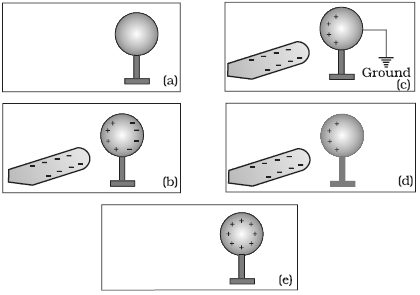
$1$. Take an uncharged metallic sphere mounted on an insulating stand,as shown in Fig. $(a)$.
$2$. Bring a negatively charged rod close to the metallic sphere,as shown in Fig. $(b)$. The free electrons in the sphere are repelled by the rod and move to the farther end,leaving the near end positively charged.
$3$. Connect the sphere to the ground using a conducting wire. The free electrons at the farther end flow to the ground due to repulsion,while the positive charges at the near end remain held due to the attractive force of the rod,as shown in Fig. $(c)$.
$4$. Disconnect the sphere from the ground. The positive charge remains trapped at the near end,as shown in Fig. $(d)$.
$5$. Finally,remove the charged rod. The positive charge redistributes itself uniformly over the surface of the sphere,as shown in Fig. $(e)$.
In this experiment,the sphere is charged by induction,and the rod does not lose any of its charge. $A$ similar process can be used to charge a sphere negatively by using a positively charged rod.
$1$. Take an uncharged metallic sphere mounted on an insulating stand,as shown in Fig. $(a)$.
$2$. Bring a negatively charged rod close to the metallic sphere,as shown in Fig. $(b)$. The free electrons in the sphere are repelled by the rod and move to the farther end,leaving the near end positively charged.
$3$. Connect the sphere to the ground using a conducting wire. The free electrons at the farther end flow to the ground due to repulsion,while the positive charges at the near end remain held due to the attractive force of the rod,as shown in Fig. $(c)$.
$4$. Disconnect the sphere from the ground. The positive charge remains trapped at the near end,as shown in Fig. $(d)$.
$5$. Finally,remove the charged rod. The positive charge redistributes itself uniformly over the surface of the sphere,as shown in Fig. $(e)$.
In this experiment,the sphere is charged by induction,and the rod does not lose any of its charge. $A$ similar process can be used to charge a sphere negatively by using a positively charged rod.
0 likes
View Solution53
EasyMCQ
If $10^{9}$ electrons move out of a body to another body every second,how much time is required to get a total charge of $1 \, C$ on the other body?
A
$100 \, \text{years}$
B
$200 \, \text{years}$
C
$250 \, \text{years}$
D
$300 \, \text{years}$
Solution
(B) The charge of one electron is $e = 1.6 \times 10^{-19} \, C$.
In one second,$10^{9}$ electrons move out of the body.
Therefore,the charge transferred in one second is $q = 10^{9} \times 1.6 \times 10^{-19} \, C = 1.6 \times 10^{-10} \, C/s$.
To accumulate a total charge of $Q = 1 \, C$,the time required $t$ is given by $t = Q / q$.
$t = 1 \, C / (1.6 \times 10^{-10} \, C/s) = 0.625 \times 10^{10} \, s = 6.25 \times 10^{9} \, s$.
To convert this time into years,we divide by the number of seconds in a year: $365 \times 24 \times 3600 \, s \approx 3.1536 \times 10^{7} \, s$.
$t \approx (6.25 \times 10^{9}) / (3.1536 \times 10^{7}) \approx 198.18 \, \text{years}$.
Rounding this value,we get approximately $200 \, \text{years}$.
In one second,$10^{9}$ electrons move out of the body.
Therefore,the charge transferred in one second is $q = 10^{9} \times 1.6 \times 10^{-19} \, C = 1.6 \times 10^{-10} \, C/s$.
To accumulate a total charge of $Q = 1 \, C$,the time required $t$ is given by $t = Q / q$.
$t = 1 \, C / (1.6 \times 10^{-10} \, C/s) = 0.625 \times 10^{10} \, s = 6.25 \times 10^{9} \, s$.
To convert this time into years,we divide by the number of seconds in a year: $365 \times 24 \times 3600 \, s \approx 3.1536 \times 10^{7} \, s$.
$t \approx (6.25 \times 10^{9}) / (3.1536 \times 10^{7}) \approx 198.18 \, \text{years}$.
Rounding this value,we get approximately $200 \, \text{years}$.
0 likes
View Solution54
MediumMCQ
How much positive and negative charge is there in a cup of water $(250 \; g)$?
A
$7.58 \times 10^{9} \; C$
B
$3.65 \times 10^{6} \; C$
C
$1.34 \times 10^{7} \; C$
D
$2.68 \times 10^{8} \; C$
Solution
(C) The mass of one cup of water is $m = 250 \; g$. The molar mass of water $(H_2O)$ is $18 \; g/mol$.
The number of moles in $250 \; g$ of water is $n = 250 / 18 \approx 13.89 \; mol$.
The number of molecules in one cup of water is $N = n \times N_A = (250 / 18) \times 6.022 \times 10^{23} \approx 8.36 \times 10^{24} \; \text{molecules}$.
Each water molecule $(H_2O)$ contains $2$ hydrogen atoms ($2$ protons,$2$ electrons) and $1$ oxygen atom ($8$ protons,$8$ electrons). Thus,each molecule has $10$ protons and $10$ electrons.
The total charge $q$ is given by $q = N \times (\text{number of protons per molecule}) \times e$,where $e = 1.602 \times 10^{-19} \; C$.
$q = (8.36 \times 10^{24}) \times 10 \times 1.602 \times 10^{-19} \; C \approx 1.34 \times 10^{7} \; C$.
Since the number of protons and electrons is equal,the magnitude of positive and negative charge is the same,which is $1.34 \times 10^{7} \; C$.
The number of moles in $250 \; g$ of water is $n = 250 / 18 \approx 13.89 \; mol$.
The number of molecules in one cup of water is $N = n \times N_A = (250 / 18) \times 6.022 \times 10^{23} \approx 8.36 \times 10^{24} \; \text{molecules}$.
Each water molecule $(H_2O)$ contains $2$ hydrogen atoms ($2$ protons,$2$ electrons) and $1$ oxygen atom ($8$ protons,$8$ electrons). Thus,each molecule has $10$ protons and $10$ electrons.
The total charge $q$ is given by $q = N \times (\text{number of protons per molecule}) \times e$,where $e = 1.602 \times 10^{-19} \; C$.
$q = (8.36 \times 10^{24}) \times 10 \times 1.602 \times 10^{-19} \; C \approx 1.34 \times 10^{7} \; C$.
Since the number of protons and electrons is equal,the magnitude of positive and negative charge is the same,which is $1.34 \times 10^{7} \; C$.
0 likes
View Solution55
Easy
$(a)$ Explain the meaning of the statement 'electric charge of a body is quantised'.
$(b)$ Why can one ignore quantisation of electric charge when dealing with macroscopic, i.e., large-scale charges?
$(b)$ Why can one ignore quantisation of electric charge when dealing with macroscopic, i.e., large-scale charges?
Solution
(N/A) The statement 'electric charge of a body is quantised' means that the electric charge of any body can only exist in integral multiples of the elementary charge $e$ (the charge of an electron). Mathematically, $q = ne$, where $n$ is an integer $(n = 0, \pm 1, \pm 2, \dots)$ and $e \approx 1.6 \times 10^{-19} \ C$. This implies that charge is not continuous but discrete.
$(b)$ On a macroscopic scale, the charges involved are extremely large compared to the elementary charge $e$. For example, a charge of $1 \ \mu C$ consists of approximately $6.25 \times 10^{12}$ electrons. Because the number of charges is so vast, the discrete nature of the charge becomes negligible, and the charge can be treated as a continuous quantity for all practical purposes.
$(b)$ On a macroscopic scale, the charges involved are extremely large compared to the elementary charge $e$. For example, a charge of $1 \ \mu C$ consists of approximately $6.25 \times 10^{12}$ electrons. Because the number of charges is so vast, the discrete nature of the charge becomes negligible, and the charge can be treated as a continuous quantity for all practical purposes.
1 likes
View Solution56
Easy
When a glass rod is rubbed with a silk cloth,charges appear on both. $A$ similar phenomenon is observed with many other pairs of bodies. Explain how this observation is consistent with the law of conservation of charge.
Solution
(N/A) When a glass rod is rubbed with a silk cloth,electrons are transferred from the glass rod to the silk cloth.
As a result,the glass rod acquires a positive charge and the silk cloth acquires an equal amount of negative charge.
The total charge of the system (glass rod + silk cloth) before rubbing is zero,and after rubbing,the total charge remains zero because the net charge is the algebraic sum of the positive and negative charges $(+q + (-q) = 0)$.
This observation is consistent with the law of conservation of charge,which states that the total electric charge of an isolated system remains constant over time.
Charges are neither created nor destroyed,only transferred from one body to another.
As a result,the glass rod acquires a positive charge and the silk cloth acquires an equal amount of negative charge.
The total charge of the system (glass rod + silk cloth) before rubbing is zero,and after rubbing,the total charge remains zero because the net charge is the algebraic sum of the positive and negative charges $(+q + (-q) = 0)$.
This observation is consistent with the law of conservation of charge,which states that the total electric charge of an isolated system remains constant over time.
Charges are neither created nor destroyed,only transferred from one body to another.
0 likes
View Solution57
Medium
$A$ polythene piece rubbed with wool is found to have a negative charge of $3 \times 10^{-7} \;C$.
$(a)$ Estimate the number of electrons transferred (from which to which?)
$(b)$ Is there a transfer of mass from wool to polythene?
$(a)$ Estimate the number of electrons transferred (from which to which?)
$(b)$ Is there a transfer of mass from wool to polythene?
Solution
(A) When polythene is rubbed against wool,a number of electrons get transferred from wool to polythene. Hence,wool becomes positively charged and polythene becomes negatively charged.
Amount of charge on the polythene piece,$q = -3 \times 10^{-7} \; C$.
Amount of charge on an electron,$e = -1.6 \times 10^{-19} \; C$.
Number of electrons transferred from wool to polythene $= n$.
$n$ can be calculated using the relation,$q = ne$.
$n = \frac{q}{e} = \frac{-3 \times 10^{-7}}{-1.6 \times 10^{-19}} = 1.875 \times 10^{12}$.
Therefore,the number of electrons transferred from wool to polythene is $1.875 \times 10^{12}$.
$(b)$ Yes. There is a transfer of mass taking place. This is because an electron has mass,$m_{e} = 9.1 \times 10^{-31} \; kg$.
Total mass transferred to polythene from wool,$m = n \times m_{e} = 1.875 \times 10^{12} \times 9.1 \times 10^{-31} \; kg$.
$m \approx 1.706 \times 10^{-18} \; kg$.
Hence,a negligible amount of mass is transferred from wool to polythene.
Amount of charge on the polythene piece,$q = -3 \times 10^{-7} \; C$.
Amount of charge on an electron,$e = -1.6 \times 10^{-19} \; C$.
Number of electrons transferred from wool to polythene $= n$.
$n$ can be calculated using the relation,$q = ne$.
$n = \frac{q}{e} = \frac{-3 \times 10^{-7}}{-1.6 \times 10^{-19}} = 1.875 \times 10^{12}$.
Therefore,the number of electrons transferred from wool to polythene is $1.875 \times 10^{12}$.
$(b)$ Yes. There is a transfer of mass taking place. This is because an electron has mass,$m_{e} = 9.1 \times 10^{-31} \; kg$.
Total mass transferred to polythene from wool,$m = n \times m_{e} = 1.875 \times 10^{12} \times 9.1 \times 10^{-31} \; kg$.
$m \approx 1.706 \times 10^{-18} \; kg$.
Hence,a negligible amount of mass is transferred from wool to polythene.
0 likes
View Solution58
Easy
Discuss the phenomena experienced due to electrostatics.
Solution
(N/A) All of us have the experience of seeing a spark or hearing a crackle when we take off our synthetic clothes or sweaters,particularly in dry weather,and also with ladies' garments like a polyester saree.
Another common example is the lightning that we see in the sky during thunderstorms.
We also experience a sensation of an electric shock while opening the door of a car or holding the iron bar of a bus after sliding from our seat.
The reason for these experiences is the discharge of electric charges through our body due to the rubbing of insulating surfaces (triboelectric effect).
Electrostatics deals with the study of forces,fields,and potentials arising from static charges.
Another common example is the lightning that we see in the sky during thunderstorms.
We also experience a sensation of an electric shock while opening the door of a car or holding the iron bar of a bus after sliding from our seat.
The reason for these experiences is the discharge of electric charges through our body due to the rubbing of insulating surfaces (triboelectric effect).
Electrostatics deals with the study of forces,fields,and potentials arising from static charges.
0 likes
View Solution59
Easy
Why is a spark seen when removing synthetic clothes in the dark during winter?
Solution
(N/A) $1$. During winter,the air is dry,meaning it has low humidity.
$2$. When synthetic clothes are removed,they rub against the body or other layers of clothing,causing the transfer of electrons due to friction (triboelectric effect).
$3$. This process results in the accumulation of static electric charges on the surface of the synthetic fabric.
$4$. Because the air is dry,it acts as a poor conductor,allowing the charge to build up to a high potential difference.
$5$. When the potential difference becomes high enough,it causes a momentary breakdown of the air's insulating property,leading to a rapid discharge of electricity in the form of a spark,which is visible in the dark.
$2$. When synthetic clothes are removed,they rub against the body or other layers of clothing,causing the transfer of electrons due to friction (triboelectric effect).
$3$. This process results in the accumulation of static electric charges on the surface of the synthetic fabric.
$4$. Because the air is dry,it acts as a poor conductor,allowing the charge to build up to a high potential difference.
$5$. When the potential difference becomes high enough,it causes a momentary breakdown of the air's insulating property,leading to a rapid discharge of electricity in the form of a spark,which is visible in the dark.
0 likes
View Solution60
Easy
What is called electrostatics?
Solution
(N/A) Electrostatics is the branch of physics that deals with the study of electric charges at rest. It involves the analysis of forces,fields,and potentials associated with static electric charges.
0 likes
View Solution61
Medium
$(a)$ $A$ comb run through one's dry hair attracts small bits of paper. Why? What happens if the hair is wet or if it is a rainy day? (Remember,a paper does not conduct electricity.)
$(b)$ Ordinary rubber is an insulator. But special rubber tyres of aircraft are made slightly conducting. Why is this necessary?
$(c)$ Vehicles carrying inflammable materials usually have metallic ropes touching the ground during motion. Why?
$(d)$ $A$ bird perches on a bare high power line,and nothing happens to the bird. $A$ man standing on the ground touches the same line and gets a fatal shock. Why?
$(b)$ Ordinary rubber is an insulator. But special rubber tyres of aircraft are made slightly conducting. Why is this necessary?
$(c)$ Vehicles carrying inflammable materials usually have metallic ropes touching the ground during motion. Why?
$(d)$ $A$ bird perches on a bare high power line,and nothing happens to the bird. $A$ man standing on the ground touches the same line and gets a fatal shock. Why?
Solution
(N/A) The comb gets charged due to friction with dry hair. This charged comb induces opposite charges on the near side of the paper bits,causing attraction. If the hair is wet or it is a rainy day,the moisture reduces friction and allows the charge to leak away,so the comb does not get sufficiently charged to attract paper.
$(b)$ Aircraft tyres are made slightly conducting to allow static charge,accumulated due to friction during landing,to flow safely to the ground,preventing sparks that could cause a fire.
$(c)$ Metallic ropes are used to conduct static electricity generated by the friction of the vehicle's body with air or road to the ground,preventing the buildup of charge that could ignite inflammable materials.
$(d)$ The bird is at the same potential as the wire,so no current flows through its body. The man,standing on the ground,creates a potential difference between the high-voltage line and the ground,causing a current to flow through his body.
$(b)$ Aircraft tyres are made slightly conducting to allow static charge,accumulated due to friction during landing,to flow safely to the ground,preventing sparks that could cause a fire.
$(c)$ Metallic ropes are used to conduct static electricity generated by the friction of the vehicle's body with air or road to the ground,preventing the buildup of charge that could ignite inflammable materials.
$(d)$ The bird is at the same potential as the wire,so no current flows through its body. The man,standing on the ground,creates a potential difference between the high-voltage line and the ground,causing a current to flow through his body.
0 likes
View Solution62
MediumMCQ
What is the reason behind the production of electric force between two particles?
A
Mass of the particles
B
Charge of the particles
C
Spin of the particles
D
Velocity of the particles
Solution
(B) The electric force between two particles is fundamentally caused by their electric charges. According to Coulomb's Law,the force $F$ between two point charges $q_1$ and $q_2$ separated by a distance $r$ is given by $F = k \frac{|q_1 q_2|}{r^2}$,where $k$ is Coulomb's constant. This force arises due to the interaction of the electric fields generated by these charges.
0 likes
View Solution63
EasyMCQ
What is the order of current flowing during lightning in the sky?
A
$10^1$ to $10^2 \ A$
B
$10^4$ to $10^5 \ A$
C
$10^7$ to $10^8 \ A$
D
$10^{-1}$ to $10^{-2} \ A$
Solution
(B) During a lightning discharge,a massive amount of charge is transferred between the clouds and the ground or between two clouds in a very short duration of time.
The typical current involved in a lightning strike ranges from $10,000 \ A$ to $100,000 \ A$.
This corresponds to the order of $10^4 \ A$ to $10^5 \ A$.
Therefore,the correct option is $B$.
The typical current involved in a lightning strike ranges from $10,000 \ A$ to $100,000 \ A$.
This corresponds to the order of $10^4 \ A$ to $10^5 \ A$.
Therefore,the correct option is $B$.
0 likes
View Solution64
EasyMCQ
Fill in the blanks:
$(i)$ $A$ static charge produces a ...... field around it. (Electric,Magnetic)
$(ii)$ $A$ moving charge produces a ...... field around it.
$(i)$ $A$ static charge produces a ...... field around it. (Electric,Magnetic)
$(ii)$ $A$ moving charge produces a ...... field around it.
A
Electric,Magnetic
B
Magnetic,Electric
C
Electric,Electric and Magnetic
D
Magnetic,Electric and Magnetic
Solution
(C) $(i)$ $A$ static charge (a charge at rest) produces only an electric field in the space surrounding it.
$(ii)$ $A$ moving charge (a charge in motion) produces both an electric field and a magnetic field in the space surrounding it.
$(ii)$ $A$ moving charge (a charge in motion) produces both an electric field and a magnetic field in the space surrounding it.
0 likes
View Solution65
Easy
Discuss the historical observation of frictional electrics.
Solution
(N/A) The discovery that amber,when rubbed with wool or silk cloth,acquires the property of attracting light objects is attributed to Thales of Miletus,a Greek philosopher,around $600 BC$. This phenomenon is the earliest recorded observation of static electricity,where the term 'electricity' is derived from the Greek word 'elektron',meaning amber.
0 likes
View Solution66
Easy
From what word is the name 'electricity' coined? Explain its meaning.
Solution
(N/A) The name 'electricity' is derived from the Greek word 'elektron',which means 'amber'. In ancient times,it was observed that when amber is rubbed with fur,it acquires the property of attracting light objects like bits of paper or straw. This phenomenon was the first recorded observation of static electricity.
0 likes
View Solution67
Medium
Discuss the types of electric charges by rubbing appropriate non-conductors. Which scientist gave their names?
Solution
(N/A) Any matter is primarily composed of two particles: $Electron$ and $Proton$.
The charge on an $Electron$ is considered negative, and the charge on a $Proton$ is considered positive. Electric charge is a scalar quantity.
When two non-conductors are rubbed together, electrons are transferred from one body to another due to their lower mass compared to protons. The body that gains electrons becomes negatively charged, and the body that loses electrons becomes positively charged.
The terms 'positive' and 'negative' for electric charges were introduced by the American scientist $Benjamin$ $Franklin$.
$A$ body possessing a net charge is called a charged body, while a body with no net charge is called a neutral body.
When two bodies with equal and opposite charges are brought into contact, they neutralize each other.
The following table shows the types of charges acquired by various non-conducting objects when rubbed together:
The charge on an $Electron$ is considered negative, and the charge on a $Proton$ is considered positive. Electric charge is a scalar quantity.
When two non-conductors are rubbed together, electrons are transferred from one body to another due to their lower mass compared to protons. The body that gains electrons becomes negatively charged, and the body that loses electrons becomes positively charged.
The terms 'positive' and 'negative' for electric charges were introduced by the American scientist $Benjamin$ $Franklin$.
$A$ body possessing a net charge is called a charged body, while a body with no net charge is called a neutral body.
When two bodies with equal and opposite charges are brought into contact, they neutralize each other.
The following table shows the types of charges acquired by various non-conducting objects when rubbed together:
| $1. \text{Pair}$ | $2. \text{Positive Charge Object}$ | $3. \text{Negative Charge Object}$ |
| Glass rod and Silk cloth | Glass rod | Silk cloth |
| Wool and Plastic comb | Wool | Plastic comb |
| Cat fur and Ebonite rod | Cat fur | Ebonite rod |
0 likes
View Solution68
Difficult
How can you represent experimentally that $(i)$ there are two types of charges and $(ii)$ there is repulsion between two like charges and attraction between two unlike charges?
Solution
(N/A) The existence of two types of charges on different bodies is demonstrated by the following experiments:
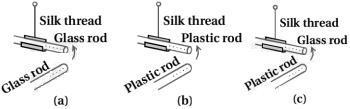
- Experiment $1$: When two glass rods,rubbed with silk or wool,are brought close to each other,they repel each other,as shown in figure $(a)$. Similarly,two plastic rods rubbed with fur also repel each other.
- Experiment $2$: When a glass rod rubbed with silk is brought near a plastic rod rubbed with fur,they attract each other,as shown in figure $(c)$.
- Pith Ball Experiment: If a pith ball is touched with a charged glass rod,it acquires a positive charge. If another pith ball is touched with a charged plastic rod,it acquires a negative charge. It is observed that two pith balls charged by the same type of rod repel each other (like charges),while a pith ball charged by a glass rod attracts a pith ball charged by a plastic rod (unlike charges).
Conclusion: These experiments confirm that there are only two types of electric charges,conventionally named positive and negative. Like charges repel each other,and unlike charges attract each other. The property that differentiates these two types of charges is called the polarity of charge.
- Experiment $1$: When two glass rods,rubbed with silk or wool,are brought close to each other,they repel each other,as shown in figure $(a)$. Similarly,two plastic rods rubbed with fur also repel each other.
- Experiment $2$: When a glass rod rubbed with silk is brought near a plastic rod rubbed with fur,they attract each other,as shown in figure $(c)$.
- Pith Ball Experiment: If a pith ball is touched with a charged glass rod,it acquires a positive charge. If another pith ball is touched with a charged plastic rod,it acquires a negative charge. It is observed that two pith balls charged by the same type of rod repel each other (like charges),while a pith ball charged by a glass rod attracts a pith ball charged by a plastic rod (unlike charges).
Conclusion: These experiments confirm that there are only two types of electric charges,conventionally named positive and negative. Like charges repel each other,and unlike charges attract each other. The property that differentiates these two types of charges is called the polarity of charge.
0 likes
View Solution69
Easy
What are positive and negative charges? Which type of charge does an electron have?
Solution
(N/A) The terms positive and negative for charges were introduced by the American scientist $Benjamin$ $Franklin$.
This naming convention is analogous to mathematical numbers,where adding a positive number to a negative number of the same magnitude results in a sum of zero. Similarly,when equal amounts of positive and negative charges are combined,they neutralize each other.
Based on this convention,an electron is defined as having a negative charge.
This naming convention is analogous to mathematical numbers,where adding a positive number to a negative number of the same magnitude results in a sum of zero. Similarly,when equal amounts of positive and negative charges are combined,they neutralize each other.
Based on this convention,an electron is defined as having a negative charge.
0 likes
View Solution70
Medium
Which instrument is used to detect the charge on a body? Explain it with a diagram.
Solution
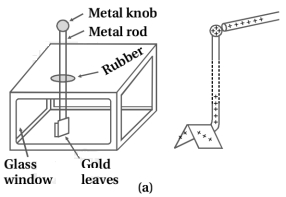
(N/A) simple apparatus used to detect the charge on a body is the gold-leaf electroscope,as shown in the figure.
It consists of a vertical metal rod housed in a box,with two thin gold leaves attached to its bottom end.
When a charged object touches the metal knob at the top of the rod,the charge flows onto the leaves,causing them to diverge due to electrostatic repulsion.
The degree of divergence is an indicator of the amount of charge present on the body.
It consists of a vertical metal rod housed in a box,with two thin gold leaves attached to its bottom end.
When a charged object touches the metal knob at the top of the rod,the charge flows onto the leaves,causing them to diverge due to electrostatic repulsion.
The degree of divergence is an indicator of the amount of charge present on the body.
0 likes
View Solution71
Medium
Describe the activity to construct a simple electroscope.
Solution
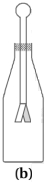
(N/A) $1$. Take a thin aluminium curtain rod with ball ends, typically used for hanging curtains.
$2$. Cut a piece of the rod approximately $20 \,cm$ long, ensuring one end has the ball and the other end is flattened.
$3$. Take a large bottle that can accommodate the rod and a cork that fits securely into the bottle's opening.
$4$. Insert the rod through the cork such that about $5 \,cm$ of the ball end projects above the cork.
$5$. Fold a small, thin strip of aluminium foil (about $6 \,cm$ in length) in the middle and attach it to the flattened end of the rod using cellulose tape.
$6$. Place a paper scale inside the bottle beforehand to measure the separation of the aluminium leaves.
$7$. The separation between the leaves provides a rough measure of the amount of charge present on the electroscope.
$2$. Cut a piece of the rod approximately $20 \,cm$ long, ensuring one end has the ball and the other end is flattened.
$3$. Take a large bottle that can accommodate the rod and a cork that fits securely into the bottle's opening.
$4$. Insert the rod through the cork such that about $5 \,cm$ of the ball end projects above the cork.
$5$. Fold a small, thin strip of aluminium foil (about $6 \,cm$ in length) in the middle and attach it to the flattened end of the rod using cellulose tape.
$6$. Place a paper scale inside the bottle beforehand to measure the separation of the aluminium leaves.
$7$. The separation between the leaves provides a rough measure of the amount of charge present on the electroscope.
0 likes
View Solution72
Medium
How does a simple paper electroscope work?
Solution
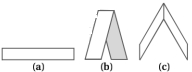
(N/A) $1$. Take a strip of white paper and fold it in half to create a crease.
$2$. Open the strip and iron it lightly as shown in figure $(a)$ and $(b)$.
$3$. Hold the strip by pinching it at the fold. You will notice that the two halves move apart as shown in figure $(c)$.
$4$. This occurs because the process of ironing transfers charge to the paper strip.
$5$. Since both halves of the strip acquire the same type of charge,they exert an electrostatic force of repulsion on each other,causing them to move apart.
$2$. Open the strip and iron it lightly as shown in figure $(a)$ and $(b)$.
$3$. Hold the strip by pinching it at the fold. You will notice that the two halves move apart as shown in figure $(c)$.
$4$. This occurs because the process of ironing transfers charge to the paper strip.
$5$. Since both halves of the strip acquire the same type of charge,they exert an electrostatic force of repulsion on each other,causing them to move apart.
0 likes
View Solution73
EasyMCQ
Why does matter obtain electric charge?
A
Due to the presence of protons only.
B
Due to the presence of electrons only.
C
Due to the presence of charged particles like protons and electrons within atoms.
D
Due to the presence of neutrons.
Solution
(C) All matter is made up of atoms and/or molecules.
Although normally materials are electrically neutral,they do contain charges; however,their positive and negative charges are exactly balanced.
Forces that hold molecules together,forces that hold atoms together in a solid,the adhesive force of glue,and forces associated with surface tension are all basically electrical in nature,arising from the forces between charged particles (protons and electrons).
Thus,the electric force is all-pervasive,and matter exhibits electric charge due to the fundamental charged constituents within its atomic structure.
Although normally materials are electrically neutral,they do contain charges; however,their positive and negative charges are exactly balanced.
Forces that hold molecules together,forces that hold atoms together in a solid,the adhesive force of glue,and forces associated with surface tension are all basically electrical in nature,arising from the forces between charged particles (protons and electrons).
Thus,the electric force is all-pervasive,and matter exhibits electric charge due to the fundamental charged constituents within its atomic structure.
0 likes
View Solution74
Medium
How can a neutral body be charged electrically?
Solution
(N/A) To electrify a neutral body,we need to add or remove one kind of charge.
$A$ body can be charged positively by losing some of its electrons. Similarly,a body can be charged negatively by gaining electrons.
The body that loses electrons experiences a slight decrease in mass,while the body that gains electrons experiences a slight increase in mass.
When we rub a glass rod with silk,some electrons from the rod are transferred to the silk cloth. Thus,the rod becomes positively charged and the silk becomes negatively charged.
No new charge is created in the process of rubbing; charge is only redistributed.
$A$ body can be charged positively by losing some of its electrons. Similarly,a body can be charged negatively by gaining electrons.
The body that loses electrons experiences a slight decrease in mass,while the body that gains electrons experiences a slight increase in mass.
When we rub a glass rod with silk,some electrons from the rod are transferred to the silk cloth. Thus,the rod becomes positively charged and the silk becomes negatively charged.
No new charge is created in the process of rubbing; charge is only redistributed.
0 likes
View Solution75
MediumMCQ
What was found by Thales of Miletus?
A
The existence of magnetic poles.
B
The phenomenon of static electricity by rubbing amber with fur.
C
The law of universal gravitation.
D
The principle of electromagnetic induction.
Solution
(B) Thales of Miletus,a Greek philosopher,discovered that when amber (a fossilized resin) is rubbed with fur,it acquires the property of attracting light objects like small pieces of paper or straw. This phenomenon is the earliest recorded observation of static electricity.
0 likes
View Solution76
MediumMCQ
What is the Greek meaning of the word 'electrics'?
A
Amber
B
Light
C
Energy
D
Force
Solution
(A) The word 'electric' is derived from the Greek word 'elektron',which means 'amber'.
In ancient times,it was observed that when amber was rubbed with fur,it acquired the property of attracting light objects like bits of paper or straw.
In ancient times,it was observed that when amber was rubbed with fur,it acquired the property of attracting light objects like bits of paper or straw.
0 likes
View Solution77
Easy
What is electric charge? Is it a scalar or a vector quantity?
Solution
(N/A) Electric charge is an intrinsic property of matter that causes it to experience a force when placed in an electromagnetic field. It is the fundamental property of subatomic particles like protons and electrons.
Electric charge is a scalar quantity. Although it has positive and negative signs,these signs represent the nature of the charge (like or unlike) rather than a direction in space. It follows the algebraic laws of addition,not vector addition.
Electric charge is a scalar quantity. Although it has positive and negative signs,these signs represent the nature of the charge (like or unlike) rather than a direction in space. It follows the algebraic laws of addition,not vector addition.
0 likes
View Solution78
MediumMCQ
Which scientist represented the types of charges?
A
Benjamin Franklin
B
Charles-Augustin de Coulomb
C
Michael Faraday
D
$J$.$J$. Thomson
Solution
(A) The concept of positive and negative charges was introduced by the American scientist $Benjamin \ Franklin$. He proposed that there is only one type of electric fluid,and the terms 'positive' and 'negative' were used to describe the excess or deficiency of this fluid.
0 likes
View Solution79
MediumMCQ
What are called electrically charged and electrically neutral bodies?
A
Bodies with net charge and zero net charge respectively.
B
Bodies with positive charge and negative charge respectively.
C
Bodies with equal number of protons and electrons.
D
Bodies with only electrons and only protons.
Solution
(A) An electrically charged body is one that possesses a net electric charge,meaning the total number of protons and electrons is not equal. If the number of electrons exceeds the number of protons,the body is negatively charged. If the number of protons exceeds the number of electrons,the body is positively charged.
An electrically neutral body is one that has no net electric charge. This occurs when the total number of protons (positive charge) is exactly equal to the total number of electrons (negative charge) within the body,resulting in a net charge of $0$.
An electrically neutral body is one that has no net electric charge. This occurs when the total number of protons (positive charge) is exactly equal to the total number of electrons (negative charge) within the body,resulting in a net charge of $0$.
0 likes
View Solution80
MediumMCQ
What is called the polarity of electric charge?
A
The magnitude of the charge.
B
The property which differentiates the two types of charges.
C
The ability of a charge to attract other charges.
D
The total amount of charge in a system.
Solution
(B) The polarity of electric charge refers to the property that distinguishes the two types of electric charges,namely positive $(+)$ and negative $(-)$.
This property determines how charges interact with each other: like charges repel,while unlike charges attract.
Therefore,the correct answer is the property which differentiates the two types of charges.
This property determines how charges interact with each other: like charges repel,while unlike charges attract.
Therefore,the correct answer is the property which differentiates the two types of charges.
0 likes
View Solution81
MediumMCQ
By which instrument can the charge on an object be detected?
A
Electrometer
B
Electroscope
C
Galvanometer
D
Voltmeter
Solution
(B) An $Electroscope$ is a scientific instrument used to detect the presence of an electric charge on a body.
It works on the principle of electrostatic induction and repulsion between like charges.
When a charged object is brought near the metal knob of the electroscope,the leaves diverge due to the redistribution of charge,indicating the presence of an electric charge.
It works on the principle of electrostatic induction and repulsion between like charges.
When a charged object is brought near the metal knob of the electroscope,the leaves diverge due to the redistribution of charge,indicating the presence of an electric charge.
0 likes
View Solution82
Easy
Why can only electrons transfer from one body to another body in frictional electricity?
Solution
(N/A) In an atom,protons are located inside the nucleus and are tightly bound by the strong nuclear force,which is the strongest force in nature. Electrons,on the other hand,revolve around the nucleus in outer orbits and are bound to the nucleus by a relatively weaker electrostatic force. During friction,the energy provided is sufficient to overcome the binding energy of the outer electrons,allowing them to be transferred from one body to another. Protons,being deeply embedded in the nucleus,cannot be removed by such small amounts of energy.
0 likes
View Solution83
EasyMCQ
What type of charges are obtained on silk cloth and glass rod when they are rubbed against each other?
A
Silk cloth: Positive,Glass rod: Negative
B
Silk cloth: Negative,Glass rod: Positive
C
Both: Positive
D
Both: Negative
Solution
(B) When a glass rod is rubbed with a silk cloth,electrons are transferred from the glass rod to the silk cloth due to the difference in their work functions.
Since the glass rod loses electrons,it becomes positively charged.
Since the silk cloth gains electrons,it becomes negatively charged.
Therefore,the glass rod acquires a positive charge and the silk cloth acquires a negative charge.
Since the glass rod loses electrons,it becomes positively charged.
Since the silk cloth gains electrons,it becomes negatively charged.
Therefore,the glass rod acquires a positive charge and the silk cloth acquires a negative charge.
0 likes
View Solution84
Medium
How are conductors and non-conductors different? Why are they not charged by rubbing them with our hands?
Solution
(N/A) Conductors are materials that allow electricity to pass through them easily because they possess free electrons that can move throughout the material. Examples include metals,human and animal bodies,and the Earth.
Non-conductors (insulators) are materials that do not allow electricity to pass through them. Most non-metals,such as glass,porcelain,plastic,nylon,and wood,offer high resistance to the passage of electricity.
When charge is transferred to a conductor,it readily distributes over the entire surface. In contrast,if charge is placed on an insulator,it remains localized at the point of contact.
When a metal rod is rubbed with our hands,it does not become charged because any charge generated leaks through our body to the Earth,as both the human body and the Earth are conductors.
Non-conductors (insulators) are materials that do not allow electricity to pass through them. Most non-metals,such as glass,porcelain,plastic,nylon,and wood,offer high resistance to the passage of electricity.
When charge is transferred to a conductor,it readily distributes over the entire surface. In contrast,if charge is placed on an insulator,it remains localized at the point of contact.
When a metal rod is rubbed with our hands,it does not become charged because any charge generated leaks through our body to the Earth,as both the human body and the Earth are conductors.
0 likes
View Solution85
Easy
Give examples of non-conductors and conductors.
Solution
(N/A) Conductors are materials that allow electric charges to flow through them easily. Examples include metals like $Copper$,$Silver$,$Aluminum$,and $Iron$,as well as the human body and earth.
Non-conductors (also known as insulators) are materials that do not allow electric charges to flow through them easily. Examples include $Glass$,$Plastic$,$Rubber$,$Wood$,and $Ebonite$.
Non-conductors (also known as insulators) are materials that do not allow electric charges to flow through them easily. Examples include $Glass$,$Plastic$,$Rubber$,$Wood$,and $Ebonite$.
0 likes
View Solution86
Easy
Why can metal rods not be charged by holding them in hands?
Solution
(N/A) Metal rods are conductors of electricity. When you hold a metal rod with your bare hands,the charge induced on the rod flows through your body to the ground because the human body is also a conductor. Since the charge is continuously grounded,it cannot accumulate on the rod,making it impossible to charge the rod by holding it directly.
0 likes
View Solution87
Medium
What is electrostatic induction?
Solution
(N/A) When an uncharged conducting body is charged by bringing a charged body near it without making physical contact,this process is called charging by induction. Since the induced charges remain at rest on the surface of the conductor,this phenomenon is known as electrostatic induction.
0 likes
View Solution88
Easy
Mention the types of methods of charging a body.
Solution
(N/A) body can be charged in three main ways:
$(1)$ Charging by friction: When two neutral bodies are rubbed against each other,electrons are transferred from one body to another,resulting in equal and opposite charges.
$(2)$ Charging by conduction: When a charged body is brought into physical contact with an uncharged body,charge is transferred from the charged body to the uncharged body.
$(3)$ Charging by induction: When a charged body is brought near an uncharged body without making physical contact,the charges in the uncharged body are redistributed,and it becomes charged.
$(1)$ Charging by friction: When two neutral bodies are rubbed against each other,electrons are transferred from one body to another,resulting in equal and opposite charges.
$(2)$ Charging by conduction: When a charged body is brought into physical contact with an uncharged body,charge is transferred from the charged body to the uncharged body.
$(3)$ Charging by induction: When a charged body is brought near an uncharged body without making physical contact,the charges in the uncharged body are redistributed,and it becomes charged.
0 likes
View Solution89
Easy
How can an object be charged by contact?
Solution
(N/A) When we touch a neutral object (such as a pith ball) with a charged object (such as an electrified plastic rod),some of the charge from the charged object is transferred to the neutral object.
As a result,the neutral object acquires the same type of charge as the original charged object.
This process is known as charging by contact or conduction.
For example,if a negatively charged plastic rod touches a pith ball,electrons flow from the rod to the ball,making the ball negatively charged.
Consequently,the pith ball is repelled by the plastic rod due to like charges,but it would be attracted to a glass rod that carries an opposite (positive) charge.
As a result,the neutral object acquires the same type of charge as the original charged object.
This process is known as charging by contact or conduction.
For example,if a negatively charged plastic rod touches a pith ball,electrons flow from the rod to the ball,making the ball negatively charged.
Consequently,the pith ball is repelled by the plastic rod due to like charges,but it would be attracted to a glass rod that carries an opposite (positive) charge.
0 likes
View Solution90
Medium
Discuss the method of charging two spheres without contact.
Solution
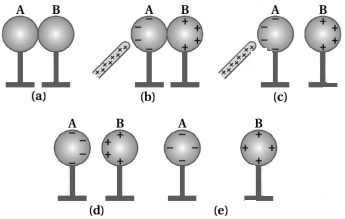
(N/A) $(i)$ Bring two metal spheres,$A$ and $B$,supported on insulating stands,into contact as shown in figure $(a)$.
$(ii)$ Bring a positively charged rod near one of the spheres,say $A$,taking care that it does not touch the sphere.
The free electrons in the spheres are attracted towards the rod. This leaves an excess of positive charge on the rear surface of sphere $B$. Both kinds of charges are bound in the metal spheres and cannot escape. They,therefore,reside on the surfaces,as shown in figure $(b)$.
The left surface of sphere $A$ has an excess of negative charge and the right surface of sphere $B$ has an excess of positive charge.
As the negative charge starts building up at the left surface of $A$,other electrons are repelled by these. In a short time,equilibrium is reached under the action of the force of attraction of the rod and the force of repulsion due to the accumulated charges. Figure $(b)$ shows the equilibrium situation.
The accumulated charges remain on the surface,as shown,till the glass rod is held near the sphere. If the rod is removed,the charges are not acted upon by any outside force and they redistribute to their original neutral state.
$(iii)$ Separate the spheres by a small distance while the glass rod is still held near sphere $A$,as shown in figure $(c)$. The two spheres are found to be oppositely charged and attract each other.
$(iv)$ Remove the rod. The charges on the spheres rearrange themselves as shown in figure $(d)$. Now,separate the spheres further apart.
The charges on them get uniformly distributed over them,as shown in figure $(e)$.
$(v)$ In this process,the metal spheres will each be equal and oppositely charged. This is charging by induction.
$(ii)$ Bring a positively charged rod near one of the spheres,say $A$,taking care that it does not touch the sphere.
The free electrons in the spheres are attracted towards the rod. This leaves an excess of positive charge on the rear surface of sphere $B$. Both kinds of charges are bound in the metal spheres and cannot escape. They,therefore,reside on the surfaces,as shown in figure $(b)$.
The left surface of sphere $A$ has an excess of negative charge and the right surface of sphere $B$ has an excess of positive charge.
As the negative charge starts building up at the left surface of $A$,other electrons are repelled by these. In a short time,equilibrium is reached under the action of the force of attraction of the rod and the force of repulsion due to the accumulated charges. Figure $(b)$ shows the equilibrium situation.
The accumulated charges remain on the surface,as shown,till the glass rod is held near the sphere. If the rod is removed,the charges are not acted upon by any outside force and they redistribute to their original neutral state.
$(iii)$ Separate the spheres by a small distance while the glass rod is still held near sphere $A$,as shown in figure $(c)$. The two spheres are found to be oppositely charged and attract each other.
$(iv)$ Remove the rod. The charges on the spheres rearrange themselves as shown in figure $(d)$. Now,separate the spheres further apart.
The charges on them get uniformly distributed over them,as shown in figure $(e)$.
$(v)$ In this process,the metal spheres will each be equal and oppositely charged. This is charging by induction.
0 likes
View Solution91
Difficult
Why do light particles like pith balls attract towards a charged rod?
Solution
(N/A) When an electrified rod is brought near light objects,the rod induces opposite charges on the near surfaces of the objects and similar charges move to the further side of the object.
The centers of the two types of charges are slightly separated. We know that opposite charges attract while similar charges repel.
The magnitude of the force depends on the distance between the charges. Since the opposite charges are closer to the rod than the similar charges,the force of attraction is greater than the force of repulsion.
As a result,light particles like bits of paper or pith balls are pulled towards the rod.
The centers of the two types of charges are slightly separated. We know that opposite charges attract while similar charges repel.
The magnitude of the force depends on the distance between the charges. Since the opposite charges are closer to the rod than the similar charges,the force of attraction is greater than the force of repulsion.
As a result,light particles like bits of paper or pith balls are pulled towards the rod.
0 likes
View Solution92
EasyMCQ
Why does a charged particle attract light,neutral particles?
A
Due to gravitational force
B
Due to electrostatic induction
C
Due to magnetic force
D
Due to nuclear force
Solution
(B) When a charged particle is brought near a light,neutral particle,it induces a redistribution of charges within the neutral particle.
This phenomenon is known as electrostatic induction.
The side of the neutral particle closer to the charged particle develops an opposite charge,while the side farther away develops a similar charge.
Since the opposite charge is closer to the source charge,the attractive force between them is stronger than the repulsive force between the like charges.
Consequently,the net force on the neutral particle is attractive.
This phenomenon is known as electrostatic induction.
The side of the neutral particle closer to the charged particle develops an opposite charge,while the side farther away develops a similar charge.
Since the opposite charge is closer to the source charge,the attractive force between them is stronger than the repulsive force between the like charges.
Consequently,the net force on the neutral particle is attractive.
0 likes
View Solution93
EasyMCQ
What is a point charge?
A
$A$ charge with zero mass.
B
$A$ charge whose size is negligible compared to the distance between it and other charges.
C
$A$ charge that exists only at the origin.
D
$A$ charge that is always positive.
Solution
(B) If the sizes of charged bodies are very small compared to the distances between them,they are called point charges.
In this model,all the charge content of the body is assumed to be concentrated at a single point in space.
In this model,all the charge content of the body is assumed to be concentrated at a single point in space.
0 likes
View Solution94
Medium
What is the meaning of the additive nature of electric charges?
Solution
(N/A) Electric charge is a scalar quantity.
The total charge of a system is obtained by adding the individual charges algebraically.
If a system contains $n$ charges $q_{1}, q_{2}, q_{3}, \ldots, q_{n}$,then the total charge $Q$ of the system is given by $Q = q_{1} + q_{2} + q_{3} + \ldots + q_{n}$.
Therefore,$Q = \sum_{i=1}^{n} q_{i}$,where $i = 1, 2, 3, \ldots, n$.
Proper signs (positive or negative) must be used while adding the charges in a system. For example,if a system contains five charges $+1, +2, -3, +4,$ and $-5$ in some arbitrary unit,the total charge is $(+1) + (+2) + (-3) + (+4) + (-5) = -1$ in the same unit.
The total charge of a system is obtained by adding the individual charges algebraically.
If a system contains $n$ charges $q_{1}, q_{2}, q_{3}, \ldots, q_{n}$,then the total charge $Q$ of the system is given by $Q = q_{1} + q_{2} + q_{3} + \ldots + q_{n}$.
Therefore,$Q = \sum_{i=1}^{n} q_{i}$,where $i = 1, 2, 3, \ldots, n$.
Proper signs (positive or negative) must be used while adding the charges in a system. For example,if a system contains five charges $+1, +2, -3, +4,$ and $-5$ in some arbitrary unit,the total charge is $(+1) + (+2) + (-3) + (+4) + (-5) = -1$ in the same unit.
0 likes
View Solution95
Medium
Give the differences between charge and mass.
Solution
(N/A)
| Charge | Mass |
| $1$. It produces an electric field. | $1$. It produces a gravitational field. |
| $2$. It is an intrinsic property of matter. | $2$. It represents the quantity of matter in a body. |
| $3$. It can be positive or negative. | $3$. It is always positive. |
| $4$. Its value is invariant with respect to speed. | $4$. Its value increases with speed according to the relation $m = \frac{m_0}{\sqrt{1 - v^2/c^2}}$. |
| $5$. The force produced by it can be attractive or repulsive. | $5$. The force produced by it is always attractive. |
| $6$. Its $SI$ unit is coulomb $(C)$. | $6$. Its $SI$ unit is kilogram $(kg)$. |
0 likes
View Solution96
Easy
Write the law of conservation of charge. Give one example.
Solution
(N/A) The law of conservation of charge states that the total electric charge of an isolated system remains constant over time.
This means that charge can neither be created nor destroyed,only transferred from one body to another.
Example: In the process of beta decay,a neutron decays into a proton and an electron.
Equation: $0n^1 \rightarrow {}_{1}p^1 + {}_{-1}e^0$
Before the decay,the net charge is $0$. After the decay,the net charge is $(+1) + (-1) = 0$. Thus,the total charge is conserved.
This means that charge can neither be created nor destroyed,only transferred from one body to another.
Example: In the process of beta decay,a neutron decays into a proton and an electron.
Equation: $0n^1 \rightarrow {}_{1}p^1 + {}_{-1}e^0$
Before the decay,the net charge is $0$. After the decay,the net charge is $(+1) + (-1) = 0$. Thus,the total charge is conserved.
0 likes
View Solution97
Medium
What is quantization of charge? What is the reason for quantization?
Solution
(N/A) Quantization of charge is the property by virtue of which all free charges are integral multiples of a basic unit of charge, denoted by $e$. This means that any charge $q$ on a body can be expressed as $q = ne$, where $n$ is an integer $(n = 0, \pm 1, \pm 2, \dots)$ and $e \approx 1.602 \times 10^{-19} \ C$.
The quantization of charge was first suggested by the experimental laws of electrolysis discovered by the English scientist Michael Faraday. It was later experimentally demonstrated by Robert Millikan in $1912$.
The fundamental reason for quantization is that during the process of charging (such as rubbing two bodies together), only an integral number of electrons can be transferred from one body to another. Since an electron cannot be divided into smaller parts, the charge transferred must always be an integer multiple of the elementary charge $e$.
The quantization of charge was first suggested by the experimental laws of electrolysis discovered by the English scientist Michael Faraday. It was later experimentally demonstrated by Robert Millikan in $1912$.
The fundamental reason for quantization is that during the process of charging (such as rubbing two bodies together), only an integral number of electrons can be transferred from one body to another. Since an electron cannot be divided into smaller parts, the charge transferred must always be an integer multiple of the elementary charge $e$.
0 likes
View Solution98
Medium
Mention the $SI$ unit and value of fundamental charge. Write its smaller units.
Solution
(N/A) The electric charge of an electron is called the fundamental charge. Its symbol is $e$ and its charge is negative.
In the International System $(SI)$ of units,the unit of charge is the coulomb,denoted by the symbol $C$.
One coulomb is defined as the charge flowing through a wire in $1 \ s$ when the current is $1 \ A$ (ampere).
The value of the fundamental charge is $e = 1.602192 \times 10^{-19} \ C$. In general,it is taken as $e = 1.6 \times 10^{-19} \ C$.
There are approximately $6.25 \times 10^{18}$ electrons in a charge of $-1 \ C$.
In electrostatics,smaller units of charge are:
$1 \ mC$ (milli coulomb) $= 10^{-3} \ C$
$1 \ \mu C$ (micro coulomb) $= 10^{-6} \ C$
$1 \ nC$ (nano coulomb) $= 10^{-9} \ C$
In the International System $(SI)$ of units,the unit of charge is the coulomb,denoted by the symbol $C$.
One coulomb is defined as the charge flowing through a wire in $1 \ s$ when the current is $1 \ A$ (ampere).
The value of the fundamental charge is $e = 1.602192 \times 10^{-19} \ C$. In general,it is taken as $e = 1.6 \times 10^{-19} \ C$.
There are approximately $6.25 \times 10^{18}$ electrons in a charge of $-1 \ C$.
In electrostatics,smaller units of charge are:
$1 \ mC$ (milli coulomb) $= 10^{-3} \ C$
$1 \ \mu C$ (micro coulomb) $= 10^{-6} \ C$
$1 \ nC$ (nano coulomb) $= 10^{-9} \ C$
0 likes
View Solution99
Medium
Why can we say that the charge of any body is always an integral multiple of $e$?
Solution
(N/A) The fundamental charges in the universe are protons and electrons,each having a magnitude of $e$.
Since any body is composed of a discrete number of these particles,the total charge $q$ on a body is the algebraic sum of the charges of its constituent protons and electrons.
If a body contains $n_2$ protons and $n_1$ electrons,the total charge is $q = n_2(e) + n_1(-e) = (n_2 - n_1)e$.
Let $n = (n_2 - n_1)$,where $n$ is an integer (positive,negative,or zero).
Therefore,$q = ne$.
This property is known as the quantization of charge,which states that the charge on any body is always an integral multiple of the elementary charge $e$.
Since any body is composed of a discrete number of these particles,the total charge $q$ on a body is the algebraic sum of the charges of its constituent protons and electrons.
If a body contains $n_2$ protons and $n_1$ electrons,the total charge is $q = n_2(e) + n_1(-e) = (n_2 - n_1)e$.
Let $n = (n_2 - n_1)$,where $n$ is an integer (positive,negative,or zero).
Therefore,$q = ne$.
This property is known as the quantization of charge,which states that the charge on any body is always an integral multiple of the elementary charge $e$.
0 likes
View Solution100
Difficult
Can we neglect the quantization of charge? If yes,then mention the situation.
Solution
(A) Yes,we can neglect the quantization of charge at the macroscopic level.
The step size $e$ is very small compared to the charges we deal with in daily life,which are typically of the order of a few $\mu C$.
At this scale,the fact that the charge of a body can only increase or decrease in discrete units of $e$ is not observable.
The grainy or discrete nature of the charge is lost,and it appears to be continuous.
This situation is analogous to a dotted line viewed from a distance; it appears continuous to the human eye even though it is composed of individual points.
At the macroscopic level,one deals with charges that are enormous compared to the magnitude of the elementary charge $e$.
For example,a charge of $1 \mu C$ contains approximately $10^{13}$ times the electronic charge. At this scale,the discrete nature of charge is negligible,and it can be treated as a continuous distribution.
However,at the microscopic level,where the charges involved are of the order of a few tens or hundreds of $e$,the discrete nature is significant,and quantization cannot be ignored.
The step size $e$ is very small compared to the charges we deal with in daily life,which are typically of the order of a few $\mu C$.
At this scale,the fact that the charge of a body can only increase or decrease in discrete units of $e$ is not observable.
The grainy or discrete nature of the charge is lost,and it appears to be continuous.
This situation is analogous to a dotted line viewed from a distance; it appears continuous to the human eye even though it is composed of individual points.
At the macroscopic level,one deals with charges that are enormous compared to the magnitude of the elementary charge $e$.
For example,a charge of $1 \mu C$ contains approximately $10^{13}$ times the electronic charge. At this scale,the discrete nature of charge is negligible,and it can be treated as a continuous distribution.
However,at the microscopic level,where the charges involved are of the order of a few tens or hundreds of $e$,the discrete nature is significant,and quantization cannot be ignored.
0 likes
View SolutionElectric Charges and Fields — Electric Charge, It's Properties and Method of Charging · Frequently Asked Questions
1Are these Electric Charges and Fields questions useful for JEE and NEET?
Yes. All questions in this section are mapped to JEE Main and NEET exam patterns. Previous year questions from JEE Main, NEET, GUJCET and state-level exams are included with full solutions.
2Can I switch to Hindi or Gujarati for these questions?
Yes. Use the language tabs in the hero section or the sidebar to view the same questions and solutions in English, Hindi or Gujarati.
3How do I generate a question paper from this subtopic?
Use the Vedclass Exam Paper Generator — select the chapter and subtopic, set difficulty, and generate Sets A, B, C, D automatically. First 3 chapters of every subject are free.
Vedclass Products
For Students
Vedclass Test Series
Mock tests in real JEE/NEET style with performance analysis. 5-day free trial.
Start Free TrialFor Teachers
Exam Paper Generator
Generate Set A/B/C/D papers from this chapter in 2 minutes. 3 chapters free.
Try FreeFor Institutes
Online Exam Module
Live online exams with unlimited students, 360° analytics & white-label branding.
See DemoFor Teachers & Institutes
Generate a Electric Charges and Fields Exam Paper in 2 Minutes
Select subtopic & difficulty — Sets A, B, C, D auto-generated with No Repeat logic.
First 3 chapters of every subject are free — no payment required.